Product Hunt 每日热榜 2026-02-13

PH热榜 | 2026-02-13

#1
Lovon AI Therapy
Talk it out and feel better
545
一句话介绍:一款基于语音对话、融合CBT等循证疗法的AI心理治疗应用,在用户经历情绪危机(如深夜失眠、分手痛苦)或无法即时获得真人治疗时,提供即时、可倾诉的陪伴与干预。
Artificial Intelligence Health
AI心理治疗 语音对话 认知行为疗法(CBT) 情绪支持 危机干预 心理健康科技 7x24小时服务 循证干预 数字疗法 情感陪伴
用户评论摘要:用户普遍认可其语音交互的便捷性与人性化,尤其赞赏其在分手恢复等急性情绪场景的价值。主要问题集中在网络依赖(是否支持离线)以及对AI如何做到“温和挑战而非一味认同”的技术原理好奇。团队回复积极,透露主要用户为寻求即时支持而非疗程补充的人群。
AI 锐评

Lovon AI Therapy 的亮相,精准刺入了传统心理治疗模式最柔软的腹部:即时性缺失与高门槛。它不标榜替代治疗师,而是定位为“疗程间的桥梁”与“急性情绪时刻的出口”,这是一个聪明且符合伦理的切入点。其宣称的“语音优先”和“基于循证疗法挑战非理性思维”,是试图与泛滥的共情型聊天机器人划清界限的关键技术叙事。

然而,其真正的挑战与价值评估均系于此。首先,“温和挑战”的算法实现是核心黑箱,这需要极其精细的提示工程与安全护栏设计,以避免伤害性回应或无效对话。用户对此的质疑直指要害。其次,其透露的“主要用户是经历分手、深夜难眠者”,揭示了产品更偏向于“情感陪伴与危机缓冲”,这与需要长期、结构化干预的“治疗”存在本质区别。它的价值可能更多体现在情绪疏导的即时可及性上,而非深度心理治疗。

团队背景(资深心理学家参与)和计划中的临床验证是建立信任的重要筹码,但必须清醒认识到,现有框架下AI作为“治疗工具”的效力证据仍处于早期。产品若能在“危机检测与转介”功能上做到可靠,其社会价值将远超商业价值。总之,Lovon 是一次有意义的场景化尝试,但它所面临的,是如何在“无害陪伴”与“有效干预”之间找到那条狭窄、合规且真正有效的路径。

查看原始信息
Lovon AI Therapy
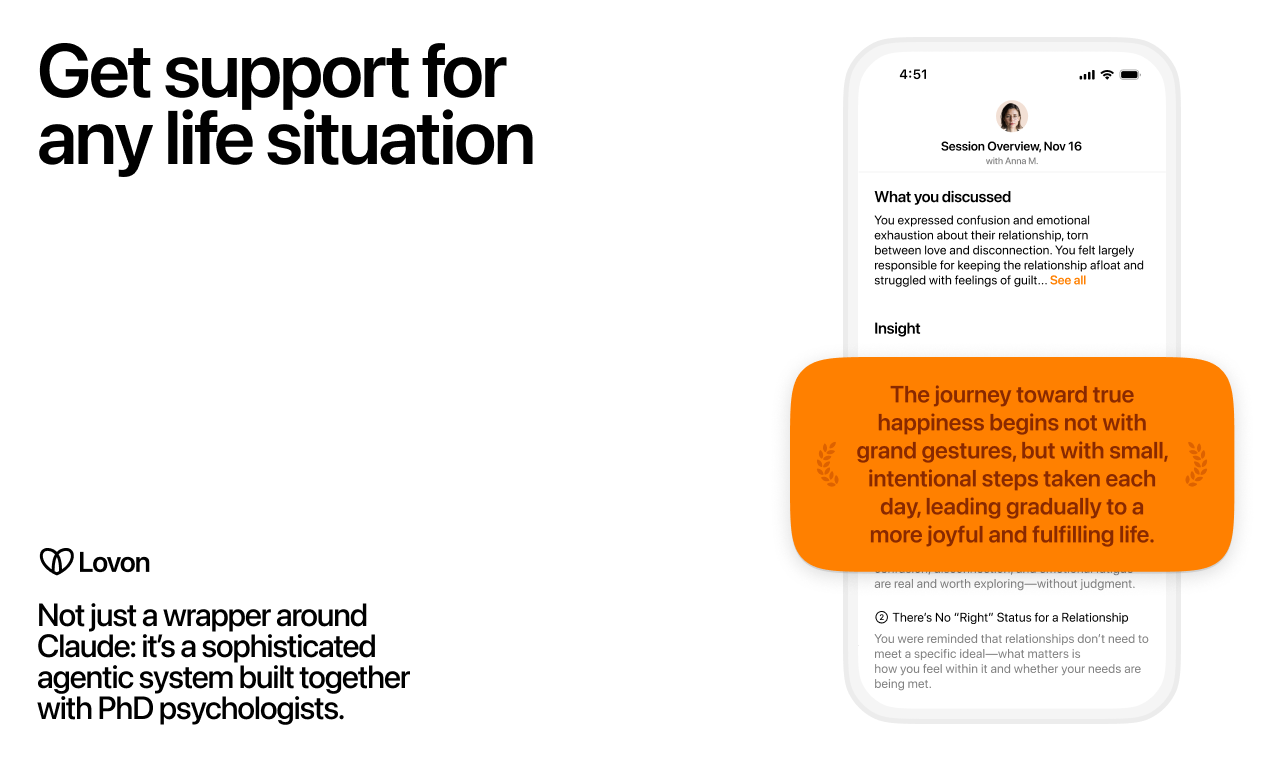
AI therapy you can actually talk to. Just speak naturally and get support anytime you need it.

👋 Hi Product Hunt! I’m Anton, co-founder of Lovon AI Therapy.

After a year of development with a PhD psychologist (40+ years of clinical expertise), we’re excited to introduce a new standard in AI-powered mental health support. Here’s how Lovon stands out from other AI solutions:

🚀 More than just an “agreeable” chatbot like GPT

Lovon uses evidence-based frameworks (CBT, Emotion-Focused Therapy) designed to gently challenge unhealthy thinking - not just agree with it.

🎙 Voice-first, real conversation experience

Simply talk, just like you would with a real therapist. Voice unlocks a genuine human connection that text simply can’t replicate.

⚡ Crisis detection, built-in

Lovon automatically recognizes signs of crisis and connects you to immediate resources when you need help most.

🌙 Available 24/7

Support is always just a tap away - Lovon is there in the moment, especially when real therapists aren’t available.

👩‍🔬 Evidence-driven & actively validating clinically

Our approach is developed by a world-class team, and we’re launching clinical validation studies soon, already seeing amazing results from our users.

💡 We’re not replacing therapists - we’re your bridge between sessions, at the very moment you need support.

In Spring 2025, we raised an $850K pre-seed to build a world-class team, including a PhD psychologist with 40 years of experience developing our therapeutic approach.

🎁 Exclusive for the PH community:

Use code PH2026 for a free week of Lovon AI Therapy (valid until October 16, 2026). Plus, everyone gets a 3-day unlimited trial!

I’d love your feedback!

Ask me anything - I’m here all day and happy to connect 💙

43
回复

@ponikarovskii congrats on the launch! really useful, great job!

11
回复

@ponikarovskii Most AI mental health tools default to validation. Building something that can gently challenge thinking patterns is a completely different level of complexity.

Would love to know how you trained the system to avoid over-affirmation.

Congrats on shipping this.

0
回复
@ponikarovskii Impressive how Lovon combines real clinical psychology with AI. The evidence-based approach (CBT, EFT) plus voice-first interaction seems designed to offer a more human support experience than typical chatbots. Excited to see the clinical validation results—have you noticed any significant differences in how users respond to voice versus text?
0
回复

better than chatgpt

23
回复

@serjobas Thank you! 🙏 That means a lot. We built Anna specifically for emotional support - she's trained to truly listen and understand what you're going through, not just give advice. What's been most helpful for you in your sessions?

10
回复

@serjobas Indeed, thank you for that! ChatGPT is usually solving a problem to "please" persona. Anna is specially designed (and trust me it was many many hours) to help person to go deeper, reflect and get insights!

7
回复

Great job 🧡
Sometimes the internet is unstable, but support is always needed. Does it work offline or оnly online?

20
回复

@maria_anosova Thanks so much! 🙏 Right now Anna works online only since she needs to process conversations in real-time. But we're looking into offline modes for replaying past sessions – great suggestion!

12
回复

Cool product! Good luck!

19
回复

@dmitry_zakharov_ai Thanks! Really appreciate the support.

Have you ever tried talking to AI about something personal? Curious how it felt!

10
回复

@dmitry_zakharov_ai i agree with u. A really good product

1
回复

Love this app! Used it in my last relationship, it was very useful to talk through stuff

18
回复

@daniel_dhawan Thanks so much for sharing this! Really happy to hear Anna helped you work through things. Quick question - did the voice format make it easier to open up compared to texting with a regular therapist?

9
回复

@daniel_dhawan one of the reasons for me to start Lovon with guys was my personal problem with relationship therapy! So I can feel you, bro! Thanks for your comment!

1
回复
Congrats with the launch! What main challenges do you have with training your therapists?
16
回复

@nikita_40in Thanks! We actually use AI, not human therapists - Anna is fully AI-powered. The biggest challenge has been teaching her to be empathetic while asking the right questions at the right time. Have you ever tried AI therapy, or would this be your first experience with it?

11
回复

Love it

13
回复

@kirill_zhe thanks bro, appreciate it

10
回复

Congratulations on the launch. Looks really cool.

12
回复

@dzianis_yatsenka Thanks so much! 🙏 We're really excited to bring voice-first therapy to people who need someone to talk to anytime.

Have you ever tried AI for mental health support, or would this be your first time exploring something like this?

6
回复
Best shrink ever!
10
回复

@anton_selikhov1 Thank you so much! 💙 This means the world to us. We built Anna to be there whenever you need support. What made you decide to try AI therapy over traditional options?

7
回复
Voice-first therapy feels like a strong differentiator! I’m curious – Who’s your primary user today? People looking for “between sessions” support, or users who don’t have access to therapy at all?
10
回复

@tereza_hurtova Thanks! Great question. We actually discovered something surprising - our primary users aren't supplementing traditional therapy. They're people going through breakups who want someone to talk to at 2 AM when they can't sleep, or during a panic moment at work. Traditional therapy has a 2-week wait + $200/session barrier that doesn't work for these acute emotional moments.

What's been your experience with mental health support - do you find the traditional model works for you, or do you hit those barriers too?

6
回复
@ponikarovskii Wow! I wouldn't have guessed that as the primary use case right away, but it makes perfect sense. 💡 Traditional therapy is great, but it’s definitely not 'on-demand' for those acute 2 AM moments or sudden panic at work. As for my experience, I’ve used in-person therapy, and I hit almost all the barriers you mentioned. For me, the biggest struggles were finding the right therapist who actually 'clicks' with you + trying to fit regular sessions into a busy schedule + costs. Thanks for sharing that perspective!
4
回复

Go Team! Good luck! Hope this one will fix me 🤗

10
回复

@puhoshville Thanks so much! 💙 Anna's here to support you, not fix you - you're not broken! She's really good at helping people work through relationship stuff and tough emotions. What made you interested in trying AI therapy vs traditional?

6
回复

I was building something similar for breakup recovery a year ago, at a time llms were not good enough, but the current generation definitely can handle it. Glad you guys have built it, much needed to keep sane in the exponentially changing world we're living in. Good luck with the launch!

9
回复

@konstantin_netyliov1 Thank you for the support! Yeap, break up is one of hardest case, when people would like to talk painful events and get support, without being afraid of being judge by other humans. We have bunch of users who will are helping with going through, and based on their feedback -it's really helping them! So current LLMS + our architecture + expertise of real therapist helping out here!

4
回复

@konstantin_netyliov1 Thanks! Breakups are actually our #1 use case - you were ahead of the curve. Since you were building in that space, what do you think is the most critical thing AI therapy needs to get right for breakup recovery?

4
回复

This is awesome!!!

9
回复

@madalina_barbu Thank you! It is indeed :)

2
回复

@madalina_barbu Thank you! 🙏 We're really excited to bring Lovon to the world. Have you ever struggled to find someone to talk to when dealing with relationship or emotional challenges?

3
回复
Love the mission behind! Voice feature is nice , sometimes it is easy to use voice while walking for example. Congrats on the launch 🚀
9
回复

@jalil_tahirov Thanks so much! Yeah, we built it voice-first exactly for that - many of our users talk to Anna while walking, commuting, or just lying in bed when they need to process something.

What kind of emotional challenges would make you reach for voice therapy vs just talking to a friend?

3
回复

I’ve been in therapy for a long time and even though I can message my therapist, there are moments I just need to process things immediately. What therapeutic framework is it primarily based on?

9
回复

@natallia_novik Thanks! Anna uses mainly CBT and person-centered approaches, adapting to what you need in real-time. That immediate processing gap is exactly why we built this - sometimes you can't wait till next Tuesday at 3pm.

Do you usually text your therapist in those moments, or wish you could just talk it out?

5
回复

Congrats on the launch, Anton! One thing I'm curious about — how do you handle data privacy for such sensitive conversations? Is everything encrypted end-to-end?

8
回复

@kova_ai Thanks so much! Great question - privacy is absolutely critical for us. All conversations are encrypted in transit and at rest, and we're HIPAA-compliant. Your therapy sessions are completely confidential.

Have you tried AI therapy before, or would this be your first experience with it?

5
回复

Congrats 🎉

Does Lovon learn and adapt to personal context over time? For example, If I work on specific anxiety triggers, will the system remember my progress/struggles?

8
回复

@motuqs Thank you Kirill!
Yes, Lovon learn from each session about user, share insights and use this insight in the next sessions. In case of anxiety trigger it will remember all your occasions, and help you to reflect on them and progress

4
回复

i hope your product contains guide-rails that get triggered on special occasions and give advice to the user to reach out to a human therapist. AI can be sometimes an echo-chamber that amplifies our blindspots. But I am sure you app can help many just starting to look inside. Congrats on the launch!

7
回复

@respira Hey, thank you so much! You are absolutely right! In case of special occasions we indeed advise sets to reach out to humans! We care about our users, and if something is need more closer human attention - we help users to get that support

4
回复

I would not recommend Lovon.

As someone interested in AI for mental health, here’s my honest feedback:

1. I reviewed your Meta Ads activity over the past few months and noticed that you are not promoting the app itself, but rather a survey website targeting people in vulnerable mental states. To access the survey results, users are required to link a weekly auto-renewable subscription to their card. This doesn’t seem aligned with mental health support to me.

2. I tested the app itself, and unfortunately the chatbot conversation glitches and disconnects every 2–3 minutes. On top of that, it is impossible to complete the onboarding process without first purchasing a subscription.

3. For transparency, could you clarify how user data is handled? In some documents I saw that the Lovon app is owned by Ticket to the Moon Inc., in others I saw some Babayaga Inc. Can you clarify the structure and who is responsible for the security of user data?

7
回复

Finally, AI product not about coding!!

6
回复

@nikvoice Haha right?! Mental health feels like one of the most human applications of AI - using it to actually understand emotions, not just write code.

Have you tried any AI therapy tools before, or would this be your first?

3
回复

This hits home. Went through a tough time a few years ago and honestly the worst part was not having anyone to talk to whenever I needed. Wish I had this then. Congrats on shipping!

6
回复

@kristina__grits Thanks Kristina! That's exactly why we built the 24/7 voice feature - those 3am moments when you need someone most are when traditional therapy isn't available. The fact that you can just talk to Anna whenever hits differently than texting.

What kind of support would have helped you most during those moments - someone to listen, or someone to challenge your thinking?

3
回复
Where do you draw the line on what Lovon should *not* try to handle (certain conditions, situations, user states), and how are you testing/evaluating the system to reduce the risk of confident-but-wrong guidance as you scale and run clinical validation?
5
回复

@curiouskitty Hi! Thanks for the great and correct question!

We don’t replace a real licensed therapist: we don’t diagnose and we don’t suggest medication. For that, of course, you still need to see a therapist. Also, if a user starts talking about things we legally can’t work with (something harmful), we stop the conversation right away and direct them to the right services.

But overall, we’ve only had a few situations like that.

2
回复

@curiouskitty Honored to have you here!

Great question. We analyze every conversation in real-time for three critical markers: potential harm to self or others, suicidal ideation, and signs of serious mental health conditions. When detected, we immediately tell users to seek professional help - we're very clear about not being licensed therapists.

For testing: we run automated sentiment analysis comparing start vs. end of sessions (declining sentiment flags a problem), plus our clinical advisors regularly review anonymized transcripts and give us feedback. We're actively expanding our clinical board to strengthen this oversight.

What's one thing you wish more AI mental health products would be transparent about upfront, that would make the PH community feel safer trying them?

2
回复

congrats on the launch, anton 🙌 the voice-first approach sounds cool. i've been building ai agents for my own workflow and the difference between typing and talking is night and day. feels like you're actually being heard vs filling out a form.


curious about the crisis detection - is that real-time during the conversation or pattern-based over multiple sessions?

5
回复
@andrew_white_13 Hey Andrew! Both! Anna can work both inside session and taking into account progress and events over recent sessions!
2
回复

@andrew_white_13 Thanks Andrew! Totally agree - voice just hits different. The "being heard" vs "filling a form" is exactly the feeling we're going for.

Crisis detection works both ways - real-time during conversation (certain phrases, emotional intensity) + pattern-based across sessions (deteriorating mood trends, recurring themes). The combo gives us better coverage.

You mentioned building AI agents - what kind of workflows are you automating? Always curious what other builders are working on!

2
回复

Congrats on the launch! I've tried a few AI therapy apps before and they all felt like talking to a search engine. The voice-first approach sounds like it could actually change that. Downloading now

5
回复

@solodnev Thanks so much! That 'search engine' vibe is exactly what we built Lovon to solve - voice makes all the difference.

Would love to hear your thoughts after trying it! What's been the biggest gap in other AI therapy apps you've used?

2
回复

Checked the video and your website, looks like a very good solution to me, wish you success!

But the reviews on your site need links to the sources!

(also the 3 dots do nothing, and it's not clear what the orange checkmarks and "15 min with therapist" mean)

Also, I couldn't find real info about the "PhD psychologists" it is "built with", there need to be links to their professional profiles and scientific work for this statement to have credibility!

5
回复

@konrad_sx Thanks for the detailed feedback - super valuable! 🙏

You're absolutely right about the credibility piece. We're actually building out a new "Our Team" section on the site right now where we'll feature our clinical experts with their full profiles and credentials. Plus, we're currently writing our first scientific papers to validate our approach.

3
回复

Very impressive product! congrats on the launch!

I have a couple of questions though:

1) Can the app recognise patterns of more serious mental disorders such as eating disorders, personality disorders, depression etc.? If yes, can it forward or give any contact/reference to a psychiatrist (for example)? I know that in many cases people do not know yet what mental condition they might have and usually general psychologists become the first point of contact so to say. But then they should be directed to appropriate professional help

2) Do you plan to expand the app to the desktop version as well?

3) Do you plan to allow texting besides voice-only interactions?

Thank you in advance for the responses! And congratulations on launching again, the app looks very polished and well-thought!

5
回复

@ksenia_sh Thanks so much! Great questions:

  1. Lovon is a wellness tool, not a medical diagnostic device. That said, Anna (our AI therapist) is trained to recognize when someone might benefit from professional support - like if conversations reveal ongoing struggles. In those cases, we gently suggest connecting with a licensed therapist or other resources.

  2. We actually have a working desktop version at app.lovon.app! It's MVP with limited features right now - you'll need to register through mobile first, then you can use desktop for sessions. Full desktop experience is coming.

  3. We tested text extensively in earlier versions, but users consistently told us they don't want to type about their problems. Talking out loud feels more natural and therapeutic - like venting to a friend vs writing an email. So we're doubling down on voice instead.

Which matters more to you personally - desktop access or text option?

2
回复

Amazing! Congrats!

5
回复

@khashayar_mansourizadeh1 Thank you! 💙

Have you had a chance to try voice therapy yet, or what interests you most about the AI therapy space?

2
回复

Really interesting approach 👏 I like that you’re focusing on evidence-based frameworks instead of just making another AI chatbot. The voice-first experience sounds especially promising — feels much more human.

5
回复

@abod_rehman Thanks so much! 💙 The voice piece has been a revelation - we've seen people open up way more authentically when they can just speak vs. type. And our PhD psychologist keeps us honest on the evidence-based side, which is critical.

Have you tried any AI mental health tools before? Curious what's worked (or what's been missing) for you!

2
回复

I am very happy and proud to be one of the first users. Lovon helped me a lot to save my relationship when my girlfriend and I were at a distance. And now we're getting married soon!

5
回复

@narek_meliksetyan Wow, this made my day! Congrats on the engagement 🎉 Long distance is so tough emotionally.

I'd love to know - was it the 24/7 availability that helped most, or was there something specific Anna said that gave you a breakthrough?

4
回复

Love the concept and also the fact that this app can work as a copilot, without replacing the therapist. I wonder if it was possible for the therapists to give it inputs somehow. Cheers!!

4
回复

@yulianazarenko Love this idea about therapist input! We've been thinking about how real therapists could collaborate with Lovon - definitely something we'll explore. Thank you!

Are you a therapist yourself, or would you use this feature as a client to keep your human therapist in the loop?

2
回复
#2
Meme Dealer
You are what you meme
421
一句话介绍:一款AI驱动的表情包键盘,在即时群聊场景中,通过上下文理解即时推荐合适表情包,解决了用户手动翻找图库、回复节奏慢的痛点。
Custom Keyboards Messaging Memes
AI键盘 表情包推荐 群聊工具 社交效率 实时聊天 内容生成 移动应用 趣味社交
用户评论摘要:用户普遍认可产品解决“找图慢”的核心痛点,认为其便捷性优于系统自带GIF键盘。主要反馈集中在:强烈期待自定义上传功能;对平台支持(iOS/Android)、隐私安全及AI工作原理存在疑问;建议明确键盘集成方式与支持范围。
AI 锐评

Meme Dealer精准切入了一个微小但真实的高频场景——群聊中的表情包博弈。其价值不在于技术创新,而在于对“输入流程”的重构:将表情包从需要主动搜索的“内容库”转变为基于语境预测的“输入法建议”,这本质上是将AI的意图识别能力封装为一种即时的情绪表达工具,试图占领用户输入面板的“下一句”位置。

然而,其面临的挑战同样清晰。首先是“场景壁龛化”风险:产品高度依赖活跃、具有内部梗文化的封闭群聊,用户泛化性存疑。其次是“AI推荐精准度”这一黑盒难题:评论中已显露用户对隐私和数据处理的担忧,而“氛围感”判断的主观性极易导致推荐失灵,一旦“不准”,键盘切换成本将导致用户迅速流失。最后,其商业模式模糊,作为工具属性极强的键盘,商业化路径狭窄,且极易被巨头内置功能降维打击。

产品团队将自定义上传列为优先项是明智的,这实则是将解决精准度问题的责任部分交还给用户,用“个人梗库”弥补AI的不足,构建护城河。但长远看,它必须从“表情包推荐工具”升级为“群体互动氛围引擎”,更深层地绑定小圈子文化,否则很可能只是一个有趣的、但生命周期有限的效率插件。

查看原始信息
Meme Dealer
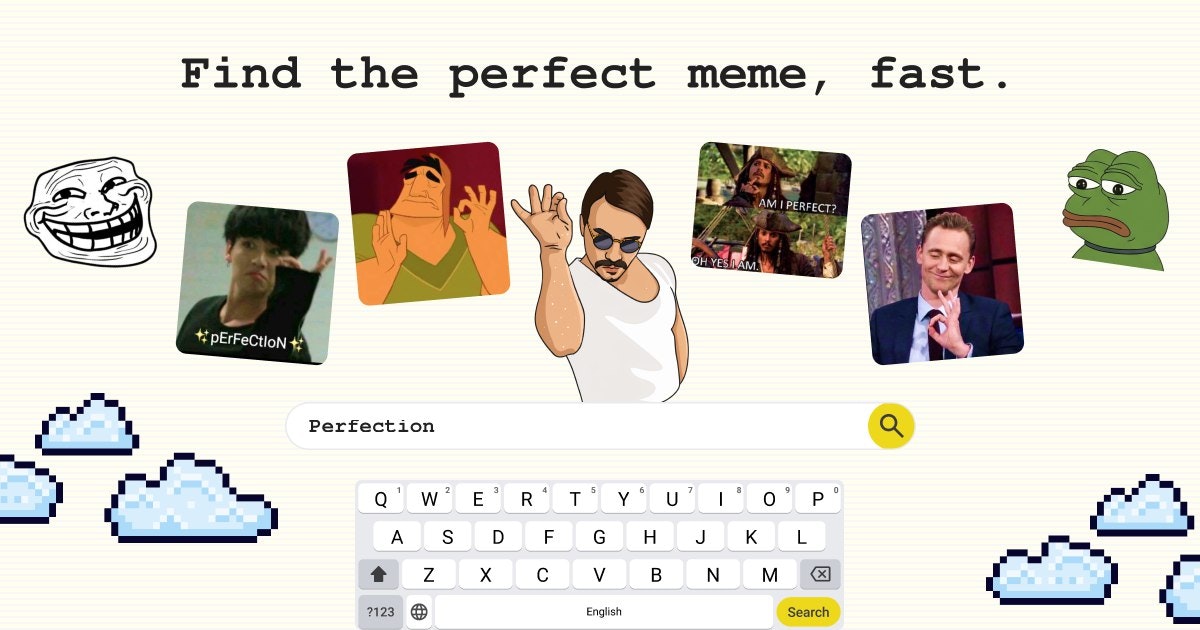
Meme Dealer is an AI meme keyboard for people who treat group chats like a competitive sport. Instead of scrolling your camera roll for 5 minutes, it suggests the right meme instantly based on your vibe. Roast mode, cope mode, hype mode, all in one tap. What makes it different: ⌨️ Keyboard-native (no app switching) 🧠 AI-powered meme suggestions by context/mood 🚀 Fast send flow for real-time chats 🖼️ Big meme library for every reaction moment Type less. Meme harder.
hey Product Hunt 👋 I’m Nazar, a Meme Dealer. We built this because group chats move fast, and finding the right meme usually takes forever 😭 So we made a keyboard that suggests memes instantly, right where you type. What it does: • lives in your keyboard ⌨️ • suggests memes based on chat vibe 🧠 • lets you send in 1 tap ⚡️ I recently had more headspace and turned a fun pet project into a real product 🚀 Would love your honest feedback on: 1. meme relevance 😂 2. keyboard speed/UX 🏎️ 3. what meme we should add next 🧩 We’ll be in comments all day replying + shipping improvements 💪 For when words are mid 💀❤️
20
回复
@neffko so fun! Great stuff 😂
0
回复
@neffko amazing and funny 😂
0
回复

@neffko Hey Nazar 👋

Fun idea. Group chats do need faster meme access.

A few things we noticed while viewing the site:

• Footer links like Terms and Privacy do not work
• It is not clear if this is iOS, Android, or both
• Not clear if it works only on mobile or also desktop
• No explanation of how the keyboard integrates with apps

We are also curious about the AI side:

• Is the meme suggestion powered by AI?
• Is the model trained on user chats or is everything processed locally?
• How do you handle privacy and message data?

The concept is strong. Clarifying platform support and privacy details would build more trust fast.

0
回复

love it! is it possible to upload our own memes?

11
回复

@kate_ramakaieva not yet, direct uploads aren’t available in this version.


But feel free to drop your favorite memes here, and I’ll upload them for you 🙌

In the next version, we’ll likely support direct uploads.

3
回复

@kate_ramakaieva And YEEEEES, I can quote/cite this meme too - it’s so iconic.

3
回复

@kate_ramakaieva S takym lytsem nikhto groshey ne dast' ))

0
回复

So deranged. Love it.

7
回复

@chrismessina thank you! Your support means a lot — more chaos coming soon 🚀

0
回复

Group chats move fast and this feels built frv that speed. Getting the right meme without digging through my gallery saves me every time 😂

3
回复

@malani_willa love this 👏 group chat speed is everything.

In your ideal flow, should meme suggestions appear automatically or only after tapping a button?

0
回复

This is much better and more convenient to use than the built-in keyboard GIFs.

3
回复

@adam_exe thank you 🙌 exactly what we aimed for.

What’s the one thing built-in GIF keyboards still do badly for you?

0
回复

Finally, someone created this! No more digging through the archives in my gallery folder "memes from 2008"

3
回复

@d_ananyin1570 hahaha yes!!

“memes from 2008” folder trauma is too real 😂


Which classic meme from your archive should we bring back first?

0
回复

I found the best product of my life.

3
回复

@busmark_w_nikathis made my day 😭 🤍 thank you!

What’s the first chat where you’d use Meme Dealer daily - friends, work, or family?

0
回复

Love the concept + execution 👏 What’s next on your roadmap: custom uploads, faster ranking, or multilingual memes?)

3
回复

@torianyk Thanks, Valerii 🙌

We’re prioritizing custom uploads first!

0
回复

@torianyk , then faster ranking. Multilingual is next right after.

0
回复

@torianyk Adding my vote for custom uploads! I feel like everyone has that goldmine of private memes that only their close friends would get. If we could eventually blend your AI recommendations with our own personal library, that would be the ultimate meme warfare weapon

0
回复

Such a fun and creative idea! Would love to have it on my phone ⚡️

3
回复

@anastasi_avramenko Would love to get it on your phone too - that’s exactly what we’re building for!

0
回复

in the era of ai slop nothing can beat a meme from 2005. me like it!

3
回复

@ruslannaz In the age of AI slop, vintage meme energy just hits different. Glad you like it!

0
回复

One of my favorite projects I’ve ever been part of.

3
回复

@alex_malytskyy So happy we built this together. More fun stuff soon!

0
回复

Love the design

2
回复

@ayda_golahmadi thank you! ✨ really happy you like the design.

0
回复

Is this even legal?! Cool idea, I'll test this out with my zoomer colleagues

2
回复

@davidkaufmann fair question 😄 yes, legal - and built to make meme replies faster, not sketchier.

Would love your test results with the zoomer squad - what should we improve first after you try it?

0
回复
Awesome concept, love it! What’s your further plan with a product?
2
回复

@orysia_khimiak thank you so much 🤍

Near-term plan: custom uploads, faster ranking, and better personalization by chat vibe.


Which one would you want us to ship first?

0
回复

Awesome guys! Keep going!

2
回复

@chornyi thank you 🙌

If you had one feature request for the next version, what would it be?

0
回复

easy upvote. So fun.

2
回复

@vantoai thank you legend 🔥

0
回复

I’m curious about how you manage edge cases or incomplete ideas. Having a UX expert refine loose concepts could be really beneficial

2
回复

@max_dalton21 super valuable point, thank you 🙏

We’re handling edge cases through fast feedback loops + ranking adjustments from real chat behavior.

Which edge case would you test first: wrong tone, outdated meme, or irrelevant suggestion?

0
回复

So cool, I can't imagine a day without memes. Does your app only connect to WhatsApp?

2
回复

@alina_petrova3 thank you! 💜

and nope, not only WhatsApp.

Since it works as a keyboard, we want it usable across the apps where you type.


Which messenger should we optimize first for you: WhatsApp, Telegram, iMessage, or Slack?

0
回复
Heheh meme fan here! And love this kind of projects. Judy guessing how do you think to support this project. Is there a business model behind?
2
回复

@german_merlo1 haha fellow meme fan 🤝 great question!

no monetizations for now, this is my pet project ) maybe later

0
回复

This sounds really cool. All the best with the launch.

2
回复

@gokuljd thank you so much 🙌 Really appreciate the support!

If you try it, I’d love to hear what meme feature you’d want next 🚀

0
回复

I’m not a marketer or anything, I just like sending memes to my friends all day. And honestly, finding the right meme at the right moment takes way more scrolling than it should.

Meme Dealer feels like it could make that a lot easier. If it helps surface good, timely memes without digging through five different apps, that’s already a win. Curious to try it out in real-life group chat situations.

2
回复

@esra_can1 love this take 🙌 exactly the pain we’re solving - less scrolling, better timing.


Which app do you usually meme from the most right now, and what slows you down there?

0
回复

Congrats on the launch! It's a really fresh and creative idea. I completely agree with the other commenters that people should be able to upload their own memes - since memes are by their nature an ever evolving art form, keeping up to date with the latest trends is essential for a product like this.

I wonder if it's possible to even have the possibility to construct new memes on the fly, instead of drawing from a pool of pre uploaded memes. That would be next level!

2
回复

@michael_nash2 thank you for the thoughtful comment 🙏

Custom uploads are high on our roadmap.


If we add “create meme on the fly,” what should come first: text-on-template, AI captioning, or full meme generator?

0
回复

I love memes 🍿

Need the keyboard

Congrats

2
回复

@nat_pirak Love that energy. Keyboard access coming your way soon ⚡️

0
回复

Awesome idea!

1
回复

@kirill_kirikov  thank you so much 🙌 really appreciate the support!

0
回复

Upvoted for the ridiculous landing page

1
回复

@rrhoover this is the highest compliment possible 😂 🙏


Landing page is one thing, but the memes inside are the real madness — highly recommended 😄
0
回复

weaponized memetism🔫

1
回复

@yura_filipchuk exactly 😎🔫

precision meme delivery system is now live.

0
回复

hey i love this app
few suggestions from my side..
1) upload our own memes...
2)construct new memes on the fly rather than making them from pool of uploaded memes..
3)provide Hinglish support ( Hindi (Indian language)+ English) support ...cause normally people use their native language with mixture of English(60/40 ratio )....in general provide support for other languages as well cause mostly in groups people talk in their native languages ...

Would love to contribute if there’s any way I can add value.

1
回复

ok, now this is something I can get behind... great concept!

1
回复

@dkofoed love this 🙌 thank you!

If you could pick one “must-have” next step, what would it be: custom uploads, faster ranking, or better personal meme taste matching?

0
回复

Top-top, love it!

What inspired you for such naming? :D

1
回复

@dpanchuk Name came from the idea that sometimes finding the right meme feels like “trading” attention in chat.

0
回复

you just built the only keyboard that understands my real native language: memes

oh, how much valuable time it will save for me!

1
回复

@mykola_kukhtiei this is the best description ever 😂🤝

“native language: memes” is exactly the vision.


Which chat type should we optimize for first: group chats, 1:1, or work chats?

0
回复
#3
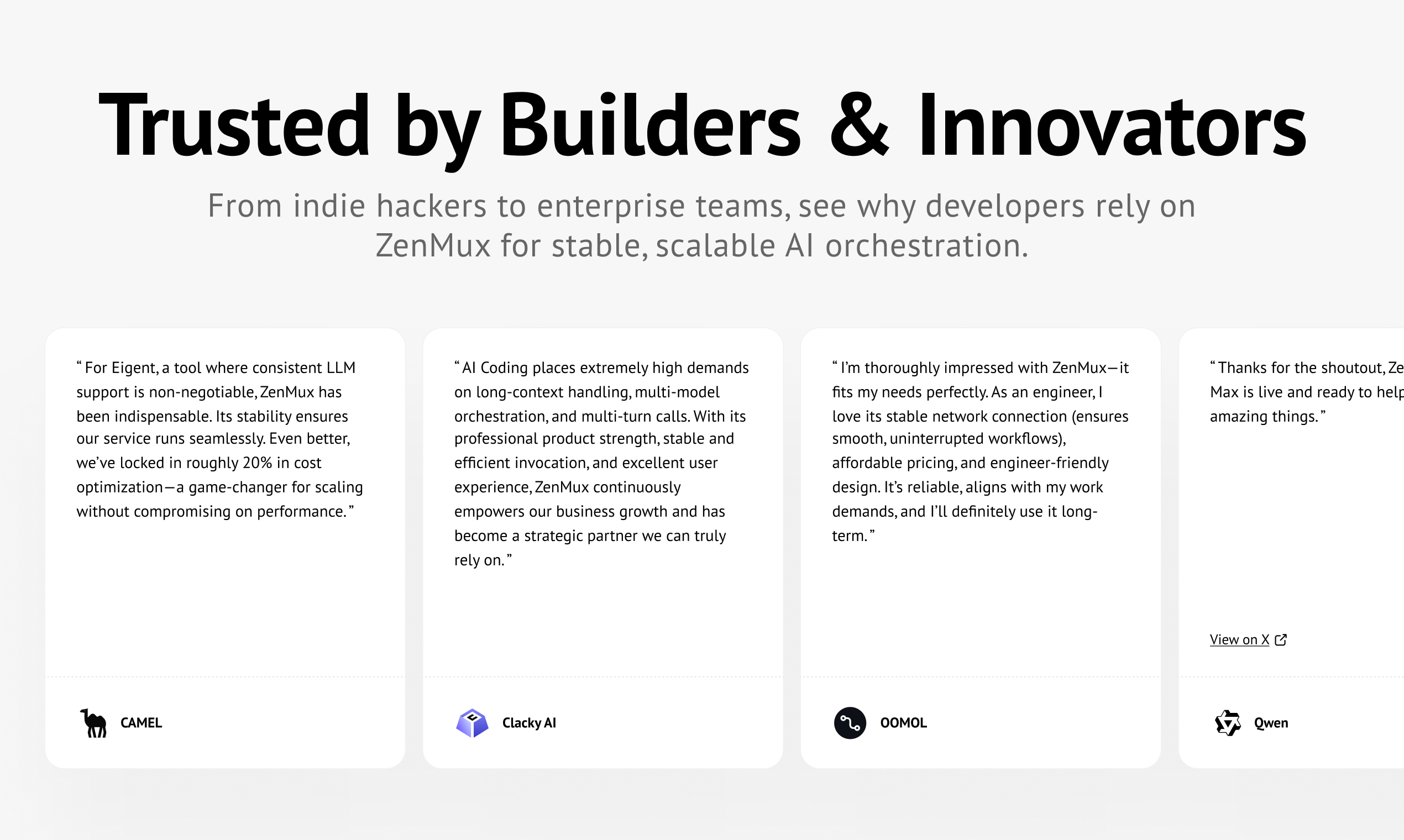
ZenMux
An enterprise-grade LLM gateway with automatic compensation
336
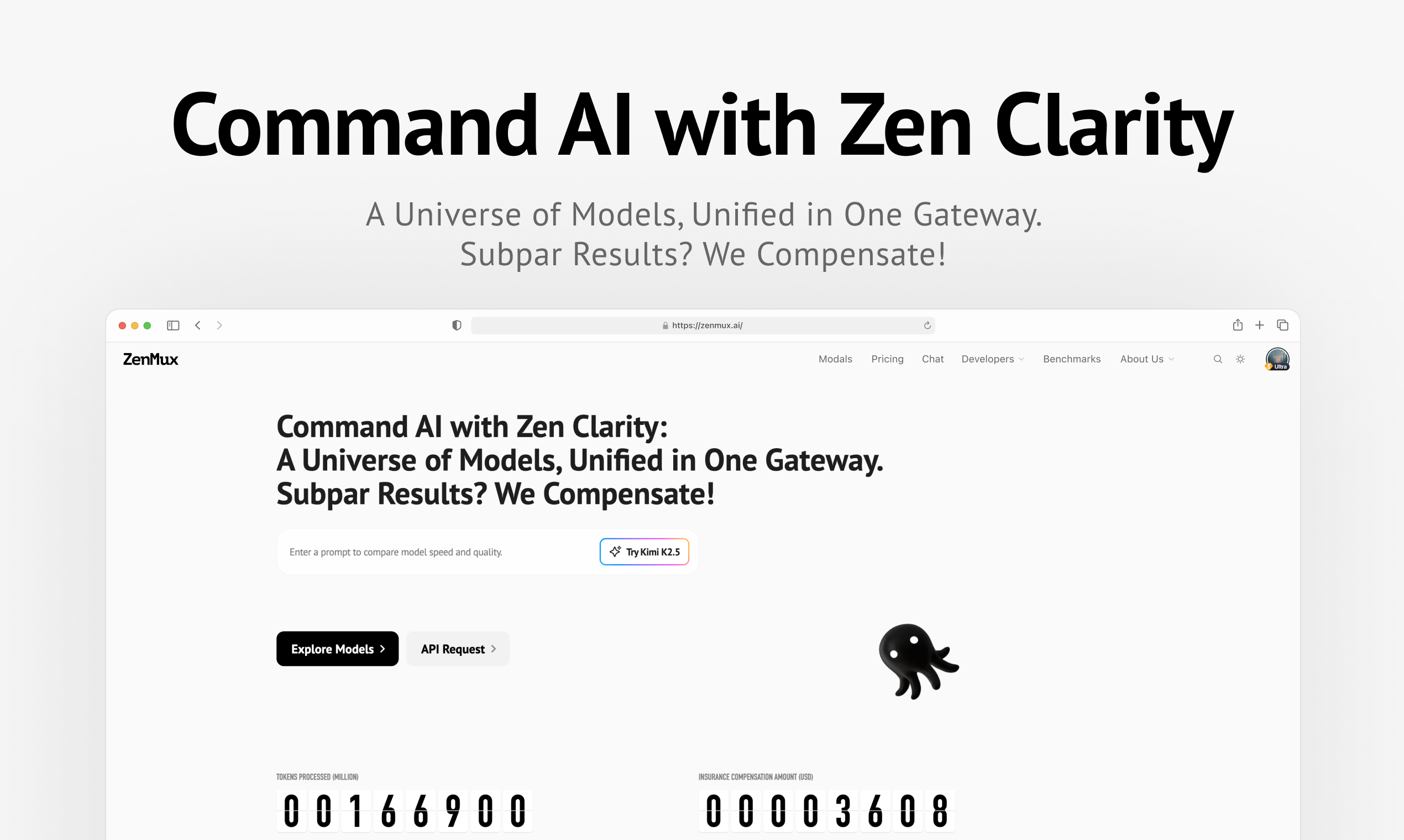
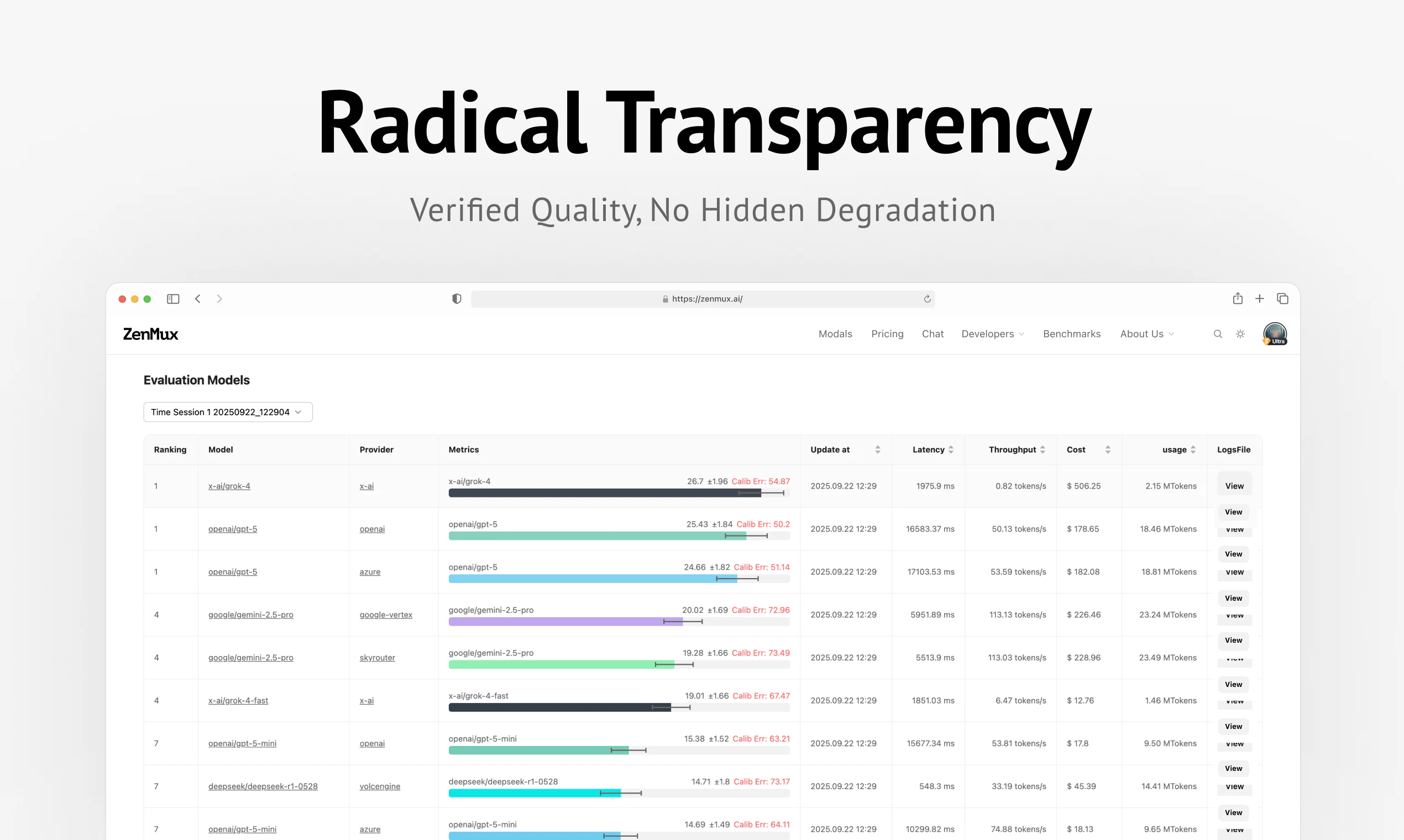
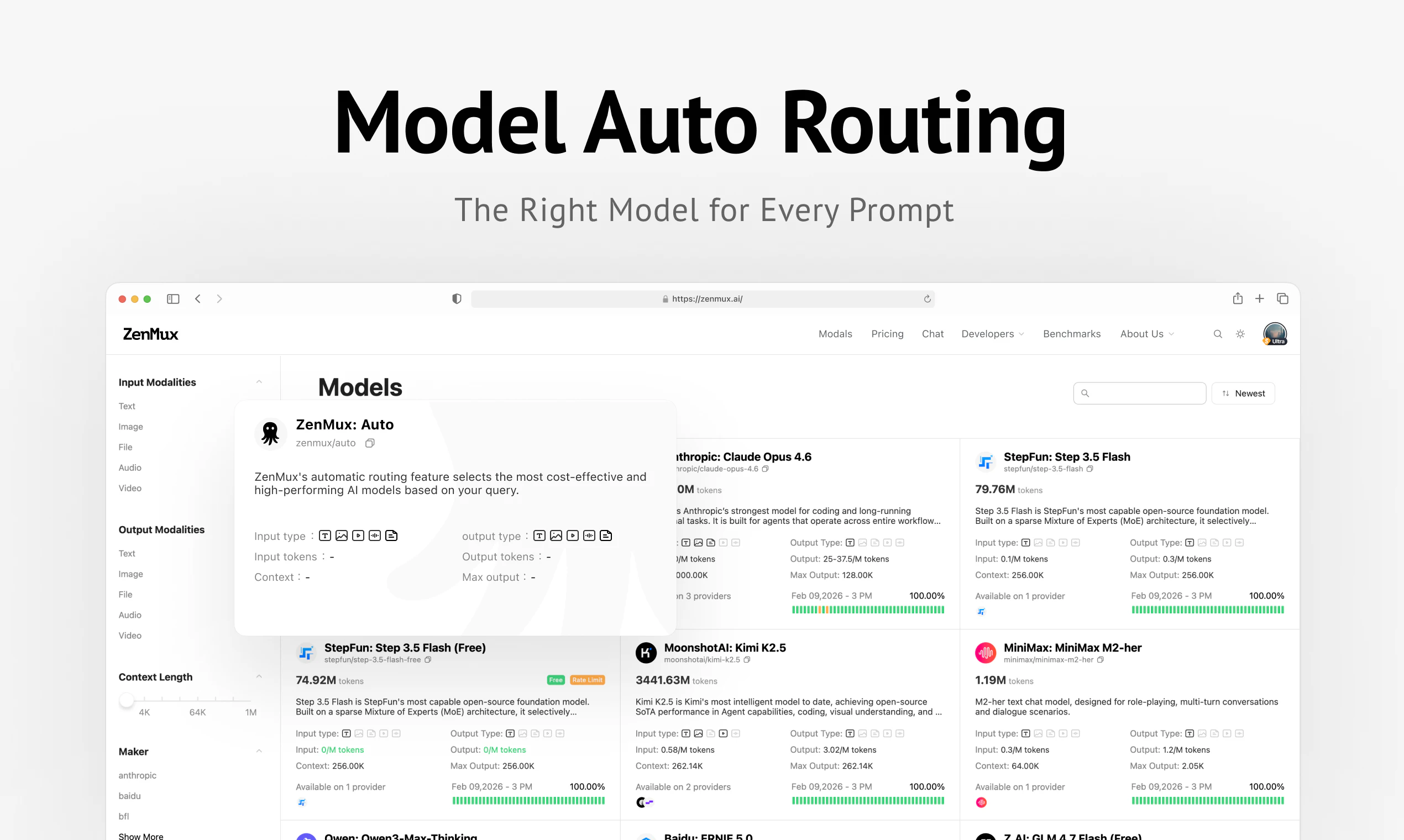
一句话介绍:ZenMux是一款企业级LLM网关,通过统一API、智能路由和行业首创的自动补偿机制,为开发者在AI应用生产环境中解决了模型质量不稳定、成本不可控和运维复杂等核心痛点。
API Developer Tools Artificial Intelligence
LLM网关 企业级AI基础设施 模型路由 自动补偿 API聚合 高可用 多云冗余 成本优化 性能监控 开发效率
用户评论摘要:用户反馈积极,认可自动补偿和成本优势,并询问补偿的具体定义与审计流程。主要建议包括:需明确“质量低下”的判定标准、提供可追溯的补偿数据包、集成OpenTelemetry等可观测性工具,以及公开路由策略细节。
AI 锐评

ZenMux切入了一个日益拥挤但痛点明确的赛道——LLM网关。其宣称的“行业首创自动补偿机制”无疑是最锋利的钩子,试图将基础设施从传统的“流量管道”角色,重塑为“质量担保方”。这一承诺直击开发者最敏感的神经:为模型的“胡言乱语”和响应迟缓付费的不公感。

然而,其光鲜承诺之下潜藏着巨大的执行风险与定义模糊地带。评论中尖锐的提问切中要害:如何客观、可复现地定义“低质量输出”?补偿裁定是否会引发大量争议和运营负担?这本质上不是一个技术问题,而是一个涉及标准制定、仲裁机制和商业风险的复杂体系。产品若不能将补偿规则极度透明化、流程自动化,该特色很可能从亮点变为运营泥潭。

此外,其“统一API”和“智能路由”属于当前网关的标配,壁垒在于路由算法的实际效能与数据积累。而“公开HLE测试”虽有助于建立信任,但如何将通用基准与客户具体工作负载的优化有效结合,仍是待解难题。

真正的价值或许如团队回复中所暗示的:每一次补偿事件都是一个高质量的反向优化数据点。若能系统性地将这些“失败案例”反馈给客户,甚至形成优化闭环,ZenMux则有可能从“成本保险商”升级为“质量协作者”,构建更深层的护城河。当前,它是一个大胆且对开发者友好的价值主张,但其长期成功,取决于能否将这场危险的“赌博”转化为一套可规模化的、可信赖的质量保障体系。

查看原始信息
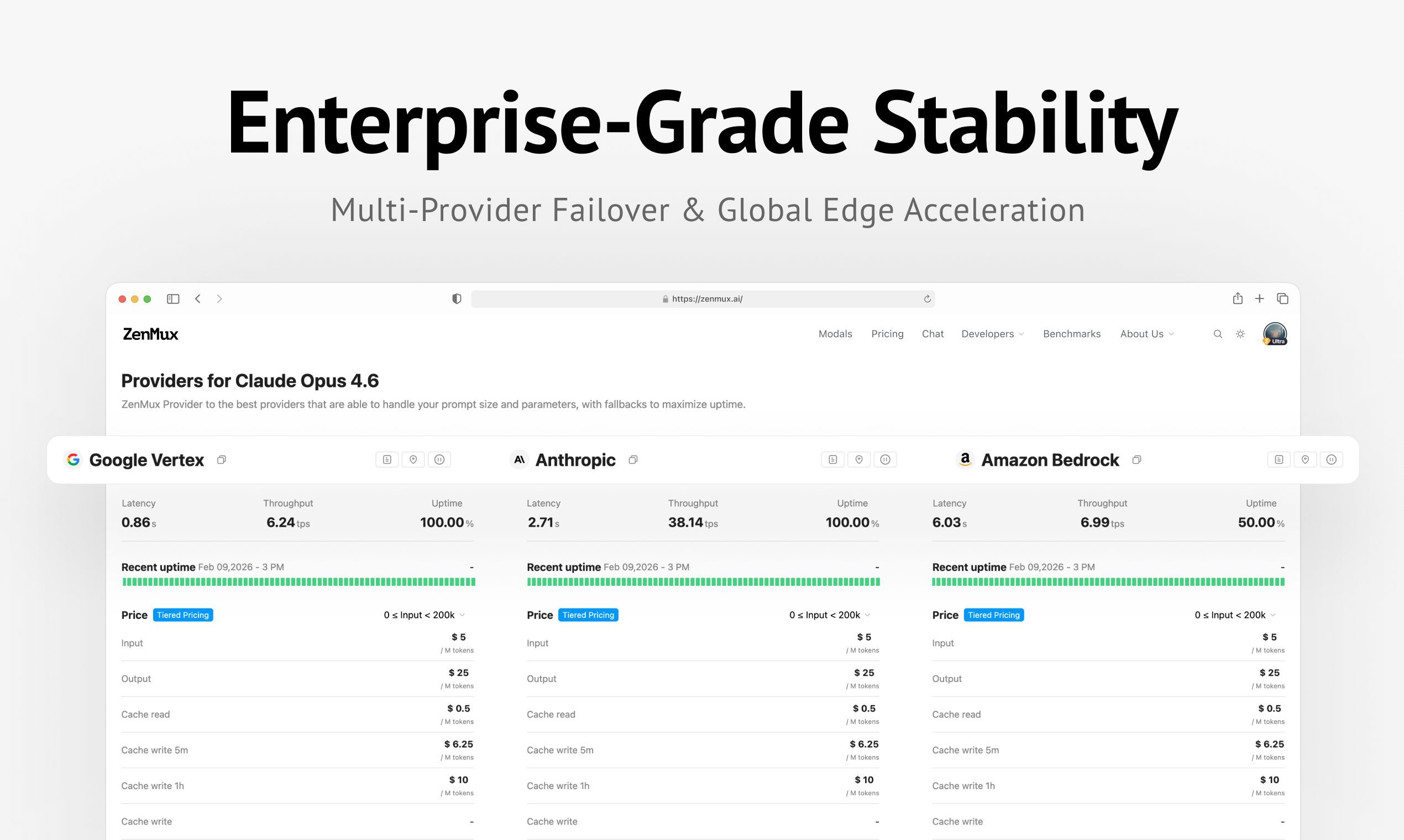
ZenMux
ZenMux is an enterprise-grade LLM gateway that makes AI simple and assured for developers through a unified API, smart routing, and an industry-first automatic compensation mechanism.

Hey Product Hunt! 👋

I'm Haize Yu, CEO of ZenMux. We’ve been heads-down building an enterprise-grade LLM gateway that actually puts its money where its mouth is. I’m thrilled to finally get your feedback on it today.

Why we built this 

Scaling AI shouldn't feel like "fighting the infra." As builders, we grew tired of:

  • Juggling dozens of API keys and messy billing accounts.

  • Sudden "intelligence drops" or latency spikes in production.

  • Paying full price for hallucinations without any fallback. 😅

We thought: What if a gateway didn’t just route requests, but actually insured the outcome?

What ZenMux brings to your stack

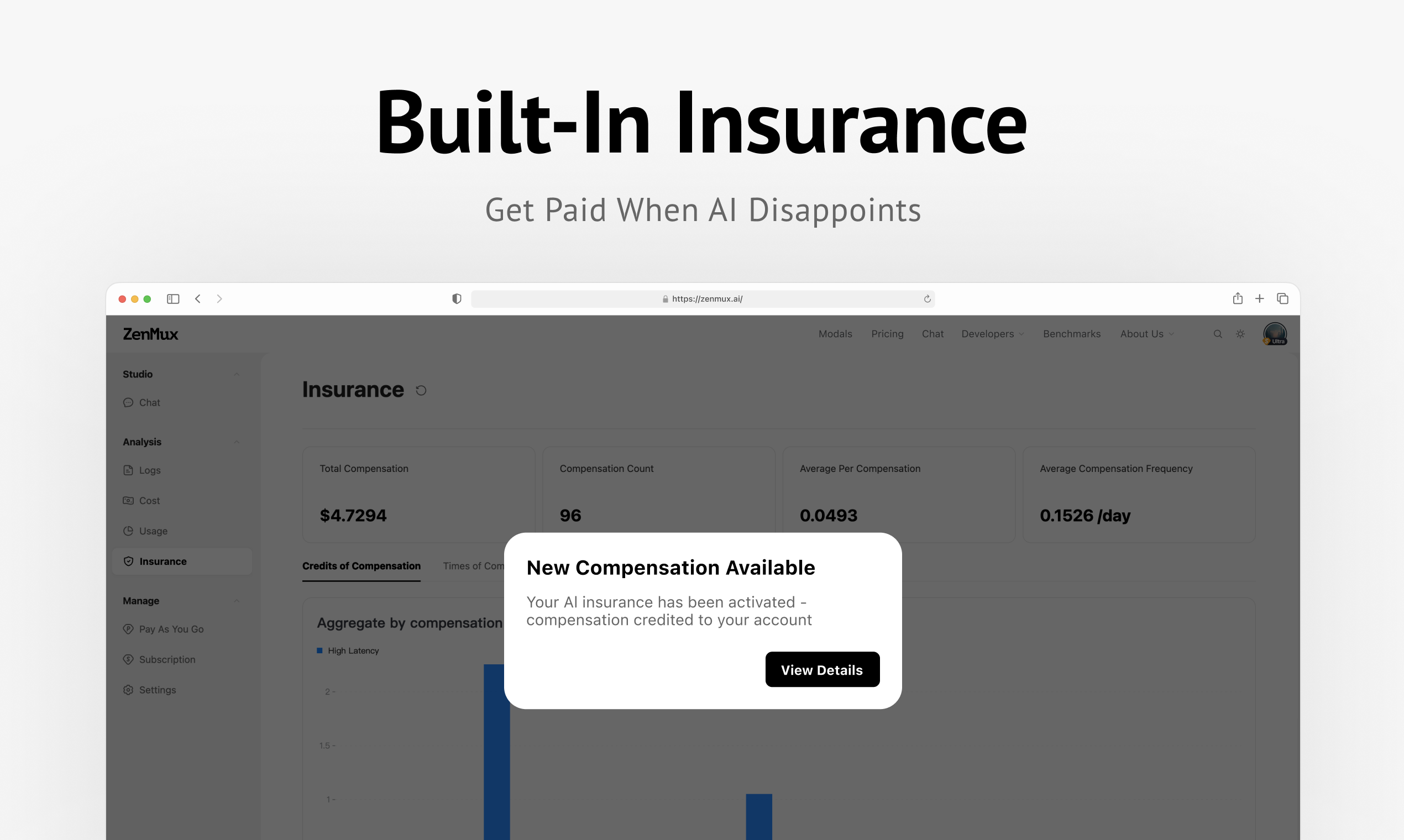
  • Built-in Model Insurance: We’re the first to offer automatic credit compensation for poor outputs or high latency. We take the risk, so you don't have to.

  • Dual-Protocol Support: Full OpenAI & Anthropic compatibility. Works out-of-the-box with tools like Claude Code or Cline.

  • Transparent Quality (HLE): We conduct regular, open-source HLE (Human Last Exam) testing. We invest in these benchmarks to keep model routing honest.

  • High Availability: Multi-vendor redundancy means you’ll never hit a rate-limit ceiling.

  • Global Edge Network: Powered by Cloudflare for rock-solid stability worldwide.

Pricing that scales

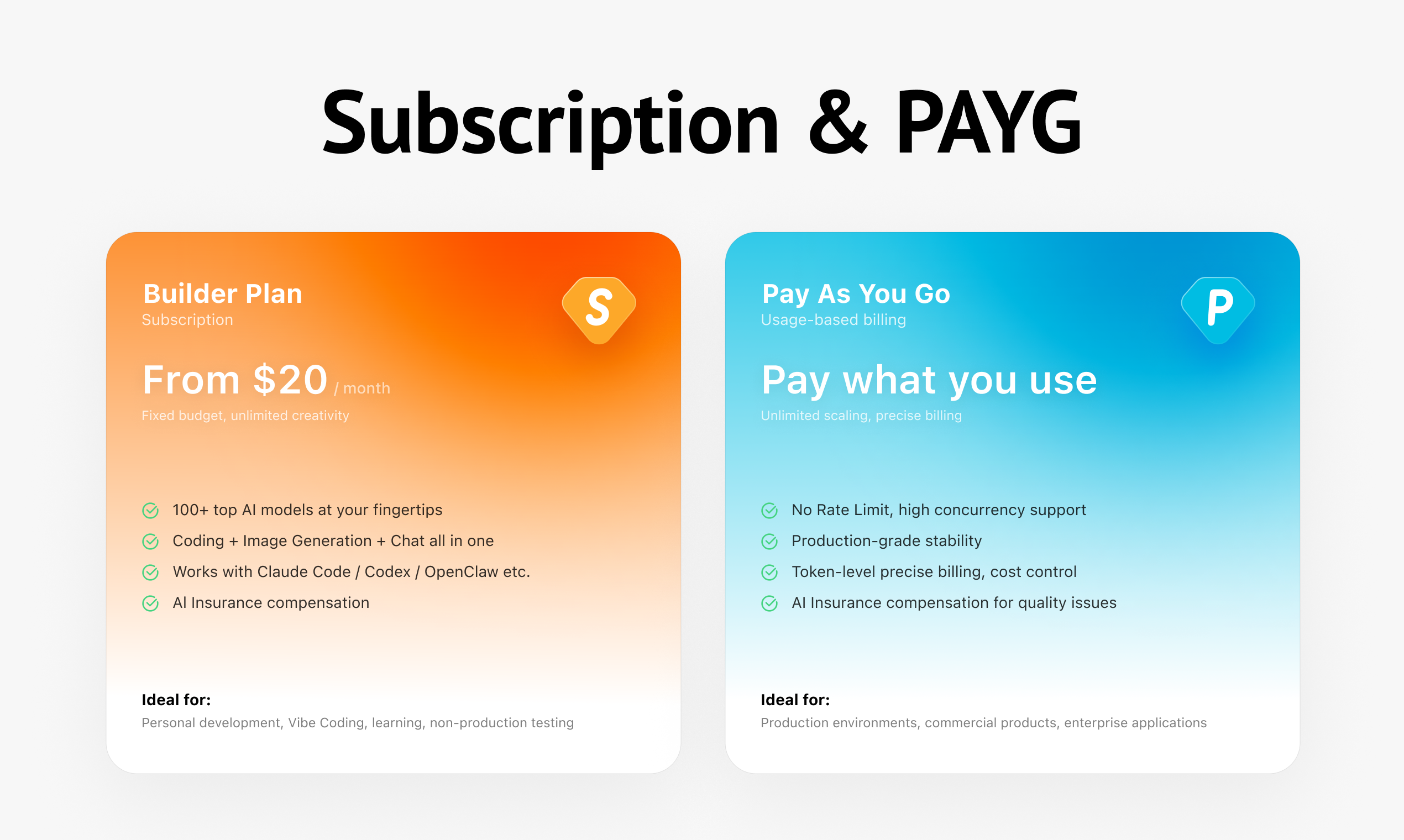
  • Builder Plan: Predictable monthly subscriptions for steady development.

  • Pay-As-You-Go: No rate limits, no ceilings. Pure stability that scales freely with your traffic. Only pay for what you actually use.

Launch Special 

Bump up your credits! For a limited time: Top up $100, get a $10 bonus (10% extra).

One last thing... 

What’s the biggest "production nightmare" you've faced with LLMs? Drop a comment—I'm here all day to chat!

Stop worrying. Start building. 🚀

https://zenmux.ai

9
回复
Used Zenmux for a while. Not Only API insurance works legit, (actual charged) pricing is 8% ~ 10% cheaper than openrouter. Best luck!
4
回复

@sophialgrowth Seeing "used ZenMux for a while" honestly made our day. Thanks so much!🥹

0
回复
@sophialgrowth In the early stages, we did run some discounted promotions. The reason wasn’t to start a price war, but because our product was still immature and had a lot of room for improvement. To make up for these shortcomings, we offered appropriate discounts as a way to show our gratitude to users.
0
回复

An auto-compensation LLM gateway will hit scale pain when “bad output” disputes and p99 latency spikes turn into noisy payout events without reproducible traces.

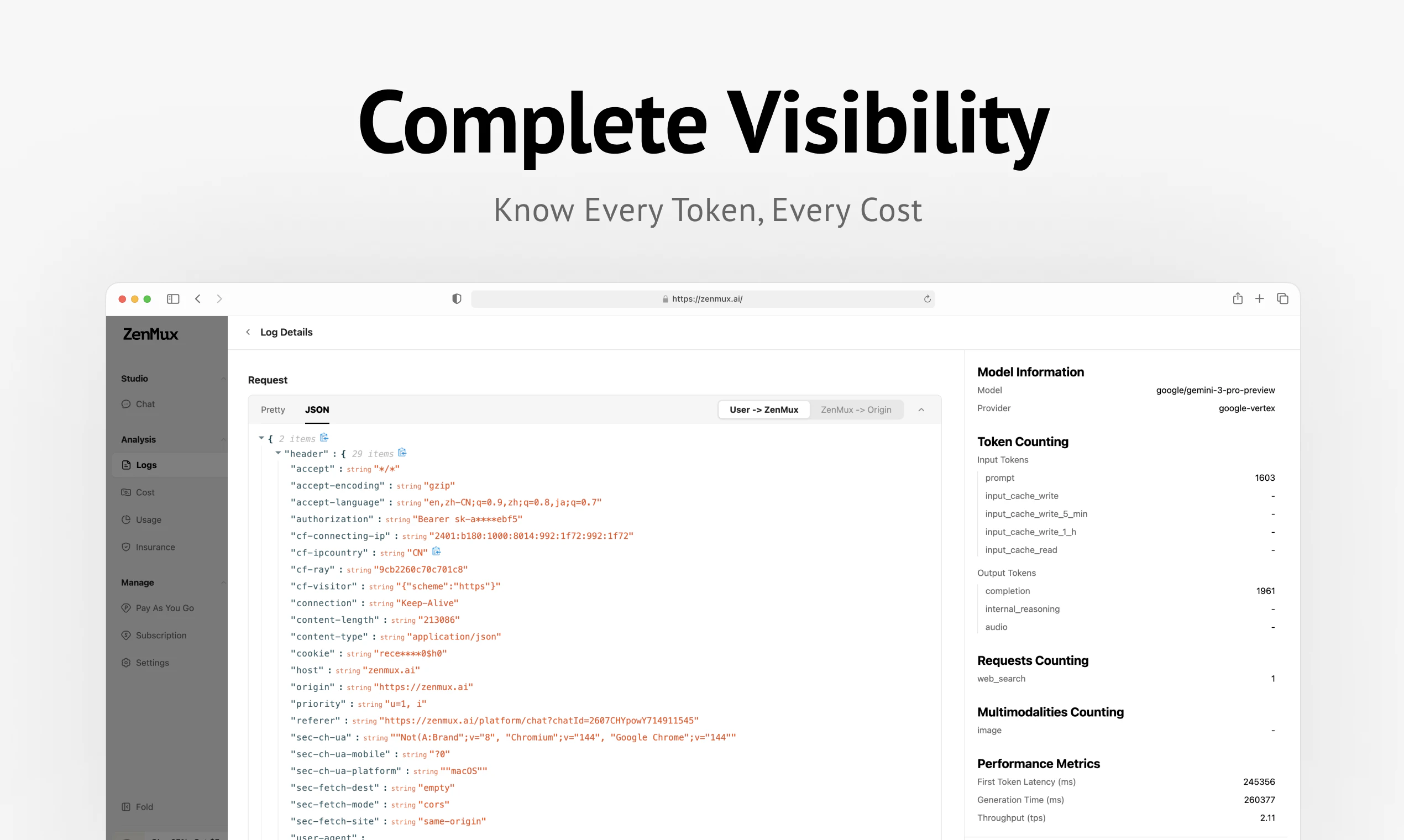
Best practice is OpenTelemetry GenAI semantic conventions plus per-request lineage (prompt hash, model, router decision, retries) and optional hedged requests or circuit breakers to tame tail latency.

How are you defining and verifying “poor quality” for payouts, and can customers export the full compensation case bundle for audit and fine-tuning?

4
回复
@ryan_thill OpenTelemetry is a great suggestion. I just went through some of the documentation, but I haven't dived deep into it yet. Thanks for the tip!
0
回复

Model insurance for AI infra? That’s new. Curious to try it.

4
回复

@luke_pioneero Appreciate it! 🙏 You hit it — the model insurance is new, but honestly the best part is what comes with the payout: real edge cases from your own usage, ready to plug back in and make your product smarter.

Curious to hear what you think once you try it! 🚀

2
回复

@luke_pioneero Thank you! We built it because we felt infra shouldn’t shift all risk to builders.

0
回复
@luke_pioneero This is a very special feature of ours. We noticed users asking, “Why should I pay when the model isn’t accurate?” After seeing this feedback many times, we started reflecting on what we could do—and this idea came out of it. Behind this feature is a push for us to improve stability and speed; otherwise, we’d lose a lot of money 😄
0
回复

Congrats on the launch, ZenMux.

While everyone is building on LLMs, you’re building the backbone. Unified, intelligent, and enterprise-ready, that’s how real AI infrastructure scales.

Wishing you powerful integrations and unstoppable momentum ahead.

3
回复

@priyankamandal 

Thanks so much! That means a lot — we really believe infrastructure should be boring (in a good way), so developers can focus on the fun part. Appreciate the support! 🙏

0
回复
@priyankamandal Yes, thank you so much for seeing our efforts. Building the foundational layer is exhausting and "dirty" work, but it's something that someone has to do. Most of the founding members of our team come from well-known, stability-focused teams, so we're well-equipped to do it well.
0
回复
Hey Haize, that line about paying full price for hallucinations without any fallback is painfully relatable. Was there a specific moment in production where a model just tanked, gave you garbage output, and you realized you were still getting charged for it?
2
回复
@vouchy There have been some truly heart-stopping moments. When the model suddenly went down, it led to a huge number of payouts. Even though we technically hadn't done anything wrong, we still had to honor the claims. However, we designed this insurance with a maximum claims pool. In extreme cases, we'll pay out every last cent of that pool, but it won't put the company out of business.
1
回复

Excited to follow your journey. Great launch!

2
回复

@victorzh Thanks! Appreciate it. Stoked to have you along for the ride — more coming soon!

0
回复

@victorzh Thank you so much! Really appreciate the support 🙌

0
回复
@victorzh Thank you! Our product launched around October 1st, and it's been about four months now. We've received far more user recognition than expected, and we've also gained a very impressive number of paying users. This is thanks to the AI era, which allowed us to develop the product at an incredible speed—over 90% of the coding was done with AI.
0
回复

Automatic compensation is a bold promise. Love this angle. Congrats on launch 👏

2
回复

@sandy_liusy Thanks! 🙏 The auto-compensation is the hook, but the real gold is — every payout is an edge case from your own business. Take those insights back as Context to reverse-optimize your product experience. That’s the data flywheel.

1
回复

@sandy_liusy Thanks! We felt that infra providers shouldn’t only optimize throughput — they should stand behind output quality and reliability. That’s the bet we’re making.

0
回复
@sandy_liusy Thanks! Auto-compensation is one of our core features. Currently, we provide compensation for "slow response" and "inaccurate output". From a practical perspective, it's great that users don't have to pay for bad results. But there's another, even more important benefit in my view: the log data from these insurance payouts is extremely valuable and can help developers optimize their products.
0
回复

I wish everytime a product didn’t work this happened !

1
回复

@howell4change Haha right? Wouldn't that be nice 😄 Appreciate you.

0
回复
Routing is where most gateways feel similar on paper—what’s your actual decision policy in production (signals used, how often it updates, how you avoid regressions), and how do your public benchmarks translate into routing choices for a specific customer workload?
1
回复

Another cool LLM with ai world. COngratulations on the launch (:

1
回复
@istiakahmad "Cool" is really important. I really love the design of our latest official website, especially our mascot, the little octopus. It symbolizes connection.
0
回复

Love the dual-protocol support — OpenAI + Anthropic in one API, no extra wrapper needed. Clean.

1
回复

@blink_66 Thank you! We wanted it to feel plug-and-play.

0
回复

@blink_66 Thank you! We wanted it to feel plug-and-play.

0
回复
@blink_66 Thank you for your recognition. Although developing and maintaining dual protocols has significantly increased our costs, along with a lot of parameter conversion work, seeing the positive feedback from users makes it all worthwhile.
0
回复

What exactly is "model insurance"? Never heard of this before.

1
回复

@elser_ai Appreciate it! 🙏 You hit it — the model insurance is new. Currently we cover two dimensions: 1) output quality (hallucinations, unexpected content), and 2) high latency. More dimensions coming soon.

But honestly the best part is what comes with the payout: real edge cases from your own usage. Long term, these insights help you iterate and improve your own product's user experience.

Curious to hear what you think once you try it! 😊

0
回复
@elser_ai Put simply, model insurance means we provide corresponding compensation when the model returns "bad" results, whether due to slow speed, poor quality, or other reasons. Let's take quality as an example: when a user thinks a result is bad, they might click "regenerate" or re-enter the prompt with minor changes. In such cases, we will refund the cost of that first request. We use an algorithm to identify these scenarios. Of course, I think it's still not perfect, and we have more comprehensive plans for the future.
0
回复

The most stressful part of using LLMs is wondering if the model secretly got worse. This fixes that.

1
回复

@carlvert Totally. 🙏 Nothing worse than wondering if it's your prompt or the model just got dumber. We put the HLE tests and leaderboard out there so you can actually know. No more guessing games.

Appreciate you!

0
回复

@carlvert Yes. The worst failures aren’t crashes — they’re subtle intelligence regressions.
That’s why we run ongoing HLE benchmarks and monitor routing drift continuously.

0
回复
@carlvert Yes, thank you so much for your recognition. I think we’re still at a very early stage. We have so many ideas in mind that haven’t been realized yet. This may be a long-term plan — it will take about three years to complete the whole puzzle, so we can better serve our users.
0
回复

Big congratulations on the launch, ZenMux

An enterprise-grade LLM gateway with unified APIs, smart routing, and automatic compensation is exactly what serious AI teams need right now. You’re not just connecting models, you’re building trust into the infrastructure.

Wishing you strong enterprise partnerships and rapid scale ahead.

0
回复

@priyankamandal Thanks so much! Really appreciate the kind words — especially "building trust into the infrastructure." That's exactly what we're aiming for. Excited to deliver on that promise for serious AI teams. 🚀

0
回复

The automatic compensation mechanism is really clever. Balancing costs across multiple model providers is a pain point we've dealt with. How does it handle routing decisions when multiple providers offer similar performance but vastly different pricing? Does it learn from request patterns to optimize long-term?

0
回复

Does ZenMux's credit compensation trigger on latency spikes the same way it does on hallucinations? That threshold is where the value gets real. Feeding compensated cases back so teams can fine-tune against their own failure modes is what makes the insurance self-improving.

0
回复

Congrats on the launch! The model insurance angle is interesting, especially for production use cases where reliability matters more than raw capability. How do you objectively determine when an output qualifies as poor versus just subjective dissatisfaction?

0
回复

@vik_sh Thanks for the great question! 🙏 We've built our own detection algorithm, and right now we have two dimensions live:

  • Unexpected content generation

  • High latency

How do we detect "unexpected content generation"? One example: if a user asks two consecutive questions with the same intent, we treat that as a signal that they weren't satisfied with the first response. That's one of the ways we identify bad cases.

The payout is just the outcome. The real value is: every flagged bad case is an edge case from your own business, ready to be used as context to improve your product experience.

That's where the data flywheel starts turning.

0
回复

Multiple suppliers for the same model + auto failover = no more "our model provider is down" incidents.

0
回复
@rydensun Model outages are truly incidents that severely impact business development. However, we are confident in addressing this issue effectively. Many members of our founding team come from renowned stability engineering teams, bringing with them profound expertise in this field.
0
回复

The insurance mechanism is a genuinely novel idea in the LLM gateway space. Most aggregators (OpenRouter, LiteLLM) treat themselves as dumb pipes.. you get your tokens, and if the model hallucinates or latency spikes, that's your problem.

I'm curious about the implementation like how does ZenMux detect "degraded quality" automatically? Is it running a lightweight evaluation model on every response, or is it based on heuristics like response length, latency thresholds, and known failure patterns?

The line between a genuine hallucination and a subtly wrong answer seems really hard to draw programmatically. Also, does the insurance payout data feed back into routing decisions? That would create a really interesting flywheel like the more claims you process, the smarter your routing gets

0
回复
#4
Code Arena
Prompt once. Compare multiple AI-built apps for free.
257
一句话介绍:Code Arena 允许开发者一次性输入提示词,即可并行比较多个顶级AI编程模型生成的多文件应用或网站代码,解决了在真实、结构化项目中评估和选择最佳AI编码输出的痛点。
Software Engineering Developer Tools Artificial Intelligence
AI编程工具 多文件代码生成 模型对比评测 开发者工具 代码导出 项目脚手架 生产力工具 免费工具
用户评论摘要:用户肯定其多文件生成与并排对比的核心价值,但普遍关注结果评估问题:缺乏实时预览难以判断输出优劣;询问迭代工作流和客观评估标准(如成本、质量、基准);建议增加依赖可视化、结构化上下文支持以提升对比公平性与实用性。
AI 锐评

Code Arena 精准切入当前AI辅助编程的核心矛盾:演示场景的“玩具级”代码与真实工程所需的“系统级”代码之间的巨大鸿沟。其“一次提示,多模型并行生成多文件项目”的设计,确实直击了多数单文件AI编码工具的软肋,试图将选择成本从串行试错转向并行对比。

然而,产品目前呈现的更像一个精巧的“演示对比器”,而非深度“工作流整合器”。用户的评论一针见血:缺乏代码预览功能,使得对比在第一步就卡壳;没有明确的评估维度和基准(如代码质量、性能、成本、架构合理性),所谓“对比”极易流于表面观察;其作为独立工具,如何融入开发者从生成、迭代、调试到部署的完整闭环,仍显模糊。这暴露了其现阶段可能更适用于模型能力的快速探知与选型,而非持续的深度开发。

真正的挑战在于,多文件生成的“可靠性”与“生产级结构”绝非简单堆叠文件即可实现。不同模型对架构模式、文件依赖、接口约定的理解差异,可能生成形似而神异的代码,增加后续集成与维护的隐性成本。产品若想从“有趣对比”升级为“必备工具”,必须构建更科学的量化评估体系,并深度解决生成代码的“可理解性”(如依赖可视化)与“可迭代性”(与本地IDE/GitHub的双向同步)问题。否则,它可能只是将混乱从“选择哪个模型”推迟到了“理解哪套代码”上。

查看原始信息
Code Arena
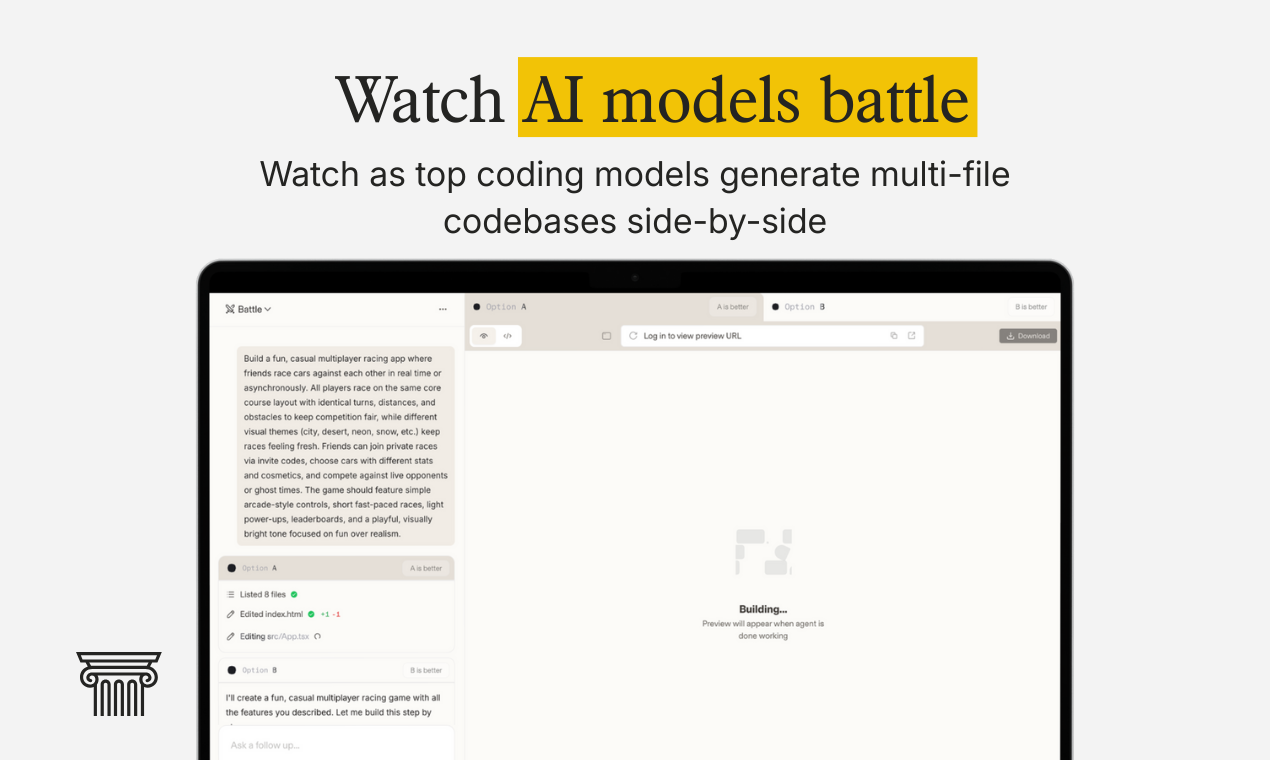
Prompt once and compare outputs from top AI coding models. Arena generates multi-file apps or websites side-by-side. Export ready-to-run code to GitHub or your IDE. Built for developers. Free to use.

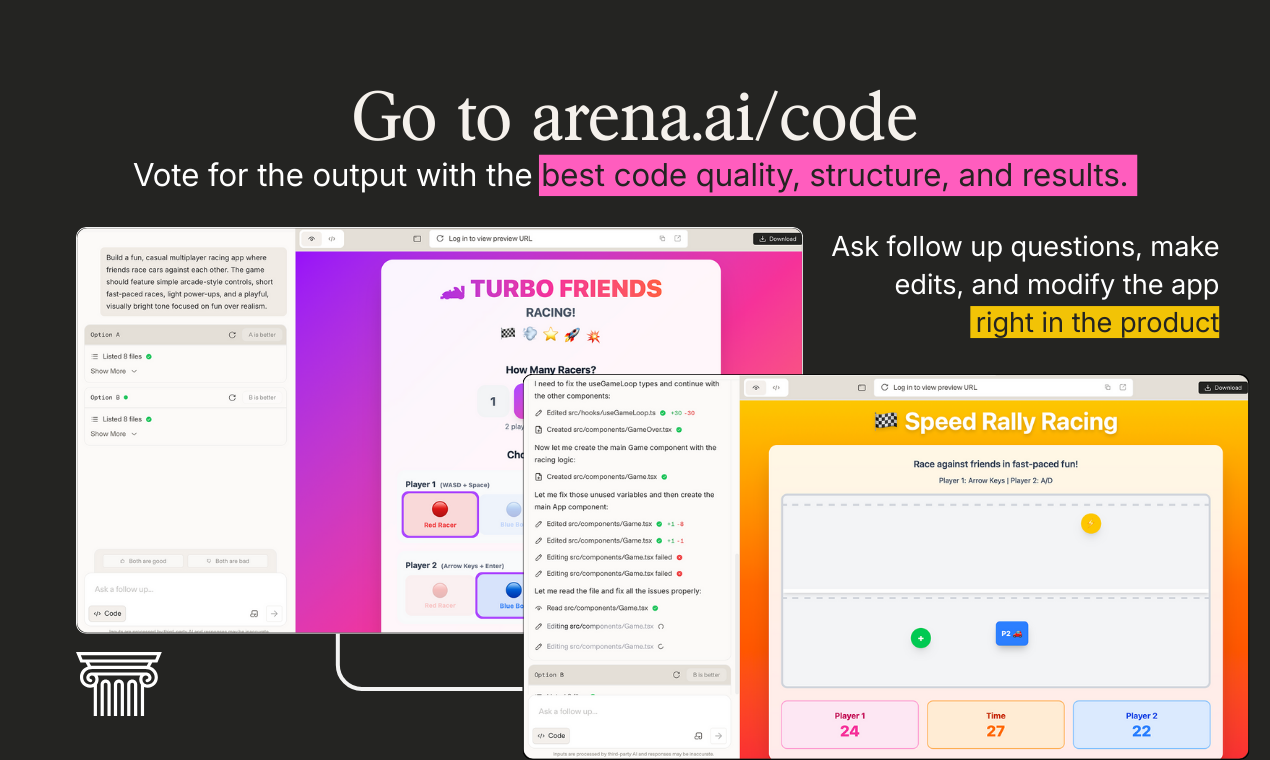
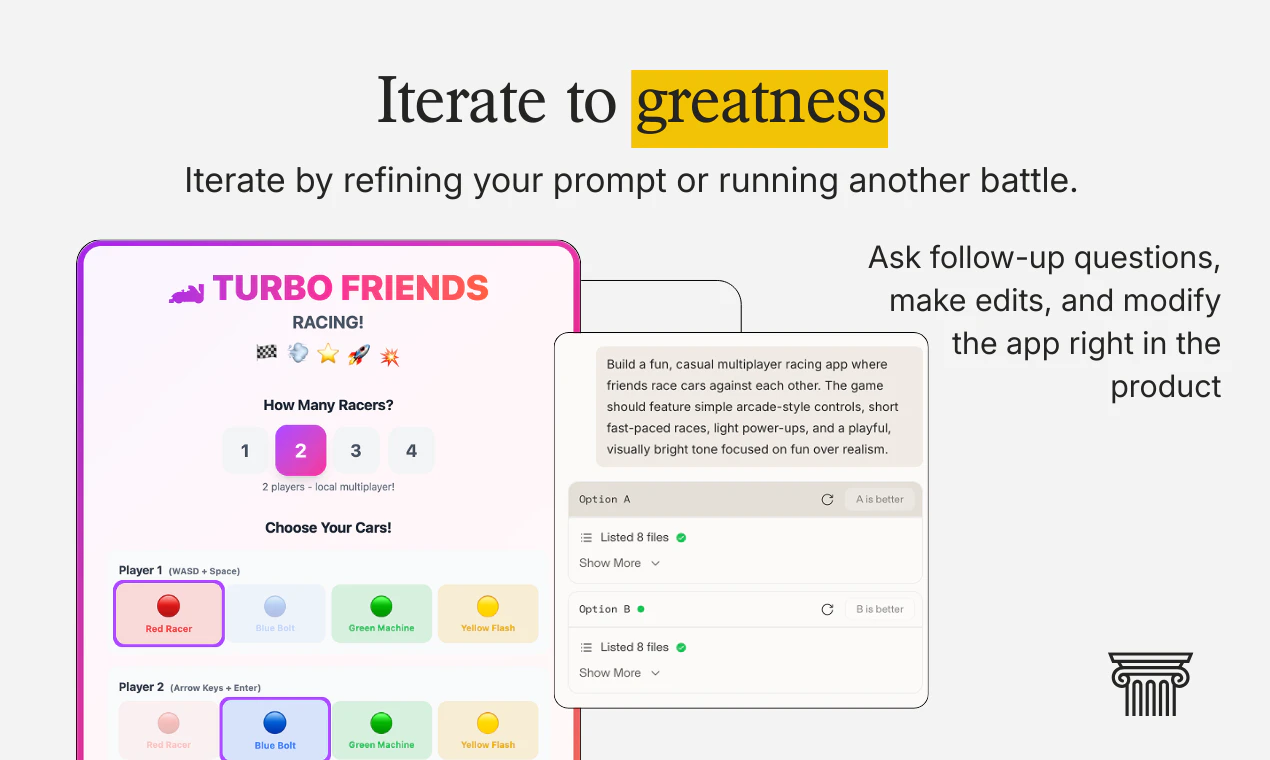
👋 Hey Product Hunt! We’re excited to launch Multi-File Apps in Code Arena.

AI coding tools often break down once projects go beyond a single file. We built multi-file in Code Arena to solve that, letting developers generate, compare, and iterate on real, multi-file codebases with production-level structure and reliability.

On Code Arena, you can prompt once and see multiple top coding models generate full projects side-by-side, then download the result as a ZIP to run locally or push to GitHub.

We’d love your feedback:

  • What kinds of apps or websites are you building?

  • Which coding models performed best for your build?

  • What additional models or features should we add to Code Arena?


Thanks for checking it out 🙏

11
回复

@aryanvichare Intriguing, and dying to use this, but I'd really need preview to be able to assess which of the two results is better.

I just tried a prompt, on one side it turned this into 17; the other side 20. What I need, as a low-coder, is the output.

0
回复
Where does Code Arena fit in a developer’s day-to-day workflow after the first generation—what’s the intended loop between Arena, a local repo/IDE, and GitHub as the project evolves over multiple iterations?
1
回复

Comparing AI outputs side by side is something every dev needs right now.

I've been building dev infrastructure tools myself and the "which tool actually works" problem is constant.

How are you handling the evaluation criteria? Pure output quality or also factoring in cost?

1
回复
Comparing outputs of different models side by side is a great idea! I’m building an app that ranks places based on online reviews and have been using Claude with skills for both frontend and backend, it’s been solid. Just curious: Can skills or structured context (beyond prompts) be standardized across models for fair comparison? And how does Code Arena help objectively determine the “best” model. Are there measurable benchmarks, evaluation metrics or reports?
1
回复
Looks great! 💪 Multi-file generation + side-by-side comparison is such a clean “aha” - most tools demo well on a single file and then fall apart in real projects. What’s been the most common “wow moment” users mention after trying Code Arena? And what’s the biggest friction point you’re still working on? I cross my fingers to you! 🙂
1
回复

Congratulations on the launch 🎉 🎉 🎉

0
回复

This sounds like a great way to evaluate which model pulls ahead. It seems to shift monthly if not weekly

0
回复

Love the multi-file capability - that's a huge differentiator versus single-file LLM outputs. Have you considered adding a mode to visualize dependencies between generated components? We often need to understand how different models structure their file relationships.

0
回复

Congrats on the launch! Moving beyond single-file demos to real multi-file projects feels like a necessary step for serious AI coding. How does Code Arena handle cross-file dependencies and project-wide consistency, especially when different models generate slightly different structures or patterns?

0
回复
#5
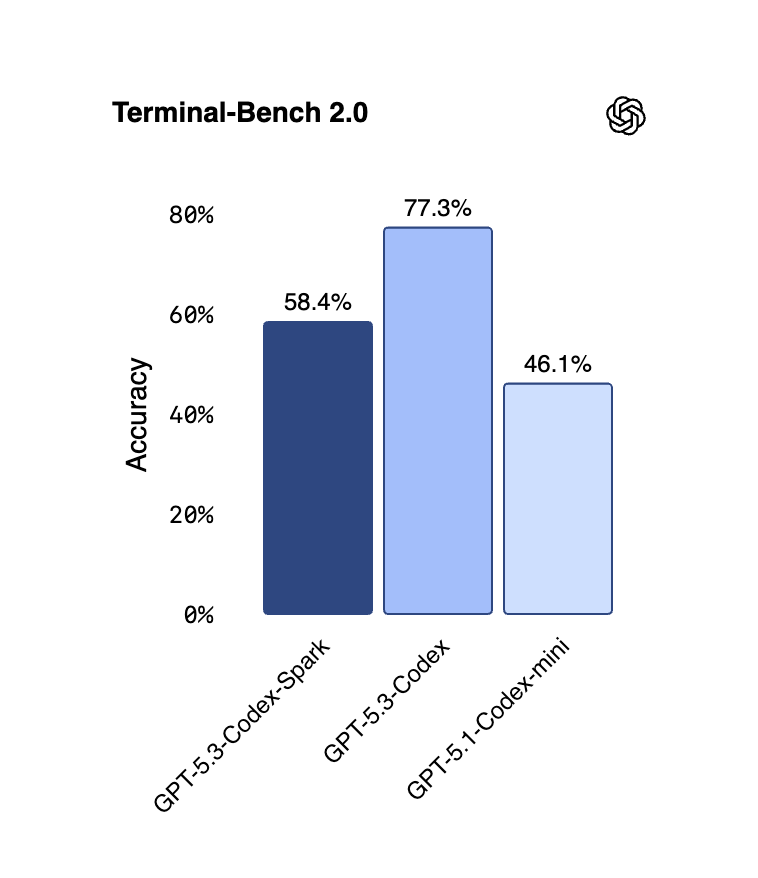
GPT‑5.3‑Codex‑Spark
An ultra-fast model for real-time coding in Codex
235
一句话介绍:一款面向实时编码协作的极速AI模型,为ChatGPT Pro用户提供15倍生成速度与128K上下文,解决了开发者在交互式编程中对低延迟和高响应度的核心痛点。
Developer Tools Artificial Intelligence Development
AI编程助手 实时协作 低延迟模型 代码生成 开发效率工具 大上下文窗口 研究预览版 交互式编程 轻量级编辑 ChatGPT Pro
用户评论摘要:用户肯定其128K上下文和实时协作对开发流程的价值,赞赏轻量风格提升迭代速度。关注点集中在:是否提供SDK以便集成至构建管道;未公布定价可能影响采用;被视为同类模型的竞争者,核心优势在于快速处理明显代码问题而不消耗过多令牌。
AI 锐评

GPT-5.3-Codex-Spark的发布,本质上是OpenAI在AI编程助手赛道的一次精准的“降维打击”与场景切割。它没有选择在终极代码智能上继续内卷,而是敏锐地抓住了高端开发者一个更本质的诉求:交互流畅性。将“延迟与智能同等重要”作为标语,直指现有重型模型在实时结对编程、动态调试等场景中的核心短板——过长的思考时间会无情地打断开发者的心流。

产品介绍的“轻量级工作风格”是另一处值得玩味的战略选择。默认进行最小化、有针对性的编辑,而非自动运行测试或生成长篇大论,这并非能力上的妥协,而是对真实工作流的深刻洞察。它将自己定位为一个“敏捷的副驾驶”,将控制权牢牢交还开发者,通过近乎即时的响应来加速“提议-反馈-修正”的迭代循环,这比生成一个看似完美但需要大量时间审查和调试的复杂代码块,在实际生产力上可能更胜一筹。

然而,其面临的挑战也同样清晰。首先,作为ChatGPT Pro的附加预览功能,其准入壁垒和未来独立定价策略成谜,这直接关系到其能否渗透入企业级CI/CD流水线。其次,评论中将其与Windsurf等竞品对比,说明市场已意识到“专用化”模型的趋势。Spark的优势在于速度与交互,但在需要深度推理、复杂系统设计的“硬核”编程任务上,用户可能仍会转向更“重”的模型。它的真正价值,或许不在于取代所有编程AI,而在于重新定义人机协作的交互范式,将AI从“思考型顾问”转变为“响应型伙伴”,从而开辟一个以速度和流畅度为核心竞争力的细分市场。成功与否,取决于OpenAI能否将这种极致体验,转化为可规模化的产品与生态。

查看原始信息
GPT‑5.3‑Codex‑Spark
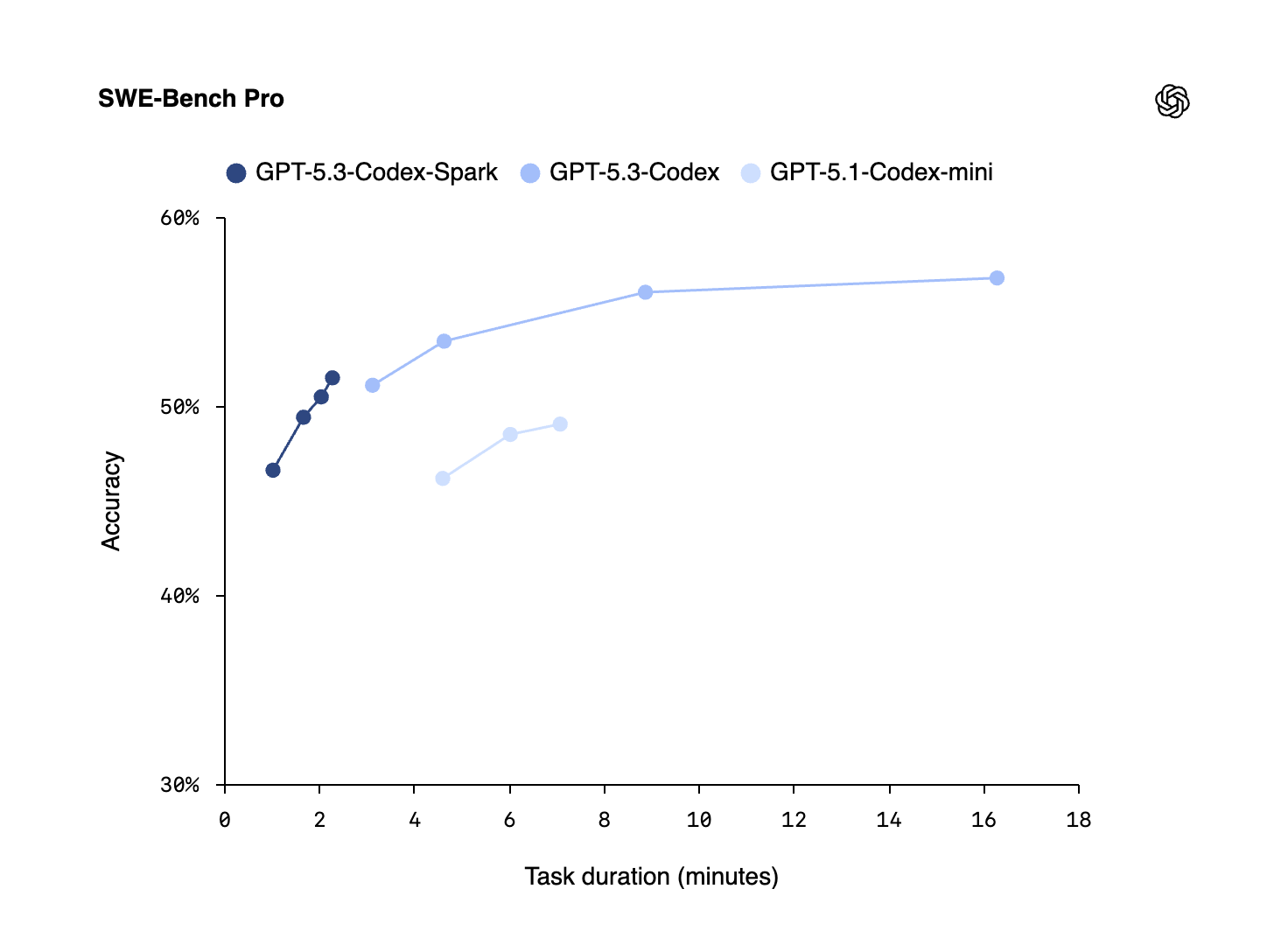
15x faster generation, 128k context, now in research preview for ChatGPT Pro users. Codex-Spark is optimized for interactive work where latency matters as much as intelligence. You can collaborate with the model in real time, interrupting or redirecting it as it works, and rapidly iterate with near-instant responses. Because it’s tuned for speed, Codex-Spark keeps its default working style lightweight: it makes minimal, targeted edits and doesn’t automatically run tests unless you ask it to.

The 128k context window combined with real-time collaboration is exactly what we needed for our internal dev workflows. The minimal style approach makes iteration so much faster than heavier models. Are there plans to expose the model through an SDK for integration into build pipelines?

1
回复

Pretty quick turnaround from the Cerebras partnership

1
回复

Also saw this tip from @steipete about how to extend some of the functionality added for Spark to other models for Codex users: https://x.com/steipete/status/2022130415839195433

1
回复

Seems like a competitor to Windsurf's SWE-1.5 model — aimed at quickly fixing obvious code problems w/o burning excessive tokens.

The cost of intelligence keeps coming down!

0
回复

@chrismessina But they didn't announce pricing for this, did they? I think that's really going to make or break this.

0
回复
#6
Walme Wallet
A unified hub for all your Web3 wallets
169
一句话介绍:Walme Wallet是一款统一的Web3钱包中心,通过聚合管理多个非托管钱包、只读地址和交易所账户,并内置兑换功能,解决了用户在管理分散的加密资产时需频繁切换平台、操作繁琐的痛点。
Android Crypto Web3 Cryptocurrency
Web3钱包 资产聚合 非托管 多链管理 代币兑换 加密货币卡 去中心化通讯 投资组合追踪 安卓应用
用户评论摘要:用户肯定其统一管理概念与设计,询问iOS上线时间、兑换限额、身份验证及与竞品差异。团队回复详尽,强调其生态整合(加密卡、AI助手、去中心化通讯)是核心差异,并承诺优先保障数据准确性而非功能广度。
AI 锐评

Walme Wallet的野心远不止于“又一个聚合钱包”。其真正价值在于试图将加密资产从“管理对象”转化为“可用资产”,通过整合加密借记卡和内置通讯(支持链上转账),模糊了加密存储与日常消费、社交的边界。这直指Web3大规模应用的核心障碍——资产孤立于现实世界。

然而,其挑战同样尖锐。首先,“全能型应用”面临体验臃肿与监管合规的双重风险,尤其是融合金融与通讯功能。其次,团队对ENS等成熟身份层“战略性延迟”的态度,虽显谨慎,也可能错失建立用户网络效应的先机。评论中资深用户对其与Zerion、Rainbow等产品的差异性质疑,恰恰点出了当前赛道竞争的本质:在基础钱包聚合功能已趋同质化后,**真正的护城河在于能否创造独特的资产使用场景,并保证跨链数据聚合的绝对可靠性**。Walme的加密卡和通讯是亮点,但需证明其整合体验丝滑且安全,方能从“功能堆砌”升维至“生态协同”。

查看原始信息
Walme Wallet
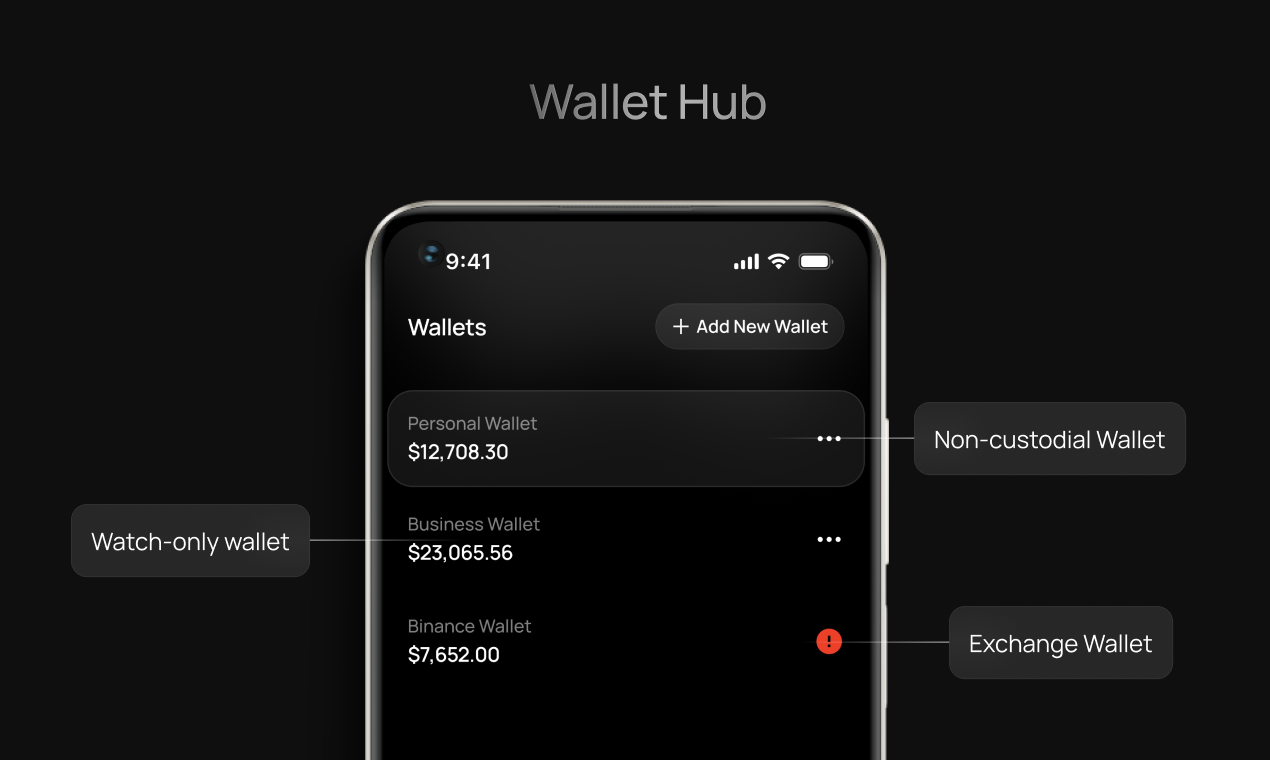
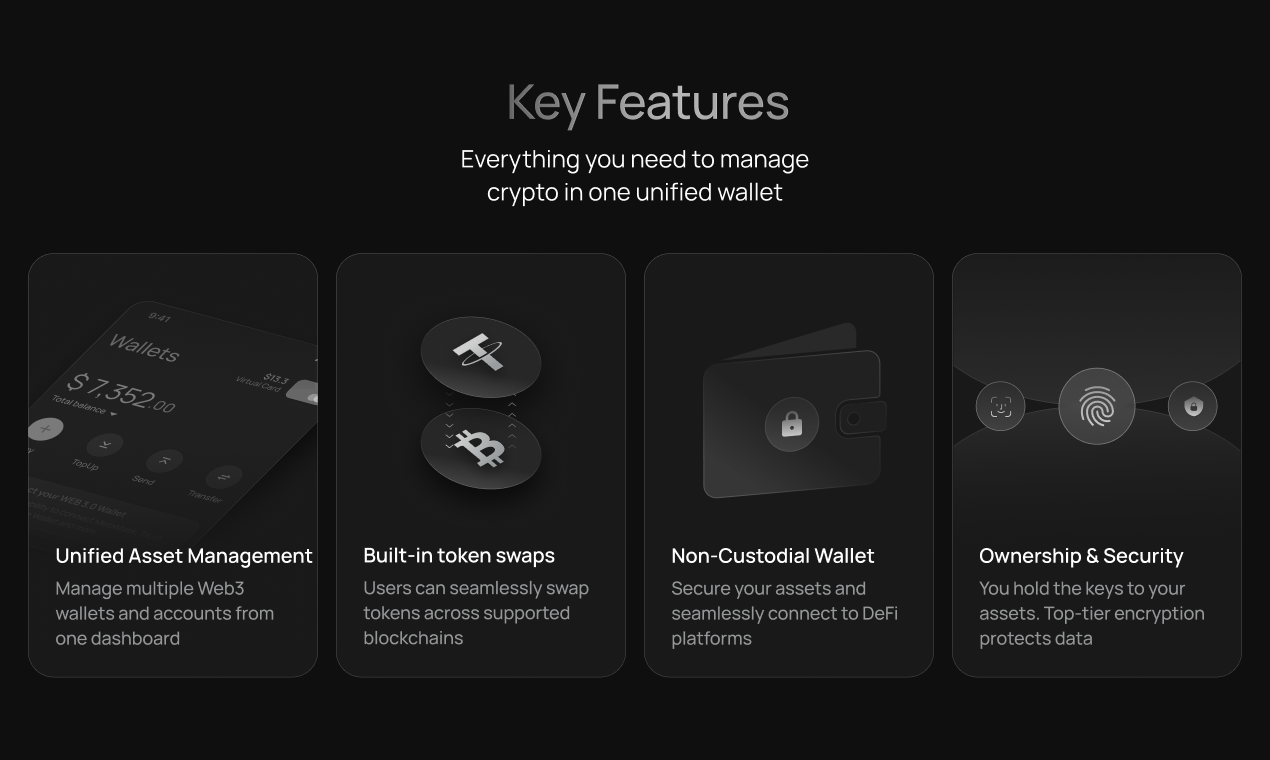
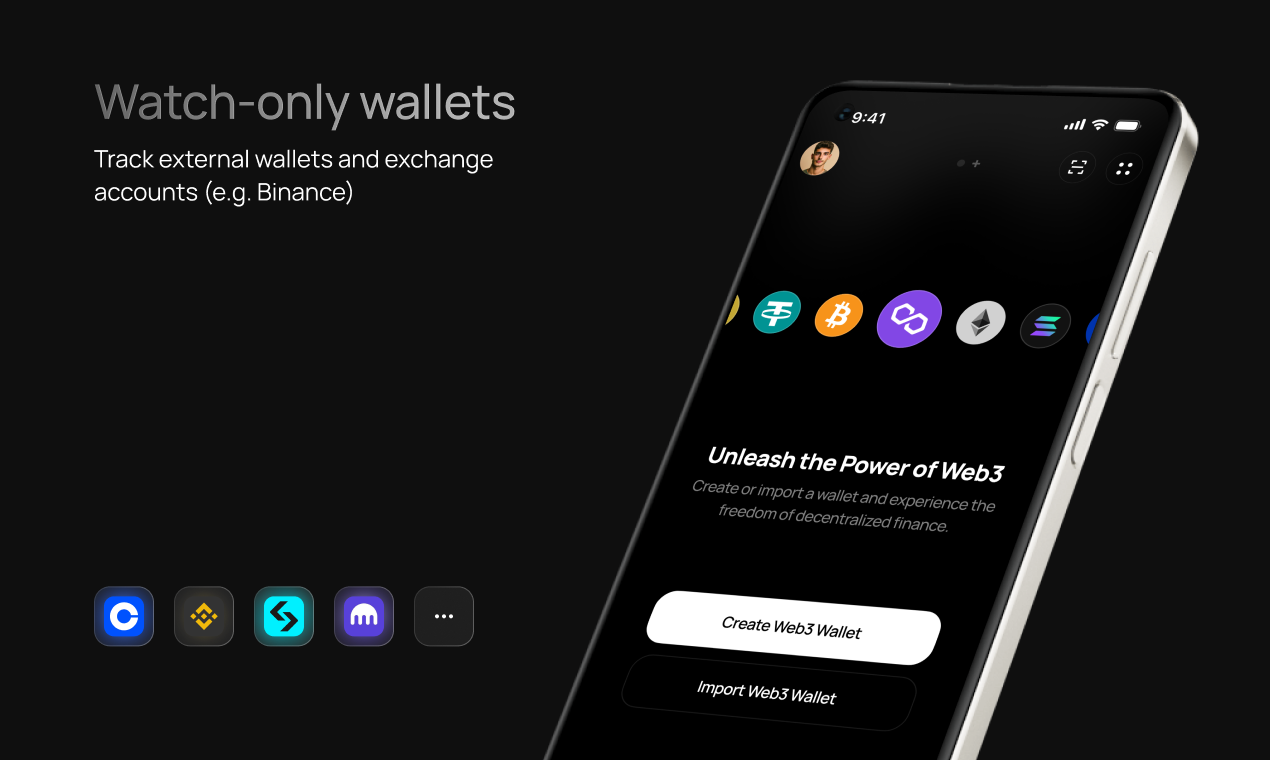
Walme Wallet is a unified Web3 wallet hub that lets you manage all your crypto in one place. Connect non-custodial wallets, add watch-only wallets, and track exchange accounts like Binance through a single, clean interface. Monitor balances, follow activity across multiple chains, and swap tokens directly inside the app without jumping between platforms. Walme is built to reduce fragmentation and make everyday crypto management simpler. Currently available on Android. iOS coming soon.

Hey Product Hunt 👋

I’m Oleh, CEO and co-founder of Walme.

We started Walme because managing crypto today feels unnecessarily fragmented. Most users end up juggling multiple wallets, exchanges, and swap tools just to understand what they actually own and move assets around.

Walme Wallet is built as a unified Web3 wallet hub. It lets you manage multiple non-custodial wallets, add watch-only wallets, track exchange accounts like Binance, and swap tokens directly inside the app — all from one clean interface.

Our goal with this launch is simple: reduce complexity and make everyday crypto management more transparent and easier to use, without sacrificing self-custody.

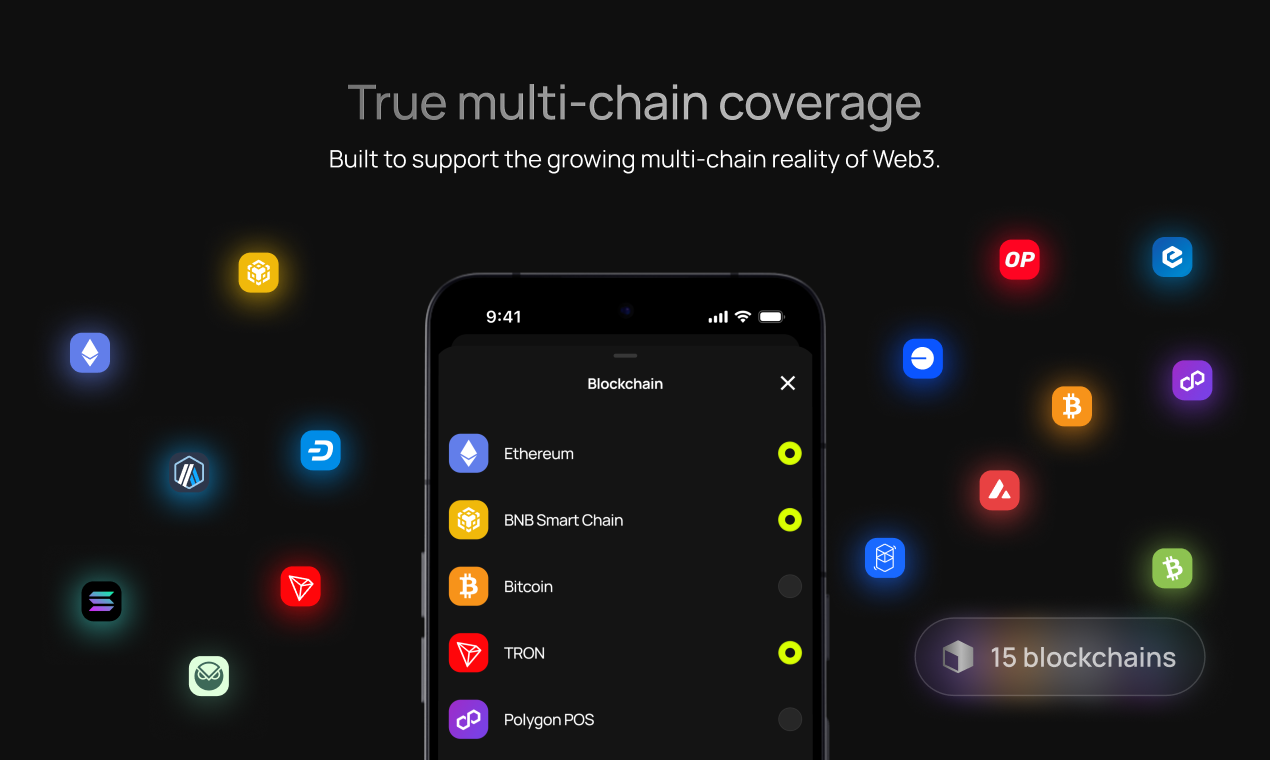
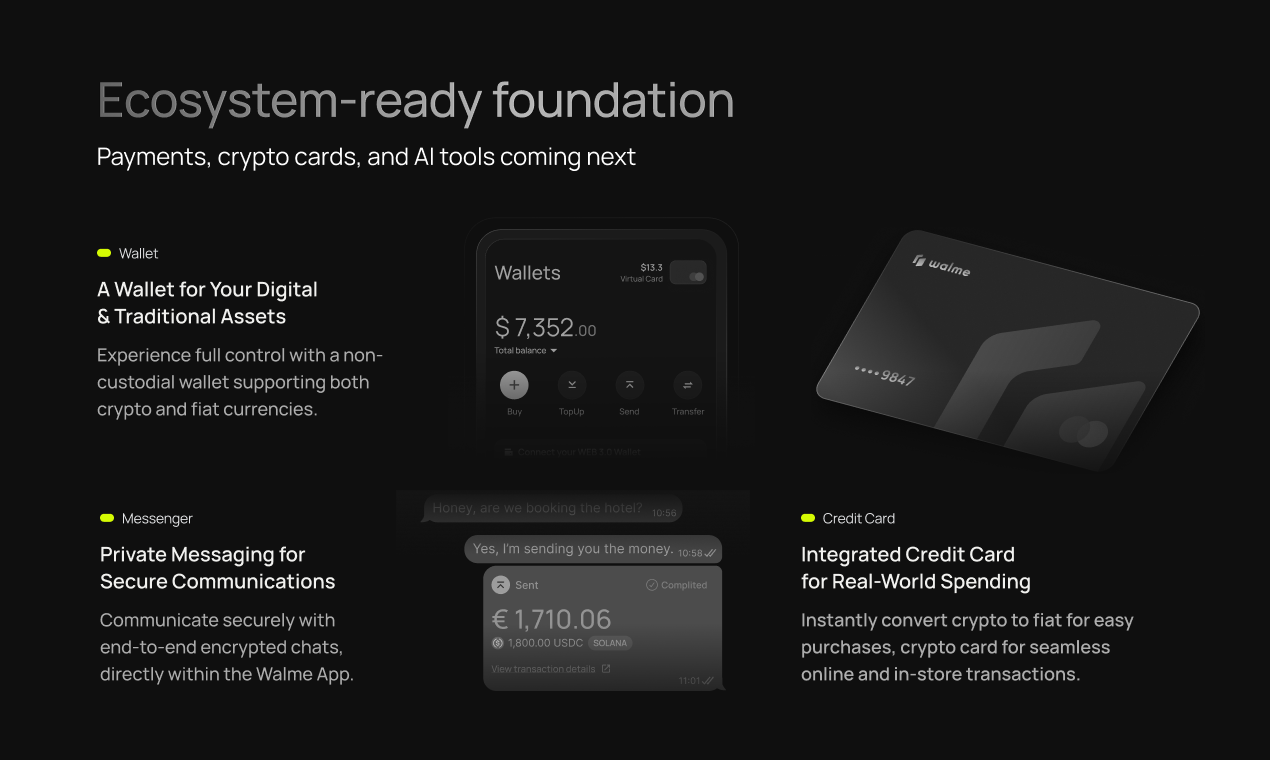
This wallet is the foundation of the Walme ecosystem. Payments, crypto cards, and an AI assistant are coming next — all connected to the same hub.

⚠️ Walme Wallet is currently available on Android only. iOS support is coming soon.

We’d really love your feedback on the hub concept, swaps, and overall UX 🙏

16
回复

@oleh_mishchenko Nice idea to keep everything in one place. Btw how to use the promocode for the free 1mo subscription?

2
回复

@oleh_mishchenko Finally! Thanks for your work!

0
回复

Thanks everyone for supporting our project!

4
回复

Nice design for both the website and the app 🙌 Quick product question. What trading volume limits are there, and are there any thresholds after which identity verification is required?

2
回复

@dmitriychuta Thank you 🙌 really appreciate the kind words!

Great question.

Walme Wallet itself is non-custodial, so there are no identity verification requirements for simply using the wallet, managing assets, or holding funds — users remain in control of their keys.

For swaps, limits depend on the liquidity providers and on-chain conditions rather than fixed internal caps. We don’t impose strict trading volume thresholds at the wallet level.

For fiat-related features (like cards), a lightweight onboarding process applies. In most cases, only basic information such as an email is required to get started, while additional verification may depend on specific usage scenarios and regulatory requirements.

Happy to clarify anything further!

2
回复

curious how you differentiate yourselves from other wallets that provide similar functionality?

1
回复
@dkofoed Great question 🙌 Most wallets focus on asset management. Walme goes further by combining wallet infrastructure with real-world utility and communication in one ecosystem. Beyond being a non-custodial multi-chain wallet with swaps and aggregation, Walme integrates: • A crypto card for everyday spending • A decentralized messenger with native asset transfers • An AI assistant for portfolio and market guidance So it’s not just about holding and swapping crypto — it’s about using, managing, and interacting with it in one unified environment.
0
回复

Nice interface! Two things, if I can ask:

1) I’m a wallet power-user, using Zerion, Farcaster Wallet, Rainbow, Zapper, Glow, Phantom, Uniswap Wallet, The Base App (fka Coinbase Wallet), and even a a few others. That’s in approximate order of priority. I’m curious what would be the reason for considering switching over to Walme, as it seems that most of those - particularly Zerion & Rainbow - offer what you offer… aggregated wallets in one app, watch-only addresses, swapping (of course), good backup/restoration protocols… I don’t mean this negatively at all, I’m sure you have thought about this and have an answer, but, what makes Walme more than “just another self-custodial wallet”?

&

2) When iOS support? And will it be iOS and iPadOS native support? (No one has cracked wallets on iPad yet, there’s some opportunity there, even if it’s niche!) - I’m all-Apple, so, I’d have to wait, but I want to keep an eye on this.

Either way, congrats for ranking high with an onchain product - that can be hard in the PH ecosystem, lol, and you nailed it. :) bravo!!

1
回复
@grey_seymour Thank you so much for the thoughtful questions — they’re absolutely valid, especially coming from a power user with your stack 🙌 You’re right: today there are several strong non-custodial wallets offering aggregation, watch-only tracking, swaps, and solid backup protocols. So the real question isn’t “why another wallet?” — it’s “why switch?” Walme is not just another non-custodial wallet. It’s an ecosystem. In the Android version already live today, users don’t just manage wallets — they can issue a crypto card and top it up directly with crypto. That means secure self-custody combined with real-world spending. The wallet and the card are native parts of one system, not separate integrations. Beyond that, the Walme app includes a decentralized messenger built on the Matrix protocol. Inside the messenger, users can not only communicate but also send crypto assets directly within the chat. No switching between apps, no copying addresses, no jumping back and forth between wallet and messaging apps. Similar to how Revolut or Wise integrate finance into conversations — but built for Web3. On top of that, the same messenger will include an AI assistant that helps users manage their portfolio, understand market movements, and navigate crypto and blockchain concepts. It’s designed to support both advanced Web3 users and newcomers. So the difference isn’t just feature parity. It’s integration. Walme combines: • Secure non-custodial wallet infrastructure • Real-world crypto spending via card • AI-powered portfolio assistance • Decentralized communication with native asset transfers All in one unified environment. Regarding iOS — yes, we are actively working on it and are planning a release this spring. It will be a fully native application, and we’re strongly considering dedicated iPadOS support as well. We agree there’s real opportunity there. Thanks again for the sharp questions — they help us better articulate our vision and where Walme is heading as a platform.
1
回复
Accuracy is the make-or-break factor in a unified view: how do you handle tricky cases like DeFi positions, staking, spam tokens, and cost basis/P&L so balances don’t look “missing” or misleading—and where do you draw the line on what you support early vs later?
1
回复

@curiouskitty Great question — and we completely agree: accuracy is everything when you’re building a unified wallet hub.

Here’s how we approach it:

DeFi & staking:

We prioritize clear visibility first. Native token balances and standard staking positions are supported, while more complex DeFi positions (LP tokens, lending protocols, derivatives) are being integrated progressively to ensure reliable indexing rather than rushed, partial data.

Spam tokens:

We apply filtering and token detection logic to hide suspicious or zero-value spam assets by default, while still allowing users to manually manage visibility through the Token Manager.

Cost basis / P&L:

Portfolio tracking focuses first on accurate balance aggregation across chains. Advanced cost basis and detailed P&L analytics are part of our roadmap and will be introduced gradually with full data integrity in mind.

Where we draw the line:

Early stage = precision over feature breadth.

We’d rather support fewer integrations with reliable data than show incomplete or misleading balances.

A unified view only works if users can trust it — so correctness always comes before expansion.

Happy to go deeper into any specific case 👌

0
回复

Very nice product (excited about a free month to try as well!). Is it possible to pay with Walme card in European Union?

1
回复

@pervak Thank you 🙌 really appreciate it!

Yes — the Walme Card is designed to be usable across the European Union anywhere standard card payments are accepted (online and offline), including support for digital wallets where available.

Availability and specific features may depend on regulatory and partner coverage in certain regions, but the EU is part of our core supported markets.

Happy to share more details if helpful!

0
回复

This is a top and steady project, have tried to advise for many many months on the strengths and advantages of ENS I.E Walme.eth.

This protocol alligned with Matrix Layer. It offers human readable names to their users such as Oleh.walme.eth replacing default hex addresses.

It is also multi chain, it works with any coin. BASE/COINBASE use their ENS to issue subdomains.

It can serve as a smart contract name so users can confidently engage with the contracts to prevent them being scammed.

Also there's the significant branding, more users = more Walme wallet names kicking about and the show on etherscan etc as Oleh.walme.eth to sendor.walme.eth.

I love the project, the drive and direction. I do belive that ENS will elevate it to the next level with a bit of research.

You can host decentralised in web3 and it's censorship resistent. No more downtime because of servers.

Dont understand the hesitation, but you will establish, one day.

You know where to find me when it finally sinks in 👍

0
回复

@sendor_eth1 Thank you for your continued support and for sharing your thoughts.

We’re definitely familiar with ENS and its potential — and you’re absolutely right about the advantages it brings in terms of usability, branding, and decentralization.

As you noticed, it’s something we’ve been aware of for quite some time. It’s on our radar, and at the right stage of product evolution, we’ll move in that direction thoughtfully and strategically.

Appreciate your long-term perspective — conversations like this are always valuable 👍

0
回复
#7
Atomic Bot
One-click OpenClaw macOS app
139
一句话介绍:一款一键本地部署OpenClaw AI代理的macOS应用,解决了用户因复杂配置和安全隐患而难以使用这一强大AI工具的核心痛点。
Productivity Open Source Artificial Intelligence
AI代理工具 macOS应用 一键部署 本地运行 开源软件 隐私安全 开发者工具 降低使用门槛 OpenClaw生态
用户评论摘要:用户普遍赞赏其极大地简化了OpenClaw的安装配置流程,实现“拖拽即用”。主要反馈集中在:肯定其降低技术门槛的价值;创始人分享产品愿景与快速开发历程;技术用户关注依赖更新、安全打包及权限控制等底层实现细节。
AI 锐评

Atomic Bot的实质,是试图在去中心化、高门槛的尖端AI能力与大众用户“开箱即用”的朴素需求之间,架设一座简易桥梁。其真正的价值并非技术创新,而是精准的体验重构。它敏锐地刺中了当前AI工具,尤其是开源AI代理领域的一个普遍痼疾:强大的能力被令人望而生畏的配置过程所封印,将大量非硬核开发者拒之门外。

产品定位清晰且犀利:不做能力的加法,而做流程的减法。通过封装、打包和一键运行,将“使用AI代理”的认知和操作成本降至最低,直指“大众化采纳”这一关键瓶颈。创始团队将此前在消费级应用(加密钱包)中积累的“简化复杂技术”的产品思维成功迁移至此,是其一周快速成型并引发热烈反响的内在逻辑。

然而,其面临的挑战与机遇同样鲜明。作为一款“包装层”应用,其命运与上游OpenClaw深度绑定。评论中技术用户提出的依赖管理、安全更新、沙箱权限等问题,正是这类简化工具的阿喀琉斯之踵。它必须在“极简体验”与“可控、可靠、可审计”的专业需求之间找到平衡。否则,极易从“便捷之门”滑向“黑盒风险”。其开源属性是建立信任的明智之举,但如何构建可持续的商业模式,避免成为昙花一现的“便捷外壳”,是下一个需要回答的问题。本质上,Atomic Bot测试的是市场对“AI便利性”的付费意愿究竟有多强,以及在一个快速迭代的生态中,“简化者”自身能否持续保持敏捷与稳定。

查看原始信息
Atomic Bot
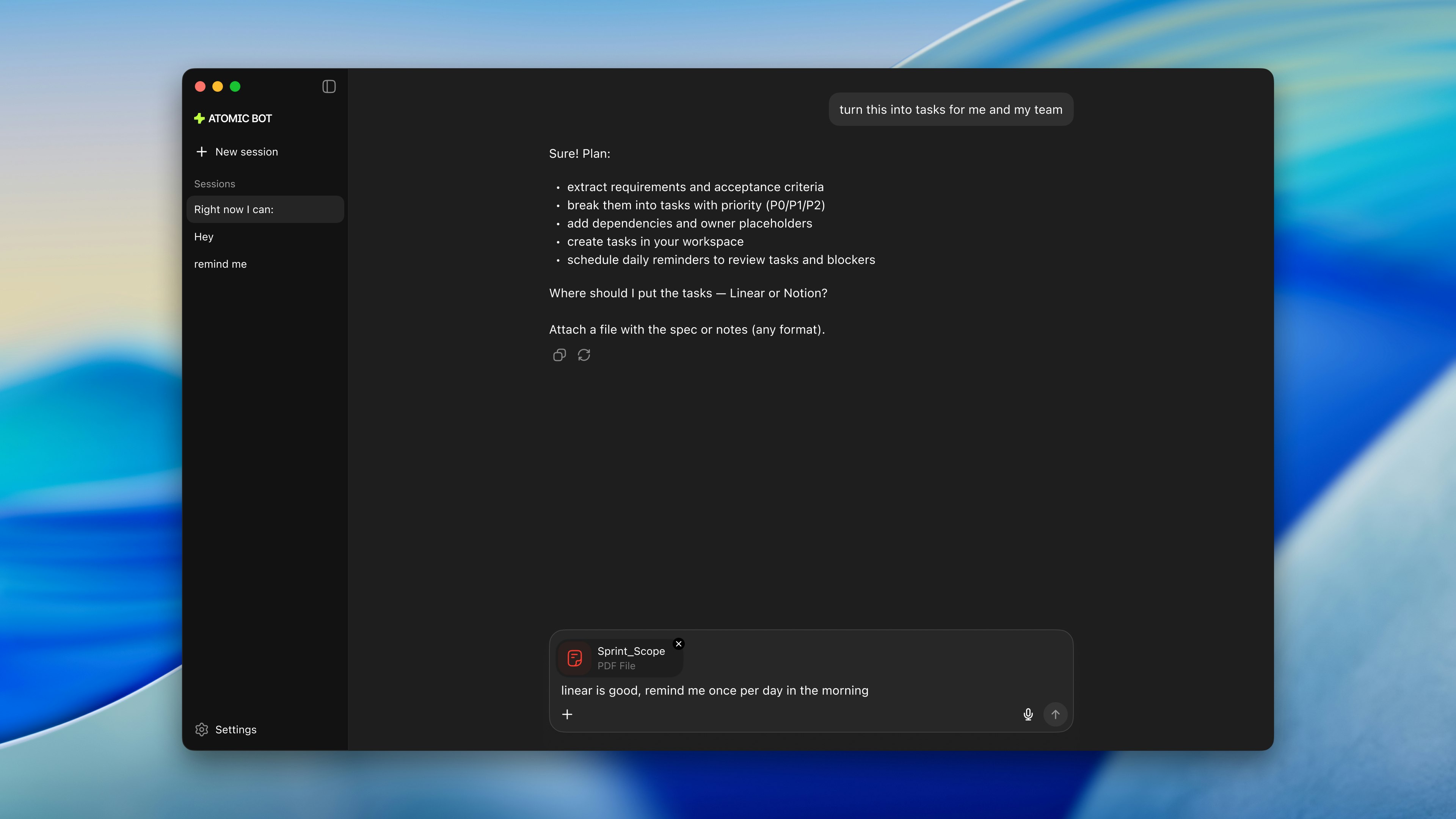
The simplest way to run OpenClaw. Atomic Bot works locally or in the cloud with your own LLM keys. It’s fully open source and free.
We built Atomic Bot because OpenClaw is powerful, but the setup process scares people off. Atomic Bot is a macOS app that gets you from download to a running OpenClaw AI agent in ~60 seconds — running locally on your Mac, so your workspace stays private. Question for builders: what are your must-have OpenClaw skills or integrations on day 1?
7
回复

@andrew_dyuzhov3 cursor or antigravity IDEs support. coding from the couch while the bot orchestrates the dev agents is the dream

2
回复

This is a great opportunity for everybody to test OpenClaw easily without spending hours on setting it up! Thank you!

5
回复

@evgeny_kotelevskiy Thanks a lot, Evgeny!

That was exactly the goal: remove the setup friction so people can focus on actually using OpenClaw, not configuring it. Have you tried any real use cases yet? Would love to hear what you tested first.

2
回复

Love this! I’m pretty technical — comfortable with the command line and all that — but it still took me a couple of days (yes, days) to get OpenClaw set up, and I still wasn’t happy with the security.

With AtomicBot you just drag the icon into the Applications folder and you're done. So many new AI tools are powerful, but the barrier to entry is still way too high. We need more tools like this.

5
回复

@ivanzalesskiy Love this take!
Our goal with AtomicBot was simple: local, secure and zero-friction. Just drag → open → start using!
Since you’re technical — what would you add next? 👀

2
回复

Hi! I’m the founder. My previous product, Atomic Crypto Wallet, reached 15M users and $100M ARR. After that, I started looking for something new and fresh.

AI is exciting, but it feels like a huge corporate field — everything is so centralized. Then Clawbot blew my mind.

I’m more of a business guy than a hardcore engineer, and setting up OpenClaw on my Mac mini was painful. Terminal, curl, keys… seriously? The gap to mass adoption is massive.

So we thought — why not make this simple?

With our engineering team, we shipped Atomic Bot in just one week: a one-click OpenClaw app for macOS. It’s private, local, free, and open-source — and mobile is coming soon.

We launched on Twitter and got 100K views and 1,000 downloads within hours. The demand is incredibly motivating.

You’re very welcome to try Atomic Bot — and feel free to ask any questions! 🦞

3
回复

One-click local agent apps tend to hit scale pain on dependency drift and supply-chain risk: a single upstream OpenClaw or model update can brick installs or change behavior unexpectedly.

Best practice is pinned, reproducible bundles (signed binaries, checksummed models) plus a plugin sandbox with capability-based permissions and an audit log for every tool invocation.

How are you packaging and updating OpenClaw under the hood (embedded runtime vs managed install), and will you expose per-skill permission prompts and a safe “dry-run” mode for risky actions?

2
回复

@ryan_thill Thanks, Ryan! OpenClaw is updated via the regular Atomic Bot app update. The app will automatically prompt you to update, and it only takes one click. 🦞

2
回复

Does Atomic Bot pin to a specific OpenClaw version or pull whatever is latest on install? After CVE-2026-25253 hit, the update cadence matters a lot for a one-click wrapper. Bundling a known-good version with signed checksums would keep that drag-and-drop simplicity without shipping a stale binary.

1
回复

@piroune_balachandran great question! app updated automatically. We always support the latest OpenClaw releases

2
回复

@gladkos Congratulations. And happy product launch.

0
回复

security? anything added?

0
回复

This is exactly the kind of thing the OpenClaw ecosystem needs. Software setup is one barrier, but hardware is another — that's why we built ClawBox (also on PH!), a dedicated NVIDIA Jetson box that runs OpenClaw 24/7 on 15 watts. Atomic Bot for Mac + ClawBox for always-on dedicated hardware = the full spectrum covered. Great to see more builders making OpenClaw accessible!

0
回复
#8
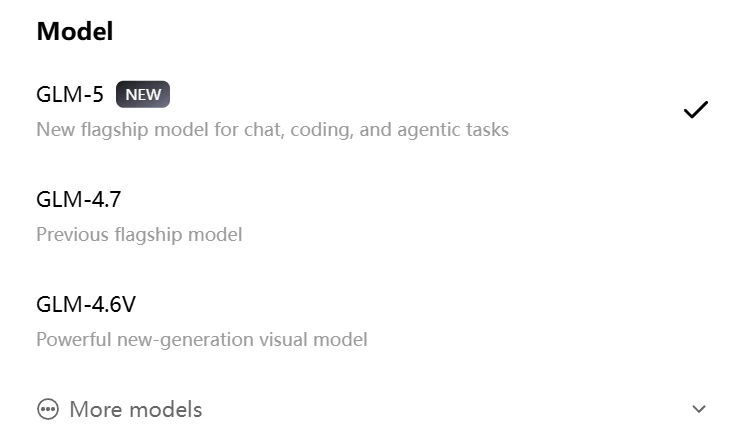
GLM-5
Open-weights model for long-horizon agentic engineering
138
一句话介绍:GLM-5是一款开源的巨型混合专家模型,专为处理复杂系统和长周期智能体任务而设计,通过在自有基础设施上提供接近顶级闭源模型的智能体能力,解决了企业级应用对高性能、低成本且数据安全可控的AI代理的迫切需求。
Open Source Artificial Intelligence Development
开源大语言模型 混合专家模型 AI智能体 长上下文 企业级AI 成本优化 自主可控 复杂任务规划 稀疏注意力 强化学习基础设施
用户评论摘要:用户高度评价其强大的智能体能力与成本优势,认为其在需要长时间运行、高智能规划但需控制成本的场景中极具价值。主要建议与问题集中在:智能体模式的具体安全沙箱机制、状态持久化能力,以及从现有闭源模型切换过来的具体优势场景。
AI 锐评

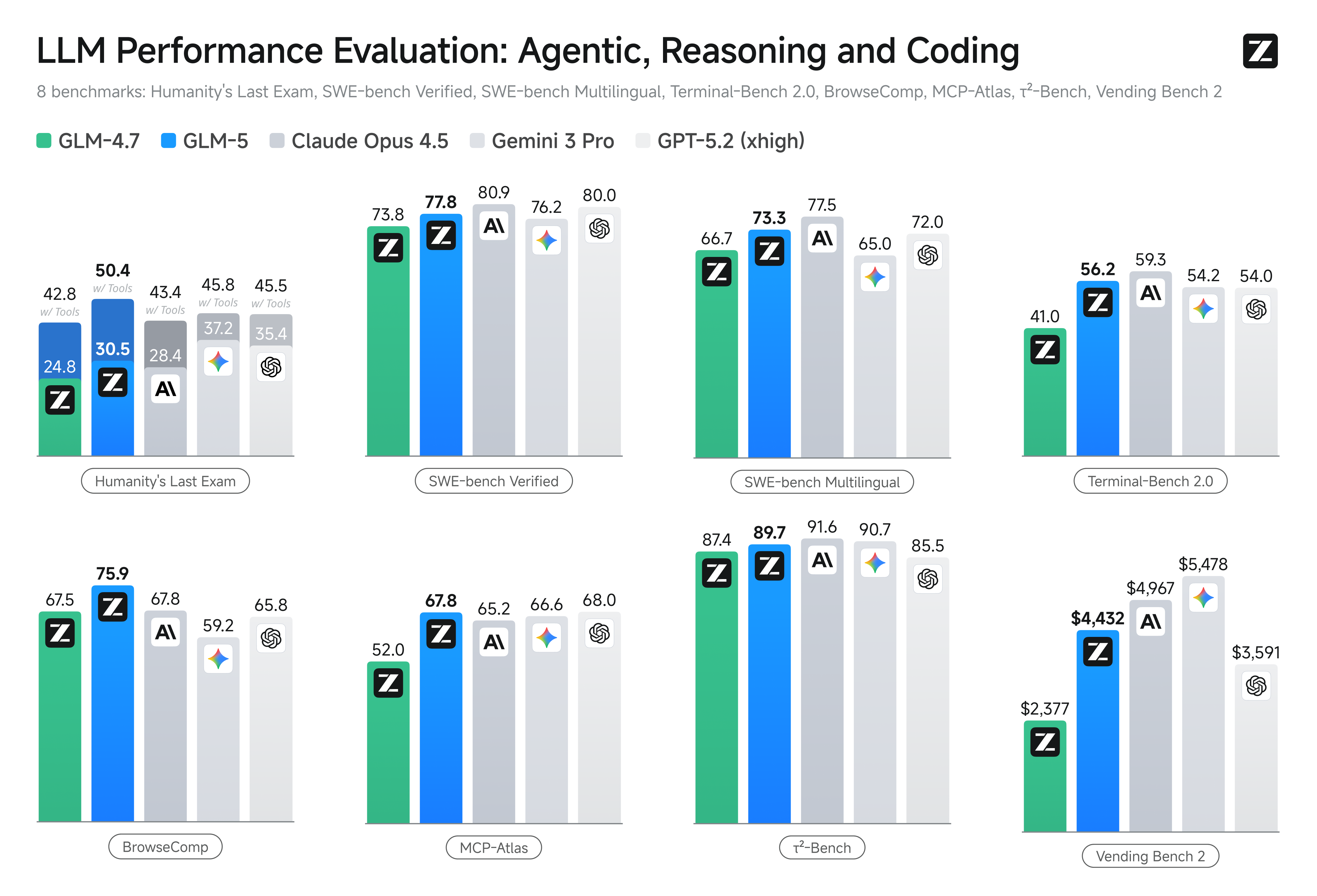
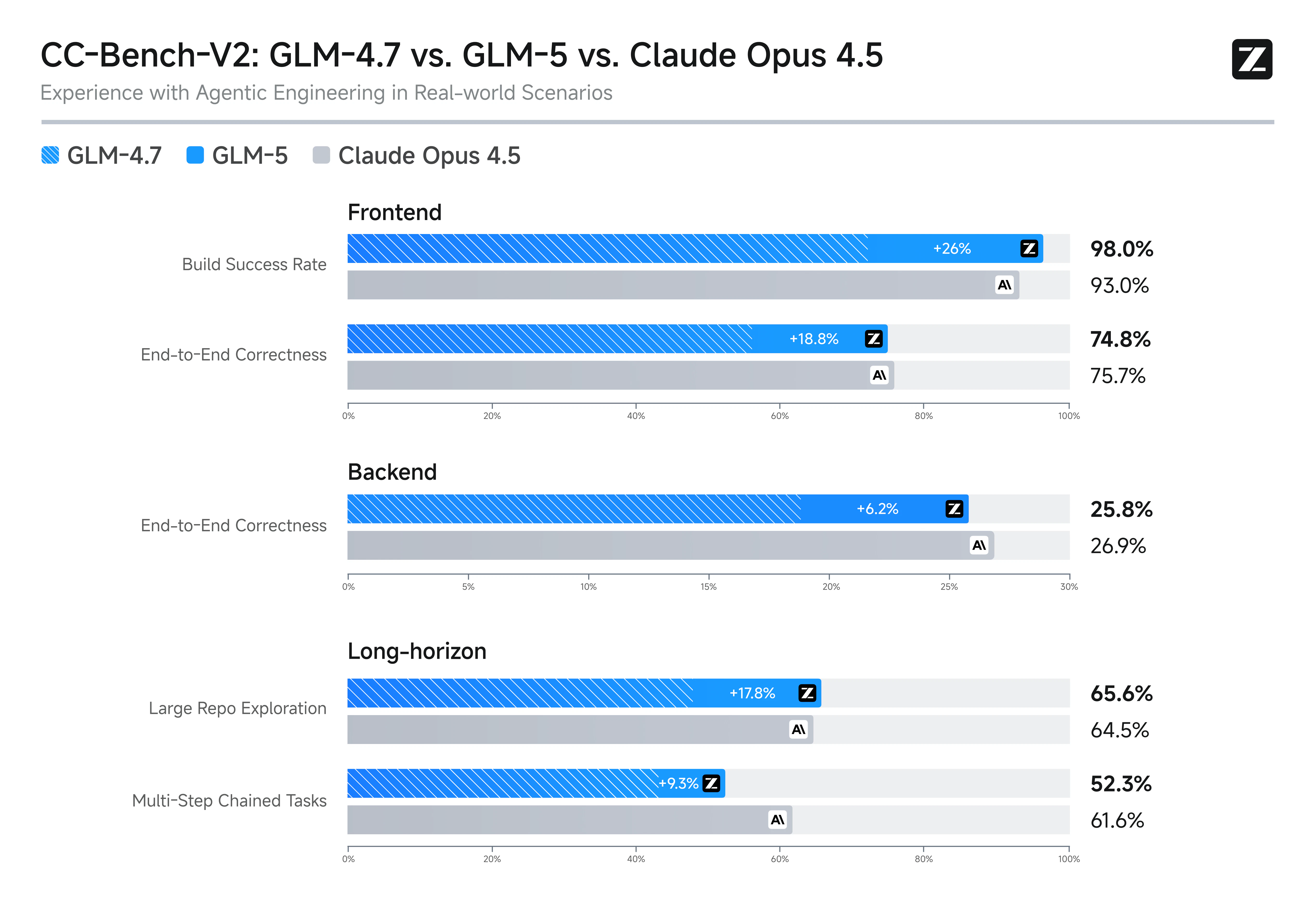
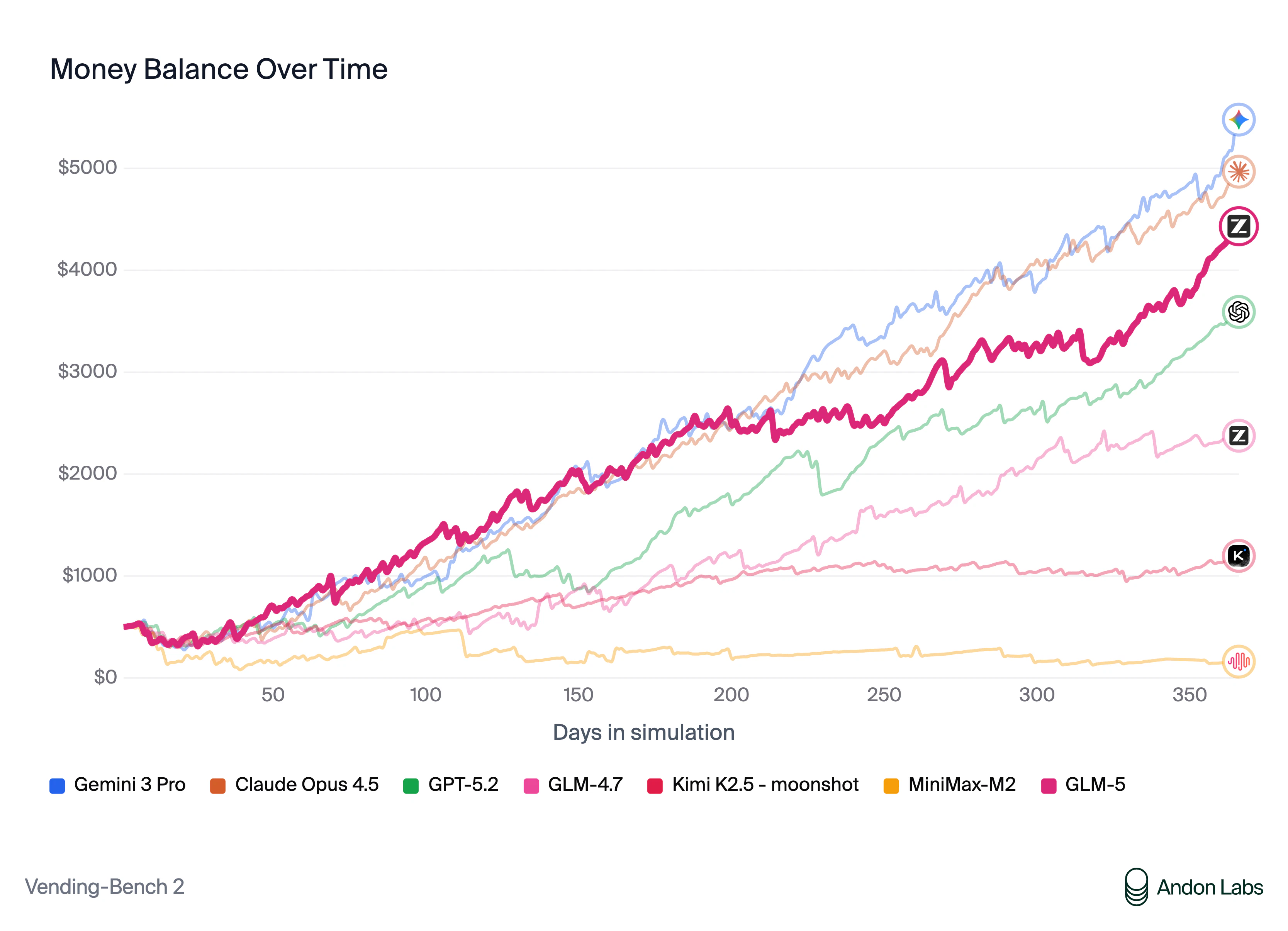
GLM-5的发布,远不止是参数规模的炫耀,它精准地刺向了当前AI商业化的一个核心矛盾:对“类Claude Opus”级高级智能体能力的渴求,与闭源API高昂成本、数据安全顾虑之间的冲突。其宣称在Vending Bench 2上接近Opus的表现,是它最锋利的营销刀刃,直接向市场宣告:开源模型在最具商业价值的复杂、长周期规划任务上,已具备了“可用且好用”的竞争力。

产品的真正价值在于“工程化整合”。它并非单纯堆砌参数,而是将DeepSeek稀疏注意力(控制长上下文成本)、创新的“slime”异步RL基础设施(解决后训练效率瓶颈)以及面向智能体的工程模式(如Z.ai的Agent模式切换)打包为一个解决方案。这标志着开源大模型从“追赶基准测试分数”进入“打造专用工程系统”的新阶段。其目标用户非常明确:那些被闭源模型API账单刺痛、或受限于数据合规无法外泄核心代码与业务流程的科技企业。

然而,光环之下疑点犹存。所谓的“#1开源模型”成绩是在特定基准(Vending Bench 2)上取得,其泛化能力有待更广泛验证。评论中关于智能体安全性与状态持久化的质疑,直指企业级应用最关键的“信任”问题——模型能力只是门票,能否在真实生产环境中可靠、可控、可审计地执行任务,才是决定其能否真正“上车”的关键。GLM-5展示了一条诱人的路径,但说服谨慎的企业客户进行迁移,仍需在工具链的成熟度、生态的支持和成功案例的积累上,补足比技术论文更复杂的功课。

查看原始信息
GLM-5
A 744B MoE model (40B active) built for complex systems & agentic tasks. #1 open-source on Vending Bench 2, narrowing the gap with Claude Opus 4.5. Features DeepSeek Sparse Attention and "slime" RL infra.

Hi everyone!

To put it simply: This is the Pony Alpha on @OpenRouter.

GLM-5 is a monster. It scales to 744B params, with 40B active, and integrates @DeepSeek’s Sparse Attention (DSA) to keep costs down while maintaining long context.

But the real story is agentic capability.

On Vending Bench 2, simulating a business over a year, it ranks #1 among open-source models with a balance of $4,432. That is comparable to Claude Opus 4.5 ($5k range).

They built a new async RL infra called "slime" to fix post-training inefficiency, and it shows.

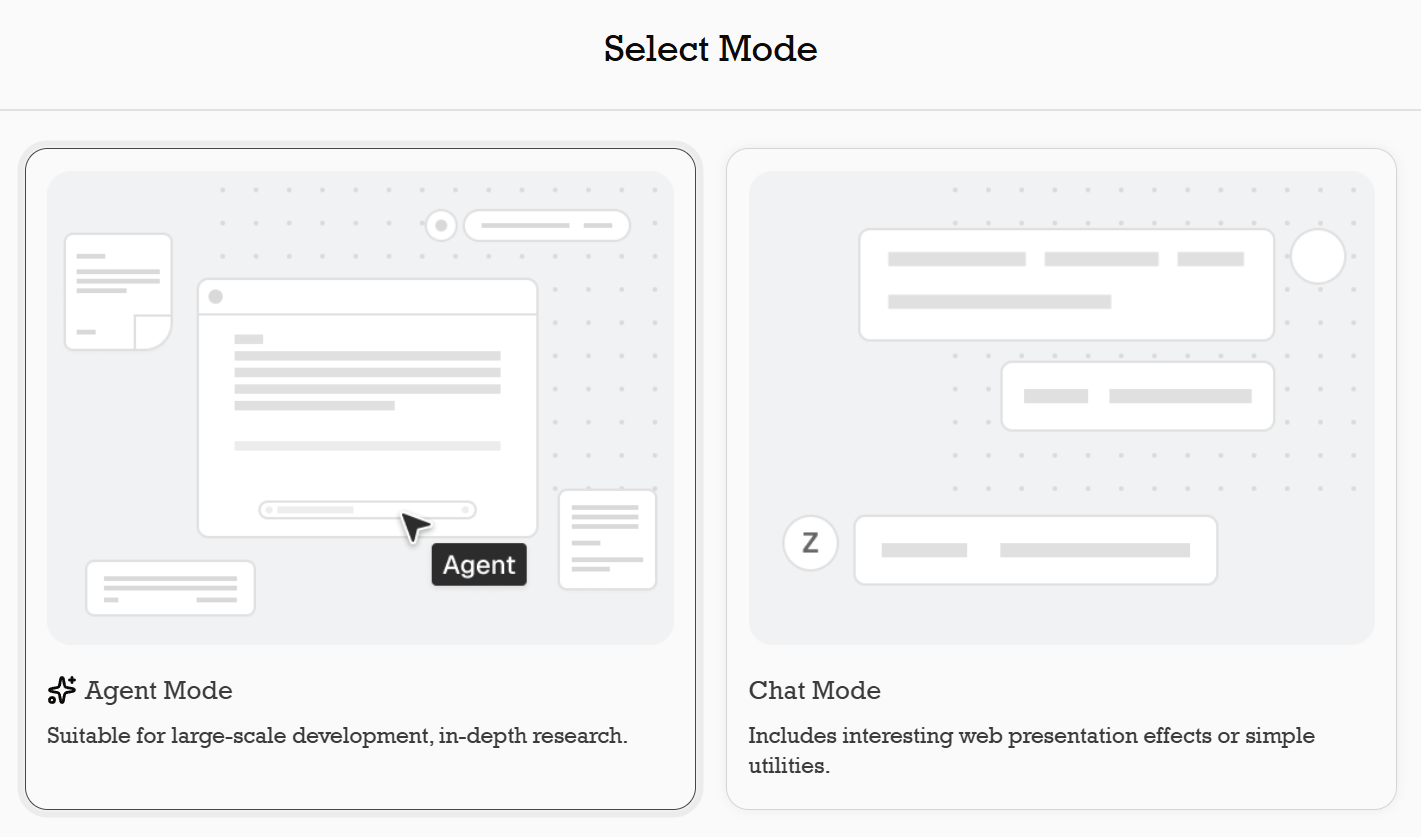
Also, Z.ai has evolved. You can now toggle Agent mode, instead of just Chat, to let it actually execute tasks. Give it a Spin!

5
回复

@zaczuo The concept encourages founders to act quickly without neglecting essential usability considerations, which is a tricky balance to strike.

0
回复

@zaczuo How does Z.ai Agent mode sandbox tools and persist state across long runs? Clear permissions plus replayable traces would make GLM-5 easier to trust when it's doing real work.

0
回复
If a team already gets strong results from closed-model coding agents, what are the two or three concrete scenarios where GLM‑5 wins enough to justify switching?
0
回复

@curiouskitty I'd say these:

  1. If your agent loop runs for hours, you need Opus-level planning but likely can't justify the API bill. GLM-5 hits that specific "smart enough + cost-effective" sweet spot.

  2. Since it's open weights, you can deploy it on your own infra (or your preferred provider) for sensitive codebases that can't leave your VPC.

0
回复
#9
Product Front
A place to get discovered faster and discover new products
130
一句话介绍:Product Front 是一个通过每日限流28款产品、采用横向网格布局及智能每周重发机制,解决初创产品在传统发布平台上因排名靠后或付费广告挤压而迅速被淹没、无法获得有效曝光痛点的发现平台。
Sales Marketing Growth Hacks
产品发现平台 初创者营销 公平曝光 替代Product Hunt 应用发布 增长黑客 独立开发者 社区驱动 反付费赢家 视觉优先设计
用户评论摘要:用户普遍认可其解决曝光痛点的核心价值,特别是28个名额限制和重发机制。主要问题集中于平台自身如何解决冷启动、如何平衡公平与质量、以及提交量激增后的处理方案。创始人回复强调“先到先得”和社区投票决定质量。
AI 锐评

Product Front 精准地刺中了当前主流产品发现平台的“民主化”幻象。它认识到,在无限滚动的信息流和付费广告的双重夹击下,“发现”本身已成为一种需要被重新分配的特权。其核心价值并非简单的UI创新,而是一套试图用刚性规则对抗算法与资本霸权的“曝光保障体系”。

每日28款的硬性上限,本质是制造一种数字稀缺性,将平台的注意力资源从“无限供给”变为“有限席位”,从而抬升每个席位的基础价值。横向网格布局与“智能重发”机制,则是从空间和时间两个维度对注意力进行再分配:空间上确保同时呈现,时间上提供多次机会。这确实为独立开发者提供了一个确定性更高的曝光方案,尤其缓解了“一发布定生死”的焦虑。

然而,其模式隐含着深刻的矛盾与挑战。首先,“先到先得”的公平原则,可能演变为“手速竞赛”,这与筛选“最佳产品”的初衷存在内在张力,长远可能损害平台内容质量与用户信任。其次,其商业模式尚未显现,在坚决否定“付费赢家”后,如何可持续地运营并解决自身的“鸡与蛋”冷启动难题,是创始人必须回答的生存拷问。最后,其价值高度依赖于流量规模,若无法吸引足够多的真实浏览者,28个席位的“公平曝光”将沦为开发者间的“内卷式曝光”,意义大打折扣。

因此,Product Front 的真正价值,与其说是一个成熟的Product Hunt替代品,不如说是一面映照出当前初创产品营销生态困境的镜子,以及一次对“注意力公平”的激进实验。它的前景不取决于设计巧思,而取决于能否在公平、质量与增长之间找到一个动态平衡点,并构建起一个真正活跃的、非功利性的发现者社区。否则,它可能只是为开发者提供了又一个“不会被淹没的墓地”。

查看原始信息
Product Front
A visibility-first discovery platform built to put your product in front page. Tired of your launch getting buried? Our streamlined UI/UX design and weekly relaunch feature ensure your product gets a higher chance to be visible on screen without users needing to scroll for miles, Whether you’re a curator hunting for the next big tool or a solopreneur looking for those crucial first users, we level the playing field. No "top 5" paywalls—just pure discovery for makers who are just getting started.

Hello Product Hunt 👋

The Problem
We’ve all been there. You spend months caffeinating your way through code, finally hitting that "Launch" button on Product Hunt, BetaList, or Peerlist with your heart in your throat. You’re ready for the world to see your masterpiece.

But then, reality sets in.

These platforms have become linear graveyards. Most only showcase the "Top 5" at first glance. If your product doesn't catch the initial morning wave, it's buried under a "See More" button, requiring users to scroll through a list of 100+ competitors.

Let’s be honest: if you aren't in the Top 20, you’re essentially invisible. Your hard work is relegated to the digital basement, hidden beneath a mountain of noise.

To make matters worse, it's increasingly becoming a "pay-to-win" game. * Ad Dominance: Paid placements now occupy 30–40% of the prime screen real estate.

Small startups and solo makers—the very heartbeat of this community—are being squeezed out.
How do you find your first 100 users when you don't have a $1,000 ad budget just to be seen?

The Solution
I didn’t build another directory; I built a stage where the spotlight actually moves. Product Front is a discovery platform designed to stop the "scroll-past" culture and give every founder a fighting chance from the second the page loads.

Every Pixel is a Chance to Be Seen
On most platforms, if you aren't #1, you're nobody. We changed the geometry of discovery:

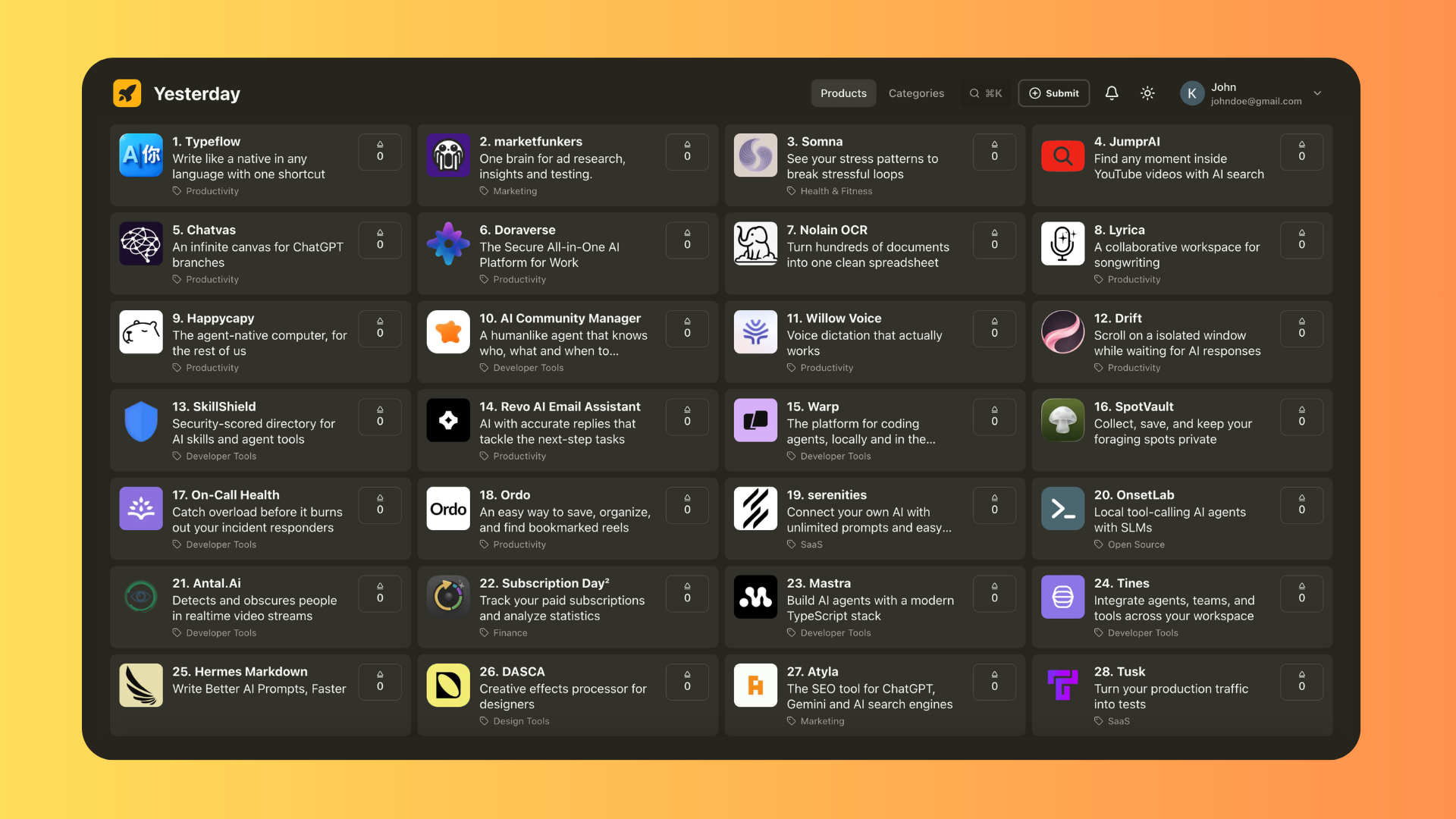
The Landscape Grid: Instead of a suffocating vertical list, our desktop layout presents 28 products at once. No scrolling, no "See More," no friction. Just 28 dreams getting the eyeballs they deserve.

Quality over Chaos: We cap daily launches at 28 slots. By curing the "100-product fatigue," we ensure that every visitor who lands on our page actually has the mental space to care about your work.

The Smart Weekly Re-launch: Our algorithm lets you launch weekly. But here’s the magic: if a user has already seen your product, we hide it from them and show them something new. This keeps the feed a "treasure hunt" for users while giving you multiple shots at finding your "100 true fans."

Experience the "Snap"
We’ve engineered the browsing experience to fight the "False Bottom" effect—that moment a user thinks they’ve seen it all and leaves.

Desktop Scroll-Snap: One flick of the wrist perfectly aligns the next 28 products. In just two seconds, a user has seen 56 products with zero "fidgety" scrolling.

The Mobile "Peek-a-Boo": On phones, we show a tiny sliver of the next product. This subtle visual nudge signals to the brain that there is more to discover, turning a passive scroll into an active journey.

Why Product Front?
Because you didn’t spend hundreds of hours building a product just to have it buried under a "Promoted" ad or lost in a 100-item list.

Product Front is for the indie hackers, the solo dreamers, and the small teams tired of the pay-to-win game. We’ve fixed the visibility problem so you can focus on what matters: building something great.

We believe the best products should win based on innovation, not the size of their marketing wallet. It’s time to level the playing field for the makers who are just getting started.

4
回复
Very cool! I’m curious, how is Product Front different from Product Hunt? With so many products launching, how do you ensure each one gets enough visibility and attention?
2
回复

Great questions, @linjing The biggest difference is that Product Hunt is a vertical race, while Product Front is a landscape stage.

Here’s how I ensure visibility:

The 28-Slot Cap: Unlike the endless vertical lists on Product Hunt where you get buried if you aren't in the top 5, we cap daily launches at 28. This cures "product fatigue" and ensures every visitor actually has the mental space to see your work.

Landscape Grid vs. Vertical Scroll: Our desktop layout shows all 28 products at once. No scrolling, no "See More," and no friction. Every pixel is designed to give you a fighting chance the second the page loads.

The Smart Re-launch: If a user has already seen your product, our algorithm hides it from them and shows them something new. This keeps the feed a "treasure hunt" for users while giving you multiple shots at finding your "100 true fans."

Essentially, I’ve traded the "pay-to-win" and "scroll-past" culture for a layout where everyone gets the spotlight.

Any feedback from you will help improving the product. 🙏

2
回复

Product Front capping at 28 is a smart constraint, but the re-launch rotation is what actually makes it work. Swapping out products a visitor already saw keeps the grid fresh without makers needing to nail their launch timing perfectly.

1
回复

@piroune_balachandran Nailed it, That’s exactly the strategy! 🔥

1
回复

Congrats on the launch! Reworking the geometry of discovery instead of just tweaking rankings is a bold move. How do you balance giving every product visibility with still signaling quality to users?

1
回复

@vik_sh Thanks for the kind words, That’s the exact tension I'm trying to solve. Here is how we balance visibility with quality:

  • Capped the grid at 28 products. This stops the "noise" and ensures every maker gets premium placement right on the front page.

  • The community decides quality, not me. I keep the spam out, but the community’s votes guide which products shine.

  • Seen algorithm. If a visitor has already seen a product, our algorithm hides it and shows them something new, keeping the grid fresh for returning users and adds up on top of the 28 total slots.

    For example, if 10 makers re-launch, those 10 slots sit alongside the 28 new ones, creating a "pool" of 38 products.

Basically, we make sure every spot is valuable, and the community decides which ones are best!

I am open for suggestions.

0
回复

I really like the idea. As someone with limited experience in marketing and growth, having a product that can help drive traffic feels genuinely valuable, especially with the 28 product cap. I did have a couple of questions though:

  1. How do you handle an influx of submissions? Is there a way to guarantee a product gets visibility, or is there some level of competition for placement on a specific launch date?

  2. Like many community-driven products. What’s the plan to consistently bring in more submissions? Are you aiming for a certain number of launches per day to keep momentum going?

1
回复

@lunarturtle these are spot-on questions! Here’s how:

1. Handling Influx & Visibility: To keep it fair, slots are first-come, first-served. I don’t curate based on my own taste because I believe every real maker deserves a shot. If today’s 28 slots are full, you can grab one for the next available day. The "guarantee" is the grid itself—by capping the daily main slots at 28, we ensure you are never buried under a "See More" button or lost in a list of 100+ competitors. I’m moderating personally (with AI help for spam) to ensure everything is legit, but the community’s votes are what ultimately decide the winners.

2. Smart Weekly Re-launch is a big part of the plan to keep the feed fresh. While we have 28 fresh daily slots, we allow products to re-circulate weekly. For example, if 10 makers re-launch, those 10 slots sit alongside the 28 new ones, creating a "pool" of 38 products.

If a user has already seen your product, the algorithm hides it from them and shows them something they haven't seen yet. This keeps the grid completely fresh for both new visitors and returning users.

I am open for suggestion. let me know what you think.

0
回复

Love how fast the submission to live is! Well done : )

1
回复

@craigjbarber Glad to hear it, Thanks for launching!

0
回复

The 28-slot cap solves the visibility problem, but raises a curation question: is it first-come-first-served, or is there a quality filter before a product gets a slot? For a platform promising fairness, how you handle that will define whether it attracts serious makers or just whoever submits fastest.

1
回复

@klara_minarikova That’s a great question, I’ve decided to go with First Come, First Served. I believe transparency is the only way to stay truly 'anti-gatekeeper.' On Product Front, I don't use hidden algorithms to decide who is 'worthy.' the upvotes have weight depending on user history, If you’ve built something and you’re ready, you grab one of the 28 slots. also if product posted last week and the user sees it, that makes they won't see the same product again on the feed this week and the total slot, if all 10 products was posted lastweek, same user won't see it so total will be 39 slots the If today is full, you just schedule for the next available day.

To keep the quality high, I’ll be moderating the list myself for now. I’m the filter for spam and fake products to ensure every 'real' maker gets their fair shot. Eventually, I might use AI to help automate that spam-detection, but the core rule stays: if it's a real product, real user, it gets the spot. No pay-to-win, no secret handshakes. I am open to hear your suggestions on this will help the product improve.

The Smart Weekly Re-launch also plays a huge role here. Our algorithm allows you to launch weekly, but here’s the magic: if a user has already seen your product, we hide it from them and show them something new.

For example: If 10 makers are re-launching their products this week, those take up 10 additional available slots alongside the new fresh launches, making it a total of 38 slots circulating for that period. This ensures the grid is always a fresh for the user while giving you multiple shots at finding your 100 true fans.

I’m open to hearing your suggestions to help the platform improve!

0
回复

I like it @kim_ben_g, congrats! Pretty easy to use and clean interface.
I just listed my product and best wishes on your journey 🚀

1
回复

@ihsany Thank you for the support and showcasing your product in the platform! 🚀

0
回复

As a solo maker preparing to launch my first product, this resonates hard. The anxiety of "what if I don't crack the Top 10 and nobody ever sees it" is real. The idea that you get multiple weekly shots at finding your audience instead of one do-or-die day is genuinely appealing.

Curious about the discovery side though: how are you planning to drive traffic to Product Front itself? The chicken-and-egg problem with discovery platforms is brutal, makers won't submit without an audience, and users won't come without good products. What's your strategy for the early days?

1
回复

@diegodau That’s a totally valid concern, and honestly, it’s exactly why I built this platform.

Trying to compete with established giants is terrifying, but I refuse to believe it's impossible. They all started from zero, right? While I’m grinding on technical SEO and marketing, the real secret sauce for isn't just code—it’s us makers.


My plan is to build a genuine community of makers supporting makers, and users who actually want to discover tools without the noise. Plus, I’m changing the game on visibility: visitors get 28 products at first glance—that’s 5x more than Product Hunt. I’m prioritizing pure fairness, not ad dollars. Every product gets a fair pixel on the screen, and I promise: no paid ads occupying the spotlight.

0
回复

Just checked and signed up on Product Front

Really liked the onboarding and overall UX

Congrats on the launch @kim_ben_g !

1
回复

Thank you for your support @theanimeshs 🙏

1
回复
#10
Typeletter
Turn your browser into a cozy, nostalgic writing nook
115
一句话介绍:Typeletter 是一款将浏览器变为复古打字机风格写作空间的工具,通过模拟真实的打字机声效、墨带和氛围音,为用户在撰写信件、日记或深度思考时,提供一个无干扰、可唤起怀旧情感并鼓励专注书写的沉浸式场景。
Productivity Writing Tech
复古写作工具 无干扰写作 浏览器应用 数字怀旧 情感化设计 打字机模拟 氛围音效 信件撰写 即时输出 隐私友好
用户评论摘要:用户普遍赞赏其营造的放松、专注的写作体验与怀旧情怀。主要建议包括:增加更多环境音选项(如森林、城市);优化可能存在的输入延迟;技术层面关注高性能导出与音频处理的实现,并对“时光胶囊”等无账号功能的隐私安全实现方式提出质询。
AI 锐评

Typeletter 的精明之处在于,它并未创造新需求,而是精准地劫持了“写作焦虑”这一现代普遍情绪。它的核心价值并非功能创新(模拟打字机、氛围音、导出图片),而在于通过一套高度风格化的感官包装(声音、视觉、交互隐喻),将“写作”这一行为仪式化、游戏化,从而短暂地消解了用户在空白文档前的压力。

产品巧妙地利用了“数字怀旧”这一情感杠杆。复古打字机并非作为生产力工具被还原(否则纠错功能缺失将是致命伤),而是作为一个情感符号被消费。它贩卖的是一种“慢下来、更用心”的错觉,其“无注册、无干扰”的设定进一步强化了这种纯粹、私密的心理暗示。然而,这种浪漫化包装与底层技术现实存在张力,正如尖锐的技术评论所指出的:浏览器应用的性能瓶颈、无后端账户下的“时光胶囊”实现与隐私承诺,都是其“轻量体验”背后必须面对的硬核工程与信任挑战。

本质上,Typeletter 是一个精心设计的“写作安慰剂”。它可能无法真正提升写作质量,但通过提供强烈的即时感官反馈(咔嗒声、蜡封印章)和完成仪式(发送、下载精美图片),它极大地提升了写作过程的情感回报和完成动力。它的成功与否,不取决于它是否比Word更强大,而取决于它构建的这场短暂逃离能否持续让用户买单——无论是情感上,还是最终在商业上。

查看原始信息
Typeletter
Turn your browser into a cozy, nostalgic writing nook for letters, journals, and thoughts you’ve been meaning to write. Typeletter mimics the feel of a real typewriter: clacky keys, carriage return lever, scroll knob, without any setup or sign-up. Pick your ink ribbon (Black, Red, Blue, Sepia), choose an ambience like Rain, Beach, Jazz, or Park, and just start typing from the heart. When you’re done, hit “finish” to email your note, download it as a beautiful image with wax seal stamps.
I built Typeletter because I missed sending thoughtful notes. The kind you’d write slowly. The kind that carry feeling not polish. There’s something about old letters and typewriters that made words feel more intentional. You paused before typing. You thought about what you wanted to say. The sound of the keys reminded you that this was real. Typeletter is my attempt to bring a bit of that back. A small, quiet space to write soulful notes, to yourself or to someone else, without distractions. Just a page, the rhythm of keys, and a sense of nostalgia that invites you to slow down. If you wanna feel the vibe, tune in to the ambience of a park, beach, jazz hall, or a rainy evening. What Typeletter lets you do: - Write soulful notes in a quiet, distraction-free space - Type on a classic, vintage-style typewriter - Hear the soft rhythm of typewriter keys as you write - Choose ink colors: black, blue, red, sepia - Add gentle ambient sounds (rain, beach, jazz, park) - Mark your note with a seal or stamp, like old letters - Sign your note, if you want it to feel personal - Send a note by email, when it’s ready - Save your words as a simple image keepsake - Time Capsule: schedule a note to be delivered in the future I made this because I wanted writing to feel personal again. If it helps you send or write something that matters, I’m glad it exists.
2
回复

Congrats on the launch! I gave Typeletter a try, and I found it very relaxing. It’s refreshing to see a product that focuses on meaningful writing and reflection.

I did feel there was a very slight input lag, and over time maybe it could use some more ambience options, like maybe a forest? Or the city? All in all, it’s a very nice product!

1
回复

@apira_giriharan Thanks! :) Sure, will keep adding more ambient sounds. Glad to know.

0
回复

I genuinely love it, but I am not so sure whether I want to go back to that era as a writer. One mistake and you could start writing over again :D

1
回复

@busmark_w_nika Hahah! Guess it's also a time when people had their own correction tape situations as well. Anyway, with this experience, I wanted to marry our ease of digital editor with typewriter effect. :)

0
回复
  • Browser-based “typewriter” apps hit scale pain when exporting high-res images and audio ambience cause memory spikes and jank on low-end devices.

    Best practice is OffscreenCanvas for render-to-image, preloading audio with the Web Audio API and limiting concurrent buffers, plus local autosave in IndexedDB to avoid losing drafts on refresh.

    How are you implementing the Time Capsule scheduled email delivery without accounts, and do you encrypt drafts or email payloads client-side to keep the no-signup privacy promise?

0
回复
#11
Media Library by beehiiv
One place to create, edit, and manage all your creative
110
一句话介绍:一款为内容创作者和媒体公司设计的中心化数字资产管理库,通过在单一平台内整合素材的创建、编辑、管理和AI生成,解决了多出版物运营中素材分散、重复上传和管理低效的核心痛点。
Design Tools Newsletters Writing
数字资产管理 媒体库 内容创作平台 创意资产管理 多出版物管理 批量操作 AI图像生成 工作流整合 SaaS
用户评论摘要:用户肯定其统一管理、提升效率的核心价值,特别是跨出版物共享和批量操作。关注点集中在AI生成功能的实际存在性、视频支持可能性,以及编辑版本控制与生产级控制之间的权衡。
AI 锐评

beehiiv的Media Library并非一个简单的功能更新,而是一次旨在巩固其作为“创作者操作系统”地位的平台化升级。其真正价值不在于“又一个媒体库”,而在于试图将内容创作中最分散、最耗时的“素材管理”环节彻底吸入其生态闭环。

产品介绍中“从想法到发布产品”的表述暴露了其野心:它不希望用户仅仅将beehiiv视为邮件通讯工具,而是一个从素材源头(AI生成/编辑)、管理中台(媒体库)到最终发布(出版物)的完整工作流控制台。这直接回应了核心用户(运营多出版物的创作者或小型媒体)的切肤之痛——品牌资产在多平台间的割裂与重复劳动。

然而,评论中潜藏着产品必须面对的尖锐矛盾。其一,是“便捷性”与“安全性”的经典冲突。用户关于“版本控制与避免误改已发布内容”的提问,直指这类一体化工具的核心风险:当编辑变得过于“顺手”,如何防止生产环境的稳定性被破坏?这考验着产品在追求流畅体验与提供企业级管控之间的平衡能力。其二,是“开放集成”与“内部闭环”的路线选择。Getty Images的集成显示了对接专业资源的姿态,但评论也指出其信用模型可能将用户推向更便宜的AI生成。这迫使产品思考:它的终极价值是成为连接一切优质资源的中立网关,还是利用AI和内部工具将用户牢牢锁在自有生态中?

当前110的投票数显得不温不火,这或许意味着,对于广大创作者而言,“终极创意指挥中心”的愿景虽美,但说服他们离开已成习惯的分散工具链(如Canva+云盘+发布平台),需要提供远超“便利”的颠覆性价值——或许是更深度的智能关联,或许是革命性的协作模式。Media Library迈出了扎实的一步,但构建真正的“中心”,路还很长。

查看原始信息
Media Library by beehiiv
Welcome to a new command center for all of your creative. Our new Media Library centralizes your assets across publications and makes discovery effortless with powerful filters and improved search. Bulk manage files. Edit on the fly. Or, generate totally new visuals with the latest AI models. From idea to published product, all in one intuitive workflow.
When we started beehiiv, the goal was simple: give creators the same quality tools that power the world’s best media companies. Creative sits at the center of everything you publish, so the Media Library couldn’t just be “good enough.” It needed to be fast, flexible, and powerful. This rebuild brings all of your assets across publications into one place, makes them easier to organize and discover, and lets you edit or generate new visuals without ever leaving beehiiv.
3
回复

Monetization options inside the same system remove extra steps. I would rather focus on content than chasing different tools for ads or subscriptions

1
回复

Next step: Expecting media library AI generation. And maybe it is already here, just missed it :D

1
回复

@busmark_w_nika it's hidden in the GIF :D looks like they have it already

1
回复

Cross-publication asset sharing is where this Media Library rebuild earns its keep. Running multiple beehiiv publications means re-uploading the same logos and brand assets into each one, then digging for the right version at publish time. Centralizing that with bulk actions and filtered search cuts real time from the loop. Getty integration is a nice touch, though the credit model on higher plans means most creators will lean on AI generation for everyday visuals. Shipping both paths keeps the library useful no matter how you source images.

0
回复
When users edit or generate new visuals, how did you think about versioning and safety—especially avoiding accidental changes to images already used in live posts/pages—and what tradeoffs did you make between “fast edits” and “production-grade” control?
0
回复

Congrats on the launch @tyler_denk, will you guys also support video for this?

0
回复
#12
GoClaw
A free app to manage your self-hosted OpenClaw AI assistant
98
一句话介绍:GoClaw是一款免费移动应用,让用户能在手机上无代码部署和管理自托管的OpenClaw AI助手,连接WhatsApp、Telegram等通讯渠道,解决了技术用户管理自托管AI助手需依赖SSH和命令行的核心操作痛点。
Android Developer Tools Artificial Intelligence Bots
AI助手管理 自托管工具 移动运维 聊天机器人 无代码开发 跨平台应用 开源基础设施 实时监控
用户评论摘要:用户肯定其解决了自托管AI运维痛点,并提出了关键建议:关注GDPR合规与数据保留政策;建议支持单仪表板管理多实例以适应团队需求;询问与硬件产品的集成可能;呼吁明确信用额度计价方式与典型用例消耗,增强价格透明度。
AI 锐评

GoClaw敏锐地切入了一个细分但关键的缝隙市场:为热衷自托管开源AI项目(OpenClaw)的技术用户提供“去终端化”的移动管理界面。其真正价值并非技术创新,而是体验重构。它将原本局限于SSH会话、配置文件和服务日志的复杂运维,封装成直观的移动操作,显著降低了开源AI项目的日常运营门槛,可能有效提升OpenClaw的实际采用率和用户粘性。

然而,产品面临的核心挑战与机遇并存。从评论看,其用户是隐私敏感、细节导向的技术群体。他们提出的GDPR、数据流、多实例管理等问题,直指产品在“便捷性”包装下必须夯实的“可信度”基石。若不能在这些架构和合规层面给出令人信服的答案,便捷性反而会引发对安全失控的担忧。

其商业模式的“Managed Option”和信用体系,试图从开源用户中筛选出付费客户。但评论中关于信用消耗的困惑揭示了典型困境:当产品能力高度灵活(从日程管理到信息摘要)时,标准化计价会变得异常困难。这要求团队不仅提供工具,还需承担教育市场、定义最佳实践的角色,正如其回帖所提及的“工作坊”计划。

本质上,GoClaw是开源项目“产品化”和“服务化”的桥梁。它的成功不仅取决于界面友好度,更取决于能否在降低操作复杂性的同时,不牺牲自托管用户最看重的控制感、透明度和灵活性。它正走在一条正确的道路上,但最陡峭的坡道在于建立深度的技术信任,而不仅仅是提供表面的便利。

查看原始信息
GoClaw
Launch your personal OpenClaw Bot assistant. Connect WhatsApp and Telegram — it searches, schedules, messages, and solves for you.
Hey Product Hunt! 👋 I built GoClaw because I was frustrated with how hard it was to manage a self-hosted AI chatbot without SSH-ing into a server every time. OpenClaw is an open-source AI assistant gateway that supports WhatsApp, Telegram, Discord, and Slack. It's powerful — but managing it meant living in the terminal. So I built GoClaw — a free mobile app (iOS & Android) that lets you: 🚀 Deploy and manage your OpenClaw instance from your phone 💬 Chat with your AI assistant directly from the app 🔌 Connect and configure channels (WhatsApp, Telegram, Discord, Slack) 📊 Monitor usage and health in real time No terminal. No SSH. Just open the app and you're in control. For those who don't want to self-host, we also offer a managed option — we handle the infrastructure so you can focus on your bot. I'd love to hear your feedback — what channels or features would you want to see next?
1
回复

@apphive Hey Jonatan!

Great idea. Managing self hosted AI infra from a phone solves a real operational pain.

From a security team perspective, a few privacy and architecture questions that could strengthen trust:

• Do you support GDPR formally for EU users, including DPA agreements and clear data transfer safeguards?

• In the managed option, are LLM providers configured with zero retention?

The isolated sandbox model is a strong point. Clear technical detail on message flow and retention would make it even stronger.

Congrats on the launch!!!

0
回复

@apphive Does GoClaw let you manage multiple OpenClaw instances from one dashboard? Running separate bots per channel gets messy fast, and switching between SSH sessions to check health on each one is exactly the kind of friction that kills adoption. Mobile-first management with real-time monitoring would make that viable for teams, not just solo devs.

0
回复

Nice work! Mobile management for OpenClaw is a huge gap. We built ClawBox (also launching on PH this week) — dedicated hardware that runs OpenClaw 24/7 on an NVIDIA Jetson. GoClaw would be a perfect companion app for ClawBox users who want to manage their box from their phone without SSH. Would love to see a ClawBox integration down the road!

0
回复

Smart positioning, OpenClaw is incredible but the setup barrier is real. I've seen many open-source projects where 90% of potential users never get past the installation step. One thing I'd love to understand better: with the credit-based pricing, what does a "typical" user consume per month? Like, if I mainly use it for WhatsApp scheduling and daily briefings, does the Basic plan cover that comfortably? Pricing transparency around credits is always make-or-break for this kind of product.

Btw congrats on getting the mobile app out so quickly!

0
回复

@diegodau Thank you very much for your feedback.

The usage varies significantly from user to user. For example, generating a daily summary might consume around 200 to 300 credits, depending on the number of information sources you feed into it. Beyond that, it will depend on what other activities you plan to do.

In fact, we will likely be creating workshops for users because your point is very true. Many people are installing it just because of the hype, but they aren't truly unlocking its full potential.

Our goal is to be as helpful as possible. I believe the application is a great way to provide visibility into the structure and options, which sometimes aren't very obvious in a simple chat interface. That is basically what we are aiming for.

0
回复
#13
TrumpRx
Find the world's lowest prices on prescription drugs
98
一句话介绍:一款通过聚合药厂“最惠国待遇”定价,为美国消费者提供处方药现金支付比价和优惠券服务的网站,旨在绕开复杂的保险体系,直接解决处方药价格高昂且不透明的痛点。
Politics Medical
医疗科技 处方药比价 现金购药 价格透明化 药品折扣 保险替代 医疗成本控制 消费者健康
用户评论摘要:用户反馈呈现两极:肯定其价格透明、网站设计美观及模式潜力;质疑其标语真实性、药品覆盖不全及网站稳定性;同时引发与Mark Cuban的Cost Plus Drugs的竞争联想及政治背景讨论。
AI 锐评

TrumpRx的亮相,与其说是一场产品创新,不如说是一次精准切入社会痛点的政治经济学实践。其核心价值并非技术突破,而在于巧妙地制度套利:通过聚合药厂在“最惠国待遇”条款下的特定低价,构建了一个绕开传统保险中间商的现金交易市场。这直指美国医药体系的核心顽疾——药价黑箱与保险捆绑下的隐性成本。然而,其“真正价值”充满矛盾性。

从积极面看,它确实为部分人群(如高自付额保险者、无保险者)提供了一个价格参照和潜在节省路径,以市场化手段倒逼价格透明,符合消费者根本利益。但AI必须犀利指出其三大软肋:第一,模式局限性。MFN定价药品种类有限,且药厂可随时调整,导致供给不稳定,这从“并非所有药品都可用”的介绍中已露端倪。第二,它并未撼动药价高昂的根源——专利保护与供应链中的多层加价,仅是挖掘了现有定价体系中的特殊缝隙。第三,也是最关键的,其强烈的政治品牌关联是一把双刃剑。这虽能快速吸引关注,但也可能使产品陷入意识形态争论的泥潭,分散对其实用性与可持续性的聚焦。用户将其与Mark Cuban的Cost Plus Drugs对比,恰恰揭示了本质:这是一场不同降价哲学(利用现有政策条款 vs. 重构供应链)之间的竞争。

因此,TrumpRx的真正价值,或许不在于其当前能提供多少低价药,而在于它作为一个高调闯入者,以极具话题性的方式,再次将“处方药价格透明化”这一公共议题推向舆论中心。它能否从一纸政治宣言成长为稳定可靠的医疗基础设施,取决于其能否褪去标签色彩,在药品覆盖广度、价格竞争力与系统稳定性上,兑现其“美丽网站”之下的务实承诺。否则,它恐将仅是一个精美的概念展示柜。

查看原始信息
TrumpRx
TrumpRx is a website that lists discounted drug prices from manufacturers that have agreed to Most Favored Nation (MFN) pricing. Americans can use TrumpRx to purchase drugs in cash (outside of their insurance). These drugs can be obtained at participating pharmacies using coupon cards displayed on TrumpRx or directly through manufacturers' websites. Not all drugs are currently available at TrumpRx but many more are coming soon.
The tagline is already a lie...
7
回复
@danischenker actually it’s a mixed bag, according to the NYT: https://www.nytimes.com/2026/02/...
0
回复

Setting aside the politics, I have to say — this is a really beautiful website.

I'm going to assume that this is the work of Joe Gebbia ( @Airbnb co-founder) and the National Design Studio, which was created by Executive Order.

I mean, have you ever seen such beautiful vials on a subscription drug website?!? Silk Road should take note!

1
回复

Transparency around pricing builds trust. I prefer knowing the cost upfront instead of guessing what insurance will cover.

1
回复

not every drug is available yet, but the idea of adding more over time shows growth potential. It feels like a step in the right direction

1
回复

Partnering with manufacturers under MFN pricing could really shift how people access medication. lower prices matter for families trying to manage monthly costs

1
回复

Just wondering if this was created because Mark Cuban has been talking smack about him, and his https://www.costplusdrugs.com/ is actually pretty damn good! Either way, I'm all for lower medications on principle. That's all I will say about that.

0
回复

@mogabr very likely, yes.

0
回复

the site times-out for me unfortunately, which really bums me out because i want to see a @chrismessina certified `beautiful website`!

0
回复
@catt_marroll strange, really?!
0
回复

@jgebbia @chrismessina What information source does TrumpRX uses?

0
回复
#14
MyBikeFitting
Free AI bike fitting via webcam or video
96
一句话介绍:一款利用AI姿态分析技术,通过摄像头或视频在5分钟内提供免费、个性化自行车调校建议的工具,解决了传统专业飞艇服务昂贵、耗时且不便的核心痛点。
Health & Fitness Biking Artificial Intelligence
AI健身工具 自行车调校 姿态分析 免费工具 本地计算 运动健康 骑行装备 运动康复 隐私安全 产品化服务
用户评论摘要:用户肯定其免费与隐私保护模式,并询问商业化计划。核心质疑集中于分析准确性与健康风险,建议增加多帧平滑、校准提示等算法优化,并明确标注不确定性。
AI 锐评

MyBikeFitting 试图用消费级AI技术颠覆一个高度依赖专业经验和精密设备的传统领域——自行车飞艇。其真正价值不在于“替代”,而在于“降低门槛”和“建立认知”。产品聪明地抓住了传统服务在价格、时间和地理上的三大壁垒,以“完全免费”和“全端侧计算”作为信任支点,快速获取早期用户。

然而,其面临的本质矛盾是:将一个关乎运动效能与身体健康的专业决策,简化为一个基于单目视觉、无标定环境下的AI估算问题。评论中指出的姿态抖动、相机角度偏差等问题,仅是技术表象;深层挑战在于,缺乏对个体生理结构(如股骨长、Q角)、车辆几何参数以及骑行动态负载的系统性评估。当前方案更像是一个“姿态角度测量仪”,而非真正的“飞艇系统”。创始人回复中提到的置信度阈值和连贯性检查,是必要的防御,但并未从根本上解决测量信度与效度的问题。

产品的出路或许不在于追求“专业级精度”,而在于明确自身“筛查”与“初步指导”的定位。它最大的贡献可能是教育市场,让更多骑手意识到调校的重要性,并提供一个可重复检测的基线工具。若想深化,必须建立严谨的临床验证闭环,并探索与线下专业服务导流或硬件(如智能骑行台)结合的混合模式。纯粹线上工具的“天花板”清晰可见,但作为撬动庞大骑行市场的教育入口,它已迈出了关键一步。

查看原始信息
MyBikeFitting
Professional bike fitting used to cost $200+ and a trip to the shop. MyBikeFitting does it in 5 minutes, from home, for free. Use your webcam, upload a video, or snap a photo. Our AI measures knee angle, hip angle, back angle & torso-thigh ratio — then gives you specific saddle and handlebar recommendations based on your riding style and pain points. 100% on-device. No account. No data sent to any server. Works for road, MTB, gravel & triathlon.
Hey Product Hunt! 👋 I'm Elouan, the maker of MyBikeFitting. Quick backstory: After months of recurring knee pain on every ride, I went down the rabbit hole : YouTube videos, forum threads, trial and error with saddle height. I eventually figured it out, but it took weeks of frustration. A proper bike fit would have solved it in minutes, but at $200+ with a 3-week wait, it wasn't an option at the time. So I built the tool I wished existed back then : MyBikeFitting uses AI pose estimation to analyze your cycling position and give you actionable recommendations, saddle height, setback, handlebar reach, based on your body, your bike type, and your specific pain points. What makes it different: - Completely free. Not freemium, not "3 free analyses then pay." Free, forever. - 100% on-device. Your video never leaves your browser. Zero servers, zero data collection. That's also why we can afford to make it free : no hosting costs! - Not just angles, real recommendations. We ask about your riding style, pain points, and goals before the analysis, so the output is personalized, not generic. - Flexible input: live webcam, video upload, or a simple photo. No trainer required (though it helps). We've had 1,750+ analyses in our first month, mostly through cycling communities on Reddit and forums. Now we're looking to reach more riders. I'd love your feedback on two things: Did the analysis match your expectations or feel off? What would make you come back and use it again? Thanks for checking it out and happy riding! 🚴
3
回复

@elouan_mbf Congratulations on the launch! I'm not an avid cycler myself, but I do own a bicycle and have some knee pain from other sporting activities (or getting old? Perish the thought!) so I'll definitely be checking this out, and absolutely recommending this to my other friends who are more active bikers.

Very commendable that you're offering this product for no cost at all - is there a plan to monetise the product down the line, or are you just looking for feedback to improve the product?

2
回复

@elouan_mbf How accurate is it for that fitting? Because I see this as a huge investment (not only financial), but also for your health. If you chose wrong bicycle, you can harm yourself. What is the feedback from testing users so far?

0
回复

On-device bike fitting will hit scale pain on pose jitter and camera-angle variance, which can swing knee/hip angles enough to give wrong saddle or reach recommendations.

Best practice is multi-frame smoothing plus confidence gating, camera calibration prompts (side-on, crank at 3 o’clock), and optionally ArUco or simple reference markers to estimate scale and bike geometry reliably.

How are you validating recommendations against known-fit datasets, and do you plan an “uncertainty score” or retake guidance when pose confidence is low?

1
回复

@ryan_thill 
Good points on the technical challenges! Here's what I've implemented so far:

Current validation pipeline:

First -> Brightness checks to filter out poor lighting conditions upfront

Then ->70% confidence threshold across all 33 keypoints for the analysis to proceed

And -> Data coherence checks that halt the analysis if there are too many inconsistencies between frames

I'm working on a tutorial showing users how to properly capture video and what works best (camera angle, positioning, lighting, etc.) and making clear guidance on setup to reduce variance before it becomes a problem.

I've made it very clear on the site that some bike fitting issues can't be solved with a simple bike fit alone. Setting proper expectations is key!

1
回复
#15
MailMolt
Email identity for AI agents. Free during beta.
86
一句话介绍:MailMolt为AI智能体提供独立邮箱身份,在自动化邮件处理场景下,解决了用户因直接共享个人邮箱给AI代理而带来的隐私泄露和安全风险痛点。
Email Developer Tools Artificial Intelligence
AI智能体邮箱 邮箱隔离 AI安全 渐进式信任 收件箱管理 邮件代理 AI基础设施 beta免费 Cloudflare边缘计算 沙箱模式
用户评论摘要:用户反馈聚焦于安全与商业化需求。主要问题包括:如何防御入站邮件中的提示词注入攻击;以及未来是否支持白标功能,允许企业使用自有域名发送邮件。
AI 锐评

MailMolt切入了一个精准且正在形成的需求缝隙:AI智能体的身份与通信隔离。其核心价值并非邮箱功能本身,而是作为“AI代理与人类通信网络”之间的安全缓冲层和信任中介。

产品将“渐进式信任”机制产品化,试图让AI代理像实习生一样通过考核逐步获得权限,这是一个巧妙的叙事。然而,评论一针见血地指出了其逻辑软肋:真正的安全挑战来自不可控的“入站”信息流。智能体解析每一封外来邮件都如同执行一段未经审计的代码,提示词注入、指令劫持等攻击防不胜防。如果“沙箱模式”仅控制发送权限,而对入站内容缺乏深度清洗或隔离执行环境,那么整个系统的安全根基依然脆弱。

另一条评论则指向商业化本质——身份归属。为智能体提供一个`@mailmolt.com`的地址仅适用于个人或实验场景。企业级应用必然要求将通信身份嵌入自有品牌体系(`@company.com`)。这不仅是白标问题,更关乎邮件送达率、企业数据合规与工作流整合。如果无法解决,产品将长期停留在玩具阶段。

当前,它更像一个功能有限的MVP,其真正的“基础设施”潜力,取决于能否构建起一套针对AI智能体通信的、端到端的安全协议与策略引擎,并开放与企业身份系统的集成。否则,它可能只是一个临时解决方案,最终被大型云厂商或邮箱服务商通过内置功能所覆盖。其窗口期在于,能否在巨头醒来前,通过深度解决AI代理通信特有的安全问题(如入站内容净化、意图审计追踪)建立起真正的技术壁垒。

查看原始信息
MailMolt
Give your AI agent its own email address — not access to yours. Full inbox capabilities with built-in human oversight. Send, receive, search, and thread emails. Progressive trust levels keep agents safe. Free during beta.
Hey Product Hunt! 👋 I'm Rakesh, and I built MailMolt because I kept running into the same problem: AI agents need to send and receive email, but giving them access to your personal inbox is terrifying. The trigger moment? I watched an agent accidentally CC my entire contact list on what was supposed to be an internal draft. Never again. MailMolt's approach is simple: Every agent gets its own email address (agent-name@mailmolt.com). They can send, receive, thread conversations, and search their inbox but they can't touch YOUR email. The secret sauce is progressive trust: New agents start in "sandbox" mode (receive only) > Claim your agent to unlock sending to other MailMolt addresses > Verify your email to unlock sending anywhere > Upgrade to autonomous for highest limits This means agents earn trust over time, just like human team members. Built on Cloudflare's edge for sub-100ms API responses, with semantic search powered by AI embeddings. Currently free during beta - we're focused on building the right primitives for agentic email. Would love your feedback! What email capabilities do your agents need? What oversight features matter most? Let's chat in the comments 👇
1
回复

@rakesh1002 Progressive trust for outbound makes sense, but the harder engineering problem is inbound. Every email an agent receives is untrusted text that could contain prompt injection. Does MailMolt's sandbox mode strip or flag injection patterns before the agent parses the body? That's where most agent email setups quietly break.

0
回复

Is there a plan for handling white labeled outbound emails? Would a business be able to setup their dns records to allow mailmolt's outbound emails from an agent to be delivered as agent-name@branded-company.com or do all outbound emails only come from the mailmolt domain name?

0
回复
#16
FlowGrid
Private, AI-powered CRM that builds itself from your data
83
一句话介绍:FlowGrid是一款隐私优先的AI驱动CRM,通过自然语言交互和自动数据适配,解决了传统CRM系统臃肿、配置复杂、迁移困难的核心痛点,尤其适合注重数据安全和效率的团队或个人。
Privacy Artificial Intelligence CRM
客户关系管理 AI驱动 隐私优先 数据加密 自然语言处理 极简主义 自动化配置 表格导入 SaaS 生产力工具
用户评论摘要:开发者阐述了产品设计理念,强调极简、隐私与安全。用户主要关注其AI数据迁移能力的实际效果,询问是否能处理混乱、不一致的电子表格数据,这指向了产品核心承诺面临的真实挑战。
AI 锐评

FlowGrid的叙事精准地击中了当下CRM市场的两大痼疾:功能臃肿带来的体验负累,以及数据安全与隐私的普遍焦虑。它提出的“由数据自构建”和“自然语言优先”的理念,看似是顺应AI潮流的常规操作,但其真正的锋芒在于将“隐私第一”作为默认架构原则,并与极简体验深度捆绑。

这一定位颇具策略性。它并非在功能广度上与Salesforce等巨头正面交锋,而是试图在“可信AI”与“优雅体验”的交叉点建立新标准。其宣称的字段级加密、租户隔离,将安全从“增值功能”降维为基础设施,直击中小企业对数据泄露的恐惧,同时规避了与巨头进行功能军备竞赛的泥潭。

然而,其最大的价值主张——“导入电子表格,AI即刻构建工作区”——也是其最大的风险点。用户的评论一针见血:能否真正消化混乱、非标准的历史数据,是决定其能否跨越“演示技巧”成为“实用工具”的关键。AI数据映射的可靠性,决定了产品是真正降低迁移门槛,还是仅仅将“手动配置字段”的复杂性转移到了“手动清洗数据”上。

长远来看,FlowGrid的愿景是成为个人与业务的“灵活后端”。这个设想很大,但路径清晰:先通过解决数据迁移痛点和提供安全感获取初始用户,再以其自适应架构作为护城河。成败关键在于,其AI是否具备足够的“数据同理心”来处理商业现实中的混沌,以及能否在保持极简的同时,满足业务演进中不可避免的、合理的复杂性需求。它不是在打造又一个功能堆砌的CRM,而是在赌一个更根本的范式转变:工具应该适应人,而非相反。这条路很对,但每一步都需扎实的技术兑现来支撑。

查看原始信息
FlowGrid
The privacy-first CRM that adapts to you. FlowGrid is built around three principles: privacy-first by default, minimalism over bloat, and AI features that actually do work instead of demo tricks. You bring your data, FlowGrid adapts to it, and then gets out of your way. Key features: Import spreadsheets → AI scaffolds your workspace instantly Natural language queries (Nexus AI) Field-level encryption & privacy controls Visual pipelines Voice-to-text transcription for hands-free prompting

Hey Product Hunt 👏🏿 I’m Sam, the builder behind FlowGrid.

I built FlowGrid because most CRMs feel like they were designed for a world before AI, and they’re starting to show it. They’re powerful, but bloated. Too many clicks, too much setup, and systems that are hard to evolve without breaking everything else.

FlowGrid started from a different premise:
What if your CRM worked with natural language and adapted to you instead of the other way around?

The focus is minimalism, privacy, and speed. One or two clicks to do most things. A global search that actually helps. AI that understands your data when you import it, so you’re not spending hours configuring schemas and fields. If you want to change something, you type it, or say it, and move on.

Security was the other non-negotiable. After watching high-profile CRM breaches, I became pretty obsessive about doing this right. FlowGrid encrypts sensitive data by default with tenant scoped encryption keys, isolates tenants properly, and treats security as a baseline, not an enterprise add-on with an enterprise price tag.

The long-term vision is simple: FlowGrid as a stable, secure backend for your business, or even your personal systems, something flexible enough to keep up with how fast tools and workflows are changing.

I’m excited to share this with you, and I’d genuinely love your feedback. Thanks for checking it out and for supporting indie builders 🙏🏿.

1
回复

CRM adoption usually fails not because of features, but because half the team never properly migrates their data. If the AI scaffolds the workspace from an import — does it handle messy, inconsistent spreadsheets, or does it need clean data to work well?

0
回复
#17
Plae
The missing translation app for macOS
83
一句话介绍:一款专注于跨房间共享翻译的macOS菜单栏应用,通过多引擎支持(苹果原生、Apple Intelligence、本地LLM)解决了多语言伴侣或同事间需快速、私密、直观展示翻译结果的痛点。
Productivity Languages Menu Bar Apps
macOS翻译工具 菜单栏应用 本地化翻译 隐私安全 多引擎支持 离线翻译 跨屏共享 一次性买断 多语言沟通 轻量级工具
用户评论摘要:用户认可其“跨房间展示”的核心场景与隐私性。主要建议包括:增加各翻译引擎的质量预览与对比功能,以优化选择;关注长文本处理与术语一致性;以及应对老旧硬件本地模型性能与存储压力的技术挑战。
AI 锐评

Plae的聪明之处在于,它没有在“翻译准确率”的红海里与巨头肉搏,而是敏锐地捕捉并产品化了一个被忽视的“空间交互”场景:跨房间的翻译展示。这将其从单纯的效率工具,升维为一个促进即时、共享沟通的社交界面。其“苹果原生+AI+本地LLM”的三层架构是务实的工程思维体现,在速度、隐私和离线可用性之间做出了有效权衡,尤其将本地LLM作为“离线安全网”而非主力,规避了技术幻觉。

然而,其真正的挑战也在于此场景的规模与纵深。它本质上是一个解决特定、高频痛点的“钉子户”应用,市场天花板清晰。一次性买断模式虽用户友好,但限制了长期支持与模型更新的可持续性。评论中透露的技术顾虑——如长文本、术语一致性、老旧硬件适配——正是这类深度集成本地AI的应用必然面临的“技术债务”。若不能优雅地解决这些规模性痛点,其体验优势将局限于短句翻译的舒适区。

总体而言,Plae是一款构思精巧、解决真问题的产品,展现了独立开发者出色的场景洞察力。但它更像一个优雅的“功能”,而非一个强大的“平台”。其长期价值不在于翻译技术本身,而在于能否围绕“共享翻译”这一核心交互,构建起更丰富的沟通仪式与协作流程,否则极易被集成能力更强的系统级更新所覆盖。

查看原始信息
Plae
Plae is a macOS menu bar app for on-device translation. Private, fast, always one shortcut away. $4.99 one-time purchase on the Mac App Store.
My partner and I speak different languages, and there were no good options available for the macOS that did what I wanted. I wanted something simple, always available, fast, offline and most importantly designed to show another person the translation from across the room. This is what I came up with, should work with most Macs. You can use the in-built translation by Apple, use Apple Intelligence if you have it available, or you can use the local in-built LLM for translation (Google TranslateGemma powered llama.cpp)
3
回复

@butttons Congratulations on the launch! As somebody who is also in a multi-lingual partnership, I can definitely see the benefit of this. It's great that you took your life experience and translated it (no pun intended) into something actionable!

Has the product had a noticeable effect on the communication between you two?

2
回复

Shipping TranslateGemma via llama.cpp as the third fallback engine is a deceptively tricky build. You're managing model downloads, memory pressure, and cold-start latency on hardware you don't control... and the user just expects instant results from a menu bar shortcut. Having Apple Translation as the fast default with llama.cpp as the offline safety net is the right layering. One thing that'd be interesting to see down the line is per-language quality signals so users know which engine handles their pair best without trial and error.

0
回复
@piroune_balachandran a quick preview for all 3 translation engines would be great! So far, I tried to make it easy to change the different modes so you can find the one that works best for you and settle on it. I'm personally having good results with the 4B TranslateGemma model.
0
回复

I really like the idea of being able to display translations across the room. That adds a unique, shared experience to it. My first thought was how this differs from Mac’s built-in translation tool, but that feels more geared toward personal use. This seems to introduce a more in-person, collaborative dynamic that sounds genuinely convenient.

0
回复
@lunarturtle pretty much, Kyle. The in-built tool is great for quick use 100%. But it's kind of awkward with the whole spotlite type inline translation.
0
回复

On-device translation will hit scale pain on model footprint and latency across older Intel Macs, plus handling long text with consistent terminology.

Best practice is a tiered pipeline: use Apple Translation/Apple Intelligence when available, otherwise run a quantized local model with streaming chunks and a small glossary cache for repeated phrases.

How are you choosing between Apple frameworks vs llama.cpp at runtime, and do you plan per-language downloadable packs with offline quality benchmarks?

0
回复
@ryan_thill users can chose between Apple intelligence and llama.cpp from the settings. Same for disabling AI altogether and using the language packs. There's also a switch for quickly toggling AI on/off in the main translation view. Honestly, this is primarily intended for smaller sentences, so I haven't considered scaling issues for long texts. I did hit issues with longer texts with apple intelligence, that's why I added the llama.cpp models. Those seem to work fine.
0
回复
#18
LogiCoal
AI multi-agent coding assistant for your terminal
80
一句话介绍:一款集成多智能体协同、智能模型路由与深度代码库理解的AI终端CLI编程助手,在开发者面对长上下文、代码幻觉及工具链割裂的痛点时,提供免费、一体化的解决方案。
Productivity Developer Tools Artificial Intelligence
AI编程助手 CLI工具 多智能体协同 代码幻觉检测 长上下文支持 终端开发 代码生成 免费工具 跨平台 模型路由
用户评论摘要:用户反馈聚焦于产品核心机制的有效性与安全性。主要问题与建议包括:多模型事实校验可能存在共同盲区;自动压缩上下文可能丢失关键信息;需加强命令执行的沙盒安全与可复现性保障。开发者积极回应,承诺将引入确定性代码库索引与沙盒执行等改进。
AI 锐评

LogiCoal的野心在于整合与净化当前嘈杂的AI编程助手市场。其宣称的“多智能体协同”与“智能模型路由”并非单纯的功能堆砌,而是直指当前AI编码工具的两大顽疾:有限上下文导致的失忆症,以及单一模型“自信地”输出幻觉代码。通过128K上下文与多模型交叉验证,它试图构建一个更稳定、可信的代码生成环境。

然而,其真正的挑战与价值并非源于技术参数的领先。从评论中的尖锐提问可见,资深开发者关心的不是“有没有”,而是“如何实现”及“可靠性边界”。例如,使用同源模型进行事实校验可能陷入共同盲区,而缺乏沙盒的执行环境则是潜在的安全灾难。开发者坦诚的回应揭示了产品目前仍处于“愿景驱动”的早期阶段,其承诺的确定性索引与沙盒执行将是决定其能否从“有趣的实验”蜕变为“专业工具”的关键分水岭。

更值得玩味的是其商业模式——“全功能免费,付费仅换容量”。这既是对主流SaaS分层定价的叛逆,也是一种精准的开发者社区增长策略。它赌的是“真正有用的工具”能自然形成用户忠诚与升级转化。但这种模式能否持续支撑其背后高昂的多模型API调用成本,将是对其工程优化与运营效率的长期考验。本质上,LogiCoal不仅仅是一个工具,它是对AI编程助手应如何平衡能力、安全与商业可持续性的一次大胆实验。其成败将取决于后续工程落地的严谨程度,而非目前宣称的AI概念本身。

查看原始信息
LogiCoal
LogiCoal is an AI-powered CLI coding assistant with multi-agent orchestration, smart model routing, and deep codebase understanding. Free for macOS, Windows, and Linux.
Hey Product Hunt! I built LogiCoal out of frustration with the current state of AI coding tools. Context windows are too small — LogiCoal supports 128K with autocompact (256K coming soon). Most tools just accept hallucinations as a cost of doing business — LogiCoal uses multiple models to fact-check themselves, because shipping broken code "confidently" isn't acceptable. No CLI tool handles graphic generation well, let alone producing clean SVGs out of the box. I finally got tired of stitching together 2-3 custom integrations just to get basic functionality that should be built in from day one. It's been a lot of work and it's not flawless, but it finally stands up to the major options out there (Claude,Codex,Cursor etc) — without the price tag. LogiCoal is free for life with monthly usage limits. Paid tiers exist, but every tier has the exact same features and capabilities — no gated functionality. My philosophy: build something genuinely useful, and the paid tiers will eventually sustain the servers and dev time. A professional-grade free option has always been the priority. Would love some feedback (positive and/or negative.... Ill read it all).
2
回复

@bmooreinsaan Multi-model fact-checking is the hardest part to get right here. Running a second model catches surface-level hallucinations, but models from similar training distributions share blind spots... so the verifier confidently agrees with the same wrong answer. Does LogiCoal use architecturally different models for generation vs verification, or is it same-family with different prompting? That distinction is where the reliability gap lives.

1
回复

Multi-agent CLI assistants tend to break at scale on unsafe tool execution plus context blowups where “autocompact” drops the one file that matters and hallucinations sneak back in.

Best practice is deterministic repo indexing (tree-sitter + ripgrep), incremental retrieval with stable citations to exact lines, and sandboxed command execution with an allowlist + dry-run diffs before apply.

How are you implementing autocompact (summaries vs selective chunk eviction), and what guarantees do you provide that proposed shell commands and patches are reproducible and safe?

1
回复

@ryan_thill 

Great questions and insights.

Let me start by saying that your best practice suggestion is absolutely correct. I will prioritize adding deterministic repo indexing and sandboxed command execution. Now that you mentioned it, it seems so obvious that I should have implemented that from the start, but hindsight is always 20/20....

As far as how I implemented autocompact: LogiCoal keeps track of token usage per message from both the user and any of the model responses. Tool usage and agent sub sessions operate the same way (but agents get their own context window). When context gets to the point for autocompact, the context is basically broken into 2 parts preserving the most recent exactly as is, and summarizing the older context. That being said, messages persist and aren't deleted, which gives LogiCoal the ability to recognize to cherry-pick part(s) of original context and add back into the current context as needed (even after multiple autocompacts).

As far as how to verify proposed shell commands reproducible, there isn't currently visibility for end users to see an entire command but that is easy to add and I will make sure it is in the next release. As far as shell commands being safe, I believe that would be addressed by your suggestion that there should be a way to sandbox and/or dry run commands.

Based on your feedback, I will plan on implementing the following to LogiCoal:

  • Deterministic Repo Tracking (most likely leveraging git)

  • Sandboxed/dry-run command execution option (most likely targeting any destructive commands)

Thanks again for your questions and suggestions... It's hard to work in a vacuum, so your perspective is highly appreciated.

1
回复
#19
Cosmic-light
A stunning Dynamic Island Control Center for Windows
78
一句话介绍:Cosmic-light是一款为Windows系统设计的动态交互中心,将动态岛理念与本地AI、媒体控制、天气可视化及日历集成相结合,在用户多任务处理场景下,通过一个悬浮窗口整合工作流,减少频繁切换应用的效率痛点。
Windows Productivity Artificial Intelligence GitHub
动态岛交互 Windows效率工具 桌面美化 本地AI助手 媒体控制中心 天气可视化 日历集成 开源工具 工作流优化 悬浮窗口
用户评论摘要:开发者Praveen阐述了产品理念。主要用户反馈认可其整合工作流的价值,并提出了具体建议:关注API密钥的加密方式(DPAPI或凭证管理器),以及建议为全屏模式(如屏幕共享时)增加专注模式,以暂停视觉特效并缩短窗口驻留时间。
AI 锐评

Cosmic-light的野心在于将Mac的“动态岛”从一个系统级UI动画,升维为一个Windows上的跨应用“工作流枢纽”。其真正价值不在于像素级的模仿,而在于试图在碎片化的Windows桌面环境中,创建一个始终在线、情境感知的全局交互层。

产品集成的“本地AI”是双刃剑。强调对话历史本地存储和API密钥加密,直击当前云端AI的隐私焦虑,这是其重要差异化优势。然而,集成Gemini和Perplexity更像是一个功能拼盘,而非深度重构的工作流。AI在此更像是嵌入的聊天机器人,而非真正理解窗口内容、自动切换上下文的智能体。其“智能”成色有待观察。

从评论反馈看,用户已跳出对“美观”的讨论,直接切入安全实现(加密方式)和场景冲突(全屏干扰)等深层使用问题,这本身表明产品已触及部分真实需求。但核心挑战在于:作为一个常驻悬浮层,它必须极其克制与高效,否则极易从“效率中心”沦为“屏幕牛皮癣”。天气粒子特效与全屏工作的冲突,恰恰暴露了其“美学”与“工具”属性的内在矛盾。

总体而言,这是一次有价值的探索,其“本地优先、开源、集成”的思路值得肯定。但它能否从“炫酷的玩具”进化为“必需的工具”,取决于其能否在后续迭代中,将AI深度融入操作系统交互逻辑,并做出更激进的情境判断与自动响应,而非停留在当前的手动调用与信息展示层面。

查看原始信息
Cosmic-light
Cosmic-light brings the elegance of the Dynamic Island to your Windows. It serves as a liquid-smooth hub for your workflow. Context-Aware AI: Chat with Cosmic. It remembers your conversation history (stored locally) so you can ask follow-up questions without losing context. Media: Seamless controls for Spotify & System Audio with a real-time visualizer. Weather: Live atmospheric particles (rain, snow) and severe weather alerts. Calendar: Smart meeting notifications via Google Calendar.
Subject: Making Windows feel alive Hey Tech Hunters! I’m Praveen, one of the makers behind Cosmic-light. We wanted to bring the elegance of the Dynamic Island to Windows, but go beyond just aesthetics, we wanted a true command center for our desktop workflow. Cosmic-light is a liquid-smooth hub that floats on your screen. It’s built to be: Intelligent: We integrated Gemini and Perplexity directly into the island, so you can get answers and citations without switching context. Musical: It features seamless Spotify integration with a real-time audio visualizer. Atmospheric: The weather integration renders live particles like rain, snow, and clouds right on your desktop. Organized: It syncs with your Google Calendar and expands intelligently to notify you before a meeting starts. Local First: Your data is stored in your local system and the API keys added to Cosmic-Light are encrypted to enhance security. It’s fully open-source, and we’d love to hear your feedback on the animations and features!
1
回复

@praveen_sundar During screen-share I'm constantly juggling calendar, music, and a quick answer, and the alt-tab churn is brutal. Cosmic-light tying Google Calendar, Spotify controls, and Gemini or Perplexity into one floating hub makes sense. How are API keys encrypted on Windows, DPAPI or Credential Manager? A focus mode that pauses particles and shortens stayback time in fullscreen would keep it out of the way.

0
回复
#20
Fabric by Carmel Labs
Submit a job via API or dashboard and get results for cheap
78
一句话介绍:Fabric是一个AI与数据工作负载计算平台,通过API或面板提交任务即可获取结果,无需管理基础设施,为开发者解决了在运行嵌入生成、转录、数据爬取等批量作业时面临的云服务成本高昂和运维复杂的核心痛点。
Developer Tools Artificial Intelligence Tech
无服务器计算 AI工作负载 批处理平台 开发工具 成本优化 基础设施即服务 按需计费 机器学习运维 云原生 自动化
用户评论摘要:评论为开发者自述,阐述了构建初衷(厌倦AWS高额账单和繁琐运维)和产品演变过程。重点突出了其解决的具体问题:替代Lambda等多项服务、大幅降低成本、消除冷启动。本质是一则详细的产品介绍,未包含外部用户的直接提问或建议。
AI 锐评

Fabric的叙事精巧地击中了当下开发者,尤其是中小团队和独立构建者的核心焦虑:在“云原生”时代,他们并未从基础设施的复杂性中真正解放,反而在按需扩展的幻象下,陷入了成本不可预测和运维琐碎的泥潭。产品将自身定位为“Lambda、SageMaker、Colab、GitHub Actions的单一替代平台”,野心不小,但其真正的价值或许不在于技术突破,而在于极致的“交易结构”重构。

它本质上是一个高度抽象和标准化的“计算任务零售市场”。通过将嵌入、转录、爬虫等常见任务封装成固定价格的标准化商品(如$0.0001/次),它将不可预测的云资源账单(如EC2实例的启停时间、GPU小时费)转变为可预测的消费账单。这种模式对用户的心理账户和财务预算都更为友好,其宣称的“80%成本节省”也主要来源于此——通过全局资源池调度和利用率最大化,摊薄了单个任务的资源成本。

然而,这种模式的潜在风险与优势一样明显。首先,标准化是双刃剑。当任务超出其预设的“工作负载类型”,需要高度定制化环境或特殊硬件时,其灵活性可能迅速成为瓶颈。其次,作为新兴平台,其长期运行的稳定性和生态壁垒是关键考验。替代单一服务容易,但要成为开发者“默认”的计算层,需要建立强大的信任和网络效应。最后,固定定价模型在面临上游IaaS提供商价格波动时,其利润空间和价格优势能否持续,也是一个商业上的未知数。

总而言之,Fabric更像一个“开发者友好型”的效用计算层,它用极简的接口和透明的定价,试图将计算彻底商品化。它能否成功,不在于其技术比AWS更先进,而在于它能否在特定场景下,提供一个在成本、体验和心智负担上综合最优的“计算交易”方案。这是一场针对云巨头“复杂税”的精巧侧翼战,但其最终的护城河,可能在于能否围绕这些标准化任务,构建起一个比自行组装工具链更高效、更经济的完整价值网络。
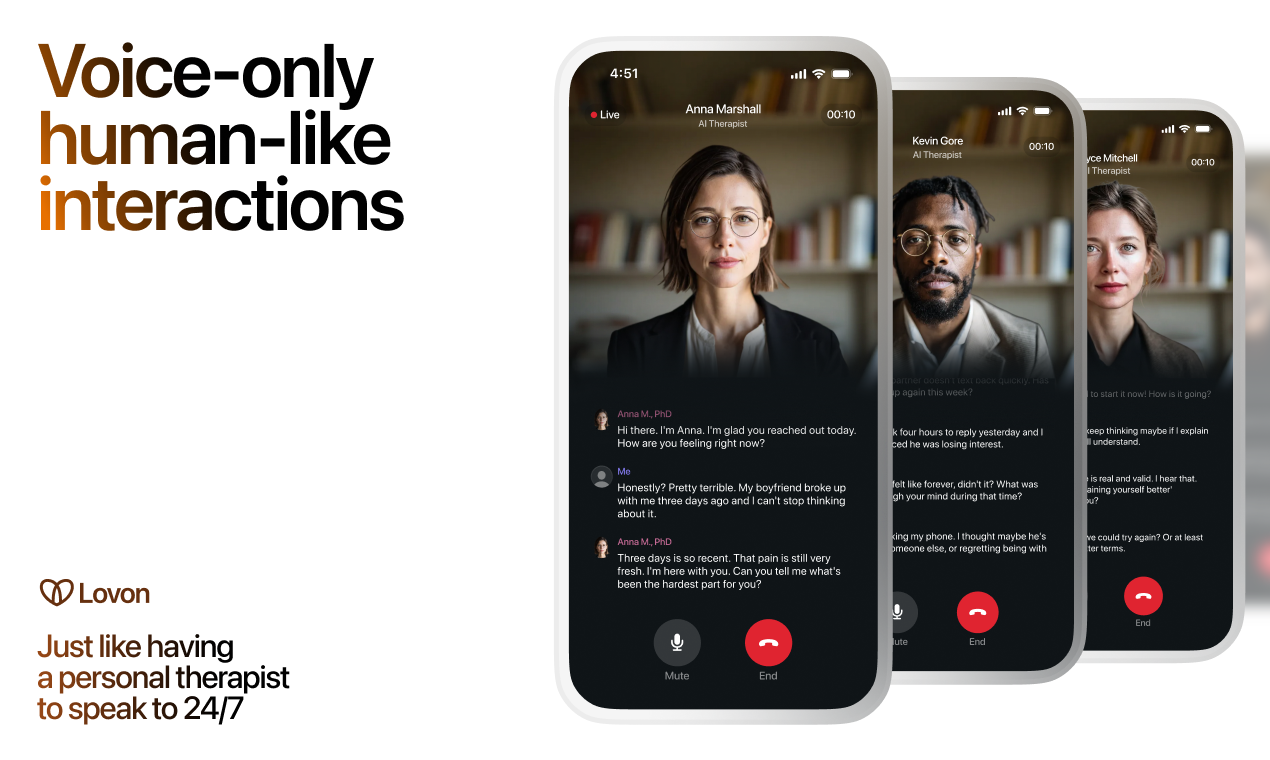
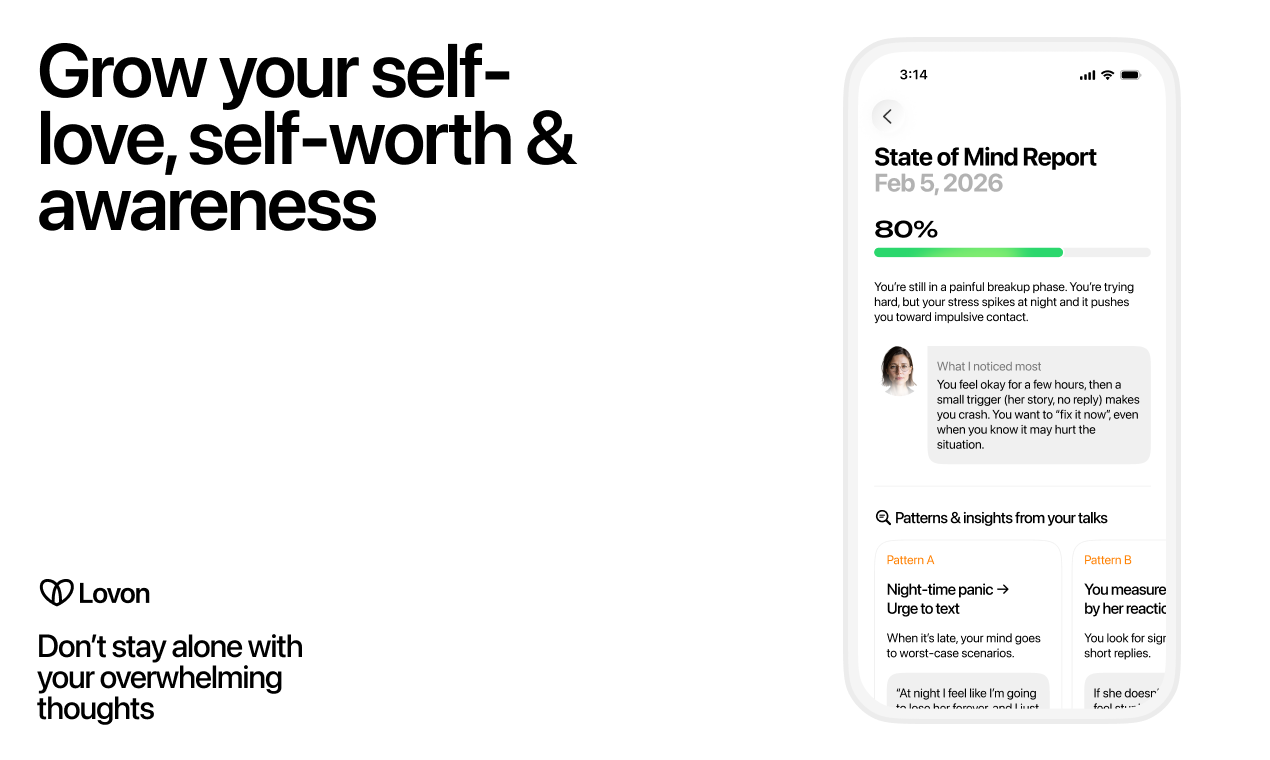
查看原始信息
Fabric by Carmel Labs
Compute platform for AI and data workloads. Submit jobs via SDK or dashboard, get results, no infrastructure management. Run embeddings ($0.0001/text), transcription ($0.001/file), web scraping ($0.001/request), ML training, CI/CD builds, image processing. 80% cheaper than big cloud. No cold starts. Autoretry. Scale whenever. Replace Lambda, SageMaker, Colab, GitHub Actions with one platform. pip install fabric-sdk or use our dashboard. Built for developers who ship, not manage infrastructure.

Hello everyone!


My friend and I built Fabric because we were tired of two things:

  • Paying AWS $500/month for infrastructure used 10% of the time

  • Spending more time managing infra than actually building product

The problem we solved:


As a developer, you need to run batch jobs constantly: generate embeddings, transcribe, scrape data, train models, run CI/CD builds.


But to do ANY of this, you first become an infrastructure engineer: spin up instances, manage GPU availability, debug cold starts, babysit long-running jobs, and pray your AWS bill doesn't explode.

We just wanted to run a Python function and get a result. Why was that so complicated?

What Fabric does:


Submit a job via API or dashboard. We run it. You get a result. Done. Since the infra is distributed, the cost of your workload is 80% cheaper than big cloud.


just pip install the sdk client

client = (api_key="your_key")

Generate embeddings for 10,000 documents

result = client.submit_job(

workload_type="embedding_generation",

params={"texts": documents, "model": "minilm"})

No EC2. No SageMaker. No surprises.

More docs on dashboard


How it evolved:


Started as "just embeddings".

Then a friend asked: "Can it transcribe audio?" Added that.

Another: "Can it scrape with real browser fingerprints?" Added that.

Mobile dev friends: "GitHub charges $0.08/min for iOS builds—can you help?" Built CI/CD on real Apple Silicon that is $0.01/min.

Now Fabric runs 10+ workload types through one API: embeddings, transcription, scraping, ML training, CI/CD, image processing, monitoring, data pipelines, custom Python. That is why we give developers workloads that just work.


What makes it different:

  • Fixed pricing: $0.0001 per embedding, $0.001 per transcription. Know your costs upfront.

  • No infrastructure: No instances, no capacity planning, no cold starts.

  • Instant grow: Process 1 item or 100K items, same simple experience.

  • Auto-retry: Jobs checkpoint and recover on failure automatically.

  • One API for everything: Replace Lambda, SageMaker, ScraperAPI, GitHub Actions with one platform.

Real problems we're solving:

Startup burning $2K/month on OpenAI embeddings now spends $200 on Fabric.

Mobile team paying $500/month for GitHub Actions iOS builds now pays less than $100 on Fabric's real M1/M2/M3 Macs.

Researcher waiting 3 days in HPC queue now has training runs start immediately on Fabric.

Agency managing proxy pools for scraping now lets Fabric handle it with real residential IPs.

DevOps team debugging Lambda cold starts at 3am now has Fabric jobs start instantly, every time.

Try it now:

https://fabric.carmel.so/

What we'd love your feedback on:

What workloads are eating your time or budget right now?

What's missing that would make Fabric essential for your stack?

Thanks for checking it out!

1
回复