Product Hunt 每日热榜 2026-03-01

PH热榜 | 2026-03-01

#1
Claude Import Memory
Switch from ChatGPT to Claude with import memory feature
437
一句话介绍:一款允许用户通过复制粘贴方式,将ChatGPT等AI助手的记忆上下文导入Claude的工具,解决了用户在切换AI平台时需从头重建对话历史和个性化设定的痛点。
Artificial Intelligence
AI助手迁移工具 用户记忆导入 平台切换 认知连续性 数据可移植性 生产力工具 Claude生态 用户粘性破解
用户评论摘要:用户肯定其降低迁移成本的核心价值,但指出其仅能转移显性事实,无法复制隐性的交互风格与推理校准。主要疑问集中在处理复杂历史、矛盾信息、与GPTs项目迁移的实操性,并建议将营销重点从“数据迁移”转向“零智力损失”的情感共鸣。
AI 锐评

这款产品远非一个简单的数据导入工具,它实质上是AI竞争进入“用户心智争夺战”阶段的一次精准切入。其真正价值在于试图破解当前AI助理市场最大的用户粘性来源——沉没的认知成本。用户花费大量时间调教的个性化上下文,已成为阻止其迁移的主要壁垒。

产品聪明地利用了“复制粘贴”这一最低技术门槛,实现了一个高情感价值的承诺:你的数字工作人格可以随身携带。然而,评论犀利地指出了其天花板:能迁移的是“记忆”(显性事实),而非“默契”(隐性的交互模式与思维校准)。这暴露了其本质仍是一种“上下文快照”的搬运,而非真正的智能体无缝接替。

更深层的行业意义在于,它首次将“用户数据与记忆的可移植性”从一个理论议题推向了实践前台,直接挑战了AI厂商通过封闭上下文构建护城河的商业模式。它能否倒逼行业形成记忆移植的开放标准,还是促使厂商将护城河挖得更深、更隐性(如对用户风格的深度自适应),将成为观察行业走向的一个有趣风向标。当前,它是一个出色的过渡方案和营销利器,但离实现真正的“认知连续性”尚有本质距离。其成功与否,最终将取决于Claude自身在理解与运用这些导入记忆上的智能水平,否则,导入的只是一堆待重新理解的“文本遗产”而已。

查看原始信息
Claude Import Memory
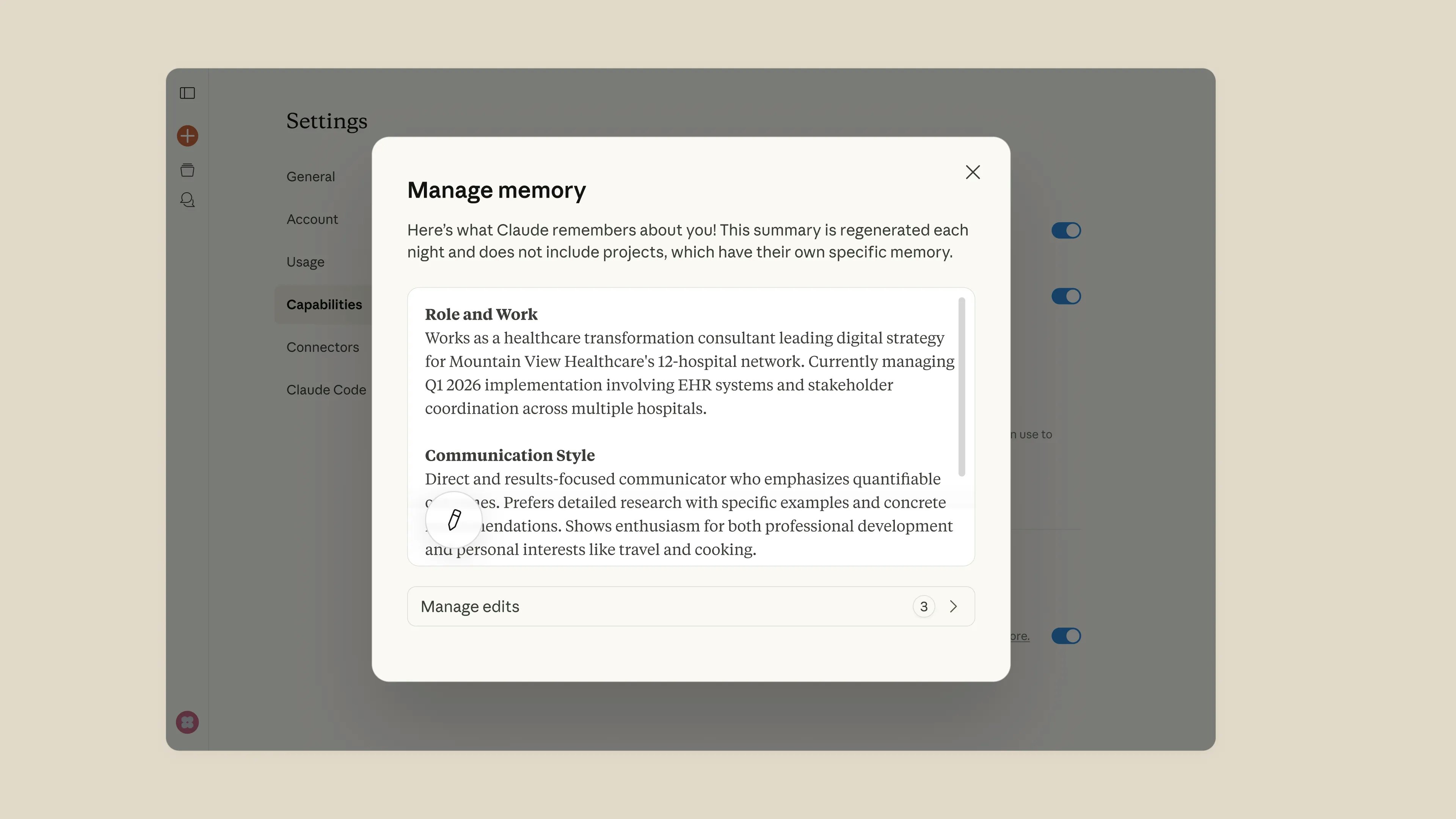
Transfer your preferences, projects, and context from other AI providers into Claude. With one copy-paste, Claude updates its memory and picks up right where you left off. Memory is available on all paid plans. Switch without losing what makes your AI useful.

As @busmark_w_nika reported, People are switching from OpenAI to Claude following Sam Altman's announcement today.

Now you can switch from ChatGPT to Claude without starting over!

What’s possible now

Claude has a Memory feature that lets it retain user preferences, context, project details, and personalized information across conversations (so you don’t have to re-explain everything each time). This memory is available on paid plans (e.g., Pro, Max) and is similar to ChatGPT’s memory feature.

How you bring ChatGPT context over

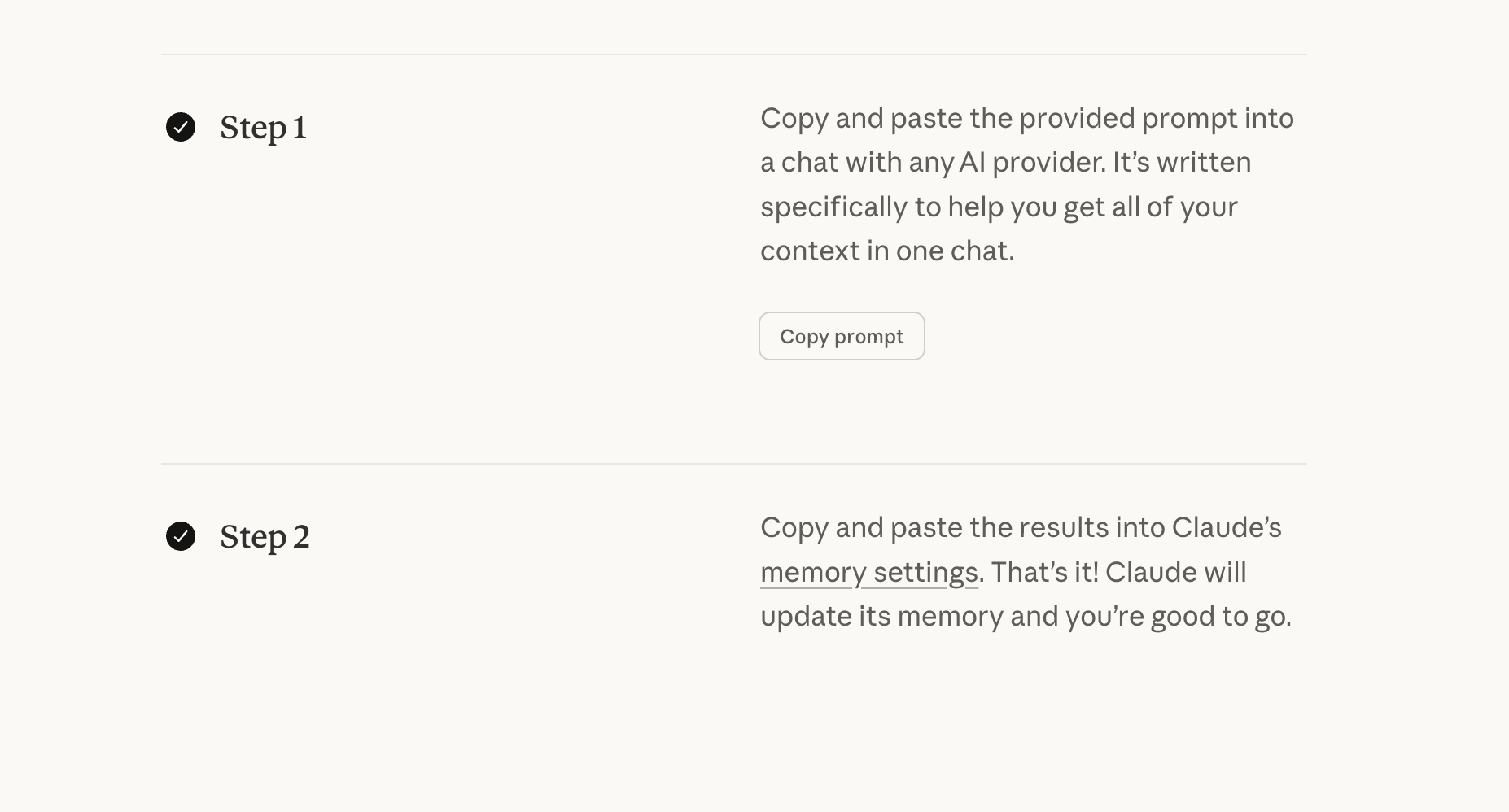
There isn’t a literal “one-click” automatic transfer between ChatGPT and Claude yet. You can export or copy your memory/context from ChatGPT (e.g., ask ChatGPT to summarize what it knows about you) and then import it into Claude’s memory by pasting it into a new chat or using Claude’s memory settings.

In short

Claude can use prior context from ChatGPT if you bring it over manually. It effectively lets you continue where you left off without starting your workflow from scratch, as long as you import the summary/context.

Have you made the switch to @Claude by Anthropic yet or you prefer staying with @OpenAI?

Let us know in the comments! :)

9
回复
@rohanrecommends Do you have any tips for transferring GPTs to a Claude project?
0
回复
@david_lefebure working smart means working with the right group of company
0
回复

The copy-paste transfer gets you the explicit memory layer — the facts Claude now knows about you. The harder problem is the implicit layer: how ChatGPT has calibrated to your tone, your pace, your reasoning style, the shortcuts it's developed for how you work. That doesn't copy-paste. Claude still has to infer all of it from scratch. The real test of this feature is whether a cold Claude + your imported memory actually feels like continuity, or just familiarity.

3
回复

What I'd really like to see, as a heavy paid user (tier 2 of Pro) of Clausde, is when a chat gts full, the hand-off doesn't lose so much;; I have train each new chat for 30 mins before I can continue getting things done.

3
回复
@osakasaul working smart means working with the right group of company
0
回复
Congrats on the #1 spot!, Switching AI models is a huge pain because of the starting from zero feeling. Quick thought: Right now, you're marketing a “migration tool”, but the real emotional hook is Cognitive Continuity. If you pivot your messaging to “Don’t leave your AI brain behind” or “Switch to Claude with zero intelligence loss”, you’ll convert much faster. I run franvimktg and I’ve got 2 copy tweaks for your hero section that focus on “Seamless Intelligence”rather than just “Data Import”.
2
回复

This is actually a very interesting shift.

The real switching cost between AI tools isn’t UI — it’s memory.

Context is the moat.

Once your AI “knows” your projects, decisions, and thinking patterns, you’re not just using a tool — you’re building a cognitive extension of yourself.

Curious question:

Do you see portable memory becoming an industry standard?
Or will AI providers eventually compete on proprietary, locked-in context layers?

We’re building a product where structured probability and event context matter a lot — so the idea of transferable intelligence is fascinating.

2
回复
This is amazing! I would love to switch from chatGPT to Claude for certain tasks. Still unsure if it would be better to just import the memory or train Claude through conversations
2
回复

The copy-paste flow is clever for getting explicit facts across, but I'd love to know how Claude handles contradictions in imported memory. If ChatGPT "knew" something outdated or just wrong about you, does Claude surface that for review or silently accept it?

1
回复

Congrats on the launch! How does it handle complex system prompts or long chat histories?

1
回复

Wild how AI models have basically developed political reputations at this point and now have actual fanbases because of it. Fascinating direction for this industry.

I've been preferring Claude lately, feels like it's pulling ahead, but I'm sure it'll keep swinging back and forth. Perplexity is looking really solid too. So, this seems really useful for a lot of people!

1
回复
Hey, this looks amazing. I'm totally gonna try it right away. Thanks to the Anthropic's team
1
回复
@marcelo_farr I think that this is definitely going to impact OpenAI with ChatGPT because I think that lots of people are actually moving from their subscription to Claude
1
回复
This is honestly something I’ve needed for a while. Rebuilding context every time you switch AI tools is frustrating, especially when you’re working on long-term projects. Being able to transfer preferences and memory directly into Claude makes the transition much smoother. This feels like a practical solution for people who use multiple models regularly.
1
回复

Claude Import Memory feels most valuable right at the chat-full handoff. A tiny handoff packet, goals, constraints, key decisions, do-nots, then paste into a fresh chat and, if Memory is on your plan, save only the durable bits there. Separate slots for prefs vs project brief would keep imports from becoming a junk drawer, and you can redact sensitive stuff before saving.

0
回复

Nice timing, nice caption!

0
回复

Thats what clever move means ✅

0
回复

Huge move importing memory lowers switching cost overnight, if Claude can pull in context cleanly that changes the game for power users, curious how smooth the copy paste flow really is anyone testing this today

0
回复

Has it actually worked for anyone?

0
回复

i know its product hunt but congrats to claude being #1 on Appstore i hope it will be top product of the day as well as number 1 on android playstore too

0
回复
#2
Notra
Turn your daily work into publish-ready content
269
一句话介绍:Notra通过连接GitHub、Linear和Slack,将已交付的开发工作自动转化为可发布的更新日志、博客和社媒内容,解决了工程团队交付速度快与市场内容产出滞后之间的核心矛盾。
Marketing SaaS Artificial Intelligence GitHub
自动化内容生成 开发者营销 产品更新日志 AI写作工具 研发与市场协同 SaaS工具 GitHub集成 品牌语音适配 工作效率工具 产品发布管理
用户评论摘要:用户普遍认可其解决了从开发到营销的内容滞后痛点,生成内容质量高、自然。主要建议与问题集中在:品牌语音个性化定制、SEO功能、多产品线内容优先级处理、以及向Slack等平台直接推送内容的深度集成需求。
AI 锐评

Notra切入了一个精准且日益凸显的缝隙市场:研发与营销之间的“内容转换断层”。其真正价值并非简单的AI文本生成,而在于充当了一个“上下文翻译器”。它深度集成至GitHub、Linear等开发协作核心地带,抓取的不仅是提交信息,更是功能背后的设计逻辑和产品决策意图,这使其生成的初稿具备了超越模板的准确性与深度。

产品巧妙地避开了与通用AI写作工具的正面竞争,定位为“工程团队的营销副驾驶”。其核心壁垒在于对开发工作流的深度理解与集成能力,以及将技术术语转化为用户价值叙事的“翻译”逻辑。从评论看,用户最买账的正是其“低摩擦”体验,将一项繁琐的“上下文切换”任务变成了近乎无感的副产品。

然而,产品面临的挑战同样清晰。首先,是“品牌语音”的深度适配问题。当前抓取网站生成语音的方案仍是表层,如何持续学习并内化一个品牌独特的叙事风格,是避免内容同质化的关键。其次,是内容价值的判断与优先级问题。正如用户所问,如何区分值得推广的用户功能更新与内部基础设施调整,这需要产品引入更复杂的决策层,或许需要结合业务数据(如功能使用量)或产品经理的输入。最后,其商业模式可能受限于目标客群规模,即那些交付频繁、且拥有独立营销需求的科技公司,市场天花板需要审视。

总体而言,Notra是一款极具洞察力的垂直化AI应用。它没有追逐泛化的内容生成,而是通过深挖一个具体工作流的痛点,提供了近乎“管道”式的解决方案。其成功与否,将取决于能否在“自动化”与“可控性”、“规模效率”与“品牌独特性”之间找到最佳平衡点。

查看原始信息
Notra
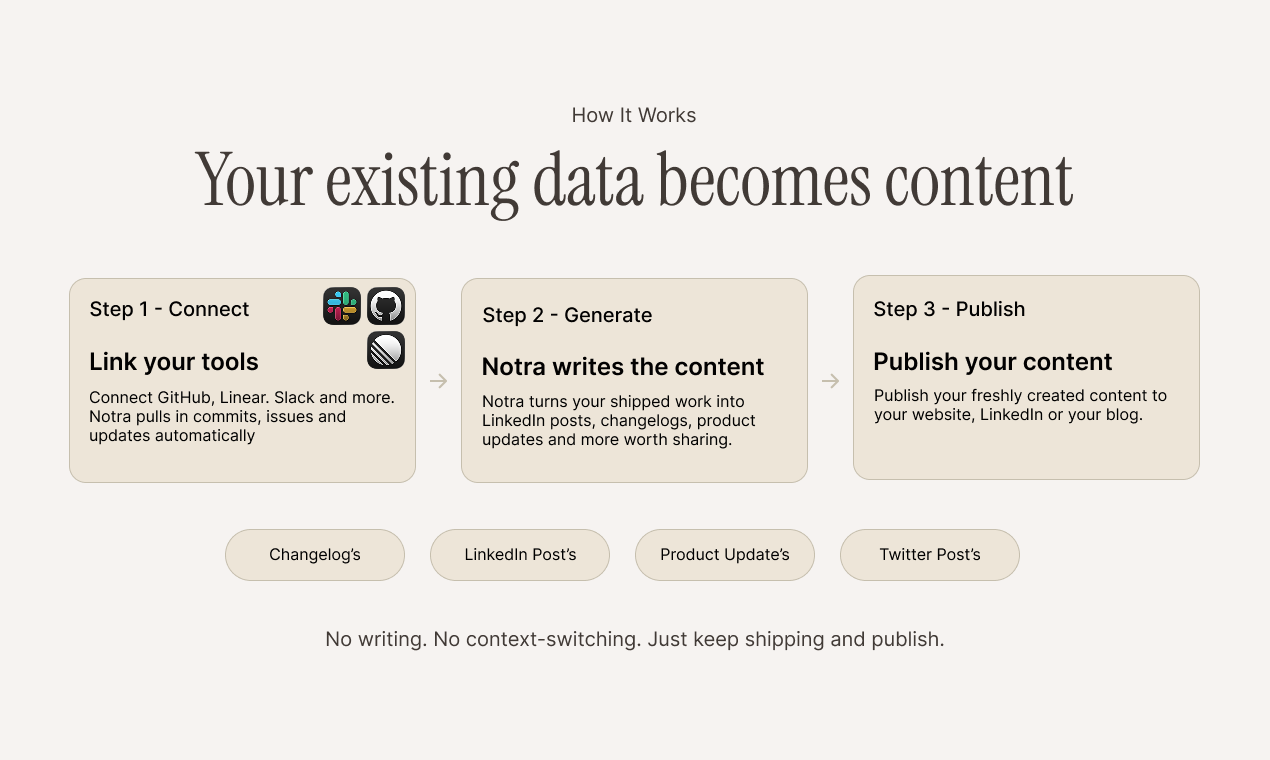
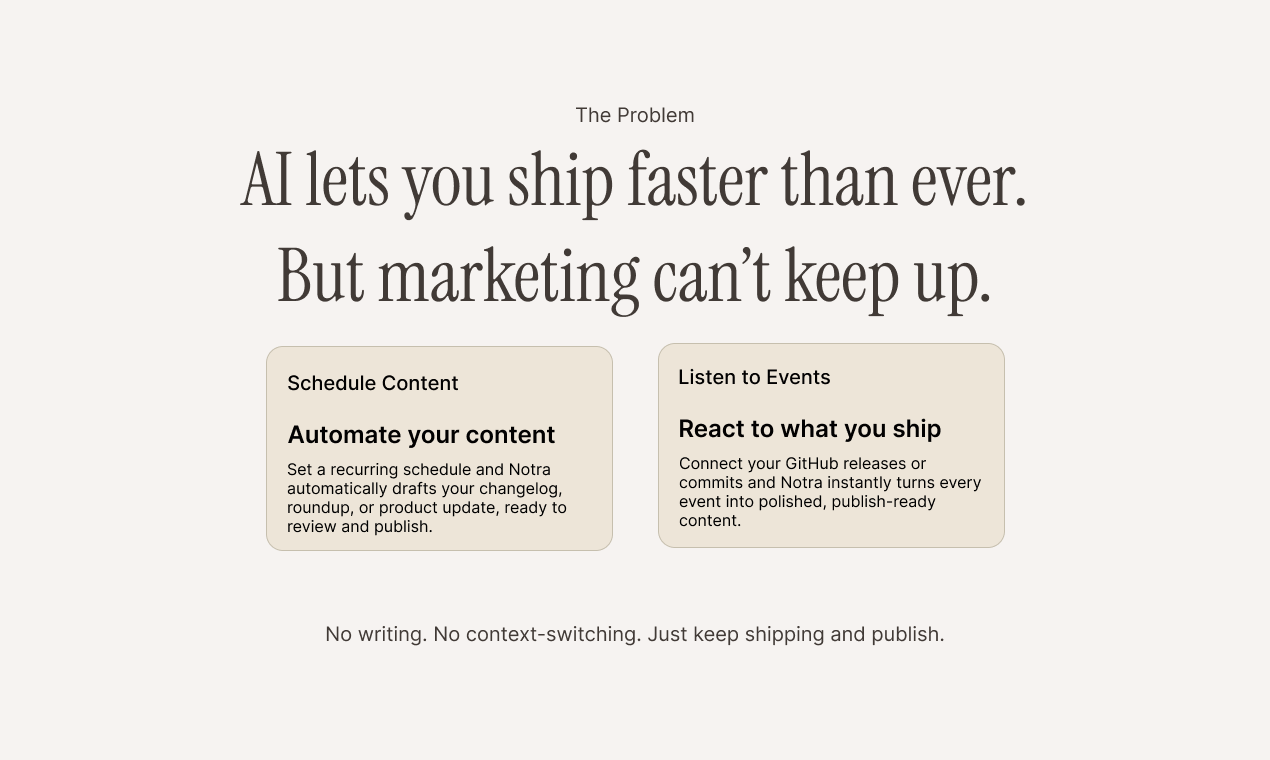
Notra connects to GitHub, Linear and Slack to turn shipped work into ready-to-publish changelogs, blog posts, and social updates.

Hey everyone, excited to launch on Product Hunt today!

AI made coding faster. Marketing can't keep up. Notra lets you ship product updates as fast as your code, so changelogs, LinkedIn posts, and marketing copy go out without the usual lag. The idea: engineers shouldn't have to slow down to market what they built.

Would mean a lot if you could take a look. Curious what you think!

10
回复

@dominikkoch really cool idea and product and i think it works , i am also working on a product which can help you in getting customers and also helps in automating your customers support , it helps you getting leads through support , it helps you converting your customers , it solves you users queries in a most efficient way possible so you need not to worry , i am giving free access to you to try our product at scale if you are in let me know and checkout - customsupportai.com

0
回复

@dominikkoch Every sprint we'd ship a dozen PRs and the marketing update would lag two weeks because nobody wanted to context-switch into copywriting mode. By the time someone wrote it up, half the details were fuzzy. Notra pulling from merged PRs and auto-drafting changelogs plus social updates kills that lag. Brand voice matching is what separates this from a template generator... without it you're still rewriting every draft. Once Linear and Slack land, drafts pick up design rationale and product decisions that PRs alone miss. That's where content goes from accurate to genuinely useful.

2
回复
Awesome product! Gave it a shot and the generated content is natural and right on point, fitting the actual product development instead of random unrelated stuff. Feels like it really helps with getting media-content stuff done - especially when you‘re focussed on the technical side.
2
回复

Thanks for giving Notra a try@glenntoews! And thanks for all the feedback!

1
回复

This lowkey turned the chore of creating release notes and changelogs into a drop-in solution, absolutely love how low friction it is

2
回复

Appreciate the kind words @izadoesdev!

1
回复

Super super nice, congrats on the product and the launch! Do you have a way to personalize the output to match the user's tone of voice? The content creation part is great, but I was wondering if you also have something in place to ensure it doesn't sound generic?

1
回复

We actually pull in your website to try and match your brands voice/identity. You can also give it custom instructions to help make it less generic!

0
回复

Is there an offline mode available or any built-in SEO tools for the published content?

1
回复

Offline mode wouldn't really make sense because you can't publish/create new content that way. SEO tools would be awesome, though; I am putting that on my list, thanks!

1
回复

This is a real pain point. We spend way too much time turning dev work into marketing content. Love that it pulls directly from GitHub and Linear — that's where the actual work lives. Congrats on the launch!

1
回复
1
回复

Great product, we could automate code w different tools but finally a good product for marketing. Should definitely try it

1
回复

Exactly my throughts! Thanks a lot for trying Notra!

1
回复
Bridging this gap is a strong positioning angle! Curious how you’re thinking about quality control and brand voice over time?
1
回复

It should learn from you and get better at that over time as its knowledge and references provided grow. We also fetch your website to compile a custom brand voice.

1
回复

A use-case for this could be writing release notes automatically, or letting my co-founders know what is coming out on new releases, can I link it to post to slack rather than just feeding it data from there?

1
回复

Hey@haxybaxy, thats a great idea actually, would you want to send the whole post straight to Slack or just a link/reference to it? Both is definitely something it should do long term!

1
回复

This is solving something I've felt firsthand - we ship fast but then the marketing side just... lags behind for days. The idea of pulling directly from GitHub commits and Linear tickets to generate ready-to-go content is smart. Curious about one thing: how customizable is the tone/voice for the outputs? Like if you have a very specific brand voice, can Notra learn that over time?

1
回复

We currently fetch your website to generate a brand voice and let you edit it or even add your own custom instructions. Adding references etc. is also high on my list!

1
回复

Amazing product that I can’t wait to use. Congrats on the launch!

1
回复
Thanks @ay_ush! can't wait for you to try it!
1
回复

I really love the idea! This is such a strong concept, and Notra actually works really well too. I tried it, and I’m fascinated by how good the texts Notra creates are, just based on my Git commits. It’s absolutely crazy. I’m very excited to see how this will impact our marketing in the long term.

1
回复

Thank you @bennyqp, glad you found Notra useful!

1
回复

the first tool that really gets my messy commits and makes perfect changelogs from it, that i literally then just instantly display on my website. great ux too, very intuitive!

1
回复

Thank you @janburzinski, glad you enjoy using Notra and thanks for all the feedback so far!

1
回复
I agree. I think building is no challenge anymore. Marketing and distribution becomes more and more important. Especially now that potential customers get spammed with products. What feedback did you get already from users?
1
回复

Thanks@phirabu! We got a lot of feedback about the output quality so far and lot's of feature suggestions like an API or a MCP server.

1
回复

This hits close to home. At Custyle, we're building AI-powered merchandising, and the gap between shipping code and shipping marketing content is real. Engineers move fast, but marketing copy gets stuck in a queue.

What's interesting here is the integration depth — pulling from GitHub commits AND Linear tickets gives you actual context, not just surface-level updates. That's the difference between "we shipped features" and "here's what changed for users."

Quick question: For teams with multiple products or workstreams, how does Notra handle prioritization? Like, if we're pushing updates across 3 different product lines simultaneously, can it distinguish what's worth promoting vs. what's internal infrastructure?

0
回复

Congrats, this is really nice!

As a QA, I've seen so many great features ship with hardly anyone pushing them forward because devs didn't have the time to write marketing copy or properly explain the full picture to their marketing team.

Does this capture the "why this matters" or just the "what changed"?

0
回复

Hey folks
What’s the exact moment or event that makes me think: ‘This is worth paying for Notra’?”

0
回复

Congrats on the launch, website looks super neat and clean. Is there any API to integrate with different software? In my company we've been using Microsoft Teams, so I don't know if it's possible to fetch details from there.

0
回复

This hits a real pain point. I'm a solo founder shipping features constantly and the marketing side always lags behind — I'll push 5 updates before I even think about writing a changelog or posting about it. The GitHub-to-content pipeline makes a lot of sense. Quick question: does it handle different tones for different channels? Like a more technical changelog vs. a casual tweet or Reddit post from the same PR?

0
回复
#3
OpenFang
Open-Source Agent Operating System
192
一句话介绍:OpenFang是一个开源、安全的智能体操作系统,通过预置调度、安全沙箱与多工具集成,解决了现有AI代理框架依赖人工触发、缺乏真正自主执行与可信安全边界的核心痛点。
Productivity Open Source Developer Tools GitHub
智能体操作系统 开源 Rust 自主代理 安全架构 WASM沙箱 调度执行 单二进制文件 多工具集成
用户评论摘要:用户普遍赞赏其从“聊天包装器”转向真正自主调度的理念及严肃的安全架构(WASM、Merkle审计)。核心问题聚焦于:失败重试与回滚机制、多智能体协调与状态共享、长期分布式与商业化愿景,以及安全措施(如沙箱)的具体执行时机。
AI 锐评

OpenFang的亮相,与其说是一个新框架,不如说是对当前“智能体”概念泛滥的一次精准祛魅。它直指行业软肋:绝大多数所谓代理,本质仍是需要人类持续交互的增强型聊天机器人,离“自主执行工作”相去甚远。其价值核心在于,用“调度”取代“提示”,用“系统”取代“框架”,试图将智能体从玩具升级为可信的生产力工具。

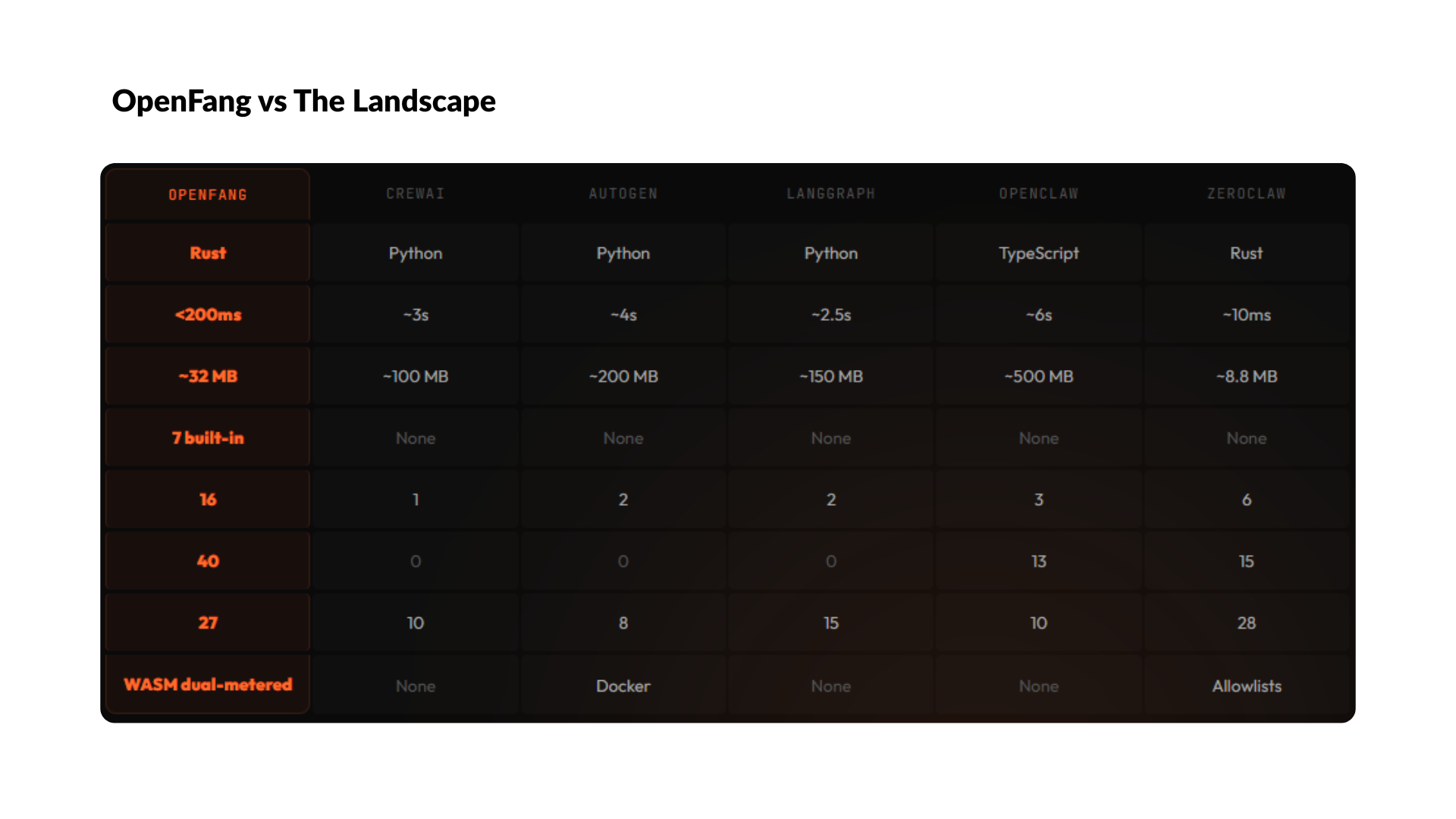
真正的锋芒藏在技术选型与架构中。Rust语言、单二进制分发,是对Python系依赖地狱和部署复杂性的公然反抗,瞄准的是稳定与可控。而WASM沙箱、Merkle审计追踪、污点跟踪等16层安全设计,并非锦上添花,而是将“不信任”原则植入骨髓。这回应了一个关键质疑:当代理能操作支付、API等真实世界接口时,如何防止其“作恶”或出错?OpenFang试图用技术强制力给出答案,将安全从事后审计变为事中隔离与追溯。

然而,其挑战同样清晰。评论中关于“失败回滚”和“多智能体协调”的提问,戳中了从“能运行”到“可靠运行”的鸿沟。调度下的自主,意味着更复杂的错误处理与状态协调,这需要超越单点安全的系统级设计。此外,其开源、自托管的路径,虽受开发者欢迎,但如何与云原生、集成的商业平台竞争生态与易用性,是其必须面对的长期命题。

总体而言,OpenFang是一次值得尊敬的底层突围。它不追逐对话的流畅度,而是死磕自主的可靠性与安全性,为智能体真正融入关键工作流铺设基础设施。它的成功与否,将检验市场对“自主”的需求,究竟是叶公好龙,还是ready for the next level。

查看原始信息
OpenFang
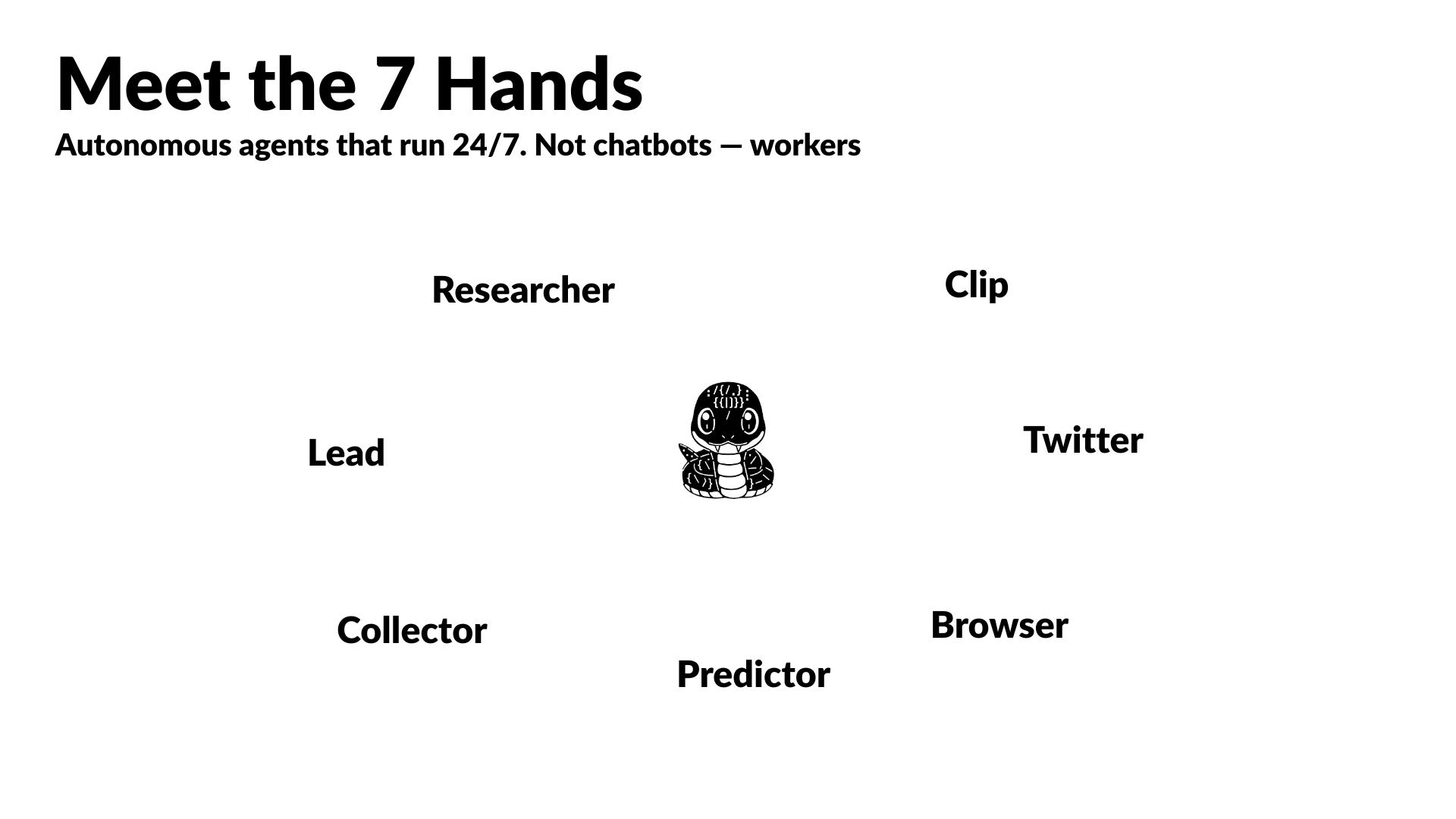
Open-source Agent OS built in Rust. 7 autonomous Hands that work for you on schedules. 16 security systems. 53 tools. 40 channels. 27 LLM providers. WASM sandbox, Merkle audit trail, taint tracking. Single binary.
hey everyone, im jaber, i built openfang because every agent framework i tried was basically a chatbot wrapper. you type something, it responds, you type again. thats not autonomy thats a conversation. i wanted agents that wake up on a schedule, do the work, and report back without me sitting there. so i built Openfang!
10
回复
@jaber23 what do your agents do for you?
2
回复
@chrismessina anything
0
回复

hey, congrats on launch. I noticed that you mentioned P2P networking in your website, do you plan to make it distributed in the future?

1
回复
@libos indeed!
2
回复

@libos Agent frameworks that treat safety as one global toggle break when a Hand has browser access and purchase authority alongside one that just reads APIs. OpenFang splitting guardrails per Hand via HAND.toml is what makes scheduled autonomy actually trustable. Single Rust binary compounds that... no Python dependency tree to audit across 7 autonomous processes on a cron. Where this gets real: overlapping schedules where two Hands compete for the same external resource. That coordination layer is usually where autonomous setups hit their first production stress test.

0
回复

This is the kind of infrastructure play the agent space needs. Most frameworks are still stuck in "prompt-response" mode — basically glorified chat wrappers. But actual autonomy means agents that wake up, do work, and report back without you babysitting.

What caught my attention: the security-first architecture. WASM sandbox + Merkle audit trail + taint tracking isn't just feature creep — it's acknowledging that agents making real-world calls (payments, API writes, data access) need guardrails. At Custyle, we're building AI-powered merchandising agents, and the question of "what happens when an agent goes rogue mid-task?" keeps me up at night.

Quick question: For scheduled agents that fail partway through, is there a built-in retry/recovery mechanism? Or does the Merkle trail just help with debugging after the fact? Also curious how you're thinking about multi-agent coordination — if 7 Hands are running simultaneously, how do they share state without stepping on each other?

0
回复

Building an Agent OS in Rust with a WASM sandbox is a serious architectural choice. Most ‘agent frameworks’ stop at orchestration - you’re clearly thinking about execution boundaries and auditability.

Curious how you see OpenFang competing with cloud-first agent platforms. Is the long-term vision self-hosted autonomy, or a distributed network of agents?

0
回复

Amazing one Jaber, congrats, do you consider making other products use yours to build agents in their workflow?

0
回复

Built in Rust with WASM sandbox — that's a serious approach to agent security. Bookmarking this.

0
回复

Congrats on the launch! The idea of building agents that actually run autonomously on schedules instead of just responding to prompts is a really important distinction — most frameworks still feel like glorified chat wrappers. Building this in Rust with a WASM sandbox is a bold choice too. Curious about the security model — with 16 security systems and Merkle audit trails, are you targeting enterprise use cases or is this more for indie devs who want to self-host reliable agents? Either way, shipping a single binary makes the DX so much cleaner.

0
回复

The security architecture here is impressive - 16 layers including WASM sandboxing, Merkle audit trails, and taint tracking is serious work. Most agent frameworks treat safety as an afterthought, but for agents that actually interact with the real world (payments, database writes, API calls), this is exactly the right priority.

Curious about one thing: when an agent triggers an action with real-world side effects (like sending an email or making a payment), how does the system handle rollback if a later step in the chain fails? Is there a compensation mechanism, or does the sandbox prevent those actions from executing until the full chain is validated?

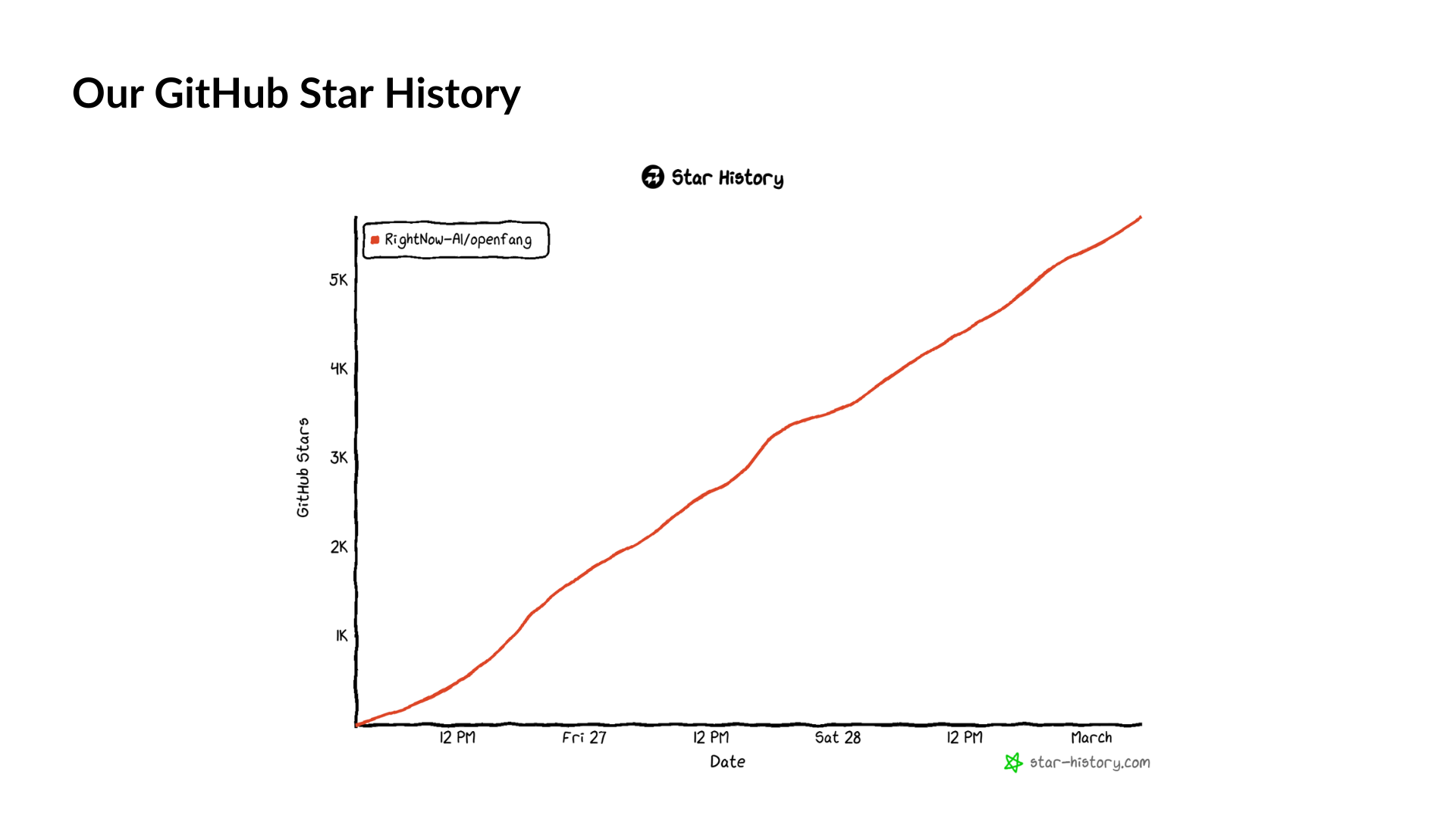
Congrats on the launch - 4,000+ stars in 4 days speaks for itself.

0
回复

The WASM sandbox + Merkle audit trail combo is really smart for agent security. Most frameworks just trust the LLM output blindly - having taint tracking built in from day one shows you actually thought about what happens when agents run unsupervised. Curious how the scheduling system handles failures mid-task.

0
回复

Really interesting approach building an open-source Agent OS in Rust. The focus on WASM sandbox + security layers stands out. Curious how you’re thinking about long-term extensibility for third-party tools?

0
回复
#4
Voicr
Your voice in, polished text out — in seconds
188
一句话介绍:Voicr是一款全离线AI语音转文字应用,用户通过自然说话即可即时获得精炼、可分享的文本,解决了灵感稍纵即逝、思维快于打字以及书面表达耗时耗力的核心痛点。
Android Productivity Writing Artificial Intelligence
语音转文字 AI文本润色 全离线应用 隐私安全 笔记工具 内容创作 移动效率 可定制提示词 多版本输出 灵感捕捉
用户评论摘要:用户普遍认可其解决“灵感流失”痛点的价值,并对全离线模式表示赞赏。主要建议与问题集中在:增加多场景预设、支持录音后追加编辑、优化非母语口音识别、提供桌面端版本、考虑更灵活的定价策略,以及探索“思维演进”等深度功能。
AI 锐评

Voicr的宣言“Your voice in, polished text out”精准切入了一个高频且未被妥善解决的效率断层:从模糊、流动的思维到清晰、结构化文本的“最后一公里”损耗。它并非简单的语音备忘录,其核心价值在于充当了一个“认知减负”的实时编辑,试图将碎片化思考直接转化为可交付的成果。

产品最犀利的刀刃在于两个看似矛盾的选择:一是提供“可定制提示词”,这实际上是将文本风格的掌控权部分归还给用户,以对抗AI输出固有的“平庸化”风险,回应了用户对“保持个人声音”的深层焦虑;二是“100% on-device”,这在数据隐私恐慌时代构筑了坚实的信任壁垒,直接与主流云端方案形成差异化竞争,但同时也为其模型能力与处理复杂任务的性能设下了天花板。

然而,Voicr面临的真正考验在于其定位的“模糊地带”。从评论看,用户既希望它是“快速捕捉工具”(用于Slack消息),又期待其成为“思考伴侣”(用于长文、思想演进)。这揭示了其核心矛盾:**在“即时抛光”与“深度孵化”之间如何取舍?** 过度抛光会扼杀思想的原始生命力(正如用户担忧的“失去能量”),而单纯记录又退化为普通录音笔。它的“可定制提示词”是解决此矛盾的一次精巧尝试,但能否满足从即时通讯到内容创作的全场景需求,仍需观察。

其未来演进的关键,或许不在于增加更多功能,而在于更智能地理解语境与意图。例如,根据录音长度、关键词自动匹配处理深度,或像用户建议的,允许对同一思想进行多次录音“浇灌”,使其逐步生长。若仅停留在当前“高效转录+风格模板”层面,它可能沦为又一个有趣的工具;若能真正降低从思维到优质文本的“认知摩擦力”,它才有潜力成为一个颠覆性的底层习惯。

查看原始信息
Voicr
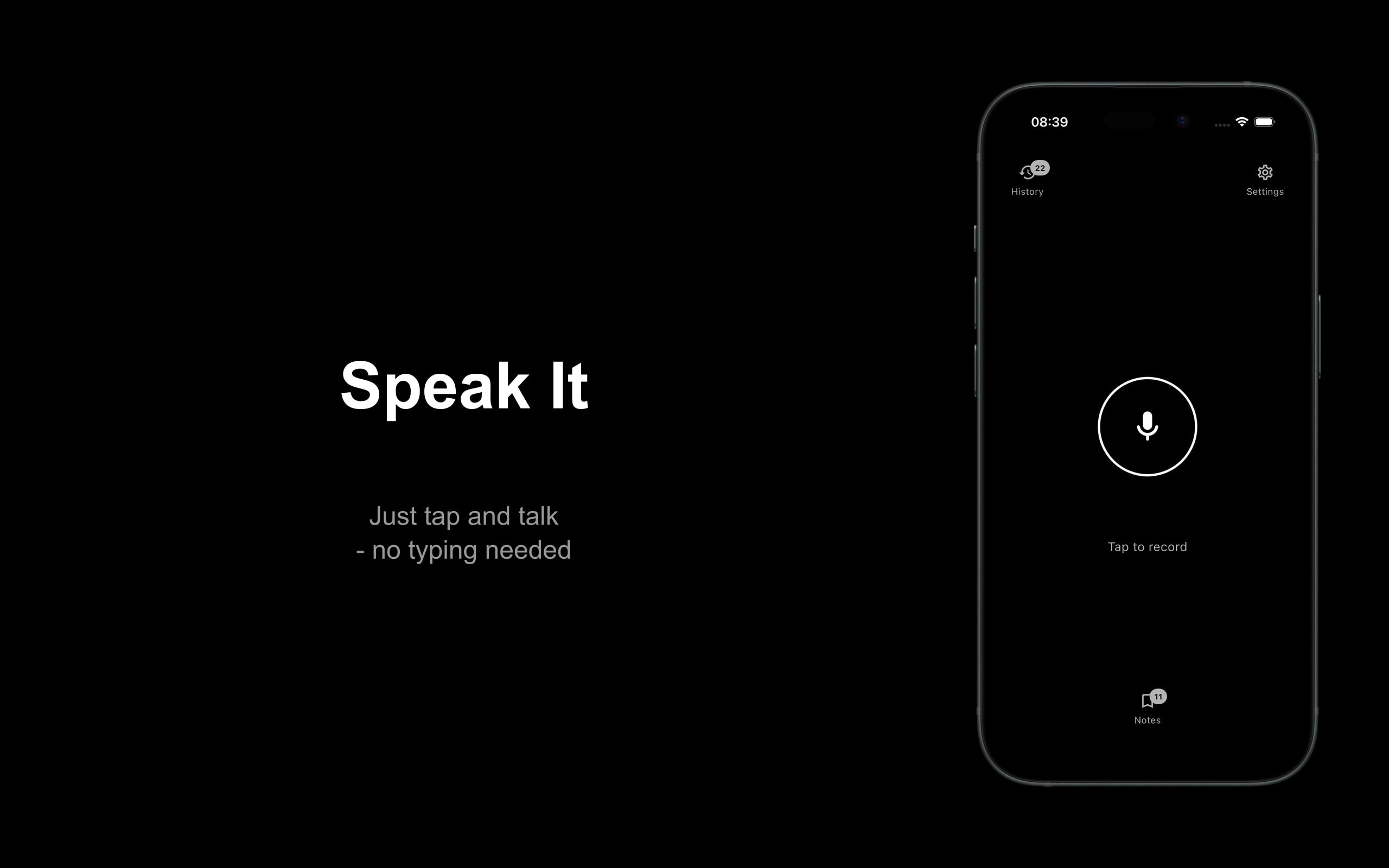
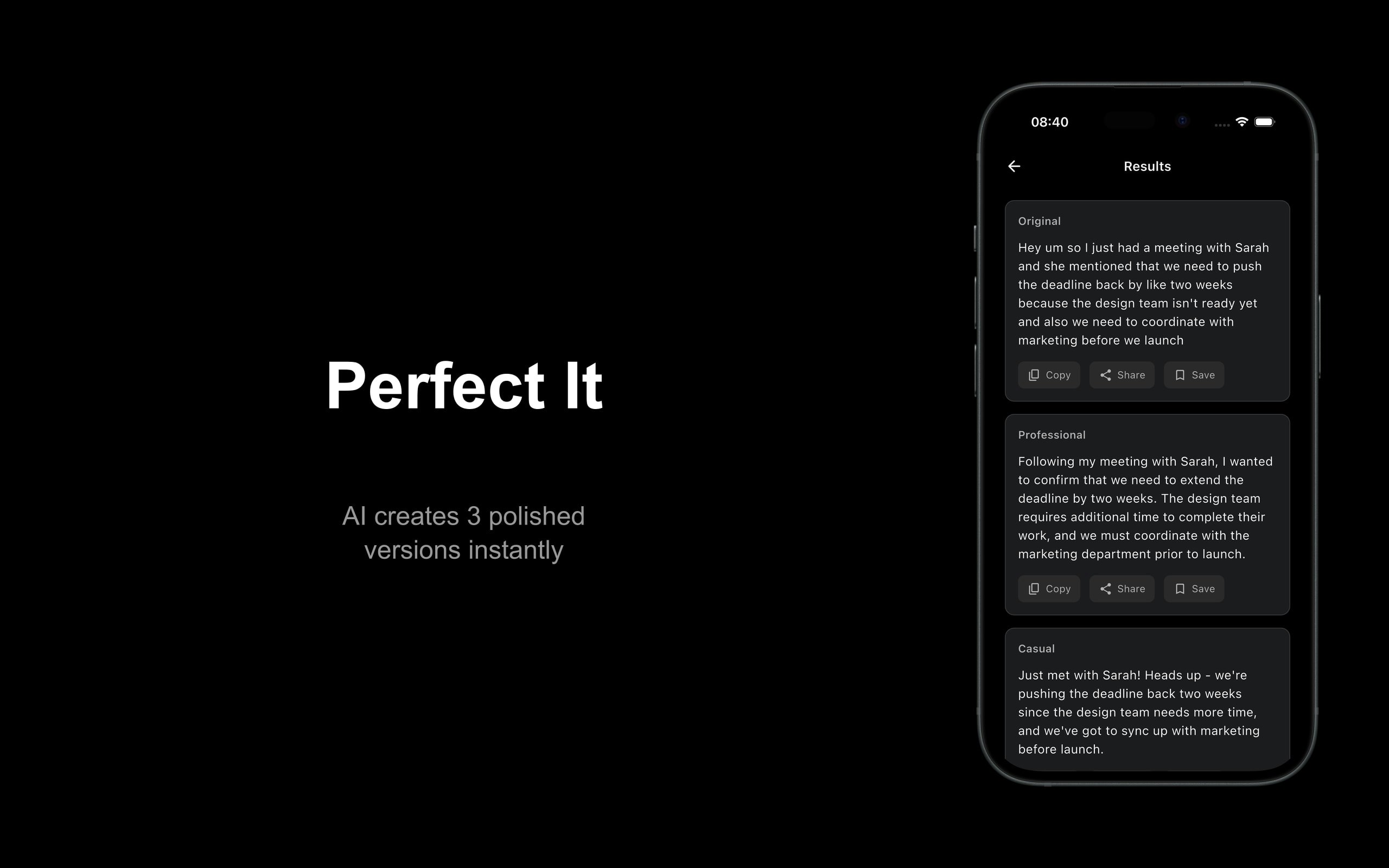
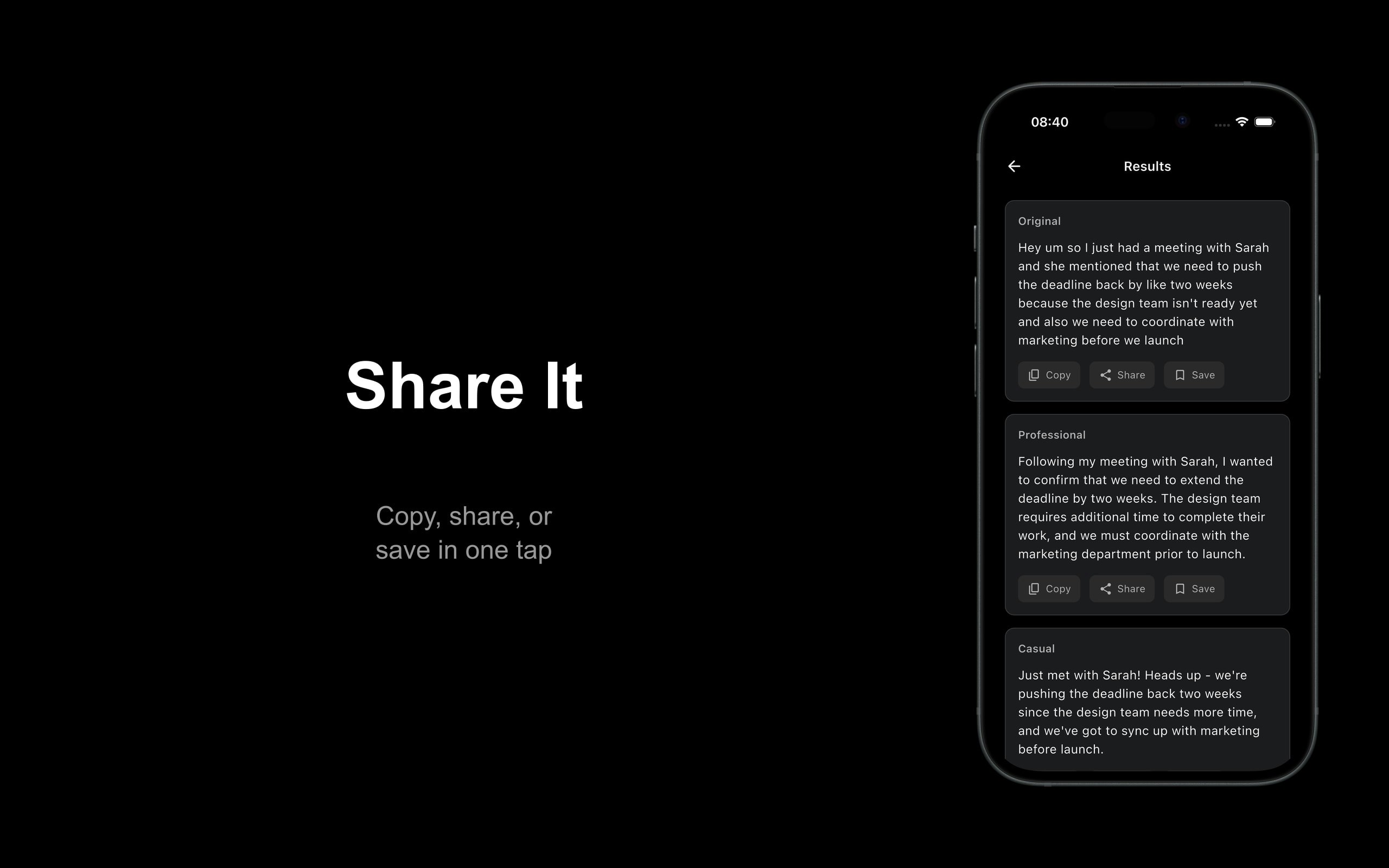
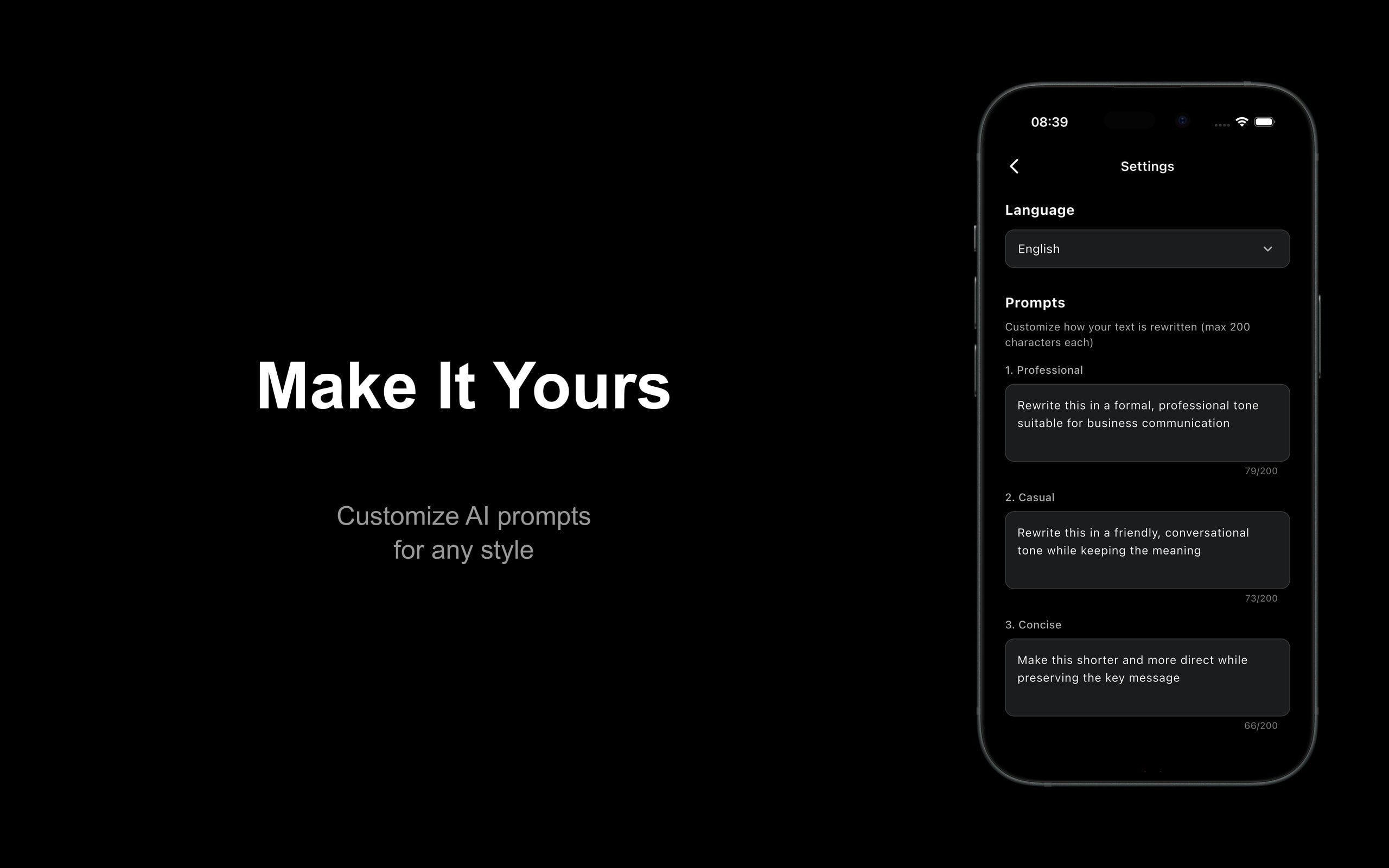
We all know what we want to say. Writing it down is the hard part. Voicr closes that gap. Speak naturally, get polished text instantly — ready to share anywhere. Out of the box, you get 3 tones: professional, casual, and concise. But every tone is fully configurable — replace them with your own custom prompts to match your voice, workflow, or audience. → Speak once, get multiple versions → Fully customizable AI prompts → 100% on-device — no accounts, no tracking iOS & Android. Free trial.
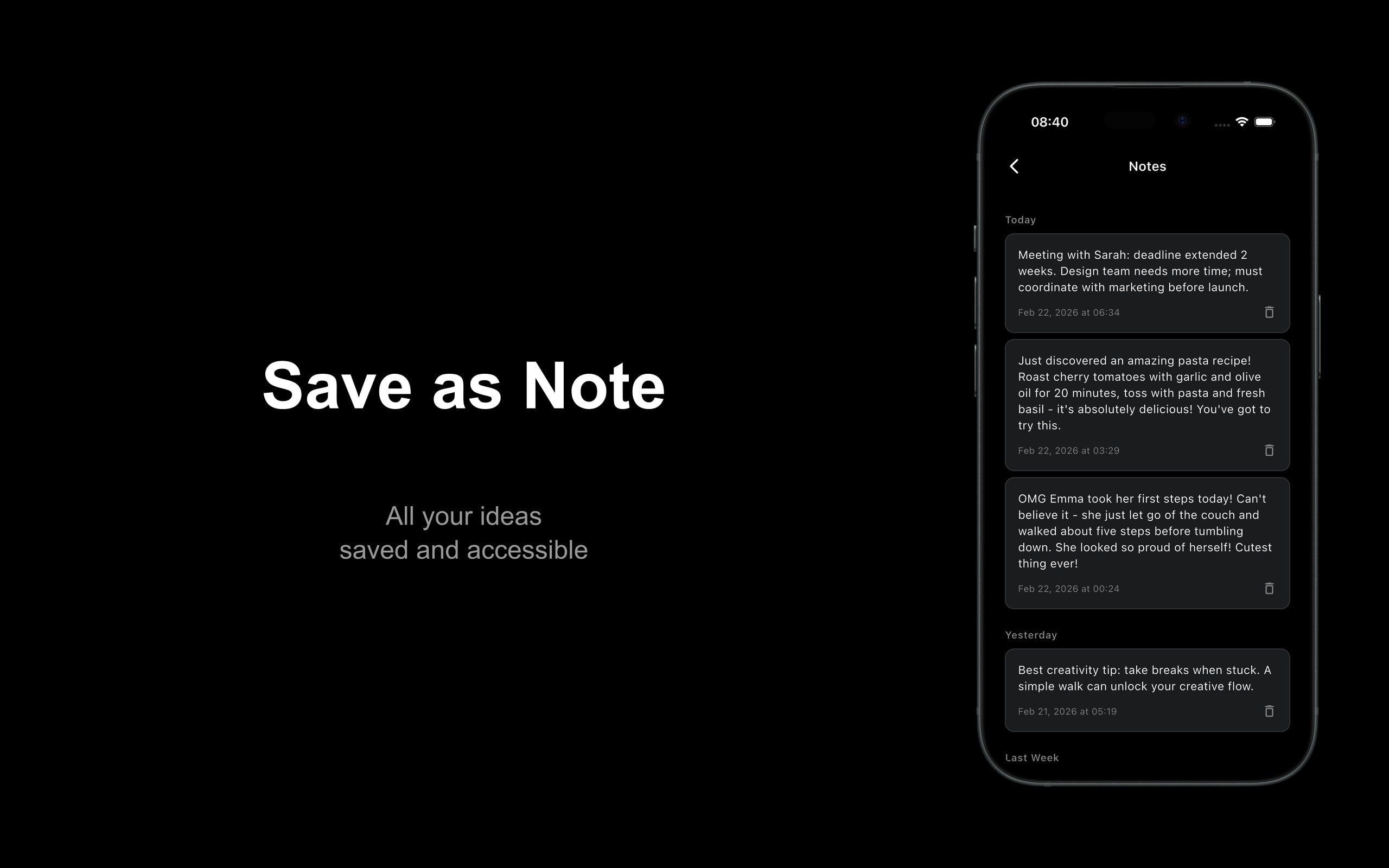
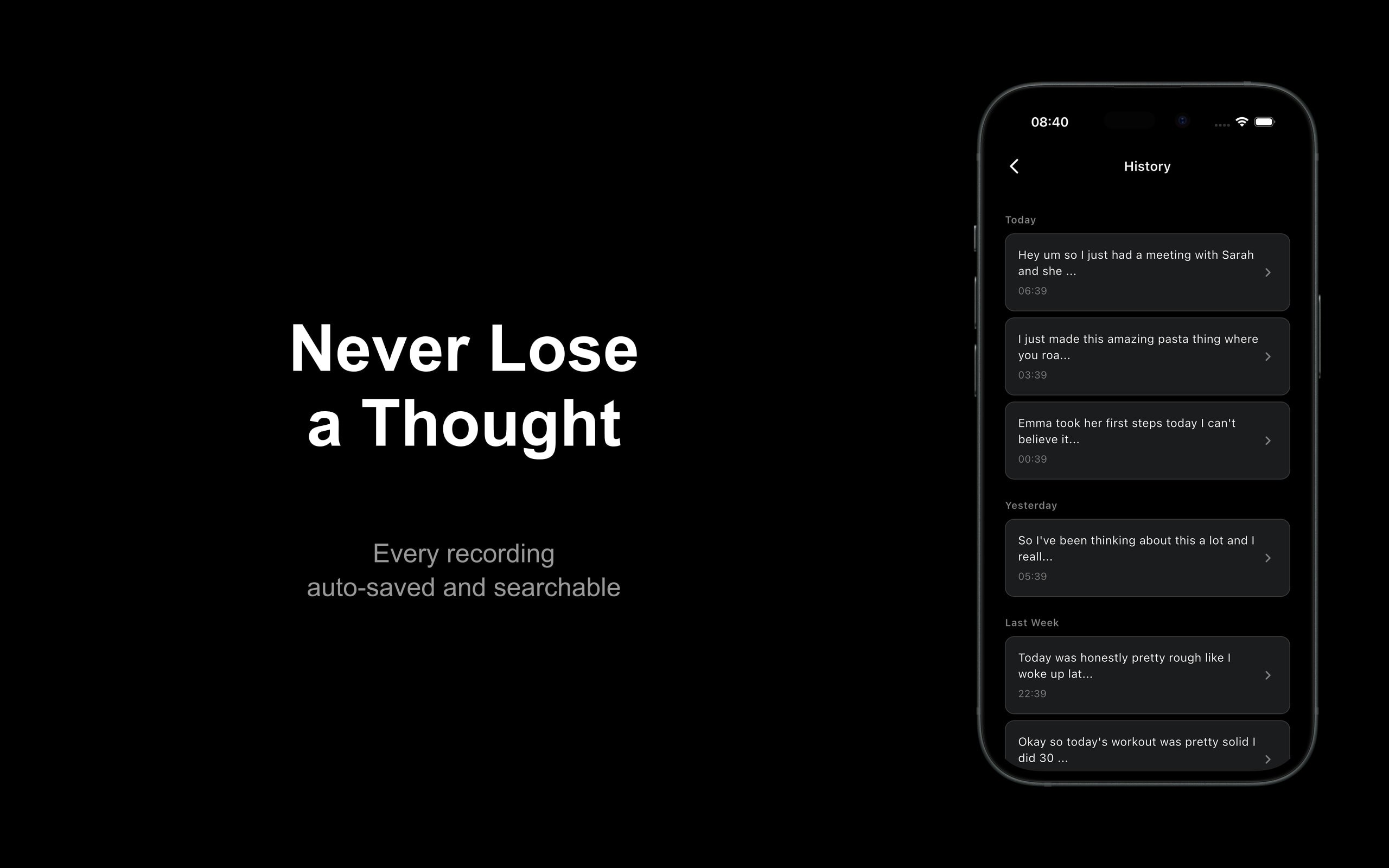
Hey PH! 👋 I built Voicr because I kept losing my best ideas. You know that moment — you're walking, driving, making coffee — and the perfect post hits you. The exact words. The right take. You KNOW it's good. You grab your phone, open the notes app, start typing... and it's gone. The magic version that existed in your head turns into a flat, half-finished sentence on screen. This happened to me constantly. My best thinking always happened when I couldn't sit down and write. And by the time I could, the moment had passed. So I built Voicr. The idea is dead simple: the second inspiration hits, you tap, speak, and it's captured — not as a messy transcript, but as polished, ready-to-share text. Post it immediately, or save it to your notes for later. That's the other thing — Voicr is also a note-taking app. Every recording lives in your history. Your best outputs go to a dedicated notes section. So nothing gets lost anymore. You get three tones out of the box (professional, casual, concise), but every tone is fully configurable — replace them with your own prompts so the output sounds like YOU, not generic AI. Everything on-device. No accounts. No cloud. No data leaving your phone. I use it daily for quick notes, Slack messages, LinkedIn posts, tweets — basically anything where I think faster than I type. Two things I'd love from this community: Honest reaction after trying it? What features would make this a daily habit for you? Here all day — fire away. 🙏
4
回复

@justonedev This resonates a lot: ideas are highest quality before we try to type them.

A few things I’m curious about:

  1. How do you preserve nuance without over-polishing? Sometimes the raw voice energy is what makes the idea powerful: does Voicr allow you to control how much it “cleans up”?

  2. Since it’s fully on-device, how are you handling model quality vs. performance tradeoffs? Especially for longer, more complex thoughts.

  3. Have you considered a “thought evolution” mode: where you can refine the same idea across multiple recordings and watch it compound into something bigger?

The on-device + no account angle is strong. If you nail the balance between authenticity and polish, this could easily become a daily capture reflex. Curious how you see it evolving: quick capture tool, or eventually a full thinking companion?

0
回复

@justonedev Worked on a voice pipeline once and the gap between accurate transcription and output that sounds like you is where all the complexity hides. Voicr making tones fully configurable instead of locking to preset professional/casual/concise splits tackles that directly... presets never match how someone actually writes. Zero-cloud on-device approach earns trust fast. Every competitor with a cloud pipeline is one policy update from training on recordings. What'd push this toward daily driver: per-use-case configs so a Slack message and a LinkedIn post don't need manual prompt swaps.

0
回复
Congrats on the launch! , Voice is the fastest way to think, and Voicr makes it usable. Quick bit of feedback: You're currently marketing “polished Text”, but the real value is Cognitive Offloading. If you pivot your messaging to “Capture every insight before it vanishes” or “Ending Keyboard Fatigue for Creators”, the ROI becomes immediate. I run franvimktg and I’d love to drop a few tweaks to help you nail that “Mental Clarity” angle.
1
回复

The "speak once, get multiple versions"

approach is clever, removes the mental

overhead of switching tone manually.

100% on-device with no accounts is a

bold choice in an era where everything

wants your data.

Respect for that!

One thing I'm curious about - how does

the on-device model handle accents?

Asking as someone who speaks with a

strong Indian English accent.

Does it perform well or struggle

with non-native speakers?

1
回复

@alamenigma It uses OpenAI Whisper as speech to text model so all accents are being handled pretty well.

1
回复

This looks great, congrats! Keep up the great work.

I was thinking that sometimes an idea needs multiple takes. What if you could do a "part 2" recording that builds on a previous one? Like continuing a thought from yesterday without starting fresh.

0
回复

Superb, Are you planning for iOS version?

0
回复

Hey @justonedev cool product! Does it work when there are 2 speakers?

0
回复

Super useful app. It would be a great addition if the app included a direct integration with Google Keep to make organizing my notes easier. The current price tag feels unrealistic, and I would be much more willing to pay a maximum of $3 per month for a subscription.

0
回复

@justonedev Congrats on your launch and great product. I really like the feature that provides different tones to choose from. Quick question- can I edit/add to a note by dictating a more information that occurred to me after the fact?

0
回复

Congrats on the launch! How does the AI maintain the original speaker's tone while polishing the grammar?

0
回复

I remember the hard time working on my thesis. I read a lot and my brain was messed up, so I always took a walk outside, turned on GPT voice agent and started talking about whatever came up to my mind. I also kept pushing the agent to ask more follow-up questions so it could drain more thoughts. After that I got a summary and a nice looking catalog. This app resonates and has so much potential.

Looking forward to what's next.

0
回复

This nails a real problem. I've lost count of how many times I've had a perfect thought while walking and by the time I sit down to type it out, it's gone or comes out completely flat. The 3 tone options are a smart move — being able to go from a casual voice note to a professional-sounding message without editing is huge. As a solo builder, I'd love something like this for drafting quick product updates or tweets on the go. Are you planning to add a Chrome extension version or is the focus staying mobile-first?

0
回复

Super useful for quick content drafts. I always think faster than I type, so voice-to-polished-text makes a lot of sense. Does it handle multiple languages?

0
回复

Hey Aleks! It looks really cool, and super useful even more. I'm sure it's gonna help many founders to get those thing done. Wish you all the best here!

0
回复

@german_merlo1 Thank you Germán!

0
回复
is if only for the phone or does it have anything for desktop/web as well? Looks lime exactly what I'd need to take some memos while working
0
回复

@nair0 For now it is only available for ios/android but soon will be a version for macos.

0
回复

This product totally speaks to me. :D

And it is exactly how I would like to operate – I will say something, and it will create a text from my note! :) without fluff.

0
回复

@busmark_w_nika Thanks Nika! That's exactly the idea.

1
回复

Congrats on the launch. Who is this really for? Creators? Founders? ADHD thinkers? Sales people?

0
回复

@lily_10000 Great question! Honestly, it's for anyone who thinks faster than they type — but the people who love it most right now fall into three camps:

Busy professionals who are drafting Slack messages and emails between meetings (speak it on your commute, send it before you sit down).

Content creators who have a voice memos graveyard full of ideas that never became posts — Voicr turns a 30-second brain dump into a ready-to-post caption.

Non-native English speakers who are sharp and articulate but second-guess every email they write in English. This one's emotionally huge — it's not just a time-saver, it's a confidence unlock.

ADHD thinkers, sales people, founders — absolutely yes. If your brain works faster than your thumbs, you're the target user.

0
回复
Congratulations on your launch! This is a great concept, especially the voice-to-text notes. Is there any formatting option available, where I record my voice to take notes and it automatically jots it down as bullet points, or highlights the important notes?
0
回复

@shreya_srivastava17 Thank you. You can add any prompt in the settings and it will use it to format post/message.

0
回复
#5
Simplora 2.0
The agentic meeting stack with free prep, notes, and chat
152
一句话介绍:Simplora 2.0是一款智能会议全栈平台,通过AI代理在会前、会中、会后自动提供研究、笔记与执行支持,解决了团队因会议准备仓促、上下文分散、行动项遗漏而导致的效率低下与决策延迟痛点。
Productivity Meetings Artificial Intelligence
智能会议平台 AI会议助手 会议全生命周期管理 会前简报 自动会议纪要 知识库构建 销售赋能 团队协作 SaaS 免费增值模式
用户评论摘要:用户认可其“全生命周期”定位与免费无限笔记的吸引力。核心问题聚焦于:AI回答的准确性保障、知识库长期管理的噪音与衰减、跨会议模式分析的具体维度。建议包括:增加对未决议题的主动预警、优化知识库的时效性权重。
AI 锐评

Simplora 2.0的野心,在于将“AI会议笔记”这一红海竞争,升维至“智能会议操作系统”的层面。其真正的价值并非更优的转录,而是试图成为会议数据的枢纽与决策代理。

产品逻辑犀利地切中了当前办公工具的弊病:信息孤岛。通过连接外部工具,它在会前能生成有上下文的简报,这直接瞄准了销售、顾问等角色在高压会议前“临时抱佛脚”的痛点。会中提供“验证答案”,则是大胆地将AI从被动记录员推向主动参与者,其成败关键在于“验证”机制能否真正控制幻觉,这将是其信任度的生死线。

评论中透露的担忧极具代表性:知识库是否会随着时间推移从资产变为负债?团队给出的“三重记忆”架构(个体会议、跨会议聊天、验证记忆)是理论上的解决方案,但实际效果取决于算法对信息相关性、时效性的精准判断,这需要深厚的工程与数据科学积淀,并非易事。

其“免费无限”策略是典型的颠覆式入口,旨在快速获取用户与会议数据,这些数据正是训练其代理、优化知识库的燃料。然而,其商业模式能否成立,取决于能否为高价值团队(如GTM)证明其能直接提升成交率或客户满意度,而不仅仅是节省时间。它面临的挑战不仅是技术上的,更是组织行为上的:能否改变人们根深蒂固的、碎片化的会议习惯,让团队真正依赖一个中心化系统进行会务闭环。

简言之,Simplora 2.0若成功,将成为团队会议记忆与决策的“外脑”;若失败,则可能只是另一个功能更复杂的笔记工具。其分水岭在于“代理”是否真的能自主、可靠地驱动行动,而非仅仅提供信息。

查看原始信息
Simplora 2.0
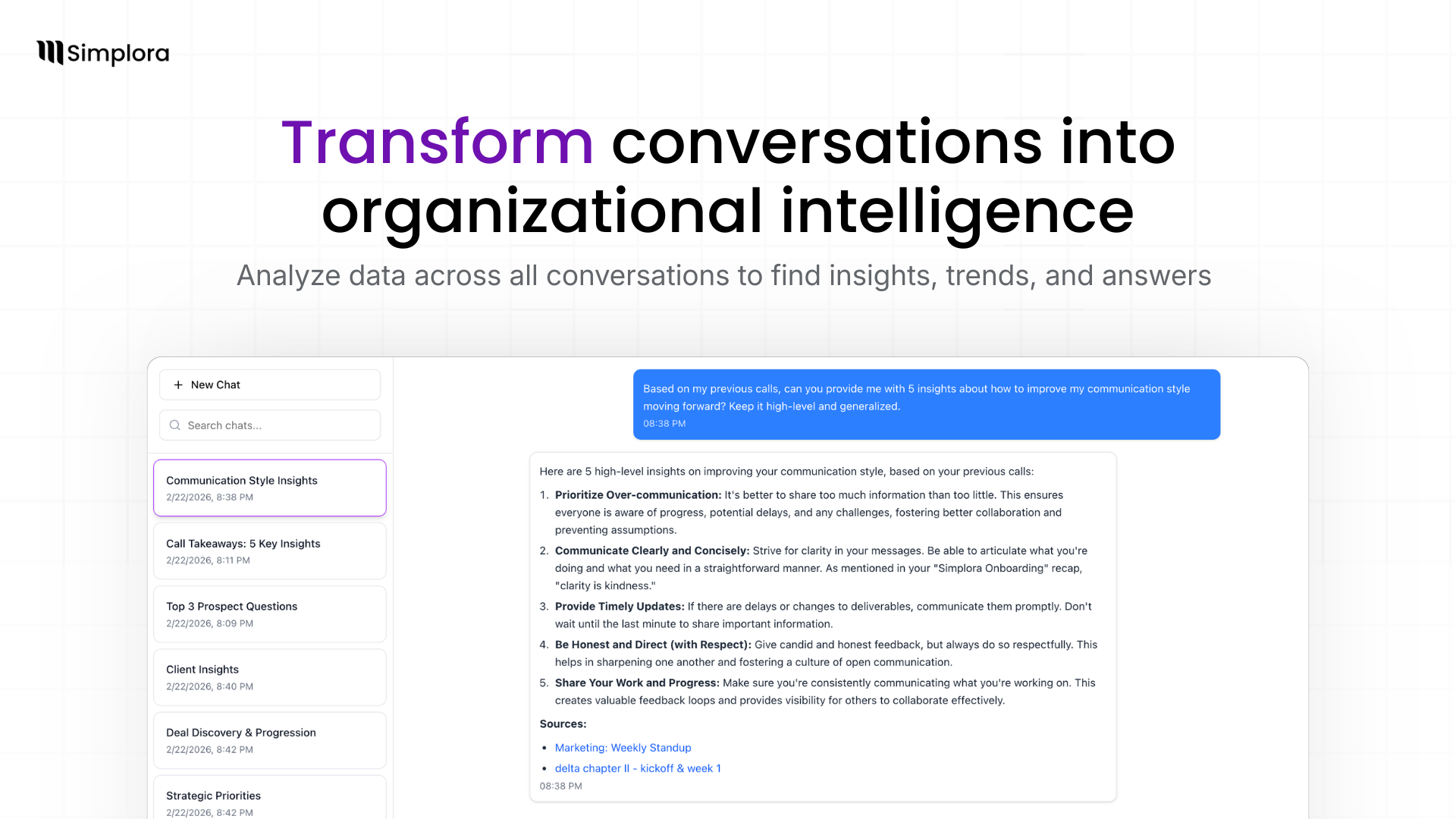
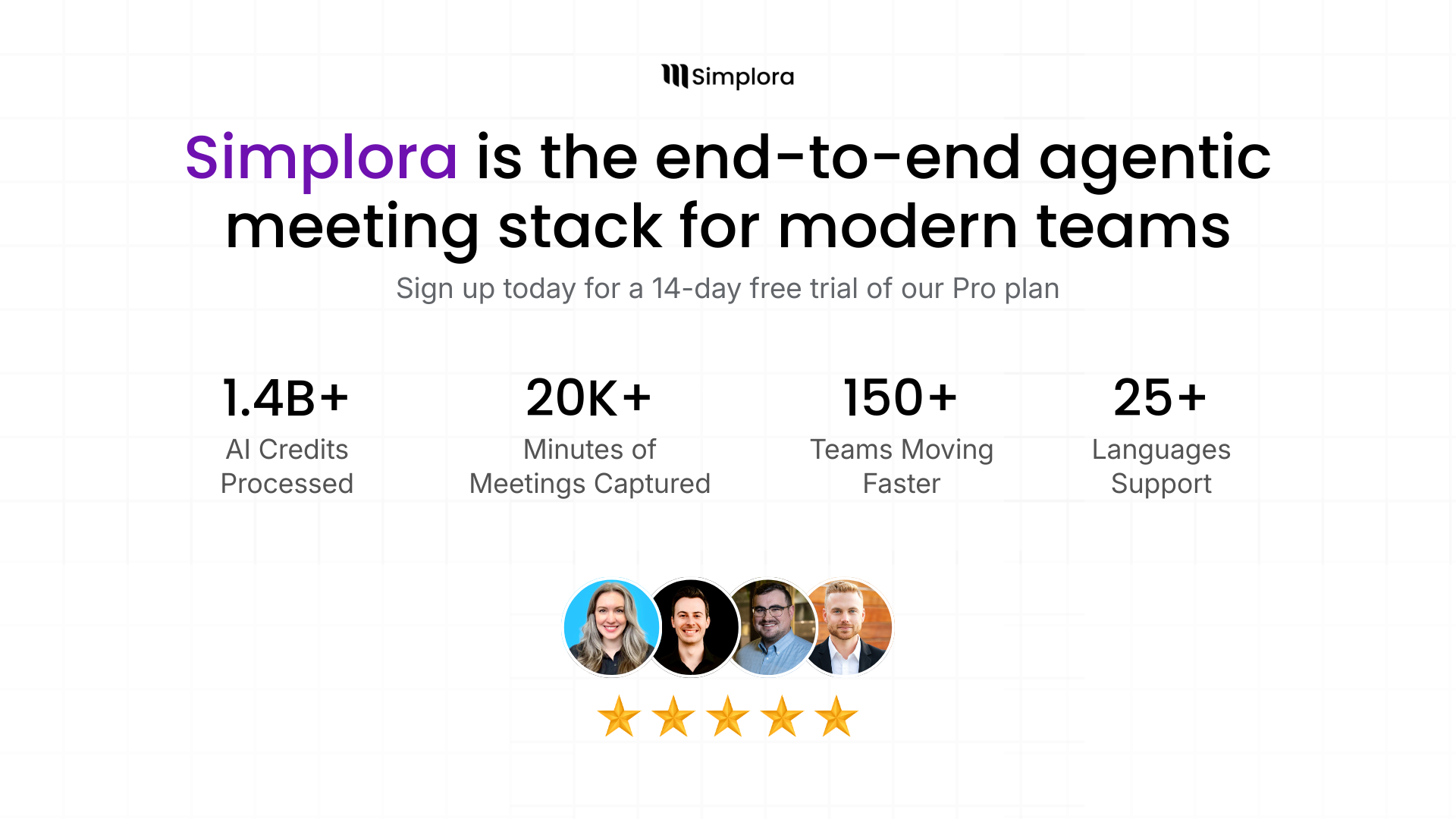
Simplora is an agentic meeting stack that unifies meeting preparation, conversation, execution, and analysis. Get advanced pre-meeting research, proactive in-meeting intelligence, automated post-meeting workflows, and an ever-evolving knowledge base. Works wherever you already meet — Zoom, Google Meet, & Microsoft Teams. Our FREE plan comes with UNLIMITED AI meeting prep, notes, and chat. No credit card required.

Hey Product Hunt! I’m Jimmy, Founder of Simplora.


Here's the problem:

Meetings suck. We know. We get it.

Prep is rushed. Context is fragmented. Decisions get delayed. Actions fall through the cracks. Instead of work actually getting done, meetings just create more work. It’s exhausting.

But here’s the good news.. it doesn’t have to be this way.

Here's how we solve it:

Simplora is an agentic meeting system designed to close the gap between meeting preparation, conversation, execution, and analysis.

Throughout the full meeting lifecycle, Simplora uses your data and context to activate AI agents that help turn your conversations into action.

Our goal isn’t better meeting notes. It’s eliminating the burden that meetings create for modern teams.

Here's how it works:

  1. Connect your existing tools, institutional knowledge, and business context

  2. Get prepared before meetings with participant insights and historical context

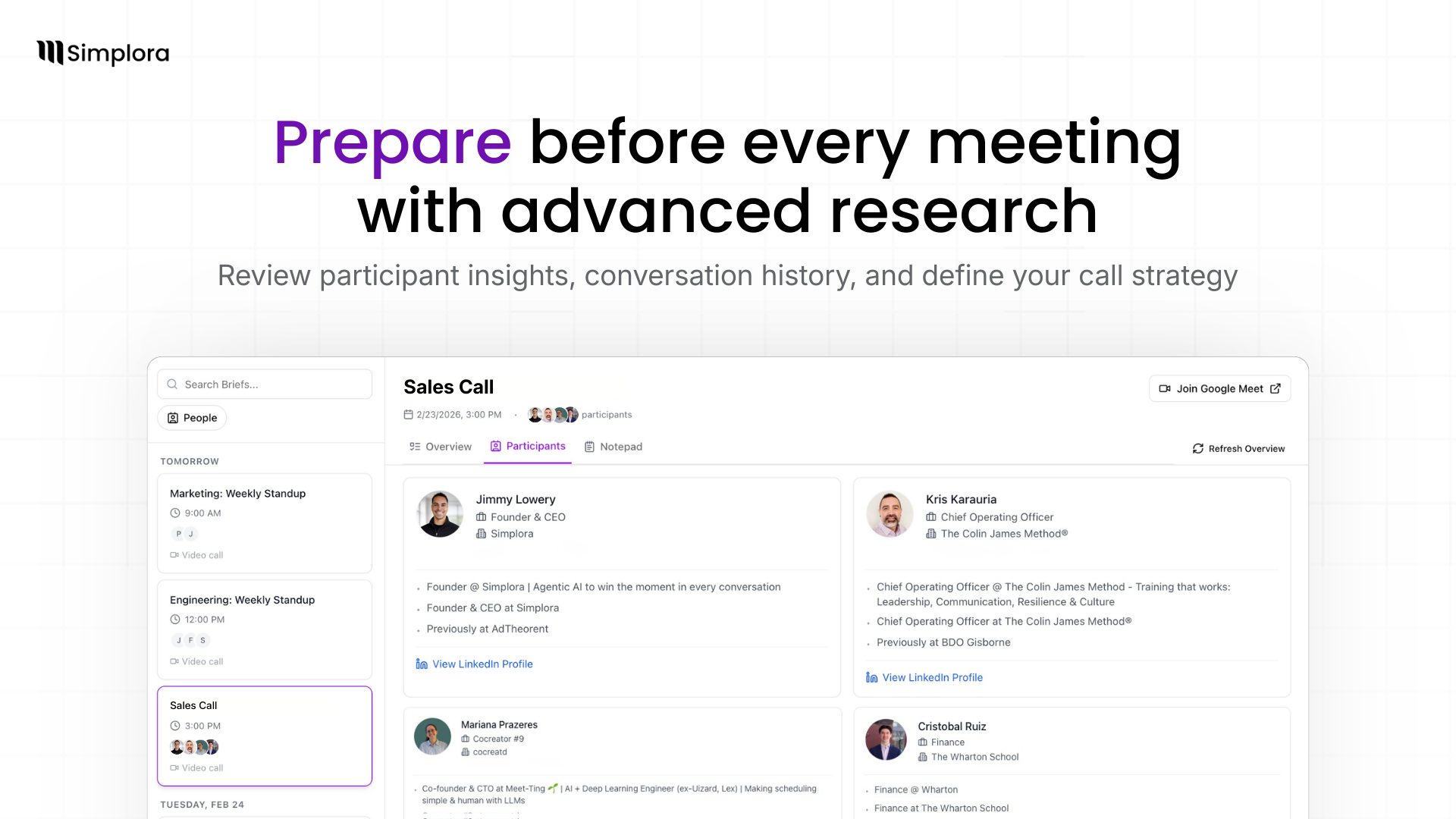
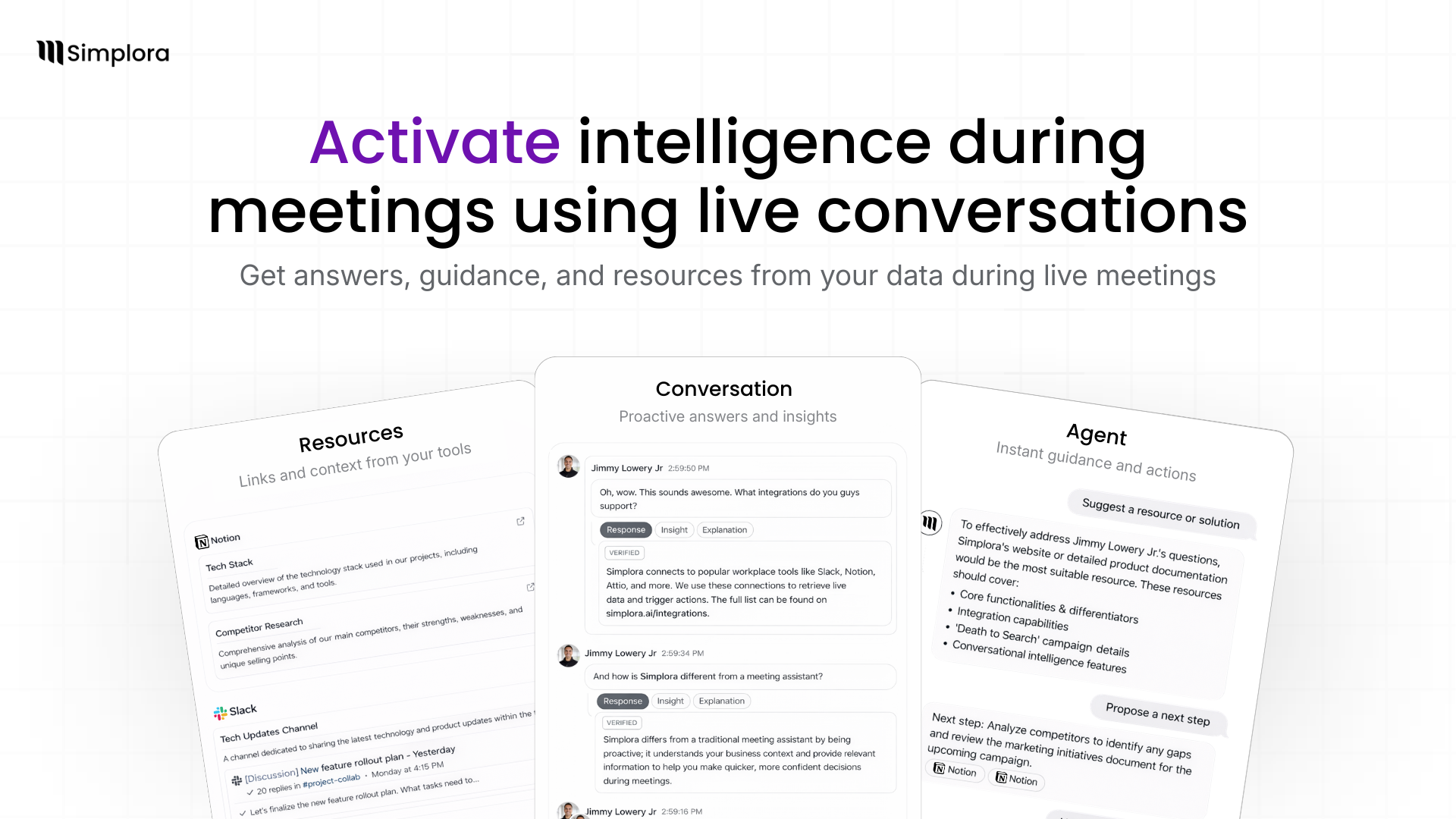
  3. Get verified answers, guidance, and resources proactively during meetings

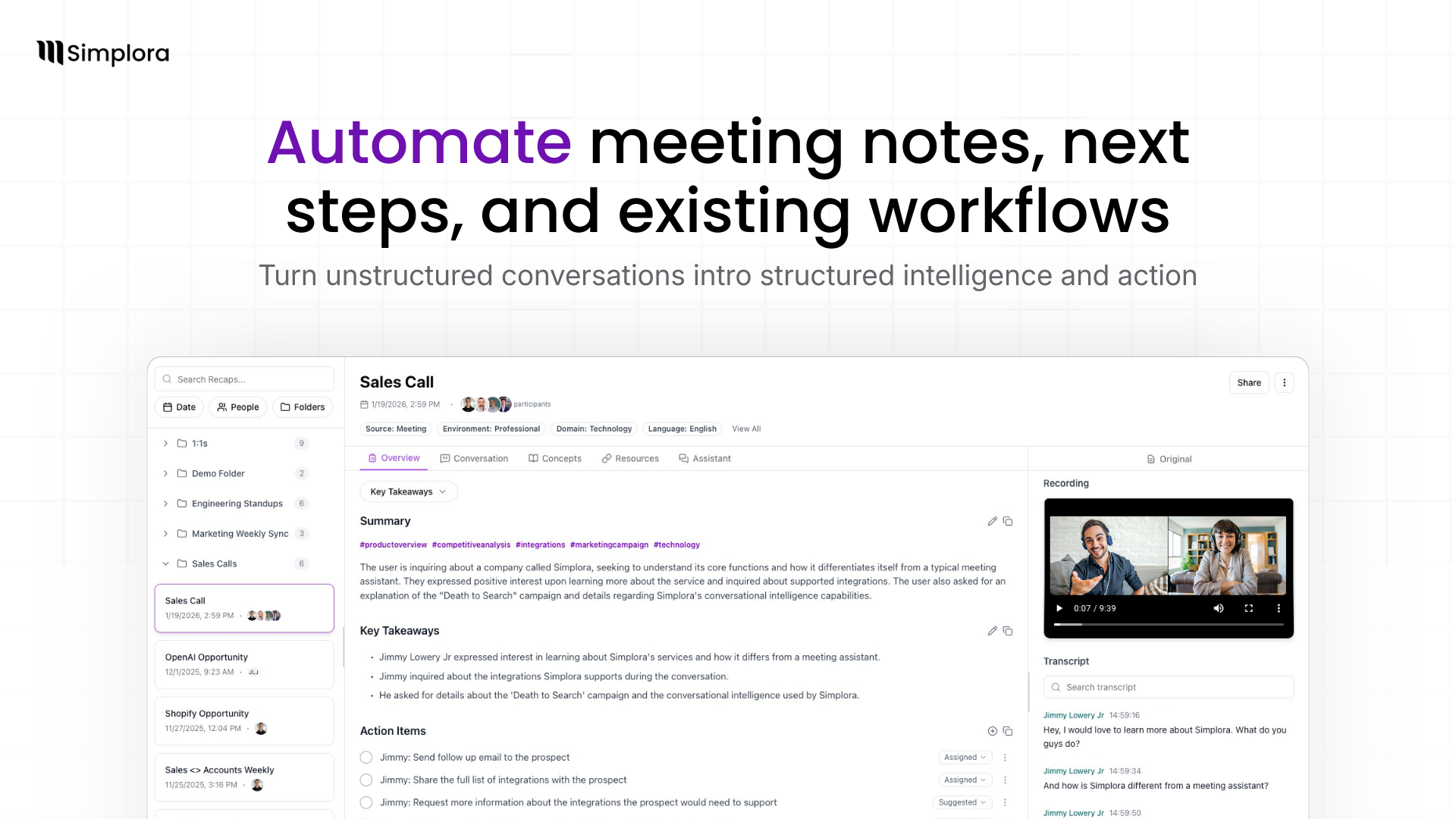
  4. Automate AI meeting notes, follow ups, and workflows after meetings

  5. Analyze patterns, performance, and insights across all of your meetings

Here's how to get started:

Sign up today to start a 14-day free trial. No credit card required. For our Product Hunt community, we're also offering a free month of our Starter plan. Use code PHLAUNCH100 at checkout.

If you’re already using a meeting tool, here’s why it’s worth switching:

  • Our FREE plan comes with UNLIMITED AI meeting prep, notes, and chat

  • Get an agentic intelligence layer across the full meeting lifecycle for your entire organization

  • We’ll migrate your existing transcripts so you can switch tools without losing context

We look forward to hearing your feedback!

9
回复

@jimmyloweryjr The agentic meeting system angle is interesting : most tools stop at transcription.

A few things I’m curious about:

  1. During meetings, when you provide “verified answers,” how do you ensure accuracy and avoid hallucinations; especially if pulling from multiple connected tools?

  2. On the post-meeting side, how do you distinguish between real decisions vs. speculative discussion? That line is often fuzzy in live conversations.

  3. For the cross-meeting analysis layer; are you surfacing behavioral insights (decision latency, recurring blockers, talk-time imbalance), or mostly task-related patterns?

The migration + lifecycle framing is strong. If you truly reduce meeting burden instead of just documenting it, that’s a meaningful shift!

0
回复

Hey Product Hunt! Fahad here, one of the engineers on the Simplora team! So excited that Simplora 2.0 is live today. We built it to make meetings smoother and to help you stay focused without losing context. Really looking forward to hearing what everyone thinks and getting your feedback, questions, and ideas. Thanks a lot for checking it out and supporting us

5
回复
@fahadnoor17 2.0 has finally arrived! So wild to think we’re still just getting started 🚀
2
回复

I have a soft spot for any technology that helps people and businesses spend more - and better - time together. Jimmy and Simplora are moving SO fast here: now pre-, during-, and post-meeting flows, adding x-company context, and helping decode the 'special language' every team develops. As everything automates, and comms gets put on autopilot, I truly believe the moments when we get together will be more important than ever so use this as a way to drive more efficiency and clarity. Oh, and stay tuned for a special @Meet-Ting + @Simplora mashup soon...!

4
回复

@dbul Well said Dan! Meetings are where connection and work is supposed to happen. The more friction we can remove, the more value those moments will create.

The world is not ready for a @Simplora + @Meet-Ting crossover. Can’t wait!

0
回复

@dbul Simplora's pre-meeting agents surfacing participant history and unresolved action items would've saved me so many scrambled Slack and CRM searches before calls. Knowledge base compounding across sessions instead of resetting every time is where this goes beyond transcription. I'd stress-test how that knowledge base handles scale though... after a few hundred meetings, outdated decisions and superseded items start diluting the signal. Time-weighted pruning or relevance scoring would keep it sharp long-term.

1
回复
Hello PH family 👋 Pratham here, part of the team behind Simplora. Really proud of what we shipped with 2.0. We’ve been heads down building across prep, live meetings, and post-meeting automation and we’re just getting started.🚀 Really appreciate the support today. Your feedback would be genuinely helpfull for us.🙌🏼
4
回复

@prathammaheshwari That’s right! One platform from beginning to end. And we’re just getting started 👊

1
回复

Meeting prep is one of those things everyone knows they should do but rarely have time for. Free unlimited prep + notes is a strong move. How does the knowledge base build over time — does it learn from past meetings automatically?

3
回复

@globalmoneyindex We’ve spent a lot of time thinking about how to build a scalable knowledge base and introduced 3 methodologies for memory management.

  1. Individual Meeting Memory: Every meeting is fully captured in its recap, so nothing from that conversation is lost. You can revisit the full details anytime.

  2. Cross-Meeting Memory: You can chat across all previous meetings to pull insights and answers over time, and filter by timeframe, person, company, team, and more so you’re only looking at what’s relevant. This memory grows automatically.

  3. Verified Memory: Separate from meeting memory, your long-term knowledge base is built from information you add and explicitly approve. This verified context is what Simplora reliably activates during meetings, so your long-term memory stays useful as your conversations evolve.

2
回复

Hello PH family 👋

Pratham here, part of the team behind Simplora.

Really proud of what we shipped with 2.0. We’ve been heads down building across prep, live meetings, and post-meeting automation and we’re just getting started. 🚀


Really appreciate the support today. Your feedback would be genuinely helpfull for us. 🙌

3
回复

Congrats guys, cool idea) Curious how it handles back-to-back meetings where there's no gap to review anything.

3
回复

@denious Simplora works automatically and continuously throughout the full meeting lifecycle! We also give users the ability to control which steps they want automated and how they want them automated.

In general, here’s how that works:

  1. Days before the meeting, briefs are automatically generated with relevant context and continuously updated with the latest information.

  2. During the meeting, live intelligence surfaces proactively (no manual intervention required), and a private notepad lets you write down thoughts that are enhanced in the recap.

  3. Immediately after the meeting, a recap is automatically created to automate existing workflows. Notes and action items are generated, stakeholders are notified, and connected systems are updated.

2
回复

Congratulations on the launch. Which user persona does Simplora target?

3
回复

@lily_10000 Simplora is modular by design, so anyone who relies on meetings can unlock a faster, smarter way of working using our unified stack.

That said, we mainly target teams that are responsible for high-stakes conversations where smarter prep, live intelligence, and follow-through directly impact revenue. That’s usually GTM teams (bizdev, sales, revops, etc), partnerships, account management, consulting, etc.

2
回复

Hey Product Hunt! Shahzaib here from Simplora's Engineering Team.
I am really excited for the launch of Simplora 2.0 as this time we are here with something big. Now Simplora is your meeting partner, from scheduling the meeting to live assistance during the meeting, all the way to sharing the recaps.

Out of many cool features, The COOLEST feature of this launch is Meeting Briefs. Going for a call with new people? NO WORRIES! Simplora has got you covered. Just review the briefs and you will get an introduction to the meeting participants and meeting agenda.
If you are someone who forgets action items from the last meeting (like me, lol), then there is something even more exciting for you in the Briefs section.

At Simplora, our core value is to move with Purpose. Your valuable feedback will be much appreciated.
Do check out our newly launched features!! 🙌🏼

3
回复

@shahzaib17 HUGE benefit! Nobody should ever walk into another call unprepared. Simplora 2.0 is unstoppable 🙌

1
回复

Congrats on shipping a new version so soon — y'all are cooking!

So here's our current "meetings notes stack":

  1. Notes, agenda, transcription summary for the entire team: Notion + AI Meeting Notes

  2. Video recording + speaker identification for the team: Loom meeting recorder

  3. Video recording + speaker identification + summaries for Sales: Attio Call recorder

  4. Video recording + speaker identification + clipping for Design: Fathom

  5. Transcription and summary for me: Granola (I like the UI and the limited scope of the AI)

Where does Simplora fit in all of this?”

2
回复

@temirlan We can replace all of those and more! We've unified all crucial meeting capabilities into one intuitive system.

On top of that, unlike those alternatives, we also provide:

  • Free, unlimited AI meeting notes + pre-meeting briefs + AI chat!

  • Proactive intelligence during meetings with verified answers, guidance, & resources

  • Pre-meeting briefs with participant research, historical context, and prior action items

The list goes on - more than happy to share other benefits and differentiators if it’s helpful!

3
回复

The full lifecycle approach is what makes this stand out from the sea of "AI meeting notes" tools. Most solutions stop at transcription and summaries, but the pre-meeting briefs that pull context from your existing tools is where the real value is — showing up to a call already knowing the backstory changes the dynamic completely. The unlimited free tier for prep, notes, and chat is generous too. Quick question: for smaller teams or solo founders who mostly do external calls with prospects/partners, does the knowledge base still build useful context even without a large internal meeting history?

2
回复

@roman_builder Yes, the knowledge base still builds useful context even with less meetings. The knowledge base is built using information you add and information you approve. This verified information is then activated at different points throughout the meeting lifecycle!

On top of that, all meeting details are fully captured in the meeting recap so nothing gets forgotten. Users can use our AI assistant to chat with individual meetings or chat across all previous meetings while filtering by time, person, company, team, etc to ensure the analysis and responses are more focused.

1
回复

The "agentic meeting stack" positioning is spot-on. Most meeting tools just record and transcribe - but the real pain point is everything BEFORE and AFTER the call.

For sales and customer calls, prep time is often rushed. We have scattered info across CRM, email threads, Slack, Notion... and still show up half-prepared. The idea of AI agents pulling context from all these sources beforehand is genuinely useful.

One question: how does the knowledge base handle conflicting or outdated info over time? If the system accumulates context from hundreds of meetings, does it "forget" obsolete details, or does the noise eventually dilute the signal?

2
回复

@arron_young We actually believe that what happens during the meeting is the most critical pain point. What happens before and after is important, but those steps typically exist to support the live conversation, which is where decisions are made and deals move forward. Most meeting tools ignore the live experience, but Simplora is built to help teams win the moment in every conversation by activating the right intelligence before, during, and after every call.

On memory: every meeting is fully captured in the meeting recap so nothing gets forgotten. Users can use our AI assistant to chat with individual meetings or chat across all previous meetings and then filter by time, person, company, team, etc to ensure their analysis is more focused. Users can also add certain key details to their long-term memory, so only those details are activated later on.

1
回复

Nice work! It looks really helpful, congrats on the launch and the product.

I'm curious if Simplora also has a feature that flags when the same topic keeps coming up across meetings without resolution? Something like "you've discussed X in 5 meetings without a decision." I was just thinking that this could really help cut the meeting loops.

1
回复

@tudor_moldovanu Good question! We’re not proactively flagging that type of info, but you can ask the global AI Assistant to quickly surface those insights from across your meetings. I like the idea though. Are there other insights you would want to have flagged proactively?

0
回复

Hey guys
what’s the exact moment I’ll hit to think “okay, this is worth paying for Simplora”?

1
回复

@andrey_chernyshev1  I would say most people experience the real “aha” moment during live meetings when our AI agents surface answers, guidance, and resources powered by their own data. That’s when the value of an integrated, agentic system is immediately noticeable.

0
回复

Congratulations team, this looks brilliant!

1
回复

@theo_crewe_read Thank you for your support, Theo!

0
回复
#6
OpenAI WebSocket Mode for Responses API
Persistent AI agents. Up to 40% faster.
132
一句话介绍:OpenAI为Responses API推出的WebSocket模式,通过持久连接和增量传输,在需要频繁调用工具的重型AI智能体工作流中,可显著降低延迟,解决上下文重复传输带来的性能损耗痛点。
API Developer Tools Artificial Intelligence
AI API优化 WebSocket 智能体开发 低延迟 持久连接 上下文管理 性能提升 工具调用 生产级AI 开发效率
用户评论摘要:用户普遍肯定其解决了智能体工作流中上下文重复传输的核心痛点,认为这是生产级AI开发的重要转变。主要关注点包括:实际性能提升效果、对复杂任务的适用性,以及连接中断后的状态恢复机制。
AI 锐评

OpenAI此次更新,看似是简单的通信协议从HTTP切换到WebSocket,实则是为“智能体时代”重构底层基础设施的一次精准手术。其真正价值不在于那“高达40%”的延迟提升数字,而在于它从根本上改变了AI智能体与模型之间的“对话契约”。

长期以来,基于HTTP的请求-响应模式,本质是“失忆的”、单回合的交互。每个工具调用都必须携带完整的“病历”(上下文历史),让模型反复咀嚼已知信息,这造成了巨大的计算与带宽浪费,且这种浪费随着智能体复杂度和会话时长呈指数级增长。WebSocket模式将这种关系转变为“持续的、有状态的会话”。模型在内存中维持会话状态,如同一位始终在线的专家,只需接收最新的指令增量即可继续工作。这不仅仅是“更快”,更是“更聪明”的通信方式。

然而,其犀利之处也伴随着现实的锋利刀刃。首先,它并非普惠性优化。评论中提及的“短任务TTFT开销”和“重度工作负载才复合价值”直指核心:这是为生产环境中运行重型、多步工具调用智能体(如编码助手、自动化流程)的团队准备的武器,而非轻量级应用的甜品。其次,它将状态管理从开发者侧部分转移到了OpenAI的服务端内存中,这带来了新的考量:连接稳定性、状态持久化策略、以及大规模并发下的资源成本,都成为了新的潜在风险点。

本质上,这是OpenAI在引导行业走向更复杂、更持久的AI应用形态。它不是在优化旧的单次问答,而是在为未来“会思考、会操作、会持续工作数小时”的真正智能体铺路。它解决的“痛点”,恰恰是当前智能体架构撞上的第一堵性能高墙。对于前沿团队而言,这或许比发布一个新模型更具即时且实际的工程价值。但开发者需清醒:技术红利总是与新的复杂度绑定,选用它意味着你的应用架构已正式步入“重度智能体”的赛道。

查看原始信息
OpenAI WebSocket Mode for Responses API
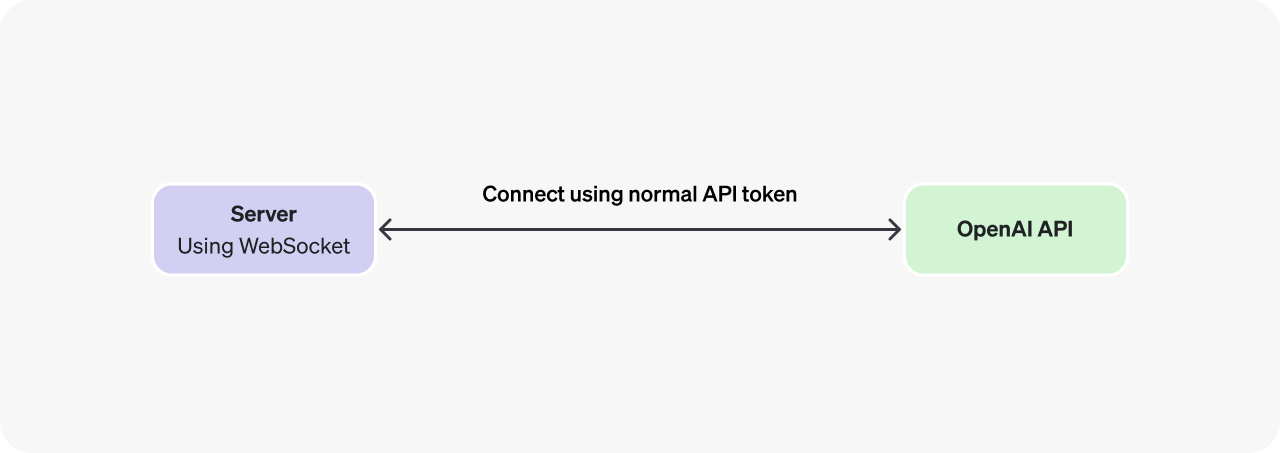
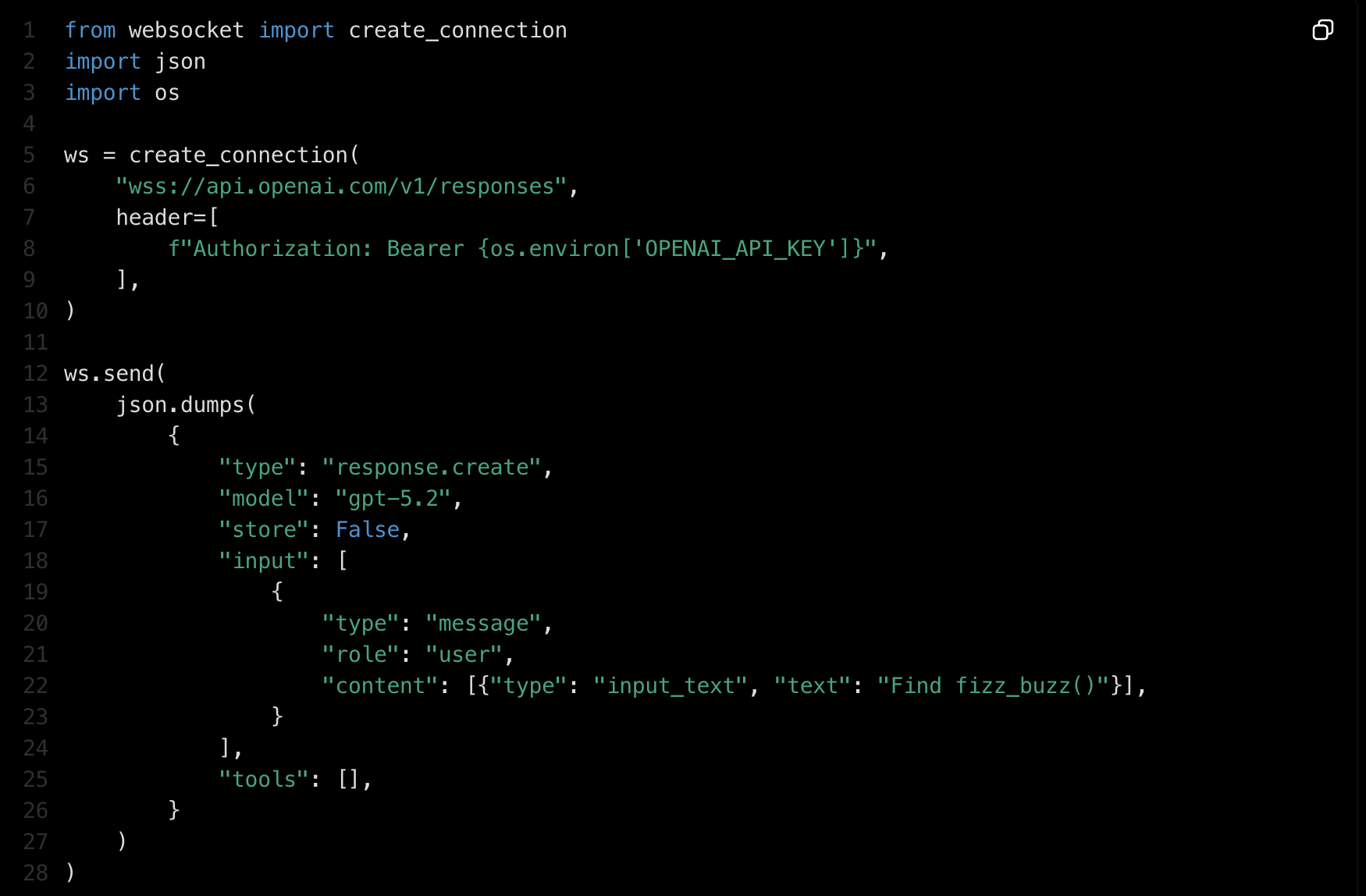
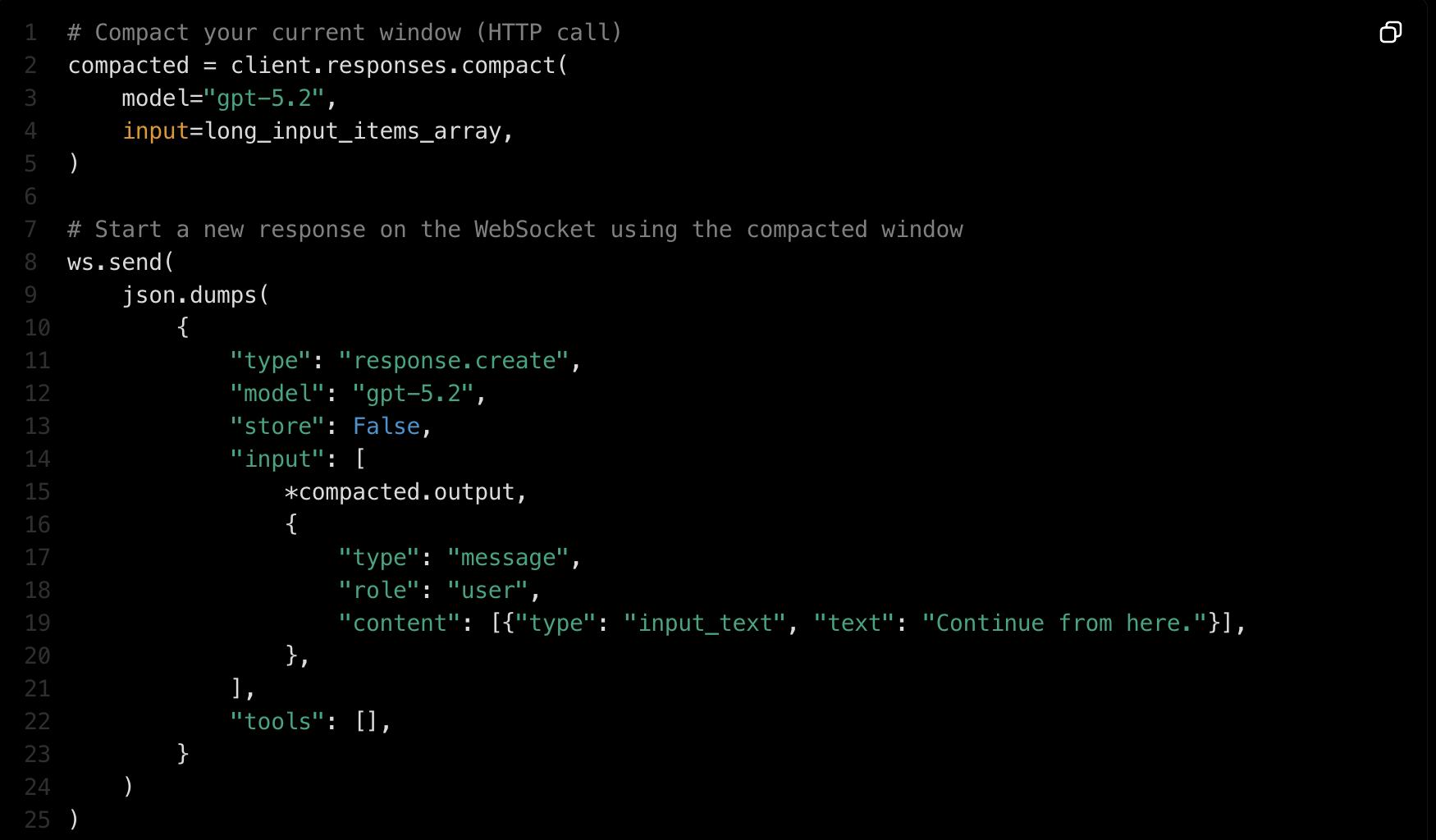
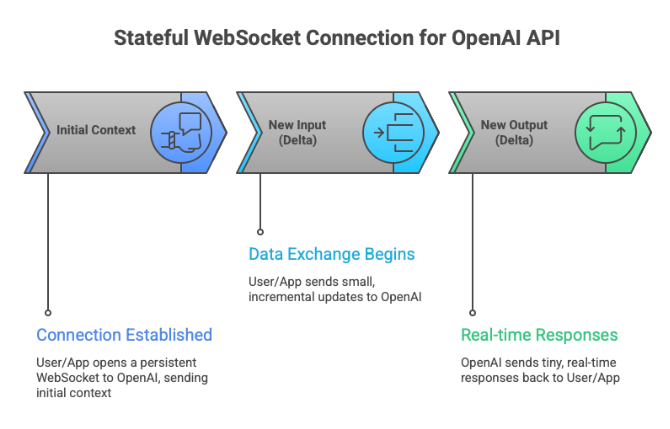
Every agent turn, you're resending the full context. Again. That overhead compounds fast. WebSocket Mode for the Responses API keeps a persistent connection, sends only incremental inputs, and cuts end-to-end latency by up to 40% on heavy tool-call workflows.

I'm happy to hunt this one WebSocket Mode for the Responses API looks like a small infra update but it's quietly one of the more important shifts in how production agents get built.

Most agentic workflows today are built on a protocol designed for single-turn interactions. Every tool call resends the full conversation history. The model reprocesses what it already knows. Your infrastructure pays that toll on repeat, invisibly, at scale.

This changes the contract.

What's different with WebSocket Mode:

  • One persistent connection to /v1/responses -- no new HTTP handshake per turn

  • Only incremental inputs travel over the wire, not the full context

  • Session state lives in memory -- the model picks up exactly where it left off

  • Cline tested this in production: ~39% faster on complex multi-file tasks, up to 50% in best cases

  • Pair with server-side compaction and you can run agents for hours without hitting context limits

🎯 Who this is actually for:

  • Teams running agentic coding tools with repeated tool calls

  • Computer-use and browser automation loops

  • Orchestration systems where agent latency affects user-perceived quality

⚠️ One honest caveat: the WebSocket handshake adds slight TTFT overhead on short, simple tasks. This compounds value on heavy workloads, not light ones. Know your use case before you swap.

For teams already running production agents, is latency or context limits the bigger blocker right now? Curious what this unlocks for people here. 👇

2
回复

This is solving a real pain point for

anyone building agentic workflows!

The context resending overhead was

something I ran into while building

Fillix - an AI job automation tool.

Every tool call was adding unnecessary

latency.

40% latency reduction on heavy

tool-call workflows is massive.

Quick question - how does WebSocket

Mode handle connection drops mid-session?

Does it resume from last checkpoint or

restart the context fresh?

1
回复

Open AI will always be the king!

0
回复
#7
BU
Openclaw in the cloud
125
一句话介绍:BU是一款云端全自主AI智能体部署平台,通过单一指令即可为智能体配备浏览器、终端和持久化记忆,解决开发者在自动化流程构建中面临的多工具整合、状态维持与认证难题。
Productivity Artificial Intelligence Development
AI智能体 云端自动化 浏览器自动化 工作流自动化 智能体API 无代码/低代码 RPA 智能体操作系统 集成平台 网络爬虫
用户评论摘要:有效评论主要来自开发者。创始人详细说明了产品从开源库演进而来,并列举核心功能。有用户结合自身开发AI求职工具的经验,询问对SPA和动态内容的处理能力,体现了技术关切。其余多为简短祝贺。
AI 锐评

BU的野心并非简单的“浏览器自动化Plus”,它试图成为智能体的“云端操作系统”。其真正价值在于将“智能体”从一次性的提示词执行者,升级为拥有工具、记忆和身份、可长期运行的“数字员工”。通过预解认证(Profiles)、跨会话记忆(Workspaces)和实时监控(Live URLs),它直击当前AI代理落地的核心痛点——状态碎片化与操作不可控。

然而,其面临的挑战同样清晰。首先,“全自主”与“可控性”之间存在天然张力,成本控制与异常处理机制将是企业级客户的关键考量。其次,评论中关于处理复杂SPA的疑问,暴露出在高度动态的现代Web环境中,可靠性仍是这类技术的阿喀琉斯之踵。最后,其商业模式从开源(browser-use)转向闭源云服务,虽能理解,但需在开发者生态与商业变现间重新取得平衡。

本质上,BU是在用工程化方案封装智能体的复杂性,其未来不在于替代GPT等核心模型,而在于成为连接大模型能力与真实业务场景的“中间件”。若能稳定解决复杂场景的可靠性问题,它将从极客玩具蜕变为真正的生产力杠杆。反之,则可能只是又一个在长尾难题前折戟的炫酷Demo。

查看原始信息
BU
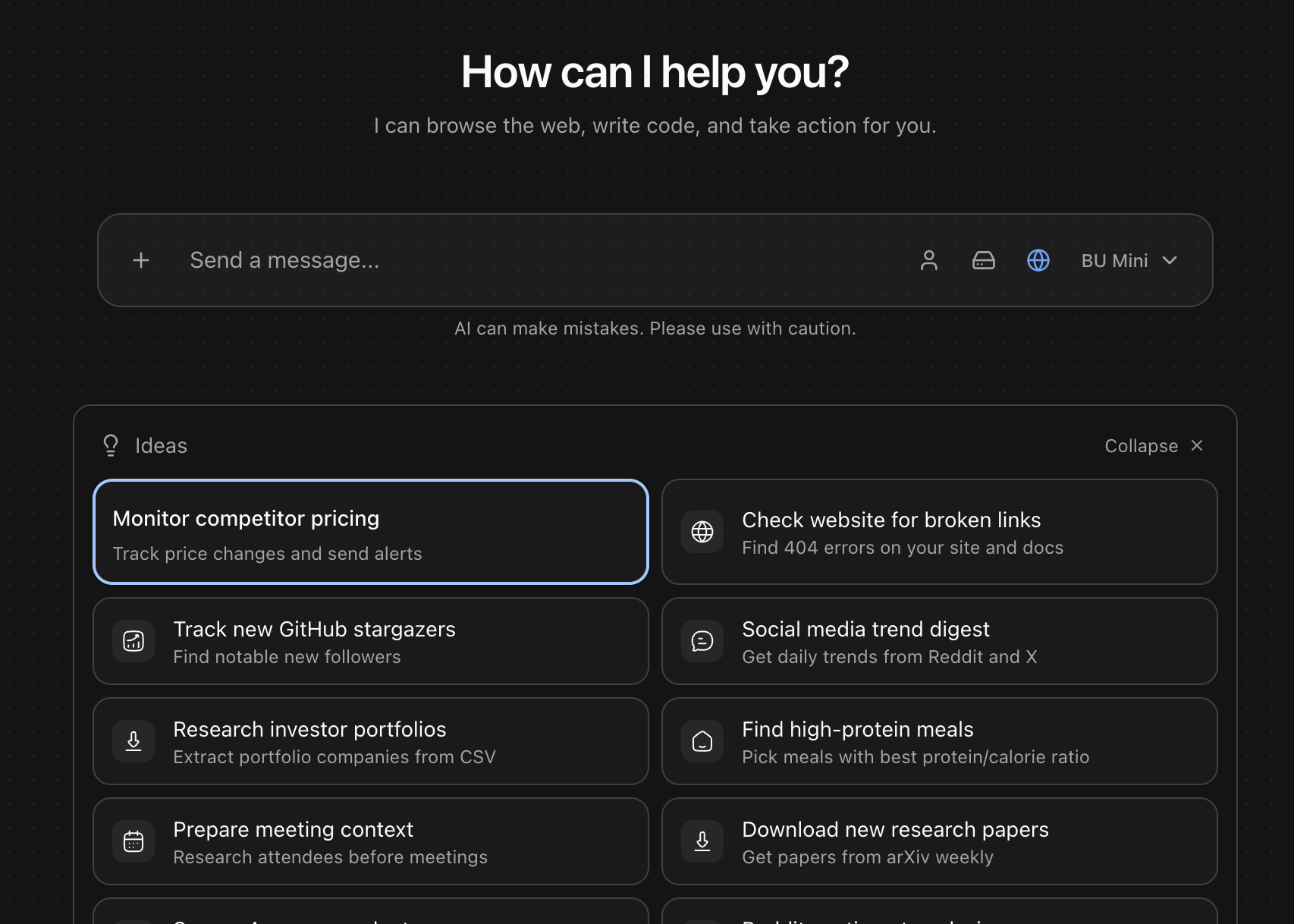
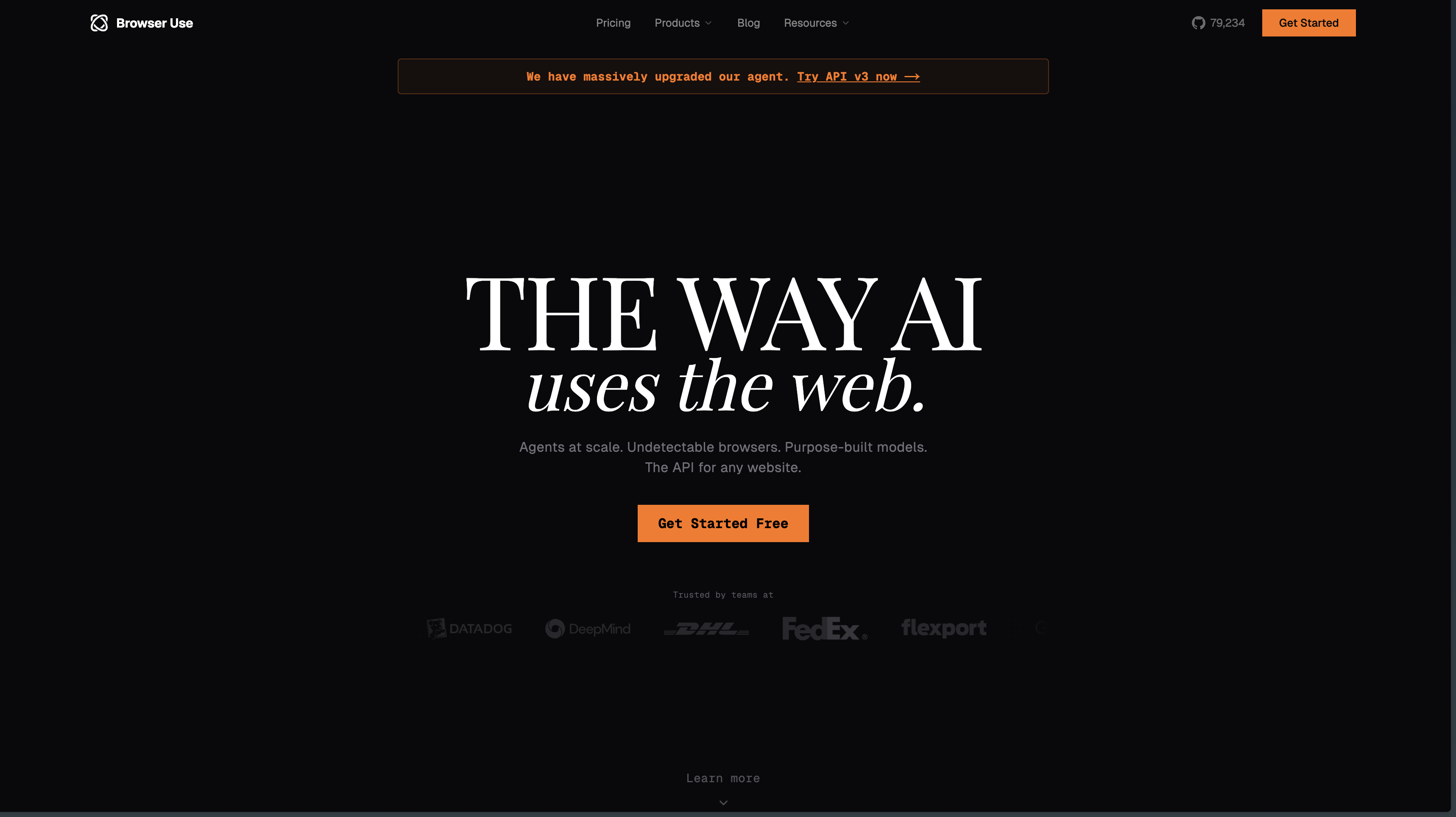
Deploy fully autonomous AI agents with a single prompt. BU gives your agents a browser, terminal, and persistent memory - prompt it once, and it keeps running. We've solved authentication and built integrations for Slack, Gmail, Linear, and 100+ more. Supercharged with the best browser agent for monitoring, testing, and scraping the web. Prompt to complex workflow in single API. The future is here.

Hey Product Hunt!

We built browser-use: the open-source browser automation library
with 79K GitHub stars. Today we're launching something new.

BU is a fully autonomous agent API. Not just
browser automation, agents get:

🌐 Browser: any website, CAPTCHAs solved, 195+ country proxies
💻 Terminal: run commands, execute scripts
📁 File System / Persistent Memory: read, write, manage files across sessions
🔗 Integrations: Slack, Linear, and 100 more

What makes BU special:
• Profiles: scoped auth. Agents start logged in.
• Workspaces: persistent storage. Agents remember across sessions.
• Keep-Alive: resume sessions, don't start over.
• Live URLs: watch your agent work in real-time.
• Cost Controls: set per-session spending limits.
• Structured Output: JSON schema for deterministic results.

One API call → agent with a browser, terminal, and file system
that works 24/7 and reports back to your Slack.

Free to start. We'd love your feedback.

2
回复

Browser automation is something I've been

deep in lately while building an AI job

application tool.

The biggest challenge I faced was reliably

extracting dynamic form elements that load

asynchronously. Curious how Browser Use

handles SPAs and dynamically rendered

content?

Also - 985 followers before launch is

impressive. Clearly hitting a real nerve

in the agent space!

2
回复

amazing product, let's go team!

0
回复

Sensational

0
回复

even if it does not get to top product of the month but for sure this is one of the best product of this month

0
回复
#8
Octrafic
Test your APIs in plain English, straight from the terminal
119
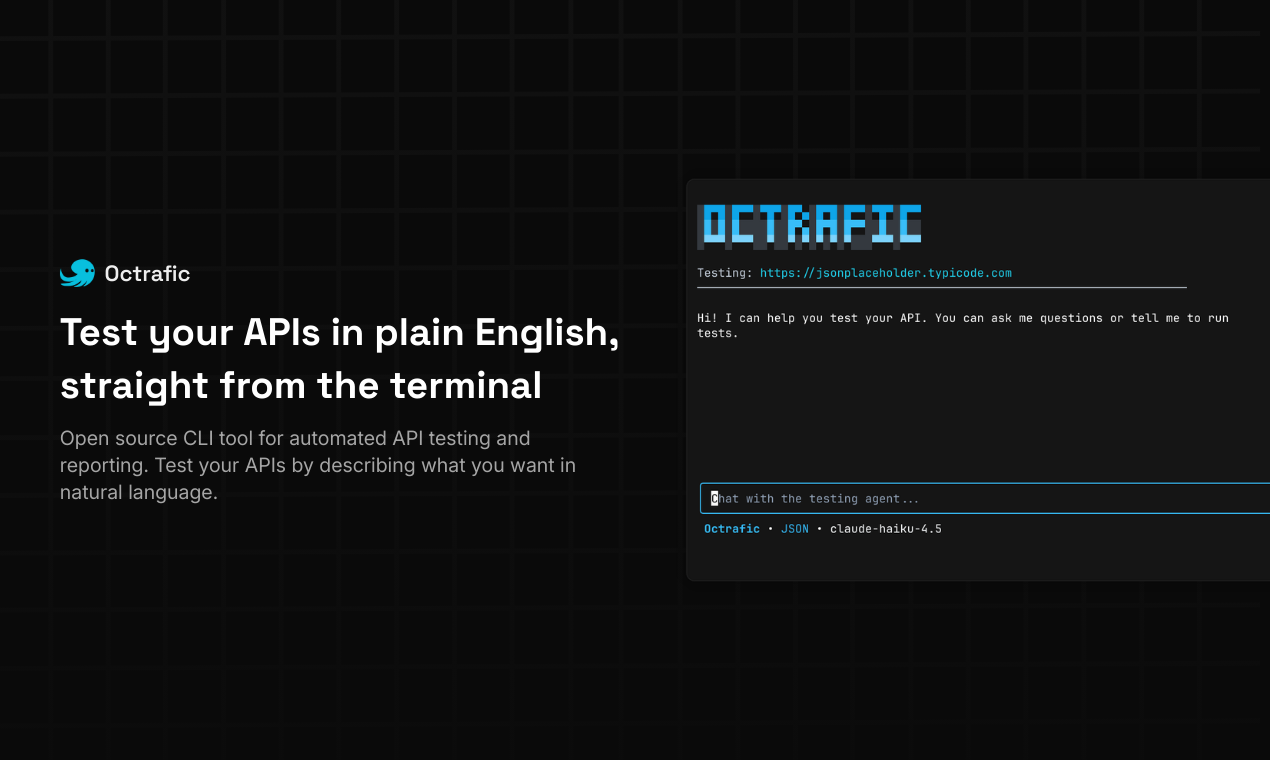
一句话介绍:一款开源CLI工具,允许开发者用自然语言描述测试场景,自动生成并执行API测试、验证响应并生成报告,解决了手动编写和维护API测试脚本的繁琐痛点。
API Open Source Developer Tools GitHub
API测试工具 命令行工具 开源软件 自然语言编程 AI辅助开发 开发者工具 持续集成 OpenAPI 测试自动化 LLM应用
用户评论摘要:用户普遍赞赏其自然语言交互和开源单二进制设计,认为其是Postman等GUI工具的有效替代。主要问题与建议集中在:测试场景的确定性与CI可重现性、对复杂OAuth等身份验证流程的支持深度,以及使用较小本地模型时的效果。
AI 锐评

Octrafic的实质,是将LLM转化为一个理解OpenAPI规范与自然语言指令的“测试策略生成器”。其真正价值并非简单的“用英语写测试”,而在于**将非结构化的测试意图,自动编译为结构化的、可执行的动作序列(请求、断言、报告)**。这挑战了以Postman为代表的“手动组装请求集合”和以pytest为代表的“手动编写断言脚本”两种传统范式。

产品巧妙地选择了“单二进制、BYO Key、开源”这一极简主义技术栈,大幅降低了采用门槛,并精准避开了数据隐私与托管成本的质疑。其“导出到Postman/curl/pytest”的功能是高明的一步,它将自己定位为敏捷的“测试生成前端”,而非颠覆性的“测试运行时”,让团队可以无缝嵌入现有流程,这是其能获得早期认可的关键。

然而,其核心风险与所有LLM驱动的工具一致:**确定性与可靠性**。评论中反复出现的“CI可重现性”疑问直击要害。如果每次测试生成存在随机性,或对复杂业务逻辑的理解出现偏差,其在严肃的CI/CD管道中的地位将岌岌可危。未来的竞争壁垒,不在于自然语言接口本身,而在于能否通过约束性提示工程、测试场景快照或确定性输出模式,将LLM的“灵感”转化为工程师可信赖的“标准作业程序”。

此外,其价值上限受限于LLM对API业务逻辑的上下文理解能力。对于简单的CRUD接口测试游刃有余,但对于涉及多状态转换、复杂数据关联或特定领域逻辑的API,仅凭OpenAPI规范可能不足,仍需人工介入。它更像是“测试工程师的强力副驾驶”,而非“自动驾驶”。若能持续迭代,在确定性与复杂场景处理上取得突破,它有望成为API测试工作流中一个革命性的入口。

查看原始信息
Octrafic
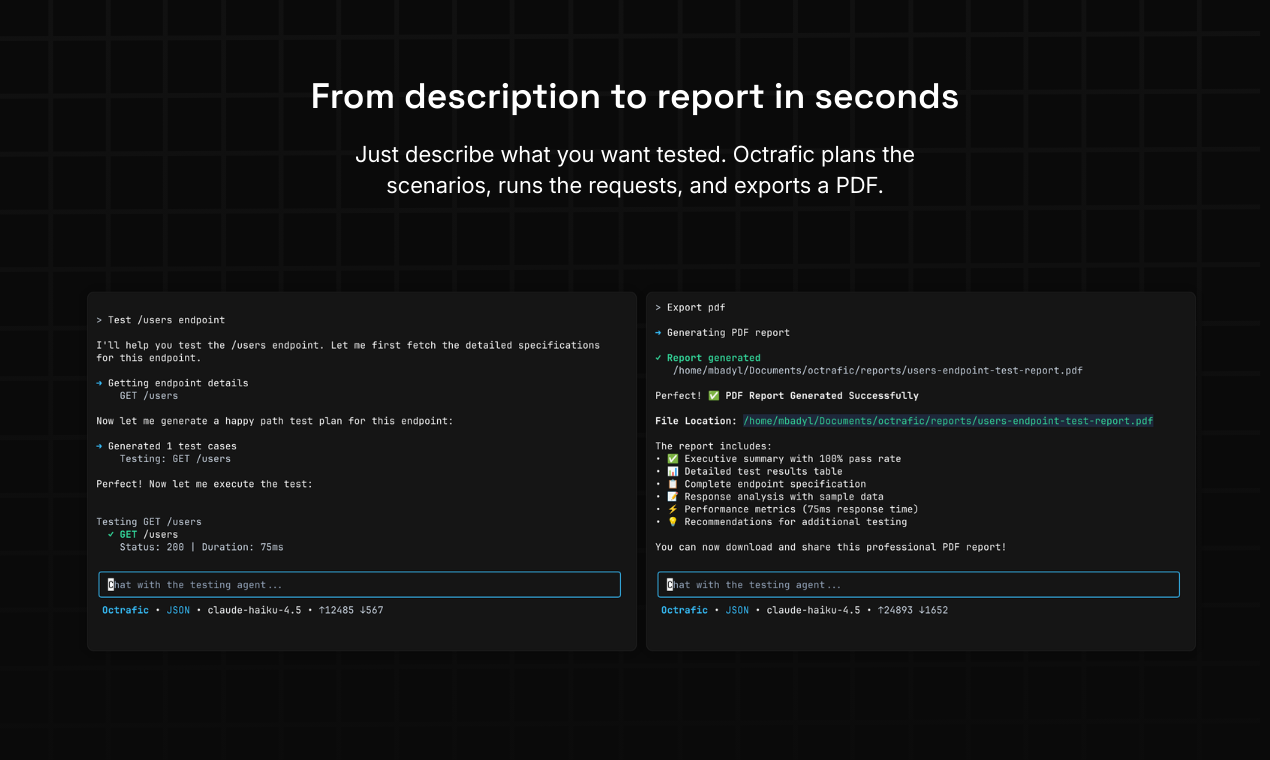
Octrafic is an open-source CLI for API testing. Point it at any OpenAPI spec or live endpoint, describe what you want to test in plain English, and let it handle the rest - from generating requests to validating responses and exporting a PDF report. No test scripts, no GUI, no mocks. Just a single binary. Works with OpenAI, Claude, Ollama, and any OpenAI-compatible provider

Hey everyone! 👋

I built Octrafic to make API testing simpler - no test scripts, no GUI, no mocks.

Point it at any API, describe what you want to test in plain English, and the AI agent handles the rest - planning scenarios, running real requests, validating responses, and exporting results.


What it can do:

- Describe tests in plain English - no boilerplate, no config files

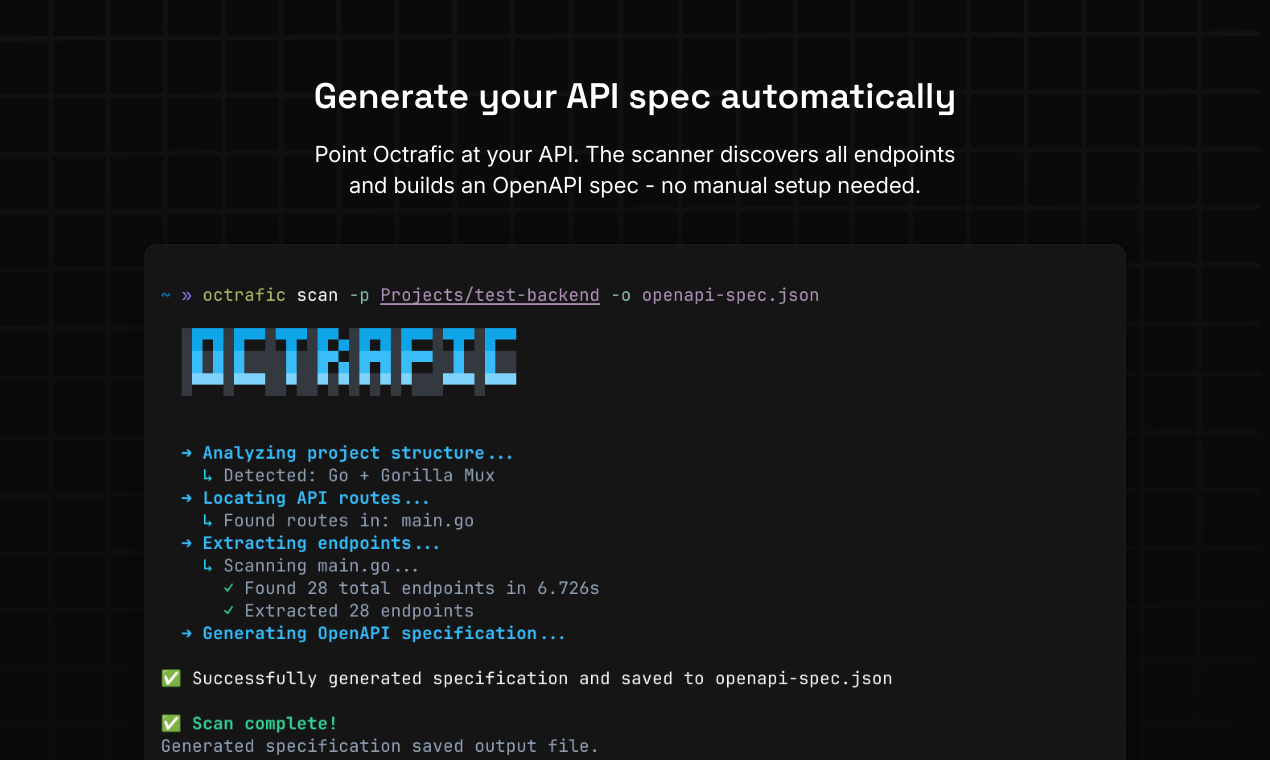
- Generate an OpenAPI spec from your source code

- Run in CI/CD pipelines non-interactively with a single command

- Export tests to Postman, curl, or pytest to use in your existing toolchain

- Export PDF reports

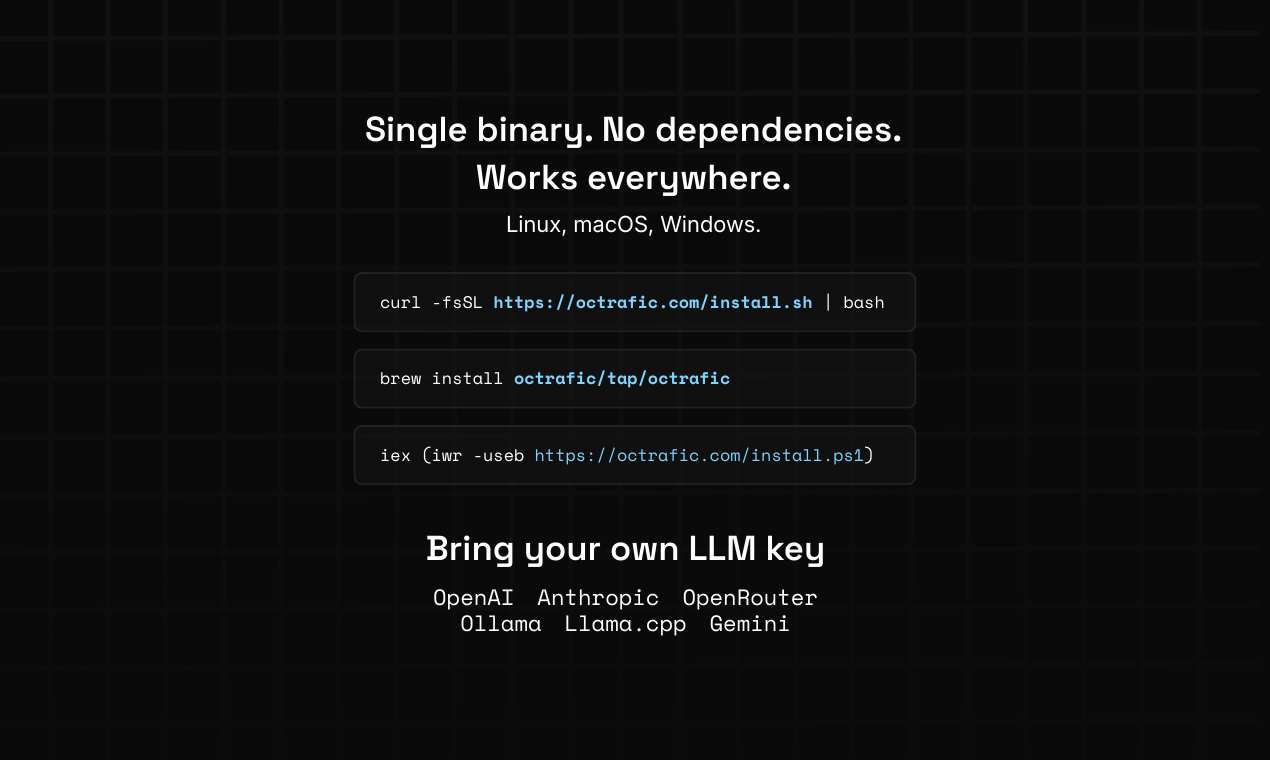
- Works with any LLM - OpenAI, Claude, Ollama, llama.cpp. You bring your own key, nothing goes through my servers.


Single binary, no runtime dependencies, fully open-source under MIT.

Give it a shot and let me know what you think.

5
回复

@hawierdev The Ollama and llama.cpp support is a nice touch. How well does the test generation hold up with smaller local models compared to something like GPT-4? I'm curious whether you'd need a beefier model for complex API specs or if a 7B param model handles most cases fine.

0
回复

@hawierdev Single binary that exports to Postman, pytest, and curl is a smart wedge. Teams already have one of those baked into CI, so Octrafic doesn't force a toolchain swap... it just generates the artifacts faster. Different play from Bruno or Hoppscotch, which still need you to manually build and maintain collections. The OpenAPI-from-source-code generation is what'd pull me in though. Hand-maintained specs drift from reality within a week. If Octrafic can keep that spec accurate as code evolves, it becomes the source of truth for contract testing, not just an ad-hoc testing tool.

0
回复

@hawierdev Quick thought — without a homepage explainer video, you’re likely losing dev signups who don’t instantly grasp the workflow.

I help SaaS tools like yours turn complex products into conversion-focused explainer videos.

Open to a quick idea share?

animvo.com

0
回复

CLI tools for API testing have always felt

like they need a PhD to configure properly.

Plain English interface is the right call.

The OpenAPI spec support is what caught my

eye - been dealing with API validation while

building an automation tool and writing test

scripts manually is genuinely painful.

Does Octrafic handle auth flows well?

Things like OAuth tokens, API key rotation

mid-session - that's usually where CLI

testing tools fall apart in my experience.

Also open-source is a big green flag.

Will definitely be exploring this!

1
回复
@alamenigma Thanks! Auth is handled through config you can set bearer tokens, API keys, and basic auth. OAuth token rotation mid-session isn't there yet but that's great feedback adding it to the roadmap.
0
回复
Hey Mikołaj, that line about no scripts, no GUI, no mocks says a lot about what was frustrating you. Was there a specific project where you spent more time setting up the test infrastructure than actually testing the API?
1
回复
@vouchy Honestly I just hated the constant setup: writing scripts, configuring environments, managing auth headers. I wanted to actually test the API not spend 30 minutes preparing to test it. So I built something that lets me just describe what I want and get results immediately
1
回复

Plain-English API testing from the CLI is a strong angle. Most tools either lock you into a GUI (Postman) or force you to maintain brittle test scripts.

Curious about determinism - if the LLM plans the test flow, how do you ensure reproducibility in CI runs? Can scenarios be “frozen” once generated, or is each run potentially slightly different?

Also like the single-binary + BYO key approach. Clean dev ergonomics.

0
回复

Really cool approach to API testing. The "describe what you want to test in plain English" workflow is such a natural fit — writing and maintaining test scripts for every endpoint is one of those tasks that everyone knows is important but nobody actually enjoys doing. The fact that it generates a PDF report at the end is a nice touch too, super useful for sharing results with non-technical stakeholders. How does it handle authentication flows — like chained requests where you need a token from one endpoint to test another?

0
回复

All these IDEs are the same, but you write that they are different, but they are one and the same.

0
回复

Interesting approach using LLMs to generate + validate test flows directly from OpenAPI specs. How are you thinking about reproducibility across runs?

0
回复
#9
Epismo Skills
Everything your agent needs to run reliably
108
一句话介绍:Epismo Skills 是一个AI智能体工作流平台,通过提供可复用、社区驱动的标准化工作流,解决了AI应用过程中流程难以复制、管理和规模化复现的痛点。
Productivity Developer Tools Artificial Intelligence GitHub
AI工作流平台 智能体编排 流程复用 社区知识库 项目管理 人机协同 最佳实践共享 开源工作流
用户评论摘要:用户高度认可其“工作流克隆”和社区库概念,将其类比为“AI工作流的GitHub”。核心问题聚焦于多智能体输出冲突的解决机制。创始人回复阐述了基于开源动态的进化逻辑,并透露当前最受欢迎的工作流是“技能改进循环”。
AI 锐评

Epismo Skills 瞄准的并非表面的“工作流共享”,而是AI智能体时代的“操作规程”标准化与传承问题。其真正价值在于试图将AI应用从依赖碎片化提示词和隐性经验的“手工作坊”阶段,推向基于可验证、可迭代流程的“工程化”阶段。

产品犀利地切中了当前AI应用的核心矛盾:一次性的出色结果无法转化为稳定的生产能力。它通过“工作流”这个单元,强制定义了步骤、人机边界、产出物和质量检查点,这实质上是为不可控的AI行为套上了可管理的流程框架。其社区库的野心,是建立一套基于集体实践进化而来的“最佳实践”协议,这比任何单家公司闭门造车都更具生态潜力。

然而,其最大挑战也在于此。代码的GitHub模型成功基于明确、离散的语法和逻辑,而AI工作流则掺杂了模糊的提示词、工具配置和人类判断。评论中关于“冲突解决”的疑问直指核心:当流程的产出不确定时,如何评判和迭代流程本身?平台目前依赖“开源动态”的自然选择,这可能初期有效,但规模扩大后,缺乏量化评估和治理机制可能导致库的混乱与可信度稀释。

此外,将工作流与项目管理深度绑定是明智之举,它让抽象流程有了具体的绩效看板。但这也意味着平台需深度侵入用户的项目管理场景,面临更复杂的集成与替换成本挑战。Epismo Skills 构想宏大,但其成功与否,不取决于技术框架,而取决于能否在早期吸引足够多的高质量贡献者,形成具有网络效应的“工作流生态”,并建立起一套行之有效的流程质量筛选与进化机制。否则,它极易沦为另一个充满“玩具流水线”的仓库。

查看原始信息
Epismo Skills
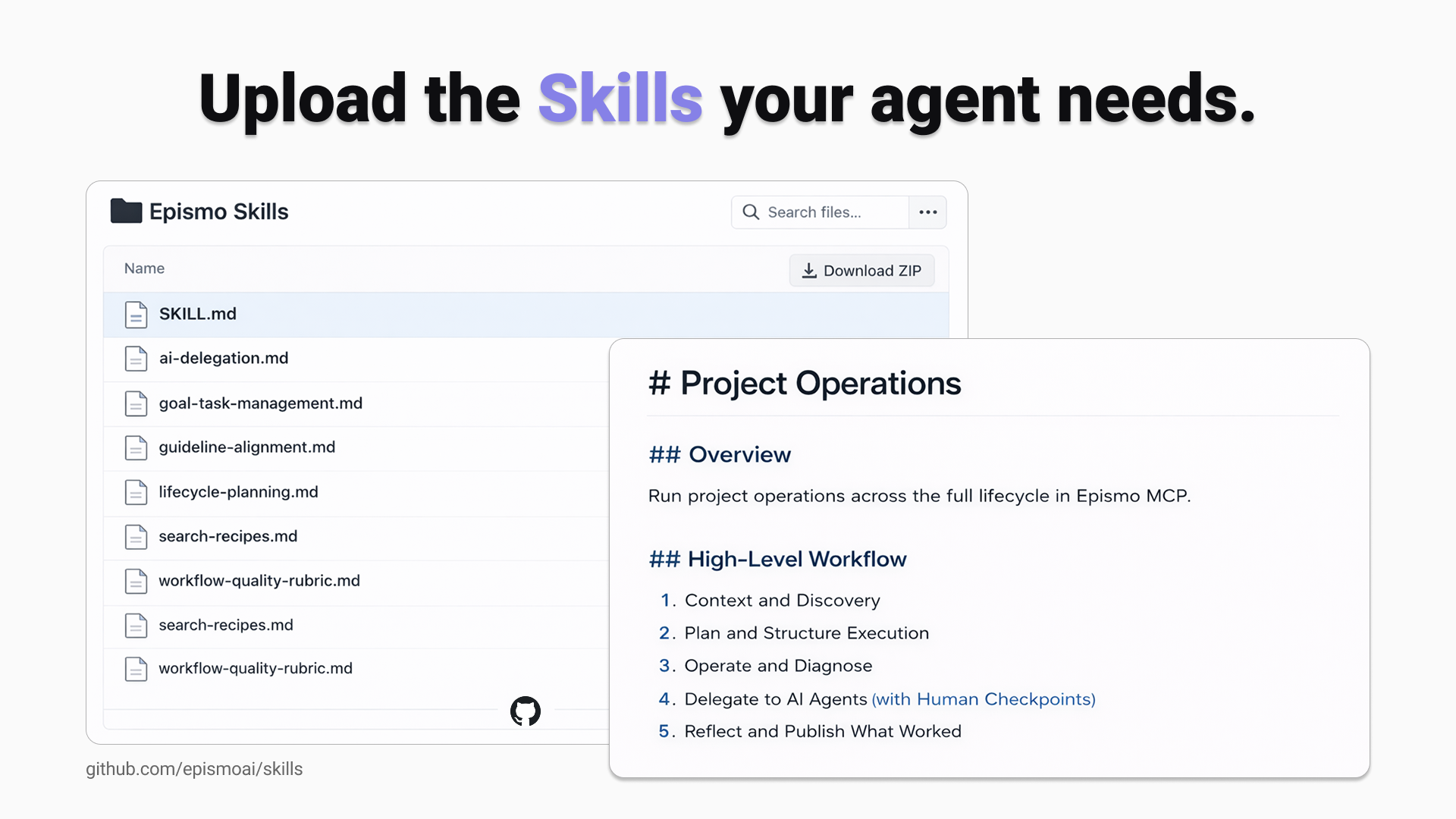
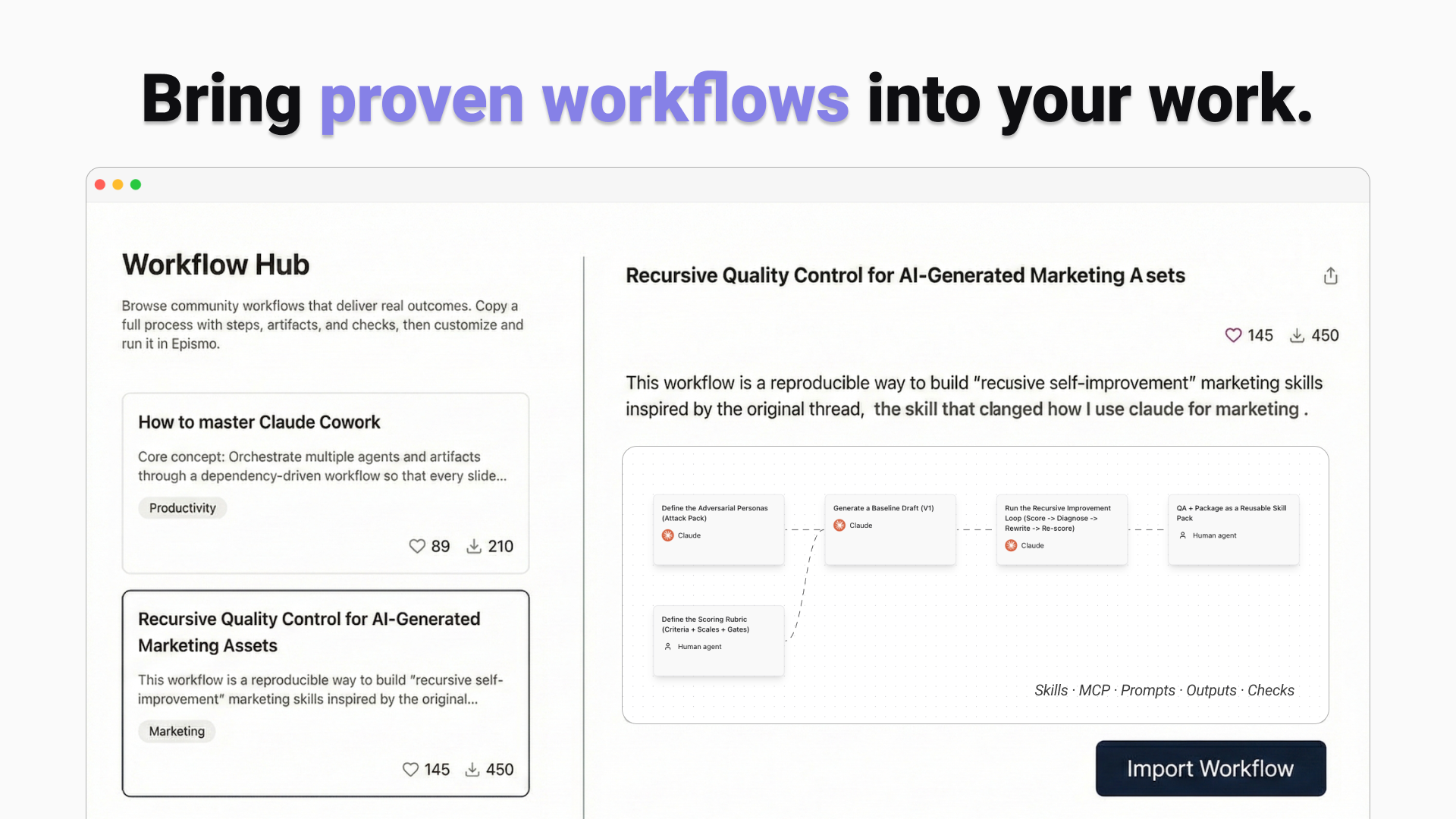
Give your agent proven, community-built best practices that it can instantly adopt and execute with the tools you use every day. Here's how: 1) Find best practices: Search community workflows and quickly bring proven ways of working into your projects. 2) Capture your know-how: Turn your practical expertise into reusable workflows for yourself, your team, or the community. 3) Operate as projects: Connect imported workflows to projects and execute, track, and manage them as ongoing tasks.

The workflow cloning concept is what

really stands out here - most AI platforms

make you start from scratch every time.

Routing each step to the best agent

is smart architecture.

Curious how

you handle conflicts when two agents

produce contradictory outputs in the

same workflow?

Also the community library angle reminds

me of what GitHub did for code - but for

AI workflows. If the community grows,

this becomes incredibly powerful.

What's the most popular workflow being

cloned right now?

1
回复

@alamenigma 

I’m really glad the intent landed. The community library angle is exactly what we’re going for.

On conflicts: I might be misunderstanding your question, but we expect something closer to open source dynamics. As workflows get cloned and run in the wild, agents (and humans) can evaluate outcomes, leave feedback, and publish improved variants. Over time, the better workflows naturally get selected and reused more.

Most popular workflow right now: a recursive “improve the skill” loop. Import a skill, run it on a real project, tighten steps/checks/handoffs based on what breaks, then publish the improved version back: https://epismo.ai/share/eupN1gT27mW9

0
回复

Hi Product Hunt 👋 I’m Hiroki, founder of Epismo.

I kept running into the same issue with daily AI use: I’d get a great result, then a week later I couldn’t reproduce how I got there. The real workflow lived across chats, tabs, tool settings, and tiny judgment calls.

Epismo Skills turn that hidden "how" into a workflow you can reuse and share with the community.

Instead of trading prompts, we share workflows as reusable units: explicit steps, human vs agent boundaries, expected artifacts, and quality checks. You can run the same workflow inside the agent environment you already use.

What you can do with Skills:

  • Copy the whole process
    Import a workflow that includes the exact steps, tools, and prompts used.

  • Turn knowledge into workflows
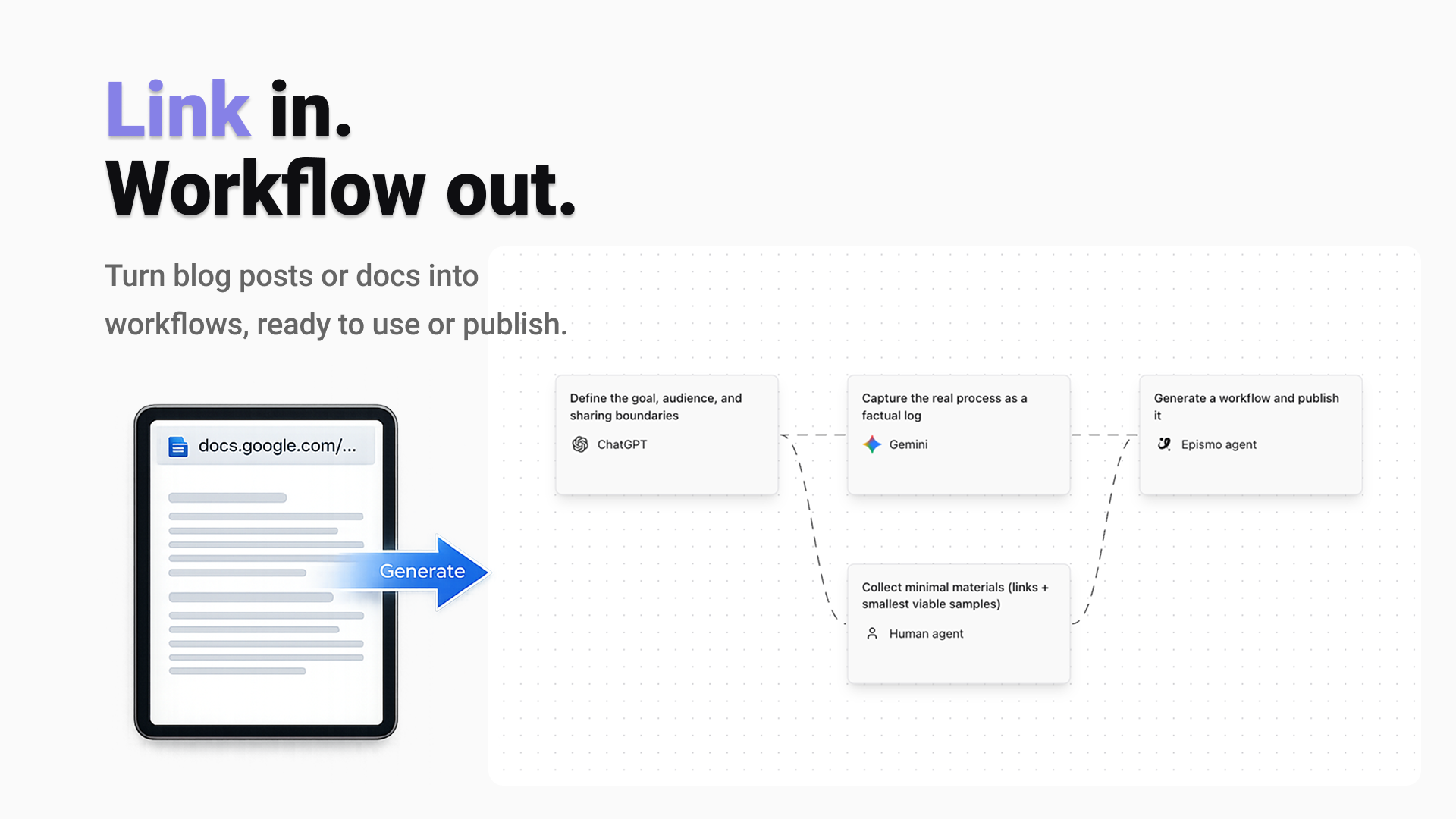
    Generate a workflow from project context or an external doc/link, then reuse it.

  • Run workflows as projects
    Treat an imported workflow so progress stay visible.

Take a workflow, adapt it to your context, then publish your improved version back so others can reuse it and build on it.

What workflow do you wish you could import and run today?

Source: https://github.com/epismoai/skills

0
回复

@hirokiyn Ran into this on a multi-agent pipeline. Shared the prompt chain, teammate couldn't reproduce it because three manual review gates and a tool config were implicit. Epismo making human vs agent boundaries explicit per step is what separates this from prompt libraries that only version the instruction. Project-level tracking compounds that. Most shared workflows are fire-and-forget... you clone and you're on your own. Running imported Skills as tasks with progress visibility means you can tell if an adaptation is performing or drifting over time.

0
回复
#10
Hearica
Turn all computer audio into captions for the deaf
95
一句话介绍:Hearica是一款将电脑全局音频实时转为字幕的辅助工具,解决了听障人士在多应用、多场景(如会议、视频、通话)中无法获取实时字幕的痛点。
Productivity Inclusivity
实时字幕 语音转文字 无障碍辅助工具 全局音频捕获 多语言翻译 跨应用转录 屏幕悬浮窗 听障人士 生产力工具 实时翻译
用户评论摘要:用户肯定其全局音频捕获方案和60+语言实时翻译。主要问题聚焦于:1. 对重口音和专业术语的处理能力;2. 多人对话时的发言人区分;3. 对macOS版本的期待。开发者回复称可通过自定义语境提升准确率,并支持发言人分离功能。
AI 锐评

Hearica看似解决了一个“小”痛点——跨应用实时字幕,实则捅破了一层长期存在的“窗户纸”。在Zoom、Teams等应用内置字幕已成标配的今天,其“系统级”音频捕获能力,才是真正将“无障碍”从封闭的单一应用场景解放出来,覆盖到任意老旧软件、游戏或本地视频播放的关键。这从技术实现上并非颠覆,但在产品理念上却是一种稀缺的“完整性”思维。

然而,其真正的挑战与价值核心并非技术,而在于生态与信任。首先,持续的系统级音频捕获涉及极高的隐私敏感度,这对一个独立开发项目是巨大的信任门槛,评论中已出现安全合规的关切。其次,其宣称的准确率优势严重依赖云端模型和“自定义语境”这一人工调优,这使其陷入两难:作为即时辅助工具,用户期待“开箱即用”的高精度;而作为专业工具,自定义语境功能又将准确率责任部分转嫁给了用户。其从开源项目演化而来的背景,既带来了情怀加分,也让人对其长期维护、数据合规及商业化可持续性产生疑问。

本质上,Hearica的价值在于它试图成为系统级的“听觉义肢”。它的成功不在于是否比某款转录软件更准,而在于能否以极低的认知与操作负担,无缝融入用户所有数字听觉场景,并建立起牢不可破的隐私信任。这条路,道阻且长。

查看原始信息
Hearica
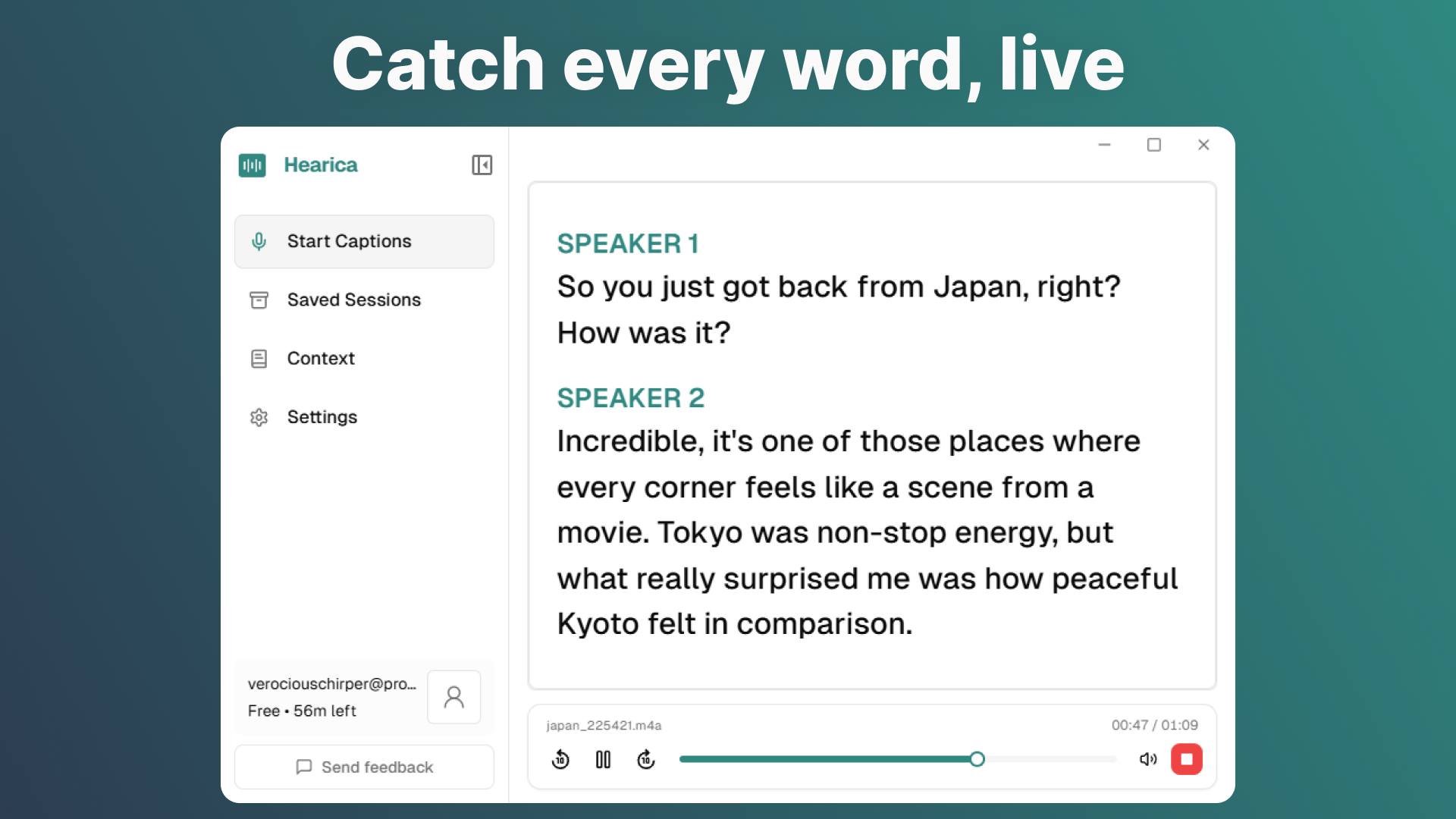
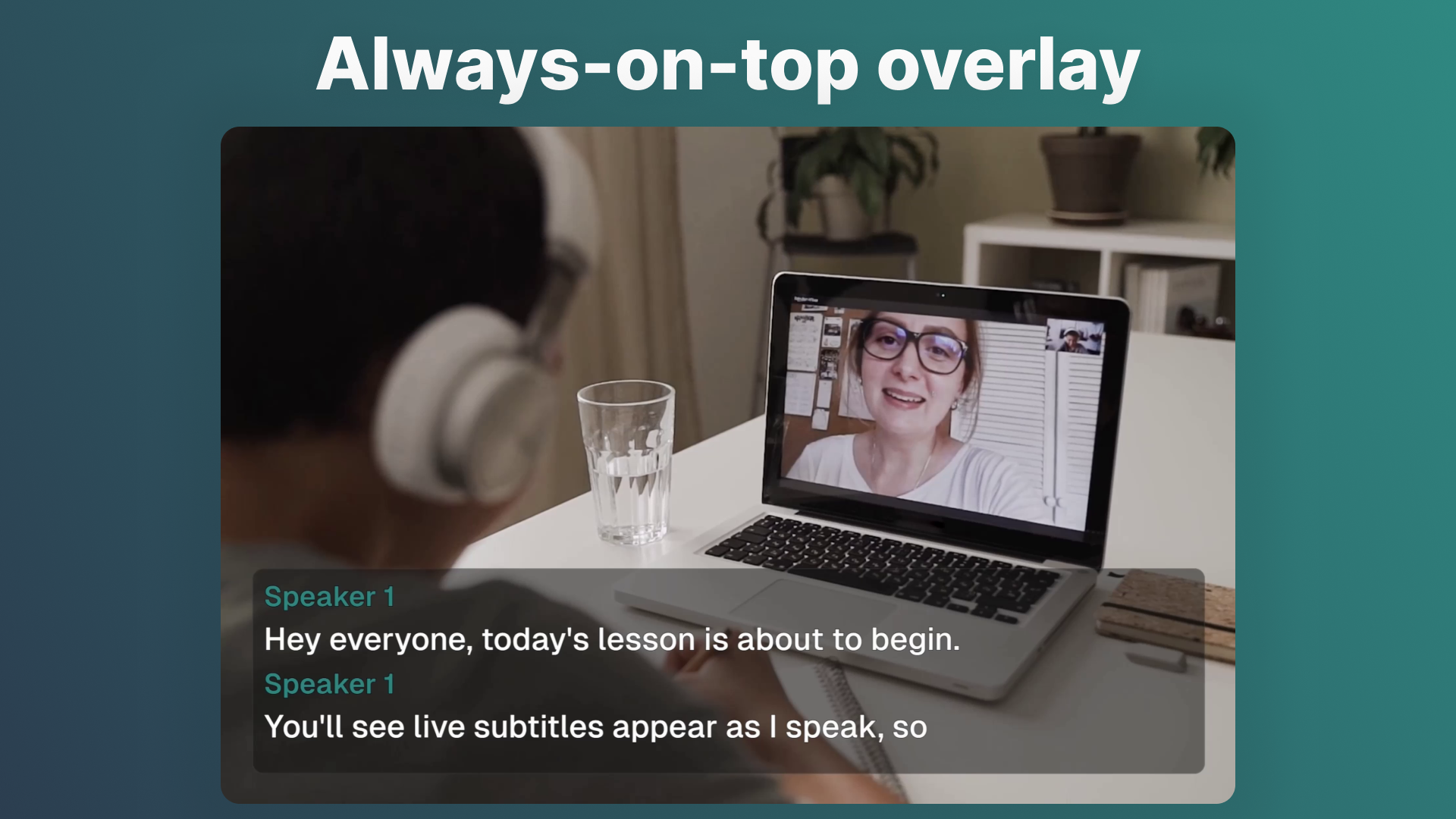
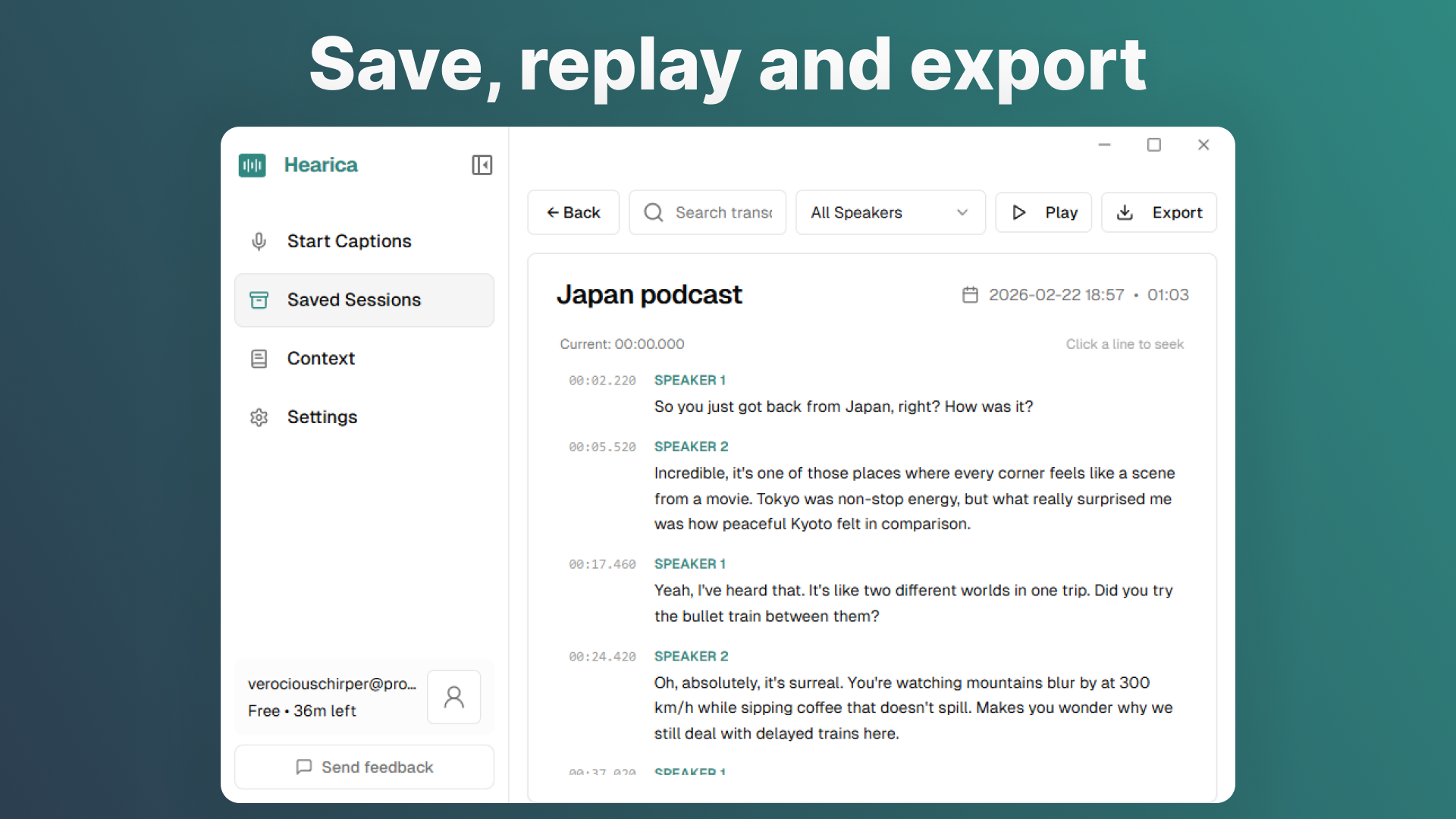
Most captioning tools only work inside one app. Hearica works across your entire computer. Any call, any video, any voice. It sits as a floating overlay on your screen and transcribes whatever you're hearing in real time. Save and replay with audio, export, translate into 60+ languages, add custom context for perfect accuracy. Never miss a word again 👂

System-wide audio capture instead of

per-app is the right approach - surprised

nobody solved this properly until now.

60+ languages with real-time translation

is impressive. How does it handle

heavy accents or technical jargon?

2
回复

@alamenigma  Hi Modassir, Hearica handles heavy accents and jargon quite well, the speech-to-text model is very accurate. There can be occasional edge cases, but you can iron them out using context and language hints. You might want to try our accuracy taster tool on hearica.com, it accepts file and microphone input (as does the main app).

0
回复

Love that this started as an open-source passion project to solve your own hearing loss. The custom context feature is clever — most transcription tools just throw generic models at everything. Waiting for the macOS version!

1
回复

Nice! Curious how it handles multiple speakers in the same room vs. remote calls — does it differentiate voices or just transcribe everything as one stream?

1
回复

@denious Hi Denis, Hearica can do either. If you enable speaker separation, it identifies speakers by the slight differences in their voices, and shows which speaker is talking. If you disable speaker separation and break detection, you get a simple continuous caption stream.

0
回复

I started in 2024 with an open-source project, System Captioner, tinkering with OpenAI Whisper models to create a tool that could caption live streams and help me with my hearing loss. Although quite accurate, the size and clunkiness of the models meant the app wasn't as accessible to the public as I had wished.

Since then, I have been working on Hearica. It leverages cloud to run on any PC while being significantly more accurate than YouTube auto-captions or built-in transcription models that come with some operating systems. And adding context, even a short note like "A live stream of a medical lecture", makes it even more accurate.

What's your experience with real-time captioning and translation tools? Have you ever been in a situation where you wish you had real-time captions?

I'm bootstrapping Hearica solo and it's a passion project years in the making. I would love to hear your thoughts. Hearica is out on Windows today, with a macOS launch soon.

0
回复

@evermoving  congrats on launching Hearica

I work with early stage SaaS founders on security & GDPR readiness.

I ran a quick public facing check and noticed a couple of areas that might matter as you scale.

Would you be open to a 2 minute snapshot?

0
回复
#11
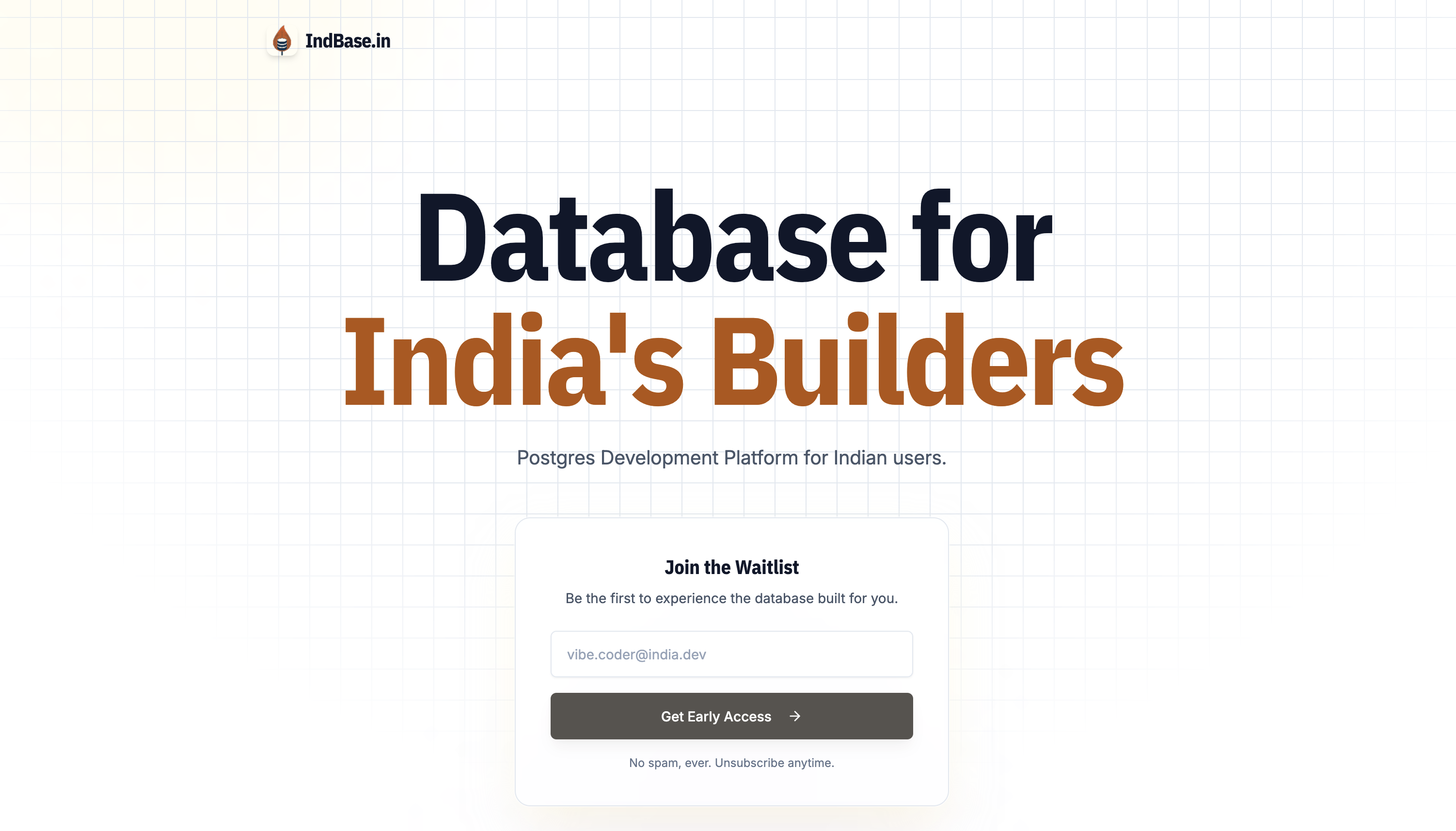
Indbase
Database for India's Builders
38
一句话介绍:Indbase是一款为印度开发者打造的、本地化部署的PostgreSQL数据库服务,核心解决了在印度市场因数据跨境存储而产生的合规性、延迟和运营支持等基础设施痛点。
Developer Tools Database Vibe coding
数据库即服务 PostgreSQL 印度本土云服务 数据驻留 合规性 基础设施 初创企业 本地化运营 开发者工具
用户评论摘要:有效评论主要为产品团队自身发布,阐明其建设印度本土化、合规PostgreSQL服务的初衷与愿景,旨在招募早期构建者进行验证。另有用户回帖表示赞赏与感谢,但属于推荐反馈,信息量有限。
AI 锐评

Indbase的亮相,与其说是一款成熟产品的发布,不如说是一份精准针对印度“数字主权”与“科技自立”情绪的宣言。其真正价值不在于技术层面的创新(托管PostgreSQL已是红海),而在于其精准的定位策略:抓住印度市场日益增长的数据本地化合规要求、对跨境云服务延迟的敏感,以及本地化运营支持(IST时区、本地支付)的隐性需求。

产品团队在评论中的自我阐述极为关键,它剥离了营销话术,直指核心——这是关于“架构与责任”的基础设施重构。在印度初创生态蓬勃发展的背景下,AWS、Google Cloud等国际巨头虽占据市场,但在数据驻留法律明确化、民族情绪高涨的语境下,一个“物理位置、法律对齐、运营可用性”均在本土的服务,构成了差异化的利基市场切入点。然而,其最大挑战也在于此:能否在巨头环伺下,真正构建出稳定、可靠且成本有竞争力的基础设施服务,并赢得足够多对合规有刚性需求(而非仅情绪认同)的付费客户。目前阶段仍处于“验证假设”的早期构建期,其成功与否,将取决于团队的技术与运营深度,以及对印度复杂监管环境的理解与适配能力,远非一句“为印度建设”那么简单。

查看原始信息
Indbase
Join the Indbase waitlist for India's self-reliant PostgreSQL database.

We haven’t launched yet.

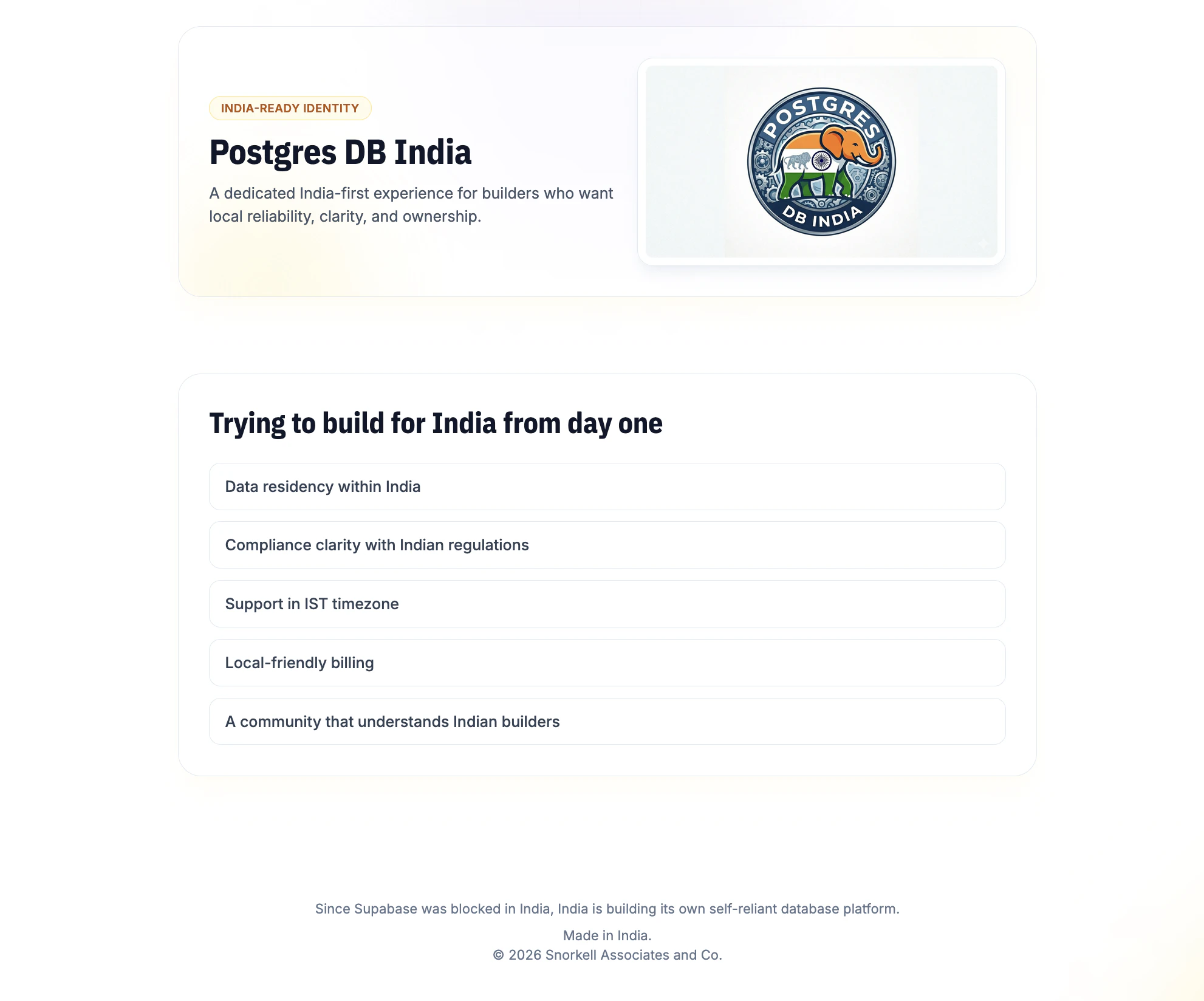
We’re building IndBase because we believe Indian startups deserve core infrastructure that is physically located, legally aligned, and operationally available within India.

This is not about marketing positioning.
It’s about architecture and accountability.

We are working toward:

• Postgres hosted inside India
• Clear data residency guarantees
• Alignment with Indian compliance requirements
• Billing that works locally
• Support that runs in IST

Right now, we’re in build mode - validating assumptions, speaking with early builders, and shaping the platform carefully.

If you’re building in India and care about where your infrastructure lives and how it operates, we’d value your input early.

We’re opening the waitlist to start that conversation.

29
回复

This product is amazing! Thank you @suman_saurabh3 for recommending it. I am really happy with the quality and how well it works

1
回复
#12
Gisteasy
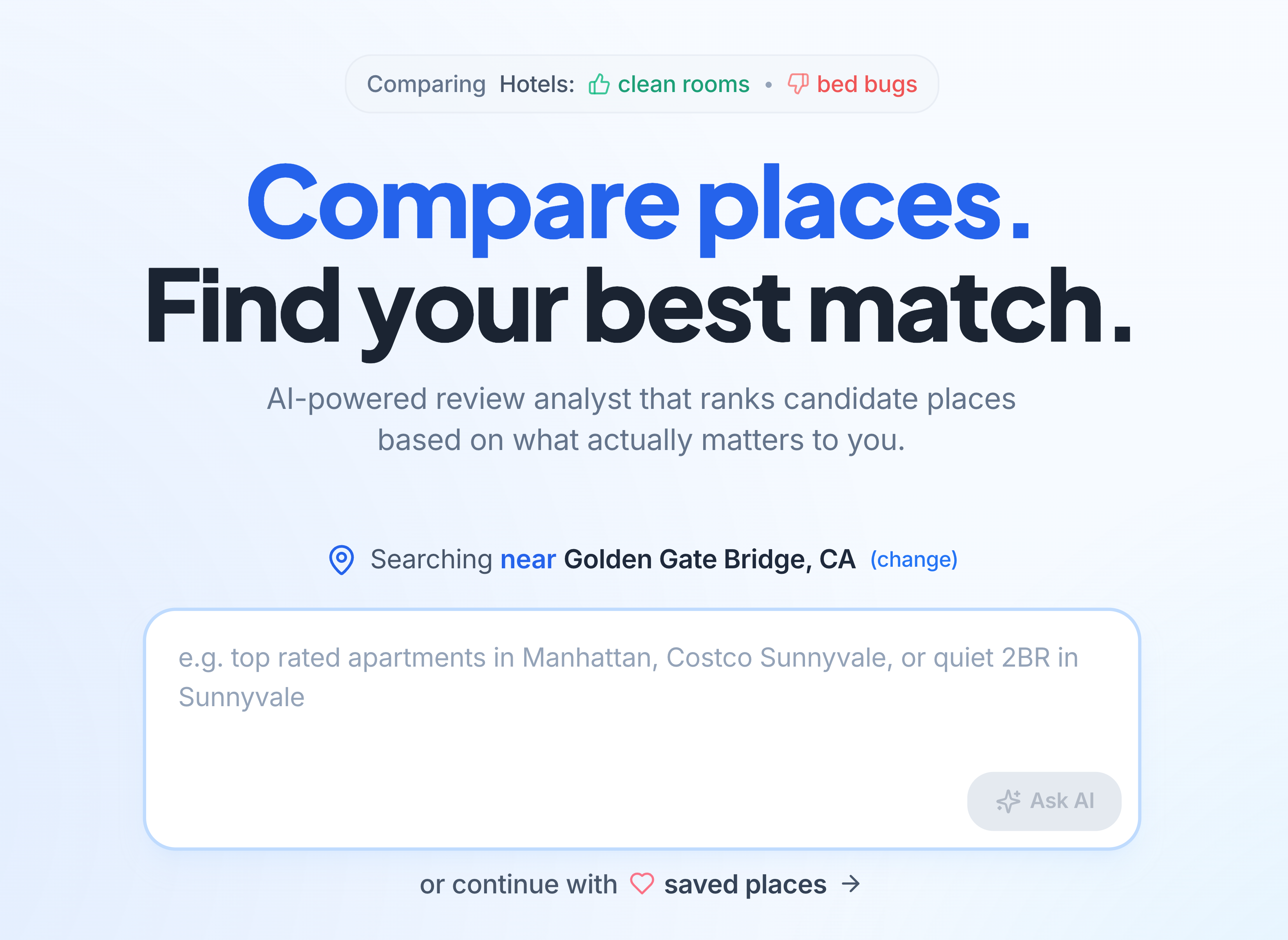
Compare places. Find your best match with AI review analyst
11
一句话介绍:Gisteasy是一款利用AI分析地点评论的匹配工具,在租房、订酒店、选餐厅等需要基于他人经验做决策的场景下,帮助用户从海量评论中高效提炼关键信息,规避潜在“雷区”,找到最符合个人偏好的地点。
Productivity Travel Maps
AI评论分析 地点匹配 决策辅助工具 消费情报 谷歌地图数据 个性化推荐 租房助手 旅行规划 信息过滤 生活服务
用户评论摘要:用户肯定产品解决“错过关键负面评论”的痛点。主要问题集中于数据源覆盖范围(目前仅限谷歌地图,计划拓展Yelp等)及全球可用性(已确认全球可用)。建议增加更多本地化评论平台。
AI 锐评

Gisteasy瞄准了一个真实且普世的痛点:信息过载下的决策疲劳。在评论成为消费决策圣经的时代,其价值不在于创造新信息,而在于充当“信息减噪器”和“信号放大器”。产品逻辑清晰——将用户主观偏好转化为可分析的关键词,再与评论情感和内容进行匹配。

然而,其核心壁垒与潜在风险均系于数据。目前仅依赖谷歌地图,数据维度单一,且受限于谷歌API的规则与成本。规划中的多平台整合是必然路径,但将面临数据清洗、格式统一与更新频率的严峻工程挑战。更深刻的质疑在于,AI提炼的“关键信号”是否会造成新的信息偏见?过度简化复杂的评论情感(如讽刺、语境依赖的抱怨)可能导致误判。

其真正的价值或许不在于给出一个确切的“匹配分数”,而在于提供了一套结构化的分析框架,引导用户从“漫无目的地刷评论”转向“带着关键问题去验证”。它更像一个专注的“助理”,而非全能的“决策者”。成功的关键在于保持这种辅助性,避免营造“AI万能决策”的幻觉,并持续拓宽数据源的深度与广度,尤其在垂直领域(如租房、高端餐饮)建立更精细的语义分析模型。当前阶段,它是一个颇具潜力的效率工具,但离成为可靠的生活决策基础设施,还有很长的路要走。

查看原始信息
Gisteasy
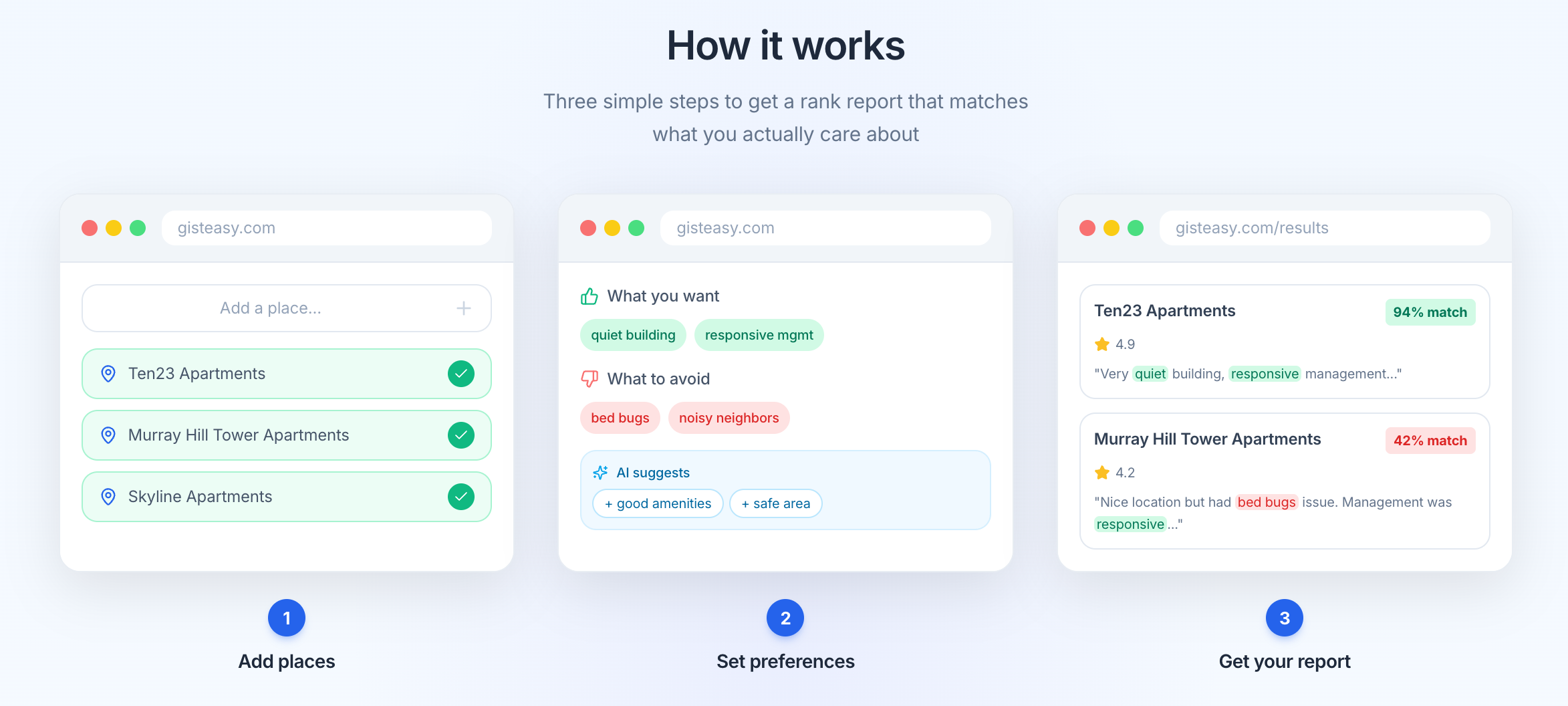
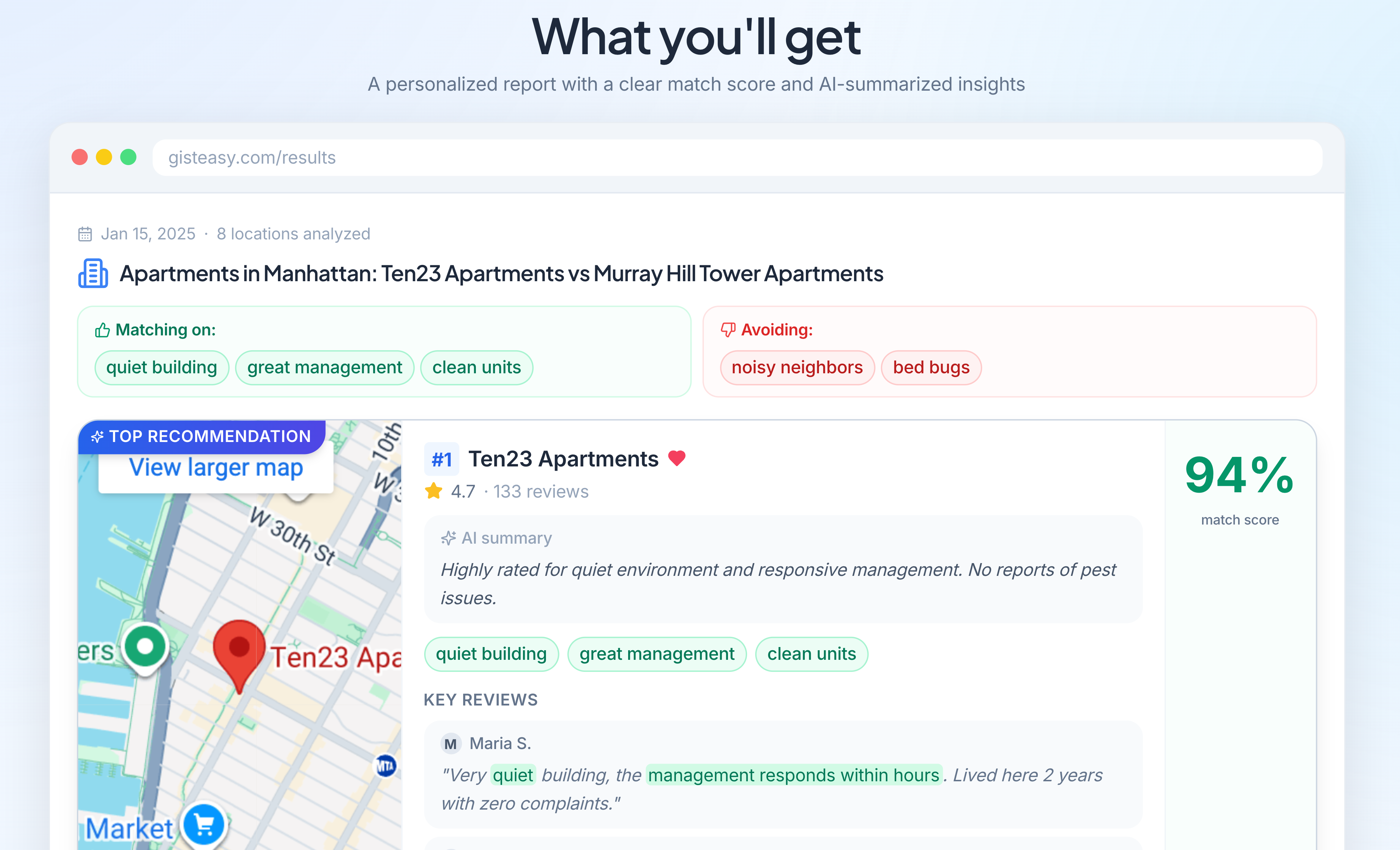
Review-based place matching: Compare places by analyzing their reviews. Tell us what matters to you, and we'll match you with places that align with your preferences.

We built Gisteasy after apartment hunting and realizing how easy it is to miss deal-breakers—like noise—when you’re buried under hundreds of reviews.

The idea is simple: you tell us what matters to you (and what to avoid), and we analyze reviews to surface the signals that actually matter—key red flags, relevant comments, and a personalized match score—so you don’t miss the one review that changes the decision.

It applies to lots of situations.
• Booking a hotel and worried about cleanliness? We find it based on what people actually mention in the comments.
• Picking a first-date restaurant and hoping to avoid somewhere too crowded? That comes straight from the comments.

We’re still early, and would really appreciate any feedback, suggestions, or ideas on how this could be more useful.

3
回复

Congrats on the launch team! Its interesting. Does this cover places allover the world or specific countries and areas?

1
回复

@ayman_elafifi1 Thank you! Yes, it covers places worldwide — you can search and analyze locations in any country where google maps is enabled.

0
回复

Huge congrats on the launch! 🎉 This is such a fantastic idea.

Quick question for the team: Which platforms are you currently pulling review data from (e.g., Google Maps, Yelp)? And are there plans to integrate more localized platforms in the future?

1
回复

@cosmosheep Thanks for the support! 🎉 We're currently using Google Maps only, but Yelp, Booking.com, and Airbnb are on the roadmap. Any specific platforms you'd suggest we add next?

0
回复
#13
YourShelf
A link-in-bio for your media taste
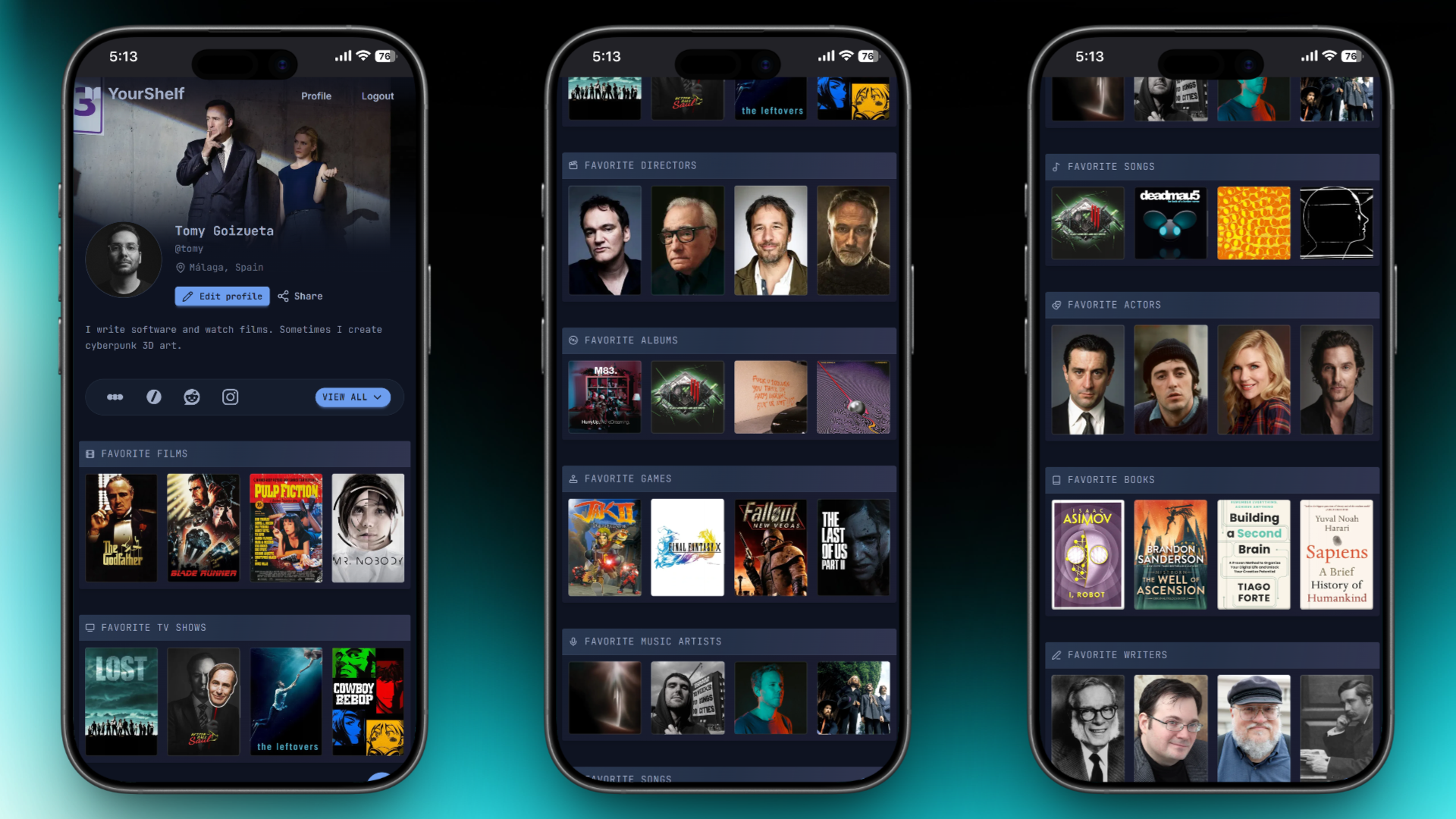
9
一句话介绍:YourShelf是一款围绕个人媒体品味打造的“链接聚合”页面,通过展示用户精选的影视、书籍、游戏和音乐作品,在社交媒体个人简介等场景下,解决了用户难以直观、个性化地展示自身兴趣与品味的痛点。
Movies Entertainment Social Networking
链接聚合页面 个人品牌展示 媒体品味管理 社交媒体工具 个性化主页 兴趣图谱 数字身份 文化消费记录 创作者经济 个人名片
用户评论摘要:开发者阐述了产品初衷是解决个人兴趣展示无统一出口的痛点。用户反馈认为产品概念很棒,直击“个人简介难写”的普遍需求。有一条有效评论提出了一个具体问题:为何选择展示“4个”项目,这可能是关于设计逻辑或可定制性的潜在疑问。
AI 锐评

YourShelf精准地刺中了当前数字身份展示中的一个断层:我们拥有无数分散的兴趣图谱(Letterboxd、Goodreads等),却在最需要快速建立认知的社交名片(如Instagram简介)中,只能用一串冰冷的通用链接来代表。它本质上不是在挑战Linktree,而是在重新定义“链接”的价值——将“去哪”的链接,升级为“我是谁”的品味声明。

其真正价值在于将“文化消费”转化为一种可展示的社交资本和信任货币。展示精心挑选的“Top 4”,是一种高效的身份信号发射,能快速在同好间建立认同,其效率远高于文字简介。它服务于日益兴起的“品味身份”经济,用户通过消费偏好来构建自我形象。

然而,其深层挑战也在于此。首先,“Top 4”的强限定是一把双刃剑,它制造了稀缺性和策展感,但可能无法满足用户多元、流动的品味表达,引发“为何是4个”的疑问。其次,其发展高度依赖于与上游专业社区(如Letterboxd)的共生而非竞争关系。最后,也是最关键的,如何避免让这种展示流于表面的“品味表演”,而能促发更深度的交流(如为何喜欢),是产品能否从“漂亮名片”升级为“社交枢纽”的关键。当前版本像是一个精美的静态橱窗,下一步或许需要考虑如何引入动态的“推荐”或“共鸣”功能,让品味真正流动起来。

查看原始信息
YourShelf
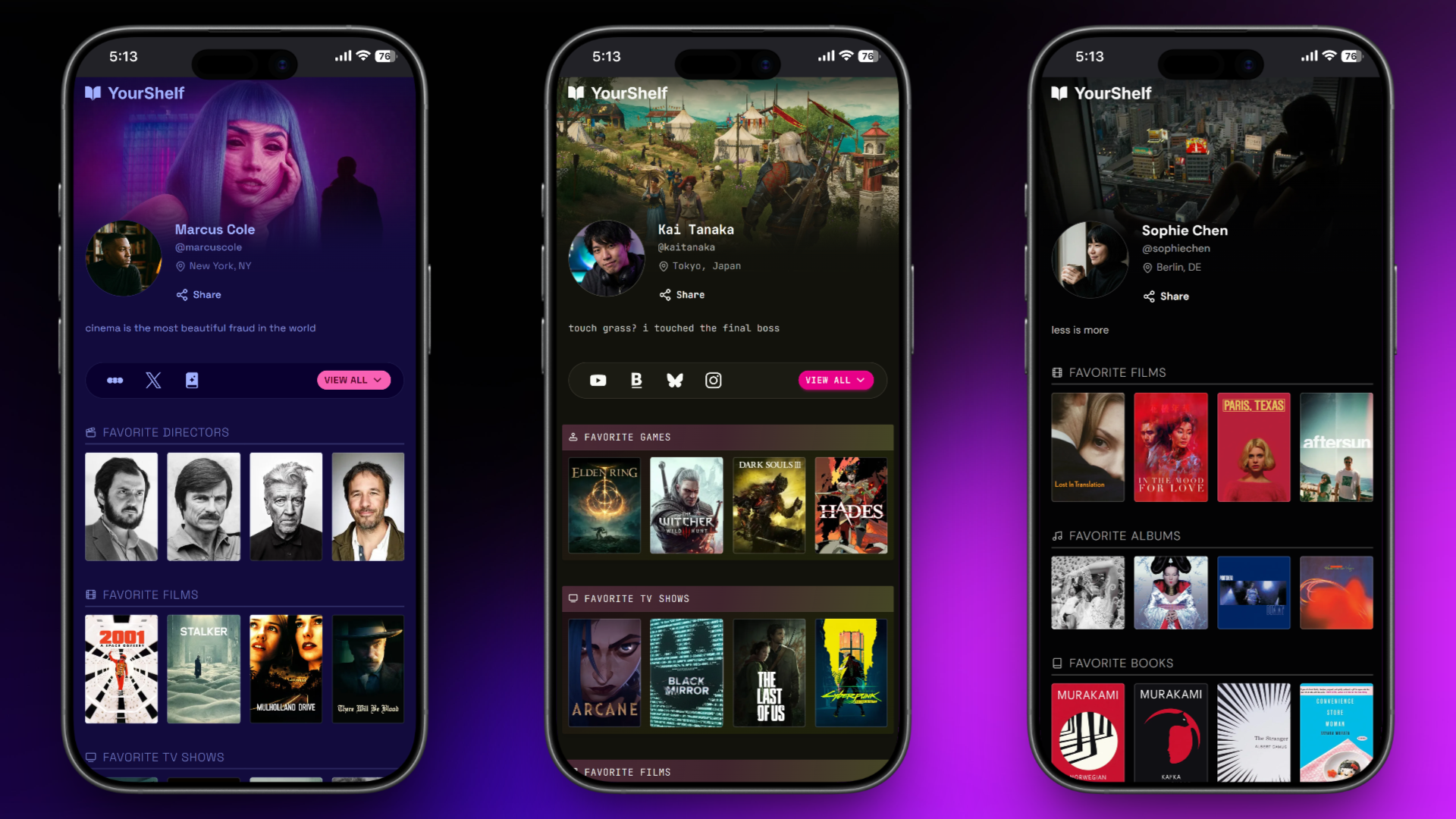
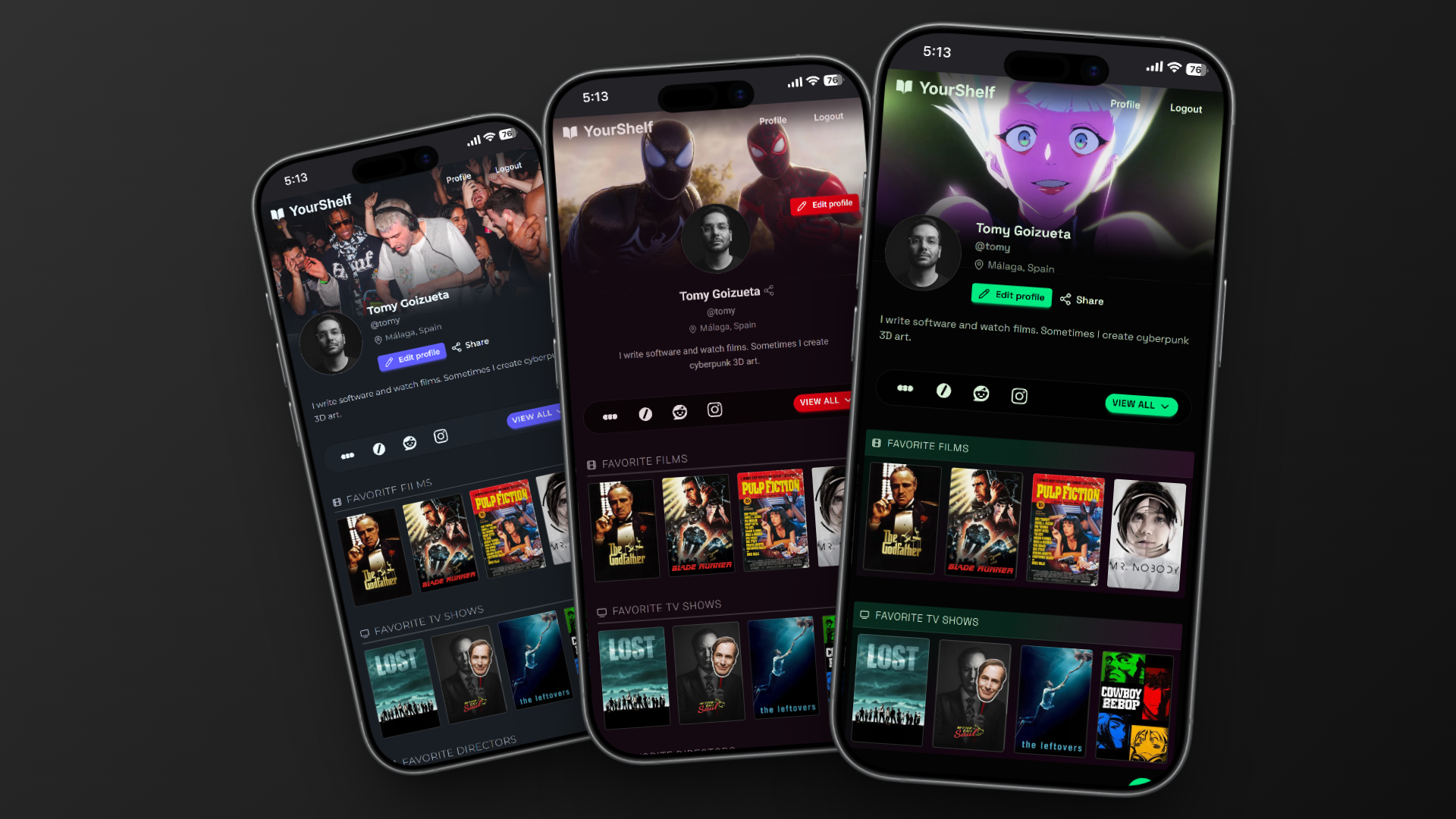
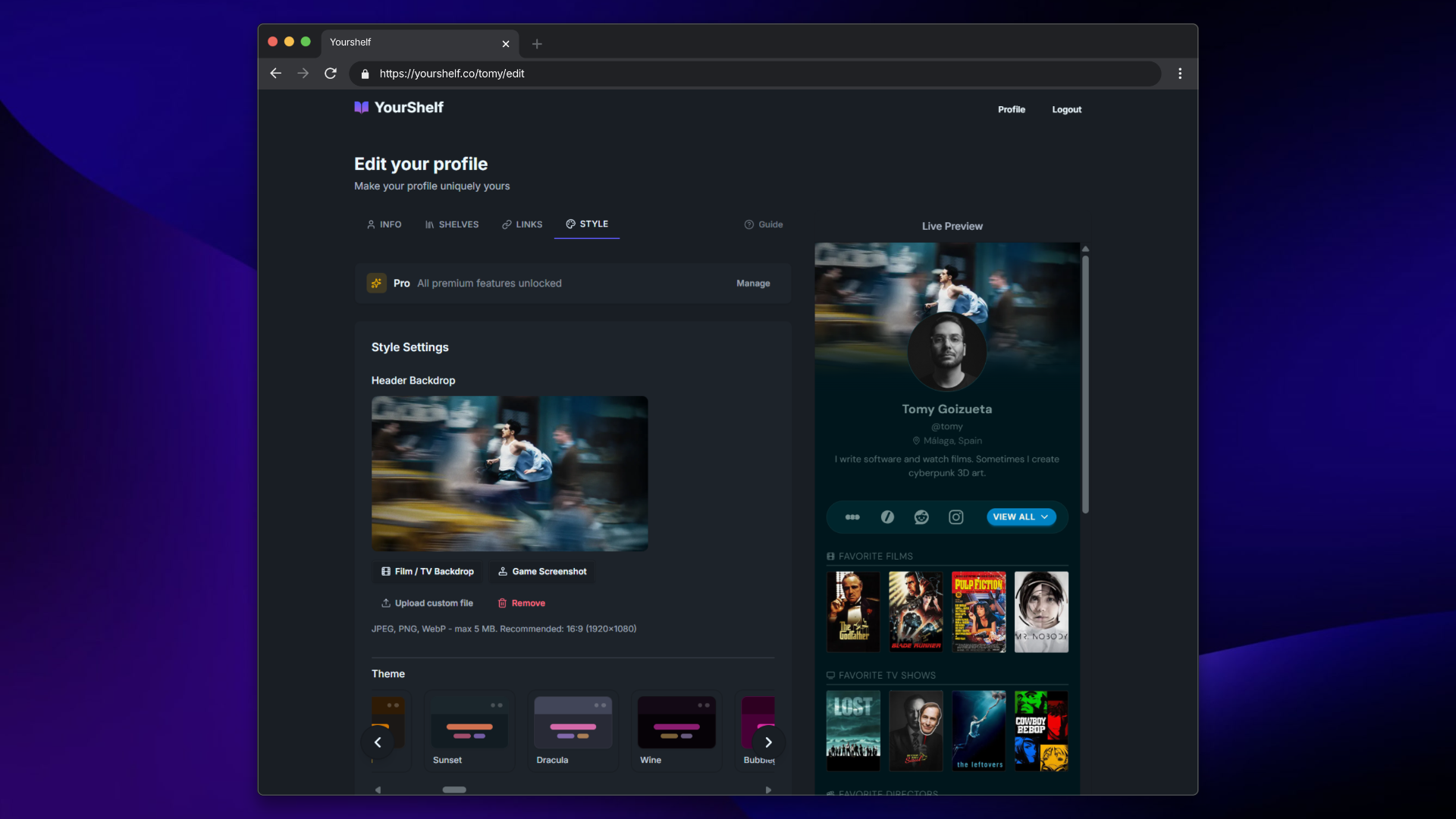
YourShelf is a link-in-bio built around your media taste. Tools like Linktree or Beacons are great for listing links, but they don't say anything about who you are. YourShelf lets you showcase your top 4 picks in films, TV shows, books, video games, and music alongside your social links. Every pick is powered by real databases like TMDB, Spotify, Hardcover, and IGDB. 60+ themes, 10+ fonts, custom backdrops, and 140+ social icons. Built for anyone who uses Letterboxd, Goodreads, or Backloggd.

Hey everyone! I'm Tomy, a solo dev from Spain.

I built YourShelf because I wanted a link-in-bio that actually reflects who I am. I use Letterboxd, Goodreads, Backloggd, and Spotify, but when someone asks "what should I watch?" I never had a single place to point them to. Linktree and similar tools are great for links, but they don't show your taste.

YourShelf lets you pick your top 4 films, TV shows, books, video games, and music albums, all pulled from real databases (TMDB, Spotify, Hardcover, IGDB), and display them on a customizable profile page alongside your social links.

It's free to use. The Pro plan adds extra personalization like custom backdrops, more font options, and exclusive shelves.

This is my profile: https://yourshelf.co/tomy

I'd love to hear what you think, and if you create a profile, feel free to share it here!

0
回复

Oh, this is really cool! Congrats!

Curious, why did you pick 4?

0
回复

Wild that every social platform hasn't done this already. Bios are honestly one of the hardest things to write about yourself and it's difficult to know what to put. This is awesome.

0
回复
#14
IndieBar - Revenue Tracker
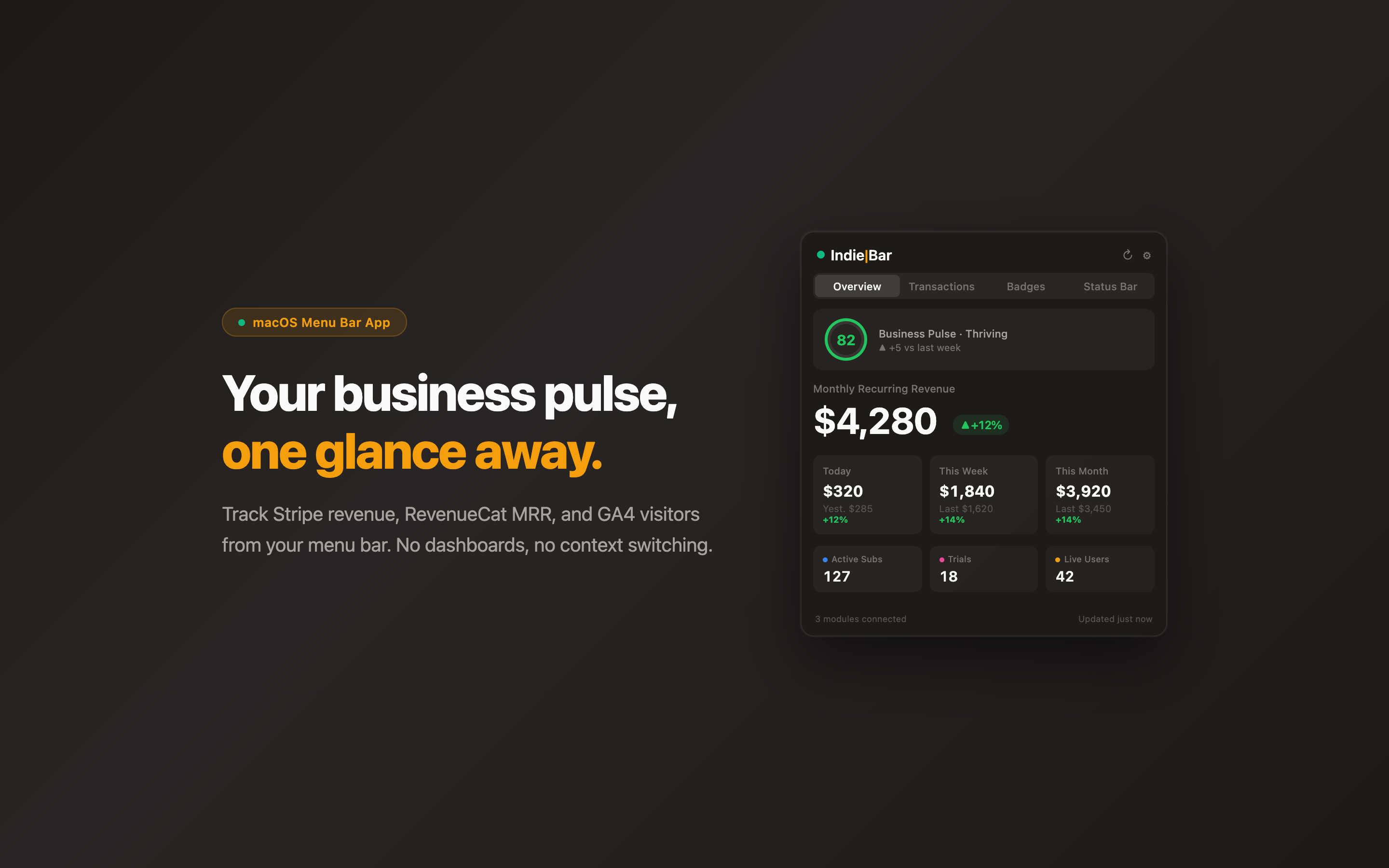
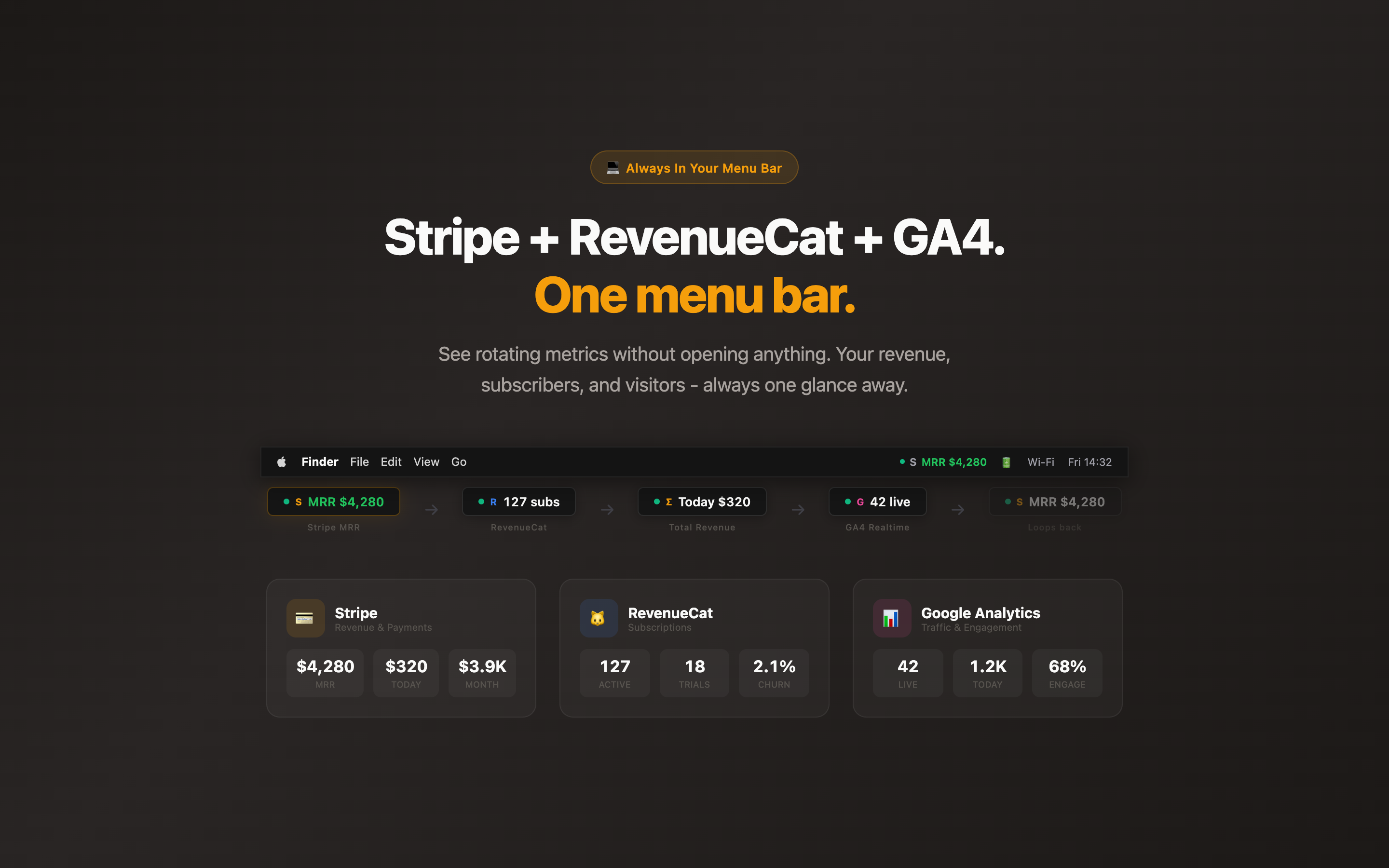
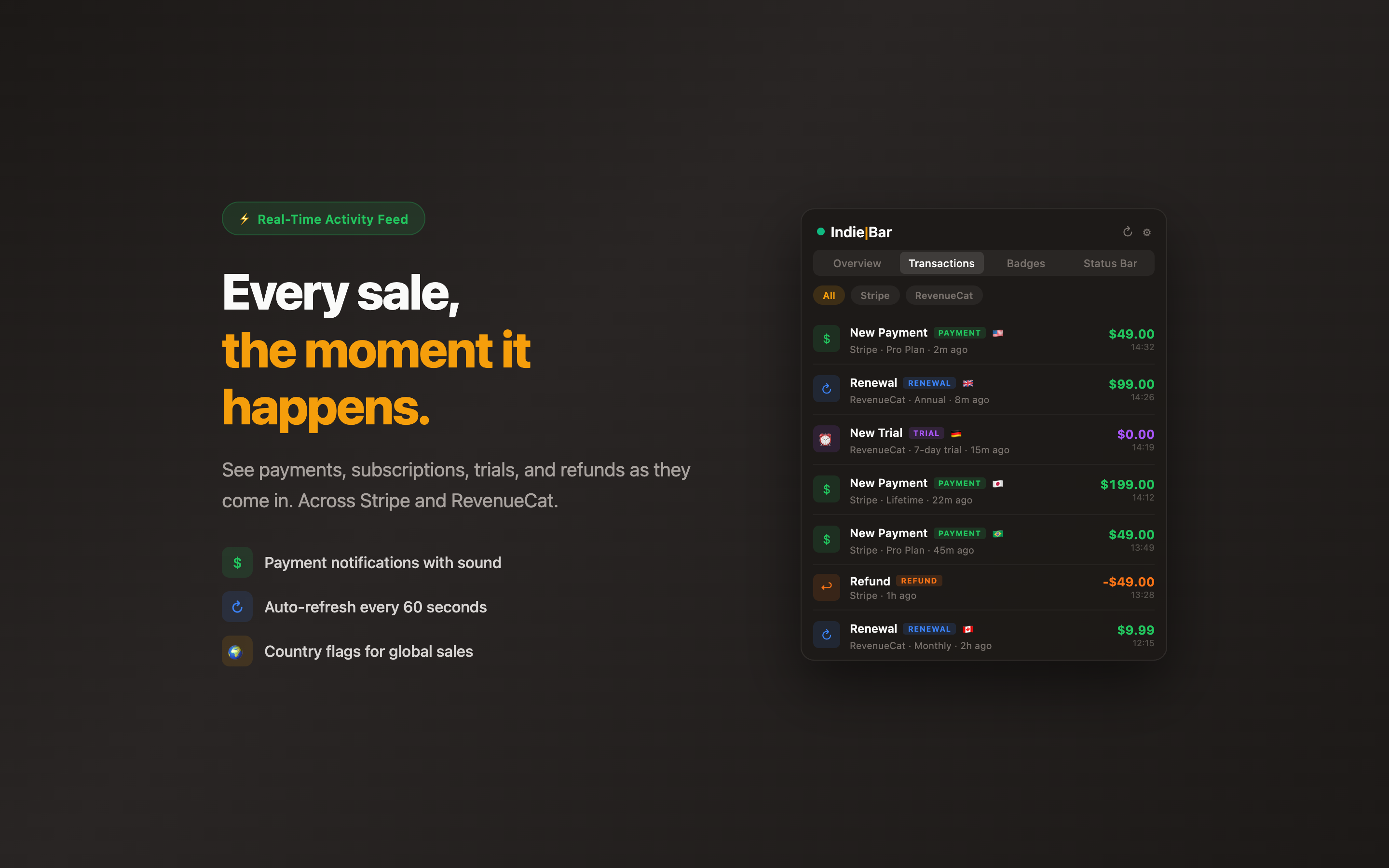
Ambient business metrics for indie devs. In your menu bar.
8
一句话介绍:一款常驻macOS菜单栏的营收追踪工具,为独立开发者提供免打扰的关键业务指标(如收入、订阅、流量)实时概览,解决了他们频繁切换数据面板、陷入数据焦虑的痛点。
Productivity Developer Tools Menu Bar Apps
独立开发者工具 营收追踪 菜单栏应用 数据可视化 Stripe集成 隐私安全 买断制 实时通知 业务健康度 macOS应用
用户评论摘要:开发者以亲身经历阐述产品源于解决自身“流失焦虑”和“数据面板沉迷”痛点,强调其源于真实需求。评论有效传达了产品理念(为独立开发者而生、无订阅、无数据收集),但附带的回帖为无关的营销广告,属无效反馈。
AI 锐评

IndieBar 表面上是一款轻量级的数据聚合工具,但其真正的价值在于它试图成为一款“数字镇静剂”。它精准刺中了独立开发者(尤其是SaaS领域)最脆弱的神经:对业务波动的高度敏感和由此产生的持续性焦虑。通过将关键指标“环境化”(Ambient)到菜单栏,它将原本需要主动、耗时查看的离散数据,转变为被动、无压力的信息流,这本质上是一种行为干预,旨在将开发者从“数据强迫症”中解放出来。

其“买断制”和“数据永不离开本地”的承诺,是产品核心价值的延伸,而非简单的营销噱头。它迎合了独立开发者群体对SaaS订阅疲劳的厌倦,以及对自身核心业务数据(收入、用户)的极度敏感和掌控欲。这构建了极强的信任感和社区认同(“独立开发者为独立开发者打造”)。

然而,其深层风险也在于此。产品的天花板与“独立开发者”这个细分市场的规模紧密绑定。其极简主义的设计哲学(如单一的Pulse Score)在面对复杂业务分析需求时可能显得乏力。它更像一个“情绪仪表盘”而非“决策分析工具”,这决定了其用户粘性高度依赖于用户是否持续处于“焦虑缓解”的需求状态。一旦业务稳定或团队扩大,对更专业分析工具的需求可能会取代它。当前8票的热度也侧面印证了其受众的垂直与有限。它的成功不在于技术颠覆,而在于对特定群体心理状态的精准洞察和人文关怀,但这份关怀能否支撑起可持续的商业模式,仍需观察。

查看原始信息
IndieBar - Revenue Tracker
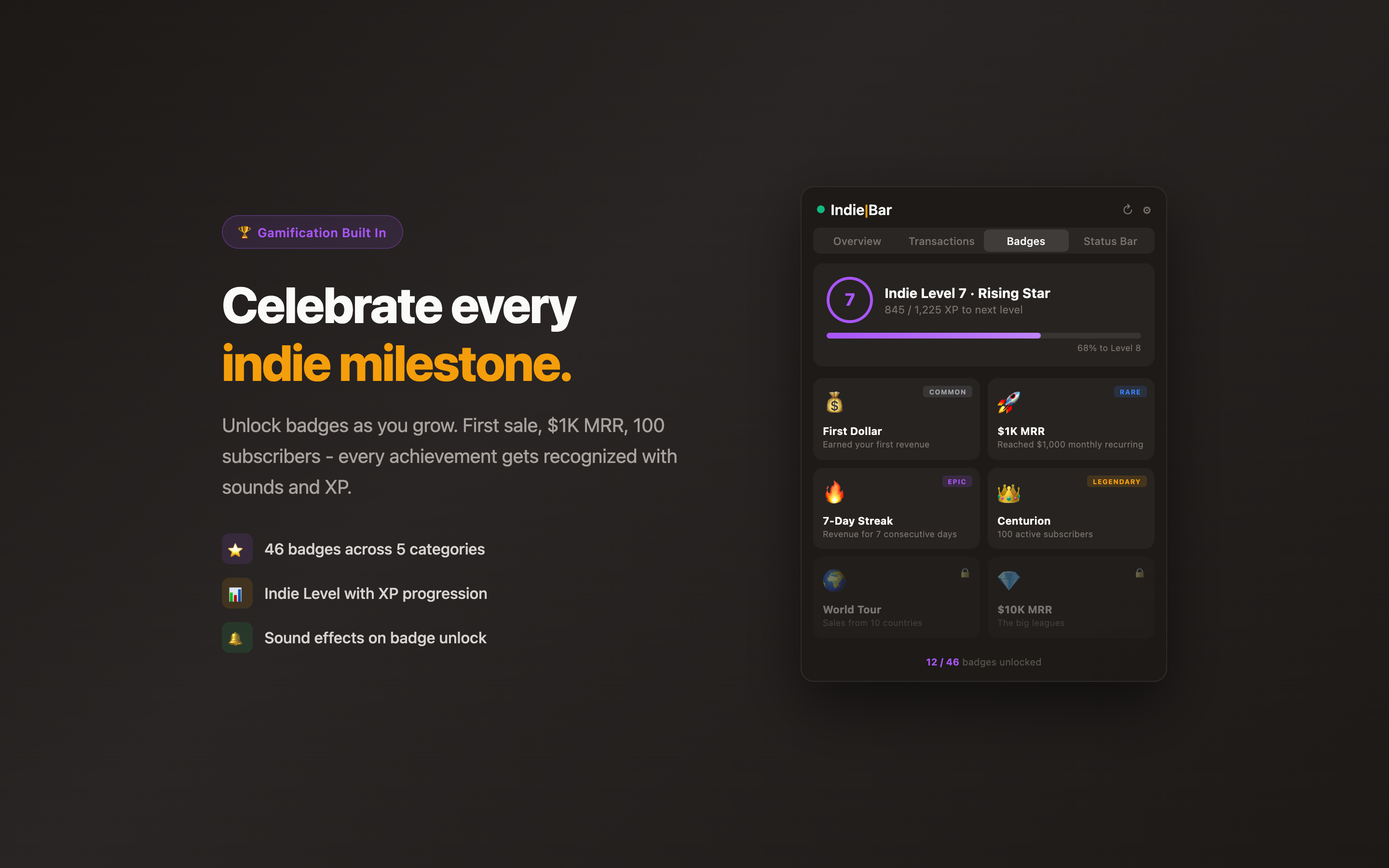
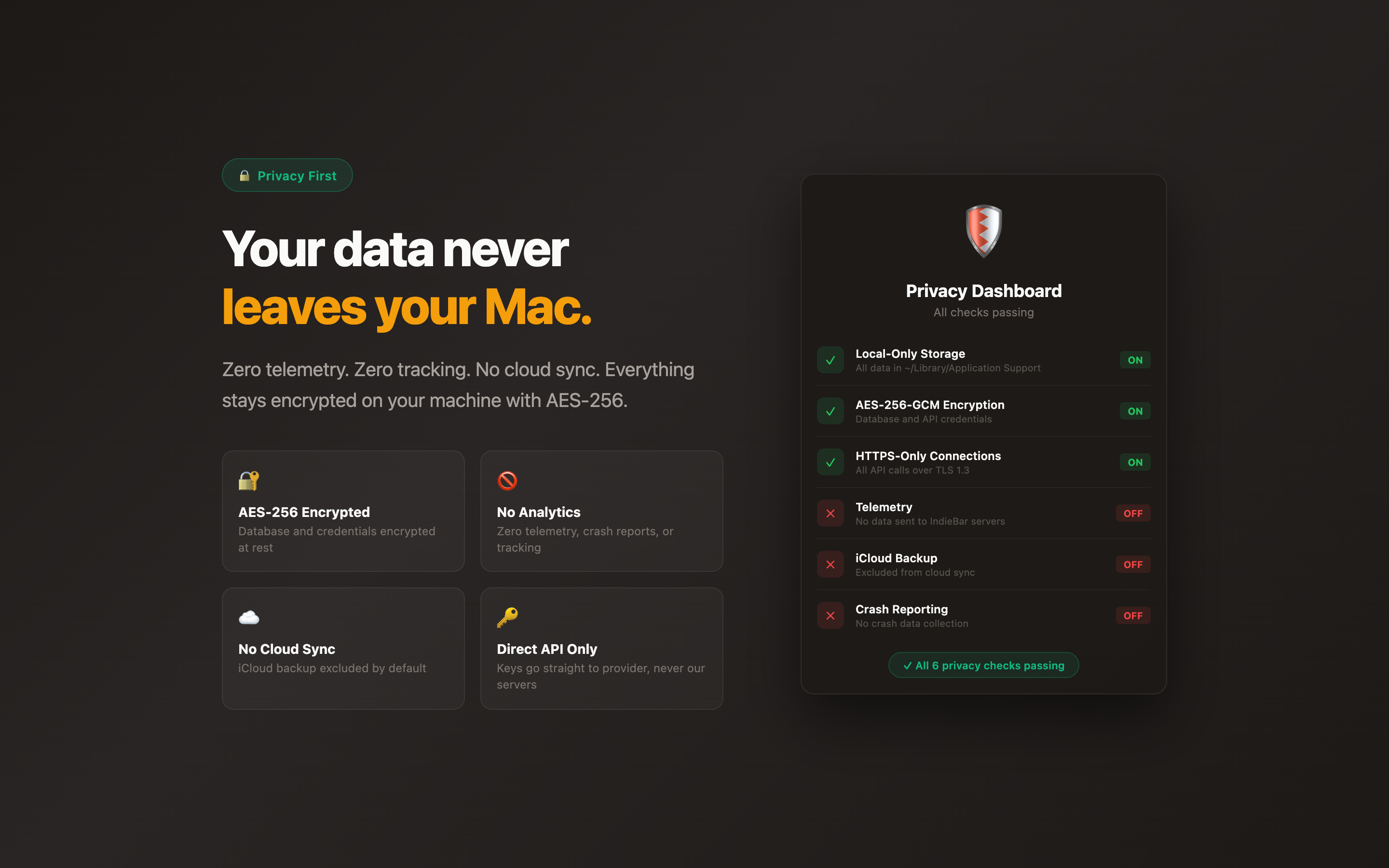
IndieBar lives in your macOS menu bar and shows your Stripe revenue, RevenueCat subscriptions, and Google Analytics traffic at a glance. No more switching between dashboards. Get instant notifications when a sale comes in. Track MRR, churn, trials, and live users across multiple projects. Pulse Score gives you a single number for your business health. Your data never leaves your machine.
I'm an indie developer. I've shipped SaaS products, dealt with churn anxiety, and lost entire afternoons to dashboard doom-scrolling. I know what it feels like when a quiet day makes you question your product-market fit. IndieBar started as a personal tool. A menu bar icon that shows my MRR so I don't have to open Stripe. A single Pulse Score so I know things are okay without running mental calculations. It was supposed to be a weekend project. But when I showed it to other indie devs, the reaction was always the same: “I need this.” Not “cool idea.” Not “interesting.” Just “I need this, when can I use it?” So here we are. IndieBar is built with zero telemetry, stores everything on your machine, and costs a one-time $19.99 when you're ready. No subscriptions. No data harvesting. Just an indie tool, built by an indie dev, for indie devs.
0
回复

@bytemtek Fix This Before Your Traffic Goes to Waste - Your homepage may be losing leads because there’s no clear product explainer video.

A short video can instantly communicate value, reduce confusion, and increase signups. I help SaaS companies create high-converting explainer videos tailored to improve conversions.

Happy to discuss ideas for your brand.

animvo.com

0
回复
#15
Fokus
Plan your day with AI that schedules and organizes tasks
7
一句话介绍:Fokus是一款AI驱动的统一每日规划器,通过整合多平台任务并智能排程,在用户面临多工具切换、任务碎片化的繁忙工作场景中,实现了日程与任务的自动化集中管理,解决了效率损耗与规划负担的痛点。
Task Management SaaS
AI日程规划 任务管理 生产力工具 跨平台整合 智能排程 时间块管理 每日规划 工作流自动化 聚焦助手 隐私安全
用户评论摘要:高赞评论详细阐述了产品价值,即整合多工具、AI代理自动分解目标与排程。另一条评论则直接询问产品的付费价值点,官方回复解释目前尚未正式发布,属提前曝光。
AI 锐评

Fokus描绘了一个诱人的愿景:一个由AI“船长”统领的智能中枢,终结我们在Jira、Asana、日历和邮箱间疲于奔命的现状。其核心价值主张清晰——从“整合”到“自动规划”,试图将用户从繁琐的协调与优先级判断中解放出来。然而,光鲜的概念之下,挑战同样尖锐。

首先,其面临的已是红海市场。从传统的日历应用到新兴的AI调度助手,竞争壁垒并非简单的功能聚合。真正的难点在于AI排程的“可接受度”:算法能否精准理解任务的隐性优先级、人际协作的弹性空间以及突如其来的“救火”需求?一个过于僵化或频繁出错的自动排程,反而会成为负担。

其次,那条“零赞”评论直击灵魂:“我究竟为何付费?”这暴露了早期产品最关键的验证缺失。用户为“节省时间”或“减少决策疲劳”付费,但这类价值感知强烈依赖于实际使用中的可靠性与心智依赖。目前产品介绍仍停留在功能罗列,未能呈现不可替代的“魔法时刻”(Magic Moment)。官方“尚未正式发布”的回复,更让产品成熟度与市场准备度存疑。

其潜在优势在于“统一工作空间”的定位与对话式交互的尝试,若能深度融合上下文(如自动从邮件、Slack消息中提取并创建任务),或许能构建独特粘性。但当前阶段,它更像一个功能完备的“原型”,其真正的考验在于:当用户将繁忙的工作流托付给它时,AI“船长”是能真正掌舵,还是只会按预设航线机械行驶,在复杂现实面前迅速触礁?数据隐私的强调是加分项,但前提是核心智能足够可靠。否则,它只是另一个等待被关闭的标签页。

查看原始信息
Fokus
Fokus is your AI-powered unified daily planner. Consolidate tasks from Jira, Asana, Todoist, Google Tasks & more. Time-block your calendar, master productivity with intelligent task management.
Fokus brings tasks, calendar, and goals into a single daily workspace. A crew of AI agents led by Captain Fokus turns objectives into tasks, enriches them with priority and effort estimates, and auto-schedules your day around deadlines, energy levels, and working hours. You can connect Google Calendar, Outlook, Gmail, Slack, Notion, Jira, Trello, and more to stop switching between tools. Plan with task, objective, and calendar views. Time-block focus sessions, capture tasks instantly with QuickCapture, attach files, and track progress with built-in analytics. Voice and image input in the AI chat makes planning feel like a conversation. Your data stays private and under your control.
6
回复

Hey guys
as a user, what’s the exact moment in Fokus when I’ll think: “Okay, this is worth paying for”?

0
回复

Hi @andrey_chernyshev1 
We still did not officially lunch! we are still preparing our Product Hunt lunch, someone posted this here.

0
回复
#16
DataKid AI
Data in. Deep insights out. Prompt not needed.
6
一句话介绍:DataKid AI是一款无需人工提示、能自主分析数据并生成洞察报告的AI工具,解决了用户在数据分析中需反复调试提示词、编写代码和整合报告的效率痛点。
Analytics Data & Analytics Data Visualization
自主数据分析 AI数据洞察 自动化报告 无代码分析 Python代码生成 数据可视化 假设检验 智能探索 CSV分析 商业智能
用户评论摘要:用户反馈集中在功能局限(仅支持单CSV文件)和对核心能力的深度质疑(如何确保自主探索的可靠性与准确性,避免“幻觉洞察”)。开发者回应强调了数据与代码结果 grounding 及分阶段验证的防护机制。
AI 锐评

DataKid AI 宣称的“无需提示、自主思考”模式,试图将数据分析从“交互式问答”推向“自动化探索”,其野心直击当前AI分析工具的核心软肋:用户仍需具备提问能力和领域知识来引导AI。然而,这正是其最大风险所在。将“提出好问题”这一数据分析中最具创造性和专业性的环节完全交由AI,本质上是用统计相关性模拟人类的好奇心与业务直觉。评论中关于“幻觉模式伪装成洞察”的质疑极为尖锐——在缺乏明确验证框架和领域约束的“黑箱”循环中,AI的“自信”与“正确性”极易脱钩。

产品的真正价值或许不在于替代资深分析师,而在于充当初级数据工作者或业务人员的“超级外脑”,快速完成数据清洗、基础可视化和常规模式检测的脏活累活,其“干净报告”的输出形式具有实用意义。但它的天花板也显而易见:对复杂多源数据的无力、对业务上下文的理解缺失,以及其“自主循环”可能陷入统计游戏。其护城河不应仅是自动生成Python代码的能力(这已逐渐普及),而在于其验证机制的严谨性与可解释性。当前阶段,它更像一个有趣的“数据假设生成器”,而非可靠的“决策制定者”。成功与否,取决于团队能否在“自主性”与“可控性”之间找到精妙的平衡,而这恰恰是AI应用中最难的课题之一。

查看原始信息
DataKid AI
DataKid actually thinks for itself: it scans your data, comes up with smart questions and hypotheses on its own, writes and runs Python code, creates charts, tests assumptions, decides what’s worth digging into next, keeps looping until the insights stop getting better, then stops and writes up a clean, readable report — executive summary, visuals, key findings, and actionable conclusions.
Hey PH crew, I'm Yang, and after months of late nights and way too much coffee, I'm finally launching DataKid AI here. Honestly, it started simple: I was tired of spending hours prompting ChatGPT or Claude just to get basic insights from a CSV, then debugging code, then realizing the report still sucked. I kept thinking — why can't AI just do the thinking? Scan the data, come up with good questions itself, test hypotheses, loop until it's actually useful, then hand me a clean report I can show my cofounder or boss without embarrassment. So I built that. No prompts needed. Upload file → AI takes over → you get charts, stats, summaries, conclusions, the works. It's still v1 (single file, max 50MB), but the core autonomous loop is there and it's already digging up non-obvious stuff on datasets like tech layoffs or random sales CSVs I've thrown at it. This is me trying to feed myself by building something people actually use. First "sale" was literally me testing payment on myself lol. Would love your honest feedback — roast it, break it, tell me what datasets to run demos on, or if it saved/made you rage-quit in 30 seconds. Launching is scary but exciting. Thanks for checking it out
0
回复
Looks cool. But it seems that it only supports single csv. I can imagine there is a bigger need if multi-csv datasets are supported.
0
回复

Most AI analytics tools generate answers.

You’re claiming to generate curiosity.

That’s a much harder problem.

Autonomous data exploration sounds powerful — but the real risk is hallucinated patterns dressed as insight.

The real moat won’t be Python execution.

It’ll be epistemic discipline.

How do you ensure the agent isn’t just getting more confident — but actually getting more correct?

0
回复

@zapuskatel Thanks for the sharp question — you're absolutely right that nobody has fully solved reliable autonomous exploration yet. Generating true curiosity without slipping into confident hallucinations is brutally hard.

That said, we've put serious effort into it, and the results have been pretty solid so far.

Our strongest guardrail: every single insight must be directly grounded in the actual data and code execution results. This alone kills most hallucinations.

The other big win is our staged validation process: here's a dedicated phase where the agent actively tries to deepen/ falsify simple hypotheses with more rigorous checks. We've seen it reliably discard a large chunk of shaky insights on its own — which feels like real progress toward epistemic discipline.

Still early days, and we're iterating fast.

1
回复
#17
Lucid AI: Dream Journal& Sleep&Fortune
Decode your dreams. Own your day.
6
一句话介绍:一款集梦境记录与AI解析、星座运势、塔罗占卜于一体的个人心灵指南应用,在晨间或睡前场景,帮助用户捕捉、解读潜意识信息,以应对现代人对自我探索和精神慰藉的需求。
Android Health & Fitness Artificial Intelligence
心理健康 睡眠辅助 梦境分析 玄学占卜 个人日志 AI生活助手 正念冥想 数据隐私 订阅制应用
用户评论摘要:用户评论数量少,有效反馈有限。一条评论提及近期多梦,对产品功能表示好奇。开发团队回复积极,阐述了产品连接梦境与情绪健康的长期价值,并邀请用户体验。
AI 锐评

Lucid AI 呈现了一个典型的“新时代数字安慰剂”产品形态。它巧妙地将“科学”外衣(AI、心理学)与“玄学”内核(占星、塔罗)捆绑,瞄准了当代年轻人普遍存在的焦虑、自我关注及意义渴求的模糊痛点。其真正价值并非在于提供任何经过临床验证的分析结果,而在于构建了一个低门槛、高仪式感的自我对话与情绪出口。

产品逻辑清晰:以“梦境记录”这一强私密性、高神秘感的行为作为核心入口和数据来源,利用AI生成看似个性化、实则基于公共符号库的解读,赋予琐碎日常以“深意”。再通过每日运势、塔罗等轻量级玄学内容,提供持续的情感牵引和打开理由,形成用户粘性。所谓的“21天清醒梦训练营”、“每周灵魂报告”则是标准的订阅服务钩子,将模糊的“自我探索”需求转化为可收费的标准化服务模块。

风险与挑战同样明显。首先,功能堆砌导致定位模糊,是严肃的梦境分析工具,还是娱乐向的占卜应用?两者用户群体和期待值截然不同。其次,AI解读的深度与准确性存疑,极易流于肤浅的通用模板,长期使用后新鲜感消退,用户留存成疑。最后,其商业模式高度依赖用户持续贡献最私密的梦境数据,尽管声明注重隐私,但“匿名梦墙”等功能与数据安全的平衡仍需警惕。

本质上,这是一款设计精巧的“情绪消费品”。在压力社会,它有广阔的市场空间,但其长期发展取决于能否在“娱乐消遣”与“伪科学工具”的钢丝上找到平衡,并真正建立起基于用户数据反馈的、有深度的解读壁垒,而非停留在提供心理按摩的浅层阶段。

查看原始信息
Lucid AI: Dream Journal& Sleep&Fortune
Lucid AI is your personal guide for dreams, horoscope, and mood. Log dreams by text or voice, get AI interpretations from psychological and symbolic angles, and shape your day with daily horoscope and tarot. Features: dream journal & AI analysis, cosmic agenda, 78-card tarot, 21-day lucid dreaming camp, weekly soul analysis, anonymous dream wall, sleep music mixer. Your data stays yours—view, or delete anytime; no ad sharing. Explore your dream world. 🌙✨

its funny, i dream alot these days. it has been 2 weeks, and i was wondering what my dreams are abouts.

this might be interesting

1
回复

@wisnu_wendo That’s exactly why we built LucidAI! 🌙 It’s fascinating how our brains start communicating more vividly sometimes. Two weeks of intense dreaming is a goldmine for self-discovery.

I’d love for you to try logging those dreams in the app. Our AI doesn't just give you a static definition; it connects the dots between your dreams and your emotional wellbeing over time. You might find some surprising patterns in those two weeks!

Looking forward to hearing about your first analysis. Sweet dreams!

0
回复
Hey Product Hunt — thanks for being here. We built Lucid AI because we kept forgetting our dreams by breakfast and wanted a place to log them and actually understand what they might mean. It grew into a personal guide: AI dream interpretations, daily horoscope and tarot, a 21-day lucid dreaming camp, sleep and breath coaches, weekly soul analyses, and dream visualization — all in one app. We’d love to hear what you think. Try it, and if you’re comfortable, share one dream you’ve had — we’ll keep improving the interpretations and the product based on your feedback. — Lucid AI team
0
回复
#18
MCP Marketplace
The app store for AI tools. Find, trust, and install
5
一句话介绍:MCP Marketplace是一个AI插件应用商店,通过提供经过安全扫描、一键安装的MCP插件,解决了开发者和用户在寻找、信任及集成各类AI工具到Claude、ChatGPT等平台时的发现与安全痛点。
Developer Tools Artificial Intelligence Vibe coding
AI插件商店 模型上下文协议 开发者平台 工具集成 安全扫描 应用分发 创作者经济 生态聚合 一键安装 开源协议
用户评论摘要:用户反馈积极,认为该产品是MCP生态急需的“可信门户”,精准解决了当前插件市场分散、缺乏审核的“蛮荒状态”。评论者以早期移动应用商店的发展历程类比,肯定了其安全扫描和 curation 的价值,并鼓励创作者提交作品。
AI 锐评

MCP Marketplace的野心,远不止是一个简单的插件列表网站。它切入的是AI Agent生态中最关键也最混乱的“连接层”——Model Context Protocol。其真正的价值在于试图成为AI时代的“协议应用商店”,将开源、分散且缺乏标准的MCP服务器(插件)生态,进行标准化筛选、安全化封装与商业化分发。

产品逻辑直击当下AI工具集成的两大核心痛点:一是“发现与信任危机”,开发者将工具开源在GitHub,但用户面临质量参差、安全未知的困境;二是“商业化路径缺失”,创作者缺乏简便的变现手段。平台通过8层AI安全扫描建立信任门槛,通过集成Stripe和许可证管理提供变现管道,本质上是在扮演“生态赋能者”与“规则制定者”的双重角色。

然而,其面临的挑战同样严峻。首先,MCP协议本身仍在演进,其作为“AI互联网基础协议”的地位尚未稳固,存在被大厂自有标准边缘化的风险。其次,平台的核心壁垒——安全扫描——是一个技术军备竞赛,能否持续领先于恶意攻击者的规避手段存疑。最后,作为中间平台,它需要平衡开发者、用户与各大AI客户端(如Claude、Cursor)三方的利益,在客户端可能未来自建商店的潜在竞争下,其“中立性”和“不可替代性”需要持续加固。

总体而言,这是一个在正确时间点、以正确模式切入新兴赛道的产品。它赌的是MCP协议的普适化未来,其成败不仅取决于自身运营,更取决于它所依附的协议生态能否繁荣。它不仅是工具商店,更是一场关于AI时代工具如何被发现、信任与交易的早期基础设施实验。

查看原始信息
MCP Marketplace
1,700+ security-scanned AI plugins (MCPs) for Claude, ChatGPT, Cursor, VS Code, and more. One-click install, no coding required. Creators can now monetize on paid tools. Every listing passes an 8-layer AI adaptive security scan before going live.

Hey Product Hunt - we built MCP Marketplace because discovering and trusting AI plugins shouldn't be hard.

MCP (Model Context Protocol) lets AI assistants connect to real tools: databases, calendars, APIs, smart devices. But finding safe, working servers was a mess of scattered GitHub repos with no vetting.

So I built what I wanted to exist:

  • 1,700+ tools across categories, searchable and filterable

  • 8-layer AI adaptive security scanner that reviews every submission before listing (public scores, not a black box)

  • Works with every MCP client: Claude, ChatGPT, Cursor, Windsurf, VS Code, Copilot, Gemini

  • Creator monetization optionality (finally): set a price, we handle Stripe checkout + license keys. You keep 85%

  • One-click install: no coding required

It's completely free to browse and install. I'd love your feedback. What tools would you want to see listed? And if you've built an MCP server, submit it and create a creator profile.

1
回复

I've been writing about this exact thesis for the past year. MCP is the composability layer that turns AI from a monolith into a marketplace, and I've seen this movie before. In 2002, we launched the first U.S. app store at Verizon. The pattern is the same: open protocol, developer ecosystem, curation layer, distribution wins.

What caught my eye with MCP Marketplace is the security scanning. The MCP ecosystem right now is scattered GitHub repos with zero vetting. The same wild west we had with early mobile apps. Someone needs to be the trusted front door. This is it.

Congrats on the launch. This is exactly what the ecosystem needs.

1
回复

@paulpalmieri Thanks Paul. That app store parallel is spot on and honestly it's the exact mental model we've been building around.

The ecosystem right now feels like early mobile apps before anyone figured out curation and trust. We're betting that the trusted front door matters just as much this time around. Expanding what we scan and surface over the next few weeks.

Really appreciate the kind words from someone who's been through this cycle before.

0
回复
#19
NoteDock
Quick Smart AI Notes
5
一句话介绍:NoteDock是一款AI智能笔记应用,通过快速捕捉文本、语音和截图,并利用AI自动组织、提取任务与事件,在用户灵感迸发或信息碎片化的场景下,解决了记录分散、整理耗时且难以转化为实际行动的痛点。
Productivity Task Management Calendar
AI笔记 智能捕捉 信息组织 任务管理 意图提取 个人生产力 自动化 自然语言处理 认知助手
用户评论摘要:用户认可其快速捕捉和AI整理的核心概念,认为从混乱思绪到可用结构的转化是亮点。主要建议包括增加分享功能。核心讨论点在于AI“意图提取”的可靠性,以及用户控制权与全自动化的平衡问题。
AI 锐评

NoteDock的野心远不止于“笔记”。其标语“Quick Smart AI Notes”略显保守,实则产品内核是一场关于“意图提取”与“决策外包”的激进实验。当前笔记市场的竞争已从“记录能力”转向“处理智能”,而NoteDock试图扮演用户与海量碎片信息之间的“决策层”:它不满足于存储,而是主动解析内容,定义何为任务、何为事件,并决定何时提醒。

这带来了产品价值与风险的双重跃升。其真正价值在于,若能精准可靠,它将实现从“被动记录仓库”到“主动认知伙伴”的跨越,把用户从“记下来然后自己整理、决定、安排”的完整认知链条中解放出来,直接交付行动指令。这正是高赞评论所指的“认知升级”。

然而,其最大风险也在于此。AI的“理解”与“决策”是否总能符合用户意图?“自动创建日历条目”的边界在哪里?用户对自身信息的控制感和信任感,极易在AI的过度自信或错误判断中崩塌。评论中“好奇用户保留多少控制权 vs. 全自动化”的质疑,直接命中了产品的核心矛盾。当前仅5票的热度,或许也反映了市场对这类高度自动化、介入个人工作流深层的工具仍持审慎态度。

NoteDock的未来,不取决于其捕捉速度或界面优劣,而取决于其AI在“意图提取”上的准确率与透明度,以及如何在“智能代理”与“用户主权”之间找到那个微妙的、令人舒适的平衡点。它不是在做一个更好的笔记应用,而是在试探人机协作的新边界。

查看原始信息
NoteDock
Drop in any thought. NoteDock captures text, voice, and screenshots, then uses AI to organize, turn action into tasks and events, and nudge you at the right time.

Hello, I would love to hear your feedback to my app.

As one man team I put a lot of effort in solving my own issue with writing notes to random places with no central hub to do so. The big name apps were too clunky for me, slow and didn't use AI well enough.


What the app does:

  • Captures information quickly (text, photos, screenshots, links, and notes)

  • Organises automatically with AI (tasks, events and todos are grouped contextually into collections)

  • Automatically makes context-aware actions (creates reminders, deadlines and calendar entries)

  • Natural language search and editing (searches across all entries using natural language)

I think its useful for:

  • Capturing ideas, tasks, and references as they come up

  • Organising study materials or project notes

  • Saving everyday items like books, recipes, or places

Let me know your feedback! :)

3
回复
@dave_jan I like the concept, actually wanted to make something similar, will give feedback
0
回复
@dave_jan The core concept clicks quickly interested to see how it could work with my currect stack.
0
回复

A fast way to capture ideas und thoughts. The AI turning messy thoughts into something usable is the best part.

1
回复

Nice app! In the next version, I’d really appreciate a sharing button.

1
回复

Capturing thoughts is easy.
Turning them into structured action is hard.

The real value here isn’t note-taking — it’s intent extraction.

If AI can reliably decide what deserves attention and when to nudge, that’s a cognitive upgrade.

Curious how much control users keep vs. full automation.

This feels closer to an external decision layer than a notes app.

0
回复
#20
buildarc
Turn Claude Code sessions into content you can post
5
一句话介绍:一款CLI工具,能自动解析用户与Claude Code交互的完整会话记录,将其转化为可直接发布的社交媒体内容,解决了开发者“公开构建”过程中内容整理与创作的痛点。
Open Source Developer Tools Artificial Intelligence GitHub
AI内容生成 开发者工具 CLI 会话分析 公开构建 内容创作 效率工具 本地处理 Node.js 开源
用户评论摘要:目前仅有一条来自开发者的介绍性评论,尚无真实用户反馈。评论中开发者主动征求使用意愿、缺失的格式或平台建议,表明产品处于早期验证阶段。
AI 锐评

buildarc瞄准了一个精巧且真实的缝隙市场:将AI编程辅助过程中产生的、本为废弃物的“开发日志”(.jsonl文件)货币化。它的真正价值并非技术突破,而在于对“公开构建”这一流行创业范式的流程自动化。它试图解决的核心矛盾是:开发者享受编码过程,却恐惧内容创作——尤其是从海量、琐碎、充满失败尝试的对话中提炼叙事。

产品逻辑犀利地指出了当前AI编程的盲区:AI是优秀的即时协作者,却是糟糕的叙事记录者。它将开发者从“面对空白编辑器”的创作恐惧中解救出来,扮演了一个“数字考古学家”的角色,从数据废墟中挖掘故事线。其“零依赖、全本地”的设计是明智的信任构建策略,精准切中了开发者对数据隐私的敏感神经。

然而,其天花板也显而易见。首先,市场容量存疑:深度使用Claude Code并坚持“公开构建”的开发者本就是小众群体。其次,内容价值风险:自动生成的“决策、转折、情绪”流水账,极易陷入同质化,失去真实“人”的叙述魅力,可能产出大量枯燥的“技术日记”。最后,商业模式单一,“免费开源”虽利于传播,但也将自身局限于一个功能单一的利基工具,而非可持续的生意。

本质上,buildarc是AI编程工作流的一个“内容附件”。它的成功不取决于自身有多强大,而取决于Claude Code这类会话式编程范式能走多远。它是一个聪明的杠杆,但支点本身尚在摇晃。
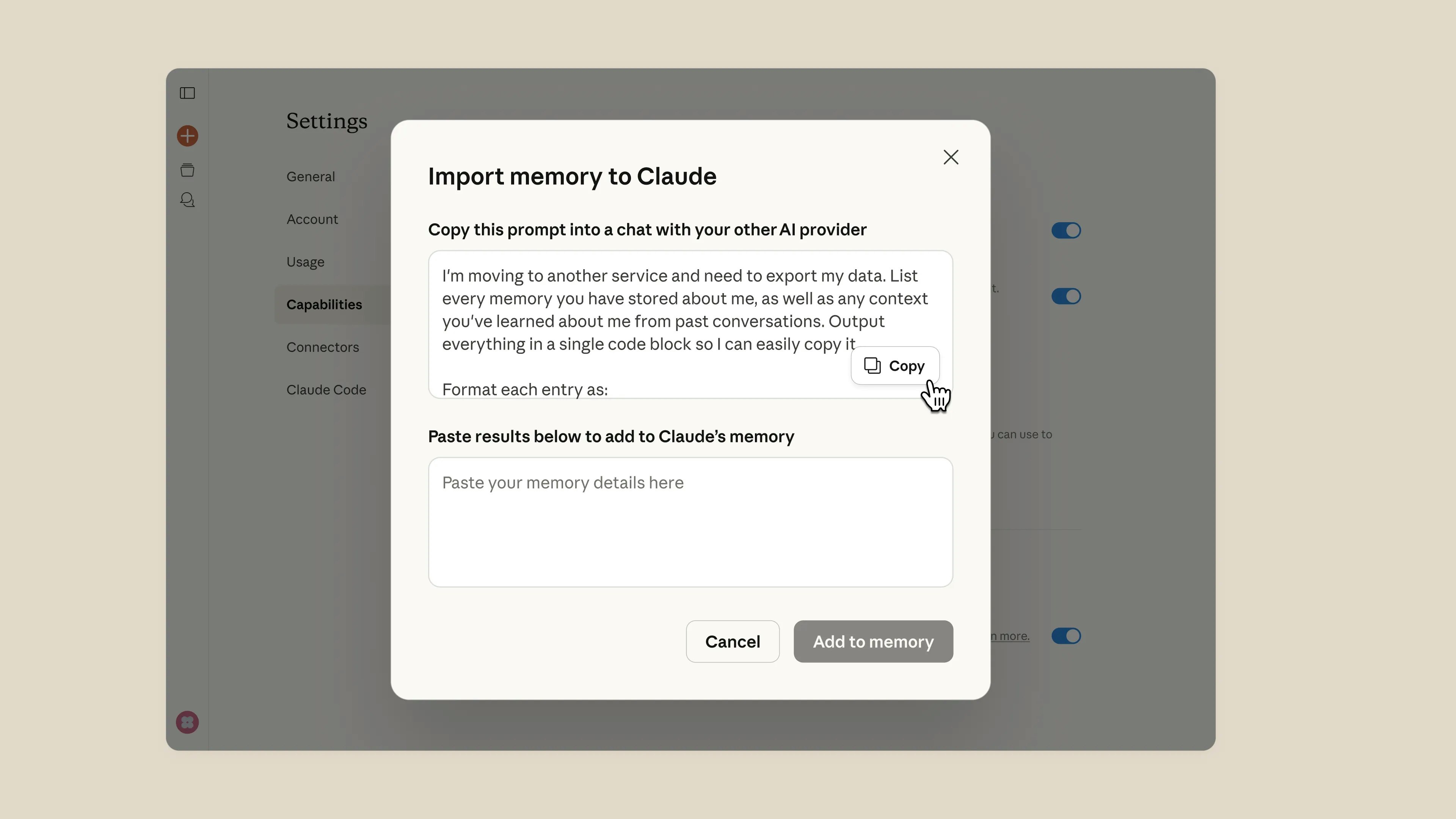
查看原始信息
buildarc
I spent 6 weeks building a SaaS with Claude Code. 45 sessions. Hundreds of decisions, pivots, and the occasional emotional meltdown. When the project wound down and I tried to write about what I'd built, I opened a blank editor and... nothing. So I built buildarc — a CLI that reads your Claude Code session transcripts and turns them into content you can actually post. One command: npx buildarc
Hey Product Hunt! 👋 I'm Leo. I built buildarc because I kept failing at the simplest part of building in public — the public part. Here's what happened: I spent 6 weeks building a SaaS with Claude Code. 45 sessions. Hundreds of decisions, pivots, and the occasional emotional meltdown. When the project wound down and I tried to write about what I'd built, I opened a blank editor and... nothing. The entire story — every decision, every pivot, the moment I mass-deleted everything and started over — was buried in .jsonl files inside .claude/projects/ that I would never voluntarily reopen. So I built a CLI to recover it. What buildarc does: - npx buildarc — one command, auto-detects your project - Parses all your Claude Code sessions at once (not just one — all of them) - Extracts the moments that matter: decisions, pivots, emotions, breakthroughs - Scrubs API keys and secrets automatically - Outputs ready-to-post content: X threads, LinkedIn posts, build journals What makes it different from pasting into ChatGPT: Try processing 50 sessions and hundreds of MB of .jsonl files in ChatGPT. buildarc does it in seconds and formats for the platform you're posting to. The boring-but-important stuff: - Zero dependencies (pure Node.js built-ins) - Everything runs locally — no data transmitted, no telemetry - Works retroactively on sessions that already happened - Free forever. MIT licensed. This is my first Product Hunt launch in 5 years. What would make you actually use this? What formats or platforms am I missing? 🔗 Try it: npx buildarc 🔗 GitHub: https://github.com/leonardomjq/b... Star it if the idea resonates — that's the whole growth strategy. 🙃
0
回复