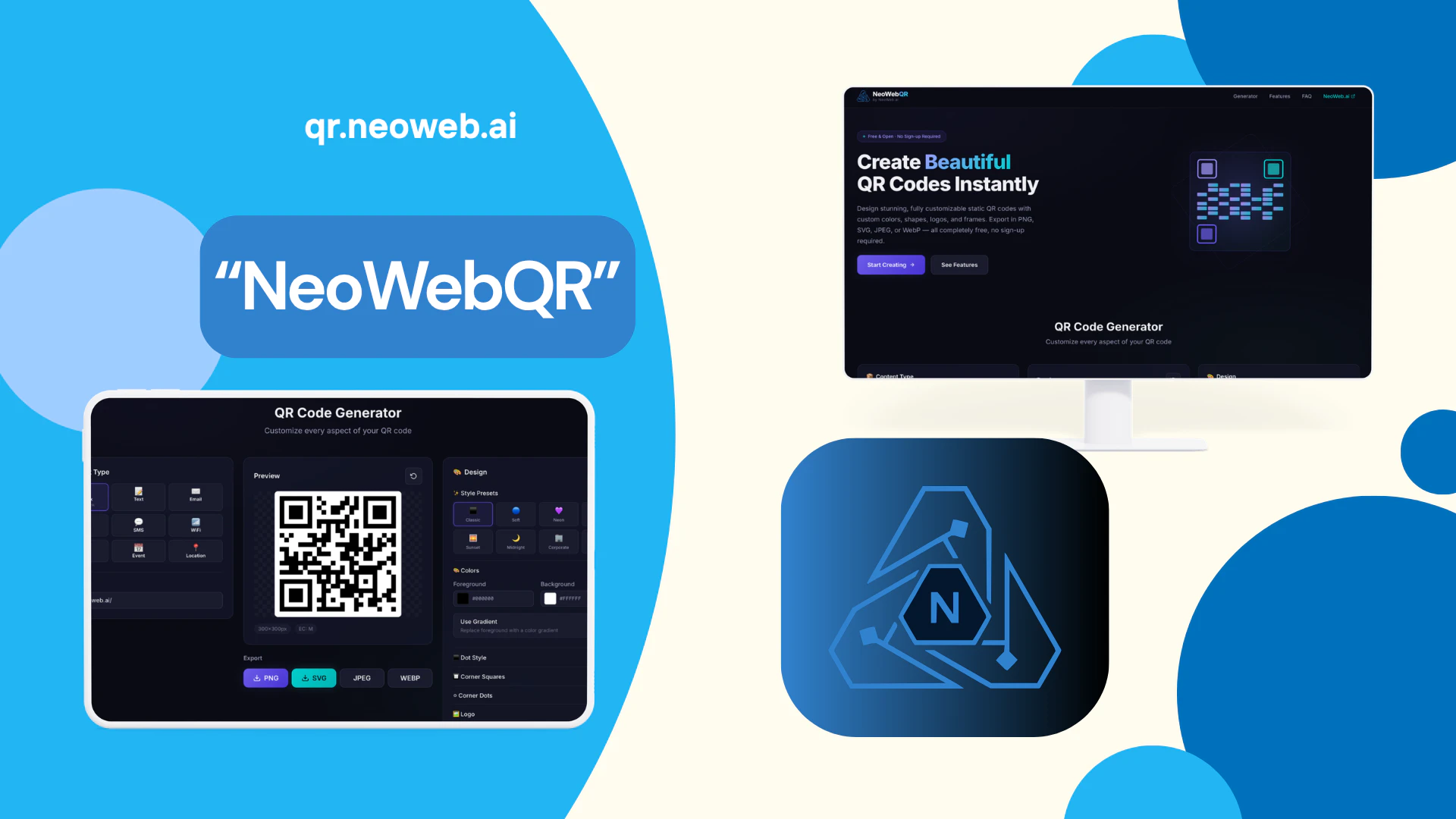
Product Hunt 每日热榜 2026-04-19

PH热榜 | 2026-04-19

#1
Vantage in Google Labs
Practice & assess future-ready skills with AI-simulated team
250
一句话介绍:Vantage 是一款由谷歌实验室推出的AI模拟团队协作评估工具,通过在模拟真实场景(如辩论、提案)中与AI化身互动,解决了未来技能(如批判性思维、协作)难以量化和规模化评估的痛点。
Hiring Productivity Artificial Intelligence
AI评估工具 未来技能测评 生成式AI 模拟团队协作 教育科技 技能地图 批判性思维训练 企业培训 谷歌实验 自适应学习
用户评论摘要:用户肯定其解决了高阶技能难以测量的核心问题,并关注其模拟高压力商业场景的逼真度、AI挑战的适应性、以及评估模型如何随行业实践更新。同时,用户期待了解技能地图如何追踪长期进步。
AI 锐评

Vantage 并非简单的技能测试应用,其真正价值在于构建了一个“压力测试沙盒”,试图将抽象软技能转化为可观测、可量化的交互数据。它直击了现代教育与人才评估体系的软肋:我们深知协作、批判性思维至关重要,却只能用粗糙的考试或主观面试来评判。

其核心创新点“Executive LLM”引入动态干扰,是模拟真实职场复杂性的关键一步。真正的协作与思考往往发生在计划被打乱、资源受限或遭遇反对时,能否在此动态过程中捕捉有效“技能证据”,是它能否超越传统情景问答的核心。与纽约大学的验证及对标OECD框架,则是为其学术可信度与行业通用性背书,旨在建立一套新的技能评估标准。

然而,潜在挑战同样尖锐。首先,其“人类专家级”评分本质上是将AI与现有人类评判对齐,但人类专家在评估这些软技能时本身是否存在偏见与不一致?这可能导致AI放大了现有评估体系的固有缺陷。其次,评论中关于“技术栈与最佳实践演进”的担忧非常现实,AI模拟的场景库与评判逻辑若无法持续、敏捷地更新,产品将迅速脱节于真实的“未来”技能需求。最后,从“评估”到“赋能”的跨越至关重要。提供技能地图与反馈只是开始,如何基于评估缺口生成个性化的、有效的学习路径或训练方案,才是用户实现“进步”的闭环,目前看来这仍是留白。

总之,Vantage 是一次野心勃勃的标准化尝试,它用AI拆解了技能的“黑箱”,但技能的培养与验证终究无法完全脱离真实的人类与社会互动。它最可能成功的场景或是作为大规模初筛或教学辅助工具,为人类决策提供高信度的数据参考,而非取代最终的、复杂情境下的真人判断。

查看原始信息
Vantage in Google Labs
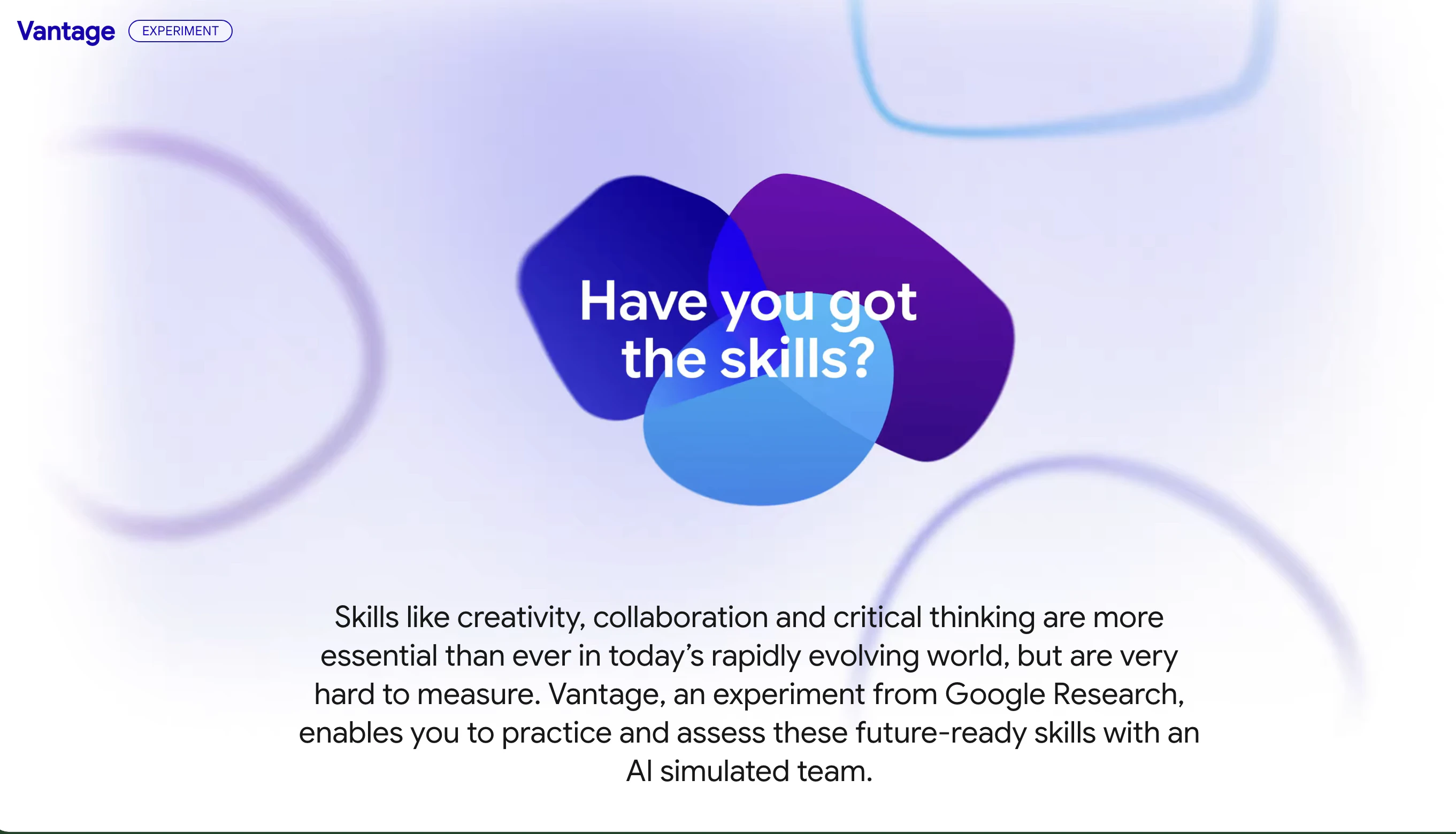
Vantage is a Google Research experiment that uses GenAI to assess future-ready skills like collaboration, critical thinking, and creativity. AI avatars simulate real scenarios, score your performance, and deliver a personal Skill Map. Now on Google Labs.

Google Research just made the hardest skills to measure, actually measurable.

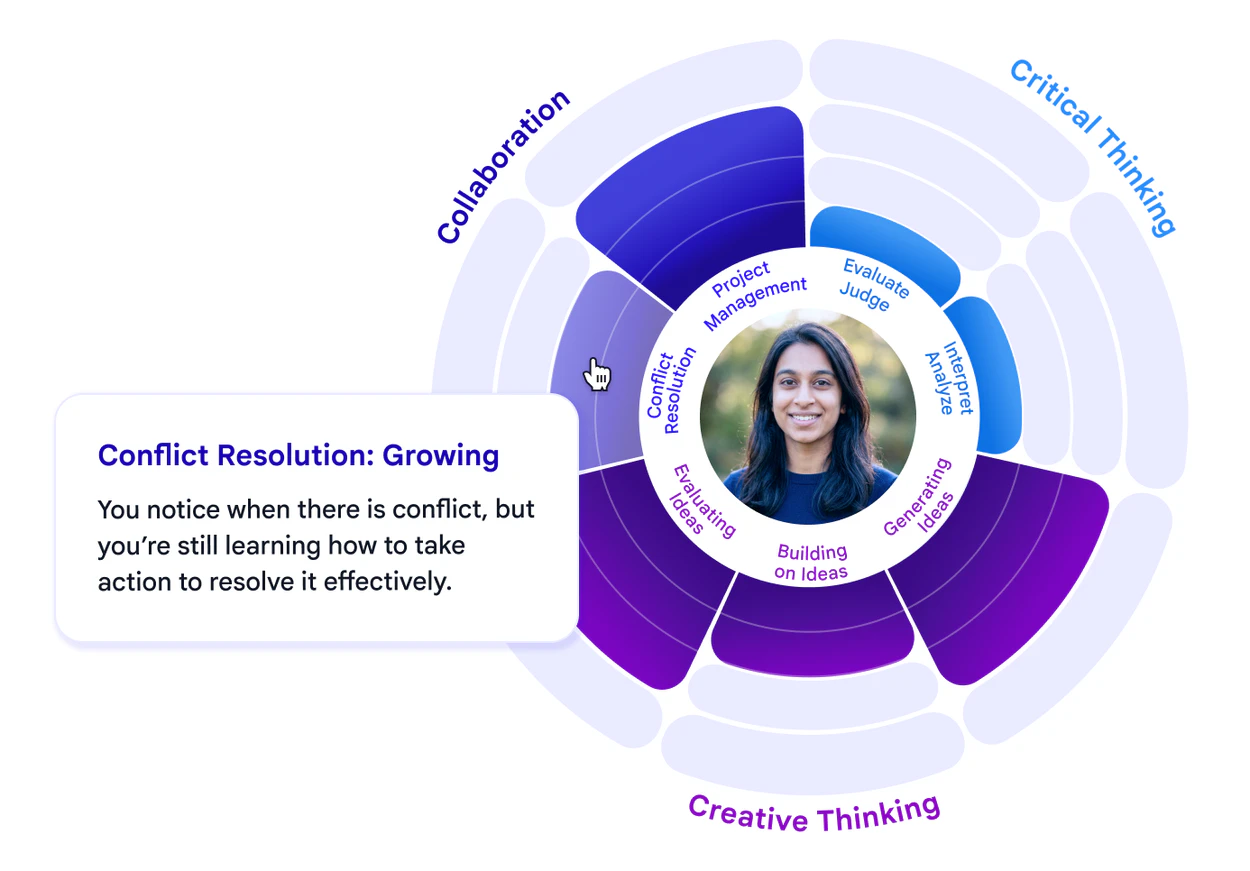
Vantage is a Google Research experiment that uses GenAI to assess future-ready skills like collaboration, critical thinking, and creativity. AI avatars simulate real scenarios, score your performance, and deliver a personal Skill Map.

The problem: Critical thinking, collaboration, and creativity matter most but are nearly impossible to assess at scale.

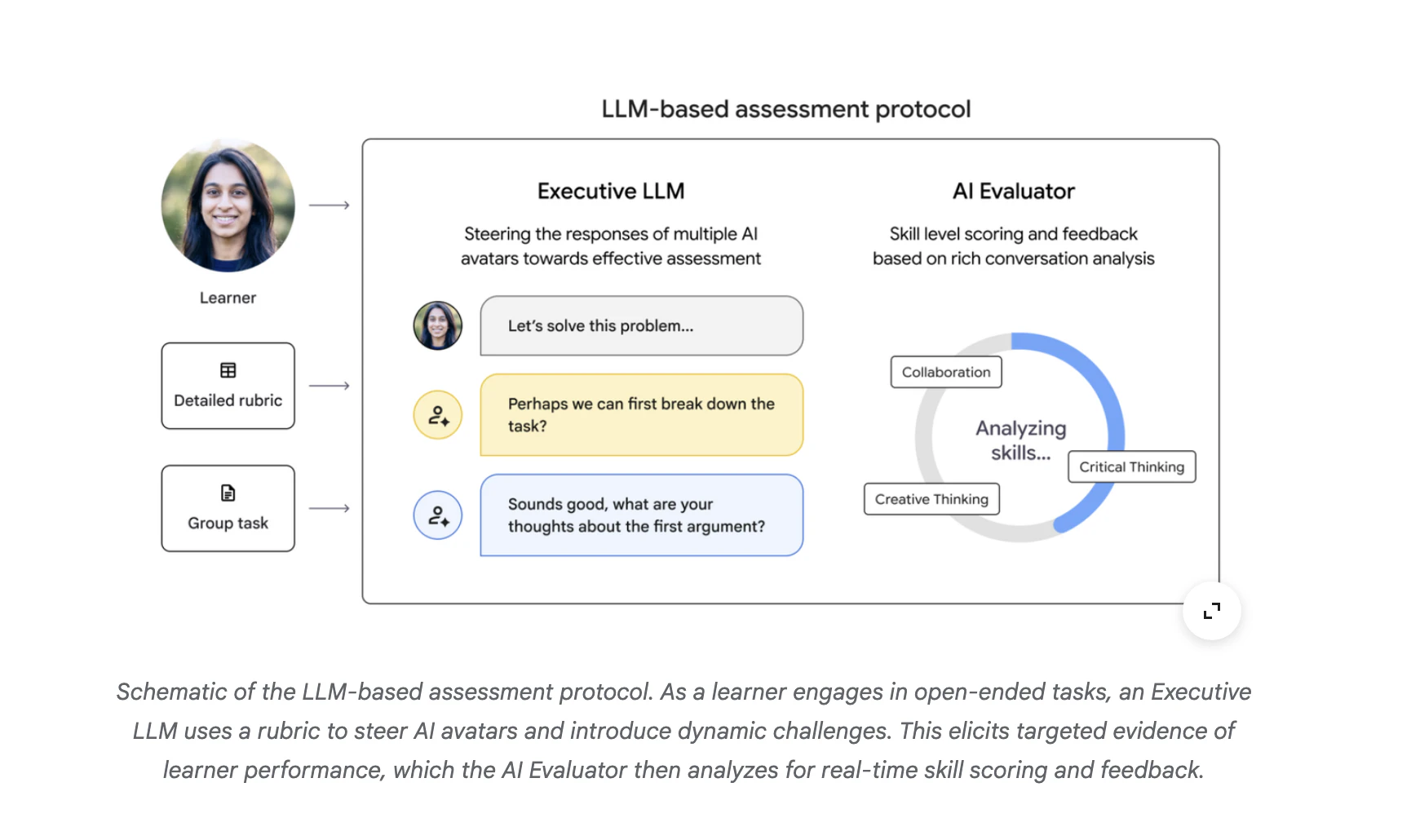
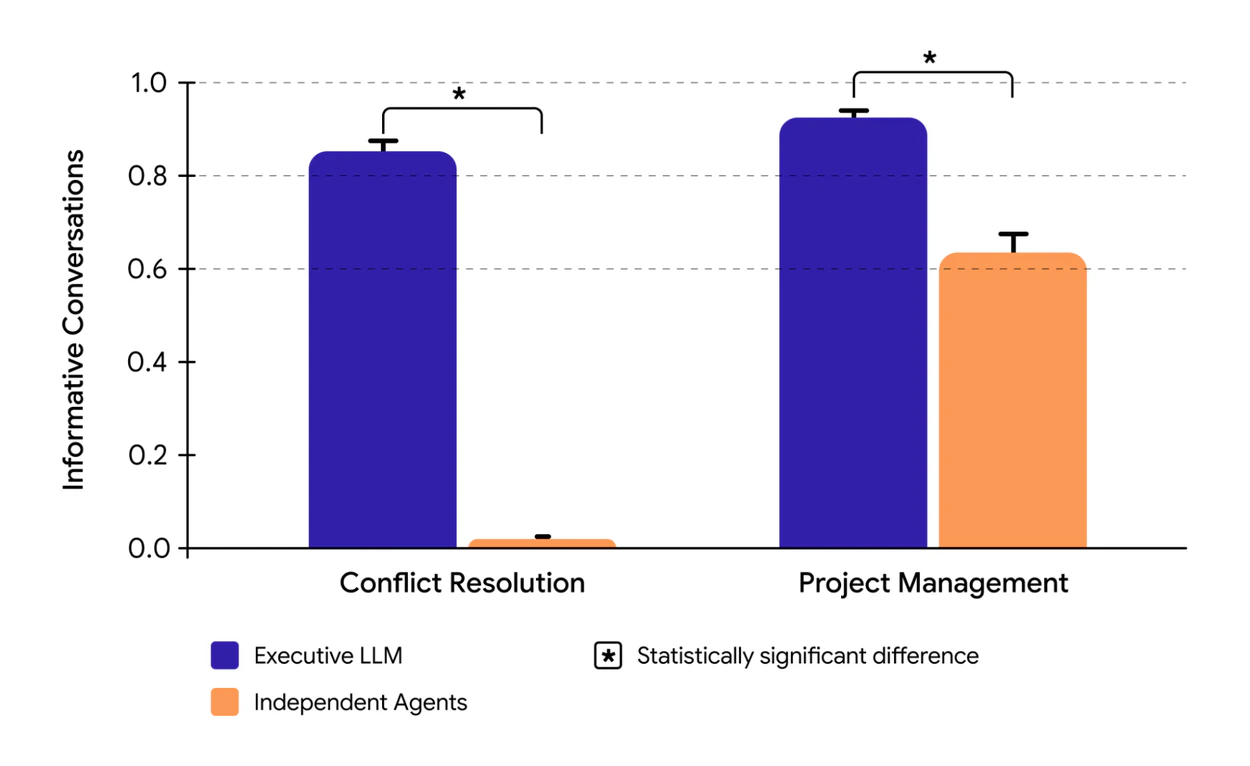
The solution: Vantage uses an Executive LLM to simulate real team scenarios, surface skill evidence, and score performance at human-expert level.

What stands out:
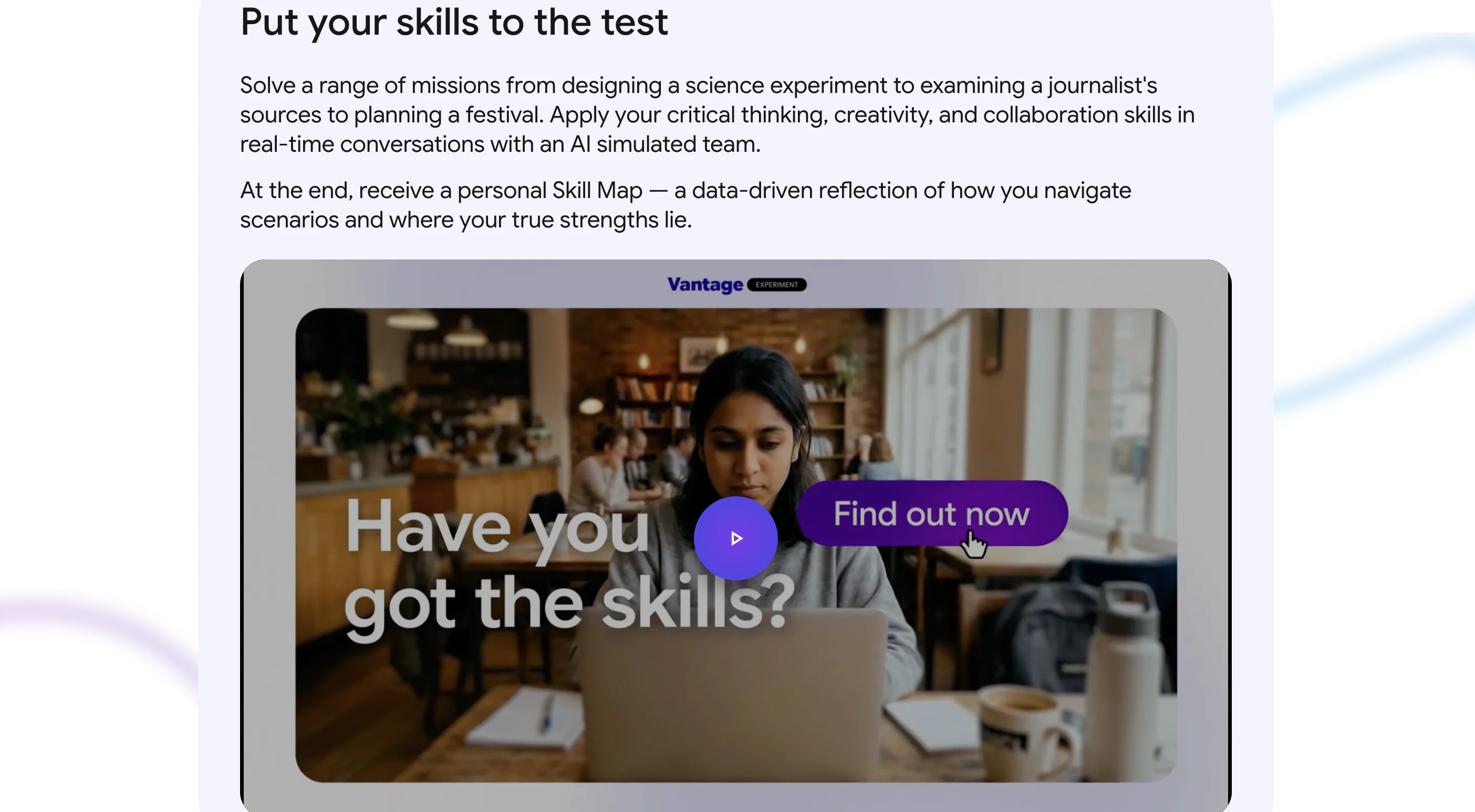
🧠 AI simulated team: Work through missions like debates, pitches, and experiments with AI avatars.
🎯 Executive LLM: Introduces dynamic challenges like conflict and constraints mid-conversation.
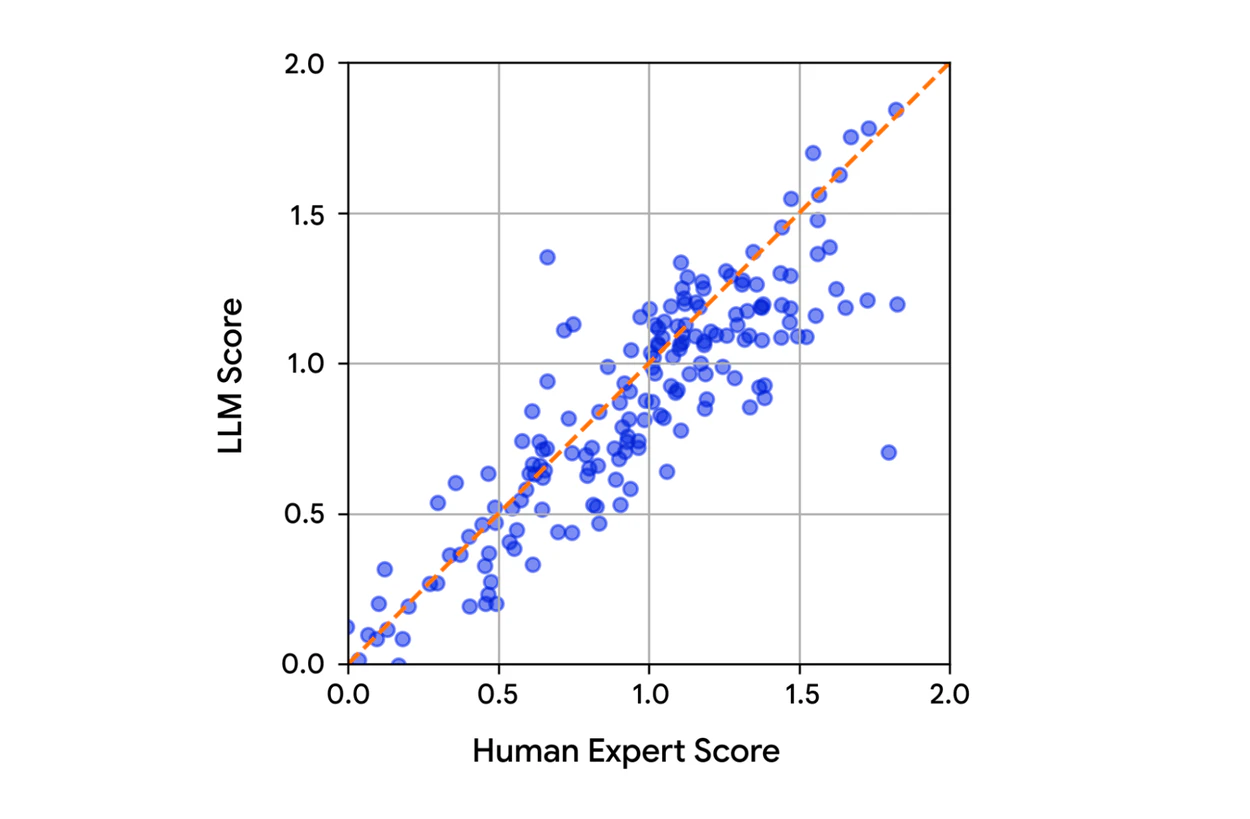
📊 AI Evaluator: Scores using expert-level rubrics with human-like agreement.
🗺️ Personal Skill Map: Visual scores with precise qualitative feedback.
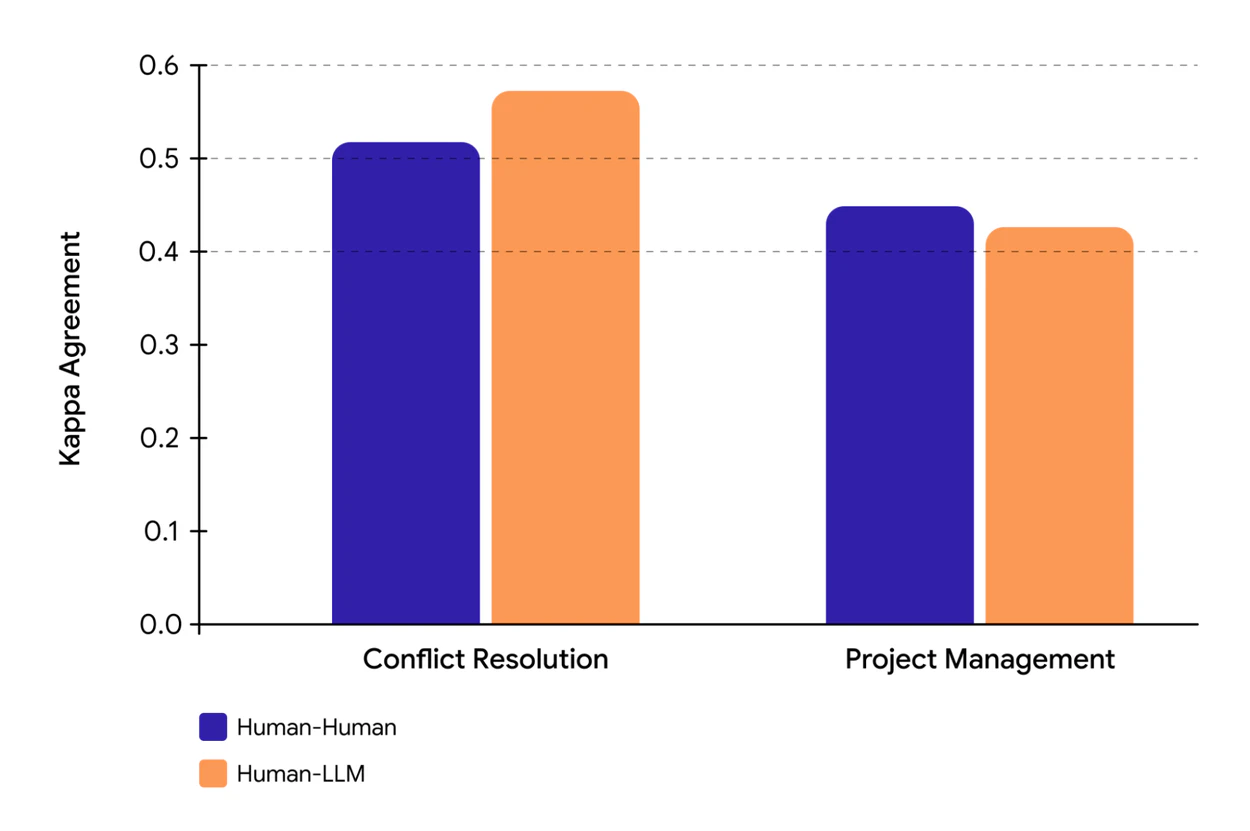
🔬 Validated by New York University: AI scoring matches human experts across 188 testers.
📐 Aligned with OECD and World Economic Forum frameworks.
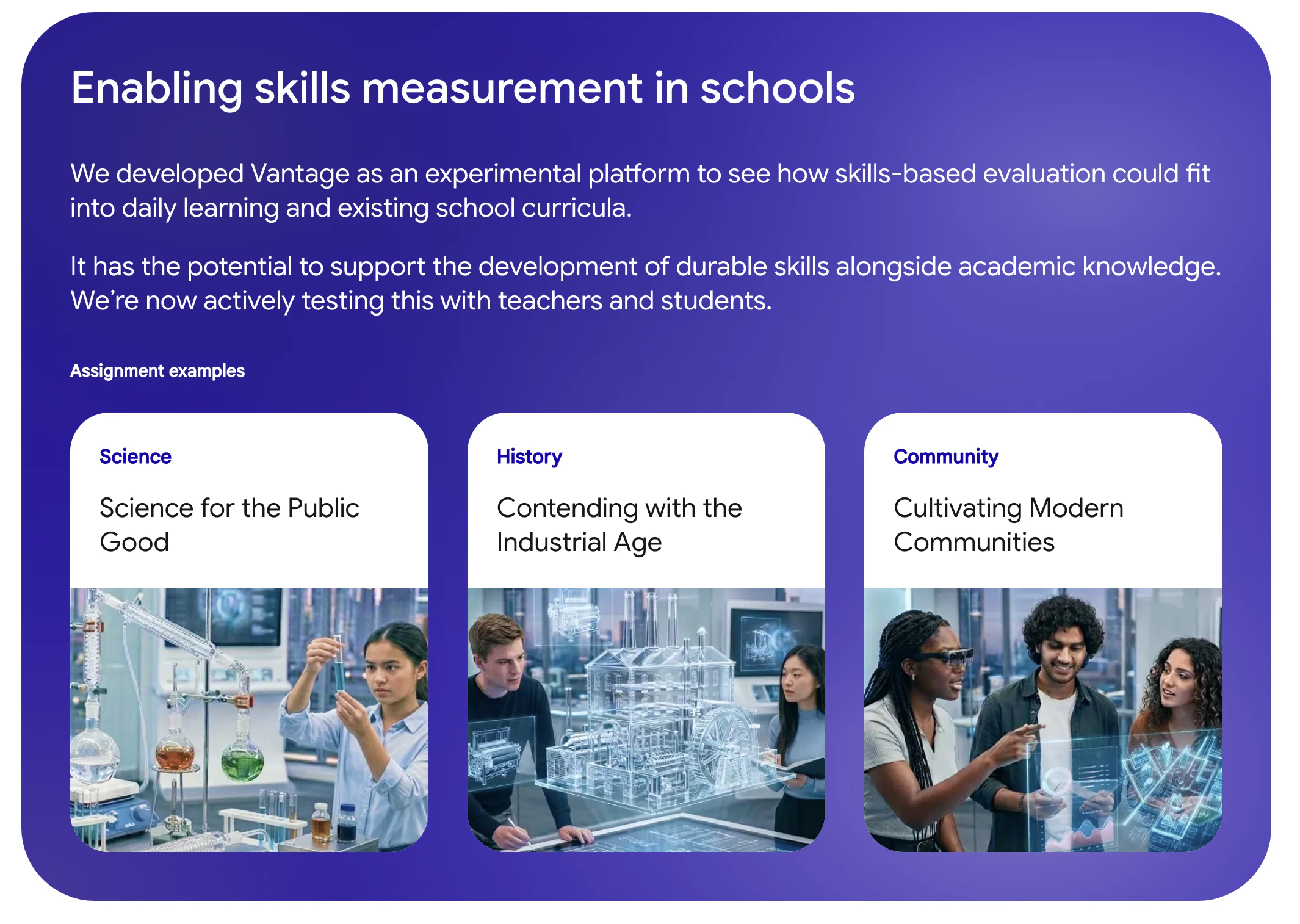
🎓 Built for classrooms: Designed as a skills layer alongside existing curricula.


Skills assessed:
- Collaboration: Conflict resolution and project management.
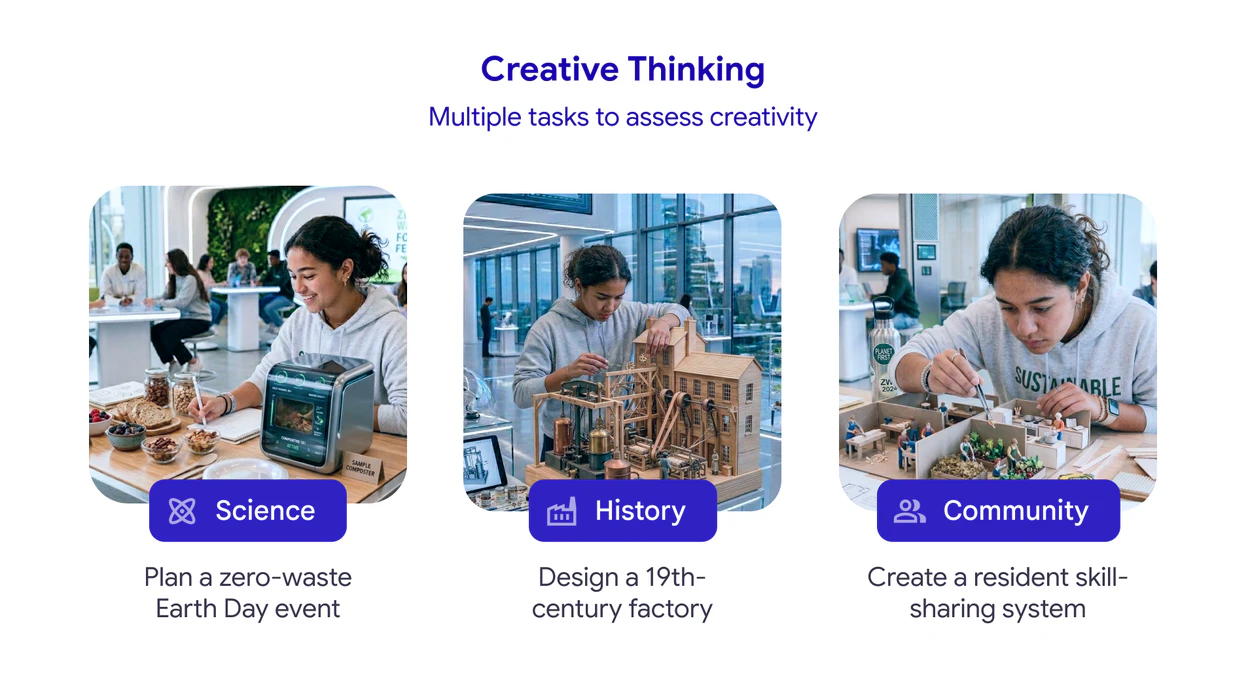
- Creative Thinking: Generating, building, and evaluating ideas.
- Critical Thinking: Interpreting, analyzing, and judging information.

Different because it’s not a test, but an adaptive conversation that reveals real capability.

P.S. I hunt the latest and greatest launches in tech, SaaS and AI, follow to be notified @rohanrecommends

4
回复

@rohanrecommends For B2B/tech roles like product launches or client pitches, how does Vantage simulate those high-stakes moments; like defending a pivot to skeptical stakeholders or resolving cross-timezone conflicts? Does the AI throw curveballs based on your actual responses?

3
回复

Interesting idea! How do you ensure the AI-simulated scenarios stay relevant as tech stacks and best practices evolve? I remember one painful incident where outdated training led to a junior engineer deploying a container with root privileges to production.

3
回复

This would be a great brainstorming partner!

2
回复

critical thinking and collaboration are the skills I need most but never know how to actually benchmark. curious how the skill map tracks improvement over time. do repeated sessions show progression?

0
回复

Cool! Built something like this before under the guise of an interview and its interesting how a reframing from interview to assessment enables you to discover a whole value add of education.

0
回复
#2
Gemini app for Mac
Option + Space and Gemini is right there
244
一句话介绍:一款通过快捷键(Option + Space)即时呼出的原生Mac版AI助手,允许用户分享当前窗口内容获取上下文帮助、分析本地文件并生成内容,解决了在多个应用间频繁切换、重复解释工作场景的低效痛点。
Mac Artificial Intelligence Menu Bar Apps
AI桌面助手 原生Mac应用 快捷键唤醒 上下文感知 多任务辅助 生产力工具 谷歌Gemini 即时分析 内容生成
用户评论摘要:用户主要反馈分为两点:一是高度认可其“贴近意图”的桌面集成形态,认为比网页版体验更优;二是提出具体功能疑问,如窗口共享功能是否能智能关联跨多个应用(如Figma、Notion)的复杂工作流。此外有用户询问Windows版本计划。
AI 锐评

Gemini for Mac 的发布,其核心价值并非技术突破,而是一次对“AI与操作系统融合形态”的精准卡位。它试图将大模型从“目的地”(浏览器标签页)重新定义为“系统级服务”。快捷键呼出、窗口共享这些功能,本质上是在争夺用户与AI交互的最高频入口——桌面工作流。

然而,其真正的考验在于“上下文感知”的深度。目前的产品介绍和评论中的疑问都指向了同一核心矛盾:它究竟是一个“更便捷的聊天机器人”,还是一个能真正“理解”复杂、碎片化桌面工作流的智能体?评论中关于跨Figma、Notion、网页多标签联动的质疑非常犀利。如果其窗口共享仅能捕捉单一窗口的静态快照,而无法主动关联用户的行为轨迹和跨应用数据,那么它只是减少了切换步骤,并未从根本上提升认知效率。这不过是把“复制粘贴”的过程自动化了,离真正的“工作流伙伴”尚有距离。

谷歌此举可视为对微软Copilot深度集成Windows的有力回应,也是其生态防御。成功的关键在于后续能否开放更底层的API,让AI不仅能“看到”窗口,更能“理解”应用内的具体对象(如Figma设计图层、Notion数据库条目),并主动建立连接。否则,它很可能只是一个体验更流畅的“浮窗版ChatGPT”,难以构筑持久的壁垒。这场桌面AI之战,胜负手在于系统级整合的深度与智能体真正的“悟性”。

查看原始信息
Gemini app for Mac
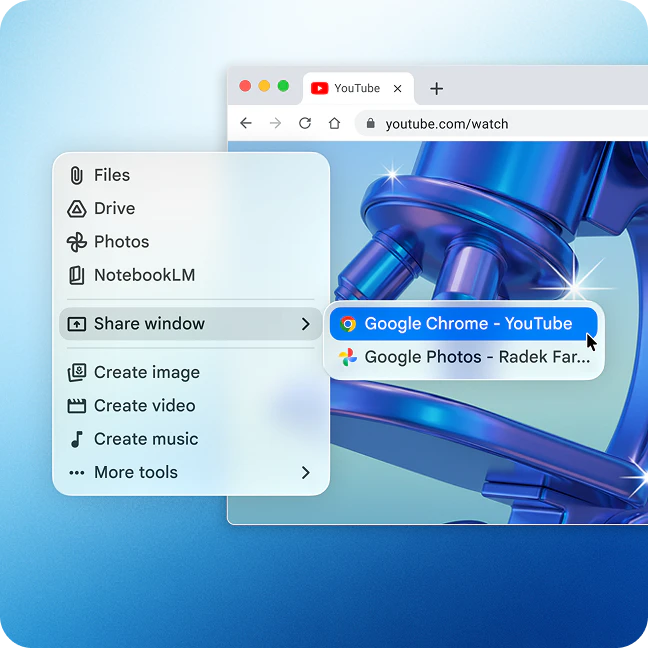
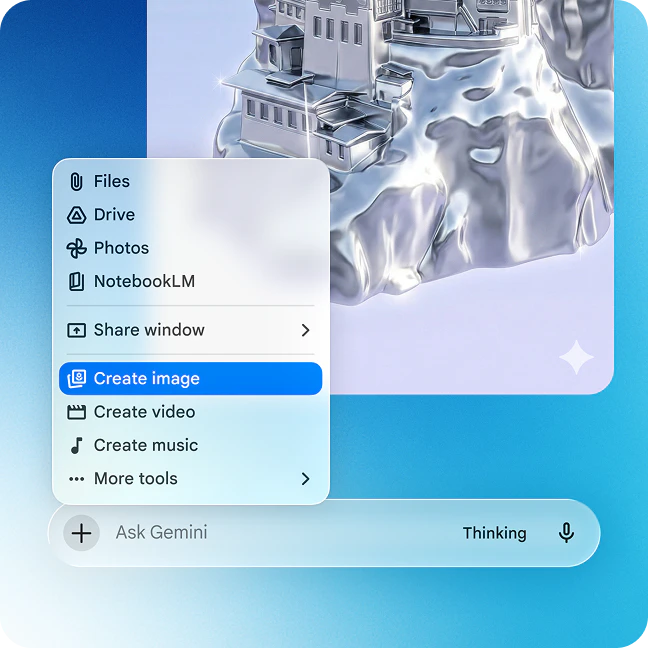
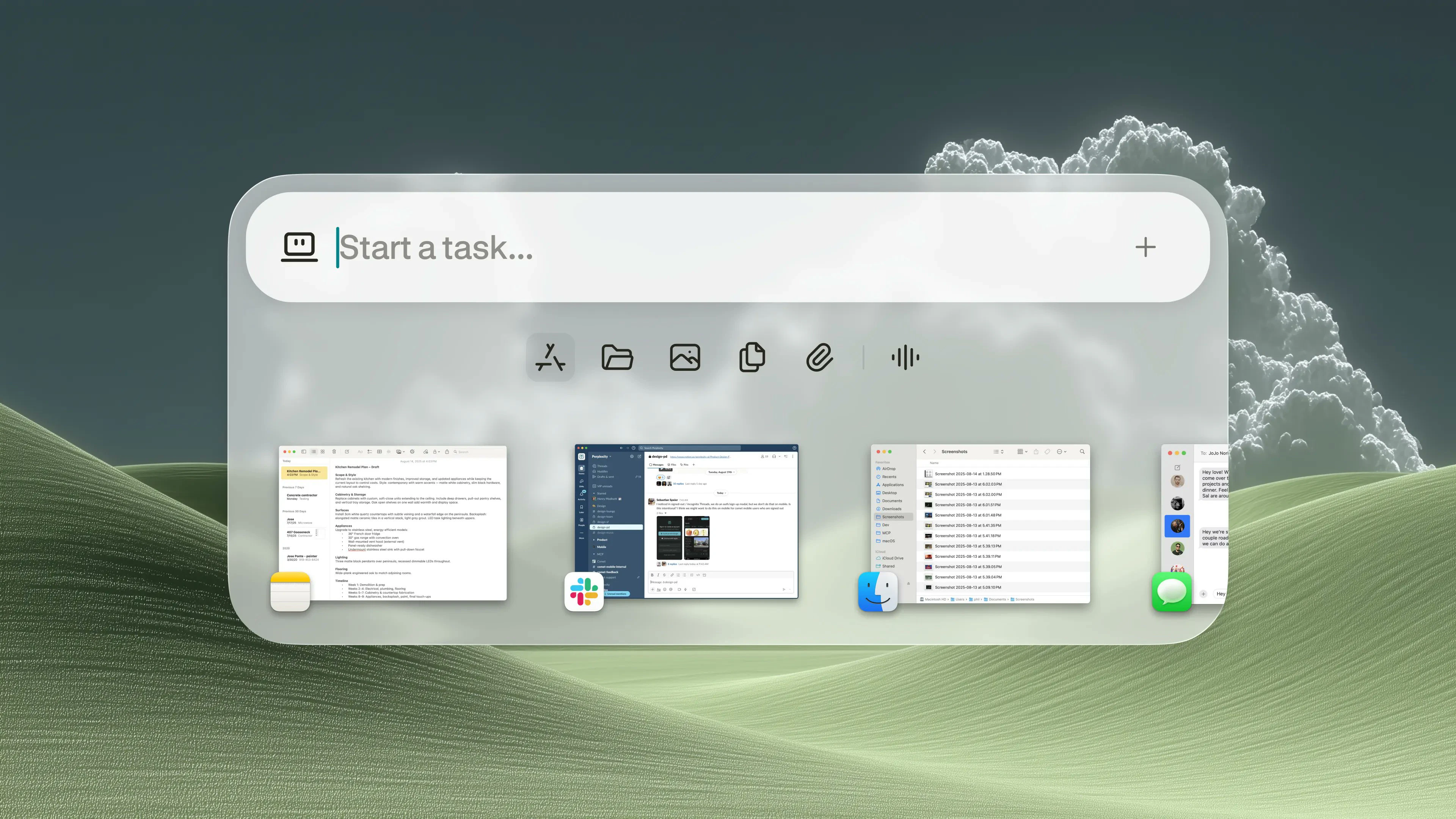
The official Gemini app is now available natively on macOS. Use a simple shortcut (Option + Space) to bring up Gemini instantly. Share your active window for contextual help, analyze local files, and generate content without ever switching tabs.
Hi everyone! This is a Gemini that sits much closer to your intent, and much closer to the way you actually interact with your Mac. Instead of opening a tab and re-explaining everything, you can pull it up with Option + Space, share the window you are already working in, and get contextual help right there. That is a much better product shape for desktop AI. Will it become your always-there assistant on macOS?
5
回复

@zaczuo How smart is the window-sharing at picking up multi-tab workflows? Like if I'm jumping between Figma, Notion notes, and a PH launch page for branding research; does it auto-connect the dots, or do I still need to spoon-feed "analyze this together"?

2
回复

什么时候有Windows版本?

0
回复
#3
Verdent 2.0
Your AI Technical Cofounder
200
一句话介绍:Verdent 2.0作为“AI技术联合创始人”,在用户用自然语言描述需求后,能自主规划、执行并交付产品进度,主要解决独立开发者或小团队在将想法转化为可运行业务过程中,需要身兼项目管理、开发、测试等多职、效率低下的核心痛点。
Productivity Artificial Intelligence Vibe coding
AI编程助手 自动化开发 无代码/低代码 智能体 项目全周期管理 离线运行 技术联合创始人 产品交付
用户评论摘要:用户肯定其“真正交付”的价值,但主要疑问集中于:AI决策过程是否透明可控;在复杂业务场景下的可靠性;职责边界(产品方向等不应委托);离线运行的技术实现(本地/云端)与长上下文处理;以及代码效率审查等具体能力。
AI 锐评

Verdent 2.0的野心不在于成为又一个代码补全工具,而在于重新定义“建造者”与“工具”的关系。它宣称的“AI技术联合创始人”角色,本质是将开发流程从“人驱动AI”转变为“AI驱动执行”,人只需负责最高层的目标与决策。这直击了当前AI编程工具的普遍窘境:开发者仍需深度介入每个环节,成为“AI的监工”,而非解放创造力。

其宣称的“离线工作”、“记忆项目”、“持续改进”等特性,试图构建一个具有持久性和自主性的智能体系统,这比单次任务完成更具颠覆性。然而,这也正是其最大的风险与挑战所在。评论中关于“决策透明度”和“复杂业务处理”的质疑一针见血。当AI承担从规划到测试的完整链条时,其决策逻辑可能成为一个“黑箱”。在简单场景下,用户或许可以接受“交付结果”;但在真实的、充满权衡和边缘案例的业务中,缺乏过程可见性和可控性的“自动驾驶”是危险的,可能导致技术债的隐形积累或方向性偏差。

因此,Verdent的真正价值并非替代人类决策者,而是成为史上最高效、最不知疲倦的“执行合伙人”。它的成功与否,将不取决于其生成的代码行数,而取决于其系统设计能否在“自主性”与“可控性”、“端到端推进”与“过程可解释性”之间取得精妙平衡。它瞄准的是“无代码”运动未能完全解决的深层需求——不是让非程序员能拖拽组件,而是让构建者能直接指挥一个理解业务逻辑的、全栈的“执行引擎”。这条路若能走通,将深刻改变早期产品开发的形态,但目前它仍处于一个需要用户高度信任的“概念验证”关键期。

查看原始信息
Verdent 2.0
Verdent is your AI technical cofounder for turning ideas into running businesses. Tell it what you want to build in plain words, and it plans the work, drives execution, and delivers real product progress using your project context. Unlike most code generation tools, Verdent moves the entire product forward end to end, remembers your project, improves over time, and keeps working even when you're offline.

Hi Product Hunt 👋 I’m Adrian, cofounder of Verdent.

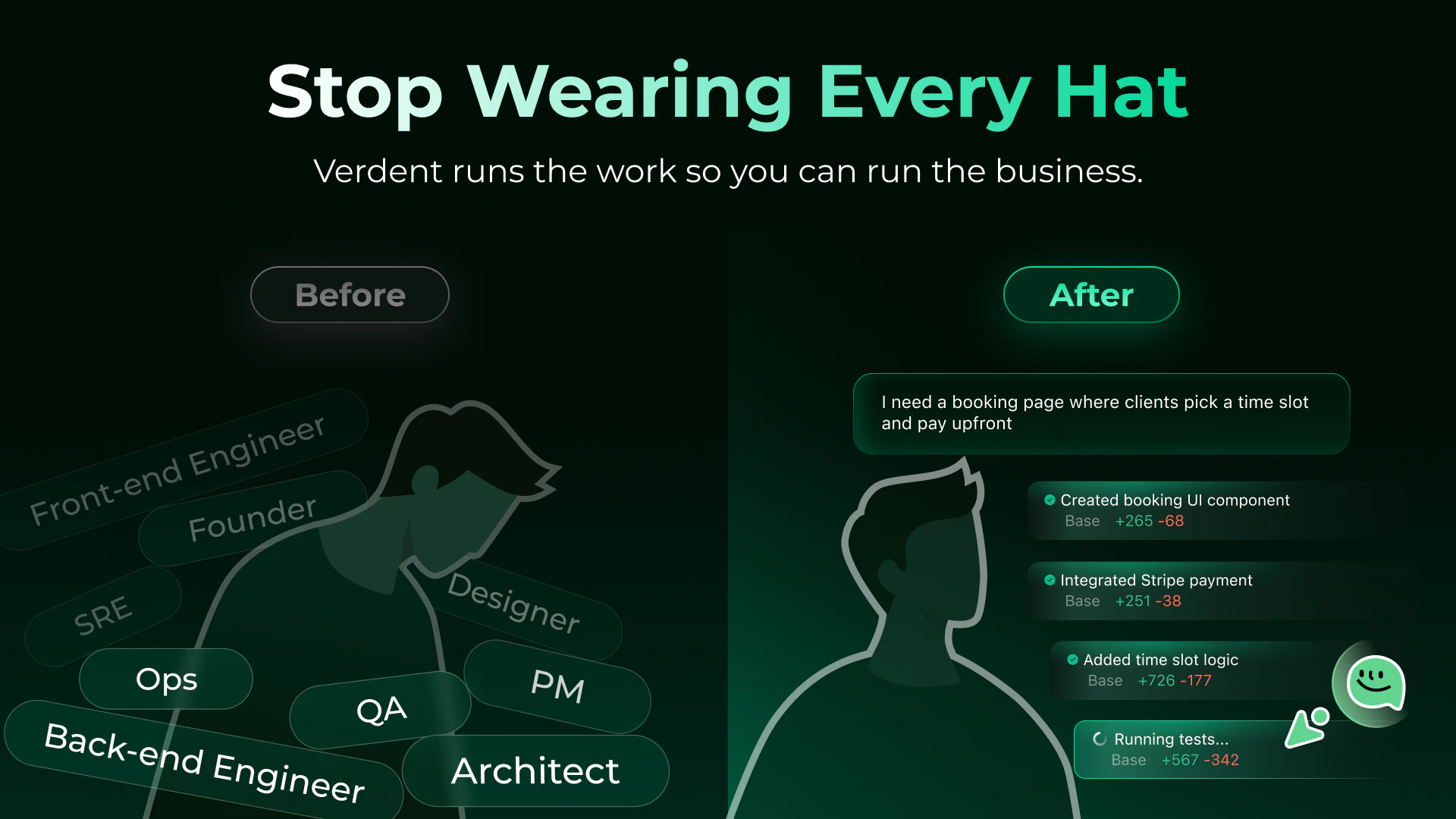
With most AI coding tools, you are still acting as the PM, engineer, QA, and ops. You keep switching contexts, checking every step, and re explaining things every time. Instead of building a business, you end up managing the process. Most tools help you prototype. Verdent is built to help you actually ship.

Stop wearing every hat

Say “I need a booking page with time slots and payments.” Manager handles the planning, implementation, and testing. You just decide what to build next.

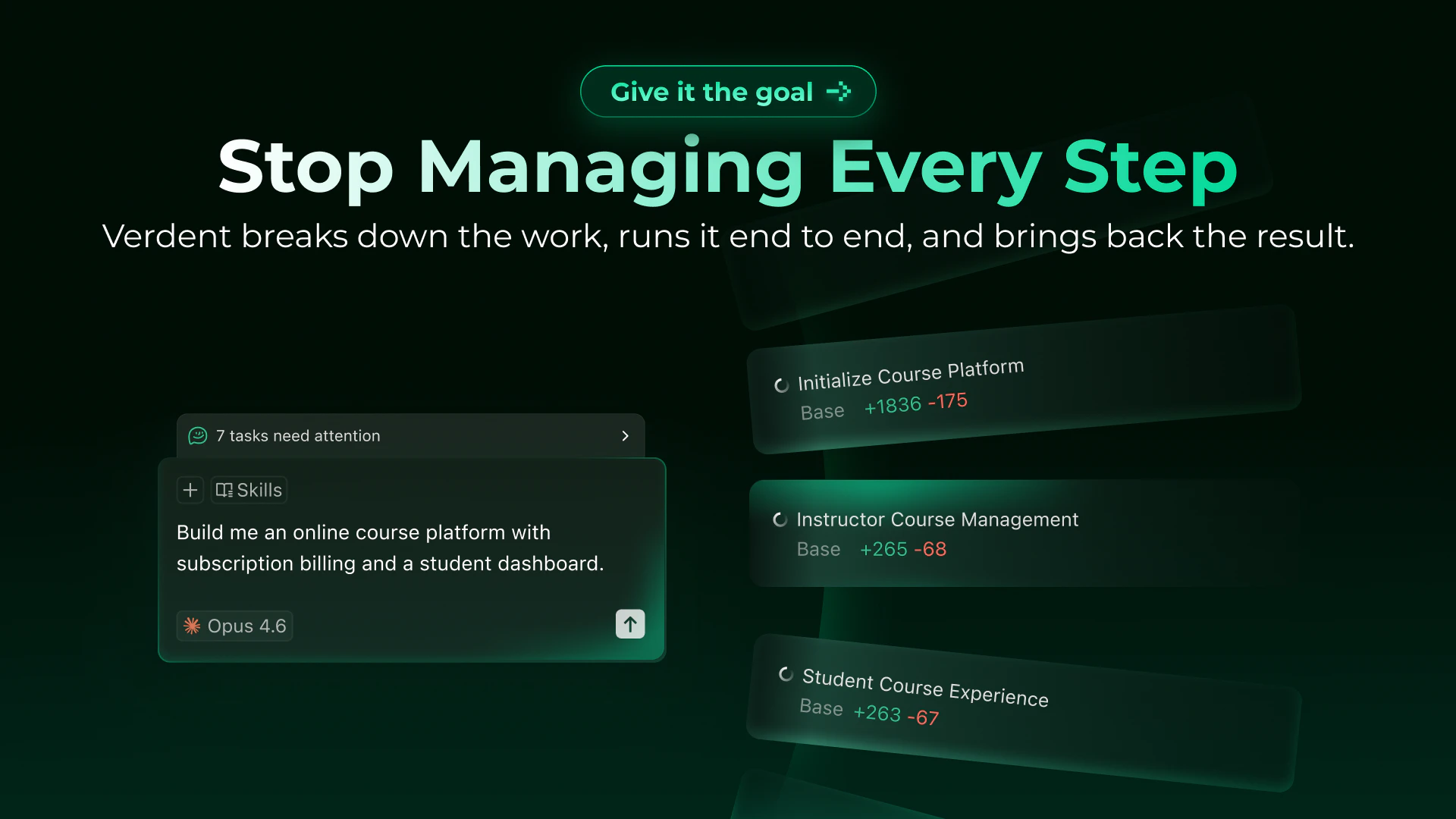
Stop managing every step

Give it a goal and come back to something that works.

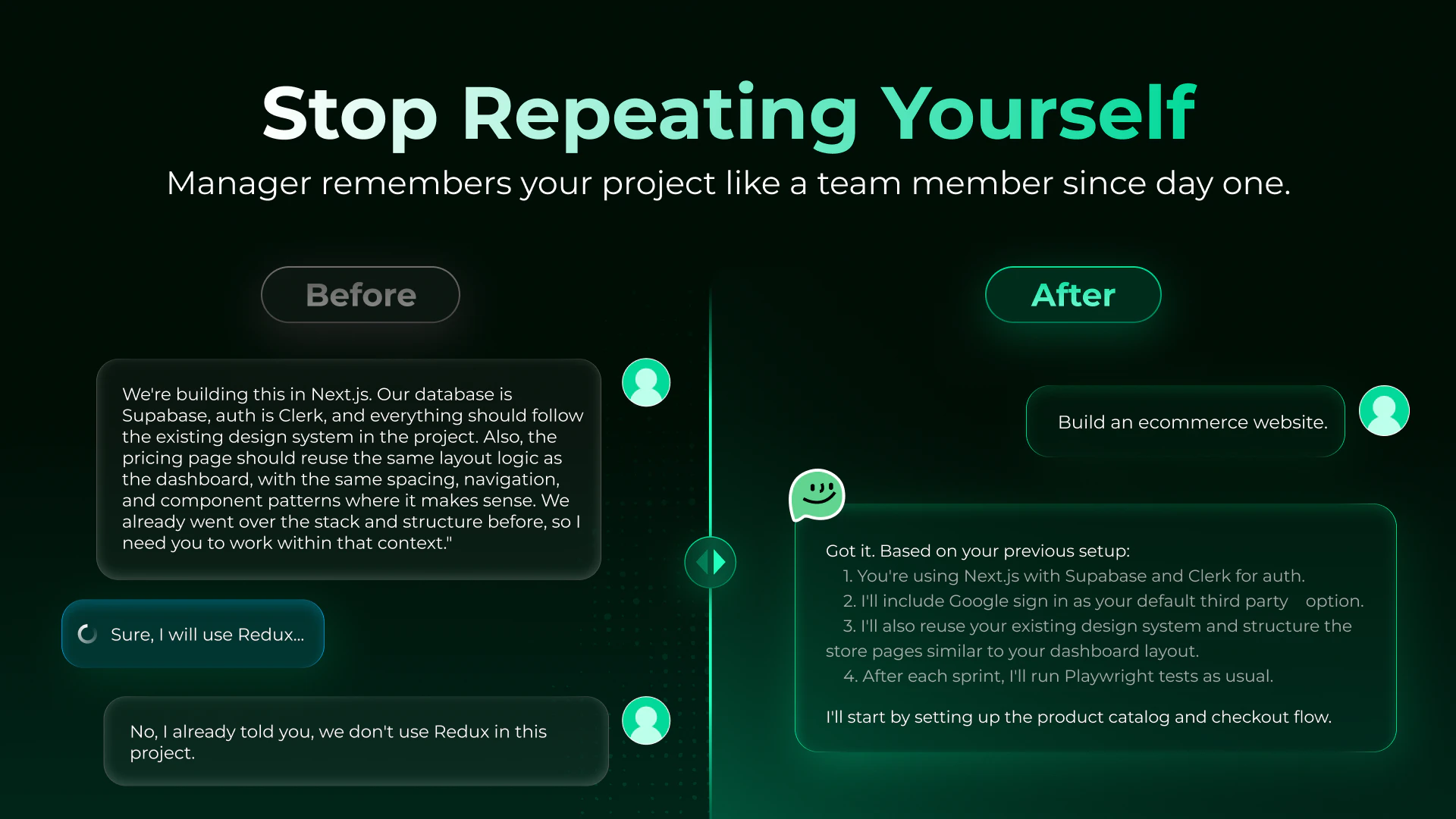
Stop repeating yourself

Manager keeps track of your project, your standards, and how you like things done. It gets better the more you use it.

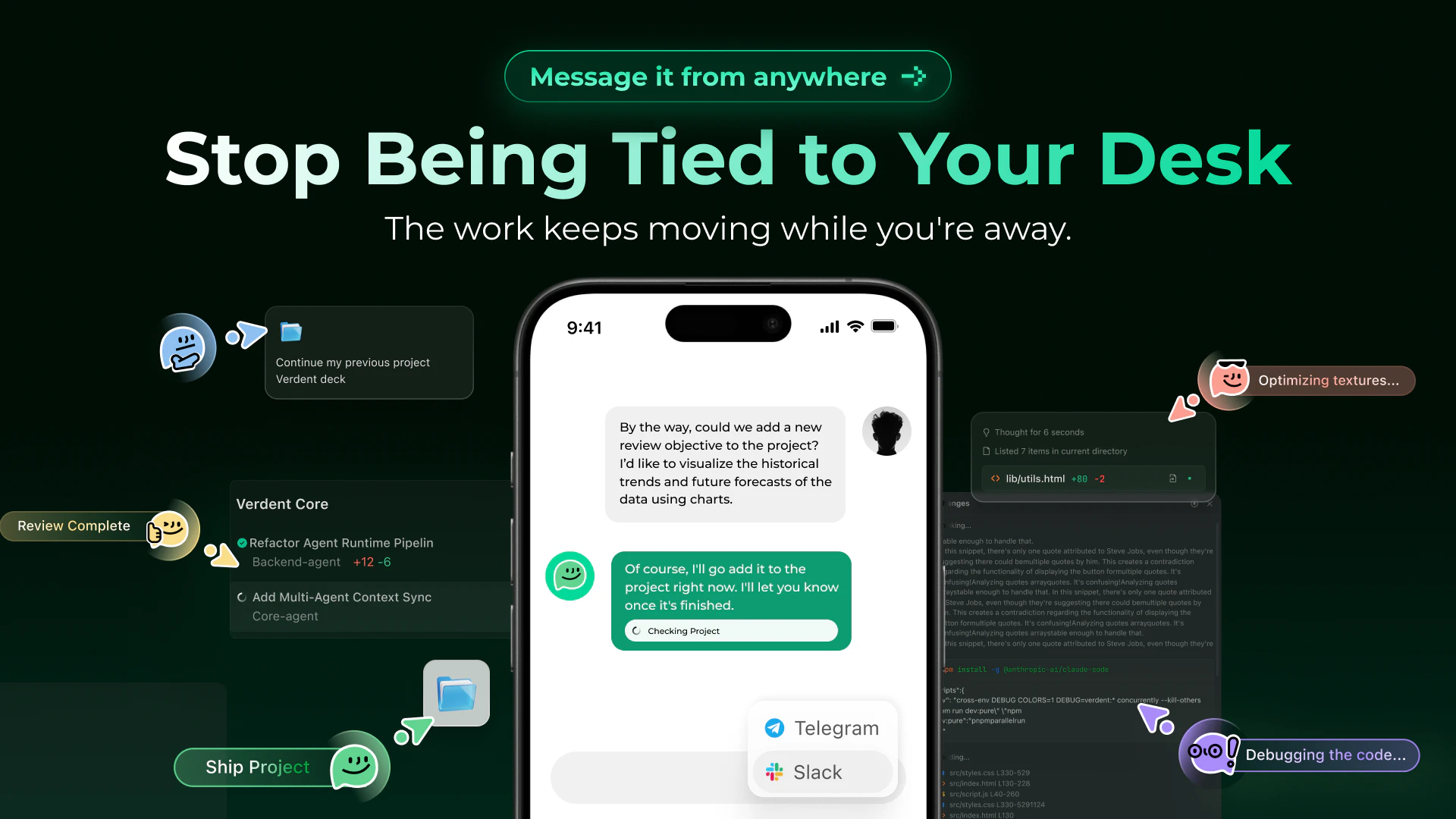
Stop being tied to your desk

Send it a message from your phone. It keeps working while you are away.

Our most active users are solo founders shipping features daily without writing code.


Last launch was about coding with AI.

This one is about helping builders actually run and ship their business.

Try it free 🙌

8
回复

@livingindream_ For small tasks or clear features, this sounds powerful. But in a real business, things are rarely that clean. There are tradeoffs, messy edge cases, and decisions that only make sense with deeper context.

What I would really want to understand before relying on something like this is how visible the decision making process is. If it plans and executes on its own, can I clearly see why it chose a certain approach, or does it become something I just review after the fact?

0
回复

@livingindream_ For non-coders building side projects say, a simple booking tool, how hands-off can the Manager really be, and what's one tip to get it nailing your style from day one?

0
回复

Coolest launch of the day but "AI technical cofounder” is a strong claim. What responsibilities do you think should never be delegated to Verdent?

6
回复

@lak7 Hey Lakshay, great question! We think of Verdent as the technical cofounder, not the decision maker. You are still responsible for product direction, priorities, and the key tradeoffs. What to build and why it matters should always come from you. Verdent helps with everything after that. Turning your decisions into actual progress and keeping the work moving.

4
回复

Hey all, we have integrated Anthropic's latest model Claude Opus 4.7 already! Excited for everyone to try it in Verdent:)

4
回复

Looks exciting, couple questions though. When Verdent is "working even when you're offline", do you mean it is running agents on my infrastructure, or cloud-side on Verdent's? Curious how you handle context limits across long async runs.

3
回复

@vayvala Hi Michael, it's still running on ur infrastructure! We've designed auto context compaction when approaching context limit, as well as agent memory system to share context across sessions.

2
回复
Can Verdent check the codebase for efficiency ? Definitely need that when working with Claude code
2
回复
@tanner_beetge Yeah codebase audits are pretty doable via skills today. Wire up the flow once, run it whenever. Eco Mode's also worth a look if cost efficiency is part of what you mean, since it routes to OSS models so you're not always paying Claude rates. What's the main thing you're running into?
1
回复

Does it maintain shared context across agents or does each run independently?

0
回复
#4
Perplexity Personal Computer
Local files. Native apps. Voice control. Always on.
192
一句话介绍:一款将个人电脑转变为AI智能协调器的系统,通过自动化跨本地文件、原生应用和网络的复杂工作流,解决用户在处理繁琐、重复性跨平台任务时的效率痛点。
Productivity Task Management Artificial Intelligence
AI工作流自动化 本地与云端混合 智能代理 生产力工具 跨应用协调 文件管理 语音控制 可审计操作 终端用户AI 自动化助手
用户评论摘要:用户肯定其“本地+云端”混合架构是核心突破,并关注具体实现细节:如何在没有API的应用间切换、操作的可审计与撤销粒度、跨会话状态持久性、多模型路由控制,以及实际处理混合工作流(如内容创作)的自动化程度与可靠性。
AI 锐评

Perplexity Personal Computer 并非又一款聊天机器人或简单的自动化脚本工具,其真正价值在于试图重新定义人机交互范式——从“人操作计算机”转向“人管理AI,AI操作计算机”。产品将AI定位为“系统级的智能协调器”,这比局限于浏览器或单应用的AI助手更具野心。

其关键创新点在于“本地+云端”的混合环境集成。目前多数AI工具无法触及本地文件与原生应用,形成数据孤岛。此产品若能安全、可靠地打通此界限,确实能解锁真正的端到端工作流自动化。然而,这也使其面临最严峻的挑战:安全性、可靠性与用户信任。评论中关于“可审计、可逆操作”的细节追问直击要害——在系统级进行文件操作、邮件发送等动作,一旦出错代价高昂。产品必须提供堪比版本控制的细粒度操作追溯与回滚机制,否则难以获得用户授权。

“状态持久性”是另一犀利观察。当前的AI多为“无状态”对话,而真实工作流是连续、有状态的。产品能否跨会话记忆上下文、维持任务进程,是其能否承担复杂项目、而不仅是零散任务的关键分水岭。

此外,在“智能代理”赛道火热的当下,产品需清晰界定其与Claude Desktop、Cline等竞品的差异。其宣称的“多模型协调”是技术亮点,但用户对模型路由的透明度和控制权提出要求,这揭示了用户对AI黑箱操作的普遍焦虑。

总之,这是一款面向高阶用户的先锋型产品,其理念超前。但它能否从“炫酷演示”走向“可靠的工作伙伴”,取决于其在安全、可控、状态管理这些深水区问题的工程解决深度,而非单纯的功能堆砌。它挑战的不是某个应用,而是用户数十年来形成的与电脑交互的基本习惯。

查看原始信息
Perplexity Personal Computer
Personal Computer by Perplexity AI is an AI-powered system that turns your machine into an intelligent orchestrator. It works across local files, native apps, connectors, and the web to complete complex workflows, organize data, and execute tasks end-to-end. With secure, auditable actions and user control, it blends local and cloud environments to boost productivity and handle work that’s too messy or repetitive to do manually.

Personal Computer by Perplexity AI is redefining what a computer can do.

Most computers still rely on you to juggle files, apps, tabs, and workflows. Personal Computer flips that, it acts as an AI orchestrator that understands your objective and executes tasks across your local files, apps, connectors, and the web.

What makes it different? It blends local + cloud environments, bringing multi-model orchestration directly to your machine, not just inside a chat window.

Key features:

  • Works across files, native apps, and the web

  • Automates complex & continuous workflows

  • Reads and executes your to-do lists

  • Organizes files and compares local + web data

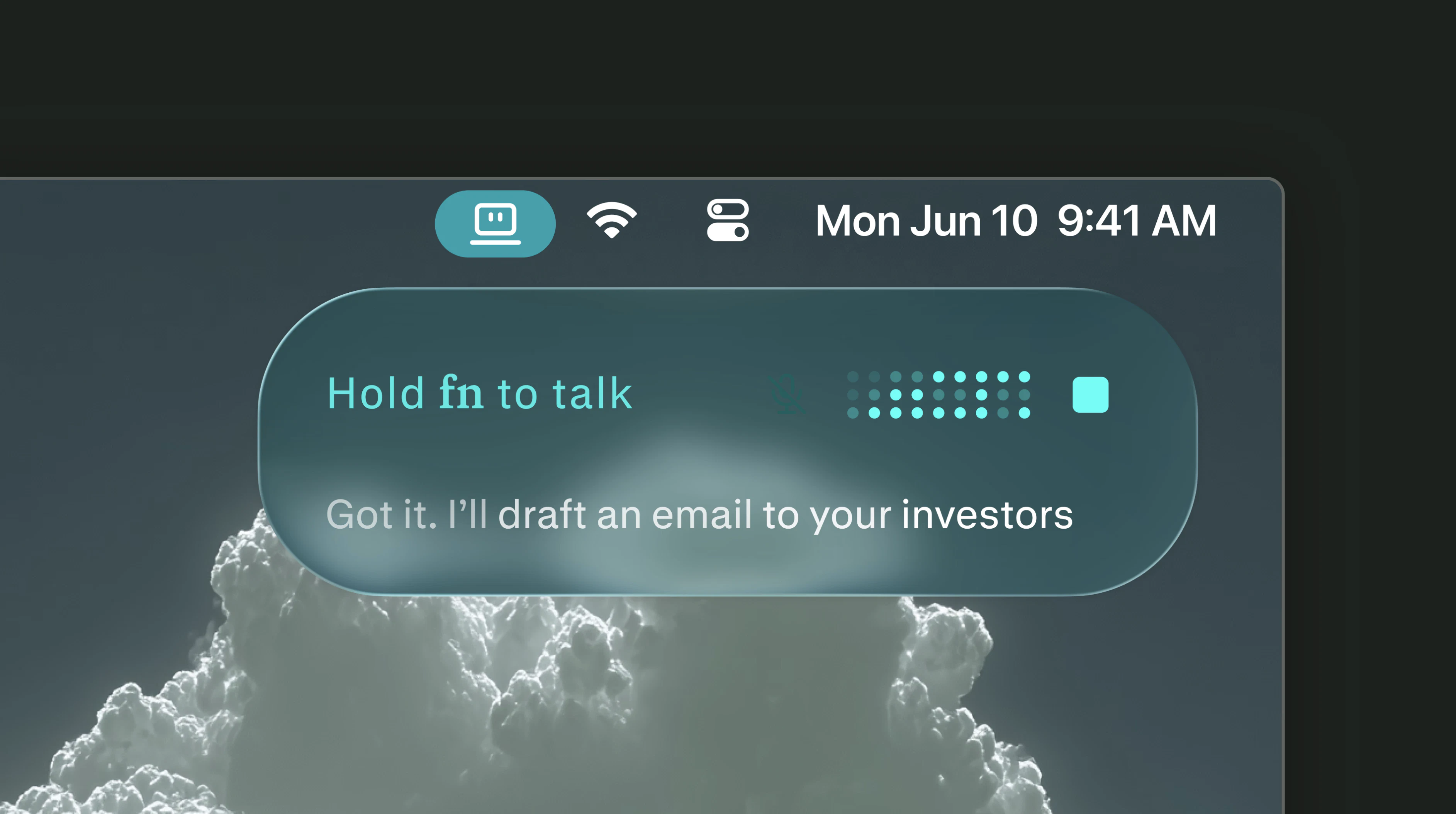
  • Voice + keyboard activation (CMD shortcut)

  • Secure sandbox with auditable, reversible actions

Who it’s for & use cases:

  • Builders, operators, and power users

  • Automating repetitive workflows

  • Managing files, tasks, and communication

  • Decision-making using local + web context

Why it matters: This is a shift from “using a computer” to managing an AI that uses the computer for you.

If you’re into the future of AI-native workflows, this is worth watching.

P.S. I hunt the latest and greatest launches in tech, SaaS and AI, follow to be notified @rohanrecommends

7
回复

@rohanrecommends How does it handle context-switching between your local files like Notion branding templates and external tools PH threads, LI comments? Say I'm prepping a "PH Hunter outreach" workflow; does it auto-summarize yesterday's forum comments + pull my personal brand playbook into one action plan?

4
回复

@rohanrecommends The local plus cloud blending is the part that actually matters here. Most AI tools live entirely in the browser and have no idea what is on your machine. Bridging that gap is where the real workflow automation unlocks.

Curious about a few things though.

How does it handle context switching between apps that do not have APIs? Like if someone asks it to pull data from a legacy desktop app or a PDF sitting locally, what does that actually look like under the hood?

The auditable and reversible actions claim is interesting. What is the scope of that? If it moves or renames files, deletes something, or sends an email on your behalf, how granular is the undo trail?

Voice activation is table stakes now but the CMD shortcut always-on approach is smart for power users. Is there a way to set boundaries on when it can act autonomously versus when it needs confirmation?

Last one. Multi-model orchestration sounds powerful on paper. In practice which models are being used for which tasks and does the user have any visibility or control over that routing?

Congrats on the launch. The category is getting crowded fast but local plus cloud done properly is still an unsolved problem for most people.

0
回复

@rohanrecommends or someone juggling content workflows across local docs, web research, and tools like Notion/Sheets; how well does it manage those hybrid tasks without constant babysitting?

3
回复

The interesting shift here isn’t voice or integrations, it’s state. If the system can remember what it was doing across files, apps, and sessions, that’s when it starts to feel like real work is moving. Stateless AI is helpful, but it doesn’t reduce ownership. How persistent is the system across sessions?

2
回复

If this is essentially an alternative to Claude Cowork - impressive how quickly you shipped it. The "agent that actually does stuff on your machine" space is heating up fast.

0
回复
#5
Avina
GTM Agents to Find and Reach Your Next Customer
179
一句话介绍:Avina是一款GTM智能体平台,通过自然语言定义目标客户与购买信号,实时追踪全网线索并自动执行个性化营销活动,解决了企业在市场进入中线索定位不准、多渠道触达流程割裂的痛点。
Sales Marketing Artificial Intelligence
智能获客平台 GTM自动化 销售线索挖掘 意图信号追踪 ABM营销 AI邮件营销 客户数据 enrichment 市场进入工具 B2B营销 实时受众刷新
用户评论摘要:用户肯定其自然语言定义、精准触发信号和实时数据能力。主要问题集中在数据新鲜度、信号时效粒度、具体信号源细节、与竞品差异点及CRM集成范围。创始人回应强调实时抓取、多数据源瀑布式查询和以信号为起点的产品哲学。
AI 锐评

Avina看似是又一个GTM自动化工具,但其真正锋芒在于对“时机”的偏执。它不满足于成为又一个批量发送引擎,而是试图重构市场进入的起点——将传统的“广撒网后过滤”模式逆转为“基于实时信号的精准围猎”。产品介绍中“Healthcare companies that had a data breach in the last 6 months”这类示例,暴露了其野心:它要捕捉的不是静态画像,而是动态的、具有明确购买意图的“时刻”。

然而,其宣称的“实时信号追踪”面临双重考验。一是技术层面,全网信号(尤其是招聘信息、财报提及)的抓取、去噪与实时解读是巨大挑战,数据新鲜度与信噪比将直接决定线索温度。二是市场教育层面,要求营销人员从“列表思维”转向“触发式思维”,定义出真正预测性强且可被监测的信号,本身就需要高阶的GTM认知。

从评论区的问答看,Avina试图通过“多数据源瀑布式查询”和集成主流去匿名化工具来构建数据壁垒,但其核心差异点或许更在于工作流闭环设计。它不像Clay等工具止步于提供“更智能的列表”,而是强行将线索发现、评分、受众刷新与多渠道触达自动化捆绑,这降低了操作复杂度,却也提高了厂商锁定风险。

值得警惕的是,将GTM完全托付给“智能体”可能导致营销动作的同质化。当所有竞品都能基于相似信号(融资、招聘、页面访问)发起攻击时,个性化邮件的“个性化”效力可能被稀释。Avina的未来,取决于其能否帮助客户发现更独特、更前瞻的微观信号,从而从“更快地响应已知模式”进化到“识别未知的购买模式”。否则,它可能只是将营销内卷提升到了一个更高效、更自动化的新层次。

查看原始信息
Avina
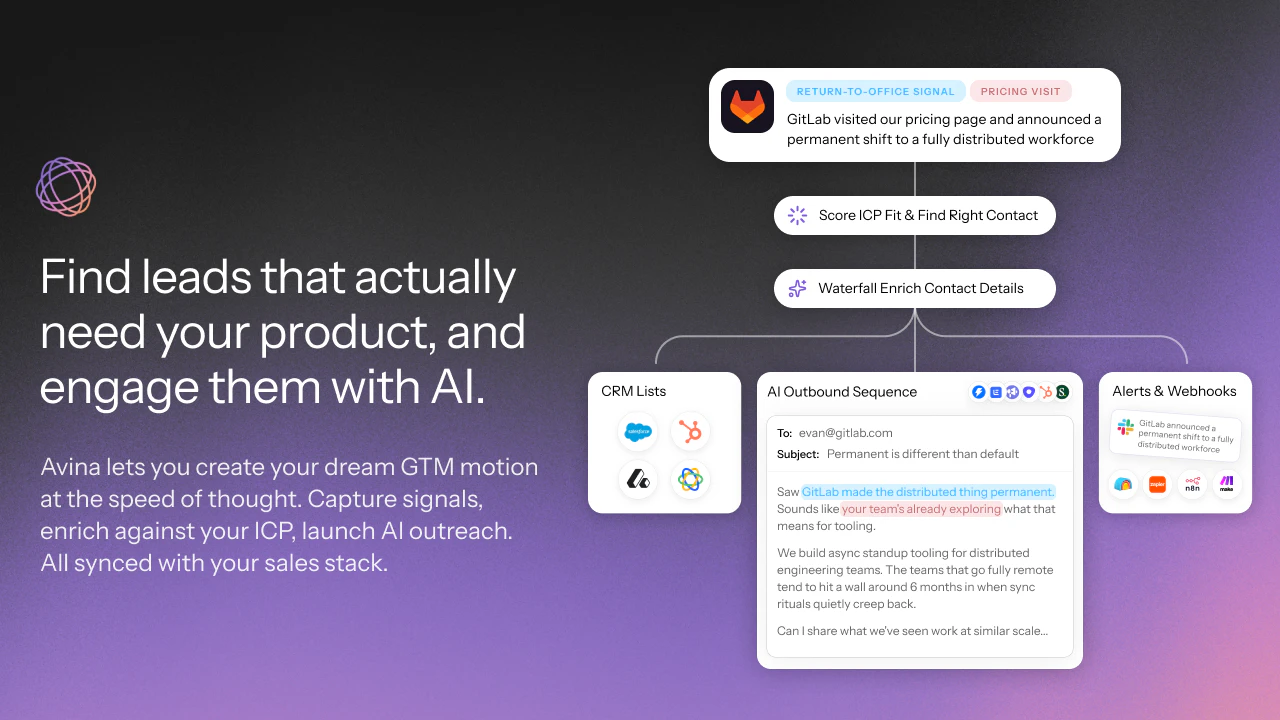
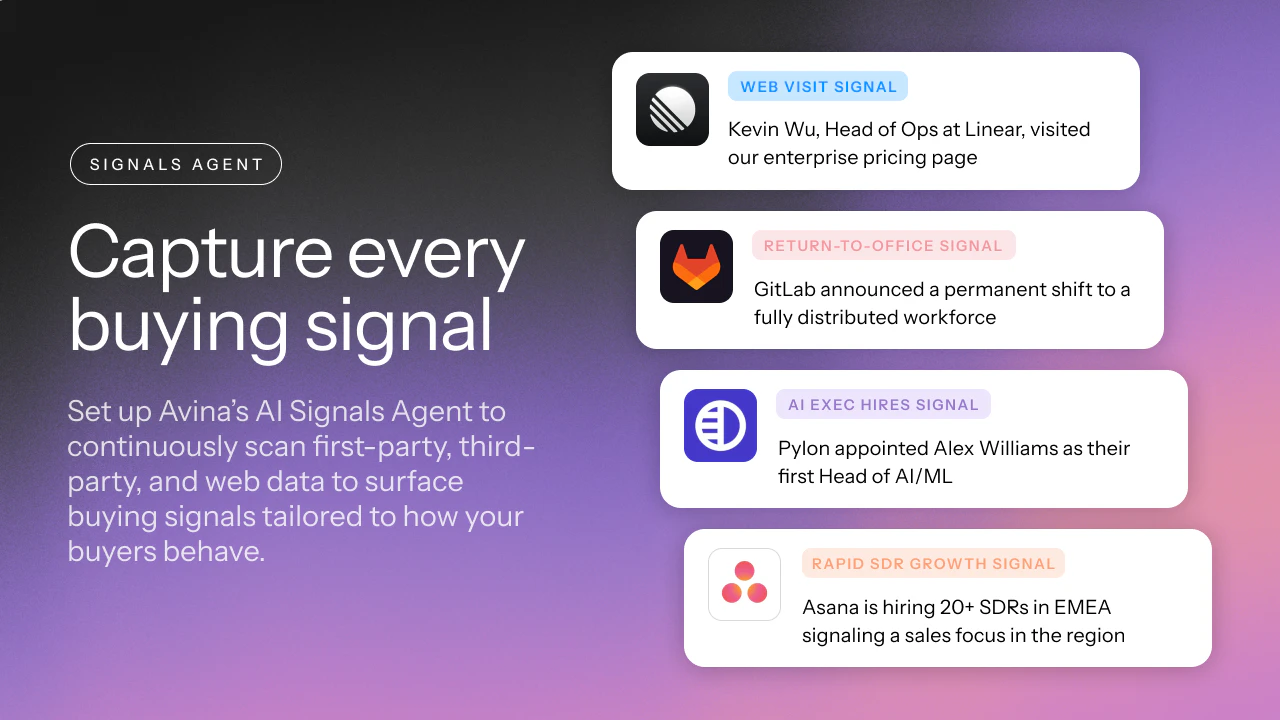
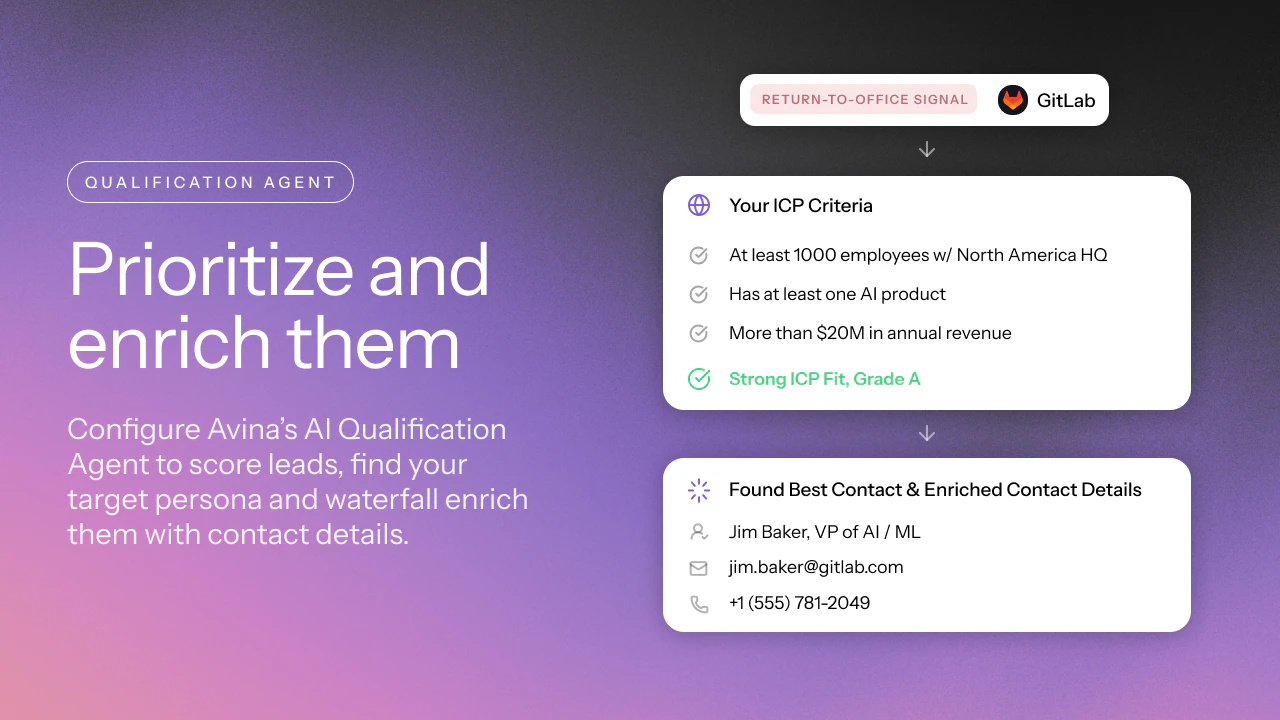
Find and reach the leads who need your product. Define your ICP and buying triggers, and Avina tracks signals across the web, LinkedIn, job posts, site visitors (RB2B, Vector, and Clearbit built in), and more. Every lead gets enriched with target contacts and scored against your ICP, then rolled into live audiences that refresh daily. Then Avina automatically runs personalized AI email and ABM campaigns, integrated with your existing tools, to reach them wherever they are.

Hey Product Hunt 👋


We’re Vivek and Mike, co-founders of Avina.

We built Avina because the bar in go-to-market keeps rising, but tools haven't kept up. Buyers ignore generic emails and poorly targeted ads, yet most prospecting and automation platforms still hand you broad lead lists and noisy "signals." Running GTM intelligently means duct-taping tools and complex workflows together yourself.

Avina does it for you. The best GTM starts when buyers actually have a reason to care, so Avina finds the right people at the right moment and helps you get in front of them wherever they are.

How it works:

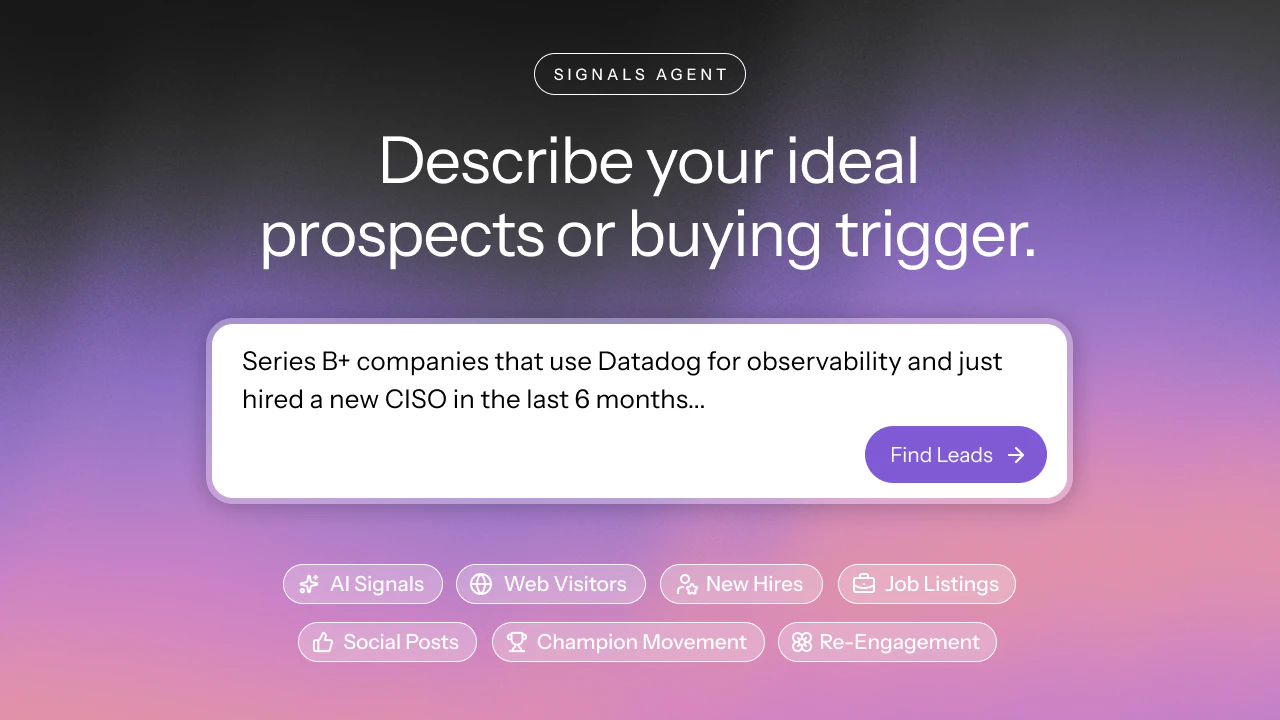
  1. Describe the kinds of leads that need your product and the triggers that suggest they're ready to buy, all in plain English.

  2. Avina finds those leads, enriches them with verified contacts, scores them against your ICP, and refreshes your audience daily.

  3. Then it gets you in front of them across personalized AI emails, hyper-targeted ad audiences, and ABM campaigns.

  4. Everything syncs back to your CRM and Slack.

A few examples you can try:

  • "Healthcare companies that had a data breach in the last 6 months"

  • "Prospects who spent 30+ seconds on our pricing page in the last 2 weeks"

  • "Insurance carriers that acquired a competitor in the last 90 days"

  • "Companies whose filings mention efficiency initiatives and are hiring ops roles"

Website de-anonymization (RB2B, Vector, Clearbit, and more) is included out of the box, so you can act on first-party intent too.


The goal:

Go from signal to warm lead to relevant outreach across every channel your buyers live on, without duct-taping ten tools together.

PH-exclusive deal:
15% off for six months

We’ll be in the comments all day and are excited to hear what you think!

23
回复

@vivek_sudarsan The plain English lead definition is the part that actually changes behavior. Most GTM tools make you learn their query syntax before you can find anyone useful. Removing that barrier alone should meaningfully improve who actually uses the product versus who churns after day three.

The trigger based targeting examples are sharp. Healthcare data breach in last six months is the kind of specificity that separates a warm outreach from noise.

One thing I am curious about - how fresh is the enrichment data in practice? Intent signals decay fast. A prospect who hit your pricing page 14 days ago is a very different conversation than one who did it yesterday. How granular does the timing get on the signal side?

Congrats on the launch. The duct tape problem in GTM is very real.

0
回复

@vivek_sudarsan incredible!!!

3
回复

Congrats on the launch! Awesome team!!

2
回复

@abhiondemand Thanks Abhi, appreciate the support!

0
回复

Congrats Vivek and Mike! I’ve used Avina at both of my last two companies and it provides such fantastic intelligence and customer buying signals.

Keep it up team!

2
回复

@evanpope Thanks Evan, appreciate the support!

1
回复

Awesome job Mike and Vivek!

As a former Product Marketer, selling NetOps tools to SecOps and vice versa, I wish we had something like Avina to help capture exactly when a network buyer persona is looking to expand into security services. Or when an IT org is going through a re org and the CISO goes from reporting to the CIO straight to the CEO.

This sort of intelligent GTM agent would have made my life a lot easier when I was a marketer. I can see a lot of MSSPs get use from this as well. It would be cool to see Win/Loss insights as well that can inform product strategy. Great stuff and congrats on the launch!

2
回复

@sidnanda Thank you! Really appreciate that. The reorg signal you mentioned (CISO reporting line moving to the CEO) is a perfect example of the kind of buying trigger that's almost impossible to catch manually but hugely predictive of expansion opportunities.

Win/Loss feeding back into product is a great idea. If you're ever up for chatting, I'd love to hear more about what you wish you'd had in your PMM days.

2
回复

Amazing! Finally we can close our Apollo subscription. For the prospectives, are they searched online in realtime, or you have a proprietary database?

2
回复

@renchu_song Real-time, mostly. We pull live from the web, news, LinkedIn, job postings, etc. for signals, then waterfall across the best contact DBs for enrichment (so you get broader coverage than any single provider). Plus native integrations with RB2B, Vector, Clearbit, and others for website visitor de-anonymization.

2
回复

Hey Avina Team,

For me as a marketer, the most important thing is understanding exactly which signals the tool can use as triggers, beyond generic and well-known signals like a company raising funding.

BR,
Oleksii

2
回复

@galbur Good callout! We offer a wide range of signal types, including standard 1st and 3rd party signals and custom AI-driven searches, including:

  • New hires

  • Job listings

  • Funding rounds

  • Social posts

  • Champion movement

  • Website visitors with contact-level de-anonymization

  • Generative AI traffic

  • Ad engagement (incl. Linkedin ad impressions and clicks)

  • Email engagement

  • Custom signals that can search across ANY publicly available web data, that you define with a single prompt, like "recently launched an AI product" or "achieved SOC 2 in the last 30 days". Other examples are above.

3
回复

Congrats on the launch, team! What was the motivation to build this app? Personal experience or a gap that you spotted in the market? What would you say your biggest differentiator is against other agentic AI GTM tools that are available?

1
回复

@peterclaridge Thanks! Honestly, Mike and I hit this problem over and over scaling our last company. No matter what tools we stacked together, what actually moved pipeline always came down to two things: timing and relevance. And it was painfully hard to identify the right leads at the right moments.

That's kind of the bet behind Avina. Huge respect for what teams like Clay and Unify have built but where we differ is that we're obsessive about the starting point: every motion kicks off with a hyper-targeted audience built around signals specific to your business, not a broad list you refine later.

From there, we run the full loop for you: monitoring those audiences in real time, enriching and scoring contacts as signals fire, and activating across the channels where your buyer actually lives (email, LinkedIn, ads).

Broader view is that GTM is bigger than sending mass emails to get replies, even though most tools still treat it that way. I think the future looks a lot more like paid than cold outbound, continuous motions that build awareness and education alongside pipeline to a targeted segment, not one-shot mass sends hoping for a meeting. That's what we're building for.

2
回复
what databases do you use to enrich the accounts/contacts? also, do you support crm integration with zoho?
0
回复

@aanchal_dahiya We waterfall many sources including Leadmagic, Hunter, Wiza, Findymail and others (many of the same ones as Clay). You can also bring your own API keys for sources like for Apollo.

Yes! Zoho is in early access, let us know if you’d like to get set up with it.

0
回复
#6
Creator OS
Stop missing comments on Instagram.
110
一句话介绍:一款为多平台内容创作者提供AI缩略图生成、视频工作流管理、品牌合作对接及数据分析的一站式平台,核心解决创作者在Instagram等平台因评论通知繁杂而错过关键互动、以及跨平台内容制作效率低下的痛点。
Productivity Social Media Marketing
创作者经济 SaaS工具 多平台管理 AI图像生成 社交媒体自动化 内容工作流 品牌合作 数据分析 效率工具 中小创作者
用户评论摘要:用户肯定其一体化解决方案的价值,主要提问聚焦于:AI缩略图功能如何保持品牌一致性及是否具备自学习能力;是否支持多账号管理;为何选择整合YouTube、Twitch和Instagram;以及评论抓取的技术实现方式(官方API还是爬虫)。建议增加自动识别评论中问题的过滤功能。
AI 锐评

Creator OS的野心在于整合创作者分散的工作流,但其核心价值定位存在模糊地带。产品试图同时解决“前端”的内容制作(AI缩略图)和“后端”的互动管理与商业化(评论管理、品牌合作),这使其面临“功能杂而不精”的典型风险。

从评论反馈看,其宣称的“All-in-One”吸引力背后,是用户对每个模块深度的质疑。AI缩略图被证实仅为“风格锚定”工具,缺乏基于性能数据的闭环优化;评论管理依赖官方API,虽合规但功能停留在基础自动化,未能解决高流量下的“信息过载”核心痛点。这暴露了其现阶段更像是一个功能拼盘,而非一个拥有颠覆性核心引擎的智能平台。

其真正机会或许在于“连接”而非“创造”。开发者回复中透露,用户多为同时运营多个平台的创作者。若能以“跨平台互动数据中枢”为切入点,深度整合各平台评论、消息与数据分析,并在此基础上构建智能工作流(如精准识别商业合作意向的评论),其价值将远高于提供一个替代Canva的缩略图工具。当前4.9美元/月的定价揭示了其目标客群是预算敏感的中小创作者,但这类用户对工具集成度的需求,是否强于对单点极致解决方案的需求,仍需市场验证。产品需尽快明确一个能形成壁垒的核心功能,否则极易被各垂直领域的专业工具所淹没。

查看原始信息
Creator OS
AI thumbnails, video pipeline, brand deals, pitch pack, analytics & integrations — the all-in-one platform for YouTube, Instagram & Twitch creators. Plans from $4.90/mo.

Congrats on the launch! This looks like a solid all-in-one solution for creators juggling multiple platforms. I'm curious about the AI thumbnail generation - how does it handle brand consistency across a creator's channel? Does it learn from past thumbnails that performed well, or is it more of a one-off generation tool? Would love to hear how creators are using it in practice.

1
回复

@osakasaul Thanks! and the honest answer is: today it’s closer to a consistency-aware generation tool than a fully self-learning system.

We already help creators keep thumbnails on-brand in two main ways. First, you can feed the system a reference thumbnail or YouTube URL, and it extracts the visual “DNA”, things like palette, layout, text placement, and overall energy then uses that as the style anchor for the new generation. Second, creators can save a default face/reference image, so their identity stays visually consistent across outputs.

We also keep generation history and make it easy to reuse or iterate on past concepts, which is how a lot of creators are using it in practice right now: reference a thumbnail that fits the channel, keep the face/identity consistent, then generate faster variations without starting from scratch.

What it does not do yet is automatically learn from your top-performing thumbnails and optimize future generations from CTR data on its own. That’s a direction we’re interested in, but I wouldn’t describe the current product as a closed-loop “self-learning” thumbnail system yet.

1
回复

feeding a reference URL to extract visual DNA instead of describing a style from scratch. that's the part I've been doing manually for too long.

0
回复

The problem is real. Comment windows on Instagram are tiny and the algorithm rewards early engagement heavily. Does this work across multiple accounts or is it tied to one?

0
回复

@prashant_1234 Yes! It's excellent for engagement and marketing! Currently, we don't have the option to connect multiple accounts!! But that's a matter of infrastructure; I hope to have the capacity to connect multiple accounts soon!

And thank you so much for your support ❤️

0
回复

Why did you decide on YT, Twitch and esp Instagram? I think that YT and Twitch are the same category, but whatIG?

0
回复

@busmark_w_nika My focus was solely on YouTubers! But Twitch was easy to integrate, so implementing it was cost-effective!

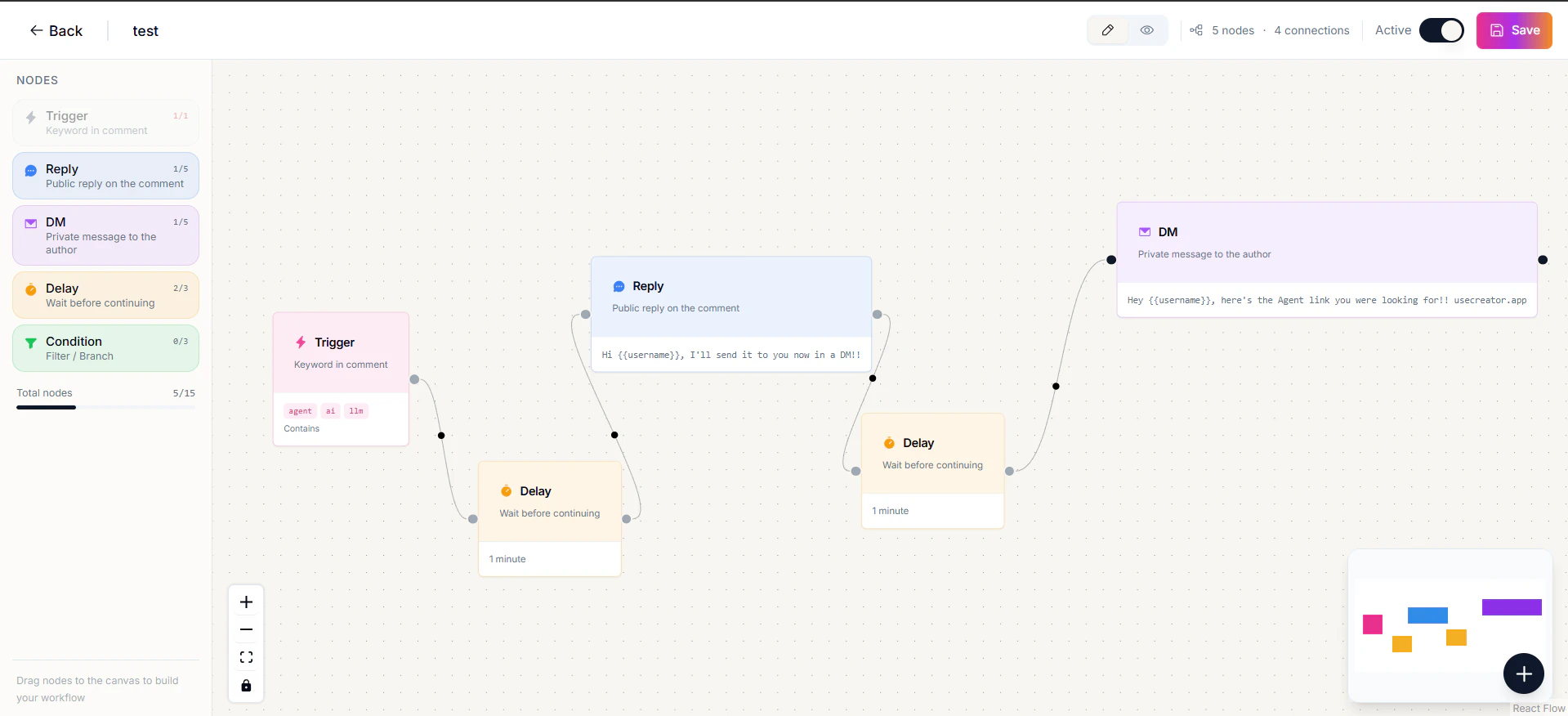
Regarding Instagram, I noticed that many creators still create pitches in Canvas, and they also struggle with automations, such as sending links, etc., via DMs based on a Reel comment! Today, many want this type of automation, but end up wanting to create it themselves, and there's this Metacritic bureaucracy. I created something simple that only requires one click; just connect two automation nodes and you're done! A good portion of Instagram creators are also on YouTube. Today, in the system, all three options are optional! You connect the one you find best for your pipeline and your daily routine.

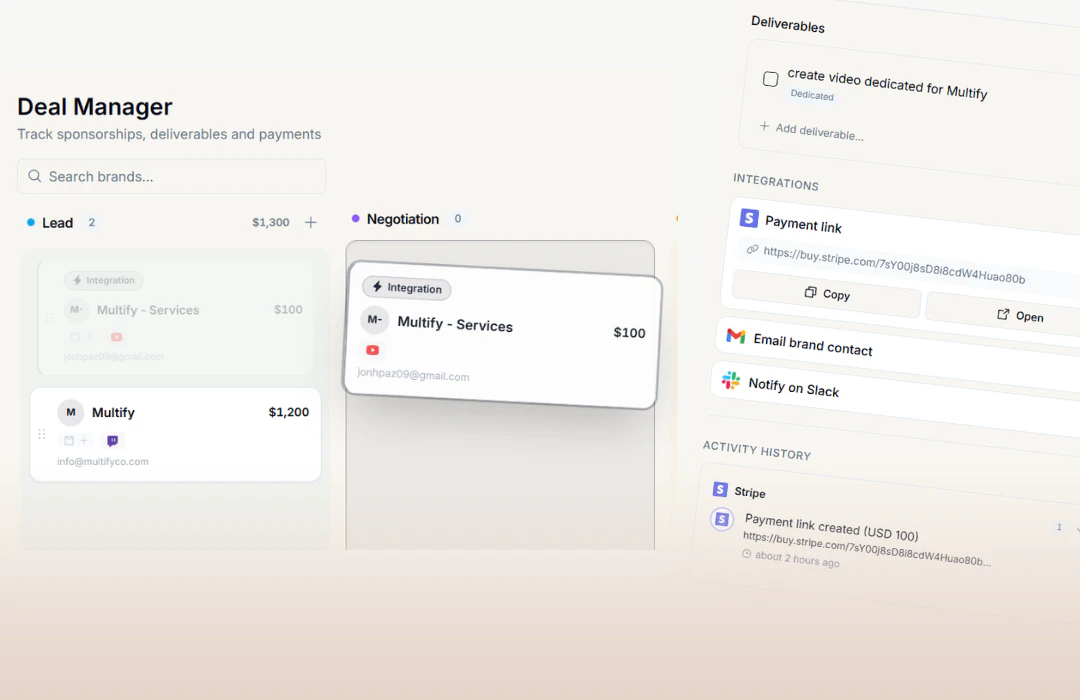
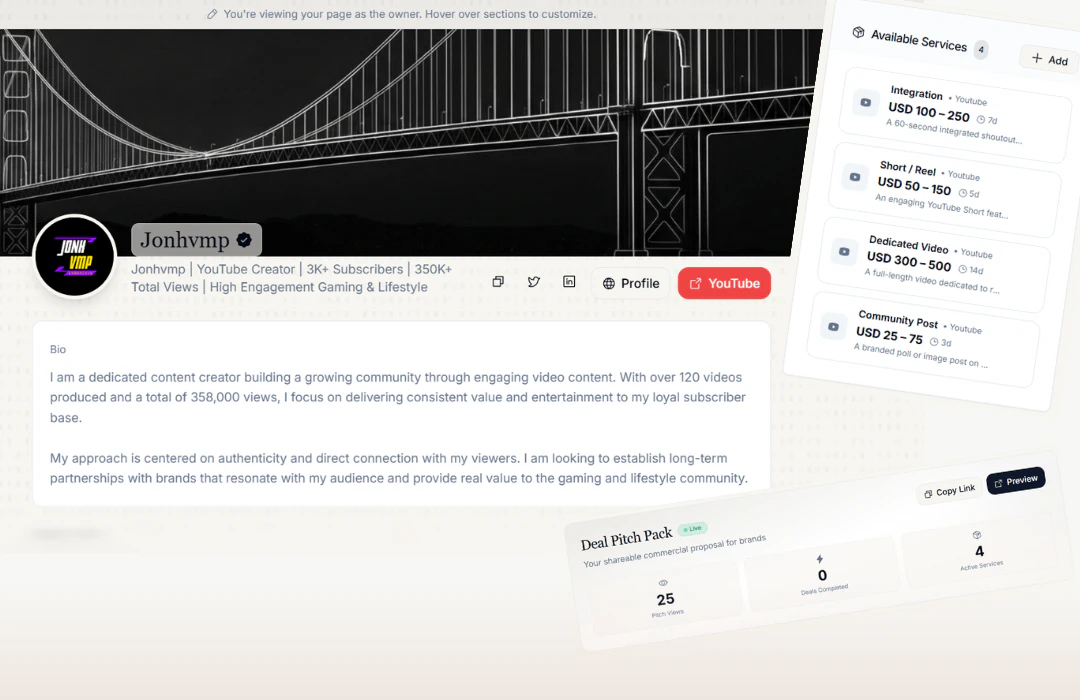
Today, our clients can create dedicated pitch pages for companies to hire their services, and the creator can create payment links, etc., without even leaving the system! And the page will always remain updated with real data.

0
回复

The native Instagram notification feed becomes impossible to manage once a reel gets any real traction. I wonder if you are relying on the official Graph API to pull these in real-time or if you had to build a custom scraper. An automated filter that specifically surfaces comments containing questions would make this a total no-brainer.

0
回复

@y_taka Great question. The honest answer is: we’re using the official Instagram/Meta stack, not a custom scraper.

Real-time events come in through Meta webhooks, and we supplement that with Graph API syncs for profile, media, and insights. So under the hood it’s closer to an official event-driven integration than a scraping-based workaround.

That said, I wouldn’t describe the current product as a full replacement for Instagram’s native comment notification feed yet. Right now, the strongest part of the system is automation around incoming comments and DMs, rather than a dedicated high-volume comment triage workspace.

On the “surface comments that contain questions” idea: I agree that would make the product much stronger. Today the filtering is more rule-based than semantic. We can match keywords and run workflow conditions on comment text, but there isn’t a first-class “question detection” layer yet. It’s a very logical next step, though, because the event pipeline is already there.

0
回复
#7
Tell
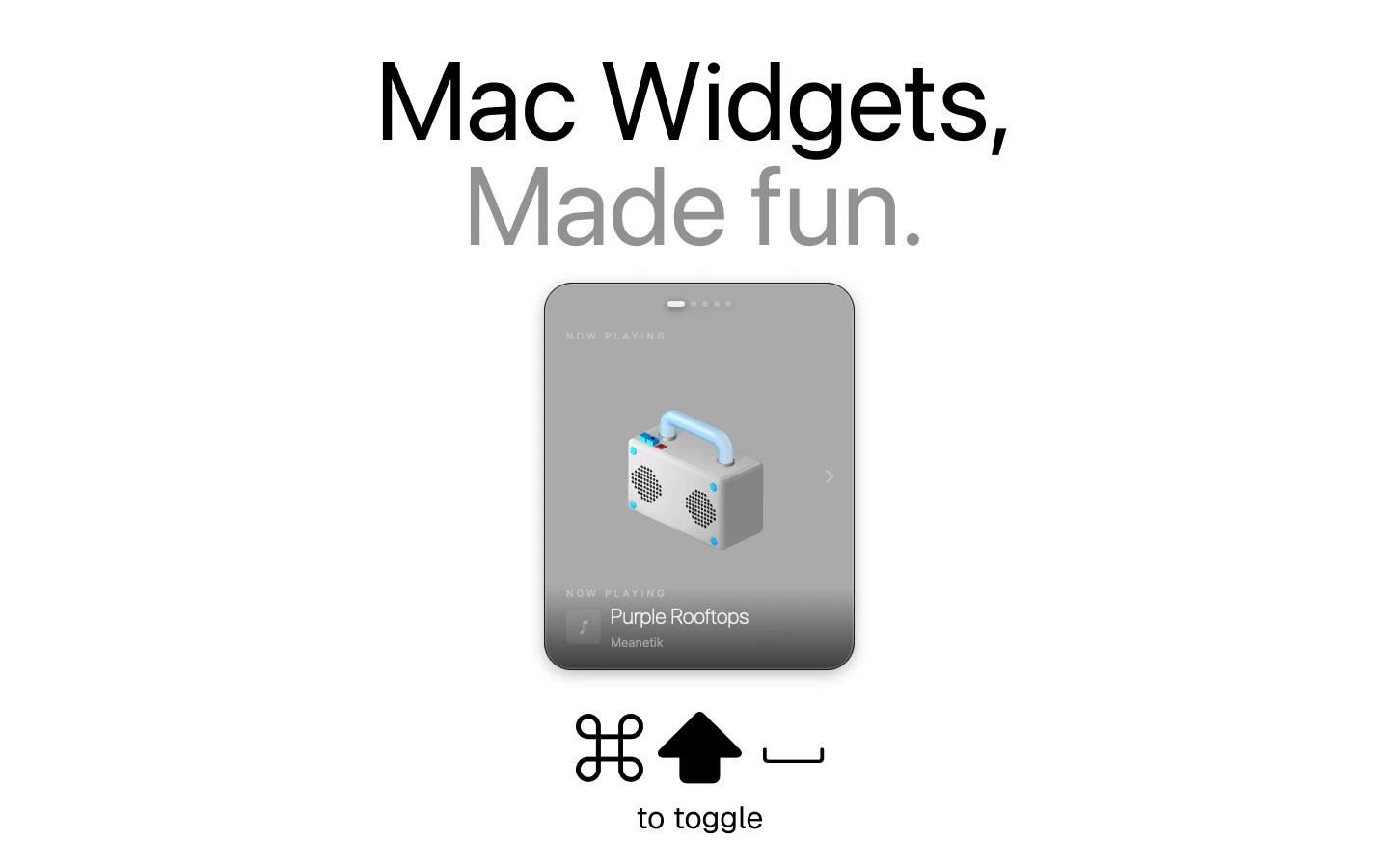
Mac widgets, made fun.
107
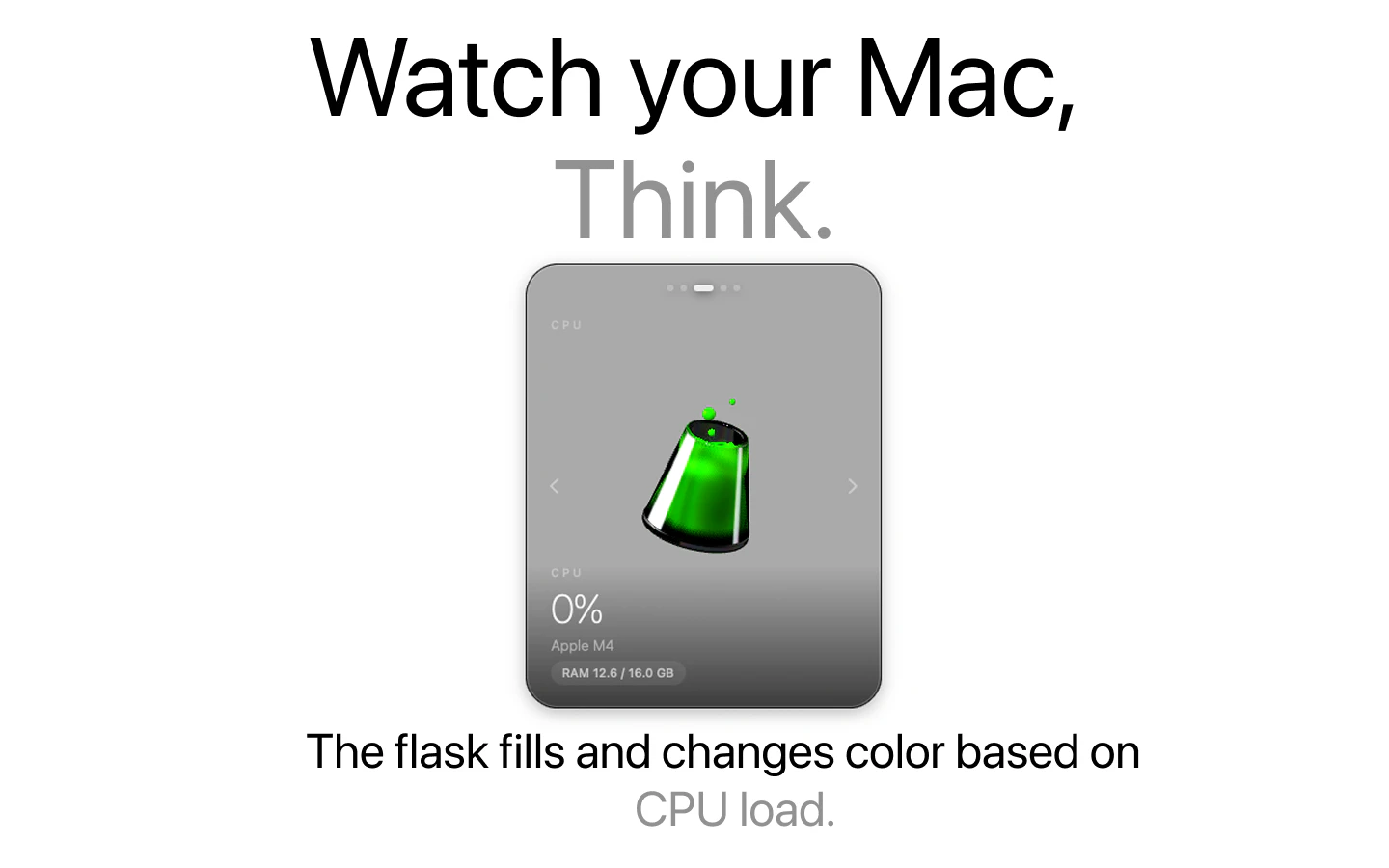
一句话介绍:一款将Mac系统性能数据(如CPU、网络、电池)转化为桌面交互式3D动画对象的原生应用,在用户需要直观、愉悦地监控系统状态时,解决了传统监控工具界面枯燥、缺乏视觉吸引力的痛点。
Menu Bar Apps Apple 3D Modeling
macOS应用 系统监控 桌面美化 3D可视化 交互式组件 动态桌面 性能管理 创意工具
用户评论摘要:用户普遍赞赏其创意和趣味性。主要反馈集中在性能影响担忧上,开发者回应已重点优化,力求轻量。另有用户期待更多主题和对象。
AI 锐评

Tell的核心理念是“功能装饰化”,它试图在工具理性与感官体验之间架设一座桥梁。其真正价值并非提供了更强大的系统监控能力——传统命令行或扁平化小组件在数据密度和效率上可能更胜一筹——而在于将冰冷的后台数据流,转化为一种具有审美愉悦和情感连接的“桌面景观”。

产品标语“Mac widgets, made fun”精准地揭示了其颠覆逻辑:它不追求功能的堆砌,而是致力于体验的重塑。在效率工具普遍追求“隐形”和“零打扰”的当下,Tell反其道而行之,让监控本身成为可被注视、甚至可被把玩的焦点。这种设计哲学,与其说是在解决“监控不便”的痛点,不如说是在回应“数字环境情感匮乏”的更深层需求。用户与电脑的关系,因此从单向度的使用,增添了一丝双向的、拟人化的互动。

然而,其最大的潜在悖论也蕴含于此:一款以可视化系统资源消耗为己任的工具,其自身必然也是资源的消耗者。尽管开发者强调轻量化,但3D渲染的固有开销使其难以真正“隐形”。这要求产品必须在视觉魅力与系统负担之间找到极其精妙的平衡,否则便会陷入“监控工具本身成为需被监控的问题”的讽刺境地。

从市场角度看,Tell巧妙地卡位在一个细分缝隙:它比纯粹的美化软件更“有用”,又比专业的监控工具更“有趣”。其发展路径的关键在于,能否将这种“玩具属性”深化为可持续的“工具属性”。开发者提及的“更深入的系统模块”是正确方向,但必须确保核心的轻盈感不被破坏。如果成功,它或许能开创一个“情感化系统工具”的新微小品类;若失败,则可能仅是一次炫技般的玩物,在新鲜感褪去后迅速被遗忘。

查看原始信息
Tell
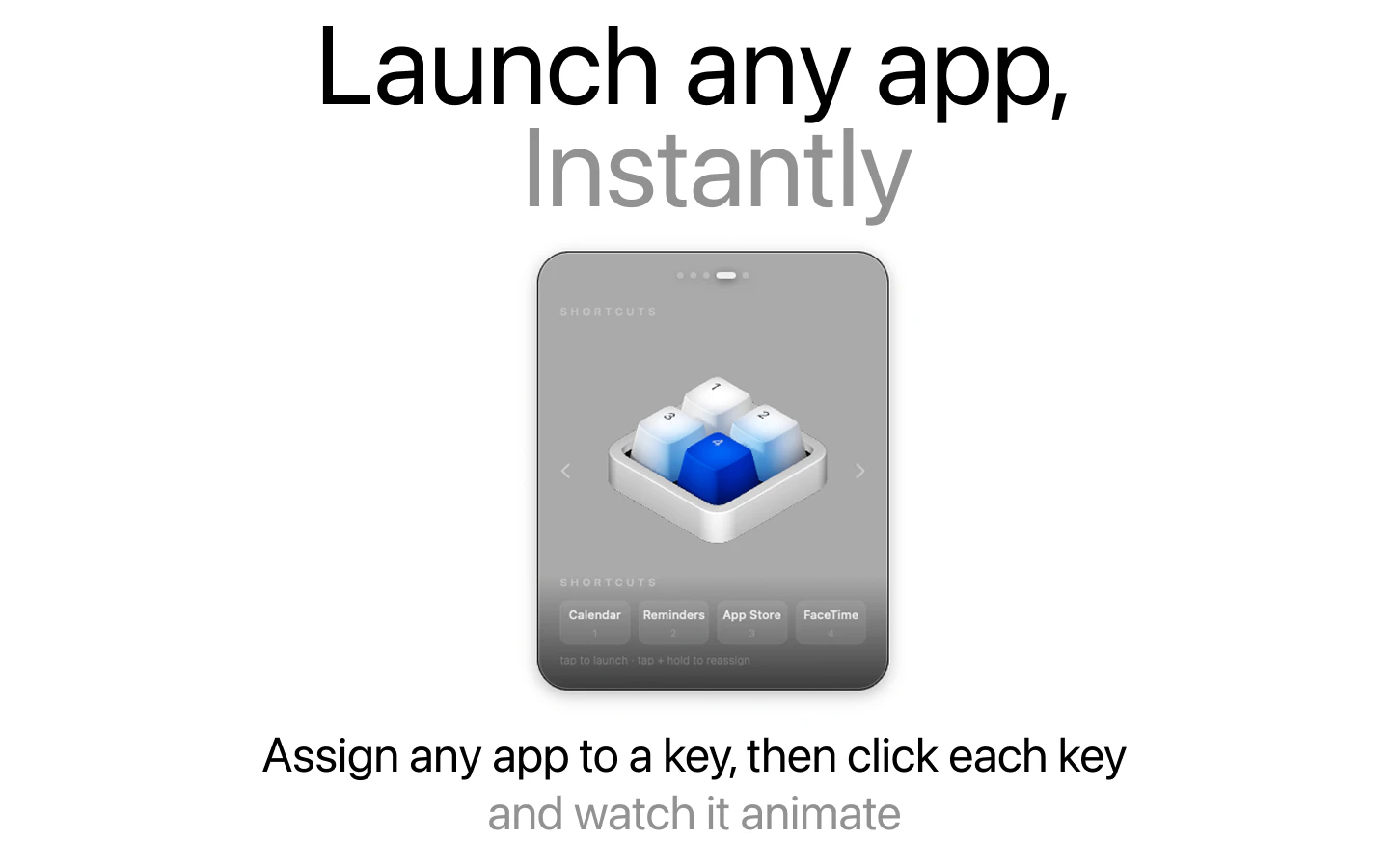
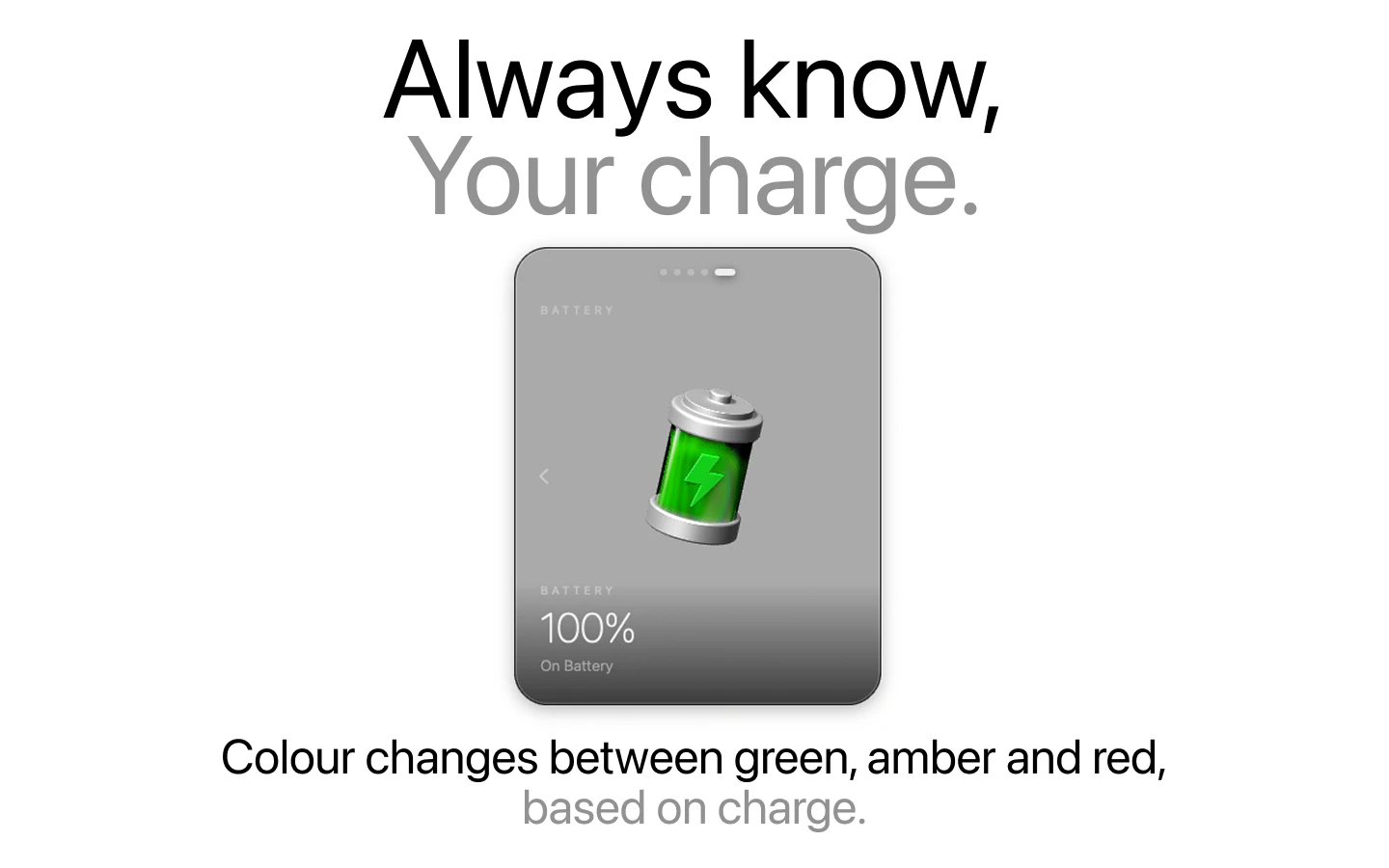
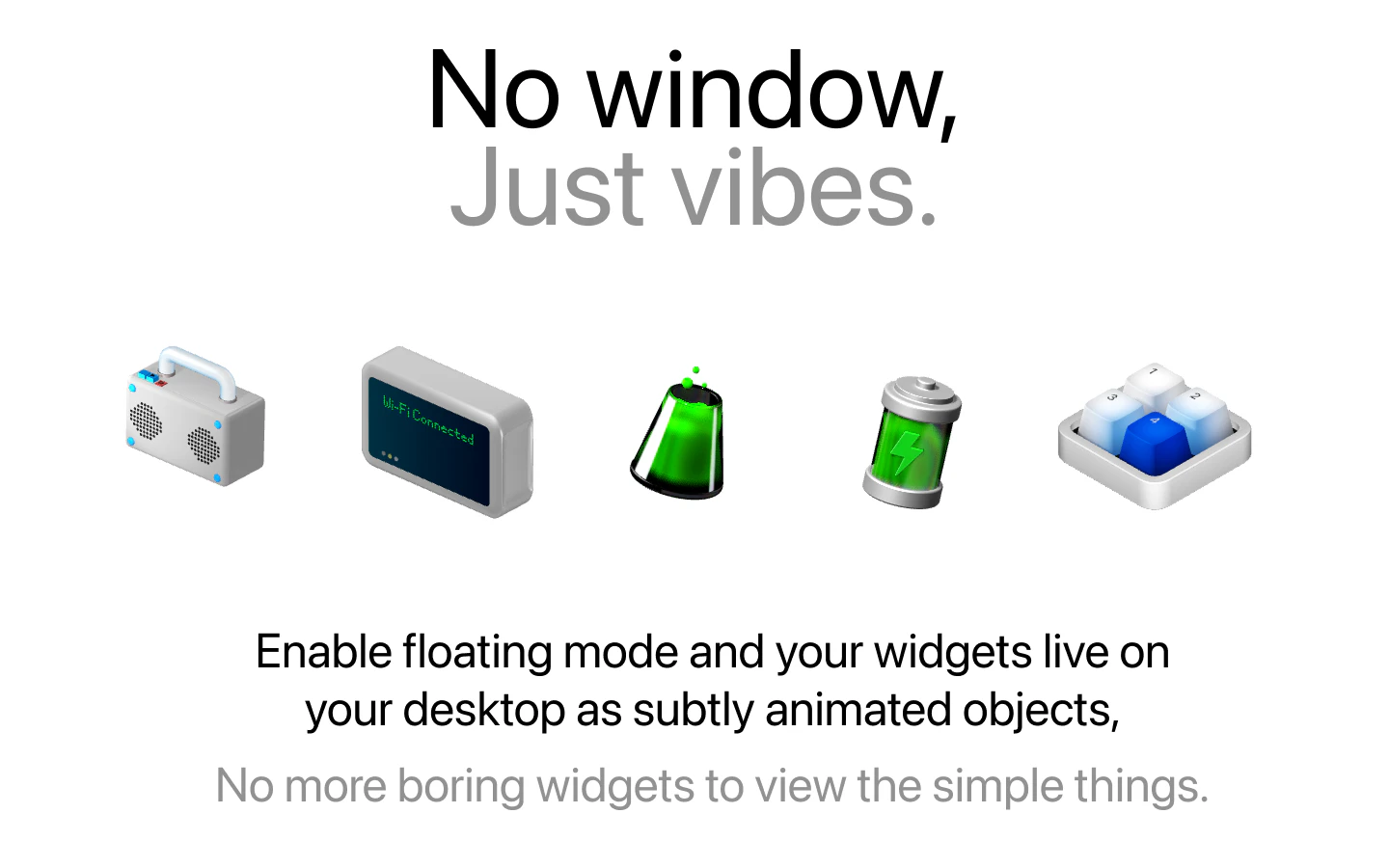
Native macOS app that transforms system stats into interactive 3D objects. Monitor network speed, CPU usage, battery, and more through smooth, animated visuals that live on your desktop. Designed to feel fast, minimal, and alive - not like traditional widgets. More collections, animated objects, and new system modules for deeper insights are already in development and coming soon
Hey everyone - I’m the maker of Tell. I’ve always been into 3D design and interactive visuals, and for the longest time I wished my desktop felt a bit more… alive. Everything felt flat, static, and honestly a bit boring. I wanted something that looked and felt cool, but was also actually useful day-to-day. So I built Tell - a way to turn system data like CPU, network, and battery into interactive 3D objects that just sit on your desktop and move with you. This is just the beginning. I’m already working on new object collections, themes, and more expressive ways to visualize different parts of your system. I want this to feel less like “widgets” and more like a living layer on your Mac. Would genuinely love your feedback - what you like, what you don’t, and what you’d want to see next 🙏
2
回复

@will_gee1, another super-cool addition to the digital space like @CC-BEEPER . Great work, Will! I love it when the ordinary is transformed into something a little bit more fun ;).

0
回复

Hehehe love this kind of widgets that makes our work funnier! It's a matter of enjoying the journey as well. Wish you all the best Will

0
回复

@german_merlo1 Thank you sir! Not all the boring things to look at should be boring!

0
回复

Congrats on the launch! This is such a fresh take on system monitoring - the 3D object approach is genuinely delightful. I'm curious about performance impact: since these are animated visualizations running on the desktop, how optimized is Tell to avoid becoming a resource hog itself? Do you have any benchmarks on CPU/memory usage?

0
回复

@osakasaul Appreciate it Saul, means a lot 🙏

Performance was something I focused on a lot while building this. It’s designed to stay lightweight - it’s not constantly doing heavy work, just checking system stats at intervals and updating the visuals smoothly.

In normal use CPU and memory stay pretty minimal, and if it’s hidden or not active on the desktop it’s basically idle.

Still refining and optimizing it as I go, but the goal is for it to feel smooth without becoming part of the problem it’s visualising.

0
回复
#8
Paperweight
Cleanup your email and manage your digital footprint
103
一句话介绍:Paperweight通过扫描用户收件箱,映射并管理其数字足迹,在用户面临账户遗忘、安全风险及隐私暴露的场景下,提供批量注销、违规警报等功能,帮助用户一键清理邮箱并掌控个人数据。
Email Open Source Privacy GitHub
数字足迹管理 邮箱清理 隐私安全 账户注销 开源工具 本地化处理 GDPR合规 数据删除 订阅管理 安全防护
用户评论摘要:目前仅有一条有效评论,用户询问产品是否能实际删除账户,或仅负责发现账户。这反映出用户对工具能否完成从“发现”到“执行”的全流程自动化操作存在核心关切。
AI 锐评

Paperweight切入了一个真实且日益严峻的痛点:数字足迹的失控。其核心价值并非简单的“邮箱清理”,而是试图成为个人数据资产的“清点与处置”平台。将扫描范围限定于本地收件箱,并标榜“隐私优先”和开源,是其在信任缺失市场中的明智策略,旨在以技术透明性换取用户对敏感数据处理的授权。

然而,其模式存在深层矛盾与挑战。首先,依赖邮箱扫描的“账户清单”必然不完整,大量不通过邮箱注册或使用单点登录的服务无法被覆盖,其“数字地图”从诞生起就存在盲区。其次,也是最关键的,是“执行权”问题。正如唯一评论所尖锐指出的,它能否真正“删除”账户?从技术现实看,自动完成跨平台账户注销几乎不可能,这涉及各网站各异的流程、验证、二次确认甚至人工客服。工具更可能止步于提供链接与指引,将最繁琐、最不可控的人工操作抛回用户。这使其价值从“自动化解决方案”降维为“可视化仪表盘”。

真正的壁垒与未来价值,或许在于其“本地化”架构。若能在此基础上,发展出标准化的、用户授权的自动化交互协议(如与密码管理器联动),或成为聚合用户数据权利请求(如GDPR删除权)的中介,才可能触及更深的护城河。目前来看,Paperweight是一个出色的“意识唤醒”工具,但离成为数字足迹的“终结者”还有很远的路要走。它的成功,将不取决于技术多么炫酷,而在于能否将混乱的现实世界规则,封装成用户可一键完成的简单操作。

查看原始信息
Paperweight
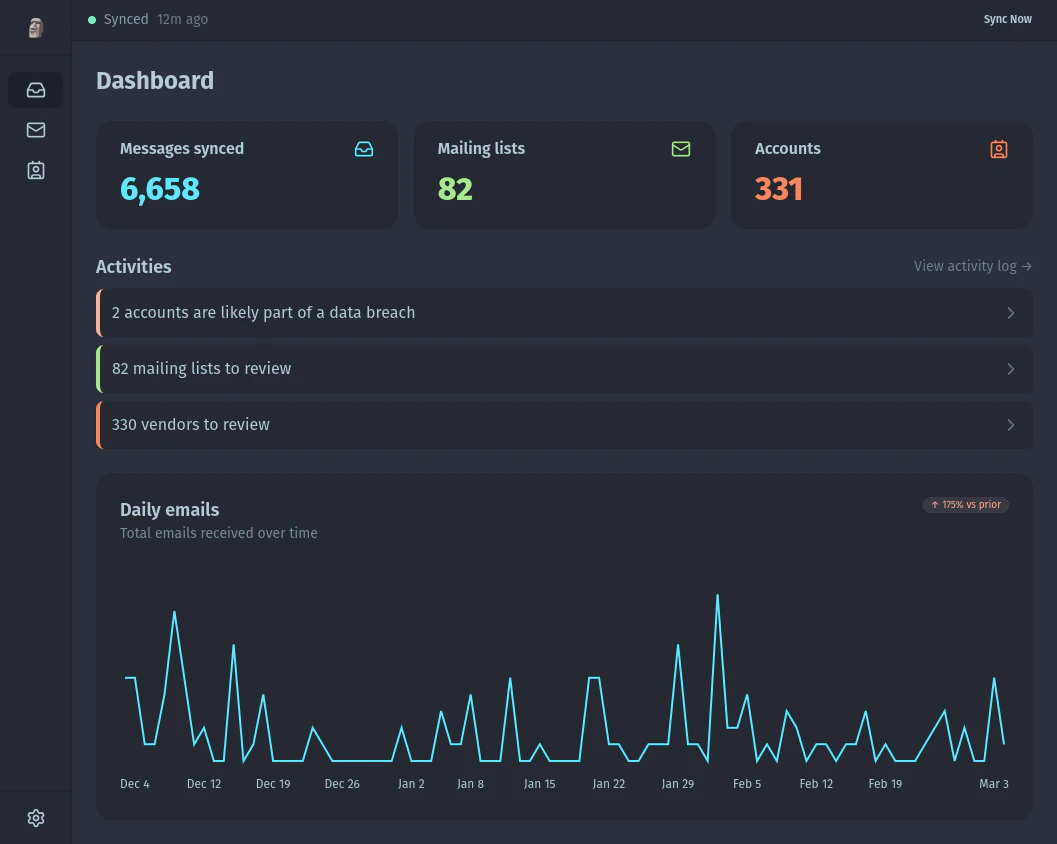
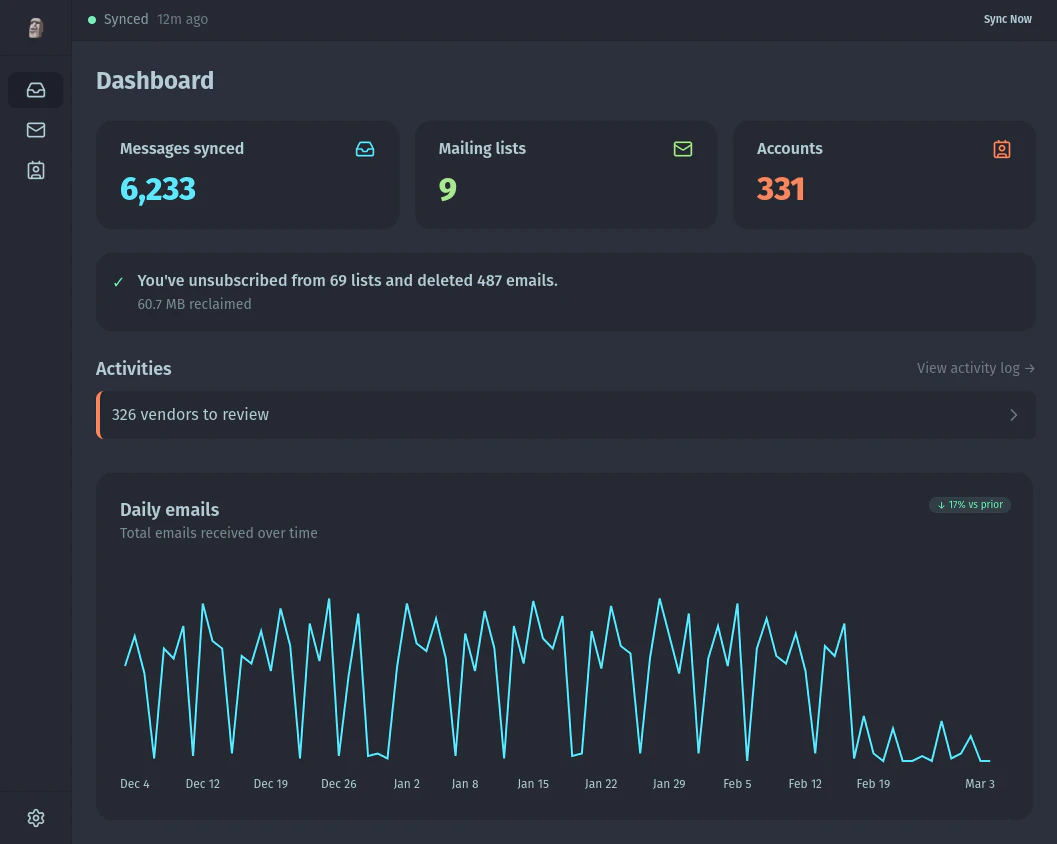
Every account you create, every service you sign up for, every online purchase is connected to your email address. Most people have 100+ accounts they've forgotten about, creating security risks and privacy exposure. Paperweight scans your inbox to map your digital footprint, then helps you take back control and delete your data. Features - Bulk Unsubscribe - Breach Alerts - Account Inventory - GDPR Deletion - Privacy-First - Open Source Respects your privacy. All data stays on your computer.

Does it actually delete accounts for you or just surface them? Great tool btw!

0
回复
#9
Nibbo
Family hub with a 3D pet that grows as you get things done
91
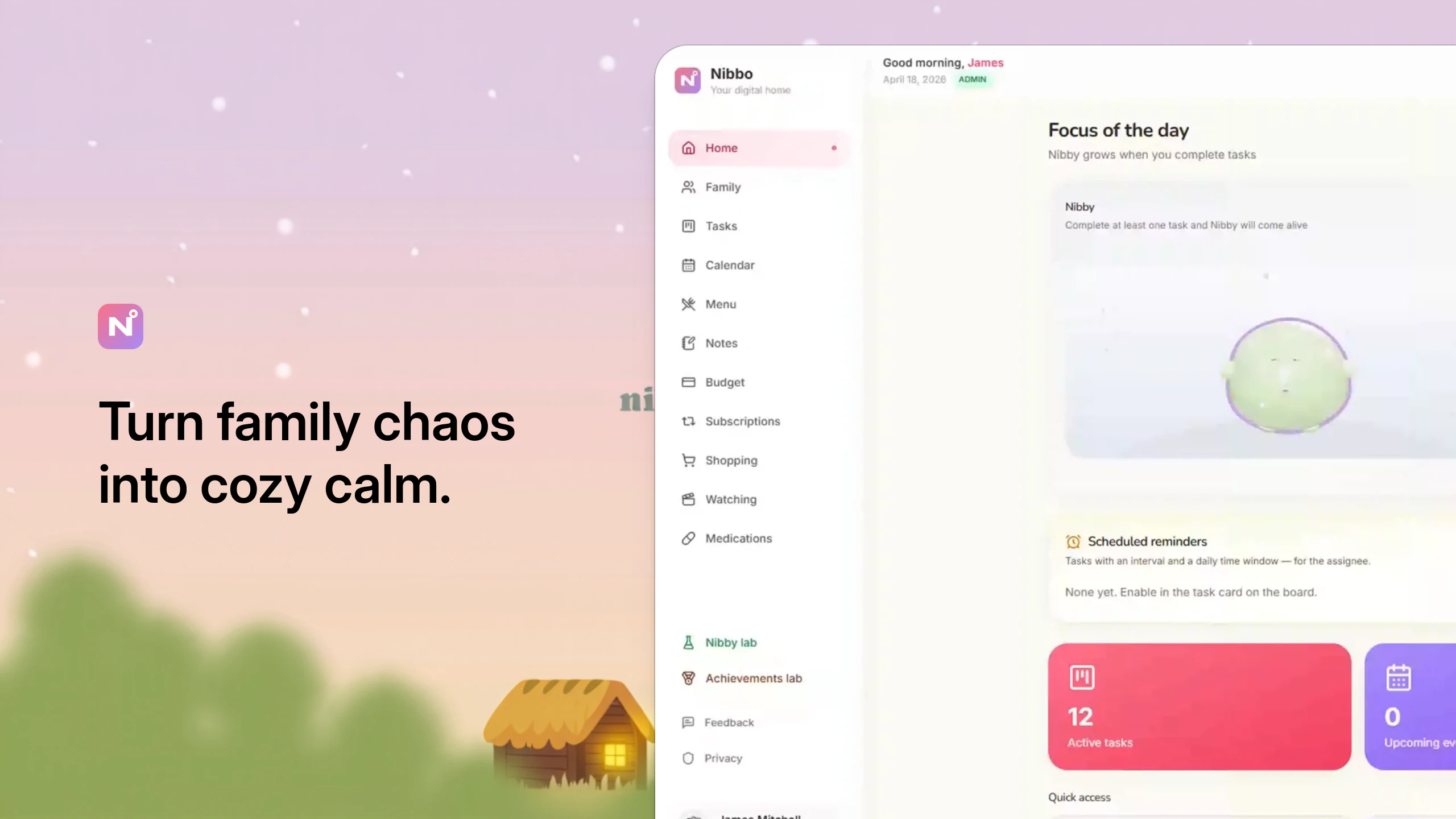
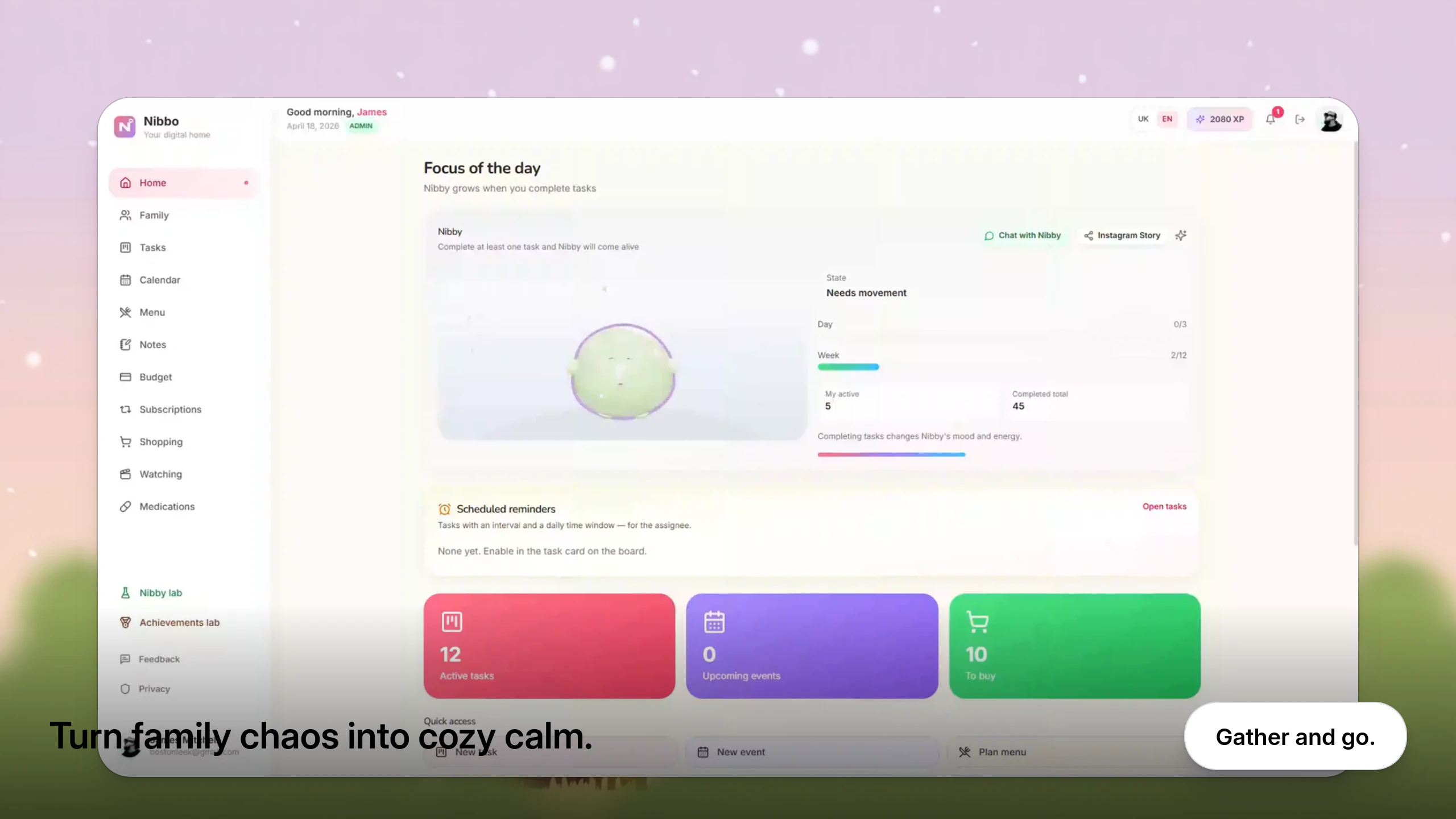
一句话介绍:Nibbo是一款集任务、日历、膳食计划、购物清单和预算功能于一体的家庭协作中心,通过一个独特的3D宠物角色“Nibby”将家庭互动游戏化,旨在解决多人群聊沟通混乱、责任不清、动力不足的痛点,为家庭提供一个有序且有趣的共享空间。
Productivity Task Management GitHub Family
家庭协作 任务管理 家庭日历 膳食计划 共享购物清单 家庭预算 游戏化 3D宠物 生产力工具 免费应用
用户评论摘要:用户主要反馈集中在产品理念和具体功能细节上。创始人自述开发初衷并获得祝贺,有用户认为3D宠物很可爱。唯一有效的提问是关于预算功能如何具体处理共同开销的分摊(如 groceries 或外出就餐),这指向了核心协作功能的实际落地需求。
AI 锐评

Nibbo的叙事充满了温情与精准的痛点捕捉——“由一位单身父亲为自家打造”的故事极具感染力,直指现代家庭在数字化协作中的普遍困境:信息散落于多个群聊,责任模糊,缺乏持续参与的粘性。其真正的创新与风险,都押注在“Nibby”这个3D宠物身上。

它将工具属性(任务、日历、预算)与游戏化机制进行了深度捆绑,试图用情感化互动(宠物成长、反应)替代令人反感的“唠叨式”督促。这种设计在理论上颇具巧思,尤其针对有孩子的家庭,可能有效提升儿童参与家务的积极性。然而,其核心挑战在于“游戏化”的长期有效性。宠物互动的新鲜感能维持多久?当成长体系触及天花板,或家庭活动进入平淡期,Nibby是否会沦为另一个需要被“管理”的静态图标?这考验着开发团队后续的内容更新与互动设计深度。

从产品架构看,它试图成为家庭的“操作系统”,但每个垂直功能(如专业预算、复杂日历)都可能面临单一功能应用的竞争。其最大优势在于“整合”与“氛围”,将工具理性包裹在情感体验之中。用户关于“如何分摊费用”的提问,恰恰揭示了从美好概念到严谨功能落地的关键一步。家庭财务的透明与公平是敏感地带,处理不当会直接破坏其倡导的“和谐”氛围。

总而言之,Nibbo是一款理念先行、设计感突出的产品。它能否成功,不在于功能列表是否齐全,而在于“Nibby”这个数字生命能否真正融入家庭情感,成为不可或缺的“数字家庭成员”,而非一时新鲜的电子玩具。其“完全免费”的模式,在为初期增长扫清障碍的同时,也为未来的可持续性蒙上了一层问号。

查看原始信息
Nibbo
Nibbo replaces the family group chat chaos with one calm space — tasks, calendar, meal planning, shopping lists, and budgeting, all shared. At the heart of it is Nibby: a living 3D mascot unique to your family, generated from your activity DNA. It reacts to what you do, earns XP, and keeps everyone gently motivated — without the nagging. Kids and adults share the same plan. Responsibilities are clear. Cozy time goes up. 100% free. Built by a solo dad, for his own family — now shared with yours.
Hey Product Hunt! 👋 I built Nibbo for my own family — we kept drowning in group chats trying to coordinate meals, tasks, and shopping. Nothing stuck. So I built one calm space for all of it: tasks, calendar, menus, budgets, shopping lists. And to make it actually fun, I added Nibby — a procedurally generated 3D pet that's unique to your family and reacts to how engaged everyone is. It's completely free. No catch. I'm a solo dev and this started as a personal project — now I want to share it with other families. Would love early feedback: what's the one thing your family always drops the ball on? That's what I want to fix next. 🏠
1
回复

@bostonleek Congratulations. How does the budget tracker handle shared costs, like splitting a grocery run or dinner out?

2
回复
Nibby is so cute!
0
回复
#10
Fixa.dev
A cloud-native AI agent that can build literally anything
90
一句话介绍:一款在云端开发环境中自主研究、编码和部署的AI智能体,解决了开发者在构建真实、生产级软件时面临的工具链复杂和环境配置繁琐的核心痛点。
Developer Tools Artificial Intelligence Vibe coding
AI编程助手 云端开发环境 自主智能体 全栈开发 生产就绪代码 自动化部署 MCP集成 无代码/低代码 Agentic AI Web开发
用户评论摘要:用户肯定其云端部署和强大自主性,但主要关切点集中在安全性(依赖包审查、代码漏洞)和实际应用风险(AI自主决策可能带来的长期技术债务),并询问了与私有代码库集成的具体方式。
AI 锐评

Fixa.dev所标榜的“构建一切”的云原生AI智能体,其真正价值并非取代工程师,而是将软件开发的基础设施和初始工作流进行了极致的“服务化”封装。它本质上是一个搭载了前沿模型、具备浏览器和命令行权限的“云端数字劳工”,其突破点在于将Claude Code等智能编码副驾驶的“建议”能力,升级为在隔离沙盒中直接“执行”的能力。

这种从“顾问”到“执行者”的跃迁,带来了巨大的便利性,也埋下了更深的隐患。产品最大的卖点——自主浏览、安装依赖、编写生产代码——恰恰是它最危险的阿喀琉斯之踵。创始人对安全问题的回应(“可以提示它做安全审计”)暴露了当前Agent范式的核心缺陷:责任主体的模糊。将安全审查寄托于对同一个不可控AI的“提示”,是一种逻辑悖论。它把需要严谨判断和经验的技术决策(如依赖选择、架构模式),交给了缺乏长期项目维护视角的统计模型。

其真正的用武之地,可能并非从零构建核心业务系统,而是作为超级加速器,用于快速原型验证、搭建演示项目、或处理那些定义清晰、边界明确的“标准化”开发任务(如配置支付、连接特定SaaS)。它所集成的Stripe、Vercel等一键部署,恰恰说明了其定位:服务于高度依赖现代云服务生态、追求上线速度的敏捷场景。然而,对于需要深度设计、可持续维护的复杂工程,赋予AI过高的自主权,无异于在技术栈中引入了一个无法问责且变化无常的“黑盒”架构师。Fixa.dev展示了AI融入开发工作流的激动人心的未来形态,但也提前预演了随之而来的技术伦理与工程管理挑战。

查看原始信息
Fixa.dev
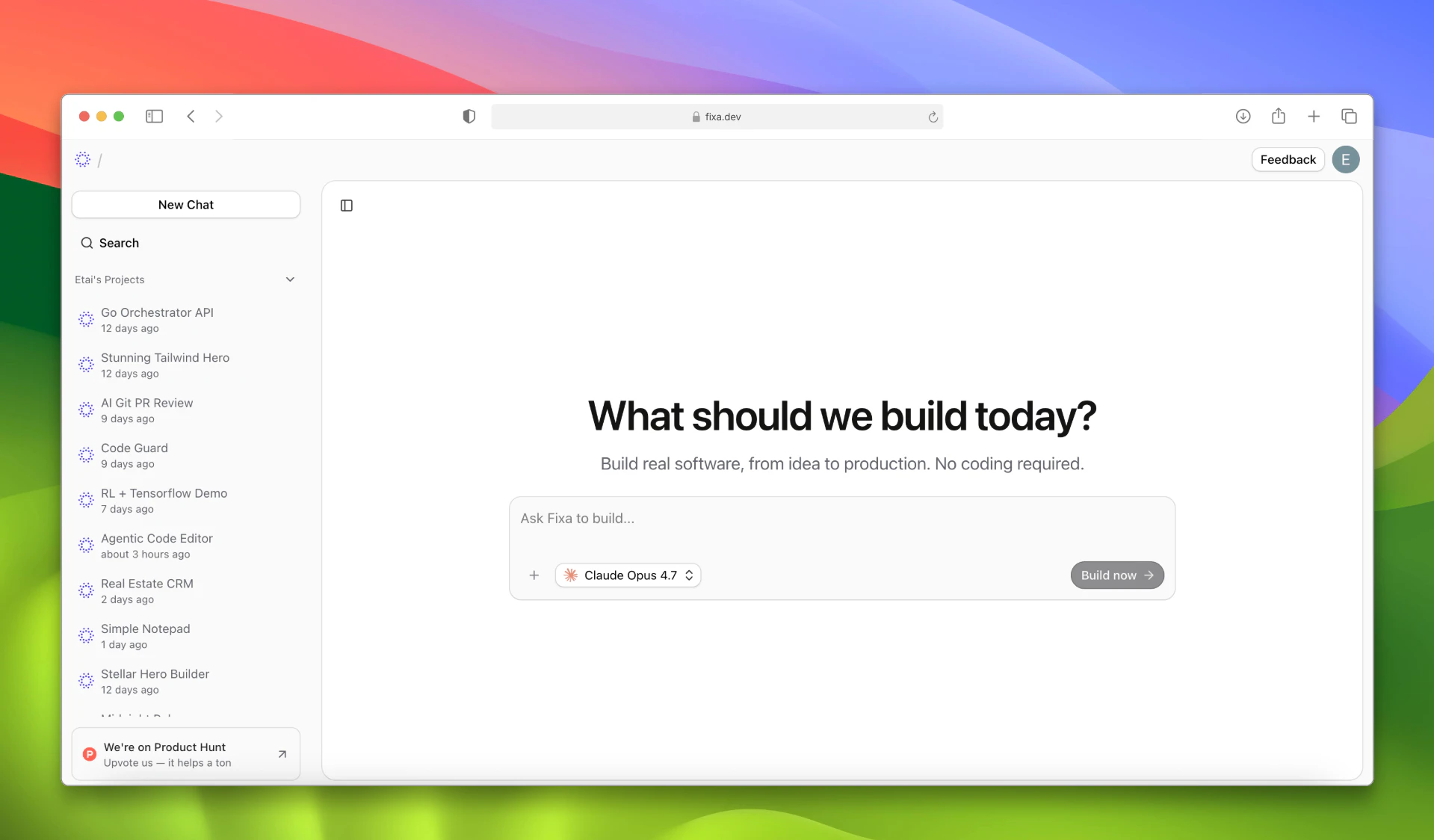
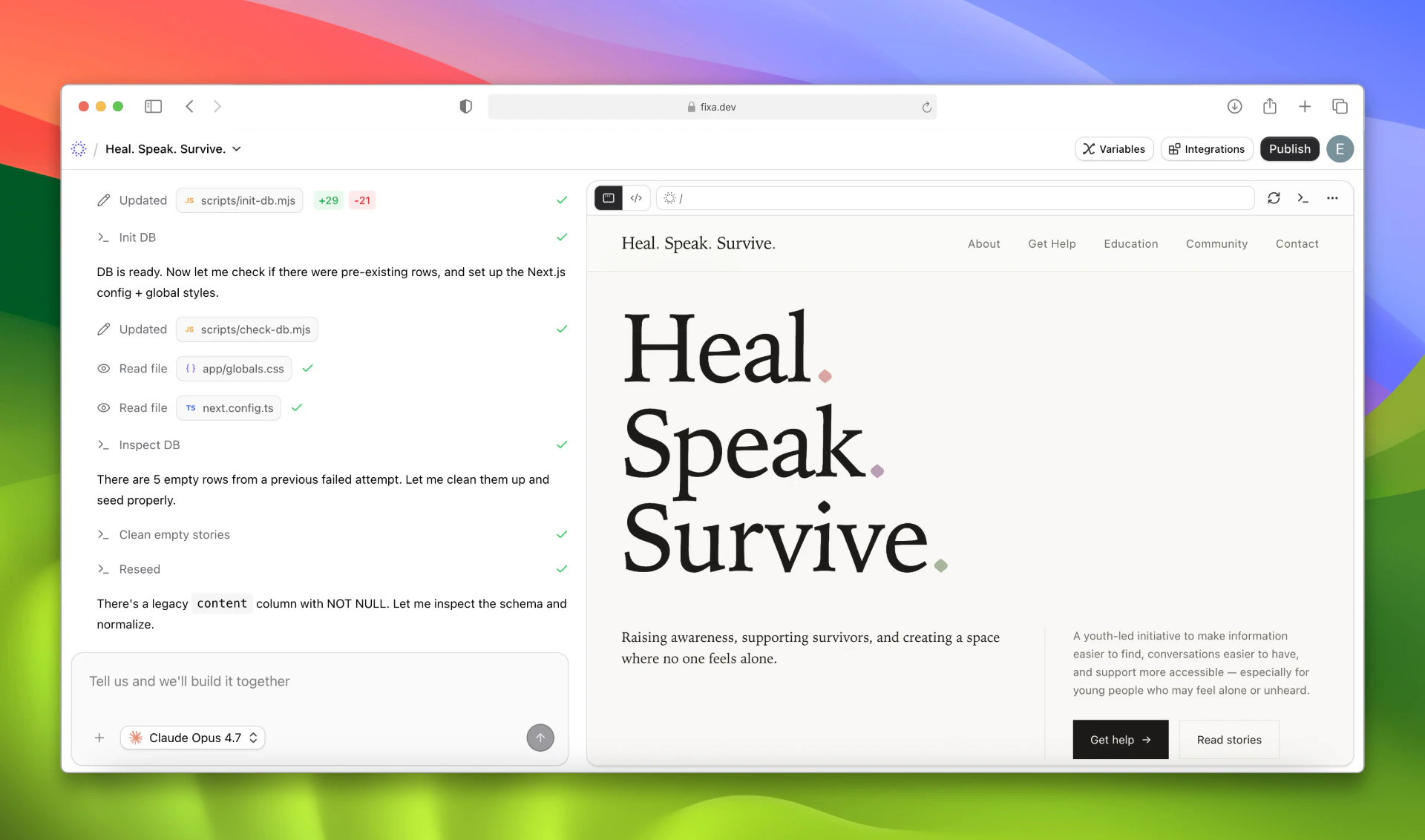
Fixa is the most powerful autonomous AI agent on the web, operating inside a full cloud dev environment to build real software. Powered by frontier models, it autonomously browses the web to read live documentation and dynamically installs whatever dependencies your app needs. Fixa writes production-ready backends and features one-click integrations for Stripe, Supabase, Clerk, and Vercel. With our universal MCP connector, you can link any MCP server to integrate deeply with your workflows.
Hey Product Hunt! I am Etai, a 16-year-old solo developer, and I spent the last few months building Fixa. I have been testing all the new AI coding tools lately, and while UI generators are great for scaffolding, they hit a hard wall. You cannot build real software without a real environment. I wanted to build something closer to Claude Code, but entirely web-native and capable of building anything. So, I built Fixa. It is essentially a full autonomous software engineer with its own cloud dev environment. Because it operates in a full cloud sandbox powered by frontier models, it is not restricted by what I pre-programmed. Here is what it can actually do: - Autonomous Research: It has a built-in browser. If you ask it to use an API it does not know, it will search the web, read the live documentation, and implement it. - Build (almost) Anything: It has raw access to its cloud environment to dynamically install whatever languages, frameworks, or dependencies it needs. - Universal MCP Connector: You can connect any MCP server to let the agent run complex data analytics or interact directly with your existing workflows. - Production Backends: It writes real, production-ready backend code, wires up databases, and gives you a live preview. - One-Click Everything: It has native one-click integrations for Stripe, Supabase, Clerk, OpenAI, Google AI, and Anthropic and deploys your full-stack app straight to Vercel in one click. Building a cloud-native agentic loop that can browse the web, read docs, and write error-free production code was the hardest thing I have ever built. Since it is just me working on this, I would love for the Product Hunt community to push it to its limits. Ask it to build something complex, let it research the docs, and let me know what you think of the results! I will be hanging out in the comments all day to answer any technical questions. Thank you, Etai
1
回复

@etai_g This is powerful, no doubt. But it also feels like the kind of tool I would approach carefully before using in anything serious.

An agent that can browse docs, install dependencies, and wire up a backend on its own is making a lot of decisions that normally require experience and context. In a real project, small choices around libraries, configs, or structure can have long term impact.

0
回复

Moving the coding agent to the cloud is a smart play since running large context loops locally always sets my laptop fan on fire. I am really curious how Fixa manages secure access to existing private repos to understand an established codebase. Letting this loose on a backlog of minor UI bug tickets would be a perfect way to test its actual reasoning limits.

1
回复
@y_taka Hey Takahito. Absolutely, just prompt Fixa: “Clone into (your repo url)” and then just prompt whatever you need done. Agent, via its read file tool, performs greatly at contextualizing in repos, even large ones. Let me know how it goes! The feedback button on my site goes straight to me, or shoot me a PM
0
回复

Congrats on the launch! This is genuinely impressive. Quick question - when Fixa autonomously installs dependencies and writes backend code, how do you handle security validation? Like, are there guardrails to prevent it from installing malicious packages or introducing vulnerabilities, or does it require human review before deployment?

1
回复
@osakasaul Hey Saul. That’s a great question. Usually the agent just installs what it wants and runs whatever commands it needs. However, you could definitely prompt it to do a security audit, and that should do. In the future, I could integrate Snyk and have it inspect for malicious packages.
1
回复
#11
Wyndo
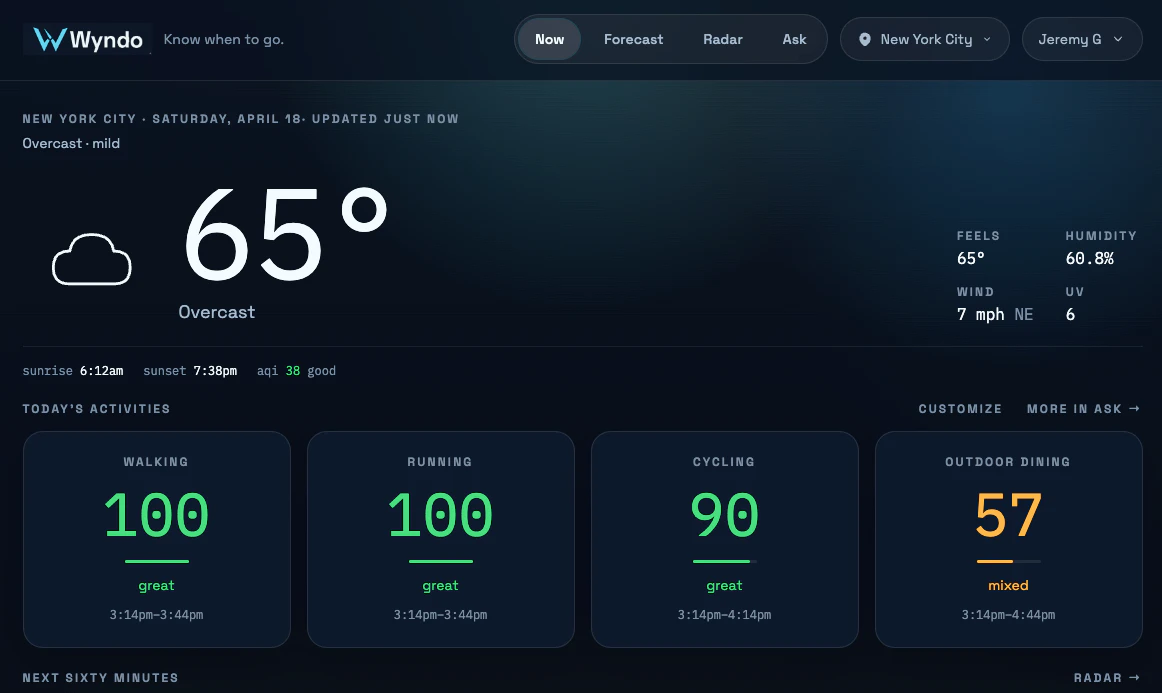
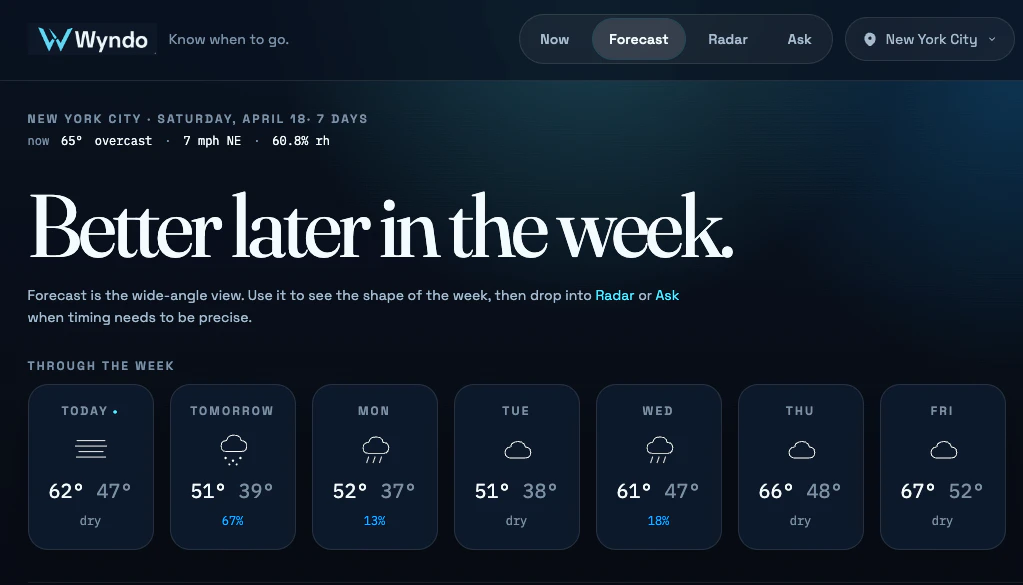
Weather app that tells you when to walk, bike or eat outside
88
一句话介绍:Wyndo是一款通过直接给出“现在出发”、“等待”或“取消”建议,来帮助用户决定何时进行户外活动的天气应用,解决了用户在复杂天气数据前决策困难的核心痛点。
Web App Weather
天气应用 决策辅助 户外活动规划 规则引擎 实用工具 即时建议 场景化天气 无广告 免费应用 生活效率
用户评论摘要:用户普遍赞赏其直观的“行动建议”概念。创始人详细解释了产品逻辑与数据源。有效反馈集中在活动类别的扩展上,如建议加入网球、皮划艇等运动,并对未来是否引入机器学习优化个性化规则提出了探讨。
AI 锐评

Wyndo的锋芒在于其“反直觉”的产品哲学:在AI泛滥的时代,它刻意选择了一条确定性的、规则驱动的路径。它的真正价值并非提供更精准的天气预报——其数据源并无特殊之处——而在于扮演了一个“专属气象分析员”的角色,将晦涩的百分比和图表翻译成人类能立即理解的行动指令。这本质上是一种用户体验的降维打击,用明确的决策替代复杂的信息,切中了用户“决策疲劳”的深层需求。

然而,其“专业与犀利”的挑战也根植于此。规则引擎的优劣完全取决于规则的完备性与精细化程度。当前支持的几大类活动仅是开端,如评论所指,面对网球对地面湿度、皮划艇对风速水流等高度专业化的需求,其通用规则库将面临指数级膨胀的压力。创始人承认有运用ML的“机会”,但这恰恰是产品的战略十字路口:引入机器学习优化个性化偏好,是否会牺牲其引以为傲的确定性、可解释性及响应速度?在“简单可靠的工具”与“懂你的智能助手”之间,Wyndo必须谨慎选择其进化方向。目前,它成功定义了一个新颖的品类,但护城河尚浅,其长期竞争力将取决于在垂直场景中规则深耕的深度与广度,而非技术的时髦标签。

查看原始信息
Wyndo
Every weather app tells you there's a 60% chance of rain. None of them answer the question you're actually asking: should I go right now? Wyndo is a weather app that answers that question with a direct answer: go now, wait, or skip it Instead of handing you hourly graphs and percent-chance bars, Wyndo scores the next few hours against what you're actually doing — walking, running, biking, driving, or eating outside — and gives you a direct recommendation with the reasoning behind it.

Hey Product Hunt, I'm Jeremy, and I built Wyndo.

Here's the problem I kept having: I'd check the weather before a run, see "60% chance of rain," then squint at the hourly graph trying to figure out when in the next three hours that 60% actually lives. I'd re-open the app three more times before heading out. Sometimes I'd leave too early. Sometimes I'd get caught in it anyway.

Wyndo is the weather app I wanted. Pick your activity — walk, run, bike, drive, or eat outside — and it scores the next few hours and tells you go, wait, or skip it, with the reasoning right there on screen. Every recommendation cites the weather factors you can already see: precipitation timing, wind, temperature, visibility, alerts. A light drizzle that's fine for a drive gets flagged for outdoor dining.

The engine is deterministic and rule-based. No AI guessing at the forecast. LLMs help parse questions and phrase answers. Data comes from OpenWeatherMap for minute-by-minute precipitation, Open-Meteo for hourly and daily forecasts, and the National Weather Service for alerts. Free, no ads.

Try it at wyndo.app — no signup needed to ask your first question. I'd love to hear what you ask it, and especially where the answer felt wrong or thin. The feedback form is one click from anywhere in the app, and responses feed back into the eval for future recommendations.

3
回复

@jeremyg22 Big congrats. How does it weigh humidity/surface wetness for court sports like tennis on clay, or is that next on the rule tweaks?

1
回复
@jeremyg22 What about adding in paddle boarding/kayaking as an activity?
0
回复

Simple but cool product! Btw you explicitly avoided ai for decision making, so do you see a future where learned preferences (using ml or something) outperform deterministic rules here??

0
回复

@lak7 I think there are opportunities for both, yes.

1
回复

Big congrats on the launch! 🚀 I love the 'go, wait, or avoid' approach. I’m constantly looking at the 40% chance of rain and trying to do the math in my head on whether I’ll get soaked if I take the dog out now or in an hour.

Taking that mental work out of the equation is such a smart idea.

0
回复

@gokhan_elgun Thanks for the feedback. As you use it, let us know if you run into any bugs or inaccurate recommendations.

0
回复
#12
Assemble
One /go command for AI work that remembers — zero runtime
85
一句话介绍:Assemble是一款开源AI工作配置生成器,通过“/go”命令触发,能根据任务难度自动路由、保留跨会话记忆,并在复杂任务时转为规格驱动的工作流,解决了通用AI工具在长上下文、多步骤复杂项目中输出肤浅、流程崩溃的核心痛点。
Open Source Developer Tools Artificial Intelligence GitHub
AI工作流 配置生成器 开源工具 智能体框架 提示工程 跨平台 零运行时 上下文记忆 规格驱动 效率工具
用户评论摘要:用户反馈积极,认可其按难度路由和“结构性异议”(如Deadpool角色)的设计,认为能显著提升复杂任务输出质量。主要问题集中于跨会话记忆的具体机制、跨平台上下文流转,以及任务复杂度误判时的自我纠正能力。
AI 锐评

Assemble的宣称直指当前AI代理生态的浮夸核心:它不提供又一个臃肿的“运行时”,而是生成配置。这看似技术降级,实则是战略清醒。其价值不在于替代现有AI平台,而是成为它们的“神经中枢”,通过可移植的Markdown文件实现记忆和流程的标准化,将智能从封闭的、易失的对话上下文,沉淀为可管理、可审计的结构化资产。

“结构性异议”机制是产品最犀利的洞察。当前LLM倾向于讨好与附和,导致审查和审计流于形式。内建“死侍”和“毁灭博士”角色进行挑战与升级,并非噱头,而是将人类协作中的制衡与复审机制代码化、提示化。这试图解决的是AI协作的“群体思维”痼疾。

然而,其宣称的“零运行时”是一把双刃剑。它将复杂性转移到了配置和提示工程本身,这要求用户具备相当的架构理解力。产品能否成功,不取决于其框架多精巧,而取决于其预设的“规格驱动工作流”模板是否真正覆盖了从代码评审到合同起草等场景的深层逻辑。否则,它可能只是将“通用AI工具的肤浅”替换为“复杂配置的肤浅”。其真正的考验在于,那些宣称30分钟解决10天难题的案例,能否被普通用户复现,还是高度依赖创始团队自身的提示工程秘方。开源是其建立信任的关键一步,但社区能否贡献出高质量、可复用的工作流规格,才是其生态壁垒所在。

查看原始信息
Assemble
Assemble is an open-source configuration generator for AI work: /go, memory, spec-driven workflows, and zero runtime across 21 platforms.

Hey Product Hunt,


I’m Rénald, founder of Cohesium AI.

I built Assemble because I was tired of AI tools that sound helpful but stay generic. A code review becomes a polite summary. A security audit becomes a reformatted checklist. A multi-step project starts strong, then falls apart as soon as context gets longer or the work gets more complex.

So I built what I actually needed: a structured AI work system, not just another assistant.

With Assemble, you type /go and describe what you need. From there, it routes the task by difficulty, keeps useful cross-session memory, and switches into a spec-driven workflow when the work is complex. For bigger delivery, it can even move execution into a board with review and test stages.

What makes it different from most agent frameworks:

it’s a configuration generator, not a runtime
zero daemon, zero SDK, zero dependencies, zero lock-in
native configs for 21 platforms including Cursor, Claude Code, Codex, Gemini CLI, Copilot, and Windsurf
• it works beyond coding too: docs, contracts, proposals, email, and client operations

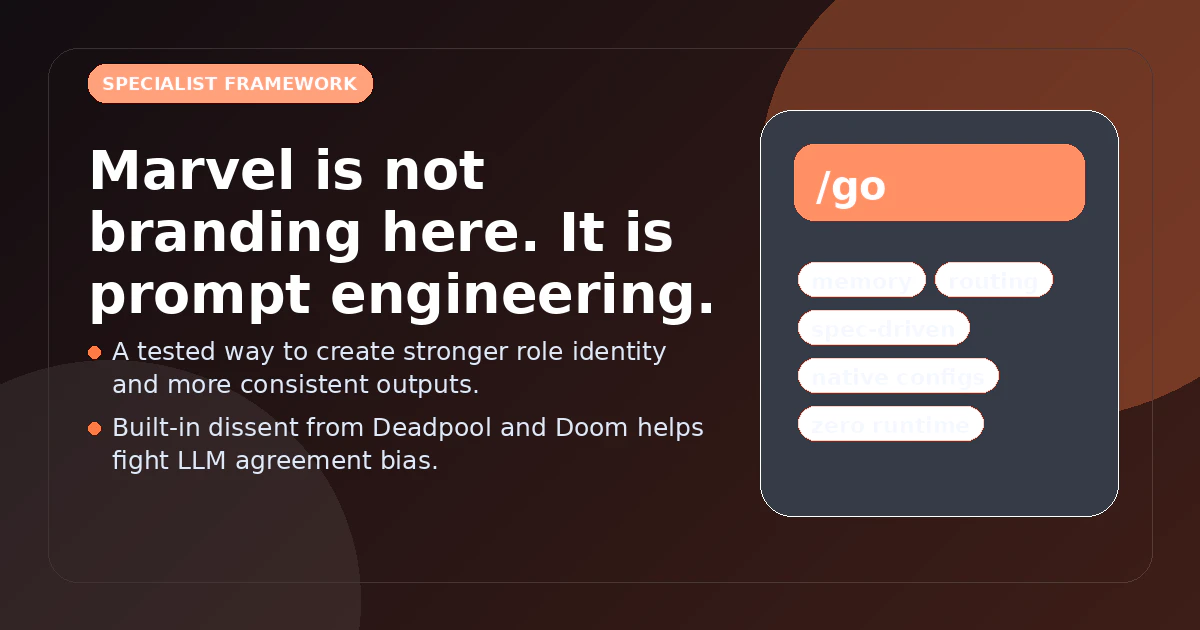
The Marvel framework isn’t branding — it’s a prompt-engineering choice. In testing, it gave us stronger role identity, better consistency, and less generic output than traditional agent setups.

And because LLMs naturally agree too easily, Assemble bakes in structural dissent: Deadpool challenges assumptions by default, and Doctor Doom escalates high-stakes decisions.

A real turning point for me: a client project that was supposed to take 2 days turned into 10 days of failed attempts with generic AI tools. With Assemble, it took 30 minutes.

If you try it, I’d genuinely love your feedback — especially on the workflows, platforms, and specialist roles you’d want next.

MIT licensed. Open source. Built for real work.

1
回复

@cohesiumai For non-coding flows like client proposals where you're balancing tone, data, and stakeholder alignment, how does the cross-session memory handle evolving feedback loops? Does Deadpool/Doom kick in to stress-test assumptions mid-draft, or is that more for execution phases?

0
回复

@cohesiumai The routing by difficulty is the part that actually matters here. Most AI tools treat a two line task and a two week project exactly the same way and that is where everything falls apart on longer work.

The Marvel framework as a prompt engineering choice is interesting. Structural dissent baked in by default is a genuinely different approach. Most tools are built to agree and confirm. Having Deadpool challenge assumptions automatically changes the quality of output in ways that are hard to get otherwise.

The 2 days to 10 days failure story followed by 30 minutes with Assemble is exactly the kind of before and after that makes this real rather than just another AI wrapper claim.

Curious about a few things though.

How does the cross session memory actually work in practice? Does it persist context across completely different projects or just within the same workflow? And when it routes a task by difficulty, what happens when it misjudges the complexity, does it self correct or do you have to manually override?

Congrats on the launch. The zero daemon zero SDK approach is the right call for adoption. Nobody wants another thing running in the background.

0
回复

Congrats on the launch! This looks really impressive. I'm curious about the memory component - when you say it "remembers," does that persist across different AI platforms automatically, or do users need to configure how context flows between integrations? Also, how does the zero runtime constraint work with platforms that have inherent latency?

0
回复

@osakasaul Thanks, appreciate it.

For memory, Assemble keeps things simple: it uses Markdown files (.md) as the persistence layer. So yes, memory can persist across platforms and LLMs, because it’s not tied to any provider’s hidden internal state.

That continuity comes from portable, readable files rather than model-specific memory.

On the zero runtime side, Assemble doesn’t add a daemon or always-on orchestration layer between the user and the target platform. The logic lives in the config and files, so execution still happens natively in the tool you use — which means latency stays the platform’s latency.

If helpful, I can also explain how we separate persistent memory from session context.

1
回复
#13
AGG Loop
Secure, forever-free localhost tunnels (ex-Deposure).
84
一句话介绍:AGG Loop是一款即时、零配置的本地主机隧道工具,通过提供安全、免费的公共URL映射,解决了开发者在调试Webhook、测试API等场景中需要临时暴露本地服务的痛点。
API SaaS Developer Tools
本地隧道 开发工具 网络安全 命令行工具 免费服务 API测试 端口转发 开发者工具 开源替代 零配置
用户评论摘要:用户反馈官网存在失效链接(如GitHub仓库),团队已回应并更正。另有评论提及注册问题已全部修复。整体评论互动较少,主要集中于产品发布公告和问题报告。
AI 锐评

AGG Loop作为一款“永久免费”的本地隧道工具,其核心叙事是“收购并重生”了一个已有产品(Deposure),并强调由母公司实验室项目资助,从而摆脱了SaaS常见的收费限制。这既是其最大卖点,也是最大的风险点。

产品价值清晰:为开发者提供了一个即开即用、无需担心带宽和成本的临时公开测试环境,其“企业级安全”的强调旨在打消对免费服务安全性的疑虑。然而,其商业模式依赖母公司的“实验室项目”输血,而非自身造血,这为其长期可持续性画上了一个问号。这种模式能持续多久,完全取决于母公司的战略耐心,一旦资助中断,产品命运堪忧。

从评论看,产品上线仍显仓促,存在链接错误等技术性瑕疵,虽然团队响应迅速,但暴露了在品牌迁移和资源整合上的细节疏漏。当前市场已有Ngrok等成熟竞品,AGG Loop以“永远免费”作为差异化利刃,短期内能快速吸引价格敏感和轻度使用的开发者。但其真正的挑战在于,如何在零收入模式下,持续保障网络稳定性、安全升级和用户支持,并构建起足够深的护城河。否则,它可能仅仅是一个不错的、但随时可能关闭的“实验性福利”,而非一个值得长期依赖的开发基础设施。

查看原始信息
AGG Loop
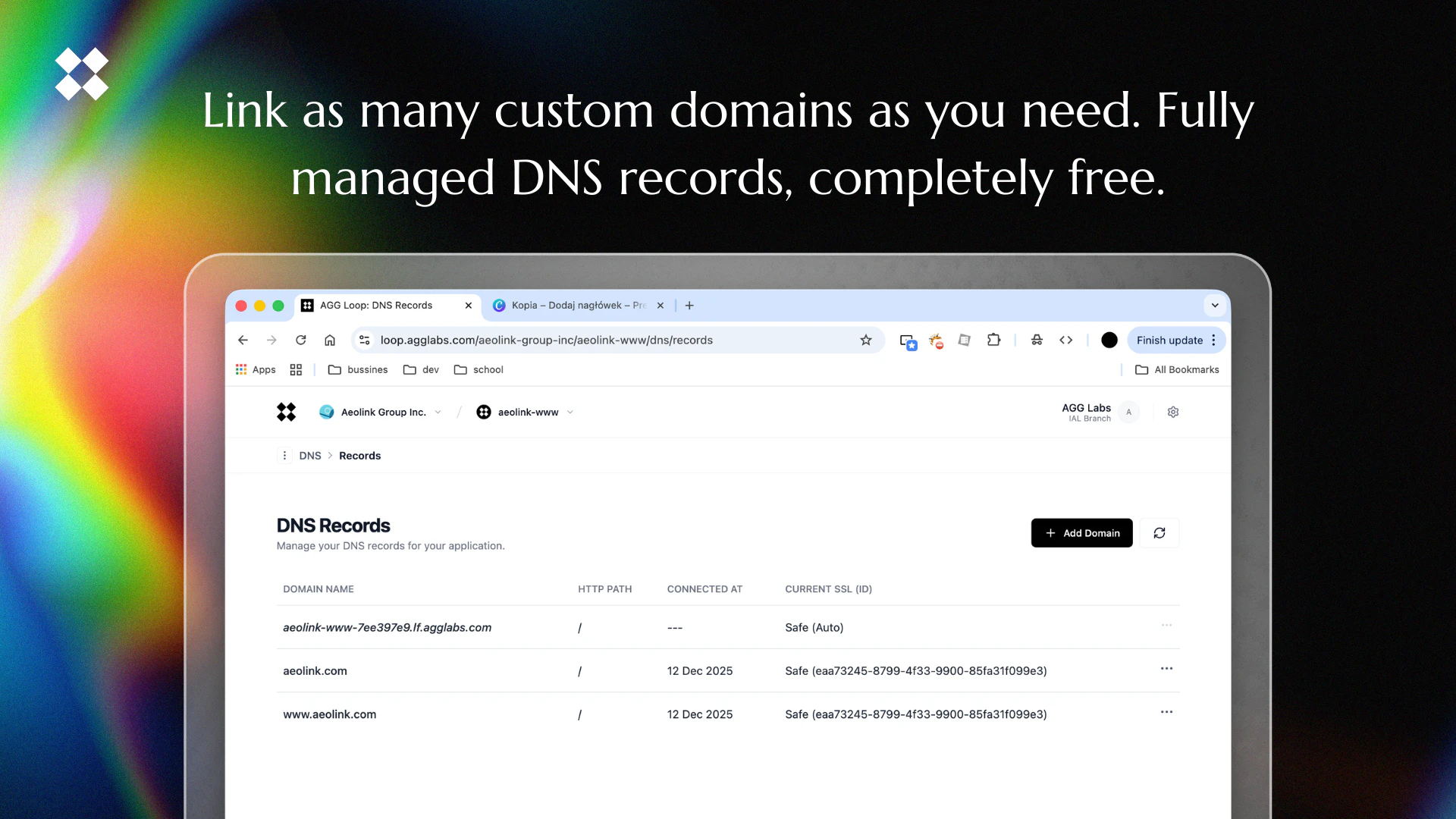
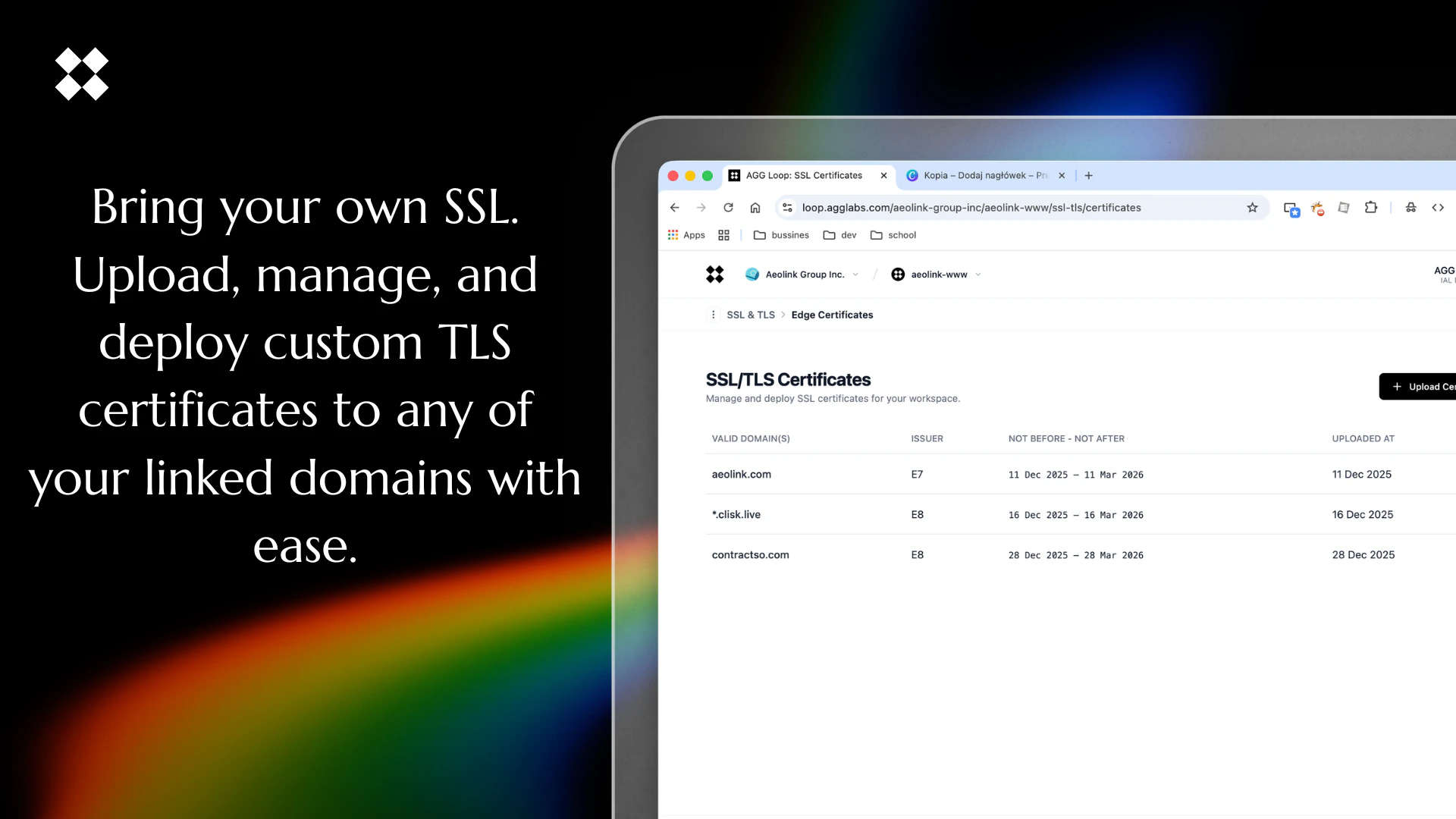
We acquired Deposure and rebuilt it from the ground up! AGG Loop provides instant, highly secure localhost tunneling with zero config. 100% free forever with no bandwidth limits, fully backed by the Aeolink Group Inc. lab program.
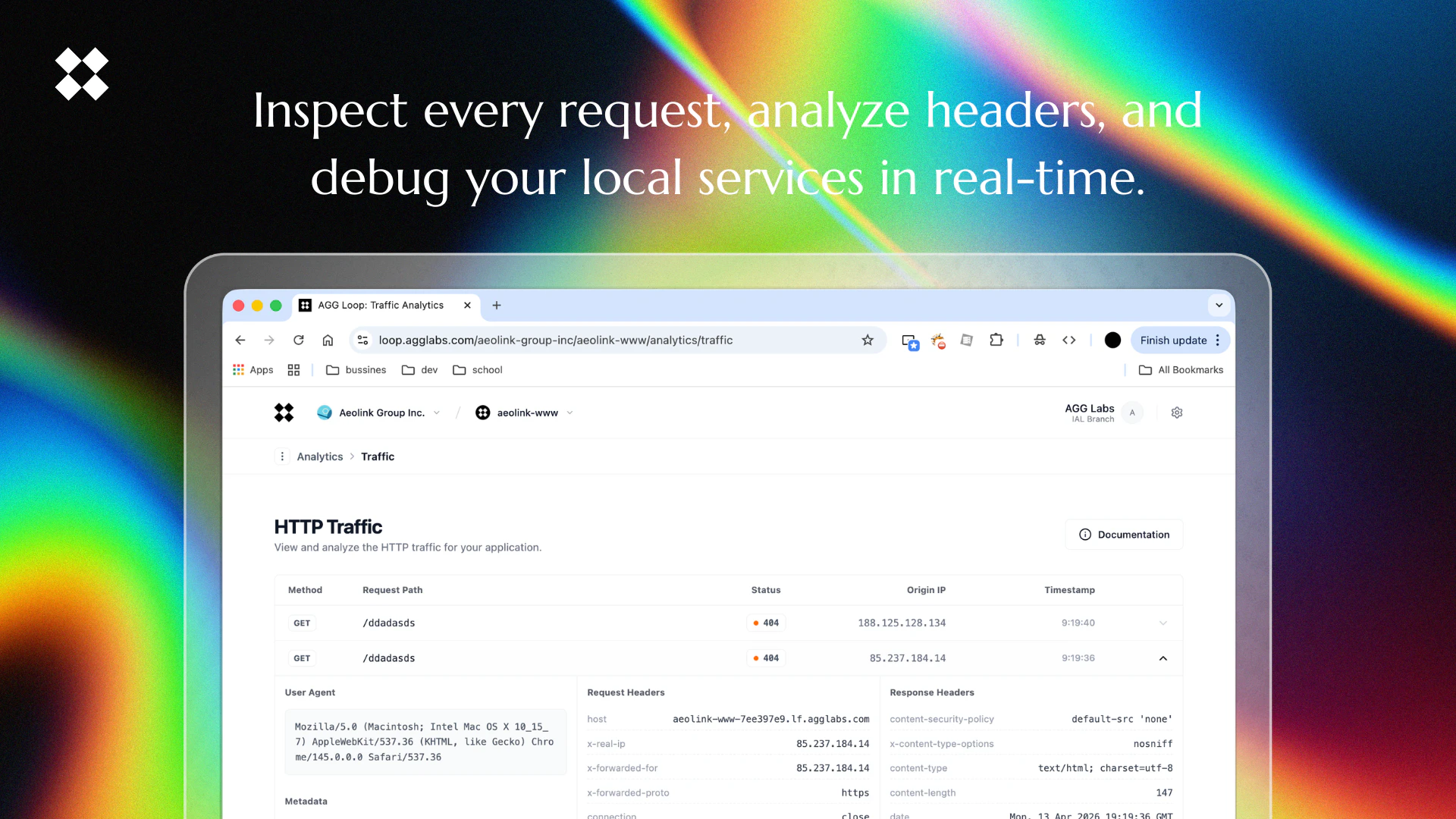
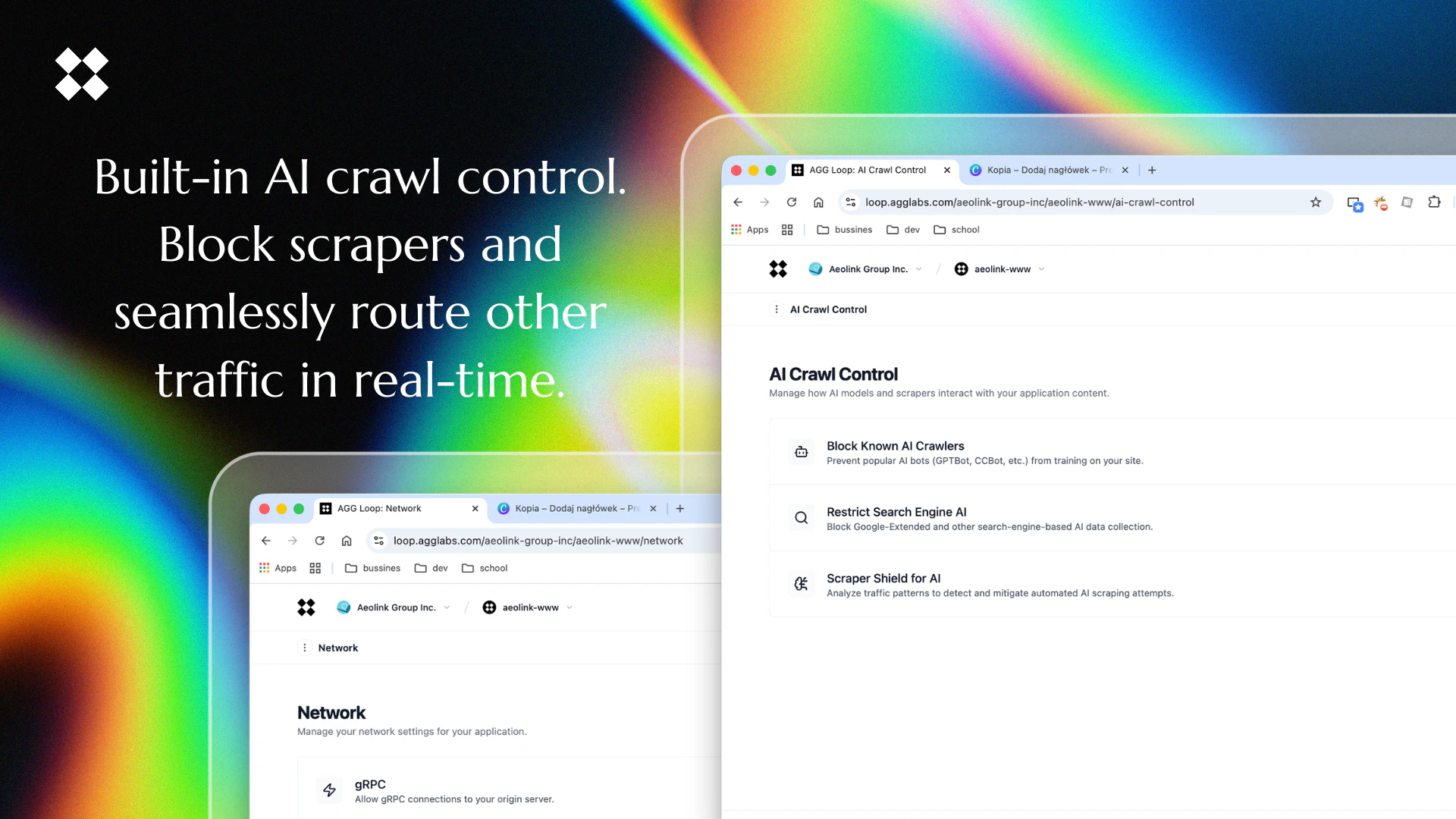
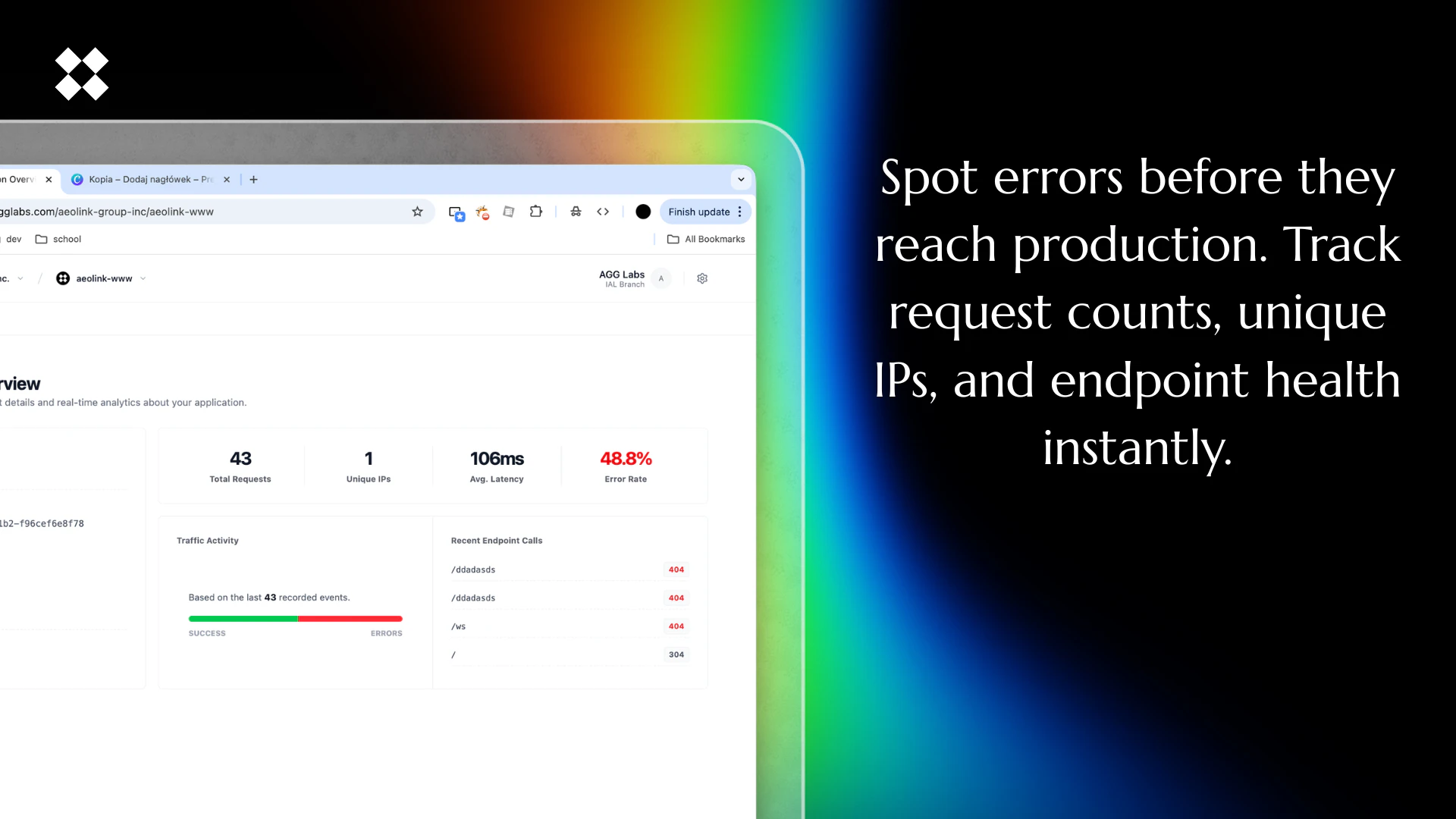
Hey Product Hunt! 👋 If you remember Deposure, you already know how incredibly useful it was for exposing local servers to the public internet instantly. We loved the simplicity of that tool so much that AGG Labs officially acquired it. Today, we are thrilled to relaunch it as AGG Loop! We kept the minimal, frictionless CLI experience you loved, but we completely overhauled the underlying network architecture. We know that routing local traffic to the outside world requires absolute trust, so we implemented rigorous, enterprise-grade security protocols under the hood. Whether you're debugging webhooks, testing APIs, or doing low-level network configurations on Linux, your data is now routed safely. Why are we doing this, and what’s the catch? There is no catch. AGG Loop is 100% free forever. No bandwidth throttles, no artificial session cuts, and no premium paywalls. This is possible because the project is fully funded by the laboratory program of Aeolink Group Inc. We wanted to give back to the developer community and provide a powerful, secure networking tool without the usual SaaS limitations. TL;DR of what AGG Loop gives you: ⚡ Instant localhost to public URL routing. 🛡️ Upgraded, hardened security architecture. 💻 Native, lightweight CLI experience. 💸 100% Free forever (Funded by Aeolink Group). We’d love for you to fire up your terminals, test it out, and let us know your thoughts in the comments. Happy tunneling!
0
回复

some of the links in https://www.agglabs.com/loop are returning a 404 - i.e: https://github.com/agglabs/loop-client

0
回复

@farmisen Hi, Thanks for letting us know, we will take care of that immediately. Correct path is: https://github.com/deposure-lab/Loop-Client. Migrating old Github wasn't sucessfully done yet, so it's still hosted on old account. We apologise for inconvenience.

1
回复
Changelog: All issues with signing up has been resolved. Platform is operational in 100%. We apologise for inconvenience.
0
回复
#14
Confetti Burst Chrome Extension
Everything you need for a joyful browsing experience
21
一句话介绍:一款为任何网页点击添加可定制化礼花动画效果的Chrome浏览器扩展,旨在将枯燥的网页浏览转化为充满惊喜的互动体验,解决日常上网缺乏趣味性的痛点。
Chrome Extensions
浏览器扩展 趣味增强 用户体验 视觉反馈 个性化 轻量工具 免费 隐私友好 互动动画 Chrome插件
用户评论摘要:开发者亲自介绍创作初衷,源于其主营的ConfettiSaaS业务,希望将礼花乐趣普及到所有网站。有一条祝贺评论,互动友好。目前评论中未发现具体问题或功能建议。
AI 锐评

这款产品本质上是一个“数字糖果”——提供即时的感官愉悦,但缺乏实际功能深度。其真正价值并非解决一个刚性痛点,而是敏锐地捕捉并商品化了“微交互”的情感需求。在效率工具横行的赛道,它反其道而行之,用纯粹的、无意义的趣味作为卖点,这恰恰是其犀利之处。

然而,其天花板也清晰可见: novelty effect(新奇效应)衰退后,用户留存将是巨大挑战。礼花动画在初次使用时带来惊喜,但很快可能被视为视觉干扰,尤其是“混沌”强度模式。产品目前依赖单一的情感价值,缺乏与网页内容或用户行为的智能结合,可持续性存疑。

从商业模式看,作为其SaaS业务的引流品或品牌展示窗口或许更为合理。它验证了“愉悦感”作为一种产品维度的市场存在,但同时也暴露了独立成品的单薄。若想突破工具属性,未来或需探索与游戏化、成就系统或甚至心理健康(缓解点击焦虑)等更深层场景的结合,否则恐难逃被用户一时兴起安装,而后默默禁用的命运。

查看原始信息
Confetti Burst Chrome Extension
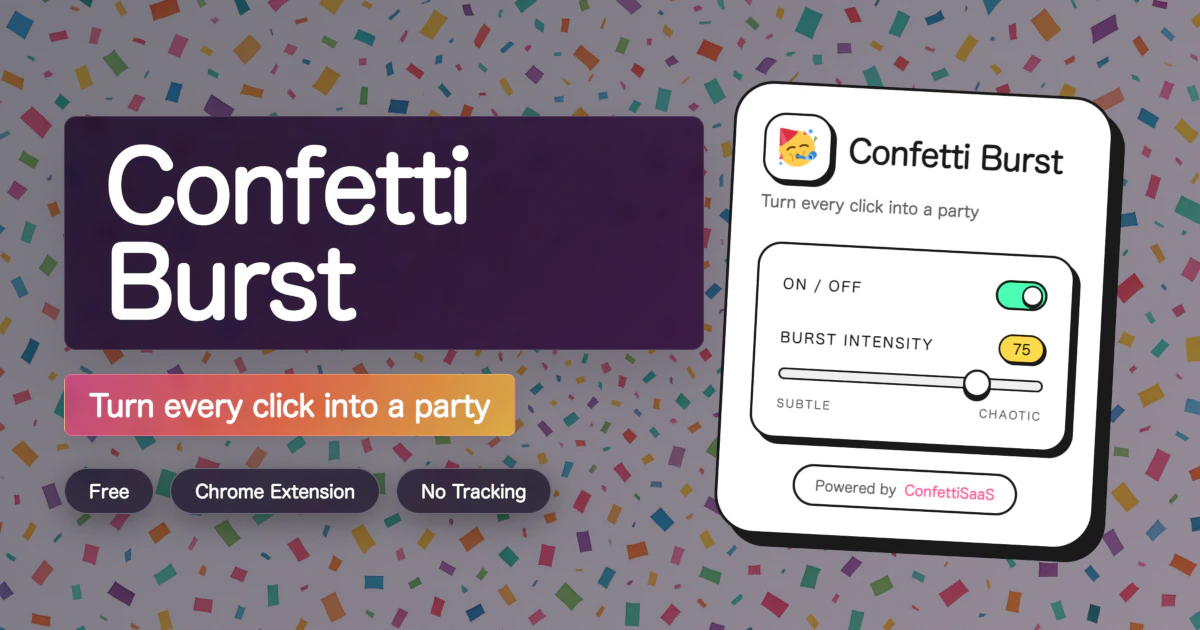
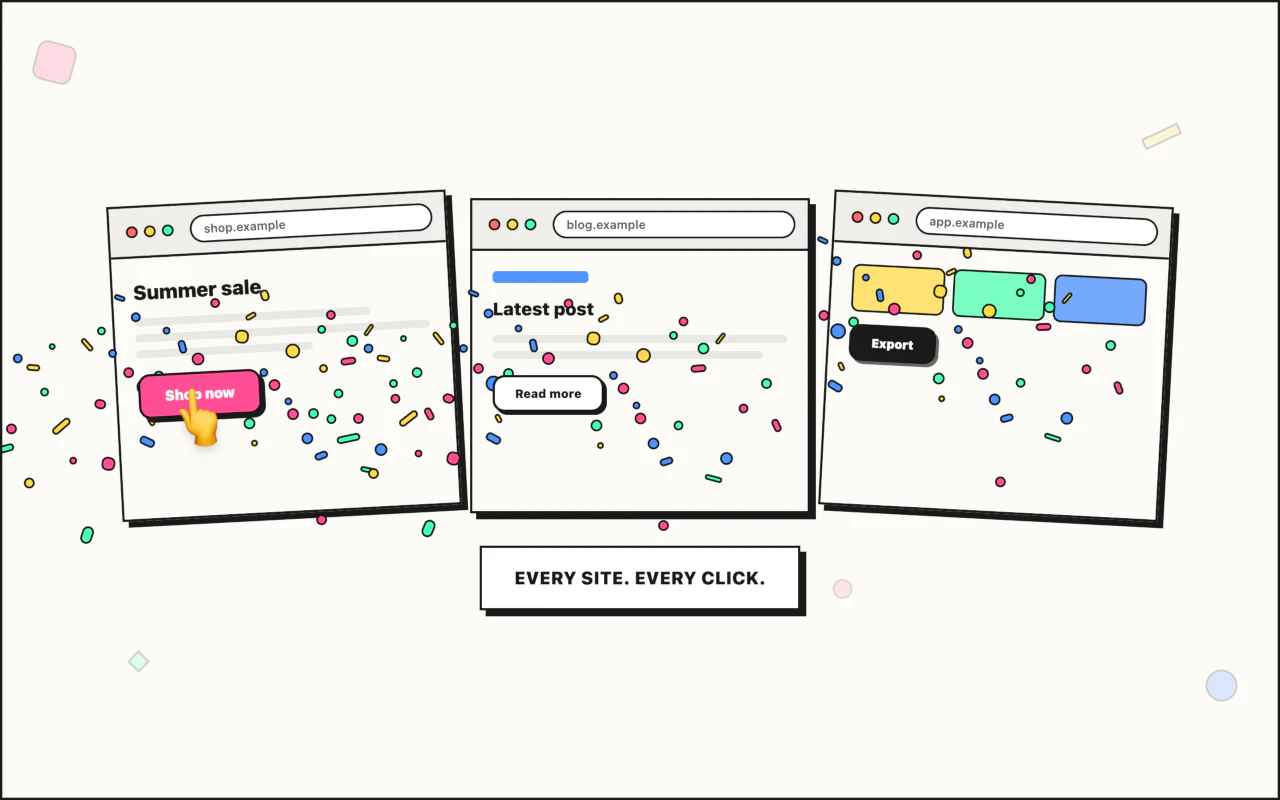
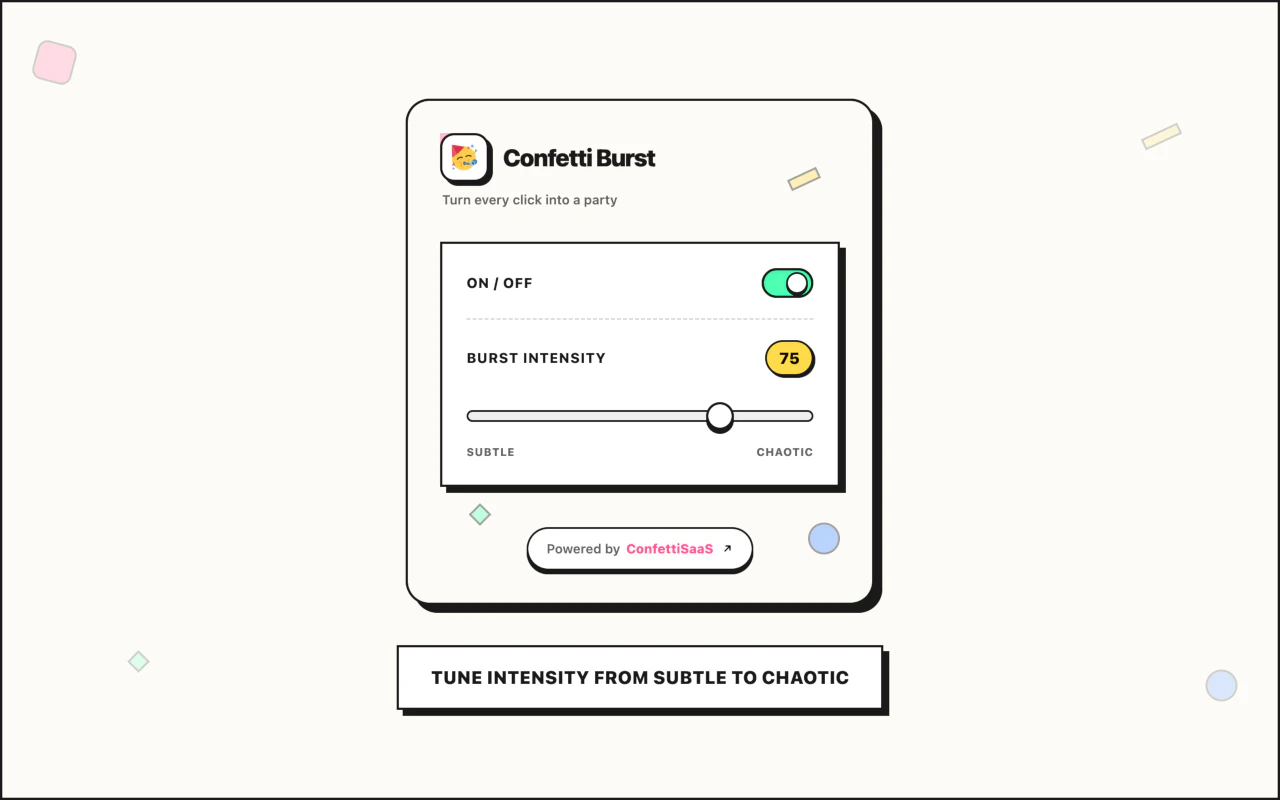
Add fun confetti bursts to every click on any website. Customize intensity from subtle to chaotic. Free and privacy-friendly.
Hey PH folks 👋 Me again with a fun project. Running ConfettiSaaS is super fun seeing all those great projects using confetti! But the downside is every website without confetti becomes boring 😅 To fix this I build the Confetti Burst Extension! It adds confetti to every click on any website 🎉🎉 I hope you enjoy it! Happy confetti popping 🥳🥳
2
回复

Great launch Lars!

exciting one here

0
回复

@misterrpink thank you! happy confetti popping 🥳

0
回复
#15
Today for Mobile
Write today. Let your past thoughts find you.
17
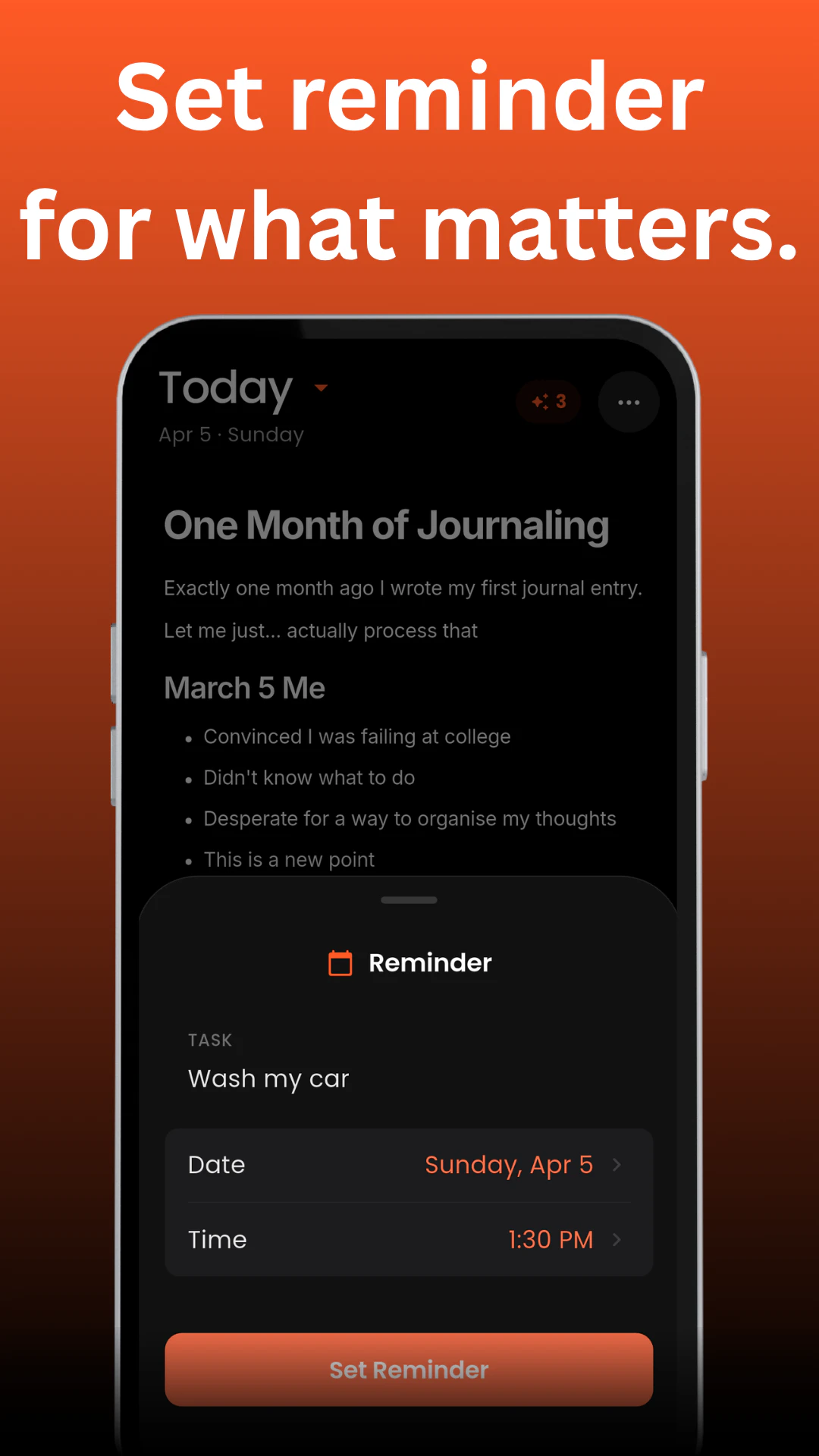
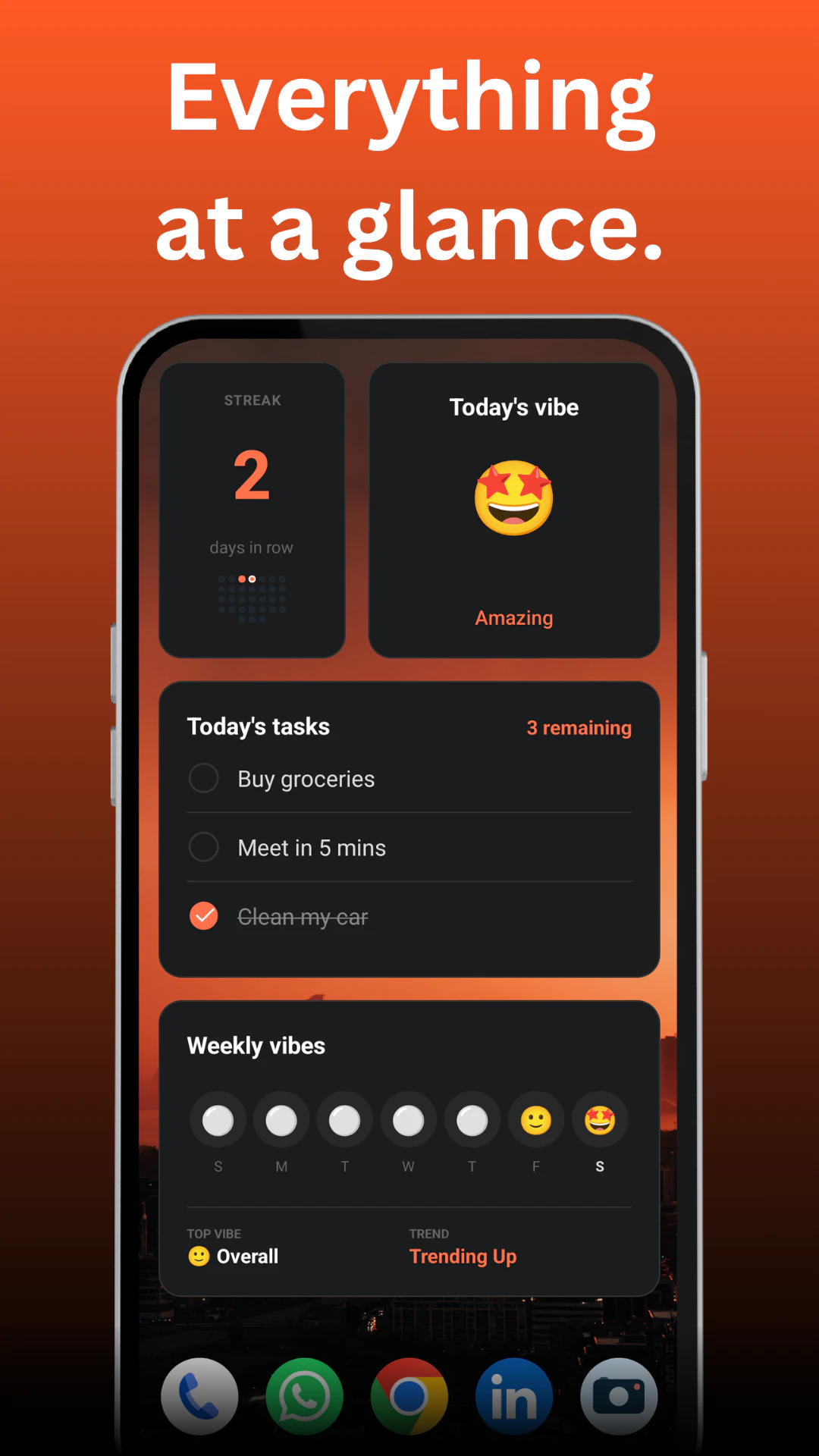
一句话介绍:一款主打“隐私优先”的日记应用,通过“每日一页、午夜锁定”的极简强制设计,解决了用户过度管理“第二大脑”笔记系统而疏于真实思考的核心痛点,帮助用户在移动端实现无压力、专注的日常记录。
Productivity Privacy Artificial Intelligence
日记应用 极简主义 隐私优先 离线应用 数字健康 心智管理 每日记录 安卓应用 无压力写作 反第二大脑
用户评论摘要:用户普遍赞赏其极简设计带来的专注感和“午夜锁定”促成的记录纪律。核心反馈是:该应用有效解决了笔记工具带来的“管理负担”,从“管理系统”回归“真实思考”。“记忆轨道”功能获得好评,被认为能智能关联过往想法。用户期待移动端体验,认为其适合快速日常记录。
AI 锐评

Today for Mobile 看似是又一款日记应用,实则是针对“知识管理焦虑”的一剂猛药。它精准刺中了“第二大脑”方法论的一个阴暗面:工具异化。当构建和维护笔记系统本身成为目的,思考与记录的本源价值便已丧失。产品通过“每日一页、午夜锁定、不可编辑”这三重近乎专制的规则,强行截断了用户进行无休止优化、整理和表演式记录的行为路径,其真正价值在于“认知减负”。

“记忆轨道”功能是点睛之笔,它并非简单的搜索,而是被动、智能的关联提醒。这巧妙地回答了“不管理如何检索”的质疑——系统替你完成关联,而你只需专注当下书写。这暗合了人类记忆本身的运作方式:非线性的、由情境触发的。应用将自身定位为“心智空间”而非工具,其“完全离线与隐私”的特性进一步强化了这一立场,试图构建一个免受数字干扰的纯粹内省环境。

然而,其商业前景与普适性存疑。这种高度规训、放弃控制感的模式,可能只吸引特定群体——那些已深陷工具复杂性并感到疲惫的“反思者”。对于习惯自由编辑、希望构建个人知识库的用户而言,它显得过于僵化。它更像一个功能明确的“数字冥想工具”,而非通用的笔记解决方案。其成功与否,取决于有多少用户愿意用形式上的自由,交换心智上的专注。这是一场针对数字时代记录习惯的激进实验,结果如何,有待观察。

查看原始信息
Today for Mobile
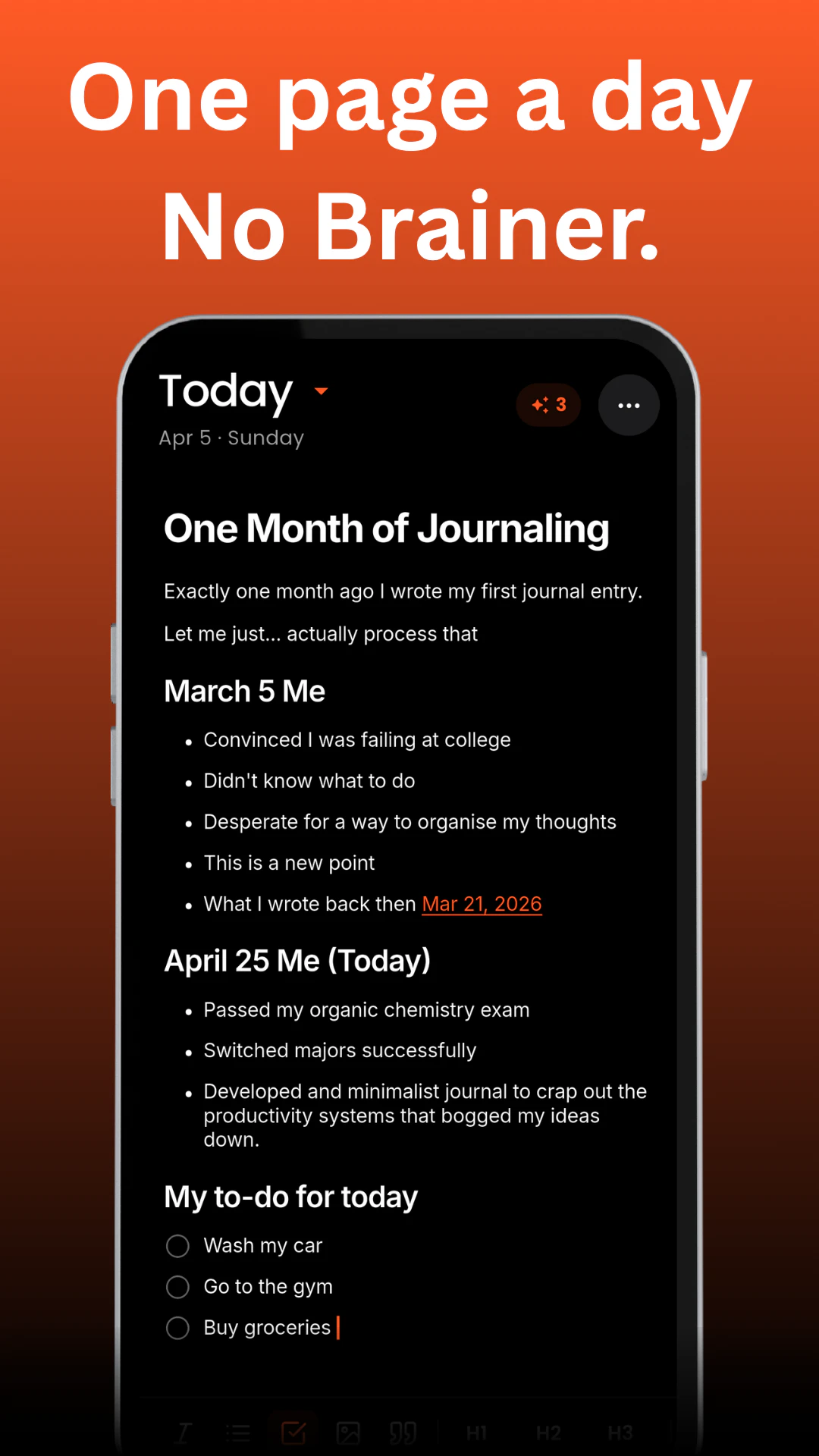
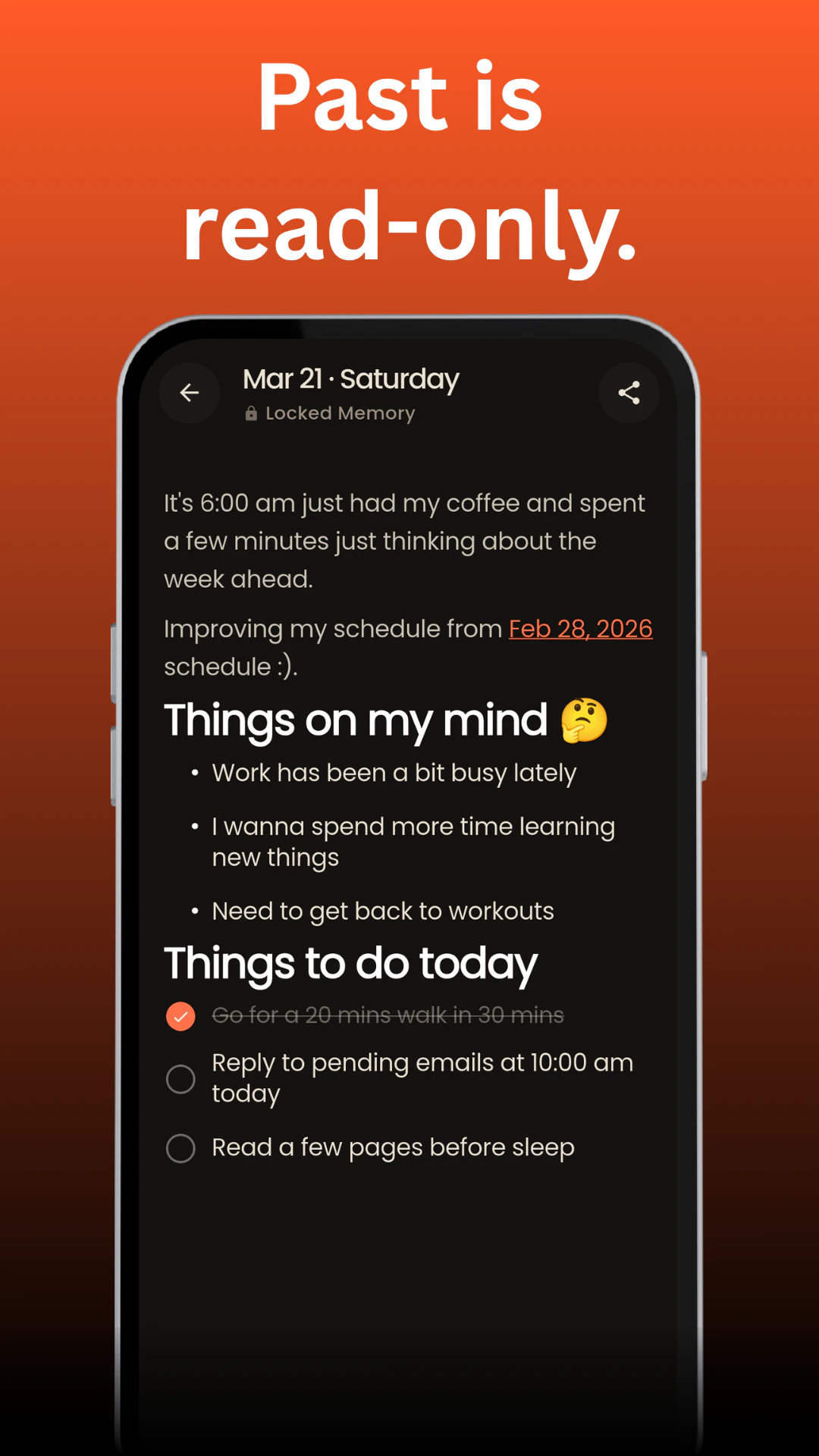
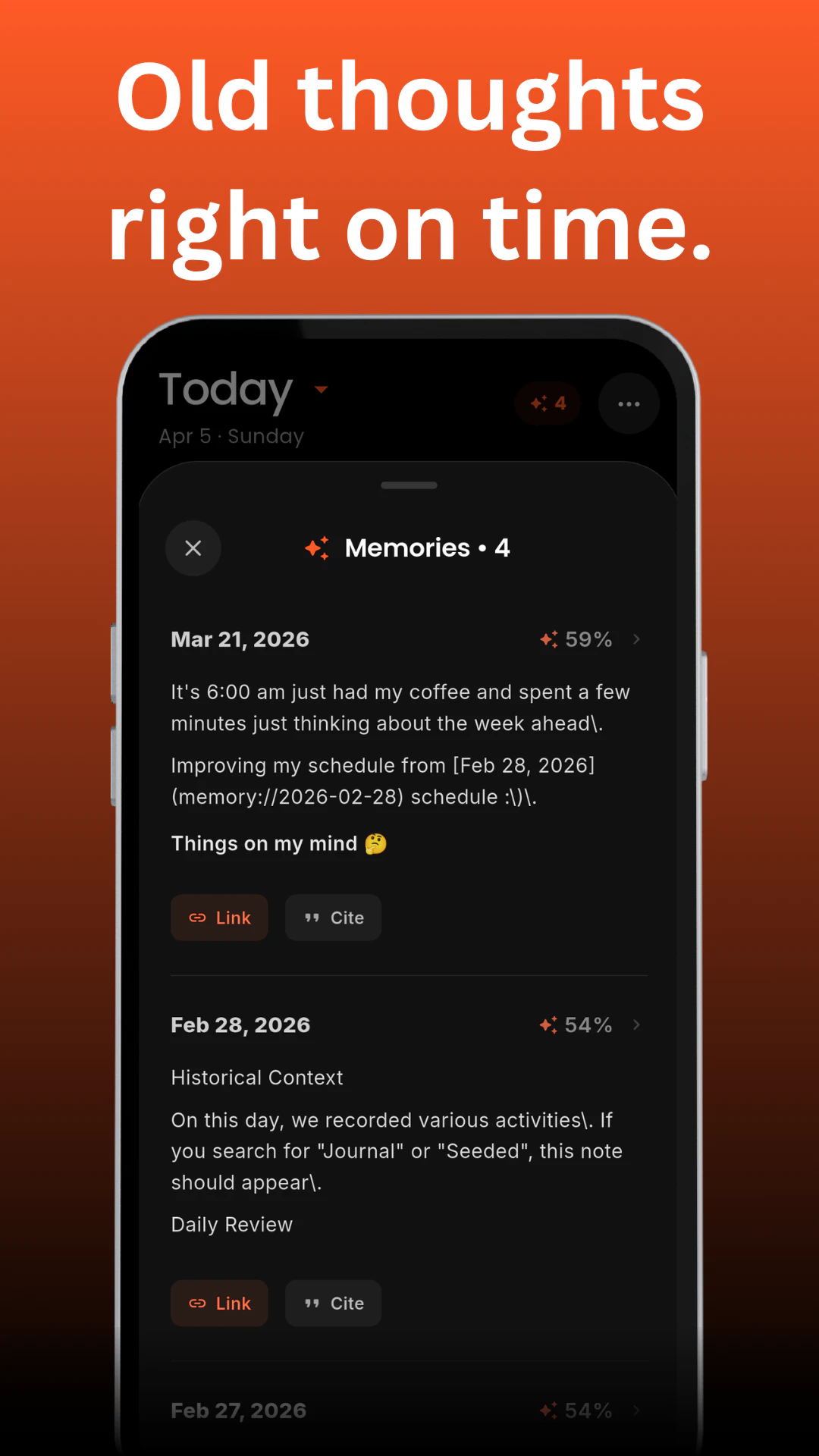
Today is a privacy-first journaling app built for thinking clearly, without managing a system. I built it after realizing I was spending more time tweaking my “second brain” than using my first. One page a day, locked at midnight. No edits, no cleanup. Memory Rail brings back relevant past thoughts as you write. Fully offline and private. Now available on Android.
I spent more time tweaking my “second brain” than actually using my first 😅 Every time an old idea came back, I’d go blank, then waste time digging through notes that never really helped. That frustration led to a simple question: What if journaling didn’t require any system at all? So I built the opposite: - One page per day - Locks at midnight - Fully offline At first it felt restrictive, but it actually made thinking easier. No editing, no organizing, no pressure. Memory Rail came later, almost as a correction to my original problem. Instead of searching your past, it brings the right parts back while you write. After launching on desktop, a lot of people asked for a mobile version, so this is that step. Curious how this feels on Android, especially for quick, everyday journaling.
5
回复

I’ve been using the desktop app for some time now and was eagerly waiting for the mobile version, awesome to see it finally launched! Looking forward to using it on the go 🙌

1
回复

@ayushpatil0810 

Really appreciate that 🙌
Excited to hear how it feels once you start using it on the go 👍

0
回复

It's been a few days since I have started using the "Today" app. Unlike any other note making app, this is straightforward, minimalistic and yet has gorgeous themes. While the features like memory rail are indeed attractive, its core theme of locked notes per day truly makes for honest journaling discipline.

1
回复

@parthgithub_byte 
Thank you , this captures the intent behind the app clearly.
Glad it’s helping you stay consistent and intentional with your journaling.

0
回复

Been using this since beta and it genuinely feels different. No clutter, no pressure to organize, just open it and think. The midnight reset is underrated, it actually helps you move on instead of over-editing yesterday. Feels more like a mental space than an app.

1
回复
@siddhesh_rane6 Really glad it’s clicking for you. ‘Mental space, not an app’ is exactly what we were aiming for.
0
回复

The midnight lock is the reality check I didn't know I needed. I used to spend hours 'cleaning up' my notes, but Today forced me to stop performing and start actually thinking. The Memory Rail is like a conversation with my past self—it pulls up exactly what I forgot I knew, right when I need it. If you’re tired of managing a complex 'second brain' and just want your first one to work better, this is it.

1
回复
@sudarshan_khot That’s a great way to put it. Less managing, more thinking. Happy the midnight lock + Memory Rail are working for you.
0
回复
#16
Celaro
A code-first newsletter CMS, with a UI for content.
12
一句话介绍:Celaro是一款代码优先的新闻邮件CMS,通过代码块定义结构、UI界面处理内容,解决了营销与开发人员在创建复杂邮件时因编辑器笨拙、格式错乱而效率低下的痛点。
Newsletters Email Marketing Developer Tools
代码优先 邮件通讯 内容管理系统 React Email 开发者工具 无头CMS 营销科技 协同编辑
用户评论摘要:用户反馈主要分为两点:一是创始人详细阐述了产品从解决自身痛点(传统编辑器笨拙、格式易崩溃)转向当前“代码优先+UI编辑”定位的过程,并寻求用户当前工作流的痛点;二是有用户指出官网着陆页文字可读性差,团队已承诺修复。
AI 锐评

Celaro试图在“完全可视化拖拽”和“纯手写代码”两个极端之间,寻找一个看似精准的中间赛道:让开发者用代码定义坚固的邮件结构和组件,让内容运营者在清爽的UI中填充内容。其真正的价值并非在于技术栈的新颖,而在于精准切分了一个细分协同场景——技术-营销团队的内部工作流摩擦。

然而,其面临的挑战同样尖锐。首先,市场定位略显尴尬:对于轻量级用户,Beehiiv或Substack的完全可视化方案更简单;对于重度定制化团队,直接使用React Email等开源框架搭配自建后台可能更彻底。Celaro的“混合模式”需要说服两个角色同时改变习惯,迁移成本不低。其次,“代码优先”本质上将邮件模板的维护责任和门槛留给了开发者,产品更像一个“为开发者提供的邮件内容管理API”,而非一个独立完整的SaaS解决方案。这限制了其目标市场的广度。

从评论中创始人主动寻求用户“当前 frustrations”的举动可以看出,产品仍处于验证核心假设的早期阶段。那条关于“着陆页文字可读性差”的反馈,虽看似表面,却隐喻着更深层风险:如果连面向早期采纳者的门面都忽视用户体验细节,又如何让人信服其能彻底解决“邮件创建 fiddly”的核心承诺?产品的犀利之处在于提出了一个真实的协同痛点,但其成功与否,取决于能否在狭窄的赛道中,将“代码控制力”与“内容编辑便捷性”的结合做到极致,并找到那群恰好被现有工具同时折磨着的开发者和内容创作者。

查看原始信息
Celaro
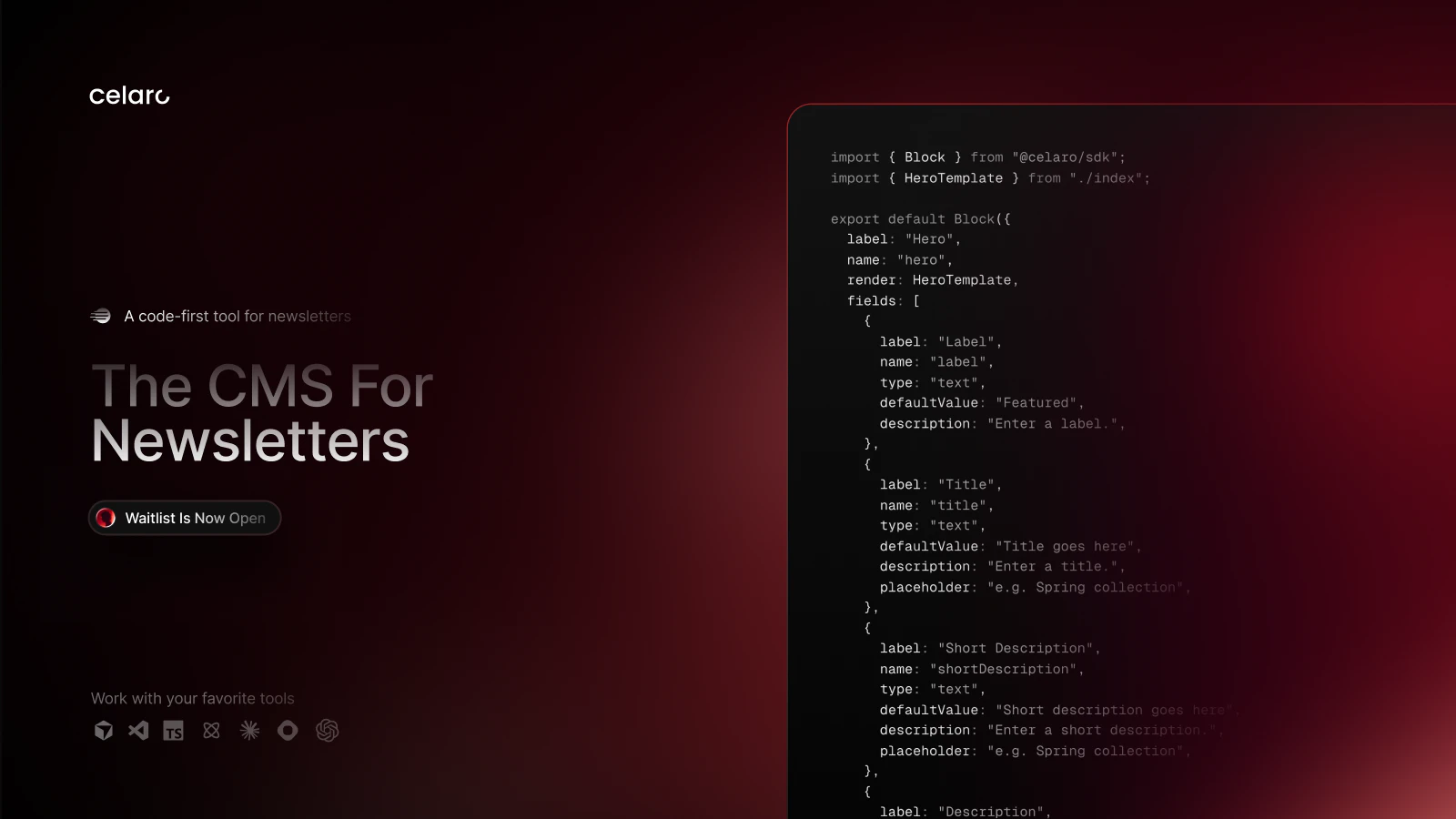
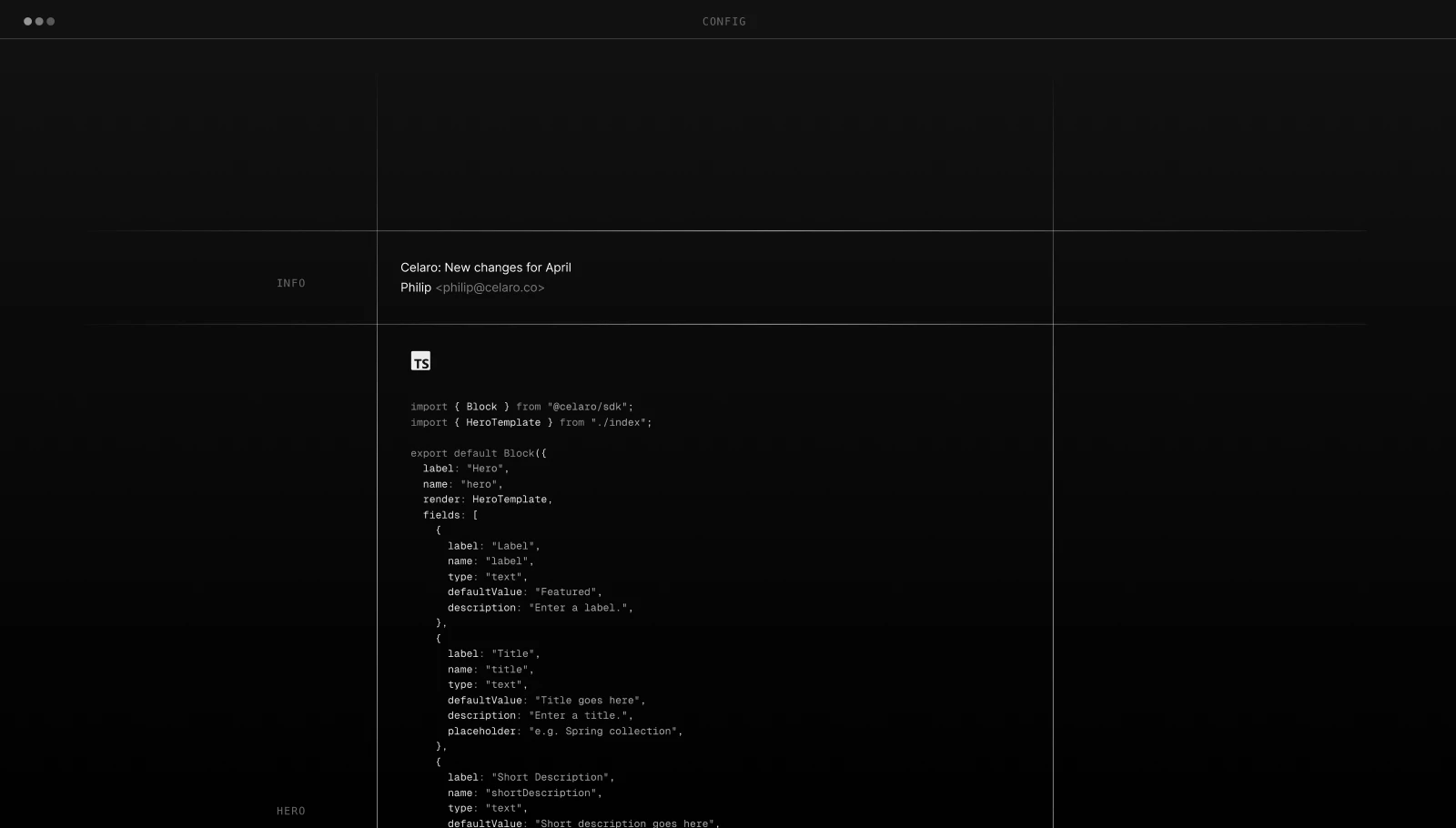
Create newsletters using code-based building blocks, with a simple UI for writing and editing content.

Hey, long time no see 👋

We originally built Celaro in a different direction. But along the way, we kept running into the same problem:

Creating newsletters is way more fiddly than it should be.

Clunky editors. Formatting breaks. Constant workarounds.
You end up fighting the tool more than actually writing.

So we decided to focus on that.

Celaro is a code-first newsletter CMS, with a UI for content.
Think code-based building blocks, edited through a simple admin interface.

You define the structure in code. Everything else happens in a clean admin UI.

It works especially well if one of you likes working in code, and another just wants to write without touching it.

If you're building emails with React Email, SendGrid, Beehiiv, Mailchimp, or anything similar, this might be for you.

Would love to hear how you're doing it today, and what's frustrating about it.

Cheers ❤

2
回复

Hey, love the idea and branding! One concern though is that this text on the landing is quite difficult to read.

0
回复

@ahh1539 Thanks for pointing that out, we'll fix it!

0
回复
#17
Petty Court
Formal justice for completely trivial crimes.
9
一句话介绍:一款允许用户为生活中微不足道的“冒犯”提交正式投诉、并获取AI生成法庭判决风格通知的应用,以幽默、形式化的方式解决了人们因琐事心生不满却又难以启齿的社交痛点。
Free Games Legal Artificial Intelligence
娱乐社交 解压工具 AI生成内容 趣味应用 关系互动 幽默投诉 数字玩具 情感宣泄
用户评论摘要:用户反馈积极,主要体现为实际使用(已提交多起“案件”)和趣味互动。开发者评论解释了产品初衷:用正式形式化解琐碎怨气。评论中未发现具体功能问题或改进建议,更多是体验分享。
AI 锐评

Petty Court 的本质,并非一个解决实际问题的工具,而是一面精准捕捉当代社交情绪的“数字哈哈镜”。它将日常生活中那些微不足道、上不了台面却又真实存在的烦躁感——如伴侣乱扔袜子、朋友已读不回——包装进一个严肃的“法庭”范式里,通过极致的“形式正义”来达成情感宣泄。其核心价值在于对“较真”这一行为的戏谑化解构。

产品巧妙地利用了两种反差感来制造趣味:一是议题的极端琐碎与流程的极端正式之间的反差;二是人类用户心知肚明的玩笑意图与AI法官“一丝不苟”审理之间的反差。这创造了一种安全且富有创意的表达空间,让负面情绪得以用一种无攻击性、甚至能促进互动的方式释放。与其说它在提供“正义”,不如说它在提供一种具有社交货币属性的“情绪剧本”和“关系黏合剂”——那份可分享的“判决书”,正是对话的延续而非终结。

然而,这款产品的天花板也清晰可见。其生命力高度依赖于用户的新鲜感与分享欲,功能深度有限,重复使用容易导致趣味性衰减。它更像一个精心设计的“社交玩具”或一次性话题引爆点,而非拥有长期用户黏性的平台。其成功与否,取决于能否持续激发用户创造和传播这些幽默的“微型戏剧”。在AI应用日趋同质化的当下,Petty Court 以四两拨千斤的姿态,展示了AI作为“氛围营造者”和“社交催化剂”的另一种轻巧可能,但距离成为一款持久的产品,还有很长的路要走。

查看原始信息
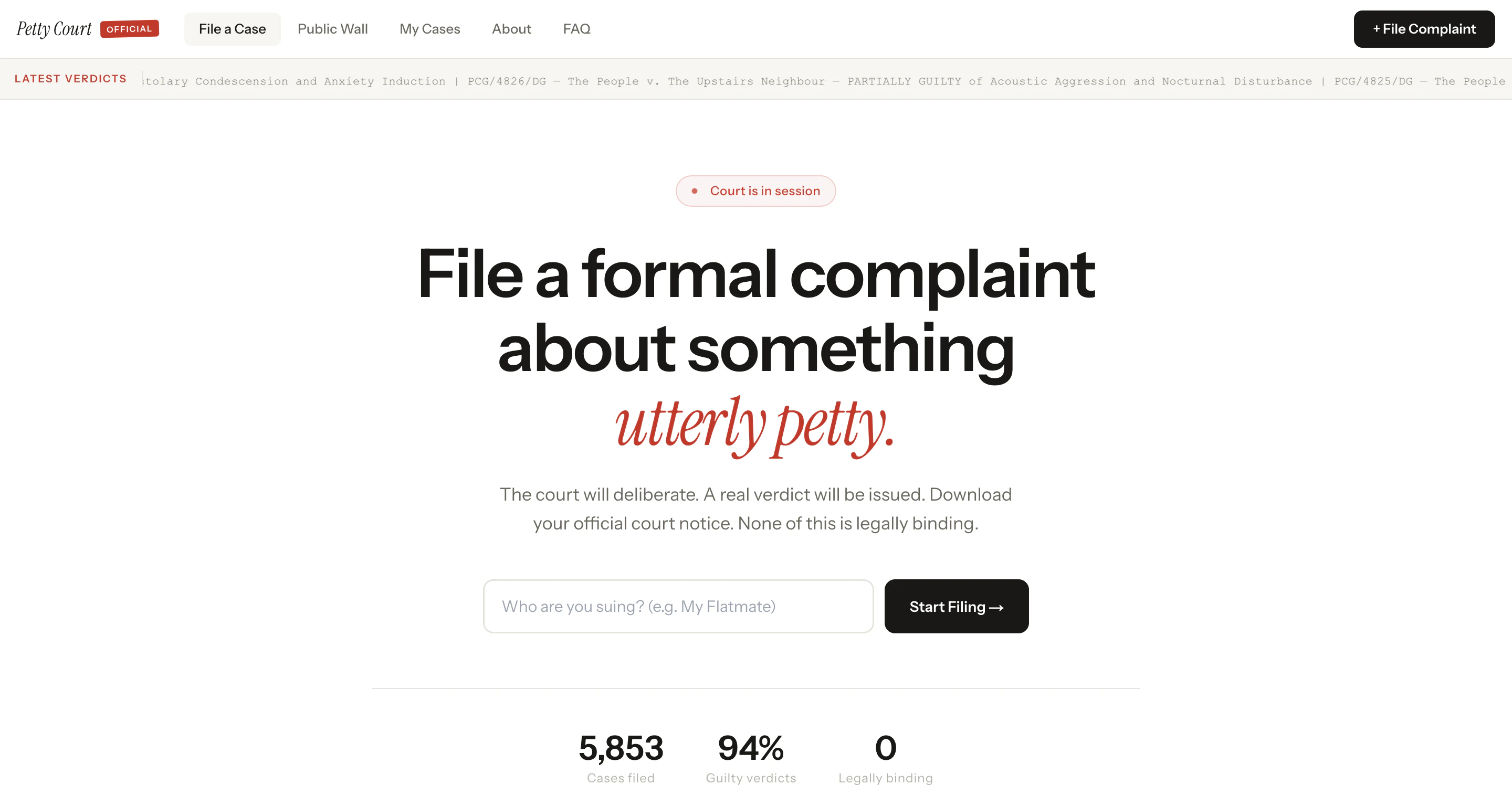
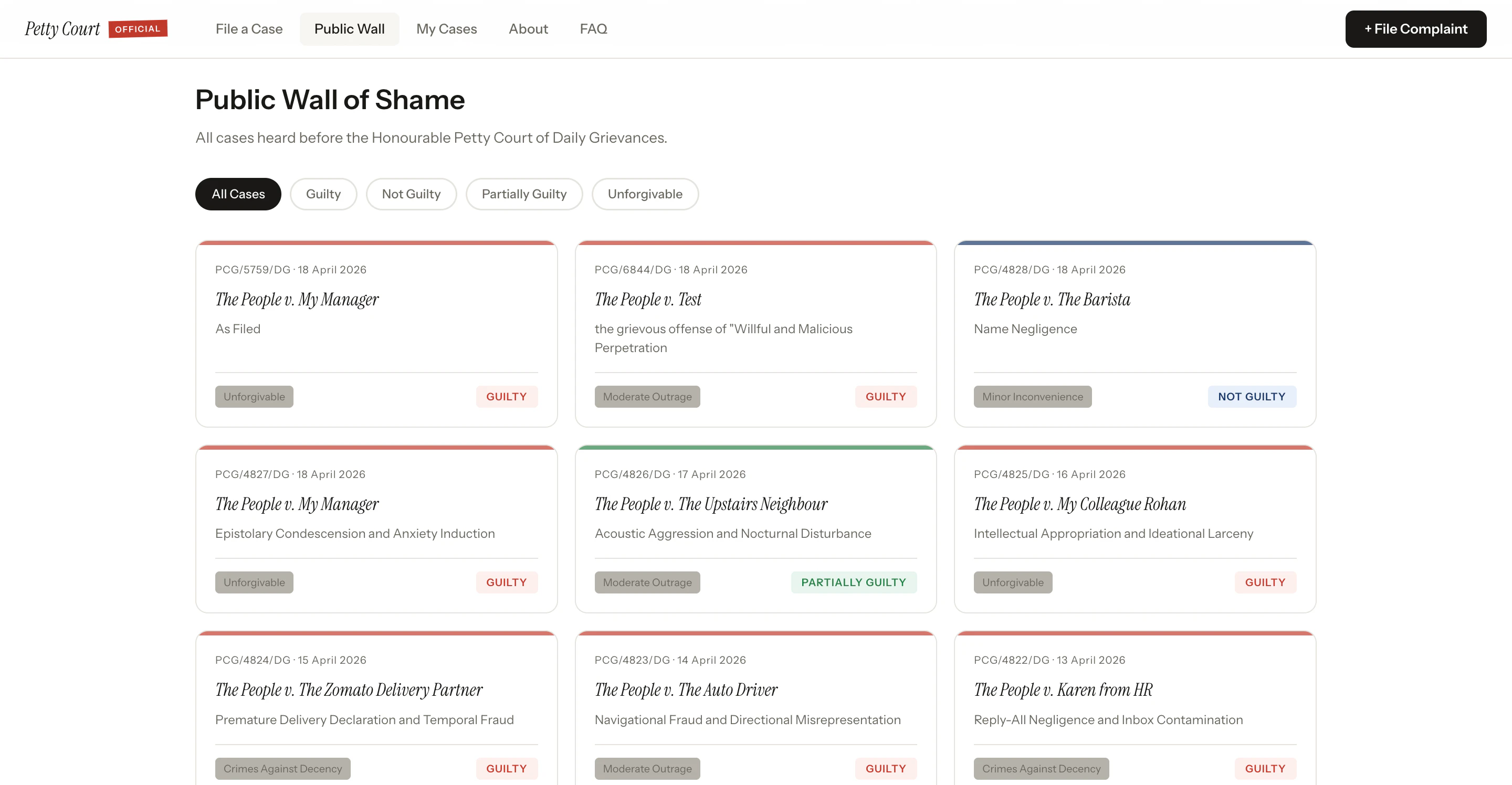
Petty Court
Justice for the unjustly inconvenienced. File formal complaints about everyday frustrations and receive shareable verdicts styled as real court notices.

Filed 5 cases against my friends and my wife already :P

1
回复

@tejas_godboley I'll be counter-filing soon. XD

0
回复
Hey PH! I built Petty Court because some grievances are too petty for a serious conversation, but too real to just let go. Sometimes you just need the universe to formally acknowledge that yes, what they did was wrong. A court notice with a GUILTY stamp is infinitely more cathartic than a passive-aggressive text. The court is presided over by two AI judges who take everything completely seriously, with a straight face and everything. Practical question: what would YOU file a complaint about? Drop it below, and I'll submit it live and post the verdict here.
0
回复
#18
MedIQGPT
Your Health Records, Intelligently Organized
9
一句话介绍:一款通过AI安全上传、存储、搜索和解读个人医疗文档的应用,在用户面临海量、杂乱医疗文件(尤其是不易辨认的手写单据)时,充当私密、智能的档案管理助手,缓解信息混乱与焦虑。
Health & Fitness Artificial Intelligence Medical
个人健康记录管理 AI文档解读 医疗信息组织 隐私优先 家庭共享 安全存储 健康科技 数据加密 非诊断工具 文件OCR
用户评论摘要:用户主要反馈集中在数据安全与隐私担忧。开发者回应强调采用企业级加密、行级数据隔离、承诺永不利用数据训练AI或展示广告,并提供数据删除/导出功能以建立信任。
AI 锐评

MedIQGPT的定位显示出一种在喧嚣的AI医疗赛道中难得的“克制”。它没有选择成为又一个试图替代医生诊断的“AI健康顾问”,而是退一步,聚焦于一个更基础、更普遍却长期被忽视的痛点:个人医疗信息的物理与认知混乱。其真正价值不在于算法的颠覆性,而在于其“隐私优先”的设计哲学与清晰的边界感。

在数据即黄金的时代,它反其道而行之,明确宣称“零AI训练”,这既是其最大的卖点,也可能是其商业模式的潜在枷锁。它将自己定位为一个“智能文件柜”和“术语翻译器”,这降低了监管风险和法律门槛,但也将市场天花板限定在工具层面,而非诊断或治疗服务。从评论中的担忧可以看出,即使用尽加密与合同承诺,用户对云端存储医疗数据的本能警惕仍是其增长的最大障碍。开发者的详细回应是教科书级的危机公关,但将信任构建于技术细节(如AES-256)和商业承诺,而非如本地化处理等更彻底的技术路径,其长期说服力有待考验。

产品从OCR工具演化为“隐私优先智能层”的路径也揭示了其洞察:用户最深层的痛并非“看不懂”,而是“找不到”和“信不过”。因此,它的核心竞争力或许并非AI的“智能”有多强,而在于其作为“可信赖的侧翼”的定位是否足够坚实。在印度等新兴市场,面对手写单据泛滥、医疗记录分散的家庭场景,它提供了切实的秩序。然而,其未来挑战在于,如何在不触碰数据红线的前提下,持续提升“智能”附加值,避免沦为单纯的加密云盘,并真正跨越用户心中那道关于隐私的“信任鸿沟”。

查看原始信息
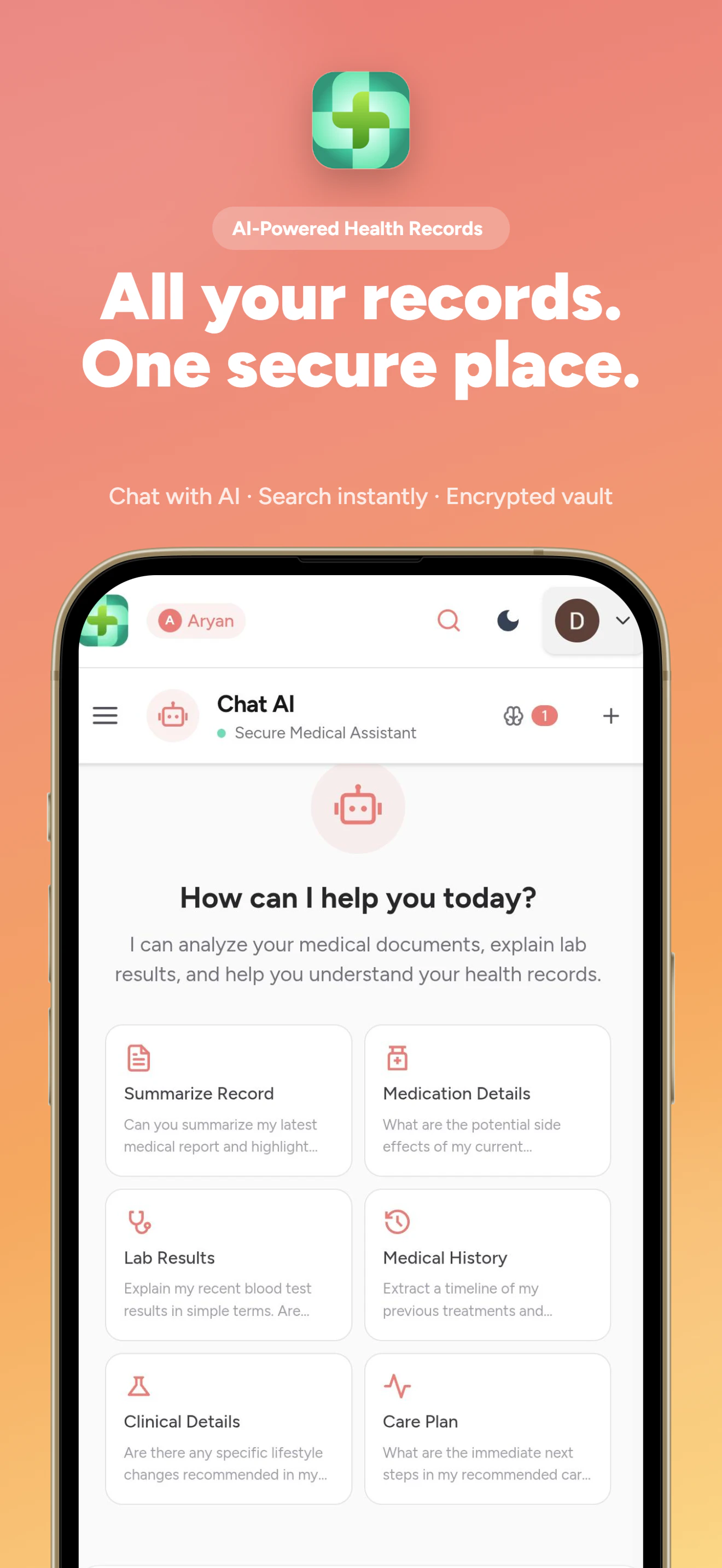
MedIQGPT
Upload, store, search and understand your medical documents with AI. Secure storage, AI-powered search, and family sharing - private by design. Start for free.

We've all watched friends and family scramble through stacks of medical reports, prescriptions, and lab results during health scares - especially in India where handwritten notes are often illegible scribbles. People feel lost, anxious, and clueless about their conditions (or their kids' or parents'), needing a trusted companion to explain terms, organize files, and answer day-to-day questions without exploiting their data.

That's the problem we solved: No privacy-invasive AI "health advisor" that trains on your sensitive info or guesses at messy handwriting (we don't; we just store it safely for doctors). Instead, mediqgpt.com is your personal medical data sidekick—a secure organizer for all your docs, reports, and histories (even for pets). It explains jargon clearly, retrieves info instantly, and empowers you (and your doctor) with complete context during urgent moments - never selling or training on your data.

Our process evolved from a simple OCR tool for prescriptions to this full privacy-first intelligence layer after user tests showed the real pain: disorganized chaos in complex journeys for young kids and elders. We're not a doctor replacement, just the confident companion you need to navigate without the fear.

Try it at mediqgpt.com launching now! 🚀 #HealthTech #PrivacyFirst #MedIQGPT

1
回复

I am a little worried about medical records getting uploaded on a new platform. Even though you seem not to train on the personal data but this data residing somewhere has me worried. How do you handle that?

0
回复

Hey, @shardul_lavekar that's a valid concern! Medical data deserves top-tier protection, especially on a new platform like ours. TBH I'd feel the same way.

Your data stays YOURS:

  • AES-256 encryption + TLS everywhere your data travels

  • Row-level security in the database, only YOU see your documents (or who you share with)

  • Zero AI training on your docs (Azure/Bedrock contracts guarantee this)

  • Delete/export anytime. No selling, no sharing.

Internally, we have decided to never showing any ads, because ads can seem very invasive at times, esp on platforms where your medical data resides.

Full details: [mediqgpt.com/privacy]

Happy to show exactly how it works! 🙌

2
回复
#19
Crickets
Every repo's health, without bugging your team
8
一句话介绍:一款为工程经理和技术负责人提供的晨间仪表盘,通过连接GitHub组织,无打扰地集中展示代码库健康状态,快速识别阻塞项与风险点,解决多项目管理中信息碎片化、手动追踪效率低下的痛点。
Productivity Developer Tools GitHub
工程管理仪表盘 GitHub监控 代码库健康 研发效能 无打扰管理 技术债务可视化 团队协作 SaaS工具
用户评论摘要:评论者为产品创始人,阐述了自身在多项目、多团队管理中的痛点,即手动在GitHub中追踪信息效率低下且易打扰团队。Crickets是其解决方案,能快速概览阻塞项,无需打扰团队成员。目前无其他用户反馈。
AI 锐评

Crickets切入的是一个精准且普遍存在的管理缝隙:技术管理者对项目“健康度”的知情权与“微观管理”骚扰团队之间的边界矛盾。它的核心价值并非提供新数据,而是对GitHub现有数据的“降噪重组”与“风险提炼”。

产品将散落在各仓库的Issue、PR、配置信息转化为“待办事项”与“风险雷达”,其宣称的“无代码、无代理”模式降低了使用门槛,但也暗示了其天花板——深度依赖GitHub API的现有数据维度,难以触及代码质量、部署流水线状态等更深层工程指标。其列举的监控项,如无人认领的Bug、僵尸Issue、巴士因子,本质上是将长期存在的团队协作惰性与技术债务进行了显性化、仪表盘化,这对管理者是利器,但也可能成为制造焦虑的“监控工具”,关键在于团队如何共识性地使用这些数据。

从市场看,它避开了与Jira、Linear等重型项目管理工具的正面竞争,定位为轻量、专注的“晨间简报”,场景清晰。然而,“免费1个仓库”的模式能否有效转化至付费(尤其是面向管理多个仓库的工程经理),是其商业化的关键考验。当前缺乏真实用户评论,其实际体验中的信息准确性、警报智能性(避免误报)均有待验证。总体而言,这是一个构思巧妙、解决真痛点的工具,但其长期价值取决于它能否从“风险报告器”进化成“智能协作建议者”,而不仅仅是另一个需要被“关闭的标签页”。

查看原始信息
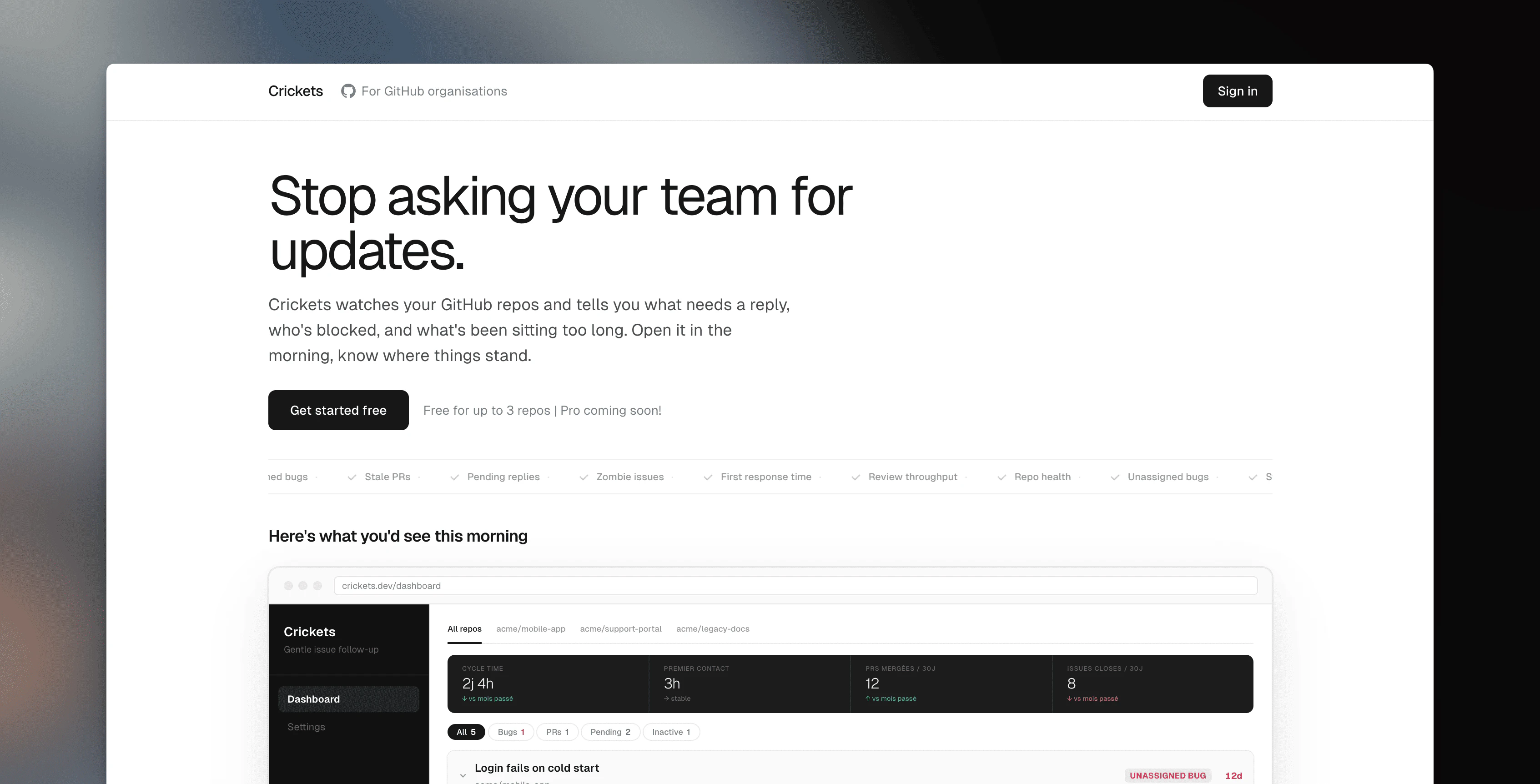
Crickets
Crickets is the morning dashboard for engineering managers and tech leads. Connect your GitHub org and see what needs attention: unassigned bugs, stale PRs, pending replies, zombie issues, production errors with no ticket. Plus tech stack versions, bus factor, and repo hygiene. Open it, see what's blocked, close the tab. No code changes, no agents, no noise.

Hey Product Hunt 👋

I work at an agency, and like a lot of you I juggle multiple projects, multiple teams, multiple GitHub repos at the same time.

The thing that was driving me nuts: having to go hunt the info down myself. Open GitHub, filter issues, figure out which PR has been sitting there for 10 days, try to understand why this bug still has no owner. And all of that without wanting to spam the team with "hey where are we on this?".

Crickets is my answer to that. I open the dashboard in the morning, I see in 30 seconds what's blocked, what's drifting, what needs me. And I close the tab. Without pinging anyone.

What it watches:

  • 🐛 Unassigned bugs

  • ⏳ PRs with no review

  • 💬 Customer issues with no reply

  • 🧟 Zombie issues (no activity for weeks)

  • 🛠️ Outdated / end-of-life tech stack

  • 🚌 Bus factor (one dev carrying everything)

  • 📋 Repo hygiene (CI, Dependabot, security policy…)

You connect your GitHub org and that's it.

Free for 1 repo, Pro coming soon.

Really curious to hear your feedback, especially from folks juggling multiple clients or multiple teams in parallel 🙏

0
回复
#20
QR by NeoWeb.ai
Free beautiful QR codes with full design control
8
一句话介绍:一款无需注册、完全在浏览器中运行的免费静态二维码生成器,通过提供深度的视觉自定义和数据隐私保护,解决了用户在创建美观、实用二维码时面临的工具繁琐、付费墙阻碍和数据安全顾虑的痛点。
Web App Design Tools No-Code
二维码生成 静态二维码 设计工具 隐私安全 免费工具 在线工具 浏览器应用 营销物料 数据本地处理
用户评论摘要:有效评论仅一条,为开发者自述。其阐述了产品初衷:解决现有工具限制多、界面杂乱、基础功能付费墙过高等问题。强调了免费、免注册、深度定制、隐私保护的核心特点,并主动向社区征求关于功能与设计的反馈。
AI 锐评

在二维码工具近乎红海的市场中,NeoWebQR 看似是一款简单的美学工具,但其真正的锋芒在于对两个底层行业惯性的精准反击:一是对“功能分级订阅”商业模式的颠覆,二是对“数据必须上传”这一默认路径的否定。

产品将“静态二维码生成”这一基础但高频的需求,从复杂的SaaS产品矩阵中剥离出来,做成一个功能完整、完全免费的独立工具,这本身就是一种极具侵略性的市场策略。它直接瞄准了那些被其他工具“微付费”或强制注册激怒的普通用户和轻量级创作者。其宣称的“无限制”和9种内容类型支持,试图将免费版的体验做到与传统工具的付费版持平,这足以对许多依靠该功能引流的中小二维码服务商构成压力。

更深层的价值主张在于“隐私设计”。强调一切在浏览器中运行,数据不离本地,这并非单纯的技术实现描述,而是击中了当前用户日益敏感的数据安全神经。尤其是在处理Wi-Fi密码、联系方式、日程等半隐私信息时,这一特性从“不错的功能”升级为“关键决策因素”。这使其在政府、教育、隐私倡导者及高安全意识企业用户中可能具备独特吸引力。

然而,其挑战也同样明显。作为一款完全免费、无账号体系的产品,其商业模式模糊,长期可持续性存疑。它目前依附于NeoWeb.ai主品牌,更像是一个获取流量与品牌好感的“钩子”产品。此外,“静态二维码”无法后期编辑内容,这限制了其在需要追踪数据分析的营销场景中的应用,使其主要停留在“视觉设计”和“即时分享”层面。若想突破,未来可能需要在不损害核心隐私承诺的前提下,探索动态二维码、基础数据统计等增值服务路径。

总体而言,NeoWebQR 是一款定位清晰、价值观鲜明的“狙击手”式产品。它或许不会覆盖所有二维码使用场景,但在其选择的“免费、美观、隐私”的细分战场上,已经构筑了足够坚固的竞争壁垒。它的出现,迫使行业重新思考:那些最基础的用户体验,是否应该被锁在付费墙之后?
查看原始信息
QR by NeoWeb.ai
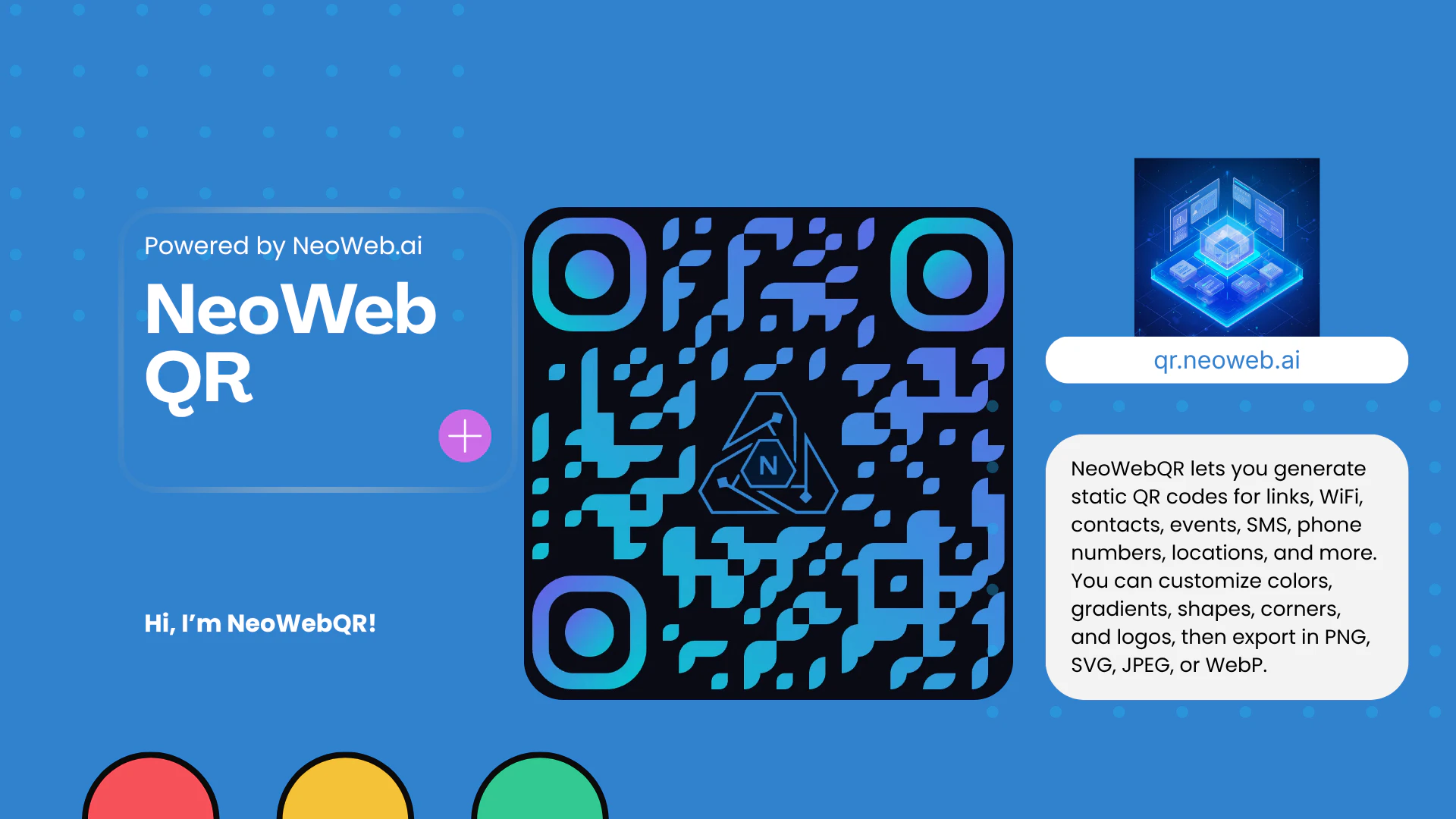
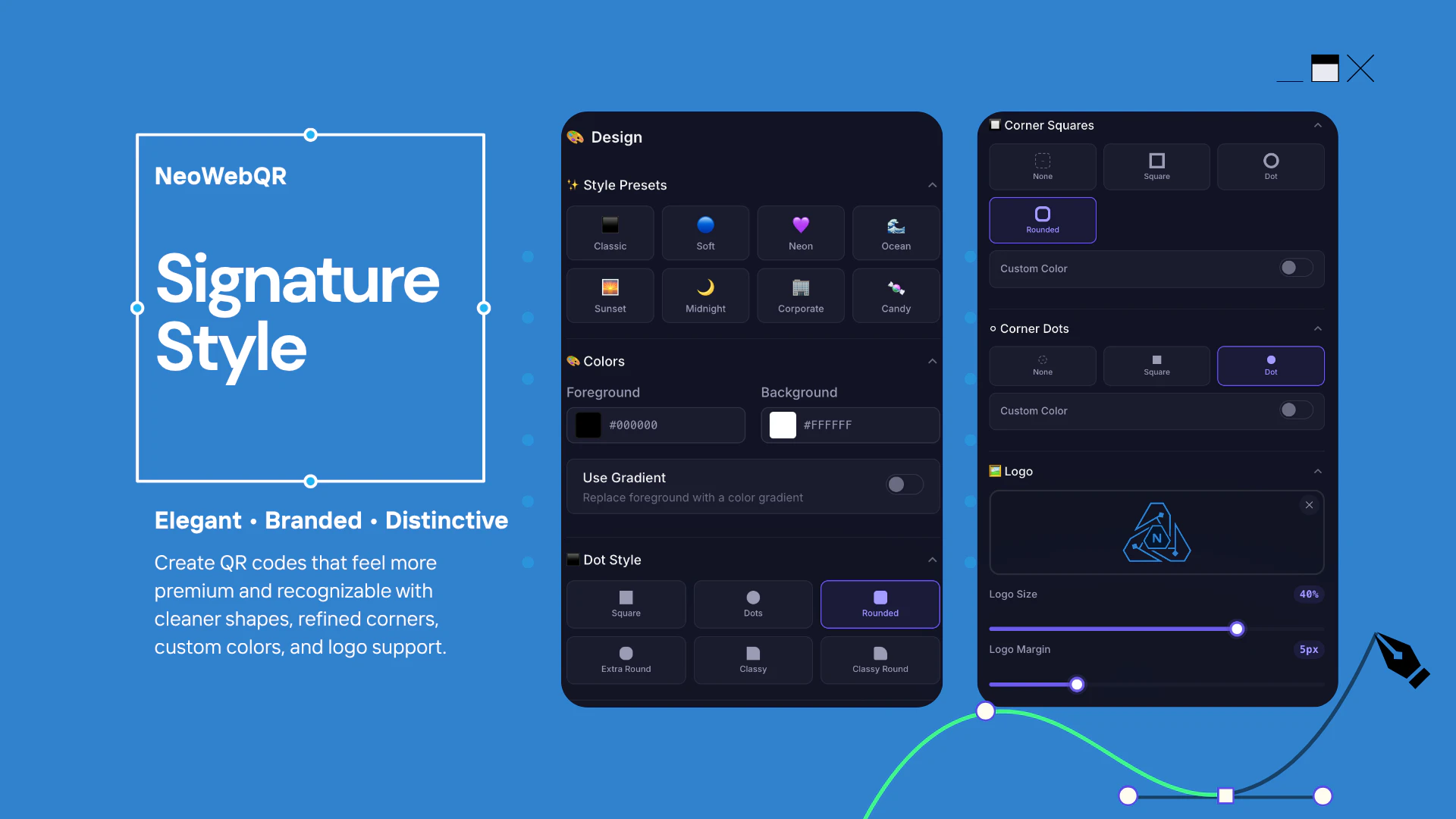
NeoWebQR helps anyone create beautiful static QR codes for free — with no sign-up, no limits, and no tracking. Customize colors, gradients, dot styles, corners, frames, and logos, then export in PNG, SVG, JPEG, or WebP. It supports 9 content types including links, WiFi, vCards, events, SMS, email, phone, and location. Unlike many QR tools, everything runs in your browser, so your data stays private.
Hey Product Hunt 👋 We built NeoWebQR because most QR tools felt too limiting, too messy, or too aggressive with paywalls for very basic things. We wanted something simpler: -free to use -no sign-up -beautiful by default -deeply customizable -private by design NeoWebQR lets you generate static QR codes for links, WiFi, contacts, events, SMS, phone numbers, locations, and more. You can customize colors, gradients, shapes, corners, and logos, then export in PNG, SVG, JPEG, or WebP. One part we cared about a lot was privacy. Everything runs in the browser, so your content stays on your device. It started as a small sub-product inside NeoWeb.ai, and turned into something we felt should exist as a standalone free tool anyone can use. Would love your feedback on the product, the design controls, and what content types or export options you’d want next 🙌
3
回复