Product Hunt 每日热榜 2026-04-20

PH热榜 | 2026-04-20

#1
Dune
Context-aware Mac keypad to automate workflows + meetings
476
一句话介绍:Dune是一款上下文感知的Mac物理按键板,能根据前台应用自动切换三个按键的功能,为开发者和频繁开会人士自动化高频操作,减少工具切换和复杂快捷键的记忆负担。
Productivity Artificial Intelligence Development
智能硬件 Mac外设 生产力工具 自动化 上下文感知 AI助手 开发者工具 会议效率 可编程按键 工作流优化
用户评论摘要:用户肯定其设计理念和效率提升,关注核心技术细节:如何智能判定“最相关操作”、应用检测的准确性与延迟(200-600ms)、能否锁定按键功能、按键音量和高级自定义能力。创始人积极回复,解释了基于系统API的检测原理和自定义逻辑。
AI 锐评

Dune的野心不在于提供海量可编程按键,而在于用“情境智能”重新定义物理交互的逻辑。它本质上是一个“决策外设”,将用户从记忆和配置宏按键的负担中解放,代之以系统主动推送的、基于上下文的三个最优选项。这背后是对现代工作流,尤其是AI原生工作流演变的精准洞察:当操作对象从静态菜单变为动态AI Agent时,固定的快捷键体系已然失效。

其真正价值在于充当了物理世界与数字智能体之间的“低摩擦触发器”。无论是触发GitHub的PR流程,还是激活一个Claude Agent,它将多步、跨界的数字操作坍缩为一次确定的按压,提供了AI时代稀缺的“确定感”和“操控感”。垂直三键设计是反直觉的聪明之举,它承认了核心高频操作的有限性,并优化了手部移动路径。

然而,其核心挑战也在于“情境智能”的可靠性。200-600ms的检测延迟在快速切换场景下可能打断心流,而“最相关操作”的算法将是长期体验的关键。它目前更像一个“智能预设”而非“自适应学习”系统。能否从“理解应用”进化到“理解用户意图”,将决定它是下一个Stream Deck,还是一个昙花一现的精致玩具。它赌的是软件交互的复杂度已超越人类手动配置的意愿,这个赌注很大,但方向值得深究。

查看原始信息
Dune
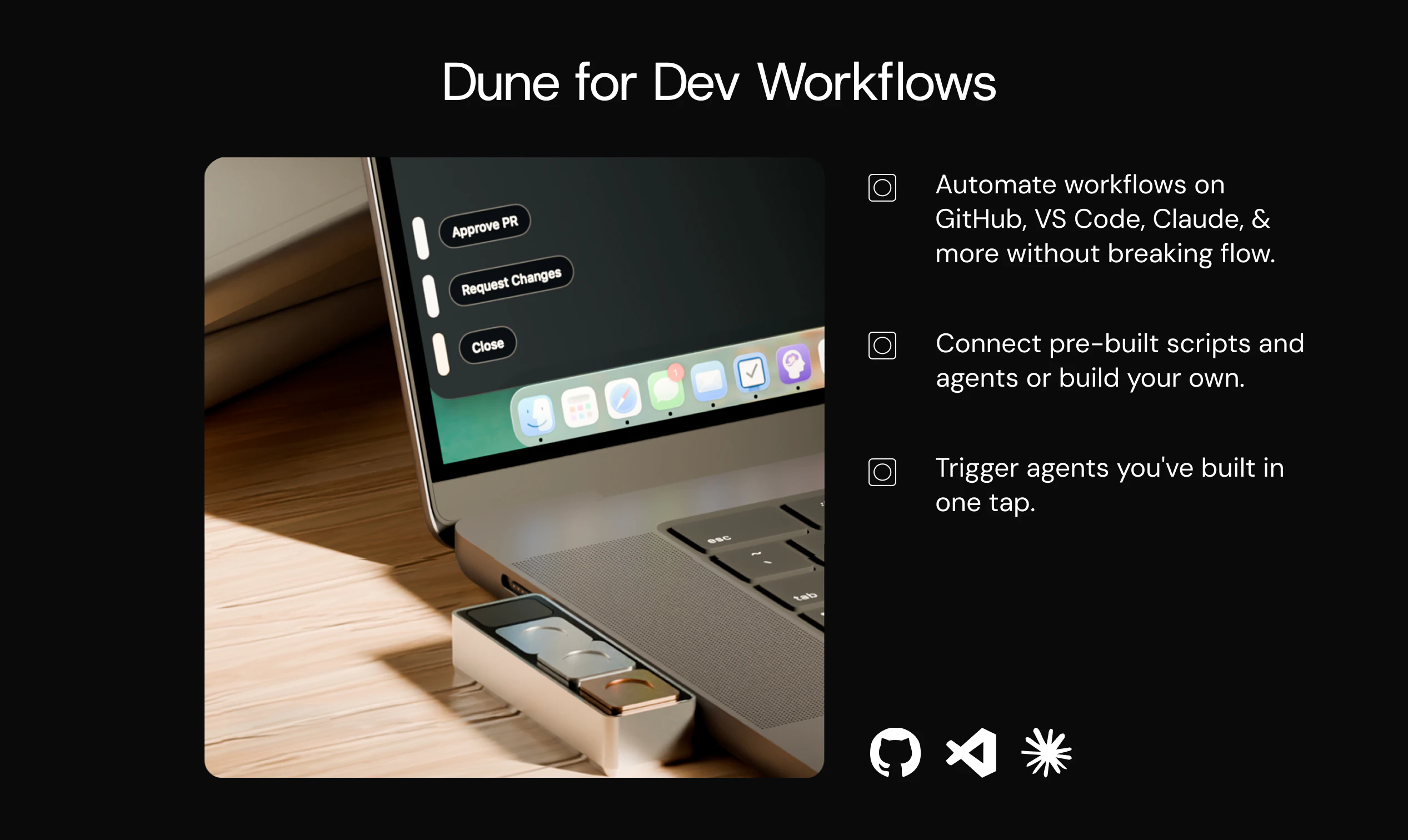
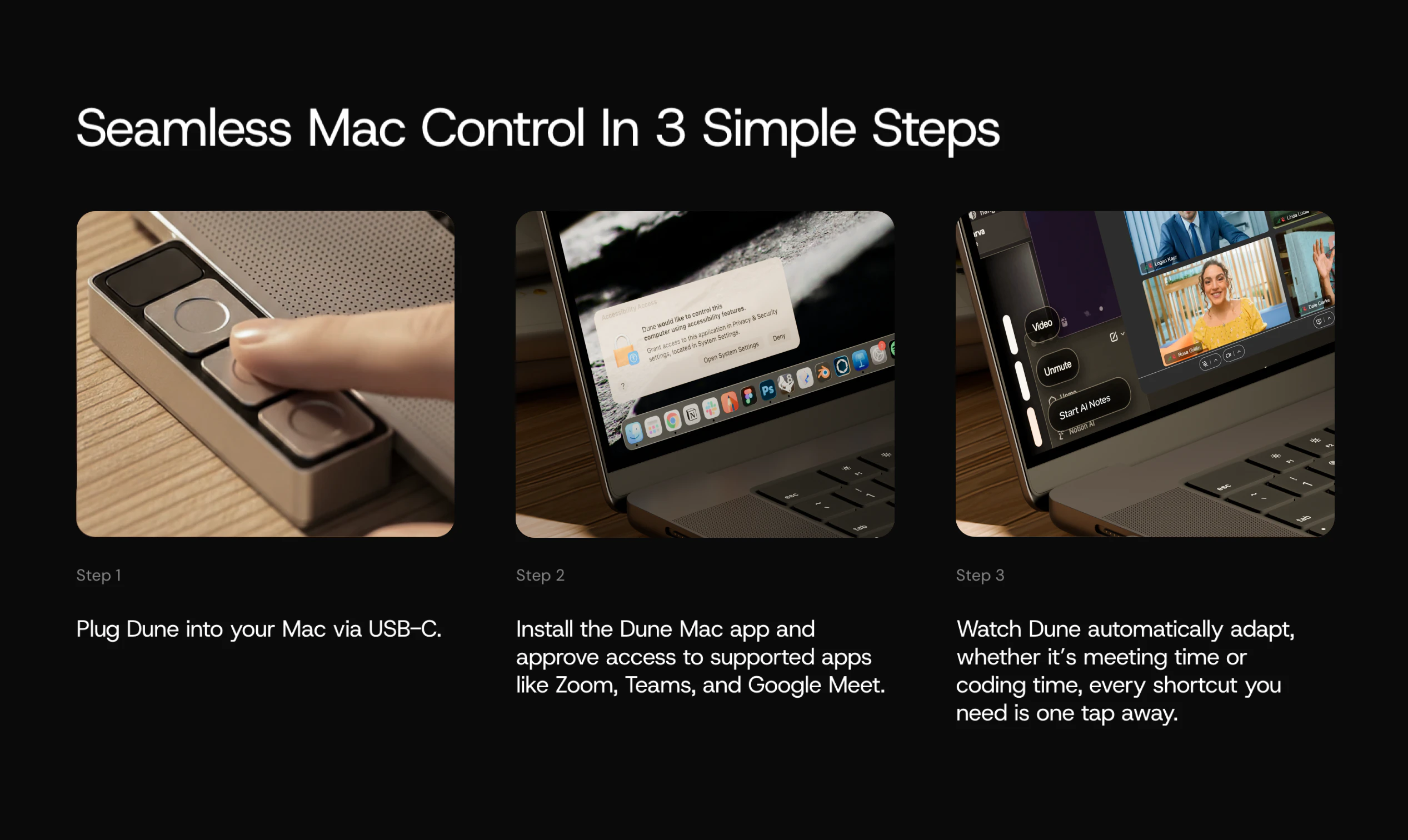
Dune is a Context-aware Keypad for Mac that sits next to your keyboard and changes what its three keys do in real time based on the app running in the foreground. Built for developers who live in GitHub, VS Code, Claude, Openclaw, and for anyone running AI agents or in back to back meetings on Zoom, Teams, and Google Meet.

Hi! Really excited to finally share what we've been building.
I’m the founder of Project Mirage. We are a team of Designers, Developers and Engineers who have been building in Consumer Hardware for over 8 years, now building in AI Interfaces.

What is Dune and why is it called so?
Dune is a context Aware Keypad for mac that reads which app is in the foreground and automatically changes what its 3 keys do based on what you're doing. We call it Dune because a sand dune is never one thing. It shifts, quietly and constantly, shaped by whatever surrounds it.
That's what these three keys do. They observe what you're doing and become what you need, right then.

What Makes Dune Different
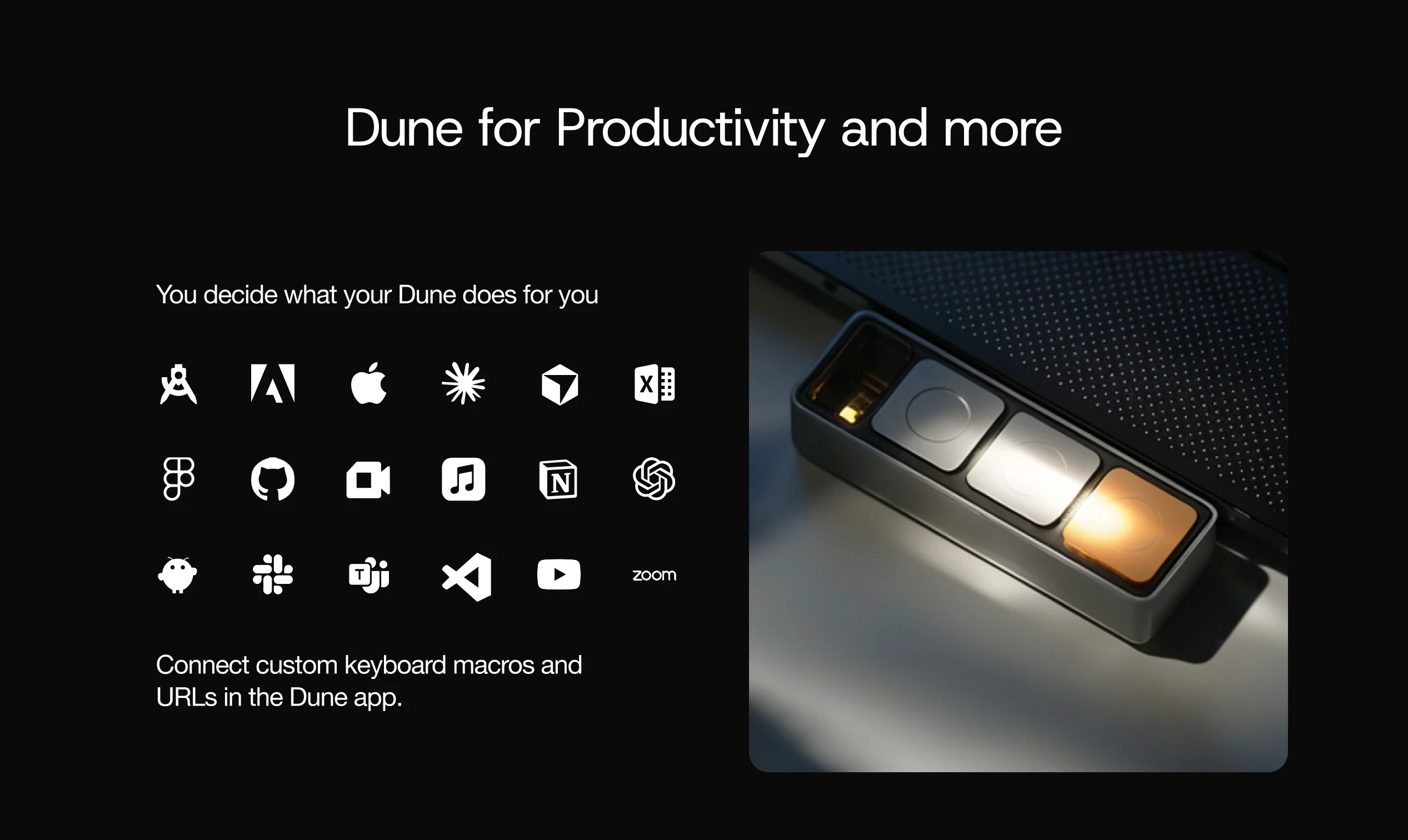
Dune is context-aware, meaning, its keys update automatically based on the app you are running. Unlike other keypads that lock you into setting up keyboard macros for each app, Dune comes with the most-used commands and complex workflows already built in. It is also highly customizable - you can write your own scripts and connect your own agents to trigger via Dune. It reads your active app and surfaces the three most relevant actions automatically, in real time.

The Problem & Our Solution
The way we interact with computers hasn't meaningfully changed in 45 years. We still rely on browsing through screens, clicking multiple links, and memorizing unnecessarily complex keyboard shortcuts for everyday actions. Most shortcuts are buried, forgotten, or simply never discovered, and that's not a user problem, it's a design problem.


Meanwhile, what we actually do on computers has gotten far more complex - developers juggle dozens of tools at once, and meetings now run back-to-back with controls scattered across cluttered interfaces. The friction is constant, and it adds up.


We spent months experimenting with new interface paradigms, showcased three of them at CES, and built Dune to put the best of what we learned directly in your hands. A three-key Mac keypad that reads your active app and surfaces the right actions automatically, whether you're coding, in a meeting, or getting things done.

Features & Benefits
1. Context Awareness: Dune detects which app is in the foreground and automatically updates what its 3 keys do in real time, so you never have to manually switch profiles or reconfigure anything.
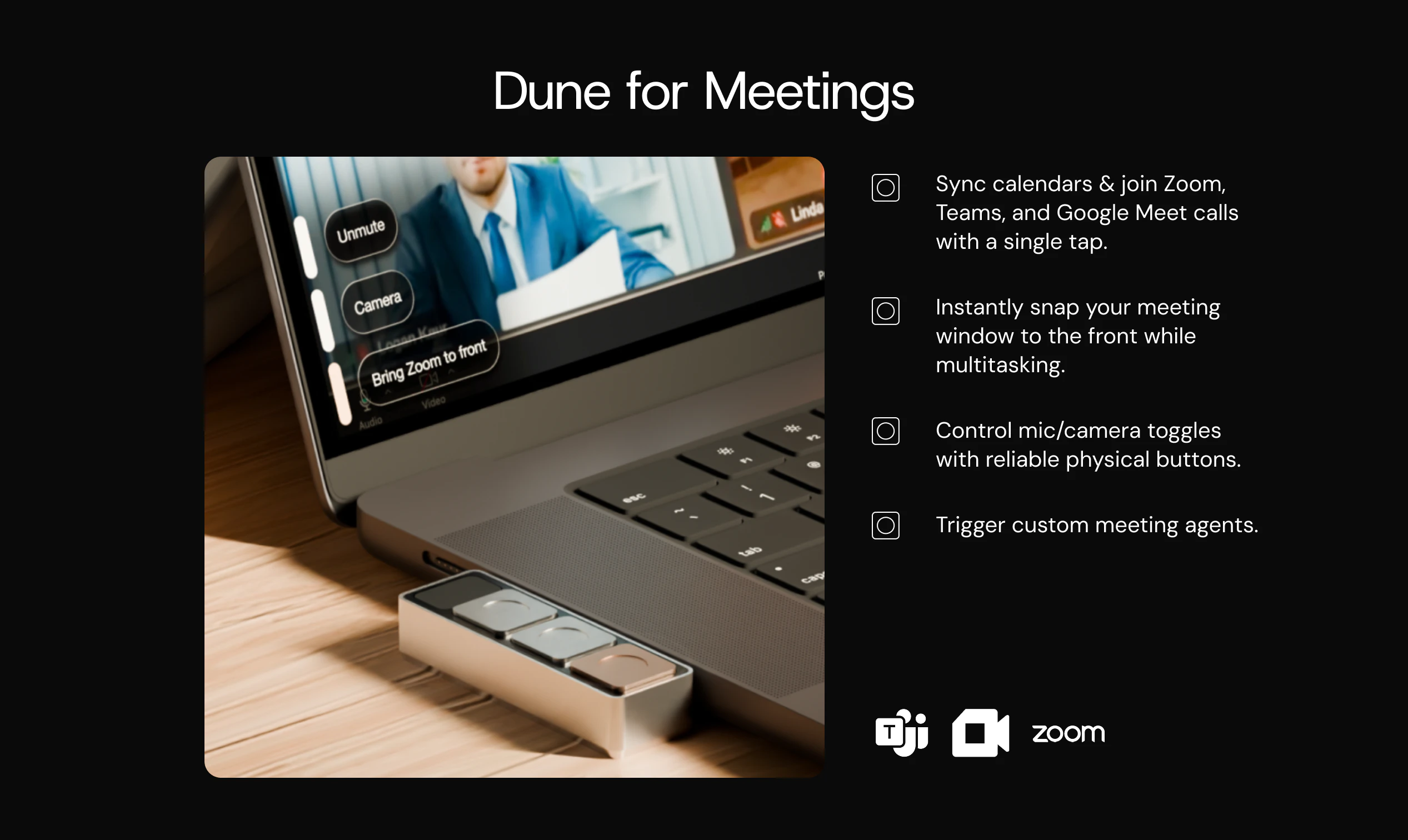
2. Instant Actions: Every key is always mapped to something relevant to what you are doing. In GitHub, that means raising a PR, approving/rejecting a change. In your meeting app, joining a call, toggling your mic and controlling your camera with one tap - all while juggling a hundred different tabs.
3. Calendar Sync: Dune syncs with your calendar so you can join your meetings in a single click. Works with Zoom, Teams and Google Meet.
4. Agent Triggers: Trigger your AI agents or agentic workflows directly from your desk. An email assistant, a calendar agent, or anything else you've built in Claude can be activated from the same three keys without switching context.
5. Custom Macros and URLs: Connect any keyboard macro or URL in the Dune app and define exactly what each key does across any app or workflow.

Who Is Dune For?
Dune is built for anyone who lives on their Mac.
1. Developers: Approving a PR on GitHub takes 4-6 clicks on average. Multiply that across a full day of reviews, commits, context switches, and agent triggers and you're spending more time navigating your tools than actually building. Dune maps its three keys to the actions you reach for most in GitHub, VS Code, Claude and more, so you stay in flow.
2. People who live in Back-to-Back Meetings: One tap to join a call, a dedicated mic toggle that auto-brings your meeting window to front, and a camera key so you're never fumbling at the wrong moment. Syncs with your calendar and works with Zoom, Teams and Google Meet.

We'd especially love to see what you build with it.

Drop a comment! I’d love to hear what shortcuts have been frustrating you and share how Dune can fix that for you.
---

🎁 Product Hunt Launch Offer
33% off for our early birds, use code PRODUCTHUNT99 at https://www.projectmirage.ai/order

⭐️ Important Links
Site: https://www.projectmirage.ai/
Setup Guide: https://boom-cuticle-650.notion....
All FAQs: https://www.projectmirage.ai/#du...
Demo: https://www.youtube.com/watch?v=4Hn_ece7NVc

37
回复

@apoorv_shankar How does Dune decide the “three most relevant actions” in real time, and how much control do advanced users have to override or train that context logic for their own workflows?

0
回复

@apoorv_shankar Congrats on the launch here! What's one shortcut frustration you personally fixed with Dune that surprised even you?

3
回复

@apoorv_shankar For devs bouncing between GitHub PR reviews, VS Code debugging, and Claude agent tweaks, how smart is the app detection? Does it handle nested workflows well like PR → comment → approve chain, or can you chain keys for multi-step actions without breaking immersion?


0
回复

Is it reading the active window process or something deeper than that?

9
回复

@darksynapse the app reads the active foreground application via macOS accessibility APIs. So it is process-level detection, we do not record or keep a track of what you're doing on your screen like some other AI Assistant apps.

5
回复

Early user here - thought it would take weeks to build the muscle memory. Took about two days. Now if the keys are not there I notice immediately. Nicely done.

8
回复

@mir_mubashshir glad to hear that. What are you primarily using Dune for?

4
回复

Is there a way to temporarily lock the keys so they stop remapping?

5
回复

@joe_12 Yes, you can select custom actions for each key, lock the action so it doesn't change for any app, and even decide which apps could overpower these preset actions.

3
回复

Three keys in a vertical stack rather than horizontal is interesting. Easier to reach without moving your hand off the home row.

5
回复

@pranab_kumar1 Thanks. Yes, it felt like a more convenient form than what other larger macropads.

1
回复

Curious what the latency looks like between the macOS accessibility API firing and the key remap completing.

5
回复

@nadeem_zafar1 Detection latency is 200–600ms depending on the system — 200ms is the typical case, 600ms on the slower end of hardware we've tested. It's polling the foreground app, so there's inherent system-dependency. Such latency in generally hard to notice but we are working towards reducing this further.

0
回复

What is the loudest the keys get? Hot desk life is real, and some of us have to be considerate.

5
回复

@sourav_sheth1 Consider it about 2x louder than your mac keys, but that's also intentional. The button press makes you feel like you've triggered a larger action or accomplished a larger task. :)
We work at a co-working space and haven't seen people noticing the sounds of the keys, so this won't be a concern.

3
回复

This is cool. Context-aware is doing a lot of work in the pitch. Macro keypads usually trade a few saved seconds for remembered mappings so net productivity ends up a wash. How does Dune's context trigger? Active window, calendar state, time of day.... ? Congrats, and good luck :)

4
回复

@keith_hiyamojo Sure agree, the difference with Dune is that it goes beyond simple keyboard shortcuts + it also displays the shortcuts in one corner of the screen so its easier to remember. Additionally, because of Agentic workflows being a thing now, a single button becomes much more powerful, and Dune is specially designed for connecting custom scripts and agents without having a complex flowchart like Interface to build new actions. Examples of more complex triggers that come pre-loaded with Dune include- Joining a meeting, Raising/Merging a PR on github, checking limits on Claude etc.

On context triggers- You can customize your actions to be triggered based on the Active Window, Calendar events and Time of the day and you could also choose which Apps could overpower an active window - for example, if you're in a zoom meeting, the 3 buttons will function as meeting control buttons and a new active window in the foreground won't affect these functions.

0
回复

Congratulations. And happy product launch. @apoorv_shankar

4
回复

@huisong_li Thanks :)

0
回复

Cool project! Guys, you're great!

4
回复

@artem_anikeev Thanks :)

0
回复

Congratulations!!!

4
回复

Interesting contrast to tools like Stream Deck fewer buttons, but smarter ones. Feels like a bet on intelligence over customization.

3
回复

@maklyen_may 100%, its designed for the current software workflows we have- powered by AI, assistants and agents. Wish I had read your comment before explaining the differences between Stream deck and Dune to others :)

0
回复

Curious how fast and accurate the app detection is in practice. Even slight lag could break the flow you're aiming for.

3
回复

@lucy_rolff  The app detection is almost 100% accurate since we use multiple methods from scripts to accessibility to detect the app in the foreground. The Detection latency(to change actions when you switch to a new app) is 200–600ms depending on the system, 200ms is the typical case, 600ms on the slower end of hardware like for older Macbook Air devices. Since the software is polling the foreground app, so there's inherent system-dependency. We generally haven't seen such small duration to be a problem. But we're actively working to reduce this further.

0
回复

Okay, I love this! I'm really excited. The vertical stack of keys looks like a smart idea. How is the latency?

3
回复

@antoninkus Thanks. Current Detection latency(to change actions when you switch to a new app) is 200–600ms depending on the system, 200ms is the typical case, 600ms on the slower end of hardware like for older Macbook air devices. Since the software is polling the foreground app, so there's inherent system-dependency. But we're actively working to reduce this further.

0
回复

Hardware that actually thinks about the person using it. That is what we were going for from day one and I think we got there. Really proud of this one.

3
回复
0
回复

custom scripts alone are worth it. i have sooooo many workflows I want to build with this. congrats on the launch, really proud of what we shipped :)

3
回复

@the2ndfloorguy Cheers! and excited about what we will ship next!

0
回复

Waiting for an update wherein it connects via bluetooth and I could use it as my external Knuckles. Kudos to the team!

3
回复

@prastik we had actually built a Bluetooth version as an early prototype too. Never thought of this use case though :P

2
回复

How long does it take to learn a new app? Like if I add a tool to my workflow tomorrow, does Dune pick it up automatically or do I need to do something?

3
回复

@shaumik_kanvinde there is no real learning on the app yet, we have pre loaded actions and you can add your custom actions, agents, scripts and other workflows. So as soon as you set it up, you can start using Dune and the actions will change based on the app you're running. And we display the actions on the bottom left corner of the screen so you what the 3 buttons do.

0
回复

the fact that it changes based on the foreground app is sneaky smart 👀 been losing my mind switching between cursor claude and meetings lately so this solves the exact right problem.
how hard was app detection to get reliable across all the chaos?

2
回复

@krystian_n_l_ Thanks. I'd say its moderately difficult, requires a lot of testing. :)
There are a few ways we could go about detecting the foreground app, and the same method doesn't work for every app weirdly, so we use a combination, but it works very reliably now.

0
回复

This looks fantastic! Congrats on the launch! It's USB-C connection, but you have M2 or later on the site for compatibility. Any specific reason an M1 Mac won't work? There are 2 USB-C ports in the same location as the newer models

2
回复

@twtechnology the software works well on M1 as well, the problem is with the mechanical compatibility of Dune with different Mac models. We have different SKU's for different mac models, all designed to stay flushed with the device you have. Since M1 Mac has a different thickness, height and distance between the base and USB c port as compared to other Macs that we support, a good fit would require a custom Dune device which we do not support right now. You can still connect it with an M1 Mac but the experience won't be very good.

0
回复

How fast is the remapping actually? Like is it instant or is there a moment where the keys are in between states? Never clocked it properly.

2
回复

@paras_patle1 The Detection latency(to change actions when you switch to a new app) is 200–600ms depending on the system, 200ms is the typical case, 600ms on the slower end of hardware like for older Macbook Air devices. Since the software is polling the foreground app, so there's inherent system-dependency. Generally, we haven't seen early users detect such a lag. But we're actively working to reduce this further.

0
回复

Designing something this compact while keeping it intentional and complete was a unique challenge. Really Happy with how it turned out!

2
回复
0
回复

Every surface on this was intentional. Good to finally have it out in the world!

2
回复

@erzoisonline Cheers!

0
回复

As someone who has spent years building hardware, shipping something this precise and this smart at the same time is genuinely satisfying. Really proud of what this team pulled off.

2
回复

@anoop_jayan1 Cheers!

0
回复

Three keys sounds like nothing until you realize those three keys are always the right three keys. This is a good one! 😎

2
回复

@aditi_saxena6 Thanks. Exactly! Context and agents have made it possible to make 3 keys do everything you need.

0
回复

nice, i basically wanted to do the same with the elgato custom stream deck module and call it "clawboard.engineer", but this is sooo much better. i need this in my life.

1
回复

Why i need this ? If I can also use siri much faster than this

1
回复

@ankit_narang1 Hmm, not sure if you will find Siri as fast and easy to connect with the daily workflows we have showcased in the video.

0
回复

Looks dope man! Good luck

1
回复

@ikalimullin thanks!

0
回复

Congratulations on the launch! Looks exciting, and I love the naming, waiting for more geographies to come :)

1
回复

@natella_nuralieva Thank you. Where do you need it shipped to?

0
回复

three keys seems minimal but probably smart. love that it's built specifically for the GitHub/VS Code/Claude workflow since that's our daily stack. wondering if there's any way to customize actions beyond what the AI suggests, or if it learns your patterns over time?

1
回复

@piotreksedzik We have a pre-loaded set of actions which work with these apps and you can customize what each button does, within each app and have it setup in such a way that you see different actions in the morning vs noon. The Dune configuration tool also lets you connect your own scripts and agents so you could create really powerful custom workflows beyond keyboard shortcuts for each app.

0
回复
#2
Claude Desktop Buddy
Bring Claude into the physical world with maker hardware
319
一句话介绍:一款通过蓝牙低功耗(BLE)API将Claude桌面应用状态(如会话、权限提示)连接到物理微控制器(如ESP32)的工具,为开发者和极客提供了将AI交互实体化、可触摸的创新方式,解决了AI交互缺乏物理反馈和沉浸感的痛点。
Open Source Hardware Artificial Intelligence GitHub
硬件交互 AI实体化 开发者工具 物联网 蓝牙低功耗 微控制器 Claude生态 极客项目 人机交互 桌面伴侣
用户评论摘要:用户普遍认为这是一个极具潜力的创意起点,将AI与物理世界连接。主要问题集中在API功能细节(如事件流是否双向、是否只读)、未来扩展计划(如开放更多事件类型),以及具体的硬件兼容性(如GameBoy Color)。建议包括用于状态灯、电子看板等更丰富的硬件交互场景。
AI 锐评

Claude Desktop Buddy 表面上是一个为Claude桌面应用提供BLE API的小工具,但其真正的价值在于它悄然捅破了AI交互的“次元壁”。在AI交互被禁锢于屏幕像素和语音声波的当下,它提供了一个低成本、低门槛的“泄漏点”,让AI的抽象状态(如“正在思考”、“等待批准”)得以渗透进物理世界,变成一盏灯、一个桌宠或一块电子墨水屏的显示。这远不止是一个极客玩具。

其犀利之处在于两点:一是“轻”。它没有笨重地重新定义硬件,而是巧妙地利用了成熟的、开发者友好的微控制器生态(如ESP32、M5Stack),将创新成本降至最低,迅速激活了硬件创客社区的想象力。二是“桥”的定位。它目前聚焦于权限提示等核心交互点,看似功能单一,实则精准地锚定了AI助手工作流中“需要人类介入”的关键时刻,将其转化为一个可触摸的硬件事件。这为“被动式”或“环境式”AI交互奠定了基础——未来,你可能不再需要盯着屏幕等待Claude的提问,桌上一枚闪烁的灯光或一个玩偶的抬头就足以传达信息。

然而,其挑战也同样明显。目前的演示更像一个“单向状态广播”,评论中关于双向交互的疑问直指核心:如果硬件仅能“显示”而不能“输入”深层指令,其交互深度将大打折扣。此外,从酷炫的概念原型到稳定、安全的日常工具,还有很长的工程化道路要走。它能否从“有趣的实验”进化为“不可或缺的交互层”,取决于API的开放程度、事件流的丰富性以及是否能形成真正的硬件用例闭环。

总之,这不是一个成熟的产品,而是一颗精心投掷的“思想石子”。它的出现,其象征意义大于当前功能:它宣告了AI交互不再满足于虚拟世界,开始正式向物理空间“殖民”。无论这个项目本身未来如何,它所指向的“具身化AI交互”方向,无疑值得所有从业者侧目。

查看原始信息
Claude Desktop Buddy
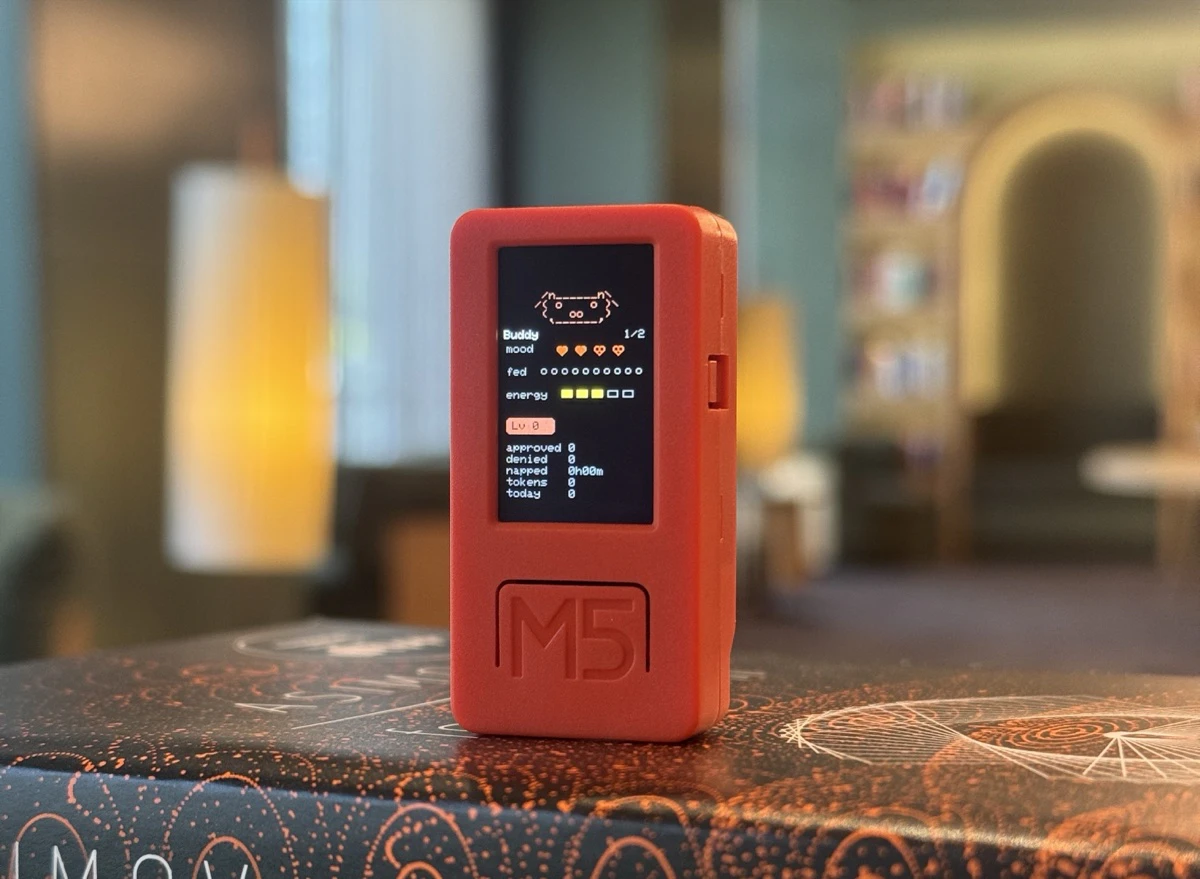
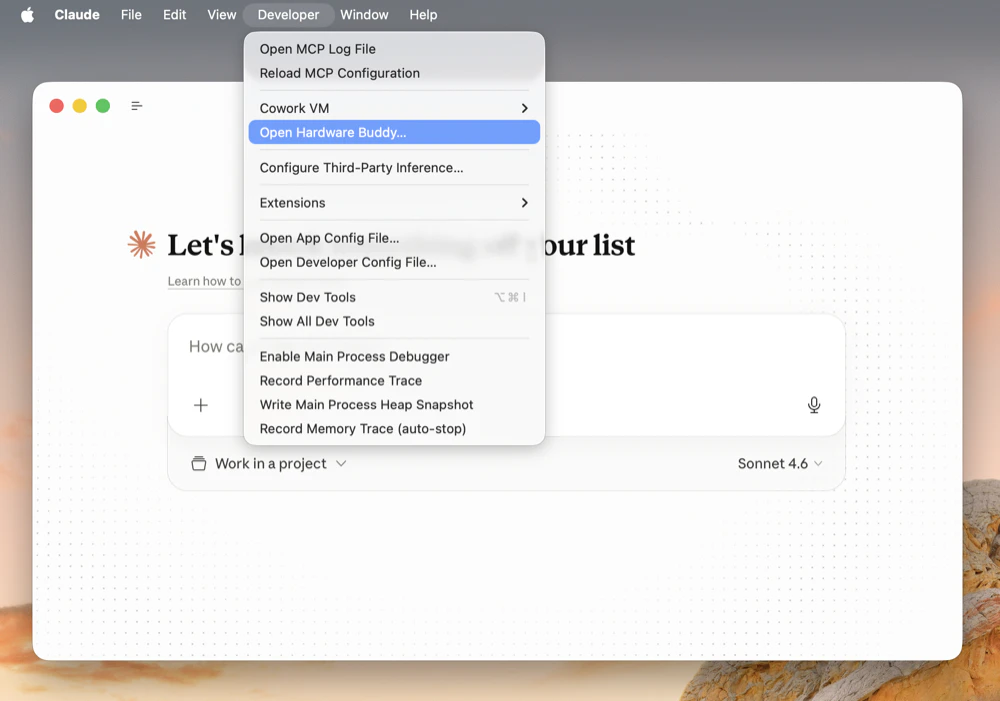
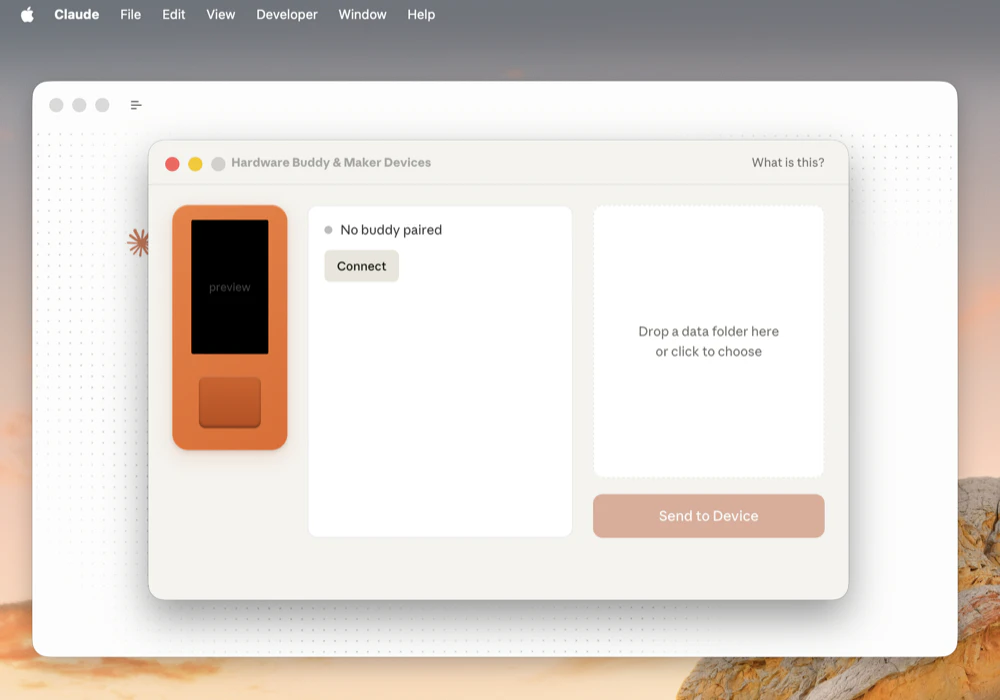
Claude Desktop Buddy exposes a lightweight BLE API from the Claude desktop app. It allows makers to connect Claude Cowork and Claude Code to physical microcontrollers (like the ESP32) to display states, handle permission prompts, and more.

Hi everyone!

This is a wayyy interesting bridge for Claude into physical form.

What @felixrieseberg shipped here is small, but the idea behind it is bigger: Claude Cowork and @Claude Code now expose a lightweight Bluetooth path that lets maker hardware react to sessions, recent messages, and approval prompts. The reference device is an ESP32 desk pet built on M5StickCPlus, which honestly feels like a very fitting choice — M5Stack really is one of the friendliest entry points in the hardware world🔥

It already makes interacting with Claude Code more fun to look at and touch:

But the interesting part is not just approvals. What happens when this lives on an e-ink kanban? Or when the hardware surface is something much more ambient, tactile, or playful? This is clearly the start of a much bigger hardware interaction layer for Claude!

9
回复

@felixrieseberg  @zaczuo Claude on a pwnagotchi... I'd like to see how that works out. 👀

2
回复

@felixrieseberg  @zaczuo What hardware integrations are you most pumped to see builders experiment with next, and any quick tips for noobs getting started with the BLE API?

0
回复

@felixrieseberg  @zaczuo This is super exciting!! Can't wait to try this

0
回复

@zaczuo BLE from Claude desktop to ESP32 is clever — are permission prompts forwarded over BLE as bidirectional events, or is the hardware side purely read-only status display? The approve/deny button use case would be a great hardware interaction for Claude Code agents.

2
回复

Does it work on my GameBoy Color. thats all I want to know :D

0
回复

oh this is wild — BLE straight from the desktop app is such a fun primitive. any plans to open up the event stream beyond permission prompts? would love to drive a little status light off tool calls

0
回复

will you also bring back /buddy? @felixrieseberg

0
回复

@mert_aktas we built this at the lab

to recreate the /buddy experience https://github.com/fiorastudio/buddy with some new features like XP leveling and making it portable via mcp. i'd imagine this will pair nicely with the physical manifestation of the tamagotchi now in these physical devices :)

1
回复
#3
The New Waydev
Measure the full AI SDLC. From token to production.
301
一句话介绍:Waydev是一款AI软件开发生命周期分析平台,通过在代码提交层面追踪AI生成代码从IDE到生产环境的全流程,解决了企业因无法量化AI编码工具实际产出与投资回报率而造成的资源浪费痛点。
Productivity Developer Tools Artificial Intelligence
AI代码分析 工程效能 开发运维 成本管控 ROI衡量 软件开发 数据驱动 开发工具 智能监控 团队协作
用户评论摘要:用户普遍认为该产品切中了当前AI编码工具“只知用量,不知成效”的核心盲点,对“成本/每个已合并PR”等实际ROI指标表示赞赏。主要问题集中于:如何精确进行多AI代理贡献归因、如何避免工具沦为开发者监控、以及与现有工程指标工具的差异化。
AI 锐评

Waydev的发布,与其说是一款新产品,不如说是对当前狂热AI编码工具市场的一剂“清醒剂”。它试图回答一个被速度幻觉掩盖的关键问题:当AI代理疯狂消耗token产出代码时,多少真正创造了价值?

其真正价值不在于提供又一个数据看板,而在于构建了一套从“活动量”到“产出价值”的映射与问责体系。通过将AI生成的代码块与最终的合并请求、生产部署进行“血缘关联”,它把模糊的“AI辅助”变成了可审计、可归因、可计费的具体贡献。这直接挑战了当前以消耗量为导向的AI工具商业模式,迫使供应商从比拼“生成速度”转向证明“产出质量”。

然而,其面临的挑战同样尖锐。首先,是度量本身的复杂性。代码贡献的归因在多人、多代理协作中极易模糊,简单的行数或提交关联可能扭曲真实价值。其次,是文化与信任风险。过度细粒度的追踪可能被误解为对开发者的监控,引发抵触,这与旨在提升效能的初衷背道而驰。最后,是其价值的终极证明难题。它成功连接了“工程输出”与“业务成果”之间的最后一公里吗?目前看,它更擅长回答“AI代码是否被采用”,而非“被采用的AI代码是否带来了更好的业务结果”。这仍是工程智能领域的共性挑战。

总体而言,Waydev精准地定义并抢占了一个新兴的品类——“AI生成代码的观测层”。它不生产代码,也不直接评判代码质量,而是成为价值流中的“审计员”。在AI编码工具从尝鲜走向常态化的拐点,这种对效费比和问责制的需求必然爆发。其成败关键在于,能否在提供透明度和避免制造恐惧之间找到精妙平衡,并最终将数据洞察转化为可行动的、改善开发流程与决策的智能,而非仅仅是事后报告。

查看原始信息
The New Waydev
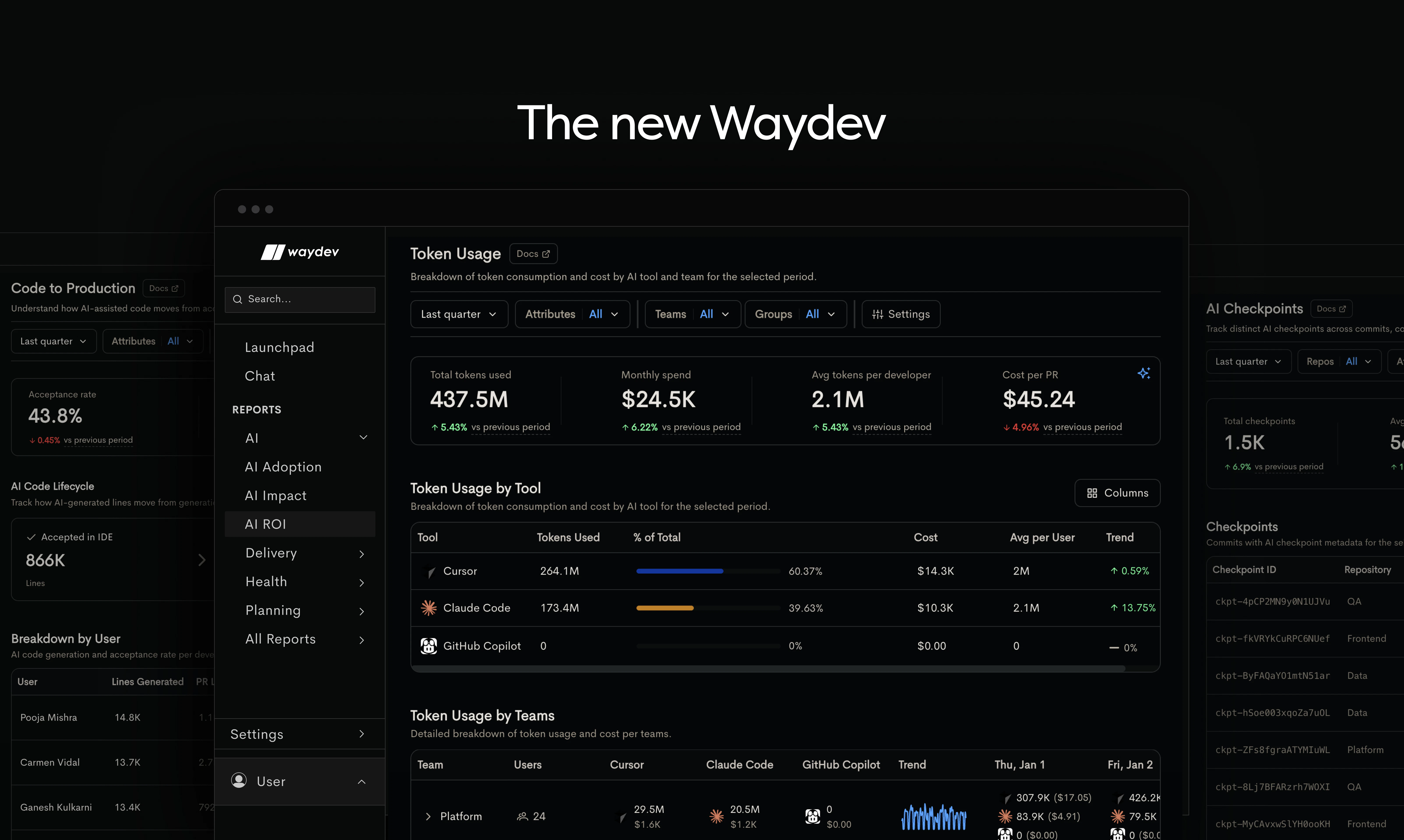
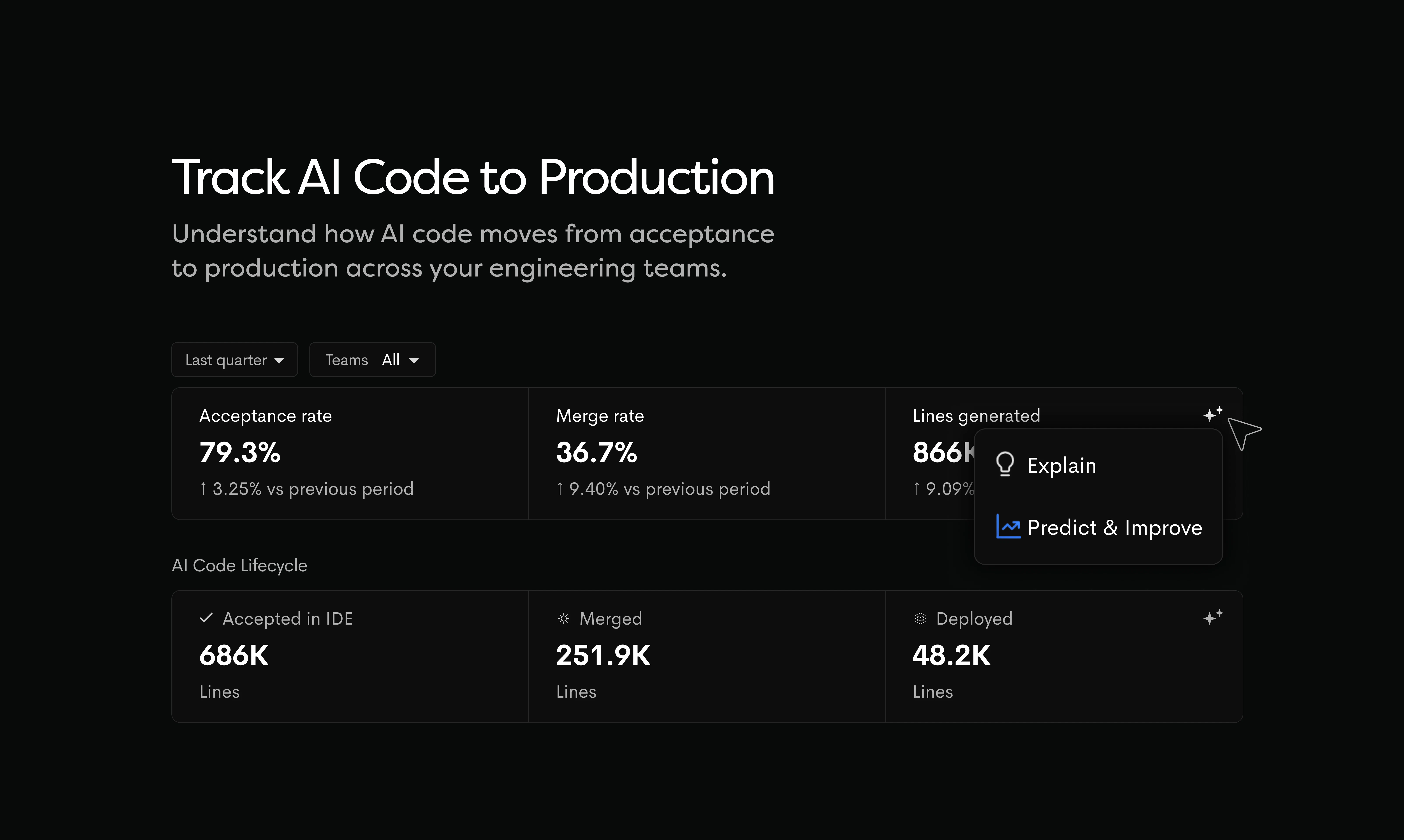
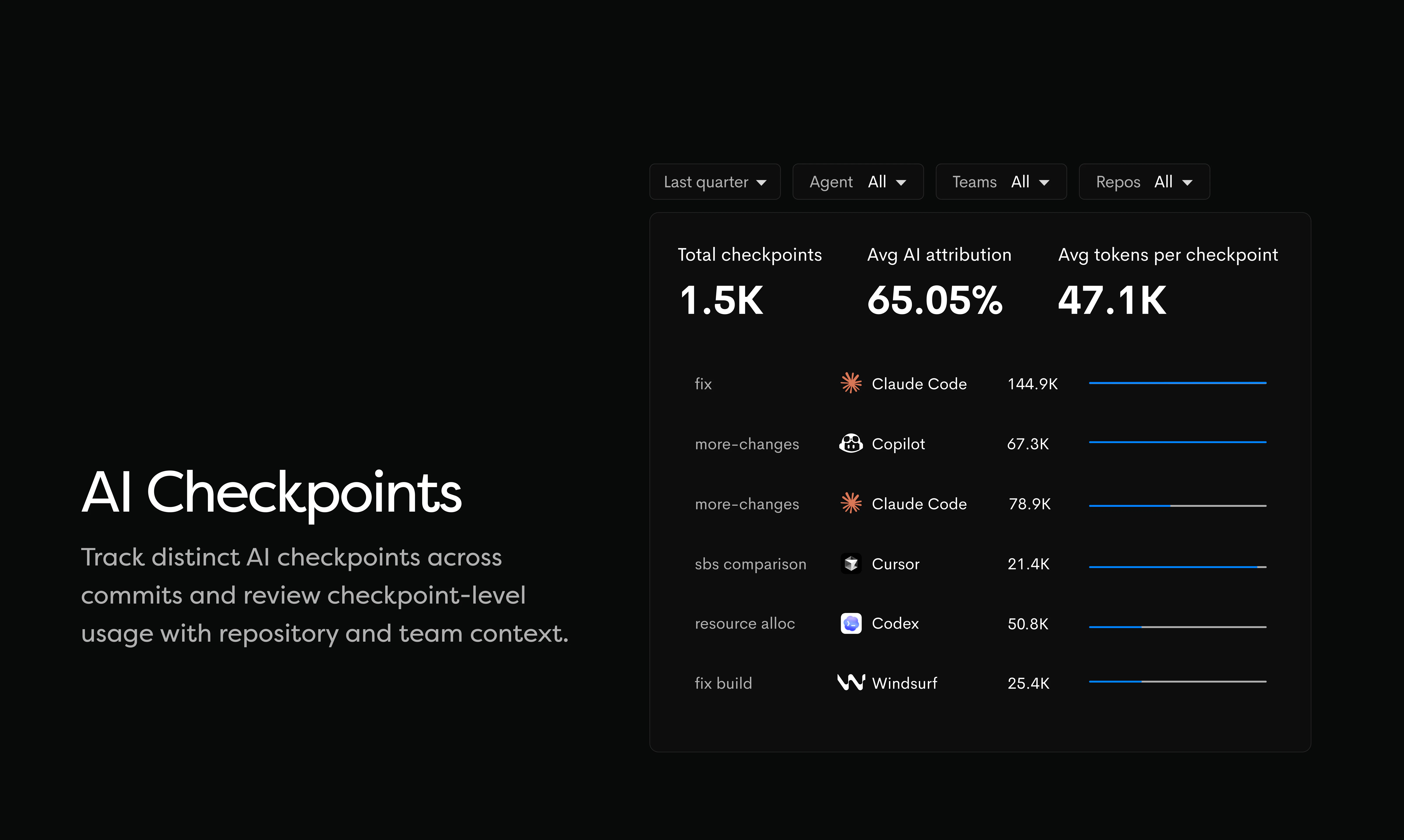
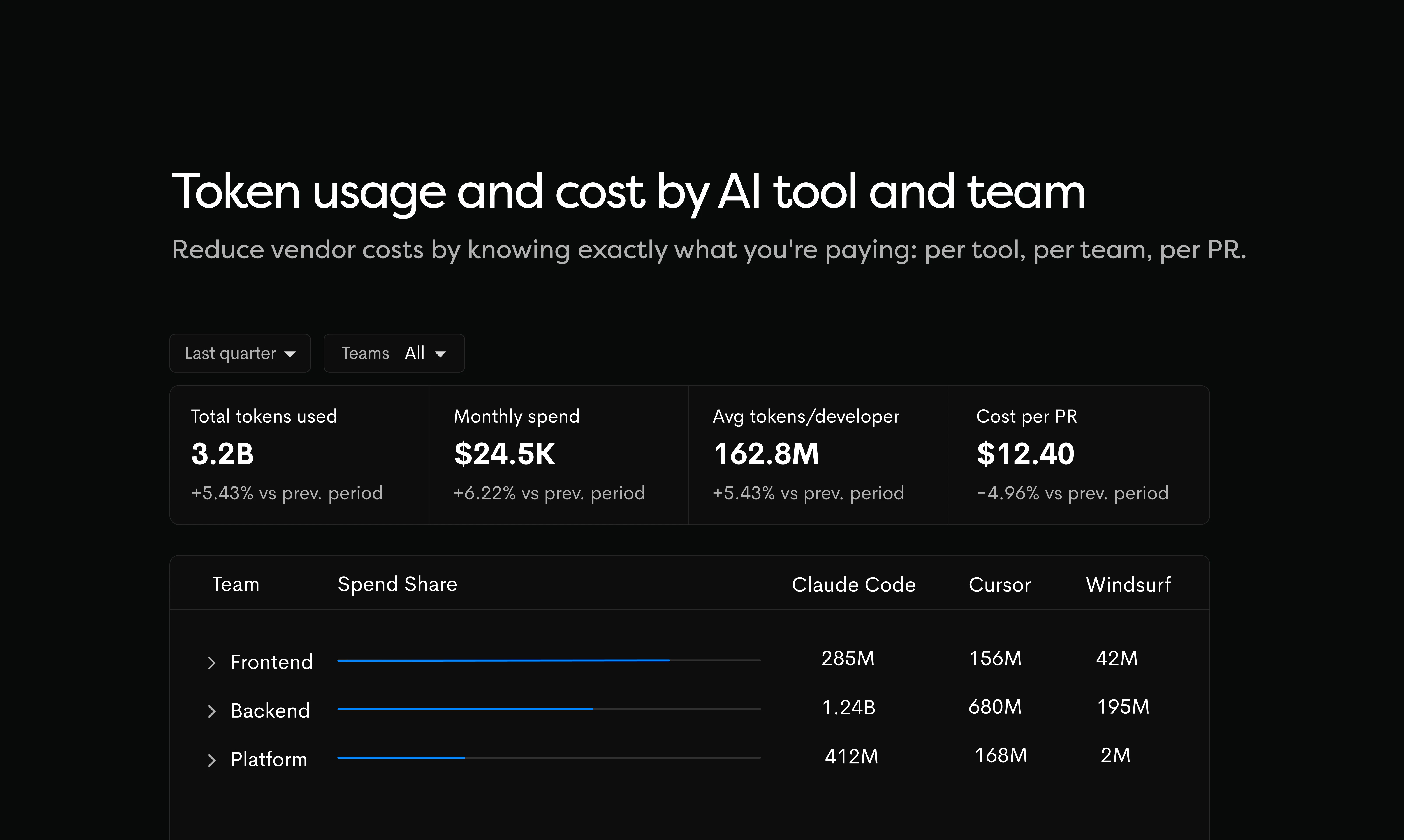
AI agents write code. Most teams cannot tell you what percentage actually ships. Waydev tracks agent-generated code from IDE to production with AI Checkpoints: which agent, tokens consumed, cost per PR, acceptance rate, deployment status. Per team, per repo, per vendor. Compare Copilot, Cursor, and Claude Code on what reaches your customers. Measure cost per shipped PR and AI ROI. Ask the Waydev Agent anything.

Most team track usage , but not what actually makes it to production. This kind of visibility could really help cut wasted spend . Curious if it also highlights why some AI generated PRs don't get shipped?

47
回复

@caleb_bennett1 Exactly. Most AI dashboards stop at usage. The real question is what gets merged, shipped, and creates value. And yes, this kind of visibility should also show where AI-generated PRs get stuck, in review, rework, or abandonment, which is where a lot of wasted spend hides.

3
回复
1
回复

@caleb_bennett1 Really good point

4
回复

Hey Product Hunt 👋

I am Alex, founder of @Waydev Nine years of building engineering intelligence. I have never seen a shift like this one.

AI agents are writing your code. Nobody audits the output.

4% of public GitHub commits are already authored by Claude Code. Companies are spending up to $195 per developer per month on AI coding tools. Almost none of them can prove the spend is working.

That is the gap we rebuilt Waydev to close. The new platform measures the full AI SDLC:

  • AI Adoption — which tools your teams use, what you spend per vendor, per team, per repo

  • AI Impact — follow AI code from IDE to production. See where it ships and where it dies

  • AI ROI — cost per PR, cost per shipped line, tokens consumed vs code shipped

  • AI Checkpoints — commit-level attribution. Which agent, how many tokens, what percentage was AI

  • Waydev Agent — ask anything. Closes the loop by feeding insights back to your AI through MCP

AI adoption was the easy part. Proving what AI actually changed in production is the hard part. That is what we built.

In the comments all day. Ask me anything.

— Alex

30
回复

@alex_circei This makes a lot sense , AI is everywhere, but it's hard to tell what's actually useful. Seeing the real impact on shipped code like the missing piece.

0
回复

@alex_circei This hits something most teams are quietly ignoring. Everyone is using AI to write code, but almost nobody can say what actually made it to production or whether it was worth the cost. There is a lot of activity, very little clarity.

0
回复

@alex_circei, congrats to you and the team! This cuts to something most teams aren’t ready to admit yet: we’ve dramatically improved code generation, but not accountability. Measuring AI adoption is easy, but measuring whether that code actually survives in production is the hard and far more important problem. The focus on commit-level attribution and metrics like cost per PR or shipped code is directionally right, even if imperfect. Without that layer, AI spend is just a growing line item with no clear tie to outcomes.

What’s especially interesting is closing the loop, feeding these insights back into the agents themselves. That’s where this shifts from analytics to a self-improving system. The challenge will be balancing useful visibility with developer trust. This has to feel like system optimization, not surveillance. If you get that right, this starts to look like the observability layer for AI-generated code. That’s a category worth defining early. Godspeed :-)

2
回复

This feels super relevant right now. A lot of teams are thinking about this problem. Will give it a shot.

5
回复

@abhi_shek1994 Thanks!

1
回复

this is exactly what we've been missing. we use Cursor and Claude Code daily but have zero visibility into which suggestions actually make it to prod. the cost per shipped PR metric is brilliant - finally a way to measure actual AI ROI instead of just "feels faster." curious how the agent tracking works across different IDEs?

3
回复

@piotr_pasierbek Appreciate this, Piotr. That is exactly the gap we kept hearing from teams.

Most AI tools show activity. We wanted to show what actually ships.

Waydev measures at the source-of-truth layer, code, PRs, and production, so teams can see which AI-assisted changes make it into shipped PRs and what ROI they actually create. That is also how we approach agent tracking across IDEs: not just by looking at reported usage inside one tool, but by connecting the contribution back to the work that reached production.

Happy to show you how it works with Cursor, Claude Code, and other agent workflows.

1
回复

This hits a real blind spot. Everyone is adopting AI coding tools, but almost no one can tie usage to actual shipped value.

3
回复

@christian_onochie Exactly. Adoption was the easy part. The hard part is proving what changed in production, for speed, quality, and ROI.

1
回复

nice way of looking at your team's output, now together with visibility for generated code. will try it out soon.

3
回复

@dragos_bulugean Thanks! We're waiting for your feedback!

5
回复

love that you're tracking acceptance rates by vendor. we've been debating Copilot vs Cursor internally and it's all gut feeling right now. being able to see "Cursor had 73% acceptance but Copilot code shipped 2x faster" would end those arguments quickly. does it handle when devs modify AI suggestions before committing?

2
回复

@piotreksedzik Exactly. Most teams are still arguing AI vendors based on screenshots, gut feeling, or who shouts the loudest internally.

The goal here is to compare vendors on what actually matters: acceptance, shipped output, rework, and downstream delivery impact.

And yes, that is an important part of it, not just whether a suggestion was accepted, but how much of it survived after edits and made it through commit, PR, and into production.

Otherwise the metric is incomplete.

1
回复

Congratulations for this release, I know how much work you and the team put into it. Now, this version looks like a very robust solution, love it! Can't wait to plug the new Agents into our workflows and see what we actually ship 🫡

2
回复

@axelut Thanks Alexandru, really appreciate it. This release took a lot of work, so your words mean a lot.

And yes, that’s the whole point, not just adding agents into the workflow, but finally seeing what they actually ship and what value they create in production.

Excited to see what you do with it.

1
回复

Finally something that looks at actually measuring productivity beyond just lines of code. With AI agents, generating code is becoming the easy part, but the more important question is what actually makes it through review, ships to production, and creates durable value. Otherwise we risk confusing velocity of spitting code with actual progress.

This feels like the right lens for understanding AI’s real contribution to engineering teams. The one question I'm still trying to figure out and I'd love your perspective: how do you connect these engineering metrics (output) with the business KPIs (actual business outcome)?

2
回复

@cborodescu Chip, exactly. That is the trap, AI can increase code volume far faster than it increases delivered value.

The way we think about it is by treating engineering metrics as leading indicators, then tying them to business outcomes at the team, initiative, and product level. For example:

  • cycle time, review time, deployment frequency, and rework rate show how efficiently value moves through the system

  • incidents, rollback rate, and change failure rate show the quality cost of that speed

  • then you connect those signals to business KPIs like feature adoption, customer retention, revenue impact, SLA performance, and cost to deliver

So the real question is not “did AI generate more code?” but “did AI help this team ship the right work faster, with less risk, and with better business results?”

That is the layer we think is still missing in most of the market.

3
回复

measuring actual shipped % of agent code is such a missing metric — everyone's tracking tokens spent, not outcomes. how do you handle attribution when a PR goes through multiple agents + a human review before merging?

1
回复

@tijogaucher That’s exactly why token metrics miss the point. We attribute on shipped code, not suggestions. We track lineage from agent action to commit to merged diff, then split credit by what actually survives after human edits and review.

So in a multi-agent PR, each agent gets attribution only for the code that makes it through to the final shipped result. Human review is a separate layer, unless the human materially rewrites the code.

What matters is not who touched the PR, it’s what actually shipped.

1
回复

I’d love to know if your platform highlights trends or just raw metrics

1
回复

@new_user___0932026a86e905cf4b2b7f7 Both, Raj. Raw metrics for defensibility, plus AI-generated forecasts and anomaly alerts on top. Acceptance rate, cost per PR, merge rate, and deployment frequency get projected 90 days out. If a vendor's cost doubles or a team's merge rate slides, you get the alert in week two, not in the QBR. Live demo here if useful: https://ai.waydev.co/demo-login

0
回复

Is this for big enterprise or even for small startups?
Also I didnt find the pricing model. Not sure what I missed.

1
回复

@zabbar Hi Zabbar, great question. We built Waydev with enterprise needs in mind, but it can absolutely be valuable for startups too, especially teams that want visibility into what AI is actually helping ship.

Our best fit today is usually companies with 50+ engineers, but we’re happy to talk with smaller teams as well.

On pricing, you didn’t miss anything, we’re not listing it publicly yet. It depends on team size and setup, but happy to share details if you want to take a look.

1
回复

Looks really cool.

How do you compare against https://macroscope.com/ ? I like 1) their github integration and the code suggestions, 2) the the sprint analysis.

1
回复

@ty_robb Really good product.

From what I’ve seen, Macroscope is strongest as a GitHub-native AI layer: very fast GitHub setup, PR and commit summaries, code review, fix suggestions, and lightweight sprint/status reporting. Waydev is broader. We connect engineering data across GitHub, GitLab, Bitbucket, Azure DevOps and Jira, then go beyond suggestions into DORA, sprint risk/capacity, DX, AI adoption, AI impact, AI ROI, and resource planning.

So I’d frame it simply:

  • if you want an AI reviewer living inside GitHub, Macroscope looks strong

  • if you want to understand whether engineering, including AI tools, is actually improving delivery, planning, quality and ROI across the org, that’s where Waydev is much deeper

On the sprint side specifically, Waydev is very explicit there: velocity/sprint reporting, scope creep, capacity issues, forecasted sprint risk, plus Jira-based sprint visibility.

2
回复
Feels like something team actually needs right now, curious to see how it evolves with realworld usage.
1
回复

@hamza_afzal_butt please tell us your feedback!

1
回复
A lot of engineering analytics tools get dismissed as “commit/LoC dashboards.” What product decisions did you make to avoid Goodhart’s-law behavior (PR splitting, metric gaming), and how do you recommend companies operationalize Waydev without turning it into an individual performance scorecard?
1
回复

@curiouskitty Great question. We made a few deliberate product choices to avoid turning Waydev into a commit/LoC scoreboard.

First, we do not optimize around raw activity metrics. Commits, lines of code, PR count, and similar signals can be useful as context, but they are easy to game and dangerous when treated as outcomes. We focus much more on system-level flow, quality, and delivery signals like cycle time, review time, deployment frequency, change failure rate, rework, incidents, and what actually ships to production.

Second, we push measurement up from the individual to the team, repo, and org level. The goal is to understand how the system performs, where work gets stuck, and whether tooling, process, or AI adoption is improving outcomes. Not to rank engineers.

Third, we connect metrics instead of showing them in isolation. A spike in PR volume alone tells you very little. But PR volume plus longer review time, higher rework, and more incidents tells a very different story. That is how you reduce metric gaming, by making tradeoffs visible.

Fourth, we recommend companies use Waydev for coaching and operating rhythms, not performance management. The best rollouts are for engineering leaders, not as a scorecard for individual compensation discussions. Use it to ask: where are the bottlenecks, which teams need support, what changed after adopting AI tools, what is improving, what is getting worse?

My simple rule is this: if a metric can be easily gamed, it should never be the goal. It can be a signal, but never the target.

So the operational model we recommend is:

  • measure teams and systems, not individuals

  • look at outcome bundles, not single vanity metrics

  • use trends and before/after analysis, not snapshots

  • combine quantitative signals with qualitative context like DevEx feedback

  • never use one metric as a proxy for engineer quality

That is how you get value from engineering intelligence without creating Goodhart-law behavior.

5
回复

Token consumption tracking is interesting — how does that work in practice with something like Claude Code, which runs autonomously and can spin up multiple sub-agents mid-session? Are you capturing tokens at the session level, per file touched, or per PR? The attribution question gets messy fast when one 'task' spawns 40 tool calls across 3 agents.

0
回复

@sounak_bhattacharya Great question. In practice, session-level token counts alone get noisy very fast, especially with autonomous agents and sub-agents.

The way we think about it is:

  • session/run = execution context

  • tool calls / sub-agents = child events inside that context

  • PR / merged changeset = primary attribution layer

  • production outcome = the layer that actually matters

So if one task spawns 40 tool calls across 3 agents, we would not treat those as 40 separate “units of value.” We roll them up into a lineage, then attribute the consumption and activity to the PR, repo, engineer/team, and eventually to what shipped.

Per-file is useful as supporting detail, but not as the source of truth. The cleanest practical model is to preserve the raw trace, then normalize attribution at the PR / merge / deployment level.

Otherwise you get a lot of activity data, but no real answer to whether the spend produced better outcomes.

That is also why we care less about token volume in isolation, and more about token spend tied to cycle time, rework, deploy frequency, incidents, and production impact.

1
回复
#4
kaizen
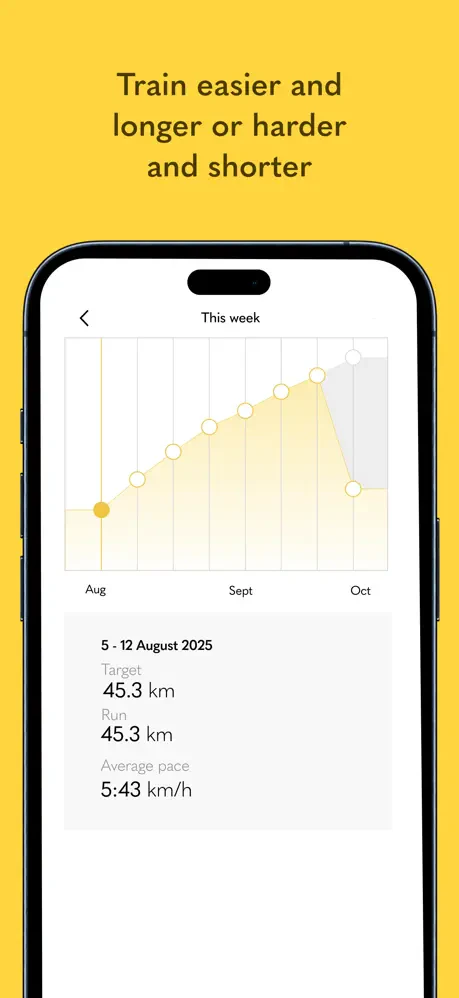
Run training that adapts based on the running you do
219
一句话介绍:一款能根据跑者实际完成情况动态调整训练计划的跑步APP,解决了传统固定计划因生活变动而难以坚持、易脱轨的痛点。
Health & Fitness Running Pitch Berlin
跑步训练 自适应训练计划 AI健身教练 跑步应用 个性化训练 训练负荷管理 马拉松训练 数据驱动 运动科技 健康生活
用户评论摘要:用户普遍赞赏其自适应逻辑,让训练可持续且无压力。主要问题集中在:计划缺乏具体结构化间歇跑课程;UI/UX有待优化,操作繁琐;价格偏高。创始人回应将推出结构化训练系统。
AI 锐评

Kaizen的核心价值并非在于提供又一个训练计划库,而在于其底层逻辑从“计划驱动”转向“现实驱动”。传统训练计划本质是“理想世界”的线性投影,一旦现实偏离预设,整个模型就宣告失效。Kaizen试图构建一个以“训练负荷”为统一度量衡、以用户历史与当前状态为输入的反馋循环系统。它不执着于你“应该”在周二跑间歇,而是关注你“实际”累积的训练刺激,并动态调整后续目标以逼近最终赛事目标。

这戳中了业余跑者的真实困境:生活本身就是最大的变量。然而,其当前的“价值空洞”也显而易见。它将灵活性推向了极致,却牺牲了新手所需的具体指导(如配速区间、间歇结构),这使其更像一个为有经验的跑者设计的“元教练”或“负荷管理仪表盘”,而非一站式解决方案。用户关于“缺乏具体课程”和“UI不佳”的批评,正反映了其产品定位与用户预期间的落差——用户支付了“智能”溢价,却可能未获得与之匹配的、直观易用的结构化体验。

其真正的护城河在于算法对“个人体能模型”的刻画精度与自适应调整的合理性,这需要长期数据验证。若其算法足够可靠,未来价值可延伸至伤病风险预警与个性化强度建议。但目前来看,Kaizen是一次有价值的范式创新,但作为成熟产品,仍需在结构化内容与用户体验上完成关键补课,才能将犀利的理念转化为不可替代的用户价值。

查看原始信息
kaizen
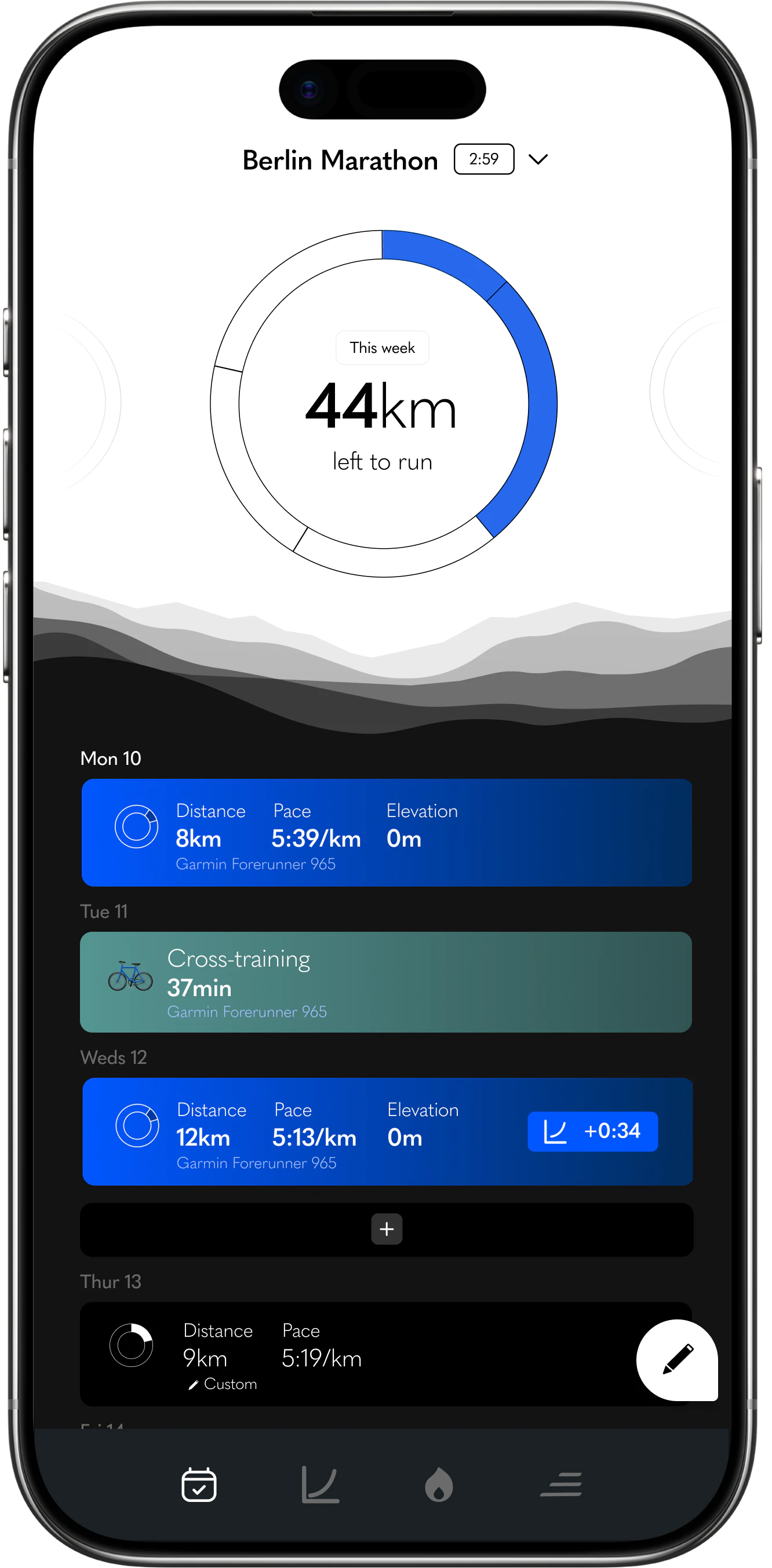
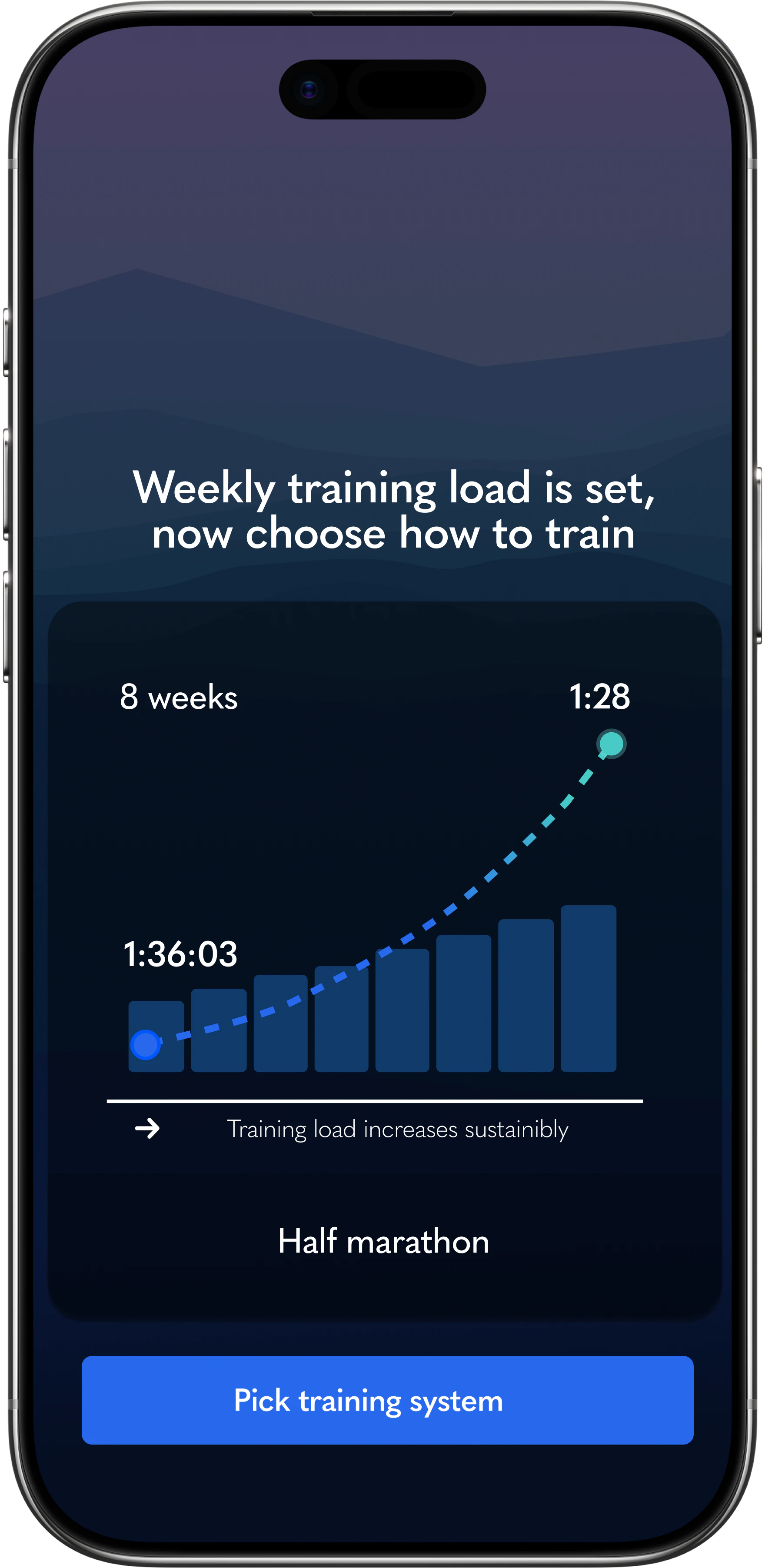
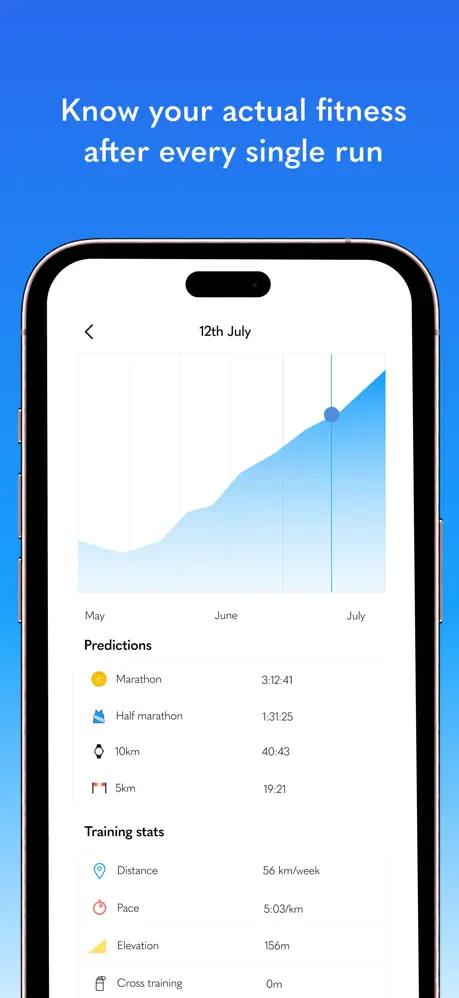
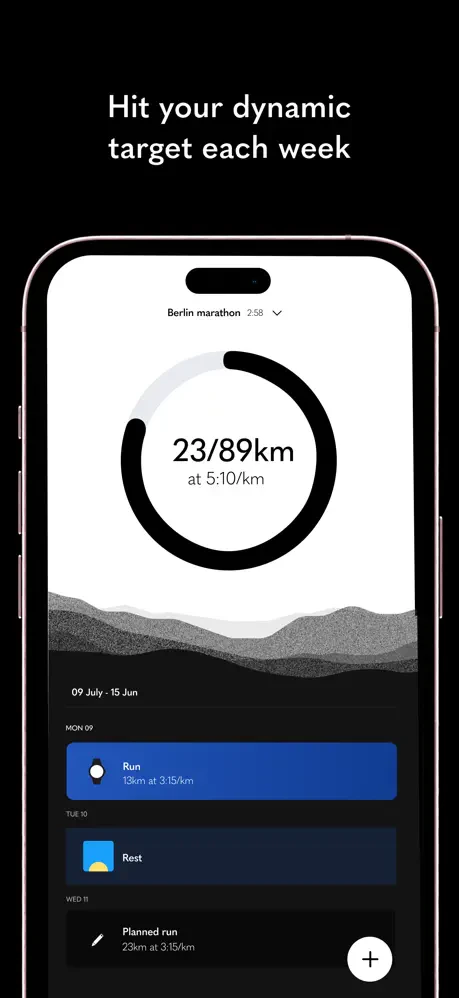
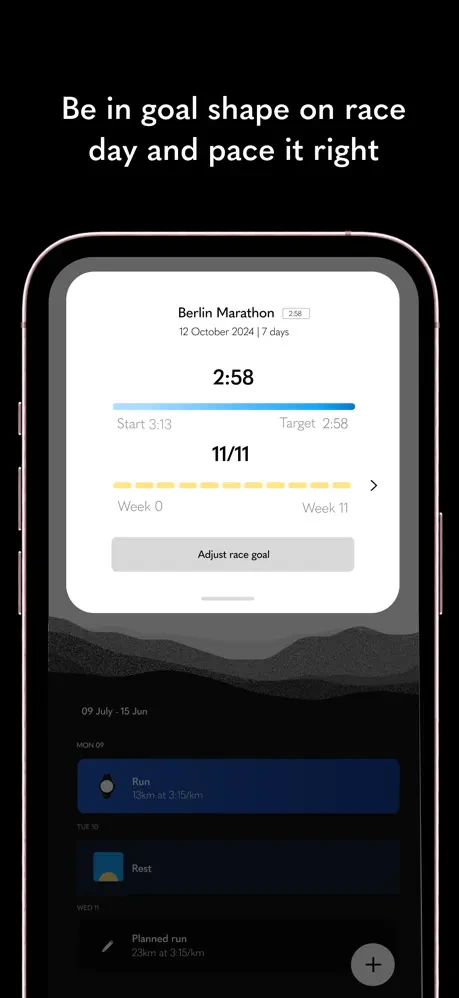
Most running plans break when life happens. kaizen adapts to the running you actually do, continuously updating your training so you keep progressing toward your goal.

Hey Product Hunt — Josh here, founder of kaizen.

This launch means a lot to me because I’ve been building versions of this idea for almost 10 years.

It started with my own experience as a runner. I ran my first marathon at 17 and followed the kinds of plans most runners follow, but I kept running into the same problem: they only really worked if life went perfectly. Miss a few sessions, get a week wrong, and the whole thing could start to feel off track.

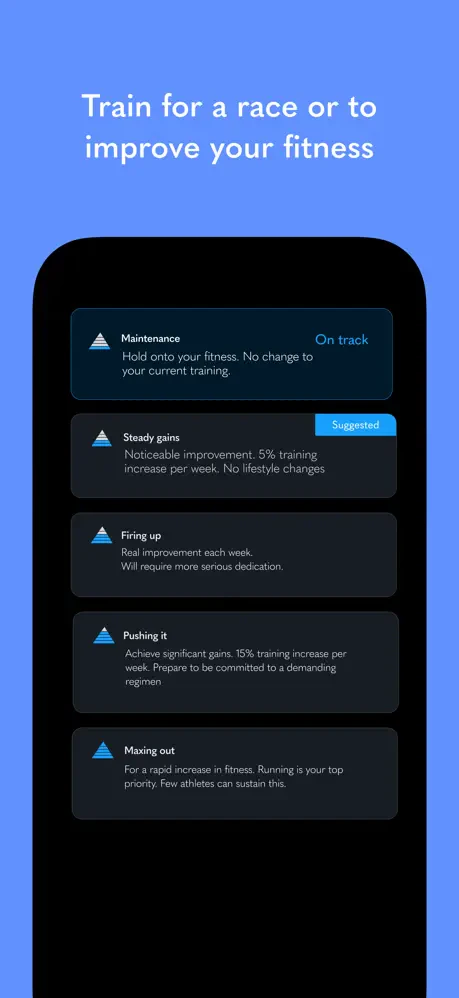
Over time, I became more interested in what actually helps someone improve in the real world. Turns out consistency is the primary determinant, closely followed by the ability to gradually increase training load. So I developed a system that ingested all my recent running history (relative to my past races and training) to understand how fit I was today, and work out how much I'd need to run each week to achieve my goal.

That system changed my own running completely. I went from a 3:24 marathon to 2:28 and became the top-ranked U23 marathoner in the UK. But more importantly, running stopped feeling like a cycle of falling behind and starting over. It became sustainable and enjoyable.

That’s where kaizen came from.

Really excited to finally share it here, and grateful to everyone who’s helped get it to this point.

11
回复

@josh_kaizen This feels very real because most running plans fall apart the moment life gets in the way. The idea of adapting based on what you actually do instead of what you were supposed to do makes a lot more sense and feels closer to how real progress happens. I am curious how it handles longer periods of inconsistency, when someone misses multiple sessions or weeks, does it still help them move forward in a meaningful way or mainly focus on getting them back into a steady rhythm?

0
回复

@josh_kaizen For busy folks like me, how does it handle mixed workouts or cross-training to avoid overtraining?

1
回复

@josh_kaizen How does kaizen handle mid-plan pivots; like if I'm strong on legs but nursing a shoulder tweak? Does it auto-adjust weekly volume/intensity based on subjective inputs alongside the raw data, or is it mostly history-driven?

0
回复

Been using kaizen for a few months now and generally really enjoying it! Sometimes I find the mileage goals are a bit tooo high (but I'm not generally a high mileage runner), but honestly, the predictions are pretty accurate (I ran a tempo half marathon a few weeks back and it had the pace spot on). I really like that you can plan your week to hit your goal, and the adjustments you get after each run to your goal time. I also like that you have a predicted time for all the distances (they're not just focused on the marathon, like half of the running community seems to be at the minute!) Also a big fan of the "Tailor your prediction" function - I used it just this morning and now I feel my marathon predicted time is (hopefully) a lot closer to reality!

I work with a coach, so kaizen is more of a complement to my training / let's me see if I'm on track for my goal, but I am a fan and would recommend (I just wish I knew a little more about the science behind it and how it calculates its figures!)

4
回复

Lining up to the start line of

Boston Marathon today with a good grasp of my finishing time thanks to Kaizen! Love the flexibility!

3
回复

congrats on the launch! the adaptive angle stands out. Most running plans are fixed 16-week blocks that punish you for a bad week 7. How does kaizen decide when to push versus back off? Pace trends, RPE, missed sessions, or a mix?

3
回复
@keith_hiyamojo it takes a bigger picture view and sets a training load target each week, which all add up to get you in goal shape. So on a weekly basis you can make up that load how best suits you. If you can’t make it, your next weeks adapt. We’re rolling out training systems soon to provide structure on top of the flexibility. And structured workouts will follow with the suggested guidance based on RPE. Keen to steer clear of “prescribing” paces
0
回复

As someone who has always preferred to run freely based on how I’m feeling or sometimes constricted by busy days and weeks, I struggled to follow prescribed training plans, as sometimes they would end up feeling like an extension of work. One more to-do in the calendar. This app finally solved that issue, and it quietly become my main training driver. Couldn’t be thankful enough for it.

No more skipping running with friends because I have a specific workout to do.

No more big question marks about what sort of shape I’m in and having to test it or prove it in workouts.

The more I used the app the more I realised I was back to my initial years of running freely and enjoying it.

And when I go to a race I know what my fitness is translating to in race times (it surprisingly always gets the prediction extremely close!).

I even tested not doing anything close to potential “race pace” for months on end and then raced a 10k simply on feel and voila: it matched the pace that Kaizen was predicting for that distance (that I hadn’t run before in training).

2
回复

Having used Kaizen (and a host of other running apps) it's definitely one I recommend to others.

The training plan gives you the flexibility to run when and how you like. For me, this allowed me to listen to my body a lot better, pushing on days I felt fresher, and taking it easier when I needed the rest. This isn't something I've ever seen in other apps (and I've no doubt is part of the reason so many other apps are driving people into injuries)

(As I understand it) The weekly targets are built on a solid scientific and data led basis, which means I can be confident that the goals I've set are going to be hit. Literally just last weekend I met another Kaizen subscriber who ran a new PB at ParkRun having used Kaizen in training.

2
回复

@djabb great to hear you've been enjoying kaizen! More PBs in the future for you :)

1
回复

This hits a real pain most running plans assume perfect consistency which which just isn’t how life works.

1
回复

Love it. Use it. Even paid for it.

1
回复

Hey Josh! It's super cool. I'm currently using another app and I can really feel all you're expressing here. My own plans broke when life happened and needed something like kaizen. Wish you all the best here!

1
回复
Many runners bounce between Garmin Coach/DSW and apps like Runna—what’s the specific breaking point that makes someone realize they need kaizen, and what do they get in week 1 that they can’t get from those tools?
1
回复

@curiouskitty kaizen's unique understanding of the true drivers of fitness allow it to adapt the training plan when real life happens (missed sessions, changes to schedule etc). This means that with kaizen training stays 'on track' and running becomes a truly sustainable habit.

1
回复

If running is your primary sport, Kaizen is the way to go!

Balancing all the training for long distance running can become a constant puzzle with everything else going on in your life. I think Kaizen really helps simplifying training by making you focus on what matters - gradually increasing your total training load step-by-step.

The dynamic tracking of this training load really helped me see when I was at risk of overtraining. Am convinced this has spared me some overtraining injuries in the past year.

0
回复

As somebody who struggled to follow my Garmin training plan fr this reason, this is an awesome idea. I'm highly partial to at home fitness apps that adapt with you instead of being generic but claiming personalized. Does it adapt from the first run you do with Kaizen or is there a "learning" period to learn a users habits?

0
回复

Love this. How does it compare to Runna?

0
回复

the adaptive piece is really interesting - most training apps just expect you to stick to the schedule no matter what. how does it actually adjust? like if you miss a few days or run longer than planned, what kind of changes does it make to keep you on track?

0
回复

Kaizen is a hard app to recommend, its ui is slow and clunky, the plans that it gives you are confusing and the price is pretty steep for something that has these issues.

The app tells you how far you should run in the week and lowers the amount of distance if you've had a particularly hard run (tempo), there are ways to say you are planning to run x time at y event but there is no specific plan like runna or garmin it just tells you to run distances per week.

If your looking for future weeks they dont update unless you plan runs in their excruciating interface - and even then the distance doesn't seem to be affected until the week is complete.

Id say this app is good if you just want a weekly goal and no specific session runs i.e. 3x5 at 5km pace, if you want to do that you have to do it off your own back and setup your session yourself.

As i say difficult app to recommend to anyone really.

P.s. i did try and email them some suggestions and they told me that they were working on some of them, now that they've officially launched on product hub i can see that it was not true.

I wouldn't re-sub to this app.

0
回复

@mark_davies9 I appreciate the honest feedback Mark. Sorry to hear kaizen hasn't live up to your expectations yet.

I've been working hard on our next major feature which will be released in the next week and should help address your frustrations and hopefully will mean you're able to get more value from the app in the future.

0
回复
#5
Pegasus 1.5 by TwelveLabs
AI model for transforming video into Time-Based Metadata
186
一句话介绍:Pegasus 1.5是一款将原始视频实时转化为可查询、可计算的时间戳结构化数据的AI模型,解决了海量视频内容难以快速检索、分析和利用的核心痛点。
Developer Tools Artificial Intelligence Video
视频理解AI 多模态AI 视频结构化 时间元数据 视频检索 内容分析 企业级API 长视频处理 智能剪辑 自动化生产
用户评论摘要:用户普遍赞赏其长达2小时的长视频处理能力和实际性能提升。主要关注点集中在企业数据安全与部署方式(询问本地化/VPC选项),以及处理大视频文件上传至云的潜在瓶颈。CEO的回复示例展示了其在自动章节划分等场景的“快速见效”应用。
AI 锐评

Pegasus 1.5的野心,远不止于又一个“视频理解API”。其核心价值在于试图为视频数据建立一套“时间本位”的标准化查询语言。将非结构化的视频流转化为带时间戳的、可自定义的结构化元数据,本质上是将视频从仅供人类观看的媒介,转变为可供机器直接读取和计算的“数据资产”。

产品强调的“自定义Schema”和“基于领域需求”是关键分水岭。这意味着它不再满足于提供通用的标签识别,而是允许企业将自身的业务逻辑(如“明星球员扣篮”、“logo出现”)直接编码为分析规则,从而实现深度垂直的场景化赋能。其标榜的超越Gemini等通用大模型的细分性能,以及长达2小时的处理能力,正是为了证明其在企业级、工业化场景下的可靠性与实用性。

然而,真正的挑战在于“最后一公里”的部署。正如用户尖锐指出的,对于涉及敏感或海量原始视频数据的企业,将2小时视频文件频繁上传至云端本身就是巨大瓶颈。模型性能再优,若无法解决数据移动的安全与效率问题,其“实时”与“规模化”的承诺将大打折扣。这要求TwelveLabs必须提供灵活(甚至边缘计算)的部署方案,而不仅仅是云API。

此外,产品将视频“未来验证”和“供智能体导航”作为愿景,颇具前瞻性。这实则是为即将到来的AI Agent时代铺设基础设施:当AI需要主动调用和理解视频资料时,预先被高度结构化和语义化的视频库将成为关键燃料。Pegasus 1.5的真正战场,或许不是今天的视频剪辑工具,而是明天的多模态AI生态底层。其成功与否,取决于能否以足够低的成本和足够高的灵活性,让企业愿意为尚未完全到来的“智能体时代”提前重构自己的视频数据仓库。

查看原始信息
Pegasus 1.5 by TwelveLabs
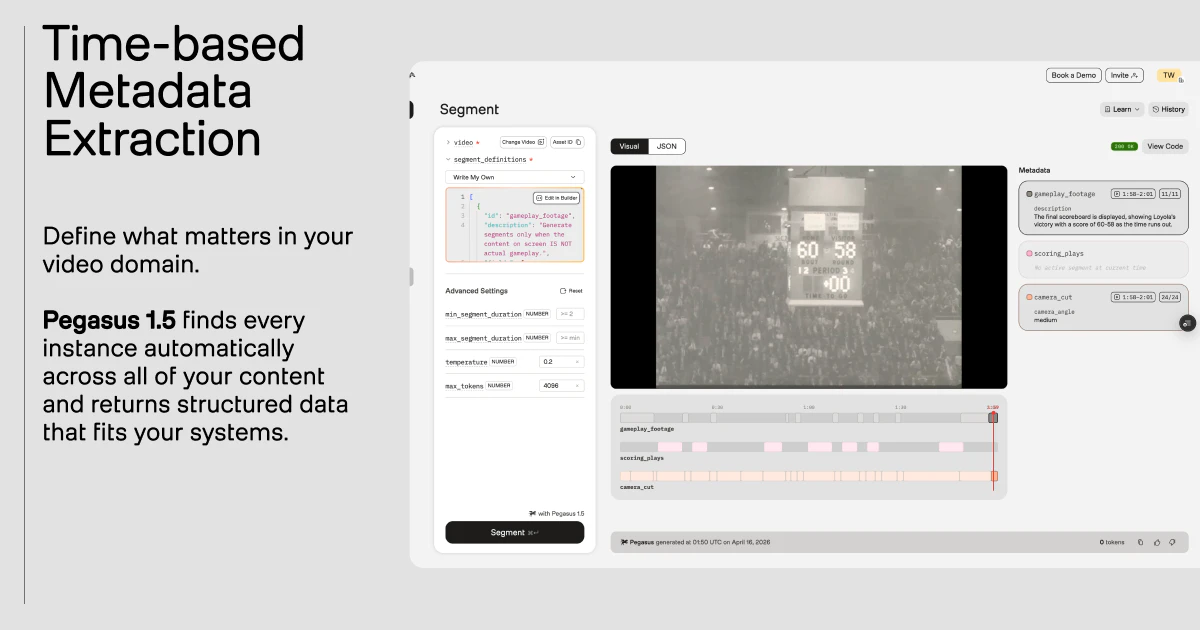
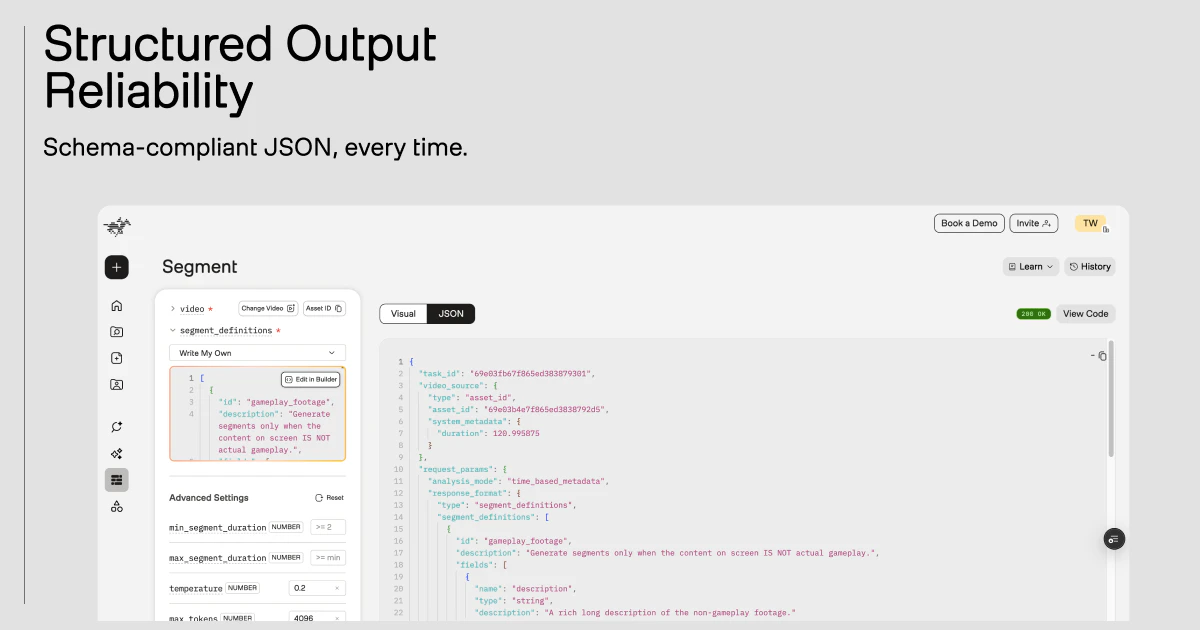
Pegasus 1.5 transforms raw video into consistent, structured, timestamped data on-the-fly. Video becomes a queryable and computable asset, based on your company’s custom requirements. Define a schema of what matters in your domain, point it at any video up to 2 hours, and get back structured, time based metadata in a single API call. And, it’s multimodal – pass in an image, and find anytime this reference appears in your video. Your video library, finally queryable for humans and agents.

Hi, Jae here. I’m the CEO of @TwelveLabs

Today, we’re launching Pegasus 1.5, the first video language model turning video into queryable data assets. What would you build if your video was as queryable as text? Try the free Playground: twelvelabs.io

Video is the most opaque data source; it’s hard to know the content of your video without simply watching the video. Pegasus 1.5 lets you understand your video library, autonomously, on-the-fly, and at scale. More than that, it future proofs your archive and enables agents to actually navigate it with enriched and custom-defined metadata.

What’s New:

  1. Time Based Metadata: Generate custom, time-coded metadata, based on your exact need. Some examples include: segment every time the speaker changes, segment every time my favorite basketball player dunks, and segment every time my logo appears on screen.

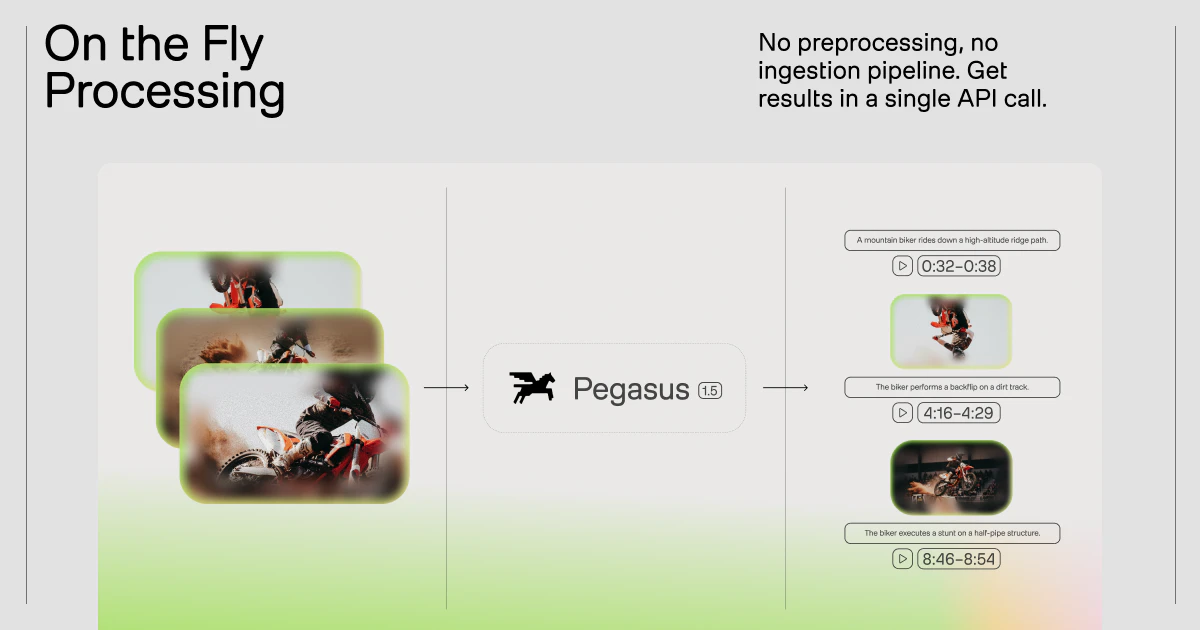
  2. On the Fly Processing: Start with just one video, and get value immediately. If you’re a creator who needs to chapterize your content for youtube, with transcription and key events, upload the video on TwelveLabs, and Pegasus 1.5 will give you exactly what you need.

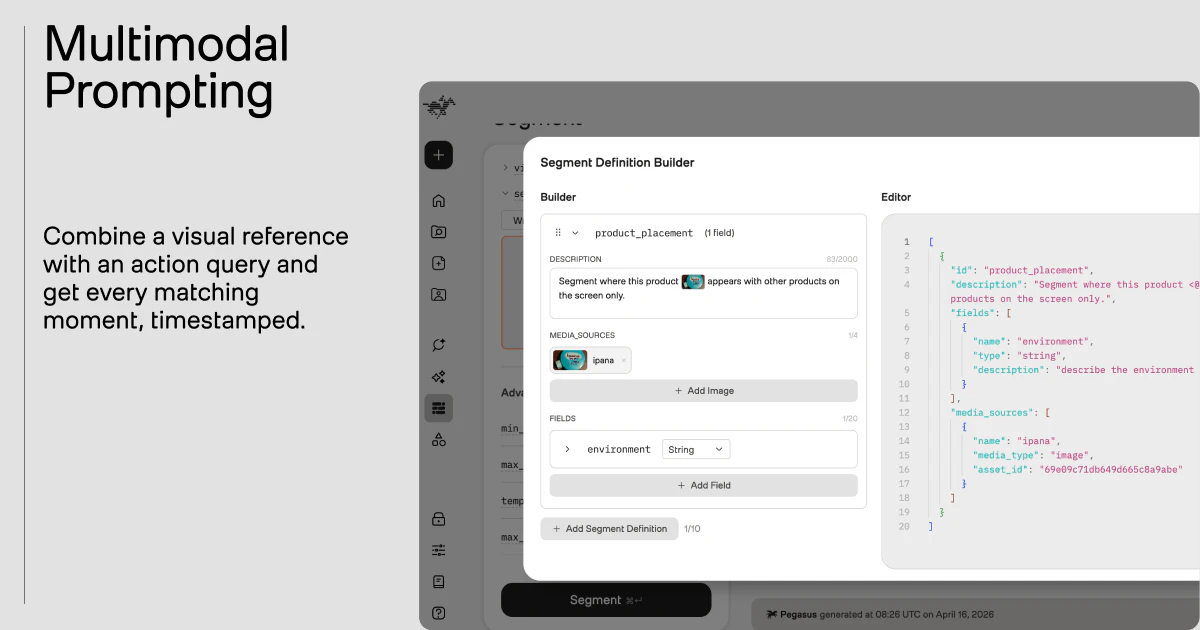
  3. Multimodal Prompting: Pass in an image, and tell the model to show you every time the object in the image appears. Try it for product placement or for tracking your favorite player across a game.


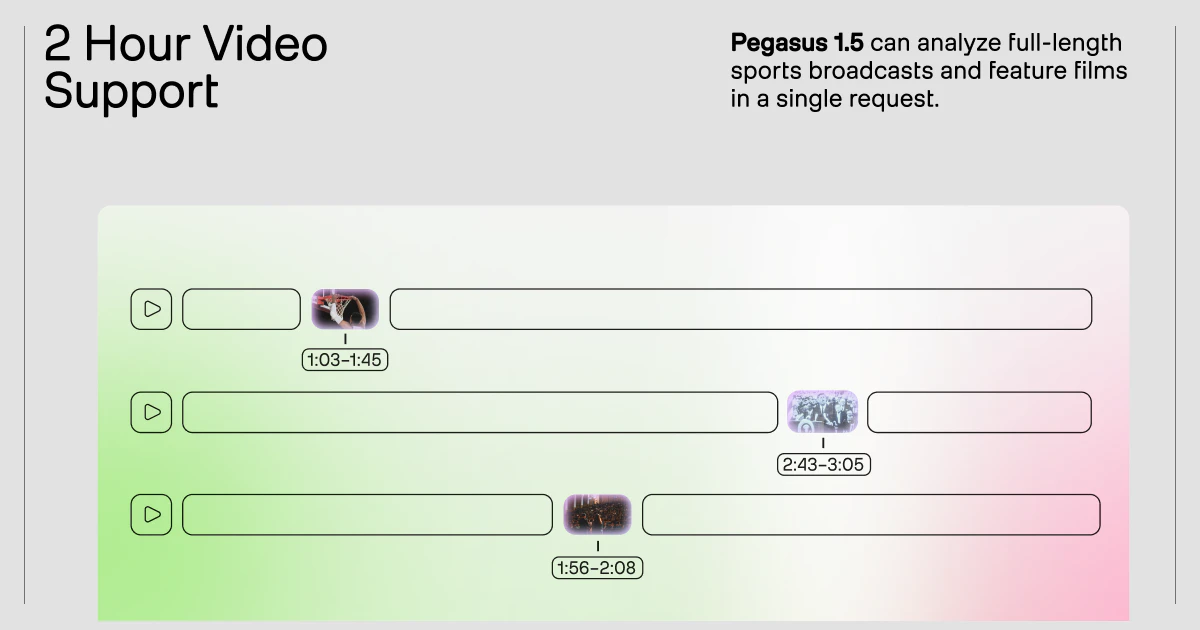
We're proud to make a model that actually helps you understand your video content, in the way you want. We outperform top general models on segmentation and on multimodal inputs. We support 2 hours of video, which is more than two times other models. And, we’re way more cost efficient. Check it out, and would love your feedback!

19
回复

@TwelveLabs  @jaelee_ is this a purely cloud-based api or is there an on-prem/vpc option for enterprise security? for raw video data, moving 2-hour files to the cloud is always the bottleneck. love the 'on-the-fly' processing promise.

6
回复

@jaelee_ What's one quick win you've seen creators get from querying their archive, like auto-chaptering long workshop clips or spotting key moments for clips?

0
回复

I had a blast collaborating with @emilykurze and the @TwelveLabs team on this launch.

Pegasus 1.5 is a significant leap in generative video AI: autonomous and reliable segmentation, long-form video support (up to 2 hours), with SOTA performances (30% better than Gemini 3 Pro, 3.1 Pro, and 3 Flash).

Try the free Playground at twelvelabs.io - Looking forward to see what you're building!

18
回复

Impressive to see long-form support up to 2 hours. That’s where most current tools struggle, so this feels like a meaningful improvement.

12
回复
#6
tasteit
The food social network to meet people over food
151
一句话介绍:Tasteit是一款以特定菜品为切入点的社交网络,在用户想通过美食结识新朋友或寻找饭搭子的场景下,解决了线上社交目的模糊、破冰尴尬的痛点,将共餐转化为自然的线下连接方式。
Pitch Berlin
美食社交 线下约会 饭搭子 陌生人社交 兴趣社区 本地生活 活动组织 消费体验
用户评论摘要:用户普遍赞赏其独特理念与流畅体验,认为其抓住了真实的社交需求。核心讨论围绕其与Yelp等工具的本质差异(“找食伴”而非“找餐馆”),以及“共同喜好”能否有效促成线下见面。创始人回复强调了“聚餐邀请”这一社交触发机制是核心抓手。
AI 锐评

Tasteit的野心并非再造一个美食点评或发现平台,而是试图将“共餐”这一最高频的线下社交行为产品化,其真正的价值在于对社交动机的精准重构。

它敏锐地刺中了当前社交产品的空白:熟人社交趋于固化,陌生人社交充满表演性与不安全感。Tasteit通过“菜品”这一具体、低门槛、高共鸣的介质,将社交的发起动机从“我想认识人”(压力来源)悄然转变为“我想吃这个,恰好有人同行”(自然需求)。这并非简单的“美食+社交”叠加,而是将“共餐”设定为第一性原理,所有功能都服务于促成线下饭局。其回复中提到的“Dine”模式是关键,它把抽象的“连接”打包成一个包含地点、人员、付费的具体事件,极大地降低了交易成本。

然而,其面临的挑战同样尖锐。首先,是冷启动与信任的双边市场难题:用户既需要足够多“想吃”的菜品,更需要足够多“可信”的食伴。其次,其模式重度依赖高密度城市与特定的用户群体(乐于尝试、有空闲时间),规模化可能遭遇文化差异与安全性质疑。最后,也是最关键的一点,它必须证明其“社交触发”频率足够高,能抵御“偶尔尝鲜”后的沉寂。它真正的对手不是Yelp或Instagram,而是用户固有的、与熟人约饭的惯性路径。

如果成功,Tasteit不会止于一个“约饭工具”,而可能成为基于真实兴趣与体验的、线下关系链的发起层,其想象空间在于对本地生活及体验式消费的颠覆。但目前,它仍是一场关于“人类是否愿意为了一盘菜,与陌生人共享一段时光”的大胆社会实验。

查看原始信息
tasteit
Nobody owns food as a social behavior. Until now. Tasteit is the Food Social Network. A dish is your entry point - discover it, see who loves it, turn that into a real meal together. Just food as the most natural reason to meet.

Hey Product Hunt - Giorgi here, founder of Tasteit.

This one is personal.

I grew up in Tbilisi, Georgia - a city where every important moment in life happens around a table. Business deals, friendships, love stories - all of it starts with food. I never understood why there was no platform built around that.

Every social network we use today was built around something else - photos, status updates, professional profiles. Food, the most frequent social behavior in human life, never got its own home.

So we built it.

Tasteit is the Food Social Network. A dish is your entry point. You discover it, see who loves it, and turn that into a real meal together. No awkward intros. No profiles to fill out. Just food as the most natural reason to meet someone.

We started in Tbilisi. Then Berlin. Then New York. People in 70+ countries found us without us looking for them.

Today we're launching here as part of The Pitch by Deel global competition - and it means a lot to us.

Really grateful to everyone who's supported this from the beginning. And excited to finally share it with this community.

11
回复

@giorgi_urushadze1 It is a very good app. Good luck to the entire team.🙏🏻🩷👍🏻💝

0
回复

@giorgi_urushadze1 Number one. Super 🙌🏻♥️🥰

0
回复

@giorgi_urushadze1 What's one unexpected way Tasteit's helped spark real-life connections across those 70+ countries so far?

0
回复
Congrats guys! Product is smooth and well built. Love the idea 💡
1
回复

@sandros_stori Thank you!

0
回复
Tasteit overlaps with restaurant-tracking/social discovery products like Beli (taste graph + recommendations) and with classic review platforms. What’s your wedge that gets people to open Tasteit *before* Google Maps/Instagram/Yelp—and what “hook” keeps them coming back weekly once the novelty wears off?
1
回复
@curiouskitty Great question. Beli and Yelp answer “where should I eat?” Tasteit answers “who should I eat with?” - that’s a fundamentally different job to be done. The wedge is the Dine. You don’t open Tasteit to find a restaurant - you open it because someone invited you to a meal, or because you want to find someone to eat with tonight. That’s a social trigger, not a search trigger. The weekly hook is the same reason you open WhatsApp - people. Active Dines, people who liked the same dish, a friend who posted what they’re eating. The food graph makes every interaction social, not transactional. Google Maps finds places. Tasteit finds people. The retention mechanic is human connection, which doesn’t have a novelty expiration date.
1
回复

hands down one of the most amazing consumer app release I have seen in very long time.

1
回复

@ana_robakidze Thank you! <3

0
回复
Super unique perspective on future of relationships and social life. Very memorable and unique product I have used it in several cities, Met interesting people, There is a big future in for this. Bookmark this!
1
回复

@demetre_mildiani1 Thank you Demetre!!!

0
回复

Love this !!

1
回复
0
回复

The concept is solid and Tbilisi as origin story is genuinely charming. The real test is whether "a dish you both love" is enough of a wedge against just... texting a friend and picking a restaurant on Google Maps. 👀

0
回复

Will it help me to find someone who likes pizza with pineapple? 😁

0
回复

I would recommend people trying this out, I just went to eat out with a bunch of interesting people.

0
回复

There is noting more interesting than sharing a meal with a stranger and chatting about life. The people who used to travel and stay in hostels know what im talking about. :D

0
回复

every time I've met someone interesting recently it started with "let's grab food" not "let's connect on LinkedIn." the awkward intro problem is real.

0
回复
@jiang_nancy absolutely! 💙
0
回复

Interesting concept. How are you turning that initial interest in a dish into people actually meeting up in real life?

0
回复

@becky_gaskell Every dish is a social tiger; you have the option to choose people who liked the same dish and plan a dine-out with them. We also have a dine mode, where people plan what to eat, where, with whom, who is going to pay, and so on.

0
回复

Favorite app. Literally had a dream where I fought with my family and had no one to dine with but I wasn’t worried because Tasteit exists. I know my foodmate is always a click away

0
回复

@lika_tsabadze as a founder, this makes me so happy. Thank you!

0
回复
#7
Granter
Your company's AI Grant Consultant
125
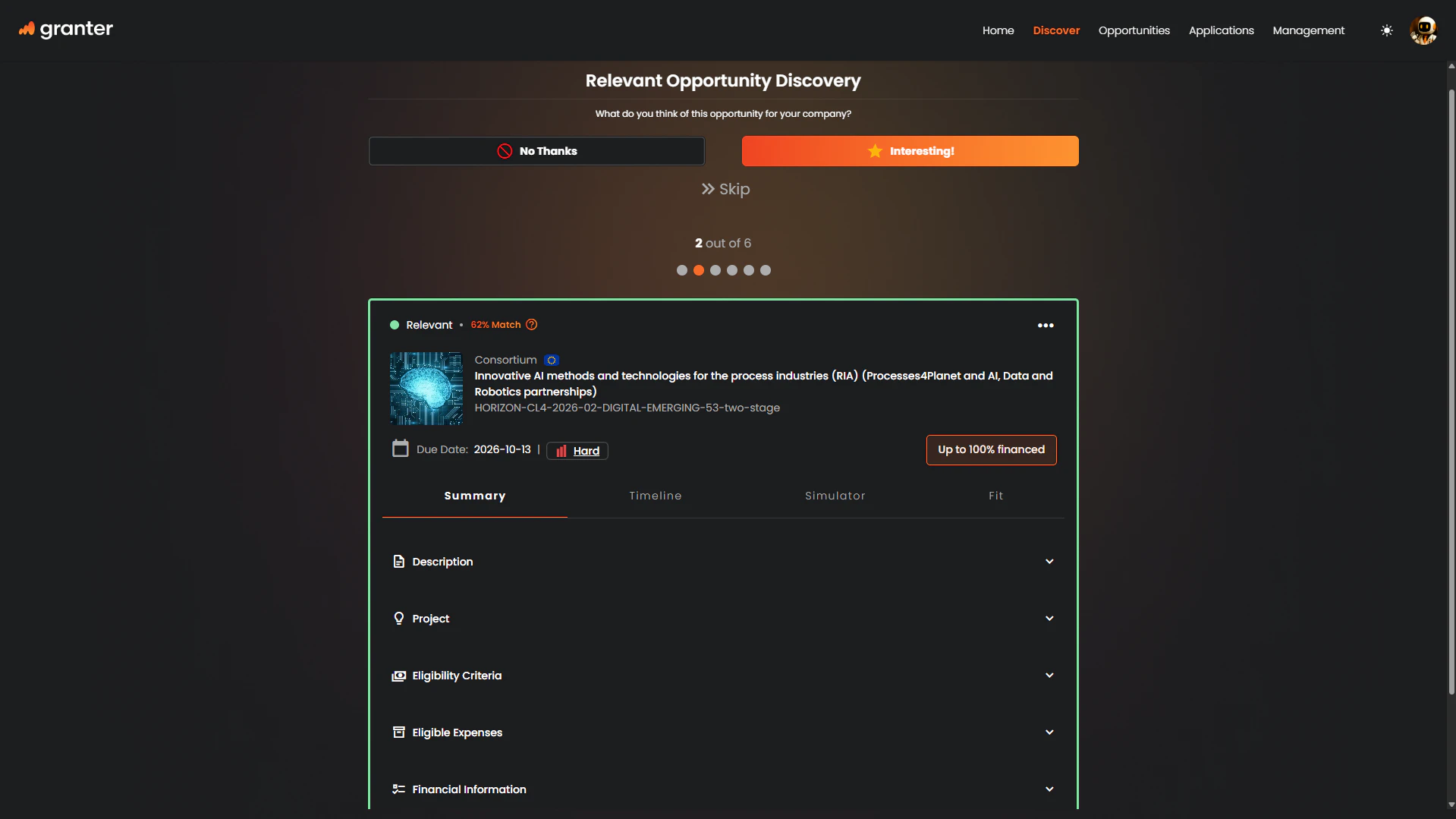
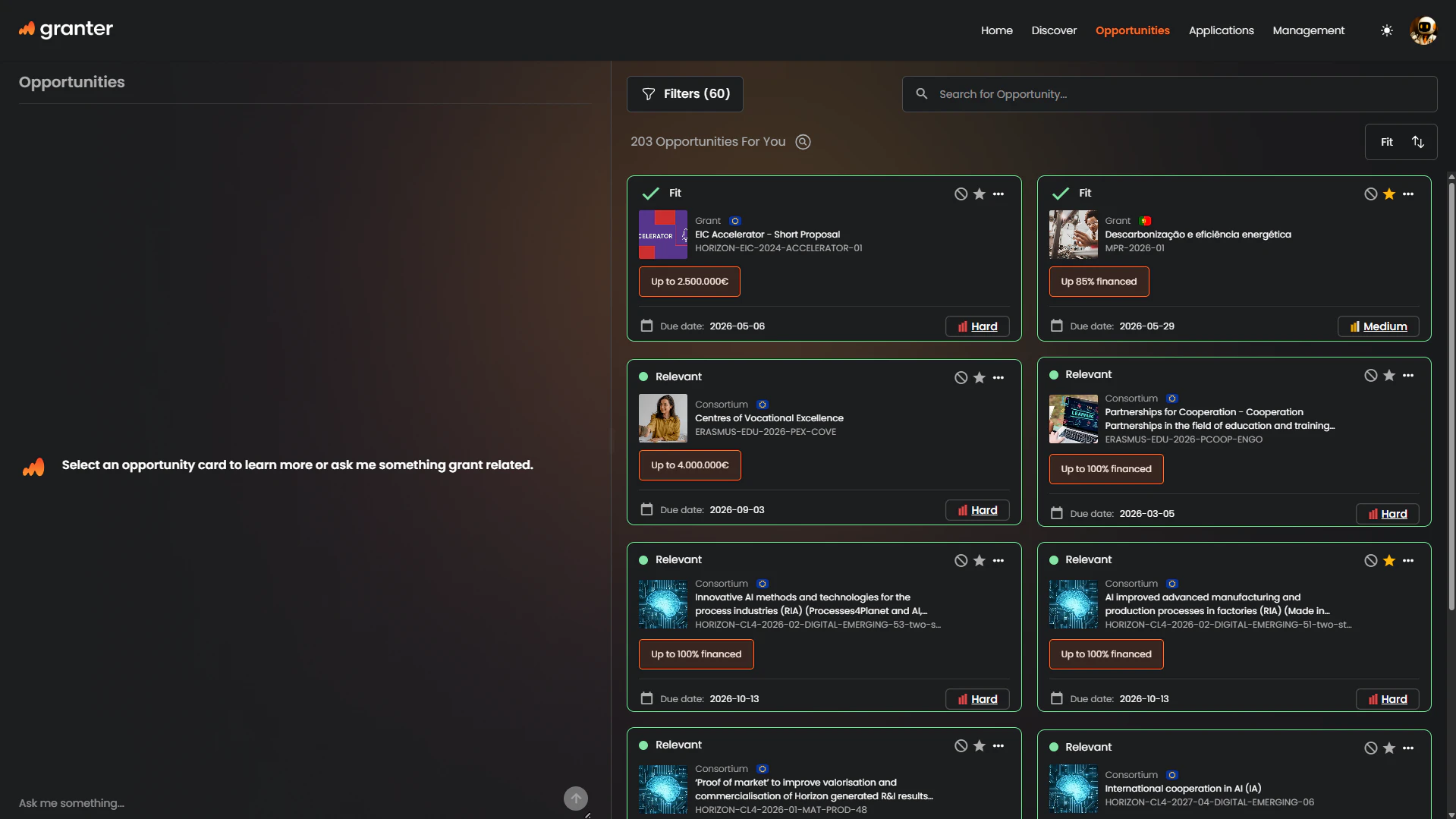
一句话介绍:Granter是一款深度集成到企业内部的AI代理,它能7x24小时自主运行整个资金申请生命周期,通过自动寻找机会、撰写高质量申请材料及处理获批后合规事务,解决了企业在申请政府或机构资助时流程繁琐、专业门槛高、耗时耗力的核心痛点。
SaaS Artificial Intelligence Pitch Berlin
AI企业服务 自动化资金申请 政府资助咨询 智能合规管理 企业数字员工 B2B工具 流程自动化 智能写作 区域化适配 申请成功率优化
用户评论摘要:用户关注区域适配性(如印度、欧盟)、处理超本地化复杂规则的能力、与现有系统集成和数据自动化的技术细节、以及AI生成内容如何满足特定技术叙事和合规审查。开发者回应强调区域化定制、通过数据消化和学习实现适配,并拥有专门的合规评估功能。
AI 锐评

Granter描绘的“全自动数字员工”愿景直击企业资金申请流程的顽疾——信息不对称、文书工作浩如烟海、合规细节令人望而生畏。其真正的价值不在于“又一个AI写作工具”,而在于试图成为贯穿“发现-申请-合规”全链路的智能中枢。这意味产品逻辑必须从“辅助生成”升级为“流程代运营”,其难度呈指数级增长。

从评论暴露的关切看,Granter面临三重核心挑战:首先是“数据的深水区”。自动集成企业敏感数据(财务、人力)存在技术与信任双重壁垒,目前仍需手动导入,这使其“深度集成”的承诺大打折扣。其次是“规则的迷宫”。各地资助计划规则碎片化且动态变化(如印度MSME计划的17个资格环节),AI需要持续消化超本地化知识,这考验其数据管道与Agent调优的敏捷性,所谓“快速扩张”背后是沉重的运营负担。最后是“评审的黑箱”。申请成功与否最终取决于人类评审的主观判断,AI能否精准构建符合其偏好的“技术叙事”,而不仅仅是合规清单检查,这是其宣称“高质量”的关键,但回复中仅以“给予高度消化的背景”一笔带过,缺乏说服力。

因此,Granter的潜在壁垒并非技术,而在于构建一个覆盖多区域、多行业的“资助规则知识图谱”与“成功案例模式库”的生态能力。它更像一个高度专业化的、按需配置的“外部顾问团队”的数字化投射,而非通用型员工。其成败将取决于:在特定垂直行业与区域能否真正跑通闭环、证明显著高于传统咨询的成功率,并在此过程中建立起难以逾越的数据与案例护城河。当前阶段,它仍是一个充满前景但需谨慎验证的“承诺”。

查看原始信息
Granter
While most tools only help with one part of the process, Granter is the AI agent that fully integrates into your company to autonomously run your entire funding lifecycle. It works 24/7 to find relevant opportunities, writes high-quality applications, and handles post-approval compliance effortlessly. Your own digital employee, tailored to your company, industry, and location.

Is this app target to specific region?
Getting the grants is different region - have a very diverse flow. How u are able to manage this

1
回复

@zabbar yes, specific to region and to each individual grant. Not a generic tool. We expand markets fast but there's a data digest process behind it. Getting everywhere eventually!

0
回复

As someone building B2B tools in India, what's the biggest win you've seen so far, and does it handle region-specific programs like Startup India or EU funds?

1
回复

@swati_paliwal we started in Europe and we're there yes. Getting everywhere fast. International, national, and regional specific programmes, all of it.

0
回复

This solves a real pain point. We looked into government grants for our B2B tech company last year and gave up after the third application — the compliance requirements and formatting were brutal even for straightforward programs. Curious about two things: how do you handle the highly specific technical narratives that grant reviewers look for (vs. generic AI-generated language), and what's the success rate looking like for applications submitted through Granter vs. traditional consultants?

1
回复

@thekrew How does Granter adapt to hyper-local rulesets like India's MSME schemes with 17 eligibility hoops? And for tech founders specifically; any early win stories where it uncovered grants we would've missed manually?

0
回复

@thekrew lots of learning, agent tuning, and giving very digested, grant-specific context for each individual opportunity. On success rates: overall positive, but it varies hugely by grant and who's reviewing it ofc.

0
回复

"Fully integrates into your company" — what does that actually mean technically? Does Granter connect to existing tools like email, accounting software, or a document drive to pull company data automatically, or does someone still need to manually feed it financials, headcount, past projects, etc. before it can write a decent application?

0
回复

@sounak_bhattacharya there's an onboarding with some manual steps yes. Pulling company data automatically is sensitive territory, although we could make it work.

1
回复

Grant writing and government proposal writing have a lot of overlap — both are competitive structured applications where you're fighting for limited awards. One thing I've always found tricky in this space: the AI handles the narrative draft well, but compliance checklists (is every requirement explicitly addressed?) are where things fall apart.


Does Granter do any compliance mapping — like cross-referencing your narrative against the grant's stated requirements? That's the piece I'd want before submitting anything.

0
回复

@sagaiq_coo yes we actually have an evaluator that does exactly that and it's one of our most battle-tested features (multiple pilots around it). Happy to show you!

0
回复
#8
Knowzilla
Real-time AI for sales that guides every deal
120
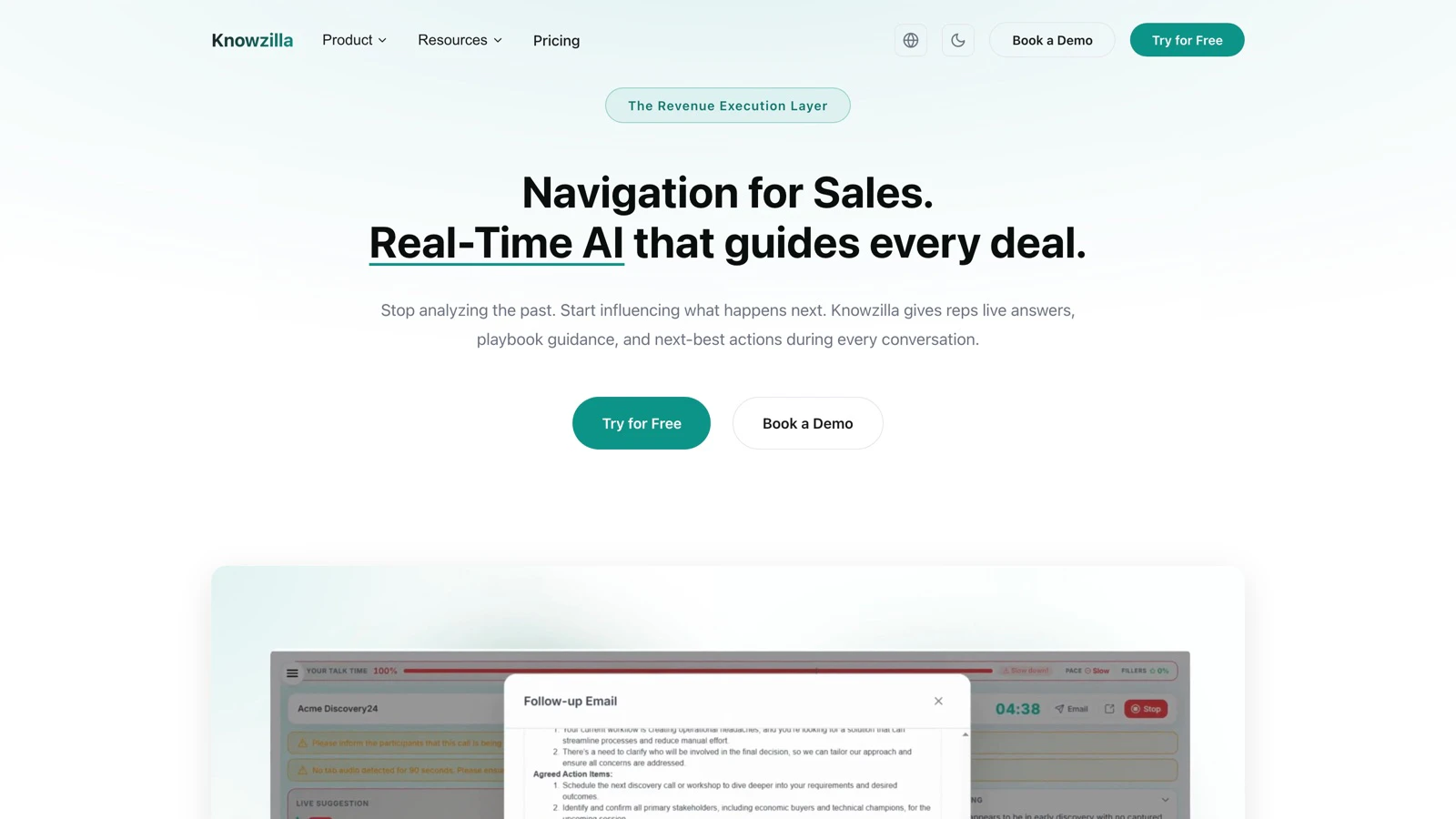
一句话介绍:Knowzilla是一款在销售实时通话中提供AI即时答案的工具,解决销售团队因无法快速从手册中找到答案而丢单的痛点。
Pitch Berlin
销售赋能 实时AI助手 通话辅助 销售培训 objection处理 知识管理 B2B销售 SaaS 销售效率工具 对话智能
用户评论摘要:用户认可产品解决实时销售对话痛点的价值,询问知识库构建方式、多语言支持、信息更新机制及是否干扰倾听。关注其对不同销售周期和角色的适用性,并报告了产品小故障。
AI 锐评

Knowzilla瞄准了销售培训领域最顽固的“知行鸿沟”——将静态的销售话术与动态的客户交锋相结合。其宣称的价值并非简单的信息检索,而是将企业沉淀的“部落知识”转化为实时战斗中的“肌肉记忆”,这直击了销售管理的核心成本:因初级代表临场失措而流失的机会。

然而,产品光鲜的AI外壳下,潜藏着几个本质挑战。首先,是“注意力争夺”悖论:在高压通话中,代表是应全心倾听客户,还是分神阅读AI提示?这需要极其精准、非侵入式的交互设计,否则工具本身会成为干扰源。其次,是知识库的“冷启动”与“持续喂养”问题。评论中尖锐地指出,这类工具的成败往往取决于初始知识构建与后续更新闭环。团队回复的“组合方式”和“更新提醒”仍是传统思路,并未展现AI在自动从成功案例中萃取、演化知识体系方面的突破性。最后,其“一刀切”的潜力受到质疑:长周期、复杂技术销售与快节奏交易所需的指导逻辑截然不同。若不能深度适配销售方法论,它极易沦为又一款“智能”却泛泛的提词器。

真正的价值不在于“有答案”,而在于“在正确情境下,以正确方式,给出经过验证的正确答案”。Knowzilla的框架正确,但其护城河的深度,将取决于它能否将AI从“实时文档”升级为懂得销售策略、客户心理与交易节奏的“虚拟销售教练”。否则,它只是把纸质手册电子化并加快了打开速度而已。

查看原始信息
Knowzilla
Knowzilla gives sales teams real-time answers during live calls, so they can handle tough questions, overcome objections, and stop losing deals because the answer was buried in a playbook.

Hey Product Hunt 👋 I'm Liina, I've been selling and growing things for decades (yikes, sounds old) some things kept repeating itself. So we built Knowzilla to fix it: people can sit through endless onboarding and still freeze when a real sales conversation gets hard. I ran a top-performing regional team and kept thinking: selling is not rocket science. You need the right answers and confidence, the rest can be automated.

We are a team of sales and engineering leaders - built some unicorns before, now we want to help anyone sell their beautiful idea better.

8
回复

@liina_knowzilla How does Knowzilla pull real-time answers without slowing down the convo or risking generic responses?

0
回复

@liina_knowzilla Does Knowzilla adapt to different sales styles like consultative B2B vs transactional SaaS, or focus more on objection-handling patterns? How's it building that muscle memory for reps who crumble under live pressure?

1
回复

Standard sales training often collapses under the pressure of a live call. I have spent a large part of my career designing consultative processes and managing sales teams; the primary hurdle is always ensuring that a strategic framework actually translates to a real-time conversation.

I admire that Knowzilla is using AI to solve these problems. Provides the situational awareness required to handle complex objections without the mental tax of searching through playbooks is gold. This looks like a sharp, pragmatic solution for organizations that prioritize precision over guesswork.

2
回复

@therealsjr thank you so much! We want to help sales teams close not look frantically for answers 🫶

1
回复

Interesting take on the live call guidance problem. We ran a 15-person sales team at our IT services company and the biggest gap was always tribal knowledge — senior reps knew the answers to tough objections but junior reps would freeze. How are you handling the knowledge ingestion side? Specifically curious whether Knowzilla pulls from closed-won deal recordings or if the team has to manually build the knowledge base upfront. That bootstrap phase is usually where these tools stall.

2
回复

@thekrew combinatiom of both - it helps you build your playbook, upload info and then starts learning from the good outcomes

0
回复

The Playbook creation flow is already a strong highlight for me. The questions you guide users through are thoughtful and genuinely useful, they help clarify key aspects of the product and provide a solid high-level overview. That alone adds a lot of value.

The call assistant is another standout feature. Getting immediate analysis after a meeting is incredibly practical and can save a lot of time when reviewing conversations or extracting insights.

I did run into an issue with the Playground, specifically the email practice feature. When I clicked the button to start, nothing happened.

Regarding the call assistant, I tested it in a language other than English, and the results weren’t as accurate. Improving multilingual performance could be a great area for future development and would definitely broaden the product’s appeal.

Overall, this is a solid and interesting project with a lot of potential. Wishing the team all the best with the launch and what’s ahead! 🚀

1
回复

@matheusdsantosr_dev thank you so much for the detailed feedback. Truly helpful ❤️🙏

1
回复

Hey Liina! Love the idea! How do you ensure that the library has all the up-to-date information? does it self-refresh or it needs someone (e.g. RevOps) to take care of that?

1
回复

@philip_kubinski hey! Team needs to keep data up to date but we will setup notifications: “hey this info hasn’t been updated for x months, perhaps time to review”

0
回复

This is clever. My only worry is that I'd be so focused on reading the suggestion that I'd stop actually listening. Is that just a me problem, or did you run into that during testing? Did it get easier after a few calls? Congrats on the launch!

0
回复

Curious how this handles long-cycle deals — government BD in particular runs 6-18 months from first contact to award. The "guiding every deal" concept is interesting but most sales AI I've seen is optimized for 30-90 day cycles.


Does Knowzilla have any concept of deal stages that extend that far out, or is it more focused on standard commercial pipelines?

0
回复

Looks pretty interesting! Is this solution positioned to mainly help SDRs / BDRs and AEs? Or have more technical sellers like Enterprise AEs or Sales Engineers been using this as well? I can image with younger and less technical salespeople this is really useful but also curios to learn how more technical salespeople use it or get value out of it. Keep up the good work!

0
回复
#9
Urbned
Send money like a Text Message. Powered by Stablecoins.
104
一句话介绍:Urbned 利用稳定币构建了隐形的跨境支付通道,让移民、自由职业者和企业能够像发短信一样轻松地完成美元到比索、卢比等货币的国际汇款,解决了传统跨境转账速度慢、费用高、流程复杂的痛点。
Fintech Payments Pitch Berlin
跨境支付 稳定币 加密货币钱包集成 虚拟银行账户 国际汇款 金融科技 区块链金融 全球劳动力 外汇兑换
用户评论摘要:由于提供的用户评论列表为空,无法总结具体反馈。通常在此类产品中,用户关注点会集中在到账速度、手续费、法币兑换汇率、监管合规性以及与传统银行和汇款商的体验对比上。
AI 锐评

Urbned 描绘的“像发短信一样汇款”的愿景,直击了传统SWIFT体系与西联等汇款巨头的核心短板:速度与成本。其真正的价值并非在于创造了新技术,而在于巧妙地充当了“中间层”,试图将稳定币的结算效率与前端用户熟悉的法币世界体验进行无缝缝合。

产品设计的精明之处有两点:一是宣称“稳定币层不可见”,这旨在消除普通用户对加密货币的认知门槛和操作恐惧,仅让其享受结果;二是直接集成MetaMask和Phantom钱包,这无异于精准捕获了已有加密资产、却苦于无法便捷用于现实支付的增量用户群,为他们开辟了清晰的变现和实用通道。

然而,其面临的挑战同样尖锐。首先,**监管是悬顶之剑**。提供虚拟美元/欧元账户并处理法币兑换,必然涉及严格的货币传输牌照(如美国MSB)及各国支付法规,其合规进程将决定生存空间。其次,**“最后一公里”的稳定性存疑**。将稳定币最终兑换为当地法币并存入收款人银行账户,严重依赖其当地银行或支付合作伙伴网络,这在部分新兴市场可能成为拥堵点和风险点。最后,**价值主张的可持续性**。在稳定币本身尚未经历完整金融周期考验的背景下,将其作为“隐形”基础架构,一旦发生类似UST的脱锚极端事件,整个系统的信誉将瞬间崩塌。

因此,Urbned更像一个在传统金融与加密世界夹缝中寻找机会的“巧匠”。它的成功不取决于技术是否最颠覆,而取决于其平衡监管、合作伙伴关系与用户体验的精细化运营能力。它可能无法颠覆银行,但有望成为特定高频、小额跨境场景中一个更优的补充选项。其前景,系于钢丝之上。

查看原始信息
Urbned
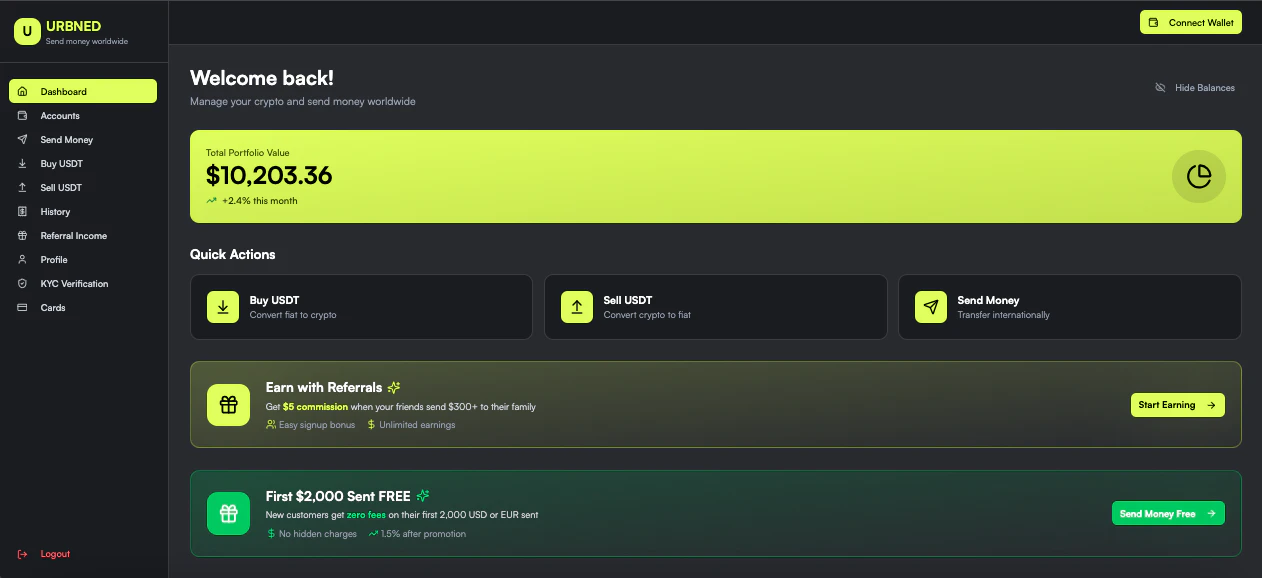
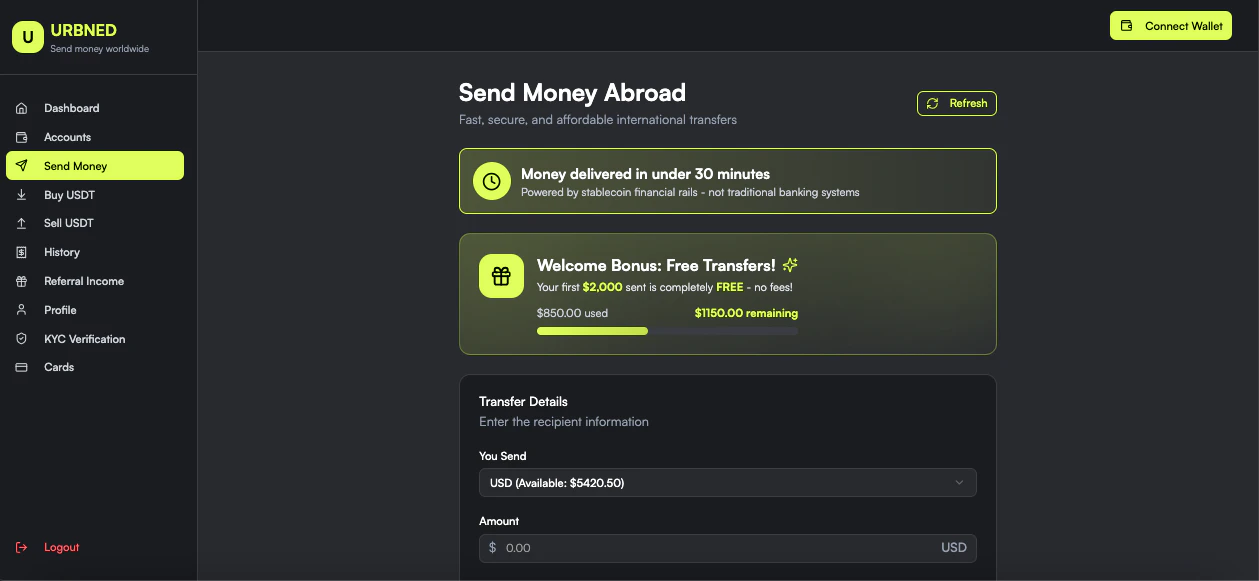
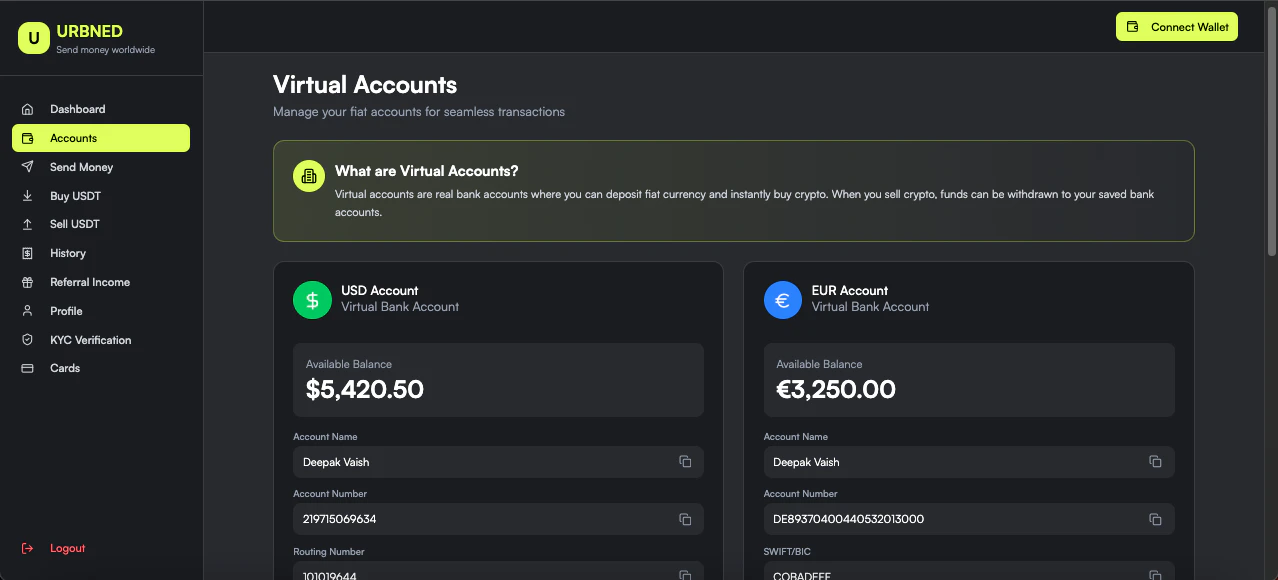
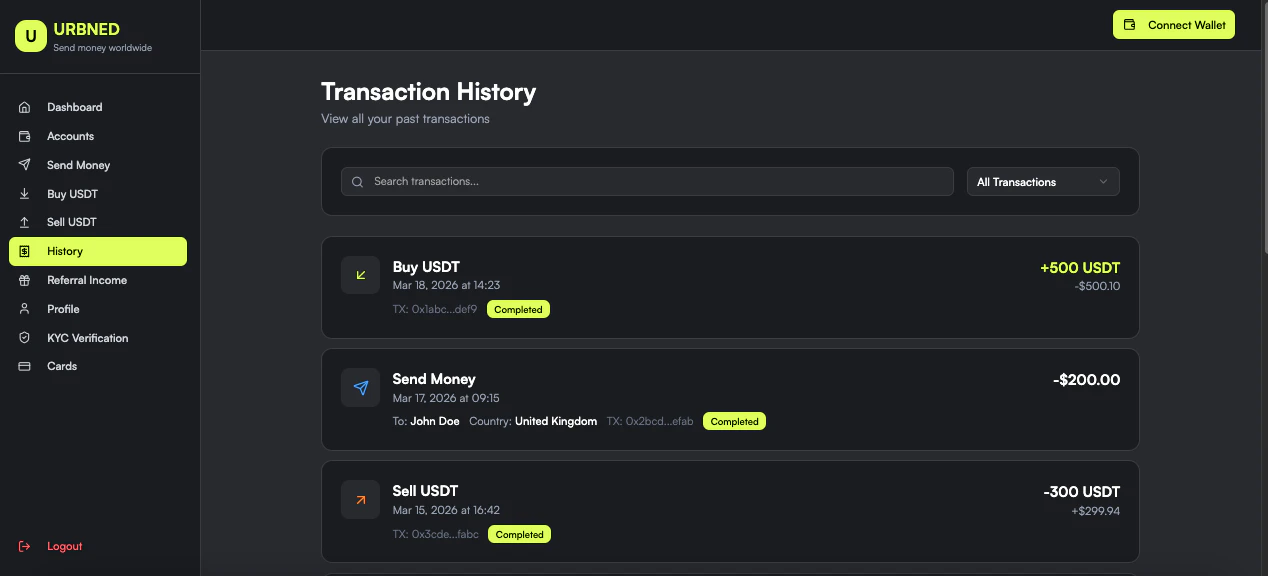
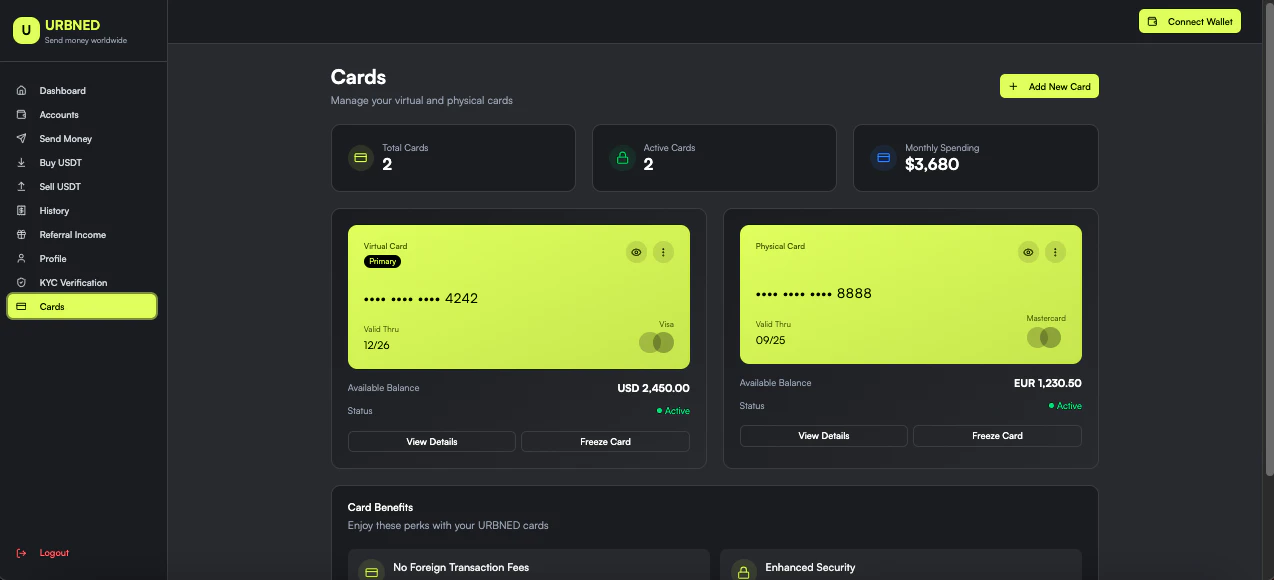
Building stablecoin-native cross-border financial rails for immigrants, freelancers, global workforce and businesses. You send dollars, recipients receive pesos, rupees, and more. The stablecoin layer is invisible. What URBNED offers: 🏦 Virtual USD & EUR accounts — in your name, no new bank needed 🔄 Fiat → stablecoins → fiat — invisible stablecoin rails, zero complexity. 🦊 Send money internationally from MetaMask & Phantom directly. ⚡️ Global delivery in minutes.
#10
PangeAI
Instant, agent-driven spatial analysis and decision-making
104
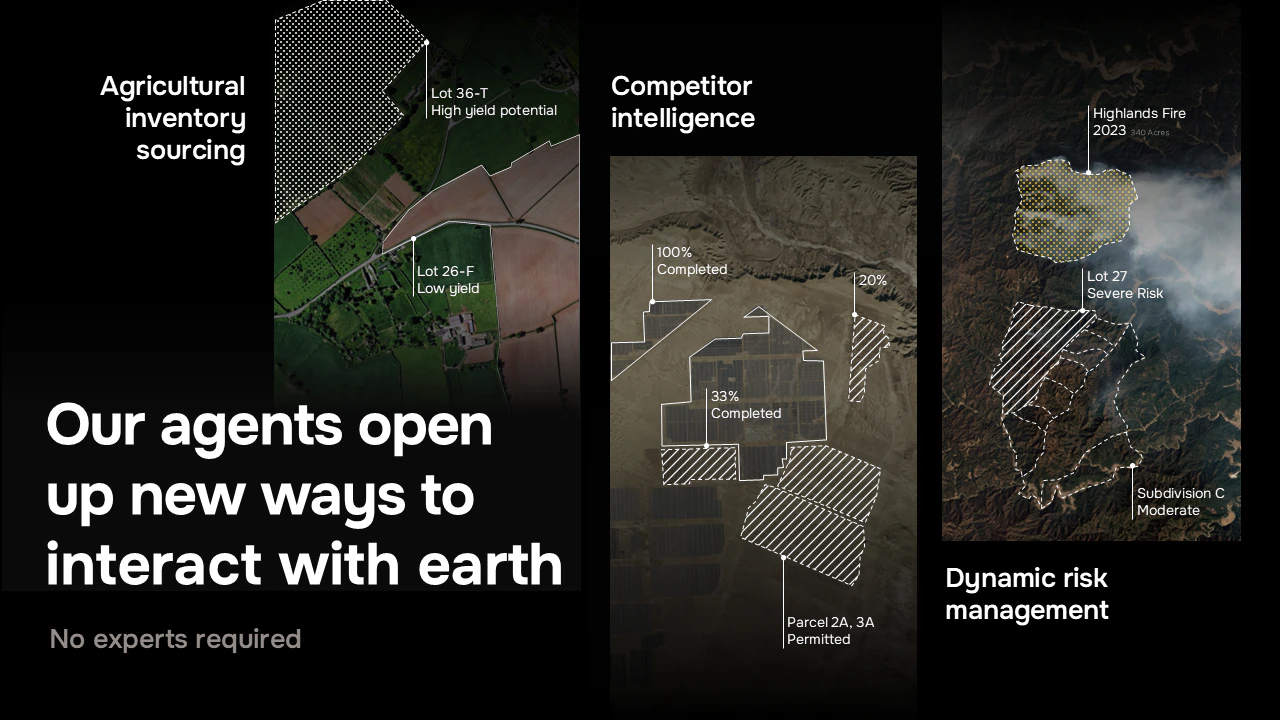
一句话介绍:PangeAI是一个基于AI智能体的地理空间数据分析层,让非专业用户无需GIS团队即可快速(分钟级)回答现实世界的地理问题,如快速评估数百个地点在上月是否遭遇洪涝。
Artificial Intelligence Maps Pitch Berlin
地理空间分析 AI智能体 卫星影像 空间决策 无代码GIS 自动化处理 数据融合 B2B SaaS 空间计算 物理世界理解
用户评论摘要:用户反馈积极,创始人以幽默方式点明传统GIS工作繁琐痛苦的核心痛点。有效评论集中于产品愿景(让AI理解物理世界位置)和具体技术关切,如如何处理不一致的遥感数据、多源数据(LiDAR、街景)融合,以及智能体如何推理并标识数据缺口。
AI 锐评

PangeAI的野心不在于成为另一个GIS工具,而旨在成为“空间智能”的推理层。其真正价值是试图填平两个巨大鸿沟:一是专业地理空间操作与日常业务决策之间的知识鸿沟,将“周”级的分析压缩至“分钟”级;二是当前大语言模型所代表的“语义理解”与真实物理世界“空间理解”之间的能力鸿沟。

产品标语中的“agent-driven”是关键。它暗示其AI并非仅用于图像识别,而是能自主调用、处理、融合多源异构地理数据(卫星影像、矢量、坐标系统),并执行链式推理以完成复杂任务的智能体。这直指传统GIS和单一API服务的天花板:它们提供数据或工具,但不提供端到端的、基于自然语言的决策答案。

评论中关于“处理混乱现实数据”的提问,恰恰点出了其成败的关键。地理空间数据的噪声、不一致和残缺是常态。PangeAI若仅是将传统处理流程自动化,价值有限。其宣称的“智能体”必须展现出真正的“推理”能力——例如,在云层遮挡卫星影像时,能主动寻找替代数据源(如街景摄像头),或基于历史模式和周边数据进行概率性推断,并明确告知用户结论的不确定性。这才是“无需GIS团队”承诺能否兑现的核心。

风险同样明显。作为夹在底层数据供应商与上层企业应用之间的“智能层”,其分析结果的准确性与可靠性将面临极端严格的场景考验(如灾害评估、选址规划)。此外,其商业模式、数据成本及对特定坐标系统或数据源可能存在的隐性依赖,都是其从炫酷Demo走向企业级服务必须跨越的障碍。如果成功,它定义的将是一个新品类;如果失败,则可能只是又一个试图用AI包装复杂性的、华而不实的工具。

查看原始信息
PangeAI
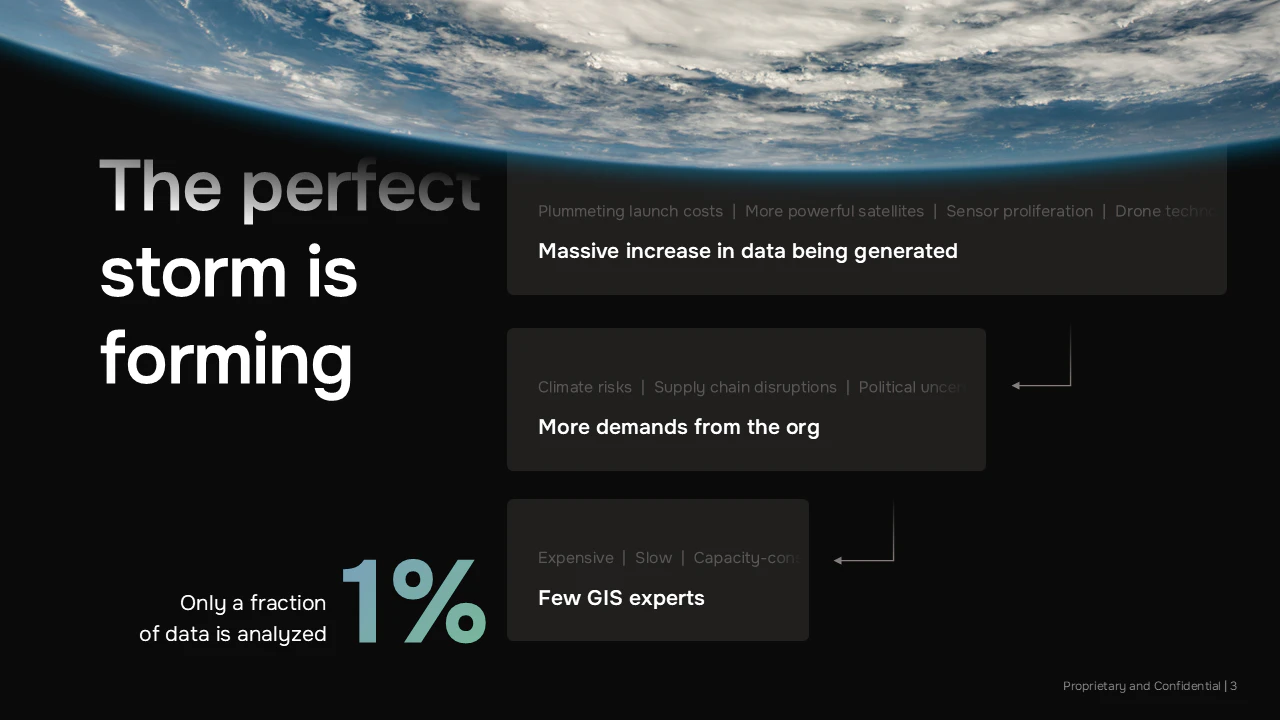
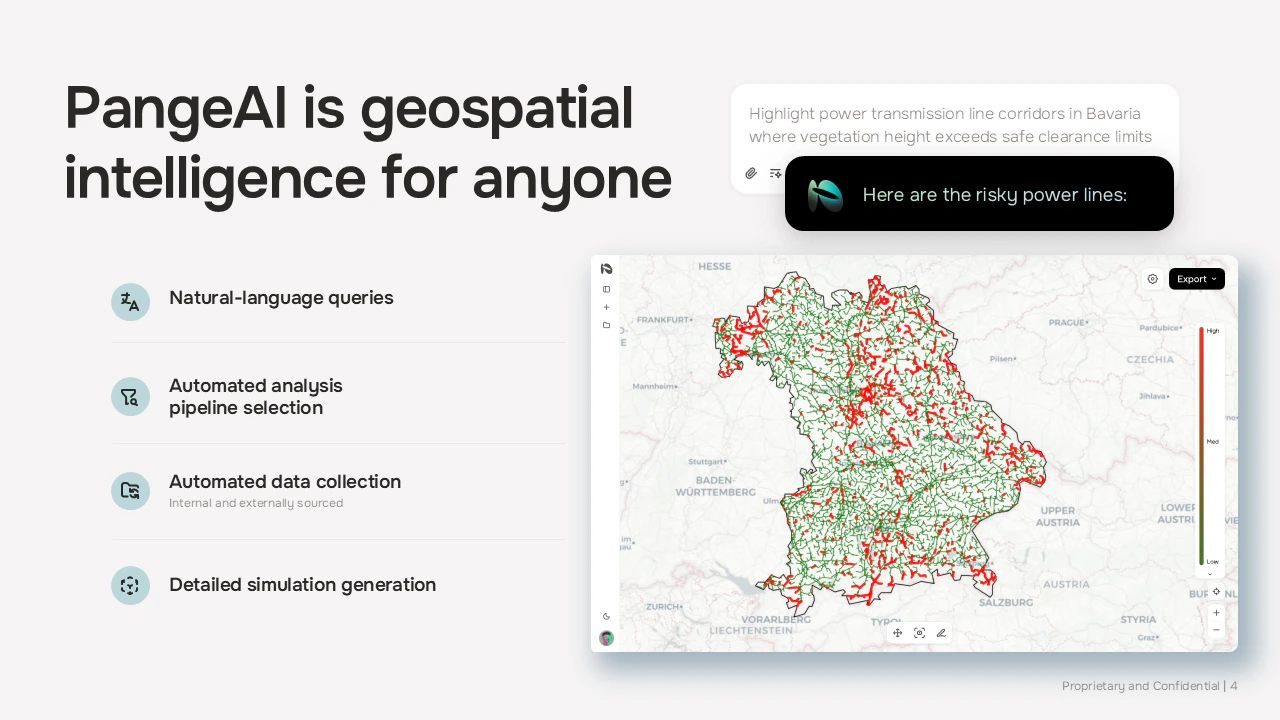
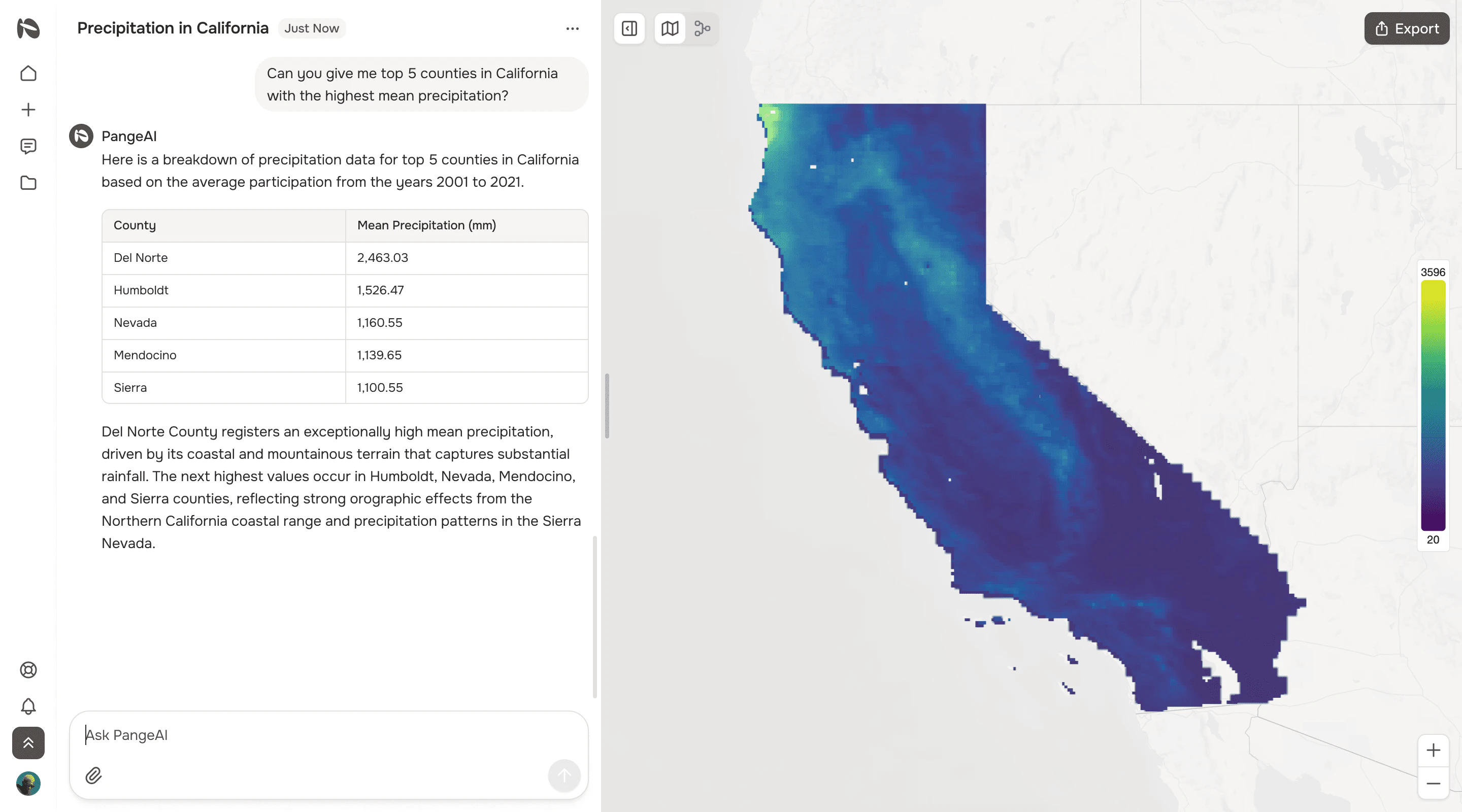
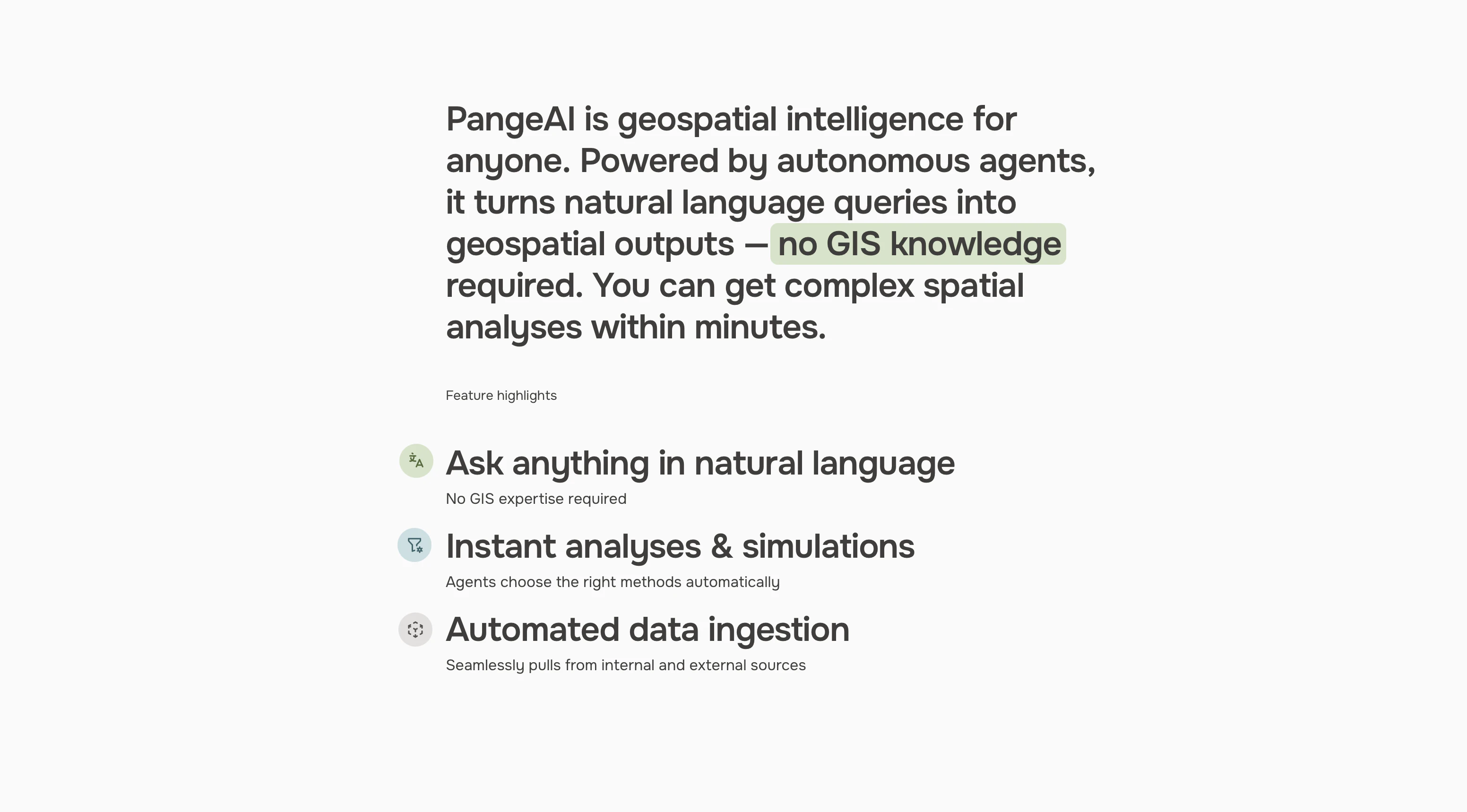
PangeAI is an agentic layer over geospatial data: satellite imagery, vector geometries, coordinate systems. You can answer physical-world questions without a GIS team. "Which of my 400 sites flooded last month?" Minutes, not weeks. Built between Silicon Valley and Europe

🌎🫶If you've ever spent a Friday night reprojecting EPSG:4326 into EPSG:5514 and questioning your life choices: this one's for you. Marek here, CTO and recovering geospatial engineer. We built PangeAI so AI agents can finally handle the stuff that made me want to quit grad school. Would love your feedback, especially the brutal kind.

12
回复

Most AI agents know what they’re talking about, but they have no idea where they are. We’re here to make sure the robots don’t try to take a shortcut through a lake just because it's a straight line on a CSV

Please get in touch with us for info, we'd love to map things for you :)

8
回复
@yanbin_pan 🤖🌍🚀
0
回复

Johanna here, CEO of PangeAI.

Nowadays everyone seems to be building AI agents…
we’re focused on the ones that actually matter - the ones that understand the real, physical world (and save you from GIS-induced suffering)

Would love your thoughts (I'm German, so honest feedback is basically a love language)

7
回复

@johanna_von_der_leyen What's one "brutal" limitation you've hit with current geospatial tools that PangeAI's agents solve best?

0
回复
@johanna_von_der_leyen 🌍🎉🚀
1
回复

@johanna_von_der_leyen How does PangeAI handle messy real-world data like inconsistent satellite imagery or urban occlusion? Does it blend LiDAR + street cams for reliable outputs, or lean on agent reasoning to flag gaps?

0
回复
#11
TorchTPU
Running PyTorch Natively on TPUs at Google Scale
101
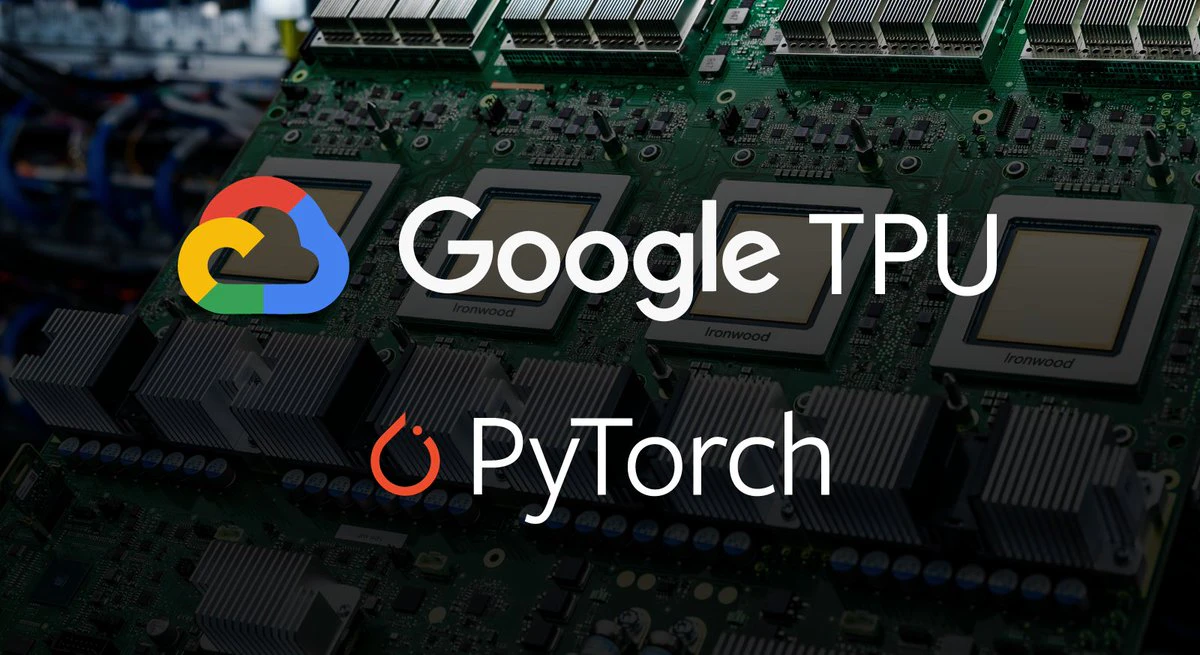
一句话介绍:TorchTPU是谷歌推出的PyTorch原生TPU后端,允许开发者仅修改极少量代码即可在谷歌规模的TPU上运行现有PyTorch工作负载,解决了PyTorch用户难以利用高性能TPU硬件且迁移成本高昂的痛点。
Open Source Developer Tools Artificial Intelligence
人工智能基础设施 深度学习框架 硬件加速 PyTorch后端 TPU 高性能计算 模型训练 谷歌云 无缝迁移 分布式训练
用户评论摘要:用户普遍认可其“极简代码修改”和“Fused Eager模式”带来的性能提升价值,并关注其非封装层的深度集成方式。主要疑问集中在:从单机扩展到多Pod集群的实际挑战、对自定义CUDA内核作业的兼容性,以及调试模式对混合精度等边缘案例的处理能力。
AI 锐评

TorchTPU的发布,远不止是谷歌TPU生态对PyTorch的又一次“兼容”。其真正锋芒,在于以“PrivateUse1”级别的深度系统集成,试图对AI硬件竞赛的底层游戏规则进行一次迂回侧击。

表面看,它解决了PyTorch用户接入TPU的工程摩擦,通过“Fused Eager”等模式在易用性与性能间取得平衡。但深层次上,这是谷歌在NVIDIA CUDA生态统治下的一次精准破局。它不强迫用户改写模型逻辑,而是选择“融入”最流行的PyTorch生态,实质是降低开发者尝试TPU的心理和技术门槛,旨在从庞大且活跃的PyTorch社区中,为自家TPU硬件引流。其价值不仅在于50-100%+的性能提升,更在于“scale to 100K+ chip clusters”所暗示的、对超大规模训练场景的野心——这是直接瞄准了下一代前沿模型研发的基建战场。

然而,其挑战同样尖锐。评论中关于“自定义CUDA内核”的疑问直指要害:众多成熟生产管线深度绑定CUDA,TorchTPU依赖的XLA编译栈与CUDA生态的兼容鸿沟能否真正抹平,仍是未知数。此外,“动态形状支持”等关键功能尚在路线图中,说明其在应对灵活研究场景时可能仍有局限。它提供了优雅的入口,但通往峰值性能与极致灵活性的道路,依然可能布满需要“深度硬件专业知识”的坑洼。

本质上,TorchTPU是谷歌以软件柔性化解硬件生态壁垒的一次高明尝试。它能否成功,不只看技术指标,更取决于能否在开发者心中重塑“TPU=复杂难用”的刻板印象,并构建起一个足以与CUDA生态部分抗衡的、繁荣的PyTorch-on-TPU应用生态。这场战役,现在才刚刚开始。

查看原始信息
TorchTPU
TorchTPU is Google's PyTorch-native backend for TPUs. Run existing PyTorch workloads with minimal code changes, get 50-100%+ speed gains with Fused Eager mode, and scale to 100K+ chip clusters — no static graph compilation required to get started

Google just made TPUs a first-class target for PyTorch, and you barely need to change your code.


The problem: TPUs power Gemini, Veo, and the largest AI clusters on earth, but using them from PyTorch required workarounds, framework rewrites, and deep hardware expertise most teams don't have.

The solution: TorchTPU is a PyTorch-native backend that lets you change one line of initialization and run your existing training loop on TPU, no core logic changes required.

What stands out:
⚡ Fused Eager mode: Auto-fuses ops on the fly for 50-100%+ speed gains, zero setup required by user

🐛 Debug Eager: Catches shape mismatches, NaNs, and OOM errors one op at a time so you fix bugs faster
🔁 Strict Eager: Async single-op dispatch mirrors the default PyTorch experience for a flat learning curve
🔧 torch.compile via XLA: Peak performance with full-graph compilation, battle-tested for TPU topologies
📦 Custom kernels via Pallas & JAX: Write low-level hardware instructions without breaking performance
🌐 DDP, FSDPv2, & DTensor supported: Scale distributed training without rewrites
🔀 MPMD support: Divergent code across ranks works without breaking your stack
💾 Shared Compilation Cache: Reduces recompilation overhead across single & multi-host deployments

On the roadmap for 2026:
- Public GitHub repo with docs and reproducible tutorials
- Dynamic shapes support via torch.compile
- vLLM and TorchTitan integrations
- Linear scaling validated up to full Pod-size TPU infrastructure
- Native multi-queue support for async codebases

Different because this isn't a wrapper or a fork; TorchTPU integrates at the PyTorch PrivateUse1 level so you get ordinary PyTorch Tensors on TPU hardware, no subclasses, no rewrites, no friction.

Perfect for ML engineers and research teams running PyTorch workloads who want to leverage Google TPU infrastructure without abandoning their existing codebase.

P.S. I hunt the latest and greatest launches in tech, SaaS and AI, follow to be notified @rohanrecommends

3
回复

@rohanrecommends congrats for this launch!!

0
回复

@rohanrecommends For a mid-sized research setup, what's the biggest gotcha you've hit when scaling from single-host to multi-pod, and how does the shared cache help there?

0
回复

honestly the Fused Eager mode is what caught my attention here — getting 50-100% speedups without touching your training loop is pretty wild. been running some PyTorch fine-tuning jobs on A100s and the compile step is always where things get messy. curious how the debug eager mode handles mixed precision edge cases though, that's usually where I spend half my debugging time. the fact that this works at PrivateUse1 level instead of being a wrapper is a huge deal for anyone maintaining custom training pipelines

0
回复

The Skill Map output is what I want to understand better. Is it a snapshot — like a score you get once after a session — or does it update over time as you do more scenarios? Because a one-time assessment is pretty different from something that tracks how you're actually improving.

0
回复

Running existing PyTorch workloads on TPUs with minimal code changes is compelling — what's the experience like for jobs that depend on custom CUDA kernels? That's typically where XLA/TPU migration breaks down for large training pipelines.

0
回复
#12
Makko AI
Make 2D game art and playable games. No drawing. No coding.
101
一句话介绍:一款AI驱动的2D游戏创作平台,通过自然语言描述,无需绘画和编程技能,即可快速生成风格统一的游戏资产并构建可玩游戏,极大降低了游戏创意的实现门槛。
Design Tools Indie Games Artificial Intelligence
AI游戏开发 无代码游戏制作 2D像素艺术 游戏资产生成 智能游戏设计 创意工具 快速原型 独立开发者 视觉一致性 游戏工作室
用户评论摘要:用户肯定其生成优质像素艺术的能力,关注AI对“图块集”等专业资产的支持度。开发者回应迭代迅速,将专门优化图块集功能。核心问题聚焦于AI对复杂游戏机制(如“纳达尔式闪避”)的迭代反馈与理解能力,以及资产风格一致性工具的实际效果。
AI 锐评

Makko AI的野心并非仅是又一个“AI绘画工具”,它试图成为从创意到可玩游戏的“端到端”智能体。其宣称的价值在于用对话取代学习曲线陡峭的编程与美术工作流,这直击了无数“想法型”创作者的终极痛点。

然而,其真正的挑战与价值深度,隐藏在用户评论的细节中。首先,“风格一致性”是核心卖点,也是最大技术壁垒。AI生成单张图片已不新鲜,但确保角色、背景、动画在整个游戏项目中视觉统一,是规模化生产的刚需。其“Collections”工具能否智能管理并贯彻风格,将决定它是玩具还是生产力工具。其次,用户询问“纳达尔式闪避”的反馈机制,尖锐地触及了AI游戏开发的深水区:AI能否理解复杂、抽象的“游戏感”并迭代机制?目前看,它可能更擅长执行“生成一个红色头发武士”这类明确指令,而对“手感”这种主观、系统性的调优,其“智能”程度存疑。

产品目前看似以“资产生成”为立身之本,但其长期叙事必须建立在“理解游戏设计逻辑”之上。否则,它极易沦为高级素材库,而“构建可玩游戏”将局限于预设模板的拼接。每周更新的承诺显示了敏捷性,但若不能在图块集、机制迭代等核心需求上建立技术护城河,其宣称的“革命性”将大打折扣。它的真正价值,在于能否将游戏开发从“技能密集型”手工业,部分转化为“创意描述密集型”的智能工业,这条路才刚起步。

查看原始信息
Makko AI
Makko is an AI-powered 2D game studio. Start with concept art, create characters, backgrounds, and animations that all match in style, then build a playable game with your own art in Code Studio. No drawing skills. No coding. Just describe what you want and AI builds it. Collections keep every asset visually consistent across your whole game. Free to start.
Hey Product Hunt! 👋 We built Makko because the gap between "I have a game idea" and "I have a playable game" is massive, and it's been that way for decades. Learning to code, learning a game engine, learning to make art... most ideas die before they ship. Makko closes that gap to a conversation. You tell Makko what you want to build, and our agentic AI handles the rest: game logic, mechanics, pixel art, the whole thing. You can be playing your first game in minutes. It's free to sign up, and we'd love to see what you build. Drop your games in the comments, we're reading every one. 🎮 → makko.ai
7
回复

@makko_ceo What's one underrated game mechanic you've seen creators nail right away with Makko?

0
回复

@makko_ceo How does Makko handle iterative feedback? Like if I say "make the character dodge like Nadal's backhand," does it refine mechanics/art on the fly, or suggest upgrades based on playtesting?

2
回复
@dayal_punjabi yes, you can continue to refine characters and their animations, and our Collections tool makes it so you can put your character in different outfits/settings as well!
0
回复

a pixel art that actually looks good and isn't just a blurred mess... does the ai understand tile-sets or is it just individual assets for now? either way, not needing to spend weeks on sprites is a huge speedup. supported

5
回复
@priya_kushwaha1 thanks for the feedback and kind words! You can get tilesets if you spend a good amount of time iterating with the AI currently. We are rolling out updates in the coming weeks that dial in on tilesets specifically though. For context, we release updates and upgrades every week. Cheers, Tony
2
回复

@priya_kushwaha1 We appreciate the kind words Priya!

1
回复
Hey there! I’m one of the co-founders of Makko.ai, I built the original prototype because I’ve always wanted to make video games and none of the AI tools out there could create reliable, consistent 2D art and animations. Fast forward 7 months and Jeremy has turned that prototype into an enterprise piece of software used by thousands of people before exiting beta. I’ll be around all day and available to answer any questions, come make games with us! Cheers, Tony
5
回复
#13
Papayo.ai
AI hiring assistant for recruiting agencies
95
一句话介绍:Papayo.ai是一款面向招聘机构的AI原生招聘平台,通过部署专注于寻源、触达、日程安排和候选人评估的专属智能体,旨在显著缩短招聘周期,解决招聘机构耗时低效的核心痛点。
Pitch Berlin
AI招聘平台 智能招聘助手 招聘流程自动化 人才寻源 招聘机构SaaS AI智能体 招聘效率工具 候选人评估
用户评论摘要:用户评论极少且无实质反馈。唯一主评疑似产品方自述,强调其专注于“高质量招聘”而非“大规模招聘”。一条回帖询问是否有浏览器扩展计划,表达了兴趣并认为产品看起来不错。
AI 锐评

Papayo.ai的构想直击招聘行业“时间就是金钱”的命门,其价值主张清晰:用AI智能体流水线式接管从寻源到评估的招聘全链条,为人力密集型的招聘机构提供自动化杠杆。这并非简单的聊天机器人套壳,而是试图构建一个“AI员工”团队,分工明确,颇具野心。

然而,其Product Hunt上近乎空白的真实用户反馈与95个点赞形成微妙反差,这暴露出其早期阶段的核心挑战:概念吸引力与落地验证之间的鸿沟。招聘是高度依赖信任、人际判断与复杂决策的领域,AI能否在“候选人评估”等关键环节提供可靠、无偏见的支持,而不仅仅是效率提升,这是其必须回答的尖锐问题。标语中的“AI-native”是亮点也是风险点,它意味着深度重构流程,但也可能过早将机构捆绑在一条尚未被完全验证的技术路线上。

当前,它更像一个精心包装的技术愿景。其真正价值不在于演示了哪些AI功能,而在于能否在真实的、纷繁复杂的招聘场景中,证明其智能体具备超越基础自动化的“理解”与“决策”能力,并最终转化为可量化的“招聘质量提升”而不仅仅是“时间缩短”。否则,它可能只是自动化洪流中又一个可被替代的效率工具。

查看原始信息
Papayo.ai
Papayo.ai is an AI-native hiring platform with specialized agents for sourcing, outreach, scheduling, and candidate evaluation. Targets staffing agencies to reduce time-to-hire.
We drive growth of quality hiring when no one else does as all focus on mass hiring.
0
回复

@rico_fernando1 have you guys planned on making an extension?
or am i too forward in time? cause this looks good to me

0
回复
#14
DogBase v2 Official Launch
The AI-powered platform built for professional K9 teams
91
一句话介绍:DogBase是一款AI驱动的专业工作犬团队操作系统,通过整合训练日志、健康管理和绩效追踪,解决了K9搜救、执法等领域因依赖零散工具而导致数据丢失、模式难察、团队协作不透明的核心痛点。
Productivity Artificial Intelligence Pitch Berlin
工作犬管理平台 AI驱动分析 训练日志 健康监测 绩效追踪 专业K9团队 SAR工具 执法犬管理 服务犬 数据协同
用户评论摘要:用户反馈集中于AI功能的具体价值与数据呈现细节。创始人的深度回复阐述了产品源于真实场景,并强调了团队的专业背景。有效评论提出了两个关键问题:AI如何识别笔记难以发现的细微健康/疲劳趋势;以及“绩效追踪”功能的具体指标和报告形态。
AI 锐评

DogBase v2的发布,表面上是一个垂直的SaaS工具,但其内核是一次对高度专业化、高风险作业流程的数据化重构。其真正价值不在于简单的“记录”,而在于试图成为工作犬团队的“数据中枢”与“决策副驾”。

产品切入点的犀利之处在于,它没有选择泛化的宠物市场,而是锚定了“专业工作犬”这一需求刚性、容错率极低但数字化程度异常落后的缝隙市场。用户用笔记本、WhatsApp和电子表格的现状,是典型的“工具碎片化”困境,这直接导致了数据孤岛和模式湮灭。DogBase的核心价值主张,正是通过强制性的结构化数据录入,打破这些孤岛。

然而,其宣称的“AI驱动洞察”是价值兑现的关键,也是最大的风险点。评论中的提问一针见血:AI究竟能发现哪些人眼难以察觉的模式?是细微的行为变化预示的早期伤病,还是训练数据中隐藏的效能衰减曲线?这要求其AI模型必须建立在极其专业、高质量的领域数据之上,且需得到资深训导员的经验验证。创始人自称“身在行业中”并用自己的犬只数据,是建立初始信任的关键,但能否规模化地提炼出普适、可靠的洞察,将决定产品是停留在“数字记录本”,还是进阶为不可或缺的“团队预警系统”。

另一个潜在壁垒与机遇在于“协同”。专业团队(如特警队、大型搜救组织)的内部协作与信息可见性需求强烈。若能通过数据标准化,实现跨犬只、跨小组的绩效对标与健康趋势预警,其价值将从个体工具升维为组织级的资产管理与风险控制平台。这或许是它未来超越“工具”范畴,成为行业基础设施的关键一步。

总体而言,DogBase展现了一个优秀垂直AI应用的雏形:深扎痛点场景、拥有领域内行的理解、并试图用数据智能解决经验传承与风险预判的难题。但其成功与否,将严格取决于其AI功能在真实高压环境中所证明的实际效用与可靠性,而不仅仅是概念上的“智能化”。

查看原始信息
DogBase v2 Official Launch
DogBase is the operating system for professional working dog teams. Log training, manage health, track performance, and get AI-powered insights — built for K9 SAR, law enforcement, sport, and service dog programs.

What inspired DogBase: I'm a SAR K9 handler. My Belgian Malinois Echo started as my service dog during a period of serious illness — and eventually became a fully certified search and rescue dog. During that journey I realized working dog teams are managing incredibly complex operations with notebooks, WhatsApp groups, and spreadsheets. Training data gets lost. Health patterns go unnoticed. Teams have no shared visibility into what's actually happening with their dogs. So we built DogBase — a platform where every session, health event, and performance insight lives in one place, with AI that tells you what the data means. We're not just a tech company. We're in the space. Echo is still active, and his data is in DogBase right now. Would love feedback from anyone working in K9, dog sport, or animal performance — and happy to answer questions about what we've learned building AI tools for operational teams.

2
回复

@almogk How has DogBase's AI helped spot subtle health or performance trends that notebooks miss, like fatigue patterns before they impact a mission?

0
回复

"Performance tracking" is interesting for working dogs — what does that actually surface over time? Like, are you looking at things like drive degradation, injury recovery curves, or alert accuracy rates? Would be curious to see what a 6-month performance report actually looks like for a patrol dog.

0
回复
#15
GalaxyBrain
An information operating system powered by local files
91
一句话介绍:GalaxyBrain是一款本地优先的信息操作系统,通过让文档页面拥有变量、公式和实时联动引用,在跨文档知识管理和动态项目跟踪等场景下,解决了信息孤岛与手动同步的效率痛点。
Productivity
本地优先知识系统 结构化文档 动态联动 无代码编程 个人知识管理 实时同步 JSON存储 HTTP API 信息操作系统 文档即应用
用户评论摘要:创始人详述了历时多年的重构历程,强调产品核心引擎现已稳固。用户评论主要关注非技术用户的上手难度,以及在管理多页面、公式密集型工作流时的实际表现,体现了市场对产品易用性与复杂场景能力的关切。
AI 锐评

GalaxyBrain的野心远不止于“智能笔记”。它本质上是一个运行在本地文件系统上的、面向非专业开发者的轻量级计算环境。其核心价值在于将“文档”从静态容器升格为可编程、可互联的“数据单元”,通过变量与公式在文件间建立动态图谱,试图在Notion的数据库灵活性与传统电子表格的单元格引用逻辑之间,开辟一条新路径。

“本地优先”与“结构化JSON存储”是它的战略支点,这确保了数据主权和可被其他工具(通过API/MCP)自由调用的潜力,契合了当前开发者与高阶用户对封闭生态的反思潮流。然而,其最大的挑战也在于此:如何让被“无代码”标语吸引的用户,真正理解并驾驭其类编程的思维模型?评论区的担忧已直指这一矛盾——产品强大的“引擎”与用户期待的“平滑上手”之间存在鸿沟。

它的未来,取决于能否在“电子表格般的直观”与“编程环境般的强大”之间找到那个精妙的平衡点。否则,极易陷入专业人士嫌其能力边界清晰、大众用户觉其学习曲线陡峭的尴尬境地。它是一款为“知识工程师”打造的利器,但要想破圈,必须在抽象概念的“封装”与用户引导上做出更多革新。

查看原始信息
GalaxyBrain
GalaxyBrain is a local-first knowledge system where pages have variables, formulas, and live references between them. Define a value on one page, reference it from another, and it stays in sync automatically. Like a programming environment crossed with a document editor. Everything is stored as structured JSON files on your machine. There's a built-in HTTP API and MCP tool so you can point Claude Code, Codex, or a local model at the same folder and build on top of it. No account needed.

Hey PH! I soft launched GalaxyBrain here about a year ago. The response was encouraging but it became clear pretty quickly that the foundation wasn't strong enough for what we were trying to build.

So I convinced my smartest friend (@viralplatipuss) to join as technical cofounder and we rebuilt the entire product from the ground up. GalaxyBrain is closer to a spreadsheet engine than a note app, and that level of complexity needed a foundation built properly.

It's ready now. The core is solid. You can have thousands of pages with dynamic values, all connected to each other, all staying perfectly in sync and updating in real time.

It's been a multi-year labor of love. You might find some rough edges on the fringes but the engine underneath is rock solid.

Would love to hear what you think and if this approach has potential.

2
回复

@viralplatipuss  @jon For someone managing workshop notes, content research, and dynamic project trackers, how easy is it to onboard without coding, and what's one killer use case you've seen users pull off?

0
回复

@viralplatipuss  @jon For someone managing workshop notes, client feedback, or PH launch playbooks across 50+ connected pages, how does the real-time linking handle formula-heavy workflows?

0
回复
#16
Claro - Research Agents
Claro runs the AI agents that operate on your data
87
一句话介绍:Claro是一款AI数据研究代理平台,通过多模型共识和置信度评分机制,在表格内直接运行多种任务型AI代理,解决了企业在处理供应商、产品等海量异构数据时对AI输出结果缺乏信任的核心痛点。
Productivity Artificial Intelligence Pitch Berlin
AI数据代理 数据清洗与增强 PDF提取 网络爬虫 数据验证 置信度评分 来源追溯 多模型共识 企业级数据治理 无代码数据平台
用户评论摘要:用户反馈聚焦于置信度评分与引用机制的技术细节,特别是对PDF等非结构化数据处理的可靠性提出疑问。创始人详细解释了评分算法(来源可靠性40%等)与多模型验证架构,展现了产品构建的深度。
AI 锐评

Claro的亮相,直指当前企业AI应用最脆弱的“阿喀琉斯之踵”:华而不实的输出与无法落地的信任赤字。它没有沉迷于制造又一个聊天机器人外壳,而是选择了一条更艰难但更务实的路径——构建“验证优先”的AI执行层。

其真正价值不在于提供了十几种数据提取与分类代理,而在于为每一个输出单元格构建了一套量化可信度的“免疫系统”。将置信度评分拆解为来源可靠性、交叉验证一致性、模型确定性等可衡量的维度,并辅以多模型共识和LLM作为评判者的过滤机制,这实质上是在试图为AI的“黑箱”输出建立可审计的透明管道。尤其针对企业级的产品与供应商数据管理,这种对稳定ID、持续验证的强调,远比一次性的答案提取更有长期价值。

然而,其挑战也同样明显。首先,这套复杂验证体系的运行成本与延迟,能否在百万元级别的数据规模上依然保持实用性与经济性,有待观察。其次,当数据本身高度模糊或冲突时,即使评分机制标为“低置信度”,仍需人工最终裁决,产品能否形成高效的人机协同闭环至关重要。最后,从“研究代理”模块走向其愿景中的完整“数据执行层”,需要更深度的行业数据模式积累与集成能力。

总体而言,Claro是一次将AI从“提供答案”推向“交付可信决策依据”的重要尝试。它能否成功,不取决于AI代理的“广度”,而取决于其验证体系的“深度”能否真正经得起企业混乱、复杂现实数据的持续冲击。

查看原始信息
Claro - Research Agents
Today, we're opening the first public module of Claro: Research Agents. 10+ task-specific agents run inside a native table - enrichment, PDF extraction, URL scraping, classification, location lists, dedupe. Every cell comes back with a confidence score, citations, and ranked sources. Built validation-first, not a chat wrapper. 200 free credits on signup, no card.

Hey Product Hunt 👋 I'm Matteo, co-founder of Claro.

We built Claro because we kept losing trust in our own AI outputs. @tameesh and I spent years at Delivery Hero and Yelp trying to wrangle product and supplier data at scale. Tameesh then did NLP/LLM research and published at MIT Review. Every time we plugged an LLM into a data workflow, we got beautiful-looking answers with no way to know which ones were right.


Claro is the AI execution layer for product and supplier data. It takes messy supplier feeds, spreadsheets, and documents, turns them into trusted catalog entities with stable IDs, and keeps them validated and correct over time.

Today we're opening the first public module: Research Agents. 14 task-specific agents that run inside a native table:

📋 Find your perfect list — describe ideal prospects, suppliers, or partners, get an enriched dataset 📍 Build a location list — draw an area on a map, generate POIs with attributes 📄 Capture tables from PDFs — pull tables from reports, pick which to keep 📑 Turn documents into structured data — extract fields across hundreds of docs at once 🌐 Scrape data from URLs — turn a list of links into structured rows 📊 Analyse CSV — upload a spreadsheet, validate and enrich it 🔀 Merge & Map — dedupe and reconcile records across two files and more.

What makes Claro different is what happens to every answer before it hits your table:

Multi-model consensus — we push extractions to multiple models in parallel and only accept where they agree
LLM-as-judge filtering — a lightweight quality gate catches nonsensical outputs before they reach you
Source ranking — first-party and authoritative sources above random blog posts, datasheets above application guides
Confidence scores — every cell scored at row, column, and entity level based on source reliability, cross-source consistency, model certainty, and retrieval quality
Full citations — click any cell to see the exact passage, URL, or document section it came from
BM25 + AI hybrid matching — for entity resolution against your existing catalog, with human approval loops for borderline cases

It's not a chat wrapper. It's validation-first infrastructure with a spreadsheet you can use today.


Three things I'd love today:

  • Try it — 200 free credits, no card.

  • Break it — throw your ugliest CSV or weirdest PDF, tell me what it got wrong (and what the confidence score said)

  • Tell me which agent you'd use first — we're deciding what to deepen next

I'm pitching live at The Pitch Berlin today, so I'll be bouncing between stage and comments, but I'll reply to every one before EOD.

If you run a marketplace, distributor, or multi-supplier catalog and the underlying platform sounds relevant, DM me — we'd love to talk.

Thanks for taking a look 🙏 — Matteo

14
回复

@tameesh  @matteo_fava Which agent has surprised you most with its accuracy so far on real-world data?

0
回复

Hello, Tameesh here, co-founder & CTO 👋

Happy to go deep on anything technical — how we compute confidence scores, how source ranking weights first-party vs open-web sources, how we orchestrate tool calls across extract/classify/generate/search, multi-model consensus, entity resolution with BM25 + embeddings, graph-driven validation, what happens when the model is uncertain.

Short version of what I’m proud of: the confidence score isn’t a vibes check. Source reliability 40%, cross-source consistency 30%, model certainty from output variance 20%, retrieval quality 10%. We run multi-model consensus for high-stakes enrichments and LLM-as-judge as a lightweight filter on top. You can sort a 100k-row dataset by confidence and review only the reds. That’s the difference between “AI output” and “AI output you can use.”

Drop your hardest technical question below 👇

1
回复

thanks @rajiv_ayyangar for the support as Hunter!

1
回复

The confidence score + citations on every cell is the interesting part. How does that work across the PDF extraction agent specifically? PDFs can be messy — scanned docs, weird formatting, tables within tables. Does the confidence score drop noticeably on low-quality source material, or does it stay falsely high?

0
回复
#17
QA Crow
A murder of crows for your bug backlog
87
一句话介绍:一款让开发者用自然语言编写QA测试的AI代理工具,通过模拟真实浏览器运行测试并生成结构化错误报告,解决了中小团队及独立开发者因传统QA平台价格高昂、流程复杂而无法获得有效测试的痛点。
SaaS Developer Tools Artificial Intelligence
AI测试代理 自然语言编程 软件测试 按量付费 开发者工具 自动化测试 错误追踪 独立开发者 中小团队 浏览器测试
用户评论摘要:用户普遍赞赏其按量付费模式和绕过销售流程的简洁性,认为精准契合小团队需求。主要疑问集中于:AI处理模糊指令和复杂流程的可靠性、如何避免误报、与直接使用通用AI编写测试的差异、以及具体的技术实现细节和竞品对比。
AI 锐评

QA Crow的亮相,与其说是一款技术产品的发布,不如说是一次对臃肿、封闭的B2B软件商业模式的有力嘲讽。它敏锐地刺中了当前QA工具市场的核心矛盾:一方面,AI的普及催生了大量快速开发的小型应用,它们对测试的需求迫切;另一方面,主流测试平台却将定价和销售模型锚定在“Fortune 500”企业,筑起了高不可攀的价格壁垒。

产品的真正价值,首先在于其**极致的商业模式减法**。它彻底摒弃了“坐席费”、“年度合同”、“最低消费”和“销售介入”这些传统SaaS的标配,回归最朴素的“用一次付一次”。这不仅仅是定价策略,更是产品哲学——它只为自己创造的价值收费(执行测试),而非为潜在的“企业关系”或“销售成本”买单。这使其成为了“独立开发者经济”生态中一个精准的基建组件。

其次,其技术路径选择体现了务实的**AI应用观**。它没有空泛地宣传“全自动测试”,而是构建了一个“人类描述-AI审查与修正-真实环境执行”的协作流程。将AI定位为“挑剔的审查员”和“可靠的执行者”,而非全知全能的替代者。这既承认了当前LLM在复杂逻辑和领域知识上的局限性,又将其在理解自然语言、执行重复性浏览器操作方面的优势最大化。用户评论中关于模糊指令处理的担忧,恰恰是产品需要持续构建核心壁垒的关键点:其AI的“判断力”能有多强?

然而,挑战同样明显。当用户询问“与直接让Claude写测试用例有何不同”时,触及了本质:**QA Crow必须证明其垂直化AI代理能提供远超通用模型的价值**。这价值应体现在:对测试领域的深度理解(如自动识别模糊步骤、补充认证逻辑)、与真实浏览器环境及错误报告系统的无缝集成、以及执行过程的稳定性和可观测性。否则,它可能只是一个精巧的、集成了支付功能的提示词工程外壳。

总而言之,QA Crow是一次值得尊敬的“小众突围”。它不试图在功能完备性上正面冲击“企业级”巨兽,而是通过商业模式创新和精准的AI能力聚焦,服务一个被长期忽视但正在蓬勃增长的群体。它的成功与否,将验证在AI时代,为“建造者”而非“采购部门”设计工具,是否是一条可行的商业路径。

查看原始信息
QA Crow
Write QA tests in plain English. Like, “click the thing, don’t crash.” QACrow reads your plan, fixes your questionable life choices, runs real browser tests, and hands you bugs that actually make sense. No enterprise contracts. No “book a demo.” No sales guy named Chad. Just you, your app, and a very judgmental AI crow making sure it doesn’t break in production. Built for people who ship.
Every QA platform I looked at started at $8,000/month. Some didn't even have a free tier! You had to "talk to sales" to find out you couldn't afford them. That math works fine for a Fortune 500. It does not work for the wave of indie devs and small teams shipping real apps right now, often built fast with AI, who need testing more than anyone and can afford it least. QACrow is the answer I wanted to exist. You write a test plan in plain English the way you'd describe it to a teammate. We review it for quality before you spend a cent — flagging vague steps, missing auth, unclear flows. Then a real browser, driven by an AI agent tuned for QA work, executes it against your live app and reports back with structured bugs, screenshots, and repro steps. You can watch the run happen live. Pricing is pure pay-as-you-go. No seats, no minimums, no annual contract. You start with $10 in free credit, top up when you want, or setup autopay. Named after crows because they're the smartest birds alive — they use tools, recognize faces, and remember who wronged them. Felt right for a QA product. Would love feedback, especially from anyone who's been quoted "$8k/mo, 12-month commit" recently. I see you. Ryan Merket ryanmerket.com @merket
5
回复

@merket  @ryanmerket Interesting direction, especially removing the whole “talk to sales” barrier.
But how reliable are the generated tests in edge cases or complex flows?
Do they actually catch production-level issues or mostly basic ones?
Also how do you avoid false positives flooding the backlog?
Would be good to see real examples beyond simple demos.

0
回复

@merket  @ryanmerket Okay this is one of the more entertaining launches I’ve seen 😄 turning plain English into actual QA tests while roasting the user a bit is a great angle, and skipping the whole “enterprise demo” circus is refreshing. Feels very aligned with how fast teams actually ship today. How reliable is it when translating vague or messy instructions into consistent test cases across different browsers and edge cases? Good luck today!

0
回复

@merket  @ryanmerket yeah just like how crows have great mind in making decisions and solving problems

1
回复

Great for small team/solo shippers. But if someone does not have any written tests, how do we set it up? Do we just explain our product....what is the process?

1
回复

@prateek_kumar28 simply ask your agent to write a basic test plan on deploy.

3
回复

Idea sounds good. Any plans for MCP so you can teach AI to build the tests when implementing a feature?

1
回复

@k_piotr that's next up! though you can do this with your own agent and sending the plan via sdk/api to be ran on deploy

1
回复

Really like the approach with the npm package and pay as you go pricing.

I wonder though why the crow should be better than simply telling Claude Code or Cursor to write some test cases for my project?

0
回复

@ryanmerket which platform charge $8k for qa per month? What is different in this platform compared to already in the market?

0
回复

@xavair QA Wolf and their direct competitors.

0
回复

Superb idea. what happens when the test description is under specified ?

0
回复

@pristine we fix it for the user :)

0
回复

@ryanmerket 'write QA tests in plain English' — what happens when the test description is ambiguous? Like 'make sure the form works' — does QA Crow infer what 'works' means from the DOM/context, or does it prompt the user to clarify before running?

0
回复
When someone evaluates QA Crow against tools like testRigor/Testim/mabl or newer “agentic” runners, what’s the sharpest differentiation you’re betting on (e.g., live run visibility, bug report structure, execution model, pricing), and where do you intentionally *not* try to compete yet?
0
回复

@curiouskitty All of the examples you listed plus the others that came up when I was searching for a solution were all geared towards the enterprise, with "book a demo" or "contact us for pricing" business models. For examle, QAWolf plans start at $8,000/mo.

QA Crow is PAYGO, automated top-up, and only charges when you test, versus lock-in contacts with super high prices.

It's just me. All these other guys need to factor in VC premium into their pricing.

1
回复
#18
EchoTube
Fast, private Open Source YouTube client
84
一句话介绍:一款注重隐私、无广告的开源Android YouTube客户端,通过完全在设备端运行的推荐引擎,为用户在追求纯净观看体验时,解决了被平台广告、算法追踪和数据收集的痛点。
Open Source GitHub YouTube
开源应用 Android客户端 视频播放 隐私保护 无广告 本地化推荐 数据主权 Kotlin开发 Jetpack Compose YouTube第三方工具
用户评论摘要:用户主要关注其与ReVanced等工具的差异、法律合规性及隐私实现深度(如是否使用代理隐藏IP)。开发者回应隐私重点在于无账号、无应用内追踪及数据本地化,承认IP可能暴露,并透露使用了基础的Firebase分析。有用户询问iOS版本计划。
AI 锐评

EchoTube的价值核心在于其“主权本地化”的激进主张。它并非简单地去广告,而是试图将“推荐算法”这一平台最核心的控制权与数据黑洞,从服务器拉回用户设备。这直接挑战了以数据喂养、以广告变现的传统流媒体商业模式,迎合了当前用户日益增长的数据主权意识。

然而,其面临的挑战同样尖锐。首先,技术层面,完全本地的推荐模型其精准度和发现能力,能否与云端巨量数据训练的算法抗衡,存疑。其次,法律与合规风险高悬。作为寄生型客户端,其绕过官方广告系统、集成SponsorBlock等行为,始终游走在YouTube服务条款的边缘,生存取决于平台的容忍度。开发者关于IP不匿名的坦诚,也揭示了其隐私保护的局限性——它主要防御的是应用层追踪,而非网络层。

本质上,EchoTube是理想主义开发者对垄断平台生态的一次“越狱”尝试。它提供的并非完美解决方案,而是一个重要的宣言和选择:即用户有权为隐私和洁净体验,牺牲部分算法精准度和便利性。它的真正意义在于展示了另一种技术路径的可能,但其长期生存,不仅依赖开发热情,更取决于开源生态的维护、法律环境的博弈,以及能否在“纯净”与“可持续”之间找到平衡点。目前来看,它更像是技术觉醒者的利基产品,而非大众的普及型解决方案。

查看原始信息
EchoTube
EchoTube is an open-source Android YouTube client built with Kotlin and Jetpack Compose, offering fast search, clean playback, and a fully on-device recommendation engine. It runs ad-free, requires no account, and keeps all data local, giving users full control, privacy, and a modern viewing experience.

"It runs ad-free, requires no account, and keeps all data local, giving users full control." – This is the strongest competitor of YouTube!

1
回复

@busmark_w_nika Thank you so much! That means a lot 🙌

The goal has always been to give users a clean, private experience without compromise. Still a lot more to build - stay tuned!

0
回复

Hey Product Hunt 👋

I’m Aditya, the developer behind EchoTube.

EchoTube is an open-source Android YouTube client built to feel fast, clean, and fully private. I started working on it because most video apps today are bloated, ad-heavy, and rely heavily on opaque server-side algorithms. I wanted something that gives a great experience without tracking users or locking them into an account.

The core idea is simple: everything should run on your device. EchoTube uses a fully local recommendation system that learns from your watch patterns - like watch time, skips, likes, and searches - without sending any data to a server.
Key highlights:
• Fast, lightweight UI built with Kotlin + Jetpack Compose
• Clean playback with features like PiP, background play, and casting
• Smart on-device recommendations (no telemetry, no account)
• Ad-free experience with tools like SponsorBlock and DeArrow
• Full control over your data - everything stays local

This is v1.0, so there’s still a lot to improve. I’m actively building and would genuinely value your feedback - features, bugs, or even criticism.

If you care about privacy or just want a simpler YouTube experience, I’d love for you to try it and tell me what you think

0
回复

How is it different than revanced or morphe .software? Also, wondering how you can keep it legal with Youtube?
Great that there are more options to use Youtube without ads in general!

0
回复

Open source YouTube client with privacy focus — does EchoTube route requests through a proxy to avoid YouTube tracking the client IP, or is the privacy mainly around avoiding in-app analytics and ads? Wondering how it handles the YouTube login/auth flow.

0
回复

Hey! @jimmypk To be honest - EchoTube doesn't route traffic through a proxy, so YouTube can still see your IP. For that level of anonymity you'd need a VPN on your end.

The privacy focus is more about: no account needed, no ads, no tracking SDKs, and all your watch history and recommendations stay on your device and never leave it.

For login, it works fine without a Google account. If you do sign in, it uses Google's standard OAuth — the app never sees your credentials.

One thing worth knowing: the app uses Firebase for crash reports and basic analytics to help fix bugs. It's not used for ads or profiling, just keeping the app stable.

Happy to consider a proxy/Invidious backend as a future feature!

0
回复

It's great that there are no ads. Are you considering releasing an Apple OS version in the future?

0
回复
#19
Iqana
Step into the future of digital asset investing
84
一句话介绍:Iqana为家族办公室、高净值人士和财富经理提供非托管、自动化的加密资产组合管理,利用机构级技术和系统化风控,解决了他们缺乏内部量化团队与交易系统却想参与专业数字资产投资的痛点。
Pitch Berlin
加密资产投资 非托管 自动化投资组合管理 机构级技术 系统化风险管理 数字资产 财富管理 量化策略 高净值客户 家族办公室
用户评论摘要:产品方详细介绍了其系统化策略、非托管模式及服务对象。用户主要询问策略在类似2022年市场暴跌时的实时调整能力,以及客户在首月能获得的“速赢”体验,显示出对策略韧性与实际见效时间的核心关切。
AI 锐评

Iqana的定位精准地刺入了数字资产投资专业化进程中的一个关键缝隙:策略供给与托管权的分离。其“非托管、自动化机构策略”的卖点,本质上是将传统对冲基金的量化能力SaaS化,并刻意与资产托管解耦。这看似是技术方案,实则是一个精明的信任构建与市场进入策略。

在加密世界历经FTX等托管方暴雷后,“非托管”已从技术特性升华为核心价值主张。Iqana借此直接回应了高净值客户最深层的安全焦虑——资产控制权。然而,其真正的挑战与价值考验在于另一端:所谓的“机构级策略”在极端波动的加密市场中能否持续产生阿尔法?用户评论中关于“2022年熊市适应能力”的提问,一针见血。加密市场的动量与收益策略往往在牛市中表现耀眼,在长期、深度的熊市中却容易持续磨损甚至失效。产品方若不能清晰论证其策略的风控模块、资产轮动或对冲机制在极端行情下的具体表现,那么“系统化风险管理”就只是华丽的空壳。

此外,其目标客户(家族办公室、财富经理)虽资金雄厚,但决策谨慎,且传统金融领域已有成熟的TAMP(全权资产管理平台)服务。Iqana需要证明的不仅是策略的有效性,更是其整个操作流程、合规对接与客户报告体系能达到传统金融的严谨标准。否则,它可能仅被视作又一个加密量化工具,而非可靠的财富管理解决方案。

简言之,Iqana的模式颇具前瞻性,踩中了资产安全与专业需求两大痛点。但其长期成功的钥匙,不在于“机构级技术”的宣称,而在于能否以可验证、可审计的方式,向苛刻的机构级客户证明其策略的“机构级耐受力”与“机构级稳定回报”。否则,它可能只是为高净值客户提供了一个更优雅地亏损的通道。

查看原始信息
Iqana
Iqana offers non-custodial, automated crypto portfolio management with institutional-grade tech and systematic risk management. Targets family offices, HNWIs, and wealth managers.

At Iqana, we’re building the infrastructure that allows investors to access institutional-grade Digital Assets strategies without needing to build a quant team or trading stack internally.

We focus on:

• Systematic, data-driven strategies (momentum, market-neutral, yield)

• Non-custodial setups — clients keep control of their assets

• Advanced risk management and execution infrastructure

In short: we power HNWIs, hedge funds, family offices, and asset managers with hedge fund-level Digital Assets investing — in a simple and secure way.

Happy to answer any questions 🙌

11
回复

@quim_allard How do the momentum or yield strategies adapt in real-time to crypto downturns like 2022, and what's a quick win clients see in the first month?

0
回复
#20
CONA
E-commerce accounting that runs itself
82
一句话介绍:CONA是一款专注于DACH地区(德国、奥地利、瑞士)的电商自动化记账工具,通过连接Shopify、亚马逊等平台与德国本土的DATEV会计系统,在电商财务对账场景下,自动完成订单核对、支付匹配、费用及增值税处理,解决了手动对账繁琐易错的痛点。
Pitch Berlin
电商SaaS 自动化记账 财务对账 DACH市场 德国会计准则 增值税处理 支付匹配 Shopify生态 中小企业 税务师工具
用户评论摘要:用户关注点集中在产品适用范围与核心能力。主要问题包括:是否支持多币种店铺与国际增值税,以及目标用户是自由职业者、中小企业还是会计师。官方回复明确了其专注于德国会计准则,能处理多币种、跨境增值税及汇率差异,主要服务对象为中小企业及税务顾问。
AI 锐评

CONA的发布,精准地刺中了跨境电商,特别是面向DACH市场卖家的一个隐秘而顽固的痛点:财务本地化合规与效率的悖论。其真正的价值不在于简单的“自动化”,而在于扮演了“生态翻译器”的角色——将全球电商平台(如Shopify、Amazon)产生的、结构庞杂的交易数据流,“翻译”成符合德国严格会计准则(DATEV系统)和复杂增值税体系要求的标准化账目。

产品标语“E-commerce accounting that runs itself”颇具野心,但评论区的问答揭示了其成功的边界与战略取舍。面对用户关于国际通用性的疑问,官方明确其“德国聚焦”的定位,这恰恰是其犀利之处。它没有选择做一个功能泛泛的全球通用工具,而是深挖德国市场高壁垒、高专业度的会计合规需求。这意味着它的核心用户并非所有跨境电商卖家,而是那些在DACH地区有实质业务,且深受本地税务顾问(Steuerberater)审计压力困扰的中小企业。它为这些企业提供的,是与本地财税专业人士无缝协作的“合规接口”,其价值等同于一个永不疲倦、零出错的初级会计团队,大幅降低了因手动处理海量订单导致的合规风险与人力成本。

然而,其深度本地化策略也是一把双刃剑。这固然建立了短期竞争壁垒,但也可能限制了其市场天花板和估值想象空间。产品未来发展需权衡:是继续深化在德语区的专业壁垒,向更全面的企业财务中台演进;还是将其“生态翻译”能力模块化,复制到法国、日本等其他高合规要求的市场?目前来看,CONA选择了先做深、再做广的务实路径。在跨境电商精细化运营时代,这类解决具体区域、具体难题的“手术刀式”工具,其生存与发展空间,可能比一个功能大而全的“瑞士军刀”式平台更为稳固。


查看原始信息
CONA
CONA connects Shopify, Amazon, and marketplaces with DATEV to automate order reconciliation, payment matching, fees, and VAT. DACH-focused e-commerce accounting.

E-commerce accounting automation is a real pain — reconciling Shopify payouts, COGS, returns, and sales tax across multiple states is genuinely tedious. Does CONA handle multi-currency stores and international VAT, or is it focused on US-based sellers first?

3
回复

@jimmypk CONA is focused on German accounting, and handles multiple currencies and European cross border VAT, currency FX differences etc

4
回复

Payment Matching is a nightmare indeed... who is this built for — freelancers, SMBs, or accountants/Steuerberater?

1
回复

@patrick_s4 mainly SMBs and tax attorneys, anyone trying to manage and automate multiple shops and payment methods within German GAAP

0
回复