Product Hunt 每日热榜 2026-05-06

PH热榜 | 2026-05-06

#1
Kanwas
An open-source brain for your team
412
一句话介绍:Kanwas是一个开源协作工作空间,旨在解决团队知识分散、人机(含AI Agent)上下文割裂的痛点,通过实时画布将关键知识、决策与数据变为可编辑、可迭代的“活脑”,让人类与智能体在同一环境下高效协作。
Productivity Artificial Intelligence
开源 AI协作 团队知识库 画布工作空间 Agent上下文 实时协作 产品战略 知识管理 决策记录 自进化大脑
用户评论摘要:用户普遍称赞其解决了多Agent和团队知识分散的痛点,尤其认可画布界面优于传统聊天UI。核心问题集中于:非技术团队的上手引导与组织方式;多用户/Agent并发编辑高利害决策时的版本与冲突管理;与Notion+Claude等现有方案的差异化价值。
AI 锐评

Kanwas在“AI协作”这个已经拥挤不堪的赛道里,找到了一个颇为刁钻的切入点:它不再试图用聊天框去框定人类与AI的交流,转而拥抱了“思考空间”而非“对话记录”的范式。这是一个值得肯定的产品哲学转向。它的真正价值不在于又一个知识库或者协作画布,而在于它试图定义“人机共享上下文”的协议。当大多数产品还停留在让AI做你的私人助理时,Kanwas已经开始塑造“Agent同事”的认知环境。这种将团队隐性知识——那些决策背后的推演、权衡和直觉——结构化、可追溯、并可被AI消费的能力,才是它潜在的护城河。

然而,风险同样清晰。首先,它试图同时讨好人类(提供深度编辑与画布体验)和Agent(提供结构化、可调用的上下文输出),这种“兼顾”极易导致特性臃肿和体验分裂,最终谁的痛点都没彻底解决。其次,“自进化大脑”听起来性感,但也意味着初期的混乱若没有足够强的引导机制,用户很可能在填鸭式地倾倒信息后,收获的不是智慧,而是一个逻辑瀑布。此外,开源Apache 2.0是猛药,既能吸引开发者信任,也可能让核心能力被竞品快速复制并生态化反超。总体而言,Kanwas踩准了“Agent将从工具演变为协作体”的行业拐点,但能否从“好用的概念验证”进化为“团队日常无法离开的协作基座”,取决于它接下来如何驯服复杂性,并用实际案例证明其工作流对于战略和决策层的不可替代性,而非仅仅是另一个更漂亮的Miro。

查看原始信息
Kanwas
For you, your agent, your coworker and their agent. It holds the team's critical know-how, research, decisions and data. But it's not a dead storage. It's a workspace that makes the context workable for humans as well as agents.
Heyy builders! 👋👋👋 Meet Kanwas. Your teams brain. For you, your agent, your coworker and their agent. It holds your team's critical know-how, research, decisions and data. But it's not a dead storage. It's a real-time collaborative workspace that makes the context workable for humans as well as agents. We love to run Kanwas for product discovery, positioning, competitors research as well as for GTM. To think things through. To do high-stakes decisions and have it all accessible by agents. Kanwas brain is self-evolving, so every input, insight, iteration and agent run makes the next one smarter. It's made to be iterative, visible, fully editable so it fits your workflow. Hope you like it!!! ❤️
21
回复

The distinction between convergent work (right answers exist) and divergent work (only judgment exists) is one of the clearest explanations I've read for why AI nails code and fumbles strategy and it makes Kanwas's whole bet make sense. A shared context board where decisions, trade-offs, and reasoning compound over time is exactly what the divergent work needs. For seed-stage founding teams scaling past the point where everyone just knows the context instinctively, this is the tool they need to find before the knowledge starts leaking. I've added Kanwas to softrankings under the seed-stage collaboration stack for that reason.
@johancutych when does a team typically hit the wall where a shared context layer becomes essential rather than just useful?

0
回复

@johancutych Congrats on the launch!

I love anything centered around context for agents. Sharing and evolving context across humans and agents so things compound over time. That’s what really makes tools start to feel powerful.

Also really like the idea of making team knowledge “workable” instead of just static docs.

Curious how teams are using this day-to-day — more for strategy / thinking like you mentioned, or also for execution workflows (technical documentation and job aid type workflows)?

0
回复

@johancutych How does the self-evolving brain specifically handle versioning or conflicts when multiple agents/humans edit high-stakes decisions simultaneously?

0
回复

as a solo founder, my 'team' is mostly just me and a handful of agents. keeping the context consistent across all of them is a full-time job. kanwas feels like it could save me hours of 're-explaining' the product vision to my dev and marketing agents. awesome @johancutych

9
回复

@vikramp7470 yeah like having the whole thinking in one space where it's accessible by both humans and agents is like super power. you do better decisions + you go faster

2
回复

@vikramp7470 I often use Kanwas for solo work too. The canvas interface is so much better than antyhing i have running locally. Also the CLI is a great way to give my AI agents a place to give me visibility into what is going on and share their output.

6
回复

@vikramp7470 exactly! the best part is that you can still use your coding agents to pull the context and let it work on top of the same context rest of the agents have.

1
回复

Not sponsored or anything: Been using this thing for a while, and LOVE it :) it helped a lot with getting my thoughts in order and writing great strategic docs :)

7
回复

@samuelbeek your feedback and success story helped us shape the product the most. Super happy to have you on!

0
回复

@samuelbeek Hey Sam, thank you for all your feedback and support!

0
回复

@samuelbeek Awesome to see you using it Sam! We are just starting

0
回复

@predrag_ristic1 Really like that you’re not trying to force everything into chat bubbles. The industry somehow decided every AI product needs to look like another messaging app and it gets exhausting fast.

One thing I’m curious about though is onboarding for non-technical teams. Engineers usually tolerate messy flexible systems because they understand the power behind them, but operations/marketing/sales teams often need stronger structure.

Have you noticed users naturally understanding how to organize work inside Kanwas, or do people initially create chaos everywhere before finding a workflow? Feels like this kind of product can become insanely powerful or completely overwhelming depending on first-time experience.

6
回复

@josh_bennett1 Thats a great point and something we are focusing on with kanwas a lot. The first onboarding + what to do after that.

We worried about it a lot at the start but seeing user usage it seems most of them get it. I think canvas interface kind of helps here because most non technical people have used tools like figma or other canvases for creative work.

That said we do plan to do a lot of educational content around kanwas very soon. To really help you get 100% out of it.

0
回复

@predrag_ristic1  @josh_bennett1 EXACTLY! this comment warms my heart. Canvas is something we've put a lot of effort into and takes a lot of our focus, but I really love it for creative work where the work doesn't collapse.

also everyone starts differently. Someone goes chaos first and then turn it into structure, others like to create structure first and keep it clean

0
回复

@josh_bennett1 Thank you for the nice comment and referencing on chat interfaces and our angle!

For quite a while we were struggling if canvas view is the best approach, but for all of us in the team it clicked from the start, and it was even hard to describe what exactly is making us to feel like that.

Happy to see that many people resonate with it, and find it more natural than chat ones. I guess it simulates the way the brain works, and also the flow when we are at the desk with pen and papers.

0
回复

In the app and genuinely loving it within first 30 mins. You guys have built something great 💪

6
回复

@amanvirk1 this means a lot coming from you!! so good to see kanwas being used how it was intended to! 🔥🔥🔥

1
回复

@amanvirk1 Thank you so much for the shoutout. Means a lot

1
回复

@amanvirk1 exciting! so happy to see you as our user! ❤️

1
回复

the human + agent angle is exactly the gap right now. most teams have context scattered across notion, slack, docs, claude projects, and neither humans nor agents can really use it well. excited to try this. congrats on the launch @johancutych

5
回复

@bas_fijneman thanks!! Kanwas is the single place for the scattered context so both human and agents can be on the same page. We run whole Kanwas on Kanwas and it feels like super power. Looking forward to your feedback!

1
回复

 @bas_fijneman  Super happy that you like it! Let us know how it goes

1
回复

@johancutych  @bas_fijneman The scattered context is a real problem most teams are now facing. What works for use is to divide the context between working context and knowledge base.

1
回复
Great idea! I have been struggling with all the rigid chat UIs out there that try to fit your worflow into a linear conversation. But that is not how brainstorming usually works. It is messy and canvas is a great solution to that!
5
回复

@zuse yep collapsed outputs are hell, I've always liked canvas interface for any creative and iterative work. messy middle is the new moat!! thanks for shouts Tom!

0
回复

@zuse Thank you! Team brainstorming session with Kanwas over Google Meet is one of our most favourite use cases. We all have the shared context, there is a visual reference to reason about, and we can ask the agent to check any facts or do some additional research as we go.

0
回复

@zuse Yep we love to use for these creative sessions. There really is no good tool to do this in.

0
回复

This actually hits a real pain point. Managing context between multiple agents is messy right now . Having one shared “brain” feels like a big step forward.

5
回复

@adrian_scott2 yep! Thats what we are solving!

0
回复

@adrian_scott2 Yes, this is exactly the problem we were facing daily. Sharing context between different agents, and also within the team.

0
回复

@adrian_scott2 exactly! we are after solving this pain!

0
回复

Before everything, really nice video!! Always good to see someone stepping it up in terms of effort + production 😎 Second, congrats on the launch!! In the world of AI, something like Kanwas is a breath of fresh air. Will be following closely!

5
回复

@chddaniel thanks, my grandmas beautiful green garden really delivered haha. Can't wait to see you cranking kanwas to the max for shipper!

0
回复

@chddaniel Thank you! I also love the video Johan made yesterday.

0
回复

@chddaniel happy you liked the video! curios to see what you will do in kanwas!

0
回复

love that it’s fully editable. my biggest fear with "ai brains" is when they hallucinate a decision we never actually made. being able to step in and refine the context keeps the agents from going off the rails. @johancutych

4
回复

@priya_kushwaha1 exactly, we made it fully transparent and actually pleasurable to write and edit files. Cause that's how you keep the context up to date and tight!

1
回复

@johancutych  @priya_kushwaha1 Yes, having full control over the context is one of the most important features of Kanwas. In the future we would like to explore making even the thinking process and the context references in one conversaion visiable.

1
回复

@priya_kushwaha1 yep one of the biggest problems with current tools. And why we are making kanwas. Its made for introspecting your agents brain. This is how you get 10x output.

1
回复
This is awesome! Great work!
4
回复

@dianagetssocial1 Thank you Diana! We poured our souls into this haha

0
回复

@dianagetssocial1 means a lot coming from you Diana!!!

0
回复

@dianagetssocial1 Thank you Diana ❤️ happy to see your support!

0
回复
Really appreciate the Apache 2.0 license here. Context tools should not be black boxes!
4
回复

@floschirmer @marek_vybiral chose well :)) we really think that if you commit into product like this, you should feel safe with your data

0
回复

@floschirmer Yes!! I think we all learned our lesson from tools that came before. You need something that can work with local agents + is interoperable.

0
回复

@floschirmer I agree completly and thank you for noticing the licensing specifics because it much more important than most people realise.

0
回复

Great work team, BTW, how should I think about this compared to Notion plus Claude, or Obsidian plus Claude Code?

4
回复

@abod_rehman Think of it as one package that does it all. You don't have to cobble together 15 different plugins and tools to make this work. With all of this not running locally but online with realtime collab :)

1
回复

@abod_rehman + miro, great for collaboration!

0
回复

@abod_rehman it is out of the box setup, that you don't need to maintain as your second job. plus it works for your whole team from day on

0
回复

I have tried to make this work with Claude chats, Notion pages, GitHub issues, and random docs. The issue is not creating content, it is keeping context usable after the first session. Kanwas seems pointed at that exact gap.

4
回复

@isratjahan17 Yeah. We want to solve this problem in a comprehensive way once and for all. Automatically updating context that you can verify and edit. Not just a blob of 300 documents you have no idea what to do with.

0
回复

@isratjahan17 the best context is tight and nuanced + compounding!

0
回复

@isratjahan17 Exactly! Kanwas the single "home" where the team and agents can work, collaborate and store the results.

0
回复
I use it everyday. It’s great.
4
回复

@petrbrzek Thank you Petr! Love that you are our user from day 1!

0
回复

@petrbrzek Thats great to hear Petr!

0
回复
0
回复

The idea of treating team knowledge as something “living” instead of static documentation is really interesting.

Feels like the challenge over time is keeping the context actually useful instead of turning into another layer of noise as more humans and agents interact with it.

4
回复

@munevver_ertuncccc and we really believe that, at least for now, it also needs to be transparent, readable, workable by humans. Thats how you get actually living knowledge base

0
回复

@munevver_ertuncccc Yep thats one of the biggest reasons we created kanwas. For ourselves first. Its very easy for context to get out of date. But if you can see it, iterate on it and have a smart agent that gardens it output of your LLMs becomes 10x better

0
回复

@munevver_ertuncccc I agree, that is definitely one of the things that we want to focus on a lot. AI is still not in the phase of taking care of it on its own, and on the other hand teams don't have time to manage and update it, so we are trying to find a balance of keeping people in the loop by making agent support this flow, until we can bet on the complete solution from ai side

0
回复

Currently vibecoding my own app and constantly losing context across chat sessions relevant info gets buried in history and I can't find it again. This is exactly what I've been missing. Great job, guys 🙌

4
回复

@ondrejvostarek would love to hear how you run kanwas!!

1
回复

@ondrejvostarek Nice, there is a native connection to Claude Code or Codex through the CLI tool + skill. Give it a try, you can capture the any context that needs to be stored just by asking the local agent. And you can easily share it with others. Personally it's my favourite feature.

1
回复

@ondrejvostarek Thank you Ondrej! Would love to see you using Kanwas and hear what you think!

0
回复

Going to give this a go immediately! amazing work - thank you

4
回复

@ben_wynne_simmons will be waiting for your feedback Ben!!

0
回复

@ben_wynne_simmons Great, let us know if there's anything we can help you with! Also we appreciate and thought and feedback.

0
回复

@ben_wynne_simmons Exciting! Can't wait to get your thoughts!

0
回复

This is super cool! Manually trying to keep context between team mates is such a pain at the moment. I can see how this would really fix it. Congrats on the launch!

4
回复

@jessesibley_ thanks Jesse! we are running whole Kanwas on Kanwas. And did you say hi to your agent? (i mentioned it in the video you know :)))

0
回复

@jessesibley_ Thank you! Exactly, the pain of keeping the context flowing between us and the different AI platfroms / agents was why we decided to build Kanwas.

0
回复

@jessesibley_ Great to see you here Jesse, would love to hear your feedback!

0
回复
Is there a way to work with different subsets of knowledge?
4
回复

@lakshminath_dondeti sure you can literally select any doc, or even a line of text and work over that :)

1
回复

@lakshminath_dondeti Yes, you have a filesystem where you can organize the knowledge and agant can naturally navigate it based on your instructions. You can select specific documents and the agent knows to focus on these. You can also create fully separate workspaces.

2
回复
@marek_vybiral good stuff. Thanks. 🙏
1
回复

Great job!

4
回复

@federico_terzi Thank you Federico!

0
回复

@federico_terzi 🙏🙏🙏

0
回复

@federico_terzi Thanks! Hope you will like it

0
回复

When anyone can build anything, knowing what to build is the most important thing. Kanwas will really help with this 🚀

4
回复

@alexchristou17 EXACTLY this!!

0
回复

@alexchristou17 Yeah, it was always the case but now when feature development is so much faster it's the essence of building products.

0
回复

@alexchristou17 yep the problem moved up a stack. We now need good tools to decide what to build :)

0
回复

good one! upvoted!

4
回复

@nikolas_dimitroulakis so appreciated!

0
回复

@nikolas_dimitroulakis Thank you Nikolas!

0
回复

@nikolas_dimitroulakis Thank you for the support!

0
回复

Not sure exactly how I could implement that at our company, but it will clearly fix a big problem for me.

When I am brainstorming or researching on a certain topic, I end up with a big conversation. I need to scroll vertically on Claude or Gemini. The whiteboard form factor you're proposing here would definitely help me organize my ideas and visualize them afterwards.

Definitely worth an upvote and a complete test from me. :)

Congrats on the launch, btw, and best of luck!

4
回复

@baptiste_ncls yeah I love it because it doesn't collapse my thinking. It's great to iterate on the AIs output, cut out the bad parts, improve the ones that feels good!

1
回复

@baptiste_ncls Thank you! Brainstorming and research are one of the strongest usecases for us too. The best part is that you can easily share the progress and the final output with your team and gove over it e.g. on a video call.

0
回复

@baptiste_ncls Curious to get your feedback and insights after the test!

0
回复

This is for sure worth looking into. What I worry about is the space getting overfilled with content which becomes irrelevant over time. How do you plan to solve this issue?

3
回复

@josip_herceg Good to see you here Josip! yeah that's a real issue, and we are bringing more schedule tasks soon so you can easily setup agent to run linting process to keeps things clean.

the idea is to have like a gardener that goes through the context and finds things that contradicts, overlap, or are outdated and messy. Then to bring them to your attention so you can decide to weed them out or keep them

0
回复

@josip_herceg Just want to mention the gardener is something I'm working on right now.

0
回复

@josip_herceg Yep thinking about this a lot. We will have something cool soon for this problem.

0
回复

I built something like this internally for our team - literally called it our Brain. The idea was they can use that context in Claude though and build skills against it, etc.

Is that possible, or can you only execute tasks within Kanwas? I love the idea of a Brain we can all visualise & collaboratively maintain/iterate in here but then use in claude.

3
回复

@tom_rudnai1 Yes definitely. You can use Kanwas as the single source of truth for context that the whole team expands and edits and use it with other AI tools.

0
回复

@tom_rudnai1 good to see you here Tom!!! Actually we built it so you can run any agent through CLI :)

0
回复

@tom_rudnai1 exactly! updates work in both directions. you can bring anything in kanwas and iterate on all your signals, and also local/coding agent can pull the latest context and work with it

0
回复

Hey product people. I am in charge of the canvas interface of Kanwas.

Kanwas is built with the idea of moving from chats to shared spatial context space, where you, your team, and your agents can work together and build on top of it.

My favourite part is being able to control context in the easy way, starting from scratch, or starting from yesterdays research, or just cross referencing latest positioning angle with the newest competitor updates.

From the start of building it we are using it as team, and collaborating through all the challenges, from working on strategy and gtm, to updating feature specs, doing users insights from the posthog events and user calls, and even doing this product hunt launch.

Happy to see you using it and getting the feedback! Here to answer any question!

3
回复

Where does Kanwas fit if we use Notion for docs and Linear for tickets?

3
回复

@jakub_brabec depends on how exactly you use them. From what I hear from our users Notion is often a graveyard of docs and Linear is tasks.

Kanwas is the place where you figure out the WHAT. the messy middle. The place where you pull research, your own idea, user calls and data and start working on top of that, together with AI.

If output is like PRD it can go into Notion, if its a clear spec for coding agent Kanwas can push it to Linear.

You can then keep the traces that lead you to decision in a board so you can come back to them later or let Kanwas tidy it up and update the brain for lasting context

0
回复

@jakub_brabec 2 things. Kanwas in the end is just of plan files (markdown, yaml, etc...) you can import and export and work with locally. Thats great if you want to use multiple agents.

But also kanwas is a much nicer place to think. It makes it easy to create 10 different versions of your doc and compare them side by side and let agent work on all of them. It lets you explore tradeoffs, new ideas and brainstorm in a much more productive and fun way.

0
回复

@jakub_brabec Kanwas is more focused on active work with the AI agent, you can for example work on brainstorming session with a team on live call, craft a new copy for landing page, do some competitor research and then use the CLI and connections to store the artifacts in Notion and create tickets for Linear.

0
回复

How opinionated is the agent? Does it mostly organize what is already there, or does it push back on assumptions and ask questions too?

3
回复

@cam_eddy we've two modes, Direct that is behaving similar to coding agents, executing.

but the mode that I love the most is "get my brain going", it's made to ask you a lot of questions so it really gets your brain going and makes the outputs sharp thanks to your taste and judgment

0
回复

@cam_eddy We are really trying to do something different. Most AI tools will just produce more more and more output. We want to focus on quality instead. Output less, ask more and really think with the user.

0
回复

@cam_eddy Interesting question Cam! As @johancutych already said we support 2 modes, but regardless of that you can update main instructions and your style and way of working to be more push back oriented

0
回复

I am glad this is not another closed workspace where everything disappears into a proprietary database. Markdown/YAML plus Git history makes the product much easier to trust.

3
回复

@mahin_makkhy This kind of interoperability was very important to us. We didn't want to vendor lock users to some proprietary format but rather let them work on markdown files.

Nice side-benefit of this is that you can use our CLI tool to export and import files easily

0
回复

@mahin_makkhy .md files are way to go!!

0
回复

@mahin_makkhy True! Markdowns are the way to go, and from our learnings agent works the best when it lives on top of it.

0
回复
#2
Shadow 2.0
The work your meetings create, done before they end
409
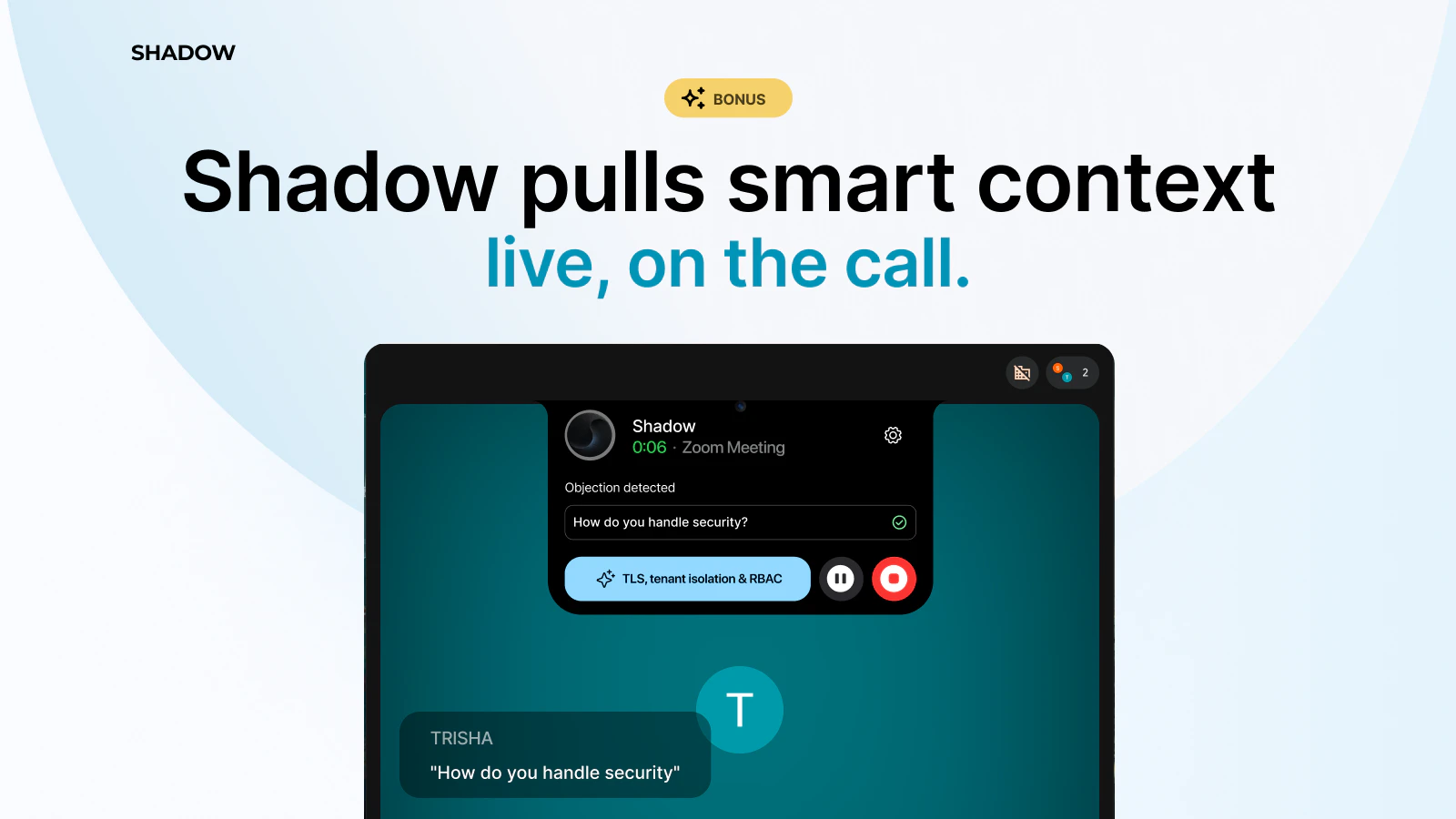
一句话介绍:Shadow 2.0 是一款实时AI代理,在在线会议进行中自动识别并执行待办事项(如生成文档、发送邮件、安排日程),让用户在挂断电话前就完成所有会后工作,彻底消灭“会后任务列表”。
Productivity Meetings YC Application
AI会议助手 实时任务执行 自动化工作流 会后管理 效率工具 AI代理 会议纪要 CRM更新 日程安排 产品发布
用户评论摘要:用户普遍痛点:会后需花大量时间处理邮件、文档、CRM更新等。主要疑问:与Otter/Fireflies等记笔记工具的本质区别?能否自动推送到Figma、Productboard等工具?用户关注“执行”而非“记录”,并希望保留人工审核环节以控制敏感操作。部分用户询问多人大(>10人)会议的识别精度。
AI 锐评

Shadow 2.0 确实切中了一个高频且极度痛苦的场景——会议并未在“挂断”时结束,反而开启了繁琐的“会后工作流”。绝大多数同类工具止步于“记录和总结”,本质上只是给用户生成了一张更精美的“待办清单”。而Shadow的颠覆性在于将能力从“听写员”升级为“执行幕僚”,它在会议进行中就开始动手干活:发邮件、建文档、定日程,试图让用户走出会议室时,所有工作已经尘埃落定。

这个产品价值清晰且犀利,但挑战同样巨大。第一,执行层的出错成本远高于记录层。AI误判一个“下次聊”为“预约会议”,就可能造成尴尬或日程混乱。虽然团队强调“人工审核层”存在,但若审核比例过高,所谓的“实时高效”将大打折扣。第二,深度集成依赖生态。目前的Notion、Gmail、日历只是冰山一角,用户真正渴望的CRM、Jira、Figma等核心生产力工具的实时双向同步才是护城河,而这些集成往往需要数百个企业级API的稳定对接,工程复杂度陡增。

从商业角度看,这个产品定位非常精准:瞄准的是高净值、高会议密度的知识工作者(顾问、销售、创始人),他们愿意为“每周赢回一个工作日”付费。早期采用者必然是那些被琐事压垮的“会议机器”,他们最迫切的需求不是“更智能的笔记”,而是“有人能替我在会后擦屁股”。Shadow 2.0如果能持续降低执行错误率并快速扩展工具链,有望重新定义“会议生产力”赛道——让会议真正成为思考与决策的场所,而非新任务的生产线。

查看原始信息
Shadow 2.0
Every online call creates a to-do list. Shadow clears it live. It understands your conversation, tracks what needs to happen, and executes tasks in real time. PDF creation, slide generation, CRM updates, follow-ups, and scheduling before the call ends. Our goal is to have no post-call work. Just stay focused while Shadow handles everything in the background. Starting with core workflows and expanding to everything your calls create.

Hi Product Hunt 👋

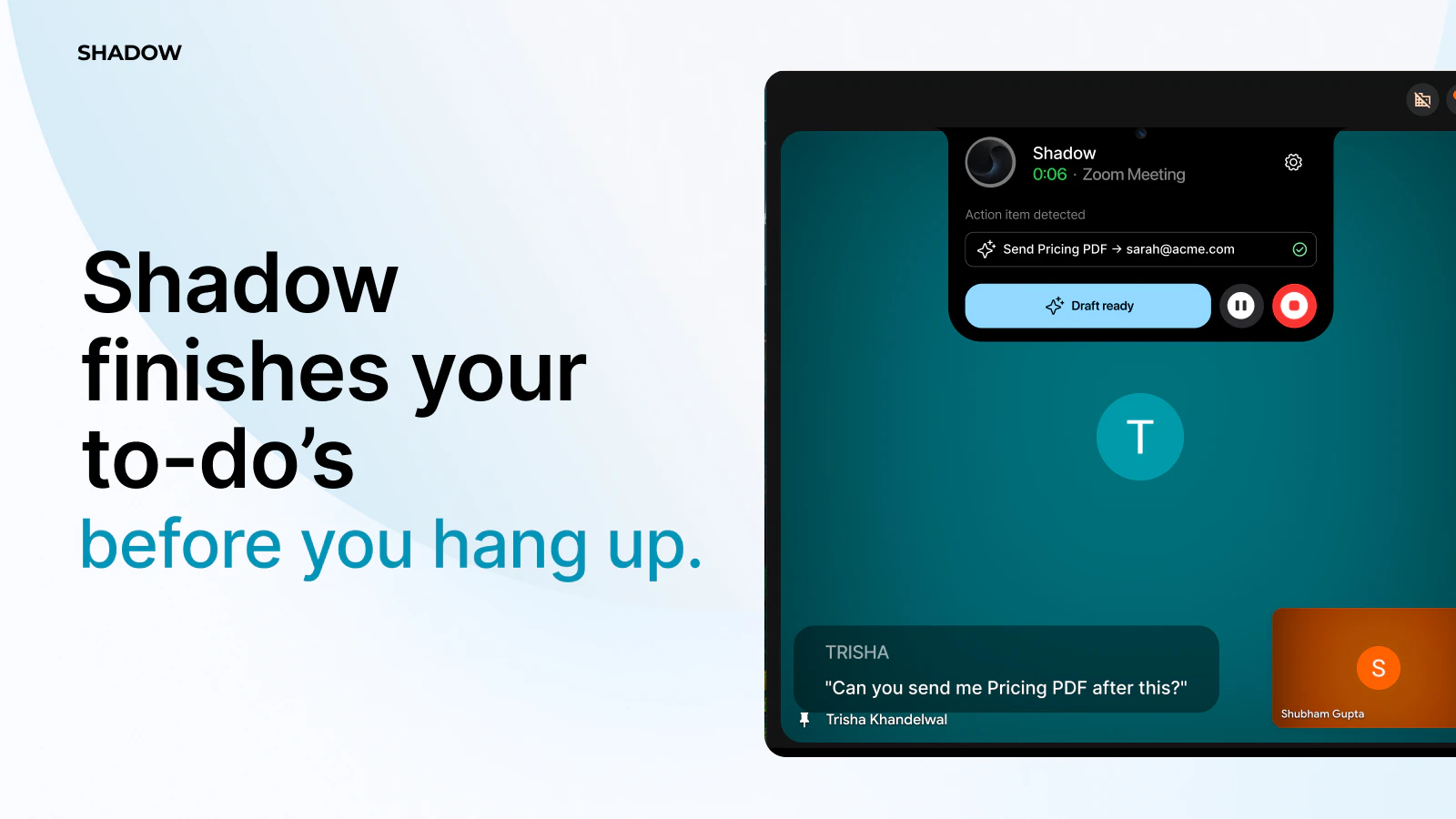
Shadow is a real-time AI on the call that completes your post-call to-dos while you're still on the call

The problem: A user told us something we couldn't ignore:

"I go into back-to-back calls. I miss my meals. Someone wants a proposal, someone wants metrics, someone wants a follow-up. I hang up, and there's a new to-do list every single time. I feel like a robot just running endlessly."

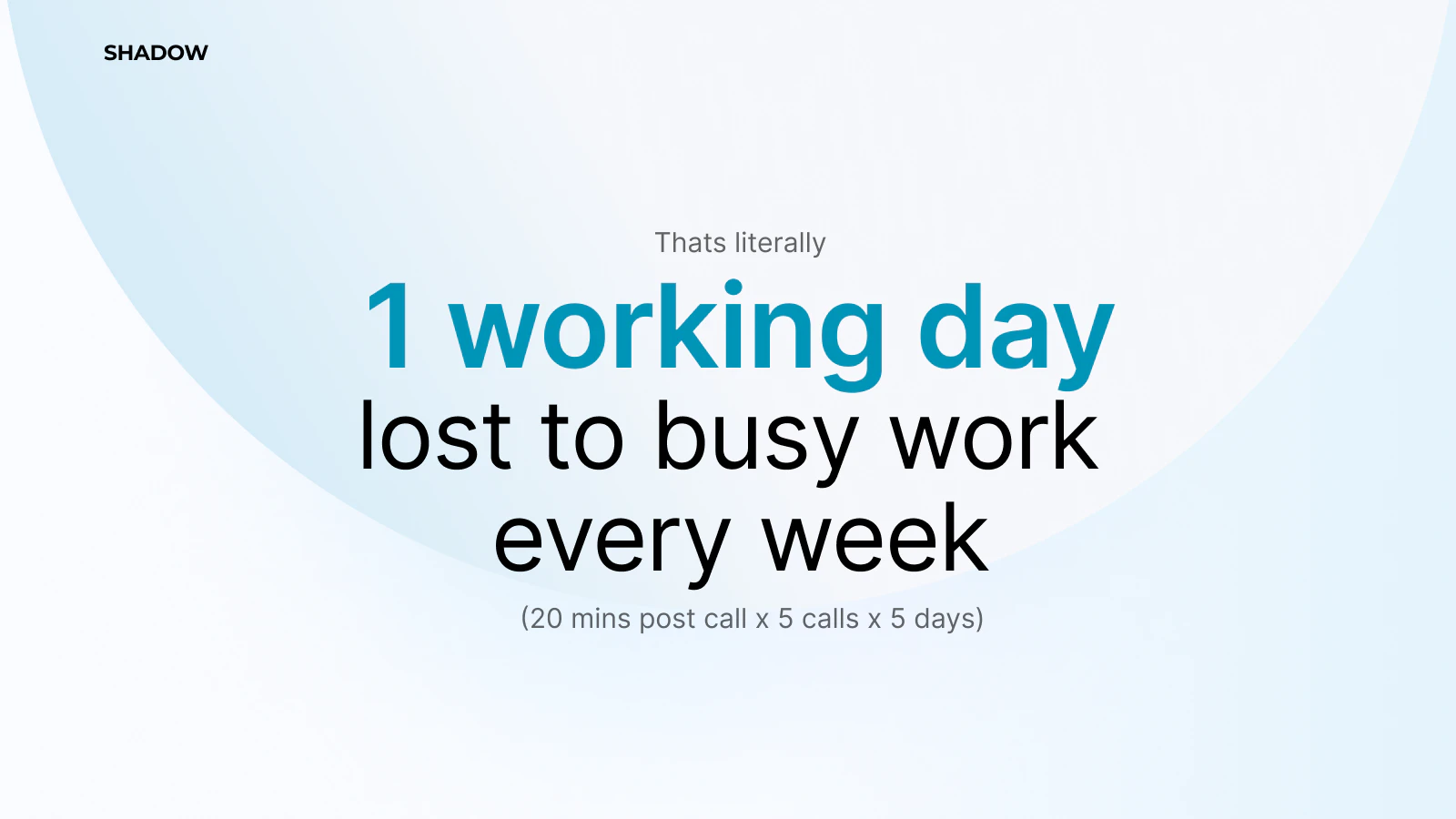
We did the maths. 5 calls a day. 20 minutes of post-call admin. 5 days a week. That's 8+ hours — one full working day — lost to busywork, every week.

The solution: Shadow was already on the call. It already had the context. So we asked: what if it just handled the to-dos before you hung up?

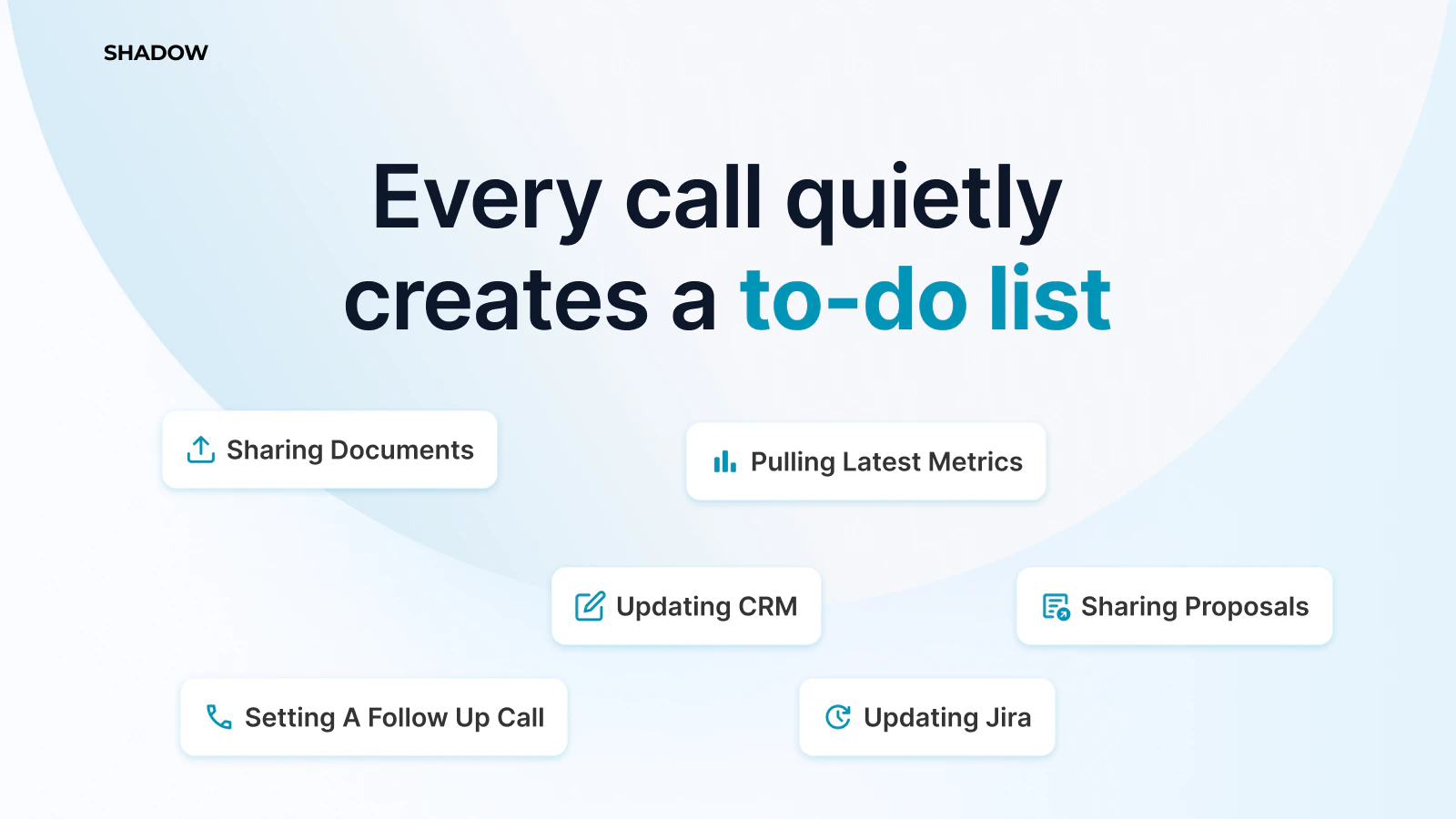
While you're still talking, Shadow detects action items in real time and executes them. Today, that means:

  • 📝 Notion doc creation: notes and summaries written as you speak

  • 📅 Follow-up meeting scheduling: booked before you hang up

  • 📧 Draft email: written automatically based on what was discussed

Coming soon: Slack, Salesforce, Jira, Google Sheets, PostHog, GitHub, LinkedIn, Twitter and more. This is just the start.

What's new in Shadow 2.0: We've moved from a browser app to a native desktop app.

Shadow now:-

  • Auto-detects your meetings the moment they start, no manual setup

  • No bot joins your call, invisible to everyone else. It just works.

Who is it for? If you live on calls, sales, consulting, recruiting, ops, Shadow was built for you. Anyone who goes over back to back calls.

One question, If you could automate one thing that happens after every call, what would it be?

Drop it below, it might be the next thing Shadow handles.

Shubham

Co-Founder, Shadow

shadowlabs.ai

20
回复

@shubham16180 Shubham said it perfectly.

We’re building Shadow because post-call work shouldn’t wait until after the call - the context is already there while the conversation is happening.


Today it handles emails, Notion docs, and scheduling in real time. The bigger vision is to let people leave calls with the actual work already done.

2
回复

@shubham16180 One of the problems every industry, every professional role relates to.
As a dev, I hate updating tickets, creating tickets, Productivity tracking platforms had become counter-productive for me.

3
回复

@shubham16180 Many congrats Shubham, Hersh and team! :)

How I met the makers?

I first came across Shadow through the @Velo team and the moment they walked me through what they’re building, my first thought was: “Wait… was this made for me?”

What is Shadow?

Shadow is a real-time AI agent that sits on your calls and turns conversations directly into done tasks (notes, follow-ups, docs, and next steps) before the meeting even ends.

As someone running a high-demand consulting business, I spend ~7 hours a day on calls and spoke with 1,300+ founders last year. After every call, I usually spend another 15–30 minutes processing notes, sending follow-up emails, and organizing next steps.

Why I endorse it?

A tool like Shadow doesn’t just sound useful, it feels like getting a full working day back every week.

I’ve also had the chance to work closely with the team on feedback ahead of launch, and they’ve been incredibly fast, agile and obsessed with getting better.

That combination of a sharp product and a hungry, execution-focused team is exactly why I’m excited to endorse both Shadow and the ambitious makers building it! :)

7
回复

Hey Product Hunt 👋


We’re excited to launch Shadow today.


We started building Shadow because we kept seeing the same problem again and again: meetings don’t really end when the call ends.


You finish the conversation, but the actual work is still waiting for you:

  • writing follow-ups,

  • updating tools,

  • creating notes,

  • sharing docs,

  • assigning next steps, and

  • trying to remember everything that was promised.

Most AI meeting tools help capture what happened. That’s useful, but we felt the bigger opportunity was not just capturing action items, but helping complete them while the conversation is still happening.


That’s what Shadow is built for.


Shadow listens during the call, understands the context, and helps complete meeting actions in real time - so by the time the call ends, the follow-ups, updates, and next steps are already moving.


We’re still early, but we strongly believe meetings should lead to finished work, not more work after the meeting.


Would love to hear your thoughts, feedback, and questions.

8
回复

@mayank_gupta40 Mayank is the AI (Anant Intelligence) behind our AI orchestration

3
回复

Hi Product Hunt,

Built Shadow because the real cost of a meeting isn't the meeting, it's the hour of follow-ups afterward. Shadow sits in your calls and handles the action items for you: emails sent, docs updated, tasks created. You just review and approve. Excited to share it with PH!

7
回复

@priyansh_agrawal2 Priyansh has been deep in building the actual “review and approve” layer - because the goal was never to let AI blindly do things on your behalf.

Shadow should handle the busywork, but you stay in control before anything gets sent, created, or scheduled.

2
回复

This sounds incredibly exciting, a strong, well-thought-out solution to a genuinely frustrating problem. It’s amazing to think how seamlessly tasks could get done in no time, without needing constant hands-on effort.

5
回复

@trisha_khandelwal Our team shares the excitement of the possibilities this product opens up! Feel free to share any particular use case you have in mind.

3
回复

@trisha_khandelwal AI taking over our jobs... jobs we didnt care about anyway :P

3
回复

@trisha_khandelwal Exactly - the goal is to reduce the constant hands-on effort after every call without taking control away from the user.

Shadow should quietly prepare the work in real time, and you just review/approve what needs to happen.


Curious - which task do you think people would want automated first: follow-up emails, docs, scheduling, or task creation?

0
回复

I'm the dev, AMA

5
回复
4
回复

@priyansh_agrawal2 Is there a page I can read about what tasks it can actually automate after calls?

1
回复
Can it also handle figma updates on the fly? That would be crazy as hell
5
回复

@jpinkman not yet, but it’s coming soon.


We’re starting with the most common meeting actions first — emails, docs, follow-ups, and calendar scheduling - but Figma updates on the fly is exactly the kind of workflow we want Shadow to handle next.


Curious, what Figma action would you want it to do during a call - update copy, create a quick wireframe, or make design tweaks?

2
回复

@jpinkman Give ideas on your own risk... They may get implemented and launched

1
回复
This is almost like a agent that listens to call and does things or am I missing something?
5
回复

@sourav_sanyal Absolutely! It is hooked to any work that comes your way and lives to get it off your plate. More than agent, we aim to make a personal ai for you. One with personality and one who knows you! Would de

4
回复

@sourav_sanyal Yes! Shadow listens during the call, understands action items, and can complete things like emails, Notion docs, follow-ups, or calendar scheduling in real time.


The key difference is that it doesn’t just “auto-do everything” silently — the user stays in control and acknowledges actions before Shadow completes them.


Curious, what would be the first thing you’d want an agent to handle for you during a call?

3
回复

@sourav_sanyal Imagine a product that offers you time.
And I'm sure you can't put a price on that. ... :P

2
回复

Hello Product Hunt 👋

I'm Hersh, founding member at Shadow leading GTM. Wanted to share what we've learned building this.

The pattern:

Over the last six months, I've spoken with hundreds of founders, freelancers, consultants, recruiters, and operators. Different roles, different industries. They all said some version of the same thing.

"The actual call isn't what's killing me. It's everything that comes after."

The follow-up email. The invoice. The doc share. The CRM update. The Notion recap. The next-step Slack message.

A 30-minute call creates 90 minutes of work.

Why this matters now:

We've spent a decade adding tools to capture more of what happens in our calls. Notetakers record it. Notion stores it. Slack notifies the team. Every one of those tools makes you do more after the call ends. Not less.

We started Shadow with one question. What if the work just got done while the call was still happening?

What we built:

Shadow runs on your call, understands what's being asked for, and executes the work in real time.

Someone asks for the doc. The link is in their inbox before they finish the question. Someone asks for the latest numbers. The data is on screen mid-conversation. Someone asks for a follow-up. It's scheduled before you hang up.

By the time you say goodbye, the to-do list is already done.

Who it's for:

Anyone whose day is shaped by meetings. Founders, freelancers, consultants, recruiters, ops leaders, sales teams. If you finish your day with a stack of admin that came from your calls, Shadow is for you.

A question:

If you could automate one thing that happens after every call this week, what would it be? Genuinely curious. The answers might shape what we ship next.


Hersh
Founding GTM

shadowlabs.ai

5
回复

@hersh_singh Hersh has been closest to the people we’re building this for, and this pattern kept coming up again and again: the call is not the hard part, the work after the call is.

That’s why we’re building Shadow as a real-time layer that doesn’t just capture context, but helps complete the work while the context is still fresh.

2
回复
For people already using Otter/Fireflies/Granola-style tools, what’s the most common “breaking point” that makes them switch—what specific post-call workflow finally becomes painful enough that a notetaker stops being enough?
4
回复

@curiouskitty The breaking point we keep hearing is: the summary is useful, but it still leaves the user with another to-do list.

For people using Otter/Fireflies/Granola-style tools, the pain usually starts when the same post-call workflows repeat every day:

  • writing the follow-up email

  • creating the recap/doc/proposal

  • scheduling the next meeting

  • updating CRM/tasks

  • sharing the right collateral

That’s where a notetaker stops being enough. Shadow is trying to move from “here’s what happened” to “here’s the work, already prepared for approval.”

For sales/consulting-heavy users, the biggest switch trigger seems to be follow-ups + proposal/docs + CRM/task updates after every call.

1
回复

Can it also help create user stories in productboard automatically? I go over lot of customer calls. I want AI to take my notes and put it in my tools

4
回复

@raghav39 this is exactly the kind of workflow we want Shadow to handle.

Today, Shadow can capture the notes/action items during the call and turn them into docs, follow-ups, or tasks. Productboard isn’t live yet, but converting customer calls into structured user stories inside product tools is very much on the roadmap.

Curious - would you want it to create raw notes in Productboard first, or directly create polished user stories with problem, context, and acceptance criteria?

2
回复
@raghav39 eventually yes. We will connect to all the enterprise tools used today to help users get relieved from the busy work
0
回复

Can Shadow schedule follow ups and send docs on its own, or is there still a human layer present?

4
回复

@soni_karan Shadow understands the meeting context and is helpful enough to takeover much of your workload generated from everyday meetings, alongside, it is careful enough to not execute sensitive tasks, and wait for your approval.

Think metrics brought for you instantly during call,
Mails drafted for you during call,
Calendar events scheduled for you during the call
Notion pages published for you during the call.

2
回复

@soni_karan here’s still a human layer by design.


Shadow can detect the follow-up, prepare the doc/email, or set up the calendar invite in real time - but the user reviews and approves before anything gets sent or scheduled.


We don’t want AI silently acting on your behalf. We want it to remove the busywork while keeping you in control.


Curious - would you be comfortable with auto-send for low-risk follow-ups, or should approval always stay mandatory?

2
回复

@soni_karan It does both and goes beyond. Shadow creates Notion docs, drafts emails, books follow-ups, all while you're still on the call. Next up: BI tools, Jira, CRMs. The goal is simple: Give people their time back.

0
回复

This one feels personal. I have struggled with the pile of follow-ups after almost every call, and it’s honestly the most draining part of meetings for me. Love how clearly you have defined the problem and the direction to solve it. Really excited to see how this evolves.

4
回复

@nikhagarg this means a lot - that pile of follow-ups after every call is exactly the pain we kept hearing again and again.

We’re trying to make the call itself the place where the work gets completed, not just captured for later.

Curious - what’s usually the most draining follow-up for you: writing emails, creating docs, updating tasks, or scheduling next steps?

4
回复

@nikhagarg worry no more, Shadow is here !
Start planning for what you'll do with the immense free time coming your way.

5
回复

@nikhagarg Glad to hear! We want the world to know the meaning of productivity category!

0
回复

This is actually super relatable 😅 every call quietly turns into a mini to-do list.
Love the idea of handling things during the call instead of after. Curious how well it picks up on action items in meetings with larger groups (>10 people)

4
回复

@ajaykumar1018 Hey Ajay, really glad it resonates!

Great question, larger group calls are something we're actively working towards. Right now Shadow works best in smaller focused calls, but scaling it up is on the roadmap. Would love to keep you in the loop as we get there!

3
回复

@ajaykumar1018 exactly — that “mini to-do list after every call” pain is what pushed us to build this.


For larger groups, we’re focusing on picking up clear ownership, decisions, and next steps without turning every discussion point into noise.


Curious - in your experience, do action items get missed more in large internal meetings or customer calls with multiple stakeholders?

3
回复

@ajaykumar1018 Hi Ajay, glad to hear you resonate

1
回复

How is this different than the other AI meeting assistants? whats the differentiator? The innovation? The novelty? :D How does it stand out from the 1000s of live meeting HUD AI systems for meetings? Sorry for the roasty question. but you asked for it so here it is 😸

3
回复

@conduit_design Sharing an analogy, one of our users gave,
"I have been paying salary to AI assistants that only had ears, finally something that comes with hands and legs... getting work done is what was needed, not dumping notes"

0
回复

@conduit_design fair question - and probably the right roast 😄

The way we think about it: most AI meeting assistants are built around capture - record the call, summarize it, extract action items, and give you something to process after.

Shadow is built around execution during the call.

So instead of ending with “here are your action items,” Shadow helps complete them while the context is still live - draft the follow-up email, create the doc, schedule the next meeting, prepare the next-step task - with the user reviewing/approving before anything goes out.

The novelty isn’t “AI understands meetings.” The bet is: meetings should end with the work already done, not with another to-do list.

Curious - what would make this feel truly different for you: acting during the call, approval before execution, deeper tool integrations, or better context from past meetings?

0
回复

@conduit_design fair roast!

Most tools are just Voldemort's diary: Self-writing, forever. We're building a chief of staff.

They're stuck at note-taking. We're solving getting work done. 😄

0
回复

Congrats on the launch, folks! Just looking at it from a marketing angle, I think many people would be looking at Shadow AI and thinking: yet another AI notetaking tool.

What would be useful is knowing what makes Shadow AI different? What is the compelling use case that Granola, Fathom, Otter, Fireflies, Loom, and so many others don't provide?


Zoom notes and Gemini notes include action items in their summaries after the email.

A good start is a comparison matrix for people already using these existing notetaking tools on what Shadow AI can do that these other tools cannot.

3
回复

@peterclaridge this is a very fair point - and honestly, probably the clearest thing we need to communicate better.

We’re not trying to build a better notetaker. Tools like Granola, Fathom, Otter, Fireflies, Zoom notes, etc. are great at capturing what happened and summarizing it after the meeting.

The core difference with Shadow is execution during the call.

So instead of ending the call with “here are your action items,” Shadow helps turn those action items into finished work while the call is still happening - follow-up emails, docs, next-step scheduling, and eventually CRM/task/tool updates - with the user reviewing and approving before anything goes out.

So the outcome we care about is not “better notes.” It’s: you leave the call with the work already done.

Also fully agree on the comparison matrix. That’s a great suggestion, and we should make this much clearer for people already using notetakers.

Curious - from a marketing angle, which workflow would make the difference most obvious first: follow-up emails, docs, scheduling, or CRM/task updates?

0
回复

@peterclaridge this is a very fair point - and probably the biggest thing we need to make clearer.

We don’t think of Shadow as a notetaker. Notetakers capture the meeting, summarize it, and give you action items after.

Shadow is built for what happens during the call: turning those action items into actual work while the context is still live - follow-up emails, docs, scheduling, and eventually CRM/task/tool updates - with the user reviewing and approving before anything goes out.

So the difference we’re betting on is: meetings shouldn’t end with a better to-do list. They should end with the work already done.

Also, +1 on the comparison matrix. That’s a great idea, especially for people already using tools like Granola/Fathom/Otter/Fireflies.

Curious from your marketing lens - which workflow would make this difference most obvious first: follow-up emails, docs, scheduling, or CRM/task updates?

1
回复

@peterclaridge Totally respect the notetaking tools, they're great at what they do.

But there's a difference between a tool with ears and one with hands and legs.

Notes tell you what happened. Shadow gets the work done. Yours to choose. 😄

0
回复

Every call creators a to do list is such an accurate framing .Most of the pain starts after the meeting ends.

2
回复

@maali_baali That’s what we’re trying to change with Shadow: instead of ending the call with more work, the follow-ups, docs, scheduling, and next steps are already prepared for review.

Curious - what’s the most annoying post-call task for you: follow-up emails, notes/docs, scheduling, or updating tasks/CRM?

0
回复

Love the focus on reducing cognitive overload .Remembering action items across multiple meetings is exhausting even for highly organized teams.

2
回复

@daniel_henry4 That’s the overload we’re trying to reduce.

0
回复

This is a genuine time saver. Especially since the end of a meeting is the time with lowest energy levels and maximum procrastination potential.

2
回复

@pavan_375 ehe, now simply go out for a coffee post meeting, stress-free. ! :P

0
回复
This is so cool. There have been many meeting recorders, but none that actually does the work for you!
2
回复

@abod_rehman Exactly, that’s the core idea.

Meeting recorders and note-takers are useful, but we felt the real pain starts after the call - follow-ups, updates, docs, next steps, and all the small tasks that pile up.

We’re trying to make meetings end with work already moving, not just with a better summary.

0
回复

@abod_rehman and then came Shadow (beatdrop)

0
回复

This sounds like a magical tool. Every meeting is not just like a meeting, it's a list of to-do lists that you get. And I think if some parts or all parts of it can be taken care of, I think that's fantastic. Congratulations on the launch. :))

2
回复

@zerotox Really appreciate this, you’ve captured the problem perfectly. Meetings quietly turning into to-do lists is exactly what we’re trying to fix. If we can take even part of that off people’s plates, that’s a win for us. Thanks so much for the support! 🙌

0
回复

@zerotox Thank you, really appreciate it.

That’s exactly the pain we’re trying to solve. Meetings often look like one conversation, but they quietly create a bunch of follow-ups, updates, notes, docs, and next steps.

Our goal with Shadow is to take care of those tasks while the context is still fresh and the call is still happening, instead of leaving everything for later.

0
回复

every call ends and ur evening is already booked with "send the proposal" and "share those metrics".

most tools just summarize after the fact, shadow doing it live during the call is the right shift. congrats on 2.0 team !!

2
回复

@saad_el_gueddari thanks for your support Saad!

0
回复

@saad_el_gueddari exactly - that evening pile-up is the pain we’re trying to remove.

“Send the proposal,” “share the metrics,” “schedule the next call,” “create the recap” - these shouldn’t become a second workday after the meeting ends.

Shadow’s bet is that if the context is already live during the call, the work should be prepared live too, with the user reviewing/approving before anything goes out.

Curious - which one would save you the most time after calls: proposals, metrics sharing, follow-up emails, or CRM/task updates?

0
回复

That “I feel like a robot just running endlessly” line is painfully relatable 😅

Really interesting direction feels like trust and timing will be everything for tools like this.

2
回复

@munevver_ertuncccc exactly - trust and timing are the hard parts here.

If Shadow acts too early, it feels risky. If it acts too late, it becomes just another post-call task list.

That’s why we’re building it around a review/approval layer: Shadow prepares the work while the call is still happening, but the user stays in control before anything gets sent, created, or scheduled.

Curious - what would make you trust a tool like this faster: clear previews, approval before every action, or better control over what it’s allowed to do?

0
回复

How does this deal with the language switching mid-conversations if we speak multiple languages in the same conversation?

2
回复

@bengeekly Shadow is built to handle mixed-language conversations by following the actual conversation context, not forcing everything into one language.

So if a call switches between English, Hindi, Spanish, etc., the transcript and action context can still be understood, and the final output can be created in the language that makes sense for the task - for example, an English follow-up email even if parts of the call were in another language.

Curious - when a call switches languages, what matters more to you: accurate transcript in the original language, or clean outputs in one language?

1
回复

@bengeekly try seeing it in action, even we get surprised how smoothly the transcript switches language.

0
回复
The slide generation one got me. Everyone talks about follow-up emails and scheduling because those are obvious. But someone says "can you prep a deck for the next meeting" mid-call and Shadow just... does it? That's the one that changes how the rest of the call feels. Congrats on the launch Shubham. This one's genuinely different.
2
回复

@rafay_farhan exactly - follow-up emails and scheduling are useful, but they’re also the obvious layer.

The more interesting part is when Shadow can take something from the conversation and turn it into a real work artifact - like a deck, proposal, NDA, quotation, or Jira ticket - while the context is still fresh.

That “can you prep a deck for the next meeting?” moment is exactly the kind of workflow we want Shadow to own.

Curious - what kind of deck would be most useful for you: sales proposal, customer recap, internal update, or next-meeting prep?

0
回复
Very nice, love the idea. How is the AI aware of your company’s products, processes and goals to make sure the tasks created from the call are correct ?
2
回复

@yuri_mihaileanu1 Great question.

Shadow doesn’t just rely on the call transcript. It needs company context too — things like your docs, past notes, product info, processes, and connected tools - so the task it creates is grounded in how your team actually works.

Also, we keep a human approval layer before anything important goes out. So Shadow can prepare the task in real time, but the user reviews/approves it before it’s sent, created, or scheduled.

Curious - for your team, would the most important context come from internal docs, CRM, past calls, or project/task tools?

0
回复

@yuri_mihaileanu1 would love to hear your company's knowledge base platforms

0
回复

The idea of an AI-assistant for video calls is great. I tested several tools while looking for the best solution for me and my team, but I still haven't found the one I'd use regularly. The app looks great, although the setup process took some time. I'll test it during an upcoming call. Good luck!

2
回复

@lipkovskiy The setup process point is well noted. We'll come up with a work around.

0
回复

@lipkovskiy appreciate this - especially since you’ve tried a few tools already.

You’re right on setup too. We’re working on making that much smoother, because the product should feel useful before it feels like work to configure.

Would love to hear how it goes on your upcoming call - what part of the setup felt slowest for you?

0
回复

Turning calls into completed work instead of just notes is a big shift.

If execution during the call works reliably, this could be a game changer.

2
回复

@naitik_kapadia exactly - reliability is the whole game here.

The shift only matters if Shadow can understand the right action, prepare it with context, and still keep the user in control before anything is sent, created, or scheduled.

That’s why we’re starting with high-frequency workflows like follow-up emails, docs, and scheduling before expanding deeper into CRM/task updates.

Curious - from a product perspective, what would make you trust execution during the call: approval before every action, clear action previews, undo/edit controls, or better integrations?

0
回复

@naitik_kapadia Hey Naitik, just imagine, you get off a call with nothing to do. All the major items, already done or drafted!

0
回复

Looks great !
Does it also help me talk to my notes as well. Many a time, i want to come back to my meeting asking relavant questions about chat that happened.

2
回复

@sidharth_choraria1 yes, that’s a big part of the experience we want to build.

Shadow should not just create notes, but make the meeting context usable later - so you can ask things like “what did we decide?”, “what were the objections?”, or “what should I follow up on?”

Curious - would you use this more to recall past decisions, find action items, or prep before the next meeting?

0
回复
@sidharth_choraria1 yes this is part of our roadmap. Not only that future version of Shadow will help you out on the live call based on the past meeting context
0
回复

@shubham16180 Congratulations. And happy product launch.

1
回复

@shubham16180  @huisong_li Thank you from our team at Shadow Labs!

0
回复

Can have coding agent too ?

1
回复

@khuzema_khomosi Yes, definitely possible.

Right now we’re starting with common meeting actions like Gmail, Calendar, and Notion. But a coding agent is a very interesting direction.

For example, during a product/engineering call, Shadow could help create a Jira ticket, update docs, summarize a bug, or eventually connect with coding tools to prepare small changes.

Curious - would you find this more useful for creating tickets/docs from engineering calls, or actually making small code changes from the discussion?

0
回复
#3
Superset 2.0
Run 100s of coding agents on any machine from anywhere
374
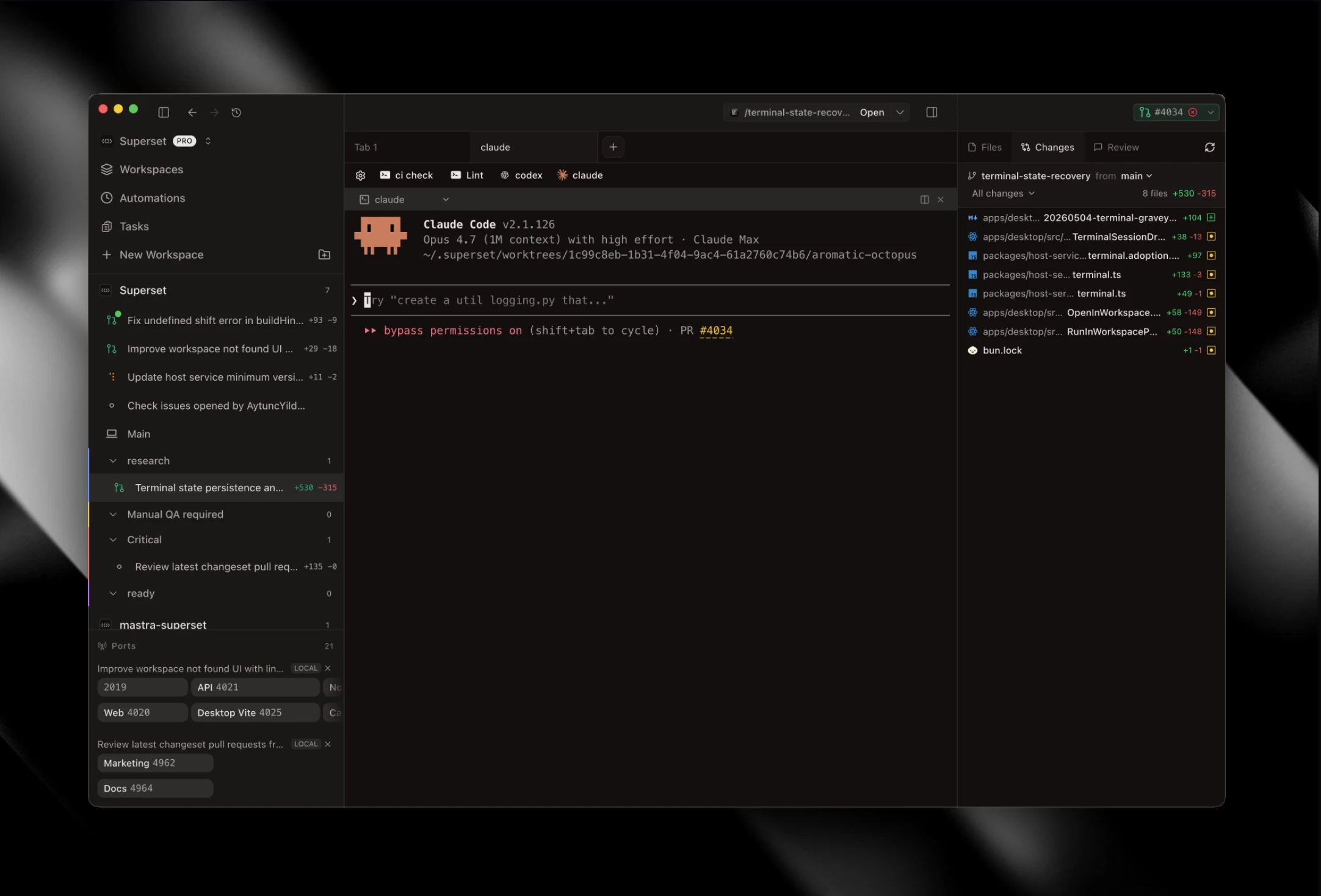
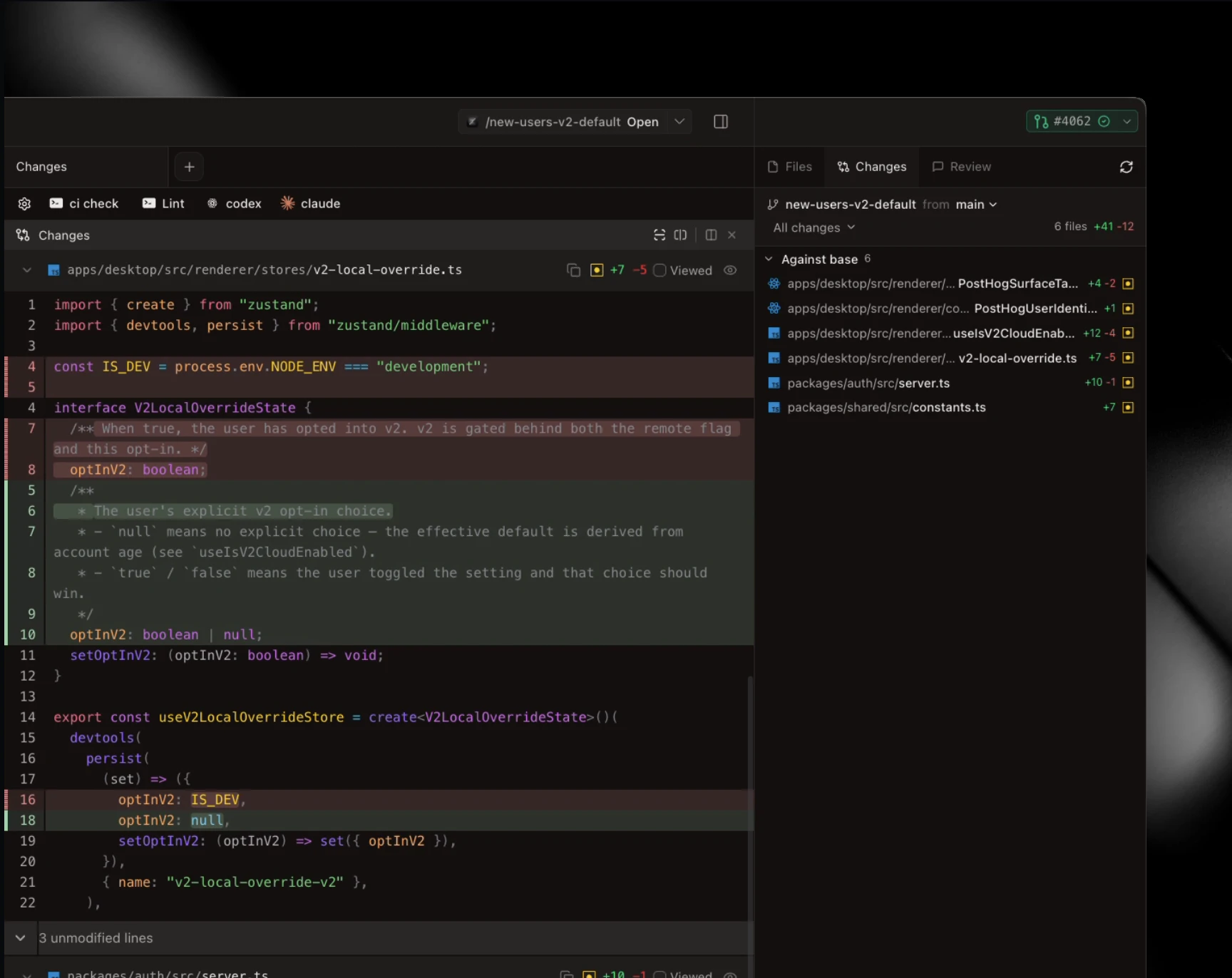
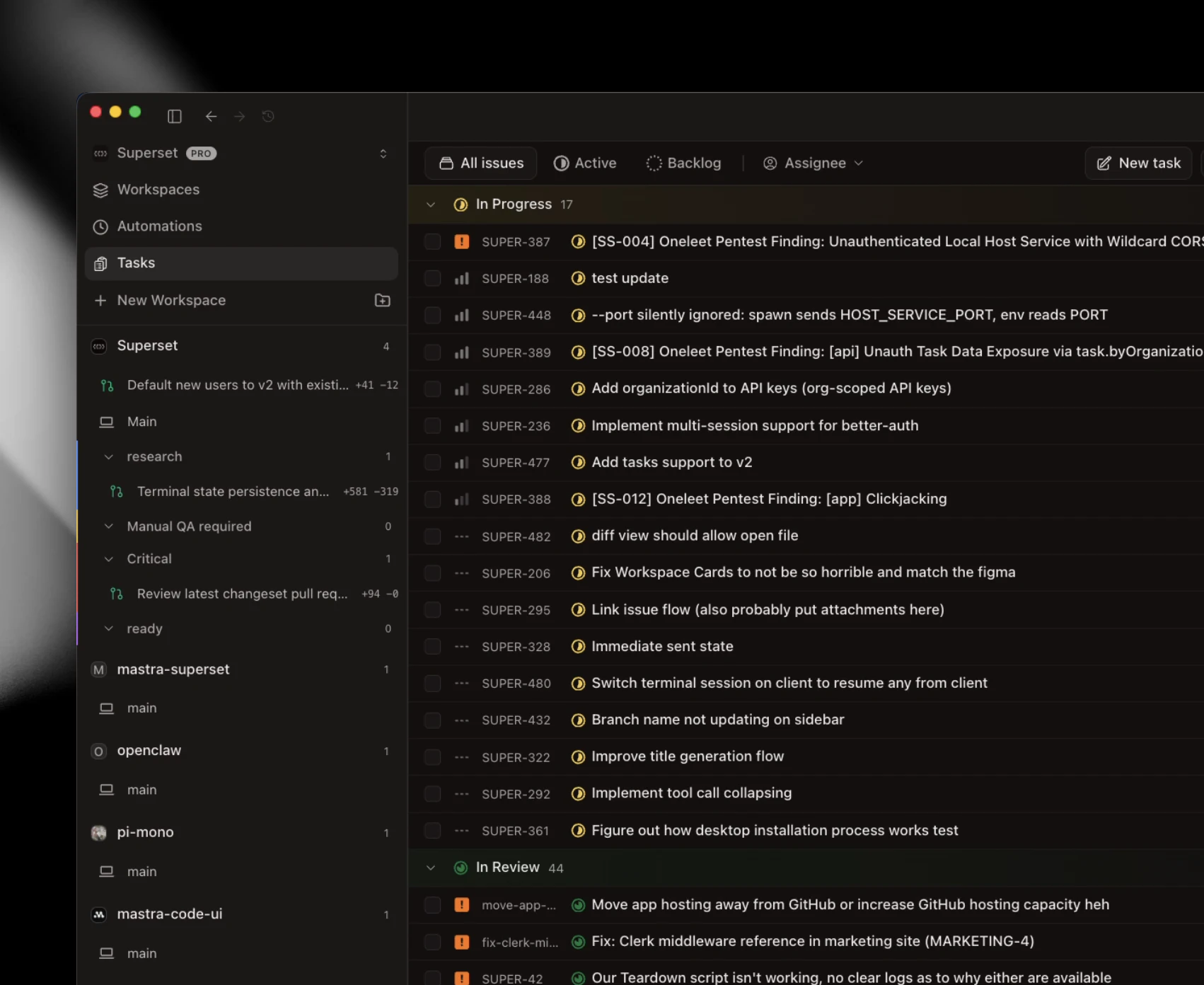
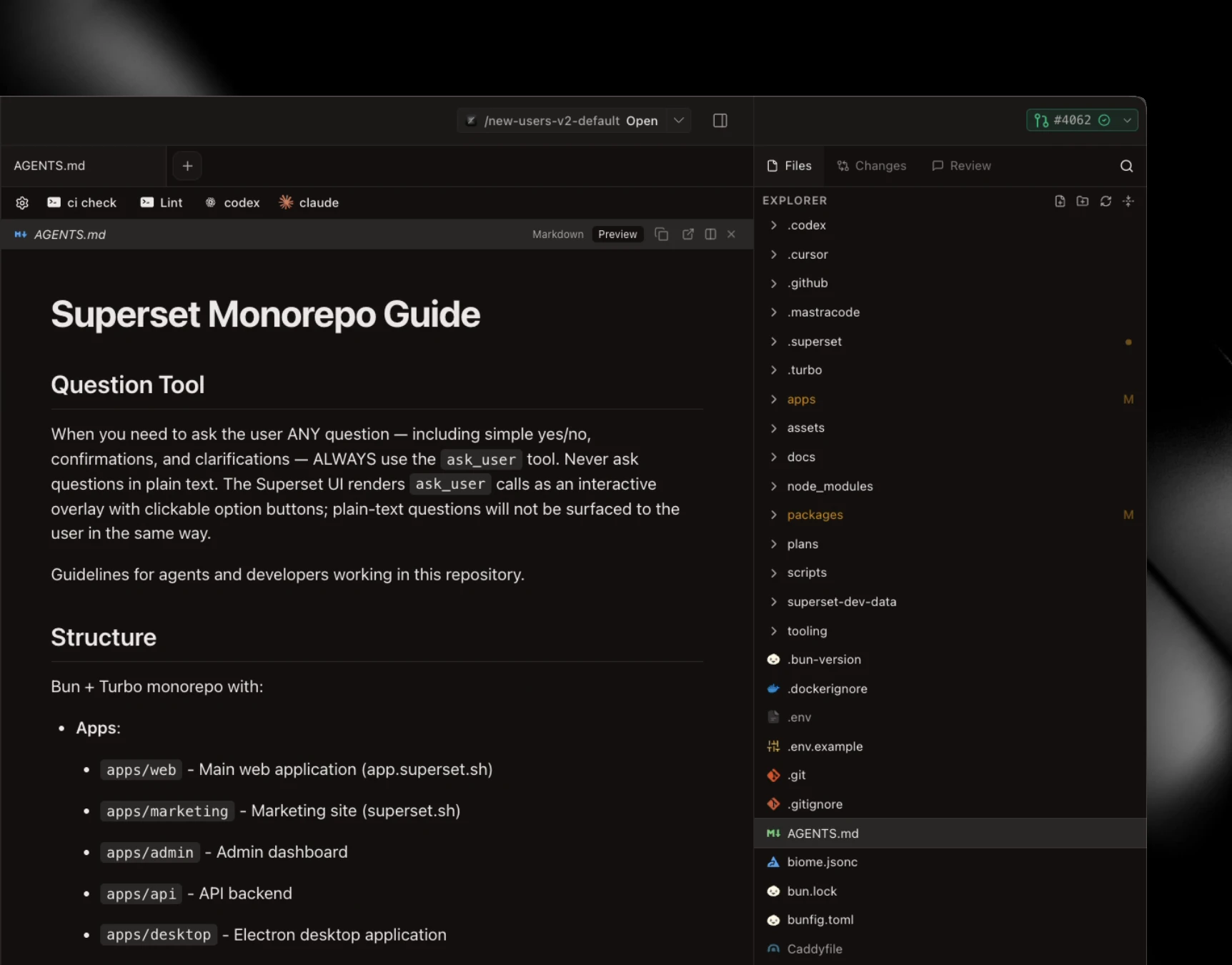
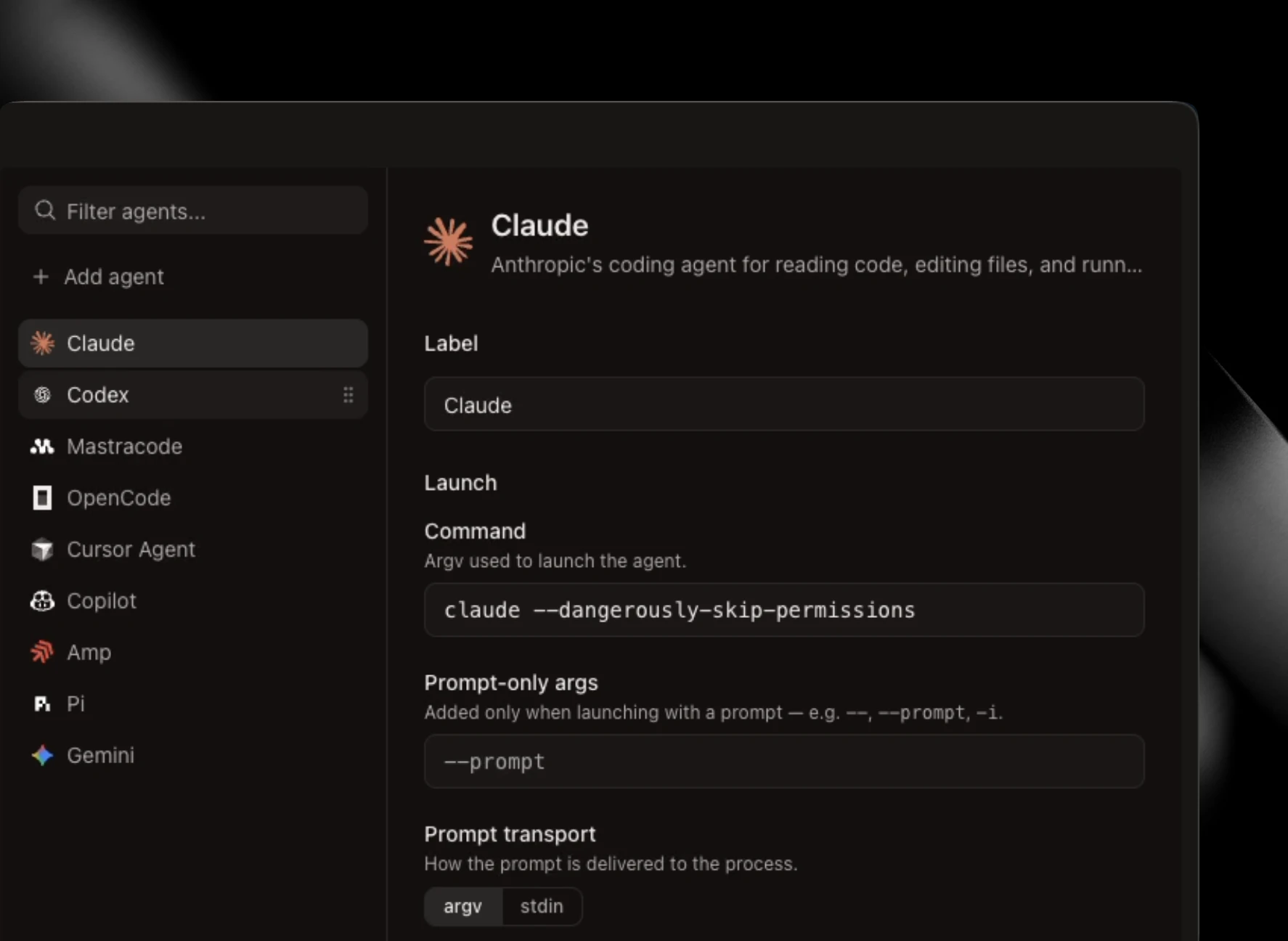
一句话介绍:Superset 2.0 是一款让开发者能在任意机器上远程运行数百个并行编码代理的IDE,解决了单机算力限制和代理协作效率低下的痛点。
Text Editors Developer Tools Artificial Intelligence GitHub
并行编码代理 远程工作空间 IDE AI辅助开发 代理协作 自动化 Git工作树 团队协作 CLI代理 编程效率
用户评论摘要:用户称赞其解决了Cursor、Claude Code的磁盘空间和等待瓶颈,支持并行代理和远程工作空间。主要疑问包括:安全与权限控制,代理在大型代码库中的冲突协调,以及实际生产环境中的高并发代理使用案例。
AI 锐评

Superset 2.0 的升级绝非简单的功能迭代,而是对“AI时代开发者工作流”的一次底层重构。其核心价值不在于“又一个AI IDE”,而在于“分布式代理编排”——它精准切中了当前AI编程工具的核心矛盾:单机算力与多代理并行需求的不匹配,以及“等待代理输出”比“审查输出”更耗时的效率黑洞。

从产品设计看,“远程工作空间”和“自动化”才是真正的杀招。前者让开发者摆脱本地硬件束缚,将算力压力转移至云端或闲置服务器,后者则让代理从“被动调用”进化到“主动值守”。这种架构下,代理不再是临时工,而是常驻的“数字工程师”,能实现代码审查、问题分诊、跨时区接力等持续级工作流。

然而,产品仍面临严峻挑战。评论中用户对“冲突处理”和“安全边界”的质疑直指核心:当数百个代理在相同代码库中并行操作,如何避免逻辑冲突和资源竞态?目前依赖“代理自愈”和人工介入的方案显得过于理想化,尤其在生产级场景下,缺乏精密的分布式锁或任务编排机制可能引发灾难。此外,远程访问的权限粒度还停留在“组织—用户”层面,缺乏对凭证、密钥等资产的分级控制,对于追求安全合规的成熟团队而言是致命短板。

一句话总结:Superset 2.0 为未来“AI工厂”搭建了骨架,但在精细控制和安全监管上仍有血肉待填充。对于敢于尝鲜的3人精英团队,它是利器;对于求稳的企业级组织,它尚需打磨。

查看原始信息
Superset 2.0
Run 100s parallel coding agents, offload them to different machines. Rewritten from scratch to support remote workspaces. Share and collaborate with teammates in realtime. Works for any CLI agent.

Hey everyone!

The pace of shipping software keeps getting faster and it's been so much fun building at the bleeding edge, and trying to help as many people ship products people love as possible. We've had quite the grind to get this one out so we're hoping you all enjoy :)

New Features:

  • Remote workspaces - ship code across across devices / team members, continue working from anywhere

  • Automations - schedule agents to pick up tasks for you later (think of Openclaw's heartbeat feature)

  • Superset CLI - gives agents superpowers, and unlocks powerful new workflows

  • MCP refresh - works with v2 and backed by an expanded toolset

  • A general app refresh - the same Superset you know and love, just a bit more elevated

I'd call this a push to get out the building blocks for everyone's code factories, there's crazy new workflows that are possible now that even we're still discovering.

Excited to see what you all build, and if you have any feedback, we're here to help!

7
回复

@thesaddlepaddle This feels like a solid step toward making agents workflows actually usable day-to-day, not just demos remote workspace and automations is a strong combo.

Curious how you’re thinking about visibility and control as things scale, because that’s where this could really stand out.

0
回复

 The moment most developers hit when using Claude Code solo is that you're spending more time waiting for the agent than you are reviewing its output which means your bottleneck is the tool, not the work. Running 10+ agents across isolated Git worktrees with a unified dashboard that pings you when they need attention is the right architecture for how a 1–3 person founding team should actually leverage AI in 2026. For seed-stage technical founders using coding agents as their primary dev leverage, this is exactly the kind of tool they need to find before they're hiring engineers to solve a coordination problem that better tooling would eliminate. Added Superset to softrankings under the seed-stage engineering stack for that reason. @thesaddlepaddle —> what's the highest number of parallel agents a power user has run simultaneously so far?

0
回复

Hey all,

I'm Kiet, one of the creators of Superset. Originally created Superset as a local-first IDE with the ability to run dozens of coding agents in parallel on your machine. After many months and thousands workspaces created daily from users, we're hitting the physical limit on a single laptop. Our users can have 30+ parallel workspaces on their machine running multiple coding agents each.

That's why we built Superset 2.0. It's a ground-up rewrite of the core Superset engine to allow for users to connect to any remote machine and run coding agents there as if it's their local machine. This enables users to scale to hundreds of agents and be able to run with their agents from anywhere, even when their own laptop is off.

The last few months have seen incredible adoption from the most cutting edge teams from all over the world. I'm excited to see what you will build with Superset!

6
回复

I was using Cursor, then Claude Code, then CC inside Cursor, and finally switched to Superset and haven’t looked back.

Awesome that I no longer need to worry about disk space limits killing my flow

3
回复

@dave_yen1 thanks! We plan to keep it that way :)

1
回复

@dave_yen1 we need to get you your remote Mac Mini setup!

1
回复

@dave_yen1 thanks Dave!! 🙏

1
回复

My go to IDE. Superset has totally replaced all others for me including Cursor and Conductor and is now my default for coding with agents.

3
回复

@roboalias That's awesome to hear! Thank you for the support, let me know if you ever run into any issues

2
回复

@roboalias thanks Ali! Means a lot, we hope to keep earning that trust :)

2
回复

@roboalias that’s great to hear! 🙏 thanks for sticking with us

1
回复
Remote workspaces are a big bet for “work from anywhere.” How do you think about trust boundaries and least-privilege access when a workspace host has real credentials and repos—what controls exist (or are planned) to prevent a misclick or compromised client from turning remote access into repo/secret exposure?
3
回复

@curiouskitty so we currently have it airtight at the following levels:

  1. Your desktop by default is not accessible for remote access (it doesn't even load the module that has the ability to make the connection until you restart the desktop server). We actually recommend not turning it on and investing in remote workspaces with least-priviledge instead to improve security.

  2. Permission must be granted to access a remote workspace - by default nobody has access to your remote workspace, owners instead need to grant it to users in settings (and they have to be a part of your org).

Hope that makes sense!

1
回复

Just came here to genuinely support superset.
Have been using them since few weeks now. I don't even touch anything other than superset now.

They've really been a game changer for us.
We had our founding engineer come to SF all the way from Australia. And the first thing we did was got him a Mac so he could use Superset. You guys are genuinely amazing!

3
回复

@sshresthh that's amazing to hear! We should definitely have you guys over to the SF office at some point! And bring home some of the ugliest swag you've ever seen!

3
回复
@flyakiet I’m so up for it man. Thanks for the invitation 🙌🙌. We are a big fan of yours ;) My co-founder always asks me to introduce him to you guys lol. 😂
3
回复

nice

2
回复
0
回复

@reaganhsu you the man

0
回复

I've been using Superset for a while now, and I'm excited to see it here. The team has been shipping a lot, tons of improvements each couple of days. I personally enjoy using it to run parallel agents.

2
回复

@vladzima known entity! Thank you for the continued support and the constant feedback as always Vlad!

1
回复

been watching superset since v1 and the jump to remote workspaces is huge. running agents from anywhere even when ur laptop is off is the kind of thing that sounds simple but changes how u actually work. proud of the team for shipping this, congrats kiet and satya

2
回复

@saad_el_gueddari thanks Saad, we'll do our best to continue to keep making you proud!

2
回复
Running multiple coding agents in parallel without the usual context switching chaos sounds like a huge productivity boost for dev teams. How Superset handles agent coordination when several agents touch related parts of the same codebase at once? Congrats @flyakiet
2
回复

@flyakiet  @hamza_afzal_butt so we are exposing useful primitives / building blocks right now (agents can now spawn other agents, very soon agents will be able to send messages to other agents), but at the moment there's no easy way to make sure agents don't collide without human intervention.

The nice thing is agents are really good at recovering, I haven't had a failed merge conflict in months now when I get CC to do it which makes it more manageable!

1
回复

Out of curiosity, who is running 100 parallel agents on real production codebases and what is the workflow that earns its keep? What is the most surprising one you have seen?

2
回复

@michael_vavilov Ah we aren't running 100 yet to be honest - we can hover at 5-10 pretty consistently IMO!

One of our more useful flows is issues triage, in which we ask claude to use the Superset MCP to grab issues -> investigate -> pass a prompt to a new workspace and agent to work on the groomed ticket.

The automations are surprisingly useful too once you get a few running, because they also can spawn a bunch of agents themselves. I use it for sales stuff / email triage pretty frequently

2
回复

Been on Superset almost from day 1. It made my life so much easier when it comes to handling multiple terminals and multiple git worktrees in parallel. Such a game changer!

So looking forward to this v2, in particular remote workspaces 🔥. Keep rocking folks 🚀

2
回复

@juristr It's an honor, thank you! We'll do our best to keep delivering :)

0
回复

@juristr thank you so much Juri! Let me know if you ever have any issues or requests :)

0
回复

@juristr thank you 🙏 glad to hear it, we’ll keep improving it

0
回复
Do you guys support code reviews across models?
2
回复

@lakshminath_dondeti right now we support 2 review paths

  1. All GitHub reviews and comments are pulled into the sidebar and can be brought into the agents

  2. All CLI agents for review will work out of the box since we work with any CLI agents like Claude Code, Codex, OpenCode, etc.

1
回复

Running Superset and love it! Congrats on the launch!

1
回复

Coding just got 100x cooler!

1
回复

Congrats on the launch! Looks interesting!

I suppose 100 agents run in different branches? How do you handle merge conflicts after or is it something a human should do?

1
回复

@danshipit thanks, agents are surprisingly good at merge conflicts these days! I recommend making sure you merge not rebase though as I've seen agents mess up rebases pretty badly (and it's harder to recover from).

Different branches is definitely our recommendation, as that way you can coordinate tasks so that you have fewer conflicts!

1
回复

The interesting part here is not more agents. It is whether teams can trust the orchestration once those agents are spread across machines and repos.

How are you handling permission boundaries, failure recovery and audit history when one agent changes code that another agent depends on?

1
回复

@pratikraj that's actually a class of issues we plan to invest in, but the main way to avoid these issues as always is to make sure agents are sufficiently isolated in sandboxes with least-privilege (one of the first steps is sandboxing which we now support). Agent audit history / failure recovery etc. is definitely a hot-button issue, we'll do our best to discover what the best practices are for it :)

0
回复

Been waiting for something that handles parallel agent runs without everything bleeding together. The sandboxed environments are the thing. Curious if it works well over SSH on a cheap VPS.

0
回复

An issue i face in every orchestrator is the "data modelling" in an application, spawning 10 different agents assume different schema for a data representation and add their own custom fields which leads to duplication, or "AI Slop" when trying to merge. Does superset have any plans to tackle this somehow? Very cool launch btw!

0
回复
#4
pay.sh
Discover, access, and pay for any API autonomously
282
一句话介绍:pay.sh 构建了一套开源、实时的支付基础设施,让AI代理能够无需API密钥和订阅,自动发现并按次调用付费。
API Open Source Developer Tools
AI代理支付 API按次计费 开源基础设施 实时支付 无密钥调用 代理网关 Google Cloud x402协议 CLI工具 去中心化结算
用户评论摘要:用户普遍认可其“代理原生”方向和简洁性,但提出关键担忧:代理失控导致大量微支付消耗。有用户建议增加预算上限和断路器,开发者回应当前依赖系统授权,后续将提供额度与时间限制等精细控制。
AI 锐评

pay.sh的野心不止于一个工具,而是试图定义AI经济体中的“支付层”标准。它精准切中了当下AI代理生态的痛点:API调用仍停留在人工管理的“账号+密钥+订阅”模式,这严重限制了代理的自主性和规模化。与Google Cloud等巨头的合作,以及x402、MPP等标准背书,让它在技术路线上有了现实根基。

但问题同样尖锐。评论中提到的“代理陷入循环烧钱”不是边缘场景,而是AI自主决策的本质风险。目前依靠系统弹窗授权(类似Apple Pay)的方案,本质上仍是“人肉闸门”,并未真正解决代理的自主权与财务控制间的矛盾。后续所谓的“1美元1小时”预授权机制,也只是将风险从单次转嫁为窗口期,如果代理在该窗口内高频出错,损失依然可控但难防。

更深层的隐忧是生态协调:要让API提供方主动接入PAY.md规范,需要极强的网络效应和激励。虽然Solana、Stripe等参与,但实际开发者迁移意愿取决于成本、延迟和信任。如果pay.sh无法在初期提供显著的费率优势或体验提升,它可能沦为“又一个漂亮的CLI工具”。

总体而言,pay.sh方向正确,时机精准,但真正的价值将从“让代理能付钱”演进为“让代理聪明地付钱”。这需要超越支付本身,嵌入智能阈值、风险控制和审计能力——而这正是它从支付层升级为经济层的关键一跃。

查看原始信息
pay.sh
In collaboration with Google Cloud, we're building the open source real-time payment infrastructure for AI agents so they can discover and pay per call for any API.

Thanks @fmerian! Hey everyone, I'm Ludo, maker of pay.sh 👋

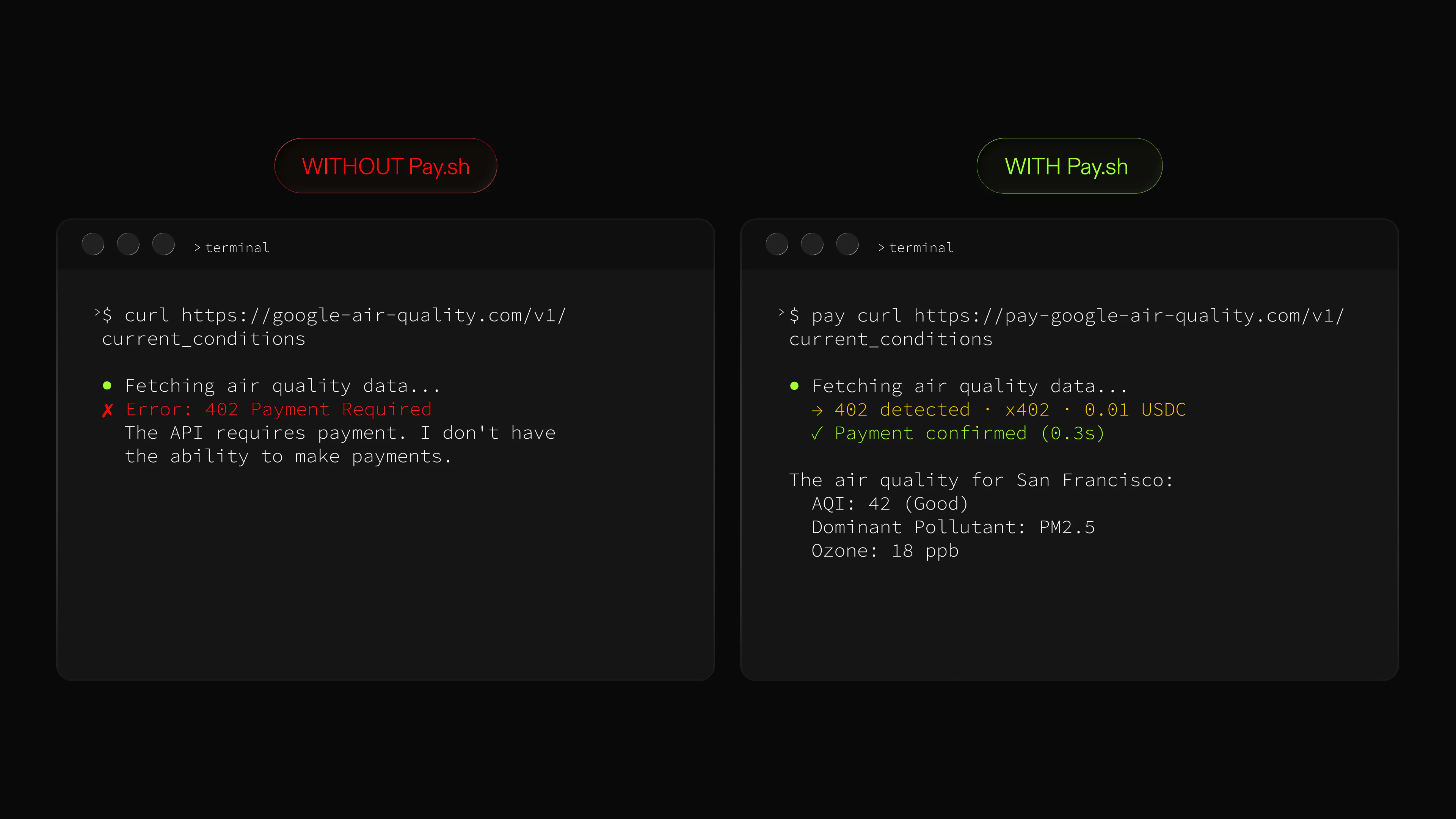
In collaboration with Google Cloud, we're building the open source real-time payment infrastructure for AI agents so they can discover and pay per call for any API.

We are replacing sign-up pages, API tokens and subscription management with a new intuitive tech stack designed for agents to pay for services and goods.

It will be a long journey, and today we're super excited to ship the following:

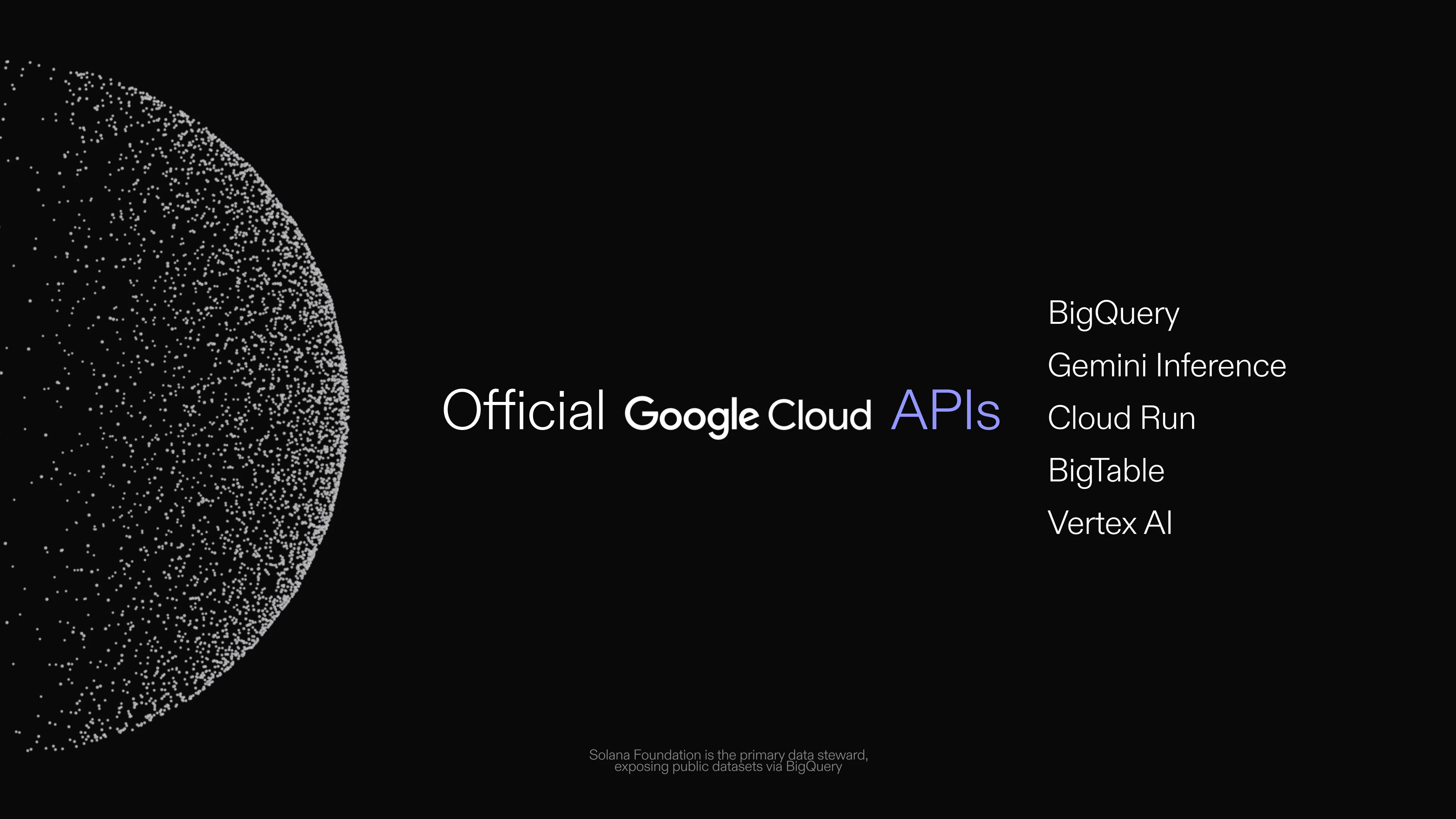
  • Agent Gateway for Google Cloud: a hosted proxy that allows agents to access major APIs including Gemini, Maps, BigQuery public datasets, and twelve others APIs.

  • pay: a command-line tool for consuming this new generation of API endpoints. If you're running some APIs, pay can also be deployed as a proxy. Local first, MIT Licensed.

  • pay-skills: a catalog of high quality APIs, community-driven. Think `brew` for OpenAPI specs that can charge agents (PAY.md). MIT Licensed, PRs welcomed. Curated and monitored.

pay.sh is built on top of strong standards (x402, MPP) involving players such as Cloudflare, Stripe, Solana Foundation, Coinbase and many others who understand this direction is inevitable.

To give it a try: brew install pay. Let us know what APIs you want added to pay.sh, or any kind of feedback.

I'll stay on top of your comments!

Ludo

9
回复

@fmerian  @ludovic hreat work!

1
回复

@ludovic humbled by this new collaboration with you! @Axel, @Surfpool, now pay.sh... keep up the great work!

0
回复
Nice work!
4
回复

S/O to makers @ludovic and @vibhu!

1
回复

Love this direction - One command line to let your agents pay for any API. No accounts. No keys. No subscriptions needed.

S/O to makers @ludovic @vibhu and the @Solana Foundation for this amazing contribution to the ecosystem.

4
回复

can't wait to hand this to my agent

3
回复

@redactedadrian lfg! any APIs the team should add in priority for your use case? cc @ludovic

0
回复

The agent native angle is what stands out most .Feels like this isn't just a dev tool but infrastructure for autonomous systems.

2
回复

exactly! to quote @nirbhikjangid: "this can & will boost agentic commerce!" - source

0
回复

Pay-per-request, no API keys, agent-native — this is one of those primitives that quietly unlocks a category of products that just couldn't ship before. The thing I'm most curious about is the failure mode: what happens when an agent gets into a feedback loop and burns through 10,000 micro-payments in a minute? I run a small AI alerts product around prediction markets called PolyMind, and the autonomous-decisions-on-noisy-signals problem is brutal even at fixed cost per call. With pay-per-request you've added a real money knob to the loop. Are you exposing budget caps / circuit breakers at the agent level, or leaving that to the agent runtime? Cool launch either way — congrats.

2
回复

Thanks @samir_asadov !

At the moment, we're at a stage where agents clearly need supervision when they want to spend.

Currently, every spending attempt is prompting an OS system authorization - (using TouchID on macOS - so Apple Pay like experience).

The next step is "here is 1$, it's valid for 1 hour, whatever is left after automatically returns to me".
We'll progressively give more knobs to play with to users / developers / agents.

2
回复

[Pay.sh] unlocks a category of products that just couldn't ship before.

This just made my day!

0
回复

@samir_asadov you might want to check out agentwonderland.com. Has built in controls for api/agent providers and handles refunds automatically.

0
回复
Coolest thing is its completely cli based and will bring ease to me on top of the AI agents I use. super cool ship ♥️
2
回复

@heyayushh @ludovic is a 🐐 - opinionated, with a taste for great dx

0
回复

Very cool, is it based on the x402 protocol / whitepaper ?

1
回复

@maxencecornet exactly - Pay.sh is built on x402 and MPP. Your data remains yours, and your billing frictionless. Payments are handled automatically under the hood, settled in stablecoins on Solana, and paid to providers in fiat. The product is also fully open source. Explore the code, contribute, or build your own integration on GitHub.

0
回复

can't wait to integrate this into my crypto tax api!

1
回复

looking forward to it! make sure to star the repo

0
回复
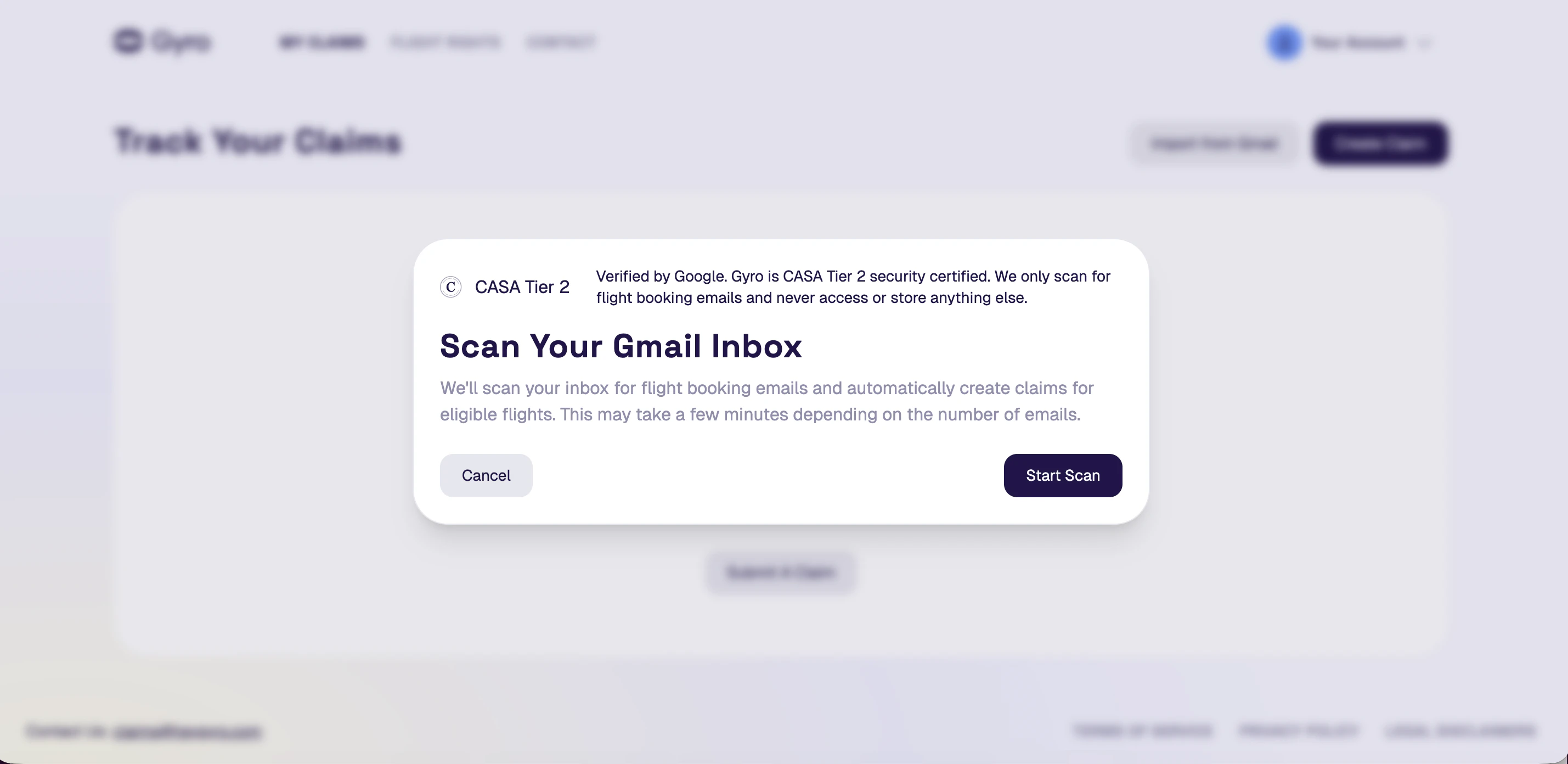
#5
Gyro Autopilot
100s of Dollars Could Be Sitting in Your Inbox 📥
232
一句话介绍:Gyro Autopilot通过扫描用户邮箱,自动识别并申请因航班延误、取消等产生的未领赔偿金,解决用户因流程繁琐而放弃索赔的痛点。
Travel Artificial Intelligence Personal Finance
航班赔偿 邮箱扫描 AI自动化 索赔服务 旅行 refund 消费者权益 金融科技 被动收入 无风险试用
用户评论摘要:用户普遍反馈操作简单、惊喜地发现遗忘航班可获赔。大量用户成功获得数百至数千美元退款,高度认可其“无劳而获”的价值。主要疑问集中在如何解析多格式多语言的航空公司邮件。
AI 锐评

Gyro Autopilot精准切中了航空赔偿领域一个巨大的“效率洼地”——每年数十亿美元的无人认领赔偿金。其产品逻辑极其聪明:不是创造新需求,而是消除“索赔流程繁琐”这一核心阻碍。通过邮箱扫描+自动化代理,将用户从繁琐的文书、拒信和漫长等待中解放出来,真正实现了“工具即服务,服务即结果”。

从评论反馈看,用户的核心共鸣点并非技术本身,而是“遗忘的航班”被意外兑现的惊喜感。这种“发现金”的体验,传播力极强。产品方聪明地采用了“不成功不收费”模式,极大降低了用户尝试的心理门槛,这比任何广告都有效。

然而,产品价值高度依赖航空公司的邮件格式、不同国家的法规(如欧盟EC261与美国各州差异)以及索赔渠道的稳定性。邮件解析的准确率、面对航空公司“耍赖”时的法务博弈能力,才是长期护城河。目前大量好评可能集中在简单案例,复杂或易被拒的索赔能否同样高效,才是验证其“自动”含金量的关键。此外,隐私是悬在邮箱扫描类产品上的达摩克利斯之剑,产品需要将安全信任从口号落实为可验证的技术细节。整体而言,这是一个模式清晰、时机准确、体验优雅的“痛点收割机”,但后续能否规模化处理复杂案例并建立法律壁垒,将决定它从“好工具”蜕变为“好生意”的上限。

查看原始信息
Gyro Autopilot
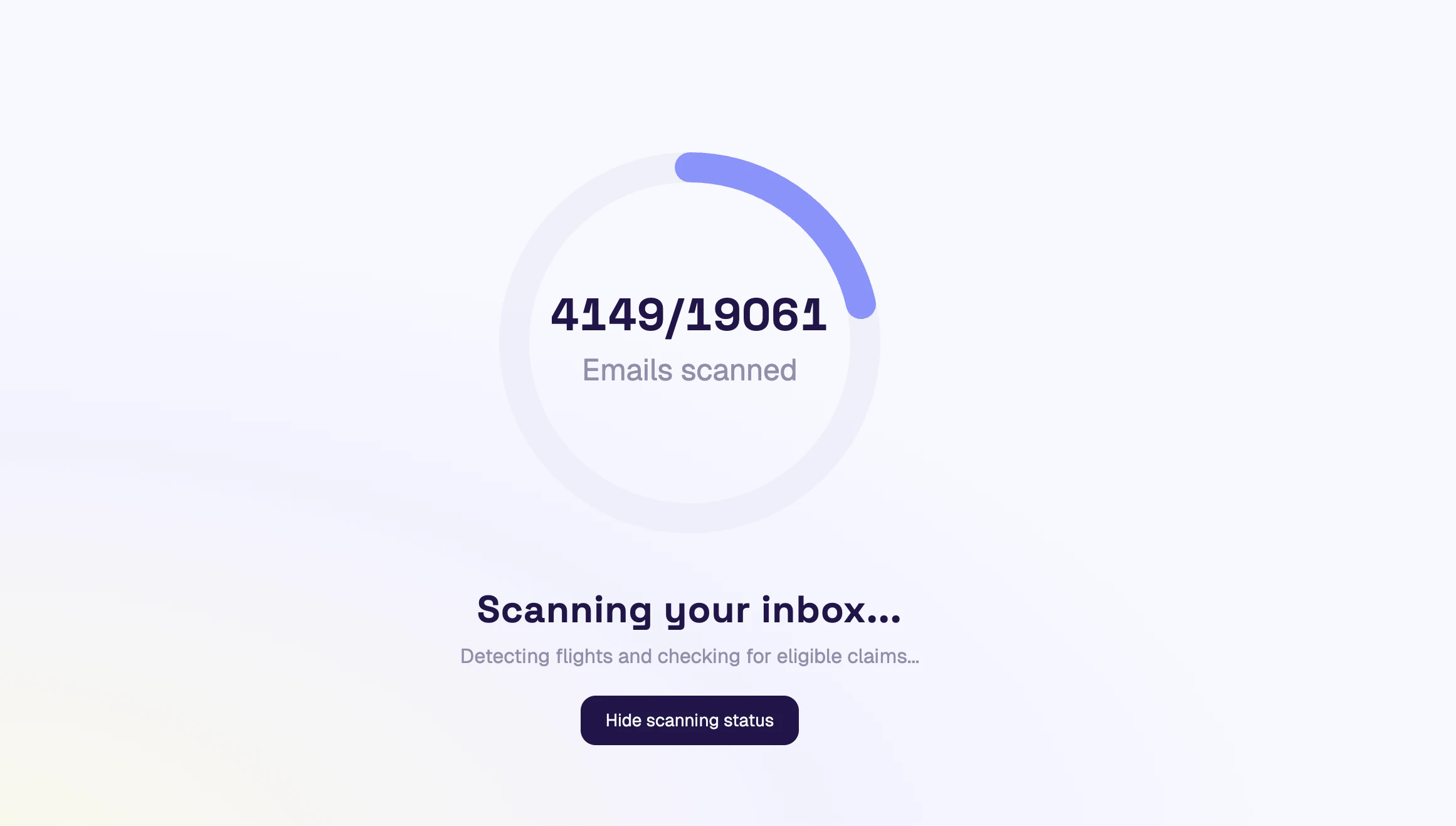
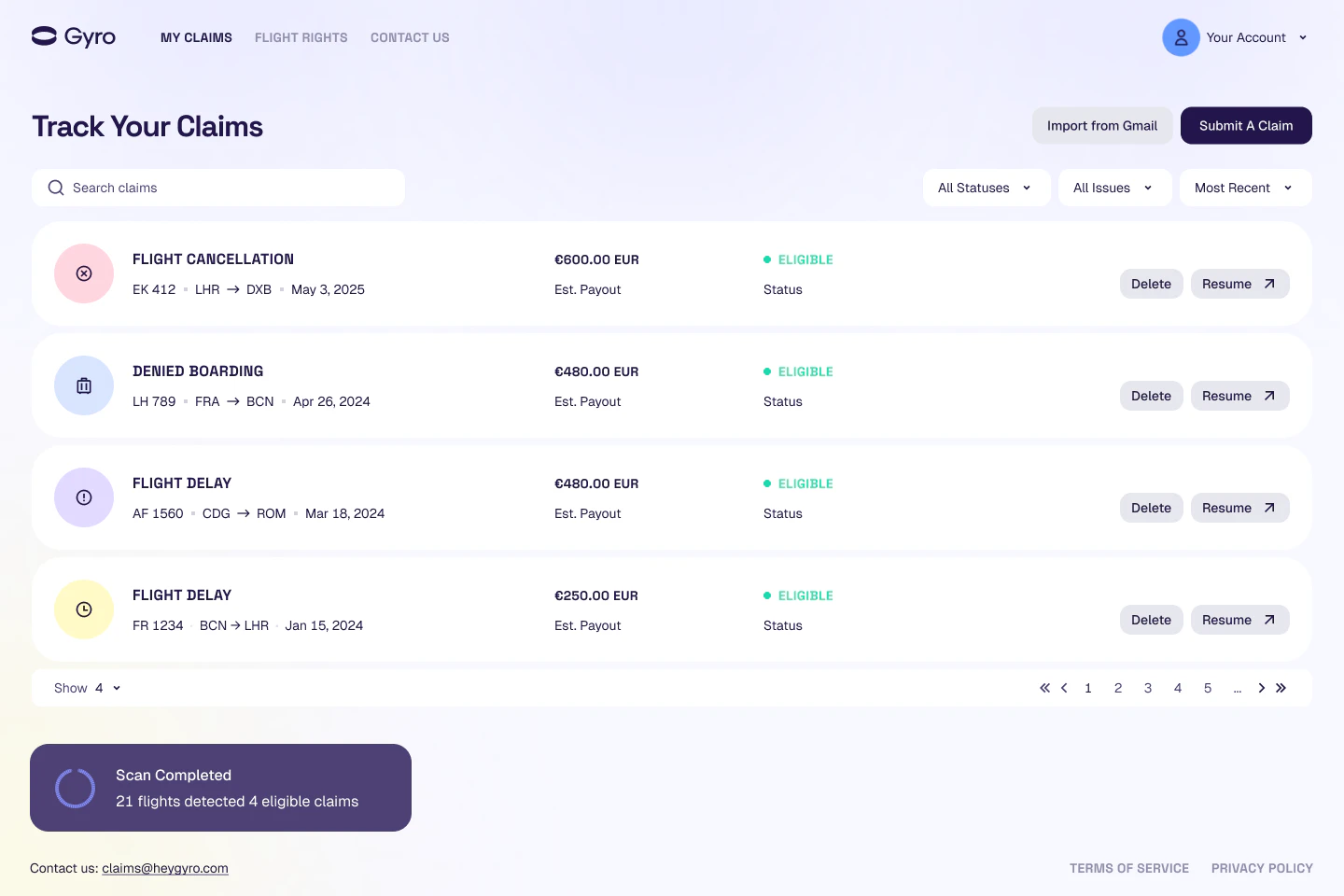
Scan your inbox for unclaimed flight money from delays, cancellations, overbookings, and more. Gyro Autopilot finds what you’re owed and claims it automatically. No win, no fee. No commitment. No credit card.

Hey! Product Hunt! 👋
I’m Jonathan Attias, co-founder of GYRO.

Our team spent years building products around AI, automation, and payments. Honestly, the team built something that feels a bit like magic.

We started GYRO after noticing a broken reality:

Billions in flight compensation go unclaimed every year.
Not because people aren’t eligible.
Because the process is exhausting.

Forms, rejections, waiting, support tickets. Most people simply give up.

So we built something different.

Connect your email.
GYRO finds delayed flights, checks eligibility, files claims automatically, and helps users get paid.

No lawyers.
No paperwork.
No back and forth with airlines.

The big shift for us was understanding this:

People don’t want another tool.
They want the outcome.

One moment that made us realize we were onto something:
A user found thousands of euros from old flights they completely forgot about.
Then it kept happening again and again.

Today, hundreds of thousands of flights have already gone through the system.

Guess the name fits.

33
回复

@jonathanattias And don't let me even start with the terrible damage made to Vivaldi 🥹

3
回复
@jonathanattias that’s awesome man!
2
回复

@jonathanattias This is such a smart approach. Your point about "people don't want another tool, they want the outcome" is exactly the shift I'm trying to make with my own project right now (an inline translator). Forcing users to do "paperwork" or jump through hoops kills adoption every time.

Finding thousands of euros from forgotten flights is an insane "aha!" moment for a user.

I’m curious about the email scanning side-since airline emails come in so many different formats and languages, did you have to build custom parsers for each major airline, or are you relying entirely on LLMs to extract the flight data?

Really clean value prop. Upvoted!

0
回复

Didn’t expect anything when I tried this ended up getting money back from a flight I completely forgot about 🤯

If you have old flight emails… just try it. Takes a minute.

11
回复

@dor_shoshan Crazy how much money gets lost just because people don’t know they’re eligible. This is exactly why we built it.

2
回复

@dor_shoshan That's the best kind of surprise! And you're right - it literally takes a minute. Thanks for the recommendation, Dor!

0
回复

Found money is the best money 💸. I spent about a minute going through my old flight emails and ended up with a refund I wasn’t even expecting. If you’ve traveled at all in the last year or two, you might be sitting on some cash. Just try it

9
回复

@dor_shenkar Love this. Most people have no idea how much money is just sitting there hidden in old flight emails ✈️💸

2
回复

@dor_shenkar Thanks for the support Dor!

3
回复

@dor_shenkar "Found money is the best money" - 100%. Thanks for trying it out and spreading the word, Dor!

0
回复

I had low expectations but i gave it a try and WOW, it found a flight i totally forgot about. So easy!

8
回复

@omri_baumer1 Glad you like it!

2
回复

@omri_baumer1 Love hearing this. Most people don’t realize how many eligible flights are just buried in their inbox waiting to be claimed

2
回复

@omri_baumer1 Love the reaction! That's exactly what Autopilot is built for - finding the flights you forgot about and turning them into money. Thanks for giving it a shot, Omri!

0
回复

I’ve definitely left money on the table because the claims process is very stressful.

7
回复

@othman_katim We feel you Othman, thanks for sharing. But now you know where find us :)

2
回复

@othman_katim You’re definitely not alone.
A lot of people give up somewhere between the forms, waiting, and back-and-forth with airlines. That friction is exactly why so much compensation never gets claimed ✈️💸

1
回复

@othman_katim Exactly - that's the whole reason we built this. The money is yours, the process shouldn't be what stops you from getting it. Let Autopilot handle the stressful part!

0
回复

As a frequent flyer, this product reimbursed me over $3,500 in the past year.

Can’t wait to see what this year will bring.

Never thought I’d find myself secretly hoping for delayed flights lol

6
回复

@natalie_rubin This might be the first product in history that makes people look at delays a little differently 😂

0
回复

@natalie_rubin $3,500 is incredible, Natalie! And haha - we've heard that from a few users, the "secretly hoping for delays" effect. That means we're doing something right!

0
回复

In a quick and easy check with a convenient process,I discovered that I’m eligible for a refund on an old flight that was delayed by several hours. In additional we landed at a different destination, and I found out that I’m also entitled to compensation.

Highly recommend, very user friendly and convenient interface.

5
回复

@naori_rosenberg Love hearing this.
What feels like “just a bad flight day” can actually turn into real compensation, and most people never even check. Glad the process felt simple and smooth

0
回复

@naori_rosenberg Wow, a delay AND a different destination - that's a double win! Thanks for the kind words about the interface, we worked hard to make it simple. Appreciate the recommendation!

0
回复

If you’ve had delayed/canceled flights, do yourself a favor and check this.

I found out I was eligible and got money back with almost no effort.

low effort, high reward.

5
回复

@new_user___12520268dd96c9b5183fb8e This is exactly how it should feel.
A few clicks, almost no effort, and money back from flights you already forgot about

0
回复

@new_user___12520268dd96c9b5183fb8e "Low effort, high reward" - couldn't have said it better ourselves. Thanks for spreading the word, Dvir!

0
回复

Just tried it - super smooth experience.

Connected my email and it quickly surfaced flights I didn’t even think about.

Love how simple the whole process feels.

4
回复

@noa_ayoun Love hearing this.
That moment when forgotten flights suddenly turn into potential money back never gets old ✈️💸
Glad the experience felt smooth and simple.

0
回复

@noa_ayoun Thank you Noa! We put a lot of work into making the experience as frictionless as possible - connect your email and we handle the rest. Glad it shows!

0
回复

I just discovered I about $1,000 in claims and submitted a refund through your platform :)
Finally a great way where leveraging AI for personal finance!

4
回复

@asaf_fybish This is exactly the kind of thing we dreamed about building.
AI that doesn’t just save time, but actually finds real money people didn’t even know they had ✈️💸

0
回复

@asaf_fybish $1,000 - that's amazing, Asaf! Glad Autopilot could find that for you. And yes, this is exactly what AI should be doing - putting money back in people's pockets.

0
回复

Manifesting this kind of surprise in my inbox immediately 😭💸

3
回复

@new_user___1262026c483a3b53664161a Haha love the energy! Give it a try and let us know what Autopilot finds in your inbox!

0
回复

@new_user___1262026c483a3b53664161a The best kind of email is “you’re eligible for compensation” 😂✈️💸

0
回复

Congrats on launching! I've definitely had flights delayed or canceled and never bothered to chase the refund because it felt like too much hassle. If this actually digs through my inbox and handles it for me, that's a no-brainer. Going to try it out.

3
回复

@roman_prodan This is exactly the problem we wanted to solve.
Most people are eligible for compensation, they just never want to deal with the headache of airlines, forms, and follow-ups ✈️💸

1
回复

@roman_prodan That's exactly the problem we're solving, Roman. Most people just let it go because the process is painful. Autopilot does the digging for you - hope it finds something good!

0
回复

I got money for an old British flight that got delayed. Thanks!

3
回复

@flow3d Love hearing that ✈️💸
Those old delayed flights are exactly the kind of thing people forget about, until suddenly they turn into real money back.

0
回复

@flow3d Love it! British Airways delays are more common than people think. Glad we could recover that for you, Omri!

0
回复

This is one of those why didn't this exist earlier? ideas .The friction in claiming flight compensation is real.

2
回复

@ethan_walker14 Totally.
The money was always there, the process was just painful enough that most people never claimed it ✈️💸

0
回复

I was waiting for this thing for so long! Let’s go!

2
回复

@izakiyan Thanks Yaniv! The wait is over - let us know how it goes!

0
回复

@izakiyan Thank you Yaniv!

0
回复

I wasn’t expecting much, but decided to give it a shot, and I’m honestly impressed. It uncovered a flight I had completely overlooked, and the whole process was incredibly simple.

2
回复

@yuval_fishel That's exactly the kind of story we love hearing. Most people have no idea they're sitting on money from old flights. Glad we could surface that for you!

0
回复

Love products that just find money you didn’t know you had.

Gave it a try and actually got compensated for an old flight.

super smooth experience too :)

2
回复

@dar_ger This is exactly the feeling we hoped to create ✈️💸
Open it, connect, and suddenly discover money from flights you completely forgot about.
Glad the experience felt smooth :)

1
回复

@dar_ger That's awesome to hear, Dar! The whole idea is to find money that's already yours but you never had the time or energy to claim. Happy it worked out!

0
回复

I am just trying it and it found a flight that you have to go through manually and i have to sign a document on docusign - what's the point if i have to go and find all the info again to fill in the form - this should have been automatic and shoudl require only the signature

1
回复

@fanis_poulinakis Totally fair feedback, and you’re right.
The goal is for this process to become fully automatic, with the signature being the only thing the user needs to do. We’re already pushing hard in that direction and improving the flow every week ✈️

1
回复

Congratulations 🎊

1
回复

@madalina_barbu Thank you!

0
回复

Congrats on the launch @norel_eitan
Quick question, does this work across all airlines globally, or is it limited to specific regions/regulations like EU261?

1
回复

@abod_rehman Thanks Abdul! Great question. We currently cover claims under EU261, UK Air Passenger Rights, US DOT regulations, and Canadian APPR - so it works for flights touching Europe, the UK, US, and Canada. That covers the majority of international routes. We're expanding to more regions soon. If you've flown through any of those, Autopilot will find what you're owed!

0
回复

This is great and I bet it scales in a way too. Why stop at just flight credits. I have credits for free pickleball games in my inbox, reward points for Starbucks that have an expiration date, etc.

Confident this can grow into a much much larger business over time. Love it!

0
回复

the friction point fanis raised is actually the most interesting product design challenge here. the value prop is zero effort, so any step that breaks that contract feels jarring even if its just a signature. the docusign moment is probably unavoidable for legal reasons on certain claim types but it would land completely differently if the form was pre-filled and the only action was literally one tap to sign. the closer it gets to that the more the "magic" framing holds up.

0
回复

I'm one of those people that loves taking advantage of rewards. But flight compensation is one I've never known how to claim. Even last week my flight was delayed over 2 hours AFTER we boarded the plane.

I can see this product succeeding because of how opaque the whole process naturally is. When a service improves the customer experience and helps them MAKE money, it is usually a recipe for success. Great work and I will give it a try.

0
回复
Interesting. Do you guys also support class action lawsuit claims? Apple is supposed to give money to Siri users.
0
回复
#6
Custom Integrations by Databox
Bring missing data into Databox without writing code
202
一句话介绍:Custom Integrations by Databox 让用户无需编写代码即可将任意 API 接入 Databox,将数据转化为结构化数据集,自动同步到已有工作流中,彻底解决在关键工具因缺少原生集成而被迫使用电子表格、手工脚本或依赖工程团队维护的报表断档痛点。
Analytics SaaS Developer Tools
无代码API集成 数据自动化 业务报表 RevOps 数据分析 自定义连接器 API数据接入 SaaS工具集成 结构化数据集
用户评论摘要:用户普遍认可其解决了“手动导出到电子表格或依赖工程团队维护脆弱连接”的长期痛点,尤其赞许其对非标准分页、OAuth2等复杂认证的自动化处理。有用户建议不要过度依赖AI计算,官方回应澄清AI不直接计算原始数据,而是基于已同步的结构化数据集提供查询界面。
AI 锐评

这一工具的价值在于精准切入了一个长期被忽视的“企业级数据粘合”痛点——非头部工具的报表集成。市面上大多数BI产品竞相推出“AI洞察”时,Databox选择反向构筑数据基石的完整性。从用户反馈看,其真正威慑力不在“无代码”,而在对非标准分页、OAuth2等复杂协议的后台优雅处理,这才是让分析师、RevOps团队从“维护脚本的噩梦”中真正解脱的关键技术壁垒。

8+点赞的评论无不指向一点:此前团队被“导出→粘贴→维持→崩溃”的循环消耗大量隐形人力成本,而该功能将这一部分从隐性工程债变为了自动化资产。CEO轻松上手,AI分析师(Genie)基于全量结构化数据而非采样推理,打通了数据与洞察间的最后一公里。

长远视角下,该功能的战略价值在于数据基础设施的完整性——正如团队所说,“AI在18个月后是商品,但干净、完整的数据集不是”。未来Databox若持续强化这个“自服务API中心”,有望建立区别于多数BI厂商的“数据层护城河”。当前风险在于:API连接稳定性随时间推移和协议变更的长期维护能力,以及与已有大型数据集成平台(如Zapier、Fivetran)的功能错位竞争。总之,这是一个“朴素但致命”的产品,专治数据集成中“只差那一个工具”的强迫症。

查看原始信息
Custom Integrations by Databox
Custom Integrations lets you connect virtually any API to Databox without writing code. Turn API responses into structured datasets and analyze them alongside your other sources to get a complete view of performance.

Hi Product Hunt! 👋


I'm Davorin from the Databox team, and today we’re excited to share something we’ve been working on for a while: Custom Integrations.


Every team has a tool that runs a critical part of the business but doesn’t connect to their reporting. So to work with that data, teams export it into spreadsheets, maintain scripts, or rely on engineering to build and fix connections.


These workarounds get the job done, but they take time to set up, break easily, and create ongoing work for the people managing them.


Custom Integrations solves that.


It lets you connect virtually any API to Databox and turn the response into a structured dataset without writing code. Once the connection is set up, the data syncs automatically and becomes part of your existing workflow. You can build metrics, visualize them on dashboards, or analyze them with our AI Analyst.


That opens up a lot of possibilities. You could pull historical S&P 500 data and overlay it on your HubSpot pipeline to find seasonality in your sales cycle. Or connect a niche tool your team depends on, like a partner referral system, and finally see its performance next to the rest of your reporting.


Here’s what this means for your team:

  • Work with complete data: Bring in data from tools that weren’t part of your reporting and analyze performance without gaps

  • Eliminate ongoing maintenance: Replace manual exports and fragile workflows with automated syncing

  • Give your team direct access to data: Anyone can explore performance and get answers on their own, without waiting on an analyst or engineer 

Custom Integrations is built for analysts, RevOps teams, and agencies who want to eliminate reporting gaps. 


We’d love your input 👇


What’s the one tool you wish your reporting stack supported—but doesn’t today?


Thanks for checking it out 🙏

29
回复

@davorin Many congratulations Davorin, Ziga and team on shipping this! :)

I’m excited to be hunting Databox again today after their previous launch, Genie.

This time, the team is tackling one of the most painful gaps in reporting: all those critical tools that don’t have a native integration and force you into spreadsheets, scripts, or ongoing engineering favors.

Custom Integrations by Databox lets you connect virtually any API without writing code and turn those responses into structured datasets that sync automatically.

Once connected, that data becomes part of your existing Databox workflow... you can build metrics, visualize them on dashboards, and even analyze everything with their AI Analyst side by side with your existing sources for a truly complete view of performance.

What I love about this launch is how it removes the “export to sheet / maintain a fragile workaround / ping engineering” loop for analysts, RevOps teams, and agencies, and instead gives them direct, self-serve access to the data they rely on.

Give it a spin today!

9
回复

I know that this is a business tool.. but boy did I have some fun with this feature. Since everything has an API these days, you really do get to report on anything and everything. Excited to see how this feature skyrockets.

11
回复

I tested Custom Integrations against a few APIs we had been unable to connect before - tools with non-standard pagination and OAuth2 flows. All of them connected cleanly and the datasets synced without issues. For anyone who has spent time maintaining workarounds for this kind of thing, the difference in reliability is immediately noticeable.

8
回复

@tadej_kelc This is exactly the kind of feedback that matters - non-standard pagination and OAuth2 were the two things that broke the most setups with the old approach, so hearing they held up cleanly is good to know. The reliability gap is real and it's usually invisible until something breaks at the wrong moment.

Appreciate you actually putting it through its paces rather than just taking our word for it.

4
回复

From a technical standpoint, what makes Custom Integrations solid is what it handles behind the scenes - OAuth2, pagination modes, dynamic date values, time zone handling. Each of these sounds minor until it is the thing that breaks your connection. Getting all of that into a setup any analyst can configure without writing code is the real achievement here.

7
回复

Congrats to the whole team on this launch. It has been a long road and seeing it out in the world is genuinely satisfying. If you are a data analyst or ops person who has been working around a missing integration for months - this one is for you.

7
回复

This is so easy a CEO can do it.

When this launched, I spent my saturday morning building an integration with AuthoredUp, the tool I use to publish and analyze my Linkedin posts.

I then built a Claude skill that connnects to the Databox MCP to help me draft my posts. It looks through my past post's performance and analyzes why certain posts perform better than others. Then, it uses that to propose post angles, validate my hooks, draft my outlines, and edit my drafts.

6
回复

I work across a lot of client accounts, and the recurring problem is always the same - data sitting in a tool that does not connect anywhere, so it never makes it into reporting. Custom Integrations gives us a way to handle that without escalating to engineering or maintaining brittle automations. Build the connection, get the dataset, move on.

6
回复

@masa_sajko1 thanks Masa. This is exactly the use case we built it for. The "escalate to engineering or maintain something fragile" loop is the thing we kept hearing from agencies - and it's the worst kind of tax on your time because it never really goes away, it just keeps coming back.

The "build it, get the dataset, move on" framing is actually how we think about it too. Once it's set up, it just runs. Curious what kinds of tools you've been dealing with - whether you've already tried connecting something through it.

4
回复

We spent a lot of time thinking about what it means for data to actually be accessible - not just technically available, but something any person on the team can use without needing to understand the pipeline behind it. Custom Integrations is built around that. You connect it once, and from that point forward the data is just there for anyone who needs it.

5
回复

Congrats on the launch? Every BI tool is shipping "AI insights" right now. In 18 months, what's the part of Databox that isn't a commodity?

5
回复

@maks_bilski Fair challenge, and honestly a great question.

The "AI insights" layer is table stakes in 18 months, you're right. What doesn't commoditize as fast is the data layer underneath it. Most BI tools will have a chat interface - fewer will have a truly complete, unified dataset that the AI can actually reason over. The moat isn't the AI. It's whether your data is in good enough shape, and complete enough, for the AI to give you answers you can trust.

That's what we're building toward. Custom Integrations is one piece of it - the bet is that the team with the most complete, cleanest data foundation wins, not the team with the fanciest model on top of a pile of gaps. Genie is only as good as what's connected to it.

18 months from now - that's the part we're not willing to cede.

7
回复

Super proud to be part of the team behind this. Custom Integrations has shown up in so many customer conversations, usually right after someone lists all the tools they can’t live without and we all collectively sigh 😄
Seeing it come to life like this, and done properly, is a big milestone. Massive shoutout to everyone who brought it over the line.

4
回复

There is always at least one tool in every team's stack that does not connect to their reporting. Something internal, something niche, something built before anyone thought about APIs. Custom Integrations is the answer to that - not a workaround, not a one-off script, but a connection that syncs automatically and becomes part of your workflow the same way every other integration does.

4
回复

Congrats on launch! The problem is real, I struggled with it firsthand, while running my previous company. The only thing: I hope you don't rely purely on AI provided calculations, since now and then it tends to be incorrect.

4
回复

@davitausberlin Thanks Davit - glad this resonates from firsthand experience. That's exactly the gap we set out to close.


On your point about AI calculations: totally fair concern, and worth clarifying what's happening under the hood. Genie doesn't calculate on your raw data - it queries a structured dataset that's already been synced from your API. So when you ask a question, you're getting answers drawn from your actual source data, not from AI inference. The AI part is just the natural language interface - the numbers themselves come from the same place they always did.


Happy to dig into any specifics if you want to poke at a real use case.

5
回复

the 'export to spreadsheets' loop is basically a part-time job for revops teams at this point. 😅 every time a client asks for a metric from a niche tool, we end up in a manual sync nightmare. being able to turn an api response into a structured dataset without code is a massive time-saver. @zigapotocnik

3
回复

@priya_kushwaha1 "Part-time job for RevOps" is painfully accurate - and it's one of those things that never makes it onto anyone's official task list but somehow eats hours every week. The structured dataset piece is what makes it stick: you set it up once and that particular spreadsheet export just stops existing. Glad it landed for you!

2
回复

Simple idea but high impact .Getting all your data in one place without code is still harder than it should be this moves things forward.

2
回复

@elliot_grant1 Exactly the framing we had in mind - the idea isn't new, but the execution gap was real. "Harder than it should be" is what we kept hearing, so that's what we went after. Appreciate it!

0
回复

From a sales ops perspective, Custom Integrations are powerful because they unlock every tool in your stack, not just the popular ones. The niche platform your SDRs love, the legacy system finance runs on, the internal tool no vendor will ever build a connector for. All of it can flow into the same dashboards as your CRM and revenue data.

That means one full picture of performance, faster answers for leadership, and trends you can actually see across the whole funnel. If it has an API, it can drive your reporting. Nothing in your stack is off-limits anymore.

Combine this with Genie AI Analyst and the possibilities are unlimited.

2
回复

One of the things that makes Custom Integrations genuinely useful for ongoing reporting is that the datasets sync automatically. You are not managing a one-time import or triggering a refresh manually. The data stays current, which means the reports built on top of it stay current too. That is the difference between a connection teams keep and one they quietly stop using.

1
回复

I always see how custom integrations are a huge headache for any developer to deal with. This will be interesting to see how it can be used for better integrations around accounting workflows.

1
回复

@lienchueh The developer dependency is exactly what we wanted to remove - not because developers shouldn't be involved, but because waiting on one to connect a data source is the wrong use of everyone's time. Accounting workflows are an interesting case - a lot of the tools finance teams rely on have APIs that just never get connected to reporting. Would be curious what your stack looks like at Trufflow and whether there's a specific gap you're working around.

0
回复

the long tail of tools nobody integrates is the actual pain. coming from analytics myself, ive lost full afternoons stitching csvs from some niche tool nobody else uses just to get one chart. being able to point at any api and get a clean dataset out the other side is the kind of unsexy infra work that quietly saves teams hours every week.

Congrats on the launch !!!

1
回复

@saad_el_gueddari "Unsexy infra work that quietly saves hours" is probably the most accurate description of what this is - and exactly the kind of thing that never gets celebrated but everyone feels when it's gone. Lost afternoons stitching CSVs for one chart is a real cost that just doesn't show up anywhere. Appreciate the kind words, and glad it resonates from someone who's lived it.

1
回复
#7
Alumni Founder
The tool that maps founder networks for any company
180
一句话介绍:一键输入公司或大学名称,即可可视化呈现其创始人校友网络图谱,帮VC、销售和创始人快速发现潜在合作或推荐路径。
Venture Capital SaaS Tech
创始人网络图谱 校友关系映射 VC寻源 销售暖引荐 共同创始人匹配 社交关系可视化 人才管道分析 创业数据挖掘 企业网络分析 Crunchbase增强
用户评论摘要:用户普遍认为功能聪明且实用,解决了手动拼凑数据(LinkedIn+Crunchbase)的痛点。但移动端体验差、定价混乱是主要槽点;同时有反馈数据准确性不足,且缺乏邮箱/电话等直接联系方式。
AI 锐评

Alumni Founder 的价值在于它将“创始人神话”从叙述故事系统化为一套可查询、可度量的数据图谱。这种“网络即基础设施”的思路——尤其通过“重叠强度”(同团队、同时期)和“融资额”两个维度的叠加,让关系不再是虚无的人脉而是可量化的信号——确实对VC的deal sourcing和销售团队的热线索构建提供了实质性好处。产品切入点精准:抓住了“人人都谈论PayPal黑手党/Stripe校友,但无人能快速可视化”这个认知缺口。但冷静审视,其护城河主要建立在数据底层(Crunchbase+LinkedIn整合模型),而非产品体验或网络效应。用户评论中“手机端糟糕”“定价混乱”以及“数据可能不准确”等反馈,反映出当前版本离“开箱即用”还有距离。同类工具如Apollo或SimilarWeb在B2B销售场景已有积累,竞争不可忽视。最大疑问在于:当数据源(crustdata)成为单品时,能否通过“网络图谱”的聚类和预测能力——比如自动预测哪个特定公司会孵化出下一个独角兽——形成差异化,而非停留在“漂亮的交互式数据库”。另外,有意忽略邮箱/联系人信息以主推API,虽是商业化策略,却损害了“一站式痛解决”的用户直觉。整体来看,这款产品是对人力工作(手动扒数据)的线性优化,但要成为颠覆性产品,还需要在数据实时性、移动端体验和智能推荐上下更大功夫。

查看原始信息
Alumni Founder
Enter any company or university and see the complete founder network it produced. Who spun out, how they're connected, how strong those connections are, and how much they've raised - mapped as a live visual graph. Used by VCs for deal sourcing, sales teams for warm intros, and founders looking for co-founders.

Hey PH! 👋

Mapping founder networks is one of those things that sounds simple but is actually a massive pain. You're bouncing between LinkedIn, Crunchbase, and Google trying to piece together who came out of a company, what they built, and how they're connected and you still end up with an incomplete picture.

Alumni Finder does it in one shot. Enter any company and it instantly maps the entire founder alumni network as a visual graph.

Here's what that looks like in practice:

Type in Stripe and you'll see Daniela Amodei (Anthropic), Anurag Goel (Render), Jenn Knight (AgentSync) - all former Stripe employees who went on to raise hundreds of millions. You can see who overlapped with who, which teams they came from, and whether their connection is strong (same team, same time) or partial (same company, different era).

The graph shows:

🌐 Full founder alumni network - every founder that spun out of a company or university
🔗 Connection strength - strong overlap (same team, same tenure) vs. partial overlap (same company, different time)
💰 Funding raised - so you know who built something real
🏆 Cross-company benchmarks - compare which orgs produce the strongest founder networks side by side

A few ways people are using it:

VCs use it to source deals from specific talent pipelines - type in Palantir or Stripe and see every founder that came out, how much they've raised, and whether they overlap with your existing portfolio.

Sales teams use it to map warm intro paths into target accounts - find a former colleague who now works at the company you're trying to get into.

Founders use it to find co-founders - see who from your old company has already made the leap into startups.

Angels and scouts use it to get ahead of deal flow - spot emerging founders from strong talent pipelines before they're on everyone's radar.

Corp dev teams use it to track where talent from acquired companies landed and what they built next.

And a lot of people just use it for fun too by finding who in their alma mater have become founders!

Check it out here: https://tools.crustdata.com
Let us know if you have any feedback!

4
回复

Many congratulations @nithish_a1 @mhimed and team! :)

This is a such a smart way to productize something everyone in tech talks about (PayPal mafia, Stripe alumni, YC networks) but almost no one can actually map without a ton of manual digging.

What gets me most excited about Alumni Founder is that it turns those loose “founder lore” stories into a living, queryable graph you can actually use for work whether you’re a VC sourcing from specific talent pipelines, a sales team hunting for warm intros, or a founder looking for your next co-founder from a past company or alma mater.

The ability to see overlap strength (same team, same time, etc.) plus funding raised makes these networks immediately actionable, not just pretty visualizations.

Huge kudos to the @Crustdata team for shipping this. It feels like a foundational infrastructure layer for anyone who believes the next generation of iconic companies will come out of today’s best talent hubs. Super excited to be hunting this one! :)

6
回复

@nithish_a1 Congratulations on the launch! Mapping networks is so difficult and time consuming. I think making those "overlaps" easier to spot in networks is just great.

0
回复
Tried it on the mobile. Not good. Desktop version is better. Pricing is a bit confusing. Good idea though. Good luck.
4
回复

Seeing spin outs visually mapped is powerful. That's how a lot of great companies actually emerge.

3
回复

I remember back then when I was choosing schools, we were doing that with completely random information from random websites. As a founder I would have loved to compare schools by the amount that has the most active alumni community and of founders and the one that produced more founders

3
回复

@bengeekly I had this exact same thought. In addition to the use cases @nithish_a1 listed, being able to visualize an actual network isn't just useful for professionals but students and juniors as well.

1
回复

@bengeekly Hey Ben thanks for this feedback. Coming soon maybe 👀

0
回复

the paypal mafia and stripe alumni stuff is talked about constantly but nobody could actually map it without spending a weekend on linkedin and crunchbase. turning that into a live graph with overlap strength and funding context is genuinely useful, not just a cool visualization. excited to see what people surface with it.

cool stuff !!

2
回复
0
回复

this is amazing. as someone who supports startup founders, this is really helpful. i think it will also be great for creating content about founders.

2
回复

@heyitsirenechan Exactly Irene! Apart from the utilitarian purposes, there's a lot of fun ways people can use this tool

0
回复

whoa this is amazing!

1
回复

@abhilash_chowdhary Thanks Abhilash!

0
回复

Reminds me a little of another startup called Interlink but their use case is helping (mostly young) candidates recruit better by minimizing time spent in the Handshake>LinkedIn>Gmail>Networking Call>Interview>Job twister.

I like the use case here and definitely think it could be helpful to map university networks for younger college grads.

0
回复

Love the time-to-value. Some of the results are inaccurate though. How fresh is the data?

0
回复

Are we also able to find the emails and phone contacts of them??

0
回复

@himani_sah1 We have emails and phone contacts in our API, unfortunately, its not available in the tool at the moment.

0
回复
#8
WOZCODE
Cut Claude Code costs by up to 50%
164
一句话介绍:WOZCODE 是一款针对 Claude Code 的插件,通过优化上下文管理和工具调用流程,帮助开发者将令牌消耗降低高达 55%,并提升任务完成速度,解决 AI 编码代理中普遍存在的浪费问题。
Productivity Developer Tools Artificial Intelligence
AI编码代理优化 Claude Code插件 令牌成本节省 上下文压缩工具 开发效率提升 批处理编辑 终端基准测试 启动加速 成本控制 Token优化
用户评论摘要:用户普遍认可其对令牌浪费的针对性优化,尤其在大项目场景下效果显著;部分用户提出免费额度消耗过快、付费层级不透明的痛点,希望改进;有专业用户好奇其实现原理(如工具层拦截 vs 模型路由),并希望获得更清晰的基准测试重现方法。
AI 锐评

WOZCODE 的切入点精准且聪明:它没有试图“超越”Claude Code,而是在其脆弱的执行层上补了一刀——即大量上下文被无效重读、读写环过多导致令牌浪费。这种“效率层”思路与实际用户痛点的匹配度极高,评论中多次提到“观察到一半令牌被浪费”就是铁证。技术上,其核心动作是通过定制工具将“查找并编辑3个文件”这类操作从12次调用压缩为2次,大幅减少反复重读。这种优化逻辑不依赖模型本身,本质上是一个工程层面的“抽水机”,把 Claude Code 底层的高频低效循环直接替换掉,效果是肉眼可见的。

然而,这并不意味着 WOZCODE 无懈可击。评论中一位用户反馈“$100免费额度几小时用完,付费层级不透明”直接暴露了商业化透明度问题:自称能节省成本,却不先展示清楚付费梯度,有点反直觉。另外,其基准测试(Terminal Bench 2.0 提升11个点)虽然有数据支撑,但缺乏对“任务类型差异”的细致划分,跨业务场景的适配性尚未被充分验证。更关键的是——既然“浪费”是原生Claude Code的机制,未来 Anthropic 是否可能在下个大版本内生优化这部分逻辑?如果是,那么作为外挂插件的 WOZCODE 将面临被原生取代的风险。它的护城河并不算深,核心在于用户习惯和早期集成触发的高切换成本。

总体而言,WOZCODE 是一个务实、利基且有一定技术壁垒的效率工具,适用于对成本敏感、追求极速迭代的中高级开发者或团队,但长远来看,它更像一个在“AI代理配套生态”中暂时吃香的过渡产品,而非持久性基础设施。

查看原始信息
WOZCODE
WOZCODE is an efficiency layer for Claude Code. It helps developers spend fewer tokens, finish tasks faster, and improve agent performance without switching IDEs, subscriptions, or workflows. Install it in two commands and get more value from every Claude Code session.

Hey Product Hunters! 👋

I'm Ben, Cofounder of Woz.

A few months ago the world changed. Claude Code with Opus 4.5 made coding agents more powerful than ever before.

We loved the productivity gains, but when we dug into the session logs, we found something painful: half of our tokens were being burned on erroneous reads and re-reads after edits. Paying a premium for productivity is one thing. Paying a premium for wasted tokens is incredibly frustrating.

So we went under the hood of Claude Code and found ways to make it dramatically more efficient.

Today we're launching WOZCODE, a Claude Code plugin that makes it:

Up to 55% cheaper

Up to 40% faster 

+11 points higher on Terminal Bench 2.0

Full breakdown of how it works → wozcode.com/how-it-works


What this means for you as a Claude Code user: 

→ More output before hitting usage limits 

→ Significant savings on API costs 

→ Faster completion of tasks (power users are adding 300+ extra gent coding hours per month!)


How to use it: 

WOZCODE is an official Claude Code plugin, approved by Anthropic. It works anywhere you use Claude Code. Installs in two commands, uses your existing Claude subscription, and drops into your current workflow (CLI, Claude Desktop, VS Code, Conductor, Superset, etc.).


🎁 Launch day offer: WOZCODE is free to try, and anyone who creates an account before midnight PT today gets an additional $100 in savings. Get started at https://www.wozcode.com/


Our team is online and happy to answer any questions. Look forward to hearing from you and seeing how much you save!


Claude loves burning your tokens. Now you don’t have to let it!

24
回复

Really interesting direction. Token waste and unnecessary context reads become very noticeable once projects grow. Nice to see someone focusing on the efficiency layer instead of adding more abstraction on top.

5
回复

@ben_collins4 Claude Code is a beast, but you're spot on about the token burn-it's painful to watch credits disappear on redundant reads. I’m currently building Fenly (an inline translator), so I’ve been obsessing over LLM efficiency and latency lately, especially after some "brutal" user feedback about my engine speed yesterday.

A 55% cost reduction is a massive claim. I’m curious about the technical side: how are you preventing those erroneous re-reads? Are you intercepting the CLI calls to optimize the file-reading logic, or is it more about clever context pruning before it hits the model?

Definitely going to try this out to save my own tokens. Congrats on the launch, Ben!

2
回复

Hey PH! Brad here, Cofounder and CTO @ Woz.

Couldn’t be more excited for you to see what we’ve been building. People always ask: faster, cheaper, better… sounds too good to be true. So how does it actually work?


At the core we’ve improved the way Claude Code optimizes context and all the benefits are downstream from that.

Instead of relying solely on the default tools inside Claude Code, WOZCODE uses a set of custom tools designed for efficiency and context optimization. For example, in vanilla Claude Code, a simple "find and edit 3 files" takes 12+ calls (3× Glob/Grep + 3× Read + 3× Edit + 3x Verify Read). By the final step, it’s reprocessing all prior output as input tokens.

WOZCODE collapses that to 2 calls (1× Search + 1× batch Edit). Context stays small, so every step that follows is cheaper and faster. Over a 30-prompt session, that compounding effect adds up fast.

Happy to answer any questions you may have. You can also check out https://www.wozcode.com/how-it-works to see benchmarks and more technical detail.

8
回复

The cost angle is super relevant. Especially once you move beyond experimentation.

I’m currently using Claude Code to build an internal dashboard, and token usage adds up faster than expected.

How are you optimizing for cost without compromising output quality or context depth?

5
回复

@sayani970 The sad reality is that most of your token use today in Claude Code is just wasted. Why read an entire file (and then carry it through in the context on every LLM roundtrip until the next compaction...) if only a snippet is needed? WOZCODE increases the quality and remains high throughout all your coding sessions!

0
回复

@sayani970 Hey Sayani, great question. We've actually observed that WOZCODE improves output quality. AS a data point, WOZCODE with Opus 4.7 scores 80.2% on Terminal Bench 2.0 compared to 69% for Claude Code alone.

We apply many techniques to deliver cost benefits, but the bulk of the savings come from more token efficient tools. This keeps the context higher quality for longer. More detail here: https://www.wozcode.com/how-it-works

2
回复

the cost angle is one of the few honest framings out there right now. we run a heavy claude code workload internally and the bill jumps the moment you go from prototyping to actual production loops, so this hit close to home.

two things i would love your take on:

what is the model-routing logic under the hood, is it static rules per task type or something more dynamic that adapts to prompt characteristics? curious because we have found heuristic-based routing starts breaking once heavy tool-calling enters the picture.

and on the 50% number, is that measured like-for-like on the same task graph or an aggregate across mixed workloads? not pushing back, just trying to understand what setup we would need to reproduce something similar internally.

5
回复

@whateverneveranywhere Hey Ava, thanks for the questions. We do limited model routing. The majority of the benefits come from better context handling. We provide Claude Code with more token efficient tools so the context stays high quality longer. You can read more about it here: https://www.wozcode.com/how-it-works

We show several benchmarks on our website for various types of real world coding tasks. Those benchmarks compare WOZCODE against vanilla Claude Code. However, we encourage everyone to run benchmarks on their own codebase with the types of task they do most often. Once you have WOZCODE installed you can run /woz-benchmark to run your own benchmarks

3
回复

half of every claude code session is just rereads after edits, ive watched it happen in real time and felt the bill for it. fixing it at the tool layer instead of bolting on another wrapper is the right move.

cool stuff guys !!

3
回复

@saad_el_gueddari Thanks Saad. Glad our approach is resonating with you. Eager for any feedback once you've had a chance to try it.

1
回复

hey @ben_collins4
been using this on claude max 20x plan, the token optimisation is real. I hit the $100 free tier limit in a few hours though, which is kind of ironic for a tool that saves tokens. couldn't see what the paid tier limits would be before upgrading, so I paused there. would love clearer upgrade transparency and smoother onboarding.
great job, rooting for you!

3
回复

@ben_collins4  @hmakinci Savings do add up quick! Send me the email you signed up with and I'll grant you a bonus!

2
回复

@hmakinci Hey Hasan, glad you got value out of the product. The paid tier gives unlimited usage!

You can also get $200 of savings credits per month if you create an account with a corporate email.

Hope that's helpful

2
回复

Must use product. Been using it for the past little while, and I can finally calm my token-nerves.

2
回复

@vishv token nerves are real. Thanks Vish. Glad you're getting value from the product

0
回复

We recently refactored our entire platform using Wozcode and it saved us weeks. Setup and auth have been a little messy at times, but overall it’s been a game changer for us at Passive. One of the biggest differences is that we hit Claude limits way less often now, which lets us stay in flow and keep building for much longer without constantly resetting context or starting over. The whole development process just feels cleaner, faster, and more structured. Love the product and look forward to seeing it get even better moving forward!

2
回复

@tj_collins Thanks TJ! Glad you are seeing the impact in your business. Love hearing how WOZCODE is making a measurable difference for startup teams

1
回复
The extra 300+ hours per month is wild. How do you think this shifts the balance between solo devs and larger teams? Great idea and Congratulations!
2
回复

@odeth_negapatan1 It is wild. In general, WOZCODE gives even more leverage to power users who are running 5+ agents in parallel. Can be both solo devs and startup teams

1
回复

@odeth_negapatan1 For a individual who can be on the Claude Max subscription, we help you not hit your limits as fast, but for a corporate team who has to use the insanely high API pricing, the benefits can be felt even more.

1
回复

First I really dig the design of the site! Second cutting the cost of CC, sounds like a dream haha, we can ship more! Thanks for a great product!

1
回复

@johancutych thanks Johan. Glad you like the Woz Wizard :)

0
回复

Love the simplicity of it! Wondering how you are measuring how much the session would have cost without WOZ. Is it an estimate or you can somehow figure it out precisely?

1
回复

@massimoalbarello 

Great question. For token and cost savings it's pretty straight forward. Our tools map against Claude Code's native tools so we can simply calculate calls saved and and token usage x pricing for each call. Time savings is based on calls saved and a per-call roundtrip time. This roundtrip time is an estimate that we calibrate against our internal benchmarks.

see more at https://www.wozcode.com/how-it-works

0
回复

I've always thought that there was a way to more efficiently save credits for AI agents. Will this also help Claude Code keep it's efficiency and learning for preferred results?

0
回复

but I wonder, why not just use Pi instead of Claude Code in general? Pi coding agent uses barely no tokens, so token aware users should switch their agent harness, no?

0
回复
#9
Contrario
The AI recruiting platform powered by expert recruiters
158
一句话介绍:Contrario 结合专家招聘网络与AI智能体,在Slack中通过自然语言处理90%的招聘工作,解决了企业招人时高质量候选人难回复、难匹配的痛点。
Hiring Artificial Intelligence Tech
AI招聘 招聘平台 招聘网络 智能体 人机协作 Slack集成 候选人筛选 招聘自动化 人才匹配 初创企业
用户评论摘要:用户肯定其15天招核心团队的效率,关注AI与招聘官的协作反馈机制(如override实时学习)、是否集成ATS及Slack、是否支持非技术岗(确认支持GTM/Ops)、候选人背景核查仍靠第三方、冷启动问题依赖类似岗位数据。
AI 锐评

Contrario的聪明之处在于它没有重蹈“AI完全替代招聘”的覆辙——这个领域里SaaS工具堆砌功能,却解决不了核心问题:优秀候选人根本不鸟那些模板化私信。它把“真人招聘专家”和“AI自动调度”缝合起来,既用专家的人脉和沟通能力撬动候选人,又用智能体处理筛选、协调、排期这些高重复度工作,本质上是在拿人做护城河,而非纯技术。

从评论看,产品逻辑立得住:对于初创公司,15天建工程团队的案例很有说服力;而对GTM、运营等非技术岗,其“专家匹配+AI辅助”模式反而因供需流动更快而效率更高。回帖中CTO对AI学习机制的拆解也实在——override后实时重打分,但要依靠招聘官标记原因来分离有效信号与噪声,这比许多“黑盒AI”坦诚得多。

但挑战也很明显:一是冷启动对完全新颖角色的覆盖仍是盲区,虽用同类岗位数据缓解,但本质上依赖历史经验库的广度;二是产品体验过度捆绑Slack,对习惯ATS完整工作流的HR可能形成认知门槛,即便已适配Ashby等主流平台,获客转化仍有摩擦;三是“20%首单折扣”的营销略显传统,难以匹配其“引领招聘新浪潮”的叙事野心。

总体而言,Contrario在产品-市场契合度上踩准了“信任缺口”——企业主不再相信纯自动化工具能搞定招聘,而它用“人+AI”的混合体提供了一个可验证的替代方案。但能否从小众的创始人圈层扩展到规模化企业,还需看其专家网络的供给弹性和成本控制能否跑通。

查看原始信息
Contrario
Recruiting tools won't get you the hire. The right team will. Contrario combines a network of expert recruiters with AI agents built for hiring. Our recruiters and agents handle 90% of the work — sourcing, screening, coordination, and closing — all from Slack via natural language. With every decision, the system learns your bar and surfaces better candidates over time.

Hey Product Hunt! Arya here, Co-Founder & CEO of @Contrario

My team and I have spent the last 18 months building Contrario in the recruiting space. What’s happening now is that SaaS and AI recruiting tools are everywhere, with people claiming they have proprietary tech that can help you find the most “cracked” talent.  

What people do not tell you is that even the best recruiting tools can’t guarantee that strong talent will reply and interview at your company. That is just not how it works. After working with 200+ businesses and going through YC, what we learned is that the real way to win talent is the best expert recruiters working for you — curating targeted outreach messages, doubling down on what's working, and selling the company's vision in every interview.

So we built Contrario to do exactly that. Check us out: https://www.contrario.ai/  

You import your open jobs, and Contrario will: 

  • generate a curated JD with ideal profiles, companies, and more

  • find and assign expert recruiters who already made similar hires

  • surface high-quality talent interested in working at your company

  • schedule interviews for you based on your availability

  • and learn from feedback until we find the right candidate

So instead of a slow manual recruiting agency or paying for first-gen AI tools, you get an agentic platform that does everything for you.

A few outcomes: 

  • An AI marketing startup hired their core engineering team of 4 in 15 days.

  • A people data company hired 2 AEs and 2 operations people in <1 month.

  • And 150+ candidates hired in <12 months since starting Contrario including @Wispr Flow

The future of recruiting is humans and agents working together as one. Contrario is leading this wave. 

Who is Contrario for?

Founders making hires. Engineering managers expanding the team. Heads of talent and in-house recruiters looking to grow the team. Anyone who has to hire but doesn't want manual processes and a lack of high-quality candidates to be a bottleneck.

🎁 For the PH community:

Try Contrario today, and if it clicks, get 20% off your first hire, no matter the role.

Get started by booking a demo: https://www.contrario.ai/book-a-demo and select “Product Hunt”

What’s the next urgent hire you need to make? 

45
回复

@arya_marwaha Huge congrats on the launch! That 15-day turnaround for a core engineering team is seriously impressive. Love that you are cutting through the noise of first-gen AI tools to focus on what actually closes talent. Bridging the gap between automated workflows and expert recruiters feels like the exact right play for the current market. Regarding the feedback loop mechanism you mentioned—does the platform learn primarily from the hiring manager's feedback on candidate profiles, or does it also incorporate feedback from the candidates post-interview?

0
回复

@arya_marwaha cool stuff!

8
回复

Hey! CTO & co-founder here 👋

Really proud of what our team built here at Contrario. Excited to launch today and would love any feedback from the PH community!

38
回复

@soodadityab Aditya is the brain behind our incredible software and product. If anyone has any tech specific questions, he's here all day to answer!

3
回复

Does Contrario integrate with an ATS too, or is Slack basically the whole interface?

13
回复

@thamibenjelloun Hey Thami! Yes Contrario integrates with all major ATS providers (Ashby, Lever, Workday) so you can use that alongside the Slack interface.

10
回复

@thamibenjelloun wondering which ATS system you need supported?

0
回复

@thamibenjelloun Hey 👋

I won’t take much of your time.

Most businesses are losing customers not because their service is bad, but because their online presence doesn’t convince people to trust them.

If your website looks outdated or unclear, people simply leave… and go to your competitor.

I help fix that.

At Elite Web Studio, I build clean, fast, and high-converting websites that make your business look professional and bring in real clients.

No stress, no complicated talk — just a website that actually works for your business.

If you want your brand to start attracting the right customers online, I’m here to help 👍

0
回复

As a recruiter, I tend to be skeptical. However, I can tell you that working with the Contrario team the past year has been great. Hard working, innovative, passionate about clients and candidates.

Other companies promise that they will address your hiring with volume and pure breadth of recruitment coverage. Contrario focuses on applying the right matched recruiters with needs resulting is a fast, yet personal experience.

Proud of what the team has accomplished.

12
回复

@tteshara it's been a pleasure having you on the platform, Tony, and seeing the success you've had with the combination of software/agents and incredible clients who are responsive and engaged. Curious, what's been the most valuable part of the platform for you? What's the biggest feedback you have for us?

1
回复

congrats on the launch. the network-of-recruiters-plus-AI-agents framing actually makes a lot of sense given how broken the candidate side feels right now.

we see this from the other angle, helping candidates parse and respond to recruiter outreach. so much of what comes through still reads like a template that did not bother checking the resume. the human-in-loop piece you describe sounds like exactly the part that makes calibration possible.

two questions if you have a sec:

what does the feedback loop look like between an agent and the recruiter when a candidate does not fit but is close on one dimension. does the agent learn from the override or wait for an explicit retrain?

and how do you handle the cold-start problem for a startup hiring its first five engineers, where there is no past hire data to calibrate against?

11
回复

@whateverneveranywhere Hi Ava thanks for the support, and glad you agree with the human-in-the-loop component!

On your first question: within a role, the agent updates in real time off overrides. this means if you relax a dimension on one candidate, the rest of the slate gets rescored within minutes. cross-role generalization is gated though, since one recruiter's "close enough" is another's "not even close," so global updates only happen during periodic calibration passes over many overrides. the thing that made it actually work was asking recruiters to tag why on each override (calibration vs one-off vs exploration) and that's what separates retrain signal from noise.

On your second question: we've placed enough founding engineers across pre-seed and seed startups that we calibrate from comparable roles rather than the company's own history. the cold start is really only a problem when both the role and the archetype are novel, which is rare.

Curious, how do you think we approach completely novel roles with no past hiring data, and do you think the feedback loop between our agent and recruiter right now is the most effective it can be?

0
回复

We work with the Contrario team at Listen and appreciate the human recruiters + AI agents approach to recruiting. We've seen great candidates come through the platform for our growth team. Curious which types of roles have been the strongest fit so far across customers?

9
回复

@dianadlim It’s been great partnering with the Listen team! We have definitely seen the highest liquidity among GTM/ops and remote engineering roles just from a supply standpoint. However in-person engineers are always in demand and it’s interesting how the talent flows based on how well that particular company is doing. For example, a well known Series B startup can command much better engineering talent than earlier Seed companies who are more reliant on referrals.

5
回复

Is this only for tech roles or can it work for ops, sales, and GTM hires too?

8
回复

@tigran_karapetyan11 works for ops, sales, and GTM hires too! In fact fill rates are faster for these types of hires!!

2
回复

How does this process feel different/same for the recruited?

6
回复

@mariegael Hey Mariegael great question! On the candidate side, it feels the same in the sense that you're still working with the human recruiter throughout the entire process, who is your champion and advocate. It feels different because we've added features like curated lists where you can indicate interest in certain jobs that let you become more engaged as a candidate. What features would be most valuable to you as a candidate being recruited?

0
回复

Cool stuff, how much time does it take human recruiters to perform a background check and verify the Recruiter Agent was not manipulated or lied into hiring a candidate?

6
回复

@yamanbicer Hey Yaman that’s a very important question! Right now we still use third-party software to confirm background checks and aren’t reliant on agents. On verifying the recruiter agents, they’re primarily responsible for tasks related to scheduling, coordination, and auto-filling submission notes for now, rather than high-stakes decisions like hiring a candidate. When do you think an agent, if ever, will be ready to take on these tasks?

0
回复

fantastic team and product! Contrario is a cornerstone partner that has brought us key team members @arya_marwaha

6
回复

@chris_pisarski thanks Chris, it’s a pleasure to be partnered with Crustdata!

1
回复

Love that! Do you plug directly into slack?

6
回复

@alexandre_berkovic indeed we do :) and we have MCP agents that can take actions on behalf of customers like scheduling interviews and moving candidates forward

5
回复

the honest framing about tools not being able to make great talent reply to u is the part most ai recruiting pitches skip. pairing expert recruiters with agents instead of trying to fully automate the human bit is a way more believable angle. hell ya !!

4
回复

@saad_el_gueddari Thanks for the support Saad! Curious - what parts feel automatable by agents now vs. required by humans? Do you think that will change at all in the next 5 years?

0
回复

Congrats on the launch! On the candidate side, do the rejections come with feedback or help the recruiters generate a feedback? This could help both sides to get good matches.

And on the recruiting side, do you plan to have integration to apps such as Granola to ingest notes into feedback?

2
回复

@gunes_ozgun Great questions Güneş!

Every rejection comes with detailed feedback, and we even collect specific interview-level feedback from the ATS. For example, if you didn't perform well in the technical, what are the reasons why, based on a specific scorecard. This is communicated directly to the recruiters and candidates!.

On the recruiting side, we currently integrate with Fathom note-taker to transcribe + enhance JDs, and an internal notetaker called Notario that join recruiters' phones/video screening calls so they can auto-fill notes faster!

On the recruiter side, do you think it would be valuable to build other integrations with companies like Granola, Otter AI, etc.?

0
回复

the curated jd feature sounds lowkey useful. writing job descriptions is the one task i always procrastinate on. does the agent suggest which companies to poach from or do we provide the list?

2
回复

@priya_kushwaha1 Appreciate it. We include green flags, red flags, ideal candidates, + ideal companies based on the intake transcript. Either you can manually tell us what companies to include, or our agent auto-suggests companies in similar industries to list. As long as we don't actively work with them, we can list them on the internal recruiter JD! Wonder if this agent would be a useful feature for you on ideal companies and candidates?

1
回复

Do hiring managers get to see recruiter ratings or track records before they're assigned?

1
回复

@deven_lathiya Yes HMs can see recruiter track records and relevant experience upon request. Today, because our network of expert recruiters is intentionally curated + relatively small, we’re able to match companies with recruiters using performance data and internal ML models rather than public ratings. We may expand the visibility of recruiter performance metrics as the network scales, but the idea is to work with a highly-vetted group of recruiters who each have demonstrated strengths is the core thesis right now.

0
回复

this is super cool! need to give this a spin for kanwas!! btw love the slick design of landing page, you guys rock

1
回复

@johancutych Thanks your team is killint it - need to give kanwas a spin for our ops + eng team. 😊 Shoutout our Product Designer for creating our landing page! How did you design your website, by the way? Looks pretty neat!!

0
回复
#10
Ads in ChatGPT
Create, manage, and measure your ChatGPT ad campaigns
151
一句话介绍:Ads in ChatGPT 是一个面向美国广告主的自助广告管理平台,旨在解决企业在ChatGPT对话场景中难以自助创建、管理并衡量广告投放效果的痛点。
Marketing Advertising Artificial Intelligence
AI广告平台 ChatGPT广告 自助投放 CPC竞价 CPM广告 广告效果衡量 自然注意力变现 AI商业化 广告归因 对话式广告
用户评论摘要:用户普遍关注广告形式与用户体验的平衡,担忧干扰对话自然流畅性;对仅限美国地区感到遗憾;有用户质疑实际功能尚未完全上线,目前仅是登记表单;此外,对广告归因和全球可用时间提出疑问。
AI 锐评

Ads in ChatGPT的推出,本质上是OpenAI在“自然注意力”与“生产力收费”两条商业化路径上的一次明确押注。从产品功能看,它并没有颠覆性创新——CPC/CPM、Campaign管理、转化衡量,这套工具链在Google Ads和Meta Ads中早已成熟。真正值得关注的是“广告位”本身:ChatGPT的对话流是高度线性的,用户带着明确意图进入,广告若强行插入,极易打断认知连贯性,导致点击率与用户体验双输。目前评论中“如何让广告像建议而非噪音”的追问,恰恰点出了这类AI广告的核心困境:传统搜索广告是“用户找答案,广告顺便推”,而ChatGPT是“直接给答案,广告成了多余的路标”。除非OpenAI能找到“在回答中自然植入赞助商上下文”的格式(比如推荐某个工具完成用户正在进行的任务),否则广告很容易沦为对话中的“弹窗”,引发用户反感。此外,当前仅限美国、功能未全量上线的状态,也说明OpenAI对广告主和用户容忍度的测试极为谨慎。短期看,这更像是一个向资本市场讲故事的叙事工具;长期看,它成败的关键不在于投放效率,而在于能否定义出“非侵入式AI原生广告”的范式——目前还差得远。

查看原始信息
Ads in ChatGPT
OpenAI is expanding ChatGPT ads with a beta self-serve Ads Manager for US advertisers, partner-based buying, CPC bidding, CPM campaigns, conversion measurement, and aggregated reporting, while keeping ads clearly labeled and separate from ChatGPT answers.

Hi everyone!

ChatGPT ads are moving from a limited, high-touch pilot into something much more like a real self-serve ad platform.

OpenAI is now rolling out Ads Manager Beta for US advertisers, where businesses can register, add billing, set budgets and bids, upload ad creatives, create campaigns and ad groups, launch ads, and monitor performance. In other words, it starts to look much closer to the ad platforms marketers already know.

The buying side is getting more complete too. CPC bidding now sits alongside CPM, with reporting for impressions, clicks, spend, CTR, average CPC / CPM, and conversions when measurement is set up.

One route is monetizing natural attention. Another is charging for productivity. ChatGPT ads make that split much more visible. Maybe one of these becomes the classic AI business model, or maybe the real answer is still being invented?

7
回复

@zaczuo  i would just note - that nothing is rolled out yet. all they done so far is a form to register.

1
回复

I'm particularly interested in ChatGPT's ad display formats, ad placement sizes, their impact on user experience, and when it will be available to global users. I haven't seen any ads while using ChatGPT, only screenshots on online media.

0
回复

Oh boy, sad that it is only available in the US now 😢

Really curious to see how this thing will convert...

0
回复

Advertising inside LLMs feels like the next frontier, but it’s definitely a hard problem to solve without breaking the user’s flow. I’m currently building an inline translator (Fenly), so I spend a lot of time thinking about non-intrusive UI in chat environments.

My main question is about the user experience: How do you ensure the ads feel like helpful suggestions rather than just "noise" in the middle of a conversation? Also, how are you guys handling the attribution side—is it easy to track if a chat actually led to a conversion?

Really curious to see where this goes. Congrats on the launch!

0
回复
#11
Gas City 1.0
build your own software factory
141
一句话介绍:Gas City 是一个开源平台,通过编排 Claude Code、Codex 等AI编码代理,将它们的非确定性输出转化为产品级解决方案,帮助软件工程师构建、部署、运维产品的“软件工厂”。
Open Source Developer Tools Artificial Intelligence GitHub
开源平台 AI编码代理 软件工厂 代码编排 开发运维 代理协作 产品化部署 工程效率 质量管控 开发工具
用户评论摘要:用户赞赏其将AI编码代理视为可编排的生产系统,而非孤立工具,使“软件工厂”落地。同时有评论询问其如何与GitHub PR、CI、本地开发等现有流程衔接,作者回应正构建默认工作流Pack。
AI 锐评

Gas City 试图解决当前AI编码工具最尴尬的现状:单个代理写代码爽,但组合作业、质量对齐、持续部署全崩。把“Agent编队”当作分布式工人来管理,并输出“Pack”作为标准化工作流单元,方向是对的,但本质还是把混乱的代理输出当作流水线原料来“后处理”——这治标不治本。

核心价值在于它不再鼓吹“AI替你写代码”,而是承认AI是“非确定性的高产出体”,你需要一个工厂来消化它的废品和不稳定产出。这种务实态度值得肯定,但问题也很明显:它依赖的CLI代理(Claude Code、Codex等)本身的质量基线并不稳定,工厂再高效,原料若劣质,产出仍旧有限。

此外,从用户评论可见,团队尚未给出与GitHub CI、本地开发等成熟工具链的清晰集成路径。拿“Stay tuned”搪塞,说明当前还停留在理念展示阶段。鼓吹“pick three”式的全能交付,更多是营销话术,实际效果取决于你愿意为这个工厂投入多少二次配置的代价。

一句话:Gas City是AI时代的Jenkins,需要用户自己搭建流水线、调参、写插件。它的价值在于框架思维,而非开箱即用。对于普通团队,可能仍在“工具孤岛和全栈废品”之间挣扎。

查看原始信息
Gas City 1.0
The successor to Gas Town, Gas City is the OSS platform software engineers use to build software factories that builds, deploys, operates, and maintains their software products. Orchestrate your favorite CLI coding agents (Claude Code, Codex, Gemini, and more) to their non-deterministic output into product-quality solutions. features, schedule, quality: pick three.

Software engineers today are struggling with the expectations of their organizations that they leverage coding agents to move at vibe coding speeds while still maintaining the production quality required to solve enterprise-sized problems.

In the old days, the motto was "features, quality and schedule: pick two." Today organizations expect that agentic engineering deliver all three. And with software factories and Gas City, we can do exactly that for the first time in software engineering history.

Myself and Julian are the OSS stewards of the Gaslandia ecosystem, including Beads, Gas Town and Gas City.

For me, Gas City represents the pinnacle of 25 years as a product leader building tools and ecosystems for software engineers.

Julian is the chief architect of and contributor to Gas City, building the software factory that itself runs Gas City at a velocity heretofore unknown in the world of software projects of any kind.

4
回复

Really like how this release treats AI coding agents as an orchestrated production system instead of isolated tools, making “software factories” feel like an actual operational model rather than a buzzword.

1
回复
Gas City introduces a clear workspace model (Cities + Rigs) and packaging model (Packs). What tools does this sit alongside in a real engineering stack (GitHub PR flow, CI, issue trackers, local dev env), and what does an end-to-end workflow look like from ‘task created’ to ‘merged and deployed’ without adding new process overhead?
0
回复

Hey @curiouskitty  We built Gas City to be a platform for build any software factory you want with "packs.' In fact the original Gas Town comes out of the box in Gas City as a pack. We did that because we're still learning as an industry what the answer to your question is.

That said, we're busy building out a pack with default answers to those questions for people to get started with. Stay tuned!

0
回复
#12
Realtime TTS-2
Voice AI that feels as good as it sounds
138
一句话介绍:Realtime TTS-2 是一款面向实时对话场景的语音合成引擎,通过训练对话语料和自然语言控制,解决了语音AI“像念稿”而非“像聊天”的痛点,让用户能够生成语调、情感和口音均可实时调节的“活人”声音。
API Developer Tools Artificial Intelligence
实时语音合成 情感控制 跨语言语音克隆 语音AI 文本转语音 对话式TTS 语音设计 人工智能 产品猎榜 Inworld
用户评论摘要:多数用户称赞其自然语言控制和跨语言能力,认为“训练对话而非朗读”是正确方向。但有用户反馈语音转语音模式存在幻觉、回答不一致、音质待提升,另一用户批评听起来仍像有声书朗读,缺乏真正人感。官方回复解释了技术定位并邀请测试。
AI 锐评

Realtime TTS-2 的定位精准地踩在了“语音AI的恐怖谷边缘”——大多数TTS产品把“朗读得准确”当作终点,而它试图把“听得像人”作为起点。从产品介绍看,六项升级中真正有壁垒的是“对话式语料训练”和“多轮上下文感知”,这解决了行业通病:语音代理听起来像客服念稿而非真人交谈。自然语言控制语音方向(如“疲惫但温暖”)比预设情绪标签更灵活,但这也意味着对用户的prompt工程能力有要求,可能增加使用门槛。跨语言保持音色一致性是硬功夫,100+语言切换能力直接对准全球化应用场景(如语言学习、多语种客服)。不过,评论中暴露的“语音转语音幻觉”“音质不足”等问题值得警惕:当产品强调“像真人”,用户就会以真人标准要求它。目前TTS-2在自然度上仍可能逊于OpenAI的Alloy等竞品,且其真实效果高度依赖应用场景——在短句对话中表现可能优于长段落。一句话评价:方向对了,细节还需打磨;想成为“语音界的GPT”,得先让用户听不出这是AI。

查看原始信息
Realtime TTS-2
Realtime TTS 1.5 is #1 on Artificial Analysis, voted best in blind tests by thousands of real users. TTS-2 builds on that with six major upgrades: natural language voice direction for tone, emotion, speed, and pitch. Text-based voice design, where you describe a voice in words and generate it. Cross-lingual synthesis across 100+ languages preserving speaker identity. IPA phonetic control for brand names and rare words. And improved alphanumeric pronunciation. Try it free at inworld.ai/tts.

Hi Product Hunt! We're back! I'm Kylan, CEO and co-founder of @Inworld.

Some of you might remember when we launched Inworld TTS here. It went on to become the #1 ranked voice AI on Artificial Analysis, voted best in blind listening tests by thousands of real users. That meant a lot to us, so we went back and rebuilt the model from the ground up.

Today we're launching Realtime TTS 2.0. Try the live speech-to-speech experience at realtime.ai

Here's the thing we kept hearing from builders: voice AI was built for audiobooks and voiceovers. It sounds good, but it sounds like a human reading from a script. If you've ever talked to a voice agent and thought "something feels off," that's why. Realtime conversation is a completely different problem, and we decided to solve it.

What can you build with it?

  • Companion apps that adapt to your user's mood and tone in real time through natural language voice direction

  • Language tutors that switch languages mid-session with the same voice, no re-recording

  • Characters that sound exactly how you describe them with text-based voice design

  • Support agents that get every code, name, and number right with improved alphanumeric handling and International Phonetic Alphabet (IPA) support

So what actually changed?

Natural conversationality. We trained the model on conversational speech instead of narration. You get natural rhythm, breath, micro-pauses, the cadence humans actually use when they talk to each other. Every voice you build on TTS 2.0 sounds like a person in conversation, not a narrator.

Conversational awareness. TTS 2.0 is informed by the full audio context of the multi-turn exchange. Not just the current sentence, the whole conversation. How it speaks adapts to how it was spoken to. A line delivered after a joke lands differently than the same line after bad news. The model knows the difference because it heard what came before.

Full voice direction. You steer the model with natural language the way you'd direct a voice actor. Not preset emotion tags, full descriptions: "act like you just got home from a long day, tired but warm." Combined with inline controls for specific moments ([whispering], [sigh], [excited]), the voice is as controllable as it is expressive.

Text-based voice design. Describe a voice in plain text, generate it. "A posh british man, aged 30-40, speaking deliberately" Iterate on the prompt until it fits, save it, deploy it. No casting calls, no recording booth.

Crosslingual fluency. One voice across 100+ languages with on-the-fly switching inside a single generation. Your voice identity is preserved across every language. No re-recording, no managing separate voices per locale.

Realtime TTS 1.5 is still #1 on the leaderboard. TTS 2.0 takes that quality and adds everything that was missing to uplevel realtime conversation.

Learn more at inworld.ai/tts.  Happy to answer any questions in the comments.

– Kylan

8
回复

Hey everyone, Andreas from the Inworld team! I've been pumped about this launch for weeks and I'm so excited that we finally get share TTS-2 with you all. If you want to hear what it can do, jump into the playground at inworld.ai/tts and try voice design or steering for yourself or play with our realtime demo at realtime.ai. Would love to hear your reactions!

6
回复

#1 TTS just got better!

4
回复

I'm most excited about the improvements made in cross-lingual. It's so seamless to have an engaging conversation and switch between multiple languages like English, Hindi, then French and it's the same voice.

3
回复

training on conversation instead of narration is the right call. every voice agent ive tried sounds like an audiobook reading my support ticket back.

congrats team !!

3
回复

Realtime TTS 2 is our best model yet.

It's designed to be a frontend of a voice interfaced application of any kind and scale.


Besides naturalness and multilingual quality improvements, in this iteration, this model can't be actually called a "yet another" TTS. Because similarly to speech-to-speech models, Realtime TTS 2.0 was trained to be explicitly steered to provide the most appropriate response, given the conversation context and agent's goal.

Check it out!

2
回复

The voice control seems to be crazy good, you can just describe the tone and it gets really close without all the tweaking. Feels more usable than most TTS tools I’ve tested. I am gonna test it!

1
回复
Pushing the frontier! Congrats to the team and thank you to all of the partners and customers whose feedback has helped shape TTS-2. Onwards and upwards!
1
回复

So I tried it, Speech to Speech. It confuses itself and hallucinates very quickly with just basic questions and conversation, I asked both bots how are you, what are you doing today, and what are you doing for dinner. Both gave me completely different spectrum of answers. They gave alot of filler responses like hey, hmm, huh, which I can understand why those are there. But Jason started telling me how to increase the gain of my television set, and Sarah thought I was going to a party. Also the vocal fidelity is alot to desire, in speech to speech. Just my honest feedback so far. Keep at it.

0
回复

@frank_cefalu thanks for sharing this feedback and for creating a new Product Hunt account to post it. Just to be clear, it's a voice synthesis technology, not sure how LLM model halucinations apply here.

0
回复

The #1 TTS on Artificial Analysis just got a major capability upgrade. Most voice AI hears what you say. Realtime TTS-2 hears how you say it.

Had a great conversation with Myles. Highly recommend trying it yourself at realtime.ai. It's truly impressive.

0
回复

It sounds too much like audio book narration. I guess it was trained on that input? Same thing that plagues every single elevenlabs voice. The only voice that sounds human out there is the alloy voice from open ai. and thats an old ai voice. its so strange. this field should be wide open. competative. whats going on ? what an I missing?

0
回复

@conduit_design Did you try Myles on realtime.ai? Curious what feels off there for you.

0
回复
#13
DevAlly
AI powered accessibility compliance for teams who ship fast
134
一句话介绍:DevAlly 利用AI将无障碍合规流程从“出报告”升级为“可执行的工作流”,帮助产品团队在欧盟EAA、美国ADA和Section 508标准下,自动生成优先级排序的修复任务清单、代码级修复建议及实时合规仪表板,解决工程、法律与产品团队之间关于无障碍合规的协同难题。
Productivity Software Engineering Developer Tools
无障碍合规 AI工作流 代码级修复 VPAT生成 ADA合规 EAA合规 Section 508 产品团队协作 自动化测试 合规仪表板
用户评论摘要:用户普遍认可产品从报告到工作流的创新,称赞界面美观。核心问题来自一位用户:如何扫描需登录的应用、能否用于临时测试环境(如Firebase测试网站)。官方回复支持通过工作流构建器存储凭据,并建议预约演示。
AI 锐评

DevAlly的微妙之处在于,它并没有发明一个新市场——无障碍合规工具早已拥挤,Ax、Wave、Lighthouse等前辈各占山头。它真正做到的,是把合规从“法律部门的审计痛点”重新定义为“工程团队的交付节点”。大多数工具停留在“告诉你哪里不行”,而DevAlly尝试给出“这一行代码怎么改”。这种从检测到修复的闭环,切中了“合规落地难”的根本矛盾:不是发现不了问题,而是修复成本与优先级不清。产品演示中强调VPAT实时生成和采购团队对接,也揭示了一个聪明策略——将合规从内部成本转化为销售筹码。不过,AI生成的代码级修复在复杂交互逻辑(如动态表单、单页应用路由切换)中的准确率,以及大型团队对工作流权限管理的要求,评论中并未深入触及。总体看,DevAlly的核心价值并非技术突破,而是对“合规流程中无人负责的那段灰色地带”进行了产品化填空,这一填空在欧盟EAA强制执行窗口期的当下,时机精准。

查看原始信息
DevAlly
Whether you’re starting or scaling your accessibility compliance program, DevAlly helps product teams automate and streamline compliance under EAA, ADA and Section 508.

Hey folks 👋 I'm Cormac, co-founder of DevAlly.

We built DevAlly because accessibility compliance kept falling into the same gap between what legal needed, what engineering could prioritize, and what product teams were actually shipping.

Most testing tools give you a report, whereas DevAlly gives you a workflow.
Simply scan your product, and you'll get a backlog of issues prioritized by severity, with code-level fixes. When you've addressed your issues you can generate VPATs and compliance dashboards in realtime, giving customer procurement teams exactly what they're asking for.

We're a small team out of Ireland and this is our first Product Hunt launch. We would love your honest feedback, especially if you're in QA, engineering, or product development.

Ask us anything 👇

17
回复

@cormacchisholm Great work

0
回复

@cormacchisholm Very excited to be part of this team and looking forward to seeing how it is used!

7
回复

Super psyched be launching DevAlly to the world today! Creating a more accessible world for everyone, one web app or website at a time

8
回复

So excited to be launching DevAlly today! AI is making it easier to build software than ever. We're here to make sure what you build works for everyone.

6
回复

Delighted that what we've built is finally out in the open. If you've ever found yourself landed with an accessibility audit and overwhelmed at where to begin, this is what you've been missing ⭐️

6
回复

Awesome product guys!

Some very clear messaging on the landing page with striking visuals so your web designer is excellent.

I used it to scan my websites homepage and I actually got a near perfect result! Yay.

I didn't get to try using it on my application thought and I'm wondering how does it handle getting passed the authentification step?

And would there be a way to run this against, for example, a temporary test environment website. For example the test-website features for firebase.

5
回复

@tryexcept Thanks Jay!

Our designer @andressalombardo is world class and is helping demonstrate that designing accessible products doesn't mean it can't still be beautiful.

You can easily test authenticated apps with our workflow builder, where you can store usernames and passwords or authentication keys. We'd be delighted to give you a demo -> https://devally.com/demo

2
回复

accessibility always ends up in that weird limbo where legal flags it, eng deprioritises it, and product just ships. going from a report to an actual prioritized backlog with code level fixes is the part that turns it into work people will actually do.

congrats on the launch guys !!! really cool stuff.

5
回复

Delighted to be launching DevAlly today! Very proud to have our work out in the open and excited for what's to come!

5
回复

Massively proud of the team behind this launch. Getting to build alongside people this sharp, on a mission to genuinely improves the web for everyone, is a rare combination. Excited to finally share what we've been working on!

5
回复
#14
damnlines.com
No one likes waiting in a damn line.
133
一句话介绍:damnlines.com通过实时摄像头监控纽约餐厅和场所的排队人数,为消费者提供排队等待时间信号,解决“不知道何时去才不会白排”的痛点。
Hardware Sensors Video cameras
排队监控 实时队列 等待时间 纽约市 餐厅 计算机视觉 摄像头分析 生活效率 城市服务 餐饮体验
用户评论摘要:多数用户认可其独特性和实用性,尤其对纽约“排队文化”有共鸣。核心反馈包括:希望覆盖更多地区(不仅限纽约)、增加更多地点(如Ceres Pizza等),以及期待全球推广。少数用户建议增加更多摄像头和地点监控。
AI 锐评

damnlines.com是一个典型的“垂直场景+硬核技术”产物——用计算机视觉盯着纽约最火的几家店门口的排队情况。它解决的痛点是真实且高频的:在纽约,排队的边际成本极高,时间不比金钱廉价。产品价值在于将“社交盲盒”变成“数据透明”,让用户从“到了才知道要不要排”变为“出门前就知道值不值得去”。目前用10个摄像头监控有限地点,看起来是MVP(最小可行产品),但核心壁垒不在硬件,而在数据积累和用户信任的建立:一旦用户习惯出门前看一眼排队数据,切换成本会很高,且未来可拓展至预约提醒、历史峰值预测甚至黄牛预警。但问题同样明显——覆盖范围极窄,技术可复制性高,且本地化太强(只服务纽约)。若不能迅速扩展到其他城市或品类(如博物馆、银行、游乐场),将难以摆脱“极客小工具”的宿命。此外,隐私和商业合作风险也不可忽视:商铺是否同意被监控?摄像头数据如何脱敏?一旦执法或监管介入,产品可能面临合规挑战。总体来看,这是一个“小而美但难做大的实验性产品”。

查看原始信息
damnlines.com
No one likes waiting in a damn line. Track live line activity for NYC restaurants and venues with real-time queue snapshots and wait-time signals. See wait times at L'Industrie, Salt Hank's, and more.
We have 10 cameras currently and hope to monitor every damn line across NYC. Computer vision counts the number of people in each frame, multiple times per minute. Now we know the best time to visit NYC's top spots without waiting a minute.
5
回复

I'm a fan. NYC's line culture is next level.

3
回复

ten cameras pointed at the most cursed lines in nyc is exactly the kind of weirdly specific project that makes the internet fun.

yolo crunching frame counts to tell me when to roll up to lindustrie is genuinely useful too tbhh..

1
回复

Only in NYC?? Wish it covered more locations.. Amazing concept though.

1
回复

I absolutely love when I know about a product before I see it on PH! Keep up the great work, great product and pumped to see how it scales.

I also live right outside of Ceres Pizza and it could use a camera! Its between Prince Street Pizza and and the new L'Industrie location on Grand and gets packed for tickets in the morning

0
回复

This is gold! It would be a brilliant idea to make it worldwide.

0
回复

Very very useful! I have always had fascination of wanting to know the queue status at a place before going there.

0
回复
#15
Magic
Blend your content into real-world locations
130
一句话介绍:Magic 是一款将产品图片自动嵌入真实世界视频实景(如巴黎、时代广场、东京)的 AI 工具,帮助电商品牌以极低成本快速生成高质量、风格统一的营销视频,省去传统拍摄的耗时与不确定性。
Marketing Artificial Intelligence Video
AI视频生成 电商营销 产品实景植入 模板化视频 品牌内容制作 VFX A/B测试素材 低成本获客 真实场景合成 AI一致性输出
用户评论摘要:用户认可其解决“一致性”痛点的定位,并赞赏对传统拍摄的成本颠覆。核心疑问集中在:10%失败案例表现如何?隐私与版权归属不明确,上传素材和数据存储政策需清晰;界面浏览体验杂乱,模板分类和引导有待优化。
AI 锐评

Magic 切中的是电商品牌在“内容效率”与“审美稳定”之间的夹缝——传统拍摄贵且慢,纯 AI 生成又往往不可控。其卖点“90%一次性通过率”和“1美元替代5000美元”确实不是空话,因为它并没有在 AI 文本生成视频的老路上死磕,而是选择了一条更务实的路径:基于真实实景素材做上层合成。这意味着它避开了“六根手指”和“帧间跳变”的 AI 通病,也天然规避了使用生成式 AI 可能触发的版权争议(实景本身就来自合法拍摄)。产品形态很聪明:把创意执行压缩成“选模板+拖产品”+“一键生成”,精准打击电商团队“出物料-上测试”的日常迭代流水线。但问题也很明显:评论中已经有用户提到隐私条款缺失、上传素材产权归属模糊,这在品牌客户看来是致命隐患。另外,“350+ 模板”看起来丰富,但真正能帮助品牌建立差异化叙事的模板依然寥寥——你可以在时代广场放个洗发水瓶,但如何让街头成为“故事的背景”而不是“一个街头背景”,Magic 目前只停留在对第三方创作者的依赖上。它更像是一个高效的“视觉贴片工厂”,而不是内容战略的赋能者。对中小卖家来说,这可能是目前性价比最高的获客视频方案;对有品牌调性追求的大客户而言,它现在还只是一个备选项,而非替代品。

查看原始信息
Magic
Upload your content, choose from 350+ templates, and watch the magic happen — your product placed inside real filmed footage from Paris, Times Square, Tokyo and beyond. The most consistent results on the market: sharp logos, accurate colors, predictable quality every time. Trusted by L'Oréal, Anua, Renova, Verge, and brands across 50+ countries. Starting from $1 per video.

I had a chance to be on a billboard and appreciate that! :D Have a nice launch! :)

6
回复

@busmark_w_nika you mean this one?

0
回复
Hey PH! I'm Artur, co-founder of Magic. We built this after watching e-commerce brands waste weeks and thousands of dollars on product content that still looked average. The problem wasn't budget - it was consistency. AI tools gave 30–40% usable outputs. Studios were slow and expensive. We've built a system that reliably turns any product image into professional content - videos, packshots, UGC - with 90% first-try success. Today, we serve brands and marketplaces across 50+ countries. Happy to answer anything - brutal questions welcome.
3
回复

The 350+ template approach for product-in-real-locations is genuinely useful for fast iteration on creative — most teams I've seen still pay agencies for one-off shoots they don't even A/B test. One adjacent angle I keep thinking about: layering narrative/context onto the location rather than just placing product. I built StoryRoute for travel storytelling and the gap I keep bumping into is that "city as background" is solved; "city as a meaningful place" isn't. Are you planning template variants where the location itself becomes the message, not just the backdrop?

3
回复

@samir_asadov Good point, Samir. I think it's important to have the space for storytelling.

We're developing what we call the spatial intelligence inside Magic, where you can literally overlay high-quality computer graphics and generative AI on top of the real video without the need to render or regenerate the entire video.

Talking about storytelling, so far this part is covered by the creative community we work closely with. However, we are planning to open the possibility to upload and create your own templates as well as create the storylines.

I will check your product; maybe we can collaborate in some way.

0
回复

Hey! 👋 I'm Ivan, co-founder of Magic.

My team has been deep in AR/XR and 3D graphics for 10+ years. We know this space inside out.

About a year ago we started Magic - honestly, because our users kept asking for the same thing:

"Beautiful videos without the AI weirdness"

No prompts, no guessing, no "why does this person have six fingers." Just open a template, get a great video.

We come from computer graphics, so quality was never negotiable for us. Our approach is pretty different from most AI video tools - we work with real footage and add digital content on top. That's why the output is predictable. Brands need that.

The moment I knew we were onto something: an agency told us they'd just spent $5,000 on a video. They made the same thing in Magic for $1. That kind of story kept coming.

Hundreds of thousands of people have tried it now. Guess the name fits...

3
回复

The problem wasn't budget, it was consistency' that's the line. That reframe alone is better positioning than most AI creative tools manage in an entire landing page. Brutal question as requested: what does failure look like in the 10% that doesn't work first try? That's where I'd want to stress-test this.

1
回复

Impressive work! It’s refreshing to see an AI video tool built specifically for e‑commerce rather than general animation. The VFX and packshot templates make my product look like it’s in a real commercial, and the pricing feels fair for small businesses. Would love to see more templates for apparel or packaging in future updates. The concept of drag‑and‑drop product videos is exciting, but the site felt cluttered and I had trouble scrolling through categories. I also couldn’t locate any clear privacy or data‑use statements. Before I’d feel comfortable uploading my product shots, can you clarify how images are stored and who owns the generated content? Better onboarding materials would go a long way. Keep it up :-)

1
回复

real footage with ai layered on top sidesteps the uncanny ai look and the copyright headaches in one move.

smart angle honestly !

1
回复

@saad_el_gueddari Thank you! We simply based this on the feedback of the users who had been feeling that the shift is happening, but they were not satisfied with the AI slop.

1
回复
#16
Magic Studio by Once UI
Turn Once UI into a $10k agency
103
一句话介绍:Magic Studio是一个基于Once UI的白标前端系统,为自由职业者和机构提供即用型落地页、仪表盘、文档及工作室站点,帮助开发者快速启动并销售高端前端项目,从“做项目”升级为“运营工作室”。
Productivity Freelance Developer Tools
白标前端系统 设计系统 项目模板 自由职业者工具 前端工作室 Next.js UI组件库 快速交付 品牌化开发 高客单价项目
用户评论摘要:用户普遍认可其商业价值,认为“系统+AI”模式精准。核心问题集中在锁定性与可移植性:一旦基于Magic Studio构建项目,如何脱离其框架?官方回复表示,依赖Once UI和Next.js确实限制迁移,但数百预置组件和快速交付能力的优势远大于限制。
AI 锐评

Magic Studio的聪明之处在于它没有试图发明新轮子,而是精准切中了前端服务商的一个隐形痛点——你有技术,但你没“产品”。从前端开发者到前端工作室,缺的不是代码能力,而是一个可重复销售、可快速复制的“服务产品化”框架。

从产品设计看,它把“卖项目”这件事本身做成了一套模板:工作室官网、提案素材、交付脚手架一应俱全,降低了从接单到溢价的心理门槛和操作成本。评论中关于锁定性的质疑很关键——选择Magic Studio本质是选择了一整套技术栈押注(Next.js + Once UI),这对于追求灵活性的资深团队可能是桎梏,但对于刚起步、需要快速跑通商业闭环的自由职业者,这种“有限度的锁定”反而降低了决策复杂度,让他们能聚焦在客户获取和交付质量上。

AI的角色在这里是润滑剂而非引擎:系统本身的价值在于组织化和品牌化,AI只是进一步挤压了从设计到部署的摩擦,让“卖模板”看起来更像“卖服务”。Magic Studio真正的护城河不是技术,而是它把“前端工作室”这个模糊概念做成了可购买、可差评的商品。如果后续能让用户更容易在交付后迁移或剥离,或提供更细分的行业模板,上限会更高——否则,它可能只是一次性提升客单价,而非建立长期壁垒。

查看原始信息
Magic Studio by Once UI
Magic Studio is a white-label frontend system built on Once UI. It gives you everything you need to launch and sell high-end frontend projects: landing pages, dashboards, docs, and a studio site — all consistent and ready to customise. Built for freelancers, agencies, and developers who want to sell premium work without starting from scratch.
Hey, I’m Lorant — creator of Once UI. A lot of developers can build great UIs. But very few can actually sell high-end frontend work. So we built Magic Studio: → a white-label frontend system → studio landing page + pre-built templates → consistent design system → ready to brand as your own The goal is simple: Help you go from “I build stuff” to “I run a $5k–$20k frontend studio”
1
回复

@lorant_one Love this idea 🚀

Turning Once UI into a full white-label system for selling frontend projects is super practical, especially for freelancers and agencies.

You could also consider listing it on AI directories like iSEOAI for more visibility.

0
回复

The "system + AI = revenue stream" framing is sharper than most launches articulate it. The pattern that makes this work isn't actually the AI — it's that someone with strong opinions packaged a defensible system, and the AI just removes friction on top. I see this same dynamic with niche knowledge channels: people who quietly build genuinely useful expertise on YouTube end up converting better than the polished generalist channels (I run a small modeling channel on YouTube: https://www.youtube.com/@Mod3Loop and the highest-converting videos are also the ugliest). Curious how Once UI is thinking about lock-in vs. portability — if I build a $10k engagement on top of Magic Studio, what's the story when I want to fork the system?

1
回复

@samir_asadov I appreciate your thoughts, I share the same perspective! AI is great, but AI + systems are the real winners in my opinion.

With the Once UI Pro subscription (that unlocks the Magic Studio template, plus several others for landing page, dashboard, documentation, ecommerce store, etc. as GitHub repos) you can deliver as many client projects as you wish.

These templates are built on top of our open-source design system that handles easy customization and comes with hundreds of pre-built components. Using this framework means that you are locking in to Next.js and Once UI - which clearly has solid benefits, but also limits portability.

However, for many people, the benefits will tremenduously outweight the limitations: you get a professional agency website out of the box, with high-value offers and all resources to help you ship these offers as fast as possible :)

0
回复

Hey Lorant!

Really clean work on this. Love how polished everything feels without being overcomplicated. Definitely looks like something that actually speeds up building instead of adding more layers.

1
回复

@jexcellence Thank you Justin, glad you like the concept! 🤩

0
回复
#17
Spotit
Your cursor's tutor. For every Mac app.
102
一句话介绍:Spotit 是一款 Mac 端 AI 操作指引工具,通过截取当前窗口画面,用自然语言问答精准高亮下一步点击位置,帮助用户在实际操作中学习复杂软件操作,彻底告别反复搜索菜单和教程的痛点。
Productivity User Experience Tech
Mac 应用 AI 助手 操作指引 屏幕识别 学习工具 交互式教程 效率工具 Photoshop Figma 生产力
用户评论摘要:用户关心隐私,开发者回应仅截取当前窗口,截图发至云端(EU)经 Anthropic 处理即丢弃,不存盘,但敏感文件建议最小化。有用户期待 Windows 版。另有调侃错过 YC 申请截止,但整体评价偏向认可 UI 和想法。
AI 锐评

Spotit 的巧妙之处在于它选择了“不替代用户”。当大多数 AI 产品都在拼命替你完成工作、让你变懒时,Spotit 反其道而行——它只指出“点击哪里”,但让你亲手去点。这个设计哲学精准刺中了“用过就忘”这一学习悖论:人只有在亲自操作时才会形成肌肉记忆。它本质上是一个“实时交互式文档”,但又比任何视频教程或 ChatGPT 输出都更直接——因为它直接作用在你的真实屏幕上,免去了“找对应按钮”的认知成本。

然而,它的缺陷同样明显。当前依赖云端视觉处理(截图发往 Anthropic),隐私层面存在天然短板,即便开发者承诺不存储,敏感行业用户依然会犹豫。纯本地模型跑在 Mac 上是未来的必选项,但短期算力成本不低。其次,产品的价值高度依赖“长尾场景”的覆盖率——对于用户最常用的 Photoshop 蒙版、Figma 裁剪等标准操作,Spotit 表现可能很好,但遇到冷门软件或深度定制化操作,AI 的识别准确率会骤降。目前的演示更像一个“demo”,真正要变成日活工具,需要持续标注和优化大量应用的操作逻辑图谱。

简单来说,Spotit 是一个好想法但尚未完全验证的产品。它解决的不是“不会用”的问题,而是“懒得学”的借口。对于那些愿意花十秒提问而非两分钟拿手机查教程的用户,它确实能缩短学习正反馈循环。但若无法在隐私、准确率和跨平台覆盖上站稳,它很容易沦为“好奇心工具”——用过一次,感动一下,然后吃灰。

查看原始信息
Spotit
Press a key on your Mac. Ask "how do I mask a layer in Photoshop?" Spotit highlights the next click. Walks you through every step. You do the clicking. You learn as you go. Next time, you won't need it for that thing.

Hey Product Hunt 👋

We built Spotit because we kept watching people - smart people - get stuck on apps they have been using for years. Hunting through menus. Googling "how do I crop in Figma" for the fifth time. Asking ChatGPT and getting back a wall of text describing buttons they couldn't find.

Spotit lives next to your cursor on macOS.

Press ⌃⌥ anywhere. Ask a question in plain English. Spotit points at the exact next thing to click, on your actual screen. for one tap answers that's it. For longer tasks, it walks you through every step.

You do all the clicking yourself. That's the point. Most AI tools want to do the work for you. Spotit shows you how, so you actually learn it. Next time, you won't need AI for that thing.

It's a Mac app, available today. Free to try.

Three things I'd love your help with:
1. Try it in the app you know least well — that's where it shines
2. Tell me what app you wished it worked better in
3. Roast the onboarding if it's bad

I'll be here all day answering everything.

— David

4
回复

quick question on the privacy side is it processing the screen locally or is my ui being sent to a server? working on some sensitive client stuff so gotta be sure. clean ui btw. @davidtzuke

3
回复

@vikramp7470 Good question. Active window only, not the full screen. The screenshot goes to our Supabase backend (EU), forwards to Anthropic's Claude Sonnet via OpenRouter for processing, and is discarded after the response. Never stored on our servers, never written to disk on your Mac.

What we log: your question text, the response, confidence score, and which app you were in. We do not log screenshots, audio, or window contents beyond the matched element label.

For sensitive client work specifically: I'd close or minimize the NDA file before pressing ⌥⌘. The active window is what gets captured, so anything else on screen stays private. Fully on-device vision is on the roadmap for a future version. Full privacy policy: getspotit.com/privacy

- David

3
回复

"YC Application" - @gustaf Check it out! We missed the deadline!

1
回复

Loved working and using this project, I hope you guys will have fun using it!

-Ciprian

1
回复

i'll be waiting for the expansion, i'm not a Mac user. Onboarding seems fine. Maybe more definitive content

0
回复
#18
GetDynasty
Exit tax-free using Trusts. For startup founders.
98
一句话介绍:GetDynasty将富裕家族办公室使用的QSBS信托堆叠策略产品化,帮助初创创始人及早期员工以传统成本的一小部分实现退出时免税,最高可规避超1500万美元的资本利得税。
Fintech SaaS Legal
税收优化 QSBS堆叠 信托设立 创始人退出 税务筹划 创业服务 资产管理 节税工具 Carta前团队 trust-as-a-service
用户评论摘要:评论中创始人团队解释了自身遗憾(因未提前规划而多缴税),强调通过软件+持牌信托公司降低门槛和成本。用户反响积极,有祝贺语和邀约链接。核心建议是:越早(股份价值低时)设立,效果越好。
AI 锐评

GetDynasty切中了一个非常“隐秘但痛感极强”的创业真问题:创始人最终拿到手的钱,被税务吃掉近三分之一。而顶级富豪用QSBS信托堆叠合法完成零税负退出,这套玩法过去只对“私人律所客户”开放。Dynasty的价值在于“降维普惠”——把原本20-50k美金、流程黑箱的定制化服务,变成1500美金/年、软件引导+持牌信托公司兜底的标准产品。

从产品逻辑看,它确实解决了高价值但低频的决策难题:税收优惠窗口与股权增值时序高度耦合,越早架构越有效,但多数人忙于创业而忽略。Dynasty以“软件+信托牌照”双重壁垒,降低了创始人的认知与操作门槛,复用了Carta团队所擅长的“流程标准化”打底。

但需要冷静看待的是:1)QSBS本身有复杂的法律适用条件(如C-corp、五年持有期、资产限制),产品虽然简化流程,但最终合规责任依然落在税务顾问身上,软件无法承诺100%免税;2)信托管理涉及长久期的利益与所有权结构,以1500美元年费是否能覆盖持续、稳健的受托管理风险?3)目前核心场景在“即将有定价轮次”之后的早期结构设置,而一旦股权快速增值,因赠与税限制,策略弹性会急速下降,产品核心用户群其实相当窄——不是所有“看起来符合条件的创始人”都能受益。

总的来说,GetDynasty是“税法套利的产品化”,方向正确,市场渴求。但创始人最怕的往往不是税太高,而是规划后依然被“不合规”反噬。这个产品的长期护城河,不是代码,而是法律与税务服务的真实履约能力,以及是否能在规模化后维持案例层面的高胜率。

查看原始信息
GetDynasty
The tax strategy wealthy founders use to exit tax-free, now available to every founder. Most founders lose ~30% of their wealth to taxes at exit, while family offices and ultra-wealthy entrepreneurs use QSBS Stacking to exit tax-free. Dynasty productizes the entire process, so every founder can access the most powerful tax strategy in startup history at a fraction of the traditional cost.

Hey Product Hunt! 👋

Alessandro here, CEO and Co-Founder of Dynasty.

We’re excited to launch Dynasty: a platform that helps founders exit tax-free using Trusts.

We help founders plan, create, and administer trusts to stack their QSBS exemption (up to $15M+ in potential tax-free gains) at a fraction of the traditional cost, allowing them to take advantage of the greatest tax strategy in the history of startups: QSBS Trust Stacking.

• • •

A little context on why we built this:

We were the founding team at Carta (first sales hire, first PM, first engineer, and first exec). We helped scale the business from $0 ARR to $300M+, and eventually had a life-changing equity outcome.

But when we sold, we paid the maximum capital gains tax (23.8% federal + 13% California).

After we left, we learned something that completely changed our perspective: an angel investor friend who cashed out $40M paid $0 in taxes (perfectly legally) by using QSBS trust stacking. They’d set up trusts for their family and gifted portions of their QSBS shares into those trusts early, multiplying their exemption.

Each trust got up to $15M in tax-free gains could be used as trust-funds for the beneficiaries, and as investment vehicles to compound wealth.

We couldn’t believe it. The strategy existed, it was legal, and it worked, but it was basically locked behind private-client law firms, opaque processes, and $20–50k+ engagements.

• • •

So we built Dynasty to make it accessible to any founder or early employee.

Dynasty productizes the full workflow: planning → legal structuring → trust creation → compliance → administration → ongoing support, all guided step-by-step through software so you don’t need to understand trust law or tax code.

Even more impactful: trust administration is handled through our professionally licensed trust company, so maintaining these trusts is dramatically cheaper and easier than the traditional route — helping you actually capture the benefit at exit. We are the only venture-backed software company to also be a licensed trust company.

If you’re gearing up for a priced round (or even just curious what you could shield), the earlier you explore this, the better. These structures are simplest and most effective when your shares are still low in value due to gift tax implications.

• • •

🤝 PH DEAL: $300 OFF Sign-Up Our pricing is $1,500/year for up to four trusts. PH founders/early employees who come via this launch will get $300 off there first year. Offer ends May 15th.

• • •

What we’ve done so far:

Since we launched in July 2025, we’ve served over 400 founders, angel investors, and early employees, and created over 1000 trusts for QSBS Stacking alone.

We’re here all day so feel free to ask anything. If you want to learn more, we welcome you to book a time with our team.

4
回复

@alessandro_chesser1 Hey guys! Jordi here from the video.

If you would like to learn more or get started, feel free to book a 30 minute call with us here: Book a call

We can discuss how set up would work for your personal equity situation, and answer any questions you have.

4
回复

Can't wait to save founders billions with you guys! Congrats!

1
回复

@sophia_amorusooo thanks Sophia! Proud to have you on board.

0
回复
#19
Open Finance MCP
Access your bank data in ChatGPT & Claude via Open Finance
95
一句话介绍:Open Finance MCP 让用户通过巴西开放金融体系,直接在ChatGPT或Claude等AI助手中用自然语言查询自己的银行流水,省去手动翻账的麻烦。
Fintech Developer Tools Artificial Intelligence
开放金融 AI助手 金融数据API MCP协议 巴西央行 银行流水查询 隐私合规 自然语言交互 个人财务管理 数据可携带权
用户评论摘要:用户对AI直接访问银行数据感到惊讶且关注隐私;开发者关心多银行多账户支持及查询限额;建议增加银行报表导入替代直接连接,降低安全焦虑。
AI 锐评

Open Finance MCP的价值在于它解决了AI时代“数据孤岛”与“用户控制权”之间的矛盾。它不是又一个记账APP,而是一根标尺——丈量了“金融数据可携带权”在实际应用中的可落地性。其核心创新并非AI接口本身,而是借助巴西央行特许的开放金融标准(LGPD与OAuth融合),将数据交互的合规成本内部化。这意味着用户可以在保有完整控制权(随时撤销、明确授权)的前提下,让AI实时参与个人财务分析。这一点对全球开发者是一个重要启示:金融科技产品的护城河已从单一功能转向协议层合规能力。但MVP阶段每天5次查询、单账户单银行限制,暴露了产品尚处“概念验证”阶段,远未解决高频使用与多银行聚合的真实需求。真正的挑战在于:在用户新鲜感消退前,Cumbuca能否将这一“工具”进化为可信赖的“日常助手”——尤其是面临用户对隐私泄露的本能恐惧时,仅有技术合规说辞不足以消除恐惧。此外,产品目前极其依赖巴西监管框架,难复制到美国或印度。若想全球化,就需要抽象出通用MCP接口适配不同市场的开放银行标准。锐评一句话:方向极好,但请别让“监管红利”成为唯一壁垒。

查看原始信息
Open Finance MCP
What if your AI assistant could see your actual bank statements? The Open Finance Data MCP connects your bank account to ChatGPT, Claude, and any MCP-compatible AI — through Brazil's Open Finance. Ask about spending, get summaries, analyze patterns in natural language. No account needed — authenticate via Open Finance (your CPF + your bank). Your data, your control — revoke anytime. Setup takes 2 minutes. Built by Cumbuca, a licensed Payment Institution in Brazil.

This is actually crazy, didn't know you could just plug Open Finance data straight into an AI agent like this. The built-in governance is what makes this actually usable in the real world. We need something like this for India's AA framework too honestly. How does it handle cases where the data owner needs to manually approve access?

2
回复

@yash_singhal9 Would love to see an MCP for AA framework!!!

On manual approval: the flow is actually quite elegant. When you connect an account, we (as a licensed ITP) initiate the consent request, you get redirected to your own bank's interface, where you authenticate and explicitly approve what data you're sharing and for how long. Then you get redirected back to the app with an active consent. It's essentially OAuth, but for financial data, standardized at the protocol level and enforced by the Central Bank, so giving consent to get your data from any institution in Brazil has the exact same flow. No one can skip it or shortcut it.

Revocation is symmetric: you can go back to your bank's interface at any time and kill the consent. The MCP gets an authorization error on the next API call immediately.

0
回复

Looks cool! But how about the privacy aspects?

2
回复

@sriram_gkPrivacy is actually a core constraint of the protocol, not just a policy, the whole thing runs on Brazil's regulated Open Finance infrastructure, which is governed by the Central Bank and subject to LGPD (Brazil's data protection law, analogous to GDPR).

A few specifics: you can only link an account that shares your own tax ID (CPF), so there's no way to access someone else's data. Consent is explicit and scoped, you choose which accounts and data types to share, and can revoke it anytime from your bank's own app. The MCP never touches credentials; it receives an access token after you've authenticated and consented through your bank directly. We don't store financial data also, each call fetches live data within the scope of your active consent.

2
回复
Hey Product Hunt! Bruno from Cumbuca here. We're a Payment Institution authorized by Brazil's Central Bank, and we work with Open Finance infrastructure every day. We had this idea that kept nagging us: Open Finance exists to give people control over their financial data. AI assistants are everywhere. Why can't I just ask Claude "what did I spend on food last month?" and get an answer from my actual bank account? So we built it. The Open Finance Data MCP is a Model Context Protocol server that connects your bank account to any MCP-compatible AI assistant (Claude, ChatGPT, etc.) through Brazil's Open Finance ecosystem. How it works: - You add our MCP server URL to your AI client - First time you ask a financial question, it redirects you to authenticate via Open Finance (your CPF + your bank — standard, regulated flow) - After that, you can query your bank data in natural language What makes this different from personal finance apps: - No account to create. Authentication is 100% via Open Finance. - Your data isn't stored on our servers — it's queried in real time. - You can revoke access at any time. - It works inside the AI tools you already use daily. Current scope (MVP): - Bank statements (one account, one bank) - Rate limit: ~5 queries/day We believe Open Finance only fulfills its promise when regular people can actually *use* their data. AI is the most natural interface for that. This is our attempt to democratize access to what was supposed to be accessible all along. MCP server URL: www.cumbuca.com/MCP This is part of Cumbuca Launch Week — we're shipping 4 tools this week to make Brazil's financial ecosystem more accessible. Questions for the community: - What financial data would you query first if your AI could see your bank account? - For developers building with MCP — what's been your experience so far? What's missing? - Would you use this for personal budgeting, business expense tracking, or something else entirely?
1
回复

@bruno_cury  Does multi-bank mean multiple MCP server instances, or one server handling multiple consents? The five-query-per-day limit makes me wonder how this works once you connect a second bank.

0
回复

Connecting bank data directly to AI assistants sounds useful… but I’d definitely think twice before linking financial accounts.

1
回复

@yogesh40 Agreed; maybe a new feature to implement is to guide users based on their bank on how to export their monthly reports to feed in instead? The convenience of a direct connection is real, but seems scary.

0
回复
#20
moar
Your documents. AI ready.
92
一句话介绍:moar通过AI协同优化的文档压缩引擎,将大文件转化为保留语义的Markdown/CSV,解决了向ChatGPT、Claude等AI工具上传文档时“文件过大”或“格式噪音导致推理降级”的核心痛点。
Chrome Extensions Productivity Artificial Intelligence
AI文档预处理 Token压缩 文档优化 数据隐私 Markdown转换 AI兼容性 格式清洗 本地处理 上下文窗口优化 产品效率工具
用户评论摘要:创始人Gavin详述开发动机:人类文档的格式冗余(如元数据、空单元格)导致AI处理效率低下,moar算法由AI模型本身“训练”而成,实现95% Token节省且零语义损失。强调产品纯本地、永久免费,诚恳邀请用户测试极端案例。
AI 锐评

moar精准切中了一个被长期忽视的“硬需求”:AI工具的输入质量鸿沟。用户支付高昂的订阅费,实际却在为文档中的“包装垃圾”买单——PPTX的样式元数据、XLSX的空行、PDF的嵌入字体,这些对人类视觉友好的元素,对大模型只有拖累。moar的聪明之处在于,并非简单做格式转换(那是Pandoc的活),而是将文档视为“AI的饲料”,通过与模型对话式的迭代测试,识别并剔除80%以上的非语义Token。

不过,必须冷静看待其宣传的“95% Token节省”。此数字大概率在极端冗余的格式(如含大量空白、复杂图表的PPTX)上取得,对于纯文本Markdown或结构化JSON,压缩空间微乎其微。产品真正的护城河在于两点:一是“零服务器”的隐私承诺,这对处理合同、财报的职场用户是强吸引力;二是其针对性优化的粒度——如果它真能识别特定格式下哪些属性(如段落间距、字体族)是LLM的“眼球垃圾”,将大幅提升长文档推理时的思路连贯性。

当前局限也很明显:仅限50MB文件单体处理,缺乏批量流水线作业能力;只输出MD和CSV,丢失了原文件的视觉布局,对于需要保留表格边框、图片标注的场景(如学术论文)支持有限。作为免费工具,它是文档入AI前的“清道夫”,价值务实。但若想成为真正的基础设施,它需要证明:当面对混合内容(如页眉页脚含关键会议代码)时,它的“优化”不会变成“误伤”。
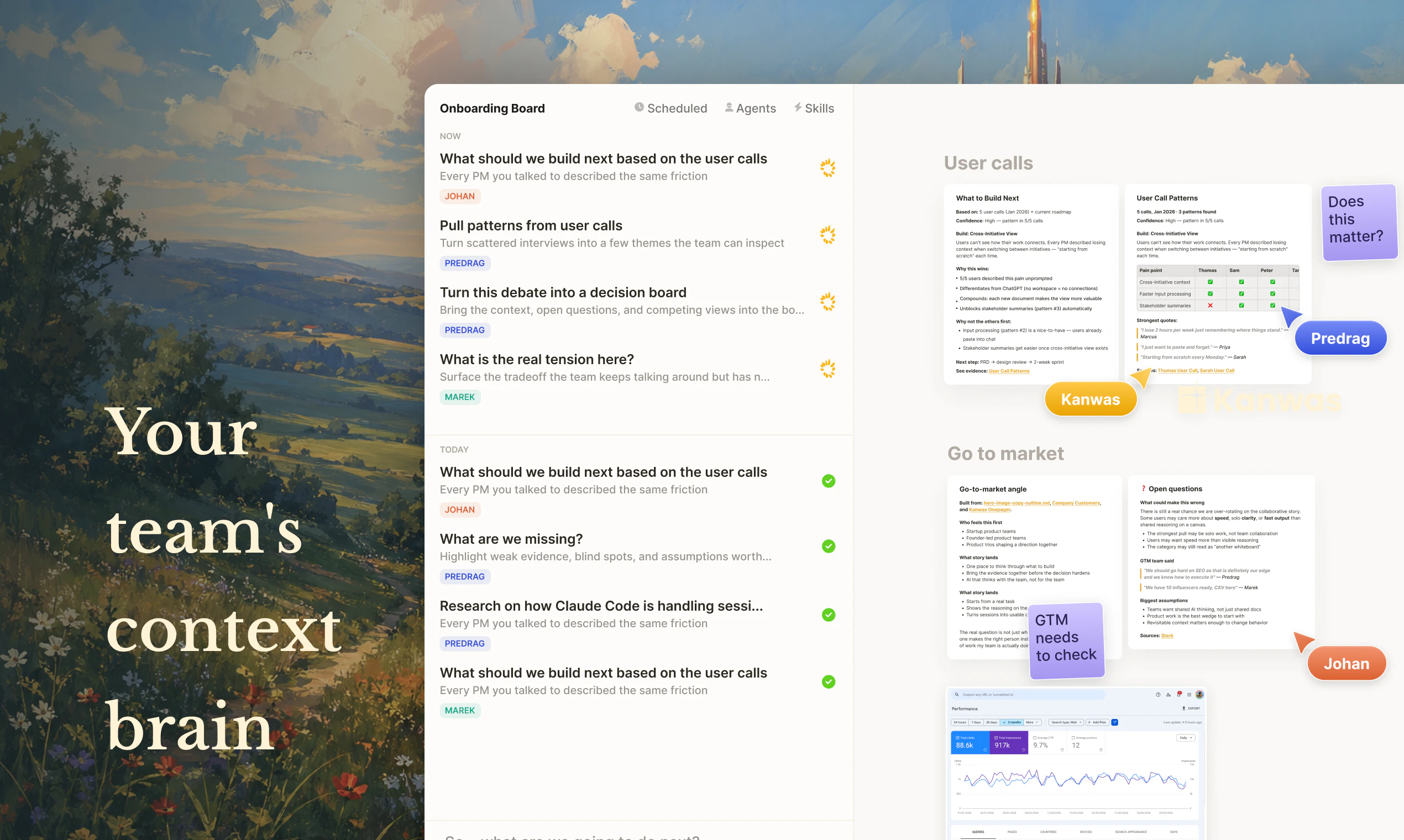
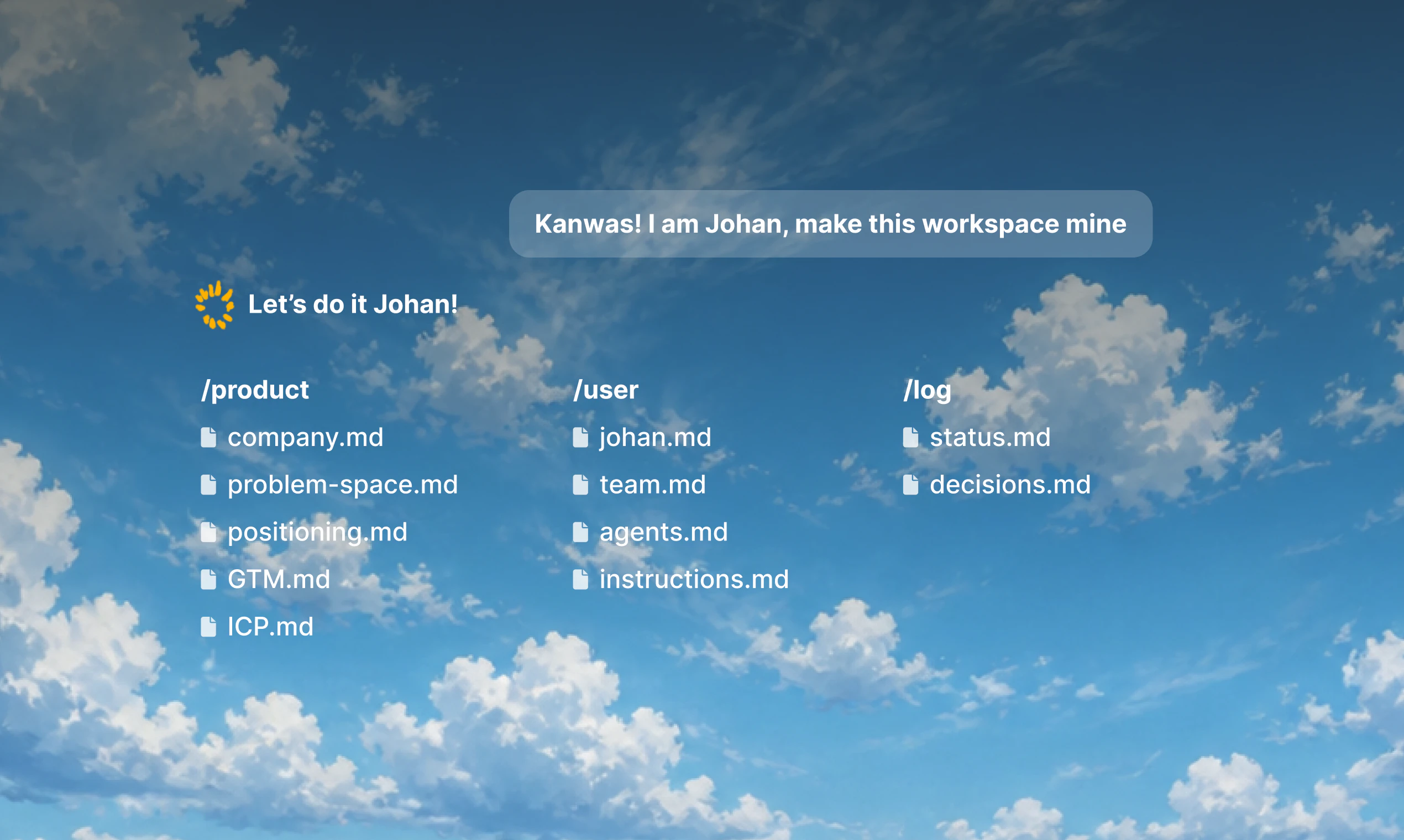
查看原始信息
moar
No more "file too large." moar extracts real structure from any document and delivers clean, right-sized Markdown or CSV for every AI tool you use including ChatGPT, Claude and Gemini. Up to 95% token savings. Zero loss of meaning. Supports nine formats: PDF, DOCX, PPTX, XLSX, CSV, TXT, MD, JSON and HTML. Files up to 50 MB each. moar is built from the ground up to be 100% private. Your documents never leave your device.

👋 Product Hunt,

I'm Gavin, the creator of moar.


Almost from the moment I started using AI tools, I kept hitting the same wall: I'd drop a long document into Claude or ChatGPT and get "file too large" or watch response quality drop because the model was wading through bloated inputs.

When I opened the source files of these docs, I found layers of formatting metadata, repeated headers, empty cells and other clutter the AI had to read but didn't actually need. I was paying for a premium subscription and burning most of my context window on pure noise.

I started doing some digging and came to realize that our documents are formatted and designed for human verbosity, not AI comprehension. And then it hit me: to get better results for a human like me, I needed to first make it better for AI.

So I stopped guessing at what AI tools need from documents and I asked them. moar's optimization algorithms have been co-designed with ChatGPT, Claude, Gemini and other LLMs. Every optimization step tested against what the models actually use versus what they ignore.

Through a series of structured conversations, side-by-side output testing and iterative feedback loops, they told me exactly which formatting metadata is dead weight, which structural cues matter, where bloat costs them attention.

The result is up to 95% token savings with zero loss of meaning for AI tools.

Non-negotiables from day one:
- moar is 100% private by design. No server, no uploads, no logs. Your documents never leave your device.
- moar's AI-native document optimization engine is and always will be free.

Would love your feedback, especially weird files or edge cases I haven't seen yet. Honest critique very welcome.

4
回复