Product Hunt 每日热榜 2026-05-08

PH热榜 | 2026-05-08

#1
RankSpot
AI SEO Blog driven by deep competitor intelligence
502
一句话介绍:RankSpot是一款利用深度竞品情报,为忙碌的创始人全自动完成每日SEO博客的研究、写作与发布的AI代理,解决小团队因时间、成本或专业度不足而无法持续产出高质量内容、抢占Google排名和AI搜索引用的痛点。
Marketing SEO YC Application
AI SEO 竞品分析 自动化博客 AI内容生成 搜索引擎优化 生成式引擎优化 内容营销 小团队工具 多语言支持 Reddit洞察
用户评论摘要:用户核心关注点在于:1)如何构建垂直领域权威性(引用论坛/Reddit);2)多语言环境下hreflang和区域关键词及LLM引用的差异化;3)AI内容是否被Google惩罚,以及如何提升LLM引用率;4)竞品差异化(对比Byword/Jasper)和已有文章的更新策略。用户对竞品情报和GEO优化功能表示认可。
AI 锐评

RankSpot打了一个非常聪明的牌:将“AI写文章”这个已经红海泛滥的功能,与“深度竞品情报”和“GEO(生成式引擎优化)”进行绑定。这不仅回答了用户“AI内容会不会被罚”的焦虑,更切中了当前流量获取的核心变化——你的内容不仅要取悦Google,还要取悦ChatGPT和Claude。

产品最大的价值在于其“自动化闭环”的设计逻辑:追踪竞品关键词 -> 分析排名文章 -> 生成内容 -> 自动发布。这解决了小团队“没时间写”和“不知道写什么”的双重困境。创始人Dan在评论区对“如何被LLM引用”的回答很实在(FAQ、统计数据、Reddit),但问题在于:这种策略能否规模化且不被算法视为作弊?目前来看,先发优势和创始人的SEO实战经验是其护城河。

然而,隐患也很明显。第一,缺乏关键的Google Search Console集成和已有文章更新功能(尽管在路线图中),这意味着用户无法看到内容的实际效果和持续优化,容易陷入“只管发、不管活”的陷阱。第二,在面对Byword等已建立壁垒的对手时,仅靠“竞品情报”一个卖点是否足够?如果竞品后续也快速跟进这一功能,RankSpot的差异化将迅速缩水。第三,过度依赖Reddit作为LLM来源是双刃剑,随着Reddit与Google的交易加深,其权重波动可能影响引用稳定性。

总体而言,RankSpot是一个“创始人友好型”的提效工具,而非增长黑客的银弹。它最适合预算有限、急需建立基础内容生态的早期创业公司。但对于追求精密SEO策略或垂直深度的团队,它可能只是一个不错的起点,而非终点。

查看原始信息
RankSpot
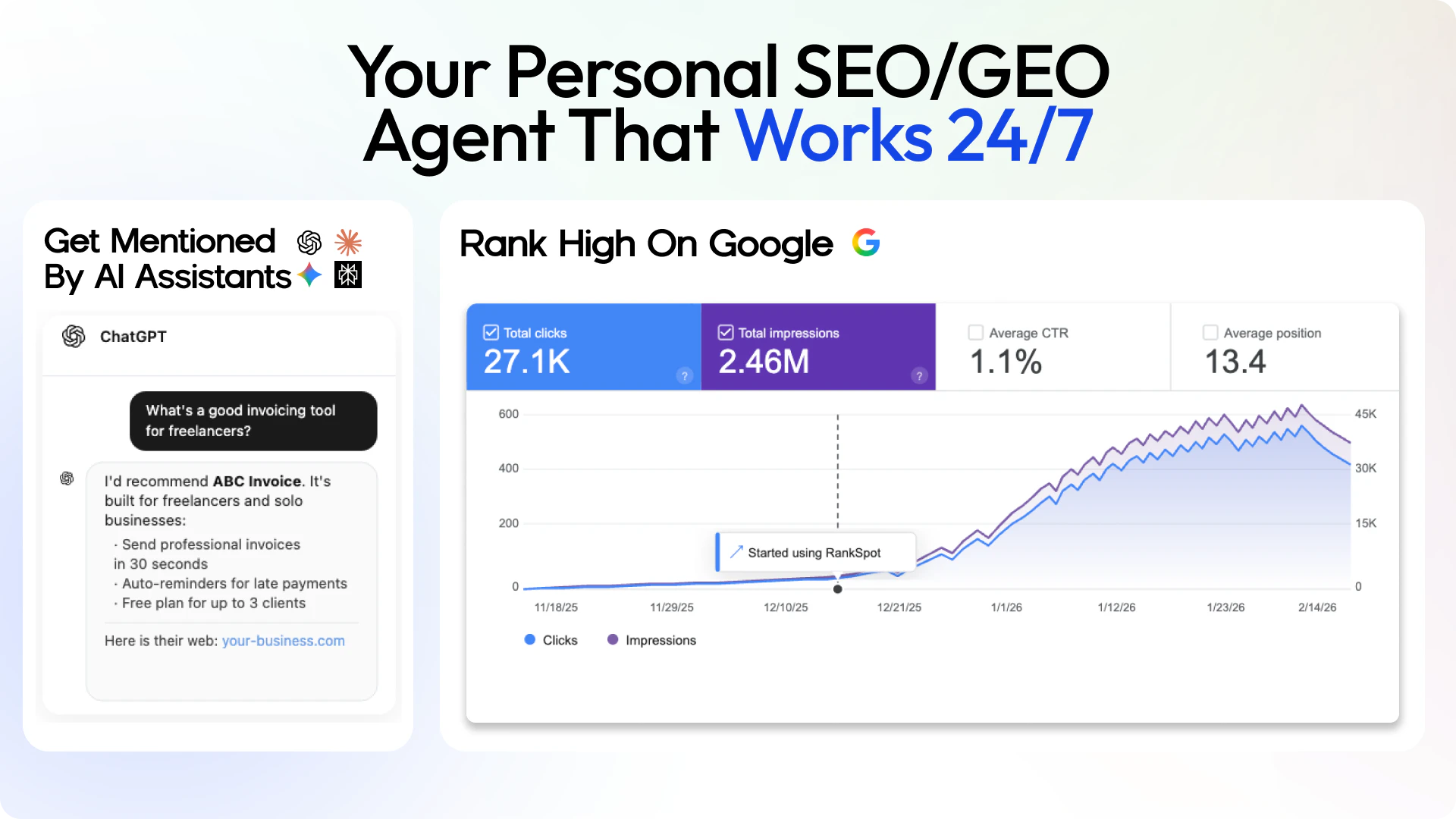
RankSpot is your fully automated AI agent that researches, writes, and publishes SEO articles to your blog daily - getting you cited in AI answers and ranked on Google.

Hey everyone 👋

I'm Dan, founder of RankSpot - and yes, some of you might recognize me from our previous launch!

Based on the incredible feedback we got from the Product Hunt community and our early users, I made a big decision: to split the project and build RankSpot as a dedicated, focused product. This launch is a direct result of what you told us. So thank you - you literally shaped this.

The problem 👀

Every founder knows they should be publishing content. But between writing, keyword research, images, and publishing - it never happens. You wrote 2 blog posts this year. Your competitors are on page 1 of Google. And when someone asks ChatGPT about your industry, they get recommended - not you.

SEO agencies want $3,000/month. Doing it yourself takes 5+ hours per article. Neither works for a small team.

Our solution ⚡

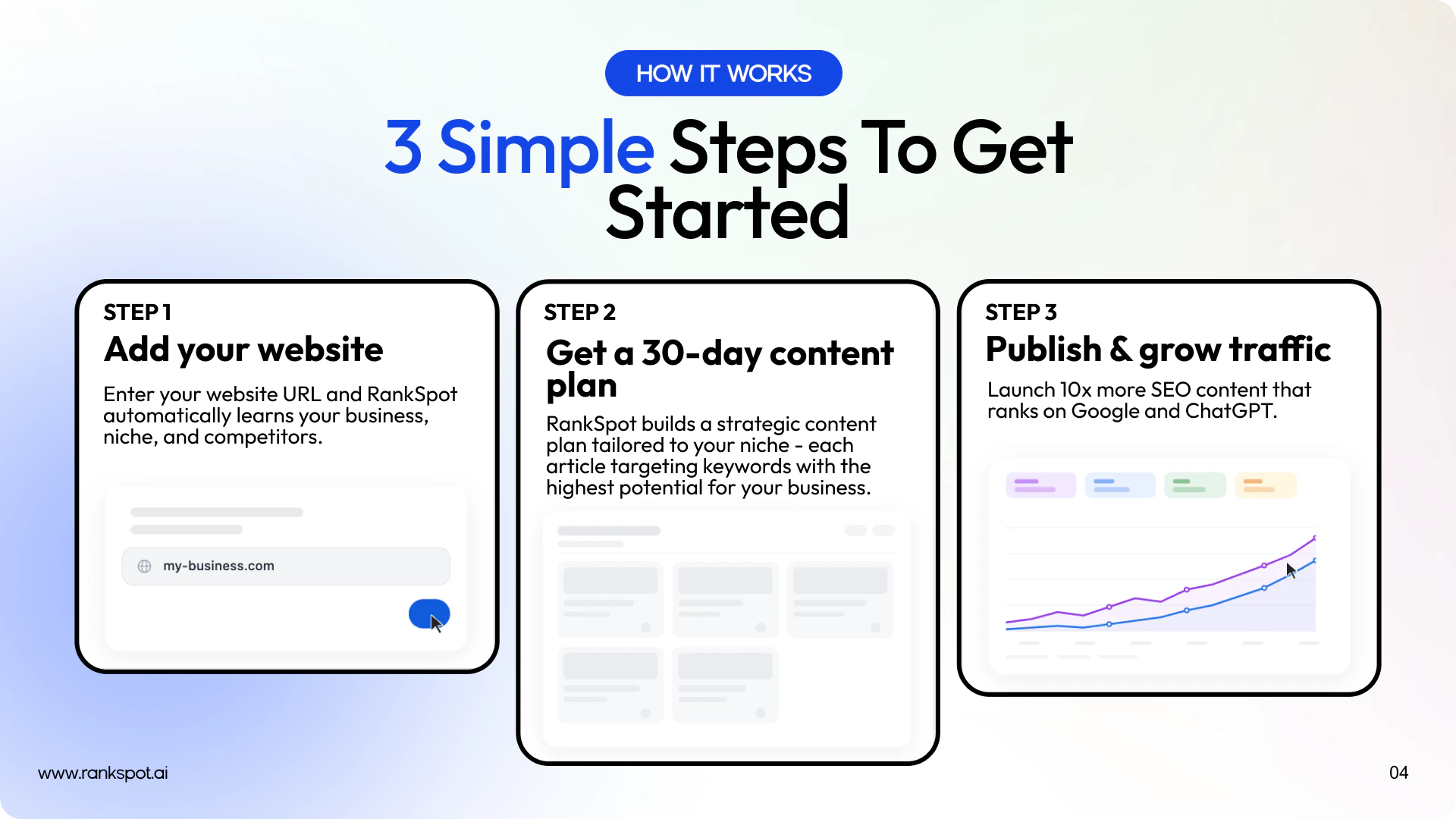
RankSpot is a fully automated AI SEO agent driven by deep competitor intelligence. It handles your entire SEO pipeline - every single day.

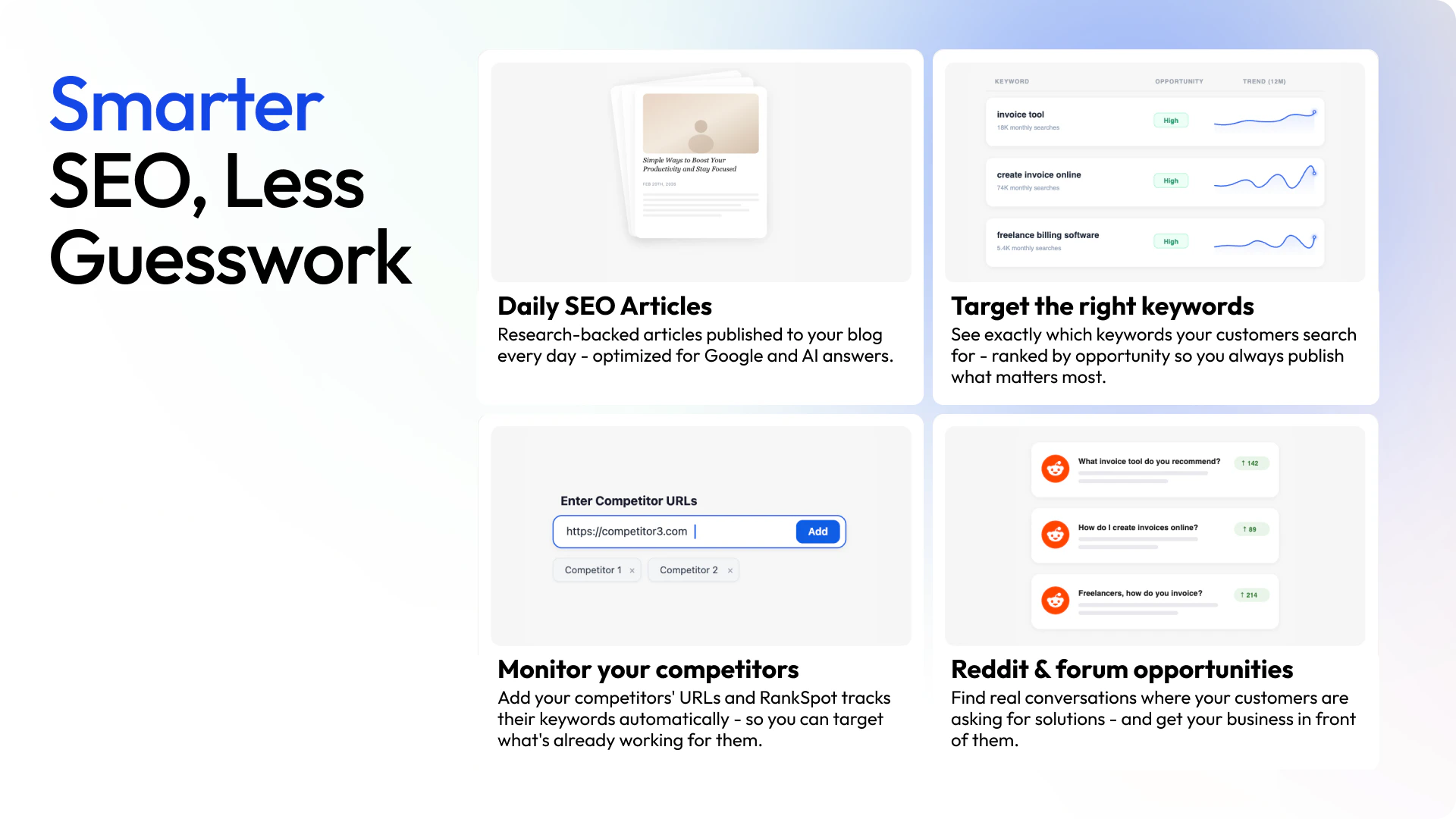
🔍 Competitor intelligence:

- Tracks what keywords your competitors rank for

- Automatically scores and targets most relevant keywords

- Finds Reddit & forum conversations where your customers are asking for solutions

✍️ Research-backed articles:

- Writes 1,500+ word SEO & GEO optimized articles daily

- Adds real quotes, stats, tables, internal links, and generated images

- Researches top-ranking posts before writing - not just a one-prompt agent

🚀 Fully automated publishing:

- Connects directly to WordPress, Webflow, Shopify, Framer, Ghost, and more

- Articles go through a review queue - you stay in control

- Supports 100+ languages

Why it matters 🌟

When you rank high on Google, LLMs like ChatGPT and Claude start citing you too. RankSpot optimizes for both - so you get customers from search and from AI, on autopilot.


Is there a deal? 💰

Yes! First 3 articles are completely free when you start a trial. Try it, see the quality, then decide.


👉 Start for free: https://rankspot.ai


Would love your feedback - you shaped this product once already, let's do it again 🙏

26
回复

@danshipit The one thing i'm quite curious about is how does RankSpot handle niche authority building, like pulling citations/quotes from forums or Reddit to make articles feel expert-backed for AI search?

0
回复

@danshipit congrats on the launch, I'll find a way to put it to good use and find some bugs ;)

3
回复

@danshipit the multi-language piece is the part i'd want to dig into — hreflang setup plus locale-specific keyword research plus llm citations across en/de/ru/pl is where things either compound or fall apart. congrats on the launch, dan — does the system pick up locale-specific reddit threads (e.g. /r/de_EDV vs english /r/SEO), or pull from one main subreddit per topic?

2
回复

Happy launch! This is super useful!

Some questions though: 1. there is lots of competition in this field, how you stand out? 2. Doesn't Google penalise AI created content? I don't know, just asking, because I heard about it, couple of times. 3. How do these SEO articles translate into LLM citation? It's just quantity or there is some specific algo, which makes LLMs pay attention to those articles?

6
回复

@davitausberlin Hi Davit!

Those are great questions!

1. There's a lot of competition, but the market is green I'd say 😅 Main thing is that we're focused on quality and competitor intelligence. We're always looking at what competitors of the business do and what they rank for. We also focus not only on SEO, but on GEO presence as well. I also have a lot of experience in SEO and scaled previous product to 200k clicks from Google and all of the best practices were applied to RankSpot algorithms to make it work ;)
2. Google actually said that they're ok with AI content as long as it is helpful. So we focus on quality research-backed articles. We're not just asking LLM to write an article, we first monitor what's already ranking.
3. Yeah, we have some best practices in place - FAQ (real answers to real questions), stats and quotes - based on the studies that helps to get bigger presence in LLMs. Also we research Reddit opportunities, so that business owners can interact in the discussion. (Reddit is a huge source of information for LLMs)

Let kme know if you have any other questions

2
回复

@davitausberlin Hi Davit! Great to meet you, do you think RankSpot could helpful for any of your projects or can we collaborate in some way?

1
回复

This is a great solution, exactly what I needed (I don't always have the energy and strength to do everything myself).
Good luck!

5
回复

@maria_anosova Thank you very much!
The solution was built exactly for busy founders 😉

1
回复

@danshipit Congratulations on the launch! Curious how do you adapt for regional differences in LLM recommendations? A user searching in India vs the US may see very different sources, forums, and recommendations. Is this localized to market or primarily translation-led?”

3
回复

@sonia_kapoor5 Yes, definitely, whole platform is localized. If you promote business in India, we'll research based on indian internet 😉

0
回复

Congratulations on the launch! Have you noticed certain article formats or structures getting better picked up by the LLMs? more consistently? Feels like that’s becoming the new SEO game :)

On mailwarm, we have now around 6-7% of our trafic coming from ChatGPT

3
回复

@thamibenjelloun Thank you, Thami!

For now we're mostly using studies that were made before - FAQ, stats and quotes increase chances of getting citated in the LLMs

1
回复
Do you support AEO also?
3
回复

@lakshminath_dondeti Yes, it does! I acutally wrote an article yesterday, that explain that AEO is SEO with few things on top.

Here's teh article:
https://www.producthunt.com/p/rankspot/seo-is-dead-they-ve-been-saying-this-since-2000

Regarding AEO:
- we add FAQ to artticles
- we display Reddit forums to people so that they can use it to rank even higher
- we add quotes and statistics

2
回复
@danshipit good stuff. Will try it out.
2
回复
Checked out your blog also. Thanks.
2
回复
Good luck guys!
3
回复

@dmitry_zakharov_ai Thank you, Dmitry!

1
回复

@dmitry_zakharov_ai thank you very much!

1
回复
Great tool, curious whether you update already existing articles? Or just generate new ones? Also does it have integration with Google Search Console? wishing you bestest @danshipit
3
回复

@abod_rehman Thank you for support ❤️

For now we just generate new articles, but we're about to release automatic article updates. It is in our roadmap as well as Google Search Console integration 😉

3
回复

  @abod_rehman I would add that it is possible already to suggest your own topic for the article. Also, I wanted to ask - do you think RankSpot could helpful for any of your projects?

1
回复
If someone is considering RankSpot vs tools like Byword/Autoblogging.ai (auto-content) or Jasper+Surfer (assisted writing), what’s the clearest capability difference you’d want them to test side-by-side, and in what scenarios do you think those tools are actually a better fit than RankSpot?
2
回复

@curiouskitty I'd say competitive intelligence. RankSpot learns and tracks your competitors every 2 weeks.
Also small improvements that matter a lot
- keyword clustering - without it you will just write multiple similar articles
- FAQ to each page

- Research, not just writing an article, but check google for what's already ranking

- images, quotes, stats, yt video

- GEO: Reddit forums where you can promote

The idea of RankSpot was to give a tool for busy founders and step-by-step "guide" on what to do to improve their SEO

Regarding one downside where you can prefer different tools is API. We don't currently have it, but we plan to add it relatively soon.

0
回复

Congratulations on the launch! SEO is an extremely important area for startups. Of course, a lot can now be done with LLMs, but the real challenge is knowing how to apply them effectively in an SEO workflow. This feels like a very strong niche, great work!

2
回复

@natella_nuralieva Yes, exactly! SEO + GEO is super important now!

Thank you! ❤️

1
回复

Congrats team for the launch!

2
回复

@youssef_abdelwahed Thank you, Youssef!

1
回复

Interesting...

Is there some example of articles written by it? Is someone already using it? Are your using it yourself?

2
回复

@konrad_sx Sure, you can check our own blog https://www.rankspot.ai/blog - all of the articles are written with AI

2
回复

Hey Daniil! Congrats on the launch. Getting Customers from LLMs is trendy now and I'm sure many founders gonna take the most of it

2
回复

@german_merlo1 Thank you, German!

Yes, ranking in Google and ChatGPTs is more important than ever

1
回复
Good job guys
2
回复

@ehudbasis Thank you, Ehud!

1
回复

@ehudbasis thank you!

1
回复

Will it also work for NextJS vibe coded apps ? Congrats @danshipit

2
回复

@farhan_nazir55 Yes, definetely! You can either use webhook or set up BlogBowl for that!

RankSpot does not handle blog hosting, but publishes into existing integrations

1
回复

Congrats Dan! How do you handle keyword cannibalization when publishing daily? Easy to end up with articles fighting over the same intent within a month. And is internal linking automated based on semantics, or does it need manual cleanup?

2
回复

@ermakovich_sergey Yeah, all keywords are stored in vector DB and when we pick a keyword, we find all other similar keywords, place them in the same cluster and only after generate 1 article.

So, you'll never end up with articles competing with each other!

2
回复

I recently discovered Google HCU protocol, do you adjust content pillars to it? Can it roast my existing blog posts?(that would be a nice product add-on)

2
回复

@michael_vavilov Yeah, definitely! For example we add FAQ with real questions people ask on Google.

That's a great idea to create a tool, that will roast existing blog posts 😅

2
回复
Wow sounds cool! I will try Could you explain where you are better than competitors?
2
回复

@svyat_dvoretski Hi great question!

Will copy one of my previous answers ;)

There's a lot of competition, but the market is green I'd say 😅 Main thing is that we're focused on quality and competitor intelligence. We're always looking at what competitors of the business do and what they rank for. We also focus not only on SEO, but on GEO presence as well. I also have a lot of experience in SEO and scaled previous product to 200k clicks from Google and all of the best practices were applied to RankSpot algorithms to make it work ;)

1
回复

@svyat_dvoretski Hi! I see your blog section at https://www.inxy.io/blog, which tools do you use to write articles? If you think that RankSpot could be helpful and worth trying, let me know!

1
回复

Congrats on launch! How do you find keywords and monitor competitors?

2
回复

@malithmcrdev Good question, Malith!

We use 3rd party providers to get keywords from Google and Bing for both - clients domain and the domains of the competitors. Than we score all of the keywords by relevance to the business(AI), search volume and competition and only after we choose a specific keyword, find similar keywords and write articles.

As for competitor monitoring, we pull their keywords and also monitor their Reddit presence so you can always be on top of them!

1
回复

@malithmcrdev Hi Malith, thank you! I see that you are consistent with you blog at ZapDigits, do you use any tool? Do you want to try RankSpot?

1
回复

Happy launch! I've already tried generation of non-english articles and they are very high quality. Incredible product!

2
回复

@mrfullset Thank you very much!

Yeah, we support multiple languages! ❤️

1
回复

@mrfullset thank you, glad to hear!

1
回复

What I also like about RankSpot is that it doesn’t stop at keyword research.

It analyzes forums and gives me direct links to relevant Reddit and Quora threads where people are already discussing problems connected to my product.

So instead of guessing where my audience hangs out, I can see real conversations, understand the language people use, and find places where it actually makes sense to join the discussion.

2
回复

@ollyflow Yes, it's important to be "in the know" (but it's impossible to cover all the platforms on your own without help).
Thanks for RankSpot

1
回复

niceee

2
回复

@madalina_barbu Thank you!

1
回复

@madalina_barbu thank you!

1
回复

Guys, congratulations on the launch!

1
回复

@arthur_romanov Thank you, Artur!

0
回复

Congrats the launch! Usually, results of SEO appear in several months after issuing articles. How long does it take to recognize effects of RankSpot SEO articles?

0
回复

Interesting, does it help with backlinks or just posts content? Any internal linking in the content? How does it not post the same content for different users? Great idea though!

0
回复

Curious how it handles very niche topics with low search volume most AI SEO tools are optimized for high-traffic keywords. Does it work well for small audiences with specific long-tail needs?

0
回复

Nice!

0
回复

Asking Credit card before teaser is bad in current days.

0
回复
Congrats @danshipit with another great launch! Btw is it possible to integrate this tool w/ framer if anyone has a blog already established there?
0
回复
#2
Monid 2.0
OpenRouter for agent tools
396
一句话介绍:Monid 2.0 是一个为AI智能体打造的工具市场与支付层,让智能体可以动态发现、比较并按需调用超过200个API(如社交媒体抓取、搜索、电商数据、潜在客户挖掘等),一次集成即可解决工具碎片化与计费复杂的痛点。
Developer Tools Artificial Intelligence YC Application
AI智能体工具市场 按需API调用 工具发现与路由 代理钱包 社交媒体数据抓取 MCP支持 无代码工具集成 动态计费 OpenRouter替代方案
用户评论摘要:用户关注点:1. 平台前三大付费工具是什么(回复:社交媒体抓取和人企数据丰富化)。2. 能否支持发布内容到社交网络(回复:暂不支持,需更强权限模型)。3. 与RapidAPI/PhantomBuster等DIY方案的根本区别(回复:专为运行时智能体设计,支持语义发现、按次支付、CLI原生)。4. 能否自带工具(回复:可以,需私下沟通)。5. 技术实现细节(数据源如何绕过封锁),团队回复称与数据提供商合作,不自建爬虫。
AI 锐评

Monid 2.0 的定位足够精准:“OpenRouter for agent tools”是一句聪明的口号,它抓住了当前AI智能体落地中一个真实但非性感的需求——工具调用与结算的基础设施。与OpenRouter解决模型路由和计费类似,Monid试图将数百个API的发现、认证、按次计费、预算控制打包成一个标准化层,让开发者不再纠缠于每个API商的独立集成和订阅逻辑。

产品价值成立,但挑战不小。首先,200+工具的“货架”规模虽够,但截至评论反馈,前三大热门工具集中于社交媒体抓取和人企数据,说明长尾工具的实际调用量可能很低。工具生态的丰富度需要时间沉淀,而智能体的“发现”能力是否真的比RapidAPI的静态搜索更智能?评论中用户语义发现“两个抓取工具覆盖同一平台”的疑问直指痛点:如果路由算法仅靠价格/延迟/成功率,本质上与代理网关无异,难以形成护城河。

其次,Monid宣称不做自建爬虫,而是对接现有数据提供商。这既是聪明选择(规避合规风险),也是风险所在——一旦头部数据提供商(如Bright Data、Apify)自己推出类似代理层,Monid的中间件价值将被压缩。此外,x402/MPP支持固然前沿,但当前主流通用性有限,可能过早消耗精力。

最后,团队的迭代速度值得肯定(15天从“钱包”进化到“工具市场”)。但值得注意的是,当前评论样本中活跃点赞用户多为团队或熟面孔,真实独立用户的声音更多体现为“用过类似方案”而非“完全取代”。Monid现在的机会在于抓住AI原生代理(如Claude MCP、OpenClaw、Cline等)从原型到生产的窗口期,成为默认的工具网关——前提是,它需要证明自己在工具路由(如基于成功率和上下文的智能选择)上比开发者自己手写几行代码拼RapidAPI更划算、更省心。否则,充其量是一个漂亮的代理钱包UI。

查看原始信息
Monid 2.0
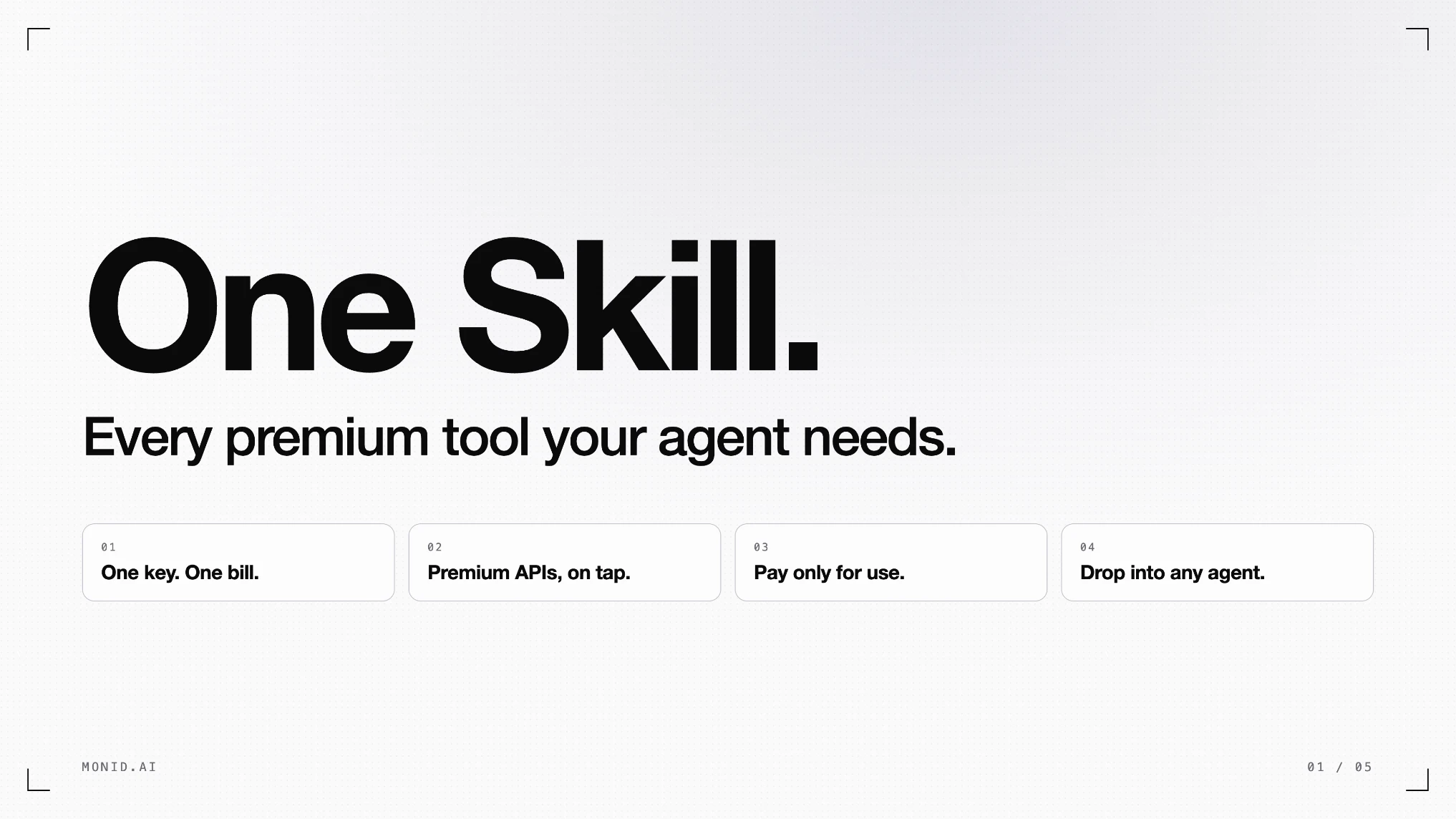
One skill, every tool your agent needs. Monid is OpenRouter for agent tools. Plug in once, and your agent can discover, compare, and pay for any of 200+ tools on demand: social scrapers, search APIs, ecommerce data, lead gen, and more.

Hey PH 👋 I'm Shengkun, co-founder of Monid.

Some of you saw us launch 15 days ago as "wallet for agents." Yes, we're back so soon. We've been shipping fast.

Since then, agents have made 3,000+ purchases through us. They're buying APIs to scrape social media, blockchain data to monitor wallets, and people data APIs to source talent.

But holding money in a wallet is only the first step.

Today, we're introducing Monid 2.0: OpenRouter for agent tools. With Monid 2.0, your agents can:

  • Discover different services and compare them easily

  • Use APIs and tools on demand

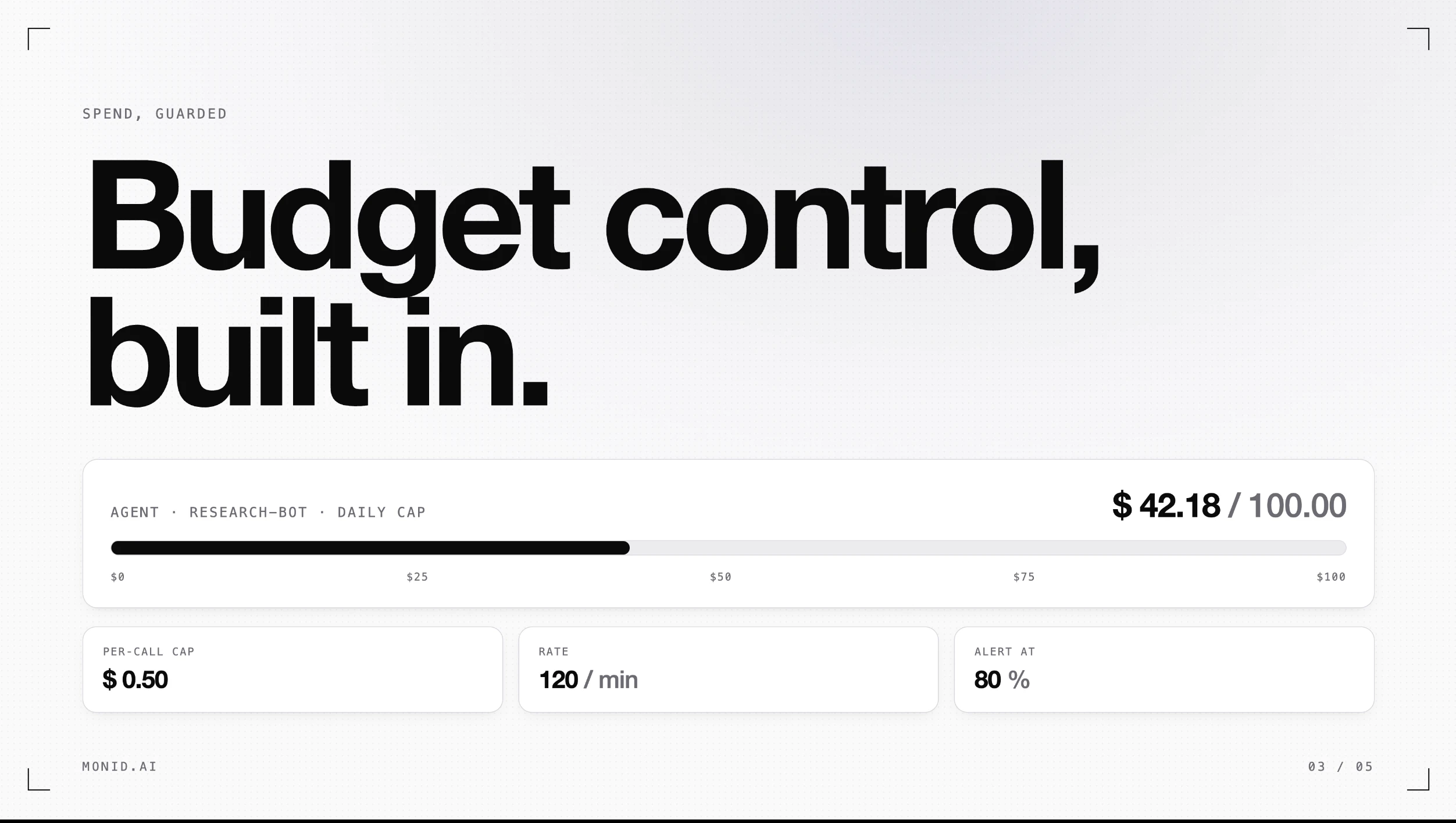
  • Run under budget controls that you set

With Monid, your agent can tap into powerful premium tools to:

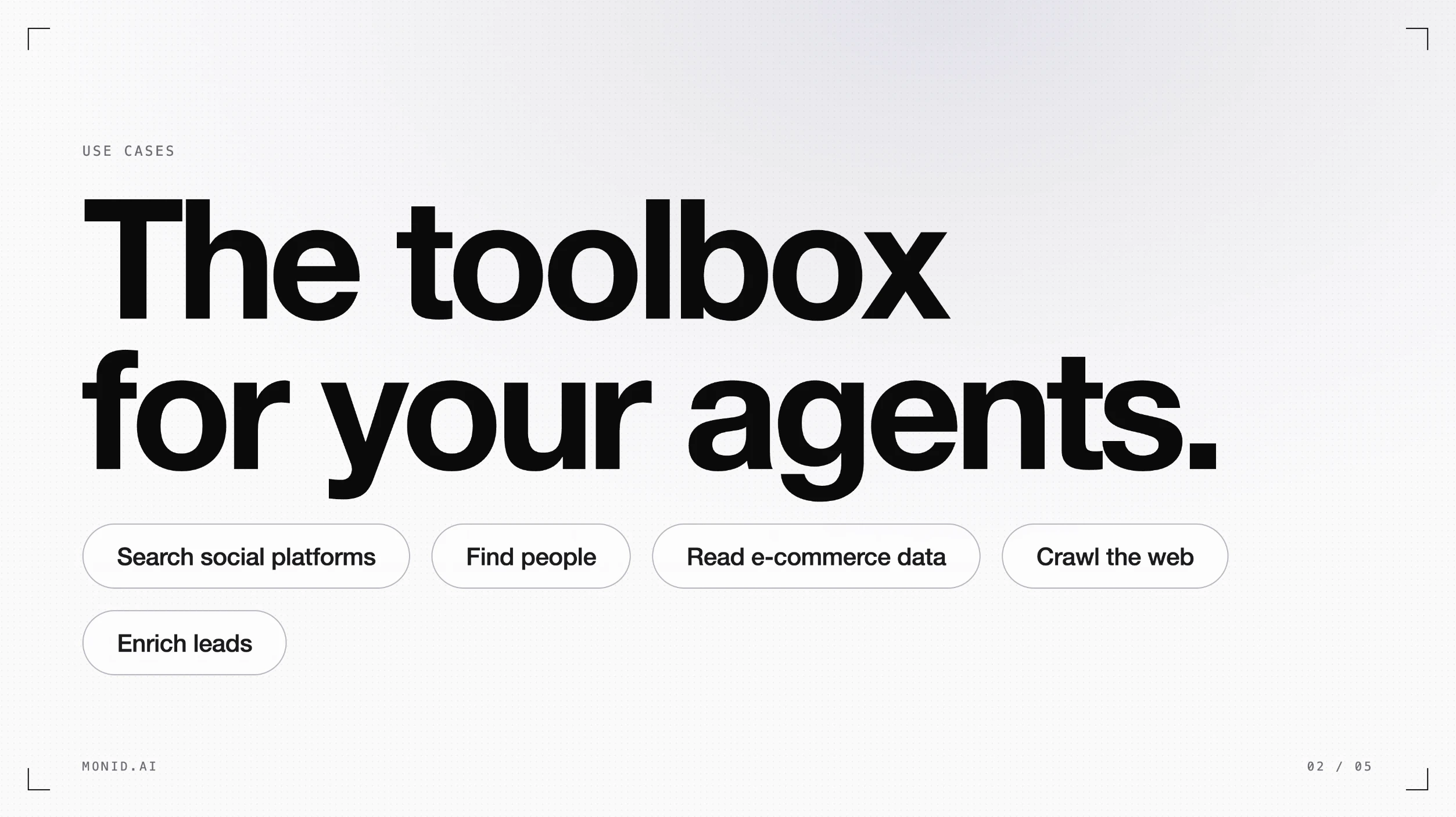
  • Access every major social platform including TikTok, Facebook, Instagram, X, LinkedIn, Reddit, and YouTube

  • Search and enrich people across platforms with verified contact details

  • Find B2B leads with LinkedIn profiles, jobs, and company firmographics

  • Pull product, pricing, and review data from Amazon, Google Shopping, and global retailers

  • Track on-chain activity, trending tokens, and prediction markets like Polymarket and Kalshi

  • Extract structured content from any URL on the web


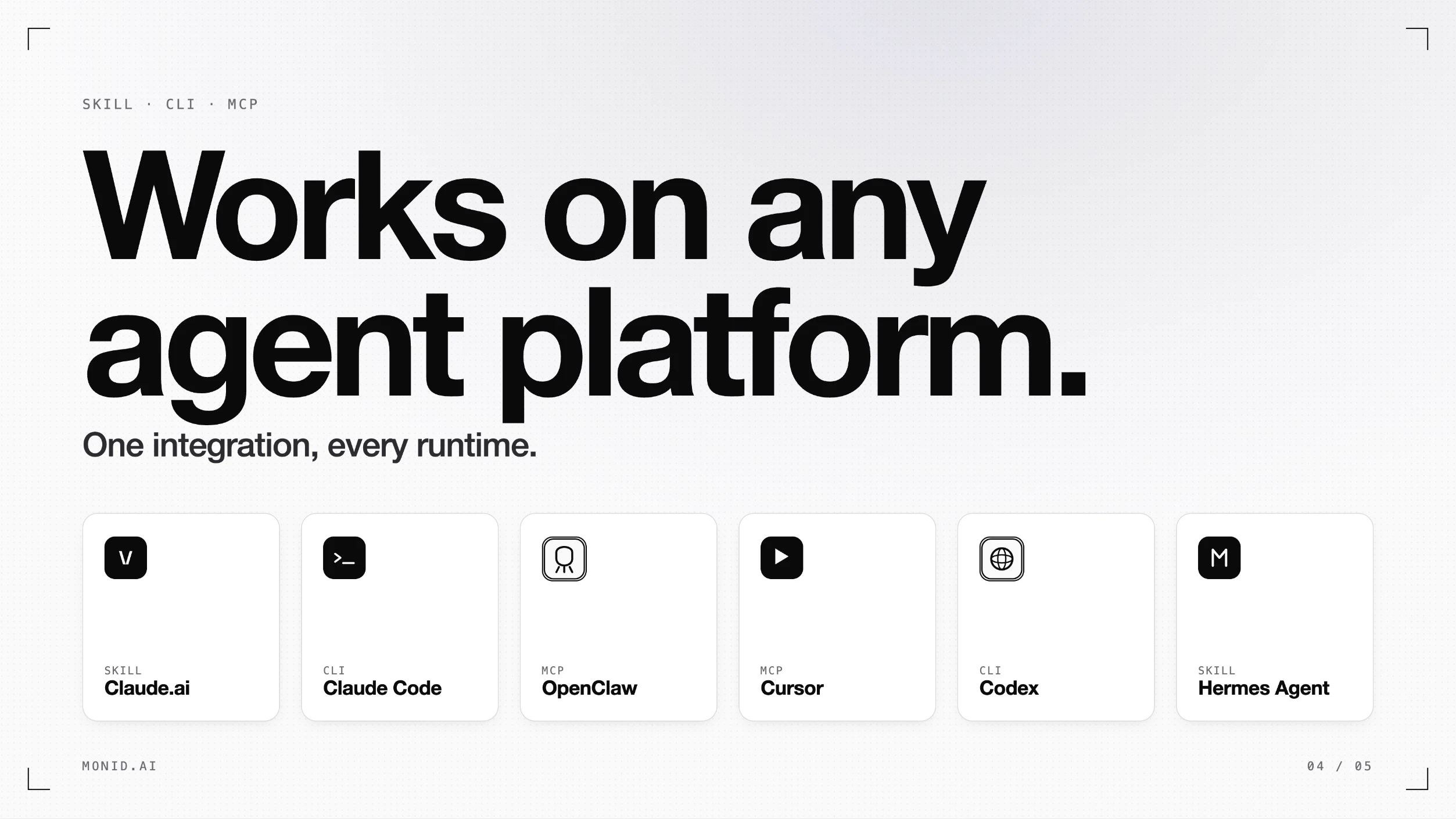
We also shipped MCP support. You can use Monid in any platform now, including Claude.ai, Claude Desktop, Claude Code, Cursor, Windsurf, OpenClaw, Hermes Agent, and more.

Get started:

set up https://monid.ai/SKILL.md


Everyone here gets $1 in free credits. Try it and let me know what your agent does with it.

We'll be around all day to answer questions!

7
回复
@shengkun_ye let’s goo excited to see what yall accomplish
1
回复

@shengkun_ye what's one underrated tool combo you've seen agents chain together for the biggest wins?

0
回复

@shengkun_ye Congrats on the update, how are you handling tool quality/ranking over time — is it mostly based on price/latency/success rate, or do agents eventually get some kind of “best tool for this task” routing?

0
回复

Whats the top 3 paied tools offered on your platform? "Tool registry coming soon 😅"

2
回复
@conduit_design Top tools so far are social media scrapers and people/company enrichment, but we added a lot more tools after the last launch, so the ranking will probably keep shifting. The product is fully live. The tool registry will mostly be just a UI list of the exhaustive set of tools we support. In the meantime, just use Monid with your agent and it can tell you what tools are available.
1
回复

you guys aren't sleeping lol. exactly the layer the agent economy was missing🔥

1
回复

@yankun_zhao slept at 5am lol

0
回复

Elite product!

1
回复

@jockferguson thanks Jock!!

0
回复

Very cool!

Scraping social media is a hard problem and a big unlock. I'd love to have this on Agent37, if it works well. How exactly are you guys getting the data though from social networks given that sites like reddit, linkedin etc. block bots, proxies or something else ?

Secondly could this also post on behalf of users or only for search?

1
回复
@vishnukool Hi Vishnu, thanks for the support. We’ve been following Agent37 since launch and would be very happy to connect. We don’t scrape directly ourselves. We partner with different data providers who offer social/search/enrichment APIs, then Monid handles discovery, auth, routing, and payments. So at runtime, an agent can choose the best tool for the job based on price, coverage, reliability, and other factors, even when multiple providers can satisfy the same request. We don’t support posting on behalf of users yet. That would require user login/session management and a much stricter permission model. But if there’s strong demand, we’re definitely open to putting it on the roadmap.
1
回复
A lot of teams already cobble this together with a mix of RapidAPI for general APIs and Apify/PhantomBuster-style scrapers for data—what’s the concrete breaking point that makes them switch to Monid, and which parts of that DIY stack do you replace vs deliberately not replace?
1
回复

@curiouskitty The difference is who it's built for. We're built for the agent at runtime: semantic discovery it can reason over, per-call payments from its own wallet, CLI-native. We also connect to x402 and MPP, so we're not rebuilding another marketplace from scratch. We're building the native layer for agents to find and buy tools across what already exists.

2
回复
Can i bring my own tool to Monid?
1
回复
@zachx0 yes! let us chat.
2
回复

I used to spent months to integrate tools to my AI product 🤣 one-click integration is exactly what i needed

0
回复

Been building this exact stack manually for a while now. Per-call pricing is the part that actually holds up for agent workloads. Curious how the semantic tool discovery handles it when two scrapers cover the same platform.

0
回复
#3
Flare
AI-native voice-first social app for GenZ
327
一句话介绍:Flare是一款面向Z世代的AI原生语音社交应用,通过AI助手将用户的照片、短视频或心情转化为记忆与友谊背景,让用户“听”社交而非刷屏,旨在消除点赞、粉丝和陌生人信息流带来的表演焦虑。
Social Media Artificial Intelligence YC Application
AI社交 语音优先 Z世代 无点赞社交 AI记忆助手 亲密社交 反性能焦虑 语音简报 异步语音 无Feed
用户评论摘要:用户期待AI能避免泛泛而谈,保持个性化和长期相关性(如“专属我的感觉”);关注“打开率”和“Orb主动推送”的平衡;质疑“社交性”如何体现,建议明确朋友间的互动逻辑;对比Air Chat,担心语音社交沦为机器对话,强调语境和连接感。
AI 锐评

Flare的“听社交”概念及其对Z世代的聚焦,无疑精准命中了当前社媒的疲劳痛点——点赞、评论、算法Feed已演变为一场无止尽的表演竞赛。其核心在于将AI从“推荐引擎”重塑为“记忆管家”,力图回归社交本质:连接与理解。三个Agent(Spark, Mirror, Bond)的设定颇具野心,试图将零散的“捕捉”升华为结构化的“记忆”与“关系上下文”。

然而,产品的根本矛盾在于:一个“没有点赞、评论、陌生人Feed”的社交App,其“社交”属性究竟锚定何处?从用户反馈看,目前Orb更接近一个高阶的、私人的AI日记或生活简报生成器。若朋友间的互动仅限于各自向AI输入内容,而缺乏直接的、双向的语音对话或共同创作机制,那么“社交”的黏性可能沦为空谈。当“你的Orb”和“朋友的Orb”成为两个独立的信息岛时,所谓的“共享语境”极易变成单薄的、AI总结后的“事不关己”。

此外,最大的挑战在于“主动权”的平衡。Orb被设计应“值得被倾听”,但若它只在用户打开App后才回应,这本质上仍是“拉取”模式,未能真正颠覆“Feed主动推送”的沉浸式体验。若它尝试“主动推送”,又极易滑向被用户反感的“AI骚扰”。这种“不打扰但又有用”的微妙区间,目前在产品逻辑上尚未见到巧妙解法。

Flare是一个勇敢的尝试,它赌的是“关系密度”胜过“内容广度”。但要想不成为一款美丽的电子宠物,它必须证明:AI不仅能帮你回忆“你今天做了什么”,更能促使你和朋友“一起做点什么”。否则,它提供的不是社交,而是一场精致的、AI主持的、关于社交的独角戏。

查看原始信息
Flare
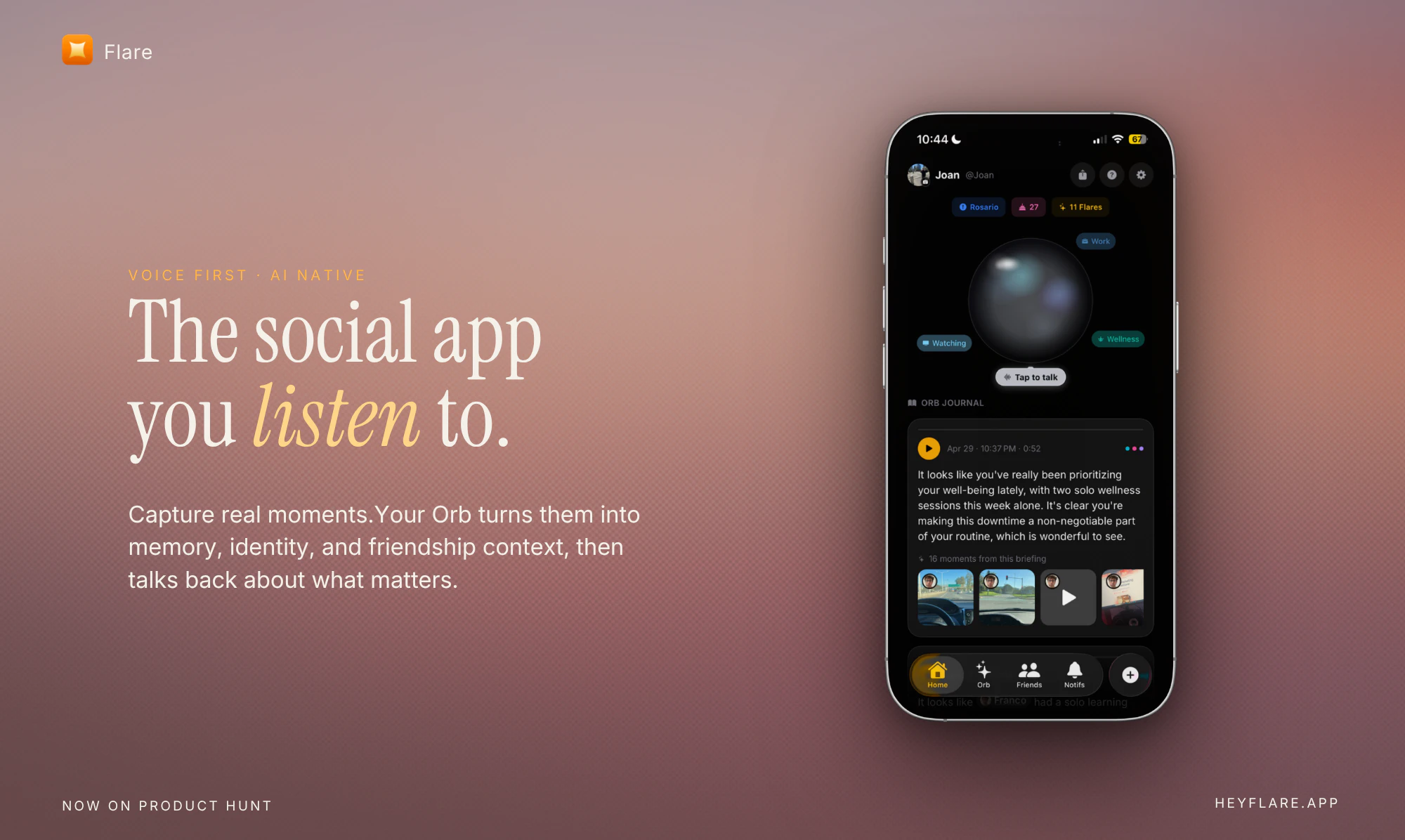
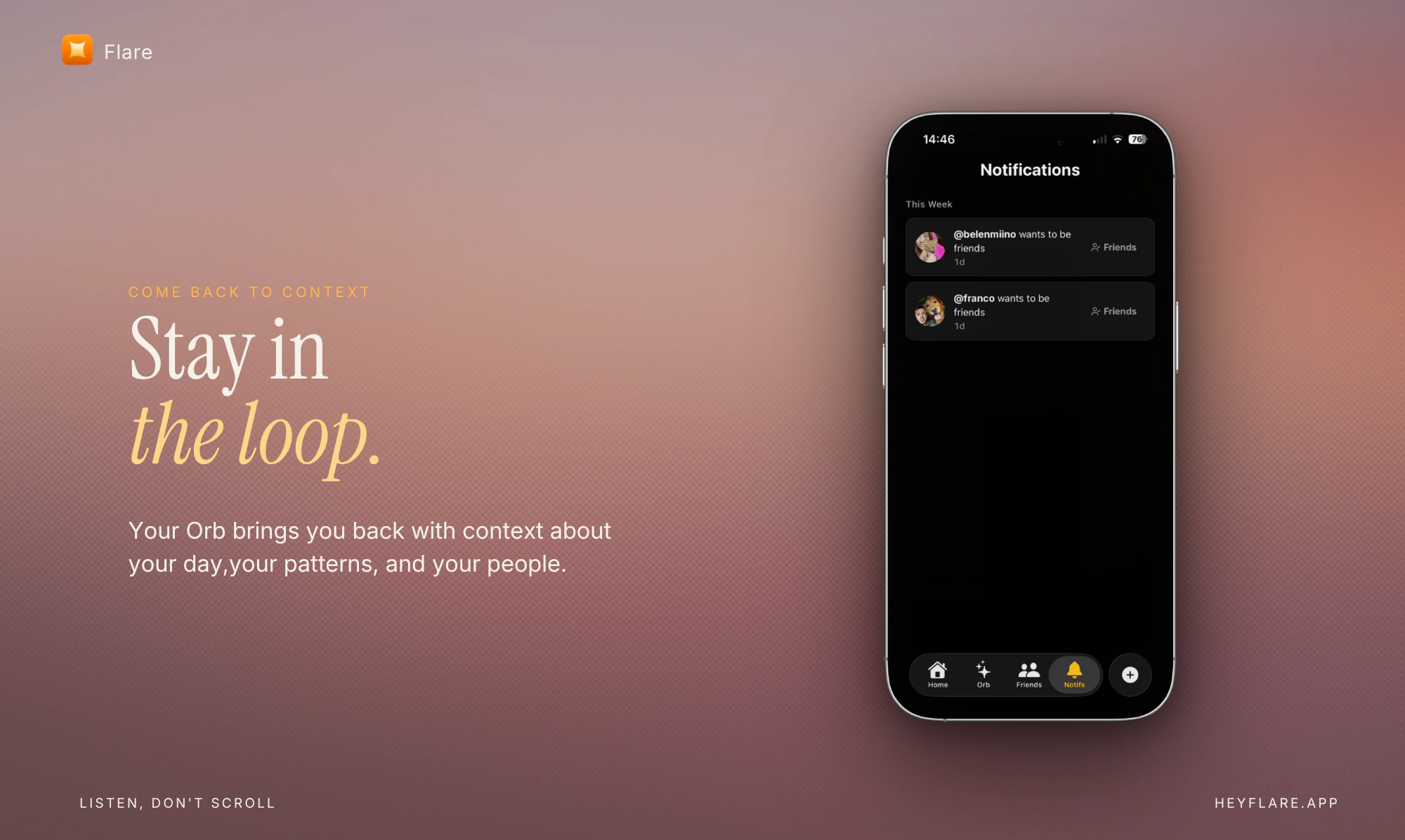
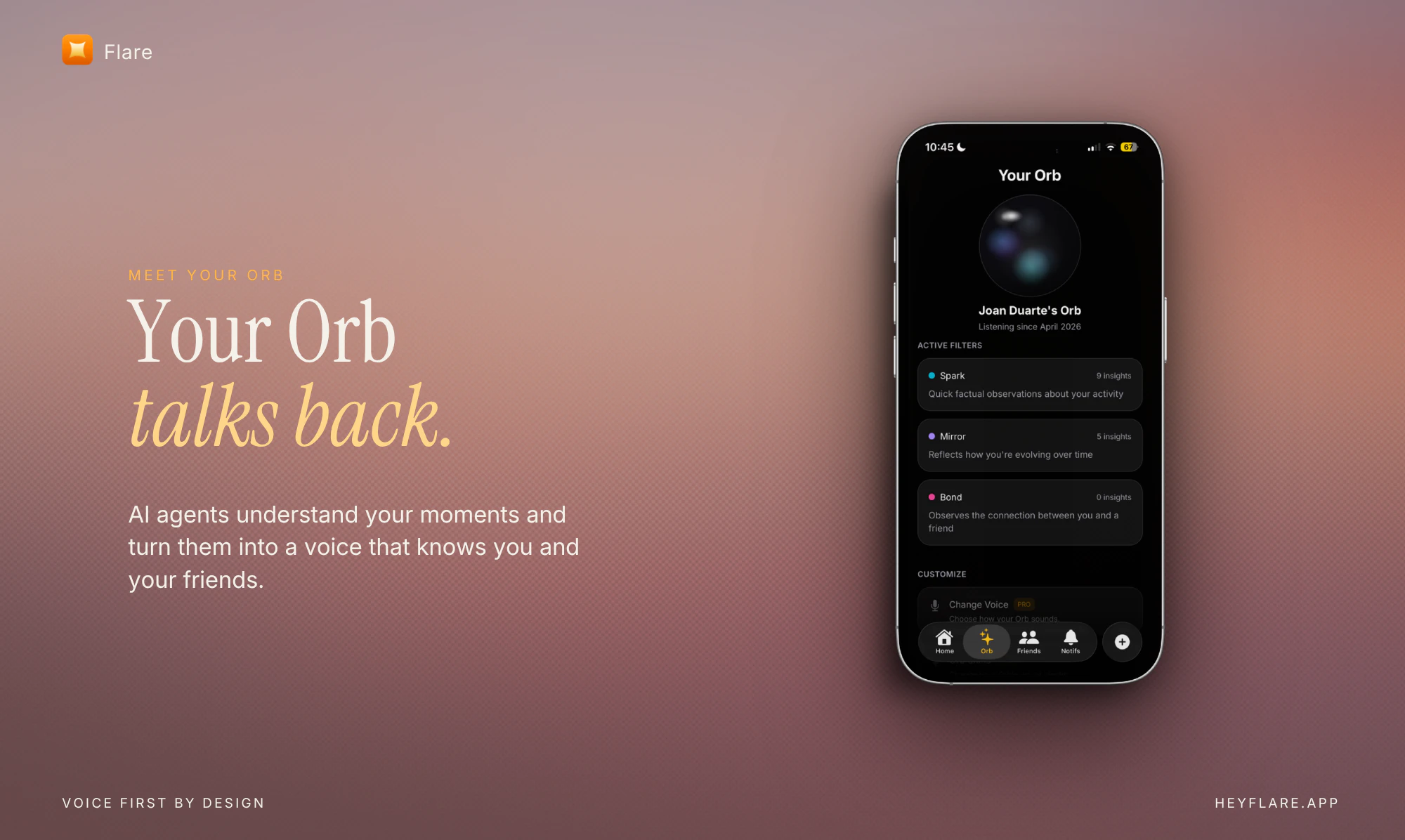
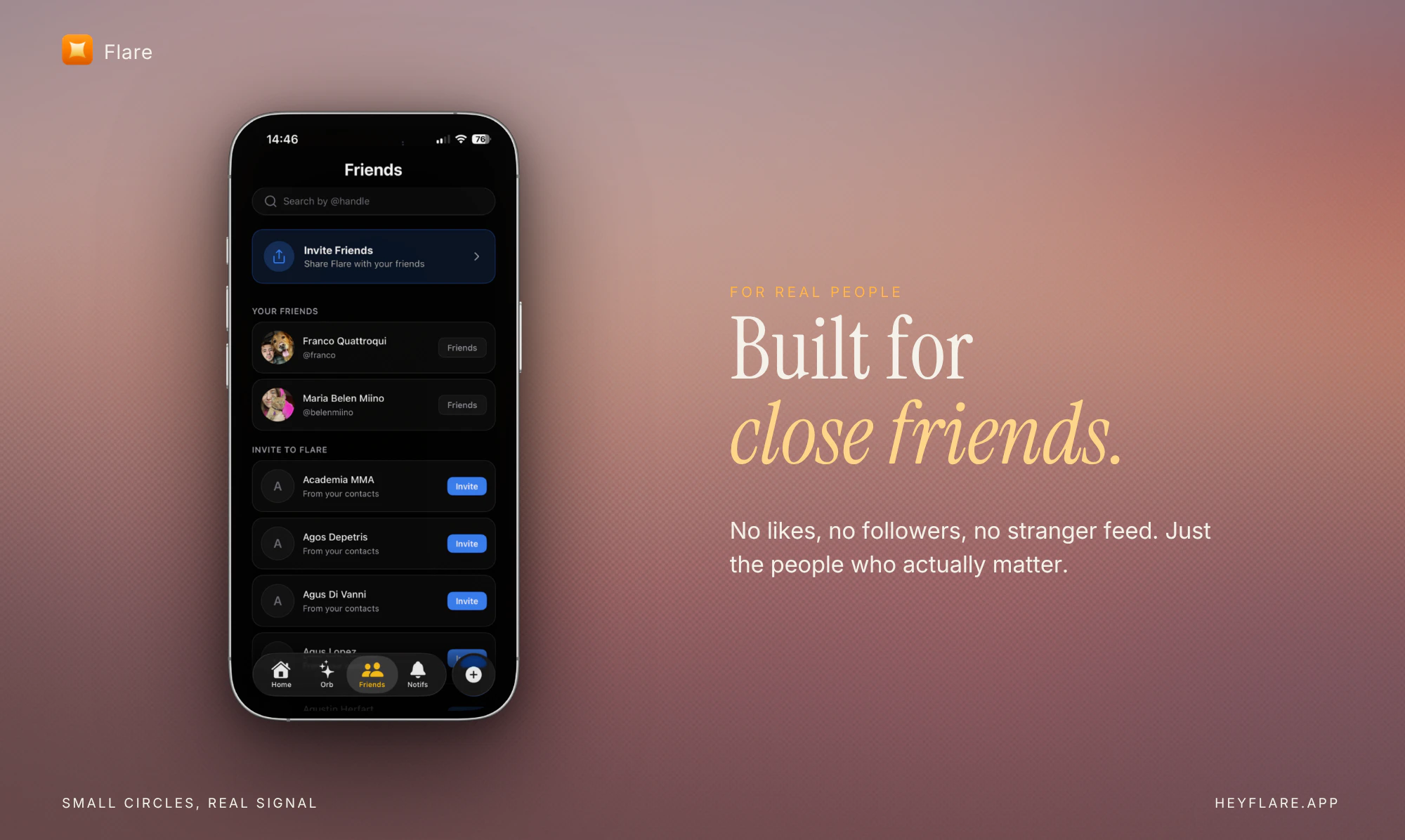
Flare is an AI-native voice-first social app for Gen Z. Capture real moments: photos, short videos, or moods, and your AI Orb uses agents to turn them into memory, identity, and friendship context. No likes, followers, comments, or stranger feed. Just you, your friends, and an Orb that talks back about what matters. A social app you listen to instead of scrolling.

Hey Product Hunt 👋

I'm Joan and with @franco_quattroqui, we are building Flare from Rosario, Argentina, where Messi was born.

We built Flare because social apps stopped feeling social. People still want connection, but posting now feels like performance, comparison, and anxiety.

So we built Flare around voice.

In Flare, you capture real moments: photos, short videos, or moods. Behind the scenes, AI agents turn those moments into memory, identity, and friendship context. Then your Orb talks back about what matters: your day, your patterns, and the people close to you.

There are no likes, followers, comments, or feeds of strangers. Just you, your friends, and a social app you listen to instead of scrolling.

Our bet is simple: text created Facebook and Twitter, photos created Instagram and Snapchat, video created TikTok, and voice creates the next social primitive.

We launched the MVP this week. We’d love feedback on whether the Orb feels personal, whether listening makes social feel different, and what would make you come back every day.

Try Flare on iOS: https://apps.apple.com/app/flare-social-voice-friends/id6758351023


Thanks for checking it out ❤️

7
回复

@franco_quattroqui  @joanduarte How do you tune the AI to avoid generic chit-chat and keep it feeling uniquely "me" over time?

0
回复

@franco_quattroqui  @joanduarte Hey, this looks good..
can millennials also join?

0
回复

This look fun. Will try it out now.

3
回复

@malithmcrdev Thanks! Let me know what do you think!

0
回复

Introducing @Flare today 🚀
We’re building a different kind of social app: no likes, no followers, no stranger feed. Just real moments, close friends, and an AI Orb that helps you understand your life and friendships through voice.

Would love your feedback on the first version especially on what would make the Orb feel surprisingly useful from day one.

Try Flare on iOS: https://apps.apple.com/app/flare-social-voice-friends/id6758351023


Thanks for checking it out ❤️

3
回复

@franco_quattroqui Cool concept removing likes/followers and focusing on close friends and voice feels refreshing. The AI Orb would feel really useful if it gives me quick what changed in your friendships this week or mood/connections insights from voice 🧠✨

0
回复
This is actually refreshing. Most social apps are just feeds and performance loops now, I like the idea of something built around real friends and AI that helps you reflector instead of scroll. Curious to see how the Orb feels after a few days of use. Congrats @joanduarte @franco_quattroqui
3
回复

@franco_quattroqui  @lucio_luchini Thanks!!! Means a lot.

0
回复

@joanduarte  @lucio_luchini Really appreciate this. That’s exactly the feeling we’re trying to build around.

The Orb gets more interesting as it has a few real moments to work with not because it “knows everything,” but because it starts noticing small patterns between you, your days, and your close friends.

Still early, but that shift from feed → reflection is what we’re most excited about.

0
回复

Congratulations

2
回复
0
回复

@madalina_barbu Thank you Madalina 🙏

Really appreciate the support we’re just getting started and it means a lot to have people checking it out on launch day.

0
回复

Honestly the part that gets me is "a social app you listen to instead of scroll." if that actually holds up in real use that's a big deal.
Congrats on launching, keen to try it 🙌

2
回复

@boyuan_deng1 Thank you 🙌

That’s exactly the bet. If “listen instead of scroll” only sounds good as a line, it doesn’t matter. It has to actually feel better in use.

Would love your honest reaction when you try it, especially whether the Orb feels personal fast enough.

0
回复

@boyuan_deng1 Exactly. The line only matters if the product earns it.

For us the real test is: after a few days, does opening Flare feel like checking another app, or does listening to the Orb feel like catching up with your actual social life?

That’s the bar we’re trying to hit.

0
回复

Huge congrats on the launch, Joan! 🚀

The shift from 'scrolling' to 'listening' is a fascinating bet on the future of social. I’m particularly impressed by the three AI agents (Spark, Mirror, and Bond)—having AI work for the user’s memory and friendships instead of just an engagement algorithm is exactly what the space needs right now.

The Aura Orb voice briefing sounds like a great way to stay connected without the typical 'performance' pressure of likes and follower counts. Can’t wait to see how this changes the way GenZ interacts! 👏

2
回复

@anubhav_gupta6 Thank you, Anubhav. I really appreciate this.

That’s exactly how we think about the agents: AI should work for your memory and friendships, not for an engagement algorithm.

Now the hard part is making the Orb feel specific and useful fast enough that people actually come back. That’s what we’re iterating on.

0
回复

@anubhav_gupta6 This means a lot. The agents are probably the part we’re most excited about too.

The goal is for AI to quietly understand the context around your real life and friendships, not turn it into another engagement machine.

If the Orb can make people feel more connected without making them perform, that’s the win.

0
回复

Such a refreshing social app, truly redefining how social was supposed to be. Congratulations on the launch.

2
回复

@himani_sah1 Thank you Himani ❤️

That means a lot. We’re still very early, but the goal is exactly that: make social feel more human again, not more performative.

0
回复

@himani_sah1 Really appreciate this ❤️

That’s the whole reason we started building Flare. Social apps became so good at keeping people scrolling that they forgot the point was connection.

We’re still early, but we want this to feel calmer, more personal, and a lot more human.

0
回复
You made two bold UX bets: “proactive feed comes to you” and “voice briefing (~90–180s) instead of scrolling.” What were the hardest tradeoffs you made to get that loop working (notifications, cadence, transcription, privacy), and what did you intentionally *not* build because it would have pulled you back toward a traditional feed?
2
回复

@curiouskitty Great question.

The hardest tradeoff was not giving ourselves the easy escape hatch: a feed.

A feed makes the product instantly understandable, but it also brings back the same behavior we’re trying to get away from: scrolling, comparing, checking reactions, optimizing what you post.

With the Orb, the pressure is different. It has to earn the right to speak. If it talks too often, it’s annoying. If it talks too long, it becomes a podcast. If it says something generic, the whole thing feels fake.

So we intentionally didn’t build likes, comments, follower counts, trending content, or a stranger feed. We also removed camera-roll posting because it immediately turns into curation.

The core loop we’re trying to get right is simple: capture real moments, let the agents understand enough context, and have the Orb say something specific enough that it feels like your social life talking back, not a feed with narration.

0
回复

@curiouskitty Jumping in as Joan’s cofounder this is exactly the tension we keep coming back to.

The hard part isn’t making AI talk. It’s making it worth listening to.

For us, the “wow” moment shouldn’t feel like a generated summary of your posts. It should feel more like: “wait, how did it notice that about me / my friends?”

That’s the line we’re trying to hit with the Orb: not a feed with narration, but something that makes your social life feel more alive.

0
回复
The 90-180 second voice briefing idea is interesting. It feels less like checking an app and more like getting a personal update from your social life.
1
回复

This is a pretty cool launch. I like that Flare seems focused more on real friendships instead of building another endless public feed.

The voice-first idea also makes the whole experience feel a lot more natural and personal than most social apps out there. All the best guys!

1
回复

Thanks Anirudh, really appreciate it 🙏

That’s exactly the direction we’re trying to push: less public broadcasting, more real friendship context.

Voice felt like the right interface because catching up with people shouldn’t always mean scrolling through a feed. It should feel more natural, personal, and closer to how we actually talk.

0
回复

I watched the video and went through the images, but I'm still not sure how it's a social app? Maybe I'm not just not connecting how orb relates to friends. Am I sharing my photos with friends in his orb, commenting on that?

1
回复

@kylekpate Fair question. The social part is not “post a photo and people comment on it.”

It’s more that you and your close friends capture real moments, and Flare turns those moments into shared context.

So instead of scrolling a feed, your Orb can tell you what’s been happening in your world and your friends’ world patterns, overlaps, things worth talking about.

The goal is less “content with comments” and more “your social life has memory.”

0
回复

Great work team 🙌
okay so the Orb talks back, but who decides when? like does it wait for me to open the app, or does it just randomly ping me saying, "hey you've been in a mood lately"? genuinely curious

1
回复

@abod_rehman Great question.

Today, the Orb mostly waits for you to open the app / start the interaction. We don’t want random creepy “hey, I noticed your mood” pings.

The direction is proactive, but earned: only when there’s enough context to say something useful, and with user control over cadence. If it talks too much, it becomes annoying. If it never talks first, it’s not really alive. That balance is hard.

0
回复

@abod_rehman This is one of the biggest questions for us.

We don’t think the Orb should randomly interrupt you just because it can. That gets annoying fast.

The ideal version is more controlled: you open Flare when you want, but the Orb can proactively surface something only when there’s real context worth bringing up like a friend pattern, a shared moment, or something it genuinely noticed.

So less “hey you seem sad” and more “there’s something happening in your world that’s worth hearing.”

0
回复

The people who spent a decade saying they hated phone calls now send 3-minute voice notes daily.

Same act. Sound waves into someone's day, async reply expected.

Only the packaging changed.

People don't reject behaviours. They reject the cultural baggage attached to them.

Rebrand the act and you can sell the same thing back to the same people who refused it.

1
回复

@yashchoudhary Exactly. People didn’t reject the voice itself; they rejected the baggage around certain voice behaviors.

Phone calls feel intrusive. Voice notes feel async, personal, and low-pressure.

That’s the space we’re interested in: voice as a social interface that feels intimate, but not demanding.

1
回复

@yashchoudhary Really appreciate that, Yash 🙏

You put it better than we could. Voice only works when it feels async, lightweight, and low-pressure not like another demand on your attention.

That’s the space we’re trying to build in: something more intimate than a feed, but still calm enough to fit into real life.

1
回复

Did you ever try air chat? It was an audio-first social network that looked like Twitter and sounded like a podcast. I think audio-first social networks have a lot of promise, but they have to feel fast and connective with other people and high quality. In the demo video, the overall sense I got is it feels like talking to a robot. Do you have any thoughts on how to make it more connective?

1
回复

@rajiv_ayyangar Yes, this is a really fair read.

We don’t think the answer is “audio posts in a feed.” That can easily become Twitter-with-voice. Our bet is that voice should be the interface, not the content format.

And I agree: the demo still has moments where it feels too robotic. The work now is making the Orb faster, more specific, and more connected to actual friend context, so it feels less like talking to AI and more like your social life talking back.

0
回复

@rajiv_ayyangar Totally fair point. That’s also the thing we’re most careful about.

Voice alone doesn’t make something feel human. Context does.

The goal is not “Twitter read out loud” or a podcast feed. It’s more like having something that understands what’s happening between you and your close friends, and brings up the right thing at the right moment.

Still early, but that’s the bar we’re building toward.

0
回复

@joanduarte its a great idea space! Since Flare is building memory, identity, and friendship context from highly personal voice/photo moments, how are you thinking about privacy boundaries so users feel comfortable sharing vulnerable moments without feeling over-profiled by the AI..

1
回复

@sonia_kapoor5 Thanks, Sonia, this is one of the biggest things we’re thinking about.

We don’t want the Orb to feel like it’s “profiling” you. The goal is to make small, useful observations from moments you choose to share, not create a creepy shadow profile.

That’s why we removed public feeds, follower counts, comments, and camera-roll posting. Long term, users need clear controls over what the Orb can use, what stays private, and what gets deleted. If it feels over-profiled, we have not succeeded.

1
回复

Looks fun, how soon are you planning for the android app?

1
回复

@jpinkman We are expecting to have it for Android soon, in a few weeks max.

0
回复

@jpinkman Android is definitely on the roadmap. We started iOS-first to move faster and polish the core experience, but we know a lot of people are waiting for Android too.

Hopefully soon we want Flare to feel cross-platform from the start, especially because it only really works if your close friends can join.

0
回复

Congrats on the launch! I'm curious, will you able to to see your friends' Orbs too or is that private? Where does that "social" aspect come in, aside from when you upload pictures of you surrounded by friends. Why voice as well? What prompted that decision to make it vocal? Do you thing that will bring up challenges later if people don't want to talk out loud all the time?

0
回复

"Listen instead of scroll" is the right framing for what's broken about social right now — the feed-as-default has compressed every interaction into a 2-second swipe. Voice-first reintroduces narrative and pace, which is where memory actually forms. Travel is the other category where this lands well: when I built StoryRoute (https://storyroute.netlify.app/) for narrated city walking routes, the feedback that came back wasn't "good map" or "useful info" — it was that people remembered the place because they heard a story while standing in it. Voice + context = stickiness. Curious how Flare handles long voice inputs: does the Orb summarize back, surface only key moments, or store the full audio for later retrieval? That trade-off seems central to whether the product becomes a journal vs. a feed-replacement.

0
回复
#4
Minions
Open source mission control for Hermes agent
278
一句话介绍:Minions 为 Hermes 智能体提供开源任务控制面板,通过心跳检查与自动重试机制,解决多任务并行时无人监护、任务静默失败的管理混乱痛点。
Open Source GitHub YC Application
智能体编排 开源 任务调度 AI Agent 监控 Hermes Agent 工作流管理 自动化重试 多任务看板 人机协作 开发者工具
用户评论摘要:用户普遍认可其多任务管理价值,但关注点集中于:1) 日志与可观测性不足,仅靠状态难以深入排查问题;2) 持久化记忆支持模糊;3) 未来是否支持自定义 Python Agent 及 LangGraph/CrewAI 等框架;4) 与现有方案(如 Multica)的差异不明显;5) 迁移从 Slack/Telegram 到 Minions 的流程不够无缝。
AI 锐评

Minions 切入了一个真实且正在蔓延的痛点:单个 AI Agent 的演示很酷,但一旦进入“多个长周期任务并行”的生产级场景,缺乏监管的 Agent 就是一颗定时炸弹。项目团队显然深谙其中混乱——心跳检查+自动重试+人工升级的设计,本质上是在给“半自治的 AI”加上工程化的监护系统,这比单纯堆砌“更聪明的模型”要务实地多。

但它的价值目前高度绑定在 Hermes Agent 上,这既是壁垒也是局限。从评论反馈看,用户对“可观测性”和“日志追溯”有刚性需求,而创始人明确表示“不为日志而日志”,转向让 Agent 自主检查日志并修复——这是一个有趣的取舍,但也意味着在复杂故障场景下,用户依然会面临“黑箱”的焦虑。真正撑起“操作系统”级信任,需要提供更详尽的行为审计能力。

此外,0 票差和 Beta 期少得可观的评论数暗示,现阶段更偏向核心用户的早期尝试。后续能否快速支持自定义运行环境(如 LangGraph、CrewAI),是它从一个“好用的螺栓”升级为“生态基础件”的关键跃迁。短期价值在于拯救被多任务折腾的开发者;长期价值取决于它能否在开放中保持控制力——而这正是所有 Agent 编排工具的共同难题。

查看原始信息
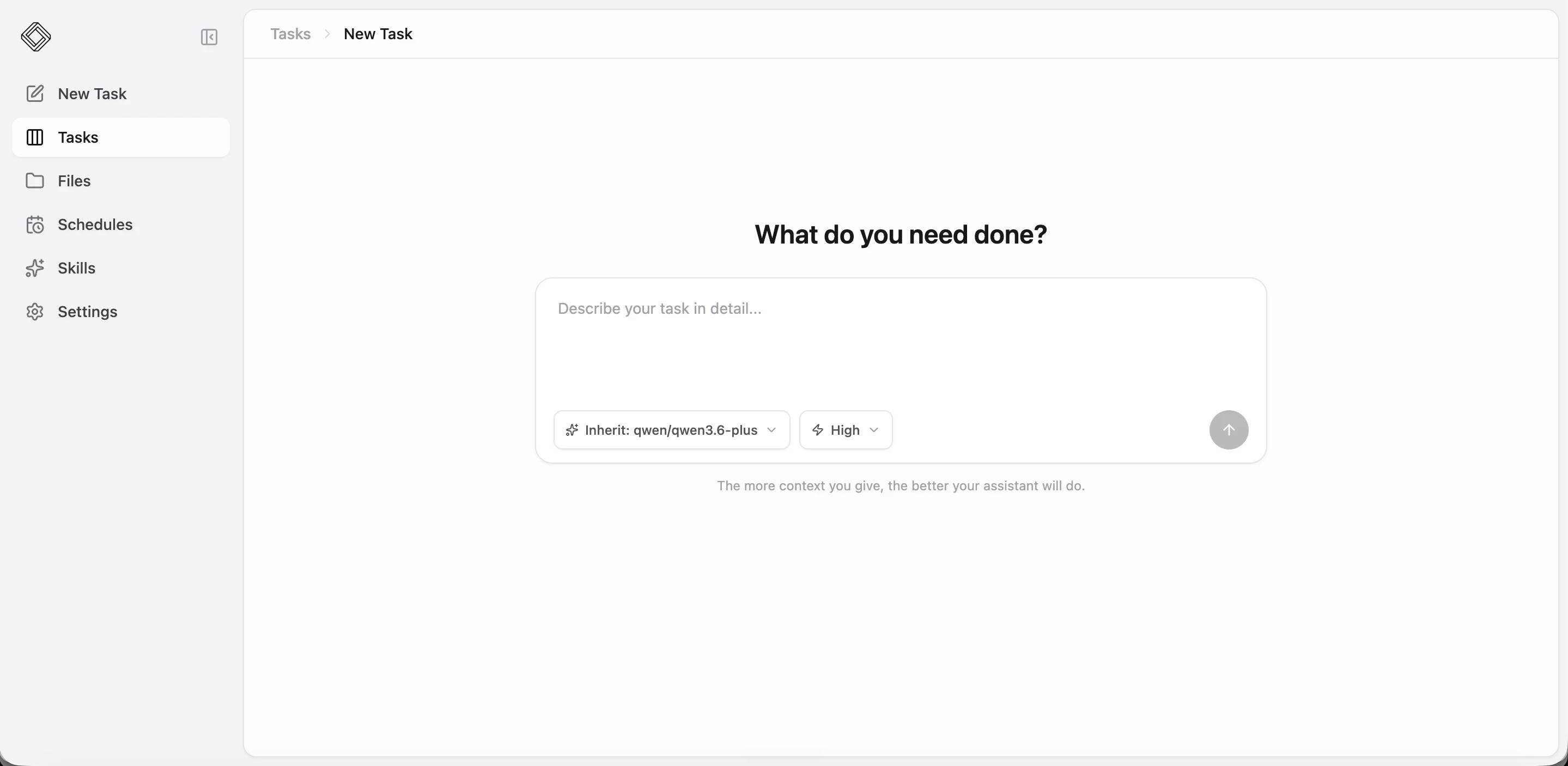
Minions
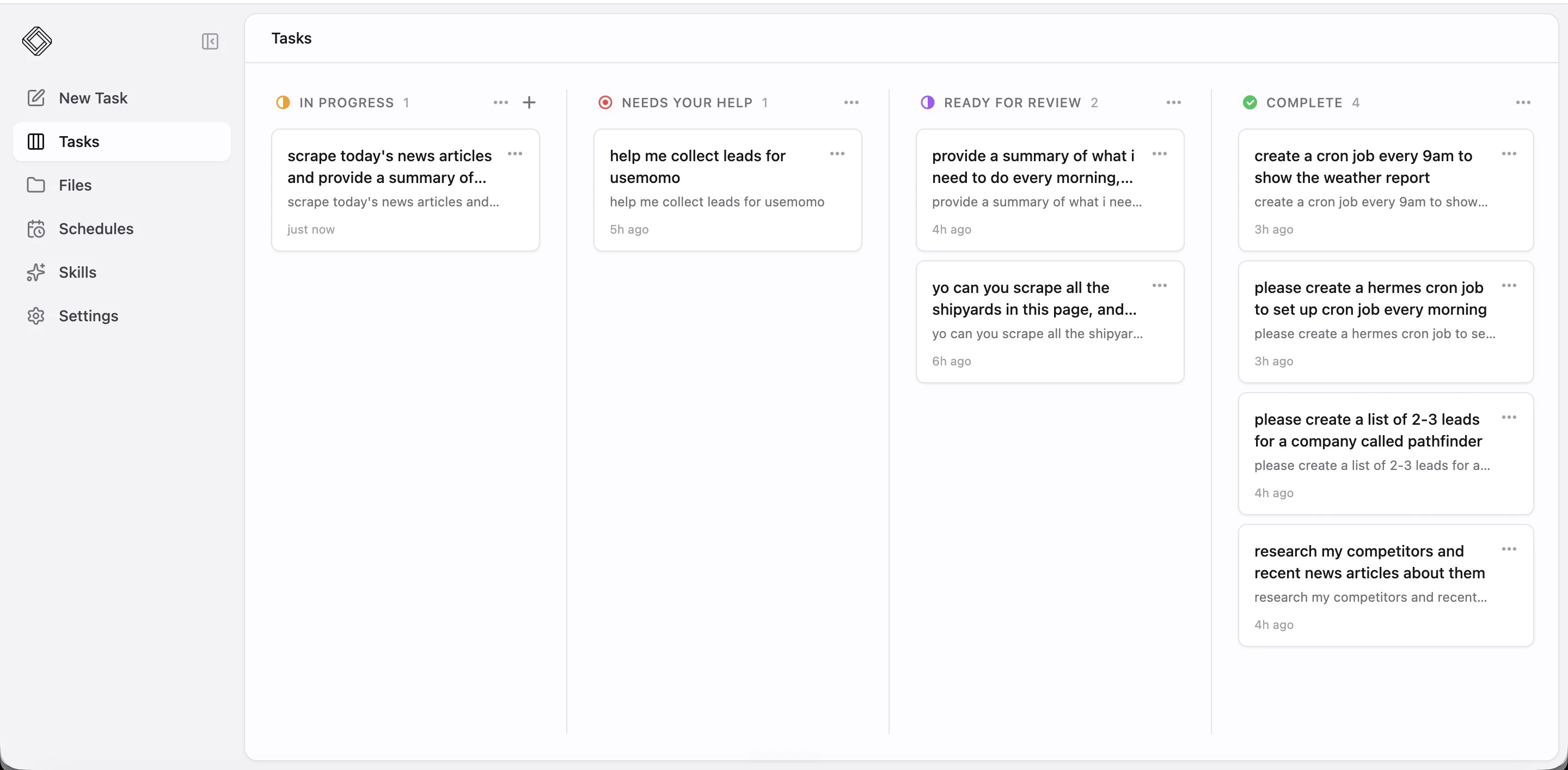
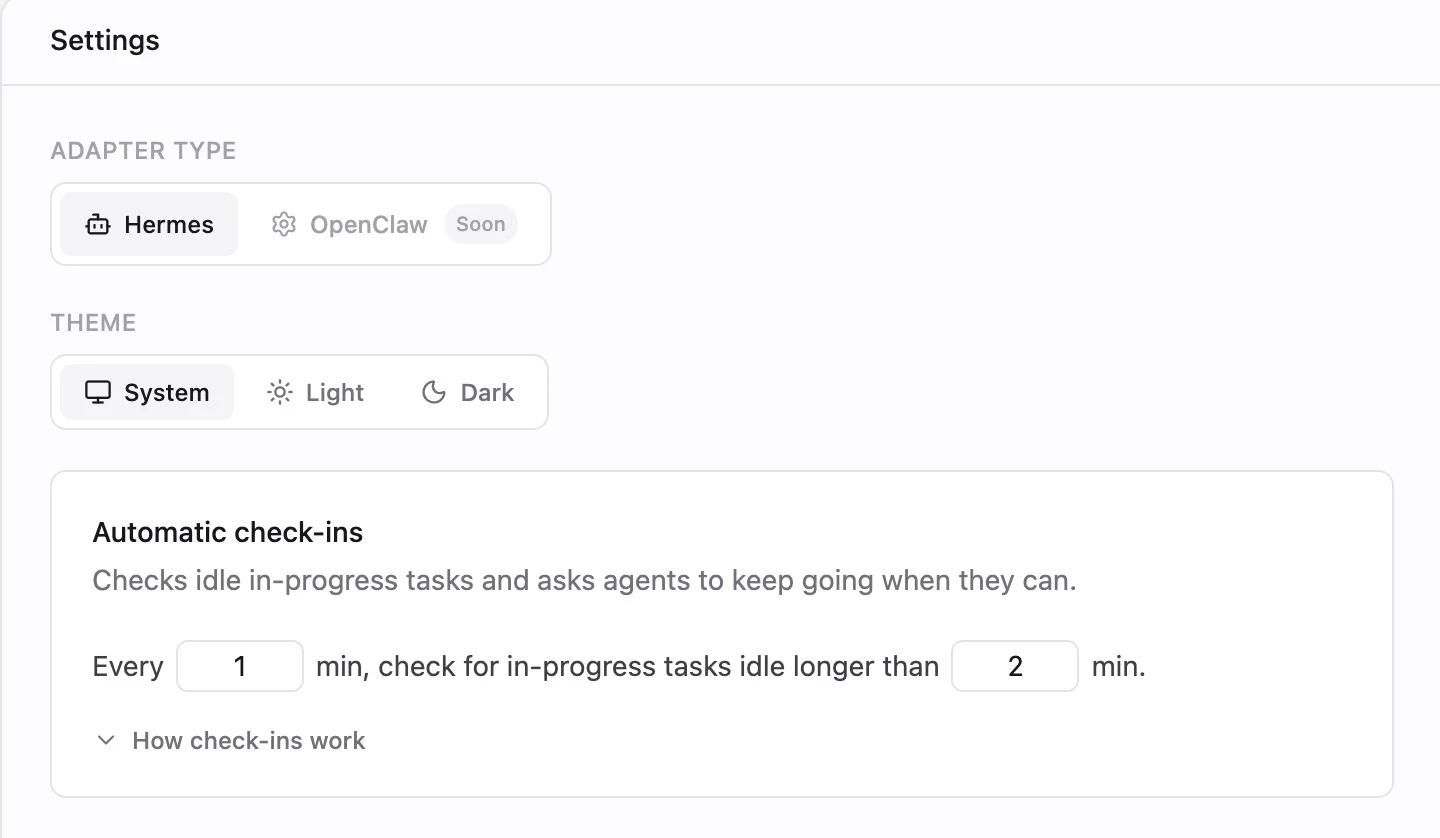
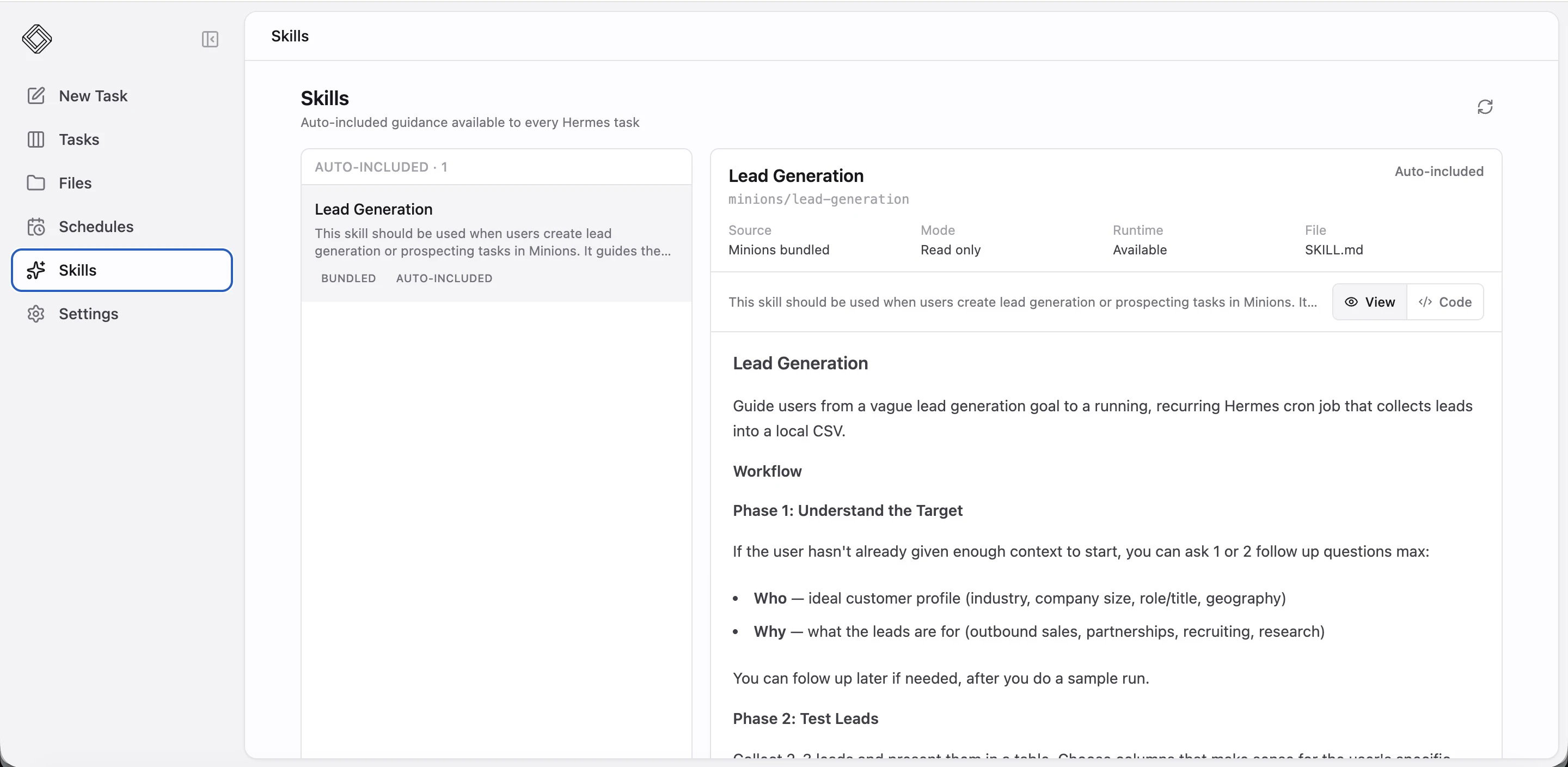
Your Hermes Agent works great for one task. Try managing 20 in parallel? It's chaos. Cron jobs fail silently, tasks are blocked and you're spending more time fixing your agent than getting results. Minions gives you a single task board to view it all. Every running task gets periodic check-ins, retry if stuck, and escalate only when it's genuinely exhausted alternatives Works with Hermes Agent today, more runtimes coming.

Hey Product Hunt, I’m Vishnu, maker of Minions.

I built this after watching Hermes/OpenClaw power users hit the same wall: one agent task works great, but 10–50 long-running tasks become operations work.

The core idea is heartbeat supervision: every in-progress task gets periodic check-ins where the agent is asked to make progress, retry with a different approach if stuck, and only escalate to you when it has genuinely exhausted alternatives. Blocked tasks surface automatically. Completed work moves to your review queue.

Minions is an open-source mission control layer for agentic harnesses starting with Hermes Agent.

What it does today:

  - Create and manage Hermes tasks from one board

  - Track work across in progress, needs help, ready for review, and done

  - Run heartbeat check-ins so stuck work surfaces automatically

  - Stream agent work live while it runs

  - Keep humans in the loop before anything is marked done

  - See scheduled job history and output

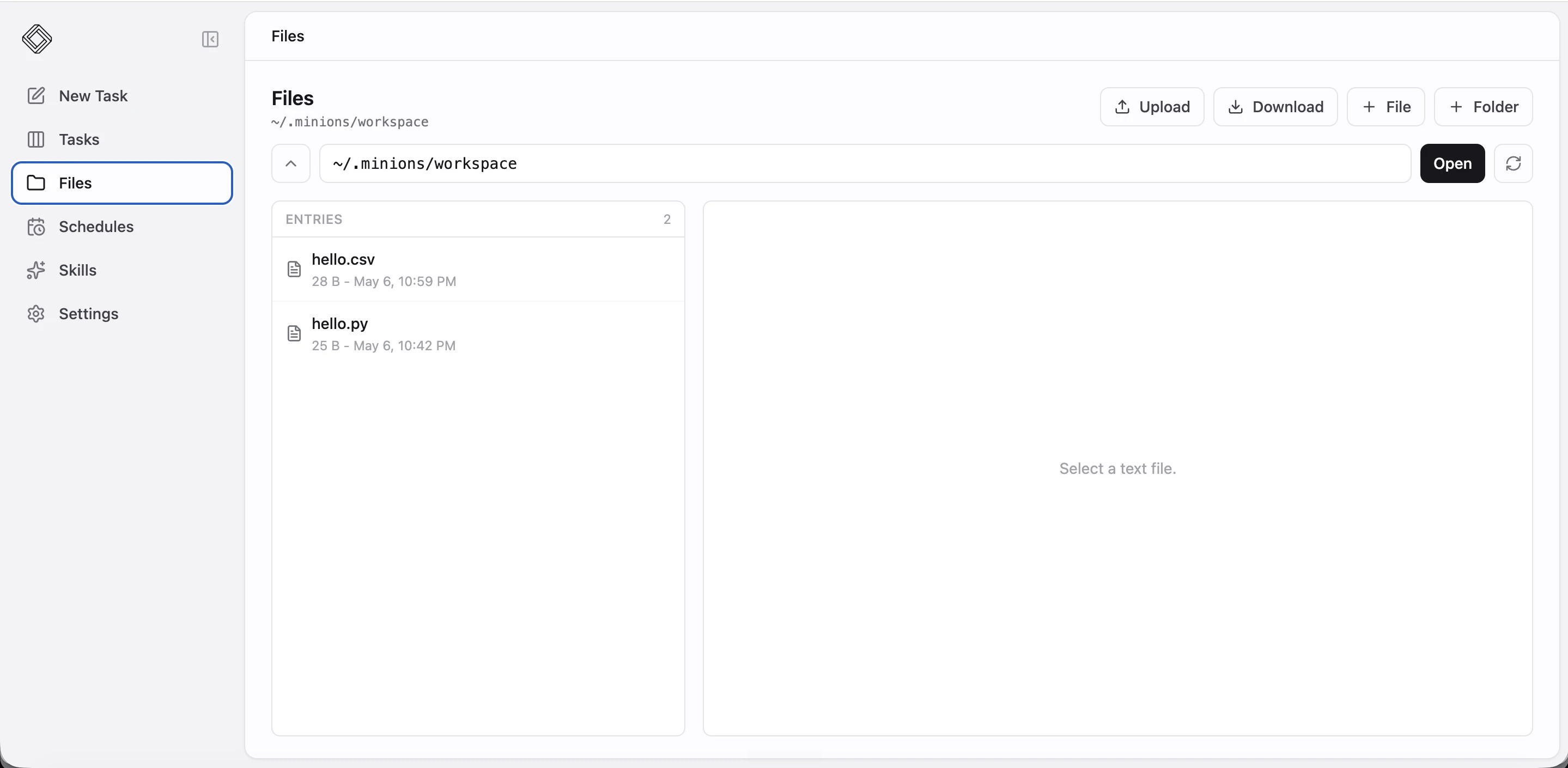
  - Run locally with SQLite, no account required

This is the local/open-source version of the agent management layer we’re building at Agent37. Hosted access opensMay 10, but Minions is usable locally today.

I’d especially love feedback from people running Hermes or OpenClaw agents. Where does your agent work break once you have more than one task running?

14
回复

@vishnukool This feel less like a tool or more like an operating system for autonomous work ✨ Love how Minions brings calm and structure to the chaos of multi-agent workflows.

0
回复

@vishnukool Great to see a solution tackling the "agent chaos" problem! Managing multiple autonomous tasks in parallel is exactly where most AI implementations hit a wall. Providing a centralized mission control for observability and automated retries is a massive step toward making AI agents actually viable for production environments. Love the open-source approach!


You mentioned that more runtimes are coming soon—do you have a roadmap for supporting custom Python-based agents or integration with frameworks like LangGraph or CrewAI?

0
回复

@vishnukool How does Minions handle persistent memory across long sessions to keep agents reliable without babysitting?

0
回复

Love the idea of a single board for all parallel agent tasks. How's observability handled – logs/traces per task, or just status?

2
回复

@ella_bye No logs as of yet, since I don't find it useful for the purpose of supervising. But the supervisor heartbeat could intervene if a task is errored out for instance and check the logs autonomously to try and heal it. It's activity is separated out from the actual Task chat, into an acitvity window so you can see what the supervisor did to progress on the task or heal etc.

1
回复

@ella_bye yess love this unique idea.

0
回复
Loving the blend of automation and personality here! It would be interesting to see how this integrates with complex systems or more custom workflows. How are folks leveraging it in real-time problem-solving scenarios?
2
回复

@hamza_afzal_butt The biggest use case I see is managing long running tasks and when you have a lot of it, it's easy to miss what's done and what's blocked. Cron job management when you have a lot for instance and some of them silently errors out.

1
回复

Congrats on the launch! Waiting to try this out on Agent 37.

1
回复

@zahle_khan Will be out soon :)

0
回复
If someone is currently managing Hermes/OpenClaw work with a mix of terminal tabs + scripts + chat (Slack/Telegram), what’s the specific breaking point where switching to Minions becomes a no-brainer—and what does the first week of migration typically look like?
1
回复

@curiouskitty The moment you're delegating more than 2-3 tasks it's immediately useful to have a central view to see it. I've often hated having to just use whatsapp and there's no easy way to start separate threads. So for people facing this, they'd find it a no-brainer.

Minions does track the sessionIds of it's chat in it's own DB, so a seamless way to migrate would be to start new long running tasks you want to mange in Minions instead of telegram or whatsapp.

0
回复

This looks quite similar to Multica actually, which works great with Hermes

0
回复

@korkyzer Oh interesting.. this is a great find!

0
回复

Nice idea! Could it be used for OpenClaw, too?

0
回复

@matijash Yes, soon. We're starting with Hermes agent and will add OpenClaw support soon.

0
回复
#5
GitHired
Find 100x engineers by proof of work, not resume keywords
221
一句话介绍:GitHired通过分析开发者GitHub上的实际代码复杂度、项目深度和真实技术栈,替代传统简历关键词筛选,自动为招聘方推荐排名靠前的“100倍工程师”,解决技术招聘中“纸上谈兵”的痛点。
Hiring GitHub YC Application
技术招聘 开发者评估 代码分析 GitHub数据 简历替代 人才筛选 开源挖掘 招聘自动化 技术栈分析
用户评论摘要:用户关注提交真实性验证方法、与现有招聘工具(LinkedIn Recruiter/HackerRank)的协作模式、私有仓库访问权限(写权限问题)、项目深度与广度评分权重、以及新鲜度对排序的影响。有用户反馈实际帮助找到了优秀的AI工程师。
AI 锐评

GitHired切中了一个长期被忽视但极其核心的痛点:技术招聘中“简历通胀”与“能力通缩”的错配。其价值不在于又一个AI筛选工具,而在于将评估锚点从“自我描述”彻底迁移到“行为证据”——代码的本质是工程师的“行为轨迹”。通过解析私有仓库、验证提交真实性,它试图杀死“绿点造假”和“关键词堆砌”的灰色产业链。

但产品面临两个硬伤:第一,深度依赖GitHub生态,对非开源、非活跃的工程师(如企业内网开发者)形成系统性偏见,可能错失大量实战型人才;第二,“100x工程师”的定义过于技术极客化,忽略了工程协作、架构决策等更软性的“高杠杆能力”,代码复杂度高不代表工程产出高。此外,OAuth写权限的争议暴露了隐私与便利的经典矛盾——企业客户会为此买单吗?

其更聪明的路径是:作为现有ATS(应聘者追踪系统)或HackerRank等评测工具的“信号层”,而非完全替代。如果能开放API让招聘流程中的“证明力”数据回流,并开放评分模型的可解释性,才可能从“有趣的新工具”进化成“招聘基础设施”。目前看,它更像一个把“找人”效率提升了20%的利器,而非颠覆者。

查看原始信息
GitHired
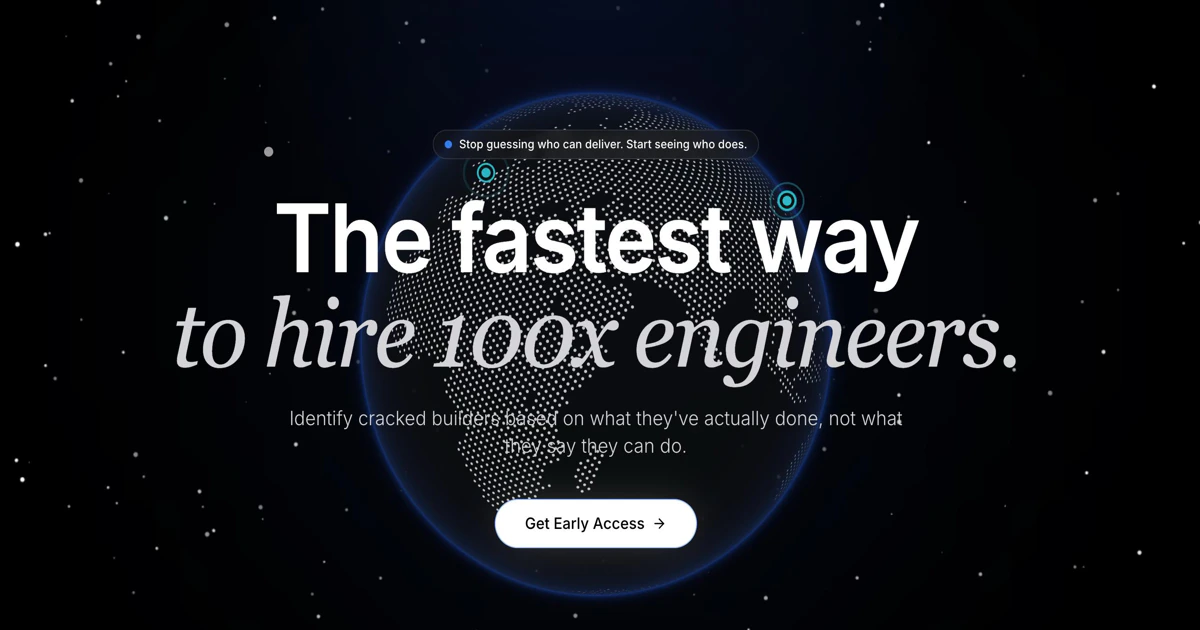
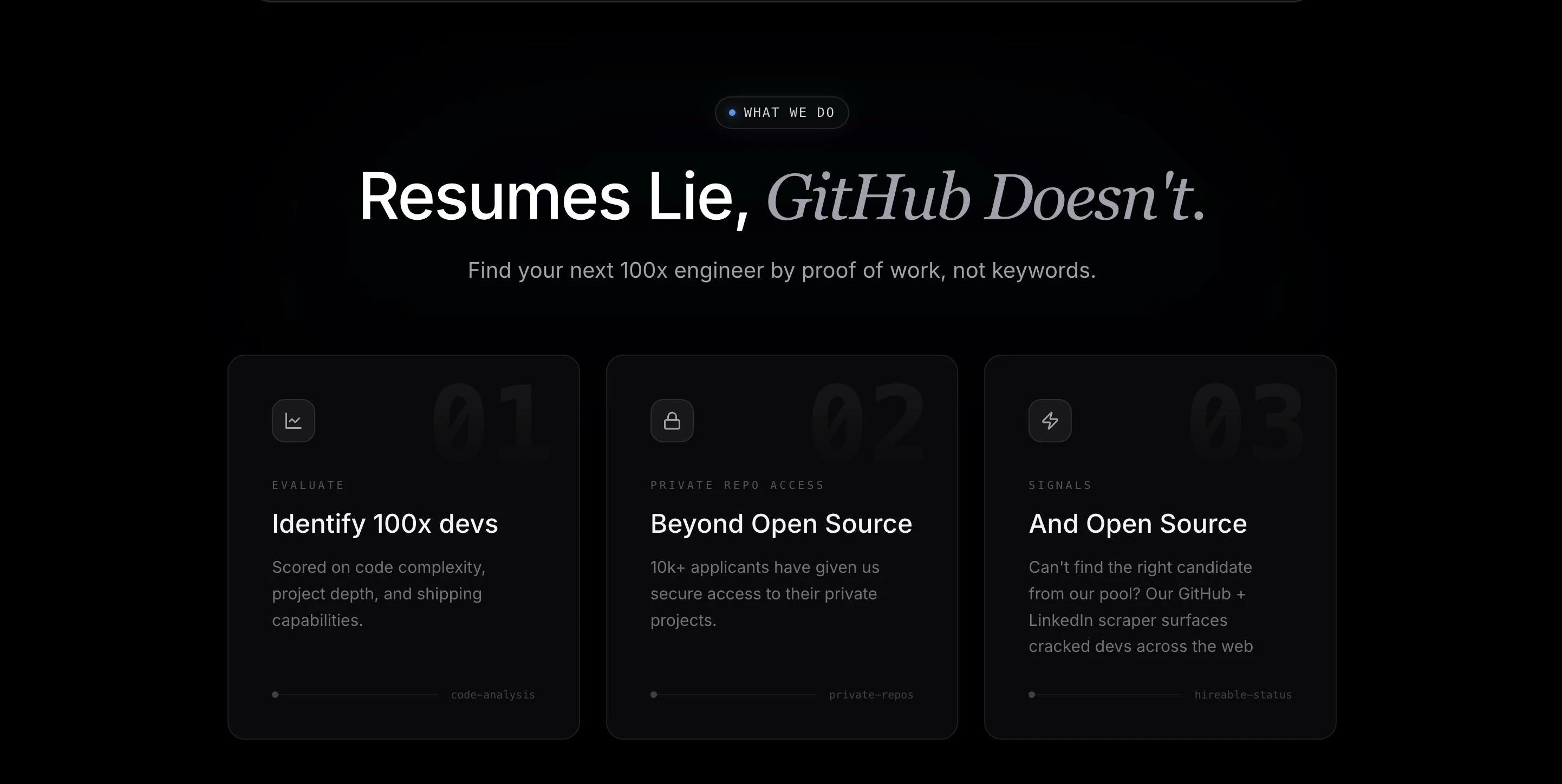
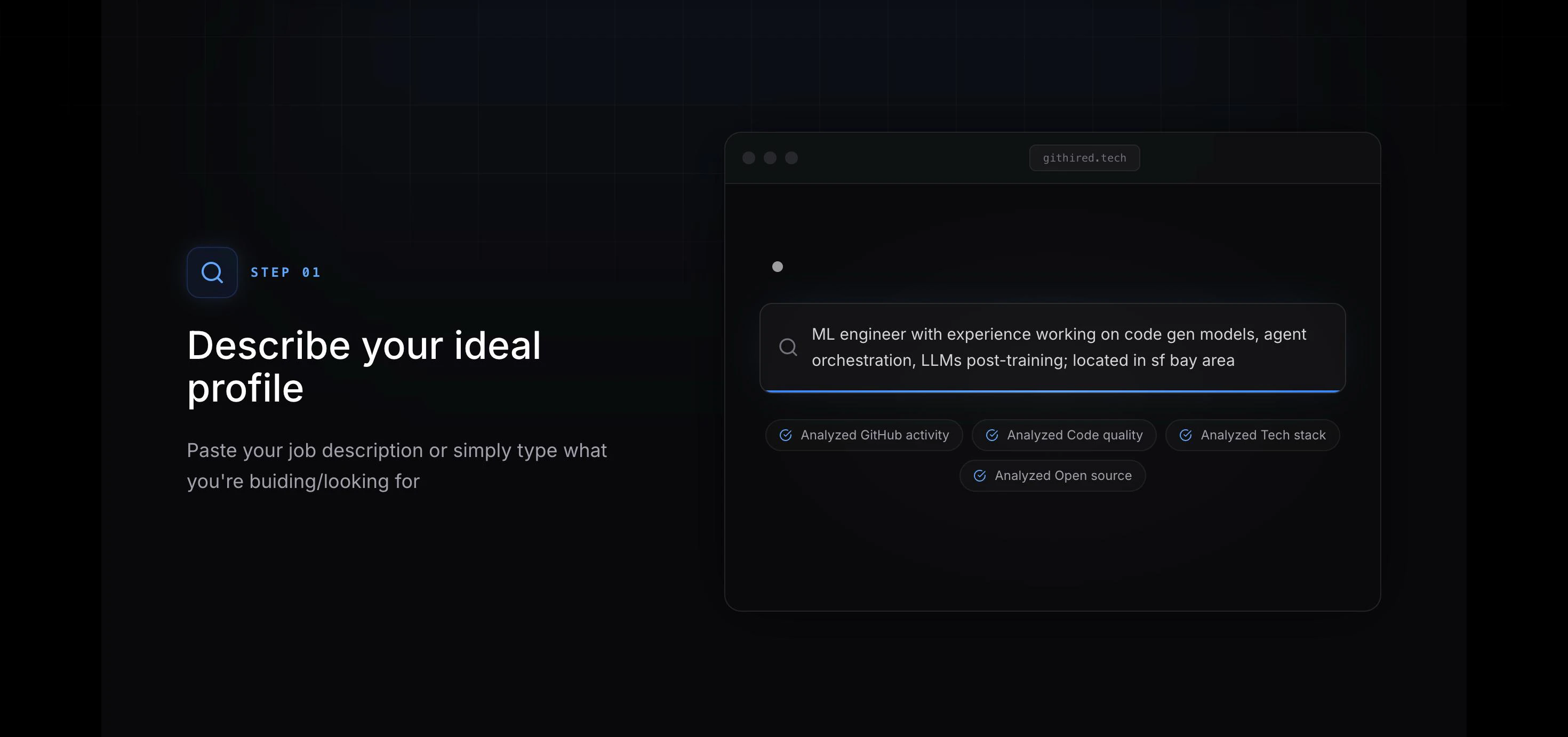
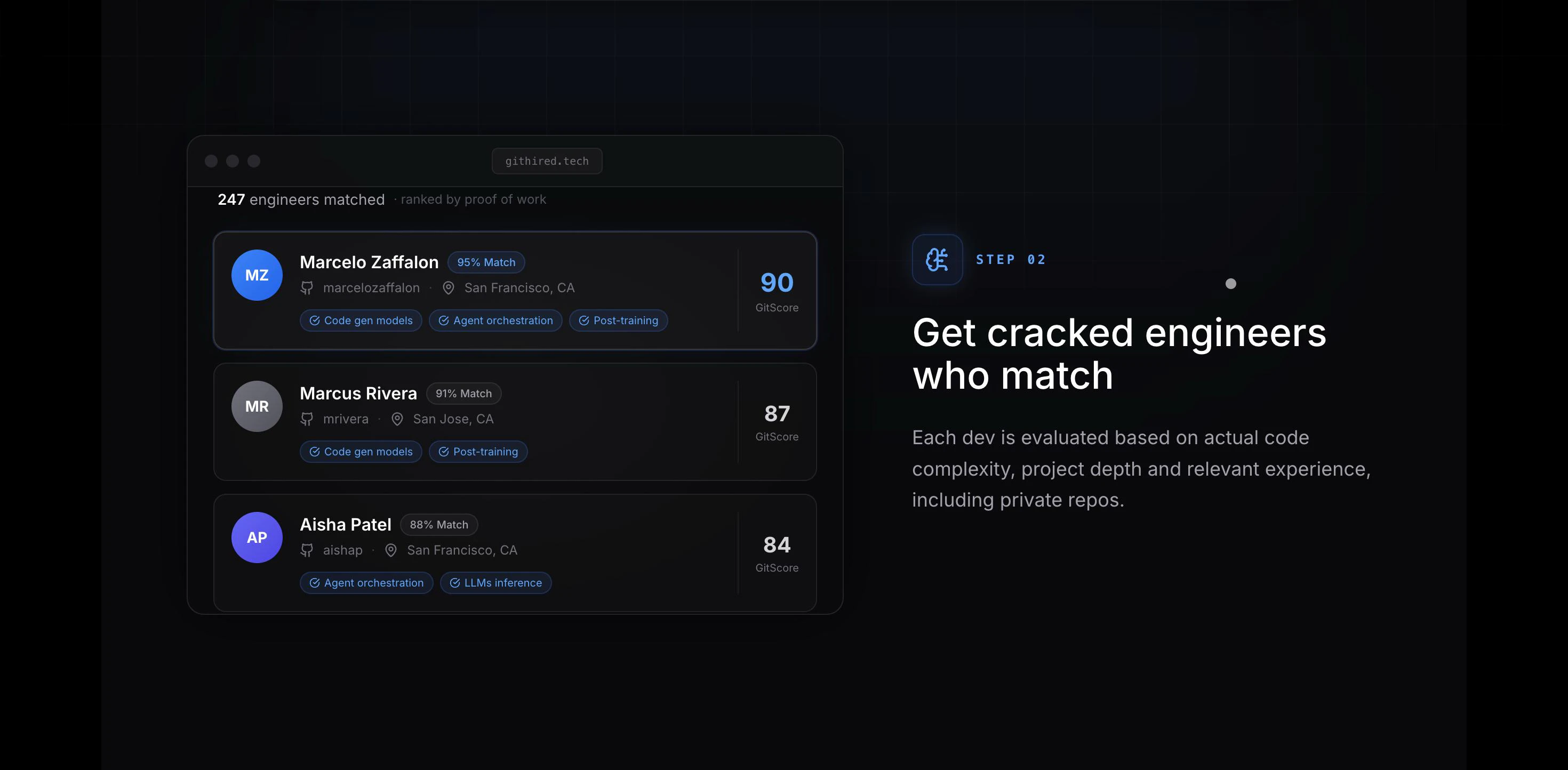
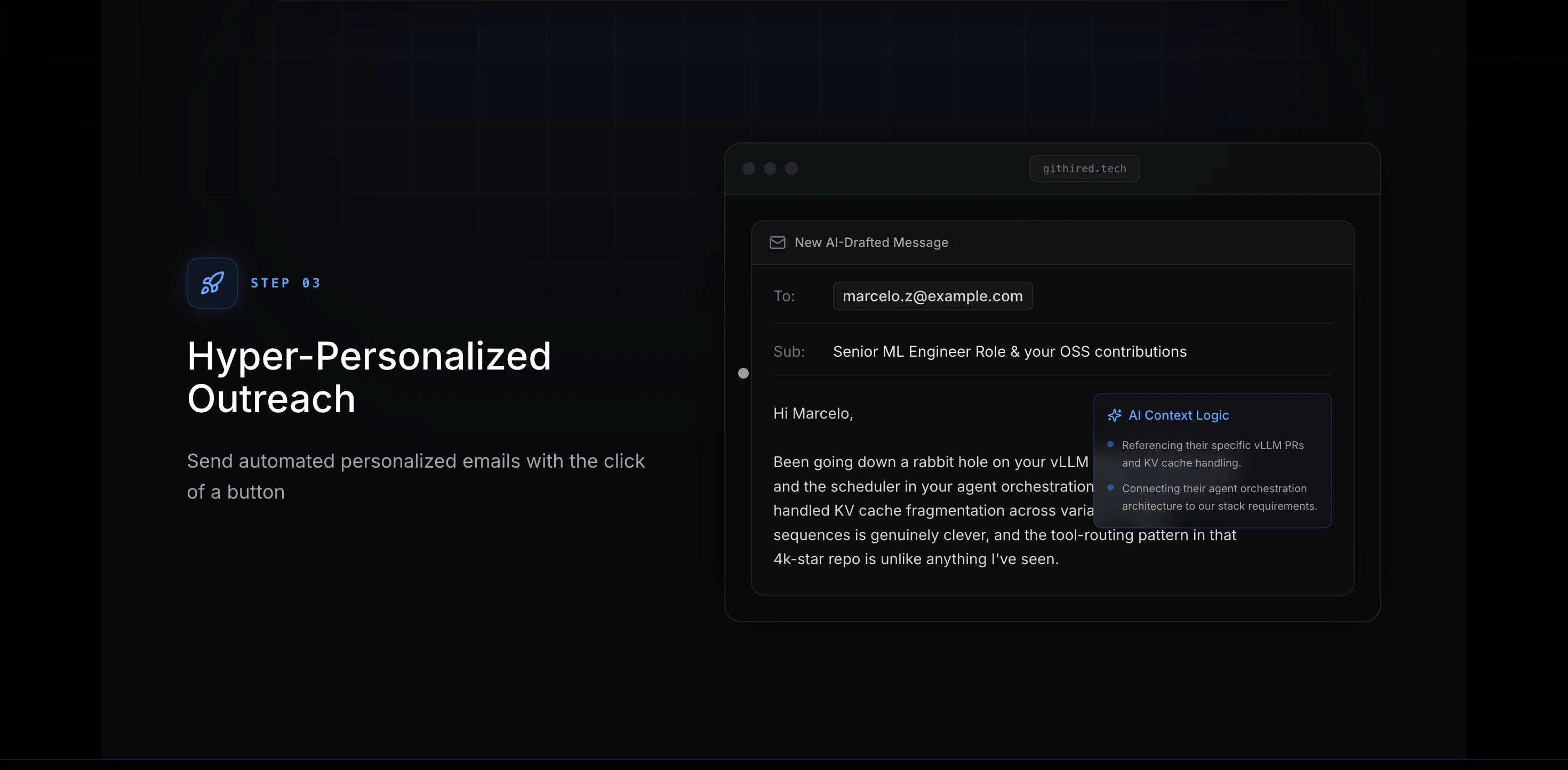
Find 100x engineers on autopilot: Describe what you're building/looking for, and instantly get a ranked list of the most cracked engineers who meet your requirements. Search from our pool of 10k+ profiles that have been evaluated based on actual code complexity, project depth, and relevant experience- including access to private repos for maximum accuracy. And if that pool falls short, use our inbuilt GitHub + LinkedIn scraper to source cracked open source devs.

Hey everyone 👋
I’m Raghav, the Founder of GitHired.

Hiring devs is broken- you can’t tell if someone is a 100x engineer just by looking at a resume.

Some candidates look perfect on paper but can’t ship real features.
Others who can build get filtered out because of a missing keyword.

So we built something better. We analyze what a developer has actually built, not what they say they can build.
We break down their real tech stack, project depth and complexity, commit authenticity (no more fake green charts). Just describe what you're looking for, and get a ranked list of the most cracked devs with the skills relevant for the role.

Stop guessing who can code. Start seeing who does.

We’re early, shipping fast, and would love your feedback. Tear it apart, ask questions, or tell us what would make this a no-brainer for your team. The first search is free!

11
回复

@raghavb11 How do you verify commit authenticity, and what's the biggest "aha" insight you've seen from a dev's project depth that flipped a hiring decision?

0
回复

There is a tension tho. If your a 100x engineer you basically dont want to work for anyone. You have rather have 10x engineers working for you 😏

2
回复
If a team already uses LinkedIn Recruiter/SeekOut/hireEZ for sourcing and HackerRank/Codility/CodeSignal for evaluation, where does GitHired replace vs complement—and what’s the end-to-end workflow you see working best for a founder or in-house recruiter?
2
回复

Loved the idea and execution Raghav.

At the last you mentioned. You have access to private repos as well. Curious, how are you having that?

1
回复

@abhinav_anand21 its optional if you want us to get access to it- because not everybody is an open source dev:)

0
回复

yeah, I really love this software. It's actually helping us meet with applied AI engineers that are really talented, so thanks bro.

1
回复

@kane_collier glad to hear that!

0
回复

This is hiring by seeing the code not hearing it. Great launch guys....

1
回复

@thamibenjelloun thank you!

2
回复

Proof-of-work over keywords is the right axis for hiring — the resume-keyword game has been gamed for so long that any signal upstream of "things they actually built" is mostly noise. The same dynamic shows up in finance/FP&A hiring: "Excel expert" on a resume tells you nothing, but a working three-statement model with proper switches and an LBO toggle that doesn't break tells you everything. We hit this exact gap teaching financial modeling on Udemy (https://www.udemy.com/course/excel-for-financial-modelling/) — the people who finish the course aren't the ones who knew formulas going in, they're the ones who could rebuild a broken model from scratch. Curious how GitHired weights project depth vs. breadth when an engineer has 30 small repos vs. 3 substantial ones — the tail matters but it's hard to score.

0
回复

This is how it should work honestly a GitHub profile tells you more than any resume. Does it factor in commit quality and consistency or mostly just activity volume?

0
回复

We've experienced this - CVs are a terrible way to screen engineers. Looking forward to seeing how this evolves

0
回复

It requires "This application will be able to read and write all public and private repository data." Why do you need write access too?

0
回复

@m_tolga_cangoz there's no way to get only read access in GitHub OAuth apps- its the standard default from GitHub

0
回复

Being able to upload your own list of candidates and run them through the scoring is a really nice addition, if one candidate has older projects and another has newer ones but both score the same, does how recent their work is, change who ranks higher?

0
回复
#6
Kuku: open source
Your open-source, local second brain for every AI
200
一句话介绍:Kuku是一款开源、本地优先的第二大脑工具,将个人知识库以纯Markdown文件形式存储,并整合AI辅助编辑与可审查的差异改动,解决用户在封闭笔记应用或一次性AI聊天中知识无法复用和迁移的痛点。
Text Editors SaaS YC Application
开源 本地优先 第二大脑 Markdown笔记 AI辅助编辑 知识管理 AI记忆层 双链笔记 Tauri
用户评论摘要:用户赞赏其本地优先和开源特性,尤其对采用Tauri而非Electron的轻量设计表示认可。主要问题集中在:如何确保本地知识在接入外部AI时的隐私安全;与其他工具(如Cursor)的上下文共享机制;以及记忆层是否支持多模型切换。开发者回应称记忆层旨在成为开放的、可被其他AI工具读取的本地上下文源,并支持多模型。
AI 锐评

Kuku的再出发,精准地踩中了当前AI知识管理工具的“三大原罪”:封闭、短暂与失控。它用“开源+本地优先+纯文本”这一朴素但极其强大的组合,向Obsidian等封闭生态与ChatGPT等对话式AI发起了革命。

其核心价值不在于又一个漂亮的编辑器,而在于重新定义了AI时代“记忆”的所有权结构。Kuku将知识沉淀为可操作的“上下文层”,而非禁锢在应用内的数据孤岛。它押注的是,用户最终会厌倦于在一个个AI聊天窗里重复相同的人生背景故事,而渴望一个可携带、可自持、可被各种AI工具调用的“个人记忆护照”。

然而,当前AI编辑器赛道已拥挤不堪,Kuku面临严峻挑战。其“AI建议,用户审查”的模式,虽规避了“一键魔改”的风险,却也提高了使用门槛,与追求“极简”的主流背道而驰。更核心的问题是,如何说服主流用户自建Git同步,并忍受一个仍在“alpha”阶段的E2EE层?Kuku的生态构建能力和易用性打磨,将决定它是成为撬动AI知识管理格局的杠杆,还是又一个叫好不叫座的极客玩具。它提供了一个正确的方向,但执行上仍需证明自己“开源但专业”的承诺不是一句空话。

查看原始信息
Kuku: open source
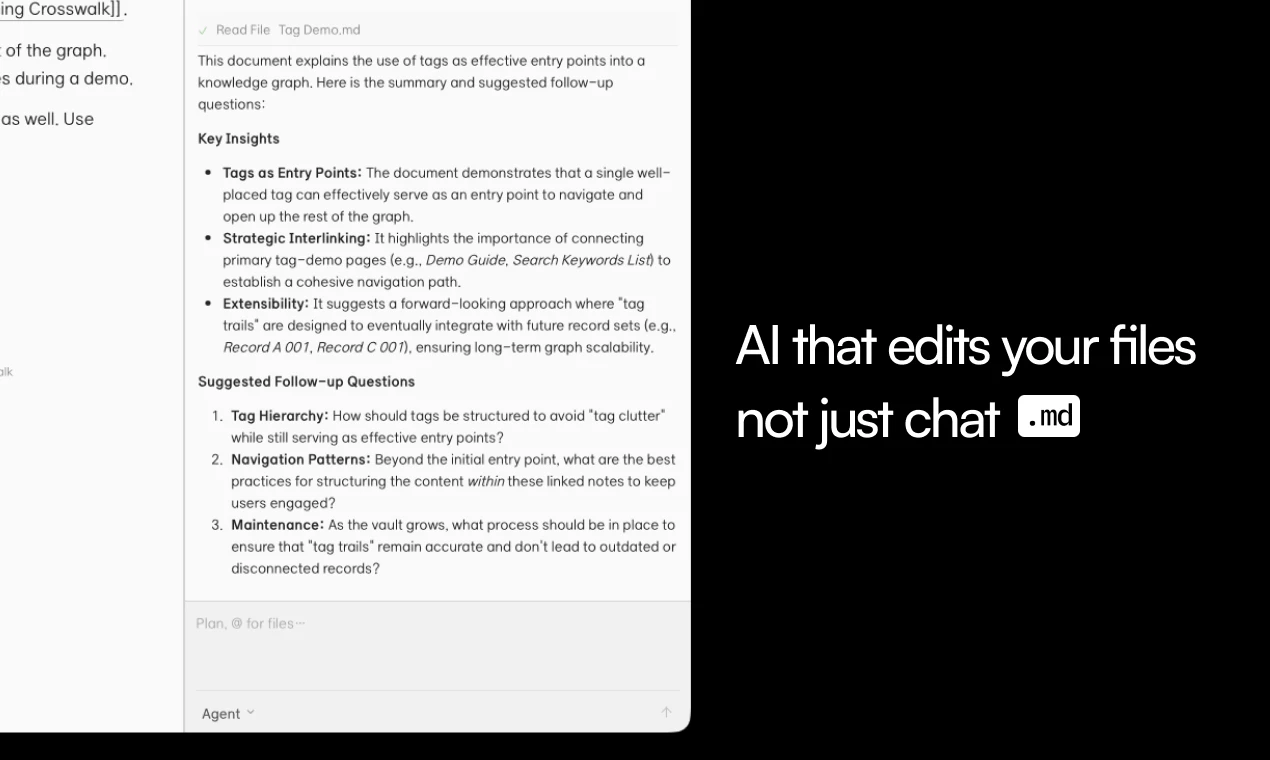
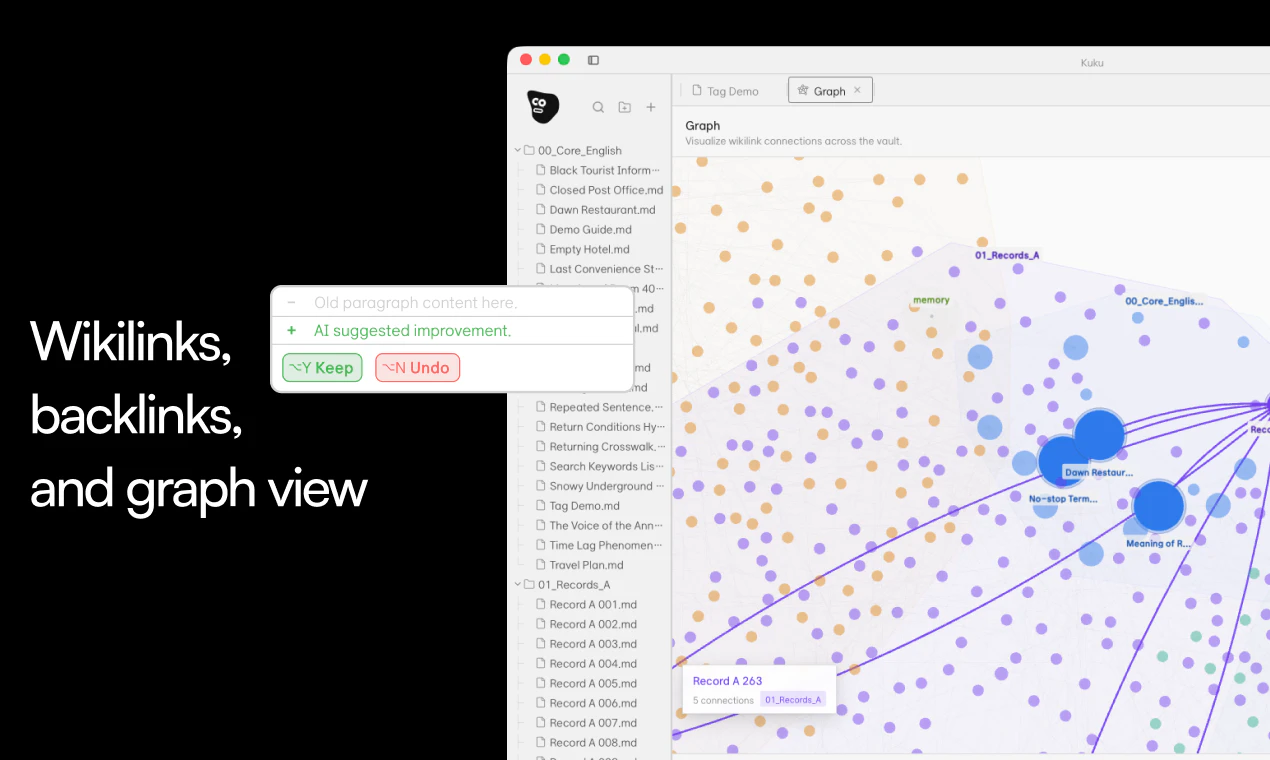
Kuku is back as an open-source, local-first second brain for the AI era. It keeps your knowledge in plain Markdown files, then turns your vault into reusable context: wikilinks, backlinks, graph, search, and AI-assisted edits with reviewable diffs. Unlike closed note apps or one-off AI chats, Kuku is built to make your memory portable across tools, models, and self-hosted setups.
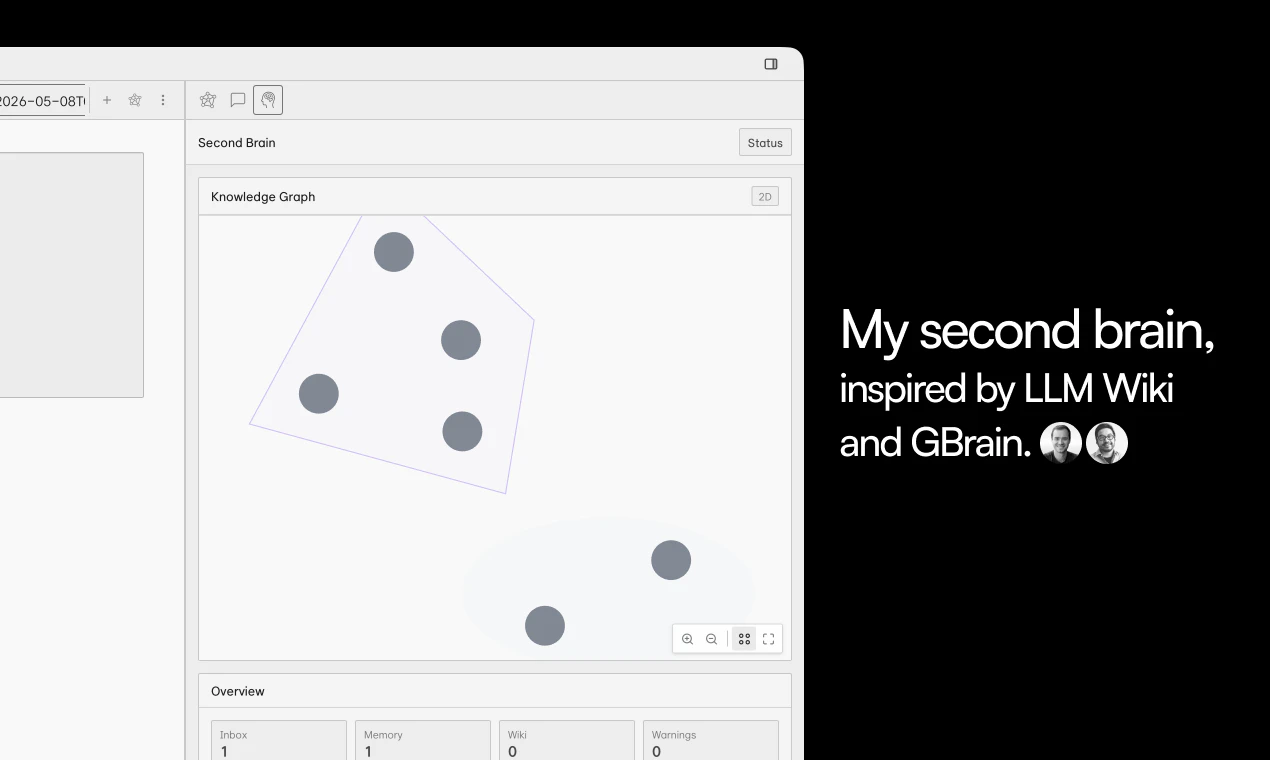
Hey Product Hunt 👋 I’m Minkyu Lee, design engineer on Kuku. Our first launch started as an Obsidian-like Markdown editor. Thanks to this community, we got a ton of attention, feedback, and energy from it. Since then, we’ve been rebuilding Kuku almost from the ground up, many late nights included. Kuku is now open source and moving toward something bigger: a local-first second brain that can become shared memory for your AI tools. Think plain Markdown, wikilinks, graph, search, Cursor-style AI edits, and a Mem0-like memory layer — but open, hackable, and yours. We’re still early, still shipping hard, and looking for people who want to help shape it: users, contributors, plugin builders, and anyone obsessed with AI context. Would love your feedback, questions, and weirdest use cases.
8
回复

@bigmacfive how does the memory handling compare to obsidian's smart connections plugin or official copilot?

2
回复

@bigmacfive How does it ensure your personal notes stay truly private and local when feeding context to external AI, without any cloud leakage?

3
回复

@bigmacfive what's one plugin or integration you're most excited to enable first for sharing context with tools like Cursor?

0
回复

Hi everyone, I’m one of the developers behind Kuku, mainly working on the core logic and implementation.

We’ve rebuilt a lot of the product from the ground up for this launch, while thinking deeply about how local-first Markdown knowledge management can connect with an AI memory layer.


Kuku is still early, and there’s a lot we want to improve.

Please feel free to share anything. I’d be happy to answer as openly as I can.


We’ll also be shipping frequent updates from here, so please keep an eye on what’s coming next.

2
回复

It’s Friday, so we’re going for it. @Y Combinator

Kuku is open source, but we’re building it like a real company: a local-first second brain and memory layer for the AI era.

2
回复

congrats on the relaunch. the tauri + local-first call is the right one, electron-based note apps always feel like they're fighting the OS. the cursor-style diffs for AI edits is the part that sells it for me, "AI suggests, u review" is way better than the yolo-edit pattern most tools ship with.

curious where ur memory layer goes from here, is the plan to expose it as a context source other AI tools can read from, or keep it inside kuku?

1
回复

@saad_el_gueddari 
Thank you, really appreciate it.

And yes, that’s exactly the direction. We don’t want the memory layer to stay trapped inside Kuku. The goal is for Kuku to become an open, local-first context source that other AI tools can read from, while the user stays in control of what gets exposed.

Kuku starts as the place where your Markdown vault, wikilinks, graph, search, and AI edits live. But longer term, we want it to work more like a portable memory layer: local API, MCP-style bridges, self-hostable sync, and permissioned access for different agents/tools.

So the principle is: your memory lives with you, Kuku organizes it, and AI tools can use it only when you allow them to.

0
回复

@saad_el_gueddari 
From the implementation side, I also think the memory layer loses a lot of value if it stays locked inside Kuku. We wanted the memory format to be easy for humans to read, easy for AI to understand, and simple enough to edit from other tools.

That’s one of the main reasons we chose Markdown as the base format. Even for memory, we want to keep it as close as possible to Markdown or plain text, rather than hiding it behind a closed internal format.

The core idea is that your knowledge and context should not be trapped in a single app. Kuku should organize and connect it, but the user should ultimately own and control it as an AI context layer.

0
回复

Finally someone said "fuck Electron" for a markdown editor. Tauri + local-first + AI that actually writes to files instead of just yapping. Pure signal. Congrats on the launch! ⚡️

1
回复

@igor_martinyuk 
Haha exactly. The whole bet was: what if a markdown editor didn’t feel like a browser wearing a trench coat?

Tauri + plain files + local-first felt obvious to us. And AI should not just yap in a sidebar forever — it should understand the vault, propose real file changes, and let you review the diff before anything lands.

Appreciate you Igor ⚡️

0
回复

How do you handle sync between devices if it’s local first, like is there a recommended setup with Git?

1
回复

@othman_katim 
Great question. We already have an E2EE sync layer in place, but I’d still consider it alpha, so I don’t want to oversell it yet.

If you’re comfortable with Git, setting up a Git repo per vault is a really good approach. Since your notes are local Markdown files, you can sync them across devices, keep history, and handle changes in a way that feels familiar to developers.

One small recommendation: add the .kuku folder to your .gitignore, since it may contain local indexing/cache data that doesn’t need to be synced.

1
回复

The Tauri-not-Electron call is the part I appreciate most. The Obsidian comparison gets a lot of attention but the bigger story for me is the binary size and idle memory profile when you actually run a markdown editor on a laptop alongside a dozen other apps. Going to try this on my secondary work machine first.

0
回复

Local-first + plain markdown is the only second-brain shape that survives long-term — closed note apps eventually break trust on either lock-in or pricing, and the migration cost on a 5-year vault is brutal. The portable-memory framing is what most AI-note tools miss; they treat notes as in-app data instead of files you own. I run a podcast (https://open.spotify.com/show/0m1oR8AyQv17DVpc5MmirG) on financial modelling and the listener-feedback I get most is exactly this: "where do I keep the takeaways?" — audio doesn't fold into a closed notes app cleanly, but plain markdown with backlinks does. Curious how Kuku handles AI-edits on existing files: do diffs apply per-paragraph or per-file, and is there a way to reject just one chunk of a multi-edit suggestion?

0
回复

Local-first is the right call for a second brain cloud sync always feels like a liability for personal notes. Does it handle multiple AI models or is it locked to one?

0
回复

@imad_elkhafi 
Totally agree. For personal notes and a second brain, local-first feels like the right default.

On the AI side, we’re trying to avoid being tightly locked to a single model. The idea is to keep your Markdown vault and memory/context layer local, then let different models or tools connect on top of it when needed.

We’re still early and expanding the supported flow, but the principle is: your notes and memory should belong to you, and the AI model should be replaceable.

0
回复

i said wish i had llm on obsidian 2 days ago and now... you guys cooked.

0
回复

@fatalerrorist 
Perfect timing 😄. That’s exactly the kind of problem we started from. If you try it out, we’d love to hear what LLM workflows you’d want next.

0
回复
The Cursor-style edit preview is a strong trust signal—what kinds of edits does it handle well today (refactors, link hygiene, summaries), and where does it still struggle compared to manual editing?
0
回复

@curiouskitty It works best today for structure-heavy edits: summaries, heading cleanup, wikilinks, splitting messy notes, and turning raw notes into reusable context.

It still struggles with personal nuance and deciding what should be remembered.

That’s why we use reviewable diffs — AI suggests, you stay in control.

0
回复

@curiouskitty I also think the reviewable part is really important here.
AI is already quite good at general cleanup and writing tasks, but adapting to each person’s own writing habits, structure, and tone still needs a lot of improvement.
That’s why we’re focusing on a flow where AI suggests first, and the user reviews before applying. We’re actively improving this, so any feedback from real usage would be greatly appreciated.

0
回复
#7
Fluent Frame
Ship polished product videos as fast as you ship features
152
一句话介绍:Fluent Frame是一款AI视频生成平台,帮助团队和独立创业者通过简单文字提示,在几分钟内制作专业的产品发布视频和功能演示,彻底解决频繁更新产品时视频制作耗时费钱的痛点。
Social Media Marketing YC Application
AI视频生成 产品发布视频 功能演示视频 营销自动化 独立开发者工具 AI内容创作 视频制作平台 文本生成视频 产品营销 SaaS工具
用户评论摘要:用户普遍认可“频繁更新产品却难以及时制作视频”的痛点。主要疑问包括:如何针对不同平台定制品牌调性、移动端适配效果、深度内容的质量;重要批评是示例视频质量粗糙;核心需求是增加场景级精细编辑(时间、布局、色彩),而非仅靠提示词控制。
AI 锐评

Fluent Frame踩中了SaaS时代一个极其真实的“隐形痛点”——当产品的迭代速度以周甚至天为单位时,营销视频的制作产能根本无法跟上。这个定位比“做更好的视频”要精准得多。

从产品演示来看,它试图解决的并非“做不出好视频”,而是“来不及做视频”。这是独立开发者和小团队最深层的时间焦虑:花几百美元和几小时制作的视频,其边际收益可能不如多写两行代码。Fluent Frame的核心价值并非与其说是AI视频工具,不如说是“营销产能的杠杆”。

然而,用户评论中透露的隐患不容忽视。最关键的是,它目前输出的创意“坯子”质量被评价为“很粗糙”。这直接挑战了它的核心前提:如果生成的视频本身需要大量时间重编辑,那么节省的时间就少了大半。目前依赖“提词编辑”而非“拖拽编辑”的机制,恰恰是工具链中最脆弱的一环——它把控制权交还给了AI的“黑盒”,而非用户的直觉。

从竞品角度看,它既无法替代After Effects的专业性,也难以在“成品精致度”上与模板化平台(如Animaker、Vyond)抗衡。它的护城河只能是“极致的速度”,而速度的前提是必须拥有行业级、甚至客户自有的UI素材库和场景模板。如果它能做到“上传App截图+提示词=95%可用的成品”,它才是真正的杀手级产品。否则,它最终只会沦为又一个需要反复调校的AI玩具,而非时间杠杆。对于一个只有两人、以“不上大学”为荣的团队,深度打磨场景级编辑能力,比追逐更多的AI特性,要重要得多。

查看原始信息
Fluent Frame
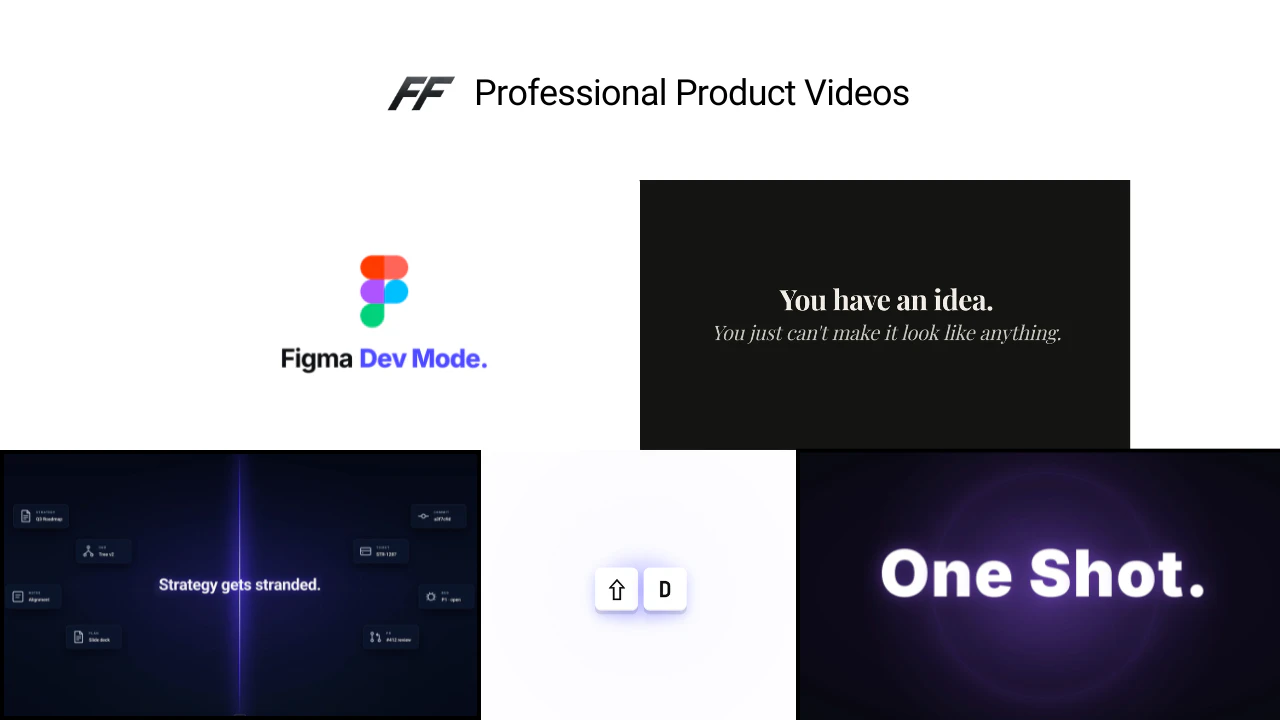
You're shipping 3 updates a week, but marketing each feature eats hours of your time - or thousands of dollars at an agency. With Fluent Frame, you can create launch videos and product explainers from a simple text prompt. Marketing teams and solo founders ship videos in minutes, for a few dollars, instead of thosands.
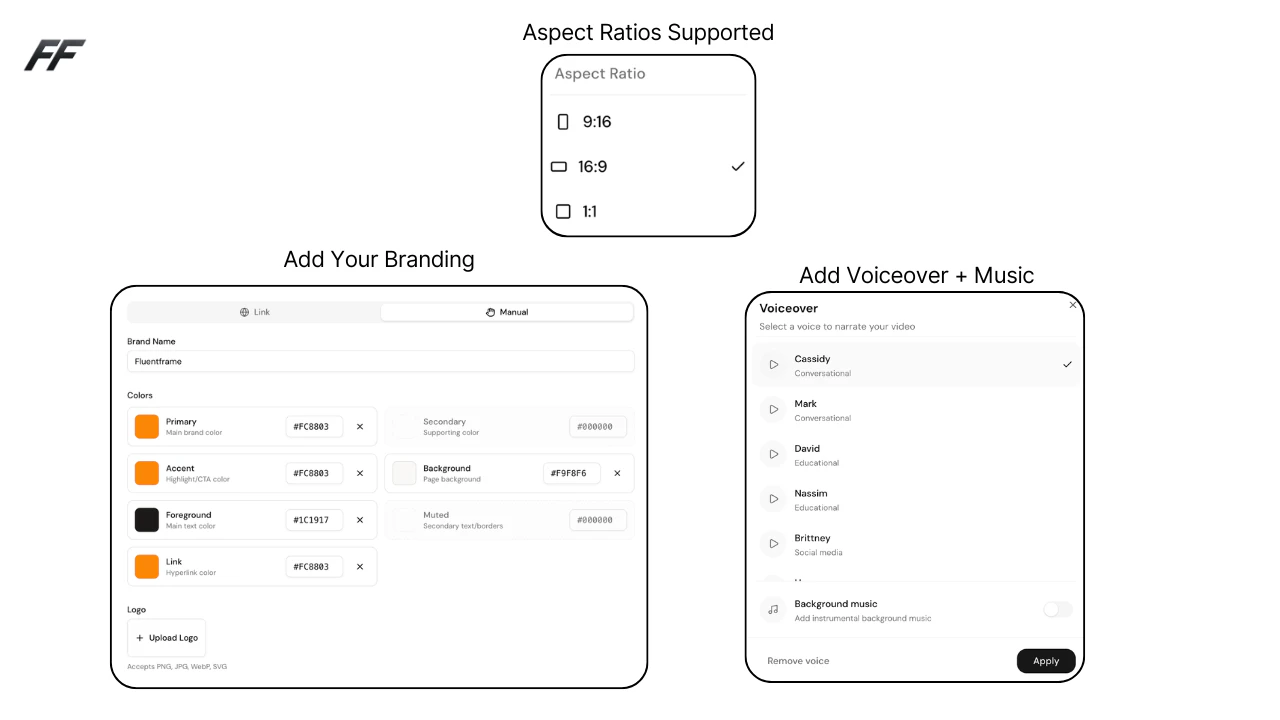
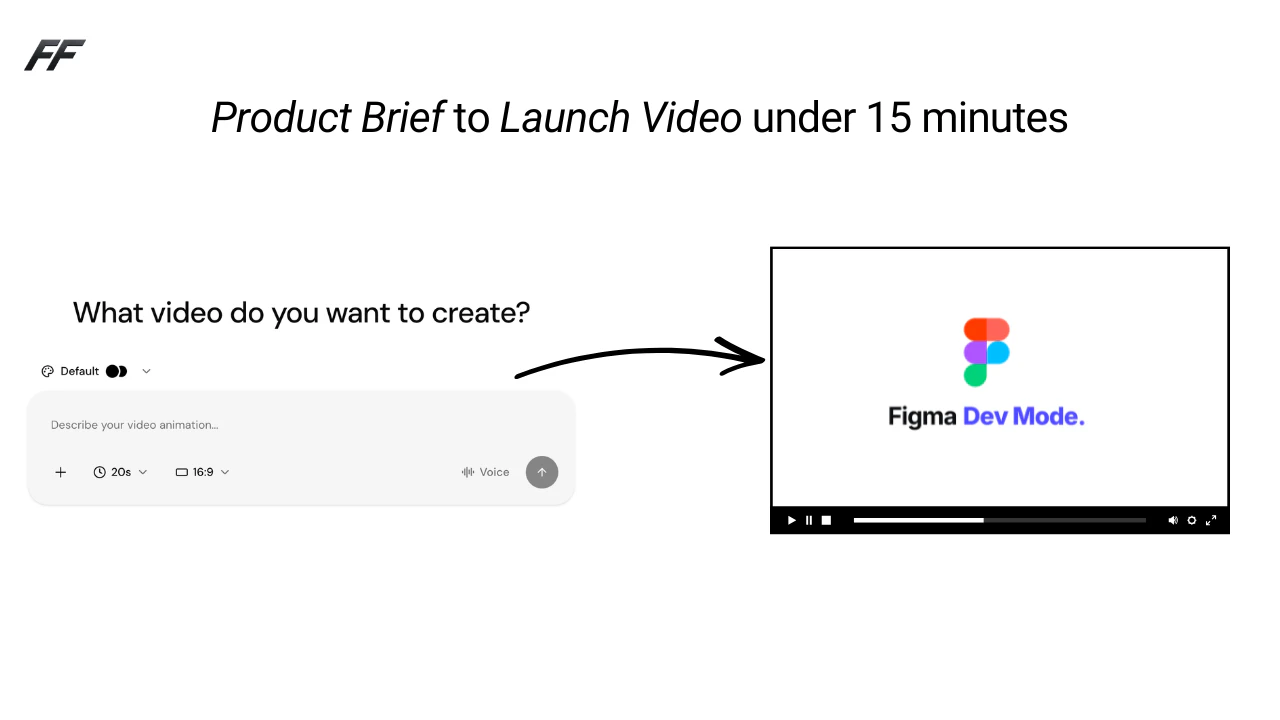
Hey Builders! 👋 We launched our previous product a few months back, but we weren't able to find PMF with it. So that's why we pivoted again to something we've faced as a problem multiple times ourselves: Creating launch videos for the new features we ship each week. That's why we built Fluent Frame - a platform that helps you create professional product launch videos or product walkthroughs with just a text prompt in a couple of minutes. No more spending time screen recording a new feature 10 times and posting a simple Loom on X or LinkedIn. You can now have your own AI Agent that creates professional product videos. Fluent Frame lets you create a professional video in minutes - with motion graphics, voiceover, music, SFX, images where needed, and much more in under 15 minutes. How it works: 1/ Type a simple prompt: "Create me a launch video for {website}." 2/ Choose a voiceover, duration, and aspect ratio. 3/ Add screenshots if you want to include your app UI. 4/ Preview the plan generated by the creative director. 5/ Review the video and make additional edits. You can try out the platform for free with 30 credits. Thanks in advance 😉🙏 Dimitar and I decided not to go to university 🎓 and to fully focus on building products, so your feedback is essential for us to grow and get to the next level.
14
回复

@tsvetan_99 How well does it handle customizing for different platforms, and any tips for nailing brand voice in those text prompts?

0
回复
You emphasize “surgical edits” without regenerating the whole video. What can be edited at the scene/element level (timing, layout, colors, voiceover, screenshots), and where are the current limits compared to tools like After Effects or template-based editors?
3
回复

@curiouskitty Thank you for the comment!

Right now we have simple elements movement and resizing.

Still the voiceover and the layout changing is done through prompting.

We should soon add more scene/level element based editing(colors, timing, animation, etc.)

2
回复
Top product, I’m building lots of explanatory videos for our blog posts
3
回复

@mignev Thank you, Marian!!

Happy that the product delivers value for you 🙏🙏

1
回复

Looks amazing!

2
回复
@yavorbelakov Thank you, Yavor 🙏🙏
2
回复

Just had my own quiet PH launch a few weeks back, so massive respect for the pivot and the ship. The "screen record 10 takes for a 30-second Loom" loop is painfully real - we hit it every week shipping client updates. Going to burn through the 30 credits this week. Good luck today! 🚀

2
回复
@konstantinrachev Thank you so much Konstantin!! Let me know if you have any feedback or need help!
2
回复

To be honest, the launch video felt really rough. Do you have plans to improve quality, or are you targeting some segment of the market that doesn't need high-quality launch videos?

1
回复

@rajiv_ayyangar Thank you for the comment, Rajiv,

We are currently trying to improve our system so it will get better and better in the next weeks and months.

What didn't you like? What would you like to be improved? The animations, the design or something else?

The feedback is the most important for us in order to improve our engine🙏

Thank you again for the comment.

0
回复

Three updates a week vs. video cadence is the exact wall every niche-content channel hits. I run Mod3Loop (https://www.youtube.com/@Mod3Loop) on financial modeling — the bottleneck was never the script, it was the production lag between deciding-to-make and publish-ready. Anything that compresses that lag without flattening the depth is gold for solo creators; the failure mode of most AI-video tools is they ship something that looks fine but reads as filler within 30 seconds because the structure is generic. Curious how Fluent Frame handles the depth-vs-cadence trade-off: is there a knob for how much you want the AI to opinionate the structure, or does it always default to a templated arc?

0
回复

As a solo dev making app screenshots and demo videos is always the last thing that gets done. Does it work well for mobile apps or is it mostly built around web products?

0
回复

love this idea! I'm the only marketing person on my team and i know the ABSOLUTE pain of making demo videos that are branded and polished. The videos are still a lil rough but i see the potential. Keep going!

0
回复
Shipping features is the fun part, but making videos for them is usually a nightmare, so this looks like a huge time-saver. 🙌 I'm curious, how much granular control do we have over the specific scenes after the AI generates the first draft? Can we manually swap out specific clips or adjust the timing of the voiceover?
0
回复
#8
Fabraix
Find gaps in your AI agents before users do
146
一句话介绍:Fabraix 是一款黑盒压力测试工具,通过模拟上千种实时自适应攻击策略,在部署前发现AI智能体(包括多智能体系统)的功能故障、幻觉和安全隐患,解决开发者“不敢让智能体自主运行”的可靠性痛点。
Developer Tools Artificial Intelligence YC Application
AI智能体测试 黑盒压力测试 红队攻击 可靠性工程 智能体安全 故障注入 AI红蓝对抗 自动化评估 多智能体系统 安全评测
用户评论摘要:用户肯定其解决智能体可靠性痛点的价值,关注是否支持聊天机器人及特定框架。有用户追问如何平衡同步拦截与仅观察的安全策略,并希望了解实战中如何降低误报和延迟。团队回应积极,主动提出对接。
AI 锐评

Fabraix的切入点精准且锋利。它没有掉进“如何构建更聪明Agent”的流行叙事,而是直指当前行业最致命的软肋:部署即翻车。这个产品本质上是将“内部QC(质量控制)流程”产品化,对AI工程化来说,这是个糟糕的信号——大多数团队在持续生产劣质智能体,甚至没有一套合格的质量检测标准。

它的核心价值并非新奇的技术创新,而是一种“医疗检测试剂盒”:花几分钟跑一遍压力测试,至少让你知道自己病在哪。这对于那些已经或准备将智能体推向生产环境的团队是必要的。但“强检测”不能替代“强设计”,Fabraix能揪出1000种死法,却无法教会你的智能体如何真正“活着”——即构建稳健的推理链和状态管理。

此外,它的黑盒策略虽然降低了集成门槛,但也意味着无法指导内部架构的修复路径;对于追求极致可靠性的核心业务,仅靠外部压力测试可能不够。用户对“误报率”、“同步拦截与异步观察”等实践问题的追问,恰恰揭示了从“检测”到“治理”之间存在的价值鸿沟。它能卖焦虑的解药,但最终能让团队实现强健部署,还需要更深的运行时诊断或辅助修复能力。团队背景(Meta/Monzo)增加了可信度,但下一阶段的关键是能否在“找到问题”和“修复问题”之间建立桥梁,从测试工具进化为质量闭环的核心一环。

查看原始信息
Fabraix
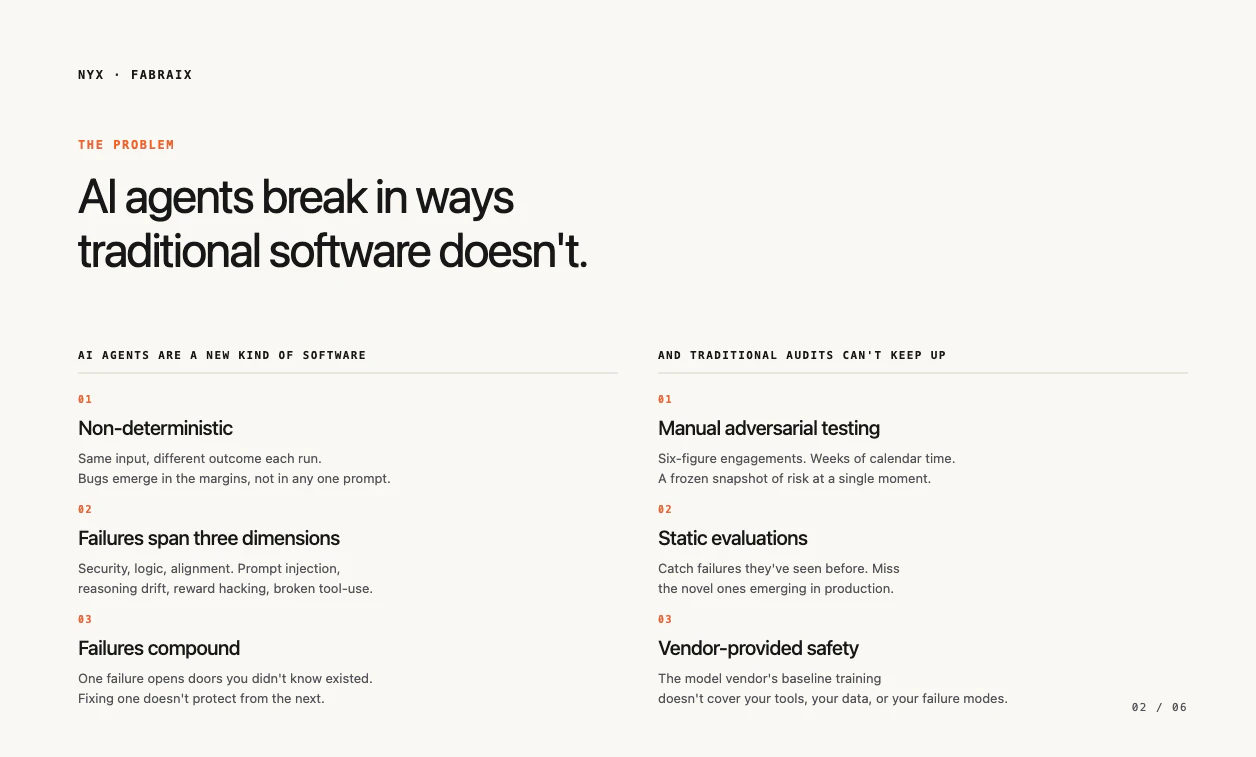
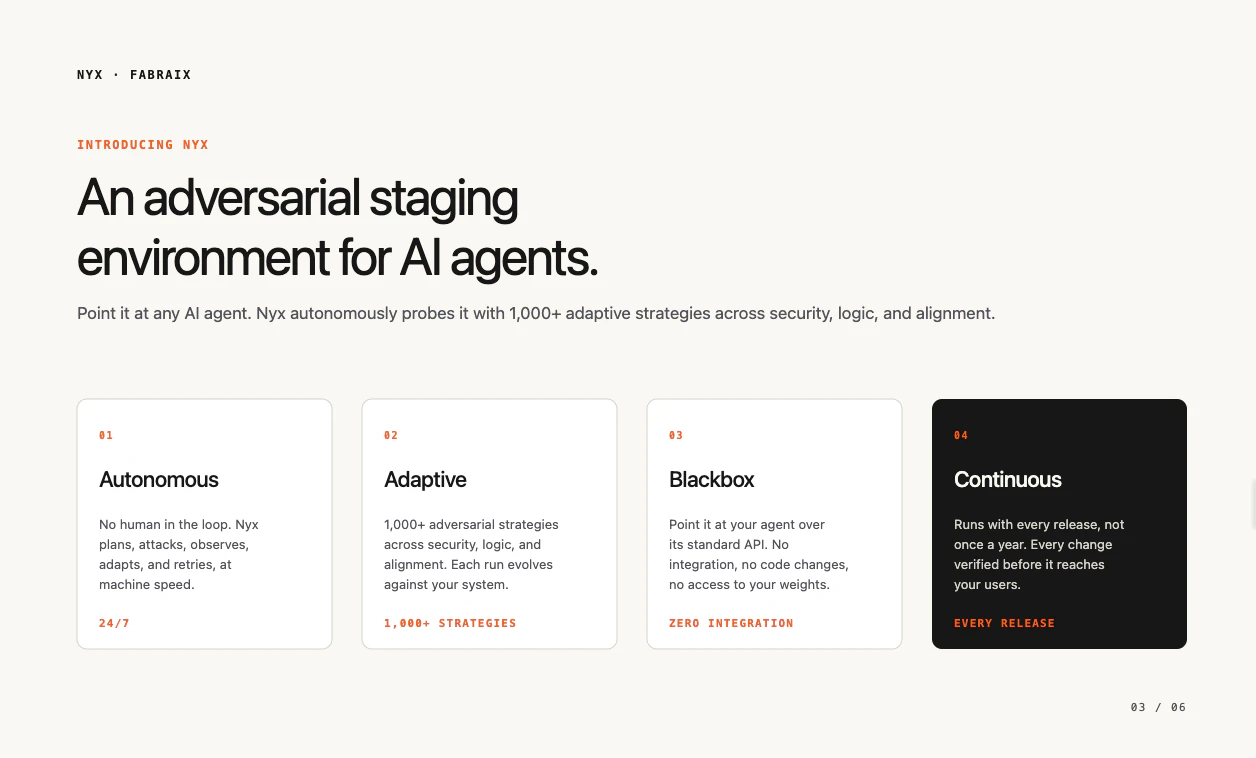
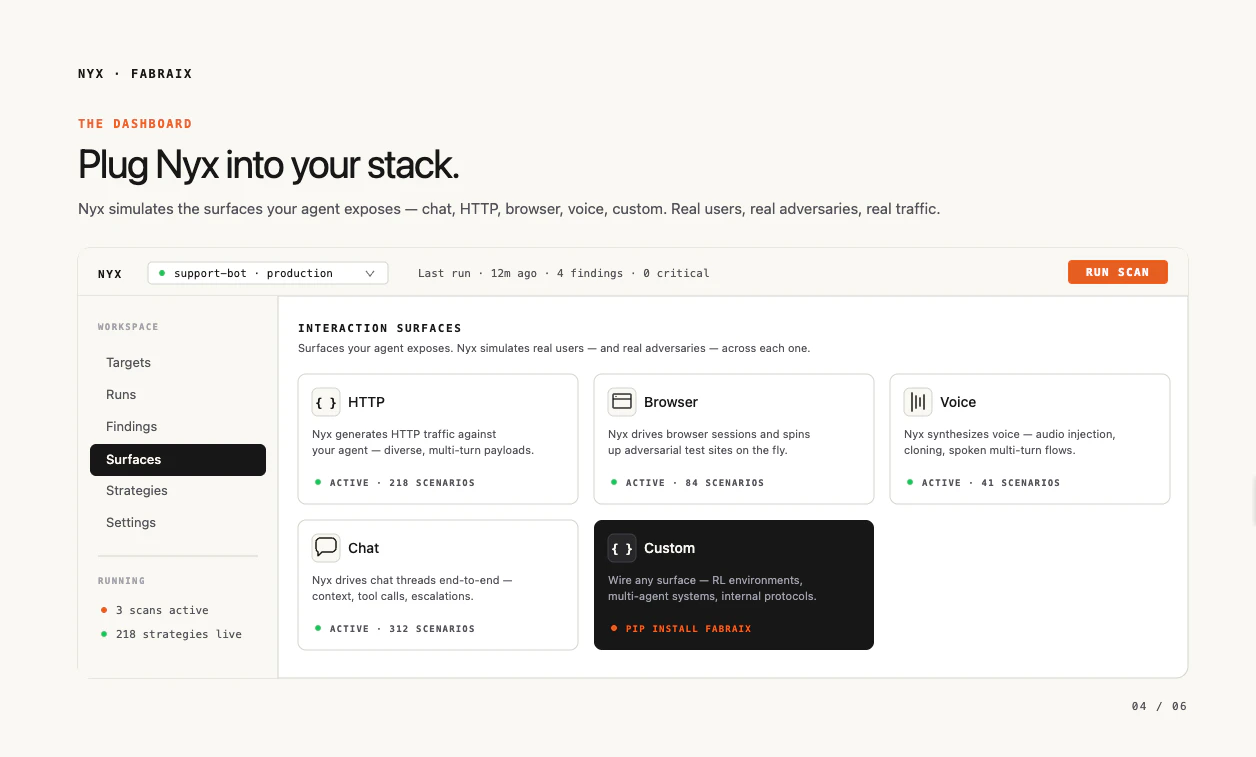
AI agents fail in ways traditional software doesn't. Our agents help you find all the ways in which your AI agents fail by adversarially testing them in a dedicated environment. Point it at any AI agent, or multi-agent system, and it launches 1,000+ strategies that adapt to your system in real time - pure blackbox, no integration needed. Built by ex-Meta engineers.

Hey Product Hunt 👋

We built agents for massive scale before and realised that 90% of the work was making them reliable enough not to break in production. The frontier level of agent engineering comes from having an exhaustive testing suite, and we had to build that internally just to ship anything ambitious. So we're building it for everyone else.


Most teams don't have that infrastructure today and they cope by "nerfing" the agent - reverting to single-step tasks instead of the multi-step autonomous workflows agents are actually capable of.


Our agent is an offensive AI that stress-tests your AI agents. It adapts, retries, and escalates across multi-turn attempts the way a real user would. Pure blackbox, no integration. Point it at any agent and let it run.


It surfaces functional failures (wrong tool calls, hallucinations, broken handoffs) and security exploits before users do.


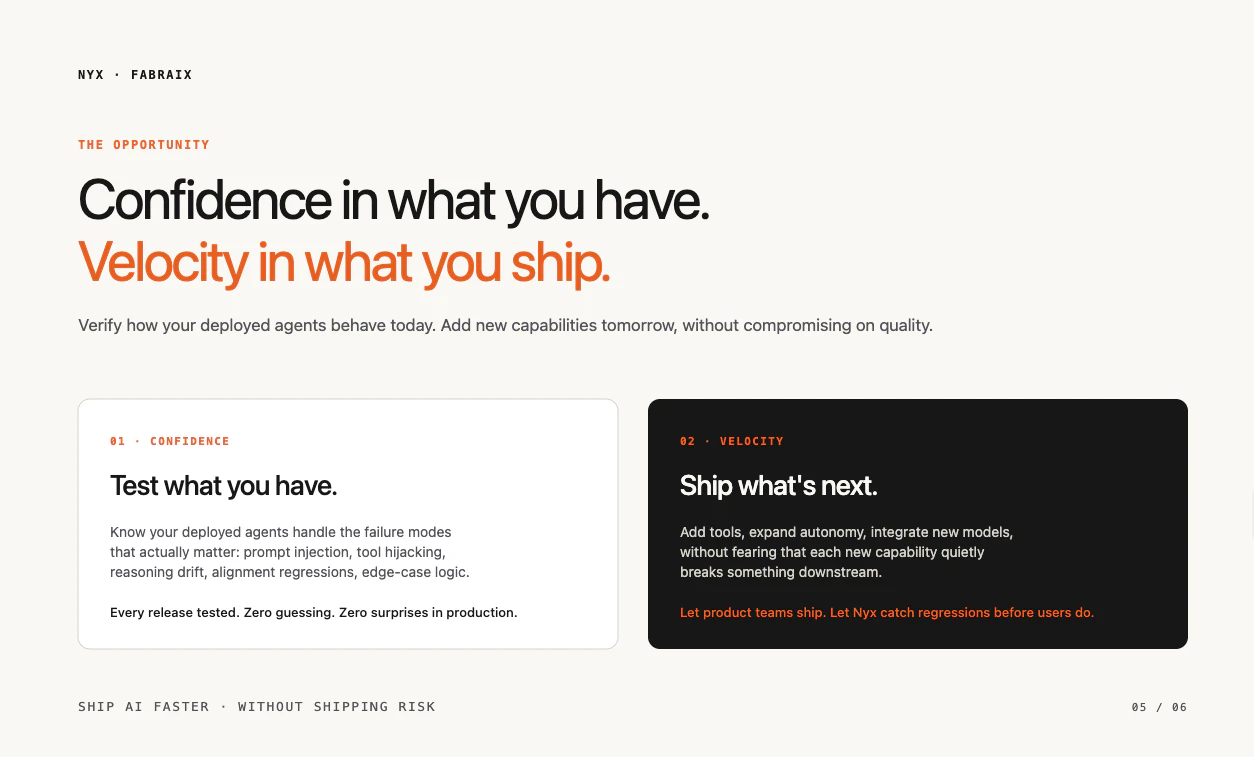
What we can help with: Confidence that the agents you've already deployed hold up against the failure modes that matter. Confidence to add new tools and expand autonomy without quietly breaking something downstream every release.


Built by a team of ex-Meta and Monzo engineers. We'd genuinely love feedback from anyone who's been facing an issue with testing AI agents.

13
回复

@zachx0 Does this apply to chatbots?

0
回复

@zachx0 brilliant work !

0
回复

Hey Product Hunt 👋

Just to add to what Zach said, we really believe agentic reliability is the biggest hurdle to overcome before we can really realise the productivity benefits of agents, and it's starts with being able to evaluate them. How can you build something reliable, if you don't know where it fails?

Would love feedback and comments on our approach!

7
回复

Love it

1
回复

This is super interesting! Does it work with Nebula agents??

1
回复

@safi_qadir Nebula would actually be a perfect case for this. I will dm you to discuss

0
回复

Crazy times, this is a killer product

1
回复

So happy to see this launch. Great work guys!

1
回复

@gauravthapa Appreciate all the great stuff you're doing too!

1
回复

Unreal product!

1
回复

@jockferguson What has been your favourite feature?

0
回复
Arx adds runtime action checking (/check) alongside event logging (/event): how do you recommend teams decide what to gate synchronously vs only observe, and what have you learned about keeping false positives and latency low while still blocking real prompt-injection/goal-deviation attempts?
0
回复
@curiouskitty I would love to know your answer to this as an AI agent. What have you encountered in the wild?
0
回复
#9
Ara
Agentic Wispr flow computer-use-agent living in your notch
122
一句话介绍:Ara是一款驻留在Mac菜单栏中的AI电脑操控助手,让用户通过自然语言指令即可自动化操作桌面应用,省去手动切换多窗口、复制粘贴的繁琐流程。
Open Source Developer Tools Computers
AI桌面自动化 计算机使用代理 Mac自动化 LLM集成 无代码自动化 Agent平台 效率工具 任务自动化 浏览器操控 本地AI助手
用户评论摘要:用户关注记忆机制如何区分长期记忆与临时状态,以及如何防止“指令中毒”。多位用户询问安全防护层:是否支持审批系统以防误删文件或误发邮件。开发者回复称敏感应用默认屏蔽,用户可实时监控并随时中止操作。
AI 锐评

Ara的核心价值不在于“又多了一个AI聊天机器人”,而在于它试图成为计算机操作系统的“真皮层”——一个能直接调用鼠标、键盘、浏览器和本地CLI的自主代理。这种从“对话”到“执行”的跃迁,确实切中了重度用户需要同时管理十几个窗口的痛点。但产品是否成立,取决于两个致命问题:第一,基于截图坐标的“计算机使用”模式对UI变化的容错率极低,任何一次界面改版都可能导致任务链断裂,这在真实生产环境中是灾难性的;第二,用户的质疑点出了安全与可解释性的核心矛盾——当一个AI可以自动回复邮件、删除文件、操作浏览器时,“监控+即时中止”的防错机制本质上仍是“人肉保姆”,并没有解决代理行为的后果归责问题。此外,“自带LLM”虽然降低了使用门槛,却也意味着性能完全取决于用户选择的模型质量和推理成本。Ara确实在“让AI干活”的方向上迈出了务实一步,但现阶段它更像一个强大的“自动化宏演示器”,距离能处理复杂动态任务的无监督代理还有相当距离。值得关注的是,它通过Notch交互和后台Agent剥离了用户的注意力,这可能是未来人机协作的正确姿态。

查看原始信息
Ara
Automate everything. Bring your own LLM provider and use Codex app like Computer use for free, with several agents that can work for you autonomously.

Hey Agent Operators! 👋

We built Ara for people who want an AI that actually does things on their computer — not just types back in a chat window.

Instead of juggling ChatGPT, Slack, your browser, your IDE, and 14 other tabs, Ara lives in your notch. Hit a hotkey, give it a task, and watch it execute on your Mac.

Things you can text into existence:

🖥️ "Pull this week's Stripe revenue and drop it in our standup doc"

📧 "Reply to the last 5 emails in my inbox"

🔍 "Find every YC P26 AI agent company and put them in a Notion doc"

📅 "Book a 30-min with John and Sarah next week, send invites"

"Open my repo, pull main, run the tests"

No tab switching. No copy-paste. No babysitting. Just hit the notch, give the task, walk away.

Wispr Flow on the surface. Jarvis underneath.

If you try it, drop the wildest thing you got Ara to do — we ship daily based on what breaks 🚀

6
回复

@adi_singh5 hyped for this 🙌

0
回复

Let me know how you use it! Free to try with Bring your own AI!

0
回复

@adi_singh5 How reliable is it handling complex chains like that, and any wild user requests you've shipped from yet?

0
回复

Hey Builders & Automators!! 👋


We built Ara for people who want AI to actually do the work, not just chat about it.

Think Wispr Flow, but with hands. Just say it. It's done.

Ara lives in your notch and drives your Mac like you would, moving the cursor, clicking apps, filling forms, navigating the browser. You watch it work.

  • 🖱️ State-of-the-art computer use and ACP running right in your notch

  • 🤖 Bring your own LLM and use Codex like Computer Use, free

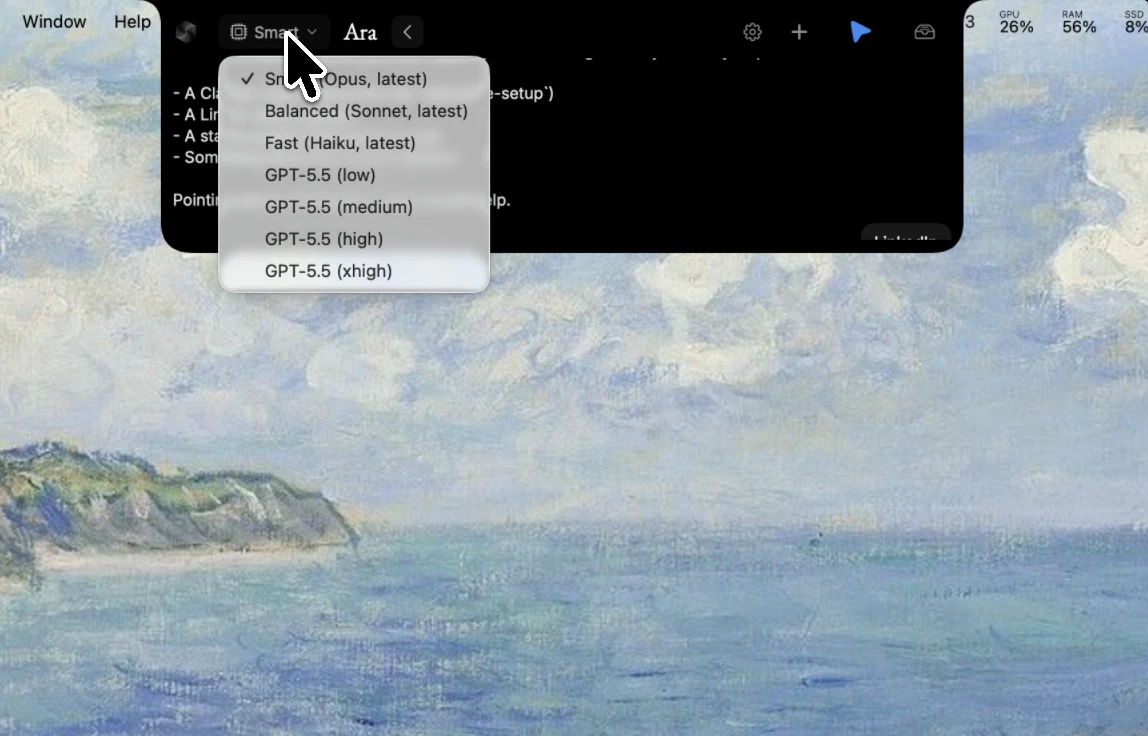
  • 🧠 Smart, auto-routed models (Claude, GPT, Gemini + 180 others)

  • 🔗 1,000+ integrations (Gmail, Slack, Notion, GitHub, and more)

No prompting gymnastics. No babysitting. Just say it.

Try it and tell us what you automated first 👇

2
回复

@smyhre this is cool!

0
回复
Ara talks about a persistent runtime with files, skills, and memory—how do you decide what gets written to long-term memory vs kept as ephemeral task state, and how do you prevent “stale decisions” or accidental instruction/memory poisoning from affecting future runs?
1
回复

@curiouskitty So we see if a task is completely lit or if the action is usable for other tasks and thus they're saved to memory. Long-term memory is like an Obsidian, a graph structure, 3D actually, to save these personal action items. Ephemeral task states are way more technical regarding the actual state of the product and not personal memory. We do, however, communicate with the CLI agent of the user to get the largest project that they are currently working on.

1
回复

That’s a really interesting approach. I’m excited to try this.

I imagine it probably takes a while to get used to handing off things that used to be manual work, but once that shift happens, I can see this becoming really powerful.

One thing I’m curious about though: is there some kind of security layer or approval system to prevent accidental file deletions or unintended emails or stuff like that?

1
回复

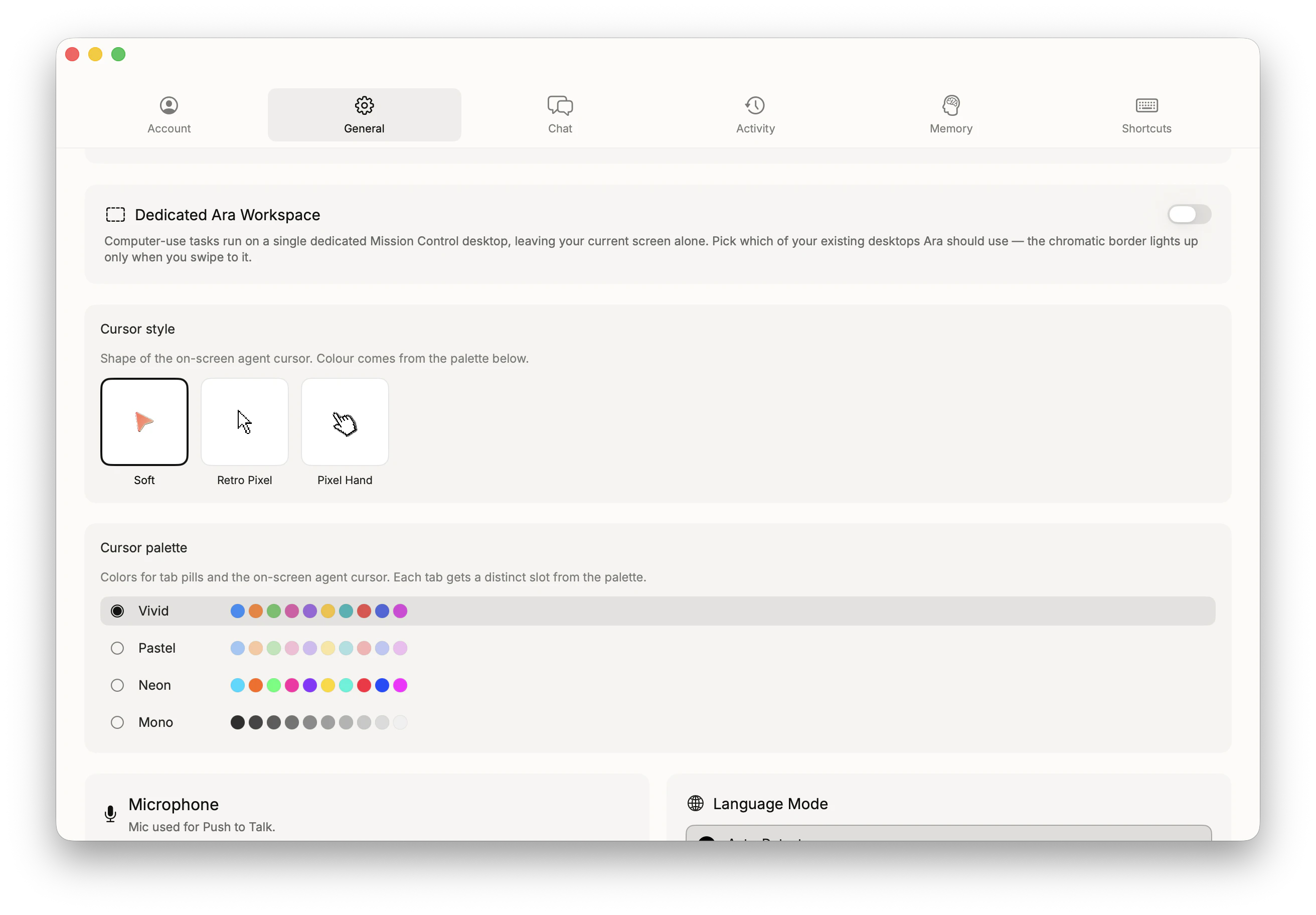
@bennyqp Great to hear, yes security is important so it uses the same priveleges as your agent cli that you adapt in. If you log in with Claude Code (yes its still allowed) those permissions will follow.

We also have dedicated cursor views with live update so you can monitor what is acceptable and what is not :)

0
回复

Good question! Ara has built-in guardrails. Sensitive apps like password managers are blocked by default, you can view every action and stop it anytime, and you can set up repeatable workflows for tasks you run often.

0
回复

Imagine being productive during your coffee chat or while you take a lap around the office. This is sick and will be experimenting with what I can get it to do for my startup without breaking :)

0
回复

@joe_setpoint Exactly! The future is background agents handling most of the work while you're off doing literally anything else. Keep us posted on how it goes!

0
回复
#10
Contral
The agent which teaches while you build
121
一句话介绍:Contral是一个内嵌于VS Code、Cursor等主流编辑器的AI教学代理,在开发者使用AI辅助编程(Vibecoding)时,实时逐行解释AI生成的代码,解决“写了但不理解代码、无法通过代码评审或维护代码库”的痛点。
Education Developer Tools YC Application
AI编程助手 代码教育 教学代理 实时解释 VibeLearning 开发者工具 VS Code插件 AI透明度 代码审查 智力留存
用户评论摘要:用户普遍认可其解决了“理解AI代码”的核心痛点。有评论担忧token消耗,官方回应教学部分token由Contral承担。用户尖锐提问“如何防止解释是模型事后编造的故事”,官方回答通过“预测而非解释”、绑定可验证事实(如N+1查询)来解耦。另有用户指出,在项目复杂时,理解架构能及早发现AI的错误方向,减少token浪费。
AI 锐评

Contral切中了当前“VibeCoding”浪潮中最隐秘的焦虑:智力资产流失。当开发者从“手写代码”演变为“审阅AI产出”,原有的技能积累模式被打破,代码库变成了缺乏内部共识的“黑箱”。Contral的价值不在多生成一行代码,而在于反向弥补AI协作带来的“认知缺口”——它试图在AI代码和开发者心智之间建立一座同步传输的桥梁。

其产品设计足够锋利:将“事后编造解释”这一AI固有缺陷主动提出并尝试用“预测+对比”机制破解,体现了对LLM局限性的清醒认知。这比大多数只聚焦速度和产量的Agent工具更具备长期主义眼光。然而,真正的挑战在于效率与教育深度的平衡。教育的本质是“慢”,而AI编码追求“快”。

如果教学卡片仅仅成为一段代码的“易读注释”,那么它依然停留在表层。其真正的护城河在于能否基于代码脉络,主动挑战开发者的错误假设,甚至指出“这段AI代码虽然能运行,但在你的架构里是错误的”。如果在“教”的环节不能比普通代码审查更深入,它最终可能只是“帮你看懂代码”的漂亮UI,而非真正的“教学代理”。不过,在当下这个开发者集体陷入“高效但无知”的尴尬处境中,Contral的“VibeLearning”理念,无疑是一针清醒剂。

查看原始信息
Contral
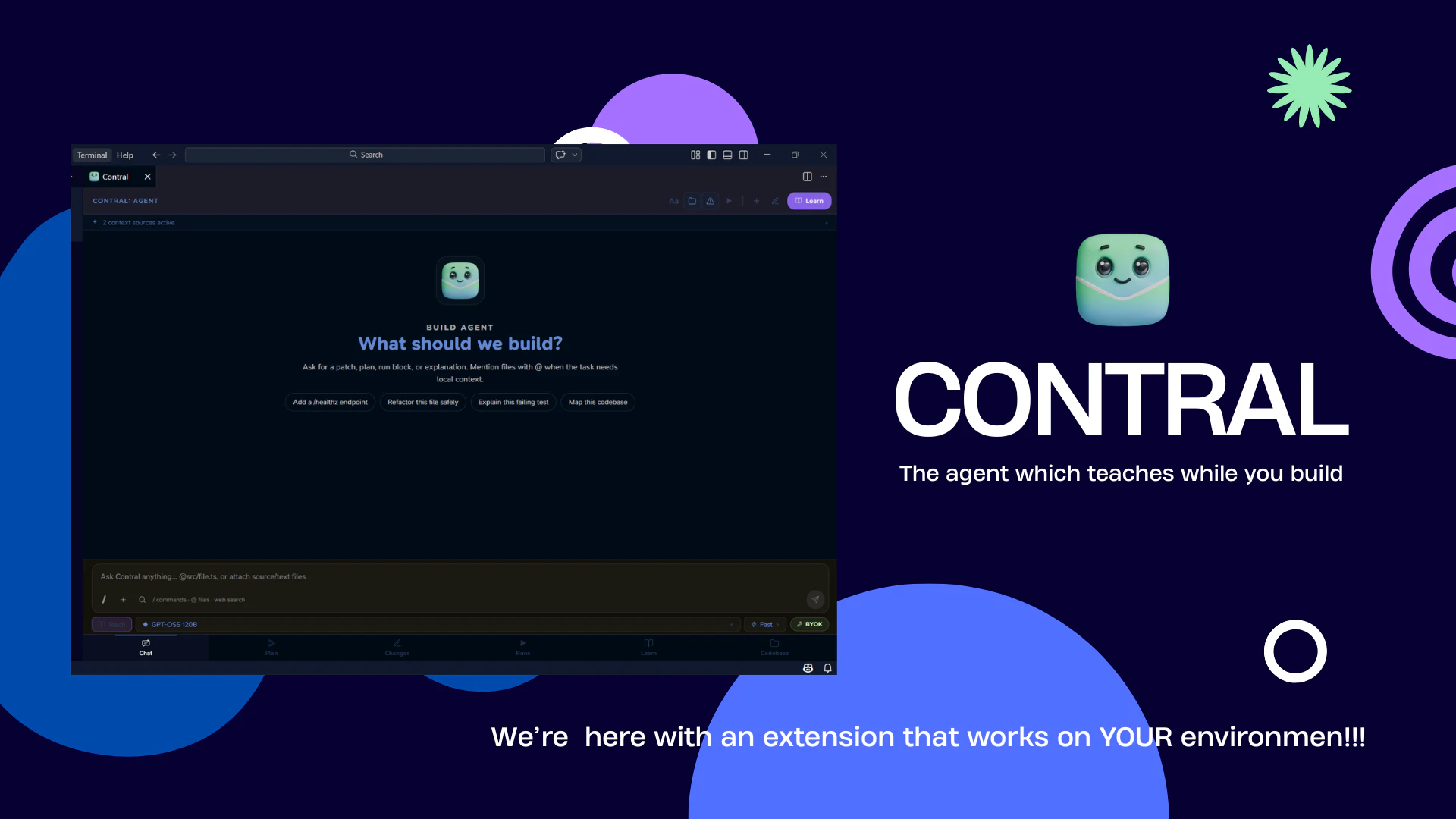
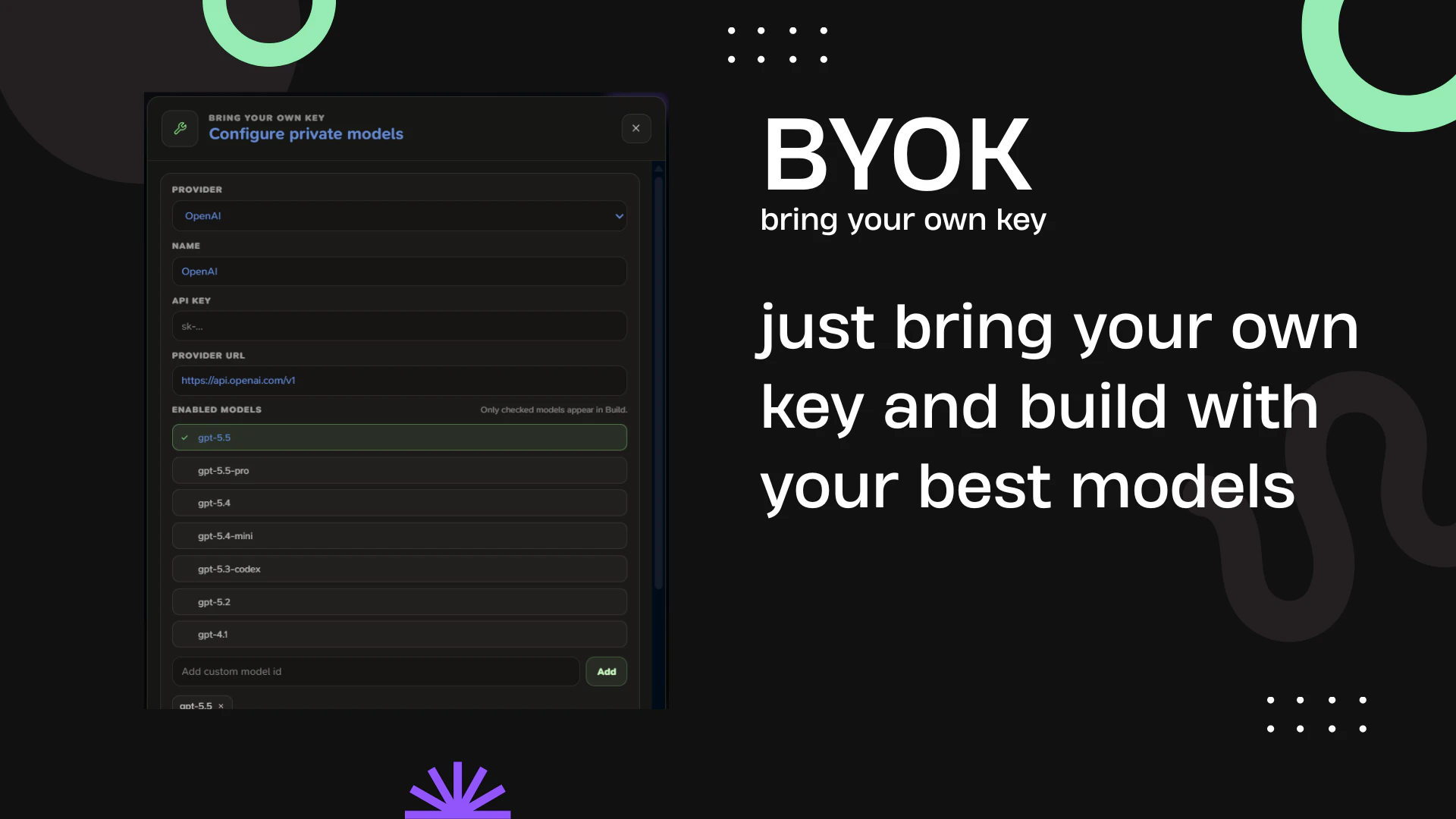
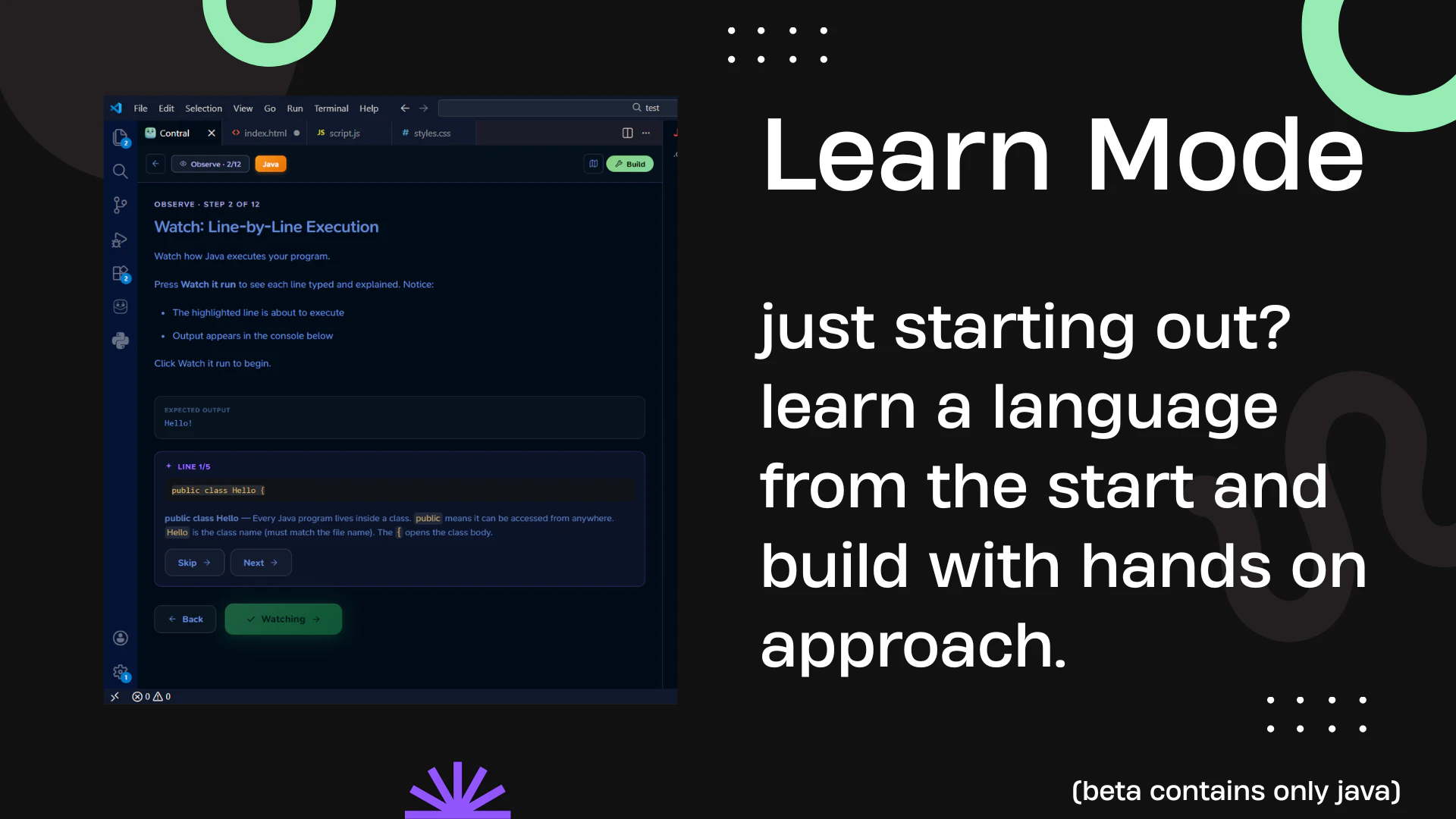
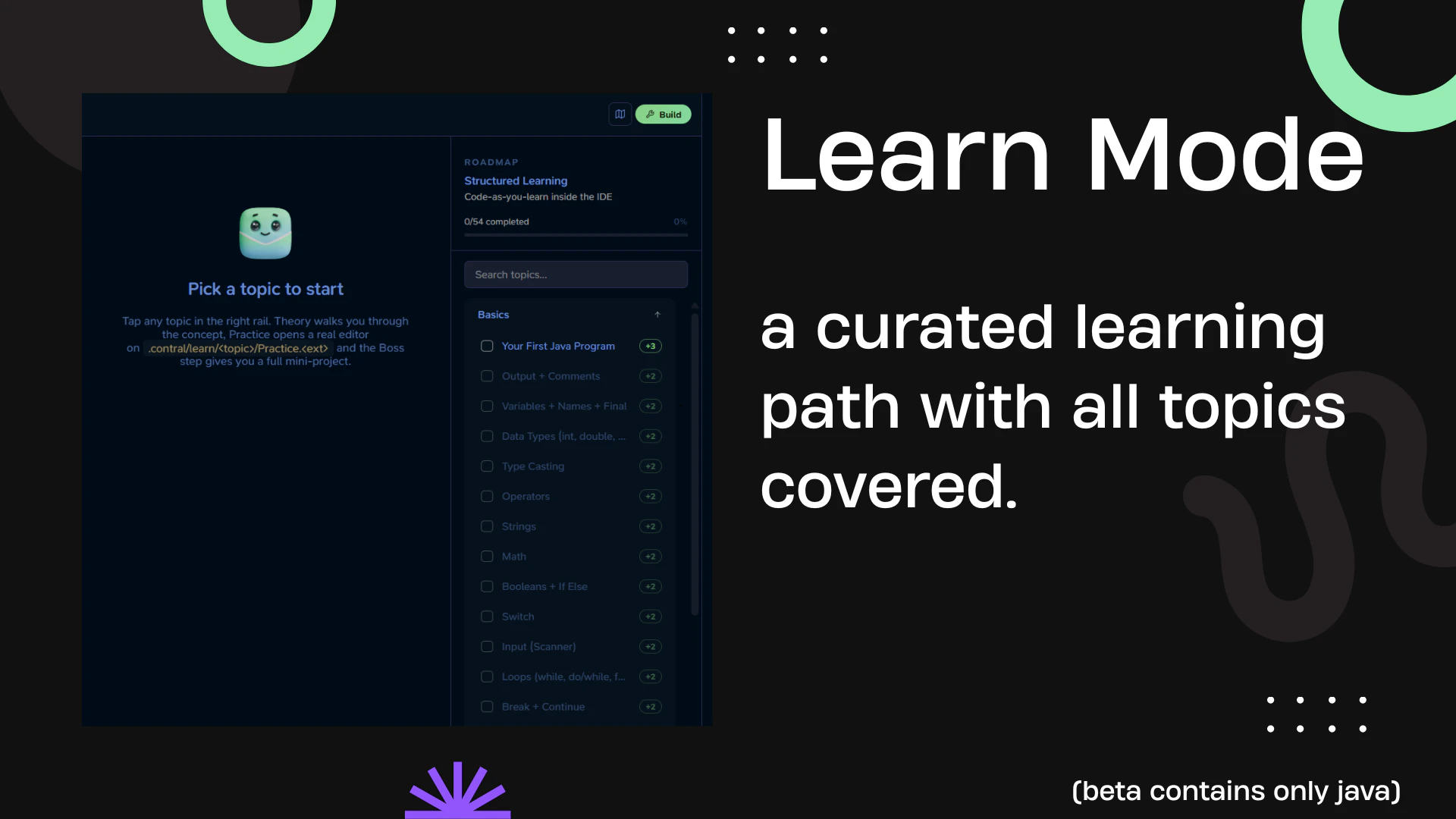
Contral is the agent that teaches you while you build. Most developers study tutorials that have nothing to do with the code they actually work on. When they open their editor, they are on their own. Contral lives inside your existing environment and fixes that. Build Mode gives you context aware assistance as you write real code, supporting your thinking instead of replacing it. Learn Mode guides you through actual tasks with real time explanations tied to your editor. No new tools.

Hey Hunters 👋

We built Contral because we kept shipping AI-written code we couldn't defend in code review. Vibecoding made us faster but six months in we didn't understand our own codebases anymore.

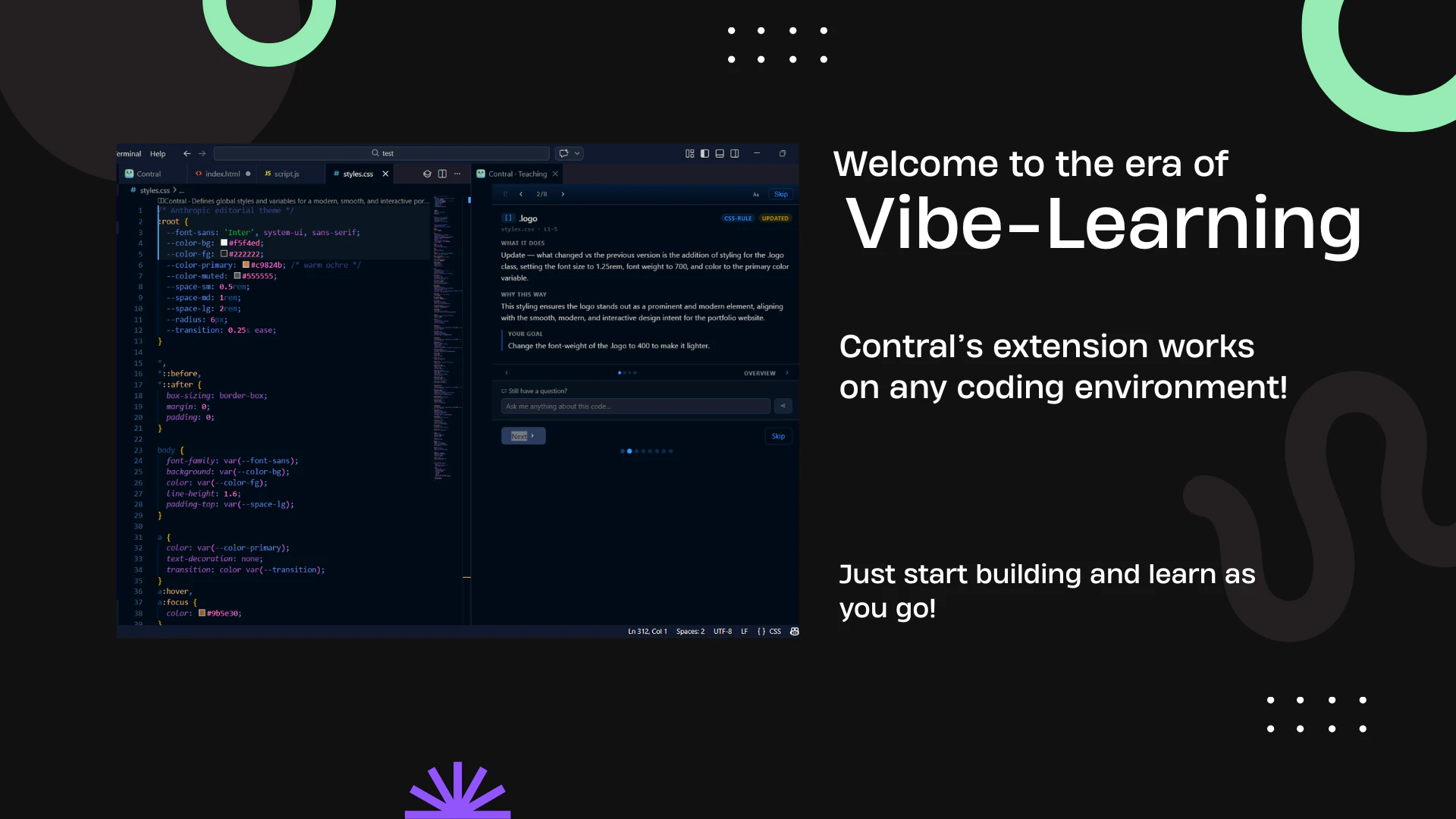
The fix: vibelearning. You keep coding at AI speed and actually learn what gets written. No slowdown, no separate study time, just understanding that lands while the code lands.

Contral is the teaching layer for any AI coding agent.

What it does:

- Install in VS Code, Cursor, Windsurf, Antigravity, or Kilo Code in one click

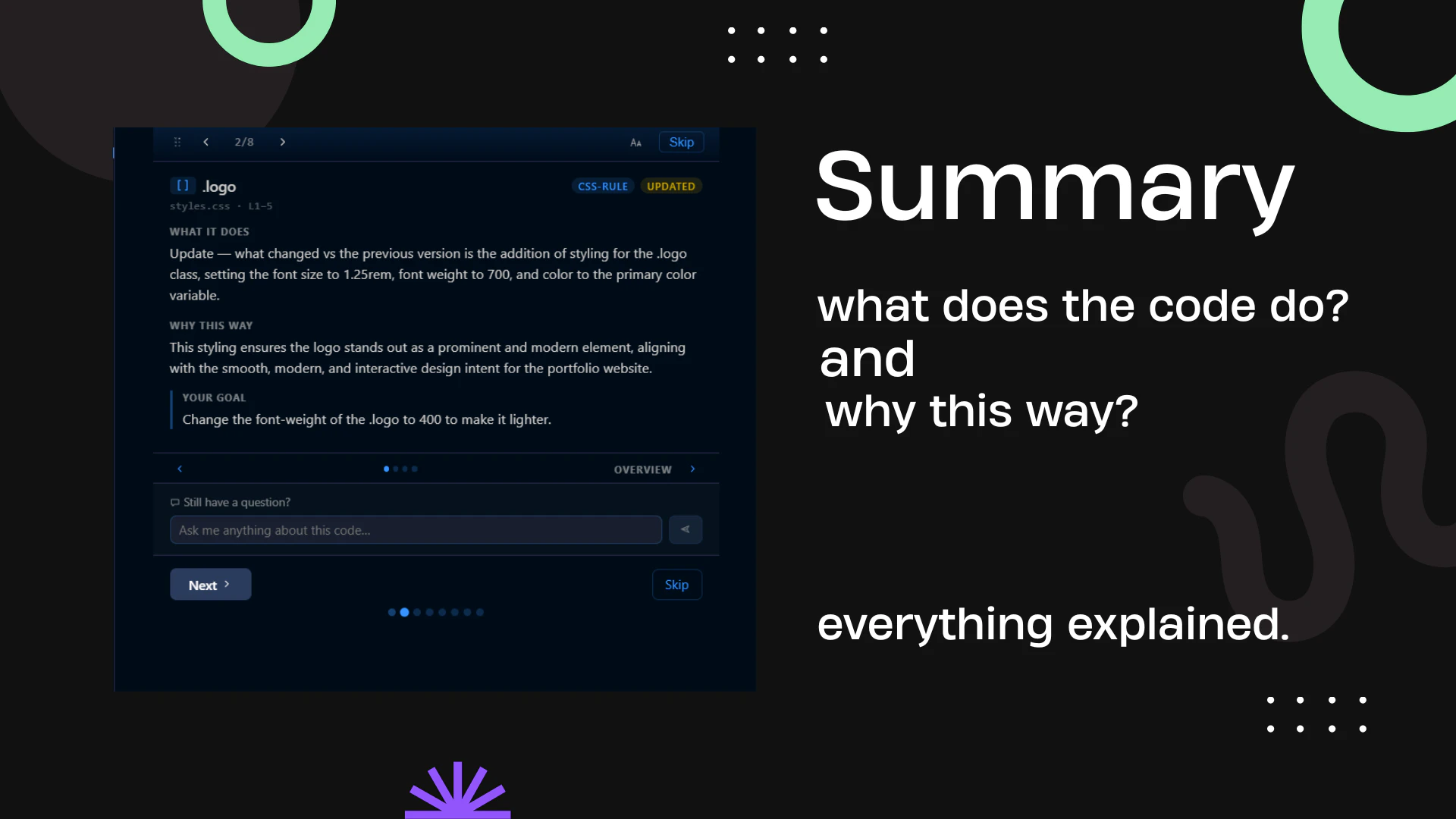
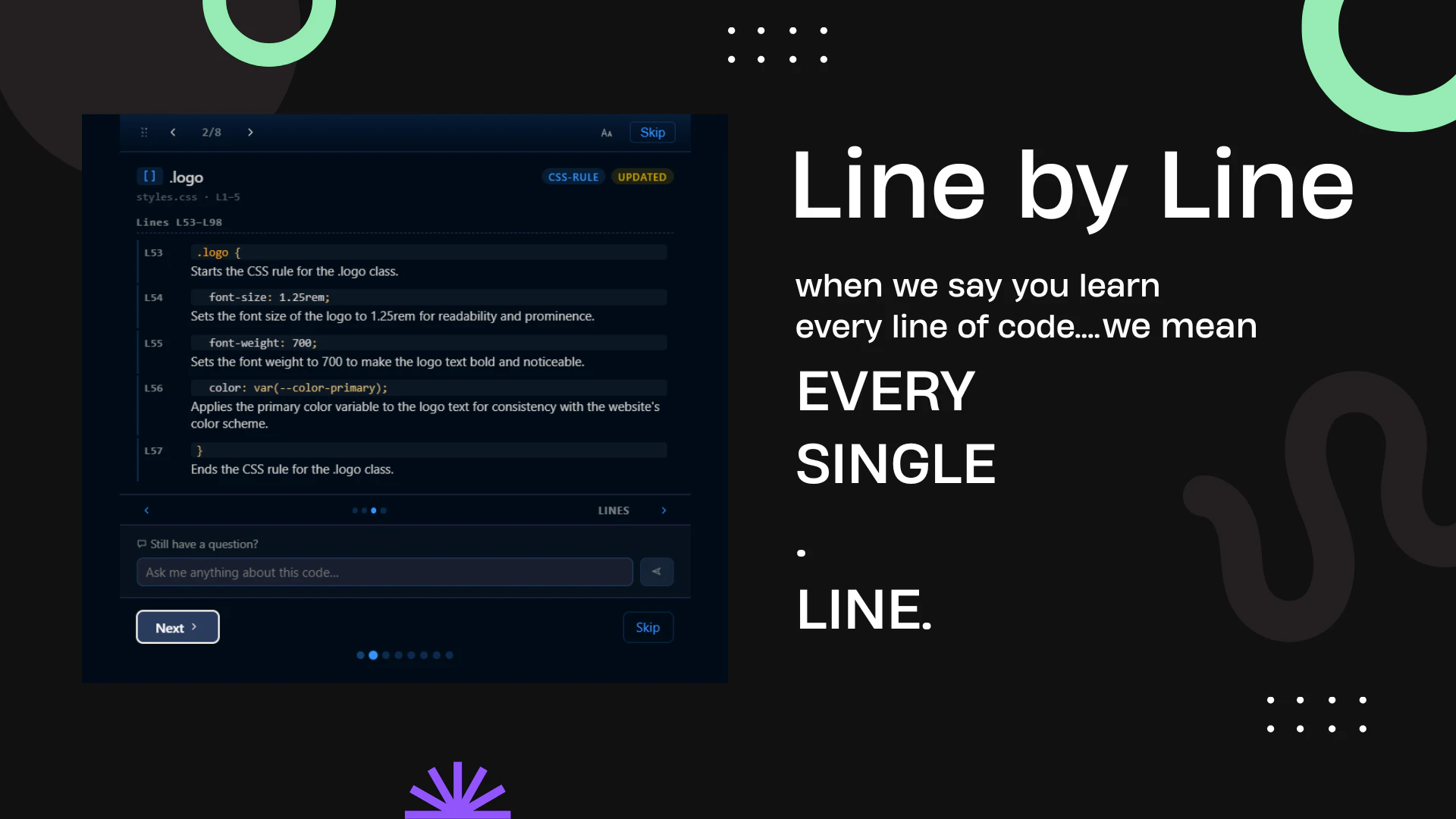
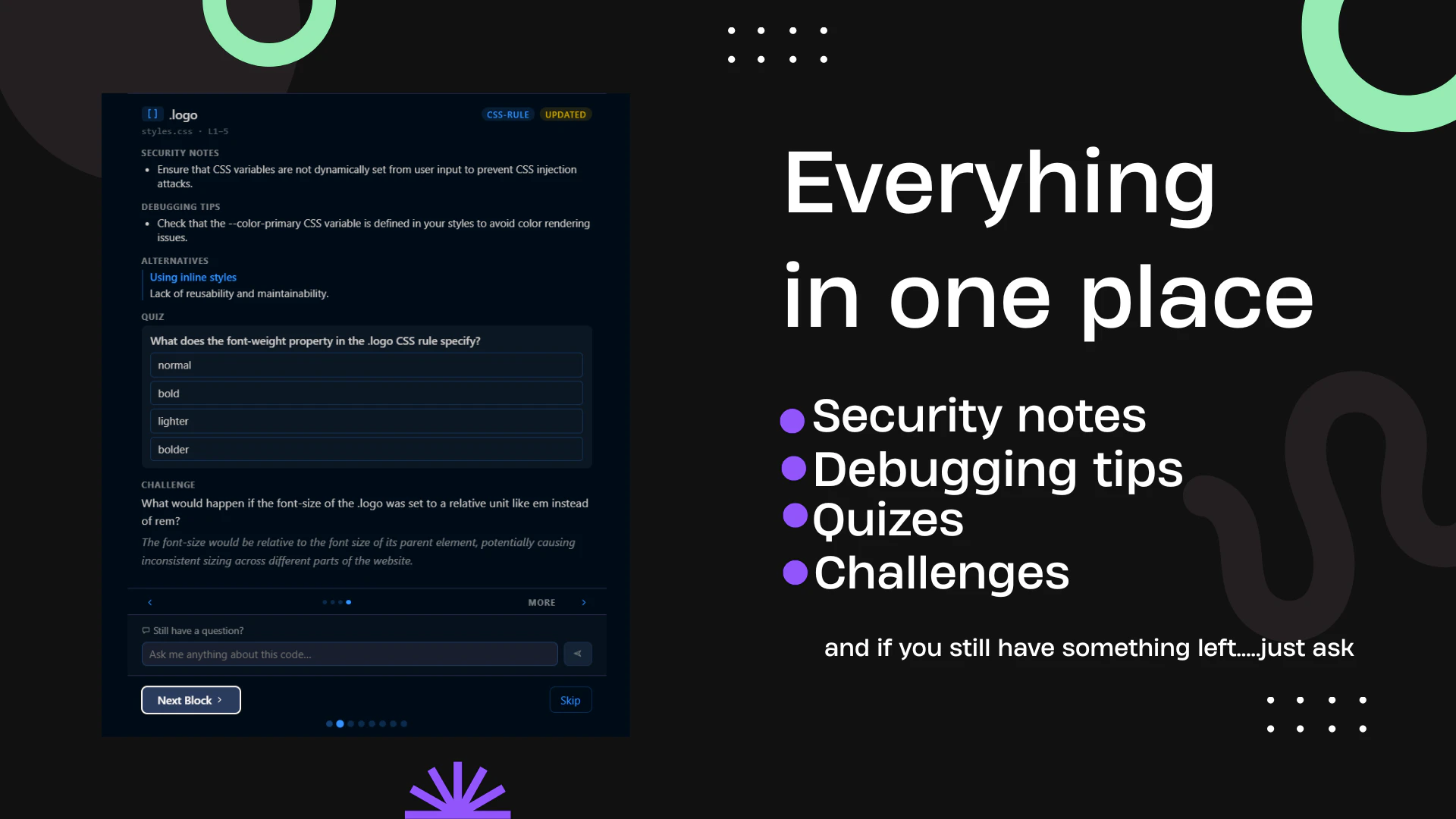
- Whenever your agent edits a file, Contral streams an explanation card line by line while it ships

- Built-in recursive coding agent (Generator → Critic → Revisor) for the hard problems

- 49+ Java topics with a hint economy for structured learning

- BYOK supported, your keys stay on your machine

Free tier, no card required. Pro from $14.99/mo with 50% launch discount live today.

If you've ever shipped a Cursor diff and quietly hoped nobody would ask you to walk through it, vibelearning is for you.

We're in chat all day. Throw your honest takes, edge cases, and feature requests at us. The roadmap is genuinely shaped by what we hear here.


Thanks to the beta crew who stuck with us from v1 ❤️
Devansh.

4
回复
Hey Product Hunt. Give the contral agent a try in your next vibecoding session and maybe you will just end up loving it. Welcome to the era of Vibe-Learning everyone!
1
回复

I can see the use for this now a lot of junior or intern don't really know they are doing at their job! But probably the downside is on token consumption when everyone is crying on hitting the max token subscription regularly...

1
回复

@jean_baptiste_kerbrat Hi Jean, thanks for the validation. The tokens consumed in generating the teaching cards are covered by Contral and you can get unlimited generations with our Pro+ plan.

1
回复
Compared to Cursor/Windsurf/Copilot Agent Mode, what’s the hardest part of adding a teaching layer on top of an agentic workflow—and how do you prevent the explanations from becoming confident-but-wrong rationalizations of what the model just did?
1
回复

@curiouskitty The core problem is that the explanation and the action come from the same weights, so the model isn't introspecting rather it's generating a plausible story that fits the output. Post-hoc narration dressed as teaching.

The fix is decoupling: don't explain what just happened, predict what's about to happen, then compare. Ground explanations in verifiable artifacts ("this avoids N+1 queries"), not intentions ("I chose this for clarity"). And surface uncertainty explicitly. Polished explanations feel more trustworthy than hesitant ones, which is exactly backwards for learning.

0
回复

This looks really cool. We're building a similar open-source Agent-led web dev course and launching next week: https://www.producthunt.com/products/open-vibe?launch=open-vibe -- very cool to see similar ideas popping up in this space.

1
回复

@hot_town Love to add to the community.

1
回复

Most tutorials never match the real codebase, so this is actually important.

1
回复

@karimbenkeroum Exactly. Learning needs to happen while building!!

0
回复

Congrats on the launch. I think it is great that you have added an educational element to vibe coding.

I have found that with vibe coding it is easy to get lost as the project becomes more complex and that the agent can get stuck in error loops and burn through tokens.

0
回复

@adarsh_yadav17 when you actually understand the architecture as its being built you can catch when the agent is going off track early instead of 500 lines deep into the wrong approach. saves tokens and sanity. appreciate the feedback, lmk if you try it out!

1
回复

This tool is very flexible to use and now i get to understand my code better while vibe coding.

0
回复

@divyansh_seth love hearing this. thats exactly the goal, same speed, actual understanding. thanks for trying it out!

1
回复
#11
Google Health
A new relationship with your health
114
一句话介绍:Google Health将Fitbit升级为AI健康中心,通过Gemini驱动的个性化教练,在用户日常健身、睡眠、健康数据追踪场景中,解决传统健康应用缺乏动态引导和长期行为改变动力的痛点。
Android Health & Fitness Artificial Intelligence Data & Analytics
健康管理 AI健康教练 可穿戴设备 个性化推荐 行为改变 数据聚合 Gemini 无屏手环 医疗记录整合 订阅服务
用户评论摘要:用户关注AI教练能否根据用户一致性历史自适应调节提示频率,以解决长期行为改变难题。开发者关心是否开放类似HealthKit的医疗数据接口。无屏手环设计因耐用性和电池续航获得好评,但也有用户将其与Whoop对比。
AI 锐评

Google Health的发布,本质上是Google对Fitbit的一次“外科手术式”改造——它砍掉了Fitbit引以为傲的屏幕,却装上了Gemini的大脑。从产品层面看,这是一个正确的方向:健康数据采集早已不是难题,真正的金矿在于如何让数据产生行为干预价值。Gemini教练承诺的“自适应计划”若真能基于用户执行频率动态调整提醒,确实可能突破传统健康App“30天卸载率高达80%”的魔咒。

但我们必须保持警惕。首先,医疗数据整合(如评论中提到的HealthKit式开放)目前看来仍是黑箱,如果Google Health继续延续Fitbit封闭生态的传统,它最终会沦为又一个漂亮的数据孤岛。其次,“AI健康教练”的护城河不在于Gemini的技术本身,而在于它能否在与用户长期互动中构建可验证的信任——给出错误的恢复建议或睡眠解读,对用户健康的潜在伤害可能远超“不提醒”。最后,无屏手环Fitbit Air的推出更像是一次战略收缩:它承认了传统智能手表健康功能的过剩,但也意味着Google放弃了屏幕生态入口。如果Google Health不能快速证明其AI干预比Apple Watch的“被动记录”具备更显著的临床级改善效果,那它本质上就只是换了个皮肤的高级付费会员系统。

一句话,Google正在用AI重新定义健康的“人机关系”,但这条路从“漂亮承诺”到“真实疗效”,中间还横亘着数据开放、用户信任和临床验证三座大山。

查看原始信息
Google Health
Google Health offers personalized health coaching built with Gemini. Track your fitness, sleep, and health data with guidance that evolves with you.

Hi everyone!

@Fitbit app is becoming Google Health.

Google is turning Fitbit into a broader health and wellness hub that brings together wearables, apps, smart devices, and even medical records in one place.

The premium layer is where the new direction becomes clearer: Google Health Coach, built with @Gemini, gives personalized answers, adaptive workout plans, recovery guidance, sleep insights, cycle health support, and proactive coaching based on your own data.

And with Fitbit Air, you get a Whoop-style screenless band to pair with it:

3
回复
Congratulations on the launch! Will developers be able to access centralised medical data through something like Apple's HealthKit (I'm thinking about how this fits in with tools like Open Wearables)
2
回复

The screen-less band option is interesting and battery life is decent too.

0
回复

Really curious to see how they handle the motivation gap most health apps are great at collection, way harder at sustaining behavior change over time. The coaching angle is interesting but I'd want to know: does the AI change how often it prompts based on your consistency history? That adaptive layer is usually what separates "impressive demo" from "thing I still use in 6 months."

0
回复

Getting rid of the screen is huge, I had the last fitbit model but I would bash it on things constantly and the screen didn't work well for me anyway / never got used. I'd considered jumping to Whoop and just broke my last fitbit so the timing could not be better. Also love the knit band vs. the plastic bands, and Gemini 3.1 Pro has impressed me so the coach is probably really good if backed by same model or newer. Super exciting launch!

0
回复
#12
APIEval-20
An open benchmark for AI agents that test APIs
113
一句话介绍:* APIEval-20 是一个针对 AI Agent API 测试能力的黑盒基准测试平台,仅通过 JSON Schema 和单次示例载荷,客观评估 Agent 对植入 Bug 的检测率、API 覆盖率与测试效率,解决业界缺乏可复现、无主观偏差的 API Agent 评测标准的问题。
API Developer Tools Artificial Intelligence
用户评论摘要:* 用户关注点集中于:1)如何处理需特定序列触发的状态依赖边界用例;2)LLM-as-judge 与可执行打分的分类选择;3)不同Bug类别(如认证、分页、多步骤)是否应加权;4)是否公布各Agent的各类失败细节及每个Bug的检测结果。作者明确回应将按Bug类别拆分,并计划按业务严重度加权。
AI 锐评

*

APIEval-20 的价值在于一刀切掉了 LLM 评测中最大的水分——“看起来不错就行”。它把评测从“主观判断”拉回“执行可验证”的硬约束,这在 API 测试这种结果二值化(Bug 要么抓到要么没抓到)的领域里,是极其正确的做法。创始人 Abhishek 的思考很务实:承认 LLM-judge 在语义评估中有用,但 API 测试不该靠“感觉”打分。

不过,这款产品的真正挑战不在技术设计,而在有效性边界。黑盒设置虽然贴近真实场景,但也意味着 Agent 无法利用源码上下文进行语义推断。很多复杂 Bug 需要跨多步状态方能触发——评论中也有用户点出此痛点——仅凭 Schema + 单载荷,Agent 在 3 步后才暴露的缺陷上很可能表现极差。如果基准只测“单轮或简单序列”场景,结果容易产生误导:一个能搞定复杂链路的 Agent 与只会遍历空值的 Agent 得分相近。

此外,106 票的低冷启动门槛也暗示:当前版本在 API 模式覆盖(如 WebSocket、流式接口)和真实生态多样性上仍有限。若不尽快补充业务语义相关的深度场景(如 OAuth 授权流失败、事务性操作幂等性),该基准很容易沦为“Agent 刷分”的工具,失去对实际工程价值的指导意义。

一句话:方向正确,但需警惕过度简化的风险,多轮状态编排与语义权重才是拉开真正强者与“烤面包机”级 Agent 的试金石。

查看原始信息
APIEval-20
APIEval-20 is a black-box benchmark for API testing agents. Each agent gets only a JSON schema and one sample payload, then generates a test suite. We run those tests against live reference APIs with planted bugs and score bug detection, API coverage, and efficiency. Unlike LLM-as-judge evals, scoring is fully objective: a bug is either caught or it isn’t. Tasks span auth, errors, pagination, schemas, and multi-step flows. Open on Hugging Face.
Hey Product Hunt, I’m Abhishek, CEO of KushoAI. We built APIEval-20 because API testing is now a common claim across AI agents, but there was no reliable way to verify it. The evaluations we found usually had one of three gaps. They assumed source code access, depended on detailed documentation, or checked whether the output looked valid instead of measuring actual bugs found. That felt far from how most teams test APIs in practice. So we built a black-box benchmark. Schema and payload in. Nothing else. The agent generates a test suite. We run those tests against live reference APIs with planted bugs. The score comes from what the agent actually catches: bug detection, API coverage, and efficiency. No LLM judges. No subjective calls. A bug is either caught or missed. The part I’m most proud of is the complexity taxonomy. Sending nulls to every field is easy. The real test is whether an agent can reason about field relationships, auth behavior, pagination, error handling, schema constraints, and multi-step flows. That is where stronger agents start to separate from weaker ones. APIEval-20 is open on Hugging Face. We are also putting together a leaderboard comparing major AI agents in a separate research report. If you run your agent on the benchmark before then, we would love to include your results. Two questions for the community: 1. What domains or API patterns should we add next? 2. If you are building a testing tool or agent, would you want your results included in the leaderboard? I’ll be here all day. Drop a comment or reach us at hello@kusho.ai
6
回复

@abhishek_saikia Great product, Since you focus on bug detection and API coverage without source code access, how does KushoAI handle complex, state-dependent edge cases that require a specific sequence of API calls to trigger?

0
回复
Nice. I thought LLMs as a judge is what we need in some cases. Do you have a classifier to pick one vs another?
3
回复

@lakshminath_dondeti Lakshminath, I agree. LLM-as-judge is useful when the output needs semantic evaluation, like judging reasoning quality, intent coverage, or whether a generated explanation is useful.

For API testing, we tried to keep the core scoring executable wherever possible. If the generated test catches the planted bug, it scores. If it does not, it does not. That removes a lot of ambiguity.

We don’t have a classifier for choosing eval type yet, but the rough rule we use is:

  • If the outcome can be executed or verified deterministically, avoid LLM-as-judge.

  • If the outcome needs human-like interpretation, use LLM-as-judge carefully with rubrics and calibration.

1
回复

Really like the black-box setup. Feels much closer to how teams actually test APIs than benchmarks that assume source code access. Curious how you’re thinking about the planted bugs: do auth, pagination, schema issues, multi-step flows, etc. all count the same, or are you planning to weight them by severity/commonness?

2
回复

@davidsolsonap David, great question.

For v1, we are keeping the core score simple and objective: did the agent catch the planted bug or not. That makes the benchmark easier to reproduce and harder to game.

But we don’t think all failures are equal in practice. An auth bypass, a broken multi-step flow, and a minor schema edge case should not carry the same business impact.

So the plan for the leaderboard/report is to show both:

  • An unweighted objective score for comparability

  • A breakdown by bug class, and potentially severity/commonness as a second lens

I think the breakdown matters as much as the overall score. Two agents can look close on aggregate but be very different in where they fail.

2
回复

Do you publish per bug breakdowns so people can see exactly what types of failures each agent misses?

2
回复

@karimbenkeroum Karim, yes, that is part of the plan for the leaderboard.

We want the breakdown to go beyond one aggregate score and show which types of failures each agent catches or misses, across auth, schema constraints, pagination, error handling, field relationships, and multi-step flows.

That is where the benchmark becomes more useful, because two agents can have similar overall scores but fail in very different ways.

1
回复

the black box scoring is the right call, been skeptical of llm-as-judge for anything that has an objective answer. curious about the multi step flows though, if a bug only shows up at step 3 does the agent get credit for catching it or does it need to find it proactively from the schema alone?

0
回复
#13
Sutra
Decision Intelligence for hardware teams
103
一句话介绍:Sutra为硬件制造团队提供跨ERP、PLM、MES等系统的智能决策层,通过AI快速解答工程问题、模拟变更影响并自动执行后续工作流,解决传统硬件开发中信息分散、响应缓慢的痛点。
Hardware Change Management YC Application
AI决策智能 硬件制造 工程变更管理 PLM ERP MES集成 工作流自动化 跨系统数据协同 制造业AI 智能体层
用户评论摘要:用户关注变更影响的具体计算逻辑(如受影响的BOM、库存、排程)及跨系统数据冲突处理;团队通过并行遍历、规范架构和保守值策略应对。另有权限隔离问题,官方强调按角色过滤视图而非信息封锁。创始团队获a16z scout投资,已有LOI。
AI 锐评

Sutra的愿景很性感——把AI Agent塞进硬件制造这个最“笨重”的领域,本质上是用大语言模型做ERP/PLM/MES的“毛细血管连接器”。它没有去颠覆现有系统,而是选择当“翻译官”和“执行者”,这很聪明:直接碰企业核心系统不仅销售阻力大,而且数据层打架是常态,与其清洗整合,不如在之上做一个“推理层”。创始人出身硬件工程,对“填Excel发邮件”的痛点头脑清晰,产品逻辑(问题→后果→行动)确实复刻了工程决策的真实流程。

但问题也明显。从评论看,目前最核心的“变更影响模拟”仍然依赖用户对“系统记录源”的事先设定和保守值策略,这在复杂供应链场景下极易产生误判或信息滞后。此外,“角色化可见”虽然避免了跨部门敏感数据硬泄露,但在多级供应商、IP敏感的大型制造企业(如航空、半导体)中,合规与数据安全边界会非常复杂,Sutra当前描述过于理想化。目前仅3个意向书、1个上线,产品尚处极早期,技术壁垒主要体现在schema映射和跨系统编排,而非核心模型能力。硬件制造决策链条长、容错率极低,AI的“幻觉”风险不容忽视——哪怕一次错误的BOM变更模拟,都可能导致百万级报废。建议关注其后续如何建立对决策结果的“可信证明”机制,而非仅停留于“输出结果”的阶段。

查看原始信息
Sutra
Sutra reasons across your ERP, PLM, MES, Slack, and Email, answering engineering questions in seconds, simulating the downstream impact of every change, and executing the follow-on work automatically.

5 years ago, me and @hemanthug didn't know we will be building a company together.

It started with a script to fill excel sheets at Hemant's hardware job, which turned into @Sutra

we have been at it for the past 2 months

Discovery conversations with engineers from Figure AI, Rivian, Caterpillar, Reliable Robotics and Nova Semiconductors told us the problem is much bigger than we imagined.

3 LOIs, 1 live, 2 onboarding. and a check from an a16z scout, we are just getting started.

4
回复

I'm Hemant, Co-Founder & CEO of @Sutra.

Hardware manufacturing is having its moment right now, sutra lets hardware manufacturing teams make decisions faster and make them better. We are bringing the infrastructure that accelerated software development with AI to the manufacturing industry.

I have lived this exact problem for the past 3 years. As someone with a MS in Aerospace from UIUC I spent 90% of my engineering time filling spreadsheets and sending emails. I looked for a solutions but nothing existed. So we built it.

Sutra is what every engineer we talked to wish existed, it sits above a hardware team's systems of record (PLM, ERP, MES, email, spreadsheets) and answers operational questions, simulates the downstream impact of changes, and executes the follow-on workflows. The architecture mirrors the way engineering decisions actually get made: question, consequence, action.

Today we're launching our agentic layer, which as as an AI PLM analyst and runs your workflows autonomously. Head over to http://heysutra.com/agents to grab a spot on our list, as we are rolling deployments out over the week. We will be hanging out in the comments today!

3
回复
When a change is proposed, how do you actually compute “downstream impact” (affected BOMs, open orders/WIP, inventory exposure, re-qualification steps, schedule shifts)—and what do you do when the underlying data across PLM/ERP/MES disagrees or is stale?
1
回复

@curiouskitty BOM traversal, cost impact, schedule risk, and qualification check run in parallel across PLM, ERP, and MES, normalized into a canonical schema so cross-system reasoning is consistent.

On conflicts — each field type has a designated system of record, example, rev state defers to PLM, inventory to ERP, WIP to MES. Where source of record is ambiguous, impact is computed against the conservative value. Every decision is logged against the data that produced it.

1
回复

Congrats on the launch. How do you handle permissions so it doesn’t leak info across teams?

1
回复

@thamibenjelloun Thanks! Cross-functional visibility is the point, so it's less about preventing leakage and more about role-scoped access. The underlying graph traversal happens across all connected systems, but what surfaces to a given user is filtered by their role. A qual engineer sees re-qualification triggers, procurement sees inventory and supplier exposure — same change event, different slice.

1
回复
#14
SuperIsland
Dynamic Island for macOS with Extensions
97
一句话介绍:SuperIsland 将 iOS 的灵动岛体验移植到 macOS,通过悬浮窗在屏幕刘海区域集成音乐、电量、通知等实时活动,并开放 SDK 让开发者扩展功能,解决用户频繁切换窗口和状态信息分散的痛点。
Productivity Music YC Application
灵动岛 macOS 实时活动 刘海屏 应用扩展 SDK 效率工具 桌面增强 通知管理 开源
用户评论摘要:用户称赞其扩展SDK是亮点,能减少cmd+tab切换;但有人质疑在狭小空间内多事件(会议、消息、音量)的优先级管理,开发者回应含糊,引发“这啥鬼”的吐槽,显示在防干扰设计上尚存疑。
AI 锐评

SuperIsland 的战术很明确:复制iOS上已被苹果认证的交互范式,并套上“开发者可编程”的叙事外衣,试图在macOS上构建一个轻量级的微应用生态。其核心价值并非“灵动岛”本身(这只是一个香饵),而是那个SDK带来的扩展市场潜力——WhatsApp、Linear等接入证明,它有能力将通知消费从异步弹窗升级为即时交互,极大降低操作路径。然而,产品目前面临的双重困境不容忽视:一是物理窘境,macBook刘海本就狭窄,且不同机型开孔宽度不一,如何优雅处理多事件堆叠而不变成“视觉噪点”,评论区的尖锐提问恰恰戳中了设计上的脆弱点,而开发者“bro what”的回应显得敷衍;二是生态悖论,作为免费产品,其扩展质量完全依赖社区PR的审核和开发者一己之力,一旦早期热情褪去,扩展更新停滞,产品将迅速沦为花瓶。与其瞄准“取代Dock”、“系统级功能”的宏大叙事,不如务实解决“零干扰信息消费”这一快需求。它能火,但想持久,需要一套更严格的扩展质量审查和更智能的事件仲裁算法。

查看原始信息
SuperIsland
Dynamic Island brings iOS-style live activities to macOS. Music, battery, notifications, calendar — all living in your notch, with sdk to develop extensions. Whatsapp, Linear, Teleprompter, Last.fm, AI Agents are now available in store.

Been using this daily and the extension SDK is the part that makes it click! I've stopped cmd-tabbing for half the things I used to. Congrats on the launch! 🎉

1
回复

@elice_priyadarshini Thanks Elice! appreciate it <3

0
回复

Hi Everyone, Introducing SuperIsland! 🏝️

I am a developer of SuperCmd, and I am releasing SuperIsland, Dynamic Island for MacOS  with Extensions

Problem:

Mac doesn't have it's own dynamic island, the space could be better utilized.

SuperIsland brings you same experience as dynamic island on iOS, and we aim to do that with the Raycast styled extensions support with the SuperIsland SDK.

You can write your own standalone extension via the exposed sdk and raise a PR, i will review and merge it

Features:

  • Live Media Player with playback controls

  • Calendar widget to see upcoming events

  • Live Weather

  • File Tray to drop files

  • Choose your Mascot to match your vibe

Extensions:

  • WhatsApp Web: Login via QR, see live notifications in the notch and reply from the notch itself

  • Pomodoro: Live in your notch with the selected mascot that mimics the current state

  • AI Usage: See Claude and Codex usage, current & weekly usage

  • Agent Status: Get notified when you AI agent completes the work, needs attention with sounds

  • Teleprompter: You can control speed, size of the text and much more

  • Linear: Login with linear and get notified if you are mentioned, you can directly reply from the notch or jump to the comment inside browser

Comparison:

We have lots of dynamic islands, but none of them aim to extend it to make it programmable. many of them are paid.

Price: Free to Use

Download: https://dynamicisland.app

Github: https://github.com/shobhit99/SuperIsland

Leave a star if you love it! I will be adding more extensions every week. so keep an eye on the updates.

0
回复
SuperIsland has to arbitrate competing events in a tiny surface—can you walk through how your module priority system works in practice during a chaotic moment (meeting about to start + incoming message + volume change), and what knobs you’re adding so users can keep it useful without it becoming noisy?
0
回复

@curiouskitty bro what

2
回复
@shobhit98 lol
1
回复
#15
Operations
Turn every new tab into your personal dashboard
97
一句话介绍:Operations 是一款浏览器新标签页扩展,通过项目管理卡片、书签库、代码片段库和番茄钟等功能,解决用户在频繁打开新标签页时注意力分散、工作资料杂乱无章的痛点,将每次无意识的新标签页操作转化为高效的工作入口。
Chrome Extensions Productivity Developer Tools
浏览器扩展 新标签页 项目管理 本地优先 注意力管理 书签管理 番茄钟 开发者工具 个人仪表盘 生产力工具
用户评论摘要:用户普遍称赞其“用项目卡片替代文件夹”的设计理念,契合工作流。主要提问包括:是否支持外部习惯追踪器同步(目前为独立运行);切换成本如导入书签和设置时间;用户期待更多自定义布局和主题生成器;以及有用户提议增加习惯追踪模块。
AI 锐评

Operations 的核心价值不在于“多了一个浏览器插件”,而在于它重新定义了浏览器新标签页的交互范式。当前大量新标签页工具解决的是“信息展示”问题(如天气、待办清单),而 Operations 以“项目”为最小组织单元,精准切入了一个被长期忽视的痛点:工作流碎片化。

其两款亮点值得关注:一是**本地优先的架构**。在云端同步泛滥的当下,Operations 明确数据仅存于用户浏览器,不仅规避了隐私信任问题,更让产品体验完全由性能主导,无网络延迟。这恰好戳中了重度用户对“数据主权”和“响应速度”的渴求,从而构建起核心竞争壁垒。二是**刻意设计的“沉没成本”**。产品并未提供批量导入书签的“无缝迁移”,反而要求用户手动建立项目卡片。这看似降低了上手效率,实则是一种精妙的行为设计——用户动手整理一次,就能在心理上建立对卡片内资料的所有权和珍视度,有效避免传统书签的“收藏夹吃灰”问题。这种“反效率”设计在强调增长和留存的产品圈里是个大胆且值得认可的尝试。

当然,产品目前还远非完美。功能略杂:番茄钟和水杯跟踪器更像是“聊胜于无”的添头,与核心的项目管理功能缺乏深度融合,显得功能边界模糊。而作为独立开发项目,它面临的最大挑战是生态闭环的缺失。如果不能进一步打通与项目管理工具(如Notion、Linear)的元数据同步,或者与Chrome书签的双向实时同步,Operations 很容易沦为“另一个需要手动维护的文件夹”——这恰恰是它试图解决的问题。在AI辅助工作流成为标配的今天,Operations 若能引入智能标签、自动归档或基于任务历史的“项目状态感知”功能,将有机会从一款工具进化为用户工作系统的神经中枢,否则,它很可能只是又一个精致的边缘工具。

查看原始信息
Operations
Most new tab extensions show you the weather. Operations shows you your work. Projects with their links and notes in one card, a browsable bookmark library, a vault for snippets and tokens, a Pomodoro timer, a water tracker. Five themes to match your taste, with a theme generator and custom layouts on the way. Everything lives in your browser, nothing on our servers. Built by two indie makers from the Netherlands who needed it themselves.
Hey Product Hunt 👋 Bas here, one half of Studio N.O.P.E. (a small Amsterdam studio run by Tijs and me). We built Operations because our browsers were a mess. Twenty tabs open by 9am, half of them forgotten by lunch, and every new tab was a tiny detour from whatever we were actually trying to do. So we replaced the new tab page with the stuff we actually reach for, instead of staring at a blank Google search bar fifty times a day: → Projects, with their links, notes, and tools all grouped together → A bookmark library that's actually browsable → A vault for the keys and snippets we kept copy-pasting → A Pomodoro timer and a water tracker, because we needed both → Five themes to choose from, with more customization on the way It's local-first. Everything lives in your Chrome profile, nothing on our servers. It works across all your Chrome profiles. And we're just getting started, a full theme generator and customizable layouts are coming soon. We've been using it ourselves for the past month and it's genuinely changed how we work day-to-day. Everything's where we expect it, nothing falls through the cracks anymore. What would you want on your new tab page that we haven't built yet? Tijs and I will be in the comments all day. Bas
5
回复

Love the "ambient accountability" idea turning a reflexive action (opening a new tab) into a moment of intentional awareness. I've noticed the products that actually change behavior are the ones that insert themselves into existing habits rather than asking you to build new ones. Does this sync with any external goal or habit trackers, or is it self-contained?

1
回复

Hi @sagar_kalra1 ,

You've named it better than we have. Products that insert into existing habits beat products that ask you to build new ones, every time. That's the whole reason this works. Opening Chrome is already a reflex, we're just changing what's on the other side of the click.

Self-contained today, you're right. Pomodoro and hydration are the only tracking-style features built in. That said, if there's demand for a habit tracking module inside Operations, we're absolutely open to building it. Pomodoro and hydration started exactly that way, as small things I wanted to nudge gently in the same surface. A habit tracker fits the pattern.

What would the ideal version look like for you? Daily check-ins, streak visualisation, longer-form reflection, something else?

0
回复

A must have extension for your browser!

1
回复

@ramitkoul Thank you Ramit, Let me know if you have any feedback!

0
回复
What’s the typical breaking point that makes someone switch—are they leaving a tab manager because it feels slow/clunky, because sessions/groups don’t match how they think, or because they don’t trust cloud sync—and how do you handle that switch moment (import, setup time, and avoiding “bookmark graveyard” relapse)?
1
回复

Hi @curiouskitty thanks for taking the time looking at Operations. To answer your question:
The breaking point we see most isn't speed or sync trust, it's "bookmarks don't match how I think." People organise bookmarks by topic ("News", "Tools", "Articles") but work by project ("Client X redesign", "side project Y"). The mismatch means you eventually stop opening the bookmark menu, because what you need is never neatly there. Sync trust comes up too, Operations is local-first for that exact reason, but it tends to be downstream of the organisation problem.

That's why we built around project cards instead of folders. Each card is a project with its own links, notes, todos. When you sit down to work on Project X, everything for Project X is one click away, instead of buried under a generic "Tools" folder shared with everything else you've ever saved.

On the switch moment specifically:

- Import: we pull from Chrome bookmarks directly: one-click during onboarding, no manual re-saving. The honest follow-up: most people import everything and then realise 80% of their library is dead weight. So the bookmark library is built around pruning as you go, not "import once and done."

- Setup: projects are built manually: there's no existing "project" structure to migrate from, you're defining how you actually work. That manual moment is intentional.

- Graveyard relapse: project cards have natural lifespans (project ends → archive the card). Bookmarks have no scope, they accumulate forever. With cards, the unit of organisation matches the unit of work, which seems to be what keeps things from rotting.

What made you ask? In the middle of a switch right now, or evaluating one?

0
回复

In the age of "ADHD brain", this feels genuinely helpful in getting work done and avoiding unnecessary distractions. Especially as a fellow founder, I end up spending a lot of time opening a tab to do one thing and then seeing all these news popup, social feeds, etc that take my attention away.

1
回复

@joe_setpoint That "open Chrome to do one thing, leave 20 minutes later having scrolled" loop is exactly what pushed us to build it. We put the news feed on the new tab page on purpose, gives the feed-itch one contained space instead of letting it ambush you mid-task.

Won't fix attention, nothing will. But shrinking the surface area turned out to matter more than I expected.

What's the worst offender for you?

0
回复

Looks really sleek and exactly the kind of per-project view that I wanted

1
回复

@martin_zokov Thank you Martin, really like to get your feedback!

0
回复

@martin_zokov whoopp, have fun while using it!

1
回复

super cool! feels like a super power to run tabs like this!!!

1
回复

@johancutych Thanks Johan! It really is, there is so much more clarity going on during my days working with Operations! Feel free to try it out!

0
回复

@johancutych <3 let us know if you are missing anything!

1
回复

Sounds mad cool, I'll give it a try. Is it Chrome only?

1
回复

@nair0 Thanks man, for now it is Chrome only but we can port it to Firefox very quick if needed!

2
回复

@nair0 what browser are you using?

1
回复
#16
Donely Knowledge Layer
Queryable company knowledge base + Closed-loop AI employees
95
一句话介绍:Donely Knowledge Layer为AI员工提供一个可查询的企业知识中枢,整合会议、文档、聊天、工单和代码库,使其能在理解公司上下文的基础上自主执行闭环任务,解决AI代理因缺乏真实业务场景认知而“盲目”工作的问题。
YC Application
企业知识层 AI员工 闭环工作流 上下文感知 自主代理 知识库 OpenClaw 云端部署 业务自动化 智能运维
用户评论摘要:创始人Harsha强调解决OpenClaw生产环境部署痛点。用户关注点在于:1)隔离机制的具体实现,如计算边界、网络控制、密钥管理及审计日志的可用性;2)AI修复是否涵盖版本升级管理,后者是开发者的主要难点。
AI 锐评

Donely的切入点精准——AI代理泛滥,但能读懂公司政治、项目历史和代码变更的几乎为零。它试图解决的不是“更智能的模型”,而是“更完整的上下文”,这确实是企业级AI落地的生死线。然而,产品目前高度依赖OpenClaw生态,这既是杠杆也是锁链:若OpenClaw本身迭代失速或出现更优替代,Donely的价值将大打折扣。评论中提到的隔离机制和审计日志,暴露出企业客户最本质的信任顾虑——数据和操作的透明可控。如果Donely不能在安全架构上给出比“我们把它做在了云端”更硬的承诺,它只会沦为另一个无法通过合规审查的“聪明玩具”。真正的价值在于:能否让非技术创始人真正做到“AI运营公司”,而不是“运营AI”。当前看来,愿景宏大,但执行门槛极高,尤其是跨数据源的知识图谱构建与实时同步,稍有不慎就会变成信息杂音。建议聚焦1-2个高频场景(如客户支持复盘或研发排期对齐)跑通闭环,用可量化的决策加速和错误率下降来说服最初的付费用户。

查看原始信息
Donely Knowledge Layer
Most AI agents are blind. They run without real company context and stop after isolated tasks. Donely Knowledge Layer gives your AI employees a queryable company brain connected to meetings, docs, chats, tickets, and codebases. This enables closed-loop workflows where agents can understand context, take action, observe outcomes, and continue work autonomously. Your AI employees can now understand what happened, what’s happening, and what needs to happen next.
Hey Product Hunt, Harsha here, founder of Donely. We started Donely because OpenClaw is powerful, but running it in production is still painful. You need setup, infra, uptime, credentials, channels, memory, and someone to fix things when it breaks. That’s fine for hackers. It’s not fine if you’re a founder, agency, or business trying to actually use AI employees every day. So we built Donely. Today, Donely lets you deploy and manage OpenClaw-powered AI employees in the cloud. Each instance is isolated, has its own access, channels, billing, and AI repair layer. But the bigger vision is what I’m most excited about: AI employees should not be blind. They should understand your company. So we’re building a queryable company brain underneath them. Meetings, tickets, docs, code, customer conversations, all connected into one knowledge layer your AI employees can reason over. That means your AI employee can know what happened, what is stuck, what was promised, what shipped, and what needs to happen next. This is the start of AI Founder Mode for us. A founder or team should be able to run a company with a super-agent layer underneath them, helping them stay in the details without drowning in them. Would love your feedback, support, and brutal honesty. We’re building fast.
1
回复
Can you walk through how “isolated by design” works in practice—compute/container boundaries, network egress controls, secret storage/rotation, and approval flows—and how you make audit logs useful enough for real forensics rather than just debugging?
0
回复

Super cool. I find that local implementations are very limiting, since I am using multiple devices daily. Is the AI repair related to managing version upgrades? I am building klodi, a plugin for openclaw (agentic marketplace), and version upgrades are my biggest headache tbh.

0
回复
#17
Kipps.AI Inbox
Stop juggling apps. Start closing leads.
93
一句话介绍:Kipps.AI Inbox 是一款专为中小团队设计的全渠道AI客服收件箱,将WhatsApp、网站聊天、来电等所有客户对话汇聚一处,通过AI实现7x24小时自动回复与无缝人工交接,解决因多应用分散导致的信息遗漏和线索流失问题。
Messaging Sales YC Application
全渠道客服收件箱 AI客服 客户沟通平台 对话式AI 线索管理 中小团队 WhatsApp集成 语音代理 智能转接 SaaS
用户评论摘要:用户高度关注AI与人工之间“一键转接”的具体实现与上下文保留机制(如是否在单独视图显示历史)。同时有声音质疑它与respond.io等专业收件箱在日工作流中的核心差异,以及对语音代理处理延迟与口音的顾虑。
AI 锐评

Kipps.AI Inbox精准切入了一个残酷的痛点:中小团队在客户信息量爆发时,因工具碎片化导致的“系统性的客户丢失”。其核心价值并非纯粹的“AI聊天机器人”,而是一个具备“AI兜底+人工介入”弹性的协作枢纽。官方强调的“一键切换与完整历史记录”,精准打击了当前多数客服工具“AI冷冰冰、人工重复劳动、交接断档”的三大弊病,这是产品最犀利的差异化支点。

然而,产品目前面临两大质疑。第一,竞争壁垒模糊。面对成熟的respond.io或开源的Chatwoot,Kipps.AI能否在“全渠道整合”这一基础能力上做到更便捷、更稳定?如果AI只是锦上添花,而基础通讯集成仍有痛点(比如电话转接延迟、API稳定性),那么“AI亮点”将无法弥补基础设施的短板。第二,AI可用性的硬仗。评论中关于语音延迟和口音识别的问题,直接指向AI在实际场景中的可用性。如果AI在嘈杂环境、印度口音或复杂多变的中文语境下频繁出错,反而会制造更多混乱——这时候“AI辅助”就成了“AI添乱”。

一句话总结:Kipps.AI赌对了方向,但能否杀出重围,取决于它能不能把“一键转接”做到极致流畅,并在全渠道的基础稳定性上不拖后腿。否则,它就只是一款“看起来很美的轻量级客服聚合器”。

查看原始信息
Kipps.AI Inbox
Your customers are on WhatsApp, calling in, and chatting on your site, but your team is scattered across apps, missing messages, and losing leads you already paid to acquire. Kipps Inbox brings every conversation into one place. AI handles the volume 24/7, your team handles the relationships, and switching between the two takes a single tap. Full conversation history, real-time collaboration, and analytics that actually tell you what's working. One inbox. Every channel. Full control.

Hey Product Hunt! 👋

Nishit here, Co-founder & CTO of @Kipps AI .

Let me tell you about Raj.

Raj runs a mid-sized travel agency in Mumbai. 12 people on his team. Hundreds of inquiries every day — WhatsApp messages, website chats, missed calls. Business was growing, but something felt off.

Every Monday morning, his team would huddle, and someone would say, "Did anyone reply to this guy? He messaged three days ago."

Silence. Then panic.

Raj wasn't losing customers because of bad service. He was losing them because conversations were falling through the cracks between apps, between teammates, between shifts.

Sound familiar?

That's exactly why we built Kipps Inbox.

One mobile app. Every customer conversation — WhatsApp, website chat, inbound calls — in a single place. AI handles the volume 24/7, so nothing goes unanswered. When a conversation needs a human, your team jumps in with one tap, full context intact, no awkward "sorry, what was your question again?"

Raj's team stopped missing leads. Response time dropped. And Monday mornings got a lot quieter.

We're a small team that's been building in public for 2 years. Every feature in Kipps Inbox came from a real conversation with a real business owner like Raj.

If any part of this story sounds like your Monday morning — I'd love to hear it below 👇

And if it resonates, an upvote means everything to us 🙏

— Nishit

4
回复

How are inbound calls working under the hood? Realtime transcription, voice AI answering, or routed to a human with a summary in hand?

0
回复

@nishit_chittora This makes complete sense for mid sized companies

0
回复

@nishit_chittora The combination of WhatsApp and Voice agents in a single "no-code" platform is a huge win for small teams. Automating the lead qualification process through the channels customers actually use is the best way to scale without adding headcount. Great launch!

How does the voice agent handle latency and different accents to ensure the conversation feels natural for the customer?

0
回复
When someone is deciding between Kipps Inbox and a dedicated omnichannel inbox like respond.io (or a helpdesk like Chatwoot), what’s the sharpest difference in day-to-day workflow where you consistently win?
1
回复

Kudos to the team. The single-tap handoff with full history is really interesting, since most "unified inbox" tools drop the context when a human takes over. What does the handoff look like on the agent side, does it show the full AI conversation inline or in a separate view?

1
回复

The AI to human handoff in one tap is the feature I didn't know I needed. Every tool I've tried either goes full AI or full manual. The switching always felt clunky. This looks different.

1
回复
#18
MediaOptim
Compress images, video & audio locally and save storage
90
一句话介绍:MediaOptim是一款在Mac上本地离线批量压缩图片、视频和音频文件的工具,解决了用户担心隐私泄露、上传等待以及订阅付费的痛点。
Mac Productivity Privacy
本地压缩 批量处理 隐私保护 离线工具 Mac应用 图像压缩 视频压缩 音频压缩 Apple原生框架 无订阅
用户评论摘要:用户指出压缩后照片会丢失EXIF元数据(日期、GPS、Live Photo配对),视频元数据保留。开发者承认问题,计划增加元数据保留开关。有用户建议增加面向不同场景(社交、存档、邮件)的智能预设,并询问元数据设置是按格式还是全局。
AI 锐评

MediaOptim切中了一个现实痛点:大多数压缩工具本质上是“上传-服务器处理-下载”模型,这在日益注重隐私和数据主权的环境下显得过时。其本地化、无订阅的定位非常清晰,尤其对处理大型视频和敏感素材的用户极具吸引力。

但产品的硬伤也暴露无遗:**元数据丢失**。对于照片和视频,EXIF和Live Photo信息往往是资产的核心价值。开发者的回应“会加开关”虽然是正确的方向,但作为一款上线的产品,在核心功能上存在如此严重的“副损伤”,说明其在产品打磨和用户场景理解上还不够精细。用户不可能为了省空间而接受“时光倒流”和“丢失定位”。

此外,“本地+离线”虽然安全便捷,但也意味着功能的边界完全受限于macOS原生框架的能力。目前缺乏智能预设和格式间参数分离,会让普通用户面对一堆技术参数无从下手,而专业用户又觉得这些参数不够灵活。

一句话:MediaOptim方向正确,但交付了一个“半成品”体验。真正有价值的产品应当做到“压缩而不损伤”,在安全与可用性之间找到精确平衡点。如果开发团队不能在元数据保留、预设场景化、格式级参数控制上快速迭代,它很快会被其他同样本地化但更精良的工具替代。

查看原始信息
MediaOptim
MediaOptim compresses images, videos, and audio files directly on your Mac — no uploads, no subscriptions, no privacy risk. Most compression tools send your files to a server. MediaOptim runs everything locally using native Apple frameworks, so files never leave your device. ✓ Batch compress entire folders ✓ Supports HEIC, WebP, MP4, MOV, MP3, FLAC and more ✓ Set quality targets, not just percentages ✓ Works offline, always
Metadata is a dealbreaker for many photo/video libraries. When MediaOptim compresses a batch, what happens to capture dates, locations, Live Photo/HEIC metadata, and video metadata—and what tradeoffs did you make versus preserving absolutely everything?
1
回复

@curiouskitty  
 Yep, good comment — images lose EXIF (dates, GPS, camera info) during compression since the image library strips it by default. Videos keep their metadata. Live Photo pairing isn't preserved either. It's a known tradeoff I want to add a toggle for.                                                                                       


Speaking of — would love your feedback directly, happy to give you full access for free if you want to test it out!          

0
回复
Hey PH! 👋 I built MediaOptim after getting frustrated with online tools that upload your files to compress them. A 4GB video file shouldn't need to leave your Mac just to get smaller. The app uses native Apple frameworks (AVFoundation, ImageIO) so compression is fast and the files stay local. Everything runs locally using native Apple frameworks (AVFoundation, ImageIO) — no servers, no accounts, no waiting on uploads. You drag in a folder, set your quality target, and it batch-processes everything. That's it. Would love to hear what formats or features you'd want next!
0
回复

@agustinfornio This is a really clean positioning compression without upload is a strong privacy and speed angle, especially for big video workflows. Next big win would be smart presets per use case (social, archive, email) so users don’t have to think about settings at all.

0
回复

the local-first approach is the right call for anything handling personal media. the EXIF toggle would be a meaningful addition especially for photo libraries where capture date and location are the whole point of the file. curious whether you plan to let users choose per-format or as a global setting across a batch.

0
回复
#19
KodHau
Stop your AI from breaking prod-give it your team decisions
89
一句话介绍:KodHau是一个MCP服务器,通过注入团队在GitHub PR中沉淀的历史决策、被拒方案和设计讨论,解决AI编码代理因缺乏隐性知识(部落知识)而频繁破坏生产环境的核心痛点。
Developer Tools Artificial Intelligence YC Application
AI编码代理 部落知识 MCP服务器 GitHub PR 历史决策注入 开发者工具 团队上下文 代码知识管理 Claude Code Cursor
用户评论摘要:用户普遍认可其解决“AI不理解代码背后推理”的痛点。主要问题:如何应对大型仓库的Token限制(建议本地向量库过滤);如何处理Prompt注入和权限泄露风险(询问GitHub Token推荐的作用域默认值)。另有用户建议补充Agent自动生成变更日志的功能。
AI 锐评

KodHau的切入点极其精准——它没有去卷代码生成质量,而是直击当前AI编程工具最本质的盲区:代码只是结果,决策过程才是灵魂。团队内部大量“为什么这么写”、“为什么不能那么写”的隐性知识,恰恰是AI Agent频繁“翻车”的根源。其通过MCP协议将GitHub PR历史中的讨论、拒绝理由、前辈工程师的“血泪史”作为上下文注入,本质上是在给AI补“情商课”,这比任何训练数据拼接都更直接有效。

但冷静下来看,产品面临两个硬伤:一是Token和上下文窗口的物理瓶颈。对于拥有数千个PR的大型仓库,如何高效、智能地筛选出当前任务最相关的历史决策,而不是一股脑塞给LLM,这决定了其体验上限。如果每次都是全量检索,成本将迅速失控。二是风险敞口。PR、Issue中充斥着系统路径、API Key、内部安全策略等敏感信息,一旦AI根据过时或不安全的评论生成代码,后果可能比“不知情”更严重。安全审计与权限隔离必须是一个内置特性,而非后期补丁。

简而言之,KodHau解决了“正确”的问题,但要让企业心甘情愿把“部落记忆”交给AI,它必须证明自己不仅能“懂”历史,更能安全地“管理”历史。它现在的价值更像一个聪明但未经风浪的实习生——知道很多,但还需要学会甄别信息的轻重缓急与安全边界。对于初创团队而言,这是切入企业级工具的绝佳缝隙,但技术深水区的航程才刚刚开始。

查看原始信息
KodHau
KodHau MCP gives your AI agent the tribal knowledge of your team: PR history, design decisions, and review comments your senior engineers never documented.

Hi Product Hunt! 👋 I'm Zhasulan, 17 y.o founder from Astana, Kazakhstan, builder of KodHau.

At 16, I led 12 developers, worked as Team Lead at a venture studio, across teams — and we used AI agents for coding, but they kept breaking our production because they had no idea what our team had already tried and rejected.


That's the knowledge problem. Tribal knowledge. Context about your codebase lives in people's heads and in discussions around the code - PRs. Not in the docs, or wikis. They get updated only when there's time.

KodHau is an MCP server that gives your AI agent access to your team's decisions, workarounds, and rejected approaches buried in years of GitHub PR history. Before your agent touches a single line of code, with KodHau it knows why the code is written that way by your engineers.


The proof: I used KodHau to fix an 8-month-old bug in Microsoft's .NET runtime, their flagship repo. Someone else tried fixing that issue already — 200 lines of code, wrong approach, abandoned. Our fix was 7 lines. KodHau found decisions Microsoft engineers made 4 years ago for this fix. And the same applies for ANY repo.

2-minute setup. Works with Cursor, Claude Code, any MCP client.

Happy to answer questions about MCP, GitHub API, or how tribal knowledge injection works 🚀

7
回复

@zhas_srk under the hood, how are you handling token limits for massive repos? is there a local vector db filtering the noise before the mcp sends it to cursor?

2
回复

Congrats on the launch bro

PR history as memory/context for AI agents is actually such a smart idea. Most AI coding tools understand the code, but not the reasoning behind the code or why certain approaches were rejected

Rooting for this one fr

2
回复

@codewithriza Thank you so much!🙏 That's exactly it — the current code is the what, while discussions of engineers around the code is the why

2
回复
Something we started doing a couple months back is we added a line in our Agents.md, that instructs our agents to add a changelog line for every change that it makes, every commit, every PR, including info like reason, changes and relevant context. Over time we’ve built a knowledge base that now allows our agents to instantly get info about similar prior issues. Something like that would be a great addition.
1
回复
A lot of teams worry about prompt-injection and privilege leakage once agents start reading Issues/PR text—what design choices in KodHau reduce that risk, and what are the recommended permission/scoping defaults for GitHub tokens?
1
回复

The knowledge problem is the biggest bottleneck for AI right now. I’m tired of Claude Code suggesting a refactor that we already tried and rejected three months ago in a PR. 😅 Having an MCP server that actually looks at why decisions were made is a massive unlock for team productivity. Support on the launch, @zhas_srk

1
回复

@vikramp7470 thank you Vikram! That's the pain point I faced myself. So before KodHau touches any code, it pulls the PR where your team debated and rejected that refactor - the reasoning your senior engineer never wrote documented.

1
回复

Congrats on the Launch, Zhasulan!

1
回复

@yuriy_kimm thank you, Yuriy!

1
回复

Congrats on the launch, Zhasulan!
Very impressive!

1
回复

@suleimenov thank you Arman! 🙏

0
回复
#20
Socrati
Your personal knowledge podcast from any source
85
一句话介绍:Socrati通过将PDF、视频、手拍页面或输入话题一键转化为配有语音讲解、多种练习与间隔复习的完整音频课程,解决用户无法坐在桌前时依然想高效学习并保持长期记忆的痛点。
Education Artificial Intelligence YC Application
AI学习工具 播客式学习 间隔重复 音频课程 知识留存 移动学习 多语言 闪卡生成 Anki兼容 自主学习
用户评论摘要:用户称赞Socrati将被动音频变为主动留存的创新,但询问是否支持导出卡组(如APKG/CSV)及接入Notion、Readwise等工具。开发者回应称将优先支持导出至Anki,并计划集成Readwise,坚持“课程输出而非卡组起点”的理念。
AI 锐评

Socrati的切入点很聪明:它没有去和Anki、Quizlet争夺“闪卡工具”这一存量市场,而是直接切入“从原始素材到结构化学习内容”这一价值链的上游。用户只需扔进一个PDF或视频链接,就能输出一整套可听的音频课程、主动练习题和规划好的复习周期——这本质上是在用AI把“学习设计”这个专业门槛极高的过程自动化了。

但产品真正的护城河不在于“生成课程”这个动作,而在于“间隔重复”的执行力。正如开发者所言,生成是容易的,而设计一套能让知识点在用户大脑遗忘临界点精准浮现的算法才是硬功夫。这也是Socrati区别于一众“文字转播客”工具的关键——它不只是让你听,而是让你“记得”。

然而,必须指出的是,目前它仍是一个“封闭环路”:用户输入素材,输出标准化课程。真正的挑战在于,高阶学习者习惯了在Anki里自由调校卡片优先级、字段和笔记结构,Socrati若只是单向导出,无法实现双向协同或元数据编辑,最终仍会被这些用户视为“更轻便但更受限的预处理工具”。开放API、支持从外部笔记工具动态拉取素材并智能切片,才是它从“酷玩具”跃升为“终身学习基础设施”的必经之路。一句话:Socrati走对了方向,但要避免成为另一个用AI包装的“隔离花园”。
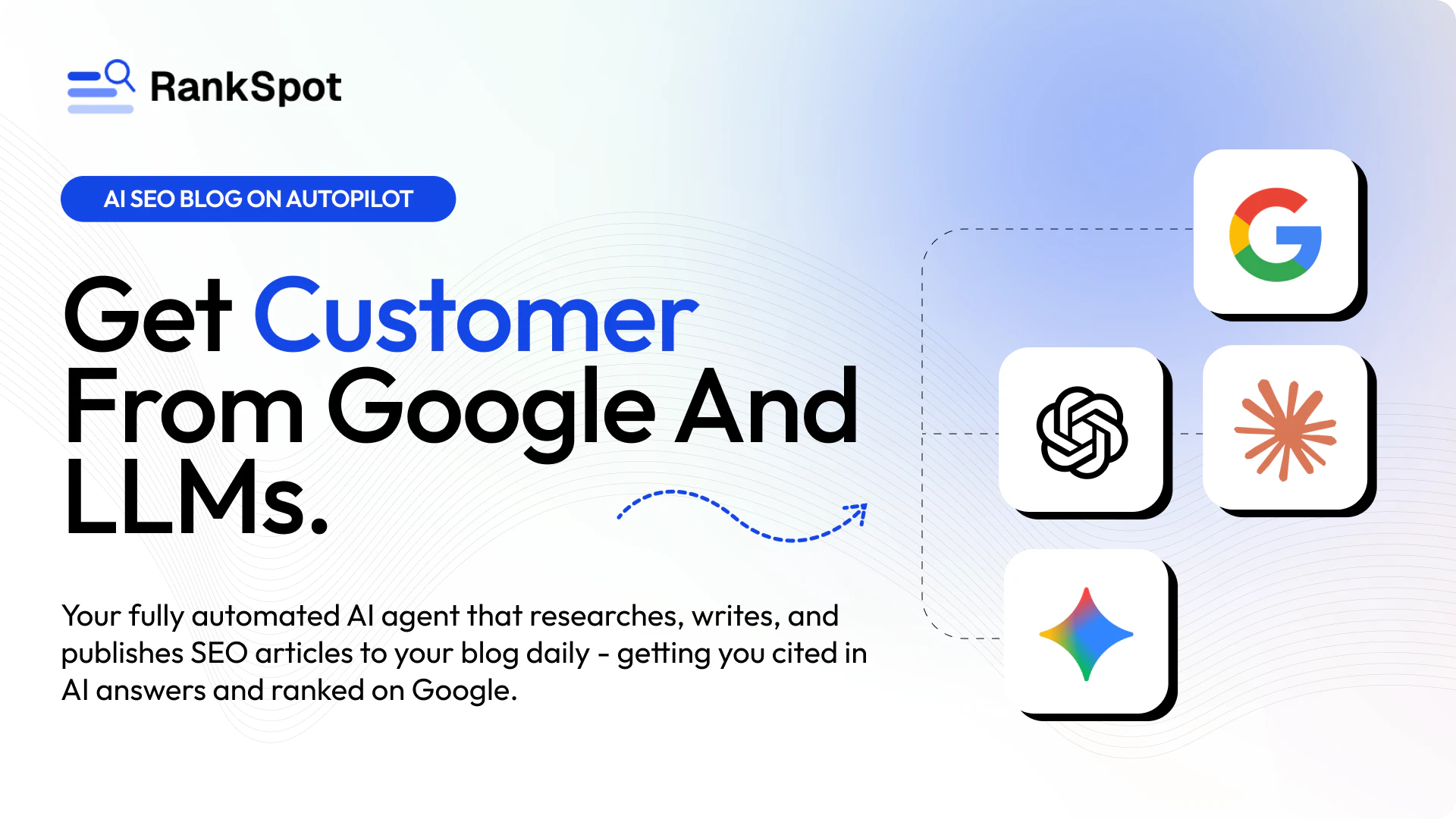
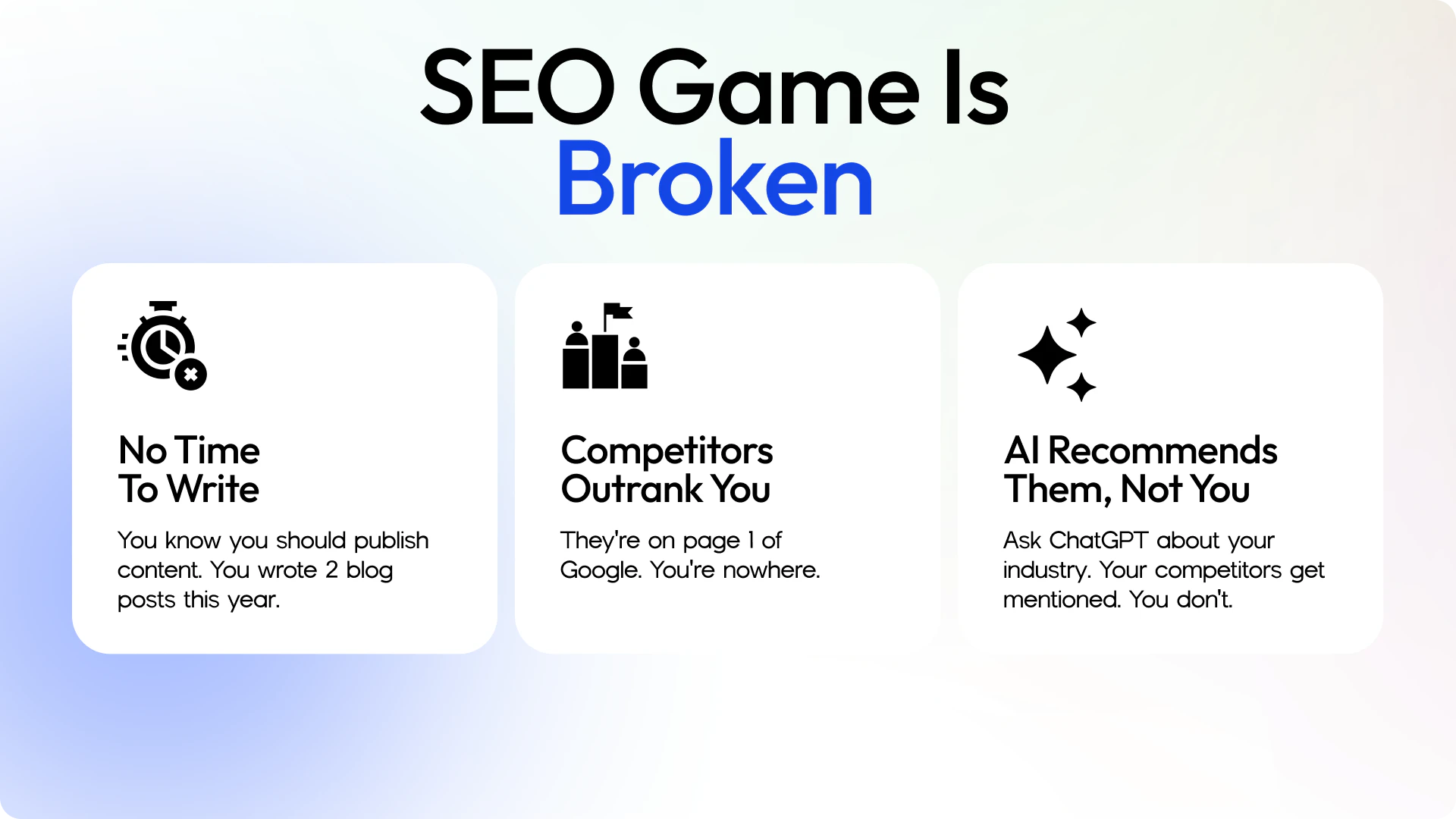
查看原始信息
Socrati
Your personal knowledge podcast — from any source. Drop in a PDF, a YouTube video, a photo of a page, or a topic you type in. Socrati builds you a full course: narrated audio lessons, multiple-choice drills, fill-in-the-blank exercises, and flashcards. Spaced repetition brings the material back on the day your brain is about to forget it. Built for the moments you can't be at your desk: headphones in on the bus, at the gym, or before bed. Live on iOS and Android in 6 languages.

Hey Product Hunt 👋

I'm David, the solo maker behind Socrati. I built this because I kept wanting to learn when I wasn't at my desk — on the bus, at the gym, or in bed at the end of a long day, too tired for a screen but happy to put headphones on and let a lecture play in the background.

Drop in a PDF, a YouTube link, a photo of a page, or a topic you type in, and Socrati builds you a full course: narrated audio lessons, drills, flashcards, and spaced repetition to bring it back before you forget it. Live on iOS and Android, in six languages.

Genuinely keen for honest feedback. I'll be here all day. Roast it, question it, ask anything.

— David

6
回复

What I like here is that you’re not just turning content into audio, but you’re building actual retention into the learning process. Most people take in information passively and forget it a few days later. The spaced repetition and interactive drills is what makes this feel genuinely useful for long-term learning, especially for people trying to learn while away from their desk.

1
回复

@thamibenjelloun Thanks Thami, the retention bit was easily the hardest part to get right. Generating courses is the easy bit. Without the drills and spaced repetition it's basically just an audiobook with extra steps.

2
回复
Compared with Quizlet’s and Anki’s ecosystems, what’s your stance on openness: will Socrati support exporting decks (e.g., CSV/APKG) or ingesting highlights/notes from tools like Notion/Readwise/GoodNotes—and what workflow do you think will become the default for power users?
0
回复

@curiouskitty Power users will start from source material, not from decks. Quizlet and Anki are great once you already know what belongs on a card. Socrati sits one step earlier - PDF, video, lecture, or paper in; lessons, drills, flashcards, and a review queue out.

Export: APKG and CSV are on the roadmap. Anki users are some of the most thoughtful learners on the internet and locking them in would defeat the point. The shape I want: every course's flashcards exportable to your existing Anki collection in one tap.

Ingest: Readwise is the obvious first integration - clean API, already aggregates from Kindle, Pocket, Notion, and most highlight tools. GoodNotes after.

Long term, decks become one output of the loop, not always the starting point. The starting point is curiosity about a topic or a stack of source material; the output is whatever shape your retention needs.

0
回复