Product Hunt 每日热榜 2026-05-11

PH热榜 | 2026-05-11

#1
articuler.ai
Describe your goal. Meet the right professional.
369
一句话介绍:Articuler.ai 是一个基于意图匹配的专业人脉平台,通过分析9.8亿公开资料,帮助用户精准找到投资人、合伙人、客户或导师,并生成高回复率的定制化联系邮件,解决传统关键词搜索无法识别真实需求和人际关系匹配的痛点。
Social Network Career Community
人脉匹配 AI社交 意图搜索 专业网络 冷邮件 求职招聘 投资对接 创始人工具 事件匹配 向量搜索
用户评论摘要:用户普遍认可“意图匹配”比关键词搜索更精准,关注冷邮件的真实感。核心疑问包括:对“15%回复率”的真实性有待验证,能否用于招募工程师或找客户,以及是否支持批量发送。团队背景(曾开发2.5亿用户社交应用)增加了信任度,但产品尚未解决大规模发送与个性化之间的平衡。
AI 锐评

Articuler.ai 在概念上确实击中了 LinkedIn 的软肋——后者本质是一个静态目录,而前者试图将“人脉搜索”从“查黄页”升级为“语义理解”。团队曾搭建过数亿用户的约会匹配系统,这种经验在构建高维度偏好向量和冷启动策略上具备天然优势,因此产品在“匹配精度”而非“覆盖面”上的竞争力值得期待。

但必须泼一盆冷水:平台高调宣传的15%回复率缺乏严格的AB测试对比和行业基准。在B2B场景中,决策链复杂,回复率不等于成交率;而在C端社交中,高回复率可能更多反映的是信息差价值而非长期关系建立能力。此外,产品强调“非数据库、非批量工具”,这在商业变现上是一把双刃剑——高客单价的私密匹配服务能否支撑规模化增长,仍需验证。

更关键的问题在于用户数据主权和隐私风险。虽然声明基于“公开资料”,但通过大量非结构化数据生成个人画像的Playbook功能,在欧洲GDPR或美国CCPA等法律框架下存在模糊地带。另外,该模式能否真正解决“弱关系激活”这一社交网络经典难题,还是最终沦为更智能的版领英InMail垃圾邮件生成器,取决于它对“意图”二字的定义——如果算法依然偏爱高薪、高学历、高热度的候选对象,将会重构精英人脉圈而非打破信息壁垒。产品目前仍处于尝鲜阶段,能否从“约会游戏的打工者”进化为“商业关系的操作系统”,团队还需要补上信任机制、合规体系和付费模型这三块拼图。

查看原始信息
articuler.ai
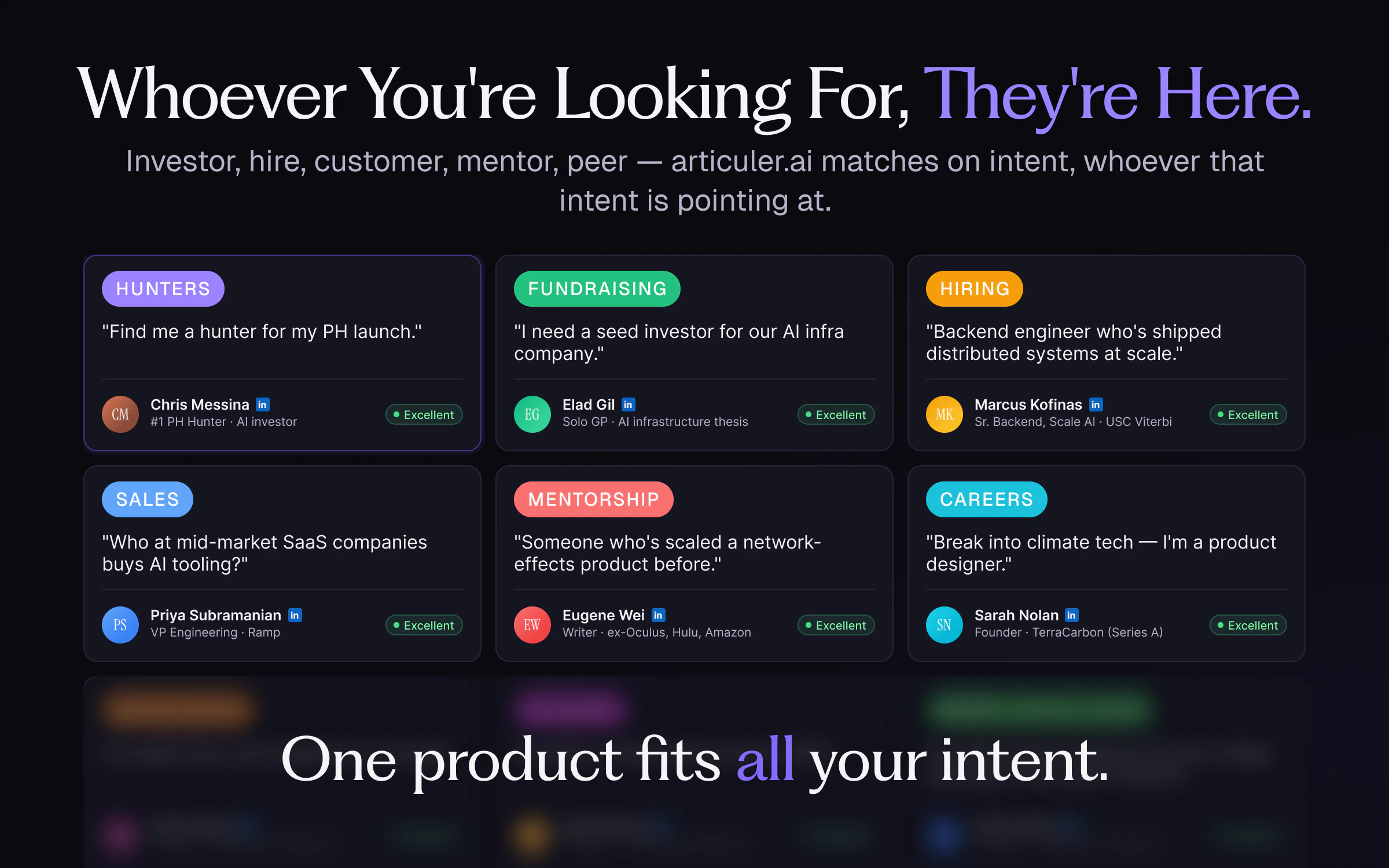
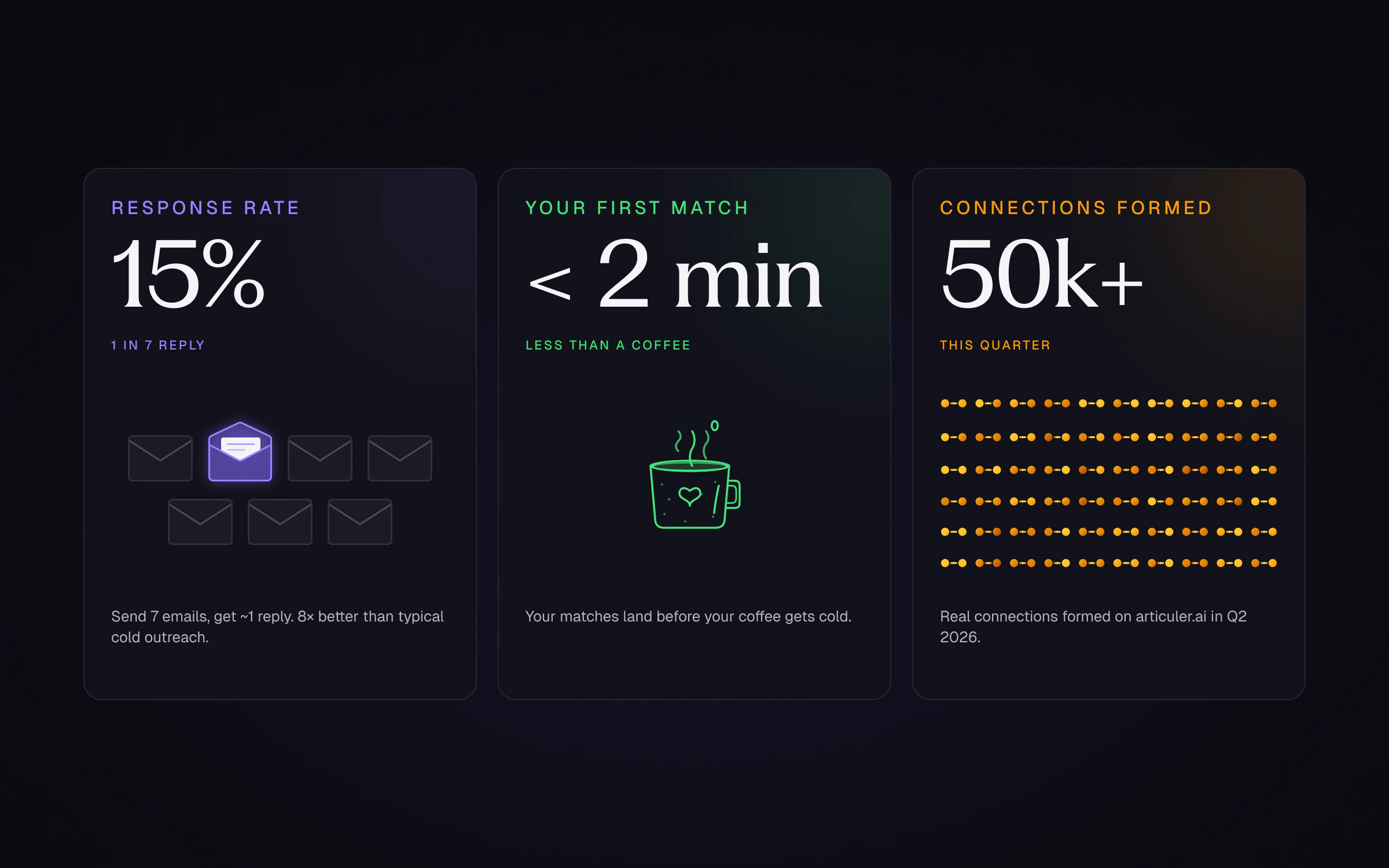
Networking is broken because keyword search is broken. We bring real connections to the table — the investor who funds your round, the hire who ships your roadmap, the partner who opens your next market. Tell us your intent and Articuler does three things: (1) Match across 980M public profiles, or within a scope like "VCs who wrote checks in Q1 2026." (2) Playbook: decode anyone from their public footprint. (3) Cold email: a first note that actually lands. 15% reply rate. 8x cold outreach.

Hey Product Hunt 👋

I'm Jason, CEO of Articuler.ai. Before this, I was a VC — and the hardest part of the job was never closing the deal. It was finding the right person in the first place.

LinkedIn works like the Yellow Pages: you have to already know who you're looking for. That's broken.

Articuler.ai matches on intent, not keywords.

  1. Describe what you need in plain language — e.g., "early-stage consumer AI investors who wrote checks recently."

  2. We match across 980M public profiles and surface the people who actually fit.

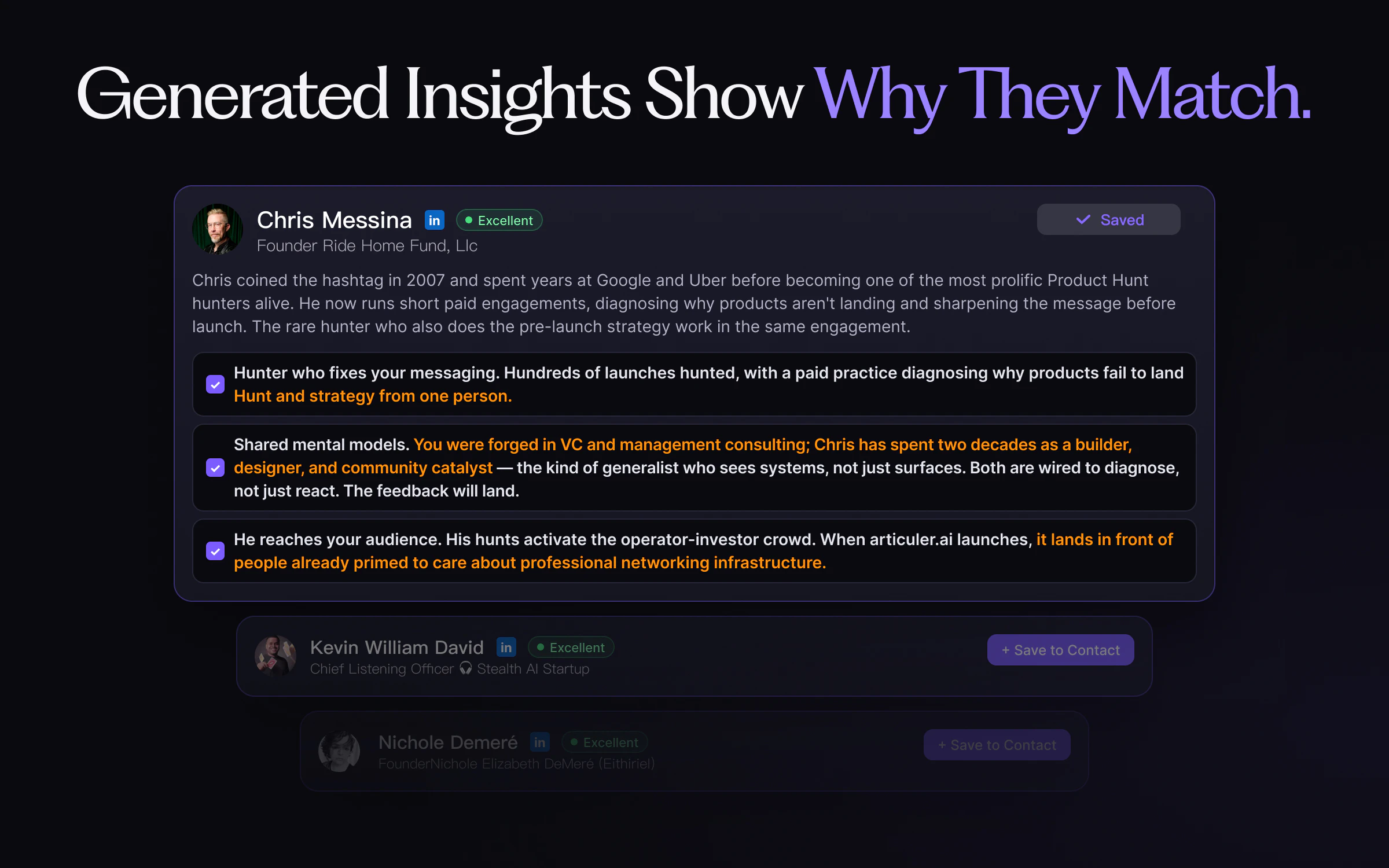
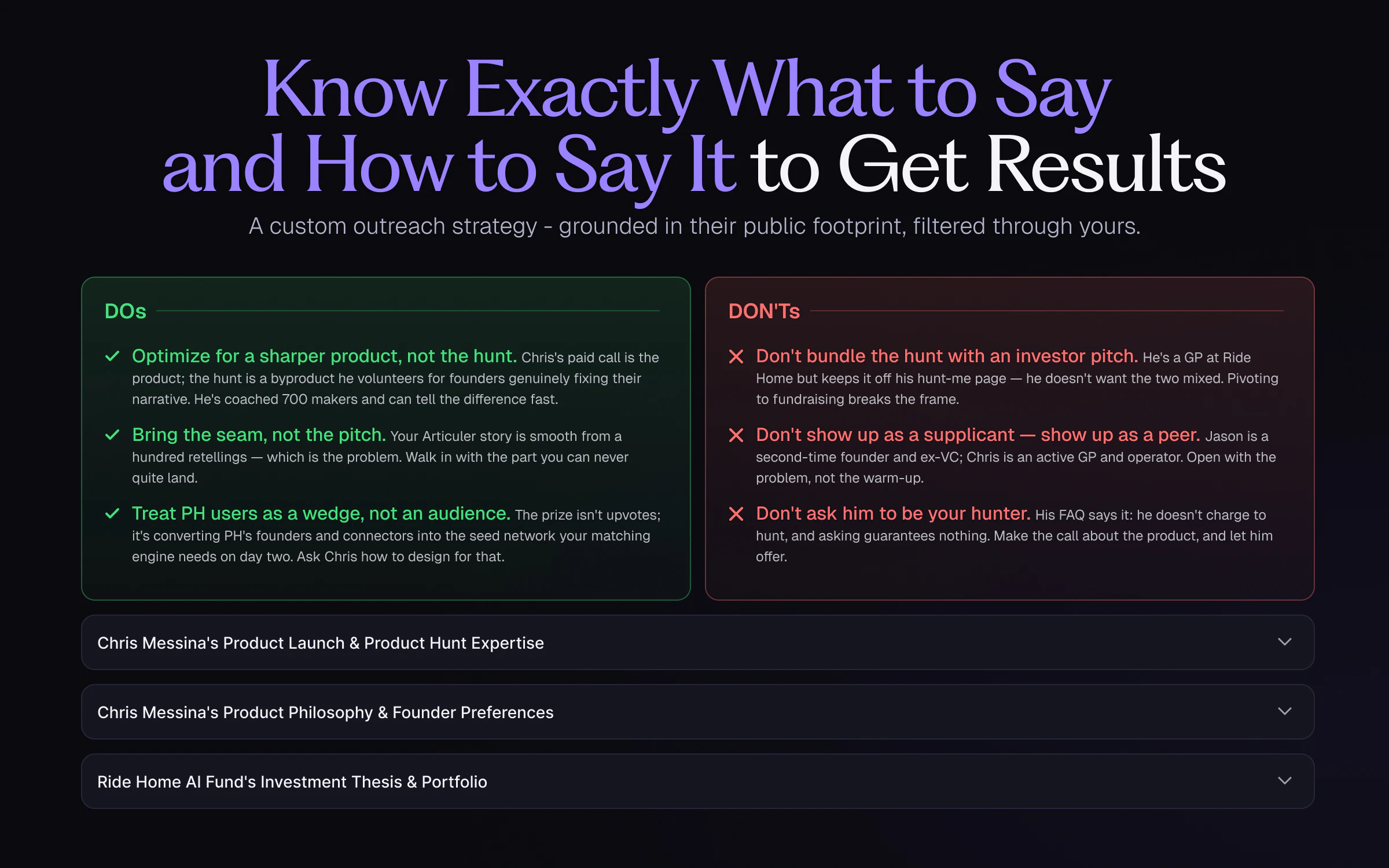
  3. Playbook decodes them. For every match, we read their public footprint and tell you what they care about, how they think — and the things you should never say. ("Don't ask Chris Messina to be your hunter — his FAQ says he doesn't charge.") The intel you used to only get from a friend who knew them.

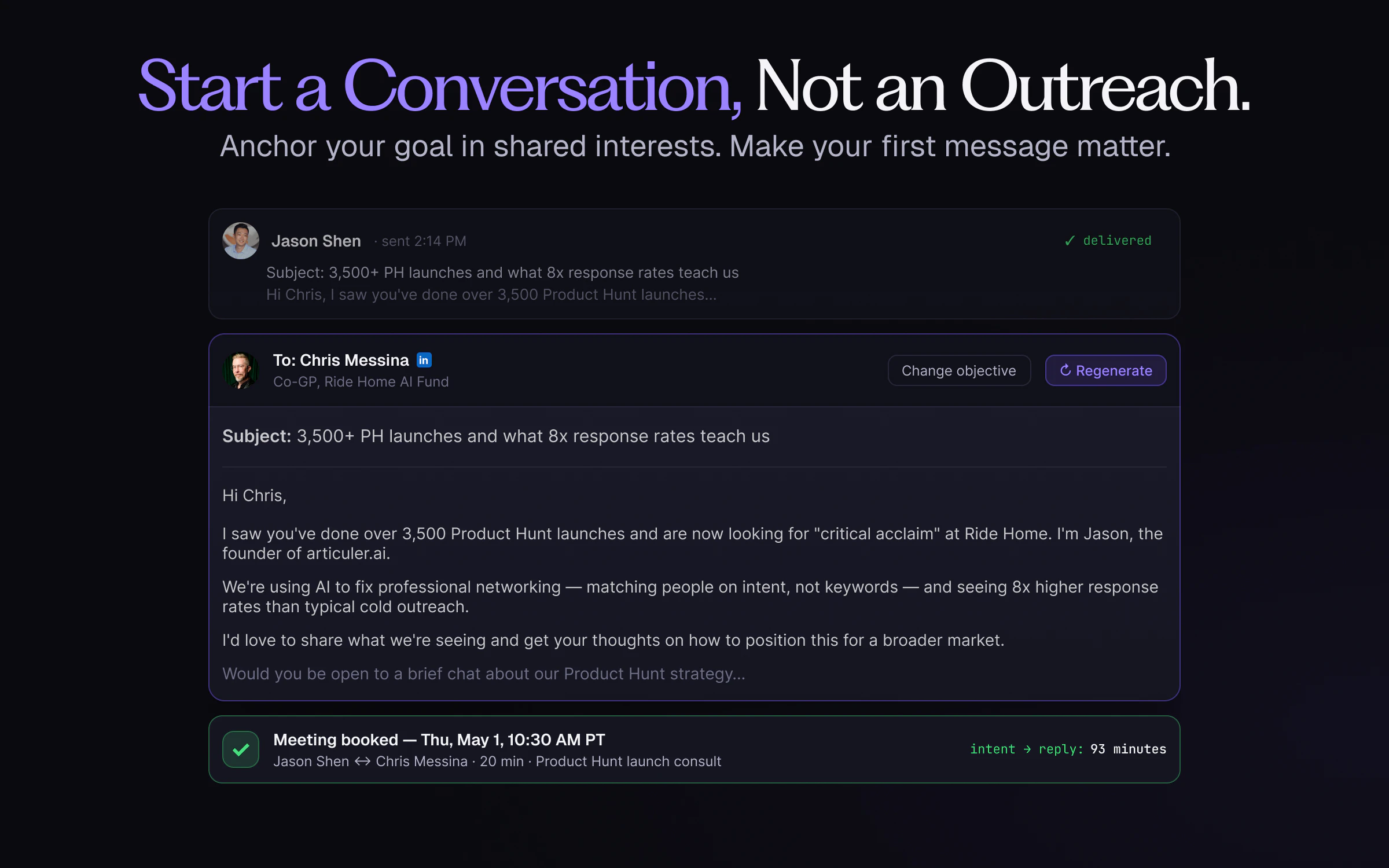
  4. We draft the first note — anchored in shared context. 15% reply rate. 8x cold outreach.

🔍For founders sourcing co-founders, hires, or investors, and young professionals exploring their next move. If your next opportunity depends on a person who isn't in your contacts yet, Articuler.ai is for you.

What's next: Event Match (pre-event matchmaking) launches next month.

🎁 PH gift: apply code PH26Q2 at checkout → one month free of our Pro features.

Drop a comment and tell us what do you think!

— Jason

16
回复

@jason_shen3 Honestly the matching part makes sense to me because searching LinkedIn with keywords feels useless half the time.

I’m more curious about the outreach stuff though, since most AI-written cold emails are painfully obvious after the first line. Wondering how natural these actually sound when people reply back.

0
回复

I get a load of cold outreach that opens like, "based on your experience with the Ride Home AI Fund…" — and I laugh, because I'm not actively investing from the fund now.

In these cases, someone's AI agent scraped some stale info, deemed it "relevant," and sent it to me anyway.

With Articuler, that problem goes away.

@jason_shen3 and @hotwheels_bo built two of China's largest dating apps — Tantan (acquired by Momo / Hello Group) and Jimu (acquired by Inke / Inkeverse) — and they made an observation: dating apps got cannibalized by Instagram and Snapchat because people found more natural ways to meet. The professional equivalent hasn't happened yet.

LinkedIn is still the default, and LinkedIn is full of AI garbage that nobody wants to read.

Articuler starts from intent: you describe who you're trying to reach, it runs conversational clarification, then surfaces ranked matches from ~980M public profiles with a "why connect" annotation baked in. The cold email writes itself from there.

The relevance problem is real and unsolved. But if anyone has the pattern-matching instincts to crack professional matchmaking, it's a team that already did it twice in a harder market.

7
回复

@jason_shen3  @hotwheels_bo  @chrismessina The strongest signal here is still intent → relevance → explanation that why connect layer is what makes it feel less like scraping and more like real matchmaking. If that reasoning stays accurate at scale, this could genuienly rehape cold outreach quality ✨

0
回复

Hey PH 👋

I'm Bob, co-founder & CTO of Articuler.ai.

Before Articuler.ai, I spent a decade developing human-matching systems — as Tech VP at Tantan and CTO at Jimu. Two dating apps, 6M+ DAU combined 👨🏻🎓.

You might think dating apps and professional networking tools are different things, but the core challenge was always the same:

How do you identify the right person out of millions, fast and accurately?

💕 Twenty years ago, you met your spouse in your village, your church, your office, or your social circle. Dating apps decoupled romance from those institutions — now you can match with anyone, anywhere, based purely on signals.

🎓 The same thing is happening to professional life, just faster. AI is unbundling individuals from organizations. A solo operator with Cursor and Claude ships what used to take a 10-person team. The unit of value creation is shrinking from the company to the person.

Which means: who you find, and who finds you, stop being a career nicety and become infrastructure, as critical as your bank account.

LinkedIn is a directory. Warm intros don't scale. What's needed is matching at internet scale, on intent — which wasn't possible until GenAI turned every public footprint into a vector.

That's what we're building. 980M+ professionals, vectorized. Match on intent.

Romance got its decoupling tools twenty years ago. Professional life is getting them now. And that is what Articuler.ai is doing.

Have a great day guys!

— Bob

6
回复

Has anyone used this for finding mentors rather than transactional connections?

3
回复

@jissin lu 😄 If Confucius had Articuler, "in any group of three, one of them is my teacher" would've become "in any group of 980 million, the right teacher is one query away." (I really like your porofile pic haha :)

Jokes aside — mentorship is one of our favorite use cases, and not just for founders. College students and young professionals use us heavily — the question "who walked the path I'm trying to walk" is the deepest networking need most young people have.

Try a Directory Match like "USC grads who broke into big tech in the last 3 years" — that scopes the search to your alumni network specifically and surfaces people who remember exactly what your stage feels like. Way more useful than a generic LinkedIn search for "Google PM."

Founders find investors. Students find mentors. Different intent, same engine. What domain are you in?

0
回复

@jissin Hi Lu, happy to share a little personal story! I've seen it firsthand.

I just graduated last year, and when my friends were job searching, they had the drive but not the network. I let them try Articuler.ai, and the most valuable matches weren't recruiters — they were mentors. Alumni and professionals who actually took the time to review resumes, reframe their story, and show them how to reach out.

As a recent grad, I can tell you: the biggest gap early in your career isn't skills. It's access. You don't have 20 years of warm intros to fall back on. Articuler.ai closes that gap — not by handing you a list of strangers, but by finding people who are willing to help and telling you how to start that conversation.

0
回复

As a solo founder, finding the right people is literally my biggest bottleneck. This feels like it was built for me.

3
回复

@itsluo Luo, this is exactly who we built Articuler for 🙏 Solo founders feel this bottleneck the hardest — every hire, every investor, every first 10 customers is a single-person decision with no team to crowdsource intros from.

Try a query like "early-stage operator who's done 0-to-1 GTM at a solo or 2-person team, open to fractional or advisory roles" — that's the kind of search LinkedIn can't run. And Playbook will tell you things like "this person turned down 3 fractional offers last quarter because the founders pitched salary instead of equity" — the intel you'd never find on a profile.

What's the most painful "right person" search on your list right now? Happy to run it.

0
回复

@itsluo Thank you for liking our product! Perhaps you can take a look at our directory feature, it helps you with finding very specific people for your need. If there isn't one that suits you, you can always reach out for us to give us ideas!

1
回复

Congrats on the launch! Does this work for recruiting as well? Can I find a growth engineer on Articuler?

2
回复

@venier Giacomo, thanks 🙏 Yes — recruiting is one of our strongest use cases, with one specific philosophy: good hiring isn't finding a list, it's finding people whose background aligns with what you're building.

"Growth engineer" returns 50,000 LinkedIn results. For Snaply, you'd want something like "growth engineers who've shipped voice/audio products or written about real-time AI infra." LinkedIn can't filter for that. Public footprints (tweets, blogs, GitHub) can. Happy to run it for you.

Also worth flagging: a real chunk of Articuler's users are young professionals actively looking to join startups exactly like Snaply — they're already on our platform describing what they want. We've been thinking about building a dedicated startup-hiring directory that matches founders like you with these candidates. Snaply feels like the right launch partner for this — are you in?

0
回复

@venier Thank you for your comment, Giacomo. Yes, just as Jason mentioned, we do exactly what you asked!

We find you the right person for your next hire, but we can also do matching on the other side and connect potential employees to you by adding founders and job seekers into the same directory.

0
回复

Congrats. Do I understand correctly, it's a database of users/companies, where you can use text search to narrow down results and then sent them email?

2
回复

@davitausberlin Davit, we're not a database — and respectfully, not trying to be a better one.

The "database + search + cold email" stack — ZoomInfo, Apollo, Lemlist — is structurally spam infrastructure. Buy a list, run keyword filters, blast templates. The whole industry's TAM depends on filling professional inboxes with messages people don't want to read.

Articuler is on the opposite side. We're a content distribution network for professional intent.

Keyword search matches strings: "VP of Marketing" returns every VP of Marketing. Intent matching understands meaning — we read 980M public footprints (posts, podcasts, hiring patterns, check histories, etc.,) and surface the specific humans whose current intent overlaps with yours. Where there's actual exchangeable value on the table.

A database tells you who exists. We tell you who's worth meeting, and why.

Worth noting — FlowMarket and Articuler are pointed at the same horizon from different starting points. You're letting AI agents discover and negotiate B2B deals; we're building the layer where humans find the right humans to begin with. Different problems, shared belief: the future is about fit and intent, not lists and blasts. Would love to chat someday about how the layers might compose 🚀

1
回复

I run a founder community with monthly events. Could I use Articuler.ai to match attendees before they show up?

2
回复

@erictian Yes, you can! In-event matching is on the last stage of beta testing, please dm me, and I can provide you more details.

1
回复

@erictian Of course! Our event matchmaking function will be launched no later than late June. Happy to reach out and discuss further details with you.

1
回复

How specific can I get with my search? Like can I say "founders in Austin who just raised a seed round"?

2
回复

@ann_y1 Yes, just as simple as that! Then you will get a list of profiles with a detailed summary about why they fit your profile and your goal!

1
回复

@ann_y1 just tell us your target's image, and we deliver!

1
回复

Congrats on your launch! This looks like a powerful way for companies to move beyond keyword search and build real, outcome‑driven connections.

2
回复

@charlenechen_123 Thank you Charlene! We only want to deliver connections that are useful

0
回复

Looks pretty useful tbh. If it can actually match you with the right investors, hires, or partners without endless keyword searching, that’s a big win. The 15% reply rate sounds impressive, but I’d definitely want to test it myself

1
回复
0
回复

This is interesting — the framing of "define your goal, not the person" actually flips how I usually think about networking. Most tools I've tried make me start with a name or a title, then I'm basically guessing whether that person is the right fit. Starting from intent feels much closer to how I actually think when I need help with something.

The 980M number is wild but what caught me more is the "filtered through yours" part — outreach grounded in their public footprint AND mine. That's the gap in every cold email tool I've used: they help you research the recipient but the message still sounds like it could've been sent by anyone.

Curious about a few things:

  1. How does it handle softer intents like mentorship or peer connections vs transactional ones like sales/hiring? Feels like those need very different tones.

  2. For the "8x better than cold outreach" — is that across all use cases or skewed toward certain categories?

  3. Can you bring your own context (notes, past convos, what you're actually working on) to sharpen the match, or is it all inferred from your public footprint?

1
回复

@hans_c Hans, this is one of the most thoughtful reads of the product I've seen 🙏 You caught the "filtered through yours" detail that we obsess over most — most cold email tools research the recipient but treat the sender as anonymous. The message ends up technically accurate and emotionally hollow.

To your three questions:

1. Softer vs transactional — We don't think they're that different. Sustainable connections are built on exchangeable value — what changes is just the form. · Sales: a specific insight matching what their company's working on (recent hires, launches, public asks). · Fundraising: your domain insight intersecting their current thesis (recent posts, podcasts, check history). · Mentorship: genuine curiosity from someone walking their path — sometimes a shared alma mater is enough.

Generated Email and Playbook adjusts the form, so a sales pitch doesn't read like a mentor request, and vice versa.

2. The 8x figure — Overall rate, not cherry-picked. Caveat: consumer/SMB sees higher reply rates than enterprise — senior recipients are harder regardless of personalization quality.

3. Bring your own context — Current version infers from your public footprint + auto-learns from your preference signals (saves, outreaches, conversions). Next version lets you bring explicit context (notes, what you're working on, who you've talked to). Exactly how you framed it.

Also — Me.bot is the adjacent problem we care about deeply. The day everyone has a real personal memory layer, Articuler's "filtered through yours" gets exponentially better. Rooting for you 👌

1
回复

@hans_c Thank you Hans, really appreciate the thoughtful breakdown — and you nailed exactly why Jason and Bob built Articuler.ai this way. Starting from intent rather than a name or title is how people actually think about networking. You don't wake up thinking "I need to find John Smith." You think, "I need someone who can help me with X." Every tool on the market forces you to translate that backward into keywords. We wanted to skip that step entirely.

And yes — the "filtered through yours" piece is what we're most proud of. The Playbook doesn't just research the other person. It reads both sides and finds the threads between you. That's why the outreach doesn't sound generic — it's grounded in what you actually have in common, not just what they've done.

0
回复

@hans_c That’s exactly what caught my attention too most networking tools still feel very search-first instead of goal-first.

The part about outreach being filtered through both profiles feels especially interesting because generic personalization is becoming easier to spot now. Curious to see how well it handles more relationship-driven networking compared to transactional outreach.

1
回复

Hi, congrats! Quick question: is it mainly for finding investors, or can it also help with finding and pitching potential clients?

1
回复

@jojo_li JoJo, great question 🙏 Short answer: both — but finding and pitching clients is actually where Articuler shines hardest.

Two sides of the same engine:

· Finding — instead of "VP of Marketing at SaaS companies," you can run "VPs of Marketing at mid-market SaaS companies who recently mentioned localization pain or hired international growth roles." That's signal, not title — and signal is what tells you who's actually ready to buy.

· Pitching — this is where Playbook earns its keep. For every prospect, we read their entire public footprint and tell you what they care about, what they've publicly criticized, what kind of pitches they've responded well to. Think of it as the briefing you'd get from a friend who actually knows them — the friend most BD reps wish they had before every cold call.

Then we draft the first email anchored in shared context, not a template. 15% reply rate, 8x cold outreach.

What does your ICP look like? Happy to run a sample search — would love to see Articuler land a Vozo deal 👌

0
回复

Recently what makes me headache is to send out cold reach out emails in batches... what platforms or social media apps do you support now?

1
回复

@cruise_chen We're deliberately not a batch tool. Articuler drafts a separate message per person based on that specific person's profile, recent activity, and your overlap with them — sending the same message to a list isn't really the workflow. Today you can use the drafts in email, LinkedIn DMs, or anywhere else you paste text. The tradeoff is real: you send fewer messages, but reply rate is the multiplier (we see ~8x over generic blast). If your headache is prep time per email rather than send mechanics, you're in the right place. If it's pure volume, we're probably not the right fit.

0
回复

@cruise_chen Right now, articular.ai can connect directly to your Gmail. However, we can also craft dedicated messages for you to copy and paste on other social media platforms for outreach (for example: LinkedIn, Twitter, etc.).

0
回复

made by dating app guys, so they literally know how to match humans!

1
回复

@yankun_zhao 🚀🚀You next financing round is on us!🚀🚀

0
回复

@yankun_zhao Hey Yankun, you get the gist!

0
回复

Could a BD lead use this to find partnership opportunities, or is it more focused on people-to-people connections

1
回复

@haoran_fok Henry, yes — strongly yes 🙏 BD is one of our top use cases, because every partnership is ultimately people-to-people. The deal closes between two humans.

Real examples from our users:

· Consumer electronics brand → finding EU distributors who've ranged competing audio products

· CRM SaaS → mapping VPs of RevOps at companies that just switched off Salesforce

· Forklift manufacturer → finding warehouse automation integrators with Tier-1 deployments

None findable on LinkedIn keyword search. Partnership BD lives in the signal layer, not the title layer. What angle are you working on?

(BizCard looks slick 👌)

1
回复

this + event networking = actually useful combo

1
回复

@novamaker01 Glad that landed. In-Event Match is the part we think gets least talked about and matters most — it's the only place where the cost of meeting the wrong person gets paid in real-world hours, not just an unread email. If you've got a conference coming up, worth signing up an event slot.

1
回复

@novamaker01 Thank you Felix! Event matchmaking comming next, feel free to connect and I will get you our first hand information!

0
回复

What have you seen as the biggest issue for matchmaking so far? Also are you planning on adopting more features like they have at Boardy?

0
回复

The intent-based matching is a smart angle. LinkedIn search is basically keyword roulette. I'm building a startup right now and finding the right investors and advisors is one of the hardest parts. Going to try this for that exact use case.

0
回复

The matching logic here seems really interesting. How are you handling the 'vibe check' between the user's goal and the professional's style beyond just skill keywords? Congrats on the launch.

0
回复

@jason_shen3 @hotwheels_bo @justin_bai Similar to my review (jumped in to give feedback before the launch was live). Congrats on the launch and looking forward to seeing where this gets.

The meat on the bone here is obviously the quality of the outputs. I tend to rush through onboarding (nothing different here) and even by doing so quickly - I got super tailored and unique outputs - specific to my intended need.

Text box is great for search (vs a thousand filters) and I really love the niched product experience. Create a profile - search for X - shortlist and track those prospects.

The simple Kanban style tracking feels intuitive and intentional.

In a world full of AI slop products - it's nice to see some really solid products with really specific / niche use cases that just feel purpose built with a clear mission.

0
回复

@dzaitzow Thanks Daniel!

0
回复

Congrats on the launch! The intent-based matching is what hooks me — searching LinkedIn by keyword

feels broken the moment you're looking for someone with a specific perspective, not a specific job

title. As a founder building in the AI space, the part I'm most curious about is the Playbook — how

deep does it go on someone's public footprint? Does it pull from podcasts/Twitter/Substack, or

mostly LinkedIn + company pages?

0
回复

@erfanveisi Thank you for you comment Erfan! Great question, and I believe this is the reason we are different than most professional networking tools:

The Playbook doesn't rely on a single source. We aggregate across the public professional web — LinkedIn, company pages, GitHub, Twitter/X, published articles, podcast appearances, conference talks, Substack, patent filings, academic papers, and public investor/portfolio data. Basically, if it's public and professionally relevant, we're indexing it.

But the real differentiator isn't breadth of sources — it's how we process them. Every piece of public content gets vectorized into the same semantic space. So when we build a Playbook, we're not just stitching together bullet points from different platforms. We're computing the actual relationship between what that person has said, built, invested in, and written about — and mapping that against your background and intent.

Hope this answers your question, and feel free to check out our product! Don't forget to apply our promo code 🎁PH26Q2 for one month free access!

0
回复

The cold email piece — "15% reply rate, 8x cold outreach" — is the part that genuinely stands out here. We build B2B sales automation for service firms and the hardest problem isn't sending volume, it's relevance at the point of first contact. Curious how Articuler handles cases where the public profile data is stale or the "why connect" annotation lands wrong — does the system have a feedback loop to recalibrate match quality over time?

0
回复

@thekrew Really appreciate this — and you're touching on exactly the right problem.

Volume was never the bottleneck. Relevance is.

The 15% reply rate comes from our Playbook feature, before you even press the "send" button. Before any outreach, Articuler.ai reads both sides — your background and theirs — and finds the actual shared ground between you. That's what makes the first message land. It's not a template with a mail-merged company name. It's context that could only come from understanding both people. We are like that "guy who knows the other guy".

On stale data — great question. Public profiles do go stale, and we're aware that's a real edge case. Right now we mitigate this by pulling from multiple public sources rather than relying on a single profile, so even if someone's LinkedIn is outdated, their recent activity elsewhere can fill the gap. That said, this is an area we're actively improving — the goal is to flag confidence levels on match data so you know when context is fresh vs. inferred. You can truly see the degree of matching between you and the target individuals on this list.

1
回复

love it! so glad to see the fast iteration and yes it really works for all people business!

0
回复

@stainlu ❤️❤️❤️

0
回复

@stainlu Means a lot. Shipping speed is the whole strategy this quarter, the fact that the same engine works for hiring, fundraising, and BD off one profile is the part we're proudest of. More coming this month.

0
回复

This is game-changing stuff

0
回复

@gavin_luo ❤️❤️ @Tripo AI is my favorite 3D generation model

0
回复

@gavin_luo Bo spent years building datin apps... so the skills transfer lol

0
回复

Congrats on the launch. The "define your goal, not the person" framing is very clear.

Curious how you avoid the system over-optimizing for obvious public signals. Do you have a way to surface less obvious but high-fit people when their profile does not use the expected keywords?

0
回复

@fabian_exner Fabian, this is exactly the design problem we obsess over 🙏

we don't use keyword matching at all. We embed each person's full public footprint, directly into a semantic vector. Matching happens in vector space, not in keyword space.

So the "profile doesn't use expected keywords" failure mode doesn't really apply. Two people writing about the same idea with different vocabulary — "climate" vs "energy transition", "distributed systems" vs "large-scale infrastructure" — end up close in the embedding space because the model captures meaning, not surface words.

We don't search profiles, we match meanings. That's the difference between matchmaking and search.

Caveat: there's still real work in deciding which signals to weight up (behavior vs declaration, recent vs old activity). But the "missing keyword" failure is mostly a keyword-system problem, not a vector-system problem.

Right thing to push on 🚀

0
回复

Intent-first networking is such a smarter approach than keyword-search. As a solo dev building FinTrackrr, I've wasted so much time on LinkedIn trying to find the right early advisors and beta users — keyword search just surfaces random people. The idea of describing your goal and letting the AI decode public footprints to find actual matches is exactly what cold outreach needs. 15% reply rate claim is impressive. Does it work well for early-stage founders looking for beta users or first customers?

0
回复

@asim_saeed1 Yes, with one caveat. Beta users and first customers are exactly the use case Global Match does well, because you can describe what your product solves instead of searching for a job title — "operators at sub-50-person fintech teams frustrated with [specific problem]" returns a tighter list than any LinkedIn filter combination. The caveat: match quality is sensitive to how specific your disqualifiers are. "Founders interested in fintech" returns noise; the tighter the who-shouldn't-care, the better the shortlist.

0
回复

Congrats on the launch. The 'intent-based' matching vs. keyword search is such a necessary shift.

0
回复

@bilal_niaz ❤️❤️ You are more than welcome to give articuler.ai a try!

0
回复

@bilal_niaz Keyword search asks "who matches these tokens." Intent matching asks "who can move this specific goal forward." They look similar from the outside but produce completely different shortlists. Glad it resonates.

0
回复

@bilal_niaz Thanks Bilal, it's time for the next chapter for professional networking!

0
回复

Looks great!

0
回复

@madalina_barbu ❤️❤️❤️

0
回复

@madalina_barbu Thank you Madalina!!!

0
回复

Early-stage hiring is all about reaching the right people fast. Love the concept — gonna test this for my next hire.

0
回复

@yehan_xiao Yehan 🙏 Early-stage hiring is the use case we obsess over the most — the best first hires almost never show up in LinkedIn keyword filters. What's the role? Happy to run a sample search and share the playbook on the top 3 matches.

0
回复

@yehan_xiao Feel free to just leave us one line or one goal about the type of person you are seeking. We can just run it for you and present you the results, and you can see it for yourself!

0
回复
#2
OpenJobs AI
End-to-End Autonomous AI Recruiter
305
一句话介绍:OpenJobs AI 是一款端到端自主AI招聘代理,通过多代理协作自动完成从职位需求解析、候选人搜寻与筛选、个性化沟通到面试安排的完整招聘流程,解决招聘中“找到人但约不到人”的中间环节断裂问题。 --- ### 关键词 AI招聘代理, 自动化招聘, 候选人筛选, 多代理协作, 招聘SaaS, 人才搜寻, 面试安排, AI智能体, HR科技, 招聘效率 --- ### 评论摘要 用户认可其多代理架构和自主性,但关注点包括:对量化、生物等小众岗位的有效性;积分机制的价格合理性;候选人体验是否会造成信息骚扰;AI能否区分简历包装与真实能力;获取首批候选人的速度;以及邮件沟通的自然度。 --- ### AI锐评 OpenJobs AI 的核心价值不在于“找到更多人”,而在于“把人留住”。它准确切中了招聘流程中最被忽视的“黑暗地带”:候选人沉默后的二次触达、已表达兴趣后的跟进、以及从“可能合适”到“确定面试”之间的漫长拉扯。这些年,招聘SaaS几乎把资源全砸在了漏斗顶部(职位发布、简历匹配、ATS),却让最劳力密集型的中段环节——也就是长达数周、需要高度情境化的候选人沟通——继续由人类手工驱动。MIRA的四代理架构在技术上是合理的:搜索代理解决广度,对话代理解决深度,而跟踪代理解决“流失率”。但真正决定其天花板的是两个核心问题:第一,积分定价机制(一个已确认意向的候选人消耗1积分)是否会激励平台优先推送高频简历而非最优匹配?如果“已确认”是付费门槛,那AI的筛选逻辑可能从“最合适”滑向“最可能回复”,这对雇主是一种隐性伤害。第二,处理AI优化的简历是个棘手的噪声问题。官方声称通过代码库、论文、对话深度来识别“真实建设者”,这在技术可行,但规模化后极易被对抗性手法污染(例如Ghost Contributors、伪装的项目轨迹)。若不能建立可信的、实时验证的能力凭证链路,这个优势会迅速被刷子工具有效攻击。总体而言,OpenJobs AI 的产品逻辑是近5年来HR技术中最诚实的创新之一——它不画饼“找到完美候选人”,而是承诺“把已经关注的候选人变成面试”。建议团队尽快开放可以显著降低价格敏感性的API接入模式,让招聘代理直接嵌入ChatGPT、Claude等企业级智能助手,将“招聘工具”进化为“招聘能力基础设施”。在人才稀缺的行业(AI、生物技术),它能立刻创造可量化的ROI;但在招聘已是买方市场的领域,它仍需证明自己的成本效率高于一个普通的招聘专员。
Hiring Pitch Singapore
用户评论摘要:AI解读失败
AI 锐评

AI解读失败

查看原始信息
OpenJobs AI
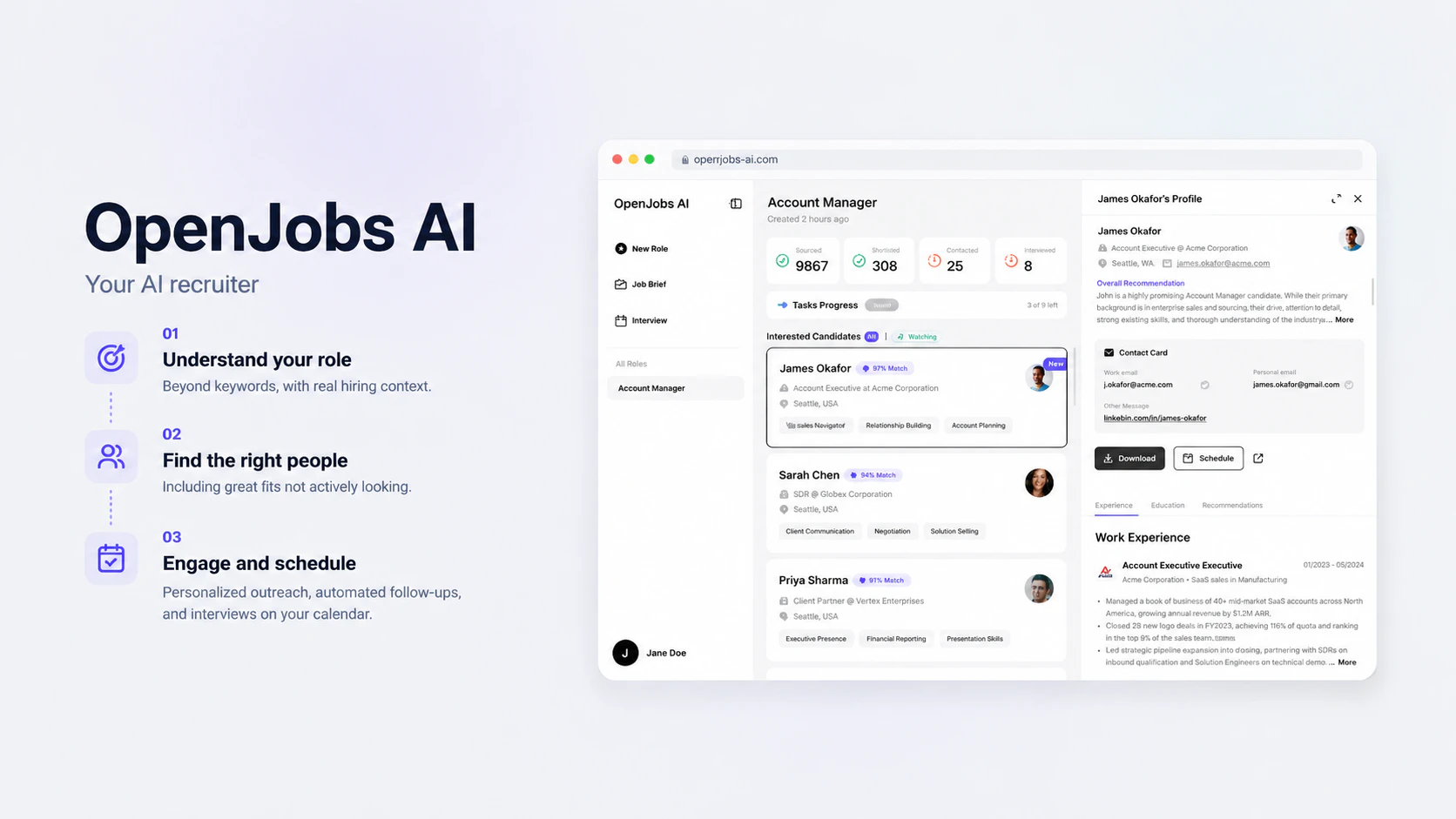
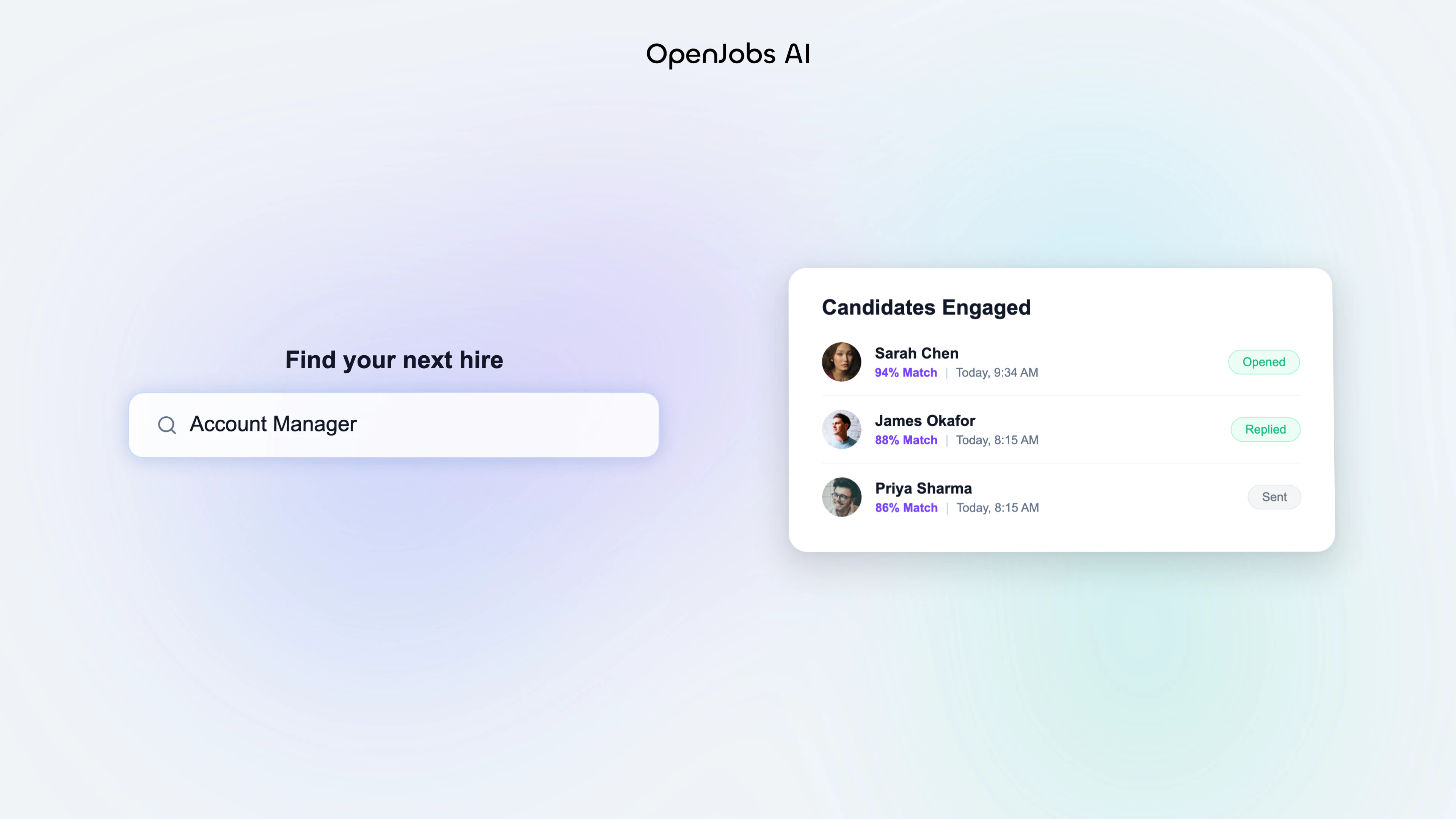
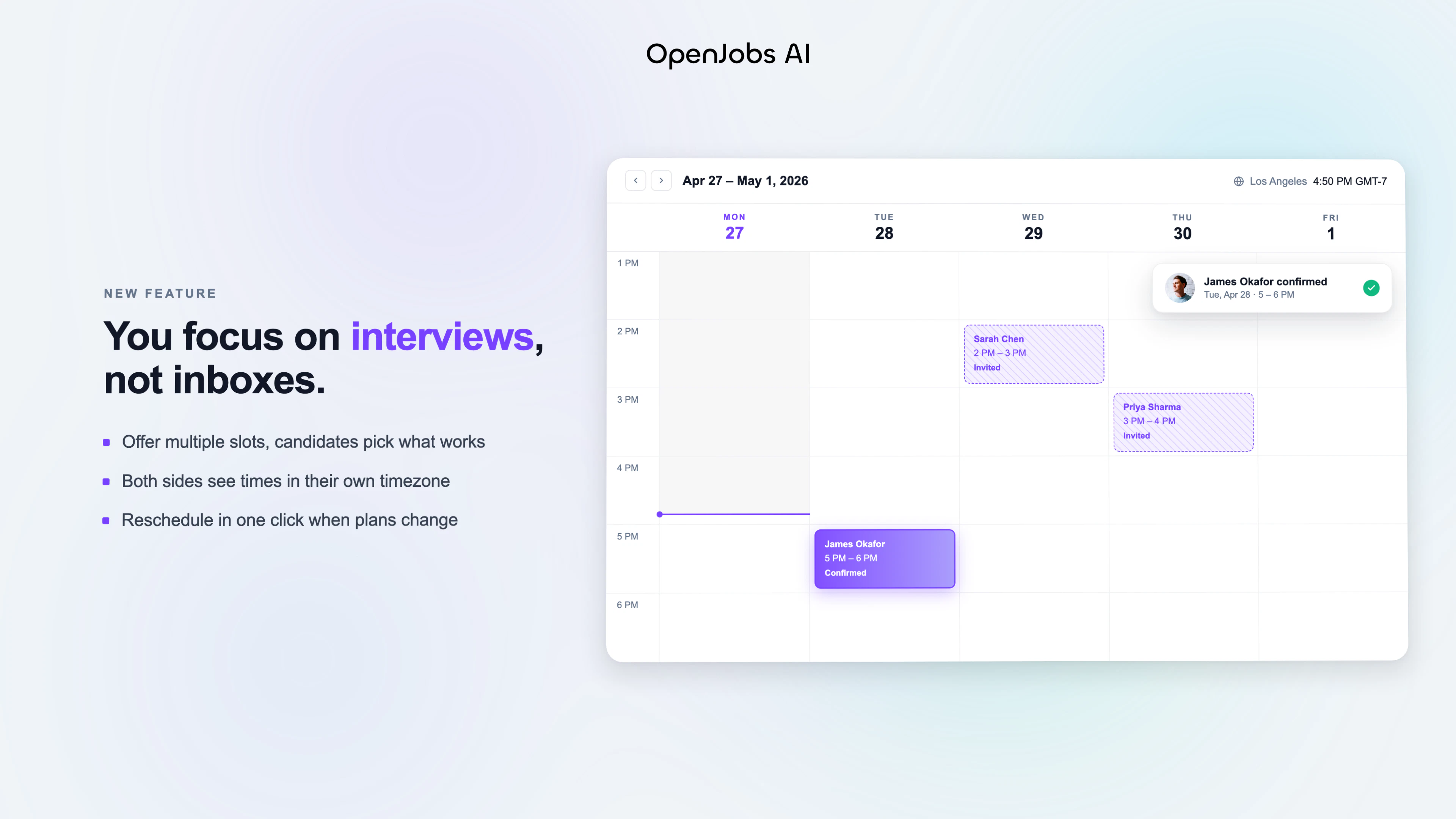
Tell us what role you’re hiring for. AI recruiter sources qualified candidates, screens them against your requirements, sends personalized outreach, tracks replies, and books interviews directly on your calendar.

I've been having a version of the same conversation almost every week this year.

Sometimes it's with a founder. Sometimes a head of talent, sometimes an operator trying to grow a team while still shipping the product. The details change. An eng role that's been open four months. A sales hire that fell apart in week three. A senior PM who finally said yes and then went quiet. But the shape underneath is always the same. They have the budget. They have the role open. The person they need exists, is reachable, is probably already somewhere in the funnel. And they still can't get them in the door.

This isn't a recruiter's problem. It's a problem every team trying to grow has felt. And it's one of the very few places in modern business where you can have unlimited budget, urgent need, and the right person sitting one message away, and still fail.

Every recruiter, every hiring manager, every founder I know carries a private list. The senior engineer who replied three weeks late, after the team had moved on. The PM who would have been perfect, but went quiet around day 14 and nobody had the cycle to chase. The director who finally said yes to a phone screen, then no-showed, and you never found out why. The list lives in their head. They don't talk about it. They file it under "cost of doing business."

I've spent more than a decade circling this same problem from different angles. First inside large hiring platforms, then working alongside more than 1,000 enterprise teams and recruiting agencies trying to make hiring actually work. The thing I can't stop thinking about is that quiet list. Because it isn't a cost. It's a system that's broken in a place no tool ever tried to fix.

Every wave of recruiting tech solved the front of the funnel. Find more people. Find them faster. Score them better. Then the brutal middle got handed back to one human, sitting at a desk, writing one email at a time. The half-finished conversations. The candidates going cold. The no-shows nobody recovers. That's where most of the work actually happens. That's also where most of it dies.

Nobody fixed it. Not because it didn't matter. Because until recently, the technology to fix it didn't exist.

Now it does. Agents, not a single model but a coordinated team of them, can hold a real conversation with a candidate over weeks. Pick up tone. Notice when someone's hesitating. Re-engage when they go cold. Not at the level of a great recruiter on their best day. At the level of a steady, attentive one. Working every conversation. Never tired. Never out of patience.

MIRA is what came out of that. Four agents that share the load. One turns a fuzzy job description into a real search strategy. One finds the right people. One runs the conversations. One watches every candidate at once, and flags the ones about to slip.

The deliverable isn't a list. It's the person who didn't get away.

The bigger picture underneath: hiring is the most important workflow in any company actually trying to grow. And the one most clearly designed for a world that no longer exists. A world where the bottleneck was finding people, not engaging with them. As agents start to work with other agents to get real work done, the layer that's missing isn't another database. It's a system that actually understands people. One that can find the right human, hold a real conversation, and bring them into the room.

That's the layer we're building.

If any of those private lists sound familiar, I'd love to hear your story. Whether you're a founder who's watched a quarter slip because the right hire didn't land, a hiring manager carrying the weight of an empty seat, or a recruiter staring at the names you wish you'd kept warm. Especially the ones you don't usually tell. Those are the ones I keep learning from.

9
回复

We have increased the free trial quota for new users, so you have more room to explore and get a real feel for what we can do.

2
回复

How does Mira handle niche roles like quant or biotech? Or is it mostly noise?

4
回复

@cruise_chenNiche is exactly where Mira shines. Keyword sourcing breaks on quant and biotech because the signal is in the sub-specialty, not the title. Mira reads JDs at that resolution: stat arb vs market making, wet-lab vs computational bio, mRNA delivery vs protein engineering. That's why AI, robotics, and biotech became our biggest verticals, the deeper the domain, the worse traditional tools perform, and the bigger our edge. Quant's the same architecture. Give Mira a real JD and you'll see a slate same-day from a pool 300x larger than manual sourcing. Try it on your hardest open role.

2
回复

@cruise_chen thanks for the comments, please see my CTO's feedback.

1
回复

@cruise_chen 
To add some context — the objective scarcity of qualified candidates is a genuinely difficult challenge, and one that no algorithm alone can solve. It is fundamentally a supply problem. That said, when each role is communicated with greater clarity and specificity, it meaningfully improves the likelihood of a successful match.

What traditional recommendation engines and search engines have failed to deliver, we have built: a results-driven, interactive talent-sourcing Agent. When you experience it firsthand, I am confident it will exceed your expectations. Thank you.

1
回复
How do the credits work? The FAQ didn’t seem to cover that detail.
3
回复

@lakshminath_dondeti One Credit allows you to unlock a candidate who has already confirmed their interest—meaning they’ve expressed enthusiasm for both the company and the position. You can then schedule an interview and wait for the appointment to be confirmed. Thank you so much, I’ll make improvements right away!

3
回复
@genedai one credit for an unconfirmed candidate seems steep. Has the pricing been tested in different markets and at different salary levels?
2
回复
@genedai many thanks.
1
回复

Congrats on the PH launch. Calling it "autonomous" instead of "assisted" is the right framing. I don't want a copilot, I want the agent to just do the work and tell me when there's an interview to take.

3
回复

@jocky Thank you
Communicate like a seasoned recruiter—one deep conversation, and you’re ready to extend the final interview invitation. That’s all it takes.

You can have the right candidate in hand the same day and send the invitation immediately, instead of ending up with just a shortlist after a hectic search. Simple and efficient.

1
回复

@jocky You just drew the line we built the company on. Copilot is what you build when you don't trust the model yet. Agent is what you build when you do. The whole point is that you shouldn't be in the loop until there's an actual decision to make, and screening 200 resumes is not a decision, it's a tax. Mira pays the tax. You make the call.

1
回复

@jocky yes, you are right, the next step should be a background agent !

1
回复

Guys, good luck! Cool product!

2
回复

@dmitry_zakharov_ai many thanks!

0
回复

@dmitry_zakharov_ai Thanks Dmitry!

0
回复

@dmitry_zakharov_ai Thank you so much

0
回复

Curious about sourcing. Are you pulling from LinkedIn, GitHub, your own database?

1
回复

What's the user experience like as a candidate that Mira reaches out to once a call has been booked? Is the call with an AI agent or with an actual human recruiter from the hiring company?

1
回复

@ebroms Once a candidate books a call, the experience can be fully configurable by the employer. Some companies prefer an AI-led screening interview first for speed and consistency, while others route candidates directly to a human recruiter or hiring manager. Our goal is to reduce recruiter overhead without making the candidate experience feel robotic or impersonal.

0
回复

@ebroms When someone books a call with us, they're talking to a real human at the company. A recruiter or the hiring manager, depending on the role. Mira doesn't sit in for the interview.

That's intentional. The moment a candidate agrees to a call, they're making a real career decision, and finding an AI on the other end would feel like getting catfished. People are fine chatting with an AI to confirm the boring stuff. Timing, scope, comp range, whether the role's actually remote. They're not fine pitching their career to a chatbot for 30 minutes, and frankly, they shouldn't have to.

Our split is pretty simple. AI does what AI is actually good at: searching, personalizing, juggling async threads, getting calendars to agree with each other. Humans do what humans are still way better at: reading whether someone's the right fit, conveying what the team's actually like, closing. Candidates get both. Nobody has to pretend to be the other one.

0
回复

Congratulations on the launch. Tried it. How do you find if the candidate is really fit for the job and is actually looking for the job?

1
回复

@lokesh_motwani1 Thank you! We look at two separate problems: fit and intent.

For fit, Mira evaluates candidates beyond keyword matching — including trajectory, project relevance, skill overlap, and likely success in similar environments.

For intent, we use a mix of activity signals, responsiveness patterns, and inferred openness to opportunities, so recruiters spend less time reaching out to people who are unlikely to engage.

0
回复

@lokesh_motwani1 Lokesh, thanks for trying it. You're naming the two problems that actually matter, and most "AI sourcing" tools mash them together. They're not the same.

Fit is: could this person do the job well if they joined? Intent is: would they actually take it if asked? A great candidate who isn't looking is a wasted ping. A motivated one who isn't a fit is worse, because nobody catches it until everyone's already burned hours on interviews. We score them separately.

For fit, we don't match on resume keywords. We reason about it. Which past projects actually demonstrate the role, which gaps are real, which ones a keyword filter would kill but a smart recruiter would push through.

0
回复

Honestly, I never imagined we'd be on Product Hunt at this stage, much less Hunted by Rajiv himself. Every single one of us has been heads-down solving real hiring problems for our customers, not building decks or chasing visibility.

We're not a team that likes to talk loud. We're pragmatic, we sit inside our customers' workflows, and every part of Mira is built around problems we've watched recruiters and founders actually struggle with, not problems we imagined from a whiteboard.

So today is genuinely surreal. Thank you, Rajiv, for the trust. And thank you to everyone showing up in this thread, every comment, upvote, and piece of pushback is shaping what we build next.

We're listening. And we're just getting started.

1
回复

how long does it typically take to get the first batch of candidates sourced after setup?

1
回复

@thea5 Feel free to try it with a real open role. You will find that candidates can be scheduled for interviews the same day. It is an incredibly efficient experience — moving straight to booking, confirming a time on the calendar. It really is that simple.
Thank you.

1
回复

@thea5 the fastest result we recorded is half an hour

0
回复

@thea5 generally speaking, we may receive about 10-15 candidates within 72 hours.

0
回复

Congrats!
Curious how candidates experience the outreach
does it feel automated or more natural?

1
回复

@blink_66 You can describe your hiring needs just like you would in a conversation with a seasoned recruiter, and the right candidates end up booked directly on your calendar. This is not automation for the sake of automation. This is what the hiring process was always meant to be. It starts with what the Hiring Manager actually needs, and ends with the right candidate scheduled for an interview.
Thank you so much.

1
回复

@blink_66 

Thanks! Funny enough, the most common reaction we get is "wait, was that actually an AI?", and not in the bad way. Candidates tell us it felt more specific and thoughtful than 90% of recruiter outreach they get. The design principle is simple: every message is generated per-candidate per-role, references real signals from their actual work, and the candidate can reply with real questions (comp, team, scope) and get real answers back. It's a conversation, not a blast. The bar we hold ourselves to: would a thoughtful senior recruiter on their best day send this? If not, Mira doesn't.

0
回复

@blink_66 thanks for your question, so far, most of the human felt they are talking to a human recruiter.

0
回复

Really like the multi-agent angle here. Most tools stop at sourcing. Congrats on the launch, will be keeping an eye on this.

1
回复

@carlvert Thank you for your interest. We will keep improving. The Agent has made such a tremendous difference for us, and we hope it can do the same for many more teams down the road.

1
回复

@carlvert thanks for your conments, please give it a try and we appreciated any further suggestions.

0
回复

@carlvert Thanks. Sourcing is the easy half, the rest is where time actually goes. That's the wedge. We'll be here when you're ready to look closer

0
回复

How does it handles Resume noise? Like handling if Candidate has an AI optimised resume or he is a real builder?

1
回复

@yuvraj_xyz This is fundamentally a complex noise-reduction problem. We tackle it by aggregating multi-dimensional data to improve the accuracy of information, all within appropriate and compliant boundaries of course.

Our goal is to surface better, more relevant candidates and bring them into the interview process. For candidates, building their own credibility over time matters just as much. We are continuously exploring and pushing forward. Thank you.

If you have any ideas or thoughts, we would love to hear them. Thank you so much.

1
回复

@yuvraj_xyz The right question for 2026. Resume noise is no longer noise, it's the default.

Our take: stop treating the resume as ground truth. Mira triangulates against artifacts that are hard to fake, GitHub commits, papers, patents, OSS contributions, actual shipped products, and uses conversational screening to probe depth. Ask a real builder about a tradeoff they made and they go ten minutes. Ask an AI-optimized profile and it collapses in two turns. The asymmetry we're betting on: AI can write a resume, but it can't fake a track record of actually building things. The polish gets you in. The conversation gets you out.

0
回复

@yuvraj_xyz thanks for your comments ! AI-optimized resumes are becoming the norm, so we don’t rely heavily on resume keywords alone.

At OpenJobs AI, we look much deeper into “builder signals” — things like actual project history, execution patterns, technical depth, consistency across experiences, public work, hiring context, and how candidates communicate/problem-solve over time.

A polished resume can help someone get discovered, but it’s very hard to fake real output, real momentum, and real domain understanding at scale. That’s where our agents focus.

0
回复

A little worried about candidate experience. Aggressive automated outreach is already burning out top candidates. How does OpenJobs AI avoid contributing to the noise?

1
回复

@jinhao_bai2 Spamming candidates is simply the wrong approach. We only surface roles that are accurate and genuinely relevant to each individual. Modeling candidate intent is a complex engineering challenge, and one we are continuously iterating on and exploring.

When information is truly precise and scarce, it carries real weight for the candidate. That is why our response rate consistently outperforms the industry average. We will keep optimizing and delivering more value.

2
回复

@jinhao_bai2 This is exactly the question that should be asked, and honestly, it's why we exist.

The reason candidate experience is broken isn't AI, it's that recruiters were forced to use templates and bulk tools to keep up with volume. AI done wrong amplifies that. AI done right inverts it. Mira sends fewer messages, not more. Every outreach is gated by a qualification step, generated per-candidate per-role, and rate-limited across our entire network so no one gets hit twice. Candidates can actually have a conversation back, asking about comp, team, scope, before deciding to engage. The candidate experience metric is in our north star, not a footnote. If Mira contributes to the noise, our whole thesis collapses.

0
回复

@jinhao_bai2 That’s a real concern, and honestly we think the industry is heading in the wrong direction if AI just means “more spam at scale.”

Our approach is to optimize for relevance, timing, and signal quality — not outreach volume. The goal is fewer but much higher-context interactions, where the agent already understands why this opportunity actually matches the candidate.

Long term, we believe recruiting agents should behave more like trusted talent scouts, not mass outbound tools.

0
回复

Tried it on a niche role where I was genuinely skeptical the AI would find anyone good. It surfaced candidates I hadn't found in 3 weeks of manual search. Real respect!Curious — how are you guys approaching growth and distribution right now? Feels like this could scale really well through SEO/GEO around hiring workflows, job titles, and recruiter intent searches.

1
回复

@whitney_hong Appreciate it — that’s exactly the kind of workflow we’re trying to unlock.

Right now our focus is less on paid growth and more on building deep product loops inside recruiting workflows. SEO/GEO around recruiter intent, niche roles, and hiring outcomes is definitely a big part of the strategy, especially as the agent gets better from real usage data. We think distribution in recruiting will increasingly come from performance, not just traffic.

1
回复

@whitney_hong Thank you for your feedback and guidance on our direction.

The multi-agent collaborative model, built around outcomes and data, changes everything compared to traditional approaches. It brings us closer to the nuanced judgment of a seasoned recruiter, while being fairer and more efficient at the same time.

We believe methodology and approach are everything. We also believe great products speak for themselves through word of mouth. So our focus stays on continuously raising the bar on our service and product, and delivering real, tangible results for our clients and users.

We welcome more people to come and try it out. The more feedback we receive, the faster our Agent and our team can improve. Thank you.

1
回复

@whitney_hong Three weeks of manual search beaten by an agent is exactly the wedge. Thank you for stress-testing it on a hard role, that's the signal we actually care about. On distribution, you're half right. SEO/GEO around recruiter intent is the obvious play, and yes, we're running it. But the bigger bet is agent-to-agent: Mira is exposed via API and MCP, so she shows up inside Claude, GPT, and any internal copilot a recruiter already uses. "Hiring workflow" stops being a destination, becomes a capability. Which role broke your manual search? Curious. 👀

0
回复

Does it suits for small startups OR u r targeting medium size organization?

1
回复

@zabbar till now, there are more than 100 startups tried our poduct, the feedabcks are very positive ,espsecialy from some CTOs.

1
回复

@zabbar SMBs are our target clients

1
回复

Hiring as a startup founder is exhausting — sourcing, outreach, follow-ups, scheduling… it never ends. Love that MIRA handles the full loop, not just the sourcing part. Will give it a shot for our next role.

1
回复

@yehan_xiao 
Have an efficient conversation with the Agent,everything becomes simple and clear! A new way of recruiting has begun.

0
回复

@yehan_xiao please give it a try! thanks for your comments

0
回复

@yehan_xiao Founder hiring is brutal, you're hiring while doing everything else. Sourcing is the easy half. The follow-ups, the scheduling, the chasing, that's where founder time actually goes, and that's the part we built Mira to take. DM me when you're ready, I'll personally help you set up the first role.

0
回复

The problem framing is spot on. Every founder I know has that quiet list. Good luck with the launch!

1
回复

@luke_pioneero 
Thank you very much! We will continue to support startups and look forward to our startup program.

1
回复

@luke_pioneero thanks luck for your comments!

0
回复

@luke_pioneero Thanks for the good wishes!

0
回复

Gem/LinkedIn Recruiter both stop at the reply. This one books the meeting too — which is actually the part that takes my time.

1
回复

@cynthia220 We’re more than just a sourcing tool. we deliver real, efficient interview bookings with the right candidates.

Booking is our newest feature; stay tuned for even more powerful outreach and interview scheduling.

Welcome to continue the discussion.

1
回复

@cynthia220 thanks for your comments!

1
回复

@cynthia220 Exactly. Sourcing without scheduling is half a product. The reply isn't the bottleneck, the calendar Tetris after it is. Thanks for naming the wedge better than our marketing page does.

0
回复

Congrats on the launch! does MIRA handle technical roles well or is it better suited for business/sales hiring?

1
回复

@sandy_liusy 
Thank you
Top-tier headhunting firms have already used us to place their technical and marketing leaders. We recommend trying it for both engineering and sales roles, you’ll see outstanding results.

1
回复

@sandy_liusy so far, i would like to say both are ok .

1
回复

@sandy_liusy Thanks! Technical is genuinely where Mira shines, AI, robotics, and biotech are our largest verticals today, and Mira reads JDs at sub-specialty resolution (not just "ML engineer" but RL vs CV vs systems). Counterintuitively, the harder and more niche the role, the bigger the edge over manual sourcing.

What kind of role are you hiring for? Happy to run a quick test on a real JD if you're curious. 👀

0
回复

Can I approve candidates before ai agent reaches out, or is it fully autonomous?

1
回复

@linglistack Some parts of the process require human-in-the-loop involvement—only to confirm the candidate profile and schedule the interview. Focus solely on the key decisions, not on wasting time in ineffective steps.

1
回复

@linglistack Yes, you can do the candidate review before automating the following process

1
回复

@linglistack really depand on what's your needs

1
回复

Congrats! Open Jobs AI is awesome product. Good luck!

1
回复

@hello_leo Recruiting remains a significant challenge — one we're committed to tackling head-on, for both our team and our AI Agent.

1
回复

@hello_leothanks leo for your comments !

0
回复

@hello_leo we will do it better!

0
回复

Curious about data privacy. Where are candidate profiles and conversation logs stored?

0
回复

The "candidate identification and outreach" piece is what we pay the most attention to building in the B2B sales automation space — and it's genuinely the hardest part to get right at scale. Curious how Mira handles the personalization-to-volume tradeoff: does it generate outreach messages per candidate, or does it work from templates the recruiter configures? The quality floor on AI outreach tends to collapse fast when volume goes up.

0
回复

@thekrew We think the personalization layer is the product. Mira doesn’t just blast recruiter-written templates at scale — it generates candidate-specific outreach based on profile, experience, signals, and role context, while still keeping recruiters in control of tone and constraints. The hard part is maintaining a quality floor as volume increases, so we optimize more for response quality and relevance than raw send volume.

0
回复

@thekrew Sharp question, Vamshi. You're pointing at the exact failure mode that killed the first wave of "AI sequence" tools.

Our framing: the personalization-volume tradeoff is a symptom of treating outreach as a writing problem. It isn't. The real bottleneck isn't generating words per candidate. It's having something specific and true to say to each one that the recruiter couldn't have written themselves at scale.

Mira writes per-candidate, never from templates. But the part that actually matters happens upstream of the message. Before any outreach is generated, the Job Brief Agent and Search Agent produce a structured fit narrative for each candidate: which signals in their profile map to which requirements in the role, what's core versus adjacent, and what would plausibly motivate this specific person to take a call given their trajectory and current context. The message is just the surface rendering of that reasoning.

The reason quality doesn't collapse at volume is that we deliberately don't optimize volume. What we optimize for is qualified interviews, not messages sent or even reply rate. That changes the entire shape of the system. We'd rather contact 30 candidates with a 40% positive response rate than 300 with 4%. Unit economics are healthier, candidate experience stays dignified, and employers waste fewer interview slots.

The honest tradeoff we accept: Mira is slower per candidate than a template blaster. For technical and specialist hiring, which is where we're focused, that's the right side of the tradeoff to be on.

Would love to compare notes on how the sales-side version of this problem looks for you. The shapes seem to rhyme.

0
回复
#3
Graphbit PRFlow
AI code reviewer that catches what others miss
301
一句话介绍:Graphbit PRFlow 是一款基于确定性分析的 AI 代码审查工具,它能以单次遍历追踪跨文件函数依赖,在每次拉取请求发布前捕获他人遗漏的严重安全漏洞,解决了现有 AI 审查器结果不一致、噪音多、缺乏跨文件上下文的核心痛点。
Productivity Developer Tools GitHub
AI代码审查 Pull Request 安全漏洞检测 跨文件上下文 确定性输出 开发工具 GitHub集成 团队协作 付费按次计费
用户评论摘要:用户高度认可其“确定性”和“跨文件追踪”能力,认为可解决AI审查结果不一致的痛点。主要问题集中在对大型存储库的支持、本地部署可能性、自托管LLM支持、以及如何在团队标准演变中避免误判。有用户建议在营销中强化“确定性基线”带来的信任价值。
AI 锐评

PRFlow 最聪明的做法,是放弃了“AI 全能”的幻象,转而押注了一个朴实但极具商业价值的定义:**确定性基线审查**。它精准地戳中了当前 AI 代码审查市场的两个现实困境:一是“结果如开盲盒”带来的信任缺失,二是“噪音过多、审都审不完”带来的生产力新黑洞。通过将自身定位为工程师的可信赖“第一道防线”,而非试图替代人,PRFlow 巧妙地避开了与人类判断力的正面竞争。

其核心壁垒在于对“跨文件上下文”和“函数级依赖追踪”的工程落地。这并非概念创新,而是对代码审查本质的回归——危险的代码错误往往隐藏在文件的连接处,而非单行 diff 中。用“14比0”的竞品对比来证明其价值,远比宣传虚幻的“无限智能”更具说服力。

然而,其真正的考验在于:**良性的“确定性”能否对抗系统性的“复杂性”**?用户的犀利提问直指要害,大型单体仓库、深度嵌套的依赖图、以及不断演变的团队编码规范,都可能成为确定性流程中的变量。PRFlow 目前的解法(Token预算、文件优先级、基于人工纠正的学习)虽是其理性回应,但仍需在真实企业级项目中证明其泛化能力和鲁棒性。一次性基准测试与持续稳定服务之间存在巨大鸿沟。

此外,采取“按次付费”的模式是精明的市场切入策略,降低了团队的采用门槛。但长远来看,真正的挑战不在于获得首批尝鲜的技术专家,而在于如何让这套工具说服那些对“AI阴影”充满警惕的资深架构师和CTO。如果能通过持续的、可靠的“零噪音”表现,将自己从“工具”升维为“工程文化的一部分”,PRFlow才算真正站稳了脚跟。目前看,它走在一条正确的窄路上,但前方的路远比发布会上展示的那10个PR更崎岖。

查看原始信息
Graphbit PRFlow
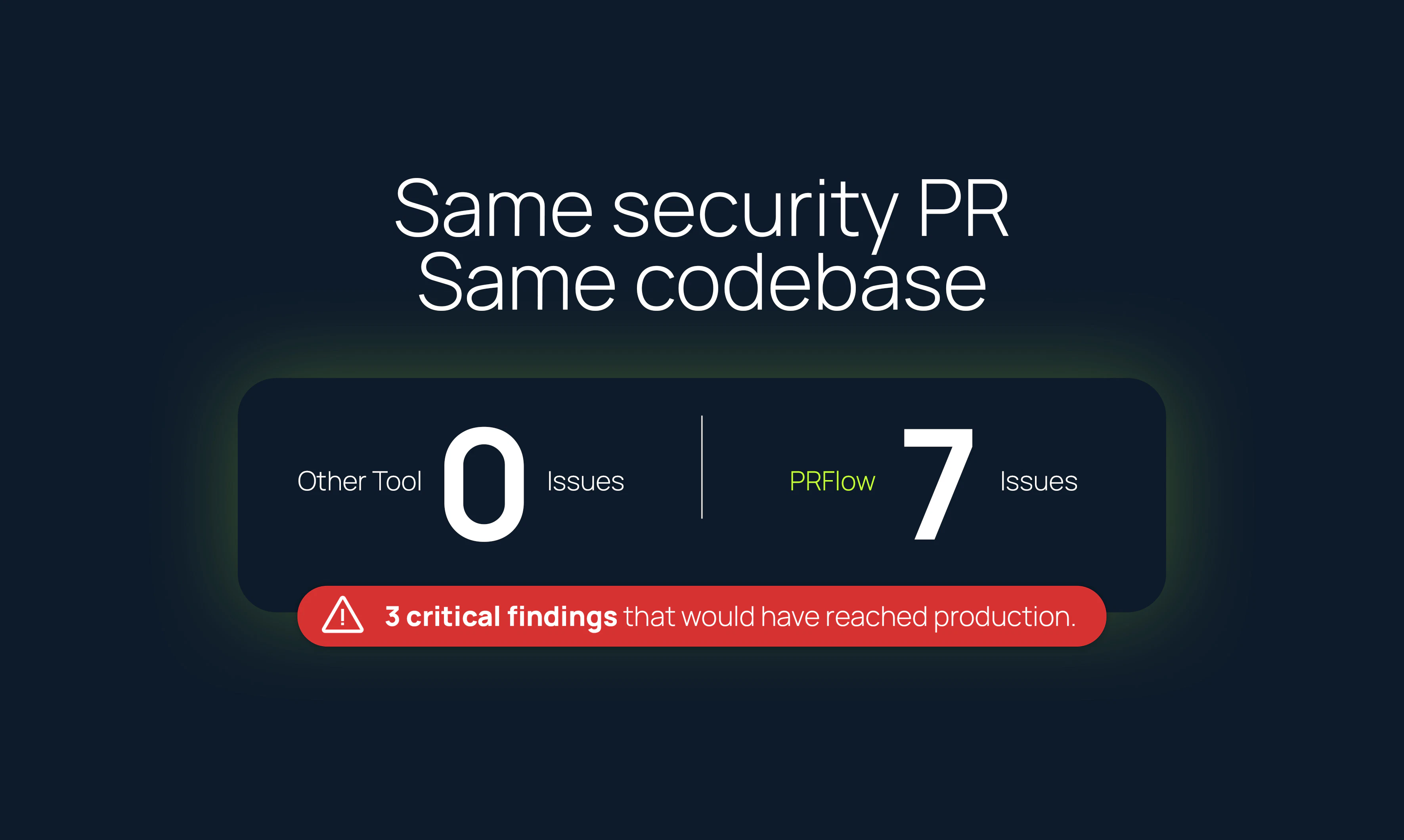
Your AI teammate that reviews every pull request before it ships. Tested on 10 real projects, PRFlow found 7 critical security issues where competitors found zero. Learns your team's standards over time. Pay per review, not per seat.

Thanks everyone, I'm Musa, founder of GraphBit.

We built PRFlow after getting frustrated with AI code reviewers that flood your PR with noise, miss the issues that actually matter, and feel different every time they run.

The market has options. We know that. We built PRFlow anyway because none of them solved the core problem: consistency and cross-file context in a single pass.

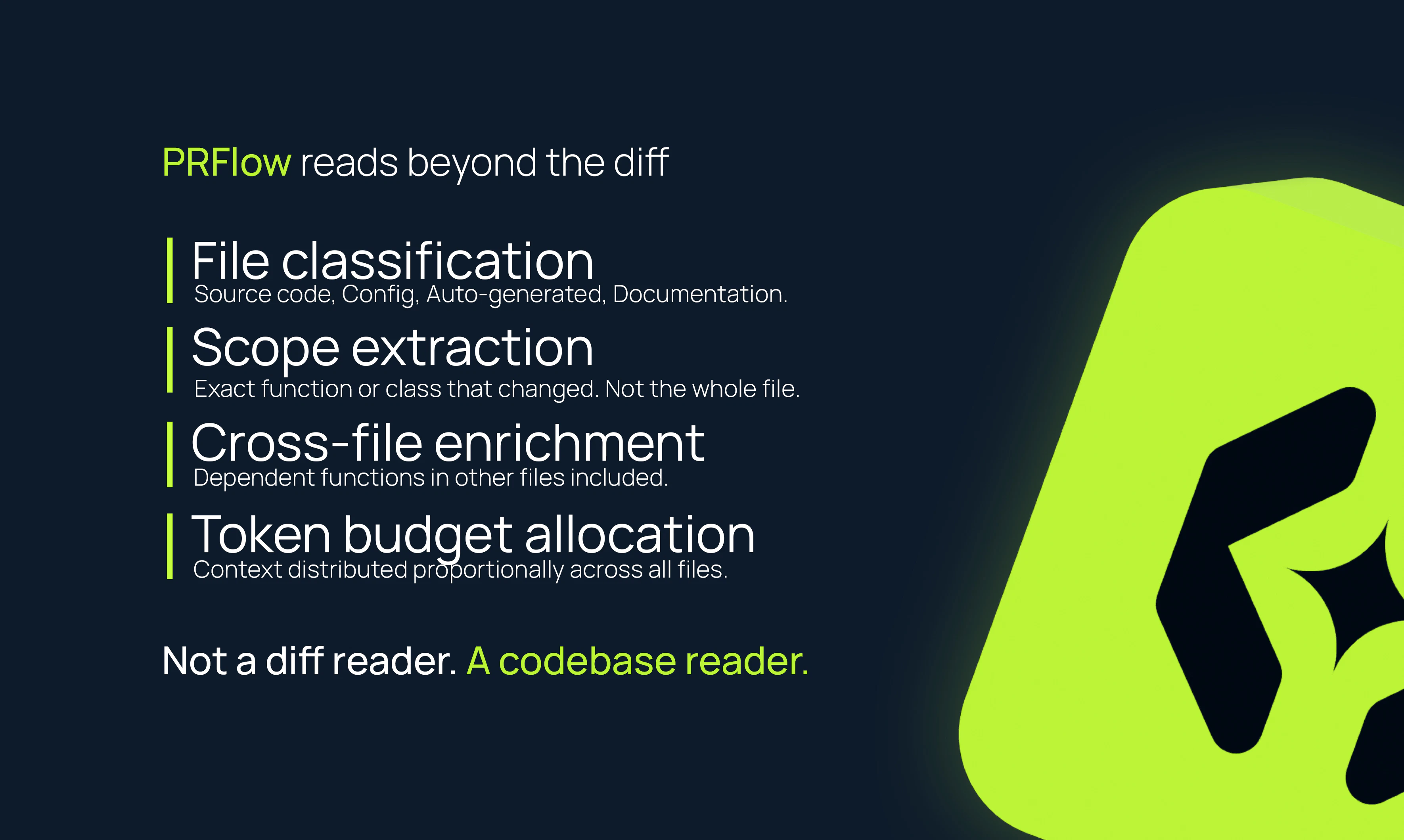
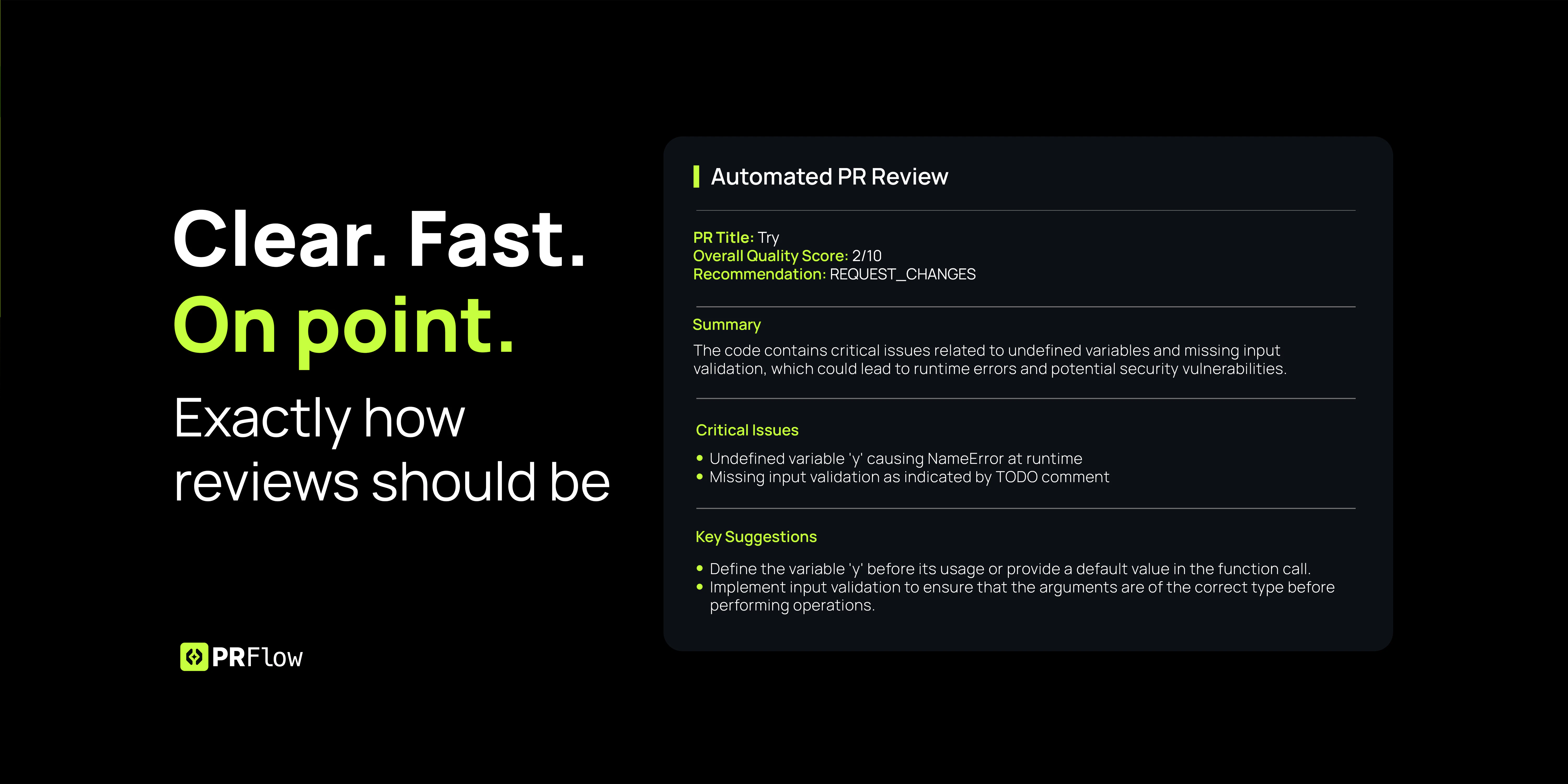
PRFlow is a deterministic baseline reviewer that lives inside GitHub. Open a PR and a structured review posts in minutes, every time, with the same output. It traces the exact function that changed across cross-file dependencies, not just the diff lines. That is how it caught 14 security issues on a PR where another tool found zero.

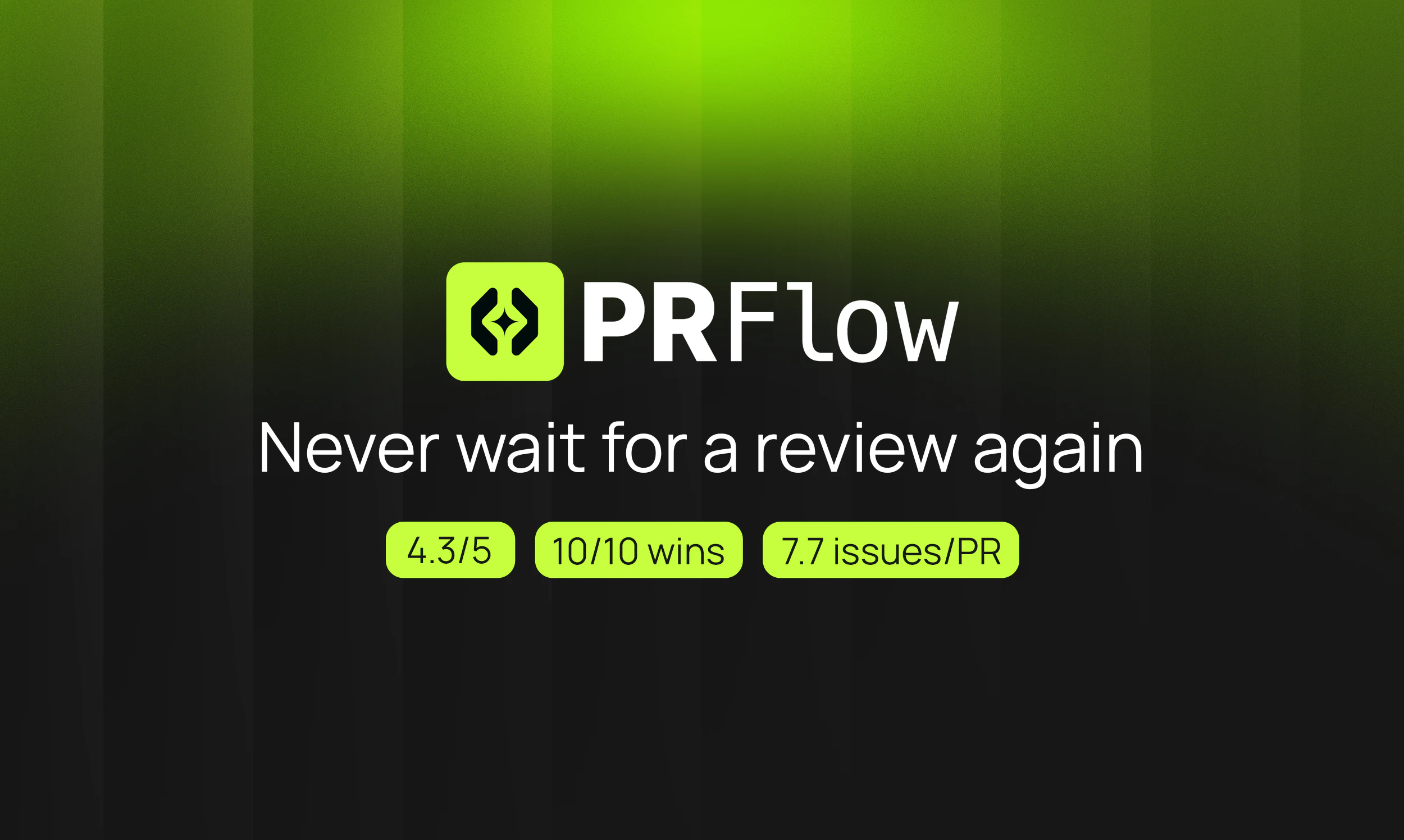
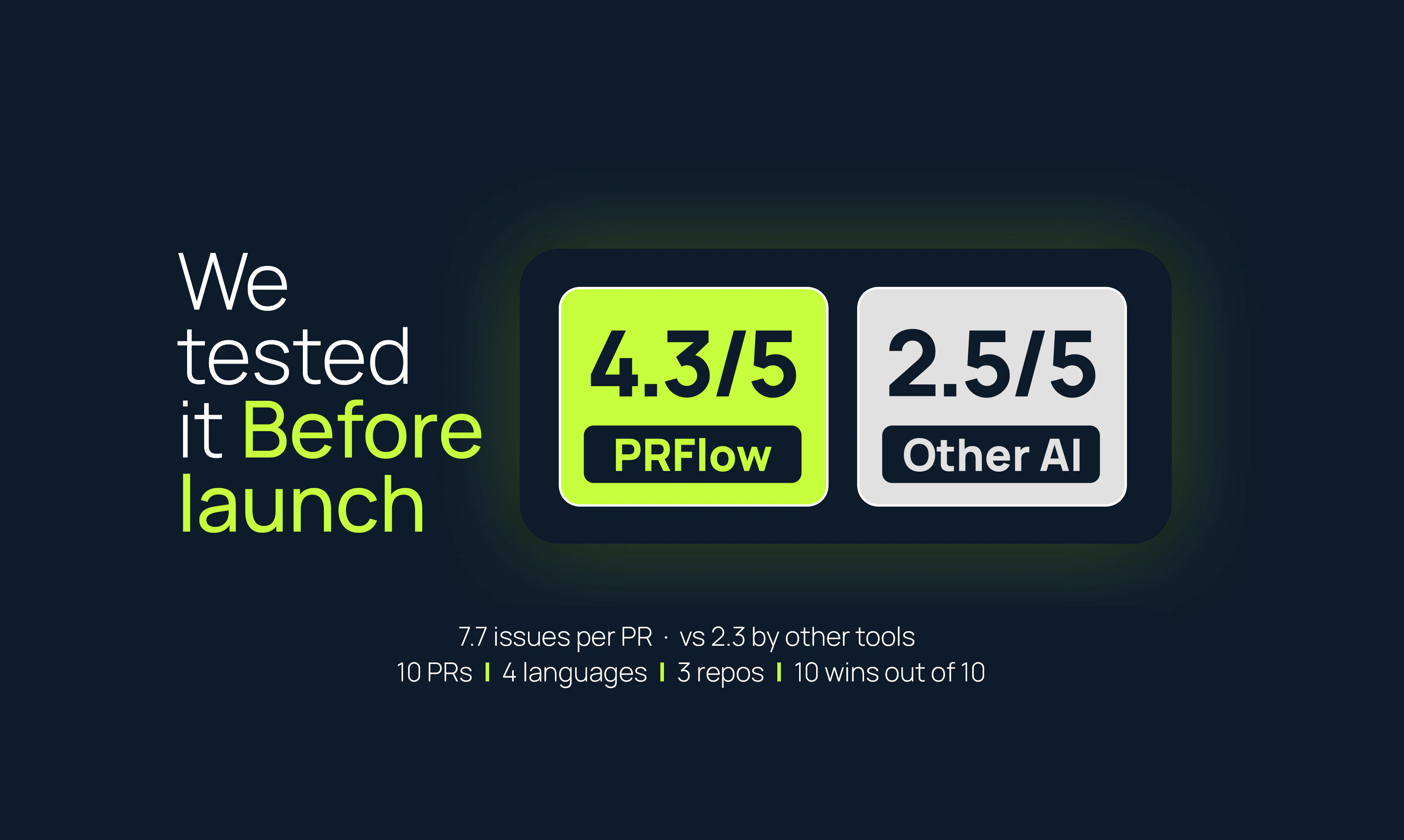
We benchmarked PRFlow on 10 real public pull requests. Rated 4.3/5 on average. Every review is live on GitHub and readable right now.

PRFlow handles the baseline so your team focuses on architecture, intent, and edge cases. Not repeated first-pass checks.

There are other tools. Try PRFlow on a real repo and see the difference yourself. We read every comment.

47
回复

@musa_molla I love the idea of an AI code reviewer that can catch what others miss - it's a game-changer for dev teams. Finding warm leads who've already shown interest in similar products has been key for my own launches, and I'm curious, what's your strategy for getting Graphbit PRFlow in front of the right developers and DevOps teams? Are you targeting specific communities or forums where code review is a major pain point?

0
回复

@musa_molla The deterministic angle is the most underrated part of this pitch - and I think you're underselling it. Consistency isn't just a UX nicety; it's actually the precondition for trust in any review tool. Teams can't build workflow around something that behaves differently run to run. That's the real reason AI reviewers get abandoned, not the noise.

The cross-file dependency tracing is where I'd love to understand more. Diff-level review is a solved (if noisy) problem; but function-level change propagation across a codebase is genuinely hard, especially at scale. How does PRFlow handle large monorepos or deeply nested dependency graphs? That's where I'd expect the failure modes to show up, and it's also where the 14 vs 0 security catch story gets even more compelling if you can speak to it.

One thought on positioning: 'deterministic baseline reviewer' is technically precise but might undersell the outcome. You're essentially saying 'your senior engineer's first-pass, codified and automatic, every time', that's a different emotional register than 'reviewer.' Something to consider as you scale past early adopters into teams that need to sell this upward.

Congrats on shipping and putting the benchmarks in public. That's a confident move most tools avoid.

0
回复

@musa_molla Yes. Very noizy. You need a master PR reviewer jsut to review the AI reviewers 😅.... Is graphbit free for public repos? id love to try it on one particular public repo thats launching soon on PH https://github.com/eoncode/runner-bar/

2
回复

Really like the direction here. Most teams already have code review processes in place, but review fatigue and repetitive comments still slow things down a lot.

What stood out to me about PRFlow is that it seems focused on improving reviewer focus instead of trying to fully replace human reviews. That balance is important for engineering teams.

Curious to see how teams integrate this into their existing PR workflow over time. Congrats on the launch 👏

12
回复

@1mirul Exactly the balance we were going for. PRFlow handles the repetitive stuff so the senior devs can focus on what actually needs their eyes. Thanks for getting it

0
回复

Thanks, @1mirul. That’s very much the design philosophy behind PRFlow. We’re not trying to replace human review, but to automate the repetitive process so engineers can focus on architectural decisions, business logic, and edge cases. The goal is to make review workflows more consistent inside GitHub while keeping humans in control of the final judgment.

1
回复
Really like this approach to AI-assisted code reviews. Instead of replacing engineers, GraphBit PRFlow seems focused on reducing repetitive review noise and helping teams stay focused on meaningful feedback. Cleaner PRs and faster reviews can make a huge difference for engineering teams over time. Curious — how are you handling context awareness across larger PRs or multi-file changes? Congrats on the launch 🚀
7
回复

@tanjum That's exactly the balance we were going for, baseline handled automatically so engineers stay focused on what needs human judgment.

On larger PRs and multi-file changes: PRFlow traces the exact function that changed and follows its dependencies across files in the same PR. Token budget is managed so larger PRs don't get shallow reviews. The depth stays consistent regardless of PR size

0
回复

@tanjum Thanks. For bigger PRs, PRFlow builds context in layers using our own context engine. It extracts structured context from each changed file, enriches that with cross-file dependencies, and then reviews the PR as a whole rather than one file at a time. For very large PRs, it also uses token budgeting and file prioritization so the review stays focused and useful.

0
回复

Hey PH 👋

I'm Imrul, Business Development Lead at GraphBit and part of the maker team behind PRFlow.

Before this, I spent years working closely with engineering teams across different stages of growth. The pattern I kept seeing was the same: teams slowing down not because their engineers were bad, but because code review had become the bottleneck.

A senior engineer drowning in PRs can't review everything properly. A junior developer waiting days for feedback loses momentum. The review process that was supposed to protect code quality was quietly killing team velocity.

Here's what's interesting:

🔍 Most AI code reviewers read what changed. They scan the diff and stop there. But the most dangerous bugs - XSS, auth bypass, race conditions - don't live in a single file. They live in how files connect.

⚙️ PRFlow reads the function that changed and traces its dependencies across every file in the PR. That's how it caught 14 security issues on a PR where every other tool found zero.

The problem was never that developers write bad code. It's that no tool could see the full picture until now.

We benchmarked PRFlow against the leading tools on 10 real public PRs. 4.3/5 vs 2.5/5. Every review is live on GitHub. You can read them right now.

Code review is infrastructure. It should be consistent, context-aware, and trustworthy, not a coin toss.

That's what we built.

Have a great launch day everyone! 🚀
— Imrul

6
回复

the 'deterministic baseline' part is what caught my eye. usually ai reviewers feel like a coin toss one day it’s strict, the next it’s lazy. having a consistent output makes it much easier to integrate into a real team's workflow without the senior devs getting annoyed. support on the ship @musa_molla

4
回复

@vikramp7470 Coin toss, that's exactly it 😄 That frustration is why we built it this way. Same PR, same review, every time. Thanks for the support!

1
回复

Totally agree, @vikramp7470 . That’s exactly the bar we’re aiming for. Deterministic behavior makes the review process much easier to adopt because teams know what kind of feedback to expect each time. Trust is hard to earn with AI tools, so consistency was a big design priority for us.

3
回复

Really happy to be the hunter for PRFlow today.

The team spent serious time building an AI-native code review agent focused on consistent code review at scale, cross-file context, and detecting security vulnerabilities in pull requests before they ship.

For teams dealing with PR review bottlenecks, this is a product that genuinely deserves a closer look.

4
回复

@byalexai Thank you for supporting us today, means a lot to the whole team 🙏

1
回复

Quick question: does GraphBit support connecting to self-hosted or open-source LLMs (like Ollama or local Llama models), or is it limited to cloud API providers like OpenAI and Anthropic? Thinking about use cases where data can't leave the network.

2
回复

@aanchal_dahiya GraphBit is model-agnostic by design and on-prem deployment is supported. For data-sensitive use cases, the architecture allows local tokenization before any LLM contact. Self-hosted models including local Llama setups can be connected. Happy to walk through the specifics if you want to share more about your setup.

0
回复

Congrats guys, looks exciting because most AI reviewers just skim the diff and miss the bigger picture. The cross-file dependency mapping is the real unlock, and 14 issues caught where another tool found zero is a serious proof point. Excited to see this grow!

2
回复

@campritchard That's exactly it, the diff is just the entry point. The bug lives in what the change touches downstream. Glad that landed clearly 🙏

0
回复

Hey Product Hunt! 👋 Thrilled to be here on launch day.

I'm Junaid Hossain, one of the makers behind PRFlow, and I want to share why we built this.

We kept hitting the same wall: AI code reviewers that catch nothing meaningful on the first pass, flood your PR with noise, and feel completely different run to run. Consistency was broken at the foundation.

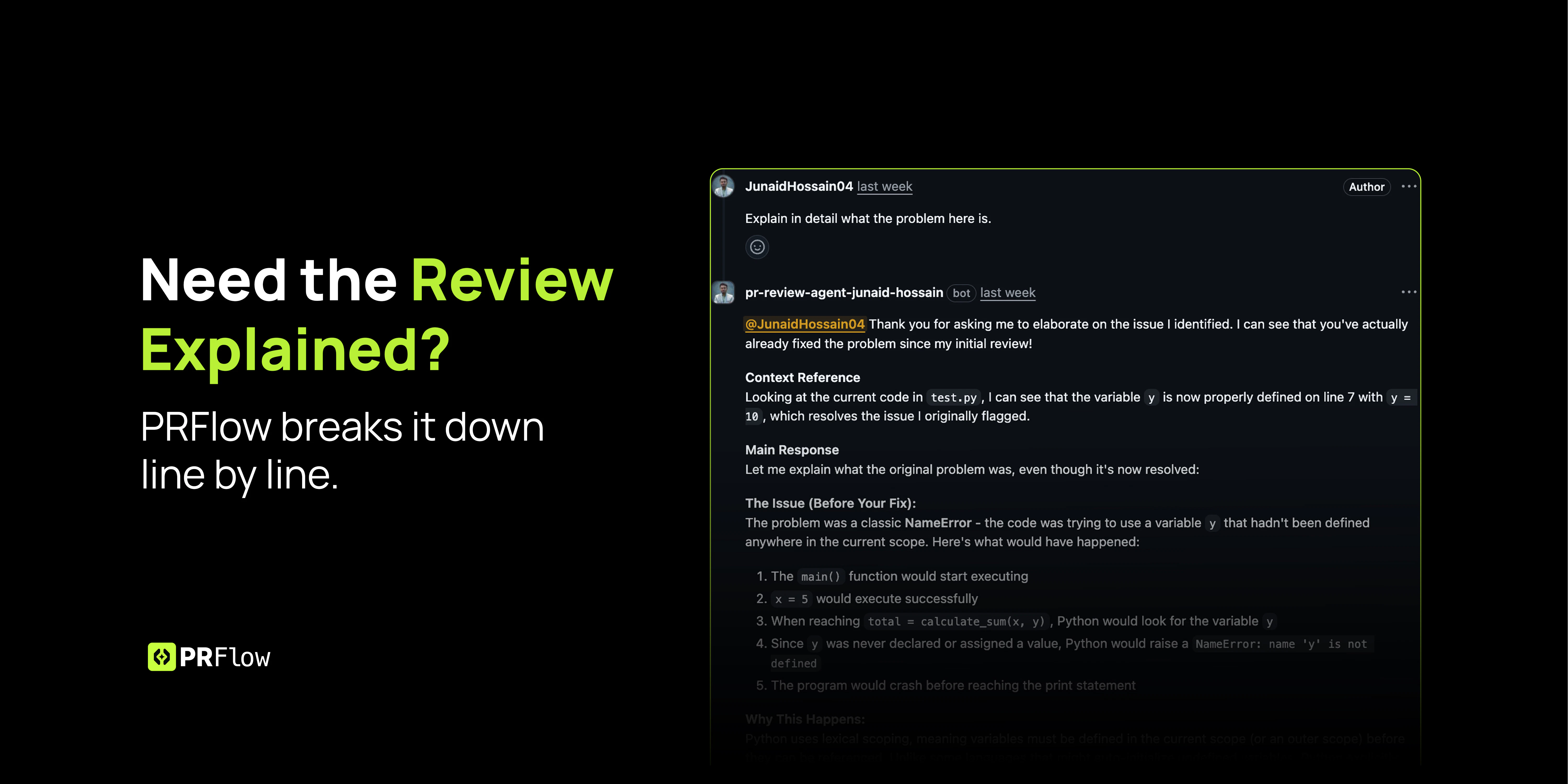
PRFlow is our answer to that. It doesn't just scan diffs, it traces the exact function that changed and follows it across cross-file dependencies in a single pass. That's how it caught 7 critical security issues, including an XSS vulnerability spanning a Ruby model, an HTML template, and a JavaScript file, where competitors found zero.


What makes it different in practice:

  • Every PR gets a structured review, every time, not just when you're lucky

  • It learns your team's standards from feedback, so noise goes down over time automatically

  • Pay per review, not per seat. Therefore, no bloated contracts for a tool you're still evaluating

We benchmarked on 10 real public PRs. Some of the reviews are live on GitHub. You can read them right now.

Would love for you to install it on a real repo and tell us what you think. We read every single comment. 🙏

2
回复

Congrats on the launch, Musa! The 'cross-file context' piece is a massive differentiator. Most AI reviewers get stuck on the diff lines and miss the bigger architectural ripple effects.

2
回复

@bilal_niaz Exactly that. The diff is just the surface, the bug usually lives in how the change connects to everything else. Appreciate you getting it.

0
回复

@bilal_niaz Thanks. Really appreciate that. That was one of the biggest things we wanted to solve, moving beyond line-by-line diff comments and giving the reviewer enough surrounding context to catch architectural or cross-file issues that would otherwise get missed.

0
回复

"Learns your team's standards over time" , this is where I'd love to dig deeper 👀

The architectural choice that fascinates me: how do you handle the fact that team standards are themselves moving targets? A staff engineer ships a new pattern on Monday, the team adopts it by Friday, and your model has three months of "this is how we do it" in its weights. Does PRFlow have a way to detect when the team is intentionally drifting vs accidentally regressing? Feels like the hardest problem in this category. I personally need a product which can tackle this challenge.

Great launch — rooting for the team today 🚀

2
回复

@jason_shen3 This is the hardest problem in the space and you've articulated it perfectly.

Honest answer: right now PRFlow learns from explicit corrections, when your team flags something as intentional, it stores and applies that. So a new pattern gets reinforced when engineers actively confirm it in review conversations.

The drift vs regression detection you're describing - knowing when the team is intentionally evolving vs accidentally breaking convention - that's a deeper layer we're working toward. The memory architecture is built to support it but we're not claiming to solve it fully yet.

Appreciate you pushing on this. The teams that think at this level are exactly who we're building for 🙏

And congrats on @articuler.ai, Matching on intent across 980M profiles is a genuinely hard problem, the playbook feature especially, turning a cold connection into a warm conversation before it even starts. Rooting for you on launch day..

1
回复

Does PRFlow post comments as a bot or as a check summary on GitHub?


2
回复

@peyton_perez Thanks. It posts as a bot on the PR, with a review summary and inline comments when needed. Not just as a check summary.

0
回复

@peyton_perez Exactly, inline comments directly on the PR, not just a check summary. So your team can reply, discuss, and resolve right in the thread where the code lives

0
回复

Can teams self host PRFlow, or is it entirely GitHub cloud based?


2
回复

@asher_luca Thanks. Right now, PRFlow is GraphBit cloud-based rather than self-hosted. The review orchestration runs through the GraphBit cloud.

0
回复

@asher_luca Cloud-based for now. Self-hosting is something we hear interest in, especially from enterprise teams. Good to know it matters to you, noting it

0
回复

How long does the minutes promise take for a 500+ line PR, Musa?

2
回复

@antonio_manuel1 Thanks. The exact time depends on file count, PR complexity, and how much cross-file context needs to be pulled in, but the architecture is built to keep even larger PRs in the minutes range(0-3 minutes) through single-pass review and token-budgeted context handling.

0
回复

Does your benchmark include PRs with generated code or vendored dependencies?

2
回复

@alexis_rodriguez7 Mostly no. PRFlow filters out a lot of low-value review surface by default, including dependencies, build artifacts, binary/non-code files, and it also supports repo-level ignore rules for auto-generated or vendored paths. So our benchmark focus was on reviewable PR code, not noise from vendored or generated files.

1
回复

@alexis_rodriguez7 Good question. Our benchmark used real open-source PRs, generated files and vendored dependencies are automatically detected and skipped. PRFlow only reviews code your team actually wrote

0
回复

Congrats, Musa! Does PRFlow handle cross file refactors where a function signature changes across 10 files?


2
回复

@emily_carter18 , Thanks. Yes, within a single PR that’s exactly the kind of cross-file change PRFlow is meant to handle. It analyzes the PR holistically, so a function signature change across 10 files is reviewed as one connected refactor rather than 10 unrelated edits, subject to the PR’s file-size limits.

0
回复

Congrats on the launch! How do you define noise vs a real issue in your rule engine?


2
回复

@barnaby_lloyd Thanks. In PRFlow, noise means low-value feedback like trivial nits, duplicate comments, or findings below the repo’s configured threshold. A real issue is something actionable that affects correctness, security, performance, maintainability, or cross-file behavior.

0
回复

Does PRFlow support monorepos with cross-project dependencies out of the box?


2
回复

@olivia_bennett7 Yes, for monorepos inside a single repo. PRFlow uses cross-file dependency analysis and repo-level context, so it can reason across multiple projects in the same PR, with practical limits on very large PRs.

0
回复

@olivia_bennett7 Within a single repo it handles cross-file dependencies well out of the box. Full cross-project monorepo support is something we're working on.

What's your setup? Happy to tell you exactly what PRFlow would and wouldn't catch for your case

0
回复

What’s one real issue PRFlow caught that you’ve never seen another tool flag?


2
回复

@wyatt_carter XSS vulnerability that spanned three files- a Ruby controller, an HTML template, and a JavaScript file. The bug only existed in how they connected, not in any single file in isolation.

Every other tool we tested on the same PR found zero issues. PRFlow caught it because it traces the function that changed and follows its dependencies across the whole PR.

That one finding is what convinced us we were building something genuinely different

0
回复

Congrats! Does PRFlow reuse its cross file context across multiple PRs to speed up?


2
回复

@owen_shaw2 Thanks, Owen. Yes, partially. PRFlow reuses repository memory and previously indexed context across PRs, so it avoids starting from zero each time. That helps reduce repeated context-building work, while the current PR still gets a fresh review.

0
回复

@owen_shaw2 Fresh context per PR by design, stale context from previous merges would actually hurt accuracy more than help speed.

What persists across PRs is the memory layer: team corrections, false positive flags, and coding preferences. That's what improves over time, not the runtime.

Latency sits at 1 to 3 minutes regardless. Consistency has been the bigger win than speed for most teams 🙏

0
回复

Congrats on the launch! How do you define noise vs a real issue in your rule engine?


2
回复

@boyuan_deng1 Great question. We don't use a rule engine, that's actually a key part of how PRFlow avoids noise in pull request security auditing.

Instead of predefined rules, PRFlow uses context-aware pull request analysis. It extracts the exact function that changed, pulls in cross-file dependencies, and retrieves past feedback from your team's correction history. The AI then evaluates against that full picture, not a checklist.

What reduces noise in practice: if your team has previously flagged something as intentional, PRFlow stores that and stops raising it. Over time the signal-to-noise ratio improves automatically without you writing a single rule.

The honest answer is no system is perfect on day one, but the memory layer is what separates it from tools that feel like a coin toss every PR. Happy to dig into specifics if you have a particular case in mind.

0
回复

@boyuan_deng1 Thanks. In PRFlow, noise means low-value feedback like trivial nits, duplicate comments, or findings below the repo’s configured threshold. A real issue is something actionable that affects correctness, security, performance, maintainability, or cross-file behavior.

0
回复

Does the single pass analysis catch issues that span three or more dependent files?


2
回复

@imogen_wallace Yes. PRFlow analyzes the PR holistically, not file by file, and adds cross-file dependency context during review. That makes it better at finding issues that span several dependent files.

0
回复

@imogen_wallace Yes, that is the core of how PRFlow works. Most tools do diff-level scanning and miss issues that live in connected files. PRFlow does cross-file bug detection in GitHub PRs by tracing the actual function that changed and following its dependencies. In our benchmark we caught an XSS vulnerability spanning a Ruby model, an HTML template, and a JavaScript file - classic case of automated XSS detection that a diff-only tool would never reach. Reducing technical debt with AI code review only works if the review actually sees the full picture. Happy to share the GitHub link to that specific finding if useful.

0
回复

Love the baseline approach.
@musa_molla , Congrats on the launch! Can it run on every push or just on PR open?

2
回复

@abod_rehman Yes, it can run on every push to an open PR, not just when the PR is first opened. Right now PRFlow triggers on PR open, on new commits pushed to the branch, and when a draft is moved to ready for review.

1
回复

@abod_rehman Thank you! PRFlow triggers on PR open and every push to an open PR, so automated pull request review happens continuously throughout the lifecycle, not just at the start. Every new commit gets a fresh pass. No gaps in coverage

0
回复

Congratulations on the launch. I am a solo dev building Badge, I will definitely try this for my repo as an AI reviewer. One question - you said you save cross file context in a single pass, one obvious questions comes - how do you deal with loss in the middle, because that directly translates to misses in review.

1
回复

@lokesh_motwani1 Great question and glad you're going to try it on Badge.

The single pass doesn't mean one giant context window. PRFlow extracts only the relevant function scope and its cross-file dependencies before sending to the model, so the actual input is tight and focused, not a full repo dump. That's what keeps the middle from getting lost.

Token budgeting handles the rest, larger PRs get prioritized by semantic significance rather than being truncated blindly.

Important thing is, no system is perfect on very large PRs, but the extraction step before the model call is what keeps the signal-to-noise ratio high

0
回复

As a solo dev who reviews my own PRs (building FinTrackrr, a free personal finance tracker), I miss critical issues all the time. The idea of an AI teammate that learns your team's coding standards and catches security issues that humans miss is genuinely valuable. The pay-per-review pricing model is smart — especially for solo devs and small teams without enterprise budgets. Does it support Python codebases or is it primarily focused on JS/TS?

1
回复

@asim_saeed1 Thanks. Yes, it supports Python. PRFlow is not limited to JS/TS, and Python is one of the main codebase types we’ve been building and testing it around. Also, just to clarify on pricing, our plans are currently token-based, so when you buy a plan you get a graphbit coin allocation rather than being charged separately per individual use.

0
回复

@asim_saeed1 Solo devs reviewing their own code is actually one of the use cases we care most about, you're the ones with the least margin for error and the least backup.

Python is fully supported and one of the stacks we've tested most heavily. The auth bypass we caught in our benchmark was in a Python codebase.

Coin-based means you buy what you need and use it at your own pace. No monthly seat pressure

0
回复

Can I run PRFlow retroactively on closed PRs to audit past missed issues?


1
回复

@gaius_loxley Not yet, PRFlow currently triggers on PR events, so it works on open and updated PRs. Retroactive auditing on closed PRs is something we've heard interest in. Good signal, noting it

0
回复

Can developers override or train PRFlow to learn their team’s specific patterns?


1
回复

@daniel_harris11 Yes. When your team replies to a PRFlow comment, "this is intentional" or "we prefer this pattern" it stores that and applies it to future reviews automatically.

No manual training setup. It learns from how your team actually works

0
回复

Hey Product Hunt! I’m Rupak, one of the makers behind Graphbit PRFlow.
We built PRFlow to make pull request reviews faster, more reliable, and more context-aware, so teams can catch real issues before code ships.
It reviews PRs inside GitHub, leaves clear actionable comments, supports follow-up conversations on the PR, and gets better context over time from repository and conversation memory.
Happy to answer questions about how it works, what kinds of issues it catches and other technical functionalities.

1
回复

the cross-file context piece is what gets me - most reviewers treat a PR as a flat list of diffs and miss the connective tissue entirely. curious how you handle PRs where the meaningful change is in what didn't get updated, like a call site that should have changed but wasn't touched?

0
回复
#4
Genpire
Make Real Products with AI, literally.
272
一句话介绍:Genpire是一款将AI创意转化为实物生产的平台,用户通过文字描述或草图即可生成包含技术图纸、物料清单的工厂级技术包,并直接对接工厂进行打样和批量生产,解决了从“想法”到“工厂”这一物理产品落地过程中的高门槛、高成本、长周期痛点。
Design Tools Artificial Intelligence Maker Tools
AI制造 消费品生产 技术包生成 智能工厂对接 产品设计 供应链AI 创意落地 ToB SaaS AI Agent 物理产品
用户评论摘要:用户普遍认可其“消费品界的Lovable”定位。核心问题集中在:1. 技术准确性能否处理运动部件与静态物体的差异(如转轴公差);2. 产品须经历真实生产验证,是否有成功案例链接;3. 落地环节的工厂合作模式、定价策略及如何处理履约、支付与退货等后端问题。评论中对“一步到位”的生产实现充满期待与审慎。
AI 锐评

Genpire的产品定位非常精准,它抓住了当前AI热潮中一个被忽视的巨大断层——AI可以帮你写代码、做PPT、画图,但几乎无法帮你制造一个实物。从“vibe-coding”到“vibe-manufacturing”的迁移,本质是将AI从纯粹的数字化界面延伸到了物理供应链的最前端,这个思路极具前瞻性。

从技术实现看,Genpire解决了两个核心矛盾:一是将模糊的创意(prompt/草图)转化为高度结构化的、工厂可读的“技术包”,这是对制造业非标知识图谱的工程化挑战;二是通过AI Agent和多层数据分析,将“设计”与“找厂”两个传统割裂的环节打通,试图创造一种“设计即报价、即生产”的闭环体验。

然而,产品目前最大的风险在于“最后一公里”的信任鸿沟。评论中关于“技术准确性”和“成功案例”的追问直指核心——技术上生成的“完美图纸”与工厂线下实际开模、试产时遇到的工艺、公差、材料收缩等变量之间的鸿沟,是任何软件都难以完全模拟的。Lovable能快速生成代码,是因为代码解释环境是确定的;而制造业的变量是极端的、依赖经验和物理试错的。如果没有足够的实际生产数据和真实的返修案例来训练其AI模型,Genpire很容易变成一个“漂亮的提案工具”,而非真正的“生产引擎”。

策略上,创始人提到的“60%的beta用户已有供应链”值得警惕。这意味着Genpire正在扮演“锦上添花”的设计工具角色,而非颠覆性的生产平台。如果核心价值局限于提升早期设计效率,而无法在“智能匹配工厂”和“管控生产质量”上建立不可替代的壁垒,它很可能面临来自SolidWorks、Adobe等传统CAD/设计工具的AI化反击,或成为工厂端自研系统的“前菜”。

真正的价值检验点在于:Genpire能否通过其“工厂网络”积累足够多的实际交付数据和订单反馈,反向优化其Agent的判断力,最终做到“AI生成的方案不仅好看,而且好造”。如果能,它将打开万亿级消费品市场的效率革命;如果不能,它将仅是一个营销噱头,昙花一现。

查看原始信息
Genpire
Most AI stops at the idea. Genpire takes it to the factory. Think Lovable, but for consumer goods manufacturing - an agentic platform that turns prompts and sketches into products, collections, and factory-ready specs, then lets you work with your own factory or tap into a vetted network for instant quotation, sampling, and bulk production. One workflow, all the way from an idea to the factory floor. Genpire makes building physical products faster, simpler, and finally accessible to anyone.

Hey Product Hunt 👋

Even with all the new AI tools out there, it’s still way harder to launch a physical product than to launch an AI-powered app. Creating something like a flip-flop brand or an accessories line, for example, still requires design skills, tech packs, sourcing, and navigating factory workflows - all slow, expensive, and deeply manual.

Genpire is here to change that.

We took the “vibe-coding” simplicity you see in tools like Lovable and applied it to real, physical product creation. Just describe your idea and Genpire generates your product visuals, technical drawings, multi-view renders, and a complete factory-ready tech pack in minutes - no design or manufacturing experience needed.

You can build handbags, sneakers, toys, beauty tools, lamps, apparel, gadgets - anything. Genpire supports eight major product categories, giving millions of people the ability to bring big ideas to life exactly as they envisioned them.

For Pro users, Brand DNA lets Genpire adopt your exact style and creative identity. And with our new Manufacturer Quotes, vetted factories can help you sample and produce your product faster than ever.

Would love your feedback - and if you drop an idea in the comments, I’ll generate a tech pack or full product concept for you. Let’s build your Genpire 👑

- Daniel Shoshani

14
回复

@daniel_shoshani1  def. a game changer for DTC brands. how does it handle technical accuracy for moving parts vs static objects?

6
回复

@daniel_shoshani1 I love the idea of bringing AI-generated products to life, the "literally" part of your tagline really stands out to me. Finding warm leads has been key for my own launches, I've had success targeting users who have upvoted similar products that merge tech and design. What's your strategy for getting Genpire's AI-created products into the hands of customers, are you planning to partner with existing manufacturers or distributors?

0
回复

@daniel_shoshani1 Every shortcut on the surface only feels like magic because of the stack underneath holding it up. So proud to see this finally out in the world congrats on the launch, team!

7
回复

Hey Product Hunt :)
I’m Muharrem, part of the engineering crew over at Genpire. I spend most of my time head-down in our marketing platform and the QA backbone that makes everything tick basically, I’m the one ensuring the AI agents and brand tools actually hold up when we ship those tech packs. Genpire’s whole thing is flipping a simple description into a factory-ready product in literal minutes. Truth be told, even after watching this loop run through testing thousands of times, it still catches me off guard when a real, tangible RFQ pops out at the end. I’d love to hear your thoughts, so just toss an idea in the comments and let’s see what Genpire whips up for you.

7
回复

@myurtsever The backbone of the Genpire machine!

2
回复
0
回复

Hey Product Hunt!

Esmat here — Co-Founder & CTO of Genpire.

I came up in enterprise security at Check Point, where the bar for "good enough" is set by the worst day a customer could have. That's the mindset I brought into building Genpire's technical foundation.

Genpire is an AI-native platform that takes any idea, sketch, or prompt and turns it into factory-ready files — design visuals, technical specs, materials, measurements, and manufacturer matching — all in one workflow. Under the hood, that's multi-agent systems working across design, technical, and sourcing layers, with structured data pipelines built to be reliable and compliance-ready from day one. SOC 2 Type II and ISO 27001 are in progress — because enterprise data handling should be designed in, not bolted on.

We built this to work for a solo designer with a big idea just as well as for a procurement team at a global retailer. That's the engineering challenge I wake up for every day.

Super excited to finally have this out in the world. Would love your feedback — drop your idea in the comments and I'll generate a tech pack for you right here!

— Esmat Nawahda

7
回复

@esmatnawahda that "worst day" framing is the exact mindset I steal every time I sit down to hammer out a new test. The real reason I'm stuck in the QA and marketing infra weeds is because we made a pact on day one: if it doesn't clear that bar, it doesn't ship. I’m incredibly proud of where we’ve finally landed. It’s a massive day for the whole crew

3
回复

Hey Product Hunt!

I'm Adam, Co-Founder and COO of Genpire.

We're super excited to launch Genpire and introduce the the way real products get manufactured.

Genpire is an AI-powered platform that turns any idea, sketch, or prompt into a complete, factory-ready tech pack in minutes. Built for designers, brands, and creators, Genpire streamlines the entire journey from concept to production with AI-generated product specs, technical sketches, measurements, materials, and manufacturing-ready documentation with no prior experience required.

Would be happy to get your feedback! share with us your idea and I’ll generate a tech pack or full product concept for you and share the link here!

- Adam Shoshani

7
回复

Hey Product Hunt 👋

Daniel here, co-founder & CEO of Genpire.

We built Genpire because making physical products is still absurdly hard - endless agencies, slow tech packs, ten Slack threads to get a single revision. So we built the platform we wished existed: one place to design, edit, spec, and hand off real products to manufacturers, end to end.

Today on Product Hunt is genuinely a big day for us. We'd love your feedback - what works, what's confusing, what you'd want to make first. Plus there's a PH-exclusive discount on every plan if you want to take it for a real spin.

Ask us anything. We're here!

7
回复

I've been waiting for this a very long time. If it works you have yourself a lifetime customer. Selfish ask, will you move to larger product sourcing, say container house? Asking for a friend 😂

5
回复

@olumidegbenro Thank you, Olumide!

Thing is - we're in the design-to-manufacturing business, interesting to see that more than 60% of our beta users already have their sourcing and supply chain all sorted out, while Genpire plays a role in their planning, design and specs workflows, in parallel with allowing them to manage the sampling process and sourcing through our agentic sourcing interface offered both for new comers who wants to use our built-in, vetted network of factories - or their own by inviting them to collabrate.

Container house are naturally on a later stage (and plenty of players in this space) - we might launch this on PH sometime during 2027 🏭🪄🍠

3
回复

Wow, super interesting. Lovable but for consumer-goods!

5
回复

@musharofchy Its sure is! We're applying what's good in vibe-coding, into the design, specs and manufacturing workflows of consumer goods. Challenging, but pretty usefull for both non-experienced indie makers, up to product and design teams!

Any idea for a real product? We'll share a free AI powered tech pack for you to use!

3
回复

@musharofchy Exactly the comparison we love! And honestly it shaped how we thought about the architecture from day one.

With Lovable, the "compiler" is code. With Genpire, it's a factory-ready tech pack. That sounds similar but it's a fundamentally harder output to get right. Code either runs or it doesn't. Manufacturing specs need to be accurate in dimensions, materials, tolerances, and structure because a real factory is on the other end.

That's the engineering challenge that gets me out of bed every morning. Really glad it's resonating!

0
回复

Congratulations

5
回复

@madalina_barbu Thank you, Madalina, any product in mind? We'll share with a free tech pack to get it made :)

3
回复
3
回复

@madalina_barbu Thank you

1
回复

Hey Product Hunt! 👋 Noa here- project manager by day, recovering fashion designer by heart.

My brain lives at the intersection of creative chaos and structured execution, and Genpire was built with exactly that in mind.

So proud to see this finally out in the world- congrats on the launch! 🚀

5
回复

@noa_dichno Hi Noa!

Good to have you here!

5
回复

Hello Product Hunt 👋
I’m Sahar, a Frontend Developer at Genpire, and I’ve had the opportunity to help build the product, mainly on the frontend side.

What excites me most about Genpire is how thoughtfully it blends creativity and technology. It’s been incredibly rewarding to help shape the experience and see our ideas come to life.

So happy to see Genpire launched and out in the world, and excited to hear your thoughts 🚀

4
回复

Wow Daniel! Sounds like magic. Guessing what's the pricing or business model cause physical products can have many variations. Anyway I feel it's worth it and I wish you all the best here!

3
回复

@german_merlo1 Pricing and business model for AI-native platform like Genpire are such a huge space! We offer a 3-tiered monthly plan (with annual discounts), that usually suits the needs of indie-makers, DTC brands and large enterprise consumer goods teams alike. We also offer a team plan soon, with SKU based pricing, but more on that later.

Appreciate the comment!

Best
Daniel

1
回复

Interesting. Any links to products taken to production from this?

2
回复

Following — the "literally" is doing a lot of work in that tagline, and I'm here for it. The last-mile in AI-generated products is the vendor layer (fulfillment, payments, returns); that's where most demos break. Curious how you're handling it.

2
回复

This is super interesting! I was hoping to see something like this come out soon. Congrats on the launch!

For the built-in manufactures , where did you find them and why did you decide to partner with them specifically?

0
回复

Congratulations on the launch 🚀

0
回复
#5
ClawSecure
The AI-Powered Antivirus for AI Agents
251
一句话介绍:ClawSecure 是一个专为 AI Agent 生态打造的 AI 驱动安全工具,通过预安装扫描、实时运行时监控和亚 200ms 验证 API,解决 AI 智能体在无监管环境下代码突变、权限滥用和数据泄露等核心安全隐患。
Developer Tools Artificial Intelligence Pitch Singapore
AI Agent安全 杀毒软件 运行时监控 代码审计 OWASP 智能体防护 威胁检测 安全扫描 权限管理 开源
用户评论摘要:用户对产品概念高度认可,称其为“无聊但必须”的工具。核心问题围绕:如何区分代码突变是恶意还是正常更新?如何处理误报?同时用户期望集成 Slack 警报。有用户实测发现权限隐藏问题,并验证了 30 秒扫描承诺。另有用户询问如何从手动审查迁移到采用该产品。
AI 锐评

ClawSecure 切中了一个真实且正在迅速恶化的痛点:AI Agent 生态的“裸奔”状态。创始人提出的“代码即攻击”并非危言耸听——当每个 Agent 都拥有系统级权限且无沙箱隔离时,传统的安全范式彻底失效。该产品并非简单的“为 AI 做杀毒”,而是构建了一套贴合 Agent 运行特征的动态防护体系:利用哈希漂移检测代码突变,结合行为上下文而非静态规则来区分恶意操作与正常进化,这比传统 AV 引擎对零日攻击的感知能力至少领先一个维度。

商业策略上,通过免费无注册的 30 秒扫描作为“漏斗”入口,利用“数据震惊”——用户发现自己信任的 Agent 正偷偷外泄数据——完成从免费到付费的转化,逻辑清晰且杀伤力强。缺失的 Slack 集成是明显短板,但已在路线图上。

目前最大的挑战不在于技术,而在于生态。“41% 的 Agent 有风险”这个数字本身就意味着,如果市场教育不足,ClawSecure 可能面临“产品好但用户还没感受到痛”的窘境。另外,“AI 驱动”是现代 SaaS 的标配用语,ClawSecure 需要更明确地展示其 AI 模型在具体场景下(如代码突变 vs 代码更新)的决策逻辑和准确率数据,而非停留在“行为分析”的宣传上。如果它真能成为 Agent 生态的“Windows 安全中心”,那估值天花板会很高。但前提是,它必须先活过这个安全产品“叫好不叫座”的初期阶段。

查看原始信息
ClawSecure
ClawSecure is the AI-powered antivirus for AI agents. Pre-install scanning, real-time runtime monitoring, an in-agent Security Companion Agent, and a sub-200ms Verification API. Full 10/10 OWASP ASI coverage. 41% of top agents are dangerous. Free, no signup. clawsecure.ai

Hey Product Hunt! 👋 I'm J.D., founder of ClawSecure.

Your AI agents are running with full system access. No verification. No oversight. 41% are dangerous. 1 in 5 send data to attackers. 22.9% silently mutate code after install. 1.6M+ get installed every week. Zero security underneath. 🚨

After a decade securing AI and Web3 at scale (2x exited founder, Bloomberg, CNBC, NYSE, NASDAQ), I've watched billions disappear when ecosystems scale faster than their security. It's happening again, but faster than any cycle before.

We built what the AI agent economy was missing: AI-powered scanning, real-time runtime monitoring, an AI security agent, and a sub-200ms Verification API. Full 10/10 OWASP ASI. Free, no signup, 30 seconds.

Hyped to be back on PH 🚀

Ask us anything, challenge us, or share what's keeping you up at night about agent security — I'll be here all day!

7
回复

@jdsalbego Hey J.D., huge congrats on the launch. With OWASP ASI 10/10, how do you recommend founders prioritize between runtime monitoring vs. the Verification API for early detection of shadow agents?

0
回复

@jdsalbego Many congratulations on the launch, J.D. :)

Thrilled to see ClawSecure on The Pitch leaderboard. I am rooting for it since its first launch!

Everyone is building OpenClaw AI agents, there's hardly any security solution for them. Hence this is a refreshing + critically important category to pioneer.

1
回复
If an AI agent mutates code after install, how does ClawSecure distinguish malicious behavior from self-improving workflows?
2
回复

@divyanshu_kandpal Great question. Not every code change is malicious. Developers push legitimate updates, dependencies get patched, skills evolve. When Watchtower detects hash drift, it triggers an automatic full rescan through our 3-layer audit protocol. The updated code gets analyzed the same way a fresh install would: our proprietary engine evaluates whether the changes introduce actual threat patterns like C2 callbacks, credential exfiltration endpoints, or permission escalation, versus benign updates like bug fixes or feature additions.

The key is context-aware intelligence. Our engine understands the difference between a skill legitimately using system-level capabilities (which is standard for any useful agent) and a skill abusing those same capabilities to exfiltrate data or execute unauthorized commands. A dependency update that patches a vulnerability scores differently than one that introduces an obfuscated payload. The rescan produces an updated Security Audit Report with the new risk score, so users can see exactly what changed and whether the change made the skill safer or more dangerous.

1
回复

Honestly, this feels like one of those “boring but super necessary” tools. If AI agents are touching real user data, having security audits + live monitoring built in is a pretty big deal.

2
回复

@le_ng_c_dan_nhi "Boring but necessary" is the best compliment a security product can get. The boring infrastructure is what everything else runs on top of. Nobody thinks about antivirus until they need it, and by then it's too late.

And you're right, once agents are touching real user data, email, files, credentials, payment tools, the blast radius of a compromised skill isn't theoretical anymore. That's exactly why we built runtime monitoring beyond just scanning. Knowing a skill was safe when you installed it isn't enough. You need continuous visibility into what your entire agent environment is actually doing. Appreciate the support!

1
回复

Just spent 5 mins playing with the free scanner. Found two agents I'd been using that had elevated permissions I didn't realize. The 30-second promise seems to be delivered. Congrats @jdsalbego and the team! GL today with the pitch!

2
回复

@kate_ramakaieva That "I didn't realize" moment is exactly why we built this. Most people have no idea what their agents are actually doing until they see it laid out in a report. Elevated permissions hiding in plain sight is one of the most common findings across the 10,000+ agents we've audited.

Glad the scanner delivered. And if you want to go deeper than individual scans, the runtime monitoring dashboard maps your entire agent environment, every permission, every connection, every blast radius, so nothing stays hidden. Thanks for the kind words on the pitch, appreciate the support!

2
回复

Out of all products today this one attracted most with its 22.9% post-install mutation stat. And the "code is the attack" framing makes sense for an ecosystem with no sandboxing. Interested if you catche mutations in transitive dependencies too or just the top-level skill code itself? Anyways, solid work

2
回复

@artstavenka1 Really appreciate that. The "code is the attack" framing came directly from watching what happens in an ecosystem where skills ship with full system access and no permissions model. It's not a runtime anomaly when the code itself is the weapon.

To your question: yes, we cover both. The pre-install scan resolves the full recursive dependency tree and checks for known CVEs, compromised packages, unpinned semver ranges that are vulnerable to hijack, and typosquatting on known packages. Watchtower then monitors for hash drift across the entire skill codebase, so if a transitive dependency gets compromised in an update, the hash change triggers an automatic rescan through the full 3-layer protocol. That's actually one of the sneakiest attack vectors in the ecosystem: the top-level skill code stays clean while a nested dependency quietly introduces the payload. We catch both layers.

2
回复
Congrats on the launch. Security for AI Agent, the next huge topic.
2
回复
2
回复

how you handle false positives in the audits?

1
回复

@divya_kothari1 False positive rates are low across our platform because of how the detection architecture is designed. Our proprietary engine runs context-aware intelligence that classifies threats based on how AI agents actually operate, not generic code patterns. It differentiates legitimate system-level capabilities like clipboard access, filesystem operations, and shell execution from genuine exfiltration and malicious behavior by analyzing the full behavioral context: what file the pattern appears in, how data flows through the skill, whether external endpoints match known malicious infrastructure, and whether the behavior aligns with what the skill declares it does.

Beyond static analysis, our AI-powered runtime monitoring adds a completely different detection dimension. It continuously analyzes metadata telemetry across your entire agent environment, every skill, MCP server, CLI tool, and configuration, using LLM-driven threat classification to score risk, detect behavioral anomalies, and flag deviations in tool call patterns. When you're correlating declared permissions against actual runtime behavior and measuring that against a dataset of millions of audited agents, the signal-to-noise ratio improves significantly. Static analysis tells you what code could do. Runtime behavioral analysis tells you what it's actually doing. The combination is what keeps false positives low and true detection high.

1
回复

I would like to receive an alert on my Slack whenever Watchtower detects suspicious behavior. Congrats on launching.

1
回复

@iamanantgupta Thanks! Slack integration is on our near-term roadmap and one of the most requested features from our community. Right now Watchtower alerts surface through the runtime monitoring dashboard in real time and via email and Telegram notifications. The detection infrastructure already generates the events the moment hash drift or a behavioral anomaly is caught, so adding Slack and Discord as notification channels is a straightforward build on top of what's already there. It's coming soon. Appreciate the feedback, it helps us prioritize.

1
回复

Congrats on the launch @jdsalbego ! Most teams I know are still on manual review and version pinning until something goes wrong. What's usually the thing that pushes them to actually adopt ClawSecure? And what does the first week look like once they're in?

1
回复

@juan Thanks! The honest answer is usually data shock. Someone scans a skill they've been running for months, expecting a clean report, and discovers credential exfiltration patterns or shell execution they had no idea was there. That moment shifts everything from "I should probably look into security" to "what else is running in my environment that I haven't checked?"

The second trigger is realizing that manual review and version pinning only covers what you can see at one point in time. 22.9% of skills in our dataset changed their code after install. A skill can pass every check on day one and quietly mutate on day five. Once users experience that personally through Watchtower

flagging something they already trusted, the need for continuous monitoring clicks immediately.

The first week is straightforward. Most users start with the free scanner to audit everything they're currently running. That takes an afternoon since each scan is about 30 seconds. They see their Security Audit Reports, identify what's clean and what needs attention, and Watchtower starts tracking everything for code changes automatically.

From there, the users who are running agents in any real capacity quickly move into runtime monitoring. One command installs the daemon, and suddenly they have full visibility into their entire agent environment: every skill, every MCP server, every CLI tool, permission maps showing blast radius, configuration audits, and AI-powered risk scoring across everything. The dashboard gives them a single view across all their tracked agents with real-time alerts instead of manually checking individual reports.

The shift from "I scanned a few skills" to "I can see my entire agent environment and what every component is actually doing" is usually what converts free users to paid. That's by design. The free tools show you the problem. Runtime monitoring shows you the full picture and keeps watching it continuously.

2
回复
#6
Warp Open-Source
Agentic development environment built with the community
185
一句话介绍:Warp Open-Source 是一个通过社区与AI代理协作,将代码编写、测试等繁琐工作交由Oz代理处理,让开发者聚焦于创意与验证的“半监督式”开源开发环境,旨在解决传统开源项目维护者人力瓶颈和AI工具缺乏人为审核闭环的问题。
Open Source Developer Tools Artificial Intelligence GitHub
开源终端 AI代理 人机协作 社区驱动 开发环境 Oz编排 PR审核 智能体 代码审查 自动化测试
用户评论摘要:用户普遍赞赏开源策略,但关注点集中在:1)BYO本地模型支持(如Ollama)以保护NDA代码;2)社区贡献的PR审核速度与安全框架;3)AI自动化与开发者控制权的平衡;4)跨命令会话的上下文保持能力。创始人回应称本地模型支持将在一两周内落地。
AI 锐评

Warp的野心不止于做AI终端,它试图重构开源协作的底层范式——用“监督式自动化”替代传统的“众包式”贡献。创始人Zach点出的“最大瓶颈已从写代码变为人为验收”是精准的行业洞察。然而,这步棋存在三重风险:首先,目前系统高度依赖Warp的自有云代理Oz,对于企业级用户关心的NDA代码和私有网络环境,即便承诺1-2周内支持BYO模型,但若无法在本地或内网实现完整代理编排,其Agentic能力将大打折扣。其次,“人机协作”表面是提效,实则是将审核压力从代码审查转移到了“规范审查”——社区贡献者写代理文档的能力可能远差于写代码的实力,导致“上游规范污染”而Oz无法兜底,这在评论中已有用户提出。最后,500+贡献者、56K星标的爆发式增长究竟能维持多久?当基础设施平台(Warp Core)问题暴露时,社区是否会因缺乏决策参与感而流失?Warp的长期价值不在于实现“AI写代码”,而在于能否证明“AI能可信、可控地接受社区集体指挥”——这恰恰是所有开源项目治理都未解决的奥德赛。如果做成了,它是开源3.0的里程碑;如果做砸了,它不过是又一个被开发者尝鲜后弃用的套壳玩具。

查看原始信息
Warp Open-Source
The best, longest-lasting software is built with the people who use it, so we've opened up Warp to the community. To make this possible, Oz-managed agents do the heavy lifting (coding, planning, testing), letting community members focus on ideas, direction, and verification. 25K+ stars added and 500+ contributors in week one.

👋 Hey Product Hunt community,

Zach here, founder of Warp. Two weeks ago we open-sourced Warp — and honestly, the response blew us away. We’re bringing it to Product Hunt today because this community is exactly the kind of community we want to build with.

The short version: Warp is now open-source, and the community can participate in building it using an agent-first workflow managed by Oz, our cloud agent orchestration platform. Community members shape direction and verify behavior. Oz-managed agents do a lot of the implementation heavy lifting. The Warp team reviews and ships.

We're doing this because we think we can ship a better Warp, more quickly, by working with our community to supervise a fleet of agents. The biggest bottleneck to development is no longer writing code — it's the human-in-the-loop activities around it: deciding what to build, speccing it clearly, and making sure it's right. Opening up lets us be more responsive to users and work with them on the long tail of our backlog.

The response so far has been pretty wild:

  • 25K+ new GitHub stars in week one — we more than doubled, to around 56K

  • 500+ unique contributors opened hundreds of PRs

  • Great conversations with the community about what people want to see in Warp next

We still have a lot to figure out to build the right workbench for agentic development. For example, we’re actively discussing how to support local and arbitrary models in a way that matches what users actually want, not just what is easiest for us.

Would love to hear: what would you want to build or fix in Warp? And what are you skeptical about?

Check out the repo: https://github.com/warpdotdev/warp

Watch what the agents are up to: https://build.warp.dev

Thanks for checking it out — excited to build this together.

— Zach

7
回复

@zach_lloyd  I love the idea of an agentic development environment, especially one built with the community - it's amazing to see collaboration like that. What's your strategy for getting Warp in front of the right developers, and do you think leveraging communities that have already shown interest in similar open-source projects will be a key part of that? Finding warm leads has been crucial for my own launches, and I'm curious if you're taking a similar approach with Warp.

0
回复

@zach_lloyd  the prompt already takes longer to write than the diff takes to read on solo agent work, and that's with the codebase in my head. spec-and-verify is what i'd watch when community contributors without that context start handing specs to Oz. specs go bad upstream and Oz can't catch what wasn't asked for.

0
回复

Super bold move, but also savvy.

Proprietary software is no longer a moat like it once was; even more important is to consider that if you're not fixing your customer's edge cases and bugs at agentic speed, they're going to go elsewhere or just roll their own solution.

Warp going open source means that the community can take more agency over their experience and fix the paper cuts that the Warp Corp team just doesn't have enough time or attention cycles to prioritize.

I am curious about how fast PRs will be approved though, and what kind of scaffolding Warp will need to add to manage the community!

Here's a high level look at the contribution flow. Steps owned by the contributor are shown in yellow; steps owned by the Warp team or Oz are shown in blue:

5
回复

Thank you @chrismessina! 🙌

Totally agree, and it's been super exciting to see what the community has been building and adding to Warp. Over the past 2 weeks, we've continuously been making changes to our internal processes so we can be on top of the repo. It's definitely something that we expect to evolve so we can get those PRs merged in fast and give a great experience to our contributors.

2
回复

oss ftw!

4
回复

@fmerian absolutely 🙌

1
回复

Opening the source while keeping Oz as the heavy-lift layer is an interesting bet. Most OSS terminals stall because reviewers can't keep up with PRs, so routing implementation through managed agents and keeping humans on specs and verification might actually scale. I'm watching the local model question closely. For me, the dealbreaker is whether I can point Warp at a local Ollama endpoint without losing the agent orchestration UX. If Oz only orchestrates cloud models, that's a non-starter for anyone with NDA codebases. Any rough timeline on a BYO-endpoint config?

1
回复

@brainystudy totally agree, it's been very important to us that our process scales, and the Oz agent managed workflows have been working out very well.

Re: BYO-endpoint, we're currently working on adding support and is a high-prio item on our immediate roadmap. Expecting it to land in the next 1-2 weeks. You can also check out this discussion for more details: https://github.com/warpdotdev/warp/discussions/9619#discussioncomment-16831279

1
回复

It's good to see Warp going open-source, but I'm curious how the community plans to handle plugin contributions. Are there frameworks in place to ensure security and compatibility, especially with potential third-party integrations?

0
回复

Love the move to open-source. For the agentic features, how are you balancing the 'magic' of automation with the developer's need for granular control? It's a tough line to walk.

0
回复

@rivra_dev Great question! Developer control is important and keeping humans-in-the-loop is what makes this system more valuable. Human discretion comes in at a couple of places:

1. Maintainers get to decide whether issues are complex enough to require specs or straight-forward enough to go straight to code. This keeps the decision about complexity and goals in the hands of human operators.
2. All the agents are flexible and rely on repo-specific skills that outline how they should triage, write specs, and review PRs. This let's each repo dictate its priorities and goals in skill files that the agent respects.
3. Oz can respond to maintainer requests on any PR, allowing operators to quickly jump in and steer PRs from any contributor with Oz based on their priorities. Our team uses this to carry PRs to the last mile with fine-tuned adjustments all the time.

0
回复

Going open source is a bold move for Warp. The terminal space is one of those areas where developer trust matters more than features — and open source is the fastest way to earn it.

As someone who spends most of my day in the terminal building and deploying, the "agentic" part is what interests me most. How does it handle context? The biggest limitation I've seen with AI-in-terminal tools is they lose context between commands. If Warp can maintain a running understanding of what I'm working on across a whole session, that's genuinely different from just having an inline copilot.

0
回复

@ytubviral So, the interesting thing about Warp is that it started out as a terminal and evolved the agentic features on top. We've got a dedicated terminal subagent that's really good at working with commands that are launched by the agent and processing their outputs. Warp also treats each command execution as a "block" that you can capture as explicit context into an agent request. I use this all the time to pipe build errors or logs in to the agent to analyze. If you're curious to see all this in action, I'd definitely recommend trying Warp out yourself and seeing how it plugs into your terminal workflows.

0
回复
#7
Weavable
Give every AI agent persistent work context
175
一句话介绍:Weavable通过持续更新的活动图谱为AI代理提供持久、实时的业务上下文,解决代理因直接连接API导致token浪费或使用静态知识库导致上下文过时的问题。
SaaS Artificial Intelligence Operations
AI代理上下文 知识图谱 MCP端点 企业工具集成 Token优化 实时数据 活动日志 工作流自动化
用户评论摘要:用户普遍认可活动图谱/变更日志解决上下文动态性的思路。核心问题聚焦于:多模型对同一上下文的解释差异、权限治理如何随规模扩展、快速变化场景下的实时性、以及旧数据导致代理混淆的上下文修剪策略。
AI 锐评

Weavable切中的是一个极其精准且昂贵的痛点——AI代理在企业落地时的“上下文断裂”。传统方案要么让代理在原始API数据中“大海捞针”,烧掉大量Token;要么依赖RAG的快照,导致决策滞后且不准确。Weavable提出的“活动图谱”本质上是将昂贵的、实时的上下文推理工作从模型侧前置到基础设施层,用结构化的变更日志替代重复的检索和推理循环。其宣称的90%Token节省和85%的输出偏好并非营销噱头,而是架构优化的直接结果。

然而,产品面临的核心挑战并不在技术,而在生态位。当前市场上,MCP(Model Context Protocol)正在成为连接模型与数据的行业标准,而Weavable本质上是在MCP之上构建了一个更“聪明”的中间层。这个中间层有价值,但它的命运取决于两点:其一,能否避免沦为“临时补丁”,而是真正成为企业上下文治理的标准化层;其二,其治理模型(基于OAuth的上下文隔离)在企业复杂权限体系下的可操作性仍有待验证。评论中用户对“多模型解释差异”和“权限边界”的追问,恰恰点出了其当前架构的盲区——它优化了Token效率,但暂未从根本上解决模型行为的一致性与数据安全的根本矛盾。

一句话总结:Weavable是当前AI代理工作流中一个优雅且必要的“加速带”,但能否成为企业级上下文的核心“锚点”,取决于其能否在标准化与治理深度上持续进化。

查看原始信息
Weavable
Weavable gives AI agents persistent, live work context from the tools your business already runs on. Through a single MCP endpoint, it turns scattered updates, relationships, and system changes into a usable context layer so agents can reason more accurately without constantly re-ingesting data. The result is lower token usage, better outputs, and more reliable agent behavior across real business workflows.

Hey Product Hunt 👋 I'm Abesh, co-founder of That Works, and today we are launching Weavable.

The Problem

Teams building agentic workflows are sitting on a goldmine of work context: decisions, relationships, pipeline data and support history that is spread across every tool they use. Getting that context into agents reliably is still harder than it should be.

Most approaches follow one of two flawed paths:

Direct app connections - raw API and MCP responses flood the model, token costs balloon, and the agent burns its context window figuring out what matters instead of acting on it.

Static knowledge bases or RAG - context goes stale the moment it's captured. Agents work from the last snapshot and confidently get things wrong.

So we built Weavable.

The difference is measurable: one-tenth the tokens compared to direct app connections, with outputs preferred 85% of the time in LLM-as-a-judge evals.

How Weavable is Different 🔌

Weavable is context infrastructure for AI agents. Instead of dumping raw data at the model or freezing a snapshot, Weavable maintains a continuous updating changelog across your actual work tools, so the knowledge graph your agents reason from is always mapped, reconciled, and up to date.

🔷 Connect your tools: one OAuth flow covers HubSpot, Slack, Zendesk, Jira, GitHub, email. Scoped access, no broad permissions.

🔷 Define shared contexts: customer health might live across your HubSpot pipeline, Zendesk queue, and a Slack channel. Weavable pulls that together into a single context your whole team's agents reason from. No per-agent app connections, no duplicated permissions, no visibility gaps.

🔷 Plug it in: one MCP endpoint into Claude, Cursor, n8n, or any client you're running. Live in a few minutes.

Who is this for?

If you're building or operating agentic workflows on top of real work data, and you're tired of silent failures, token blowout, and context that's always slightly wrong - Weavable is built for you.

🚀 Get started today

Start free for 30 days, full access, no card required at weavable.ai

— Abesh & Varun

9
回复

@abesh_thakur I love how Weavable is tackling the challenge of giving AI agents persistent work context - it's a game-changer for efficiency. The concept of persistent work context really resonates with me, especially with the tagline highlighting its importance. How are you planning to reach potential customers who have already shown interest in similar AI-related products, I've found targeting warm leads who have upvoted similar products to be crucial in my own launches?

0
回复

@abesh_thakur the change log is an excellent idea. Finding ways to provide contexts to agents is so valuable. Congratulations on the launch!

0
回复

This is a really interesting point of view here. The activity-graph approach makes sense — context should reflect what's happening, not just what was recorded.

One question from our experience building Faindo: we connect to multiple AI models (ChatGPT, Perplexity, Gemini) and one challenge we keep hitting is that each model interprets the same context differently depending on how it was trained. Does Weavable normalize context before it hits the MCP endpoint, or does it stay model-agnostic and let the agent handle interpretation?

Congrats on the launch, following the progress closely.

6
回复

@nerijusrimdzius Thanks, and a great question!

Weavable structures context before it hits the MCP endpoint. We rank it, denoise it, and resolve the connections that carry the most signal, so the downstream model gets a high-quality, ready-to-reason-over view rather than raw records to make sense of.

One thing we've noticed: because of how we construct the context, models in the same class tend to reason about it in similar ways. The structure is unambiguous enough that interpretation converges. Different classes of model still unlock different capabilities on top of that, but the floor moves up everywhere, and the variance within a class drops noticeably.

Curious where you've seen the biggest gaps across the three you're running at Faindo. That's exactly the kind of cross-model signal we want to be informed by.

3
回复

@nerijusrimdzius Thanks for sharing your build journey here. Since you brought up such an interesting (and real) issue with multiple models interpreting context differently, how have you been handling it so far at your end? Any good results/hacks that you swear by?

2
回复

Jumping in as the other maker.

Here’s the bet underneath everything we built: work isn’t just documents or records. It’s activity. The things people and agents do over time. A renewal slips because three signals lined up across CRM, support, and Slack that nobody connected. A deal closes because of a conversation in a thread, not a field.


The record is the residue. The work is what moved.

Most AI context tools either flatten all of that into a snapshot, or stitch together a handful of MCPs that make endless calls against flat records, pollute the context window, and still don’t know what changed or why. We thought both were wrong.


So we built Weavable on a deterministic engine that tracks how information changes, builds a changelog of every meaningful update, and stitches it into an activity graph. That graph is what your agent queries through the MCP endpoint. Not a summary, not a vector blob. A structured, time-aware picture of what’s actually happening. And because your agent can query for the specific signals it needs, it doesn’t ingest an entire workspace to find them. Less context window, less cost, sharper answers.


Would love to hear from anyone who’s tried to solve this differently. We think the activity-graph approach is the right primitive, but we’re early enough that we want to be wrong out loud if we are.

6
回复

This is very cool guys, congratulations. How does Weavable do in terms of speed at a practical level compared to connecting say claude code into all the individual data sources?

We've found connecting to the data sources directly is slow as well as being token heavy, claude has to pull some data, build a context, then pull more data, from that figure out what else it needs, it goes on for a while, especially if some are through MCP, does this help with that as well?

5
回复

@seyed_danesh Thanks Seyed! Yes, this is one of the (many) things that Weavable is designed to fix.

You're describing the iterative-retrieval loop: pull, reason, pull more, reason again. Each round trip costs latency and tokens, and with direct MCPs across multiple sources it compounds fast.

Weavable does that work upstream and continuously. By the time the agent queries, the connections are resolved, the signals are ranked, and the change history is already in the graph. The agent typically gets what it needs in one query against a context, not four against four data sources. Fewer round trips, lower latency, and roughly a tenth of the tokens.

In our testing we've not only found the responses to be of better quality but also found that the downstream model/agent becomes better at adhering to instructions too!

4
回复

Nice! I especially like the activity graph/changelog approach because it treats context as something dynamic.

Curious: how do you actually reduce token usage by 90%?

5
回复

@grantmac_ Thanks! Indeed, nothing about data is every static!

On the tokens: pulling raw data into the context window costs you twice. Once on ingestion, then again on reasoning, while the LLM connects records, sorts by recency, and figures out what matters. Weavable's graph already knows the relationships and what changed when. The agent queries for the specific signals it needs, and the model only reasons over those.

The 90% is what we see on realistic workflows like pre-meeting briefs, renewal analysis, pipeline summaries, compared to the same thing built on raw MCP calls.

4
回复

@grantmac_ thank you for taking a look, and for the encouragement!

1
回复

Yes! I've been trying to solve this problem for months with various (often questionable) hacks. Love it.

One thing I’ve been thinking about a lot with agentic systems is context governance.

Most team have hugely different sensitivity levels across data, customer conversations, board discussions, HR issues, commercial terms, etc. How does Weavable handle permissions and context boundaries so agents only reason from the information that specific users or teams should actually be able to see?

4
回复

@iamtherealcmk Thanks Conor! Context governance is the right question to be asking as more sensitive work moves through agentic systems.

Two layers to how we handle it.

First, all connections to source apps are OAuth and read-only, tightly scoped. Weavable only sees what your OAuth scope permits.

Second, agents don't connect to your data sources directly. They connect to contexts you've defined in Weavable: curated views with explicit data scopes. This set of HubSpot pipelines, those Slack channels, this Notion space, scoped to the user or team that should see it. Board discussions, HR, commercial terms each live in their own context with their own access rules. The governance boundary sits at the context layer, where you can model the actual sensitivity structure of your team, not at the data source where it's brittle and easy to overshare.

Every query against a context is logged too: which agent, which user, which signals were retrieved. So you get an audit trail that matches the governance model.

What's the shape of the hacks you've been running? 😅

3
回复

@iamtherealcmk to add to this - you are absolutely thinking about the right things. There are some pretty good strides being made to tackle governance overall, but not at the pace at which it needs to keep up - and it's not a matter of just shipping more dashboards.

If you do have any working "hacks" that you are happy with - do share!

1
回复
Really interesting launch, Abesh 👏 The continuous changelog approach feels like a big step forward compared to static RAG or raw API feeds. How do you see teams balancing the flexibility of shared contexts with the need to keep permissions tightly scoped as they scale?
3
回复

@odeth_negapatan1 Great question - it's on point.
Every app is connected to a user's context through OAuth, which means for teams using shared contexts, the underlying permission model is never changed - whatever they were able to see originally is what they can see using Weavable, nothing more, nothing less. This is a critical area of work for all things agentic, so clear UX and scoped context creation has been a pretty major focus for us as we build this.

1
回复

Congrats on the launch. The activity graph / changelog framing is strong.

How do you decide which context should become a reusable workflow signal versus just being retrieved for one agent query?

3
回复

@fabian_exner Thanks Fabian! That decision sits with you, not us. A context in Weavable is something you define and curate, so you decide whether a slice of your work data is worth standing up as a reusable view or just queried against a broader context.

In practice, two patterns: workflow-shaped (recurring jobs like renewal analysis or pipeline review, where the same signals get queried on a cadence) and exploratory (you query a broader context, find what matters, then decide if it's worth crystallizing into its own).

Because the graph underneath is always live, contexts are easy to create, modify, and clone as you learn what the agent actually needs.

1
回复

@fabian_exner Thanks for the support!

0
回复

Massive congrats on the launch! 🚀 One-tenth the tokens vs direct app connections, with 85% preference in LLM-as-judge evals — that's a serious pair of numbers to lead with, and it maps to a real pain. Most agent setups I've seen either drown in raw API output or reason from a snapshot that's already wrong. Treating context as live infra rather than a dump or a freeze is the right call. Signing up.

3
回复

@dyballnoble Thank you! "Live infra rather than a dump or a freeze" is a sharper way of putting it than we've managed ourselves 😀

The whole bet behind the activity graph is that context has to be a live, structured view of what's happening, not a dump of static data handed to the model where reasoning happens at a language level. Work is about things happening, not just the end-state artifact. Looking forward to hearing what you think once you're in.

1
回复

Congratulations. And happy product launch. @abesh_thakur

3
回复

Thanks so much for your support @huisong_li!

0
回复

@huisong_li Thanks for your support - means a lot to us! What kind of AI powered workflows have you been getting the most mileage out of for your day to day?

1
回复

The product looks like a genuinely useful tool, but it was shared to me by somebody on LinkedIn selling upvotes as a service pretending that it is their product.

2
回复

@lewisrogers Thanks for flagging this Lewis! To be clear, this was not us, but we really appreciate the good faith outreach to bring it up here rather than just ignoring it. If you can DM me the LinkedIn profile, we can follow up with PH so they can act on it.

1
回复

@lewisrogers Took a quick look at ReadySetLaunch as well - congrats on building something that looks genuinely useful too!

1
回复

Congrats on the launch guys!

A lot of AI workflow tools solve “access to data,” but not necessarily “understanding evolving organizational context.”

Curious how you think about context drift over time. For example, if priorities, ownership, or relationships between systems change gradually across Slack, Jira, HubSpot, etc., how does Weavable ensure agents are reasoning from the current operational reality rather than stale inferred relationships?

Also interested in whether you see this becoming more of a “system of context” layer that other agent frameworks standardize around long term.

1
回复

@maxcameron Excellent question Max, and thanks for the support!
There are a few ways to handle what you mentioned. We think of solving this through a combination of

a) a changelog-based graph that keeps its context relational and up to date and

b) being able to reason across these scoped contexts - for example, understanding the real state of a deal based on not just the last meeting notes left there, but continuing conversations on Slack threads internally


These directionally already go a long way in determining the state of affairs, and we eventually have to get to a, as you called it, a system of context. You do raise a great point about standardization overall - lots to think through!

0
回复

Interesting approach. We use claude code heavily for our startup and the biggest friction is re-explaining context every session. Curious how this handles context that changes fast, like when you're shipping multiple features in a day and the codebase is shifting under you.

1
回复

@tjclayton great point, but this is also where building a changelog based graph really helps - in fact, being able to capture the fast moving codebase for example is essential because static snapshots, or multiple queries (like you hinted at in your case) isn't going to get you reliably there or at a much greater cost.

1
回复

The lack of long-term memory is usually what kills agent utility in SaaS. How does Weavable handle context pruning so the agent doesn't get 'confused' by old or conflicting data?

1
回复

Really cool! How do you think about trust boundaries when agents have persistent cross-system awareness?

1
回复

@brucewalker_ Great question! Since the apps connect to Weavable using OAuth, the system can only access and process data that a specific user is already permitted to see across contexts within the parent applications.

On the other hand, if you want to use a global admin to share everything within a given set of tools across the organization, you can do so without having to reconfigure the entire system.

I think this approach makes governance across the AI stack much more manageable, and allows the system to scale.

0
回复
All the best 🚀
1
回复

@suhasmotwani Thanks Suhas!

0
回复

Persistent context across agents is the exact problem most multi-agent systems hit. Workspace isolation makes context sharing safer — without it, cross-tenant leakage is a real risk. How are you handling tenant boundaries?

1
回复

@pengspirit666 Excellent question, and something we see quite often when working with larger companies.
The control itself is defined when you curate a context. That's where you set which data scopes are in, which are out, and who the context is available to. Cross-tenant boundaries can be enforced both there and at the OAuth layer, depending on which connections each side of the boundary should be able to reach. Additionally, every query against a context is logged too: which agent, which user, which signals were retrieved so the entire flow becomes auditable.

1
回复

@pengspirit666 thanks for the great question and support!

0
回复

💥🚀

0
回复

@andreyv 🚀🚀🚀

0
回复
#8
MiroMiro v2
Inspect, edit, and export any website's design
162
一句话介绍:MiroMiro v2是一款浏览器设计工具,让开发者/设计师能像使用Figma一样,实时检查和编辑任意网站的设计样式(颜色、字体、间距、阴影),并一键将选中区域导出为Tailwind或HTML/CSS代码,大幅缩短从灵感借鉴到实际代码的转化时间。
Chrome Extensions Design Tools Productivity Developer Tools
设计审查 前端开发 代码导出 Tailwind CSS 实时编辑 设计系统提取 无障碍检测 浏览器插件 设计到代码 开发者工具
用户评论摘要:用户普遍赞同其解决“从视觉到代码”的痛点,尤其欣赏“实时编辑+导出”流程和Lottie自动检测。核心疑问聚焦于导出的代码质量:复杂页面的响应式布局和可复用组件是否需大量清理。开发者建议将其定位为“视觉到AI提示的桥梁”,而非直接“导出即用”。
AI 锐评

MiroMiro v2本质上是一个“设计反编译工具”加“单向样式同步器”。它的真正价值不在于取代Figma或DevTools,而在于切断了“视觉参考→手动调参→重新编码”的痛苦链条,将前端开发者从“看一个好看页面,花20分钟在DevTools里翻找并手动重构样式”的低效劳作中解放出来。

然而,产品目前存在两个致命内伤:第一,导出代码的“生产就绪度”是最大短板。评论中开发者已直接指出,复杂页面导出的代码仍需要大量人工重构,这暴露了其核心算法在处理真实世界“混乱”标记结构(如内联样式、嵌套组件、CSS-in-JS)时的无力感。如果不解决导出代码的语义化和可复用性,它最终只会沦为一个“高级截图工具”,而非真正的“代码生成器”。第二,商业转化场景模糊。它提供了从“看到”到“拥有”的捷径,但“偷”来的设计代码在法律和职业道德上存在灰色地带。产品创始人建议的“导出→提示AI”策略很聪明,这实际上将MiroMiro定位为指导AI生成代码的精确语境提供者,而非最终代码的制造者。这个定位比“一键导出生产级代码”更务实,也更具想象力。

V2最大的亮点其实是“实时编辑”和“设计系统提取”——前者让前端调试体验从DevTools的“一次性”升级为“可持久化”,后者则是一个被低估的企业级功能,能快速反向工程竞品的设计系统。对于独立开发者或小型团队,在快速原型验证和素材收集阶段,MiroMiro是极具杀伤力的。但若要成为日常开发工作流的核心,它还需要在代码重构和团队协作上下更多功夫。目前,它更像一把锋利的“撬棍”,而非一套完整的“工具箱”。

查看原始信息
MiroMiro v2
Inspect, edit, and export any website's design as clean code. Hover to see styles, click to edit colors, fonts, spacing, and shadows live like in Figma. Export sections as Tailwind or HTML/CSS. Capture the full design system: colors, fonts, spacing, radii, shadows, even the tech stack. Pull SVGs, Lottie animations, and images. Extract design tokens for Tailwind, CSS vars, or JSON. Check WCAG contrast on any text. Copy any value with one click. The fastest path from inspiration to working code.
hey Product Hunt 👋 back with MiroMiro v2. last time it was an inspector, now it's a full design toolkit. what's new since the last launch: 🎨 live editor - click any element and edit colors, fonts, spacing, borders, shadows, opacity in real time. the page updates as you type. basically Figma's right panel, but on any website. 💻 export to code - select any section of a page and export it as Tailwind or HTML/CSS. the part i'm most excited about. takes the "i like how this site looks" => "working component in my editor" loop from 20 minutes to 20 seconds. 🎞️ automatic Lottie detection - MiroMiro now finds every Lottie animation on a page automatically and lists them for you. no more hunting for the file. just open the panel, see what's there, download what you want. ✨ overall UI overhaul - cleaner panels, better hierarchy, faster to find what you need. the old version worked, the new one feels good to use. still there: • hover to inspect, one-click copy on every CSS value • SVG and image downloads • design system overview (palette, fonts, spacing, shadows, tech stack) • design tokens export (Tailwind, CSS vars, JSON) • WCAG contrast checker • free for 3 days with full access, Pro for unlimited we're at 7,000+ installs now and this release is the biggest jump since launch. would love your feedback, especially on the export to code flow. what's missing for it to fit your workflow? miromiro.app
5
回复

@soraiadev  I love the concept of inspecting and editing any website's design with MiroMiro v2 - the idea of having that level of control is really intriguing. The tagline "Inspect, edit, and export any website's design" resonates with me, especially for design-focused projects. How do you plan to reach designers and developers who could benefit from this tool, and have you considered leveraging the networks of users who've already shown interest in similar products, like I have with my own launches by targeting warm leads?

0
回复

@soraiadev This feels like the natural evolution from inspect tool to design-to-code bridge especially the 20 seconds → component loop is the real unlock here.
If the exports stay clean in real-world messy sites, this could become a daily driver for fronted workflows ⚡

0
回复

the live editor basically turns the whole web into a playground. i love the idea of tweaking a live site's shadows and borders directly in the browser to see how it actually looks before jumping back into the codebase. congrats on the v2 ship...

3
回复

@vikramp7470 Thank you Vikram! 🙌 That's exactly the feeling I was chasing with the live editor. As a front end dev I spend so much time tweaking tiny values in DevTools, then losing them on refresh and having to redo it all over again. MiroMiro is basically the tool I always wished I had open in another tab.

2
回复
@vikramp7470 haven’t tested this out yet but your comment reminds me of the boost feature that the arc browser (rip 🪦) had for this.
0
回复

Congrats on the launch!

I have seen Soraia build the product since the very beginning since she shares everything on X.

MiroMiro is one of the coolest projects from the Indiehacker community!

2
回复

@farid_sukurov Thank you so much, Fred! This means a lot coming from you.

I see you as a huge builder and someone I really look up to, you just know so much about this whole world, from building products to scaling and marketing them.

Really grateful for the support 🙏

1
回复

The “export + prompt” workflow is honestly the smartest part here. Giving AI tools a real visual reference instead of starting from scratch makes a huge difference.

Also love that you can tweak styles live on the page before exporting. Feels way faster than fighting with DevTools all day 😂

Congrats on the v2 launch 🚀

2
回复

@campritchard Thank you so much Cam! 🙏

That's the main reason I built this, giving AI tools a real visual reference is the perfect way to put it.

As a front-end dev myself, it saves so much time, I really think this is how AI tools should fit into our workflows.

2
回复

This looks seriously useful 👀

Curious about the export flow though, especially for Tailwind:

How well does it handle responsive layouts and reusable components? Like if I export a section from a complex landing page, does it mostly come out production-ready or does it still need a lot of cleanup after?


The “Figma inspector but on live websites” direction is super interesting 🔥


Also, good luck with the launch 🚀

2
回复

@ajaypatel9016 Thanks Ajay 🙌

MiroMiro exports the code of any section you inspect, not pre-built components. For simple sections (hero, pricing, CTA) the output is close to production. For full landing pages it's more of a starting point.

The workflow I'd actually recommend isn't "export and ship" but rather "export and prompt". Pass the code to Claude or Cursor and let the AI handle reusability, refactoring, responsive tweaks. MiroMiro becomes the visual-to-prompt bridge, so your coding agent can build with a real reference instead of making things up it can't see.

That said, I'm always improving the export-to-code side since it's the most complex part of the product!

2
回复

Good luck with the launch!

2
回复

@dmytro_krasun Thank you a lot Dmytro!

0
回复

Inspecting sites for font and color references is one of those things that takes you 20 minutes before you even start building. This solves it cleanly. The one-click asset extraction is the feature I'll actually reach for daily. Congrats on the launch!

0
回复
#9
Snapseed 4.0
Google’s best photo editor just got seriously better
145
一句话介绍:Snapseed 4.0 将经典免费修图工具升级为全流程移动摄影工作台,解决用户在手机端无法同时完成胶片风格直拍、精准局部蒙版、批量导出和非破坏性二次编辑的痛点。
Android Photography Photo & Video Photo editing
移动修图 Google官方 胶片滤镜 智能蒙版 RAW编辑 无损工作流 批量处理 内置相机 免费无广告 专业化摄影
用户评论摘要:用户对Snapseed回归表示期待,但更关心“seriously better”具体指什么——是增加AI修图、批量导出、还是提升原有工具精度?部分用户希望针对内容创作者优化社交媒体素材处理效率,也有用户担忧新版能否保持经典手感。
AI 锐评

Snapseed 4.0的发布,本质上是一次“经典IP的现代化复权”。145票在Product Hunt上不算爆款,但足以说明核心用户群的怀念与观望。从介绍来看,Google并未选择堆砌AI滤镜或强行订阅化,而是老老实实补齐了全工作流缺口:胶片风格内置相机、无损编辑、批量处理——这几个功能直击了Lightroom Mobile付费用户的软肋。

但需要注意的是,Snapseed当年失势并非因为功能不足,而是Google长期缺乏维护与迭代,导致被Adobe和VSCO蚕食市场。4.0版本若想“王者归来”,不能只靠情怀和免费标签。评论中用户最在意的“AI修图”并未在更新中明确提及,反而强调“仍像Snapseed”——这既是定心丸,也是双刃剑:如果仅停留在操作手感和免费层面,在AIGC席卷修图领域的今天,它依然只能做“精准的旧工具”,而非“高效的下一代工具”。

真正的价值在于:Google通过Snapseed 4.0重新掌握了一个零门槛、无广告的移动端入口,这对旗下Pixel相机生态和照片存储服务是潜在的导流利器。但若这是又一场“复活即弃养”的操作,145票可能就是它最后的高光。

查看原始信息
Snapseed 4.0
Snapseed 4.0 brings Google’s classic photo editor back with film looks, smart masking, batch edits, non-destructive workflows, RAW support, and a built-in camera. Free, with no ads, watermarks, or subscription.

Hi everyone!

Snapseed is so back. The Android and iOS apps have both been updated to 4.0.

The new direction is closer to a full mobile photo workflow: shoot with film-inspired looks, keep the originals, re-edit later, mask regions quickly, and apply styles across batches.

It still feels like Snapseed — fast, tactile, and free!

5
回复

@zaczuo I love the promise of Snapseed 4.0 being "seriously better" - what specific features do you think will resonate most with users? For my own launches, I've found that targeting warm leads who have already shown interest in similar products is key, so I'm curious, what's your strategy for reaching users who are already familiar with photo editing apps? Will you be leveraging Google's existing ecosystem to drive adoption?

0
回复

I used to use Snapseed all the time back in the day... it was great. Hope it holds up.

0
回复

Snapseed has been my go-to for quick mobile edits for years. The fact that it's free and does 90% of what Lightroom Mobile does is wild.

Curious what "seriously better" means in this update — is it more AI-powered editing features, or refinements to the existing tools? The selective editing and healing brush were already great. If they've added proper batch editing or better export options, that alone would be worth the update for content creators who need to process thumbnails and social images quickly.

0
回复
#10
ChatGPT for Google Sheets
Chat with your spreadsheet, edit cell with natural language
107
一句话介绍:ChatGPT for Google Sheets 是一款内嵌于电子表格的侧边栏AI,让用户通过自然语言直接完成公式编写、数据清理和模型构建,彻底消除跨工具切换的痛点。
Productivity Spreadsheets Artificial Intelligence
用户评论摘要:用户称赞“权限先行”机制解决了AI篡改数据的信任问题,尤其适合金融建模场景;关注AI如何维持数据格式一致性;有用户建议针对已熟悉Google Sheets的深度用户进行精准获客,并询问推广策略。
AI 锐评

这款产品的价值不在于“能用AI写公式”,而在于它重塑了人机协作的信任基线。当前市面上的AI办公插件大多沦为“高级搜索引擎”——用户描述需求,AI生成结果,但过程是黑箱。而ChatGPT for Google Sheets的“权限先行+变更追溯”设计,本质上是把AI从“代劳者”降格为“参谋”——它不越俎代庖地修改数据,而是先解释逻辑、请求许可,再将每一步变更具象化到具体单元格。这种克制,恰恰击中了金融、运营等对数据准确性有零容忍要求的用户的命门。值得注意的是,产品释放到免费和Go计划,看似是普惠,实则是在铺数据飞轮——更多免费用户意味着更丰富的自然语言与电子表格交互场景训练数据,这比直接收费更有战略意义。但问题同样尖锐:AI是否真能理解复杂的公式级联与隐含假设?从评论中“如何保证数据格式与类型一致”的质疑来看,产品在面对跨表引用、条件格式、数组公式等Excel/Sheets边界案例时,大概率会出现幻觉或错误更新。此外,侧边栏形式虽降低了切换成本,却也割裂了与主界面的视觉连贯性——对于重度用户而言,小窗间的滚动操作可能反而拖慢效率。总体而言,这是一款思路清晰的“陪练型”AI工具,但距离真正替换人类的建模能力,还有很长的边界案例要填。

查看原始信息
ChatGPT for Google Sheets
A sidebar AI for Excel and Google Sheets that handles formula writing, data cleanup, and model building through natural language. For analysts and operations teams who live in spreadsheets.

ChatGPT is now a sidebar inside your spreadsheet, and it is now free to use.

What it is: a native add-in for Excel and Google Sheets, powered by GPT-5.5, that lets you build, edit, analyze, and explain spreadsheets using plain language directly inside the tool.

Most AI-for-spreadsheets workflows involve switching between a chat interface and your file. You describe what you need in one place, then manually implement it in another. This add-in collapses that into a single context. You stay in the spreadsheet; the model reads your cells, understands formula chains, makes changes, and tells you exactly what it did and why.

What makes it different: the transparency mechanic. ChatGPT explains its reasoning, links answers to the specific cells it touches, preserves existing formatting and formulas, and asks for permission before making changes. You can revert edits at any point. That permission-before-change model is not the default behavior in most AI tooling.

Key features:

  • Generate full formatted spreadsheets from a plain language description

  • Ask questions across tabs, rows, formulas, and assumptions

  • Clean and standardize messy data in place

  • Trace and fix formula errors with plain language explanations

  • Build scenario tabs, financial models, and comparison tables from natural instructions

  • Connects to apps from your ChatGPT account where plan and permissions allow

Benefits:

  • No context-switching between a chat tool and your spreadsheet

  • Audit trail: see which cells were changed and why before accepting

  • Works on existing files, not just new ones

  • Now available on Free and Go plans, removing the previous plan restriction

Who it's for: analysts, operations leads, and finance professionals who spend most of their day in Excel or Google Sheets and want to run scenarios, clean data, or build models faster without leaving the file.

The GA expansion to Free and Go plans is the real news here. What was previously gated to Business, Enterprise, and Pro users is now broadly available. That changes the addressable audience significantly.

1
回复

@rohanrecommends I love the idea of chatting with my spreadsheet - the tagline "edit cell with natural language" really resonates with me as someone who spends way too much time formatting cells. Finding warm leads, like people who've upvoted similar productivity tools, has been key for my own launches, and I'm curious to know how you're targeting users who are already familiar with Google Sheets. What's your strategy for getting this in front of power users who could really benefit from this level of automation?

0
回复

Damn just in time for me needing some spreadsheet stuff and not wanting to look at it

1
回复

The permission-before-change mechanic is a genuinely smart design choice -- most AI tooling acts first and explains after. For finance professionals living in spreadsheets, transparency matters enormously. I've been teaching financial modeling in Excel for a while (have a Udemy course covering project finance and valuation model structures -- udemy.com/course/excel-for-financial-modelling) and the #1 friction students hit is trusting AI-generated formulas in complex models. This directly addresses that. Really solid launch.

0
回复

Spreadsheets are the ultimate 'unstructured' playground. How do you ensure the AI maintains data types and formatting consistency when it's writing back to the cells?

0
回复
#11
Web Speed
Kill the 'Token Tax.' 90% cheaper agents.
100
一句话介绍:Web Speed通过将混乱的DOM/HTML页面转换为高保真、低Token消耗的机器可读JSON地图,解决AI网页代理在浏览网站时Token成本高昂和运行不稳定的痛点。
Productivity Developer Tools Artificial Intelligence GitHub
AI网页代理 Token成本优化 DOM转JSON MCP协议 SDK 浏览器自动化 动态内容处理 反爬虫绕过 Agent适配层 效率提升
用户评论摘要:用户肯定了“Token税”的痛点,询问成本降低的基准测试数据,并关注处理动态内容、SPA及反爬机制的细节。开发者回应已提供Benchmark页面,并详细解释了通过Playwright执行JS、CDP附着真实浏览器、模拟人类操作等技术方案。
AI 锐评

Web Speed切中了当前AI Agent落地时最现实的“经济账”——Token成本。其本质是把浏览器解析的“脏活”(DOM变异、JS延迟加载、反爬检查)从大模型昂贵的上下文窗口中剥离,转化为一个预处理的确定性映射引擎。这种“逻辑层”的定位非常聪明:它不试图替代大模型的智能,而是用工程手段降低调用成本的指数级。

真正价值在于两点:一是将成本结构从“Token数×单价”优化为“映射固定成本+低Token交互成本”,让Agent在长链路任务(如多步表单填写、价格监控)中不再因Token爆炸而不可用;二是通过SDK模拟人类操作(如真实按键、附着浏览器指纹),解决了企业级自动化无法无视的反爬墙问题,这是普通DOM解析器做不到的。

潜在风险在于:产品对反爬策略的“灰色兼容”可能触碰平台服务条款,且依赖Playwright在大量并发场景下的稳定性需要严苛测试。若真想切“90%更便宜的Agent”,还需证明映射层的维护成本(如网站改版后的适配工作)不会转嫁给用户。总体而言,这是为Agent成本敏感场景提供的一把工程精确刀,而非AI革命。

查看原始信息
Web Speed
Web Speed is the logic layer for web agents. Translate any website into high-fidelity, token-efficient machine maps for AI agents. Web Speed can save agents 70%-90% on token costs when navigating the web while running faster and more reliably because of its deterministic mapping engine.
Hey everyone! I'm super happy to launch Web Speed. It's the adaptation layer for the agentic web, converting messy DOM HTML pages into easily readable JSON files for any MCP-supported LLM. Additionally, our new SDK and MCP server allow any LLM to become an agent for you on the internet while maintaining token and speed reductions. More updates coming soon. Let me know if you have any questions. Thanks, Dominic
2
回复

@dominic_pi_dunyer What's one real-world task or workflow where you've seen the biggest wins from converting DOM to JSON (like time saved or accuracy boost)?

0
回复

@dominic_pi_dunyer I love the idea of killing the 'Token Tax' - it's a major pain point for many users. Your claim of 90% cheaper agents is really intriguing, how do you plan to reach the web3 communities that would benefit most from this solution? Finding warm leads who have already shown interest in similar products has been key for my own launches, I'm curious to know if you're targeting specific forums or groups to spread the word.

0
回复

do u have any testing benchmark on 70%-90% cost reductions?

1
回复

@zabbar Yep, we have run many tests and the anonymized results are on our website under the 'Benchmarks' page. Hope this helps.

0
回复

The 'token tax' framing is spot-on. DOM-to-JSON conversion sounds straightforward but the devil is in how you handle dynamic content, SPAs with lazy-loaded sections, and sites that actively block automated access. How does Web Speed deal with pages that render heavily client-side, where the initial DOM is basically empty? That's usually where these mapping layers fall apart.

1
回复

@christian_knaut That would be the SDK.

0
回复

@christian_knaut Hi there, here are a few ways that we deal with the issues that you described.


1. Handling Client-Side Rendering (CSR) & SPAs

Web Speed doesn't just scrape raw HTML. When you use interpret_page(js=true) or

evaluate(), it spins up a full Playwright-driven browser engine.

- Hydration Wait: It executes the site's JavaScript, waits for the application to mount,

and only then performs the mapping.

- State Awareness: Tools like wait_for_element and wait_for_url allow the agent to pause

until the client-side router has finished loading the specific view.

2. Bypassing Bot Detection

Standard scraping libraries often fail because they use "clean" environments. Web Speed

allows the agent to attach to your real browser (via CDP):

- Real Fingerprints: It inherits your active sessions, cookies, and hardware

fingerprint.

- Human-Like Interaction: fill_field(use_keyboard=true) simulates actual keystrokes

rather than just setting a .value, which bypasses many "trusted input" checks used by

modern anti-bot layers (like those on X or Amazon).

3. Lazy-Loading & Dynamic Sections

For infinite-scroll or lazy-loaded content, Web Speed uses the Agent Verification Loop:

- The agent can use evaluate() to scroll the page or trigger custom events

(dispatch('scroll')).

- It then re-calls read_page to capture the newly injected nodes, ensuring the "map"

stays updated with the dynamic state of the application.

Please let me know if you have any other questions.

0
回复
#12
Grok Connectors
Bring your daily apps into Grok
91
一句话介绍:Grok Connectors 是一个让AI助手(Grok)直接读写并操作你日常办公软件(如Gmail、Notion、GitHub)的集成层,解决AI“只对话不办事”的痛点,实现从信息获取到任务执行的闭环。
Productivity Artificial Intelligence
AI代理 工作流自动化 应用集成 MCP协议 生产力工具 办公软件连接 任务执行 SaaS连接器 AI办公 xAI
用户评论摘要:用户(@zaczuo)认可其整合日常应用的价值,但核心疑问在于分发渠道:是否与主流应用市场建立了合作关系?如何触达最需要的重度用户?这暴露了工具落地中“酒香也怕巷子深”的隐忧。
AI 锐评

Grok Connectors 的本质是给原本“嘴炮”的AI装上了一副“机械臂”。其核心价值不是“连接应用”这个技术动作,而是将Grok从“问答助手”升格为“数字执行者”——它终于能代你读邮件、改文档、审代码,这是从认知层到行动层的质变。

但冷静来看,这并非技术上的壁垒创新。竞争对手如Zapier的AI、OpenAI的GPT Actions早已布局类似MCP标准的自动化能力。Grok的优势在于xAI与Anthropic的算力合作带来的低成本推理,以及马斯克生态下Twitter/X实时数据的先天壁垒——这才是“Connectors”中最独特的连接器。

用户评论中的担忧极其精准:在SaaS工具林立且每个公司都拼命建护城河的当下,分发与合作远比技术实现更难。Grok Connectors能否打通Google Workspace、Notion等平台的企业级API授权,能否让CIO们信任一个来自xAI的AI代理操作核心业务数据,这些才是生死挑战。

一句话锐评:这把“万能钥匙”的技术门槛不高,但能否打开企业的大门,取决于xAI的商务壁垒和信任资产,而非代码的巧拙。

查看原始信息
Grok Connectors
Grok Connectors is an integration layer that connects your AI assistant to workspace apps. It reads, writes, and executes tasks across your tools and supports custom MCP servers.

Hi everyone!

After the new compute partnership with Anthropic, Grok from xAI — or should we call it SpaceXAI now — is starting to move from an interesting conversational assistant into your productivity world.

With Connectors, Grok can now go straight into your @Gmail, @Notion, @GitHub, @Linear, Google Workspace and more. It can read your emails, summarize docs, update presentations, organize your calendar, review PRs, and actually get real work done across the tools you already live in.

What's next?

5
回复

@zaczuo I love how Grok Connectors aims to bring all our daily apps into one place - the tagline really resonates with me. Finding warm leads, like those who've upvoted similar integration tools, has been key for my own launches, and I'm curious to know if you've explored any partnerships with popular app marketplaces to expand your reach. How do you plan to distribute Grok Connectors to reach the widest possible audience, especially among power users who'd benefit most from this integration?

0
回复
#13
Scroll Launch
Launch your product and get discovered by other makers
90
一句话介绍:Scroll Launch 是一个专为独立开发者与 SaaS 创始人打造的产品发布平台,通过周排行榜与高 DR 外链,帮助他们避开 Product Hunt 拥挤赛道,更快被早期用户发现。
Sales Marketing SEO
产品发布平台 独立开发者 SaaS 创始人 Product Hunt 替代 周排行榜 高 DR 外链 早期用户获取 增长工具 社区推广 产品发现
用户评论摘要:用户核心关注:① 与 PH 的受众是否重合;② 发布时机如何搭配 PH 策略;③ 当前排队需等8周,担心效果过期。另有反馈建议将“替代方案”卖点转化为“直接获益”表述。
AI 锐评

Scroll Launch 切中了 Product Hunt 的痛点:竞争红海、注意力碎片化、后续流量衰减。它以“周排行榜+DR外链”作为价值锚点,本质是给独立开发者一个**确定性更强的曝光窗口**,而非随机抽奖式的首页搏杀。这一点在标题和产品介绍中直接对标 PH,策略聪明但危险——用户会拿它与 PH 的所有优势(流量规模、媒体覆盖、品牌背书)做直接对比,哪怕前者只是一款社区型工具。

从评论反馈看,用户最焦虑的并非“值不值得用”,而是**时机衔接与排队效率**。8周的等待期几乎摧毁了“趁势发布”的紧迫感,对于快节奏的产品 Launch 周期来说,这是致命的设计缺陷。真正的价值不在替代 PH,而在于**作为第二通道与PH形成协同**——早鸟发现、高权重外链、周榜持续曝光,恰好补足 PH 发布后的长尾衰退。团队应当优先优化发布排期,把等待时间压缩到1-2周内,否则再好的定位也会被运营滞后拖垮。

此外,当前用户对“受众重合度”的质疑来自对平台冷启动的合理谨慎。Scroll Launch 若不能证明自己拥有与 PH 互补的独立用户画像(例如更关注技术原型、较早期的小众买家),就会沦为一款只有供给方(开发者)而无需求方(真实使用者)的零和游戏。真正的壁垒不是“替代”,而是**能否在一年内积累出1000个愿意每周主动回访发现产品的活跃用户**。只有做到这点,它才值得被称为“alternative”,而非“landing page”。

查看原始信息
Scroll Launch
ScrollLaunch is the best Product Hunt alternative for indie makers and SaaS founders. Launch your product, climb the weekly rankings, earn high-DR backlinks, and get seen by thousands of early adopters.

Who's actually discovering products here? Same early adopters as PH, or a different crowd? That changes how I'd think about using this alongside a PH launch. Congrats on the launch!

1
回复

@jared_salois thankyouuuuuuuu

0
回复

Congrats on the launch! 🚀

Just ran a logic audit on ScrollLaunch. You have a "Clarity Fail" in the hero. "Product Hunt Alternative" is a feature, not a benefit.

I have a full roadmap of 10 Trust Leaks I found. Want me to drop the link here?

1
回复
0
回复
@kalashvasaniya bought the car for his
0
回复
Launch your product, earn DR backlinks, and climb the weekly leaderboard.
0
回复

@kalashvasaniya why's the backlog of products so long that i can only launch in 8 weeks from now? not sure if this is going to work out. in the next 8 weeks i might have already forgotten about scrolllaunch again.

2
回复

This is timely ... I'm a solo founder launching on Product Hunt in a couple of weeks, so figuring out the right secondary-channel strategy right now.


Quick question for the team: When you see makers using Scroll Launch alongside a PH launch, what timing works best? Same week, or staggered 3-7 days after the PH launch?

Congrats on the launch.

0
回复
#14
Hoogly.ai
Turn employee voice into meaningful action using AI
89
一句话介绍:Hoogly.ai利用AI驱动的保密对话替代传统员工调研,解决企业反馈收集后难以转化为管理者实际行动的痛点。
Human Resources Pitch Singapore
AI驱动 员工体验 反馈管理 行动跟踪 匿名隐私 领导力教练 组织发展 HR科技 对话式调研 SaaS
用户评论摘要:用户肯定产品聚焦“后续行动”,指出调研反馈后缺乏跟进是行业通病;同时关切AI如何在保证员工匿名性(如隐藏个人信息)的同时,仍为管理层提供足够具体、可操作的洞察。
AI 锐评

Hoogly.ai的选品切中了企业HR领域“调研疲劳”与“行动瘫痪”之间的巨大鸿沟。传统问卷只是数据采集器,而Hoogly试图将闭环延伸到“建议-洞察-行动-跟进”的全链路,这比单纯做AI对话引擎高明一个段位,也是其获得早期用户“正名”的核心原因。

但必须清醒看到:89票对应的社区热度尚属早期,其价值真正成立的唯一标准是管理者是否会因为AI生成的“匿名又能落地”的洞察而改变决策。当前评论里关于“隐私vs可操作性”的质疑恰恰是最大的技术瓶颈——如果AI为了安全过度清洗数据,结果就是一堆正确的废话;如果不够模糊,又会沦为又一个打着AI旗号的监控工具。此外,将“行动”自动化为管理者推送动作建议很容易,但让管理者愿意执行并承担后果,这不是算法能解决的代际文化问题。产品目前更像一把补齐“漏斗末端”的锋利好刀,而企业变革这头大象,远不止一把刀就能撬动。

查看原始信息
Hoogly.ai
Traditional engagement surveys are slow, generic, and rarely lead to action. Hoogly replaces them with confidential AI-powered conversations that transform employee voice into insights, coaching, and meaningful follow-through for leaders.

I like the focus on follow through here, because collecting feedback is one thing, but helping leaders actually act on it is most important.

3
回复

@thamibenjelloun thanks Thami - this is definitely what we hear from customers too!

0
回复

@thamibenjelloun I was shocked to see the state of play with Action plans. It takes 4months to plan them and then no follow-through 🙈

0
回复

We are sincerely grateful for the love we are getting from customers! 🥰

0
回复

Super stoked for today!! <3

0
回复

@anitta_krishan me too!

0
回复

The challenge with employee voice is often anonymity vs. actionability. How does the AI ensure privacy while still giving management specific enough data to fix problems? Love the concept.

0
回复

@rivra_dev thank you! It's a great question. As employees have their conversation, the AI strips away anything personally identifiable in real time. Employees can even see what will get shared before it gets shared.

0
回复
#15
Suprbox
Box for AI agents to secure enterprise data storage
86
一句话介绍:Suprbox 是一个策略驱动的数据保险箱,专为使用AI智能体的团队设计,通过在存储层设置细粒度访问规则(如敏感度、时间、频率、人工审批),解决智能体误用或越狱后读取敏感企业数据(如薪资表、董事会备忘录)的泄露风险。
Storage Artificial Intelligence Security
AI代理数据安全 企业数据保险箱 策略网关 审计日志 访问控制 S3替代方案 敏感文档管理 AI安全基础设施
用户评论摘要:用户赞赏其针对自主AI代理的数据泄露场景切中痛点,并追问“人工审批”在执行中是否会暂停Agents流程(如通过Slack通知),还是仅针对特定文档类别预授权。另一评论关注其向大型企业推销时,如何应对复杂安全协议及获取有效客户线索。
AI 锐评

Suprbox的切入点聪明且务实:它不试图在提示词层面与AI对齐博弈,而是回归到数据存储的物理边界——政策门控。这本质上是一个带“规则引擎”的S3兼容存储层,其核心价值在于将安全控制从“不可解释的模型行为”转移到“可审计的基础设施策略”。创始人清醒地意识到,当自主Agents具备访问凭证后,一切提示词护栏都是沙堡,唯有对数据读取本身进行强制规则检查才是抗震的。

产品逻辑非常清晰:客户不是需要另一个“AI安全”噱头,而是需要一把能按“文档敏感度+时间+频率+人工”等多维规则自动上锁的保险箱,且每把锁的开启都要留下不可篡改的签名日志。这对于处理薪资、法律合同、内部备忘录的金融、法律、HR和R&D团队,是硬刚需。

但问题同样尖锐:在Agents持续异步运行的典型场景中,“人工审批”的门控如何不拖死工作流?是设计成“无敏感操作自动放行-高敏感操作进入异步审核队列”的微架构?还是像评论所问那样,会中断进程并ping Slack?此外,即便存储层正确,如果Agents能通过聚合多个低敏感文档推断出敏感信息(推理攻击),Suprbox能否感知?目前看,它更擅长阻止明文外泄而非语义推断。

商业化挑战也很现实:大企业的安全团队通常不相信SaaS自称的“零信任”,它们会要求私有化部署或硬件密钥。Suprbox若想从“车库神器”走向“CIO必备”,需要尽快证明它比S3 IAM+组织级DLP方案更简单、审计颗粒度更细,且能兼容已有合规框架(SOC2、HIPAA等)。目前86票算是圈内口碑开局,但要规模化,还需在“插拔式集成”和“策略模板化”上做足功夫。一句忠告:不要让自己变成另一个“需要人看守的保险箱”。

查看原始信息
Suprbox
Suprbox is a policy-gated vault for the data your AI agents read. Instead of handing an agent your Drive or S3 key, you give it a scoped Suprbox key every read is checked against rules you set (sensitivity, time-of-day, rate limits, human approval) and signed into an immutable audit log. Unlike prompt guardrails, Suprbox protects the data itself, so even a jailbroken or misconfigured agent can't exfiltrate what your policy denies. Built for teams running real agents on sensitive documents.
Hey , I built Suprbox after watching a friend's team accidentally hand a research agent the same Google Drive credentials a human would use. Within a week the agent had read salary spreadsheets, board memos, and an un-redacted contract none of which it needed for its actual job. No prompt guardrail catches that; the agent was just doing what it was told, with the access it was given. So I started from the data side instead of the prompt side. Every agent gets its own scoped Suprbox key, every document lives in a vault with rules (sensitivity, rate limit, time-of-day, human approval, watermark), and every byte that leaves is signed and logged. If something goes wrong, you have a real audit trail not a chat log. The biggest shift while building was realizing this isn't really an "AI tool." It's storage with a policy gate in front of it. That reframing made the whole thing simpler the API ended up looking like S3, just with rules. Would love to hear how you're handling agent access today, and what feels broken about it. Happy to answer anything. — Hritvik
2
回复

@hritvik_gupta1 that is a useful workflow. I have yet to encounter this issue, but how autonomous Agents are becoming, I can see it being catastrophic for any team actually exposing their confidential data unintentionally.

0
回复

@hritvik_gupta1 hritvik, how does the 'human approval' gate work in the middle of an agent's loop? does it pause the execution and ping a slack channel, or is it more of a 'pre-approval' for certain document categories? definitely i'll check

1
回复

@hritvik_gupta1 I'm really impressed by Suprbox's focus on securing enterprise data storage with AI agents - the idea of a "box" for this purpose is really intriguing. What I'd love to know is how they plan to distribute this solution to large enterprises, given the complex security protocols in place. Finding warm leads who have already shown interest in similar data security products has been key for my own launches, and I'm curious if Suprbox is leveraging a similar approach, especially with its unique "box" concept.

0
回复

Nice Solution, Congrats team

1
回复

@vrijraj Thanks, hope you'll like the product.

1
回复
#16
Plouton AI
Computer-Use AI agents for FinOps workflows
85
一句话介绍:Plouton AI 通过浏览器内的AI代理,直接在SAP、NetSuite、QuickBooks等财务系统中自动执行应付账款、对账和结账工作流,无需API集成,解决财务团队手工操作低效且难审计的痛点。
Pitch Singapore
AI代理 FinOps自动化 财务工作流 浏览器自动化 无API集成 对账 应付账款 审计追踪 人工审核 企业软件
用户评论摘要:创始人强调产品定位是交付结果而非仅给建议。用户关注点:如何精准触达FinOps目标客户;以及工作流回放审计时是实时屏幕录像还是日志记录。官方回复确认会录制并脱敏每一步操作的屏幕视频,以供复盘。
AI 锐评

Plouton AI 的“计算机使用”概念并不新鲜,本质上仍是RPA与AI的缝合体——通过浏览器模拟人类操作来执行财务流程。其核心卖点“无需API”是一把双刃剑:一方面降低了与老旧ERP系统的集成门槛,让财务团队能快速上手;但另一方面,依赖浏览器DOM解析的稳定性存疑,一旦SAP或QuickBooks更新UI布局,工作流就可能中断,这正是传统RPA厂商多年来未能根治的顽疾。

产品的真正价值在于“可回放审计”和“人工审核”的设计——在财务合规这个敏感领域,黑盒自动化会引发信任危机。通过记录屏幕录像并提供人工介入节点,Plouton实际上在贩卖“可控的自动化幻觉”,而非真正的AI决策。对于中小企业的重复性对账、凭证录入等低价值劳动,这无疑是效率工具;但对于大型企业的核心财务链路,完全依赖浏览器代理跑关键流水,风险管控不足。

80多票的反馈量说明它仍处于早期概念验证阶段。创始人的坦诚值得肯定,但“用自然语言描述工作流并端到端执行”的愿景,距离真正颠覆FinOps还很遥远。目前更现实的定位是:一个带审计尾巴的脚本录制工具,而非智能体。

查看原始信息
Plouton AI
Plouton AI uses browser-based AI agents to run accounts payable, reconciliations, and close workflows inside tools like SAP, NetSuite, and QuickBooks without API projects.

Myself along with my co-founder @furqan_kidwai built Plouton AI because finance teams don’t need another “AI copilot” that stops at suggestions. They need outcomes.


Plouton is an AI workflow orchestrator for finance operations, capable of navigating real systems, executing reconciliations, handling repetitive back-office workflows, and creating a complete audit trail with screenshots, logs, and "replayable" runs.

Think less "chatbot." More “AI operations teammate that actually finishes the job.”


Today’s preview is an early look into the system we’ve been obsessively building:

• AI-powered reconciliation workflows
• Browser-native task execution
• Human-in-the-loop approvals
• Replayable workflow memory
• Full auditability for finance & ops teams


We’re building toward a future where businesses describe workflows in plain English… and the system executes them end-to-end.


Still early. Still scrappy.

But the signal from pilots has been kinda wild already.


Would genuinely love feedback from operators, finance leaders, automation nerds, and anyone tired of “AI demos” that break the second reality shows up.


Drop thoughts, questions, criticism, chaos below 👇

5
回复

@furqan_kidwai  @sarfraz_hussayn_07 I love the idea of using AI agents for FinOps workflows, the "Computer-Use" part of your tagline really caught my attention. Finding warm leads who have already shown interest in similar products has been key for my own launches, I'm curious to know how you plan to reach the right audience with Plouton AI. What's your strategy for getting in front of FinOps teams who could benefit from this type of automation?

0
回复

when a workflow gets replayed for an audit, does the replay show exactly what the agent did on screen in real time or just a log of the steps it took?

0
回复

@bengeekly hey there that's a good question. During every run that we have, basically a workflow, we record everything during that workflow, and then we sanitize the recording for any sensitive information. And after each workflow the video recording for each step is available for future reviews

1
回复
#17
Known Agents
Track the bots and AI agents crawling your website
85
一句话介绍:Known Agents 是一款为网站设计的“机器人版Google Analytics”,帮助站长实时追踪AI代理、爬虫和抓取工具的访问行为,解决传统分析工具忽视非人类流量、导致企业对AI用户行为完全盲区的痛点。
Analytics Artificial Intelligence Bots
AI代理追踪 机器人流量分析 网站监控 爬虫识别 LLM引荐来源 代理体验优化 实时数据面板 SEO/AEO 内容安全 企业级分析
用户评论摘要:用户普遍认可其价值,主要关注:如何用数据指导行动(如屏蔽、优化或监控);LLM引荐来源跟踪对SEO/AEO的启发;代理商购受阻时如何优化UI;以及能否帮助设计更好的“代理体验”(AX)。也有用户询问获客策略,需教育市场。
AI 锐评

Known Agents切入了一个“所有人都知道存在、但没人认真量化”的盲区——AI代理流量。其核心洞察是:当互联网流量中近半数来自非人类实体,传统分析工具(如Google Analytics)的“用户画像”已彻底失真。产品以“LLM引荐来源”为差异化卖点,直接回应了GEO(生成引擎优化)这一新兴需求,让企业能像优化搜索引擎排名一样优化在AI对话中的曝光。

但产品目前的价值更多停留在“认知层”——告诉用户有多少Agent来了,看了什么页,来自哪个AI平台。真正的护城河在“执行层”:如何将数据转化为可操作的规则(如动态调整robots.txt),如何识别恶意爬虫与合法采购代理人(例如OpenAI的BingBot vs. Claude的Browser Agent),以及如何从“被动监控”跃迁到“主动引导代理完成转化”。团队提到的“代理会话回放”功能方向正确,但若仅停留在回放而不提供智能建议(如“该页面83%的代理在此放弃,建议简化表单”),就难逃“漂亮仪表盘”的工具宿命。

此外,商业模式隐含风险:多数网站无需付费,意味着客户粘性来自于免费用户的“数据控制感”,而非即期收入。而真正高价值的企业(如电商、内容平台)可能需要更细粒度的防火墙集成与API支持。如果仅作为“监控工具”存在,被云服务商(如Cloudflare、AWS WAF)原生集成将是时间问题。能否抓住窗口期,将监控升级为“代理流量操作系统”或“AX优化引擎”,决定了该项目是昙花一现的垂直工具,还是下一代互联网基础设施的组成部分。

查看原始信息
Known Agents
Known Agents is "Google Analytics for bots". AI agents, crawlers, and scrapers are now half of your website's traffic, and they're becoming more important to your business every day. They're silently buying your products, reading your docs, and researching your company. Known Agents gives you realtime visibility into all of this activity. You can see which bots are visiting your site, the pages they’re most interested in, where they’re coming from, and which humans they're referring to you.

Hi everyone 👋

Almost half of your website's traffic isn't human anymore. It's bots and AI agents. (source)

Bots aren't new, but AI just made their activity a lot more meaningful. AI agents are now doing things like:

  • 🛍️ Buying your products and booking reservations

  • 💻 Reading your docs to implement your tools and code

  • 📖 Scraping your content to train models

  • 🔬 Researching your business for competitors

The problem is that they're completely hidden from you right now. You're blind to half of your visitors if you're only using a human analytics platform, and you can't optimize what you can't see.

Known Agents is "Google Analytics for bots". It lets you see exactly what they're doing on your pages, and how they're referring real humans from AI chat and search platforms. This is a new type of user that's only going to get more important.

It's free for the vast majority of websites, and takes 5 minutes to set up.

Check it out: https://knownagents.com

Let me know what you see in your realtime feed. Which bots are visiting, and what surprised you?

Feedback is appreciated!

5
回复

@ghking I love the idea of tracking bots and AI agents crawling your website - the phrase "Track the bots" really stood out to me. For my own launches, finding warm leads who have already shown interest in similar products has been key, I'm curious to know how you plan to reach potential customers who might not even know they need a product like Known Agents. What's your strategy for getting in front of website owners who are likely to be concerned about bots and AI agents impacting their site?

0
回复

@ghking Congrats 🙌

Once people see all these AI bots in their feed, what are your early users actually doing with the info? Blocking them, optimising for them, or just watching? Curious where this goes 👀

4
回复

@francesco2689 thank you! Right now, it’s a mix of all three.

Every website now needs basic visibility into AI agents and LLM referrals, which are becoming a new category of traffic source and distribution channel, similar to search or social.

What you do with that information depends on your industry. For example, publishers and content creators can use these insights to control access with robots.txt and firewall rules. E-commerce companies can see where shopping agents are getting stuck before completing a purchase, then optimize their UI and checkout flows to improve conversion.

3
回复

Great idea in a long overdue category. The LLM referral tracking alone is worth it - being able to see when ChatGPT or Claude is sending traffic to Boraspeak's website has reshaped how we think about SEO/AEO and content. Congrats @ghking!

2
回复

@pdbthefifth Thanks!

Agreed, measuring and optimizing your content for LLM referrals from AI chat platforms (GEO, AEO, AIO) is becoming just as important as social and search (SEO) these days.


It's crazy how many people and businesses aren't looking into it at all, or don't even know that they should.

1
回复

Very cool, a lot has been said lately about how much general internet traffic is bots, but I've never really been able to quantify exactly how that's affecting the sites I build. Being able to separate out agent traffic from scraping is huge too!

2
回复

@david_pimentel Totally, there's so much more diversity within the bot ecosystem that people don't realize.

We're tracking around ~3,000 bots across 17 categories (e.g. AI Assistants, AI Coding Agents, AI Data Scrapers, Search Engine Crawlers, SEO Crawlers, etc.)

They all behave in different ways, and are interested in different kinds of content. It's really interesting to see the patterns.

2
回复

This is truly such a great idea. The internet is shifting away from humans. We’re already seeing more and more purchases on our site come from agents but it’s impossible to tell where they’re coming from. I’ll definitely be trying Known Agents out.

2
回复

@kylevenn Thanks Kyle! Agreed, we see an extremely clear trend in the data. More and more traffic is shifting away from humans and toward agents every day, and it looks like the ratio will finally flip in the next few months. Agents will be the primary user of the internet (the "agentic web").

2
回复

I was watching a video yesterday about how the 'users' of the next great software products will be agents. I feel like this would allow people to better design and optimize their tools for bots. How could this help build for agents?

1
回复

@tyler_farley1 Exactly, basically optimizing "Agent Experience" (AX) rather than just "User Experience" (UX).


Known Agents does exactly that. For example, you can replay individual agent sessions to see exactly what path they took navigating trough your website, including where they dropped off. You can use that information to adjust that page to be more agent-friendly (e.g. maybe there are hidden elements, problematic asynchronous loads, or unclear copy that need to be adjusted).

1
回复
#18
Needle AI, Inc.
AI marketing team for ecommerce brands
83
一句话介绍:Needle结合AI自动化与人工审核,为电商品牌提供从活动策划到广告/邮件素材生成的一站式营销服务,替代传统代理商的繁琐流程。
Pitch Singapore
AI营销 电商自动化 广告素材生成 邮件营销 人工审核 Shopify SaaS 活动策划 增长工具 营销代理替代
用户评论摘要:用户主要关心产品是否仅针对Shopify/电商品牌,以及除Meta外是否支持Google Ads、TikTok等渠道获客,暗示需求多样性与跨平台兼容性。
AI 锐评

Needle切中了一个真实的痛点:电商品牌在预算有限时,常困于“外包贵、自建慢”的营销困境。它试图用“AI+人工审查”的混合模式,在效率与质量间找平衡,比起纯AI工具更可信,比传统代理更灵活。但产品价值的关键在于“人工审查”的深度与成本——如果只是低效校对,就只是伪创新。评论中用户聚焦Shopify和Meta外的渠道支持,暴露了其当前可能过于依赖单一生态的局限。真正的硬核价值应体现在:能否打通多渠道(如TikTok、Google)并自动适配不同平台的素材规范,以及AI策划能否真正理解“转化率驱动”而非堆砌创意。对于订阅SaaS品牌,其“电商”标签可能成为障碍,除非它能把邮件自动化能力抽象成通用的增长引擎。总体而言,这是一个方向正确的工具,但尚未展现出颠覆性壁垒,需警惕沦为“平庸的模板工厂”。

查看原始信息
Needle AI, Inc.
Needle combines AI and human review to plan campaigns, create ad and email assets, and launch growth work for ecommerce brands that would otherwise hire an agency.

Curious. Is Needle primarily optimized for Shopify/ecommerce brands, or does it also work well for subscription-based SaaS/products?

Also, beyond Meta, do you support other acquisition channels like Google Ads, TikTok, or app-install campaigns?

0
回复
#19
onBeacon
Your AI Growth PM, on call 24/7
82
一句话介绍:onBeacon是一款AI增长产品经理工具,能在几分钟内基于230+行为科学原则分析用户流程并提供可测试的A/B变体,帮助团队快速提升留存和转化,解决传统增长实验周期长、效果难以量化的痛点。
User Experience Artificial Intelligence Pitch Singapore
AI增长产品经理 行为科学分析 A/B测试生成 用户留存优化 产品增长工具 实验自动化 用户流失预警 SaaS工具 数据驱动增长 产品优化
用户评论摘要:用户关注行为科学原则是否根据产品类别(如电商vs教育)加权,开发者回应权重取決于产品上下文和目标。另一用户询问变更优先级,开发者区分了“速赢项”和“战略建议”。整体评论认可概念,但对分发策略和普适性有疑虑。
AI 锐评

onBeacon的定位非常精准——它试图用AI取代传统增长团队“研究-设计-实验”的低效循环,直接输出可落地的A/B变体。其核心卖点“230+行为科学原则”和“2.3倍留存提升”的数据极具吸引力,但真正的价值并非算法本身,而是将心理学洞察与产品流程自动匹配的能力,这比通用增长工具更贴近“PM思维”。

然而,必须冷静看待几个现实问题:第一,行为科学原则的应用高度依赖产品上下文——同样“损失厌恶”在电商和医疗SaaS中的权重天差地别,虽然开发者声称会按上下文加权,但初期缺乏足够训练数据时,效果可能只是“精心包装的通用建议”;第二,A/B变体“即时生成”听起来很美,但实际落地需要技术对接、数据埋点和实验平台,若产品本身基础设施薄弱,这些“分钟级方案”反而会成为新瓶颈;第三,团队背景(Siri、AdWords)是优势,但大厂经验未必能直接移植到中小团队——后者更需要的是“教它如何理解自身业务逻辑”,而非“直接给答案”。

真正的壁垒在于其“知识库”能否随着实验积累形成飞轮效应。如果像Figma那样让用户贡献行为数据反哺模型,onBeacon有望成为增长团队的“第二大脑”;若只是静态规则引擎,最终难免沦为“更贵的A/B测试工具”。当下版本更建议作为“诊断雷达”使用——用其发现用户流失的关键节点,再结合团队自身判断做决策,而非盲目全盘采纳。

查看原始信息
onBeacon
onBeacon analyzes your product flows against 230+ behavioral science principles and tells you exactly what to change to boost engagement and stop users from churning — with ready-to-test A/B variants delivered in minutes, not weeks.

I used to be the growth PM at Google Adwords. I experienced firsthand how long it took to run a single growth experiment. A week on research. A week on designs. By the time we shipped, weeks had passed and I had only a handful of experiments to show for it.

That frustration is why Murad and I built onBeacon.

We recently worked with a top Google Play developer losing 90% of their users within the first 7 days. We analyzed their flows, applied behavioral science, and delivered ready-to-test A/B variants in hours. Retention jumped 2.3X and engagement lifted 10.8%. So we decided to turn this into a product more teams could use.

What we're building next: a knowledge base that learns your product context and gets smarter with every experiment. It starts to feel less like a tool and more like a growth PM who knows your product inside out. It's a really hard problem, but we've built Siri, AdWords and MacOSX so we thought, why not!

If you have ever shipped a feature and users aren't getting to that "aha" moment and coming back, this one is for you.

Would love to hear what you think!

2
回复

@mohammedcarim I love the idea of having an AI Growth PM on call 24/7 - the "on call" part of your tagline really resonates with me. For my own launches, finding warm leads who have already shown interest in similar products has been key, I'm curious to know how you plan to reach potential customers who would benefit from onBeacon's unique AI-powered growth management. What's your strategy for distributing onBeacon to high-growth teams that could use an extra hand in optimizing their workflows?

0
回复

The 230+ behavioral principles - are they weighted differently depending on the product category? What works for e-commerce checkout probably fires differently for an EdTech platform or a nonprofit tool. Congrats on the launch!

1
回复

@jared_salois Exactly right! The principles are weighted by context - product category, business goal, and the specific flow being analyzed. A checkout flow prioritizes principles around friction reduction and trust signals. An onboarding flow leans more on Aha Moment acceleration and habit formation. The more context we have about your product and users, the more precisely the weights are applied. It's the core of what makes onBeacon different from a generic checklist.

0
回复

How do you prioritize which changes matter most, like impact vs effort?

1
回复

@thamibenjelloun Great question! We provide both Quick Wins and Strategic Recommendations so you can choose what to tackle first based on your bandwidth. Each finding is prioritized by impact on activation and retention, to help make the product decision easier.

1
回复
#20
Yeta AI
Real-time AI dubbing for any YouTube video
81
一句话介绍:Yeta AI让用户只需粘贴YouTube链接、选择语言,即可实时将视频自动配音成目标语言,解决了学习或观看外语优质内容时“字幕费眼、等待漫长”的痛点。
Productivity Artificial Intelligence Video
AI实时配音 YouTube视频翻译 多语言配音 海外内容本地化 在线学习工具 创作者工具 无代码 语言障碍消除 实时音频流处理 免费试用
用户评论摘要:用户认可其“实时性”和“即贴即用”的便利性,尤其对教育内容全球分发价值表示期待。关键追问包括:分发策略、与YouTube自带配音的差异、以及实时配音的技术实现(是流式处理还是预计算缓存)。
AI 锐评

Yeta AI切入了一个明确且高频的痛点:语言屏障导致优质教育和娱乐内容的浪费。从产品介绍和评论来看,其核心壁垒在于“实时性”——宣称30-60秒启动、流式缓冲处理,这比传统上传等待几小时的任务式配音体验提升了一个量级。创始人强调“零VC、自发型团队创业”虽然情感上引人共鸣,但也暴露出前期冷启动和商业化压力。

**价值所在:** 这款产品本质上是“内容本地化的实时翻译器”,而非简单的字幕工具。它让用户从“被动阅读”转为“主动视听”,尤其对教学类、科技类、财经分析等高价值长内容有奇效。评论中那位做可再生能源金融建模的博主就点出了核心:它把“成本高昂的多语言版本制作”变成了零门槛的即时需求满足。

**潜在风险:** 第一,语音质量和同步准确性是“一票否决”的关键。若出现音画错位、AI语气生硬、专业术语翻译错误,用户信任会迅速崩塌,目前无数据支撑长期效果。第二,商业模式高度依赖YouTube平台生态,如果谷歌收紧API政策或推出更强大的内置配音,Yeta将面临“天花板式”竞争。第三,产品目前仅限桌面端,移动端尚在开发,而海外用户视频消费正快速转向手机,这是一个时间窗口上的软肋。

**锐评总结:** Yeta AI抓住了一个真实且刚需的“小而美”切口,用技术极简主义降低了全球化内容消费门槛。但它需要尽快证明自己在高负载下的配音质量、建立用户UGC案例库,并探索与内容创作者的付费分成模式,否则极易沦为“好用但无法赚钱的工具”,或者被大平台功能吞噬。
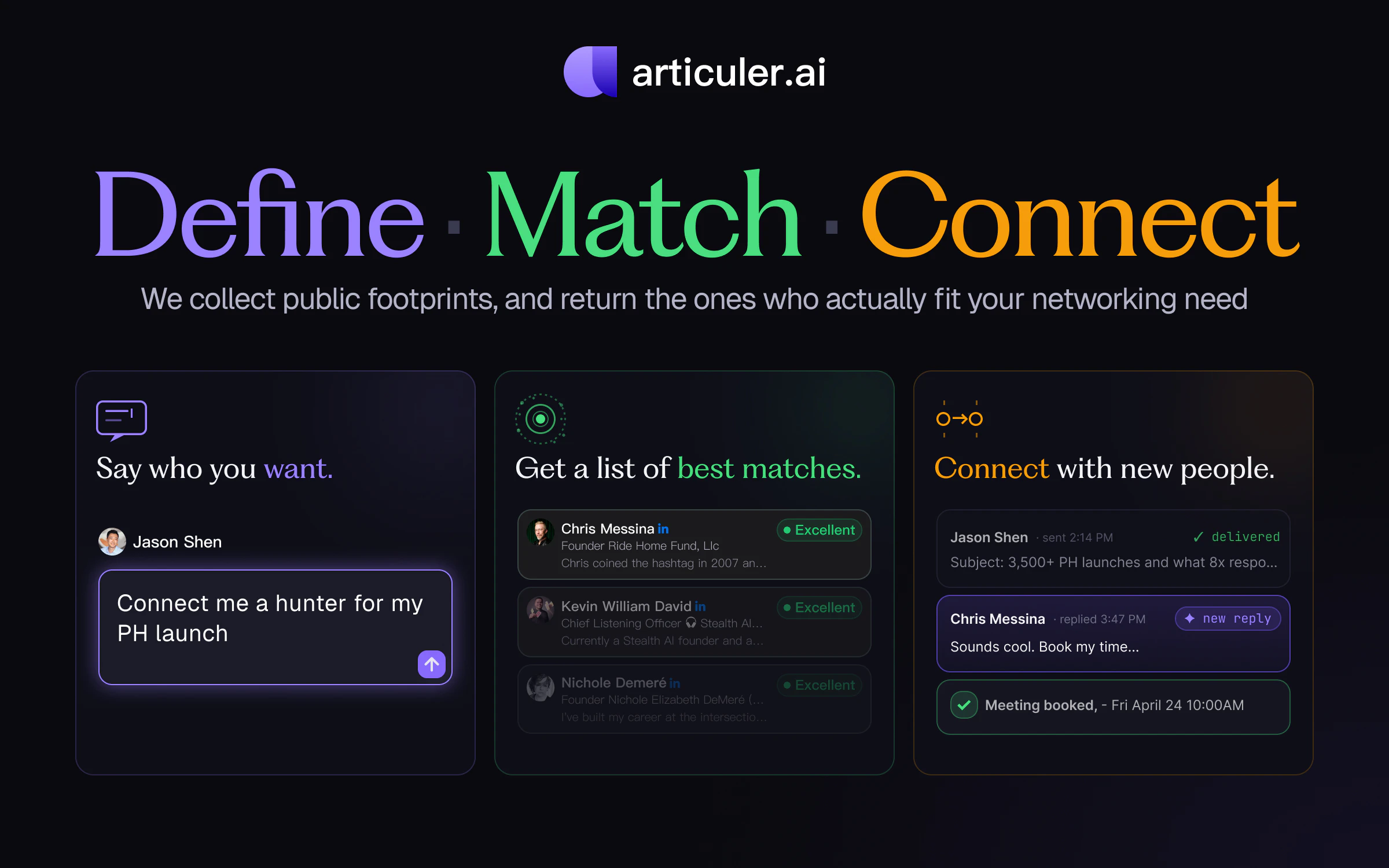
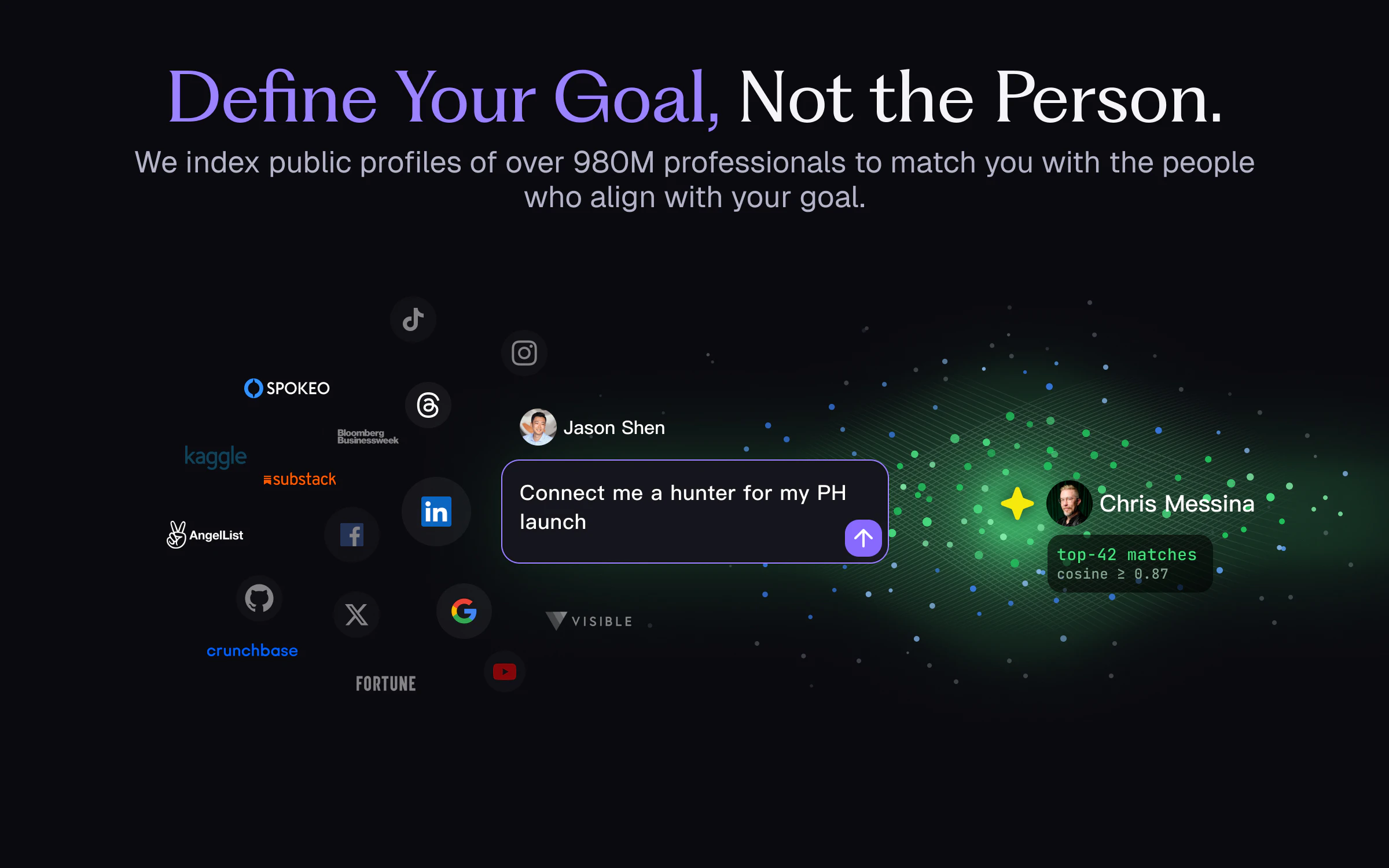
查看原始信息
Yeta AI
Paste a YouTube link, pick a language, and Yeta AI dubs it in real time — no uploads, no waiting. Natural AI voices in 10+ languages. Free to start, no card needed.
Hey Product Hunt! 👋 I built Yeta because I kept hitting the same wall — a great tutorial on YouTube, but in a language I don't speak well enough to follow along comfortably. Subtitles help, but they make you work. You're reading, not learning. So I built something different: paste a YouTube link, pick your language, and watch it dubbed in your language. Most dubbing tools make you wait hours. Yeta takes 30–60 seconds — then you're watching. My small team and I spent 6 months building this — nights, weekends, out of our own pockets. No VC, no funding rounds, just people who genuinely believed this should exist. It started as a personal tool. Then friends asked for it. Then strangers. So here we are. What makes Yeta different: — Dubbing starts in seconds, not minutes — Audio syncs in real time as the video plays — Natural-sounding AI voices, not robotic TTS — Works in 10+ languages, free to try Right now Yeta lives on desktop — that's where we started. Mobile app is already in the works, so if you're a phone-first person, hang tight. If you've ever wanted to learn from a creator who doesn't speak your language — this is for you. If you like what we're building, an upvote means the world to us. It's the kind of support that keeps bootstrapped teams going. 🙏 Would love your honest feedback. What language would you want to watch YouTube in? 👇
3
回复

@shumkov_code I love the idea of real-time AI dubbing for YouTube videos, it's a game changer for creators looking to reach a global audience. The "any YouTube video" part of your tagline really caught my attention, I'm curious to know how you plan to distribute Yeta AI to the millions of YouTubers out there. Finding warm leads, like those who have upvoted similar video editing tools, has been key for my own launches, so I'm eager to hear about your strategy to get Yeta AI in front of the right people.

0
回复
Nice logo! Congratulations on the launch. YouTube seems to support some dubbing already. Is this for when they don’t? Thanks.
3
回复

@lakshminath_dondeti Thank you! Yes, unfortunately, most languages ​​on YouTube are not available for AI translation, and manual dubbing is expensive these days.

1
回复

@lakshminath_dondeti We'll be glad if you use our service =) a free translation will allow you to translate a 15-20 minute video.

1
回复

Real-time dubbing is going to change how niche educational content gets distributed globally. I run a YouTube channel covering financial modeling for renewable energy deals (Mod3Loop -- youtube.com/@Mod3Loop) and the audience is inherently international, but producing dubbed versions has always been cost-prohibitive. This changes that math significantly. The no-upload, paste-a-link approach is exactly right -- that's the friction point that stops most creators from even trying. Congrats on the launch!

1
回复

@samir_asadov Thank you! How was the service in short?

0
回复

The real-time aspect here is super impressive. Most dubbing tools I’ve seen are asynchronous. Maker-to-maker question: are you handling the audio synthesis on the fly as the video streams, or is there a clever pre-calculation layer to keep the latency that low? Congrats on the launch.

1
回复

@rivra_dev Thank you! Yes, that's our advantage. We try to process the stream while the user is watching the video, sending data to the buffer in 2-minute chunks.

0
回复

Also a quick reminder — we have a free plan that gives you 15–20 minutes of dubbing every month, no credit card needed 🎁

More than enough to try it out and see if Yeta works for you. Just sign up and start watching

1
回复

Thank you so much for all the support on launch day — it truly means the world to a small bootstrapped team like ours

We built Yeta because we genuinely believed this should exist — and seeing people actually try it makes every late night worth it.

If you've had a chance to play around with it, we'd love to hear your honest thoughts. Good or bad — real feedback is what helps us make Yeta better for everyone.

Just drop a comment below or reply here — we read everything personally 💬

Thank you again. This is just the beginning

— Eduard, CEO of Yeta AI

1
回复