Product Hunt 每日热榜 2026-05-12

PH热榜 | 2026-05-12

#1
Kelviq
Payments, tax, and billing for SaaS & AI companies
431
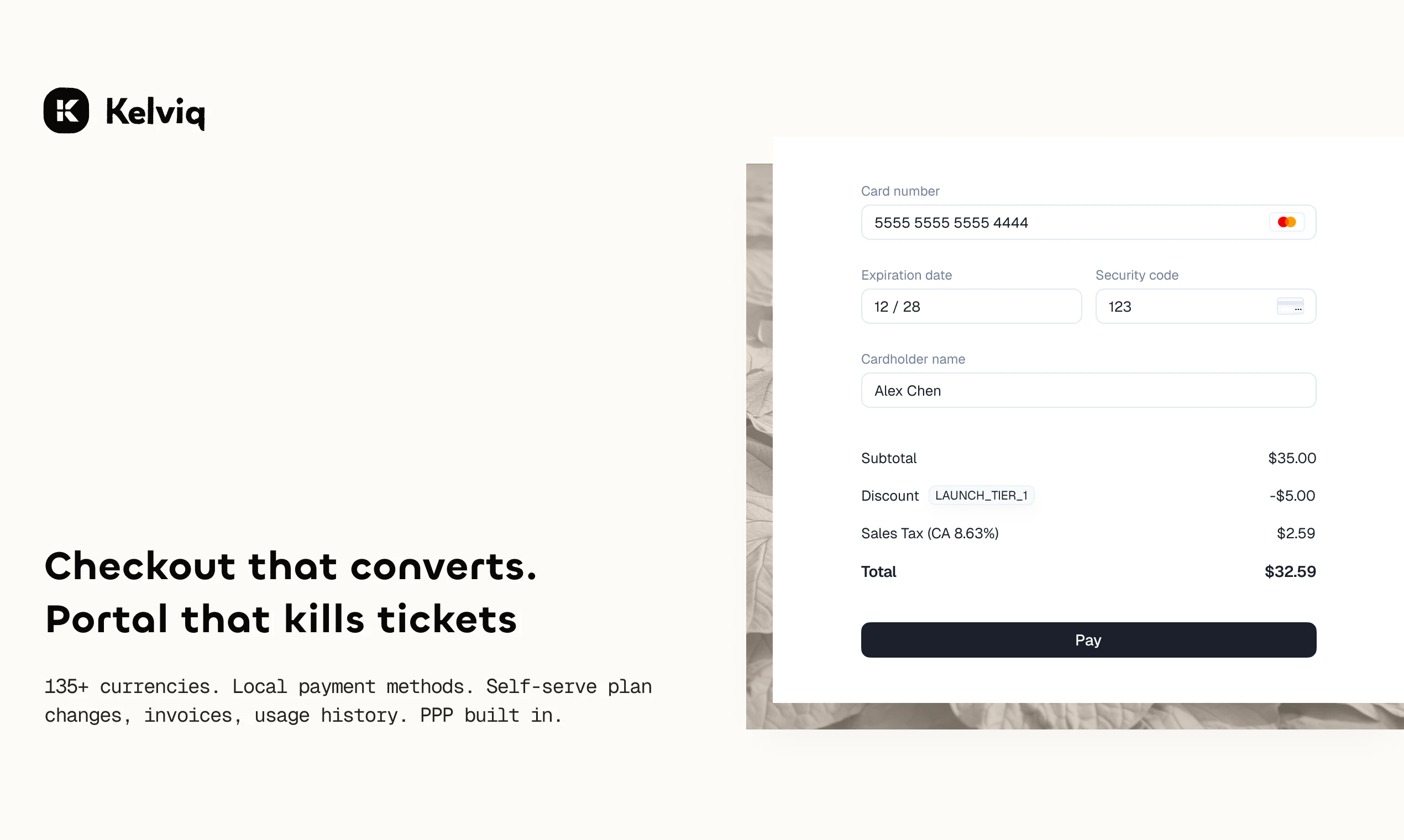
一句话介绍:Kelviq是一个面向SaaS、AI及数字产品的一站式变现平台,旨在解决开发者自行拼接支付网关、税表、订阅逻辑及合规系统造成的工程重复与耦合问题,让产品团队能快速落地复杂的全球计费、税务与合规管理。
Payments SaaS Developer Tools
SaaS计费平台 AI产品变现 全球税务合规(MoR) 订阅与用量计费 数字交付与授权 统一支付 产品推广
用户评论摘要:评论普遍赞赏其对税务合规的集成(如3.5%包含全球VAT/GST),认为解决了“DIY税务”的痛点。用户关心迁移成本,官方回应从Stripe迁移较直接。也有用户询问B2B欧盟反向征税的自动处理功能,官方确认支持。
AI 锐评

Kelviq切入的是一个“皇帝的新衣”式痛点:大部分SaaS/AI创业者在早期都天真地认为“接个Stripe就行了”,但随后就被订阅状态机、用量计量、税表注册和合规审计淹没了。Kelviq的核心价值不在于比Stripe多几个百分点的费率,而在于它把自己定位成“毛里求斯经销商”(Merchant of Record, MoR),主动替你扛住了全球税务与合规的终极法律风险。这个“担责”是很多传统支付聚合商(包括Stripe本身)所不愿或不敢碰的雷区。

从产品设计看,它已经把定价模式的抽象层拉高到了“特征开关+用量计量+许可证生成”的粒度,这意味着用户可以将定价迭代的权力从工程师手中夺回,交给产品或增长团队。这层抽象正是Monetization Platform(货币化平台)区别于Payment Gateway(支付网关)的关键分水岭。

但需要注意的是,3.5%+40¢ 在核销大额交易时未必比传统支付+独立合规方案便宜;而“从Stripe迁移简单”的承诺,依赖于用户的计价模型是否足够标准化。对于重度定制化订阅(如依赖复杂退费规则或信用系统的产品),迁移成本会显著上升。此外,平台尚未展示高并发下实时用量计量的延迟和一致性保证,这对AI Token级计费至关重要。

总体而言,Kelviq比Paddle和Lemon Squeezy在SaaS/AI特定场景下的抽象层更高,但其能否持久保持优惠费率并支撑企业级定制请求,将是它从中型玩家手中抢滩的关键。

查看原始信息
Kelviq
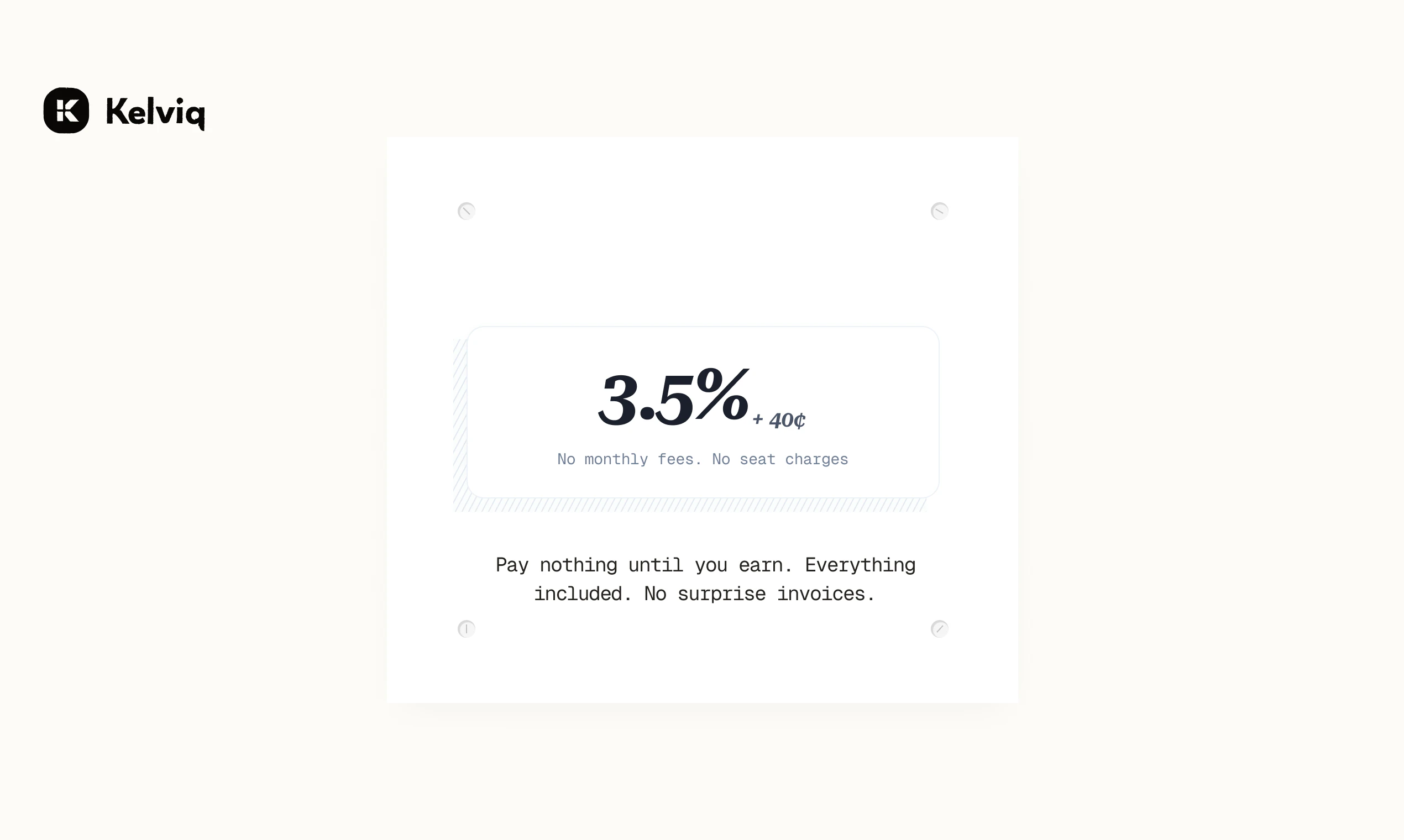
Kelviq is the complete monetization platform for SaaS, AI, and digital products. It handles payments, global tax, subscriptions, usage-based billing, digital delivery, license keys, and compliance in one place, for 3.5% + 40¢ per transaction.

Hi Product Hunt 👋

I'm Sachin, co-founder of Kelviq.

For the past few months, we've been building Kelviq, and we're excited to finally share it with you.


Kelviq helps SaaS, AI, and digital products sell globally without rebuilding billing infrastructure from scratch.

It handles payments, checkout, global taxes, compliance, subscriptions, digital file delivery, license keys, usage-based billing, credits, feature access, and payouts in one place.


We built this because we kept seeing the same problem through our other product, ParityDeals.


Adding a payment gateway is easy. Building the full monetization layer around it is not.


Once you start charging for features, seats, usage, credits, API calls, or AI tokens, you usually end up building a lot of custom infrastructure:

  • Webhook listeners to sync payment events into your database

  • Subscription tables to track who has access to what

  • Retry logic for missed or failed events

  • Custom usage tracking

  • Feature flags tied to pricing plans

  • Scripts for upgrades, downgrades, prorations, and grandfathered users

Over time, pricing becomes tightly coupled with your codebase. Changing a plan, moving a feature, adding usage limits, or launching a new pricing model often requires engineering work, database changes, and a deployment.


We wanted to make all of this much simpler. With Kelviq, you can:

  • Get started in minutes: You don't have to handle dozens of webhooks, build a database layer to track customers, manage subscription states, or hardcode feature access. Kelviq provides a single, unified system.

  • Handle Global Tax & Compliance Automatically: As your Merchant of Record, Kelviq takes on the full liability for global sales tax (VAT, GST, etc.), fraud, and regulatory compliance. You can sell in 100+ countries without ever registering for a foreign tax ID.

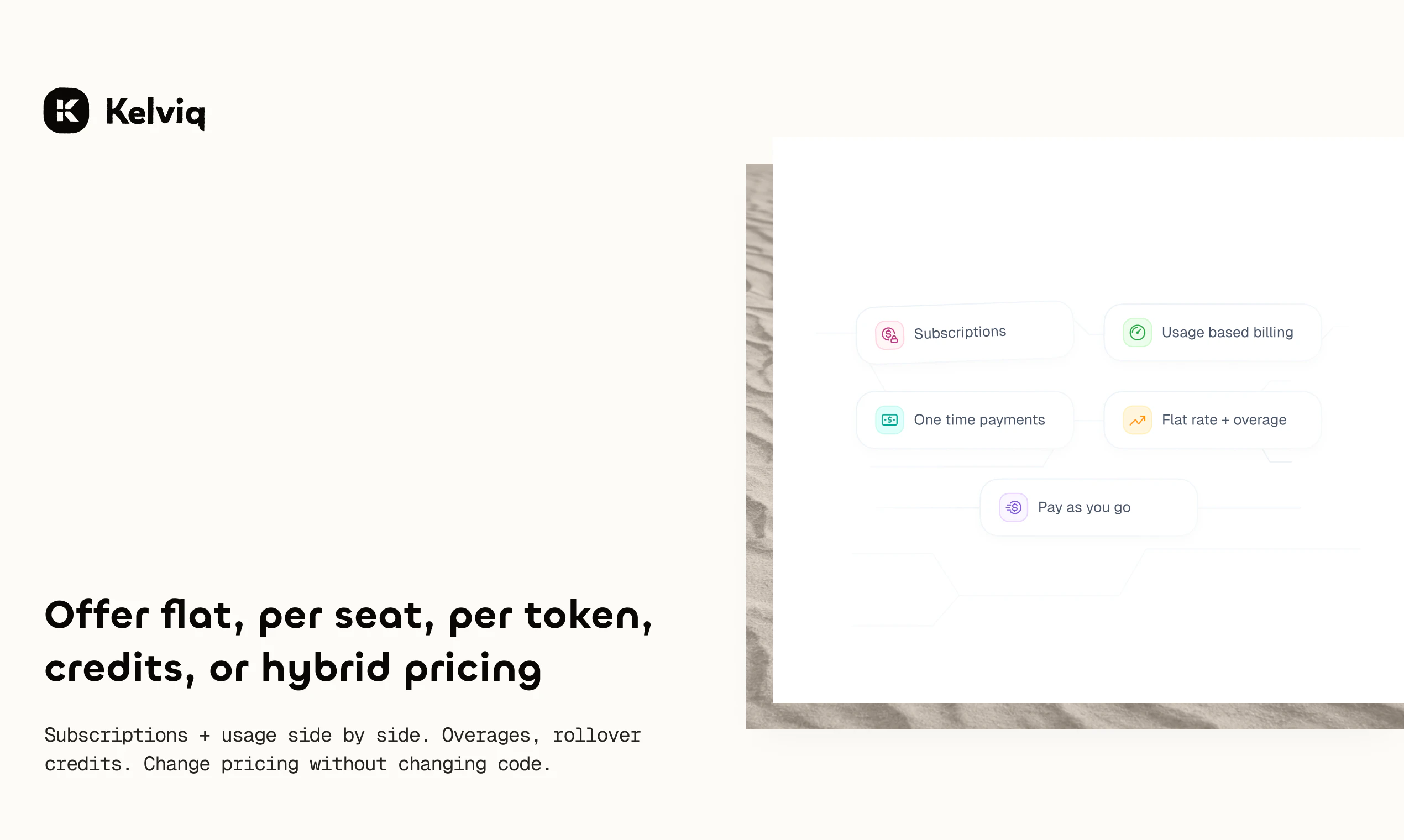
  • Run any pricing model: Flat fee, usage, seats, tiers, volume, credits, pay-as-you-go, overage charges, or hybrids. Configure them in minutes.

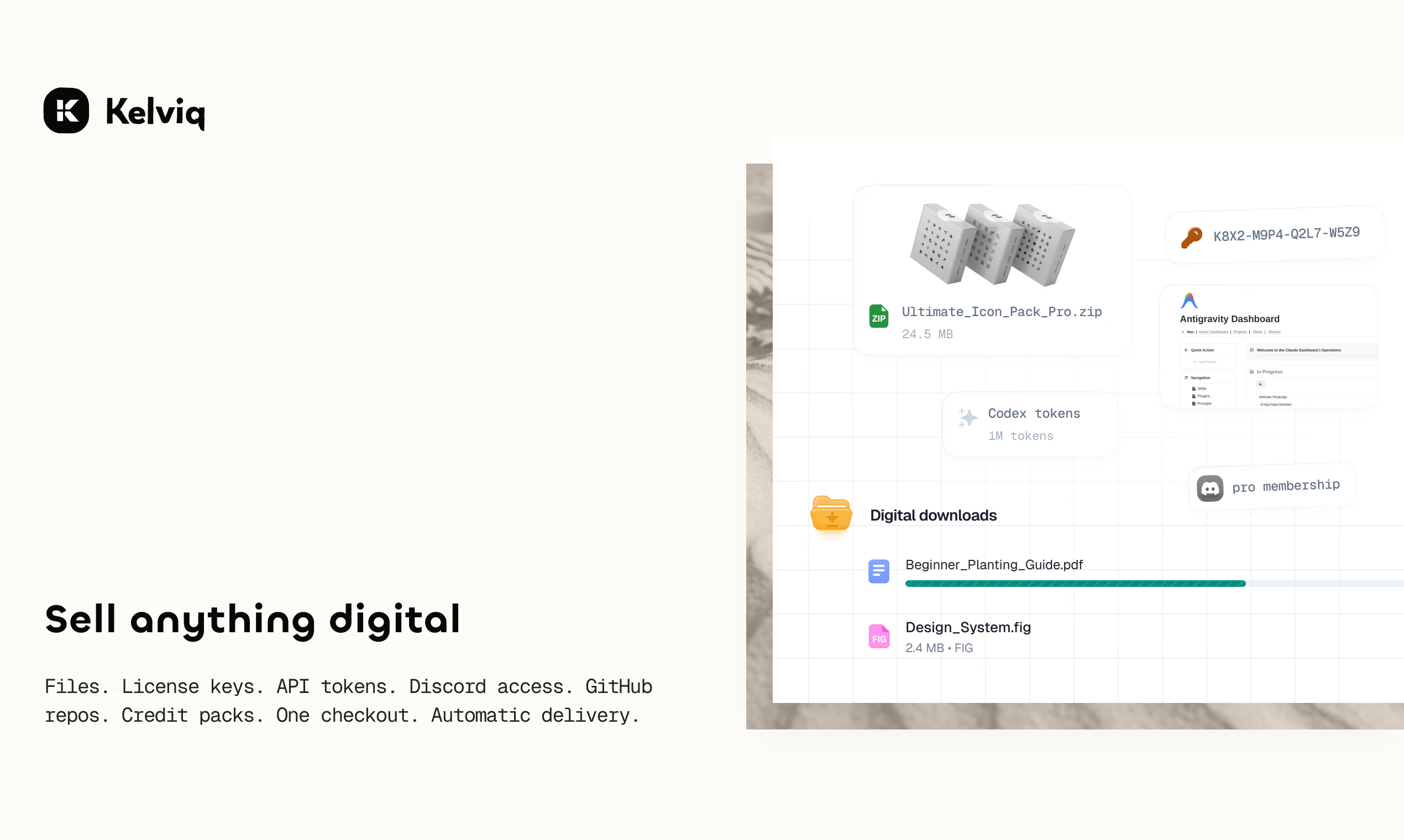
  • Sell digital products with ease: Securely deliver files, e-books, or software on purchase and automatically generate license keys to validate customers.

  • Meter usage in real time: Count every API hit, data storage unit, or AI tokens in real time. Set soft or hard caps, pick reset cycles, send alerts, and handle overages with one call.

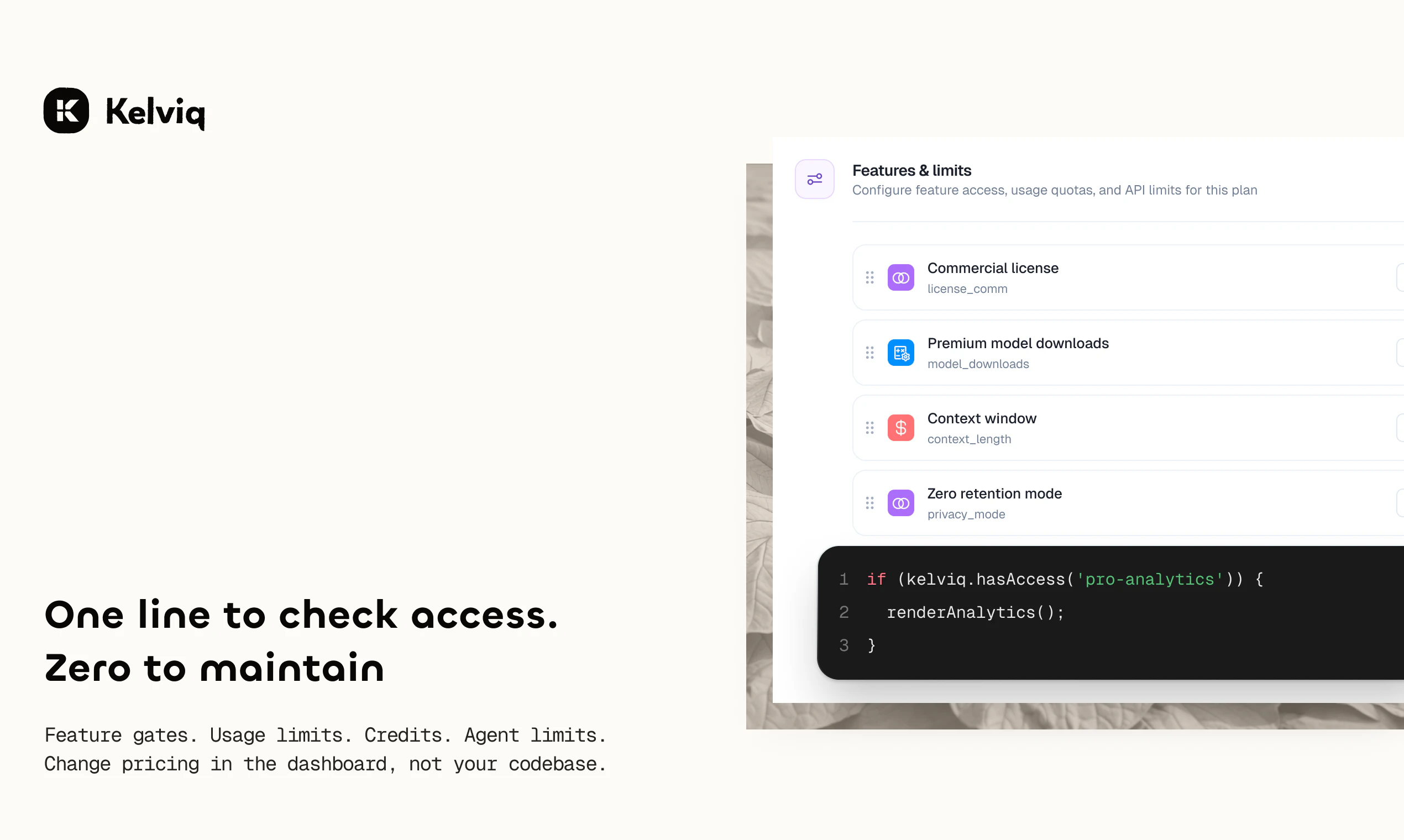
  • Control feature access: Define features per plan. Turn them on or off and check access in your app with one SDK call.

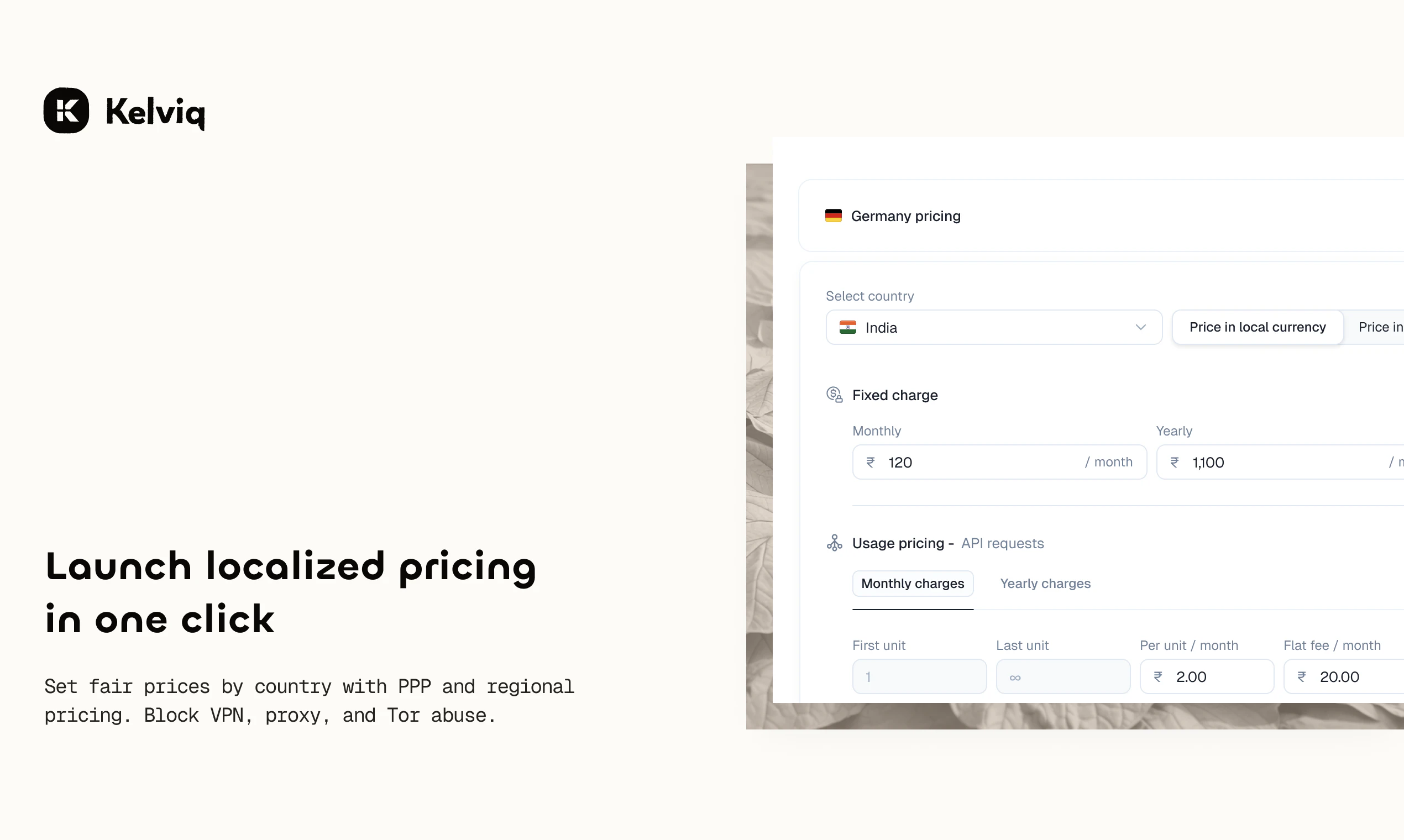
  • Localized pricing by country: Offer country-specific prices in 135+ currencies with VPN, proxy, and fraud protection built in. You can also set up promotions for specific countries.

  • Ship pricing changes without touching code: A/B test plans, roll out changes, or update pricing in real time without redeploys.

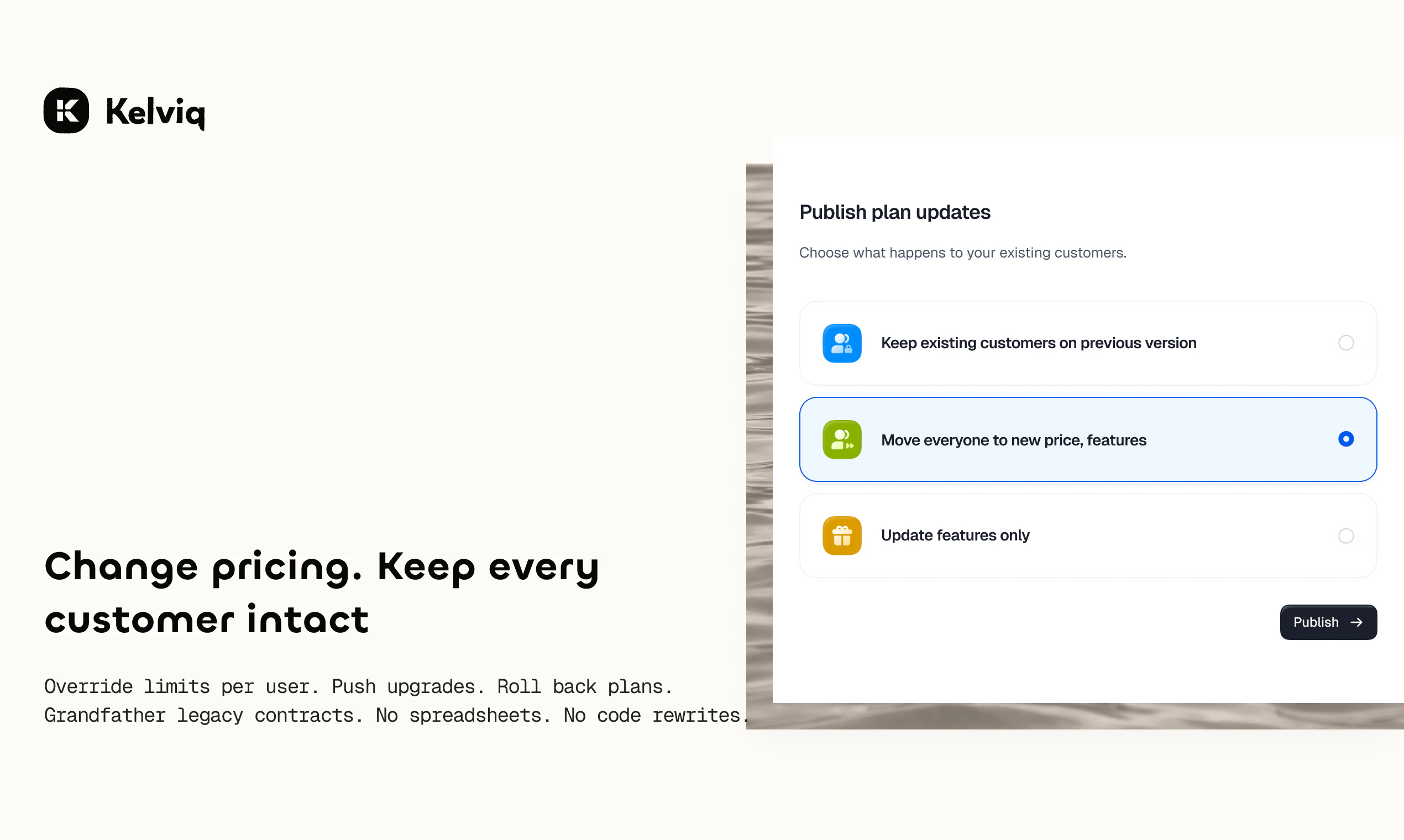
Manage the full customer lifecycle: Handle upgrades, downgrades, migrations, overrides, and grandfathering without writing custom scripts.


We are also running a special founder offer right now:
2.9% + 40¢ per transaction for your first $5K in volume. After that, just 3.5% + 40¢ per transaction.


We'd love your feedback, questions, and suggestions.

Thank you for checking out Kelviq 🙏

26
回复

@sachinchoolur love the product.. all the best Sachin.. 🚀

4
回复

@sachinchoolur Many congratulations Sachin on launching Kelviq on Product Hunt! :)

How I met the maker?

I first discovered Sachin’s work through his earlier products and have been following his journey since, we had re-connected last year via our mutual friend @harsh_jhunjhunuwala during the ParityDeals launch. When he started building Kelviq it instantly caught my eye.

What is Kelviq?

Kelviq is a complete monetization platform for SaaS, AI, and digital products that bundles payments, checkout, global taxes, compliance, subscriptions, usage-based billing, digital delivery, license keys, credits, and feature access into one system.

Instead of stitching together a payment gateway, webhooks, custom billing logic, and tax tooling, you plug into Kelviq and get a unified platform plus a Merchant of Record that handles global tax and compliance for you.

Why I endorse Kelviq?

I endorse Kelviq because it lets founders launch serious billing in days instead of months and keep iterating on pricing without constant engineering work.

Support for flat, seat-based, usage-based, credit-based, and hybrid models along with real-time metering (API calls, AI tokens, etc.) and localized pricing in 135+ currencies makes it a powerful fit for modern SaaS and AI products that want to scale globally.

Give it a spin! :)

10
回复

@sachinchoolur solves huge problem monetising products

0
回复

@alokvats finally its coming out.. so happy for you guys. Kelviq fills such a big gap for us solopreneurs. Keep going 🚀🚀🚀

3
回复

@a_nubhv Thanks for the support.

0
回复

Congratulations on the launch!

3
回复

@riya_jawandhiya Thanks, Riya!

1
回复
0
回复

Big fan of your work Sachin, congrats on the launch!

3
回复

@musharofchy Thanks Musharof!

0
回复

Id use this over Stripe.

2
回复

I would use it for my next side project ❤️

2
回复

@prashant_mahajan Thanks, Prashant!

0
回复
Wait, 3.5% includes tax compliance globally? That’s the actual unlock. Most platforms make you DIY the worst part.
2
回复

3.5% flat pricing is interesting curious how margins scale.

2
回复

@bruce_warren Yeah, this is a special offer for our early customers.


As volume grows, we'll also have custom pricing for larger customers, but our goal is to keep Kelviq much more accessible than traditional MoR providers.

0
回复

Congrats on the launch 🙌

Does Kelviq handle reverse-charge VAT for B2B sales within the EU automatically (valid VAT ID = no tax charged)?

2
回复

@francesco2689 Yes Francesco, we do handle reverse-charge VAT for B2B sales. If the customer provides a valid VAT ID, no VAT is charged.

Whether the VAT should be deducted from the gross amount or handled separately can also be configured at the settings level.

1
回复

Looks neat. would try it for upcoming side projects! all the best @sachinchoolur

2
回复

@neelptl2602 Thank you Neel.

1
回复

Cool stuff. Congrats on the launch. I hope Kelviq gets featured.

2
回复

@jotzilla Thanks for the support.

0
回复

Congratulations with the launch Sachin - been following your and Kelviq's journey. The speed at which you're shipping things is really incredible! All the best 🚀

2
回复

@designerdada Thanks, Akash! Means a lot coming from you 🙏

0
回复

THIS IS AWESOME!! need this for getoverlay.io

1
回复

Congrats on the launch! As a founder dealing with stripe integration right now, the idea of having payments, tax, and compliance handled in one place is really appealing. How does migration work for teams already on Stripe?

1
回复

@tjclayton It's a comparatively easy process with Stripe. We'd mainly need to review your current pricing structure and plan setup to ensure a smooth migration.

0
回复

Let's go Sachin!!

1
回复
Can this replace metronome?
1
回复

@feiyou_guo Yes, Kelviq has built in usage metering.

0
回复

Being able to change pricing without digging through billing code sounds really nice 😂

This stuff always gets messy once products start growing. Congrats on the launch!🚀

1
回复

@campritchard Thanks, Cam!


Pricing should be owned by the product,GTM team, not blocked by engineering tickets.

That's one of the main reasons we built Kelviq.

1
回复

Curious how it handles Apple/Google IAP alongside web payments most billing tools are built around web-first and mobile app billing is always an afterthought. Does it support App Store subscriptions?

1
回复

@imad_elkhafi Right now, Kelviq is focused on web payments and web-based subscriptions. We don't directly support Apple/Google in-app subscriptions yet.

0
回复

I think your logo looks very familiar :)

1
回复

@asti_pili Oops! Just noticed. Looks similar :)

0
回复
Great product! There is a way to migrate users, active subscriptions and license key from other MoR like LemonSqueezy or Paddle?
1
回复

@theviolacode Thanks! Yes, we can help with migration.


If your current provider supports PCI-compliant payment method migration, like Stripe or Paddle, we can migrate payment methods as well, so your customers don’t have to re-enter their cards.

We can also help migrate products, plans, customers, active subscriptions, discounts, files, and license keys from platforms like Lemon Squeezy or Paddle.

1
回复

Congratulations on the launch!

1
回复

@devpura1993 Thank you

0
回复
This looks awesome! Can we have a call with you guys to see if we can use it?
1
回复

@ilaiszp Hi Ilai,

Sure, please grab a slot here: https://tidycal.com/neravath/15-minute-meeting

Happy to walk you through the product and help you with the setup.

1
回复

Congrats on the launch! Handling global tax is often the biggest hurdle for early-stage SaaS expanding internationally. How does Kelviq handle tax remittance for specific regions like the EU (VAT) compared to US sales tax? Is the 'digital delivery' feature integrated with the billing logic to automate access management upon payment?

1
回复

@rivra_dev 
We've registered in EU for tax remittance, so we handle the VAT OSS filings and reverse charges ourselves.

In the US, we manage the various state nexus thresholds and collect/remit sales tax on behalf of our users.

Regarding digital delivery: yes, the billing logic is tightly coupled. Once the payment is verified, the system triggers the delivery webhook, sends an email notification and grants access immediately, so there's no manual 'hand-off' needed.

0
回复

Congrats on the launch 🚀 The traction today is incredible. Curious — what was the unlock that pushed you past 200 upvotes in just a few hours? Trying to learn from the best today since my own launch is happening 😅

1
回复

@axlerodd Thank you :)

1
回复

This is really cool 😎

1
回复

@buildersps Thank you.

0
回复

Congrats on the launch! Kelviq looks promising

1
回复

@manuarora Thank you Manu.

0
回复

Curious about the 3.5% + 40¢ number — that's a hard line in the sand vs. Stripe's 2.9% + 30¢, but you're bundling sales-tax remittance and global compliance into the same blob. For SaaS founders the implicit framing matters: is Kelviq pricing as a flat replacement for Stripe + TaxJar + Paddle MoR, or is the AI/usage-billing primitive the part you'd argue is worth a different cost basis?

In my world (project-finance modelling, where I run ModeLoop on the side), the cleanest valuation conversations always start by separating commodity-line items from differentiated ones. The bundling decision tends to be where founders either communicate or obscure unit economics. Where do you see customers landing on that vs. the underlying CPM/CPM-equivalents?

0
回复

Cool, I use polar and migrate to stripe. how do you handle that kinda low cost? 3.5$ is most low MoR I've ever seen.

0
回复

what is different form Kelviq and paypal?

0
回复

Hey Sachin, congrats on the launch! Many Indian founders have been struggling with Paddle and Lemon Squeezy suddenly closing accounts or having strict entity requirements. Since Kelviq supports individuals, can you clarify how you handle payouts for Indian users (e.g., via Stripe Connect or local bank transfer) and if there are any specific compliance hurdles/GST requirements we should be aware of to ensure account longevity?

0
回复
#2
Open Vibe
Ship your SaaS with AI, without getting stuck
249
一句话介绍:Open Vibe 将Claude Code等AI编程代理转变为SaaS导师,在用户构建真实应用的过程中,同步讲解认证、支付、部署等关键概念,解决“闭眼编码”导致无法理解与调试的痛点。
Education SaaS GitHub Vibe coding
AI编程学习伴侣 SaaS模板教学 Vibe Coding 开发者工具 交互式教程 代码理解 Git部署 开源脚手架 AI集成引导 产品猎人热门
用户评论摘要:用户普遍认可其解决“闭眼编码”后无法调试的痛点。主要关注点:①如何平衡上下文教学与结构化课程;②能否追踪学习进度避免重复;③对更大代码库的适用性;④有用户指出定位在“学习”与“避免卡住”间需更清晰。
AI 锐评

Open Vibe切入了一个极其精准且日渐尖锐的痛点——“AI辅助编程”泛滥下的“盲飞”困境。当前市场充斥着“10分钟用Cursor搭个AI应用”的速成教程,用户能快速堆积代码,却对底层架构、HTTP协议、数据库事务等毫无概念,一旦AI输出偏离预期(这是常态),马上陷入“提示-修复”的死循环。Open Vibe的解法相当务实:它没有选择做空泛的知识图谱,而是提供一个真实的、业界标准的SaaS脚手架(Open SaaS),然后让AI代理在用户动手定制时,同步以动画和图解讲解每个具体操作背后的Why——比如“为什么这里用PostgreSQL而非MongoDB?”“为什么支付回调需要幂等性设计?”这种情境化教学比任何脱离项目的教程都更有黏性。

但产品距离成为“AI时代的编程教练”仍有明显差距。用户评论中已点出两个关键短板:一是需要进度管理,防止同一个知识点反复讲解;二是对于用户自己引入的更复杂的代码库,教学效果尚未验证。此外,定价模式与“教+建”的组合是否会使产品陷入“教程工具”与“开发脚手架”的定位模糊?目前来看,它更接近一个“带注释的交互式启动套件”,而非通用学习平台。真正的价值在于,它让“AI辅助开发”从盲从输出转向“理解后复用”——这对提升整个Vibe Coding社区的代码素质意义重大,但若要成为主流工具,必须在个性化学习路径和冷启动引导上做更多投入。

查看原始信息
Open Vibe
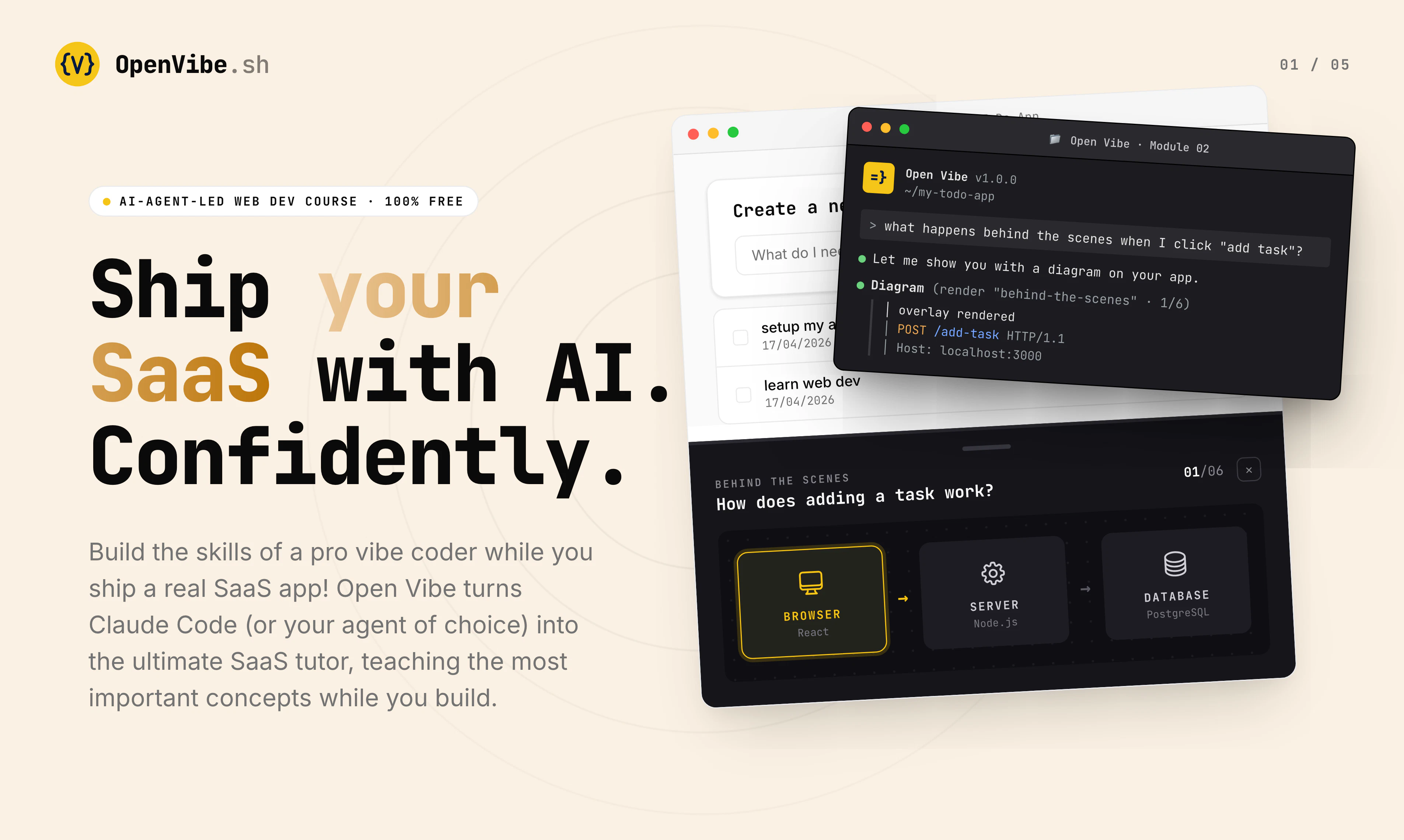
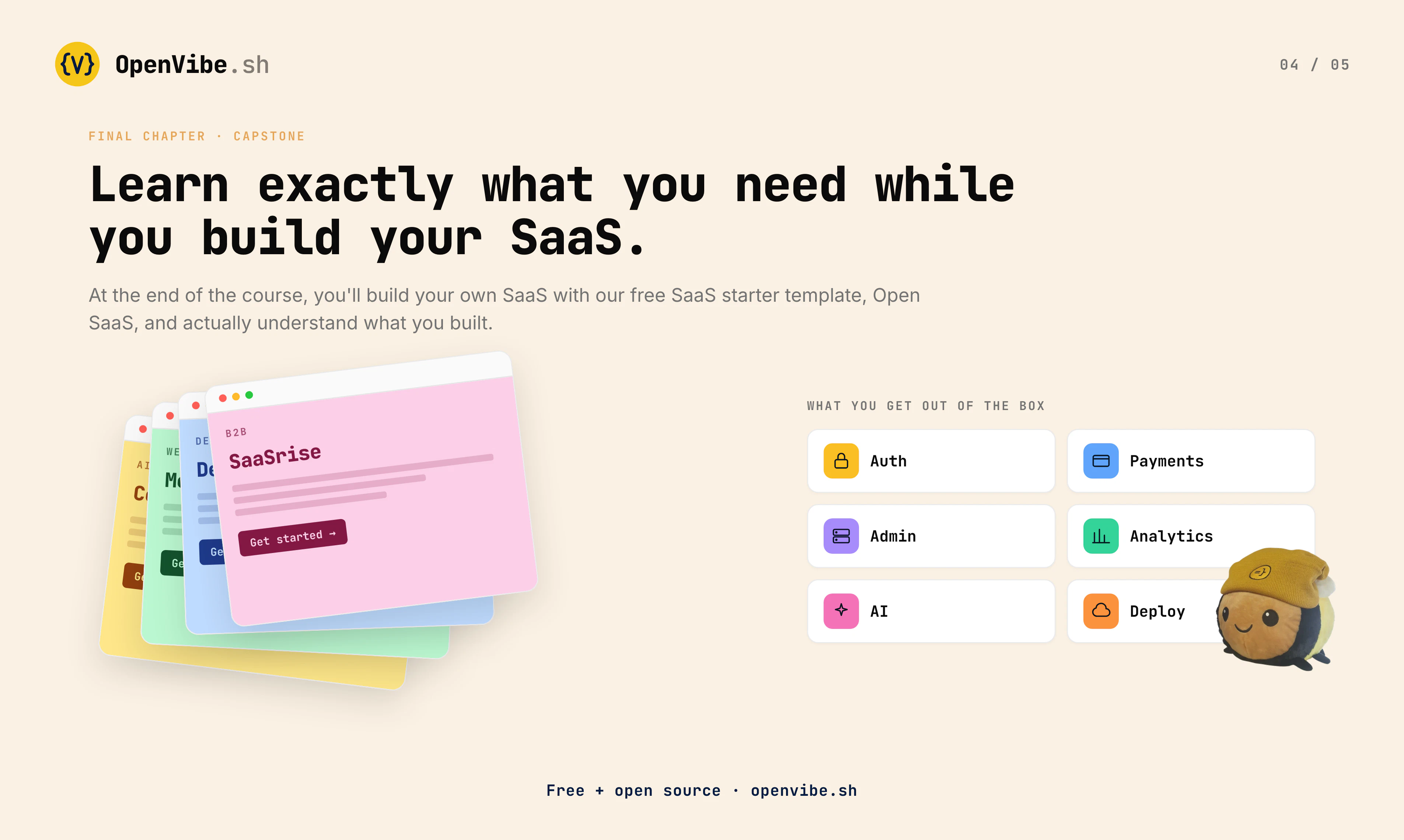
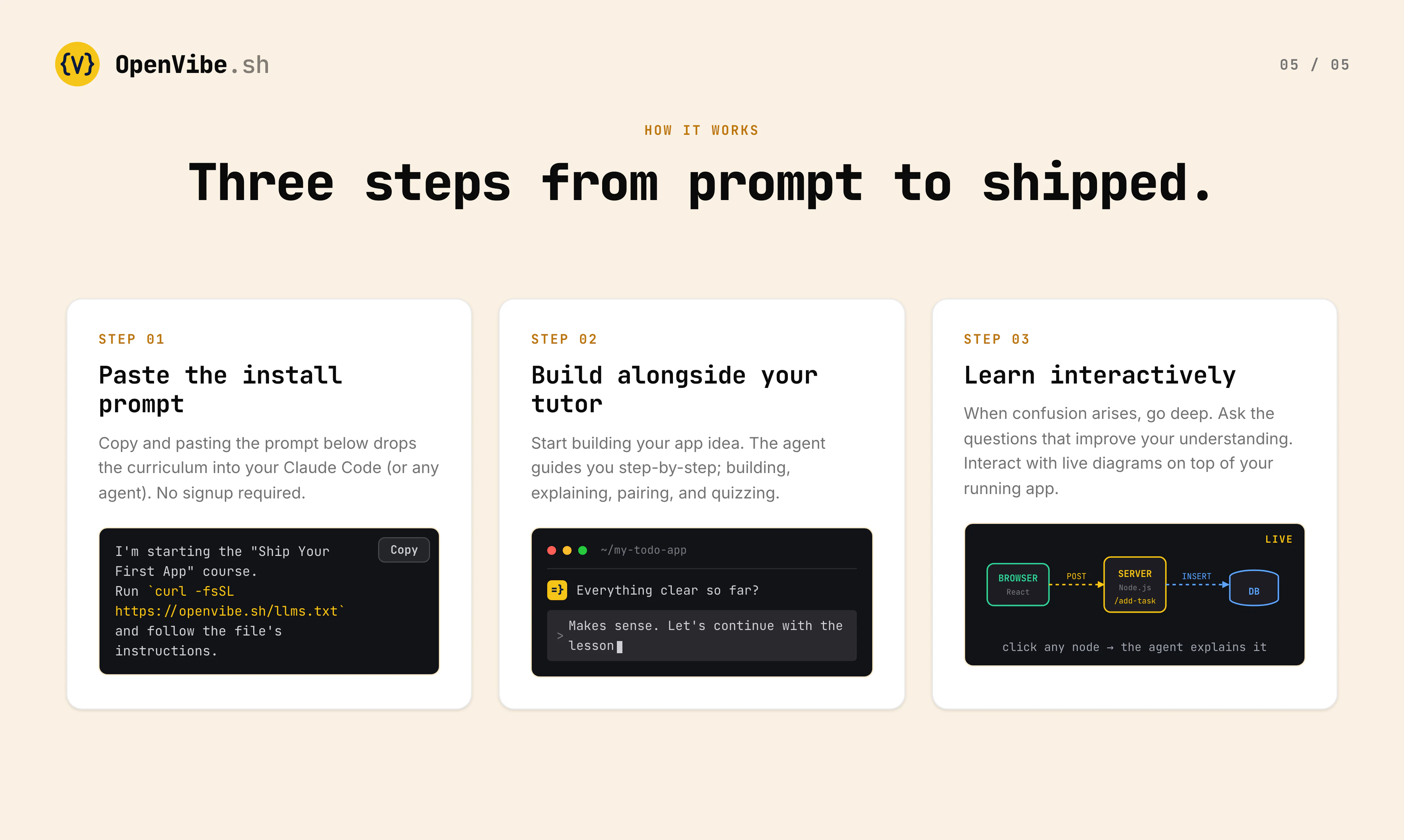
Build the skills of a pro coder while you ship a real SaaS app! Open Vibe turns Claude Code (or your agent of choice) into the ultimate SaaS tutor, teaching the most important concepts while you build.

Vibe coding blindly builds apps you don't understand.

Static tutorials teach with throwaway apps.

With Open Vibe your agent tutors you while you build and ship your SaaS using the tools and concepts of the pros.

What Open Vibe does:
🛠️ Sets up your local development environment for agentic coding for you
😎 Guides you through building full-stack apps (Auth, Payments, AI-integrations)
💻 Explains complicated processes like Git, Deployments, Databases, HTTP, etc along with animated diagrams
🧑‍🏫 Acts as your personalized tutors as you build and ship your own app ideas

Who it’s for:
🧑‍💻 Vibe Coders
🏗️ Aspiring Founders/Entrepreneurs
🔬 Learners experimenting with AI

Quick links
Website: https://OpenVibe.sh
GitHub: https://github.com/wasp-lang/shi...

7
回复

The biggest problem with vibe coding right now isn't that people can't ship - it's that they ship without understanding what they shipped. You get a working app and zero ability to debug, extend, or make architectural decisions when the AI gets confused. Curious about how it handles the teaching moments. Does it pause and explain concepts in context (like "here's why we're using this pattern"), or is it more of a structured curriculum that happens to use your project as the canvas? Those are very different learning experiences.

4
回复

@ben_gend it's actually both approaches combined. We use Open SaaS, our free, open-source SaaS boilerplate template, and explain concepts in context as the user makes changes and customizes it to become their own SaaS.

1
回复

This feels like a bridge between learning and doing finally.

3
回复

@bruce_warren yep! learn and do at the same time :)

0
回复

Congrats on launch! Wasp is a wonderful framework and perfect for something like this. And, really cool to see a teaching tool!

2
回复

@campak Thanks for your continued support, Cam!

1
回复
Interesting. There was another app like this last week on product hunt. Does your app keep track of what the user learned and not repeat stuff?
2
回复

@lakshminath_dondeti yeah Contral, I think it's called. They take the IDE extension route and focus on any codebase. We provide the codebase (Open SaaS, our free, open-source SaaS boilerplate template) and build/teach around that. And, yes, we keep a course progress JSON updated to track learner's progress.

0
回复

super cool! Understanding the codebase is one of the biggest issues with vibe coding and it's the reason why most people get stuck. I'd love to see how this looks on a bigger codebase

2
回复

@zvonimir_sabljic1 this is a cool idea! right now it runs on top of Open SaaS, our free, open-source SaaS template, so that's already a pretty big codebase and it works great.

1
回复

Tried it and it delivers. Biggest thing for me: instead of blindly approving every Claude Code suggestion, you're walked through what's actually happening and why it matters. Awesome launch, Vince. 🚀

2
回复

@matija_tolic1 Awesome. We went people to feel confident about what they're shipping, so that's the idea!

1
回复

Super excited to see Vinny shipping this! I think that having a tutorial embedded in the agent makes the whole experience so much more interactive. Plus, you can actually build your own thing while learning about all the web dev concepts you need to ship without getting stuck. Huge if true :)

2
回复

@matijash That's the most exciting part for me, that you can start on your idea right away and learn as you build it, rather than going through a course and do cheap demo apps before you start on your own.

0
回复

I was just looking for a product like this yesterday! (and honestly, briefly considered building it :P)

1
回复

@robert_douglass awesome! i'd love your feedback if you get a chance to try it :)

0
回复

I thing this is great! Learning even just the basics of web dev is a big help and will make it much easier to get further along with your app.
Btw I was a bit confused with the messaging because at one moment it is about not getting stuck, another it is about learning, I guess those are connected but also don't have to be, so I am not sure what is this more about, I guess about learning, and not being stuck is just a consequence?

1
回复

@martin_sosic learn the system in context using your Agent as a tutor while you build so that you don't get stuck in the prompt-fix loop that plagues so many vibe coders!

0
回复

Putting two things together - vibe coding and learning how to develop and code is awesome. Congratulations on the launch!

1
回复

@vibor_cipan That's the idea. Thanks!

0
回复

The "getting stuck" problem is real. For me the bigger issue wasn't technical it was showing up the next day after a bad session. I've been experimenting with extremely small daily logs (like, just one sentence about what I built or unblocked) and it's been weirdly effective at keeping the streak going. Something about having to write even one line means you have to do at least one thing. Congrats on the launch the Claude Code integration angle is smart.

0
回复

Well done @matijash 🙌

0
回复
okay i thought it is just another saas template. but interactive part is really good. this has a lot of potential . one of those products which keeps on evolving. wondering how you are going to tackle the framework parts. especially with tech stack becoming polygot these days.
0
回复

"Without getting stuck" is doing a lot of work in that tagline what's the most common place devs get stuck that this specifically solves? Architecture decisions, boilerplate, or something else?

0
回复
“Without getting stuck” is doing a lot of heavy lifting in that tagline. Every SAAS partner has lost a week to infra that had nothing to do with their actual product.
0
回复

This is a fascinating concept for a 'tutor' in the IDE. How does Open Vibe maintain the balance between giving the developer the 'answer' and actually teaching them the underlying concepts? Does it support multiple LLMs besides Claude, or is it specifically optimized for Claude Code's capabilities?

0
回复

@rivra_dev it's a tutor in the terminal and its been tested extensively with Claude Code but should work with other terminal-based coding agents. It's based on the Open SaaS boilerplate starter and walks through concepts there in context as the learner builds their app idea.

0
回复

I like the landing page, we should have you doing our redesign.

0
回复

@sodic i know, right?

0
回复

Looks pretty sweet. The UI for visualising the data flow is the detail beginners need. It's sometimes easy to get lost in the word soups that LLMs give you... Draw a picture for me and I'm happy. Good job Vinny!

0
回复

@mihovil_ilakovac help me help you!

1
回复

Really interesting approach to AI-assisted development.

0
回复

@bilal_niaz appreciate it!

0
回复

Been watching Vinny cook on this one! Just a bit of knowledge can go a very long way when vibecoding effectively, and Open Vibe gives you that, hands on.

0
回复

@_cprecioso yep, understanding the system is more than enough to get very far with AI tools these days.

0
回复
#3
Hyperswitch Prism
Library to plug-n-switch payment processors
196
一句话介绍:Hyperswitch Prism是一款开源的支付处理器切换库,让开发者通过一次集成即可灵活切换、冗余备份或按规则路由不同支付网关,避免被单一供应商锁定,解决支付集成随业务增长而变得复杂的痛点。
Open Source Fintech Developer Tools
支付处理器切换 开源支付库 多支付网关集成 支付抽象层 Stateless架构 开发者工具 Node/Python/Java/Rust SDK 支付冗余 无状态库 支付路由规则
用户评论摘要:用户对该库的“无状态”设计和“单一集成层”给予认可,认为适合不想采用完整支付编排平台的团队。主要诉求包括:补充失败支付重试与对账的示例;追加Golang SDK;澄清跨语言统一错误处理的实现;以及说明不存储数据时如何跟踪事件与对账。
AI 锐评

Hyperswitch Prism在“支付编排平台”和“裸接单一支付处理器”之间,硬生生撕开了一个巧妙的中间地带。其真正的价值不在于“又多了一个开源支付库”,而在于它精准击中了高速增长型企业的结构性痛点:当业务从单一市场、单一支付商向多区域、多网关演进时,集成成本、维护开销和供应商锁定风险呈指数级上升。Prism用“无状态+单一接口”的极简哲学,把最脏最累的网关差异封装在底层,让业务逻辑在上层可以像插拔U盘一样更换支付处理器。这种设计既避免了部署完整支付编排平台(如Juspay自家的Hyperswitch)带来的臃肿和基础设施开销,又保留了“后期升级”的迁移路径。不过,“无状态”虽然降低了接入门槛,但也意味着重试、对账、事件存储等关键支付场景仍需要团队自行搭建或依赖其他组件,对刚刚起步的单处理器团队来说,Prism可能显得“过于通用”而缺乏开箱即用的便利。然而,对于已经感受到多支付网关之痛、又不想被复杂平台绑架的中型团队,这几乎是最优的“防御性集成”方案——你不需现在就引入编排巨兽,但代码结构中已为未来准备好了切换的接口。从社区反应看,对Golang和失败重试用例的强烈呼声也揭示了其当前短板:要真正成为“支付标准层”,必须有更丰富的最佳实践样例和语言覆盖。一句话:Prism是支付领域的“TypeScript”——给你接口安全感,但运行时还得你自己来。

查看原始信息
Hyperswitch Prism
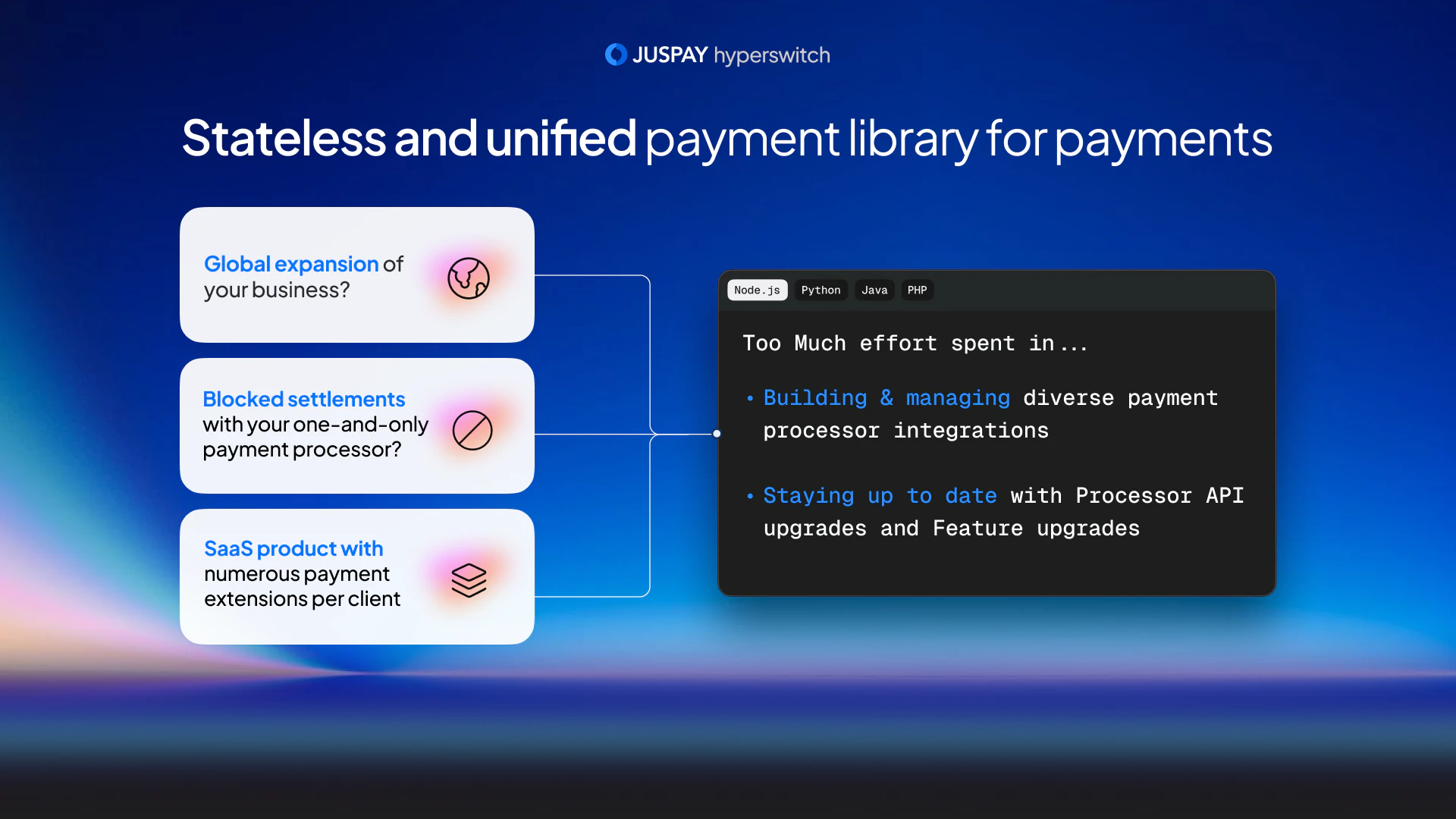
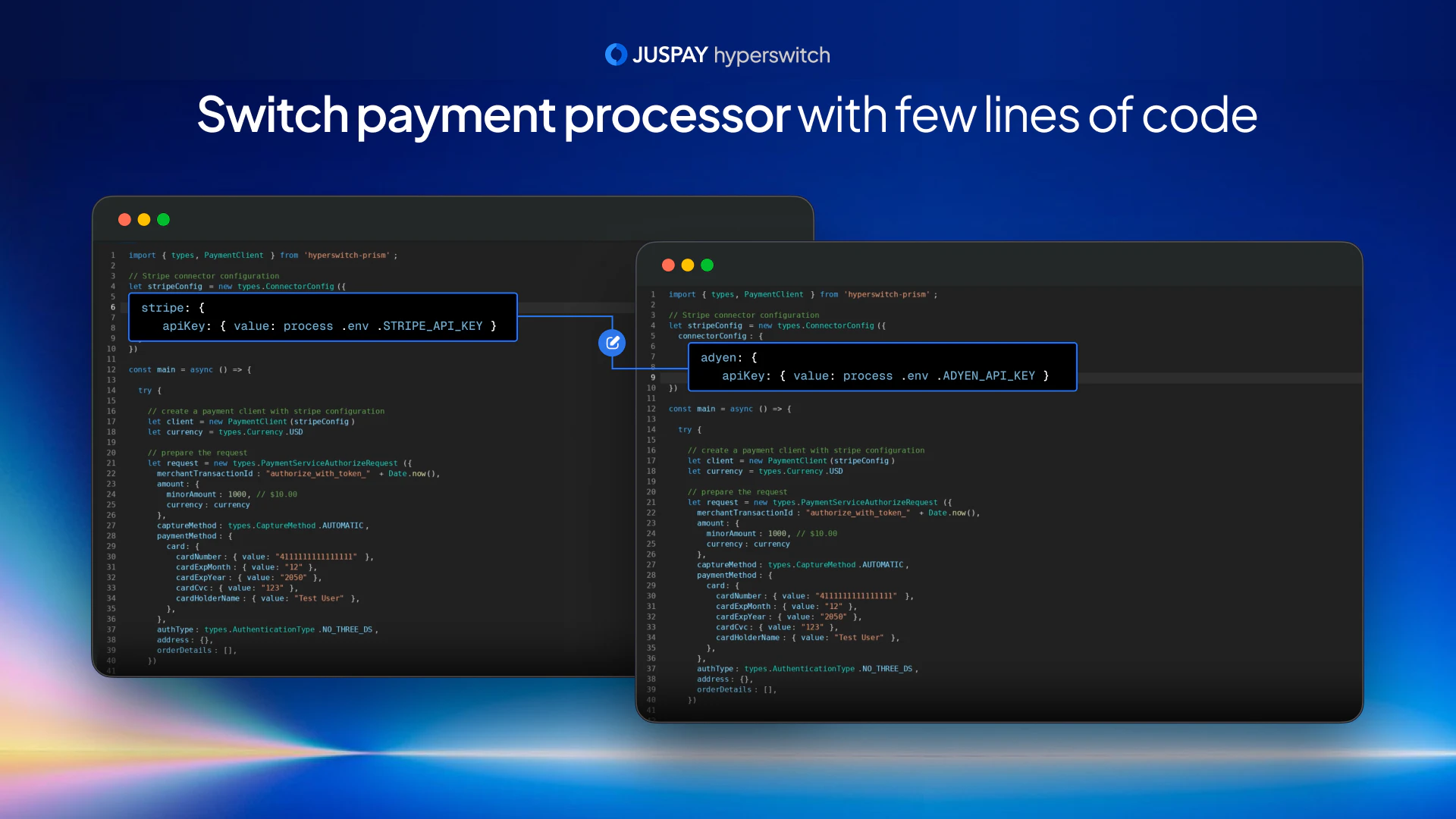
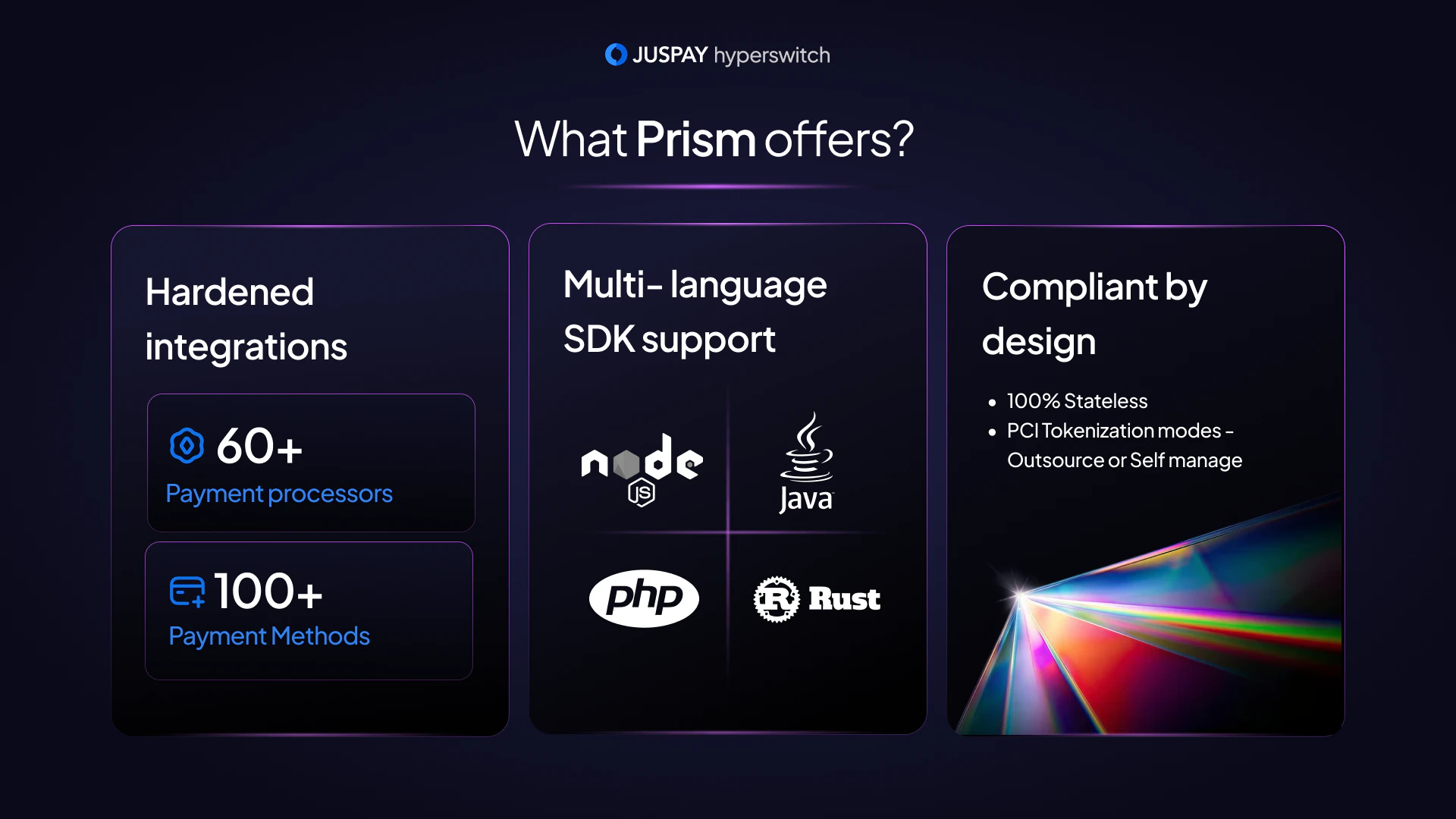
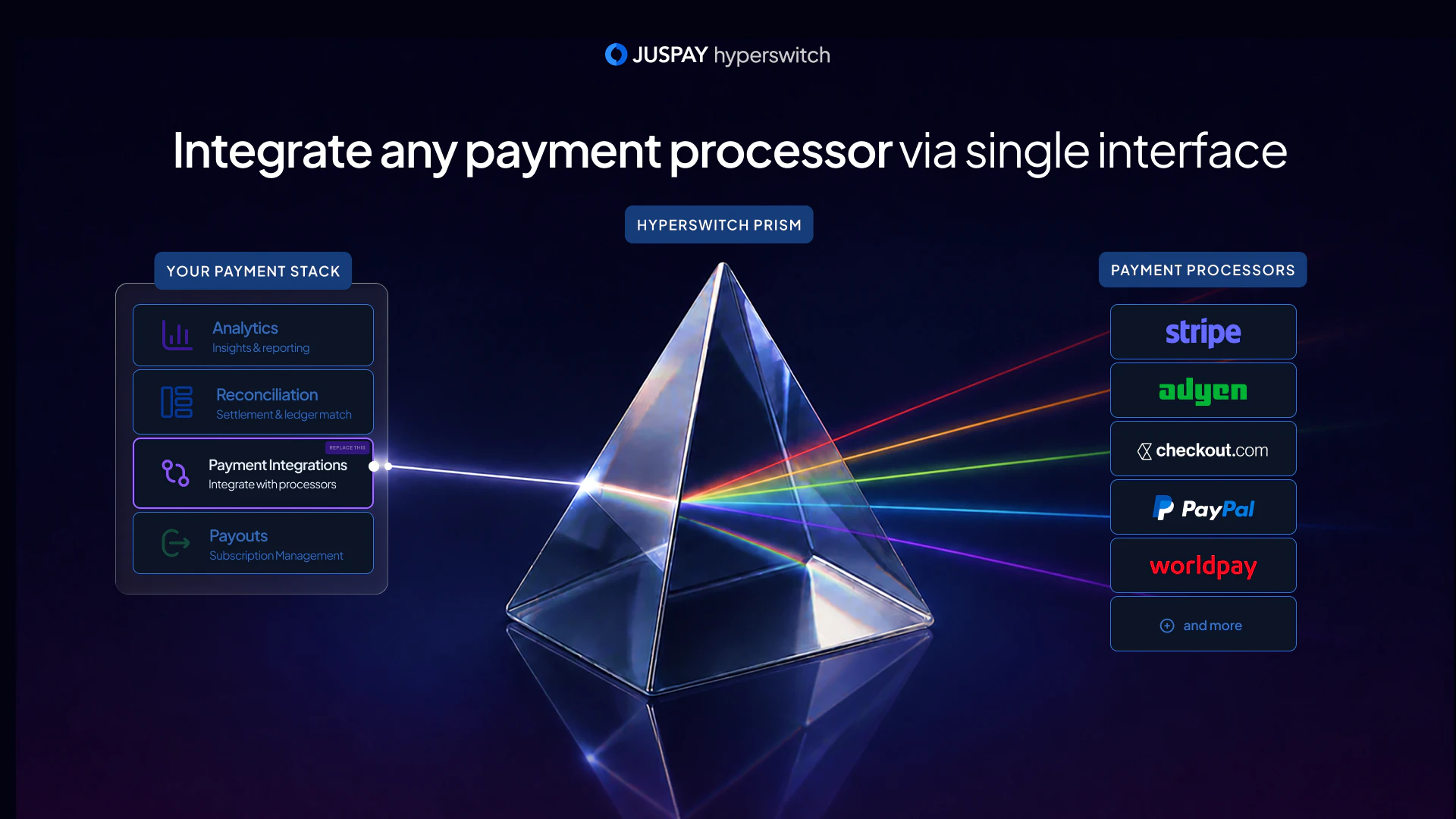
Prism is a stateless payments library that connects your app to multiple payment processors. You can integrate once and point to any payment processor; add fallbacks for redundancy, switch processors based on routing rules - all by swapping a few lines of code. No sign-up needed. No infra setup needed. Actively maintained within the Juspay Hyperswitch production environment. Apache-2.0 licensed, polyglot ready, with SDKs for Node, Python, Java and Rust.

Hello Product Hunters 👋


I’m Jeeva from Juspay, the team behind Hyperswitch, the open-source payments platform with 42K+ GitHub stars.

Today, we’re launching Prism: an open-source library that gives developers one common integration layer across payment processors like Stripe, Adyen, Braintree, Checkout, and others.

Most teams start with a single payment processors. That works well early on. But as the business grows, payments get more complex:

Early growth: new markets need new processors, and customers expect local payment methods.

Scaling up: finance teams want pricing leverage, engineering teams need reliability, and maintaining payment processor integrations becomes ongoing work.

Prism helps teams avoid locking in to a single payment processors from the start.

With Prism, you get:

  • one schema across multiple payment processors

  • a stateless integration layer

  • no database and no stored PII

  • SDKs for Node, Python, Java, and Rust

  • open-source flexibility without infra setup or sales conversations

Our goal is simple: make payment processors integrations easier to build, maintain, and change over time.

When did payments start getting operationally complex for your business?

20
回复

@jeeva_ramachandran This is awesome

4
回复

@jeeva_ramachandran This is great. Global integrations are need of the hour for businesses operating across global corridors.
Does this also helps abstract future integration complexity like enum changes, data drift, or evolving API behavior?

0
回复

@jeeva_ramachandran Congratulations on the launch!
I think a lot of teams underestimate how quickly payments get complicated once you expand markets or start working with multiple processors. It stops being “just Stripe” pretty fast.

Really like the idea of having one common integration layer without getting locked into a single provider.

0
回复

Congrats on the launch! I like the stateless approach - makes sense for teams that don’t want a full payment orchestration platform yet. One thing I’d look for in a business app is good examples around retries, idempotency, and status changes.

Do you have sample flows for failed payment -> retry -> reconciliation?

4
回复

@ihorperkovskyi Thanks! Retries, idempotency, and reconciliation are handled at the application layer. The SDK focuses on providing the processors integration, while teams can implement their own retry logic, idempotency handling, and reconciliation flows based on their specific requirements.

We don’t provide built-in samples for these flows since the implementation usually varies from team to team.Prism is all about unification for payment processors

6
回复

Congratulations on the launch @Juspay Hyperswitch team!
This is exactly what we need. Please add golang sdk as well (our stack is on golang)

4
回复

@nikhil_mishra7 Thanks for the support!

Great to hear Hyperswitch-Prism fits your needs. We’re actively working on adding new SDK's and it’s currently under development. Stay tuned — we’ll be sharing updates soon

7
回复

Since it's polyglot ready, do you provide unified SDKs that maintain consistent error handling across all supported languages, or is the logic primarily at the library level?

4
回复

@rivra_dev The SDKs provide unified error handling across all languages through language-specific wrappers generated from a single source of truth.

6
回复

How do you handle tracking events and reconciliation if Prism itself doesn’t store anything?

4
回复

Hi @othman_katim Prism's goal is to unify events, statuses, errors across payment processors.
The user of prism is expected to store the unified events, statuses and errors on the application.

Payment orchestration platforms are a stateful solutions which can unify as well as store events (which Juspay hyperswitch does). But Payment orchestration platforms may become an overkill for some businesses who just need the diversity layer. Hence Prism was intended to solve that problem.

7
回复

The stateless approach here is pretty interesting. A lot of teams just want the flexibility layer without adopting a whole payment orchestration stack.

Feels like a clean middle ground. Congrats on the launch!

3
回复

@campritchard Thanks for the feedback and support.

0
回复

Let’s go!!

3
回复

The plug-n-switch primitive maps almost perfectly onto how project finance modelers handle module swaps — you don't rewrite the model when the offtake structure shifts from PPA to merchant; you swap the revenue module while the rest of the workbook keeps integrating cleanly. Hyperswitch's redundancy-and-routing layer is the same idea applied at the payments edge. The hard part in both worlds is contract surface: making the swap zero-rewrite means the interface has to anticipate every parameter the new module might want.

This is also the half of project-finance template design that's painfully underrated. I host a small library of these on Eloquens (https://www.eloquens.com/channel/samir-asadov-cfa) and the templates that get reused most aren't the ones with the fanciest formulas — they're the ones where the module boundaries hold up under change. Curious how you decided on what's inside vs. outside the Prism interface contract — did you back-solve from the messiest real-world processor migration?

1
回复

@samir_asadov Absolutely, the contract part is the most important to keep up with underlying diversity.

In the case of Prism's interface boundary - we had the experience of building and running processor abstraction on Juspay hyperswitch payment orchestration platform for many years. It had integrations that evolved over time and we had a clear picture of what stays inside the module boundary.

  • Payment processor domain stays inside the interface(data transformations, error mappings, status mappings).

  • Everything else stays outside the library (business logic to wire API calls, API credentials)

All the data transformations lies, processor endpoint stay inside the library.

1
回复
#4
Jotform Claude App
Build, edit, and analyze forms directly in Claude
174
一句话介绍:Jotform Claude App 让你用自然语言对话在Claude内直接构建、编辑和测试表单,无需切换工具或手动设置,将表单从“填表”变身为“对话”。
Productivity Artificial Intelligence No-Code
AI表单生成 对话式SaaS Claude集成 低代码工具 表单智能化 工作流自动化 用户调研 无代码开发 A/B测试 产品体验优化
用户评论摘要:用户普遍关注对话构建的流畅性与实际工作流的契合度,尤其希望它能处理动态交互、测试边界条件(如多语言验证),并保持长时间编辑中的状态连续性。部分用户质疑其是否只是分销渠道,开发者回应强调是“AI原生工作流需求”。
AI 锐评

Jotform Claude App不是“表单生成器+AI”的缝合怪,其真正价值在于将表单从“触达界面”变成“对话界面”,把传统表单工具中最拖沓的死循环(建→测→改→再测)压缩成一句自然语言指令。但问题也随之暴露:评论中“状态连续性”的追问戳中了致命伤——对话记忆天然会随着长度衰减,而表单逻辑本身是图结构而非线性文本,Claude的上下文窗口一旦溢出,你指望用户重复“请记得那个Phone字段有国家码验证”吗?更隐蔽的风险在于,用户习惯被训练的越“傻瓜”,就越难回头面对Jotform原本复杂的后台逻辑编辑器,这本质上是在用“体验降维”换取“上手速度”。如果Jotform能让Claude在每次对话后反写回平台的结构化表单图,而非仅靠聊天记录兜底,那才算真正实现了“AI原生”对传统SaaS的升维攻击。否则,这只能是一个漂亮的快速原型工具,离成为企业级表单工作流中枢还有一句话的距离。

查看原始信息
Jotform Claude App
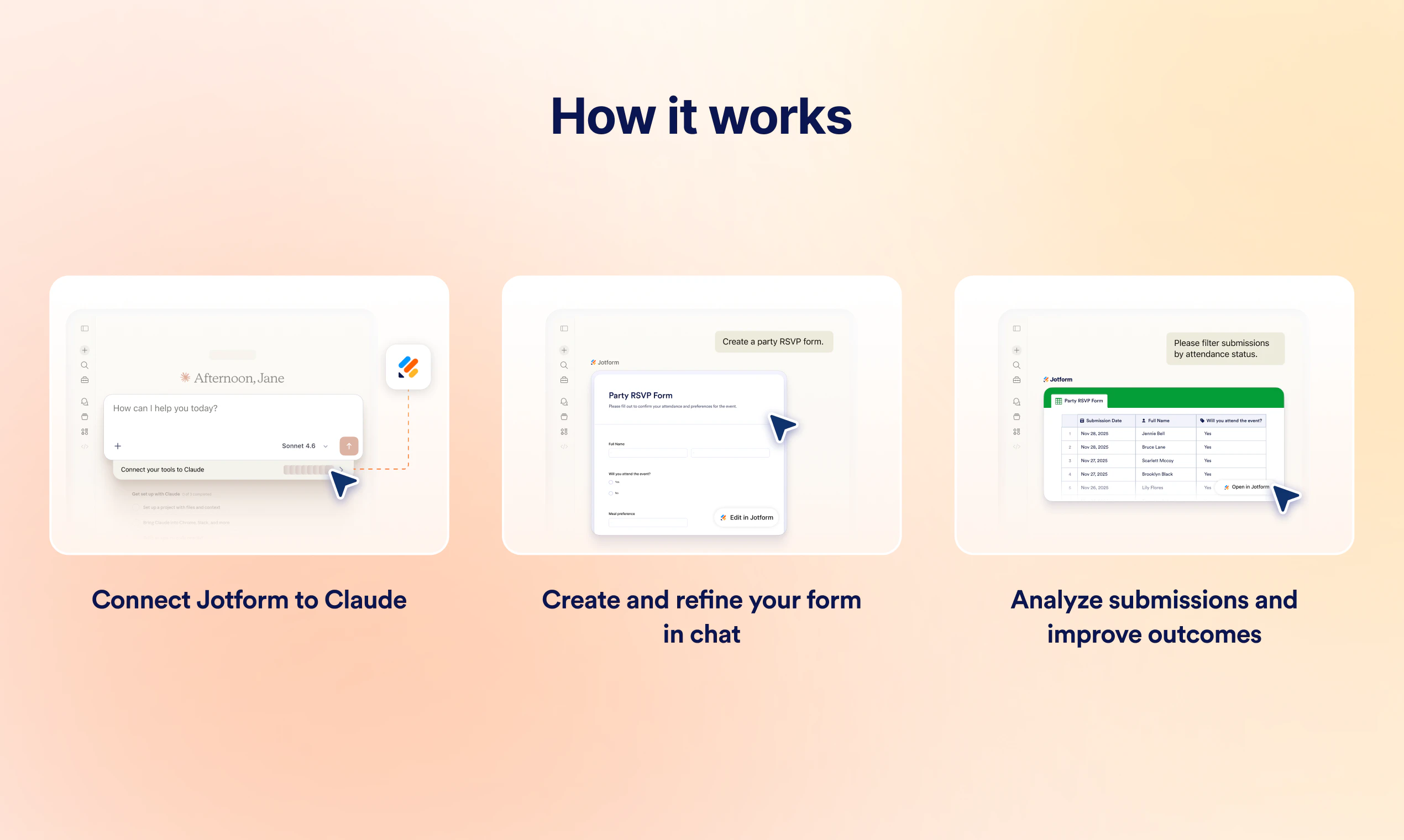
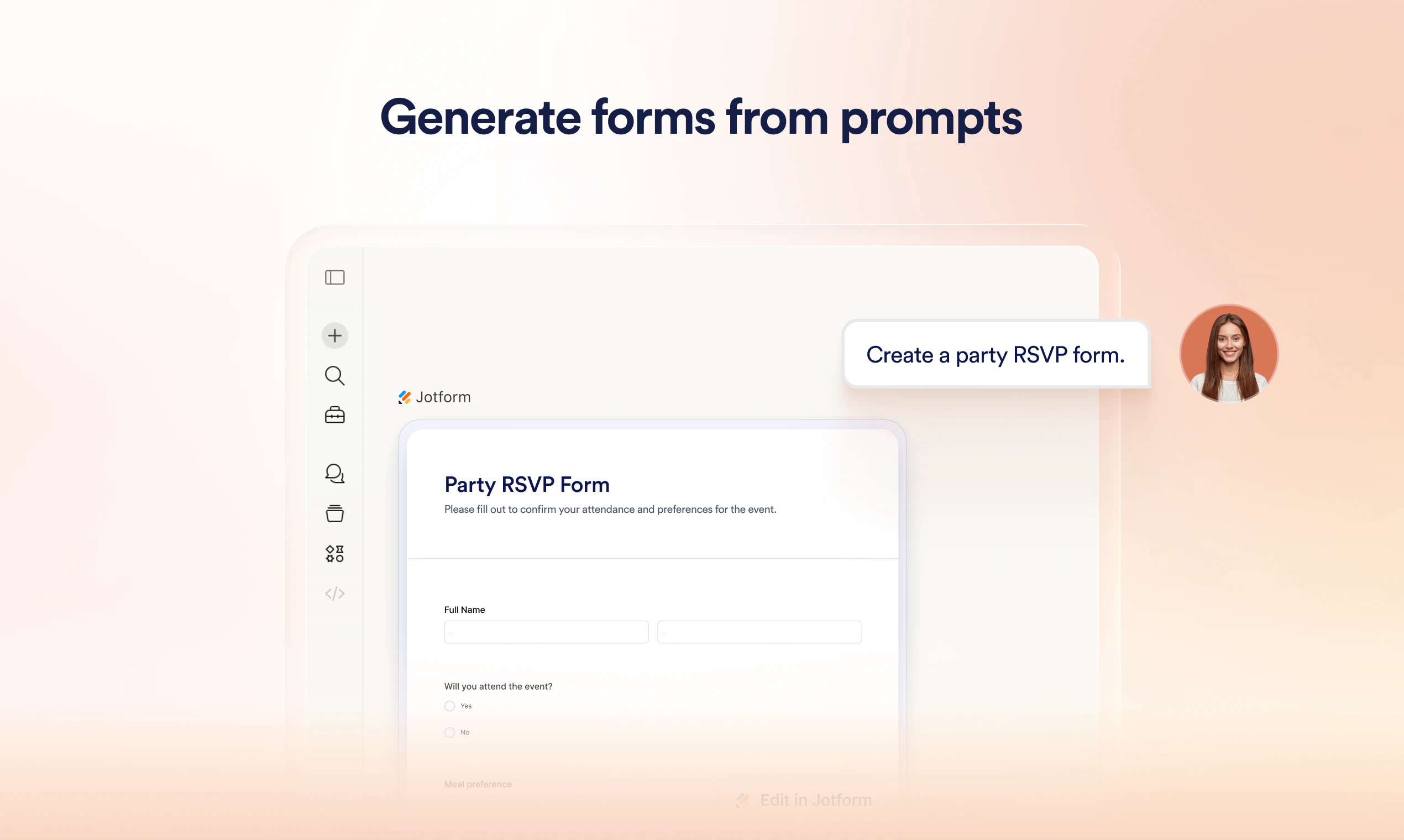
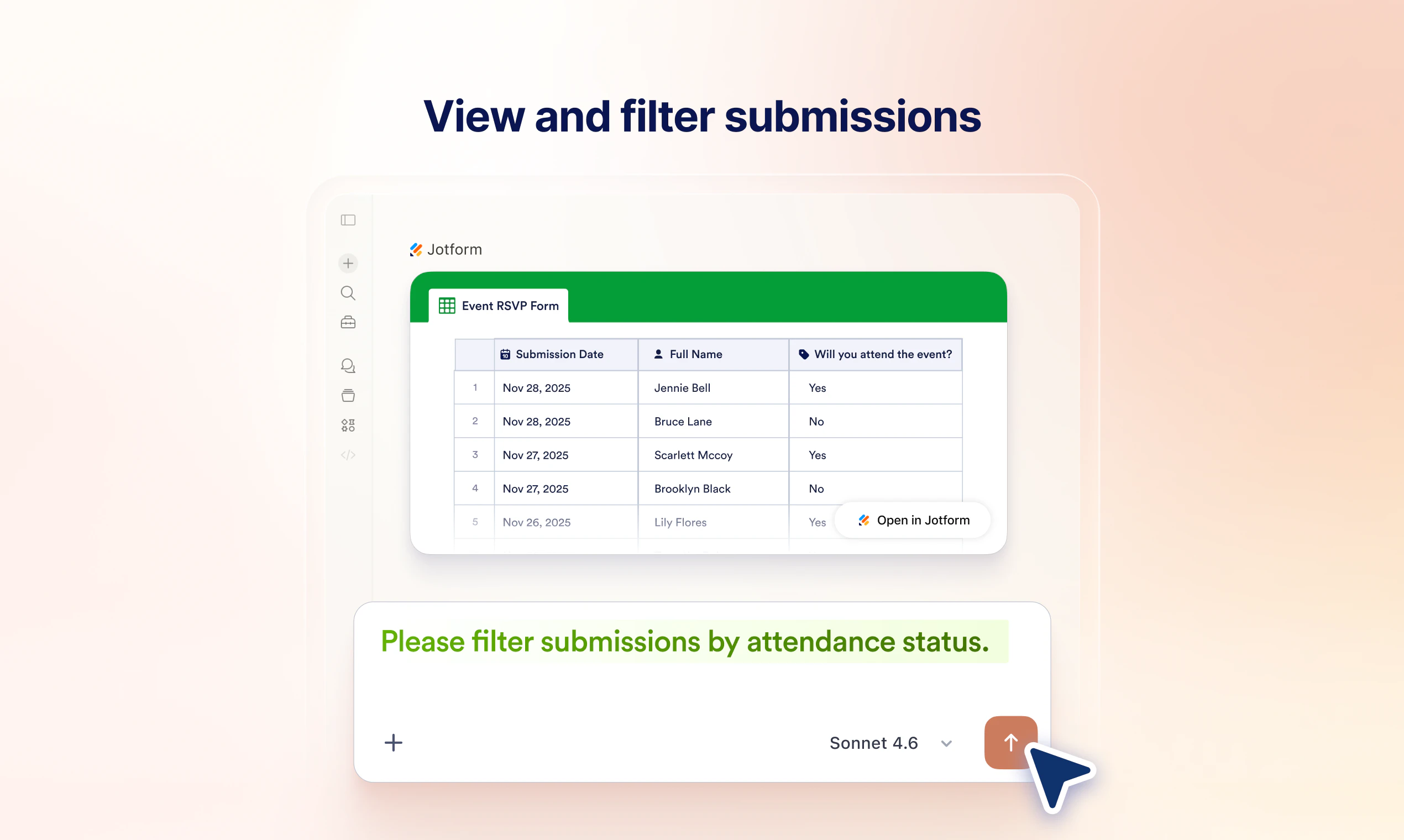
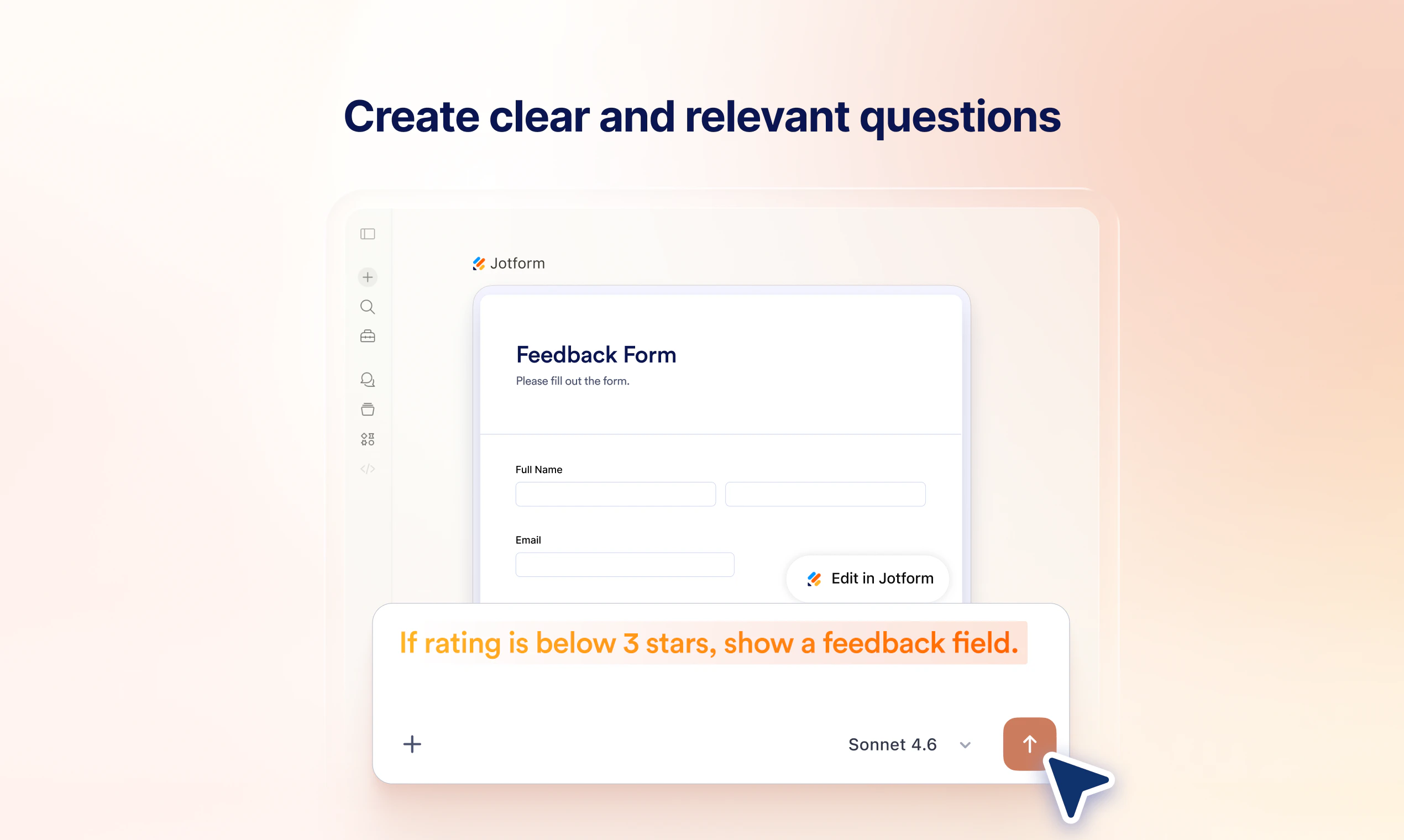
Build, edit, and analyze forms directly inside Claude using simple conversations. Create forms, edit fields, add logic, search submissions, and get insights, all by describing what you want. No manual setup or switching tools.
Hey Product Hunt 👋 I’m happy to announce the Jotform Claude App! We built this to simplify how forms are created and managed. Usually, you have to build forms step by step, then switch to other views or tools to test them and understand the responses. With this, you can do all of that in one place by just describing what you need: create forms, edit them, run test submissions, and look at results. Would be great to hear how you end up using it.
5
回复

The "copy any design" angle is bold how does it handle dynamic or interaction-heavy sites? Curious if it captures animations and hover states or mostly static layout.

2
回复

while the idea is nice, and jotform itself is great, I don't realize how you come up with this need.
Were users asking for working directly in claude or is just a new distribution channel?

1
回复

@alxrda Fair question, it’s not just about Claude as a distribution channel.

We’re seeing a shift where users increasingly want to interact with software conversationally instead of clicking through menus and setup steps. Forms are actually a perfect fit for that, since most people think in terms of outcomes, not configurations.

So the idea was less “users asked for Claude specifically” and more “users want faster, AI-native workflows,” and Claude is a great environment for that experience.

1
回复

Forms-in-a-chat-window is the right shape because the brittle part of form-building was never the fields — it was the loop: build, preview, find an edge case, dig back to the right field, repeat. Collapsing that into a conversation kills the tab-switching latency, and the implicit memory of the conversation context turns "add validation to the phone field" into a one-line ask instead of a five-click navigation.

Where I keep landing on these AI-in-existing-tool products is that the win shows up in the everyday flow, not in the marquee demo. I've been building a small AI-powered weekly meal-planning PWA called DishRoll on the side, and the same pattern holds: the value isn't "generate a 7-day plan" (that's a demo); it's "swap Thursday for something high-protein after my workout shifted" mid-week. Curious how Jotform handles state continuity across a long-running form-build conversation — do you expose the form-graph back to the model after each edit, or rely on the chat history as the source of truth?

0
回复

yesterday i spent 30 mins on a multilingual contact form generating realistic test data. invalid Polish phone formats that pass length checks but fail country-code regex were what kept slipping through (libphonenumber catches it cleanly, but it's overkill for a contact form). with conditional branches test-data setup eats half the session.

0
回复

@webappski Honestly this is exactly the kind of workflow pain we wanted to reduce with the Claude App.

A lot of the time goes into testing edge cases, conditional logic, and realistic submissions rather than building the form itself. Being able to generate, edit, and test conversationally makes those iterations much faster.

0
回复
#5
display.dev
Publish agent-generated HTML behind company auth
154
一句话介绍:display.dev 让开发者通过一条命令,将AI智能体生成的HTML/Markdown产物发布为带有企业身份认证(SSO/OTP)的永久链接,解决了AI产物在团队内分享时“截图或本地运行”的低效痛点。
SaaS Developer Tools Artificial Intelligence
AI产物分发 企业级认证 SSO 智能体协作 可交互分享 开发者工具 HTML发布 无代码部署 DevTools 团队协作
用户评论摘要:用户普遍认可该工具“安全又轻量”,解决了AI产物缺乏稳定URL的痛点。主要建议和疑问包括:是否支持自定义域名和链接自动过期;能否支持SAML等企业级认证;能否传递已登录用户身份实现数据个性化。官方回复称自定义域名即将推出,删除产物可手动实现“过期”。
AI 锐评

display.dev 切中的是一个真实且正在快速膨胀的痛点:AI智能体产出的质量越高,其交付物(HTML/Markdown)的传播与协作就越尴尬。传统SaaS思维下,要么将其视为“静态文件”丢进聊天软件,要么为其搭建一个昂贵的全栈应用来托管。display.dev 的聪明之处在于,它不做复杂的“web应用平台”,只做“AI产物的分发管道”。它将AI的输出视为一种文档类型的“发布物”,并为其捆绑上企业最在意的认证、审计、内联评论和版本迭代能力。

核心价值不在于技术实现(一条命令发布文件不新鲜),而在于“仪式感”——给AI生成的临时性输出一个永久、安全、可回指的URL,这从根本上改变了团队对AI产物的使用心态:从一个一次性聊天响应,变为一个可审阅、可迭代、可追踪的项目资产。评论中用户对“自定义域名”和“身份传递”的追问,恰恰暴露了当前产品的局限性:它依然是一个通用平台,而非深度嵌入企业工作流的“白标”服务。如果无法让用户在企业域名下以自有品牌呈现这些产物,并实现身份感知的个性化渲染,它最终可能沦为一个小众的“快照工具”,而非协作一级入口。

此外,当前依赖读者手动登录评论来驱动迭代,本质上还是“人-人”协作,而没有真正做到“人-Agent”闭环。真正的产品跃迁应在“Agent能根据用户的注释自动修改并重新发布”,而非仅“读取注释”。否则,一旦新鲜期过去,其“内联评论”功能很容易被Slack或飞书的原生反馈替代。总体而言,display.dev 方向正确,但若止步于“优雅的托管”,其护城河不深。真正壁垒在于能否成为AI Agent协作的标准协议层。

查看原始信息
display.dev
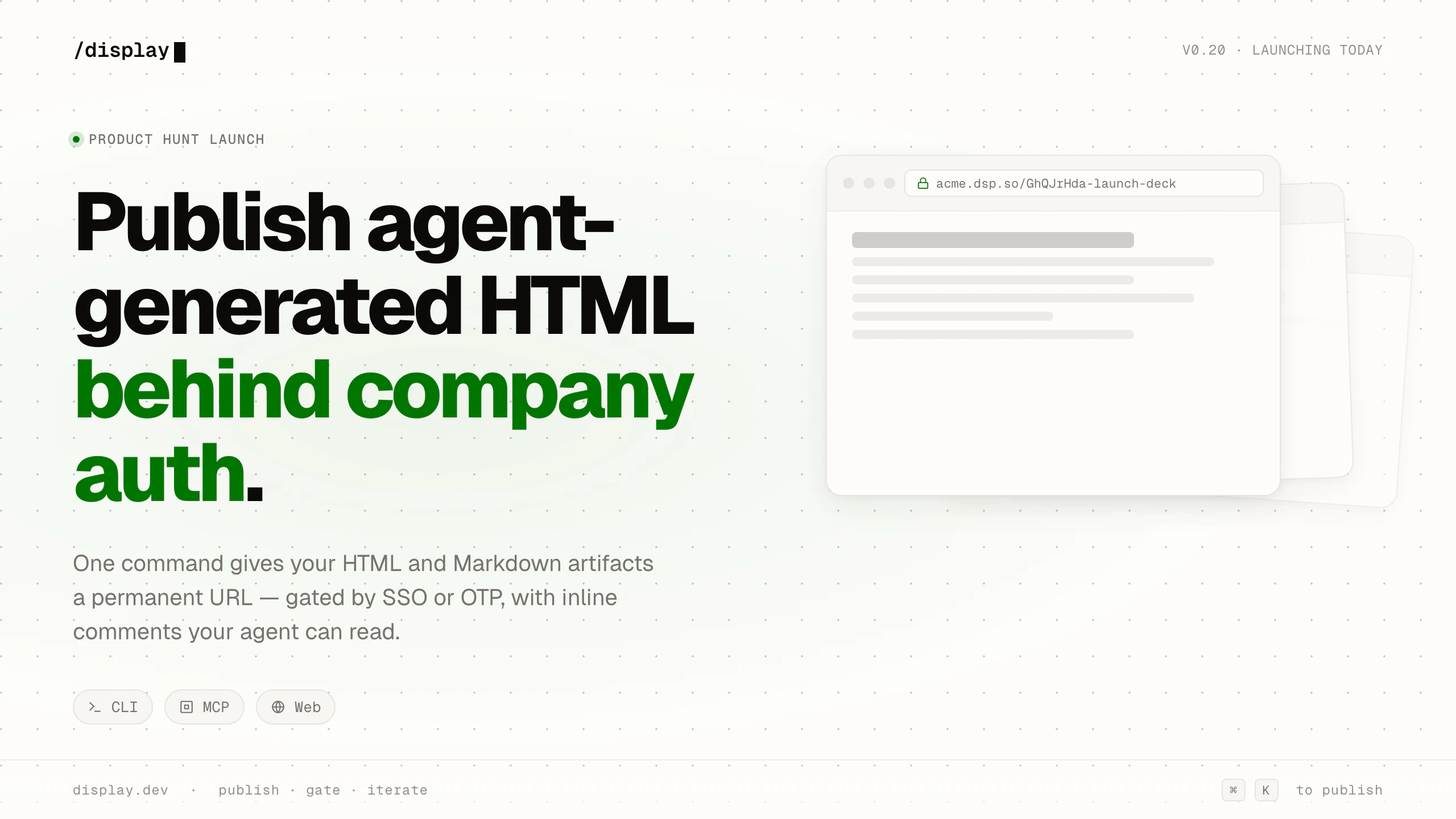
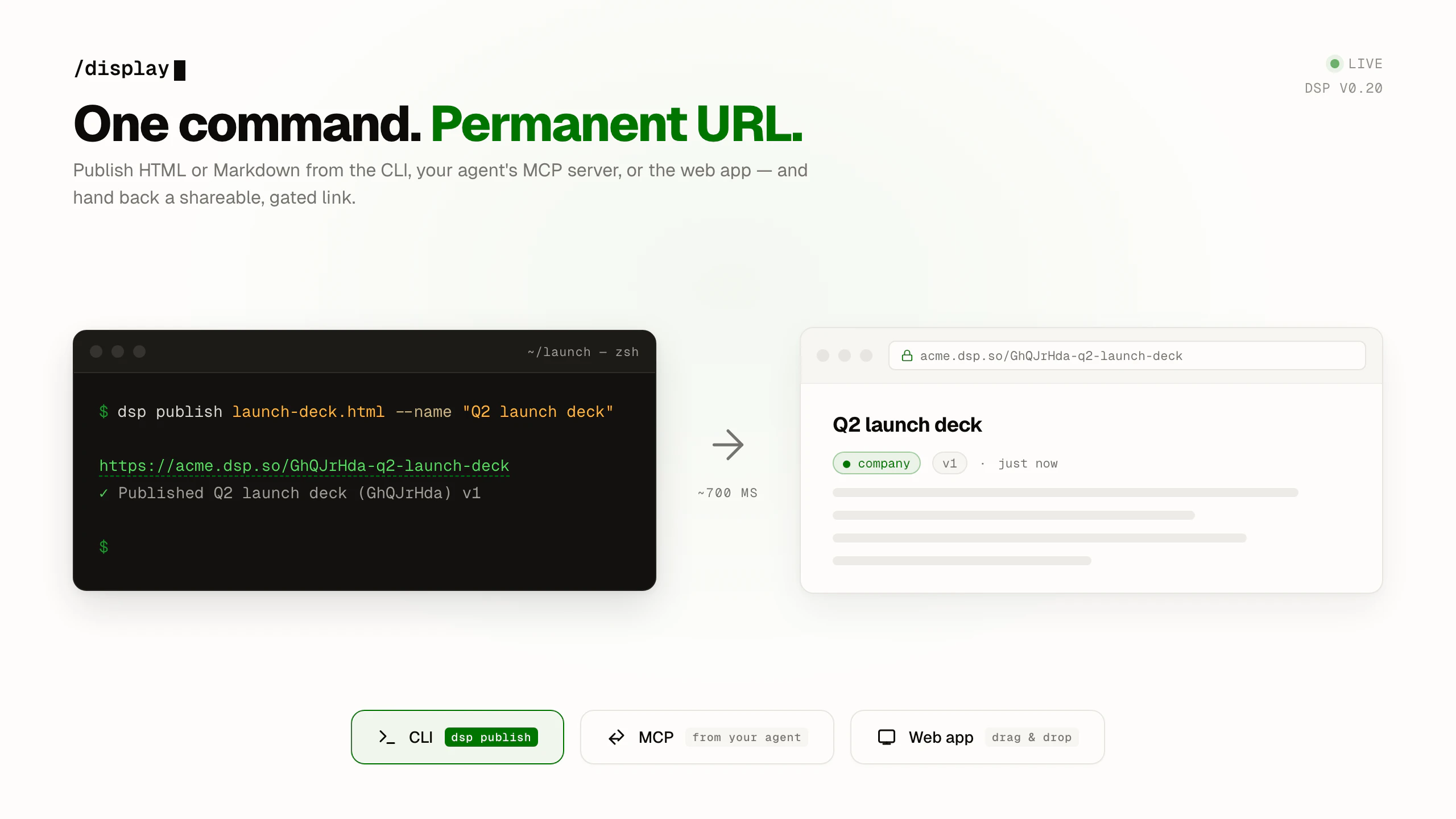
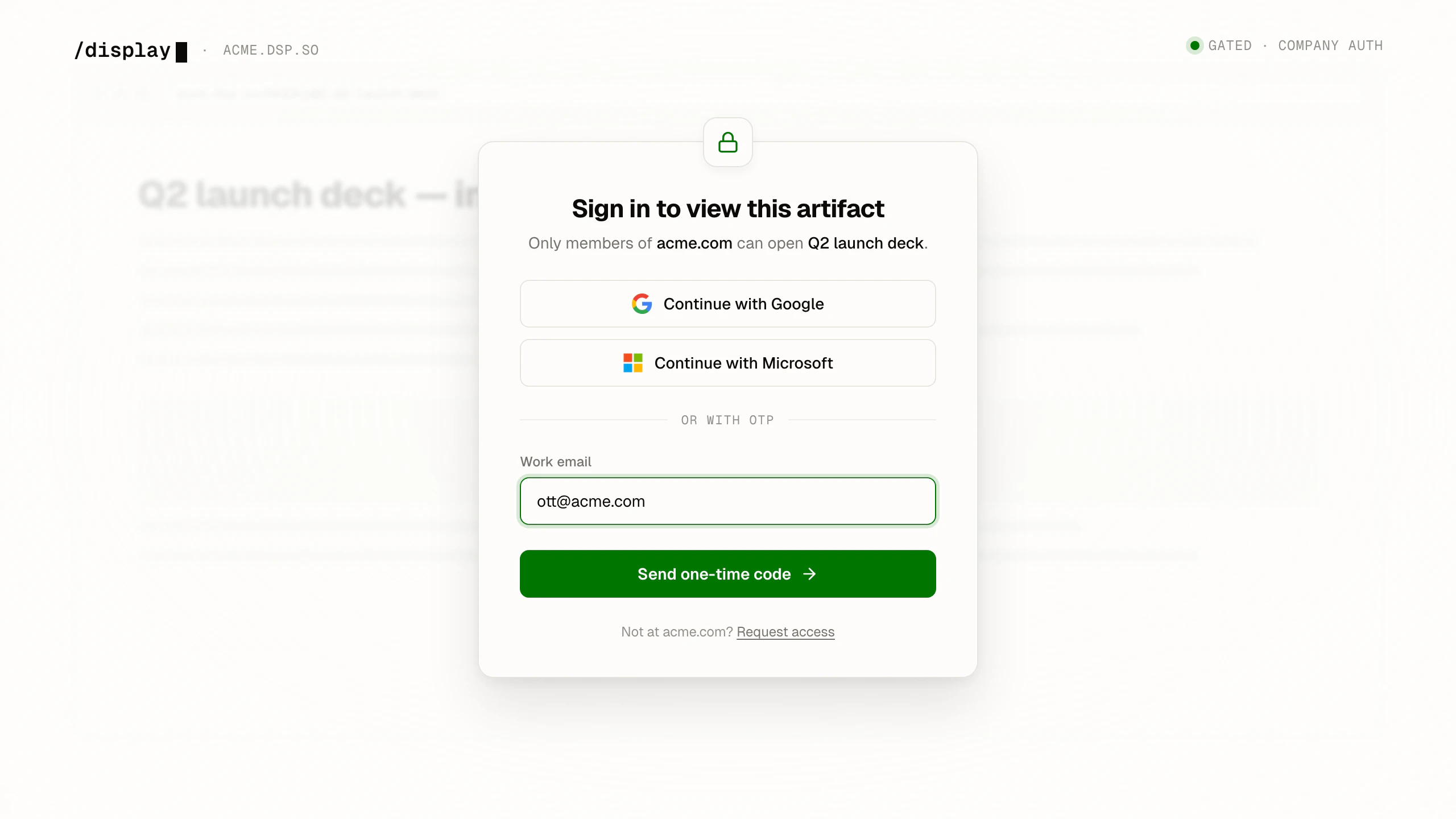
display.dev is the easiest way to publish agent-generated artifacts behind company authentication. One command gives your HTML and Markdown files a permanent URL. Your colleagues sign in securely via OTP or Google/Microsoft SSO, and drive iteration with in-line comments.

Hey everyone!

I'm Ott, co-founder of display.dev.

A month ago @carlrannaberg came to me with a problem. In his constant use of Claude Code, his agents were building him beautiful HTML artifacts – spec sheets, interactive plans, reviews, etc. Sharing them with colleagues, however, was a mess – screenshots or PDFs to Slack, having others open HTMLs and run them on localhost – nothing good really.

The problem clicked immediately. Anyone building with agents long enough hits this wall.

So we built display.dev – one command publishes any HTML or Markdown artifact behind your company's auth. Your team signs in with Google, Microsoft or a one-time password. They see the artifact exactly as the agent built it. No static and inconvenient screenshots, no GitHub accounts, no $320/month Vercel add-ons.

Here’s what makes it actually useful day to day:

> One command, one click or your agent does it for you – CLI, web app or MCP. Publishing happens wherever you already are – your terminal, your browser or inside Claude Code/Cursor/etc. You get back a permanent URL.

> Gated by default, public when you want – Google + Microsoft SSO or OTP. Everyone at your company gets in, nobody outside does. And if you want to share something with the public, simply change the visibility setting.

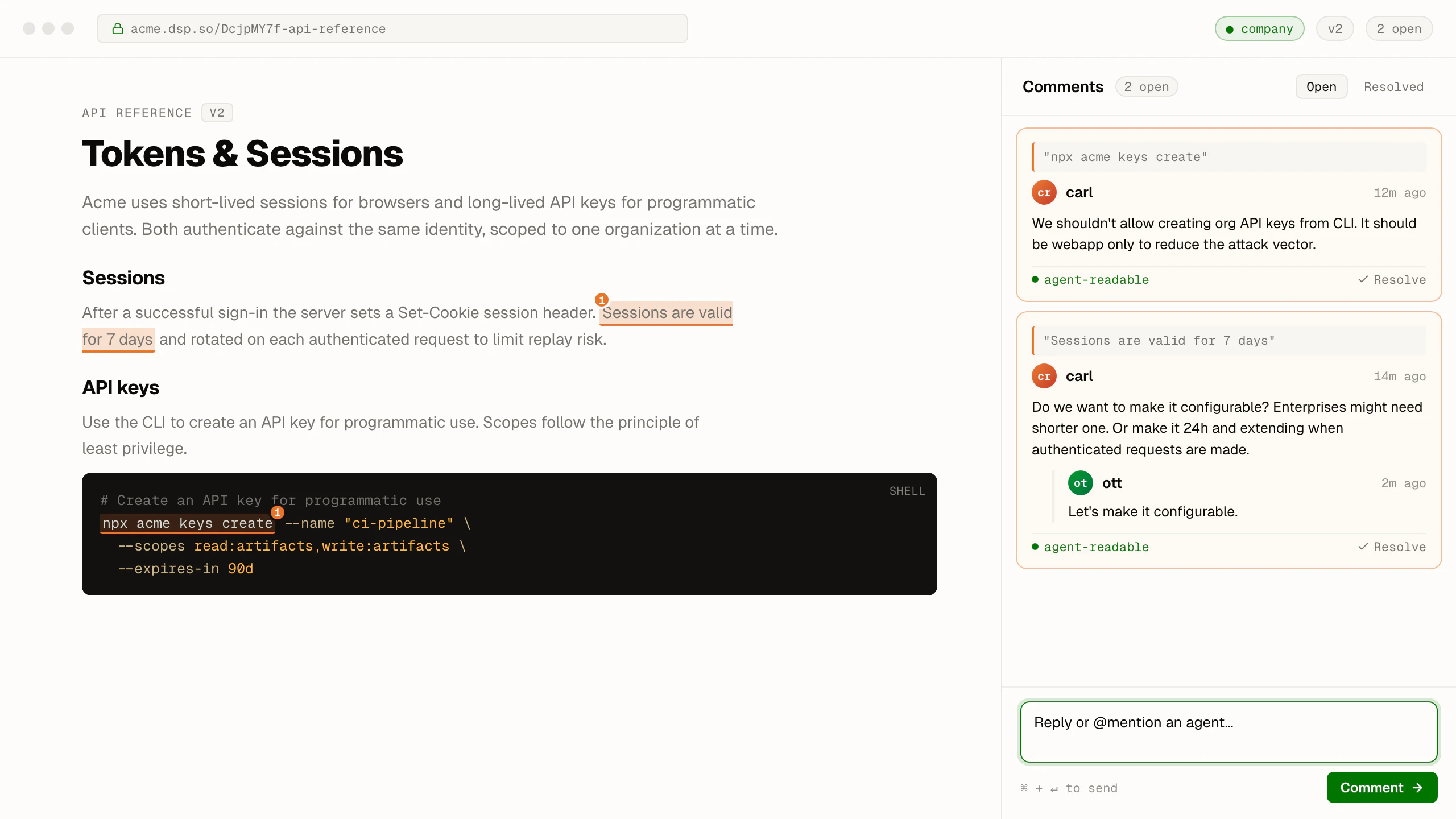
> Comments your agent can read – Teammates drop inline comments. You and your agent can read them, update the artifact and resolve the thread. The thing stays alive instead of dying as a one-shot output.

> Your published artifacts are natively agent-readable – agents can pull the content as markdown from any published link, so there's no manual back-and-forth copy-pasting or importing-exporting.


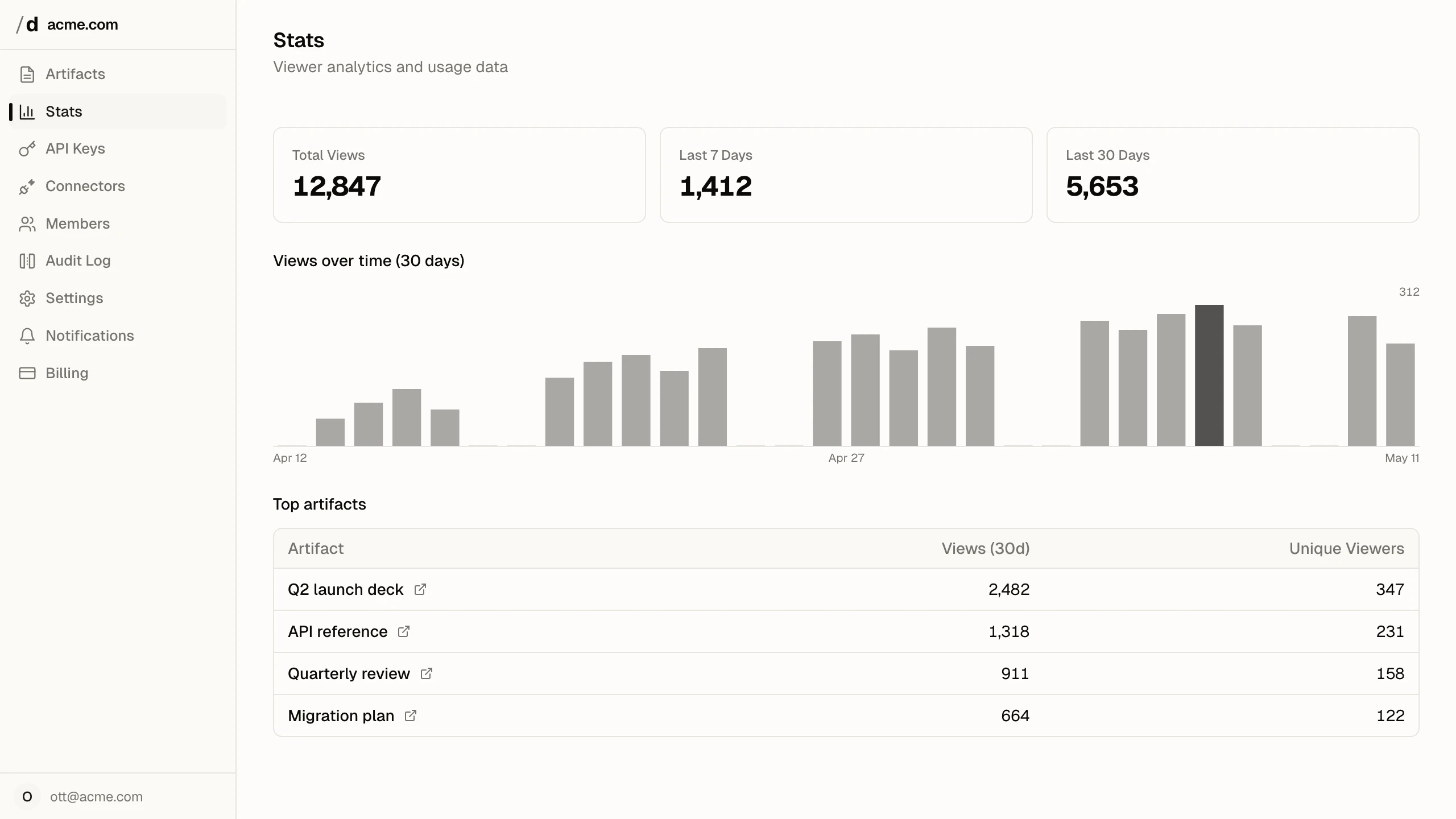
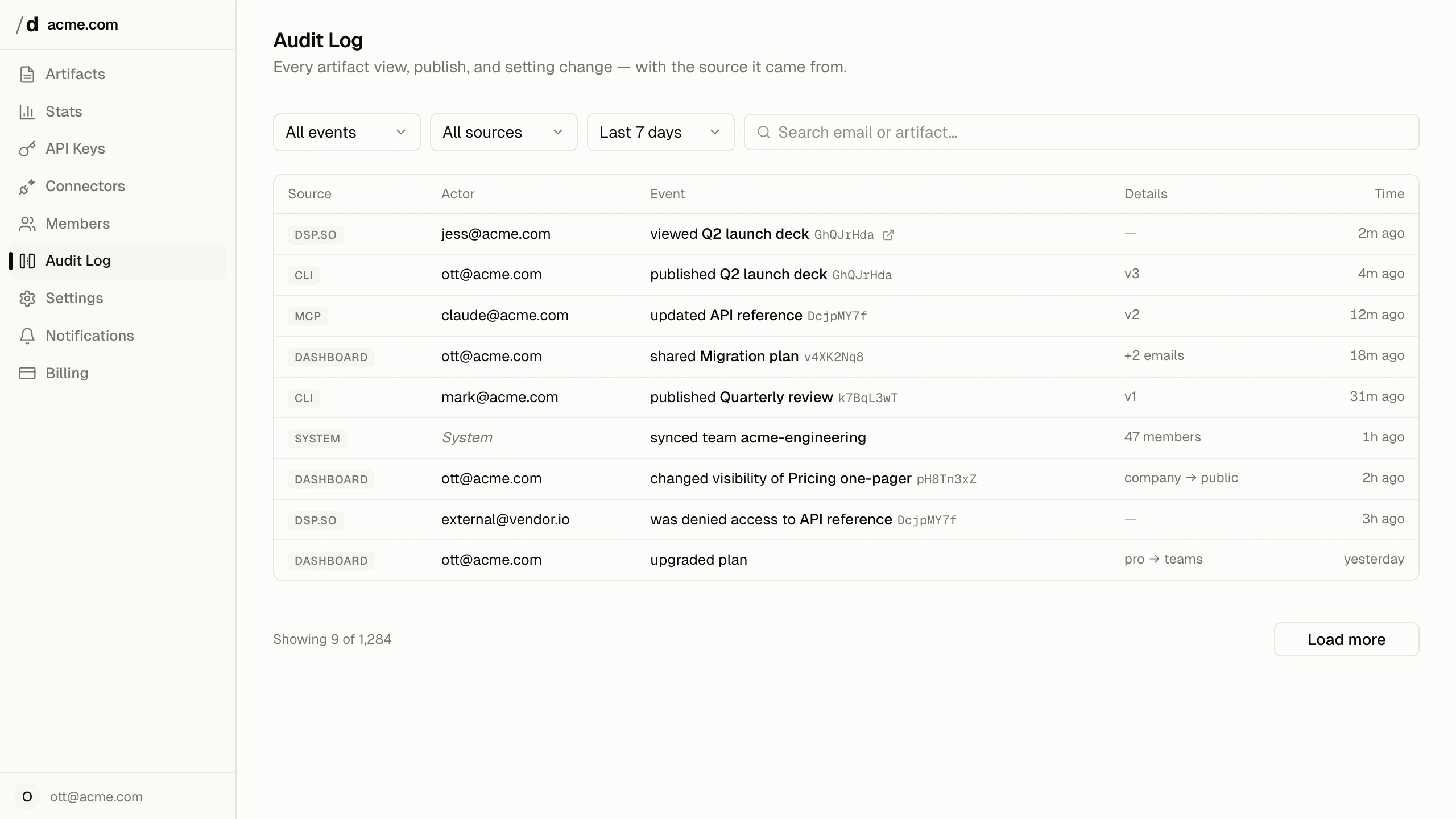
> Stats and audit logs – View counts per artifact, plus audit logs of exactly who accessed what. Useful when you actually need to know if your exec opened the doc.

> Publish without an account – agents can publish unauthenticated using “curl”. The response is a public preview URL anyone can open and a single-use claim URL. Later, you can claim the URL for the organization, if you sign up or in.

> Unlimited viewers, flat price – No per-seat cliff when you share with your PM, exec and legal team on the same day. (Also, a free and a solo tier exist!).

We've been using display.dev daily ourselves – privately sharing analysis docs and ideas that Claude has built, collaborating on things fast. It's made a real difference to how we work.

Happy to answer questions – on the product, the problem and alternative solutions!

5
回复

I like how this is both secure AND lightweight, a rare combination! Cool stuff!

1
回复

@double_u_d thanks, Kirill!

0
回复

This is a perfect utility for the current 'coding agent' era. Being able to instantly host agent-generated artifacts behind SSO is much cleaner than passing around raw HTML files. Does display.dev support custom domains for these permanent URLs, and is there an option to expire links automatically for temporary artifacts?

1
回复

@rivra_dev Thanks, Rivra!

I agree that it's a much cleaner flow – so much easier to share a simple URL and collaborate within the artifact.

On your questions:
> Custom domains – we're introducing them shortly, they're planned to come out in the next few weeks. Keep an eye out on our channels or page.
> Automatic expiry – not at the moment, but currently it's as simple as telling your agent to delete it and it's done.

0
回复

Awesome that someone finally built this!

1
回复

@andruspurde Appreciate the support!

0
回复

I'm curious about how display.dev handles authentication for different enterprise setups. Is it using OAuth, SAML, or something else? Auth integration is often trickier than it first appears, especially with legacy systems in the mix.

0
回复

The screenshot-or-PDF-to-Slack pain point is the right thing to fix — agent-generated artifacts only feel like artifacts when they have a stable URL someone can come back to. The SSO/OTP gate is doing two jobs at once: keep strangers out, and (more subtly) tell the agent which audience it's writing for, which I think is underrated.

I hit a related shape building PolyMind, a small alert tool that watches Polymarket and pings me when a position shifts in a market I care about. The artifact problem there is the same: an alert is only useful if it lives somewhere it can be revisited and annotated by the trader after the fact — a one-shot Slack ping is essentially fire-and-forget. Curious whether display.dev's comment layer is intended to drive iteration on the artifact itself, or whether it's more of an asynchronous review channel for humans to triangulate around what the agent produced.

0
回复

Once the user is logged on, can their identity be passed so that when we fetch the data, we can customize it?

PS: Please add a "Contact us" page :)

0
回复

@jay_janarthanan1 Can you explain in a little more detail what you mean about passing on the identity for customization?

We'll make sure to add a contact us page - a very good point!

0
回复
#6
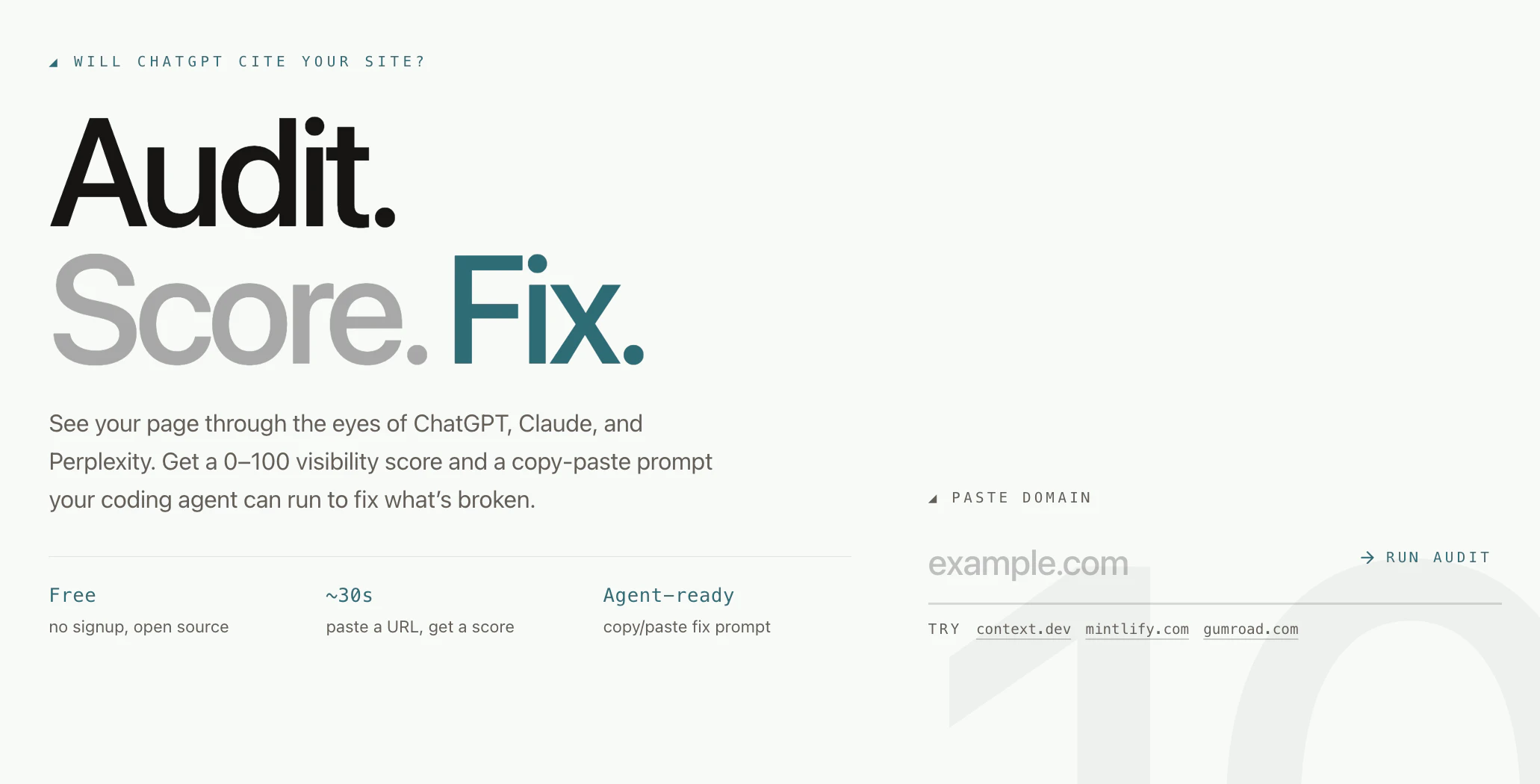
Free AI SEO Auditor
Audit your site for the AI search era. 100% Open Source
141
一句话介绍:免费开源工具,30秒内为你的网页打出AI搜索引擎(如ChatGPT、Claude)的可见性分数,并给出可直接复制的修复指令,解决传统SEO工具不覆盖AI搜索场景的痛点。
SEO Developer Tools Tech
AI搜索SEO GEO优化 开源SEO工具 网站可见性评估 AI引用检测 LLM内容优化 结构化数据 无注册分析 网页审计 Prompt修复
用户评论摘要:用户反馈工具实用,评分与Google收敛性相关,低分网站建议先优化基础SEO。用户询问结构化数据和分析开销,建议增加导出报告功能。开发者回复强调开源和主业务分离,避免商业化路径模糊。
AI 锐评

Free AI SEO Auditor切中了一个真实的焦虑点——当流量入口从Google转向ChatGPT,传统的SEO方法论正在失效。产品本身并不复杂:通过模拟LLM对页面内容的抓取和解析逻辑,给出一个简单粗暴的“AI可见性分数”和可执行的Fix Prompt。这种“打分+直接可操作”的设计极其高效,甚至跳过了传统SEO报告冗长的分析环节,直接与Cursor等AI编码工具联动,形成“审计-修复”闭环。

但从评论区的反馈来看,用户最关心的“结构化数据”和“Schema Markup”权重问题并未得到明确解答。更关键的是,用户提出“谁在付token费用”直指核心商业模式:一旦调用量激增,免费策略将承压。“开源”能拉拢社区,但“免费”域名暗示了商业路径的脆弱性——如果最终要靠收费或变相订阅,用户的正向预期将受损。

产品的真正价值不在于它给出的分数是否精准,而在于它定义了一个“AI SEO”的评价标尺。在这个新赛道里,谁先制定标准,谁就掌控话语权。现在的问题只有一个:在用户发现这个分数可以用更粗糙的方式(如检查正文长度和llms.txt)猜出来之前,能否建立起足够的依赖和网络效应。

查看原始信息
Free AI SEO Auditor
Most SEO tools optimize for Google. This one scores you for the AI search era. Paste a URL — in ~30 seconds, get a 0–100 visibility score showing how ChatGPT, Claude, and Perplexity see your page, plus a copy-paste fix prompt you can hand to Cursor or Claude Code. No signup. Fully open source.
Hey PH 👋 Every founder I talk to is asking the same thing: "is ChatGPT citing us?" Nobody has a clean way to find out. Traditional SEO tools score you on Google. The AI-visibility startups want $500/mo and a sales call before they tell you anything. So we built the free, open-source version. Paste a URL → ~30 seconds later you get: → A 0–100 visibility score for ChatGPT, Claude, and Perplexity → A breakdown of what's actually hurting your AI citations (llms.txt, schema, JS rendering, freshness, structure) → A copy-paste fix prompt — hand it to Cursor or Claude Code, and the fixes ship themselves No signup. No sales call. Code's on GitHub.
6
回复

Hey, nice tool.

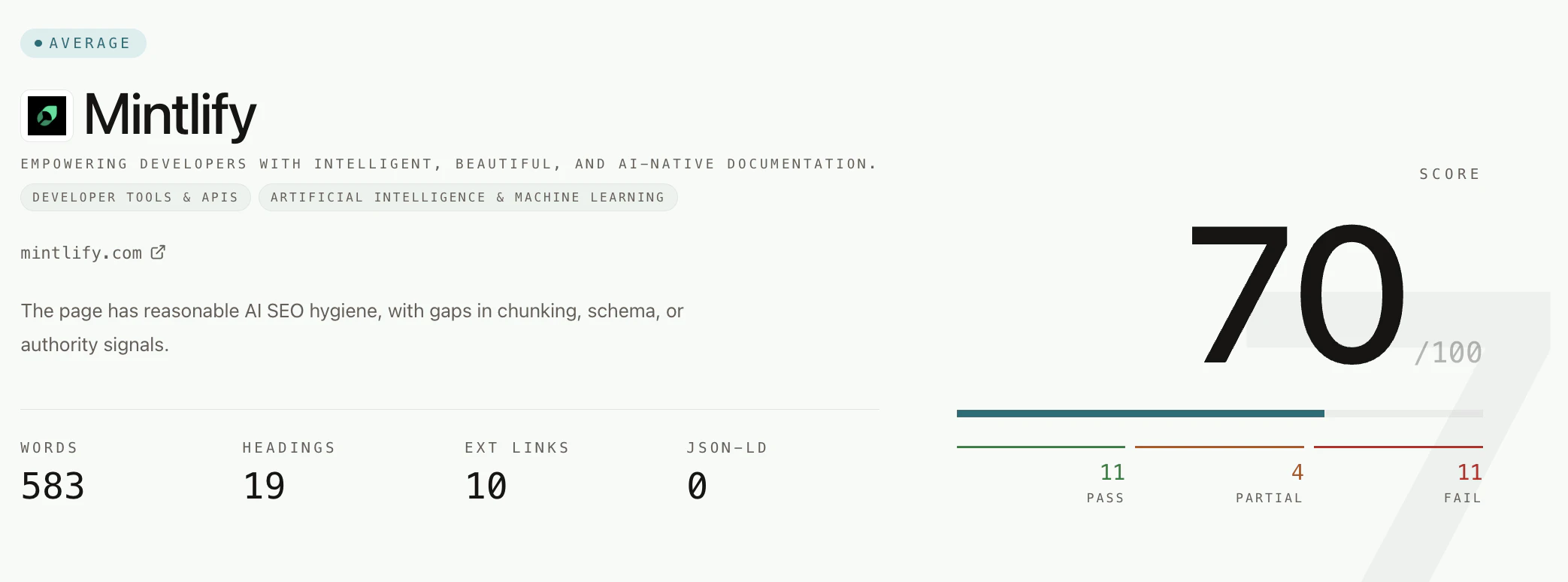
I just tested it on my website maamria.com.

My site is still new, and Google Search Console is currently showing that only a few pages are indexed. I have around 75 pages not indexed, including many marked as "Discovered – currently not indexed"

Your tool gave my site a score of 31/100 and marked it as critical. It also detected things like very low visible content, only one heading, no external links, and no JSON-LD.

So my question is does this result look normal for a new website that Google has not fully indexed yet? And do you think the score from your tool matches what Google Search Console is showing?

Also, from your point of view, what should I fix first to make the site easier for AI search engines like ChatGPT, Claude, and Perplexity to understand?

Thanks, I’m testing the tool and it looks useful.


5
回复

@houssem_maamria Honestly it's just based on latest GEO/AI SEO research, seems that having good SEO is still the main marker of taking off GEO wise so i wouldn't worry about it way too much

0
回复

Really interesting tool. The recommendations actually feel useful and well-reasoned, not the usual "keep your title under 80 characters" type of advice. Picked up some new insights I hadn't considered before.


Special shoutout to the "Copy Fix Prompt" feature, that's a genuinely clever idea. Makes it super easy to take the suggestions straight into your workflow.


Nice work!

3
回复

@nowaffl happy to hear it!

0
回复
Do you support AEO?
2
回复

@lakshminath_dondeti Yeah, it does. ChatGPT/Claude/Perplexity visibility scoring is AEO under different naming — GEO and IEO label the exact same metric. The acronym choice is mostly tribal.

0
回复

@lakshminath_dondeti same thing yes! it's also open source btw

0
回复

Hey Yahia, congratulations on the launch!

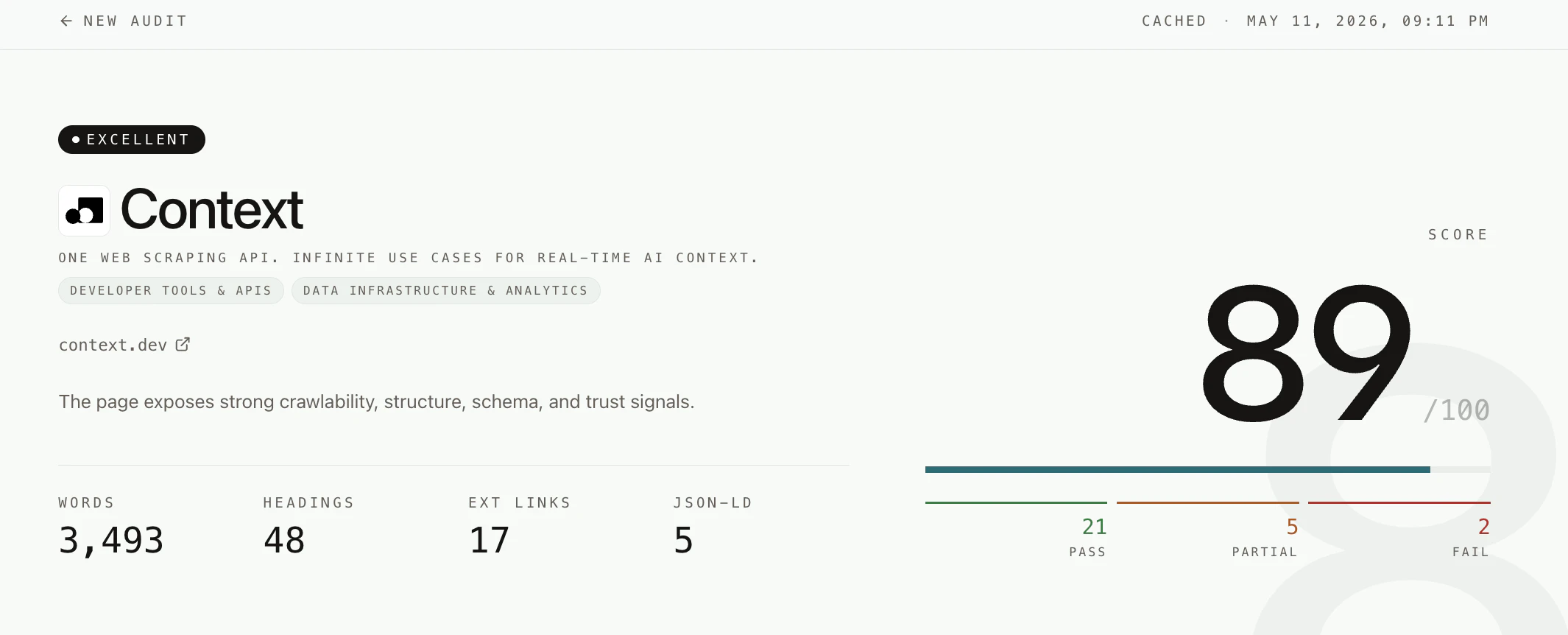
I tried your tool on vaulternal.com and got an 83/100 - which is actually a pretty solid score. The main area that seems to need improvement (according to your tool) is the "Citation Surface Presence" metric, so I'll take a closer look at that. You can see the audit here: https://www.freeaiseoaudit.com/audit/vaulternal.com

Out of curiosity, are you planning to monetize the tool at some point? Having "free" in the domain name might make that a bit tricky down the road.

Good luck with the project!

2
回复

@val__greg it's an open source project built on context.dev

Context.dev is actually my main business!

1
回复

Bookmarking this — I'm literally in the middle of SEO auditing my own launch today. Will run it through. Congrats 🚀

1
回复

@axlerodd Awesome, best of luck!

1
回复

Tested Free AI SEO Auditor on CambrianEdge.ai and got a solid 93/100.

Really liked the concept overall, especially the “copy full prompt” feature. Makes the workflow much smoother when you want to iterate quickly instead of rewriting things manually.

One feature that could make this even more useful would be the ability to export/download the report as an image or PDF. Feels like something teams would want to share internally or attach to audits.

Great work on this, @yahia_bakour3

1
回复

@kabirsalunkhe noted! awesome to hear

0
回复

This is super relevant for us. We have 30+ programmatic landing pages (airport-specific) and we've been optimizing purely for google. Never thought about how AI search engines parse them. going to run our pages through this today. does the scoring weight structured data / schema markup heavily, or is it more about content signals?

0
回复

Hey I just found out you website is pretty good and shows amazing resutls.
I just tested my website getdetach.com and it shows results that I really want for my site. Now I will improve my SEO and will again test it.
Thanks!

0
回复

Hi Yahia, really glad I came across your tool — just gave it a spin on my site falcondrivelabs, which I know could use some SEO polishing. Curious to see the findings and recommended fixes.

One quick general question: when a free tool runs AI-powered analysis, I always wonder — who's footing the bill for the tokens?

0
回复

This is great timing — I've been thinking a lot about how AI search changes the game for niche tools like mine. I built YTubViral (14 AI tools for YouTube creators) and realized halfway through that optimizing for traditional Google SEO wasn't enough anymore. Creators are starting to ask ChatGPT and Claude things like "best tool for YouTube titles" instead of searching Google.

Quick question: does the audit cover structured data and schema markup, or is it more focused on content signals? That's been the hardest part for me to get right.

0
回复

"AI search era" is the right framing most SEO audits are still optimized for traditional search and ignore how LLMs crawl and surface content. Does it check for things like llms.txt and structured data specifically?

0
回复

I just tested my website Clearlist.me and it got 82 out of 100 and got really cool tips on how to even improve more. I do like how easy it is to just copy the recommendations and hand them to my agent.

0
回复
#7
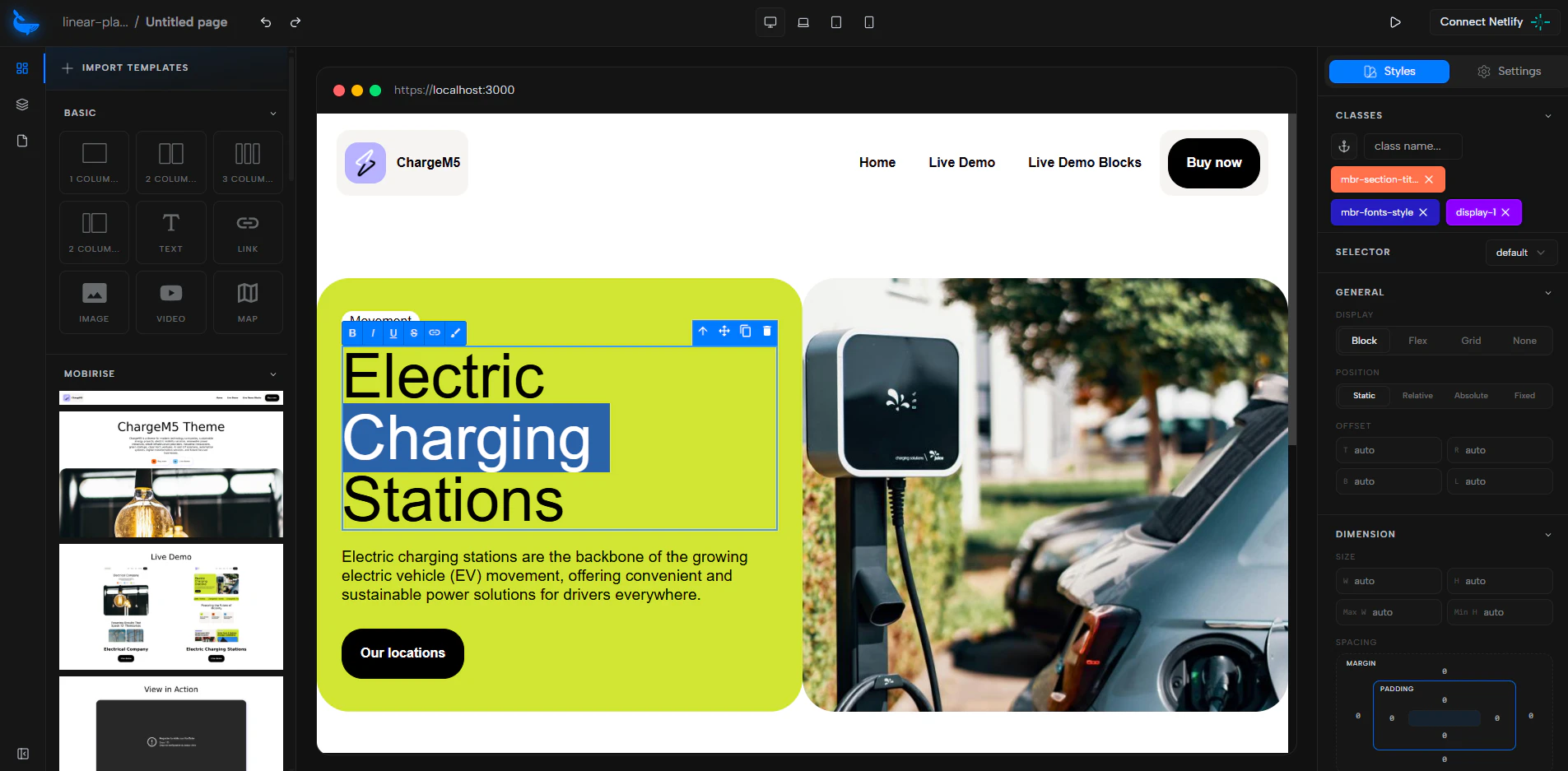
Whale Starts
The website builder that can copy any design on the web
130
一句话介绍:Whale Starts 是一款能够一键克隆任意网站设计的无代码建站工具,帮助用户快速从现有网页中复制布局并可视化编辑,省去从零搭建的时间和精力。
Website Builder Web Design UX Design
无代码建站 网站克隆 可视化编辑器 模板复制 快速建站 设计窃取 网页转换 实时协作 SaaS工具 前端开发
用户评论摘要:用户赞誉其克隆功能,认为能快速测试落地页;但质疑对复杂动画和交互网站的抓取效果。创始人承认复杂动画可能有问题,但多数情况可用。用户建议增加拖拽组件、从Joomla/WordPress或Figma转换的功能,并呼吁改善新手用户引导流程。
AI 锐评

Whale Starts 切入了一个微妙而诱人的需求——把“复制”包装成“效率”。对初创团队和营销人员而言,能秒级克隆竞品或灵感网页,确实能省下大量设计稿来回改的沟通成本。但其风险同样刺眼:产品页上那句“小心版权”的提醒,恰恰暴露了核心功能在法律灰色地带的尴尬。技术实现上,创始人承认对“极度复杂动画”可能处理不佳,说明其爬取能力并非黑魔法,而是对相对标准化的静态或轻交互页面的高效还原——这倒是足够覆盖大多数落地页、公司官网的使用场景。

从用户反馈看,当前产品更像是“半成品式的快捷工具”:缺乏成熟的新手引导,服务器限制导致克隆功能仅对“版主”开放,甚至需要用户主动联系申请。这种限制暴露了其底层基础设施仍处于早期阶段。值得一提的是,团队在评论中回应“若目标网站响应式并有点击交互,Whale会一并复制”,这暗示其解析引擎基于DOM结构与CSS快照还原,而非类似Selenium的高级自动化,因此对JavaScript重度渲染的页面(如SPA、WebGL)几乎无能为力。

真正价值在于:它可能成为非技术人员在“找灵感→快速试错→微调上线”路线上的最短路径,尤其适合那些不需要原创性、只求“像某公司官网一样”的小团队。但要成为专业生产力工具,还需解决合规压力、性能瓶颈与编辑器完善的三角难题。否则,它只会停留在“有点酷但不敢真用”的Playground层面。

查看原始信息
Whale Starts
Whale Starts is a powerful website builder to design, clone, and launch sites with ease. Import any website, edit visually, and collaborate in real-time. just get your template URL from any website and whale will do the same so you can re-use it in fraction of seconds.

no more ai slop, just build you nice website with no code !

ask us anything you wants about whale, we are ready to answer.

4
回复

The “copy any design” part is pretty wild 😂

Can already see this being useful for quickly testing landing page ideas instead of rebuilding everything from scratch.

1
回复

@campritchard exactly, in our startup, one client ask for for editable website, but find a problem with the cms, so we use strapi and set input for each params like text, color, images... but after this tool, we scrape that website and use whale instaid as cms

0
回复

The "copy any design" angle is bold how does it handle dynamic or interaction-heavy sites? Curious if it captures animations and hover states or mostly static layout.

1
回复

@imad_elkhafi it all depond on the website, so if website have extermly complex animation could have some problem, but most of time it works, also if the scraped website is responsive have click action , whale will copy that too !

1
回复

it would be great to have drag and drop feature for a component, right?

also, do you have a converter from joomla/wp templates or to figma?

1
回复

@maksym_shcherbakov1 yes sure we have dop and drag, feature, change direcly from component like any webiste builder, the only spice is the copy of other webistes, but for wordpress, to be honest we didn't test on it but we will put on our workflow !

0
回复

Hey! Good job. It may sound weird, but I didn't get how to use the tool. Any plans to add user onboarding?

0
回复

@lipkovskiy thanks for asking, for now when you try to copy a design , you go to plugin and on search input you put the website you want to copy (be carful about copyright), but becasue of the limitaion of our server, we make it exclusive only for modirators , so if you want to have that feature contact Us, thx.

2
回复
#8
HeyNews
Your newsletter, your voice, ready to publish in 5 minutes
117
一句话介绍:HeyNews是一款AI新闻简报写作助手,通过训练用户历史文章库和监控定制源,在5分钟内生成保留作者个人风格的发布级草稿,解决新闻简报运营者从信息筛选到个性化写作的耗时痛点。
Newsletters Writing Artificial Intelligence
AI写作助手 新闻简报工具 风格模仿 内容自动化 Beehiiv Kit Substack 语音训练 源监控 草稿生成
用户评论摘要:用户最关注“声音训练”的真实性:需要多少篇历史文章才能准确模仿作者语气(实测5篇/格式起)。核心质疑包括:能否处理同一格式内有意变化的语调(如紧急通知或赞助商内容)?以及模型是否会平均化所有风格导致单调?编辑主导权设计获肯定。
AI 锐评

HeyNews的“声音训练”是真正与通用AI工具拉开差距的刀刃。它不再试图通过提示词去“描述”你的风格,而是直接以你的历史文章为训练数据,捕捉那些连你自己都未察觉的基因:句式节奏、签名式用法、甚至格式化的怪癖。这不是“更像人类”的生成式公关话术,而是实打实的技术架构选择——每套格式(如周一深度文vs周五问答)独立训练AI写手,避免了混合格式带来的信号稀释,使得最低仅需5篇就能开始有效工作。

但产品价值的光环下,有两个核心挑战未解。其一,创始人坦诚的“同一格式内故意变调”仍无解——当作者需要紧急通知或感人告别时,AI只会输出统计学上的平均腔调,此时只能靠手动重写而非工具改进。这说明它的上限是“高效生产力的标准间拿捏”,而非“创意跳脱的个性表达”。其二,新闻简报行业的核心竞争并非仅是写作——选题判断、独特观点、对读者情绪的深层感知才是订阅制护城河,HeyNews在源评分和编辑判断上仍高度依赖人,这意味着本质上它依然是“体力劳动的集约化”,而非“智力劳动的替代化”。订阅门槛(月费99美元起)作为针对专业运营者的B2B定价合理,但已排除大量个人试水者。长期来看,能否通过行业垂直化(如金融分析或小众科技领域)深化风格适配精度,将是决定其是从利器蜕变为领域标准,还是沦为又一个高端模板工具的关键。

查看原始信息
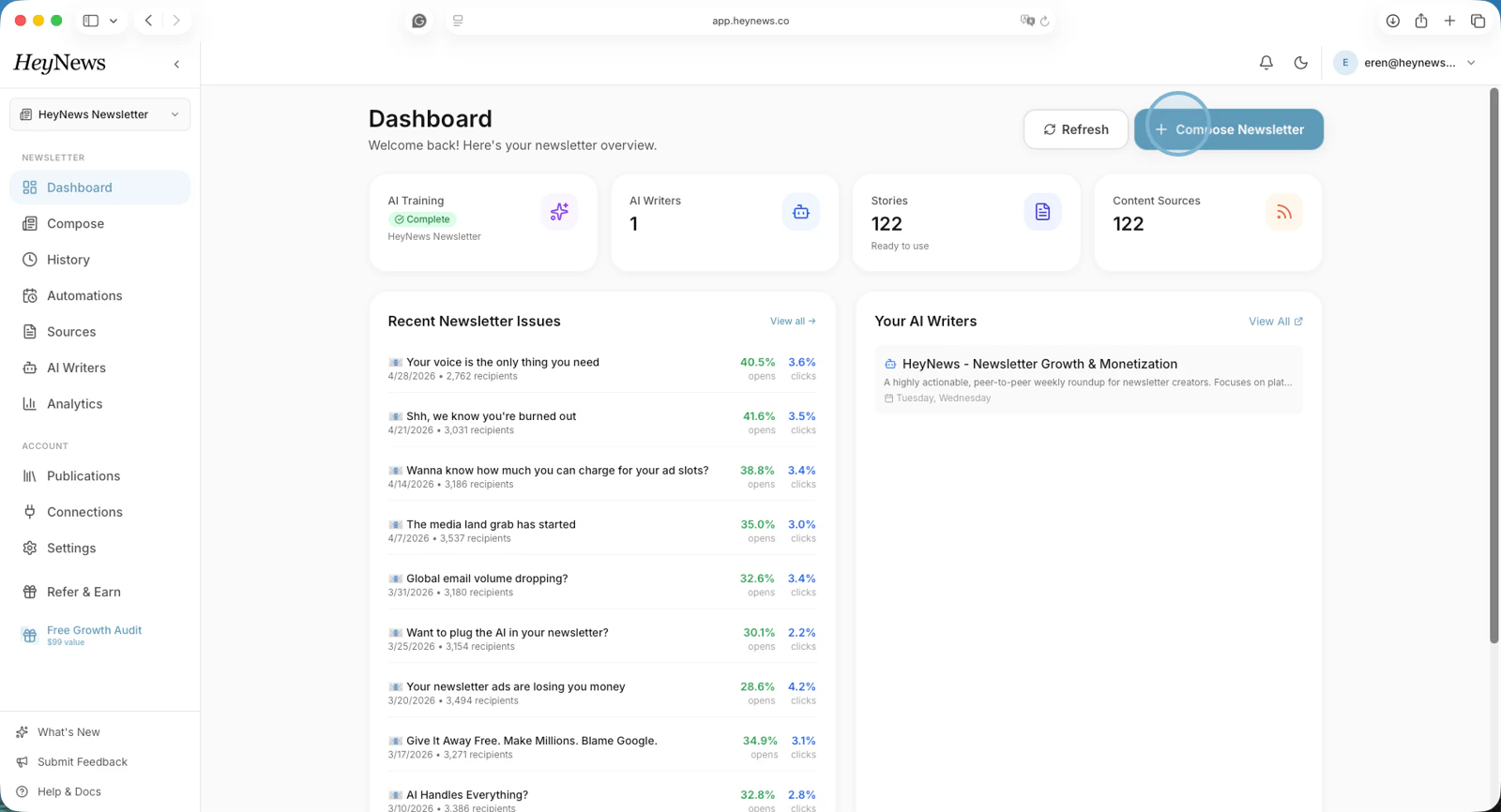
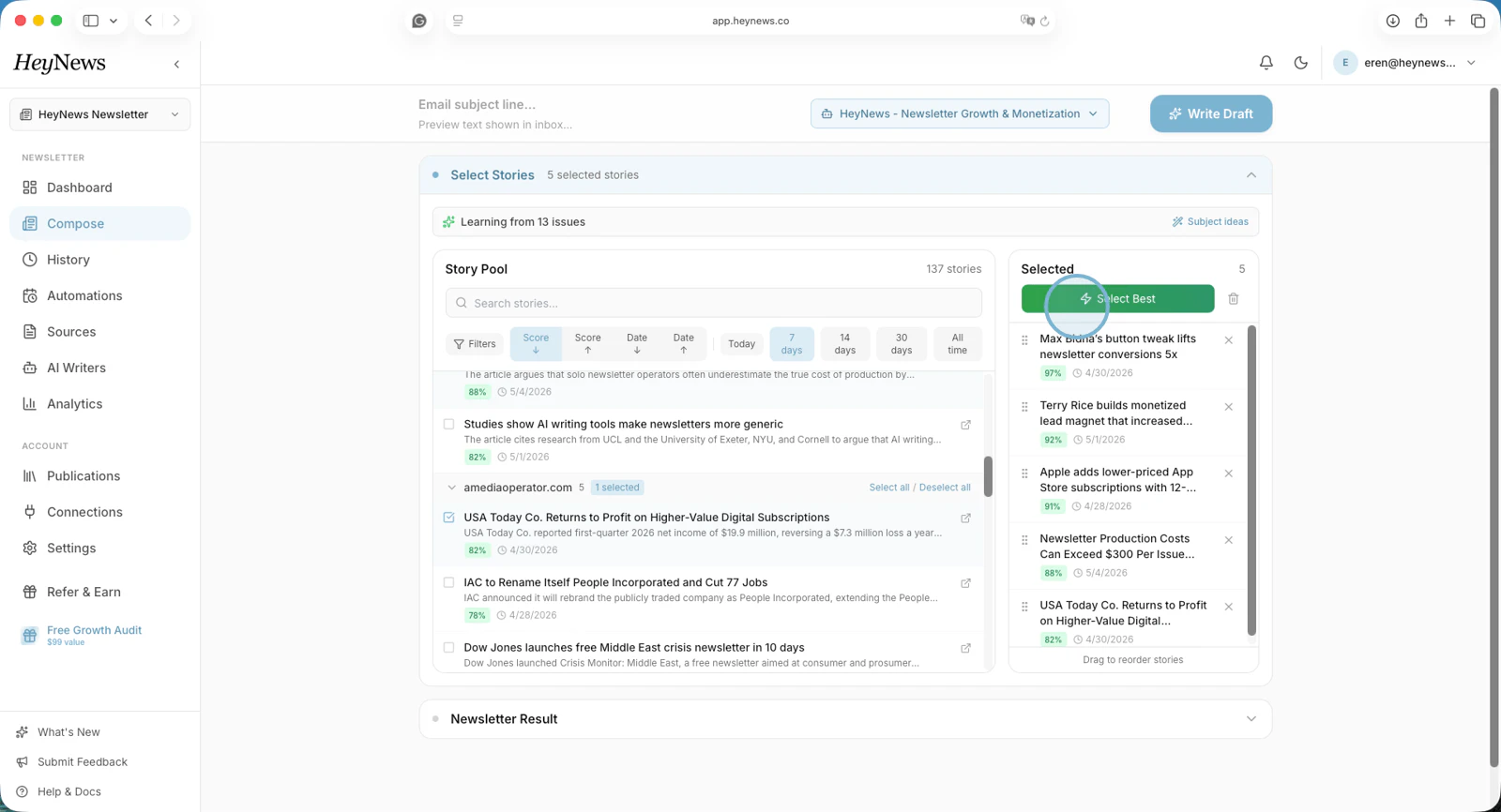
HeyNews
HeyNews learns from your newsletter archive, monitors your sources, and generates publish-ready drafts in your voice. Native Beehiiv & Kit; archive imports from Substack or any newsletter with a public archive. 14-day trial, plans from $99/mo. PH50 → 50% off 12 months.
Hey hunters! 👋 Cagri here, co-founder of HeyNews. We started HeyNews because we watched newsletter operators (including a few friends running 5-figure-MRR Beehiiv and Kit publications) lose 6 to 10 hours every week to the same loop: scan a hundred sources, pick the stories worth covering, draft something that sounds like them, ship it, repeat. Generic AI tools couldn't do step 3. The drafts always sounded like AI. So we built HeyNews to handle the production layer. The part we're proudest of is the voice training. You connect your newsletter (Beehiiv via API, Kit via OAuth, or any platform with a public archive: Substack, Ghost, Mailchimp, Medium), HeyNews reads your past issues, and the drafts come out sounding like you wrote them. Not "AI trying to sound human." More like "your style, on a Tuesday morning when you have time to write." What's in v1: - 🎙 AI Writers: They train on your past issues for tone, vocabulary, sentence patterns, and signature phrases. Different edition styles get different Writers, and each Writer improves with every send (we pull open and click data from your platform). - 📡 Source curation: RSS, blogs, social profiles (X, LinkedIn, Instagram, TikTok), Reddit, and saved articles via a Chrome extension. Every story gets a relevance score against your audience. - ✏️ Compose: Smart Select picks the best stories per section. One-click style updates and revisions by chatting. Subject line and preview text suggestions. - ⚙️ Automations: Schedule drafts on your cadence. Review-before-send only. We never auto-publish. You keep editorial judgment. - 📊 Analytics: Open rate, CTR, best-send-time heatmap, per-issue breakdown. Plans start at $99/mo (Starter), with a 14-day trial OR 5 generated issues, whichever comes first. We ask for a card up front so the trial converts cleanly. Cancel any time before day 14 in two clicks, no charge. Special for Product Hunt today: code PH50 gets you 50% off for 12 months on any plan, monthly or yearly, including add-ons. So Starter ends up at $49.50/mo for a year. Code is good through June 30. We used HeyNews ourselves for over a year before launching it publicly. 550+ issues across 10+ formats. This isn't a beta. It's how we've been publishing all along. We'll be in the thread today, helping answer questions too. We would love to hear from anyone running a newsletter. What's broken in your current workflow? Honest critiques are especially welcome. We'll be here all day.
12
回复

@cagrisarigoz Congratulations!

0
回复

Thrilled to see HeyNews live! To answer Cagri's question from a content marketing perspective: the most 'broken' part of current workflows is usually the friction between research and writing. You often lose your 'voice' while juggling 20 different tabs.

I’m particularly excited about how the platform avoids AI 'hallucinations' by sticking to trusted RSS and social feeds. It’s great to see a tool that keeps the editor in full control!

2
回复

@cagrisarigoz Voice training actually solving the "sounds like AI" problem is the most interesting part here. Every other tool gets the curation right but fumbles the draft. Curious how it handles niche technical newsletters where the tone is very specific — does it pick up on jargon and formatting quirks too?

3
回复

This is a good one. Voice training angle is what separates this from the generic tools. Training on actual past issues allows to pick up jargon, quirks and sentence patterns. Looks like the right approach! To stress-test - how it handles newsletters that deliberately vary their tone issue-to-issue? Does the model average out your style?

4
回复

@artstavenka1 Real edge case. The per-format AI Writer setup handles part of it: if the variation is structural (Monday deep-dive vs Friday Q&A), each format gets its own Writer trained only on matching issues, and they stay separate. No averaging across them.

Where it actually struggles is intentional variation within the same format. Same newsletter, same template, but the operator deliberately shifts the tone of the issue. In that case, the AI Writer does converge on the central tendency. The workaround that works in practice is splitting systematic variation into separate formats so each gets its own AI Writer, but for mood-driven variation that isn't easily labeled, it stays a real limitation.

One related point worth flagging: what gets averaged is tone, not topic. Source scoring is a separate system, so the mix of sources brought into any specific draft still shifts the result.

That partly compensates for the averaging on the voice side, but it's a manual lever rather than something the model resolves on its own.

4
回复

The "in my voice" v. "more human" piece of the prompt is so key. Especially as we see more and more second and third human AI layers like Sinceerly and others start to pop up. Now it just needs the originality that the author brings to the table to be fully autonomous

2
回复

@joe_setpoint indeed! This was our starting point as well. The exact question was: Should we create more "artificial" stuff when we can create unique content in the relevant author's tone&style? The answer was a resounding no, and here we are. 😌

0
回复

The "learns from your archive" part is clever. I've seen so many newsletter tools that generate generic content — having it adapt to your voice is what makes it usable long-term.

I'm curious about the learning curve. How many past issues does it need before the suggestions start feeling like "you"? I run a bilingual blog (Spanish/English) for a YouTube creator tools platform and voice consistency across languages has been my biggest challenge.

2
回复

@ytubviral Thanks! As my co-founder @cagrisarigoz mentioned in one of his previous replies, 5 issues per format is the minimum amount we need to make it sound like you. But more is definitely better, so we use as many issues as possible.

You have an interesting challenge on your hands. I think we can manage to ensure voice consistency across languages, but the problem is that nobody on our team speaks Spanish, so it would be really challenging for us to test cross-language voice fidelity in this case.

1
回复

Curious about the voice training minimum. how many past issues does the model need before the output actually sounds like you and not generic AI? most tools I've tested fall apart under ~20 examples

2
回复

@romain_delgado Our trials have shown that our voice matching works even with 3 past issues, but to create a sustainable and balanced outcome, we recommend to use more than 5 issues minimum.

1
回复

@romain_delgado great question. ~5 issues from a single format is the practical floor for us.

That's lower than the 20-example wall you've hit on other tools because of the architecture: we train a separate AI Writer per format rather than one Writer per publication, so each AI Writer only has to learn one cadence (Monday deep-dive vs Friday roundup, say) instead of disambiguating multiple cadences from one shared pool.

The reason most tools fall apart under 20 is usually that they're trying to learn the operator's voice across mixed-format examples. Five issues of "Monday deep-dive" together are more useful for that format than fifty issues of "everything you've ever shipped." The signal isn't diluted by formats with different rhythms.

More is better. There's a noticeable gain going from 5 to 10. But the marginal return flattens fast. Operators we've onboarded with 20-30 issues per format don't get a clearly better AI Writer than those onboarded with 6-8. What helps more after the floor is variety within the format (a mix of strong and average issues, not just the greatest hits), so the Writer sees what "normal for you" looks like, not just "best of you."

The Catch: it's per format, not total. An operator with 100 issues across 5 wildly different formats is in worse shape on day one than an operator with 25 issues across a single format.

1
回复

Concentrating a full day labor into about 5 minutes while keeping the operator's voice intact for that price is something! Reach out to mete '' at '' heybe . ai for partnership opportunities with a great product like HeyNews!

2
回复

The "in your voice" part is what makes this interesting to me. I've tried AI draft tools before and the problem is always that they smooth out the rough edges that made my writing feel like me. Curious how HeyNews handles that does it pick up on style over time or is it more template-based? The Substack import is also a smart touch for people with an existing archive. Congrats on the launch.

1
回复

@sagar_kalra1, the "smoothing out rough edges" failure mode is the exact one we tried to design against. Most tools end up there because they generate against a style description ("write like Sagar's newsletter, which is conversational and witty") rather than against your actual writing. A description of your voice is a flattened version of it by definition.

What HeyNews does instead: the AI Writer trains on your past issues directly. The rough edges come through as data: signature phrases, sentence patterns that aren't textbook-correct, the way you open sections, formatting quirks. Not as instructions, as patterns. That's what survives generation.

On the "over time" question: it's trained, not templated. The trained profile is refined after each send (performance data from your platform shifts weights on the scoring side, thereby choosing which stories surface). The voice side is more stable. Once it knows your voice, it knows it and rebuilds only if you retrain it on new issues.

Honest caveat: some voice tics still get smoothed, especially subtle rhythm choices that the model reads as noise until enough examples show otherwise. The operator review step is where those get re-added. A practical signal that voice training is working: a few issues in, you should be editing for content, not for "this doesn't sound like me." If you're still doing the second kind of edit, something's off.

0
回复

Congrats on the launch — the “review-before-send only” choice feels important. For newsletters, the hardest part isn’t just generating words in a familiar style; it’s preserving editorial judgment when a story should *not* sound like the last 20 issues.

Curious how you handle deliberate voice shifts: e.g. a more urgent issue, a more personal note, or a sponsor-heavy edition where the usual cadence needs to bend without becoming generic?

1
回复

@jim_jeffers Jim, you've named the actual editorial judgment edge, and the honest answer is the AI Writer won't solve it. That's a design choice.

For your three cases concretely:

  • Urgency: the system handles the baseline; the urgent-issue restructuring is operator work. We've thought about urgency-signaling on the source-scoring side (story age, cross-source overlap, breaking-news patterns), but right now the operator catches that, not the system.

  • Personal note: this is the case where I'd recommend writing the personal section from scratch and letting HeyNews assemble the rest of the issue around it. An AI Writer trained on regular issues will flatten a heartfelt anniversary or farewell. It shouldn't try.

  • Sponsor-heavy editions: if they're structurally different (more ad slots, a different opener, sponsor-led sections), they benefit from being their own format with their own AI Writer trained on past sponsored issues. If it's the same template with one extra ad block, that's a compose-time placement question, not a voice question.

The wider answer is the one you opened with: editorial judgment doesn't transfer. The product's job is to make the baseline cheap so the operator's attention is free for the moments that need it. Review-before-send is the explicit rule precisely because of cases like these.

0
回复

Been watching Cagri and the team build this and it's exciting to finally see it live. The detail that sold me: they used HeyNews to ship 550+ of their own issues before opening it up. That's the kind of dogfooding that shows up in the product. Rooting for you all today!

0
回复

The "step 3 sounds like AI" failure mode is the real wall for any voice-as-output product — generic LLMs produce competent-but-anonymous prose, and once a reader has caught that smell they can't unsmell it. Training off the archive solves a different problem than prompt-engineering does: it makes the model write like a specific person rather than like "a knowledgeable newsletter writer in general," which is the difference between something a reader subscribes to and something they unsubscribe from.

I hit a parallel problem on the audio side running ModeLoop, a small podcast on financial modeling. When I tried AI-generated show notes early on, listeners called them out almost immediately — not because they were wrong but because they didn't sound like me. Eventually I stopped using them. Curious how you handle the cold-start problem here — how many archive issues does HeyNews need before the voice match feels native to a reader who knows the publication well?

0
回复
#9
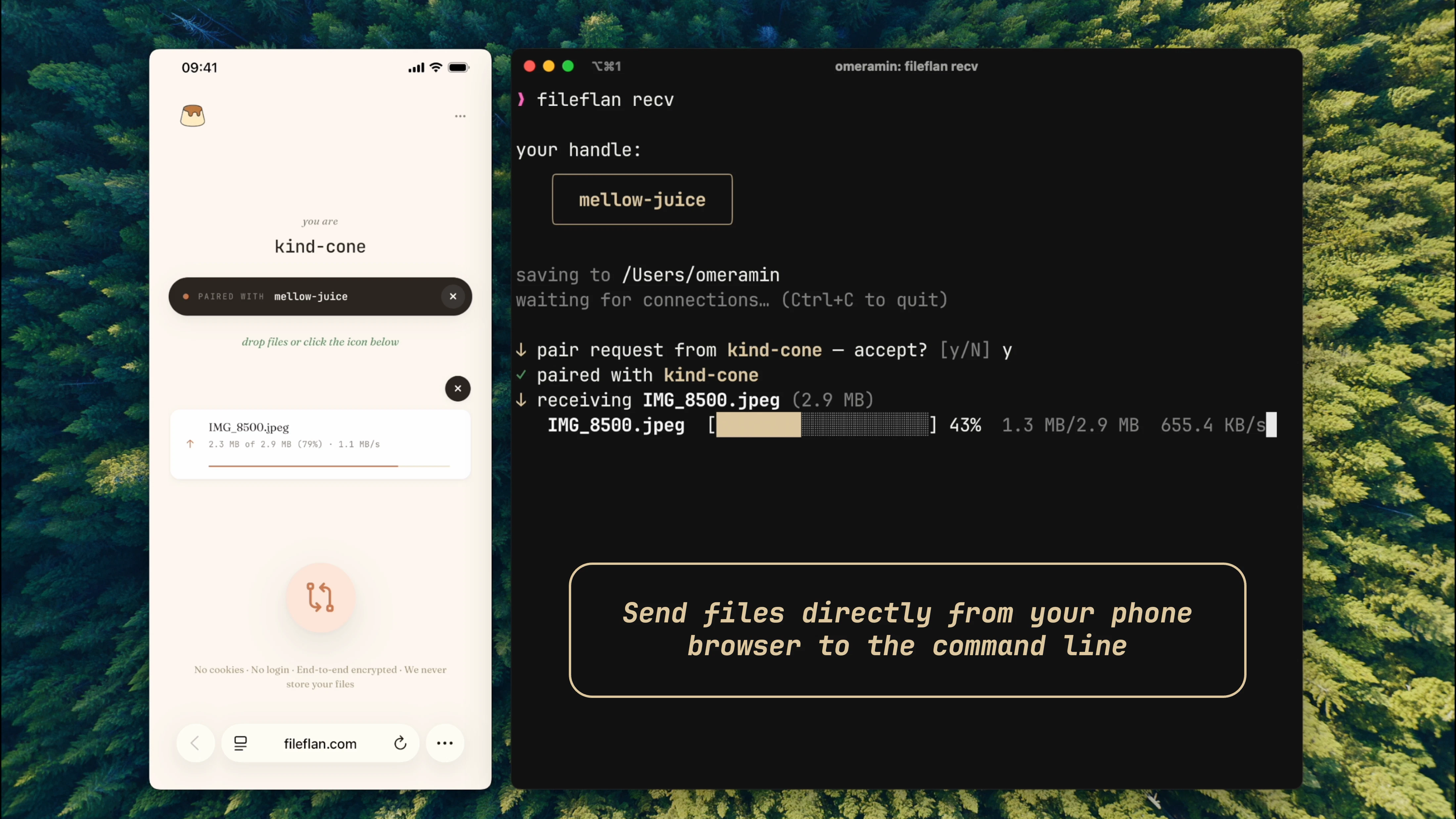
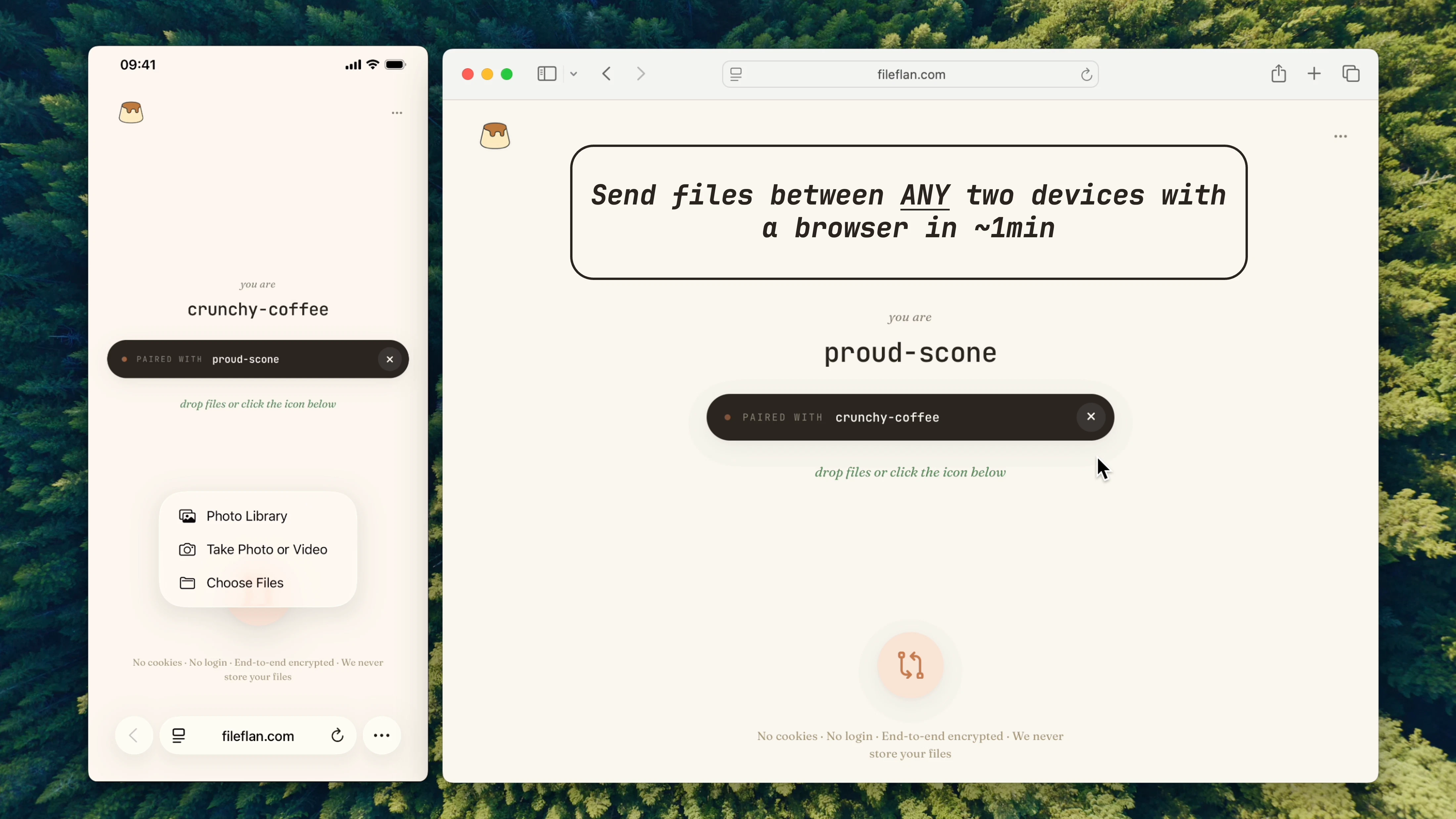
FileFlan
Instant private universal file sharing
110
一句话介绍:FileFlan 是一款无需登录、跨设备、端到端加密的点对点文件共享工具,解决用户在手机、电脑、命令行终端等不同设备间快速、私密传输文件(含整个文件夹)的痛点。
Productivity Privacy Data
文件传输 点对点 端到端加密 跨平台 零登录 大文件传输 命令行工具 隐私保护 免费工具 浏览器互传
用户评论摘要:用户赞赏其功能全面,尤其指出免登录、跨网络、支持文件夹和 CLI 的优势,认为比同类工具更完善。但对单次 1GB 文件上限提出疑问,开发者回应浏览器模式下受限于 RAM,且未来可能放宽限制。
AI 锐评

FileFlan 切入的“私密跨设备文件传输”赛道并不新鲜——前有 PairDrop、FilePizza、WebWormhole 等免费竞品,后有 AirDrop、Nearby Share 等系统级工具。但它的差异化在于“全都要”:把零学习成本的浏览器拖拽、能跑在无 GUI 设备上的 CLI、完整的文件夹树支持、以及默认跨网络的 P2P 加密全部打包,且坚持零登录、零 Cookie。这本质上是在“工具性”和“奇客性”之间找平衡——既要满足普通用户“打开即用”的低门槛,又要覆盖开发者/运维人员“SSH 里就能传”的硬核场景。

然而,1GB 的单文件上限在当前 4K 视频、大型安装包日益普遍的背景下略显保守,开发者解释为浏览器 RAM 瓶颈,但若未来不通过分片或服务器中转方案突破,可能会劝退部分重度用户。此外,该项目目前投票数刚过百,尚未形成大规模社区验证,稳定性、传输速度、跨 NAT 穿透的成功率仍需更多实测数据支撑。

其真正的价值不在于“再发明一个传文件方式”,而在于实现了“隐私、便捷、跨端”三要素的较低摩擦组合。如果后续能持续优化大文件处理、并保持开源透明,它完全有潜力成为隐私敏感用户和跨平台工作流中的默认选择。但仅靠“免费+零登录”很难构建护城河——同类工具随时可以跟进功能,竞争焦点最终会落在传输可靠性和生态兼容性上。

查看原始信息
FileFlan
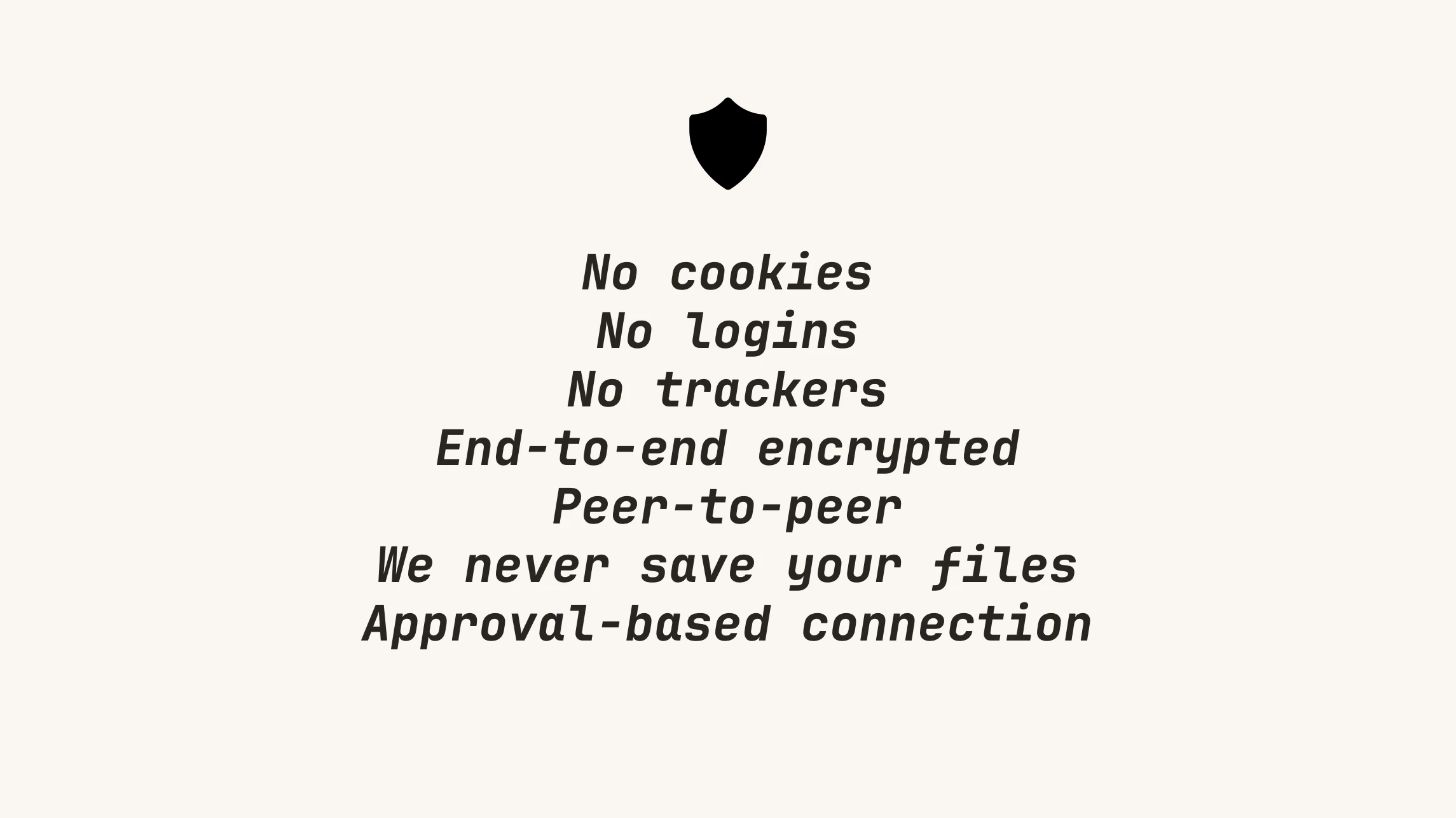
Phone browser to command line, Apple to Android, any device to any device. If it has a browser or a CLI, it works. P2P, end-to-end encrypted. No cookies, no logins, free.
You're probably thinking how this differs from similar free tools already online, like PairDrop, FilePizza and WebWormhole. Each one is lacking in ways others succeed, but FileFlan provides you the best of every world, and more. Including: • Send large files (up to 1GB each) • Send entire folder trees in one go • CLI mode, cross-compatible with browser mode • Works across different networks by default • A comprehensive set of privacy+security features • A polished, robust user interface • Zero learning curve If you have access to any two devices with network capability, you could start sharing files between them in ~1min. This includes devices with no GUI and virtual machines.
1
回复

Nice!

Why the 1GB limit?

0
回复
@thomas_berg3 On browser mode, files are buffered into the RAM. If you permit overly large files it will just cause the browser to crash
0
回复
@rb81 Yeah it is, one for a future update
1
回复
#10
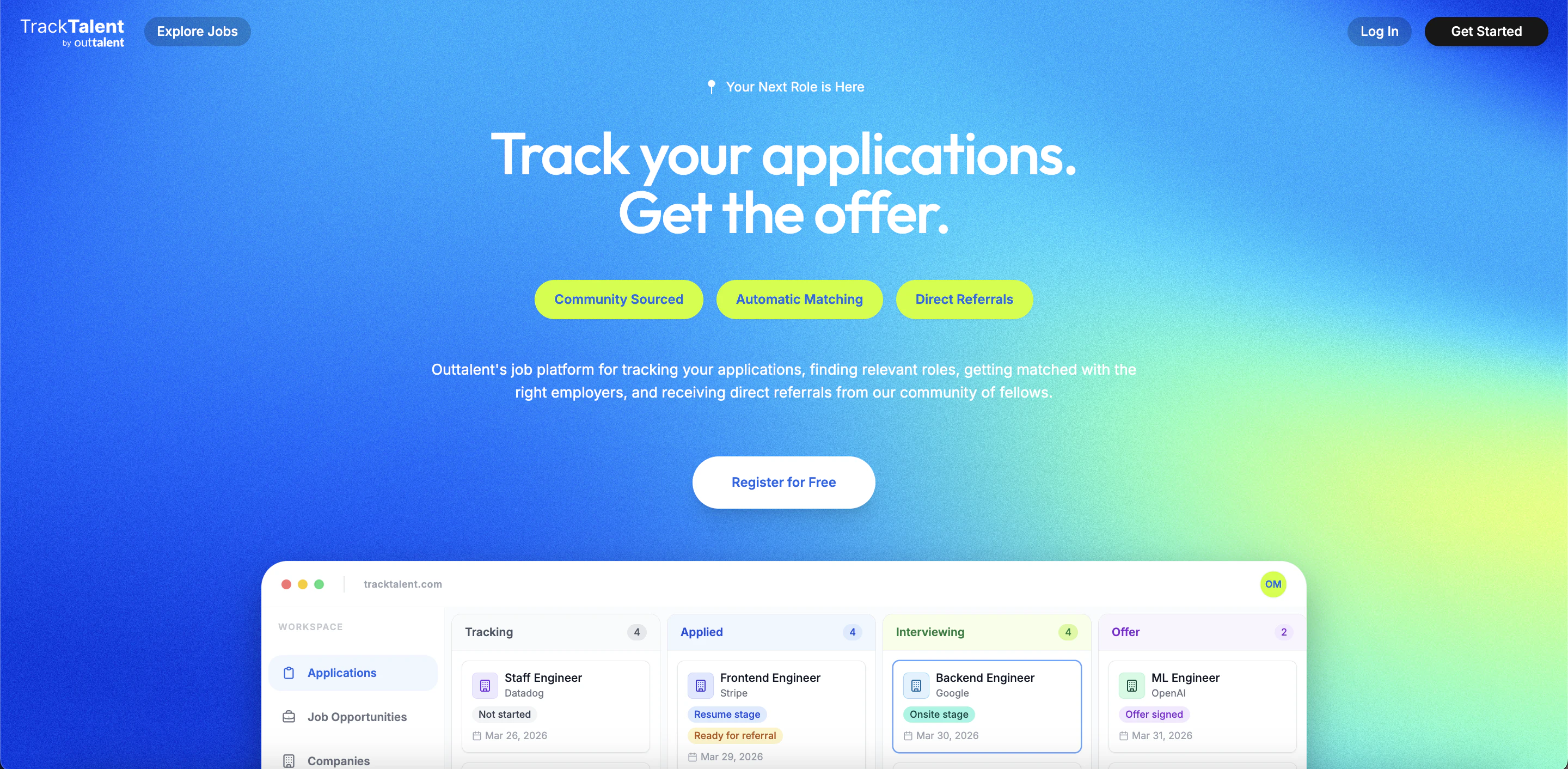
TrackTalent
Track jobs, get matched, and land offers faster
103
一句话介绍:TrackTalent 是一款专为工程师打造的求职追踪与智能匹配平台,旨在解决求职过程中信息混乱、投递低效、缺乏内推渠道等痛点,帮助用户从投递到录用实现流程化管理。
Hiring Productivity Career
求职平台 工程师 应用追踪 职位匹配 内推 求职自动化 社区驱动 职场工具 招聘效率 候选人体验
用户评论摘要:用户普遍认可产品解决了求职流程混乱的痛点,但提出两个关键疑虑:一是如何平衡雇主可见度与候选人信任(避免“监控感”);二是小众技术栈的匹配效果。此外,有用户询问是否有自动跟进提醒功能,以及目前是否支持非工程师岗位。
AI 锐评

TrackTalent 本质上是一个面向候选人的“逆向ATS”,精准切入工程师求职的流程管理空白。其价值在于将原本分散在Excel、邮件、招聘网站和内推人脉中的信息流整合为结构化管道,并通过社区贡献降低信息差,这比单纯的职位聚合站点更具竞争力。

然而,产品存在明显的身份悖论:它强调“不为雇主服务”,但智能匹配与内推流程又高度依赖雇主的接纳与数据接入。若仅依赖社区贡献,职位库的广度和时效性难以匹敌LinkedIn等平台。评论中关于“监控感”的担忧也直指要害——一旦引入雇主视角,产品极易沦为简历筛选漏斗的另一端,失去“为候选人提效”的初心。

真正的护城河在于其“Outtalent”积累的私域流量与辅导经验。能否将过去帮助200+人拿下FAANG offer的实战方法论(如跟进节奏、投递策略)转化为平台算法,而非简单搬运职位,决定了它突破小众工具宿命、成为下一代求职基础设施的可能。目前来看,对非加速器用户的功能开放程度偏低,若长期依赖“Fellowship”锁住核心体验,恐将限制社区裂变。

查看原始信息
TrackTalent
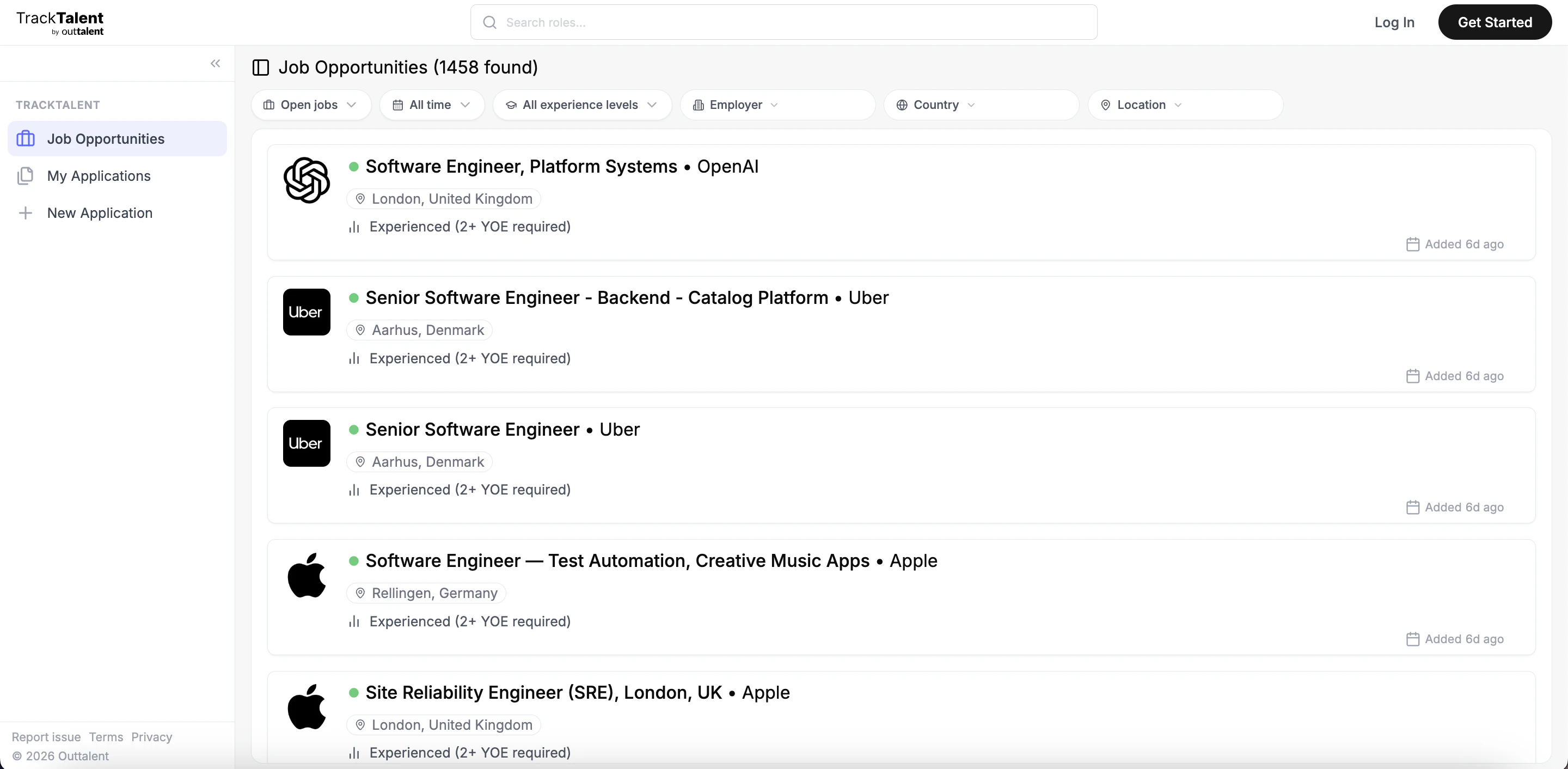
TrackTalent is a job platform for engineers to track applications, discover high-quality roles, and get referred faster. It combines a structured pipeline, community-sourced opportunities, and intelligent matching to help you focus on the right jobs and move efficiently from application to offer.

Hey everyone 👋

We built TrackTalent because job hunting for engineers feels unnecessarily chaotic today.

People track applications in spreadsheets, miss great opportunities, apply to hundreds of irrelevant jobs, and often never hear back. At the same time, referrals and insider knowledge are still one of the biggest advantages in tech hiring, but they’re hard to access if you don’t already have the network.

At Outtalent, we’ve helped engineers land 200+ offers at companies like Google, Meta, Amazon, Stripe, and more. Along the way, we built internal tools to manage applications, referrals, opportunities, and interview pipelines more efficiently. Eventually we realized this needed to become its own platform.

TrackTalent combines:
• application tracking
• intelligent job matching
• community sourced opportunities
• referral workflows
• a structured pipeline from application to offer

The goal is simple: help engineers spend less time on chaos and more time on the right opportunities.

Would love to hear your feedback, ideas, and thoughts ❤️

3
回复

Recruiting tools that don't feel like surveillance are rare. Curious how you balance candidate trust with employer visibility. Solid launch 🚀

2
回复
Is this ATS for candidates? 😅
2
回复

@lakshminath_dondeti No, it's not XD

2
回复

Hi everyone. I’m thrilled to share TrackTalent with you - our job tracking platform!


When I joined Outtalent, this was my very first project: built to provide our clients a smarter way to manage their job search end-to-end. Over the past year I’ve continuously iterated on this platform - adding more features, better workflows and smarter automations aimed at actually helping our clients land jobs. Since launching it internally, the volume of our clients’ job applications and successful referrals has grown tenfold, reflected in the offers they continue to land.

The team and I are now excited to share the platform with the public. You can use it to explore tech job listings and track your applications. If you become part of our Fellowship accelerator program - you will also get access to intelligent job matching, mentorship and referrals to the top tech companies (FAANG & adjacent).

TrackTalent has been my baby since day one, and it's exciting to finally see it fly. Hope it helps you land something great.
I’m happy to answer any questions!

2
回复

Congrats on the launch! The job market for engineers is quite noisy right now, so a tool that helps centralize applications is very timely. Does TrackTalent offer automated 'follow-up' reminders for applications that haven't responded? Also, how does the 'intelligent matching' handle niche tech stacks compared to broader roles?

1
回复

Something similar for marketing doesn't exist? :)

1
回复

@busmark_w_nika you can use this tool for any job applications! We plan to add listings for different industries in the future.

0
回复
#11
MiniCPM-V 4.6
Ultra-efficient 1.3B vision-language model for mobile
98
一句话介绍:MiniCPM-V 4.6 是一款专为手机和消费级硬件设计的1.3B参数多模态大模型,通过高效的视觉令牌压缩技术,解决了在资源受限设备上运行图像与视频理解任务时成本高、速度慢的痛点。
Open Source Artificial Intelligence GitHub
多模态大模型 移动端AI 视觉理解 边缘计算 开源模型 量化压缩 视频分析 iOS/Android/HarmonyOS 1.3B参数 高效推理
用户评论摘要:用户主要关注模型实际内存占用,一位开发者询问1.3B参数在16/8/4/1 bit量化下具体大小;发起人回应称这是“最干净的高效玩法”,但未直接回答量化规模问题,显得回避技术细节。
AI 锐评

MiniCPM-V 4.6 的定位精准——用1.3B参数在手机上跑视觉理解。从产品角度看,它确实踩中了三个痛点:高分辨率图像的高成本、视频输入的连续性负担、以及移动端部署的碎片化。混合4x/16x视觉令牌压缩是技术亮点,号称能让“重活变轻”;而对iOS/Android/HarmonyOS的全平台demo支持,加上Apache-2.0开放与Ollama/vLLM等框架兼容,说明团队在生态和开发者体验上下了功夫,这是务实的一面。

但不得不指出,98票的热度在Product Hunt上只能算中等,评论区仅有的两条互动暴露了问题。开发者最关心的“内存占用”没有被明确解答——1.3B参数本身只是个数字,量化精度决定落地的实用性。回避回答或是团队尚未做出精细量化版本,而1.3B的尺寸在移动端如果仅能跑FP16,内存压力依然巨大(约2.6GB),对主流手机并不友好。

另外,产品介绍中的“清洁效率游戏”一语暗示这是系列中最省成本的版本,但也可能意味着牺牲了更强的视觉理解能力。在边缘计算场景中,稳定性、量化后的精度损耗、以及视频推理的帧率才是用户真正关心的,这些在本次发布中缺乏数据支撑。总体而言,这是一个在正确方向上迈出半步的产品,但要打动开发者真正部署到生产环境中,还需要更透明的性能基准和量化选择。

查看原始信息
MiniCPM-V 4.6
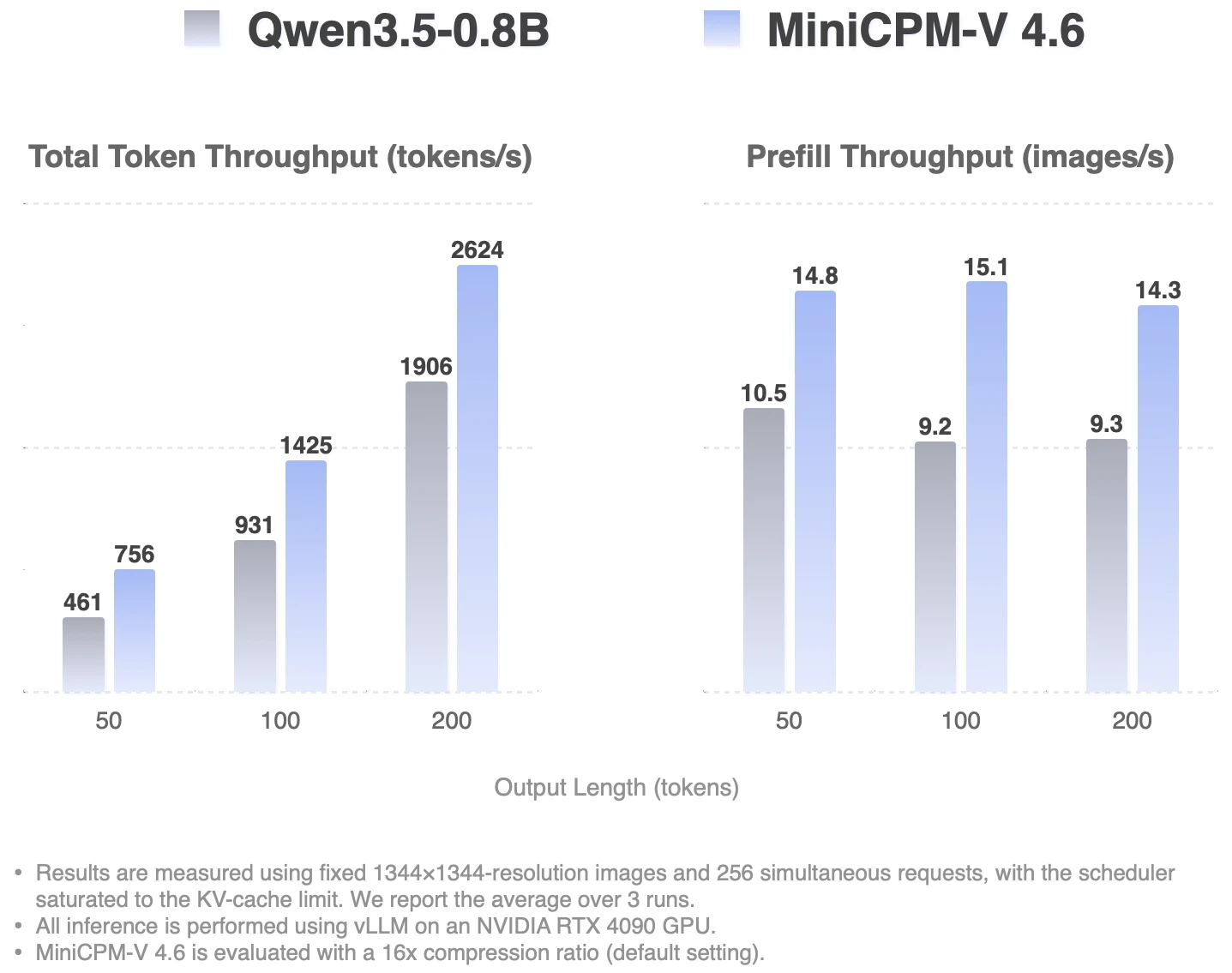
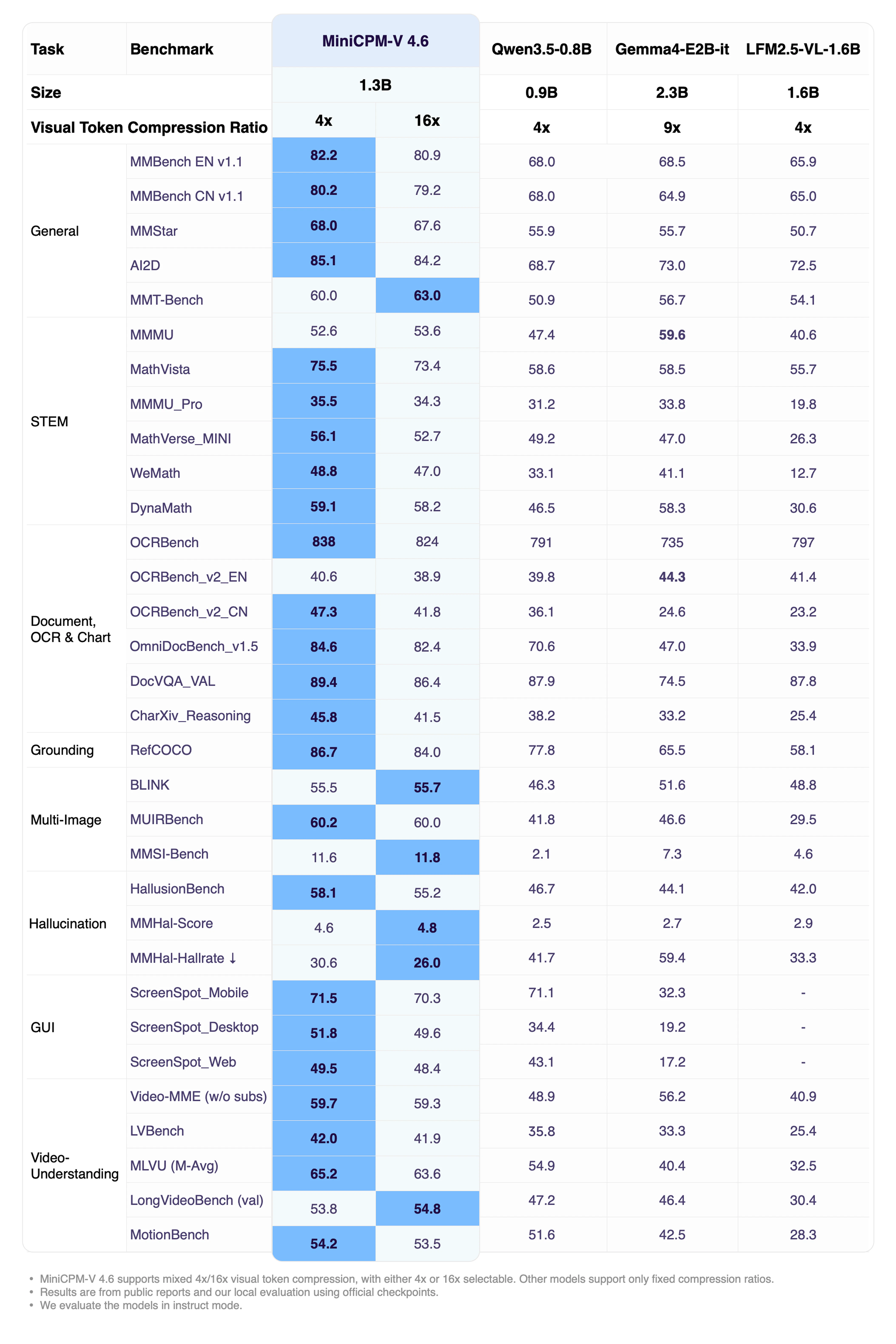
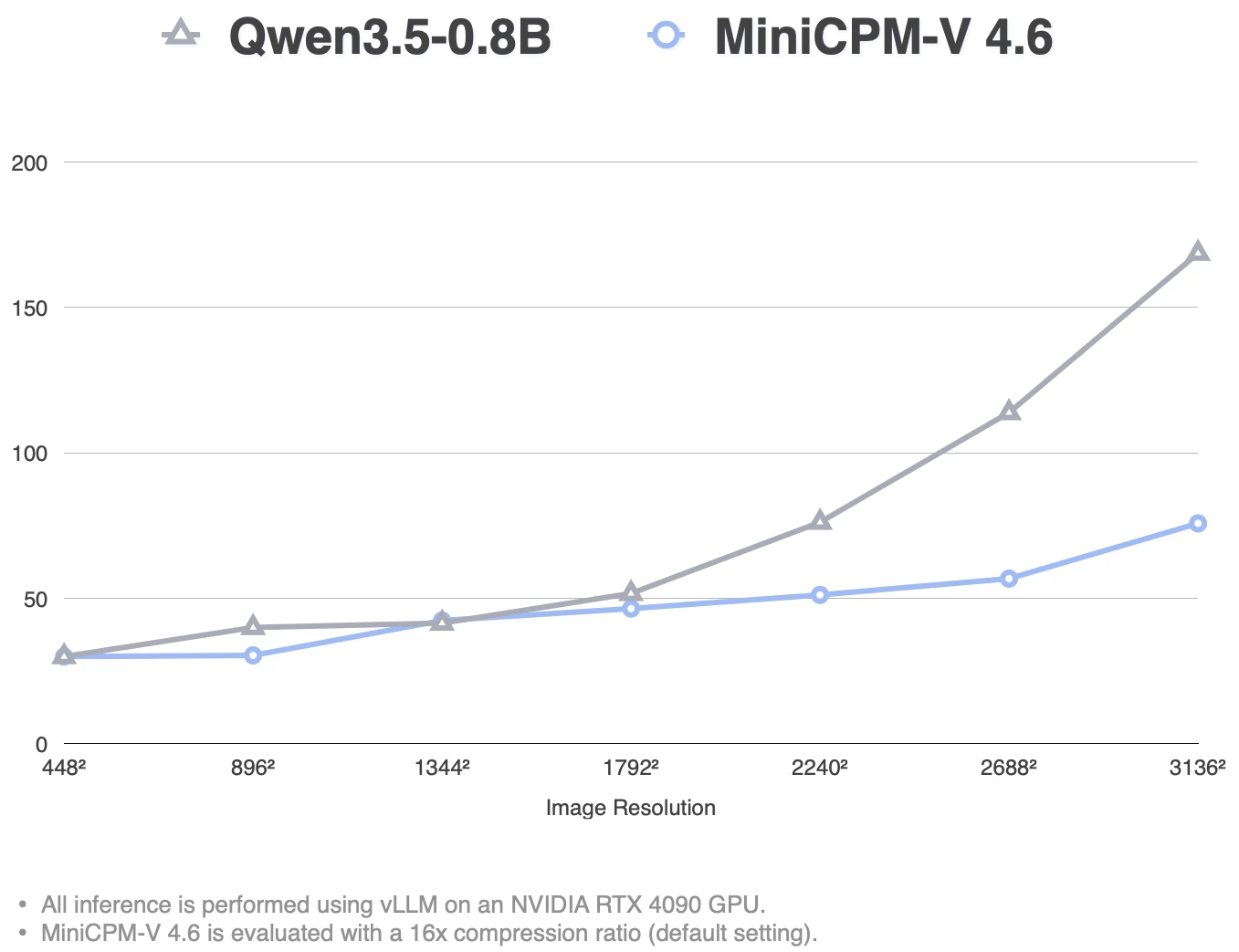
MiniCPM-V 4.6 is an open MLLM for image and video understanding on phones and consumer hardware, with mixed 4x/16x visual token compression, iOS/Android/HarmonyOS demos, and support for vLLM, SGLang, llama.cpp, and Ollama.

Hi everyone!

MiniCPM-V 4.6 is a 1.3B open MLLM for image and video understanding, built for phones and consumer-grade hardware. It is the smallest MiniCPM-V model to date, and probably the cleanest efficiency play in the series so far.

Visual understanding can get expensive very quickly, especially with high-res images, video inputs, and on-device use cases. MiniCPM-V 4.6 focuses on making that workload lighter, faster, and more practical to deploy.

It also has a pretty complete developer path: mobile demos across iOS, Android, and HarmonyOS, Apache-2.0 weights and code, quantized versions, and support for frameworks like vLLM, SGLang, llama.cpp, and Ollama.

Small multimodal models are getting a lot more interesting when they are designed around real edge constraints!

2
回复

@zaczuo Thank you for posting this. How large is the model in memory? It's 1.3B parameters, is that 16 bit, 8 bit, 4 bit, or 1 bit?

1
回复
#12
Habitvs
An Apple Health companion that grows with your habits
94
一句话介绍:Habitvs 将 Apple Health 的健康数据转化为一只名为 Kova 的虚拟宠物,通过其情绪状态直观反映用户的睡眠、活动、心率等真实身体状况,以无压力、去惩罚化的方式陪伴用户建立健康习惯,解决传统健康应用“数字说教”和“断签焦虑”的痛点。
Health & Fitness Productivity Lifestyle
虚拟宠物 健康习惯 Apple Health 心理健康 数据可视化 无压力追踪 手表应用 像素艺术 AI 信件 隐私优先
用户评论摘要:用户高度认可“无内疚感”产品哲学,尤其称赞隐私保护、手表小组件和“每周信”功能。主要建议包括:优化新手引导,解释能量条含义;希望Kova外观能随数据动态变化(如眼袋);增加互动性,如小游戏、情绪徽章;解锁饰品应更具收集挑战性。
AI 锐评

Habitvs 瞄准了一个精准的缝隙市场——用“情感化反馈”对抗“量化焦虑”。它的聪明之处在于,将枯燥的健康数据转化为具象的、可共情的“宠物情绪”,以此降低用户的心理门槛。这本质上是一种“游戏化”的降维打击,但比俗套的“升级打怪”更高级:它让用户关心的是Kova而不是数据本身,从而实现了健康习惯的软性引导。从产品设计看,隐私是绝对的红线,苹果三大框架(HealthKit、SwiftUI、Foundation Models)的结合确保了无缝体验和用户信任,这是独立开发者难以复制的护城河。

然而,批评点在于其“浅层交互”的局限性。目前Kova的角色更像一个“被动显示器”,用户的反馈普遍指向“更深度的双向关系”,比如动态外观、迷你游戏等。这些需求一旦规模化,对美术和动画的投入将指数级增长,而目前94票的热度说明市场声量尚小。另一个隐患是“沉溺”问题:当健康变差导致Kova“担忧”,是否会反向加剧用户的负面情绪?如果产品只负责“映射”而不提供“干预路径”(比如健康建议),长期来看仍是一个电子宠物,而非健康工具。

总评:创意巧妙,执行扎实,但能否从“新鲜感”走向“长期粘性”,取决于团队能否将数据反馈从单向展示升级为双向叙事,并谨慎平衡“镜像健康”与“促进健康”之间的边界。

查看原始信息
Habitvs
Habitvs turns Apple Health data into a virtual companion named Kova. Sleep, recovery, activity, and mindfulness shape how Kova feels and reacts each day.

Hey Product Hunt!

I'm Igor, and today I'm launching Habitvs - a tiny virtual pet for iPhone and Apple Watch whose mood is shaped entirely by your real Apple Health data.

Why I built it
Most health apps shout numbers at you. Rings. Charts. Streaks that punish you for one bad day. I wanted the opposite - something that just cares. So I built Kova, a pixel companion who quietly reacts to how you're actually living. Move and sleep well, and Kova thrives. Burn out, and Kova gets a little worried.

How it works
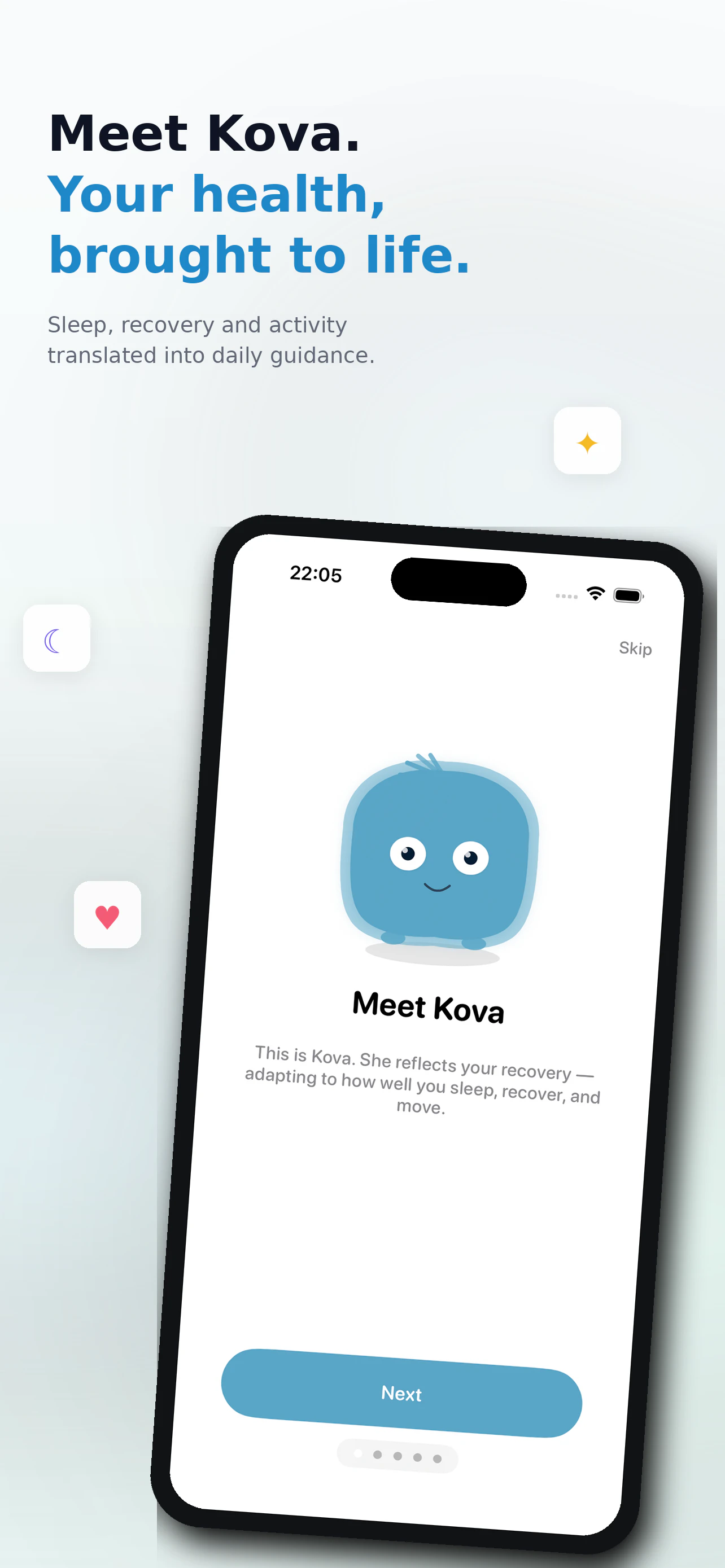
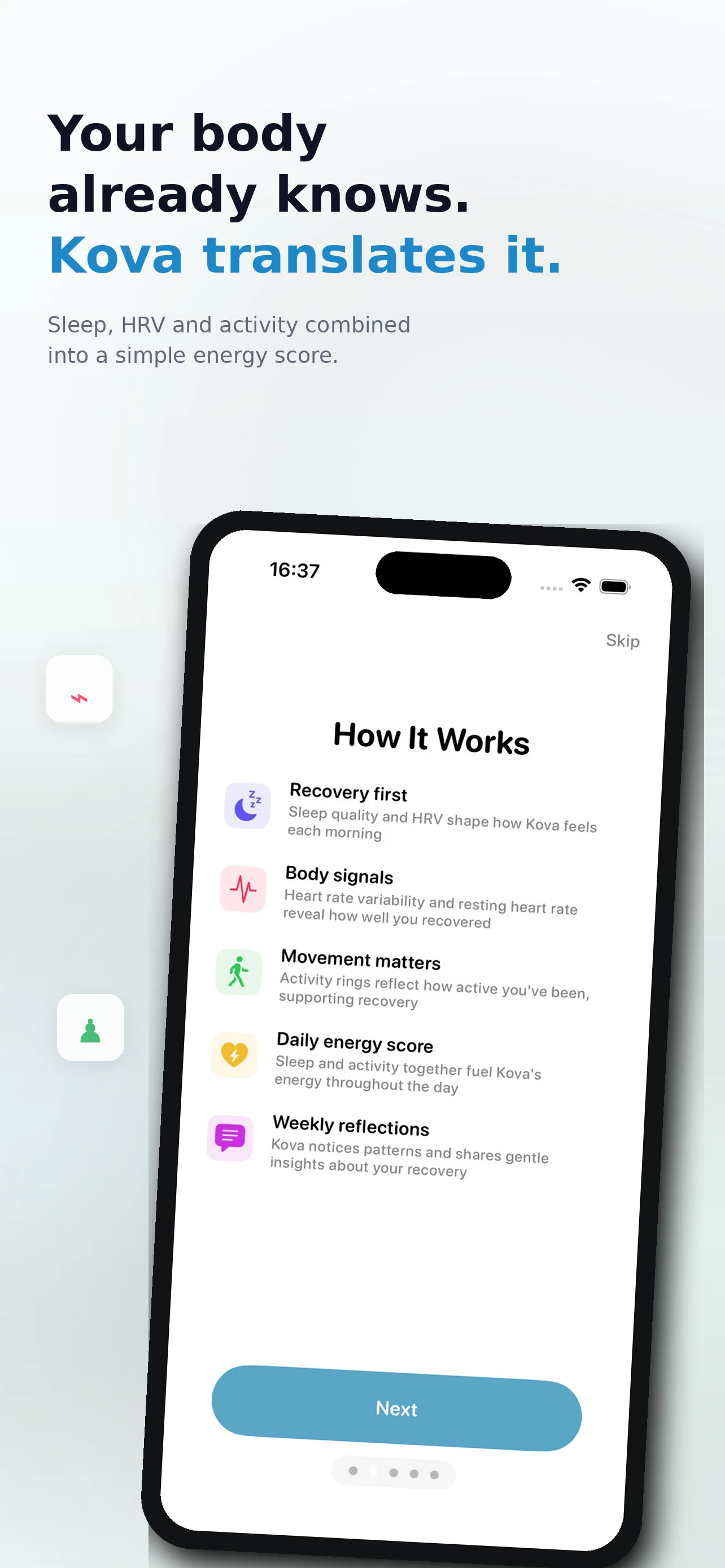
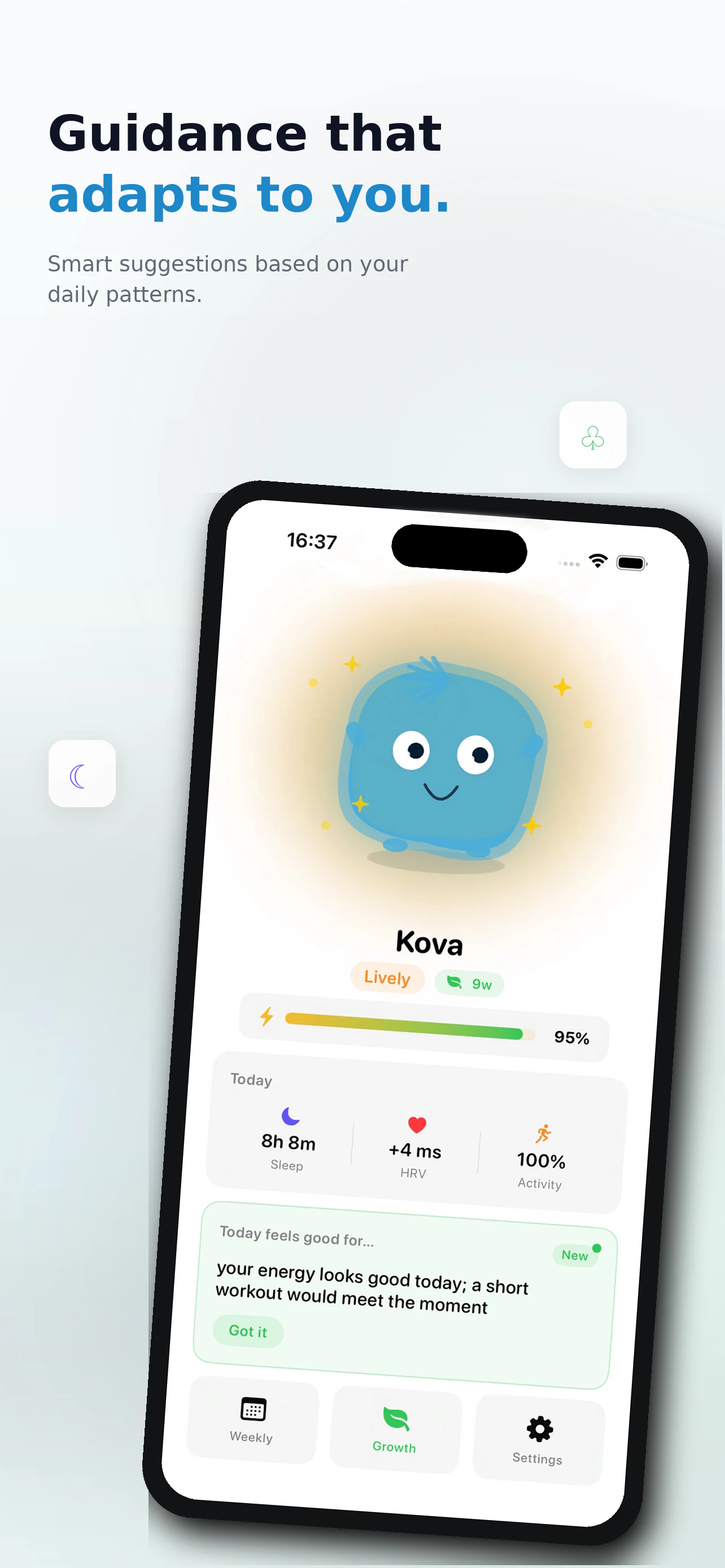
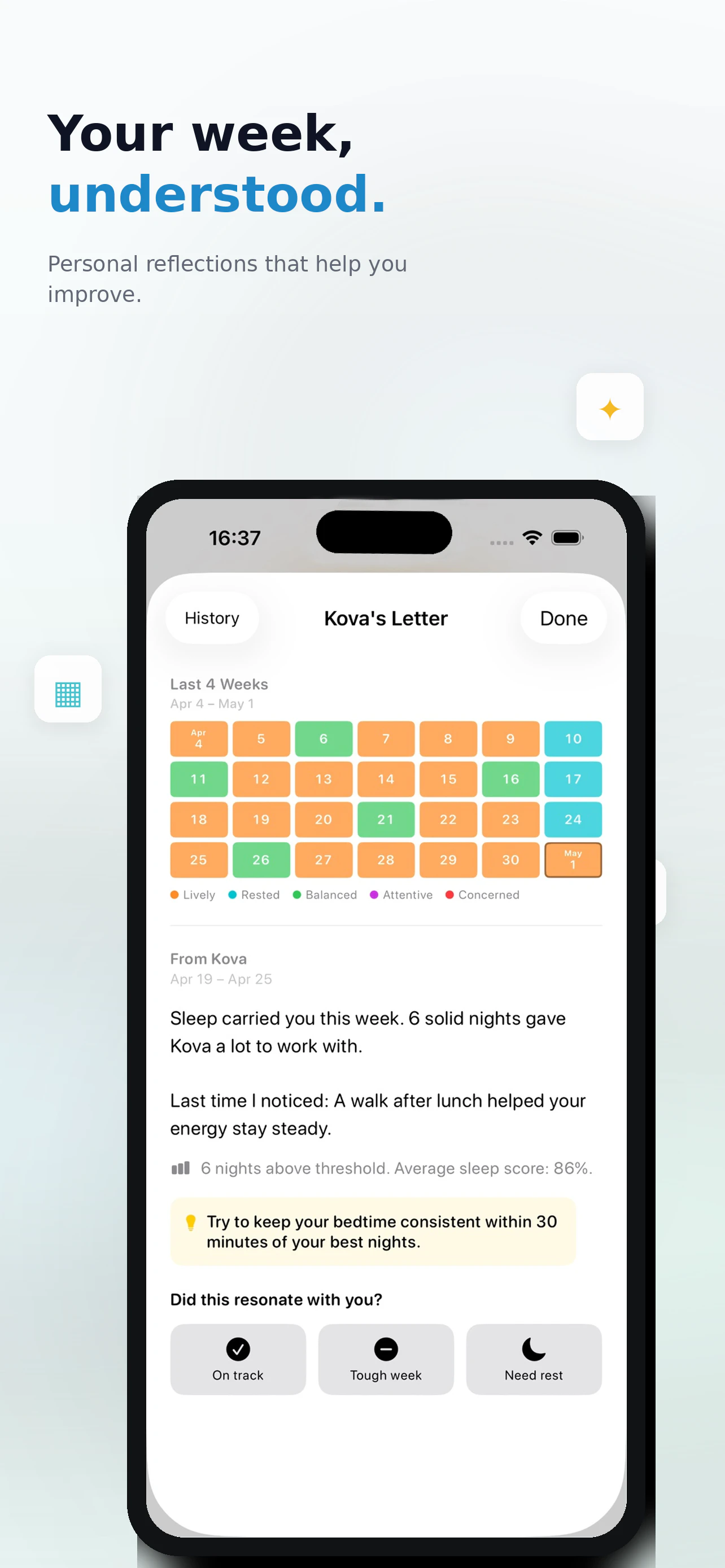
Kova has 5 moods - Lively, Rested, Balanced, Attentive, Concerned - driven by your activity rings, sleep, HRV, resting heart rate, mindfulness, daylight, and even wrist temperature. No goals to hit. No guilt trips. Just a small friend who mirrors your wellbeing.

What's inside
• Native iOS + watchOS apps (SwiftUI + HealthKit)
• Home Screen, Lock Screen, and Apple Watch complications - including a pixel-art "Retro" style
• A weekly letter Kova writes to you, generated on-device with Apple's Foundation Models - nothing leaves your phone
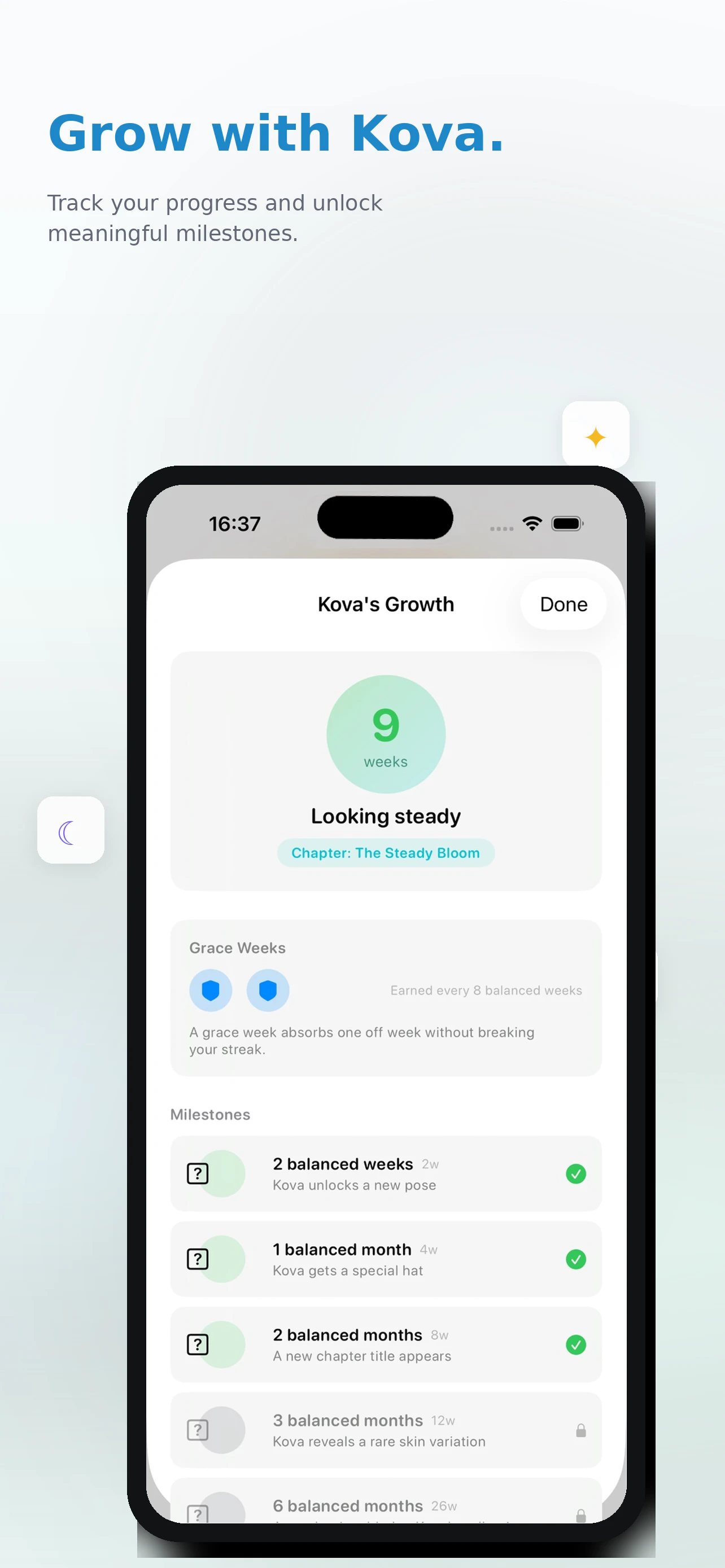
• Streak system with a weekly "shield" so one missed day doesn't break your momentum
• Milestones at 3, 7, 14, and 30 days - including a crown for Kova
• Customization: 7 colors, hats, glasses, bowties

Privacy
Your health data never leaves the device. No accounts. No tracking. Ever.

I'd love your honest feedback - what feels delightful, what feels missing, and what would make Kova feel more alive. This is just day one.

Thanks for stopping by, and go check on Kova.

4
回复

@igorbmaciel94 how did you decide which metrics like HRV and wrist temp make the biggest impact on mood without overwhelming the simple vibe?

0
回复

Hi Igor!

First off, I love the philosophy behind Habitvs. As someone with ADHD who appreciates a low-stakes way to stay mindful and active with some extra gratification from it, the idea of a virtual companion that mirrors your wellbeing rather than shouting numbers and guilt trips at you is so refreshing. The pixel-art complications are a nice touch.

I spent a little time with my Kova today (I named mine Goofy!), and I want to share some creative input that I hope will provide you with some decent feedback.

Onboarding Experience

Feature Tour - I think the app could benefit from a more in-depth guided tour upon first opening. A step-by-step walkthrough with info blurbs highlighting specific features would help new users feel oriented right away

Clarity on Stats - For example, I found myself wondering what exactly the energy bar represents at first

Deepening the Connection with Kova

Visual Evolution - I'm interested to see how Kova could change visually based on health data. Things like lack of sleep/not meeting a sleep goal reflect with little eye bags or other features of fatigue.

Moodlets & Check-ins - Having small "moodlets" appear while the app is open or doing occasional mood check-ins with Kova would make the relationship feel more interactive and two-way if that is your goal

Gamification & Customization

Activity-Based Rewards - I love the current customization, unlocking even more colors, hats, or accessories by hitting personal or app-based activity milestones would be a great motivator and gratifier. I think it would also increase the longevity of a user who may want to "collect" such items, especially if any were limited edition or only obtainable by specific goals and/or activities

Mini-Games - Adding small, health-related mini-games, like a 1-minute breathing exercise, brain-boosting games, or a quick movement challenge, could give users more ways to interact with Kova during the day

Streaks

If you're interested in leaning even further into the "no guilt" mindfulness vibe, consider a system that doesn't just protect streaks but prioritizes rewarding momentum. Continuing to reward positive progress, even if a day is missed, keep the focus on the journey rather than just a number without eliminating it completely. You already lean into this with the weekly shield, a feature I really like!


1
回复

@madison_r Hi! Thank you so much for this - the depth of this feedback genuinely made my day, and "Goofy" is a 10/10 name. 🙌


Let me go through your points, because a lot of them land really well:


Onboarding & clarity

You're right - the energy bar isn't self-explanatory and that's on me. It's actually derived from Kova's mood (Lively 95% → Rested 78% → Balanced 60% → Attentive 35% → Concerned 12%), so it's a reflection of how your day's signals are tracking, not a separate metric. I'm going to add a short "what does this mean?" inline tooltip and rethink the onboarding to include a light guided tour. Step-by-step blurbs over the first session sounds like the right shape.


Visual evolution of Kova

This is the direction I most want to push next. Right now Kova's mood changes (expression, body color, movement) but the body itself doesn't carry over fatigue/recovery cues. Little eye bags after poor sleep, a slightly drained posture after a strain day - yes, exactly that. The signals are already being captured under the hood (sleep, HRV, RHR, wrist temperature, mindfulness, daylight), so this is mostly an art/animation problem, not a data one.


Moodlets & check-ins

Love this. Kova already writes a weekly letter reflecting on the week, but small in-session moodlets - a quick "how are you feeling?" tap, or Kova reacting in the moment - would close the loop and make it feel two-way. Adding to the list.


Activity-based rewards & collectibility

Currently there are milestone rewards at 3/7/14/30 days (bronze ring → silver → gold → crown), and the 30-day crown takes visual priority over any hat you've equipped. But you're right that unlocking more colors/hats/accessories through specific goals - and especially time-limited or condition-specific items - would make customization feel earned instead of just available. This is a great direction.


Mini-games

Honestly hadn't planned for these, but a 1-minute breathing exercise with Kova feels very on-brand for the "no guilt" philosophy. Noted.


Streaks & momentum

Really glad you noticed the weekly shield - that was a deliberate choice. There's also a quieter "Balanced Week" track running in parallel that rewards consistency at the week level rather than the day level, so a single missed day doesn't erase the bigger pattern. I think you're nudging me to surface that more prominently and lean further into momentum-over-streak-number framing. Agreed.


Thank you again - this is the kind of feedback that actually shapes a product. Going to sit with all of it. 💙


- Igor

0
回复

the on-device Foundation Models for the weekly letter is a smart call - that's exactly the kind of feature that would feel creepy if it phoned home and delightful because it doesn't. how did you decide which health signals to weight most heavily for Kova's mood?

0
回复
#13
knooth
Screen recording with AI-powered editing for Mac
92
一句话介绍:knooth是一款为Mac用户设计的本地化AI屏幕录制与剪辑工具,旨在解决录屏、编辑、音频处理流程分散、效率低下的痛点。
Design Tools Artificial Intelligence Photo & Video
屏幕录制 AI剪辑 Mac应用 本地处理 隐私优先 自动字幕 音频降噪 视频编辑 创作工具 效率提升
用户评论摘要:开发者自述因工作流碎片化而开发此应用,希望简化流程;用户表示对自动剪辑功能期待,愿意试用并分享反馈。评论暂无具体问题和建议,整体呈积极认可。
AI 锐评

knooth的市场切入点很聪明——它瞄准了Mac用户“录屏-剪辑-音频处理”这一碎片化痛点,并用“本地AI+隐私优先”作为差异化卖点。当前92票的成绩说明它确实引起了早期用户的共鸣,尤其是独立创作者和轻量化视频制作者。

但冷静来看,这并非颠覆性创新。融合录屏与剪辑在Mac生态中已有诸如ScreenFlow、Loom等竞品,AI字幕、音频清理等功能也逐渐成为标配。knooth真正的护城河在于“全本地运行”和“隐私优先”,这能吸引对数据安全敏感的付费用户,但也意味着无法利用云端算力做更复杂的AI处理,例如视频风格迁移、智能脚本配音等。

此外,从用户评论只表现为“开发者自述+单一句点赞”来看,产品可能尚处于极早期,用户池较小,缺乏真实的大规模功能反馈和Bug容忍度考验。开发者的“长期规划”固然重要,但若不能在未来2-3个月内积累出满足专业用户剪辑逻辑(如逐帧调整、多轨关键帧精细控制)的硬核能力,就很容易沦为“一个有趣的玩具”而非生产力工具。其真正价值,取决于本地AI能力与剪辑深度之间的平衡点能打得多准。

查看原始信息
knooth
knooth is a screen recording and video editing app for macOS with AI-powered editing built in. Record your screen, camera, microphone, or even iPhone/iPad screens directly from your Mac. Edit with a built-in timeline supporting video, audio, text, image, and shape layers. Add animations, transitions, AI captions, cursor auto zoom, filler word removal, audio cleanup, and fast exports. Everything runs locally on your Mac. No cloud uploads. Privacy first.
I built knooth because my screen recording workflow always felt fragmented. I would record in one app, edit in another, clean and mix audio somewhere else. knooth started as an attempt to simplify that workflow into one native Mac app. A huge thank you to everyone who tested early beta builds, shared feedback, reported bugs, and helped shape the app over the last few months ❤️ This is just the beginning — I already have a long roadmap of features and improvements planned based on feedback from beta users. Would genuinely love your support, feedback, and ideas 🙌
1
回复

Looks pretty cool im gonna try it. Im creating a video for my new app i made and i really dont wanna do it manually, this looks very promising!

1
回复
@andrewb23 Do share your feedback. Would be happy to add your feature request in the current roadmap
0
回复
#14
Keeby for Windows
Satisfying mechanical keyboard sounds, now on Windows
91
一句话介绍:Keeby for Windows 是一款让普通键盘发出逼真机械键盘音效的桌面小工具,通过空间音频和低延迟引擎,为打字爱好者提供沉浸式的听觉反馈与视觉动效。
Windows
机械键盘音效 桌面应用 系统托盘 空间音频 音频可视化 键盘自定义 Windows工具 音频引擎 打字体验 独立开发
用户评论摘要:用户称赞其设计出彩,是“愉悦且不必要”的实用小工具。有人询问与同类产品Klack的区别。开发者回复了Mac版本用户对于Windows版的需求,并强调重写原生音频引擎以保持低延迟。
AI 锐评

Keeby 精准击中了两个小众但忠诚的群体:写字楼的“键盘声控”和追求桌面仪式感的数字游民。其核心价值不在“必要”,而在“趣味”与“氛围营造”。产品路径清晰:先验证Mac端需求,再听声Windows呼声,用原生引擎解决跨平台音频延迟这个硬伤,体现了对核心体验的尊重。

然而,产品挑战同样明显。第一,功能过于单薄。它本质上是一个“音效皮肤”+“可视化皮肤”的组合,可替代性极强——Windows上不乏类似免费或开源工具,且用户对“Klack”的提问直指同质化竞争核心:差异化在哪里?第二,91票的Product Hunt热度表明它尚未破圈,缺乏爆款传播锚点。开发者声称“free to try”但未明说收费模式,这暗示了商业化悬崖:试玩后,用户付费意愿是否足以撑起持续维护?第三,从“spatial audio”到“reactive visualizer”的描述,暴露了对硬件生态依赖——没有好的扬声器或耳机,效果打折;且始终无法解决机械键盘本尊用户的“真人不屑一顾”危机。

一句话锐评:Keeby 是码农和内容创作者的“白噪音”——愉悦感极强,但心智壁垒极低。建议开发者要么深化与主流输入法/操作系统级的联动,要么用社区共创的“声音皮肤”植入创意付费墙,否则终究会沦为Windows菜单栏里又一个下载后即遗忘的电子玩具。

查看原始信息
Keeby for Windows
Satisfying mechanical keyboard sounds for your Mac. Spatial audio, reactive visualizer, customizable switch profiles.
Hey 👋 I'm Adrian, indie dev from the Philippines. I made Keeby for Mac a while back, it's a small app that makes your keyboard sound mechanical with spatial audio. A lot of folks asked for a Windows version, so I built one. Rewrote the audio engine natively so it stays low latency, runs from the system tray, free to try. If you give it a go, I'd love to know which switch profile you stick with.
2
回复

@eydiwowers This is one of those delightfully unnecessary products that people instantly want once they try it 😄 The native low-latency rewrite was probably the right call keyboard sound lag would kill the illusion immediately ⚡

0
回复

one of the best mac app i have in recent time (plus its designs are lit 🔥)

1
回复

Hey, I love Klack - what's the difference? Why should I consider to switch to Keeby? :)

0
回复
#15
DeepFrame
Serious security before public exposure
89
一句话介绍:DeepFrame是一个无需提供源代码、仅需提交应用链接即可进行深度安全渗透测试的平台,旨在帮助快速开发的Web应用在公开展示前发现并修复隐藏的安全漏洞。
SaaS Privacy Security
安全渗透测试 Web应用安全 漏洞扫描 无代码审计 创业公司 数据泄露防护 安全合规 深度测试 自动化安全 应用安全
用户评论摘要:用户盛赞无需代码库即可测试,降低了安全门槛。创始人回应强调,漏洞常隐藏在代码之外。有用户提问发现过哪些关键漏洞,但未获具体案例回答。
AI 锐评

DeepFrame确实切中了当下AI应用创业浪潮中的一个结构性痛点——速度与安全严重脱节。一方面,AI编码工具让应用构建变得前所未有的快,但安全意识的滞后和对代码审计的畏难情绪,使得大量初创产品如同“裸奔”上线。DeepFrame“无需代码库,仅需链接”的切入点极其精准,它不仅降低了深度渗透测试的认知和执行门槛,更关键的是触及了一个认知误区:代码审计并非安全的全貌,运行时环境的配置错误、API端点暴露、第三方集成漏洞等“看不见的坑”往往更致命。

但需要泼一盆冷水的是,“深度渗透测试”与“自动化扫描”存在本质区别。真正的“深度”需要结合业务逻辑的人工推理和复杂攻击链模拟,而仅凭链接授权,在缺乏业务上下文和核心代码逻辑的情况下,所谓的“深度”很容易退化为黑盒扫描的高级版本。创始人在回帖中强调“数据泄露、秘密泄露通常不在代码里”,这诚然是事实,但正因如此,纯黑盒的检测能力天然受限。此外,89票的产品热度也说明,市场更多是“尝鲜”而非“信赖”。

DeepFrame的价值在于成为“安全扫盲的第一站”,而非“纵深防御的最后一道防线”。如果它能通过低门槛测试激发创始人对安全的重视,并顺势引导他们进入更专业的审计流程,那它就是一个极好的漏斗型产品。但若将“无代码”作为长期护城河,则可能陷入“浅度扫描”的陷阱,最终沦为安全领域的“安慰剂”。对于真正的关键应用,一个不能审代码的“安全工作室”,恐怕还不够“严重”。

查看原始信息
DeepFrame
DeepFrame — a luxury security studio running authorized deep pentests for fast-moving web apps. Depth, clarity, retest.

Recently I saw friends and people with incredible stories losing a project they did with great effort because of data leaks and an unsafe app! This is happening more and more! and looking at the audience of founders who use AI to create apps, I feel that we already have a lot of demands to deal with, from creating the app, marketing, customer acquisition, etc., one of the pillars is a safe and scalable project! So it was based on this pain that we created DeepFrame, an agent system focused on security, from end to end to reveal the biggest points of security flaws in any application! and one of the biggest differences is that there is no code base required, just submit your product link and authorize the service.

Visit https://deepframe.xyz/startups to join the startup program and receive security support.

4
回复

@jonhvmp What's the #1 vulnerability you've caught early that saved a project from disaster?

0
回复

The fact that no code base is required is a huge plus—just submitting a link and authorizing the service makes deep pentesting feel way less intimidating for fast-moving startups.

2
回复

@bilal_niaz That was the main reason for continuing with DeepFrame. Imagine having to share a repository of your code. As a Software Engineer, I know that looking at the code makes it very easy to find these flaws, and people already use Claude Code; they can fix what they see! But security breaches you least expect, data exposure, leaked secrets, are usually not in your code. They might be, and we solve that problem. Imagine the damage if someone with malicious intent collected data from your user base? The process is so extensive that the company could fail. Yes, our services require links and authorization.

2
回复
#16
Whirr
Ambient agent activity in your notch
84
一句话介绍:Whirr 是一款在Mac刘海区域实时显示AI代理运行状态的小工具,解决了用户频繁切换窗口以确认代理任务进度的痛点。
Mac Productivity Developer Tools
AI代理 状态指示器 Mac刘海 生产力工具 系统增强 实时监控 任务可视化 窗口管理
用户评论摘要:用户反馈核心痛点是“错过代理响应”和“需要确认任务是否执行”。创作者为解决该问题,利用刘海区3px网格动画展示代理实时状态,交互简洁直观。正面评价集中于外观“slick”。
AI 锐评

Whirr精准切中了一个被忽视但高频的场景——当AI代理开始执行复杂任务(如代码生成、数据爬取)时,用户并非无事可做,而是陷入“频繁切换窗口确认进度”的隐性焦虑中。它将“进度感知”从主动查询变为被动注入,本质上是将AI代理的“心跳信号”视觉化映射到系统级的注意力盲区(刘海)。这个想法很聪明,但巧妙不等于有价值。目前版本仅解决“知悉状态”这一最浅层需求,对“干预状态”毫无涉及。用户真正需要的是:能在状态异常时一键暂停、重跑,甚至查看摘要日志——这些功能才构成闭环。此外,仅支持通知栏区域限制了信息密度,当多个代理并行,84个投票只能证明“概念美好”,要成为日常工作流的一环,Whirr需回答一个核心问题:“用户是希望用眼睛余光瞟一眼状态,还是希望在刘海就能下达下一个指令?”如果定位只是“会发光的灯”,那么它很快会被系统自带的活动监视器或AI平台自身的推送所替代。

查看原始信息
Whirr
See what your AI agent is doing without switching windows. Whirr shows live status under the notch.
I got tired of missing agent responses and having to make sure the agent was doing the task I asked it to do. This is the problem i wanted to solve. It started out with me finding these nice 3px grid loading animations and really wanted to do something with it, though they would look really good in the notch. Then i managed to add the live status from the agents.
2
回复

this looks slick!

1
回复

@hot_town Thank you Vinny!

1
回复
#17
Hopper
First agentic development environment for mainframe/COBOL
84
一句话介绍:Hopper 为仍依托大型主机/COBOL 运行核心业务的银行、保险等机构,打造了首个集成AI代理、TN3270终端及工作流面板的现代化开发环境,旨在解决老旧主机开发调试效率低、缺乏智能化工具的核心痛点。
Productivity Developer Tools Artificial Intelligence
大型主机 COBOL 代理式开发环境 AI代理 z/OS 现代化改造 编码效率 终端模拟器 遗留系统 开发者工具
用户评论摘要:用户对COBOL领域出现AI代理感到惊喜与认可,评论简洁正面(“这太棒了”),目前有效反馈集中在表达惊奇与支持,尚未提出具体的使用问题或改进建议。
AI 锐评

Hopper的定位精准且巧妙——它没有试图去“改造”或“重写”COBOL代码,而是在既有的大型主机运行范式上,为开发者引入了一个具备上下文感知能力的AI代理。这避开了“用AI取代COBOL程序员”的伪命题,转而聚焦于“用AI帮助COBOL程序员更高效地工作”的真实需求。

从实际价值看,Hopper直击了大型主机运维开发的三个痛点:一是知识壁垒,精通JCL、TSO和COBOL的程序员日益稀缺,AI代理能够部分解释作业失败原因、协助编写JCL,这相当于降低了入门门槛并提升了专家效率。二是调试效率低下,过去手动查看SPOOL输出、在不同数据集和作业间切换极为耗时,Hopper通过面板化和AI导航,能将数小时的任务压缩到数分钟。三是试错成本高,AI进行模拟操作(如提交作业前检查JCL)能减少生产环境的误操作风险。

但需冷静看待其局限性。首先,大型主机环境的敏感性和权限严格控制,AI“安全地操作”依赖于底层的精细权限配置和沙箱机制,稍有疏漏便可能引发生产事故。其次,COBOL系统往往伴随着数十年的业务逻辑和历史债务,AI在解释复杂、隐晦的错误时,深度依赖于对特定业务领域的理解,而非单纯的语法分析,这可能是其准确性的天花板。最后,当前仅84个投票和零星评论,说明其仍处于极早期阶段,产品成熟度和社区认可度尚待验证。

Hopper的聪明之处在于,它没有去碰“AI替代你”这个敏感话题,而是以“AI辅助你”的姿态切入了年久失修却极其稳固的利基市场。它的真正价值不是彻底变革了COBOL开发,而是证明了:哪怕是最“古老”的生态,也可以通过精细化的AI工具获得可见的效率增量。但对于客户而言,决策的关键不是它有多炫,而是它的“失误率”是否能低到让核心银行的运维总监敢于说“可以在生产环境试用”。

查看原始信息
Hopper
Hopper is the first agentic development environment for the mainframe. It's Cursor for mainframes. It combines a real TN3270 terminal, mainframe-aware panels for datasets, jobs, members, and spool output, and an AI agent that can operate across z/OS workflows. The agent can inspect datasets, read and edit PDS members, write JCL, submit jobs, parse JES output, explain failures, and help developers debug mainframe workflows faster. Hopper is available on Windows, Linux, and macOS.

Hey Product Hunt 👋

Today we’re launching Hopper, the first agentic development environment for mainframes.

Mainframes running on COBOL are the 60-year-old computing platforms that still quietly run much of the modern economy: banks, payments, insurance, airlines, government systems, and more.

But they were built for expert humans using terminal screens, function keys, batch jobs, datasets, and highly specific workflows, not AI agents.

Modern AI coding tools assume GitHub, shells, files, package managers, and test runners. Mainframes are a completely different computing paradigm.

Hopper combines a real mainframe terminal, context panels for datasets and jobs, and an AI agent that can safely operate across mainframe workflows.

Our goal is simple: bring AI agents to the legacy systems that still run the world without pretending they are modern codebases.

You can request access to a mainframe on our page, and start playing with Hopper to see what an agentic mainframe environment feels like.

Would love to hear any feedback or comments!

7
回复

Never thought I would see a COBOL AI agent, this is awesome!

0
回复
#18
Vexilo
Claude Code planner w/ 31 agents, 92 commands, + 121 skills
82
一句话介绍:Vexilo是一款针对Claude Code生态的智能索引与工作流管理工具,帮用户系统化发现并调用91条命令、31个专业Agent及121项技能,解决此前因信息分散导致的令牌浪费与效率低下问题。
Productivity Developer Tools Artificial Intelligence
Claude Code Agent编排 提示词管理 CLAUDE.md 令牌优化 开发者工具 AI工作流 双语索引 PWA
用户评论摘要:用户关注如何为非编码者(如营销人员)自动构建CLAUDE.md以触发合适Agent,避免手动调优的繁琐。这暴露了产品在非技术用户引导上的潜在缺口,也说明易用性是下一个战场。
AI 锐评

Vexilo本质上是在做一件“给AI IDE放说明书”的生意。Claude Code生态爆发力极强,但发现成本高、工具散落在Discord和GitHub里,Vexilo用“索引+Agent模板+CLAUDE.md自动生成”三板斧,确实切中了重度用户的切肤之痛——很多人烧了3倍令牌才发现有/context指令,这不是笨,是生态太乱。产品逻辑清晰,尤其双语支持和PWA离线体验、一次性付费而非订阅,对开发者群体有天然亲和力。但必须指出两个隐忧:一是护城河偏浅,这些命令和技能本身是公开信息,未来Claude官方若自己做个内置目录或LLM直接告诉你该用啥,Vexilo的中间层价值就会被稀释;二是评论中已有人问“非编码者怎么用”,说明产品目前预设的仍是开发者语言,若想扩展到设计师、营销人,那内容组织和触发逻辑就要重新设计,难度不小。总的来看,Vexilo是一个精准的“生态补丁”,现阶段很有用,但天花板取决于它能否从“汇总工具”进化为“工作流引擎”。如果你每天泡在Claude Code里,这张地图值一次付费。

查看原始信息
Vexilo
Most Claude Code users discover 10% of the ecosystem — by accident. You burn tokens because nobody told you /context exists. Vexilo fixes that. → 92 commands organized by use case → 31 specialist agents (code-reviewer, tdd-guide, planner...) → 121 skills by domain (frontend, backend, AI, devops) → ECC Superpowers workflow (160K+ ⭐ GitHub) → Auto-generates CLAUDE.md instantly Bilingual EN/中文 · PWA · One-time, no subscription.
Hey Product Hunt! 👋 I built Vexilo after a painful realization: I'd been using Claude Code for 2 months and burning 3x more tokens than necessary — because nobody told me /context existed. Then I found /aside. Then /model haiku. Then 31 specialist agents I never knew about. Each discovery felt like "wait, this existed the whole time?" The Claude Code ecosystem is genuinely incredible — but the discoverability is brutal, especially for non-English speakers. There's no central index. You find things by accident, through Discord comments and GitHub READMEs. So I built one. Vexilo maps the entire ecosystem — including Everything Claude Code (160K+ ⭐), gstack, and UI/UX Pro Max — into one bilingual interactive index, organized by what you're actually building. The CLAUDE.md export is the part I'm most proud of: drop it in your project root, tell Claude to read it, and it automatically knows every tool available and when to use each one. Free preview at vexilo.app — happy to answer any questions!
2
回复

@haostudio how does Vexilo recommend structuring CLAUDE.md for non-coders (like marketers) to auto-trigger the right agents/skills without prompt engineering headaches?

0
回复

Hey Product Hunt! 👋

I'm Alex, the maker behind Vexilo.

Two months ago I started using Claude Code seriously and hit a wall immediately — not with the AI, but with discoverability. I kept finding powerful features by accident, months after I should have known they existed.

/context alone would have saved me hundreds of dollars in wasted tokens. I found it on week 6.

So I spent 3 weeks mapping the entire ecosystem. What started as a personal doc became Vexilo — an interactive, bilingual index of everything Claude Code can actually do.

What makes it different:

  • Organized by what you're building, not alphabetically

  • Auto-generates a CLAUDE.md you drop into any project

  • Works offline (PWA)

  • One-time purchase, no subscription

Use code PRODUCTHUNT for $5 off today.

Happy to answer any questions about Claude Code or how I built this. What's the most useful Claude Code feature you discovered way too late? 👇

0
回复
#19
Seer Platform
The fastest way to go from idea to physical product
81
一句话介绍:Seer Platform是一款面向发明者与硬件创客的AI驱动平台,通过整合3D设计、固件编写、市场与专利研究等工具,解决从概念到可制造原型过程中流程碎片化、技能门槛高的痛点,实现“想法→实物”的最快转化。
Hardware Developer Tools Artificial Intelligence
AI硬件开发 3D设计生成 原型制造 创客工具 专利研究 固件编写 产品研发 智能制造 孵化平台 CAD自动化
用户评论摘要:用户反馈积极,强调平台解决了硬件开发流程繁琐、技能要求高的长期痛点。有效评论指出当前多数AI平台聚焦软件,而Seer专注硬件“从想法到原型到生产”全链条,并期待社区对AI原生硬件创造未来的看法,无负面问题或建议。
AI 锐评

Seer Platform的“野心”不止于做一个AI辅助设计工具,它试图成为硬件创新的“操作系统”。在当前“vibe coding”席卷软件圈之时,Seer提出的“vibe crafting”概念,精准地捕捉到了硬件领域长期存在的“创意断层”——即拥有想法的人往往缺乏将其转化为可制造产品的工程与制造知识。其核心价值在于将工业设计、固件开发、供应链调研、专利检索等高度专业化的职能,通过一个Agent(“Invent”模式)串联成闭环,大幅降低了硬件创新门槛。

然而,犀利的观察必须指出其潜在风险:硬件产品的成败远不止于设计出3D模型和生成固件。真正的硬件痛点在于供应链管理、生产工艺把控、成本优化以及认证合规(如FCC、CE)。Seer目前提供的BOM管理和3D打印订购是第一步,但若无法深度整合和动态学习各品类的生产know-how与失效模式,其“从概念到完成”的承诺可能会在进入量产阶段时遭遇滑铁卢。此外,AI生成的设计是否具备真正的可制造性与独创性,以及如何规避生成内容与现有专利的潜在冲突,将是决定其能否从“发烧友玩具”进化为“专业工程师助理”的关键。这台“硬件Copilot”的想象空间巨大,但下半场的考验才真正开始。

查看原始信息
Seer Platform
Seer is built for inventors, offering an AI-powered framework to develop physical products. It can design 3D objects, generate orthographics, write firmware, and perform market and patent research. These tools work individually or through “Invent” mode—an agent with product design–level expertise that can take your idea from concept to completion using both creative and engineering intelligence. The output is ready-to-manufacture prototypes, and you can order 3d printing from within Seer.

Beyond happy that we’re finally sharing Seer with everyone.

As someone who has always been more into hardware than software, I’ve spent years wanting to build useful physical things and constantly running into the same exhausting process around it all. And with deadlines and time pressure, you end up settling for less than what you originally imagined.

That always felt wrong to me. Ideas are valuable. They shouldn’t be abandoned just because the process of building them is too difficult or fragmented.

So seeing Seer not only solve that frustration for us, but also help other inventors bring their ideas to life, has been incredibly meaningful.

Really excited to hear what everyone thinks.

1
回复

While most agentic platforms today are focused on automating software development, Seer is focused on something else entirely:

Hardware.


Seer is built for inventors, makers, and hardware visionaries who have ideas but lack the specialized skills needed to bring them to life — things like CAD design, circuit design, prototyping workflows, and manufacturing logistics.


Our goal is simple:

Remove the barriers between imagination and physical creation.


With Seer, users can:

• Generate hardware concepts
• Create CAD and electronics workflows
• Manage BOM sourcing and component ordering
• Access prototyping and manufacturing tools
• Perform market and patent research
• Prepare patent filing documentation


And we don’t stop at the prototype.

We want to accompany inventors from idea → prototype → production → protection.

Software had its “vibe coding” moment.

We believe hardware’s next step is:

“Vibe crafting.”


Would love to hear what the Product Hunt community thinks about the future of AI-native hardware creation.

1
回复
#20
ContentPilots
Turn any video into endless Shorts & Reels with AI
80
一句话介绍:ContentPilots 是一款 AI 视频拆解工具,帮助内容创作者将一条长视频自动剪辑成多条适配短视频平台(YouTube Shorts、TikTok、Instagram Reels 等)的爆款片段,并自动生成标题、标签、文案和跨平台一键发布,解决创作者“手动拆条、多平台重复劳动、流量获取效率低”的痛点。
Productivity Social Media Marketing
AI视频剪辑 短视频生成 内容自动化 社交媒体管理 病毒式传播 多平台发布 创作者工具 长视频拆条 文案自动生成 生产力工具
用户评论摘要:用户普遍认可其简化工作流的价值,但反馈集中在:1)AI 剪辑的准确度和创意性有限,常切掉关键内容;2)对非英文视频支持差;3)希望增加自定义剪辑边界和更精细的编辑控制;4)部分用户建议平台应覆盖更多小众垂直领域。
AI 锐评

ContentPilots 切中了当下内容创作者最真实的“体力活”痛点——从长视频中手动找高光时刻、拆条、改格式、写文案,再到逐个平台发布,这几乎占用了创作者一半的非创作时间。产品将这一链条用 AI 自动化,理论上能大幅提升产能,尤其适合日更型创作者和 MCN 机构。

但坦率地说,当前版本更像是一个“省力杠杆”,而非“造浪机”。从用户反馈看,AI 的拆解逻辑仍停留在机械切割和低层级热度预测上,缺乏对内容叙事、情感节奏和用户心理曲线的深度理解。当被切掉的恰好是埋梗的关键帧,或者标题生成充满“震惊体”而同质化严重时,它反而会拉低账号的整体质感。此外,80 张投票的成绩在 Product Hunt 上不算惊艳,说明专业用户对“一个篮子装满所有渠道”的自动发布策略仍存谨慎态度——毕竟每个平台的算法偏好和用户行为截然不同,一键通吃往往意味着在每个平台都做不到最优。

真正的价值不在于“剪了多少条”,而在于“剪出了多少条有效播放”。如果 ContentPilots 后续能引入基于平台算法反馈的动态调整机制(比如学习某个账号在 TikTok 上的完播率偏好,再反向优化剪辑策略),它才具备从工具进化为增长引擎的潜力。否则,它只是帮创作者从“累死”变成“忙死”的加速器。
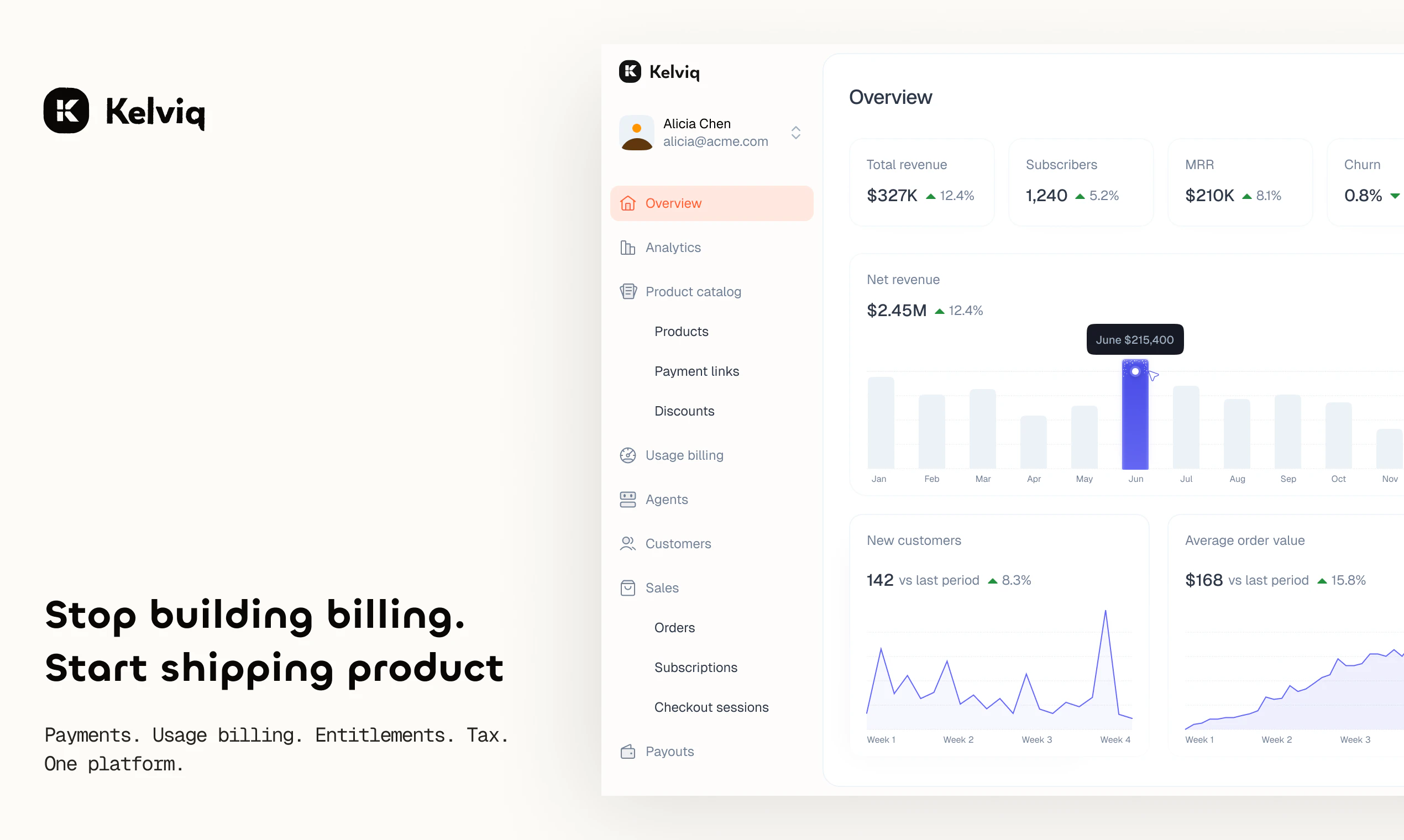
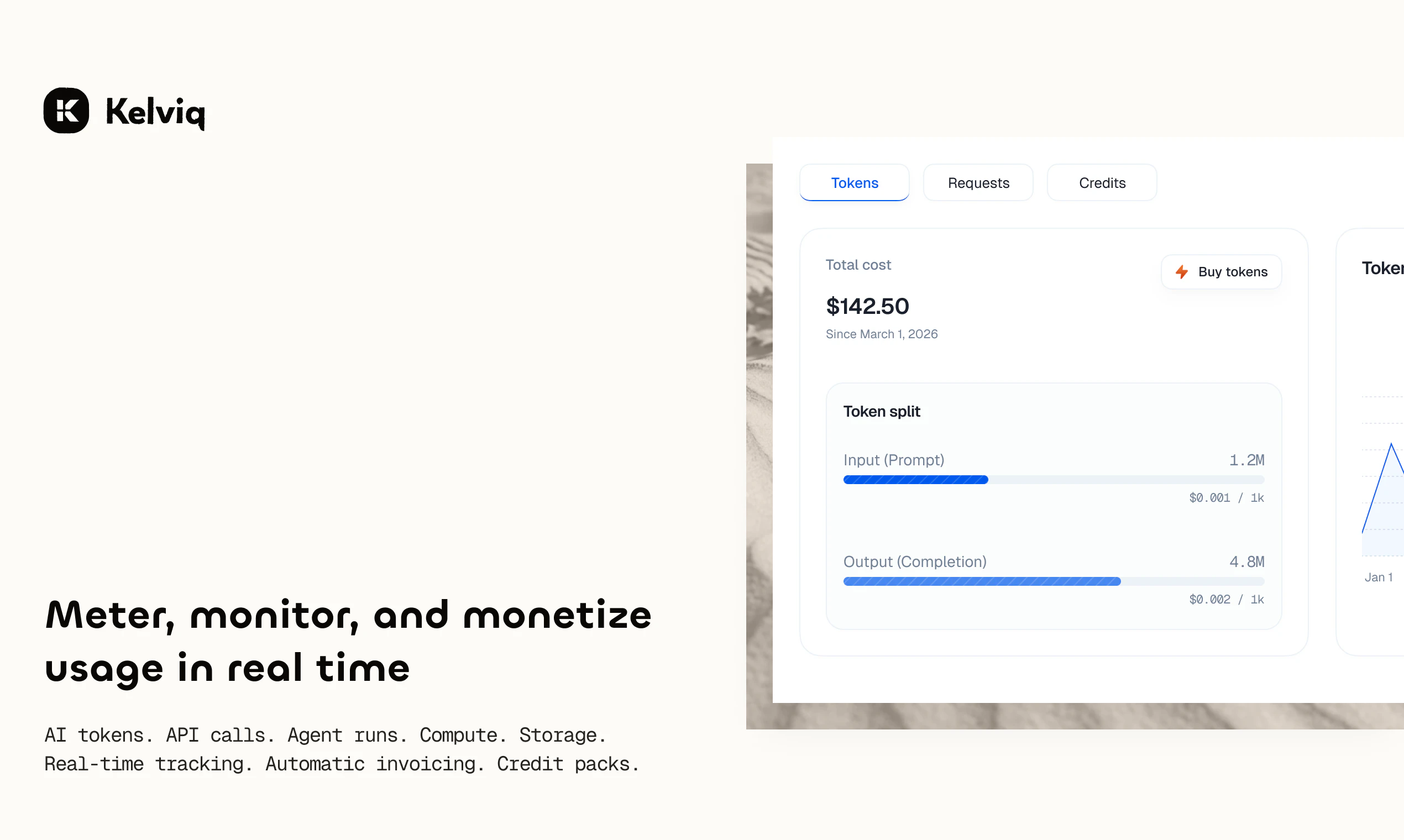
查看原始信息
ContentPilots
Upload one video and ContentPilots AI cuts it into countless viral Shorts, Reels & TikToks — automatically. Writes your titles, tags, captions, and schedules everything to YouTube, TikTok, Instagram & LinkedIn in one click.