Product Hunt 每日热榜 2026-05-25

PH热榜 | 2026-05-25

#1
Unabyss
MCP-native self-updating context layer for your AI
547
一句话介绍:Unabyss为重度AI用户打造一个自动化的个人上下文层,从日常应用提取并结构化身份与知识,通过MCP协议让所有AI工具共享,彻底告别反复自我介绍和跨平台信息孤岛。
Productivity Artificial Intelligence
AI上下文层 MCP协议 跨平台AI记忆 知识管理 个人数据聚合 用户隐私控制 自动化工作流 生产力工具 AI Agent Prompt工程
用户评论摘要:用户普遍认可解决了多AI工具间信息割裂的核心痛点,但高频质疑上下文新鲜度(同步间隔、变更触发机制)、冲突解决逻辑(多源数据优先级)、文件膨胀处理(自动摘要与版本管理),以及质疑“预提取”本质仍是缓存,存在数据漂移风险。
AI 锐评

Unabyss切中了一个正在指数级膨胀的痛点,但它的“杀手锏”或许也是其阿喀琉斯之踵。

**价值核心**:它没有选择做又一个“记忆插件”,而是以用户为中心,把分散在多个SaaS应用中的碎片信息,抽提、清洗、结构化为一套可读、可编辑、可精细授权的本地化文件(persona.md等)。这比ChatGPT的被动记忆、Claude Projects的封闭缓存高明了一个维度——用户真正拥有了“副本控制权”,并能通过MCP这个正在标准化的协议,一次性分发给所有Agent。对跨平台重度玩家而言,这是当前最优雅的“一次构建,随处使用”方案。

**隐忧与挑战**:

1. **新鲜度悖论**:所谓“自更新”目前仍依赖源应用的同步间隔(如5分钟),而非实时的变更事件推送。在高速迭代的AI工作流中,几分钟甚至几小时前的陈旧信息足以让Agent产生严重误导。正如评论指出的,任何缓存都会漂移。当“自动同步”变成“自动过时”时,信任会迅速崩塌。

2. **冲突仲裁机制**:当LinkedIn与Notion对“职位”描述矛盾时,产品目前依赖人工确认一次“作为基座”。这在初期可行,但复杂场景下(多项目、多身份),缺乏自动化、带权重的冲突解决逻辑,会导致上下文混乱。

3. **规模化壁垒**:文件会膨胀。虽然有摘要和版本控制,但如何在不丢失关键细节的前提下,保证上下文能满足Agent的token窗口限制,并维持高信息密度,是技术上的硬骨头。

**锐评**:

Unabyss像一个极富才华的仓库管理员,把货品(你的上下文)归置得井井有条,并给了你(用户)一把万能钥匙(MCP)。但仓库里的货品是否“新鲜”,完全取决于供应商(Gmail、Notion)的通知系统是否准时。它解决的是“你有地方放”和“如何找”的问题,但尚未根治“东西已经坏了你还在吃”的问题。

对于早期的尝鲜者和技术先锋(founder、builder),这是提升AI工作流一致性的必备工具。但要称为“终极上下文层”,它必须进化出主动的情境感知能力——不仅是被动同步,更要能基于模型交互的反馈,智能判断哪些上下文“已腐坏”并主动提示刷新。否则,随着记忆量增大,它可能从“第二个大脑”退化为“另一个需要维护的档案柜”。

查看原始信息
Unabyss
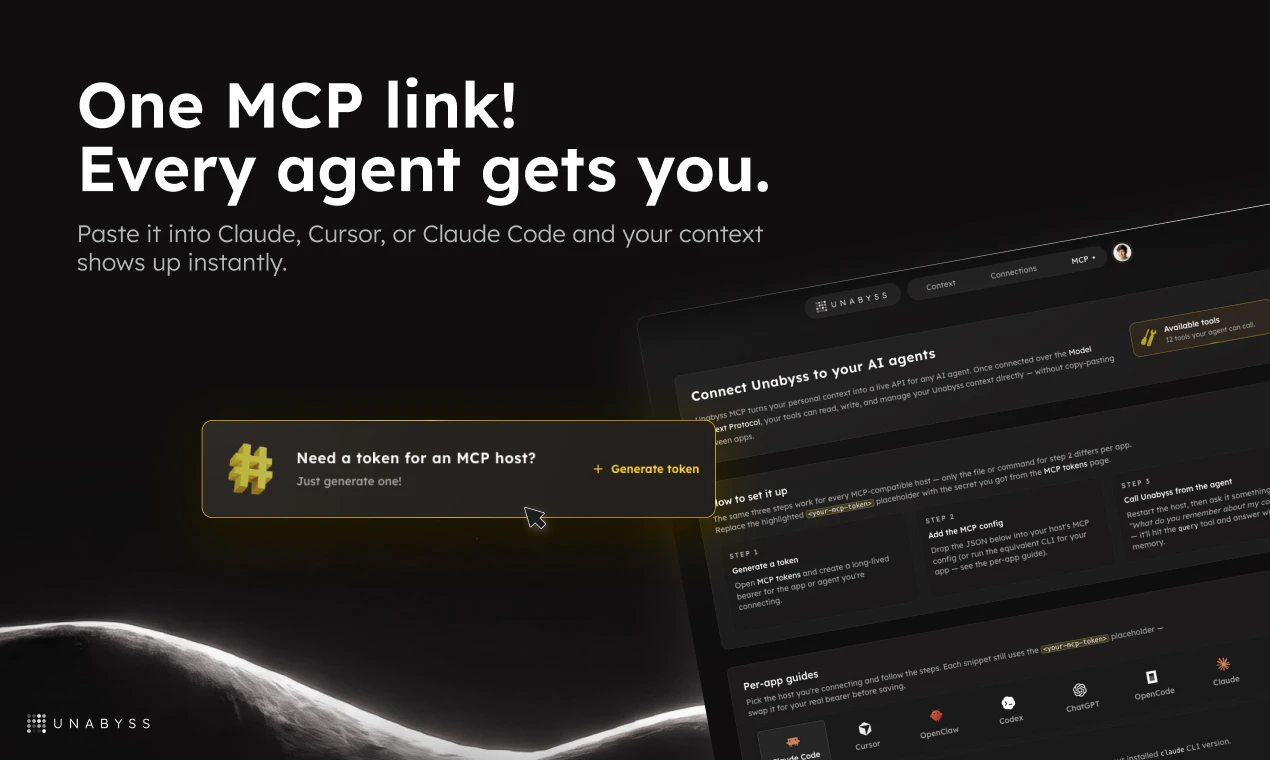
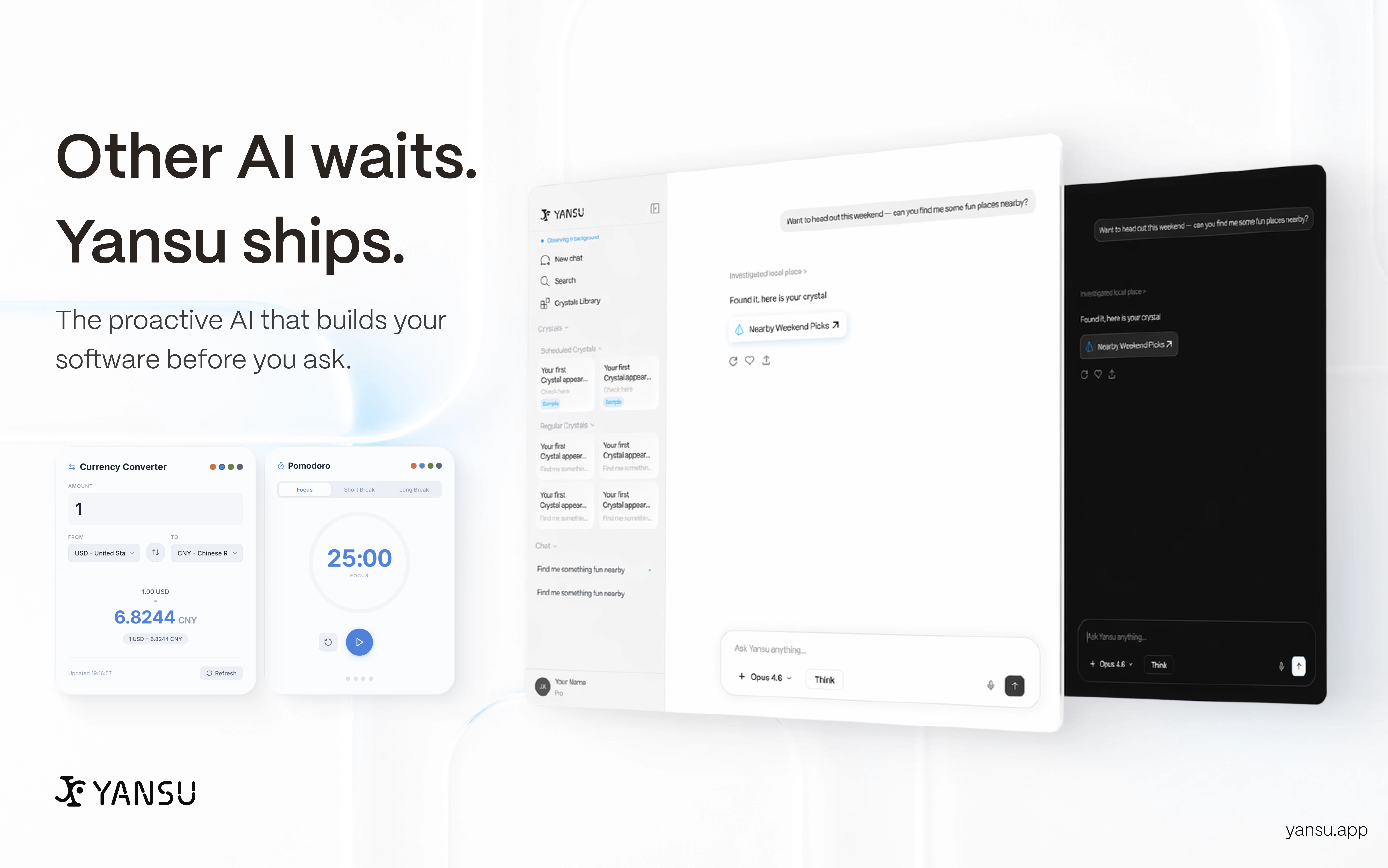
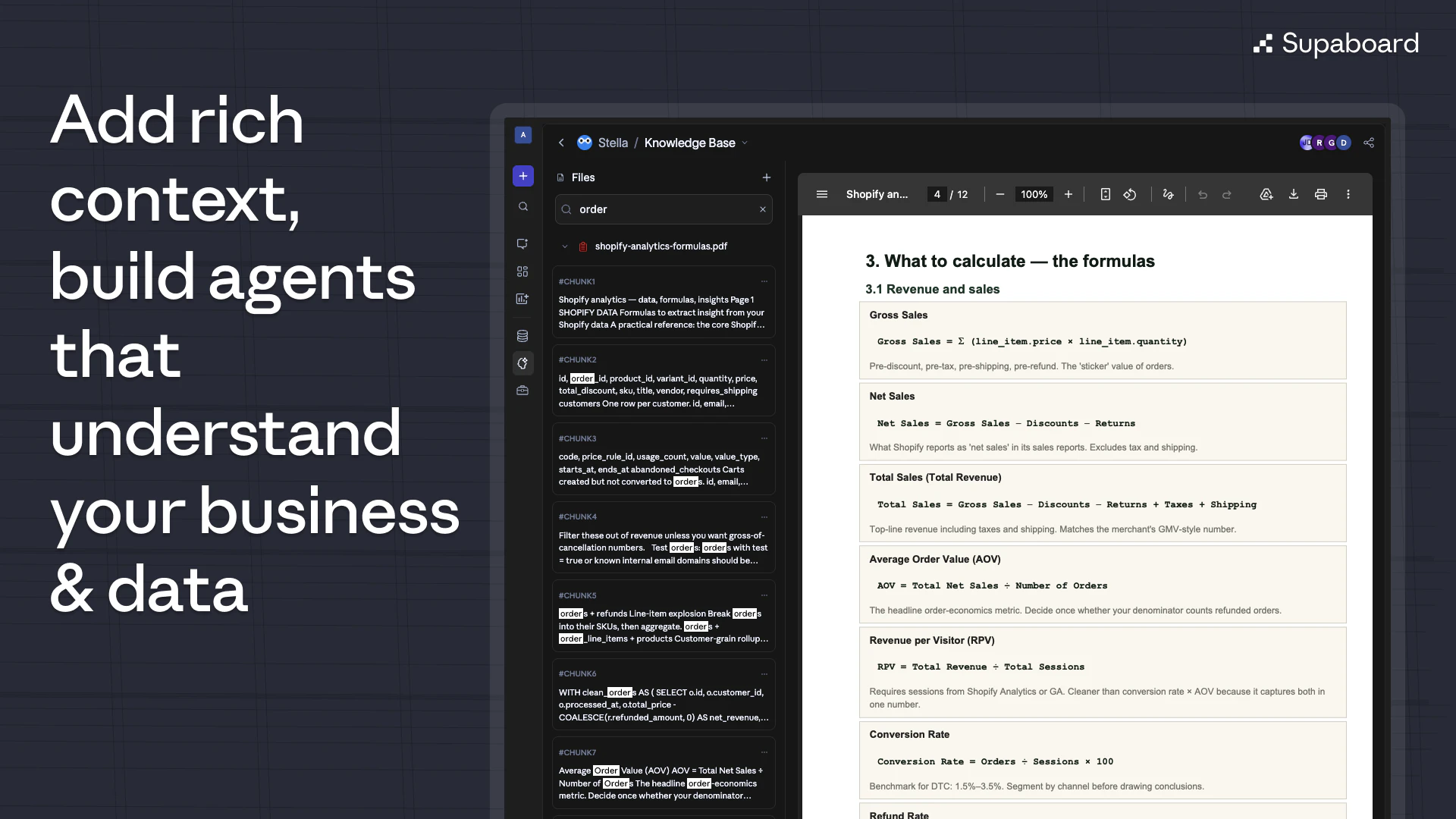
Set it up once and never re-explain yourself to AI again. Connect the apps you use daily - Unabyss will extract, structure, and update your context automatically. Share it with any AI tool via MCP, with granular control over what each tool can see.

Hey PH 👋 Philip here, co-founder of Unabyss.

What is Unabyss? Unabyss is your personal context layer - a single, structured vault of your identity, knowledge, and preferences that any AI app or agent can access instantly, with you in full control of what gets shared and with whom.

The Problem Every AI tool you use starts from zero. You re-explain your role, your goals, your tone, your company - over and over. And when you finally do build up context inside one platform, it's trapped there. ChatGPT memory doesn't follow you to Claude. Claude Projects don't talk to Cursor. The more AI tools you adopt, the worse it gets.

The Solution Unabyss extracts your context once - from LinkedIn, your website, Notion, Gmail, Slack, GitHub, and more - and structures it into clean, layered files (persona.md, voice.md, company.md...). From that point on, every agent and LLM tool you use can pull exactly the right context automatically, via MCP or one-click exports. No re-explaining. No copy-pasting. No context left behind.

What makes it different: your context is user-owned, pre-extracted (not built from interactions over time), and cross-platform - it works with any tool, any LLM, any agent, through a single connection.

Key Features

  • ⚡ Auto-extraction from your existing tools in under 90 seconds

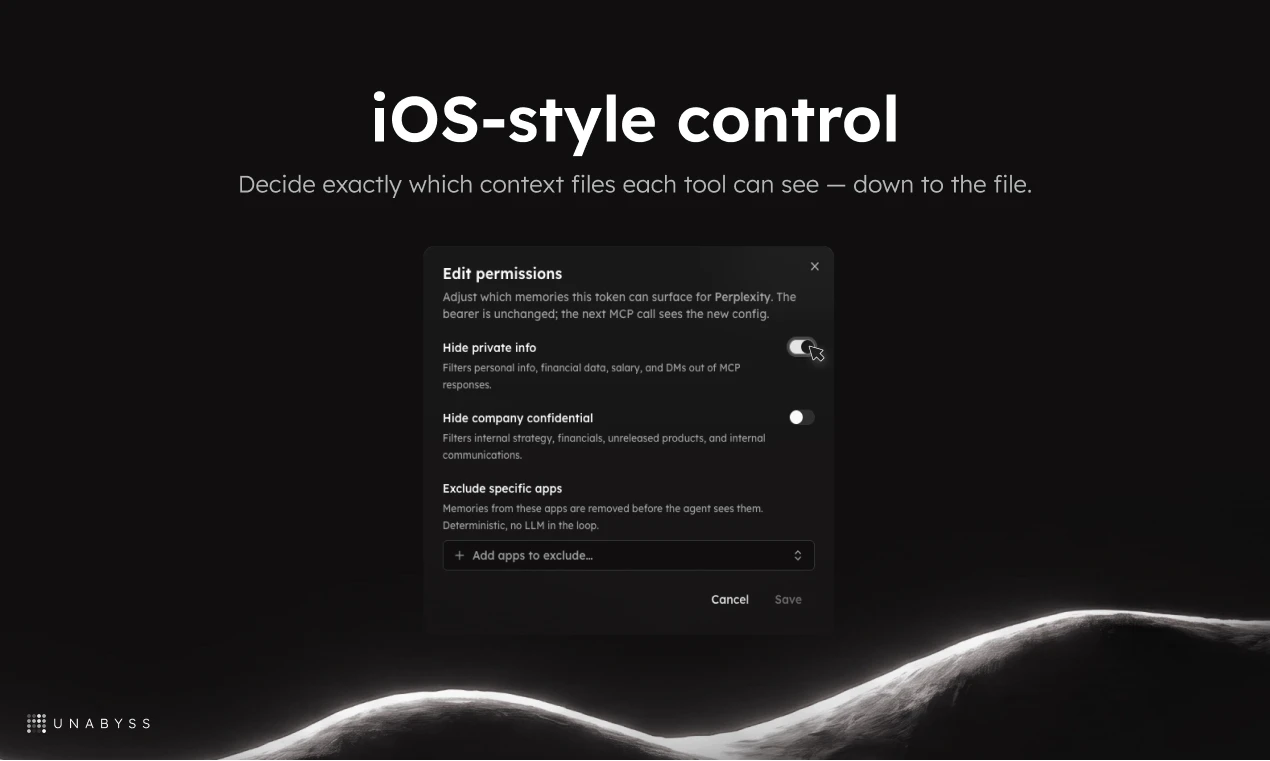
  • 🔒 Granular permissions — share e.g. voice.md without exposing professional.md. iOS-style control, not cookie banners

  • 🔌 MCP server for Claude, Cursor, Claude Code, OpenClaw, and any compatible agent

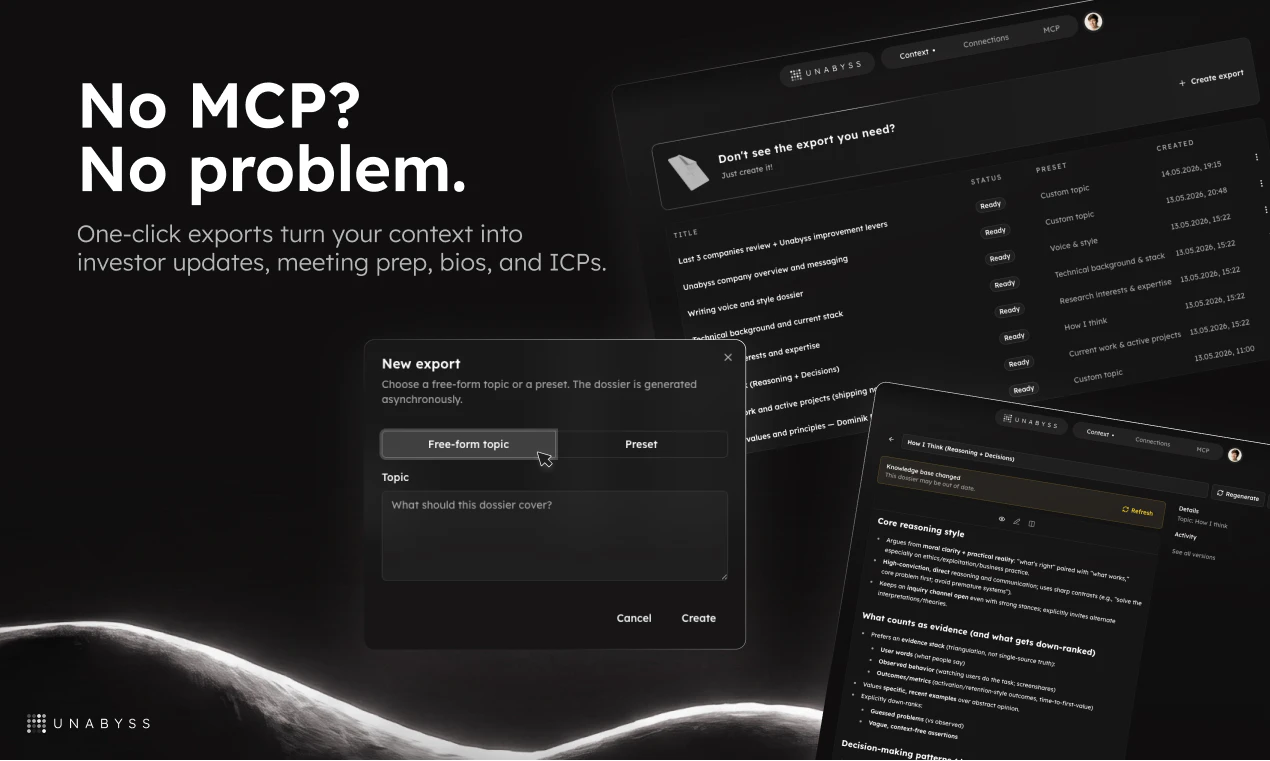
  • 📤 One-click exports - investor updates, meeting prep, ICPs, bios - generated from your context instantly

  • 🔄 Always up to date as your sources sync

Who It's For Founders, operators, and builders who live across multiple AI tools and are tired of starting from zero every time. If you use Claude, Cursor, ChatGPT, or any LLM daily - and you've ever thought "it should already know this" - Unabyss is for you.

What We'd Love From You Try it, connect your first source, and tell us: which integrations should we prioritize next, and where do you need your context the most? We'll be here all day reading every comment — your feedback directly shapes what we build next. 🙏

46
回复

@philip_kubinski Hey Philip, congrats on shipping 👋

The "pre-extracted, user-owned, cross-platform" positioning is sharp, and pulling context out of interactions into clean layered files (persona.md, voice.md) is the right structure most memory tools miss.

One question on the freshness claim. You say context stays "always up to date as your sources sync," but pre-extracted context has the same failure mode as any cache: it drifts. If Unabyss pulled my identity and preferences from LinkedIn and Notion three months ago, and since then I changed roles, repositioned my company, shifted how I talk about what I do, what actually triggers a re-extraction? Source-change detection, a refresh schedule, or me manually telling it "this is stale now"? Asking because the gap between "structured once" and "actually current" is exactly where context layers quietly start lying to the model with confidence.

9
回复

@philip_kubinski This feels useful for people using multiple AI tools because re-explaining your background, goals, and project context gets old really fast.

0
回复

@philip_kubinski congrats on the launch!

5
回复

Really like the idea of context following you across AI tools instead of starting from scratch every time. Feels much closer to how people actually work .

5
回复

@mia_taylor2 thanks!

0
回复
Claude says that it gets confused after a while. How do you keep it together? How do we evaluate that you are connecting the dots correctly?
4
回复

@lakshminath_dondeti the main challenge is to "remember" what's truly important and sift out the rest. And that's what Unabyss is best at. We structure, tag, and keep track of the changes so what's important is always available - no more confusion in your Claude.

2
回复
@dominik_bartosik What drives relevance? User feedback or automated reasoning?
2
回复

How does updating work in practice? If my tone or role changes over time, do I manually refresh it or does Unabyss adjust it automatically from new activity?

4
回复

@marcel_dybalski1 Unabyss will update it for you when something changes, so there’s no need to refresh it manually. It’s works like a self-updating memory :)

2
回复

Looks incredible @philip_kubinski @marcin_uchacz1 - all the best!

3
回复

@marcin_uchacz1  @mayuresh_patole Thanks a lot, Mayuresh! Looking forward to collaborating with you on our B2B app ;)

0
回复

@philip_kubinski  @mayuresh_patole thanks! we're aiming at Chronicle's results, but there's less and less time :D

0
回复

How exactly is the context connected to tools? Is it MCP only?

3
回复

@iamanantgupta currently you can connect your Unabyss context to the agents like Claude, ChatGPT, Cursor, OpenClaw etc. via MCP. But apps like Gmail and Notion, you connected to Unabyss via simple and secure OAuth. I hope this answered your question ;).

3
回复
The approach of pre extracting context into structured, human readable files rather than building it passively from interactions is a genuinely better architecture you own it, you can read it, you can correct it. That's a level of trust passive memory systems will never have. Feels obvious in hindsight but nobody built it right until now. Congrats on the launch! But I have one question like When context conflicts across sources say LinkedIn describes your role differently than your Notion how does Unabyss decide what's canonical, and can users manually override specific fields?
3
回复

thanks@veerhunt_agai! About the scenario: when you sign up, Unabyss will create an identity summary of you and will ask you if there are any conflicts - once set there it will be the base source of truth about you. Down the road, when you use it in agents or in our context chat, if our segmentation engine can't figure something out, it will ask you.

3
回复

Looks lit! very much needed.

3
回复

@nicolas_baranowski Thanks, Nicolas! Hoping you'll enjoy using it ;)

2
回复

Curious how context staleness is handled — if I update a doc in a connected app mid-conversation, does the MCP layer reflect that in real-time or on a sync interval?

2
回复

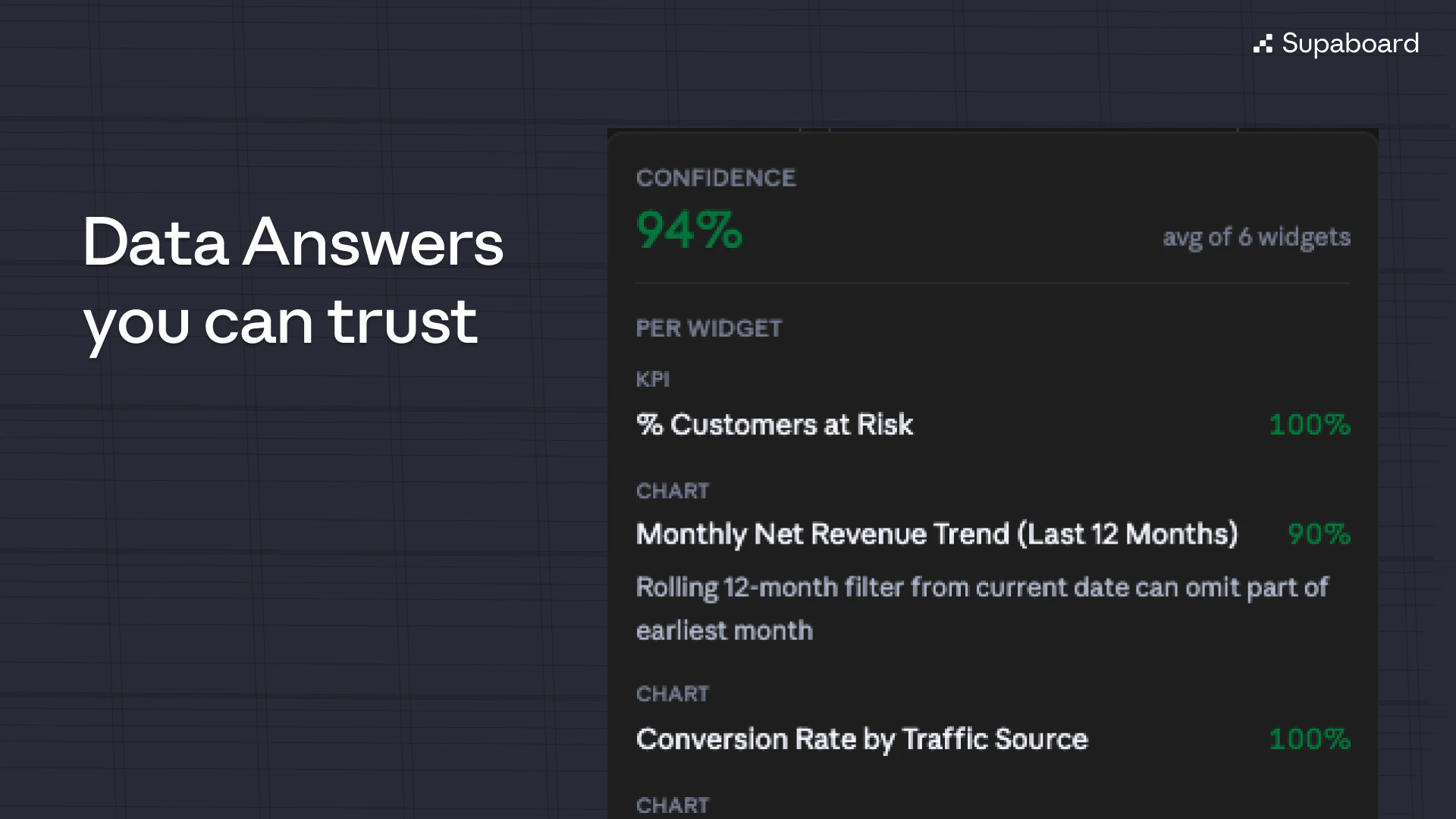
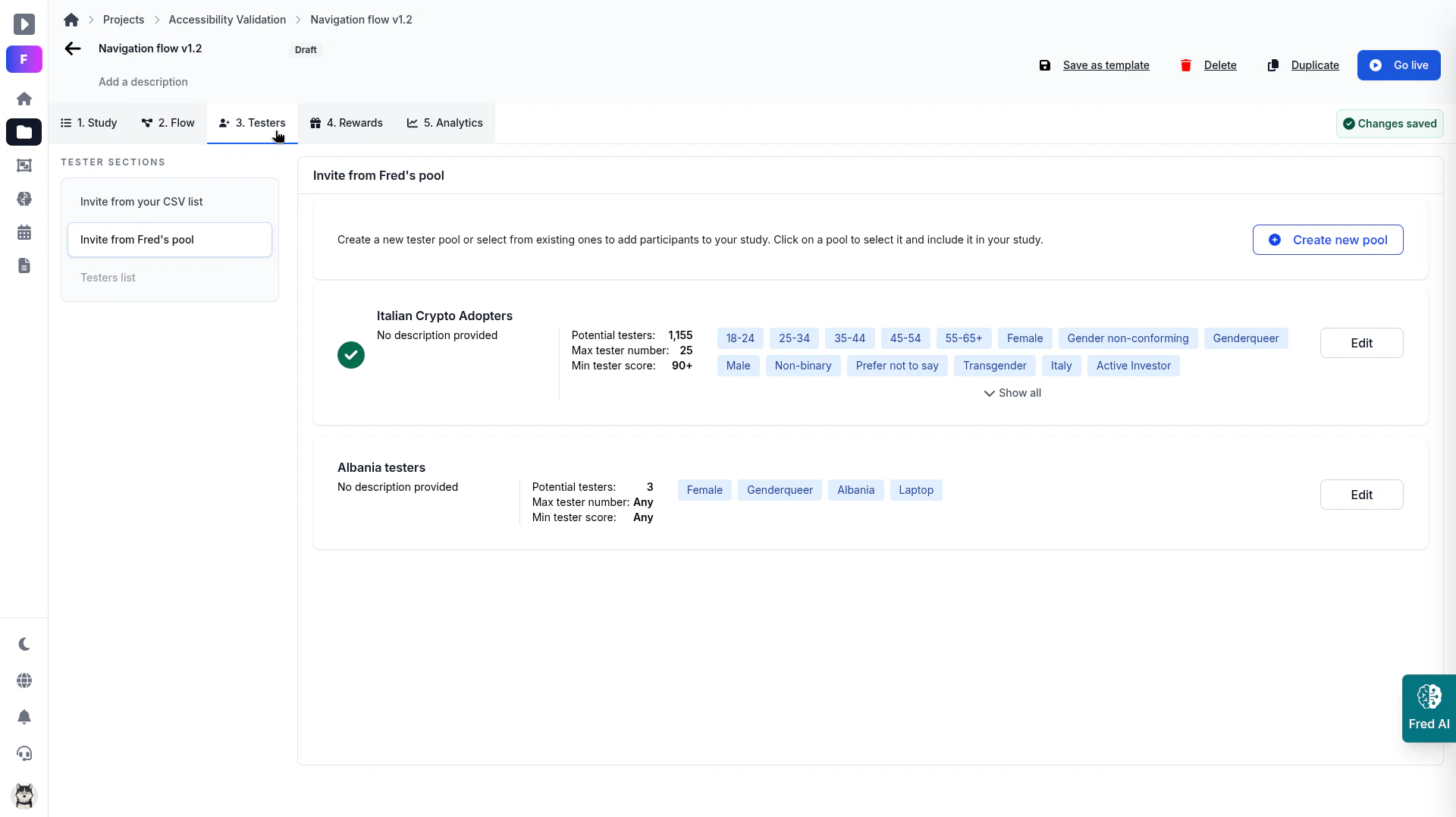
@hirogure great question! you can set up the sync interval for each app connected to Unabyss (see the screenshot).

In the situation you described, context might be missing the update, but after 5min, it'll be imported & added to the vault.

do you see specific use-cases where the real-time sync would be essential?

0
回复

my context was never that organised before, great stuffff

2
回复

@kyzo thanks!

0
回复

@kyzo man, such words from a seasoned coder - it's an honour! 🫡

0
回复

So you mean I don't have to manually feed stuff into my claude's memory? Extremely cool idea. Will be trying over the next days.

These kinds of products are what's making AI feel more and more like actual magic every day, well done folks:)

2
回复

@dawid_baranowski thanks a lot!

0
回复

@dawid_baranowski haha, we feel the frustration - that's how we came up with Unabyss. Sometimes frustration is the best fuel to create something new :)

0
回复

Looks super useful. Will give it a try! Congrats on the launch

2
回复
0
回复

@himanshu_bamoria1 thanks a lot, Himanshu!

0
回复

This sounds helpful, just a quick question about the control part: If I connect to my apps, can I tell Unabyss to only look at specific folders, or does it just scan everything it finds?

2
回复

@creativewjordyn it depends on the app. In Slack, Notion, Calendar, and GitHub, you can choose exactly what to sync. In other apps, we sync all available data, filter it, and segment it.

1
回复
Congrats on the launch! Do you guys offer integration with ios native apps like notes/reminders? Recently created a macro to aggregate my apple notes to feed to my agents; would be great if unabyss could streamline this!
2
回复

@vihaan_pande thanks! At the moment we dont have those integrations but we are working on it ;)

1
回复
@dominik_bartosik is there a manual info ingestion feature where users can input external context?
0
回复

This is a very relevant problem. One question; What happens when these context files become too large over time ? Does Unabyss automatically summarize or compress it?

2
回复

@abhishekr_ai aside from summarizing, as you noted, we also have a versioning system, so old dates don't pollute your context.

1
回复

Congratulations on the launch! I have a question: where does the vault actually live? is it stored locally, on your servers, or encrypted in the cloud? and if I disconnect tomorrow, is my data fully deletable?

2
回复

@aanchal_dahiya vault lives in an encrypted cloud. But if you want to stop using Unabyss, you have a few options to remove the data.
1. You can remove data only from selected app/apps.
2. You can purge all your account data, but keep the account to start fresh.
2. Or you can delete the account permanently.
All options are easily accessible in the Connections and Settings pages.

0
回复

how is this different from connecting your github repo (that has all the context about you)?

2
回复

@toni_olendzki thx for asking! it depends what you mean:

1) repo as a personal wiki (Karpathy’s idea): although we really admire Karpathy's job, in his solution the AI writes and updates markdown notes from stuff you add. Works great for focused research, but not really for multiple data sources that need processing (nor from precision, nor retrieval efficiency perspective) + it takes time and you need to be fairly technical. Lastly, there’s no real permission level for each app / agent.

2) repo as the actual project code: even then, the repo is only part of the picture that LLM should see. A lot of how your team works lives in Slack, Linear, email, Drive, calls, and so on (not only in git)

Unabyss pulls all sources together, keeps them up to date, and enables AI models and agents to use your context safely and efficiently (saving lots of tokens)

1
回复

Such a useful tool! One question though, that is how are you handling conflicting context across sources?
Like for ex, if my linkedIn says one thing, slack conversations imply another and my Notion docs are outdated then how does Unabyss decide what becomes the source of truth??

2
回复

@lak7 we have few solutions for this problem. First one is when you are onboarding, this is the time when your identity summary is created, you can give feedback to it, adjust facts, essentially make it as accurate as possible. Then, in the background, we segment the data and score it based on multiple factors. So next time, if you ask in context chat about something that creates conflict, the agent will ask you to choose what's true and what's not - the same happens when you have connected Unabyss via MCP to your Claude or ChatGPT. Once conflict is resolved, it is saved ;).

2
回复

Setup fallbacks. Be happy. might be the most relatable AI dev tagline this week

2
回复

@nithin_raju1 Fallbacks FTW!

2
回复

Can I have like a "work mode" and a "personal mode" and flip between them depending on which tool I'm using?

2
回复

@chris_zawisza you can do it via permission-level and generate two MCP tokens:
- one enabling only personal context
- the other enabling professional context

We're also working on adding multiple email accounts at the same time - this should be ready and launched still this week.

4
回复

Every few days or every week I start something new with AI, and each time I have to repeat the same things all over again. Since it’s impossible to keep all these AI systems updated regularly, I never really get 100% out of them because I’m never providing the full context. Unabyss sounds like exactly the kind of solution I desperately need! Congratulations, I’ll definitely be following your progress.

2
回复

@mariuszt Thanks, Mario!

That's the sole reason we started that - we got tired of uploading & updating countless md files.

Check out the MCP - it's a real gamechanger if you work with AI daily.

4
回复

Will it support my open claw ? Also I use 3 subscription of claude for different purposes. Is it possible to select what is bbeing shared via unabys?

2
回复

Hi @greenparrotnow! All the agents you mentioned can pull your context via MCP - claude and openclaw. And even if you have multi-accounts. Also, both of them work especially well with Unabyss when you add an optional system prompt. Look in our guide: https://app.unabyss.com/mcp/guides.

2
回复

This sounds great and I was actually waiting for something like this. My main question: is there a way to handle projects or specific topics separated? For instance when working on several codebases / products. My issues is always the amount of information I need to manage across projects while keeping an overview. Currently it feels like one huge mixed salad.

1
回复

@arkadiy_kreslov1 Yes, you can do it in many ways. One is to generate separate exports that will have all the defining info about each project, then you can use them as is (they will update along the way) or use them as a starting point for agents to retrieve more details connected to the project. But that's a more manual way to do it.
By design, Unabyss segments data into different "buckets," so new information about a certain project will be automatically connected to it. You just need to ask about it ;)

0
回复

For everyone that didn't try the Unabyss MCP - it's super easy - one click connect!

1
回复

@dominik_bartosik YES, it's that easy!

1
回复

Is there a risk that the Unabyss fills the gaps in my context with fabricated information? I mean - hallucination?

1
回复

@adam_janczewski1 we have guardrails to prevent that, even 3 to be precise :D. But, as with any LLM tool, we can't say it's 100% preventable. We are constantly improving it, so it will be even better each time you use it.

1
回复

Congratulations on the launch! This is a great product and much needed.

One question I had: I have setup memory.md files in Claude which is basically a memory of the interactions I have had with Claude for it to remember the context of the project. Can Unabyss understand from those files about "how" the engineer usually proceeds with a problem?

1
回复

@aiswarya_s great question!

Yes, you can import these files to Unabyss and they will become a natural part of your context. Plus, from the moment you connect with MCP, Unabyss will know your conversations, which will help it improve - compounding effect at its best :)

What else can I share to help? :)

1
回复

when linkedin says one thing and notion says another, who wins? the conflict resolution between sources is where this gets tricky and most context tools just pick the latest update which isn't always right

1
回复

@tina_chhabra we have a few soultuons for that. One starts when you onboard. Unabyss creates an identity summary that you can tweak or add to it. This is a baseline of who you are. Then, whenever a new date comes up and differs from what we already have, the agent will ask you to decide what's true and what's not.

1
回复

@marcin_uchacz1 Congratulations. And happy product launch.

1
回复

@huisong_li thanks! I’ll reach out so we can chat about graphs and memory - I think it’ll be really interesting to swap notes!

0
回复

Great idea - not my use case yet as I use only one AI tool and also have very well written personal/projects skills - but definitely will revisit this when I hit some issues with remembering me as person by AI in multpile AI tools!

1
回复

@wojciech_sado you can take advantage of the Unabyss now. I would even say that your case is perfect. Your skills can be enriched with data from Gmail, Notion, or Obsidian, so they don't stay static as the input structure changes. Another use case is to run an agent to create new skills based on your carefully crafted ones for new input types.

0
回复

I had this exact problem of wiring different context sources 3 times this month only. Well done and congrats on #1 today!

1
回复

@adam_zaczek1 thanks, and sign up for Unabyss so you won't have this problem anymore ;).

0
回复
#2
own.page
Make your own personal website with bento tiles
484
一句话介绍:own.page 让创作者和创始人无需代码,能在1分钟内搭建出比传统“链接聚合页”更具视觉表现力和生命力的个人网站,解决社交媒体简介过于局限、现有工具过于模板化和缺乏个性化表达的痛点。
Social Network Social Media Website Builder
个人网站 链接聚合页 拖拽式建站 无代码 创作者工具 个人品牌 网红营销 数据分析 落地页 Bento风格
用户评论摘要:用户普遍赞赏设计美观和易用性。主要问题:有用户询问与Carrd、Notion、Linktree等工具的核心差异;以及是否支持动态数据拉取(如自动更新最新博文或社交内容)。创始人回应称动态更新已在路线图中。
AI 锐评

own.page在Product Hunt上获得484票,评论热情看似不错,但深挖来看,这款产品本质上依然是“C端版本的Carrd+Linktree缝合怪”,并未跳脱出Bento风格页面生成器的框架。其核心卖点“比链接聚合页更像个人网站”更像是一种营销话术,而非技术壁垒。

从用户反馈看,大家夸的都是“好看”、“易用”,这恰恰是此类工具的准入门槛,而非护城河。当Carrd、Notion、Super等工具都能用更低的成本或更高的自由度实现类似效果时,own.page的差异化究竟在哪?创始人强调的“动态数据拉取”仍在路线图上,这意味着当前产品只是一个精美的静态展示页面,对于需要“活”的内容(如最新博文、社媒缓存)的创作者来说价值有限。

真正值得关注的是创始人透露的长期愿景——社区和受众增长,但这恰好是虎口夺食。从“花钱做页面”到“用页面赚钱”,中间隔着用户增长、内容分发、社交网络效应等庞杂的难题,而own.page目前只解决了第一步“展示”。其“Freemium”模式靠收20%折扣的Pro年费,商业模式极为依赖付费转化率。在AI建站和超级App不断吞噬入口的今天,这种轻量化工具极易被巨头复制或降价挤压。

一句话总结:一个合格的精美PPT,但距离一个有生命力的“数字家园”,还差一个时代的距离。除非能快速补齐动态生态和社交裂变能力,否则大概率会淹没在Link-in-Bio工具的红海中。

查看原始信息
own.page
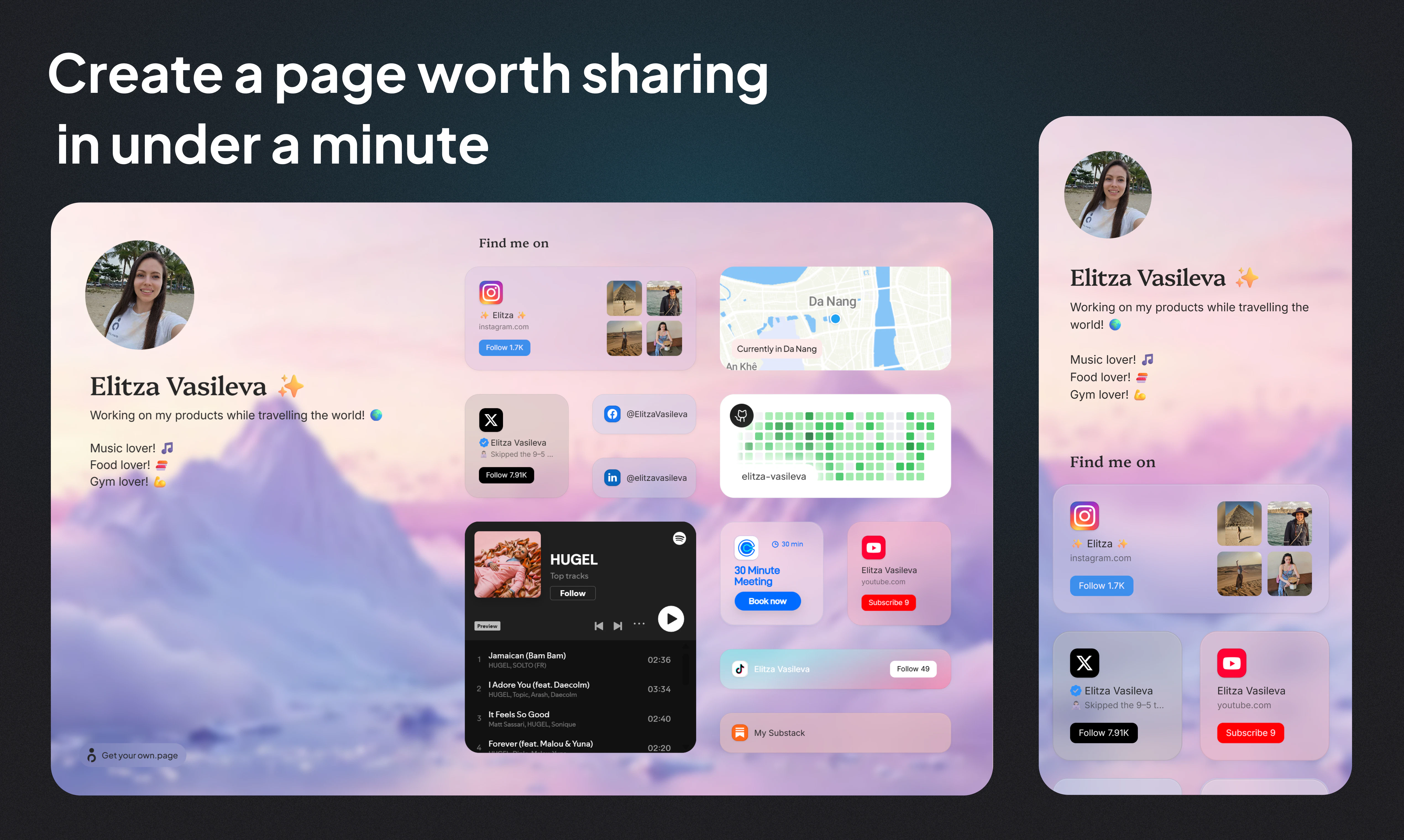
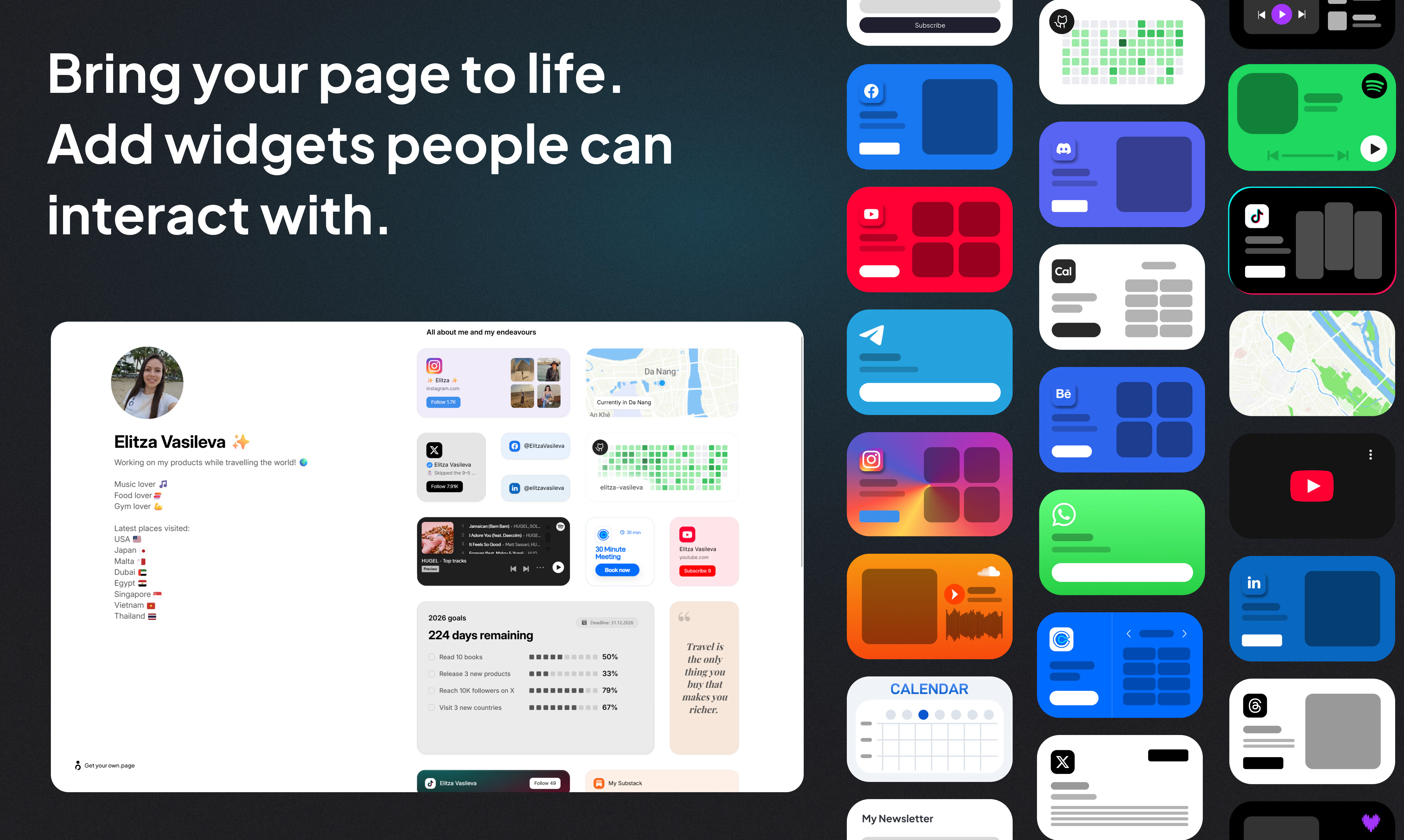
own.page helps creators and founders build a beautiful link-in-bio that feels alive - more like a personal website than just a list of links. Build a page in under a minute, customize it your way, add powerful widgets and integrations, understand your visitors, and grow your audience from one place.

Hey Product Hunt 👋

I’m Elitza, founder and CEO of own.page. Today I’m super excited to finally launch own.page - a beautiful link-in-bio that feels more like a personal website than just a list of links.

I started working on own.page together with my university friend and co-founder @dominik_scholz because we felt that social media profiles are too restrictive, and most link-in-bio tools feel too generic. They help you share links, but they don’t really help you express who you are, what you do, and what you are working on.

Since then, the project has evolved a lot, with already more than 6,000 creators using own.page to build their online presence. Today, I’m continuing to build and grow own.page on my own.

I wanted to create something more flexible, more visual, and more alive - a place where creators, founders, freelancers, and small businesses can build an online presence that actually feels like them.

💡The idea

own.page helps you showcase everything you are: your work, projects, services, content, socials, products, affiliate links, and anything else that belongs to your digital online presence.

You can create a beautiful page in under a minute, or spend more time customizing it into something unique and personal. The goal is simple: give you a page that looks good, feels like you, and gives you the tools you need to grow.

✨ What you can do with own.page

🧱 Drag, drop, resize, and arrange your content freely

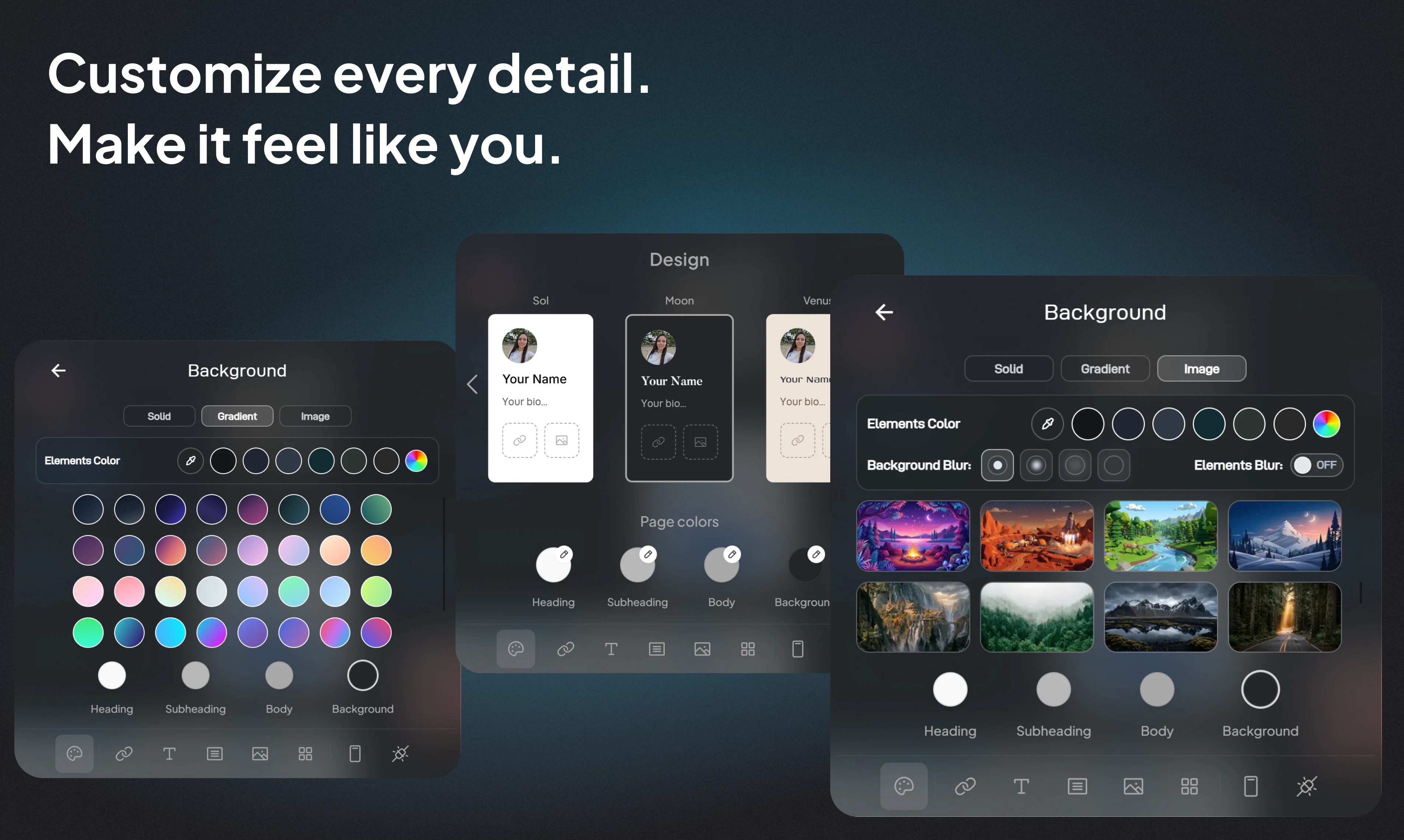
🎨 Customize your page with themes, gradients, images, colors, layouts, and custom backgrounds

🔗 Share links, socials, projects, services, products, content, newsletters, and anything else you like

🧩 Add powerful widgets and integrations like YouTube, Spotify, GitHub, Calendly, newsletter form, and many more

📄 Create multiple pages for everything you are - work, hobbies, projects, travel, services, or anything else

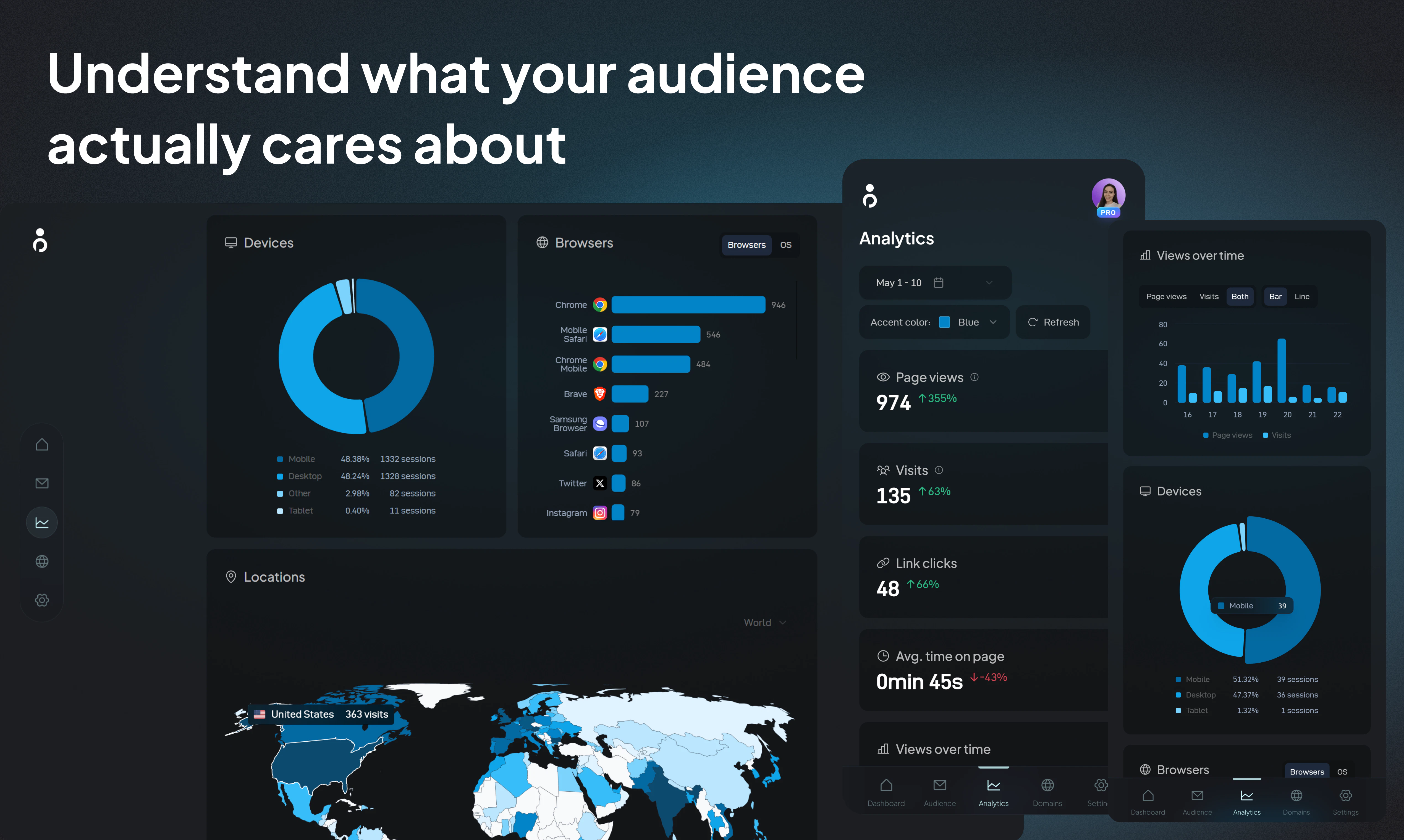
📊 Understand your visitors with analytics for visits, link clicks, and performance

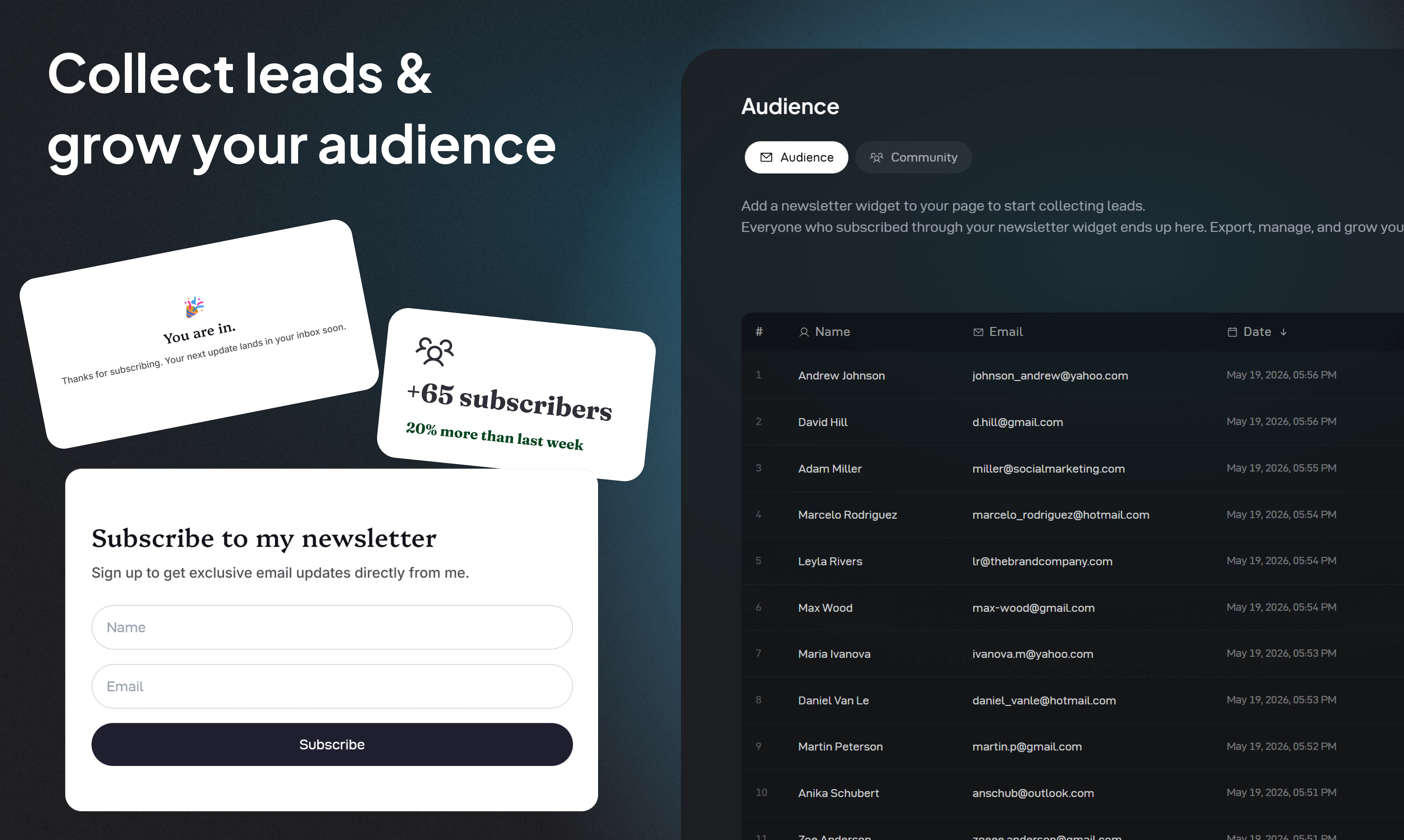
💌 Collect emails and grow your audience directly from one place

🌐 Add your custom domain and make your page feel like your brand

🌍 Publish everything in one click - no code, hosting setup, or complicated website process needed

🚀 Why I’m building this long-term

I’ve already invested a lot of time, energy, and care into own.page, and I genuinely believe in the problem I’m solving.

This is not just a quick side project for me - I want to build own.page into a sustainable platform that keeps improving over time and becomes the best place for creators to represent themselves.

That’s also why own.page has a freemium model. The free version makes it easy to get started, and the paid plans help me cover the costs, keep building, supporting users, and adding the features I believe creators and founders need.

🔮 What’s next

I don’t want own.page to become just another link-in-bio tool. My bigger vision is to build a platform and community that helps people not only showcase their work, projects, and personality, but also grow their audience, understand what works, and connect more deeply with the people who care about what they do.

The next direction for own.page will focus strongly on community, growth, audience-building, discovery, and better tools for creators and founders to turn their online presence into something more valuable.

I’m just getting started, and I’d love your feedback, ideas, and support today.

🎁Product Hunt launch offer: Use code PRODUCTHUNT20 to get 20% off own.page Pro for your first year. Valid for 1 week after launch.

Thanks so much for checking it out 💜

26
回复

@dominik_scholz  @elitza_vasileva Great launch! Love the design of the product and how easy the onboarding is. I just created a website and see myself using the product for my personal websites. Link in bios are too limiting! Love the direction, and wish you all the luck!

0
回复

@dominik_scholz  @elitza_vasileva Great work guys! It looks wonderful.

4
回复
@elitza_vasileva This looks super clean 👀 Way better than the usual boring.... Nice work... 😊
1
回复

Excited to hunt own.page today.

@own.page helps creators, founders, freelancers, and makers build a beautiful personal page for everything they are: work, projects, services, content, socials, products, affiliate links, newsletters, and more.

Instead of being just another link-in-bio tool, own.page gives you a flexible space to shape your online presence. You can create a clean page in under a minute, or customize it deeply with layouts, themes, gradients, images, widgets, integrations, analytics, email collection, and a custom domain.

What stands out here:
• Drag, drop, resize, and arrange your content freely
• Add links, projects, services, products, and social profiles
• Use widgets like YouTube, Spotify, GitHub, Calendly, and newsletters
• Track visits, clicks, and performance from one place

If you want a personal page that feels more like a real digital home than a simple list of links, own.page is definitely worth checking out.

14
回复

@byalexai Thank you for your support, Alex! And for hunting own.page for me!

3
回复

@byalexai this looks pretty usefull for non-tech starters, good luck with the launch

0
回复

Congratulations @byalexai, and @elitza_vasileva on the launch. the product looks great and will check it out soon

0
回复

It's so beautiful!!!

4
回复

@marclou Thank you so much, Marc! 🙏🤩

1
回复

Wow, been following you for a while and you folks really made progress! Congrats! I love how the strength of your platform lies in the integration of other social platforms - like displaying the github activity as a widget. awesome! that says so much more about who i am than a generic text and links.

3
回复

@maristos Thank you so much for the support Marian! Yes, that's exactly the goal - to be able to share much more than just generic links and really express yourself and the projects/work you are doing!

2
回复

Congrats with the launch!

Design of the app and generated pages is just amazing, it feels so much better vs all of the competitors. After Bento's shut down, it's so cool to see own page to appear as a better alternative.

3
回复

@andrew_zacker Thank you, Andrew! Yes, the goal was to make the design but also the resulting pages look as good a possible!

2
回复

I like how it is stylish!

2
回复

@busmark_w_nika Thank you Nika, being said from you means a lot!

0
回复

Congrats on the launch! Really cool!

2
回复

@illyism Thank you so much, Ilias!

0
回复

Hey Elitza! It's amazing. Super simple but even more useful. Love this kind of solutions and wish you all the best

2
回复

@german_merlo1 Thank you so much, Germán! That's exactly what I was trying to achieve with own.page!

3
回复
@byalexai Great launch! Question: what differentiates own.page from Carrd + Notion + Linktree combined? Are you targeting creators who want to centralize everything without touching the code, or founders who want an ultra-fast page to ship?
2
回复

@byalexai  @olivier_jury Thank you so much!

Great question. The main difference is that own.page is not just a link-in-bio tool or a simple static landing page. We’re building it as a simple, no-code way to create a more personal and interactive online presence - with links, content, widgets, media, themes, analytics, and eventually more community/social features in one place.

Our first target group is creators who want to centralize everything without touching code, but it also works well for founders, indie hackers, freelancers, and small projects that need a fast, beautiful page without setup or technical overhead.

2
回复

Love the design and how customisable it is, that's ideal for creative people!

"more like a personal website" that's clever, it's not just about stacking links, it's about showing your personality, what you like etc

I need to create my page, so I can share all the different things I do ; cooking, music, apps etc!

Congrats on the launch!!

2
回复

@vynsedev Thanks a lot, Vincent! I am happy you like it and yes this is exactly the goal to have the feel of more like a personal website rather than just a collection of links!

I am looking forward to seeing all your different pages!

2
回复

love the look and feel of the product, very well done

2
回复

@thibaultll Thanks a lot, Tibo! Means a lot to me!

2
回复

Such a great product! Very easy to use, I got my own page in under 10 minutes, adding all my links and widgets.

I can only recommend to any one who wants a quick page without the hassle of creating it by yourself.

2
回复

@vivien_mahe Thanks a lot, Vivien! I am happy to hear you got such a great experience and could craft a page for your projects and links!

1
回复

Do you support dynamic sections like latest posts or newsletters pulling in automatically?

2
回复

@othman_katim Hey Othman, thanks for the question!

At the moment, when you paste a social media link, we fetch the latest post and follower count from that platform in real time. However, the data is not fully dynamic yet, meaning it does not automatically keep updating after the link has been added.

This is already on our backlog and will be implemented soon - at least for sure for all Pro users and maybe in the free tier just in longer intervals

2
回复

Very slick design, I must say
Congrats with the launch! 🎉

2
回复

@eugzolotarenko Thank you so much! Yes, I have put a lot of effort into the UI/UX design!

2
回复

my favourite bio page for my socials!

1
回复

@eliana_jordan I am happy to heart that, Eliana!

0
回复

Hey, Congrats with the launch!
Do you plan to add more community/discovery features?

1
回复

@asti_pili Thank you so much, Asti!

Yes, we already have an Explore page on the landing page, where some of the best pages are featured. In the future, the goal is to add more in-app features that support discovery and communication between users directly within the platform - such as following others or getting notified when a page is updated.

0
回复

Love the concept of moving away from boring link-lists to interactive personal websites. As a developer, I always want to tweak things. How extensible are your widgets? Can we embed custom HTML/JS/CSS blocks or API webhooks into a tile, or are we strictly locked into your pre-built ecosystem?

1
回复

@nurik_shurik Love this question - especially coming from a developer.

I actually haven’t talked about this much yet, but our widget/tile system is partly built as a separate open-source subproject called own.tiles. You can check it out at tiles.own.page.

The idea is that developers can create their own widgets and embed them on any website, not only on own.page. And if a widget is useful and polished enough, we’d be open to including it directly in own.page as part of the available tile ecosystem.

For now, that’s the main customization/extensibility path we offer. We don’t currently support arbitrary custom HTML/JS/CSS blocks or API webhooks inside own.page tiles directly, mainly because we want to keep pages safe, stable, and easy to use.

But I really believe community-built widgets are the right direction, so this is definitely something I want to put more focus on - both by improving the developer experience around own.tiles and by spreading the word more actively.

1
回复

You guys rock, I enjoyed own.page since day 1 and love all the progress over the years.

1
回复

@pmig Thanks for your support, Philip!

1
回复

I like this https://own.page/moisestrejo

Unsolicited advice: add templates for list elements, add a list of json objects with .name and .description and .url and render that

1
回复

@moisestrejo Thank you! That’s a great idea - especially for reusable lists like links, resources, projects, or recommendations. I’ll add this to our backlog.

1
回复

Solid work! The fetch-on-paste choice for social data caught my eye. Was that a cost call? Did the platforms (Twitter's API tier nonsense in particular) push you that way?

1
回复

@artstavenka1 Hey, thank you so much - and great question!

Yes, getting data from social platforms is quite tricky. Each fetch has a cost, and while it’s not very high individually, it can become expensive as the number of users and links grows. That’s why, for now, we only fetch the data when a link is pasted.

The goal is to automate this in the future and re-fetch the latest data, like follower counts, profile pictures, and videos, at regular intervals - for example, once a week or every few days.

2
回复

I love that this leans into the grid/bento box layout instead of just a straight line of links. It gives a quick snapshot of active projects instantly. Grabbing my domain username right now before someone else claims it.. great work Elitza

1
回复

@priya_kushwaha1 Thanks a lot Priya! That's exactly the idea of own.page and yes go grab that username!

2
回复

I like that own.page keeps setup simple, because most people will only maintain this long term if updating it is painless.

1
回复

@zact Thank you so much, yes I wanted to make not only the creation seamless, but also the whole updating and maintaining process, becuase this is usually the biggest problem with websites and link in bio tools.

2
回复

awesome product, love the resizable widgets! 🙌

1
回复

@tonnoz Thank you, Tonino! I am happy you like it

1
回复

Bento-style personal sites still have huge demand. Clean execution matters more than complexity here.

1
回复

@nithin_raju1 That's so true! This market is huge and the demand is still very high, but what was lacking for me is exactly the beautiful design combined with the easy of use for a page that looks more than just a collection of links!

2
回复

Very cool product! Congrats on launching, all the best for the day and see you on X 🔥

1
回复

@plbompard Thank you so much! Appreciate it and see you on X yes!

1
回复

Congrats on the launch Elitza! Love the design and the overall product experience.

Love the customization and focus on widgets!!

1
回复

@jondeparra Thanks, Jonathan! Being said from a great designer like yourself means a lot!

1
回复

How does the analytics side work — are visitor insights session-based or do you track returning visitors over time to show audience growth trends?

0
回复

The bento-tile layout fits people whose "work" is scattered across a lot of surfaces — products, writing, video, courses. I ended up hand-building a portfolio hub for exactly that reason, so I see the appeal. One question: how well does it hold up with a dozen-plus links before it starts feeling cluttered? (Disclosure: I built my own portfolio site, asadov-stack.netlify.app, so I'm comparing against my own DIY version.)

0
回复
#3
Yansu
AI that learns how you work and turns it into software
304
一句话介绍:Yansu是一款通过持续观察用户屏幕和工作流来学习个人工作模式,并自动生成定制化软件和自动化流程的AI工具,解决了用户需要手动描述和配置自动化任务的痛点。
Productivity Artificial Intelligence Maker Tools
AI自动化 屏幕监控 工作流学习 低代码工具 智能体 办公效率 个人化软件 隐私保护 本地处理
用户评论摘要:用户核心关注隐私、意图推断的准确性及误操作的纠错机制。开发团队强调本地处理与PII脱敏,但学者提出“Hand-Off”若执行错误如何发现与回退问题。另有用户询问区分临时与永久行为变化的能力,以及面对API变更的适应性。
AI 锐评

Yansu试图回答一个根本问题:软件应适应人,还是人去适应软件?其“被动观察-主动生成”的理念极具颠覆性,直指当前自动化工具“上手即静态”的根病。技术上“搭模型理解意图”的路线远超简单的宏录制,野心可见一斑。但“预定义正确”的坑里,跳过手动配置就意味着把信任全押给了黑盒推断。用户评论中关于“误操作发现与回滚”的尖锐提问戳中了软肋——当前回复“我们会在执行前询问”本质上是将决策权推回给用户,违背了“主动为主”的设定,这是理念与实践的割裂。隐私作为护城河也非坦途:本地脱敏虽好,但从截图推断商业机密、非公开合同等敏感信息的边界何在?尽管技术宣传漂亮,但产品从“玩具”到“严肃生产力工具”还差一个决定性的闭环:一套用户能轻松编辑、回溯、审核AI生成的“工作流释义”,让透明度和可解释性成为新的信任基石。Yansu如果只停留在“自动生成”,不做成“可理解、可修正的共创伙伴”,大概率会沦为下一个“看似性感,实则鸡肋”的自动化demo。

查看原始信息
Yansu
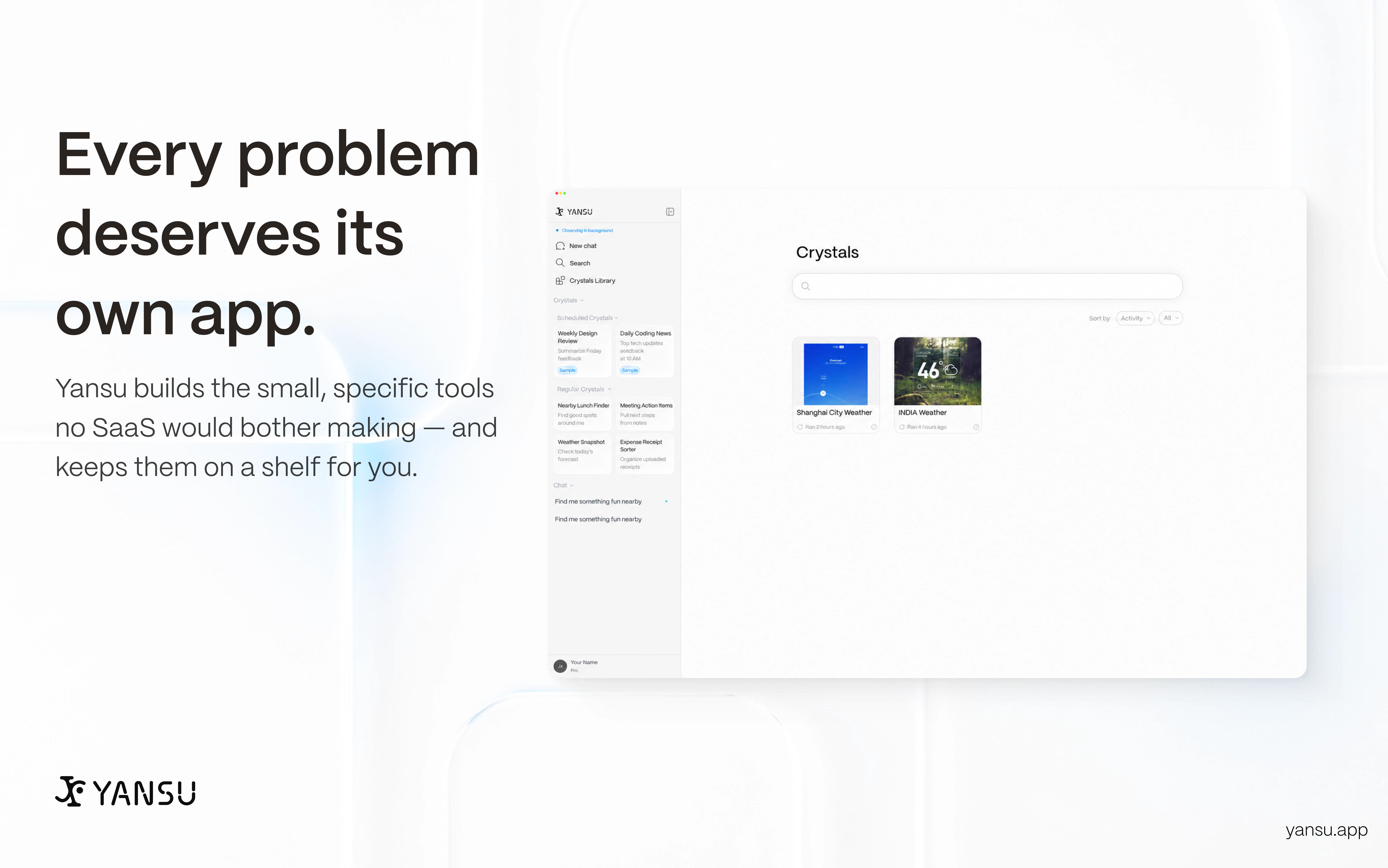
Yanshu learns from the work you already do. It spots repeated tasks across files, messages, and workflows, then turns the best patterns into apps and automations. No process mapping or blank canvas—just the routines worth systemizing. Use it to automate recurring work, build lightweight internal tools, and speed up daily ops without writing code.

Hi everyone. This is Bo. One of the builder of Yansu.

We set out a vision of bespoke software at scale. All of the software in the future will tailored to your exact needs and drifting with you as you change and grow.

However, we see two challenges. First, not everyone has the time, energy or intention to build for themselves. Second, for those building they have to tinkering with it a lot to build the right thing and continue managing it.

We solve this with two new ideas:

  • Switching the relationship between software and human/user. Software is the proactive actor and human/user is the reactive one. Software is proactively and automatically created for you. You don’t have to wage any energy on it.

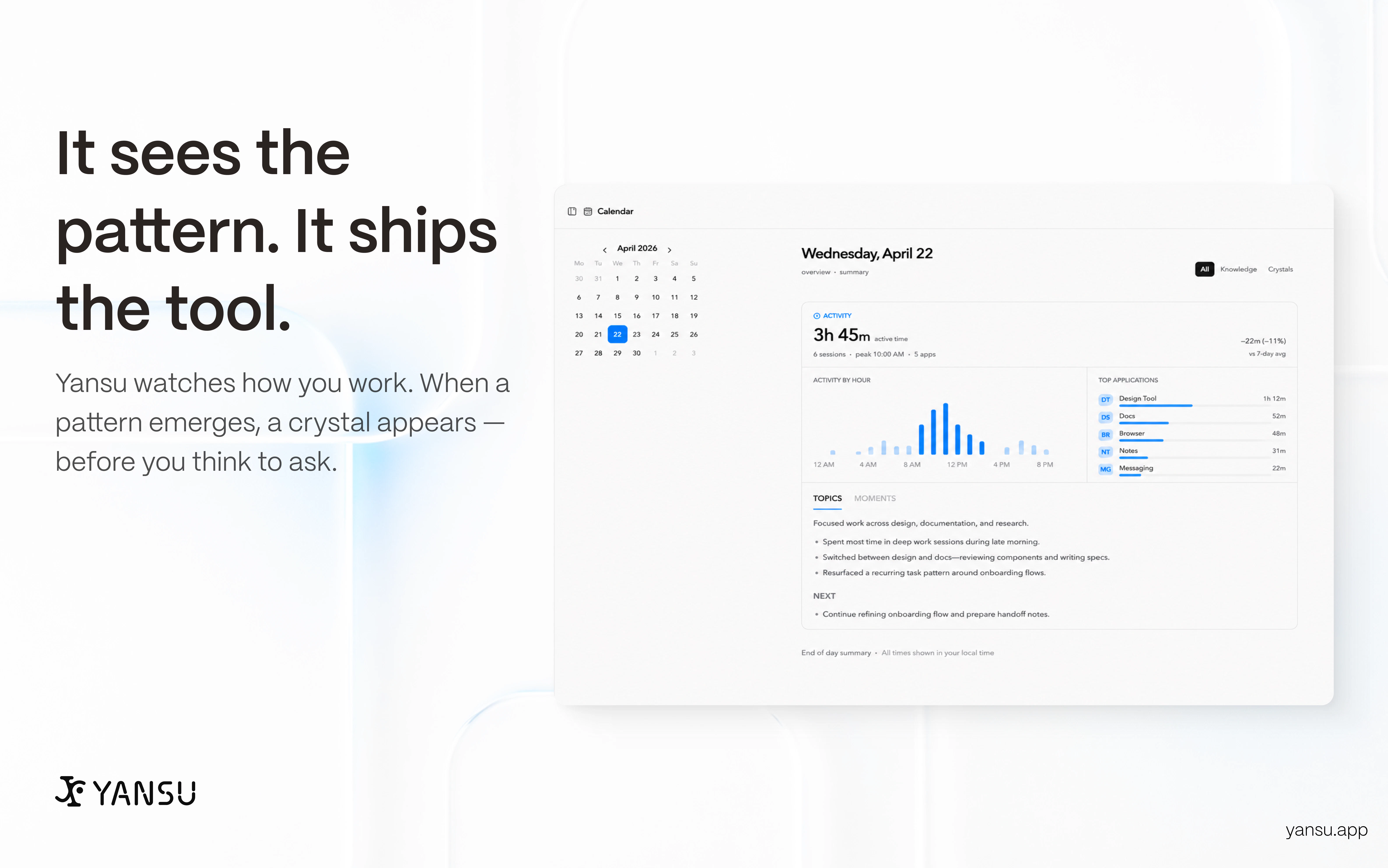
  • Observe your screens and summarize and understand your intentions without you explicitly telling the AI. This solves the drift and tinkering problem.

When these two ideas comes together, you have an app that is:

  • Continuously understand, build and refine knowledge about you and the entities that relate to you.

  • From observation and understanding it proactively builds the right app for your exact needs:

    1. Take over your current task and automatically complete it via Hand-Off

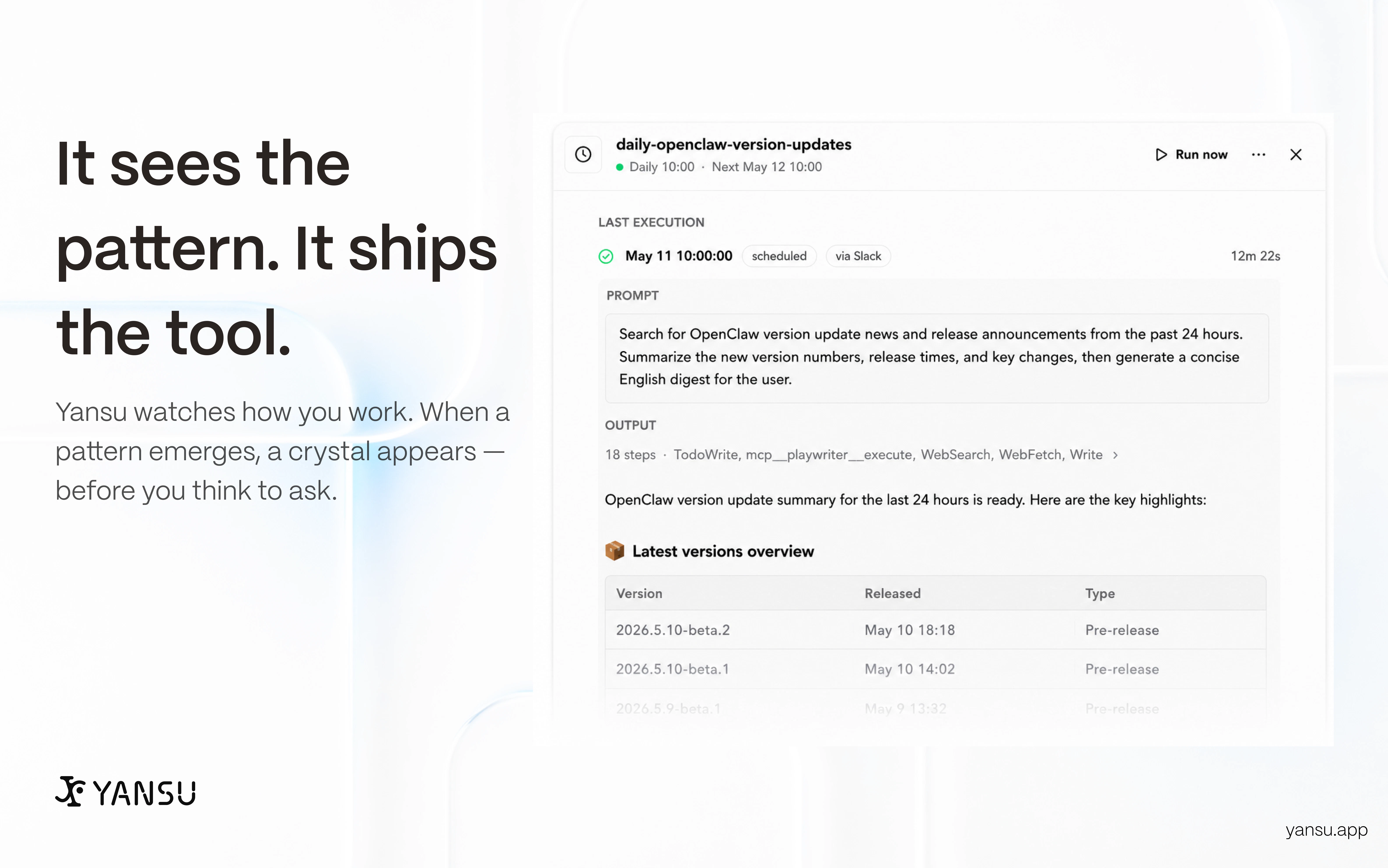
    2. Understand your daily patterns and generate scheduled automations.

    3. Understand your unique challenges and options and create bespoke desktop apps just for you.

We believe these capabilities not just right one for future and also extremely powerful today. Hand-off feature has many WOW moments for me and I am still blowing away by it.

Give it a try and let us what do you think. We are here to answer questions and discuss about roadmap and the thinking behind it.

Have fun!

Bo


PS. Since many asked about privacy. I want to share how we think about it.
Trust and Privacy is the most important element for us. It is the value we do not trade off.
How does it reflect in the app:
1. All information are stored locally
2. All OCR/audio are processed locally
3. We proactively remove ANY PII information
4. Users have full control of what app can be observed
5. Users have quick action can stop it anytime

12
回复

Great, a real AI assistant that helps users solve problems.

0
回复

@bozhao Three people already asked about the privacy side, so I'll poke at the opposite end: the Hand-Off.

Observing my screen and inferring intent is the impressive part, but inference is probabilistic. Some slice of hand-offs will confidently complete the wrong task. So when Yansu takes over and gets it wrong, how do I find out? Reviewable diff before it commits, an undo, or it just executes and I notice later when something's off?

"It did it for you" and "it did the thing you actually meant" are different promises. Curious which one Hand-Off is making today, and where you want it to land.

Bo, the drift-with-you idea is the genuinely novel bit here. Most automation tools are static the day you set them up.

2
回复
Congratulations on the launch! Really curious how do you handle privacy and user control while continuously observing screens and understanding intent?
2
回复

@abod_rehman Great question — privacy is exactly the constraint we designed Yansu around.

Our core privacy technology moat is our enterprise-grade, validated on-device redaction capability. Yansu’s principle is clear: user-sensitive information must never reach the cloud before being redacted. Before any data is uploaded, Yansu uses local text models, local vision models, and rule-based engines on the user’s device to identify and redact passwords, secrets, tokens, emails, phone numbers, identity documents, payment information, private browsing content, personal information in chats/documents, as well as password managers and user-defined protected app windows.

The cloud model only receives redacted, structured context for understanding task intent. Raw screens, raw text, and unredacted sensitive information are absolutely never uploaded. In other words, Yansu does not let cloud AI directly process users’ original data; it first completes enterprise-trusted redaction locally on the device, ensuring sensitive information is deterministically blocked before it can leave the local environment.

3
回复
How do you group screenshots of a user rapidly switches windows?
1
回复

@lakshminath_dondeti just like how a human coworker observe you, we give AI space/time to reflect and reconstruct those info into a session

1
回复
@bozhao thanks for the clarification
1
回复

Congrats on launching. What tasks can it automate... marketing, dev or more? Is there a landing page I can see the most common use cases?

1
回复

@zerotox It does what you are already doing. If you are already dong marketing, it will either take over for you, so you can focus on higher value work, or build an app that's is your current workflow, so you can complete faster and at a higher accuracy.

2
回复

The correction flow matters a lot here because “AI inferred intent” should never become “AI quietly changed the wrong thing.”

1
回复

@jamesmali absolutely, we ask before we build and we shares the intent behinds it.

0
回复

What’s the hardest trade-off you’ve made between being proactively helpful versus staying out of the user’s way?

1
回复

@caleb_anderson1 Amazing questions. The trade-off in our mind is always trust first. That means we want to continually earn and keep those trust. A lot of personal side of things like finance/health/relationships, we stay away from them (even it could be very helpful)

0
回复

@caleb_anderson1 We ask for user to hand-off, either task without much ambiguity or very repetitive

0
回复

Congrats! scheduled automations based on daily patterns sound incredible. how long does Yansu typically observe before generating its first useful automation for a new user?


1
回复

@daniel_harris11 Usually a few times of repeat work will trigger it. Could be in the same day or a few days.
The other feature, hands-off is very nice. It can trigger almost instantly after install to have a quick "AHA" moment.

0
回复

Congrats! the drift problem is real for power users. how does your AI distinguish between a temporary workflow change versus a permanent shift in user behavior over time?


1
回复

@wyatt_carter The key feature is continue observation and continue refinement. The continue observation sees and understands the shift in momentum of your usage and automatically adjust it in the night, when it "dreams", aka refine/distill the days of learning

0
回复

@wyatt_carter The key feature is continue observation and continue refinement. The continue observation sees and understands the shift in momentum of your usage and automatically adjust it in the night, when it "dreams", aka refine/distill the days of learning

0
回复

Really like the positioning of Yansu as “serious coding” rather than just another AI code generation tool. In real-world software projects, the hard part is rarely just producing more code — it’s aligning intent, specs, edge cases, team knowledge, and long-term maintainability. The idea of combining spec-driven development, scenario simulation, human QA, and traceable code feels very relevant for teams building complex products. Excited to see more AI coding platforms move from vibe coding to reliable engineering outcomes. Congrats on the launch!

1
回复

@hanzhizhang0405 Thank you — really appreciate this.

From a design perspective, that’s exactly what feels important to us: moving beyond “generate more code” toward clearer intent, better alignment, and a product experience teams can actually trust in real workflows.

0
回复

Wow. this looks promising! i'm always wondering how i can automate tasks, but i have to do an audit manually and then write on clickup to create an automation. it would be great if there is a process that automatically spots tasks to automate!

0
回复

When Yansu detects a repeated pattern, does it surface that to the user for confirmation before building the automation, or does it make judgment calls autonomously about what's worth systemizing?

0
回复

Impressive automation depth! But third-party APIs are constantly changing, and the text formats used by users are unpredictable. How resilient are your agents to user interface/API changes in integrated tools such as Notion or HubSpot? Do they adapt automatically, or is the entire workflow interrupted until the person corrects the request?

0
回复

Congratulations on your launch!

Had a question: I do have a memory.md in Claude and I have configured such that Claude will keep adding new learnings into that file and that is messy. Because Claude decides what to store into that memory over time, and it ends up storing a lot of fluff.

Is Yansu sort of an "Obsidian" + "memory.md" which automatically updates over time?

0
回复

@aiswarya_s to answer your second question, yes and no. Yes as it keeps everything and proactive create stuff.

yansu actually automatically import and update from your claude memory. And you can use the Yansu skill to get other memories of you into claude when you are using claude to work

0
回复

Cool idea. tho security is still a concern

0
回复

@olliez1 totally and we take very serious approach to prevent the lost of trust in here. We actually proactively remove PII before anything send remotely. All audio and OCR are processed locally.

0
回复

Really interesting direction, especially the shift from “tools you configure” to “systems that interpret intent and act on it”. Curious how you’re thinking about the trust boundary in cases where the system proactively executes something the user didn’t explicitly initiate that’s usually where adoption either accelerates or breaks.

0
回复

@new_user___1452026946a93788355af99 We always ask permission before building and share the intention from the start.

0
回复

Yansu watching how you work and building the automation before you ask is a fundamentally different take on AI productivity. I've seen too many AI assistant tools that just surface a chat box. We've been building in the customer success for ops-heavy SaaS teams space, and Yansu touches on something we think about a lot. How long does it typically take before Yansu starts producing something useful?

0
回复

@shivam_jaiswal36 exactly. they should initiate and we will be the manager that judge and feedback to them.

0
回复

@bozhao I like the idea of discovering workflows from what people already do instead of asking them to start with a blank automation canvas. Most users don’t know how to “design a workflow,” but they definitely know the repetitive work they keep doing every week.

0
回复

@alpertayfurr Exactly, we want to help everyone breaks down the barriers. We want to help the majority of users to cross the "chasm" and be a builder. Yansu is the guide that helps you.

0
回复

@alpertayfurr very much our intention.

0
回复

Does it have a library of public workflows for common tasks? A marketplace like n8N where someone can create a workflow, list it publicly and then monetize it.

0
回复

@iamanantgupta Not at the moment. We have a bigger plan here and we can't wait to roll it out soon.

0
回复

How do you avoid the “filter bubble” problem where Yansu only reinforces your current habits instead of exposing you to better unknown workflows?

0
回复

@chen_hao3 that's a hard problem to solve. We want to replace and then refine. Let us do the work first, and then from observation and conversation, it will automatically refine.

0
回复

This is interesting, but is there way to flag certain commands/actions to be executed only when I give confirmation? there is still a chance it can do mistake, right?

0
回复

@ashishkingdom Yes, it can makes mistake. Just like a human can. And the best part is it learns from that. Also, you can always flag it before you give confirmation.

1
回复

I think the most valuable thing in the AI age is your SOPs, your processes, and how you do things, and not really automation. Automation is easy, but your processes are unique to you. I think if your process can be converted to workflows, this tool is incredibly useful.

0
回复

@himani_sah1 Thank you. That is the intention behind our design. Your SOP is your thought process and that is what make you uniquely you. We are capturing that and creating applications or doing hand off works based on that.

0
回复

Could Yansu eventually observe emotional or cognitive load (e.g., task switching fatigue) and proactively simplify or defer automations accordingly?

0
回复

@carter_son Yes, we are taking these steps carefully. We are adding dreaming features that understand you better and we have other in the pipeline that start become more part of your life.

0
回复

How does Yansu handle compliance in regulated industries where proactive software changes might violate audit trails or approval workflows?


0
回复

@vespertine_dallarosa We always keep those in mind when we first started it.
1. All information are stored locally.

  1. We proactively remove these informations (PII or other sensitive info).

  2. We have a very comprehensive system that you can add non-tracking applications or period of time that stop observing at all.

0
回复

Hand off automation sounds like a productivity superpower. can Yansu take over multi step tasks that span across three or four different software tools at once?

0
回复

@dylan_russell Oh yesss. What's amazing is, it even understand your surroundings and make JIT adjustments

0
回复

How does Yansu handle scenarios where your observed behavior is inefficient, will it proactively suggest a better way or just replicate your existing patterns?


0
回复

@fletcher_oliver It first replace, and then refine/readjust. The first version will replace, so even it is inefficient workflow, at lease you don't have to do it anymore. And then from learning your work, it will start refining it and share how and why with you before any actions.

0
回复

You said software becomes the proactive actor—does Yansu ever initiate a task without any prior observed signal, just based on predictive intuition?

0
回复

@benjamin_harris3 It proactively ask you, Can I do x/y/z, because of a/b/c. You are still in control

0
回复

Does Yansu have a feedback loop where the user’s rejection or modification of a suggestion trains future proactive behavior?

0
回复

@antonio_manuel1 Yes, we have a few feedback loops that not just adjusting short term and long term understanding. All conversations are very value and we treasure them deeply.

0
回复

What happens when Yansu observes two competing intentions from the same user at different times of day—how does it resolve the conflict?

0
回复

@andrew_paul11 that's a challenge very hard to solve. We will use the previous learning to resolve it. And sometime, it does get wrong. but during the daily dreaming, it will correct, learn, and reflect

0
回复

Congrats! what’s the onboarding experience like for someone who has zero technical background but wants Yansu to build their first bespoke tool?


0
回复

@colton_drake It is designed for those users. I am very proud of the onboarding process we have. It guides you without you need any technical background and the bespoke app creation process is like a friend is chatting with you very nature.

0
回复

If all software in the future becomes this tailored, what happens to standardized enterprise apps that teams rely on for shared workflows?


0
回复

@gaius_loxley very interesting question. I believe each team's workflow is very unique. We should not fit ourselves into these standard enterprise software, these apps should fit our unique ways.
In our upcoming version of Yansu, it understands entities that interact with you and it will build the bespoke application for you and your team, so everyone can use the same thing.

0
回复
#4
Supaboard 3.0
AI data analysts that understand your business
273
一句话介绍:Supaboard 3.0 是一款让非技术团队通过自然语言提问、无需编写SQL即可快速创建仪表盘和获取业务洞察的AI原生商业智能平台,解决了传统BI工具依赖技术背景、仪表盘泛滥和报告响应慢的核心痛点。
SaaS Data & Analytics Data Visualization
AI商业智能 自然语言查询 无代码分析 智能仪表盘 数据治理 业务逻辑代理 600+数据连接器 文本转SQL 数据问答 自助分析
用户评论摘要:用户普遍认可其快速从提问到仪表盘的能力,但高度关注数据治理与审计,尤其是多数据源下业务逻辑冲突时的处理机制。核心疑问包括:能否替代Metabase/Looker、是否支持查询溯源与编辑、如何处理关键指标中途变更,以及定价模型(99美元)背后的技术支撑。部分用户指出“业务逻辑在先”是差异化价值,但强调审计性和防幻觉能力是信任前提。
AI 锐评

Supaboard 3.0 的标语“理解你业务的AI分析师”精准戳中了当前AI+BI领域的最大软肋——大多数文本转SQL工具只做到了“语法正确”,却做不到“业务正确”。其核心价值不在于又多了一个ChatGPT wrapper,而在于它试图将“业务逻辑”提升为一等公民,让AI不是根据你问的句子去猜,而是根据你预设的规则去答。这种“规则优先、查询后行”的架构,至少在理念上跳出了纯大模型幻觉的泥潭。

但评论中暴露的信任危机才是真正的生死线。用户反复追问“如何保证两个部门的营收定义一致?”“能否追溯源数据行?”“指标变更时AI如何适应?”——这些不是边缘需求,而是企业级数据分析的硬门槛。Supaboard在宣传中提到了“治理与审计”,但在回应中更多是理念层面的“我们会标记不匹配”,而非给出具体的技术实现路径(如血缘追踪、版本化规则集、冲突仲裁算法)。没有这些,它就仍然是一个“看起来很美的原型”。

最大的亮点在于定价策略的回应。团队没有陷入模型参数竞赛,而是直接将其定位为“价值10万美元的数据分析师”的平价替代,这对中小企业极具杀伤力。但危险也在于此:一旦出现一次“自信的错误回答”,信任崩塌的速度会比传统BI更快,因为用户没有SQL能力去验证。

一句话总结:方向对了,但“业务逻辑代理”的工程化落地,远比PPT上展示的仪表盘要残酷得多。

查看原始信息
Supaboard 3.0
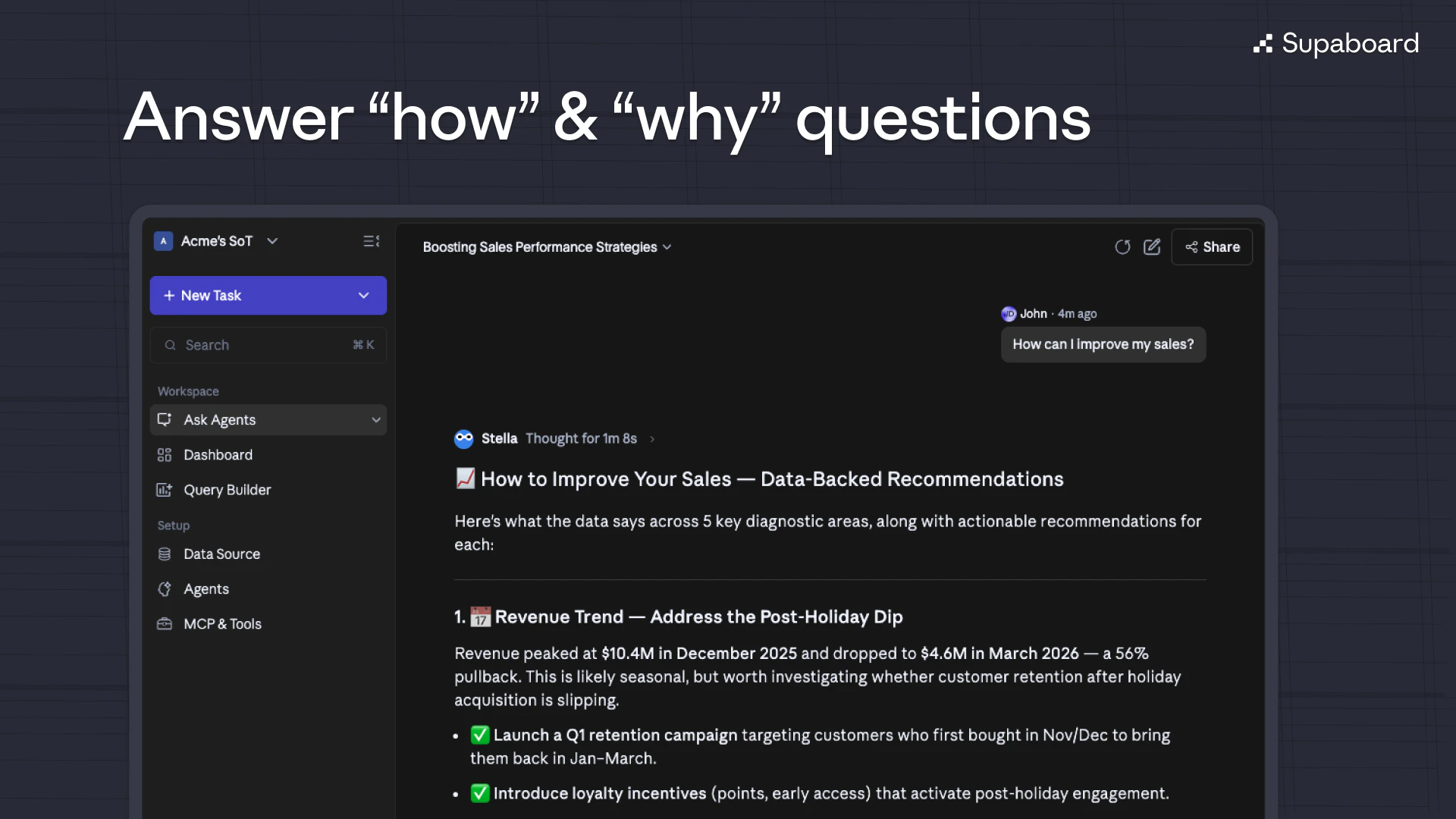
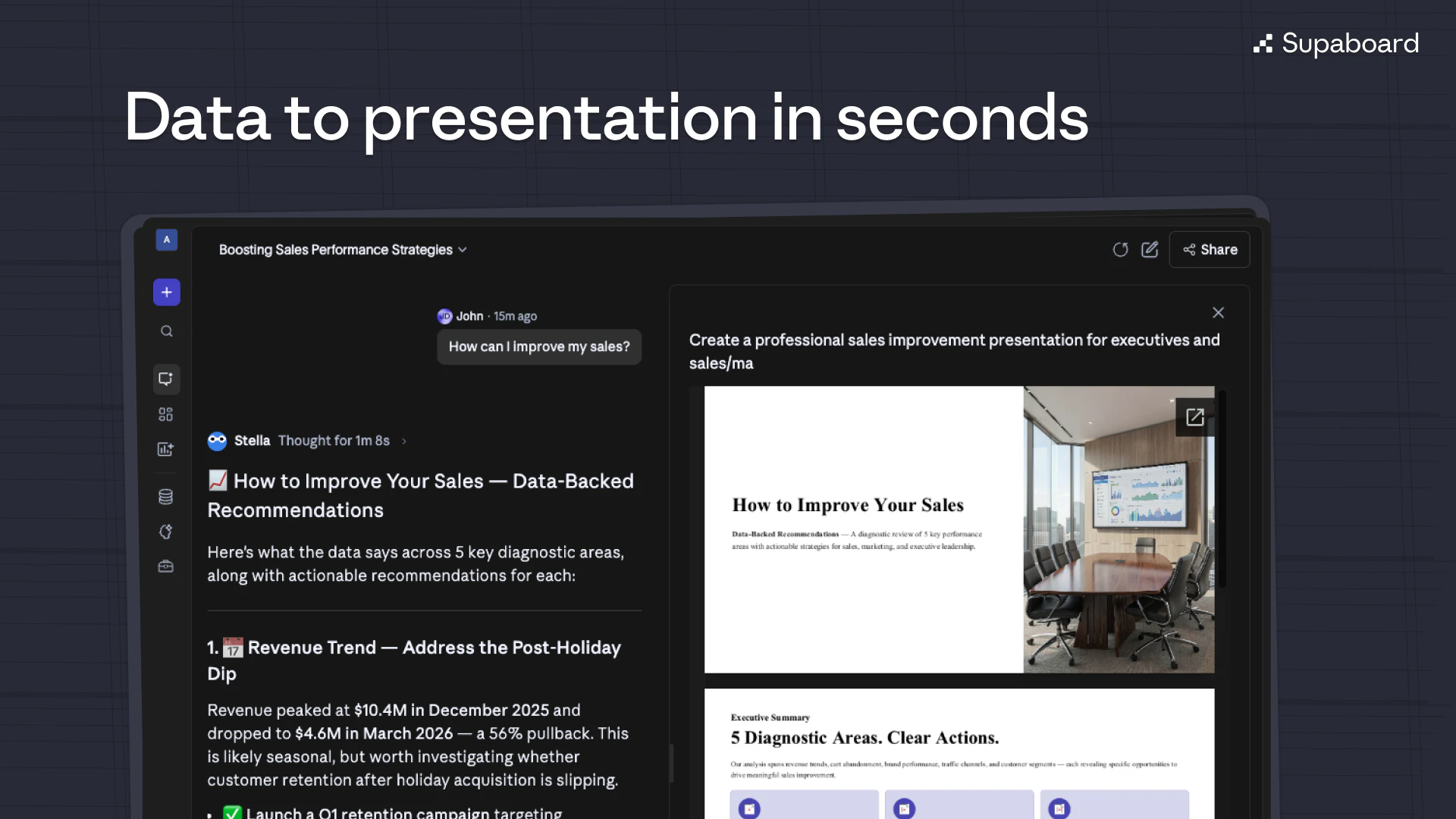
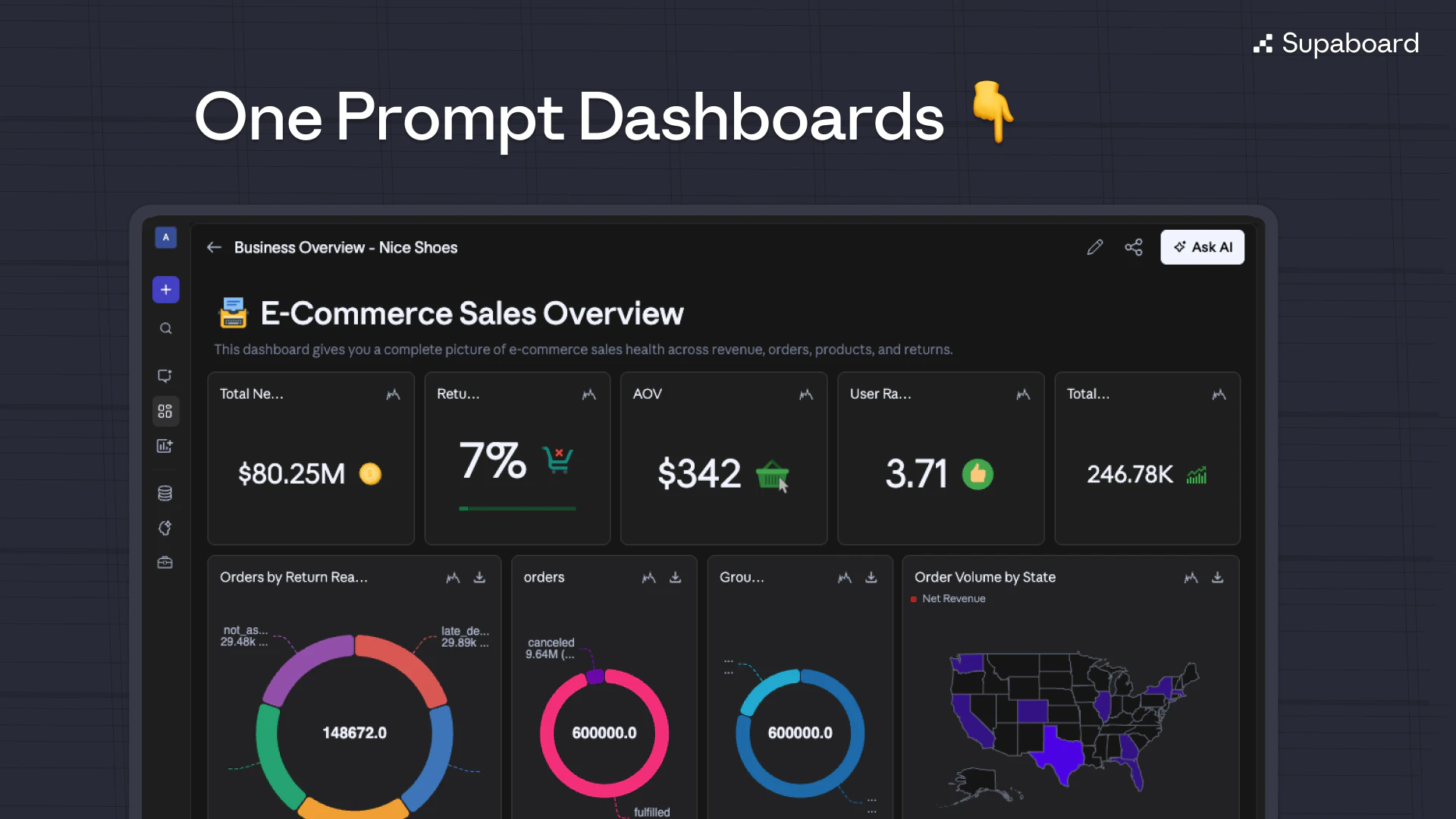
Supaboard helps your team turn business data into answers faster. Skip SQL, dashboard digging, and report delays. Ask questions in plain English, analyze data, and generate dashboards in minutes.

Hey Product Hunt 👋

We launched an earlier version of @Supaboard AI here before, and since then we’ve been focused on one thing: making business intelligence faster, more accurate, and easier for every team to use.

Traditional BI is still too technical for most teams. Too much SQL, too many dashboards, and too much waiting for answers. We built Supaboard to change that.

Since our last launch, Supaboard has evolved into a more complete AI-native BI platform.

What’s new in Supaboard 3.0:

⚡ Completely redesigned UI and smoother analytics workflows

⚡ Much faster performance and response times

⚡ More accurate AI answers powered by business-logic-aware agents

⚡ 700+ data connectors across databases and business tools

⚡ MCP support and built-in tools for more flexible AI workflows

⚡ Stronger governance, security, and controlled data access

Today, Supaboard is used by 1000+ teams, with thousands of dashboards created to help teams make faster decisions with data.

You can sign up for free, start a trial, or book a demo to explore Supaboard.

We’d genuinely love feedback from teams working with analytics, dashboards, reporting, or AI workflows 🙌

Thanks for checking out Supaboard 3.0!

— Team Supaboard

13
回复

@deepak_singh09 The connector count is impressive, but governance is the real test.
With that many sources, access control, field permissions, and audit history matter a lot.
Self-serve analytics works best when people can move fast without accidentally seeing or changing the wrong thing.

0
回复

@deepak_singh09 This is a strong update. The hardest part with AI BI tools is usually not getting an answer but trusting that the answer follows the company's real business logic. I like that you mention governance and controlled data access. How does Supboard handle cases where two teams define the same metric differently, kike revenue, active users or churn?

0
回复

This is the product I wish I had in my previous job, trying to manage so many different dashboards and piece together what's happening in multiple Excel sheets. What's the biggest use case you've seen for Supaboard so far? And what is the most surprising thing you've seen someone use Supaboard for?

6
回复

@peterclaridge Thanks so much, Really appreciate that and honestly that’s exactly why we built @Supaboard AI .

The biggest use case we’re seeing is teams bringing together data from multiple sources and getting instant answers or dashboards without needing SQL. A lot around sales, marketing, and weekly business reporting.

The most surprising part has been seeing people use it like a conversation with their data, asking one question, then another, and uncovering insights they weren’t originally looking for. That’s been really exciting to watch.

2
回复

Hi @peterclaridge 

Thank you for your kind words. For most our users, this is the exact problem they have faced. The tools may change but the headache remained the same. So we listened to them and shaped our solution around the 1000+ feedback calls and user experience interviews.

The biggest use case we have seen where our product shines is e-commerce, logistics and healthcare industries. For these segments, data is scattered across multiple applications and among various departments. What their data teams do is create agents for various departments and ship a dashboard with said agent. The dashboard gives a realtime birds eye view into things like operations, inventory, etc while the agent takes care of the finer details.

What has truly shocked me is that I have had feedback calls where the user tells me that they generate powerpoint decks straight from Supaboard and use it at his stakeholder's meeting- without changing a single element in the deck. Even I am not that confident, tbh.

Just out of curiosity, what was the worst dashboard sprawl moment at your old job? I collect these.

2
回复

Love products that reduce dashboard dependency for non-technical teams. The UI looks clean too.

5
回复

Hi @nithin_raju1 
Means a lot. Thanks.

3
回复

Congrats on the launch!!, Love the dashboard, it looks clean and easy to understand. The AI feels really fast too. As someone non-technical, I found it very easy to use and genuinely helpful.

5
回复

Hi @istiakahmad 
Appreciate the kind words

4
回复
I'm curious: for a team of 10 non-technical people, do you recommend replacing Metabase/Looker completely, or keeping Supaboard as a complement for ad-hoc queries?
4
回复

Hi @olivier_jury 

It depends on whether you are willing to do a bit of upfront work.

What makes Supaboard different from vanilla BI tools is that it actually understands how your business operates. That means someone needs to teach it that context once, by setting up agents with your business logic baked in. For a non-technical team, that setup step usually falls on the one person who knows the business best.

Do that well, and you can replace Metabase or Looker entirely. Skip it, and you are better off keeping Supaboard as a complement for now.

2
回复

What stands out to me most about @Supaboard is how fast the whole experience feels. Going from a question to a usable dashboard in seconds is pretty wild. Feels like the kind of tool that can genuinely change how teams work with data every day.

Congrats on the launch!

4
回复

Hi@hotfixer 
Thanks for your support

2
回复

@Supaboard  @hotfixer Thanks so much 🙌 Really appreciate the support.

2
回复
At $99 subscription, what basic models are you employing and how’s that useful?
3
回复

Hi @lakshminath_dondeti 

We're not selling you a chatbot wrapper. Supaboard trains domain-specific agents on your actual business data, across 600+ sources, with conversational dashboards on top. The $99 is for the outcome, not the model name on the label.

Think of it this way. You are hiring an employee who is working 9 to 5, costing at least a $1000, versus having an agent that understands your business equally well and can answer your questions, instantly.

Do you still think $99 is too much?

3
回复
@subhrajyoti_modak1 The price comparison charts bring out cynicism in people. When we can get access to SOTA for $20, why would $99 get anything less? You can give fewer credits or limit features in other different ways, but you can’t short change on the model. It’s friendly feedback as a fellow builder/founder. Good luck.
3
回复

Supaboard making AI analysts that actually understand business context is a genuinely different angle. I've worked with teams drowning in dashboards that don't surface what matters. We've been building in the AI customer success for data platforms space, and Supaboard touches on something we think about a lot. How do you handle it when a business's key metrics shift midcycle?

3
回复

Hi @shivam_jaiswal36 

This one hits closer to home than most. We are not just builders of Supaboard, we are heavy users of it. And being a startup means the business changes every week. Keeping track of shifting metrics is hard enough on its own; having to re-teach the AI what changed every time would make the whole thing unusable.

So we stopped treating metric shifts as edge cases to handle and started treating them as the default state to design for. The AI does not expect a stable definition: it expects change, and adapts accordingly.

1
回复

The "business logic baked in" angle is what makes this interesting over vanilla text-to-SQL. Most tools give you technically correct answers that miss context like fiscal calendars or custom KPI definitions. How do you handle cases where business logic conflicts across different data sources?

3
回复

Hi @dhiraj_patel5 

This is the exact point where most "text-to-SQL" tools silently fail you. For them, business logic is a second-class citizen that the AI tries to retrofit onto an answer it has already assumed. When conflicts arise, these systems pick a winner (almost at random) and produce something that looks good enough, that is, as long as you don't know the business well enough to catch it.

Our approach flips that. Business context comes first, the answer comes second. When something does not reconcile, we would rather flag it than fake it.

3
回复

Been using Supaboard for a while now and it’s been super easy to work with. Love how quickly you can go from asking a question to getting a clear dashboard or insight. It feels intuitive, fast, and really useful for teams working with data. Great job on the launch 👏

3
回复

@yogeshchauhan Thanks so much, Really happy to hear you’re loving Supaboard.

0
回复

Most of my week is reconciling exports between tools that don't talk to each other. If other connectors cover my stack, this kills the whole reporting tuesday. Saved for next quater

2
回复

Hi @dmitry_isaevski 

That's exactly the pain we built around. Reporting Tuesday shouldn't exist. We're at 600+ connectors now, happy to check your specific stack if you share the tools over a call, takes a minute.

0
回复
@deepak_singh09 Finally, a tool that tackles the real problem: too much SQL, too many dashboards, too much waiting. Silly question: for a team of 10 non-technical people, would you recommend replacing Metabase/Looker completely, or keeping Supaboard as a supplement for ad-hoc queries?
2
回复

@olivier_jury Yes, absolutely. Supaboard is a great alternative to Metabase and other BI tools. We’ve already seen teams shift from other BI tools to Supaboard and use it as their primary workspace for dashboards, reporting, and answering questions without SQL.

0
回复

Does Supaboard show the generated queries or transformations so analysts can verify and change them?

2
回复

@thamibenjelloun Yes, Supaboard shows the generated queries, so analysts can verify and edit them.

1
回复

The thing I always stress-test with AI-analyst tools is auditability — can I trace a stated number back to the assumptions and source rows behind it, or does it just confidently assert a figure? In financial work that traceability is the whole game. Curious how Supaboard handles drill-down and whether the same question gives reproducible answers across runs. (Full disclosure: I build financial models for a living and run a small modeling tool, ModeLoop — so I come at this with a "numbers have to reconcile" bias.)

1
回复

Congrats on the V3 launch! Moving from raw LLM text to deterministic business data is a huge pain. How do your custom 'Master Rulesets' actually prevent prompt injection or override loops? If a user asks a tricky question that contradicts the validation rules, does the agent hallucinate a chart, or does it just gracefully fail?

1
回复

Is there a part of self learning loop built into the product like the guidance I give it or mistakes it made during data analysis?

0
回复
#5
tweet.md
X posts as clean Markdown
213
一句话介绍:tweet.md 通过简单的URL替换(x.com→tweet.md),将X平台帖子/线程一键转为干净的Markdown格式,解决AI工具、笔记软件和大模型调用时复制内容格式混乱、缺失上下文的痛点。
API Social Media Artificial Intelligence
X内容转换 Markdown输出 AI工作流 笔记转存 URL替换 LLM数据处理 线程结构保留 Obsidian集成 Agent Skill 社交内容清净化
用户评论摘要:多数用户认可其解决实际痛点,赞赏URL替换的简洁设计。主要建议:1.输出中加入完整的来源元数据(原URL、作者、抓取时间等);2.扩展支持LinkedIn等其他社交平台;3.确认图片是否保留URL而非文本;4.关心API限流与缓存机制。
AI 锐评

tweet.md切中的是一个被低估但日益严重的需求——社交平台内容的“格式污染”。当X的内容被大量用于AI训练、RAG检索或LLM上下文窗口时,原始HTML里的广告脚本、动态加载块、响应式冗余代码会直接破坏解析鲁棒性。该项目用极简的URL重写而非浏览器扩展或脚本,降低了用户学习成本,本质上是在构建一个“社交内容的数据清洗中间层”。

但从商业与生态角度看,产品存在明显天花板。首先,完全依赖X API意味着随时可能因政策或速率限制而失效,且API对历史线程的完整度(如删除帖、编辑历史)支持有限,用户评论中提到的“抓取时完整性”问题正是其隐含缺陷。其次,Markdown输出虽然优于HTML,但本身仍是线性文本结构,对连锁引用、嵌套转推、媒体轮播等X原生复杂交互的还原能力存疑。最后,功能单薄(仅X平台),一旦头部AI工具(如ChatGPT、Cursor)内置同类功能或X自身推出官方Markdown导出,tweet.md的替换逻辑将瞬间失去护城河。

其真正的护城河可能在于“开发者生态集成”——通过Agent Skill让AI自主调用,并形成缓存+结构化元数据的付费墙。但若不能快速将相同模式复制到LinkedIn、Threads、小红书等碎片化内容源,它只会是小众生产力爱好者的一把瑞士军刀,而非数据清洗赛道的基础设施。产品思路很聪明,但体量上还无法与“复制粘贴”的用户习惯竞争。

查看原始信息
tweet.md
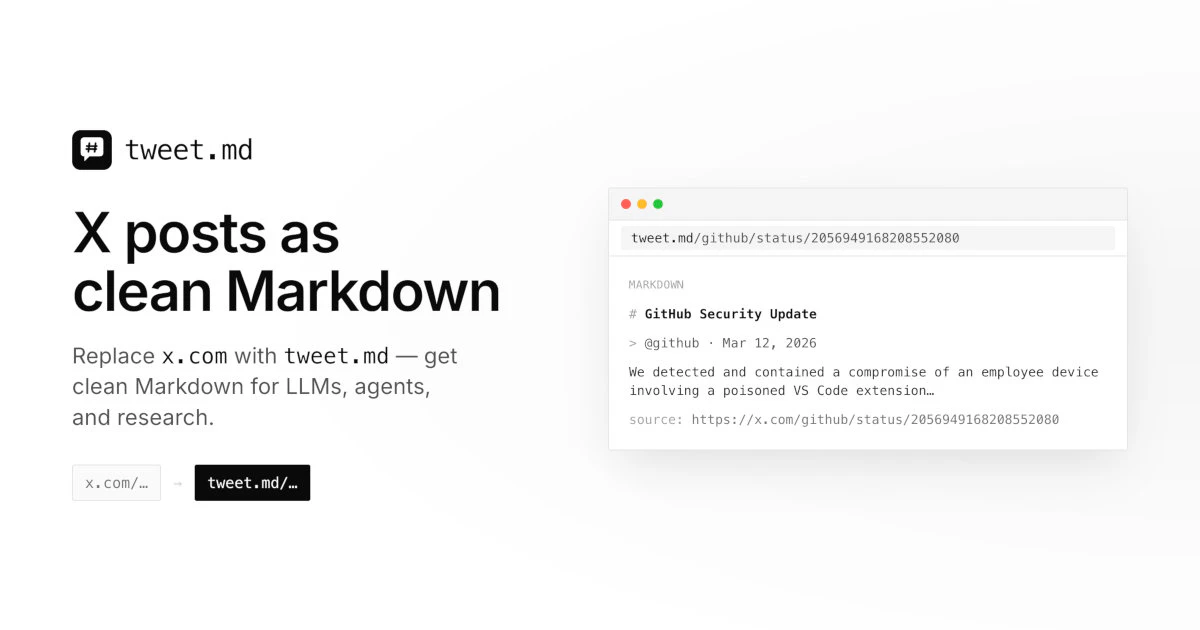
Get any X post or thread as clean Markdown for LLMs, agents, and research. Swap x.com for tweet.md or use the API.
Hey Product Hunt 👋 I built tweet.md because I kept running into the same annoying problem: X posts are often useful context for AI tools, but copying them usually gives you messy text, embeds, screenshots, or browser clutter. tweet.md turns X posts and threads into clean, attribution-preserving Markdown. The workflow is as simple as rewriting the URL to tweet.md: x.com/ProductHunt/status/2057518338419634198 → tweet.md/ProductHunt/status/2057518338419634198 There’s also an AI agent skill, so agents can use tweet.md directly in their workflows. It supports: * single X posts * threads * quoted posts * articles * Obsidian-friendly Markdown The goal is simple: make public X content easier to use with ChatGPT, Claude, Cursor, Codex, Obsidian, and other Markdown/LLM workflows — without scraping HTML or pasting messy copied content. Would love your feedback, especially from people using X content in research, AI workflows, or note-taking.
8
回复

@builditn0w It's an amazing idea, Lars!

Finally, something different. Everything is flooded with AI stuff.

1
回复

@builditn0w This is actually very practical problem. I often copy useful X threads into AI tools or notes but the context gets mess soo quickly. The URL rewrite flow is a nice touch because it does not add another complicated step. Does tweet.md also keep the original post structure clearly when a thread has quotes, links or media inside it?

2
回复

@builditn0w This is one of those small tools that quietly fixes a really real pain X content is useful, but it’s usually hostile to reuse in AI or notes. Turning it into clean Markdown with attribution feels like the right abstraction layer for research + agent workflows.

0
回复
neat product
1
回复

@fmerian thank you! 🙌

0
回复

This is exactly the kind of tiny utility that becomes more valuable because agents can use it reliably.

One thing I’d want in the Markdown output is a small provenance block: original URL, canonical URL, author handle, fetched-at time, and whether the post/thread was complete at fetch time. For research and AI workflows, that helps distinguish “this is what the post said when I captured it” from “this is the live state of X right now.”

If you ever add LinkedIn or other sources, that same receipt would matter even more because public posts move, disappear, or get reformatted in ways that can quietly change downstream summaries.

1
回复

@jim_jeffers you do actually get all of those information with paid credits :)

just not sure what you mean by "post/thread was complete at fetch time"?

you are not the first one requesting Linkedin! Will definitely check it. Thanks for your support!

0
回复

this is one of those tools that solves a problem you didn't realise you had until you see it. I copy tweets into docs all the time and the formatting is always a mess. the agent skill is a nice touch too

1
回复

@tina_chhabra and it's not only formatting, sometimes you even lose context when copying the html!

thanks for the support Tina :)

0
回复

Concrats Lars! Not sure how often I need it but I can imagine it can be super helpful. Also I like the domain!

1
回复

@vuhrmeister thank you Valentin!
even if you never need it I am happy for your support :)

1
回复

Also, any ambition to do this for LinkedIn? I am there recently and it is also a big market to cover :)

1
回复

@busmark_w_nika definitely worth checking! but need to make sure they have APIs I can use properly. Will come back to you when I do! :)

1
回复
Congrats on your launch! very interesting, have myself faced this issue. Does it need X APIs too?
1
回复

@aiswarya_s thank you! Would love to get your feedback once you used it :)

Yes tweet.md uses the X API for getting post data.

0
回复

congrats on the launch mate!! :)

1
回复

@thepetermick Thank you Peter 🥳

0
回复

Long threads with images sometimes break copy-paste. Does tweet.md keep image URLs in the Markdown or text-only?

1
回复

@novamaker01 images get rendered in markdown syntax with public image url like this thread:

0
回复

Finally a simple way to turn good X threads into something actually reusable ❤️

1
回复

@rdrudra99 thank you! happy you like it :)

0
回复

The URL-swap trick (x.com to tweet.md) is clever and the decision to output deterministic Markdown with thread structure, quotes, and canonical links intact is what makes this actually useful in LLM pipelines. We've scraped social content before and the noise from raw HTML always breaks downstream parsing. How do you handle X's rate limiting on the API side? Do you cache resolved posts?

0
回复

@retain_dev yes, making it LLM first was the main priority with humans in mind (x.com with tweet.md swap).

Yes we do cache posts and userinfo for fighting the rate limiting.

0
回复

Should it support cross-posting too? I don't know how it could though.

0
回复

@hboon not sure what you mean by cross-posting?
Tweet.md only works for X but it does support reposts and quotes.

0
回复
#6
Tiny CV
Resume builder that fits on one page
177
一句话介绍:Tiny CV 将Markdown内容一键生成为一页PDF简历和干净公开链接,解决AI写简历后排版乱、适配难、分享烦的痛点。
Hiring Productivity GitHub Career
简历构建器 Markdown转PDF 一页简历 AI简历优化 开源简历工具 求职工具 公开简历页 简历模板 人物页面
用户评论摘要:用户普遍认可其简洁和Markdown工作流集成,核心建议包括:支持简历内嵌图片,简历自动适配一页并预警,支持连接GitHub同步项目,增加AI简历抗AI筛选功能,以及为每条经历提供面试追问的强化功能。
AI 锐评

Tiny CV精准切中了“AI写稿、人工排版”这一代求职者的高频撕裂感。它没有试图做一个大而全的简历编辑器,而是聪明地定位为Markdown的一页PDF渲染器,并开源,这本身就是一种克制且锐利的产品哲学。

产品核心价值并非“好看”,而是“约束”。一页强制让用户从堆砌关键词转向精选证据,配合自动排版(Pretext自动调整字体边距),降低了非设计师用户最后的排版焦虑。从评论看,“一页警告”功能是刚需,极大减轻了用户手动调布局的痛苦。

然而,产品天花板也明显。多数反馈集中在功能补全(图片、GitHub同步),而非颠覆性创新。创始人回应较为保守,这既是保持简洁的坚持,也可能成为增长瓶颈。真正有壁垒的是“AI代理自主操作”的建立,以及在AI筛选简历时代,如何帮助候选人“在海选中曝光”——而非单纯展示。如果Tiny CV只停在“漂亮的PDF展示层”,其护城河很浅,容易被大厂模板或AI原生工具(如Notion AI、ChatGPT渲染插件)吞没。更值得深挖的方向是:将“一页简历”作为入口,延伸至“面试准备深度解读”的叙事验证层,形成从撰写、优化到面试预演的内容闭环。

查看原始信息
Tiny CV
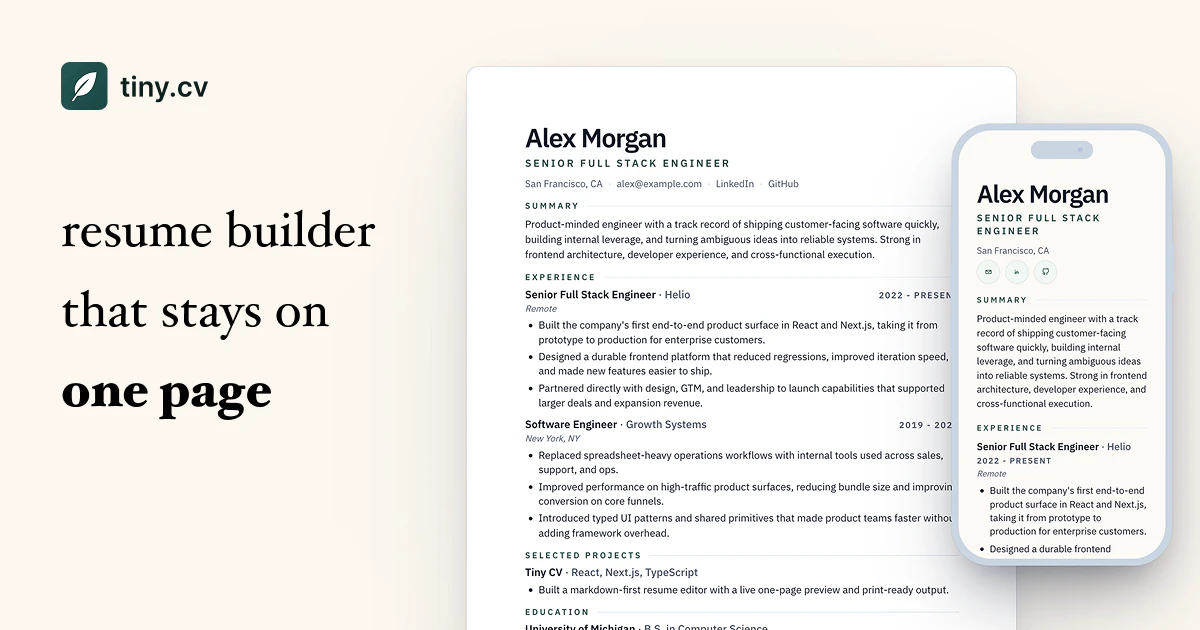
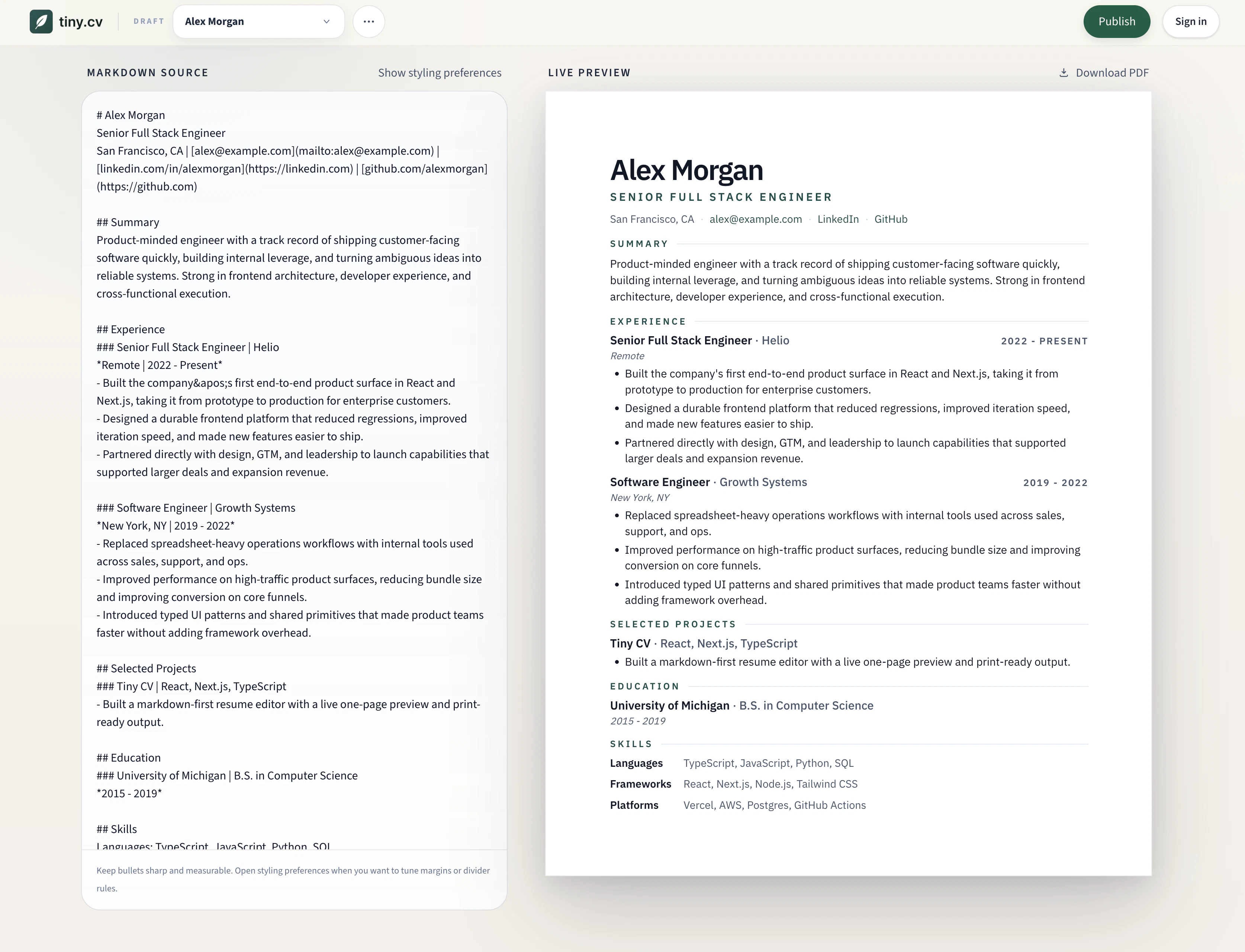
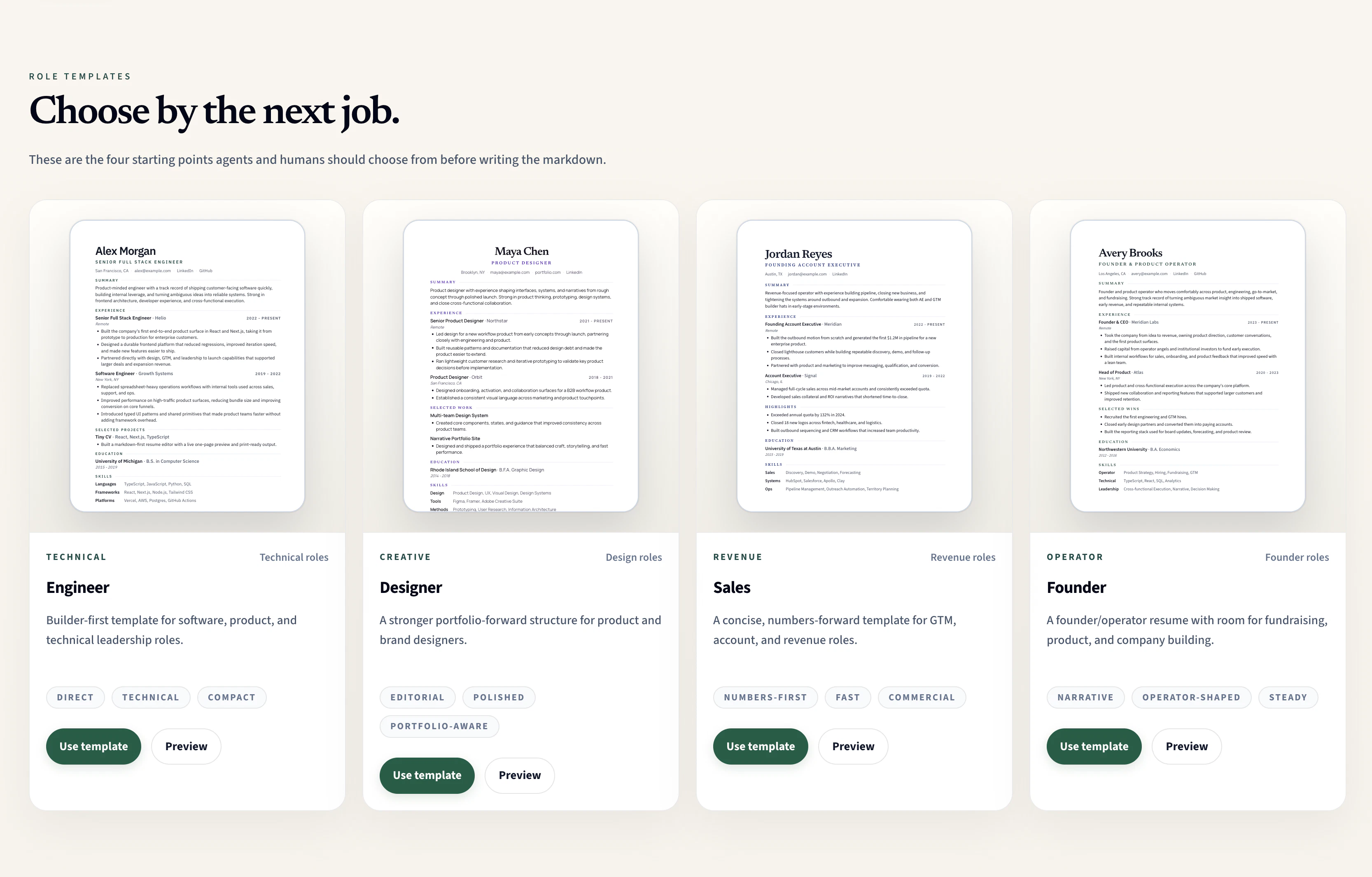
Tiny CV turns markdown into one-page resumes that look right as PDFs and clean public links. Build from focused templates, preview on real paper, tailor versions by role, and let agents draft safely. And share it all on a clean tiny.cv url. Your agents can also use Tiny CV entirely by themselves, no human actions needed. Supports X402 and MPP out of the box.

I like the idea. My question is whether it is somehow LLM optimised because many HR-ists use AI to read and select applicants. How does this one help them to stand out?

5
回复

@busmark_w_nika not as much in the "hack the AI" sense.

Tiny CV is optimized for clarity and your existing Markdown workflow via agents. Easy for both humans and AI to parse. The biggest advantage is tailoring. You can use an agent to adapt your resume to a specific job description while keeping the source editable and reviewable.


But the idea of having skills to help stand out in AI systems is a great one. Will add it to the roadmap as well!

1
回复
Hey PH! I built Tiny CV to help some recently laid off friends polishing up their resumes for the first time. They all use AI agents to write their resumes in Markdown, but the final output didn't look that great. Tiny CV turns Markdown into a clean, one-page resume you can edit, export as a PDF, or publish at a clean tiny.cv link. The goal is to make resumes agent-friendly without making them feel generic. Your resume stays readable, editable, and yours. It’s open source and free to use. For launch, I’m also offering our Founder Pass for the first 100 people who want a tiny.cv identity and premium publishing features — 97 spots left right now (just one-time $100!). Would love feedback, especially from people who write in Markdown or use agents to help with job applications.
3
回复

@andrewjiang Nice this is axctually a very practical bridge between AI-generated content and human-readable output. Markdown → polished one-page CV is a clean, useful transformation layer.

0
回复

Congrats on the launch, Andrew! So many people are using AI to draft their text in Markdown these days, but getting it to look like a polished, professional resume is always a headache. Love that Tiny CV is open-source and built to help people out. I wonder does the platform also support rendering Markdown elements like clickable links for portfolios or profile images?

1
回复

@yashika_vahi links for now. Not exactly sure we'll support images because sizing and taste come far more into play when you introduce images. And thank you!

0
回复

Brilliant! Just revamped my resume using Tiny CV and it worked like a charm. Thank you @andrewjiang

1
回复

@tanoy27 awesome to hear and thank you for trying it out!

0
回复

For years I kept my resume as a LaTeX file compiled in Overleaf. Editing .tex just to move a bullet was always friction, so markdown as the input is the obvious fix. Does it warn you when content overflows one page, or auto-fit it?

1
回复

@adrian_rebega it uses Pretext to autofit your content as much as possible to one page, autosizing margin and font size. Even moves to legal size paper if needed. At some point it does tell you "hey this is probably too much for one page".

1
回复

@adrian_rebega that's one of the main use cases for Tiny CV!

1
回复

Nice launch. The one-page constraint is a useful forcing function because it makes candidates choose evidence instead of stacking keywords.

One thing I would love to see is an interview-readiness pass after the resume is tailored: for each bullet, can the candidate answer 3 follow-up probes? What changed, what broke, what tradeoff did they make, and how did they validate the result?

I work on Offer.cc, so I see this a lot in resume/JD prep: people can make a resume look cleaner, but the real hiring signal appears when each bullet turns into a defensible interview story. If Tiny CV keeps the Markdown/resume flow clean while nudging users toward that probe-ready evidence, it becomes more than formatting.

1
回复

@jerry_z5 that is a great idea. I like the idea of allowing the candidate to add more context for each role, maybe even allowing the viewer to probe deeper. I'll put that on the roadmap.

0
回复

Can users put photos in the resumes as well?

1
回复

@constships Not yet! I’m keeping the first version intentionally simple.


Starting by making the core document very clean, structured, and readable, then let people add links to LinkedIn, GitHub, personal sites, portfolios, etc.

I could see photos making sense later for public tiny.cv pages, but probably as an optional profile feature rather than a default resume element.

0
回复

so creative! the interface reminded me of overleaf! :)

1
回复

@ashishkingdom thank you!

1
回复

Brilliant. I find many resume builders to be complicated. not here

0
回复

Great idea, very pleasing to the eye. I have a question: is it possible to connect to GitHub and then directly sync the above content? Could it even recognize the project links and quickly transform the GitHub homepage into a clean, personal resume with a single click?

0
回复

@genglin that's an interesting idea. I'd imagine many people wouldn't want to connect their Github, and instead are happy to have their local Claude Code / Codex agents write their resume and use Tiny CV as more of a publishing tool.

Would you want to connect to github? How would you want it to pick which repos are important to your resume?

0
回复

btw its fully open source, in case you want to build it into your own system or add features: https://github.com/andrewjiang/cv-studio

0
回复

One page of the desktop or mobile?

0
回复

@himani_sah1 one page PDF / desktop and responsive on mobile. Mobile just become a nice mobile optimized page where you can also download.

0
回复
#7
Pi Coding Agent
The coding-agent harness you can make your own
147
一句话介绍:Pi Coding Agent 是一个极简且高度可定制的终端编码助手,让开发者能自由构建和调整 AI 编码工作流,而非被工具束缚。
Open Source Artificial Intelligence Development
编码助手 终端工具 AI工作流 可定制 开源 扩展包 npm 开发者工具 代码代理 插件系统
用户评论摘要:用户称赞其易用性和自定义性,强调可通过 npm 包分发避免专有插件注册表。提出如何跨包实现提示模板继承的问题。有用户表示它改变了对固定编码代理风格的依赖,而更像一个团队协奏工具。
AI 锐评

Pi Coding Agent 的野心不在于做又一个“万能”的代码助手,而在于重新定义“谁该主导工作流”。它刻意砍掉 sub-agents 和 plan mode 等花哨功能,反其道而行之,保持核心调度器的最小化。这种做法在业内看似保守,实则精准打击了当前 AI 编码工具的痛点——过度智能、僵化、不可控。用户厌倦了被工具牵引,Pi 选择了“裸奔”却开放的哲学:把决策权还给开发者。

值得注意是,它甚至押注于 npm 这种现有生态作为分发管道,而非自建插件体系,既降低了开发者学习成本,也避免了平台锁定风险。评论中提到的“与 OpenAI Codex 流量接近”更是一个噪音信号:这意味着它极可能被用作 AI 代码生成底层的“透明管理层”,而非前端的“聊天界面”。

但批评点也很明显:零门槛不等于零复杂度。这种“一切皆插件、无默认设定”的模式,对初学者/小型团队可能意味着高昂的组装成本。另外,全终端化路线意味着它几乎放弃了图形界面交互的可能性,这注定会损失大部分非硬核用户。

总体而言,Pi 不是面向市场的“产品”,而是面向开发者社区的“基础设施”。它的真正价值不在于自身功能多强,而在于它重新让开发者成为了 AI 代理的控制者,而非被控制者。

查看原始信息
Pi Coding Agent
Pi is a minimal terminal coding harness. Adapt Pi to your workflows, not the other way around. Customize Pi with extensions, skills, prompt templates, and themes. Bundle them as Pi packages and share via npm or git. Pi ships with powerful defaults but skips features like sub-agents and plan mode. Ask Pi to build what you want, or install a package that does it your way.

Hi everyone!

Pi is a minimal, hackable terminal harness for building the AI coding agent workflow you actually want.

It keeps the core small and clean, then gives you the freedom to add, modify, or replace almost anything through extensions, skills, and packages. Context management, sub-agents, permissions, custom workflows — you can make it behave exactly how you like.

Pi first caught a lot of attention as the harness underneath @OpenClaw. What’s really striking now is how strongly it’s showing up in the @OpenAI ecosystem. It’s astonishing that Pi and @opencode have roughly similar usage share in OpenAI/Codex production traffic!

It’s cool to own your harness 🤓

3
回复

Pi is such a joy to use! It's easy, customizable, and fits my workflow perfectly. I use Pi inside my VScodium terminal with opensource models. Pi makes my entire dev workflow FOSS, which means I no longer worry about large tech companies making changes to their models.

1
回复

The npm-based package distribution is the right architectural call. Making the agent extensible through tooling developers already use for dependency management avoids the 'special plugin registry' trap. We've wasted time fighting opinionated defaults in other coding agents, so shipping without sub-agents and plan mode by design is a real differentiator. How does prompt template inheritance work across packages? Can a base template be partially extended?

0
回复

@Pi Coding Agent The customizable harness angle is interesting. I think coding agents get much more useful when teams can shape the workflow around their own review habits, instead of adapting everything to one fixed agent style.

0
回复

Even though my ecosystem is more of shifted to KiloCode ocasionally and VSCode for the rest of self coding or building tasks, Pi agent does seem very useful for such a simple agent that you get to decide what it can or can't do and build from a simple base.

Also the way it is handling chat forks is much better than other bots i have seen, Copilot is not that great while kilocode was better than copilot but this is the style i'd much prefer, asking questions to clarify in middle of chat and then turn back and continuing like we never did in first place, but made this interaction much more seemless

0
回复

We’re entering the era where coding agents become teammates instead of tools. Interesting direction.

0
回复
#8
Orchestria
AI music engine with granular stem control
115
一句话介绍:Orchestria是一款通过将AI音乐生成为独立音轨(Stem)并支持自然语言“代理式”指令修改的音乐引擎,解决了现有AI音乐工具无法对成品进行精细化单轨编辑、必须整体重做的痛点,让创作者拥有真正的掌控权。
Web App Music Artificial Intelligence
AI音乐引擎 音轨分离编辑 自然语言控制 音乐制作工具 免版税音乐 音频工作站 AI代理 音乐创作 48kHz音频 创作者工具
用户评论摘要:用户肯定其“避免全轨重做”的实用价值,视其为“音频层的Figma”。同时,一位初学者询问是否友好,收到肯定回复。另一用户关注版权归属,官方提供了完整的审计与创作过程证明方案。
AI 锐评

Orchestria的115票在Product Hunt中不算惊人,但其切入的痛点足够精准。当前AI音乐生成(如Suno、Udio)最大的硬伤在于“黑箱”——你只能祈祷抽卡般得到一首好歌,而无法像在DAW里一样微调一个鼓点。Orchestria的“粒度化音轨控制”和“代理式自然语言指令”本质上是为AI音乐加入了“撤销”和“局部替换”功能,这不再是一个玩具,而是一个真正的生产力工具。

不过,我们必须警惕其宣传中的水分。“Agentic Flip”听起来很酷,但底层逻辑仍是基于预设的MIDI和VST映射,其“自然语言”修改的准确性将直接决定产品生死——当你说“让贝斯更拨弦”,AI是否能理解你对音色质感的模糊描述?这需要强大的预训练音频模型作为支撑,而不仅仅是简单的关键词匹配。此外,项目目前仅处于发布阶段,DEMO和实际使用中的延迟、音频质量一致性(尤其是多音轨合轨后的相位问题)仍有待考验。

其最大的价值在于向市场证明了:“AI音乐”的下一个竞争点不是生成一首完美的歌,而是提供一个可编辑的、可协作的“工程文件”。如果Orchestria能持续优化其AI对复杂音乐术语的语义理解,并开放VST插件接口,它确实有机会成为音频领域的“Figma”。但若仅停留在生成几个音轨片段的Demo阶段,它很快就会被大厂的集成方案所淹没。真正的挑战,永远在细节里。

查看原始信息
Orchestria
Existing music AIs are black boxes. Orchestria flips the script, generating music as separate stems with natural language agentic control. 100% royalty-free: you own everything you create. Key features: • Stem Control: Edit or regenerate instruments separately without ruining the mix. • Agentic Commands: Tweak sounds (e.g. "make bass pluckier") with natural language. • Pro Audio: Studio-grade 24-bit / 44.1kHz WAV outputs. • Sync Player: Beautiful, sample-accurate visualizer.

Hey Hunters! 😸

We built Orchestria because we loved the idea of AI music, but absolutely despised the lack of creative control. For music producers and creators, an all-in-one button approach that gives you a final, static stereo audio file simply wasn't enough. We wanted an AI partner, not an AI replacement.

The Problem We Solved
Every single AI music generation app on the market takes a text prompt and outputs a finished, uneditable audio file. If you don't like the snare drum pattern or want to try a different bassline, you have to regenerate your track from scratch.

Our Approach & Evolution
Orchestria flips this paradigm on its head. It generates music as individual, sample-accurate audio stems (Drums, Bass, and Melody) — all in studio-grade, 24-bit / 44.1kHz quality.
While developing our system, we found manual dials to be rather cumbersome, which is why we invented the "Agentic Flip". Thanks to our AI agents, you can give commands to individual stems using natural language prompts (e.g., "Pluckier bassline", or "Change the melody lead instrument into retro synth"). Our AI will make the exact changes to the MIDI and VST instruments automatically, while keeping your overall track untouched.


We'd Love Your Feedback On:
1. The Agentic Flip: How does the natural language stem-control workflow feel to you?
2. Deep Obsidian Player: What do you think about the interactive layout and visualization?
3. Future Tech: Which VST / synthesizer integrations do you want to see us deploy next?

We will be hanging out in the comments all day. Let's make some music together! 🎧🎹

Hundreds of people were already on our waitlist. Join us!
https://www.orchestria.tech

4
回复

@batu_akdogan The biggest practical win here is avoiding full-track regeneration. A lot of AI tools are impressive for getting a first idea, but not as useful when you need to make one specific change. If the drums are good but the bass is wrong, starting from scratch feels wasteful.

Stem-level editing makes this feel closer to an actual production workflow. Even for someone who is not a full-time producer, being able to fix one layer at a time would make the tool easier to use for real content.

0
回复

I like this idea. Is it beginner friendly? I've just started learning music production and was wondering if I can empower my process with AI tooling

1
回复

@constships Yes! Orchestria is actually the perfect bridge for beginners. One of our goals is precisely this: to simplify the process of generating samples/loops or drums. You guide the track using natural language. Instead of drawing MIDI notes, you can just type: "Add a warm bassline in G minor" or "Make the drums faster and more driving." The AI agent automatically keeps everything in the correct key and tempo, helping you learn scales and chord progressions naturally as you create. Thanks for your feedback!

1
回复

Is there any content fingerprinting or proof of ownership you provide if someone ever disputes a track?

1
回复

@thamibenjelloun Yes, absolutely. If you ever face a copyright dispute or need to prove ownership, we provide:

  1. Database Audit Logs: Every project, stem, and audio export is registered to your account with a unique Project ID, timestamp, and user metadata.

  2. Prompt & Iteration History: Since Orchestria is agent-based, we log the exact natural language instructions and versions used to build the track, proving your creative process.

  3. Asset Verification: The final WAV/FLAC stems are mapped directly to our secure storage. If a dispute arises on platforms like YouTube (Content ID) or Spotify, our support team can verify your files and issue an official generation certificate to help resolve it quickly.

1
回复

Granular stem control is cool. Feels like the Figma for audio layers moment for indie creators

1
回复

@nithin_raju1 Absolutely. That's exactly our goal. The system isn't designed to take anyone's job or create unnatural, robotic, slop AI music; it's a product that both producers and people who want to create music can use.

1
回复
#9
LLMTest
Use the right LLMs in your apps. Setup fallbacks. Be happy.
109
一句话介绍:LLMTest通过统一API和自动回退机制,帮助开发者自动评测并选用最优LLM模型,解决AI功能在模型选择与生产环境中因API故障导致的业务中断问题。
API Developer Tools Artificial Intelligence
AI模型评估 模型自动选择 API回退 开发者工具 LLM测试 MCP集成 生产稳定性 OpenRouter聚合 智能降级 vibe coding
用户评论摘要:用户认可自动回退机制是核心亮点,能防止生产故障。但指出注册页采用全黑背景、缺乏导航和产品信息提示,与首页体验割裂,建议补全引导和“无需信用卡”说明以降低心理门槛。
AI 锐评

LLMTest瞄准了一个真实且日益尖锐的痛点:LLM泛滥时代的选择瘫痪与生产环境的不确定性。其核心价值并非“评测哪个模型最好”——这类工具已不新鲜,而是将“模型评测”与“生产级容错”缝合进一条API,并提供MCP接口让Claude/Codex直接调用,这本质上是在做AI时代的智能路由+熔断降级基础设施。

从产品设计看,“自测+自动回退”的组合拳,切中了vibe coder与技术型开发者共同惧怕的黑洞:花时间选出最优模型,结果上线后因API限流或JSON解析失败直接崩掉。LLMTest让选择权从人工猜测变成数据驱动,同时把容错逻辑内置化,这才是生产环境的硬需求。

但需要注意几个隐患:一是评测的客观性存疑——如果测试用例与真实场景分布不匹配,推荐结果可能误导;二是过度依赖OpenRouter单一上游,若OpenRouter本身出现故障或定价波动,LLMTest的可用性将直接受损;三是门槛感知问题,用户评论已指出注册体验断档,这类细节在B2D工具中往往决定转化率。

整体而言,LLMTest是一款“切口准、价值清晰但天花板受制于生态依赖”的工具。它不会取代原生模型供应商,但有望成为AI应用开发者在模型选择与运维交接处的可靠粘合剂。建议尽快补全注册引导和开放免费沙盒测试,以降低试用摩擦。

查看原始信息
LLMTest
"OpenRouter + Intelligence" LLMTest helps devs and vibe coders automatically: ✅ Pick better models for AI-powered features (faster, cheaper, better, sometimes all 3 combined) ↪️ Automatically add fallbacks when LLM providers fail (API is overloaded or JSON format isn't respected) All through one single API and MCP functions so you can just tell Claude or Codex to optimize everything.
Hey PH! I'm Tom and I created LLMTest to solve one of my own problems. I was constantly trying to figure out which LLM models to choose to power AI features in my products. So I was using OpenRouter and Claude to create custom webapps for each use case. But all the tests were still "manual" and I had to decide for myself which of 300+ models I would end up using. I thought others might be facing the same issue. So I created LLMTest: an API and MCP server that lets anyone (coder or vibe coder) just run automatic tests on their own AI flows and pick winners. And I added automatic fallbacks so that even if an API is down or not returning a JSON like requested, my apps don't break in production. To sum things up: ✅ One API. One invoice. 300+ models available, refreshed daily. 🤖 Ask Claude Code / Codex to optimize AI features using LLMTest 🏆 Use better, faster and/or cheaper models in your apps ↪️ Smart fallbacks: forget timeouts, overloads, and bad JSON output 💰 Pay per use. Start with $5. Top-up anytime. I'd love to get your feedback on this ❤️
3
回复

Went through the flow after seeing it. The homepage is clean, the 3-step flow and pricing section do their job. But the signup page is off, full black background, no nav, no reminder of what you're getting into and there is no "no credit card needed" line. You go from a well-designed homepage to a form that feels like a different product. That moment right before someone types their email is where a lot of people reconsider. Small fix, but the signup page needs to carry some of the homepage's momentum into the form. The product itself looks solid.

0
回复

The automatic fallback part is the strongest hook for me. Choosing the right model is useful, but making sure an AI feature does not break when a provider times out or returns bad JSON feels even more important in production.

0
回复
#10
tldx
Fast CLI to bulk-check domains via RDAP & MCP
103
一句话介绍:tldx 是一款基于 RDAP 协议的极速批量域名查询 CLI 工具,通过并发检测与 MCP 服务器集成,帮助创始人或 AI 代理高效筛选可用域名,彻底摆脱传统 WHOIS 的速率限制和低效解析痛点。
Open Source Developer Tools GitHub
域名查询 RDAP CLI 工具 开源 Go语言 AI 代理 MCP 服务器 Homebrew 批量生成 创始人工具
用户评论摘要:用户 @brandonyoungdev 在产品介绍中说明了构建初衷(个人工具开源)与核心使用场景(按关键字组合批量查域名)。跟帖用户询问技术实现细节(是否直接查询 DNS),开发者未在提供的评论中直接回复该技术问题。
AI 锐评

tldx 的真正价值不在于“查域名”这个老生常谈的需求,而在于它用 RDAP 协议和 Go 语言的高并发能力,彻底砸碎了传统域名查询的枷锁。它没有选择吃力不讨好的 WHOIS 解析或容易被封的 DNS 探测,而是基于 RDAP 这一规范化、无速率限制的公开注册数据查询协议,本质上是在做“数据的批量合规抓取”。这让它从一个玩具变成了一个可以稳定用于抢注监控、前期调研的工业级实用工具。

更值得玩味的是它内置的 MCP 服务器。这绝不是拍脑袋加的功能,而是看到了 AI Agent 正在从“聊天气泡”进化到“执行任务”的必然趋势。开发者敏锐地识别出“域名创意+快速验证”是一个非常适合由 AI 代理完成的自动化闭环。tldx 不再仅仅是一个给程序员用的终端命令,而是成为了 AI 系统直接调用的“数据库 API”。

不过,必须指出的是,它的使用门槛依然很高。命令行界面和 Go 语言的开源生态,决定了它目前的受众仍然仅限于开发者群体。对于那些创业小白来说,“brew install tldx”这个动作本身就是一道门坎。但换个角度看,这或许正是产品的精准定位——它服务的是那些真正需要高效工具、不惧怕命令行的硬核用户和 AI 开发者。在大模型争相接入各种工具的时刻,tldx 通过 MCP 不经意间卡住了“AI 时代域名助手”的身位,这可能是其最隐蔽也最致命的后手。

查看原始信息
tldx
Finding a good domain is half the battle. tldx is a blazing-fast, concurrent CLI tool that generates and checks domain availability in bulk via RDAP. Mix keywords, prefixes/suffixes, or regex, and stream results to stdout, JSON, or CSV. Plus, tldx includes an MCP server, empowering AI agents (like Claude) to brainstorm and verify domains for you automatically! Install via Homebrew (brew install tldx). Say goodbye to rate-limits and legacy whois parsing. 100% Free & Open Source in Go.
Hey PH! 👋 I’m always building small tools for myself that end up buried in private repos. (Seriously, only 35 out of 120 are public, and most of those are just forks.) I open sourced tldx a year ago. It's my solution to the domain search process that happens for founders. I wanted something I could ask: "give me every combo of get, use + my keyword + .com, .io, .ai and tell me what's free" and just get results. So I built it. It had to be fast, private, and easy to ideate with. It's written in Go, fully open source, and available via Homebrew, winget, and AUR. There's also an MCP server built in, so it's easy to integrate into agentic workflows. Check it out and let me know what you think: GitHub: https://github.com/brandonyoungd...
3
回复

@brandonyoungdev this is great; do you hit DNS directly, or what are you querying to pull your results?

0
回复
#11
Databerry
Track all your business data in a single dashboard
103
一句话介绍:Databerry 是一个面向独立创业者的数据聚合仪表盘,让你无需在多个工具间来回切换,就能在一个界面中集中监控收入、分析、会议等关键业务指标。
Analytics Data & Analytics Business Intelligence
数据聚合仪表盘 创业工具 业务监控 Stripe集成 PostHog Calendly SaaS 效率工具 一站式看板 独立开发者
用户评论摘要:用户普遍认可其解决了多项目、多工具切换的痛点,但同时提出几个关键问题:数据源连接失效时能否明确告警(如Stripe重授权、token过期);如何避免仪表盘自身变得嘈杂;是否提供财务层级的专业分析(如跑道、烧钱率);以及是否支持MCP接口供AI代理查询。
AI 锐评

Databerry切中的确实是创业者的真实痛点——“信息碎片化”带来的心智负担,尤其是独立开发者或小团队,他们往往同时管理数个轻量级项目,每一分钟都在被不同工具的通知和登录流程消耗。产品“反仪表盘”的定位值得肯定:只展示对创始人真正有用的指标,强调分钟级上手,而非像传统BI工具那样堆砌复杂图表和维度,这恰恰是它与Notion、Metabase等通用工具拉开差距的关键。

但需要警惕的是,它的核心竞争力并不在“整合”本身——Stripe、PostHog等接口的对接在技术上并不构成护城河。评论中指出了两个核心风险:第一,数据同步一旦出现故障(API限流、授权过期),安静的“假数据”会比没有数据更危险;第二,当用户接入的工具增多,创始人仍然需要主动筛选“什么该看”,这意味着产品目前在“主动排除噪声”和“数据健康度可视化”上仍有空白。

此外,缺少对财务模型的支持(如跑路率、CAC、LTV的动态计算)也会削弱其在融资场景下的价值——一个仪表盘如果只告诉你“昨天下单数”,却没有告诉你“按当前速度还能撑多久”,那它仍然只是多个工具的“显示器”,而非决策的“驾驶舱”。

Drew的叙事很扎实,社区反馈也积极,但Databerry需要更快速地构建数据异常告警机制和意图驱动的智能视图,否则很容易沦为又一个“打开即忘”的营销工具。

查看原始信息
Databerry
Track revenue, analytics, meetings, and more from a single dashboard. Connect Stripe, PostHog, Calendly and other tools in minutes.

Hey Product Hunt, it's Drew 👋

As a solo founder I have multiple projects to look after daily. Check revenue, check events, check analytics, and more.

The more you build, the more you have to keep your eyes on. At some point you realise you don't even have enough RAM to have all these browser tabs open at the same time.

I got tired of logging in, switching accounts and opening dozens of dashboards just to know what was going on with my own projects.

So I built my dream tool. The hub that connects all those tools into a single dashboard - a tool for founders, not data analysts.

You see.. I hate when the platform makes you spend 2 hours learning how to use it. And even then, 99% of what you see is noise you don't actually need.

Databerry was built the opposite way. Pick metrics that matter, arrange it how YOU want, and you're done in minutes. No data analyst degree required.

Hope you like it.

(It's Free — no credit card needed)


Would love your honest feedback!

What tool integration should I ship next 👀?

5
回复

@drew_miko This feels useful for founders running multiple small projects because the real pain is not analytics, it is checking five tools just to know what changed today.

0
回复

@drew_miko the connection is cool, but dashboards are built for humans... what about an MCP or something that agents can easily query?

1
回复

@drew_miko The "pick metrics that matter, arrange them how YOU want" framing is the right anti-dashboard pitch. One thing solo founders get burned by: a dashboard that silently shows stale numbers when a connector drops. Stripe reauths, PostHog rate-limits, Calendly token expires, and the tile keeps showing yesterday's figure like nothing happened.

Does Databerry surface "this data is X hours old / sync failed", or does it trust the last good pull? For a tool people glance at to make decisions, the failure mode matters more than the happy path.

2
回复

The one dashboard for founders pitch usually dies the moment the dashboard itself gets noisy right? What's the cap before Databerry turns into the thing it's replacing? Right now it sounds like discipline on the user's side, but the most useful version of this would have opinions about what NOT to show. Overall - congrats!

1
回复

@artstavenka1 Thanks for the great feedback! I believe that any tool requires a bit of discipline from it's user. But where you are wrong - is that Databerry isn't replacing anything!

In fact you should keep using the powerful tools that you already have in use. But you're no longer required to waste time by opening them ever again. Now you have it all organised in a single clear and founder-friendly space.

0
回复

Congrats on the launch Drew. Curious if each dashboard is tied to one project or if you can track multiple products side by side on the same account.

1
回复

@novamaker01 That's exactly the point! Having 2+ projects makes it very hard and time consuming to track all of them daily.

In Databerry you have one dashboard that allows to view multiple projects! Demo shows it quite clearly in the first 30 seconds.

0
回复
Like the approach. All the best with your launch. 🙏
1
回复

@tim_350life Appreciate it 🙏 Been working on this for a while!

1
回复

Pulling scattered business data into one view is genuinely useful for early teams. The place I'd push: does the finance layer — runway, burn, CAC/LTV — get first-class treatment, or is it just another data source plugged in? That's usually where founders lose the plot right before a raise. (Disclosure: I'm in finance and built ModelUp, a modeling tool aimed at founders, so the runway/cap-table angle is my bias.)

0
回复

Congrats on the launch. What does it specialise in... marketing data, finances or others?

0
回复

@zerotox Databerry specialises in nicely connecting together the tools that specialise in something. It's a hub for powerful tools, not a replacement.

0
回复
#12
The Incident Challenge
Production Debugging Games for Software Engineers
99
一句话介绍:The Incident Challenge 是一款让软件工程师在模拟真实生产故障中进行根因分析与修复的竞技游戏,旨在通过限时实战提升工程师在高压环境下的排错能力。
Artificial Intelligence Tech Games
生产调试 故障模拟 根因分析 软件工程师 限时挑战 工程思维 AI辅助 系统架构 故障演练 CTF风格
用户评论摘要:用户普遍认可其真实感和挑战性,认为它比纯编程更有价值。有反馈指出“确实很难,像真的故障”,但未提及具体改进建议或缺陷。部分用户强调该游戏能帮助工程师练习在压力下保持冷静。
AI 锐评

The Incident Challenge 的切入点是精准的:当AI能生成大量代码时,“理解系统为何崩溃”成了稀缺的人类技能。它把传统CTF里偏重安全攻防的模式,转向了更普适的工程排故——这才是大多数软件工程师日常最痛的点。产品设计上,用真实故障模式、误导性文档、限时排名的机制,把被动挨打的“背锅体验”变成了主动竞技,这很聪明。但问题也很明显:首先,99票在Product Hunt上属于中等表现,未形成病毒式传播,说明其吸引力可能仍局限在“爱折腾的排障狂”圈层;其次,AI辅助能被集成,但产品未能清晰定义“AI无法替代的人类直觉”究竟是什么,容易陷入“AI能加速查Log,但人类仍需理解上下文”的模糊叙事——这会削弱不可替代性的说服力。最后,如果模拟场景不能持续更新、紧贴真实云原生架构(如K8s、微服务、数据一致性问题),玩家很快就可能摸透套路。它的真正价值,不在于教人写代码,而在于训练“在噪音中锁定信号”的系统直觉——这才是资深工程师与初级工程师之间最难被量化的鸿沟。如果能把这个鸿沟变成可衡量的层级,并嵌入企业内训流程,它可能从游戏变成标准化的工程素质评估工具。

查看原始信息
The Incident Challenge
Compete in realistic incident simulations where you find the root cause, fix the system, and race the leaderboard.

Hey Product Hunt!

I’m excited to share The Incident Challenge with you.

The idea started from something we kept seeing: AI can write code now. A lot of code.

But the moment production breaks, the hard part usually isn’t writing the fix.

It’s understanding what actually happened. Where to look. What to ignore. Which weird detail matters.

That’s the (human) skill we wanted to turn into a sport. So we built The Incident Challenge: a production debugging game for engineers.

You get dropped into a realistic broken system. What you get:

Logs, code, configs, docs, architecture diagrams, misleading symptoms, and a ticking clock.

Your job: Find the root cause. Fix it. Deploy the solution. Beat the leaderboard.

And yes, you can use AI agents.

But the challenge is designed so AI alone usually isn’t enough.

It might help you move faster, but you still need real engineering instincts to win.

The idea pretty much exploded on reddit, and today we have more than 300 devs participating.

Some people solve the same incident in minutes. Others take much longer.

That gap is exactly what makes it fun.

The challenge is live now, so feel free to give it spin, and maybe you might win!

Would genuinely love your feedback, ideas for future incidents, and brutal honesty on whether this feels like something engineers would want to play.

Come debug with us 🤘

5
回复

@avi_ct 🚒 🪲

1
回复

Finally, a coding challenge that actually mirrors real engineering. Writing code is the easy part; tracing a race condition through misleading docs is the real sport. Stoked to try this out and see if my instincts are as good as I think they are. Good Job 👏

2
回复

@vikramp7470 Thank you Vikram! Exactly.

Improving as an engineer looks very different now. The best challenges can’t just be about writing code anymore, because AI is already getting pretty good at that.

They need to test what AI still struggles with: understanding systems, dependencies, architecture, and knowing where to look when something breaks. That’s what we want The Incident Challenge to keep testing.

P.S. the challenge today, is pretty hard - good luck!

1
回复

Built this because debugging under pressure is a skill, and most engineers only practice it when prod is on fire.
I've sat in too many incidents where smart engineers froze - not because they lacked knowledge, but because they hadn't practiced navigating chaos under pressure.


The Incident Challenge is a production incident CTF you can actually enjoy. Logs, architecture, code, docs, clues - we designed each one to feel like a real system that actually broke. Because it did. We based these on real patterns.

Bring AI, bring your terminal, bring whatever you want.
The system doesn't care how you solve it - just whether you can.

FIND THE 🪲

2
回复

@shayliv This challenge is HARD. feels like a real incident.

0
回复

Realistic incident simulations sound like a fun way to actually practice being on call without ruining your day. Congrats on your launch!!

1
回复

@thamibenjelloun Yes! Happy you like it

0
回复
#13
MashuPack
Turn codebases into a clean file for Claude and ChatGPT
96
一句话介绍:MashuPack将代码仓库中的指定部分打包成一个清洁文本文件,解决用户在ChatGPT/Claude等浏览器端AI工具中因文件数量限制和上下文混乱而无法高效上传代码的痛点。
Productivity Developer Tools Artificial Intelligence
代码上下文打包 AI工具集成 代码库管理 文本文件生成 开发者工具 浏览器AI工作流 文件上传优化 代码审计辅助 Token估算 开发效率
用户评论摘要:用户普遍认可其解决了AI工作流中的上下文痛点,但提出需保留文件路径和目录结构以便模型引用,建议增加文件列表、时间戳、忽略路径、Token估算等上下文清单功能,以实现更轻量的审计追踪。
AI 锐评

MashuPack精准切入了一个被忽视却高频的“隐形摩擦点”——AI对话界面与本地代码库之间的上下文鸿沟。当众多工具沉迷于自动化全量代码分析时,它反其道而行,强调“可控性”与“轻量打包”。这种定位既聪明又务实:聪明在于,它承认了当前浏览器AI模型对单一文本文件的兼容性最佳,避免与复杂API或插件生态直接竞争;务实在于,它将开发者从手动复制粘贴、分割文件、管理上传限制的琐碎中解放出来,保留了“选择权”。

然而,其真正价值取决于两个关键变量:一是能否解决“出口歧义”——当模型返回需要修改具体路径的建议时,打包后的扁平文本文件可能丧失原仓库的精确映射,虽然开发者回复中提到会保留路径和结构,但用户评论中“上下文清单”的呼声恰恰说明当前方案在可追溯性上仍有缺口;二是护城河极低——类似的脚本、浏览器插件或Repo-to-text的开源方案并不少见,UI友好度是唯一壁垒。若止步于“美观的文件打包器”,MashuPack很快会被Aider、Cursor等原生支持AI工作流的新型IDE碾压。真正的突围方向应是成为“AI工作流的内容总线”:通过元数据强化(如版本对比、需求-代码片段映射)将单一文本输出从“一次性输入”升级为“可审计的对话上下文资产”,而非仅做一个漂亮抄送员。

查看原始信息
MashuPack
Select the exact parts of a repository and compile them into one clean text file for ChatGPT and Claude or Gemini. MashuPack is built for browser-based AI workflows where file-count limits, upload friction, and messy context assembly keep getting in the way. It makes code context portable, intentional, and easy to control.

nice and simple utility, I've been using tree for this, but Mashupack is a nice visual way to solve the same problem.

1
回复

This solves a very real Claude/ChatGPT workflow pain. Simple idea, high utility = dangerous combo 🔥

1
回复

@nithin_raju1 Thanks so much!

0
回复

Do you keep file paths and a table of contents so the model can still reference where things came from?

1
回复

@othman_katim Yes - MashuPack preserves file paths and structure, and the tree/report can be copied along with the full contents. It also already shows token estimates in the UI for folders/files when you toggle the stats view. What I want to improve next is making more of that metadata clear in the exported manifest itself, so the output stays self-describing outside the app. Thank you for your comment!

0
回复
I built MashuPack because I had a split workflow. In the terminal, I already had good tools for navigating codebases and working with agents in real time. But I still do a lot of long-form planning, debugging, review, and codebase understanding in conversational web UIs like ChatGPT and Claude. That workflow kept breaking on context. File-count limits, upload limits, and inconsistent format support made it annoying to get the right slice of a codebase into the model. The one format that always seemed to work was a single text file. So I started manually packing up small collections of source files whenever I wanted to discuss a subsystem, plan a refactor, or ask high-level questions about a repository. That got repetitive fast. MashuPack came from wanting a better interface for that exact job: select the context you actually want, compile it into one clean file, and stay in control of what gets included. I’d especially love feedback from people who use ChatGPT or Claude in the browser for software planning, debugging, or understanding unfamiliar codebases.
0
回复

@semmaplabs This solves a very real context problem.
Browser AI tools are useful for planning and review, but uploading scattered files gets messy fast.
Being able to package only the relevant subsystem sounds much cleaner.

0
回复

@semmaplabs This feels very relatable the hardest part of using AI for engineering isn’t always prompting, it’s preparing the right context cleanly. Love that MashuPack focuses on controlled context selection instead of trying to automate everything blindly.

0
回复

A context manifest would be valuable here.
Something like file list, timestamp, ignored paths, token estimate, and exclusions.
That gives teams a lightweight audit trail for what was sent into ChatGPT or Claude.

0
回复
#14
Rixx
The Perplexity alternative that organizes your research
94
一句话介绍:Rixx是一款以可信溯源为核心,通过多模态搜索、文件上传和可视化图表等功能,将AI搜索从“猜答案”转化为“查证据”的研究管理工具,解决用户对AI回答不信任和研究资料碎片化的痛点。
Productivity Artificial Intelligence Search
AI搜索 可信溯源 多模态搜索 研究管理 论文级引用 图表可视化 文件上传 搜索替代方案 生产力工具 信息整理
用户评论摘要:用户高度认可其解决“多标签页切换”的痛点;核心疑问集中在搜索深度(爬取上限)、JS渲染页面及多媒体兼容性;建议增加“声明-来源-强度”对照表以提升研究可信度;开发者回应已支持多源并行搜索与源质量排名。
AI 锐评

Rixx的定位并非又一个“更聪明的搜索引擎”,而是试图重新定义“可信研究”的流程标准。它的核心价值不在“答得更快”,而在“敢让你验证”——用实时引文、图表内联、PDF/文档上传和Insights分组,把AI搜索从黑箱式答案生成器,扭转为可审计的研究资产。

但必须泼盆冷水:当前产品仍处于“漂亮原型”阶段。用户评论中“搜索深度是否有上限”“是否支持JS渲染页面”等质问,直指技术地基——若多模态搜索只是简单拼接API,而非统一的信息抽取与交叉验证管道,那么“不撒谎”只是营销话术,而非工程承诺。此外,“公开引文”不等于“语义保真”,评论区那位用户提醒得很尖锐:AI是否会把狭窄源头扭曲为宽泛结论?Rixx若不能推出“声明-来源-矛盾标记”的透明对照表,就永远停留在“带链接的摘要”水平,离“可发表研究”还有鸿沟。

商业化是另一道坎。Perplexity Pro已20美元/月,Rixx若缺乏独家数据源或企业级协作功能(如团队空间、自定义爬取策略),很难说服重度用户迁移。创始人说“深层研究模式开发中”——希望这不是画饼,而是通往真正差异化护城河的起点。否则,Rixx只会是研究者收藏夹里又一个“偶尔用一下”的工具。

查看原始信息
Rixx
AI search engines lie. Rixx doesn't. Search the web and get answers backed by real citations so you can verify every claim, not just trust it. → See data visually with charts and graphs → See images inline with your results → Upload PDFs, docs, and links as context → Multimodal search: text, images, docs together → Organize research into Insights folders Stop guessing. Start knowing.
Hey PH! I built Rixx because AI search tools were giving confident answers that were just wrong. Rixx gives you cited answers from the live web every claim is traceable to a real source. You can also upload your own PDFs, docs and links, see data as charts, and organize everything into Insights. Would love brutal honest feedback what would make this your default search?
3
回复

@hitendraa For marketing workflows, the biggest win is going from research to report or blog draft without jumping across five tabs.

0
回复

The tab switching problem is so real. At any point during research I have like 10 tabs open — search, AI chat, docs, notes. If Rixx actually keeps all of that in one place it would save a lot of mental overhead. Congrats on shipping this!

1
回复

How exhaustive is the search? Does it cap the number of web searches and pages visited, or does it go until it hits a goal of credibility? Also, can it handle JS-rendered pages, PDFs and Images? I ask because I've built my own internal method that does this but would love to not have to manage it and none of the stock research tools are cost-effective, including Parallel AI's Find All or Deep Research (let alone Perplexity or stock Claude)

1
回复

@peter_neyra Great questions. Yes, handles JS-rendered pages, PDFs, images, and more natively. For depth it runs multi-search in parallel, so it hits credible coverage fast. There's a cap but because it searches multiple sources simultaneously it extracts far more signal than single-thread tools in the same timeframe. Deep Research mode is actively in development that's where the real exhaustive crawling comes in.

0
回复

The “from search to publishable research” promise is the interesting part. Citations are necessary, but for writing/research workflows the bigger trust question is usually claim shape: did the AI preserve what the source actually says, or did it turn a narrow source into a broad conclusion?

One feature I’d love is a claim table before publishing: claim, supporting sources, source strength, and any caveat/contradiction Rixx found. That would make the final blog/report feel less like a generated answer with links and more like research you can safely stand behind.

1
回复

@jim_jeffers That’s the difficult part tbh. Anyone can attach citations, but keeping the actual meaning of the sources intact is what matters more.

And the claim table suggestion is genuinely interesting that kind of transparency would fit Rixx really well.

0
回复

Congrats, Rixx feels useful if it can keep that whole chain together instead of creating another tab in the research mess. How do you handle source quality when generating cited answers?

1
回复

@dmitrii_volosatov That’s a big part of what we’re focused on. We rank and compare sources internally instead of treating every citation equally, so weaker sources don’t end up driving the final answer.

The goal is to keep the research chain reliable from search → reasoning → output.

0
回复
#15
Fred
AI-orchestrated UX research with behavioural tracking
94
一句话介绍:Fred通过AI编排将UX研究中的规划、招募、测试、分析与报告全流程整合为一站式平台,并引入实时/回放眼动追踪与行为热图,解决研究团队工具碎片化与操作拖沓的痛点。
Productivity User Experience Artificial Intelligence
UX研究 AI编排 眼动追踪 行为分析 热图 用户研究平台 产品体验 流程自动化 模式检测 证据驱动
用户评论摘要:用户关注AI眼动追踪的准确性与长会话识别能力,并提出研究者如何覆写AI解读的疑问。创始人回应强调AI仅加速模式发现,不替代判断,所有信号附带置信度与证据链接,允许人工审查与覆盖。
AI 锐评

Fred的定位精明——它不标榜“AI取代研究员”,而是切中“研究流程碎片化”这个真实成本痛点。眼动追踪与行为回放的确比纯文本分析更具洞察力,但真正的护城河在于“置信度+证据链”的设计:AI只做初筛,研究者掌握最终否决权,这恰恰是专业工具与“AI玩具”的分水岭。不过需警惕,若团队迷信AI标记的“热度区域”而忽略环境变量(如设备噪声),结论仍可能失准。产品目前更偏向敏捷团队与小型机构,对大型企业级研究的权限、合规和多项目并行管理,尚未看到足够深的信息。一句话:Fred在“效率”与“方法尊严”之间找到了平衡点,但能否从“好用”进化到“不可替代”,取决于它后续能否提供更复杂的研究设计模板与跨工具生态集成。

查看原始信息
Fred
Fred now turns UX research into an AI-orchestrated workflow: plan studies, recruit and manage participants, run tests, analyze sessions, detect patterns, and build reports in one place. This launch adds full AI orchestration, real-time and replay-based eye tracking, gaze heatmaps, smarter analysis, and a broader research suite for teams that need faster evidence without losing methodological control.
Hey Product Hunt 👋 I’m Imre, founder of Fred. We originally built Fred to solve a problem I kept seeing in UX research: teams were collecting more and more evidence, but the workflow around that evidence was fragmented. Planning lived in one tool, recruitment somewhere else, testing in another platform, analysis in spreadsheets or docs, and reporting became a slow manual process. This second launch is a big step forward for us. Fred now includes full AI orchestration across the research workflow. The goal is not to replace researchers, but to remove the operational drag around research so teams can move faster while keeping control over method, interpretation, and decisions. What’s new in this launch: • AI-orchestrated UX research workflows • Real-time and replay-based eye tracking • Gaze data and heatmap-ready session analysis • Broader support for research methods • Faster pattern detection and reporting • A more complete workspace for research teams, product teams, and agencies We believe UX research should be easier to run, easier to analyze, and easier to turn into decisions. Fred is our attempt to make that happen without reducing research to shallow AI summaries. I’d love your feedback, especially on where AI should help researchers most and where it should stay out of the way.
1
回复

The eye tracking plus behavioral replay angle is what separates this from tools that just analyze transcripts. The real test is where the AI draws the line between surfacing a pattern and flagging it as friction. How do researchers override or challenge those interpretations when the AI gets it wrong?

1
回复
@dhiraj_patel5 Absolutely. That is exactly why Fred does not present AI interpretations as black-box conclusions. Every signal we surface, whether it comes from eye tracking, behavioral replay, transcript analysis, or interaction data, includes a confidence level and a link to the evidences. Researchers can immediately see whether an insight is strong enough to trust, weak enough to dismiss, or ambiguous enough to investigate further. The AI’s role is not to replace the researcher’s judgment. It is to accelerate pattern detection and make the reasoning behind each flagged friction point transparent. Researchers can review the underlying evidence, challenge the interpretation, and decide whether it should remain an insight, be downgraded, or be ignored entirely. That human override is core to the product, because in UX research, context still matters more than automation.
0
回复

Behavioral UX + AI orchestration is such an underrated combo. Curious how accurate the intent tracking gets over longer sessions.

1
回复
@nithin_raju1 Thanks! That’s exactly the area we’re most excited about. Short sessions already give useful behavioral signals, but longer sessions are where intent patterns become more interesting because the AI can compare actions, hesitation, navigation loops, gaze or attention signals, and task progression over time. Accuracy improves when the system has more context, but we’re also careful not to treat every signal as certainty. The goal is to surface likely intent, friction, and confidence levels so researchers can validate faster, not replace their judgment.
0
回复
#16
Forum
Dedicated space for Facebook groups
92
一句话介绍:Forum是Meta推出的独立Facebook群组应用,旨在解决用户在主信息流中难以深入参与群组讨论的痛点,为社群交流、问答和内容沉淀提供专属空间,并引入AI问答与管理员辅助工具。
Social Network Social Media
社交应用 Facebook群组 社群讨论 独立应用 AI问答 管理员工具 隐私聊天 话题社区 内容沉淀 Reddit竞品
用户评论摘要:用户对Forum能与Reddit竞争表示好奇;有人指出仅因群组和活动才用FB,认为群组仍有吸引力;询问安卓版本支持;评论指出社群正回归小众私密空间,认为该应用时机恰当。
AI 锐评

Forum的诞生透露了Meta的焦虑与野心——Facebook主应用沦为“时间黑洞”后,群组这一高粘性互动场景被严重稀释。剥离出独立App是明智之举,但“去主信息流化”能否真正留住用户值得怀疑。产品核心价值在于“轻量化私密社区+AI赋能”,AI Ask能跨群组提炼答案,直击Reddit依赖搜索和人工整理的低效痛点;但对普通用户,匿名发帖才是逃离熟人社交的杀手锏。然而,Forum本质仍是Facebook的附庸,用户行为和内容资产受制于主平台,一旦群主迁移无奖励,冷启动便难成气候。更致命的悖论是:Meta一边高举“私有社群”大旗,一边用AI抓取群组内容构建公共答案库,隐私与开放性的平衡术一旦失衡,反而会加速用户流向Telegram或Discord。时机虽对,但若不能设计出与主App差异化的激励体系(如独立积分、跨群影响力),Forum最终不过是为Facebook续命的又一个“精致壳子”。

查看原始信息
Forum
Forum is a standalone Facebook app for Groups, built around deeper discussions, real answers, and communities you care about. It syncs your Facebook groups, lets you post with a nickname, and adds AI Ask plus admin tools for group owners.

Hi everyone!

Forum is a new standalone app from @Meta , built around @Facebook group discussions.

Forum is basically a dedicated app for Facebook groups. Less main-feed scrolling, more group conversations, real answers, and threads you can come back to.

There is also an AI Ask tab that can pull answers from across groups, plus an admin assistant for people running communities.

So what do you think?

Could this become a competitor to the @Reddit app on your phone?

2
回复

There are only a few things why I visit FB, but it is not a feed.
I usually go to see events (+ birthdays of my FB contacts) + groups with MEMEs :D

2
回复

@busmark_w_nika Yeah, we have quite a lot of users who prefer chatting directly in our Facebook group. Feels like groups are still an interesting place for community conversations :)

2
回复

Android version ?

0
回复

Feels like communities are moving back toward niche/private spaces again. Timing might actually be perfect.

0
回复
#17
PhoneDiffusion
#1 Local iOS AI Image Generator: Free, Unlimited & Offline
30
一句话介绍:PhoneDiffusion 让 iPhone 用户无需联网,直接在本地设备上离线、免费且无限量地生成 AI 图像,解决了云端生成带来的隐私泄露和网络依赖痛点。
Art Artificial Intelligence Apple
AI图像生成 本地生成 离线AI iOS应用 隐私计算 Stable Diffusion Core ML 创意工具 免费应用 模型选择
用户评论摘要:用户普遍认可本地生成与隐私优先的价值,并对模型选择策略(如A17 Pro对应SDXL)感兴趣,希望未来能支持侧载自定义微调模型。开发者积极回复并收集需求,关注“简单控制”与“专业功能”的平衡。
AI 锐评

PhoneDiffusion 的定位非常精准:它没有陷入“云端AI无所不能”的迷思,而是直面移动端算力瓶颈,用“离线本地化+定向模型匹配”的策略,切中了两类核心用户——隐私敏感型创作者和网络不稳定场景下的工具依赖者。其最大价值并非性能(它跑不过云端),而是“所有权”:你的提示词、生成历史、模型文件,从生成到存留,全程由用户主导。这等于宣告:AI工具可以不只是“服务”,也可以是“私产”。

但它的“窄入口”策略也意味着天花板明显:免费版仅提供一个基础模型,Pro版解锁的高级控制(手动CFG、步长、批量生成)对于专业用户极为重要,却也把轻度玩家挡在体验门外。定价与价值感知之间的平衡,将决定这款产品是“超级隐私工具”还是“小众玩具”。此外,动态模型适配与未来侧载模型的支持是高频期待,若只靠固定硬件阈值区分SD 1.5/SDXL,会随着芯片换代迅速过时。真正的护城河,在于能否建立一个iOS上可信赖的本地AI模型生态,让用户不仅能“跑模型”,更能“选模型”。

查看原始信息
PhoneDiffusion
PhoneDiffusion brings Stable Diffusion to iPhone without the usual cloud workflow. Generate images locally on supported devices, keep prompts and outputs on-device, and save everything in a private local gallery. The app routes each phone to a curated launch model - either SD 1.5 or SDXL. Pro adds premium curated models plus manual CFG, step and batch controls.
Hi Product Hunt, I’m Rok Bozic, Co-Founder of PhoneDiffusion. I built PhoneDiffusion with Rok Gregoric because most AI image apps still depend on cloud generation. That is convenient, but it also means prompts, experiments, and unfinished ideas usually leave your device. PhoneDiffusion is my attempt at a more private iPhone-native creative workflow: choose a model, pick a style, write a prompt, and generate with Stable Diffusion locally on supported iPhones. Your prompts, generated images, render history, and downloaded model files stay on-device unless you choose to export or share something. The hardest part was making the product honest about mobile tradeoffs. Instead of pretending every iPhone should run the same huge model, PhoneDiffusion routes supported hardware across curated launch models: SD 1.5 or SDXL. The free tier includes a local base model and standard controls. Pro unlocks premium curated models plus manual CFG, diffusion step, and batch controls. I’d love feedback from people who care about private AI tools, Core ML, or local creative workflows: - Which model or style would you want next? - What controls should stay simple, and what should be Pro? - What would make on-device generation feel more trustworthy? Thanks for taking a look. Let me know if you try it out, I ready every comment and feedback!
6
回复

Very interesting approach!

2
回复

@othman_katim appreciate it!

0
回复

This is such a cool launch - running Stable Diffusion fully on-device on an iPhone is so impressive, and privacy-first is so refreshing when everything hits a cloud GPU these days. Love that it actually works in airplane mode.

Curious: how do you handle the model selection for different iPhone hardware? Is it a hard cutoff (e.g. A17 Pro gets SDXL, older chips get SD 1.5), or is there some dynamic profiling that figures out what the device can handle? And are you planning to let power users sideload their own fine-tuned models at some point?

0
回复
#18
CookiePolicy Generator by CookieYes
A cookie policy that keeps up with your site
25
一句话介绍:CookiePolicy Generator 通过自动扫描网站真实使用的 Cookie,快速生成并自动同步更新 cookie 政策,解决了网站政策与实际运营脱节的法律合规痛点。
Privacy Legal
Cookie合规 Cookie政策生成 网站扫描 隐私政策 GDPR 自动更新 法律合规 SaaS工具 网站检测 嵌入脚本
用户评论摘要:用户普遍反馈产品易用、能自动同步扫描结果,解决了长期拖延和更新困难的问题。有用户提到手动更新政策容易滞后,而该工具能发现未知Cookie。整体反馈积极,无明确负面问题或建议。
AI 锐评

CookiePolicy Generator 切中了一个真实但常被忽视的痛点:Cookie 政策不是“写一次就完事”的静态文档。在 GDPR 八周年之际,CookieYes 将自身在 Consent Management 领域的技术积累(网站扫描、Cookie 检测)向下延伸,做了一款“轻量级但自动维护”的政策生成工具,思路清晰。

从产品定位看,它避免了传统法律模板的“假合规”陷阱,也绕开了聘请律师的高昂成本,直接用技术手段解决“网站动态变化”与“政策静态滞后”的核心矛盾。自动扫描+嵌入脚本+定时更新,本质上是在做一个“政策即代码”的自动化合规闭环,这让它比市面上绝大多数“一次性生成”的竞品更有长期价值。

不过,需要警惕的是:政策自动更新固然方便,但用户是否真正理解自动更新后内容的准确性?如果扫描引擎漏检了某些第三方脚本或自定义代码,产生的政策可能形成“表面合规但实际有漏洞”的假象。此外,该功能高度依赖 CookieYes 自家的扫描能力,对存量用户而言是生态内工具的自然延伸,但对新用户来说,如果仅需要一个“能出文档”的工具,迁移成本是否值得、是否绑定过深,都是潜在门槛。

总体而言,这是一款切中真实需求、执行得很扎实的工具。建议未来可增加“政策版本回溯”和“人工审核提示”功能,在自动化与可控性之间取得更好平衡。

查看原始信息
CookiePolicy Generator by CookieYes
Most websites skip their cookie policy or copy-paste one that's already outdated. Neither holds up legally. CookiePolicy Generator scans your site, detects the cookies you actually use, and generates a policy in minutes. Publish via embed script and it stays in sync with every cookie scan. Enable scheduled scans and it updates automatically. No lawyers. No templates. Built for startups, SaaS teams, ecommerce stores, and agencies. And what better day to launch than on the 8th anniversary of GDPR?

Hey everyone, Rijo here 👋
Product and Growth Manager at CookieYes, a leading consent management platform.


Today is the 8th anniversary of GDPR coming into force. Eight years later, cookie policies sit on to-do lists for months. Not out of negligence, but because most people assume it requires lawyers, consultants, or hours of legal documentation. It does not.


The result is that most websites either skip the policy entirely or copy one from another site and hope it holds up. Neither is a good position to be in legally.

There is also a quieter problem. Even people who do generate a policy tend to forget about it after day one. The site keeps evolving, new tools get added, scripts get updated, integrations get installed. The policy stays frozen while the website moves on.


That is the gap we built Cookie Policy Generator to address.

What you can do with it:

  • Scan your website and detect the cookies actually in use

  • Generate a cookie policy based on real data, not generic templates

  • Publish via embed script or copy-paste HTML

  • Enable scheduled scans and your policy stays current automatically

Who it is built for:

If your website uses cookies, this is for you. Startups, ecommerce stores, SaaS products, agencies managing multiple client sites. The process is the same: scan, generate, publish.

If cookie compliance has been sitting on your list, now is a good time to get it done. Give it a try and let me know what you think below.

10
回复

Easy to use and it seemlessly integrated with my latest cookie scan!

8
回复

So happy this is finally here! Hope everyone will try it out and let us know what you think :)

8
回复

Hey all! Susan here form CookieYes team

While building CookiePolicy Generator, one thing became clear: people don’t avoid cookie policies because they don’t care.
They avoid them because the process feels overwhelming.
And the real issue isn’t just creating a policy. It’s keeping it updated as websites change with new scripts, plugins, analytics, and marketing tools.
That gap between what a site does and what its policy says is what we wanted to fix.

I could assure your CookiePolicy Generator will find the cookies on your site you didn't even know were there, and show them to your users the right way.

The most rewarding part for us is seeing users go from “I’ve been putting this off forever” to publishing a proper cookie policy in minutes.

Hope everyone will try it out and let us know your feedbacks.

7
回复

wow guys finally live :)
funny timing, literally talked with a couple people about this mess recently. everyone keeps postponing cookie policy stuff till the site changes and suddenly nobody knows what’s even running there anymore lol
gonna send this to a few folks to test

2
回复

@dmitri_iv Thank you, Dmitri!

0
回复
#19
Knock Knock
One AI sales brain. Website. Phones. CRM. All of it.
12
一句话介绍:Knock Knock通过NOX将AI销售大脑嵌入官网、电话、CRM全渠道,实现访客识别、实时对话、自动跟进与人工无缝接管,解决中小企业用不起庞大销售团队、却需全流程自动化获客的痛点。
Sales Customer Communication Artificial Intelligence
AI销售层 全渠道获客 对话式CRM 实时访客识别 智能外呼 人工无缝切换 销售自动化 白标方案 HubSpot集成 创始人工具
用户评论摘要:用户提问:如何判断访客是适合实时人工对话还是仅需自动化培育?此问题触及AI销售的核心智能决策机制,显示用户对NOX的“资格判定”逻辑与自动化教育边界有真实需求。
AI 锐评

Knock Knock的进化令人眼前一亮,但也需冷静拆解。从“门铃”到“大脑”,NOX的核心价值不是增加功能,而是用统一记忆解决销售工具碎片化的老问题。产品聪明地抓住了“AI筛查+人工收口”这一被验证的效率模型,且支持GHL、HubSpot等主流CRM实时读写,降低了中小团队的切换成本。1票点赞的评论虽少,但用户对“何时转人工”的追问恰恰点出关键——NOX能否精准判定“质变节点”,还是依赖人工预设规则?若全凭规则,则可能沦为花哨的聊天机器人;若真有自学习模型判定销售意向深度,才是壁垒。

但风险同样明显:12票在Product Hunt上热度偏低,说明要么市场认知尚未发酵,要么产品本身在演示之外的真实表现存疑。安娜作为非技术创始人打造的产品,在Llama、GPT-4等底层模型成熟度上能否支撑多信道实时推理?电话场景下的延迟与误判率?一旦错误转接或遗漏高意向线索,反而会伤害品牌。此外,“白标方案”表明其更倾向渠道合作而非直达客户,这或许是早期快速布局的捷径,但也意味着产品深度与品牌壁垒需靠合作伙伴反馈来打磨。一句话:NOX的方向正确,但“大脑”的精确性和可靠性才是决定它能跑多远的关键。

查看原始信息
Knock Knock
8 months ago: a doorbell. Today: a brain. Meet NOX. The central memory that turns Knock Knock into a complete AI sales layer. Website, phones, inbound, outbound. All running on one brain. It knows every visitor, reads your CRM live, picks up the chat, takes the call, books the meeting, and instantly connects hot leads to a sales person once qualified. Gives you a morning brief and works like your growth officer.

Hey Product Hunt 👋

I'm Anna, co-founder of Knock Knock.

8 months ago we launched here with a simple belief.

AI engagement qualifies. A live video call closes.

You showed up. You used it. You loved it. And then you asked for more. Make it remember. Make it pick up the phone. Make it follow up. Make it run my whole sales motion, not just the moment at the door.

So we built more.

Today we're launching NOX.

The doorbell now has a brain.

NOX is the central memory that turns Knock Knock into a complete AI sales layer. Website. Phones. Inbound. Outbound. All running on one brain.

One AI sales brain. Website. Phones. CRM. All of it.

🧠 Knows every visitor in real time

📂 Reads your CRM live (GHL, HubSpot, and more)

💬 Picks up the chat with full memory

📞 Takes the call. Makes the call.

📅 Books the meeting
⚡ One-tap human takeover (the buyer never sees the seam)
☕ 5am morning brief in plain English

The wow moment. NOX is on a call. You're listening live. Tap once and you're on the line. NOX fades out. Your face fades in. Same call. No transfer. Nobody else in this category ships this.

AI qualifies. Humans close. That's been our belief from day one. NOX makes it work across every channel.

Why we built it. I'm a non-technical founder running marketing, growth, and sales mostly alone. I couldn't afford a six-person sales team. I couldn't operate a six-tool stack. So we went back to our own product and built the brain we needed.

NOX is what came out of that.

Built for: → Solution agencies and vertical agencies who want to white-label and resell → Founders running lean → Sales teams tired of stitching six tools together

Founder pricing is open today. 100 seats. Half price for the first month. White-label setup free. Omar and I are personally onboarding the first wave.

Tell me what you think. Ask anything. Drop DEMO in the comments and I'll get you in.

Anna 💚 Co-founder, Knock Knock

1
回复

This feels like a big step beyond a normal website chatbot. how do you decide when a visitor is ready for a live conversation versus just needing more automated nurturing?

0
回复
#20
Elsy
AI voice companion for aging parents
12
一句话介绍:Elsy是一款专为早期认知衰退老人设计的AI语音伴侣,通过每日对话帮助记忆与日常管理,并为远距离家属提供每周情绪、参与度和重复行为趋势报告,解决痴呆症护理中的信息碎片化和情感陪伴缺失痛点。
Android Health & Fitness Virtual Assistants
AI语音伴侣 老年痴呆护理 认知衰退 记忆支持 情绪监测 家庭沟通 隐私设计 健康管理 跨语言支持 语音交互
用户评论摘要:创始人莫滕分享父亲患病经历,强调产品针对痴呆症而非普通孤独感,关注记忆衰退、日常重复和家属远程监控需求。产品无原始对话记录,仅提供趋势分析,保护隐私。用户问题聚焦于语音交互的温暖感、对混乱时刻的响应能力及多语言适配效果。
AI 锐评

Elsy切中的不是一个泛化的“老年陪伴”市场,而是一个被技术长期忽视的硬核医疗护理场景——痴呆症早期干预。其核心价值在于两点:一是将AI从“情感填充者”升级为“疾病辅助监测工具”,通过分析语言重复率、情绪波动等生物标志物,为家属提供可量化的病程参考,而非廉价的情感安慰;二是坚守隐私底线,拒绝原始语音记录,仅输出趋势摘要,这在医疗伦理和家庭信任间找到了微妙平衡。创始人带着切肤之痛参与开发,但需警惕“亲情绑架”光环下的产品缺陷:目前投票仅12票,说明冷启动困难,且高龄用户语音交互的认知门槛(如方言适应、环境噪音)未被充分验证。此外,该模式本质是“让AI代替子女执行护理观察”,可能加剧老人的情感替代焦虑——当父亲意识到每周的“关心报告”来自机器而非子女电话时,孤独感是否更深?Elsy的方向正确,但离“真正解决问题”还有一段路:它需要证明自己不是家属甩锅的借口,而是家庭主动护理的增强器。
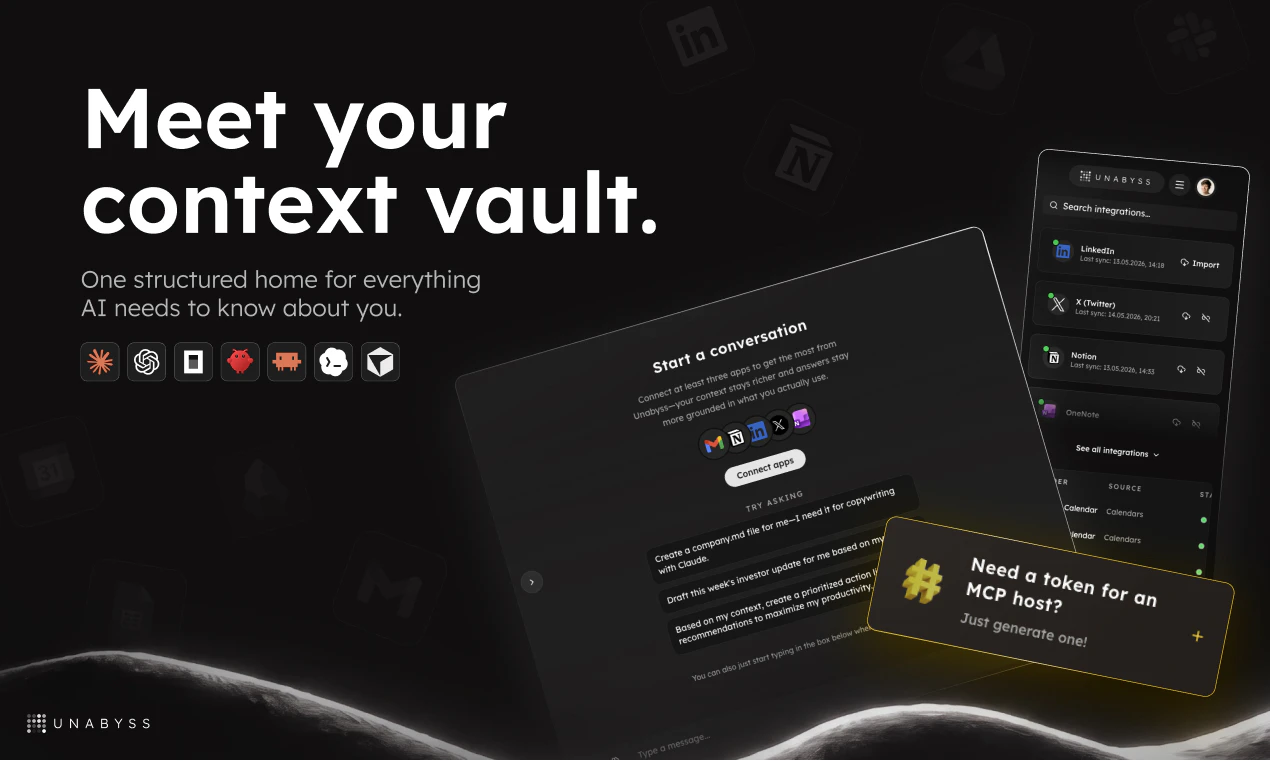
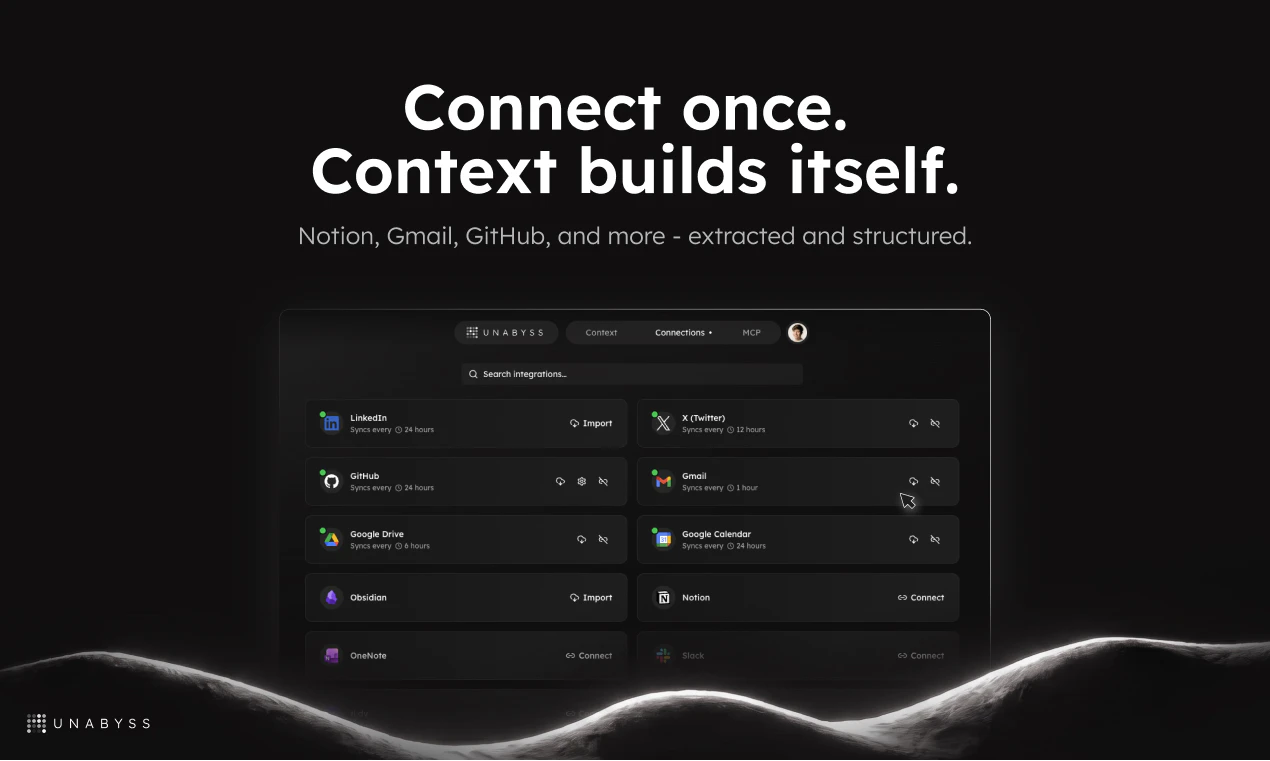
查看原始信息
Elsy
Elsy is an AI voice companion for people with early stage dementia/cognitive decline. Your parent talks to Elsy every day for conversation, memory support, and gentle routine. You get a weekly wellbeing summary: mood, engagement, repetition/confusion. Privacy by design: families see trends, never transcripts. iOS and Android, 15+ languages. Most AI companions chase loneliness. Elsy is built for the disease that makes a familiar voice matter most.
Hey Product Hunt 👋 I'm Morten, one of the founders of Elsy. My dad has dementia. I live in Singapore. He lives in Denmark, 10,000km away. Every call with him is a small audit of how much further the disease has moved. Did he eat today? Does he remember his appointments? Does he remember his friends? Did he sound like himself? My co-founder Oleg and I started Elsy because we couldn't find a product that actually fit this reality. The market is full of "AI companions for seniors" built around loneliness. Loneliness is real, but it's not what dementia is. Dementia is memory slipping, routine collapsing, language thinning out, and families across time zones trying to piece it together from 15-minute phone calls. So we built two things in one product: For the parent: a voice companion they can talk to every day. Warm, patient, available at 3am when they're confused about what day it is. It helps with memory, conversation, and gentle structure. For the family: a weekly wellbeing summary. Not transcripts (we think reading your parent's raw conversations is a privacy violation), but trends. How is mood tracking? Is engagement dropping? What are they bringing up over and over? We launched on iOS and Android in 15 languages a few weeks ago. My dad is one of our heaviest users. Some days that breaks my heart. Most days it's the reason we're doing this. Happy to answer anything: product, the dementia space, building voice AI for older users, founder questions. Hit me with the hard ones. Morten
5
回复