Product Hunt 每日热榜 2026-06-11

PH热榜 | 2026-06-11

#1
Bond
The AI to-do list that does itself
584
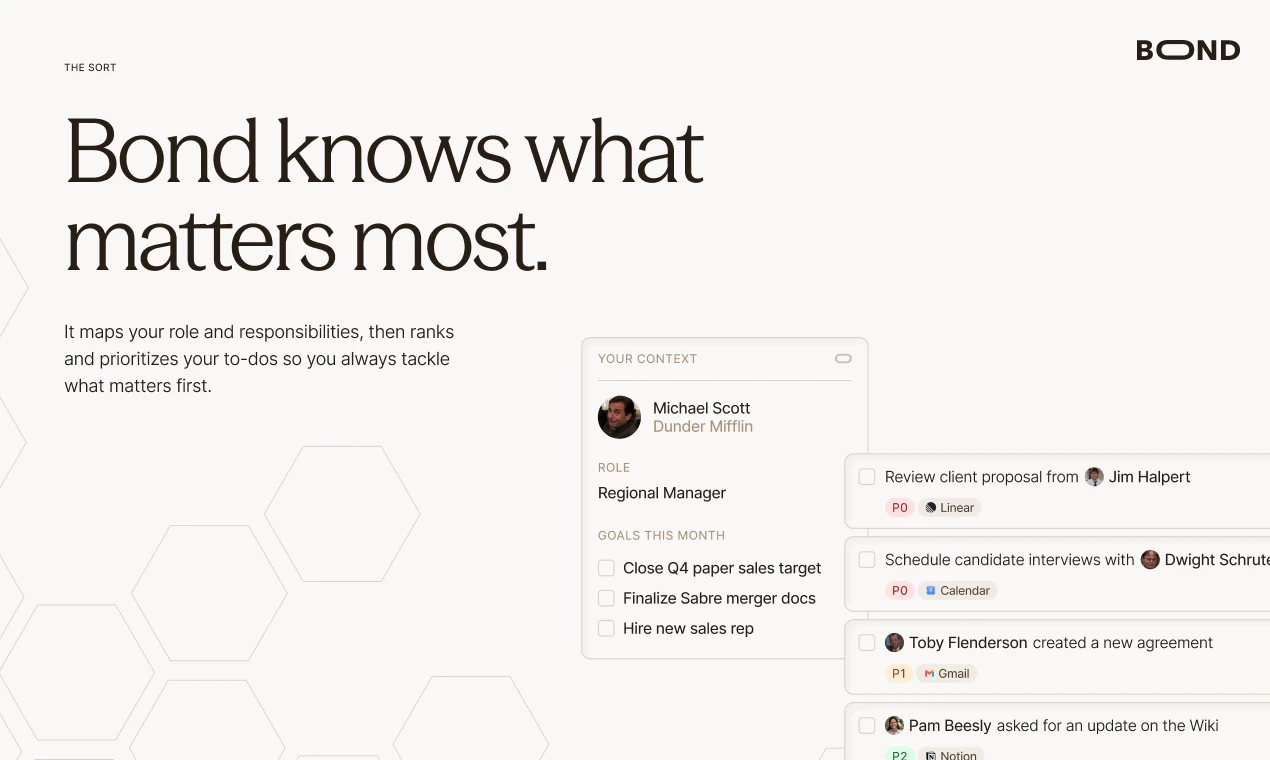
一句话介绍:Bond是一款专为高管和创始人设计的AI“参谋长”,它整合邮件、Slack、文档等工具,自动解析公司运营状态,将零散任务转化为一个自我管理的待办清单,主动提醒用户下一步该做什么,解决领导者信息过载和遗忘关键事项的痛点。
Productivity Task Management Virtual Assistants
AI待办清单 智能助手 高管效率工具 任务自动管理 优先级排序 跨应用整合 SaaS 创始人办公 自动委派 AI参谋长
用户评论摘要:用户普遍认可产品价值,反馈主要集中在:产品何时支持非高管用户(计划中);如何区分冷邮件和关键客户以精准定优先级(结合信号与战略目标);是否替代人工助理(定位为增强而非替代);如何保障敏感数据安全(按人、按源严格隔离);以及用户现场体验后称“被优先级的洞察力震撼”。
AI 锐评

Bond巧妙地切入了一个价值极高但长期被忽视的痛点:成为高管“第二大脑”,而不仅仅是另一个待办清单工具。其核心价值不在于“帮你记录任务”,而在于“帮你判断该做什么”。这种从“被动执行”到“主动参谋”的跃迁,精准命中了创始人时间焦虑的本质。

然而,产品面临的挑战也同样清晰:信任门槛极高。高管对决策权的让渡是极度审慎的,一旦“提前预警错误”或“主动委派失误”一次,信任就会崩塌。评论中关于“数据安全”、“自动执行边界”的密集追问,印证了这一点。Bond目前的“建议-摘要-可控执行”分步策略是明智的,但长期来看,如何建立精确的“置信度模型”以平衡自主性与风险,将是护城河也是绞索。

此外,产品目前依赖深度绑定用户已有的工具链,这意味着用户粘性强,但初始部署成本也高。目前的用户画像(早期创始人、CEO)反馈极佳,验证了PMF的初期成功,但从“高效创始人的玩具”扩展到“大型企业高管的标准配置”,需要解决权限管理、组织内部信息流动与隔离等复杂问题。总体而言,Bond的方向极佳,但“AI参谋长”的称号最终能否兑现,取决于其在真实高压场景下的长期信任度积累。

查看原始信息
Bond
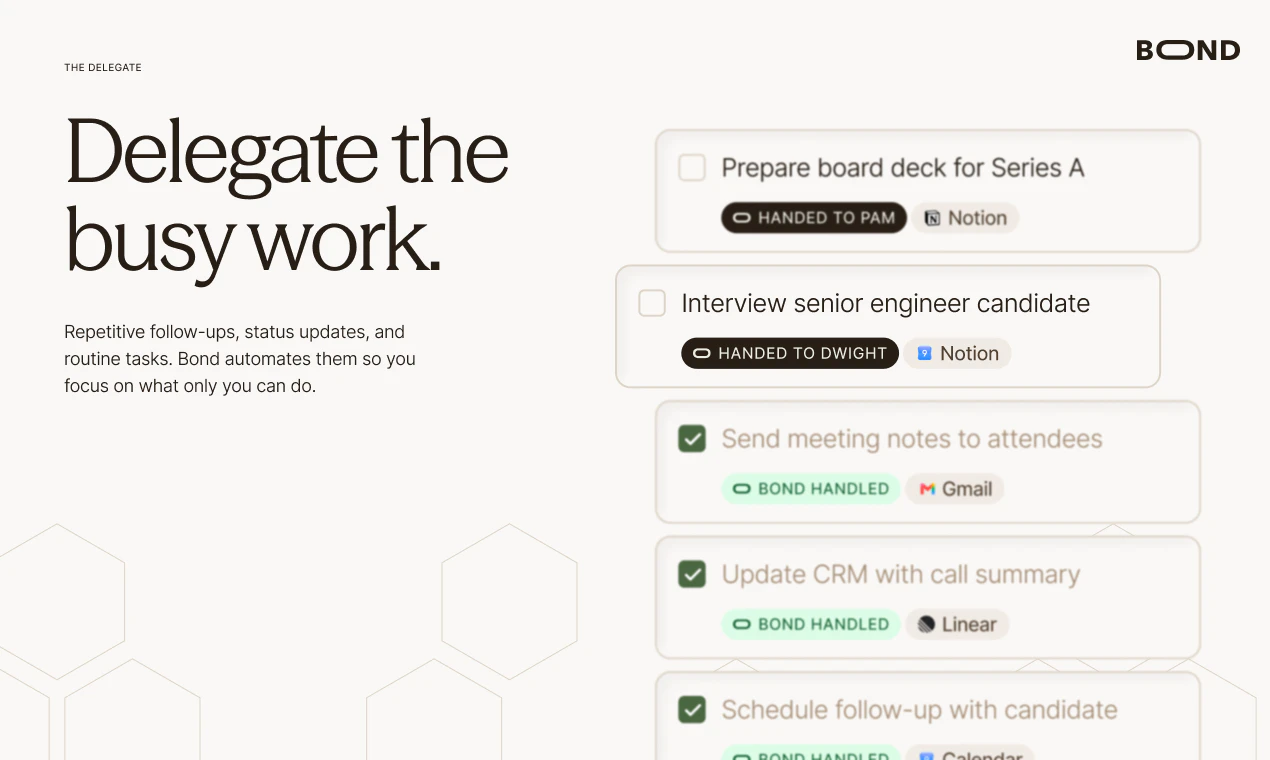
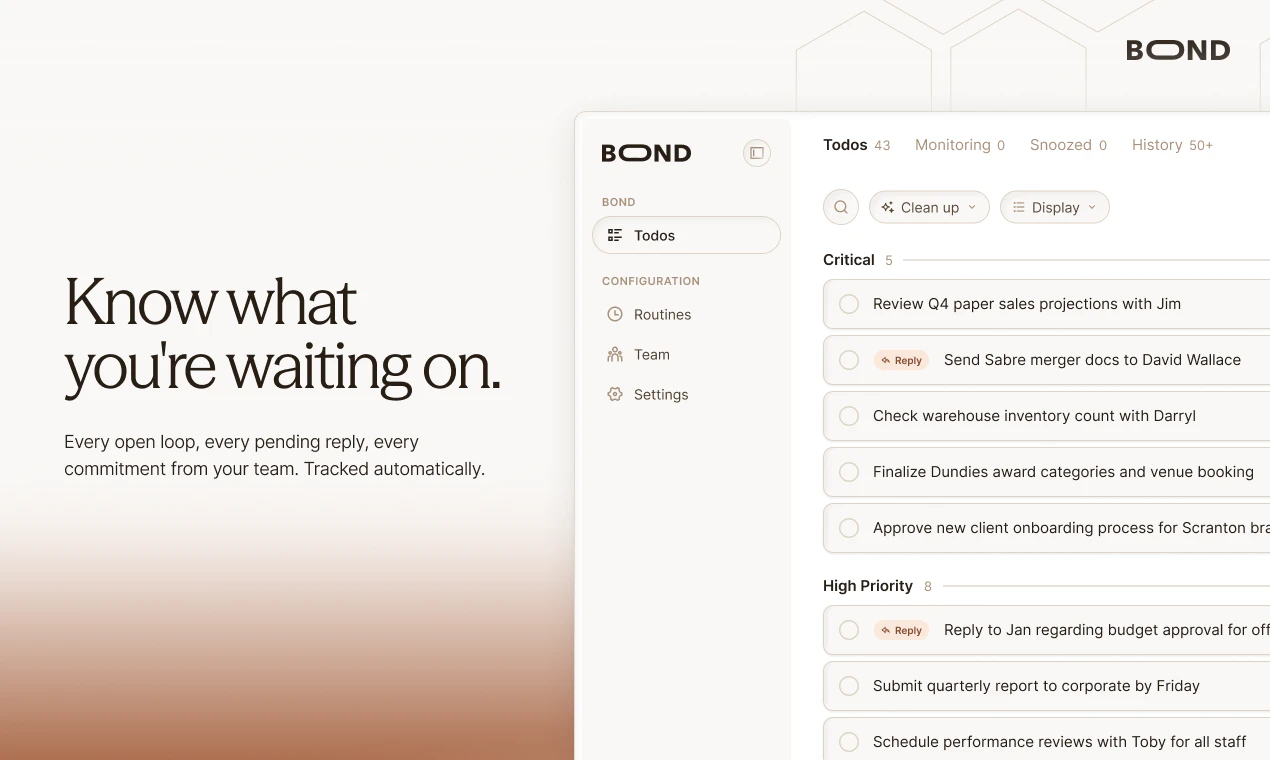
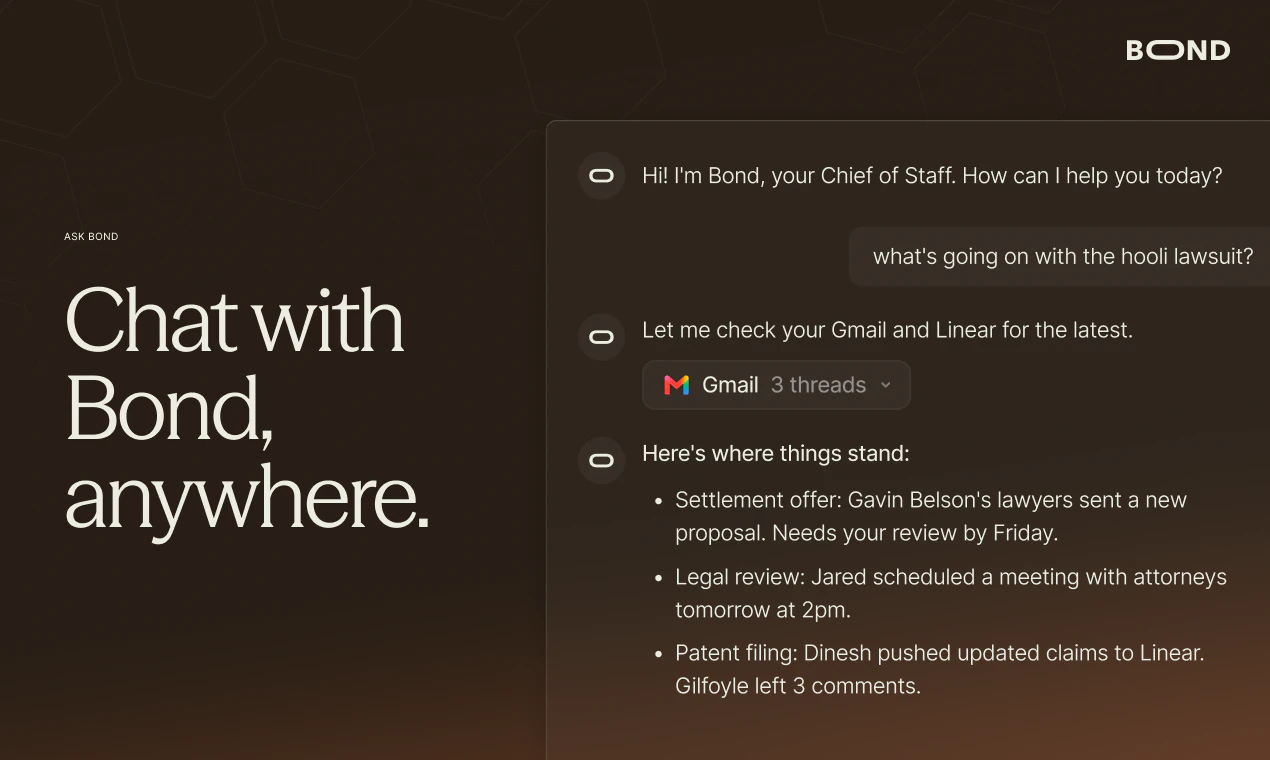
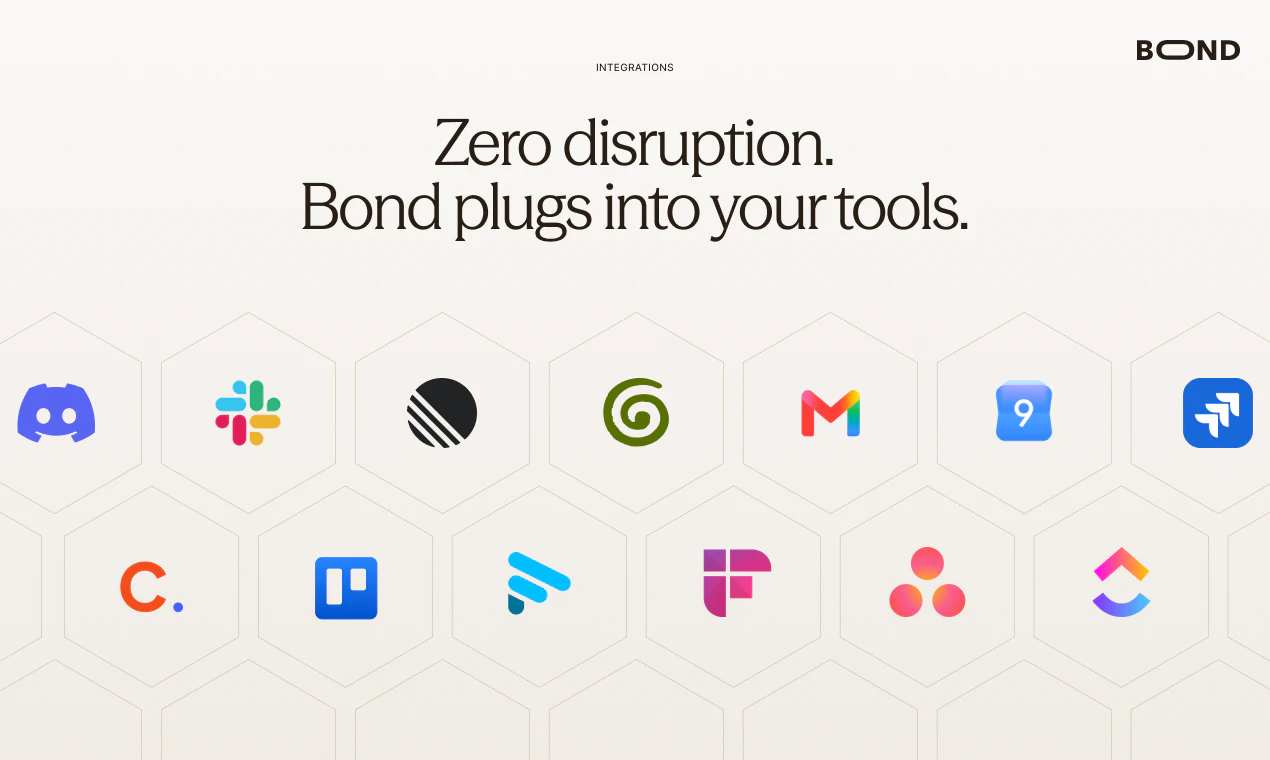
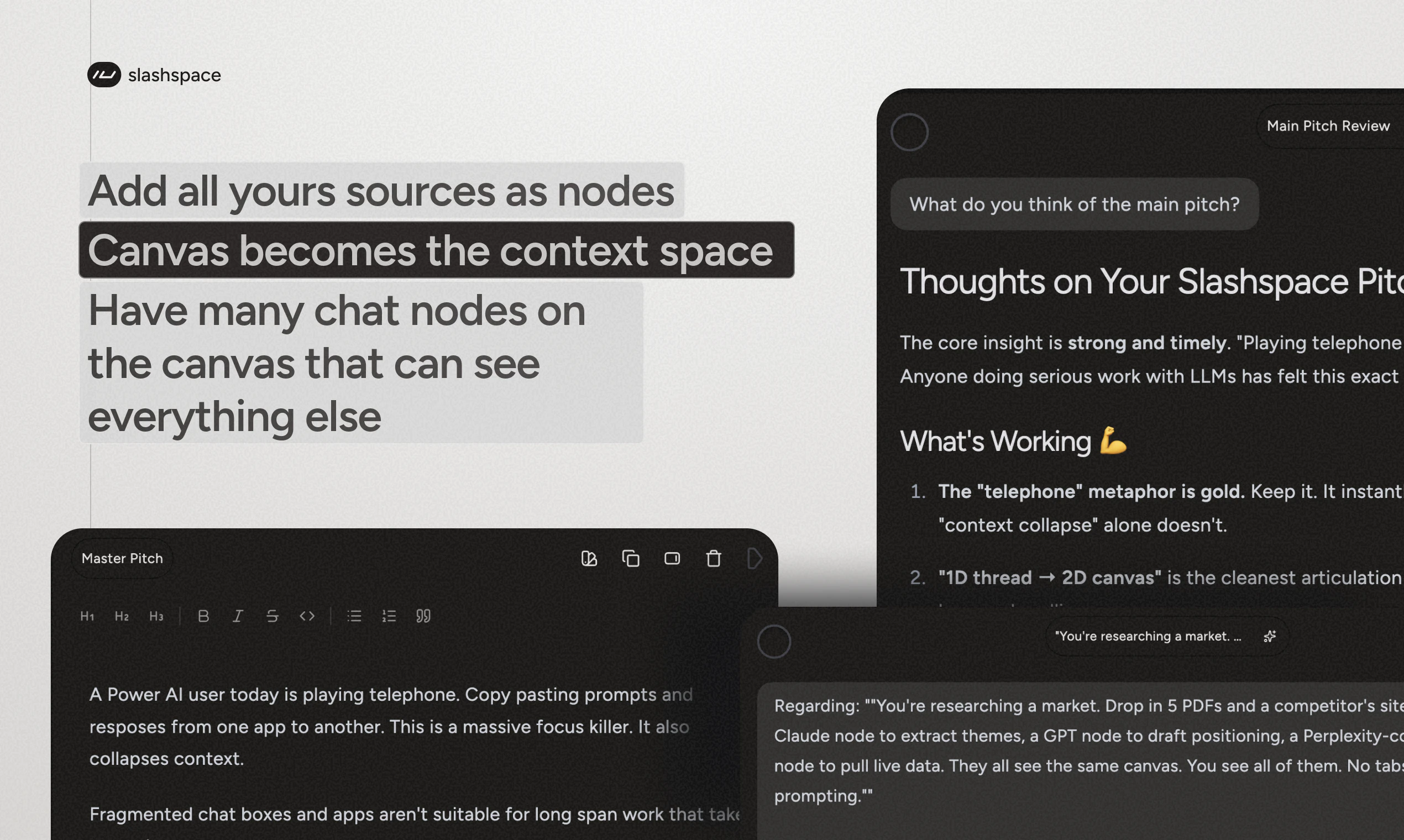
Bond is an AI Chief of Staff for executives. It connects to your tools, learns how your company works, and turns scattered tasks into a self-managing to-do list that always knows what you need to do next. You can ask Bond to prepare you for your next meeting, draft a follow-up, send an email, create action items, identify blockers, surface risks, or delegate tasks to team members.

Hey Product Hunt! 👋

I’m Chloe, co-founder and CEO of Bond.

Over the last few years, I’ve become obsessed with how exceptional leaders operate.

The best founders and CEOs aren’t smarter than everyone else.
They just have an obsession with how they spend their time.

The best leaders know exactly where their attention should go.

They know what matters, what doesn’t, and what’s at risk of slipping through the cracks.

The challenge is that as companies grow, keeping track of everything becomes a full-time job.

The information you need is scattered across email, Slack, meetings, docs, tasks, CRMs, and dozens of conversations happening simultaneously.

Before you can make a decision, you first have to gather the context.

  • What’s blocking the team?

  • Who owns this?

  • Did we follow up?

  • What’s changed since last week?

  • What am I forgetting?

Most leaders spend hours every day reconstructing the state of their business before they can actually get anything done.

That’s the problem we’re solving.

Bond is an AI Chief of Staff for high-performing founders and executives. It understands what’s happening across your company and proactively tells you:


• What matters most right now
• What’s falling behind
• What decisions need your attention
• What should happen next

A few things Bond has already done for early users:
✅ Flagged concerns about a candidate before a founder made a hiring decision

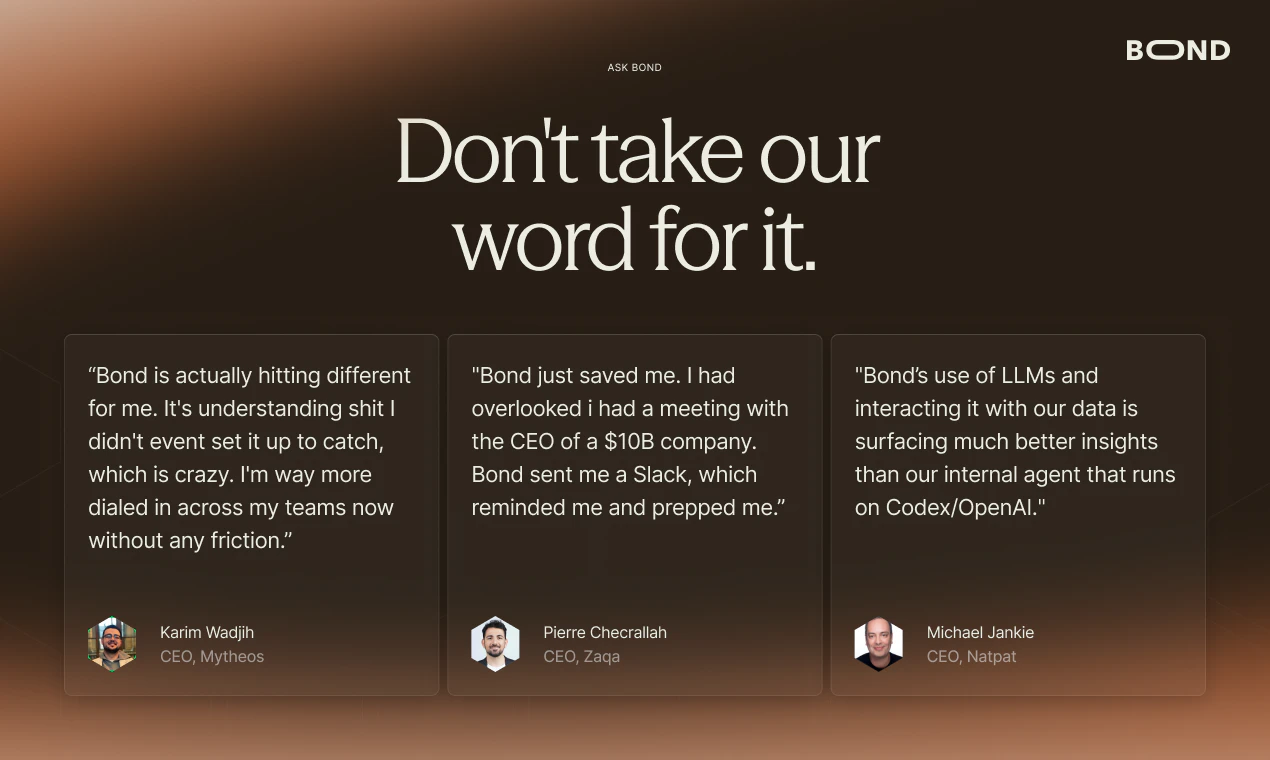
✅ Alerted a founder about a meeting with the CEO of a $10B company he’d almost missed with prep ready before it started

✅ Reminded a founder about a follow-up they’d forgotten for two weeks…the reply closed the deal

The goal is simple: you spend your attention on the work only you can do, and Bond handles the rest.

The entire team will be here all day answering questions and collecting feedback.
We’d love to hear what resonates, what doesn’t, and what you’d want Bond to do for you!

36
回复

@chloesamaha definitely feeling this pain, is there a way for my more manual tasks to get done by bond?

1
回复

@chloesamaha Congrats!! :)

5
回复

@chloesamaha Congrats on the launch team. How do you handle exec inaction (I know about it and just haven't done anything and so task age is increasing) and task priority?

3
回复
Would this product also focus on non-executives over time?
7
回复
1
回复

@martijn_bonte In the era of AI agents, aren't we all becoming executives? 🤔

1
回复

@martijn_bonte Definitely. Right now we're focussed on founders and executives just because they have the pain-point more than anyone else. But we're definitely rolling this out enterprise very soon :)

0
回复

This seems built for rather big company CEOs with large teams. Does it work for early-stage founders like myself who are wearing 10 hats and have a very small team?

6
回复

@jan_willem_denys early-stage is honestly where it shines at the moment. When you're wearing 10 hats nobody's catching the dropped balls but you...Bond does that part. Keeps the few things that matter today up top and handles the chasing/follow-ups in the background. Works whether your team is 2 or 200.

2
回复

@jan_willem_denys Thankss Jan-Willem, lovely question.
While larger teams get a lot of value from Bond, we actually built it with the belief that early stage founders need a chief of staff even more!!

Many of our earliest users are founders with very small teams, who use Bond as an AI chief of staff before they can justify hiring one.

2
回复

Hey Chloe! Loved Bond. Staff is something founders must take care when scaling and you're doing a great job on it. Wish you all the best here

5
回复

@german_merlo1 Appreciate the support Germán!

0
回复

@german_merlo1 appreciate the comment. Every high performer deals with the daily anxiety of not wanting to be the bottleneck, scared of forgetting something. Now they have Bond that remembers everything so they don't have to.

0
回复

I’m such a fan of Bond. I was lucky to get onto the waitlist early and then get onboard a couple of weeks ago. We’re fully AI native, thinking we can do everything ourselves, but absolutely blown away by Bond’s surfacing of priorities, and keeping me aware of what’s needlemoving.

Congrats on the launch, thanks for the amazing support with your really helpful product!

5
回复

@michael_jankie Thanks a ton Michael!

0
回复

@michael_jankie really happy to have you as an early adopter!

0
回复

This sounds great! Congrats on the launch.

Now it just needs to manage my never ending whatsapp inbox & take my calls for me & i'll be out of work

4
回复

@matthiasrossini Haha thanks! We're actively looking into WhatsApp, though Meta isn't exactly famous for friendly integrations lol. We'll get there.

Honestly we dogfood so hard at this point that we barely talk to each other internally anymore. It's just our individual Bonds talking to each other now. #culture

2
回复
The “self-managing to-do list” idea is compelling. How does Bond decide when to surface something, draft an action or actually act on behalf of an executive?
3
回复

@michal_giernatowski Bond surfaces things based on timing, context, and relationships. E.g. A calendar event coming up triggers prep; a message from a key contact flags for a reply, and drafting kicks in when the action is clear but needs your voice (a reply, a follow-up). Autonomous actions are reserved for low-risk, high-confidence tasks where intent is clear. Anything touching the outside world (like sending an email) goes through an approval step first. The exec stays in control; Bond just removes the friction.

1
回复

@michal_giernatowski Great question, because getting this dial wrong in either direction kills trust fast.

The way I think about it is a spectrum based on stakes and confidence:

  • Surface when it's something you need to know but only you can judge: a risk, a decision waiting on you, a thread heating up. Bond brings it to you, doesn't touch it.

  • Draft when there's a clear action but it needs your voice or judgment: a follow-up email, a nudge to a teammate, a reply. Bond prepares it and hands it over for a yes/tweak/no.

  • Act for the safe, reversible, low-stakes stuff: organizing, cross-referencing, marking things done when it sees real completion signals, prepping context. The plumbing, basically.

1
回复
@tibo_wiels @chloesamaha That makes sense especially the approval step for external actions. Can teams tune that trust boundary over time? For example, if an action is repeatable but still sensitive, can the exec approve it a few times before letting Bond handle it more autonomously?
0
回复

Congrats, Chloe!

2
回复

@anshchopra thank you Ansh!

0
回复

this looks awesome, I desperately need this for my team

2
回复

@nicklinck yess!! When Bond has context on the whole team it naturally starts connecting the dots: who's blocked, what's dependent on what, where things are slipping. Game changer for async teams.

0
回复

@nicklinck Let's make it happen my guy

0
回复

@chloesamaha nice congrats! How exactly is the prioritization determined? Is it based on pre-set methodologies such as "this email was sent to you today and all emails should be responded to within 48 hours so the due date is therefore 48 hours from now" or is there some kind of way to evaluate the task against the business's overall strategy and the due dates / prioritization are determined that way?

2
回复

@millwiller Great question! It's actually both. Bond uses a combination of rule-based signals (recency, source, sender relationship) and strategic context, like your stated goals, priorities, and responsibilities, to determine urgency. So a cold email from a stranger and a message from a key customer about a blocker will score very differently, even if they arrived at the same time. The due dates reflect that combined signal.

0
回复

@chloesamaha  @millwiller It's much closer to the second one, and that contrast is exactly the right way to frame it.

The rigid version ("all emails get a 48h due date") is what makes most tools useless, because it treats a note from your biggest customer the same as a newsletter. Bond doesn't do flat rules like that. It scores each item on things like importance, urgency, and effort, and weighs that against who it's from, what it blocks, and your actual goals and priorities. So a task that moves the needle on a key objective outranks something that's merely due soon.

Urgency does evolve with time, so genuinely time-sensitive things climb as deadlines approach, but time-pressure is one input, not the whole formula. The goal is to sort by impact, not just by clock. A truly time-bound thing rises, but it never lets "soon" masquerade as "important."

Does that make sense?

0
回复
This is greatly thought out! Congratulations on the launch. 1. Are you placing this product, as a replacement to any of the current products or a new addition to an employee’s deck? 2. How are you justifying to customers the amount it costs vs the amount it saves(any numbers)? Or just saved time? 3. Is it focused more on SMBs or enterprises or one-man kinda lean startups? May be your actual current customer split might answer this.
2
回复

@sanreds Thank you, sanreds ! Great questions.

1. We don't see Bond as replacing one specific tool. It sits above the tools you already use and helps turn all that scattered context into a self-managing todo layer. So less "another app to maintain," more "an orchestration layer across the stack."

2. The ROI is mostly time and follow-through: fewer missed follow-ups, less context reconstruction, faster delegation, and less chief-of-staff/EA busywork. For execs, even saving a few hours a week can justify the cost, but the bigger value is often avoiding the one thing that would have slipped through the cracks and ofc staying focused on the right company goals is gold.

3. Today we're most focused on founders, executives, chiefs of staff, and lean leadership teams where the coordination load is already painful. That tends to be scaling startups and SMBs more than huge enterprises right now, though the product naturally becomes more valuable as the org gets more complex.

Hope this helps 😊

1
回复

Bond sounds like it could fundamentally change the role of a human executive assistant or chief of staff are you positioning this as a replacement an augmentation or something that works alongside existing EA workflows?

2
回复

@ding_hao Definitely augmentation.
A lot of our users actually are chiefs of staff, they're brilliant, but also quite expensive...
Bond takes the heavy, repetitive layer off their plate (tracking what's slipping, surfacing blockers, drafting routine follow-ups) so they can spend their time on the high-judgment work that actually needs a human.


So it works alongside existing EA and chief-of-staff workflows, not instead of them, the human stays in the driver's seat and keeps the final say. 🏎️
Our moonshot is for Bond to clear more and more of the routine load over time, while the person running it always controls how much.
Personally, I'll always believe in empowering people with AI, not replacing them. 🌞

1
回复

Have you considered mobile interaction? I don’t want to be stuck in front of a computer all the time.

2
回复

@xie_yujin Haha hear me out: there's an inverse correlation between someone's seniority and their screen size. Juniors run three ultrawides like a NASA control room, while actual execs are making million-dollar calls from their phone in the back of an Uber.

So yes, mobile matters a lot. We focused on desktop first to get the core right, but there's already a fully functional mobile PWA today. Making that buttery smooth is next on my personal priority list, because that's where most of our users actually live.

3
回复

@xie_yujin Yes, so currently Bond is a progressive web app, you can add it to your home screen and it runs like a native app (full-screen, app icon, shortcuts to Chat / Todos / Replies).
On the go you can also use BondBot in Slack on your phone, plus push notifications for briefings and routines. But don't worry a truly native app is on the roadmap, and we already have some great UX ideas 🔥.

0
回复

How does Bond handle sensitive information like board level strategy, M&A activity or HR matters that an executive would never want surfacing in a shared or improperly scoped context?

2
回复

@carlos_leonardo1 This is the exact tension we designed around.

There is one shared company brain. That's what makes Bond more than a personal assistant. But access to it is scoped per person, so you only ever see through it what you're already allowed to see. Your DMs, private channels, and personal email feed your view and only yours. A colleague's Bond can't pull them, and yours can't pull theirs.

It's enforced at the data layer, not left to the AI to decide. Just like a teammate can't open a Slack DM they're not part of, their Bond literally can't return it either. Sensitive sources get flagged private the moment they're ingested, and every insight carries a source citation so nothing ever shows up "from nowhere." So: shared brain, shared context, but strict per-person walls on what each person can actually see.

Is the bigger worry for you something sensitive of yours leaking to your team, or their private context leaking to you?

0
回复

What's on the roadmap? Curious where you're taking the "chief of staff" concept. Are you going deeper on specific workflows or broader across more of the exec stack?

2
回复

@annemarie_leys Love this question.

The blunt version: we won't stop until every executive is unemployed from their own to-do list.

The thing we're building toward is you waking up to a single message from Bond that says: "you picked up 10 new todos since you left yesterday. I already handled 6 of them myself and delegated the other 4 to your team. You're all good." That's the whole dream. Not a dashboard you check, but a chief of staff that just runs the back office of your life while you sleep.

And we're honestly very, very close to that. More than people expect.

So to your actual question: it's both, but the order matters. We go deeper on the core workflows first (discovery, prioritization, delegation, follow-through) because that's where trust is won or lost, and then broader across the whole stack once the foundation is rock solid. Depth earns the right to go wide :)

1
回复

Congratulations guys! Does Bond connect to social media accounts?

2
回复

@kutlwano_melamu Thank you Kutlwano 🚀
Social media integrations aren’t currently supported, but they’re definitely on our roadmap. We think they’re especially interesting for founders and creators who have a lot of important context living in DMs and comments. Stay tuned, lots more integrations are coming. 🏄

0
回复

What surprised me most wasn’t the time saved. It was the reduction in background cognitive tax. That constant mental browser tab of “I need to remember to chase X, Y said they’d do Z, don’t forget the Q3 thing…” started quieting down. I still have to make the hard calls and do the actual work, but I’m not spending brain cycles just keeping the plates spinning.

2
回复

@gugan_ananth "reducing background cognitive tax" — that's exactly it. Time saved is nice, but knowing your not missing anything is such a blessing

0
回复

@gugan_ananth  Exactly! We all want our time back, because wasn’t that what AI promised us in the beginning?

0
回复
What’s the one thing BOND does that genuinely surprised your early users: something they didn’t expect to get value from?
2
回复

@marie_bontinck Honestly, the thing that surprised early users most was that BOND tracks commitments they made, even when they were buried in messy notes, transcripts, or events.
It helps executives avoid dropping any balls. 🎾

People expected help with email and calendar triage, but the “oh, wow” moment was BOND resurfacing a specific piece of work they had forgotten was still on their plate, with the source quote or context to back it up.

2
回复

Awesome launch!

Quick question: Can Bond connect to our custom workflows via API or MCP? We’re two co-founders with different roles, so would it be possible to have separate setups or workflows for each of us?

2
回复

@can_erden Thanks Can! 🙌
Yes, Bond can connect to custom workflows via MCP today! and API based integrations are on our roadmap.

For your co-founder setup, absolutely. Each person can have their own tools, workflows, and context tailored to their role while operating within the same organization. So don't hesitate to try it out 😇

1
回复

What I liked about Bond is that it feels intentionally simple. It quietly organizes the chaos across work and helps you focus on what actually matters.

2
回复

@nishikant_takawale the product team really is customer obsessed. Genuinely want to deliver an 11-star to do list experience!

0
回复

Interesting idea, but “AI that knows what I need to do next” sounds like the hardest part here. How do you avoid it just becoming a noisy task aggregator across Slack/email/calendar?

2
回复

@workout097_collab great question!! Avoiding "noisy aggregator" is the whole product. Our approach is to filter with context, not keywords. Bond pre-links every person, meeting, and responsibility before messages arrive, then nothing becomes a to-do unless it survives two checks: is this actually a commitment for YOU (not just your name near a verb), and does it matter vs. everything else on your plate? When it misses, your corrections stick. An aggregator of 10 tools' noise is worse than the 10 tools — Bond only deserves to exist if it's the opposite 🙏

2
回复

@workout097_collab Honestly, this is the exact thing we position ourselves against.

There are a ton of AI assistants out there and they almost all fail at the same place: signal-to-noise. Anyone can one-shot a Pipedream MCP-everything integration, spin up a vector DB, and call it a day. But what you get back is noise with a tiny bit of signal buried in it.

Context is a double-edged sword. It's what creates the noise, but it's also the only place the real signal lives. That's why we threw all our effort into the company brain, an engine whose whole job is knowing what's actually real vs. what isn't.

So Bond is precision-biased on purpose. It filters out things like FYI chatter, bot notifications, wrong-owner asks, and figures out what's genuinely waiting on you, and backs every item with a source citation so you can verify it in one click. The bar to show you something is high, but the things that actually matter don't slip through, because the moment the list fills up with noise you stop trusting it, and a list you don't trust is worse than no list at all :)

3
回复
@chloesamaha Congrats on the launch. Looking at the examples, the value is clear. What I’m trying to figure out is whether Bond is mainly bringing information together from different tools, or whether it’s building its own understanding of how a company operates that gets better over time. Where do you think the real differentiation sits? From the outside, it seems like more and more tools are moving in this direction, so I’d be interested to hear what makes Bond worth opening first every morning.
1
回复

@moh_codokiai Both, but the second one is where it gets interesting. Bond does pull from your tools (calendar, email, Slack, Linear) but what it's really doing is building a model of you: your relationships, your commitments, what you own, what you've said you'd do. Over time it knows who matters, what's stuck, and what you're avoiding.

Users open it first thing because it's a reliable list of what actually needs to get done today. It removes the anxiety of "did I forget something?", the overwhelm of "I have 100 things, where do I start?", and the 2+ hours wasted bouncing between tools trying to build a list.

Your morning looks completely different with Bond. Instead of waking up and spending two hours just getting oriented, you open Bond and start getting things done.

1
回复
@chloesamaha Appreciate the detailed answer. The part I’m still thinking about is how much of that understanding is unique to Bond versus something that could eventually be built into the underlying tools themselves. Do you think the moat comes from owning the cross-tool context, or from the behavioral model Bond builds about each executive over time? Also, it feels like the real test is whether founders genuinely open Bond before Slack, email, and their calendar every morning. Have you seen that behavior emerge with early users yet?
0
回复

Extremely cool

1
回复

@adamcohenhillel thank you adam!

0
回复

Chloe this rocks!!! What can it do for sales enablement and such?

1
回复

@abu_badr Here's a real example from my week: I ask Bond to pull up every lead I met with and or emailed. Then I say "draft follow-ups for all of them." Bond writes each email in my tone, with the context from the call or interaction, right in the web app chat, and I just edit or approve to send.

A task that would've taken me 2hours now takes me 5'. I no longer need to go digging through calendar events, piecing together call context, scanning sent mail trying to remember who I reached out to.

And honestly? Knowing it only takes five minutes means I actually do it and not procrastinate it (which might be one of the biggest pros of Bond that we don't talk about)

0
回复

will def check this out guys! and congrats on a killer launch.

1
回复

@aronlium Thank you Aron!!

0
回复

Congrats on the launch! My brain is really loving how we can finally consolidate so many tools together so cleanly now.

My only request - offer some sort of no or less-risk option to try it out or at least get some sort of taste for the product/the value it provides (especially for the smaller team founders/solopreneurs).

1
回复

@pavansethi_ Totally fair! Our goal is to get to 0 friction to test :)
But unlike most AI tools, Bond isn't just sitting there waiting for you to prompt it. It's running in the background 24/7, syncing across your entire stack every minute so you never have to.

Most users save 2+ hours a day, so it pays for itself in the first week. The discounted Beta price is $199/month. That's $6.60/day, cheaper than your morning coffee. ☕

1
回复

is this free?

1
回复

@mike_martiez It's $199/month. Unlike most AI tools, Bond isn't just sitting there waiting for you to prompt it. It's syncing across your entire stack every minute in the background, which means real token cost on our end.

Most people save 2+ hours a day though, so it tends to pay for itself in the first week!

1
回复
Sounds awesome. Its expensive. Maybe thats worth it but with no free trial and a high setup tax, the hurdle to actually seeing it work is too high.
1
回复

@sam_ruedinger Fair point. We're working on lowering that bar as much as possible. In the meantime, the setup is lighter than it looks, takes a few minutes, and starts surfacing value almost immediately. Happy to walk you through it personally if you want to see it work before committing.

0
回复

This is great!! Love to see systems that reduce cognitive overload. Curious to know, "It connects to your tools, learns how your company works..." how long does this 'learning' typically take?

1
回复

@alochukwu Thanks Alochukwu, honestly, it's pretty damn fast. At most, it should take about a day to start seeing the first company insights, and the self-onboarding should already give you a strong feel for the magic. 🪄

0
回复

@alochukwu Appreciate it!

There's two speeds to it. Bond is useful within minutes of connecting your tools: it maps who's who, which projects are live, and what's moving, so you get real signal almost immediately. Then it gets deeply dialed in over the first couple of days, as it learns the subtler stuff: how decisions actually get made, what you quietly care about, who gets looped in on what.

And it never really "finishes," which is the point. Companies change constantly, so a static model would go stale anyway. It just keeps adapting in the background.

0
回复

Very interesting. Can your AI make phone calls to inquire about something or make reservations? There are a lot of use cases for that in this field. Does it support multiple languages?

1
回复

@natalia_iankovych Great question, Natalia 🙏
Phone calls are definitely on our radar, there are a lot of executive-assistant use cases there, from reservations to chasing information, but Bond doesn't make autonomous phone calls yet.

Today we're focused on the highest-volume written workflows first: email, Slack, calendar, meetings, todos, and follow-ups. That's where executives lose the most operational time, and it's also where we can keep the approval loop and audit trail very clear.

On languages: yes, the underlying AI can work across multiple languages, and we already think of Bond as needing to support international teams. The main thing we're careful about is quality and tone especially when Bond is drafting on someone's behalf, so we prefer to expand language support deliberately rather than claim every language is equally polished on day one.

What language would you want us to support ?
Thankss

0
回复
#2
Respan Gateway
One AI gateway with built-in observability and evals
400
一句话介绍:Respan Gateway 是一个聚合 1,000+ AI 模型的统一 API 网关,核心在单一平台上整合了路由、回退、重试、缓存、成本控制、监控、追踪、评估和提示管理,解决生产环境中 AI 应用调试难、成本失控、可靠性差、需要拼凑多个工具的痛点。
Developer Tools Artificial Intelligence Tech
AI网关 大模型路由 可观测性 模型评估 成本控制 LLMOps 生产监控 提示管理 AI可靠性 开发者工具
用户评论摘要:用户最关注成本可见性、生产可靠性(回退/限流)以及非确定性输出的评估方法。有用户质疑“两行代码”在高复杂度Agent和长追踪链场景下的稳定性,并询问如何防范切换期间的服务中断与成本暴涨。团队回应称评估支持LLM裁判、语义检查等方式,强调自动回溯问题而非依赖人工查看仪表盘。
AI 锐评

Respan Gateway 的定位精准但野心极大——它在试图用一个“All-in-One”方案,解决AI落地生产中“好开不好修”的顽疾。从产品看,网关路由确实是“简单部分”,而真正有价值的是隐藏在背后的可观测性、评估和成本控制的有机整合。这解决了当前AI工程最大痛点:为了追踪一个生产事故,开发往往需要同时操作监控面板、日志系统、评估平台和成本报告这四五套工具,信息的割裂导致排障周期冗长。

但从评论反馈可窥见,产品最大的软肋在于“复杂场景的实战能力”。用户质疑“两行代码”部署后的真实表现并非空穴来风:Agent涉及长工具调用链和复杂状态,简单的回退和重试可能会产生意想不到的级联成本。更棘手的是,产品宣传的“评估”功能在解决非确定性输出问题上,仍停留在传统的LLM裁判和语义检查层面,尚未出现能应对用户输入漂移或提示版本回退的自动化证明。此外,团队在回复中频繁将产品误称为“Keywords AI”(疑似早期内部代号),这暴露了发布阶段的运营毛糙,可能让专业团队对交付质量产生疑虑。

总体而言,Respan Gateway 的路线图是正确的,它把“事后诸葛亮”式的排障,推进到了“事前管控”和“实时诊断”的维度。但对于追求极致可靠性的生产级项目,团队需要证明其平台的健壮性足够抗住“高并发+复杂Agent+细粒度成本分摊”的三重压力。目前来看,它更像一个极佳的“开发者体验”方案,而非企业级“生产保障”系统。

查看原始信息
Respan Gateway
Respan AI Gateway connects your app to 1,000+ AI models through one endpoint. But routing is the easy part. Respan keeps production AI reliable and under control with fallbacks, retries, caching, spend limits, alerts, and full traces for every call. Gateway, observability, evals, prompt management, monitors, and cost controls all run on one platform, so you do not need to stitch together five tools to debug production.

Hi Product Hunt,

We built Respan AI Gateway because routing to more models is only the first step.

Once your AI product is in production, the harder questions show up fast:

What happens when a provider fails?

Which customer is driving cost?

Which model version caused the latency spike?

Did the fallback work?

How do we trace, evaluate, and control everything without stitching together five tools?

Respan Gateway gives teams one OpenAI- and Anthropic-compatible endpoint for 1,000+ models, with fallbacks, retries, caching, spend limits, alerts, traces, evals, prompt management, and monitors on the same platform.

The goal is simple: make production AI easier to ship, debug, and control.

Would love your feedback, questions, and support today!

15
回复

@fran3cc Congratulations on the launch!

The combination of routing, observability, cost control, and evaluation in a single platform is really compelling.

I'm curious, for teams already using multiple AI providers, what has been the biggest pain point that pushes them to adopt Respan AI Gateway first? Is it reliability, cost visibility, debugging and tracing, or reducing engineering complexity? Also, which feature tends to deliver the fastest ROI after implementation?

Wishing you and the team a very successful launch!

0
回复

@fran3cc Congrats on the launch! For teams that already have a multi-provider setup, what’s the simplest, lowest-risk way to try Respan Gateway in production what safeguards do you provide to ensure no customer-facing downtime or cost surprises during the transition?

1
回复

@fran3cc the evals piece is what makes this interesting to me. most teams have routing and fallbacks figured out, but almost nobody has a real answer for "how do I know this model is actually performing well in production" beyond eyeballing logs. curious how you handle eval drift over time as user inputs shift.

1
回复

2 lines of code complete DevOps platform. always sounds a bit too good 😄
What breaks first when you try to use it on a real production agent with tool calls and long traces?

5
回复

@workout097_collab Totally fair. The 2 lines are for getting traffic into the gateway and traces showing up, not pretending production agents are easy.

In real agents, the first things that break are rate limits, long tool-call chains, cost spikes, and not knowing which model/tool/prompt version caused the issue.

2
回复

This is what many dev teams are missing. I’ve seen so many projects stall because they couldn’t effectively trace which model version caused a latency spike.

How does Respan handle 'evals' for non-deterministic outputs? Is it easy to set up automated regression tests for prompt changes?

2
回复

@diana_nadim2 Hi,

For non-deterministic outputs, we don’t rely only on exact-match evals. Teams can evaluate outputs with a mix of LLM judges, rubric-based scoring, semantic checks, structured/schema checks, and custom pass/fail criteria depending on the task.

For prompt changes, yes, the goal is to make regression testing easy. You can keep a dataset of representative inputs, run a new prompt or model version against the same cases, compare scores against the previous version, and catch quality, latency, or cost regressions before rolling it out!

1
回复

@fran3cc Honestly, Al reliability is still a huge challenge. Glad to see tools tackling this problem.

2
回复

@dipanshu_kushwaha5 Totally agree. AI reliability is still one of the hardest parts of putting these products into production.

0
回复

The "2 lines of code" promise immediately caught my attention. Anything that helps teams focus on shipping AI experiences instead of rebuilding infrastructure deserves a closer look. Well done!

2
回复

@1mirul Thank you! That’s exactly the goal.

Teams should be spending their time building better AI experiences, not wiring together gateway logic, traces, evals, monitors, and cost controls from scratch.

0
回复

🎉🎉🎉

2
回复
🔥🔥
2
回复
Really impressed with how Keywords AI makes managing multiple models and routing so seamless. Congrats!
1
回复

@priyankamandal Thanks a lot! We put a lot of focus on making routing and multi-model management as seamless as possible. Glad to hear it’s coming through in Keywords AI. We’re also excited about how the traces and spend-limiting features help teams keep everything under control in real time.

0
回复

The part I'd want to stress-test is how traces map back to customer and deployment context; that is usually where gateway-only setups stop being enough for debugging production incidents.

1
回复

@jimmy_lee12 Absolutely thats a crucial point. Tracing back to the customer and deployment context is often where simple gateway setups fall short. For production incidents, having that full visibility really makes a difference otherwise its tough to pinpoint the root cause. Thats something we’re keeping in mind with Keywords AI, making sure traces carry enough context to be actionable.

0
回复

Good stuff however I do not think routing is the easy part. It's only easy if it's not done properly. Routing needs to figure out best model. Best model needs to define criteria for 'best'. If it's best output + speed + price, then routing needs to detect intent behind what's flowing through it and adjust accordingly.

1
回复

@ali_shaheen Totally get what you’re saying. Routing can feel deceptively simple until you start factoring in output quality, speed and cost. Detecting intent accurately and dynamically adjusting to pick the right model is really where it gets tricky. That balance is something we’ve been thinking a lot about with Keywords ai making it smart enough to choose the best model for the task without slowing things down or driving up cost.

0
回复
How does Keywords AI handle niche or low-volume keywords differently than other tools?
1
回复

Thanks for the comment@hamza_afzal_butt. For niche or low volume keywords, Keywords AI tries to go beyond just raw search data. It looks at semantic relevance, context and related intent to surface opportunities that traditional tools might miss. The idea is to give actionable insights even when volume is low so you can still target terms that have real potential.

0
回复

Congrats on the launch!!

1
回复

Thanks for the support@michelle_marcelline . Appreciated!

0
回复

Huge fan of the routing and spend-limiting features so far.
It really bridges the gap between a standard API router and a full-scale LLMops production platform.
Having traces baked in makes managing live traffic so much cleaner.

1
回复

@kevin_huang_ynng_ Thanks so much! Glad to hear the routing and spend limiting features are hitting the mark. That gap between a simple API router and full scale LLMops is exactly what we were aiming to solve. Having traces baked in definitely helps keep live traffic manageable and its great to hear itss making a difference on your end.

0
回复

Incredible team and product!

1
回复

Thanks for the support@punn_kam . Appreciated!

0
回复

Interesting take with Respan: Self-driving AI observability and evals for agents. What made you decide to build this now?

1
回复

@borrellbr We started with observability because that’s the first major pain teams hit in production. Once real users are making LLM calls, you need to know what happened, which model was used, why something failed, and where cost or latency is coming from.

Evals became the natural next step because once you have the traces and data, you can do more than just look back manually. You can start checking quality, regressions, and failures proactively.

That’s also why we’re moving toward more self-driving observability. Teams should not have to open the dashboard every day just to find problems. The platform should surface the important issues, run checks, and help teams catch things before they become bigger production problems.

0
回复

Congrats on the launch! Genuine question from someone running multi-provider LLM calls in production: when a provider degrades mid-request (slow but not erroring), does the gateway support latency-based failover, or only hard-error fallback? And can the cost observability enforce per-provider daily caps, or is it reporting-only? The eval layer baked into the gateway is the part I haven't seen elsewhere — curious how you keep eval prompts from polluting the usage metrics.

1
回复

@mikebrandswarm Great question!

Today, we support hard-error fallback, and latency-based failover is in the pipeline. For slow-but-not-erroring providers, we know this is a real production issue, so we’re designing it around configurable latency thresholds and safe handoff behavior.

On cost, it is not reporting-only. We support both soft caps and hard caps. Soft caps can trigger Slack / email alerts, while hard caps can block requests based on the settings you configure per API key, route, or provider.

For evals, we separate eval traffic from production traffic with metadata / tags / environments, so eval prompts can be traced and analyzed without polluting normal usage metrics like customer usage, token volume, latency, or production cost reporting.

0
回复

Putting evals at the gateway layer instead of bolting them on downstream is a smart place to catch regressions before they reach prod. Does Respan run evals against live traffic samples, or is it more of a pre-deploy gate?

1
回复

@oleksii_sekundant we supports both!

Teams can run evals as a pre-deploy gate before rolling out a new prompt, model, or workflow version. That helps catch regressions before they hit production.

They can also run evals on live traffic samples, so you can monitor quality over real user behavior instead of only testing against static cases.

0
回复

I don't work in AI infra but even from the outside, the "something broke and you don't know why" problem makes total sense. having one place to see what's happening instead of piecing it together sounds like it saves a lot of pain. congrats on the launch.

1
回复

@sidraarifali That’s exactly the pain we hear from teams. The first version usually works fine, but once real users, providers, prompts, and costs are involved, it gets messy fast.

0
回复

Having caching and fallbacks baked into one endpoint is a massive win for customer-facing AI features like conversational marketing bots. How does the gateway handle latency during failovers? Is the switch seamless enough that the end-user won't notice a lag?

1
回复

@andika_fadhilah this matters a lot!

For failovers, there is usually a small retry / routing latency, since the gateway needs to detect the provider issue and move the request to another live provider. But in most cases, the end user usually does not notice much beyond a slightly slower response.

0
回复

Connecting to models is rarely the hard part anymore. Figuring out why smth failed three days later is usually where the pain starts. Interesting to see more tools focusing on that side

1
回复

@furkan_kara1 Totally!

On Respan, we log every LLM call, including the model, provider, latency, cost, prompt/version, errors, and traces, so teams can go back and actually analyze the cause instead of guessing from scattered logs.

0
回复

The underrated part here is having traces, evals, fallbacks, and cost controls in one place. Production AI gets messy fast, so fewer moving parts is a real win.

1
回复

@farrukh_butt1 Really appreciate that!

0
回复

The fallback + spend-limit combo is the part I'd test first. In real LLM apps the annoying bit isn't routing, it's knowing whether a fallback quietly changed latency/cost. Curious if alerts can be tied to a specific customer or workspace?

0
回复

Sounds useful. We have a travel AI, and we want to run tests comparing the quality of our model’s responses against other popular models. Do you have any built-in mechanisms for that?

0
回复

@natalia_iankovych Yes, absolutely.

This is one of the main use cases for Respan evals. You can run the same travel-related test cases across your current model and other popular models, then compare response quality, latency, and cost side by side.

Feel free to send me an email, and our team will reach out directly. We’d be happy to help you set up the first eval suite for your travel AI!

0
回复
#3
Asmi AI
AI that handles your personal chores in the real world
395
一句话介绍:Asmi AI是一款通过真实电话替用户处理日常杂务的AI助手,用户每天早上接听它的来电并口述任务(如预约牙医、联系水电工、与银行交涉),Asmi便代劳打电话、听IVR菜单、等待在线,最终通过iMessage或WhatsApp反馈结果,彻底解决“必须打电话”但“AI大模型做不到”的现实痛点。
Productivity Task Management Artificial Intelligence
个人AI助手 电话代办 真实世界任务 IVR导航 预约服务 语音交互 生活效率工具 多语言支持 隐私安全 无App设计
用户评论摘要:用户普遍认可其解决真实电话代办痛点的能力,但核心关切集中在几个方面:任务中遇到OTP或卡号验证时如何处理(回复称会回询用户再执行);隐私与安全担忧(明确说明不克隆用户声音,有自己的语音和号码,需用户主动指令才行动);对地址解析等细节功能提出改进建议;支持多语言和多供应商比价功能受到好评;部分用户关心通话质量、方言及回拨处理等实际场景表现。
AI 锐评

Asmi AI的产品设计精准踩中一个被大模型厂商刻意忽视的“真空地带”:尽管Claude、ChatGPT在文本对话上无所不能,但现实世界的预约、银行、保险等琐事仍然卡在没有API的IVR菜单和“请耐心等待”的语音提示上。创始人Rishi在评论中那句“我同时开了三个AI聊天窗口,但没有一个会拿起电话”就是最尖锐的痛点阐述。从产品角度看,Asmi的巧妙之处在于它没有试图做一个“万能助手”的宏大叙事,而是将能力收敛在“打电话”这个单一但高频的场景里。更聪明的策略是它基于iMessage/WhatsApp的无App交互设计——用户无需学习新操作流,把AI隐藏在日常通讯工具背后,大幅降低了使用壁垒。值得注意的是,评论区对隐私和安全性的质疑(能否克隆语音、能否处理OTP)正体现了这类产品的核心信任命门:用户愿意授权AI代打电话的前提是它必须是“工具”而非“代理人”。Asmi用“明确披露AI身份、不克隆用户声音、仅根据指令行动”的边界设计回应了这一点,这比单纯的功能演示更具战略价值。未来真正的护城河不在于技术(端到端语音模型门槛正在降低),而在于能否在与银行、诊所、政府等机构的“真实对话”中建立认可度和成功率。总的来说,Asmi AI不是换个聊天界面的玩具,而是AI从“智慧大脑”进化到“行动四肢”的一次务实尝试——它做的不多,但做对了。

查看原始信息
Asmi AI
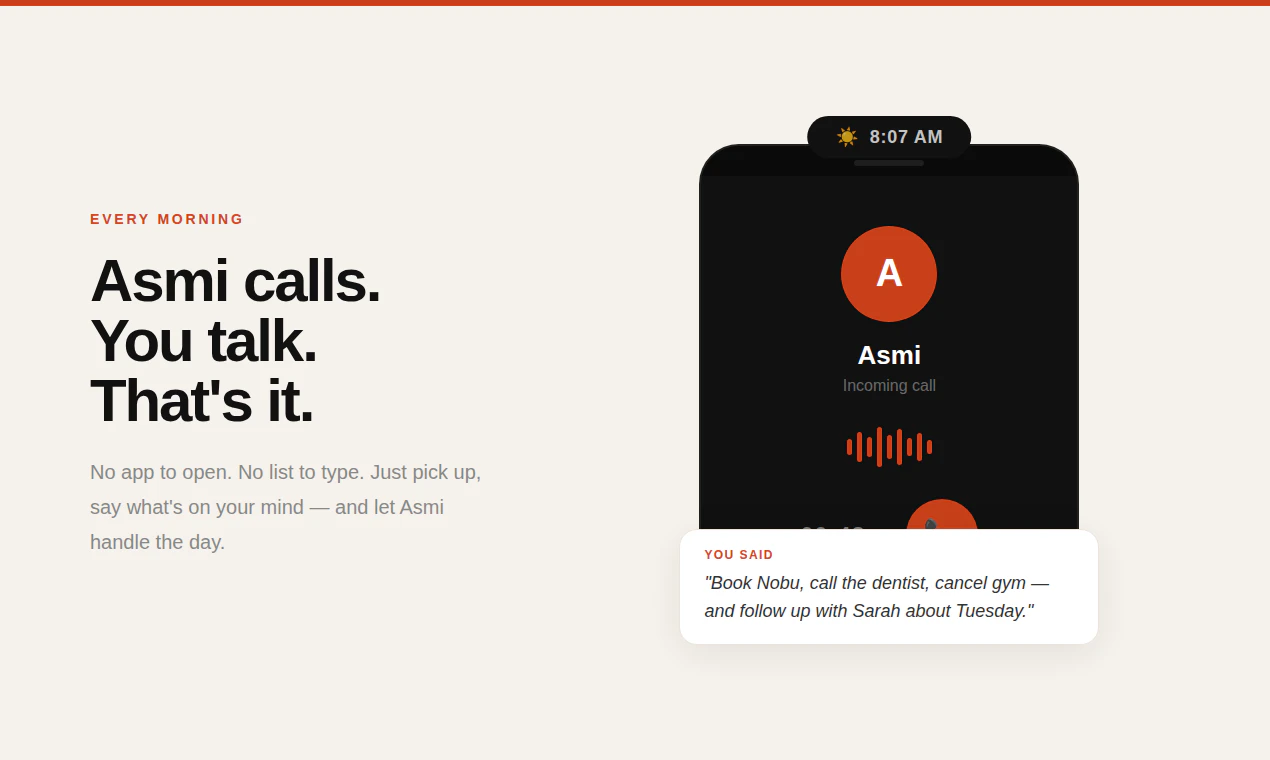
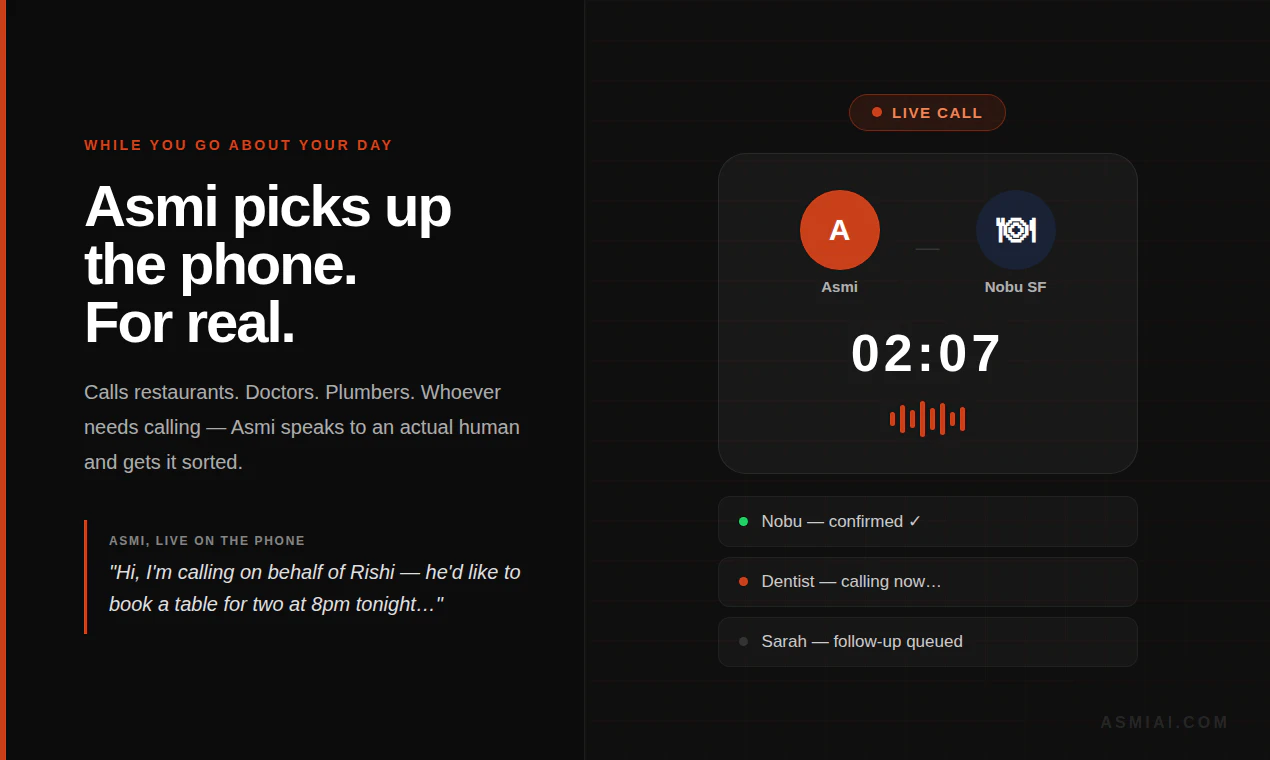
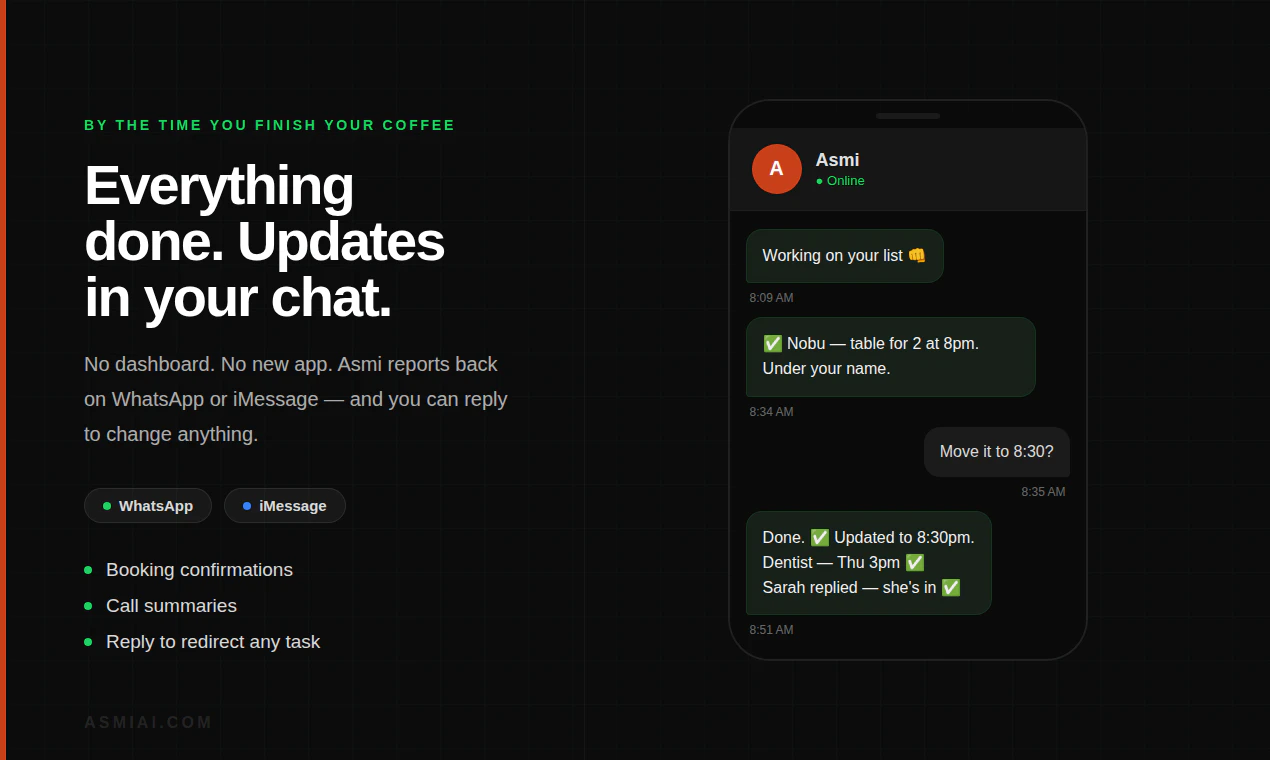
Asmi calls you every morning. You talk - it handles the day. It calls services (dentist, salon, plumber, bank, insurance) or people (friends, colleagues) to coordinate, book or resolve things. Updates you on iMessage or WhatsApp when done. It can navigate IVRS, wait on hold and handle complex conversations well.

Hey Product Hunt 👋 I'm Rishi - co-founder & CEO of Asmi.

I've built India's largest home appliances company ($500M rev, $100M raised). I spent years at Flipkart building products for 500 million people.

This is the most personal thing I've ever shipped.

The problem hit me on a Tuesday.

I had 12 things to do. Not hard things. Not creative things.

Call the dentist. Fight a charge with the bank. Follow up with three contractors who'd gone quiet. Book a restaurant. Chase my accountant.

Every single one needed a real phone call - hold music, IVR menus, "your call is important to us," the works.

I had Claude, ChatGPT, Gemini open in three tabs. All brilliant. None of them would pick up the phone.

That Tuesday cost me four hours.

So we built Asmi.

Every morning, Asmi calls you. You talk - dump everything on your mind. Then Asmi handles it. Real calls to real people. It navigates IVR menus, waits on hold, does the back-and-forth. You get a WhatsApp or iMessage update when it's done.

No app. No chatbot. Just things actually done.

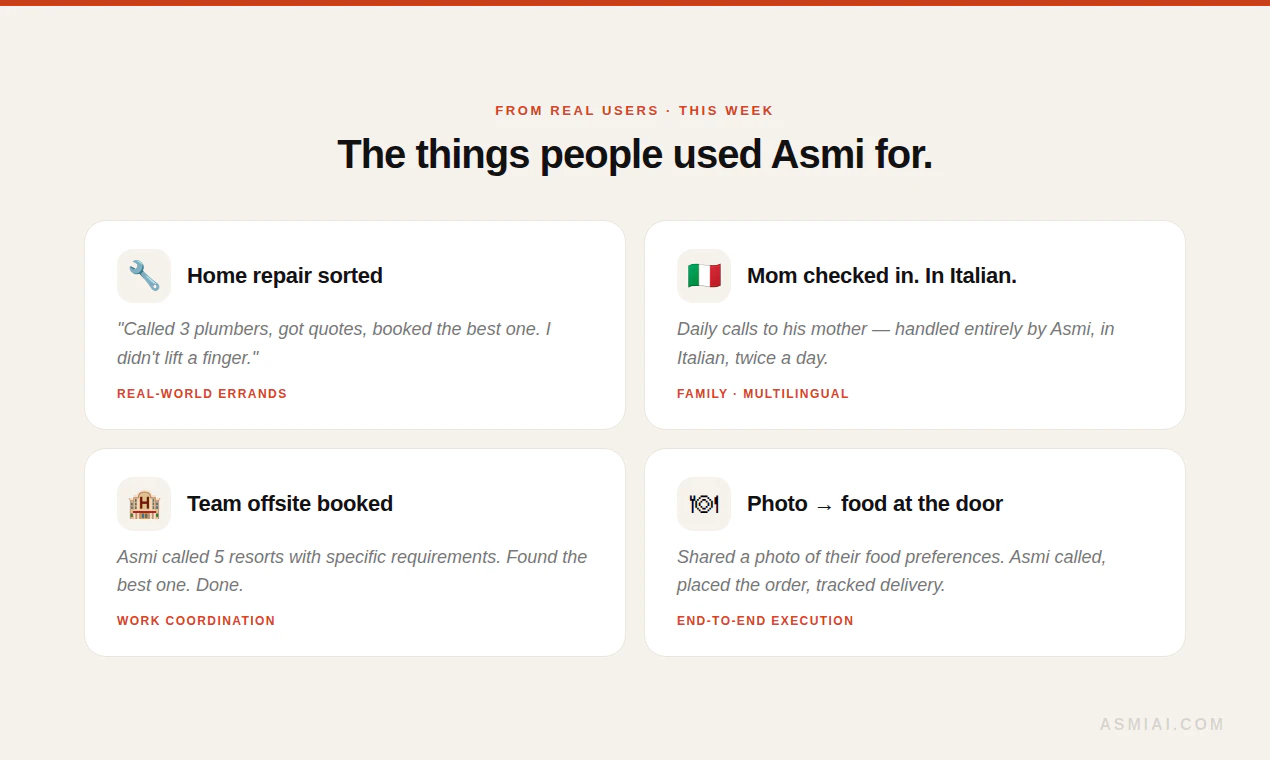
Week one looked like this:

  • Called 3 plumbers, compared quotes, booked the best - user did nothing

  • Checks in with a user's mother every day. In Italian.

  • Called 5 resorts to check specific requirements and book a team offsite

  • Photo of food preferences → called the restaurant → order placed

Why now? Every AI lab built a brilliant thinking machine. Nobody built the one that acts in the physical world. Voice is the oldest interface. Banks, doctors, contractors, government offices — most don't have an API. Asmi doesn't need one. It just calls.

The team: My co-founder Satwik Kottur is a CMU PhD, ex-Meta AI and DeepMind. He built the engine. I'm making sure the world knows about it.

I'll be here all day. Every comment gets a reply - from me and the team.

One ask: what's the one chore you've been delaying for days?
Drop it below — let's see if Asmi can take it off your plate today 👇

31
回复

@rishi_raj Many congratulations Rishi and team! Excited to hunt Asmi AI today! :)

How I Met the Makers

I met Rishi, co-founder and CEO of Asmi AI, about a month ago. I was genuinely surprised by the product’s actual availability, as I’ve seen many products claim to solve this problem but never truly build it.

In the past few months, several makers approached me trying to build this same solution, but they never delivered anything real.

What Is Asmi AI

Asmi AI is a personal assistant that handles your real-world chores through actual phone calls. Every morning, Asmi calls you; you share your tasks, and it takes care of the rest.

It contacts services like dentists, salons, plumbers, banks, and insurance companies or reaches out to friends and colleagues to coordinate, book, or resolve things.

Once completed, it updates you via WhatsApp or iMessage. Asmi navigates IVRS menus, waits on hold, and handles complex back-and-forth conversations effectively.

Why I Endorse Asmi AI

Rishi and his team come from a credible background. They’ve cracked something broader in consumer AI that we’ve long missed from Product Hunt leaderboards, which are mostly enterprise and business-focused.

I endorse Asmi AI because it addresses real-life pain points, when AI starts taking over our greatest daily burdens, that’s when the true AI revolution begins.

I’m someone who needs to check in frequently with many things and people, and Asmi’s ability to handle IVR calls and back-and-forth conversations is particularly interesting.

Getting updates through WhatsApp and iMessage is incredibly useful, and it truly feels like an assistant I’d want to use daily.

Give it a spin! :)

20
回复

@rishi_raj Been inside this product for a while now. What keeps striking me is how much the team cares about whether the task actually got done -- not whether we handled it gracefully or gave a smart response, but did the real-world thing happen. Most tools stop at the edge of the digital world. Asmi doesn't. It picks up the phone, waits on hold, navigates the IVR, talks to a real person, and comes back with a result.

My own annoying chore, Asmi helped me with - I'd been putting off calling a specialist doctor for three months. Long hold times, 3-4 month waits, just didn't want to deal with the mental load of planning it out. Mentioned it offhand on a call with Asmi. It set the whole thing up and made the appointment. Still couldn't believe it honestly :D

6
回复
@rishi_raj That’s a interesting one!!! Good luck 🚀
7
回复

Well, every real-world task that matters dead-ends at some receptionist who'll never ship an endpoint. You seem to be on the right track with the product. Tricky thing could be when a bank or salon asks to confirm an OTP or the last 4 of a card mid-call. Does it hand back to you live or just drop the task?

10
回复

@artstavenka1 Hi Art - great question! Asmi has access to the world knowledge. Before initiating any task, Asmi will come up with all relevant context required to complete that task at one go. It will first get the context from the user over a quick call or chat. It moves forward to make the call after that. If there is some new info required while it’s talking to bank or others, it will come back to you to over chat, get the context, and immediately close the loop. It is trained to always complete the task, never drop it. Hope it answers your question :)

4
回复

Perfect for introverts, but I still worry - will it be normally accepted from the other side. Is it using my voice?

9
回复

@kate_ramakaieva Hi Kate - we totally understand your worry. People generally are very responsive to Asmi knowing it’s calling on behalf of a real customer, and there is a real order, booking or issue that needs resolution. Also, the experience is almost similar to talking to a human being given Asmi’s personality, 50+ languages it can speak in - with the authentic accents.

No, we do not copy user’s voice. Asmi has its own personality, voice and a dedicated phone number.

5
回复

This sounds really interesting and genuinely useful. I'm personally not a big fan of voice calls, but in real life there are so many situations where you still have to call someone, especially when almost everything now requires booking or confirming in advance. I'm curious: does Asmi support multiple languages? For example, if I'm traveling abroad and want to book a local hotel or call a restaurant to reserve a table, could it help handle that in the language too? That would be a really helpful use case for travelers.

8
回复

@evakk Thanks Evak!

Absolutely! Asmi can place calls in multiple languages, either explicitly requested by you or smartly deduced from the task context (e.g., using location cues).

This multilingual flexibility ensures Asmi works seamlessly across the globe without any hassle, making it a perfect travel companion for handling local bookings and reservations abroad.

5
回复

the daily morning call concept is surprisingly clever. It creates a natural habit loop. but can we call anytime of the day in case any task comes up?

7
回复

@easton_carter You got it! We are part of people’s daily lives, and many of them now eagerly wait for Asmi’s morning call.

You can call Asmi anytime of the day. Also, for Asmi’a inbound call, timing is totally customisable. In fact, Asmi confirms this explicitly over the very first call it makes to the user.

4
回复
The strongest part is that users don't need to learn a new app or workflow. great approch 🙌
7
回复

@abod_rehman Thanks Abdul!

The beauty of Asmi is that it sits right inside iMessage or WhatsApp where you already spend your time, so there’s no new app or context-switching needed.


You can text Asmi between chats, or just call hands-free while driving, on a run, or grabbing groceries. It's always right there when you need it!

4
回复

Would love to see calendar integration so Asmi can automatically suggest available slots.

7
回复

@istiakahmad Thanks Istiak, you’ll be happy to hear that calendar integration actually already exists as a silent feature! You can connect it right now to add more context to your tasks.

We deliberately designed Asmi to work powerfully out of the box without needing any integrations at all, but adding your calendar will only make the experience more personalized and powerful moving forward!

4
回复

How does Asmi perform with regional accents, noisy phone lines, and poor call quality?

7
回复

@roopreddy Asmi does really well with regional accents - we have 50+ languages available today. For noise phones lines and poor call quality - we are currently dependent on external vendors, and they handle this, but for the future, we do plan to optimize this in-house and provide a better experience to all users.

4
回复

As a founder, hold music might be my biggest productivity killer. Love this concept.

7
回复

@syed_shayanur_rahmanYes to that and any real world task that consumes your time while you want to heads down focus on growing your business and spending time with your family. Asmi is here to handle it all!

3
回复
This sounds cool but I'm wary of giving it so much personal info on addition to the ability to mimic my voice. How do you make sure it won't go off the rails?
7
回复

@outofelement Hi Marat - Asmi does not mimic your voice. Asmi is your personal AI with its own personality, voice and a dedicated phone number. It introduces itself as your personal assistant to the world, and not a copy of you. Also, you don't need to give any data to Asmi to get it to work. Just pick up Asmi's call, pass on your tasks - it asks all relevant questions to get context and gets to work.

7
回复

@outofelement Totally get the hesitation and a fair concern.

A few things worth knowing: Asmi only acts when you explicitly tell it to - it won't make a call, send a message, or take any action without a direct instruction from you. Every call made on your behalf opens with a clear disclosure that it's an AI. You have full access and deletion rights over everything it stores. On voice: we use AI-generated voice for calls Asmi makes on your behalf - we don't clone or replicate your voice.

Happy to answer anything specific. Check out our detailed privacy policy here - https://www.asmiai.com/privacy

8
回复

Support for wide range of tasks, 50 lanuages and on top of that it's free? Wow, how come it's not the product of the day today? ;) Sounds super handy. I do wonder though how it would work in real life if i want to make a doctor appointment - will real people a the medical center for example even talk to AI?

6
回复

@alex_sh78 Thank you, Alexandr!

Let me show this to you with an example. In the case you mentioned, Asmi will call the reception saying it's calling on behalf of Alexander to book an appointment for Saturday, 2pm. Given how human like and natural the experience is - most of the people/businesses are totally fine talking to an assistant That has been our experience.

4
回复
Would be amazing if Asmi could coordinate between multiple vendors and compare quotes automatically
6
回复

@hamza_afzal_butt Hey Hamza - yes, Asmi does that today. It can call multiple vendors in parallel and get you a good price. Would love for you to try it out!

4
回复

I tried posting addresses on the chat as well. . Its not able to parse contact addresses when posted on the chat either. That part needs work .

6
回复

@mehulmishra6 Hi Mehul - Asmi does not take access to your contacts for privacy reasons. If you do share contact card or contact number over chat, it should be able to read contacts and also save them for future reference.

4
回复

what about privacy controls… Can users decide how long conversations are stored?

6
回复

@amna9 Hi Amna - yes, we do give users option to delete the data if they wish to. We generally store it anywhere between 30 days to 90 days as of today. And it is used for getting to know users better and making Asmi more autonomous and hassle free for them over time.

3
回复

I had Claude, ChatGPT, Gemini open in three tabs. All brilliant. None of them would pick up the phone." that line alone sells the whole product. the IVR navigation and waiting on hold part is the real value because that's where everyone's time actually goes. not the conversation itself but the 20 minutes of hold music before it even starts. curious how it handles callbacks when the service asks to call back later

6
回复

@tina_chhabra Thanks Tina. Whenever Asmi comes across a missed call or voicemail situation, either it can automatically recall in next few minutes or users can explicitly decide when Asmi should call back. Asmi is trained to handle all these task loops efficiently!

4
回复

This is the kind of AI I’d actually use because the task finishes outside the app. Curious how you handle guardrails like max budget, preferred times, or asking before it confirms something?

6
回复

@farrukh_butt1 Thanks Farrukh!

To keep you in control, Asmi smartly analyzes the task context and always asks for your confirmation and preferences—like a max budget—before initiating anything.


If an unexpected detail ever slips through the cracks, it immediately reverts to you to gather that information and wrap up the task to completion.

5
回复

I already have a list of things I can do with it: salon appointment, Apple support scheduling, meeting reminders, checking in with family for things like taking medicine on time, etc. :D

6
回复

@ranjan_kumar45 Thank you, Ranjan!

Those are absolutely fantastic use cases, and using it to check in on family for medicine is incredibly thoughtful.

3
回复

Very interesting!!! Does it work in India for services like insurance, uber, hotel booking, etc.?

6
回复

@ragsyme Hi Raghav - Yes, it works in India for all the use cases you mentioned and more. Hope that answers your question. Feel free to shoot more anytime here!

3
回复

Can users review call transcripts afterward for transparency and verification?

6
回复

@nuseir_yassin1 Thanks Nuseir!

Absolutely! Transparency is a core value for Asmi. After each successful task completion, users get a clear update alongside the transcript/recording, ensuring you always have total visibility and peace of mind.

4
回复

Most AI products save minutes. This one seems capable of saving actual hours. Really cool discovery on Product Hunt today!

6
回复

@zerotox Thank you so much Abhishek!

Saving people real hours and giving them their time back is the ultimate goal. So glad you discovered us on Product Hunt today! 🙌

3
回复

Congrats on launching. Can it also remind me of renewals and chores?

6
回复

@krutiparekh16 Thanks Kruti. Absolutely!! It can help you keep track of the day/week, remember things, and remind you at the right moment. Further, it can pick up those chores at the right moment and complete them for you :)

2
回复

I've been putting off calling my insurance provider for weeks. This might be the answer 😂

6
回复

@divya_kothari1 haha, absolutely Divya. Let Asmi make your life easier. You just do what you love to do!

3
回复

The WhatsApp or iMessage updates are a smart touch. It's good we don't have to open and monitor a dashboard. Congrats.

6
回复

@ankur_jeswani Thanks Ankur. You're absolutely right. Asmi is totally hassle-free, and we chose calls and iMessage/WhastApp to make it really easy for everyday consumers to use Asmi effectively

3
回复

Looks like what my wife used to help me do, now she may hand off to Asmi AI :D

6
回复

@iamanantgupta That is exactly what Asmi is designed for—handling those endless life admin chores so that both of you can offload the mental load and focus on what matters most to you.


We’d love to know what she thinks once she hands off that first task to Asmi!

3
回复

This reminds me of having a chief of staff for personal life. Congrats on shipping!

6
回复

@himani_sah1 Thank you so much—"chief of staff for personal life" is the ultimate compliment and exactly what we aimed to build! We'd love for you to experience that firsthand by trying it out.

3
回复

@himani_sah1 Incidentally, that was the first internal title we had for the product! Your comment feels like we've closed the loop!

0
回复

Interesting and even frightening! How Asmi handles situations where businesses refuse to talk with AI agents?

6
回复

@igorsorokinua Hi Igor - Asmi works very similar to a human personal assistant. Just that it’s more efficient, multi-lingual, and can handle hundreds of tasks in parallel.

If any business or person refuses to talk with an AI, we do respect their choice. Asmi comes back to user with the exact situation and can share the contact details with the user for them to call the business directly.

4
回复

Love how it bridges the gap between digital and real-world tasks. Waiting on hold and navigating IVRs is such a pain.

6
回复

@marianna_tymchuk Thanks Marianna. That’s true. People are loving Asmi for the same reason.

3
回复

Everyone will have their very personal agent soon, and your product seems to be right on track. Congrats on the launch!

5
回复

@nikitaeverywhere Thank you so much! We completely agree—the future is personal agents, and we are incredibly excited to be building that bridge into the real world. :)

3
回复

Looks useful, Asmi AI: AI that handles your personal chores in the real world. Who did you build this for first?

5
回复

@borrellbr Thanks Ignacio. We initially built Asmi for busy professionals drowning in life admin, overwhelmed parents managing endless family logistics, and students juggling chaotic schedules. Basically, anyone who is completely done with phone fatigue and hold music!

3
回复

Is there a B2B version with an API? Which languages are supported? I’d be interested in integrating something like this into my startup.

5
回复

@natalia_iankovych Thanks Natalia for the interest!

We’ve actually had a couple of inbounds about this already and plan to start working on a B2B version and API over the next few weeks. For languages, Asmi natively supports a wide global range including English, Spanish, Hindi, and Mandarin, among many others.


If you'd like to integrate this into your startup, drop your email ID and we’ll loop you into our B2B pipeline as soon as it's ready!

5
回复
#4
Terminal Mode by Even Realities
Keep coding agents always in sight
360
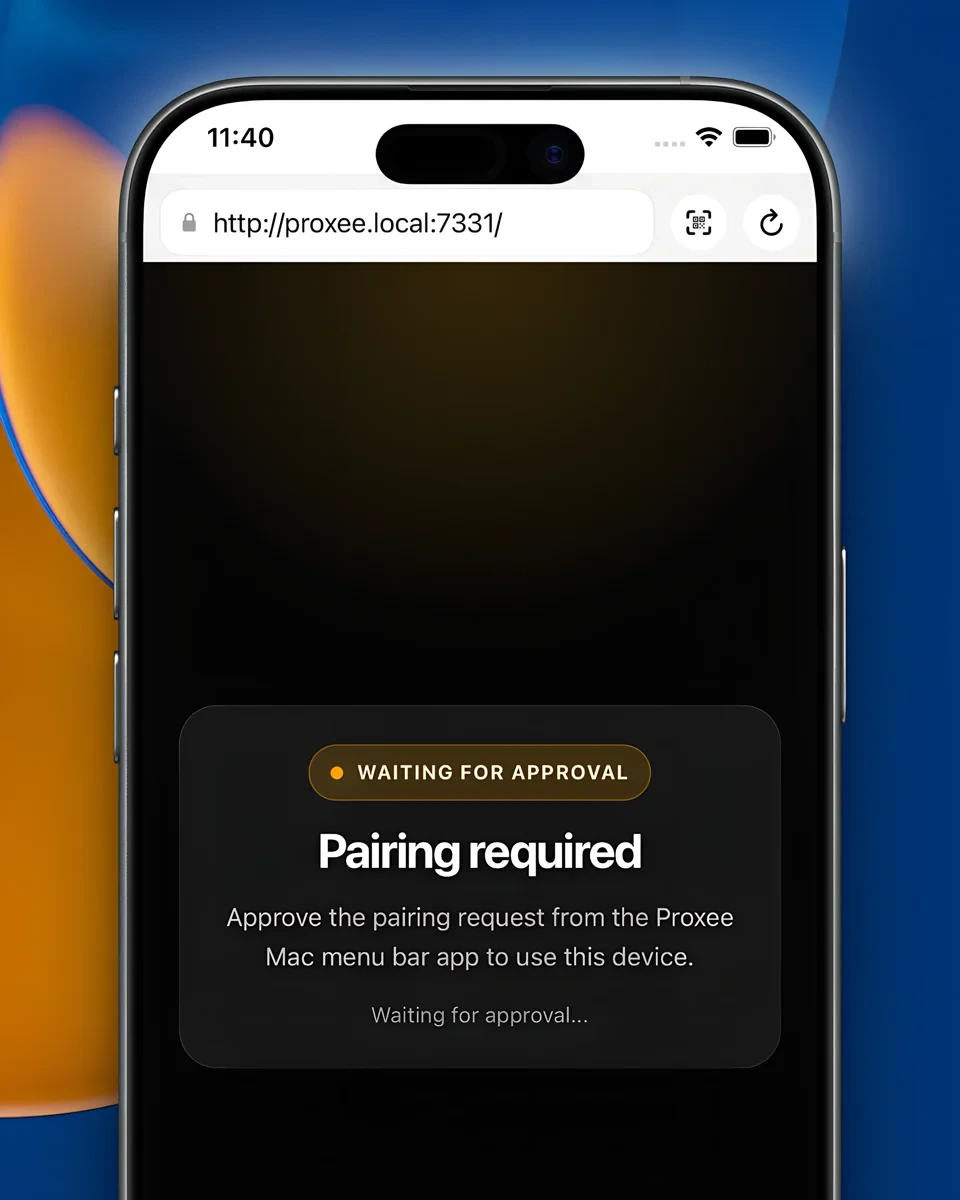
一句话介绍:Terminal Mode让AI编程代理在Even G2智能眼镜上实时可见,解决开发者远离电脑时错过代理需要人工审批或指令的痛点,通过环境终端保持编程流程不中断。
Productivity Developer Tools Vibe coding
智能眼镜 AI编程代理 环境终端 开发者工具 工作流增强 远程监控 语音指令 代理审批 免提操作 AR生产力
用户评论摘要:用户关注延迟(0.5-1秒更新)和防误触设计(需进入会话再批准)。肯定其解决代理闲置痛点的实用性,质疑通知疲劳——团队回应仅显示“需要你”状态。另有用户担忧盲目批准破坏性命令,设计已考虑完整上下文审查。
AI 锐评

Terminal Mode精准切中了AI编程代理浪潮中一个正被放大、却鲜有硬件方案解决的断层:当代理执行长任务时,人类反馈的“滞后性”成为效率瓶颈。将代理状态投射到智能眼镜的周边视野,本质是把传统“拉取式”检查(check terminal)改为“推送式”感知(glance),这种交互逻辑的转变,远比把手机通知搬到眼镜上高明。

产品的核心价值在于对“注意力经济学”的重新计算。开发者的时间碎片化是既定事实,但代理的空转浪费是加法成本。Terminal Mode在“彻底离开”和“死盯着屏幕”之间给出了一个暧昧却高效的中间态——让你在接水、通勤、踱步时仍保持对代理状态的“低功耗连接”。这种“半注意力交互”正是智能眼镜理应擅长的领域,而非试图替代手机或笔记本。

但需警惕过度理想化。0.5-1秒的延迟在多数场景够用,但对于高频审批的代理(如要求每步许可的安全策略),这种“即时感”仍可能被打断。同时,“仅显示需要你的状态”听起来克制,但代理状态的判读本身是个脏活:哪些算“真正的需要”?一条普通日志警告与一个高危命令的审批,在眼镜上可能会因缺少上下文而难以区分。评论区对“盲目批准”的担忧,说明团队尚未完全消解“眼镜简化信息”与“代理需要细粒度控制”之间的张力。

此外,该产品极其依赖生态绑定:需配合Even G2眼镜以及特定的代理运行环境(Claude Code、Codex等)。如果代理生态迅速转向全自动(如自主纠错、自动审批),或眼镜设备的易用性(续航、佩戴舒适度)跟不上,那么Terminal Mode就容易沦为特定用户群的“极客玩具”。

总体上,它不是一个颠覆性功能,而是一个方向性正确的“生产力粘合剂”。它问对了问题——用最少的人类介入,撬动最多的代理产出。但能否从“酷玩”进化为“必备”,取决于它能否在“不增加认知负荷”和“不遗漏关键决策”之间走好钢丝。对于已经高强度使用AI代理的开发者,这值得尝试;对于仍在观望的,它至少提供了一个值得产业重视的交互范式样本。

查看原始信息
Terminal Mode by Even Realities
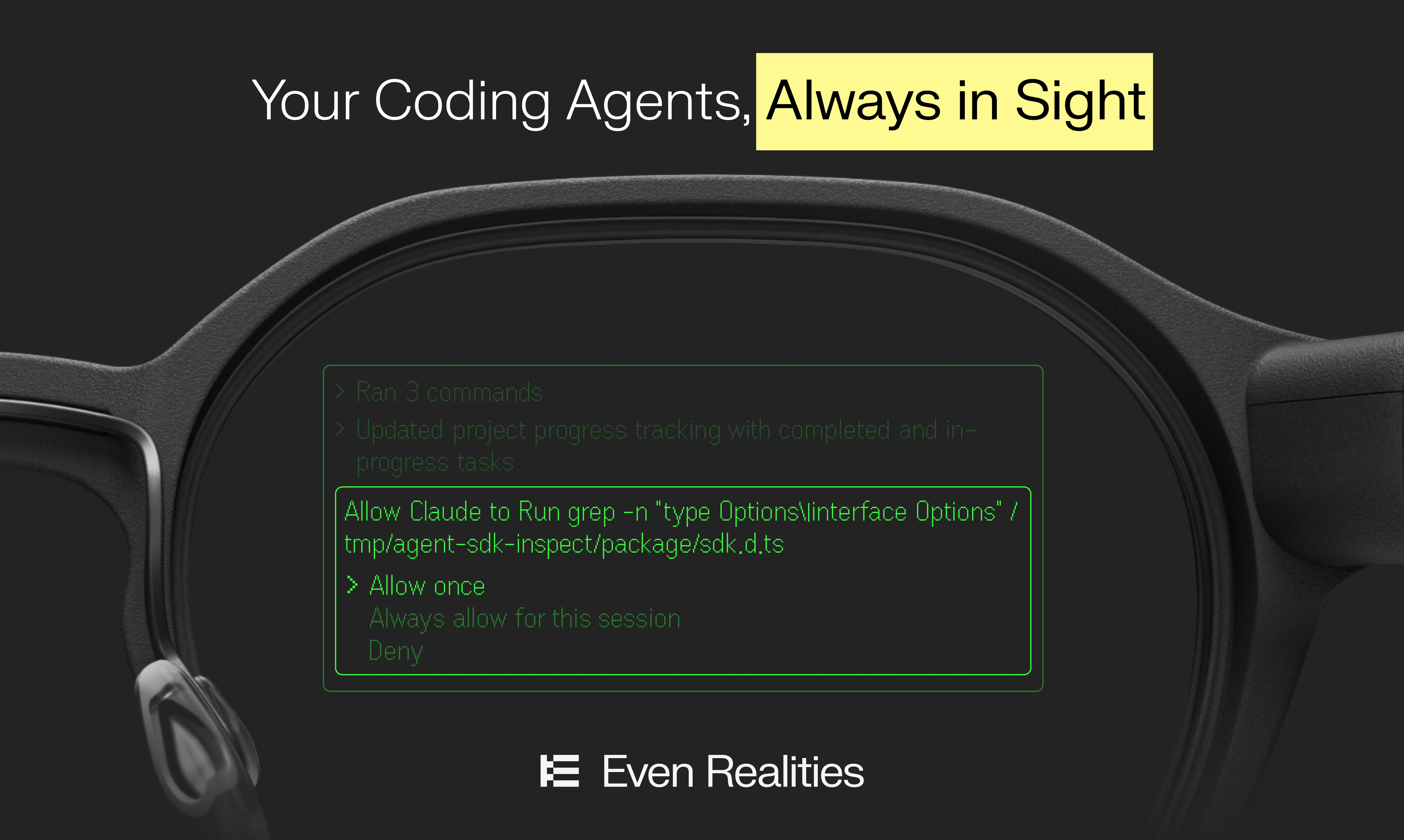
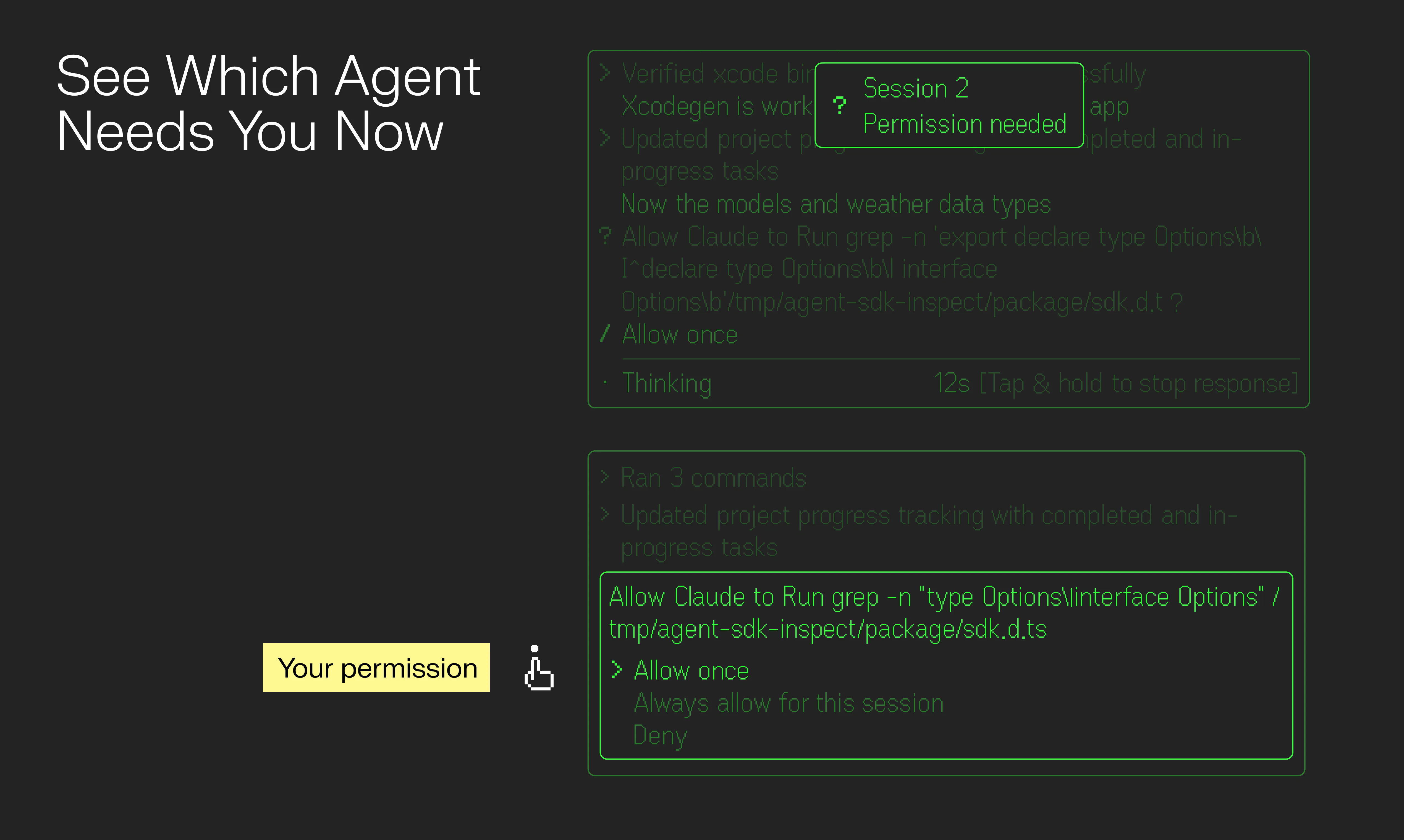
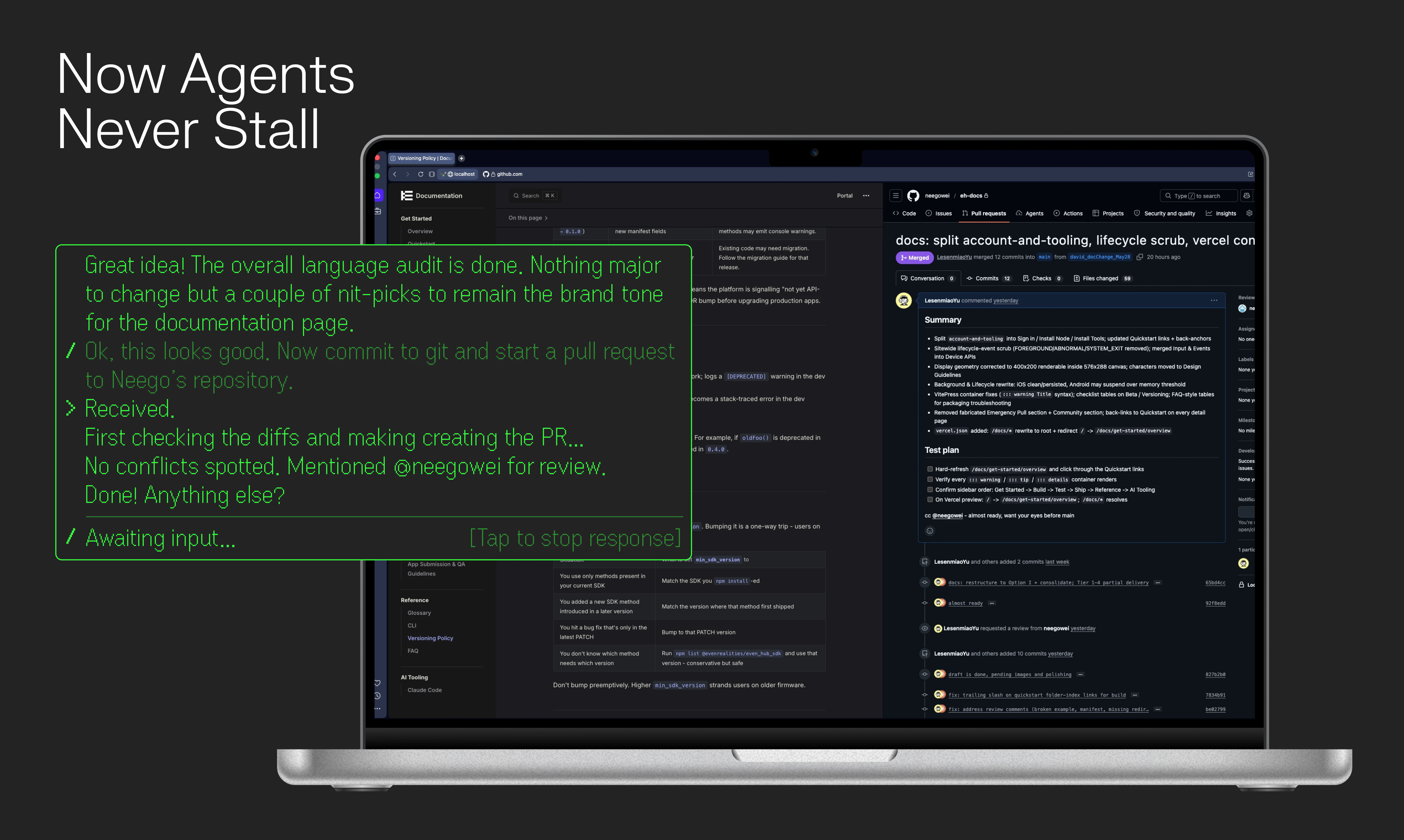
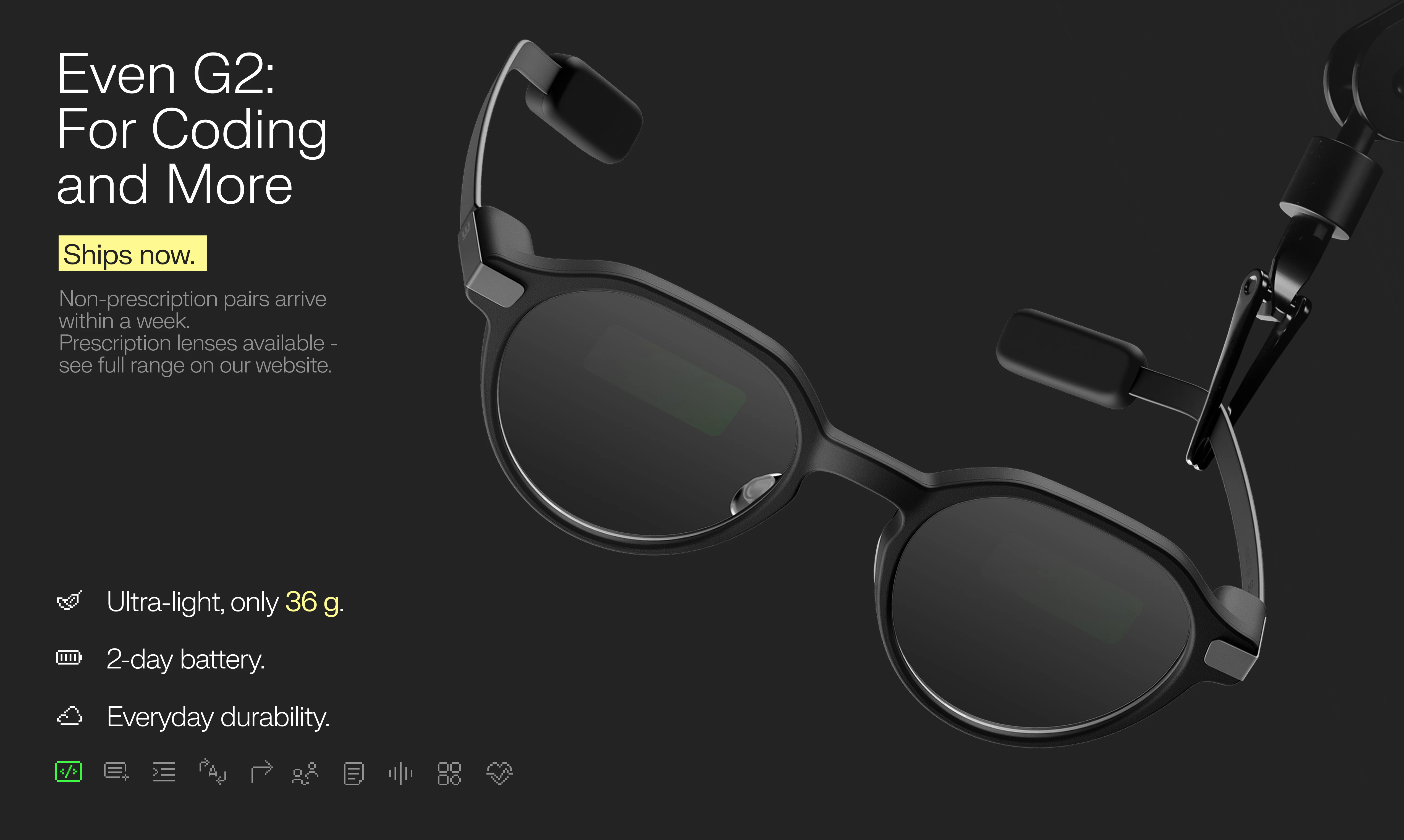
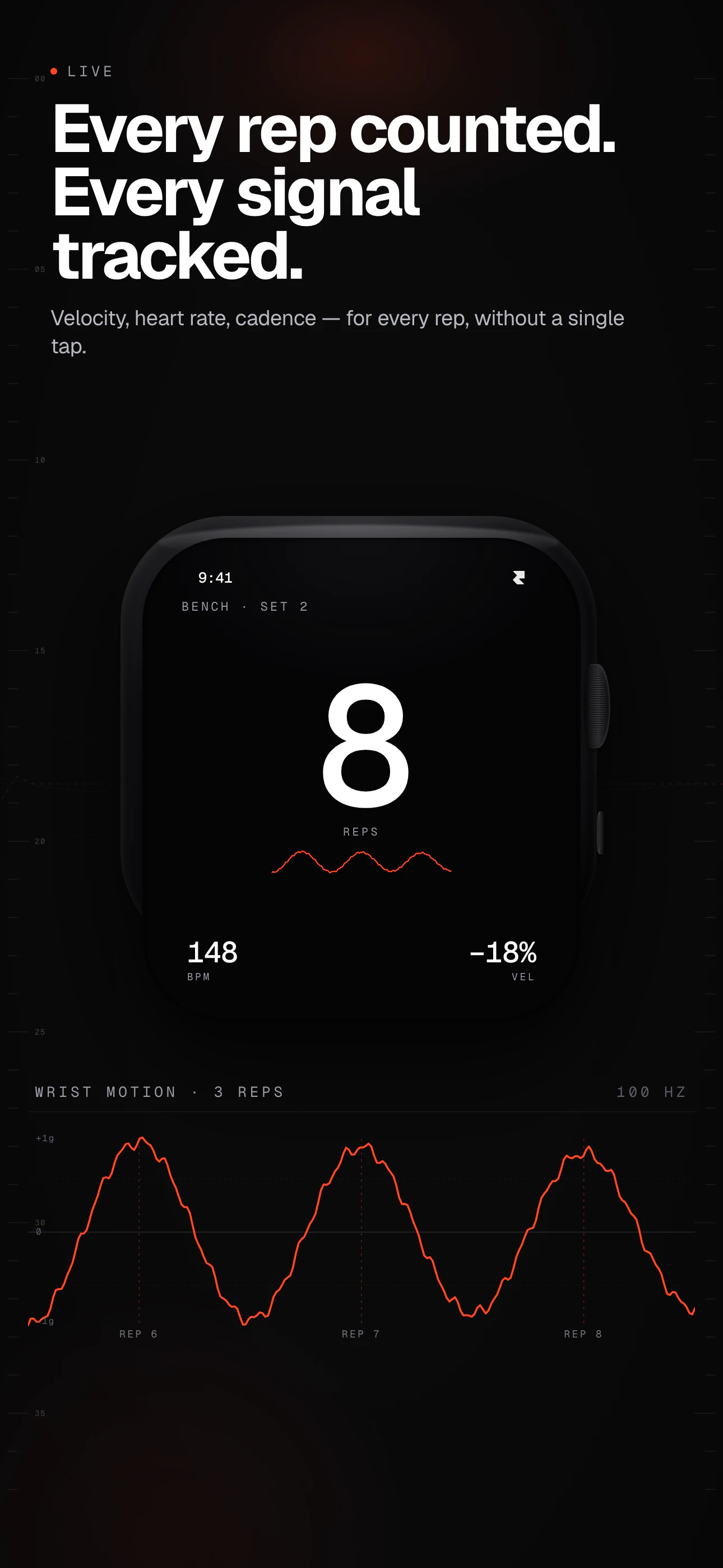
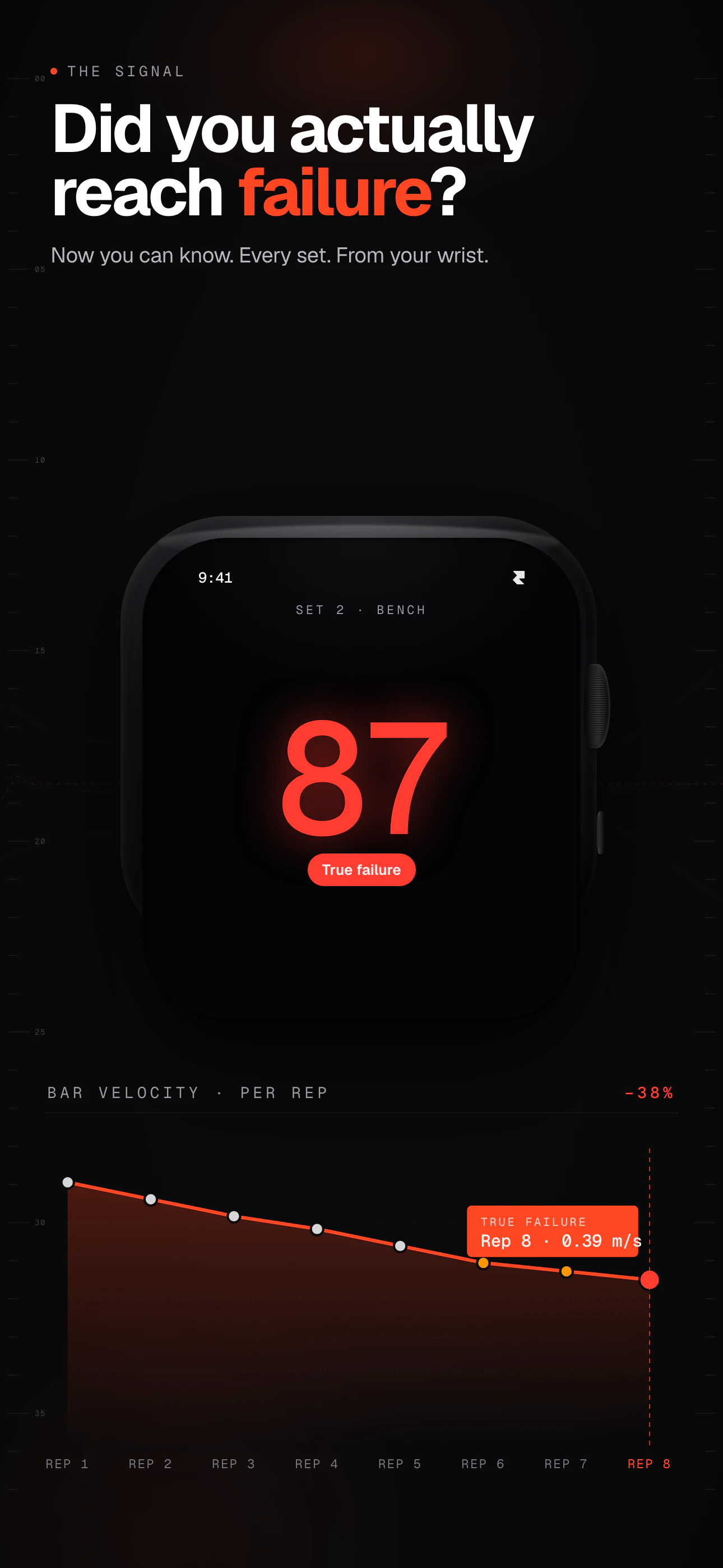
Terminal Mode by Even Realities unlocks an ambient terminal on Even G2 smart glasses. When a coding agent stalls, you catch it: see which agent needs you now, give direction, and approve key steps while your laptop runs long tasks, so token-maxers get more from every run and vibe coders stay in flow.
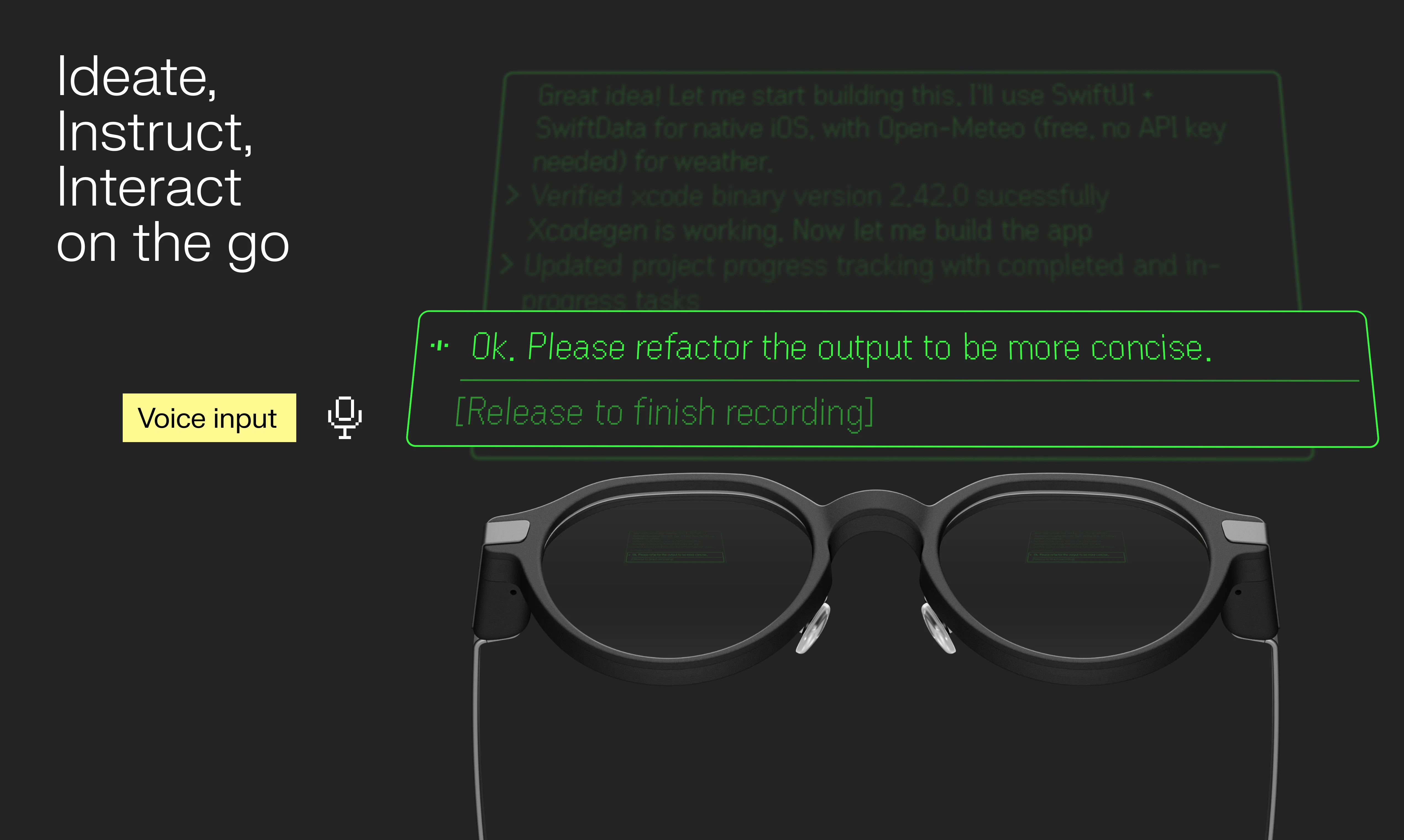
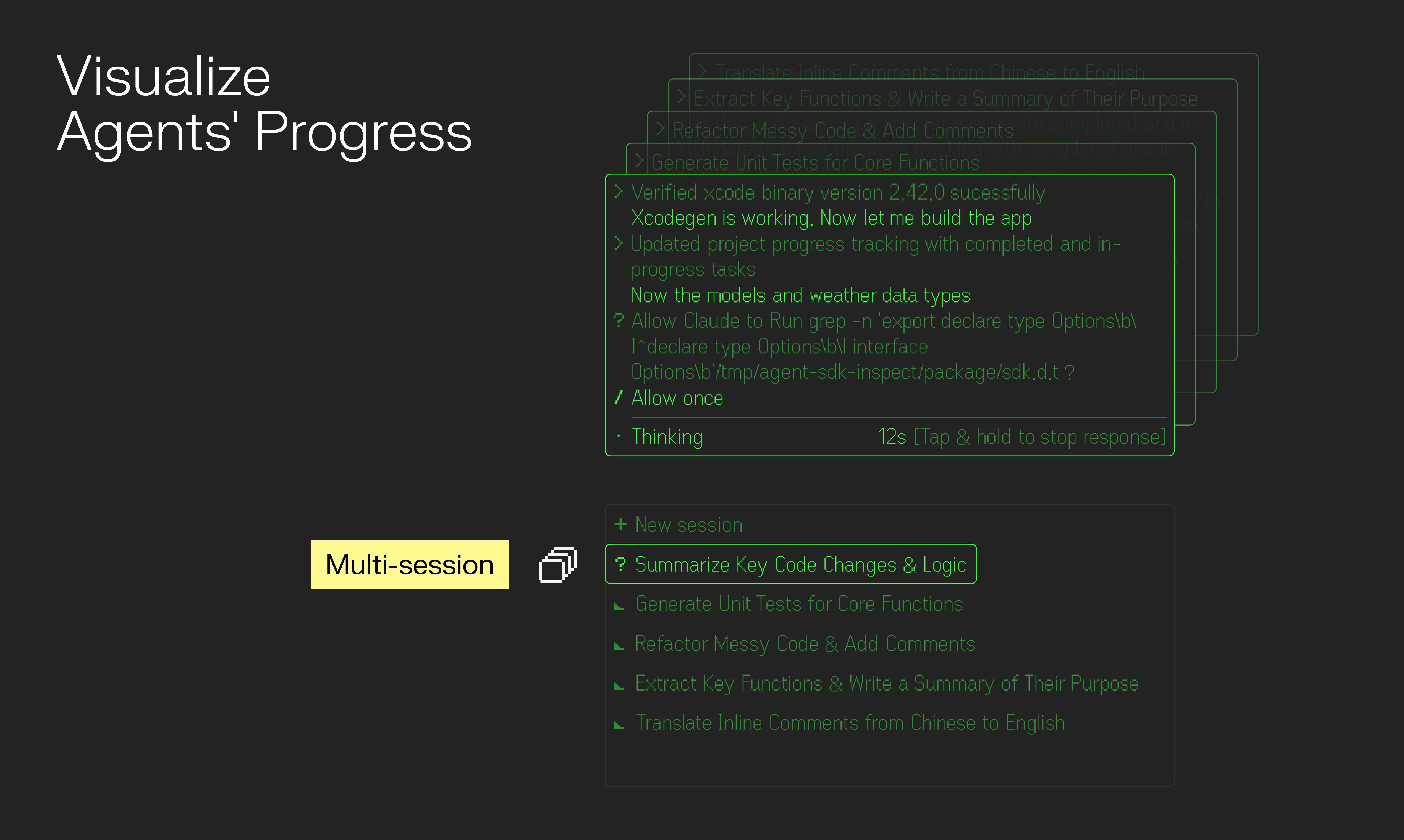
Hey Product Hunt, I’m David from Even Realities. Today we’re launching Terminal Mode by Even Realities for Even G2 smart glasses: an ambient terminal for the AI coding agents running on your laptop. AI coding agents are getting better at long-running tasks. But they still stall at small human moments: a review approval, a blocked command, a quick instruction, a yes/no choice. If you miss that moment, the agent waits. Terminal Mode makes sure you never miss that moment on Even G2 glasses. Your laptop still does the heavy work. Even G2 gives you a terminal layer in your line of sight, so you can see which agent needs you now, give a short voice instruction, and approve key steps with a tap. This is not about replacing your laptop. It is about filling the gaps between focused desk time, so your agents do not sit idle just because you stepped away from the screen. Terminal Mode by Even Realities unlocks: - Monitoring AI coding agents from Even G2 smart glasses - Seeing which agent is running, blocked, or waiting - Giving quick direction by voice - Approving key steps with a tap - Keeping agents moving while you are on the go We’d love feedback from builders using Claude Code, Codex, Cursor, or other coding agents: What are you building with coding agents right now, and when do they usually get stuck?
16
回复

@yulesenmiao congrats on the launch David. This is really interesting, how do you prevent the glasses from becoming another notification surface and fatiguing the user? in your cc use case, there are many, many "allow once".

4
回复

@yulesenmiao 

We first built Terminal Mode for our own team, and it quickly changed how we worked internally: fewer terminal check-ins, fewer idle agents, and less context switching back to the laptop.

That’s why we’re launching it here. We wanted more builders to benefit from the same workflow.

1
回复

@yulesenmiao Congratulations on the launch, David!

This feels like a very practical solution to a real problem. I use AI coding agents for development, research, and automation, and they rarely fail on the hard tasks. More often, they get stuck waiting for a quick approval, clarification, or decision while I'm away from my desk.


Two questions: have you found that most delays come from missed approvals, or are there other common bottlenecks that Terminal Mode helps solve? And the second one is, how do users avoid notification fatigue while staying responsive to the agents that actually need attention?


Wishing you and the team a fantastic launch!

0
回复

Interesting decision to put agent status directly in the glasses instead of another phone app. Feels like the value only works if the sync is fast enough to feel instant.

4
回复

@song_kirby 

Exactly. If it feels like another delayed phone notification, it fails. We treat G2 as a live state surface, not an inbox. It only shows moments that need you: blocked, waiting, approval needed.

In our Claude Code tests, the HUD updates roughly 0.5-1s after the agent enters that state, so you catch the stall instead of discovering it 20 minutes later.

2
回复

The peripheral vision framing clicks! The stall that actually costs me is the agent that asked a clarifying question 15 min ago and just sat there quietly. How do you keep someone from tapping approve on a destructive command when the HUD can only show them one line of it?

3
回复

@artstavenka1 
That concern is exactly right — we don’t want approvals to be blind.

The HUD is glanceable by default, but approvals are not limited to one line. You can enter the session and scroll through the full context before taking action. So the one-line view is more of a “this needs you” signal, not the approval surface itself.

For anything sensitive, the flow is: notice it in peripheral vision → open the session → review the context → approve intentionally.

3
回复

Will's line about 'a glance, a tap, a word' was probably my favorite part of the launch. Most smart glasses products try to compete with phones. This feels like a different philosophy.

2
回复

@xiao_zhang9 

Ditto.

We heavily try to cut out the things that aren't absolute musts. This is how we can show you what really matters.

0
回复

This feels oddly practical. Half the time an agent gets stuck, I don't notice until I come back 20 min later. Being able to keep an eye on progress w/o constantly switching context is interesting

2
回复

@gizem_ozturk 

Exactly. We’re not trying to make people watch every terminal line from glasses.

The useful part is catching the “needs you now” moment before it becomes 20 minutes of idle time. That’s where having the agent state in your peripheral vision starts to make sense.

1
回复

Curious about latency here. How quickly does a blocked agent show up in the glasses after the state changes?

2
回复

@jocky 

Path is agent runner -(network)-> companion app -(BLE)-> glasses.

BLE write is ~100ms; the dominant cost is whatever the runner takes to flip "awaiting input." With Claude Code, it surfaces in the HUD inside ~0.5-1s of the actual block. :)

3
回复

Being able to approve a tool call without touching my laptop is small in isolation. Multiplied across a full day of parallel agent runs, it's not small at all.

2
回复

@crystalmei 

That's the bet. A single approval isn't worth a product. Not breaking flow 40 times a day is - that's why we feel it makes sense to be in your line of sight when your agents need you.

Glad it lands!

0
回复

Keeping an agent's output in my peripheral view instead of alt-tabbing to a terminal is a genuinely different way to babysit long-running jobs. How readable is a streaming log on the display in practice — do you diff it down, or show the raw tail?

1
回复

@oleksii_sekundant 

Right now we can show the full raw tail, so you can enter a session and inspect the actual output when you need detail.

That said, raw logs are not always the best default for a glasses display. The direction we’re moving toward is a distilled state layer.

0
回复

This is one of the first smart glasses use cases that actually feels practical to me. Catching the moment an agent needs input, without babysitting the laptop, is a real workflow fix.

1
回复

@farrukh_butt1 

You bet!

Now you can be on the move more & still max out your productivity.

0
回复

I've talked to developers who basically set a timer and walk away from their agent runs, then come back and see what happened. That works until the agent hits a decision point halfway through and spins for an hour. Live visibility changes that risk calculation entirely.

1
回复

@stella_guan 

i‘ve been there several months ago. But now we have a game changer

0
回复

I noticed the connection stability improvements in the latest release. What was causing the issue before?

1
回复

@isla_wei 

In short, a plethora of issues. But I am glad to hear that it works better now!

What might seem like a simple disconnect to our end users derives from many small root causes that augment each other. We are aware & working around the clock in attempts to discovering more issues.

0
回复

Terminal Mode is the first feature that makes me feel like I've been underusing the hardware I already own. That's the best thing a software update can do.

1
回复

@wangyongyiuny 

Glad to hear that!

That's the beauty of software - the potential is limitless (sort of).

0
回复

Smart glasses have been looking for a killer use case for years. 'Ambient supervisor for AI agents' is interesting because it targets a workflow that's actively growing, not a general consumer behavior

1
回复

@hong_han 

nice spot, thanks!

0
回复

How do you prevent accidental approvals while moving around or during daily activity?

1
回复

@lizzy_leeeee 

Good question. We designed approvals to be intentional, not something that can happen from a random movement.

You need to enter the specific session first, then take the approval action there. So it’s not a passive “one accidental tap and something runs” flow.

A lot of the UX work went into making sure Terminal Mode stays glanceable for status, but deliberate for approvals.

1
回复

Funny how the bottleneck flipped: the agent codes fine on its own, the expensive part is the human not noticing it stalled 20 minutes ago waiting for a yes/no. I run long Claude Code sessions and the round trip of "check the laptop, it was just waiting on an approval" adds up more than I'd like to admit. Glasses may feel early, but the underlying insight - agent state belongs in your peripheral vision, not buried in a terminal tab - seems right. How do you decide what's worth surfacing vs noise when multiple agents are running?

1
回复

@david_marko 
We treat it as state, not logs.

Running agents stay quiet. We surface the moments that need human attention: waiting for input, blocked, approval needed, or ready for review.

The key question is “which agent needs me now?” not “what is every agent doing every second?”

1
回复

This is one of those products that makes you rethink what "working with AI agents" should actually look like. Instead of being glued to a screen waiting for outputs, you can supervise work while living your life. Really fascinating direction for human-AI collaboration. 👏

1
回复

@1mirul 

Cannot agree more. The principle that inspires us is "let agents work & let humans live".

0
回复

Battery life is my biggest question. How much does Terminal Mode affect all-day wear?

1
回复

@ea_z 

Glad you are asking this; We actually put a lot of engineering efforts into this.

TLDR: Skipping all the technical deep dives, we are confidently still all-day wear & pushing two days depending your usage!

1
回复

Can approvals be more granular than just approve or deny? Some actions probably need more context.

0
回复

The gym scenario from Will is the one that landed for me. I do my best thinking when I'm moving. Staying loosely connected to an agent run during a workout without pulling out my phone would change how I structure my days.

0
回复

I work across three agent sessions most days. The time I lose isn't in the decisions, it's in the checking. Opening the laptop, finding the tab, seeing it's fine, closing it. Twenty times a day. If this cuts that to a glance, the math is real.

0
回复

Curious how the system knows when an agent is actually blocked versus just thinking. That timing seems critical.

0
回复

Great Job! I see that this is great for approving permissions and finishing off a task.

One thing I was wondering was that if I have multiple terminals open will the glasses auto summarize every terminal or do I have to link it to one specific terminal and am restricted to only using one instance of an agent.

For AI like Claude where I have to direct it to specific folders or give it specific instructions, does the voice recognition support skills like if I wanted to use a skill in code and also how easy is it for me to rewind if the voice diction doesn't work properly and I need to go back to the previous state.

Apart from the peripheral vision what is the difference between the glasses vs setting it up on my phone using /remote control.

Will these glasses be Bluetooth and does that mean I will need to still have my phone on me

0
回复

Agent supervision shouldn't require sitting at a desk all day. Simple idea, but an important one

0
回复

Honestly didn't expect smart glasses to find their killer feature in waiting for Claude Code to ask permission, but here we are — and it makes total sense. Most of my agent downtime is exactly this: it's blocked on a yes/no while I'm away from the desk getting coffee.

How fast does a voice instruction actually reach the agent? If there's a noticeable lag, that glance-and-approve flow loses its magic.

Anyway, interesting product. Curious where this goes as agents run longer on their own.

0
回复

This is one of those ideas that seems obvious in hindsight but nobody was doing. Having agent output always visible while coding is a genuine workflow improvement, not just a nice-to-have. Curious how it handles multi-file refactors where you need to jump between contexts.

0
回复

This is exactly what the 'agentic' future needs! I'm deep into building web utilities and custom backend automation right now. The biggest friction point is always the micro-approvals—an agent waiting idle for me to confirm a script change just because I walked away from the screen. Giving voice instructions on the go sounds like a massive productivity unlock. Amazing work bridging this gap!"

0
回复

Clean launch for Terminal Mode by Even Realities: Keep coding agents always in sight. How are you measuring whether it is working for people?

0
回复

Our dev team has been deep in claude code lately and the "agent stalled while you stepped away" problem is real. curious about the price point - is this for individual buyers or do you see teams equipping multiple devs?

0
回复

A question about the glasses in general: as far as I remember, your glasses don’t have a camera. Have you considered adding a camera with a small physical shutter that can be opened or closed with a finger?

0
回复

Are non-coding use cases already being explored, or is the focus staying on developers for now?

0
回复

@phoenixhu 
Developers are the focus for this launch because the pain is very clear there.

But it’s not limited to coding. If your agent can do it from your laptop, Terminal Mode can keep that session visible and actionable on G2.


A fun example: I connected an agent to my smart home, so I can ask it to turn on lights, play music, and read the weather from G2. It feels like an early glimpse of G2 as an ambient command surface for agents.

0
回复
#5
Journey Now
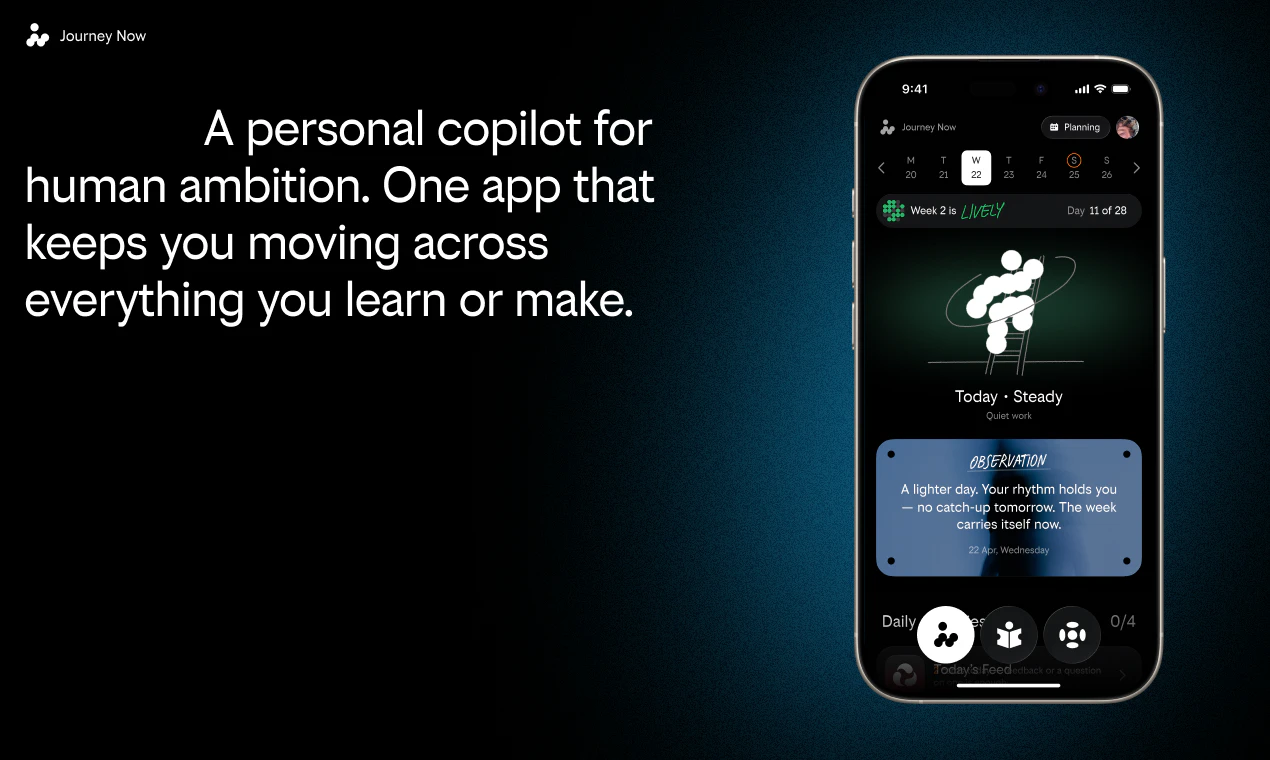
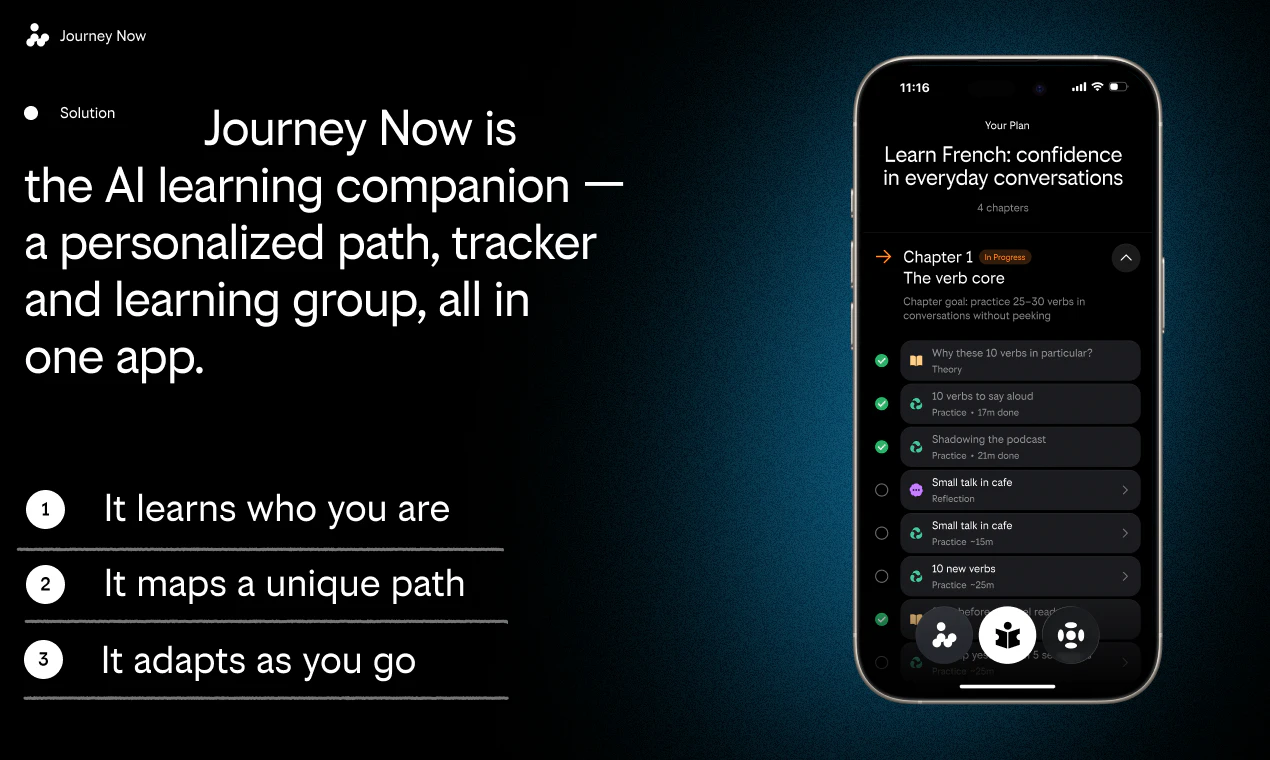
Learning copilot for human ambition via step-by-step plans
313
一句话介绍:Journey Now 将任何学习或掌握目标转化为可自动调整的个性化每日计划,并引入社交监督机制,解决个人成长中难以坚持日常习惯与缺乏反馈的痛点。
iOS Education Lifestyle
个性化学习计划 AI学习助手 日常习惯养成 目标追踪 社交监督 自适应路径 反思日志 技能提升 教育科技 效率工具
用户评论摘要:用户肯定了产品解决“日常习惯难坚持”的核心痛点,并关心AI生成内容的粒度与个性化程度。主要问题包括:是否适用于儿童或团队培训?有用户指出拥有十个课程但无习惯的讽刺,直指真实需求。
AI 锐评

Journey Now 切入了一个极其正确但难度极高的痛点——“从信息到行动”的最后一公里。它巧妙地将AI的个性化能力(自适应性路径、RAG内容、反馈闭环)与人类的社交属性(Pod机制)结合,试图取代传统学习中“老师+同伴”的双重作用。

从用户反馈看,早期的采纳者多为“有明确目标但执行力差”的知识工作者,这证实了其价值主张的精准性。但危险信号同样明显:大量高赞评论来自创始人的圈层互动,自然传播力有待观察。产品成功的关键在于“第一周的留存率”——如果AI生成的计划不够惊艳,或社交监督流于形式,用户极易重蹈“第三周放弃”的覆辙。

技术上,依赖多层LLM管道构建个性化体验,成本与延迟是隐形成本;商业上,ToC的付费意愿与ToB的团队培训场景或许更具爆发力。本质上,它是在贩卖一种“因循自我改进而生的纪律性”,这种抽象体验的交付极其考验算法精度与产品设计。若仅停留在“花哨的任务管理器”,将迅速被Notion AI、Duolingo Max等巨头碾压。真正的护城河在于:能否在用户心智中建立“Journey Now = 数字意志力”的品牌认知。

查看原始信息
Journey Now
Journey Now turns anything you want to learn or master into a personalized, step-by-step plan — with daily guidance, reflection, and a view of how friends are progressing too. As your pace or goals change, the plan adjusts itself, so progress never stalls on a missed deadline.

Hi Product Hunt 🐦‍⬛

I'm Sergey, co-founder and CEO of Journey Now.

Our Why is helping people make clear progress in becoming who they want to be and doing what they love to do.

We've spent 10 years building education products and always seen the same pattern. The real work of growth happens in the invisible daily routine. That routine needs personalized support, which most learning skips. People get stuck, follow the wrong trajectories, and make choices that affect their future (and their present, too).

Now, we have the technology, the experience, and the ambition to break the status quo.

So we built what we wished we'd had: an adaptable path, exercises, reflection journal, tracker, analytics, and a learning group, all in one app (this is Journey Now, voilà).

It took months of testing to build the engine, the methodology, and the knowledge base behind it. Paths grounded in real sources, a method that turns fuzzy goals into a day-by-day practice, and a feedback loop that recalibrates as you go.

How it works:

✶ Tell us your goal. We surface what's underneath and build a path around it (about 4 weeks, but you can change it).

✶ Each day, you get a recommendation based on your activity: exercises, theory, inspiration. Specific enough to help you show up and make progress.

✶ Reflect and calibrate your path. The path and exercises change depending on the feedback you leave.

✶ Invite close friends into your Pod. They see your progress, you see theirs. Much harder to quit this way!

You probably have one project that's been sitting in the back of your head for years — a book, a music track or photo series, a language, or a side thing you keep almost starting. This is exactly where we help and support people.

I'll be around in the comments all day with @andrewu @mikhail_pitersky @alexey_prilepskiy.
We'd love to hear your thoughts and feelings 🙂‍↕️

Get the app here https://journey.now, and let us know which journey you're courageous enough to start 🥷


Best wishes from Paris and thank you,

S

40
回复
@sergeynugaev congratulations on the launch 🔥
2
回复

  @sergeynugaev nice product! Congratulations with the launch

0
回复

Happy to hunt this product!

I really like the product’s mission and purpose, which are focused on making daily improvements to personal skills.

So let us progress never stalls 💪

And good luck with the launch!

9
回复

@mituhin Thank you Paul! It's a joy to launch a product with you. Fingers crossed!

0
回复

Congrats on the launch, Sergey and team!

I really like the framing: growth often doesn’t fail because people lack information, but because the invisible daily routine is hard to sustain without the right structure and feedback loop.

I’m especially curious to try Journey Now for my own two strong but somewhat chaotic learning interests – philosophy and Ancient Greek. If the product can help turn those into a clearer path and daily practice, that would be genuinely valuable.

Wishing you a great launch!

5
回复

@misha_yanovich Thanks, Misha! Excited to hear how the learning of Ancient Greek went 🙌

We do have some users already trying the app for learning languages like French or Japanese.

0
回复
Cool! Just wondering. Are you planning to adapt it for kids? Good luck!
3
回复

@wwwictor Hey Victor! Love your question.

I started my educational career with the issues of teenagers' self-identification. And honestly, it's still one of the most intriguing topics for me: how we can help young people to understand what they really love to learn and do. So definitely yes, we will be looking for ways to bring Journey Now into teenagers' routine and educational contexts.

3
回复

Help me understand: what type of learning is your product best suited for? Habits? Or professional skills? Is it good for team training?

3
回复

@maria_chmir Hi Maria, thanks for your question! From my experience, there are no preferred topics. For example, I used it for French learning and for blogging habits as well. My friends use it for thinking about careers or for book writing. So the spectrum is quite large.

But I think the difference depends on the educational context. My belief is that the human presence and experience are crucial for any learning, and humans are not scalable. So Journey Now works with both situations.

When you learn on your own, it gives you the support you usually can get only from a teacher, and your Pod adds real people around your progress. And when there is a teacher or a group leader, Journey Now amplifies them. That's why I especially see a great potential for team training, corporate learning, etc.

1
回复

Do you get prompts that change based on what you did that day, or are they generic?

2
回复

@thamibenjelloun Hey Thami! Sure, our system analyzes every piece of feedback and updates your path accordingly. So daily recommendations are based on your actual activity, not a generic schedule. And the content itself is RAG-grounded in real sources, not generated from thin air.

0
回复

Congrats!!!

I’ve been lucky enough to see the progress firsthand, and the product, the idea, and the team’s passion have excited me ever since day one.

In my younger years, routine felt boring, but as I’ve grown older, I’ve started to understand its value and rely on it more and more to stay sane. So I genuinely think this product is very much on time and hold a very important function in it. Let’s build strong routine patterns to stay cool and evolve!

Best!

2
回复

@taragraphy Thank you, this really means a lot! Happy to have you following along — this is just the beginning, more good stuff coming.

0
回复

@sergeynugaev Congrats! How granular do the daily recommendations get? Curious whether it's "do this specific exercise" or more like a prompt. Looks great either way :)

2
回复

@kate_prasniak Thanks for the comment, Kate! You basically get a path to your goal, which covers a month, this allows you to see the weekly scope and tasks for each day. The tasks are highly specific for your goal and usually reference a source, so you can not only try it, but also see there it's coming from and what's the background behind the idea 😌

0
回复
I’ve been following Sergey and this project for some time and what’s stands out to me is the amount of thought behind it for me. Learning is rarely a motivation problem. It’s usually the loneliness problem or not being consistent and as a person that works in Edtech and digital consumer products I find that mission of building a copilot that stays with you, adapt and helps to reflect feels very human. this mission feels genuinely important. I’m happy to support the launch and curious to what comes next.
2
回复

@anna_shapkina Thanks! By the way, now you can do this together with friends too!

2
回复

Interesting product! Congrats!

1
回复

@madalina_barbu Thank you, Mada 🙏

0
回复

Congrats!
I've been "about to learn guitar" for about four years now. If this gets me to five minutes a day, I'll be thrilled. Downloading to find out.

1
回复

The "invisible daily routine" line hit me. I have ten finished courses and zero habits to show for them.

1
回复

can’t not comment on the brand identity and visual language, it’s full of aesthetic appeal and uniqueness. Love that!!

Is there something behind it that you can share? How did you arrive at this direction?

1
回复

@klochook Thanks, Olga! We're glad you liked it. Our design lead Misha actually did a whole LinkedIn post about this a couple of weeks ago, here's the link to it 🙌

0
回复

First of all many many congratulations. Honestly this is very close to me. I've started probably 6 "systems" for a side project in the last two years and every single one fell apart around week 3. Those are not because the goal changed, just because there was nothing holding the daily habit together. That's exactly the gap you're describing.

1
回复

Pretty. How do you use AI for this? In a few words.

1
回复

Hey@nastassja_popova, great to see you here! We use AI to source exercises, which fit your learning goal. We basically have a set of different LLMs, which search for content, verify it and adjust new practice exercises based on the feedback you provide. Think of it as a personal discovery engine, which tries to come up with the best creative task for your upcoming day while you're busy with life.

0
回复

@nastassja_popova Thanks! In a few words — it's many small parts of the system (little AI services inside it), each one or a group of them handling some piece (planning your path, writing the daily content, reflections, recaps, the chat and so on) and passing context to the others through pipelines, summarizing and accumulating it in a certain way. So everything stays aware of your goal and what you've actually been doing

0
回复
Great launch! Congrats 👏
1
回复

@dmitriipokidov Many thanks 🙂‍↕️

0
回复

Curious how the recalibration works in practice? If I tell it a week went badly, does the path actually change or just nudge a bit? Congrats on shipping.

1
回复

@artyom_zhuravlev Thanks! If you tell it a week went badly, that feeds into how your future content and tasks get generated. But beyond that — if things really go off track, your circumstances change, or your priorities and values shift, you can do a refine of your plan. That adapts it to your needs much more explicitly.

0
回复
Is there a streak/reward system or something similar?
1
回复

Hey Luke@montverde, great question! We wanted to make learning more intentional, so the reward system is tied deeply to your progress. You get weekly and monthly reflections along with the progress data on how well you're moving towards your goal. If you add a close friend to your Pod, you could also cheer each other up and sent small rewards with comments, emojis to show that you're supporting your friend's journey ✨

1
回复

@montverde Right now the closest thing is in Pods — you and your friends share a weekly energy bar that you fill up together. Every minute of practice, every shared piece of content, post and comment from any member adds points toward a shared goal, and if the group hits it for the week, you keep your Pod streak alive. And each week ends with a Pod recap.

So there's a streak mechanic, but it's collective rather than individual. That said, it's still a tiny piece of what we want to do here — we think a lot about a fuller streak/reward system and have it planned

1
回复
@andrewu Cool, I think that’s still a great system!
0
回复

Congrats team! Does the Pod work for friends chasing totally different goals, or is it better when you're working toward something similar?

1
回复

@solodnev Thank you! In Pods you share your activity with each other, and the goals can be completely different — so yeah, it works great either way!

0
回复

The Pod idea is the part that stands out to me. A plan is useful, but having friends see your progress is what usually keeps you from quietly dropping it after week two.

1
回复

@farrukh_butt1 Exactly! And that "quietly dropping it after week two" is the exact thing we're fighting. Thanks for getting it — means a lot!

0
回复

Looks super promising! Question though: is it usable in a Business L&D context?

1
回复

@leon_thomandl Hi Leon! More than usable. Right now we're testing the Educators Console — an admin panel where any educator or company can create their own program (or even program tracks), and the app will stick to it and distribute the knowledge to the end users (learners and employees).

1
回复

The hardest part of learning has never been finding info for me. It's staying consistent once the initial excitement wears off

1
回复

Hey @fatih912, one of the first ideas behind Journey Now was to build a discovery engine or a "content brain" as some of our team-mates call it 😅 It basically runs all the time, trying to come up with the best learning content, which fits your goal. The more feedback you leave and the more exercises your complete, the better it gets in sourcing the next practice exercise for you.

0
回复

Great team! I wish you take product of the day!

1
回复

@alex_egorov Thanks for the support, Alex 🙏🏻

0
回复

Congrats on the launch, guys!

1
回复

@nickanisimov thanks, Nick!

0
回复

Hi! Do you already have a voice control feature? I really miss this in educational services.

1
回复

@leonid_ivanov Hey Leonid, we do have the voice input in the onboarding when Journey Now's helping you to better understand your learning goal. You can just talk about the thoughts you have and we'll help you frame the learning goal!

0
回复

Absolutely love what the Journey Now team is building!

I enjoy seeing tech-savvy people build products that genuinely serve humans. It's refreshing to see technology used not just for efficiency or entertainment, but to help people grow, learn, and unlock their potential. The product is thoughtfully designed, the mission is inspiring, and I'm obsessed with the logo :-)

Rooting for you!

1
回复

@sabina_vard Wow, Sabina, happy to read such words! Thank you. The logo love will be delivered to the team :)

0
回复

As someone who abandoned multiple personal projects, the idea of an adaptive plan sounds appealing. Static roadmaps often fail because life changes faster than the plan. The ability to recalibrate seems like one of the strongest parts of the product.

0
回复
Congrats! Curious, does your product help with interview prep?
0
回复

Love the idea! How do you iterate on your agent?

0
回复
#6
Slashspace AI
Canvas first AI experience for sustained, complex work
299
一句话介绍:Slashspace AI 是一款以画布为核心的桌面AI应用,通过将多个AI对话、工具和文件整合在一个本地存储的可视化空间中,解决用户在复杂、持续性工作中因频繁切换聊天窗口导致上下文断裂的痛点。
Productivity Artificial Intelligence Development
AI画布 多智能体协作 桌面应用 本地存储 知识管理 工作流自动化 上下文管理 复杂任务 MCP集成 生产力工具
用户评论摘要:用户普遍认可其画布和本地存储设计,认为比传统聊天更适合作业跨度大的深度工作。核心问题集中在多智能体并行写入时的冲突处理(如代码修改冲突),以及当画布节点众多时如何避免信息过载。也有用户建议完善从旧版“RabbitHoles”的迁移流程。
AI 锐评

Slashspace AI 的本质不是另一个AI聊天框,而是对“AI交互范式”的一次激进重构。它敏锐地抓住了当前AI工作流的核心痛点:上下文碎片化。通过引入“画布”这一底层元数据空间,它将AI从“问答机器”提升为“协作者”——多个智能体共享全局上下文,理论上打破了单次会话的线性局限。

产品最聪明的设计在于“本地文件存储”。这不仅是隐私考量,更是对知识资产的掌控权下放。相比于AIs that live in the cloud,Slashspace 将用户的思考过程物化为可版本化、可检索、可被Git追踪的实体,这在长期项目中的价值无可估量。

然而,其野心也带来了关键挑战。画布模型的优势最终取决于“上下文管理与调度”的智慧。目前评论中暴露的“并行智能体冲突”、“节点过多导致信息混沌”等问题,正是这一范式的天然副作用。当智能体关系从线性变成网状,如何防止协同退化为“拥挤的辩论赛”?Slashspace 目前的方案(元数据图谱+模型自主判断)在复杂场景下是否足够鲁棒,尚需验证。

此外,作为一款面向“通才”的高频工具,其上手门槛——从“聊天”到“构建画布”的心理模型转换——不可小觑。若无法提供足够直观的引导和预设模板,它可能沦为小众极客的玩具,而非颠覆工作流的利器。

总体而言,Slashspace 的愿景是正确的,它瞄准了从“AI辅助”向“AI协作”跃迁的圣杯。但其长期壁垒不在于功能堆砌,而在于如何优雅地管理多智能体在共享空间中的“秩序”,避免画布本身成为新的混乱之源。对于追求深度工作的用户,这无疑是一次值得投资的实验。

查看原始信息
Slashspace AI
An AI native user today copy-pastes prompts across a dozen apps. It's a broken experience for any kind of meaningful work. Every new chat box collapses context to zero. Slashspace solves that with an AI canvas where AI lives on the canvas, and you can run many chats as nodes. The canvas becomes the context space, and all the agents can see each other. Canvas is stored as files on your computer. Built with 1600 power users for over 1.5 years, we're the most mature canvas AI on the market.

Hello, Product Hunt! 👋

After years of being a designer and developer, AI came into my life and changed everything. It gave me the confidence to go after my most ambitious products. But chat boxes and fragmented contexts across many apps aren't built for complex work.

As a founder, developer, and marketer, I'm a generalist. I work on many things that don't fit into single sessions. I needed a new kind of interface that works along with my brain, not against it.

Slashspace is a canvas-first interface for AI. It's a desktop app that stores everything locally. For each complex problem, you create a new space. Add all your documents to this space, connect to all the MCP tools you want, and run many agents.

All the agents see everything in the space. Run multiple agents in parallel, ask them to derive context from one another, and direct them to solve problems that you wouldn't have been able to do in a linear app.

Slashspace is the 10x generalist's interface AI interface. It can write, delegate, plan, code, create, and do many things. If ChatGPT raised the floor on who can build things, Slashspace is meant to raise the ceiling on what's possible for ambitious people and teams to build in the AI-era.

Previously, we were known as RabbitHoles AI – a node-based chat workflow. Slashspace is a result of everything we've learnt over the last 1.5 years.

Hope you all enjoy using the app, and share your feedback.

Best
Praneeth

26
回复

@praneethpike the 'all agents see everything' part is shared read context — that's the tractable bit. where parallel agents actually fall over is concurrent writes. we run a few against the same repo and ended up serializing the write step to one at a time, reads shared, just so they don't clobber each other.

whether canvas nodes can write the same space at once or it's single-threaded under the hood is the thing that'd tell me how far this scales.

3
回复

@praneethpike Congrats on teh launch Praneeth. Was going to ask about shared context and then answered my own question with the "one context per goal". Makes a lot of sense.

4
回复

@praneethpike I haven't tried Slashspace yet BUT I just HAD to say that I love what you said about AI, I feel the EXACT same way about AI!! I read a paper called, "Cybords, Centaurs, and Self-Automators: The Three Modes of Human-GenAI Knowledge Work and Their Implications for Skilling and the Future of Expertise" that seriously blew my mind. I am a generalist as well and found the ultimate tool in AI. What was once something I had to create a whole team for is now something I can create in an hour! (long story short I love your outlook on things, great minds think alike!)

0
回复

Hey PH fam 👋

If you're a power AI user, you already know the pain. You're copy-pasting between Claude, ChatGPT, Cursor, Netlify, Notion, and five browser tabs, playing telephone with your own ideas.

Every context switch costs you focus AND costs the AI the context it needs to actually help you. Your best thinking keeps getting lost in disconnected threads. Slashspace fixes this at the root.

Slashspace is a canvas-first desktop AI interface where everything lives in one space. Your PDFs, websites, Slack, email, spreadsheets, YouTube videos.

Connect your MCP tools, run multiple AI models in parallel, and let every agent see the full picture. No copy-pasting. No context collapse. Just deep, sustained, complex work the way your brain actually operates.

My friend @praneethpike (and Paddle Launchpad alumni) has been been locked in on this problem for 2 years, first through RabbitHoles AI and now with Slashspace as the result of everything he's learned.

That kind of earned conviction shows in the product.

He's here today engaging with the community so drop your questions below 👇

Try it free for 3 days and see what becomes possible when your AI interface finally keeps up with you. 🚀

4
回复

@thisiskp_ You described much sharper than my maker comment. Very grateful to have you hunting the launch!

1
回复

This feels less like another AI chatbot and more like an operating system for knowledge work. The ability to connect tools, files, and multiple agents in a shared workspace could be a huge productivity boost. ✨

3
回复

@1mirul Yes, most of our users have it as a default AI app on their dock. Once you try using AI this way, it's hard to go back

0
回复

The original product - I have had it since their beginning. You can use this to expand on your ideas, while keeping an eye on the original context, you can branch out visually. Since the initial launch, it has come a long way, now has MCP and agents and the mental model been changed but the core of theidea is the (canvas) is the same. It took me a while to figure out how to migrate (as it keep on prompting to create password). But actually that is what you need to do, to migrate your old account. I use this both on Linux and Windows, but i think windows (and mac) one is well built. The most important part of this app though, it is desktop app, fast and agile. Congrats on the Launch @thisiskp_ - hope this launch will help on the progress.

2
回复

@thisiskp_  @ruhanirabin thanks for pointing the details on linux! good have to have your support from the early day!!

1
回复

Awesome platform. One of the first AI node tools I used, and am still using.

2
回复

@joe_maracic always happy to see early users! thanks for the continued support, Joe!

0
回复

I have been using @praneethpike s Rabbitholes since it launched, and he has kept improving it.

Now, with Slashspace AI, it is on another level altogether, with more flexibility and a stronger focus on using AI.
Congrats!
Luis

2
回复

@lfgellon Thank you Luis!

0
回复
This is really useful. I am looking forward to trying it out.
2
回复

@mayaa17 thank you! I'm here to see your feedback!

0
回复
Amazing post
0
回复

love the product, congrats for the launch

2
回复

@thibaultll thank you for the continued support, Tibo!!

0
回复

Chat is great for quick turns but falls apart on work that spans days — a canvas you can lay out and return to fits that far better. How does Slashspace keep context coherent across a sprawling canvas: one model context, or retrieve regions on demand?

2
回复

@oleksii_sekundant the new models get metadata of the canvas and existing nodes. so when you ask a new node about something, they retrieve context that's already on the canvas. unless you tell it do different things

1
回复

@praneethpike I have been using Rabbitholes (now Slashspace) since almost the beginning as an early adopter. Brilliant software for deep thinking and deep work. Integration with Straico and Ollama is a huge bonus over other types of "AI" software. BYOK is always a significant feature for solopreneurs. Keep up the good work.

2
回复

@jparker1455 Thank you for the continued support and helping us shape the product!

0
回复

Canvas approach makes sense for deep work. How does it handle conflicting outputs when running multiple AI models in parallel?

2
回复

@dhiraj_patel5 the models get a graph of and metadata about the nodes. so the frontier models are smart enough now to tell that another similar generation was done in a different node, and you're probably wanting something different

1
回复

@dhiraj_patel5 the agents can see a context graph, metadata of the nodes, and the latest models are smart enough to know that we're repeating or something's already been asked. so the second response will be built on top of that.

0
回复

@praneethpike Really like this direction. The idea of having a dedicated space where context, tools and agents all work together feels much more natural than jumping between endless chat threads.

Congrats on the launch

2
回复

@yogesh_prajapati3 Thanks Yogesh. This is how human thinks and most AI products don't take this into consideration

0
回复

The shared-context canvas is a clever way to run agents side by side, this is close to how I think about running multiple coding agents at once. When you've got a bunch of nodes going, how do you keep track of which agent did what without it turning into a wall of boxes?

2
回复

@ianhxu the node title generally solve this problem. And all the new nodes will get a metadata context of the graph so the new nodes will know what they're asking for

0
回复

files on disk is the line i'd circle here. we keep our own agent state as plain files for exactly this — when it's a flat file you can grep it, diff it, drop it in git.the second your context lives in some app's cloud db none of that works and you're locked to whatever they decide to keep.local files just outlast the tooling.

2
回复

@dmitry_isaevski You're spot on. Every other tool is trying to store on the cloud. We took a page from Obsidian and went with storing everything locally. This gives compounding benefits as a knowledge / context system

0
回复

I am using Slash Space application, previously known as RabbitHoles, since its launch, and it became my daily use tool immediately. I use this RabbitHoles application in my daily workflow with the AI and for project management.

2
回复

@abhijit_patil4 thank you for your continued support Abhijit! So happy to see you here

0
回复

Such a polished product! congrats on the launch!

1
回复

I really like this app. I've used it for awhile. It really helps my brain as someone who's spatially oriented. ChatGPT has the branching— but it's only up and down or a new chat initiated—whereas this has the whole canvas that you can use. It's a big improvement to my workflow.

1
回复

Love the product, specially the connection with straico im able to use so many different models. Keep up the great work!

1
回复

@younas_awais the straico fam has been very helpful in shaping the product! thank you for your continued support

0
回复

I was very excited to use RabbitHoles when it came out. It changed the way I interacted with AI and gave me new ways to approach a problem and work out a solution. As he kept developing, the tool became increasingly refined and is now easily one of the best visual tools to interact with AI. The way multiple agents can work on the same context works like a charm. Everything just works seamlessly.

Praneeth is an amazing designer and thinker. You can see the deep thought he puts in all of his works. No wonder a tool this thoughtful comes from him.

I'd highly recommend this product for anyone interested in working with AI in an effective visual form.

Go Slashspace.

1
回复

@snarayan Means a lot coming from you, Satya! We'll keep improving it to impress you more :)

1
回复

Been using Slashspace for a couple weeks, you can tell how much care Praneeth puts into his product design and overall experience. I LOVE the visual canvas and BYOK approach to the product is a nice touch. Great work on the launch!!

1
回复

I’ve definitely felt the “which chat had that answer?” problem. Having one space per project with docs, tools, and agents together feels much closer to how real work happens.

1
回复

@farrukh_butt1 Yes exactly! the problem of losing our context as humans is severely overlooked. Everyone's too excited about all the possibilities with AI but very little innovation on the interface layer to match the human's intelligence

0
回复

Amazing product, honestly! Been having a blast using this as a brainstorm sounding board, or when I'm bored, using it to replace my late-night Wikipedia-fuelled random topic deep dives. So well crafted, well designed, and with a UX that makes a lot of sense. I'm honestly replacing a lot of my other canvas-based PKMS tools with this one because it's just so versatile. Also, I super appreciate the 'auto cleanup' feature to tidy up my messy nodes.

0
回复
I’ve been using SlashSpace for about a year, and the canvas-first approach is what keeps me coming back. Keeping context, tools, notes, and AI conversations in one place feels much closer to how real work actually happens. As someone who constantly juggles multiple AI chats and tabs, the spatial canvas workflow just makes sense. Congrats on the rebrand and the launch!
0
回复

@hello thank you Farooq! great to have your continued support

0
回复

"Every new chat box collapses context to zero" is painfully accurate — I bounce between a dozen chats building my app and lose the thread constantly. Making the canvas itself the shared context where nodes can see each other is a clever fix; how do you keep the context window manageable once a canvas grows to dozens of nodes?

0
回复

This is really clever - keeping coding agent output visible without context switching is one of those "why didnt I think of that" ideas. Would love to see how it handles multi-file edits where you need to reference changes across files though.

0
回复

Looks very elegant, congrats on the launch!

0
回复

@eugzolotarenko Thanks Eugene, it's great to have your continued support!

0
回复
#7
CrustRecruiter
Turn Claude into a recruiter that thinks like you
214
一句话介绍:CrustRecruiter将Claude的推理判断能力与Crustdata的800万+候选人数据库结合,在单一聊天界面中实现个性化、规模化的智能招聘,解决传统招聘工具“黑箱筛选”、缺乏个性化判断的痛点。
Hiring Artificial Intelligence Tech
AI招聘助手 智能招聘 候选人搜索 市场地图 邮件验证 ATS同步 MCP协议 Claude集成 人才库分析 招聘自动化
用户评论摘要:用户普遍认可其将“判断力”与“数据苦力”分离的思路,并赞赏每次推荐都附带推理原因。核心疑问包括:记忆功能如何区分不同岗位的偏好;多角色或行业切换时能否快速适应;团队如何共享偏好;薪酬预测的准确性;以及如何防止过度依赖AI。创始人回复强调清晰区分角色后无需重学。
AI 锐评

CrustRecruiter的聪明之处在于,它没有试图用AI“替代”招聘官的判断,而是将判断本身产品化。这个定位精准地切中了传统SaaS招聘工具的软肋:绝大多数ATS和人才搜索工具提供的只是一个“过滤-返回列表”的黑箱,最终导致所有使用同一工具的招聘官得到的候选人高度同质化,而真正有价值的、基于经验和直觉的筛选逻辑却从未被编码进系统。

产品架构的巧妙在于“语意分离”——Claude负责“思考”(推理、记忆、生成理由),Crustdata负责“执行”(拉取数据、验证邮箱、同步ATS)。这使得每一次“喜欢”或“不喜欢”的反馈,都能被结构化为可复用的判断准则,而非简单的布尔过滤。如果这套机制能稳定运行,它将产生一个护城河效应:使用时间越长,模型对招聘官“口味”的理解越精准,迁移成本随之飙升。

但风险同样明显。首先是“偏好污染”问题:如何保证对一个硬核后端工程师的拒绝标准,不会错误影响对同一人在SRE岗位上的评价?创始人声称“只要区分清楚”就不会,但实操中语义界限的模糊性可能导致记忆混乱。其次,薪酬预测、市场地图等功能的准确性极大依赖Crustdata底层数据的质量和实时性,而这是许多B端产品折戟之处。

更深层的隐忧在于:过度依赖AI生成的有理有据的短名单,是否会削弱招聘官自身的判断肌肉?当“理由看起来很对”但实际很偏时,是人的责任还是机器的锅?产品在“赋能”的同时,也必须警惕“钝化”。对大部分团队而言,这个工具最务实的价值,不是取代人,而是让招聘官把时间从“挖邮箱”转移到“想清楚要什么样的人”上——这才是它真正的护城河。

查看原始信息
CrustRecruiter
Recruiting is half judgment, half grunt work. Claude brings the judgment, i.e. the reasoning and the memory, while Crustdata brings 800M+ candidate profiles and 5 recruiting skills via MCP, meaning the manual work runs itself and you get genuinely personalized recruiting at scale, all inside one chat.

Hey PH! 👋

Here's the thing about most sourcing tools. They can't actually recruit like you. You hand them a few filters, they run those filters in a black box, and they hand back a list. Every recruiter on the same tool runs the same filters and pulls the same people, which means the judgment that makes you good at this never actually makes it into the search.

We wanted to fix that, and we wanted to fix it where you already work. So we put recruiting inside Claude.

CrustRecruiter is a set of skills you install into Claude via MCP. The split is simple. Claude does the thinking, Crustdata does the manual work. Claude handles the reasoning and remembers your taste, while Crustdata handles everything that used to eat your day, like pulling profiles from 800M+ candidates, verifying emails, mapping markets, and syncing your ATS. That combination is the whole point, because once the grunt work disappears, what's left is real personalized recruiting at a scale no human sourcer could touch.

Describe a role in plain English and the whole loop runs in one chat:

🔎 Sourcing: Hand over a JD, a recorded intake call, or just describe the role, and get a ranked shortlist with a reason behind every single pick.

🗺️ Market mapping: See how big a talent pool actually is, where those people work now, and what they earn, before you commit to a search.

📇 Contact enrichment: Verified personal emails, so the list is ready to send the moment you finish reading it.

🧠 Memory: Every rejection and every "more like this" you give gets remembered, so each new search starts with the feedback from all your previous ones. Over time it sources the way you do.

✉️ Outreach + ATS: Push the shortlist into Gem or Loxo and write the outreach in your voice.

And here's the part we love. It gets better on its own. Every time Anthropic ships a stronger Claude, your recruiter gets smarter too, and you get that upgrade for free the day it lands.

Book a demo and bring a real role you're hiring for.
We'll run it with you live. crustdata.com/demo

44
回复

This feels like a missing infrastructure layer for AI agents. Most agents struggle because the web wasn't designed to be machine-friendly. Turning constantly changing web content into clean, usable data through a simple API is incredibly valuable. Congrats on the launch! 🚀

7
回复

Congratulations

7
回复

I especially like that this isn't just another search API. Features like deep research mode and access to newly indexed content make it stand out from traditional approaches. Congratulations on the launch! 🎉

4
回复
Really impressed by the level of control you're giving developers with filtering by domains, dates, and locations. That flexibility can make a huge difference when building trustworthy AI experiences.
4
回复
Really compelling pitch—tying Claude’s reasoning with Crustdata’s grunt work feels like it solves the ‘black box sourcing’ problem in a fresh way. Curious how well the memory feature adapts when recruiters shift industries or role types—does it relearn quickly?
4
回复

@odeth_negapatan1 Yes Odeth, infact it doesn't need to 'relearn'. If users make the selection and preference distinctions for different roles clearly, it will be able to distinguish and take the right calls without having to 'relearn'

1
回复

As someone who tests AI workflows, I see so many tools that just dump data without context. The MCP integration with Claude is a smart move as it keeps the human in the loop for the reasoning, while automating the manual grunt work.

How does the 'Memory' feature handle conflicting feedback? For example, if I reject a candidate for one role but would have loved them for another, does it distinguish between role-specific taste and general taste?

3
回复

@diana_nadim2 Hey Diana, yes it can - if you make the distinction clear for each role, Claude will be able to remember it clearly.

1
回复

This could be especially useful for lean startup teams without dedicated recruiters. Good stuff.

3
回复

@ragsyme Thanks Raghav!

0
回复

Can recruiters collaborate and share learned preferences across a hiring team?

3
回复

Congrats on shipping! How accurate are the compensation insights across different regions and industries??

3
回复

Congrats. As a power user of Claude, I love this! How quickly Claude adapts to recruiter feedback over multiple hiring cycles?

3
回复

Really like that every recommendation comes with reasoning instead of a mystery score. :D

2
回复

@roopreddy Glad you liked it Roop!

0
回复

Feels like the first recruiting product I've seen that treats judgment as the product. Congrats on launching.

2
回复

@syed_shayanur_rahman Thanks Rahman, yes exactly. We wanted to codify judgement that's the reason for developing all our skills.

0
回复

How do you prevent recruiters from becoming overly reliant on AI-generated shortlists?

2
回复

Recruiting has so much hidden manual work, so bringing sourcing and personalization into Claude makes sense. Curious how much control recruiters get over the “judgment” part before outreach goes out?

1
回复

Most recruiting tools screen on keywords; teaching one to mirror my judgment on who's a fit is the harder, more useful problem. Given Crustdata's people-search roots, how much of the sourcing is live data vs. me feeding it examples of past good hires?

1
回复

The real-time event tracking (promotions, job changes, new posts) is exactly what we look for in high-value intent data. Does the API integrate smoothly with standard marketing automation hubs like HubSpot, or is it strictly optimized for custom AI agents right now?

1
回复

Finally, a tool that remembers my taste, not just a keyword match

1
回复

Wait, intake call recording → ranked shortlist? That’s dangerously close to magic.

1
回复

The memory angle is what makes this interesting, most sourcing tools reset to zero after every search. The "gets smarter when Anthropic ships a better Claude, for free" point is also a genuinely honest value prop, not often you see a product's roadmap outsourced to a foundation model. Question: how does the ATS sync handle cases where a candidate was already in your pipeline from a different source?

0
回复

This is amazing

0
回复

I have been following crustdata for a bit and this is a genuinely smart use of MCP. the part that stands out to me is the memory layer. Most sourcing tools treat every search like it's the first one you've ever done, so you're constantly re-explaining your taste. building feedback loops into the model itself is the right call.

congrats on the launch, will be sharing this with a few people in the recruiting space

0
回复
#8
Tabstack Structured Extraction
Extract web data into structured JSON, no scraper required.
180
一句话介绍:Tabstack Structured Extraction 是一款让开发者无需编写和维护爬虫代码,仅通过定义Schema即可将任意网页内容精准提取为结构化JSON数据的API工具,直接解决网页数据提取中“因网站改版导致提取逻辑频繁失效”的核心痛点。
API Developer Tools
数据提取 结构化输出 无代码爬虫 Schema驱动 JSON 网页解析 Mozilla API工具 反爬虫 自动化
用户评论摘要:用户高度认可“无爬虫维护”和Schema驱动带来的可靠性,核心关注点在于:如何应对动态内容(如懒加载)和JS重页面?多级effort模式和真实浏览器渲染机制被证实有效。此外,用户关心用户代理单一、免费额度实效性,以及隐私和安全承诺的真实性。
AI 锐评

Tabstack的切口很准——“爬虫代码是每一家公司都会重建但没人愿意维护的烂摊子”。它的真正价值不在“提取数据”这个老生常谈的功能上,而在于“摆脱选择器依赖”这一根本性思路转变。传统爬虫的核心脆弱性在于绑定DOM路径,而Tabstack用Schema定义数据的“语义边界”,再利用模型理解页面,实现了对结构变化的免疫。这意味着对于依赖第三方数据做产品、做监控、做竞品分析的团队,维护成本可能从“每周改代码”降低到“几乎为零”。

技术上,它的effort分级(min/standard/max)和懒加载处理方案在实用性和投入成本之间找到了一个还不错的平衡。但它并非全知全能:面对无界滚动、需要交互后才能触发的内容,仍需回落至自动化浏览器的复杂流程;而用户代理固定为Mozilla-Tabstack,表面上强调透明,实则很容易在反爬严格的页面被直接封杀——这是“为了隐私而舍弃一部分可用性”的代价,也是一种明确的政治声明。

值得玩味的是背靠Mozilla的身份。一方面“你的数据不会用于训练模型”能打消不少企业级用户的隐私顾虑;另一方面,有限的品牌力和运维能力能否支撑大规模商业化,是悬而未决的问题。整体来看,Tabstack是一个方向正确、解决真实痛点的工具型产品,但要成为数据提取领域的“端到端方案”,它还需要证明在复杂场景下的稳定性和规模化能力。

查看原始信息
Tabstack Structured Extraction
Define a schema, pass a URL, get back JSON that matches. Tabstack's extract endpoint turns any web page into structured output, no parsing code and no LLM call to maintain. generate endpoint adds AI instructions for reasoned answers, not raw fields. Both enforce your schema on every call, even when the page changes. Tune speed with effort levels, target any country with geo_target. Mozilla-backed: your data is never sold or used to train models. 10,000 free credits to start.

There's one piece of code that gets rebuilt at almost every company: the layer that turns a web page into data you can actually use. Fetch, parse, clean, pipe it through an LLM, force it into the shape you wanted. Nobody wants to own it, and it breaks the second a page changes.

That's the thing we deleted.

With Structured Extraction you define the schema, pass a URL, and get JSON back that matches. The reasoning happens inside the call, so there's no parsing code and no second LLM step bolted on after. `extract` pulls the fields you define. `generate` adds instructions on top when you want a reasoned answer, not just raw values.

It's built inside Mozilla, which matters here: the pages we fetch and the data you send are never sold or used to train models.

Get started for free with 10,000 credits →

I'd love to know what you're stuck extracting right now: the messy site, the SPA that fights you, the schema that never holds. Drop your extraction struggle below.

4
回复

The structured output part is what stood out to me. Getting data is usually easy, keeping it reliable when websites change is the hard part. How often schemas need to be adjusted in real world use?

3
回复

@busra_seker1 exactly. Reliability is where Tabstack shines in that regard.

0
回复

A private-forward solution to a technical headache? I'm listening...;)

2
回复

@mark_toubman2 exactly what I said when I was interviewing to join the team! Such an awesome win.

1
回复

The "no scraper to maintain" pitch lands for anyone who's watched selectors break every time a site reships its markup. Does Tabstack lean on the rendered DOM or a model to infer structure — and how does it hold up on pages that lazy-load behind scroll?

2
回复

@oleksii_sekundant Tabstack uses the rendered DOM plus a model, not selectors. For JS-heavy pages it renders the page in a real headless browser, then a model maps the rendered content to the JSON schema you define. The part that solves your selector pain: extraction is schema-driven, not selector-driven. You describe the meaning of the data you want, not a DOM path, so when a site reships its markup there is no selector to break. The model re-infers structure from the new render against the same schema.

On lazy-load behind scroll: the rendered path handles it. After navigation it waits for the network to go idle and for JS to render, then scrolls the page in passes (with short pauses) to trigger lazy-loaded content before it reads the DOM. So data that only appears as you scroll down gets pulled in.

The honest boundary: that scroll pass is bounded, so it covers typical lazy-load-on-scroll, not endless infinite feeds. For unbounded scrolling, or "scroll, then click or interact, then read" flows, the automate endpoint drives a real browser and can scroll as a deliberate step, then return structured output.

0
回复

No-scraper structured extraction solves a real pain. The challenge has always been handling dynamic content and lazy-load patterns reliably at scale. Running a full browser context per request is expensive, but lighter HTML parsing doesn't catch enough on modern SPAs. How do you handle JS-heavy pages? Do you spin up a real browser for every extraction or have a tiered approach to keep costs down?

2
回复

@anand_thakkar1 This is exactly the tradeoff we built around: no, it's not a real browser on every request. Extract and generate give you three effort levels, and you pick the tier:

  • min: plain HTTP fetch, no JS. Lowest cost and latency, for static or server-rendered pages.

  • standard (default): balanced handling that covers most pages without full browser rendering.

  • max: full browser render that executes JS and handles lazy-loaded content. For known heavy SPAs.

So a real browser is the heaviest tier, used for the pages that need it rather than the default for every call. Responses are cached too, so repeat requests for the same page don't re-fetch (unless you use nocache).

Honest tradeoff: the lighter tiers are faster and cheaper but can miss content on the most dynamic pages, which is exactly when you reach for max.

0
回复

I've built a few scraping workflows before and maintenance was always the painful part. How it handles sites that change their structure frequently

2
回复

@erkan this is the main reason Tabstack exists. The maintenance pain you are describing comes from selector-based extraction: you pin to CSS paths or DOM structure, and the moment a site reships its markup, those break.

Tabstack is schema-driven, not selector-driven. You define the JSON shape you want, the meaning of the data, not where it lives in the DOM. A model reads the rendered page and maps content to your schema. So when a site redesigns its layout, there is no selector pinned to the old structure to break. The same schema keeps returning the same shape against the new markup.

Honest boundary: this insulates you from layout and markup churn, not from the content itself changing. If a field genuinely disappears from the page, changes in meaning, or moves behind a new interaction, you may still need to adjust. But the day-to-day "they shipped a redesign and my extractor broke" maintenance mostly goes away.

0
回复

The schema first approach is what caught my eye. Scrapers usually work great until a site changes one small thing

2
回复

@furkan_topcuoglu exactly. Tabstack takes a different approach, helping avoiding the constant scraper management fixes. I had an audit tool reviewing developer documentation and the pricing page was a constant pain point, so many varying needs and ways to get pricing across different brands. I implemented Tabstack (when I was interviewing) and realized how much more effective it is. I haven't had to adjust my app in this area since.

1
回复

This reminds me of the Faker lib. Cool stuff Tessa! 🎉

2
回复
@liran_tal thanks Liran, I hope you’re well. Appreciate your support.
1
回复

This is amazing. I wanna build something around this. The browser automation part seems like a game changer. One question: I see there is 10k credits on the free trial . Is there a time limit?

2
回复
@malithmcrdev no time limit! Enjoy your credits. Let us know if you need anything to validate your use case or needs. We’re here to help.
1
回复

@malithmcrdev thanks for the continuous support, Malith! let's spread the word on LinkedIn, repost this

1
回复

Congrats on the launch! 🚀 Defining a schema and getting structured JSON back without maintaining scrapers sounds like a huge time saver for developers.

2
回复

Thanks for the support, Alina! Help us spread the word on LinkedIn, repost this

1
回复
@alina_tyslenok_ yep! Definitely is.
0
回复

Looking forward to seeing what you're building with @Tabstack by Mozilla!

2
回复

Another amazing shipment 🛳️

1
回复

@corey_haines aww thanks for the kind words!

0
回复

Solid launch for Tabstack by Mozilla: Extract web data and automate browsers, no scraper required.. What was the hardest part to get right so far?

1
回复

@borrellbr for sure the marketing! hahah. Nah, I'm just biased. We have had a lot of challenges from getting agents to navigate the web to ensuring we're great stewards of Mozilla's manifesto for data privacy and transparency. It's been a really fun adventure, though.

@srbiv might have something else to share here that could be fun to hear.

0
回复

@borrellbr Great question, two things come to mind:

- Building a product that puts privacy first means we're often making decisions with incomplete data. We have to get creative with the few signals we do have to understand our users' needs.

- In the same vein, we're tuning the system to use the most efficient fetching strategy for any given URL. Even with continuous learning and tuning, we don't always get it right, so we give the caller the ability to control the effort of the fetch. If they aren't happy with the results, they can increase the effort and we'll spend more time and resources to get back as much content as we can.

1
回复

Do you plan to implement some user agent rotation?

For now, all requests are signed with the same user agent: Mozilla-Tabstack/1.0 (+https://tabstack.ai)

1
回复

@fabian_maume Good catch, and the single agent string is intentional. Every request identifies as Mozilla-Tabstack/1.0 with a contact URL on purpose, so site operators can see exactly who is accessing them and reach us directly. Identifiable, predictable access is the posture we want right now. If there's a specific case where the single UA is blocking a legitimate extraction for you, tell us more about it, that's genuinely useful for how we prioritize.

1
回复

I have been using Tabstack for quite some time and loving it :)

1
回复

@natwar86 that's amazing! Feel free to provide us a review if you ship anything on Product Hunt! I would love to support your efforts across the board so reach out if I can help in any way.

1
回复

Seems like an interesting concept. How well do you handle things like sites with heavy js rendering in them?

0
回复

@chris_davis23 Heavy JS rendering is handled through the effort parameter on the extract and generate endpoints:

  • max: full headless browser rendering. It executes JavaScript and waits for dynamic content to load before pulling data. This is the setting for SPAs (React, Vue, Angular, Next.js client-side), lazy-loaded content, and pricing or product grids that only appear after JS runs.

  • standard (default): lighter JS handling that covers most pages.

  • min: static HTML only, no JS, for lowest latency.

So for a JS-heavy site you set effort: 'max' and extract against the fully rendered DOM:

const data = await client.extract.json({
  url: 'https://example.com',
  effort: 'max',
  json_schema: { /* the shape you want back */ }
})

The same effort control applies to markdown extraction and the generate endpoint. And if a page only reveals content after interaction (click, scroll, log in), the automate endpoint drives a real browser to do that first, then hands back structured output.

0
回复
#9
Juno
AI Health Companion for Chronic Illness
138
一句话介绍:Juno是一款面向慢性病患者的人工智能健康伴侣,通过每日语音或文字记录症状、睡眠、用药和情绪,自动识别模式并提供个性化建议,最终将数月数据压缩成医生可快速阅读的PDF报告,旨在缩短平均7.6年的确诊时间并缓解症状管理困境。
Health & Fitness Artificial Intelligence Health
慢性病管理 AI健康助手 症状追踪 医疗模式识别 患者数据汇总 语音日记 就诊沟通工具 数字化健康 自我量化 牛津研究
用户评论摘要:用户对语音/文本自动记录功能反响热烈,认为比手动记录更便捷。核心询问包括:能否在无历史数据时仅凭口述病史与AI交互。多位用户肯定创始人亲身经历带来的产品洞察力,赞赏PDF预约报告能直接改善医患沟通效率。部分用户关注未来路线图。
AI 锐评

Juno的亮眼数据(12.5万下载、8万美元MRR、1.4万五星好评)证明其切中了一个被严重低估的刚性市场——慢性病患者的“数据孤岛”问题。传统医疗体系中,患者反复叙述病情、医生因时间限制无法获取连贯信息,导致误诊或诊断延迟。Juno的产品逻辑并非颠覆性AI医疗决策,而是用极低门槛的交互(语音/UGC零学习成本)实现高频数据采集,再利用AI完成模式识别与信息浓缩。其核心价值不在于“智能诊断”,而在于“医疗沟通的润滑剂”——将碎片化的自我感受转化为结构化的临床参考物。

但需警惕的是:第一,慢性病症状主观性强,AI给出的“模式”可能产生伪关联,尤其是对焦虑症患者症状的误判存在风险;第二,PDF报告在临床中的接受度取决于医生是否买账,目前缺乏医患双向验证数据;第三,竞品(如Bearly、ADA)已涉足症状追踪领域,Juno需通过疾病亚型精细化(如针对POTS的血压模式分析)建立壁垒。创始人个人故事是极佳的情感锚点,但长期增长仍需证明其“缩短确诊时间”的硬指标能被临床试验或真实世界数据量化。简言之,这是一个“用AI做苦活”的务实项目,但小心不要成为被数据绑架的电子病历。

查看原始信息
Juno
Juno helps people living with chronic illness reduce symptoms, spot patterns, and shorten the path to diagnosis. Built on our Oxford research and 1,000+ patient interviews.

Hey Product Hunt 👋

I'm Isaac, co-founder of Juno.

I grew up with chronic illness and waited 14 years for a diagnosis. My co-founder Marshall lived with ME/CFS through university - an "invisible illness" nobody, including doctors, believed he had. Between us we saw dozens of doctors, repeated our story every visit, and never felt like anyone saw the full picture. That's the reality for over 1 billion people. The average chronic diagnosis takes 7.6 years.

So we built Juno: an AI health companion built specifically for chronic illness.
You talk to Juno daily, by voice or text - symptoms, sleep, meds, mood. She tracks it automatically, spots patterns, provides personalised advice and turns months of data into a PDF you can actually get through in a 15-minute appointment.

Since launching the app in October:

125,000 downloads
$80k MRR
14,000+ five-star reviews

If you, a family member or a friend lives with a chronic illness - please send them Juno. We support a wide range of conditions including fibromyalgia, long COVID, POTS, ME/CFS, EDS, endometriosis, PCOS, lupus, multiple sclerosis - and we would love any feedback.

Thanks for checking us out 🙏

5
回复

What if I don’t have any collected data, but I know about my medical conditions and can tell the AI about them by voice? Is that possible?

2
回复

@natalia_iankovych Hi Natalia! Yes that absolutely works.

0
回复

A 7+ year diagnosis journey is hard to even imagine. If Juno can help people spot patterns and communicate them more clearly to doctors, that's a meaningful impact. Nice work.

2
回复

@varun1jan Thanks very much Varun!

0
回复

Pattern spotting for chronic illness would genuinely help. Love the product.

2
回复

@thamibenjelloun Thanks very much Thami!

0
回复

I love the voice check-in feature. Also very touching founding story.

1
回复

@maximilian_arnold Cheers Max!

0
回复

Interesting take with Juno: AI Health Assistant for Chronic Illness. What made you decide to build this now?

1
回复

@borrellbr Thanks Ignacio! We both grew up with chronic conditions so experienced the struggle of waiting months for an appointment and years for answers

0
回复

The daily voice or text check-ins make it feel personal and easy to keep up with.

1
回复

@roman_burdyga Definitely an easier interface for many than manual logging

0
回复

Congrats on the launch! 🎉

What stood out to me most is that you're solving a problem you've both experienced firsthand. That kind of lived experience often leads to products that truly understand users' needs.

I love the idea of having one place to track symptoms, medications, sleep, and daily changes instead of trying to remember everything weeks or months later. The PDF summaries for appointments sound especially helpful.

1
回复

@gabriella_anjani Thanks very much Gabriella! Really appreciate it

0
回复

Congrats on the launch! Juno sounds like a truly life-changing tool for people navigating chronic illness.

1
回复

@marianna_tymchuk Thanks so much Marianna!

1
回复

Amazing launch and product! What's on your roadmap now?

0
回复
#10
Nodey
Your n8n command center, now on your phone
138
一句话介绍:Nodey 是 n8n 自动化工作流的移动指挥中心,让你在手机上实时监控执行、用 AI 诊断失败原因,并通过 NFC 标签或地理围栏触发工作流,解决“离开电脑就无法处理自动化故障”的痛点。
Productivity Developer Tools Artificial Intelligence
n8n移动伴侣 工作流监控 AI错误诊断 自动化触发 NFC触发 地理围栏 手机端运维 开发者工具 低代码 自动化备份
用户评论摘要:用户普遍认可“手机端排查失败执行”的核心价值,尤其称赞 catch-and-re-run 闭环和 AI 诊断。反馈建议集中在:AI诊断应提供结构化 JSON 而非长文本;希望未来增加单节点参数编辑,以及更可靠的失败预警以建立“操作安全网”的信任感。
AI 锐评

Nodey 精准地抓住了 n8n 生态中一个被忽视却高频的痛点:工作流在 24/7 运行,而开发者不可能永远守在台式机前。当自动化在周末凌晨因一个过期的 API Key 断掉时,打开笔记本电脑查日志的体验远不如在手机上点几下重新运行来得优雅。从评论反馈看,产品核心的“监控-诊断-重试”闭环逻辑清晰,且通过 REST 轮询直连实例、不设代理的设计也赢得了技术用户的信任——这在追求数据隐私的开发者社区中是关键加分项。

然而,Nodey 的价值目前仍停留在“锦上添花”而非“雪中送炭”的层次。它的强项是“查看和补救”,而非“预防和精细调整”。AI 诊断虽然能定位失败节点,但输出长文本而非可操作的结构化数据,显得像是一个 MVP 的妥协;“无法编辑单节点参数”这种回应虽然从技术上讲合理(n8n API 限制),但从用户感知上会削弱“远程指挥中心”的完整性。此外,将 AI Workflow Builder 作为重点卖点略显鸡肋——用手机写复杂工作流显然是反直觉的,它更像是一个为了“差异化”而叠加的功能,而非解决真实移动场景需求。

真正的增长飞轮在于那一小撮“移动原生”的触发机制:NFC 和地理围栏。这能将自动化从“按计划执行”升级为“按物理世界的事件执行”,比如到家自动关闭办公室电脑、进入仓库自动触发库存核查。这才是 Nodey 最可能从“n8n 的移动查看器”进化成“自动化操作系统的移动入口”的路径。目前来看,它是一个合格的应急工具,但要成为必需品,还需在故障预警的即时性、AI 诊断的精确性与可操作性上,再做一次质的飞跃。

查看原始信息
Nodey
Nodey is a mobile companion for n8n. Monitor your workflows in real time, diagnose failed executions with AI, build workflows from a prompt, and trigger automations with NFC tags or geofenced locations — all from your phone.

The on-call angle is the real pitch here. I run WhatsApp bots for small businesses and failures never happen when I'm at the desk - it's always a webhook dying on a Saturday. Checking the failed execution from the phone instead of opening the laptop is exactly the gap. Question: when the AI diagnoses a failed execution, does it point to the specific node and param, or is it more a plain-language summary?

5
回复

@david_marko Yes, I think part of the reason why I developed this app is because of the back pain I was getting sitting so long in front of my computer. To answer your question... in the tests I've done, yes, it will point to the failure node but the response is usually provided in the format of long form text, which I now realise might not be the most convenient when people really want a quick look at their phones.

I've made a note of that for the next update... should be an easy JSON schema fix.

Thank you so much!

0
回复
Hey Product Hunt — I’m Hesham, the maker of Nodey 👋 I built Nodey because I kept running into a simple problem: n8n is incredibly powerful, but when something breaks, checking on it from your phone is still awkward. If you’re away from your laptop, on-call, traveling, or just trying to keep an eye on automations during the day, there isn’t a great native mobile command center for n8n. Nodey is my attempt to fix that. It lets you monitor n8n executions, inspect recent errors, use AI to understand and debug workflows, back up workflows into an encrypted on-device vault, and trigger automations using mobile-native actions like NFC tags, geofences, widgets, and push notifications. The homepage includes an interactive app mockup, not just screenshots — you can actually click around and get a feel for how the app works before installing it. A few things I’d especially love feedback on: 1. Does the positioning make sense if you already use n8n? 2. Which feature feels most useful: monitoring, AI debugging, vault/backups, NFC/geofencing, or widgets? 3. What would make this a must-have for your n8n setup? We’re preparing for an early June launch on iOS and Android, and we’ll be opening a limited number of founding member slots at launch. Would genuinely love your feedback, questions, and feature requests.
3
回复

@thefamoushesham congrats on the launch Hesham. Quick diagnose and resolve sounds like a winner.

2
回复

Checking the failed execution from the phone instead of opening the laptop is exactly the gap, a brilliantly executed idea.

2
回复

@kripanshu_shekhar Thank you — really appreciate it and let me know if there are any features you'd like added.

0
回复

Does it show the exact run logs and suggest a fix, or does it just summarize what went wrong?

2
回复

@thamibenjelloun It actually does. It will absolutely suggest a fix and will provide JSON that you can export with the tap of a button to your n8n instance. It will also pinpoint the failure node but the response is usually provided in the format of long form text, which I now realise might not be the most convenient when people really want a quick look at their phones. I've made a note of that for the next update... should be an easy JSON schema fix.

Thank you so much!

0
回复

Good to see Nodey: Your n8n command center, now on your phone ship. Which use case are you seeing the most demand for?

1
回复

@borrellbr I think the Live Monitoring and the ability to switch workflows on and off + find out what node caused an error are the most popular features, but I'm anticipating that people will eventually fall in love with the AI Workflow Builder for the simple reason that it produces great JSON that is immediately exportable to n8n with the touch of a button.

0
回复

@thefamoushesham n8n users are usually pretty technical and already have dashboards, alerts, and monitoring in place. What made early users install Nodey instead of just relying on the tools they already had?

There must have been a specific pain point that kept coming up?

1
回复

@josh_bennett1 Honestly, the first early user was me — I run n8n myself after all. It's a useful tool if you don't want to be stuck at your computer all day monitoring workflows and it combines enough elements (I think) to actually allow you to manage your workflows without having to reach out to your computer all the time. The other key feature is the location trigger, which I've been personally used to trigger workflows when I arrive or leave a place.

I also don't think there is an app that currently lets you build workflows with AI and export them directly to your n8n instance as well as store your workflows so you can restore them to another n8n instance and produces reliable homescreen widgets that lets you see if any execution errors popped up recently.

0
回复

What’s the main use case? If this is a tool for developers, they usually build things on a computer, not on a phone. Why is there such a strong focus on mobile?

1
回复

@natalia_iankovych I think mainly it's because building and operating tend to come with different issues. You'll still have to build workflows at a desk, but workflows run 24/7 and it's unrealistic to expect to developers to remain at their desk on standby. Nodey allows you to handle the triage by sending a failure notification, telling you what node failed, allowing you to retry the workflow, deactivate so you don't keep burning through tokens and credits... or rebuild and optimise it using our AI tools. There is also a use case in that sometimes you want your workflows to be linked to the real physical world... for example, I've been using the location trigger feature to trigger workflows when I leave my home for the office. It's useful when you have workflows that are tied to physical locations.

And, in the case of manual trigger workflows that don't run on a schedule, you can still fire them from your phone without getting yourself on a desk.

There is also the Workflow Vault (which allows you to store your workflows and restore them to any n8n instance (useful if managing clients' instances)) and the AI Workflow Builder that builds the JSON for you and exports it directly to your n8n instance.

1
回复

Running n8n means workflows break at the worst times, away from a laptop. A command center on my phone to catch a failed execution and re-run it is the obvious missing piece. Can Nodey edit a node mid-flow, or is it monitoring + triggering for now?

1
回复

@oleksii_sekundant  The catch-and-re-run loop is exactly what's built: background polling flags the failed run, you get a notification, open the execution to see which node errored with its output, and retry (or stop/delete) it right there — plus toggle workflows and fire webhook triggers manually, via NFC tag, or by geofence. Node-level editing isn't in yet, and that's somewhat deliberate: the public n8n API has no granular node PATCH (you'd replace the whole workflow JSON), and an in-flight execution runs the version it loaded at start anyway — so "mid-flow edits" can't rescue a running execution even in theory. Where Nodey goes past pure monitoring is creation: the AI builder drafts complete workflows from a prompt and pushes them to your instance, and a debug companion reasons through why a node failed. Editing the canvas is the one thing n8n's web UI proves doesn't shrink to a phone — if I add it, it'll be parameter tweaks on a single node, not graph surgery.

0
回复

Mobile access to n8n workflows is a gap that's been surprisingly underserved. n8n's web UI is powerful but it's not really built for mobile triage. The interesting challenge is maintaining a coherent state view when workflows can be mid-execution. How do you handle real-time execution monitoring on mobile? WebSockets to the n8n instance directly, or does Nodey proxy the state updates?

1
回复

@anand_thakkar1 Neither, actually — Nodey talks straight to your instance with no middleman, but over REST polling rather than WebSockets. As far as everything that we've tried indicates, n8n's push channel (/rest/push) is internal-only — cookie-authenticated for the editor UI and unstable across versions — so the public API (/api/v1) effectively mandates polling for third-party clients. While an execution is live, Nodey polls it on a tight interval (5s default, remotely tunable so I can throttle fleet-wide if needed), then drops to iOS background refresh plus refetch-on-foreground otherwise — the instance stays the single source of truth, so the app never trusts a stale local view. And deliberately no proxy: your API key and execution payloads never touch any server of mine.

0
回复

Interesting idea. Can you actually trigger n8n workflows from the app, or it's just monitoring for now?

1
回复

@dhiraj_patel5 ABSOLUTELY! This was one of the features I wouldn't compromise on. I tested a few other apps that did the same thing on iOS and Android and I was always so confused when they didn't have this basic feature. With Nodey, you can trigger any workflow you want within the app, we have widgets that allow you to trigger workflows from your homescreen, you can trigger workflows when you arrive or leave a location, and through NFC tags by waving an NFC tag across your phone!

1
回复

What would make this indispensable for me is confidence. If the app can reliably alert me before clients notice failures and help resolve issues within minutes, it becomes much more than a companion app and starts feeling like an operational safety net.

0
回复

Hi team,
First question comes to my mind is why we need an apps for this?
Why not just a simple web page?

Because I am already tired with hundreds of apps in my phone.

Thankss

0
回复

@thefamoushesham One thing I keep thinking about:

n8n workflows often connect multiple external services, APIs, databases, and AI models.

When something breaks, the root cause is usually somewhere outside n8n itself.

How do you approach troubleshooting in those situations? Can Nodey help narrow down where the failure originated, or is it primarily focused on the execution data coming from n8n?

0
回复

@moh_codokiai  Nodey's raw material is the n8n execution record — but that's richer than it sounds, because when an external service fails, its failure signature is captured in the failing node's error output: the 401 from an expired key, the 429 from a rate limit, the timeout from a slow database. So the execution detail view answers the first triage question at a glance — which node died and what the service said — by showing the full node chain with per-node status, timing, and error message. From there, failed executions get a one-tap AI diagnosis, and the Debug Companion chat can take the workflow's JSON and reason about whether the cause is your expression, your credentials, or their outage — and what to check next.

What it won't do... is probe your Postgres or your Stripe account directly: the goal is getting from "something broke" to "it's the Stripe node, 401, rotate the key" in a minute from your phone.

0
回复
#11
SlimSnap
Your AI doesn't know which button you mean
135
一句话介绍:SlimSnap 是一款 Mac 原生应用,能将用户截取的屏幕截图和箭头标注转换为结构化 JSON 数据,从而让 AI 工具(如 Claude Code)精确识别用户所指的具体界面元素,解决 AI 因只能读取原始像素而频繁猜错按钮或输入框的痛点。
Design Tools Productivity Artificial Intelligence
AI开发工具 UI标注 JSON结构化 Claude Code 截图解析 Mac应用 本地化 UI自动化 开源Schema 像素识别优化
用户评论摘要:用户普遍认可解决了 AI 误判元素的痛点,并希望增加 Windows 版本支持。有用户指出 demo 场景过于简单,建议展示复杂 UI 下的效果。另有人反馈 AI 常会过度修改无关元素,期待产品能在保持上下文方面做得更好。
AI 锐评

SlimSnap 切中了一个极其具体且让人恼火的痛点:AI 在读取截图时,面对界面中的重叠、相似元素,经常像瞎了一样乱猜。它通过“截图 + 人工标注 → 结构化 JSON”的朴素逻辑,把 AI 的“像素瞎子”变成了“可寻址的坐标专家”。这本质上是在为 AI 构建一种“触觉”,让大模型不再依赖模糊的视觉联想,而是直接获取有 ID、有坐标、有文本的 DOM 等价物。

从技术层面看,700 token 的成本压缩相比原始截图是降维打击,但产品真正的价值不在于省费,而在于**确定性**。它把模糊的“改这个”变成了明确的“修改 ID 为 e_button_5 的元素的背景色”。对于 Claude Code、Cursor 这类需要精确指令的 Agent 工具,这是弥合意图与执行之间鸿沟的关键一环。

然而,产品目前存在明显短板:一是仅限 Mac,且不支持 canvas 类应用(游戏、复杂图形界面),应用场景受限;二是纯截图+标注的流程仍是“人工定界”,无法实现更自动化地识别用户意图(比如自然语言“第三个卡片”)。评论中提到的“AI 过度修改”问题,本质上是 AI 对其能力的傲慢,SlimSnap 解决的只是“指哪打哪”,但无法解决“打完之后顺带把邻居也打了”的过度泛化问题。

总结:这是一个小而美的工具,在 UI 自动化和 Agent 编程的黄金时代找到了自己的生态位。但它更像是一个中间件,而非最终解决方案。如果后续能结合实时 UI 树抓取、跨平台支持,并主动约束 AI 的行为范围(比如仅修改标注元素,拒绝额外操作),价值会几何级放大。否则,它依然是开发者工具箱里那把“遇到难题才想起”的瑞士军刀,而非日常主力。

查看原始信息
SlimSnap
The AI reads your screenshot as a pixel blob and guesses which button you meant. SlimSnap converts the screenshot plus your annotation into structured JSON: every element has coordinates, an ID, and your arrow points at a specific one. Around 700 tokens vs 1,568 raw on Sonnet. Free Mac app. Schema and Claude Code skill are open MIT. Runs entirely on-device.
The day I shipped this started with me yelling at Claude Code for the fifth time. I'd pasted a screenshot of a misaligned form. I'd typed "fix this." Claude moved the wrong input. I retyped. Claude moved a different wrong input. I gave up and fixed it manually. The reason it kept guessing: it was reading raw pixels. It had no way to know which rectangle was the input I meant, so it picked one that looked plausible. SlimSnap converts the screenshot into a spec the AI can parse element by element. Each element has coordinates, OCR text, color values, and (if you drew an arrow on it) a target reference saying "this one." It also happens to be ~700 tokens versus the 1,568 raw screenshots cost on Sonnet (up to 4,784 on Opus 4.7+). That part is just bonus. Open: the JSON schema (MIT, github.com/bickov/slimsnap-schema) and a Claude Code skill that auto-loads your latest capture (MIT, github.com/bickov/slimsnap-skill). The Mac app is closed but free. Other tools (Cursor, Lovable, bolt.new, Replit, ChatGPT Vision): the spec works, but you paste the JSON into chat yourself. Cleaner than raw images. Not as smooth as the Claude Code auto-loader. Someone with time on their hands could write the equivalent skill for any of them. A real question: which AI tool do you reach for most when you need to point at something specific on screen? Tells me where to build the next auto-loader.
4
回复

@bickov This is a clever idea. I like that SlimSnap doesn't just throw a screenshot at AI and hope for the best — turning annotations into structured JSON with element IDs feels much more reliable. The token savings are a nice bonus, and the fact that everything runs locally with an open MIT schema makes it even more appealing. Feels like a really useful tool for anyone building UI automation or working with Claude Code. Nice launch! 👏

0
回复

This is a real pain with Claude Code and Cursor. The agent usually understands the general UI, but still touches the wrong element. Does SlimSnap keep enough context when there are multiple similar buttons or inputs on the same screen?

1
回复

@farrukh_butt1 Yes, exactly the case the schema was built for. Each element gets a unique ID regardless of how visually similar it is to others. OCR text + bbox coordinates + (if present) parent context disambiguate the duplicates. So if there are five "Submit" buttons on the screen, they show up as e_button_5, e_button_8, e_button_11 (or whatever IDs they get), and your arrow annotation points at exactly one of them.

The edge case where it still struggles: identical floating elements with no surrounding container or distinguishing text (rare but possible in canvas-based apps). For 95% of UI work, the ID + bbox + annotation combo holds up.

What kind of UI are you hitting this with most? Cursor with React forms? Claude Code with admin dashboards? Useful for prioritizing where to harden the schema.

0
回复

The underlying problem is real, Claude guessing the wrong element from a raw screenshot is a genuine frustration. But the demo might be selling it short: changing a button color is exactly the case where anyone would just open DevTools. The pitch lands harder on complex layouts with 40 overlapping components where "the second input in the third card" means nothing to a pixel reader. Would love to see a demo on a gnarly real-world UI rather than a clean form :)

0
回复

@keirodev Yeah fair. The form demo is way too clean. Anyone'd just open DevTools for that. Real wedge is exactly your example: 40 overlapping components where "second input in the third card" is the only useful way to point at it. Picked the form because it fits in one screenshot. Wrong asset for selling the real case.

Redoing the demo on something messier is on the list. If you've got a real dashboard you'd want me to throw it at, send a screenshot and I'll post what the JSON comes out as.

0
回复
Would love to see a Windows version!
0
回复

@umberto_abbatantuono Hearing this a lot today. Windows port isn't in the short-term roadmap (OCR layer is Mac-native, needs a different pipeline), but if there's enough signal it moves up the list. If anyone else here is on Windows and would actually use this, reply to this comment or email hi@slimsnap.ai. That's how I'll prioritize.

0
回复

One follow-up question for anyone scrolling: when you paste a screenshot into your AI tool (ChatGPT, Claude, Cursor, Lovable, whatever), what's the #1 thing the AI gets wrong about it? Trying to figure out which gap to close next.

0
回复
@bickov I tend to find that sometimes it wants to change too much and then I have to backtrack. Modifying other elements or changing the layout of the thing I’m talking about are what I find the most annoying.
1
回复
@bickov I think that’s super helpful, definitely a time saver. For me, OpenAI was worse for unwanted changes. I use Claude the majority of the time and it still happens but not to the same degree.
1
回复
@bickov That sounds like it works a lot better then. I use Claude.ai and Cursor mostly, I prefer it over Claude code.
0
回复
#12
PixelForge
Turn photos into game assets
117
一句话介绍:PixelForge将用户照片一键转化为带4方向行走动画的RPG角色精灵包,解决独立开发者与游戏爱好者快速获取个性化游戏资产的痛点,省去雇佣画师或反复调试AI提示词的繁琐流程。
Design Tools Artificial Intelligence Games
AI游戏资产生成 照片转像素 角色精灵包 4方向行走动画 独立游戏开发 RPG角色 一键生成 无订阅付费 RPG Maker 游戏美术工具
用户评论摘要:用户普遍认可其创意与便捷性,尤其称赞一次性付费模式。主要建议包括:增加动画类型(如待机、攻击)、支持动物或物品生成、优化风格多样性、以及游戏引擎导出功能。Maker在回帖中提供了折扣码,并引导用户试玩链接。
AI 锐评

PixelForge精准切中了一个微妙但刚需的市场缝隙——将现实中的人物快速“像素化”并直接产出可用的游戏资源。其核心价值不在于AI生图的技术壁垒,而在于“一条龙”的工程化封装:从照片到带透明通道的16帧4方向行走精灵表,再到GIF预览和主流引擎兼容,极大降低了非美术出身的独立开发者或爱好者的定制门槛。

然而,产品的天花板也很明显。目前仅提供单一类型的行走动画,功能维度过于单薄。评论中用户对“更多动画”“物品/动物生成”的呼声,恰恰暴露了当前“一招鲜”的局限性。AI生成人物同质化风险(如面部辨识度、风格一致性)在深度使用时可能会愈发突出。定价5美元虽讨巧,但若后续仅依靠单一功能池迭代,极易被免费或更灵活的竞争对手(如集成了Ctrl+Z重生成的AI像素创作平台)降维打击。

PixelForge真正的护城河不应是生成代码,而应是“资产管线”效率——比如允许用户上传多张照片合成NPC、记忆角色设定生成连续动作、直接导出为GameMaker或Roblox格式。产品当前像一把精致的瑞士军刀,但只配了一片刀刃。下一阶段的成败,取决于伯纳德(Bernard)能否在“通用AI生图”与“垂直游戏流水线”之间,找到那根持续的杠杆。

查看原始信息
PixelForge
Turn one photo into a recognizable RPG character that actually walks - a 4-direction sprite pack (4x4 sheet, 16 transparent PNG frames, walk GIFs) ready for Godot, Unity, or the web. One-time $5. No account, no subscription. Generated by AI, finished by code.

Hey Product Hunt 👋 I’m Bernard, maker of PixelForge.

I built PixelForge because putting a real person into a game should be way easier than hiring an artist, wrestling with prompts, or settling for a generic avatar.

PixelForge lets you upload a photo and turn someone into a game-style character in seconds — useful for indie games, mockups, profile art, gifts, RPG characters, and honestly just making your friends look like they belong in a tiny boss fight.

What makes it fun:

- Upload a real photo
- Generate a stylized game character
- Use style references to control the look
- Iterate fast instead of starting from scratch
- Make something personal, not generic AI slop

This is still early, so I’d love feedback from designers, game devs, pixel art fans, and anyone who’s ever wanted to see themselves as a playable character.

What should we add next: sprite sheets, animations, more styles, or game-engine exports?

2
回复

@bernardjhuang Love this idea. Turning a single photo into a usable RPG sprite pack with transparent PNGs and walk animations is super neat. The fact that it's a one-time purchase with no account or subscription makes it even more appealing. Feels like a fun tool for indie devs and hobbyists who just want assets they can drop straight into Godot or Unity. Nice work! 🎮✨

0
回复
@bernardjhuang This is super cool, I think animations for this would be awesome too. Or maybe a similar generative idea for animals or items?
1
回复
@bernardjhuang That’s awesome. I always thought AI was under-utilized in this space, glad to see something like this!
1
回复

This is cool and interesting! Good luck

2
回复

@samirrashed thanks Samir!~ HUNT80 gets you your first sprite for $1 buckarooo

0
回复

Also, if you have a few mins... I poured a lot of tokens into this one, give it a play (volume up): https://pixel-forge.net/stonk-runner

1
回复
#13
Lium AI
AI for Complex Data
115
一句话介绍:Lium AI是一个面向科研、能源、地理空间等专业领域的协作式AI平台,让用户通过自然语言对话处理数TB级别的多模态复杂数据(如3D地震数据、高光谱图像),将原本需要数周的数据工程和整理工作压缩为一次对话,解决领域专家在“大、杂、多模态”数据上难以高效获得可靠分析结果的痛点。
Artificial Intelligence Science Data Science
AI数据分析 多模态数据处理 自然语言查询 复杂数据科学 科研协作平台 GeoAI 知识复现 数据工程 领域专家工具 Terabyte数据处理
用户评论摘要:用户普遍认可其“用自然语言处理复杂数据”的价值,特别是对科学家而非程序员友好。关键疑问集中在“如何衡量有效性”,团队回应通过用户1:1访谈和内置分析追踪。技术团队强调可靠性——处理TB级多模态数据时防止模型在关键数据上产生幻觉。用户也问到与传统BI工具的最大差异,团队列举了3D地震数据等特种数据格式。
AI 锐评

Lium AI在Product Hunt发布的版本其实是一个典型的“深水区”技术产品。它画了一个极具诱惑力的大饼——让天体物理学家、地质学家用“人话”调取TB级的多模态数据,但我们需要清醒地看到其真正的价值锚点在哪里。

核心价值绝不是“对话式查询”。市面上的SQL-to-NLP工具早已有之,但大多数在真实场景中只能回答“上个月销量多少”这类低熵问题。Lium的聪明之处在于,它把大部分工程资源砸在了“数据接入”和“工作流复用”这两个最不性感但最致命的地方。工程师自曝“连接3D地震数据、NOAA气候格式”才是吃工时的大头,这恰恰是包括Snowflake和Databricks在内的现代数据栈在“非表格化数据”上的系统性盲区。Lium本质上不是AI公司,而是一家“超级数据适配器”公司,AI只是它降低使用门槛的交互皮囊。

但产品有一个明显的潜在雷区:用户引用分析的可信度。对于“向论文投稿”级别的数据溯源要求,直接问LLM会面临巨大的幻觉风险,即使团队在努力构建“我不确定”的诚实反馈机制。在低数据量或格式清晰时,这个“对话转化为可复现工作流”的闭环非常强大;但一旦数据源出现嵌套压缩包、坐标系统漏洞之类的野问题,系统暴露的根本不是“AI能力不够”,而是“数据管道本身的鲁棒性不足”——而此时用户已经习惯了“只用问问题”,这种隐形技术负债一旦爆发,对靠信誉吃饭的科研团队将是灾难。

另一个风险点在于商业化切入口。虽然产品强调“科学家也能用”,但从50个早期用户来看,更多是“受困于工程瓶颈的极客型研究者”,而非传统意义上的业务部门。团队需要警惕从“帮助科学家做研究”滑向“成为科学家外包给IT部门的中介”,那样就会陷入无休止的定制化泥潭,无法完成产品化的跃迁。

总的来说,Lium在“复杂多模态数据的智能化接入”这个细分赛道上确实打到了真痛点,且工程功底扎实。但接下来能否通过“工作流复用”真正锁定用户粘性,而非沦为又一个“炫酷但只能处理演示级数据”的玩具,才是决定其价值的考试。

查看原始信息
Lium AI
Lium is a collaborative AI platform that helps domain experts get reliable answers from messy, massive, multimodal datasets. Connect terabyte size data in any format, ask questions in plain English, generate knowledge artifacts, and turn verified analysis into reusable workflows your team can build on. Lium brings together data across geospatial, energy, space, and other complex domains so work that once required weeks of engineering can happen in a single conversation.

Hey Product Hunt! Ryan here, one of the co-founders of Lium.

A quick story on how we got here.

A few years ago, my co-founder and I had been working with AI long enough to see both its immense potential and its limitations. The thing we kept coming back to was that much of the world’s most important data is still incredibly hard for AI to work with: too large, too complex, too multimodal, too domain-specific. That’s what led us to build Lium.

Lium is an agentic harness purpose-built for large, complex, multimodal data. It helps teams connect with terabyte-scale datasets, ask critical questions where the answers can’t be hallucinated, generate meaningful knowledge artifacts, and turn ad hoc analysis that used to take weeks or months into repeatable, collaborative workflows in minutes.

We sometimes describe it as: if Cursor and Notion had a baby, it would be named Lium.

We built Lium to be easy enough for anyone to use, including scientists, analysts, operators, domain experts, and data teams working with the messy, massive, high-stakes data that powers the real world.

We’ve poured our hearts into this and would genuinely love your feedback.

Please give Lium a try and let me know what you think!

6
回复

@ryanmt Really interesting approach. I like that Lium is aimed at scientists and analysts instead of assuming everyone wants to write code. Being able to work with complex datasets through plain English and bring together geospatial, energy, and infrastructure data in one place sounds incredibly powerful. Turning weeks of data wrangling into a conversation is a pretty compelling promise. Congrats on the launch! 🚀

0
回复

Congrats on the launch! The idea of making large-scale multimodal data accessible through collaborative AI workflows is really compelling.

5
回复

@alina_tyslenok_ Thank you Alina, appreciate the kind words.

1
回复

Clean launch for Lium Ai: Ai for Complex Data. How are you measuring whether it is working for people?

3
回复

@borrellbr This is an important one. We have a few ways:

-With early access customers, we had 1:1 calls with all of them to collect feedback first hand. This is where we got conviction that we were really on to something with ~50 teams giving great reviews (and some constructive feedback of course!)
-For a more measured analysis, we have analytics built in to see usage, where people are getting stuck, how many tools they build, how many users they share it with, etc. On average, users are sharing with 2-3 collaborators which is a great sign.
-Soon we will release an evaluation harness that enables the users to track and evaluate performance themselves.

A fun one: an astrophysics researcher using our platform messaged me this morning asking to add me to their paper because Lium has had such a big impact on their work!

0
回复

@borrellbr appreciate the kind words, Ignacio! 🤟🏽

0
回复

Hey Product Hunt!

Engineer on the Lium team here 👋

The part that doesn't show up in the demo but ate most of our engineering time: making "ask a question in plain English" actually reliable on terabyte-scale, multimodal data. Anyone can wire an LLM to a SQL generator. The hard problems are the unglamorous ones — connecting to formats that were never meant to be queried conversationally (3D seismic volumes, hyperspectral imagery, the NOAA climate formats nobody enjoys parsing), keeping analysis reproducible and reusable instead of one-off, and building guardrails so the model says "I don't know" instead of confidently hallucinating on high-stakes data.

Scaling the processing platform was its own beast. A single natural-language question can fan out into a workload that touches terabytes, so the engine has to parallelize across compute, scale elastically with demand, and handle backpressure gracefully instead of falling over on the heavy queries — all while keeping cost sane so you're not paying for a cluster that sits idle between questions. Getting that to feel instant from the user's side while it's churning underneath was a genuinely hard line to walk.

The design goal we kept coming back to: an analysis you run today should be a reusable, inspectable workflow your teammate can build on tomorrow — not a screenshot in Slack.

2
回复

@scotthburk it's usually the unglam stuff that really differentiates, right Scott! - great work, man!!

0
回复

Hey ya'll, Aron here from LiumAi growth team.... .8 reasons I think Lium should exist: yes I am biased :)


1. Messy, massive, multimodal data shouldn't stand between humanity and its next breakthrough.

2. The answers to some of humanity's hardest problems are trapped inside that data.

3. Data shouldn't require a PhD in SQL to understand.

4. Researchers, engineers, climate scientists, physicists, healthcare teams, and innovators deserve better tools.

5. Humanity reached the moon 🌔 . Enterprise data is still a disaster.

6. Breakthroughs happen when curiosity moves faster than complexity.

7. Some of the world's most valuable discoveries are hiding at the intersection of data that's never been connected.

8. It's fun to support startups trying to do a little good in the world. It's even more fun to watch good people win.

If any of that resonates, we'd love your support today.

2
回复

Nice concept. What's the biggest type of data complexity it handles that traditional BI tools consistently fail at?

2
回复

Hi @dhiraj_patel5 , great question!

We work with a wide range of complex datasets from advanced industries, including 3D seismic volumes, NDT/inspection data for semiconductor and manufacturing workflows, hyperspectral and remote-sensing imagery, and other large multimodal scientific and engineering datasets.

We also see teams use Lium on large, messy business data, especially in areas like marketing and finance, when the data is spread across files, systems, and formats that are hard to analyze together.

A concrete example: Lium connects to multiple NOAA sources, so you can query terabytes of climate and weather data, often stored in obscure formats, just by asking questions in natural language. To try it, you can sign up for free and turn on the Weather & Climate domain pack, which includes the data connections and a set of pre-built tools.

Hope that helps, and I’d love to hear your feedback if you test it out!

2
回复
#14
Onpilot
An AI workforce customized to your business
111
一句话介绍:Onpilot为企业提供可定制化AI员工,自动监控跨3000+工具的运营流程,主动识别风险、发现机会并推荐行动,解决团队在多工具间信息孤岛和被动响应问题。
Customer Communication SaaS Artificial Intelligence
用户评论摘要:用户关心AI行动的信任与安全(幻觉/安全审查)、如何处理数据矛盾和不完整数据;询问是否支持客户网站表单与CRM对接;肯定“主动式”设计,希望了解最快见效的初始工作流及行业适配性;创始人回应将通过审批流程防误操作,未来加入矛盾检测。
AI 锐评

Onpilot的“主动式AI员工”定位确实戳中当前企业AI应用中的核心痛点——多数AI工具仍是“被动应答”,等着用户提问或触发,而真实业务场景中,最大的浪费往往来自“未被发现的风险”和“被错过的机会”。创始人深知,企业并不缺数据,缺的是能把散落在CRM、ERP、Slack、邮件中的信号串联起来并转化为行动的“中间层”。从评论看,用户对Onpilot的“why”解释能力、跨工具冲突处理逻辑、以及安全护栏的严谨性提出了实际拷问,这恰恰是此类产品能否从“玩具”变为“工具”的关键分水岭。创始人承认目前缺乏专门的矛盾检测器,仅靠审批流程来兜底,这在多源异构数据交汇的业务环境中是重大隐患——“如果A系统说客户已付款,B系统显示未到账,AI是否会自动发起催收?”这类场景一旦翻车,信任将瞬间崩塌。此外,3000+集成虽显诚意,但“广度”不等于“深度”,每个工具的业务语义、权限模型、数据滞后性都可能是陷阱。Onpilot的价值在于它切准了“被动→主动”的范式转换,但真正的护城河不在于连接多少工具,而在于能否在复杂业务流程中构建出具备可解释、可审计、可干预能力的推理引擎。目前来看,它在“how”上走得够快,但在“why safe”上仍需补课。

查看原始信息
Onpilot
Onpilot creates specialized AI workers customized to your systems, workflows, and processes. Onpilot monitors operations, identifies risks, uncovers opportunities, recommends actions, and automates work across 3,000+ integrations. Deploy in Slack, Teams, WhatsApp, your SaaS, or on-premises.

Hey! We built Onpilot because businesses already have the data they need.

The problem is nobody is connecting the dots.

Most AI waits for questions or they are just simple questions-answers.

Onpilot starts with how your business operates and learns with time.

→ Identifies risks before they become problems
→ Uncovers opportunities before they're missed
→ Recommends actions in your business
→ Creates live dashboards
→ Schedules the tasks and reminders
→ Helps get the work done across 3000+ tools

An AI workforce customized to your systems, workflows, and processes.

Would love your feedback and thoughts 🙌

3
回复

@onpilotai  The biggest hurdle I see for my audience isn't finding data, but trusting the AI to take the right action across multiple tools. How does Onpilot handle 'hallucinated actions' or safety checks before it schedules a task or sends a message?

1
回复

@onpilotai congrats on the launch Gunit. How do you deal with business process exceptions, wron or just incomplete data?

1
回复
Identification & action is one thing. AI & MCPs are great at doing it if you have the right governance in. But does it give you an answer to 'Why'? Business flows and decisions are mostly dependent on the 'cause'. 
2
回复

@divjot_singh_sarna I am so glad you asked this question because this is EXACTLY the kind of smart response Onpilot provides. Onpilot doesn’t just identify something and trigger an action. It explains the “why” behind it first and then next action to take. Here's what a response looks like:

2
回复

Congrats! Onpilot looks really useful for my business. Can Onpilot also be used on a customer-facing website and help visitors fill enquiry forms, qualify leads, or push that data into a CRM?

1
回复

Thanks, Harman! Yes, that’s definitely one of the use cases of Onpilot.

Onpilot can sit on a customer facing website, guide visitors through the right questions, help qualify the lead, and then push the details into your CRM with the right context attached. You can name the agent and choose your branding as well.

So instead of just collecting a form submission, it can capture what the visitor needs, why they’re interested, how urgent it is and what the next best follow-up should be @harman_saini6 

1
回复

Congrats on the launch! The proactive AI workforce angle is really interesting. A lot of AI tools sound powerful but the hard part is getting teams to adopt them in day-to-day operations. What’s the fastest “first workflow” where teams usually see value with Onpilot? risk alerts, opportunity discovery, dashboards, or automating follow-up tasks?

1
回复

@navjot_singh21 Thank you, Navjot! The fastest value usually comes from one painful daily workflow...let's say most often proactive risk alerts or follow-up automation.

For example, Onpilot can watch across tools like Slack/Teams, CRM, support, or ops systems, spot things like missed follow-ups, delayed tasks or risks before they become bigger issues, then explain what happened and suggest the next step.

Dashboards and opportunity discovery comes next once there’s more workflow context. We’ve found it works best when teams start small, see value quickly, and then expand.

2
回复
Is there any specific type of business this was built for or you had in mind while building, or is it more customizable no matter the business?
1
回复

Great question@montverde 🙌.
We built Onpilot to be customizable, but the first use case we had in mind was operations-heavy businesses, teams with workflows spread across tools like CRM, ERP, spreadsheets, emails, and internal docs.

So it’s not limited to one industry, but it works best where there are repetitive decisions, approvals, follow-ups, reports, or cross-system actions that teams want to automate safely.

2
回复
@nischaydhiman Okay cool, thank you!
1
回复

@nischaydhiman The proactive framing changes the use case entirely. Most teams are asking "what happened?" after the fact. The interesting stress test is what Onpilot does when two data sources contradict each other and an action is already queued. Does it pause and flag, or does it proceed on the dominant signal?

1
回复

@alex_iliescu Actions can be routed through approval workflows before they're executed.
But honestly, today the "two sources disagree" catch happens because the action is paused for review, not because there's a dedicated contradiction-detector auto-resolving it.
Explicit conflict-flagging is something we're leaning into next.

1
回复

the proactive part is what stands out. most AI tools wait for you to ask them something. identifying risks and opportunities before you even think to check is a different workflow entirely. curious how the 3,000+ integrations work in practice though... does it actually learn your specific workflows over time or is it more of a rules-based setup where you define what to watch for

1
回复

@tina_chhabra 

It's a hybrid by design. You define what matters upfront, but Onpilot also builds organizational memory over time. It learns your business context, key people, processes, past decisions, and how work actually gets done, so the insights become more relevant and less noisy.

As for the 3,000+ integrations, they let Onpilot connect with the tools your team already uses, pull information when needed, and take action across systems from a single place.

2
回复

Looks useful, Onpilot: An AI workforce customized to your business. Who did you build this for first?

0
回复

Thanks @borrellbr  🙌 We built Onpilot first for businesses where teams are constantly switching between tools to get work done, operations, manufacturing, service teams, sales ops etc.

The idea is simple: instead of giving every business the same generic AI agent, Onpilot lets you create an AI workforce around your actual workflows, tools, and approval process.

1
回复
#15
Airbrush Studio
AI-powered photo editor for pro results w/o manual editing
101
一句话介绍:Airbrush Studio 是一款AI驱动的照片编辑器,专为摄影师和创作者设计,旨在通过自动化繁琐的修图流程(如人像修饰、背景清理、构图优化),解决传统手动编辑耗时且专业门槛高的问题,让用户无需Photoshop技能即可快速获得专业级效果。
Productivity Artificial Intelligence Photo editing
AI照片编辑器 人像修图 背景清理 自动化工作流 创意思维 商业摄影 智能预设 批量同步 无损编辑 真实质感
用户评论摘要:产品负责人介绍了开发初衷:用户普遍反映现有工具修图难、耗时长,且AI工具常“换脸”导致失真。Airbrush Studio通过滑块和智能预设实现自动化同时保留真实感。有用户称赞展示图片选得好,让人有浏览完整个画廊的欲望。
AI 锐评

在AI修图工具泛滥的当下,Airbrush Studio切入了一个精准的痛点:不是“更快地毁掉一张照片”,而是“更快地保留照片的真实感”。当前市面上绝大多数AI照片工具要么追求一键变装、夸张滤镜的娱乐化,要么深陷“换脸”争议,而Airbrush Studio选择聚焦人像修饰这一高频刚需场景,用AI替代的是Photoshop中的重复劳动(去瑕疵、闭眼修复、背景清理),而非替代人的审美判断。这种“自动化工具而非魔法生成器”的定位,避免了大模型常见的创作失控问题。

从产品设计看,其最务实的能力在于“任务化预设”和“批量同步”——这直接切中了商业摄影师、社交媒体运营者的效率痛处。不过,产品目前投票数仅101,评论活跃度偏低,说明其可能还处于早期市场验证阶段。AI锐评需要指出:这种“专业降维”路线虽然稳妥,但门槛在于如何界定“专业结果”——如果AI的控制粒度不够细,面对对细节挑剔的专业用户,容易陷入“比手动快但比手动糙”的尴尬。此外,在生成式AI泛滥的语境下,“保留真实感”虽是个好口号,但如何界定和量化“真实感”将直接决定用户的信任边界。如果Airbrush Studio能持续打磨AI对人脸自然纹理、光影结构的精准还原,它完全有可能成为专业摄影师工具箱里的那个“最不AI的AI工具”。

查看原始信息
Airbrush Studio
Airbrush Studio is an AI-powered photo editor built for creators and photographers who want professional-quality results without the complexity of manual editing. From portrait retouching and background cleanup to image composition, Airbrush Studio simplifies manual workflows with AI automation and task-specific presets, helping you edit faster and create more.

Hi Product Hunt 👋

I'm Lia, the product lead behind Airbrush Studio: https://airbrush.com/airbrush-studio

For years, I've worked on photo editing products used by millions of creators around the world. Throughout that journey, I kept hearing the same frustration from photographers and creators: Getting great results is still surprisingly hard, even with so many editing tools available today.

When we looked at different editing workflows, one area stood out immediately: portrait editing.

Portrait retouching is one of the most demanding and time-consuming tasks in photography. Whether you're a photographer delivering hundreds of client photos or a creator preparing content for social media, achieving professional results often requires repetitive manual work.

Many people spend hours in Photoshop retouching photos one by one—removing blemishes, opening closed eyes, cleaning up backgrounds, and improving composition. At the same time, the rise of generative AI introduced a new challenge. Many AI photo tools change the way you look. Faces become different, features get altered, and people no longer look like themselves.

We believed there had to be a better way.

Our vision is to use AI to automate tedious editing tasks while preserving what makes a photo authentic.

So we built Airbrush Studio: an AI-powered photo editor that helps creators and photographers achieve professional-quality results without complex workflows.

How it works:

✦ Retouch portraits with simple sliders and intelligent AI—no Photoshop expertise required.

✦ Remove distractions, clean up backgrounds, expand images, and improve composition in seconds.

✦ Use smart presets tailored to specific jobs-to-be-done, including headshots, product photography, and real estate photos.

✦ Apply edits across an entire project with bulk sync, saving hours of repetitive work.

As we continue building Airbrush Studio, we're expanding into new workflows, including product photography and commercial content creation, with the same goal: helping creators achieve professional results without tedious manual work.

We'll be here in the comments all day and would love to hear your thoughts, feedback, and questions.

Thank you for checking us out 🧡

3
回复

Kudos guys. I loved the selection of photos you picked for showcasing. It really made me scroll until the end of the gallery.

0
回复

@natalia_est haha thanks! :) As a photo editing product, we figured we should start by being a good photo gallery first.

0
回复
#16
Cloudskill
Govern the AI skills your team depends on
101
一句话介绍:Cloudskill将企业依赖的AI智能体技能文件(如指令、配置)从零散状态转化为版本化、权限可控、可审计的集中管理目录,解决技能文件失控、安全风险高、协作混乱的问题。
Productivity Developer Tools Artificial Intelligence
AI技能治理 Agent文件管理 版本控制 访问权限 审计日志 企业AI治理 技能目录 Prompt注入防护 团队协作
用户评论摘要:用户对权限与版本控制的协作流程好奇,询问是否限制特定成员作为贡献者;同时期望产品未来能将技能版本与运行时行为关联,实现“哪个技能版本导致某次客户操作”的可追溯性,强化治理闭环。
AI 锐评

Cloudskill精准切中了AI从“玩票”走向“生产力”时最隐秘的雷区——那些被当作备忘录或临时脚本的Agent指令文件。当企业发现36%的公开市场技能存在Prompt注入风险,且Anthropic官方警告冲突技能会悄悄劣化Agent时,Cloudskill的价值就从“nice to have”变成了“必须品”。

它的核心洞察在于:AI技能正在从一次性提示词演变为类似代码的重资产,但管理方式还停留在共享文档时代。Cloudskill用软件工程中早已成熟的“版本控制+权限矩阵+审批流+审计日志”这套模版,强行给AI技能套上了合规的缰绳。这种“把技能当代码管”的思路,比市面上大多数只关注Agent编排或模型调用的工具更底层、更务实——因为它解决的不是跑得快不快,而是跑得稳不稳、出了事找谁负责。

但真正让Cloudskill有潜力的,不是它目前能做到的,而是它尚未做到的。正如评论所指出的,如果仅仅停留在文件管理层面,它只是一个带UI的Git仓库 + 权限墙。真正的杀手级场景在于“运行时溯源”:当Agent执行了一个客户退款操作,企业需要立刻知道“是哪个版本的技能,在什么时间,被谁批准,调用了哪个工具,导致了这次行为”。这就要求Cloudskill必须从“文件管理”延伸到“运行时观测”,与Agent执行框架(如LangChain、AutoGPT)或APM工具深度耦合,类似Snyk从代码扫描扩展到运行时的容器安全。

目前Cloudskill还停留在“静态治理”,但AI的毒性往往在动态执行中爆发。如果它能进化成“AI技能的全生命周期治理平台”——从创建、审批、分发、溯源到运行时监控与回滚——那它就不再是一个锦上添花的工具,而会成为企业大规模部署Agent时的事实标准。不过,眼前的风险也很实在:这类治理工具往往来自大厂或安全公司(Snyk、CrowdStrike等)的集成方案,Cloudskill作为独立产品,需要尽快建立与主流Agent框架和IDE的深层集成,否则很容易被平台生态吞没。简而言之,方向极其正确,但护城河还太浅。

查看原始信息
Cloudskill
Bring order to the AI agent skills your team depends on. Cloudskill turns scattered skill files into a managed catalogue in seconds, complete with version control, per-person access policies, and a full audit log. When skills are created or updated, every change is reviewed, approved, and tracked.
Hey Product Hunt 👋 I'm Tom, maker of Cloudskill, and I'm super excited to share what I've been building! Why I built this: AI agents like Claude, Cursor, and Copilot are only as good as the "skills" they run - the instruction files that tell them how your team actually works. I've watched those skills pile up across organisations, unmanaged and unchecked. So I built Cloudskill. The problem Cloudskill addresses: Teams are creating and pulling in more AI skills every week, and nobody's in control of them. Snyk's 2026 ToxicSkills research found 36% of AI skills on a public marketplace carried prompt-injection risks - and Anthropic's own docs warn that conflicting skills quietly degrade your agents. The skills your team now depends on are scattered, unreviewed, and impossible to govern. What Cloudskill is: A platform that turns the AI skills your team builds into managed software - reviewed, versioned, access-controlled, and audited - so the skills you depend on stay safe and consistent. How it works: 🛡️ Build a catalogue in seconds. Write a skill directly, or upload your existing skill files. Built-in authoring guides keep each one clean and conflict-free. Every edit is versioned, and you can roll back to any version with one click. 🛡️ Distribute without the chaos. Your people see only the skills they're entitled to, and download them in one click. No links to chase, no copy-paste, no stale versions floating around. 🛡️ Control who gets what. Assign access per person with a simple policy matrix. Admins see everything; members see only what's approved for them. 🛡️ Approval built in. Anyone can submit a skill; admins and nominated stakeholders review and approve before it ships. The best skills come from the people doing the work - Cloudskill just keeps a human in the loop. 🛡️ Audit everything. Every change is recorded in a searchable audit log, append-only and ready the moment compliance asks. Over time, your catalogue becomes a living record of how your organisation actually works. 🛡️ Skill files are automatically packed in folders with references, assets, evals and scripts folders along with a design.md and manifest, so your team can add as much context as they need. 🛡️ Works with the agents you already use. Claude, Cursor, Codex, Gemini CLI, GitHub Copilot - Cloudskill is the management layer that sits across all of them. The goal with Cloudskill is simple: treat your team's AI skills like the software they've become. No matter the size or your team, the skills they rely on should be governed, safe, and consistent - not a free-for-all. Try it free at cloudskill.com. I'll be in the comments all day - so ask me anything 🙏
3
回复

@tom_palmer_ux I'm thinking about the workflow, if team members can add anything to what is approved, how are versions controlled? Or do you only assign certain team members to be contributors?

1
回复

This is a sharp problem to take seriously. Skills are starting to look less like docs and more like production dependencies.

One question I would be curious about: do you plan to connect skill approval/versioning with runtime receipts later? For example, when an agent takes a customer-visible or state-changing action, being able to answer which approved skill version shaped the run, which tools it used, and what changed would make the governance story much stronger.

0
回复
#17
OwnClip
Native macOS screen recorder with local-first AI privacy
100
一句话介绍:OwnClip 是一款专为macOS打造的本地优先、通过Apple Neural Engine实现隐私保护的AI屏幕录制工具,解决了专业用户在录制教程、演示时对数据隐私和高效性能的痛点。
Productivity Privacy Tech
macOS屏幕录制 本地优先 隐私安全 AI转录 设备端处理 Apple Neural Engine 智能分享 高性能 SaaS 开发工具
用户评论摘要:用户普遍认可本地优先和AI隐私设计,但关注点集中在:1)本地录制后如何安全便捷地分享链接(已推出“Smart Share”上传到私人云盘);2)质疑长时间录制的内存压力(创始人回应直接缓存至文件,无内存问题);3)建议补充实际产品演示视频;4)部分用户对AI功能具体应用场景感到困惑。
AI 锐评

OwnClip 在“隐私”早已成为营销噱头的今天,确实做了一些正确且极致的取舍。它的核心价值不在于“录制”,而在于“本地AI处理”。通过严格本地优先架构和Apple Neural Engine,它精准切入了那些对数据主权有偏执需求的用户群体——比如产品录Demo的开发者、需要处理机密信息的咨询顾问。这种设计规避了云端延迟和订阅制数据泄露风险,性能上通过原生开发也远胜于Electron系产品。

但产品在用户价值传递上仍有明显断层。首先,创始人提到的“Smart Share”虽然解决了分享难题,却走了一条折中路线(上传至用户私人云盘),这本质上绕开了“绝对本地”的口号,反而暴露了产品的局限性:它在协作和分发场景上依然依赖第三方,且上传逻辑与本地优先的叙事存在内在矛盾。其次,从评论看,用户对“AI”的具体定义感到困惑——是转写、搜索、还是自动剪辑?产品功能清单虽长,但在“AI”如何提升传统录屏生产力这一关键点上缺乏直观展示。

商业上,如果仅靠“隐私安全”这一单一卖点,很难从Loom、Screen Studio等已经建立生态和用户习惯的竞品中突围。真正的壁垒在于:是否能在本地构建出远超云端方案的应用内AI体验(如实时智能字幕润色、自动剪辑成片),让用户心甘情愿为“不联网”的高效率买单。否则,它仍是一个优秀但小众的本地工具。

查看原始信息
OwnClip
A high-performance, native macOS screen recorder built for speed. OwnClip features a strict local-first architecture and on-device AI processing—meaning your recordings, edits, and intelligence workflows happen entirely on your Mac with absolute privacy.

The local-first + Apple Neural Engine angle is what sells me — I record a lot of app demo footage and hate that most recorders ship it to someone's cloud by default. Curious how Smart Share handles the trade-off: once a clip goes to Drive for the shareable link, is the on-device transcription/OCR still kept local only?

1
回复

@lennoxbeflying We will offer in our next builds - to embed the transcription in the video file or as an additional file to the "shared" package. I assume we will share this update in the next few days.

0
回复

local-first on screen capture is the right default — memory pressure on long recordings is where on-device processing usually falls apart. the streaming-vs-batch call there is the interesting part.

1
回复

@qifengzheng hi, That won't happen in our case. We smartly offload the stream from RAM directly to a cache file and know how to play with the memory . Keep in mind that as a pure native app, we have direct hardware and OS access. This gives us way more flexibility than typical apps, so we don't suffer from those usual upper-layer issues.

0
回复

Looks very cool.

When we record these videos, we want to be able to share a URL so someone else can watch it. How do you share a video or screenshot if everything lives on your Mac?

1
回复

@michaelcyger Thanks , In OwnClip, we solve this with a feature called Smart Share.

How it works: While videos record locally on your Mac we also provide a way to back them up through your private Google Drive (additional private services will be added in the near future - but the key here is you own your data ), Smart Share instantly and securely uploads the file to the cloud in the background.

You immediately get a shareable link, and the recipient can watch the video directly in their browser without downloading anything.

Rebranding: You can also fully customize the viewing page. Add your own logo and brand colors so the shared link looks completely professional and tailored to your business.

0
回复
As a software architect with over two decades of experience, I grew tired of bloated, cloud-dependent screen recorders that hog system memory and force private workflows onto third-party servers. I built OwnClip.io as an uncompromising alternative: an elite, native macOS utility designed for maximum performance and absolute data sovereignty. Why OwnClip is different: 🔒 Strict Local-First Privacy: Zero cloud dependency. Your recordings, metadata, and assets remain entirely under your local control, eliminating data-leak vectors. 🧠 On-Device Local AI: By leveraging the Apple Neural Engine, intelligent workflows are processed strictly on-device. Advanced capabilities run at silicon speed with zero data leaving your machine. 🚀 True Native Engineering: Optimized exclusively for Apple Silicon without the bloat of cross-platform frameworks, ensuring a near-zero hardware footprint and flawless frame rates. 💼 Lean Licensing: Clear, straightforward tiers (including a functional Free option) that respect your choice of software over forced cloud subscriptions. Software should respect your system resources and your intellectual property. I'll be online all day to discuss our architecture, performance benchmarks, and local-first AI implementation. Thank you for your support and feedback! — Founder & Architect, OwnClip.io
0
回复

@tomer_weiss2 Hi Tomer, checked out OwnClip today. The local-first architecture and on-device AI is a really strong differentiator, especially against tools like Loom and Screen Studio that call home to the cloud.

One thing though: there is no video showing what OwnClip actually looks like in action. For a screen recorder where the entire pitch is speed, privacy, and native performance, that experience needs to be seen. Right now visitors have to take your word for it.

I make cinematic 60 second demo videos for SaaS founders. Script to delivery, done for you.

Worth a chat?

Arsh
famouslyhq.com

0
回复

Really cool tool.
Didn't thought someone could pack so many useful stuff in a single tool.
Liked the transcription, screenshots history and of course the editing is really great.

0
回复

@alexander_arshavski Thank you very much for your feedback

0
回复

What does AI do? I'm not sure to understand

0
回复

@fberrez1 Hi there, OwnClip features a local-first AI architecture that runs entirely on-device using your Mac's Apple Neural Engine and other small models we use. Features like instant on-device transcription, smart audio enhancement, OCR , WebCamera effects, and others.

0
回复
#18
Proxee
Your localhost on your phone, synced.
96
一句话介绍:Proxee 是一款 macOS 菜单栏工具,通过二维码配对和双向同步,让你在真实手机上实时预览本地开发中的移动端 UI,彻底摆脱手动输入局域网 IP 或依赖浏览器模拟器的繁琐。
Mac Developer Tools Maker Tools
本地开发工具 移动端预览 实时同步 macOS 应用 iOS 配套 框架无关 零配置 局域网代理 OAuth 测试 响应式调试
用户评论摘要:用户称赞其扫码即用的体验远胜手动输 IP,并关注真实手机与 emulator 的渲染差异问题;提出对延迟、OAuth 配置细节的疑问;询问 Windows 支持计划(答复暂无但未排除);对比 ngrok 时,开发者强调本地优先和配对安全。
AI 锐评

Proxee 解决的是一个“看似小、实则痛”的问题:移动端调试的摩擦成本。在 AI 驱动的开发时代,代码产出速度激增,但“信任但验证”的环节却被严重忽略——Chrome DevTools 的模拟器无法替代真机,而每次拿手机输 IP 的仪式感足以让开发者放弃验证。Proxee 的精妙之处在于“降维打击”:它不试图成为全能的远程控制工具,只专注做“让手机屏幕跟随 Mac 走”这一件事。扫码配对、双向导航/滚动同步、SSR 安全的代理模式、OAuth 回传支持,这些功能拆开看都不新鲜,但组合起来恰好击穿了从“懒得测”到“随时测”的心理门槛。

然而,产品定位也决定了其天花板:1. 苹果生态绑定严重,macOS + iOS 的双重门槛直接过滤了大部分 Windows 和 Android 用户;2. 严格限定 LAN 环境,企业内网或公共 WiFi 的限制会让体验打折扣;3. 功能高度收敛——“不映射 DOM 状态”意味着它无法替代复杂的交互调试,更像是“预览的延伸”而非“调试的升级”。对比 ngrok 或 Vercel 的部署预览,Proxee 更本地、更即时,但对需要远程协作或暴露公开测试链接的团队而言价值有限。

简言之,Proxee 是一款“为个人开发者的微体验而设计”的工具,它足够聪明,也足够小众。若想在更广阔市场上寻求突破,Windows 和 Android 支持是迟早要啃的骨头,而双向同步的深度(如更精准的交互复现)将是差异化竞争的关键。对于被“Chrome 模拟器欺骗过”的开发者,这 96 票更像是一封“我懂你”的情书。

查看原始信息
Proxee
Proxee turns your phone into a dedicated mobile UI preview monitor for local development. Unlike browser emulators or tools like BrowserSync, it's a native macOS menu bar app with QR pairing, automatic reconnection, bidirectional sync (navigation, scroll, theme), SSR-safe proxying and support for auth flows including OAuth redirects. It's zero-config, framework-agnostic, 100% local, and includes a native iOS companion for a seamless real-device testing workflow.
I build websites and web apps on my Mac and I always want to see the mobile version while I work to ensure I don't ship any responsive UI bugs, which happens more than it used to now that I'm coding with agents. Toggling Chrome devtools and resizing the window is a constant annoyance. Checking responsive only at the end of a feature means catching layout problems too late. On top of that, I have hit real-device rendering differences against Chrome's mobile emulator and got burned by trusting the emulator then running into Safari iOS quirks after I shipped. The honest fix is testing on a real phone as you go. But nobody does that, because the workflow is too much friction: you have to find your LAN IP, type something like 192.168.x.x:3000 into the phone and redo it every time you come back to work. So I built Proxee. It is a macOS menu bar app that turns my phone into a dedicated mobile UX preview monitor. With Proxee you set your dev server port, click Go Live, scan a QR with your iPhone, approve the device once. That is the whole setup. From then on your phone follows along while you work. Live reload, navigation, scroll position and theme state stay in sync between Mac and phone. It goes both ways too. Scroll or navigate on the phone and the Mac follows, so you can drive from whichever device is in your hand. Any mobile browser on the same Wi-Fi works for quick checks but I also built a free iOS companion app that remembers the session and keeps the iPhone screen awake during long sessions (iOS prevents this in browsers - I experimented with some hacks but nothing was stable enough or worth pursuing) so no need to change settings in your iPhone every time you work. The biggest thing that sets Proxee apart is the UX. It is designed specifically for Apple devices: native macOS menu bar app, native iOS companion, QR pairing, trusted-device approvals and automatic reconnection. Everything else in this space is either a desktop browser pretending to be a phone, a manual IP chore, or an npm tool you wire into your build. Proxee also handles auth. It supports local login flows, browser-owned OAuth redirects and shared app-session refreshes across paired devices, so you can test logged-in views on the phone. OAuth providers validate redirect URLs on their side, so you add the Proxee callback URL (proxee.local:port) next to your localhost one in the provider dashboard. Proxee cannot change a provider allowlist, but it relays the redirect correctly once it is listed. By default, Proxee operates in SSR-safe proxy mode that does not rewrite absolute URLs so it does not trigger hydration mismatches. But I added a strict mode for when assets still point at localhost. On the obvious comparison: BrowserSync. It pioneered cross-device sync but it is a Node tool you configure into your build pipeline, it predates the SSR hydration era and it has no device pairing or native app. Proxee is zero config with no build-tool changes and no adapters. It is framework-agnostic (so far I tested it with Next.js, Vite, Astro, SvelteKit and vanilla HTML but it should work with others too). A few deliberate choices: - 100% local. The proxy runs on your Mac and talks only over your LAN. No cloud relay, no tunnel, nothing leaves your network. - It syncs deterministic state like navigation, scroll and theme. It does not mirror client-side DOM state, so opening an accordion on one device will not replicate on the other. Think of synced screens being pointed at the same place rather than being a relay or a remote control. - Pairing-gated. Go Live exposes the proxied site on your LAN, but unpaired clients are blocked. New devices are approved from the Mac app. - SSR-safe by default to keep frameworks from breaking hydration. Honest limitations: - LAN traffic is HTTP not HTTPS, same as your localhost server, so use a trusted network or a personal hotspot for sensitive work and production data. - Some corporate or public Wi-Fi blocks device-to-device traffic - a personal hotspot works around it. - Android browsers work, but the tuned long-session experience is iPhone first. When I started building Proxee, I thought of it as a nice-to-have vitamin tool, but I then started using it while working on my projects and I can’t really imagine going back to the old way. Curious what you think and what would make it more useful.
2
回复

@piodubro looks and works great!! Super useful

2
回复

@piodubro Nice launch! The workflow looks much smoother than relying on emulators. Any plans to support Windows in the future? 👀

2
回复

@boopathi_raja007 Thank you! Currently it's Mac-only, but Windows support is not off the table! 🙂

0
回复

The QR-and-go setup is so much nicer than typing my LAN IP into my phone for the hundredth time. I catch way more responsive bugs since agents started writing my CSS too. Does the live reload feel instant on the phone, or is there a noticeable lag behind the Mac?

1
回复
@ianhxu Thanks! It’s instant but really depends in your network. This one time, I was working at a cafe and their WiFi was very slow which obviously made everything slower.
0
回复

One OAuth detail I couldn't tell from the docs: if I only change the target app port, say from localhost:3000 to localhost:5173, does the callback stay on the same proxee.local proxy URL, or do I need another provider allowlist entry?

1
回复

@novamaker01 The provider allowlist only needs the external callback URL that the browser sees. Changing the target app port behind Proxee, like localhost:3000 to localhost:5173, should not require another OAuth allowlist entry as long as the callback URL stays on the same Proxee URL, for example:

http://proxee.localhost:7331/api/auth/callback

You’d only need another provider entry if the actual redirect_uri sent to the provider changes, such as a different host, port, scheme or callback path.

0
回复

Congrats on the launch..! but i can also run ngrok on that port from my mac and can preview in my mobile. How its different ?

0
回复
#19
INVO Ride
Book autonomous eVTOL flights over photoreal San Francisco
93
一句话介绍:INVO Ride 是一个在旧金山逼真3D数字孪生环境中模拟运营的自动驾驶电动垂直起降飞行器(eVTOL)打车软件平台,用于验证未来空中出行的调度、航线与安全逻辑。
Transportation Artificial Intelligence Tech
eVTOL 空中出租车 自动驾驶 数字孪生 飞行模拟 城市空中交通 六边形航线 航路规划 产品体验 旧金山
用户评论摘要:用户对“真实软件+模拟飞行”的诚恳框架表示认可。主要疑问聚焦于:1) 是否为真实飞行?已澄清是模拟。2) 如何建立对自动飞行器的信任?建议公开安全遥测与故障处理逻辑。开发者希望听取关于“天空航线模型是否可信”及“如何让人放心乘坐”的反馈。
AI 锐评

INVO Ride 的聪明之处在于,它没有掉入“造飞机”的硬件陷阱,而是提前为未来的空中出行搭建了完整的软件栈。这种“先跑通流程,再等待硬件”的思路,颇有几分当年网约车公司在自动驾驶成熟前先做打车平台的先见。其价值不在于“今日能否载人”,而在于用一套高度拟真的3D数字孪生环境,提前暴露和解决城市空中交通(UAM)在复杂城市空间、FAA空域和真实建筑约束下的调度与路权难题。

六边形航线网络的设计是亮点——相比网格状街道,它显著降低了转弯角度,更符合飞行器的物理特性。自分离机队的冲突检测机制也实践了安全底线。然而,产品本质上仍是一个高度沉浸式的“概念验证”,在传感器噪声、恶劣天气、通信延迟、乘客焦虑等真实世界扰动因素面前,当前的“安全归零”显得过于理想化。用户提出的信任问题直指核心:即使软件逻辑完美,如何让一个普通人看到详尽的故障迁移方案和冗余机制,才是从“有趣”到“可用”的关键。对于toB的UAM公司、城市规划者和监管机构,这套模拟框架极具参考价值;但对普通消费者而言,它仍是一个令人心潮澎湃的“预告片”,而非一张真正能登机的机票。

查看原始信息
INVO Ride
INVO Ride is a full ride-hailing stack for autonomous eVTOLs, running on a photoreal 3D twin of San Francisco: hexagonal sky lanes, a self-separating fleet, building- and FAA-airspace-aware routing. Watch the live demo, no account needed.
Hey Product Hunt 👋 I'm Leo, and INVO Ride is my answer to a question I couldn't stop thinking about: when autonomous air taxis arrive, what does the Uber for them look like? I decided the software shouldn't wait for the aircraft. So this is the full ride-hailing stack for autonomous eVTOLs, running today — real accounts, bookings, fleet management, pricing, battery/charging planning — with the flights themselves simulated over a photoreal 3D digital twin of San Francisco. Honest framing up front: no humans are flying anywhere (yet). Everything else is real software. What's under the hood: 🛣️ A hexagonal sky-lane network — not a street grid in the sky. Hex routing means every junction turn is ≤120° and trips run ~1.15× the straight-line distance (a rectangular grid is up to 1.41×). Three stacked speed decks (100/200/250 mph) plus an emergency band. 🛡️ A self-separating autonomous fleet — every craft holds a guaranteed minimum separation, adaptive-cruise style. The map shows the live safety telemetry: craft aloft, minimum separation, and a conflict counter that stays at zero by construction. 🏙️ Building-aware routing — 1,000+ real SF buildings with real heights. A lane that would clip the 326 m Salesforce Tower climbs over it, in-lane. ✈️ Real FAA airspace — actual SFO Class B shelves from FAA data; the whole lane stack stays under the floor, and no-fly zones are baked out of the network at generation time. ⚡ Operational rules that match reality — vertical takeoff/landing only from spots clear of power lines (overflight is fine), automatic charging stops on long trips, water-aware landing logic. 🏆 One more thing: there's a FIFA World Cup beacon floating by the Golden Gate with the real Bay Area fixtures. Tap the layers control to explore everything else (airspace, helipads, chargers, the wire grid). No better timing to launch than the World Cup specially for a soccer player like me. Try it without an account: ride.invostation.com/tour — an 80-second cinematic flythrough of the whole system. Then sign in and book a flight from the Golden Gate to downtown and watch your eVTOL fly it gate-to-gate. I'd genuinely love feedback on two things: (1) does the sky-lane model feel believable to you, and (2) what would make you trust an autonomous aircraft enough to step in? I'll be here all day. 🚁
3
回复

@leo_kayali Congrats on the launch Leo. This is very cool. Very blue ocean.

2
回复

Congrats on today's launch!!

2
回复

@thamibenjelloun Thank you! I appreciate it!

0
回复

The honest “real software, simulated flights” framing helps a lot. For trust, I’d want to see safety telemetry, routing logic, and failure handling made really visible before I’d ever step into one.

2
回复

Not sure if I understand, is this flying for real or over a photoreal SF?

2
回复

@divya_kothari1 the photoreal means the map matches real life 3D San Francisco in term of building, power gird, transited cables, helipads, charging stations, fog, etc.. to make an exact replica to air navigation environment of San Francisco.

0
回复

Good to see INVO Ride ship. Which use case are you seeing the most demand for?

1
回复
#20
Riven
Your Apple Watch knows when you've truly hit muscle failure
88
一句话介绍:Riven将Apple Watch转变为肌肉力竭追踪器,通过自动识别动作、免提计数和科学的重复速度损失分析,在每次训练后给出0-100的力竭评分,解决健身者“以为自己练到位,实际远未达到真正力竭”的核心痛点。
Health & Fitness Wearables Fitness
智能健身 Apple Watch 肌肉力竭检测 力量训练 动作识别 重复计数 速度损失分析 无额外硬件 训练效率 运动科技
用户评论摘要:用户关心安全机制(如卧推时避免危险强行加组)及是否需预设动作程序,开发者回应无需预设,可全自动检测。用户询问是否支持Garmin/Android等,回复Garmin已列入路线图,安卓待跟进。用户称赞科学基础扎实,开发者坦言最大挑战是分离真实动作与传感器/动作噪音(如卸杠、调整握姿)。用户指出下肢固定器械(如腿弯举)无法自动追踪,需手动记录。
AI 锐评

Riven抓准了一个被绝大多数健身App忽视的盲区——力竭的主观欺骗性。市面上无数计时、计数、记录重量的应用,都在帮用户“记”,却没有一个敢告诉用户“别练了,你根本没练到位”。Riven利用Apple Watch已有IMU传感器,直接切入“是否真正刺激了肌肉增长”这一结果导向的评估维度,而非简单地过程记录。这是从“工具”向“教练”的跃升,价值远比“又一个运动追踪器”大。

从技术层面看,开发者坦承的最大挑战——从噪声中分离真实动作,尤其是在力竭后动作变形时的误判风险——正是这类产品的生死线。一个在最后几次反复中漏计或误计的应用,会彻底摧毁信任。目前Riven仅支持上肢及部分下肢动作,对于腿弯举等静态器械只能手动输入,说明其IMU解析模型仍有明显的活动空间盲区。未来若拓展至Garmin等平台,不同设备传感器的差异将带来更大的算法适配压力。

商业上,Apple Watch独占性既是护城河也是天花板:它绑定了一个虽然庞大但仅限于iOS+Apple Watch的健身群体。安卓用户的呼声已在评论区出现,若过分依赖苹果生态,容易变成小众极客玩具。整体来看,Riven若能在更广泛的穿戴设备上保持算法可靠性,并逐步通过用户实际训练数据反哺力竭模型,它有机会从“一个有趣的实验”进化为“力量训练者的日常刚需”。但若止步于当前形态,则可能只是健身发烧友尝鲜后遗忘的又一个“酷但不再打开”的应用。
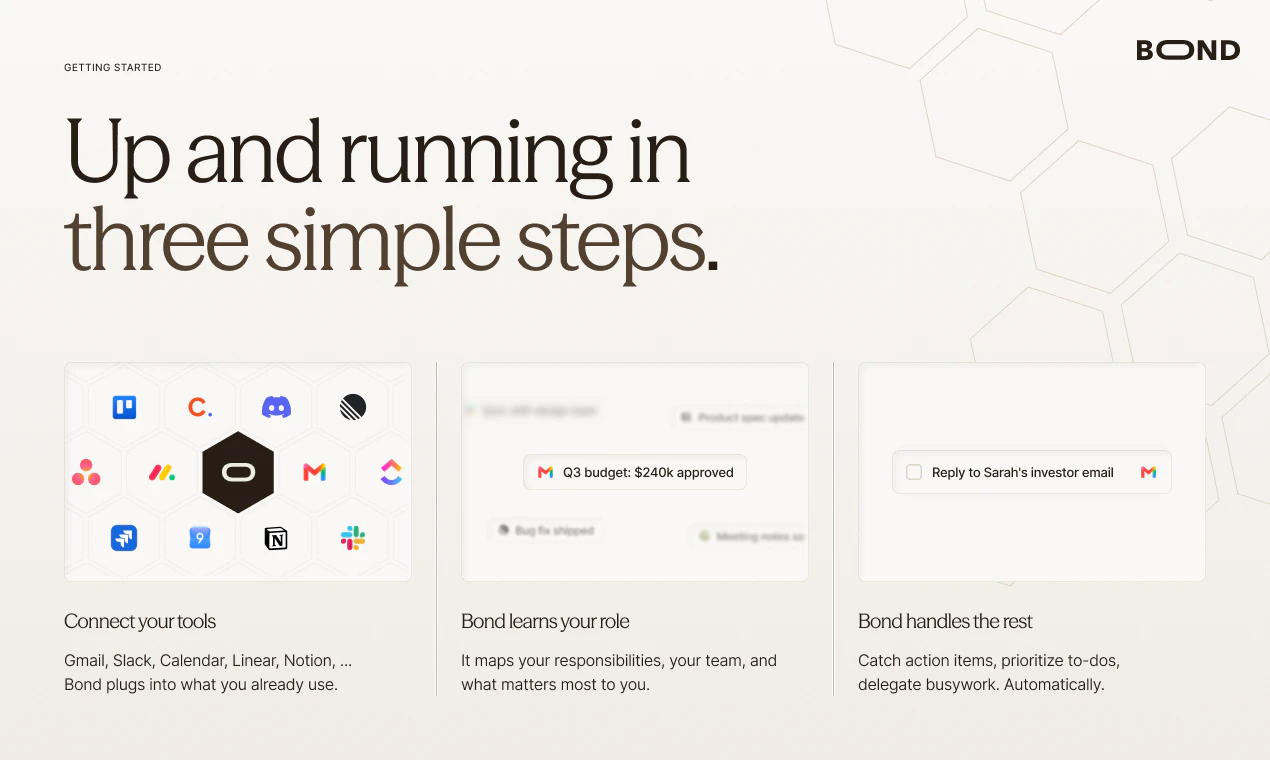
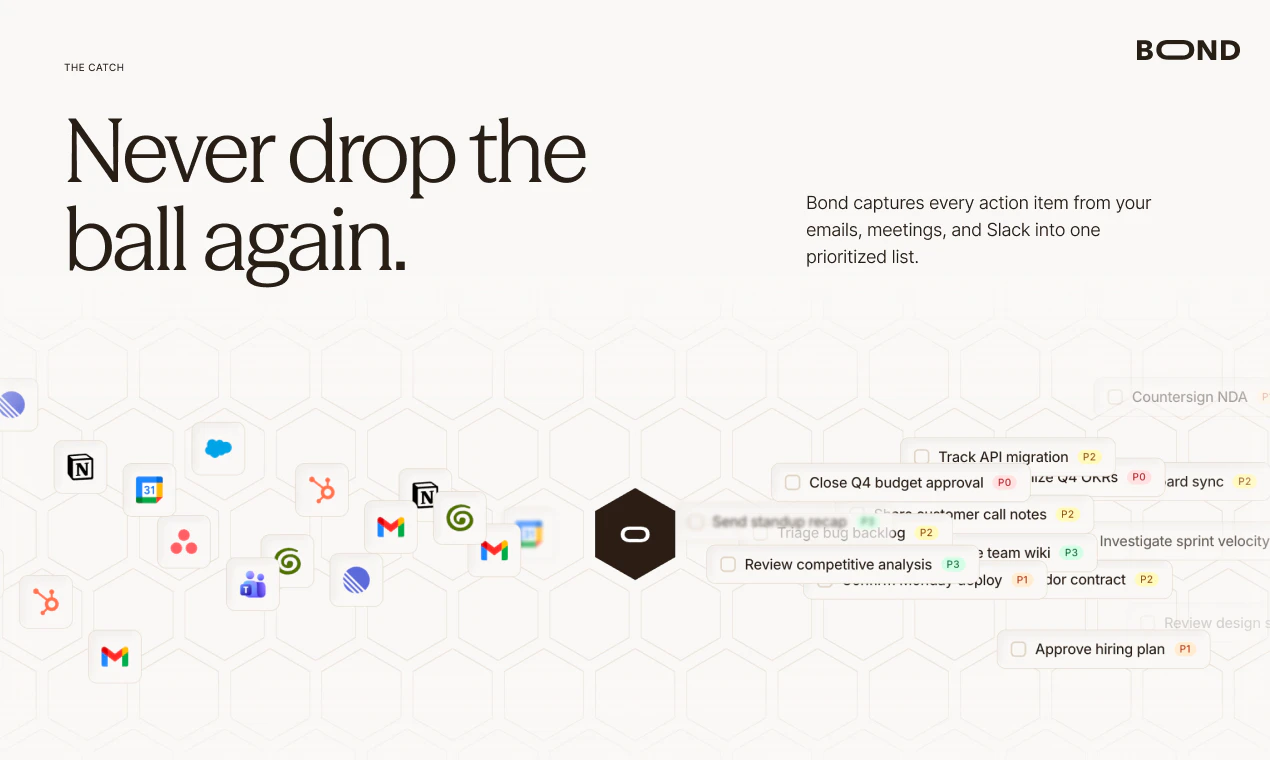
查看原始信息
Riven
Riven turns your Apple Watch into a muscle failure tracker. It auto-detects your exercise, counts reps hands-free, and measures rep speed loss — the science-backed signal of true muscle fatigue — to tell you if you actually trained to failure or stopped reps short. Built for hypertrophy and strength training: no camera, no bar sensor, no extra hardware — just the watch you already own. Get a 0–100 failure score after every set, so every workout drives real muscle growth.
Hey Product Hunt 👋 Here's an uncomfortable truth about the gym: most people never actually train to failure. They stop on discomfort, boredom, or a rep number they picked in advance — usually a few reps before the muscle is actually done. And since pushing close to failure is what makes muscle grow, that gap is why so many people train for years and look the same. Until now the only way to measure this was lab equipment — expensive, impractical, and definitely not something you'd use at a commercial gym. So I built Riven on something millions of people already wear: the Apple Watch. You just train. Riven detects your exercise, counts your reps, and at the end of every set tells you the one thing no app has ever told you — did you actually reach failure, or did you leave reps in the tank? No camera. No extra sensors. No tapping mid-set. Just the watch you already own. If you lift, I'd genuinely love your feedback — and ask me anything in the comments, I'll be here all day!
1
回复

@baraa_bilal Congrats on the launch Bilal. This is a really cool use case. For heavy weights, what is the safety margin? I don't want to be benching "just.one.more" and then have to wiggleslide under the bar (yes, it's happened. anyone who lifts heavy has one of these). Are notifications audio?

1
回复

Do I have to have a ceratin routine programmed in?

1
回复

@st1100 Nope, you go to the gym, do whatever you want, and it shall detect it. You can still manually input what you want to do, or build a program if you want. But usually I go to the gym with a program only in my head; I don't need to write it down in an app - and sometimes my plan changes based on what machines are available if the gym is busy.

1
回复

Is it "pairable" with any smart device, like rings or watches?

1
回复

@busmark_w_nika Hi Nika! For now, it supports Apple Watch only, and the workout data is synced with your Apple Health app.

2
回复

Would there be a plan to possibly be on Garmin in the future as well?

0
回复

@tyler_bush Definitely on the roadmap! Thanks Tyler

0
回复

The science behind rep speed loss is solid. What was the biggest challenge in getting reliable failure detection from just an Apple Watch?

0
回复

@keren_dona Thanks! Honestly, the biggest challenge was noise — separating real reps from everything that isn't a rep. There are two kinds:

  1.   Sensor noise. The watch IMU doesn't give you clean signals. Raw accelerometer and gyroscope data is jittery, and any attempt to compute velocity from it drifts fast. A lot of the work was filtering the signal down to something you can actually trust rep-to-rep.

  2.  Movement noise. This was the harder one. Unracking the bar, adjusting your grip, setting the weight down — on the wrist, these can look almost identical to a rep. And it gets worse near failure, because grinding reps get slow and irregular, which is exactly when you can't afford to miscount. Telling "ugly real rep" apart from "setup motion" reliably was where most of the iteration went.

1
回复

Wish there was something like this for Android.

0
回复

@ankur_jeswani Thanks, Ankur! For sure, something we have in our minds. Other wearables (other than the Apple Watch) should be able to produce close IMU signals that we can use for Riven.

0
回复

Fun! Congrats on the launch :) Does it work best for upper body vs lower body given the wrist-movement-based tracking?

0
回复

@ferdi_sigona Great question! Currently, the app supports exercises that involve upper-body or wrist movement, as well as some lower-body movements like squats (since your body moves up and down). However, exercises where your wrists remain stationary—such as the leg curl machine—cannot be tracked automatically. You can still log these exercises manually to ensure your entire workout is recorded!

2
回复