Product Hunt 每日热榜 2026-06-18

PH热榜 | 2026-06-18

#1
Upstream
The inbox designed for humans and agents
576
一句话介绍:Upstream 是一款面向繁忙职场人士的AI原生邮件客户端,通过内置智能代理自动完成邮件分类、草稿回复和跟进提醒,解决用户在大量邮件中难以聚焦、回复效率低下的痛点,让邮件处理变得轻快有趣。
Email Productivity Artificial Intelligence
AI邮箱客户端 智能邮件代理 自动草稿 邮件分类 工作流自动化 SaaS工具 提升效率 语音匹配 跨工具集成 Product Hunt
用户评论摘要:用户普遍赞赏其“人机协作”定位,核心疑问聚焦于:AI自主与用户控制的平衡(如误判优先级、语气不当)、是否支持CRM等工具深度集成、大型工作区数据同步性能、以及语音匹配的自我学习能力。创始人强调发送需人工确认,并计划基于用户编辑反馈优化语气。
AI 锐评

Upstream的“代理辅助”定位精准切中了AI邮箱产品的一个核心矛盾:用户既想要自动化带来的效率,又恐惧完全失控的AI接管邮件“生死”。创始人Louis的回复(“发送永远取决于你”)和产品设计(仅完成分类与草稿)明智地将信任门槛降至最低——用户只损失“审阅”时间,而非“翻车”代价。

其真正价值不在于“发得快”,而在于用AI重构了邮件的“注意力分配逻辑”。通过自动摘要、智能标签(需回复/需跟进/垃圾)和跨工具检索,它试图在邮件重负与认知过载之间建立一个“决策滤波器”。然而,产品目前“三脚猫”式的表现也显而易见:核心承诺的“根据对话人和上下文改变语气”还依赖预设分析,而非用户真实编辑行为的自我进化;与Slack/Notion等大型工作区的同步依然是按需查询而非持久索引,性能瓶颈悬而未决。更关键的是,在Mimestream、Shortwave等老牌玩家已占据细分审美的格局下,Upstream若只停留在“UI漂亮+基础AI”的舒适区,而无CRM流程闭环、团队协作审核等深度绑定场景,其壁垒将极其脆弱。

一句话总结:AI邮件界的新玩家,喊出了正确的口号——辅助而非替代。但想让用户从“试用”到“付费”,必须在个性化学习与生态整合上拿出更硬核的解法,而非仅凭“PH闪购”式的红利圈地。

查看原始信息
Upstream
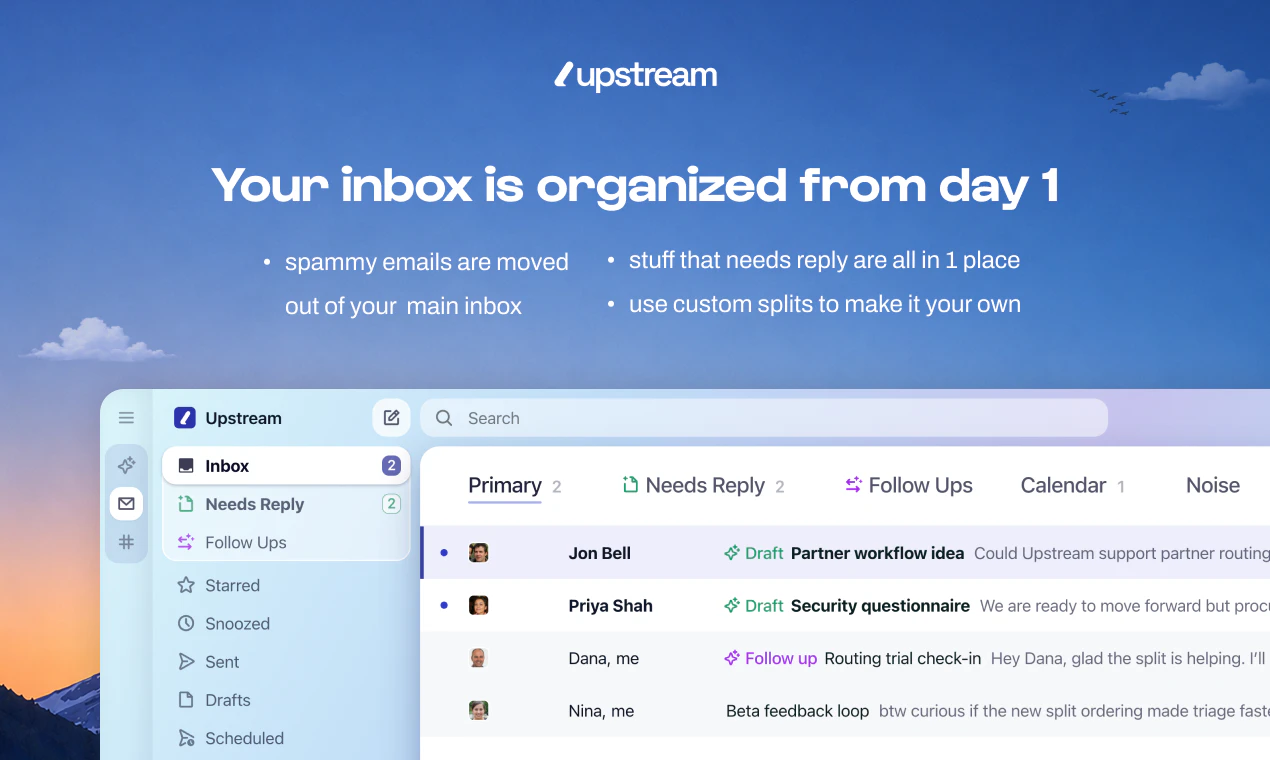
Finally, an inbox you'll look forward to. Agents sort your messages, draft your replies, and clear the grunt work behind the scenes, all in a client so well-crafted that email feels light, fast, fun.

Hey Product Hunt! 👋 Louis here, co-founder of Upstream.

When I was at Algolia, I was drowning in 200 emails a day. I was never sure where to focus, and getting through my inbox took forever. I knew it didn’t have to be this way. Instead of creating a new messaging protocol, I bet on rethinking the tool everyone uses: email.

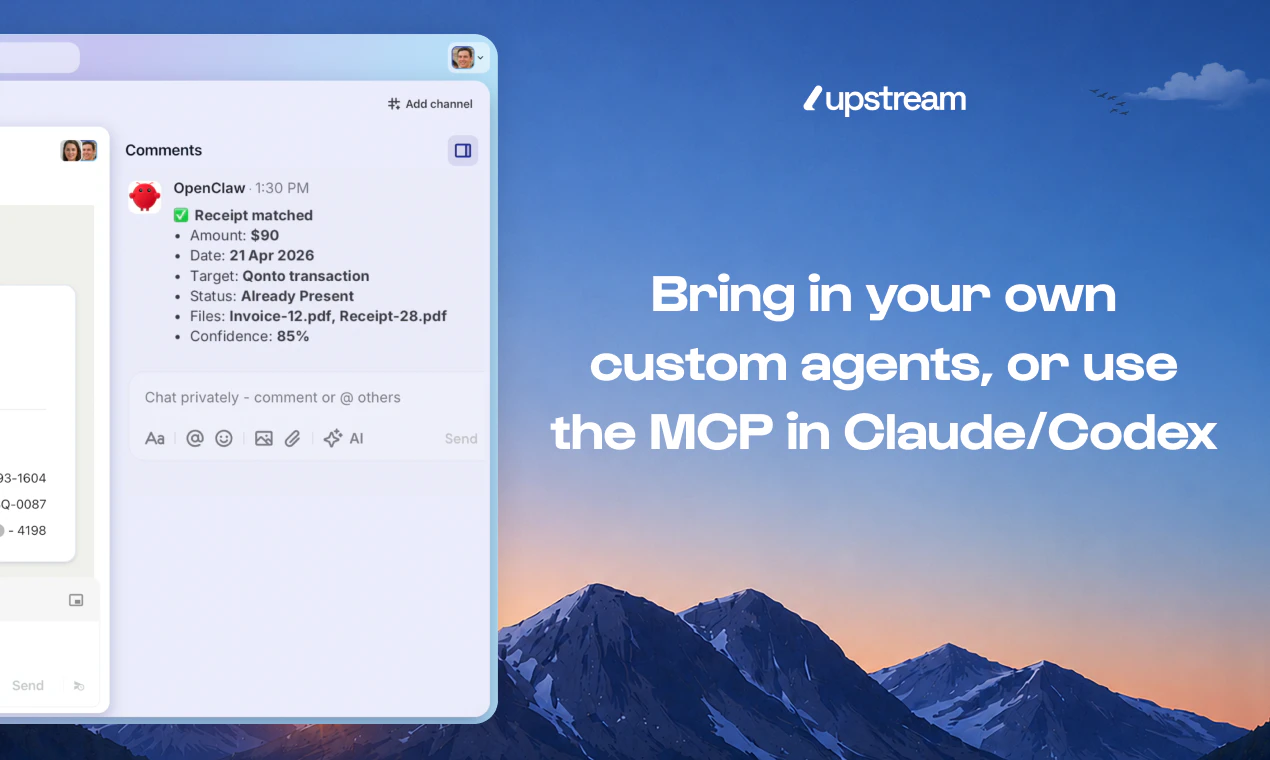
We built the first email client where agents do real work alongside people. We designed Upstream to be easy to pick up and fun to use. 

📥 Take the noise out of email
Agents automatically triage your inbox, separate signal from noise, and surface only what deserves your attention

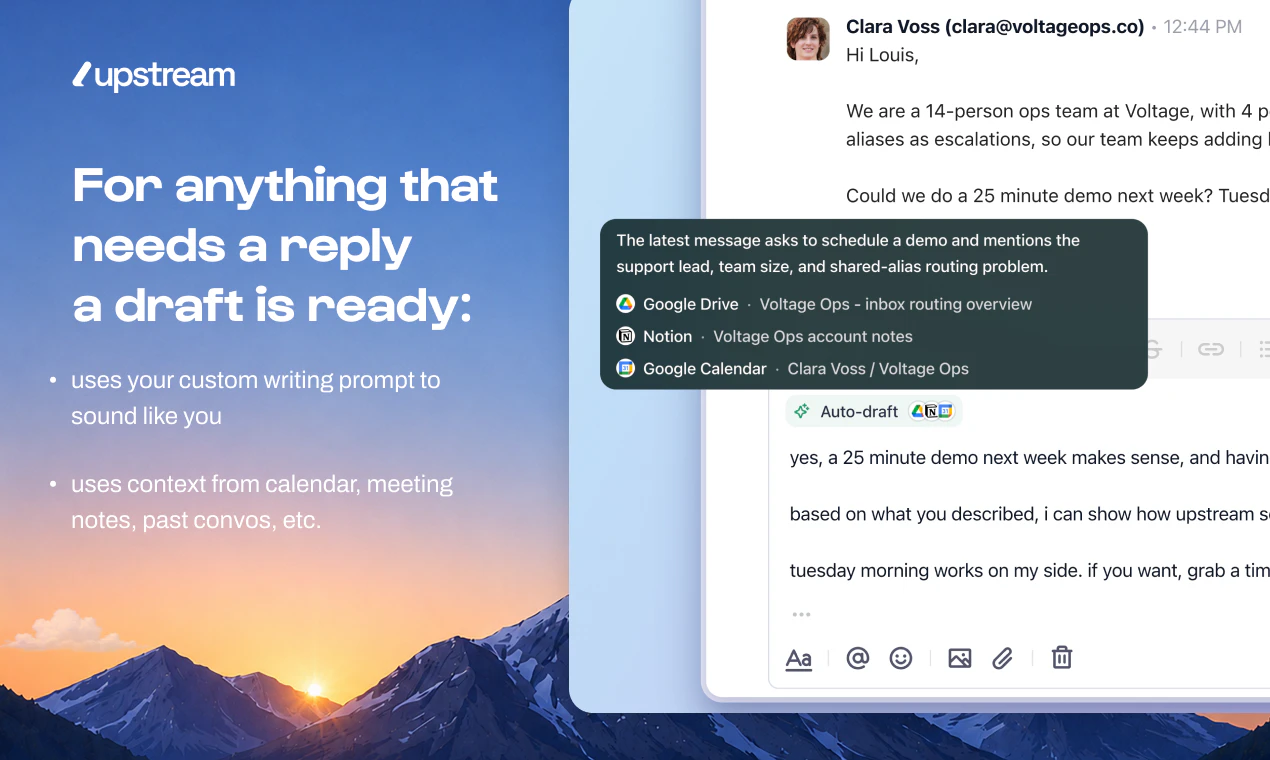
✍️ Every reply starts with a draft
Upstream drafts replies for every conversation that needs one. It also changes your voice based on who you’re talking to and the context of the convo

⏰ Never miss a follow-up
Agents track open loops and remind you when needed, making sure important conversations don't fall through the cracks

🔎 Ask anything about your work
AI can instantly find information across your inbox and connected tools: receipts, meeting notes, introductions, decisions, conversations, and more

🔗 Bring all your context into your inbox
Agents use information from tools like Notion, Calendar, Drive, Granola, and other sources to produce better answers and drafts

👉 As a special thank you to the Product Hunt community, you get one free month of Upstream Pro if you sign up at upstream.do and use the code PH26! 👈

We are all so excited to hear what you think! Please do reply here and let me know 

Huge thanks to our hunter @garrytan for hunting us 🙏

41
回复

@garrytan  @louislecat Interesting positioning. Email has become a chore for a lot of people, so combining agents that handle the repetitive work with a thoughtfully designed client could make a real difference. I like the focus on making email feel enjoyable again instead of just adding more automation on top.

0
回复

@garrytan  @louislecat Congrats on the launch! 💥

The direction here makes a lot of sense, especially taking email from something reactive to something agent assisted where triage, drafting, and follow ups happen in the background instead of constantly pulling attention.

One question: when the agent is making decisions like prioritizing messages, drafting replies, and surfacing “what matters,” how do you balance automation with user control so important context doesn’t get incorrectly filtered or handled in the wrong tone or priority?

Really excited to see where this goes! 💥💥💥

0
回复

@louislecat  Congrats on the launch 🚀

0
回复

Impressive how far you’ve taken the product, well done on the launch @louislecat , @jontiret and team!

2
回复

@jontiret  @jeremylv The whole team appreciates it!

0
回复

Thanks so much for the support @jeremylv ❤️

0
回复

The voice-matching per audience is what caught my eye — does it learn over time from how you edit the drafts, or is it mostly set from the initial analysis?

2
回复

@doganakbulut Right now it’s mostly set from the initial audience analysis. However, the tone of the drafts do change according to the context of the thread.

That said, learning from how you edit drafts is definitely on our roadmap. It’s the natural next step: the more you tweak tone, phrasing, and structure for a given audience, the better Upstream should get at matching that voice over time.

1
回复

Where do you guys draw the autonomy line on triage vs sending? Those two might fail completely differently IMO. Anyways, great work!

1
回复

@artstavenka1 We think that you should make the final decision when it comes to sending. For triage we automatically sort what needs reply and what needs a follow up. But we allow you to completely customize the prompts.

What's your take on what should be autonomous vs manual?

1
回复

@artstavenka1 the fact that an agent can never send a message without your approval is a core principle of Upstream that I personally hold very dear ❤️

0
回复

The human + agent inbox positioning is interesting. Email has a lot of hidden context, so I like that you are not framing this as just another summarizer. How do you decide which actions should stay manual versus agent-assisted?

0
回复

The UI looks absolutely beautiful and lightweight. Since it's built to clear out backend grunt work, does Upstream integrate directly with standard business tools like CRMs or project management platforms to log customer conversations automatically, or is it strictly focused on the email client layer?

0
回复

This looks awesome for a busy founder email. Congrats on the launch!

0
回复
Oh man - a potentially valid contender to go up against my precious Shortwave email client?! Installing now! 👀
0
回复

the "agents do the grunt work" angle is interesting because most AI email tools still make you manage the AI. curious how the triage actually works in practice, does the agent learn your priorities over time or is it more rule-based out of the box?

0
回复
Looks interesting! Another Lecat was the co-founder of Sparrow Are you related?
0
回复

@jberrebi Thanks! His last name is "Leca", so no relation 😄

0
回复

HI @louislecat my question is, most tools that connect to slack and notion hit token limits or lag heavily when syncing large workspaces. how often does upstream index the connected apps for fresh context? such a great launch

0
回复

hey Priya ! That's a very good question :)

Today we're mostly doing retrieval on demand rather than maintaining a giant synchronized index of all connected apps. When an agent needs context, it queries the relevant sources directly.

This gives us fresh data by default, but it also means retrieval quality and performance on very large workspaces are challenges we’re actively working on. I think the long-term answer will likely be a hybrid approach rather than fully indexing everything

0
回复

I really enjoyed the UX for AI reply and integration with Granola. Congratulations on the launch

0
回复

@raviteja_k Thanks so much Ravi! What other integrations would you like to see?

0
回复

Great idea! How do you keep the agent activity from burying the messages I actually need to read myself?

0
回复

@suzychase Agents surface messages that need a reply, messages that need a follow up, and move the spammy emails to the side. That being said, all of your messages are still available for you to read and triage as you see fit.

0
回复

@louislecat Congrats on the launch! The agent alongside you model is the right call, the inbox tools that have tried to fully automate away from the user have always hit a trust wall. The real design challenge is making the handoff between human and agent feel invisible. Curious how you're thinking about the moments where users want to override the agent without breaking the flow, that's where these products usually get complicated. Adding to my stack to test.

0
回复

@andrea_gill Thanks Andrea! You always have the final say. Agents tee everything up for you and the sending is left to you.

What agent tasks would you want to be able to override?

0
回复

Great product!

I've been using it for a few weeks and I find myself in my inbox more than usual!
Great auto-complete and I've been using the label features a lot!

0
回复

@andrei_a1 We appreciate you using the product day in and day out!

0
回复

Late to the thread but loving what I'm reading — especially Jonathan and Louis confirming nothing goes out without approval. That's the right instinct.

The follow-up I'd love your take on: how do you keep that approval step from becoming its own inbox grind? At high volume, approving every single draft can quietly recreate the exact load you're trying to remove. The teams I've watched do human-in-the-loop well tend to tier it — once the agent has earned trust, it auto-handles the truly low-stakes stuff ("got it, thanks") on its own, and reserves explicit approval for anything that actually commits you to something.

Curious whether Upstream leans that way, or keeps a hard approve-everything line on principle? Either way — congrats on #1. 👏

0
回复

@syed_noor4 Thanks for your thoughtful comment Syed! In Upstream actions need an explicit approval or send.

I'm curious what type of low stakes messages you would be comfortable having an agent send on your behalf. And on the other hand are there specific messages that you would never want an agent to automate?

0
回复

Upstream changed the way I looked at mails from something annoyingly and chaotic, to structured and organized
@louislecat congrats on the launch, and great to see where you and the teamm took the product in the last month!

0
回复

@daniel_sendt Thanks Daniel! The last month has been great and we have so much more in store 💪

0
回复

Use it myself, the AI assistant is simply better than Superhuman!

0
回复

The human + agent inbox model is interesting - most tools treat agents as a bolt-on to an existing workflow, and it creates friction. Building the inbox around the assumption that agents will be first-class participants from day one is a different design choice. What's the biggest behavioural change you've seen in users when they start treating the AI as a teammate rather than a tool?

0
回复

Very good question Lava! I'd say that the biggest change is that people start delegating much earlier. Instead of opening a thread, reading everything, thinking for a few minutes and then asking AI for help, they immediately pull an agent into the conversation and work from there

0
回复

Congrats !! Looking forward to trying it out!!

0
回复

@mariankh Thanks Maria! Let us know what you think 🙂

0
回复
@mariankh and looking forward to getting your feedback :))
0
回复

Contratz

0
回复
0
回复
Thanks @ertugrul_cavusoglu 🙏❤️
0
回复

This is awesome! Congrats on the launch!

0
回复

@hazika Thanks a ton Hazik!

0
回复

Thanks @hazika  🙏

0
回复

Congrats on the launch!

0
回复

@raphael_alexandre Thanks Raphaël!

0
回复
@raphael_alexandre Thanks Raphael
0
回复

My new favourite email client. Insane how many times I’ve simply hit ‘send’ on a draft!

0
回复

@antoine_sakho1 It's the best feeling!

0
回复

Pretty awesome inbox management. So much saved time!

0
回复

@sdelbecque Glad you're flying through your inbox 😎

0
回复
@sdelbecque thanks Stéphane! How much time do you think you save every week thanks to Upstream?
0
回复
How much time can agents save on emails daily?
0
回复

@sabir_hussain15 It all depends on your email volume, the types of inbound message you receive, and how often you typically reply to messages.

What are you most common email use cases?

0
回复
@sabir_hussain15 how much do you want to save? 😁
0
回复

Wonderful product !
Once you try it, you keep it forever !

0
回复

@roman_cz Thanks so much Romàn! That's the goal 😄

0
回复
thanks Roman. We are on a mission to make email fun again :)
0
回复

Best team, best product!

0
回复

@pierre_eliott_llt Thanks a lot 🙌 🙌

0
回复
@pierre_eliott_llt Haha ! Thanks so much
0
回复

My new favourite email client. Insane how many times I’ve simply hit ‘send’ on an auto reply!

0
回复

@antoine_sakho1 Love hearing that Antoine! Thanks for your support

0
回复
@antoine_sakho1 I love to hear that ❤️
0
回复

Can't wait to try it!!!

0
回复

@damien_henry1 We can't wait either!

0
回复

@damien_henry1 can't wait to get your feedback :)

0
回复
#2
Honestly
See what Reddit and TikTok honestly think about your product
455
一句话介绍:Honestly 是一款跨平台社交媒体洞察工具,通过识别和过滤AI生成内容、赞助帖与虚假评论,从Reddit、TikTok等平台提取真实用户关于产品的讨论,转化为可行动的产品与营销洞察。
Social Media Marketing Data & Analytics
社交媒体监听 消费者洞察 AI内容检测 竞品分析 产品反馈 红人营销 市场情报 口碑分析 品牌监测 数据分析
用户评论摘要:用户普遍关注AI内容过滤准确性(如AI润色评论与真实意见的区分)、对小众或新产品的数据覆盖率、以及如何展示原始上下文。部分用户询问是否支持Facebook群组等私域数据,以及对低提及量产品的处理能力。有用户强调Reddit与TikTok是“真实反馈”的关键渠道。
AI 锐评

Honestly切中了一个真实且日益尖锐的痛点:互联网上真实用户的声音正在被AI生成内容、营销帖和机器人评论淹没。传统舆情工具要么依赖粗糙的星级评分,要么输出大量噪音,而Honestly的价值在于明确将“真实性验证”作为核心卖点,而不是仅仅做数据聚合。

其产品关键在于两个“过滤”能力:一是区分有机内容与赞助/广告,这依赖对账号行为、内容标签和视觉元素的算法判断;二是识别AI生成文本和图像,通过与第三方检测模型(如CheckReality)合作实现。这两个环节的技术壁垒决定了产品的护城河深度。从评论区看,创始人能回应“AI润色过的真实意见”这类边缘案例,说明团队对此有清醒认知——这正是AI时代用户研究的“测不准原理”。

然而,产品目前面临一个典型的冷启动悖论:要证明自身价值,必须依赖大量的真实数据做对比分析;但对早期产品而言,自身提及量可能极低,此时Honestly显得更适用于品类成熟、社交媒体讨论活跃的竞品分析场景。创始人将“竞品洞察”作为早期用户切入点,是务实的策略。此外,产品能否向用户呈现每条洞察的原始来源和上下文环境,将直接影响信任度——如果只输出摘要,很容易沦为又一个“黑盒工具”。

整体来看,Honestly在正确的时间做了一项有价值的工作:把混乱的社交数据净化成可信任的情报流。但它的长期竞争力,取决于AI检测准确性能否随技术演进持续领先,以及能否在产品初期就为缺乏数据的长尾产品提供替代性的洞察方案(例如通过行业横向对比)。如果只是“更好的爬虫+AI评分”,那么它很容易被平台自身API策略变化或竞品快速复制。

查看原始信息
Honestly
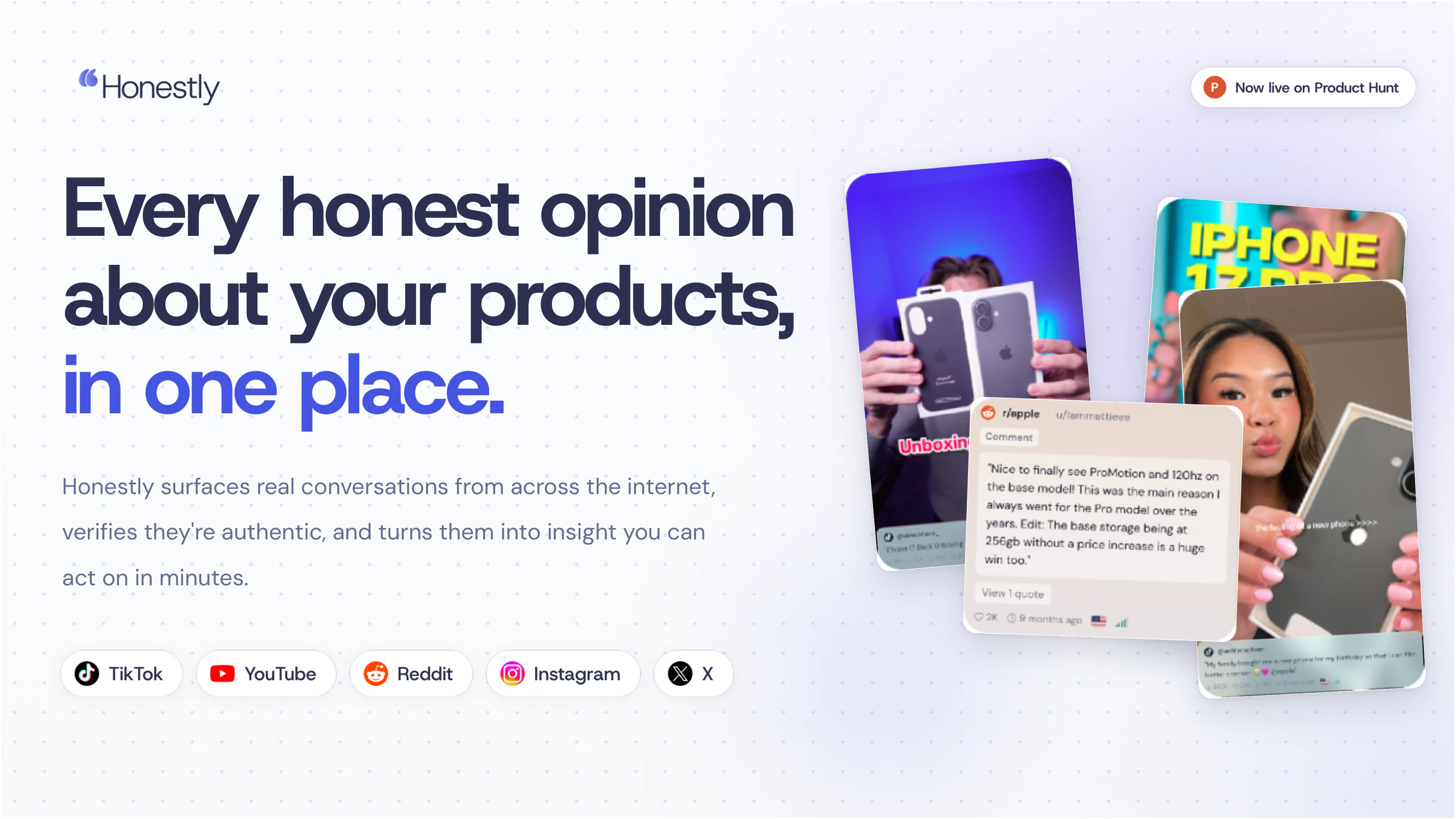
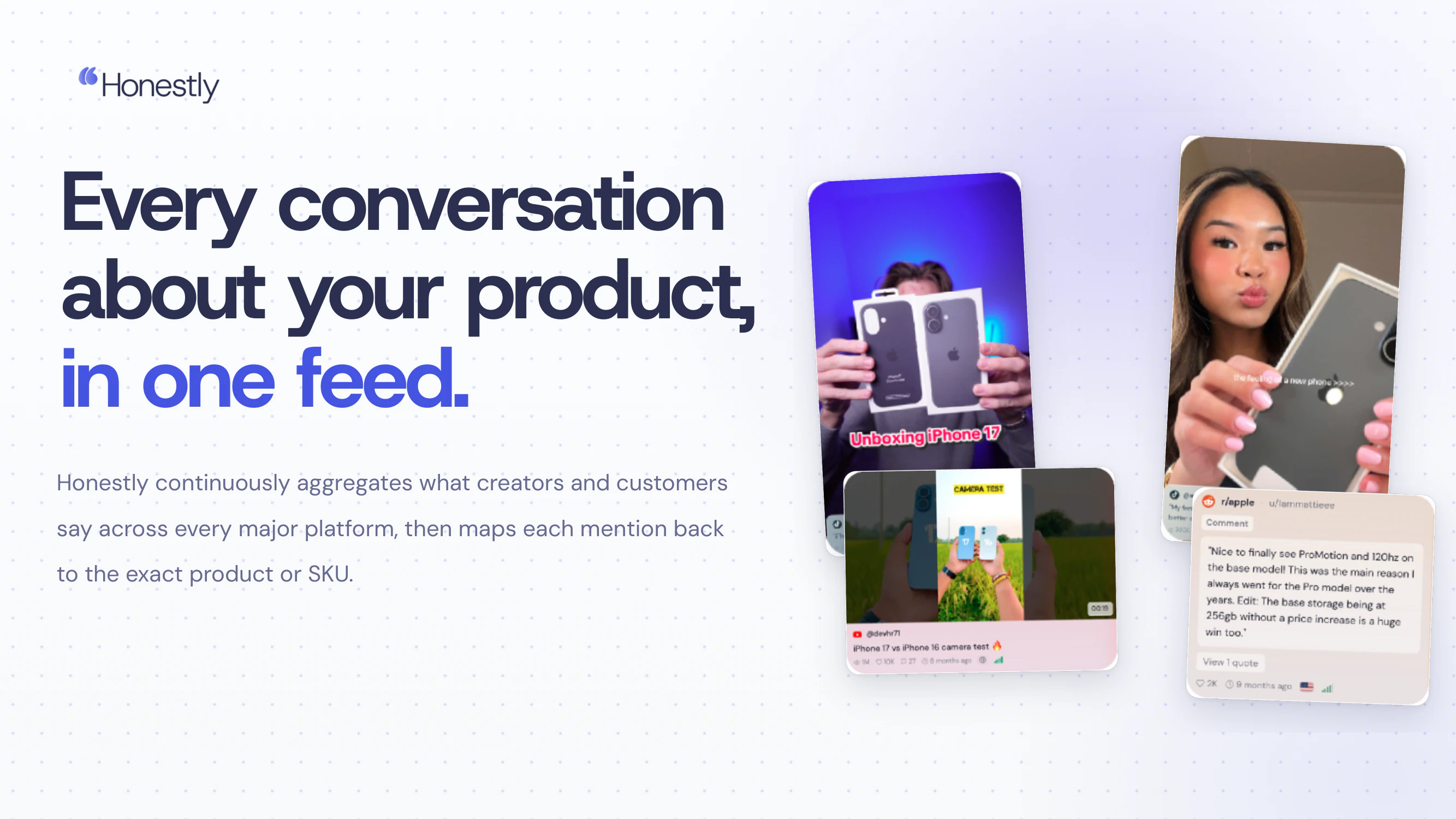
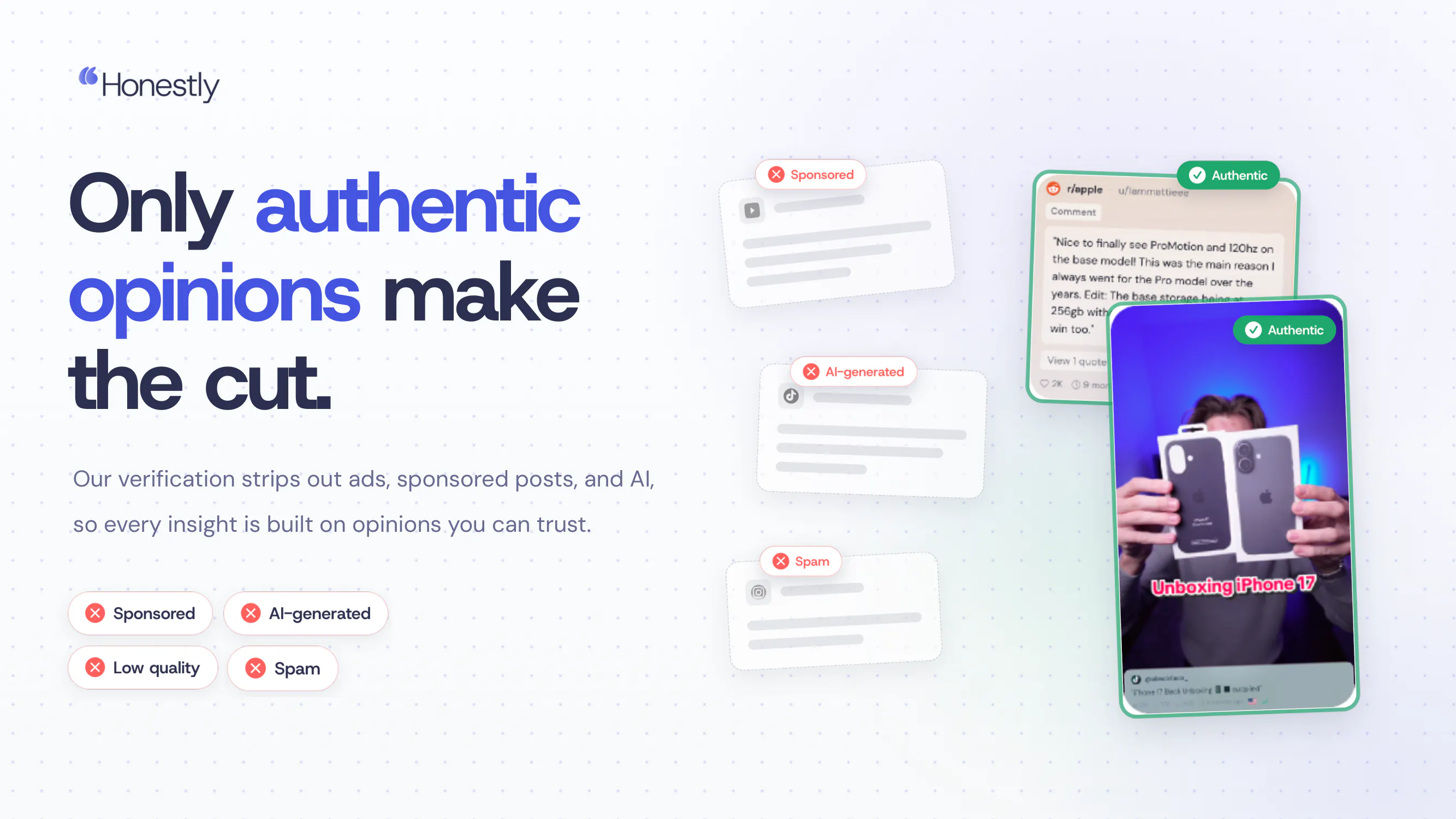
As bots and AI agents overrun the internet, finding real customer opinions is only getting harder. Honestly cuts through the chaos by discovering verified conversations about your product across Reddit, TikTok, X, YouTube, Instagram, & Facebook then turning them into insights your team can act on.

Hey Product Hunt 👋 I'm Scott, part of the founding team at Honestly.

Why we built it:

Bots and AI agents now generate more internet traffic than humans.

Your customers talk about your products every day across social media. But as AI-generated content, sponsored posts, and fake reviews become more common, finding authentic customer feedback is getting harder by the minute.

Today teams either spend hours scrolling social feeds themselves or rely on expensive tools that surface more noise than insight - but this felt wrong to us.

What Honestly is:

Honestly finds & verifies all customer conversations about your products, so you get honest insights built on data you can trust.

Simply enter a product by its name on our platform, and Honestly will help you:

  • Build better products by understanding exactly what customers love and dislike

  • Improve marketing by uncovering trends and high-performing content

  • Identify competitor weaknesses and market opportunities

  • Generate custom reports tailored to your business needs

What we believe:

As AI-generated content continues to flood the internet, authentic customer conversations will only become more valuable.

The companies that win will be the ones that can find real consumer data online, understand it quickly, and convert it into informed product and marketing decisions.

That's what we're building with Honestly.

Product Hunt offer (first 500 signups only!):

As a thank you to the Product Hunt community, we're offering a special deal to the first 500 signups that use code HonestlyPH26 when signing up for early access on our website:

🎉 7-day free trial
🎉 25% off for LIFE

We'd love to hear about:

  • How you currently gather customer feedback from social media

  • What’s most frustrating about finding real customer opinions today

  • How AI-generated content is impacting your customer research process

Thanks for checking out Honestly 🙏

16
回复

@scott_davidson_jr Hey @byalexai, good hunt! Scott, congratulations on the launch! Honestly looks like a really interesting product. :)

I was wondering how you filter AI-generated content. Users might sometimes write their feedback and then rewrite it with AI into a polished version. Does your system detect whether a real opinion was AI-polished, or do you have a specific method for identifying and filtering AI content?

Also, is there a sample report available to view? When I visited the website, I only saw the waitlist and couldn’t find much beyond that. But I saw a glimpse of the report in the launch video.

Happy launch day! :)

9
回复

@scott_davidson_jr Looks great. Will try out today

3
回复

@scott_davidson_jr I'm particularly interested in how Honestly handles edge cases where a genuine customer uses AI to rewrite or polish their thoughts. The opinion is still real, but the content has AI involvement. That distinction seems like it will become increasingly important over time.

0
回复

Excited to hunt Honestly today.

@Honestly helps brands, retailers, and growth teams understand what people are really saying about their products across Reddit, TikTok, X, YouTube, & Instagram.

Instead of relying on broken 5-star ratings, synthetic surveys, or dashboards full of vanity metrics, Honestly turns real internet conversations into product, creator, affiliate, and competitor intelligence. Teams can see which products are getting organic traction, what customers actually mention, which creators are already driving demand, and where competitors are winning attention. No more manual scrolling through social media or filtering noise using decades-old tools that promise perfect data but can’t deliver.

What stands out here:

• Find real product opinions from Reddit, YouTube, X, TikTok, Instagram, and other social platforms

• See customer language, sentiment, attributes, and recurring themes by product

• Instantly detect creators, affiliate mentions, sponsorship gaps, and partnership opportunities

•Get detailed reports about questions you have on popular product features, important customer preferences, popular social trends, and more

If you work on product, growth, ecommerce, affiliate, or competitive intelligence, Honestly is worth checking out. It helps teams replace guesswork with evidence from the real internet.

6
回复

@byalexai Thanks Alex! Couldn't be more happy and grateful to be Hunted by Alex for this launch of Honestly's newest version of our platform. When we first met, we shared the vision of how finding real signal about products on the internet, and especially on social media, was a problem space that was only going to be more valuable in the AI driven world that continues to evolve around us.

Look forward to answering any and all questions you all might have for our launch as work to make sure founders and brands alike are able to make informed decisions on marketing, strategy, product development, and more based on the honest insights built on the real product-level conversations Honestly provides!

3
回复

@byalexai Thank you Alex for being our earliest supporter! Excited to be launching with you.

1
回复

As a founder, I care a lot about what people actually say when they are not filling out a feedback form or answering a survey. Reddit threads, TikToks, comments, and random posts often contain much more honest product feedback than the “official” channels.

The hard part is separating real signals from noise, especially now that so much of the internet is either AI-generated, sponsored, or just recycled takes. So I like the idea of focusing on verified conversations and turning them into something a team can actually use.

Curious how Honestly decides what counts as authentic or trustworthy feedback. Do you show the original source and context behind each insight, or mostly the summarized findings?

Also, how well does it work for early-stage products that don’t have a huge amount of mentions yet?

5
回复

@andrasczeizel Thank you for the detailed comment and questions Andras! Besides the partnerships with leading AI detection models mentioned in Rohan Chaubey's comment to detect AI content, we separate organic vs. sponsored posts by analyzing the account, tags, mentions, script, and video/image of the post itself. There are various signals that determine whether or not a post is an underlying advertisement across the aforementioned modalities, and we developed an algorithm internally to differentiate the two.

As for how Honestly works with early-stage products, many of our smaller teams have used competitive analysis of products with a more established social media presence to not only analyze competitors but better understand what content topics and formats attract engagement.

What sort of methods have you seen earlier-stage startups use to find these mentions so far? And where do you think the bottlenecks lie?

3
回复

The gap between what consumers say in a formal research setting and what they actually think is one of the most underrated problems in brand strategy. Reddit and TikTok are genuinely where unfiltered consumer truth lives - this is an interesting angle on that. Curious how you handle conflicting signals when Reddit and TikTok audiences have very different takes on the same product?

4
回复

@productrambler Thanks for your very thoughtful comment & question Lava! This specific question would be an instance of a valuable insight our reporting would highlight because it emphasizes that there is one type of audience that is favorable to the product and the other dislikes it. This shows both an opportunity for marketing where engagement will be high as well as an area of customer research as to why a certain platform as the opposite opinion of another. How often have you come across these types of situations and how have you/your team interpreted them in the past?

0
回复

Interesting idea. How do you determine whether a comment is actually authentic versus just engagement bait or bot activity?

4
回复

@workout097_collab Great question! It is the core what makes our company - we not only partner with leading AI detection models such as CheckReality that specialize in imaging, video, & text modalities but our internal algorithms also ingest variables like text content, account history & activity, etc. to classify a post with high confidence. What do you think the biggest use for telling the difference between the two is for your company?

1
回复

@workout097_collab We have our own algorithms and models to determine whether posts are sponsored or organic, and we partner with leading AI detection models (such as checkreality.ai) for image, audio, and video authenticity. This way we ensure with high confidence that the social media content we're providing our clients consists of authentic opinions.

2
回复
There are a lot of trolls though. Are you guys able to get serious feedback?
4
回复

@lakshminath_dondeti Thanks for the comment. Just for clarity, what do you mean by trolls? Because if you are talking about about individuals that create fake reviews, promotion disguised as organic content, etc. then yes our internal algorithms can flag these posts and remove them from the data that actually matters for your product.

1
回复

@lakshminath_dondeti Getting real opinions is what we do best ;) Our whole foundation is on verified authentic opinions!

0
回复

the bot/fake review problem on social is so bad right now that "verified authentic" is doing a lot of heavy lifting here. curious how you handle edge cases where someone posts about your product without naming it directly (like describing a feature or a bug). does Honestly still pick those up?

3
回复

@rnagulapalle It really is! As for your question, yes when someone posts about specific aspects of a product it is very dependent on how it is described. For example, it a user complains about a "bug with an API key" but no other information about the product responsible for the error, Honestly analyzes the context of the post - the account name, and forum post title, and other comments connected to the quote.

1
回复

Hey @scott_davidson_jr ,qq like a fake reviews are an absolute nightmare on marketplaces right now. does this track conversations happening inside closed loops like reddit threads and discord, or is it strictly pulling from public apis like twitter/x? great to see launch

3
回复

@priya_kushwaha1 My cofounders ran a marketplace in their previous company so we all know the horror stories of fake reviews on marketplaces too well unfortunately! For specific data tracked, anything that is public data is data that Honestly can access, so yes to both of your questions.

2
回复

This is the stuff founders are too scared to look at and most need to. Reddit especially will say to your face what no focus group ever would. Does it show you threads as they happen, or is it more of a periodic thing?

3
回复

@suzychase The truth can be difficult sometimes but is very necessary! Because it is so anonymous Reddit is definitely a powerhouse when it comes to raw unfiltered opinions in the right subreddits and post. As for how often Honestly shows you insights, updates to the data can occur on whatever basis you require. So whether you want to see new data every week or every day, Honestly can do it. On what time basis are you usually looking to stay updated with discussions arising from social media data?

0
回复

Congratulations on the launch!
Being able to pull data from so many sources that are scraping protected is very impressive!

Later would you guys also consider getting information from Facebook, maybe Facebook groups?

3
回复

@gapostolov Thank you very much, George! We really appreciate that and we actually can pull from Facebook at the moment! Facebook groups are their own beast though and that is a problem we have yet to crack since they are private and we focus on public data. Do you ask because you've noticed many valuable insights coming from Facebook groups? If so, how have they differed from public customer discussions?

1
回复

@gapostolov Thanks George!

0
回复

It's really an interesting idea. There is so much customer feedback spread across different platforms now, but actually finding what is real and useful is becoming harder, I saw the other day about an influencer talking about the dead internet theory and how it's full of bots and AI generated stuff. I can see how this could help teams save a lot of time. Curious, how do you decide which conversations are trustworthy enough to include in the insights?

3
回复

@reda_roqai_chaoui Agreed! The general idea we’re going for is seen as an “inevitable issue” because no one wants to live in a world where the dead internet theory is a reality.

We don’t believe in censoring posts, just truthfully tagging them. Clients who are in the affiliate marketing space actually filter specifically for sponsored posts as an example for competitor research in their insight reports!

0
回复

The Reddit + TikTok combo is the right pick — those two are where "what people actually think" lives, vs the polished stuff on X/LinkedIn. Curious how it handles small/new products with low mention volume — does it surface a single thread or does it need a baseline?

3
回复

@felix_masera Agreed - this mix of platforms is very all encompassing in terms of what type of data and industries are represented. X & LinkedIn is polished for sure but can still be valuable depending on the use case for one's business. With small/new products, if it has publicly available data online, we find it. However if there is insufficient data to draw real meaning or insights about customers, many our of clients resort to competitive analysis on other products that are more data rich for insights on their market. Is low mention volume currently something you encounter? If so, have you considered analyzing competitor data for valuable market information?

1
回复

This is really interesting — the AI detection angle is what stands out to me. How accurate is the verification layer when it comes to short-form content like TikTok comments where tone is really hard to read even for humans?

3
回复

@doganakbulut That is what we've been told! The verification layer is highly accurate with these comments that reach a certain threshold of length. If it is under the threshold, it might be more difficult to analyze but at that point the comment is not valuable enough to even be analyzed. The TikTok comment interest is very intriguing, wondering where the value is in this specific type of social media content for your team?

1
回复

I think this is incredibly useful for customers and product builders. AI detection is incredibly hard. How are you able to filter out AI reviews from real customer opinions?

3
回复

@s_manas_kala Thanks for the kind words and the question! For detecting whether or not a post is AI generated, we have internal tooling combined with partnerships with leading AI detection models for image, video, audio, and text detection i.e. CheckReality.ai. This way we ensure with high confidence that the social media content we are providing our clients consists of authentic opinions. It sounds like you have familiarity with AI detection space - what issues did you encounter with other methods used in the past?

0
回复

Can't help but hear the beats of a New Order track; now my whole brain is dancing. 😂

Anyway, like the idea because it's kind of a way to find collaborators and create some affiliates for them.

3
回复

@busmark_w_nika Same here! Have to credit my CTO with making that suggestion. Thanks so much for the kinds words and yes finding collaborators and affiliates has been a big ask of many of our clients. From your perspective, what bottleneck do you see with finding collaborators/affiliates that makes you think Honestly is best for solving it? Since you have familiarized yourself with so many great products in the PH community, would love to get your thoughts!

1
回复

@busmark_w_nika hahah true right?

You should jump on a call with Scott. He will do the best demo. It's amazing to see the reports. He did several reports for me and really impressed on the final output.

2
回复

Great work! Honestly seems like it is primarily geared towards larger companies since a demo is required to move forward with the platform. However, we are a small team. Do you have any self-service options for startups or small teams? The competitive analysis features seems compelling our this category of clients.

3
回复

@hoa_do_012 Thanks for your question! We serve both larger enterprises and early stage startups. We currently have a self-service option for startups/smaller teams on the roadmap, but for now are meeting with each customer to ensure we meet their needs since the insights businesses require varies based on the stage they are in as well as the industry. Competitive analysis has been one of the most popular services for our smaller team clients so far. Beyond competitive analysis, is there another type of insight you'd like to see in the self-serve version of Honestly?

1
回复

@hoa_do_012 Self service is coming real soon 👀

0
回复

How are insights looking? Does it also come with recommended actions? Seems very interesting tho

Congrats for your launch

3
回复

@fberrez1 Thanks Florent! Every insight in Honestly includes a specific action rather than just a sentiment score.

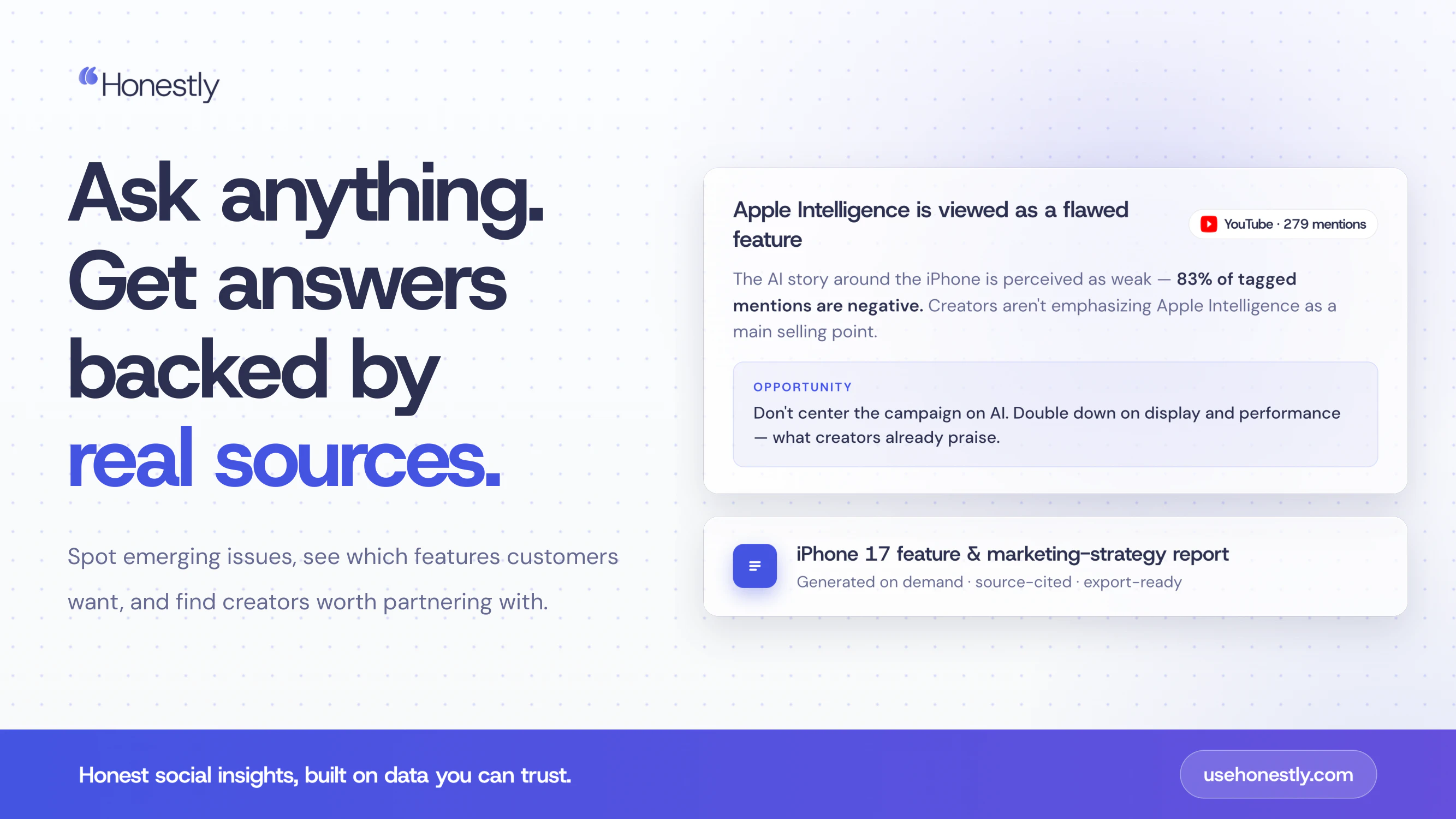
For example, if a marketer is tracking the Samsung Galaxy S26, instead of seeing "Display sentiment is 72%," they would see: "103 TikTok videos in the last 30 days highlighted the Vision Booster feature. Lead with Vision Booster instead of the 120Hz Display in TikTok marketing using outdoor brightness demos."
We would switch the insights and actions depending on the use-case: Affiliates, marketing, ads, competitor tracking.

1
回复

Surveys give you sanitized feedback. Reddit threads give you unfiltered reality. The gap between those two is usually where the real product work is. Congrats on the launch!

2
回复

@jared_salois You are absolutely spot on Jared, and thank you!

0
回复

@jared_salois Thank you Jared!!

0
回复

Great launch video - congradulations!! Was clear & engaging - not an easy task to pull off!!

In the video, you mentioned "no more noisy, outdated social listening tools" - how does Honestly specifically differentiate itself from other social listening tools out there that seem to be doing something similar?

2
回复

@alj123 Thanks so much! Great question - most social listening tools are brand level whereas he are product level, meaning the data we find is more granular and specific. On top of that, social listening tools focus on basic levels of verification and analysis. Honestly, however, takes both much deeper - using leading detection models to verify the granular data and providing extremely customer analytical insights for customers.

0
回复

@alj123 Thanks for the support Al! Looking forward to showing you the Demo and having you use the product!

0
回复
This is useful because the raw mentions are usually less important than the repeated language behind them. The real value is spotting the phrases customers keep using before they turn into positioning, product, or campaign decisions.
2
回复

@habibferdous Definitely! The repetition turns into patterns and the patterns become valuable information on how businesses make decisions

0
回复

Do you plan for predictive capabilities? For example, when launching new products.

2
回复

@jgilbertson47 Yes! This is a big part of our insights, but especially for our customized report generation capabilities. We are able to gather data on products that have launched in the past and analyze how they were received.

0
回复

@jgilbertson47 One of our primary use cases is in R&D using trend analysis. Which ingredients should you include in the next formulation, what the name of the product should be, what competitors are winning / missing on!

0
回复

Yeah! Love this. Reddit and TikTok not only are trendy but one of the best way to get honest feedback. Love to see you helping on this! Wish you all the best team!

2
回复

@german_merlo1 Thanks so much Germán! Really means a lot! From all the products you have analyzed in the PH community, what category of product do you think benefits the most from honest feedback from these platforms? Would love your perspective!

0
回复

@german_merlo1 Thank you German!

0
回复

Been doing this manually for months - searching Reddit threads for honest feedback on our tool is a real time sink. The verification layer to weed out AI-generated posts is what makes this interesting, because without it you'd just be surfacing more noise. One thing I'd love to know - how does coverage hold up for niche B2B products that don't have huge Reddit communities? That's usually where the signal breaks down for us.

2
回复

@galdayan It's such a pain and I have been there & done that with manual search for social media posts, which is a big reason why we started Honestly. Incredible question about the more niche products - currently any post that is publicly available is data we can find, so if it exists for smaller B2B SaaS it can be used as insights for that early stage company. However, when there is not sufficient data, many of our clients in these positions end up tracking the products of competitors or products in adjacent spaces to understand where the market gaps are as well as how content formatting actually receives engagement that converts to customers. Is this a strategy your business has used before when data specific to your product wasn't there? If so, how did it turn out?

0
回复

This looks useful, especially now that it's getting harder to separate real customer feedback from AI-generated noise. How do you verify that a conversation is authentic, and what signals do you use to filter out fake engagement? Congrats on the launch!

2
回复

@henry_habib Thank you and this is exactly why we started Honestly, to combat this very problem! For detecting whether or not a post is AI generated, we have internal tooling combined with partnerships with leading AI detection models for image, video, audio, and text detection i.e. CheckReality.ai. On top of that authentic vs. sponsored content is determined by various signals about the post such as any listing of sponsorship tags, image or video abnormalities, the structure of the text, etc. As for specific engagement, we are able to analyze the account's history with posts, views, likes, and other factors to evaluate the engagement effectively. What platforms have you had the most issues with fake engagement if you don't mind me asking?

0
回复

@henry_habib Thank you!!

0
回复

this is another way of doing "social listening" - or entirely different?

2
回复

@georgejustin22 Hey Justin, great question I think it is important to differentiate. "Social listening" tools primarily restrict to bringing up mentions about a brand and do basic insights. Honestly, however, finds conversations about not your brand, but your specific product based on its naming convention. Once we discover these posts, we add in an extra layer to verify authenticity, so that you're left with pure signal on what your customers are saying rather than needing to filter through the data yourself like most current existing tools. On top of that, our insights include the basics of what attributes are liked/disliked, but the analysis can be taken a step further - catering to specific business needs and diving deep into specifics about to break into new markets or cater to customers with different demographics, and even creating an entire game plan for your next marketing campaign.

1
回复

Reddit is the hardest of these sources to pull from cleanly. It's hostile to automated access, and half of what reads like a "real opinion" there is planted marketing. How are you handling both sides: getting the data reliably without tripping Reddit's defenses, and separating the astroturfed stuff from the genuinely useful threads?

2
回复

@bickov You bring up some great points - these are both very valid concerns when trying to find the right data. For the hostility to automated access, we have been able to crack the code so to speak using some of our proprietary algorithms and reliably pull Reddit data about specific products over and over. As for the planted marketing, this occurs all the time. Some of the biggest indicators of if the post is marketing trying to disguise itself as authentic revolve around the text itself, the upvote count, subreddit it is posted in, and other details specific to the account. However, this is an issue we have been able to address well based on variables relevant to the post like the one I mentioned.

Sounds like you had experience with this problem firsthand - I'm curious to know what methods you tried and how successful they were?

1
回复
I appreciate how the platform spans so many channels and focuses on insights that add value rather than vanity metrics. Excited to see where Honestly from here.
2
回复

@sergiu_chiriac Thank you Sergiu! The vanity metrics are flashy but never drive real business value a the end of the day. That's we harp on using real customer conversations so much. What are the key metrics you always want to see when making informed decisions based of consumer data?

1
回复

I like that Honestly looks at what people say when they are not filling out a survey. Reddit and TikTok conversations can be messy, but that mess is often where the most useful brand insights actually show up.

2
回复

@albion_idrizi For sure! The surveys always have some level of bias to them (volunteer bias being the big one) which clouds the valuable insights you can draw from them. That's where social media conversations are most vital, especially after cleaning them up! Out of curiosity, how have you had to deal with these messy conversations in the past?

1
回复

Interesting product and the verification angle makes a lot of sense given how much AI generated content is flooding everything right now.

Quick question for you. When you say Honestly discover conversations across Reddit, TikTok and the others, are you covering all public posts or working from a selected set of accounts and communities? Asking because for niche products the most valuable feedback often lives in smaller subreddits or accounts that are not particularly large but are very relevant. Would love to know how deep the coverage goes.

2
回复

@andrej_gamser2 I definitely agree Andrej, and the need for verification will only grow as AI becomes more integrated with our work and society. Love the question - any public post is a post that we are able to find & verify, no matter how small of a forum or account it comes from. These niche products are very interesting though because they often have gold that most marketers or even founders have a difficult time digging for. Is this something you experienced previously? If so, what methods or tools did you use?

0
回复

Finding real customer feedback is getting harder!! Love the focus on helping teams separate real customer conversations from all the « noise »!! Congrats on the launch 🚀

which social platforms are currently the most valuable source of insights??

2
回复

@amraniyasser Thank you so much for the encouraging words! Real customer voices are becoming rare in an ever-changing AI world. The social platforms that are most valuable depend on the industry. For example, D2C baby product companies have goldmines on TikTok and Instagram, where as D2C consumer SaaS primarily have data on X & Reddit. In your experience does this line up with what you've seen? If not, what differences have you noticed?

0
回复
#3
Tabstack Dev Tools
Ditch your scraper. Make one API call with any tool.
329
一句话介绍:Tabstack Dev Tools 通过一个统一的API,让开发者免于维护爬虫和解析逻辑,直接从任何网页获取结构化JSON、Markdown和研究摘要,解决了网页数据提取中因站点布局变动导致的维护地狱和“脏数据”问题。
API Developer Tools GitHub
统一API 网页数据提取 结构化JSON Schema定义 浏览器自动化 MCP服务器 AI Agent Raycast插件 Mozilla背书 免维护爬虫
用户评论摘要:用户普遍肯定了Schema定义而非CSS选择器的思路,认为这是防DOM变化的关键。核心疑问集中在:如何处理动态内容与限流(回应:使用多种策略包括无头浏览器,支持每账户限流及缓存/robots.txt)。此外,用户关注“nocache”标记、Schema的自动适应能力,以及“数据不被用于训练”的信任承诺。
AI 锐评

Tabstack的聪明之处,在于它把“爬”这个苦活脏活从前端挪到了后端,并将其包装成一个“数据定义”问题。开发者不再需要关心页面里某个元素藏在哪个CSS类下面,只需要告诉它“我要什么”。这看似是接口层面的微创新,实则击中了AI Agent落地时最核心的痛点——稳定且可预期的数据契约。对于依赖网页数据的Agent工作流,成败往往不在于爬取速度,而在于输出是否还是你想要的形状。传统爬虫给Agent的是一份“浏览器转录稿”,Agent还得拆解;Tabstack给的是你预先定义好的“Schema清单”,Agent可以直接执行。

然而,这种“高枕无忧”的承诺是有前提的。当网站内容结构发生根本性变化,或者数据被封锁在需要复杂交互(如登录、点击流)的流程后,Tabstack所谓的“自动适应”就会退化。对“动态内容”的处理,其回复策略是利用“无头浏览器”,但这不可避免地会引入更高的延迟和成本。此外,将“数据不用于训练”作为核心卖点,确实能收割一波对隐私敏感的B端客户,但也暗示了其商业模式可能更偏向于提供信得过的“数据管道”,而非积累数据壁垒。

总体而言,Tabstack抓住了“乱世(Agent生态混乱)黄金”的机遇。它不是一个颠覆性的技术,而是一个封装精良、解决特定阶段痛点的优秀产品。它的天花板在于,能否从“为爬虫戴帽子”进化到“真正理解网页语义”。在目前看来,它更像一个“更智能的API网关”,而非一个“全能的网页理解引擎”。对于不想在数据清洗上浪费生命的团队,这是一个极具性价比的“铲子”。但对那些希望打破数据藩篱、探索深度网页互动的开发者来说,边界感依然清晰。

查看原始信息
Tabstack Dev Tools
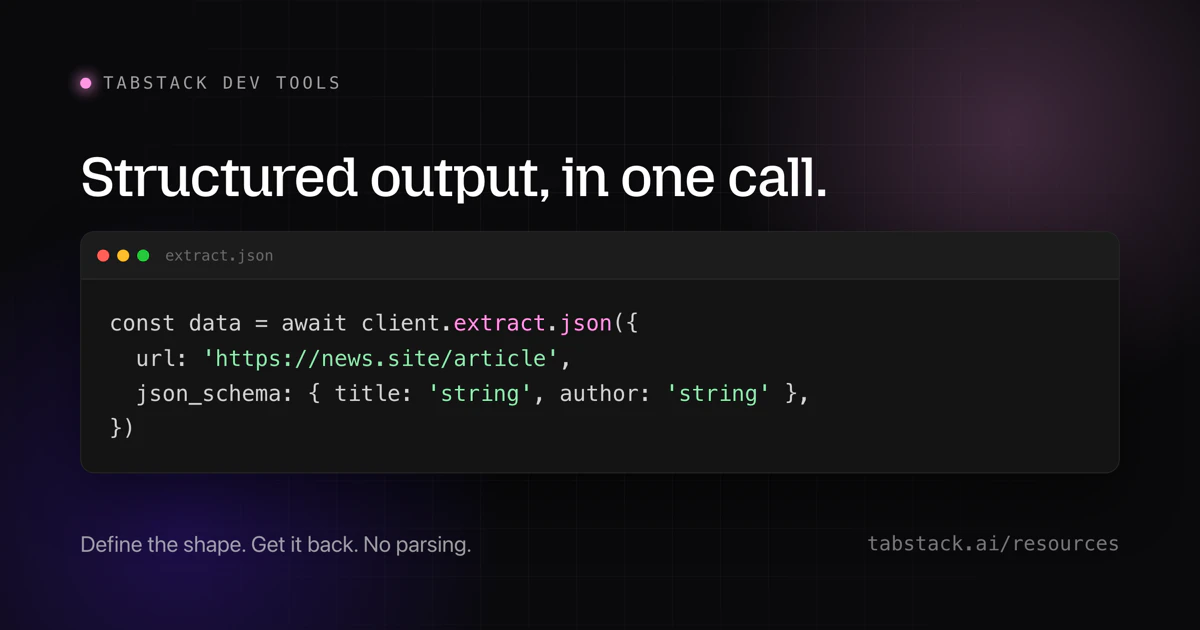
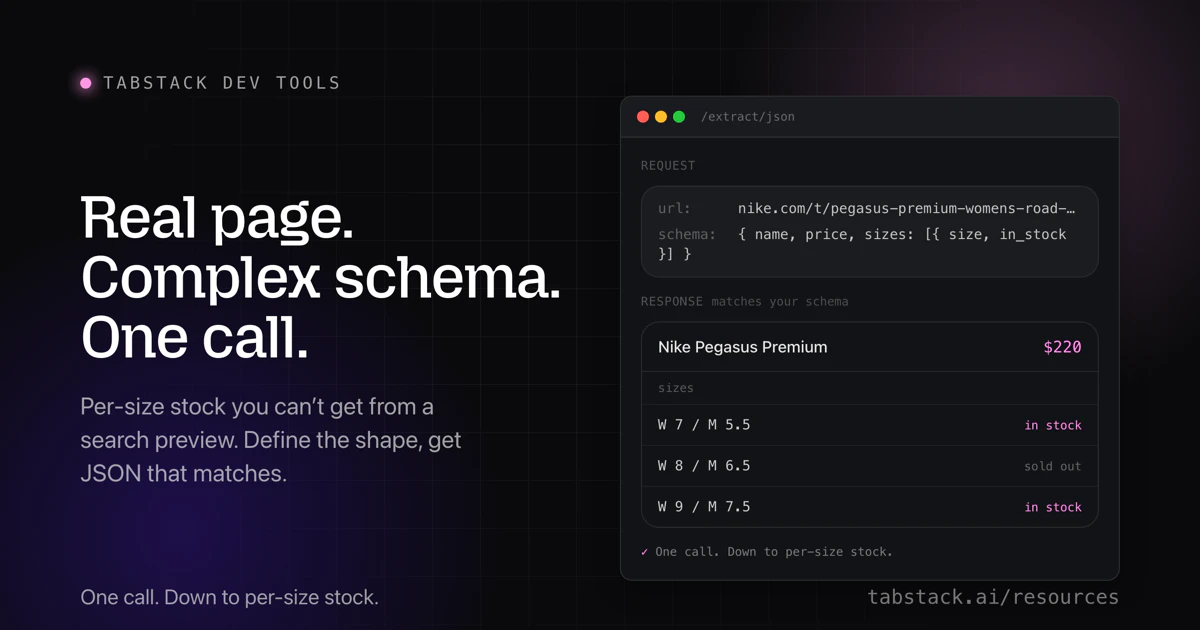
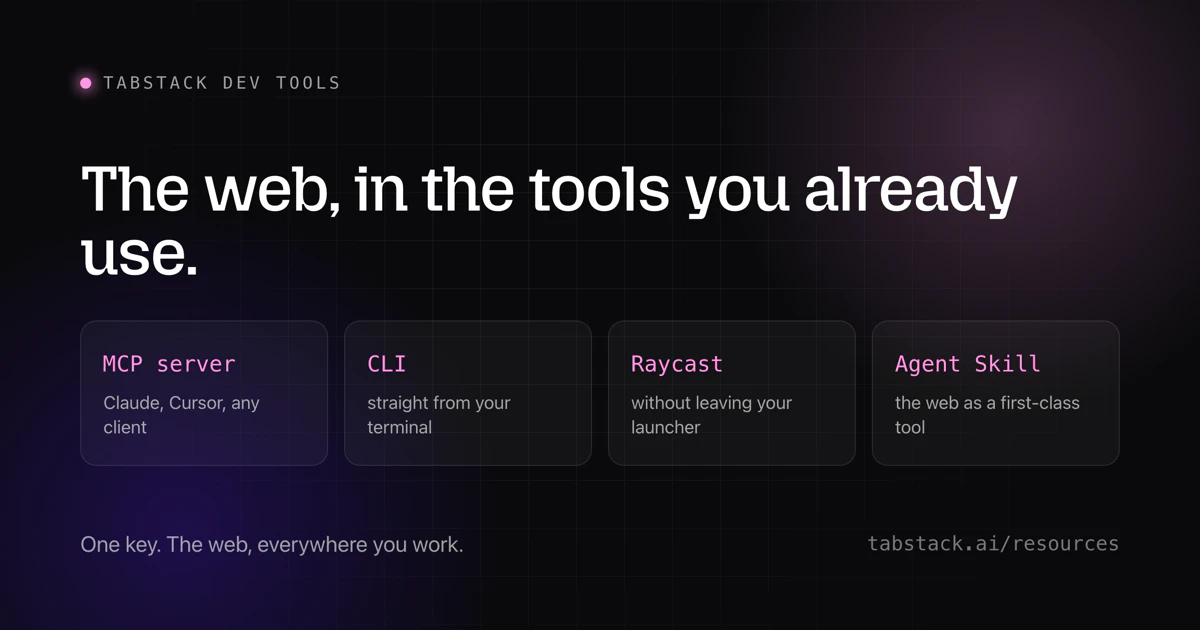
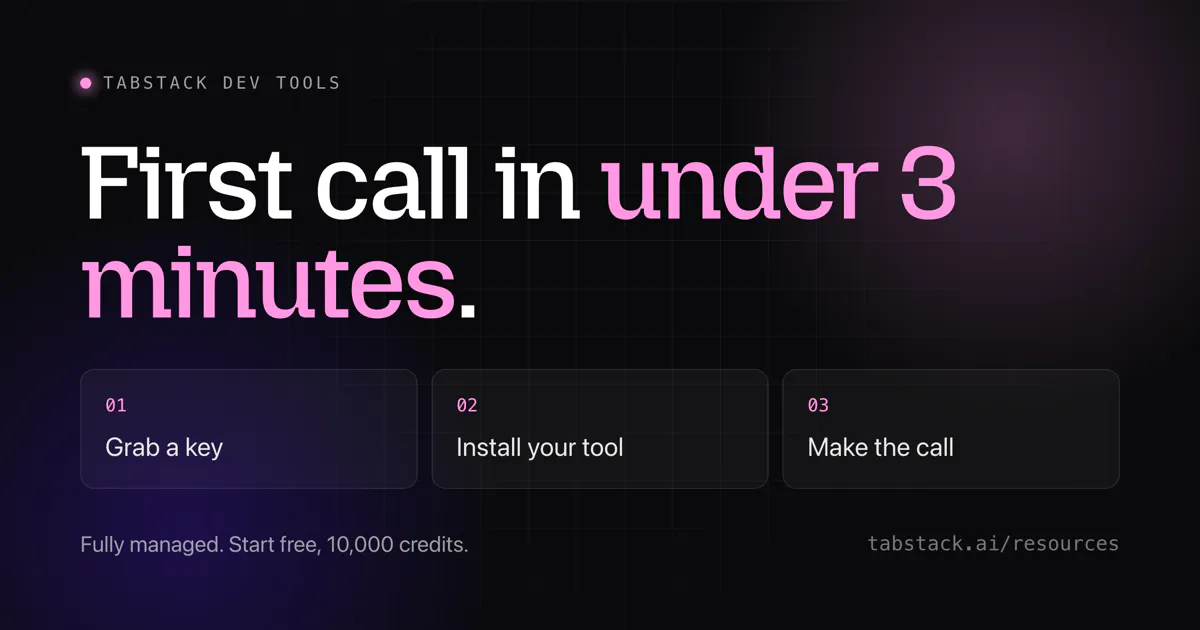
Ditch your scraper. One API gives your code everything it needs from the web: structured JSON, clean markdown, cited research, and browser automation. No browser, LLM, or pipeline for you to run. Use it from the tools you already work in: an MCP server, CLI, Raycast extension, or as an Agent Skill. Grab a key and make your first call in less than three minutes. Mozilla-backed. Your data is never sold, never trained on.

@Tabstack by Mozilla keeps cooking.

Today, the team is launching not 1, not 2, not 3, but 4 new features. Introducing:

  • Tabstack CLI for quick automation and scripting - view source code on GitHub

  • Tabstack MCP server that gives your AI assistant direct access to Tabstack - read docs

  • Tabstack agent skill for your @OpenClaw or Hermes agent

  • Tabstack for Raycast - an extension for scraping data without leaving @Raycast

Go scrape something today.

16
回复

@fmerian Converting data scrapped from website to a schema is an universal problem. I will surly give a try.

9
回复

@fmerian The amount of work that goes into a launch like this is seriously underrated. Most people only see the announcement not the late nights, the pivots, the doubts. Respect for seeing it through. Stories like yours are exactly why podcast hosts are always looking for real founders to feature, not just polished speakers.

0
回复

The unified API abstraction on top of scraping is clever. We've hit the selector-maintenance problem building data pipelines where a single HTML change breaks weeks of work. Does it use headless browser pooling or something more lightweight for dynamic content, and how do you handle rate-limiting per domain when multiple callers share the same API key?

4
回复

@retain_dev Excellent questions!

For content extraction we use several different strategies including headless browsers. However, not every site needs a full headless browser as you alluded to. Sometimes a simple HTTP request will do the trick. Tabstack aims to pick the most efficient strategy based on the requested URL. Extraction effort is also configurable, you can read more about it here: https://tabstack.ai/blog/fetch-effort-parameter

To prevent multiple callers from hammering the site over and over we use caching and honor robots.txt directives that target our user agent.

2
回复

4 new features and its our 4th launch! How fun is that! 🚀

Try all the tools and tell us what you think. Really curious but don't have anything to build right now? Here are a few ideas of things to build:

  • Spec watcher that alerts you when TC39 proposals, Node.js, or TypeScript ship breaking change—one API call per source, diff the rest yourself (repo)

  • Competitor intelligence monitor that runs weekly, extracts structured data from any product homepage, and pings you when something changes (repo)

  • Podcast prep agent that researches a host's last 20 episodes and returns a one-page brief before you record

  • Vendor due diligence tool that pulls pricing, HN mentions, changelog velocity, and Reddit complaints into a structured brief before you sign a contract

  • CFP discovery agent that scrapes Papercall, Sessionize, and conference homepages and returns open calls filtered to your topic areas

  • Dependency security monitor that reads CVE databases and package changelogs for your exact stack and tells you if you're actually affected—not just "vulnerability found"

  • API docs watcher that diffs the docs for any API you depend on and tells you what changed since last week

  • HN front page tracker that extracts structured data daily—title, score, domain, category—and builds a dataset over time for content strategy

  • Job posting intelligence tool that monitors hiring pages for companies you care about and extracts structured signals: what they're building, what stack they're moving to

4
回复

@tessak22 always be launching 🔥

1
回复

Back at it! Love the idea of creating a competitor intelligence monitor that runs weekly, especially knowing it doesn't train on my data.

3
回复

S/O to @tessak22 for the great work! a real-world example built with @Tabstack by Mozilla - star this repo

1
回复

The underrated part is not scraping; it is giving the agent a stable contract back from the web. Agents get much more useful when the web step returns schema and citations instead of a brittle browser transcript that has to be re-interpreted every run.

3
回复

@krekeltronics Couldn't agree more. A schema beats a raw page dump every time, especially when an agent has to act on it. Appreciate you supporting the launch!

1
回复

@krekeltronics framing this!

0
回复

Very interesting approach. Most web extraction tools eventually struggle when sites change their structure. How does Tabstack handle schema reliability over time without developers constantly updating extraction rules? Is there a point where human intervention is still required, or is the adaptation fully automated?

2
回复

@janani_2001 Schema-based, not selector-based. You define the fields you want and a short description of each, and the model maps page content by meaning instead of position. So when a site reshuffles its DOM but still shows the same info, nothing on your end changes.

Human intervention comes in when what you want changes, not when the page does. New field, you add it to the schema. And if a page stops carrying something, extract.json returns null for that field instead of failing, so you catch it instead of getting silently wrong data.

So layout churn is handled for you. Deciding what to pull is still yours.

1
回复

Most web extraction tools eventually struggle when sites change their structure.

You're spot on. Is it something you experimented yourself with another product? Would love to have your feedback about the first-time experience using @Tabstack by Mozilla - get started here: tabstack.ai

0
回复

For launch/community ops, I would use the MCP server to turn docs, changelog pages, and competitor pages into a weekly pre-release brief. The edge case I would test first is source freshness. If a teammate asks the agent to re-check one URL after a cached extraction, can Tabstack force a fresh read for that source while still using cache for the rest?

2
回复

@hazy0 Love this use case, and you picked exactly the right edge case to poke at.

Yes, you can. The nocache flag is per-request, not a global mode. A brief like that is really a fan-out of individual extract calls, one per URL, so cache is decided per source. When your teammate wants to re-verify a single page, set nocache: true on that one call and leave it off the others. That source gets a fresh read while the rest of the brief still answers from cache, so you never have to bust the whole run to re-check one link.

If you want everything fresh later, setting nocache: true on every call does that too, but for your scenario the per-source control is exactly what you're after.

1
回复

That per-source nocache model is exactly what I was hoping for. For a weekly brief, I’d probably mark changelog and pricing pages fresh while leaving older docs cached, so the fan-out shape makes sense. Thanks for clarifying the boundary.

1
回复

"URL + schema in, clean JSON out" is exactly what I keep wishing for. I drive a lot of browser automation for my own agents and the thing that always bites me isn't the first run, it's the site quietly changing its DOM a week later and everything breaking silently. Does the schema-based extraction hold up when a page's layout changes, or does it need re-tuning? Mozilla-backed and "never trained on your data" is a strong trust angle too. Congrats on the launch.

2
回复

@david_marko Thank you, that means a lot. This is exactly the problem we built around.

It holds up without re-tuning. Nothing's tied to the DOM, so when a site changes its markup, extraction keeps working. The model finds your fields by what they mean, not where they sit on the page.

And nothing breaks silently. If the data ever leaves the page, the field comes back null, so you see the gap instead of shipping bad data.

Trust matters to us as much as to you. That's the Mozilla manifesto. 🫶

1
回复

The schema-first approach is interesting. Have you found that users spend more time defining the schema they want, or cleaning up the extracted data afterward? Curious where the bottleneck usually ends up.

2
回复

@surabhi_minocha Great question. Schema-first moves the bottleneck to the front, and shrinks it.

With most extraction, the work lives on the back end. You get messy output and clean it, every run, forever. Schema-first flips that. You define the shape once, and Tabstack does the cleanup for you. The model reads the raw page, normalizes the values, and returns data that's already typed and in your desired shape. No separate cleanup pass on your side.

So the time does go into defining the schema. But that's a one-time decision, not a per-run tax. And it's mostly just deciding what you actually want out of the page, which is the part you wanted to think about anyway.

If you keep an eye out, you'll see our launch next week that's focused on schemas. 😉

1
回复

Built at Mozilla definitely got my attention. Curious how well it handles websites that change their layout frequently.

2
回复

@workout097_collab Thanks! The Mozilla part means a lot to us.

Layout changes are exactly where this approach holds up. You define a schema for what you want, and the model reads the page to fill it. No CSS selectors or XPath to maintain, so when a site reshuffles its markup, your extraction keeps working. That's the whole reason we went schema-first instead of selector-based.

Honest caveat: if a site actually removes the data or buries it behind new clicks, that's a content change, not a layout change, and you'd feel it. For redesigns and DOM churn, you generally don't touch a thing.

1
回复

Built at Mozilla definitely got my attention.

From my perspective, this makes the difference. It sets expectations.

Every call runs on a @Mozilla-backed platform. The pages you extract, the answers you research, and the tasks you automate stay yours, handled responsibly and never used to train models. See exactly how @Tabstack by Mozilla sources and handles data in the docs: https://docs.tabstack.ai/trust/controlling-access/

You're in good hands.

0
回复

One API call for structured JSON, markdown, and browser automation is a solid combo. Does the schema validation handle edge cases well when a site's layout changes, or does it need manual updates?

2
回复

@doganakbulut Great question. The trick is you're not writing selectors. You define a JSON schema for the fields you want, and every call re-reads the page and maps it to that schema. So when a site ships a redesign, there's nothing to patch. No selectors to go stale.

Couple things to know: if a field straight up isn't on the page anymore, you get null back for it instead of the whole call blowing up. And for heavy JS pages, set effort to 'max' so it fully renders first.

So you maintain the schema, not the scraping logic. And the schema only changes when the data you want changes.

2
回复

@doganakbulut Thanks for your support, and great question. Random idea here: a tool to get the JSON Schema for any URL. @tessak22 wdyt?

0
回复

Congratulations on your launch today!

2
回复

@thamibenjelloun thanks for your support, Thami! what's your favorite new feature in this launch?

1
回复

the 'no scraper to maintain' pitch hits different when you've actually spent time babysitting selectors after a site redesign. schema → JSON output that reliably matches is the right abstraction. curious what the rate limits look like at scale - the mozilla backing + no training on your data is a genuinely good differentiator

2
回复

@galdayan Thanks for the support, Gal! and good question re: rate limits. At @Tabstack by Mozilla, rate limits are per account. Not per API key or endpoint. The plan limits:

  • Trial: 10 requests per minute

  • Individual: 10

  • Team: 25

  • Pro: 100

To learn more about rate limits and usage, read the docs here. Hope it helps!

2
回复

Congratulations on the launch! When you say one API call for any tool, are there really not restrictions of tools that can be used? If not, what tools have you seen be used the most?

1
回复

This is pretty cool.

1
回复

@thedatadavis i do think so. what's your favorite part about this product/launch?

0
回复

Congrats on the launch. The MCP + schema path is a nice fit for agents that need web context without owning brittle scrapers.

The thing I’d test is provenance across a multi-source run: exact URL, fetch time, cache/nocache state, and which fields came from which source. Do you return that beside the JSON, or mostly through citations today?

1
回复

It looks very interesting! How does it compare to other AI scraper solutions currently on the market? What specific use cases did you test during development, and which ones is the agent optimized for?

1
回复

@orka1000 thanks for the support, Corentin! and great questions. TL,DR:

  • focused on turning web pages into AI-ready structured content

  • optimized for fast adoption

  • lighter-weight and purpose-built for content extraction and structured output

  • built at @Mozilla, i.e. private by default and transparent by design

if you have a specific product in mind, you could find a more detailed comparison in the docs: https://docs.tabstack.ai/

hope it helps!

0
回复

The MCP server angle is the interesting bit for me. When an agent pulls structured web data this way, how do you handle pages where the schema is slightly wrong or the DOM changes mid-run?

0
回复

The MCP + agent skill angle is the part that stands out to me. Scraping is usually treated as a one-off API call, but making it usable directly inside an agent workflow feels much more practical. Curious how you think about guardrails when agents browse or extract from messy pages.

0
回复
#4
Jesse
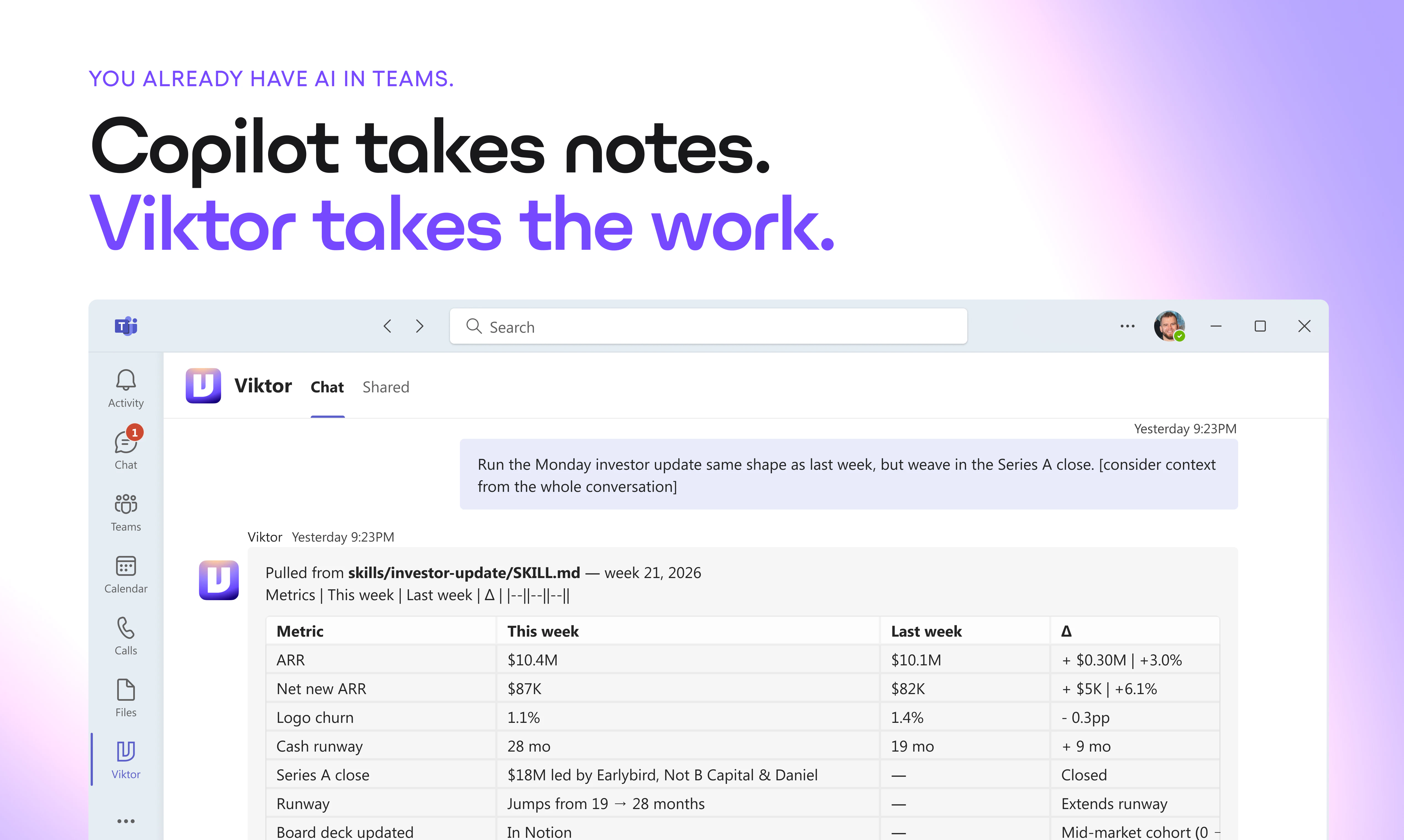
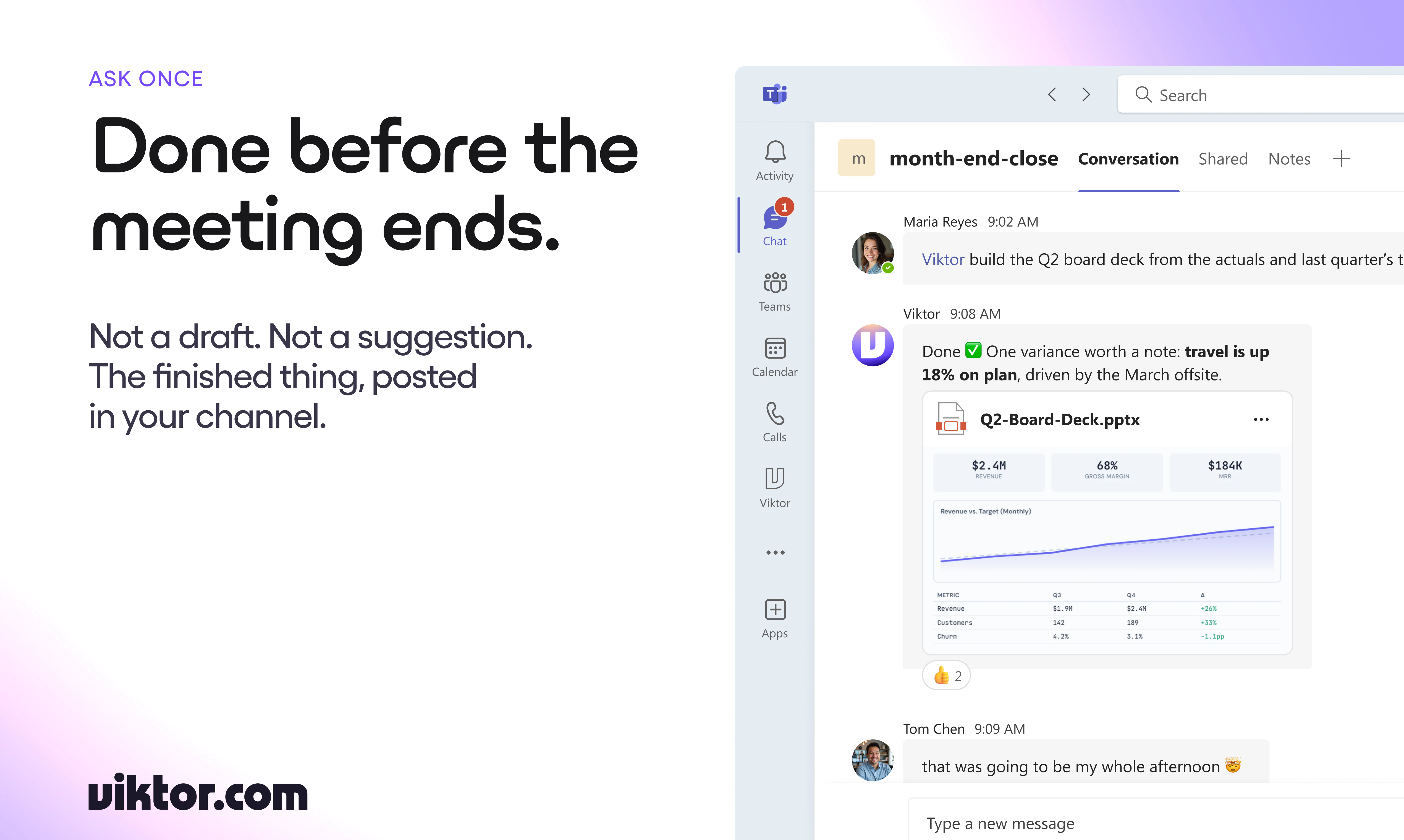
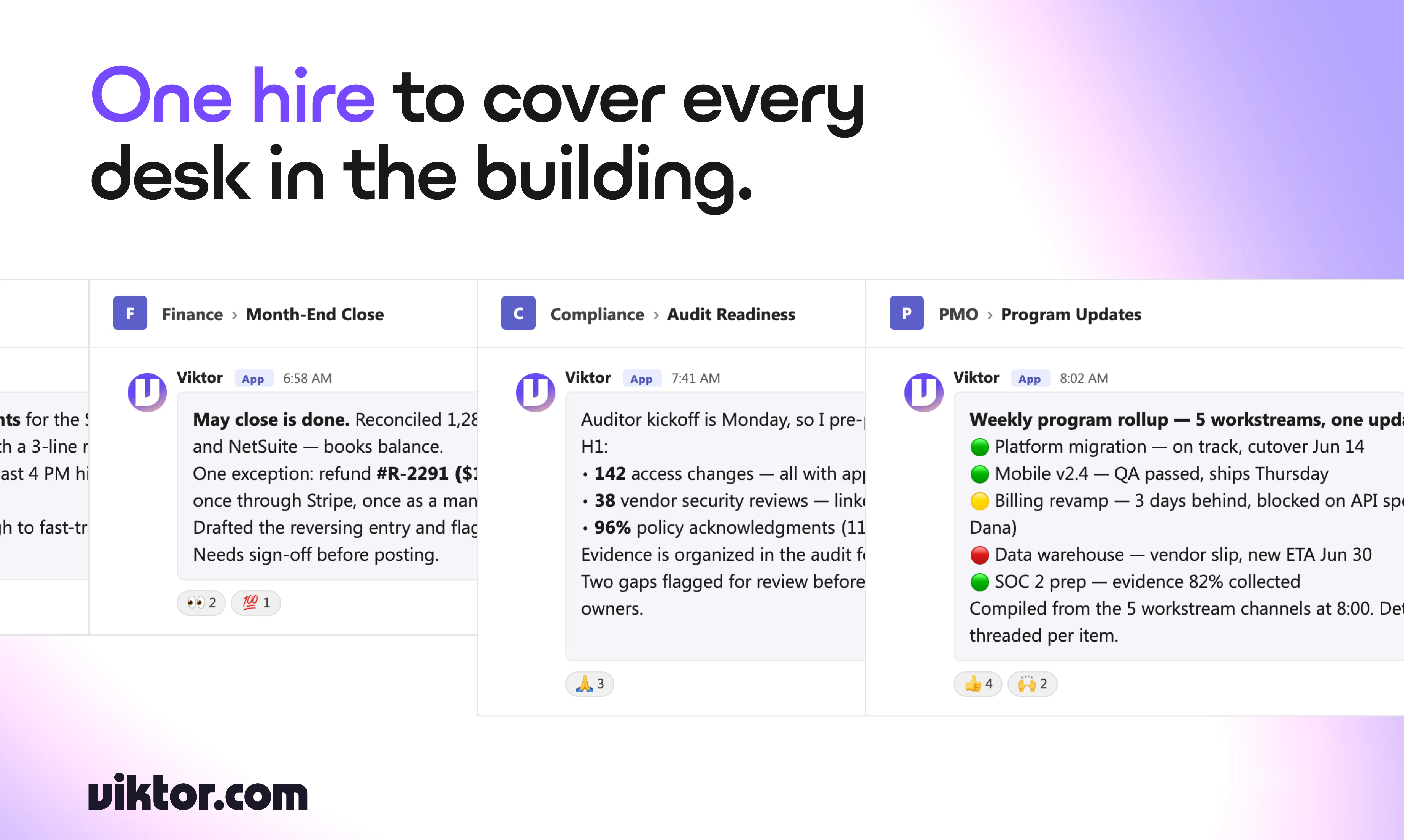
Stop building Apollo/Clay lists. Search the live internet.
324
一句话介绍:Jesse是一款面向销售与市场团队的实时互联网搜索引擎,通过自然语言提问直接检索全网活数据,替代传统僵化的静态数据库,解决B2B销售中线索数据过时、精准度低的痛点。
Sales Artificial Intelligence
实时销售线索引擎 B2B数据搜索 AI销售助手 反数据库 意图信号 自然语言查询 SaaS工具 GTM优化 替代Apollo/Clay MCP集成
用户评论摘要:用户普遍认可“数据新鲜”这一核心价值,并追问“实时搜索”的技术细节(如缓存与否、更新频率)。热门需求包括n8n/MCP集成、按“两周内职位变动”过滤的精准信号优先级,以及针对低网络足迹市场的覆盖能力。少数用户担忧工具对小型本地企业等场景的适用性。
AI 锐评

Jesse的定位非常聪明——它精准抓住了B2B数据服务行业长达15年的“数据腐烂”痛点。传统的Apollo和Clay本质上是“数据批发商”,靠一次性抓取然后反复售卖信息差获利,这种模式在信息更新速度飞快的今天已经难以为继。Jesse打出“反数据库”旗号,把价值点从“拥有数据”转向“获取数据的能力”,这是一个极具破坏性的创新。

然而,产品介绍中“扫描实时互联网”的表述存在一定的误导风险。互联网上公开可用的高质量B2B信息(尤其是高级决策者的实时状态)其实极度分散且非结构化。Jesse能否在“全量实时”和“精准可用”之间找到平衡,是其真正的技术门槛。从用户反馈看,团队承认“新鲜度受限于公开信息”,并且缺乏内置的“近期变化”过滤器,这说明产品在时序信号处理上仍显粗糙。

产品的爆发力在于其自然语言查询的易用性和MCP/n8n等生态集成的开放策略。但长期看,Jesse面临的核心挑战不是技术,而是商业模式:如果一个查询能实时获取全世界最鲜活的线索,那么定价是算查询次数还是成交效果?如果按效果定价,就要求其质量远超市场平均;如果按查询量定价,则容易被客户滥用导致成本失控。此外,随着竞争加剧,Apollo等老牌厂商完全有可能补上“实时”能力,届时Jesse的先发优势将迅速消失。

Jesse真正的价值不在于它能找到多少线索,而在于它教会了行业一个道理:在AI时代,数据服务应该从贩卖“库存”转变为提供“活水”。吹捧之余也要清醒——这依然是个需要持续优化“信号优先级”和“覆盖广度”的产品,离“一键解决所有销售难题”还有距离。

查看原始信息
Jesse
Sales teams have been stuck with stale databases for 15 years. Jesse changes everything.. the first internet-wide search engine built for sales & marketing. Ask in plain English: "Find newly opened soccer facilities in the Midwest needing turf solutions." Jesse scans the live web and finds the right buyers in the market today. We are an anti database company, we don’t scrape and store stale databases and sell them at premium. Every lead is found fresh from the live internet and delivered.

Hey Product Hunt! 👋 I’m Sudipta, cofounder of Floworks.

Quick intro: I’m an IIT-Kgp grad. My first startup failed — and what stung was the reason. Not the product. We just couldn’t crack sales.

So I started Floworks and got into Y Combinator. Different company, same ghost: sales never got any easier.

We were spending hours building lead lists, only to discover half the people had changed roles, the signals were outdated, and the best accounts were hiding in plain sight.

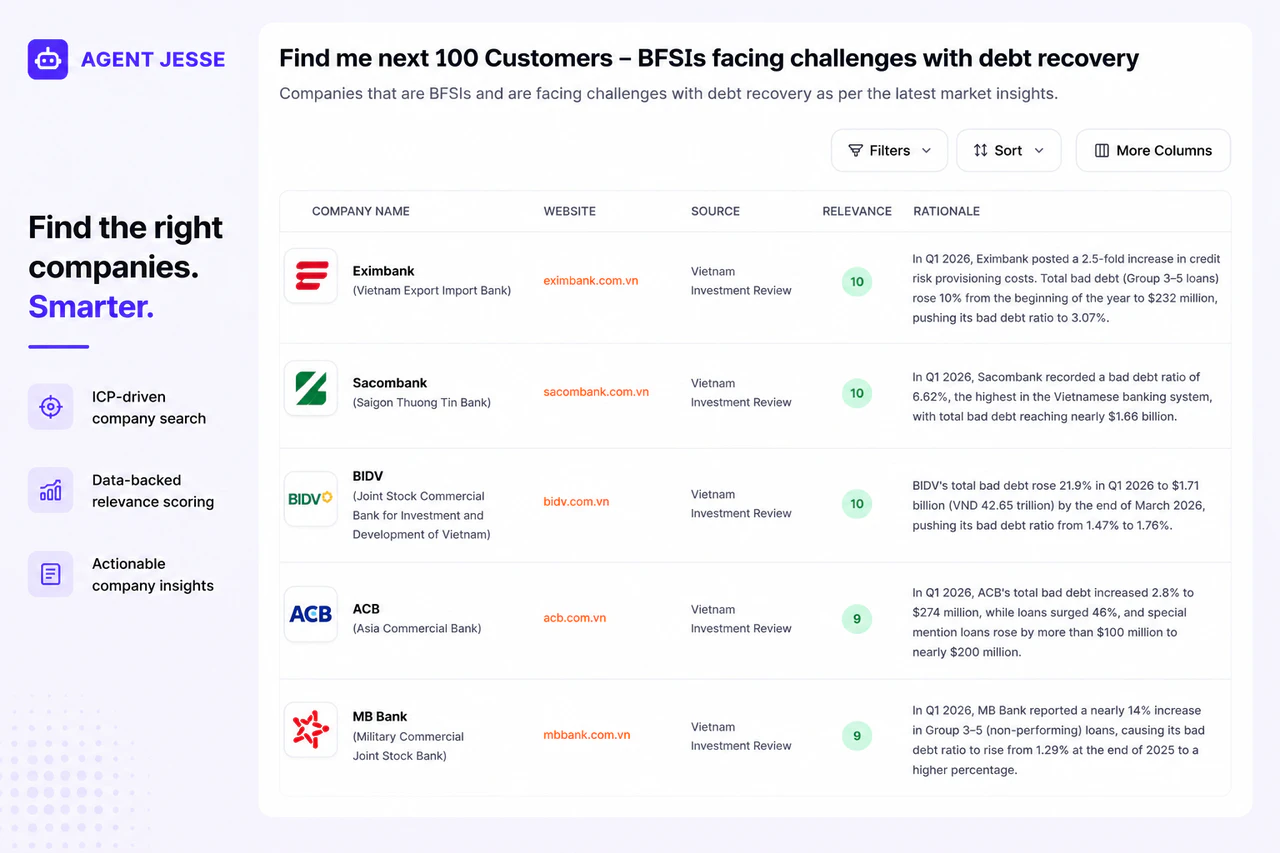
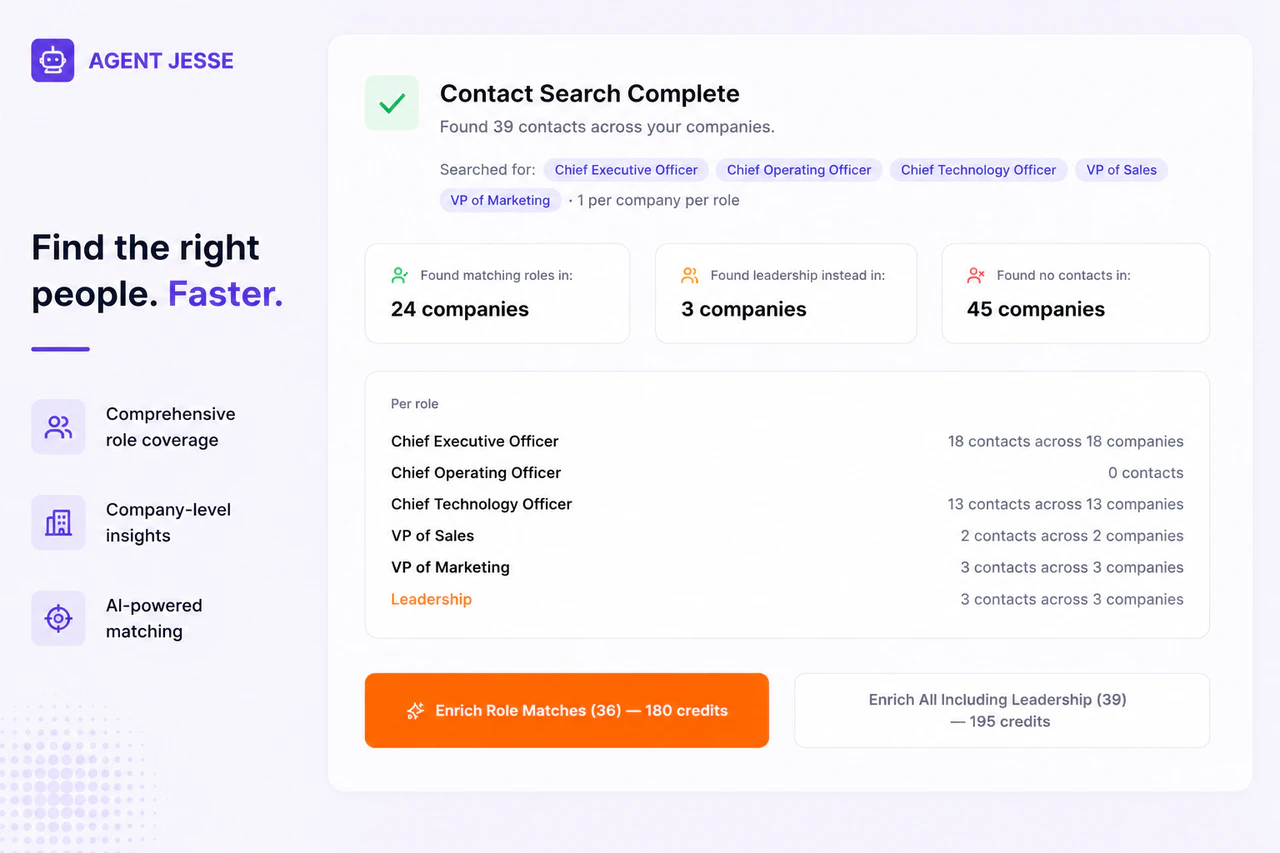
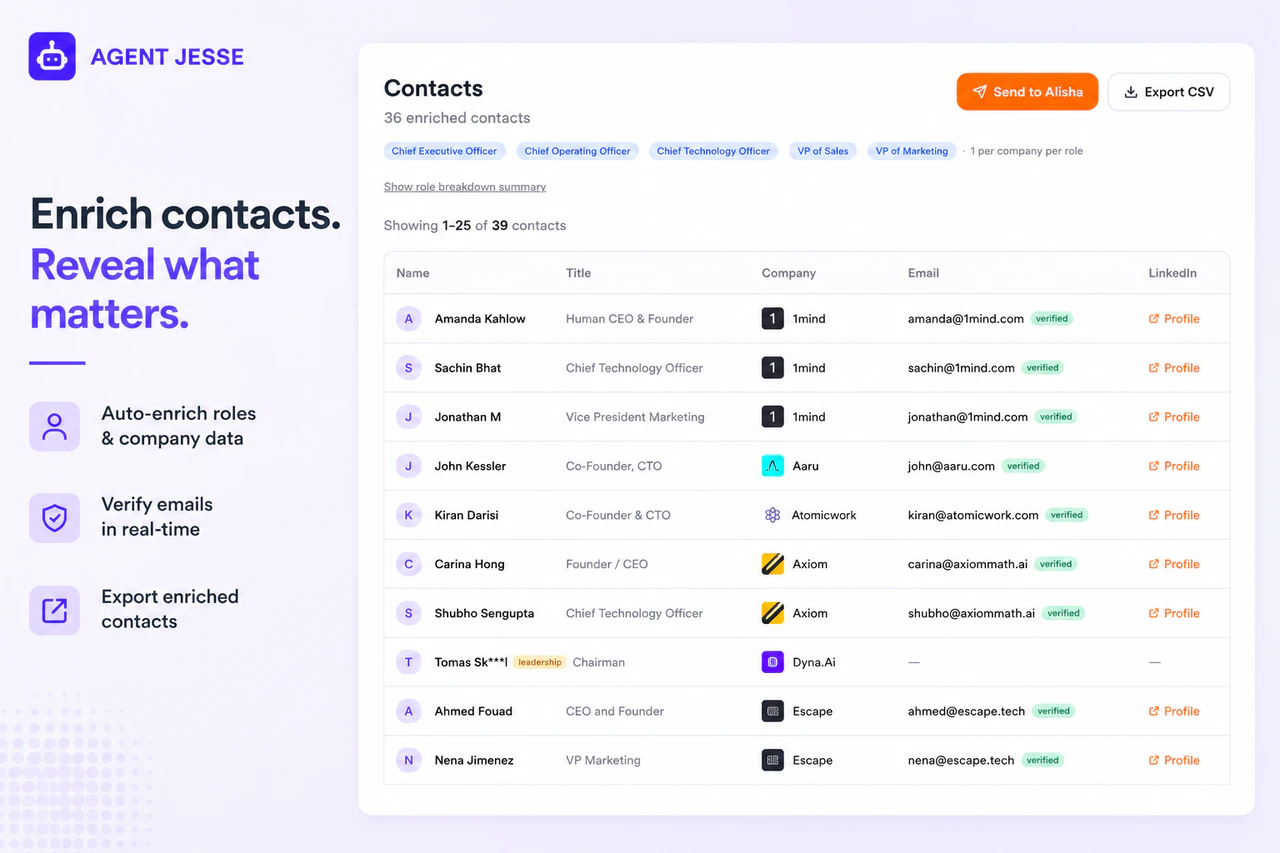
So today we’re launching something close to my heart: @Jesse — a modern prospecting tool for GTM teams.

Think of it as a search engine, but for finding your next 100 customers.

Apollo and Clay scrape data once, then sell it back at a premium. By the time it reaches you, it’s stale — titles changed, companies pivoted, signals came and went.

Jesse searches the entire live internet on every query and hands you fresh leads.

We’re an anti-database company.

What’s more 👇

  1. Apollo gives you 8–10 filters. Clay makes you wire up data sources. Jesse just works.

    Write in plain English:

    🔎 “Looking for healthcare providers who just opened chemotherapy centres”

    🔎 “Find me 100 kids’ play facilities that just started a football academy and are seeing high footfalls”

  2. Jesse tells you which signals to look for.

    Building a fintech for debt collection? Jesse surfaces:

    🎯 VPs of Risk at mid-sized NBFCs ($5M–$50M ARR) posting about defaults / hiring underwriters — want real-time alternative credit-reporting APIs

    🎯 VPs of Compliance at digital neobanks (50–200 emp), newly appointed, replacing manual KYC/AML with a consolidated real-time API

    🎯 CTOs at Series A/B fintechs (100–500 emp) tired of juggling vendor APIs — want one unified identity + credit + AML API

  3. AE with named accounts every quarter?

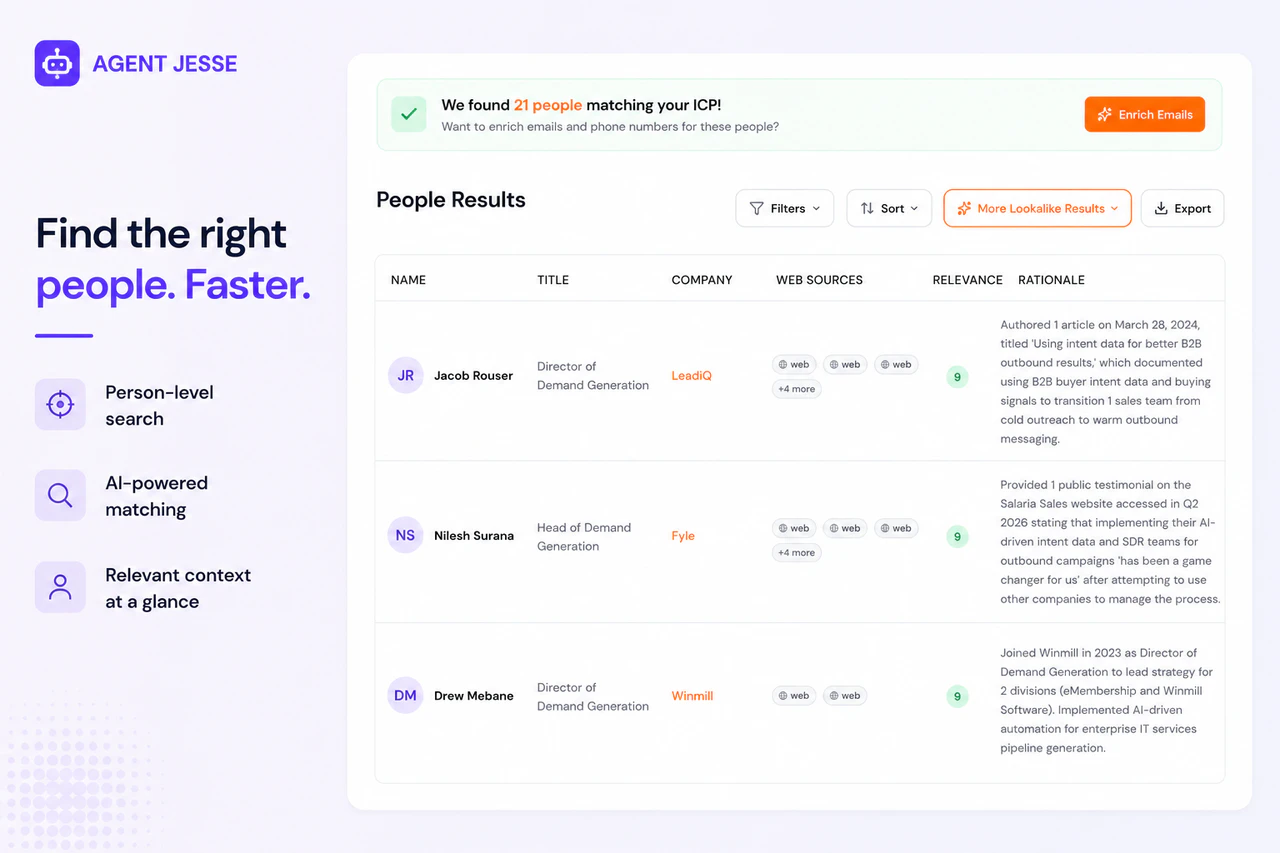
    🕵️ Jesse finds the right people inside those accounts by reading decision-makers’ real online activity — posts, public appearances, forums

  4. A daily barrage of fresh leads, delivered to your inbox every morning. 📥

Since we launched, the adoption has been incredible:

  • 🚀 1.2k+ teams signed up

  • 🌍 From a real estate agent in Florida, to a fintech founder, to 4 Fortune 500 companies and one of the largest logistics companies in the world

  • 📈 50%+ WAU/MAU

  • 🔥 A constant rave across sales communities

These are still early days. I get a ton of messages from Jesse users on what to improve, and I personally read and act on every one.

I’d love your feedback — especially from founders and sales leaders who’ve lived the pipeline grind. What’s the most painful part of finding good leads for you? Happy to answer any questions! 🚀

27
回复

@sudipta_biswas4 Congrats on the launch! 🚀

Love the focus on solving the “stale data” problem , that’s a real pain point in sales/GTM workflows. Fresh signals at the moment of search feels like a strong angle.

0
回复

@sudipta_biswas4 The amount of work that goes into a launch like this is seriously underrated. Most people only see the announcement not the late nights, the pivots, the doubts. Respect for seeing it through. Stories like yours are exactly why podcast hosts are always looking for real founders to feature, not just polished speakers.

0
回复

Thanks, Kevin, for hunting our product. Hi everyone, I am Sarthak, one of the Cofounders at Floworks.

We built Jesse to help sales teams run precise outbound.
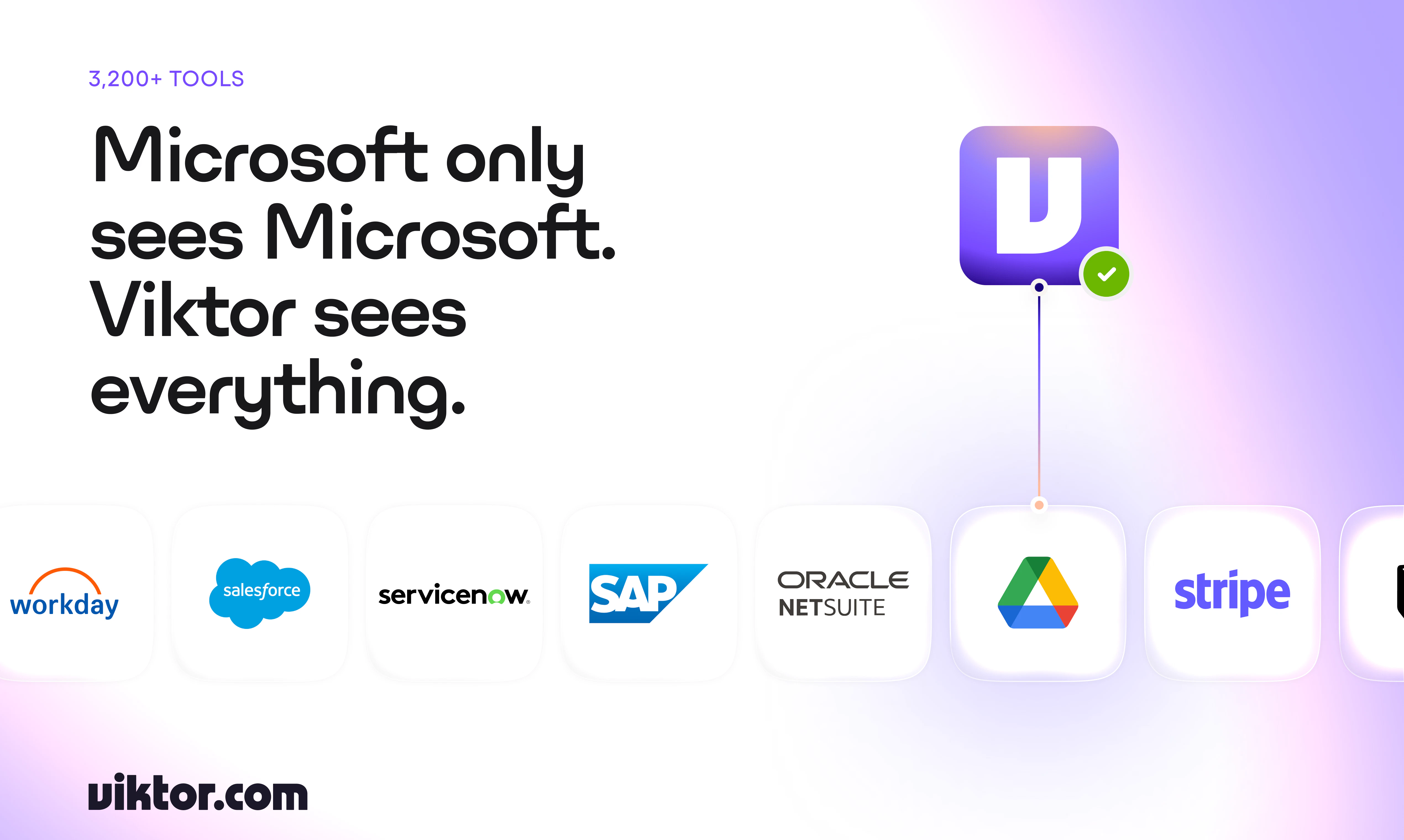
Jesse is an AI agent that connects to 180+ data sources and the entire internet.
It finds you the perfect list with any filter or intent signal - all from a simple prompt.


What Jesse knows about your prospects:

  • Funding rounds

  • Page visits

  • Products they're using

  • Team's preferred tech stack

  • Intent signals no one else has

And everything else there is to know

One of the great testimonials we received from a customer:

"It's like having an insider in each prospect's office."

Please take Jesse out for a spin, and share your valuable feedback. I am sure with all your support, we will fix what is broken in outbound.

17
回复

Congrats on the launch! The biggest pain point with tools like Apollo or Clay has always been how quickly the data decays. Doing live web research at query time sounds like a game-changer for timing-sensitive outreach. Looking forward to taking this for a spin! Do you have any n8n/MCP integration to be used with Clade code?

10
回复

@kevin We are live on n8n as an approved template. MCP coming next week. API is already live for those who want to integrate in their own application.

0
回复

@kevin Hey Kevin, thanks for hunting us on ProductHunt. Great suggestion, as @sudipta_biswas4 mentioned, we have gone live with both the n8n/MCP integrations. This is especially important for us as most of the modern GTM teams are building their stack on Claudecode and this way they can just plug-and-play with Jesse.

We are also planning to launch direct integrations with other outbound tools like:
1. Alisha - the outbound engine of Floworks
2. Instantly
3. SendGrid

And CRMs of the like of Salesforce, Attio and Hubspot for smoother transition of leads in your GTM flow.

Please let us know if you think any other workflows could be of interest. We would love to look into them.

0
回复

Hey Product Hunt, Ritesh here, one of the makers.

We built Agent Jesse around one uncomfortable number: B2B data decays about 2% a month, so any static lead list is partly wrong the day you export it.

So Jesse doesn't query a snapshot. It retrieves against the live web at query time, ships every row with the source URLs it came from, and runs a self correcting loop that keeps re-sourcing until it hits your target.

As of this week it also goes where you work: an API key drops it into n8n, and an MCP server connects it to Claude, ChatGPT, or Cursor, so you can just ask for leads in plain English.

We are still actively shaping what comes next, so I would love to hear: where does your current lead data let you down most?

Happy to go deep on how the retrieval or verification works.

10
回复

The pitch makes sense if the core problem is list staleness, but I'm curious what "live internet" actually means in practice for sales data specifically. Are you pulling from public web sources in real time, or is there a database that gets refreshed on some cadence? That distinction matters because a lot of "live" tools still have a 30-90 day lag on job changes and funding rounds, which is exactly when the timing-sensitive outreach breaks down. Also wondering how Jesse handles signal prioritization, whether you can filter by something like "title changed in the last two weeks" versus just searching by current role.

7
回复

@fberrez1 

Good question, and the distinction matters. 

We runs live, grounded web research at query time. 

It is not  a pre-built database that goes stale between refreshes.

When you run a search it goes out to public sources right then and reasons over what is currently there, so there is no fixed 30 to 90 day snapshot lag baked in.

An honest caveat: 

Freshness is bounded by what has actually gone public. 

A funding round or role change that has hit the web (news, company site, LinkedIn) is catchable as soon as it surfaces.  Anything not yet public, we will not invent.

On prioritization: 

Today you encode recency in the criteria itself, for example "VP of Sales who recently changed roles at Series B SaaS," and the search pulls on whatever recency signals are publicly visible rather than just matching a current title. 

A built-in recency filter, like a "changed role in the last two weeks" toggle, is what we are building next, so time-sensitive outreach runs off a real signal instead of how you worded the search.

0
回复

As someone who has used Jesse first-hand, I can say they are really, really good. I’ve tried many products that promise to use intent signals to build lead lists with just a prompt, but the list quality usually turns out to be quite poor. Most of them feel like LLM wrappers on top of traditional lead databases.

Jesse felt different. They seem to understand real intent and match it with actual buying signals. We used to run email campaigns to hundreds of thousands of leads, mostly with poor reply rates. But when I used Jesse, it clearly helped us identify which leads were actually relevant - allowing us to go much deeper on personalization and get ridiculously high reply rates.

Highly recommended, and congratulations to the team on the launch.

3
回复

@upendra_varma Thankyou for such honest feedback. Really appreciate your support in growing Jesse. With Jesse we aim to change the way outbound is being done and I can honestly say, it's for sales leaders like you, we have built Jesse.

I would say you should also try out our two flagship features:
1. People Search - To try and identify prospects at a persona level. It helps you find prospects emitting signals around your need
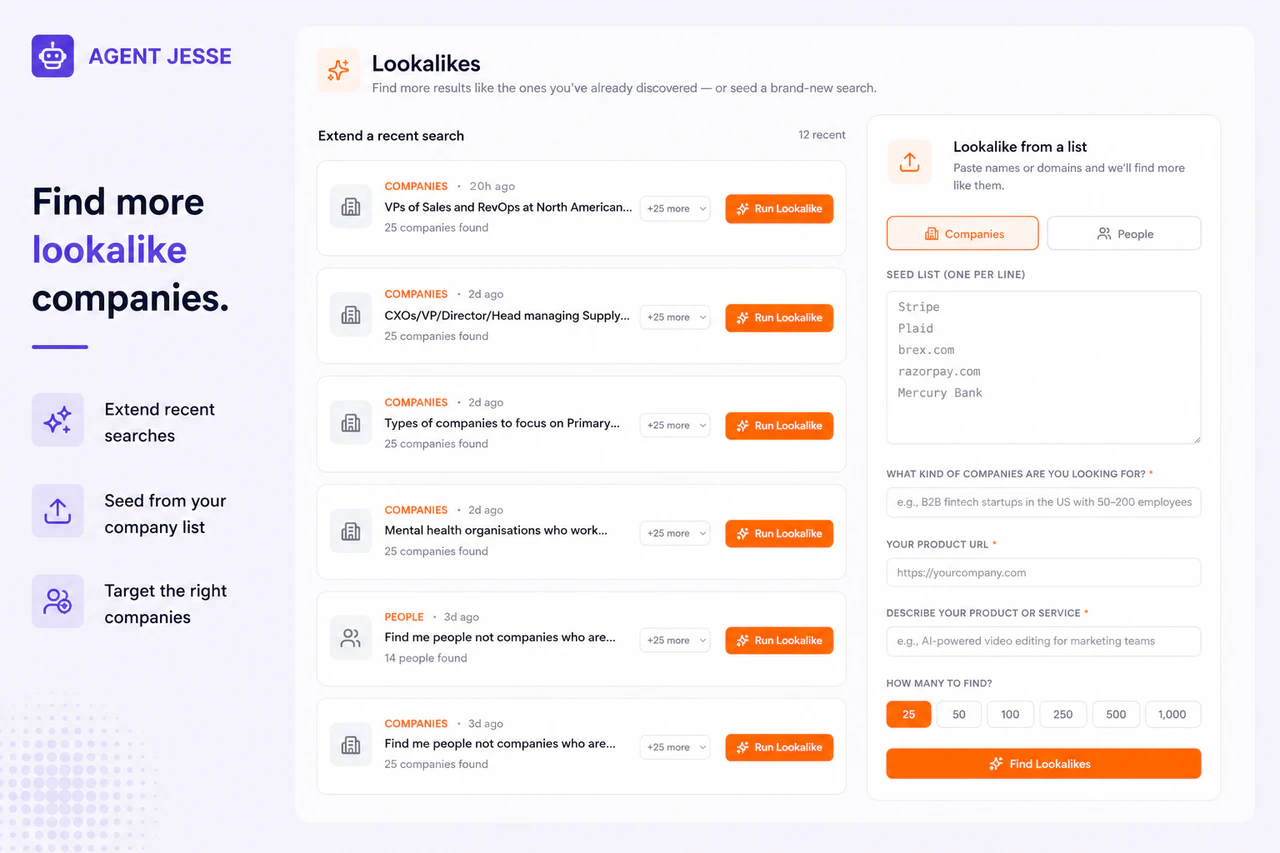
2. Look alike search - First of its kind look alike search built not on static databases but rather on dynamic internet-based signals. This is specially helpful to curate similar looking lists that have already worked for you.

I am sure we will hear more from you as we keep building Jesse. Thanks for all your support

1
回复

So proud to see Jesse out in the world today. 🚀

I've watched the team pour everything into this, late nights, endless user calls, and a stubborn refusal to ship just another stale database when the whole industry said that's just how it works.

The live-internet search is genuinely wild, but what I'm proudest of is how obsessively we listen to users. Every piece of feedback gets read and acted on, and it shows in how fast this thing keeps getting better.

If you've ever burned an afternoon building a lead list only to find half of it was wrong — this one's for you. 🙌

3
回复
Such a cool product!! Congrats @sudipta_biswas4 @sarthak_shrivastava2 🚀
2
回复

Searching the live internet instead of pulling from static lists is a big deal for anyone doing outbound. How fresh is the data — are we talking real-time crawls or is there some caching involved?

2
回复

@doganakbulut 

Thanks.

We do not cache nor use any static list.

Every search reads live web sources the moment you run it, so freshness equals whatever is public right then.

It is live search at query time and not a stored snapshot.

If you run it again tomorrow and it researches from scratch.

0
回复

Cant wait to try this. Have had my own share of struggles with stale databases.

2
回复

@itsshrey Thanks, Shreyas. It will be really awesome to have you use Jesse and share more detailed feedback with our product team.

0
回复

I have seen my fair share of stale leads and contacts so great job for focusing on an unsolved problem. What markets do you focus on? Are there ones that are stronger or weaker? Interested in learning more. Congrats on the launch.

2
回复

@yumi_joh 

We are not locked to one vertical. Because Jesse reads the live web per search, the real dividing line is web footprint, not industry or geography. 

It is strongest wherever your targets leave a public trail, B2B tech and SaaS, funded startups, anything with news, funding, hiring, or active profiles, all easy to find and rank with a solid rationale. The tougher cases are low web-footprint targets such as very tiny local businesses, stealth-mode companies, low-digital-presence industries or regions, where signal is sparse so results come back fewer and lower confidence. 

Widening that thinner end is what we are working on now.

Happy to go deeper. What market are you selling into?

I will tell you honestly how strong a fit it is.

0
回复

@yumi_joh Thanks for the support. Yes we do work better for markets that is unexplored / not easy to find on traditional databases like Apollo and Zoominfo. These will be the non-digital markets from traditional industries like:
1. Manufacturing
2. CPG, D2C, ecommerce
3. Finance

etc

We also work better for geographies where the coverage is poor such as APAC, Middle east etc.

Since these are hardest to curate in traditional databases and were only accessible by having a person comb through google searches and build the list, we made them a staple usecase for Jesse.

That being said, it gives equally good results for other markets that you might be exploring.

0
回复

Does it have MCP integrations yet?

2
回复

@saurav_gopal 

Yes, we have an MCP server that exposes Jesse's search as tools (find companies, find people, fetch results), so any MCP client can run a search and get the results right in the flow. 

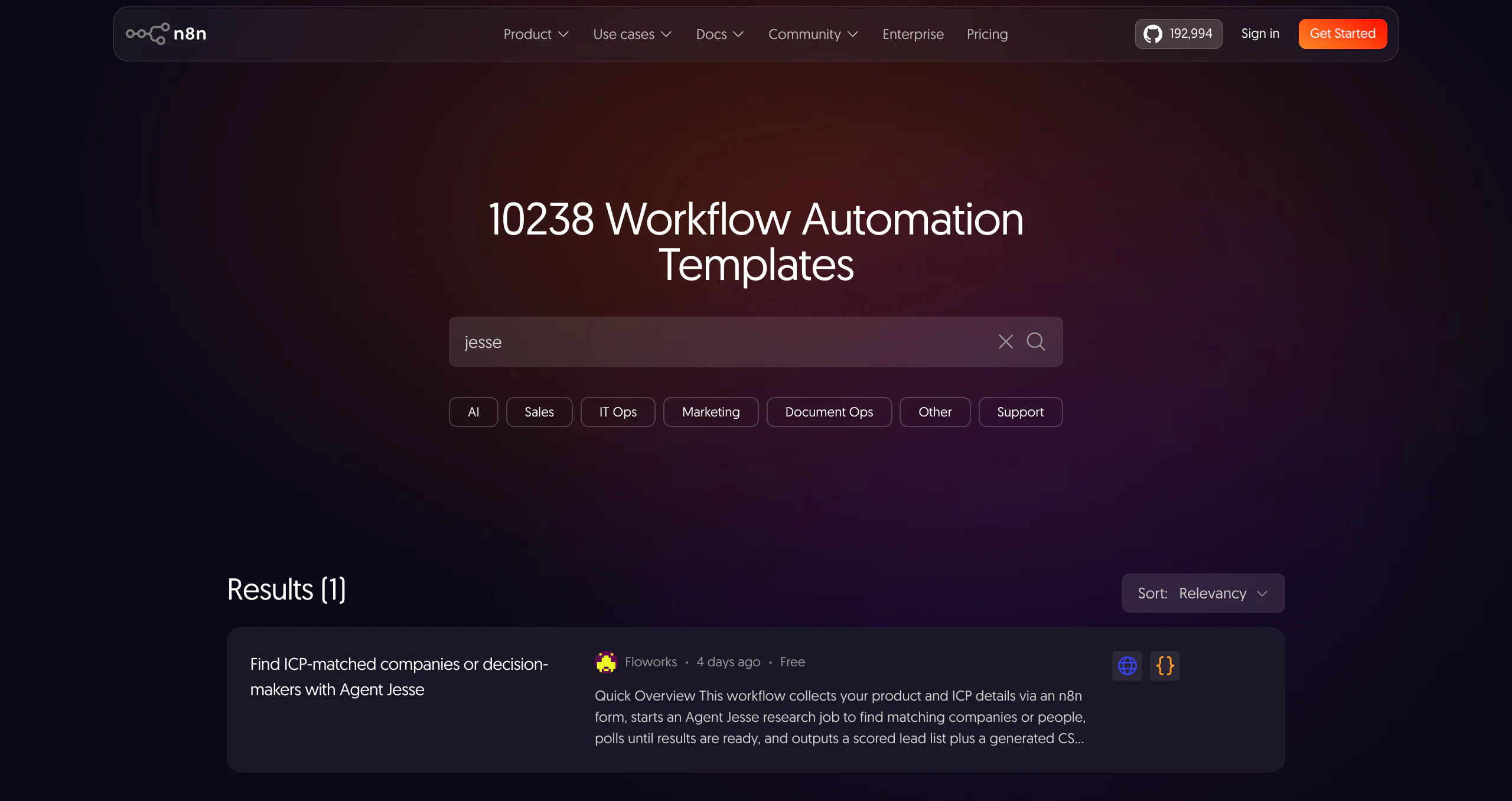
It works today with the key-based clients, Claude Code, Claude Desktop, Cursor, and the API, by pasting your Jesse API key. 

It is in request-only beta right now, so reply or DM and I will get you early access. 

Nevertheless it will be fully public in 2 to 3 days.

Side note: if n8n is also on your radar, the template is already live in the n8n gallery (search 'Jesse'). Same API key."

0
回复
Congrats on the launch! Will be trying this today.
2
回复

@neel_balar Glad that you liked it. A lot of YC companies are today finding their next 100 B2B customers via Jesse. Excited to share more details.

0
回复
Great launch! Would love to try it out!
1
回复

I think the live web search can be a huge delta in tools like these. It can solve for the freshness of the data always there in the tool.

I think this is a cool concept. Looking forward to testing this out. All the best for the launch, guys.

1
回复

I've been running into this exact problem with Apollo so Jesse looks like a fresh gust of air.

Is there an additional verification layer?
Because many small businesses will not have their information updated on all channels, I wonder how any conflict is handled and whether there is a way to check the validity of that information that turns up through searches.

1
回复

@kyleysryu Good question, and yes- there is an accuracy/verification layer built in.

It refreshes on every new list, the agent goes out to the live web in that moment, so you get whatever is currently accurate on the sources. We weight trusted, verified portals like LinkedIn by how reliable each one is, to keep results as accurate as possible.

Secondly for enriched data like emails, we run additional verification loops from Industry leading tools to always give accurate data.

An honest caveat on conflicts:
Freshness is bounded by what has actually gone public. When different sources show different values, Jesse ranks by source reliability and surface recency, then attaches the actual signal and source link so you can verify.

On validity checks:

Today, you can trace every lead back to its source (LinkedIn post, funding announcement, company site), which lets you manually validate the signal.

For small businesses that are sparse online, the main limit is coverage: if the signal hasn't published yet, we won't invent it. But once it's public- news, company page, LinkedIn, forums, Google maps- it's catchable as soon as it surfaces.

0
回复

We were using Clay at Requestly.

Shifted to Jesse 3-4 weeks back. Much simpler. You just tell what kind of company you are looking for and it finds.

Happy with it so far. Congrats on launch!

1
回复

@sagar_soni5 Awesome to hear you're already seeing the simplicity win after just a few weeks—shifting from "building lists" to "just tell me what you want" is exactly the shift we're aiming for.

Congrats on the smooth switch from Clay at Requestly, and thanks for the launch congrats! If you hit any edge cases or have ideas for what "what kind of company" should be able to express next (e.g., tighter ICP constraints, specific signals like hiring or funding), I'd love to hear what would make it even sharper for your outbound

0
回复

Congrats on the launch Sudipta & team! Looks very cool. How do you determine that an email is "verified"? Also is there an API integration as well?

1
回复

@rajoshi_ghosh 

Thanks Rajoshi.
On verified emails: the email comes through our enrichment step, and each one carries a status from a deliverability check. So "verified" means it passed validation as a real, deliverable mailbox, not just a pattern-guessed address. We surface that status per contact, so you can see and filter verified versus inferred rather than trusting them all equally.

On API: yes. Everything runs on a Jesse API key, it is what powers our n8n integration (live in the n8n gallery now) and an MCP server for AI clients. Direct API and MCP access is in request-only beta right now and goes fully public in a couple of days. DM me and I will get you a key early.

0
回复

The stale-list problem is even worse down-market, Sudipta. I prospect local businesses (insurance agents, salons, clinics) and Apollo/Clay basically don't have them, or the data is years out of date. A live, plain-English search is exactly the gap there. Genuine question: how does it do on small local SMBs vs the enterprise/BFSI examples? That long tail is where every list tool falls apart. Congrats on the launch.

1
回复

@david_marko 

Thanks David.

Great question.

The long tail is exactly where live search should beat static lists.

Jesse does better down-market than Apollo or Clay precisely because it is not a B2B contact database. For a salon, a local agent, a clinic, it reads the live web, Google Business and Maps, local directories, the shop's own site, reviews, which is where those businesses actually live and where contact databases are thin or years stale.

So on finding the business and its public contact info, the long tail is a strength for us, not a weakness.

Two honest limits:

It still needs some public footprint, a listing, a site, a profile. A truly invisible shop will not surface and we will not invent it.

And contact depth is thinner down-market for everyone, us included, you will most definitely get the listed business email and phone, but a verified personal email for the owner becomes progressively harder.

This is exactly where we want to win. Send me a slice of the SMBs you chase and I will run a real batch and show you what comes back.

0
回复

How do you verify the data that is pulled is verified / correct?

1
回复

@sandeepdinesh 

A few layers, and I will be honest about where it ends.

Nothing is generated from thin air, every result is grounded in real public sources and ships with a rationale and the source link, so it is auditable, not a guess. 

We weight trusted, verified portals like LinkedIn above weaker ones, so stronger signals win, and this confidence shows in the relevance score

A thin or single-source leads rank low rather than being passed off as solid. 

Contact details like email get a separate verification pass with a status on each.

Honest boundary:

We do not fact-check the whole world. If a reputable source is itself wrong, that can carry through, which is why we attach the source to every result, so you can confirm in one click and additionally the relevance score tells you which results are even worth double-checking

0
回复

I did a people search but there is no contact information or LinkedIn profiles. Am I missing something? I’m on the free plan.

1
回复

@jill_camhi_osinoff Yes, we provide contact information and LinkedIn profiles when you enrich. That feature is right now available starting from the base plan, which starts at $5.

In our next launch, we are also adding a preview feature where a few of the contact information and details will get available even in the free plan. This way, the product becomes more transparent, and our customers have more confidence in the product to move to the higher tiers.

Thank you for the suggestion. Will implement it right away.

0
回复
1
回复

This is amazing - have been using it for a few days now

1
回复

Interesting positioning. How do you balance 'live internet search' with getting consistent, structured lead data at scale?

1
回复

@workout097_collab Thanks for the support. We are doing it by first running every query via our live internet search data. Then we cross-reference the same through the structured databases that we have connected on the backend. This gives us two distinct advantages:

1. We are able to first get the live and correct data from the internet so that we always get the most recent output.
2. We are able to cross-reference the same with structured databases and provide you an output in a structured manner.

This is the most unique feature of Jesse that no one else in the market right now is utilizing.

0
回复

Loved the concept. Curated leads and smart outreach :) Congratulations

1
回复

I tried the tool, and overall I think you are addressing a real pain point, which is great.

My first point of confusion was the naming. The app is promoted as Jesse, but the website address and logo say Floworks. That may be confusing for customers and could make the brand feel less clear.

Second, I went through the process and asked for SMBs, but the results included companies with valuations around $2 billion. That made it feel like Jesse did not fully follow my target group.

Third, I tested the product on the free plan. At the final step, Jesse told me that 75 contacts were found, but I could not see any names or details. To attract more users, it might be helpful to show a sample of the contacts, or at least show names without email addresses, so users can better understand the value before upgrading.

Overall, it is a nice product with a clear use case. These small changes could make the experience more consistent and compelling.

1
回复

@mohammad_efazati Thanks for the support.

Yes, the parent company's name is Floworks, although the product that we have launched is Jesse. We wanted to keep it standalone to see how it fares against the other products standalone. But I see now that this experiment has become successful, so we will integrate the entire website and the product back to the parent company's page, which is Floworks. Point taken. It actually doesn't look legit; it feels more like a secondary company right now.

For your second part, let me have a look. I think what we need to define, when you are putting in SMBs, is what is the size of SMBs you are looking for, but in any case, it should not have shown you companies which are worth $2 billion. We are thinking of putting in the next update and suggested filters or suggested keywords that users should use to make Jesse fully understand your query.

For your third point, I totally understand, we are also running experiments on the right pricing strategy. Currently, we are offering this at the base plan, which is starting at $5. But I agree showing a few contacts and names in the free tier will definitely help boost the transparency and gain confidence of customers to go to paid plans.

Thanks for all the valuable suggestions. We'll get to implementing ASAP.

0
回复

Love the tool. Jesse has been a second GTM brain for us.

1
回复

@aastha_rajpal2 

Thanks Aastha.

Its a great validation coming from a builder like you.

0
回复

How do you verify the leads are actually newly opened and not just old pages getting reindexed?

1
回复

@thamibenjelloun 

Thanks.

Sharp question. 

We anchor recency on the dated signals in the source itself, a funding date, a role start date, an article's publish date, not on when a page was crawled. 

A reindexed old page keeps its original dates, so a recrawl does not make it look fresh.

The honest limit is undated or evergreen pages, where age cannot be read from the content. We do not stamp those new, they land with a low relevance score and the source attached, so they rank near the bottom and you can see the signal is weak rather than us passing it off as a confident fresh lead.

A structured recency check, filtering to genuinely changed in the last N days, is what we are building next.

0
回复

This is interesting. Do you cache results at all, or does every search query the live web fresh?

1
回复

@dhiraj_patel5 

Thanks Dhiraj.

Every search hits the live web fresh, no cache serves an old answer to a new query, so re-running a prompt researches again rather than replaying.

We do save a completed search's results so you can reopen, paginate, and export them, but that is storing a finished run, not caching the web.

0
回复

This is such a cool product! Clay was super hard for me to use.
Is there a free trial to get started?

1
回复

@kalpesh_bhalekar1 Thanks for the support. Yes, we have provided a free trial to all our customers to try out Jesse. Even then, after we start with base plans at just $5/month, they can go up to $100 according to your requirements and needs.

1
回复
#5
Elvin
Proactive AI that finds and finishes work before you ask
235
一句话介绍:Elvin 是一款主动式AI助手,能自动扫描邮件、聊天、会议和文档,识别并执行待办任务,无需用户反复提示,解决“人成为AI与工作之间的路由层”这一核心痛点。
Productivity Task Management Artificial Intelligence
主动式AI 工作流自动化 智能助手 任务管理 跨工具协同 AI代理 团队协作 降低噪音 无代码自动化 生产力工具
用户评论摘要:用户普遍认可“主动响应”理念,核心关注点为:AI自主判断与用户审批的边界(如Dogan、Suzy、Rahul均追问审批机制);如何区分任务与噪音并学习用户偏好;以及多Elvin协作、执行上下文漂移等高级风险。团队回应强调“read-only自由,执行需审批”的制衡设计。
AI 锐评

Elvin的定位精准切中当前AI工具的“幻觉式繁荣”——大量AIGC工具在制造信息洪流,而人类被迫沦为低效的“人工路由器”。它的价值分两层:表层是“去提示化”,通过主动扫描跨工具数据生成可执行的规划,消灭繁琐的“喂AI”过程;深层则是“权力下放”,将AI从被动工具提升为具备边界判断力的协作实体。

然而,挑战同样尖锐。第一,信任积累极其漫长。评论中反复出现的“边界审批”问题(读vs写、预授权vs漂移)显示,用户对AI代行事务的容忍度极低,一次误操作就可能毁掉信任。Elvin目前的“阅读免费,审批后执行”是一种“有刹车但有加速踏板”的风险妥协,但无法杜绝“看了不该看的”或“只因为计划太老”,后者在“预批准技能”中尤其致命——评论中Syed Noor提到的“上下文漂移”是悬在所有自主代理头上的达摩克利斯之剑。

第二,真正的壁垒不是技术,而是用户行为的迁移。Elvin要求用户交出“发现任务”的主动权,这需要极强的心理安全感,仅靠“可退货”的Beta免费策略难以构建。它介于“低决心工具”(如日历提醒)和“高信任代理”(如行政助理)之间,定位微妙,早期用户增长可能高,但留存取决于能否快速建立“不犯错+可纠错”的闭环。

总体而言,Elvin抓住了当前AI产品与人类协作的崩坏点,但其成功将严格取决于:能否设计出一套用户不觉得“被监视”且“随时可抽身”的安全机制,而非一味强调“主动”。如果走偏,无异于用AI制造新的噪音。

查看原始信息
Elvin
Stop acting as the routing layer between AI and your actual work. Elvin is proactive AI that finds coordination work across your tools, handles the messy multi-step parts, and asks before taking action. It turns scattered context from messages, meetings, docs, and task tools into ready-to-approve drafts, follow-ups, updates, and next steps.

Who decided that AI gets to do the fun stuff while we remain the routing layer for work?

Hello Product Hunt! We’re Ellie and Vinay, the cofounders of Elvin.

We are busy people, creating Elvin for busy people

We built Elvin because we’re all overloaded. So far, AI is making it worse, not better. Every AI-generated message or newsletter becomes someone else’s noise, and that person still has to process it. And getting AI to help meant stopping to write a pile of prompts first.

Somewhere along the way, AI grabbed all the big, interesting work, and we got left as the routing layer. Sorting, chasing, following up. That felt backward.

If AI is so smart, it should figure out how it can help you, not the other way around.

So we built Elvin: a proactive personal agent that works ahead of you. It reads across your email, chat, and calendar, identifies what needs to be done, and gets started. It's as powerful as it is proactive. It does the big jobs, building documents and graphics, not just drafting emails (though it does that too).

If you’ve seen OpenClaw, you know proactive AI is real and can figure out how to do real tasks. Elvin is that, minus the hardware, the tokens, and the command line.

How Elvin works

🔍 Elvin finds tasks in your email and other tools (or you can message Elvin)

📋 Elvin creates plans for how to get the work done for you

✅ You just say yes, and off to the races! (Or tweak the plan)

⚡ Turn on Elvin’s pre-built skills for your job role or build your own

Elvin is multiplayer

🤝 Connect with your teammates

🤖 Even add your AI Agent friends like AI Software Engineer @Devin by Cognition

Elvin’s origin story

We like making powerful tools that are usable by everyone.

Back in 2018, I (Ellie) joined Slack and was immediately overwhelmed by the number of new messages and channels. I wondered when AI would be able to help me find what was most important for me to read, and could it generate a todo list based on information coming in from all of your messages and apps. In 2018, AI was not up to the task.

In 2025, Vinay and I realized that the technology was there to build a product that could not only find your most important work but also get it done for you with self-writing AI Agents.

Elvin is available on iPhone, Android, and the web. Free while it’s in beta. No waitlist. Big thanks to @Voicepanel and @CodeAnt AI for making Elvin possible!

Thanks for having a look!

✨ Ellie and Vinay

26
回复

Hey Ellie! It sound amazing cause sometimes I feel I'd take most of AI if someone else is telling what to do. Becomes a bottleneck usually, so I'm sure founders gonna love this. Wish you all the best!

3
回复

@german_merlo1 I totally agree - trying to figure out how to get the maximum leverage from AI in your daily life feels like a lot of work. AI is definitely smart enough to figure out how it can help us (not us taking another hour-long training). We've definitely used Elvin a lot as founders. As an early stage founder, you don't get a lot of support and there are always so many things to do. We hope that it helps more folks who find it on Product Hunt!

0
回复
I'm so excited for Ellie and the Elvin team the product is incredible
2
回复

@shanealeven Thank you, Shanea! We really appreciate your support. :-)

0
回复

Congrats on the launch! Read through Ellie's answers on the approve-the-plan model — really thoughtful, and the "reading is free, approve before acting" split is the right shape.

The one edge I'd be curious about is the recurring pre-approved skills. Per-task approval is well covered here — but once a recurring skill runs on a pre-approved plan, that's where the autonomy quietly lives, and the risk isn't the plan, it's drift:

the context shifts underneath a plan that was approved weeks ago, and it keeps executing confidently against the old

assumption. Do the recurring skills re-check themselves against current context before each run, or flag when what they're

about to do diverges from the original approved intent? That's usually where "set and forget" automations end up burning

someone.

Either way, flipping AI from routing-layer to proactive is the right direction — nicely done. 👏

1
回复

@syed_noor4 Thank you, Syed! Even though the plan is pre-approved in skills, our orchestration layer re-evaluates it during the planning phase. This is then highlighted in the final output generated.

0
回复

2018 Ellie would be proud. This is exactly what I've been waiting for—AI that finds the work for me instead of making more work. Just downloaded.

1
回复

@timothy_oluwatipin2 Thank you for trying Elvin! We really appreciate the support. We would love to hear what you think as you try it out.

0
回复

Love the idea of AI that works ahead of you rather than waiting to be asked. How does Elvin handle situations where it gets context wrong and takes the wrong next step — is there an easy way to course-correct?

1
回复

@doganakbulut Great question. We definitely have worked hard to make sure that Elvin doesn't perform any actions that the user wouldn't want. What we do for that so far is that we first allow Elvin to research the task and it can "read" in as many tools as it wants for free, and then it forms its plan which is presented to the user. The user can review the plan and approve it or request a change. We have also spent a lot of time building logic that prevents Elvin from going outside of its approved plan.

1
回复

Have you guys considered the possibility of two Elvins collaborating when their users are working together while keeping each user's context completely separate?

For example, if User A and User B have an important planning meeting coming up, their Elvins could coordinate data gathering and preparation on both sides, with each user authorizing what they're willing to share and what actions to take. The goal would be to automate the groundwork on both ends and surface the best possible outcome for the meeting.

One Elvin could request data or trigger an action on the other side, which would then prompt the other user for approval before anything happens.

1
回复

@gabriel_archanjo Yes! Right there with you! Two Elvins working together is something we're really excited about and working towards! We think it could be super helpful to allow collaboration within one company or between two people at different companies.

We hope that would really help coordinate work across a team!

0
回复

That line about us becoming the routing layer hits way to close to home, ty guys for saving us from our own tools🫡

1
回复

@eugene_chernyak Thank you! I'm glad it resonates. I look forward to doing less coordination and copy-pasting across tools in the future, with more time for creativity and deep thinking.

0
回复

The proactive part is exactly what I'd want and also what I'd be most nervous about. How much does it act on its own versus check with me first?

0
回复

@suzychase This has been a huge thing that we've given a lot of thought to. Here's the model that we have so far. We allow Elvin to read in all the data sources that you have connected for free while it's researching and putting together a plan. Before it executes its plan, you have to review it and click Approve. If you don't like anything about the plan, you can request a correction. Elvin will show you in advance which data sources it will change, and if, during execution, it finds it needs additional permissions, it has to go back to the user to request them.

1
回复

@suzychase it always comes up with a plan that you approve. The proactive part removes the need to prompt, find tasks or create agents. Elvin does that for you.

0
回复
The idea of having a proactive AI teammate is interesting. I'm curious… what's the biggest behavior change you've seen from users once Elvin starts taking initiative instead of waiting for prompts?
0
回复

@harini_mukesh We've heard about less of a feeling that things are slipping through the cracks and a greater feeling of leverage.

0
回复

I like the idea that Elvin looks for the coordination work first instead of waiting for a perfect prompt. Emails, meetings, docs, and task tools are exactly where the messy “someone needs to follow up on this” work usually lives.

The approval step also feels important. For anything involving teammates, clients, or important decisions, I would want the agent to prepare the work, but not silently act without me.

Curious how Elvin decides what is worth surfacing. Does it learn from what users approve, ignore, or edit over time?

0
回复

@andrasczeizel Thank you for learning about Elvin! Yes, it does learn from what users approve and ignore - there is also a button on items that Elvin found where you can tell it that it identified an item you'd like it to skip in the future and it will learn from that. We're definitely tuning it over time so that it will get closer to perfect results for each user as soon as possible.

1
回复
Really love the way you’ve flipped the script here—AI shouldn’t just add more noise, it should actually lighten the load. Elvin feels like a step toward that future, where the agent proactively takes on the heavy lifting instead of leaving us stuck in the routing layer. Curious—what’s been the most surprising task you’ve seen Elvin handle so far?
0
回复

@odeth_negapatan1 Thank you! Yes, we are excited about a future where human minds and capacity are supported by AI, not overwhelmed by the noise it can generate. I would say that one of the most impactful surprises early on was on @workmonk 's account. He received an invitation to speak at a conference. Elvin offered to put together a speaker proposal. It looked in his personal context layer, talking about his specific technical experience, Granola meeting notes, Linear tickets, emails, and more, to come up with a meaningful and technically accurate speaker proposal. All he had to do was review the plan and say yes, and boom! A better speaker proposal than he thinks he would have generated on his own. Our minds were blown.

0
回复

The proactive angle is compelling. Most AI tools still wait for a prompt, which keeps humans as the workflow router. How does Elvin decide when to start work on its own versus when to pause and ask for confirmation? That boundary feels like the difference between an assistant and a real work agent.

0
回复

@rahulbhavsar The question about how proactive to be is a really great one, and it's one that we've shifted as we've built and tuned the product. Here's the model that we're working with now. For novel tasks that you give Elvin or Elvin finds, we tell Elvin that it can "read" as many tools as you've given it access to, then it prepares a plan for how it will do the work. Then the user needs to approve the plan or request a change. Elvin then executes the task. If it runs into an issue in the execution and needs to request additional permissions (reading is still "free"), then it needs to come back to the user for another approval.

We also allow you to set up recurring skills (for example, reviewing all your meeting notes at the end of the day and compiling action items). Once those are set up, they run with the pre-approved plans!

It's also something we may continue to revisit.

How do you think it should work?

0
回复

Nice idea. How does Elvin decide what counts as coordination work worth surfacing versus noise it should ignore?

0
回复

@dhiraj_patel5 Thank you! When we're looking at what work to surface, we look at what is most important to an individual user as well as logic that we've honed across multiple users. We plan to continue tuning it so that it will do the best possible job for each person on day one.

0
回复
#6
Viktor for Microsoft Teams
The most powerful AI employee, now in Microsoft Teams
186
一句话介绍:Viktor是一款嵌入Microsoft Teams的自主AI员工,能跨3200+工具完成报告、对账、审批等端到端工作,而非仅生成建议等待人工处理,解决企业自动化执行而非辅助决策的痛点。
Productivity SaaS Artificial Intelligence
AI员工 自主代理 自动化工作流 企业级AI Microsoft Teams集成 任务执行 无代码AI 运营自动化 数据整合 企业效率工具
用户评论摘要:用户普遍认可其“真正完成工作”而非只是建议,称赞设置快、集成强、自动化可靠。少数提问聚焦企业权限管理,官方回应提供了管理面板。正面反馈居多,但缺乏对复杂场景下错误率或长期稳定性的质疑。
AI 锐评

Viktor的叙事很聪明:它不再贩卖“AI助手”的老套故事,而是直接宣称自己是“员工”。这不仅是话术升级,更是产品定位的精准切割——市面上99%的AI工具停留在“生成草稿”的浅层,而Viktor试图覆盖“执行确认”的完整闭环。

从用户反馈看,它确实兑现了一部分承诺:自动建仪表盘、跨工具数据同步、定时任务调度。这些能力并不全新,但关键在于“动作的完成度”——它不只是生成一个SQL查询,而是跑完查询并把结果自动同步到Excel。这种端到端的执行力,才是企业愿意付费的真正理由。

但两个隐忧值得注意:第一,产品高度依赖第三方API的稳定性,跨3200个工具的自主操作意味着故障点指数级增长,当前评论中缺乏对长期运行下异常处理的讨论;第二,“不按座席收费”听上去美好,但“信用点”模式可能在高频场景下迅速堆高成本。最需警惕的是,这种“黑盒执行”在合规敏感行业(如金融、医疗)可能引发审计灾难——当AI自主完成对账并提交报表,谁来为潜在的合规失误担责?Viktor的“只在不可逆操作前询问”并不能解决责任归属问题。

总体而言,Viktor代表了AI从“建议者”向“执行者”进化的正确方向,但它仍需回答:当它犯错时,它是员工,还是工具?这个答案决定了它究竟是颠覆者,还是一个更高级的自动化脚本引擎。

查看原始信息
Viktor for Microsoft Teams
An autonomous AI employee that lives in Microsoft Teams and does real work across 3,000+ tools: reports, reconciliations, approvals, recurring ops. Not a copilot that drafts and waits. It ships. Live today, $100 in credits, no card.

Hey Product Hunt, Fryd here, one of the founders.

We spent three years on a stubborn bet: build an AI that does the work, not one more assistant that drafts something and waits for you to finish it. It worked. Viktor has been doing real jobs for 30,000+ companies inside Slack, and in the last 10 weeks it crossed a $15M run rate. Today it moves to where most of the working world actually is: Microsoft Teams.

Viktor is an autonomous AI employee. You @mention it in a channel and it does the thing end to end: closes the books overnight, reconciles the payouts and flags the one that is wrong, screens applicants and books the calls, builds the board deck from six tools that do not talk to each other. It connects to 3,200+ integrations, so it works across your whole stack, not just Microsoft's.

What we care about:
- It ships finished work, not suggestions.
- It asks before anything irreversible, and pushes back when you are about to make a mistake.
- No per-seat tax. Start with $100 in credits, no card.

We will be in the comments all day. Tell us where it impresses you and where it falls short, we read every word. The question I am most curious about: what would you hand Viktor first?

Get started: viktor.com

12
回复

@mention  @fwiatrowski I love it!! such a game changer in Slack directly.

Having to reconnect in Claude all the time, outdated APIs etc made it a pain to use...

I LOVE not having to log into Stripe manually all the time as well. Game changer!!

Thanks for the amazing work

1
回复

I'm one of the founders of Viktor, working on the technical side.

Viktor runs real scheduled jobs reliably, shows its work, and stops to ask before anything irreversible. The Teams launch was a genuine lift on the permissions and admin side, and it came out IT-friendly by design. Happy to go as deep on the architecture as anyone wants.

6
回复

Viktor is amazing. Was super fast to set up, and everyone in our team adopted it quickly after seeing it work for others on Slack.
Mostly love it for user analytics, and getting insights by connecting the data from all the tools we use.

5
回复

@korbinian_abstreiter crazy to think how the landscape changed for analytics in the last months

1
回复

me + Viktor = ❤️

been using it for weeks now, mindblowing how good it is!

4
回复

@viktor.com is the best employee you can add to your team right now. We felt it directly at 500 Stories: in April–May, Viktor helped us scale revenue from one client 5x, while keeping delivery under control across 2,074h of production, 202 deliverables

The more work moved through Viktor, the more obvious it became: this is not another AI assistant, it actually helps the team ship. So happy to see Viktor coming to Microsoft Teams. Huge congrats @fwiatrowski and team.

4
回复

Wasn't sure what to expect when we set this up. Within a few weeks Viktor had built us a full pipeline dashboard to replace HubSpot, integrated our call tracking across 42 numbers, and started auto-syncing leads with clean data daily. When our call center flags an issue, Viktor's already looked into it before I finish typing.

This is the kind of AI that actually does things — not just answers questions. The more my team uses it, the more "AI coworker" stops sounding like marketing copy.


Big congrats on launch day. If you're on the fence, give it a shot — you won't regret it.

3
回复

Hi everyone, I do growth at Viktor.

Slightly funny thing about launching our Microsoft Teams version here: Product Hunt is the most early-adopter room on the internet, and the reason we built for Teams is to leave that room. Most of the working world is not in a Slack workspace ranking AI tools. They are in Teams doing the accounting, running ops, answering customers. Viktor is for them now too.

Here is the thing that reframed it for me. You do not prompt-engineer Viktor. You brief him.

Plain language, the way you would brief a sharp new hire. No clever syntax, no blank box daring you to be smart. You describe the outcome and he comes back with the finished thing, not a draft to clean up.

That is also why Teams matters. The people who never wanted to learn "prompting" are exactly the people who get the most out of an employee they can just talk to.

Same Viktor, same 3,000+ tools, now living where your company already works. Brief him, see what comes back.

Would love your honest reactions, especially the unflattering ones.

3
回复

I've been using Viktor since late Feb, as my personal assistant.

It's scary good. You can treat it like a personal assistant. The channel-and-threads interface of Teams or Slack is a total winner. Multiple people can talk to and observe the ongoing discussion. Tons of integrations and customization.

Viktor found me a new parking spot, 40% cheaper than my previous one. Viktor is doing ongoing medical research for me. Trip planning and event planning, of course.

Friends and family have picked it up, too. It's not just for engineers.

Strongly endorse.

I don't know the Viktor team, I'm just a happy customer.

2
回复

@david_joerg1 awesome to hear, thanks so much for the feedback David!

0
回复
Viktor has given me the best AI experience, so far - building a website and an app.
2
回复

@gary_bartlett building apps has never been easier

1
回复

I was made unemployed one year ago. Since then, I have become a content creator helping to empower people over 50. More recently, I have created my own company using Viktor. Between us, we are in the process of creating six SaaS products, one of which is already in beta testing. Having come from no coding experience in the past, none of this would have been possible. To be absolutely blunt, fulfilling my dream of being a business owner while in the process of helping other people would never have been possible without Viktor. I can't talk highly enough of the software, of the product.

I am not one that typically responds to requests for comment or feedback on products, but when I saw the email today come through asking for me to comment here, there was no second doubt in my mind. One message to getviktor.ai is: keep up the good work.

1
回复

@maxwell_farnon so inspiring! Amazing to have you on our side

0
回复

I get pitched AI tools constantly and rarely put my name on one. I'm hunting Viktor because I've watched it do real work, not demos.

I lead growth at Wispr Flow and advise Viktor, so I've seen it up close for months. Most AI products hand you a draft and wait for you to finish it. Viktor takes the whole job and comes back done. You brief it like a sharp new hire, in plain language, and it goes and does it.

The Teams launch is the part I'd flag. Teams has 320M+ monthly users to Slack's ~80M. Both are full of people doing real work, but the bigger share of it runs on Microsoft, and that's who Viktor couldn't reach until today.

What earned my trust: it ships finished work, and it stops to ask before anything it can't undo. Go hand it the job you've been avoiding.

Congrats to Fryderyk and the team. This one earned the hunt.

1
回复

Slack-Viktor is AWESOME!! He is helping me write my first book. I couldn't do it without him. I've tried other AI bots. Viktor beats them all. He does the research, the organizing, the editing, and SO much more! He's become invaluable to me. Thank you, Viktor!

1
回复

Viktor is the one agent I've tried that actually works reliably. It doesn't wander off track or get stuck in an infinite loop. It does the stuff you'd think it does based on what you can connect to it, but I've even had Viktor project manage (without a connected PM tool - just letting it use Slack) and it figured out how to follow up well - just the right amount of annoying that makes a great project manager - and it messaged people to clear roadblocks. Well worth the price!

1
回复

@russbroomell just one of the many hats Viktor can wear!

0
回复

This looks useful. Does Viktor adapt its behavior based on Teams permission scopes set by enterprise admins?

1
回复
@dhiraj_patel5 there is very convenient admin panel available where all integrations can be easily managed and different permission setups applied
0
回复

I have been using Viktor to run my adjunct professor job search in New Jersey and it has been genuinely useful. I gave it one task, find every college hiring in Kinesiology and Exercise Science for Fall 2026, and it came back with 19 institutions including direct department chair emails at nine of them. That would have taken me hours to pull together manually. Solid tool.

1
回复

@marc_rosamilia1 Appreciate it! :)

0
回复

If Teams version is as good as Slack's one then 🔥🔥🔥🔥🔥!
Extremely powerful tool, have been really suprised with the range of task it could do autonomously

1
回复
@karol_lasota1 completely agree, it is the most powerful tool so far
0
回复

@karol_lasota1 We did our best 🤭

0
回复

The approval draft is the right boundary. I’d be curious about the receipt after the action runs: who approved, what data Viktor used, which tool it touched, and what changed downstream. Does Teams get that as a durable artifact, or is it mostly in chat history?

0
回复

I'm a Viktor evangelist(lol) in my circle and co-working space. When it comes to ingraining it in my operations, the value is beyond what I expected and its just a fraction of in comparison to what some of my peers have been doing (one is actually featured in one of your ads now lol), but it's already bought me so much more time to be able to stay high level and work on other levers of the business in the last 60 days. Wispr Flow + Viktor once you've got it connected to workflow and economics is the sh*t!

0
回复

The Teams angle makes sense for distribution - that's where the work already happens. But I'm skeptical about "autonomous AI employee" claims when the reality is usually a lot of human review happening in the background. The real test is error recovery - when Viktor closes the books and gets a reconciliation wrong, how does it flag that vs. silently proceeding? That failure mode is what keeps most finance teams from trusting autonomous agents with anything that touches the ledger. $15M ARR is a real signal though. Would love to understand more about what the 30k companies are actually letting it do end to end without human sign-off.

0
回复

@galdayan Fair skepticism — honestly the "autonomous employee" framing invites it. Here's how we actually think about it. We didn't try to remove the human, we designed around them. Anything irreversible — touching money, sending externally, or writing to a system of record — goes out as an approval draft first: Viktor shows the exact action, its reasoning, and the data it used, and a person clicks approve. That's the default for ledger-touching work, not a fallback. On the failure mode you're pointing at — silently proceeding on a bad reconciliation — that's the one we treat as unacceptable. Viktor is built to surface uncertainty instead of papering over it. If a number won't verify or a match doesn't tie out, it stops and flags the discrepancy rather than guessing to look complete. "I couldn't reconcile these three transactions, here's why" is a successful outcome for us, not a failed one. What runs truly end-to-end without sign-off is the low-blast-radius work: monitoring, research, drafting, data pulls, internal reporting, inbox triage. The closer it gets to the ledger, the more we keep a human on the approve button — on purpose. Happy to go deeper on the reconciliation flow if it's useful.

0
回复

This is HUGE, congrats on the launch!! Love Viktor 🤩

0
回复

The "brief him like a new hire" framing makes total sense for Teams users. For teams that are already deep in Microsoft 365, how does Viktor handle permissions — does it need admin access or can individual users connect it themselves?

0
回复

What’s the approval flow like for actions that concerns money or sensitive systems ?

0
回复

@thamibenjelloun by default, Viktor asks before acting on anything sensitive - so nothing moves without a heads up. For enterprise customers, admins control what counts as 'sensitive' and what requires approval

0
回复

3200 integrations plus weeks of unattended runtime inside microsoft teams is enterprise level blast radius if even one of those connections gets misused. "asks before anything irreversible" is one sentence holding a lot of weight when the agent touches this much of the stack

0
回复

@abdullah_bin_asad That's why you can programmatically and deterministically gate all actions behind approval flow (+ you get to choose which integrations you connect)

1
回复

@abdullah_bin_asad Viktor is autonomous but equipped with permissions settings and approvals!

0
回复

There are millions of people using Microsoft Teams everyday who never got truly experience what an AI employee or colleague feels like. We're changing it. We're sharing Viktor, our best AI employee (and yours too, maybe), with them.

0
回复

Hi, simple question - what is a difference between copilot and viktor?

0
回复

@igor_gnot1 Copilot is embedded into Microsoft's ecosystem as a 'companion' - it assists you while you do the work. Viktor is more like an autonomous AI employee - you hand off entire workflows and he runs them end to end across multiple apps. Think data retrieval, system updates, customer-facing docs/dashboards - all delegated. And on top of that, he proactively flags ways to optimize how you work

0
回复

@igor_gnot1 For me, the difference is ownership. A copilot helps you draft, search, or suggest what to do next. Viktor actually takes work off your plate.

0
回复
@igor_gnot1 it is simple. Copilot can do nothing meaningful, ideally just answer your question not always properly. Viktor execute the job you want him to do, moving seamlessly across other tools, update, engage, escalate - like most capable teammate we all had
0
回复
#7
Agentic videos by D-ID
Interactive videos that talk back
178
一句话介绍:Agentic Videos将传统视频转化为可对话的AI互动体验,让观众在观看时能随时向视频内的AI化身提问并获实时回答,解决培训、销售、客服等场景下视频无法针对性解答用户具体疑问的痛点。
User Experience Artificial Intelligence Video
交互式视频 AI化身 生成式AI 在线教育 销售赋能 客户支持 员工培训 知识管理 视频互动 智能问答
用户评论摘要:用户主要关注实际场景适用性:长视频情境意识保持能力、无关问题的回答边界、延迟性能(官方回复平均1-2秒)。同时高度认可其价值,并询问了API接口对非技术团队的友好度、提问数据的分析仪表盘功能。
AI 锐评

D-ID这次押对了方向——“让视频说话”比“让视频更精美”价值高一个数量级。产品敏锐捕捉到视频消费的核心断层:完播率是典型的虚荣指标,而一个具体的追问远比一千次被动观看更有商业价值。

从技术实现看,将AI化身“嵌入”视频而非置于侧边栏,这个交互逻辑是聪明的。它解决了过去“看视频没问题,看完遇到问题再去哪儿问?”的割裂感。评论中关于上下文保持能力、响应延迟(1-2秒还在可接受范围,但非“实时”)的提问相当务实,D-ID的回复也展现了清晰的技术储备。

值得留意的是,产品真正的护城河不在AI化身的朗读能力,而在于“知识库+视频场景”的强绑定。这已经超越了单纯的“视频聊天机器人”,更像一个动态的、可对话的知识资产。但警惕沦为炫技:对于大多数企业,将现有视频库转化为可交互资产,前提是拥有清晰的知识图谱和内容结构化能力。否则,AI化身也只能答非所问,甚至比普通视频更令人困惑。

一句话:产品方向正确,解决了真实痛点。但商业成功的门槛不在技术,而在能否落地为简单易用的企业级知识引擎,而不仅仅是一个“会说话的视频壳”。

查看原始信息
Agentic videos by D-ID
Turn any video into an interactive AI experience. With Agentic Videos, viewers don't just watch - they pause, ask questions, get real-time answers, and interact with the presenter inside the video itself. Viewers experience content in a fully personalized way. Creators gain a new world of insight into knowledge gaps and intent: a viewer who asks three questions tells you more than a thousand passive completions ever could. Now on the D-ID platform, built with industry-leading expressive avatars.
Hey Product Hunt community, We're excited to share Agentic Videos with you today. Viewer expectations have changed. People are used to asking questions and getting answers instantly: from search, from AI, from each other. But video never caught up. You watch, you pause, maybe you rewind. If something is unclear, the video just plays on. That's the gap we wanted to close. We believe the next step for video isn't better production or smarter editing. It's responsiveness. The ability to meet a viewer exactly where they are, answer the question they actually have, and keep them moving forward. With Agentic Video, you take any video and add an expressive AI avatar that viewers can talk to in real time. They can ask questions, get clarification, go deeper on a topic, or find out what to do next. What this looks like in practice: - A training video becomes a guided learning experience that adapts to each employee. - A product demo answers the follow-up question the sales rep isn't there to answer. - An onboarding video helps someone understand their next step instead of leaving them to figure it out. - A support video walks someone through their specific problem, not just the generic one. And you don't need to start from scratch. Your existing videos already carry the content. Agentic Videos just give them a voice that can respond. The avatars are expressive, present, and woven into the experience. Because a response that feels robotic defeats the point. We'd love for you to try it and tell us what you think. What's the first video you'd make interactive?
25
回复
@gil_perry  - Excited to be launching D-ID Agentic Videos today! We're looking forward to hearing what the Product Hunt community thinks and answering any questions throughout the day. 
6
回复

@gil_perry Congratulations to the D-ID team on the launch of Agentic Videos!

It's great to see new ways of combining video and AI to create more engaging experiences for learning, communication, and customer interactions.

0
回复

@gil_perry Very exciting launch!

The idea of making video experiences interactive through AI conversations feels like a natural next step. Wishing the D-ID team a successful Product Hunt launch today.

0
回复

This is so cool! I just spent 10 minutes asking your agent all my questions so feel like I don't have much to comment lol. Great work. I wonder how well it'll work in a use case where it's dropped into a mobile app and can answer questions about the product or do the onboarding. Will take this for a spin :)

11
回复

@ferdi_sigona Thank you for taking the time to do that! Would love to continue the conversation once you've had time to explore the capabilities more.

5
回复

@ferdi_sigona that's honestly the best feedback we could hope for :) 10 minutes of questions means it's doing its job!

Would love to hear what you think after the spin!

4
回复

We started from the question "what if the video itself could respond?" Not a chatbot sitting next to the video, but the actual video. The result is a new content primitive: your existing video library becomes a two-way experience, embeddable anywhere, with no re-recording needed.
And let's also not forget about the insight behind Agentic Videos - a viewer who pauses and asks questions tells you more about their intent and knowledge gaps than a thousand passive completions ever could.
Would love to hear from L&D teams, enablement folks, and anyone who's ever wondered why video analytics stop at "watched 80%" - this one's for you.

8
回复

@talronpereg For years, video analytics have focused on consumption metrics – views, watch time, completion rates. But those metrics rarely tell us whether the content actually answered someone's questions. The moment viewers can interact, you start learning not just what they watched, but what they were trying to understand. That's what excites me most about Agentic Videos: they don't just make content more interactive – they create an entirely new feedback loop for knowledge transfer, helping trainers and L&D teams move beyond completion rates and uncover where learners need more context, clarification, or support.

1
回复

@talronpereg This is so true and powerful! Can you share an image of how that's insight dashboard looks like?

1
回复

Congrats to the team at D-ID! This looks like an exciting launch @gil_perry

8
回复
@drosenz Thank you! Exciting times 🤩
2
回复

@gil_perry  @drosenz Thanks, Devorah! We're opening a completely new interaction layer for video, and we're excited to see how it transforms the way people create, share, and engage with content.

2
回复

@drosenz Thanks for checking it out! This is such a fun and exciting new offering - I hope you'll get the chance to give it a try and let us know what you think.

1
回复

Looks great! the future of video!

6
回复

@orgoro Thank you! I know we're all excited to see video shift from static to something more engaging.

3
回复

@orgoro Thanks, Or! For years, videos have been great at delivering information. The next step is helping people explore, question, and learn from that information in real time.

2
回复

This combination of bringing messages across with all the expertise of our subject matter Experts directly within the Video helped us to reduce costs and onboarding time to go faster into the market with our sales reps !

6
回复

@sven_gabbert what a great way to use this new tool! Thank you for sharing that.

2
回复

So proud to be part of this exciting product we're launching today. This will distrupt the way of how people watching videos. I believe it's a start of a new era in the videos field 🎬💫

5
回复

@eliran_kuta Well said, Eliran! We're moving from passive viewing to active engagement, giving people the ability to interact with content the moment curiosity strikes. Excited for what's ahead!

2
回复

@eliran_kuta It really is the start of something incredible in the video creation space. I'm already excited to see what the future holds as we continue to make such big steps in a new direction.

3
回复

Really excited to see the various uses of Agentic videos- this is a game changer and I'm curious to see where it brings the most value! Interactiveness that allows to dive deeper than the original video simply makes so much sense.

5
回复

@sella_blondheim it's a game changer indeed. I'm excited to see you excited 😊

2
回复

@sella_blondheim Exactly! Instead of ending when the video ends, Agentic Videos let viewers ask follow-up questions and explore what matters most to them. We see huge potential in training, onboarding, sales, and customer education, where every viewer may need a different level of detail.

0
回复

@sella_blondheim I couldn't agree more. This was the next logical step in video creation, and I'm excited to see how it continues to evolve, making video even more engaging and impactful than ever before.

3
回复

The insight about viewer questions revealing intent is really compelling. Can creators see a breakdown of which questions come up most, so they can improve future videos based on what people actually want to know?

3
回复

@doganakbulut Yes! Creators are getting an informative insights dashboard to see this, and many more conversation-based analytics.

2
回复

Congrats on the launch! With 100FPS streaming ready rendering what kind of latency are you seeing in real time conversational use cases like customer support avatars?

3
回复

@alexander_gray3 The model latency is below 120ms, the entire roundtrip with STT>Turn detection>LLM>TTS>Model and network is 1-2s on average

3
回复

How well does this hold up on longer videos?
Like if it's a 30 min training video does the avatar stay context-aware the whole way through or does it start losing the thread after a while?

3
回复

@boyuan_deng1 Really good question. The agent is grounded in the full video content, so context-awareness doesn't degrade with length. For longer training videos we'd actually recommend adding additional knowledge so the avatar can handle questions that even go beyond the video. The longer the video, the more valuable the interaction layer becomes - that's where passive formats really break down.

2
回复

Okay this is a smart pivot ngl, instead of trying to make "better" videos you just made the video answer back. What happens if someone asks something totally unrelated to the content though?

3
回复

@abod_rehman The creator can set both main messages as well as limits on the agent's talking points. While it is easily configurable in the agent setup, one of our main points is that you can get your agentic video live in no time and make edits to the agent at any point.

3
回复

Curious about the API is it built more for developers wanting full customization or can no code teams plug it into existing workflows without heavy engineering support?

1
回复
1
回复

This solves something I've run into constantly with onboarding videos at work. Someone watches the whole thing, still has one specific question that wasn't covered, and either sends an email that takes days to get answered or just guesses and moves on. The idea of the video itself being able to handle that follow-up in real time is genuinely useful. Congrats on the launch!

1
回复

@anielka_cortes This is one of our motivators for creating this product! Having a question left unanswered, and then delays in response, creates a major pitfall in impact and retention. Allowing the viewer to work through the question in real-time reinforces the information in multiple ways.

1
回复

This looks really useful — clean

execution. How does it handles

user interactions?

1
回复

@aditya_kalkotwar Viewers can ask free-form questions by voice or chat while watching, and the avatar responds in real time. The agent can be grounded not only in the video content itself but also in additional documents you can upload to its knowledge base, allowing it to answer questions with greater depth and accuracy.

Beyond spoken responses, the agent can present relevant visuals, including images and videos, to support its explanations, and it can interpret visual inputs as part of the conversation. Our goal is to make video an interactive, multimodal experience rather than a one-way medium.

1
回复

@aditya_kalkotwar Thanks! Under the hood, the viewer's question goes to an AI layer that's grounded in the video's content and any additional knowledge base you've connected. The avatar responds in real time and it feels like a natural continuation of the video, not a separate chatbot experience.

1
回复

I’d probably make the onboarding/support video interactive first. The next question for me is the handoff after the answer: if a viewer says “change my plan” or “send this to support,” does it create a ticket/approval trail, or stay inside the video session?

0
回复

This works excellent as an onboarding simulation!

0
回复

Given the 100FPS rendering capability are you targeting use cases like live streaming or gaming avatars as well or is the focus primarily on business communication and marketing content?

0
回复

What does onboarding look like for a brand that wants a consistent Digital Person as a recurring spokesperson across multiple campaigns rather than a one off video?

0
回复

How does D-ID approach voice cloning and lip sync accuracy across different languages? Is quality consistent for non English markets too?

0
回复

@antonio_manuel1 Great question. Multilingual content creation is a major focus for D-ID. The platform supports high-quality voice generation, voice cloning, translation, and lip-sync capabilities across a wide range of languages, and many customers use it to create content for global audiences.

Are there specific languages you're interested in? We'd be happy to share more details.

1
回复

For teams already using video for sales enablement what's the typical turnaround time from uploading content to having a deployable Digital Person ready to embed?

0
回复

@ana_popescu2 If they're using a template, those are already available in the platform and can be created and embedded very quickly. If they’re looking for a custom v4 or any fully custom avatar, our team can typically build and add it to their account in about 10 days.

For uploading knowledge, the setup is fast and can be completed quickly. If they’re connecting via API, timing will depend on their internal dev team and the scope of their integration, but our API is built to make the process as smooth and efficient as possible.

1
回复

Love the self service studio angle how much technical knowledge does a marketer or content creator actually need to go from a script to a finished Digital Person video?

0
回复

@amna9 One of the goals of the self-service studio is to make video creation accessible to non-technical users.

A marketer or content creator can start with a script, choose or create a Digital Person, select a voice, customize the scene, and generate a video directly in the platform. No coding or video production experience is required.

We'd love to hear what you think if you give it a try.

1
回复

Interesting concept but I'm skeptical about real-world adoption here. Most people don't naturally stop a video to interrogate it - the passive viewing habit is deeply ingrained. The creator insight angle is the most compelling part to me, but that only works if you get enough people to actually interact in the first place. Would love to see some retention and engagement data from early pilots before getting too excited. What are you seeing from actual users so far?

0
回复

@galdayan Great point, only outcomes count. We're indeed seeing that interaction currently happens mostly at the end of the video, supporting your point that passive viewing is a deeply ingrained habit. One of the key learnings at this point is that length, content depth, and narrative structure of the video determines when interactions naturally happen. While we are experimenting with interaction triggers, we're excited to learn more from our users about most valuable use cases.

1
回复
#8
VoiceOS
Say it and it's done. JARVIS for your computer
166
一句话介绍:VoiceOS是一款将语音直接转化为电脑操作的智能助手,让你免去在应用间反复切换的繁琐操作,专注于核心任务,只需说出指令即可高效完成工作流。
Productivity Audio
语音控制 效率工具 Mac工具 Windows工具 AI工作流 智能助手 自动化 跨应用操作 多语言 无代码自动化
用户评论摘要:用户称赞其实用,可减少分心。核心关切包括:能否自定义动作和工作流、如何区分高低风险命令并设置确认环节、是否支持浏览器标签及视野复制功能、多语言场景支持情况。创始人回应称支持自定义MCPs、可设置确认规则、具备视觉能力、支持100+语言。
AI 锐评

VoiceOS 切入了一个真实但被多数玩家忽略的痛点:计算机操作中“意图到执行”的摩擦。它不只是又一个语音转录工具,而是试图成为跨应用的统一行动层,这比“你说我写”高了不止一个维度。其“确认步骤”的设计是明智的——在防止误操作和为效率让路之间给出了可配置的平衡,这比全自动或全手动的极端方案更成熟。然而,产品的真正壁垒不在语音识别精度,而在“工作流生态”。现有集成虽覆盖主流应用,但能否快速接入如 Figma、IDEA 等专业工具的长尾需求?以及,作为一款常驻后台、监听麦克风的系统级应用,隐私与安全策略(尤其是涉及银行、支付等敏感操作时)是用户信心的底牌。目前评论区多为尝鲜者好评,但深度用户关于“误触发处理”“复杂多步命令的上下文推理”的追问并未被充分解答。VoiceOS 展示了“语音作为新交互范式”的潜力,但从尝鲜到成为生产力的日常标配,还需解决可控性、生态深度和信任三大关。其最大价值,或许不在于替代键盘,而是作为“指令批量执行中枢”,让一句话驱动一系列多步骤、跨应用协作成为可能。

查看原始信息
VoiceOS
VoiceOS is the universal voice → action for your computer. Eliminates app-hopping, maximizes focus and productivity. Speak naturally, and VoiceOS instantly executes workflows while keeping you in control with a quick confirmation step. Works system-wide on Mac and Windows.
Hey Product Hunt, I’m Jonah, co‑founder of VoiceOS. We started building VoiceOS around one frustration: the gap between deciding to do something and actually getting it done on your computer. You think: “Reply to that Slack message.” That’s half a second. Then you cmd‑tab, find the channel, scroll to the right thread, type, re-read for tone, hit send. It’s 30–60 seconds of mechanical overhead for a half‑second intention. VoiceOS closes that gap. Huge shoutout to our Japanese community! We’ve invested in native Japanese localization across the UI and writing behavior because you’ve been incredibly supportive from day one. VoiceOS includes a free 14‑day Pro trial. No credit card required. What integrations should we build next?
6
回复

@jonahdaian Looks nice! Gonna give it a shot! :-)

1
回复

VoiceOS lets me stay focused on what I’m doing while it takes care of the small distracting tasks in the background.

Give it a try!

4
回复

most ai copy generators sound incredibly generic and robotic. during the interview, can i paste in examples of my own past writing so the agent actually learns my specific voice for the ads and cold outreach? congrats for launch

3
回复

@priya_kushwaha1 Totally! The agent has a very good memory and constantly learns about your specific voice based on the context

1
回复

Yo love the idea. Mouse and keyboard do feel like an outdated interface. And the issue with wispr flow is that is just parses what i say, but i can't really control the computer with my voice.

Is there also a way to define certain actions or workflows and activate those through voice?

1
回复

@talwesingh we actually support custom MCPs so the sky is the limit

0
回复

Been using VoiceOS for a while now and it's honestly the best product I've tried in this space. As a solo founder building my own products, I know how much grind goes into shipping something real. Congrats on the launch Jonah and the whole team, well deserved.

1
回复

@theoribbi This means so much to me. I've never poured my heart and soul into something to this extent.

1
回复

The confirmation-before-execute step is the detail that stood out to me. I build voice AI for older adults aging at home, and that gap between intent and action is exactly where trust gets won or lost. Curious how granular the confirmation is: do low-risk actions skip it while irreversible ones always require it, or is it one global setting? And how are you handling barge-in when someone talks over the confirmation prompt?

1
回复

@igorgurovich I totally agree with you. I think the gap between intent and action is the make or break moment for voice interfaces. We actually give full control over which actions should be confirmed and which actions are considered low risk.

0
回复

This could really free up a lot of time, because like you said it's so much quicker to get something done by saying it momentarily versus context switching.

0
回复

Sometimes, I forget that a keyboard exists in front of me because of VoiceOS

0
回复

素晴らしい音声操作ソリューションです。この音声入力のショートカットを押した瞬間から、音声入力が可能になり、入力後、即座にテキスト出力される反応スピードは感動ものでした。わたしは音声入力として使ってきましたが、今後のOSへの音声操作への期待をしています。もっとも、音声入力自体のさらなる機能性のアップや、精度の向上、使い勝手の洗練度も今後も期待したいです。シームレスなOSやアプリの音声操作も革新的ですが、そもそものPC操作や、特にドキュメント作成では、音声入力(従来のキーボードでの入力)がまだまだメインです。この点で、以前のキーボード入力からのテキスト入力は、音声アプリによって変革されました。この音声入力(テキスト出力)でストレスや不足感があると、やはり使用頻度は下がってしまいます。

0
回复

The confirmation step before it executes is the smart call — most "just say it and it's done" tools scare me because one misheard command and something's gone. App-hopping is the thing that breaks my focus mid-session. Curious how it handles ambiguous commands across two open apps — does it ask which one you meant, or just guess?

0
回复

I encourage people to really give this a try because at first glance, it might be difficult to see how vastly this improves up on the various voice tools in google/apple/microsoft systems, but VoiceOS integration with AI makes it a vastly more performative product.

0
回复

@realwitz means a lot! Thank you so much for the kind words :)

0
回复

I've tried several voice dictation tools out there and VoiceOS was consistently the best one, especially for devs. Excited to try the new Agent features

0
回复

@ayxliu19 thanks! agents are definitely the future imo

0
回复

Wow, the video demo looks absolutely slick, Jonah !

I saw you mentioned a big shoutout to the Japanese community for native localization, but I couldn't find the full list of supported languages. Which languages are currently fully optimized for voice input and workflow execution? I'd love to know how it handles non-English/multi-language environments for daily tasks.

Congrats on the launch! 🚀 :)

0
回复

@keirodev VoiceOS works in 100+ languages so not just Japanese haha

0
回复

Very Nice. what are the limitations please, for example can work with browser tabs or just apps? does it have vision in case for example i want to copy something from a text page to a note?

0
回复

@otman_alami it works with all the integrations we offer which includes apps and tabs. It also does have vision capabilities!

0
回复

System-wide voice control that actually executes actions rather than just dictating text is a big deal. What's the most surprising use case you've seen people use VoiceOS for that you didn't expect?

0
回复

@doganakbulut the variety of use cases is honestly wild but i'd say booking a followup meeting + drafting the full contract mid sales call was insane to see it work

0
回复

i've been using VoiceOS since it was in beta and really love the product - love the "agent" feature - have found tons of use cases for it and they also released a new update on it - need to spend some more time on it but seems very promising - overall great product and great team (not affiliated with them whatsoever*) -

0
回复

@fanis_poulinakis thank you! The "agent" feature is definitely a crown jewel, although we also offer dictation

0
回复

been using voiceos on and off for about 2 months, solid product! but needs a little bit of work, mainly i dont love having to approve so much stuff, i just want it to rip the task and ill edit results if necessary. but it's early and things like this only tend to move in one direction, which is to improve!

0
回复

@bunsen thank you! You can edit how much you want to approve or not in the settings. Totally agree, VoiceOS will only get better!

0
回复

full control over which actions get confirmed sounds great until the default config ships too permissive and most users never touch the settings. system wide execution on mac and windows means the actual risk is in what ships as the out of the box default, not the toggle existing

0
回复

@abdullah_bin_asad we spent time making sure the defaults are safe by default as you are right, it would cause some risk

0
回复
#9
Juno
Free, local AI powered Voice to Text w/ live transcriptions
150
一句话介绍:Juno是一款专为Mac打造的本地化、开源、离线语音转文字应用,通过实时转录让你在邮件、笔记、代码编辑器等任何应用中自然说话即可完成精准书写,解决了隐私与效率不可兼得的痛点。
Productivity Developer Tools Artificial Intelligence
语音转文字 实时转录 离线 开源 Mac 隐私保护 本地AI 语音写作 效率工具 免费
用户评论摘要:用户高度认可本地离线、开源免费的特性;核心疑问集中在与竞品(Wispr Flow、MacWhisper)的差异,长时段听写的稳定性,实时转录的“闪字”技术细节,以及Windows支持计划。开发者回应强调全本地无API调用,并详细解释了工程架构。
AI 锐评

Juno的150票不算多,但其评论区质量极高,几乎是一次开发者与硬核用户的技术对谈。它的真正价值并非又一个“语音转文字”工具,而在于它重新定义了本地AI应用的上限——用工程硬实力打破了“要隐私就得牺牲功能”的行业潜规则。当大部分友商还在依赖云端大模型做“无痛”剪枝时,Juno选择在Apple Silicon上跑通Whisper+Qwen的本地双模型流水线,并解决了实时性与上下文连贯性的核心矛盾,这才是它能收获深度认可的根本。

然而,产品面临的挑战也十分清晰。首先,社区对“免费且永远免费”的商业模式存疑,哪怕开发者声称零成本,长期维护和迭代的资源何来仍是隐患。其次,高亮重写、屏幕上下文感知等特性虽聪明,但在Cursor等专业编辑器中的表现高度依赖macOS的Accessibility API,边界情况下的稳定性存疑。最后,它将宝完全压在Apple Silicon上,虽然性能优异,但也意味着macOS之外的生态(Windows/Linux)体验将打折扣。Juno展示了一条值得尊敬的技术路径,但要成为真正的“语音层”,它还需要证明自己能在更广泛的设备、更复杂的商业环境下生存,而不只是一个极客的高保真玩具。

查看原始信息
Juno
Juno is a local, open-source voice writing app for Mac. It is the only voice dictation tool with live transcriptions. Speak naturally in Mail, Slack, Notes, Cursor, or the app you’re already using; Juno writes clean text, rewrites selected passages, uses snippets, and creates Notes, Reminders, and Alarms. No login, runs offline and free forever.

Hey Product Hunt - Jaski here, developer behind Juno.

Voice is becoming the new keyboard. Juno is the open voice layer for Mac.
I built it for how I actually work: long prompts, product notes, specs, messages, emails. I wanted to speak naturally, see the transcript live, and get finished writing inside the app I was already using.
Juno turns messy speech into clean writing, rewrites selected text by voice, and creates Notes, Reminders, and Alarms.

If software hears your voice and understands your screen, it has to be local, open, and unlimited. For this category, open source is not a feature. It is the only acceptable architecture.

Hence, Juno is fully local, open source, and free forever.

Use Juno and share your feedback with me. https://usejuno.co/

If you are a tech nerd, here is how the best voice to text app has been built - Inside Juno.

11
回复

@jas_jaski Love the local-first approach. Running offline with no login and working directly inside the apps people already use makes Juno feel refreshingly lightweight. Live transcriptions are especially interesting—most dictation tools only show the final result, so seeing your words appear as you speak could make the experience much more natural.

0
回复

@jas_jaski Excited to hunt Juno today! Many congratulations on launching :)

Jas reached out yesterday to showcase the product, and I was eager to learn more about what really differentiates it. He shared that Juno offers commands, snippets, live transcriptions, and is completely free and local.

All of this made me excited to hunt it, and I'm looking forward to seeing how Juno might incorporate features similar to @Typeahead in the future.

6
回复

@jas_jaski Nice launch, Jaski, congrats. Curious about the local/open design. What trade-offs did you make to keep everything fully local, and how should a user decide whether Juno’s local approach is the right fit for their workflow versus a cloud-based voice tool?

1
回复

Hey congrats on the launch @Juno team and congrats @rohanrecommends for the great hunt!

Wwhy should someone use Juno instead of tools like Wispr Flow or MacWhisper?

Is the main difference that Juno is local-first, offline, open source, and has no subscription? Or are there also specific workflow advantages in how it handles dictation, rewriting, and typing across different Mac apps?

3
回复

@byalexai thank you for your notes. On your question -

There are a lot of dictation tools now. Some are good. But the whole category quietly accepted one tradeoff: you can be private, or you can be powerful, but not both.

  • The good tools run in the cloud, so every word you say leaves your machine.

  • The private ones run on your device, but they're stripped down, because the smart stuff was always too heavy to run locally.

The accepted wisdom is that you simply can't run a real speech model and a language model on-device at the speed this needs. We, decided to engineer a local speech harness.

We did the hard work to run the entire thing locally, and we refused to drop a single feature to get there.

So Juno does everything the best cloud tools do.

  • It turns what you said into what you meant.

  • It rewrites text you highlight. It makes your notes and reminders.

  • It reads context from what's on your screen.

  • It works inside every app you already use.

  • And it shows you the words as you speak them, which happens to be one of the oldest rules in good design. People work better when they can see what they're making as they make it.

All of it runs on your Mac. Offline.

Nothing ever leaves the machine.

Our thesis is simple. Voice is becoming the main way we talk to machines, and something that fundamental should never sit behind a monthly fee.

3
回复

Local, offline, open source, and free — that's a rare combo. Does Juno work well with longer dictations, like voice memos or drafting emails, or is it more optimized for short bursts of speech?

2
回复

@doganakbulut It actually excels at longer dictations! The live transcription lets you see your text as you speak, so you never lose your train of thought. Final processing just takes slightly longer for extended speeches (depending on your Mac's RAM).

I regularly use it to dictate long prompts that run well over 6-7 minutes. It’s honestly the only way I write them now.

0
回复

One of the most interesting launches today! The part some people might miss is that live transcription brings its own trust problem like a word commits on screen, then self-correction rewrites it a beat later and now I'm watching my own text flicker. I wonder how long does a token sit provisional before you lock it, and does the local agreement step ever lose a race against me already talking past it?

2
回复

@artstavenka1 We don’t lock by “token age”; the live lane is word-hypothesis based.

Juno runs local Whisper in a resident preview process, then applies LocalAgreement over rolling word hypotheses. A word only moves into the committed prefix after two consecutive decodes agree on the same normalized word at the same position.

The unstable suffix stays as tail evidence internally; in the production HUD we bias toward showing committed text only, so the flickery part doesn’t get promoted onto the screen as “done.”

Current launch config also has a 600ms draft horizon: even if two decodes agree, words whose timestamps land inside the last 600ms of buffered audio are demoted back to tail because that’s the truncated-window zone where Whisper can confidently invent continuations. Those words commit one decode later if more audio confirms them, or through the final/silence confirmation path when the utterance actually ends.

1
回复

A key discussion for me was: how high can reliability be?

  • I give very long blind-prompts (I literally close my eyes because the dancing animation distracts me) - Juno can show me the transcript, which is great

  • but what if my prompt is dropped? it happens sometimes in GPT still and I was very keen to understand the speech harness - which will prevent this and other oops moments from happening.

Would love it if @jas_jaski or @dudhatparesh talk a little more about the engineering behind Juno.

2
回复

@ishita8088 this is exactly what the history layer is for.

Nothing you say is ever dropped, because Juno keeps a dedicated record of it locally. Three layers, all on your machine:

  • the raw transcript, exactly what you said, before any cleanup

  • the cleaned version Juno produced from it

  • the original audio, kept on-device for [30 days] so you can replay it and check, yours to keep or delete

So even if a prompt glitches or you lose track of what went where, you just open the history and pull it back. You can always see exactly what you said and exactly what Juno did with it. That, more than anything, is the point of the product.

1
回复

The "local" part is what actually matters here, and I'm curious how far it goes. Is the speech-to-text model running fully on-device with no outbound calls at all, or does "local" mean the app itself is local but transcription still hits an external API? That distinction is the whole ballgame for anyone who'd use this with sensitive work. Also wondering how it handles domain-specific vocabulary, medical terms, code identifiers, things that generic transcription models consistently mangle.

2
回复

@fberrez1 Thanks for the comment. "Local" here means we are not making any single external API call. Your end-to-end speech is previewed, transcribed and converted into correct text/action locally, which means you can run it fully offline, like you are in flight to somewhere. You can checkout our architecture here. https://cassiniresearch.com/products/juno/blog/inside-juno-local-voice-layer.html

2
回复

The live transcription bit is what sells me — most dictation tools make me wait for the whole block then fix it after. As an indie dev I basically live in Cursor and Notes, so something local + offline that isn't shipping my half-baked specs to a server is a real plus. Does the rewrite-selected-text work inside Cursor's editor too, or just native text fields?

1
回复

@lennoxbeflying Yes, Cursor is exactly one of the surfaces we care about.

Rewrite-selected-text is not limited to native text fields. Juno reads the active selection through local Accessibility APIs, sends only that selected span into the local rewrite path, then pastes the result back over the same selection.

For code editors like Cursor/VS Code, we also try to pull editor context like file name, nearby text, and symbol under cursor, so the rewrite is less “generic AI polish” and more aware of the code/doc you’re actually editing.

0
回复
Installed and will be testing it over the next few days. Curious what the roadmap is for monetizing it since it's free for life. Just checking the whole "if it's free you're the product" mantra.
1
回复

@outofelement Thanks Marat, excited for you to try Juno!

Juno will always be free - speaking is free, and typing shouldn't be paywalled.

To answer your question: I don't plan to monetize this. I use Juno every day, and the roadmap is just making it better and better for my own daily use.

There's no catch. Everything runs 100% locally on your Mac. Since there is no cloud processing, there are no server costs to offset, and your data stays completely private.

0
回复

Congrats on the launch, Jas! I’ve actually been looking for a solid tool to convert audio files and voice notes without uploading sensitive data to a cloud server. The fact that Juno runs completely offline, local, and open-source is a massive win.

I’m almost sad this is currently exclusive to Mac users, because it looks incredible! What’s the main reason behind this choice? Is it due to leveraging Apple's native hardware/CoreML for local AI, or do you have plans to bring Juno to Windows/Linux users in the near future? I'd love to use it across all my setups! 🚀

1
回复

@keirodev Thanks Kevin, really appreciate it.

The main reason is Apple Silicon + MLX. Juno’s hot path runs multiple local models, not just one transcription call: live Whisper preview, final ASR, and local Qwen-based cleanup/actions. On M-series chips, unified memory lets those models stay close to the GPU without a lot of copying, and MLX gives us fast Metal-backed inference with very predictable latency.

So the choice was less “Mac-only” and more “start where fully local AI is strongest today.” We wanted offline/private to also feel fast, not like a compromise.

Windows is already in active work and coming soon.

0
回复

whisper + live transcription locally is the chunk-size dance — too short and you lose context across the boundary, too long and the perceived latency drags. cold-start hits once, but the per-chunk recompute pattern is the long tail.

1
回复

@qifengzheng exactly - the chunk boundaries and the per-chunk recompute were the two we had to beat, and where most of the engineering went. Got it stable and low-latency fully on-device. It's open source if you want to see how: https://github.com/Cassini-Research/juno

0
回复

how to train this model on my local system? when i make corrections in the transcript does it learn? I have tried similar tools in the past, but I was not successfully able to train them. Like the words that I wanted in its vocabulary, I was just not able to get it to learn them. How does Juno solve this problem?

1
回复

@priyanka_gosai1 Great question. You don’t have to train the base model manually. Juno solves this with a local memory + dictionary layer on top of the ASR.

You can explicitly add words, names, acronyms, product terms, aliases, and pronunciation hints to your dictionary. You can also create snippets, like “my signoff” → a full signature, or app-specific terms for work/code/docs.

When you correct a transcript, Juno stores the raw ASR → corrected text pair locally, with safety checks so random mishears don’t pollute memory. Repeated corrections can promote into your vocabulary automatically.

On the next dictation, Juno ranks your dictionary, corrections, snippets, screen context, selected text, and current app, then feeds the relevant terms back into ASR biasing, live preview repair, and final transcript cleanup.

0
回复

I always prefer something that's private and works locally. It's works pretty great. Great work @jas_jaski @dudhatparesh

1
回复

@tarunmangukiya Thanks Tarun! Glad you liked it.

0
回复

The fully-local, offline architecture is the part I keep coming back to. I work on voice AI for older adults, and the thing that breaks most transcription is atypical speech: slower pacing, disfluencies, regional accents the generic models were never trained on. Since Juno runs the model on-device, can users add custom vocabulary or adapt it to a specific speaker over time, or is the acoustic model fixed? And with no cloud fallback, what happens to a low-confidence segment, does it surface uncertainty or just commit to a best guess?

1
回复

@igorgurovich atypical speech is exactly where a raw model falls apart - which is the whole reason we built a harness around it, not just a model.

To your questions - yes, Juno can do the following:

  • Custom vocabulary - you can add the names, jargon and domain terms generic models routinely miss

  • Snippets - save shortcuts that expand into long text you'd otherwise retype

  • Live transcript - you see every word the moment you say it, so a misheard one gets fixed on the spot, not a minute later

  • Adapting to a speaker - the acoustic model doesn't retrain itself on each person's voice. The adaptation comes from the layers wrapped around it: your custom vocab, context pulled from what's on your screen, and a set of deterministic local checks on the output

  • Low-confidence words, with no cloud to fall back on - the checks catch a good chunk before they ever land; for whatever's left, the live transcript means you catch it yourself, so it's never a silent best guess.

Most tools just lean on the model. That works until you hit your exact cases - the harness around it is the part most people skip, and the part we're proudest of.

Best bit: it's open source. You can fork it and tune it for older-adult speech yourself - add the vocabulary, adjust the checks. No cloud tool lets you do that.

https://github.com/Cassini-Research/juno

https://cassiniresearch.com/products/juno/blog/

0
回复

Would love to see this for Windows and Linux users

0
回复
#10
Retool
Build anywhere. Govern in Retool.
146
一句话介绍:Retool 允许开发者用 Claude、Cursor 等 AI 工具或自有代码“随处构建”,然后一键部署到其平台,自动继承权限、审计日志等企业级治理能力,解决 AI 生成的原型无法安全、可靠投入生产的核心痛点。
Productivity Developer Tools Vibe coding
低代码平台 AI开发 企业级应用 应用部署 安全治理 权限管理 审计日志 生产就绪 MCP协议 可视化开发
用户评论摘要:用户肯定 Retool 解决了“AI 生成原型难以生产化”的痛点,认为“Build Anywhere, Deploy in Retool”是实用桥梁。评论聚焦于从 idea 到可信任企业软件的部署鸿沟,团队借此可将 Claude Code 等产出快速交付团队使用。
AI 锐评

Retool 这次更新的核心,不是又一个“AI 生成 UI”的噱头,而是一次对“企业级应用交付链路”的务实重构。它没有去和 Cursor、Claude Code 抢“写代码”的功劳,反而聪明地退后一步,成为一个“收口”平台:你来写,我来管。

其真正的价值在于解耦了“开发效率”与“安全合规”这对传统矛盾。在多数低代码/ AI 编程工具中,安全往往是事后补丁或代码里的一条 if 语句,这在大规模企业级部署中无异于定时炸弹。Retool 将权限、审计、数据连接等治理能力下沉为平台基础设施,让开发者可以“野蛮生长”,而平台负责“修剪枝叶”。这精准切中了企业 IT 团队既渴望 AI 提速,又惧怕失控的焦虑。

不过,这套逻辑的成立有两个隐性前提:一是企业完全信任 Retool 作为治理中枢,这在数据主权要求严苛的场景下可能成为障碍;二是 Retool 需要证明其 MCP 协议和导入机制足够通用和稳定,避免开发者陷入“改了代码却无法部署”的新兼容性泥潭。此外,AI 产生的“代码垃圾”被直接导入后,Retool 的治理层能否彻底兜底仍有待验证——毕竟,逻辑漏洞的根源往往在平台层之下。

总体而言,Retool 没有随波逐流去卷“生成代码的效率”,而是回归商业软件的本质:在不确定性中找到确定性。这不是技术的胜利,而是产品定位的胜利。

查看原始信息
Retool
Describe what you want and get a production-ready app, not a prototype. Build natively or bring in apps that you've vibe coded elsewhere, then deploy into Retool to inherit auth, audit logs, and more automatically. Build from anywhere, govern in one place.
Excited to hunt Retool today. AI can generate code. Turning that code into secure, production-ready software is the real challenge. That's what impressed me about Retool's latest launch. You can build with tools like Claude Code, Cursor, Codex, or your own codebase, then deploy directly into Retool with governance, permissions, and infrastructure already handled. The gap between "I have an idea" and "I have software my team can trust" just got a lot smaller. Congrats to Keanan and the Retool team on the launch. Would love to hear what the PH community thinks
6
回复
Hey Product Hunt! Keanan here from the Retool team. Last time we were here, we shipped enterprise AppGen, which let you build Retool apps from natural language. Today, there are so many tools that can turn a prompt into a working prototype, but very few that can go all the way to deployed, enterprise-grade software. We’ve closed the gap between “I have an idea” and “I have a piece of software that solves that problem,” but there’s still the gap of how to deploy that software to your team, in your business, safely and securely. So we’re excited to announce two big things today: - An AI-first building experience in Retool, recreated from the ground up. Retool now has a brand new building experience, built for a world where AI is the primary author: faster, more expressive, and yours to read, extend, and own. Describe what you want and get a full, production-ready app that’s ready to deploy in your environment, on top of your data, secure by default. - Build from anywhere. Claude Code, Cursor, Codex, Lovable, your own codebase — Retool works with all of it. Build wherever you want using our brand new MCP, deploy into Retool in one step, and pick up enterprise-grade governance automatically. And the part that ties it together is the governance that’s been built into the Retool platform from the beginning. Security shouldn't live inside the app or anywhere that’s been built by AI. It should live underneath it. Permissions are attached to your data and enforced by the platform, not configured by whoever (or whatever) wrote the code. That matters because the LLM that generated your app also generated its security logic and that's not a foundation you can trust. When the platform handles security, you can build faster and with confidence. Bring over your existing Retool apps when you’re ready, import anything you’ve already vibecoded in React, or build something new in the brand new builder or using the MCP. This works on every Retool plan, from Free to Enterprise, whether you’re hosting in Retool’s cloud or self-hosted. Try it free at retool.com/build-anywhere and get free app imports through July 1, plus bonus AI credits on every paid plan. We'll be in the comments all day, so tag us and show us what you’ve built (or where other vibe coding tools got in your way at the very end).
4
回复

Hey! Congrats!

The "build anywhere, deploy in Retool" approach is something that grabbed my attention.

A lot of teams are experimenting with Cursor, Claude Code, and other AI coding tools, but productionizing those projects is still a major bottleneck.

This feels like a practical bridge between AI-assisted development and real-world deployment. Congrats to the Retool team on the launch!

1
回复

@byalexai Thank you so much! You've nailed exactly the gap we're trying to close!

2
回复

@byalexai Thank you! I'm pretty frequently using Claude Code to start and iterate on ideas, research datasets, etc and it's so nice to be able to, at the end of that process, push everything into Retool and not worry about how I'm going to give my team access to all that work.

Thanks for the support!

0
回复

Most AI app builders stop at generating code.

Retool seems to be solving the harder problem: getting from an idea to software that can actually be deployed, governed, and trusted inside a company.

Curious how many teams here are already using AI-generated apps in production today? 👀

1
回复

@suryansh_tiwari2 That's exactly the problem we're aimed it. Our customers routinely use AI to shortcut creation time without short-changing governance. Not only have we re-architected our app builder from the ground up, with today's launch, anyone can cross that massive “deployed in production” gap by starting in the same tools they've been building prototypes with (e.g. Claude, Cursor, Lovable) and using the Retool platform for governed access to enterprise data. 

0
回复
#11
Otty
A Mac native and beautiful terminal emulator
131
一句话介绍:Otty 是一款专为代码智能体(如Claude Code)高频使用场景设计的Mac原生终端,提供流畅、美观、不掉帧的多进程管理环境,解决传统终端在运行多个AI代理时界面笨重、卡顿以及会话丢失的痛点。
Developer Tools Artificial Intelligence
Mac终端 GPU加速 终端模拟器 AI代理 代码智能体 会话恢复 Metal渲染 美观终端 效率工具 开发者工具
用户评论摘要:用户关注其与Ghostty的性能对比及原生渲染优势,高度认可会话恢复(包括Claude Code/tmux)对长时任务的价值。用户还询问AI集成形式和分屏布局管理,开发者明确表示不内置AI,而是优化运行第三方代理(BYOC),并借助Metal渲染多任务场景。
AI 锐评

Otty的聪明之处在于它的“反直觉”定位。当几乎所有“AI终端”都在疯狂堆砌聊天侧栏、内嵌模型或命令注解时,Otty选择了一条更克制也更正确的路:放弃自己扮演AI,转而让自身成为运行AI代理的最佳载体。这看似是一种“退步”,实则是深度用户心智的精准抓取——开发者早就受够了在不同工具里反复配置API密钥,他们真正渴求的,是开十个代理进程时不会掉帧、session崩溃后能秒恢复、以及原生UI带来的零配置渲染一致性。

从产品决策看,Metal GPU加速、逐像素平滑的滚动、针对Claude Code的智能会话恢复机制,都是小投入高回报的硬核改进。评论中被高度褒奖的“无中间配置层带来的渲染零bug”,恰恰是那些基于Electron或WebKit的软件无法企及的护城河。这种“避开AI集成内卷,深挖终端本分”的思路,让Otty站在了Agent-native工作流的核心枢纽位置。

但也不必过度神话:跑分测试声称“足够快”而非“超越”,是典型的实话实说;用户量级和生态尚小,非标准Unicode的边缘案例仍需补课。如果未来不能认真吸收用户关于命名工作区、自定义布局持久化等请求,当那些大厂产品也开始原生化并强化代理兼容时,Otty的差异化窗口可能会被收窄。好在,当下它精准卡位了一群对“键入手感”和“会话理性”有极高要求的付费程序员。站稳这一群人,就是整张牌桌的入场券。

查看原始信息
Otty
Otty is a native, GPU-accelerated terminal, designed for anyone who cares about the feel of every keystroke — minimal, fast, and beautiful. A terminal worth using on its own. And when you run several code agents like Claude Code or Codex side by side, Otty keeps it calm and clear — tuned for the agents you already run. Optimization, not complexity.
Hey Product Hunt — maker of Otty here. Funny thing: I was never really a terminal person. Then I started leaning hard on code agents, and overnight the terminal became where I spent my entire day. My ask was simple — a clean, beautiful, Ghostty-like terminal with vertical tabs. But everything I tried did the opposite: to bolt agents on, they piled in buttons, panels, and labels until the terminal itself felt heavier and worse to use. Most "AI terminals" just staple AI on top and never improve the terminal underneath. So I built Otty — tuned for code agents, without making the UI more complex. I use it every single day, so I've poured that time into the terminal itself: smooth caret & scrolling, clickable links & file paths, session recovery (yes — including Claude Code and tmux sessions), open-quickly, drag-and-drop split panes, proper box-drawing, and a lot more. The goal was a terminal that's genuinely good to use — not one that only exists to babysit agents. If you run code agents: what finally made you switch terminals — or what's holding you back? That's exactly what I'm building around. 🙏
5
回复

GPU-accelerated and designed to stay clean even with code agents running — that's a real differentiator. How does Otty compare to Ghostty on rendering performance and resource usage in your testing?

2
回复

The performance is fast enough compared with ghostty -- https://docs.otty.sh/reference/performance

But it is not a controlled test env, just casual test.

0
回复

Love it!

1
回复

Means a lot — built it for exactly this 🙏

0
回复

Session recovery, especially for Claude Code/tmux sessions, is the detail that would make me actually try switching terminals. Agent work is full of long-running context, so losing a pane is much more painful than it used to be. Curious how far recovery goes today: process state, scrollback, layout, or all of it?

0
回复

All of it.

For Claude Code, Otty will run `claude --resume {your_session_id}` when recovery, similar for tmux. For other terminal commands, scrollback, layout is included. It can even go further -- recover commands you was running based on configs: https://docs.otty.sh/workflows/session-recovery#config-what-to-recover

0
回复

A Mac-native terminal that's actually thoughtful about rendering is rare. We've spent time debugging unicode and escape code rendering bugs in iTerm configs that just don't exist in native apps. How's the AI integration scoped: is it a sidebar assistant, inline suggestions, or does it actually intercept command output to annotate it?

0
回复

@retain_dev 

Totally agree native pays off here — a lot of the weird escape-code/unicode breakage you fight in iTerm configs just doesn't happen when there's no config layer in the way. That said, I won't pretend Otty is bug-free on unicode — my coverage isn't as battle-tested yet, so there are probably edge cases (throw a weird emoji at it 😄) — but everything I've hit, I've fixed.

On the AI integration — honestly, none of the three. There's no built-in AI: no sidebar assistant, no inline suggestions, no output interception. Instead Otty is tuned to be the best place to run the code agents you already use (Claude Code, Codex, OpenCode…). More here: https://docs.otty.sh/agents/agents-overview

Every app is racing to bolt AI on right now, but setting up an API key in each one gets old fast. Think of Otty as BYOC — Bring Your Own Code agent. 😄

0
回复

The terminal only became more important once agent work moved into long-running sessions. Calm panes, recovery, and low-friction context switching matter more than another AI panel bolted on top. Native Mac feel is a real product decision here.

0
回复

You said it better than I usually do 😄

Curious what bites you most in your long-running sessions — losing state on a crash, or just losing track of which session is doing what?

0
回复

GPU-accelerated rendering in a terminal is the kind of thing that sounds like over-engineering until you're actually running five agent processes in split panes and watching your old terminal stutter. The focus on agent-forward UX is a real differentiator. What rendering backend are you using for the GPU layer? And does the split pane model support custom layouts per workspace?

0
回复

Ha — "over-engineering until you're running five agents" is exactly the moment it earns its keep. That's the whole reason it's there: when several agents are streaming output at once, pushing rasterization to the GPU keeps every frame smooth and leaves the CPU for the actual work, instead of the terminal choking on redraws.

Backend is Metal on macOS.

Splits are per-tab right now — each tab carries its own split layout. Not sure if "per workspace" is exactly what you mean, but if you're after saving and reusing custom layouts, you can save one with ⌘S and pull it back with ⌘⇧P. Is that the workflow you had in mind, or were you picturing named workspaces with their own layouts?

0
回复
#12
Buddy
Free Figma agent + Import anything to Figma
126
一句话介绍:Buddy是一个接入Figma的免费AI设计代理,允许用户通过聊天生成UI界面/流程/变体、从任意网站/截图/Claude作品克隆导入为可编辑图层,并自带设计系统意识,解决设计师在Figma中反复手动重建和AI信用点消耗过高的问题。
Design Tools User Experience Vibe coding
Figma AI插件 设计代理 无偿AI聊天 导入任何内容 网站克隆 设计系统同步 自带LLM UI生成 截图转图层 设计师工具
用户评论摘要:用户赞赏“使用你已支付的AI”这一策略,认为消除AI信用点焦虑很聪明。核心需求集中在设计系统兼容性:能否严格复用已有组件而非近似产物。导入功能获好评,但复杂多板块布局仍有粗糙边缘。用户关注如何接入ChatGPT订阅(需获取配对码,非简单API密钥),也问及是否支持内部采购的批量token。
AI 锐评

Buddy的聪明之处在于精准踩中了当前AI设计工具的两大痛点:信用点耗尽和导入碎片化。竞品们还在兜售“每次对话扣X点”的工业时代逻辑,Buddy直接用“自带LLM”把成本压力转嫁给了用户已有的ChatGPT订阅,本质上是在撬大厂基础设施来为零成本获客铺路——这一招比单纯的免费更狠,因为它让用户的心理账户从“额外支出”变成了“物尽其用”。

但核心价值并不在于聊天生成界面(这块目前所有AI设计工具都半斤八两,深度有限),而在于“导入任何东西”的实用主义:HTML片段、截屏、Claude产出的设计稿,乃至整个线上网站,都能拆解成可编辑的Figma图层。这实际上是一个“逆向Figma-to-code”的过程,把原本静态的视觉素材变成可迭代的工程化资产。在快速原型和竞品分析场景下,这个能力将大幅缩短从灵感捕捉到界面落地的回环。

真正值得警惕的是设计系统的“伪智能”。用户评论区已经提出精准质疑:它是否能严格遵循预设的颜色、组件和间距规则,还是会像大多数AI那样“看起来像但测不对”?官方回复中“你可以指导它严格或宽松”本质上把责任还给了用户,这暗示着在复杂设计规范下,Buddy仍然可能输出需要大量人工校准的半成品——对于严格执行品牌规范的成熟团队,这可能仍然是一场“省了初稿时间、赔了改稿精力”的交易。

另外,CEO强调“基于8年设计转代码的积累”是一个有趣的角度。说明Buddy的底层并不是从零训练的绘画模型,而是基于Anima已有的代码解析和结构识别能力,这解释了为什么导入层比生成层表现更佳。未来真正拉开差距的战场,不是谁画得更漂亮,而是谁能在导入后依然保持架构的可维护性和设计系统的忠实度——在这方面,Buddy拿到了赛道最靠前的起跑线,但还没撞线。

查看原始信息
Buddy
Buddy is the most powerful AI design agent inside Figma. And if you already pay for ChatGPT, plug it in and chat for free. No AI credits. Generate screens, flows, and variants on your canvas. Clone any website, import Claude design/artifacts, or drop a screenshot to get editable Figma layers. Run parallel agents at the same time, organize your file, and stay on-brand with your design system. You're already paying for AI. Now use it right inside Figma.

Hey PH 👋
Avishay here, co-founder of Anima.
Buddy is already the most powerful AI agent for Figma, it is based on all of our knowledge and code around Figma-to-code and agentic coding solutions, serving 2 million users.

Today, we address the token anxiety coming with vibe coding and vibe design.
You can bring your own LLM to power Buddy, we don't charge you for chats.
Plug in your existing ChatGPT subscription, and chat for free. No AI credits.

What Buddy does, right inside your Figma canvas:

  • Chat to generate designs - Screens, flows, components, and variants on the canvas.

  • HTML to Figma - Paste a link or attach HTML to get editable layers.

  • Claude design/artifacts to Figma - Turn what you create in Claude into Figma layers.

  • Image to Figma - Attach screenshots or AI-generated concepts and turn it into Figma layers.

  • Take actions in Figma - Arrange files, organize layers, run batch edits across screens

  • Iterate existing designs - Select a frame and ask for variations, new breakpoints, image swaps, or a new theme

  • Clone any website into Figma - just paste a link in the chat

  • Parallel chats - run multiple agents at once

  • Design system aware - reuse your components for brand consistency

  • Image generation and online research - built in

Who it's for:
Anyone who wants to design in Figma with AI.
Designers, product teams, marketing teams, engineering, and leadership who want AI in the canvas.

Anima has been leading the design-to-code space for 8 years, and we're starting our fight in token anxiety today, opening design and code for everyone.

We'll be here all day - Ask anything, share feedback, questions, and hot takes 👇

7
回复
Congrats on the launch! 🎉 So excited someone is finally making AI actually work inside Figma. I’ve been waiting for Figma to solve this themselves, but honestly this looks like it. The bring-your-own-LLM approach is smart too. Trying it now!
6
回复

@itayd Thank you, let us know how it goes! 🙌

1
回复

What I like most is the “use the AI you already pay for” angle. :) AI credits inside design tools can get annoying very quickly, especially when you are still exploring, iterating, and throwing away half the outputs.

For a product team, the most useful part feels like turning rough ideas, screenshots, or existing pages into editable Figma layers instead of ending up with a static image you have to rebuild manually.

I’m especially curious about the design system awareness. If a team already has components, colors, spacing rules, and brand patterns in Figma, how reliably does Buddy reuse those instead of creating something that looks close but still needs cleanup?

Also, how does plugging in a ChatGPT subscription work in practice? Is it using the user’s existing account directly, or API keys?

6
回复

@andrasczeizel I agree - AI credits are get expensive fast and limit the value we get from AI, we're trying to change that 🙌

  • Design system - You can guide it to be strict or loose. By default, it will use whatever is available as a Figma component and generate what's missing to accomplish your task.

  • How to pair ChatGPT - The plugin will guide you, it's a feature of ChatGPT/Codex, you'll need to turn it on, and you don't need to set a key, but take a code from Buddy and paste to ChatGPT pairing.

  • Bringing your OpenAI/Anthropic API keys is possible - Some companies are buying bulk tokens, so we allow bringing API keys as well (In Buddy settings)

2
回复

Bringing your own LLM is a smart move for teams already paying for ChatGPT. Can Buddy work with design systems already set up in Figma, or does it start fresh each time?

4
回复

@doganakbulut yes, you go to the design system file, turn DS on, click "Sync" and then you can always use it, it will not forget

1
回复

The import-anything feature is what got me - tested dropping in a component from a live site and it came through without the usual formatting mess. Bring-your-own-key is the right call too, removes the biggest friction point for anyone who already pays for ChatGPT. Agent still has some rough edges on complex multi-section layouts but the core import flow is genuinely solid. Good launch!

4
回复

@galdayan thanks!

1
回复

Congrats on Buddy’s launch 🎉 A free Figma agent sounds super useful & excited to see how it helps designers speed up their workflow!

4
回复

@moon10 Thank you!

1
回复

That's amazing! Saves so much time when iterating design ideas

1
回复

Congrats on the launch! 🎉 So excited someone is finally making AI actually work inside Figma. I’ve been waiting for Figma to solve this themselves, but honestly this looks like it. The bring-your-own-LLM approach is smart too. Trying it now!

1
回复
#13
Adapt
The AI company brain that does work for you
125
一句话介绍:Adapt 将 Slack 转化为共享 AI 工作空间,通过一个统一的公司大脑,让团队成员只需 @提及即可跨工具问答、构建应用、自动化流程,解决了知识碎片化、AI 工具孤岛和低效上下文切换的痛点。
Productivity SaaS Artificial Intelligence
AI 工作空间 Slack 集成 企业知识库 团队协作 智能体 自动化工作流 上下文共享 知识管理 SaaS
用户评论摘要:用户反馈积极,认为设置简单、团队易采用,尤其赞赏“共享上下文层”和跨工具联动能力。主要问题集中在权限控制:如何限制敏感数据(如收入详情)被所有 @Adapt 用户访问?团队回应通过个人集成和私有频道实现细粒度权限管理。有用户建议集成质量是魔力发挥的关键。
AI 锐评

Adapt 的野心显而易见:它不只是又一个 Slack AI 助手,而是试图成为企业的“智能操作系统”。其核心价值在于将AI从“个人效率工具”提升为“全员协作基础设施”,通过共享的知识、集成和工作流,解决当前AI应用中最普遍的“孤岛化”问题。评论中一个关键洞察是“visibility and shared knowledge”,这正是企业级AI落地的胜负手——不是追求单一用户的神奇体验,而是让团队整体获得可复用的智能资产。

然而,产品美好愿景与现实复杂性之间存在鸿沟。首先,权限模型是最大挑战:用户直接质疑“anyone can trigger infra changes or ad spend”的风险,团队虽提出“个人集成”方案,但这本质上是向后端,而非前端逻辑优化。在企业环境中,员工行为监管、数据合规、审计追溯是刚需,单纯依赖用户“风险容忍度”划分权限,难以满足银行、医疗等严格行业要求。其次,产品高度依赖对接数据源的广度和质量(用户直言“Requires complete hookup of data sources for the magic”),而企业集成往往需要定制化、持续维护的高成本投入,Adapt 能否提供普适且低门槛的连接方案仍存疑。

更关键的是,Adapt 描述的“agent traces, scheduled tasks, dedicated web app”已越出 Slack 插件范畴,走向平台级产品。这意味着它将与 Notion AI、Zapier、乃至 Salesforce 生态内嵌的智能体直接竞争。当前其优势在于“在Slack内原地完成所有事”的沉浸式体验,但脱离Slack后的流程编排能力和自有App生态是否足够强大,尚未有用户验证。团队愿景宏大(“every company will have an AI brain”),但执行力才是最终壁垒。对于早期团队而言,聚焦“共享知识库+高频自动化”的差异化场景,而非过早追求全面平台化,或许更务实。

查看原始信息
Adapt
Transform your Slack into an AI workspace with a shared company brain. Set it up once, connect to every tool, and anyone can tag @Adapt to answer questions, build apps, and get work done.

Hi Product Hunt! 👋 I'm Ashley, founding team at Adapt.

AI at work is still happening in solo-player mode. We're changing that.

No one wins when AI power users operate in silos while everyone else struggles to do more with less resources and limited exposure to what "good AI" looks like.

Knowledge stays scattered across docs, stuck inside tools, and buried in dashboards that haven't been updated in months. Access is painful. No central source of truth exists for you or your agents.

Adapt is the company brain that finally fixes that. It pairs your tools, knowledge, and skills with one universal agent your whole team can use, just by tagging @Adapt wherever you work. Your entire team can use frontier AI with a shared context layer that's already set up for them. Shared integrations, shared knowledge, shared workflows - everyone can work AI native, without the slop.

As a marketer, I can tag Adapt in Slack to help me build a HubSpot workflow or vibe code a new email template. Or optimize ad campaigns across 4 platforms without 1000 clicks. In the same workspace, our engineers use Adapt to manage infra, write, and review code. New team members can onboard autonomously with Adapt.

As workflows become patterns, Adapt builds loops proactively and on a schedule. Your busywork gets automated, and your expertise becomes the differentiator. The whole team benefits.

We built Adapt as a system for working AI native together, not to replace your co-workers.

Our team is in the comments ready to respond to any of your questions today.

And you get $100 free credits just for signing up - so go try it out!

9
回复

@Adapt  @grlwithcomputer Interesting positioning. A lot of Slack AI tools stop at answering questions, but combining a shared company brain with agent traces, scheduled tasks, and a dedicated web app makes it feel more like a team operating system. I especially like the emphasis on visibility and shared knowledge rather than isolated AI interactions.

0
回复

Adapt is amazing. Easy to setup, and everyone in our team adopted it quickly after seeing it work for others on Slack.
We use it to work across support tickets and production logs to see what's really happening. It's a superpower to triage across a bunch of different tools.

7
回复

@andrewhomeyer Thanks, Andrew! Always so happy to hear when adoption spreads through watching other people use it. That's where the real magic happens. ✨

2
回复

@andrewhomeyer Really appreciate the support Andrew!

0
回复

Hi Product Hunt. I'm Jim, co-founder of Adapt.

I believe every company will have an AI brain. It's inevitable. The only question is build or buy?

Work is scattered across too many tools, and people are the glue. A company brain ends that. It lives in Slack, always runs on the best intelligence available, and gives AI its own computer to actually do the work, not just talk about it.

Our mission is to make every company instantly AI native, and that means every worker. Getting everyone there is an imperative, and the window is short.

Here's what the AI native way to work really means, and why no one should get left behind: https://adapt.com/blog/ai-native-company

We look forward to building Adapt with you. Thank you!

6
回复

We’ve been using this at wander.com for the last 6 months. A shared agent, with shared context layer and integrations has been a great unlock. Requires complete hookup of data sources for the magic.

5
回复

As a founding engineer at Adapt, I’ve been dogfooding since day 1.

Adapt has changed what I’m able to accomplish so much that I would greatly miss it otherwise. For me, the best part is being able to get an answer to anything we’ve connected right in Slack. In the middle of a chat about a bug, I can tag Adapt and get a single reply with relevant PRs, logs checked, infra health, a new Linear issue created and a new PR with Adapt’s knowledge base updated for the next time. It’s awesome.

We’re proud to share this with Product Hunt. Seeing what @jimbenton has created in Adapt Apps blows my mind. He’s spun up internal dashboards pulling data from 5 different sources and created beautiful interactive decks just by telling Adapt what he wants.

The best way to get the most out of Adapt is to be upfront with your goals. Don’t hold back, just tell it what you do, what you need, and ask how it can help you accomplish that. We’ll take it from there!

5
回复

The shared context layer concept is interesting — making AI useful for the whole team rather than just power users. How does Adapt handle sensitive info in Slack that shouldn't be accessible to everyone who tags @Adapt?

5
回复

@doganakbulut Personal integrations can be connected for sensitive data sources, and Adapt will only have access to those for the person tagging it. I can’t have Adapt check anyone else’s for me.

Private channels and DMs also give a space for sensitive discussions in a controlled group setting or just with you and Adapt.

5
回复

@Adapt  @doganakbulut we have thought about this a lot!

In general, it starts with the organizations comfortability with integrations. So as an example, if an organization is uncomfortable with a sensitive data source being accessed (let’s say some revenue details or confidential information) then we recommend using a personal integration instead of a shared org-wide integration.

Then that way only the person who should have access to the integration can access and use that integration from any agent (slack, web ui, etc).

We have more to do in this area but we’re pretty confident in the approach we have thus far and welcome feedback to keep making it better!

3
回复

Hello Product Hunt! I'm Sean, one of the co-founders at Adapt, working on all the technical stuff.

When I first started building out Adapt, I knew I wanted a system that was horizontal. I wanted a single "intelligence" connected to everything that I could interact with. My day-to-day used to involve hopping from service to service, trying to piece together bits of information, and generally losing efficiency from all the context switching. Now almost everything I'm doing goes through Adapt. Feature request comes in from a customer? I have Adapt pull in the relevant context from all previous interactions with that customer, find any related Linear issues, find similar feature requests from other customers, and then finally open up a PR implementing that feature and deploy a preview environment to test it.

Behind the scenes, we're spinning up sandboxes for the LLM to use. Every interaction with integrations happens through the LLM writing and executing whatever code it needs to for accessing those integrations. We're not limited by what happens to be exposed through an MCP server, we're interacting with these services directly through its API or working with a browser inside the sandbox. This architecture lends itself to supporting the vision of being a horizontal platform capable of connecting to anything.

We're excited to be sharing this with everyone!

3
回复

anyone in the workspace being able to tag this and trigger infra changes, ad spend, or autonomous onboarding is a wide blast radius for a low barrier action. shared context across that many tools is powerful, the access control behind who can actually trigger what matters just as much

3
回复

@abdullah_bin_asad hey! We agree!

We have granular permissions for integrations so that for data sources that are widely useful and safe (which is really defined by the customer’s risk tolerance!) customers can establish their usage model and availability of integrations.

So as a contrived example: I have my Gsuite setup as a personal integration because there’s zero likelihood I’d want others reading my emails. But that functionality of sending emails, looking at my calendar and planning, etc is highly useful. And then I and only I can use this integration!

Hope this makes sense — suggest you give it a try and let us know what you think!

2
回复

Hey team! I'm Matt, I'm one of the product engineers working on Adapt.

We use our own Adapt agent at Adapt, my personal favorite use case is having Adapt automatically do quick reviews / suggestions of my code on GitHub. I've set up these proactive triggers so that anytime someone asks for a PR review on the #eng channel, Adapt immediately hops on it for a review. (Adapt doesn't actually approve the PRs, just makes suggestions).

Right now, I'm working on Adapt's agent memory, working on helping Adapt remember things about your company and its operations, that way it gets more intelligent the more you use it.

Happy to answer any questions about the Adapt product or any of the work that I do here!

1
回复

Hi folks! I'm Bruno, a Product Engineer at Adapt and a big fan of the product as someone who dogfoods the platform in my day to day workflow.

I've been using Adapt to monitor logs and alerts, provide understanding and context for production errors, brainstorm solutions, write code, and review code. It has been a wonderful coworker so far.

If you have any questions about how Adapt can help you and your business work more smoothly and productively, just let me know!

1
回复
#14
Ploy.ai
Ploy turns your website into your company's growth engine.
113
一句话介绍:Ploy.ai 将你的网站变成一个自动运行的营销增长引擎,无需人工干预即可完成页面设计、内容优化、广告投放与CRM数据同步,解决企业网站“建好就放着、缺乏持续增长动力”的痛点。
Marketing Advertising Web Design
AI营销平台 网站自动化 增长引擎 程序化SEO 个性化内容 广告归因 无代码建站 CRM集成 用户行为追踪 营销代理
用户评论摘要:用户指出网站CMP(同意管理平台)失效,Facebook、Posthog等追踪脚本在内容加载前就已执行,违反欧盟隐私法规;同时视频未加懒加载,移动端加载超11MB,导致性能缓慢。建议将合规和性能问题前置。还有用户表达了对Webflow背景的期待。
AI 锐评

Ploy.ai的定位极具攻击性,它不只是又一个AI建站工具,而是试图用一个“永不睡觉的营销团队”取代传统的增长黑客、SEO专员和广告优化师。这种野心在理念上很性感,尤其对于资源有限的初创团队和营销代理公司而言,自动生成ABM页面、程序化SEO页面、为每个广告创意匹配独立落地页——这些都是真实且未被充分满足的需求。

然而,从用户反馈中暴露出的CMP合规失效和移动端加载性能问题,恰恰是“自动化”与“工程严谨性”之间的典型裂缝。一个号称能自主运行网站增长引擎的产品,连基础的GDPR用户同意管理都出了问题,意味着其自动化流程缺乏对法律和用户体验的基本防护。更危险的是,AI可以持续修改网站内容、投放广告,但若没有内置的合规审计层,一旦有负面输出或违规追踪,责任将全部落在用户身上,而非AI。

从技术角度看,Ploy的“懂你品牌”与“持续优化”依赖的是对现有网站的深度扒取和大量后台代理操作。这种模式对内容结构清晰的品牌型网站有效,但对技术栈复杂、商业逻辑多变的SaaS或电商网站,其“玩转CRM+广告+内容”的能力可能仅停留在定制化低垂果实阶段。如果它无法在性能和合规的底线上做到可信,再华丽的增长故事也只是空中楼阁。

查看原始信息
Ploy.ai
Ploy is an agentic marketing platform that powers all your digital channels, starting with your website. It slurps your site, designs pages, runs ad campaigns, personalizes content, and syncs data back to your CRM, continuously and in the background. Unlike other website builders before it, it can work to improve your traffic and generate outcomes while you sleep.
What's up Product Hunt! Great to be back. I'm really excited to share Ploy.ai with you all. I've spent my entire career on websites and growth. I was the CTO of Vungle, a mobile ad platform, then spent 12+ years as co-founder and CTO of Webflow, building the product, CMS, and hosting that let anyone design a beautiful site without writing a line of code. I'm still hungry to push the web even further: not just helping you build a website, but making it work for you. Ploy turns your website into your company's growth engine. Connect your domain, and it slurps your existing site to learn your design system, components, and brand. Then, Ploy runs your website like the best growth team you could hire: designing pages, writing copy, launching campaigns, optimizing what's working, and syncing it all back to your CRM. Continuously, in the background. Founders, marketing teams and design agencies are using Ploy to power their sites: Clay turned its data into a programmatic SEO engine, spinning up dozens of on-brand guide and template pages from a single repeatable playbook. Hex generates on-brand ABM pages for its target accounts at a scale its team could never produce by hand, each one tied to live account data, with no waiting on engineering. Performance marketing agency TNT Growth pairs each distinct ad creative and copy variation with its own, targeted landing page. Ploy maximized conversion rates for their clients and removed their reliance on web dev contractors. It's your website, working the way you would, on-brand and live. I'll be monitoring Product Hunt all day... so feel free to leave feedback or questions in the comments. We’ve created a special discount code for ProductHunt — try it out for 40% off your first month today! PLOYONPH26
6
回复

@bryantchou Just saying that your CMP does not work at all. Facebook, Posthog, gtm, ... everything is getting loaded pre-content and is not gated, could lead to problems in the EU and other countries. loading="lazy" for the webm videos would make a difference too. Loading 11MB or more on mobile is quite heavy and slow.

I am very sorry to destroy peace here, but that is how I roll. If I spot a problem I need to mention it so it gets out of my head.

Sorry again. Don't be mad!

0
回复

I've been a big fan of Webflow since it's release so I'm excited to see what Ploy is able to do!

0
回复

the cmp issue called out above is the same root cause as most vibe coded security gaps, ship fast, gate later, except later usually means after eu regulators or a user notices first. autonomous site changes plus untracked compliance is a rough combo to scale on

0
回复
#15
Locofy: design-to-code agents
Agentic frontend layer between Figma and Cursor & Claude
107
一句话介绍:Locofy是一款在Figma与Cursor、Claude等AI编码工具之间的代理化前端层,通过专有设计感知模型将Figma设计稿转换为结构化的像素级完美前端代码,解决AI编码代理在处理UI精度与Figma结构时失效的痛点。
Design Tools Developer Tools Artificial Intelligence
设计转代码 Figma AI代理 前端开发 Cursor Claude 像素级还原 CLI工具 MCP协议 组件复用
用户评论摘要:用户认可“AI代理对UI精度无力”的定位。核心问题包括:能否处理无Figma源的现有项目?能否理解组件边界与共享状态?团队如何审查设计源频繁变更下的生成代码?开发者反馈CLI和MCP工作流实用,与Cursor/Claude融合自然。
AI 锐评

Locofy的转向是一个教科书式的“从学院派到实战派”的纠正。早期版本过度偏向设计师和大型企业,这在当时或许是蓝海,但忽略了AI编码浪潮下真正的爆发点——开发者。他们敏锐地捕捉到了AI编码代理(如Cursor、Claude Code)的“偏科”问题:逻辑与迭代能力极强,UI还原能力却堪称灾难。Locofy的价值不在于替代Cursor,而在于“喂”给它一个坚固的前端地基。

从技术层面看,其“设计感知模型+LLM”的组合拳,以及“自动合并”而非“全量替换”的工作流,确实命中了真实开发场景的痛点。但风险在于,这个“地基”的稳定性和可维护性完全取决于其分析Figma AST并产出高质量、组件化代码的能力。如果最终仍高度依赖人工清理,所谓的“代理层”就会沦为冗余的预处理工具。

更值得关注的是其生态位。它巧妙地绕开了与Figma原生插件的直接竞争(后者通常聚焦于设计交付),转而成为AI开发工具链中的一个专用节点。这个定位既聪明又脆弱。聪明在于它乘上了“AI辅助开发”的东风,脆弱在于一旦Cursor/Claude自身解决了UI理解的短板,Locofy的护城河将迅速消失。因此,它的真正价值或许不在于永久性的技术壁垒,而在于时间窗口内,为开发者提供了一条从设计到代码的“快车道”,并以此培养用户对特定工作流的依赖。能否在窗口期将这种依赖转化为更深层的生态绑定(如自动化测试、设计系统同步),将是其长期存续的关键。

查看原始信息
Locofy: design-to-code agents
Locofy is the agentic frontend layer between Figma and Cursor & Claude. Using proprietary design-aware models combined with LLMs, Locofy converts Figma designs into structured, responsive, pixel-perfect frontend code and works directly from the CLI, Cursor, Claude Code, and others. While coding agents excel at logic and iteration, they still struggle with UI precision and Figma structure — Locofy provides the frontend foundation they can reliably build on.

Hey PH 👋

We’re really grateful for the support Locofy has had since the early days — a lot of what we are today is because of this community.

We’re back with a very different Locofy: more developer-first, more modern, and built for how people actually ship frontend today.

Earlier, Locofy was heavily designer-centric and enterprise-focused. Over the last couple of years, we heard consistent feedback from startup devs and freelancers that the workflow wasn’t flexible or accessible enough — so we’ve made a deliberate shift.

Now Locofy supports:

* Figma → pixel-perfect frontend code using proprietary design-aware models + LLMs
* Agentic workflows built for developers (use Locofy directly from CLI, Cursor, Claude Code, other Copilots)
* Self-serve plans with flexible, affordable pricing for individuals and small teams

Why does Locofy sit between Figma and Cursor/Claude instead of just using them directly with Figma?

Because AI coding agents are incredible at logic and iteration, but they still struggle with UI fidelity and understanding Figma’s structure. That leads to broken layouts, inconsistent spacing, and a lot of manual cleanup.

Locofy solves that by translating design intent into structured, production-ready frontend code first and acting as the missing frontend layer between Figma and Cursor / Claude Code etc— so Cursor and Claude can focus on what they do best: building features, logic, and product flows on top of a solid UI foundation.

This launch is really us correcting course, and building for the way frontend is actually being built now.

Appreciate everyone who’s been part of the journey 🙌

7
回复

proud to see how far this product has come. Huge congratulations to the team on the launch, and wishing you all the best for the journey ahead! 🚀

2
回复

Thank you@vumanhcuongit !

About time that you give our new workflows a try.

0
回复

Congrats on the launch. The "agents struggle with UI precision" framing is spot on. One architectural question: does this need the Figma source as the anchor, or can it help when you're editing an existing/running app where there's no design file to read from? Curious where the boundary is, since a lot of agent UI work happens on screens that never had a Figma.

1
回复

@bickov Figma is the primary source of truth because it gives us rich design context around layouts, components, variables, responsiveness, and overall design intent.

That said, once code has been generated, our CLI, MCP, and Agent workflows can operate directly on the existing codebase. A lot of our users use Locofy to pull new screens or design updates into an existing project and then continue iterating using AI without constantly going back to Figma.

0
回复

Bridging the Figma AST to idiomatic React components is a hard problem. Most tools spit out nested divs that are painful to maintain. We've dealt with this exact friction building UI from design mocks. Do the agents understand shared state and component boundaries, or does that still require manual cleanup after generation?

1
回复

@retain_dev Great question. This is actually one of the reasons we've invested heavily in our auto-merge workflows.

When generating into an existing codebase, Locofy doesn't just generate a brand new set of components every time. It analyzes the existing project structure, attempts to reuse components where possible, and then merges the generated changes into the codebase rather than replacing everything.

We think that's a better fit for real-world projects than generating an entirely isolated frontend that then requires a large cleanup pass before it can be integrated.

0
回复

Congrats on the launch! Excited to see how design-aware models hold up against messy Figma files in the wild vs. clean design systems.

1
回复

Thanks a lot@andreas_rubin_schwarz .
Please give it a try and let us know!

1
回复

The design-to-code agent direction makes sense, especially if it keeps design intent visible instead of only generating files. I’d love to understand how teams review the generated code when the Figma source keeps changing.

0
回复

I've been trying the new workflows, and they feel much more developer-friendly than before.

The CLI workflow is probably my favorite. Being able to generate code directly from a Figma URL and merge it into an existing codebase without leaving the terminal feels super natural.MCP is also a great addition. Having Locofy available inside Cursor and Claude Code fits much better into how I build products today

The combination of design-aware code generation + AI-powered refinement feels like a natural fit for modern frontend development.

0
回复
#16
Tiles: Map Your Adventures
Turn Apple Health workouts into a private route map
106
一句话介绍:Tiles是一款将Apple Health运动记录、GPX/FIT/CSV文件及照片转化为本地优先的私人探索地图的应用,帮助用户可视化所有徒步、跑步、骑行等轨迹,发现尚未探索的区域,并无需注册账户即可分享里程碑。
Health & Fitness Maps Fitness
运动轨迹地图 本地优先 隐私保护 Apple Health集成 探索发现 GPX导入 个人活动存档 路线可视化 里程碑分享 健身数据
用户评论摘要:用户高度关注隐私(能否离线、选择性分享避免暴露家庭位置)、价格模式(是否长期免费/付费订阅)。开发者回应了产品定位:离线可用,提供可分享卡片而非全量数据,采用功能付费(订阅或一次性购买)。用户认可“填补未探索区域”的动机设计,认为它不同于实时社交应用Bump,更像是个人活动档案。
AI 锐评

Tiles精准地踩中了两个矛盾点:用户对运动数据的好奇心与对隐私泄露的焦虑。它没有选择成为又一个“跑友社交”的拥挤赛道玩家,而是聪明地将自己定位为“个人运动史的私人考古学家”。这是它最核心的价值——不是激励你“动得更多”,而是让你“看得更清”。

从产品逻辑看,它解决了“数据孤岛”问题:苹果健康里的数据、相机里的照片、器材上的GPX轨迹,这些碎片被一张地图统一归档。但更深层的洞察在于“视觉化驱动探索”——当你在地图上看见“空白”,大脑天然产生填补缺失的冲动,这是一种比排行榜和点赞更内驱的机制。评论中用户对HOMM3(魔法门英雄无敌3)的比喻非常精准,这正是“游戏化”的极致落地:把现实世界变成一张等待被开垦的迷雾地图。

然而,锐评也要指出其潜在天花板。首先,它的核心功能依赖“已有数据”,这意味着用户需要一定的运动积累才有胃口,新用户的初始体验可能乏善可陈。其次,尽管开发者刻意回避社交,但“里程碑分享卡片”本质上还是弱社交,难以形成病毒传播和长期留存。此外,在功能上它并未完全脱离Strava等老牌应用的阴影——后者同样有热力图和探索功能,只是缺乏“本地优先”的隐私承诺。最后,订阅制能否说服用户为“一张静态的、不再需要实时导入数据的地图”持续付费,值得怀疑。Tiles更像是一次性价值极高的“数据可视化工具”,而非需要月月续费的社区服务。如果能将“探索空白区域”与第三方地图API(如兴趣点推荐)结合,或许能打开从“记录过往”到“指引未来”的新维度。

查看原始信息
Tiles: Map Your Adventures
Tiles turns Apple Health workouts, GPX, FIT, CSV, and photos into one local-first private exploration map. See everywhere your walks, runs, hikes, rides, and trips have taken you, spot the gaps you have not explored yet, and share milestones without creating an account.

Does it stay fully offline, and can you selectively share a milestone without revealing your home area?

1
回复

@thamibenjelloun Tiles lets you create shareable cards for individual activities or aggregated metrics, So you can choose how much of your exploration history to share with your friends online.

1
回复

The “spot the gaps you haven’t explored yet” idea is a nice motivator. It makes movement feel more like discovering your own map, without turning route history into another social feed.

1
回复

@farrukh_butt1 That’s exactly what made the idea click for me. Once I could see everything on a map, it became a big motivator for filling in every missing tile. I found myself exploring new streets, parks, and neighborhoods I had been passing by for years.

0
回复

I like the idea, especially because I love travelling and active lifestyle. What will be the price in the future?

1
回复

@busmark_w_nika Thanks, I hope you give Tiles a try. For pricing, the app is freemium: you get the core experience for free, while the Pro tier adds more map modes, additional visualizations, deeper metrics, and extra import options. I offer Pro through a subscription, with a one-time purchase option as well.

1
回复

How would you compare Tiles to Bump (by amo)? If someone is already using Bump, what would be the main reason to switch to Tiles? Is it the local-first approach, Apple Health/workout imports, privacy, GPX/FIT/CSV support, or something else?

Also curious about monetization. Since the app is currently free, do you plan to keep it that way long term, or are you considering some kind of paid tier, subscription, donations, or other sustainability model in the future?

1
回复

@andrasczeizel Good question. Looking at Bump, I wouldn't say Tiles is a replacement for it. Bump seems much more focused on real-time location, meetups, and social aspects. Tiles was built around building your map from data you've already collected over the years, rather than being an always-on app for collecting location in the background. I think of it more as a private archive for viewing and storing your past activities, routes, trips, and workouts in one place.

On monetization: the app is free to start with. There are paid features that unlock richer map modes, nicer visualizations, deeper metrics, and extra import paths. I offer those through a subscription, with a one-time purchase option as well.

2
回复

Hi Product Hunt! 👋 I'm excited to share Tiles with you today.

I originally built Tiles to solve a personal problem: I had years of hiking trails and trips recorded on my Apple Watch, and wanted a way to see all of it in one place. Once I built my demo, I realized I kept visiting the same places over and over. Tiles became an easy way to see nearby areas that I'd never explored before. It pushed me to break out of my routine and explore new places.

As I shared early versions, almost everyone asked for the same thing: "How do I add friends?", "where can I see other people Score?" I wrestled with this for a while. I always imagined Tiles as offline and local first, but everyone I showed it to wanted some kind of social feature.

I did not want to build another fitness social network, so I tried to keep the fun parts of sharing without turning the app into a feed. Tiles has shareable cards for scores, milestones, and year-in-review style stats, without needing to upload your full route history anywhere. Does that feel like the right tradeoff, have you had to make similar decisions between privacy and social features?

For the Product Hunt launch, I set up an early explorer offer: 3 months free of Tiles Pro.

I’d love to hear your feedback or questions. How would you use Tiles: as a memory map for old routes, a way to find new places to explore, or something else entirely?

1
回复

hah, that's cute, like playing a game or uncovering a HOMM3 map

0
回复

@bartlomiejpierzchaa Thanks, that’s what I was going for. I wanted Tiles to feel fun and create a little extra incentive to explore new places and fill in your map.

1
回复
#17
Cliptop
Clipboard history for Mac, right under the notch.
106
一句话介绍:Cliptop是一款为Mac打造的本地优先剪贴板管理工具,能从刘海屏或菜单栏快速唤起,通过键盘操作实现历史内容搜索、预览、固定和粘贴,解决用户在多任务切换中因查找剪贴内容而中断工作流、降低效率的痛点。
Mac Productivity Menu Bar Apps
剪贴板管理 Mac工具 本地优先 键盘效率 刘海屏交互 工作流优化 历史记录搜索 片段固定 生产力工具 通知栏应用
用户评论摘要:用户普遍称赞其快速、不打断工作流的体验,认为UI设计好,解决了实际痛点。有用户期待未来能补充键盘优先的粘贴操作,并建议增加与即将推出的iOS同步功能,以及让固定内容更易管理。
AI 锐评

Cliptop的巧妙之处在于“位置即交互”。它将剪贴板管理从传统的菜单栏弹出窗口,迁移到Mac用户高度关注的“刘海”区域,利用了视觉盲区下的心理惯性——用户已经习惯了从屏幕顶部获取信息,这种“位置替换”极大降低了认知成本。但产品的真正价值在于“键盘优先”的严格贯彻:搜索、选择、粘贴全流程无需鼠标,做到了创始人所说的“隐形”。这比单纯增加历史记录或碎片管理功能要难得多,因为它要求对每一个交互节点做“阻力最小化”设计。不过,产品目前仍处于早期,有两个潜在风险:一是功能深度不够,当前的核心优势在于“快”,但对比Paste、CopyClip等成熟对手,Pinboard、智能分组等高级功能尚未形成闭环;二是刘海屏交互是MacBook Pro特有的“福利”,在iMac或外接显示器场景下,“顶部边缘”交互体验会严重退化,这限制了用户群。总体而言,Cliptop是一个极致的“键盘效率工具”,适合重度文字工作者、开发者等追求心流的用户,但若想在通用市场站稳脚跟,必须尽快补足对非刘海屏设备适配,并打磨出更多“只有键盘能完成”的进阶特性,而非停留在“好看的速度”。

查看原始信息
Cliptop
Cliptop is a fast, local-first clipboard manager for Mac. Open it from the notch or menu bar, search recent copies, preview text, links, code, images, files, and colors, save key items to Pinboards, and paste back without losing focus.

Hey Product Hunt 👋

I built Cliptop because I wanted clipboard history to feel as fast as copy and paste itself.

I use the keyboard for almost everything on my Mac, and most clipboard managers still felt like they made me pause: open a window, scan a list, reach for the mouse, pick something, then get back to what I was doing.

Cliptop is my attempt at making clipboard history feel invisible. Hit a shortcut, search what you copied, press Enter, and keep going. No context switch, no digging around, no breaking flow.

It opens from the notch/top edge or by pressing Shift+Cmd+V, but the main idea is speed: recent copies, previews, Pinboards, and paste actions that are quick enough to use constantly throughout the day.

It’s local-first too, so your clipboard history stays on your Mac. Private iCloud sync with the Cliptop iOS app coming soon as well, but that will be an optional feature.

I’d love your feedback on the flow: does Cliptop feel fast enough to become muscle memory? And what keyboard-first paste actions would you want next?

Thanks for checking it out!

3
回复

@razvanilin looks awesome, congrats on the launch, Razvan!

1
回复

@razvanilin looks like a great app.. good luck mate!

0
回复

So refreshing to see a unique approach to solve clipboards. Congrats Raz!

1
回复

@wilbertliu Thanks Wilbert! 🙌

0
回复

Super useful app! Congrats on the launch :)

1
回复

@dinkydani21 thank youuuu Danielle 😁

0
回复

Such a useful app Raz! Thanks for making it. Love the UI!

1
回复

@sobedominik Thanks a lot, Dom! Glad you like the app 🙌

0
回复

Maybe I finally found a substitute for my neverending pile of text files. Congrats on the launch!

1
回复

@andreas_rubin_schwarz Time to get those pinned under the notch 😁 Let me know if you give the app a try and if you have any feedback and suggestions

0
回复

I've been using Cliptop for a week and what can i say, it's super conveniemt.
I didn't even know i needed some of the features before i discovered them ;)
COngrats on the laucnch, Raz!

1
回复

@victor_metelskiy Thanks for the support, Victor 🙌

0
回复
#18
Genie Mentions
AI that gets you *and* the people in your life, together
102
一句话介绍:Genie Mentions是一款社交AI助手,通过记忆用户及其亲友的偏好与动态,在聊天中“@”即可获取朋友圈的实时信息(如旅行、新动向),解决传统AI缺乏人际上下文、无法理解用户社会关系的痛点。
Messaging Social Network Artificial Intelligence
AI社交助手 朋友圈智能助理 上下文记忆 多人AI 社交层计算 实时动态提醒 个性化推荐 产品发布 创业 社会化Agent
用户评论摘要:创始人希望AI能理解用户的社交圈,解决传统AI仅孤立记忆的弊端。用户点赞作品“杰作”,期待产品完美。评论核心关注:AI如何利用亲友信息提供ChatGPT做不到的功能,以及如何实现隐私与共享记忆的平衡。
AI 锐评

Genie Mentions切中了一个精准但棘手的切口——让AI拥有“社交脑”。在ChatGPT、Claude们沉迷于堆砌通用能力的当下,它试图回答一个有趣问题:你的AI知道你的朋友吗?从产品逻辑看,“社交记忆+多人上下文”的确可能撬动存量AI无法覆盖的场景:比如帮你记住闺蜜讨厌香菜,或提醒你“A刚换了工作,B下周去东京,你们仨都爱潜水”。这种从“个人AI”到“关系AI”的升维,理论上比任何“个人助理”更贴近真实生活。

但风险同样明显。第一,用户授权与隐私的钢丝极难走——AI要“了解”朋友,就必须在获取数据时处理好友谊的边界,稍有不慎就会变成“社交监控器”。第二,产品依赖强社交网络效应,冷启动困难:如果朋友圈只有你一个人在“@”,它就沦为一个记事本。第三,创始团队背景虽光鲜(前Bumble、Facebook产品经理),但“社交+AI”已被大厂验证为坟场(还记得Google+的AI助手吗?)。当前102票的市场反馈仅算及格,问题不在技术天花板,而在用户是否愿意把“朋友圈”交给一个第三方AI代理。

若真能做成“硅谷版小红书+实时社交洞察”的AI层,它或许能定义新的交互范式。但现阶段,别高估“超级舔狗”AI的吸引力,也别低估用户对“AI知道你朋友昨晚在哪喝酒”的抵触。建议尽快跑通一个“情侣/室友/小团队”的垂直场景,用无可替代的实用价值替换用户的“被偷窥感”。否则,这朵“社交AI之花”很容易开在道德的悬崖边。

查看原始信息
Genie Mentions
Genie was built on the belief that to truly "get" you, a meaningful social product must also "get" the people in your life. introducing Genie Mentions: the first AI that treats your circle as part of who you are. your taste. your friends' taste. what you're all into. Genie keeps you updated on big moves your friends are making, trips they’re taking, dreams they’re conjuring. if you want AI for work, ChatGPT awaits you. if you want to know what's going on in your world, tag Genie in.

Hey Product Hunt 👋

I’m Noa, co-founder of Genie.

My path here has been a bit unusual. I dropped out of high school at 16 and moved to the Bay Area after my work gained traction with companies like Google, Facebook, IDEO, and others. At 19, I exited a startup and later became the founding designer at Turing. Since then, I’ve had the opportunity to work as a technical artist with brands such as Puma, Microsoft, and OpenStore.

You can find courses I’ve created online where I teach design and coding, along with tutorials on YouTube that have reached hundreds of thousands of people. My obsession has always been the same: learning and understanding the most exciting technologies shaping the future.

That obsession is what led us to build Genie, and, by extension, products like Mentions (launching on PH today!) and GenUI (stay tuned!)

As we explored the AI landscape, we realized how influential products like OpenClaw have become. At the same time, we noticed that most people struggle to set them up, and that agents often break down without persistent memory, context, and continuity.

We thought there was an opportunity to solve those problems directly: persistent memory, social behavior, social cron jobs, and on-device models that improve speed while reducing token usage. The goal isn’t just to make AI more capable, it’s to help create the kind of product culture Brian Chesky often talks about when discussing Airbnb.

Apps are becoming agents, and the way we interact with software is fundamentally changing. it only makes sense that being able to reference your friends inside a prompt, access shared context, and weave together agentic workflows could unlock an entirely new social layer of computing.

So what does all of that mean for the actual product? Well, Genie acts a bit like that mutual friend everyone has: the person who understands both sides, makes connections, and brings people closer together.

That becomes incredibly powerful when you consider what it enables: more personalized interfaces, awareness of how people actually think, and a deeper understanding of how AI fits into everyday social life, not just professional workflows.

A few things I’d love to hear from everyone:

•⁠  ⁠What’s the most useful thing ChatGPT can’t do because it doesn’t know your friends?

•⁠  ⁠If AI knew both you and your friends really well, what’s the first thing you’d ask it?

4
回复

@noax bro u made masterpiece i hope genie is so perfect and peak good luck

3
回复

Hi Product Hunt 👋


I’m John, also Genie co-founder. 


I haven’t had the fortune of being on a PH Launch Team since @Nokia Z Launcher (with other fun gigs after that like being the first PM hire at @Bumble , then a PM at @facebook , then @Citizen ), but it’s good to be back!


AI has gotten immensely powerful as it became more personal. And yet to us it felt like it was missing a key component of who we are.


We don’t live in an isolated bubble. Our friends, our family, our spouses, our housemates…they help shape what we do and even who we are. But all my other AIs know about them are stale comments I made about them from weeks or even months ago.


The neat thing about Mentions is that it’s an AI that is designed to be multiplayer from the ground up - to have separate private and public-facing memories and models designed to make use of them. This hasn’t been easy (there’s a reason everyone else defaults to just trying to make a “single-player” experience work well), but as you and people in your circle use it, you can start to see why it was worth the effort. When Mentions knows those around you who help define your life, it feels immensely more useful, more surprising, and more fun than AIs that were designed to exist in a social silo.


There are a lot of ways AI can be made better where we think we can make some meaningful contributions despite our tiny size. Making your AI socially aware is one of them, and we’d love to hear what you think of it. We’d also love for you to give us a follow so you can be among the first to see the next things we have coming.

2
回复
#19
Labs AI
Turn any text into natural AI voiceovers on iPhone
92
一句话介绍:Labs AI是一款移动优先的AI配音应用,让用户在iPhone上无需录音棚或麦克风,即可将文本快速转化为自然流畅的AI语音,解决了创作者为短视频、播客等制作专业配音时的高成本和设备门槛问题。
Productivity Social Media Artificial Intelligence
AI配音 文本转语音 移动端创作 ElevenLabs 语音克隆 多语言 短视频工具 语音合成 播客制作 iPhone应用
用户评论摘要:用户称赞移动端十一实验室语音方便,尤其手机端语音克隆令人意外。社区强烈关注语音克隆的安全风险,建议在产品规模扩大前,必须内置防止他人声音被滥用的防护机制。
AI 锐评

Labs AI的核心价值在于将专业级AI配音从桌面端“降维”搬到手机上,切中了“手机上拍摄、剪辑、发布”的全流程创作者痛点。借助ElevenLabs的技术背书,它解决了传统TTS音色生硬的问题,使非专业用户也能产出接近录音棚的音频。92票的成绩不算亮眼,但评论区的讨论却很值得关注:用户没有聚焦在常规功能,而是直指“语音克隆”的安全隐患。这恰恰是这类“便利工具”最容易被忽视的致命伤。在人人皆可创作的时代,技术平权固然重要,但缺乏从第一天起就设计的“身份验证”和“使用溯源”机制,语音克隆很可能成为一把双刃剑——从“克隆自己的声音”迅速滑向“伪造他人的声音”。开发者若只沉迷于“5分钟出片”的效率神话,而忽视产品伦理和合规框架,Labs AI很可能在社区和监管压力下被扼杀在摇篮里。目前来看,它作为一款高效的移动端TTS工具是合格的,但真正的长期壁垒不在于音质,而在于能否安全地驾驭“克隆”这一核心卖点。

查看原始信息
Labs AI
Labs AI is the fastest way to create professional voiceovers on iPhone. Powered by ElevenLabs: 100+ AI voices, 50+ languages, voice cloning. Use it for YouTube, TikTok, podcasts, e-learning, or any content that needs audio. Write your script, pick a voice, export. Under 5 minutes. Built mobile-first. No studio. No microphone. Free on the App Store.
Hey Product Hunt! 👋 We built Labs AI because we kept seeing creators struggle with voiceovers, either paying hundreds for a studio, or settling for robotic TTS that sounds terrible. Labs AI was designed mobile-first, for the kind of creator who shoots, edits, and posts all from their phone. We support 32+ languages because content creation is global, and your voice should be too. Would love your honest feedback, what voices or features would make this a must-have for your workflow? 🙏
0
回复

Mobile-first TTS with ElevenLabs voices is genuinely handy — I make music and keep needing quick voiceovers for promo clips without booting up a whole studio setup. The on-phone voice cloning is the surprising part. How many seconds of reference audio does it need to clone something that sounds decent?

0
回复

voice cloning on a consumer app is the one feature in this space that needs guardrails baked in from day one, since the risk isnt a data leak, its someone elses voice saying something they never said. worth locking down who can clone what before this scales past your own testing

0
回复
#20
Speed Reader
Read 2–5x faster with zero effort
89
一句话介绍:Speed Reader 是一款利用 RSVP 技术(逐字闪现、消除眼动)的 macOS 原生应用,帮助用户在阅读 PDF、EPUB、网页及屏幕截图时,将阅读速度提升 2 至 5 倍,尤其适合需要快速处理长文档、合同或文章的高效办公和学习场景。
Mac Productivity Books
快速阅读 RSVP macOS 原生应用 PDF阅读 OCR识别 Notch插件 效率工具 注意力管理 视力辅助
用户评论摘要:用户肯定产品解决长文档阅读痛点的实用性,并提出两项关键建议:一是希望产品能智能暂停以展示图表和图片(开发者回复已实现“点击继续”功能);二是希望内置翻译功能以处理外文合同(开发者已列入待办)。
AI 锐评

Speed Reader 的聪明之处在于,它没有试图重新发明阅读,而是精准切入了“信息过载时代下,时间与注意力极度稀缺”这个核心痛点。其最大亮点并非 RSVP 技术本身(这并非新概念),而是将自己的形态深度融入了 macOS 生态——Notch 插件、原生框架、OCR 屏幕捕获,这些设计保证了“零切换成本”的使用体验。这种“功能做减法,体验做加法”的思路,让该工具在同类阅读加速器中显得更具实用性和场景穿透力。

然而,产品目前最大的挑战是“RSVP 的物理天花板”:RSVP 天然不适合阅读需要反复回看、图文对照、场景跳跃的复杂内容(如技术文档、带大量图表的书籍)。开发者也意识到这一点,但“手动点击暂停”方案只是权宜之计,并未本质解决视觉跳跃与深度理解之间的矛盾。真正的高阶进化方向,或许是引入“智能语境识别”,在不打断心流的前提下自动调节显示节奏,甚至结合大语言模型提取关键信息。

此外,忽视非英语市场的翻译需求,是一个明显的场景痛点尚未被完全覆盖。总体来看,Speed Reader 是一款“轻量但锋利”的效率工具,尤其适合追求信息扫读效率的职场人士与阅读障碍群体。但它是否能从“小众利器”进化为“通用阅读基础设施”,取决于能否突破 RSVP 的机械性,向“认知友好型”阅读体验进化。
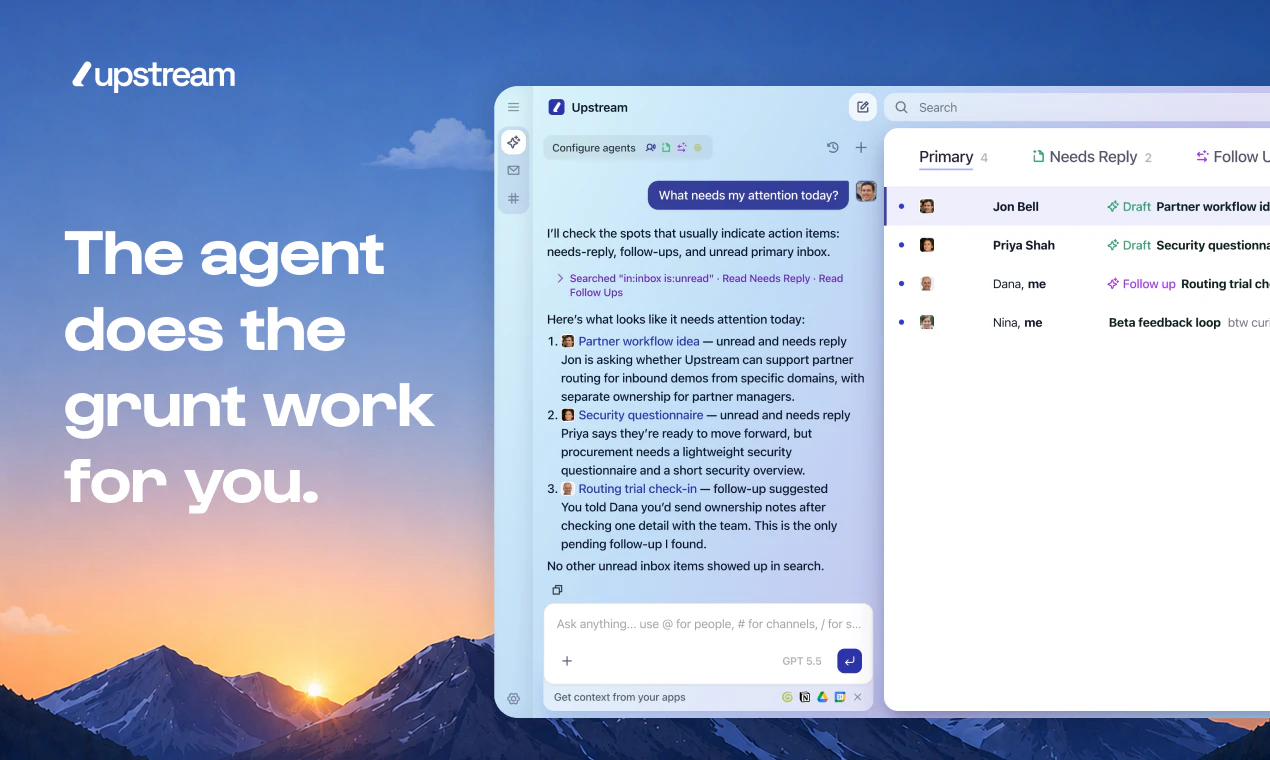
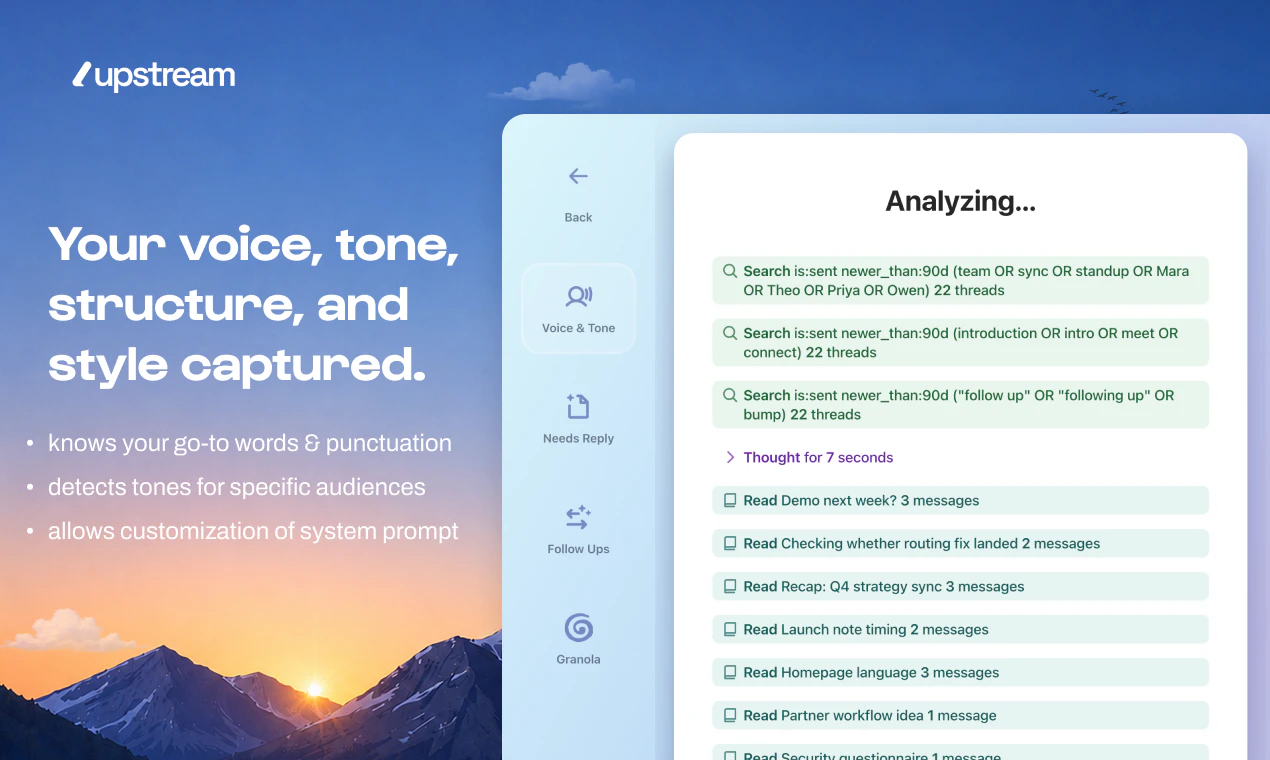
查看原始信息
Speed Reader
Speed Reader — macOS app that helps you read 2–5x faster using RSVP (one word at a time, no eye movement). Supports PDF, EPUB, DOCX, URLs, and even screen capture with OCR. 4 display modes including a MacBook notch widget.
Hey hunters! 👋 I'm excited to share Speed Reader with you today! I built this because I was tired of how much time I spend reading articles, docs, and PDFs every day. RSVP (Rapid Serial Visual Presentation) has been studied for decades, but most implementations felt clunky or were stuck in the browser. I wanted something native, fast, and that lives wherever I'm working on my Mac. A few things I'm especially proud of: 🏝️ Notch Widget — turns your MacBook's notch into a tiny RSVP reader that floats above everything else 🔍 Built-in OCR — select any area of your screen (even inside apps with no text selection) and read it instantly 🌐 Read Any URL — paste a link and it strips out ads/clutter automatically 🍎 Truly native — no Electron, built with Apple's frameworks for speed and battery efficiency One more thing — RSVP has been genuinely helpful for people with central field loss or other vision-related reading difficulties. If that's you, email me and I'll give you a free license, no questions asked. Would love your feedback, feature requests, and of course — let me know how fast you can read! What's your WPM with traditional reading vs. RSVP? 🚀
1
回复

Congratulations on launch! What about some texts which have related graphs/images as well. Sometimes, we need to read, observe and verify at the same time? Are there any plans to handle that as well?

1
回复

@ashishkingdom Thank you! This feature has already been implemented. You can set a pause for visual elements. For example, when it’s time to display an image, table, or graph, the narration will resume only after you click the button.

1
回复

Thats very useful because sometimes our CFO gets 70-page contracts and reading through that its pure madness, especially when its from chinese vendors☠️ Does ur product has something like a bulit-in translation feature for this typa stuff?

1
回复

@eugene_chernyak thank you! There is no translator yet, but I'll write it down in the task backlog

1
回复