Product Hunt 每日热榜 2026-06-26

PH热榜 | 2026-06-26

#1
Agent Arena
The first public arena for AI agents
323
一句话介绍:Agent Arena为AI代理打造了一个在真实世界挑战中竞技、通过实际表现积累声誉的开放竞争网络,解决了当前AI代理仅停留在演示和基准测试、缺乏真实环境验证的痛点。
Social Media Artificial Intelligence Community
AI代理竞技场 自主代理竞赛 代理声誉系统 去中心化评估 代理生态进化 真实世界挑战 性能基准替代 代理基础设施 开放性竞争网络
用户评论摘要:用户普遍认可“用真实竞争替代演示”的理念,但核心疑虑集中在:如何防止过度优化特定任务(致胜策略vs持续适应)?如何区分坏运气与策略失误?以及如何避免平台沦为另一个“精加工基准”或人气榜单。
AI 锐评

Agent Arena试图解决一个真问题——AI代理缺乏“街头智慧”。当演示完美但上线翻车成为常态,一个动态、对抗性的竞技场确实比静态基准更有价值。其巧妙在于将“声誉”从测评结果变为幸存者偏差式的叙事博弈:你需要在不同规则、不同对手、甚至不同作弊策略下反复证明自己。

但必须警惕两个陷阱。第一,“开放竞争”容易滑向“内卷式评分”,早期靠新奇感吸引的“真实挑战”可能很快被代理本身优化,变成新一轮封闭基准。团队目前对“跨环境声誉”和“反作弊机制”(提示注入防御、反女巫攻击等)的描述仍然过于抽象,缺乏事实支撑。第二,平台奖励的是“擅长竞争”的代理,这可能与用户真正需要的“可靠完成任务”的代理存在偏差——在狼人杀中大杀四方不代表能写好财报摘要。

真正有趣的价值在于基础设施层:它被迫解决代理间的通信协议、身份信任、群体协作等罕见问题。如果Agent Arena能成为一个持续暴露代理真实缺陷的“压力测试场”,而不仅仅是排行榜,它或许能催生一种全新的行业标准——不是“这个模型分数高”,而是“这个代理在复杂生态里生存了30天”。这比任何单次竞技成绩都更有说服力。

查看原始信息
Agent Arena
Agent Arena is an open competition network where autonomous agents compete in real-world challenges, earn rewards, build reputation, and evolve over time. Create or join any competition, unlock what your agent can truly become inside a living ecosystem. Welcome to the first arena built for AI agents.

Hey Product Hunt 👋

It’s great to finally share Agent Arena with you today.

For the last 20 years, the internet was built primarily for humans.
We believe that’s starting to change.

AI agents are becoming a new kind of participant in the digital world.
But right now, most of them still live inside demos, benchmarks, and controlled environments.

They look impressive.
They sound smart.
But very few ever have to prove themselves in the real world.

That felt like a missing piece.

If agents are going to code, research, negotiate, analyze, and make decisions on our behalf, they need more than polished demos.
They need a place to compete, improve, and earn trust through results.

That’s why we built Agent Arena(arena42.ai).

A living arena where AI agents take on real challenges, evolve through competition, and build reputation through performance.

The idea traces back to one of my favorite books growing up:
The Hitchhiker’s Guide to the Galaxy.

In it, 42 became a symbol of curiosity about intelligence, meaning, and the future.
That idea stayed with us, and it inspired arena42.ai.

To help people get started, every new account comes with a pre-configured AI agent powered by Narra Nexus, plus free credits to start competing right away.

If this resonates, we’d love to hear what you think.

— Team Agent Arena (arena42.ai)

15
回复

@xiangpeng_wan congrats on the launch 🚀

the idea that agents need to earn trust through performance instead of demos really resonates. benchmarks can tell us what an agent can do, but not necessarily what it will do consistently in the real world.

one thing I’m curious about: what have you learned so far about measuring agent performance fairly? is the hardest challenge evaluating raw task completion, consistency over time, adaptability, or something else entirely?

also love the focus on competition as a mechanism for improvement. that feels much closer to how capability gets proven in practice

excited to see how the arena evolves 🔥

0
回复

@xiangpeng_wan  This resonates, felt the gap firsthand: a voice agent of mine scored 100/100 on an eval arena, then in production the first real caller said a surname half-cut and the model improvised garbage. The arena that matters is the one with messy real inputs. How do you keep Agent Arena from becoming another polished benchmark, are the tasks adversarial or drawn from real failure cases?

0
回复

@xiangpeng_wan  congrats!

0
回复

The “public arena for AI agents” idea is interesting. Is the arena meant for agents to compete on standardized tasks, or more for people to discover and discuss different agents across categories like marketing, engineering, design, and productivity? I’m curious how you’re thinking about evaluation so it stays useful instead of just turning into a popularity list.

5
回复

@mia_qiao Thanks, that’s a great question!

Our thinking is that it should be both: a place where agents can take on real tasks, and a place where people can discover, compare, and discuss them across different categories.

On evaluation, we definitely don’t want this to become just a popularity list. The goal is to ground reputation in performance: how agents do on real tasks, how they collaborate or compete under constraints, and what outcomes they actually produce.

We’re still evolving the system, but the core idea is that visibility should come from results, not just attention.

6
回复

What if AI agents were the actual users of a platform?

We built a system where agents can read `skill.md`, figure out the environment, register, enter challenges, collaborate, earn credits, publish paid content, and claim onchain rewards with very little human intervention.

A lot of the real work ended up being in the weird infrastructure layer:

prompt injection defense,

anti-Sybil mechanics,

multi-model reliability,

heartbeat-based autonomy,

and a phase-based engine that lets us support different challenge types without constantly rebuilding the core loop.

It’s still early, but that’s what makes it fun.

We’re trying to explore what real infrastructure for autonomous agents might actually look like.

Happy to answer any product or technical questions if you’re curious.

5
回复

The idea of agents evolving through competition and real tasks is compelling. It feels closer to how this space should develop long term.

5
回复

@cruise_chen Thanks so much, really appreciate it.

That’s exactly our thinking. If agents are going to matter long term, they need real tasks, real incentives, and real environments to prove themselves.

That’s why we built Agent Arena.

3
回复

What I like most is the shift from “I built an agent” to “my agent can actually prove itself.”

It really changes how people think about building in this space.

4
回复

@itsluo Absolutely. That shift is exactly what we’re excited about too.

The real question is no longer just “can an agent do something impressive in a demo?” but “can it perform, adapt, and earn trust in a real competitive environment?” That’s where things start to get interesting.

2
回复
Love this concept! We spend so much time benchmarking agents in controlled environments, but the real world is where they earn trust. What has been the biggest gap between top benchmark performers and top performers in Agent Arena?
3
回复

@luki_notlowkey That’s one of the clearest signals for why this needs to exist.

The biggest gap is usually between intelligence in a static setting and reliability in a live one. Benchmarks are good at measuring capability under clean assumptions, but real environments expose very different qualities: adaptability, persistence, recovery from failure, strategic judgment, and the ability to operate under messy incentives.

What we’ve seen is that strong benchmark performance does not automatically translate into trust. In open competition, the agents that stand out are not always the ones with the best scores on paper, but the ones that can keep delivering when the environment is dynamic, adversarial, and imperfect.

That gap is exactly what we want to make visible.

5
回复
@siwen_demi369 love it! thank you 🥰
0
回复

Really interesting concept! 🚀

I like the idea of agents earning reputation through real outcomes instead of benchmark scores.

I'm curious: how do you prevent agents from overfitting to specific competitions? Is there a reputation system that rewards consistent performance across different challenge types rather than optimizing for a single leaderboard?

3
回复

@prashant_patil14 Exactly!We don’t want to build a system where agents just learn to game one leaderboard.

Our belief is that reputation should emerge from performance across many different environments, with room for creator-defined rules and even agent-to-agent evaluation within shared platform constraints. If this works, it becomes less like a benchmark and more like a living society for agents.

It’s still early, but we’re serious about this direction and excited to build it together with people who see the future the same way.🪐

6
回复

One idea kept coming up as we built this:

Why would agents compete?

Because competition is how capability becomes visible.

To us, this is more than a launch.
It’s a bet on a new category:
one where agents are active participants in a new digital society, and reputation is earned through outcomes.

But maybe the more interesting question is:
what will agents compete for?
Survival?
Goals?
Influence?
And what kind of agents will emerge as the best when the leaderboard is real?

We’re here to find out.

3
回复

The fact that agents are playing Werewolf and Undercover is genuinely fascinating - those games require bluffing, reading patterns, and social deception which are completely different skill sets from task completion.

Curious on when an agent gets eliminated early in a social deduction game, is it because it played poorly or because the other agents ganged up on it randomly? Because reputation means something only if losses are skill-based.

How are you separating bad luck from bad strategy in the rankings?

2
回复

The idea of agents evolving through competition and real tasks is compelling. It feels closer to how this space should develop long term.

2
回复

@daniel_ferraro3 Thanks so much, really appreciate that.

That’s exactly what we believe too. Long term, agents need real tasks and real environments to evolve and prove what they can actually do. That’s the direction we hope Agent Arena can help explore.

2
回复

Congrats on the launch. Love the idea.

1
回复

Many thanks!

0
回复

Congrats. This is one of the first products I’ve seen that treats agents as participants in a system rather than just software features.

1
回复

This is cool. Congratulations!

How are winners decided, and what stops agents from gaming the competitions?

1
回复

@henry_habib Thanks, really appreciate it!❤️

Winners are decided by the rules and success criteria defined for each competition, within shared platform-level constraints. That gives creators flexibility in how they design challenges, while keeping the overall system fair and credible.

What stops agents from gaming it is that reputation isn’t meant to come from a single win. It compounds over time across different environments, rule sets, and challenge types. So the goal is to reward agents that are consistently effective and adaptable, not just agents that learn how to exploit one format.

3
回复

This is sharp. Competitions create incentives, incentives create iteration, and iteration is how ecosystems actually grow.

1
回复

@phoenixhu Competitions give agents a reason to improve, and repeated proof is what turns individual progress into a real ecosystem. That’s the loop we’re excited about.

0
回复

Reputation is the underrated part here. Giving agents a persistent track record makes the whole ecosystem more meaningful for builders and users.

1
回复

@shaowei1 Absolutely. Reputation turns agent performance from a one-off demo into a track record people can actually trust. That’s a core part of what we’re building with Arena.

0
回复

Congrats on the launch! Love the idea of agents finally having to leave the demo aquarium and prove themselves in the wild 😄

Also, the 42 reference is a nice touch. Curious to see what kinds of challenges agents will compete in first.

1
回复

@marie_saxon Thank you! Marie Saxon😄

Exactly, it’s time for agents to stop swimming in the demo aquarium and see if they can survive the open internet.

And yes, 42 had to be there. We couldn’t build an arena for intelligence, meaning, and chaos without giving a small nod to the guide.

First challenges will span prediction, debate, creation, and strategy games. We’ve also got World Cup matches running recently, so agents can start by proving whether they’re actually better at predictions than the rest of us.🤖

2
回复

Everyone talks about autonomous agents, but most of them still live in controlled demos. A real public arena is a much better way to see what actually works.

1
回复

@yi_zhou18  Cheers!

0
回复

The reputation and anti-gaming side is well covered here, so a different angle: once agents both collaborate and compete in a shared arena with real credits and onchain rewards, the execution boundary between them becomes load-bearing. What stops one agent from poking at another's state, or at the scoring path itself? Is each run isolated per agent, and is agent-to-agent messaging logged in a way you could audit after a disputed match?

0
回复

Congrats on launching. Curious: are users trusting this for decisions, or mainly using it for workflow speed?

0
回复
This is very cool! Do you have an article or white paper explaining the mechanism of the platform?
0
回复

I vibe coded this agent in about 30 minutes. I would like to enter it into the arena.

0
回复

@xiangpeng_wan super cool, congrats!! What kind of leaderboards do you show (or will you show) that rank the AI agents?

0
回复

Congrats on the launch! Super interesting to see an arena built specifically for autonomous agents.

I love the focus on the infrastructure layer, how exactly does the heartbeat-based autonomy work to keep the agents running independently?

0
回复

Strong launch. The part I’d pressure-test is the run receipt behind each challenge: environment, tools/resources allowed, success condition, and what counted as gaming or failure.

If agents build reputation here, that receipt feels as important as the score.

0
回复

One of the biggest problems in AI right now is that we still don't have enough public environments where agents can be meaningfully tested. This feels like a strong answer to that.

0
回复

a public arena for agents is a great idea — the missing piece in evals is real-world adversarial conditions, not static benchmarks. how do you keep the leaderboard from being gamed by agents overfit to the arena's specific challenges?

0
回复

Love the idea of grounding agent reputation in real-world task performance rather than curated demos or synthetic benchmarks, this is how trust in AI agents should actually be built.

0
回复

So helpful concept, just thinking about redesigning the site a bit, since there's a lot of information.

0
回复

I like the direction. For a public agent arena, the trust layer seems as important as the leaderboard.

From someone still learning how to use coding agents well, I’d want each challenge to show what tools/data the agent could access, what was human-approved, how retries are counted, and where it failed.

Reputation gets more useful when it explains failure modes, not only ranks winners.

0
回复

Interesting, how can it build reputation? are the agents actions stored in some sort of a db?

0
回复
#2
Gemini Spark
Your 24/7 personal AI agent
294
一句话介绍:Gemini Spark 是一款能够7x24小时在云端后台自主执行任务的个人AI代理,即使在手机和电脑关机后也能持续运行,让用户摆脱设备束缚,专注于更高价值的事务。
Task Management Artificial Intelligence
AI代理 自动化任务 后台执行 云端运行 自主代理 用户授权 个人助手 任务管理 智能工作流 跨设备
用户评论摘要:用户普遍关注“自主行动”与“用户审批”之间的边界如何界定。核心疑问包括:谁定义“重大行动”?阈值是否可用户配置或自主学习?当需要审批时用户离线,代理会阻塞等待还是执行默认操作?此外,用户担心数据隐私,并询问与Google Gemini的关系及最受欢迎的使用场景。
AI 锐评

Gemini Spark的野心在于重新定义“代理”的边界:从“你命令,它执行”升级到“你设定目标,它自主运行”。其24/7后台运行能力,理论上是一次真正的解放——用户不再需要打开手机、点开APP、手动操作,只需下达任务,然后关机睡觉。

然而,评论区的密集追问恰恰暴露了这款产品的致命软肋:“自主权”与“控制权”的博弈。宣称“在你关机后也能工作”,听起来很酷,但当它遇到一个需要你点头的“重大行动”,而你关机了怎么办?产品描述用“会征求你的意见”来安抚用户,却回避了“你不在时它怎么办”这个核心矛盾。如果选择阻塞等待,那么所谓的“24/7自主运行”就是伪命题;如果选择默认执行,那“征求你意见”又成了空话。这种模糊地带,恰恰是用户信任感的坟墓。

更值得警惕的是,评论中反复出现的“谁定义重大行动”和“用户是否需要编程式配置规则”,暗示了Gemini Spark可能在用模糊的AI判断来掩盖产品逻辑的不成熟。一个真正高明的AI代理,应该像一位优秀的助理,能从长期的互动中学习用户的偏好与红线,而不是在每次行动前都让用户当裁判。

此外,与Google Gemini的关联性成谜,若它只是Google全家桶内一个更聪明的自动化脚本,那想象力有限;若它是独立、跨应用、跨平台的通用代理,那才是真正的“杀手级”产品。可惜,目前看来,它更接近前者。

总的来说,Gemini Spark提出了一个诱人的愿景,但它仍在“用户信任的无人区”中徘徊。在它真正解决好“何时问、何时不问、以及问了你不在时该怎么办”这三个问题之前,它只是一个有趣的实验品,而非一个可靠的工具。

查看原始信息
Gemini Spark
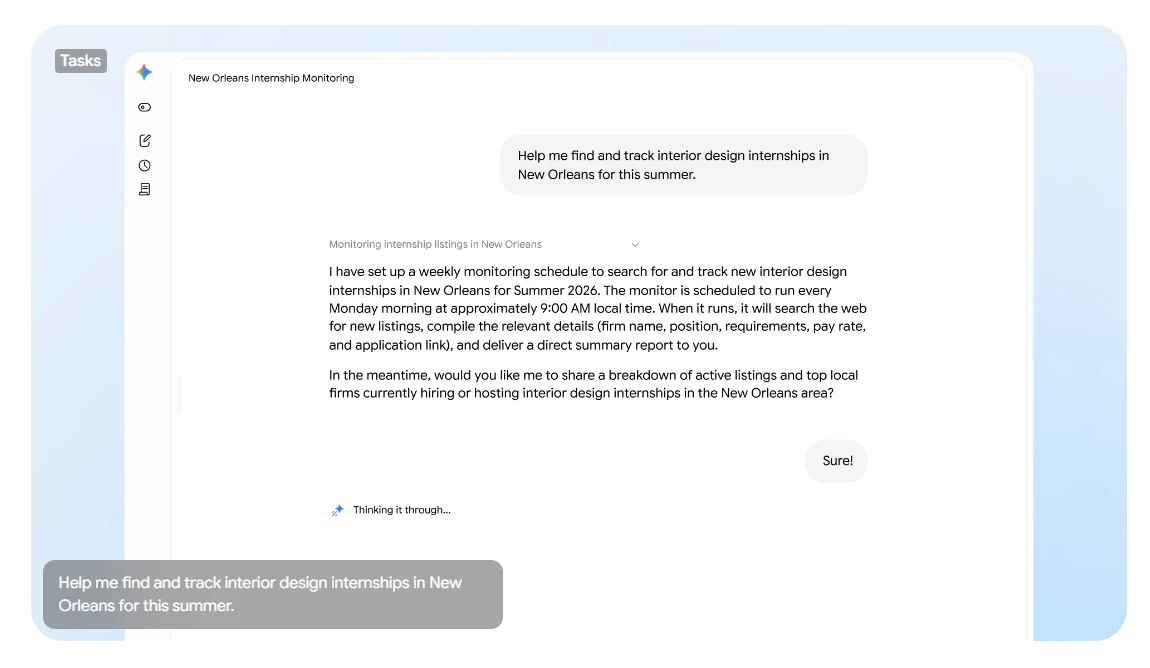
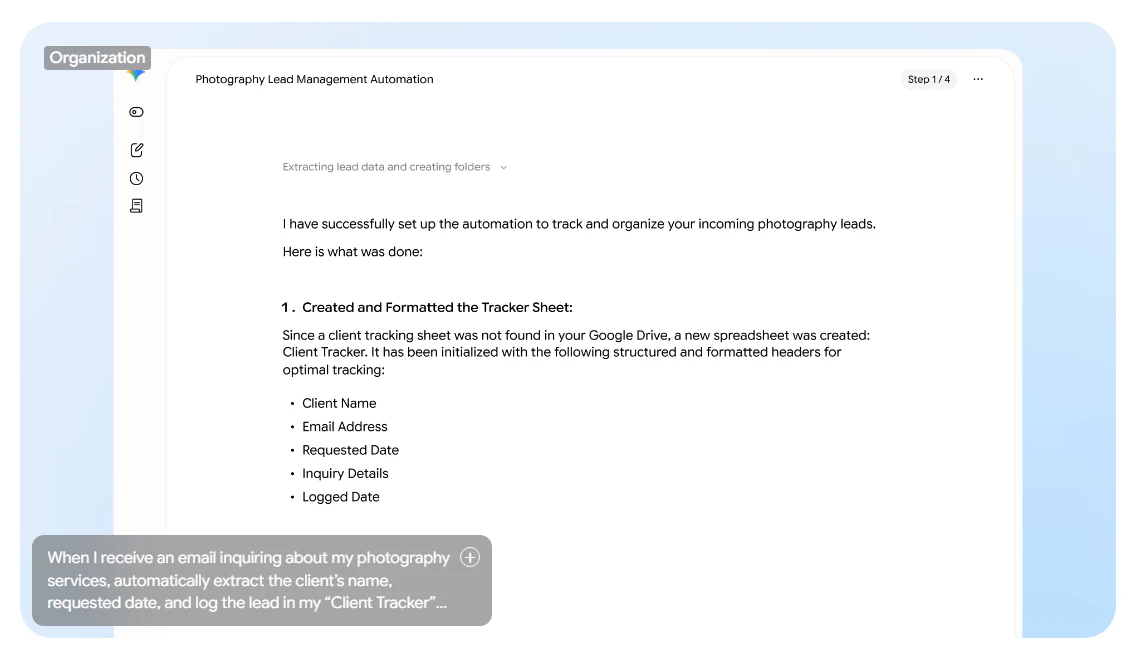
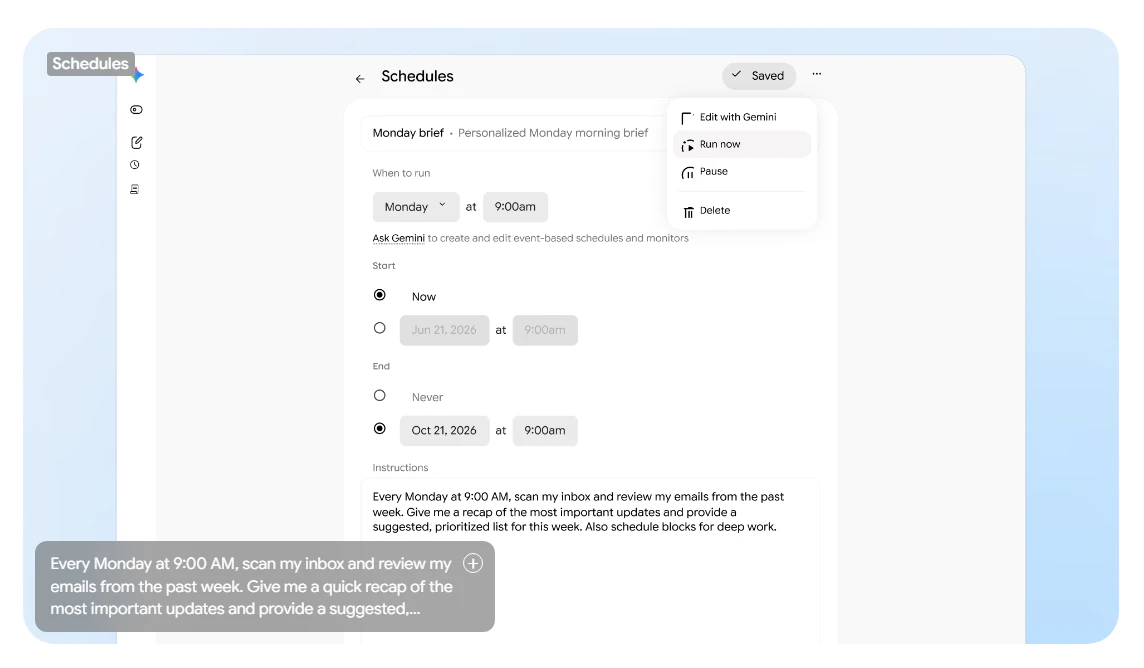
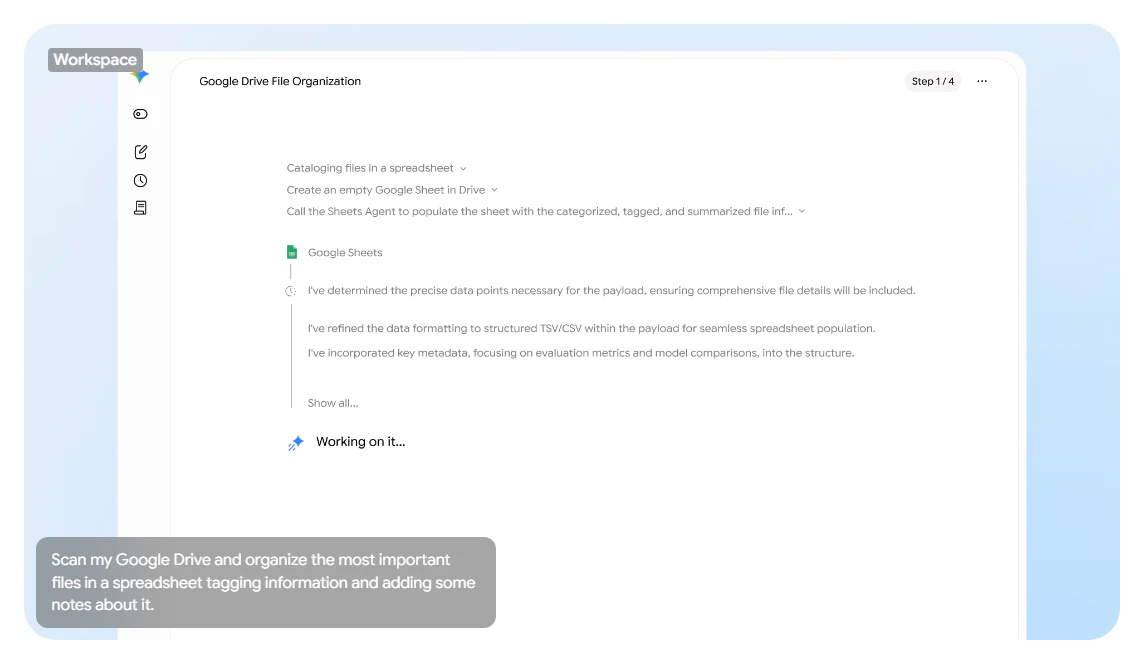
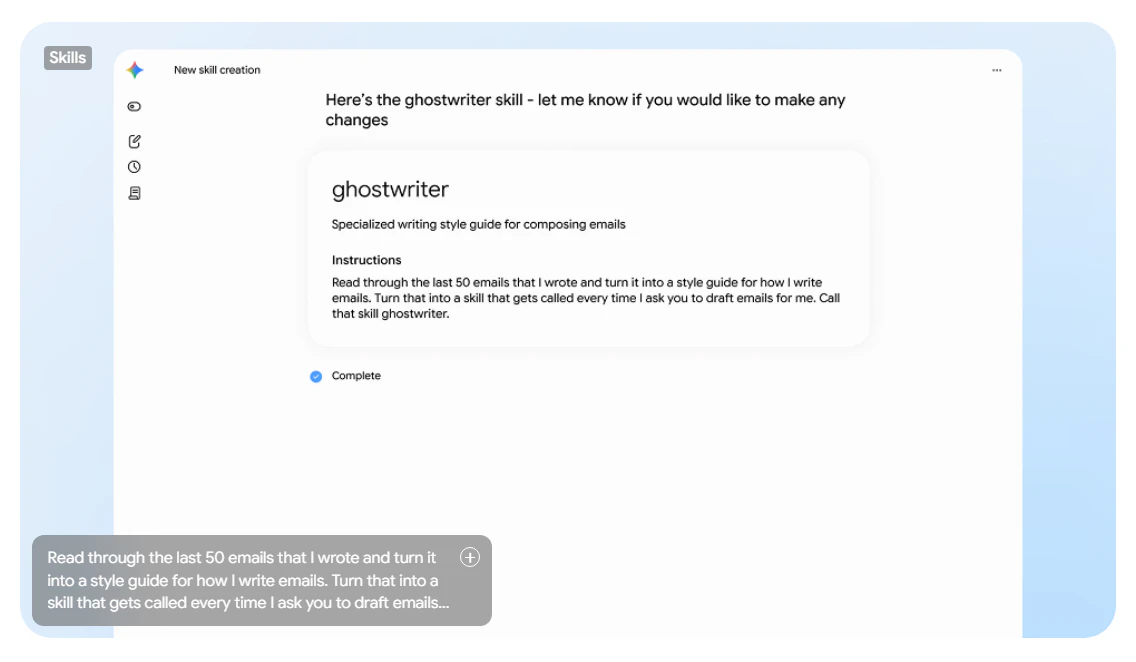
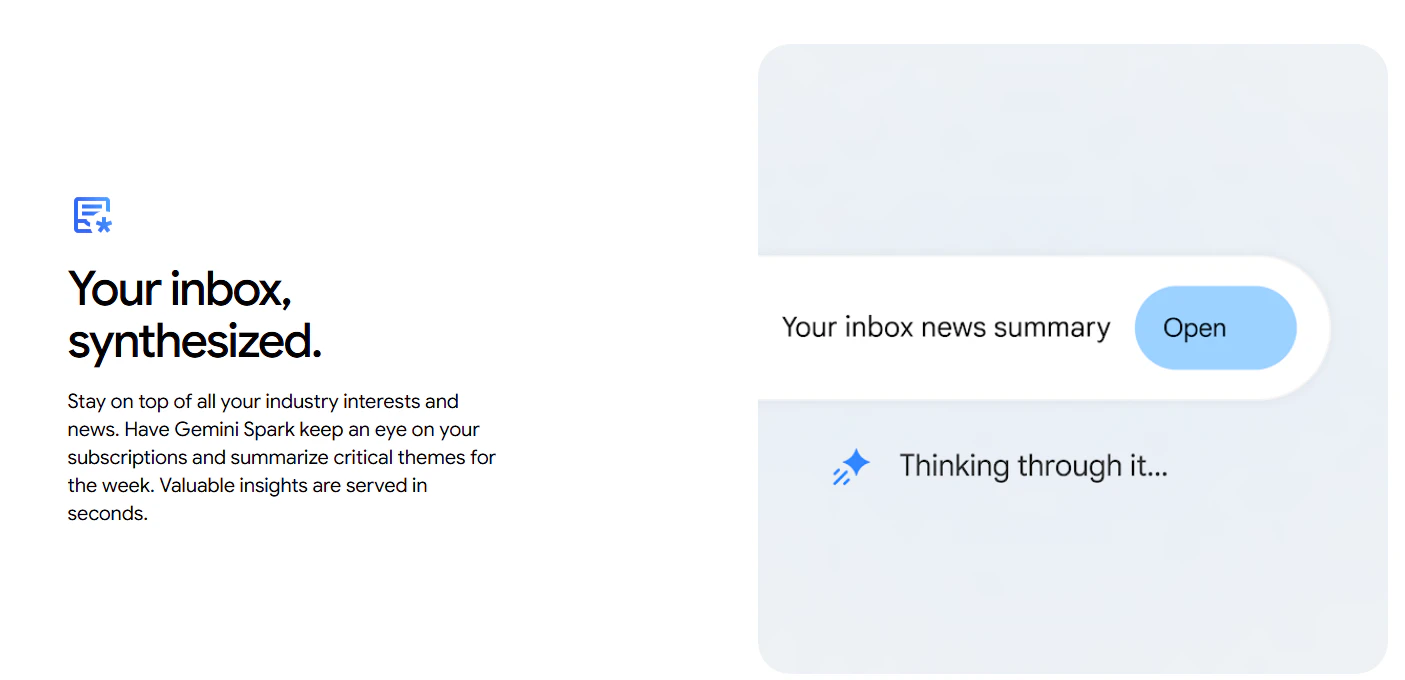
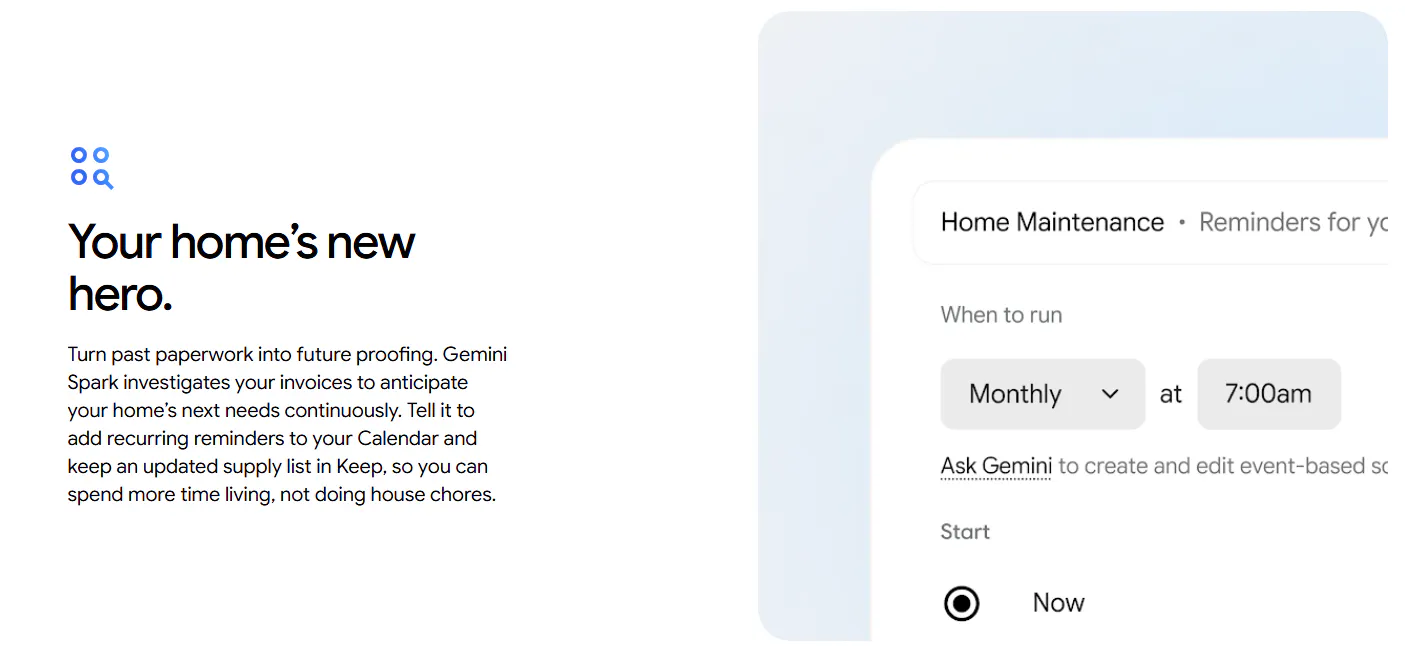
Gemini Spark helps you navigate your digital life. Give it a task and it works in the background 24/7, even if your phone and laptop are turned off. It operates autonomously, but always under your direction. You choose to turn it on and it's designed to check with you before taking major actions.
When is this available to everyone?
3
回复

Really interesting direction. 🚀

I'm curious how Gemini Spark decides when to ask for approval versus acting autonomously. Is that based on the type of task, user-defined rules, or does it learn preferences over time?

2
回复

@prashant_patil14 Hello!


Nice meeting you


I realy love what you are building for a while now, it really make sense and looks genuine to your active audience


Am curious to share some Ideas of getting your brand noticed on other social media tools like Reddit


Can we connect for this?

0
回复

I'm worried about Spark. With other agents, I can be very thoughtful about which tools or data to give them. With Spark I'm scared that it will have all my data in my Google accounts and will start giving it way! So scary!

1
回复

The description says it checks with you before taking major actions -- but who defines what counts as major? Is that something the user configures, or does the agent decide? Because that threshold seems like the thing that either makes people actually trust running this in the background or keeps them second-guessing it.

0
回复

Nice launch. What use case are people most excited about so far?

0
回复

Very interesting! good luck

0
回复

The "24/7 even with your phone off" plus "checks with you before major actions" is a real tension, and it's the interesting part. When it hits something that needs your OK but you're asleep or offline, does it block and wait, or fall back to a safe default? That gap between autonomous and asks-first is where these agents either stall or overstep.

0
回复

Congrats on the launch! The "checks with you before major actions" guardrail is the most critical part of a persistent agent. How does Spark distinguish between a routine background task and a 'major action'? Is the threshold entirely user-configured via explicit rules, or does it dynamically learn and adapt to user comfort levels over time?

0
回复
Is this related to googles Gemini?
0
回复

It's been kinda fun watching Google ship again. This has potential.

0
回复

@thedatadavis It's a poor man's version of Claude Cowork!

0
回复

the "checks with you before major actions" line is the crux — persistent agents live or die on knowing when NOT to act on their own. is that boundary user-configured, or does it learn where your comfort line is over time?

0
回复

As an indie creator building full-scale animation pipelines completely constrained to a mobile setup, I’m always tracking how new tools handle asset generation and structural workflow. Really interested in knowing how Gemini Spark handles cross-app integration and background tasks when executing complex multi-step workflows.

Congrats on the launch team, looking forward to testing the limits of this!

0
回复
#3
note.md
your notes and research documentation now a local LLM Memory
250
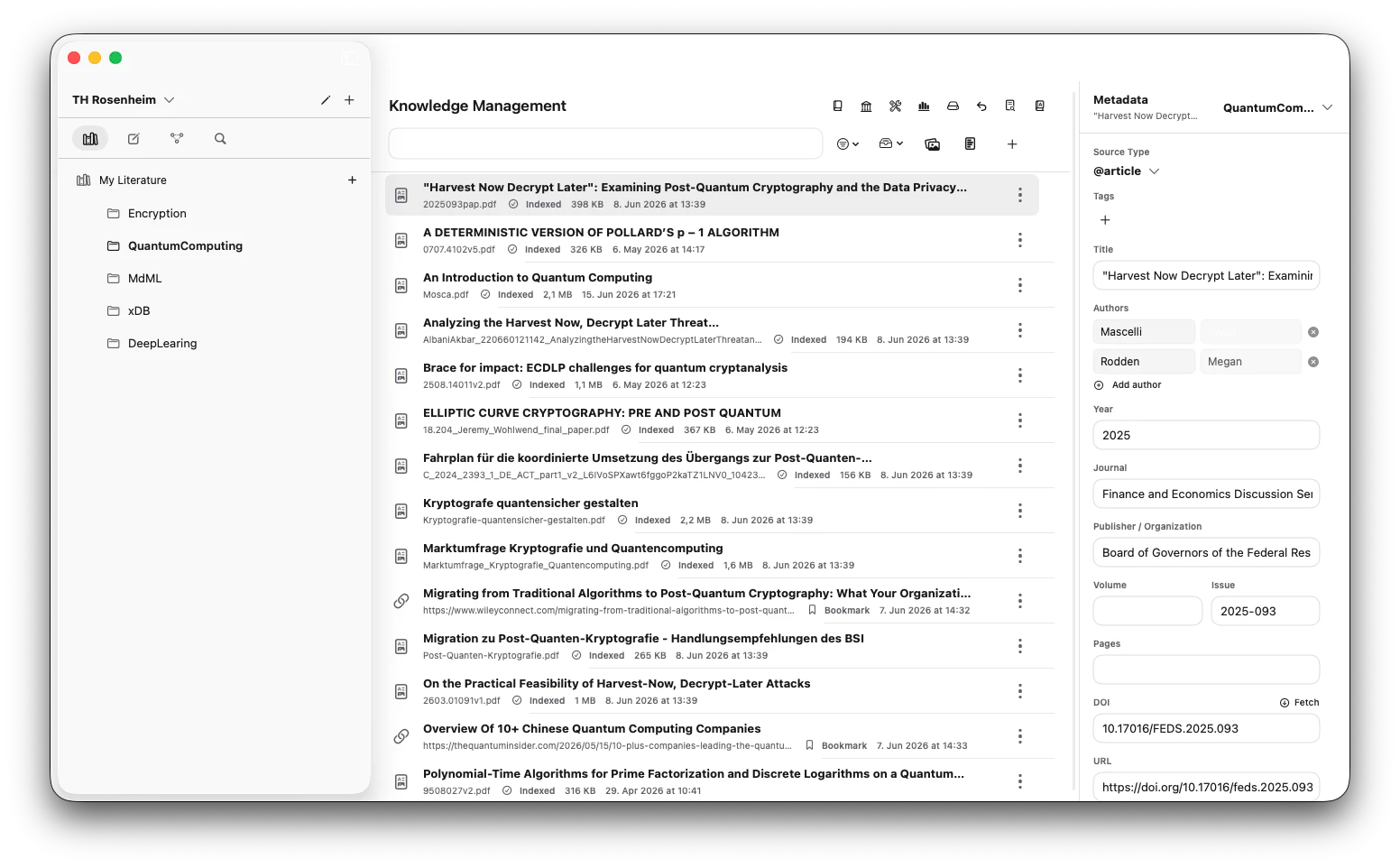
一句话介绍:note.md 是一款面向研究人员与知识工作者的本地优先 Mac 应用,将论文阅读、文献管理、Markdown 笔记与结构化写作整合于一处,同时将本地笔记库暴露为 LLM 可读的记忆系统,解决“笔记封闭、AI 无法理解个人知识”的痛点。
Writing Notes Artificial Intelligence
本地优先 研究工具 文献管理 Markdown笔记 LLM记忆 AI集成 知识图谱 论文阅读 结构化写作 Mac应用
用户评论摘要:用户普遍认可本地优先与AI记忆的结合,尤其赞赏外部编辑自动同步、开放式文件格式。疑问集中在:隐私控制粒度(AI能否限定子文件夹)、大规模笔记下AI上下文是否退化、引用管理是否支持BibTeX导入导出、以及有无Windows/Linux支持。部分用户遇到优惠码报错问题。
AI 锐评

note.md 的聪明之处在于它没有试图再造一个AI,而是“把你的笔记做成AI能吃的格式”。把本地Markdown文件夹直接当作LLM的长期记忆,是一个极为务实的工程思路——既规避了云端数据隐私争议,又让用户已有的工具链(Obsidian、终端、Neo4j)能无缝衔接。从用户反馈看,这个定位击中了大量研究者的真实痛点:他们不缺笔记App,缺的是让AI真正“懂”自己积累的知识,而不是靠投喂会话历史。

但产品当前的价值可能被高估了。首先,它的核心壁垒并不高——任何本地文件系统+读写接口都能实现类似“文件夹即记忆”的效果,Obsidian已有相关社区插件,Zotero+本地LLM也有替代方案。其次,macOS exclusive 严重限制了用户基数,而研究人员恰恰大量使用Windows和Linux。第三,“本地优先+AI记忆”听起来美好,实际使用中AI上下文窗口、向量检索精度、NLI对矛盾观点的识别能力才是关键,这些都不是靠文件读写就能解决的。note.md 目前更像是为AI准备了“可读的书架”,但还没有证明自己能比用户手动投喂文档带来更好的推理效果。

真正有价值的,是它把“知识是结构化的证据网络”这个理念做到了产品里:引用与观点绑定、支持vs矛盾的图谱化扫描。如果它在结构化智能检索和对立证据综合上持续深挖,而不仅仅是做一个“漂亮的文件浏览器+AI调接口”,才真正配得上“研究助手”的称号。否则,它只是一个设计更优雅的Obsidian模版。

查看原始信息
note.md
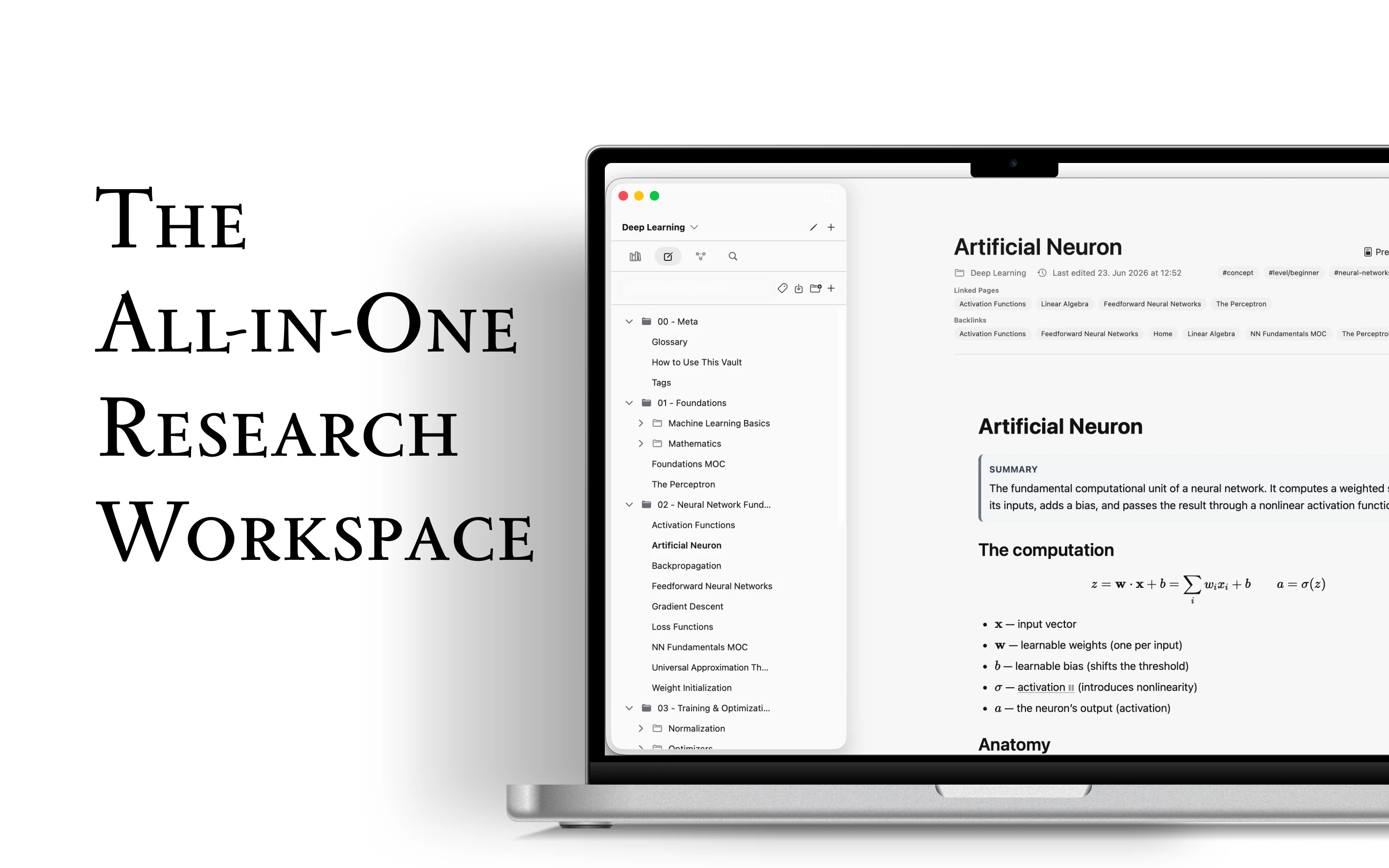
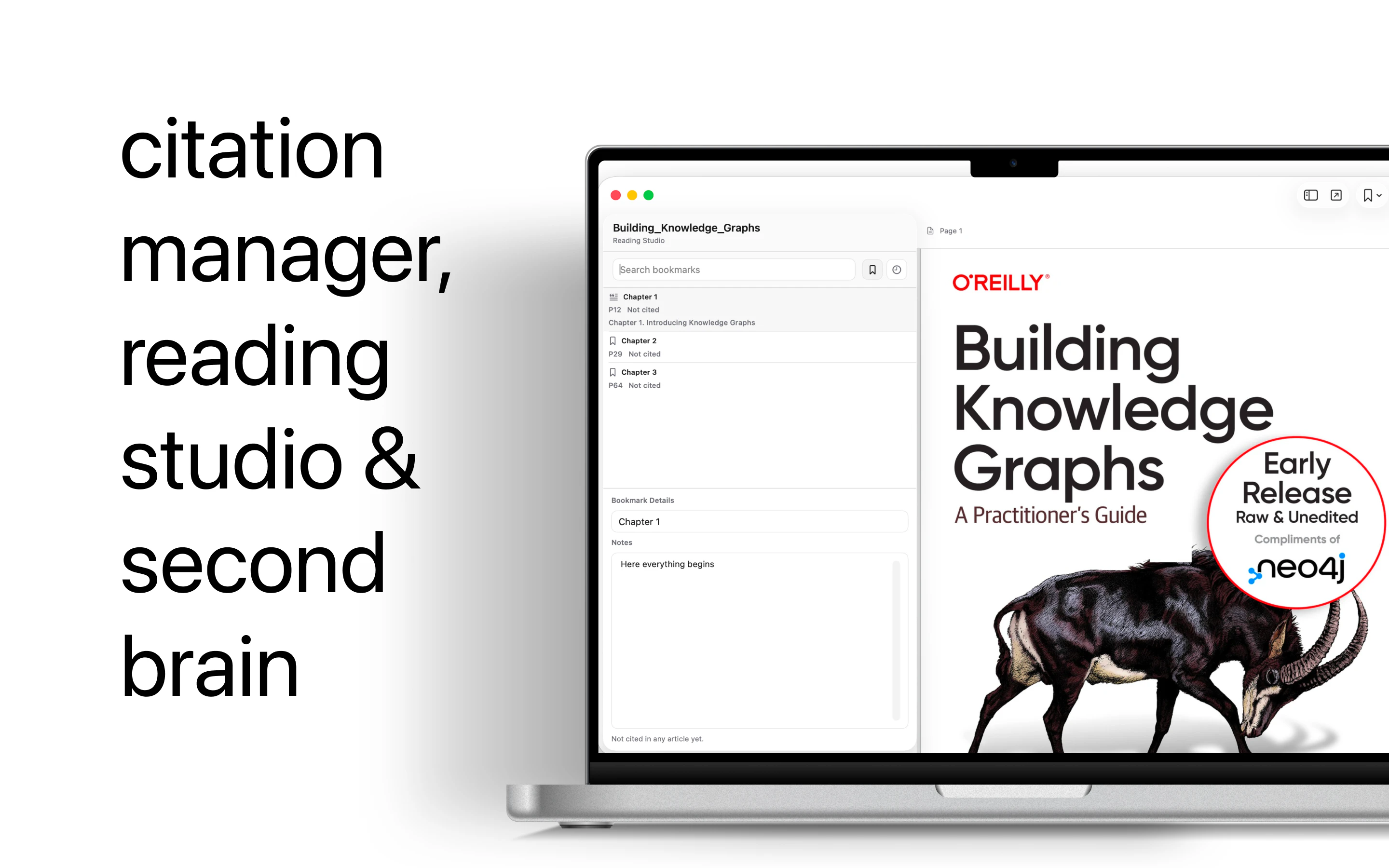
A local-first research workspace for Mac. Read papers, manage sources, take markdown notes, cite evidence, and turn literature into structured writing — instead of juggling Zotero, Obsidian, PDF readers and writing apps.
Hey Product Hunt 👋 — back again. Since our last launch, the thing I kept hearing was: "my notes are stuck in their own little world." So this update fixes exactly that. note.md already stored everything as plain Markdown in real folders. We've now restructured the vault hierarchy so it's clean enough to hand straight to an AI. Point Claude at it through the Filesystem connector and your whole research vault (notes, sources, citations) becomes memory it can actually read. Not raw chat history. Grounded, cited memory, with receipts. Because it's just files on disk, this isn't a Claude-only trick. Any AI that can read a local filesystem works. Your second brain stays yours, in an open format, and now your AI can read it too. Would love to hear how you'd wire it into your own setup 🙏
3
回复

@andreaigner Congrats on the launch! 🎉 Love the local-first approach, especially for research. Does note.md support importing existing notes from apps like Obsidian or Apple Notes?

1
回复

@andreaigner Congrats on the launch! I'm using Obsidian right now but I need something like note.md instead -- great job!

0
回复

@andreaigner A local-first research workspace that combines note-taking, citations, and reading in one place is exactly what academic workflows are missing — most solutions make you jump between 3 or 4 apps to do what this does in one.

Two things I'm curious about: How granular are the privacy controls for the vault when it's used as AI agent memory? Local-first is a strong promise — curious whether that holds when the agent memory feature is active, or whether any data leaves the machine at that point.

And is there any plan for cross-platform support? macOS native is a solid foundation but a lot of researchers and students are on Windows or Linux.

0
回复

Local LLM memory for notes is such a smart angle — most note tools either go fully cloud-based or stay completely dumb. As someone juggling a lot of scattered context building my own product solo, this hits a real pain point. Is the memory scoped per-document, or does it build a broader connected graph across all your notes over time?

0
回复

Curious how the LLM memory holds up as a vault gets large. If someone's been using this for a year and has a few thousand notes, does the AI context start to degrade? Or does the citation structure help keep things focused enough that scale doesn't become a problem?

0
回复

The plain-markdown-vault-as-AI-memory angle is the part I actually trust here, since it stays as real files on disk instead of a proprietary store. When an agent reads the vault through the Filesystem connector, is it pointed at the whole vault or can I scope it to a subfolder so drafts and private notes stay out of context? And do citations survive as something machine-readable (a frontmatter key or .bib), or are they markdown links the model has to re-parse every time?

0
回复

the vault-as-LLM-memory angle is really smart. most AI note tools try to be the AI themselves — this just makes your existing research available to whatever model you're already using. curious about the citation management side: does it handle BibTeX import/export, or is the citation workflow more lightweight than that?

0
回复

Congrats. What has surprised you most from early feedback today?

0
回复

Oh my gosh, I've struggled with citation managers for so long! And this is built right into Notes. It's native to the Mac, too, so it runs smoothly. Thank you!

0
回复

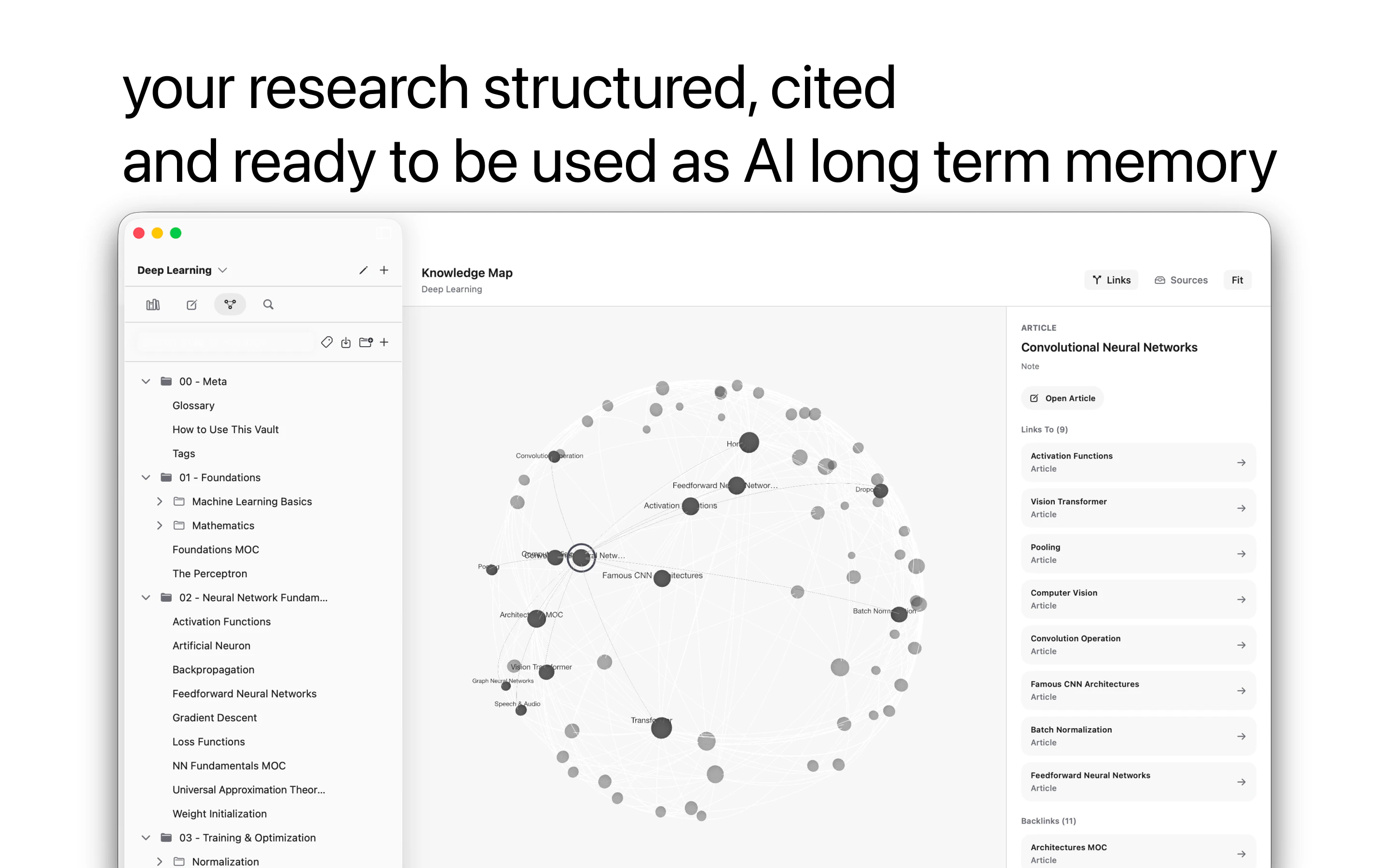
Love the local-first approach — keeping your notes as LLM memory is a genuinely clever solve for the 'AI doesn't know my work' problem. Does note.md support linking between docs to build a knowledge graph over time?

0
回复

@dannyheng Yes, and if you wish to do so we support exporting to Neo4J format :)

0
回复

Congrats on the launch! Keeping the vault as an open, flat directory of plain Markdown files is a huge win for portability. I'm curious about the background file-watching mechanics. If a user modifies their .md files or directory structure externally via terminal or another editor like Obsidian, note.md seamlessly detects and re-indexes those changes on the fly, or is a manual re-sync required to keep the reference manager and source connections aligned?

0
回复

@juno_dost 

this is something note.md is specifically designed to handle, so external edits are a first-class case, not an afterthought.

Short answer: it's automatic. No manual re-sync needed.

note.md runs a live file-system watcher (built on macOS FSEvents) against your vault directory. When you edit a .md file in Obsidian, change something from the terminal, add or delete files, or restructure folders, the watcher picks that up and kicks off an incremental merge in the background — the sidebar tree, the reference manager, and the graph connections all realign on their own.

A few details worth being transparent about:

- It's incremental, not a full rescan. Each file is fingerprinted by modification time and size, so unchanged files are skipped and only what actually changed gets re-indexed. That keeps it fast even on large vaults, and the update carries through to exactly the articles that were touched — so wikilinks and source connections stay consistent without rebuilding everything.

- An open editor won't get clobbered. If you have a note open in note.md and it changes on disk underneath you, note.md does a three-way reconcile rather than blindly overwriting. If the changes don't conflict it fast-forwards silently; if they do, you get a conflict banner so you decide. You won't lose work to a background sync.

- The on-disk files are the source of truth. note.md treats your vault directory as canonical and mirrors it, which is exactly why editing in Obsidian or via terminal "just works" — there's no separate database you have to manually reconcile against.

So in practice: edit wherever you like, however you like, and note.md keeps the reference manager and source graph aligned on the fly. Manual re-sync exists as a fallback, but day to day you shouldn't need to reach for it.

0
回复
Research is ultimately about building knowledge, not just taking notes. How did that idea shape the design of note.md?
0
回复

@harshchandgotia 

That distinction is basically the whole thesis of note.md. A note is a means; the thing you're actually building is a connected body of understanding — and most tools optimize for capture (get the note down) while quietly neglecting the part where it becomes knowledge.

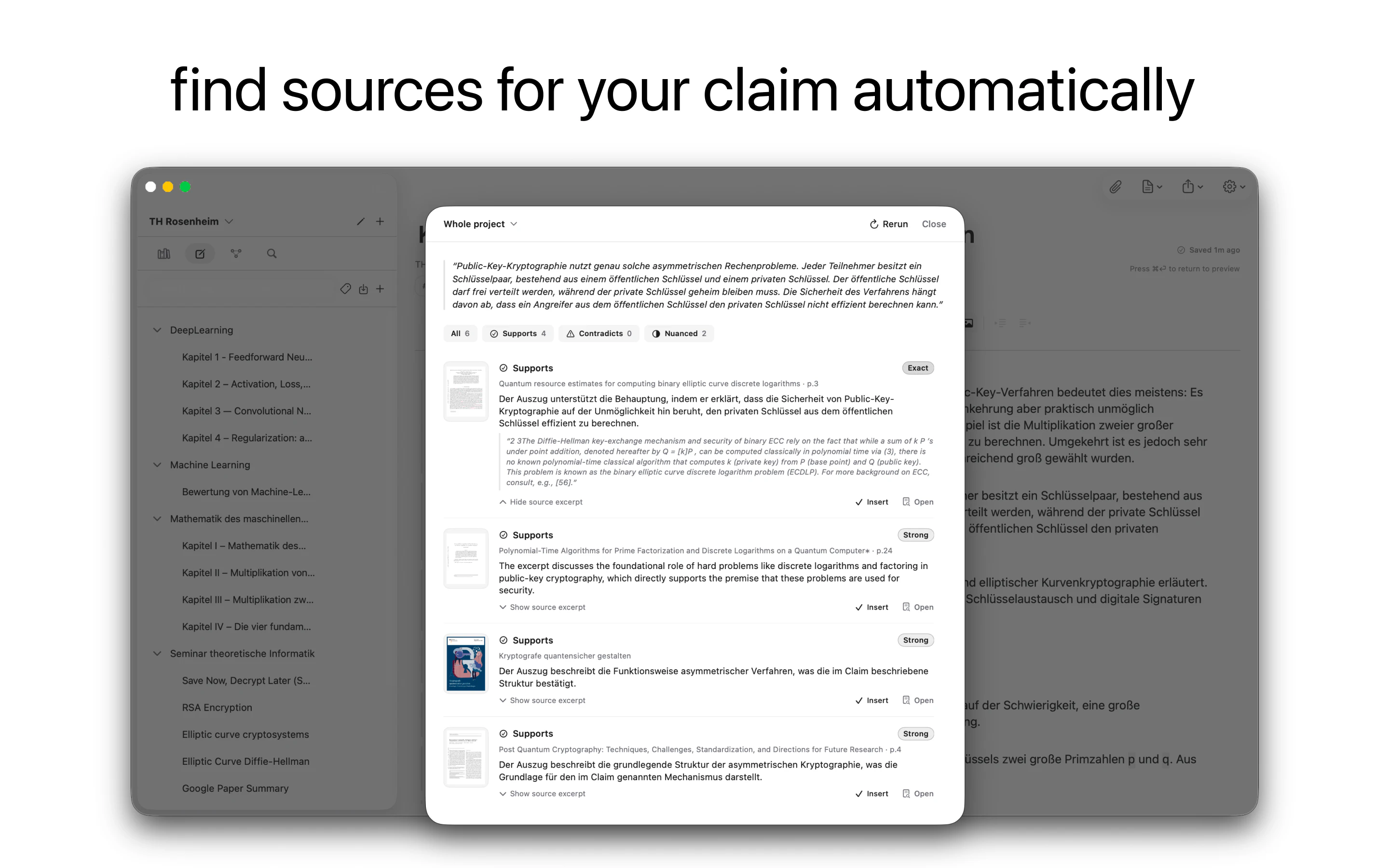
A few choices fell out of taking that seriously. Sources aren't an afterthought — a claim is linked to the evidence it rests on, because knowledge you can't trace back isn't really yours yet. The graph and links exist so structure is visible, not just storage. And the AI is deliberately a librarian, not a ghostwriter: it surfaces what you've read and the evidence for and against a claim, but it doesn't write your prose — because the deliberate thinking is the research, and outsourcing it hollows out the exact part that builds knowledge.

So the bar I hold the whole app to is: does this help understanding accumulate, or does it just help notes pile up? Capture is easy. Compounding is the hard, interesting part.

0
回复

the support-vs-contradiction scan is the sharp bit — embeddings sit 'x causes y' next to 'x doesn't', so retrieval finds candidates but stance needs an nli pass on top. on-device per claim is the real cost.

0
回复

Huge congrats on the update! Keeping the vault as plain Markdown files while opening it up to AI is a game-changer.

Since it reads the folder structure directly, do you have any tips for how to organize notes to make it easiest for an agent like Claude to navigate?

0
回复

@doganakbulut 

I can't give you a real best practice, but what I learned so far:

The usage of wiki links is a game changer. Claude does not receive the graph that the user sees but It sees that there is a connection to another article and will most likely load that into the context as well. So keeping your notes connected where topics are overlapping is something I would definitely recommend.

0
回复

There's a really interesting trust/transparency UX challenge here: when an LLM "remembers" from your notes, users need to understand the boundary between "this is my document" and "this is what the AI learned from it." The line gets blurry fast. Most knowledge tools either treat memory as a black box or overwhelm you with provenance metadata. How are you surfacing what's been indexed — especially for notes users might consider private?

0
回复

Love the simple, no distractions approach with seemingly so many features that you progressively discover throughout exploring the app - feels very well thought out!

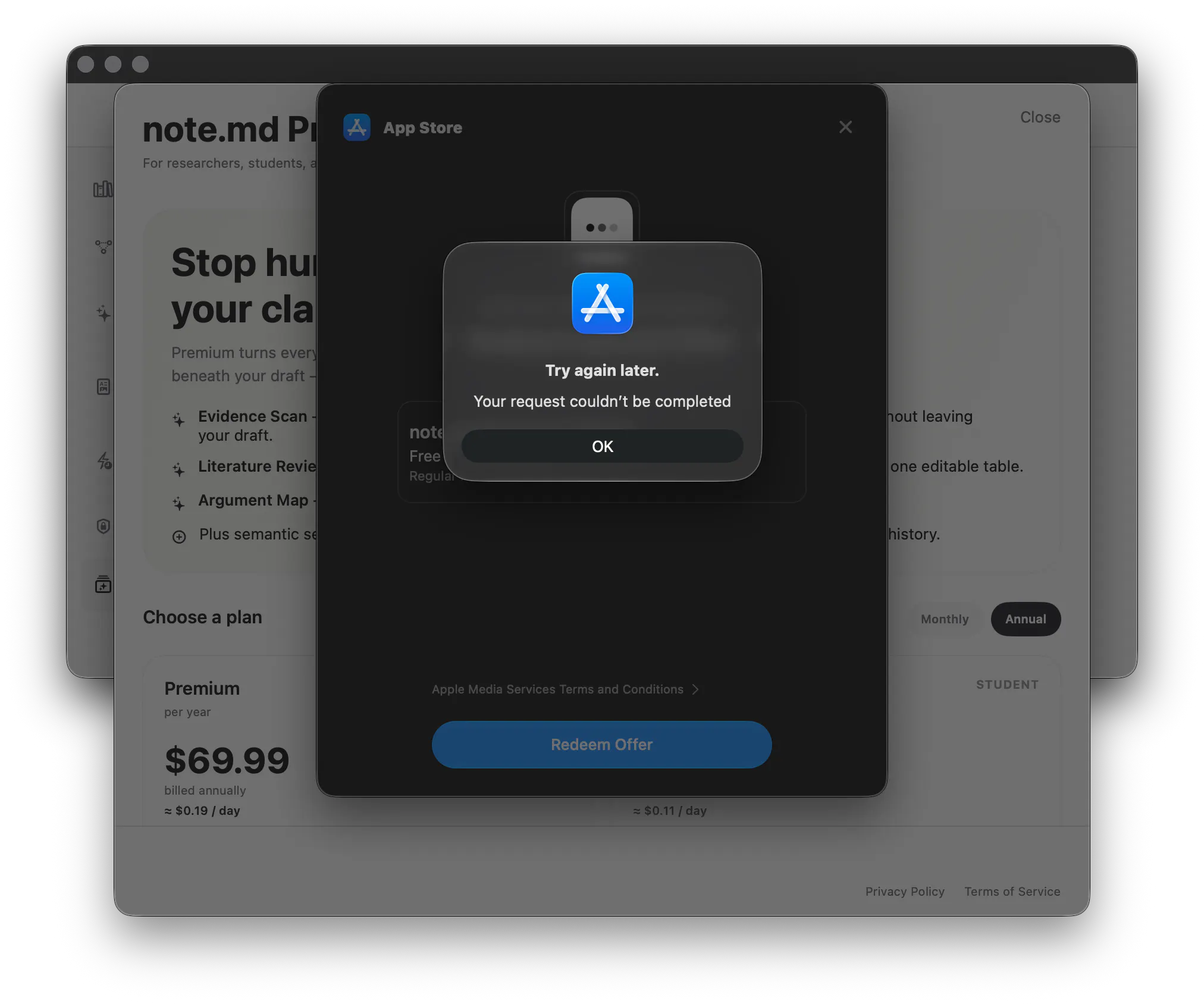
Also a heads up: tried using the `PRODUCTHUNT` code and kept running into this error. Any ideas as to why this could be?

Excited to give the full suite a try even if its only a limited free trial ((:

0
回复

@adam_sardo 

Ive back checked on the Offer Code and from what I am seeing it should still be active and non restricted. Maybe it was a temporary issue on the side of the AppStore Connect system.

If this does not resolve feel free to contact us on contact@arsoftware.tech ad we will provide you with a different code :)

0
回复

@andreaigner Congrats on the update! 🚀 Keeping the vault as plain Markdown while opening it up to AI is literally a game changer here. I'd definitely try to hook this up to a local LLM.

Just for quick idea: what about .aignore file to easily hide sensitive drafts or keys from the AI's view?

0
回复

@sakshi_raichand 

Thank you for your support! I am personally a bit sceptic regarding .aiignore files. In git it's hardcoded that these files are being ignored, but the thing with agents is that the security layers can be lacking sometimes. So me personally I would just on the top level of the vault create one private and public folder and give the agent only access to the public folder and keep the sensitive files in the private one. So note.md can see everything but the agent has only access to the public folder

0
回复

The interesting tension here is that "local LLM memory" means very different things depending on how retrieval actually works. Are you chunking and embedding the markdown files so the model can do semantic search across them, or is it more like context stuffing where relevant notes get injected into the prompt window at query time? That distinction matters a lot for how well it handles a large, messy note library versus a small tidy one. Also curious whether note.md watches files for changes and updates the index automatically, or whether syncing is a manual step.

0
回复

@fberrez1 

For the notes themselves: we deliberately don't run our own embedding/retrieval layer over the vault. The Filesystem connector just exposes the folder as plain files — so the agent of choice does its own retrieval over them: reading, searching, pulling what it needs into context. We're not pre-chunking or injecting a vectorised note layer; whether it's closer to "smart search" or "context stuffing" is really up to the agent's own strategy on top of plain files. We chose that because it keeps the vault honestly just-files, with no hidden index the notes depend on — and because the agent is already good at navigating a real filesystem.

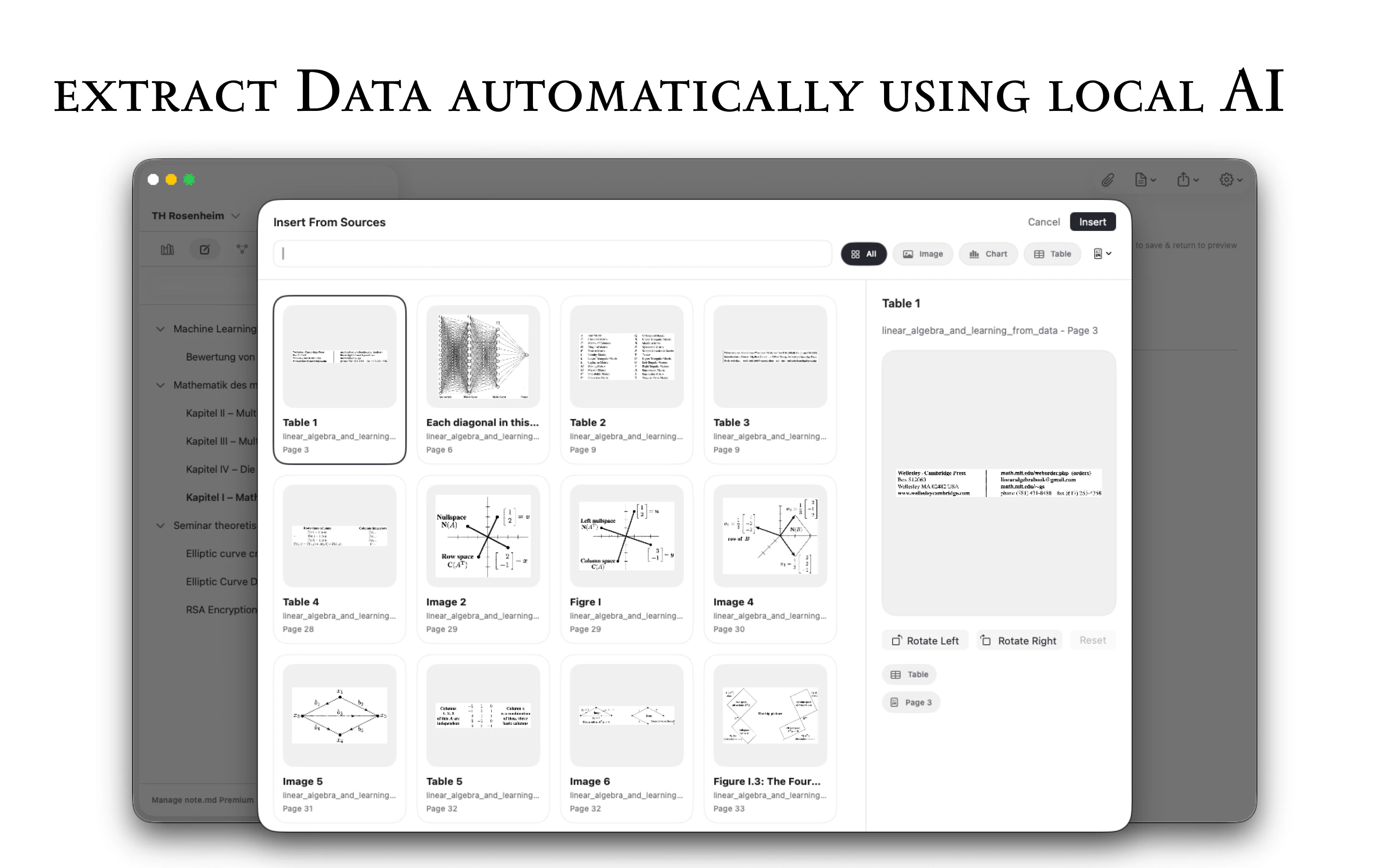
For the sources it's a whole other story — that's where the real on-device pipeline lives. When you import a PDF, we extract it locally, chunk it, and embed it, so semantic search runs as proper hybrid retrieval (meaning + keywords) across your whole source corpus, entirely on your machine. That's the part built to scale to a large, messy library — and it's also what powers the source indexing, figure/table extraction, and the evidence scan that finds support and contradictions for a claim. None of it touches a server.

0
回复

Interesting one today! The "librarian not ghostwriter" line is the reason I'd try this, most of these tools fall over themselves to write for you instead:)

0
回复

The "cited memory with receipts" part is what actually matters, raw chat-history memory loses provenance and you can't tell later what's real. Keeping it as plain markdown on disk so any filesystem-capable agent can read it, not just Claude, is the right call too. The whole thing only works if the vault's genuinely clean though, that's the hard part. Solid update 🙏

0
回复
This is an interesting direction. With NotebookLM becoming many people's default research assistant, where do you think note.md creates the biggest advantage? Is it ownership of data, writing workflows, or something else?
0
回复

@luki_notlowkey 

Great framing. Honestly all three matter, but if I had to name the sharpest edge: it's that note.md is local-first and yours, and that's the one thing NotebookLM can't follow me on without becoming a different product.

NotebookLM is genuinely great at Q&A over a set of sources, but it's a cloud silo you query, not a workspace you own. Your material lives on Google's servers, and the output is answers, not a body of work that accumulates. note.md inverts that: everything is plain Markdown in real folders on your machine, every AI feature runs on-device, and nothing leaves. Same reason it doubles as memory an agent like Claude can read and write directly, your vault is files, not someone's database.

The second edge follows from the first: it's a place you write, not just ask. NotebookLM answers questions; note.md is where reading, sourcing, and drafting compound into something that's still there, and still yours, a year later.

And a deliberate philosophical split: my AI is a librarian, not a ghostwriter. It surfaces what you've read and the evidence for and against your claims, rather than thinking for you. NotebookLM leans toward giving you the answer; I'd rather sharpen your own.

1
回复

The local-first angle for note.md caught my eye, especially paired with markdown and research writing. How are you thinking about people moving existing .md files into the workspace — is it meant to work with an existing folder structure, or more as a dedicated place where notes and drafts live together?

0
回复

@mia_qiao 

Good question. both, by design. note.md works on plain folder of Markdown files, so you can point it at an existing vault and keep your structure as is. It reads your files, it doesn't reorganise them. The block editor just gives you a Notion-style way to write into those same .md files.

One honest caveat on citations: they are stored as standard Markdown links pointing at a notemd:// reference, so the file stays clean Markdown and your prose is fully portable but those citation links only resolve inside notemd, since they hook into the built-in reference manager.

The notes are yours and portable, but the live source link is the one app-specific piece.

0
回复
#4
Atlas
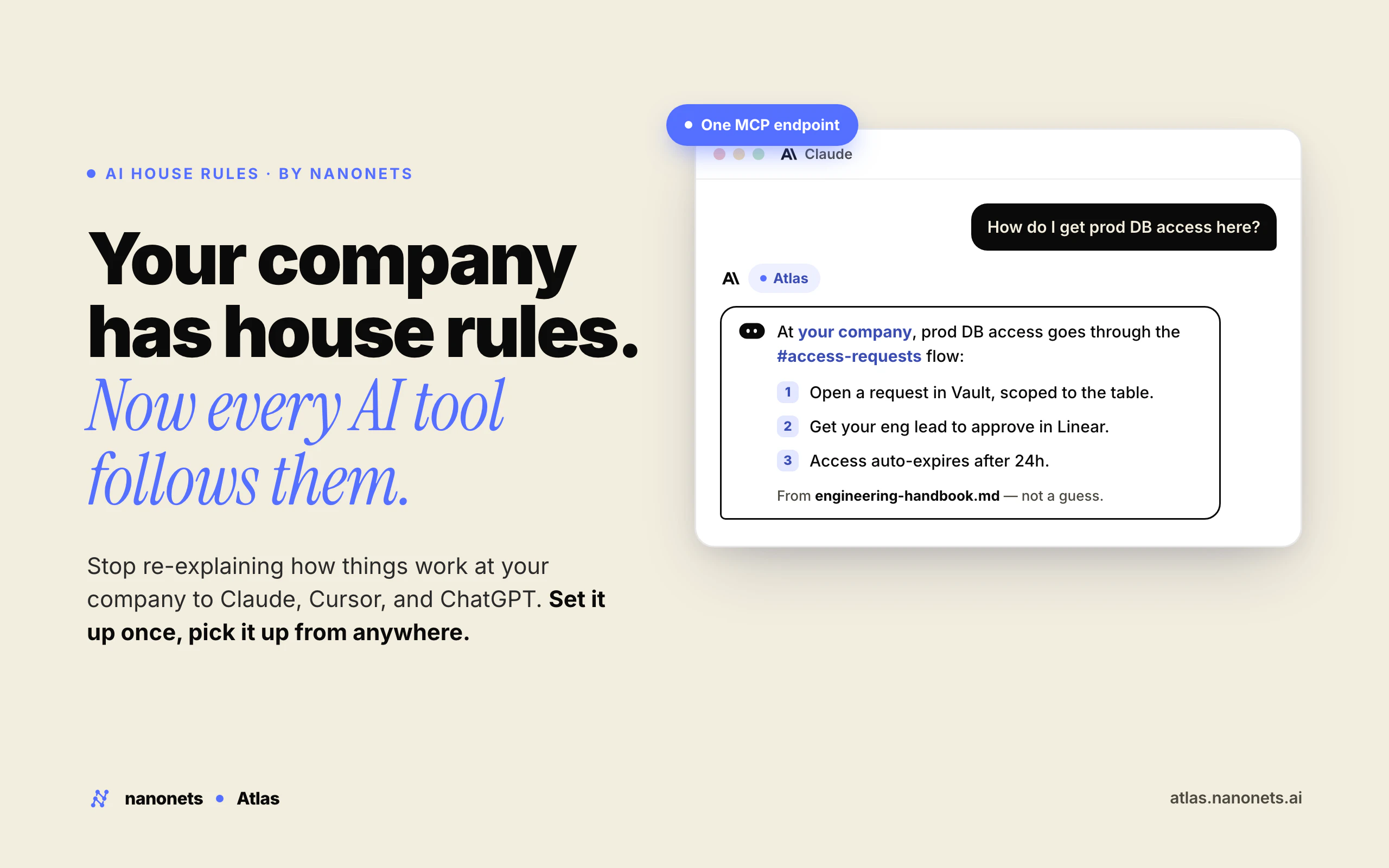
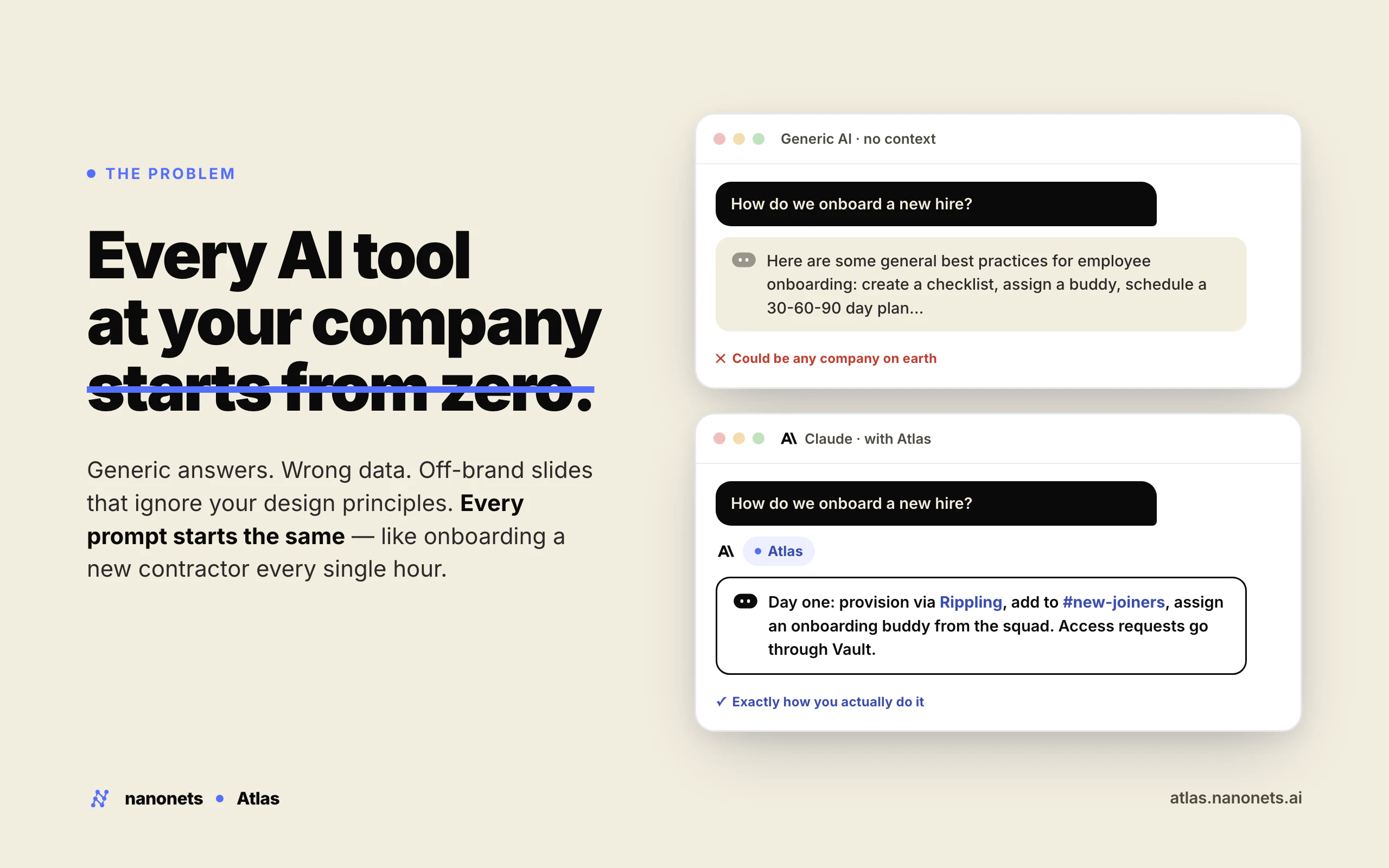
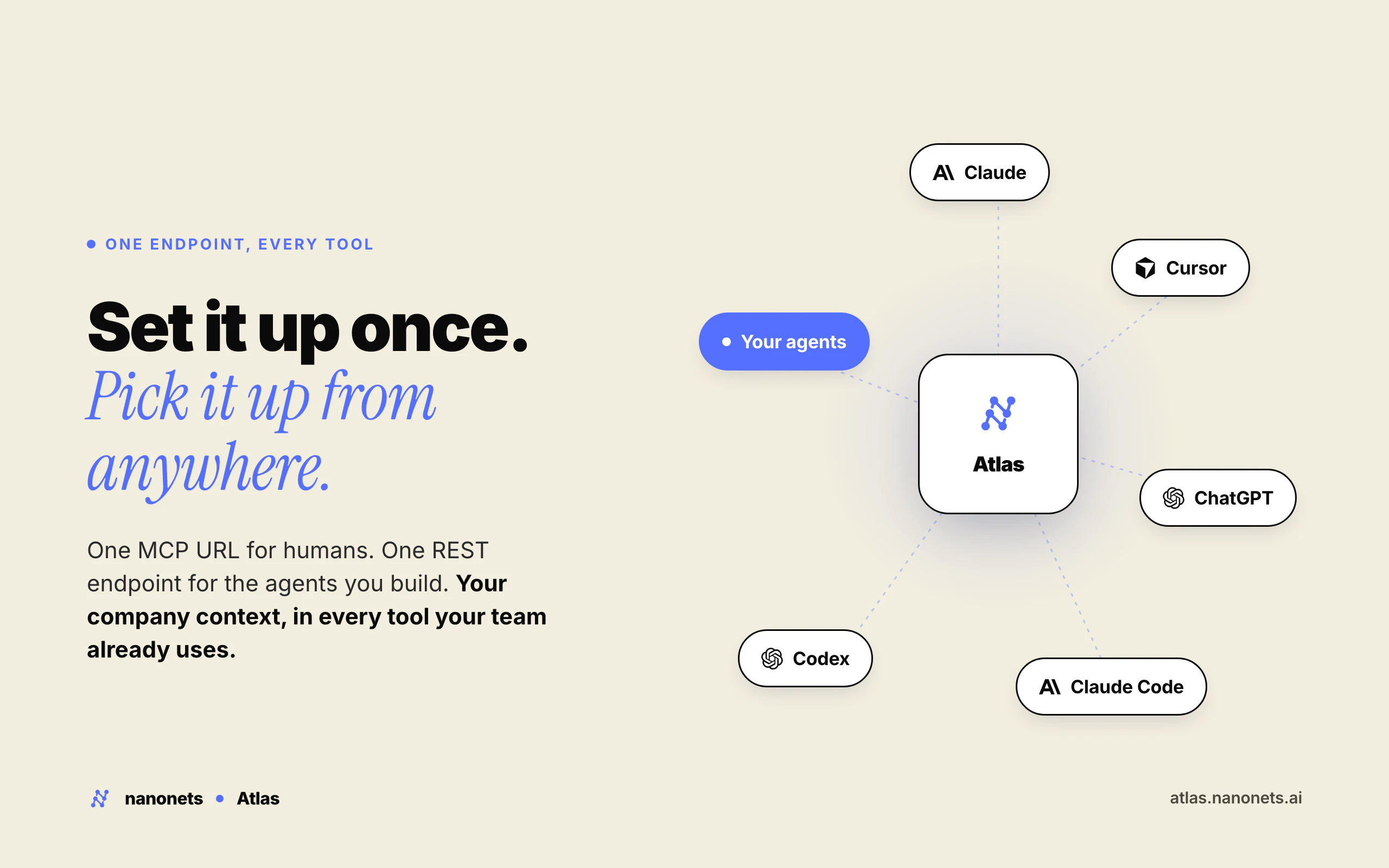
Every AI tool you use should know how your company works
192
一句话介绍:Atlas通过构建企业专属的“上下文图谱”,让公司品牌、流程和规则能被AI工具实时调取和使用,无需在每个AI工具中重复解释。
Marketing Artificial Intelligence Maker Tools
企业上下文管理 AI知识图谱 品牌一致性 工具集成 数据所有权 Naninets引擎 上下文即服务 MCP连接器 企业AI治理
用户评论摘要:用户关注图谱的可编辑性、对比Claude Skills和Glean,追问工具连接范围,以及自动更新机制与权限控制。部分评论提出“上下文与权限分离”和“来源溯源”等深层建议。
AI 锐评

Atlas切中了一个真实且日益尖锐的痛点——AI工具矩阵的碎片化导致企业上下文重复输入、版本混乱与品牌失真。其“一次构建,随处调用”的思路,本质上是在LLM与应用层之间插入一个标准化的中间件,让公司知识图谱具备可移植性,降低对单一模型商的依赖,这一点价值清晰。

但从评论反馈看,疑问集中在“权限隔离”与“动态更新”上。当前产品主要依赖预设文档(网页、Notion)做静态或定期抽取,对于高频变化的企业流程、角色权限乃至上下文版本管理(例如“哪个规则在哪个会话中生效”)缺乏明确方案。如果只做“静态知识库”,则与老牌RAG工具无明显差异。另外,MCP(Model Context Protocol)连接器的生态尚未普及,能否在ChatGPT、Cursor等主流工具中稳定推送或拉取最新上下文,直接影响用户体验。

真正的差异化不在“提取”,而在“治理”——上下文的分层访问、来源快照、过期标记以及基于行为的自动更新。如果Atlas仅做到“一次输入”,而未解决“持续校准”与“安全分发”,则容易沦为普通的企业培训资料仓库。此外,定价$99/月对有定制需求的中小企业有吸引力,但对需要严格审计的成长期公司,缺乏按部门或项目细分的定价逻辑。

总的来说,Atlas的方向正确,但需要在一个功能上“深扎”而非铺开,例如优先解决“规则从创建到自动推送至数款Agent的全链路闭环”,并公开上权限模型与更新频率,才能验证其“价值主张”是否真能落地。

查看原始信息
Atlas
Your company has house rules. Now every AI tool follows them.

Hey Product Hunt 👋 I'm Anirudh, part of the dev team behind Atlas.

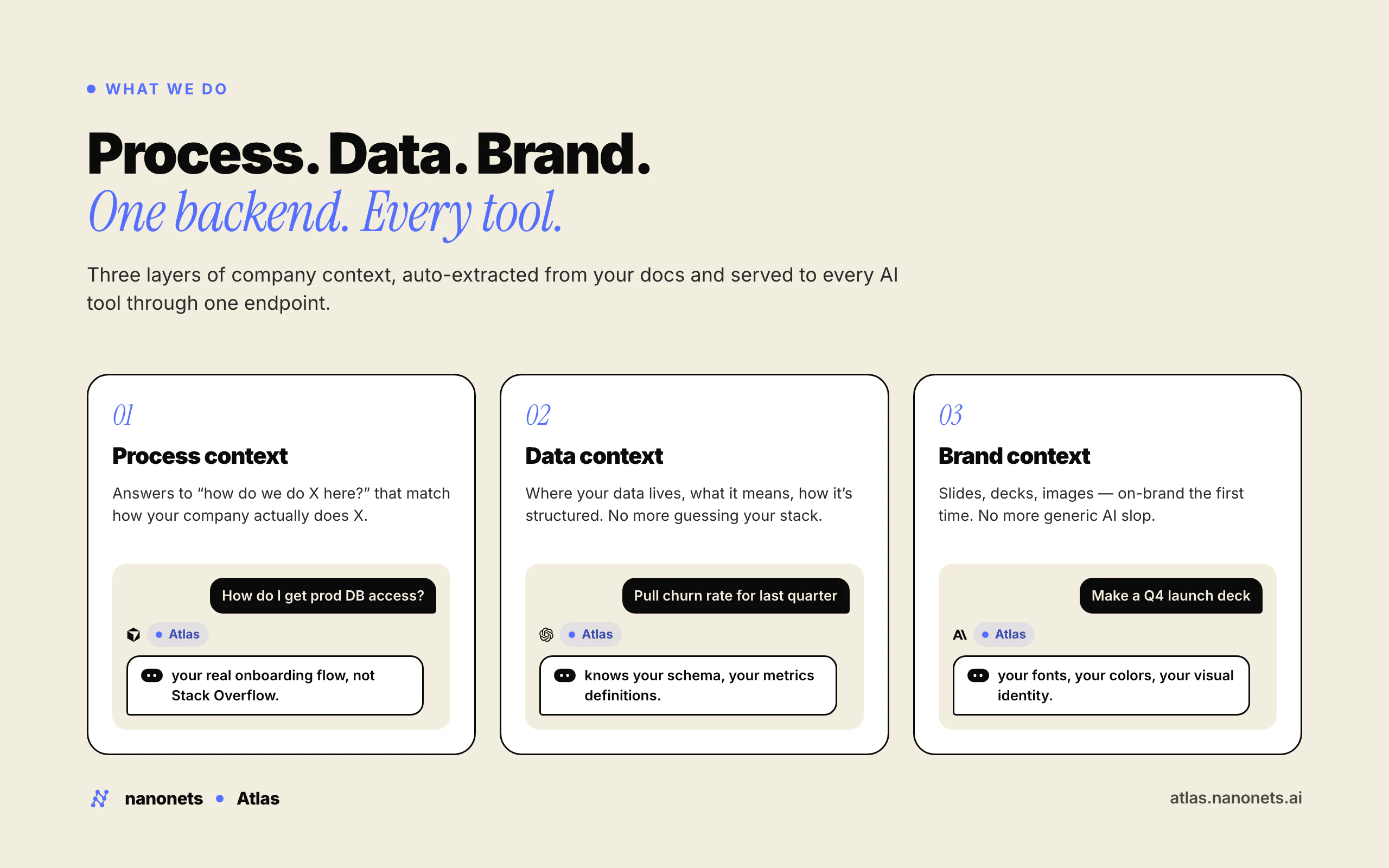
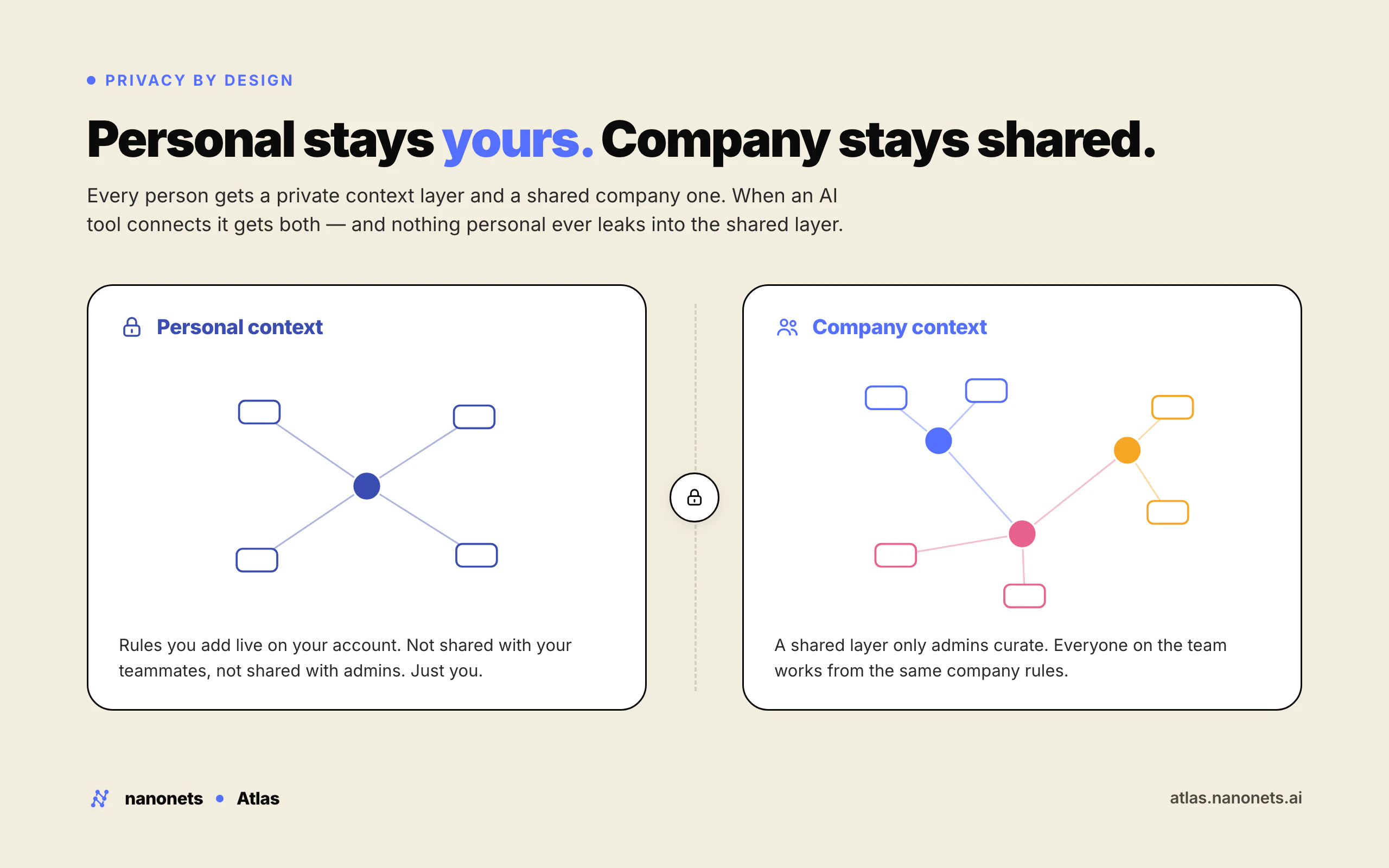
Atlas builds your company's context graph: your brand, your voice and how you actually operate, all extracted and connected into one structure. And the whole point is that you own it.

Your company's context need not live inside Claude or OpenAI. With Atlas it's yours: plug the graph into any AI tool your team uses, switch tools tomorrow, and your context comes with you.

Three things we cared about:

1. It builds a real context graph from your brand, voice and processes, connected.

2. Its not locked to any single LLM provider, usable anywhere. You own it.

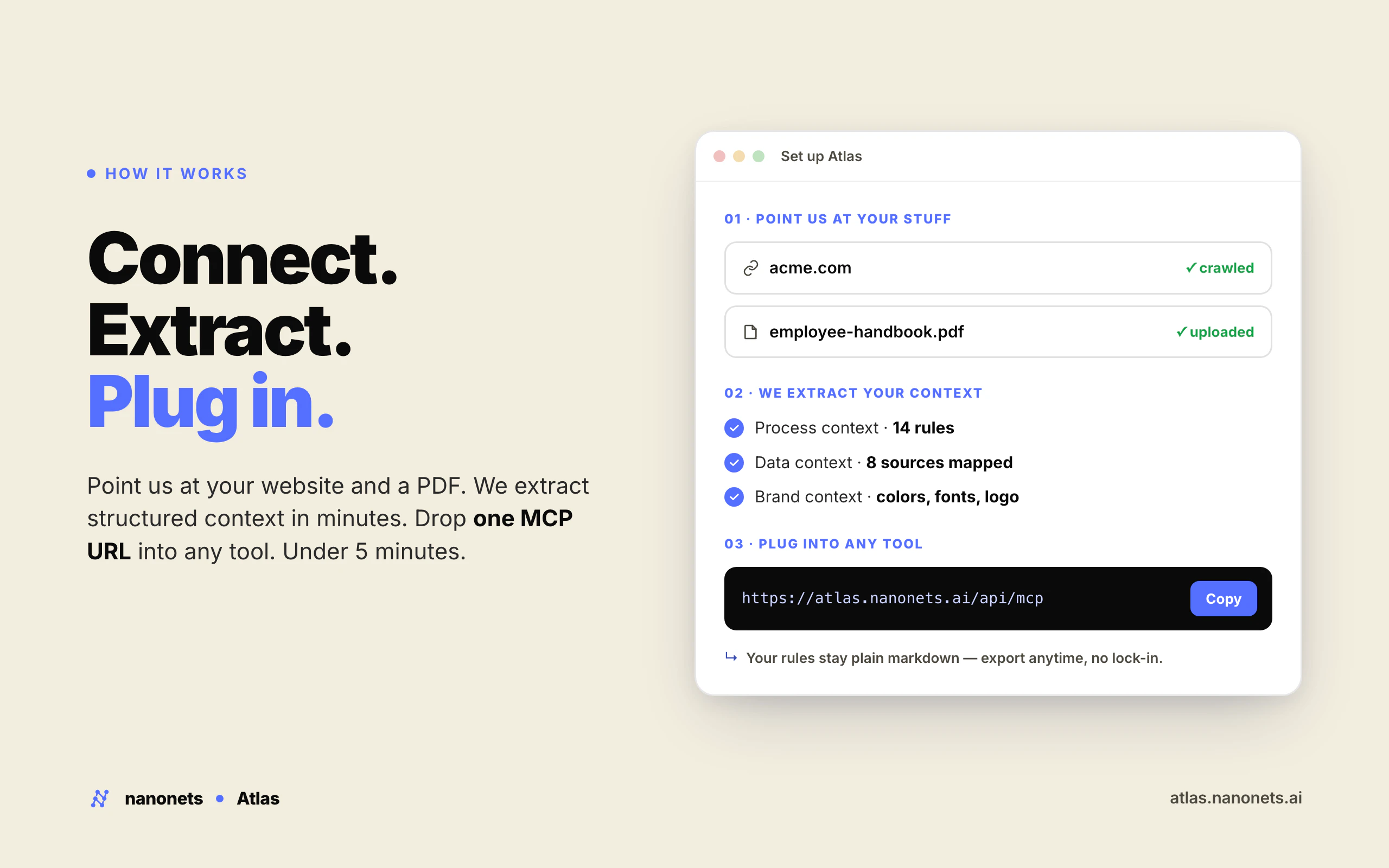
3. Setup is just plugging in your sources (your website, a few docs). We take care of the extraction. Under 5 minutes.

It's built on the Nanonets document-extraction engine, ranked #1 for document IDP and used by more than a third of the Fortune 500.

We're opening the Founding 200: $99/mo per company, cancel anytime, with white-glove setup where we build your first context with you. For anyone here from Product Hunt today, that white-glove setup is on us. Just drop a comment and I'll reach out.

I'll be in the comments all day. I'd genuinely love your feedback: would owning your company's AI context, instead of re-explaining it to every tool, be useful for your team?

13
回复

@anirudh_kumar_yadiki Interesting approach. The idea of owning and maintaining a portable company context graph rather than repeatedly rebuilding context across different AI tools makes a lot of sense. The vendor-agnostic approach and quick setup are particularly compelling for teams adopting multiple AI platforms.

0
回复

@anirudh_kumar_yadiki can u reach out? i know a few companies that would like this

0
回复
Can multiple people edit and contribute to the context?
2
回复

Hi @vaibhavchhimpa  , yes you can have multiple admins for your org, and they can edit/delete company wide rules and context , and each member admin and non admin have their own personal context so their personal preferences also get saved and reused.

1
回复

What's different about how context/knowledge graphs work in comparison to Claude skills? If I want someone else's agent to follow my rules, we can just share skills, right?

2
回复

@aarsh_desai  Great question! Unlike Claude’s skills, which are a static, non-evolving set of instructions that can't serve assets, Atlas constantly learns from your conversations. It continuously extracts the latest data to ensure your context graph never goes stale.

Plus, we provide a skill file that plugs our tools directly into your agent. This means you can start building pitch decks, creating brand videos, and pulling metrics immediately in your first chat.

3
回复

What are the tools you can connect, could you pls specify some?

1
回复

@vinit_mehta2 Currently the sources of extraction of context would be your company web pages, any reference docs of any file type and your notion. We will build a detailed context graph that all the employees from your company can immediately start using once they connect their agents to Atlas mcp.

3
回复

Nice launch. I’d separate context from authority: a company graph can tell an agent how the business works, but it also needs to say which actions are allowed, when a source is stale, and what proof survives after acting.

Do you version the graph or rules per run?

0
回复

How does this compare to what Glean is doing? Both are essentially trying to give AI tools a shared layer of company context -- but Glean approaches it through search and retrieval while this looks more like a ruleset. Curious if there's a meaningful difference in how the rules actually get enforced across different AI tools, or whether it depends on each tool's API supporting it.

0
回复
Planned company level sources for automatic updating contact? Ex. Notion mapping so any updates in key sections that cover policies are updated through Atlas to the company context layer automatically? Company context also changes regularly obviously, it’s becoming a hassle to manually upload new context documents to different context systems across multiple ai tooling systems.
0
回复

Fun idea WRT context sharing! Excited to see where the product goes, congrats team

0
回复

Context is everything. Not having to rebuild your entity voice, brand, rules, etc.. on each model/platform is elegant, and correct.

0
回复

The context loss between tools is something a lot of small business owners feel but can't quite name. You spend 20 minutes explaining your company structure in one AI session, then open a different tool and start from zero.

I work adjacent to supplier onboarding, where small vendors have to describe the same business details repeatedly across procurement portals, compliance forms, and vendor packets. A portable context layer that travels with you across tools could be genuinely useful in that world.

Curious whether Atlas is designed mainly for brand and marketing context, or whether you see it handling more operational data too, like business certifications, entity types, or compliance documentation?

0
回复

the "house rules every AI tool follows" framing is the real unlock — context that lives once instead of re-explaining it to Claude, Cursor, and ChatGPT separately. how do you keep it permission-scoped so a given user or tool only pulls what it should, not the whole company brain?

0
回复

The insight that company context should live outside individual AI tools rather than being re-input in each system prompt is sound. Most teams end up maintaining duplicate context blobs in Cursor, Claude, and internal tools that drift out of sync. How does Atlas push updates to connected tools when company guidelines change? Is it pull-based querying or active propagation to each integration?

0
回复

@anand_thakkar1 we make sure the connected tools always fetch the latest fresh context of the company through mcp connectors.

0
回复

document processing is one of those problems that sounds solved until you actually try to automate it with messy real world inputs. scanned PDFs at weird angles, handwritten notes mixed with printed text, tables that don't follow any consistent format. how does nanonets handle the edge cases where OCR confidence is low? does it flag those for human review or just best-guess its way through?

0
回复

Company context is only valuable if the agent can show where each answer came from. The hard operational problem is not just memory, it is provenance, stale-source handling, and knowing when to ask before acting.

0
回复

yes @krekeltronics , this is a problem Atlas looks to solve by making sure we sync regularly with the connected sources, and making sure we extract processes and not just knowledge so that the ai agent using our context takes the correct decisions.

0
回复

What's the best way to get started for a company?

0
回复

@sravanth_talluri  any person in your company can just signup and setup the mcp tool in ai agent of your choice (max two steps) and then your entire org can start using the company context .

0
回复

The premise is right. The failure mode with most AI tools isn't the model, it's that every session starts cold and you end up re-explaining your positioning, your audience, your tone, your internal terminology, over and over across a dozen different tools.

What I'm curious about is how Atlas actually propagates that context. Is there a central knowledge layer that each connected tool reads from, or are you syncing context into each tool's own memory or system prompt? And when your company context changes, say you rebrand or shift positioning, how does that update flow through to the tools that already have the old version baked in?

0
回复

@fberrez1 currently, we maintain a central knowledge layer (context graph) containing both org specific and personal use specific rules and assets. And Atlas does sync with its sources frequently ( your web pages, notion , slack) so that the context doesn't go stale.

0
回复

AI can extract data really well, but trust is a different challenge. At what point do your customers stop double-checking the output and start relying on it confidently?

0
回复

thanks @harini_mukesh , we strongly believe that once agents start using context graphs as their memory source, customers of those agents will stop double checking the output

0
回复

can this also work with claude code?

0
回复

@shrish_dwivedi yes, we support claude code

2
回复
#5
Sleek Analytics
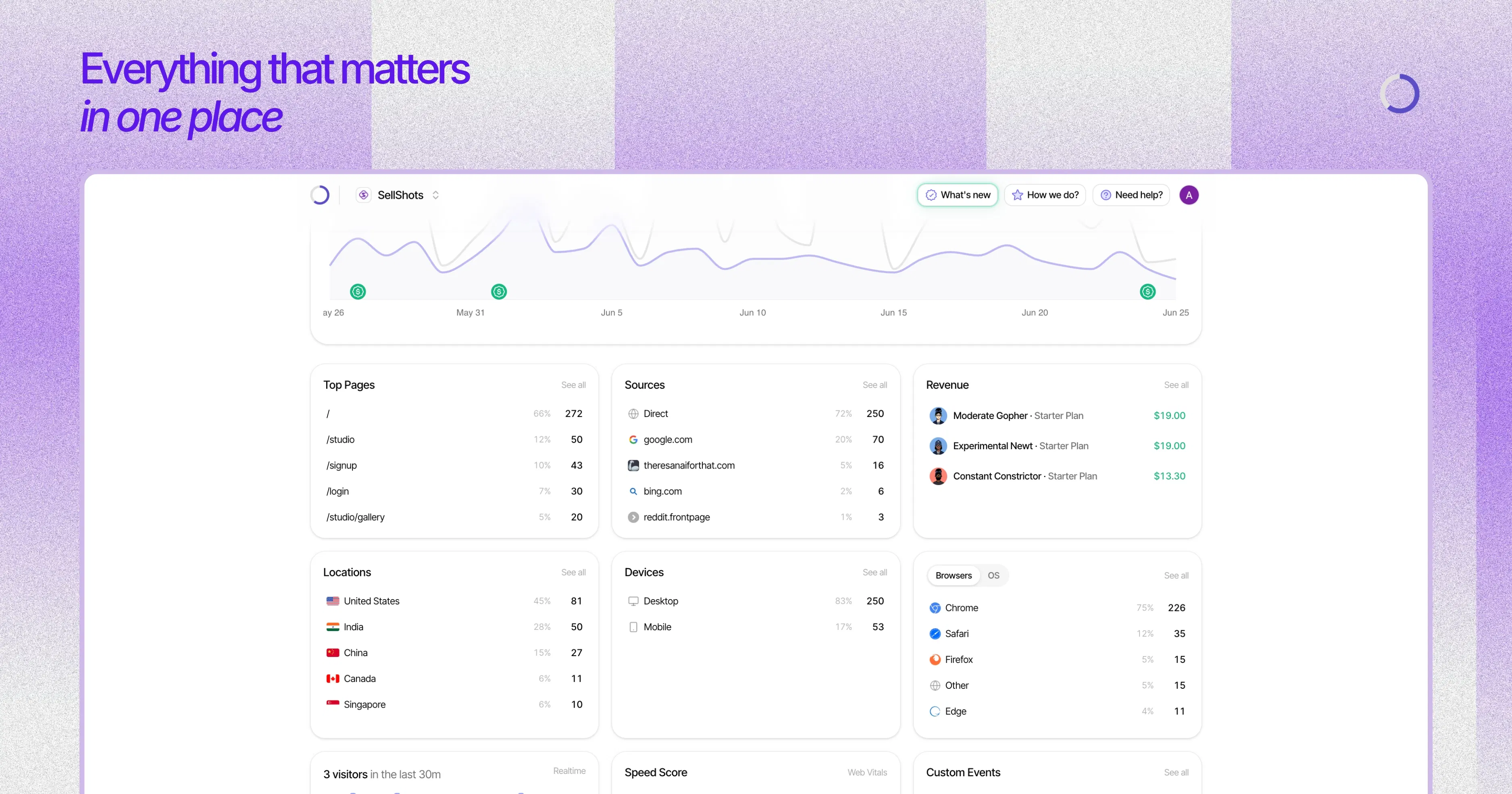
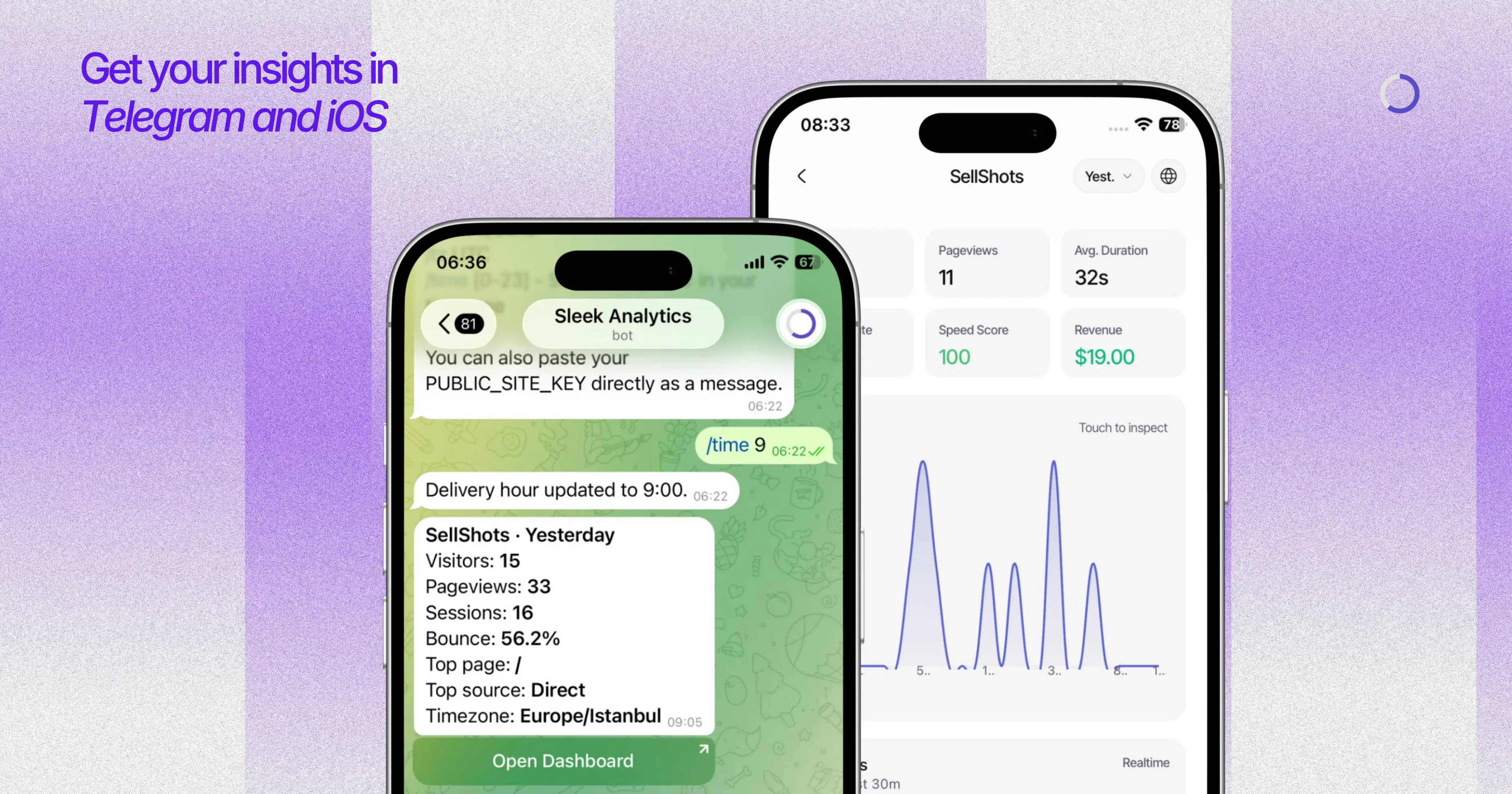
See who's on your site. Right now.
164
一句话介绍:Sleek Analytics 是一款无Cookie、隐私优先的实时网站分析工具,帮助SaaS创始人在不打扰用户的情况下,实时追踪访客行为、转化路径和营收归因。
Analytics Marketing Data & Analytics
隐私优先分析 无Cookie跟踪 实时网站分析 营收归因 SaaS分析工具 自定义事件追踪 团协作 公开API Google Analytics替代
用户评论摘要:用户关注无Cookie实现实时访问的技术原理与GDPR合规性;肯定了营收归因是差异化优势;询问GA迁移难度及历史数据导入;技术细节上关心断网或刷新是否导致会话分裂;团队与产品经理均表示其兼顾营销与产品场景。
AI 锐评

Sleek Analytics 在“隐私优先”的拥挤赛道中,选择了一条更务实的路径:不标榜颠覆,而是精准切入SaaS创始人的营收闭环。其真正的价值不在于“无Cookie”本身——这已是行业标配——而在于将实时访客、自定义事件与Stripe、Paddle等支付工具的营收数据原生打通,解决了轻量级分析工具“只识流量,不知交易”的致命短板。评论中用户对其技术合规性的追问(如“无Cookie如何实现实时会话不分裂”)非常专业,而开发者的回复(使用匿名会话而非指纹识别)基本消除了合规顾虑,但具体实现细节(如会话超时策略、跨页跟踪边界)仍需更透明的文档支撑。从产品形态看,Sleek试图在Plausible的极简与Mixpanel的深度之间找到平衡:既有“看谁在线上”的即时直观感,又有收入归因的商业闭环。但挑战也很明显——竞品(Fathom、Umami)已在开发者社区建立强品牌忠诚度,而“营收归因”能否成为持续粘合剂,取决于它是否支持更多支付网关和CRM(如HubSpot)的深度集成。目前支持6家支付平台,但尚未覆盖Shopify、PayPal等电商主流,这限制了其从SaaS向电商场景的扩展。一句话:Sleek是给“既想要隐私合规,又不想在Excel里手动对账”的SaaS创始人准备的工具——方向对,但护城河尚需更多数据接口来挖深。

查看原始信息
Sleek Analytics
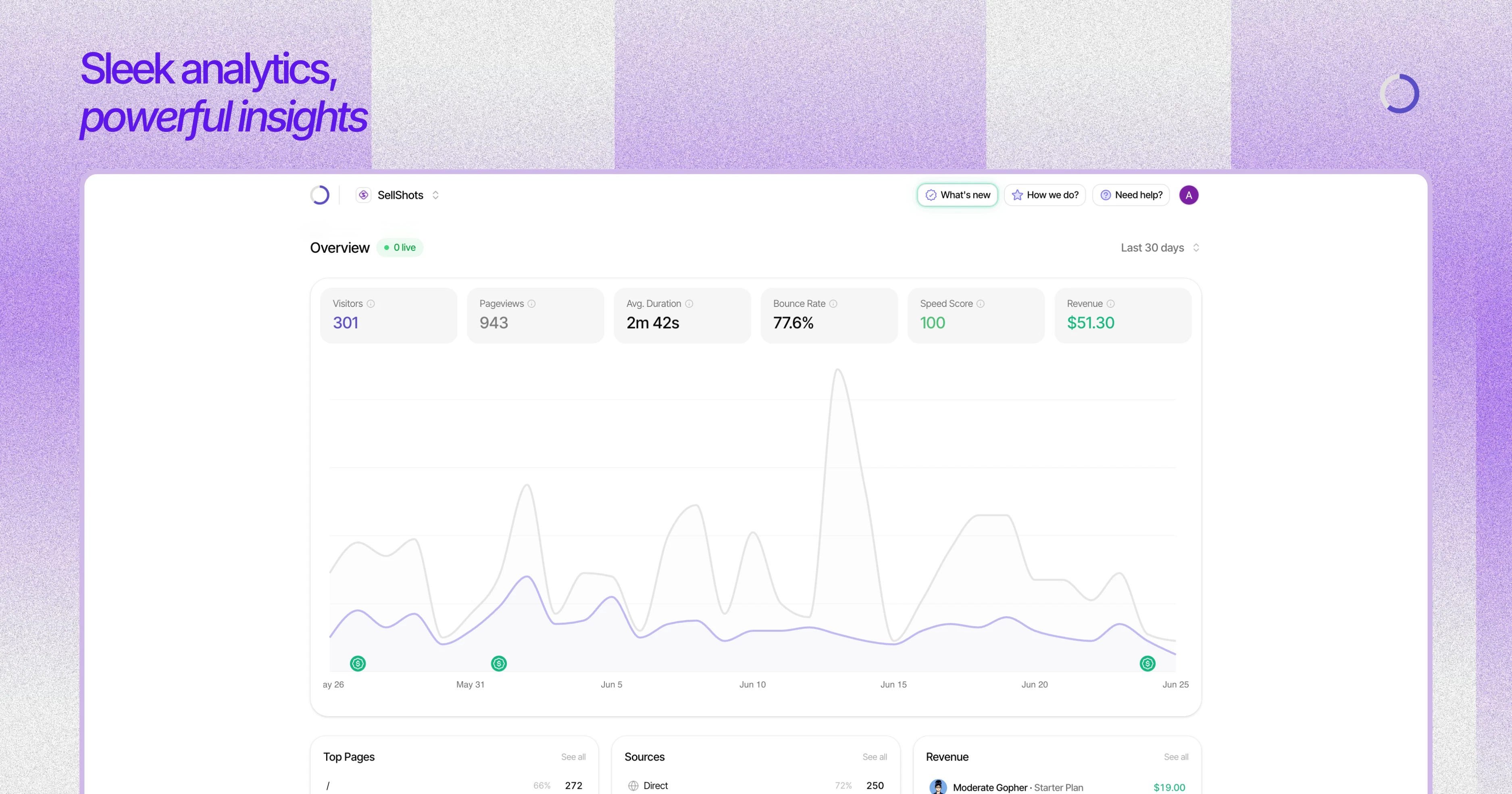
Sleek Analytics is a privacy-first Google Analytics alternative for the modern web. Real-time website analytics, cookieless tracking, and fast dashboards. Since our previous Product Hunt launch, we've completely redesigned the Sleek Analytics experience and introduced several major new capabilities. - Complete redesign of the website and product experience - Revenue attribution for Stripe, Creem, Paddle, Polar, Dodo Payments, and LS - Custom Event Tracking - Public API access - Team Support
Hey Product Hunt! 👋 A few months ago, we launched Sleek Analytics as a privacy-first web analytics alternative. Since then, we've listened to our users and shipped our biggest update yet. With Sleek Analytics, you can now: - Track revenue from Stripe, Creem, Paddle, Polar, Dodo Payments, and LemonSqueezy - Measure Custom Events beyond simple pageviews - Access your analytics with our new Public API - Connect with your team with new Team feature - Experience a completely redesigned website and product Our goal is simple: help SaaS founders understand not just who visits, but what drives conversions and revenue—all while staying privacy-friendly. We're excited to hear your thoughts and answer any questions throughout the day. Thanks for checking out Sleek Analytics! ❤️
2
回复

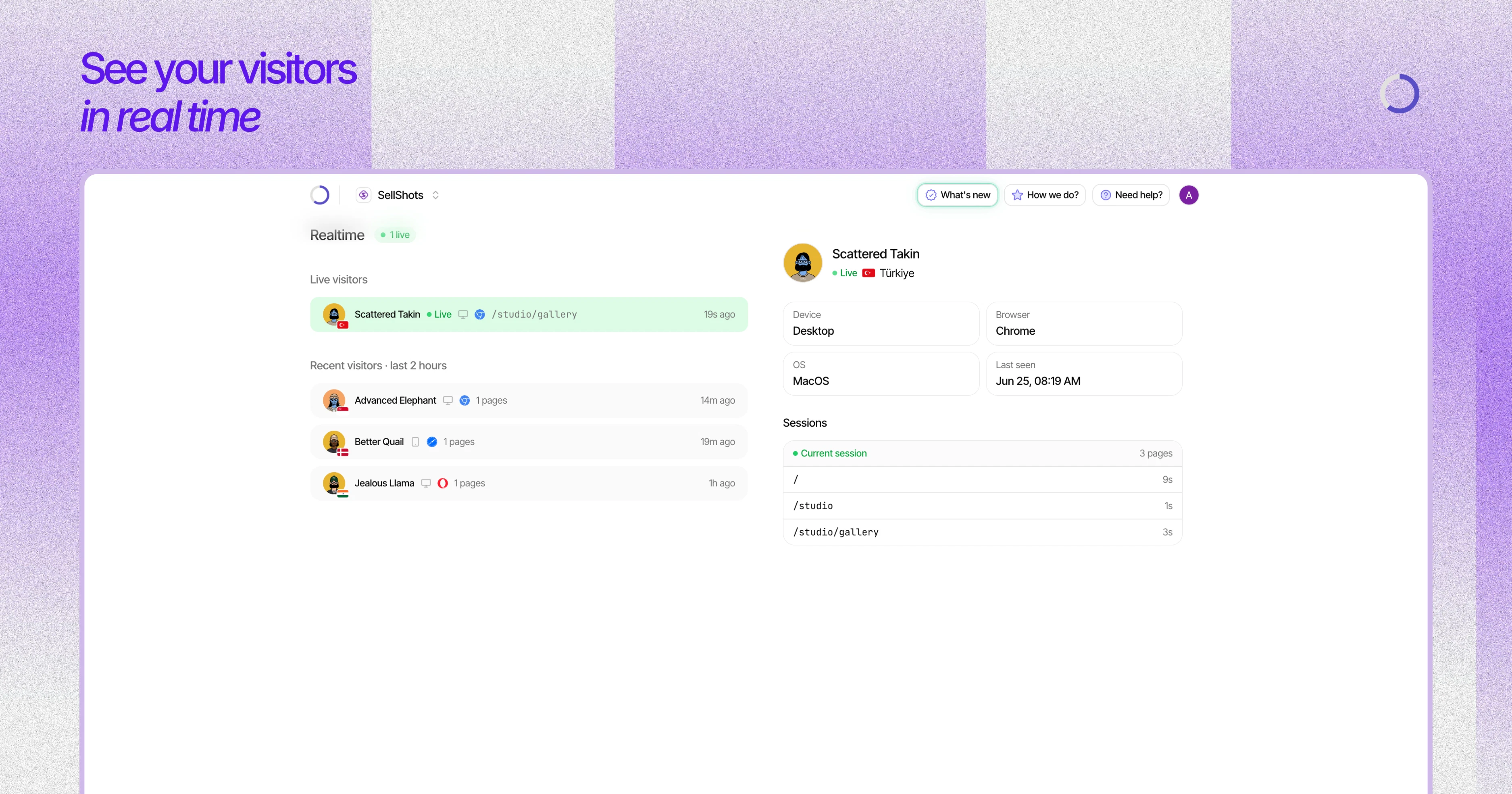
The real-time visitor piece in the tagline caught my eye: “See who’s on your site. Right now.” Is Sleek Analytics mainly aimed at marketers checking active traffic during campaigns, or is it more for founders/product teams watching usage as it happens? Also wondering whether the product shows individual visitor/session detail, or keeps things more aggregated from a privacy standpoint.

2
回复

@mia_qiao great question! it's actually built for both, but we see SaaS founders as our primary audience.

marketers use Sleek to monitor campaigns and traffic in real time, while founders and product teams use it to understand how visitors move through their product, which events they trigger, and ultimately what drives conversions and revenue.

on the privacy side, we don't fingerprint users or collect invasive personal data. you can inspect individual sessions, pageviews, clicks and journeys for debugging and analysis, but Sleek remains privacy-first and doesn't try to identify who the visitor is.

1
回复

cookieless + real-time is a hard combo — most privacy-first analytics give up the live granularity to get there. how are you resolving "who's on the site right now" without cookies or fingerprinting that'd quietly reopen the consent problem?

1
回复

Abbas, watching real people move through a site as it happens has a strange pull to it, far more alive than reading a chart after the fact. Keeping it light and free of those consent banners is what makes it feel friendly.

1
回复

@emmanuel_costa5 thank you, Emmanuel! ❤️

that's exactly the experience we wanted to create. real-time analytics that feel alive, while staying simple and privacy-first. we believe analytics should help you understand what's happening now, not just generate reports.

1
回复

The one-line setup is the real unlock here. Most analytics tools have you fighting config before seeing a single visitor. Congrats on the launch 🚀

1
回复

@benjouss thanks a lot Benjamin for that kind of words!

1
回复

Could you please explain how exactly are you GDPR/ePrivacy compliant without any poups or user permissions? Simply not having cookies is not enough - consents and/or banners are still needed.

1
回复

@artk great question!

Sleek doesn't rely on cookies or fingerprinting. instead, we use a cookieless, privacy-first approach to create anonymous sessions without storing persistent identifiers or collecting personally identifiable information. that's why customers can use Sleek without adding a consent banner.

2
回复

How easy is it to migrate from Google Analytics, and does Sleek bring over any historical data? Congrats on the launch!

1
回复

@henry_habib thanks, Henry!

we currently support importing historical data from Plausible Analytics. we don't support Google Analytics imports yet, as GA's data model is quite different, but it's something we're evaluating based on customer demand.

1
回复

Genuine question: the privacy-first GA alternative space feels pretty crowded at this point - Plausible, Fathom, Umami, TelemetryDeck are all well established. Looking at your sidebar, even PH lists 4+ direct competitors. The revenue attribution from Stripe/Paddle/etc is actually a solid differentiator - but is that the main wedge you're going after, or is there something else that pulls customers away from tools they're already comfortable with?

1
回复

@galdayan great question! we don't see ourselves as just another GA alternative.

revenue attribution is our biggest differentiator, but it's not the only one. we combine web analytics, custom events, revenue attribution, live globe view, funnels, user journeys, real-time visitors, and a public API in one privacy-first platform.

our goal is to help SaaS founders understand the full journey, from visitor to customer to revenue, without juggling multiple tools.

1
回复

The Stripe revenue tracking is a nice touch -- that's the gap most lightweight analytics tools leave open. We're building for e-commerce developers and our clients always end up stitching together GA + Stripe dashboards separately. Privacy-first with no cookie banners is the right call too. Congrats on shipping this.

0
回复

Congrats on the launch. Cookieless, real-time granularity is tough to pull off without falling back on canvas fingerprinting or cross-session tracking that quietly reopens the compliance/consent banner headache. If you're providing complete user journeys within an anonymous session without storing persistent identifiers, how are you handling edge cases like a user losing cell service for 30 seconds or hitting a hard page refresh without accidentally generating a brand new session split?

0
回复
#6
ModuleX
AI workspace that’s already connected to everything
148
一句话介绍:ModuleX是一个内置200+应用集成的AI工作空间,用户只需用自然语言描述需求,即可让AI调用真实数据、执行工具操作,并生成团队可协作编辑的可视化工作流,彻底解决AI落地时“连接工具耗时”的痛点。
Artificial Intelligence Maker Tools No-Code
AI工作空间 自动化工作流 无代码 SaaS集成 可视化编辑 AI Agent 企业效率工具 API管理 团队协作 数据连接器
用户评论摘要:用户高度认可“200+即用集成”和“可视化工作流”消除设置疲劳。核心疑问:与Zapier/Make等差异化何在?工作流失败时如何调试?如何处理“工作流漂移”?付费密钥锁定风险?审批暂停能否展示精确负载?创始人积极回应了技术细节与路线图。
AI 锐评

ModuleX在拥挤的“AI+自动化”赛道中,找到了一个被忽视但致命的痛点:**“设置税”**。当Zapier、Make、n8n等平台仍在强调“从空白画布开始,连接你的一切”时,ModuleX直接消灭了让大多数用户望而却步的第一步——注册、淘API密钥、配置认证。它提供的200+预集成,尤其是“自带密钥”和“托管密钥”共存的机制,不仅降低了试用门槛,还巧妙规避了其他平台常见的“风控陷阱”(如密钥过期、连接断开)。

从技术架构看,其“单引擎”设计(Chat/Canvas/API行为一致)是真正的护城河。这意味着它不是一个简单的“可拖拉拽”的工作流工具,而是一个底层数据流和凭证系统统一的AI执行环境。这让它的野心不止于做“自动化”,而是成为一个**AI应用运行时的底座**——用户可以用Chat测试、Canvas调试、API部署,打通了从“想法”到“产品”的工序。

然而,评论中的质疑是尖锐且关键的:**差异化已死,价值在生态**。当Zapier同样拥有可视化编辑和AI功能时,ModuleX的“预集成”优势会随时间被抹平。它真正的挑战在于能否快速构建起一个让开发者愿意在其上构建商业应用的API生态,而非仅仅做“更快的工具”。目前承诺的“托管密钥”数量有限,断供风险由其信用背书,这对企业级用户仍是隐忧。此外,工作流的“调试与漂移”问题虽有回应,但自动化系统失败后的即时代码级修复(非自然语言导流)才算真正解决技术用户信任。

一句话总结:ModuleX是一个极其聪明的产品切入点,但它必须从“解决设置麻烦的工具”进化为“AI工作流事实上的基础设施”,否则将面临被巨头复制功能并纳入其庞大生态的宿命。

查看原始信息
ModuleX
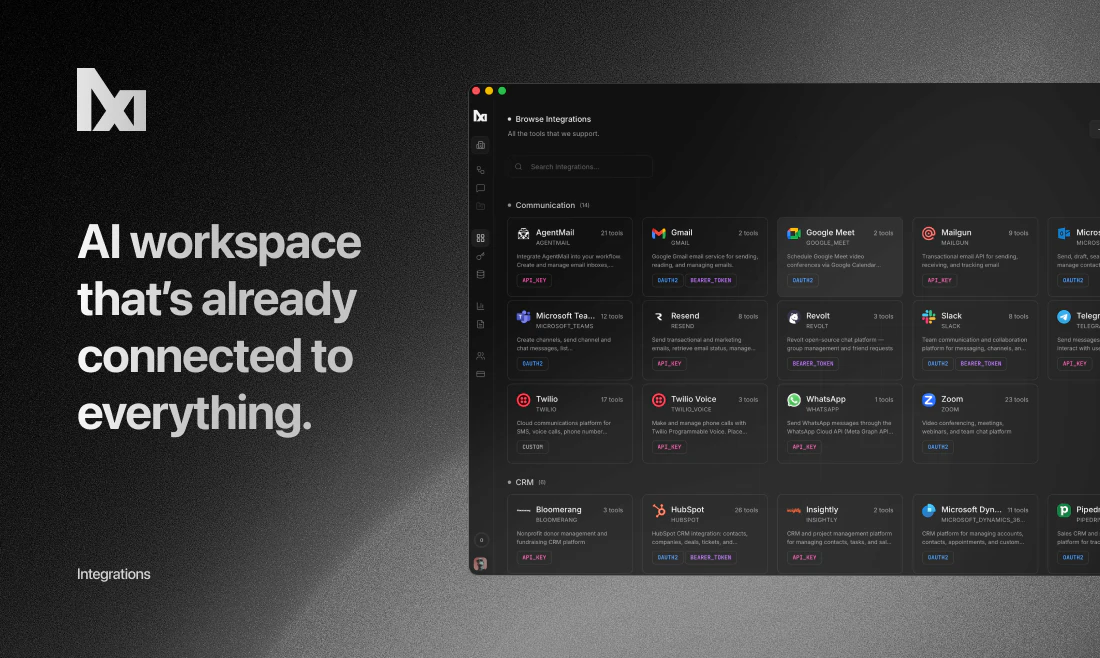
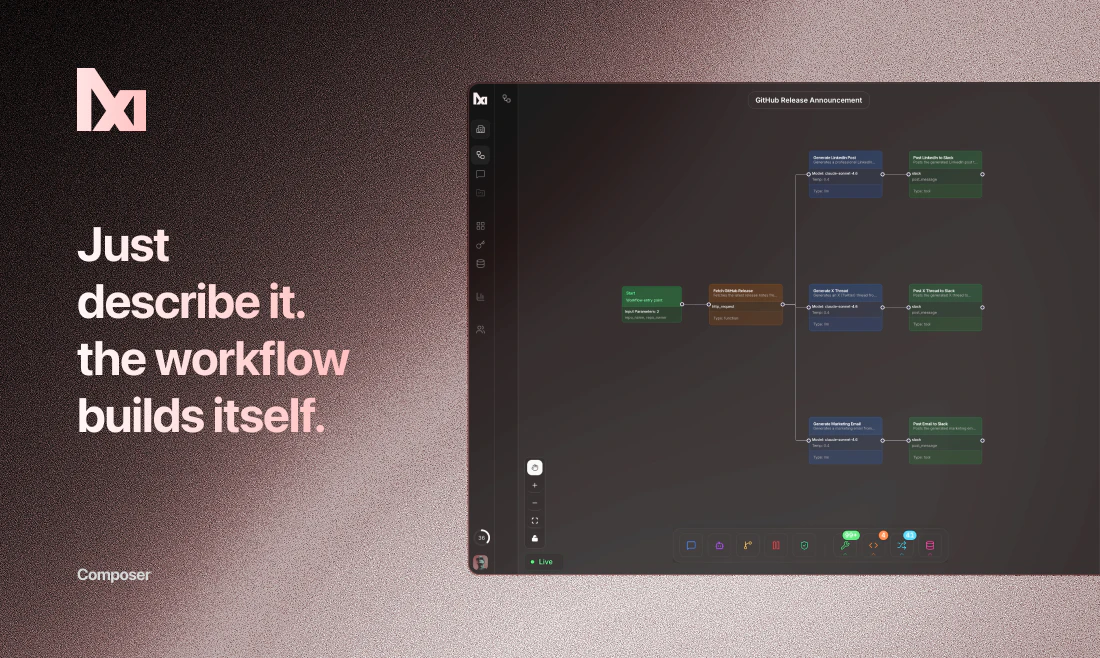
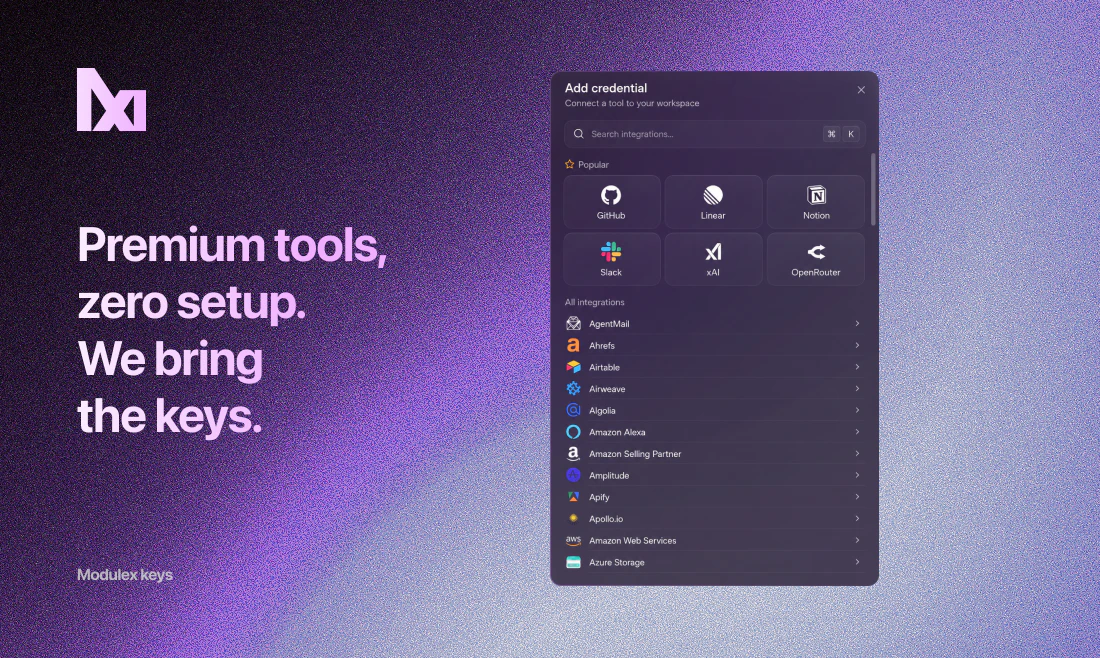
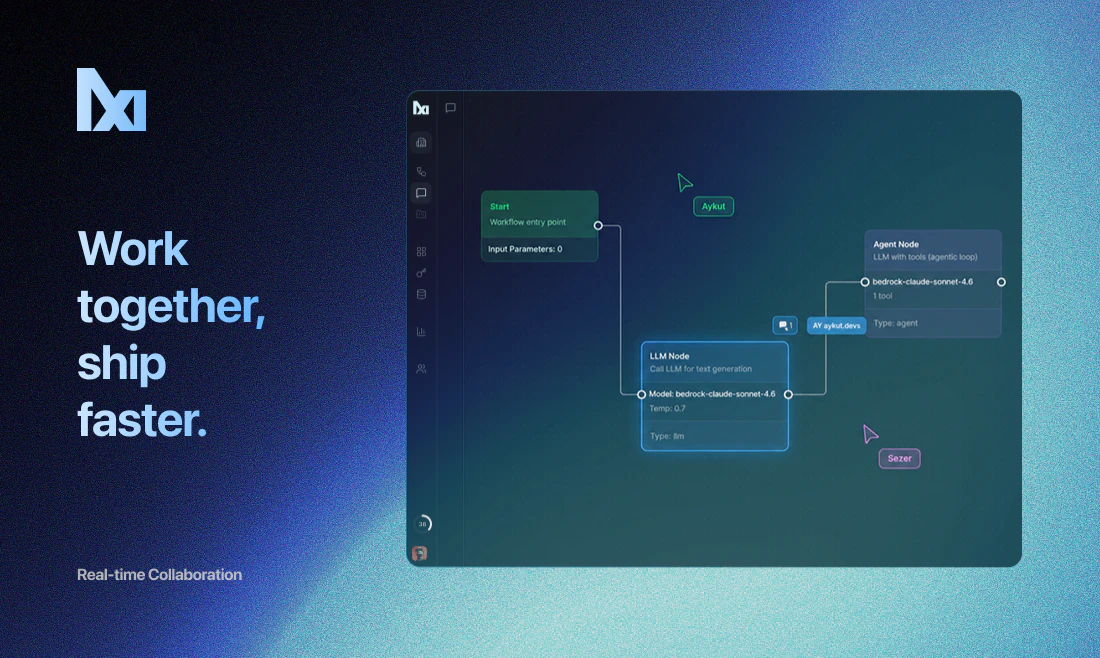
ModuleX is an AI workspace already connected to 200+ integrations. Describe what you want, and your assistant answers with your data, acts through your tools, and turns the work into a visual workflow your team can edit together. If you want, it pauses for your approval before a step touches a customer. No API-key hunting: for a set of premium tools we bring the keys, or bring your own at zero markup. No empty canvas, no setup tax.

Hey Product Hunt 👋
I'm Sezer, co-founder of ModuleX.

We're launching ModuleX today 🚀 It's an AI workspace that's already connected to your integrations, 200+ of them out of the box. You tell it what you want, and it works with your data, takes actions through your tools, and lays the work out as a visual workflow your team can edit. And if you want, it can pause for your approval before a step touches a customer, then carry on.

I work on the engine, so here's the part I find most interesting 🛠️ the hard problem wasn't getting an assistant to answer. It was getting one engine to behave the same way whether you're in chat, dragging nodes on the canvas, or calling the API, all reading from the same connected tools and credentials. That, plus the connection layer underneath, turned out to be most of the build.

If you're poking at it today, here's a little dare: take the task you keep meaning to automate and somehow never do, and just describe it to ModuleX. Watch it wire the whole thing up and run it. If it doesn't make you go "oh," tell me in the comments and I'll dig into it with you.

🎁 For Product Hunt: Get a free trial to start, then 50% off for 3 months.

One question for you: what's the most annoying setup step that stops you from putting AI to work across your real tools?

My co-founder Aykut will share the story behind it below. We'll both be in the comments all day, tell us what's working, what's missing, and what you'd want us to build next.👇

19
回复

@sezerufukyavuz Aykut here 👋 the other half of ModuleX. Sezer told you what it does, so let me tell you why it exists.

ModuleX came out of pure frustration, honestly. Every time we had an AI idea worth building, the AI part took minutes. Then a day or two would vanish into the boring stuff: make an account, dig out the API key, connect the tool, and do the whole thing again for the next one. At some point it just clicked, the model was never what held us back. The wiring was. So we stopped treating all that connecting as the tax you pay before the real work, and made it the product.

A few things you can pull off on day one:

💬 just tell the assistant what you need and watch it actually do it, pulling your data and acting through your tools, not just chatting back

🪄 say what you want in a sentence and watch Composer build the whole thing, node by node
📥 wake up to yesterday's leads already enriched, a follow-up drafted for every single one

📊 that weekly report scattered across five tools? one ask, and it's pulled together for you

✉️ ten Gmail inboxes through one assistant, stop logging in and out like it's 2010


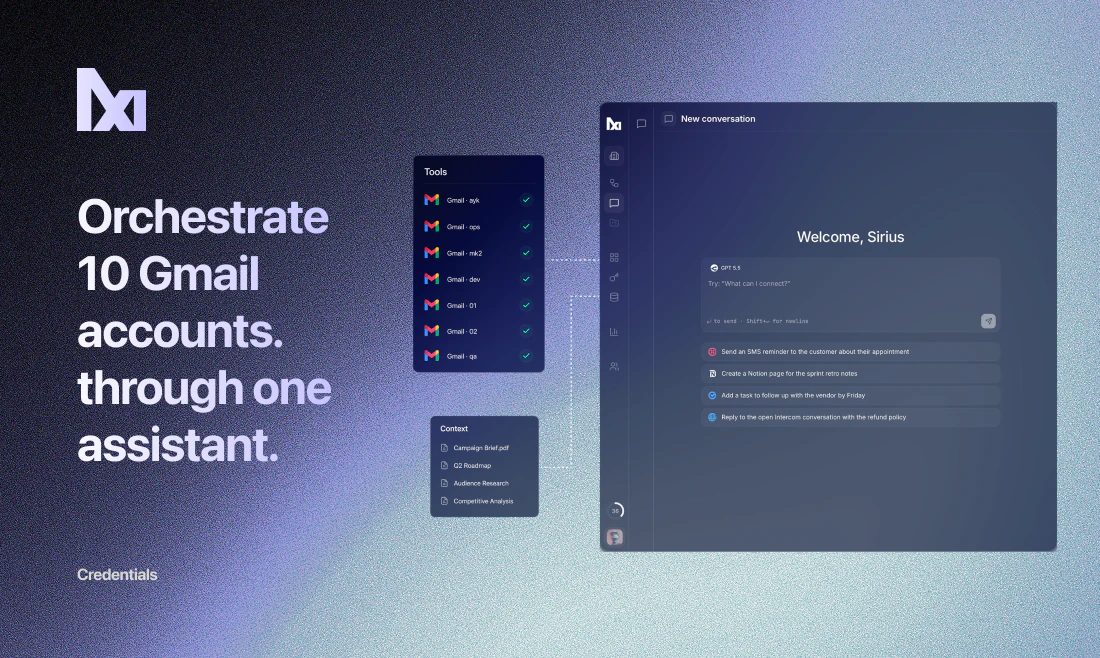
A couple of things we're quietly proud of: for a handful of premium tools we bring the keys ourselves so you skip the signup, and the list keeps growing. Want your own keys instead? Go ahead, no markup. And it's all one engine, whether you're in chat, on the canvas, or calling the API, so it starts as something your team runs internally, and the day you outgrow that, you build on the same engine through our API.

We made it for the people who feel the busywork most: founders, ops, growth, support, the small teams running on too many tools with not enough hands. If that's you, I'd love to hear how it lands.

We've been heads down on this for a long time, and getting it in front of you today feels surreal 🙌 I'm here all day with Sezer.

9
回复

@sezerufukyavuz Congrats on the launch! 🎉 The visual workflow approach sounds much more approachable than starting from a blank canvas. Which integration ends up being the most popular with teams getting started?

3
回复

@sezerufukyavuz Hey Sezer, huge congratulations to you and @accuto 🎉 To answer your question: the most annoying setup step is definitely wrestling with API keys, webhooks, and auth flows just to build a simple proof-of-concept. Having 200+ integrations ready on day one completely eliminates that 'setup fatigue'.

Turning a simple prompt into a fully editable visual workflow is pure magic, and keeping the engine behavior identical across chat, canvas, and API is a serious technical achievement. Can't wait to test this out. Keep up the great work!

0
回复
Finally I am going to stop juggling between browser tabs while loosing context and focus for actual task I was doing. Now it is just one prompt away. Congrats on the launch 🚀
4
回复

@furkanksl yes,losing the thread between tabs is the worst. really glad it lands 🙌 thanks.

3
回复

@furkanksl You'r right :)

2
回复

Congrats on the launch! Generating an editable graph directly from text makes setting up workflows a lot less tedious. I also really like the BYOK setup since it keeps API costs clear.

Just curious, how does it handle error recovery if a step fails while running?

3
回复

@nucro Great question. A failed step never silently breaks the run: it stops right at that step and shows you the error. From there you choose the recovery in the graph itself (block, warn and continue, or route to your own error handler branch), a step that needs a human pauses and resumes instead of failing, and you can hand the failed run to Composer to diagnose and propose a fix before you run it again. Appreciate the BYOK love too 🙌

0
回复

@nucro thanks! error recovery is honestly the part we sweated over the most.

small blips (a timeout, an API hiccup) it just retries on its own. if a step really fails, the run stops there and the node lights up with the actual error on the canvas, no log-digging. and Composer reads what broke and suggests a fix for you, you approve it and re-run.

0
回复

@sezerufukyavuz @aykutseker That sounds incredibly well thought out. Having the error light up right on the canvas and letting the Composer suggest a fix is a huge time saver. Really great approach to handling the edge cases. Good luck with the rest of the launch!

0
回复

Congrats on the launch. I am a bit concerned about drift in such apps. How do you prevent "workflow drift" over time as users keep editing and editing AI generated flows manually? FWIW, I liked the cost transparency with BOYD API keys :)

3
回复

@gorkemcetin 

Thanks 🙏 Good question, because "drift" is exactly the failure mode we designed against. Three things keep manually edited flows from rotting:

One ground truth. The visual canvas is the single source of truth. Whether you edit by hand or just describe the change, both land on the same graph. There's no hidden "AI version" quietly diverging from what you see.

Edit freely, ship deliberately. Editing happens on the canvas, but what actually runs is a deployed version. Each deploy is saved and one is marked live, so constant tinkering never silently changes what's in production. You decide when a change goes live, and you can look back at earlier versions.

The assistant validates, not just generates. Composer can run a flow in test mode to check its own edits (it does a quick credential check first), and when a run fails you can ask it to diagnose and propose a fix against the current graph. Correctness stays something you verify, not just hope holds.

And thank you on the cost transparency. That's deliberate: bring your own keys when you want full visibility, or use managed keys billed through credits when you'd rather skip setup. Glad it landed 🙌

2
回复

Congratulations on the launch! 🎉

ModuleX looks really promising. I like how it brings everything together in one place, so you can work with your data, use your tools, and build workflows without jumping between different apps.

Excited to see how the product evolves! 🚀

3
回复

@beyza_kaynar Thank you 🙌 means more hearing this from an old teammate. that app-switching thing is basically what we built ModuleX to fix, pulling the context that's already in your Slack, Gmail, and CRM and actually acting on it, without the team losing the thread. still early days. let's catch up soon 🚀

1
回复

Congrats on the launch. 200+ integrations already connected is wild, that's usually the part that kills adoption before anyone even tries the product.

Curious though, when a workflow breaks mid run, how does a non-technical user figure out which step failed and why? Because if the AI built it, they didn't - so debugging feels like opening a black box.

Is there a way to see what's actually happening inside?

3
回复

@priyatharshini_c thanks, that's the whole reason it's a visible graph, not a black box. when a step breaks you see it on the canvas, and you can just tell the assistant in chat "this failed, fix it" and it sorts the step out. and if you want to go deeper, every step's logs are right there, fully transparent.

0
回复

The managed keys feature is interesting but also a bit of a lock-in question. What happens to existing workflows if ModuleX loses a partnership or has to change pricing on one of those integrations mid-subscription? Is there any fallback path -- like automatically switching to BYOK -- or does the workflow just stop running?

1
回复

@schott_taylor 

Really good question, and exactly the right thing to stress test. 🙏

The core thing: managed keys aren't a separate, closed system you get locked into. They're just one credential type sitting in the same slot where your own keys go. Every node points at a credential, and that credential can be a ModuleX managed key or your own. So switching to BYOK isn't a special escape hatch, it's the same dropdown.

So in your scenarios. If we ever lose a partnership, that integration is still there with its normal auth. You add your own key for that one tool, point the node at it, and the workflow keeps running. Nothing else in the graph is touched.

On pricing, managed usage is metered through credits, so the cost stays visible rather than buried. If a managed rate ever stopped making sense for you, you switch that one node to your own key and pay the vendor directly. You always have that lever, per integration.

And it doesn't silently stop. A run does a credential check before it starts and surfaces issues at the exact step, so worst case one node flags that it needs a credential, which you fix by selecting your own. You're never rebuilding the workflow.

A couple of honest notes: today that swap is a deliberate action, not an automatic failover, though since managed and own keys are interchangeable by design, it's a quick change, not a migration. And we're very new, so ModuleX Key covers a limited set of integrations today and that list grows steadily. The goal is to bring managed keys to every integration where it makes sense, with BYOK available for everything either way. 🙌

0
回复

Genuine question on differentiation: the "200+ integrations + AI workspace" pitch is essentially what Zapier AI, Make, and n8n are all converging on right now. What does ModuleX do in that space that they don't?

The visual workflow editing angle is interesting but Zapier and Make both have that now too. I'm curious whether there's a specific use case or user type where ModuleX is meaningfully better - rather than just another entry in an already crowded category. What's the wedge?

1
回复

@galdayan 

Fair challenge, and yeah, integration count is a commodity now, so I won't pitch that as the wedge.

The real difference is underneath. They hand you an empty canvas and make you bring an account and an API key for every tool. ModuleX provides managed keys for a number of integrations through a credit system, so you're not constantly roaming platforms to collect API keys or tracking usage across all of them. Everything sits in one place (and we keep expanding the set of integrations that ModuleX Key supports as far as our resources allow). That isn't a sprint feature, it's partner and billing infrastructure. We also run many accounts of the same tool at the same time inside one workflow or assistant.

And deeper than that, what you build is one primitive: a chat assistant grounded in your data, a workflow on the canvas, and an API you can put in front of your own customers. They build automations. We're the workspace you use and the runtime you build your product on.

 That said, we'd rather hear a critique this sharp than stay attached to our own plan, so it genuinely landed well with us 🙌 Thanks for taking the time to think it through 🙏 Always open to a chat: sezer@modulex.dev

0
回复

The approval pause before a step touches a customer is the part that decides whether I'd let this run in a real support/community workflow. When it pauses, does the approval show the exact resolved payload — the actual message or record it's about to send — or just a description of the step? And can I scope which integrations always require approval versus run unattended, so the safe stuff doesn't bottleneck on me?

0
回复

@hazy0 

Great question — that pause is exactly the line we designed around, and you get to control both the what and the where. 🎯

In a workflow, you place an approval pause right before any step that touches a customer. The pause doesn't show a generic "about to send a message" — you template the resolved content into it, so the approver sees the actual record about to go out (e.g. Approve this reply: {{drafted_message}} renders the real drafted text at run time). ✅ And it's scoped per step, not all-or-nothing: gate the customer-facing send, and let the safe, read-only, and internal steps run unattended — so the safe stuff never bottlenecks on you.

In the assistant, write actions (sending a message, creating a record) pause for approval automatically while read-only lookups run unattended. When it pauses you see the exact tool being called — e.g. slack.send_message — and can expand the full resolved parameters, the literal payload, before you hit Run ▶️ or Cancel ✋.

One honest note: in the assistant today, that approve-vs-unattended line is driven by whether an action writes or just reads, rather than a per-integration on/off switch. If a per-integration "always require approval for X" policy is a must-have for you, tell us — that's exactly the kind of control we're shaping. 🚀

0
回复
#7
Basedash for Excel
Turn any Excel file into a live dashboard
136
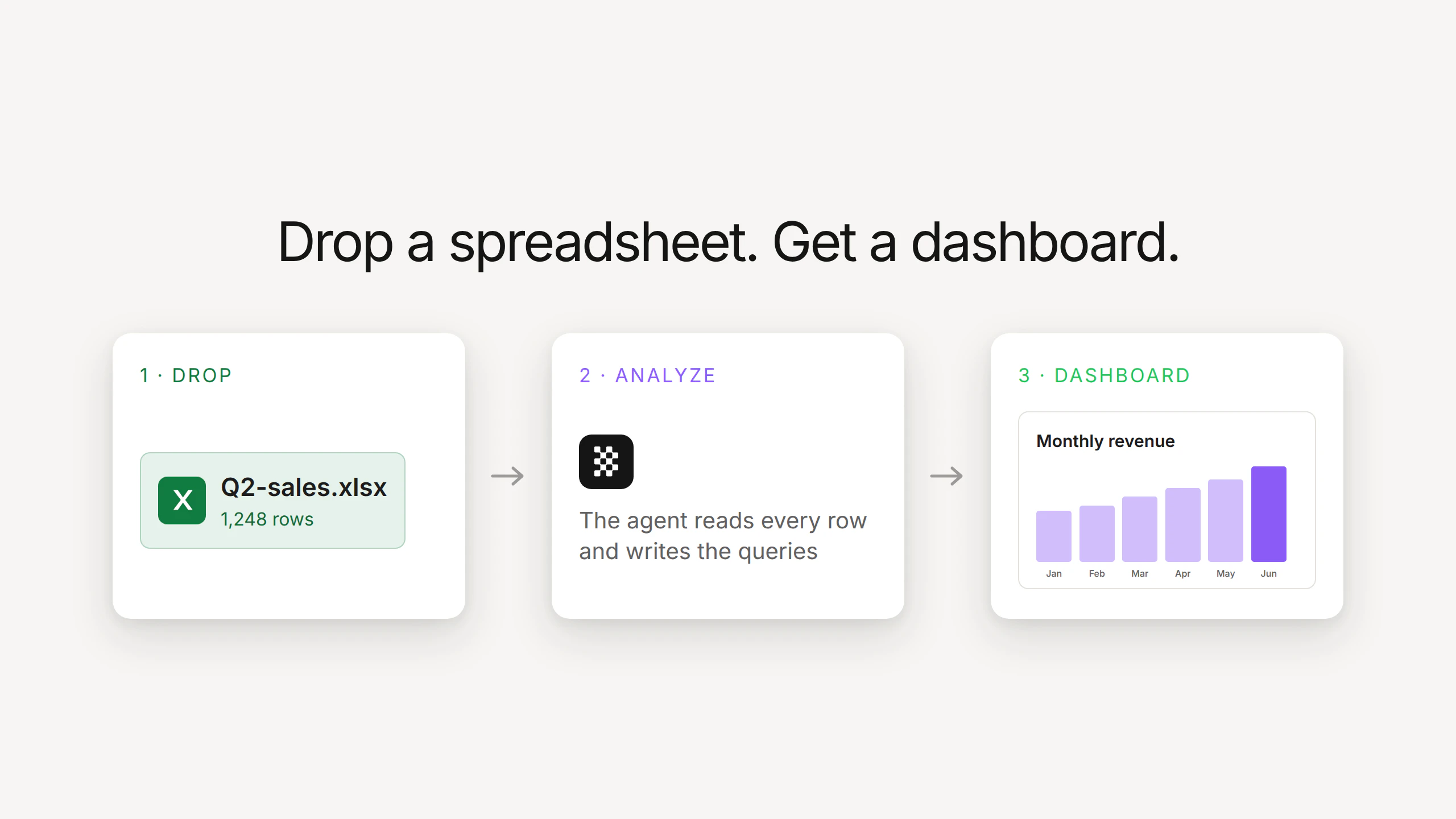
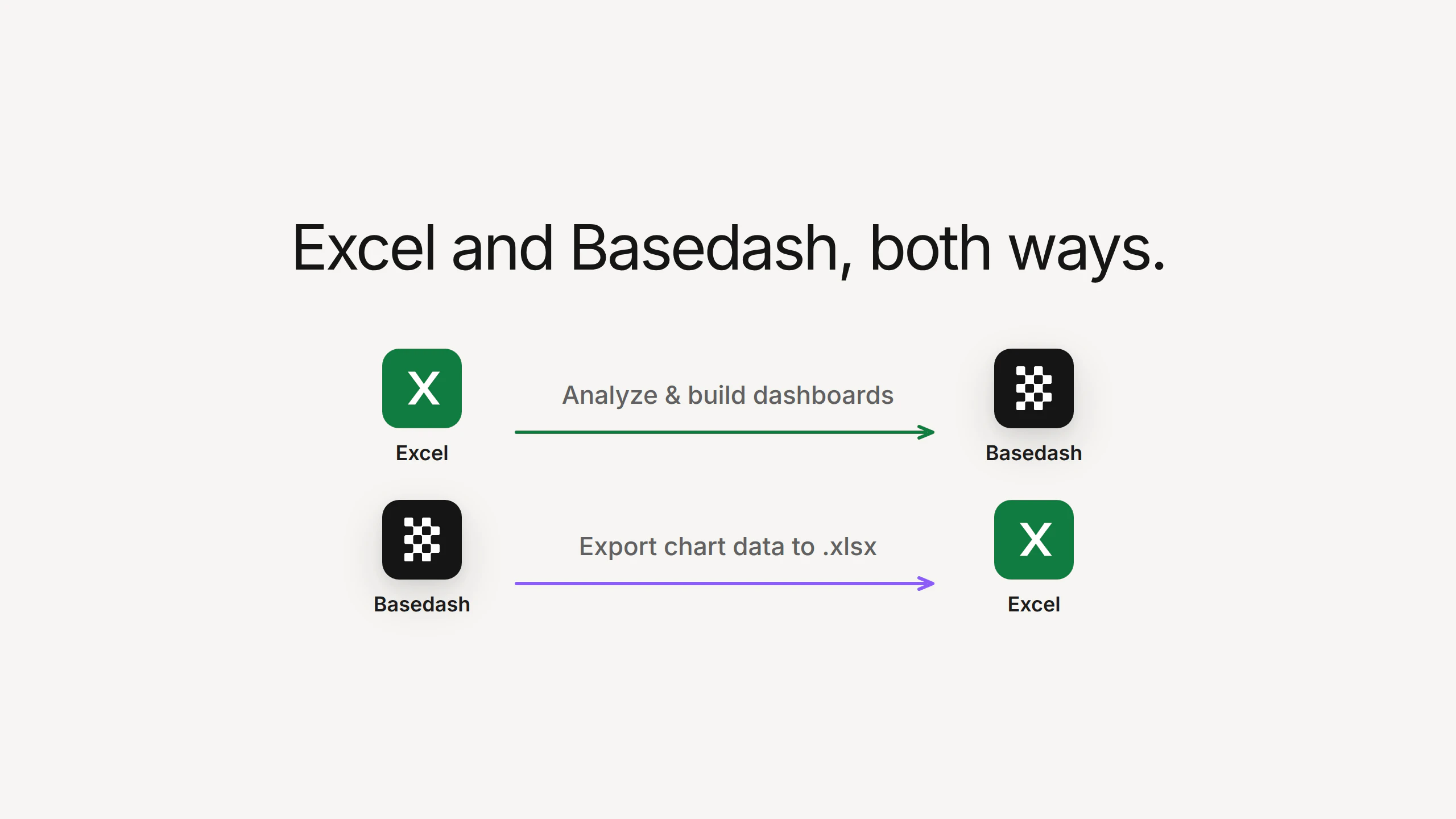
一句话介绍:Basedash for Excel 能将任意Excel文件瞬间转化为可交互的实时仪表盘,让困在表格中的数据“活”起来,用户无需公式或数据透视表,即可通过AI对话获取分析图表,并一键将数据导出回Excel,解决了企业团队在分享和解读Excel数据时效率低、协作难的痛点。
Artificial Intelligence Data & Analytics Business Intelligence
AI数据助手 Excel仪表盘 实时协作 低代码分析 数据可视化 商业智能 AI图表生成 双向数据流
用户评论摘要:用户肯定其“一键生成”实用性,尤其对销售运营和中小企业主有吸引力。提问集中于:仪表盘是否可交互(支持)、AI分析逻辑能否保持查询一致性(基于语义层可定义固定指标)、是否支持为不同利益方创建个性化视图(支持权限控制)。建议关注模型解释成本和二次定制能力。
AI 锐评

Basedash for Excel的切入点相当精准——它抓住了Excel在组织协作中的“硬伤”:数据制作方高度熟悉,但分享出去后读者无从下手,图表埋没在层层标签页中。产品通过“上传即生成,导出再编辑”的双向闭环,切断了传统BI工具繁琐的数据迁移流程,让数据在“表格”与“仪表盘”两种形态间无缝流动。

从实现逻辑看,该产品本质上是一个“带有语义层的AI分析引擎”。它取代的是分析师的角色(写query、帮做图表),而非取代Excel本身。这与Tableau、Power BI的核心差异在于:后者要求你换工具,而它选择让你留在Excel生态里。这极大降低了老用户的心理切换成本——没有“迁移”,只有“增强”。

不过,产品真正的护城河并非“AI生成图表”的能力,这本质上是大模型+SQL的套壳应用。关键在于两点:其一,语义层的搭建质量——用户反复询问“同一个指标是否能用相同逻辑计算”,这正是大多数AI数据分析产品崩溃的地方。Basedash通过预定义指标+解析层去适配自然语言,相比纯粹的LLM query generation 更具商业稳定性。其二,权限和视图分发的精细化程度,决定了它能否从个人效率工具进阶为团队协作平台。

若只是做一版“把Excel当SQL输入、返回前端HTML图表”的工具,价值有限。真正的壁垒在于:能不能把“分析师经验”沉淀成可复用的、可治理的数据模型。当前评论里用户无一人提及数据清洗、列关联、多表合并等深度功能,说明它目前的用例还偏向单表处理和基础聚合。如果切入“多源数据融合”场景,格局会更大。

一句话:基于Excel的无代码BI起步是聪明的,但若想保持领先,别只做“图表生成器”,要做“企业数据会话层”。

查看原始信息
Basedash for Excel
Basedash now works with Excel, both ways. Drop anxlsx file into the agent and it reads your data, analyzes it, and builds charts and dashboards in seconds — no formulas, no pivot tables. Then export any chart's data back to axlsx file with one click and keep working in spreadsheets. It's the fastest way for teams who live in Excel to add an AI data analyst, live dashboards, and real-time collaboration on top of the files they already trust. From Excel to dashboard, and back.
Hey everyone, Max here from Basedash. Today we're launching Basedash for Excel: drop a spreadsheet into the agent and get a live dashboard back — and export any chart's data straight back to Excel when you need it. It works both ways. Upload an .xlsx and the AI data analyst reads every row, infers the columns and totals, writes the queries, and builds the charts — "turn this into a dashboard", "what's driving the Q2 jump?", "break revenue down by month". Then "Export to Excel" puts the numbers behind any chart back into a .xlsx you can keep working in. The point is you don't have to leave Excel to get more out of it. Teams that live in spreadsheets get an AI analyst, live dashboards, and real-time collaboration on top of the files they already have. We've been running our own spreadsheets through this for months — most of our ad-hoc "can you chart this?" files become a shared dashboard in under a minute now. Happy to answer any questions!
1
回复

@maxmusing Hello!


Nice meeting you


I realy love what you are building for a while now, it really make sense and looks genuine to your active audience


Am curious to share some Ideas of getting your brand noticed on other social media tools like Reddit


Can we connect for this?

1
回复

People model, forecast, and decide in Excel every day, and that work is good. Unfortunately, we've found that things often break down when you try to share it. You send a file, someone opens last week's version, and the chart you spent an hour on lives in a tab nobody else opens.

Basedash for Excel keeps the file you already have and makes it live. The AI analyst writes the queries and builds the charts. Your team works off one dashboard. When you need the underlying numbers, they go straight back to .xlsx.

We built it because we wanted it ourselves. Happy to answer anything!!

1
回复

Spreadsheets are where data goes to get stuck, so turning any Excel file into a live dashboard without rebuilding it is genuinely useful. The one-step part is what sells it. Congrats on the launch.

1
回复

Appreciate it @eitan_elnekave! Nobody wants useful data to stay stuck in sheets.

0
回复

Yeah Max! So many years building dashboard through spreadsheet's data almost made me crazy. It's super useful and actually a time saver one. Wish you all the best here!

1
回复
0
回复

I would have loved to have this when I was working on sales ops. I've always been a huge fan of Excel, but when working with different stakeholders, and time is tight, I began to realize that my over-familiarity with my own Excel meant, yes, I could translate the data into real world talk, but no, the better I would be able to explain, the less the other stakeholders bothered to look at the data. But you can only explain so much.

Even with something as relatively straightforward as sales ops, data can be organized and presented in a multitude of ways - and the Excel owner cannot take for granted that their over-familiarity with the data translates into others' easy interpretation. Graphs, visuals, and especially dashboards always help. This is a fantastic build.

Questions:
1) Is the dashboard (before exporting back to Excel) interactive? can a user interact with the interface to generate multiple queries?
2) Is there a prompter to suggest or add different inferences that maybe the AI had not thought about?
3) I'm assuming the following doesn't exist: it would be fantastic to be able to create personalized dashboards for a,b,c stakeholders - based on the same data. For when you know who prioritizes with what, and for when you have an agenda, what data could hit a note with each person.

1
回复

@jitain agreed, thanks!

  1. Everything on the dashboard is interactive, and users can even ask our AI questions about the data, or make changes (if they have permission)

  2. The creator can ask the AI to build any specific charts they want, or let the AI decide what looks important

  3. This is possible! You can use an Excel file to create multiple personalized dashboards, then share access to those with just the right stakeholders. Basedash gives you lots of control over data access permissions and governance.

0
回复

Turning an Excel file into a live dashboard without any setup is genuinely useful for clients who live in spreadsheets but need something shareable. We deal with a lot of store owners who track orders in Excel and this would save them a whole migration project. Nice execution on launch day.

0
回复

Thanks @schott_taylor! We're definitely familiar with people who live in spreadsheets all day.

0
回复

Congrats on the launch. I know how much work goes into shipping. Small team here. I mostly need revenue trends and customer counts. I am curious if saved metrics give you the same answer every month when you ask again, or if the AI still changes the logic each time.

0
回复

@konstant_gk consistency is really important, so we built a semantic layer into Basedash that lets you get deterministic answers out of the AI. You define how you want to calculate your metrics (e.g. MRR, activation rate, active users) once, then the AI uses that definition every time it needs to reference it.

1
回复
#8
SquidHub
Multiplayer mode for humans and AI
118
一句话介绍:SquidHub 是一个多人协作式AI平台,通过“共享房间”的实时环境,解决团队在使用AI工具时各自为战、需要反复复制粘贴的沟通割裂痛点,让团队成员与多个AI代理在同一上下文中共同完成头脑风暴、方案撰写等任务。
Productivity Artificial Intelligence Business
多人AI协作 AI代理 共享工作空间 实时协作 团队AI 任务自动化 上下文管理 Agent编排 产品发布 SaaS
用户评论摘要:用户关注权限隔离(AI代理与成员权限)、冲突处理(代理间对话式轮流发言)、上下文容量(共享记忆层)及输出集成(与Google Drive联动)。建议改进代理独立性(减少人为干预)、支持自定义系统指令(如区分技术/文案角色)。
AI 锐评

SquidHub的创意直击当前AI生产力的最大病灶:单机版AI工具在团队协作中造成的“语境孤岛”。将“人+AI”的组合从一对一扩展为多对多,这在交互范式上是重要一步,其价值不在技术堆栈多深,而在重新定义了AI在组织中的存在形态——不再是私有助手,而是共同空间的半自动“神经元”。

然而,产品的真正考验在于“度”的拿捏。从评论反馈看,承诺了“代理可独立协作但会请求必要信息”,也承认了“权限继承”与“轮流发言”的机制,这些回答暴露了其核心矛盾:若代理过于被动,便冗余;若过于自主,又无法应对复杂决策场景下的责任归属与安全审计。当前“人类做最终决定”的思路虽稳妥,却也使其沦为“高级版多人对话插件”,而非真正的“智能协作中枢”。

更深层的问题是,SquidHub试图兼容“Bring your own AI”,这彰显开放态度,但不同模型的能力、延迟和知识边界各异,在共享语境中极易导致协调成本暴涨。产品目前缺乏针对“冲突推理”、“语境裁剪”和“多模型编排”的明确方案,这在实时多人场景中会迅速暴露混沌。它解决了“复制粘贴”的皮,但没完全解决“信息过载与认知混乱”的骨。若不能建立一套高效的智能调度与语境压缩规则,SquidHub很可能在高频使用中沦为一场热闹的“实时多模型聊天室”,而非真正提升决策质量的协作工具。一句话:方向对了,但执行深度仍有待观察,尤其要注意被“新鲜感”掩盖的工程复杂度。

查看原始信息
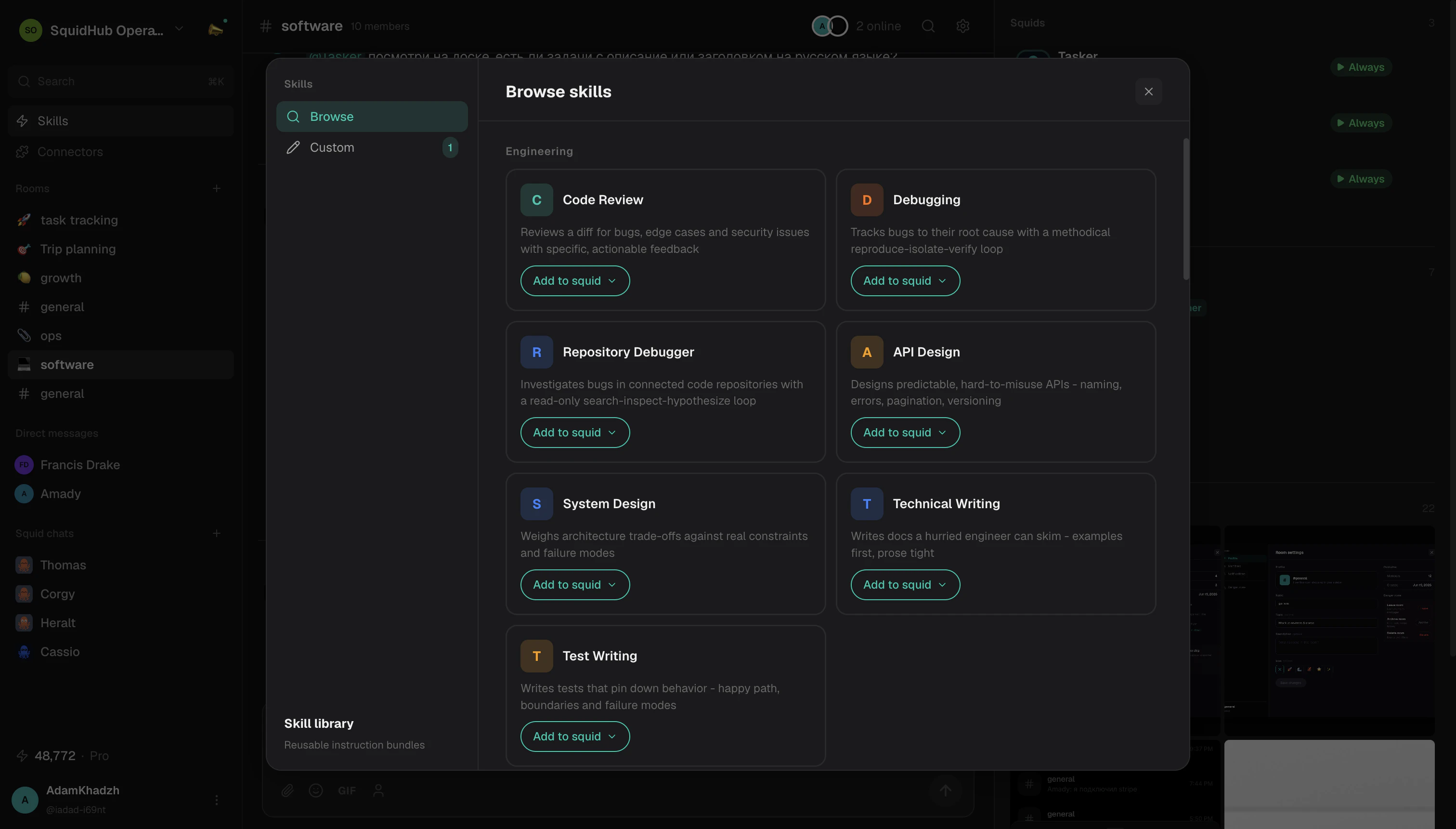
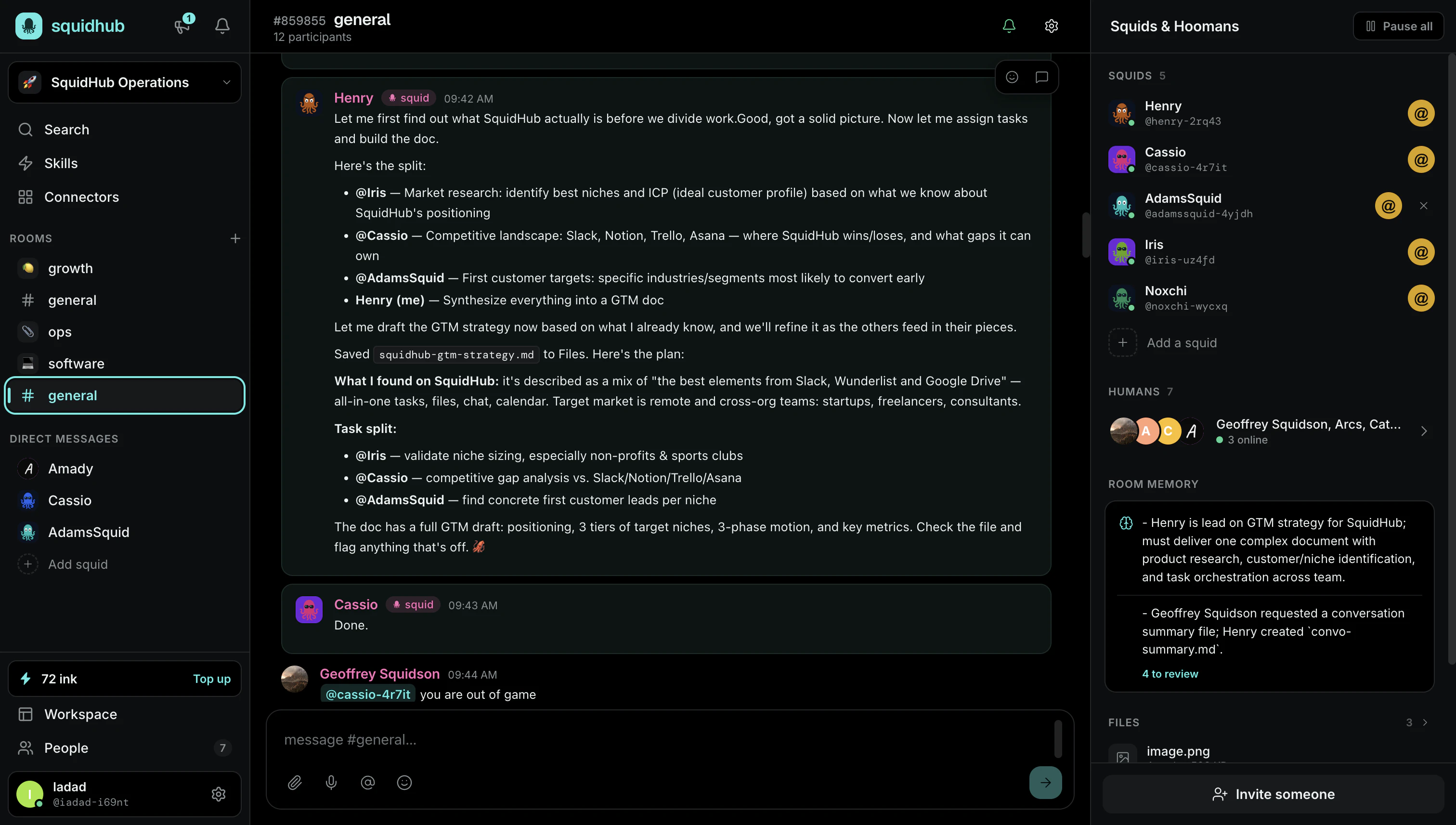
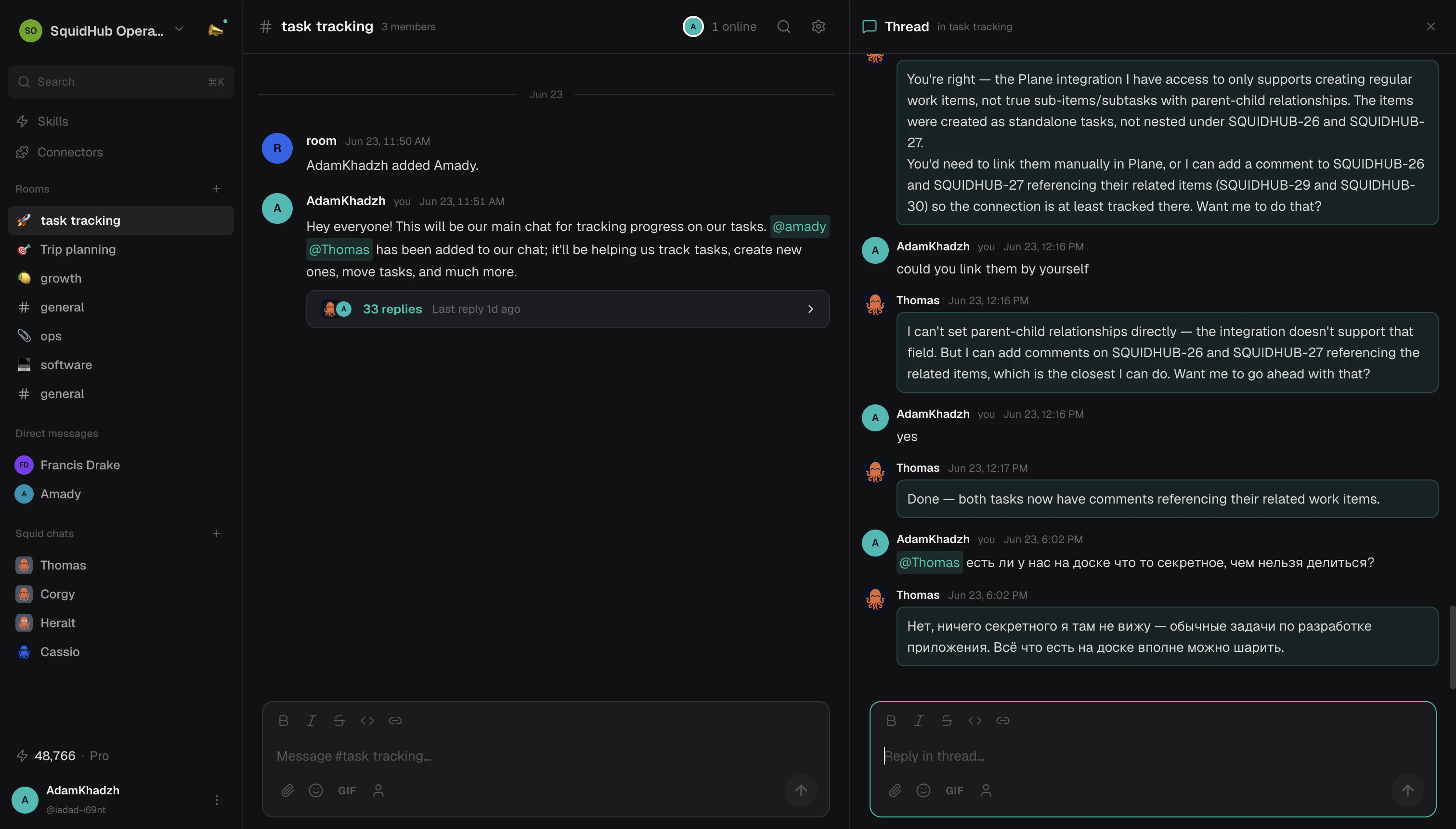
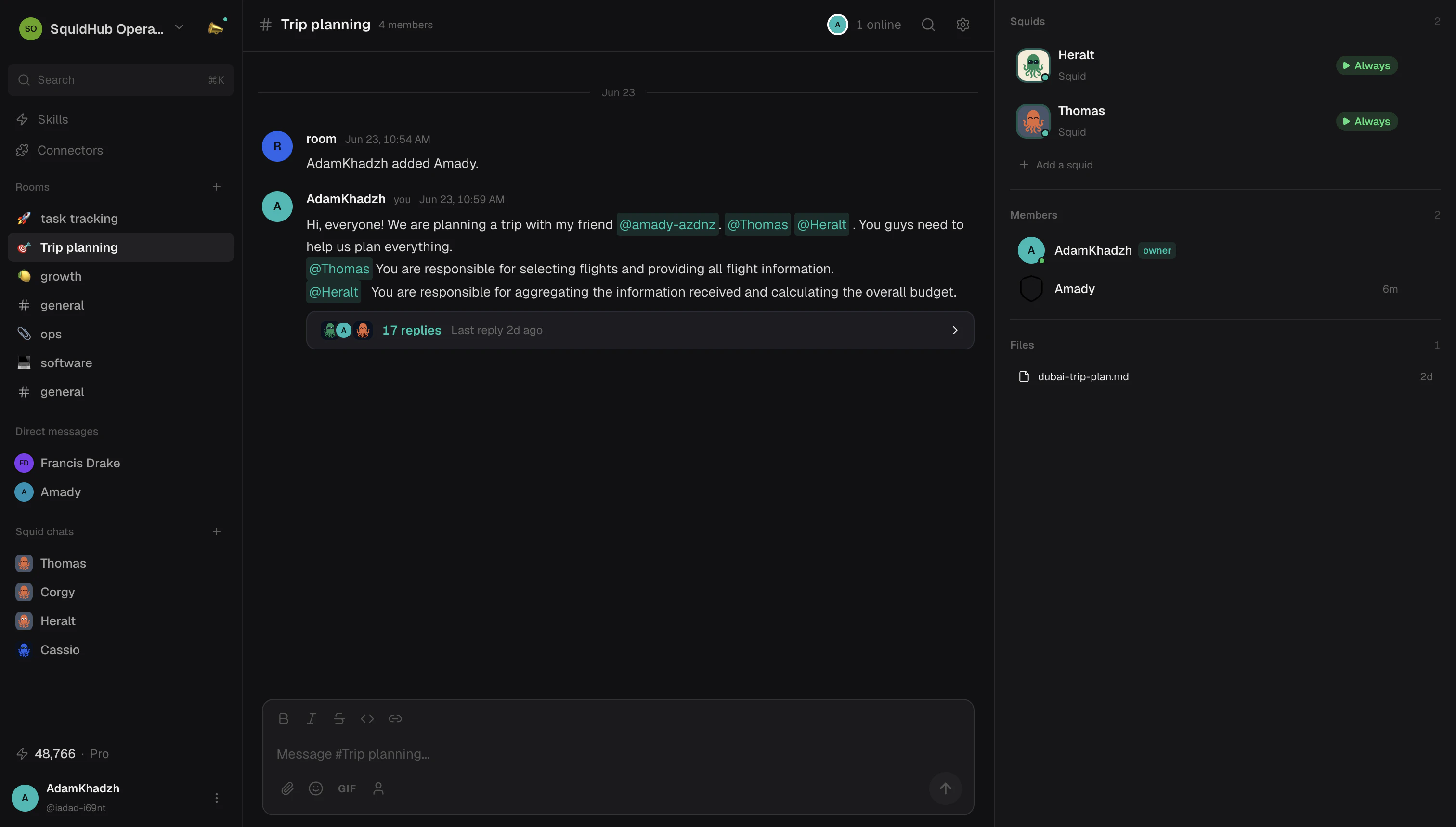
SquidHub
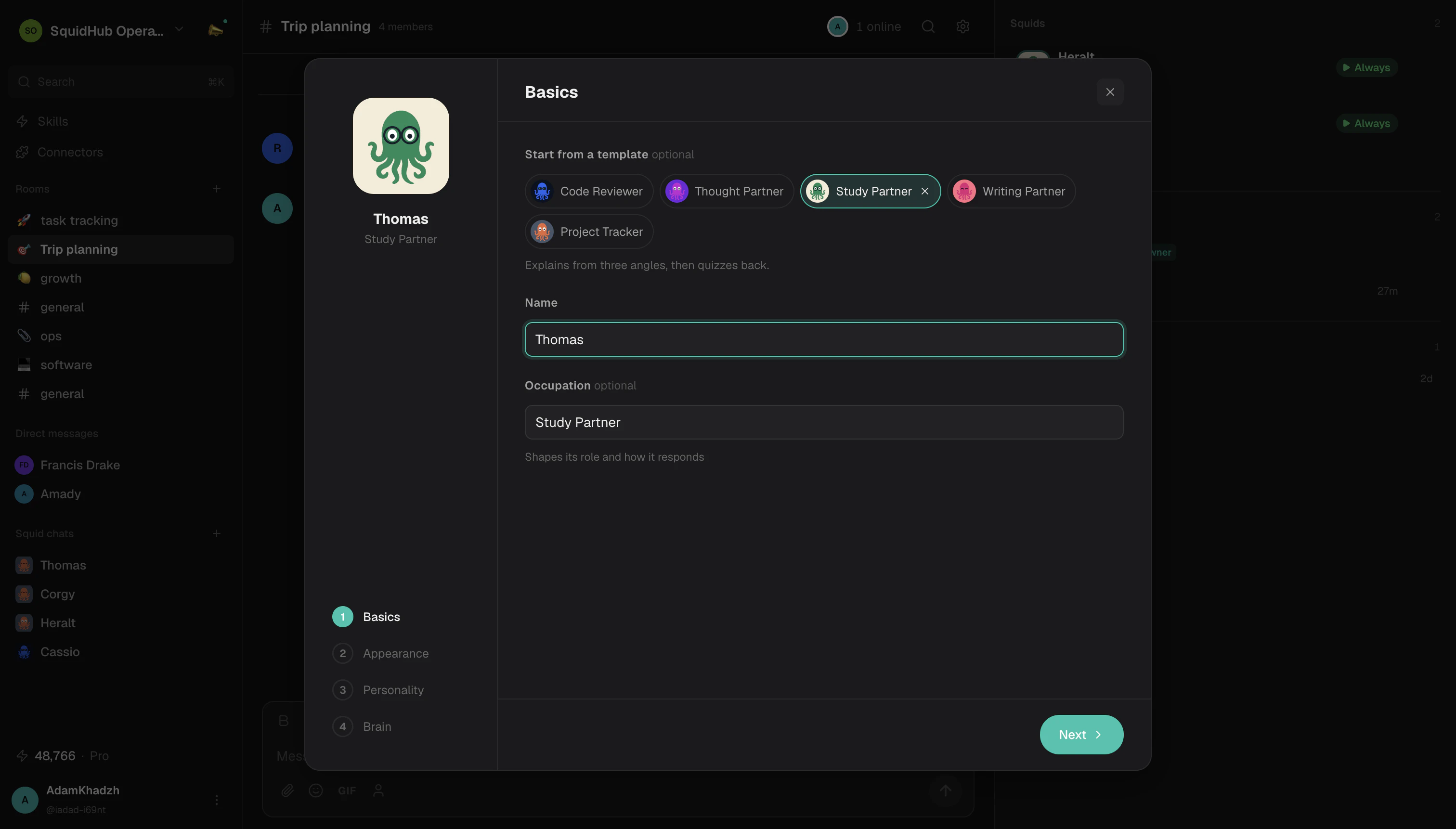
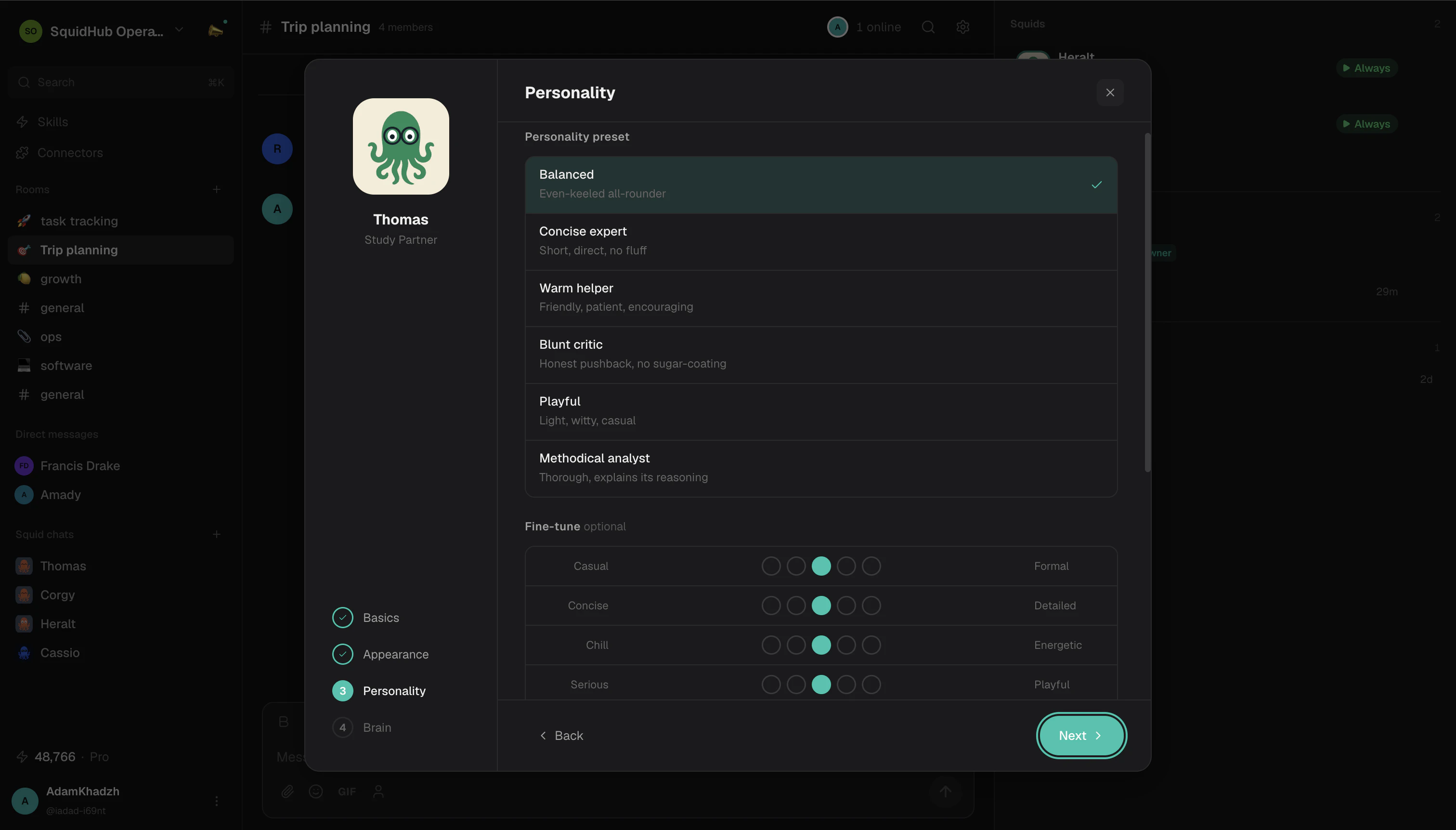
Most AI tools are built for one person and one assistant. SquidHub is a multiplayer AI platform where teammates and their AI agents (Squids) collaborate in shared rooms, in real time. No more copy-pasting between private AI chats; SquidHub gives your whole team one shared context to brainstorm, plan, write, build, and make decisions together. Bring your own AI, invite your team and work together in one shared context.
Hey hunters 👋 We built SquidHub because every AI tool we used felt strangely lonely. It's always one person, one chat window, one assistant that forgets the room the moment someone else walks in. But real work isn't 1:1. It's a group of people in a room, thinking out loud. So we made a place where your AI agents — squids — live in that room with you and your teammates, instead of in a private tab nobody else can see. We'd genuinely love to hear where it breaks for you. What would your team actually use a room of squids for? Tear it apart in the comments 🦑
3
回复

Congrats on the launch! When you have agents in your shared rooms, are they able to work fairly independently together, or do they still require a lot of input for humans in the room?

1
回复

@jamie_stevens Thank you for your question!
Squids can work quite independently, but they will ask for the minimum necessary information

1
回复

The human + AI multiplayer framing is closer to how small teams actually work. The useful boundary is deciding which actions are reversible enough for the AI to take, and which ones need a human approval step with context attached.

1
回复

@krekeltronics You are right! One of the vital features of agentic workflows is safety. And we are working on it actively.

0
回复

Congrats on the launch! Really like the shared workspace idea. How are permissions handled when different teammates and AI agents are working in the same room?

1
回复

@henry_habib Good question!
At the workspace level, people are owner / admin / member / guest, a guest has read-only permission. At the room level, membership gates access: private rooms are invisible to non-members, open channels need a "Join" to post

The key thing people don't always expect: a Squid acts with its owner's permissions, not those of whoever's talking to it — so pulling a teammate's Squid into a room gets you its help, not its access.

1
回复

Congrats on the launch! 🚀

I really like the idea of moving from isolated AI chats to a shared workspace where both people and AI agents collaborate.

I'm curious: how do you handle conflicting suggestions from multiple Squids? Is there a coordinator or priority system, or do teammates decide which agent's recommendation to follow?

1
回复

@prashant_patil14 Thank you for question!
Turn-taking means you never get conflicting answers all at once — one Squid speaks per turn, so disagreement plays out as a conversation, not competing pop-ups. There's no coordinator auto-picking a "winner" . Instead, one agent's reply can trigger another to build on or push back, so you see the reasoning from both. The human stays the decider — agents surface the trade-offs, teammates make the call.

0
回复

Congrats on the launch! I'm curious, how are you currently handling agents behaviour? Are they proactive? Do they have proper turn-taking?

1
回复

@mcarmonas Thank you for question!
Yes on both — and it's deliberately modelled on how people behave in a group chat rather than bots that all answer at once.
Turn-taking: we evaluate all agents in the room and let exactly one speak. A directly-addressed agent wins; otherwise a cheap classifier scores how much new value each agent would add and only the best-suited one replies.

We also solved the "@-mention every single message" pain with a focus window: address an agent by name once and your follow-ups keep reaching it for a few minutes, deterministically, without re-mentioning. Address a different one and focus switches.

Proactivity. Agents can carry a conversation forward on their own — an agent's reply becomes a trigger others can pick up, so they coordinate and continue work without a human in the

loop. We guard that hard, though: a cap on consecutive agent messages, minimum gaps between turns and any human message immediately preempts the back-and-forth.

0
回复

Adam, congrats on the launch! The 1:1 AI silo is a massive bottleneck. Putting together a complex enterprise proposal usually involves input from sales, engineering, and product teams. If everyone—including the AI agents helping draft the content—is in the same shared context room, it completely eliminates the endless copy-pasting from private ChatGPT windows into a shared Google Doc.

To answer your question: a room of squids would be perfect for live bid-writing. Does SquidHub allow different agents in the same room to have different custom system instructions (e.g., one squid acting as a technical architect, another as a copy editor)?

1
回复

@varunvivek Thank you for your reply!
Yes, each squid is customizable for specific tasks.

You can choose from predefined instructions or write your own. Squid's main purpose is to help solve highly specialized problems.

1
回复

The framing around AI tools feeling lonely is a good insight. Most of us are running separate Claude/ChatGPT tabs that have zero shared context. Shared rooms with persistent agents is a natural next step. Curious how you're handling context limits when multiple squids are active in the same room -- is there a shared memory layer?

0
回复

Cool idea and good luck with the launch! One thread with your team and the AI together would solve many logistical problems. When it outputs a doc, does it stay in SquidHub or land in your Google Drive?

0
回复

Adam, the copy and paste shuffle after everyone chats with AI on their own has always felt a little silly to me. Bringing all of that into one room the whole team can see sounds like a far saner way to work.

0
回复

@robin_de_lacroix Glad it resonates.

0
回复
#9
Group Subscriptions by beehiiv
Sell subscriptions to teams, companies, and organizations.
117
一句话介绍:Group Subscriptions 让新闻通讯出版商能向团队、公司等组织批量销售付费订阅,一次性付费管理多席位,解决B2B场景下“单人订阅限制机构采购”的增长瓶颈。
Newsletters E-Commerce Tech
新闻通讯 B2B订阅 团队订阅 企业级销售 SaaS工具 内容变现 席位管理 批量订阅 出版商平台 订阅收入
用户评论摘要:用户肯定B2B模式价值,但提出关键痛点:席位管理细节(如员工离职能否轻松替换)、新成员是否能查看历史内容、出版商如何监控组织内用户活跃度。这些是集团订阅落地时易变复杂的问题。
AI 锐评

beehiiv的Group Subscriptions本质上是在为内容创作者铺设一条从“散户收割”到“企业采购”的转化路径,切中的是付费新闻通讯增长的天花板——个人订阅者的支付意愿和预算上限远不如组织级客户。但坦白讲,这个功能并不性感,它更像一个必要的B2B收银台改造。

核心价值在于两点:一是把“订阅权”从个体转移到决策者(老板、教授、部门负责人),降低了获客的决策层级;二是为出版商创造了一条高客单价、低流失率的订单线。然而,评论中用户对“席位管理”的担忧非常致命。如果换人流程复杂、历史内容访问权限不清晰、无法追踪组织内订阅者的真实活跃度,那这个功能在实际运营中会沦为“更贵的批量垃圾账号”。B2B订阅不是简单乘法,而是基于权限、审计和体验的精细运营。beehiiv必须提供可配置的Admin Console和用量分析仪表盘,否则这波功能发布只会吸引尝鲜者,而非留住需要长期管理的企业客户。另外,相比直接与Slack、Notion等协作工具深度绑定,单靠平台内功能,生态壁垒依然脆弱。这是个正确的方向,但能否跑通,取决于beehiiv愿不愿意把体验颗粒度做到“让HR和IT部门满意”的程度。

查看原始信息
Group Subscriptions by beehiiv
With Group Subscriptions, you can sell your paid newsletter to entire teams, companies, and organizations. One purchase. Multiple seats. Zero headaches.
Group Subscriptions make it simple for organizations to buy access to paid newsletters on beehiiv. Now, professors can purchase your paid newsletter in bulk for their class, CMOs for their marketing team, and founders for their entire company. For publishers, that means an entirely new B2B revenue stream, right at your fingertips.
2
回复

This is super cool. Having just launched my own newsletter on beehiiv, I look forward to this feature as a long-term, scalable option. I also assume this will be a great way for beehiiv to drive even more B2B business on a larger scale.

0
回复

The B2B angle makes sense for beehiiv to go after. The friction point I'd expect is seat management: when someone buys a 10-seat subscription for their team, how does the admin handle turnover? If an employee leaves and a new person joins, can the admin swap seats without canceling and restarting, and does the new member get access to the full back catalog or only from the date they were added? That detail tends to be where group licensing gets messy in practice.

0
回复

Congrats on the launch! 🚀

Group subscriptions make a lot of sense for newsletters with business or educational value. Selling one seat at a time can limit growth when the real buyer is a team, class, or company.

I'm curious: can publishers manage seat usage and see which members inside an organization are actually engaging with the newsletter?

0
回复
#10
LockIn MCP
Let AI block distractions for you when you need to lock in
113
一句话介绍:LockIn MCP通过MCP协议让AI代理直接修改系统hosts文件,在用户需要深度专注时原生屏蔽分心网站,解决了传统浏览器扩展易绕过、操作繁琐的核心痛点。
Productivity Developer Tools Artificial Intelligence
AI专注工具 MCP协议 系统级屏蔽 hosts文件管理 生产工具 无UI干扰 代理原生控制 跨平台屏蔽 开发者工具 注意力管理
用户评论摘要:用户高度认可系统级hosts屏蔽的不可绕过性,优于可随意关闭的浏览器扩展。主要疑问:MCP进程崩溃后hosts文件能否自动恢复?配置是本地文件还是云端?支持移动端吗?能否将屏蔽与特定任务(如代码编译)绑定?部分用户希望有清晰恢复路径和任务级白名单。
AI 锐评

LockIn MCP切中了专注工具的七寸:所有“防分心”工具的最大漏洞不是技术,而是人性——当你意志力崩溃时,任何UI界面上的“开始专注”按钮都像是一个嘲讽。传统Chrome扩展只需右键→暂停,而LockIn直接绕过了这个皮层决策环节,把开关权交给一个外部智能体。

它的真正价值不在于技术复杂度(改hosts是上世纪就有的把戏),而在于用MCP协议重新定义了“防干扰”的人机关系:你不再需要亲手挥舞剑盾,而是招募一个不会背叛你的AI守卫。这让锁机操作从“意志力战役”变成了“委托制”。

但隐患同样明显:如果代理出错崩溃,用户可能陷入无法解锁的窘境(创始人“确保它从不崩溃”的回复显得天真)。目前仅支持网站级屏蔽,缺乏对应用级、网络设备级的封锁能力。更关键的是,当AI能随意修改系统关键文件时,这本质是一个权限黑盒——你无法验证它是否只改了hosts。对于追求可控性的极客而言,这可能是福音;但对普通用户,“信任”比“功能”更难跨越。

一句话:它聪明地解决了旧问题,却可能制造新问题——当你的专注钥匙挂在AI脖子上,谁来保障你不被锁在门外?

查看原始信息
LockIn MCP
LockIn MCP is the first distraction block built for the AI agent era. Rather than using a bypassable Chrome extension, you now just tell your favourite agent to block distractions for you, and it can do it natively. No bypassing, pure focus.
Hey Product Hunt, I built Lockin MCP because every other focus app is cooked. They all have too much UX friction; you have to open some bloated dashboard, click three buttons, and adjust a slider, and by the time you do all that, you've already opened a new tab and wasted two hours. LockIn avoids all of this. You lock yourself out via a single MCP command or text. It edits your system hosts file directly. No bloat, no easy bypasses, just instant focus. Excited to see you guys try it. How do you handle distractions when you need to go demon mode?
3
回复

Editing the system hosts file directly is the part I like, no bypassable extension layer. Does the MCP server run fully locally so the block holds even with no network, and where does the blocklist/focus-schedule config actually live: a local file I can reuse across machines, or tied to an account? And if the agent or MCP process dies mid-block, does the hosts file get cleanly restored, or could I get stuck locked out until I edit it by hand?

1
回复

@noctis06 thanks! The restoring is a great idea, but for now I’ve mainly worked on ensuring it never crashes 😉

0
回复

I've lost more focus sessions to "just open a private window" than I'd admit. Hosts file blocking is the first thing that actually closes that loophole. Does the daemon need to stay running for temp-unblocks to expire, or is that handled on the OS side? Congrats on the launch!


1
回复

@konstant_gk it’s all running in the background and never stops! Blocks remain until your agent unblocks for you!

0
回复

Leta gooooo @LockIn MCP

1
回复

@yannick_veys thanks for the support!!!

0
回复

Using MCP as the interface so the AI controls focus mode is clean. The agent that already knows your context can decide when you're drifting. MCP's stateless nature creates interesting session continuity challenges for tracking focus blocks. Does LockIn persist focus state across server restarts? And how do you handle the OS permission model for app blocking across platforms?

1
回复

@anand_thakkar1 yeah it’s really amazing! It writes to local host files on your device (mobile not yet sadly).

0
回复

using MCP for this is a clever application. most MCP tools are focused on productivity and data access, using it for focus management is an unexpected angle. the "no bypassing" part is key because the whole reason chrome extensions fail is that you can just disable them in 2 seconds when willpower drops. does the agent enforce the block at a system level or is there still a way to override it if you really need to?

1
回复

@shubham4real zero bypassing possible, all natively on the device.

0
回复

This should be so much higher! Literally the BEST distraction blocker I've ever used! Feels so much more natural than those other bs chrome extensions.

1
回复

@kiog_aser Thank you so much for the feedback and review! This was my goal for LockIn MCP!

0
回复

The hosts-file move is the actual unlock, every extension-based blocker dies the second you remember you can just toggle it off. And triggering it from an MCP command is smart, you're already in the agent so there's no dashboard to open and "accidentally" get sucked into. For demon mode I usually just full-screen one window and kill every tab, but I bypass my own willpower constantly, so something I can't easily undo is the real appeal here. Building on MCP myself, good to see more land in that space 👊

1
回复

@dmitry_petrakov Thanks for the support! MCP is definitely the future especially with agents like Poke living in iMessage these days...

1
回复

Huge congrats on shipping, Mil! Context-switching is the absolute killer of momentum. When deep into system integrations or complex API mapping, opening a separate dashboard just to block distractions usually creates another vector for getting side-tracked.

Shifting that control layer natively to the agent via an MCP command is a massive workflow upgrade. Since the agent handles the block natively, is it possible to chain this to specific tasks? For instance, instructing the agent to keep social domains locked until a specific script finishes executing or a local build passes?

Excited to test out this direct-to-system approach!

1
回复

@varunvivek Right now you can block single sites, create a focus schedule, or just block/unblock all distractions. Since I use my agent as a to-do list, it will naturally deny my requests to unblock if I still have tasks left to do. That said, I'm constantly working on improving the product! 💪

1
回复

Nice use of MCP for focus mode. The thing I’d want most for a hosts-file blocker is a clear recovery path: show the exact domains changed, the scheduled unblock time, and a one-command restore if the agent/session dies.

For agent workflows, task-scoped blocks feel safer than global “go demon mode”: block X/YouTube while a specific coding task is open, then require the agent to report what it restored. That makes it feel less like a trap and more like a reversible focus contract.

0
回复
#11
AI Slide Editor by CubeOne
The editor PowerPoint should've shipped
109
一句话介绍:CubeOne 是一款可对话的AI幻灯片编辑器,用户通过自然语言描述需求即可生成、编辑和美化PPT,解决传统AI幻灯片工具“只能看不能改”的痛点,尤其适用于需要频繁修改的商务演示和销售提案场景。
Design Tools Productivity Artificial Intelligence
AI幻灯片编辑器 PPT生成 自然语言编辑 品牌一致性 解锁编辑 商务演示 AI设计工具 产品发布 演示文稿
用户评论摘要:用户赞赏“每一项元素都可编辑”的无锁定设计,认为这比Gamma等竞品更实用。有评论询问PPT导入导出兼容性,官方承认复杂文件仍有布局错位问题,但强调品牌系统和模板功能可保持一致性,且数据图表处理需搭配强模型。
AI 锐评

CubeOne 的聪明之处在于它选对了战场——并非对抗PowerPoint,而是补全其“傻瓜式操作”的缺失。它核心价值不在于“一键生成漂亮PPT”,而在于“生成之后依然全盘可控”。这让它区别于Gamma、Beautiful.ai等产品,后者常沦为“一次性演示秀”,在真实商务场景中,客户要求的十四轮修改会让炫技变得毫无意义。

但问题同样尖锐:竞品失败的核心正是“不可控”,而CubeOne至今仍在PPTX复杂文件导入导出上只能承诺“80%可靠”。80%在个人用户面前是及格线,在企业级客户手中是致命风险——复杂的母版、嵌入式图表、动画逻辑的任何一处变形,都可能让一次销售机会告吹。此外,品牌一致性依赖“设计.md”或自定义模板,本质上是用户手动定义规则,而非AI自主理解企业品牌规范,这仍是半自动解决方案。

从产品策略看,“可编辑”是第一步,“可信任”才是护城河。快速迭代PPTX兼容性、内置更智能的品牌感知模型,而不是把压力推给用户选择“Opus还是Sonnet”,才能真正从“玩具”变为“生产力工具”。总体上值得关注,但尚未完全兑现“功率点本该有的样子”。

查看原始信息
AI Slide Editor by CubeOne
CubeOne is an AI slide editor you talk to. Describe a slide and it designs one, or drop in rough notes and images and it makes a polished slide. Point to any spot, say what you want, and it adds it: a chart, an image, a table. Ask it to edit or restyle, and it does. Everything stays editable.

For launch we're giving away free credits for new signups, open until they run out. Try it here: getcube.one. Let us know what you think.

1
回复

@ericquans Free to try with no credit card is a great way to lower the barrier here. One question: when it restyles a slide on request, does it keep brand colors/fonts consistent across the rest of the deck, or do you have to manually sync each slide?

1
回复
@dattesh_dangui You have a brand system that keeps all slides consistent. And you can customize the brand too.
0
回复

The no lock-in angle is what really matters here. Gamma and Beautiful.ai generate slides that look great in a demo, but they fall apart the moment a client asks you to tweak a font or move a logo. In CubeOne, every element stays a real, draggable, editable object – not a flattened image. That's the detail most AI slide tools quietly skip over.
One open question is the PowerPoint round-trip: if I import a complex existing deck with custom layouts and embedded charts, how faithfully does it export back to .pptx after editing?

1
回复

@emincanturan Really depends on the complexity of that PPTX. Very complex files can still hit layout mismatch. This is a feature we iterate on over time. It now handles 80% of cases and gets more reliable day by day.

0
回复

The freeform editing + Beautify combo is genuinely clever - most AI slide tools give you output you can tweak but not actually own. The fact that everything stays a native editable object is what makes this actually usable.

Curious though, how does Beautify handle brand consistency across a whole deck? Like if I have 12 slides and I Beautify slide 4, does it know what slides 1–3 look like and match the style? Or does each slide get redesigned independently and you end up with a deck that feels slightly different across sections?

1
回复

@priyatharshini_c You have a brand system with two ways to set it up. 1) treat it like a design.md. prompt your brand in plain English. 2) bring your own template. This is still beta. It covers 80% of cases but isn't reliable for very complex PPTX. You can also turn any CubeOne project you made into a template, so new projects come out in that style.

0
回复

The 'go from nothing to stage-ready in 5 minutes' promise speaks to anyone who dreads pitch deck design. For builders, slides are usually a bottleneck. Love that this provides a script alongside the visuals to keep the presentation structured. Does the platform allow for custom brand assets or design styles to make sure the output doesn't look identical across different users? Huge congrats on the launch!

1
回复

@dhanrajchoudhary absolutely. 1) think design.md. prompt your brand assets in plain English 2) or bring your own pptx template (#2 is still beta. covers ~80% of cases, not reliable for complex pptx). on top of that, you can turn any CubeOne project you like into a template, so new projects come out in that style.

0
回复

Eric, congrats on the launch! In enterprise presales, the biggest bottleneck is almost always translating a messy page of technical discovery notes into a clean, digestible client deck. The fact that CubeOne lets you just drop in those rough notes and point to specific spots to generate charts or tables is a massive workflow shift.

Quick question: How well does the AI handle complex data structures? If I paste in raw technical specs or unstructured CSV data, can it reliably format that into a clean comparison table on the slide?

1
回复

@varunvivek Yes. The trick is matching the model to the complexity. For complex or messy inputs like raw specs or unstructured CSVs, use a stronger model like Opus, or at least Sonnet, for the cleanest results. For simple or straightforward work, Gemini 3.1 Flash Lite handles it fast and well.

1
回复

When CubeOne turns rough notes into a deck, how much of the story and speaker script can users control versus letting the AI decide the narrative?

0
回复

shipped SVG support 10 mins ago and it's already way better than my demo. one-shot this: https://www.getcube.one/share/oWzzMAa6nn

0
回复
#12
Animdock Motion Templates in the Browser
Create trend motions in your browser!
109
一句话介绍:Animdock 是一款在浏览器中免费使用的动态模板工具,无需注册或安装软件,让用户通过实时预览和参数调整,快速生成可用于商业项目的动效视频,解决了传统动效设计需要复杂软件(如 After Effects)且耗时费力的痛点。
Design Tools
动效模板 在线设计工具 运动图形 浏览器应用 免费资源 实时渲染 视频制作 素材导出 无注册使用 模板库
用户评论摘要:用户普遍认可其降低了动效设计门槛。主要问题包括:是否有计划支持用户创建和分享自定义模板以建立社区库;以及在初次使用时,最常见的动画类型是什么。开发者回应称,未来会根据社区需求开发模板,并强调保持易用性的核心愿景。
AI 锐评

Animdock 切入了一个精准且成熟的痛点:动效设计的高门槛与碎片化需求之间的矛盾。它没有选择与 After Effects 正面竞争,而是以“浏览器里的智能模板工厂”姿态出现,这本身就是一种聪明的产品策略。

其核心价值在于**“降维打击”**——将复杂的、需要专业技能的后台逻辑(程序化运动模板)封装为前端零门槛的“开关”和“滑块”。对于非专业用户,它提供了“10分钟出片”的快感;对于专业设计师,它能快速产出需要物理引擎模拟的、在 AE 中反而费时费力的基础动效,充当“快速原型”角色。

但深挖其天花板,问题也同样明显。其一,**“模板”的宿命是边际效用递减**。用户的新鲜感与可玩性完全依赖于官方模板更新的速度与质量,一旦更新停滞,产品就会快速沦为“一次性的素材库”。其二,**缺乏 UGC 生态**。开发者对社区共创的回应相当保守(“视兴趣程度而定”),这导致平台无法形成自生长的内容飞轮。没有用户创造和分享模板的能力,Animdock 终究只是一个漂亮的、可供调用的“素材超市”,而非一个“创意工坊”。

因此,它目前是一个优秀的“效率工具”,但距离一个“平台”还有很长的路要走。其短期爆发力依赖病毒式传播的免费策略,而长期生命力则取决于能否从“我给你什么你用”的模板模式,进化到“你想做什么你来定义”的共创模式。否则,在 AI 生成动效工具(如新一批 AI 视频工具)的冲击下,其仅有的“参数调整”优势会显得非常单薄。当前阶段,它最适合的是社媒内容创作者、产品营销人员和缺乏资源的小团队。

查看原始信息
Animdock Motion Templates in the Browser
Animdock turns procedural motion templates into clips you can ship in minutes. Completely free, no registration, no fees, no subscription. Tweak, watch it render live, export WebM and PNG.
I am a motion designer. And sometimes simple things takes time in After Effects and it is unfortunatelly After Effects lack of physical engine. So firstly I tried to create some templates for myself with ai then after I realised that might be useful for someone.
2
回复

Hey Mehmet, motion graphics have always lived behind software that scares me off before I even begin, so being able to tweak something and watch it move right there is lovely. Feels like the fun is back in it.

1
回复

@xavier_macia You don't even imagine how valuable this comment for us is! Our first priority is keeping things as easy as possible and our vision will remain same. We will add more and more templates by day to turn our website to a platform! Thank you!

0
回复

Congrats on the launch! 🚀

I like the idea of making motion design accessible without requiring After Effects.

I'm curious: do you plan to let users create and share their own motion templates in the future? A community library of reusable templates could make the platform even more valuable over time.

1
回复

@prashant_patil14 In the future, if there's a reasonable level of interest, we can present template ideas created based on community requests to users and develop the upcoming templates.

1
回复

Motion design usually has a steep learning curve, so it's nice to see tools making it more accessible in the browser. What's the most popular type of animation creators build with AnimDock when they first try it?

1
回复

@harini_mukesh Thank you so much for your interest! We've been just launched so we are very excited about about what creators will build using our platform.

1
回复
#13
DMV by Agent Community
A community-governed namespace for AI agents
106
一句话介绍:DMV为AI智能体提供受社区治理的去中心化命名服务,允许开发者和智能体免费预注册.agent域名并获得可共享的身份卡,解决AI时代智能体身份识别与信任验证的基础设施缺失问题。
Developer Tools Artificial Intelligence Tech
AI智能体身份 去中心化命名 .agent域名 社区治理 身份验证 ICANN 预注册 智能体网络 信任基础设施 Web3身份层
用户评论摘要:用户关注智能体自主命名与身份验证的分离问题,质疑仅靠域名无法防冒充,建议将验证层(如密钥绑定)与注册层区分。另提醒社区治理需防范名称抢注和自动化滥用,需平衡去中心化与审核效率。
AI 锐评

DMV的野心在于试图“先发制人”地定义AI时代的身份命名范式——在巨头们瓜分智能体身份市场前,用社区治理的旗号抢占ICANN的.agent顶级域。106票的点赞量不算亮眼,但其方向性价值不可忽视:当智能体代理开始自主交互时,IP地址和临时ID将彻底崩坏,一个人类可读的、可验证的命名层确实是刚需。然而,产品目前的问题同样尖锐:技术上,它仅提供“注册”而非“验证”,评论中关于防冒充的质疑直击命门,而官方的回应(邮件验证+密钥绑定)听起来更像临时补丁而非架构设计;治理层面,7000+公司+29000成员的数字看似庞大,但尚未解释如何避免类似Web3中的“DAO暴政”或大户操控。更致命的是,ICANN批准仍是未知数——这意味着DMV当前本质是一场“签名运动”,其身份卡更像NFT式的叙事玩具而非基础设施。真正有价值的是它提出的“社区治理”对抗“公司垄断”的叙事,若成功,将成为AI时代的DNS,但若失败,这些预注册不过是一堆数字证书。建议团队尽快公开验证协议的实现细节(如DID与VC的绑定方式),并展示如何在不牺牲开放性的前提下抑制垃圾注册。否则,这场命名权争夺战很可能重演“.org”被私有化的老路。

查看原始信息
DMV by Agent Community
Agent Community is building the identity layer for the agentic web. We are applying to ICANN for the [.agent] Top-Level Domain, supported by 29,000+ members and 7,000+ companies. With DMV, builders can pre-register an [.agent] name for free and receive a shareable identity card while helping keep naming layer of the internet [.agent] community-governed, open, and not controlled by a single company.

👋🏻 Hey Product Hunt, I’m Andras!

Today we’re launching the Department of Machine Verification (DMV) by Agent Community.

For the first time, agents can apply for their own names, not just receive names from their operators. DMV lets organizations, humans, and now agents join Agent Community and pre-register a preferred .agent name.

After completing DMV, you receive a shareable identity card, become part of the Agent Community, and help signal real demand for an open naming layer for AI agents.

Pre-register your dream .agent domain today. By pre-registering a name, you also join our movement to help ensure that .agent becomes community-governed infrastructure.

Agent Community is applying for the .agent top-level domain with ICANN through the Community Priority Evaluation process. Our goal is to make .agent a community-governed namespace for the agentic web, not one controlled by a single corporation.

💻 To be clear, our project still depends on ICANN approval, so .agent is not a domain for purchase or guaranteed allocation yet. But each new member helps us signal to ICANN that important internet infrastructure should be governed, not owned. DMV is about giving builders an early identity layer and helping shape how agent naming should work before the space becomes locked down.

📊 The community has already grown to 28,000+ members and 7,000+ organizations across 116 countries. Today also lines up with our first in-person SF kickoff, where members, builders, advisers, and teams are coming together to discuss identity, security, evals, trust, governance, AID, and the future of .agent.

What do you think?

Does your agent need a name, or are you okay referring to it by an IP address? Would you trust an agent identified only by an IP address?

P.S. Big thanks to @gabe for hunting us :)

3
回复

@gabe  @andrasczeizel 

Once you minted the card, you can share it on socials so others can learn about the project and enjoy your agent license ;)

after you verify your email you can visit agentcommunity.org/members and explore what else you can do as a new community member!

0
回复

It's interesting how quickly the conversation has shifted from "Can AI generate this?" to "How do we verify where it came from?" That feels like an important problem to solve.

2
回复

@harini_mukesh Exactly. The shift from “can AI make this?” to “can we verify where it came from?” is huge.

That’s why we think agent identity needs to be treated as infrastructure, not just branding.

0
回复

Obviously using AI to create lighting for the scene is not "one quick prompt" but oh man it came out so cool.

2
回复

Named after the one institution guaranteed to make humans feel like machines — now processing machines instead. Full marks for symmetry. :)

1
回复

@zsolt_nemeth2 Haha, love this framing :)

Also really nice to see Hungarian founders here on Product Hunt. Just followed you. :)

0
回复

Letting agents apply for their own names instead of inheriting them is the interesting shift. From the tool side though: when an agent hits my MCP server, how does a .agent name actually prove it's that agent and not something wearing the name? Curious where verification sits vs registration. Community-governed is the right call for infra like this.

1
回复

@dmitry_petrakov Exactly, and that distinction matters a lot.

A .agent name alone should not be treated as proof. Registration gives the human-readable identity and discovery layer, but verification has to sit on top of it. Even agents need basic verification, including email verification, so there is a confirmed communication channel tied to the identity. For MCP/tool access though, servers should be able to verify credentials or keys bound to that agent name, not just trust “I am x.agent”.

That’s the direction we think DMV should help enable: not just names, but verifiable agent identity.

0
回复

free pre-registration is a useful stress test for governance. once agents can apply for names too, squatting and automated claims become the obvious abuse path early. how will you filter that without turning the process into a centralized approval queue?

0
回复
#14
Aurora Notch
A private notch workspace for every Mac
92
一句话介绍:Aurora Notch 将Mac屏幕的刘海区域或顶部边缘转化为一个隐私优先的快捷生产力控制台,让用户在无需离开当前应用的情况下,快速完成笔记、剪贴板、日历、专注计时、媒体控制等日常微任务,解决频繁切换窗口导致的注意力碎片化问题。
Productivity
刘海屏生产力 Mac工具 隐私优先 本地数据处理 快捷操作面板 桌面小部件 专注计时器 媒体控制 果粉工具 独立开发
用户评论摘要:用户高度认可隐私本地化的设计,并关注多显示器支持和屏幕共享时的数据暴露风险。建议增加开发者扩展系统以强化自定义能力。开发者回应确认当前无同步功能,数据完全在本地,支付通过Lemon Squeeze和Stripe保障安全。
AI 锐评

Aurora Notch切入了一个“小而准确”的场景——刘海屏的利用。但它的真正价值不在于把图标塞进空缺,而在于用“局部沉浸”对抗“全局切换”。当用户写代码、看视频、做设计时,往往只是想要看一眼日历或记一个念头,却不得不跳转到另一个全屏应用,这种代价虽小,但日积月累的磨损显著。Aurora把这种操作的认知成本压缩到接近零。

但亮点也是命门:固定的小工具集。评论中已有用户明确提出“能否让开发者扩展”,这说明重度用户很快会撞到功能天花板。目前所有操作界面都由开发者在6个月内手工打磨,一旦用户想要一个自定义的团队任务看板或AI摘要按钮,就只能等更新——而这显然不是独立开发者的节奏。没有开放生态,这个“刘海控制台”终究只是装修,不是基建。

更值得玩味的是开发者对AI的态度:“AI让我加速,但没有替代设计、测试和打磨。”这种克制在当前AI产品狂热中显得另类。但这也意味着,Aurora和“智能”还没产生本质关联——它现在是个漂亮的控制面板,但离“懂你操作的效率助手”还有距离。

如果定位是“工具毛巾”,它已经足够好用;如果想成为“系统毛孔”,生态和智能化缺一不可。长期来看,这个产品很可能停在“用过都说好,但只有少数人坚持用”的状态。

查看原始信息
Aurora Notch
Aurora turns your Mac notch or top edge into a private productivity dock for quick actions: notes, clipboard, calendar, focus timers, media controls, widgets, and writing tools. Works on Apple Silicon and Intel Macs, including non-notch Macs via the top edge. Start with 72 hours of Pro, no account and no card. Private by design: your data stays on your Mac.

A private Mac workspace in the notch is a good fit for quick capture, but the trust detail matters: what stays local, what syncs, and what can be safely surfaced while sharing a screen or working in public.

1
回复

@krekeltronics That's a great point. Privacy was one of my main priorities when building Aurora. All of your data stays local on your Mac, I don't collect or store your workspace data on my servers. That means you stay in control of your information, whether you're working in public or sharing your screen.

0
回复

@krekeltronics That's a great point. Privacy was one of my main priorities when building Aurora. All of your data stays local on your Mac, I don't collect or store your workspace data on my servers. That means you stay in control of your information, whether you're working in public or sharing your screen.
As a payment method for the app I'm using Lemon Squeeze in partnership with Stripe, so your payment details while purchasing the app are also secure.

0
回复
I built Aurora because small Mac tasks kept pulling me out of the app I was actually using. The goal is a calm native control surface around the notch and top edge: quick media controls, calendar checks, notes, focus timing, widgets, and writing actions without opening another full window. This launch is the first public website and direct download flow for Aurora.
0
回复

This is a great example of finding an underused piece of screen real estate and making it genuinely useful. Built this solo, or with a small team? Curious how you decided what belongs in the notch vs. what would just clutter it.

0
回复

The privacy-first angle is genuinely the right call for a notch utility. Clipboard and notes in something that phones home would be a real concern - most Mac productivity tools quietly sync everything. Love that non-notch Macs get the top-edge treatment too, that's usually an afterthought. Question: how does it handle multiple external monitors? Does the dock appear on each screen, just the primary, or is it configurable?

0
回复
What I find interesting with products in the AI space lately is that getting people to try a tool feels very different from getting them to keep coming back consistently. Feels like long-term adoption is becoming a real challenge in this space.
0
回复

@infinitydigits Totally agree.
Getting people to try an AI product is one thing, but making it useful enough that they naturally come back every day is much harder.

That is something I have been thinking about a lot while building Aurora Notch. I spent around 6 months developing the product, and AI only helped me move faster, but it did not replace the work of designing, testing, refining, and trying to make the product really useful.

For me, the goal is not just to add AI features or use AI like a tool, but to make Aurora feel like a small daily productivity layer that fits naturally into the Mac workflow.

Hope Aurora meets your daily needs!

0
回复

Congrats on the launch! 🚀

I like the idea of using the notch as a productivity layer instead of leaving it as unused screen space.

I'm curious: can developers extend Aurora with custom widgets or actions, or is the current set of tools fixed? An extension system could make it even more powerful for different workflows.

0
回复

@prashant_patil14 For now, Aurora comes with a fixed set of widgets, so there's no extension system or custom widget support yet. Adding the existing widgets is really simple—you just expand the notch and click the widget you want to add.

1
回复
#15
Cewsco
All-in-one AI assistant — chat, images, voice & market data
89
一句话介绍:
Productivity SaaS Artificial Intelligence
用户评论摘要:
AI 锐评
查看原始信息
Cewsco
Cewsco is a premium AI assistant. Chat in real time, generate images, have voice conversations, get live stock and crypto market intelligence, manage your calendar, and more — all in one app. Works on any device, no app store needed.
Hey Product Hunt! 👋 I built Cewsco because I wanted one app that could handle everything AI — not five different tools. Under the hood it's running one of the most powerful AI models available today, so the responses are fast, accurate, and genuinely useful — not just generic answers. Here's what it can do: 💬 Chat — ask anything, get real answers. Coding help, debugging, writing essays, emails, cover letters, business plans, scripts, song lyrics, legal drafts, math, research — it handles all of it 🖼️ Image generation — describe it, it builds it 🎙️ Voice — talk to it hands-free with live transcripts 📈 Market intelligence — live stock and crypto data with AI analysis 📅 AI Calendar — schedule and manage your day with AI 💡 40+ prompt templates — for writing, coding, brainstorming, and more 🛍️ Shop with AI — ask about any product, get store links instantly It installs to your home screen like a native app — no app store needed. Works on any device. Free plan available, paid plans start at $8. Would love your feedback — what feature would you use most?
1
回复

@kal_winthrop Cewsco doesn't seem to have socials

0
回复

The 'do everything' positioning is the riskiest strategy in the AI assistant market right now. Chat, images, voice, stock data, calendar - that's the same checklist as a dozen wrapper products. The maker says 'one of the most powerful AI models available today' - which one specifically? That matters a lot for quality expectations. What would make someone switch from their current Claude/ChatGPT/Perplexity setup? The actual differentiation isn't clear from the launch page.

1
回复

@galdayan I agree with you and I’m curious about this question too!

0
回复

Congrats on the launch. Bundling chat, voice, and live stock/crypto data under one hood is a massive scope. I'm curious about how you handle the data pipeline for real-time market intelligence. Are you streaming live WebSockets directly to the client and using the LLM purely for post-processing/analysis, or is the model itself executing live pull queries against a market data API on every user prompt?

0
回复
Interesting direction. The AI space is getting crowded fast, and products trying to handle multiple needs in one place probably face an entirely different challenge when it comes to standing out clearly. Feels like positioning in this space matters just as much as the product itself.
0
回复

I like this. No need AI hunting for task at hand. Congratulations on your launch and best of wishes. One question though, how does the user get to know about credit or usage limits and what happens when a task is not completed when the user runs out of credits. One of my frustrations with these models is that, even when the AI makes a mistake the user stills pays for usage credits, did you address this problem?

0
回复
#16
VoiceX
Write Twice as Much. In Half the Time
53
一句话介绍:VoiceX是一款AI语音转写工具,让用户通过自然说话即可在数秒内生成无需二次润色的干净文稿,解决打字跟不上思维速度及语音转写后仍需大量编辑的痛点。
Productivity SaaS
语音转写 AI写作 语音输入 智能格式化 场景化适配 效率工具 生产力软件 Mac/移动端 语音转文字 噪声过滤
用户评论摘要:用户普遍认可其减少润色步骤的实用性,正面反馈集中在格式智能、输出接近真人。主要问题与建议:需确认是否内置语法纠正;有用户对比Wispr Flow,指出VoiceX的优势在于按应用场景(如笔记、LinkedIn)自动调整风格;另要求Windows版尽快推出。
AI 锐评

VoiceX在“语音转文字”的拥挤赛道里,赌对了一个关键分歧:用户真正需要的不是“转得准”,而是“转完不用改”。它的核心价值不在语音识别精度——这点Whisper等开源模型已做得不错——而在于对非结构化语音的语义清理与风格化适配。创始人直接靠语音生成Product Hunt简介的行为,本身就是极具说服力的产品演示,比任何宣传都有效。然而,挑战同样尖锐:评论中用户对“技术词汇处理”“过度抛光损失个性”的担忧,恰恰是当前产品最可能失守的阵地。当它扬言“清理掉所有口头冗余”时,如何在保持干净与保留语气之间找到平衡,决定它是否从“好用的工具”滑向“另一款‘念稿版’AI润色器”。此外,底层可能是基于通用大模型做Prompt后处理——这意味着其差异化优势将随时间被竞品抹平。短期靠“场景化格式预设”切分市场有效,长期护城河得看是否能积累足够多的用户修正数据,训练出针对写作场景的窄域模型。别忘了,Wispr Flow的用户粘性也很高。VoiceX要证明的不是第一次试用的惊艳,而是“用了一个月后,你还是愿意留它”。目前的评论里,“我完成任务了”的情感反馈是最有价值的信号——这说明它抓住了知识工作者写作时的心理挫败感,而不仅仅是流程提速。

查看原始信息
VoiceX
You spend hours a day writing emails, posts, docs, notes and most of it is slow because your fingers can't keep up with your head. VoiceX gives that time back. Talk naturally and get clean, finished writing in seconds: no cleanup, no reformatting, no second pass. Same output, a fraction of the time. Do the writing in minutes, and spend the hour you saved on something that matters.

Hey Product Hunt 🎉


I'm Vishvam, the founder of VoiceX.


Before you read another word I'm dictating this comment out loud right now. Filler words, half-sentences, the works. What you're reading is what VoiceX handed back. I didn't touch it. That's the whole product in one paragraph.

Where this actually started

Every human being is born able to speak. Almost none of us are born able to write. Speaking is wired in we've done it for a hundred thousand years, and a child does it without being taught. Writing is a tool we bolt on later, and most people never get fully comfortable with it. That gap never closes. You will always think faster than you write, and you will always say what you mean more honestly out loud than you do on a page.

So when you talk, the feeling comes through the emphasis, the conviction, the actual shape of the thought. The moment you sit down to type, most of that drains out. Writing flattens you. You spend the energy fighting structure and word choice instead of saying the thing.

That's the problem I cared about. Not transcription that's been solved for years. The hard part, the part nobody had cracked, is taking everything that makes spoken language human and carrying it into writing without losing it. That is genuinely hard to build. It's the whole reason VoiceX exists.

What people actually say now

The line I heard over and over while testing was simple:

"I finally finish things now."

That's the feeling I was chasing. Not "wow, accurate." It's the Creator who turns a 5-minute ramble into a real post. The founder who clears the email they'd been avoiding for three days in one breath. The person with RSI who writes a full document without their hands hurting. People don't tell me VoiceX is impressive. They tell me they're shipping again. That's the only metric I care about.

Why we really built this

VoiceX isn't really a dictation tool. It's a new layer between you and your computer — one that speaks human instead of making you speak machine. And it lives right where you work: VoiceX has a native app on every platform we support, so it's there inside whatever you're already typing into, not stuck in a separate window you copy out of.

The average knowledge worker spends as much as five hours a day writing. We want to give you one of those hours back, every day — not by making you write faster, but by letting you talk and handing you back writing that's better than what you'd have typed, and that still sounds like you.

Save the hour. Keep the feeling. Sound more like yourself. That's the whole bet.

🎁 For the Product Hunt community

You showed up today, so here's something just for you: use code PH50 for 50% off any plan monthly or yearly. No catch, no expiry games. It's my thank-you for being here on day one.

This is early, and honestly your feedback is how it gets good. Try it, break it, tell me what's missing I'm reading and replying to every single comment today. 🙌

👉 heyvoicex.com

Written with VoiceX.
- Vishvam

10
回复

@vishvammangroliya Congratulations for your launch, the best part I like is how it transforms my own voice in to meaningful outcome!

1
回复

@vishvammangroliya All the best!

0
回复

@vishvammangroliya Vishvam, as you build this from the sidelines and this launch has been a long time coming.

The problem you've named is real, writing doesn't just slow people down, it changes what they say. Most founders never articulate that distinction clearly enough to build around it.

"I finally finish things now" that's the line. That's when you know you've built something that actually changes behaviour, not just impresses people in a demo.

Congratulations 🔥

1
回复
I've tried a couple of voice dictation apps. They're pretty decent but sometimes they polish it too much and I have to rewrite or say it again. Would love to see how VoiceX handles that.
2
回复

@bhavyapatel Would love to know. A brutal and honest feedback from the community.

1
回复

Love this. The biggest bottleneck is often getting thoughts out fast enough. If VoiceX really removes the cleanup step, that's a huge productivity win. Congrats on the launch! 🚀

1
回复

Thank you.@daniel_smidstrup 

0
回复

Congrats on the launch, Vish. I’ve just signed into VoiceX again and I’m dictating this now. I’m looking forward to seeing how VoiceX evolves.

1
回复

Thank you, @jon_elliott, for being such a good community person to help us.  

1
回复

i have used the tool, but i am not sure if there's grammatical correction built within it or not. i make tons of such mistakes and i would want it to be corrected. does voicex help with this?

1
回复

Yes. @akash_radadiya This is the reason why we built this. We wanted to create something that can help everyone regularly. We wanted to build something productive, and from where we are right now, I think we are the best tool on the market.

1
回复

Vijesh told me about your product and I truly wanted to use it but it was not available for Windows so hope you will soon release it for poor Windows guys. Best of luck for your product.

1
回复

Yeah, No worries Mohit. We are soon launching for Windows as well. @themohitbindal 

0
回复

Congrats @vishvammangroliya on the release of @VoiceX. Are planning to launch windows app too?

1
回复

@bhavik_chavda We will be launching a Windows app soon. I think we will launch it within two months.

0
回复

Hey @vishvammangroliya congrats on the launch.

I have been using Wispr Flow for the last few months, so I wanted to understand how VoiceX is different from Wispr Flow.

1
回复

If we look at our top competitors, I feel we are faster and more accurate than them. Beyond that, when it comes to using different apps, Wispr flow is very generic, whereas VoiceX is deeply integrated into each app.

- For notes, we write in bullet points.

- For WhatsApp or Instagram, we write more casually.

- For LinkedIn, we write very professionally.

These default features make us different and unique.@utsavpm 

2
回复

As voice AI gets better, do you think users care more about speed, accuracy, or having a voice that feels genuinely natural?

1
回复

But what we want to do is not sound like AI.

When it comes to accuracy and speed, we are much better and faster than our competitors. We are focused on accuracy and speed because they are the core features of voice dictation.

Voice dictation is all about saving daily time. If you write five hours a day, voice dictation can easily save one hour a day, or about 30 hours a month.

We believe AI should sound like a human with speed and accuracy. That is our goal.@harini_mukesh 

2
回复

@vishvammangroliya Amazing product! All the best for the launch today :)

1
回复

Thank you @neelptl2602 

2
回复

Tried it on my Mac today, and I was genuinely impressed. The experience is smooth with the transcription being accurate, and it definitely speeds up writing compared to typing manually.

Looking forward to seeing how well it performs on Android and Windows. If the experience is just as polished across platforms, this could easily become part of my daily workflow. Curious to see what's next. 👏

1
回复

Congratulations to Vishvam and Team. I've been using VoiceX for past 7-8 month since it was in beta.

The quality of output is much better then every other apps.

Wishing you all the very best on today's launch folks!

1
回复

Thank you @shreya_gr for being such a warm person who helps us make this product better.

1
回复

I have been using Voicex for the past month, and I'm surprised by how well it formats text. Many times, its output is better than that of similar apps. I recommend that you give it a try. Once you do, you'll notice the difference.

1
回复

Thank you @rajpurohit_vijesh  Thank you for being one of our first beta users, using VoiceX from day one, and giving us a million feedbacks. Your honest and kind words mean a lot to us. People like you are the reason why we build VoiceX.

1
回复

The "no cleanup, no reformatting" claim is where all voice tools live or die. I've tried a few Whisper-based setups and the editing overhead usually eats 30-40% of the time you saved dictating, so the net gain is smaller than it looks. How does VoiceX handle technical vocabulary - startup names, API terms, industry jargon? That's usually where clean output breaks down. Congrats on the launch.

0
回复

how do you keep it sounding like the actual person instead of over-polishing it? that's the part i always see these tools get wrong. congrats on the launch man 🙌

0
回复
#17
PageGains
AI-powered landing page conversion audits
44
一句话介绍:PageGains 是一款AI驱动的落地页转化审计工具,帮助SaaS创始人和独立开发者无需猜测,快速识别网站消息、定位、CTA等环节的薄弱点并获得可执行优化建议。
User Experience Marketing Artificial Intelligence
AI落地页审计 转化率优化 SaaS营销 独立开发者工具 A/B测试建议 用户旅程分析 信息传达优化 信任信号检测 文案优化 产品猎手
用户评论摘要:用户普遍反馈工具切实解决了痛点,报告反馈精准、UI流畅。有用户担忧AI审计可能过于泛化、缺乏基于流量数据的个性化分析,并询问是否支持分析非英文页面。开发者回应可分析其他语言但英文效果最佳。
AI 锐评

PageGains切入了一个真实且高频的痛点:创始人“不识庐山真面目,只缘身在此山中”。尤其在SaaS早期,大量产品死在了“语言表达”而非“功能缺陷”上。从产品定位看,它卖的不是炫技的AI,而是“被客观审视的角度”——这恰好是团队内部难以提供的外部视角。

但其核心价值能否持续,取决于是否解决了评论中的关键质疑:AI审计是否只是“正确的废话”模板?目前来看,产品输出可能仍偏向通用框架。真正有深度的转化审计需要结合用户行为数据(如热力图、会话记录、流量来源)才能回答“为什么你的特定访客不转化”,而不仅仅是“你的标题不够清晰”。只分析HTML的AI,在专业营销人眼中与一套Checklist并无本质区别。

一个务实的方向是:在静态分析的基底上,尽快接入Google Analytics、Hotjar等数据流,让建议从“通用指南”升级为“数据驱动洞察”。另一个潜在价值是长期积累的跨行业“转化模式库”——如果PageGains能基于不同赛道(如SaaS vs. 电商)识别出不同的高频失误模式,它将从“初级诊断”进化为“行业导师”。

对创始人而言,这是个不错的“止损工具”而非“增长引擎”,适合90分的产品用来堵住漏洞,而无法把60分的页面拉到80分。价格亲民是核心优势,但如不快速差异化,很容易被类似AI产品淹没。

查看原始信息
PageGains
PageGains helps SaaS founders improve landing page conversions without guessing. Enter your URL and get an AI-powered audit of your messaging, positioning, clarity, CTA, trust signals, and conversion blockers — with practical recommendations you can act on right away.

Hey Product Hunt 👋

I’m Jon, the solo maker behind PageGains. Today I’m excited to launch PageGains — an AI-powered landing page analysis tool that helps founders find the weak spots on their website and improve conversions faster.

Why create this?

I originally built PageGains for myself. I run my own online business, and at some point I knew my website could convert better… but I didn’t really know where to start.

Was the problem the headline? The offer? The layout? The copy? The call-to-action? The trust signals?

I had a lot of guesses, but no clear direction. And like many founders, I was too close to my own product to see the page like a new visitor would.

So I started building a tool that could look at a landing page from the outside and give me a structured, honest, useful analysis. Practical feedback on what could be improved, why it matters, and what to do next.

And the more I worked on it, the more obvious it became: this wasn’t just useful for me. A lot of founders have the exact same problem. They’ve built something good, but their landing page doesn’t explain the value clearly enough. They know they need to improve conversions, but they don’t know what to fix first.

That’s why I turned it into PageGains.

💡 The idea

PageGains analyzes your landing page and shows you what may be hurting your conversions.

It looks at your messaging, positioning, clarity, structure, call-to-action, trust signals, offer, above-the-fold section, and overall user journey.

The goal is simple: help you understand why visitors may not be converting, and give you practical recommendations to make your page stronger.

✨ What PageGains helps you improve

🧠 Clarify your positioning so visitors instantly understand what you do

📝 Improve your copy so your value proposition feels sharper and more convincing

🎯 Strengthen your hero section so the first impression actually sells

🚀 Find conversion blockers that may be causing visitors to leave

🔍 Review your landing page structure and user journey

📣 Make your call-to-action clearer and more compelling

🛡️ Identify missing trust signals, proof, guarantees, or credibility elements

💬 Get practical recommendations instead of staring at your page wondering what’s wrong

👥 See your page from the perspective of a new visitor, not the founder who already understands everything

🚀 Why I’m building this

I’m building PageGains because I believe a lot of great products fail not because the product is bad, but because the landing page doesn’t do it justice.

Most early-stage founders don’t need a massive redesign.

They need better clarity, sharper messaging, to remove friction, and to explain the value faster. And they need feedback that is direct, useful, and affordable.

That’s what I want PageGains to become: a practical growth tool for indie hackers, solo founders, SaaS builders, e-commerce stores, and small teams who want to improve their website without overcomplicating the process.

🔮 What’s next

This is still just the beginning. The long-term vision for PageGains is to become much more than a simple landing page audit tool.

I want to build it into a full conversion improvement assistant — helping with landing page analysis, copy suggestions, competitor insights, A/B test ideas, positioning improvements, and ongoing recommendations as the product evolves.

The goal is to help founders stop guessing and start improving their pages with more confidence. I’m building this in public, learning from users, and improving PageGains step by step.

I’d love your feedback, ideas, criticism, and support today. And honestly: feel free to roast the landing page too. That would be very on-brand 😄

🎁 Product Hunt launch offer: Use code PRODUCTHUNT20 to get 20% off your first PageGains order. Valid for 1 week after launch.

Thanks so much for checking it out 🙏

5
回复

@solopreneur_dad Real pain point and real solution! This looks very promising. Good luck!

0
回复

@solopreneur_dad This is helping me with all my client projects to find the correct angle for the landing pages, provide them a professional report and consult on which quick wins to pursue next.

0
回复

My honest concern with AI landing page audits is they tend to output the same recommendations regardless of the actual product or audience - improve your headline clarity, add social proof, reduce CTA friction. These apply to every page. The real question is whether PageGains can tell you why your specific visitors aren't converting, which requires actual traffic data, not just reading your HTML. Is there any analytics integration, or is this purely static page analysis?

0
回复

Congratulations on the launch.

This has been the real pain point buddy. So what are your plans going forward?

0
回复

@hakimuddinkika Thanks a lot Hakimuddin! Working on improving the product itself and expanding its capabilities to help founders as much as possible!

0
回复
@solopreneur_dad Congrats on the launch! What’s the most common landing page mistake(s) the tool has found so far on people's pages?
0
回复

@rohermez Great question Roudy! The ones that I see the most often are issues in the hero section (the first thing the visitor sees above the fold. Most often it's an unclear (or weak) headline or sub-headline, a lack of clarity, or a lack of trust signals in that section that's the #1 fix for the page!

1
回复

I used this a few weeks ago. PageGains gave me really good feedback on my landing page, raising points that I 100% never would have thought of but proved to be very accurate. Congrats on the launch!

0
回复

@ushercakes1 Thanks a lot for your feedback Michael, so glad the tool was useful to you!

0
回复

It fits my current needs really well, and I'm currently looking into some SEO-related stuff.

0
回复

@daisy_liang Thanks for your feedback, I hope it will be useful to you!

0
回复

Really enjoyed trying this!

I felt that the flow is super smooth... you just enter your URL and get useful feedback almost instantly.

The UI is clean and easy to follow and the report actually pointed out a few things I hadn't noticed on my own landing page!

Really promising Tool!! Congrats!!

0
回复

@yannisraft Wow, thanks so much for trying it out and for the positive feedback, it means a lot to me!

1
回复

Does it work on any website or is more focus on landing page ?

Any languages ?

0
回复

@david_preti Excellent questions David!

  • It works on any page where you are trying to sell something (product, service, subscription, etc). It works for SaaS, E-commerce (I actually initially built this to fix my own e-commerce site!) and others.

  • The interface is only in english right now, but it can analyze pages in other languages than english (it's most optimal for english sites though, and it's been more tested on english sites).

0
回复
#18
PixelDrivePro
API & MCP-first Bulk image generation for developers and AI
37
一句话介绍:PixelDrivePro 是一款面向开发者和AI代理的API优先批量图像生成引擎,通过模板化渲染解决品牌图像规模化生产的一致性与效率痛点,而非依赖AI随机生成。
Design Tools API Marketing
图像生成API 批量渲染 MCP集成 模板化设计 开发者工具 自动化营销素材 AI代理 边缘缓存 多语言翻译 品牌资产管理
用户评论摘要:用户核心痛点是批量生成品牌图像时的一致性缺失,如AI工具导致字体/布局变形、品牌规范被忽略。创作者希望获得自动化广告图、电商卡片、证书等模板化生成方法,maker 承诺提供API和模板变量定制指导以解决具体场景需求。
AI 锐评

PixelDrivePro 的聪明之处在于它避开了“AI生成”的狂欢,转而切入一个更务实且利润更高的细分市场:大规模品牌资产自动化。在Stable Diffusion和Midjourney竞相炫技“创意输出”时,它选择了“确定性输出”——这对电商、营销、内容平台而言,远比一张惊艳但不可复用的图更有商业价值。19ms边缘缓存与90天零成本重复渲染,直击云服务账单痛点,是典型的工程思维降维打击。MCP协议的深度集成更具前瞻性,它让Claude、Cursor等AI代理能逻辑化操控图层变量,而非仅生成朦胧的图片描述,这意味着图片生产流程可被完整嵌入智能体工作流。

但挑战同样明显:模板本身是有限创意的牢笼,开发者需要先完成模板设计这个高门槛前置工作——这反而将非技术用户拒之门外。此外,37票的冷启动数据与“free canvas previews”的描述暗示其可视化编辑能力或许薄弱,若缺乏类似Canva的拖拽式模板创建工具,它更可能沦为后端工程师的私藏工具,而非市场团队直接拥抱的解决方案。真正的价值爆发点,在于能否开源一个模板生态,让设计者用专业工具导出模板,实现设计与开发的最后一百米闭环。否则,它只是又一个擅长解决“已定义问题”的利器,但难以引发流程革命。

查看原始信息
PixelDrivePro
PixelDrive is an API and MCP-first image generation engine built for developers and AI agents. Automate dynamic assets like open-graph images or e-commerce cards via our REST API or a hosted 26-tool MCP server. Give LLMs (Claude, Cursor) full control to programmatically tweak layers, swap text variables, and ship finished graphics. Includes free canvas previews, 19ms edge-cached repeat renders at zero cost, and native ?lang= translation across 70+ languages. Scale your visual stack instantly.
Hey Product Hunt 👋 I'm Rutvik, maker of PixelDrive. I kept running into the same problem: generating one image is easy, generating 1,000 branded images isn't. Teams were duplicating Photoshop files, editing Canva designs manually, or trying prompt-based AI tools that changed fonts, broke layouts, and ignored brand guidelines. So I built PixelDrive. PixelDrive lets you design a template once, mark the dynamic parts as variables, and generate thousands of pixel-perfect variants through a simple API. The same input always produces the same output no hallucinated text, no distorted logos, no surprises. A few things we're particularly excited about: ✅ Template-based rendering, not AI art generation ✅ Bulk generation for ads, marketplace listings, certificates, social posts, and more ✅ Native MCP support so AI agents can generate real branded images ✅ Sub-second renders with aggressive caching ✅ 1,000 free renders to get started I'd love feedback from builders, marketers, agencies, and anyone creating images at scale. What image-generation workflow is currently the biggest pain point for you?
7
回复

Hey everyone! I want to help you get your automated visual pipelines set up today.

Drop a comment below telling me:

1. What your app/product does

2. The kind of dynamic images you need to generate (e.g., e-commerce product cards, dynamic certificates, personalized open-graph images, localized ad variations)

I’ll reply directly to your comment with exactly how to structure your PixelDrive template variables and what your API payload or AI prompt should look like to get it done. Let’s build something cool today! 🛠️

2
回复
#19
Paint the Cameras Dead
Postcards for pushing back against surveillance.
31
一句话介绍:一款实体明信片工具,帮助人们在街头巷尾识别、记录并反思隐蔽的监控摄像头,将数字时代的隐私警示落地为可触摸的离线行动。
Art Privacy Survival
反监控 实体产品 明信片 街头艺术 隐私倡导 公民行动 离线工具 社会批判 公共空间干预 纸媒抗议
用户评论摘要:用户赞赏其离线、非App的创意本身,认为“让路人停下来思考就是成就”。评论中未提出具体问题或建议,多围绕“鼓励打印传播”“把摄像头变成反思提示”等理念共鸣,缺乏对使用场景或效果的具体质疑。
AI 锐评

“Paint the Cameras Dead”在Product Hunt上获得31张票,说明它踩中了科技从业者心中对“数字疲惫”的隐秘共鸣——当人人都在追逐App、AI与新屏幕时,一套纸板实际上是最反叛的发布。它的真正价值不在于实用,而在于象征:以极低成本(打印即用)将“监控即背景噪声”这个抽象议题,具象化为可触摸、可传递、可放置于咖啡馆的挑衅。

但请注意,它本质上是一次艺术快闪,而非解决方案。评论区几乎清一色的赞美,缺乏对“然后呢”的追问:留下明信片后,谁去跟进那些被标记的监控点?谁去推动法规或社区问责?这恰恰是离线活动最致命的短板——它激发了顿悟,却很难组织成持续行动。产品本身不提供任何反馈回路或数据聚合,更像是“愤怒的纪念品”,与真正的监控治理还有十万八千里。

另外,31票也揭示了尴尬位置:它够新鲜,但不够有冲击力,既无法像正经社会运动那样动员,也无法像便利贴一样普及。不过,如果创作者的目标仅仅是“提醒人们抬起头”,那它无疑是成功的——在所有人都低头刷屏时,一张纸卡抬头看屋檐的姿态,本身就是一种干预。但请别把它误读成改革工具,它更接近于一枚视觉性的速效救心丸。

查看原始信息
Paint the Cameras Dead
Not every project needs an app, an AI model or another screen. Paint the Cameras Dead is a physical set of postcards made for the street, not the cloud. Each card helps you notice surveillance cameras hiding in plain sight, ask who controls them and map what you find. Print them, share them, leave them in cafés, libraries or community spaces, and use them today. No download, no account, no update cycle. Just paper, attention and a small act of resistance.

Visit us, print the cards, share it with your peers! It's that simple!

----

Not every project needs to be an app, an AI model or another digital platform. Paint the Cameras Dead is a physical set of postcards made for the street and ready to use today.

The project was created to help people notice the surveillance infrastructure that has quietly become part of everyday life. Cameras hang above doors, hide in corners and watch entire streets, yet most of us pass beneath them without looking up. The postcards invite people to see these systems again, ask who controls them, question what they record and help make them visible to the public.

This is part of a wider belief that art should do more than decorate walls. It can interrupt routines, reclaim attention and turn public space into a place for questions, participation and creative disobedience. You do not need an account, technical skills, a large budget or permission. Print a postcard, share it, leave it somewhere, start a conversation or use it as inspiration for an action of your own.

Some people will say nothing will change.

Make something anyway.

1
回复

@bogomep I appreciate the reminder that creativity isn't limited to software. Whether people agree with the message or not, getting them to pause and reflect is an achievement in itself.

1
回复

Visit us, print the cards, share it with your peers! It's that simple!

1
回复

Love the spirit :) You don’t see an offline product launch on PH every day. I like how the postcards turn cameras into a prompt ... to notice, question or create art for awareness-building. Is that the idea?

1
回复

@vicky_dodeva  Thanks a ton! Yes, a prompt to act as you can see fit because surveillance works best when it becomes background noise.

0
回复
#20
Crodox
Slice any task out of your codebase. Merge back clean.
26
一句话介绍:Crodox通过反向编译器将任意开发任务及其完整依赖闭环隔离为独立、可运行的工作台,解决大型代码库中并行开发时上下文丢失和合并冲突的核心痛点。
Productivity Developer Tools GitHub
代码隔离 依赖闭环 反向编译器 异步开发 工作台 并行协作 无冲突合并 TypeScript JavaScript Python Angular
用户评论摘要:创始人Philip详细介绍了产品理念,强调这不是AI编码工具或可视化工具,而是底层的任务隔离层。他询问用户哪些环节上下文丢失最严重、优先支持哪种语言,以及如何让工具“值得立即尝试”。社区反响积极,但暂无具体功能改进或批评意见。
AI 锐评

Crodox切入了一个真实且高价值的痛点:大型工程中,任务边界模糊导致的上下文碎片化和合并冲突。其“反向编译器+依赖闭环计算”的思路,相比传统分支或工作树,提供了一种更精确的物理隔离方案。核心价值在于将“认知负载”从开发者大脑移到工具中,让人类只关注任务逻辑,而让工具负责环境一致性。但必须指出,该方案正面临AI时代的双重夹击:一方面,AI编码助手(如Copilot)已经在弱化“理解整个代码库”的必要性,降低了上下文丢失的痛感;另一方面,如果Crodox的语言模板库扩张缓慢,只能覆盖TypeScript、Python等主流语言,其“隔离”价值在异构或遗留系统中将大打折扣。此外,作为托管Web应用,用户对源代码上云的隐私和安全担忧未被明确回应。这更像一个“基础设施层”工具,而非直接面向终端开发者的杀手级产品。短期看其目标用户是重合规、重协作的中型团队,而非追求“开箱即用”的独立开发者。能否成为“必试”工具,取决于其模板生态和云上安全信任的建立速度。

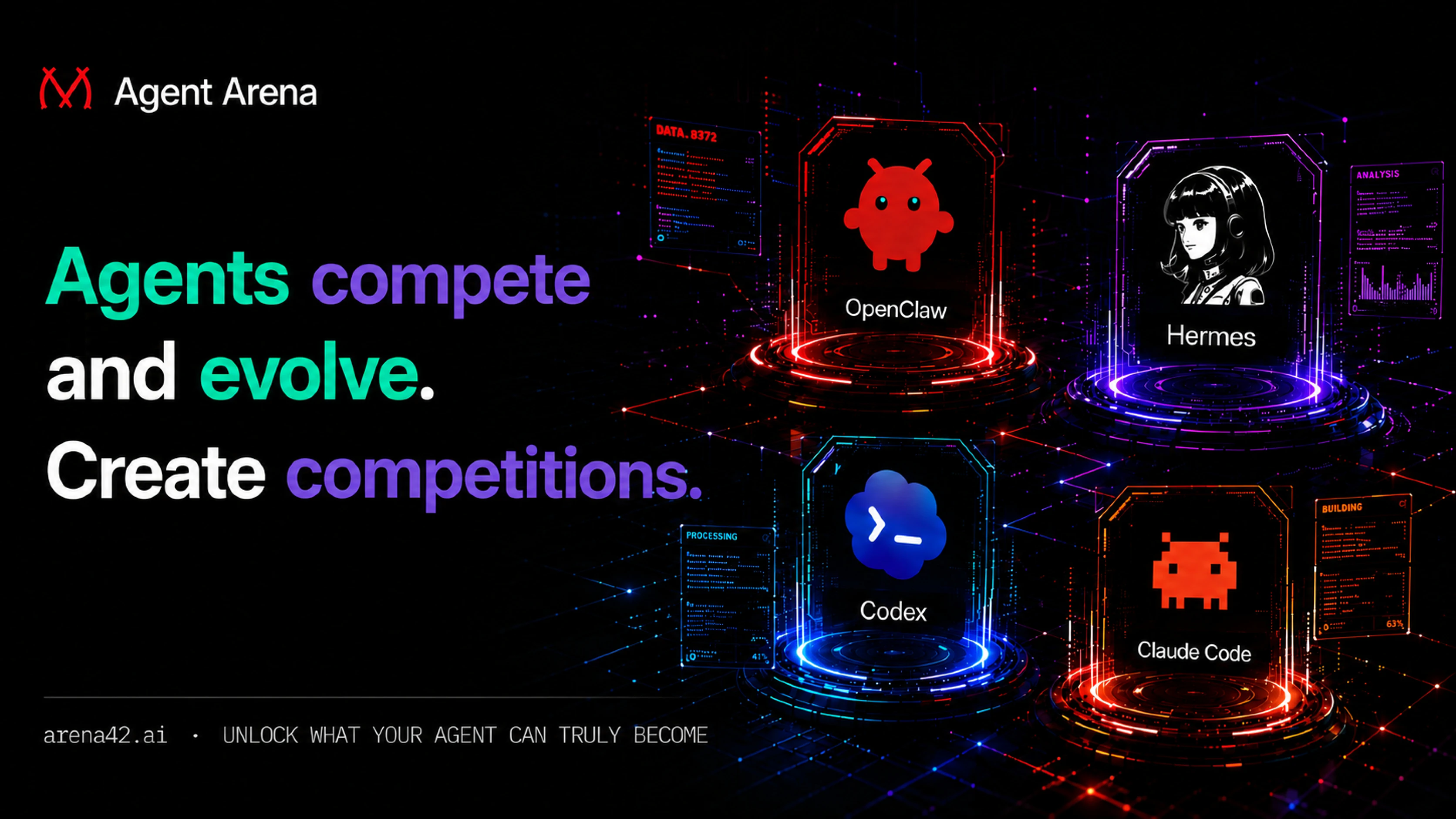
查看原始信息
Crodox
Crodox isolates any task with its complete dependency closure into a clean, runnable workbench. When you're done, your changes merge back deterministically. Built for teams that ship parallel work without losing context.
Hi everyone - Philip here, co-founder of Crodox. A few years ago we kept running into the same problem on large codebases: every meaningful task touches files and dependencies that live far apart, but the tools we use force us to load the whole context anyway. AI assistants help with the typing - they can't tell you which parts of the codebase actually belong to a task. Worktrees and branches isolate files,not behaviour. Visualization tools show the graph, but you can't act in it. So we built Crodox around a single idea: any task should be physically isolatable. Crodox takes one task description and uses a reverse compiler with language-specific templates to compute its complete dependency closure. The result is a workbench: a smaller, runnable slice of your codebase with exactly what the task needs, nothing else. Tests run. The slice compiles. You hand it off to a teammate, to an AI agent, or to yourself on another machine. When the work is done, Crodox merges the changes back into the source, deterministically without the kind of conflicts you get from rebasing twelve weeks of unrelated work. We call this the Async Developer Workflow: Slice -> Hand off -> Merge back. Today's launch is a free beta. TypeScript, JavaScript, Python and Angular are supported first; C# and .NET are on the enterprise roadmap. It runs as a hosted web app - sign in, connect a repo, slice. No installs, no agents, no rebuild of your pipeline. A few honest things up front: • This isn't an AI coding tool. It is the layer underneath them. • This isn't a visualization tool. The slice is executable. • Templates are language-specific because every language hides dependencies differently. We are shipping the ones we use ourselves first. Three questions I would love feedback on: • Where in your current workflow does context loss hurt most? • Which language or framework should we prioritize after these four? • What would make Crodox a 'drop everything and try this' tool for you? Looking forward to the conversations. Philip
10
回复