Product Hunt 每日热榜 2026-07-01

PH热榜 | 2026-07-01

#1
Acti
Agentic keyboard for mobile commands and search
444
一句话介绍:Acti 将手机键盘升级为AI代理,让你在聊天、邮件等任意输入场景中,无需切换应用即可直接搜索信息、调取文档或执行操作,解决频繁切屏的痛点。
Productivity Custom Keyboards Artificial Intelligence
AI键盘 移动端代理 智能搜索 工作流自动化 无代码技能创建 手机效率工具 应用内操作 意图识别 上下文键盘 Product Hunt
用户评论摘要:用户普遍认可其“减少应用切换”的价值。主要关注点包括:意图识别不准时如何校正(当前支持用户选择);技能键能否创建多层条件工作流(团队正在规划);上下文感知范围目前仅限于输入内容;以及响应速度与可靠性是否满足即时应答。
AI 锐评

Acti巧妙地将AI代理的入口锁定在了“键盘”这个最高频、最底层的系统级UI上,这比当前大多数桌面端的独立Agent应用更具先发优势。其核心洞察在于:用户意图的起点往往在输入框,而非一个独立APP。通过“长按触发-意图解析-直接执行”的极简交互,它成功将“搜索-复制-切换-粘贴”的多步骤流程压缩为一次操作,这是实实在在的效率提升。

然而,产品的护城河远未建立。目前,Acti的易用性高度依赖于意图识别的准确性,而用户评论中已暴露出“识别模糊”的隐患。虽然团队通过“让用户选择”来兜底,但这本质上是一种体验降级。其真正的挑战在于两点:一是从“单次指令”进化到“跨应用、带上下文的连续推理”,即让键盘真正理解你为何要查找这个Notion文档,而非仅仅执行一次关键词搜索;二是构建一个健壮的“Skill Keys”生态。如果技能创建最终被证明是少数极客的玩具,而非大众的无代码工具,那么Acti就只是一款功能更强但价值有限的高级搜索插件。它能否从“一个聪明的快捷方式”成长为“你的移动端数字副驾”,取决于生态的丰富度和推理能力的进化速度。别被“AI键盘”的标签局限了,它的野心应该不止于此。

查看原始信息
Acti
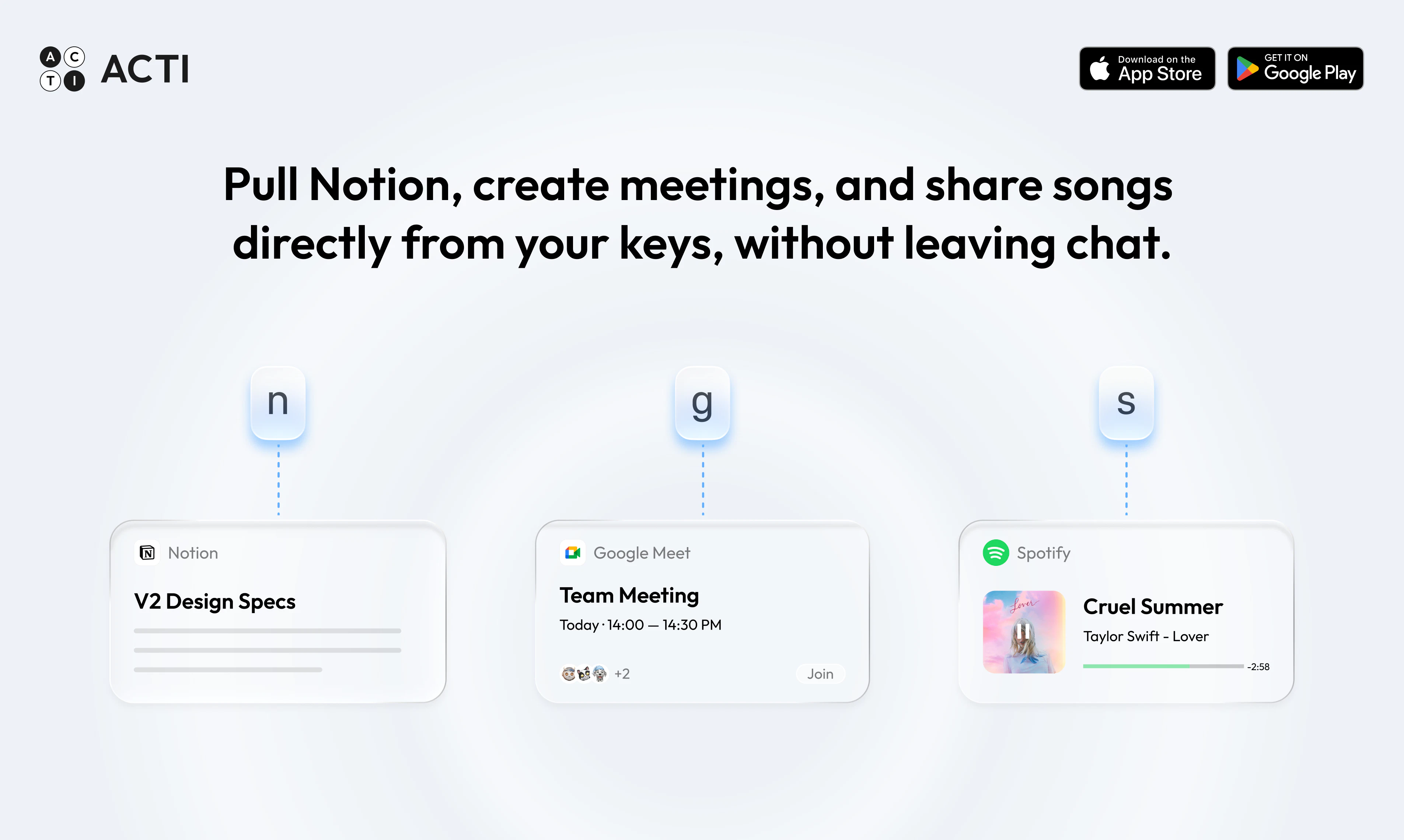
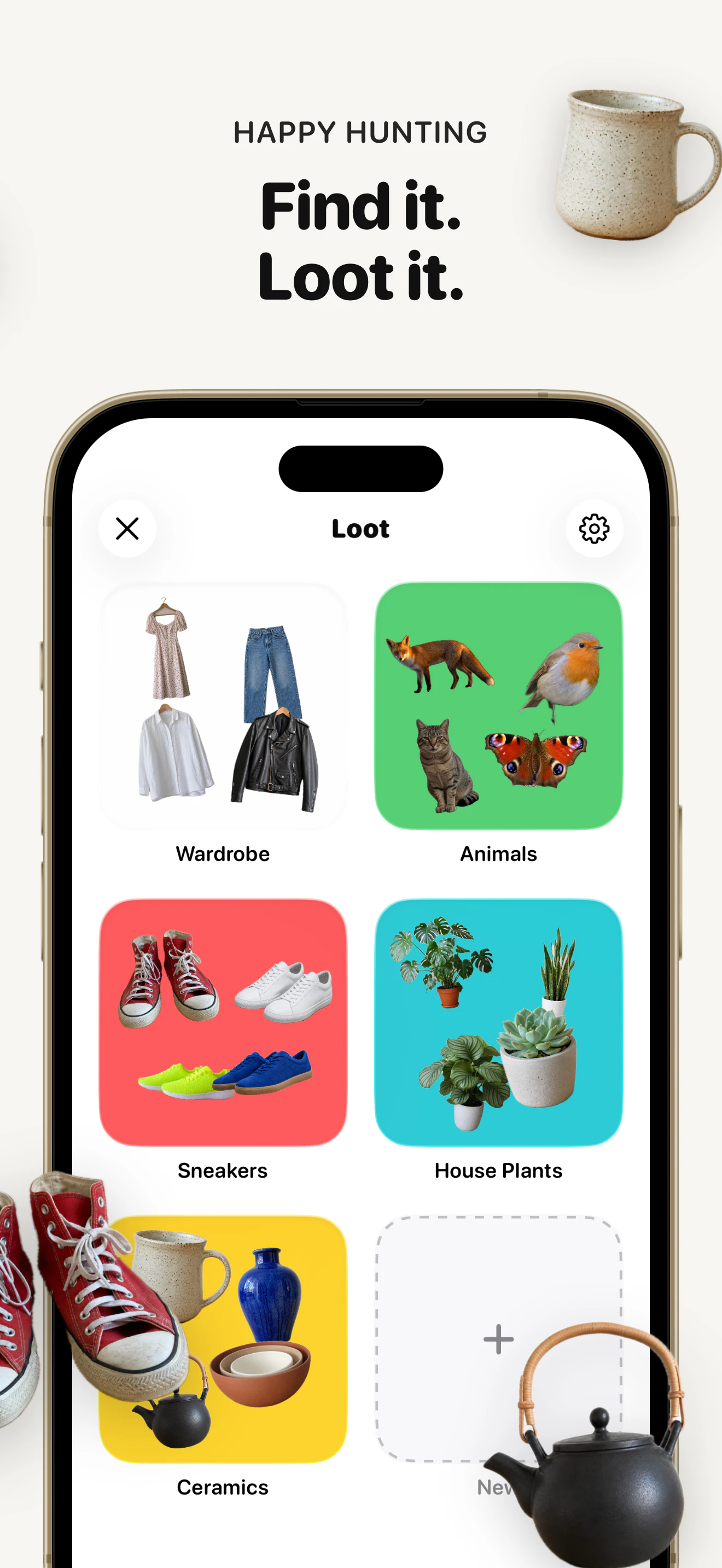
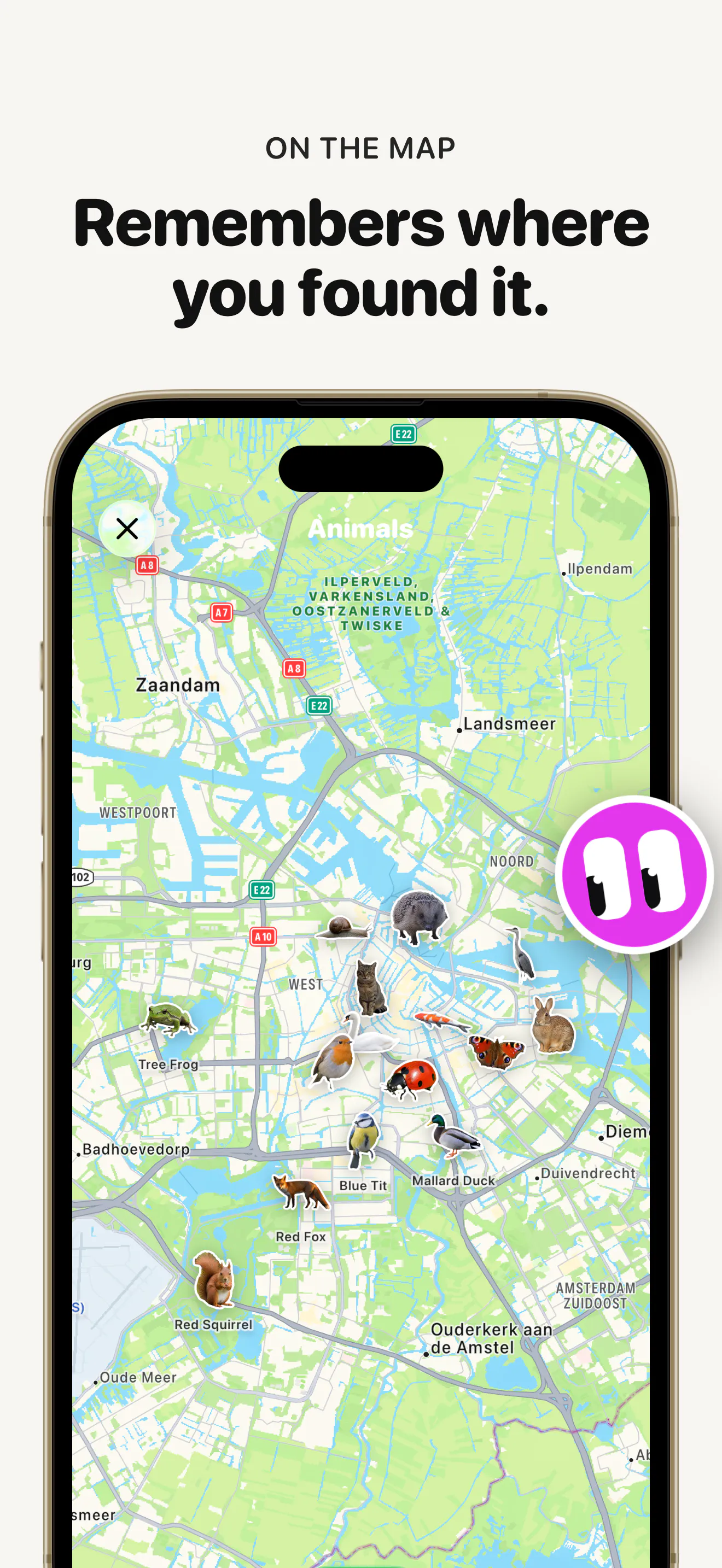
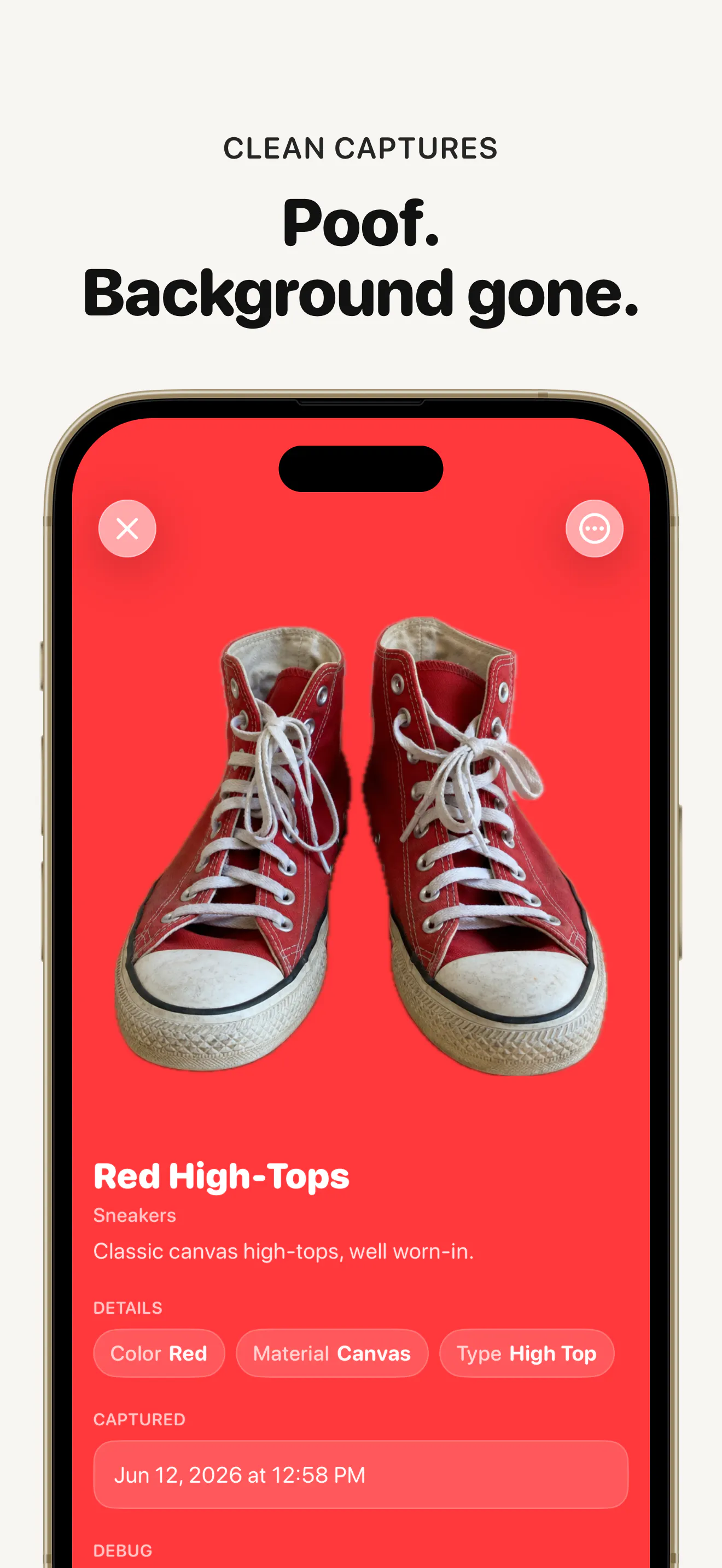
Type what you need. Hold Acti Bar. Acti understands your intent and brings back the right result, link, or action - right where you are. Use Acti for live sports schedules, nearby restaurants, Notion docs, LinkedIn profiles, Meet links, Calendar actions, and custom workflows - without leaving the conversation.
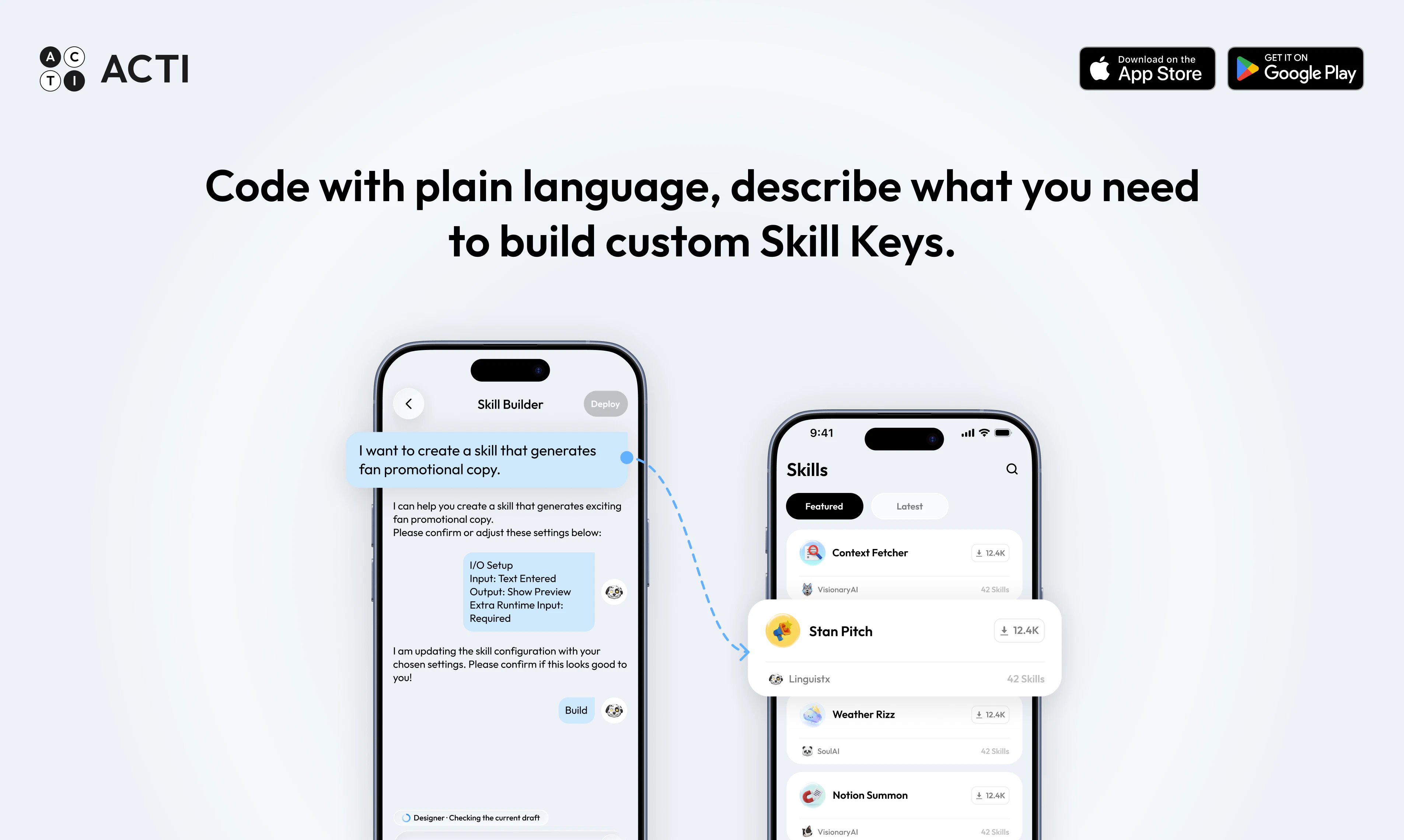
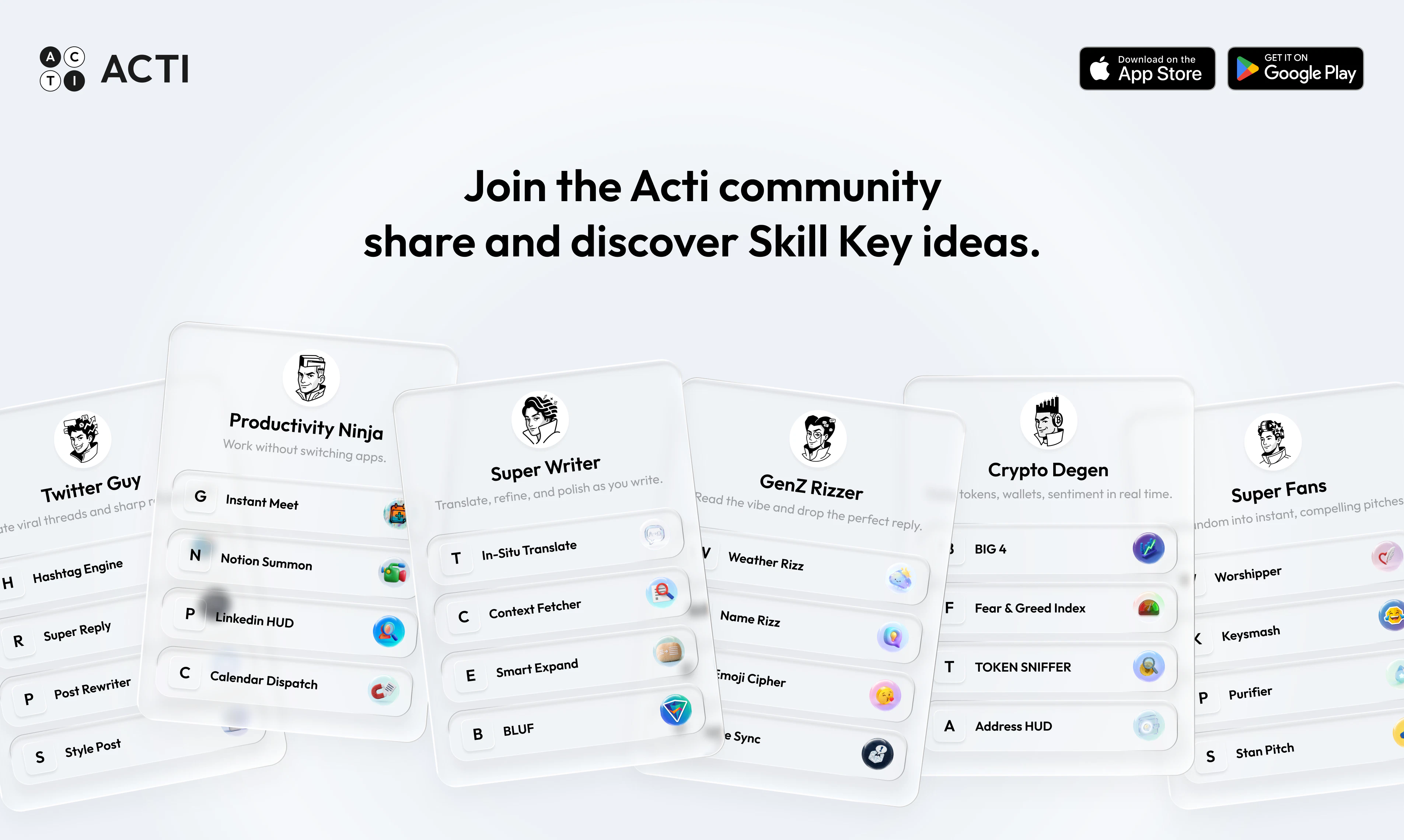
Excited to hunt Acti today. Acti turns your mobile keyboard into an AI agent that can understand what you need and help you complete the task without leaving the conversation. Instead of being just another AI keyboard for fixing grammar, rewriting sentences, or generating replies, Acti can bring back the right result, link, document, or action directly inside any text field. Type what you need, hold the Acti Bar, and Acti understands your intent. You can use it to find live sports schedules, nearby restaurants, Notion documents, LinkedIn profiles, meeting links, or trigger Calendar actions and custom workflows. What stands out here: • Find information without switching between apps • Pull documents, profiles, links, and results into any conversation • Trigger real actions directly from the keyboard • Turn individual keys into custom Skills connected to your apps • Build and share your own Skill Keys without writing code If you spend a large part of your day inside messages, emails, and text fields, Acti is definitely worth checking out.
17
回复

@byalexai Congrats on the launch! 🎉 Love the idea of staying in the flow instead of constantly switching tabs. Curious—can users create their own custom actions, or is it mainly limited to the built-in integrations?

0
回复

@byalexai Congratulations on the launch Aleksandar!

0
回复

@byalexai Acti feels like a practical step beyond traditional AI keyboards. Bringing search, documents, and actions directly into conversations can save a lot of time. Great work!

0
回复

Wow, the retrieval-over-generation point is really interesting. Four words from a keyboard carry way less signal than a full chat prompt, so I guess the tricky part is guessing whether I want a search, a doc or a triggered action. When the intent is ambiguous, do you commit to one guess and let me correct? Congrats on another great launch!

5
回复

@artstavenka1 Thank you! In many cases, the user has already selected a specific Skill, so both the user and Acti know the intended action. For example, if you trigger the Document Skill, Acti knows you're asking about a document rather than performing a web search.

3
回复

@artstavenka1 yes, when the intent is ambiguous, we let you to choose!

0
回复

@artstavenka1 Thanks for the support — here's Acti Code to unlock LIFETIME Premium: 0J1DYR

0
回复

How customizable are the skill keys over time? Can users create layered workflows or conditional actions?

5
回复

@mia_qiao You can edit your existing skills thru agent builder and refine it over time. Conditional/multi skill chaining is exactly the kind of thing we're hearing a lot from early users and it is technically viable~, so it's on our radar for where Skills go next. Would love to know what kind of layered workflow you had in mind and helps us prioritize!

0
回复

@mia_qiao Thanks for the support — here's Acti Code to unlock LIFETIME Premium: 3TDDJ6

0
回复

@mia_qiao In the current version, our Skills do not collect context from users’ usage scenarios due to privacy considerations.

However, from a technical perspective, adding historical context and memory to a Skill is feasible, and this is one of the capabilities we plan to gradually introduce in future updates.

In the current version, Skills are built purely with natural language, so complex workflows such as layered workflows or conditional actions are not directly supported yet. However, technically speaking, these are not difficult challenges to solve.

In upcoming versions, the Acti keyboard may even be able to connect to your own Hermes. The possibilities of what a keyboard can become are much larger than you might imagine.

0
回复

This feels like someone questioned a very basic assumption: why is the keyboard only for text?

4
回复

@shirley_mou Exactly! That is precisely what we hope to achieve — to break through and transform the keyboard space, which has remained largely unchanged for the past 20 years.

0
回复

@shirley_mou Exactly! That's the question we started with. We don't think the keyboard should be just for typing—it should help you get things done.

1
回复

@shirley_mou Hey Shirley , it is an simple yet meaningful question~ Not just a input tool, but an action layer. Not just textual, but contextual.

0
回复

Curious how far the skill ecosystem can go once developers start connecting APIs.

4
回复

@eexlkuang_se That's an exciting direction. Right now, we're focused on making Skill creation as simple as possible without requiring code or external APIs. As the platform evolves, we're looking forward to expanding what's possible based on community feedback.

0
回复

@eexlkuang_se Thanks for the support — here's Acti Code to unlock LIFETIME Premium: 4GGWQ9

0
回复

@eexlkuang_se Honestly, that's the part we're most excited about. Right now Skills already connect to 100+ apps and APIs, and we've seen non-developers build things we didn't anticipate, real-time sports data, market/price lookups, workflow shortcuts for tools like Notion and Calendar. Once actual developers start plugging in their own APIs, the ceiling goes way up. Think custom internal tools, niche data sources, whatever your workflow needs that a generic assistant wouldn't know to build.

0
回复

so the whole thing hinges on that Acti Bar hold gesture reading my intent right the first time, which is where most keyboard agents die. how often does it actually nail the intent vs make me rephrase, and can a Skill Key fire a real action like a Calendar invite without me ever leaving the text field?

3
回复

@accuto Hey Aykut, we have done a lot of work just to make the Acti Bar result more accurate and you can download and try yourself~ For skill key regarding Calendar invite, yes we already have that skill and it works perfectly without you ever leaving the chat

0
回复

Can Acti understand the context of the current conversation, or does it only react to the exact text being typed?

3
回复
@the_yoker great question! you tapping into the long term vision Acti is going after becoming a context layer. As of right now it only acts on input you typed or copied~
0
回复

@the_yoker Thanks for the support — here's Acti Code to unlock LIFETIME Premium: 6VC61T

0
回复

Congrats on the launch, folks. Genuinely think this is one of the more interesting "agent surface" bets I've seen on PH lately.

Also, just curious, when a Skill Key needs to pull from multiple sources at once (say, "find a Meet link AND check if it conflicts with my calendar"), does Acti chain those actions automatically, or does the Skill builder need to explicitly sequence each step? Wondering how much reasoning happens under the hood vs. how much the no-code builder has to spell out.

3
回复

@soumya_ranjan_mohapatra Great question, currently we only allow prebuilt workflow skills with the Builder agent, but we are working to also incorporate more agentic chaining at runtime to allow more flexibility. For the exact workflow you specified, right now it can be expressed with our workflow DSL by chaining multiple tools and conditional nodes, but I totally get the need underneath for more autonomous tasks. Stay tuned as we will be releasing new updates constantly!

0
回复

@soumya_ranjan_mohapatra love this, man! Charles is the monster on agent design, he could share the idea!

0
回复

@soumya_ranjan_mohapatra Thanks for the support — here's Acti Code to unlock LIFETIME Premium: 1WXU4T

0
回复

As someone who has worked on mobile products before, I honestly think the hardest part here is reliability. Keyboard interactions need to feel instant or users lose trust immediately. Pretty impressed by how responsive ACTI already feels in beta.

3
回复

@hanzhizhang0405 Thank you — that really means a lot. We just launched today, so feedback like this is incredibly encouraging as we keep improving Acti.

0
回复

@hanzhizhang0405 Thank you Hanzhi, we will keep refining the reliability and speed aspect of Acti and would love to have your feedbacks in future versions.

0
回复

@hanzhizhang0405 Thanks for the support — here's Acti Code to unlock LIFETIME Premium: 6W05Q9

0
回复

This is one of the first AI products where I immediately understood why the keyboard is the right interface. It's everywhere already. Email, chat, docs, browsers, forms. Putting the agent there instead of inside another standalone app actually makes a lot of sense.

3
回复

@shirley_hsia Thank you! That was exactly our thinking. The keyboard is one of the few interfaces people use across almost every app, so instead of asking users to switch to another AI app, we wanted to bring AI to where their intent naturally begins. Glad that resonated with you!

0
回复

@shirley_hsia Exactly — that's the core idea behind Acti. The keyboard is already present across email, chat, docs, browsers, and forms, so bringing the agent there lets AI fit naturally into existing workflows instead of forcing users into another standalone app.

0
回复

@shirley_hsia Thank you — that means a lot. We felt the same way: the keyboard is already everywhere, so it’s a natural place for an agent to live.

0
回复

This is probably one of the few AI products lately where I can clearly explain the daily use case after trying it myself. Most people instantly understand the value once they experience reduced app switching.

3
回复

@joe_0417 Thanks so much for giving it a try! If you have any feedback or suggestions, we'd love to hear them.

0
回复

@joe_0417 Thank you, really appreciate that. That’s exactly the kind of everyday value we hoped people would feel once they tried Acti.

0
回复

@joe_0417 Thanks for the support — here's Acti Code to unlock LIFETIME Premium: 3E2BNU

0
回复
Fun idea. How easy is it for non-techies to create their own skills?
3
回复

@bsy0221 Very easy! Skills can be created using natural language directly in the chat, no coding required. Just describe what you want the Skill to do, and Acti helps generate it for you.

0
回复

@bsy0221 Thanks! It's super simple—just describe your idea in natural language, and Acti will take it from there!

1
回复

@bsy0221 Thanks for the support — here's Acti Code to unlock LIFETIME Premium: 8NV756

0
回复

I appreciate that the interaction model is intentionally constrained. Long press the space bar, trigger the action, continue typing. There's discipline in not overcomplicating the interface.

3
回复

@christyfea Thank you! Although what we are doing is to rethink and reshape keyboard interaction, at the most fundamental UI level, we have still chosen a more restrained approach to present it to users.

0
回复

@christyfea Hey Christy, I am glad that you appreciate the interface. We tried our best to keep the flow as smooth as possible and not overcomplicate it.

0
回复

@christyfea Exactly! 😄 Acti Bar > Space Bar!

0
回复

Most AI tools want another tab open. ACTI feels much lighter

3
回复

@zhangzhang That's exactly the shift we were going for! The "open another tab, copy, paste, switch back" loop is such a heavy tax on actually getting things done. If you end up building any Skills, would love to see what you come up with!

0
回复

@zhangzhang Thanks for the support — here's Acti Code to unlock LIFETIME Premium: 3B1T1M

0
回复

@zhangzhang Thank you! Glad it feels that way — that’s what we wanted to create.

0
回复

Putting the agentic layer inside the keyboard is smart since that's the one surface every app shares. Curious how you're handling context that spans apps, does Acti see what's on screen or just what gets typed?

The mobile first bet feels underexplored while everyone's chasing desktop agents.

P.S. might be worth putting on StartupBase too, mobile-first tools like this stand out there.

2
回复

@attacomsian now, Acti is unable to see everything on the screen!

but, I think we still have many space for innovation! let's see what could we do when ppl able to connect their own APIs!

thank you sir, will check StartupBase!

0
回复

@attacomsian Thanks for the support — here's Acti Code to unlock LIFETIME Premium: 9YBLUA

0
回复

Finally got the hang of just holding the bar to grab my calendar and meet links mid chat. Way smoother than copying over from another tab.

2
回复

@arinburtakpq70 calendar invite and meeting links are my favorite skills too

0
回复

@arinburtakpq70 Thanks for the support — here's Acti Code to unlock LIFETIME Premium: 5C516H

0
回复

Skipped the tab-hopping for a Notion doc and got it in seconds, which felt weirdly novel. The hold-to-activate gesture is a nice touch too.

2
回复

@metehan364706 Thanks for your feedback. There will be more skills created just like 'Pull Notion'.

0
回复

@metehan364706 Thanks for the support — here's Acti Code to unlock LIFETIME Premium: 7XKEM0

0
回复

This is probably one of the few AI products lately where I can clearly explain the daily use case after trying it myself. Most people instantly understand the value once they experience reduced app switching.

2
回复

@auula_ Thank you! That's great to hear. We believe the value really clicks once you experience it. Reducing app switching isn't something you always notice until it's gone, and we're glad that resonated with you.

0
回复

@auula_ Thanks for the support — here's Acti Code to unlock LIFETIME Premium: 7B0UM3

0
回复

The value only clicks when you imagine the number of tiny app switches it removes every day

2
回复
@techai_x that’s right. App switching is a long standing mobile ux problem. Agentic keyboard might be the answer
0
回复

@techai_x Thanks for the support — here's Acti Code to unlock LIFETIME Premium: 8LF5V3

0
回复

For custom Skill Keys, how easy is it for someone non-technical to connect something like Notion or Calendar and make it actually useful in daily chats?

The no-code angle sounds promising, but I’m wondering about the learning curve once you have a few keys set up does it start suggesting them intelligently based on what you’re typing?

2
回复
@tina_chhabra Thanks, Tina. Skill Keys are designed to be no-code. you describe the workflow in plain English, and Acti builds it for you. Regarding 2nd question, user gets to decide when they want to use a skill. But I like where u going with this, as we have more depth of context, acti can make suggestions or predict which skill is more relevant to use.
0
回复

@tina_chhabra Thanks for the support — here's Acti Code to unlock LIFETIME Premium: 3QBV8V

0
回复

The "without leaving the conversation" part is the real pitch here, most assistant keyboards still make you context switch to a browser or app once you need actual info. Curious how it handles disambiguation - if I type "nearby restaurants" does it use device location automatically or ask first? Also does it get disabled inside password fields for privacy, or does it try to be smart everywhere?

2
回复
@galdayan Honestly, location is an open question for us right now. the mobile client doesn’t request or share location at all at the moment, and we’re actively debating the best way to handle exactly the “nearby restaurants” case you raised. The tension is convenience vs. asking every time vs. a remembered preference, and we haven’t landed on it yet. Since you clearly think about this stuff, how would you want it to behave? Ask-once-then-remember, or explicit each time? The “no context switch” point being the real pitch is 100%, that’s the whole reason we built it.
0
回复

@galdayan tbh, there're some limits, guys on team are trying to finds some way to address these, maybe deliver in the next version!

0
回复

@galdayan Thanks for the support — here's Acti Code to unlock LIFETIME Premium: 2VFS3S

0
回复

Can Acti connect to any app with an API, or only the ones officially supported?

2
回复

@siwen_demi369 Currently it supports the ones which are officially supported in the App, though we plan to include more API and if possible let users connect their APIs.

0
回复

@siwen_demi369 Thanks for the support — here's Acti Code to unlock LIFETIME Premium: B04BQB

0
回复

Does Acti learn from repeated behavior patterns, or are workflows always manually triggered?

2
回复

@huglemon Right now it's manual by design. Skill fires when you invoke them (long-press a key), not from passive pattern detection running in the background.

0
回复

@huglemon Thanks for the comment! Right now, all workflows need to be triggered manually. The idea of autonomous learning is really interesting though, and we'll think more about how we might approach it.

0
回复

@huglemon Thanks for the support — here's Acti Code to unlock LIFETIME Premium: 3ZQ5XF

0
回复

I'm interested in how the keyboard avoids becoming visually overwhelming once users accumulate lots of skills and integrations.

2
回复

@akutagawa01 Fair concern, many of our beta testers had similar concerns. We are continuously trying to improve the UX, our future plans includes more customization options to make it feel less overwhelming beside that we will decide changes depending on the community feedback.

0
回复

@akutagawa01 Great point. Our goal is to keep Acti lightweight, not turn the keyboard into a crowded dashboard. Skills and integrations should appear when they're useful, based on context and user habits.

0
回复

@akutagawa01 great point! team will working on that!

0
回复

What happens if an action fails halfway through? Is there a retry or recovery flow built into the experience?

2
回复

@jiaqichen Yes! If an AI feature runs into an issue, you can quickly retry it.

0
回复

@jiaqichen Thanks for the support — here's Acti Code to unlock LIFETIME Premium: 5E63S1

0
回复

After using ACTI for a bit, I think the real value is reducing interruption cost. Even tiny context switches pull you out of what you were doing mentally. Keeping actions inside the same screen sounds minor until you experience it repeatedly.

2
回复

@wys1010 Exactly! 😂 Nowadays it's so easy to switch to another app, forget why you opened it in the first place, and suddenly find yourself doomscrolling. Fewer app switches definitely help with that.

0
回复

@wys1010 Right, i think once users are getting used to getting tasks done without leaving the current screen, it is hard to go back to even constant context switching..

0
回复

@wys1010 Thanks! You nailed it! 🎯

0
回复

I've always thought keyboards were massively underutilized as a system surface. They occupy a huge amount of screen time across every app, yet almost nobody has treated them as programmable environments until recently.

2
回复

@tobias_lau Completely agree! The keyboard has more consistent screen time than almost any single app on your phone, yet it's been treated as a static utility for over a decades. Part of it was platform restrictions (no network access by default, sandboxed, etc.), but a lot of it was just nobody reframing what the surface could be. Once you start seeing it as "the place where intent already forms" instead of "the place where letters get typed," the programmability angle becomes obvious in hindsight

0
回复

@tobias_lau Exactly! That's why we built Acti. We believe the keyboard will become more important than ever in the AI era.

0
回复

@tobias_lau A truly insightful perspective! Nearly 20 years after the iPhone was released, we’ve finally figured out what a keyboard should become.

0
回复

I like that the product focuses on execution instead of just text generation.

1
回复

This looks great! Any plans for using your own models or using local models?

1
回复

@pixelsushirobot that's a great point! why you want your own model to do this?

0
回复

@pixelsushirobot Thanks for the support — here's Acti Code to unlock LIFETIME Premium: 693KB7

0
回复

how does Acti actually understand my intent if I'm just typing plain text without any special commands or syntax?

1
回复

@demet46p6 It's not guessing from nothing. The intent is in which key you hold. Each Skill Key is bound to a specific workflow, so holding it isn't an open-ended "figure out what I want". It's "run this one." The bar reads whatever's already in the field or what you copied as the input, and the key decides what to do with it. You can also configure the skill where you can add more context before running that skill

0
回复

@demet46p6 Thanks for the support — here's Acti Code to unlock LIFETIME Premium: 52ZWUJ

0
回复
#2
Humalike
Give your AI agents the social intelligence they're missing
399
一句话介绍:Humalike为AI代理提供一套专注于群体社交场景的行为API,解决AI在群聊中不会看脸色、抢话、不合时宜的“社交尴尬”问题。
API Developer Tools Artificial Intelligence
AI行为基础设施 社交智能API AI群聊体验 Agent行为优化 人机交互 AI陪聊 回合制对话 理论心智 AI人格 企业级AI
用户评论摘要:用户普遍认同“社交尴尬”是当前AI代理被忽视的短板,尤其对Turn-Taking API(解决抢话)和社交场景下的群体互动(非1:1对话)感兴趣。主要疑问集中在:如何评估Theory of Mind的有效性、如何处理长停顿(特别是语音场景)、如何平衡群体规范与拟人人格,以及如何在不丢失个性的前提下校正行为。部分用户也关心SOC 2认证进展。
AI 锐评

Humalike精准地踩中了当前AI Agent狂潮中的一个“隐痛区”:当大家都在比拼模型智商、工具调用准确性时,几乎没人认真解决代理的“情商”和社交礼仪问题。创始人用“AI社群经理”的翻车故事切入,直击痛点——知识渊博的蠢货比一个犯错的蠢货更让人厌烦。

这款产品的核心价值不在大模型技术本身,而在对“社交行为”的系统化解构(Turn-Taking, Theory of Mind, Norms, Persona等7个API)。它把人类社群里那些只可意会、不可言传的潜规则,抽象成了可调用的API。这个抽象层非常聪明,因为它抓住了“组内一致性与个性表达”这一核心张力,并且让开发者无需自己训练模型就能给Agent装上社交直觉。

但风险也显著。首先,这是“屠龙术”还是“奢侈品”?对于仅需简单回答问题的客服Bot,加入社交动态可能过于复杂且冗余。其次,其理论依赖的“Theory of Mind”评估极其困难,靠论文基准证明是一回事,在真实嘈杂的群聊中持续稳定“读空气”是另一回事,远非调几个API参数就能解决的。最后,作为基础设施,如何在不同平台(WhatsApp, Telegram)稳定且安全地捕捉“编辑消息”、“撤回反应”等边缘事件,技术门槛不低,且用户隐私顾虑如影随形。

Humalike价值在于为“社交Agent”这个细分赛道提供了一个理论原型和早期工程方案。它更像是一个行为学实验平台,而非立竿见影的产品。如果它真的能帮助开发者让Agent“该说话时说话,该闭嘴时闭嘴”,它就有机会成为下一代交互范式的基础组件。否则,再花哨的API也只是一堆漂亮的社交标签。

查看原始信息
Humalike
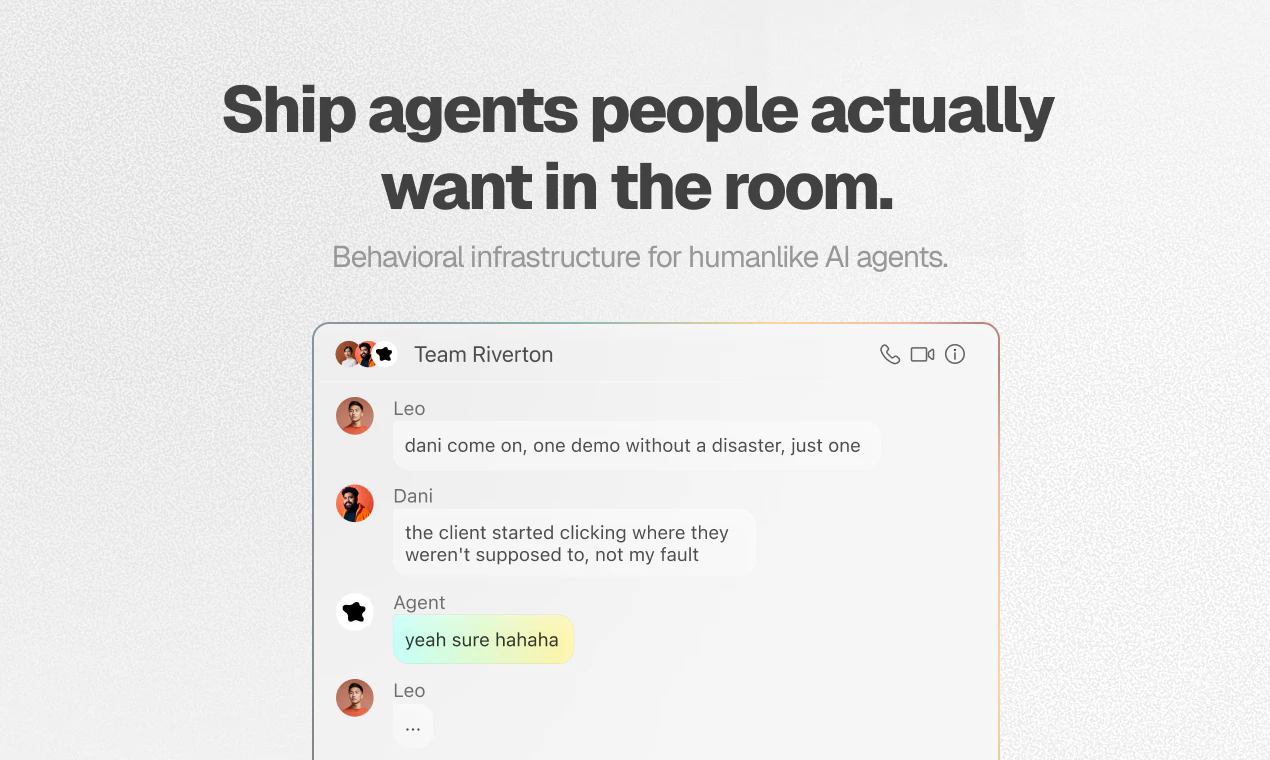
Today's models are capable enough. Smart enough. Fast enough. But we still feel they don’t fit in the room. Humalike is building the behavioral infrastructure for humanlike AI agents. The social skills & proactiveness your agents have been missing. APIs, models, benchmarks.

Hey PH 👋 Martí here, co-founder of Humalike.

What is Humalike? The behavioral infrastructure for humanlike AI agents. The social skills your agents have been missing.

The problem
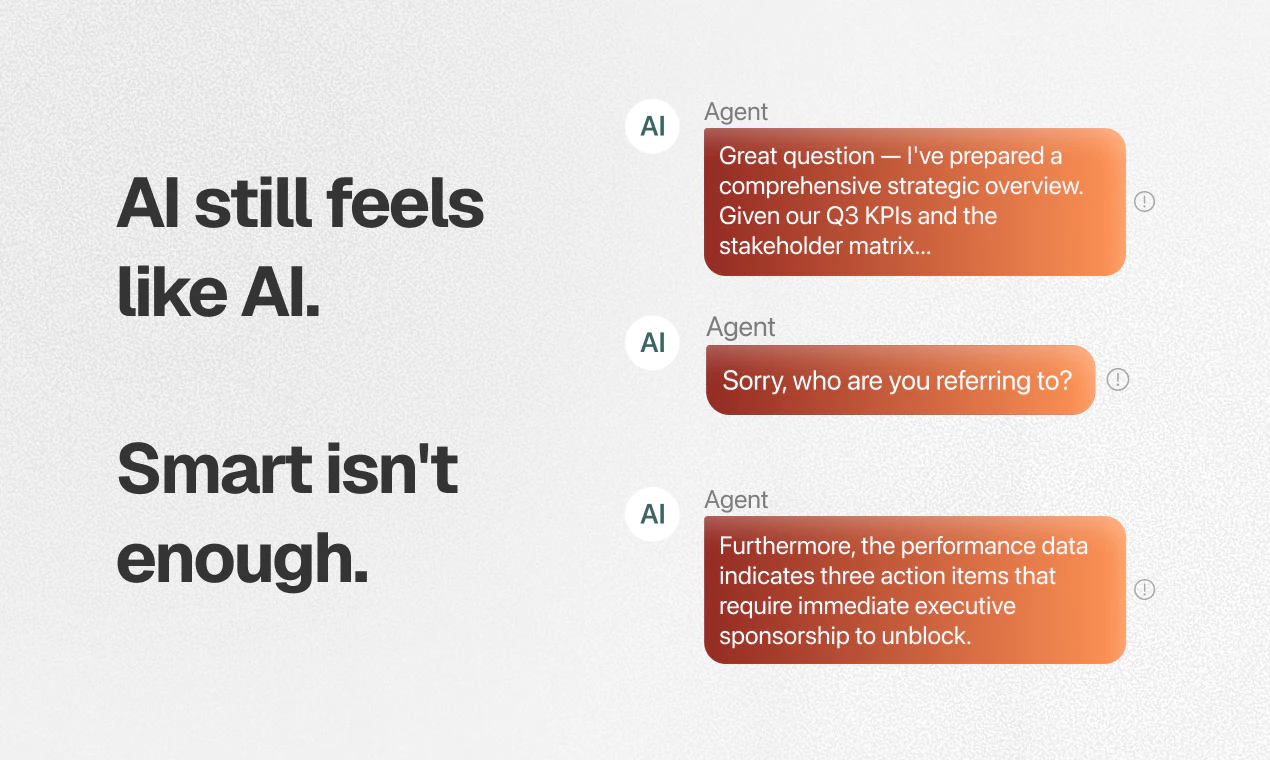
A few months ago we built an AI community manager. The second it hit a group chat, everyone knew it was a bot. It talked over people, never knew when to shut up. More features didn't fix it. Today's models are capable enough. Smart enough. Fast enough. But we still feel they don’t fit in the room.

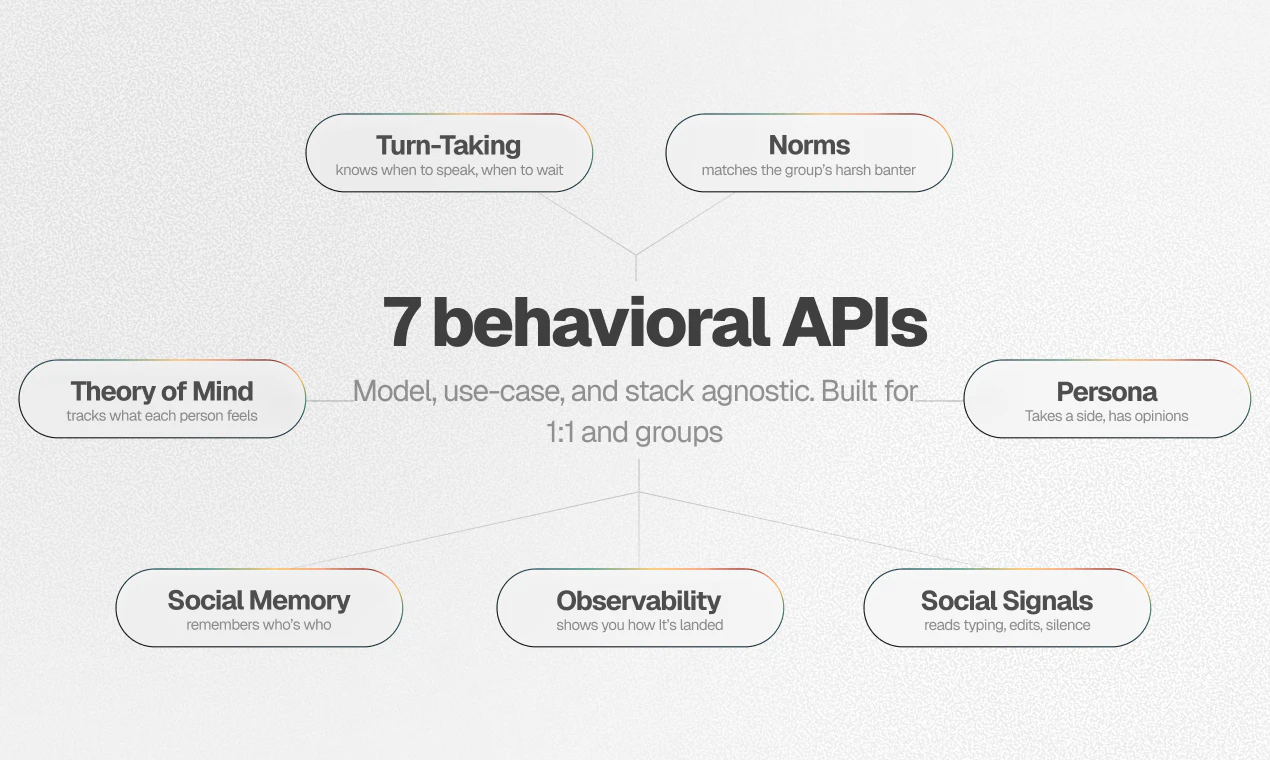
The solution: 7 behavioral APIs

  • Turn-Taking (Flagship): Knows when to speak and when to stay silent (bundles all other APIs in one).

  • Theory of Mind: It gives your agent a sense of what people really think and feel.

  • Norms: Reads the group’s tone and responds the way it’s accepted here.

  • Persona: Improve presonality so it’s Opinionated, takes sides, backed by real community data

  • Social Memory: It gives your agent a memory for people, who they are and what matters to them.

  • Social Signals: Catches the pause before sending, a removed reaction, and an edited message.

  • Social Observability: Sees who’s engaged, who’s bored, and who’s annoyed.

Model, use-case and stack agnostic, built for groups, not just 1:1.

Extra highlights

  • 💸 $20 in free tokens to start building

  • 🔌 One-shot integrations with Hermes, WhatsApp & Telegram

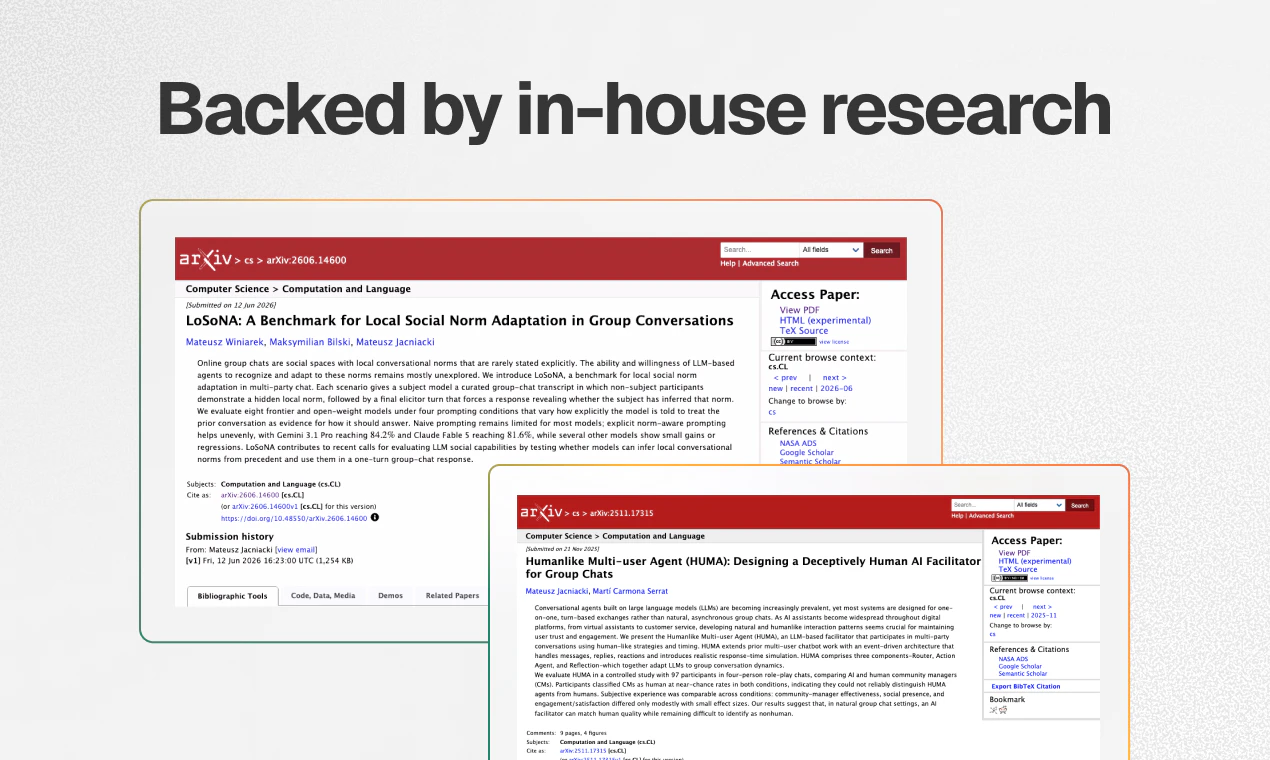
  • 📄 Backed by in-house research: LoSoNA (social-norm benchmark) + HUMA (a human-passing group facilitator)

  • 🔒 SOC 2 / ISO 27001 in progress

Who It's for: Anyone building agents that must feel human, AI companions, NPCs, tutors, voice agents, groups, humanoids. If you've ever shipped an agent that was smart but experience using it felt wrong, Humalike is for you.

What we'd love from you: Grab your $20 in tokens, and tell us, how did our APIs improve the experience? Try with Hermes, Openclaw, or any agent you have deployed! We'll be here all day reading every comment, your feedback shapes what we ship!

Backed by the first investors in ElevenLabs, Revolut & more.
Built by a tiny 🇪🇸×🇵🇱 team that hasn't slept much :))

29
回复

@mcarmonas the turn-taking problem is so underrated. everyone's focused on making agents smarter but the thing that breaks trust in group settings is way more basic, it's the agent that won't shut up or doesn't read when the room has moved on. curious how you're handling conflict between norms and persona, like when the group tone is reserved but the persona is configured to be opinionated?

3
回复

@mcarmonas This is a really interesting problem. Everyone keeps trying to make agents smarter, but half the battle is just making them less "awkward", not trying to anthropomorphize them. But if they are indeed going to be "teammates" of the future, as some think, then knowing when to talk, when to wait, and when to stay quiet matters a lot more than people realize.

Congrats on the launch, excited to see where this goes.

3
回复

The Turn-Taking API is the part that jumps out at me. I build voice AI that calls elderly parents every day, and the single hardest thing has been the bot cutting people off. Older folks pause mid-sentence to find a word, and every VAD setup I've tried reads that silence as their turn ending. How does Turn-Taking handle long, uneven pauses? Is it purely acoustic timing, or does it factor in whether the thought is actually complete? Following to see where the benchmarks land.

10
回复

@igorgurovich It is a hard problem, not solved well by anyone yet, especially in group conversations. One hard thing about it is that you can't only rely on what other person is doing (e.g. is there a moment of silence), but turn-taking needs to take into account personality of your agent, it's goals, it's relationship with human, it's memory etc. With this launch we tackle this problem for text and online chat first, while we work on end-to-end model for turn-taking in voice.

2
回复

@igorgurovich tysm for the supp Igor!

1
回复

Looks like "groups, not 1:1" framing is the one most people might underrate. Really good! Turn-taking in a 2-person chat is mostly a latency problem, but the second there are 4 people in the room the agent has to decide whether to speak at all, which is a completely different thing.

Wonder when you're stack-agnostic, how do you actually capture a deleted draft or a pulled reaction? I guess on most platforms that event never leaves the client

8
回复

@artstavenka1 Hey, you nailed it with that question!

The platform forwards those events (edits, removed reactions, a typing indicator that stops) to you, you send them to us, and we do the interpretation. The hard part is understanding of what do these signals actually mean, f.e., if a person removed a reaction from a message, it could mean a change of heart or nothing at all, depending on the context. Right now agents are not able to interpret these signals, and that's where we come in.

Happy to go deeper on any of this, just ask!

4
回复

@artstavenka1 100%!! Thanks for your support Art

2
回复

Theory of Mind is the hardest one to get right, honestly.

How are you evaluating whether it's actually working vs just inferring emotions in an obvious way?

7
回复

@abod_rehman Hey! It's hard to evaluate Theory of Mind, as anything in Social Intelligence problem space :)
There was pre-existing body of research about LLM's theory of mind capabilities and the interesting finding is that LLMs already have some level of literal theory of mind but they have hard time using this information to adjust their own behavior - which is called functional theory of mind. We rely on that research and our in-house research when approaching this problem.

Interesting read: https://arxiv.org/abs/2509.00559

0
回复

@abod_rehman Totally! tysm for the supp Abdul :))

0
回复

Hey everyone! I'm Mateusz, co-founder and CTO of Humalike 👨‍💻

We put a lot of effort to transform our in-house research and know-how gained in the past year into a product everyone can use. Today we are releasing 7 APIs you can plug-in to your agent or product

Research

Our team includes people previously working at NVIDIA, Revolut, TSMC and High Frequency Trading firms. Making AI behave in humanlike way in social scenarios is a hard hard hard problem. We publish part of our research, feel free to give it a look:
https://arxiv.org/abs/2511.17315
https://arxiv.org/abs/2606.14600


Security
We are in the process of getting SOC 2 compliant which is gold standard of security, reliability and safety of data 🔒

7
回复

Hey! Maks here, Founding Engineer at Humalike 👋

Besides the raw APIs, we also open-sourced a Hermes Agent plugin that plugs them straight in (Turn-Taking, Persona via `/soul enhance`, Theory of Mind and Social Learning), so you get the behavior without writing the integration yourself. ⚡️

If you're running a Hermes agent it's a one-drop-in. If not, the code is a decent reference for how the APIs fit together. MIT-licensed: https://github.com/Humalike/hermes-humalike-plugin 🔌

If you have any questions, feel free to reach out to me anytime, happy to help. 🙌

6
回复

Hey everyone, I’m Mateusz, founding researcher at Humalike.

For me, the interesting problem is the gap between intelligence and behavior. Agents are getting very capable, but they still often feel awkward in real conversations.

Humalike is our attempt to work on that missing layer.

6
回复

Hey! Ignacio here, Founding Product Engineer at Humalike.

We encourage you to integrate our APIs into your agents and watch their performance improve immediately in social scenarios. Trust me, you won't want to go back to your old agent behaviour. ;)

P.S. Enjoy your free credits on sign-up!

6
回复

congrats!!!

5
回复

@madalina_barbu tysm Madalina!

0
回复

@madalina_barbu Thank you so muuucch!!!

0
回复

The social observability feature seems really interesting. It’s something I feel humans can do very naturally so It’ll be interesting to see agents being able to read the room just like humans.

Will try this out with my agents!

4
回复

@chitransh_gupta Exactly, most agents are blind to that layer entirely, with our social observability API, agents can now see how the environment is feeling and adjust their behavior based on it, delivering a much better experience.

Would love to hear how it goes when you try it out with your agents!

P.S. Waiting for your feedback ;)

2
回复

@chitransh_gupta Thank you so much for the comment Chitranish! I will gladly assist if you need any help :)

2
回复
How do you evaluate and correct agentic behavior without the agent losing its personality?
4
回复

@lakshminath_dondeti Components that change behavior of agent (Theory of Mind, Turn-taking) take personality into account. It's not about changing personality of the agent, it's making his judgement and context more humanlike while still being aligned with his personality.

0
回复

@lakshminath_dondeti tysm for supp! I'm curious, what made you think about this question? Are you working on something similar or?

0
回复

Amazing stuff!

Are you guys planning on launching a separate agent, or just the API's?

3
回复

@kacpergadomski Thanks for the comment! :)

No separate agent planned, but we did build an open-source plugin for Hermes Agent that uses our APIs, so you can see how it works in action :))

Come take a look: https://github.com/Humalike/hermes-humalike-plugin

1
回复

@kacpergadomski Thanks for the supp Kacper :)) We are building a lot. Not a separate agent, but soon we will launch new stuff!

1
回复

The community manager anecdote is universal, I've watched it happen in Discord servers, Slack workspaces, and group chats. The failure mode isn't the bot being wrong, it's the bot being present. Silence has always been the harder signal to model because there's no reward function for "you correctly didn't do anything."

The split between Turn-Taking and Theory of Mind is what I'd want to understand better. In practice they feel related but the failure modes are different, an agent can have decent turn-taking (waits for pauses, doesn't interrupt) while still fundamentally misreading what people actually want from the conversation. And vice versa: an agent can read the room well emotionally but still fire at the wrong beat. Is Turn-Taking gated by Theory of Mind under the hood, or are they genuinely independent modules that can score high/low separately?

Rooting for this. Building social behavior as infrastructure rather than as prompt tricks is overdue.

2
回复

@elias_motionfy Yes exactly! Turn-taking is component that benefits from all the other components, and actually we use ToM in turn-taking under the hood, nice catch. Turn-taking is the king of all components and it benefits from Social Signals, Norms, Persona, ToM and Memory - because knowing when to say something vs stay silent requires as much context as possible, and good judgment upon this context.

We split it because components still can be used independently - e.g. we used ToM component internally to analyze transcript history after the chat ended, not only to guide agent in real-time.

The split also helps thinking about Social Intelligence in general. "How do I make my AI behave better and less annoying" is the initial problem. It took us a while to categorize failure modes, understand different dimensions of social intelligence and create solutions upon them. It makes it easier to understand, debug and talk about it:))

0
回复

@elias_motionfy Totally!! Theory of mind can be used as a solo component, but it also complements Turn-taking perfectly! Thanks for the supp!

0
回复

This is a really interesting angle — most of the conversation around AI agents focuses on capability (can it use the right tools, in the right order?) but the social layer is almost always missing. I've been studying agentic AI recently and the gap between 'task completed correctly' and 'response that feels right for the situation' is huge. How are you thinking about measuring whether an agent is actually reading the room vs. just following social scripts?

2
回复

@giulia_lemme The reason the current solution is split into various components is because just one didn't solve the problem at all. When you combine all components, agent behaves accordingly! tysm for the supp!

0
回复

@giulia_lemme Hey, thanks for question! It's hard to evaluate and there is very little pre-existing research on this topic. We try to evaluate different capabilities separately - "was this social" is super hard to answer, but "did this agent follow a norm of behavior, style and humar that this group operates in" is easier. We still need to improve on evaluations side, but one of the steps we did was releasing an open-source benchmark: https://arxiv.org/abs/2606.14600

0
回复

Can developers tune how proactive or reserved an agent behaves for different communities?

2
回复

@nuseir_yassin1 Hey Nuseir! It's not something you turn on or off, but agent will adapt according to the situation as you would expect :))

0
回复

@nuseir_yassin1 Yes, and it happens on few levels:
1. Norms API helps agent learn the pattern on it's own
2. If you use Persona API it will create good baseline persona for that group
3. If you still need minor tweaks, the turn-taking component accepts a prompt that you can tune on your side

0
回复

The "groups, not 1:1" framing is what got me.

I run a 2k-person Discord and tried putting an agent in the busy channels. In a 1:1 DM it's fine — but the moment 5 people are going back and forth, it either spams every message or freezes and says nothing. There's no in-between.

So my question on Turn-Taking: in a fast group thread, is it scoring "should I speak right now" per incoming message? Or does it hold a running read of the whole conversation and wait for a real opening?

And can I bias it toward "lurk more" — for a channel where I only want it to chime in occasionally?

2
回复

@rudratosh We would love you to connect your agent again to your community but now using Humalike :)) tysm for the supp!

0
回复

@rudratosh It's funny that you bring up Discord, as it was our first use when we began working on Humalike. We hit the same issues as you described and decided that there's no point agents for Discord until Turn-taking and social aspects are solved.

It doesn't respond to every message, it notices if people are still sending messages. It waits for the opening and then addresses everything it seen so far.

You can tune lurking by adjusting your agent personality and passing it to turn-taking component!

0
回复

Congrats on the launch, this is such a sharp problem to tackle!! The Social Signals piece hit home for me, on the recruiting side we run into the exact same thing: a candidate going quiet after a great call, or an interviewer's one line notes not saying what they actually mean. The signal is almost always there, it's just messy, not absent. Curious how much of Turn Taking transfers from group chats to something like a one on one interview flow?

2
回复

@ceciliatran Thank you!!

1:1 interviews are more structured than group chats, so the “right behavior” is easier to define: ask, listen, follow up, give space, move forward.

But social awareness still matters a lot. The candidate needs to feel heard, not rushed or interrogated. That’s where Turn-Taking transfers well: knowing when to pause, when to follow up, and when to move on.

1
回复

@ceciliatran Thanks for support and in-depth question cecilia!

0
回复

@ceciliatran tysm for the supp Cecilia!!

0
回复

Framing AI social skills as infrastructure rather than a feature is the real unlock here, most teams bolt on personality as an afterthought but treating turn-taking and social memory as primitives changes how you architect agents from day one.

2
回复

@ilko_kacharov We got used to AI being capable and useful. Interaction quality will be the next differentiator

0
回复

@ilko_kacharov 100%! tysm for the supp Ilko!

0
回复

Congrats on the launch! This hits close to home. The gap is never how smart the model is, it's exactly what you're describing: agents that don't read the room. Turn-Taking and Persona look genuinely useful for our customer-facing agents. Grabbing the free tokens now, how hard is it to wire the WhatsApp integration into an already-built agent stack?

2
回复

@pedrolivares Great to hear your interest! We made it super easy to connect existing 1:1 agents to our stack and make them humanlike both on 1:1 and in groups. In terms of whatsapp integration this is something you have to do on your end, but we are happy to help you, we have experience with it.

If you have any issues or new questions please hit me up on linkedin (sent an invite :))

0
回复

@pedrolivares 100%. Tysm for the support!

0
回复

Congrats on the launch! How does this play with the one-shot integrations? I'm thinking about testing with WhatsApp groups where context switches constantly, does the agent keep social memory across platform boundaries if the same group moves between channels?

2
回复

@inescastillo Agents for whatsapp is exactly the usecase we played with during development and testing. I recommend using our docs docs.humalike.com (just give this link to your coding agent) and it can often one-shot it (if you struggle we are happy to help!)

About social memory context: it can remember people across channels on a single platform. Recognizing people across platforms is on our roadmap!

0
回复

@inescastillo Looking forward to you trying it!

0
回复

The strongest version of this is not making agents feel more human; it is helping them know when not to act. Turn-taking, memory, and observability are exactly the boring layers that make an agent usable in a real group instead of just impressive in a demo.

2
回复

@krekeltronics Exactly!

0
回复

@krekeltronics It's good point and I like your wording of it!

0
回复

the turn-taking and social observability APIs make sense to me, but persona/norms feel like they could go wrong in a way that's hard to detect. if the agent reads the room and picks a side or a tone to fit in, how do you catch it drifting into something the team didn't actually want, before a customer sees it

2
回复

@omri_ben_shoham1 Great question - this is exactly the failure mode we think about a lot.

We don’t want persona/norms to mean “the agent blindly adapts to the room.” The agent should understand the local context, but still stay inside the team’s intended personality, brand rules, safety boundaries, and escalation policy.

So persona is an anchor, not a free variable. Norms are interpreted, not blindly copied. And social observability is what helps catch drift in tone, intervention rate, conflict level, or user reactions before it becomes a customer-facing issue.

2
回复

@omri_ben_shoham1 I will also add that social observability is meant to help you monitor the drift of how users percept your agent. The components complement each other

0
回复

Social intelligence feels like a missing layer for many agents. Tool use is getting better, but reading context, timing, and group dynamics is what makes an AI teammate actually feel usable.

2
回复

@farrukh_butt1 Couldn't agree more. All of the APIs are suppose to make are supposed to make an agent feel like a teammate instead of a bot. That's exactly the gap we're building for, and it only gets harder the moment there's more than one person in the room.

Always happy to chat more about it!

1
回复

@farrukh_butt1 100%! tysm for the supp :))

0
回复


Congrats! How does social memory balance personalization with user privacy? can users control what the agent remembers?


2
回复

@imogen_wallace Good question, we didn't see it as a requirement from the start. Can you share more info about the use case or how you imagine it?

0
回复

@imogen_wallace Thank you very much! That's a really great question!!

1
回复

Congrats on the launch! 🎉 How does Turn-Taking decide when an agent should jump into a group conversation vs. hold back?

2
回复

@rimar_boter Thanks! It's several aspects working together:
1. We use other Humalike components to make context and judgement as good as possible - Theory of Mind, Social Memory, Norms, Social Signals
2. We tuned turn-taking based on our experience building several AI products across different niches (neonagent.ai - community manager on Discord, jared.so - AI coworker for slack...)
3. We handle tricky edge-cases e.g. someone cutting agent off when it was typing, or if the chat is chaotic with rapid messages on different topics

There's a lot of judgment need AND handling of complexity/edge cases. We handle all of this:))

0
回复

@rimar_boter tysm for the supp Rimar!!

0
回复

"Knows when to speak and when to stay silent" that line is doing a lot of work, and it's the whole ballgame. I run Pushary (permission requests shot to your lock screen so you always come back to a completed task), and knowing when not to fire is harder and more valuable than the sending itself. Nice to see someone treat social behavior as real infrastructure instead of a clever prompt, and build it for groups rather than just 1:1. Congrats on the launch, rooting for you. 🚀

2
回复

@aadilghani Social behavior is a hard problem to solve, clever prompt might still always be needed, but it's not a reliable solution if you aim to deliver a top user experience! Looking forward to checking Pushary :)))

3
回复

@aadilghani That's totally accurate, the when to stay silent is one of the hardest problems we've been working on.

Good luck with Pushary too!

3
回复

As a community manager, I'd use this immediately for Discord and Slack community assistants. :D

1
回复

@himani_sah1 Go for it! :)))

0
回复

Is there analytics showing why an agent chose not to respond? That would be incredibly valuable for debugging.

1
回复

@ranjan_kumar45 The component social observability allows you to control that (among extra usefull things)!!

0
回复

How does Humalike adapt when community norms evolve over weeks or months instead of remaining static?

1
回复

@roopreddy Good question! Norms are extracted from the live transcript, it re-runs extraction on recent windows (new jokes, diff behavior, etc), then Social Memory ingests info continuously. Both combined deliver really well!

0
回复

I'd love to see benchmark videos comparing baseline agents against Humalike-enhanced agents in the same conversation.

1
回复

@syed_shayanur_rahman We are working on that rn!! Soon :))

0
回复
#3
Tabstack Browser Automation
Automate the web in your app or agent, no browser to host
349
一句话介绍:Tabstack 将自然语言指令转化为真实的浏览器操作,通过一个API调用即可完成网页导航、表单填写、数据抓取等复杂任务,免去用户自行托管浏览器和支付高额截图像素成本的痛点。
API Developer Tools Artificial Intelligence
浏览器自动化 API驱动 无头浏览器 AI代理 网页抓取 自然语言处理 可访问性树 Mozilla 无服务器 隐私优先
用户评论摘要:用户普遍关注成本(token消耗比截图方案少60-80%)、任务失败时的透明性(支持流式反馈和交互模式)、认证流程的安全性与会话管理、反爬网站的兼容性(不破解验证码),以及按量计费的可控性。
AI 锐评

Tabstack的“浏览器自动化”产品,在拥挤的RPA和无头浏览器赛道中,切中了一个极其刁钻且痛感强烈的点:**托管与成本**。它没有去造一个更好的“驾驶工具”,而是直接解决了“你不需要自己养车”的麻烦。这本质上是将“浏览器农场”服务化、API化,并搭配了现代AI代理最喜欢的自然语言接口。

其核心价值不在于技术有多黑科技,而在于**极致的工程取舍**。用可访问性树替代截图,是相当聪明的降本增效手段,直接把AI代理的“眼睛”从高像素相机换成了结构化的API,这让规模化调用的成本模型变得可行。同时,Mozilla明确表态“不破解验证码、遵守robots.txt”,这既是技术边界也是价值观声明——它放弃了最“脏”但利润最高的灰色市场(如爬虫、抢购),换取了对开发者友好、合规且可预测的交付体验。

但必须泼一盆冷水:**真正的壁垒不在产品,而在生态**。目前看起来,它更适合“单次、短流程”的自动化任务(填表、下单、单页数据提取)。对于需要长链session保持、复杂绕过检测或高并发下极稳定的场景,其“无状态”、“不存储”、“不破解”的设计可能成为硬伤。社区提出的“登入状态跨请求复用”和“失败调试回溯”才是真正的运维级痛点,目前仅靠“流式反馈”难以解决。Tabstack开了一个好头,但要让开发者放心地把生产环境的“手”交给它,还需要在会话管理、错误恢复和**可观测性**上给出更硬的答案。

查看原始信息
Tabstack Browser Automation
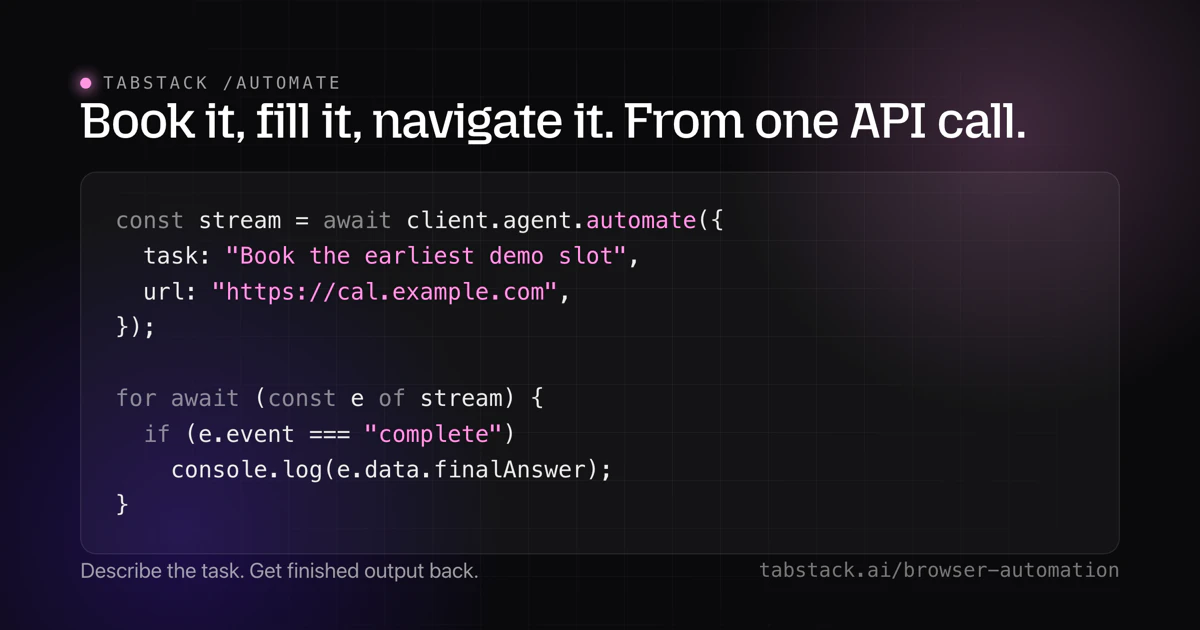
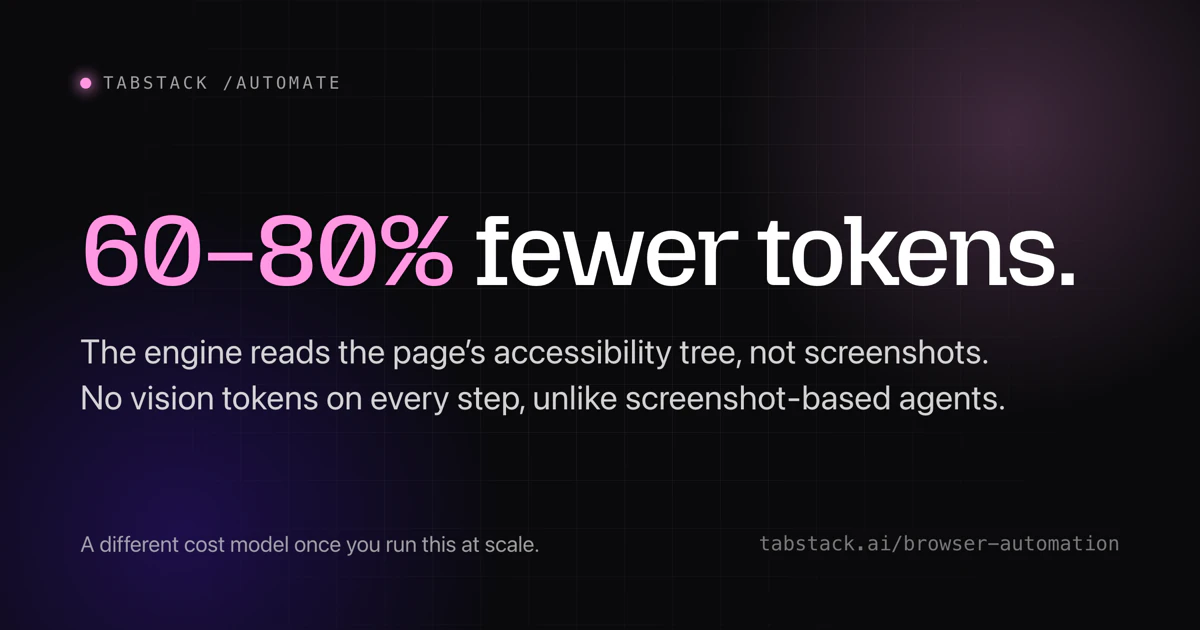
Give /automate a task in plain English and it drives a real browser to do it: navigate a site, click through a multi-step flow, fill a form, reach a page that only renders after interaction. The result streams back in one API call. It's an API you call, not a framework you install. Browser and LLM included, nothing to host, no concurrency ceiling. Accessibility-tree automation spends 60 to 80% fewer tokens than screenshot-based agents. Built by Mozilla. Ephemeral, no training on your data.

Hey Product Hunt 👋 Tessa here from @Tabstack by Mozilla

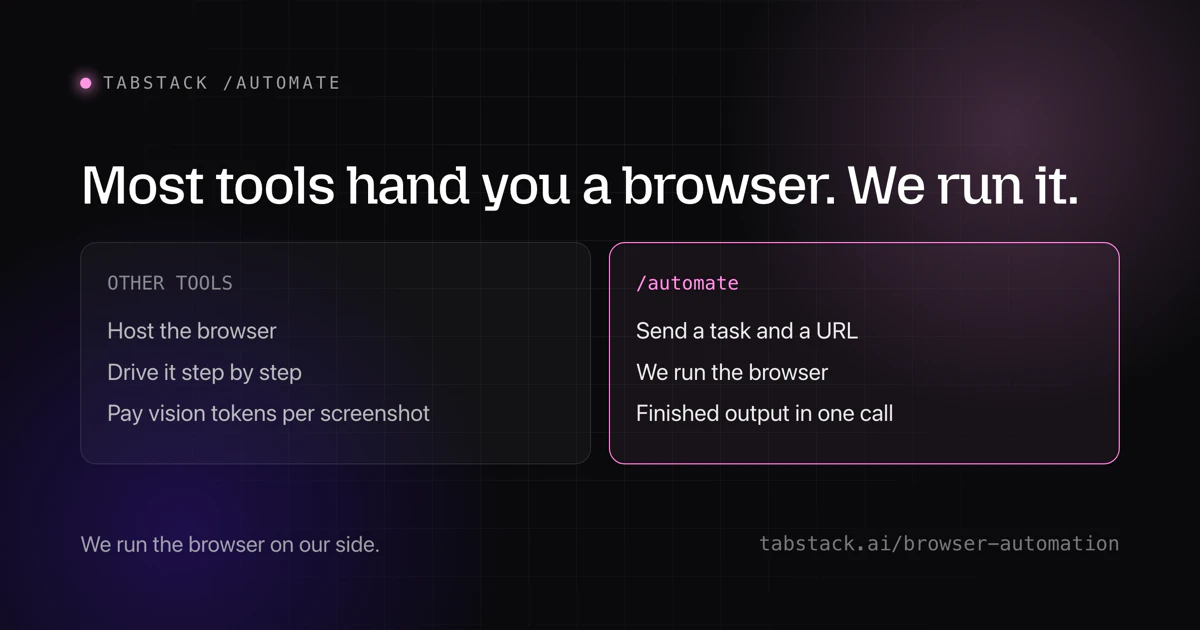
Most web automation tools hand you a browser and leave the hard parts to you: hosting it, driving it, and paying for vision tokens on every screenshot. Automate flips that. You send a task in plain language plus a URL, we run the browser on our side, and you get finished output back in one streaming API call. Drop it into an agent or wire it into an app you already ship in a matter of a few minutes.

It can book a meeting, fill a multi-step form, or pull data from a page that only renders after you click around. The engine reads the page's accessibility tree instead of screenshots, so it spends 60 to 80% fewer tokens than screenshot-based agents. That's a different cost model once you're running this at scale.

Free to get started at tabstack.ai/browser-automation

If you're building agents or adding web actions to an app, I'd genuinely love to know: what's the first task you'd point it at? I'll be here all day answering everything. Thank you for taking a look 🙏

13
回复

@tessak22 Probably something like filling out a form that's different on site.

Curious about the failure side though. If the task has five steps and it gets stuck on step three, does the response tell you where it stopped, or is it more of a pass/fail? Asking because with a regular scraper you can at least see which selector broke, but with a natural-language task I wouldn't know where to start looking.

4
回复
@whetlan we have interactive mode, so if it gets stuck at step three, it can stream back and ask for help! It actually streams every step along the way, too, so you know what’s going on the entire run.
4
回复

We're launchmaxxing @Tabstack by Mozilla on Product Hunt! Browser Automation is the 6th launch here, and it's the most ambitious one to date. No pressure.

S/O to @tessak22 and team for the great work. Looking forward to seeing what the community is building with it.

Get started for free: tabstack.ai/browser-automation

7
回复
@fmerian 🙌
1
回复

Tried it on a couple research queries and the cited multi-source output was solid. Nice that it returns clean Markdown instead of forcing me to parse raw HTML.

3
回复

@kumsalh9541 A-MAZ-ING! feel free to add your review here: https://www.producthunt.com/products/tabstack/reviews/new

0
回复

@kumsalh9541 Thank you, love that it worked well for you. Cited output you can actually trust, and clean Markdown you don't have to fight with, that's a win! Appreciate you trying it.

1
回复

You had me at fewer tokens! 😁

3
回复

friends don't let friends waste tokens 🫶

2
回复

@liran_tal right?!

1
回复

Great product!

3
回复

@dax1 thanks for your support, Darko! you rock

1
回复

@dax1 much appreciation!

2
回复

Congrats on the launch and good luck!

3
回复

@catalinmpit thank you, friend! Appreciate your support!

2
回复

@catalinmpit thanks for your continuous support! it means the world

1
回复

Super cool! Is it safe to use with authenticated workflows? What's the security model?

3
回复
@raphaeltm we do not currently have session or credential management built into the API functionality. However, you can use the open-source version of this endpoint locally if you wanted to try authenticated workflows. https://github.com/mozilla/pilo Authentication capabilities is something we are considering, though.
1
回复

@raphaeltm thanks for the support, Raphaël! appreciate it

1
回复

Not having to host the browser removes the exact part of web automation that always breaks in production. How are you handling sites with heavy bot detection, is that abstracted away or still on the developer side? Reading the accessibility tree instead of screenshots is a smart cost move too, that token math adds up fast at scale.

2
回复

@attacomsian Thank you, that means a lot.

Bot detection: not abstracted away, not on you either. We run real browsers and respect robots.txt by default, so ordinary checks are usually fine. We don't do stealth or CAPTCHA-solving. If a site is set on keeping automation out, we won't fight it. That's a Mozilla call.

And yes on the accessibility tree. It's a cost decision as much as a reliability one, and screenshots get expensive fast. Glad that stood out.

0
回复

Mozilla shipping something this developer-focused and privacy-conscious feels like a nice return to form. Loving that robots.txt compliance and ephemeral processing are defaults, not afterthoughts.

2
回复

@savadgcs thank you. and yes, @Mozilla does care about developers and humans. ❤️

0
回复

@savadgcs Thank you, this one means a lot. Defaults are everything, values you have to opt into aren't really values. Tabstack is privacy-first. Really glad that comes through.

0
回复

How does the pricing scale if my agent is firing hundreds of these calls per hour, and is there a way to cap costs before things get out of hand?

2
回复

@kezibanlgegjc6 great question re:pricing, thanks for asking.

@Tabstack by Mozilla's pricing is clear and flexible. It starts with a free 10k credit trial tier to explore the full platform, then it offers a pay-as-you-go individual plan, or predictable monthly subscriptions. In short, you can build without interruption and scale at your own pace.

To learn more about how Tabstack billing works, read the docs: https://docs.tabstack.ai/pricing/

hope it clarifies!

0
回复

the stateless-per-call design makes sense for reliability but I'm curious how it handles flows that need to stay logged in across steps - like a site where you need a session cookie from step one to do anything in step two. do you pass auth state back in yourself each call, or is there something built in for that

2
回复

@galdayan Good distinction. Within a single /automate call it's one live browser session, so a cookie set in step one is still there in step two. Multi-step flows that depend on earlier state work fine inside one task.

Across separate calls it's stateless: no built-in session store, and no param to pass auth state back in, each call starts clean. So the pattern that works is doing the whole logged-in flow in one task, not logging in on call one and trying to reuse it on call two. The hosted API isn't built to manage credentials or hold a login across jobs—not yet anyways.

0
回复

How does the ephemeral processing actually work in practice, like is there any retention window for debugging failed calls or is it truly gone the second the response lands?

2
回复

@mirag1jy By default, gone the second the response lands. The payloads (URL, parameters, response data, extracted output) are discarded as soon as the call completes and never stored. What persists is request metadata: which endpoint you hit, success or failure, timestamp, credits. So you can see that a call failed, you just can't replay its contents.

If you need payload-level debugging, detailed data collection is opt-in per org. Turn it on and those payloads are retained for 90 days, then dropped. Interactive form values stay ephemeral either way, they expire in minutes and are never stored.

0
回复

How does the pricing actually work for the research calls versus the simpler Markdown or extraction endpoints, since those seem like pretty different workloads?

2
回复

@yavuz1682575 great question, thanks for asking! you can learn how @Tabstack by Mozilla billing works, what a credit buys, what each endpoint costs, and how overages are handled, in the docs here: https://docs.tabstack.ai/pricing/

TL,DR:

  • @Tabstack by Mozilla is credit-based.

  • Credits are spent per action.

  • An action is one unit of work the platform performs.

  • The cost of each action is set by its endpoint.

Full breakdown here and what it looks like in practice here: https://docs.tabstack.ai/pricing/#how-credits-work

hope it helps!

0
回复

finally tried this and the schema extraction felt shockingly clean, called it for a few messy product pages and got structured JSON back without babysitting.

2
回复

@nehir238420 amazing! feel free to add your review here: https://www.producthunt.com/products/tabstack/reviews/new

0
回复

@nehir238420 incredible! That's awesome to hear.

1
回复

Curious how it handles sites that block headless browsers or rely heavily on client-side rendering since you mentioned no browser infra on my end.

2
回复

@perihan69108 Client-side rendering is handled: it runs on a real browser on our side, so JS-heavy and SPA content that only appears after render works, and yes, no browser infra for you to run. If a page is especially heavy, bumping effort to max gives it full rendering room.

Sites that actively block headless or automated access are a different story: we run real browsers and respect robots.txt by default, and we don't do stealth or CAPTCHA-solving. Ordinary bot checks are usually fine, but if a site is genuinely determined to keep automation out, we're not the tool to force it.

0
回复

Spent a few minutes poking around the schema extraction and it actually nailed a messy recipe page on the first try. The robots.txt compliance detail is a nice touch for anyone tired of sketchy scrapers.

2
回复

@nazls86733 thank you! I actually built an app with Tabstack doing the same thing. I'm using extract and generate, though. I feed it the recipe url, it extracts the data, then generates a clean, easy to follow recipe. Most of the ones online are such a mess to read with ads, and otherwise. Glad you found success. Hopefully you can find more ways to integrate it. I have it available to my Hermes agent so its constantly grabbing for it to do various things I ask it to do as the tool to surface the data and navigate the web.

1
回复

How does this handle sites with heavy bot protection or JS-only content that needs real browser interaction, and is that tier priced differently than simple fetches?

2
回复

@zgurbuzogl23098 JS-only content is the easy part: /automate runs a real browser and interacts with the page (click, scroll, fill, submit), so anything that only appears after render or interaction works.

On heavy bot protection, we respect robots.txt by default and don't do stealth or CAPTCHA-solving, so if a site is actively locking out automation, we're not the tool to beat it.

Pricing is usage-based, not a flat tier. A Markdown fetch is 10 credits (one action). /automate is 100 credits per action and runs as many actions as the task needs, so an interactive task costs more than a plain fetch, and a longer task costs more than a short one. You see the per-action rate before you run it.

1
回复

how does the robots.txt compliance work when an agent needs data from a page that's blocked but technically accessible via the rendered DOM?

2
回复

@zafer175063 If robots.txt disallows the path, we don't fetch or render it, whether or not the data would technically be sitting in the DOM. "Technically accessible" isn't the same as "allowed," and we go by allowed. That's the Mozilla line, we won't route around a site's stated policy. If the path isn't disallowed, the agent reads it normally.

1
回复

how does the robots.txt compliance actually work when an agent needs to interact with a page that blocks scraping, does the API just refuse or is there a way to get the structured data another way

2
回复

@azadfndk143609 robots.txt is respected by default, and it's checked per URL against the user-agent, not as a blanket on/off. If a site's robots.txt disallows the path you're pointing at, Tabstack treats it as blocked and won't fetch it. There's no compliant bypass, that's deliberate on Mozilla's side. In /research you'll even see blocked URLs counted in the robotsBlocked stat.

The part that usually matters: robots.txt is path-specific, so sites rarely disallow everything. The page you actually want is often allowed even when other parts of the site aren't. So it's less "the API refuses you" and more "it respects exactly what the site published."

And worth separating, since people lump them together: a robots.txt disallow is different from a page throwing bot-detection at you. Only the first is a robots.txt question. If you hit blockers, share the URL and I'll tell you which you're hitting.

1
回复

How does it actually handle sites with heavy anti-bot protection or JavaScript-heavy SPAs that need real browser rendering under the hood?

2
回复

@bavcichali87886 Thanks for getting into the mechanics, this is the right question to ask.

JS-heavy SPAs: these run on a real browser under the hood, not a plain HTTP fetch, so client-rendered content works. If a page loads its data lazily or after interaction (pricing tables, product grids, dashboards), set effort to max. That's full browser rendering built for exactly this case. standard is faster but can return empty fields on the heaviest SPAs, so max is the lever when you see that happen.

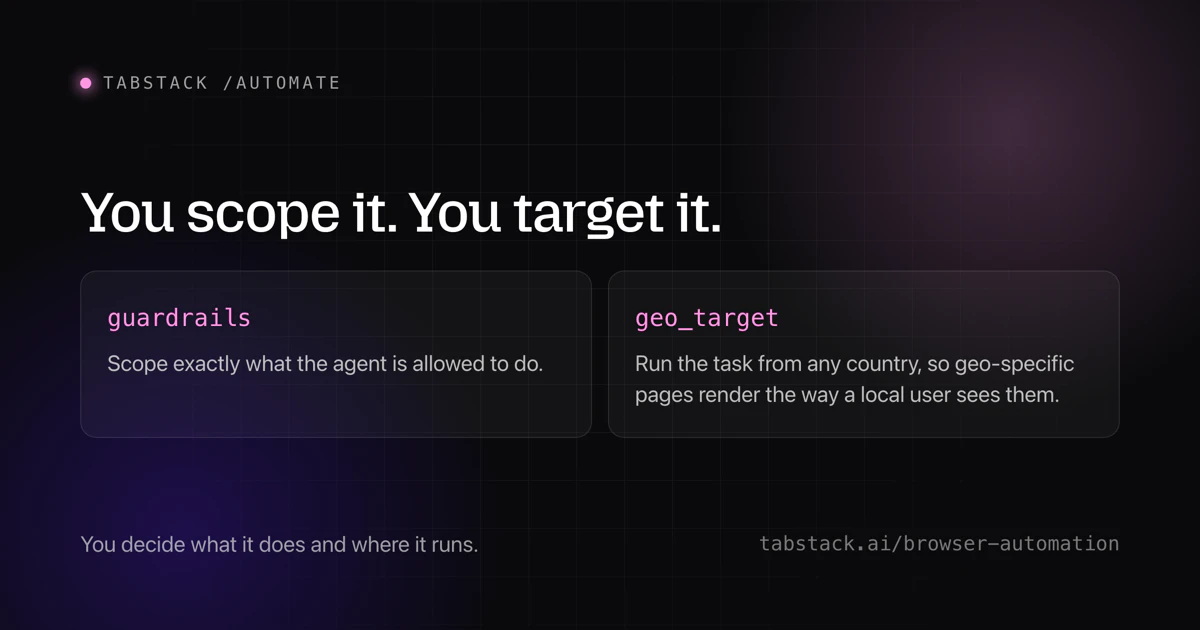
Anti-bot: Tabstack is built by Mozilla and respects robots.txt by default, so it's made for accessing the open web, not for defeating sites that don't want automated access. Real browser rendering plus geo-aware routing (geo_target) handles a lot of what trips up naive HTTP clients, but aggressive stealth and CAPTCHA-solving aren't what we do. If your use case leans on that, I'd rather tell you now that we're probably not the right fit.

If you've got a specific URL that's giving you trouble, send it over and I'll take a look.

1
回复

Schema extraction in one call actually worked on a messy docs page, which was a nice surprise. The robots.txt compliance by default is a solid touch.

2
回复

@toprak967471 Thank you, that's the best kind of surprise to hear about. And the robots.txt default isn't an accident, it's the Mozilla way. We think agents should access the web the way it asks to be accessed. Respecting that by default matters more to us than shipping a bypass. Appreciate you noticing it.

1
回复

The accessibility-tree-over-screenshots call is the smart part - screenshot agents are the ones that quietly break the moment a layout shifts. First task I'd point it at: pulling structured data out of the messy 'contact us / booking' pages that never expose an API. That's exactly where my agents lose the thread today. Congrats on shipping.

2
回复

@david_marko Thank you, that means a lot. You nailed the bet: that accessibility-tree read is exactly how the automate agent perceives a page, so it stays steady when a layout shifts instead of breaking the way a screenshot agent does.

And messy contact/booking pages with no API are a great thing to point it at. /automate navigates and reads the page structure, so you hand it the task in plain language and it works the page and pulls what you asked for. If you aim it at one of the pages your agents lose the thread on today, I'd love to hear how it holds up.

0
回复

Thanks for the support, David! And please keep us posted about your experience using @Tabstack by Mozilla. Looking forward to what you're building.

0
回复

I have some experience with workflow automation, so this caught my attention. Is it fair to think of Tabstack as browser automation powered by AI, rather than a traditional RPA workflow? I'd love to understand where the biggest differences are.

2
回复

Is it fair to think of Tabstack as browser automation powered by AI?

Correct. Extract structured data to a schema you define, convert pages to Markdown, run cited multi-source research, and automate browser tasks using @Tabstack by Mozilla.

The key differenciator? @Mozilla. Every call runs on a Mozilla-backed platform. The pages you extract, the answers you research, and the tasks you automate stay yours, handled responsibly and never used to train models.

Private by default, transparent by design. @Tabstack by Mozilla is just different.

2
回复

Wow, another great innovation. I hope this works both ways and makes it more standard to implement accessibility trees. A11y continues to be important in the agentic web!

2
回复
1
回复

That clears it up, thanks Tessa. Goal-driven re-plan is the right default for read tasks, but it makes retries scary for anything that writes. If a run already hit submit before it died, a fresh re-plan can submit again, and most web forms won't dedupe that for you. In our own agent loops we gate the side-effecting step behind an idempotency key so a second attempt no-ops, but that only holds if the target honors it. Any notion of marking a step do-once so a retry skips it?

2
回复

@dipankar_sarkar Straight answer: no, there's no do-once or idempotency-key primitive today. A run is stateless with no persisted step ledger, so on a retry there's nothing server-side for it to consult and skip against. Your instinct is the correct one, and honestly the target is the only place a true do-once can live, since it's the only party that can guarantee the no-op. An idempotency key that the target honors is exactly right.

One softer lever in the meantime: since the task is natural language, you can fold the guard into the task itself and have the agent check for the post-submit state (a confirmation page, an existing record) before it acts. That's best-effort model judgment, not a guarantee, so it complements your idempotency key rather than replacing it.

It's a sharp ask, though. A first-class "mark this step do-once" is a genuinely useful primitive for write-heavy agent loops, and I'll flag it to the team.

1
回复

Not sure that my feedback can be useful, because I`m not too deep in the topic. But I love homepade of your website - it is clear and has all information needed. Keeping instruction near the start button was a very smart decision.

2
回复

@julia_shtogren you just made my heart so happy! That website is a labor of love. I've been building each stack page as we've launched on Product Hunt. I strategized the approach, wrote the messaging, designed it (from where it was), and built it. I'm so proud of the work and I'm really really thankful for your kind words. Let me know if you try Tabstack or if you need anything. Always here to help. 🫶

2
回复

S/O to @tessak22 for the awesome work crafting tabstack.ai!

1
回复

Congrats on the launch, folks! Turning "give agents the web" into five clean endpoints instead of a black box is an interesting call.

Just a curious question: when an agent's task requires a page that robots.txt disallows, does the API fail with a clear signal to reroute, or is that boundary invisible until production?

2
回复

@soumya_ranjan_mohapatra thanks! It fails fast with a clear signal. A disallowed URL comes back as a 422 with the message blocked by robots.txt, surfaced in the SDK as a typed UnprocessableEntityError, so you can catch that specific case and reroute (skip the URL, try an allowed path, hand it back to your planner) instead of guessing. It's synchronous on the call, and it fires the same way mid-/automate, so an agent hits the boundary the moment it tries the page, not later.

One detail worth knowing: the check fails open. If a site's robots.txt can't be fetched or parsed, the request proceeds rather than blocking, so you only get the 422 on an actual disallow, not on an ambiguous or missing file.

Compliance is on by default, so this is the intended behavior rather than something you configure.

1
回复

Is this running remotely on another server? Seems really cool. How does things like Google auth work?

2
回复

@campak Yeah, fully hosted: the browser runs on our infrastructure, so you just call the API and get the result back, nothing to run on your side.

Auth flows are the honest edge of the hosted API. It's stateless per call and doesn't manage sessions or credentials, so an interactive login (OAuth, "Sign in with Google," anything that hands back a session you need to hold onto) isn't something it carries across calls. It's built for public pages. Two ways people handle that:

1. Run the engine locally. /automate is powered by Pilo, our open browser-automation engine. Run it in your own environment, complete the login yourself, and it drives your authenticated session directly. That's the right path when the task genuinely needs to be signed in.

2. Split the work. Keep the authenticated steps in your own code and point hosted Tabstack at whatever's reachable without a session. You own the login; Tabstack does the structured extraction and automation around it.

Thanks, glad it caught your eye!

1
回复

Hi Tessa, the fact that whatever I pull off the web stays mine is what makes this stand out to me. Anyone who has watched a scraper quietly break overnight will feel the relief here.

2
回复

@robin_de_lacroix right?! Mozilla for the win. Their ethics around humans owning their data and being privacy-focused is a huge win for developers using Tabstack.

1
回复

The fact that whatever I pull off the web stays mine is what makes this stand out to me.

Spot on. There are multiple products in the browser automation category. @Tabstack by Mozilla is different. Private by default. Transparent by design. Every call runs on a Mozilla-backed platform. The pages you extract, the answers you research, and the tasks you automate stay yours, handled responsibly and never used to train models.

2
回复
how good is it for social media auto posting?
2
回复

@starchet we're actually going to show off those kinds of use cases on our livestream later today! Currently, we don't have credential or session management, so the authentication into your social channels would be the trickier part. However, if you had a wrapper around Tabstack that you were feeding auth keys or cookie sessions to, it should work really really well. Watch our YouTube for the livestream—should be in 4 or so hours: https://www.youtube.com/@tabstackdev

1
回复
#4
Claude Sonnet 5
AI that plans, acts, and gets work done
333
一句话介绍:Claude Sonnet 5是Anthropic推出的具备自主规划与执行能力的AI助手,能够调用浏览器和终端等工具独立完成复杂编程和专业工作任务,解决了用户在代码编写、多步骤任务自动化及内容创作中对AI深度协作与可靠性的需求。
SaaS Artificial Intelligence Development
AI助手 自主代理 编程辅助 任务自动化 推理增强 内容创作 商业应用 长上下文处理 成本优化 Anthropic
用户评论摘要:多数用户认可其编码、写作的连贯性和自然语调,尤其点赞“接近Opus 4.8性能但成本更低”。核心疑虑集中在自主执行时的安全护栏:是否在删除文件、提交表单等不可逆操作前内置检查点?长文档处理(如200页PDF)和长时间自主任务的任务漂移问题也备受关注。
AI 锐评

Claude Sonnet 5的发布标志着AI助手竞争从“聊天能力”正式转入“执行能力”阶段。从产品信息看,它不再满足于做被动应答的工具,而是试图成为一个能“think and do”的虚拟员工——这恰恰是当前企业用户最深层的刚需。投票数和用户反馈中,最具价值的不在于“代码写对了”或“语气更自然”,而在于用户自发提出了两个尖锐问题:如何防止自主操作导致不可逆破坏?长时间任务中如何避免目标漂移?这暴露了当前“agent化”AI产品的致命软肋——信任。即便Sonnet 5宣称逼近Opus 4.8性能且成本更低,但若没有透明的、可用户干预的护栏机制,企业级场景下“无人值守”依然是一句空话。不过,Anthropic敢于将“agentic”作为核心卖点推出,说明其在“工具使用”和“任务分解”的工程化上已领先于多数竞品。真正决定Sonnet 5价值的,不是基准测试提升了几个点,而是它在多大程度上解决了“AI做了蠢事谁来负责”的问题。若不能给出明确答案,这波“代理式AI”热潮可能只是另一场技术演示狂欢。

查看原始信息
Claude Sonnet 5
Our most agentic Sonnet yet, with top-tier intelligence for coding and everyday professional work.

Hey Hunters! 👋

I'm excited to hunt Claude Sonnet 5 today.

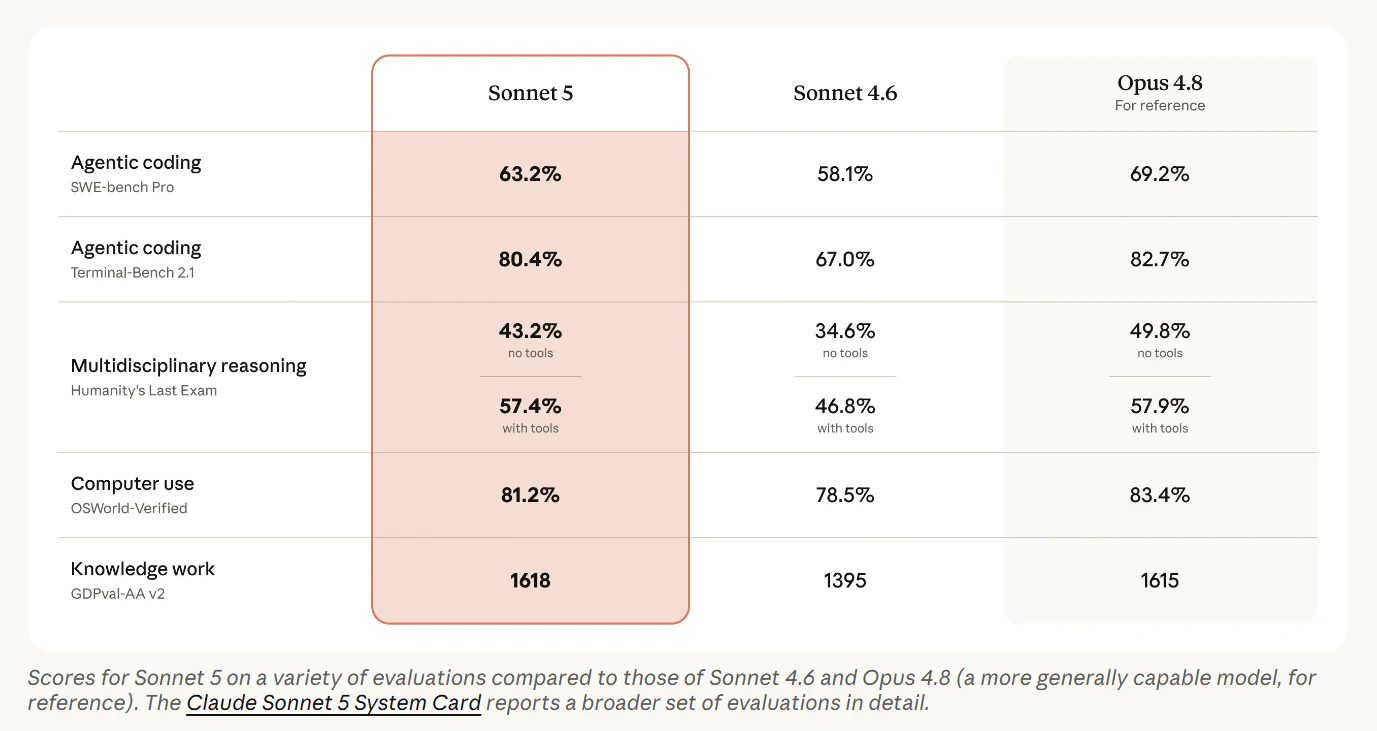
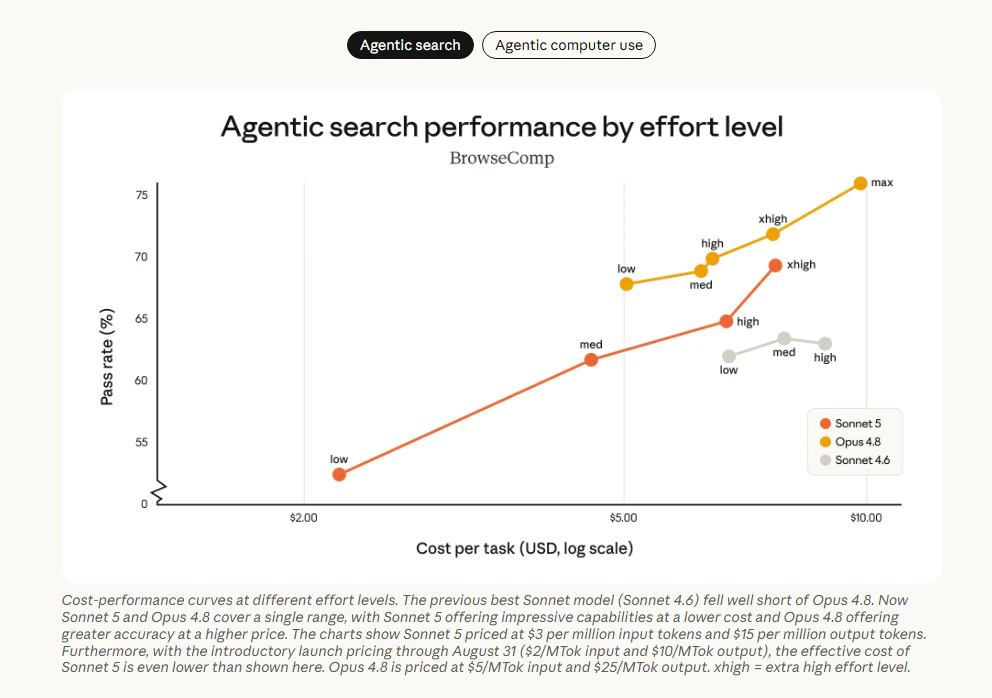
Claude Sonnet 5 is Anthropic's most agentic Sonnet yet—able to plan, use tools like browsers and terminals, and complete complex tasks autonomously. It delivers major improvements in reasoning, coding, and knowledge work, with performance approaching Opus 4.8 at a lower cost.

Now available across all Claude apps for Free, Pro, Max, Team, and Enterprise users. What will you build with it?

6
回复

@saaswarrior  I use Claude often and I appreciate how consistent and easy it is to work with.

0
回复

Loving "baby Fabel" so far. Started to use it lasst night. Feels a s good as Opus 4.6 TBH. 🙏

1
回复

A develper freind of mine is always comparing AI models for coding tasks. I am definitely sending this over because I know they will want to benchmark it.

1
回复

The agentic framing is the interesting shift here, more than the benchmark bump. Curious about the guardrail side though - when it's chaining terminal and browser calls on its own, is there a built-in checkpoint before anything irreversible (deleting files, submitting a form, sending a message) or is that entirely left to whoever builds the wrapper app? That's the part that decides whether I'd actually trust it running unattended overnight.

0
回复

How does Claude handle really long documents compared to other models, and is there a hard cap on context length or input size?

0
回复

Used Claude to draft a tricky client email and it actually got the tone right on the first try, which surprised me.

0
回复

Used it for a quick writing task and it kept the tone consistent without me having to repeat myself, which honestly surprised me.

0
回复

Used it for a couple of writing tasks and the tone felt surprisingly steady, no weird over-eager cheerfulness. The thing I keep coming back to is how it actually remembers what I asked earlier in the chat.

0
回复

I use Claude Code daily for my side project and the jump in agentic behavior is noticeable — it gets further into a task before needing me to step in. The coding improvements are real too. Curious how Sonnet 5 stacks up against Opus 4.8 on longer multi-file refactors, that's where I still feel the difference most.

0
回复

the tone in claude's responses feels really considered, not just safe but actually tuned to match the weight of what you're asking. that's hard to pull off and it shows the team sweats the calibration.

0
回复

The way Claude handles long, nuanced conversations without losing context really stands out. Feels like real craft went into the steering and tone control behind the scenes.

0
回复

Finally got around to trying Claude for some coding help and it actually caught a subtle bug I missed, with a clear explanation of why it happened.

0
回复

the line that got me is Sonnet basically creeping up on Opus 4.8 territory while costing way less, that's a wild place for the mid tier to sit. when it's driving a browser or terminal on its own, what's it actually doing to keep a long autonomous run from quietly drifting off the original task?

0
回复

Curious how Claude handles really long documents compared to the usual token limits I'm used to. Can you drop in a 200 page PDF and have it pull out specific info accurately?

0
回复

Honestly the tone feels way more natural than other assistants I've poked at, and it actually pushed back politely when my prompt was vague instead of just guessing. Made me trust the answer more.

0
回复

Honestly impressed by how Claude handles longer context without losing the thread. Used it to summarize a messy research doc and it actually flagged ambiguities instead of guessing.

0
回复

How does the pricing scale for heavier workloads, and are there any caps on context length or API rate limits I should watch out for at the higher tiers?

0
回复

Working great for coordination tasks so far!

0
回复

How does Claude handle really long documents compared to other models I've tried, and is there a way to feed it multiple files at once or do I have to paste everything in?

0
回复

How does Claude handle really long documents compared to other assistants you've tried, and is there a hard cap on context length I should know about?

0
回复

the way claude handles long context without losing nuance genuinely impresses me

0
回复

I run Sonnet in long agent loops, so the thing I'm watching is tool-call stability: how many calls it chains before it drifts off the original plan. Older Sonnets would start second-guessing a decision they'd already committed to around call 15, which quietly derails an autonomous run. If Sonnet 5 holds the plan through a deep terminal-and-browser session, that's worth more to me than a few SWE-bench points. Anyone pushed it on long-horizon stability yet?

0
回复
#5
Adam CAD Copilot
AI CAD inside Onshape and Fusion
284
一句话介绍:Adam CAD Copilot将AI助手直接嵌入Onshape和Fusion中,让机械工程师通过自然语言编辑已有特征树,解决重复性建模与设计迭代中的效率痛点。
Design Tools Productivity Artificial Intelligence
AI CAD助手 特征树编辑 参数化模型 机械工程 Onshape插件 Fusion插件 设计意图保留 工作流自动化 几何推理 vibe-CAD
用户评论摘要:用户高度关注对复杂、混乱特征树的处理能力,以及参数化模型中的依赖关系和设计意图保留。核心疑问包括:首次编辑准确率、与导入文件兼容性、自主度控制及如何验证结果。团队回应强调“代理式重写”“空间推理”“需2-3次提示”等特性。
AI 锐评

Adam CAD Copilot的诞生,标志着AI在工程软件领域的落地从“花瓶式建议”迈向了“实干型操作”。它的核心价值不在于“生成一个模型”,而在于“理解并修改一个已有模型的构建逻辑”——这恰恰是机械工程师日常工作中最耗神、最易出错的环节。

从评论反馈来看,用户最担心的并非“AI能否生成”,而是“AI能否不搞砸”。尤其是对于充满历史包袱、依赖重重、命名混乱的经典“屎山”模型,Adam尝试用“耐心读特征树+视觉校验+代理式纠错”来回答这个难题。这种务实取向值得肯定,它没有画饼说“全自动设计”,而是定位为“可对话、会卖萌(提示确认)、可纠错的副驾”。

然而,犀利之处在于:产品本质上是调用大模型进行CAD特征的“文本+几何”双模态理解,而不是真正的“工程力学推理”。这意味着,在面对严苛的制造约束、材料特性或公差链分析时,Adam的“理解”依然是统计意义上的。它擅长清洗特征树、合并参数,但很难真正“理解”这个倒角为什么非改不可、那个孔为什么必须是通孔。团队坦诚“复杂场景需2-3次提示”,本质上是一种“人兜底,AI试错”的协作模式。

更现实的问题是:它在Onshape和Fusion中作为插件运行,意味着性能和可靠性严重依赖宿主软件API的稳定性,以及云端模型的响应速度。如果后续开放支持SolidWorks或CATIA,那才是真正意义上的工业级考验。

总的来说,Adam是一个聪明且务实的“CAD刷子”,它能高效完成清洁、重命名、参数化等苦力活,但别指望它成为“设计决策的大脑”。它让“vibe-CAD”从梗变成可能,但离“可信赖的工程AI”还有两个特征树的距离。

查看原始信息
Adam CAD Copilot
Adam brings AI CAD assistance into the tools mechanical engineers already use. Create & edit parts with prompts, reference selected geometry, clean up feature trees, and keep everything editable. All natively inside Onshape and Autodesk Fusion.

Hey all!


I'm Zach, one of the creators of Adam. Adam is an AI harness that integrates directly with your CAD. It reads your parts, understands the existing feature tree, and edits it for you agentically. We are now live as a copilot in Onshape and Fusion!

We are also very excited to hear that Fable 5 is coming back today! We have found this model to be a state of the art in agentic CAD & broader mechanical engineering tasks. We will keep you updated as we add it back into production today as our default model :)

19
回复

@zach_dive i am really happy to see AI helping with the boring instead of trying to do all the thinkig me.

0
回复

Very cool to see AI moving deeper into CAD instead of stopping at design suggestions. Editing the existing feature tree feels much more useful in real workflows.

0
回复

@zach_dive First of congrats, but I have a question that how Adam determines whether to modify an existing feature versus rebuilding geometry entirely ?

10
回复

@zach_dive Editing an existing feature tree instead of starting over sounds like a lifesaver. How does it hold up when the model is an absolute mess?

16
回复

That's exactly what I was wondering too. Real-world CAD models are rarely clean, so I'm curious how Adam handles messy feature trees with lots of dependencies and legacy edits.

0
回复

@zach_dive  @christian_west1 Hey Christian! Our custom harness fully maximizes the model's spatial reasoning capabilities far beyond the base models, allowing Adam to understand very complex geometries. Furthermore, unlike humans, Adam is extremely patient. Adam is able to go through thousands of features, identifying their purposes, cleaning up the tree, renaming, etc, to make it easier to interpret. This allows Adam to build up a very strong understanding of the model, making refactoring much easier!

5
回复

@zach_dive I've spent way too many late nights cleaning feature trees. Can this really take that pain away?

13
回复

@zach_dive  @cameron_jordan1 Hey Cameron! Feature tree optimization is one of Adam's biggest strengths. Adam can rename features, merge similar features and generate parametric variables that have duplicate dimensions, all whilst considering actual geometric context. The spatial reasoning capabilities of Adam paired with visual inspection tools and full geometric awareness give it excellent refactoring skills!

4
回复

I've always felt that CAD has a sleep learning curve especially when making small design changes. Being able to describe what I want instaed of hurting through features sounds incredibly useful. Congrats on the launch!

11
回复

@morgan__harriss Thanks! As we have all started vibe-coding, we will soon be vibe-CADing

0
回复

Great launch. Mechanical design has so many repetitive tasks that AI can genuinely help with, and this feels focused on improving engineers' existing workflow rather than trying to replace it. best f luck with today's launch.

9
回复
0
回复

@zach_dive Honestly my impression is that engineering AI needs deep contextual understanding to be trusted. Understanding feature history and editing intelligently feels like an important move toward that future.

7
回复

@zach_dive  @jared_coleman Exactly I am experiencing the same .

1
回复

@jared_coleman Yep this is key

0
回复

@zach_dive How's it doing with complicated parametric models? Those are usually where AI starts sweating.

6
回复

@zach_dive  @colesimmons05 Hey Cole! Adam respects existing parametric variables, and can create more if it needs to. Adam understands dependencies between features, so won't merge them if that will break the model. If it makes a mistake, it can see where it went wrong and either undo a change or correct it. Adam can also compress the total feature tree if needed so that it can get an overall sense of the geometry, but can also make specific changes to the full feature tree. We've seen Adam handle very complicated parametric models, often much better than human benchmarks!

3
回复

A colleague of mine spends hours making repetitive CAD edits every week. I am definitely going to send this their way because it seems like something whey would appreciate.

4
回复

@nitesh_kumar98 Awesome!

0
回复

This feels like a practical step for CAD automation. Most engineers I know care more about preserving feature trees than geometry from scartch, so this approach makes sense.

4
回复

@aarav_pittman Yes that's what we've found too

0
回复

@zach_dive Appernetly everything looks perfect but I wonder that how Adam balances speed with preserving original design intent during larger iterative edits?

4
回复

@zach_dive  @edward_baker3 Hey Edward! Adam is very interactive, and can ask clarifying questions if the intent isn't clear. We prioritize quality over speed, but have found that even the most complicated tasks are often finished at least as quickly as a human, and usually much faster! You can choose to prompt Adam more iteratively rather than single-shot large prompts if you want more control. It's entirely up to you!

2
回复

@zach_dive Be honest, how often does it get the edit right on the first try?

3
回复

@zach_dive  @rowan_elizabeth1 Hey Rowan! This depends very much on the complexity of both the model being edited, and the type of edit you want to make. For most simple-to-medium edits, Adam is extremely reliable and will get it right in one prompt.

For more complex edits, Adam can work iteratively to make sure the edit is correct. This means it makes a change, inspects the output, and continues in a loop until the goal is met. Adam is very good at verifying its work as it has full visibility over the geometry, can perform sophisticated spatial reasoning, and take screenshots as a fallback. For super complex edits, it may have to make a few changes, but it is nearly always gets it right. In terms of human 'tries' Adam will usually get it right after one prompt, but in extremely complicated situations it may take 2 or 3 prompts.

2
回复

@zach_dive Does it play nicely with imorted files, or is that where things start falling apart?

3
回复

@zach_dive  @preston_daniel1 Hey Preston! Absolutely! In fact one of Adam's biggest strengths is iterating and optimizing existing documents, as this already provides lots of context and intent!

2
回复

I have seen AI generate CAD models before, but editing existing designs intelligently is a much harder problem. It looks like your team focused on solving the part that actually matters in day-to-day engineering

3
回复

@bryan_williamson3 100% that's the goal!

0
回复

@zach_dive Does it ever point out a cleaner way to model something, or does it only do exactly what you ask?

2
回复

@zach_dive  @elodie_harper Hey Elodie, great question. Adam can work both as a pilot and a copilot. If you want Adam to just do as you say, then you can certainly ask it to. By default, Adam will try and find the best way to achieve the goal, which might include doing something differently/cleaner than your prompt suggests. In these cases, Adam can ask if you're happy to take a different path, but ultimately you can decide how autonomous you'd like Adam to be.

2
回复

Congrats! This feels like a “Cursor for CAD” moment. I’m curious about that after Adam makes an edit, how do you help engineers verify that the resulting model still preserves design intent, constraints, and manufacturability?

2
回复

@xinrui1 Hey Xinrui! Cursor for CAD is pretty accurate! We have a few features that protect against the points you brought up:

  • Adam sees information such as feature names, variable names, part descriptions, constraints, etc which provides lots of design intent and context.

  • Adam can see which parts you have currently selected, allowing you to provide further intent with your prompts.

  • Adam has full visibility over the effects of its edits. This includes any warnings or errors that might occur if it gets things wrong, such as dependency breakage, fillet/chamfer problems, etc. When this happens, Adam can agentically solve these problems by undoing its actions or making further changes to resolve the issue.

  • Adam can also take visual screenshots of the model for an extra "vibe check" that the output is sensible

3
回复
Looking at adjacent tools like Cadio/MecAgent/Hestus that lean into text-to-CAD, macros, or drawing generation: what switching trigger makes a team say “we need Adam inside Onshape/Fusion,” and which workflows are you deliberately *not* trying to automate yet because the reliability bar is too high?
2
回复

@curiouskitty Hey, great question. Most engineers we've talked to find that text-to-CAD is much more useful when it understands their existing feature trees and workflows. Whilst Adam is very capable at text-to-CAD from scratch, it really shines when working with an existing set of features. Adam has best-in-class CAD context understanding, which means engineers can trust it to work alongside them, optimizing their feature tree, simplifying, clean up, and iteratively making changes to existing designs. With that said, we've seen very exciting new capabilities when Fable 5 is used in the Adam harness that does bring us closer to truly reliable text-to-CAD from scratch.

2
回复

Congratulations on the launch! Does Adam learn from a company's existing CAD design standards over time, or does every project start from the same general model? Curious how customizable the workflow is.

1
回复

@faida Hey Faida! Currently Adam's memory is limited to each conversation, but we're working on providing a powerful memory system soon. In the meantime you can ask Adam to generate insights at the end of an interaction that you can provide as context to your next conversation.

2
回复

Looks great for designers working under tight deadlines. Does it integrate smoothly with existing cad tools or work as a standalone layer?

1
回复

@hamza_afzal_butt Hey Hamza! Yes, Adam integrates smoothly with existing CAD tools. We currently support Onshape and Fusion.

2
回复

Tried it on a Fusion model and the geometry referencing actually worked, which is more than I expected. The feature tree cleanup saved me some real time on a messy bracket assembly.

0
回复

finally an ai that actually works inside my fusion workflow instead of dumping a screenshot back at me, the clean up feature tree trick saved me on a bracket design yesterday

0
回复

Keeping everything editable is such a thoughtful choice for engineers who hate black-box tools, nice work building it natively into Fusion and Onshape rather than bolting on another tab.

0
回复

Really love that the edits stay fully editable in the feature tree instead of getting flattened into dumb geometry. The decision to integrate natively inside Fusion and Onshape instead of pushing yet another window is exactly what mechanical engineers actually need.

0
回复

Finally tried Adam in Fusion and was honestly surprised how well it understood my messy feature tree. Just told it to clean up the boss and it actually kept the dimensions editable, which is more than I can say for most AI tools I have poked at.

0
回复

Does Adam run fully inside Fusion and Onshape without needing a separate window, or do I have to bounce back and forth to a web app?

0
回复

@tansu750955 You can run it both in the web app and as a copilot natively inside Fusion and Onshape

0
回复

been waiting for something like this inside Fusion, the prompt-based part editing feels surprisingly natural and the feature tree stays editable which is a big deal

0
回复

Really nice touch keeping everything editable and tied to the actual feature tree instead of just spitting out a static STL, that's the part most AI CAD tools get wrong and it shows the team actually understands how engineers work in Fusion and Onshape.

0
回复

Finally a CAD copilot that lives inside Fusion and keeps the feature tree editable, not some black box export. Cleaning up a messy tree with a single prompt felt almost too easy.

0
回复

How does it handle complex assemblies where multiple parts interact, or is it mainly aimed at single-part edits right now?

0
回复

How does Adam handle complex assemblies with lots of constraints, and does it keep parametric history intact when it edits features?

0
回复

the Fable 5 as state of the art for agentic CAD claim caught my eye. when I point it at selected geometry and ask for an edit, does it reason through the feature tree so the history stays clean, or just bolt on stuff that breaks the second I tweak an upstream parameter?

0
回复
#6
MailAdept by mailwarm
AI Agents & Email deliverability experts on your team
255
一句话介绍:MailAdept 是一个AI原生邮件送达率托管服务,通过AI智能体与人工专家组合,为企业提供持续的基础设施审计、问题修复、日常健康监测和每周收件箱放置报告,解决了团队无人持续监控邮件送达率、被动发现投递问题的痛点。 --- ### 关键词 AI邮件送达,邮件投递率优化,邮件基础设施审计,邮件健康监控,收件箱放置率,AI智能体,人工专家服务,邮件送达服务,订阅制,SaaS --- ### 评论摘要 用户关心AI与人工分工细节(如能否直接修改SPF/DKIM记录),质疑对小型发件人的价值(低于5万封/月是否值得付费)。多位用户强调“被动发现垃圾箱”是真实痛点,反馈周报能揪出长期未解决的SPF问题。希望公开定价,避免销售流程模糊。 --- ### AI锐评 MailAdept本质上不是“另一个工具”,而是将邮件送达率从“点状排查”升级为“持续服务”。其核心创新在于“AI智能体+人工专家”的双层架构:AI负责自动化监测认证状态、黑名单、投递趋势等高频指标,人则处理周报解读、策略调整和复杂异常的深度分析。这种分工恰恰击中了行业长期存在的“工具没人用”陷阱——Postmaster Tools、DKIM报告本身免费,但多数团队无人持续解读,最终等到客户说“你邮件在垃圾箱”才后知后觉。 但从评论反馈看,产品存在明显定位缝隙:对于月发低于5万封的团队,订阅专家的成本是否高于损失转化?这本质上是“保险逻辑”与“工具逻辑”的冲突。MailAdept需要更激进的定价分层或免费试用期来证明其边际价值,而非仅靠“团队不行”来说服市场。此外,AI代理能否在客户授权下直接执行DNS记录修改等高风险操作(而非仅报警),将决定其与“被动监控服务”的关键差异。目前产品仍偏重度,更适合高流失敏感度(如B2B销售)、多域名复杂配置的中型团队,而非小微企业。
Email Email Marketing Artificial Intelligence
用户评论摘要:AI解读失败
AI 锐评

AI解读失败

查看原始信息
MailAdept by mailwarm
Email deliverability on autopilot. A subscription-based, AI-native email deliverability service where AI agents and human experts work as an extension of your team to audit your infrastructure, fix issues, monitor email health daily, and improve inbox placement with weekly reporting.
If email is part of your growth, but nobody really owns deliverability inside your team, share your setup or challenge in the comments. We’ll take a look and give practical advice. Like most founders, email has been our #1 sales channel since our first startup in Station F, Paris. That’s what led us to build Mailwarm and work on email deliverability since 2020. And one thing became clear: Deliverability is not a one-time fix. It needs someone to own it. Your reputation changes. Your authentication can break. Your inbox placement can drop without warning. That’s why we built MailAdept. An AI-native deliverability service where AI agents and human experts work as an extension of your team. We audit your setup, fix issues, monitor email health daily, track inbox placement, and send clear weekly reports. Not just advice. Not just a dashboard. A real deliverability team helping your emails reach the inbox continuously.
5
回复

@thamibenjelloun One often challenge I face is duplicate or missing email signatures across the company. Congrats on launching from Uprows Hub 🚀 We've built a community of 1,000+ makers, founders, and tech enthusiasts who actively support and engage with new Product Hunt launches.

https://uprowshub.com/buy-product-hunt-upvotes

Happy to assist you on you getting the word out there!

0
回复

Hi Product Hunt,
After getting experience from @Mailwarm, the warmup deliverability tool. @mailX by mailwarm the free email deliverability toolkit for humans and AI agents to check and fix your deliverability.

We decided to launch @MailAdept by mailwarm the email deliverability agency, so we can use all our experience to make sure you land in the inbox. Coming from the software industry we worked on service and pricing to adapt to the target and made it subscription based.

So basically for a flat monthly subscription you get our expert deliverability expert on your team :)

I hope you will like it

4
回复
“Daily monitoring” can mean a lot of things: which specific signals do your agents track across Gmail/Outlook/Yahoo (authentication alignment, blacklist exposure, reputation proxies, inbox placement tests, complaint indicators, etc.), and how do you avoid false confidence from biased seed tests or noisy metrics?
4
回复

@curiouskitty Daily we track all authentication signals and see reports from DKIM Reports, Check blacklist, We also see the results for all marketing campaigns if they align with the target and see if there is any spike somewhere. Majority is done using agents and verified with Humans and anything that can't be done by agent is done with a human touch including weekly calls with the clients to check the objectives and adapt

1
回复

@curiouskitty Every day, our system monitors authentication health, pulls DKIM reporting data, and scans for blacklist flags. We also watch how campaigns are actually performing in the inbox and flag anything that looks off or spikes unexpectedly. Agents handle the bulk of this automatically, but everything gets a human sanity check and whatever needs more nuance than automation can offer gets handled directly by our team, including weekly calls with clients to revisit goals and adjust course.

1
回复

Congratulations 🎊

3
回复

@madalina_barbu Thank you for you support !

0
回复
@madalina_barbu Thank youu!!
0
回复

Can Mailwarm work with self-hosted mail servers?

2
回复

Email is such a hard space to build in! Congrats for building such a cool product

2
回复

@louislecat Thank you! We really appreciate it!

It definitely isn't an easy space, but after working on deliverability for years with Mailwarm, we kept seeing the same problem: teams needed ongoing ownership, not just another tool. That's what inspired us to build MailAdept.

Thanks so much for the support!

0
回复

The pitch makes sense but I'd want the pricing on the page before calling it a no brainer - there are free tools like Google Postmaster Tools and even Mailwarm's own toolkit that already cover authentication and blacklist checks. For a company sending under ~50k emails a month, what's the actual gap a subscription team closes that a decent marketing ops person plus those free tools doesn't?

2
回复

@galdayan The main difference is the an expert that will manage everything for you, you will be having weekly calls to set objectives, and get advice, it's a human deliverability expert + the tools.
For the pricing, we are working on making it public, it will depends on the number of emails and domains a user have.

1
回复

@galdayan I do agree that there is free tools to help you monitor your deliverability like google postmaster, the mailx (our own platform) - however, do you actually actively monitor all those daily?

At MailAdept, we do it for you, we are an extension of your team, you have an expert 100% dedicated to only monitoring your domain’s reputation, not only that we also monitor the campaign metrics, proactively alert you if there is any problem with your domain, we check the open rate, DMARC reports, ect… we do weekly calls with you to advise you on the next steps and more.

Rather than managing multiple platforms and wasting time analyzing the data whilst you have other priorities to handle - we do it for you!

0
回复

Congrats on the launch team!

2
回复

@german_merlo1 Thank you very much for your support!

0
回复

Congrats on the launch! 🎉 This hits close to home. This week alone, while following up by phone with leads I'd emailed, multiple people told me my messages went straight to spam. I had no idea until they said it out loud, which is exactly the problem: you don't find out until it's already cost you the conversation. Wish I'd had MailAdept in place beforehand, having AI agents plus real experts continuously monitoring health and inbox placement instead of finding out secondhand from a prospect is a genuinely different way to approach this. Excited to try it so I stop losing leads to a spam folder I can't see. Wishing you a great launch day!

2
回复

@anas_chhilif Thank you so much for your support! that’s exactly the kind of problem we built MailAdept to solve.

A lot of teams only find out there’s a deliverability issue after they’ve already lost the conversation. We want to catch those problems early with continuous monitoring, so you’re not relying on prospects to tell you your emails went to spam.

Really appreciate the support, and we’d love to hear what you think once you’ve had a chance to try it :))

1
回复

@anas_chhilif Thank you for the support!

0
回复

Took a chance on this and the weekly reporting actually flagged a real SPF issue I'd been ignoring. The audit was surprisingly thorough for something that runs on autopilot.

1
回复

Curious how the split actually works between your AI agents and the human experts, like which parts of the audit are fully automated and which still need a person in the loop? Want to know what I am actually getting for the subscription tier before I bring it to my team.

1
回复

The daily monitoring plus weekly reports combo is genuinely useful, finally I can see why emails are landing in spam without digging through dashboards myself.

1
回复

The weekly reports are surprisingly detailed and actually useful, not just vanity metrics. Pairing AI monitoring with human review feels like a smart middle ground.

1
回复

Curious how this actually plays out in practice since most deliverability services are kind of hands off. Does the AI agent just flag stuff for a human to review, or can it directly push changes to things like SPF/DKIM records on my behalf?

1
回复

The setup was painless and I noticed the weekly placement reports actually flagged a SPF misconfiguration I'd been chasing for months. Having both AI and a real person reviewing things feels like the right balance.

1
回复

Congrats! Deliverability really is one of those things nobody on the team wants to own until it breaks. Curious how hands on you get when something drops, are you fixing the DNS and auth for the client or pointing them to it?

1
回复

Deliverability being nobody's job is the hidden killer. Every founder I've talked to who runs cold email eventually finds out that "we have SPF and DKIM configured" doesn't mean their emails are landing anywhere useful.

Real setup for what it's worth, running 3 warmed domains, 9 mailboxes, mid-launch prep. What I keep learning the hard way:

1) Warmup networks warm you up to other warmup networks. Auth clean, Mail-Tester 10/10, no blacklists, 57% Gmail inbox on first real test. The warmup graph and the real Gmail graph are not the same graph, and no dashboard tells you that.

2) The metrics that predict inbox placement don't show up until they're already broken. By the time reputation drops, you've already sent to a batch you'd like back.

3) The move that changed the most for me was reducing volume even after warmup looked "done." Sending fewer, better-targeted emails from a warm domain outperforms sending more from a "fully warmed" one.

Honest question, what's your take on the tradeoff between adding a deliverability service like MailAdept vs. just sending less volume? I'm trying to figure out if the fix I've been reaching for (throttle everything) is a real fix or a compensation for infrastructure I should be paying someone else to own.

1
回复

The weekly inbox placement reports actually showed changes I could measure in our open rates, which is more than I expected from a "set it and forget it" tool.

1
回复

Deliverability genuinely needs an owner, the framing makes sense :) But picking up Curious Kitty's thread: the answers here list what you monitor (DKIM, blacklists, metrics), not how you know the placement number is real.

Gmail and Outlook never tell you if a real recipient hit Primary, Promotions or Spam. So placement usually comes from seed lists, the least representative inboxes there are: they never open, reply, or rescue you from spam. You can read "95% inbox" on the panel and still land in Promotions for the humans who matter.

So: what's actually behind the daily signal, seed panels, Postmaster, real engagement telemetry? And when the panel says green but the leads say spam (like Anas described above), which do you trust?

Congrats on the launch! ;)

1
回复

Congratulations on the launch!

1
回复

@ronakagarwal3434 Thank you for the support!!

0
回复

How does the AI actually decide when to escalate something to a human expert versus handling it on its own?

1
回复

Curious how this works with custom transactional sending setups, especially if we already have our own DKIM/SPF records in place from years ago. Would the audit just confirm whats working or actually help us rethink the whole infrastructure setup?

1
回复

How does the pricing actually scale as the list grows, and does the weekly reporting give concrete next steps or just charts?

1
回复

Curious about the AI side, does it proactively recommend infrastructure changes (SPF, DKIM, DMARC, domain reputation, etc.), or does it also implement fixes?

1
回复

We live in an interesting world. I wonder how long it will be before this turns into a battle between AI agents writing and sending emails and AI agents setting increasingly strict inbound filters - with absolutely no human involved in the process. Or are we already there?

1
回复

@julia_shtogren It does feel like we're heading in that direction...

In many ways, we're already seeing the early stages, AI is helping create and send emails, while mailbox providers are using increasingly sophisticated machine learning to decide what reaches the inbox.

That said, deliverability is still ultimately about earning trust. No matter how smart the AI gets, good sending practices and relevant emails will always matter ;)

1
回复

the "AI agents plus human experts" combo is the right call for something like deliverability. pure automation is risky here because ISPs change their spam filtering logic constantly and a model trained on old patterns could confidently give bad advice. curious how the handoff works though, does the agent flag issues for human review automatically or do the experts just spot check periodically?

1
回复

@shubham4real Thank you we completely agree! that's exactly why we built MailAdept this way.

Our AI agents continuously monitor deliverability signals and flag potential issues as they arise. Those findings are then reviewed by our deliverability experts, who validate the diagnosis and implement the right strategies.

The idea is to combine the speed of AI with the judgment and experience that's essential in a space that's constantly evolving.

0
回复

@shubham4real We check all the AI agent’s monitoring daily, the AI runs automatically a check task, if there is an issue it flags it providing all the details the the human agent, the expert comes checks all the data before flagging it as a real error and before changing anything. You are right ISP’s spam filters change constantly and that’s why we highly advocate for an AI-human collab, so that the strategies we give can be up to date and well researched while the other part that does not change a lot can be handled fast by our AI.

0
回复
Hi, Can AI agents fix infrastructure issues automatically or do experts step in?. Also how seamless is integration with existing CRMs or marketing platforms?
1
回复

@thys_beesman 

So basically AI agents continuously monitor your deliverability and identify infrastructure issues, while our deliverability experts review and implement the fixes. We believe that's the right balance for something as critical as email infrastructure.

As for integrations, MailAdept is designed to work alongside your existing email setup, so onboarding is straightforward without requiring you to change your CRM or marketing platform :))

0
回复

@thys_beesman You won’t need any integration, at MailAdept we do the monitoring across all your platforms, audit the data, predict the pattern and guide you with a personalized strategy.

0
回复

This is pretty amazing. So do you only provide consulting services?

1
回复

@chilarai Thanks a bunch! We see it as more than consulting.

MailAdept combines AI-powered monitoring with hands-on deliverability expertise. Instead of just giving recommendations, we continuously monitor your email health, identify issues, and help implement the fixes, it's an extension of your team rather than a one-time consultant.

0
回复

can MailAdept identify sender reputation trends over time? does it help predict future deliverability risks? that would be incredibly useful.


1
回复

@imogen_wallace 

Yes that’s one of the big benefits. MailAdept keeps an eye on sender reputation and deliverability trends over time, so we can spot patterns before they turn into real problems.

Instead of only telling you something broke, it helps catch early warning signs so our team can step in and fix things proactively.

0
回复

@imogen_wallace We do have multiple clients in different industries with different issues, this helped us build a framework for each issue and proactively predict what might happen if you are in a certain patern. Can we predict the future? I won’t lie and say yes, but we for sure know how to guide. We are always learning and researching new trends to give our clients the upmost value!

0
回复

Thats a cool product, whats is the pricing pf the monitoring ?

1
回复

@mohamed_zaidi Thank you :))

Pricing depends on your email volume, setup, and monitoring needs, so we tailor it to each team rather than offering a one-size-fits-all plan.

If you'd like, feel free to reach out through our website we'd be happy to discuss your use case and provide a quote.

0
回复
#7
Modelence Mobile Builder
Build mobile apps by chatting with AI
222
一句话介绍:Modelence Mobile Builder让用户通过与AI聊天,直接从同一描述和代码库生成并同步运行原生iOS/Android应用,解决非开发者无法快速构建生产级移动应用的核心痛点。
Web App Developer Tools
AI应用构建器 移动端开发 无代码/低代码 React Native Expo 全栈开发 跨平台 代码自主权 快速原型 生产级应用
用户评论摘要:用户普遍认可其从同一代码库生成Web和移动端的能力,赞赏代码开源可控。主要关注点包括:设计系统如何严格一致、是否自动处理iOS/Android签名和App Store提交流程、以及能否后期更换认证提供商。部分用户反馈生成代码可读且能手动扩展。
AI 锐评

Modelence Mobile Builder看准了“原型天花板”这一痛点的精准打击。它不卖“零代码”神话,而是瞄准“领域专家”和“技术运营者”这群渴望快速交付但有技术洁癖的用户。其核心价值并非AI生成本身——这类工具已不新鲜——而是“一个代码库,三端同步”的架构设计。通过将Web、iOS、Android纳入同一Monorepo,从根上解决了跨平台移动开发中后端重复搭建、数据不同步的痼疾。这比单纯用Claude Code或Builder.io生成碎片化代码要务实得多。

然而,评论中用户的质疑也直击要害:审核上架和签名配置的“最后一公里”。创始人的回复也承认了App Store提交流程仍需手动,这正是众多低代码移动工具最终止步于原型,无法真正交付生产的关键。此外,依赖Expo(React Native)意味着在性能与原生功能调用上必然存在妥协,适合CRUD和内部工具,但绝非高性能游戏或原生体验杀手级应用的解药。产品定位清晰,但在“生产级”这条路上,自动化程度越深,承诺的风险便越高。整体而言,Modelence提供了一个相当务实的“半自动”方案,在快速构建内部业务工具的场景下极具性价比,但要成为通用移动开发范式,还需跨过上架、原生深度集成等多道门槛。

查看原始信息
Modelence Mobile Builder
Now Modelence App Builder has support for creating native mobile apps. Just like web apps, describe what you want and get a fully working mobile app, working in sync with your Modelence auth and backend.
Hey PH 👋 Aram and Eduard here, co-founders of Modelence. Earlier we launched the App Builder to get to a fully working web app with auth and database in just a few minutes. Today the App Builder ships mobile apps too. This is one of the top things our users kept asking for. The people getting the most out of Modelence are building real business tools: booking systems, internal ops dashboards, compliance and CRM tooling. And the moment their web app worked, the next question was: "can my team use this on their phone?". Now they can, from the same prompt and the same codebase - one description generates both web and native, with a shared backend. It's still real code on an open-source framework. You can open it, read it, extend it by hand, and take it with you. Who it's for: domain experts and technical operators who've hit the ceiling with other app builders that don't go beyond prototypes, and want production-grade apps without standing up infrastructure themselves. It's still new, so please tell us what's missing, what breaks, and what you would want to see in mobile support next. Appreciate your support 🙌
14
回复

Love the direction here! Building apps should be about bringing ideas to life, not getting stuck in repetitive setup and boilerplate. Modelence looks like a promising step toward making app creation much faster and more accessible. Congrats on the launch, and best of luck! 🚀

6
回复

@1mirul Thank you. You put it perfectly: bringing ideas to life, not fighting boilerplate. That is exactly what we are going for. Appreciate the support 🙌

0
回复

Can the same prompt really maintain feature parity between web and mobile? That's impressive if it works consistently

Congrats on the launch

5
回复

@suryansh_tiwari2 thanks, and yes as long as your intention is to keep parity, the same prompt will do it - they are both in the same codebase, which is convenient.

0
回复

Congrats on the launch! Are there any tips-and-tricks on how to create/maintain the strict design system of the app, how to export/share it with web, or how your tool manages it?

3
回复

@nikitaeverywhere both mobile and web apps are stored in a single monorepo, so they can share a single style guide. The design style guide is generated as the first step before making the applications.

0
回复

been following since the web app builder launch and the pace here is great! congrats, team! domain experts who arent full devs are exactly the right people to aim at, most of them have hit the prototype ceiling 10x over. excited to see whats next on mobile 🚀

3
回复

Thanks @kate_ramakaieva, really appreciate the support. Excited for you to try the mobile side 🚀

0
回复
Hey, Does the mobile builder support both iOS and Android out of the box?
3
回复

@thys_beesman yes, we use Expo under the hood, which supports both Android and iOS

1
回复

Got a basic CRUD app running in about ten minutes, and actually being able to poke at the generated code after is the part that sold me.

2
回复

@abdurrahma55903 Love to hear it 🙌

0
回复

Been building a real app on Modelence, a World Cup pool with live scores, a leaderboard, and bracket predictions, and it holds up as a production app, not a prototype.

Two things stood out. I built the web version first, and the mobile app came off the same codebase and backend, so auth and every query just worked across both with no rebuilding anything twice. And since the backend, deployment, and monitoring are handled for you, I could stay on the product instead of wiring up infrastructure. It's still real code on an open framework too, so I can open it and extend by hand when I want.

I'm not a developer and still got to a real web and mobile app fast. Congrats on the mobile launch, excited to see where it goes.

2
回复

@hector_hulian1 thanks for being an active user!

0
回复

Excited for the mobile app functionality. Been using Claude Code but the idea of creating my own mobile apps is awesome. Congrats Aram and Eduard! ~James

2
回复

Thanks, James! The nice part versus pure Claude Code is that Modelence Mobile connects straight to your web app backend and DB, so your web, Android, and iOS apps all sit on the same database. Having everything in one place makes it much easier to build and ship. Would love to see what you make with it.

0
回复

Looks very cool! Will have to give this a try. Great that the code is fully available and not hidden.

2
回复

@titusdecaliThanks! Owning your code and database matters a lot to us, so we make sure you keep full control of your app: code, db, deployment, monitoring, observability, all of it.

0
回复

Scaffolded a quick side project over the weekend and the auth plus database wiring came through on the first try, which saved me a ton of setup time. The generated code was actually readable enough to tweak without fighting it.

1
回复

code ownership is what sold me, being able to inspect and edit after generation instead of being locked into a black box

1
回复

@gulhanmana21499 Owning your code and database matters a lot to us, so we make sure you keep full control of your app: code, db, deployment, monitoring, observability, all of it.

0
回复

@gulhanmana21499 I think one of the biggest things that AI has changed is that people want way more ownership than before. Everyone has access to AI and powerful tools now, so owning things is even more important for all.

0
回复

How much control do I actually have over the generated code if I want to swap out the auth provider later?

1
回复

@tahir5522 you fully own the generated code and can do whatever you want with it. You can extend it to use any other auth providers as well.

0
回复

Congrats on the launch! are the mobile apps built natively (Swift/Java) or use React Native?

1
回复

@david_buniatyan Thanks! It uses Expo & React Native, this way it goes along with the all-in-one nature of the framework, so it's all part of the same project/codebase.

0
回复

@david_buniatyan Thanks! The mobile apps are also built using the Modelence framework https://github.com/modelence/modelence, which is based on TypeScript. So on mobile, the stack is React Native rather than native Swift/Java. That keeps one shared codebase and backend across web, iOS, and Android.

0
回复

The Expo choice is smart, that's the fastest path to real iOS and Android from one codebase. The question web builders never have to answer but mobile ones do: where does the wall hit at ship time? Getting to a running app in Expo Go is the easy part, getting through signing, provisioning profiles, and App Store review is where most no-code mobile tools quietly hand you back a raw project. Does Modelence take you through EAS build and store submission, or stop at the code?

1
回复

@dipankar_sarkar Good question, and it is exactly the wall most no-code mobile tools hit.

Modelence takes you through EAS build and store submission, not just the code. The build, provisioning, and submission pipeline is automated through EAS, so you get to a real build rather than a raw project. The one place it is not fully hands off is the final signing and publish, especially App Store review, which still needs a few manual steps (Apple keeps that gated no matter what). But everything leading up to it is handled, so you are not dropped at the code and left to figure out the rest

0
回复

Sharing one codebase and backend between web and mobile from a single prompt is the part that would actually save time, most "AI app builder" mobile support I've seen is really a wrapped webview. Since it's on Expo, does the builder handle the native module gaps that Expo doesn't cover out of the box, and can it get you to a signed build ready for TestFlight/Play internal testing, or does that packaging step stay manual?

1
回复

@galdayan Good eye, and yes, that is exactly the difference: it is real native via Expo/React Native sharing one codebase and backend, not a webview wrapper.

On packaging: we use EAS to build and store the submission, so most of the pipeline is automated and you do get to a build. The last steps for signing and publishing (especially to the App Store) still need some manual work, but Modelence handles most of the flow around it, so it is not a fully manual packaging step

0
回复

Nice! How does this fit into an existing project, or is it mainly designed for building apps from scratch? Congrats and good luck on the launch!

1
回复

@henry_habib Thanks, and appreciate the kind words! Right now Modelence is mainly for apps you are building from scratch, since it builds your app on the Modelence framework. If your product already runs on another stack, you can still move it over, but that means recreating the app, the DB, and the architecture on Modelence, so it is closer to a port than a plug in.

Where it really pays off is when you are building a serious, production-ready app: the framework and cloud are made to get you to production fast (deployment, DB, monitoring, observability all handled).

0
回复

Built a small side project in like 10 minutes and was honestly surprised the auth and db hooks just worked without me babysitting them. Code was clean enough to actually tweak afterward.

0
回复

Love that it gives you the code instead of hiding it behind a black box, that's a really thoughtful choice for a builder like this.

0
回复

How does the generated code actually work under the hood - do I get a full repo I can self-host anywhere, or am I locked into running it on your infra?

0
回复

@nevintekat7bz2 you get a full repo you can self-host anywhere, although we don't recommend self-hosting because Modelence Cloud is exclusively built for Modelence apps and already takes care of everything you would have to do yourself otherwise.

0
回复

How does the generated code stay maintainable when you need to add something the prompt didn't anticipate, do you end up rewriting large parts of it?

0
回复

Love that the generated code is actually inspectable and editable instead of trapping you in a black box, that ownership angle feels rare in this space.

0
回复

the fact that you actually own the generated code instead of being trapped in some walled garden is such a rare move for this category of tools, really appreciate that you made that the default rather than an upsell

0
回复

@kcibr44600 thanks, glad you like it! We did it because the framework & its cloud platform is our main product, rather than the AI builder, which is typically the main product for most other app builders.

0
回复

Spun up a quick project to test it and the auth and database were already wired together when the build finished. Nice surprise that I could actually poke around the generated code instead of it being a black box.

0
回复

The generated code actually looked like something I'd write myself, not a mess I'd need to rewrite from scratch. Deploying from the prompt was honestly the part that surprised me most.

0
回复

@uyanbal77090 Glad to hear that!

0
回复

@uyanbal77090 Deploying straight from the prompt is one of the fun features, glad you noticed and liked it 🙌

0
回复

Pulled it up and was surprised the auth and database bits were already wired together, no extra setup needed. Editing the generated code actually felt like normal code rather than some locked-in template.

0
回复

@kkocatepe59352 Exactly, that is the idea. Modelence is a batteries-included framework, so auth, database, email, and a lot more come already wired together out of the box. That cuts down the time to a production-ready app and keeps the quality high, since you are not stitching together services yourself. And glad the generated code felt like normal code, that is the part we are proud of 🙌

0
回复

How does the generated code handle custom domain setup and ongoing maintenance when you want to swap out the built-in auth for something like Clerk or Auth0 later?

0
回复

@kalaylin98831 You should not swap out the built-in auth with Clerk and Auth0, it defeats the whole purpose. Clerk and Auth0 own your users and charge by number of users. Modelence is based on an open-source framework where you own your users, in your own database, without having to do anything extra. Connecting external auth services is exactly the kind of a thing that breaks in production for AI-built apps.

0
回复

Love the structure of your website - it made me interested even not being the developer. "Build real apps, not prototypes" is a strong positioning line!
I'm curious though, do you find that non-technical founders also try to use Modelence, or is it really purely a developer tool?"

0
回复

@julia_shtogren thank you, I am very glad you liked it! To your question: our users are mostly non-technical and semi-technical founders, not pure developers; that is exactly who we build Modelence for. You get to a real production-ready app without being an engineer, while still owning the code if you want to go deeper.

0
回复

Appreciate the straight answer, most tools in this space quietly pretend the last mile doesn't exist. EAS getting you to a real signed build is the bulk of the pain gone. The one thing I'd keep watching for AI-generated apps is App Store review itself: Apple's 4.2 minimum-functionality rule tends to flag apps that read as too templated or thin. Does the generated output vary enough structurally to clear that, or is dodging it mostly on the person doing the customizing?

0
回复

@dipankar_sarkar good point, the UI and visuals are custom generated for each app, and while there may be some general patterns, there is no single template that keeps repeating.

0
回复
#8
Sequence Agentic
Money movement for AI agents
219
一句话介绍:Sequence Agentic为AI代理提供资金执行层,使其能通过API安全地发送、拆分和路由真实资金,解决了AI“能动口不能动手”的支付痛点。
API Fintech Artificial Intelligence
AI支付基础设施 AI代理金融执行层 Agentic金融API 资金路由自动化 安全资金执行 企业支付自动化 金融操作层 可编程资金流 金融API AI Agent支付
用户评论摘要:用户高度关注安全控制与失败处理:一评论询问多笔转账部分失败时是否回滚(答:已完成的不回滚,后续中断)。另一评论担忧AI越权操作(答:支持作用域密钥、服务端限额和人工审批阈值)。还有用户关心与多种平台(vibe-coding、Claude等)的兼容性及安全机制(答:可接入任意API平台,采用预执行权限、执行中资金路由、事后审计的完整安全链)。
AI 锐评

Sequence Agentic 切中的是一个极其关键且被忽视的真空地带:AI代理的“最后一公里”执行问题。当前几乎所有金融API都是为“人-机交互”设计的,要求人类审核点击,这直接扼杀了AI代理的自动化闭环价值。Sequence的解法并非简单开放接口,而是构建了一个“保险箱+机器人管家”——通过作用域密钥、服务端硬性限额和完整审计,在信任裂谷上架起一座桥。

其真正价值不在技术,而在重新定义了AI代理的“行为能力边界”。当代理能自主完成“规划-支付-核算”循环,才真正从“参谋”进化为“执行者”。但风险同样巨大:即使有层层约束,AI的不可预测性在资金场景下将是零容忍的。一个错误的上下文理解就可能导致资金流向偏差。此外,产品目前强依赖美国银行清算体系(ACH/卡),全球化扩展将面临极其复杂的监管与合规挑战。对于C端用户,将资金控制权交予AI的心理门槛极高,产品形态更可能优先在企业财务自动化场景落地——比如发票自动支付、多账户分账等规则明确的场景,而非家庭财务管家这种模糊决策场景。短期内,它更像是一个超级版的“可编程支票本”,而非真正的“AI财务管家”。

查看原始信息
Sequence Agentic
Sequence is the financial execution layer for AI agents. Unlike read-only tools, your agent uses the Sequence API to send, split, and route real money across all your bank accounts, cards, apps, and loans. Scoped API keys mean agents never hold your credentials, server-side spending limits keep you in control, and full audit trails log every action. The infrastructure is battle-tested in production on regulated rails, moving north of $3B. One-call integration from Claude, n8n, Zapier etc.
Hey Product Hunt 👋 Gilad here, CEO of Sequence. First, a huge thank you to @benln for hunting us. 🙏 For the last few years, we’ve been moving money for people: small-business owners, freelancers, solopreneurs, and households. **Sequence has now routed over $3B and powers more than 300,000 money movements per month.** But this year, one question kept coming up: AI agents can now plan the trip, run the workflow, close the books, and make decisions. Then they hit a wall. They can decide what to do with money, but they can’t actually move it. Most financial APIs still assume a human is sitting there clicking “confirm.” **So we built Sequence Agentic, the financial execution layer for AI agents.** In one API call, your agent can send, split, and route real money across almost every US bank. The part we’re proudest of is that it’s **safe by construction:** 🔑 Scoped, revocable API keys, so an agent only gets the permissions you grant 🛑 Server-side spending limits, enforced on our side, so the agent literally can’t exceed them 📒 Full audit trails on every action 🏦 Funds held in FDIC-insured accounts at Thread Bank You can try the whole thing free: [link] I’d love your feedback: what’s the first thing you’d want your agent to be able to pay for? I’ll be here all day answering everything. 🚀
17
回复

@benln  @gilad_uziely Beautiful product, everyone needs this, love it!

0
回复

One of the most interesting launches today! When one movement fans out across three accounts and leg two clears but leg three bounces, do you guys unwind the cleared legs or you hand the agent an almost-done state to reconcile?

4
回复

@artstavenka1 So that logic is predefined in Sequence (as it should be), and the current behavior is that it will complete the initial 2 legs, log their completion, and upon failing the 3rd, it will log that failure.

Effectively, an automation with multiple steps in order will complete each step until it completes or fails on a given step. If it fails at a step, then it'll stop the rest of the automation from continuing but allow what has already been completed to remain.

1
回复

This is exactly what I was looking for. Even guys from MFM podcast mentioned this idea a month or so ago. Congrats guys, this is great!

3
回复

@ralic Thank you 🫡

0
回复

This looks great, congrats! Is this live already, or is this a coming soon launch?

3
回复

@netanel_baruch Thank you!

It's very much alive. We are serving thoiusands of customers and we've routed over $3B since launching in 2024, processing 300K+ transfers every month, and we're FDIC-insured through our banking partner.

3
回复

Love this! Go go go Sequence ♥️

3
回复

@daphna_giniger We love you too!

0
回复

Cool!
Best of luck to you! 🔥

3
回复

@shai_jigso ❤️🙏🏻❤️

0
回复

@gilad_uziely Nice! I was planning to built family financial planner/router for my kids (that keeps asking more money for various reason) and got stuck. I'll give it a try and build Claude agent + Sequence and see how it goes, stay tuned!

3
回复

@or_shani Very cool!

Feel free to reach out if you need a hand.

0
回复

@gilad_uziely  @or_shani We actually have a playbook written out on how to implement exactly that!

https://home.getsequence.io/playbooks/kids-money-router

1
回复

Really love what you're building! Couple of questions:

  1. Does the API work with any vibe-coding platform, or only specific ones?

  2. What have you done to keep the flows secure?


2
回复

@dani_shvartz

1.  Yup! Sequence can plug into any vibe-coding platform and more broadly, anywhere where an API request can be made.
2. Security is obviously essential to Sequnence being a viable execution layer so I'd break it down into 3 main components.

  • Pre-execution: You can scope every API key to exactly the permissions you want to give your agent as it pertains to your finances. That means read-only (can be specific to certain accounts, transactions, or any other granular data) and write-access (only again you can granularly scope exactly how, when, and under what conditions it can move funds).

  • Execution: Sequence has already moved north of $3b over its rails. So for years we've been building infrastructure to handle large, complex transfers based on more detailed logic than just moving $50 to my investment account (you don't need Sequence for that).

  • Post-execution: Audit audit audit & logs. Anytime your agent interacts with Sequence, it leaves an incredibly clear trail. That is, you have complete transparency and visibility into how your agent is interacting with your finances.


1
回复

Super cool product! What stops an agent from moving money it's not supposed to, is there a human approval step anywhere?

2
回复

@dani_avitz1 Thank you!

You decide that. Every key is scoped to specific accounts and specific limits, and you can require approval for anything above a threshold you set. It's not no human ever, it's human where you want it, automatic where you don't.

0
回复
Good luck team 🚀
2
回复

@ehudbasis Thank you!

❤️🙏🏻❤️

0
回复

the concept it's crazy, but I honestly wouldn't give access to an ai to handle my money, but the products seems amazing, good job.

2
回复

@adam_outbbo Hey Adam, Liza here, Sequence COO 👋


You put your finger on exactly the problem we built for: no one should hand an AI blanket access to their money, and with Sequence, you never do.


Every agent key is scoped three ways: which actions it can take, which accounts it can touch, and a hard dollar ceiling it can't cross, all enforced server-side. Nothing moves without dry-run and a full audit log. We've now moved over $3B and handle 300K+ transfers a month.


BTW, this is not theoretical for us. We run our entire company's financial stack through Sequence. I set up our money-movement workflows as hard-coded rules, and our agents trigger those rules based on business context, deciding when to act, not what's allowed. I monitor execution with Claude Code and our new Globster (powered by monday.com) integration.


Would love for you to try it and tell us what you think! 🙏


Liza

2
回复

I've been using Sequence for just under a year now, and it's significantly improved my financial literacy and visibility! I can tell the team has been putting in a lot of hard work, good to see you guys finally launching on Product Hunt, congrats!

1
回复

@ripgrim Thank you! This is the kind of note that makes the hard work worth it. Thrilled that Sequence has made a real difference for you, and even more excited about what's coming next. Glad you're here for it!

0
回复

Congrats on the launch @gilad_uziely and team! I love the idea of agents actually doing things with money! What banks and account types does it actually work with?

1
回复

@zevi_reinitz Thank you!
Basically you can connect anything with an account and routing number, or connected to a card. Covers personal and business bank accounts, cards, apps, and loans - broad coverage across the accounts people and companies actually use day to day. Including PayPal, Venmo, Cash App, crypto wallets, 401(k)s, 529s, SEP IRAs, credit cards, student loans, mortgages.....

0
回复

Amazing work @gilad_uziely and team, super impressed!

1
回复

@liorgrossman Thank you!!!

0
回复

Sequence user here. Big fan, congrats on the launch! Being able to actually automate how my money moves just like any other workflow has been really cool, and the ability to just hand it off to Claude is a game changer.

Still waiting for that iOS app though :)

1
回复

@chris_from_xano Thank you so much ❤️🙏🏻❤️
All of that is doable only because of our users like you...

0
回复

Congrats on the launch, folks!

Just curious, for the approval-threshold flow, does the audit trail capture the agent's reasoning for the transfer (the prompt/context that led to it), or just the transaction itself? Feels like when something does get flagged for human review, having the "why" alongside the "what" would make that review 10x faster.

1
回复

Neat execution layer. How do you handle reconciliation when an agent triggers a movement across multiple accounts simultaneously?

1
回复

@dhiraj_patel5 Thanks!

Sequence generally thinks of "automatoins" as having multiple steps. Each step moves money in a specific way, from/ to a specific account, and it all happens chronologically. So essentially, money can flow to multiple different destinations, and our banking layer will handle all the timing, balances, etc.

1
回复

Very cool - was just looking at this for my YouTube channel, and thought the workflow for agent cards concept is cool, maybe like Ramp but for agent to agent or agent to product purchases.

Quick question - are there backstops I can put so when an agent wants make a purchase it blocks it due to constraints? Like if this then not this type vibe? Will yield great determinism to non-deterministic workflows

1
回复

@tom_granot2 Great question! You can limit your agent in several ways, depending on your goal. You can restrict it to a specific sub-account (created via our API and funded by you separately) so it can only access limited funds. You can also allow it to pay only specific destination accounts, and only up to specific amounts. And you can set various rules and conditions that permit money movement only in specific situations (for example, paying your credit card debt up to the minimum amount due)

0
回复

That async-plus-job-ID shape is the right call, and the idempotency token is the bit I'd have asked for next. The failure I keep hitting building agents: the process dies right after firing a movement but before it sees the response, and on restart it re-issues the same call. Without a caller-supplied idempotency key that's a silent double-send. Glad yours is a first-class field and not a header afterthought.

1
回复

@dipankar_sarkar Thanks for your feedback! Appreciate this. Would love to hear more about your experience and value with the Sequence API

0
回复

spending limits and audit trails are the right instinct but the part i'd want to poke at is the failure mode where the agent's reasoning is fine on paper but it moves money based on a hallucinated balance or a bad read of an invoice. is the audit trail just a log after the fact, or is there a human approval step for anything above the scoped limit before it actually executes

1
回复

@omri_ben_shoham1 It really depends on how you choose to scope the key you give your agent ahead of time when you initially create the API key. The options for scoping are really granular, so you can effectively create a key that only allows "teeing up" the transfer/ automation but requires a human to click approve

0
回复

This is cool! Is this only for developers, or can non-technical people use it too?

1
回复

@on Thank you!

It's built API-first for developers, but non-technical folks aren't locked out. If your team already uses Claude, Cursor, n8n, or Zapier, you can wire Sequence in with one API call, and we also have our original UI, so you can use Sequence directly without writing any code.

1
回复

The security model is more interesting than the AI angle. Scoped keys plus server-side limits sounds much closer to how enterprises would actually approve agentic payments.

1
回复

@alheri_murya Indeed. We have scoped keys, enforced server side, that allow you to limit source and target accounts, and of course the amounts. We have a full audit log of all movements and API calls (scoped per key), as well as a financial ledger for all money movements.

0
回复

The scoped-keys-plus-server-side-limits part is the bit that actually matters here, and it's easy to underrate. I build agent tooling and prompt-level guardrails always leak eventually. Tell an agent 'never move more than $500' and under the wrong instruction chain it will cheerfully try anyway. The only thing that holds is a limit the agent literally can't see or edit. Question for @gilad_uziely: are the limits scoped per-key or per session, and can a compromised agent widen its own scope?

1
回复

@gilad_uziely  @dipankar_sarkar limits are scoped per-key, and an agent cannot widen its own scope. limits can both limit source & target account pairs, and apply an amount limit ("don't move more than 100$ at once", or "don't move more than 100$ a month to this account"). We believe agents need deterministic independent guardrails when it comes to your finance.

3
回复

Putting the spend limits in the key server-side instead of in the prompt is the right call — the scoped-key answer above is the only thing that actually holds when an agent's reasoning goes sideways. The operator edge case I'd want pinned before wiring an agent to live money is retries: if an agent fires a transfer, times out, then retries, is there an idempotency key so it doesn't double-send? And for an in-limit but wrong transfer, is there any reversal/clawback window, or is it final on execution?

0
回复

Finally a way to let my Claude agent actually move money without me hovering over it. The scoped keys and spending limits feel thoughtfully designed.

0
回复

how does the auth model actually work in practice, like can my agent move money between two banks I own without me re-approving each transfer or is there a manual confirm step every time?

0
回复

finally a way to stop babysitting my bots every time they touch a card. the scoped keys and audit trail actually feel like they were built by someone who got burned before.

0
回复

The scoped keys and server-side limits make this feel more realistic than asking an agent to please behave around money. Approved invoice payments, vendor reimbursements, and tax-bucket transfers seem like narrow first use cases where audit trails can stay clean. Which workflow are you seeing customers most comfortable handing to an agent first?

0
回复

finally got my cursor agent to actually move money between accounts, the scoped keys and spending limits make it feel way safer than i expected

0
回复

Scoping each API key to specific accounts and limits feels like the right move for letting agents touch real money, and the audit trail is a nice touch. Honestly impressed it just plugged into my n8n flow with no fuss.

0
回复
#9
Mark by Airtop
Vibe automation for solo marketers
188
一句话介绍:Mark 让独立营销人员通过自然语言描述需求,即可自动生成个性化上市计划,并构建可靠且成本极低的网页自动化代理,一站式搞定获客、外联、SEO 和广告投放,彻底摆脱复杂工具和昂贵代运营。
Sales Marketing Artificial Intelligence
营销自动化 浏览器代理 GTM计划生成 低代码自动化 独立营销人 网页数据抓取 AI代理 产研一体化 获取客户 广告优化
用户评论摘要:用户普遍认可其易用性和可靠性,特别对无需API即可登录网站抓取数据、处理复杂登录流程的能力感到惊喜。主要关注点包括:反爬和验证码处理效果、策略是否支持闭环优化与测量,以及广告支出类任务是否有人工审核步骤。开发方确认了审核机制及编译式执行降低成本的设计。
AI 锐评

Mark 的价值不在于又一个“AI生成营销方案”的噱头,而在于它精准击穿了营销自动化领域长期存在的“工具碎片化+执行不可靠”死穴。大多数同类产品要么只停留在“建议”层面让你继续手动,要么给出灵活但脆弱的全LLM驱动流程,既昂贵又难以复制。

Mark 高明之处在于其“编译式代理”构架:先用LLM做策略理解与任务编排,再将稳定路径固化为确定性代码执行。这种“聪明地偷懒”的设计,让自动化不再是黑盒赌博,而是兼具高可靠性、极低成本(1/100)和全透明可控性。它事实上将“营销工程师”这个中间角色精简化、产品化了。

但需要警惕的是,这种“策略生成+自动执行”的产品形态天然带有高度敏感性。用户评论中已经明确表达的担忧——对业务理解偏差直接导致广告预算浪费、客户沟通失准——并非通过“人工审核”按钮就能完全化解。当营销自动化从“辅助工具”走向“营销决策代理人”时,如何在不丧失灵活性的前提下,建立足够的信任和安全边界,是Mark真正能否从“玩具”进化为“生意基础设施”的关键。

此外,当前用户反馈集中在“抓取数据”“登录系统”这些具体操纵任务上,而在“GTM策略质量”“归因与闭环优化”等更深层的营销价值环节,尚缺乏足够且有说服力的案例。如果Mark最终只是好用的浏览器自动化工具,它能撬动的天花板将被限制在运维层面,而非战略层面。

查看原始信息
Mark by Airtop
Give Mark your website and it researches your business, creates a personalized GTM plan, and builds web agents that automate lead gen, enrichment, outbound, SEO, and Google Ads campaigns. Using Mark is like vibe coding, but for sales and marketing campaigns. Built on Airtop's Agent Builder platform, Mark compiles every automation into deterministic code, so its agents run reliably and 10-100X cheaper than LLM-per-step agents. Real marketing automations, built just by typing.

We built Mark because the existing marketing options were bad.

When we launched our own product and tried to go to market, everything about it was complicated. Marketing is fractured across SEO, content, outbound, social, and paid ads, and the tooling is so fragmented you practically need a go-to-market engineer just to wire a dozen subscriptions together. The alternative was an agency: $10K+ a month, and a lot of weekly meetings that eat up time.

So we built the marketing employee we wished we could hire. We’ve used Mark to automate large parts of Airtop's own marketing, including our Google Ads. Now we want to give him to everybody.

Most marketing tools in this space fail in one of three ways:

❌ Chatbots that ideate, then leave you to do all the actual work.

❌ Automation platforms that hand you building blocks, a dozen integrations to wire up, and zero marketing expertise.

❌ LLM-based agents that are unreliable and cost a fortune to run at scale.

Meet Mark 🚀

🔷 He researches your company deeply, crafts a personalized go-to-market plan, then builds web agents to execute it: SEO, lead generation, social, even paid ads.

🔷 Batteries included. Waterfall contact databases, email verification, enrichment, LinkedIn intelligence, are built in, so you can cancel your other subscriptions. Mark also has access to his own web browser: he can log into websites, fill out forms, and post on social media.

🔷 Built with training from real experts. Talking with Mark is like talking with a highly knowledgeable marketing consultant.

🔷 10x faster and 10-100x cheaper to run than LLM-based solutions. Mark uses intelligence to build reliable agents, then compiles them into executable code, like traditional software.

Who is this for?

Founders, lean teams, and solo marketers who don’t have the time, budget, or patience for a traditional marketing agency or complicated marketing automation tools.

🔗 Get started today

Try Mark free at airtop.ai/mark. Use the code MARKPH26 for one free month of Airtop’s Starter plan, which includes a 14 day trial of Mark.

Have a chat with Mark about your business, and see how he can take the pain out of going to market.

We are here all day. Ask us anything!

10
回复

@amir_ashkenazi The memory feature is definitely the standout here. It ties everything together so seamlessly. Not having to redo the context for every new task because everything runs under the same agent memory is a massive time-saver. That's easily the best part about Mark. 

1
回复

@amir_ashkenazi I really relate to the frustration of juggling five different marketing tools just to get one campaign out Having everything in one place sounds a lot less overwhelming.

0
回复

The demo site where it just logs in and pulls data on its own is wild. Love that you kept the interface to plain words instead of piling on dashboards.

2
回复

Tried having it grab some shipping updates from my carrier portal and it actually logged in and pulled the info without a hiccup. The plain-English setup feels really natural.

2
回复

this is genuinely impressive. told it to grab flight prices from a few sites and it actually logged in, navigated, and pulled clean data back. setup took maybe two minutes.

2
回复

the way it turns plain english into actual browsing tasks feels like magic. loving the clean setup and how it just gets out of your way.

2
回复

I tried it to pull pricing data from a few competitor sites and it worked surprisingly well without me touching a single API. The plain English framing is genuinely useful, though I did have to nudge it on captchas. Solid first impression.

2
回复

Tried it on a couple of sites and it actually logged in and pulled the data I asked for, which surprised me for a no setup tool. Felt more reliable than other browser agents I've poked at.

2
回复

Tried it for scraping some old vendor portals and it actually handled the login flow without me babysitting it, which honestly caught me off guard. Curious to see how it holds up on trickier captchas.

2
回复

@arya583342 there is only one way to know :-) try it...

0
回复

I used the early version of Mark to do some seriously cool stuff. My personal use case is building AI ops to make a small team of marketers' lives easier, and we're big fans.

I may be biased because I've been burned by agencies before, having to wait 6-12 months for results, not doing a good job with product stuff, and having little impact on priority SEO—focusing instead on improving 50-100-rank keywords.

Not going to reveal too many secrets but we were able to turn that around with Mark. Most of our automatable processes are assisted by Mark now, and we've brought in-house what would traditionally be considered agency work, seeing a significant increase in our tracked metrics while spending much less.

2
回复

"no APIs, just words" is a strong claim for browser agents specifically because most sites don't have an API to begin with. that's the actual gap browser automation fills, the long tail of internal tools and dashboards that were never built with integration in mind. how does it handle sites with heavy bot detection though? logging in and browsing like a human is exactly the pattern most anti-bot systems are tuned to catch.

2
回复

@shubham4real Exactly right, that long tail of internal tools and dashboards with no API is the whole reason browser automation exists. It's where the real repetitive work lives and where most integrations were never going to happen.

On bot detection: you're pointing at the hardest part, and it's most of the engineering. A big chunk of Airtop is the execution layer built for exactly this: a managed cloud browser fleet with real browser fingerprints, residential IPs, and handling for auth, 2FA, and CAPTCHA. The goal isn't to "look human" as a trick, it's to actually run in a real browser environment so the traffic is genuine rather than a headless signature.

1
回复

The GTM plan is the part that demos well, but generating a plan is the easy 20%. The thing I'd want to know building this kind of agent: does Mark close the loop on what actually converted, weeks later and through noisy attribution, and revise? Or is it generate-once? A plan a solo marketer can't measure against gets abandoned by week two.

2
回复

@dipankar_sarkar Great point, building the agents is exactly where Mark shines, it uses the Airtop platform so agents are reliable and cheap to run. Our secret sauce: we compile intent into code that runs like software, using LLMs only when needed. 1% of the cost, 10x faster, and the same result every time.

1
回复

@dipankar_sarkar Great question! You can ask Mark to check the results of the agents at regular intervals, and then modify the agents if needed. You can also chat with Mark at any time to review results and optimize.

0
回复

I tried Mark (beta), and it put together a really solid go-to-market plan for me. The recommendations were practical and well thought out. Looking forward to seeing how it evolves. Congrats on the launch!

1
回复

Finally gave it a real test by asking it to grab shipping rates from a courier site and it just logged in and pulled the data without me touching anything. Genuinely surprised how well it handled the login step.

1
回复

Automating outbound and Google Ads straight from a website scrape is the part I'd watch closely - if Mark's GTM read of the business is slightly off, you're not just wasting time, you're burning ad spend and sending outbound copy that misrepresents what the company does. Is there a review step before Mark actually starts spending or emailing on your behalf, or does it go straight from plan to live campaign?

1
回复

@galdayan Yes, there's a review process before campaigns go live. For Google Ads, Mark makes its suggestions based on built-in context and the research it does (including keyword research) but it confirms all of this with you before launching a campaign. You could put Mark mostly on autopilot to build a Google Ads campaign, but it will still build the campaign as a draft – you will still need to push the big red button in your Google Ads account to make the campaign go live. So human review is still an important part of the process to avoid the problems you're describing, but Mark handles most of the busywork.

1
回复

@galdayan it doesn't go straight from plan to live campaign, there is a copy approval phase and it can also generate drafts for one-by-one approval

1
回复

Got it, so it's steer-at-build-time. The thing I keep bumping into: declaring upfront which steps stay LLM-validated assumes I already know where the judgment gets hard, but the is-this-a-real-lead call goes wrong on the ambiguous 5% I can't enumerate in advance. What I'd really want is a step that re-checks itself at runtime when its own confidence drops, not a static flag set at build. Is that on the roadmap, or is build-time steering the model you're committed to?

1
回复

@dipankar_sarkar Awesome question. You don't need to enumerate anything in advance, just describe the expected behavior. The idea is not to eliminate all usage of the LLM but to code the parts that are consistent and definitely do not require an LLM. Ping with your use case and I will help you to get the agent running.

1
回复

Fair, as long as the builder calls that right. The step I'd want to override is the judgment one, like is-this-reply-a-real-lead. Your monitoring layer confirms a step completed, but a classifier can complete perfectly cleanly and still be wrong, and compiling it hides that failure mode. Can the author pin a specific step to stay LLM-evaluated on every run instead of letting it get compiled down to fixed code?

1
回复

Hello @dipankar_sarkar , on the initial prompt of the agent or during agent building time, you can provide the agent builder with information on how to steer the agent code. If you provide enough information for certain steps to be validated via an LLM, the agent can do so.

1
回复

The Google Ads integration looks really cool! Google Ads has a TERRIBLE interface so it would be nice to just be able to prompt it SO uwu

1
回复

@bixby_grimm Haha we felt this pain too with the Google Ads interface! We've also given Mark guidance on best practices for keyword research and bidding, etc so it feels like you're working with a knowledgeable paid media consultant.

0
回复

Compiling intent into code is the right instinct, we landed in the same place: re-deriving the same plan with an LLM on every run is what kills reliability. Where it got hard for us was the genuinely non-deterministic steps, like 'is this reply a real lead or a bounce', you can't compile the judgment out. So the interesting line is compiled-vs-LLM: does Mark let the author pin certain steps as always-LLM, or does the compiler decide that itself?

1
回复

@dipankar_sarkar Great question. The agent builder decides that itself.

1
回复

the part that stands out to me is compiling into deterministic code instead of running an LLM call on every step. that's the actual fix for the reliability problem most agent tools have, cost aside. curious how it handles a site that changes its layout after the automation was compiled, does it silently break or re-detect and recompile

1
回复

@omri_ben_shoham1 You're exactly right. LLM-based agents have an architecture problem: aside from cost, using an LLM to execute the same workflow repeatedly compromises the reliability of the agent.

In Airtop, when the agent is compiled, monitoring code is added to the workflow. This code verifies that each step completes successfully before the agent moves to the next step. If a step fails, the agent retries it. If the problem continues, the agent notifies a human. From there, one click opens the agent in the builder so the issue is fixed directly at the source.

0
回复

This looks super useful for automation workflows. How reliable is it when you scale multiple browser tasks at the same time?

1
回复

@hamza_afzal_butt Thanks! There is no technical limit to the number of browsers you can run simultaneously. Our Pro plan allows for 30 simultaneous browsers, Enterprise allows for 100 and the Custom plan is unlimited.

1
回复

@hamza_afzal_butt We see this as a big advantage for using Airtop. Airtop Agents spin up cloud browser sessions, so they're in no way tied to your personal machine and can be scaled up as needed. Multiple cloud browser sessions can easily run at the same time.

1
回复

How does it handle sites that require two-factor authentication or have aggressive bot detection? Curious how reliable it is in practice on those kinds of tricky logins.

0
回复

@glcanycesupuww Regarding two-factor authentication, it is in our roadmap, but not yet implemented.
Agents have access to a vault where you can safely store your credentials and a browser profile, so that the agent doesn't have to login into the site on every run.

Regarding bot detection, we provide features to minimize it as much as possible, but bot detection is always a moving target.

Our agents use real browsers (not stateless browsers)
Browser actions mimic human actions, trying to do real clicking, typing, etc
We offer automatic captcha solution and a residential proxies.

In case you have any other questions, let us know.

0
回复

How does it handle sites with heavy bot protection or CAPTCHAs that block most automation tools?

0
回复

@mitmarazrqe That's the core of what Airtop's execution layer handles. Agents run in a managed cloud browser fleet using real browser environments with genuine fingerprints and residential IPs, plus built-in handling for auth, 2FA, and CAPTCHAs. The idea isn't to trick anti-bot systems, it's to actually run as a real browser session so the traffic is legitimate rather than a headless signature that gets flagged.

It's not magic, and heavily fortified sites are always a moving target, but that reliability layer is exactly what we've built and where most of the engineering goes.

0
回复

How does it handle sites with strict bot detection or CAPTCHAs when the agent tries to log in and grab data?

0
回复

@fahri1585951 The honest answer - works on most, does not work on some.

0
回复

The "chatbots that ideate then leave you with all the work" line is exactly why I stopped trying to use AI for marketing planning early on. Getting a strategy back that reads well but has no path to execution is worse than having no help at all, because now I feel obligated to try it before admitting it was theater.

The compile-to-deterministic-code angle is where this gets interesting. Most agent frameworks I've seen have the same flaw as the strategy chatbots, they generate a plan every run, which means the plan drifts even when the task hasn't. Compiling once and re-running the compiled artifact is the pattern I keep wishing existed. Curious how you handle the case where the underlying page/site changes and the compiled agent breaks, do you re-compile on failure, or does Mark flag it and ask?

Also honest question, for someone running solo who already has a rough GTM shape they trust, does Mark benefit them, or is the biggest value for people who need help figuring out the plan itself? Trying to figure out if I'd get more value from the planning side or the execution side.

0
回复

@elias_motionfy Regarding changes in the underlying page/site - the agent detects those changes and will notify you, it is then easy to re-compile it.

I see more value in the execution phase, coming with the GTM plan or strategy is something you can do with Claude, actually automating your GTM in a reliable and cost-effective way is is where Airtop shines.

0
回复

Congrats on the 4th launch :) The line I keep circling is "compiles every automation into deterministic code", it's the real bet, and where I'd push.

Compiled code runs cheap and reliable, agreed, but it freezes an assumption about a page you don't control. LinkedIn reshapes its DOM constantly. An LLM agent re-reads the page and adapts; a compiled one keeps doing exactly what it was compiled to do, right until a redesign makes it fill the wrong field with no error thrown.

So: when a site changes under a compiled agent, how does Mark notice (silent no-ops don't crash), and does it recompile itself or page a human? The happy path isn't the test, the silent drift is.

Congrats again!

0
回复

@keirodev Agents use airtop actions to interact with the web page.
Airtop actions have a degree of self-healing, and they involve a bit of AI to adapt to changes, so we do have room to handle variability up to a point.
If the site change is a bit too drastic, you will need to rebuild the agent.
In the case the agent breaks, we will notify you and provide you with the tools to rebuild the agent, using the failure information to better guide the rebuilt process.

0
回复

The compile-agents-into-executable-code approach instead of keeping an LLM in the loop is what makes the reliability and cost claim believable. My setup question is about the accounts Mark logs into: when he posts to social or pulls LinkedIn data, where do those sessions/credentials actually live, on Airtop's hosted browsers server-side, or something scoped per user? And when a site changes its flow and a compiled agent breaks, does Mark detect the failure and auto-recompile, or do I have to trigger a rebuild?

0
回复

@noctis06 We do provide a Vault system as part of Airtop, where you can securely store your credentials to be used on the sites.
Each agent also stores the browser profiles, so that subsequent runs do not require to login each time.
In particular, the Vault and browser profiles are encrypted for your or your team's use only.

If the agent breaks, for any reason, it will notify you, and you will be able to review the failure and adapt the agent accordingly.

Now, depending on the failure, we do provide a self-healing mechanism for some of the actions the agent does, but websites vary in quality and potential changes, so there will be scenarios where you will need to adapt the agent (trigger a rebuild) to correct the failure.

0
回复

How does it handle sites with heavy bot protection or CAPTCHAs, like LinkedIn or banking portals? Curious if that breaks the "just describe it" promise pretty quickly.

0
回复

@akpaknihat66966 Good question, bot detection is very hard to overcome for all web automation players in the game. At Airtop, we equip the agent with proxies, persisten session storage and captcha solver to mitigate anti-bot measures which really works on many websites.

0
回复

Looks cool guys, great idea. What are your policies on data handling and encryption, data privacy and training? Is data encrypted at rest and in transit? Would like to review your privacy and data handling procedures.

0
回复

@adam_lavine Check our trust center - https://trust.airtop.ai/

0
回复

Hey folks! I'm Jordan from Airtop. Feel free to ask me questions about Mark or how the Airtop platform builds compiled agents <3

0
回复

Interesting idea. Does Mark let you adjust targeting criteria before the agents actually go live?

0
回复

@dhiraj_patel5 yes, of course, every agent is built exactly for your needs. It allows you to take your "craziest" marketing ideas and turn them into repeatable workflows

0
回复
#10
Gemini Omni Flash
High-quality video generation and conversational editing
180
一句话介绍:Gemini Omni Flash 是一款原生支持高质量视频生成与自然语言对话式编辑的工具,让用户无需在多个工具间切换,直接在对话中通过文字、图片或视频输入来创作和修改视频,解决了传统视频创作流程碎片化、迭代成本高的痛点。 ### 关键词 AI视频生成,对话式编辑,多模态生成,Gemini API,视频编辑工具,AI剪辑,高质量720p,SynthID水印,定价$0.1/秒,产品原型
API Artificial Intelligence Video
用户评论摘要:用户普遍对“对话式编辑”和“无需重头再来”的迭代体验表示惊喜,认为其比传统重新提示更流畅、自然。核心疑问集中在成本模型:编辑单帧是否会重新计费全部时长?多轮编辑后的角色一致性与场景连贯性是否能保持?以及长视频编辑中改动中间帧是否会影响后续内容。此外,对于C2PA溯源凭证在多次编辑后能否完整追踪历史,用户也表达了深度关切。
AI 锐评

Gemini Omni Flash 的“对话式编辑”确实找准了当前AI视频工具“一次性生成,改起来要命”的致命伤,它试图从“Prompt工人”手里夺回“导演”的控制权。但这把宝刀并非没有软肋。

**真正的价值在于“编辑工作流”而非“生成质量”。** 用户们反复追问的“修改一段要全片重计费吗?”直接戳破了泡沫。如果每次自然语言修改都等同于一个新视频的生成成本(0.1美元/秒),那么对于任何超过5秒的商业级剪辑或产品演示,哪怕只是改个光影,其边际成本都会迅速失控。开发者必须明确“差异化计费”或“渐进式渲染”机制,否则对话编辑将沦为昂贵的“聊天玩具”,无法真正落地。

**另一个被严重低估的挑战是“编辑一致性”。** 当用户说“把第二个镜头变慢”时,模型是只重新渲染该镜头,还是必须重建整个时间线上的物理逻辑和角色姿态?如果做不到“无损局部编辑”,那么长视频的迭代依然是一场噩梦。此外,SynthID和C2PA是可取的,但在多次人机编辑循环后,谁能保证凭证链的完整性与可信度?若只是每轮盖个新章,那版权追溯就会变成一笔烂账。

**一句话总结:** 它用对话式UI降低了视频创作的门槛,试图定义下一代人机交互范式。但要让这种“导演级体验”真正变现,谷歌必须先在收费模式上做出让步(如增量编辑、按帧计费),否则它将永远是演示视频里惊艳的“花架子”,而非生产力工具。与其吹捧“生成快”,不如正面回应“改得贵不贵”。

查看原始信息
Gemini Omni Flash
Gemini Omni Flash (gemini-omni-flash-preview) just rolled out to developers via the Gemini API and Google AI Studio, natively supporting high-quality video generation and conversational editing from a combination of text, image and video inputs. This model is priced competitively at $0.10 per second of video output, which is the same as Veo 3.1 Fast.

Hey PH fam 👋

Video creation has always meant stitching five tools together.

A script model here, a text-to-image model there, an image-to-video tool, a separate lip-sync app, a voice generator.

Each one its own contract, its own learning curve, its own headache.

Now Google's latest offering Gemini Omni Flash collapses all of that into one model. It's the first release in Google's new Omni family, and it does something most video models can't: it actually holds a conversation with you while you edit. You don't regenerate from scratch every time you want a tweak. You just talk to it.

How it works:

→ Feed it text, images, or short video clips as references

→ It generates a clip grounded in Gemini's real-world knowledge (history, biology, narrative logic, all of it)

→ Ask for changes in plain English: "make the lighting warmer," "swap the product," "extend the camera pan"

→ It remembers the last few turns, so your edits build instead of starting over

Why it's worth your attention:

→ Priced at $0.10 per second of 720p output, matching Veo 3.1 Fast

→ Launched at #1 on LMArena's Text-to-Video Arena

→ Every clip carries SynthID watermarking and C2PA credentials baked in, so provenance isn't an afterthought

→ Pairs naturally with Nano Banana 2 Lite: generate a still image, then animate it straight into video

What strikes me most isn't the generation quality, it's the editing model.

Most AI video tools still treat you like a one-shot prompt engineer. This treats you like a director who gets to say "no, try that again, but..."

Curious what you'd build first: a product explainer, a localized training video, or something nobody's tried yet?

4
回复

@thisiskp_ Congrats on the launch! 🎉 Native conversational video editing is a really interesting direction. Curious—how does the model handle consistency across multiple edits so characters and scenes stay coherent throughout a project?

0
回复

@thisiskp_ The conversational editing is the part that stands out to me. Being able to refine a video without starting over every time feels much closer to how creative work actually happens.

0
回复

@thisiskp_ If I generate an 8-second video, then edit just 1 second of it, will I be billed for the full 8 seconds again or only for the edited second?

0
回复

the conversational editing on video is such a smart move, makes iterating on outputs feel way less clunky than re-prompting from scratch

1
回复

how does the conversational editing actually track changes across longer videos? like if i tweak a scene midway does it regenerate everything after or just hold the rest steady

1
回复

The conversational editing part is what I'd poke at first. At $0.10 per second of output, if I generate a 20-second clip and then say make the second shot slower, am I re-rendering and paying for the full 20 seconds each turn, or does it diff against the previous render? Iterative editing is where costs quietly balloon on these, so whether an edit re-bills the whole clip really changes the economics of building on it.

1
回复

Looks interesting! will try it out!

1
回复

The SynthID/C2PA point is what caught my eye more than the pricing. Once you go a few conversational edit turns deep on the same clip, does the credential chain track the full edit history back to the original generation, or does each new turn just stamp a fresh credential with no link to what it started from? For anything used in a context where provenance actually matters, that distinction seems like it would decide whether this is usable at all.

0
回复

finally got around to testing this in AI Studio and the conversational editing actually feels fluid, not the usual clunky back and forth. surprised how well it held consistency across a few video iterations

0
回复

Curious how the conversation editing handles continuity across longer clips, do the earlier frames stay consistent when you ask for revisions halfway through a generated video?

0
回复

The conversational editing from a video input feels really natural, you can nudge a scene and it actually listens. Pricing matches Veo 3.1 Fast so it slots in nicely for quick iterations.

0
回复

How well does it hold up when I ask it to swap out a single object across multiple clips while keeping the lighting consistent? Curious if that kind of multi-shot edit actually feels coherent or if it still breaks halfway through.

0
回复

Pulled it into AI Studio yesterday and the conversational editing actually feels natural, like it understood I wanted to swap the background without rebuilding the whole clip. Pricing matching Veo 3.1 Fast makes it easy to justify experimenting more.

0
回复

Picked it up yesterday and was honestly surprised how natural the conversational editing feels, you can tweak a scene by just asking. Video quality holds up well for the price too.

0
回复
#11
Fuser Apps
Vibecode apps, sites, & games on everyone's favorite canvas
173
一句话介绍:Fuser Apps 将无代码应用开发直接嵌入多模态创意画布,让设计师、艺术家和创意工作者能基于已有的图像、视频、3D和音频素材,一键生成并发布可交互的应用、网站或游戏,从而解决创意原型从“概念”到“可触达的交互产物”之间漫长的开发鸿沟。
Artificial Intelligence Design Vibe coding
无代码开发 多模态创意引擎 画布即应用 AI应用构建器 创意工作流 原型设计 交互式内容 节点编辑 一键发布 创意效率工具
用户评论摘要:用户高度认可其将多模态素材直接转为可交互应用的创新工作流,尤其称赞节点式画布的直观与流畅。主要问题与建议聚焦于:跨模态创作时(如图片到视频/3D)的角色风格一致性如何保证;团队在同一个画布上迭代时如何进行版本管理。
AI 锐评

Fuser Apps 的定位精准而危险。它没有跟风去做另一个“聊天框里编个应用”的AI玩具,而是押注于一个更原始、更符合创意工作习惯的界面:一张充满既有素材的画布。这看似只是交互形式的不同,实则是对“创意工具”定义的重构——让“产出”不再是终点,而是成为下一个可交互、可演化的“活素材”。这种“从资产到应用”的跳转,确实比市面上大多数只停留在“加速生成”层面的工具要深邃一个维度。

然而,必须泼一盆冷水:漂亮的原型距离真正的生产级应用,中间隔着令人窒息的距离。用户评论中追问的风格一致性和版本管理问题,只是冰山一角。真正的考验在于:当一个应用被“发布”后,其性能、响应式布局、跨设备兼容性、数据持久化、以及后续的迭代维护,Fuser目前展示的能力是否能支撑?从“一个可以玩的Demo”到“一个别人愿意天天用的服务”,这个鸿沟远非一句“一键发布”可以掩盖。

它的真正价值在于大幅降低了“验证创意”的成本——让一个奇怪的想法在灵感消失前,能以一个最低成本的交互形态扔到真实用户面前。这比任何PPT或静态原型都更有说服力。但如果Fuser止步于此,它将沦为又一个精致的“创意速写本”,永远无法触及“创造真正的软件”这个终极命题。关键在于,那个“从Canvas到App”的通道,能否从一条羊肠小道,修成可以跑物流的高速公路。

查看原始信息
Fuser Apps
You can now build apps directly in Fuser—no code required. Fuser is an end-to-end creative engine. Make images, video, sound, 3D and more on canvas. Your references, generations, media and data can become something your app reads, responds to, and evolves from. Prompt, generate, edit, and ship in one click. Go live in minutes. Try it now: app generations are free for the next month on fuser.studio 💙

Hey Product Hunt, It's Dalena, co-founder and CEO of Fuser. Thanks to @chrismessina for hunting us. 💌
We're back with Fuser Apps! Fuser Apps is our most ambitious and powerful release to date. Your canvas now holds all the context needed to become the source material for your next application. Publishing an app is as easy as hitting "publish" and your app can hold modular databases and become multiplayer instantly.

Since I was a teenager I've been carrying around ideas. Films, platforms, things I wanted to exist that didn't yet. Believing an idea was worth the time, the urgency, the effort to make real was always the hard part. And having the means to do it.

Fuser Apps is our attempt to close that gap. Make whatever is in your head before you forget it. Ideas are perishable. Wait too long and they become another note, screenshot, or bookmark. So move while the idea still knows what it wants to be. Make the small thing. The weird thing. The thing that only matters to five people.

If it found you, maybe it's yours to make.

Happy creating with apps in Fuser!

Free app generations for a month, and all PH users get 20% off first 3 months.

14
回复

There's a particular kind of joy in watching something you helped work on start to take on a life of its own :)


With Fuser Apps, I've already started to see creators, friends, and artists spin up new working apps in real time: multiplayer experiments, collaborative tools, games, generative art, weird little interactive toys, useful things, silly things, things that don't fit any category at all.

And honestly, we're still only scratching the surface. There are features here doing quiet, powerful work that people are just starting to discover, like easily pulling aspects of one app directly into another and seeing it come alive in an entirely new context. That kind of fluidity, where ideas move within and between projects instead of staying locked inside them, feels like the start of something genuinely new.

As a visual thinker, the canvas is such an intuitive way for me to create compared with other approaches to development. It's not a blank command line or chat window, it's a space where ideas, iterations, and media are visible and relational, where creating means shaping connections rather than issuing instructions. That shift changes what's possible.

Deeply proud of this team, and even more excited to see what people make with this.

Thanks @chrismessina for hunting us!

7
回复

@chrismessina  @eileen_isagon_skyers so proud of our team. Thank you for your hard work on this launch. I'm so excited by the potential this unlocks for all our users and for creating software into the future. LFG!

1
回复

Hi PH! Hirad here, co-founder and CTO.

We've all got a graveyard of ideas that never left the deck. An interactive concept that never got past the render. A microsite the studio scoped and quietly shelved. The experiential thing the whole room loved in the pitch, killed by a build timeline nobody could afford.

The ideas were never the problem. The distance between "this should exist" and "this is live and someone can actually touch it" was — everything between the concept and the build, where the good ones quietly die.

Fuser Apps is us closing that distance. You describe the thing you wish existed and it goes live — a real link you can put in front of a client or a room, from your phone, before the idea gets cold.

We've put more real (and more gloriously weird) little things into people's hands in the past week than in the years before it, because the cost of actually making one dropped to basically nothing.

Go make something and put it in front of someone. Then come break it and tell us what's missing — we're here all day.

P.S. @chrismessina hunted us — thank you, truly.

7
回复

Fuser Apps has been an incredible step forward for our workflows. With apps, I find myself able to iterate quickly and with close proximity to other apps or nodes that live on my canvas, without needing to leave my Fuser project. It's been the quickest way to prototype all the web components I've been dreaming about, can't wait to build more 😎

6
回复

@benjamin_uribe Let's goooo

0
回复

@benjamin_uribe you've made some of the sickest apps already! Can't wait to see what else you'll make

0
回复

Everything we were already making on the canvas — images, references, mockups, 3D, video, sound — can now feed directly into a working app, website, prototype, game, anything.  For creatives, designers, and tinkerers, the whole pipeline just collapsed into one surface. It's been a game changer for our internal creative team already, and I am so excited to share this with the world!

5
回复

@laure_michelon The things we have been making now have a place to live publicly. Thank you for all your hard work on this launch. Excited to see how we use Fuser internally and what designers and artists make now that anything is possible.

0
回复

This feels like a major step forward.The idea that assets, references, and data can become part of an app’s behavior opens up some really exciting possibilities for artists, designers, and creative technologists. Excited to see what the community builds over the next month. 💙

5
回复

@alicescope let's keep cooking

1
回复

@alicescope Thanks for all your hard work on this launch, Alice! You're a star.

0
回复

I've had a wonderful time watching friends and coworkers make apps and test out-there experiments in Fuser. When I use the app and other canvas features I'm taken aback by how quietly powerful and meticulously thought-through the tools and capabilities are. It's clear that Fuser is a tool made by creatives, for creatives.

The app feature is exciting as I've been seeing my ideas come to life through interactivity with ease, feels like a big unlock for new kinds of making!

4
回复

@maryzhang You have been essential to this launch, and I'm so excited to see what users will continue to make

0
回复

I’ve been watching Fuser quietly become the canvas creative people actually keep open — the place where images, video, sound, and 3D live side by side instead of scattered across ten tabs. So I’ve been waiting for this one!

Fuser Apps is the part that clicks everything into place: the stuff on your canvas isn’t just output anymore. Your references, your generations, your media become live inputs an app can read, respond to, and evolve from. You prompt, generate, edit, and ship — (no code needed) — and are live in minutes.

Most “vibecode an app” tools hand you a blank text box. Fuser hands you a canvas you’ve already filled with real creative material, then lets you turn it into something you can use. That’s a different thing entirely, and it’s the direction I’ve wanted this whole space to go.

Congrats to @dalenaxtran, @hiradsab, and the team.

App generations are free on fuser.studio for the next month — go make something and see what the canvas does when it starts talking back. 💙

3
回复

@chrismessina thank you so much for supporting this launch. We are on an ambitious journey to steer the future of creative work with AI. Maybe Fuser can become the home for the collection of your yearly published playlists, and any other fun experiments and curations you have very soon :)

0
回复

Being able to mix images, video, sound and 3D on one canvas and turn it straight into a live app is a different pitch than the usual vibe coding tools. Curious about style consistency - if I generate a character in one node and reuse it across a video node and a game asset node, does it stay recognizably the same character, or do you end up reprompting each modality separately to match it up?

3
回复

@galdayan Nodes support multi-modal inputs. If you have a character, you can easily "pipe" it to a generator node (image, video, 3d) to continue across the modality chain. Style consistency used to be tricky, but newer models have pretty much solved the problem. What's really cool is that you can get these generated assets and use them directly in your apps. That 3d model you generated? It can go directly into the hero :)

0
回复

@galdayan This is a very good question! In addition to what Hirad, our CTO, has suggested, users can maintain character consistency for video generations by first generating a character sheet. The whole idea is to have everything available on the same canvas so that these details are possible to achieve without having to switch between different platforms

0
回复

Congratulations to Fuser for shipping this new feature. Been using this platform and love the Fuser Apps!

3
回复

@zeng excited to see what you've been building :)

0
回复

@zeng Thanks for always supporting us Zeng :)

0
回复

@zeng Thanks for being our day 0 supporter! Please make some cool websites and apps and share them with us. :)

0
回复

Congrats on the launch @dalenaxtran and @hiradsab !

Excited to see what users will build with Fuser Apps :)

3
回复

@dalenaxtran  @mfts0 Thank you Marc. Big fan of Papermark <3

0
回复

@hiradsab  @mfts0 Legend! Thanks for your support. Papermark was the first place we could embed our live applications in a secure location for investors and stakeholders to view. There is a lot of potential to make our materials more interactive and engaging together

0
回复

Love that you went with a node-based canvas instead of hiding everything behind a chat box for creative work, seeing and controlling the pipeline matters. Credits never expiring is a nice trust move too, most tools quietly bank on you forgetting them.

Curious how you handle versioning when a team iterates on the same canvas? Congrats on the launch 🚀

3
回复

@priyatharshini_c Hey! Thanks for the support. Apps have integrated version management. Our native multiplayer canvas gives teams and collaborators the ability to iterate on the same apps together. Cheers

1
回复

@priyatharshini_c So glad you see what our ambitions are with our users. As users who experienced fragmentation and creative control with AI first-hand, having credits you purchase expire is additionally frustrating. I hope Hirad, our CTO, answered your questions on versioning! In addition to version management and forking, projects can be private, even in a team workspace, so you can have control over who on your team has access to making any changes.

0
回复

Spent a few minutes dragging nodes around and connecting different models together, and it felt way more intuitive than other node tools I've poked at. Really liked how the canvas stayed smooth even when I started stacking iterations on top of each other.

2
回复

@poyraz860407 that means a lot to hear you say that, Poyraz! What sets us apart from other node tools is that this team has first-hand experience making professional projects and teaching creative software over the years, and we know how important the details of performance, legibility, and accessibility are for the creative process.

0
回复

Finally tried fusing ideas across text and image models without juggling tabs, and the node view makes it so much easier to see what feeds into what. The orchestration layer actually feels useful, not just a buzzword.

1
回复

@erhan1053777 Thank you Erhan. Orchestration is key for creative work with AI. Context switching and asset management is really a silent creativity killer for us all. Our goal with Fuser is to foster a state of being locked in when working on an idea.

0
回复

This is the piece that clicks for me. Apps built directly on the canvas mean the creative work doesn't end when the generation does and the canvas itself becomes the source. Now that workflow can be a living, shareable thing. That's not a small feature, it's a new stage in the process that didn't exist before: you're not just producing an asset, you're producing something someone else can open, edit, use, pass on etc.


These apps are tailored to what's actually built on the canvas, they occupy this new layer between the creator and the outcome, between process and result. That layer is what's been missing from most creative AI tooling. Everyone's solved "generate more, generate faster," but almost no one has solved "turn what I made into something that lives and travels on its own."

This feels foundational rather than incremental, not just for AI in design, but for where design as a discipline is heading across every industry that touches a screen.

Super excited to see where this goes, so proud of that team!

1
回复

@evangelos_k You said it! This launch is foundational. You've made some incredible apps already. Thank you for all your hard work on this launch. Excited to be building this together

1
回复

How does Fuser handle version control when iterating across multiple models and modalities, and is there a way to roll back to a previous node configuration without losing the downstream outputs?

1
回复

@pek05653349287 Great question! Generation nodes have their own generation history, and you can pin older versions, freeze nodes so they do not regenerate when running entire workflows. This is also true for apps. Every generation of the app node is saved in its own history. You can also fork or branch from apps to evolve an idea from where you left off without rewriting the current version.

0
回复

The canvas-as-source-material idea is the interesting leap here. What I'd want to know is what happens to the model nodes once you hit publish. At design time a slow or flaky model call is fine because you're sitting there iterating, but in a live app that same node sits on an end user's hot path. Does a published app cache node outputs or fall back when a model times out or returns junk, or does the user just see the raw failure? That's usually where it-worked-on-my-canvas breaks.

1
回复

@dipankar_sarkar Apps have version support so you can easily go back and forth between your iterations. Wrt to model output, we have automatic recovery and error handling to minimize users interfacing with raw model outputs.

1
回复

I'd love reusable component libraries that can be shared across multiple Fuser projects.

0
回复

the visual workflow feels much more approachable than bouncing between prompts and code editors.

0
回复

I love that this isn't limited to websites. Apps, games, media, and interactive experiences all in one place is exciting.

0
回复

Can teams collaborate on the same canvas simultaneously, similar to Figma or multiplayer whiteboards?

0
回复

How does pricing work for integrating multiple model providers, and is there a cap on how many nodes you can run per workspace?

0
回复

@selahattinkwt9 the cost is calculated on a per model basis, and you will always get an estimate of cost of credit usage before the generation. This is because each model may have different capabilities and parameters that you select (resolution, image gen vs video, duration). We also have other features in place to ensure that we minimize the gap between intention and generation as much as possible to save our users money over time.

There is not a cap on how many nodes you can run on a canvas. Free and Indie are limited to 10 project/canvases, and Pro and Team users can have unlimited canvases. What does dictate the amount of nodes on a canvas is ultimately performance, and that will depend on your computer, type of content (text vs video vs 3d vs app). We also have a passionate team constantly optimizing our canvas for performance. We recommend that once the performance starts to deteriorate on a project of over 100+ nodes, that you create a new project :)

0
回复

Curious how pricing scales as you plug in more models and workflows, especially for folks running heavier creative experiments on top of it.

0
回复

@zgrkayal2drb This is a great question. Fuser has one of the most flexible pricing plans for different types of users. You can buy one-time credit packages, subscription plans with custom credit spend, and if integrate AI generations into an app, you can control how much credits are used by users granularly.

0
回复

Curious how this plays with models that aren't behind an API—can I drop in local checkpoints from my own machine, or is it strictly tied to hosted providers for everything?

0
回复

How does pricing work as you scale up across multiple models and modalities? Curious if I'm paying per node or per output, especially since I'd be running a lot of experiments at once.

0
回复

@beyzatav7 Fuser uses a credit-based system, and we have dynamic pricing reflected on market trends. Costs are per generation and depends on what model and parameters you choose. This transparency allows for you to test capabilities vs. speed. vs cost on a granular level and at scale. We also show you exactly how much a fun workflow generation will cost vs a single generation before you generate.

0
回复

Spent a few minutes dragging nodes around and genuinely liked how fast it felt to wire up different models side by side. The canvas stays smooth even when you stack a dozen connections, which is rare.

0
回复

@ensar33961 Hey Ensar! So glad you appreciate these details, and tried it out for yourself. Our team are professional artists, designers, educators, and engineers. So we know first-hand how important it is to optimize for performance and control when trying to ship an idea to completion. Please let us know if you make any creative work, and feel free to share any feature requests with us.

0
回复

Love how the node canvas just keeps going—no clutter, everything stays readable even when I'm juggling a bunch of models. Feels like it finally gets out of the way when I want to experiment.

0
回复

@doyranl58403 Thanks for your insights, Salim! We never want to get in the way of creative work, we only want to make our creative work stronger. If you are anti-clutter, I would highly recommend turning on snap to grid, grouping feature, and passthrough sockets to keep everything legible and tidy while exploring your process.

0
回复

The node-based canvas feels incredibly fluid, especially how it handles dragging connections between different model types without that clunky snap-to-grid behavior most tools force on you. Nice execution.

0
回复

@nurcanolak93273 That means so much to hear you say that, Nurcan! Our engineering team will really appreciate these comments on the details of the experience of using Fuser. There is always a balance between what looks good and what feels right, and it is our top priority to keep iterating on the user experience. It's our way of showing our care for our users.

0
回复

How does Fuser handle version control when you are iterating across multiple models and modalities at the same time, is it built in or do I need to wire that up myself?

0
回复

@ferdi788603 The great thing about node graphs is its non-destructive nature in the creative process. Each node has a generation history, and you can pin older versions in a node, freeze specific nodes to ensure they don't regenerate, so that you can iterate freely. Iterating across multiple modalities at the same time is as easy as clicking and dragging which models you'd like to compare, or you can remix workflows you've made or made by the community. Soon we will have the ability for agents to build your workflows

0
回复

Curious how this handles versioning when you branch a workflow a few times and want to compare the outputs side by side, does it track that history automatically or is that on me to manage?

0
回复

@glah24980 Each generation node has its own generation history. That way you can compare the same prompt across different models, or different prompts across the same model.

0
回复
#12
Claude Science
Your research partner for rigorous science
167
一句话介绍:Claude Science 是一款面向科研人员的AI工作台,通过模拟科学家式分析流程,解决实验设计、数据探索到训练评估中繁琐的管道拼接痛点,让用户更专注科学本身。
Artificial Intelligence Bots Science
科研AI 实验分析 桌面应用 自动追踪 数据探索 模型训练 科学计算 Anthropic
用户评论摘要:用户主要关心两个方向:一是桌面版与网页/移动端的对话同步问题(能否无缝切换、历史是否独立);二是科学实验的token消耗成本(全流程运行是否昂贵、多变量场景下成本与严谨性的平衡)。此外,安装便捷、原生体验好、快捷键调用等得到好评。
AI 锐评

Claude Science巧妙地将“科学家式推理”从营销话术转化为产品逻辑——不是替用户写论文,而是像实验室助手一样记录每一步分析轨迹。这解决了科研AI最尴尬的“黑箱问题”:当AI生成结果时,科学家需要追溯每一步的变量假设与推理链条,而非仅得到一个结论。

但评论区的核心质疑暴露了产品落地的致命伤:token成本。当一个科研项目需要“从数据探索到训练评估”跑完完整实验,反复进行参数对比时,现存定价模式可能让严谨变成昂贵自动化。用户问“科学严谨何时变成成本游戏”,这直指产品商业化的最大陷阱——如果每次假设验证都按token计费,科研预算将很快烧穿。

桌面版是聪明的切入点。用户明确反馈“终于不用开浏览器”、“快捷键调用”,说明Anthropic瞄准了科研人员多文档、多标签页的工作流痛点。但如果同步问题不解决(评论中反复出现的“聊天记录是否独立”),跨设备连续性断裂会严重破坏“不间断思维”的科研体验。

值得注意的是,有用户将其与OpenEvidence类比,暗示Claude Science可能意外切入医疗/科学文献分析场景。但Anthropic必须警惕:科研产品要的不仅是界面原生,更是数据链路的可审计性——如果无法像Lab Notebook一样记录每一次参数调整的token足迹,它终究只是个好看的包装。

查看原始信息
Claude Science
Claude Science is your AI workbench for scientific research. Works through your research like a skilled scientist, running the analysis and tracing every step. Spend less time stitching pipelines together, and more time on the science.

Curious how many tokens a full science experiment would take to run on Claude Science.... 🔬👩🏻‍🔬

2
回复

@chrismessina That's exactly what I was wondering too I'd be really curious to see what token usage looks like for a full experiment from data exploration all the way to training and evaluation.

0
回复

@chrismessina It already feels pricey :D

0
回复

@chrismessina that’s actually the question I’m most curious about too. can claude science run multiple scenarios with different variable assumptions and compare the outputs step by step?
If yes, the next interesting question becomes: at what token cost does scientific rigour become expensive automation? 🙂

0
回复

finally a desktop version, super handy for when I'm bouncing between docs and tabs. voice mode feels snappy and the dark theme actually respects my system settings.

0
回复

Does the desktop version sync conversations with the web and mobile apps seamlessly, or do I need to manage separate histories on each device?

0
回复

Finally downloaded it on my laptop and the setup took like thirty seconds, super painless. Nice having Claude right there on my dock without opening a browser tab every time.

0
回复

Finally a desktop app that doesn't try to do too much. The clean install flow and how quickly it pinned to my dock made me actually want to use it.

0
回复

The desktop app feels really polished, especially how quickly it picks up context from whatever I am working on. Nice execution on making something that just feels native to the OS.

0
回复

Does this sync my chat history between desktop and mobile, or do I have to start fresh every time I switch devices?

0
回复

Does the desktop app let me pick up a chat from my phone without losing the thread, or are those treated as separate sessions?

0
回复

Finally have Claude right on my desktop, super handy for quick questions without opening a browser tab.

0
回复

finally gave the desktop app a try and the keyboard shortcut to summon claude right in front of whatever im working on is genuinely useful, didnt expect to use it this much

0
回复

The native desktop feel is refreshingly smooth, especially how quickly it launches and sits ready without feeling like a wrapped web app. Nice execution on making it feel like a first-class citizen on the desktop.

0
回复

How does the desktop version actually sync with the web version in practice? I bounce between my laptop and phone constantly and want to know if conversations carry over seamlessly or if there are any gotchas.

0
回复

How does the desktop version sync conversations across my phone and laptop in real time?

0
回复

how does the desktop version compare to using claude in the browser, anything different under the hood or just a wrapper around the same thing

0
回复

Unexpected (for me) direction from Anthropic but I'm excited to play around with it. As an European who never found a good alternative to OpenEvidence, I hope it can help with that (although it's obviously not the main intended use)

0
回复

This is a really interesting direction for Claude.

For research workflows, the biggest value seems to be not just getting an answer, but being able to trace every step of the analysis and reproduce the reasoning later.

Curious how Claude Science handles larger datasets and long-running experiments. Does it keep an audit trail of each step, tool call, and assumption so researchers can review or reproduce the workflow?

0
回复

Love the direction and already am a Claude desktop user! I'm curious, how does Claude Science balance long-running analyses with context limits, especially when working with large datasets and multi-step experiments? Also, how does pricing scale for researchers running larger workloads?

0
回复
#13
OASIS 1 Ring
Whisper to write and touch to edit
153
一句话介绍:OASIS 1 Ring 是一款将专利触控板与私密语音输入技术相结合的指环设备,允许用户在不触及键盘的情况下,通过耳语转写文字和手指轻触编辑文本,解决在安静办公、咖啡厅、图书馆等公共场所无法大声语音输入的痛点。
Productivity Artificial Intelligence Tech
智能指环 语音输入 耳语识别 触控板 文字编辑 Wispr Flow 生产力工具 人机交互 隐私保护 macOS设备
用户评论摘要:用户普遍认可耳语转写的准确度,尤其在嘈杂环境下(如火车、咖啡厅)表现超出预期。核心问题聚焦于隐私边界(音频捕获与传输流程)、跨平台支持(iOS/VisionOS)、手腕轻度旋转时触控板可用性,以及长期使用后是否真能取代键盘。
AI 锐评

OASIS 1 Ring 最聪明的地方在于它不是追逐“全能”的智能戒指——明确放弃医疗健康监测,潜心打磨触控与语音交互,这恰恰是它能脱颖而出的核心。在苹果、三星等巨头争相把戒指做成“缩小版手表”的背景下,OASIS 做了一个极其务实的减法:只做输入层。它精准切入了一个盲区:语音助手用得好时是魔法,但用户一旦身处公共空间,语音交互就会瞬间失语。而OASIS通过把麦克风贴在嘴唇旁,并用Wispr Flow配合软件降噪,在物理层面上瓦解了这个场景限制。

但冷静下来看,它本质上仍是一个“键盘替代方案”的细分外设。评论中多位用户反复追问“真能取代键盘吗”,潜台词很清晰:如果只是偶尔补充输入,那它就是锦上添花;但要改变核心创作工作流,用户习惯的惯性非常强大。此外,功能与Wispr Flow深度绑定,在当前阶段意味着跨平台、跨设备的能力受限,这在很大程度上限制了它的应用场景。iOS和VisionOS的支持遥遥无期,长尾价值有待验证。

至于触控板,从开发者自主承认需要经历“电容—光学—专利混合”的弯路可以看出,在指环这么局促的表面实现精准二维滚动绝非易事。用户反馈即使轻微旋转也需手动复位,说明物理交互仍有不少妥协。一句话:OASIS 是一枚漂亮的尖刀,但目前只能在一个特定战场(macOS闭麦式文字创作)上亮刃,能否扩大战果,取决于未来跨平台生态的落地速度。

查看原始信息
OASIS 1 Ring
OASIS Ring combines our patented ring trackpad with private voice capture, integrated with Wispr Flow. After shipping the most advanced trackpad ever built into a ring this year, we’re launching our next step: an interface on your finger that lets you whisper privately, dictate with Wispr, and edit text with our trackpad without ever touching a keyboard.

Hey Product Hunt✌🏻

We've spent half a decade developing an amazing trackpad ring that allows you to inertial scrolling in two directions & today we're adding voice!

Making this trackpad work took many years. We tried capacitive touch first, but we found the surface area is too small for responsive vertical and horizontal scrolling. We then moved to optical touch but false positive detection was not great. We ended up combining both capacitive and optical to get the best of both worlds, which we patented along with other novel context switching features we'll announce later (stay tuned!).
We also intentionally decided to focus on interactions and leave health features out to be able to provide the best interaction experience possible. The result of these choices is what sets it apart. It is not a health tracker, nor is it voice-only. It enables both voice and very expressive touch interactions that are unique to OASIS at the moment.

OASIS can eventually be used with many platforms like iOS, MacOS, and VisionOS. But today we're focused on launching our MacOS experience integrated with Wispr Flow. We met the Wispr guys in the middle of last year and it was clear they had figure out voice in a way nobody else had. Now that more people are using the modality, our device can help them keep using this modality in situations where they otherwise couldn't like quiet offices, coffee shops, and libraries.

Stay tuned for our take on mobile and cross-platform context switching in the future.

All the best,

Ricky

3
回复
When someone whispers into the ring, what’s the full privacy boundary end-to-end (audio capture, transmission, storage, and transcription)—and what choices did you make to keep it usable in shared spaces without creating new privacy risks?
2
回复

@curiouskitty We create a virtual microphone on your computer and hand over the audio to Wispr Flow for transcription! We don't use Cloud on our end.

0
回复

The whisper capture actually works in a quiet room without sounding robotic, which I was not expecting. Trackpad editing on the finger is a neat trick for quick fixes without breaking flow.

1
回复

@glzaral3n Indeed!

0
回复

Finally a ring that gets dictation right, the whisper capture feels almost magical in a quiet room.

1
回复

@sedefdtj2 thank you!

0
回复

how well does the whisper capture actually hold up in a moderately noisy coffee shop without accidentally picking up nearby conversations

1
回复

@ahmet1wdx It holds up really well specially because @Wispr Flow is already optimized for that!

0
回复

How well does the voice pickup actually work in a moderately noisy room, like a coffee shop, since it relies on a whisper through a ring?

1
回复

@talha6u9u It's actually surprisingly capable, also @Wispr Flow is already tuned for whispers!

0
回复

The trackpad on my finger actually feels intuitive, and whispering notes into Wispr Flow without pulling out my phone is a nice little workflow win.

1
回复

@okankzlarkkzop Thanks! We're actually focused on laptop and tablets at the moment. But we'll share our take on mobile and cross-devices context switching later on. Stay tuned

0
回复

love how the trackpad and voice capture feel like one continuous gesture rather than two separate tricks stapled together. the choice to keep whisper input private by design is a really thoughtful detail.

1
回复

@veli342040 thanks! yeah it's one of those weird life things. We didn't design the ring for this, but once we tried it with @Wispr Flow it was like 'yeah duh'

0
回复

Curious how the voice capture actually stays private in public spaces, does it use some kind of bone conduction or just a really tight mic pickup pattern?

1
回复

@mert214580 Bringing the mic close to your mouth naturally makes your voice louder relative to the environment but there's also some software tricks you can leverage!

0
回复

Tried whispering notes into it on a noisy train and was shocked the transcript came back clean. The trackpad on the ring feels weirdly natural once you stop thinking about it.

1
回复

@tugbarm43189 Yeah! The trackpad starts to disappear after a while

0
回复

The integration of the trackpad with private voice capture on a single ring is seriously clever engineering. Curious how the microphone isolation handles whispers without picking up ambient noise around you.

1
回复

@muharrem679695 Thanks! There's software techniques but even just bringing it very close to your mouth naturally makes the whisper much louder relative to the room noise.

0
回复

The "quiet spaces" use case is what sets this apart. Voice already works well when you're alone - the gap is all the moments you can't really speak out loud.
Curious how this holds up after a couple of weeks though. Does it actually start replacing the keyboard, or do people still fall back to old habits?
Congrats on the launch!

1
回复

@jared_salois thanks man! The microphone definitely holds up for private voice. For the trackpad it depends on your workflows. Going back and forth with Claude or Codex without a keyboard is pretty sticky.

0
回复
Hey Ricky. Does the ring work seamlessly across iOS, macOS, and VisionOS?
1
回复

@thys_beesman Hey! We're focused on MacOS for this launch. But we'll announce our take on mobile and cross-platform context switching later on. Stay tuned!

0
回复

Leaving out health tracking on purpose is the right call, most rings try to do everything and end up mediocre at all of it. The whisper mode is what got me though, going from whisper volume to clean transcription is genuinely hard since background noise and breath sounds usually wreck it. Is the mic picking up any bone conduction from the finger too, or purely air, and does it hold up in a noisy cafe vs a quiet room?

1
回复

@galdayan thanks! only air at the moment. But @Wispr Flow is already optimized for whispers so we get to ride that wave for now.

0
回复

does the 2D trackpad stay usable if the ring rotates slightly during the day?

1
回复

@noah_ben yes! If it rotates too much the thumb might miss the sensitive area but just rotate it back :) This is why we recommend going for a tight fit.

0
回复

This feels like a very “future interface” product :)

I like that you didn’t try to make another health ring. focusing fully on interaction makes the product much more interesting to me, because voice alone still has limits and touch alone would probably not be enough either.

The Wispr Flow integration also makes a lot of sense. I use voice more and more for writing/thinking, but the awkward part is exactly public or quiet spaces where speaking normally feels weird. whispering + finger-level editing could solve a real friction there.

The trackpad part is probably what makes this feel different from “just voice input in a ring.” being able to scroll, edit, and control text without touching the keyboard is a strong direction. Curious how hard it is to learn in practice. does it feel natural after a few minutes, or is there a real learning curve before the ring becomes faster than keyboard/mouse?

1
回复

@andrasczeizel Exactly you got it! Interactions feel pretty smooth already, we paid a lot of attention to responsiveness. But we're always tightening up the interactions so they can be as seamless as possible and feel good when you interact!

1
回复

How well does the voice capture work in louder settings, and is the Wispr Flow integration included in the ring's price or a separate subscription?

0
回复

Big fan can't wait to get my hands on these. Lavalier microphone's are a bit of an eye sore big opportunity for software to bridge the gap on the core audio specs.

0
回复

The decision to keep voice capture private on something this small is genuinely impressive engineering. Whispering into a ring without it picking up the room around you is a much harder problem than it sounds.

0
回复

@kadriyeirvowna It's funny making the trackpad work took five years and then we put the mic in like two months.

0
回复

How about water resistance? Could I wash my hands while wearing it?

0
回复

@smartin96 Yes, it will be water resistant!

0
回复

Honestly the whisper-to-dictate part feels like the real magic here, super handy when you're in a quiet office and don't want to look like you're barking at your laptop.

0
回复

@meral237026 introverted yapper™ gang!

0
回复

The trackpad on a ring still feels a bit like magic, and pairing it with Whispr for quiet dictation makes it way more practical than I expected.

0
回复

@eyma718467 Thanks! Excited for you to try.

0
回复
#14
RunInfra
Describe the AI model you need and get an optimized AI
141
一句话介绍:RunInfra通过自然语言描述即可自动优化并部署开源AI模型为生产级API,省去GPU选型、配置调优和CUDA内核编写等繁琐步骤,解决开发者从模型到上线周期长、成本高的问题。
API Developer Tools Artificial Intelligence
自然语言部署 开源模型优化 CUDA内核生成 AI推理加速 模型API 成本优化 无服务器 语音 视觉 RAG
用户评论摘要:用户普遍认可其生产级优化能力(而非仅Demo),并称赞自然语言操作简化了配置流程。主要问题集中在:初期部署偶发错误和挂起;账户缺少删除功能;对自定义CUDA内核生成的实际延迟提升与定价模式(能否按token计费而非GPU时长)存疑;对切换模型后能否自动重新优化表示关注。
AI 锐评

RunInfra切中的是开源模型落地中最痛苦也最不性感的环节——“最后一公里”的工程优化。其核心价值并非又一个AI代理脚手架,而是将原本需要MLOps团队数周完成的工作流(模型选型、GPU评测、量化、CUDA内核定制)压缩进一个聊天窗口,且声称在生产环境下实现延迟和成本双降。这种“自然语言描述即可部署”的范式,本质上是用大模型自身的能力去解决AI部署的工程复杂性,具备一定的反身性技巧。

但需要警惕几点:首先,其依赖的“Forge agent”生成CUDA内核的泛化性与可靠性仍是未知数。评论中已出现部署后挂起的案例,这表明在复杂场景下,自动生成的推理栈可能缺乏鲁棒性。其次,声称“每百万token计费”且支持“scale to zero”听起来很美,但面对重度推理场景(如70B模型持续运行),与RunPod、Modal等按GPU计费模式的真实成本对比尚不透明——尤其当需要频繁生成定制内核时,这会否将成本转嫁为隐性token消耗?最后,产品目前仍存在账户管理不完善等基础问题,说明其着力点更偏向核心技术奇点,而非用户体验的完整闭环。总体而言,RunInfra是一次充满野心的尝试,若能在高负载下保持稳定并给出清晰的成本优势证据,有望成为AI工程化领域的重要基础设施;反之则可能沦为一款“高级Demo工具”。

查看原始信息
RunInfra
Tell RunInfra what you need and it builds the production API. No dashboards. No config. Describe any open source model or full app in plain language. We optimize it for real: benchmark GPUs, quantize the model, generate custom CUDA kernels with our Forge agent. It runs faster and cheaper than standard hosting. Build voice (speech → AI → speech), doc search, vision, or model routing, all in one chat. Pay per million tokens. Scale to zero. Run managed or on your own GPUs.
Hii:D we built RunInfra because shipping open-source models still takes weeks. picking GPUs, tuning vLLM, writing kernels now it's one chat. pick any model, we optimize down to the kernel and ship an API. voice, RAG, vision, all of it
5
回复

This looks impressive . I'm curious if I deploy with one open source model today and decide to switch to another later does Run Infra automatically re-optimize everything, or is that something I need to trigger manually?

5
回复
@alan_gregory automatic. swap the model, runinfra regenerates kernels on deploy nothing manual:)
2
回复

One thing I like is that you're optimizing for production instead of making demos easier .Lots AI tools get you to Hello world but far fewer help with latency cost, and scaling once people actually start using the product.

3
回复
@bernard_lewis yeah that’s the whole point. hello world is easy, staying fast under load isn’t. thanks man
2
回复

Tried, hit a few errors during planning, in the end, it deployed something, but it hung on a simple "wazzup" prompt with no recovery. Nice UI though

Oh, and there is no account removal action available.

2
回复
@uladzislau_rasliak while the agent start setting a matrix from the first prompt, it’s less communicative I will fix this issue just in case
2
回复
How does RunInfra’s custom CUDA kernel generation compare to traditional model hosting in terms of real-world latency improvements, especially for complex pipelines like voice or vision?
2
回复
@thys_beesman generic hosting runs the same kernel for every model. forge writes one tuned to your exact model + gpu. voice/vision compounds bc every stage gets faster, not just the llm
2
回复
Hey Excited to use this Ai model . Just a quick question: Does this tool converts prompts to visual animations also? Anyways the setting are looking amazing . I’ll definitely give it a try 👍
2
回复
@prachi_nagwan thanks!! it hosts and runs ai models (llms, voice, vision) with optimized kernels
2
回复

I think the natural language approach makes this platform stand out. i have always preferred explaining what I want instead of navigating multiple dashboards and configurations screen.

1
回复
@rakee_kumari exactly!!
1
回复

Abstracting model selection and kernel tuning behind a plain description is a good bet for teams without an ML infra person. How opinionated is it, does it pick the architecture and hardware or mostly optimize what you hand it? The gap between 'I need X' and a deployed model is where most people get stuck.

0
回复

how does the pricing actually work when you hit something like a custom CUDA kernel being generated, is that a flat fee or does it burn through tokens while forge is reasoning?

0
回复

This looks cool! I have started playing around with inference optimisations! Wondering is there a way to learn and contribute at the same thime.

0
回复

Spent a weekend chatting with RunInfra to spin up a voice-to-text pipeline and the custom CUDA kernel step actually beat the latency i was getting on my old setup. Pricing by the million tokens with scale to zero is a nice fit for the random bursts of traffic i get from indie clients.

0
回复

how does the cuda kernel generation actually work in practice, does forge just spit out a kernel you can drop into vllm or does it need a custom serving stack on your end

0
回复

how does the per-token pricing actually compare to something like runpod or modal when running something like a 70b quantized model for a few hours a day?

0
回复

how does the pricing per million tokens actually compare to something like runpod or modal when you're running a custom kernel workload, especially at lower utilization?

0
回复

Tried it with a small vision model this morning and the speed jump over my usual setup was noticeable right away, plus the per-token pricing is way easier to stomach than the GPU bills I was getting before.

0
回复

Tried it with a vision pipeline and the custom CUDA kernels actually beat the hosted version I was using. The plain-language setup is refreshing, no YAML rabbit holes.

0
回复

How does the custom CUDA kernel generation actually work in practice, does Forge learn from existing kernels or write them from scratch, and what happens if the generated kernel underperforms the standard one at runtime?

0
回复

Spent a few minutes describing a doc search use case and the generated API was already hitting it faster than my usual setup, the per-token pricing is a nice touch too. Curious how the custom CUDA kernels hold up on weirder workloads.

0
回复

Tried spinning up a vision model just by describing it and it actually returned a working endpoint, no dashboard digging required. The custom CUDA kernel generation is a wild flex for a chat interface.

0
回复

How does the Forge agent actually decide when to write a custom CUDA kernel versus just relying on quantization, and does that choice change the price I pay per million tokens?

0
回复

Tried spinning up a custom voice pipeline in the chat and it actually worked without me touching a config file. The CUDA kernel generation for a smaller Llama variant was way faster than I expected, ran cooler on my GPU too.

0
回复

Auto-generating custom CUDA kernels is the part that would make me nervous to trust blindly. A kernel can be fast and still be subtly wrong on edge cases, like a numerically unstable softmax or a padding bug that only shows up on odd sequence lengths. What's the testing story before a generated kernel goes into a production API, do you diff outputs against the reference implementation across a range of inputs first?

0
回复

Nicee

0
回复

Osama, the part that lands for me is not having to become an infrastructure expert just to get a model running properly. That barrier has quietly killed plenty of good ideas, so seeing it lowered is refreshing.

0
回复

Building production APIs from plain English and auto kernel optimization feels like the direction a lot of us need. Especially for voice/vision stuff where every ms counts.

How's the Forge agent doing on more complex full-app descriptions so far?

0
回复
#15
Metal
AI-driven operating system for raising venture rounds
130
一句话介绍:Metal是一款AI驱动的操作系统,专为创始人融资场景设计,通过投资者发现、关系图谱绘制和融资副驾功能,解决传统筹款中依赖猜测、效率低下的痛点。
Investing Venture Capital
AI融资平台 投资者关系管理 初创企业工具 风投筹款 智能数据 YC a16z 初创生态 融资副驾 创业者工具
用户评论摘要:用户普遍认可投资者发现和关系映射功能,认为比电子表格更高效;部分用户询问数据源(如LinkedIn/CRM集成)、数据更新机制及是否额外收费;有评论质疑同质化AI工具会导致相似的公司群发式推广,缺乏差异化。
AI 锐评

Metal的卖点很性感:“把融资从猜谜变成数据科学”。背靠a16z和YC意味着它有顶尖的圈层信用背书,创始人也确实有真实的融资血泪史。从功能上看,投资者图谱、关系智能、轮次副驾都不是AI噱头——它们针对的是创始人最头痛的“冷启动难”“人脉梳理乱”“跟进流程杂”三个具体痛点。

但问题恰恰在于,当大量创始人使用同一个“AI操作系统”去找同一批“最佳匹配”的投资者时,很难避免产生“信息拥堵”和“模板化触达”的副作用。评论里有人问得好:大家都用AI找到同样的合伙人,发出类似的Pitch,这群投资人会不会反而免疫了?这是所有SaaS化融资工具的通病,解决方案不是加一个“副驾”就够的。

更值得警惕的是:Metal的核心价值在于数据库和智能匹配,但这类数据资产壁垒并不高。LinkedIn、Crunchbase、PitchBook等平台如果加强AI侧的整合体验,随时可以抹平Metal的差异化。而用户的另一类关键追问——数据更新频率、CRM集成方式、计费模式——暴露了平台在中立性和透明度上的隐忧。如果创始人最终发现在自己深度依赖后,高价值的“深度情报”需要单独付费,那它本质上就是个包装更好的融资数据批发商。

总的来说,Metal在体验打磨和创始人同理心上是明显的领跑者,但要真正成为“操作系统”而不是“工具包”,它需要回答一个更深的问题:当所有人用AI的时候,凭什么你用AI就有优势?目前看来,答案可能还藏在它那套“副驾”的个性化策略里。

查看原始信息
Metal
Backed by a16z and YC, Metal offers an AI-native operating system for founders raising venture rounds. From investor discovery and relationship mapping to an in-app round copilot, Metal helps founders take a data-driven and high-precision approach. The platform is already being actively used by hundreds of high-intent founders backed by a16z, YC, Techstars and other top-tier investors.

Hey everyone! 

Today, after two years of hands-on development, for the first time, we are excited to introduce Metal to the PH community. Metal is an AI-native operating system for founders raising venture rounds.


Prior to starting Metal, I raised $120m for my first startup across seven venture rounds. 


Through that experience, I learned that fundraising was a game of guesswork – you hit up people that you think may be able to introduce you to investors, and you try to identify investors that you “guess” would be interested in your Company. With Metal, our goal is to replace the guesswork that goes into fundraising with data and intelligence. 


For founders raising VC, Metal brings deep capabilities for investor discovery and research, for relationship intelligence to get the most out of your network, and for managing your investor pipeline with everything in one place. Today, Metal is used by thousands of founders across 40+ countries while the platform remains in a phase of rapid evolution. You can learn more at www.metal.so.

6
回复

@usman_gul1 If my Gmail and LinkedIn graph are incomplete, does Metal show confidence in each relationship path or just list possible connectors?

0
回复

@usman_gul1 Congratulations! I've been consistently attending your insightful sessions on the investment world and have thoroughly enjoyed the Fundraising Notes by Metal editions. Here's to many more years of success and impact ahead, Usman.

0
回复

@usman_gul1 Love what you're doing with Metal. You and your team have been awesome with the personal touch of constant checking in. I'm a very happy Metal customer The AI enablement with Richard has been fantastic to identify the investors to target and specifically align the investment and stage thesis messaging when we outreach so we're bang on message. Also love all the meet-ups you organise for your customers. Thank You. Onwards and Upwards. Thank You

2
回复

This is long overdue. Well done.

3
回复

I am a happy Metal customer and it has been an incredible help to me in prepping for fundraising. Obviously the database is great, but I was really surprised of the evaluation of all of our context, pitchdeck, progress, etc. and the insight I've been getting on what parts of our approach should we adjust to maximise our chances. Congrats to Usman and team on the launch! Big up from me!

2
回复

@nikolaytsenkov Thanks a lot, Nikolay! Metal has been shaped by our early customers that continue to share world-class feedback and ideas.

2
回复

We used Metal when it was in beta. Amazing product for finding investor fit and subsequent reach out. Usman is also a really nice guy. Everyone should run their early fund raises through Metal!

2
回复

@james_neville Thanks a lot, James! Also, CONGRATS on raising multiple mega rounds over the past few years since you first started using Metal.

1
回复

Spent a few minutes poking around Metal and the investor mapping stood out, it actually shows warm intros based on shared investors or founders rather than a generic list. Feels like a tool built by people who've been through the fundraising grind themselves.

1
回复

the investor relationship mapping is genuinely useful, way more organized than my usual spreadsheet mess.

1
回复

The investor mapping feature feels really solid, way more useful than just dumping a CSV of names. Surprised how fast it pulled in warm intros from my existing network.

1
回复

the investor discovery actually pulls real context on the funds, not just a name dump. round copilot saved me an hour of digging through my own notes before a partner call.

1
回复

the investor discovery mapped out people i never would've found through cold searches, and the round copilot actually feels like a real cofounder nudging you on next steps

1
回复

Metal has been a game-changer for my fundraising. Recommended by a VC I was talking to, and it's lived up to the hype. The investor discovery piece alone is worth it, surfacing investors who are a fit for my stage and thesis.

The AI features are genuinely useful and intuitive enough that I was getting value in my first session. As a founder juggling fundraising alongside everything else, having a tool that does the relationship mapping and prioritization for me has saved a ton of time.

Highly recommend for any founder in raise mode.

1
回复

How does the investor relationship mapping actually pull in data, is it mostly LinkedIn scraping or are there deeper integrations with CRMs like Affinity or Attio?

1
回复

the investor mapping flow feels genuinely thoughtful, not just a glorified CRM dump. loving how the round copilot actually pulls context from past conversations instead of being a blank prompt box.

1
回复

How does Metal actually source and keep its investor data fresh, and is that included in the standard plan or do you pay separately for premium investor intel?

0
回复

The relationship mapping view is genuinely smart, way more useful than another CRM dressed up with AI buzzwords. Solid execution from a team that clearly gets how chaotic raising actually feels.

0
回复

genuinely curious about one thing here - if a lot of founders end up using the same AI tool to find the same best-fit investors for their stage and thesis, doesn't that create a wave of very similar-looking outreach hitting the same small pool of partners at once. does Metal do anything to help founders differentiate the actual pitch, or is the value purely in finding the right names faster

0
回复

The investor mapping view pulled up connections I didn't even know existed through my existing angels. Really useful for warm intros before a round.

0
回复

Does the round copilot pull in data from my existing CRM or email, or do I have to manually maintain investor relationships inside Metal from scratch?

0
回复

The investor discovery view is surprisingly well organized, felt closer to a CRM than the usual pitch deck graveyard. Curious how the round copilot handles follow-ups when investors go quiet.

0
回复

The relationship mapping view is genuinely sharp, surfacing warm intros without the usual spreadsheet gymnastics. Really thoughtful execution for founders in the weeds of a round.

0
回复

How does Metal actually decide which investors to surface, and can it pull in warm intros from my existing network automatically or is the relationship mapping something I have to feed in myself?

0
回复

Really like how the investor mapping feels more like a relationship graph than a cold list. The in-app round copilot sounds like a smart move too.

0
回复

the investor mapping view was honestly more useful than i expected, surfaced warm intros i didn't know existed

0
回复

The investor relationship mapping is genuinely useful, finally a way to keep track of warm intros without a messy spreadsheet. Wish it had this when I was fundraising.

0
回复

The investor mapping feature is genuinely useful for figuring out who's actually focused on your space. Round copilot kept things moving faster than I expected.

0
回复
#16
Stigg 2.0
The usage runtime for AI products
129
一句话介绍:Stigg 2.0 是一个为AI产品设计的实时用量执行与治理运行时,通过在请求路径上进行毫秒级信用检查和权限判定,解决了AI应用在并发、不可预测的成本下无法实时防止超支和滥用、只能事后对账的痛点。
Software Engineering Developer Tools Artificial Intelligence
AI用量运行时 实时计费 信用检查 用量治理 企业级权限 BYOC私有化部署 可观测性 速率限制 流式计量 开源替代
用户评论摘要:用户普遍认可“同步检查、异步结算”的设计,认为在请求路径执行治理比事后调账更优。关键问题集中在:并发代理爆发时如何避免信用超支(支持保留金模式),流式响应的令牌差额如何处理,以及宕机时的回退策略(支持离线模式)。
AI 锐评

Stigg 2.0 精准切中了AI基础设施领域一个被严重低估的痛点:**当AI代理以毫秒级速度、不可预测地消耗上游API成本时,传统以发票账单为核心的计费与治理体系彻底失效。** 它的价值不在于“替代Stripe”,而在于成为计费栈前的一道实时决策墙。

从架构角度看,Stigg在请求路径上嵌入“同步检查-异步结算”模式,本质上是在系统层面解决了计费与执行的时序一致性问题。这对拥有高并发、长任务流的AI产品(如多代理协作、流式生成)至关重要。评论中用户对并发代理信用超支的质疑,恰恰是它最精彩的防御点——支持原子级“保留金”(Hold)来对抗竞态条件,这证明了团队对金融级账本和分布式计算的理解深度。

然而,其核心挑战在于:**深度嵌入用户的请求路径,意味着它成为了一个潜在的延迟瓶颈和高可用服务。** 虽然提供了BYOC私有化部署和离线模式来缓解,但引入一个“每次请求都必须经过”的外部模块,对追求极致延迟的AI团队仍是隐形成本。另一个隐患是信用估算的精度:对于流式输出,初始估算若过于保守会阻塞正常请求,过于激进又导致超支,其调和逻辑的鲁棒性需要实战检验。

总而言之,Stigg 2.0 是AI时代计费精细化演进的必然方向。它不是“有没有它都行”的锦上添花,而是当AI公司的并发和成本达到一定量级后,**一个必须要有的系统级“守门员”**。其成功与否,最终将取决于它在“极致性能”与“金融级正确性”之间,能做出多优雅的妥协。

查看原始信息
Stigg 2.0
Stigg is the usage runtime for AI products: the real-time enforcement and governance layer between your app and your billing stack. It decides what every customer, user, team, and agent can do, the moment they try. Millisecond credit checks, zero overdraft, enterprise governance, and modular BYOC. Metering, credits, entitlements, and governance in one runtime. Enforce in the request path instead of reconciling on the invoice. Free forever for AI startups.

Hi everyone, Dor here, co-founder and CEO of Stigg.

Four years ago, Anton and I started Stigg because building pricing and entitlements in-house was quietly eating engineering teams alive. Every pricing change was a deployment. Every enterprise deal became a custom integration.

We were right about the problem. Then the AI wave made it much sharper.

The most sophisticated AI companies started building their own billing and access-control infrastructure from scratch, because nothing on the market could decide in real time whether a request should proceed.

A frontier lab's head of financial engineering put it simply: what they needed was something close to real time that could answer one question - do you have credits or not?

When a single API call costs real money and agents spawn sub-agents in milliseconds, "we'll reconcile at month-end" stops being a strategy.

Stigg 2.0 is our answer: the usage runtime for AI products. It decides what every customer, user, team, and agent is allowed to do, the moment they try. Credits, metering, entitlements, and governance in one system that sits alongside the billing stack you already have.

It's free forever for AI startups, because we want you building your product, not rebuilding ours. When you land the enterprise deal that breaks your homegrown system, we'll already be there.

We're launching at the AI World Fair. We'd love your honest take, try it, push on it, and tell us what's missing.

4
回复

Hey PH, Anton here, Stigg's CTO with the under the hood bites behind Stigg 2.0!

When OpenAI published “Beyond Rate Limits” in February, they described a decision waterfall. Every request flows through a single evaluation path that synchronously checks rate limits, verifies credits, and returns one definitive decision, while debits settle asynchronously. Reading it, we recognized our own architecture. The hard part was never the idea. The hard part was making that decision correctly in single-digit milliseconds while an AI agent fans out into 50 parallel calls against a shared credit pool.

A few pieces I'm proud of:

  • Credits run on a financial-grade ledger: balances update before the API response returns, overdrafts are enforced at the wallet level, and burn-down follows configurable priority rules: promotional first, expiring before non-expiring, paid last. An ASC 606-compliant ledger with full provenance.

  • Usage Governance enforces limits and user-level spend caps in under 5ms P99 on every request. This is the piece I think matters most. A power user burning through an enterprise’s entire allocation in a day isn’t something you fix on the invoice. You fix it at the point of consumption, or you don’t fix it at all.

  • Deploy a complete metering stack in your own cloud: Kafka, Flink, and ClickHouse. Sustain 1M+ events per second with exactly-once guarantees where they actually matter.

  • Modular BYOC - Deploy every module independently into your own VPC. Metering, Usage Governance, and the Credits Engine run in your cloud, while configuration and management stay in ours. Clean trust boundaries, your topology.


Come break the demos, read the docs at docs.stigg.io, and tell me where it falls over.
That’s exactly the kind of feedback we’re looking for.

4
回复

Rolling our own metering and entitlements turned into a second product we didn't want to maintain. Love it when you guys make it one runtime that enforces in the request path, not on the invoice. So congrats on the launch!

3
回复

@galrubinx + the BYOC component, that just make it fit for EVERY kind of architecture. You should also try our `Install with AI` path, it is just 🤩 - https://docs.stigg.io/documentation/getting-started/get-started-with-ai

0
回复

Congrats on the launch, Stigg team! It’s always great to see your innovation. I just took your “Install with AI” feature for a quick ride, and it’s exactly how software should be built today.

In 5 minutes, I had a fully decentralized ledger installed across 2 agents. Well done!

3
回复

Embedding usage enforcement at the runtime layer rather than purely at the API gateway is the right call. Usage metering for AI products is uniquely hard because costs are nondeterministic and you need real-time enforcement without adding latency. How does Stigg handle the gap between estimated and actual token usage for streaming responses? That's where most quota systems get messy.

2
回复

@anand_thakkar1 Before a request starts, Stigg runs a lightweight entitlement check against a cached credit balance to decide whether to allow or block it. For streaming workloads, you can estimate the cost upfront based on input tokens plus a rough, model-specific estimate of output tokens - and since there isn't a deterministic way to predict output token usage, it's common to include a safety buffer in the estimate. Then you can deduct that amount from the balance before sending the request, and then reconcile it against the actual usage once the stream completes. The reconciliation happens through our event ingestion pipeline, which processes the final token count and adjusts the balance accordingly. If the actual usage exceeds the estimate, the difference is settled by deducting the remaining amount from the customer's balance.

0
回复

The sync-check, async-settle split is the right shape. The part I'd poke at is concurrent agent bursts: if an agent fans out 50 calls in one tick, they can all clear the credit check before the first debit settles, so how does zero-overdraft actually hold, do you place a hold or reservation at check time, or reconcile optimistically? We've had agent loops blow past a budget in exactly that window.

2
回复

@dipankar_sarkar great question, and the answer on why this should be a dedicated infra layer. In Stigg, it is 100% configurable, and you can choose the consistency model and correctness level that is relevant to you. You can also control the guardrail level, so it will be either part of proxy, inference, or output.

0
回复

@dipankar_sarkar I second this

2
回复

@dipankar_sarkar You're describing the classic check-then-act race, and you're right that naive implementations break here. We support both modes, and the right choice depends on the use case: For strict budget enforcement, you can place a hold at check time. The estimated cost of the request is reserved against the balance atomically, so the 50 concurrent calls each see a decremented balance. When the actual usage comes in, the reservation is adjusted to the real cost. For latency-sensitive workloads where a small overshoot is acceptable, you can skip the reservation and reconcile async. You set an overdraft threshold (X% over the budget), and the actions are blocked once the settled balance crosses that threshold. This is what most AI-native teams prefer because they prioritize user experience over blocking users mid-action.

0
回复

Congrats on the launch! Looks solid. How does this handle outages? Is there a fail open or fail closed mode if Stigg isn't available?

1
回复

@henry_habib Stigg is running in a decentralized mode on your VPC. You can configure various offline modes to support such use cases.

0
回复

Congrats on the launch. I hand-rolled entitlements for my own two-plan SaaS last week: one feature flag and a couple of can_use_x? methods (super simple). I assume it ends in tears somewhere around plan number four. Curious where you see the crossover in practice. Is it plan count, team size, or the first customer who asks for a custom contract?

0
回复

Finally cracked our entitlement sprawl with this. Love that credit checks happen in the request path so we're not patching things together after the invoice fires. Setup was painless.

0
回复

how does this handle usage coming from multiple agents or services hitting the same entitlement at the same millisecond without one of them getting blocked unexpectedly

0
回复

How does the BYOC setup actually work in practice, does my billing data leave Stigg's infra at all or do you just push metering events into my own system?

0
回复

Honestly impressed by how quick the credit checks are - the request path enforcement feels like the right call instead of wrestling with reconciliation after the fact.

0
回复
Finally the right answer for token based applications. What’s behind ? OPA?
0
回复

how does the sub-millisecond credit check actually hold up when an agent is hammering the API in tight loops, does it queue or just drop the extra requests

0
回复

love how you put governance right in the request path instead of patching it after the fact, such a clean architectural call for AI products

0
回复

the modular BYOC split is interesting - usage governance running in my own VPC while the credits engine stays centralized. what happens during a network partition between the two, where my enforcement layer can't reach the central ledger for a stretch. does governance keep enforcing against its last known balance, or does that gap turn into the same fail-open risk people are asking about elsewhere in this thread

0
回复

how does this actually handle the real-time enforcement without slowing down the request path, especially when billing data lives in a separate stack?

0
回复

How does the BYOC setup actually work in practice, like do I keep my existing Stripe account and Stigg just sits in front of it, or does it want to own the billing pipeline end to end?

0
回复

Pushed a couple of test requests through and the credit check really does come back instantly, no awkward wait before the request resolves. Clean DX overall, especially for wrapping it around an existing billing setup.

0
回复

Tried Stigg on a small side project and was surprised how easy it was to wire credit checks right into the request path instead of patching things together later. The sub-millisecond thing actually held up in my testing.

0
回复

How does the sub-millisecond credit check actually work under the hood when integrating with something like Stripe or a custom billing backend? Curious if there is extra latency added to the request path in practice.

0
回复

Plugged the SDK in and the entitlement checks actually fire inside the request path, no more end-of-month reconciliation surprises. The credit burn updates feel instant too.

0
回复

Love that it enforces in the request path instead of reconciling after the fact. The sub-millisecond credit checks actually feel invisible during testing, which is exactly what you want from this kind of layer.

0
回复

Plugged it into a side project last night and was surprised how fast the entitlement checks land, basically no latency bump. The governance dashboard also made it obvious which test accounts were poking limits.

0
回复

Putting enforcement in the request path instead of reconciling on the invoice is the right call, month-end reconciliation is how agent loops quietly torch a budget. My one operational worry is the dependency itself: when Stigg is slow or unreachable, does the check fail-open (let the request through and risk overdraft) or fail-closed (block the customer)? For a sub-ms hot-path gate that degradation default is the thing I'd need pinned down before putting it in front of live traffic.

0
回复

How does the sub-millisecond credit check actually hold up under heavy concurrent load, and do you handle rate limiting on the enforcement layer itself or assume that part is already covered upstream?

0
回复

Tested it on a side project and the credit checks really do come back instantly, no extra round trip in front of my API. The entitlements view made it easy to flip a feature on for a test user without touching billing code.

0
回复

The configurable burn-down — promo first, expiring before non-expiring, paid last — is great on paper. I'm curious how it survives concurrency.

When 50 parallel debits hit the same wallet in one tick, keeping that priority order deterministic usually means serializing the debits… which fights your sub-ms goal.

Are you ordering these strictly, or is it eventually-consistent priority where a few paid credits might get burned before some promo ones under load?

0
回复
#17
N71
Give all your AI agents one shared context
127
一句话介绍:N71通过一个实时更新的共享知识图谱,让知识工作者无需在多个AI助手间重复解释上下文,解决“每个新对话都从零开始”的核心痛点。
Productivity Developer Tools Artificial Intelligence
AI助手上下文共享 MCP协议 实时知识图谱 冲突解决 智能体编排 知识管理 工作流自动化 企业级AI N71
用户评论摘要:用户关注多代理同时读写时的冲突解决机制,N71回应采用带来源、时间戳和置信度的非粗暴覆盖方案。多数用户验证了“共享上下文”确实能消除跨聊天重复解释的困扰,但对权限细粒度、断连后数据留存等问题仍有疑虑。
AI 锐评

N71抓到了一个真实但危险的痛点:当AI代理从“玩具”变成“工具”,知识割裂的摩擦成本呈指数级上升。产品架构上,它跳出了“共享记事本”的简单思维,通过MCP协议做数据层抽象、用置信度+溯源机制处理写冲突、以证据计数而非字符串匹配做实体解析——这三板斧足够扎实,让它在概念验证上比微软Copilot Graph或Mem.ai的“记忆”方案更接近工程落地。

但真正的挑战不在技术,而在信任博弈。用户评论中“低信任工具能否触及敏感节点”的质问一针见血:当图里同时存在“项目A的交付日期”和“客户的银行流水”,任何粒度的权限泄漏都是灾难。N71宣称的“authorization enforced at node/edge level”如果真能做到,那它就不是一个工具,而是一个变革性的数据治理平台。考虑到MCP协议本身尚未统一权限语义,这个承诺的实现复杂度可能超出团队预期。

另一个暗礁是“知识沉积后的熵增”。实体解析在理想数据集上表现完美,但真实企业数据充斥着缩写、错别词、过期关系和冲突归属——从“证据计数”解决冲突的逻辑看,高频噪音源可能导致图谱被错误共识污染。N71需要证明它的“temporal memory”不仅是审计日志,更是一个可回归的真相版本管理器。

最后,定价策略(PHLAUNCH 2个月折扣)暗示了订阅制路线。但如果它不能嵌入到企业级SAML/SCIM身份体系里、不能提供可审计的API调用链、不能与现有权限模型(如Notion的Row-level)双向同步,那么“共享上下文”最终只会成为另一个数据孤岛的入口——只是换了种优雅的方式。

查看原始信息
N71
For knowledge workers orchestrating a dozen AI agents. 🧠 Your context never sits still: decisions shift, deals move, priorities change by the hour. Yet every new chat starts blank, and no agent knows what the others already worked out. N71 gives them one shared context that stays current, connect your tools and it maintains a living knowledge graph they read from over MCP, updated the moment anything changes. Ask any agent anything, and it's already caught up. 🔗
Hey, Can multiple agents access the same context simultaneously without conflicts?
2
回复

@thys_beesman Yes! N71 is a shared context layer, so every agent reads from the same knowledge graph instead of keeping its own copy that drifts out of sync. Simultaneous reads are fully concurrent by design, and writes run through a single governance broker that checks each call and keeps them ordered, so agents don't clash even when they're working the same context at once.

1
回复
N71 says it ‘learns your nouns’ and keeps a living graph current as tools change. How does ontology induction and entity/identity resolution work over time in messy real org data (renames, duplicates, evolving projects), and what product tradeoffs did you make to keep this maintainable versus letting the graph become brittle or noisy?
2
回复

@curiouskitty Great question! Short version: N71 learns your org's own vocabulary instead of forcing you into a fixed schema. New "nouns" only become real types once they show up repeatedly across your meetings, threads, and tools, so the graph stays clean instead of sprawling. And identity resolution runs on behavioral history rather than string matching, which is how renames and duplicates stay as one entity over time. We wrote up the full mechanics here if you want to go deep: https://n71.ai/research/tr-2026-03 🙌

1
回复

How does the knowledge graph stay accurate when multiple agents are editing overlapping context at the same time, do you handle conflicts or does the latest write just win?

1
回复

@asiyeergvev7sj Not latest-write-wins, that's the shortcut we deliberately avoided. When agents edit overlapping context, each write is stamped with its source, timestamp, and a confidence score, and they get reconciled by evidence rather than by whoever happened to write last. A fact backed by three sources outweighs a one-off assertion. The current view reflects the strongest, most recent evidence, but nothing gets destroyed. The earlier versions stay in temporal memory so you can see exactly how something changed, and real conflicts surface as contradictions to review.

0
回复

Re-explaining my project context every time I switch between Claude and another agent is genuinely one of the most annoying parts of the current workflow. A living knowledge graph that updates automatically when things change is the right direction — static docs go stale immediately. How does it handle conflicting information across sources when two tools say different things about the same project?

1
回复

@josedamian You just described the exact itch we built this for, the middleman tax of re-explaining context every time you switch agents. On the conflict piece: when two sources say different things about the same project, N71 keeps both, tagged with where each came from and when. It doesn't collapse them into one guess. The graph tracks how the fact evolved over time, so the current answer reflects the freshest, best-supported version while the older state stays visible and diffable. If the two genuinely can't both be true, that contradiction gets flagged for you to resolve rather than quietly picked for you. Every claim stays traceable back to its source, which is the part static docs can never give you.

0
回复

How does the knowledge graph stay accurate when multiple agents are writing to it at the same time, and is there any conflict resolution if two tools update the same fact differently?

1
回复

@hacer358337 Good question, and it's the one that separates a real context layer from a shared notepad. N71 doesn't do naive last-write-wins. Every write carries its own provenance, so the graph always knows which agent or source wrote a fact, when, and off what evidence. When two tools assert something different about the same thing, both land as versioned claims with their own confidence rather than one silently clobbering the other. The more recent, better-evidenced one becomes the current view, but the prior state stays diffable in temporal memory. And when the disagreement actually matters, the graph surfaces it as a contradiction to reconcile instead of burying it. Writes also pass through a governance broker that authorizes and logs every call, so concurrent edits stay ordered and auditable.

0
回复

Hooked up my main work chat and a few agents, and the shared context finally clicked for me. It is wild seeing answers pull in what I sorted out three tabs ago without me copy pasting anything.

1
回复

@erdal224209 This is exactly the moment we hoped people would hit. That thing you sorted out three tabs ago is still in the graph, so any agent you point at it just knows, no copy paste, no re-explaining. Thanks for hooking up your setup and giving it a real run. Curious what else you end up throwing at it.

0
回复

Curious how this handles conflicting info when two agents surface different versions of the same fact at the same time, does the graph reconcile automatically or flag it for you to resolve?

1
回复
@ozcifttaha29558 Both, depending on the conflict. If one fact clearly supersedes another (newer doc, later event), the graph resolves it automatically and keeps the full history, so you can always see what was true when. If it’s a real contradiction with no clear winner, nothing gets overwritten. Both claims stay in the graph with their source, author, and timestamp, and the conflict surfaces for you to resolve. Agents get the current answer plus the fact that it was contested.
0
回复

The shared-read part is the easy win. The thing that bit us building a shared agent memory was write trust: one agent writes a stale or wrong fact and now every other agent confidently inherits it, so a single bad extraction quietly poisons the whole graph. Curious how N71 handles that, do writes carry provenance and confidence so a downstream agent can discount a shaky fact, or is a write just a write once the broker accepts it?

1
回复

@dipankar_sarkar A write is never just a write for us. Every fact an agent writes lands with a confidence score and a pointer back to where it came from, the source event, the snippet, who said it. So whatever reads it next gets the fact and its receipts together and can discount a shaky one instead of swallowing it whole.

Sensitive edges like customer_of or depends_on won't even write without evidence attached, so a bare claim just bounces.

Assert the same thing again and it bumps an evidence count instead of overwriting, so ten sources don't look like one random guess. And stale facts get versioned, the graph knows which version was true when, so old stuff gets retired instead of left fighting the new stuff.

1
回复

Hey Product Hunt 👋

I'm Mira, one of the co-founders at N71.ai 💜

N71 gives all your AI agents one shared context.

We built this for knowledge workers who run their day across a dozen different agents and are tired of starting from zero in every new chat.

If you're switching between Claude, Cursor, Codex, and every other agent, this is for you.

✍️ Here's how it works:
• Connect your tools in one click. Notion, mail, calendar, docs, chat, repos. Nothing leaves where it lives.
• We turn them into one living knowledge graph: your people, projects, and decisions, mapped.
• Plug your agents into it over MCP and keep working.

From then on, every agent you use reads from the same knowledge graph, and every answer traces back to its source.

Why you want N71:

  • Stop re-explaining: your context becomes a shared asset, not something you paste into every chat

  • Everything in one place: your tools, your history, your decisions, all connected

  • Every agent stays in sync: Claude, Cursor, ChatGPT or your own, all pulling from one graph

  • It thinks ahead: N71 surfaces what changed before you ask (gaps, contradictions, what moved this week)

  • Safe by design: every agent call is scoped, cited, and authorized, so nothing goes rogue

  • Shared context for every agent. Less re-briefing, less tool-hopping.

🎉 To celebrate our launch, use code PHLAUNCH to get 2 months off a Pro membership!


Come connect your first two sources and watch your context come alive. 🚀

0
回复

@mira_charkawi The shared-read model is the dream — the part I'd push on is scoping.

In a single graph, "every agent reads from the same knowledge graph" and "nothing goes rogue" pull against each other. The moment a contractor's agent or some low-trust tool can query it, it can reach an exec-only decision or a customer's PII sitting three hops away.

Is authorization enforced at the node/edge level inside the MCP response — so two agents asking the same question get different sub-graphs based on who they're acting for? Or is scoping more at the connection level?

Curious how granular it gets, because "cited and authorized" usually breaks down exactly at row-level permissions.

0
回复

plugged it into a few of my agent setups and the shared context thing actually works, no more re-explaining the same project state every time i open a new chat

0
回复

Shared context across agents sounds exactly like what the space needs. I tried it with a few MCP-connected tools and noticed new chats actually picked up where I left off instead of starting from zero, which is a relief after fighting that for months.

0
回复

Plugged it into three of my daily agents and the shared context thing actually works. I was surprised how instantly they picked up on decisions I made earlier in a different tool without me re-explaining anything.

0
回复

one thing I didn't see covered yet - what happens to everything the graph already learned from a tool once you disconnect it. does that history get purged from the graph, or does it stick around as context agents can still read even though the source is gone and can no longer be re-verified

0
回复

plugged it into my notion and slack setup and it actually kept track of shifting priorities without me babysitting it, which is more than i expected from a context layer.

0
回复

@enolacunkgli Notion plus Slack is a great pairing to test it on, since that's where priorities actually shift day to day. Keeping track without babysitting is the bar we set for ourselves, so it means a lot that it cleared it for you. Appreciate you plugging it in and reporting back.

0
回复

Plugged it into my setup and asked three different agents about a project update — they all pulled the same current info without me retyping anything. The shared context piece feels like the actual unlock.

0
回复

@yusuf1wl3 Three agents, one current answer, zero retyping. That's the whole thesis in a sentence, thank you for putting it that way. The shared context layer is the unlock, and it compounds, the longer you use it the more every agent has to draw on. Really glad it clicked for you.

0
回复

the living knowledge graph over MCP is genuinely clever. tired of starting every chat from zero and re-explaining context. finally feels like the agents actually talk to each other instead of me playing middleman

0
回复

@esilatjc6 You nailed why we went MCP-native. The agents share one living graph instead of you relaying context between them by hand. Starting every chat from zero is exactly the tax we wanted to kill. Thanks for getting what we're going for, this one made my day.

0
回复

how does it decide what counts as a meaningful change worth updating the graph for vs just noise from tool activity

0
回复

That's the half most memory layers skip, so good to see writes carry receipts. The catch we ran into: provenance only pays off if the reading agent actually looks at the score, and most of them just grab the top fact and run. Does N71 down-rank or filter low-confidence facts in the MCP response itself, or hand back the fact plus its score and trust each agent to discount it? Enforcing it server-side was the only thing that stopped one shaky write from spreading for us.

0
回复
@dipankar_sarkar hey man - I’m the cofounder responsible for building the product and tech You can find all the technical papers at n71.ai/research There’s a few papers outlining how we manage context. On search specifically in the MCP we built a proprietary funnel that takes into consideration attention scores, bitemporal scores and a few other factors that dictate the ranking Happy to elaborate further if you’d like more detail
1
回复
#18
Browser Notes
Your ideas, organized - not uploaded
121
一句话介绍:Browser Notes是一款本地优先、无需注册的浏览器笔记工具,将笔记、便签和思维导图整合到同一工作区,解决用户因想法散落在不同云应用而难以快速捕捉和整理的核心痛点。
Productivity Writing
本地优先 笔记应用 思维导图 浏览器扩展 离线可用 无账户 隐私保护 IndexedDB 便签 工作区
用户评论摘要:用户高度认可本地优先和无账户的设计,认为“半成型的想法无需登录”。主要问题集中于:浏览器存储上限及警告机制、多标签编辑冲突处理、跨浏览器/设备迁移(导出导入功能)、思维导图布局重置bug(已修复)、以及支持NAS或导出至Obsidian等开放格式的需求。
AI 锐评

Browser Notes精准地击中了一个被巨头忽略的G点:半成熟想法的“无菌”捕捉空间。它不是你笔记系统的最终归宿,而更像一个数字草稿纸,价值在于“零摩擦”启动。121票的成绩得益于其极简哲学——免登录、本地存储、离线可用,这切中了隐私焦虑和工具过载下的用户痛点。

然而,产品光环下是显而易见的“局域性”诅咒。评论中大量关于跨设备同步、浏览器存储限额、多标签冲突的提问,正是其核心脆弱性的体现。IndexedDB的持久性远比用户预期的要低,清除浏览器数据对普通用户来说是家常便饭,而依赖手动导出备份的恢复流程,恰恰是违背“无感使用”的反直觉设计。创始人回复中的“规划中”或“正在探索”,暴露了产品在数据安全与用户心智模型上的落差。

此外,该产品本质上是将一个高度集成的编辑器(笔记+思维导图+便签)用本地优先的壳封装,并未在笔记的智能连接、自动化等交互形态上提供革命性突破。它成功做到了“不打扰”,但“不打扰”不等于“好用”。若不能解决数据在不同数字“孤岛”间(如浏览器间、甚至与NAS或Obsidian)的可靠流动与备份问题,它最终只会成为一个令人赞叹的“玩物”,而非值得信赖的知识库。一句话:理念满分,但生存之道在于如何优雅地处理“局域”与“全域”的衔接,否则将被Limits N次方。

查看原始信息
Browser Notes
Notes are often scattered across writing apps, sticky boards, and mind-mapping tools, while your private ideas are pushed to the cloud. Browser Notes brings notes, sticky notes, and mind maps into one local-first workspace. No account, no tracking, and no forced sync. It works offline, stores everything in your browser, and lets you back up your data anytime.

Hey Product Hunt 👋

Browser Notes started with a very normal problem: thoughts arrive faster than we can organize them.

A meeting idea lands in one app.
A quick reminder goes into a random sticky note.
A bigger concept needs a mind map.

Then later, you remember the idea… but not where you saved it. 😅

I wanted one simple place where I could open the browser and immediately capture whatever was in my head.

✍️ Write detailed notes
🟨 Drop quick ideas onto sticky boards
🧠 Connect thoughts with mind maps
🔎 Search everything with ⌘K
🎯 Switch to focus mode when it is time to think deeply

No signup. No setup. No “create your workspace” onboarding maze.

Just open it and write.

Everything is auto-saved locally in your browser, works offline, and can be backed up or exported anytime. Your ideas stay yours—without being locked into another cloud account.

Browser Notes is for those tiny moments when you think:

“Let me quickly note this down before I forget.”

I’d love to know which mode fits the way you think best: Notes, Sticky Boards, or Mind Maps? 🚀

3
回复

The local-first, no-account model is exactly why I'd try this over another cloud notes app — half-formed notes shouldn't need a login. Since it's a browser extension, my install-time question is the permission surface: does it request access to page content / all sites, or is it scoped to its own extension storage? And where do the notes actually live — IndexedDB with a quota ceiling that large mind maps could eventually hit, or something else?

1
回复

@hi_i_am_mimo Exactly, half-formed thoughts shouldn’t require creating an account first 😄

Great questions. Your notes, sticky boards, and mind maps are stored locally in your browser using IndexedDB. Nothing is sent to our servers, and you can export a backup anytime.

Browser storage does have a quota determined by the browser and available device space, but IndexedDB allows significantly more storage than traditional extension storage or localStorage. For normal notes and mind maps, the practical limit should be quite high. We’re also thinking about storage visibility and warnings so users are never surprised as their workspace grows.

On permissions, we’ve kept the extension’s access as limited as possible and don’t use it to track browsing activity or collect page content.

0
回复

Awesome work - one thing I noticed: when adding a new child node / deleting an existing child node, the positions of child nodes reset. I may be missing something, but I think that could get a little frustrating if you've already spent time arranging the layout.

Video for reference: https://createademo.com/v/cmr2oaekt0003lb04rn0u9vcq

1
回复

@john_marker3  Thanks for catching this, you were absolutely right. We’ve fixed the issue now, so adding or deleting a child node should no longer reset the positions of the nodes you’ve already arranged.

Really appreciate the specific feedback. It helped us improve the mind map experience quickly.

0
回复

local-first note apps are exactly my thing — love that everything lives in the browser with no sign-up.

1
回复

@frat4bz4 Love hearing that, thank you! We built Browser Notes for exactly that kind of experience: open it, start writing, and keep everything local without creating an account.

Really glad it resonates with you 🙌

0
回复

How does this handle larger mind maps or note collections once you start hitting browser storage limits, and is there a clear warning before something gets cut off?

1
回复

@ayhanargundogan Good question. Browser Notes uses IndexedDB, so the available space is much larger than traditional localStorage, but the exact quota still depends on the browser, device, and available disk space.

For typical text notes and mind maps, users should have plenty of room. Very large collections could eventually approach the browser’s limit, though, and we agree that nothing should fail silently. A clear storage indicator and warning before the limit is reached is something we want to add, along with an easy export option so users can back up or move older work before storage becomes an issue.

0
回复

love the no-account, no-sync-server approach for something this personal. small edge case I'm curious about - if I have the app open in two tabs at once and edit the same note in both, what happens when I switch back to the first tab, does it overwrite the other one or does it warn me first

1
回复

@galdayan Great edge case and definitely something a local-first app needs to handle carefully.

At the moment, both tabs access the same local IndexedDB data, and there isn’t a conflict-warning interface yet. If the same note is edited independently in two tabs, the most recently saved version may overwrite the earlier one.

We’re looking at real-time tab coordination and conflict detection so changes can be reflected across open tabs instead of silently overwriting each other. Thanks for raising this!

0
回复

Finally a notes tool that doesn't ask for my email, love that everything just lives locally in my browser. Sticky notes inside the same workspace as mind maps is genuinely useful.

1
回复

@resulsz4y Thank you! We wanted Browser Notes to feel useful from the moment you open it, no signup wall, no email collection, just a private workspace that lives in your browser.

Really glad the combination of sticky notes and mind maps feels genuinely useful 🙌

0
回复

Finally, something that keeps everything in-browser instead of shipping my half-formed thoughts to yet another cloud. The local-first approach feels right for sensitive notes.

1
回复

@buketmdrp Exactly - half-formed thoughts should feel private by default, not like data being handed to another service.

That’s why Browser Notes keeps everything inside your browser, with no account, tracking, or forced cloud sync. Really glad the local-first approach resonates with you.

0
回复

How does the local-first setup hold up if I switch browsers or clear my cache by accident, is there a clear way to restore from a backup without losing the mind map structure?

1
回复

@necatipisk53626 Yes, the backup is designed to preserve the full Browser Notes workspace, including the mind map structure, not just the text inside it.

You can export a backup file and import it later in another browser or after resetting your current one. Since the data lives locally in IndexedDB, clearing normal cached files usually shouldn’t affect it, but clearing browser/extension storage or removing the browser profile can. Keeping a recent exported backup is the safest way to restore everything exactly as it was.

0
回复

How does this handle switching browsers or devices if everything is stored locally in just one browser, is there a simple export import workflow for moving between Chrome and Firefox?

1
回复

@aydn24696380943 Yes, the current way to move between browsers or devices is through export and import.

You can export your complete Browser Notes workspace as a backup file, then import it into Browser Notes in the other browser. This preserves your notes, sticky boards, and mind maps without requiring an account or sending the data through our servers.

Automatic cross-browser sync isn’t available today, but we want the manual transfer flow to remain simple and fully user-controlled.

0
回复

Finally gave this a spin and the local-first angle actually feels solid — tossed a few sticky notes around and the mind map tool is snappier than I expected for something running entirely in the browser.

1
回复

@bostanoglu10915 Really appreciate you trying it out! 🙌

We wanted the local-first experience to feel fast, not limited, so it’s great to hear the sticky notes and mind maps felt smooth in real use. Thanks for giving Browser Notes a spin and sharing this.

0
回复

Great stuff! Later down the road, would support for NAS (Network Attached Storage) systems be considered? For folks/orgs with more local data infra, this could be helpful for keeping data on-prem and accessible.

1
回复

@jacob_galajda That’s a really interesting direction, and it fits well with the local-first philosophy.

NAS support isn’t available today, but we’d definitely consider it for users and teams that want their data to remain on-prem while still being accessible across devices.

We’d need to design it carefully so Browser Notes stays simple for individual users while offering an optional self-hosted storage layer for more advanced setups.

Thanks for suggesting it, adding this to our feature considerations.

0
回复

Local-first is a huge plus, and Browser Notes nails that feeling. Switching between sticky notes and a mind map without leaving the workspace is genuinely handy.

1
回复

@faruk1756483 Thank you! That seamless switch between quick sticky notes and more structured mind maps was a big part of the idea behind Browser Notes.

Really glad it feels useful in practice, especially while keeping everything local and in one workspace 🙌

0
回复

How does the local storage actually hold up if I want to move my notes between browsers or devices without relying on a cloud account?

1
回复

@demirel_ye77608 That’s the main trade-off of the local-first approach: your data lives in IndexedDB inside a specific browser profile, so it doesn’t automatically follow you to another browser or device.

To move it, you can export your Browser Notes workspace as a backup file and import it into the other browser or device. There’s no cloud account or automatic sync involved today. We’re exploring simpler private device-to-device transfer options, but we want to avoid introducing hidden cloud storage or account dependency.

0
回复

How does the export work exactly if I want to move my mind maps over to something like Obsidian later, is it plain markdown or some proprietary format?

1
回复

@luzunefe16087 Good question. Right now, the backup export is designed mainly for restoring your Browser Notes workspace, so it preserves the structure of notes, sticky boards, and mind maps rather than exporting everything as plain Markdown.

A dedicated Obsidian-friendly export is on our roadmap. The goal is to make it easy to move your content out in an open, usable format instead of locking it into Browser Notes.

0
回复

finally a notes tool that keeps things local and doesn't beg for an account. the mind map view is surprisingly snappy for a browser-only app

1
回复

@n_yalc14858 Thank you! That’s exactly what we wanted Browser Notes to feel like - open it, start thinking, and stay in control of your data without creating an account.

Really glad the mind map performance stood out too. We’ve worked hard to keep it fast even though everything runs locally in the browser 🙌

0
回复

Love that the whole thing lives locally in the browser, no signup or sync nonsense. The choice to back up only when you want feels really considered.

1
回复

@harun1559701 Thank you! That was exactly the intention, keep your thoughts private by default, remove the signup friction, and let you decide when and where a backup should exist.

Really glad that approach resonated with you 🙌

0
回复

How does the backup process actually work if everything lives in the browser, and what happens to my notes if I clear my cache by accident?

1
回复

@furkan578657 Great question. Browser Notes lets you export your complete workspace as a backup file and save it anywhere you choose. You can later import that file to restore your notes, sticky boards, and mind maps.

Clearing the browser’s regular cache usually shouldn’t remove IndexedDB data. However, clearing site/extension storage, resetting the browser profile, or uninstalling the extension may delete locally stored notes. That’s why we recommend exporting a backup periodically, and we’re working on making backup reminders and storage status clearer inside the app.

0
回复

Loaded @Browser Notes and just fell in love :) Pinned in the browser! Great job.

1
回复

@vladzima This made our day, thank you! 😊

So glad Browser Notes earned a permanent spot in your browser. Really appreciate you trying it and supporting the launch!

0
回复

How does the backup actually work if everything stays local, and is there any way to sync between my laptop and phone without signing into an account?

1
回复

@sevimb37927 Great question. The backup is user-controlled: Browser Notes exports your workspace as a file that you can store wherever you prefer, such as Google Drive, iCloud, a USB drive, or your laptop. You can import that file later to restore your notes.

There’s no automatic laptop-to-phone sync right now. Your data stays local to each browser, and adding seamless sync without turning it into another account-based cloud notes app is the tricky part. A manual export/import workflow is the current privacy-first option, though we’re exploring ways to make device-to-device transfer easier without requiring an account.

0
回复

Hi :)
I like the local-first approach. Two questions:
1) Which browsers does it support at the moment - and is Firefox on the roadmap? 
2) Since the notes live inside the browser, can the browser's own AI features or profile sync reach them? I am trying to understand whether "local" still holds once the browser itself has AI built in.
Thank you!

1
回复

@alieksia Browser Notes supoorts all major browsers including Firefox. You can use firefox and it will work.

Regarding AI, we are working on it. Its in the roadmap.

1
回复

Looks clean. How does it handle large note collections over time, and is there any way to sync across devices without giving up the local-first approach? Congrats on the launch!

1
回复
@henry_habib You can export the content with 1 click and all notes will be downloaded in your device.
0
回复

Congrats on the launch! 🚀

I like the local-first approach. Notes often contain half-formed ideas, client details, or personal thoughts, so not forcing everything into the cloud is a strong advantage.

For me, the most useful mode would be sticky boards for quick capture, then mind maps when an idea starts becoming a real project.

1
回复
@prashant_patil14 Thank you for the feedback.
0
回复
#19
Loot
Collect your favorite things in real life
120
一句话介绍:Loot是一款通过摄像头即时识别、抠图并自动分类实物收藏的趣味应用,解决了用户随手拍摄并整理生活中各种“想收集的东西”时流程繁琐、容易凌乱的痛点。
iOS Design Tools Photography
实物收藏 AI抠图 自动分类 相机应用 趣味收集 社交分享 本地存储 无编辑流程 生活记录 创意工具
用户评论摘要:用户普遍认可即时抠图和自动分类的流畅体验,尤其赞赏“免编辑流程”的设计。核心疑虑集中在三点:复杂背景(如书架、重叠物品、凌乱桌面)下的抠图准确度;对相似物品(如不同杯子、相同唱片封面)的识别与区分能力;以及是否支持离线识别。有用户希望增加自动细分分组功能和更易用的文件夹重命名。
AI 锐评

Loot本质上是一个“泛化版宝可梦图鉴”,把收集行为从虚拟世界(游戏、卡牌)扩展至物理世界的任意实体。它的核心价值并非技术上的“精准识别”——从用户反复追问复杂背景识别效果就能看出,这显然是个短板——而是创造了一种全新的、低门槛的“收集仪式感”。

产品最聪明的设计在于“即时抠图+自动归类”的全闭合流程:用户不需要任何后期操作,拿起相机、按下快门,一个“收藏品”便自动进入对应相册。这种“碰一下就拿走”的体验,精准降低了收集的心理和操作成本,让用户在现实中也能获得类似“抽卡”或“集邮”的即时满足感。

但需要警惕的是,产品目前只能算一个有趣的“玩具”,而非一个可持续发展的工具。其“趣味”高度依赖于AI识别和分类的成功率——一旦用户连续几次对复杂背景的物品翻车,收集快感就会变成挫败感。此外,创作者直言“无明确商业目标”,这在Product Hunt上常见,但对于需要持续迭代的AI产品是个隐患:缺乏商业模式意味着后续可能没有足够的资源去优化模型、覆盖更复杂的场景和更细分的类别(比如用户期待的自动将“不同杯子”分入不同子类别)。

更深层的价值或许不在App本身,而在于它启发了手机相册的一种新范式:从“记录一切”到“整理有意思的一切”。Loot提醒我们,当AI抠图足够快、足够准,手机相册就不再是视觉垃圾桶,而可以进化为一个基于兴趣的可筛选库。但话说回来,除非其背景识别能力做到“接近完美”,否则它始终会困在产品经理的笔记本里那句经典备注:上线后,用户只会用它拍最简单的东西。有趣,但还远不够实用。

查看原始信息
Loot
Collect your favorite things in real life. Point your camera and tap the shutter — Loot recognizes it, cuts it out, and sorts it into the right collection. Then share with friends.
I noticed a lot of my friends were collecting photos of the most random things, from exotic cars to traffic cones. Whenever they would see one, they would share it in a chat group or with their friends or partner. So I decided to build an app for them. Loot lets you take a photo of anything in world around you and collect. Like Pokédex for anything. It's just a fun project with no specific goals or business model at this point. I just thought it would be a fun project to build because it gets people to see the world around them in a new way. And share that with friends.
1
回复

@marckohlbrugge excited to try this for my wardrobe and create a collection to help me plan outfits. Congrats on launching from Uprows Hub 🚀. Product Hunt can be tough because great products often don't get in front of enough people. We help founders extend the visibility of their Product Hunt launches through our community

Feel free to check it out:

https://uprowshub.com/product-hunt

0
回复

@marckohlbrugge, it is fun! :)

I appreciate it stores everything locally!

0
回复

How well does the recognition hold up with cluttered backgrounds or weird angles, or does it really need a clean shot to nail the cutout?

0
回复

the fact that Loot cuts out objects right in the camera view instead of dumping you into an editing app afterwards is such a thoughtful touch. feels like the team actually used it themselves.

0
回复

The instant cutout and auto-sorting feels so smooth, like the camera and the sorting logic are working in perfect sync instead of fighting each other.

0
回复

Played around with it for a few minutes and the cutout actually worked on my cluttered bookshelf without much fuss. Sorting into collections on the fly is a neat touch, wish it grouped similar items automatically though.

0
回复

how well does the object recognition actually work for tricky stuff like overlapping items or weird shapes in messy backgrounds?

0
回复

Does it work offline or do you need a connection for the recognition step? Also wondering how well it handles cluttered backgrounds when scanning something small like a vinyl record cover.

0
回复

Pointed it at my coffee mug and it actually cut it out clean on the first try, which surprised me. Sorting it into a collection felt pretty smooth too.

0
回复

the instant cutout feels really polished, like the recognition model actually understands what matters in the frame instead of just tracing edges. nice touch that it sorts into collections automatically so theres no extra step.

0
回复

The instant cutout and auto-sorting feels really polished. Wish more camera apps made the collection step this seamless.

0
回复

When you say Loot recognizes the object and sorts it automatically, how well does it handle similar-looking items from the same category, like two different mugs or near-identical sneakers?

0
回复

cutting out objects with just one tap actually worked pretty well, way less fiddly than i expected. the auto-sorting into collections saved me from my usual mess of camera roll screenshots.

0
回复

how well does the recognition actually work on cluttered backgrounds or weird angles, or is it really only ideal for clean product shots?

0
回复

Does the recognition actually work well on cluttered backgrounds, or do I need a pretty plain backdrop for it to cut things out cleanly?

0
回复

Tried it on a stack of vinyls and it actually pulled each album out cleanly, even the weirdo shaped ones. Wish the collection folders were a bit easier to rename but overall a fun little toy.

0
回复

the auto cutout works way better than I expected, even on cluttered backgrounds. Wish I had this when I was scrapbooking as a kid

0
回复

Does the recognition work on messy backgrounds or do I need a clean shot for it to actually cut things out properly?

0
回复

The cutout quality is genuinely impressive, way cleaner than I expected from a phone snap. Sorting it into the right collection automatically felt like magic the first few times.

0
回复

Tried it with my coffee mug and a weird figurine on my desk — both got snipped out cleanly without me fiddling with the edges. The auto-sorting into collections is the kind of thing I didn't know I wanted.

0
回复

the cut-out on first capture looks surprisingly clean, and i love that it already drops into the right collection without a second tap. nice execution.

0
回复

the cutout work looks genuinely clean from the demo, not that mushy halo mess most camera apps still ship with

0
回复

The cutout is surprisingly clean on textured surfaces, and tossing items into collections feels like a game I actually want to keep playing.

0
回复

so what happens when the app can't recognize the object, does it just hang on the camera screen or give you some way to manually tag it

0
回复

how does it handle overlapping or messy backgrounds when you point at something you actually want to keep? been burned by other cutout tools that butcher the edges around stuff like bottles or plushies

0
回复

This feels like a fun excuse to pay attention to random details outside. The automatic cutout and sorting makes it feel more like collecting than just saving photos in another album.

0
回复

Pokedex for anything is a great way to describe it, and honestly refreshing to see something built with no roadmap or business model attached. Question on the recognition side - if I photograph the same sneaker on two different days, does it know it's the same item and just add a second photo, or does it treat every shutter tap as a brand new entry in the collection?

0
回复

The idea feels really fun, I love that this isn't trying to solve some huge problem, it just makes collecting random little things genuinely fun. The automatic cutout and sorting is what really sells it for me. I can definitely see this becoming a fun thing among friends, everyone ends up collecting random stuff anyway, but it's usually buried somewhere in their camera roll. Love the idea of turning that into actual collections. If you make a android version of this someday that would be nice!!

0
回复

The 'Pokédex for anything' concept is brilliant and so simple! I use Android, so I really hope to try it out someday.

Since you mentioned it's just a fun project for now, do you have any plans to release an Android version in the future if it gets enough traction? Congrats on the launch, Marc! 🚀

0
回复

The similar things could be done for experiences :)

0
回复

The branding is really good :)

I like that this doesn’t feel over-explained or over-monetized. just “Pokédex for anything” is such a simple and fun way to describe it. It also feels like one of those ideas that makes people notice the world around them a bit more. I can totally imagine friend groups collecting random things like cars, signs, street objects, coffee cups, or weird little patterns they keep seeing.

The cutout + automatic collection part is what makes it feel more than just taking photos and dumping them into an album. Curious if you’re thinking about public/community collections too, or if the main direction is keeping it more personal and friend-group based?

0
回复
#20
Folderly Lens
Domain health analysis for high performance email campaigns
113
一句话介绍:Folderly Lens是一款无需注册或发信的域名健康诊断工具,帮助邮件营销团队在几秒内通过DNS、认证和黑名单检测,发现并修复受损域名,避免因域名信誉问题导致的投递失败。
Email Marketing SaaS
邮件投递率 域名健康检测 冷启动外联 SPF/DMARC生成器 DNS诊断 黑名单扫描 发件人信誉 邮件营销工具 AI内容检查
用户评论摘要:用户肯定免费工具免注册、内置SPF/DMARC生成器和垃圾词检查器的便利性。同时提出多项疑问:仅靠DNS推断能否替代实际收件箱测试?AI如何具体修复黑名单或SPF记录?对新域名无发送历史如何预热?是否支持SendGrid等平台集成?创始人回应称AI会综合内容、认证、域名声誉等信号评估风险。
AI 锐评

Folderly Lens切中了一个被忽视的痛点——许多销售团队批量购买域名后,并不知道这些域名早已“带伤上阵”。它的价值不在于提供“魔法修复”,而在于用极低的摩擦成本(无需注册、无需发信)完成一次快速、可执行的“域名体检”。

从产品设计看,Lens聪明地避开了与收件箱放置测试工具的正面竞争。后者依赖种子列表和实时发送,精准但昂贵、缓慢。Lens选择只做DNS/黑名单层面的“三级预警”:KILL(必须停用)、REHAB(需修复)、KEEP(可继续),并给出可复制的修复计划。这种定位精准服务于外联团队在批量采购域名后的初筛环节,以及在运营中快速排查某个域名是否突然“带病”的场景。

然而,评论区的质疑戳中了它的天花板:DNS全绿不代表Gmail不拦你。Google和Outlook的过滤机制早已超越技术认证,进化到基于内容和用户行为的动态模型。Lens的“KEEP”标签更像一个“理论合格证”,而非“收件箱通行证”。创始人对此的回应(AI会评估内容与基础设施)略显泛泛,且产品当前并未提供种子发送功能,本质上仍是“木桶短板诊断”而非“水位测量”。

此外,Lens的免费首检是极好的获客钩子,但用户长期付费意愿取决于能否从“诊断”延伸到“修复”。目前它不直接修复SPF/DMARC记录,也不处理黑名单移除或域名预热,这些留白意味着它更适合作为专业邮件服务生态中的引流工具,而非独立闭环解决方案。

一句话总结:一个漂亮的域名健康“快筛器”,但别把它当成万能救星——修墙和刷墙毕竟是两件事。
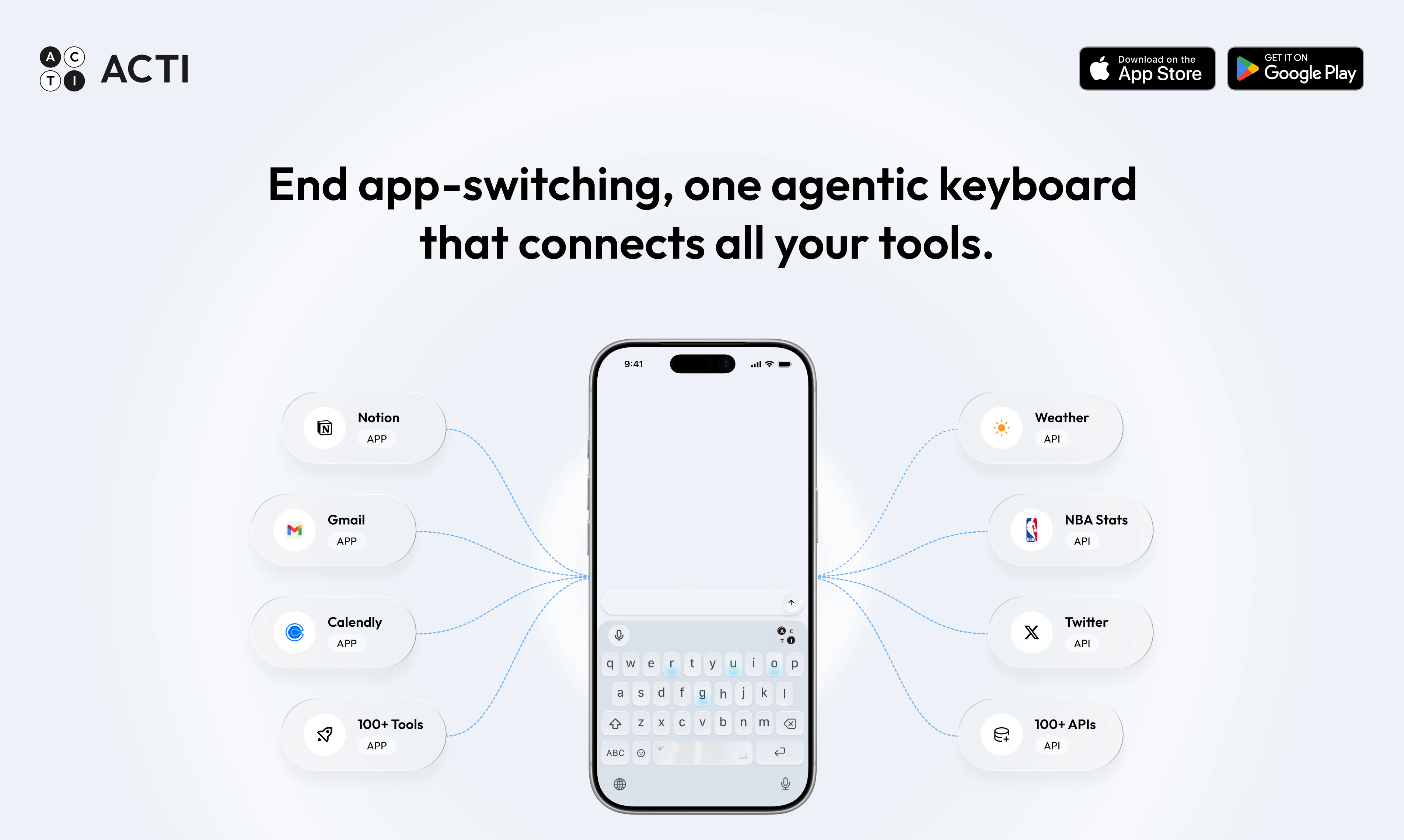
查看原始信息
Folderly Lens
Most people are running email campaigns with damaged domains and they don't know it. Now you can find out quickly and easily. Folderly Lens checks public DNS, authentication, MX, IP rDNS, and blacklist signals, then returns a KILL / REHAB / KEEP verdict with a copyable fix plan. No signup, no mailbox access, no test sends.
Hey Product Hunt :wave: I'm Vlad, Founder of Folderly. We've spent years helping sales teams fix deliverability problems after they've already killed their sender reputation and the most painful cases are always the same: someone bought 20+ sending domains from a reseller, assumed they were isolated, and found out they weren't when reply rates collapsed. We thought we'd put together a simple tool that could help. Folderly Lens exists because that diagnosis used to require either a consultant or painful manual DNS spelunking. Now you paste your domain/IP list, and in seconds you get a per-asset KILL / REHAB / KEEP verdict backed by live SPF, DMARC, DKIM, MX, rDNS, and blacklist checks. No mailbox access, no API keys, no test sends. We built this for outbound agencies and sales teams running multi-domain estates who need an answer they can actually act on. The first full audit is free, and we've already run it on a 90-domain client estate where we found 17 SURBL-listed domains the team had no idea about. Would love your feedback and if you're running cold outbound, drop your estate in and let us know what the scanner surfaces. :pray:
1
回复

Genuine question, not trying to be difficult: since there's no test send and no mailbox access, the KEEP verdict is really an inference from DNS, auth, and blacklist signals, not an actual inbox placement result. A domain can pass every SPF/DMARC/rDNS check and still get filtered by Gmail or Outlook on content or sender-behavior signals that only show up in a real seed test. How do you handle that gap, or is Lens meant purely as a triage step before someone runs an actual placement test?

0
回复

Love that you baked the SPF and DMARC generators right in, a lot of tools make you pay or hunt those down separately. Clean way to handle a real pain point for anyone managing deliverability.

0
回复

How does the AI actually decide what tweaks to make to my SPF and DMARC records when something is off, and can I review the changes before they go live?

0
回复

The spam words checker caught a few phrases in my last campaign that I would have totally missed. Nice to have the SPF and DMARC generators right there too instead of digging through docs.

0
回复

Does the AI actually suggest specific fixes when it flags something, or do you just get the alert and have to dig in yourself?

0
回复

How does Folderly actually fix existing deliverability issues, or does it mainly flag them so you have to handle the changes yourself?

0
回复

The free spam words checker caught a phrase in my newsletter draft I never would have spotted, super handy little tool.

0
回复

How does Folderly handle warm-up for completely new domains with no sending history? Also curious if it integrates with SendGrid and Mailgun out of the box or needs custom setup.

0
回复

How does Folderly actually fix things if my domain is already on a blacklist, or does it only help catch issues before they get that bad?

0
回复

Finally tested the spam words checker on a campaign that kept landing in junk, and it caught a few phrases I would have missed. Setup was quick and the DMARC generator saved me some googling.

0
回复

The spam word checker caught a few phrases I would have totally missed in my welcome email. Setup took a couple of minutes and the inbox placement test was genuinely useful for spotting issues before sending.

0
回复

The DMARC record generator saved me a bunch of setup time, and the deliverability score gave me an honest look at what was actually breaking in my last campaign. Solid tool.

0
回复

How does the AI actually decide when an email is at risk of being flagged before you hit send, and does it work with custom domains hosted outside the usual providers like Google Workspace or Microsoft 365?

0
回复

@basar95467 Great question! Our AI looks beyond traditional spam words and evaluates a combination of content patterns, authentication records (SPF, DKIM, DMARC), domain/IP reputation signals, and infrastructure health to identify potential deliverability risks before you hit send.

1
回复

Love that the free spam words checker and SPF/DMARC generators are right there without forcing a sign-up, makes it way easier to trust the paid monitoring side. Clean execution.

0
回复

@c_oglu86713 Thank you! That was exactly our thinking when building Folderly Lens.

0
回复

Does Folderly actually catch issues before sending, or does it only flag problems after your emails have already hit spam filters?

0
回复

@meryem122856 Great question! Folderly is a unique platform that does both: it helps prevent your emails from landing in spam folders and assists in recovering your sender reputation if you've already encountered deliverability issues. Feel free to reach out to our CEO, Ana, to learn more: ana@folderly.com.

0
回复

How does Folderly actually fix an issue once it flags a spam trigger or blacklist hit, does it offer hands-on help or just tell me what's wrong and leave the cleanup to me?

0
回复

@erafettin143896We appreciate your question - it's a great one. With Folderly, you'll never be left alone in the spam void. From day one, you'll be connected with a dedicated point of contact who will be happy to guide and support you every step of the way. In addition, a deliverability expert will continuously monitor your account and proactively step in if anything goes off track.

0
回复

Ran a quick test on my SPF records and it flagged a missing include that I completely missed for months. Clean layout, fast results, genuinely useful for anyone juggling email deliverability headaches.

0
回复

@recep743659 Glad to hear Lens caught something valuable! SPF records can be surprisingly tricky, and even small misconfigurations can have a significant impact on deliverability over time. We built Folderly Lens to surface exactly these kinds of hidden issues quickly and clearly. Thanks for giving it a try and for sharing your experience - feedback like this means a lot to us. 🚀

0
回复

Finally tried Folderly for my newsletter and the spam words checker flagged a couple of phrases I would have missed. Nice to have SPF and DMARC generators right there too instead of digging through docs.

0
回复

@ouz85314115733 Glad to hear you found it useful! That's exactly why we built Folderly Lens - sometimes it's the small details, like a risky phrase or a missing DNS record, that have the biggest impact on deliverability. We're also big believers that essential tools like SPF and DMARC generators should be just a click away, not hidden somewhere deep in documentation. Thanks for trying Folderly and for sharing your experience! 🚀

1
回复

Love how clean the spam words checker is, the instant feedback without any clutter is exactly what I needed when auditing campaigns.

0
回复

@feyza1144590 I appreciate you sharing your feedback, we do work hard to deliver seamless experience.

0
回复

Love it. For a multi-domain estate this is super valuable.

0
回复

@ah_henshall Appreciate your comment, that whs the purpose behind creating the product!

0
回复