Product Hunt 每日热榜 2026-02-17

PH热榜 | 2026-02-17

#1
Figr AI
Product-aware AI that thinks through UX
359
一句话介绍:Figr AI是一款面向产品经理的AI产品助手,它通过解析线上应用、Figma设计稿等资料理解产品上下文,在需求构思和原型设计阶段,帮助用户系统性地梳理流程、发现边缘案例并生成符合原有设计语言的原型,解决了AI设计工具只重界面产出、缺乏产品思维的核心痛点。
User Experience Artificial Intelligence UX Design
AI产品设计 UX分析 原型生成 产品管理工具 设计系统 流程映射 边缘案例检测 竞品分析 用户体验审查 AI助手
用户评论摘要:用户普遍认可其“产品感知”和持久记忆能力,认为节省了反复解释产品的时间。具体价值点包括:高效映射用户流程、发现遗漏边缘案例、生成高保真且符合设计系统的原型。主要问题集中在功能细节,如多问题优先级排序、除Chrome扩展和Figma外的数据源集成(如GitHub)等。
AI 锐评

Figr AI的野心不在于成为又一个“提示词出图”的AI设计玩具,而是试图扮演一个数字化的“初级产品合伙人”。其宣称的“Product-aware”是核心分水岭,它通过Chrome插件爬取线上应用、导入Figma设计令牌等方式,构建产品的持久化上下文记忆。这使其脱离了“一次一图”的零基础生成模式,转向基于现有产品体系的增量式分析与创作。

真正的价值在于,它将AI的用例从“执行层”的界面生成,前置到了“思考层”的产品定义与拆解。生成PRD、映射流程、发现边缘案例,这些本应是产品构思中最耗费心智、最依赖经验的环节。Figr AI用其训练的20万+UX模式作为“经验库”,试图系统化地填补非设计背景PM的视觉表达缺口,以及资源有限团队的设计审查盲区。这直指一个更本质的行业问题:大量产品失败并非因为界面不美,而是因为底层逻辑和用户体验流程存在缺陷。

然而,其挑战同样明显。首先,“产品感知”的深度与准确度是黑盒,解析动态复杂的Web应用状态能否完全可靠存疑。其次,从“发现问题”到“指导正确行动”之间存在巨大鸿沟,AI识别的“模式违反”是否真是问题,以及优先级如何,仍需人类最终裁决,这可能将产品争论从“有什么问题”转移到“该听AI的还是我的”上。最后,其与Lovable、v0等工具的差异定位虽清晰,但后者在纯粹的原型生成速度上优势显著,Figr AI更重的流程可能牺牲部分敏捷性,其目标用户需要更强烈的“系统性思维”诉求来驱动使用。

总体而言,Figr AI是一次有价值的升维尝试,它不满足于让AI画图,而是试图让AI“思考”产品。成败关键在于其“思考”的质量能否真正经得起复杂产品实战的检验,从而将自身从“有用的功能”升级为“不可或缺的流程”。

查看原始信息
Figr AI
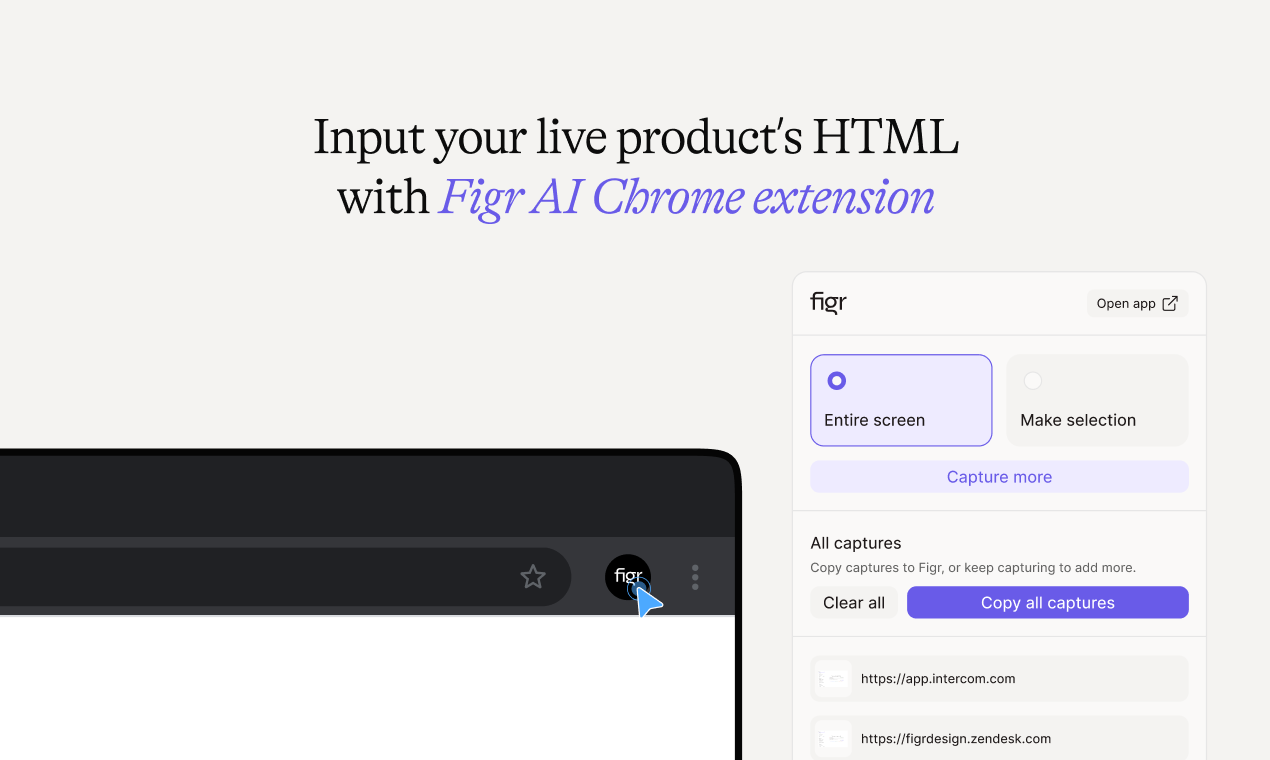
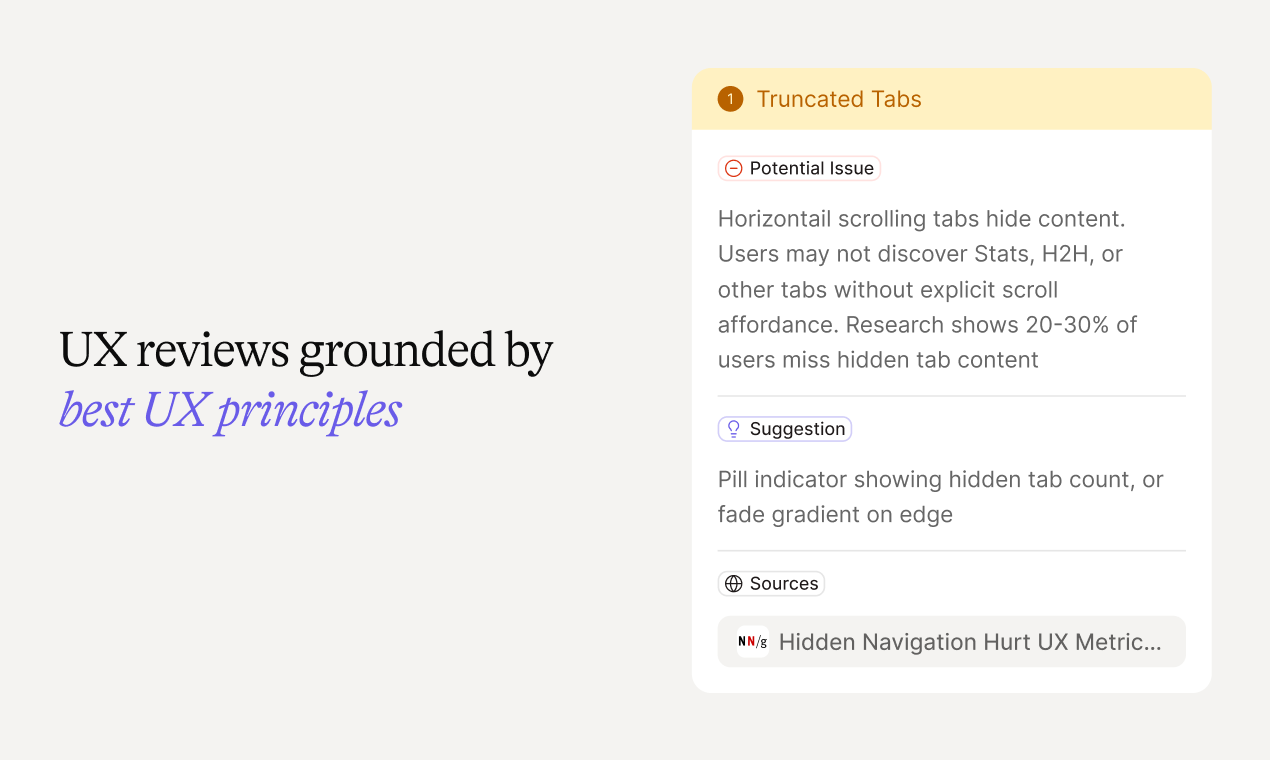
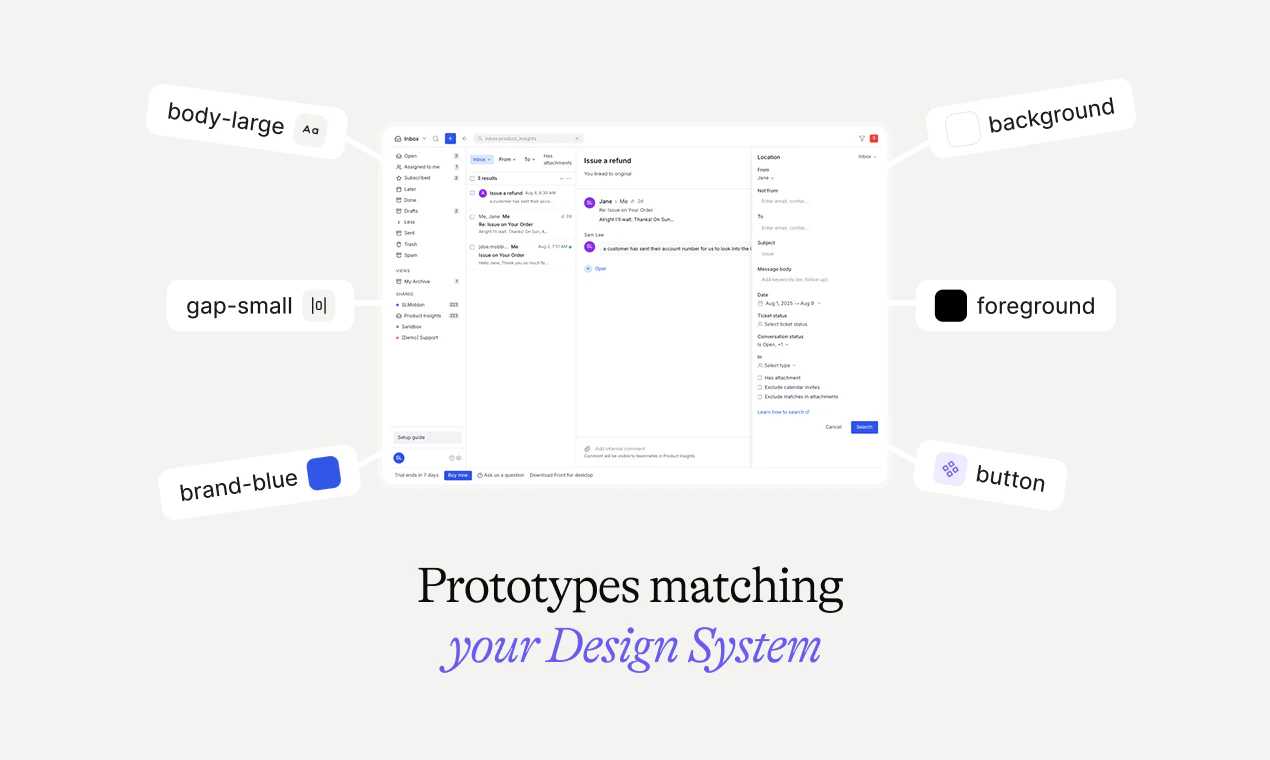
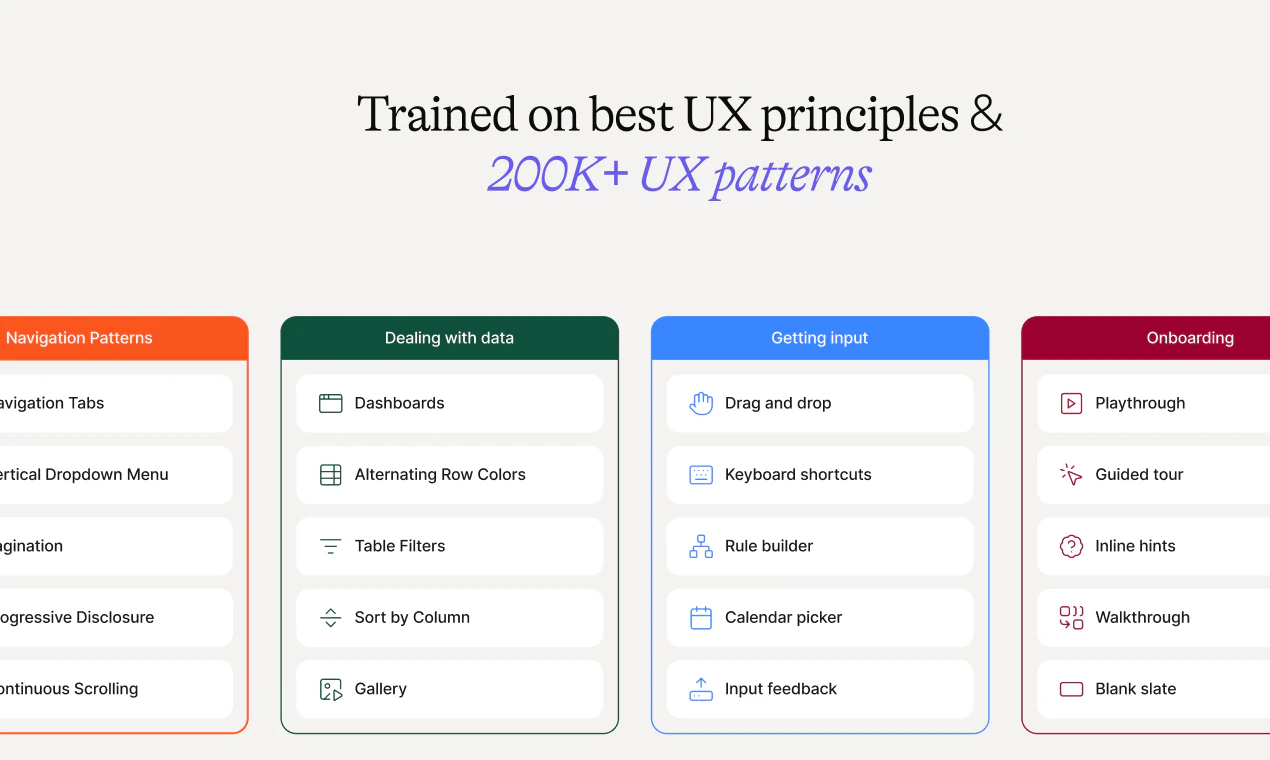
Figr is an AI product agent for PMs. Parse your live app via Chrome extension, import from Figma, drop in docs and analytics. It maps flows, spots edge cases, runs UX reviews, builds A/B variations and prototypes that match your app's design language. Every recommendation backed by 200K+ UX patterns.
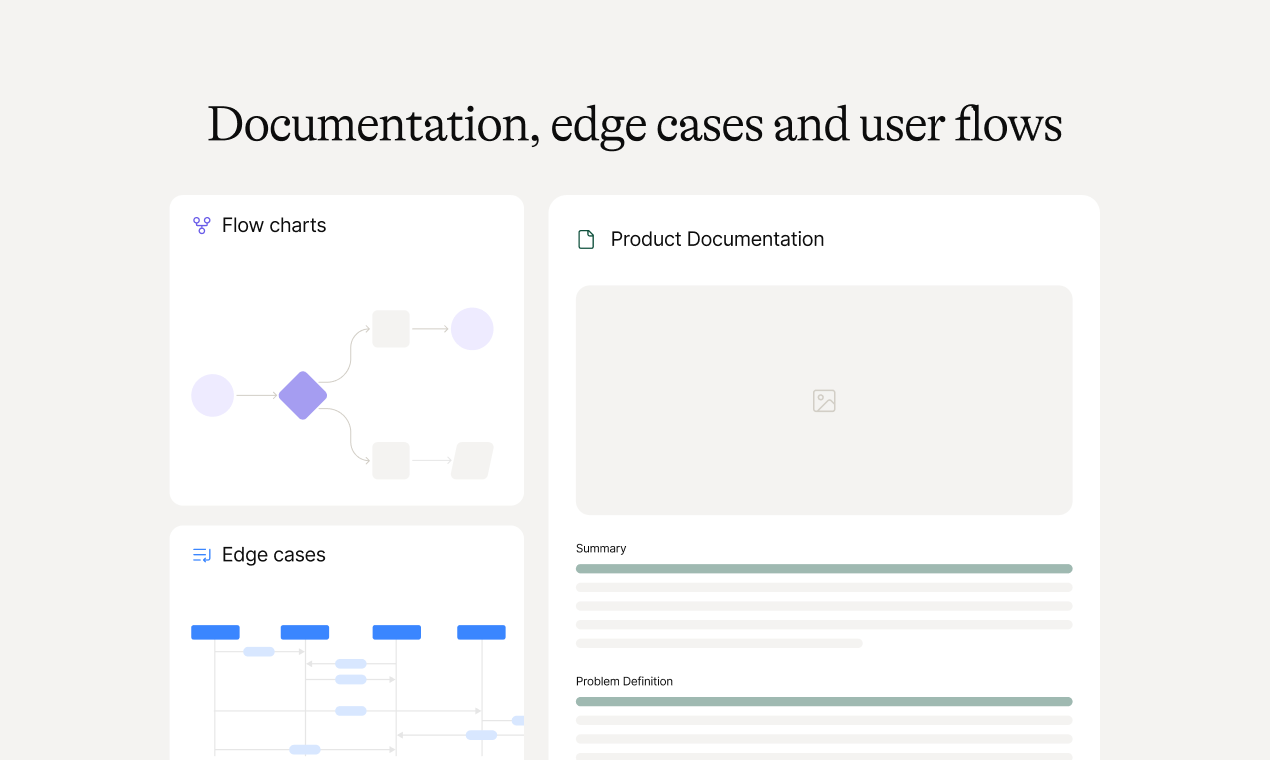
Hey Product Hunt 🎉 I'm Moksh, co-founder of Figr AI. Every AI design tool skips the hard part. They jump straight to screens. But that's not how product design actually works. You think through the problem first. The flows, the edge cases, the states nobody remembers until production. Then the design comes. So we built Figr to think before it designs. You feed it your actual product, a Chrome extension that parses your live webapp, screen recordings, your Figma with design tokens, competitor screenshots, docs. It builds a persistent memory of your product. Then when you ask for something new, it doesn't start from a blank prompt. It starts from your product. It surfaces edge cases you missed. Maps user flows. Generates PRDs. Runs UX reviews. All grounded in 200,000+ real-world UX patterns we trained it on. The prototype comes after the thinking, and it looks like your app, not a generic AI mockup. How Figr is different from Lovable, Bolt, V0: Those are great interface builders. If you know exactly what you want, they'll build it fast. But they don't help you figure out if you're building the right thing. Figr is more like an AI product partner that happens to also design. It questions your assumptions and catches what you missed. What you can do with Figr AI: - Paste a PRD and get back structured flows, edge cases, and an interactive prototype, all connected on one canvas - Parse a live webapp via our Chrome extension and redesign features in your actual design language - Import your Figma with design system tokens and generate high-fidelity prototypes that match your product - Run UX reviews and accessibility audits on existing screens - Compare competitor flows side by side (we did Cal.com vs Calendly, Linear vs Jira) - Generate test cases for complex user journeys Here are some real-world UX problems teams have worked through on Figr → figr.design/gallery Where we're headed: The world can have better products. Not every team has 10 designers. Not every PM can articulate visual intent perfectly. Figr closes that gap, not by replacing designers, but by giving every product person the ability to think through UX properly and build the best user experience for their users. We'd love your feedback, especially if you've hit the same wall with AI tools that generate pretty screens but skip the product thinking. That's exactly the problem we're obsessed with solving. Try it here → app.figr.design PS: A huge shoutout to our thousands of our early users who broke things, flagged issues, and pushed us to make Figr better, this launch is yours as much as ours.
29
回复

@moksh_garg Lesssgoooo

3
回复

@moksh_garg Amazing product man! Looks clean and useful. All the best Moksh!

3
回复

@moksh_garg Hi Moksh. Congrats on your launch! When you say Figr learns your product, what does that mean in practice? How is that fundamentally different from other AI design tools?

0
回复

As a PM/founder, this solves a real pain: stitch live product + Figma + analytics into actionable UX fixes and prototype A/Bs that don’t break your visual system. Impressed by the pattern-backed recommendations.


Question for the team: how do you decide which UX issues are worth acting on first when multiple pattern violations show up across a flow?

9
回复

@shrey_khokhra1 Hey Great question. When multiple violations show up, we prioritize by:

Proximity to the core action. If it's between the user and the thing they came to do (checkout, booking, signup), it ranks highest. Moreover, we also keep our users in the loop to take confirmation on our recommendations and prioritization.

1
回复

go to tool for brainstorming!

5
回复

@sharnam Thank you!

2
回复

Been using Figr for a bit, honestly the an AI tool where I don't have to re-explain my product every time. Saves me a ton of back and forth.

5
回复

@gmastt25409 Really glad to hear that! Persistent memory was one of the big things we focused on early. Happy it's making a difference for you 🙌

2
回复

@gmastt25409 Thank you Gabriel for your Kind word :)

1
回复

This is so cool! As a big fan of user flow mapping and UI experiments, I definitely want to try it out.

4
回复

@alina_petrova3 The flow mapping is solid, it catches edge cases you'd usually miss. Try it out and let us know how it goes.

3
回复

@alina_petrova3 Definitely Alina do give it a shot :) It deeply understands your existing product and then builds docs, flows, edge cases and prototypes.

2
回复

Been using Figr from their Beta phase, I went wow with my first design itself, it was a one short prompt saas page, and it took care of the color and font too. Moksh and team are also super helpful and take your feedback seriously.

4
回复

@sushil_kumar_ Thanks for being with us since beta, that means a lot. Early feedback like yours literally shaped what Figr is today. More good stuff coming.

2
回复

@sushil_kumar_ Thank you Sushil :)

0
回复

Noice 🚀🚀

I'm just always excited for launches like these.

4
回复

@raje_kulkarni Thank youu :))

2
回复

@raje_kulkarni Thanks Rajendra :)

2
回复

How does Figr map production app states to those states in Figma?

4
回复

@janschutte Hello Jan, Our Chrome extension parses your live webapp, so it picks up your actual screens, states, components, and styling directly from the DOM. You can also import your Figma files with design tokens. Figr AI also maps your app states, and stores it in a context graph so it already knows about your product.

3
回复

We have been using Figr for 6 months or so. Thanks to figr, we moved to our new design language under a week.

3
回复

@debarshibasak Thank you Debarshi for using Figr AI :)

1
回复

Absolutely amazing tool! Have been using their figr design system plugin in Figma saved me tons of time and now this one is huge jump!

3
回复

@elene_chekurishvili Appreciate it!

1
回复

@elene_chekurishvili Thanks Elene, I am glad you liked our previous Figma plugin. This is a huge step up, do give it a shot.

0
回复

Figr is amazing! I have used to rebuild the pricing block on one of my products. Not only made it visually better but suggested better content for conversion. It WORKS.

2
回复

@cesarzeppini Love that you tried it on something real. The content suggestions are underrated, glad they helped with conversion too.

2
回复

@cesarzeppini Thank youu Cesar! Yes Figr AI not just designing new screens but challenging you build the best UX possible.

1
回复

Great pain point indentified! Is there any way for me to just share, say the figma deisgn + the github repo with it for it to just understand, instead of capturing using the chrome extension?

2
回复

@peterz_shu Hello Peter, you can share the Figma designs with our Figma integrations, we're working on integrating github repo as well very soon!

1
回复

Loved the launch video! Congrats

2
回复

@thisiskp_ Thank you :))

1
回复

it really shows when a product is built by designers, love it! 🚀🔥

2
回复

@_manchanda_ Thank you Ash :)

1
回复

@_manchanda_ Thanks! We obsess over the details. Glad it comes through.

1
回复

Used Figr across multiple projects now, and it's just become part of my daily routine. I open it without thinking.

Saves me a lot of time

2
回复

@siraj_dhanani thank you for your kind words Siraj!

1
回复

@siraj_dhanani love this compliment honestly. Thanks for sticking with us!

1
回复

Figr AI looks like an amazing tool! Can't wait to try it out

2
回复

@rachitmagon Thanks you, would love to hear your feedback on Figr :)

1
回复

@rachitmagon Thank you Rachit :)

1
回复

This gives extreme power to founders/ex-PMs like me. Crazy job @moksh_garg and team

2
回复

@moksh_garg  @sayanta_ghosh Thank you so much :)))

1
回复

@sayanta_ghosh Thanks Sayanta :)

1
回复

Maps user flows? I'm sooold, @chirag_singla2 @moksh_garg !

2
回复
1
回复

@chirag_singla2  @neilverma :) Not just user flows, but all type of diagrams from edge case mapping to state diagrams and user journeys. As product managers we know this where the real thinking lies.

0
回复

You guys are shipping machines! Congrats on 5th launch! The concept of persistent memory for a product is the holy grail. Usually, AI context gets outdated very fast.

2
回复

@valeriia_kuna Yes the context is the most important bit. Figr deeply works on understanding your product.

1
回复

@valeriia_kuna Thanks! Persistent memory is a big focus for us, context that compounds over time makes everything better. Appreciate the support.

0
回复

What's the tool used for the product video? Looks dope.

1
回复

@byalexai Hey we used, after effects and Premier Pro

0
回复

As a UX designer myself, this is probably one of the most promising AI tools in this space. I gave it my Figma context, full app architecture and what I'm currently working on and the output was better than other tools I use. Looks like I may be integrating this into my daily workflow - great product! 🎉

1
回复

@michelle_walstra Thank you Michelle. Yes, our fundamental approach is to first deeply understand your product context and then help you build UX on top of it :)

0
回复

Curious how Figr keeps its product memory updated as the app evolves, and how teams collaborate inside it without it becoming just another layer on top of Figma?

1
回复

@shreya_chaurasia19 Hey Shreya, as you use Figr to design flows, docs and prototypes, you can chose to add such information to the context and update it.

0
回复

I tried Figr AI recently, and before even jumping into design, it asked for proper product inputs, the context via the Chrome extension and a recording of the product flow.

Once it analyzed everything and I shared my prompt around what I needed, it just went crazy.

The outcomes were surprisingly strong, genuinely comparable to thoughtful human UX design. And the best part? I could export everything directly into Figma for future iterations.

This is the first AI tool that truly felt like it understands product thinking.

0
回复
I think LLMs biggest weakness is UI/UX designs and that makes sense because it can't see the frontend it's producing in real time. And also language is a bit primitive for creative tasks or visual elements. This is a step in the right direction for a better full stack vibe coding environment
0
回复

Congratulations! The product sounded great, so I gave it a shot, and it was as good as I expected.

I do have a question: your site only talks about the option to "upgrade" my plan. Can I also "downgrade"? I'd have heave use for your product every few few months for a couple of months, so it doesn't make sense to get a more expensive plan only for those months.


I'm excited about the help I can get from Figr AI!

0
回复

Love the focus on thinking before screens — most AI tools jump straight to pretty mockups and skip the messy product logic in the middle. The persistent memory + parsing a live app via Chrome extension is especially interesting. Curious how well it handles really complex edge cases in multi-role products (like admin vs end-user flows)? Definitely going to play around with it.

0
回复

This is such a cool problem to solve, when you can't fix what you can't see, this is like a blindspot minimizer :) Excited to try it out

0
回复

Love the focus on UX patterns over generic AI results.
How are you validating that the suggested improvements actually increase conversions in real apps?

0
回复

Congrats on the launch! The idea of building persistent product memory instead of starting from a blank prompt every time feels like the right direction for serious product teams. How does Figr keep that product memory accurate over time as the app evolves, especially when design tokens, flows, or edge cases change frequently?

0
回复
#2
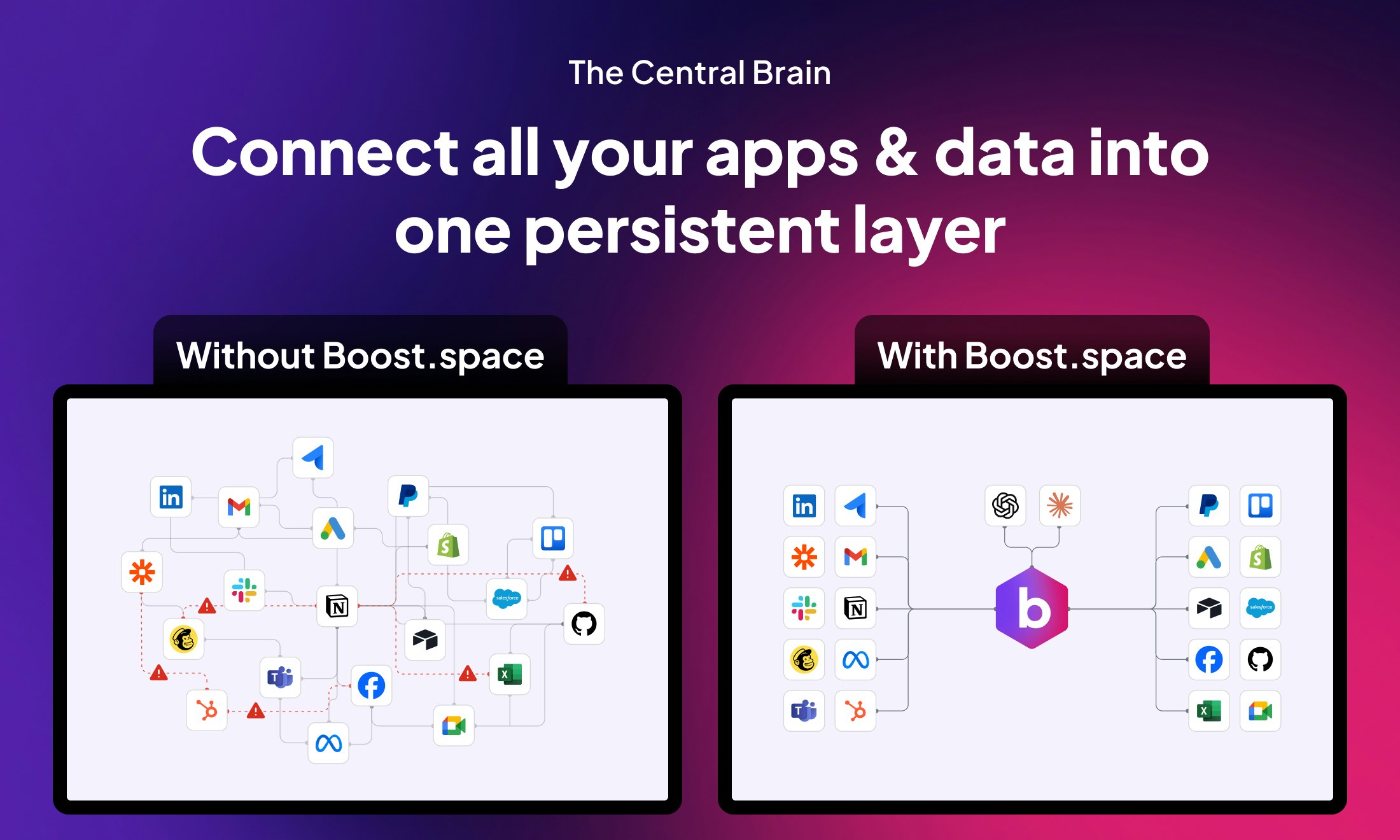
Boost.space v5
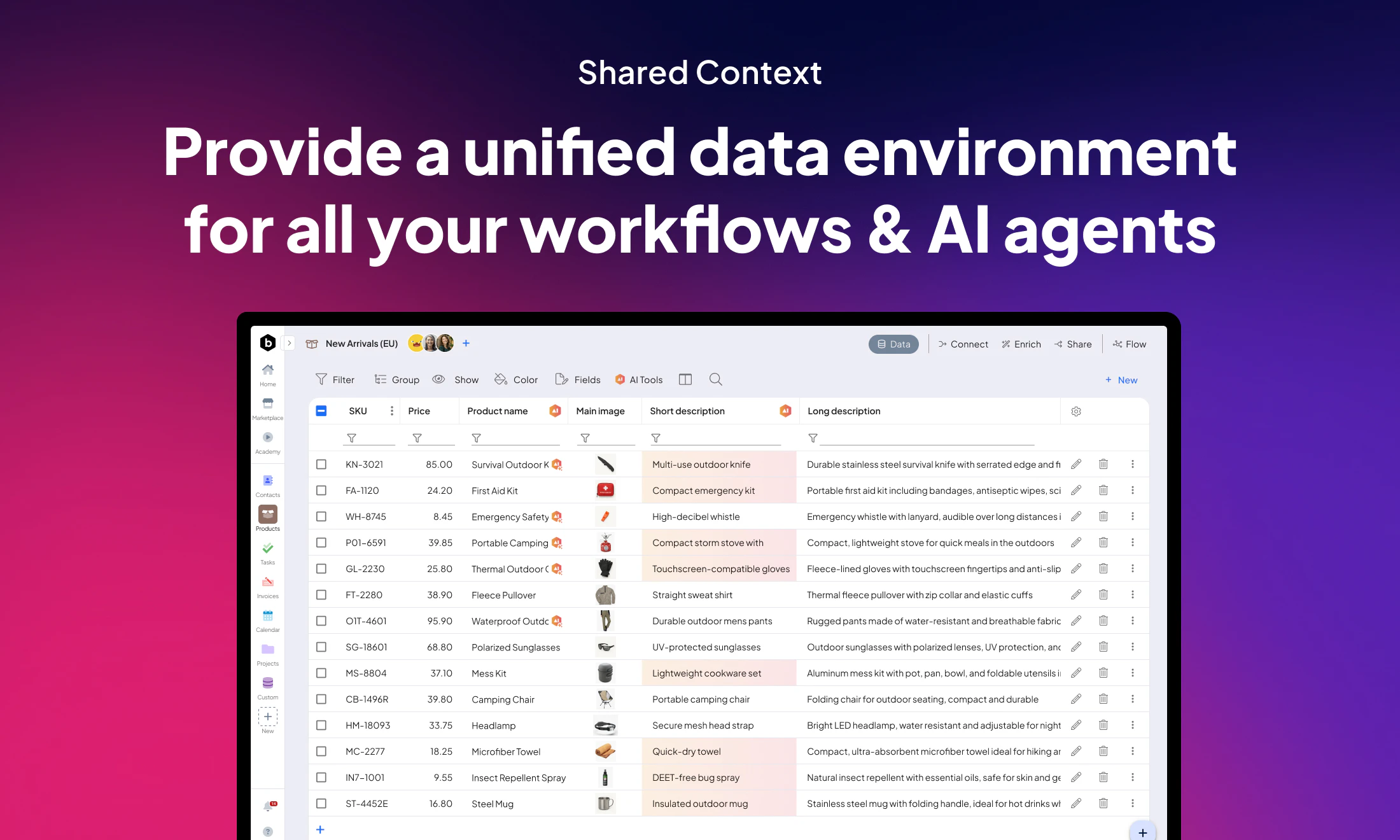
Shared Context for your AI Agents & Automations
273
一句话介绍:Boost.space v5 为AI智能体与复杂自动化流程提供了一个持久化的共享上下文数据层,解决了因数据孤岛导致的智能体“健忘”和工作流脆弱易断的痛点,使其能像集成式商业智能系统一样协同运作。
Artificial Intelligence Data Database
自动化数据层 AI智能体协作 持久化上下文 单点数据源 工作流编排 低代码平台 企业级自动化 MCP集成 实时数据同步 业务流程集成
用户评论摘要:用户普遍认可产品概念,认为其解决了自动化扩展中的数据管理痛点。主要问题集中于:如何与Claude等AI桌面端集成、实时同步能力、定制化程度、与现有工具的本质区别,以及希望看到具体的成功案例。也有评论指出需区分是解决存储问题还是根本的业务逻辑问题。
AI 锐评

Boost.space v5 瞄准了一个真实且正在扩大的市场缝隙:在低代码/无代码自动化工具(如Make/Zapier)与新兴的AI智能体之间,缺乏一个专为动态、协作式流程设计的“状态管理”层。其宣称的“共享大脑”概念,本质上是试图成为自动化时代的专用“操作系统数据库”,而非另一个简单的同步中间件。

产品的真正价值不在于替代Airtable或Google Sheets作为静态数据存储,而在于提供一种能理解“业务流程上下文”的动态数据模型。它让一次自动化运行的结果能成为下一次触发或另一个智能体决策的输入,从而实现工作流的“复合价值”,而非孤立运行。这直击了当前AI智能体在长序列任务中“失忆”以及多智能体协作混乱的核心瓶颈。

然而,其面临的关键挑战与机遇并存。挑战在于:1)教育市场,让用户理解其与增强现有数据栈的区别;2)避免自身成为另一个需要被管理的“数据孤岛”;3)在灵活性与结构化之间找到平衡,过于灵活的Schema可能无法保证数据质量。机遇则在于:随着AI智能体工作流日益复杂,对状态持久化、跨会话记忆和协作的需求将呈指数级增长。如果它能成功定义“自动化原生数据层”的标准,其护城河将非常深厚。

当前评论中的质疑非常犀利:“是解决容器问题还是根本问题?” 这要求Boost.space必须证明,其提供的不仅是更好的“数据库”,更是能强制或引导用户建立更优业务流程逻辑的“框架”。否则,它确实可能只是堆栈中新增的一个抽象层。它的成功将取决于能否让用户的工作流从“一连串条件反射”进化为“一个具有记忆和学习能力的有机系统”。

查看原始信息
Boost.space v5
Most AI agents & complex automations fail because they’re operating in the dark. Boost.space provides the persistent context layer that turns siloed LLMs into an integrated business intelligence system. Give your automations & agents a "Shared Brain." so all workflows has the full context of your business—from past interactions to live database states—allowing workflows to compound instead of breaking.

Hi Product Hunt! 👋

After processing data from over 140,000 automations, we realized that building complex systems on spreadsheets or databases made for apps is like running a marathon in flip-flops. It works temporarily, but eventually, scalability breaks.

The Problem 💣
Most automation stacks are isolated scenarios. Without a live, persistent data layer, AI agents are forgetful and workflows remain fragile hacks rather than strategic assets.

The Solution 💥
We’ve built the first database purpose-built for the automation era—the "brain" your automation scenarios & AI agents have been waiting for.

👉 Scalable Data Backbone: Replace messy, fragile stacks with a dedicated architectural foundation.
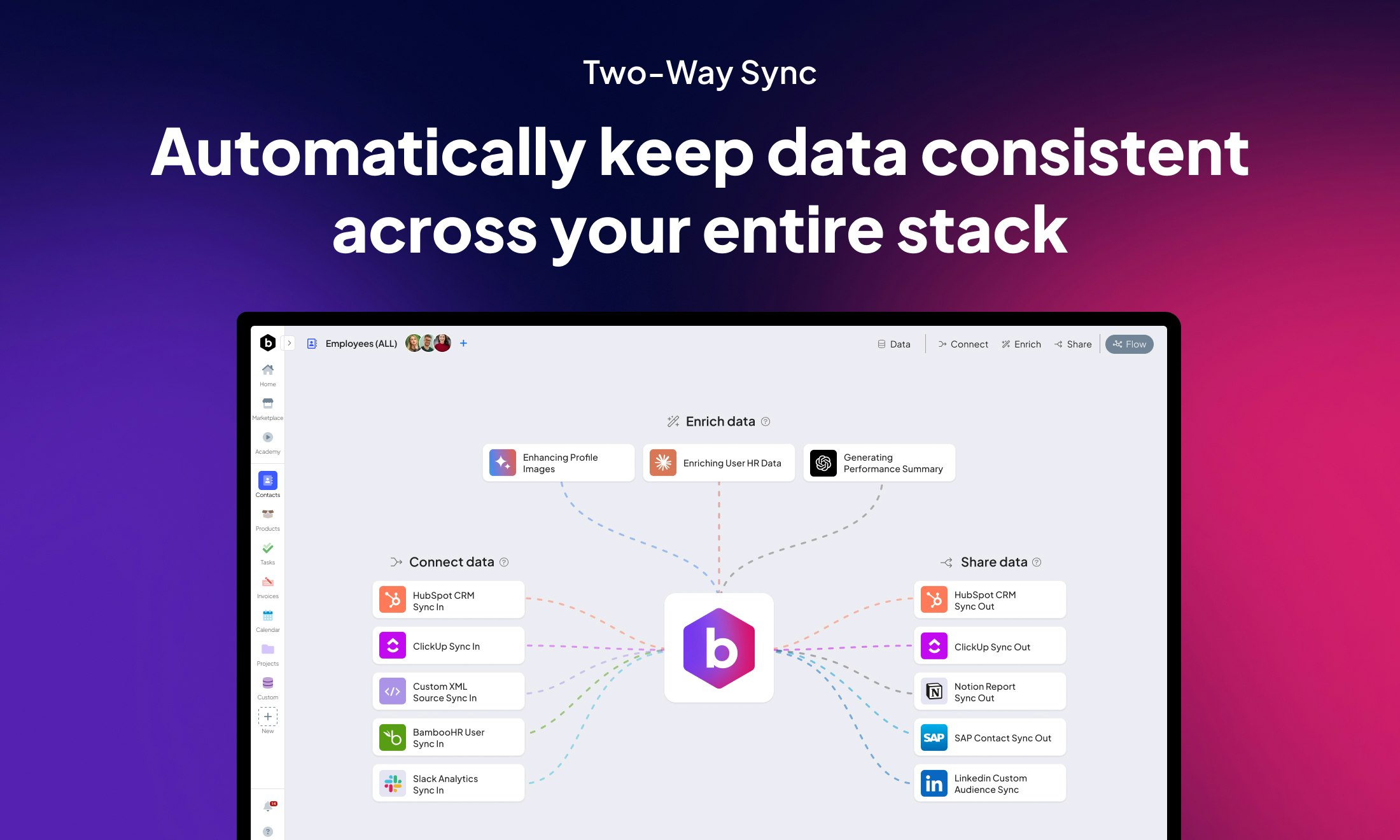
👉 Single Source of Truth (SSOT): Aggregate scattered data and orchestrate two-way synchronization.
👉 Agentic Collaboration: Enable AI agents to build on each other’s work using shared context.
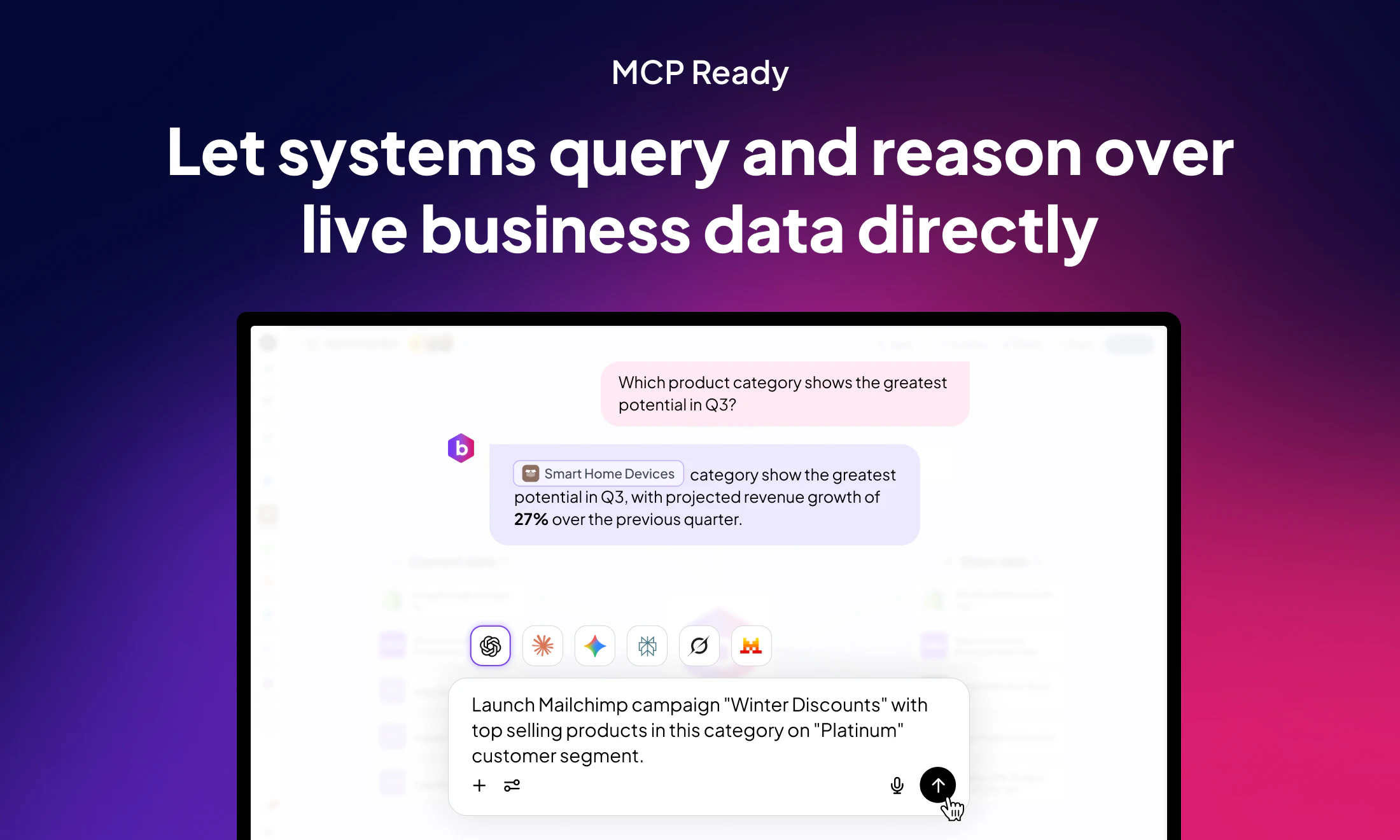
👉 MCP Ready: Let AI agents & LLMs directly query and reason over live business data.

Why It Matters? 🤖
By providing a persistent data layer, your automations & AI agents stack instead of breaking. This allows your AI agents to learn, compound in value, and operate as a connected system.

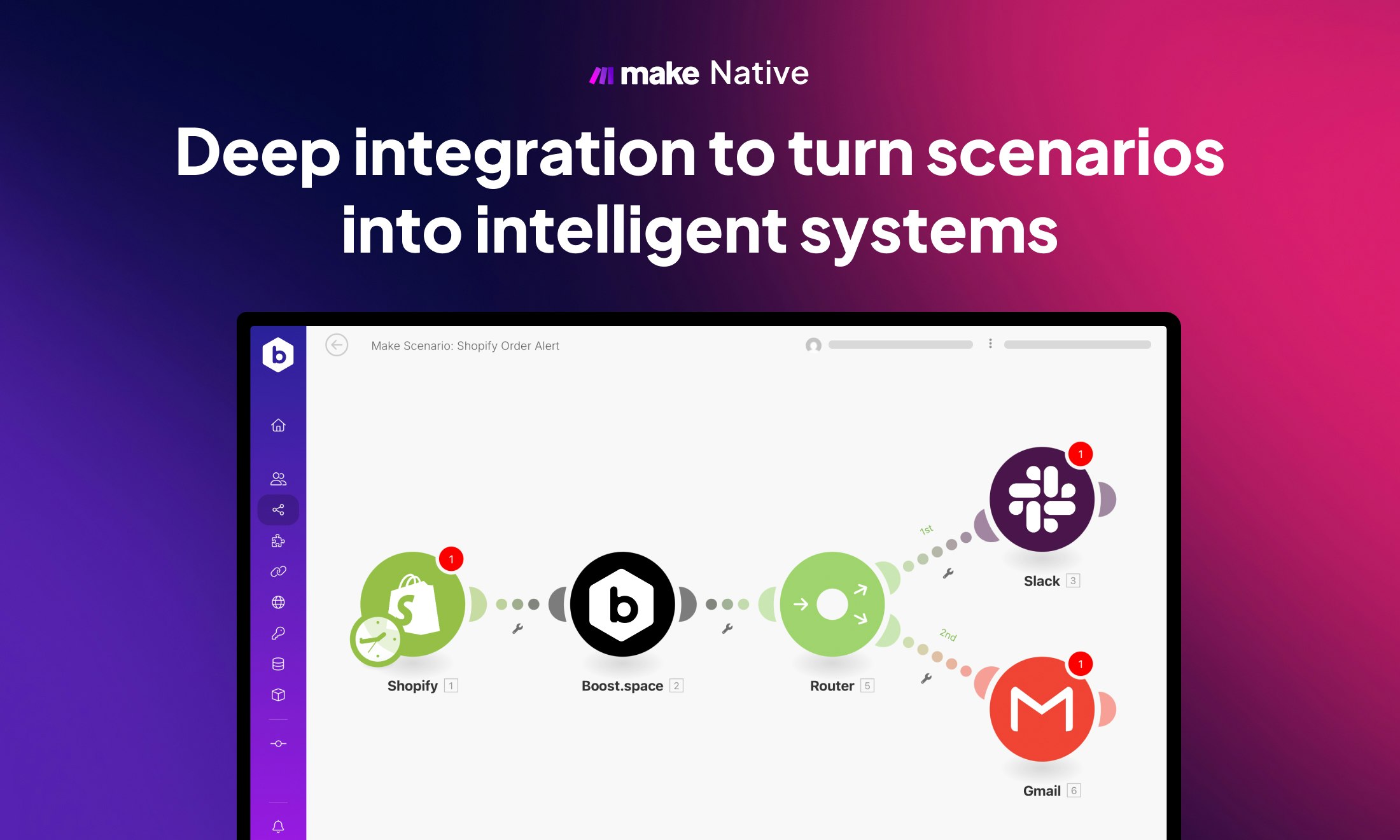
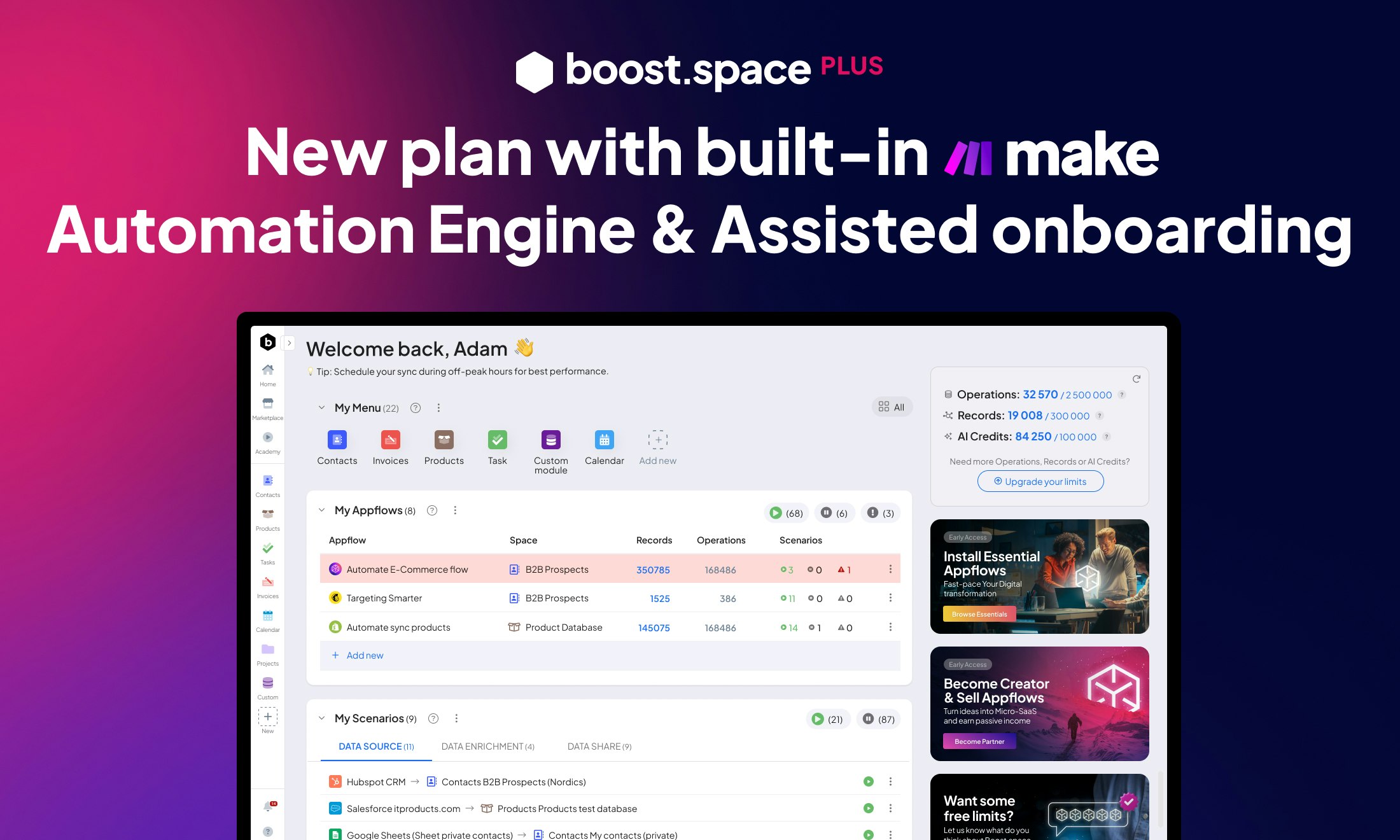
We are finally ready to share this with the community! We’d love your feedback on v5. 🤞 You can either connect your existing Make.com account or sign up for Boost.space PLUS plan with built-in Make.com Engine 🔥

🟢 Founders Launch Deal Special: Join our Global Launch & Get up to 5 hours of 1-on-1 onboarding & 50% OFF as long as you are subscribed - deal ends by the end of February 💡

Huge thanks to @RohanRecommends for hunting us! 🤞

19
回复

@matous_kralik Great product video. Was funny and got my attention. This is something I've thought off but never thought possible. Great idea and all the best in your journey!

3
回复

@matous_kralik What kinds of AI agents or automation use cases benefit most from Boost.space’s shared context layer? Can you share any early success stories that show how shared context dramatically improved agent outcomes or automation ROI?

0
回复

@matous_kralik I feel Every tool claims to be the “single source of truth.” In practice, SSOT usually becomes another sync layer. What makes boost space structurally different from just adding another abstraction on top of Make/Zapier stacks?

0
回复

Customer to us :) They've been growing immensely.. Let's go Team Boost.space!@matous_kralik

4
回复

@neelptl2602 Great to see you, Neel 🤞 And yes - just to confirm we use @SyncSignature and we love it! 🔥

1
回复

Congrats on a new epic update, team @matous_kralik @tadeas_marek This could save me sooo much time 😅… does it update stuff in real-time or do we need to sync manually?

2
回复

Depends on your setup, but yeah - two-way sync in real time is easily possible 🔥

1
回复

Boost.Space has come a long way and I love how powerful it is and could be overwhelming like GHL. Even just using the automation feature of it is already very powerful on its own. Thanks for keep innovating!

2
回复

@endymion_cheung Thank you for showing up 👌

0
回复

The move to become a shared brain for AI is smart. Regarding the MCP Ready feature, does this mean I can connect boost space directly to Claude Desktop to query live business data in real-time?

2
回复

@valeriia_kuna Yes, you can! 👌

1
回复

Congratulations!!!

2
回复

@madalina_barbu Thank you!

0
回复

Make sure to join us today at 4PM CET during the global launch of v5 together with our Founder & CEO @tadeas_marek right here: https://boost.space/v5

See you there! 🔥

2
回复

congrats on launch

2
回复

@apexflux Thank you for showing up 🤞

0
回复

Data management for low-code automation is often a headache. You often start using a Google Sheet as a no-frills database and then run into issues as your automation scales.
It is nice to see more robust solutions emerging.

2
回复

@fabian_maume Exactly! Good to see you here, Fabian 🤞

1
回复

@fabian_maume I’m not fully convinced the issue is the storage layer itself. In most cases I’ve seen, scaling problems come from poor schema design and orchestration logic, not from using Sheets per se. Curious whether this is solving the root cause or just replacing the container.

0
回复

Usefull tool, thank you for ability to tested out in my workflows!

1
回复

@tomas_blatak1 Awesome Tomáš! Thank you! Cant wait for what you can build with Boost.space

0
回复
Clean UI, sharp messaging, and powerful backend concept. Strong launch across all fronts 👏
1
回复

@abod_rehman Thank you Abdul!

0
回复

Looks powerful - congrats!

1
回复

@robbins23 Thank you Robbin!

0
回复

Great product video. Can I get a free trial?

1
回复

@kalpesh_bhalekar1 sure thing, 14 days trial a Freemium is available 🔥

0
回复
How customizable is the schema for unique business workflows and domain-specific automation scenarios?
1
回复

@priyankamandal completely. We got 14 days trial, feel free to jump in and play around a bit 🤞

0
回复

Hey Congrats for Boost.space ✨. Can you please tell me how it's work properly ?

1
回复

Congrats on the release guys!

1
回复

@madzadev Thank you!

0
回复

a SSOT with two-way sync plus enrichment becomes a conflict-resolution and provenance problem fast (loops, last-write-wins surprises, and agents acting on stale context across tenants). Best practice: anchor everything on an append-only change log with CDC-style connectors, explicit idempotency keys, and policy-as-code for tool access (OPA or OpenFGA) so every field has lineage and every action is auditable. Question: how do you

detect and resolve write conflicts across sources (per-field versioning vs LWW), and can agents query a time-travel snapshot of the Unified Grid for reproducible runs?

1
回复

@ryan_thill very complex question, but to put it simply - each source/scenario has its priority and you can set that up on field level as well as field groups. With more details - make sure to hit our support up or checkout Docs. We got tons of articles and usefull resources over there 🔥

1
回复

Congrats!! The UI looks clean af 👏 Are there pre-made automation templates or do we gotta build everything ourselves?

1
回复

@mikhail_prasolov Will forward this to our product team and thank you! 🔥

0
回复

Congrats @matous_kralik and the team, well done 🚀

1
回复

@matejkukucka Děkujeme, Matěji! 👌

0
回复

Congrats to the whole team! @matous_kralik @tadeas_marek

The product positioning is super clear and resonates deeply with real automation pain points. I have seen some of your previous launches, good to see the product keeping up with the times.

1
回复

Thanks for being here again 🔥📈

0
回复

I like the idea of “persistent context layer” because memory / context have always been a concern for complex automation workflows.

1
回复

@syed_shayanur_rahman Word! Thanks for the support 🤞

0
回复

The idea of a shared brain for agents is exactly what is missing in current automation stacks. Congrats on the launch.

1
回复

@himani_sah1 Exactly 🔥 Thank you!

0
回复
Congrats! Love products that remove complexity instead of adding more layers. This feels like exactly that 😊
0
回复

Big launch! 👏 The agent collaboration angle is especially exciting for complex enterprise workflows.

0
回复
Big congrats on shipping! How long did it take to fully redesign the architecture for v5?
0
回复

The “marathon in flip-flops” analogy is painfully accurate for a lot of automation stacks. The persistent data layer angle is interesting — especially if it truly acts as a real SSOT instead of just another sync layer. Curious how you handle schema changes and versioning when multiple agents are writing to the same data?

0
回复

This is a brilliant product idea. How you’re handling data governance and security at scale?

0
回复
Congrats! Any plans to open APIs for deeper custom integrations beyond Make.com?
0
回复
@thisiskp_ Hey KP, the APIs are open and available at https://apidocv5.boost.space/ All features such as two way sync or data consolidation works via API as well. Looking forward to what you can build with Boost.space API.
0
回复

Could you please share with me how does the tool handle real-time data sync conflicts across multiple agents and workflows? I imagine it would be very messy especially if you have too many nodes exchanging data with each other.

0
回复

@nuseir_yassin1 Each source has its priority you can set on level of each field. Id recommend hanging out during the launch webinar thats in 2h: https://boost.space/v5

0
回复

Looks powerful!! How easy it is to migrate our existing spreadsheets and fragmented databases into Boostspace? Is it more like an import button?

0
回复

@zerotox thanks to CSV and AI import you can actually do it two ways: Either export Google Sheet as CSV and import it OR connect Google Sheets via Make scenario, throw bundle of fields to Boost.space and let our AI engine map everything for you.

0
回复
#3
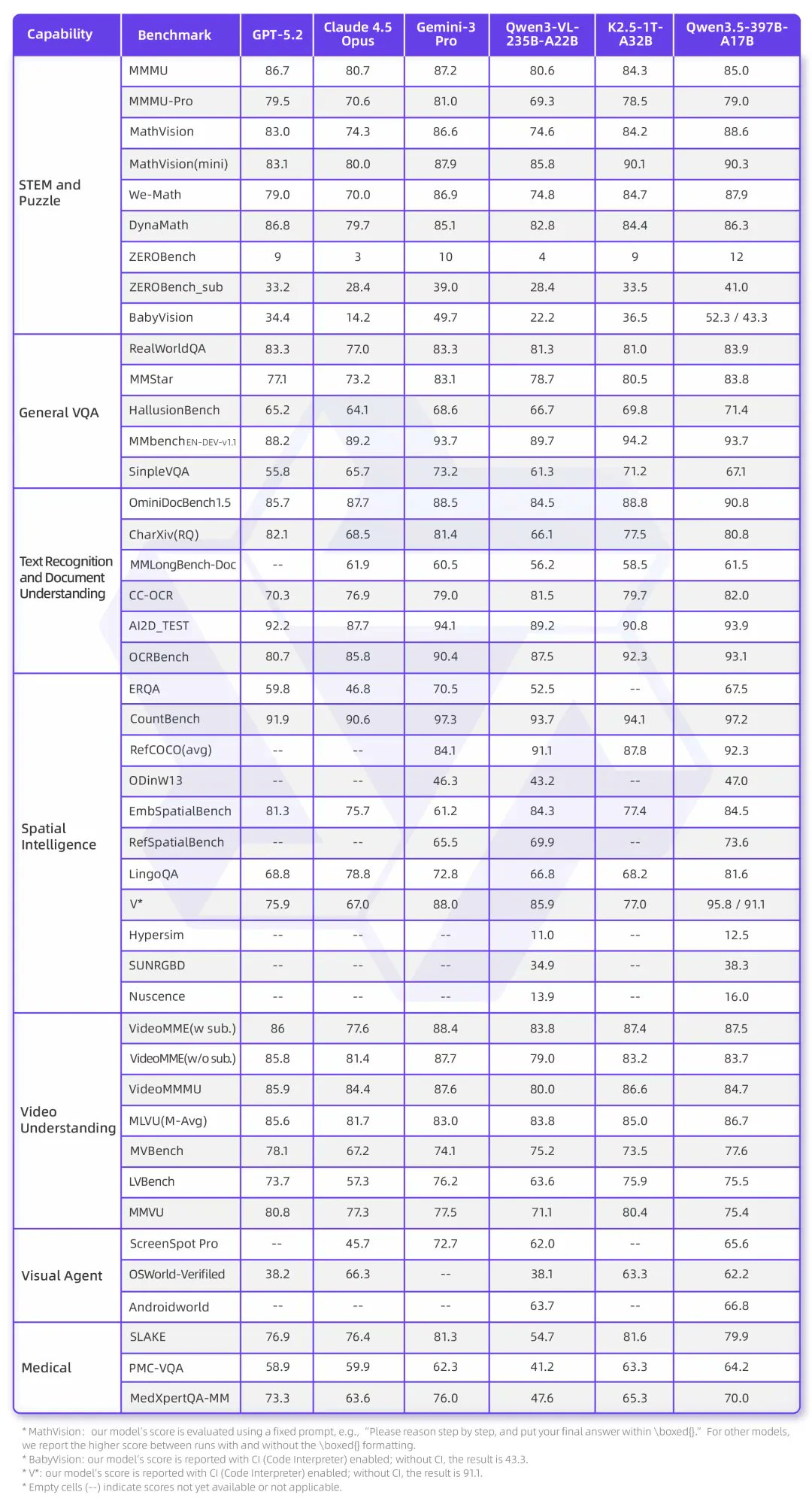
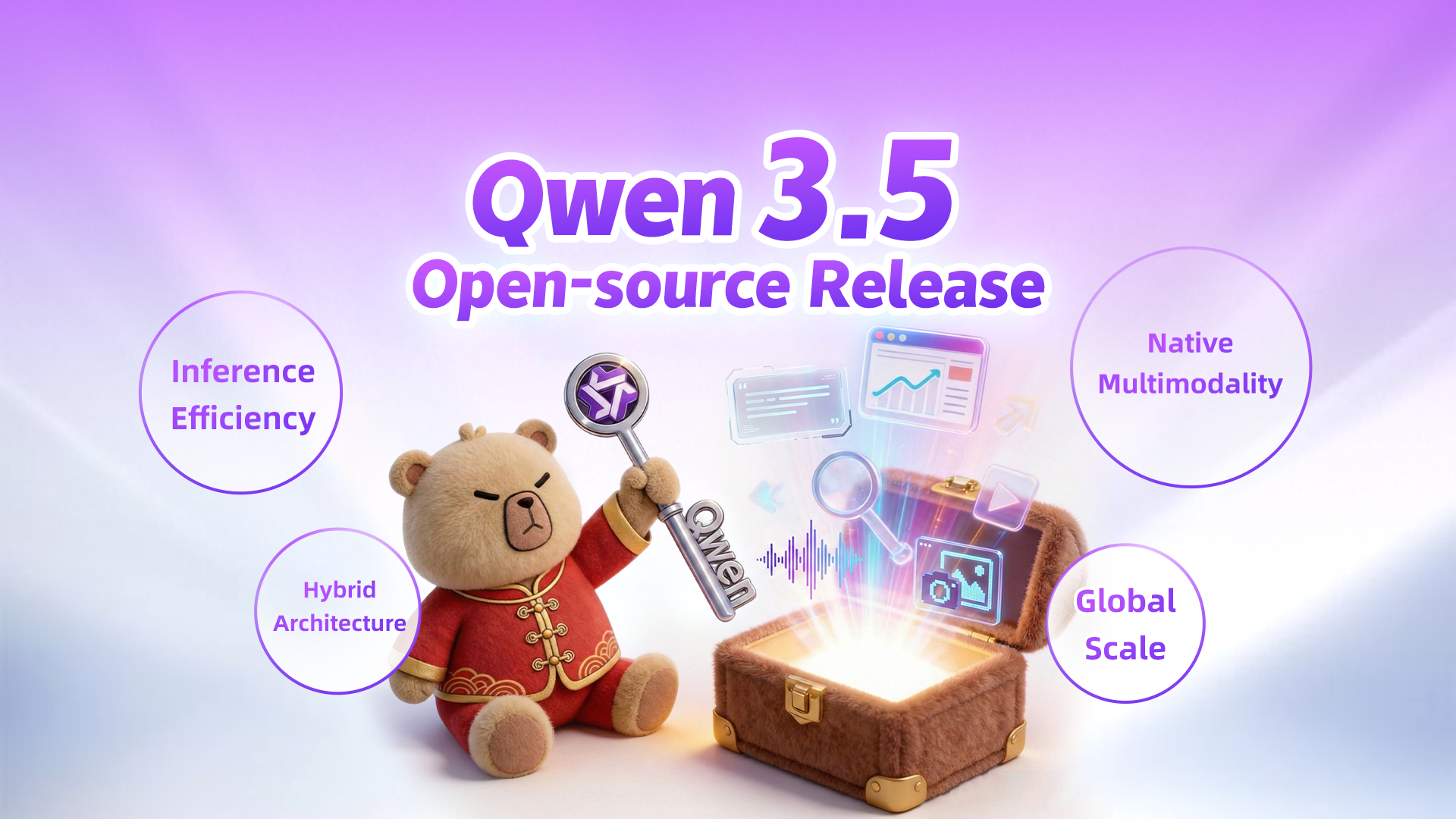
Qwen3.5
The 397B native multimodal agent with 17B active params
234
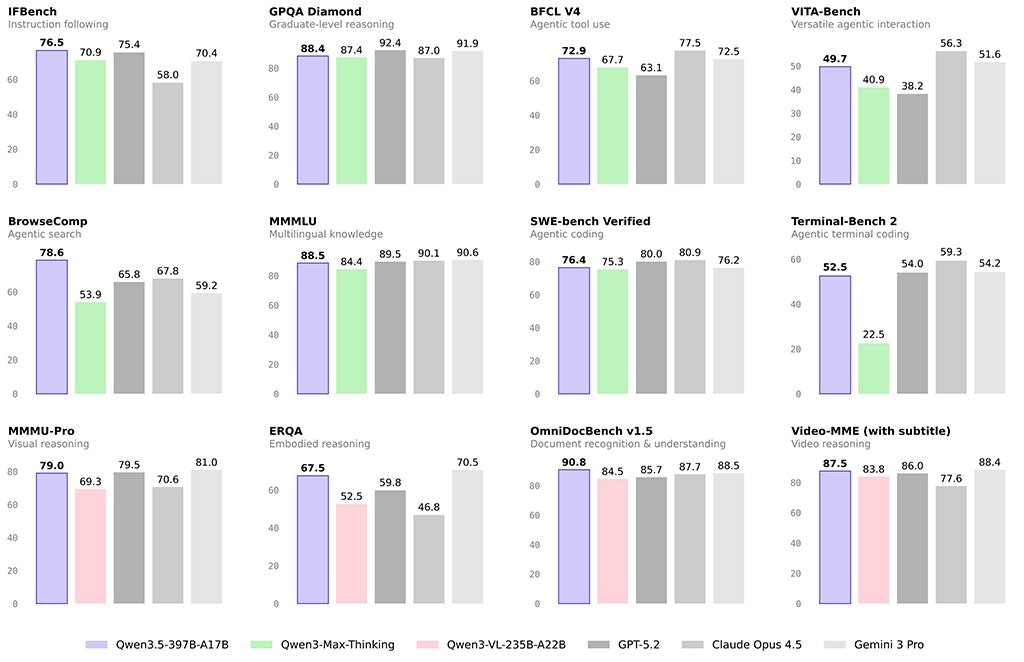
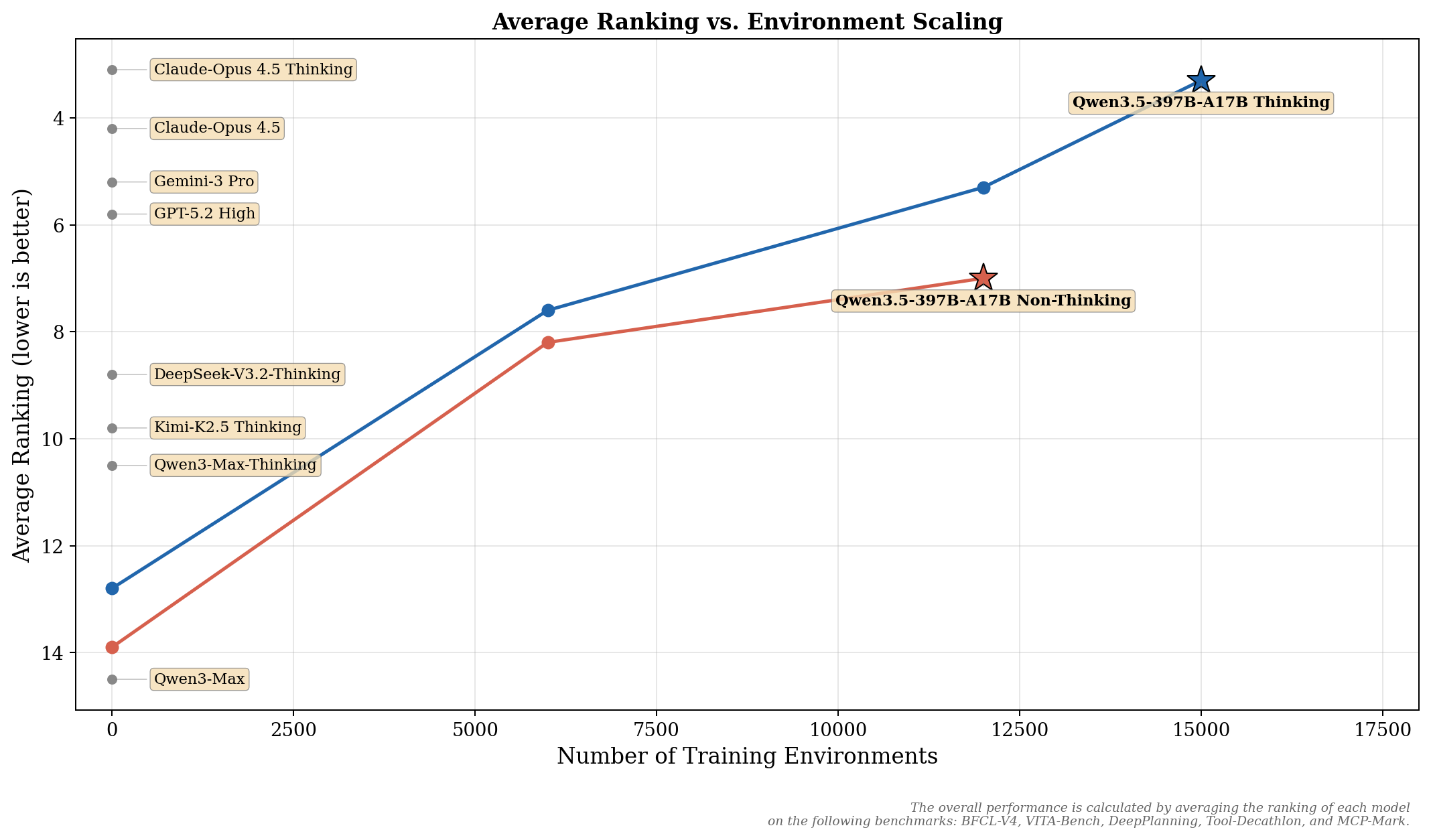
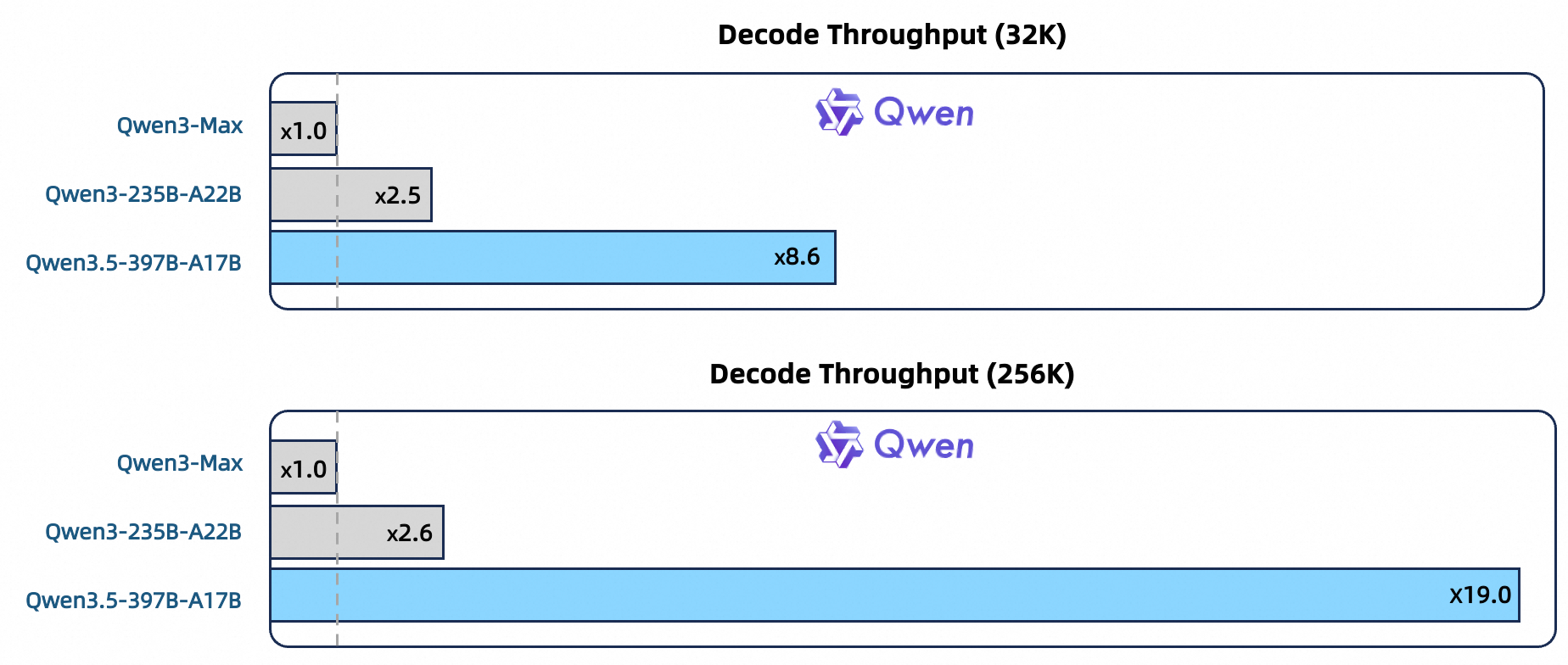
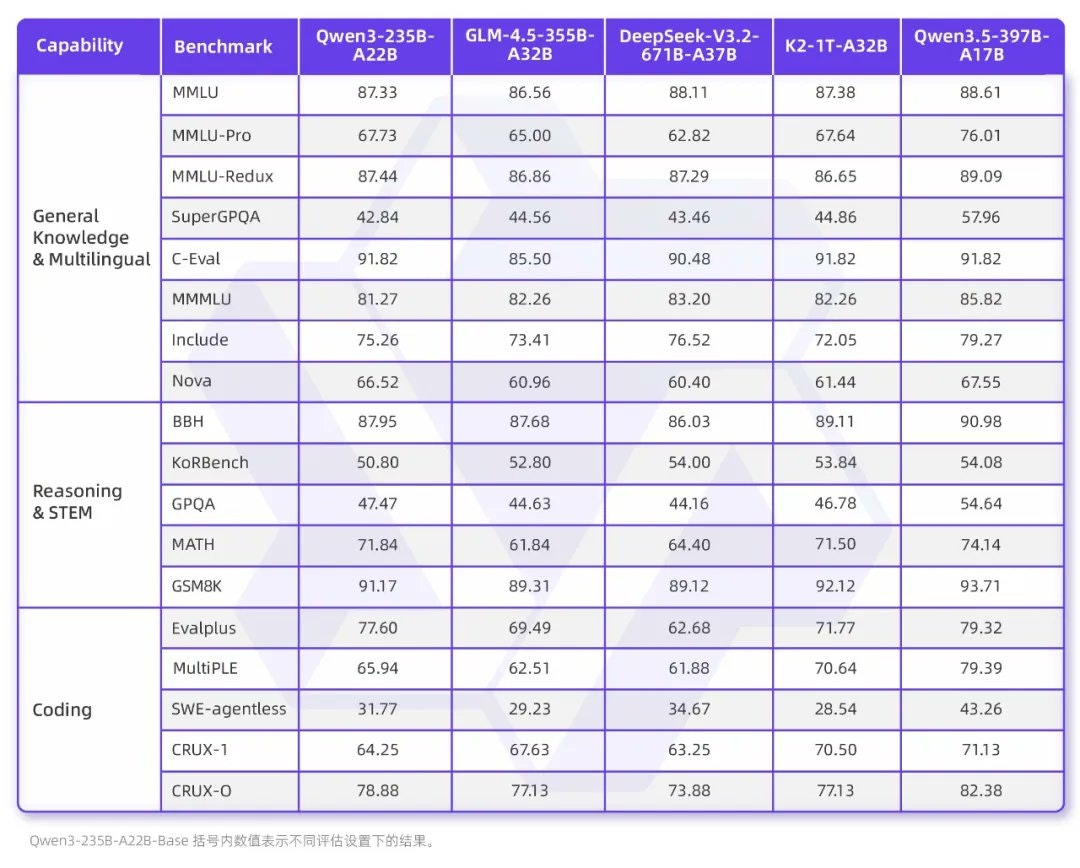
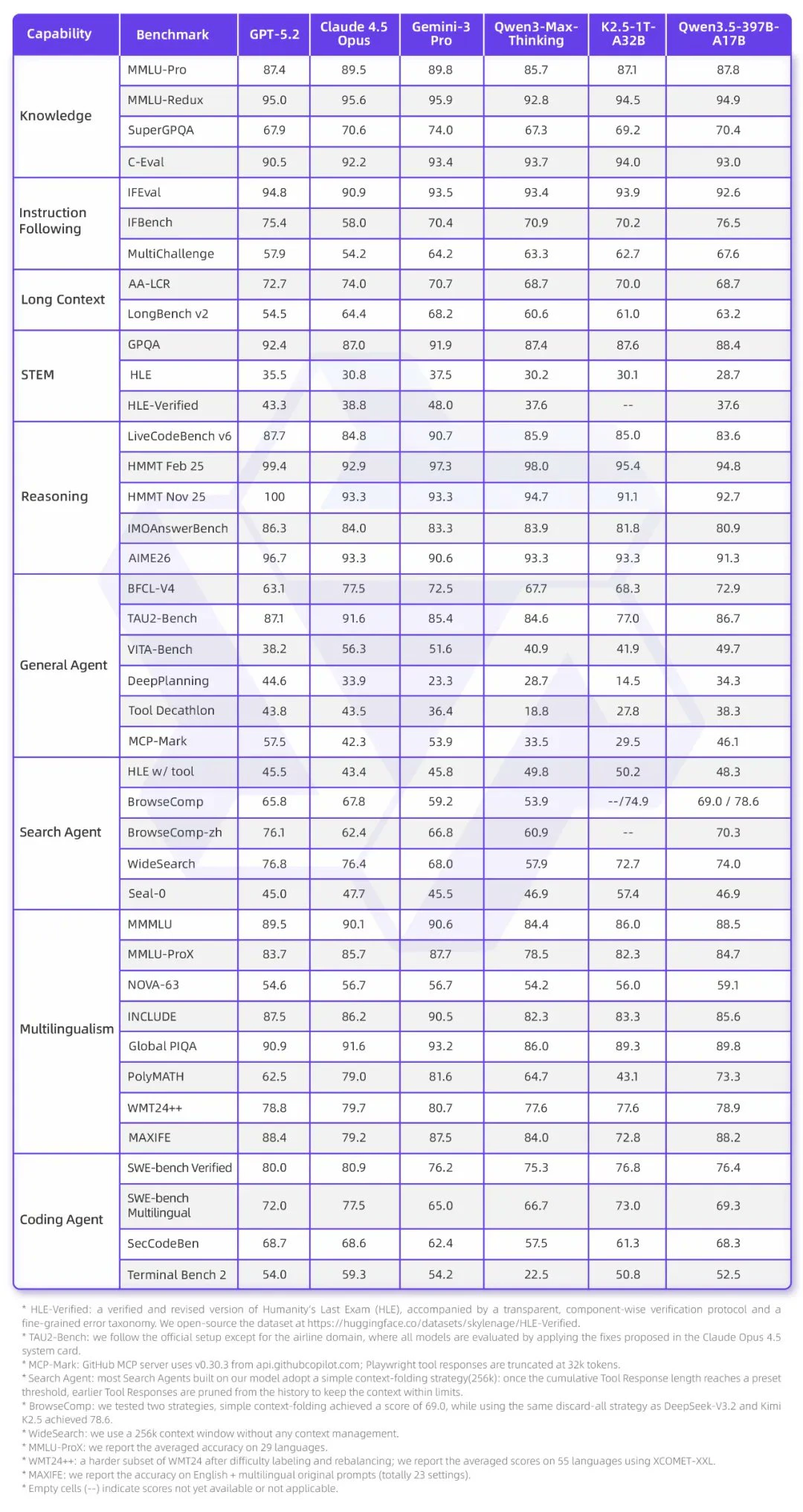
一句话介绍:Qwen3.5是一款拥有3970亿参数的混合专家(MoE)架构原生多模态大模型,通过仅激活170亿参数实现高效推理,专为处理需要长序列规划和复杂工具调用的智能体任务而设计,解决了大规模模型部署成本高、推理延迟长的痛点。
Open Source Artificial Intelligence Development
开源大语言模型 多模态AI 混合专家系统 智能体框架 高效推理 长序列任务 视觉语言模型 本地部署 Apache 2.0协议 线性注意力
用户评论摘要:用户反馈积极,肯定其开源、高效及对智能体任务的支持。主要讨论集中于技术部署:建议使用vLLM/SGLang优化KV缓存和批处理以应对长上下文瓶颈,并关注专家路由在长任务中的稳定性及实际生产环境的上下文长度目标。
AI 锐评

Qwen3.5的亮相,与其说是一次简单的模型迭代,不如说是对当前AI应用落地困境的一次精准外科手术。其宣称的“3970亿参数巨人的能力,170亿模型的推理速度”直指行业核心矛盾:能力与成本的失衡。混合专家架构与线性注意力的结合,在理论上确实为长序列、多步骤的智能体任务提供了诱人的蓝图——既保留深度,又控制延迟。

然而,华丽的参数架构之下,真实的挑战才刚刚开始。评论中提及的KV缓存膨胀、多模态预填充延迟、专家路由方差等问题,无一不是MoE模型在生产环境中难以驯服的“野兽”。它所谓的“开箱即用”支持vLLM/SGLang,更像是一份承认挑战存在的声明,而非解决方案的保证。长上下文下的专家路由稳定性,是一个尚未被充分验证的关键未知数。

其真正价值或许不在于参数规模的数字游戏,而在于其架构选择所暗示的方向:AI模型的发展正从一味追求“更大更全”的通用巨兽,转向为特定范式(如智能体工作流)进行深度定制和优化。它的“原生多模态”与为“长视野任务”而建的特性,表明其试图从架构层面,而非简单的模型微调,来从根本上提升智能体在复杂环境中的持续推理和规划能力。如果这些架构优势能在真实、复杂的工具调用链中得到稳定体现,Qwen3.5才有可能从一项有趣的技术实验,蜕变为推动AI智能体进入实用阶段的关键基础设施。否则,它可能只是另一个在基准测试中闪耀,却在工程泥潭中挣扎的庞大模型。

查看原始信息
Qwen3.5
An open-weight, native vision-language model built for long-horizon agentic tasks. Its hybrid architecture (linear attention + MoE) delivers the capabilities of a 397B giant with the inference speed of a 17B model.

Hi everyone!

Qwen3.5 is here. It is a native vision-language model with a massive 397B parameter count.

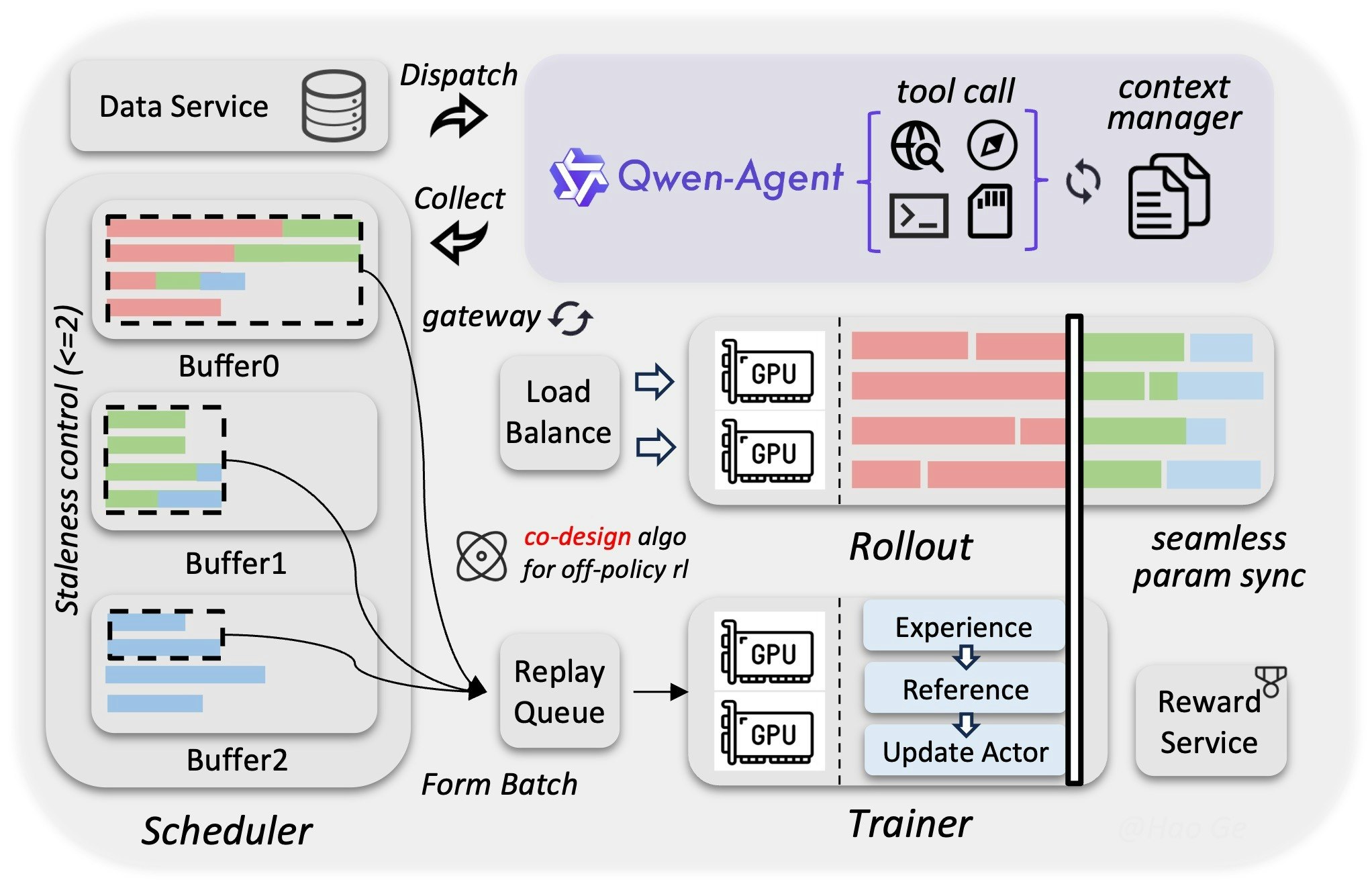
Built on the Qwen3-Next architecture (Linear Attention + MoE), only 17B parameters are active per forward pass. This hits a specific sweet spot: you get the reasoning depth of a giant model with the inference latency of a much smaller one.

For applications, this efficiency is key for agents.

It is natively multimodal with no glued-on vision adapters, demonstrating outstanding results on agentic tasks. This means handling complex workflows without burning through tokens.

Apache 2.0 and ready for vLLM/SGLang out of the box!

5
回复

Congrats @zaczuo !

Excited to test it against agentic workflows. Being a fan of Qwen3 – always a rock solid choice as a local model.

2
回复

Serving a 397B MoE native multimodal model for long-horizon agents will bottleneck on KV-cache growth and multimodal prefill latency, and expert-routing variance can reduce batching efficiency at high throughput. Best practice: run it under vLLM or SGLang with continuous batching plus paged KV cache, add aggressive prompt and image embedding caching, and lean on FP8 where supported to keep cost predictable. :contentReference[oaicite:0]{index=0} Question: what max context length are you targeting for Qwen3.5 in production and how stable is expert routing under long tool-using trajectories when served via vLLM or SGLang?

1
回复

Linear attention keeping latency flat across long tool-call chains is the part that actually matters for agents. Standard transformers get brutal once you're 50+ steps into a workflow with accumulated context. 17B active params on a 397B base with vLLM support out of the box makes self-hosting realistic too.

1
回复
#4
Mozart for iOS
Make a song and a music video while you're on the go
217
一句话介绍:一款移动端AI音乐创作应用,允许用户随时随地通过文字、图片或视频灵感快速生成歌曲及配套风格化音乐视频,解决了非专业用户在移动场景下即时、低门槛表达创意与情感的痛点。
iOS Music Artificial Intelligence
AI音乐生成 AI视频生成 移动创作 创意工具 社交媒体内容 音乐制作 人工智能 娱乐应用 内容创作 低门槛创作
用户评论摘要:用户普遍对产品创意和易用性表示兴奋,认为其赋能了普通人创作。有效评论集中于几个问题:1. 与Suno等竞品的核心差异及音质“AI感”控制;2. 导出格式(如.wav分轨)与专业工作流兼容性;3. 生成后的编辑控制深度;4. 作品版权清晰度及平台分发风险保障。
AI 锐评

Mozart for iOS 描绘了一个诱人的愿景:将完整的音乐工作室塞进口袋。其真正价值并非挑战专业DAW,而是精准切入了“创意即时满足”与“社交表达货币化”的交叉点。产品通过将“灵感-歌曲-视觉化视频-分享”的链条极度压缩,本质上是在售卖一种“可分享的创意体验”,而非纯粹的音乐制作工具。

从评论看,其面临的核心挑战与机遇并存。首先,与Suno的对比提问直指命门:AI生成音乐的“质感”是天花板。若无法在音质“人性化”和旋律独创性上建立壁垒,极易沦为另一个有趣的玩具。其次,用户对.wav分轨导出和深度编辑的关切,暴露了其“从娱乐向半专业渗透”的野心与当前移动端轻量化定位的拉扯。团队“可转网页版深度编辑”的回复是聪明的桥梁,但体验割裂风险犹在。

最犀利的评论关于版权与平台风险。团队“全部商用授权”的回应略显轻描淡写。AI生成内容的版权归属本就模糊,而各内容平台的审核规则更是黑盒。产品若真想助用户积累“文化资本”,就不能仅停留在技术实现,更需构建一套从法律澄清到平台关系维护的“信任体系”,否则“一键发布”可能伴随“一键侵权”的达摩克利斯之剑。

总之,Mozart的价值在于降低了创作的动作门槛,却提高了创意表达的天花板(理论上)。它的成功不取决于功能堆砌,而在于能否在“AI味”的普遍质疑中,产出真正具备情感共鸣和独特性的内容,并构建一个让用户安心创作和分发的生态系统。否则,其热度可能止步于一阵新鲜感驱动的社交娱乐浪潮。

查看原始信息
Mozart for iOS
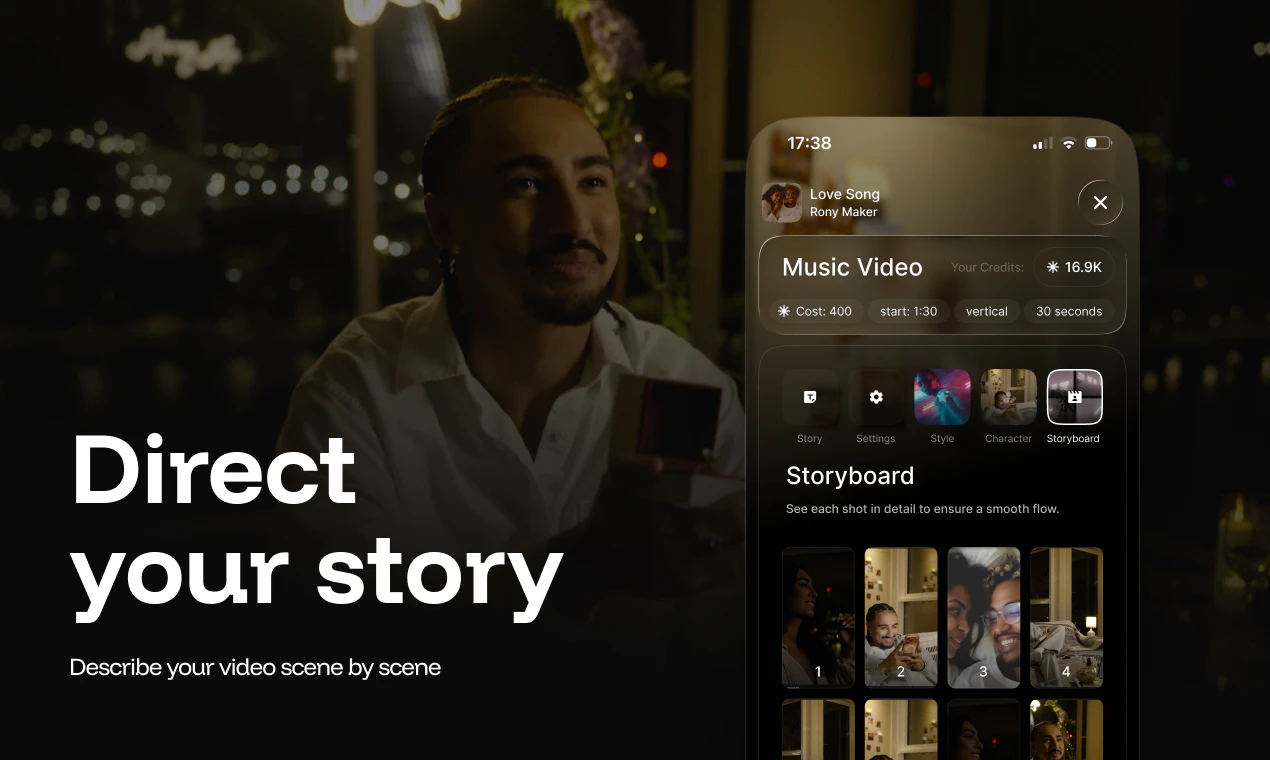
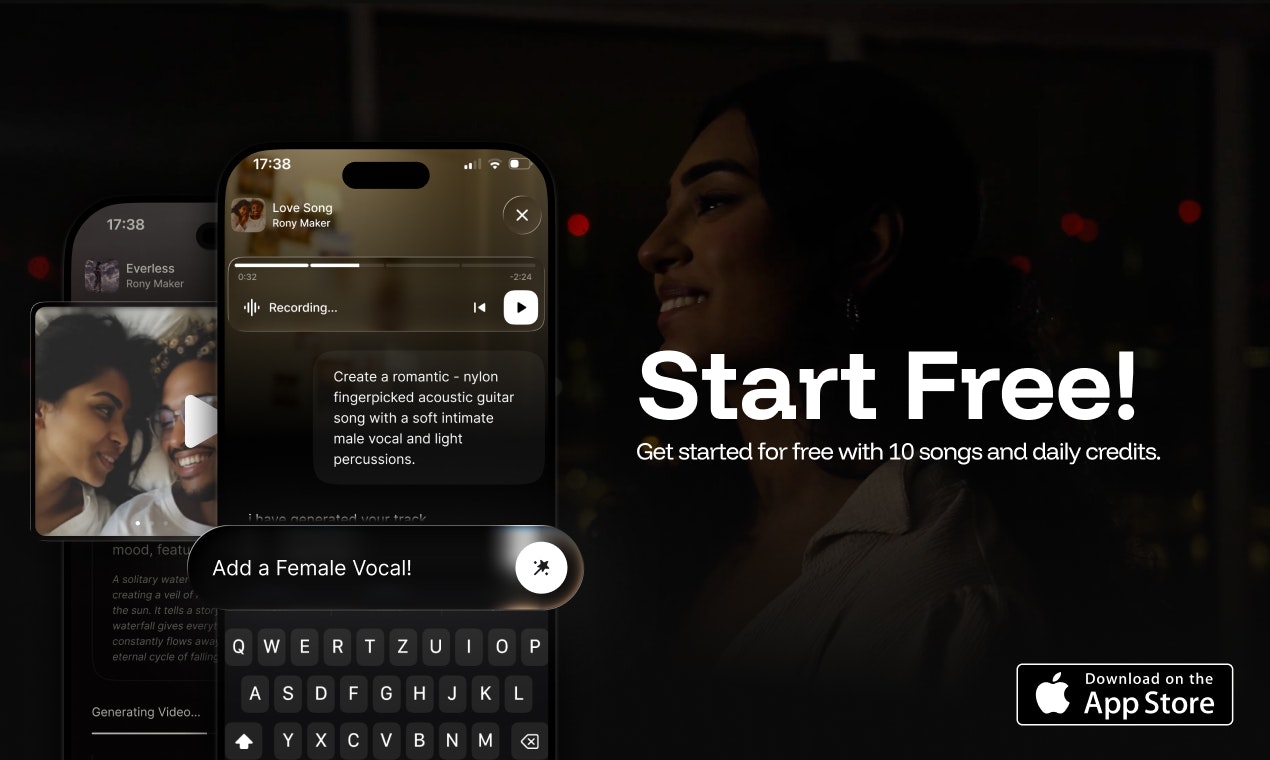
Become a mobile Mozart! 🎶 Create sonic sketches of your ideas or memories while you're on the go. Complete the picture with a custom music video using your photos and media. Then send them to your friends (and fans!) with a tap.

Hey Product Hunt 👋 Sundar here, co-founder of Mozart AI.


Big news first: we just raised a $6M Seed led by Balderton – and today we’re launching Mozart for iOS 📱🎹.

Say it with a song
Turn a memory into a song (and a music video) in minutes – right from your phone 💌

What’s in the iOS app?

  • 🎵 Make a song from text / image / video

  • Edit to perfection: “Change this chorus.” “Make it more upbeat.”

  • 🎬 Make a music video for your track in 3 easy steps:

    1. 🎨 Choose a visual style: Anime, Cinematic, Cyberpunk, Retro, Sketch, Cartoon, Victorian, Country, Street Graffiti, and more

    2. 🧑‍🎤 Pick your character: upload an image or create a persona with a text description

    3. ✍️ Direct your story scene-by-scene

  • 📤 One-tap sharing: export and post instantly to socials (or master for release)

  • 🆓 10 free songs on sign up

  • 🆓 1 free video on sign up

Massive thanks to everyone who supported our earlier launches (we hit Product of the Day #2 twice and Top 5 once) – your feedback helps us build incredible products quickly. Looking forward to another banger launch!

– Sundar

CEO, Co-Founder at Mozart AI

12
回复
1
回复

@sundararvind1244 🙌🙌🙌

1
回复

@sundararvind1244 This is so much fun.

1
回复

That's why I LOVE AI !!! Since childhood, teachers told me I couldn’t write, paint, sing or create music. Now I can. I can turn my ideas into full songs without fear and it’s letting me enjoy creativity in a way I never imagined. Great to see such a product :)

4
回复

@natallia_novik absolutely! It's the new era of intent translation with zero friction, hope you share some amazing music you make with your teachers and change their perspective :)

1
回复

@natallia_novik Thanks Natali! Looking forward to seeing the songs and videos you create and share!

1
回复

Super excited to share with with the world the Mozart AI Mobile App for ios (Android coming soon)! You can now go from a simple idea to song to music video in minutes- something which has not been possible before. Your music studio now in your pocket.

3
回复

@arjunskhanna19 exciting times!

0
回复

Have loved watching Mozart's rise on Product Hunt since last summer.

@sundararvind1244 and his team ship fast and keep expanding the capabilities of their platform, and have now brought the experience to iOS.

Fancy being the next Fred Again? Start with sonic sketches while on the go and then layer on top an original music video in a number of exclusive styles — all within minutes. Share it out to your friends, or post it so social and watch your cultural currency grow. 🎷

3
回复

@chrismessina Can't wait to see how many new Fred Again's we create with Mozart!

0
回复

@sundararvind1244  @chrismessina Thanks a lot Chris!!

0
回复

This is awesome guys, keep up the good work!

2
回复

@daveronan thank you!

0
回复

Congrats on the launch team! I know what I'll be doing for lunch now.

What exports do you guys offer for the music tracks? do you also do .wav files, if I want to export the soundtracks for my video editing workflows?

2
回复

@matthiasrossini Thank you Matthias!

Yes we do support Wav exports! If you want more control, you can export each stem as a wav too!

1
回复

Really cool promo video :)

2
回复

@busmark_w_nika thank you! Have you tried the app, it's cooler haha!

0
回复

@busmark_w_nika Thanks Nika! Super excited for you to check out the app

1
回复

Huge congrats on the $6M raise and iOS launch 🎉

1
回复

@liam007 Thank you Liam!!

0
回复
For creators who want to publish, the biggest blocker is often confidence around usage rights and downstream distribution. How do you make “can I release this?” legible inside the app (not just in terms), and what do you do when a user’s track gets flagged or challenged on a platform?
1
回复

@curiouskitty it's all commercially cleared so we don't think any of our tracks would get flagged!

1
回复

Can't wait to see the videos that you guys create!!

1
回复
0
回复
@pascual_merita let’s goo!!
0
回复

Cool concept — curious about the creative control aspect. How much can you tweak after the AI generates the initial song? Can you adjust tempo, mood, instruments, or is it more prompt-and-go?

1
回复

@go_sakioka Great question! You can use the mobile app to ask for any edits including tempo, mood, sections, extensions, etc. If you'd like more DAW level control, head over to mozartai.com and your project will stay in sync – then you have complete creative control!

0
回复

I just created my first Latino song, think Bad Bunny meets The Killers. Love it!

1
回复

@danielq that’s awesome! Do share it here :)

0
回复

Stunning video! Also, congrats on the iOS launch, team!

0
回复

Amazing team!

0
回复
Can you share your thinking around where this is different from Suno? I’ve been riding w them since the beginning, and made ~$30k selling my music onchain in 2024, but… something happened with their platform, the newer models sound SO “AI-esque” in terms of output 😳 😞 How do you compare / is the underlying ethos different, here??
0
回复

Congrats on the launch.
Curious how you’re thinking about retention with mobile creators. Are people coming back to refine tracks over time, or is usage more burst-based around moments and ideas?

0
回复
Congrats with fundraising! Already tried suno but didn’t have a chance to try yours product. As an ex professional musician, curious to try out your approach to ai generated music! @sundararvind1244
0
回复

@ponikarovskii give us a try and share your music here!

0
回复

Congratulations on the 6M seed round. Does the app allow granular control like changing specific lyrics in the second verse, or is it limited to broader style regenerations?

0
回复

@valeriia_kuna Thanks Valeriia, the app allows for granular control such as over lyrics

0
回复
#5
Layers
Marketing agents that know your code for better messaging
190
一句话介绍:Layers是一款AI驱动的营销代理平台,通过分析用户代码库自动生成并执行增长计划,解决开发者与独立创业者“重产品、轻营销”、产品上线后获客难的痛点。
Marketing automation Vibe coding
AI营销自动化 开发者营销 增长黑客 代码分析营销 社交媒体管理 广告投放优化 UGC内容创作 SaaS工具 独立开发者工具 智能营销代理
用户评论摘要:用户普遍认可其解决“开发者营销难”的核心价值,认为产品定位精准。主要问题集中于:数据隐私安全、多语言支持、非技术成员协作流程、内容个性化控制,以及与现有工具链的替代关系。创始人回复详细,体现了产品灵活性。
AI 锐评

Layers的核心理念“将代码转化为客户”直击一个经典但顽固的痛点:技术型创造者与市场增长之间的执行鸿沟。其真正价值不在于简单的营销自动化,而在于试图构建一个以代码库为“第一性原理”的营销决策闭环。

产品犀利之处在于两点:一是将代码作为理解产品、受众乃至品牌调性的数据源,这比基于问卷或描述的分析更具结构性和真实性,有望提升初始内容的相关性。二是其“分层”架构承认了营销渠道的碎片化与动态性,试图用可插拔的“层”来封装不同策略,而非提供一成不变的流水线。

然而,其面临的挑战同样尖锐。首先,“代码理解”的深度与营销效果之间的因果关系尚未被验证,过度强调可能成为技术噱头。其次,平台野心极大,从内容生成、UGC管理到跨平台广告投放,每个环节都需与垂直领域的成熟工具竞争,其集成体验能否超越“最佳工具组合”存疑。最后,其试图替代的“ChatGPT+Canva+Buffer”工作流,本质是创始人深度参与和创意发散的过程,过度自动化可能导致内容同质化,丧失创始人独有的洞察与温度。

本质上,Layers是“AI智能体”概念在营销领域的一次高复杂度实践。它可能成为资源极度匮乏的独立开发者的“增长急救包”,但其天花板在于,真正的爆发式增长往往源于非标准化的、无法从代码中解析出的市场洞察和人性化创意。它或许能有效解决“从0到1”的冷启动沉默,但“从1到100”的破圈,可能仍需人类那不可替代的“非理性”火花。

查看原始信息
Layers
Marketing agents that understand your code. Layers generates a growth plan and helps run it - content, social posting, ads, and insights - so you can keep building while users come in

Hey Product Hunt 👋

I’m Mike Khristo, founder of Layers.

I’ve been coding since the 90s.

For nearly 30 years, I’ve built product after product - shipped them, launched them, celebrated them.

And I know that feeling.

Launch day:
🚀 You’re on top of the world.
Finally, your product is live.
You know people will love it.

The next morning:
📉 Zero users.
No installs.
No signups.
Just… silence.

It feels like getting punched in the stomach.

So we built Layers.

Layers is the easiest way to turn your code into customers.

The name Layers is deliberate. Every marketing tactic and playbook is a layer:

  • Some long-lived (Google Ads, Meta)

  • Some opportunistic (UGC waves, Shorts trends)

  • Some deeply technical (SDKs, attribution, data loops)

The only constant is that there will always be new layers to try.

Instead of handing you a marketing plan and saying “good luck”…

We act.

How Layers Works 🚀

🔗 Connect your GitHub (optional, but powerful)
We analyze what you built, who it’s for, your tone, aesthetic, ICP - automatically.

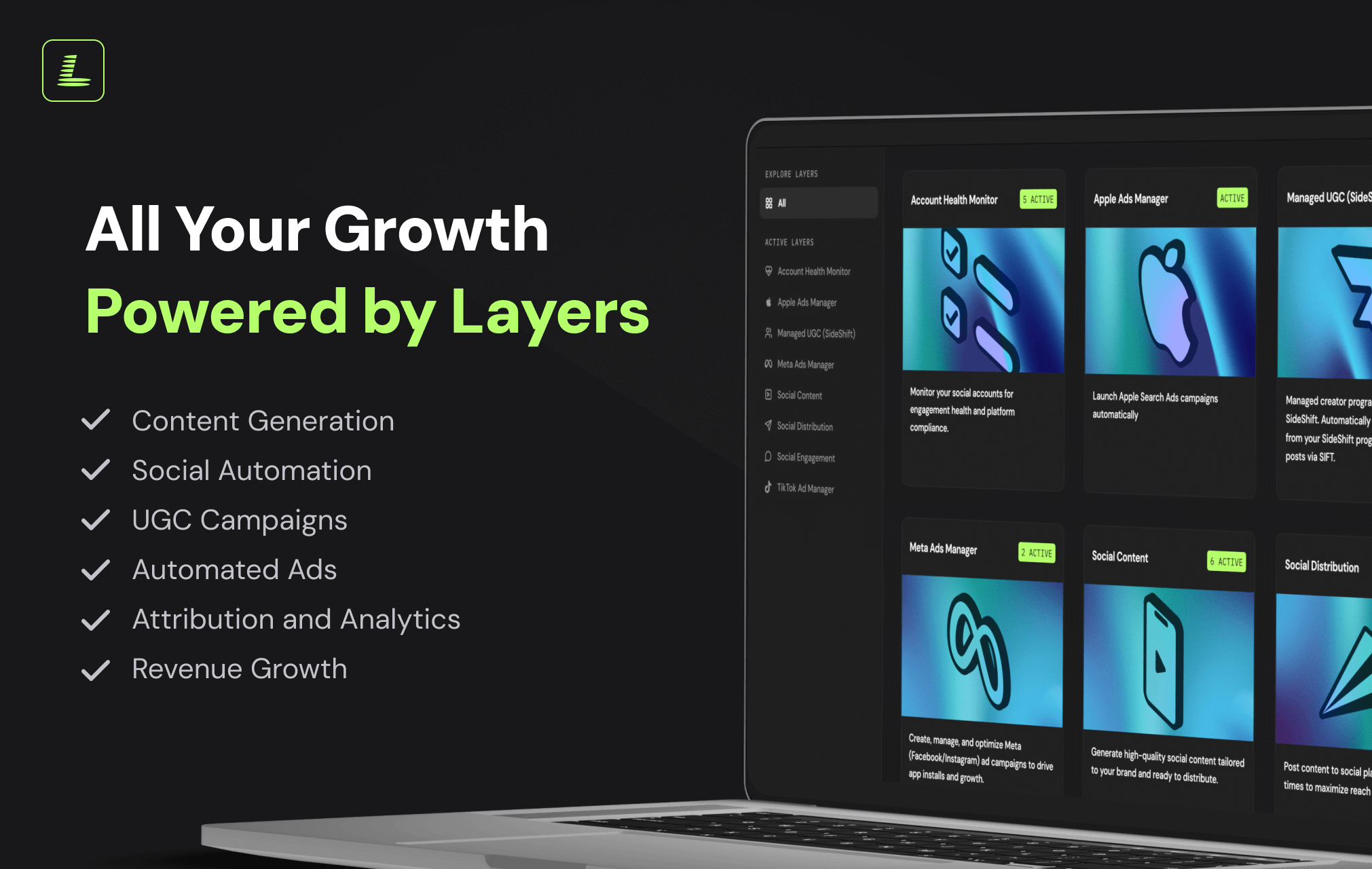
🎯 We recommend a stack of “Layers”
Not a vague strategy - a set of actions tailored to your product.

⚙️ We execute
With your permission, we:

  • Research and generate content

  • Distribute to TikTok, Instagram, and soon YouTube Shorts, X, Reddit and more

  • Analyze performance & extract insights

  • Feed that data back into future content

📈 When content wins, we scale it
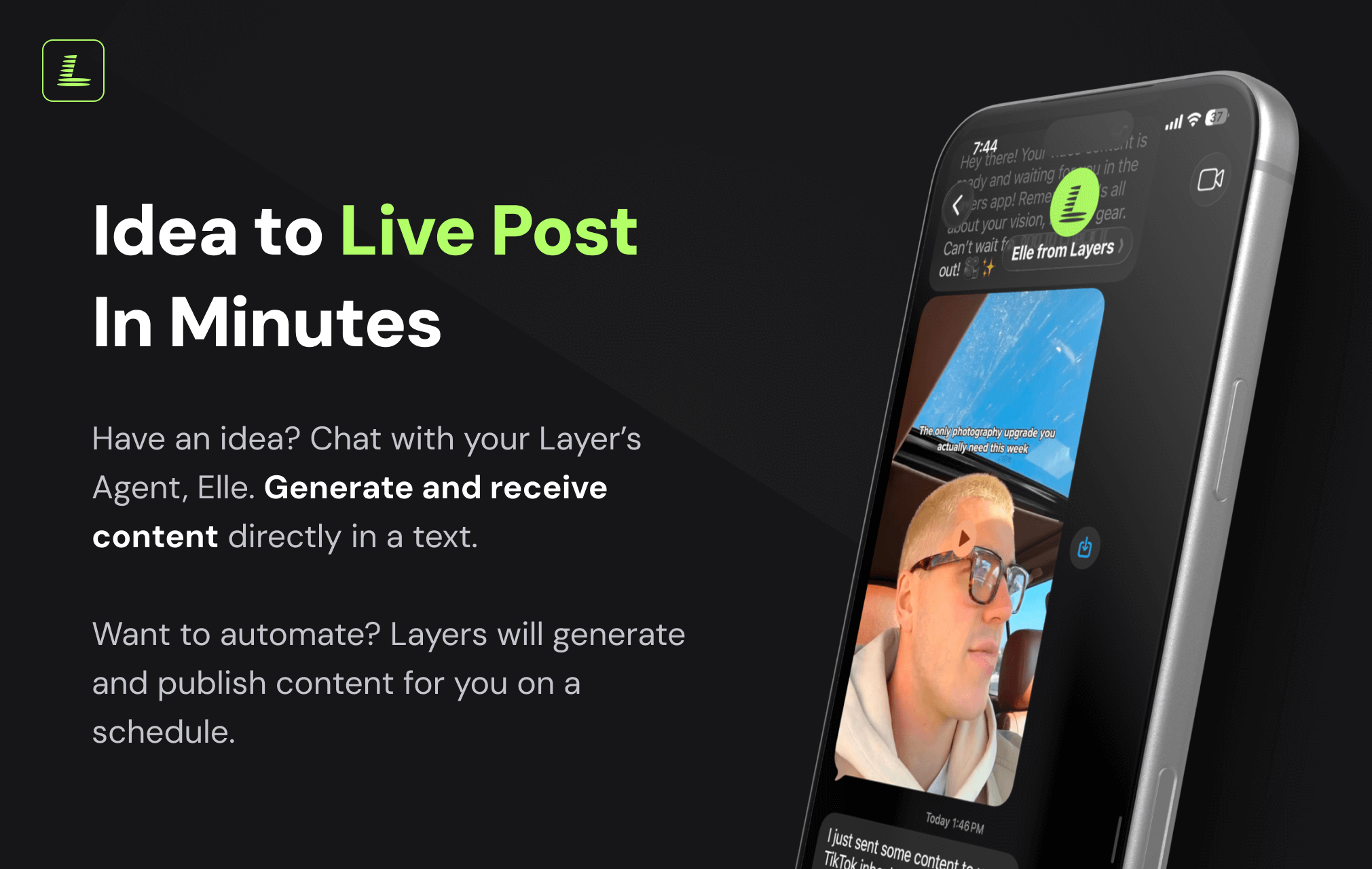
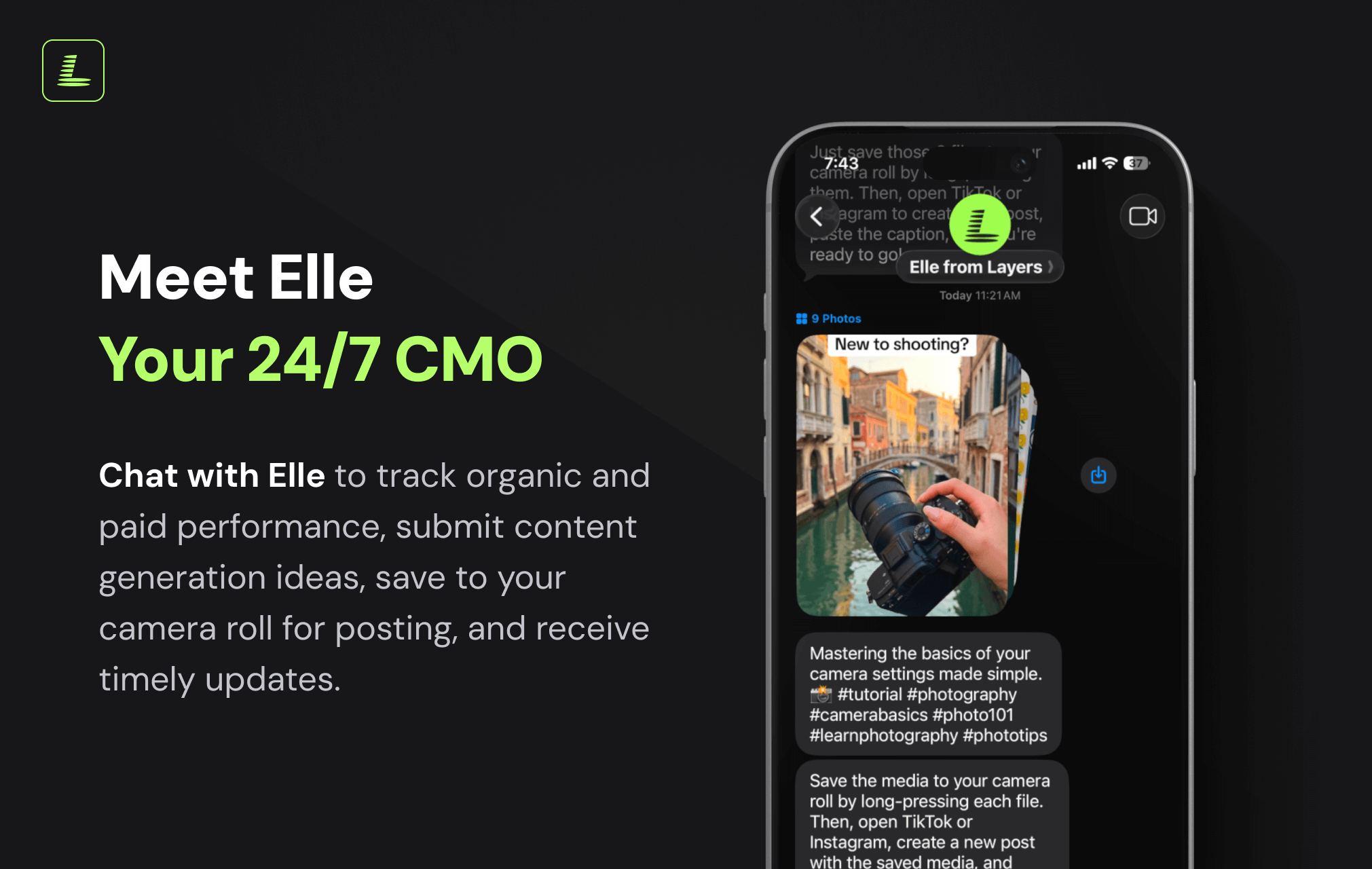
Our agent Elle (your CMO) suggests next steps. Stay in the loop as much as you want. As you build trust, you can defer decision making at a granular level, if you choose to. Elle is available on the web and through iMessage/SMS.

Paid

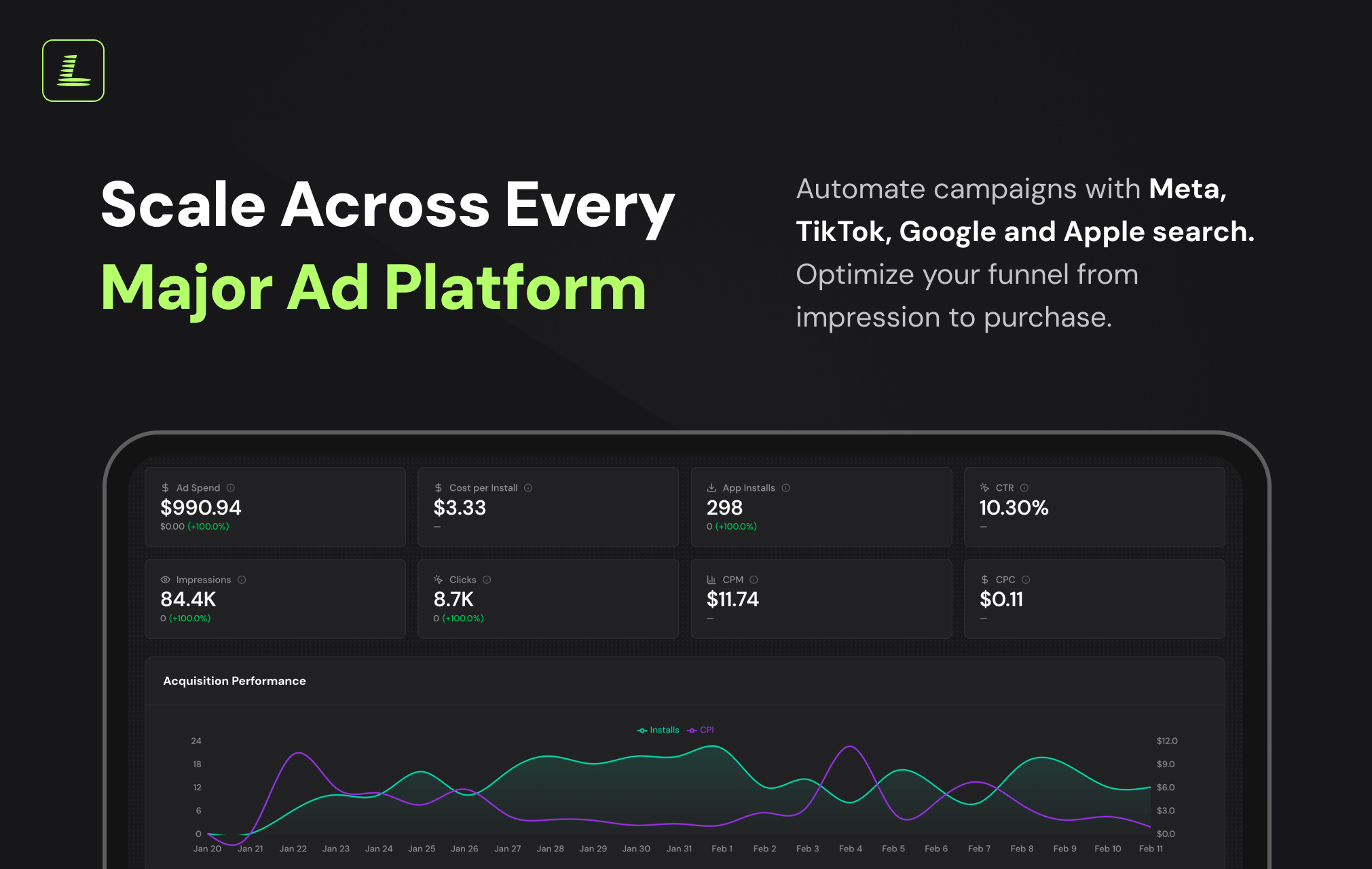
When the time is right, we’ll suggest that we launch & optimize ads for you across:

  • Meta

  • TikTok

  • Apple Search Ads

  • Google

Or skip ahead and activate ads on day 1.

🎥 Need UGC?
A couple clicks is all it takes.
We source, manage, and optimize creators for you.

🧠 If GitHub is connected, we go deeper

  • PRs for ad network SDK integrations

  • Attribution tracking setup

  • Closed-loop performance optimization

For every layer, you’re always in control.

Who Is Layers For?

  • Indie hackers

  • Mobile app builders

  • SaaS founders

  • Developers who want distribution but hate marketing

If you love building but don’t love pulling marketing levers - this is for you.

We’re on a Mission

We want to solve that emotional roller coaster developers face, once and for all.

Not every product will succeed.

But every developer deserves a real shot.

Layers exists to give you that shot.

We’re live today and would love your feedback.

Ask me anything - about ad tech, Snap, SDKs, growth loops, UGC, attribution, or the ugly emotional side of launching.

Let’s turn code into customers. 🚀

19
回复

@mike_khristo Literally the product i was looking for, for my ZeroCrew company.

6
回复

@mike_khristo This is an amazing product... It looks like it beats all the other apps! Good job with the launch!

1
回复

@mike_khristo Hey Mike. Congrats on the launch! How do you handle data privacy and security, especially when connecting to developer codebases or analytics data?

0
回复

Super excited to finally share what I've been building with long-time friends. Layers is the missing ingredient for builders like me. I have a long history of launching apps and never following through on the marketing side — I do what I do best, and that's build products. Layers solves that critical gap: gaining traction, installs, and growing revenue. Something that used to take a dedicated marketing team and months of work, you can now kick off in minutes. What a time to be alive!

5
回复

@steven_doyle what a time, indeed

1
回复

awesome product and gj on launch

4
回复

@apexflux thank you! excited to have you use it!

1
回复

Sounds super interesting! Funny enough, we have a Product called Layers too!

4
回复

@sundararvind1244 give it a shot! we'd love to hear what you think!

1
回复

Congrats on the launch!

What kind of products fit well with Layers? Can you do content for developer tooling?

3
回复

@janschutte we've been testing with a wide variety across mobile apps, saas, and related. give it a shot for your dev tools and ping me on intercom or email and we'd be happy to see if more tuning is needed for your use case!

2
回复
Hey Mike, that punch in the stomach feeling of launching something you’re proud of and waking up to silence is brutal. After 30 years of shipping products, was there a specific launch where that morning after hit especially hard?
3
回复

@vouchy yes definitely. after getting back to startup land after 6 years at snap, i got quickly humbled by that feeling. pre-ai-code, shipped a mobile app that i thought the world needed. completely deflated over the course of the next week. that was the last time. that's when Layers was born.

2
回复

Congrats on the launch!

2
回复

@patrickt010 thank you!

0
回复

Looks great

2
回复

@madalina_barbu thank you! would love for you to give it a try!

1
回复

Hi, does it support generating content in multiple languages? For example polish?

Btw. Sounds awesome, what I was looking for.

1
回复

@bartosz_rosiak yes! this week you'll be able to set your project-level or content-layer-level language if we don't automatically detect it

0
回复
When someone already uses a stack like ChatGPT + Canva/CapCut + Buffer + basic analytics, what’s the exact workflow you replace—and which parts do you intentionally *not* automate because they’re too risky or too founder-specific?
1
回复

@curiouskitty we replace those tools and much more. Content/competitive niche research, content gen, post scheduling and optimization, real-time analytics and learnings that feed back into the loop. Then there's fully integrated ads across Meta / IG, TikTok, Apple, Google. Spin up a team of UGC creators with a few clicks or a quick conversation with Elle. The platform tells you what to measure, attribution & insights, and submits PRs to you with all the latest best practices. Then it closes the loop by understanding and monitoring your growth metrics. The founder is in the loop every step of the way, either approving each action or choosing which parts to delegate with autonomy.

0
回复

Very cool! Do you support mobile?

1
回复

@daniele_packard we do! come give it a try!

0
回复

I’ve been looking for something like this. Love the idea of marketing agents that learn about your product via your code and help you research and generate content for social media. Curious how you guys source and manage creators for UGC content... is that fully handled through the platform?

0
回复

I love that it can see your github repo. However, is the content ai-generated? Is there any way for me to integrate my personal branding or character with the content?

0
回复

@peterz_shu 100% you have your own media library you can upload into. You can curate your personas, custom influencers, and brand assets.

0
回复

Congrats on the launch! The layers framing makes a lot of sense, especially for founders who don’t want to stitch together five separate growth tools. How does Layers decide which layer to activate first for a new product? What signals tell to prioritize organic short-form content over paid ads or deeper technical layers?

0
回复

@vik_sh We do deep dive research on:

  • the competitive landscape

  • history of the product

  • any social accounts the brand might already have

  • how those perform

Then we make opinionated recommendations. In some cases, if the brand is up for it, they can start running ads immediately. In other cases, they prefer to wait until they find some winning format with organic.

0
回复

The code-aware marketing concept is brilliant for indie hackers! But I'm curious about the team workflow:

if a non-technical marketer working alongside developers, can Layers still be used effectively? Or does the magic really rely on the team member pushing the code to GitHub? Basically, is this tool strict dev-only, or can a marketing team pilot it while devs just approve the SDK PRs?

0
回复

@valeriia_kuna it can definitely be used by a team, including non-technical folks! Our sweet spot is any company with no marketer up to a small marketing team. Today, you can invite your teammates and grant them access on a project by project basis.

By design, we don't have a ton of "workflow permissions" - for example, "user 1 needs to approve this content then user 2 needs to sign off on it, then user 3 needs to give final approval". That level of workflow management is too complex for our typical user.

1
回复
#6
MiniMax-M2.5
The first open model to beat Sonnet made for productivity
165
一句话介绍:MiniMax-M2.5是一款专为真实工作场景设计的开源前沿AI模型,在编程、搜索、工具调用及办公任务上提供顶尖性能,以高性价比解决企业及开发者部署高效、可扩展AI智能体的成本与效率痛点。
Open Source Software Engineering Artificial Intelligence GitHub
开源AI模型 生产力工具 代码生成 智能体 性能标杆 成本效益 长周期任务 办公自动化 工具调用
用户评论摘要:用户普遍对开源模型取得SOTA性能表示兴奋,关注其在实际工作流中的真实可用性,而非仅限基准测试。主要问题聚焦于“生产力”的具体定义及在混乱遗留代码库中的表现。有用户提示可免费试用。
AI 锐评

MiniMax-M2.5的发布,与其说是一款新模型上线,不如说是一次对现有AI生产力格局的精准卡位与宣言。其核心价值不在于“开源”或“超越Sonnet”这些标签,而在于试图将“前沿性能”与“真实世界生产力”进行强绑定,并通过极具侵略性的定价(1美元/小时)将经济可行性作为卖点。

产品介绍中罗列的SWE-Bench、BrowseComp等专项高分,直指当前企业AI应用最核心的几大场景:代码、搜索与办公自动化。这标志着开源模型的竞争已从纯粹的学术或通用能力比拼,转向了垂直场景的深度优化和效能证明。然而,评论区的关键一问切中要害:“生产力”如何定义?模型在整洁基准库上的辉煌战绩,能否无缝迁移至充满“技术债”和模糊需求的日常工作中?这仍是所有宣称“生产力”的模型必须面对的“最后一公里”难题。

其“无限扩展长周期智能体”的愿景,结合给出的吞吐量(100 tps)和价格,确实在理论上打开了大规模、长时间运行AI智能体的成本天花板。但这更像是一个面向B端和平台构建者的基础设施级价值主张,而非面向普通用户的即插即用工具。它的真正挑战在于,如何构建一个完整的生态,让开发者能便捷地将这种“廉价算力”转化为终端用户可感知的“生产力提升”。

总体而言,M2.5是一次有力的市场进击。它用开源策略吸引生态,用专项高分建立技术信任,再用激进定价撬动规模化应用。它的成功与否,将不取决于榜单上的数字,而取决于能否在那些未被基准测试覆盖的、混乱而真实的业务场景中,真正兑现“生产效率”的承诺。

查看原始信息
MiniMax-M2.5
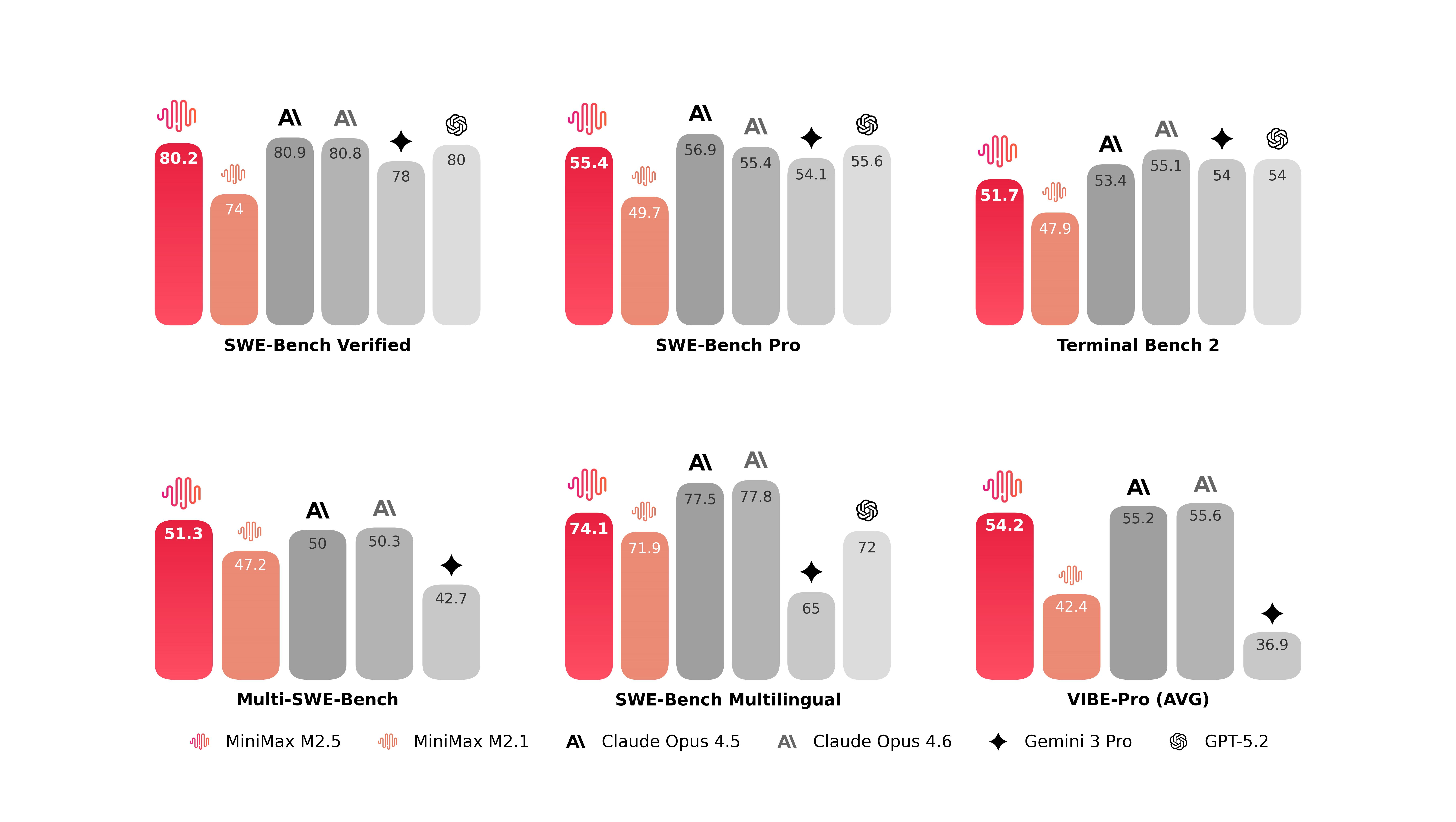
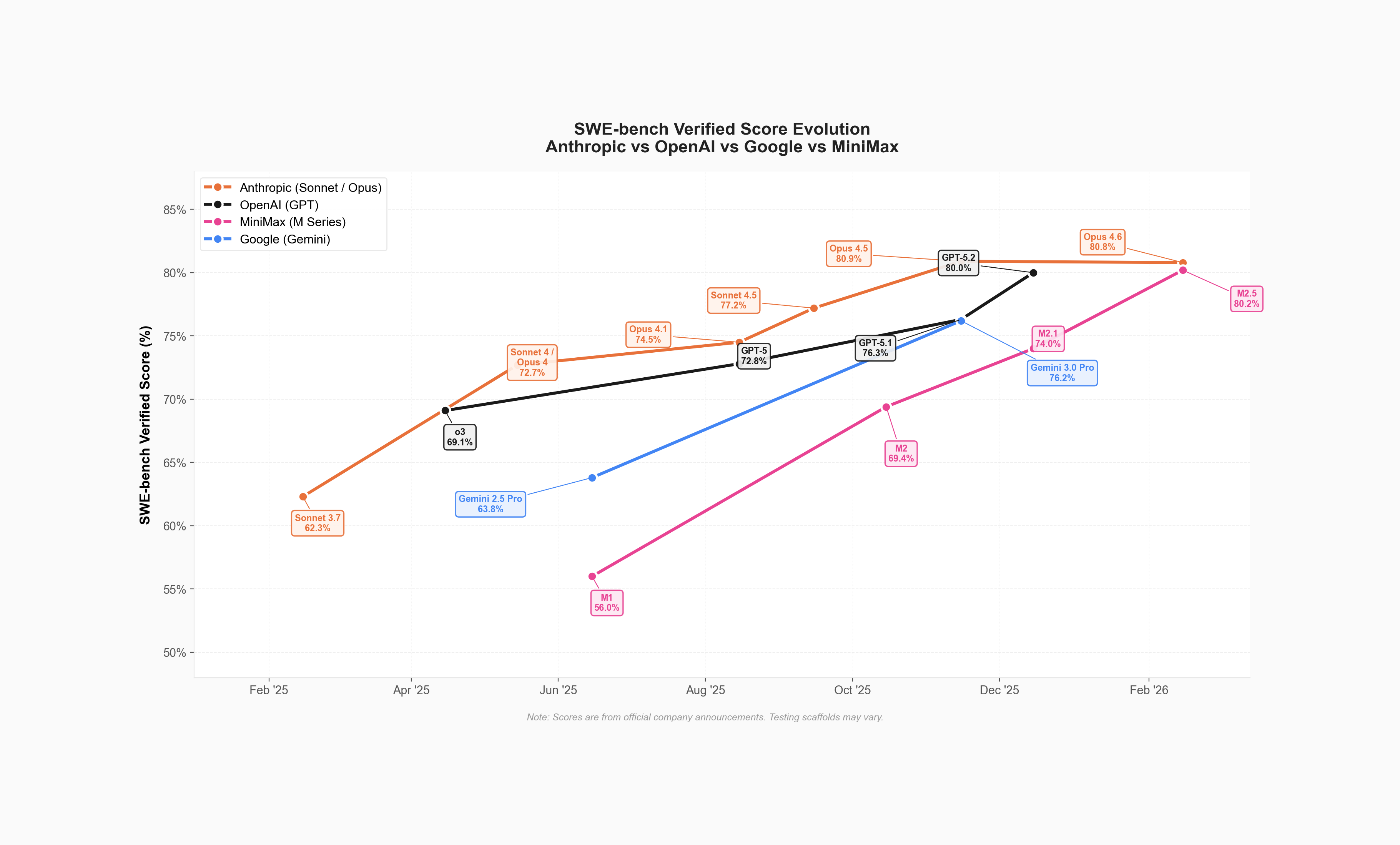
Introducing M2.5, an open-source frontier model designed for real-world productivity. SOTA performance at coding (SWE-Bench Verified 80.2%), search (BrowseComp 76.3%), agentic tool-calling (BFCL 76.8%) & office work. Optimized for efficient execution, 37% faster at complex tasks. At $1 per hour with 100 tps, infinite scaling of long-horizon agents now economically possible.

Big news for open models: MiniMax-M2.5 is out with SOTA performance at coding (SWE-Bench Verified 80.2%). The first open model to beat Sonnet. Only @Claude by Anthropic's Opus and @OpenAI 's GPT-5.2 Codex score higher.

Paths between open and proprietary models are converging...

Pro tip: If you want to quickly experiment with it, @MiniMax-M2.5 is free for a week on @Kilo Code (until Thursday, Feb 19).

OSS ftw!

7
回复

@fmerian Will Definitely try with Kilocode Thanks!

0
回复

@fmerian Whoa, MiniMax-M2.5 dropping SOTA SWE-Bench scores at 80.2% and beating Sonnet? Probably first open model to do it! 😲 Good hunt, @fmerian! :)

2
回复

@fmerian How do you define “productivity” in the context of an AI model? How should users expect the model to change daily workflows?

0
回复

looks great! This is something that seems like it would pair well with ClawdBot agents...

0
回复

One of the best models

0
回复

80%+ on SWE-Bench Verified for an open model is wild — especially if it’s actually usable in real workflows and not just benchmark-flexing. Curious how it holds up on messy, legacy codebases vs clean benchmark repos?

0
回复

Love it, I think i will add it to my saas YouScaleIt

0
回复

Congrats folks good luck on the launch!

0
回复
#7
Brainstream
Agentic AI notes: smart search, briefs & tasks
151
一句话介绍:一款能理解语义并主动创建任务、生成摘要与简报的智能笔记应用,为信息过载、行动滞后的知识工作者将碎片化思绪转化为清晰行动方案。
Android Productivity Task Management Notes
AI笔记 智能助理 任务管理 语义搜索 每日简报 知识管理 生产力工具 行动导向AI
用户评论摘要:用户认可其从捕捉到行动的闭环设计,尤其赞赏每日/每周简报功能。核心疑问集中在:1. 实际“行动”能力边界(如与外部的日历、邮件集成);2. 对现有工具栈(笔记+任务+日历)的迁移成本和初期价值路径;3. 产品最适合的用户画像和工作流。
AI 锐评

Brainstream的野心不在于做另一个笔记容器,而旨在成为个人信息的“决策中枢”。其真正价值并非炫酷的AI问答,而是通过“语义理解-自动结构化-主动呈现”的三级跳,试图根治“记完即忘、信息孤岛”的顽疾。

产品巧妙地避开了与Notion等在“无限画布”功能上的正面竞争,转而聚焦于“后笔记”场景:当信息沉淀后,如何让其自动流动并催生行动?其核心Agentic能力(自动创建任务、标签、日历事件)和简报系统,本质上是将GTD方法论与项目管理中的“定期复盘”机制自动化、个性化。这戳中了一个高级痛点:现代人缺乏的不是记录工具,而是将记录转化为结果的“认知摩擦力”。

然而,其面临的挑战同样尖锐。首先,“行动”的闭环严重依赖内部生态,评论中暴露的用户对其连接外部主流工具(如第三方任务管理器)的疑虑,是规模化必须跨越的鸿沟。其次,其“全能中枢”的定位,与用户现有的、细分的“最佳工具栈”使用习惯存在冲突。创始人在回复中强调“无需迁移,先开始记录”,这虽降低了试用门槛,但也可能让产品在初期沦为另一个“信息黑洞”,无法充分展现其核心的转化价值。

长远看,Brainstream的价值天花板取决于它能否从一个“更智能的笔记App”,进化成一个得到用户深度信任的“个人战略操作系统”。这要求其AI不仅理解笔记内容,更能深度理解用户的角色、目标与优先级,从而实现从“被动响应指令”到“主动策略建议”的跨越。当前版本是一个出色的起点,但真正的战役在于生态构建与认知习惯的重塑。

查看原始信息
Brainstream
Turn scattered thoughts into organized action with Brainstream - an AI-powered note-taking app with an intelligent assistant that doesn't just answer questions, it takes action for you. Capture ideas in seconds (voice, text, photos), then let your AI assistant do the heavy lifting: create tasks from your notes, organize with smart tags, summarize content, and deliver daily + weekly briefs that transform chaos into clarity.
Hey everyone! Maker here. This started because my wife needed a simple note-taking app. She'd tried Notion, Obsidian, and a bunch of others but they all felt like she needed a PhD just to organize her thoughts. She wanted something where she could just dump what's on her mind and move on with her day. So I built her a basic note-taking app. Voice memos, quick text notes, snap a photo - 30 seconds and done. But then she'd say things like "I know I wrote something about that dentist appointment somewhere.." and spend 10 minutes scrolling through notes. So I added semantic search: ask a question in plain English and it finds the right notes by meaning, not just keywords. Then came the moment that changed everything. She'd capture tons of ideas and tasks throughout the day but never go back to actually act on them. Sound familiar? That's when I thought what if the AI didn't just help you search, but actually did things for you? So now you can tell the AI "create a task to call the dentist tomorrow" and it just...does it. It creates tasks, organizes your notes with tags, even drafts calendar events. It's less of a chatbot and more of an assistant that gets things done. The feature I'm personally most proud of is Daily & Weekly Briefs. Every morning you get a summary of what you captured yesterday, what's due today, and what needs your attention. Every week you get the bigger picture: themes, patterns, things that fell through the cracks. It basically turns a mess of scattered notes into a clear action plan without you lifting a finger. I also added an evening closeout, a quick end-of-day ritual where you see what you got done, jot down any loose thoughts, and preview tomorrow. My wife says it's the thing that finally made her feel "on top of things." We're live on Android and web with iOS coming soon. Would love your feedback, especially on what you'd want from an AI note-taking assistant. What would make you actually switch from your current setup?
10
回复
@asadmasad Clean concept and strong execution. Brainstream goes beyond note-taking by turning ideas into action — tasks, summaries, and clear daily and weekly briefs. The focus on clarity over clutter really stands out.
0
回复

@asadmasad Congrats Asad! What kinds of users or workflows do you think benefit most from an AI that doesn’t just summarize but acts by creating tasks and briefs?

0
回复

nice launch asad! congrats!

2
回复

Congrats on the launch, Asad. The story of how this came to be is really nice and relatable for so many people.

Balancing idea capture and organization and action items is difficult. Regular daily/weekly reviews is a nice touch as well. I'm so prone to drifting from my original direction to focus on something shiny and new. That review helps to keep on track.

Personally, I have an environment I built for myself that is similar to this, from what I can tell. In addition to the idea capture/organization and daily/weekly reviews, the system is aware of my high level vision and deliverables, so it slaps me on the wrist when I pause meaningful work to build yet another AI tool for myself. You could say it works as an accountability partner to keep me on track to hit targets. Not sure if that could fit into your vision, but that's what I see in Brainstream from my own lens.

1
回复

@bbmaxwell Yup - Brainstream has this feature too in a way 😊where it resurfaces and reminds you of old forgotten tasks that haven't been completed yet. But having an overarching vision sounds interesting too - my only concern would be that it may be too fluid for a general purpose app - thoughts?

0
回复

Love how note-taking became more efficient with this tool. Love this anc congratulations on the launch, @asadmasad !

1
回复

@neilverma Thanks

2
回复

Interesting — curious what "takes action" looks like in practice. Can it create calendar events, draft emails, or push tasks to other tools? Or is the action more within the app itself?

1
回复

@go_sakioka Yeah, it can create Google calendar events, create/edit/complete tasks & notes within the app by just chatting with the app. New notes can also be created by just forwarding an email to notes@usebrainstream.app from the registered email address.

0
回复
A lot of people already have a “stack” (notes app + task manager + calendar). What does a realistic adoption path look like where Brainstream adds value in week 1 without forcing a full migration, and which integrations or workflows matter most for that?
0
回复

@curiouskitty Completely agree but I believe juggling 3 apps is not the most efficient way. Brainstream combines all 3 in a single app. And you also get native AI chat (research or chat with AI from within the app), agentic AI actions (create note, create/complete tasks, create calendar event, etc.), and other AI powered features (summarise or rewrite notes, suggest tags or extract tasks from a note,etc.). Not to forget the semantic search where you can search for anything across your notes.

So basically a realistic adoption plan is to just start capturing thoughts in the app and let the AI do the heavy lifting for you. Other than email (for the email-to-notes capability) and calendar, there is no other integration. Inward migration is not currently supported but is definitely possible if the market demand warrants it.

0
回复
#8
Vela
AI scheduling that works the way a great EA does
148
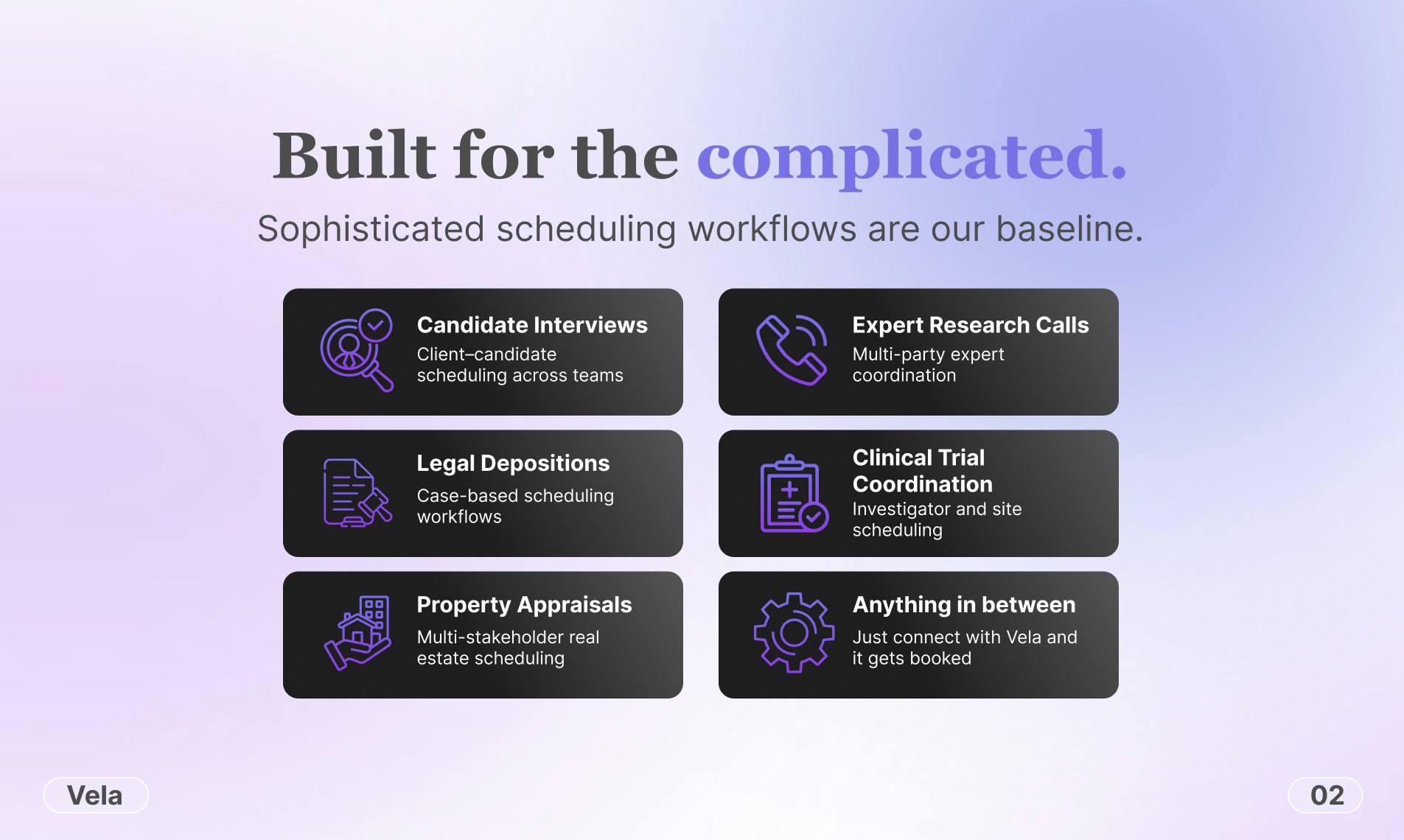
一句话介绍:Vela是一款像高级行政助理一样工作的AI智能日程调度代理,通过跨邮件、短信、WhatsApp和电话等多渠道全自动协商时间、跟进并预订会议,解决了企业及个人在批量、多平台协调会议时效率低下、沟通繁琐的核心痛点。
Productivity Calendar Artificial Intelligence
AI日程调度 智能行政助理 多渠道协调 企业级自动化 YC孵化 会议管理 SaaS 招聘行业解决方案 优先级判断 自然语言理解
用户评论摘要:用户肯定产品简化日程管理、替代人工的价值。主要问题集中于:与谷歌日历等工具的集成细节、团队与个人使用的场景差异、以及在优先级冲突或频繁改期等边缘情况下的具体决策逻辑。创始人回复强调其基于历史学习与人工兜底的智能判断。
AI 锐评

Vela的野心并非做一个更漂亮的日历插件,而是试图成为嵌入商业沟通毛细血管的“自主调度智能体”。其宣称的“品味”和“跨渠道规模化操作”直击当前调度工具的两大软肋:一是缺乏上下文与优先级判断的机械规则系统,二是无法在邮件、IM、电话等割裂场景中提供统一连贯的体验。

真正的价值在于将调度从“管理时间”提升为“管理注意力与关系”。它优先处理投资者会议而非内部同步,这实则是将商业规则隐式编码,替代用户进行持续的、低阶的决策消耗。而支持千级访谈的并行调度能力,则瞄准了招聘、销售等强节奏、高吞吐量的垂直领域,将调度从支持功能转变为业务产能的核心杠杆。

然而,其挑战同样尖锐。首先,“品味”的算法黑箱如何取得用户信任?尤其在处理“董事会成员与咖啡闲聊”的优先级时,微妙的商业政治可能远超历史数据范畴。其次,跨渠道操作涉及复杂的隐私与合规雷区,特别是在短信、电话等更敏感的通信领域。最后,从“替代人工点击”到“替代人工判断”,用户教育成本和错误容忍度将呈指数级上升。

Vela的YC背景与早期企业用例显示了其从高价值、高痛点的B端场景切入的务实路径。若能攻克信任与可靠性关口,它有望从工具演变为一种新的商业沟通基础设施层——即所有外部时间协调请求的智能网关。但若其“智能”在复杂场景中频频失准,则很容易被降格为一个昂贵的、花哨的自动回复系统。

查看原始信息
Vela
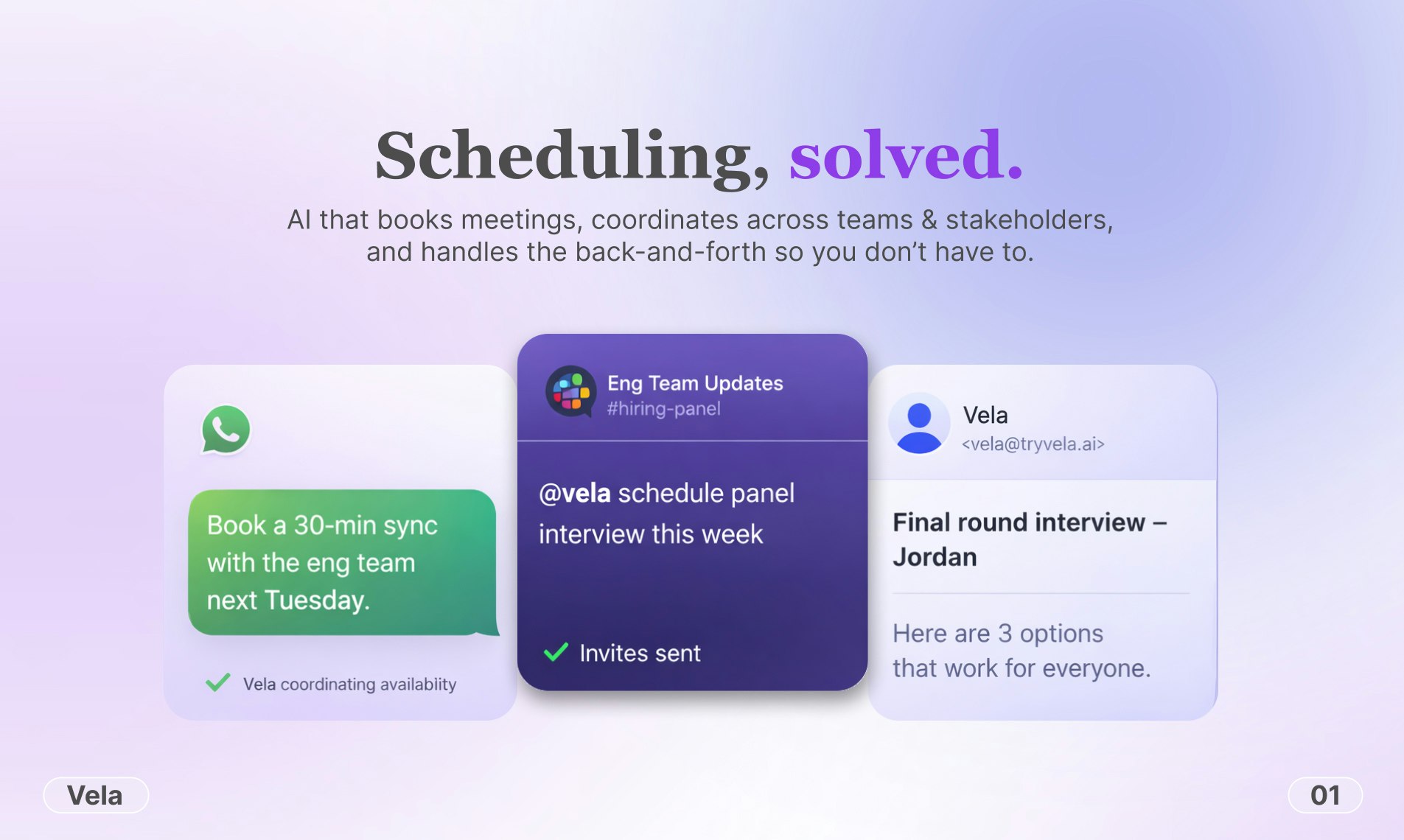
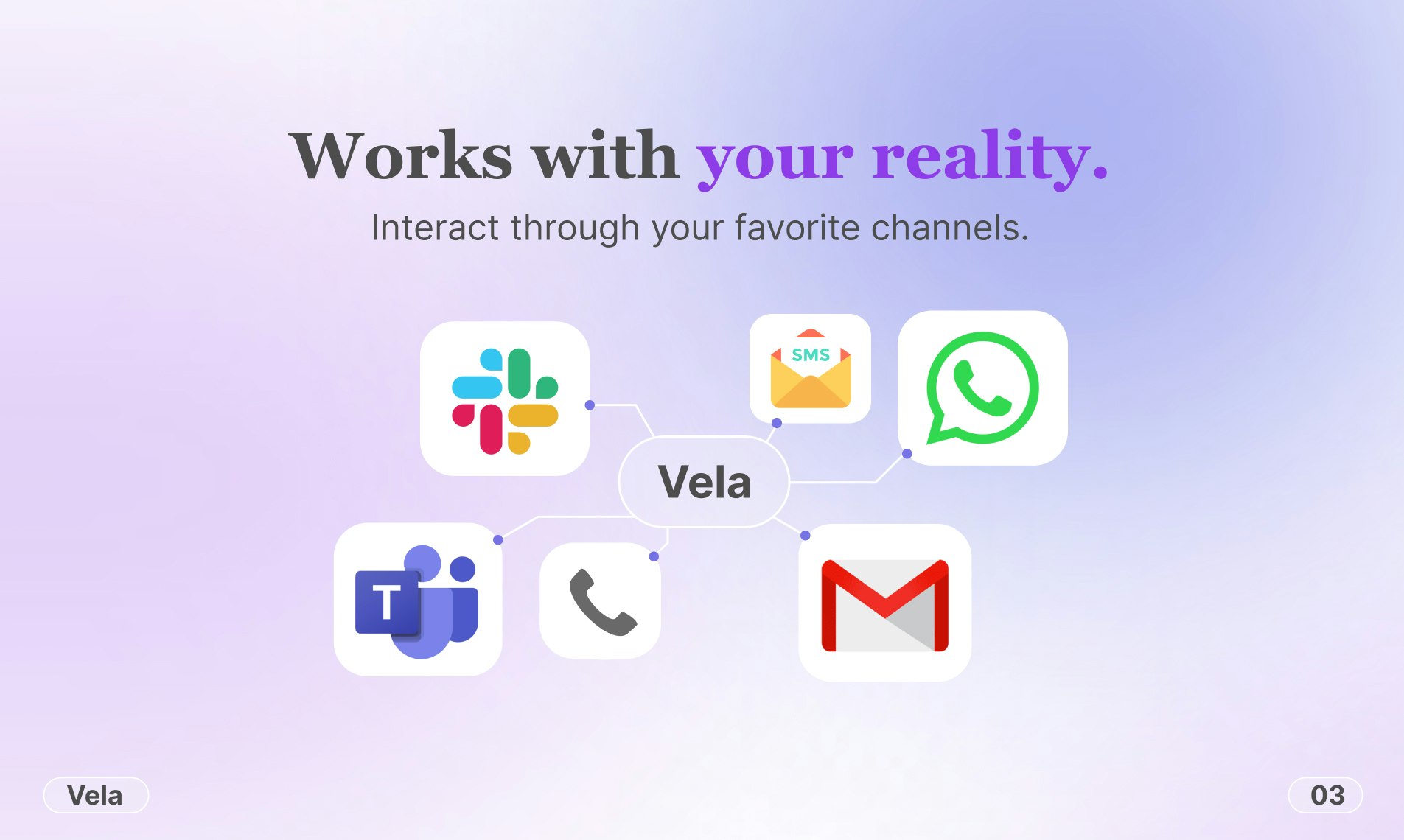
Vela is an AI scheduling agent that works the way a great EA does - across email, SMS, WhatsApp, and phone, at any scale. Loop Vela into a conversation and it takes over. It negotiates times, follows up when people ghost, and books the meeting. It has taste: it prioritizes an investor over an internal sync, and understands "early next week" without rigid parameters. Need 1,000 interviews scheduled this week? Vela makes parallel calls and coordinates across every channel. Backed by YC W26!

Hey PH! Gobhanu here, co-founder of Vela (YC W26).

We built Vela because scheduling is secretly one of the hardest coordination problems in business - and nobody's solved it end to end.

For a founder, it looks like drowning in email threads trying to lock down 20 demo meetings a week. For a recruiting firm, it looks like needing to schedule 1,000 driver interviews by Friday across phone, SMS, and email - simultaneously.
Both problems require the same thing: an agent with real judgment that can operate across every channel at any scale.

Here's what makes Vela different:
It works everywhere. Email, SMS, WhatsApp, phone calls. CC it in an email or let it make 1,000 parallel calls - same agent.
It has taste and TRULY learns. Vela knows a board member outranks a coffee chat without you writing rules. It understands "early next week" without rigid parameters.
It handles the mess. Ghosted? Vela follows up. Conflicting time zones? Handled. Multi-party interviews with 5 calendars? Done.

We're already used by enterprise recruiters scheduling thousands of interviews a week and by founders who need white-glove coordination for their highest-stakes meetings.
We're currently running paid pilots and yearly contracts with individuals and businesses. If scheduling is a pain point for you, feel free to book a demo - we'd love to show you what Vela can do.

We'd love your feedback - especially if you have scheduling workflows that feel impossible to automate. Book a Demo and we can get you your own scheduling assistant in under 15 minutes.

Gobhanu & Saatvik - <3

11
回复

@gobhanu_korisepati  To the moon! Couldn't have asked for a better co-founder <3

0
回复

@gobhanu_korisepati congrats on the launch, and more importantly on being accepted to YC - impressive stuff. I am myself work in scheduling (founder of timetuna.com - #1 on producthunt from Dec), would love to chat with you about scheduling.

0
回复

@gobhanu_korisepati How do you see Vela helping teams vs. individuals? Are there specific workflows where it’s especially transformative?

0
回复

Wow very powerful - integrates with google calendar?

1
回复

@daniele_packard Thanks Daniele!

0
回复

@daniele_packard Absolutely yes! Works across ALL email clients.

0
回复

Genuinely hate checking my calendar, Vela has taken that obligation out of my day to day

1
回复

@pranjali_awasthi thank you so much, Anjali. It's been a pleasure working with you.

0
回复

Congrats on the launch! Handling multi-channel scheduling with real judgment is a big ambition.

How does Vela decide priorities in edge cases, for example when two high-priority stakeholders conflict or when someone keeps rescheduling last minute?

0
回复

@vik_sh thanks, Victor. Vela is super smart. It looks at your previous calendar history in order to decide what you have done before. And if there's no clear evidence, it escalates to a human, until eventually it learns all of your priorities and preferences perfectly.

0
回复

Great product guys! Good luck with your launch :)

0
回复

@sundararvind1244 thanks Sundar you too!

0
回复

This has made my scheduling life a lot simpler

0
回复

@harsha_gaddipati Thank you Harsha - day zero supporter :)

0
回复

@harsha_gaddipati thank youuuuuuu

0
回复

Man, I get the scheduling chaos. We used to juggle three different tools just to keep things semi-organized. Vela sounds like a godsend for cutting that out.

0
回复

@djordjevic_nikola appreciate it! Would love to get you setup and show you a Demo. We promise Vela can literally do anything a human would with regards to scheduling :) extremely consistently!

0
回复

@djordjevic_nikola Ahhh thank you Nikola! Means the world to us... cant wait to have you try out Vela!

0
回复

We are not going to rest until 'let me check my calendar' is a phrase nobody ever has to say again

0
回复

@apexflux lets gooooo

0
回复
#9
OpenGraph+
Automatic Open Graph images for every page
131
一句话介绍:OpenGraph+ 是一款自动化生成并实时更新网站各页面Open Graph预览图像的工具,解决了开发者和内容发布者在社交媒体及群聊中分享链接时,因预览图缺失、过时或千篇一律而导致点击率低的痛点。
Design Tools Social Media Marketing
Open Graph自动化 链接预览优化 社交媒体工具 开发者工具 网站SEO增强 内容同步 无头渲染 定制化模板 网页截图服务 增长杠杆
用户评论摘要:用户普遍认可其解决了OG图片维护的痛点,认为调试工具实用。主要问题与建议集中在:与CI管道集成、WordPress/Yoast等非技术平台插件开发、自定义图像的灵活度,以及如何防止大量内容下的视觉重复。创始人积极回应,明确了命令行工具、CSS定制及下一步的WordPress集成计划。
AI 锐评

OpenGraph+ 切入了一个微小却普遍的技术盲区——链接预览图像的生成与维护。其真正价值并非简单的图片生成,而是将“预览”从一个静态的、易过时的附属品,重构为一个动态的、可编程的“内容界面”。产品巧妙地避开了在用户应用中运行复杂渲染器的重型方案,采用按需截图服务,实现了与源站内容的自动同步,这本质上是将渲染成本与运维负担外部化、服务化。

然而,其当前“面向开发者”的定位是一把双刃剑。一方面,通过HTML/CSS/Tailwind的定制方式确保了极高的灵活性和精准的目标用户触达(能直接解决痛点的人);另一方面,这也构成了增长瓶颈。正如评论中透露的,最大的需求呼声恰恰来自WordPress等非技术或低代码平台。创始人“先服务好开发者,再以此为基础构建上层应用”的路径看似稳健,实则面临市场窗口期的挑战。更成熟的头部平台或竞品完全可能快速推出类似的无代码解决方案,蚕食其潜在市场。

产品的深层挑战在于如何平衡“无限定制化”与“开箱即用”。用户关于“防止视觉重复”和“按内容类型动态调整布局”的提问,已触及了其核心逻辑的天花板:目前的CSS模板仍是规则驱动,而非真正的内容智能驱动。下一步的进化方向,应是从“可编程的截图服务”迈向“具备设计感知的内容理解引擎”,否则极易沦为另一个需要手动维护模板的基础设施。

总体而言,OpenGraph+ 展现了对开发者痛点的精准洞察和优雅的技术解决思路,但其商业天花板高度取决于能否快速从“极客工具”成功跃迁至“平台生态插件”,并在此过程中构建起基于内容理解的自动化设计壁垒。否则,它可能只是一个叫好但难以大规模渗透的利基工具。

查看原始信息
OpenGraph+
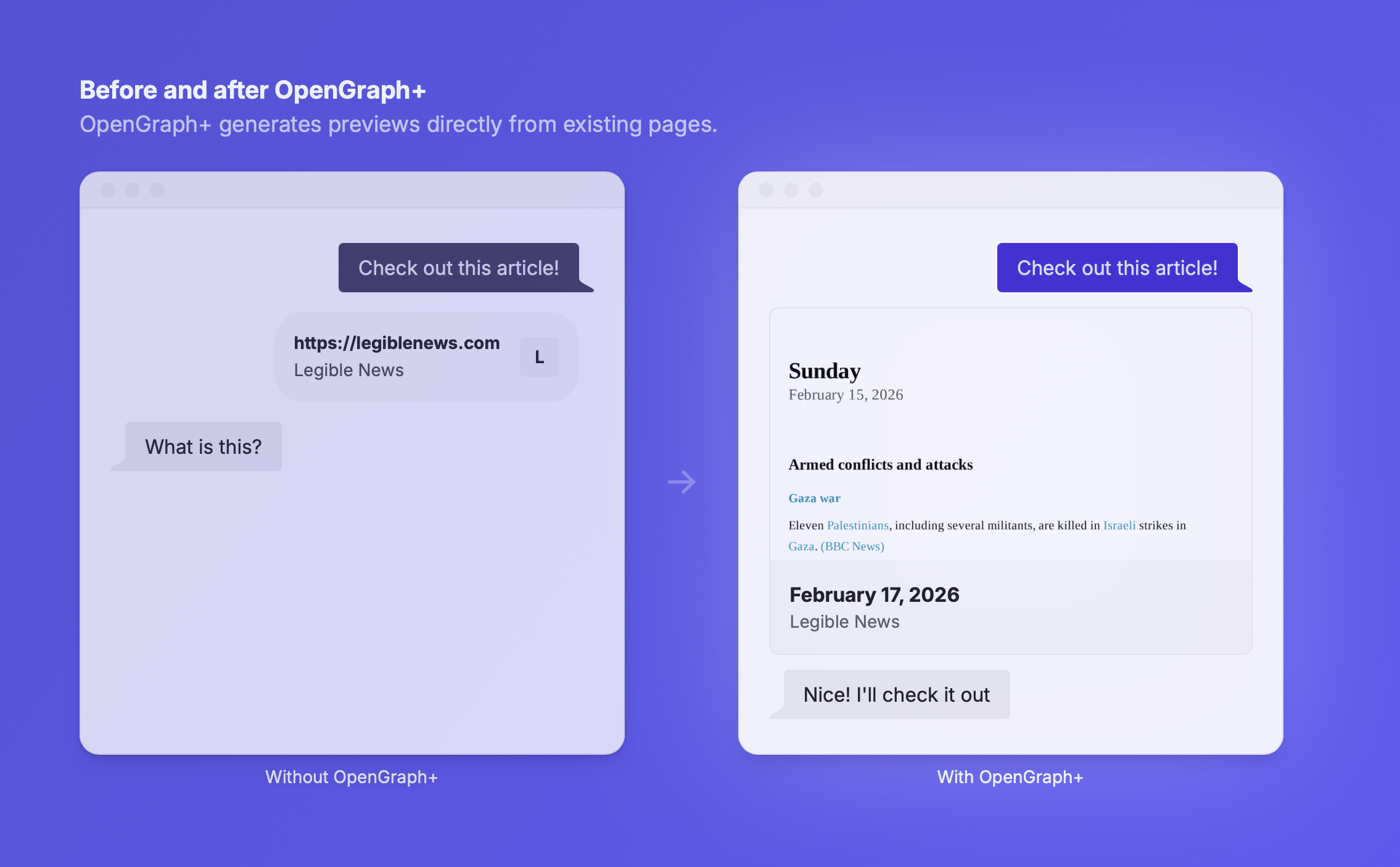
OpenGraph+ automatically generates clean, up to date Open Graph images for every page on your site. Links are shared more in Slack, iMessage, Discord, Teams, and group chats than on social feeds, but most sites still ship broken or generic previews. Fixing this usually means manual images or custom renderers that fall out of sync. OpenGraph+ captures your pages, renders social cards, and keeps them updated as content changes without running a renderer in your app or designing images by hand.

I built OpenGraphPlus.com to automate one of the most painful parts of writing and sharing articles: creating a decent Open Graph image that get people to click on the thing when I share it on Twitter or in private group chats on Apple Messages, Slack, and Microsoft Teams.

What I'm launching today is the culmination of me deploying this to many of the websites I operate, and rolling what I learned back into the product to make it easier to install and control how the link previews appear. My focus for this launch was to create something that web developers who are comfortable working with CSS, HTML, and Tailwind can immediately understand and deploy on their websites. It's ready for production websites today!

If this launch goes well, I'm hoping to connect people who feel the pain of Open Graph images on platforms like Wordpress, Shopify, etc. so I can work with them on add-ins and plugins that make it possible to automate Open Graph images without any technical knowledge. If that's you and you're willing too pickup a business plan, let's talk!

2
回复

Congrats on the launch, @bradgessler!

1
回复

Very useful! Could I somehow integrate this into a CI pipeline?

1
回复

@wilco_kruijer1 There's a command line tool `ogplus` that you can run from a CI box. I'm curious what the use case is for that though? The way OG+ works is it generates Open Graph previews on demand as people share your webpages links. This is how it stays in sync with your web content.

0
回复

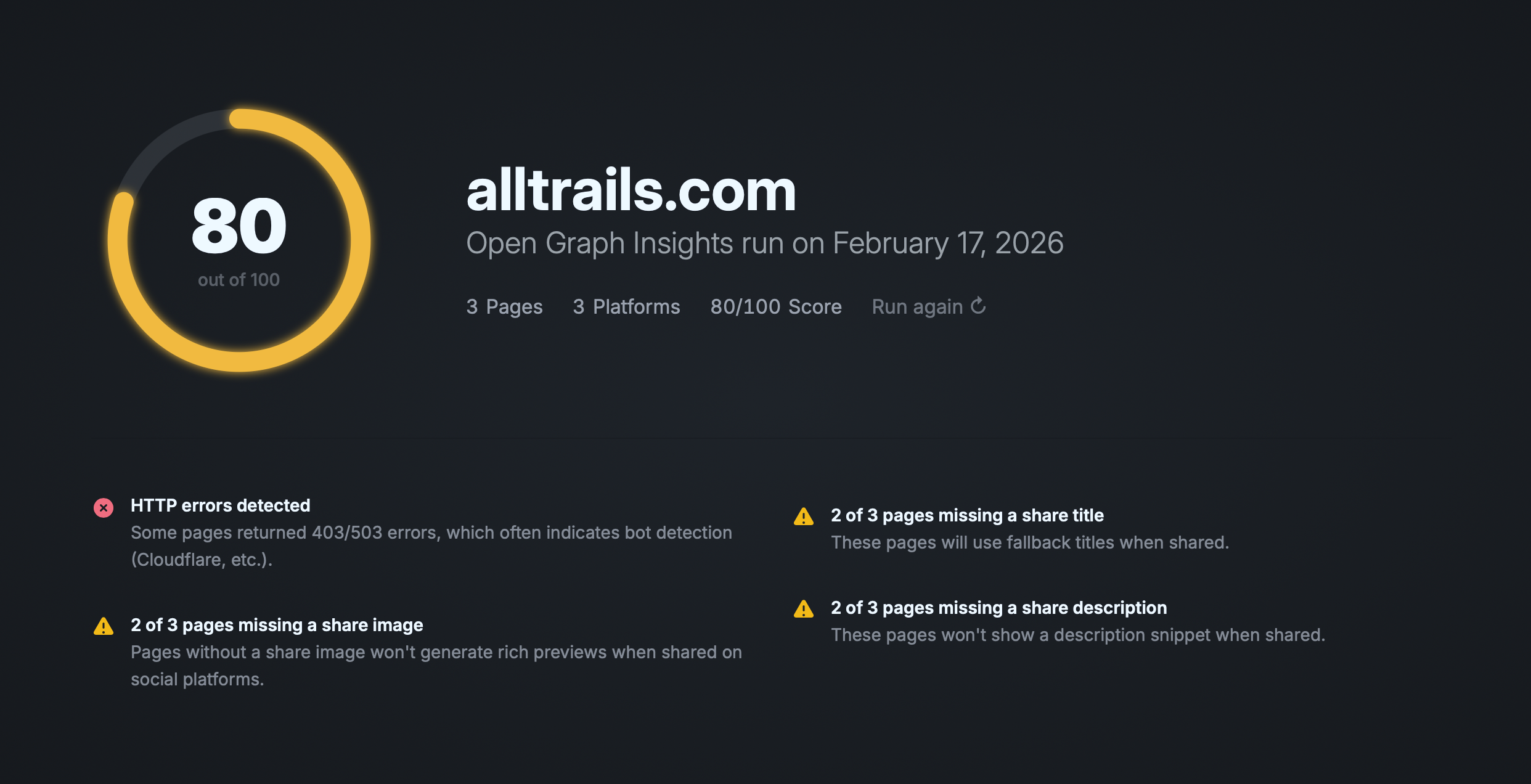
I like the analyzer on your homepage, free and immediately makes it clear what is missing.
If I understand correctly, then I just point to opengraph+ urls in my head tags?
What options are there for customizing the final image?

1
回复

@janschutte yep! You got it. Right now it's completely customizable with CSS, so a web developer can tweak the pages the pages and OpenGraph+ will take a screenshot of it.

Here's a few links for the ways to customize:

Today it's very much geared towards web developers because its foundational to less technical tools I'd like to eventually build on top of it.

I'm curious how you'd want to use OG+? Are you comfortable editing HTML and CSS, would you want a plugin for the platform you're using, or would you want to edit a template on OG+, point your site to it, and have page titles, etc. rendered into the template?

0
回复

The debugger and insights tool is really useful, I will definitely be using it!

1
回复

@emanuele_click spread the word! I built those tools to be insanely useful for teams. I'm thinking about launching a command-line tool too if people would find that useful.

0
回复
This could solve a real pain point! Most sites still ship broken or placeholder OG images, and rendering from the live page means the preview stays in sync automatically. Love that. I could use it myself! 🙂 Do you have any plans for a WordPress/Yoast integration? A huge chunk of the “OG chaos” internet runs on WP, and hooking into Yoast’s OG image output could make adoption a no-brainer for that audience. 🙂
1
回复

@tereza_hurtova yeah! I built this thing for all my other websites because I got tired of looking at my own busted Open Graph previews 🤣

So one nice thing there is people who sign-up are going to be on a journey with somebody who is very invested in their own software working really well. I'm also former CTO of an app used by 1% of the United States, so I'll be able to scale this thing as more folks sign up 🚀

1
回复

@tereza_hurtova Oh and to answer your WordPress question, yes! That's the next platform I'm going to target. So many great websites and people are running on WordPress it seems like it would be crazy if I didn't do this. I'm hoping to find somebody from this launch to go back-and-forth with on a WordPress/Yoast plugin.

1
回复
@bradgessler Love this! You can really feel you built it to scratch your own itch (busted OG previews are the worst 😅). And “used by 1% of the US” is a serious scale flex – respect! 🚀 Re: WordPress/Yoast – we run WP + Yoast on our other business (not that one we're launching soon): ~15 static pages + a blog with 150+ "student story" posts. If that’s useful, I’d be happy to be an early tester and go back-and-forth on the plugin as you build it. 🙌
1
回复

Congrats on the launch! Automating Open Graph images is such an under-discussed growth lever, previews absolutely shape click-through, especially on X and Slack. How customizable is the generation logic per article? For example, can developers dynamically adjust layout, typography, or emphasis based on content type, and how do you prevent visual repetition across large content libraries?

0
回复

great product congrats on launch!

0
回复

@apexflux thanks! Curious if you tried it yet? What do you think?

0
回复
#10
Agent Monitor
Server-side analytics for AI & bot traffic
116
一句话介绍:一款通过分析服务器端数据,精准识别和分类AI及机器人流量的分析工具,解决了SEO及网站运营者在GA4等传统工具中无法洞察AI流量,导致数据失真、决策盲区的痛点。
Analytics Marketing SEO
服务器端分析 AI流量监控 机器人检测 SEO工具 网站分析 数据可视化 流量分类 GA4补充 营销分析 数据驱动决策
用户评论摘要:用户普遍认可产品解决了GA4数据与实际情况不符的核心痛点。问题集中于产品定位(是SEO工具还是通用分析)、与GTM/Cloudflare的差异及技术取舍、以及如何识别模仿人类行为的AI代理。建议包括增强报告细节和期待URL追踪功能正式版。
AI 锐评

Agent Monitor切入了一个精准且正在急速膨胀的市场缝隙:AI代理流量监测。其真正价值并非简单的“又一个分析工具”,而在于它率先将“AI流量”从一个模糊的安全威胁或服务器噪音,重新定义为一种可衡量、可分析、甚至可优化的新型“访客”类别。

产品逻辑犀利地戳穿了当前网站分析体系的集体幻觉:当ChatGPT等AI代表人类浏览网页时,主流的客户端分析工具(如GA4)要么将其过滤为垃圾流量,要么根本无法识别。这导致网站主看到的“人类流量”持续失血,而内容在AI中的影响力却成了黑箱。Agent Monitor通过回归服务器端日志这一数据本源,并采用其宣称的“确定性逻辑”进行分类,试图重建分析范式的可信度。

然而,其面临的挑战同样尖锐。首先,技术上的“猫鼠游戏”不可避免。随着AI代理愈发拟人化,仅靠服务器信号(如User-Agent、IP、行为模式)能否长期保持高精度分类,是一个巨大问号。其次,产品定位存在张力:它出身于SEO场景,但试图走向更通用的网站分析。SEO从业者关心的“内容是否被AI收录”与安全运维人员关心的“恶意爬虫阻断”是不同需求,产品如何平衡侧重?最后,其商业价值闭环尚需验证。监测到AI流量之后,用户究竟该“优化内容以适应AI”还是“限制爬取以保护内容”?产品目前提供了“洞察”,但更关键的“行动指南”似乎仍留给市场自己摸索。

总体而言,这是一款具备前瞻性的赛道定义者。它不解决一个过去的问题,而是揭示了一个所有人即将共同面对的未来事实:AI已是你的匿名用户。它的成功将不取决于功能多寡,而取决于其分类模型能否成为行业信任的标准,以及它能否将“AI流量分析”从好奇型需求,转变为网站运营的必备基础设施。

查看原始信息
Agent Monitor
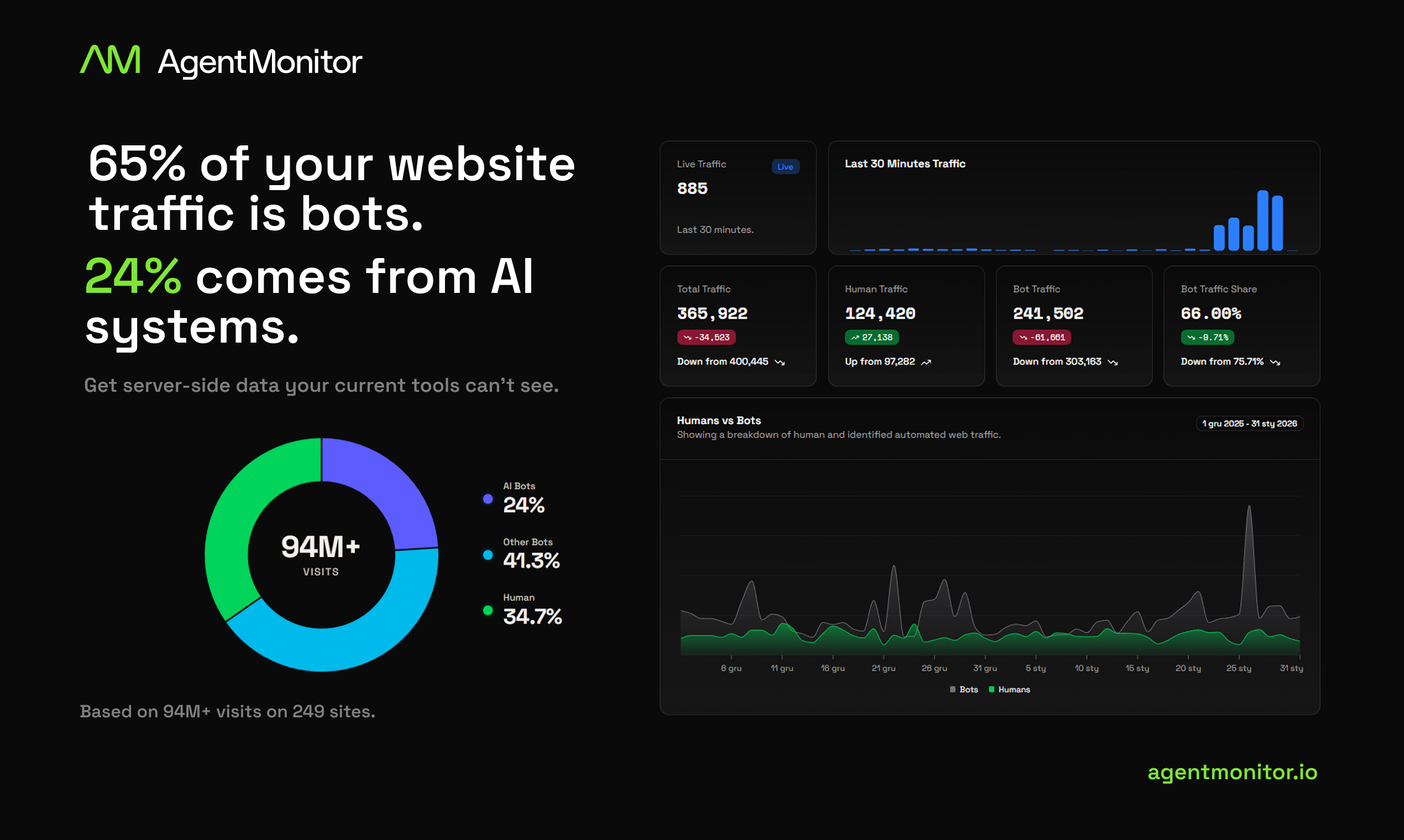
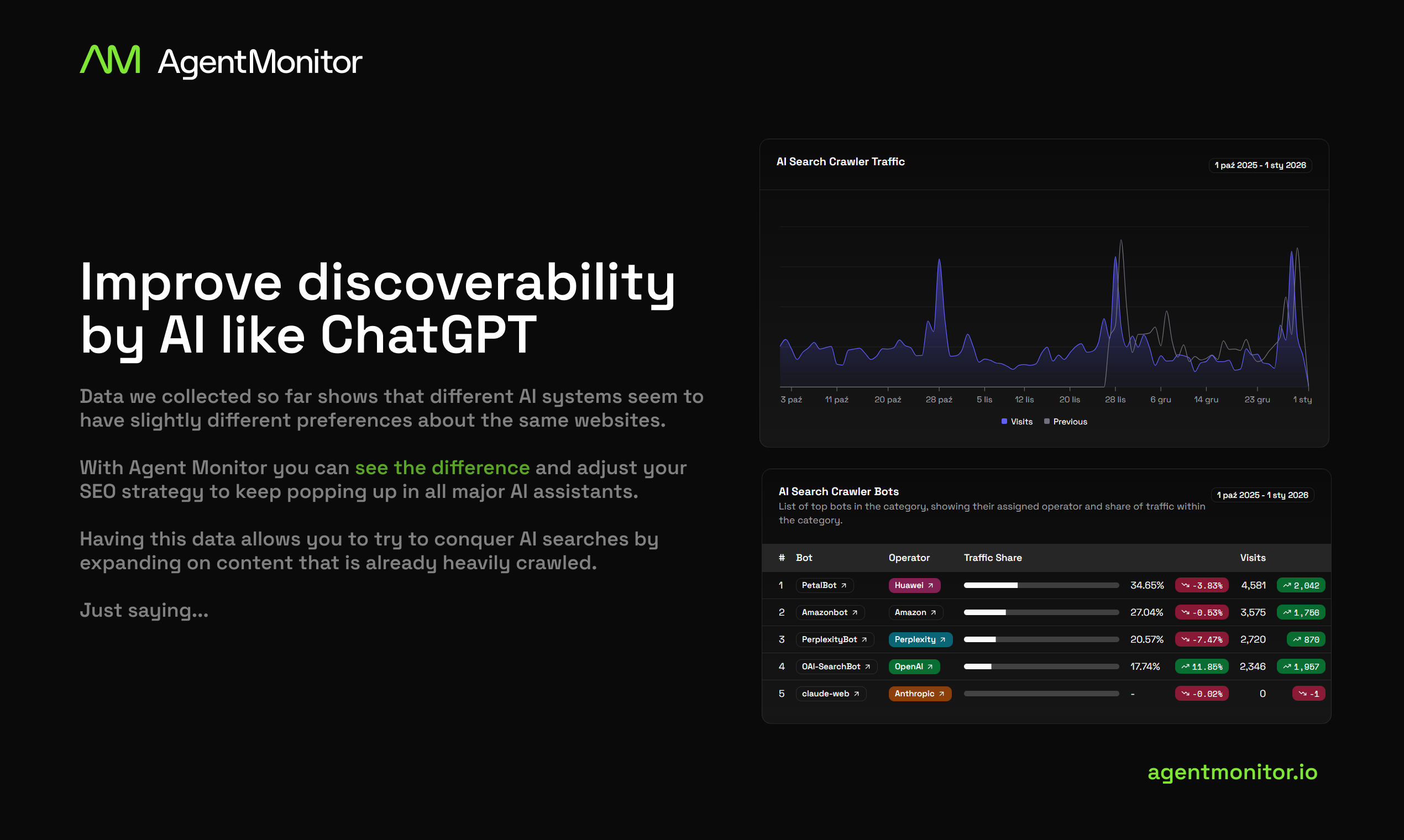
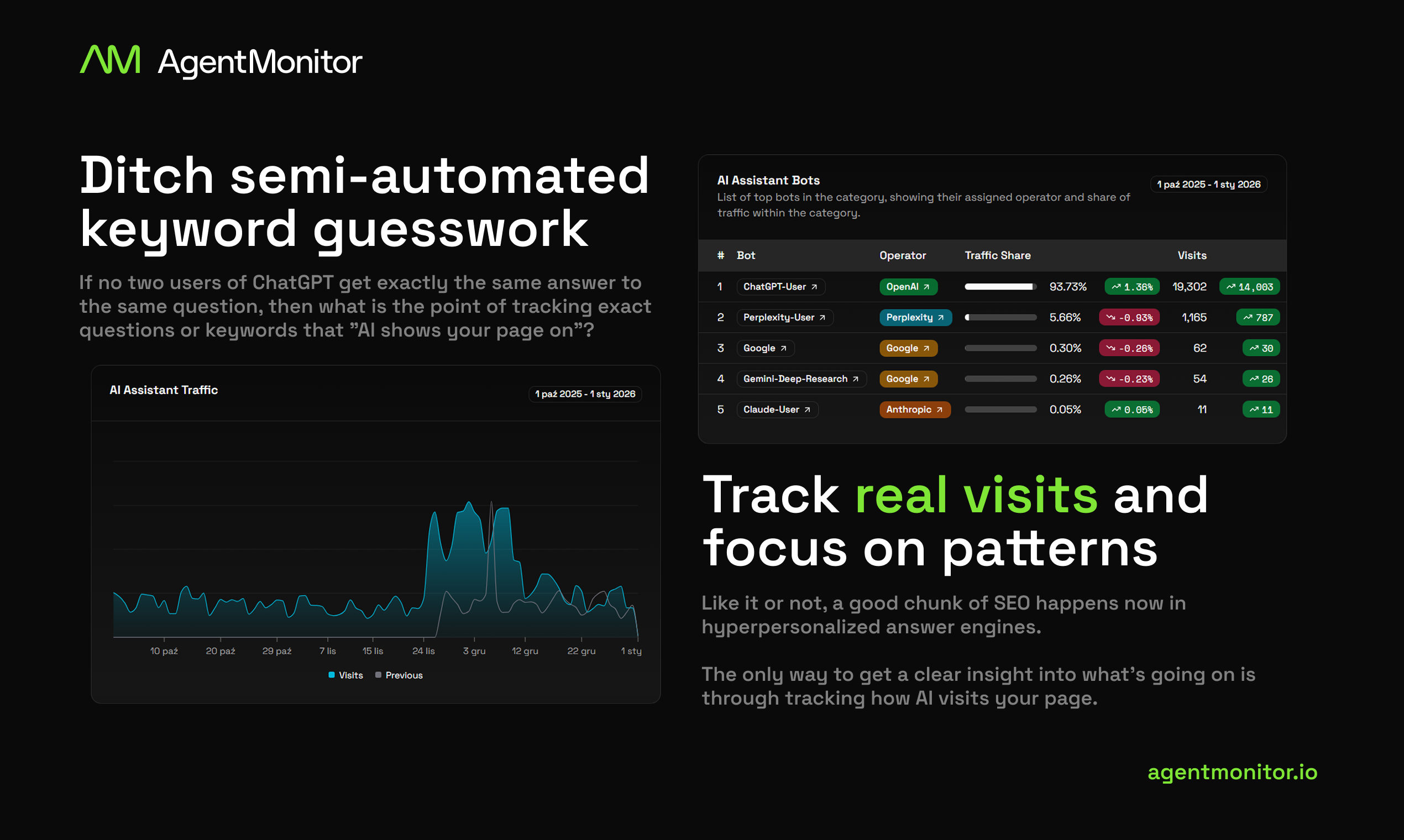
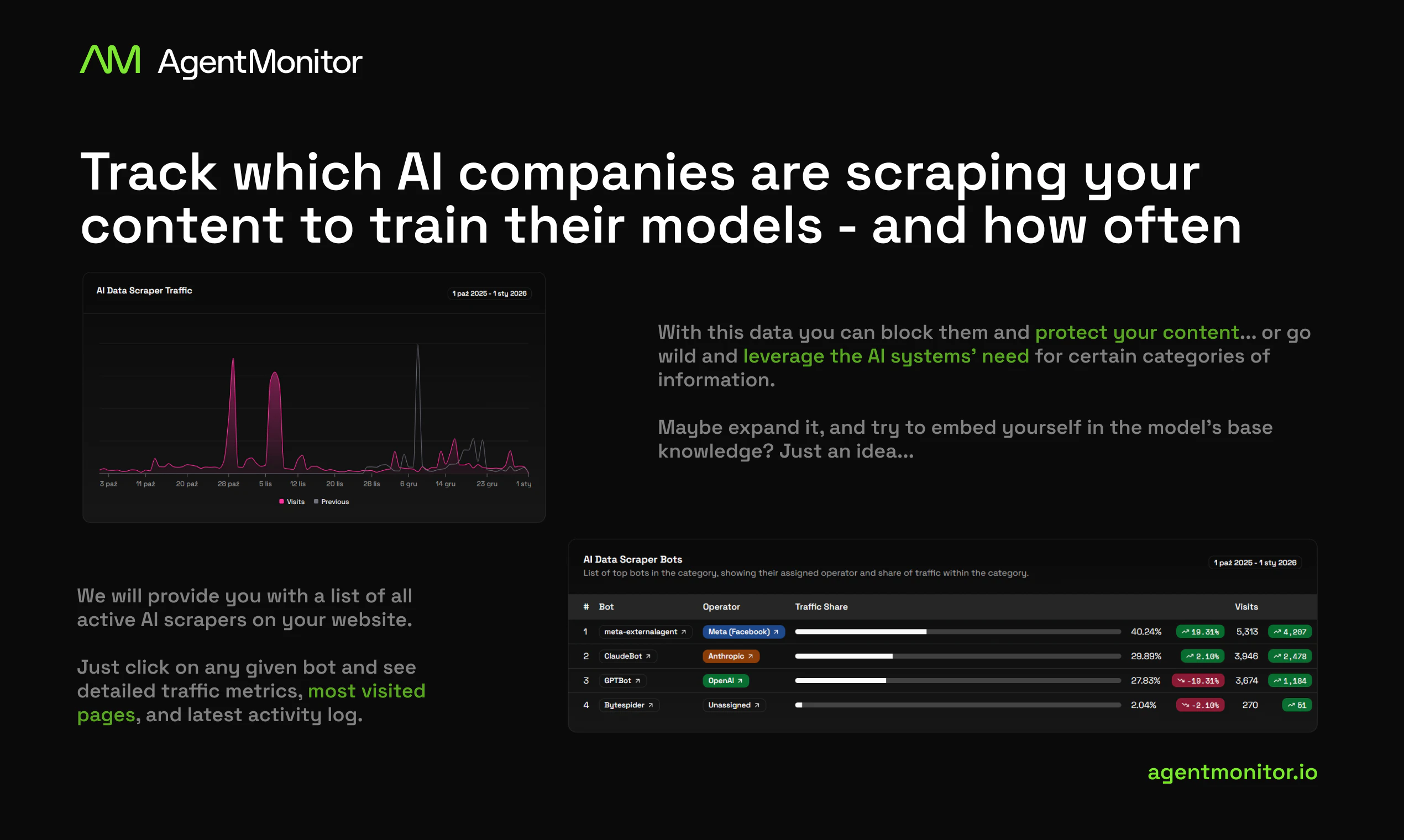
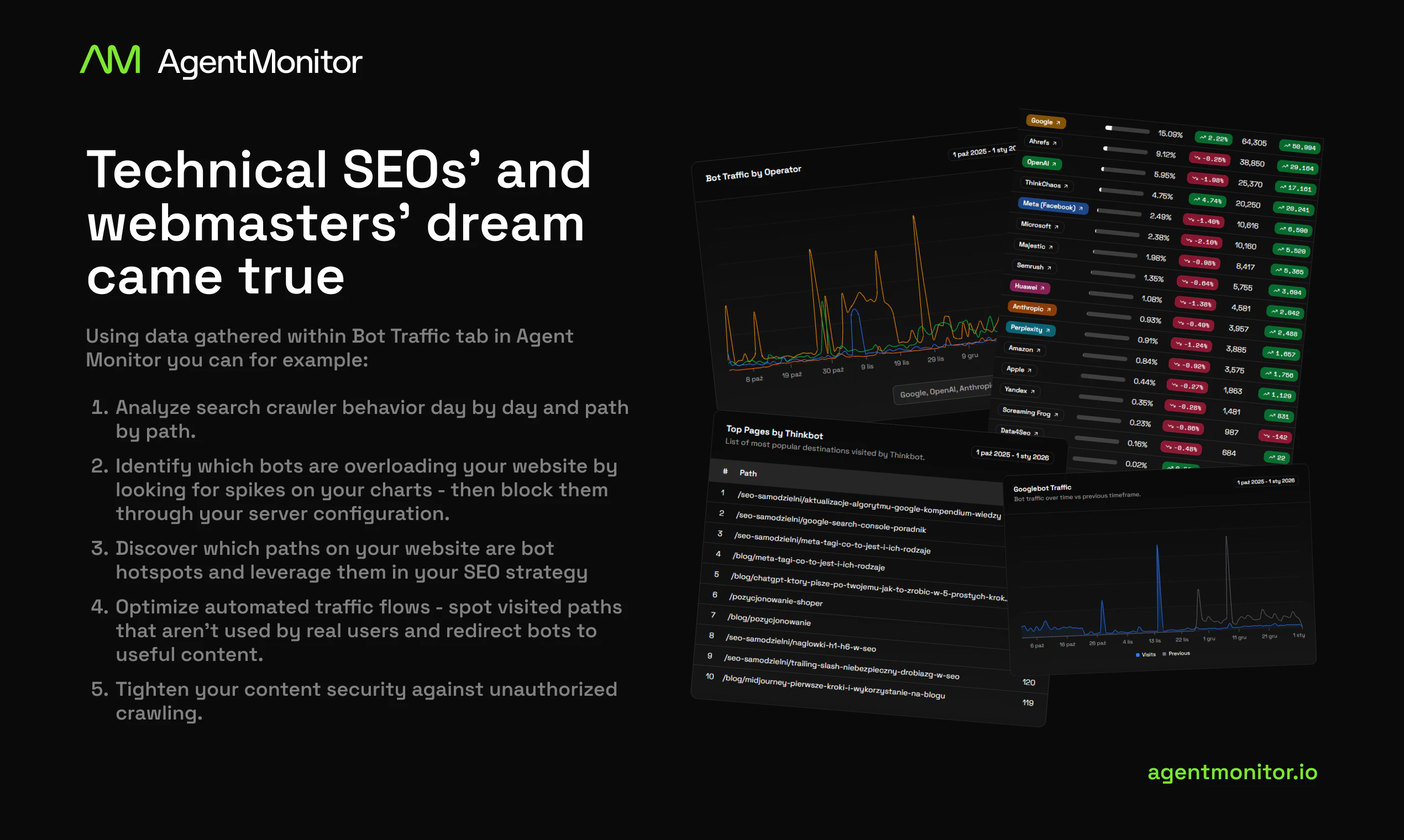
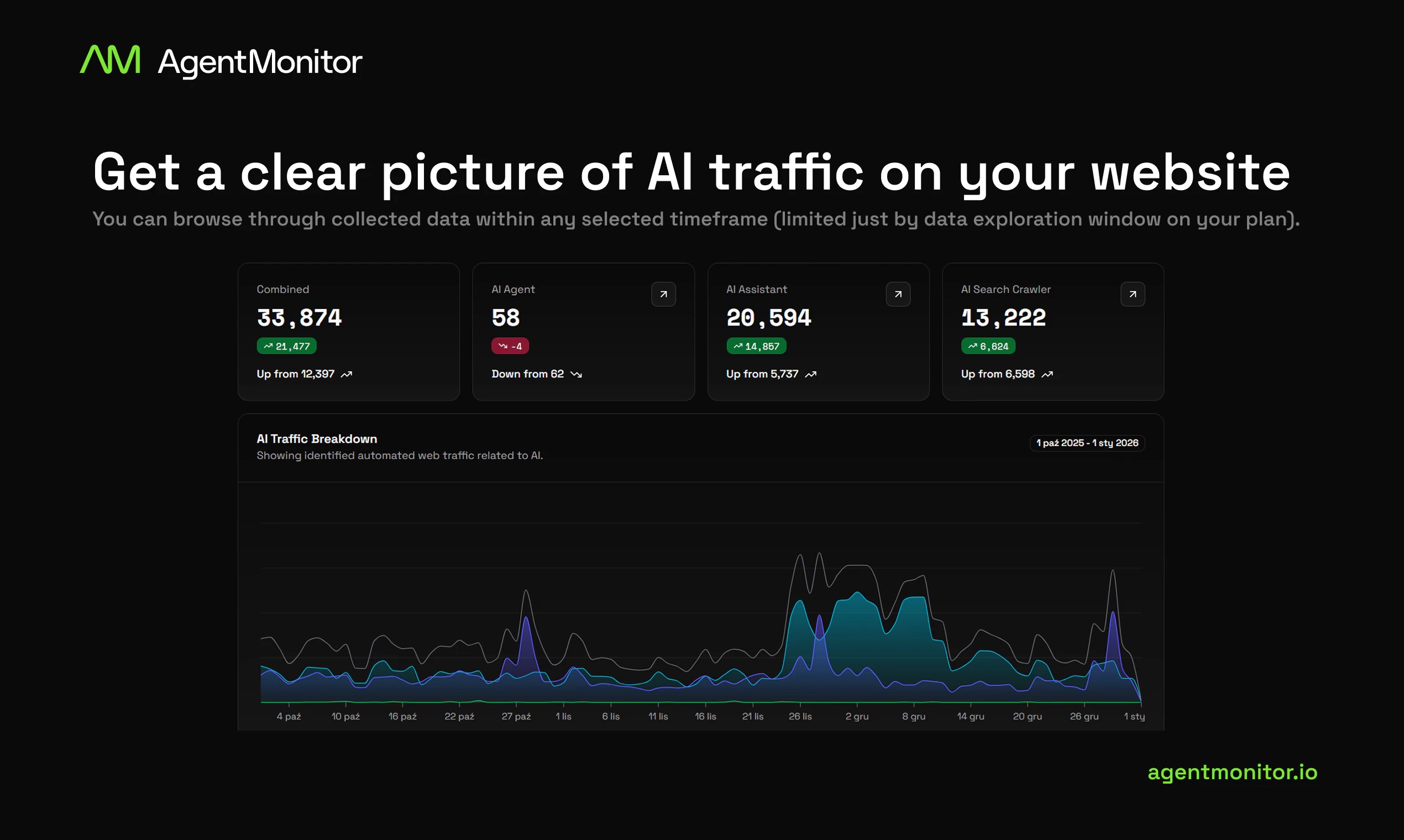
Agent Monitor captures and classifies AI & bot traffic using server-side data. Across 94M+ visits on 249 sites, 65% of traffic was bots - 24% AI bots like ChatGPT, Gemini, and Claude. None of this appears in GA4. We use transparent server-side signals to classify every visit. Get bot profiles, per-bot rankings, AI assistant traffic, and global benchmarks. Built by an SEO agency that needed real data.
Hey PH, I'm Marcin, co-founder of Top Online - an SEO agency behind Agent Monitor. I also co-authored the most comprehensive SEO handbook in Poland, so I've been deep in search and analytics for a while. Agent Monitor started because our analytics stopped making sense. Clients' traffic was dropping in GA4, but rankings were fine and conversions held up. When we dug into server logs, we found the missing piece - AI bots were all over our clients sites, and no tool was showing it. We looked for something that would give us this data. Nothing worked well enough. Cloudflare keeps 7 days of data. GA4 filters bots entirely. GTM needs heavy custom setup. So we built our own solution. That was the internal version. We've since turned it into a product because every SEO and site owner we talked to had the same blind spot. One thing worth noting: we don't use AI in the product itself. Classification is based on transparent, deterministic logic - server-side signals, behavioral patterns, no black boxes. Free 2-week trial, no credit card. Curious what you think.
16
回复

@marcin_kaminski handles Manus or similar?

2
回复

@marcin_kaminski Hey Marcin. How do you define the role of AI agent and bot traffic in modern web ecosystems? Is it something to measure, optimize, or control?

0
回复

@marcin_kaminski Last time I audited a client site, GA4 showed a 15% traffic dip but conversions were flat. Took two days digging through raw Nginx logs to realize AI crawlers were the gap. Agent Monitor doing deterministic classification server-side is the right call... makes it auditable when you need to explain the numbers to someone who doesn't trust ML labels.

0
回复

From Poland with love ;-)

5
回复

Made in Poland, monitoring the whole world! Thanks for your support @janusz_mirowski :D

0
回复

@janusz_mirowski Love it! Pierogi-powered development all the way 😄

1
回复

So this is a SEO tool for bot traffic? Very cool. ik GTM needs heavy setup, but does Agent Monitor's more lightweight solution trade-off well?

4
回复

@peterz_shu Thanks! It's not strictly an SEO tool, we built it as a bot traffic overview that any webdev, SEO specialist or site owner can use to see what's actually hitting their server. The SEO focus comes from the fact that we built it for our own SEO agency, so that's what's been most useful so far :)

As for GTM - it's flexible but requires serious setup and custom logic to even start classifying AI bots. Agent Monitor just works out of the box, essentially plug-and-play, and shows you the full picture: humans, AI bots, other bots, which pages they hit, how often.

Regarding the trade-off, across ~200 users so far, we've had almost no feedback about missing features. A few voices pointed to more detailed reporting, which we've already addressed. So the lightweight approach seems to cover what people actually need.

We're still early and shaping the product based on real user needs, so feedback is super welcome!

2
回复

@peterz_shu Thanks! Great question.


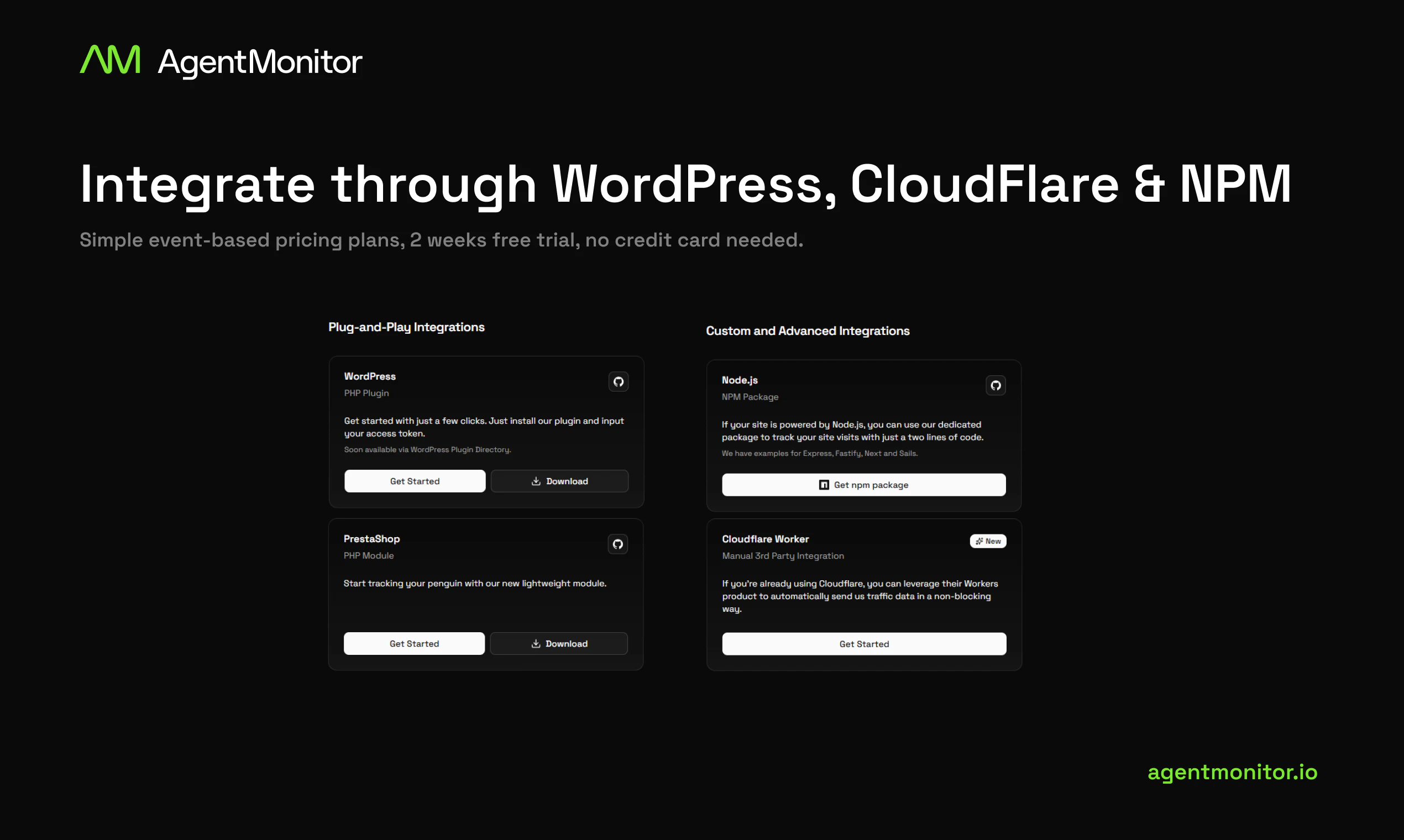
Setup is really simple - just install a plugin for WordPress or PrestaShop, or follow a few easy steps to integrate via Cloudflare.


As for data, the app collects everything GTM would collect, essentially all server logs. For analyzing AI traffic that's more than enough. What we focus on is building a massive funnel, filtering out noise, categorizing, naming, and helping with interpretation. That's it, but that's also a lot. With GTM everyone would have to do all of this manually.


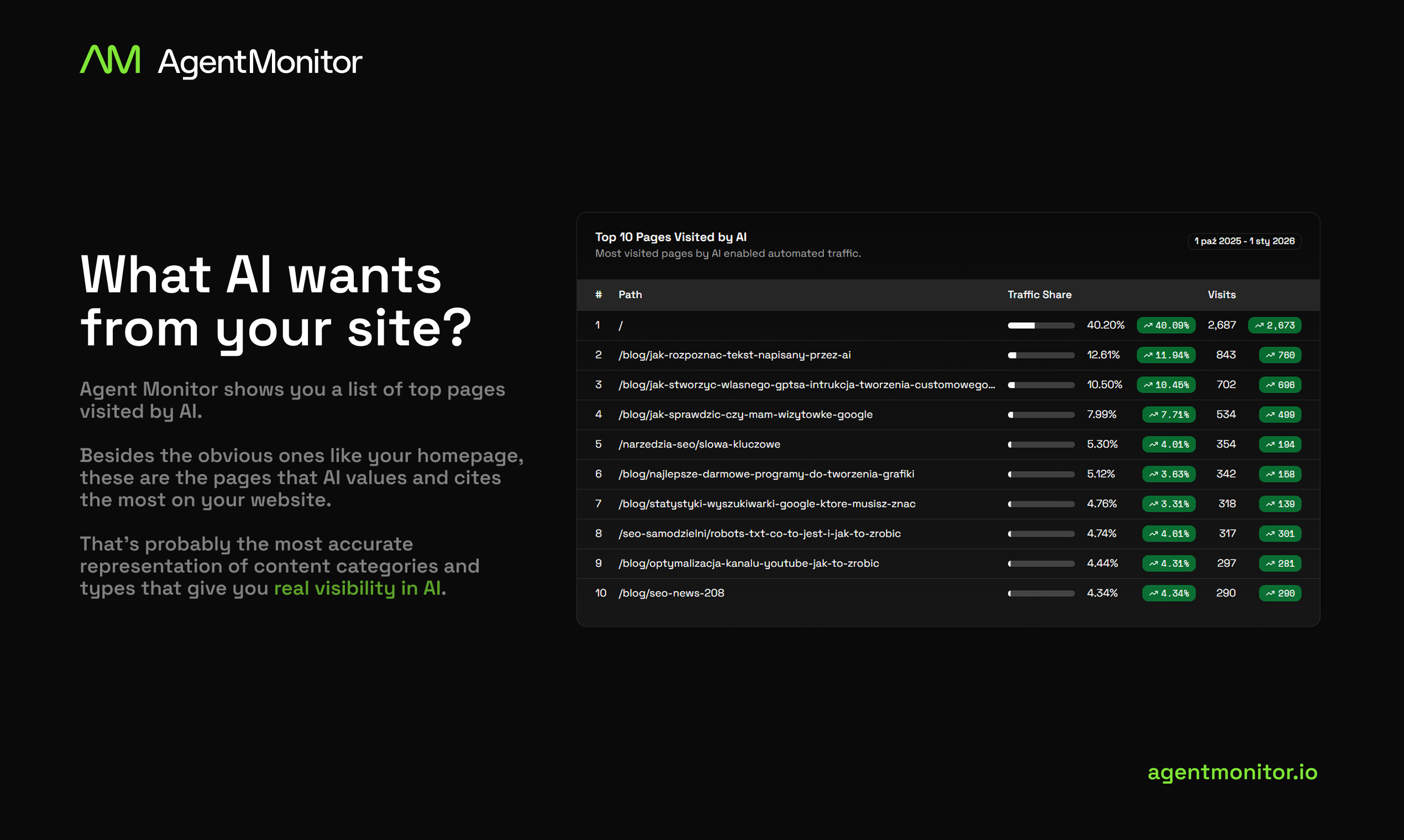
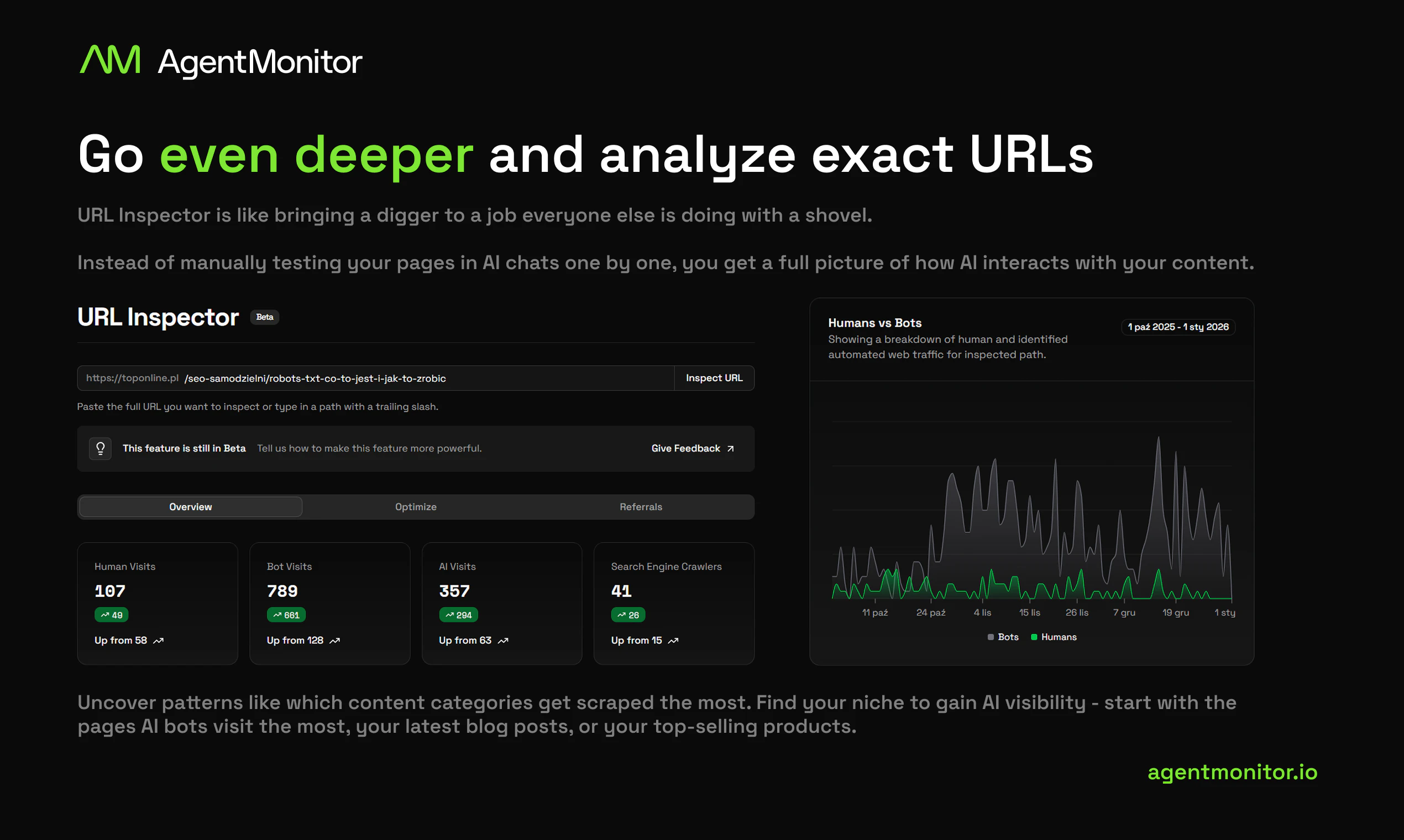
We also built something called URL Inspector - a simple tool for analyzing specific URLs. You can see if and how often a particular page was visited by AI bots, and which ones exactly. GTM probably won't give you tools like that.


Thanks again for the question. Did I answer it thoroughly? Any other questions? :)

1
回复

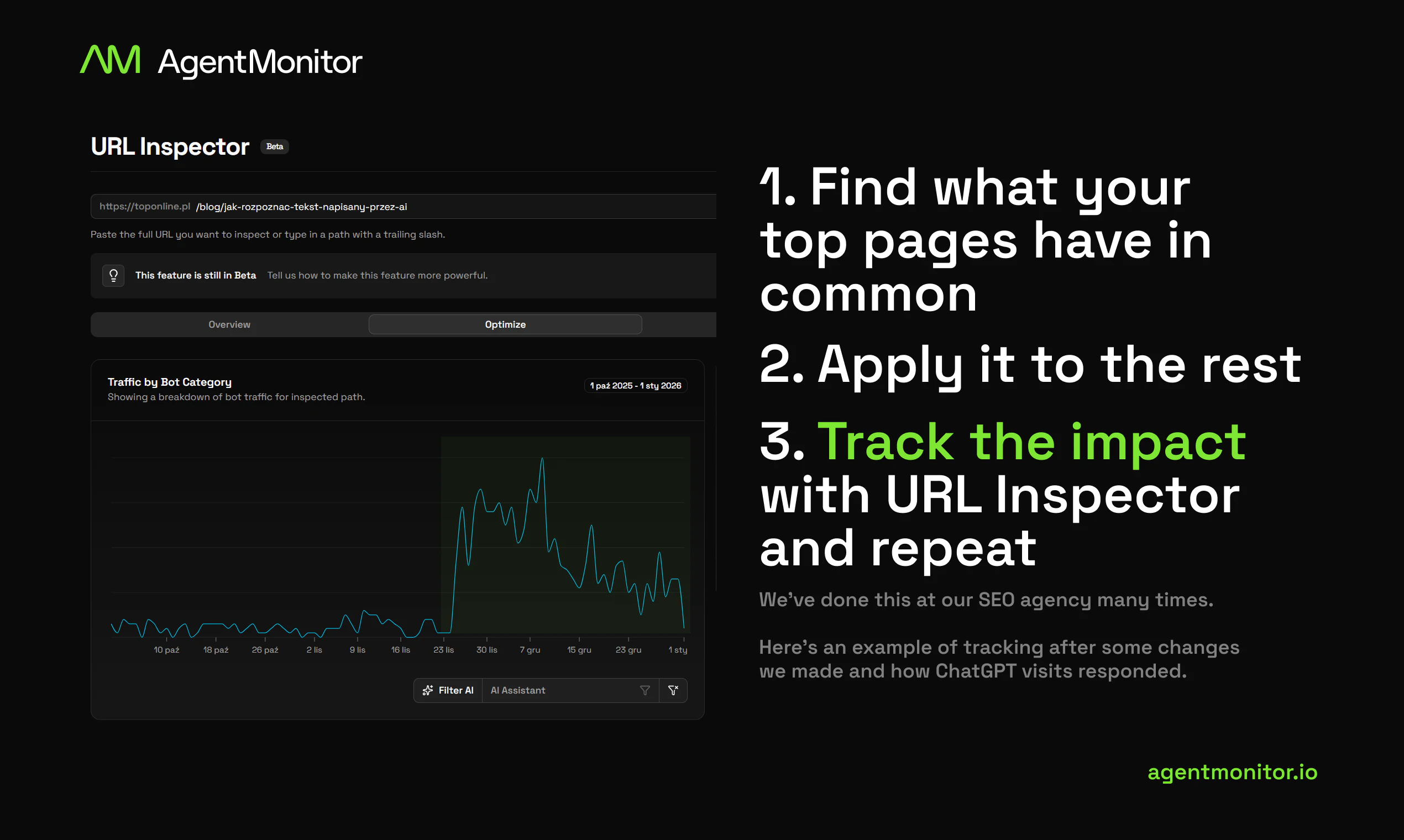
What I like most is the feature that lets you check specific URLs and see how often they’re visited by AI agents. Thanks to this, I can quickly verify whether, after publishing new content on our clients’ websites, those subpages are actually being visited by AI agents. This gives me a clear signal of whether we have a chance to appear in LLM-generated answers.

The option that shows the time of the first bot visit is also very valuable - it tells me how long it takes for bots to discover and reach a new URL.

4
回复

@grzegorz_slo Thanks! URL Inspector is actually still in beta, but it's already one of the features used the most day-to-day. Checking how fast AI bots pick up new content gives a pretty clear signal of whether those pages have a shot at appearing in AI-generated answers.

We have a lot of ideas for where to take it next, so stay tuned :)

1
回复

@grzegorz_slo Great to hear! Thanks for testing it out.

This feature was built exactly for this purpose - so everyone can check if and how often the content we create is being visited by AI assistants like ChatGPT.

Really happy it's already helpful for you.

1
回复
@marcin_kaminski Looks good! This hits close to home as a marketer! 🙂 We’ve also seen situations where GA4 numbers didn’t fully explain what was happening. Especially lately with AI bots, scrapers, and assistant traffic quietly distorting the picture... The "rankings are fine but traffic looks weird" scenario feels very real. 😁 I like that you’re approaching this from server-side signals instead of adding another black box layer. Do you see issues with AI agents that are instructed to mimic organic browsing behavior? Like those used for competitive research?
4
回复

@tereza_hurtova Thank you so much. Great question!

Let me explain our approach to this. Bots for competitive research or price monitoring aren't really "valuable traffic" for us as site owners. 99% of the time it's just regular bots. We monitor them (because we literally monitor all traffic on the site) but we don't classify them.

However, if someone is using Operator from OpenAI or Manus, that traffic is definitely detected and interpreted as an AI Agent.

Hope that clarifies it :) The whole topic of AI traffic, monitoring and classifying it is really fresh and still challenging. We're doing our best to classify everything we can. Right now this is the only proper way to analyze how people are using AI assistants like ChatGPT.

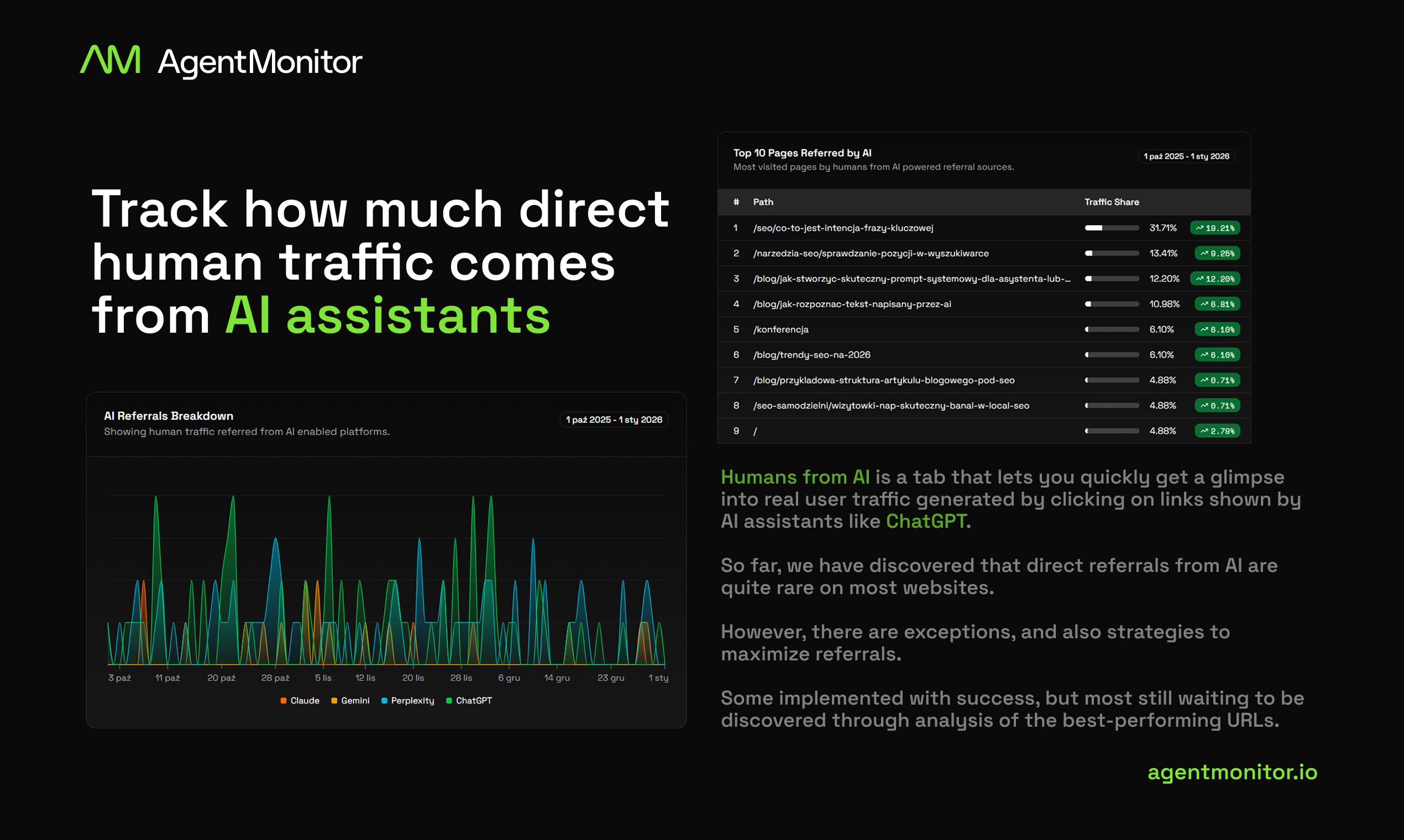
The biggest value right now and in the near future are bots like ChatGPT-User - AI assistants browsing the web on behalf of us humans. This was very visible just before Christmas when traffic from these assistants was huge in e-commerce stores. It means this traffic is already very important... but still unnoticed by most people :)

2
回复

Hey @tereza_hurtova!

Some AI operators don't play nice and send out bots that look and behave exactly like humans. We wouldn't be surprised if many of them appeared in GA4 and muddied the stats.

To expand on what our CEO mentioned about Manus AI — it's actually a great example of the "mimicking" problem you asked about.

Manus doesn't use any unique signatures, making it surprisingly hard to identify with standard tools. However, we have some cool technical tricks and algorithms up our sleeves and so far, we’ve had great success in pinpointing those pesky bots! :)

This is exactly why we went the server-side signals route. Since we analyze traffic at the infrastructure level rather than relying on client-side JS (like GA4), we have the hard data needed to figure out who each bot really belongs to.

1
回复
@xwirkijowski This is super insightful! ☺️ Thanks for sharing the RFC reference! A standardized "good citizen" layer + a constant cat-and-mouse dynamic for the rest feels like the most realistic scenario. The Googlebot verification angle is especially interesting. Impersonation risk is probably underestimated right now. Appreciate you going deep on this. 🙏
0
回复
For a team already using Cloudflare/WAF rules and GA4, what’s the concrete workflow you recommend: where does Agent Monitor sit in the stack, and what decisions does it enable week-to-week (e.g., allowlist/rate-limit/block, content changes, infra planning)?
2
回复

@curiouskitty Thanks. Great question!

Agent Monitor is an analytics tool focused mainly on monitoring AI traffic, classifying it precisely and helping interpret it.

Our app delivers more accurate and better classified data than Cloudflare. CF is good for quick integration with our app - the free version is enough. Both tools do different jobs and can't really be compared one to one. I recommend using both CF (security, caching, speed, dns...) and Agent Monitor (analyzing AI traffic).

GA4 focuses on people, our app focuses on bots with special attention to AI traffic. So in your tech stack you can place our app next to GA4. GA4 for humans, Agent Monitor for bots. GA4 answers the question: how many people visited my site. Agent Monitor answers the question: how many times did ChatGPT visit our site on behalf of people.

We also built a URL Inspector feature that helps interpret and analyze AI traffic on specific pages. This way you can find out if your content is being used by AI to answer people's questions, for deep research, etc.

To sum up, this is a different kind of app than the ones we've known so far. It's something new, something that didn't exist before - and it's hard to describe something completely new using old concepts.

So if you want to check if and how well your content is visible to AI, which pages are visited most often, or whether the new product collection you added to your store is being searched by people - but through ChatGPT and other assistants - our app makes that possible. This way you can optimize your content and your business and marketing decisions not just for people, but also for people using AI assistants.

2
回复

Thanks for having this in a free two-week trial, @marcin_kaminski. Congrats on the launch!

2
回复

@neilverma Thank you! Hope you enjoy testing it out.

2
回复

A very, very good tool that I’ve been using since the very first MVP version launched. Thanks to it, I can predict and adjust my strategy around how to work with and position my website in LLMs. I can see exactly which subpages are being picked up, what kind of traffic they generate, in which results they appear, and which articles are showing up.

The latest update with the addition of specific URL tracking was absolutely brilliant. Now I can track every single page and every content block I publish, and see after how many days (sometimes even hours) it gets indexed by the first AI systems.

A fantastic tool. Congratulations on the idea and on building it. 👏👏👏

0
回复

We have had so many issues with bot issues, amazing to have a tool that can actually give me the exact number!

0
回复

Congrats on the launch! The gap between GA4 data and what’s actually happening in server logs is something many teams probably don’t even realize exists. How do you distinguish between legitimate AI crawlers (for indexing or training) and more aggressive scraping or data harvesting bots, and how granular is the reporting when it comes to identifying patterns over time?

0
回复
#11
JustScribe
On-device instant voice transcription
114
一句话介绍:** JustScribe是一款基于设备端AI的即时语音转录macOS应用,在需要快速记录想法(如编程构思)或厌恶打字的场景下,解决了用户既依赖语音转文字效率、又极度担忧云端服务隐私泄露和数据订阅费用的核心痛点。
Privacy Audio
** macOS应用 语音转录 设备端AI 隐私优先 离线操作 实时转写 免费工具 效率工具
用户评论摘要:** 用户普遍赞赏其隐私保护(离线、无数据收集)和免费模式。主要反馈包括:肯定其转录质量优于系统自带听写;询问技术实现难点与优化;与竞品(如Wispr Flow)对比,指出其缺乏语法校正功能;开发者回应此功能将免费更新。
AI 锐评

**

JustScribe的亮相,精准刺中了当前AI应用狂欢中的一个隐秘矛盾:效率提升与隐私让渡之间的不对等交易。它宣称的“设备端、即时、免费”并非简单的功能堆砌,而是一套针对特定用户群体的价值宣言——即“我的声音是无可重置的生物特征,其处理权不容妥协”。

产品的真正价值,不在于其转录技术本身(基于Whisper等开源模型),而在于它成功地将“隐私”从一个被动的、担忧的成本项,转变为一个主动的、可感知的核心产品特性。它服务于那些对云端数据流水线抱有本能警惕的高敏感用户(如开发者、内容创作者),为他们提供了一个心理和实际都安全的“数字嘴替”。开发者自述“为自己而建”的背景,也解释了其为何能直击痛点:它解决的是创造者自身的真实窘境——既要流畅的“心流”表达,又无法忍受思维被订阅制和隐私协议打断。

然而,其面临的挑战同样尖锐。首先,设备端运算在追求“即时”体验上存在天然天花板,评论中提及的30秒音频块与流式缓冲的技术博弈便是明证,性能深度优化将是长期课题。其次,从“可用”到“好用”,它必须直面成熟竞品(如Wispr Flow)已建立的体验壁垒,如上下文感知与语法校正。开发者承诺将免费加入此类功能,这虽强化了其价值主张,但也预示着一场以“单次买断”对抗“订阅制”的艰难商业模式之路。最终,JustScribe能否从一款出色的“隐私声明式”工具,成长为拥有持久生命力的产品,取决于它能否在坚守隐私底线的同时,在转录准确度、延迟和智能后处理上,真正匹配甚至超越那些“用隐私换效率”的云端方案。它是一场值得尊敬的实验,但战役才刚刚开始。

查看原始信息
JustScribe
JustScribe is a privacy-first live transcription app for macOS. Instant, offline speech-to-text powered by AI. No cloud, no data collection. Your voice, your data.

I recently started vibe-coding by talking. Unfortunately, I'm not a fan of uploading my voice to the cloud AND paying for that every month. That's why I've build JustScribe! 🎉

I hope you find it useful, and as always - any feedback is welcome! Would mean the world to me if you share it on twitter!

7
回复

@bring_shrubbery Are there optimisations or model adaptations you built specifically for macOS hardware? What were the main technical challenges in making live, instant transcription work reliably on-device?

0
回复

@bring_shrubbery Streaming on-device transcription is harder than it looks. Whisper chunks in 30-second segments, so making JustScribe feel instant takes serious buffering work. Keeping voice data fully offline is the right call... voice is basically a non-resettable biometric.

0
回复

I just love the fact that it's a no data collection tool. Love this, and congratulations on the launch, @bring_shrubbery !

1
回复

@neilverma Yeah, I hate the idea of uploading my voice to a random server :D Thanks, and I hope you enjoy using it!

0
回复
So all I need to do is talk and it types it out? So cool. I hate typing nowadays.
1
回复

@george_esther Yep! Me too, especially when vibe coding 😅 Too bad I can't talk in every situation 😭

0
回复

It’s super cool Antoni! Wish you all the best here

1
回复

@german_merlo1 Thank you! 💙

0
回复

awesome work! congrats on alunching!

1
回复

@apexflux Thanks! 💙

0
回复

Really like the clean UI! Simple and private - love this.

0
回复

Semantic search across all note types is where the consolidation actually pays off. With a separate notes app plus task manager plus calendar, you end up searching three places for one thought. Brainstream collapsing capture and retrieval into one surface means the AI briefs have full context instead of a partial view.

0
回复

Many people already use built-in macOS dictation or other tools like @Wispr Flow and @Aqua Voice; what’s the clearest scenario where JustScribe feels meaningfully better within the first 5 minutes, and what would have to be true for a user to switch and stick?

0
回复

@curiouskitty Nr. 1 reason is that it's offline and free. I'm building it mainly for myself, so the user experience will improve with time. macOS dictation is already worse at transcribing than JustScribe. @Wispr Flow does work better because of grammar correction, but this feature will also be added soon to JustScribe, and no subscription will be needed to use it 💙

Thanks for your question btw:)

1
回复
#12
claude-devtools
See everything Claude Code hides from your terminal
111
一句话介绍:一款通过解析本地日志、可视化Claude Code完整执行过程的开发工具,解决了开发者在使用Claude CLI时因输出信息不透明而“盲写代码”的痛点。
Open Source Developer Tools Artificial Intelligence GitHub
AI编程辅助工具 开发调试工具 日志分析 执行过程可视化 本地优先 开源工具 Claude生态 上下文追踪 MCP工具调试
用户评论摘要:用户主要反馈:1. 强烈需求理解Claude的“决策原因”,而不仅是“做了什么”。2. 希望集成会话进度条和周使用量统计,方便管理配额。3. 明确提及该工具对调试复杂的MCP工具交互场景有极高价值。
AI 锐评

claude-devtools的诞生,精准地刺中了当前AI辅助编程工具生态中的一个核心矛盾:开发者控制权与AI黑箱化之间的冲突。它并非又一个试图“增强”或“包装”Claude Code的GUI,而是扮演了一个“独立审计员”的角色。其真正的颠覆性价值在于**方法论上的反转**:它放弃了主流的、侵入式的API包装模式,转而采用非侵入式的日志分析。这使其获得了无与伦比的兼容性和回溯能力——能审查任何终端发起的历史会话。

产品直指Anthropic官方CLI在用户体验上的战略性取舍:为了简洁性牺牲了透明度和可调试性。该工具将模糊的“读取了3个文件”还原为具体的路径、内容和差异,不仅满足了开发者的知情需求,更深层次上,它是在为“人机协作编程”建立可观察性标准。其“上下文可视化重建”功能,试图量化并呈现token消耗这一抽象成本,本质上是在帮助开发者优化与AI协作的经济性与效率。

然而,其局限性同样明显。它提供的仍是“事后诸葛亮”式的分析,而非实时干预。它揭示了“什么被做了”,但正如用户所渴求的,距离解释“为何这样做”仍有差距——这受限于日志本身的信息深度。它的成功,与其说是技术的胜利,不如说是对AI工具“用户赋权”缺失的一次精彩补位。它警示AI工具提供商:在追求流畅体验的同时,为专业用户保留一个“上帝视角”的调试入口,是维持信任和促进高级应用的关键。此工具若流行,或将倒逼官方CLI提供更精细的可观测性控制选项。

查看原始信息
claude-devtools
Not another Claude Code GUI wrapper. claude-devtools doesn't run or modify Claude Code — it reads the raw session logs already on your machine and reconstructs everything the CLI hides. Every file path Read, every tool called, every diff Applied, every token consumed — structured into a visual timeline with per-turn context attribution, compaction visualization, subagent execution trees, and custom notification triggers. Works with every session you've ever run. Open source, runs locally.
Hey PH! 👋 I built claude-devtools because I was frustrated with a specific problem: Claude Code stopped showing me what it's doing. Recent updates replaced detailed tool output with opaque summaries — "Read 3 files", "Edited 2 files" — no paths, no content, no diffs. The context usage became a vague progress bar. The only alternative is `--verbose`, which dumps thousands of lines of raw JSON. There's no middle ground. I shared this on Reddit as a weekend project to scratch my own itch, and the response was insane—over 100k views, 500+ upvotes, and 1,000+ downloads in just 48 hours. Clearly, we all hate coding blind! 😂 I tried every Claude Code GUI out there (Conductor, Craft Agents, Vibe Kanban, etc.). None of them solved this because they all *wrap* Claude Code. They inject prompts and only show sessions run through their own UI. If you ran a quick command in your terminal, it doesn't exist to them. claude-devtools takes the exact opposite approach: ⚡ It doesn't touch Claude Code at all. ⚡ It just reads the raw session logs already sitting at `~/.claude/` and reconstructs the full execution trace. Every file read (with syntax highlighting), every edit (with inline diffs), every tool call paired with its result, and every subagent's full execution tree. 🔥 The feature I'm most proud of is Visible Context Reconstruction: It reverse-engineers what's actually eating tokens in your context window, broken down across 7 categories per turn, showing exactly how context fills and compresses over a session. It's 100% free, open source, zero network calls, and works on macOS/Linux/Windows/Docker. What's your biggest frustration with the Claude CLI right now? I'd love to hear your thoughts, and I'll be here all day answering questions!
6
回复

Hey @matt_1398 congrats on the launch!
> What's your biggest frustration with the Claude CLI right now?

I also like to keep a "tight leash" on Claude/Codex, but besides seeing what has changed I also want to see why it did that. The session log should reflect that, maybe you can find a way to highlight when Claude changes course and why it did that!

0
回复

Hey @matt_1398

This is interesting, thanks for building this.

It would be helpful if there could be a convenient progress bar view of the session and weekly % consumption to avoid using /usage

0
回复

hi@matt_1398 

thanks for building this, i will love to help in anyway i can

0
回复

This will help me analyse exactly what Claude is doing when working with my MCP tools. Thank you!

0
回复

@stellify_software 

Spot on, Matt! 🙌 MCP debugging is exactly where this tool shines.

When you're building custom MCP tools, the payloads can get massive, and the default CLI often truncates or completely hides the exact JSON inputs/outputs your server is getting.

Being able to visually inspect exactly what Claude is sending to (and receiving from) your MCP tools makes the development loop so much faster.

Would love to hear how it handles your specific MCP setup once you take it for a spin!

0
回复
#13
HostedClaws
Your own AI employee that runs 24/7 with no set up
105
一句话介绍:HostedClaws是一款部署于Telegram的24/7全天候AI助手,通过极简的无代码设置,为中小企业和个人用户解决在邮件处理、日程安排、研究与写作等日常事务中不愿或无法应对服务器、API等复杂技术部署的痛点。
Productivity Artificial Intelligence Tech
AI助手 无代码部署 生产力工具 Telegram机器人 SaaS 自动化 中小企业效率 个人助理 订阅制 24/7服务
用户评论摘要:创始人阐述了产品解决“技术高墙”痛点的初衷。用户反馈积极肯定了其跳过API密钥等复杂配置的核心优势,认为这是留住非技术用户的关键。同时,有用户询问了衡量成功的关键指标及意外用例,并质疑其是否为现有产品的封装。
AI 锐评

HostedClaws精准地切入了一个喧嚣市场中的真实缝隙:AI代理的“最后一公里”交付问题。它的价值不在于技术突破,而在于极致的用户体验减法。产品将“AI员工”这个复杂概念,封装成一个在Telegram中即可对话的简单界面,并将所有技术基础设施完全黑箱化。其每月40美元的定价,实质上售卖的不是AI模型本身,而是免于处理服务器、Docker、API密钥和YAML配置的“技术清净”。

然而,其面临的挑战同样尖锐。首先,深度依赖Telegram作为唯一交互通道,既是其“5分钟上手”优势的来源,也构成了其场景和功能扩展的天花板,可能局限在轻量级任务处理上。其次,“无代码”和“全托管”使其在功能定制化和数据控制权上必然做出妥协,对于有特定流程或数据安全要求的企业,这可能成为硬伤。最后,评论中“是否为ClawdBot封装”的质疑,暗示了其可能存在的技术壁垒问题。在AI应用层工具极易同质化的当下,如果其仅是现有开源项目的友好前端,那么其长期护城河将十分脆弱。

总体而言,HostedClaws是一款优秀的市场适配产品,它明智地放弃了取悦技术爱好者,转而服务那些只关心结果、厌恶过程的“沉默大多数”用户。它的成功与否,将取决于能否在保持极致简单的同时,构建起真正差异化的、难以被快速复制的服务深度或生态集成,否则恐将陷入低价竞争的红海。

查看原始信息
HostedClaws
Most people know AI can help their business but don't want to deal with servers, APIs, or technical know-how. HostedClaws gives you a personal AI assistant that works 24/7 on Telegram — handles email, scheduling, research, and writing. Starts at $40/mo. No technical skills required. Setup takes 5 minutes. You message it like you'd message a person — "move my 3pm to Thursday", "draft a follow-up to the client who went quiet", "summarize my unread emails.
Hey PH! I'm Anagh, and I built HostedClaws because I kept seeing the same problem: people hear about AI agents, get excited, then hit a wall when they realize they need to rent a server, install Docker, manage API keys, and debug YAML configs. We make it much easier with a setup wizard. No API keys, no terminal set up, no technical jargon. Just connect and start chatting.
8
回复

@anaghdroid congratulations on the launch!

1
回复

@anaghdroid Congratulations! How do you measure success for HostedClaws users? What outcomes or productivity improvements matter most? Have you heard any surprising or unexpected ways people have used their AI employee so far?

0
回复

@anaghdroid MyClaw, xCloud, DigitalOcean all do one-click deploys but every one drops you into a blank API key field on day one. HostedClaws skipping that config step entirely is where most non-technical users stop bouncing.

0
回复

Good luck on launch! congrats!

1
回复

Interesting - is this a wrapper on ClawdBot or a different product?

0
回复
#14
Company logo API
Find any company logo for free
101
一句话介绍:一款提供免费、免认证API接口的公司Logo查询服务,为开发者在侧项目、SaaS应用等场景中快速获取品牌标识,解决了寻找合规、高质量Logo素材效率低下的痛点。
Design Tools API Branding
API服务 Logo查询 免费工具 开发者工具 品牌资产 侧项目工具 免认证接口 数据接口 效率工具 企业标识
用户评论摘要:用户普遍赞赏其“免费、免密钥”的极简理念,认为能有效降低开发摩擦。主要反馈集中在:1. 担忧缺乏防滥用机制和品牌使用条款合规风险;2. 建议宣传语应更侧重“加速产品交付”的结果而非功能参数;3. 询问用户反馈整合与迭代计划。
AI 锐评

Hunter推出的这款Logo API,表面上是填补了Clearbit等付费API留下的免费市场空白,但其真正的锋芒在于“策略性简化”。它剥离了账户体系、API密钥等所有传统壁垒,将自身从一个“服务”降维成一个“网络资源”,这本质上是对API经济惯性的一次突袭。其价值并非那1600万个Logo数据本身(此类数据库并非绝对稀缺),而在于用近乎“野蛮”的零门槛姿态,精准捕获了广大侧项目开发者、初创团队在原型验证阶段“不愿被流程阻塞”的瞬时需求。

然而,其光环之下阴影清晰。评论中关于滥用防范和品牌条款的质疑直指核心软肋。该产品将合规责任几乎完全转嫁给了调用者,自身则隐身于一个简单的HTTP端点之后。这种“工具中立”的定位在吸引海量使用的同时,也埋下了法律与伦理风险。一旦发生大规模商标侵权或商业滥用,Hunter能否继续维持其“无害管道”的形象?这或许是该产品为追求极致增长杠杆所付出的潜在代价。

从商业视角看,这很可能是一个精妙的“钩子”产品。通过解决一个微小但普遍的前期痛点,它高效地吸引并筛选出了活跃的开发者群体,为Hunter的核心产品(如邮箱查找服务)进行潜在客户导流。它不直接赚钱,但旨在降低用户整个“价值发现”路径的摩擦,其成功与否的关键指标,或许不是API调用量,而是其为母体业务带来的优质线索转化率。这是一场用极简体验换取增长势能的典型赌注,犀利但也脆弱。

查看原始信息
Company logo API
Instantly find any company logo using Hunter’s logo API. 100% free, no account, API key. Enter a URL to find your logos.
+16 million company logos. Free. We were missing Clearbit’s Logo API. Yes, there are alternatives. But none that are simple and free. So we built one. You can access over 16 million company logos just by calling: logo.hunter.io/{domain} No API key. No account. No setup. If you’re building a side project, a SaaS, a presentation, or anything that needs logos fast — this should help. We’re super curious to see what you’ll build with it.
6
回复

@jeanro_hunter What safeguards are in place to prevent misuse, such as bulk harvesting of logos or violating brand usage terms?

0
回复

Bringing back a simple, free logo API is such a sharp move. The “no key, no account, no setup” angle instantly lowers friction, especially for side projects and quick builds.

From a conversion lens, I wonder if the hero could lean more into the outcome instead of the feature. It’s not just access to 16M logos; it’s “ship faster without getting blocked by assets.” That feels more aligned with the builder mindset you’re targeting.

You could test a headline that frames it around speed of execution, then track API calls or repeat usage from new visitors.

Curious, are most users coming from existing Hunter customers, or is this attracting a whole new builder segment?

0
回复

@jeanro_hunter I love the concept of the Company Logo API and its potential for branding consistency. Have you considered ways to integrate user feedback into the API, making it even more tailored to their needs? 🤔

0
回复

@austinelvis Indeed, we are looking forward to feedback to see how we can advance this feature.

0
回复
#15
VidClaw
An open-source, self-hosted Kanban for your OpenClaw agent.
99
一句话介绍:VidClaw是一款开源、自托管的看板式仪表盘,为OpenClaw AI代理用户提供了可视化的任务队列、状态监控、成本追踪及人格调校界面,解决了纯聊天界面管理AI代理时产生的混乱与低效问题。
Task Management Open Source GitHub
AI代理管理 开源仪表盘 自托管 任务可视化 OpenClaw生态 运维看板 成本追踪 开发者工具 生产力工具
用户评论摘要:评论多为祝贺与积极期待,肯定其对OpenClaw生态的贡献。有效反馈包括询问是否会有更多基于OpenClaw的开源项目,以及表达将进行深度体验的意向。目前未见具体功能疑问或改进建议。
AI 锐评

VidClaw瞄准了一个正在成形但尚未被充分满足的细分市场:AI代理的严肃运维管理。其核心价值并非技术上的颠覆,而是对“AI代理即生产力工具”这一理念的工程化落地。产品介绍中“为真正运行AI代理的人打造,而非空谈者”的表述,犀利地指出了当前AI领域存在的大量概念炒作与实际工具缺失的断层。

它将经典的Kanban看板模式与AI代理任务管理结合,本质上是将后台的、不可见的AI调用流程前台化、可视化。这解决了两个关键痛点:一是降低认知负荷,让用户从混乱的聊天记录中解脱;二是提供成本与状态的可观测性,这对于将AI代理用于商业或高频任务的用户至关重要。其强调的100%自托管,则精准命中了注重数据隐私与安全的专业用户和企业的敏感神经。

然而,其成功高度依赖于OpenClaw生态的繁荣度,存在明显的平台绑定风险。目前评论反映的多为生态内的友好互动,缺乏来自更广泛AI代理用户(如使用其他框架者)的验证。其“固执己见”的设计理念是一把双刃剑,在提供开箱即用最佳实践的同时,也可能限制了其灵活性与扩展性,难以满足未来更复杂的代理编排需求。它能否从OpenClaw的“官方外挂”进化为AI代理运维领域的通用基础设施,将取决于其社区能否吸引跨生态的开发者,并构建起可持续的迭代能力。当前版本是一个优秀的垂直解决方案,但其天花板清晰可见。

查看原始信息
VidClaw
I run an AI agent on OpenClaw that handles SEO tracking, content writing, code tasks, and more. Managing it through chat alone was getting chaotic. I needed a way to queue tasks visually, see what my agent was doing, track how much I was spending, and tweak its personality without editing files over SSH. VidClaw is that dashboard. It's opinionated, minimal, and built for people who actually run AI agents - not just talk about them. It's 100% self-hosted. Your data never leaves your server.

Good luck with your launch :)

2
回复

@apexflux Appreciate that Saatvik!

0
回复

Will we see more open source projects come out of using OpenClaw?

Thanks for that tool! Will be trying it for sure.

1
回复

@alex_turovski I think so! Looking forward to your feedback Alex!

0
回复

Love this Lukasz! Great launch!

0
回复

That looks awesome!

0
回复

LFG! Loving to see these improvements in the OpenClaw ecosystem.

0
回复

Super cool project Lukasz! Gonna need to check it out more deeply 👀👀

0
回复
#16
Drivebase
Unified file manager for all your cloud storage
92
一句话介绍:Drivebase是一款开源、云平台无关的统一文件管理器,让用户在一个界面内管理、上传、分享和协作存储在多个云服务商(如Google Drive、S3等)中的文件,解决了多云存储服务切换繁琐、管理分散的痛点。
Productivity Open Source Storage GitHub
统一文件管理 多云存储 开源软件 自托管 数据隐私 云存储聚合 文件协作 云平台无关 数据自主控制
用户评论摘要:用户对产品表示兴奋和赞赏,认为解决了长期痛点。主要问题聚焦于是否支持从S3分享文件,开发者回复已通过新版本实现协作功能。评论互动积极,开发者反馈及时。
AI 锐评

Drivebase切入了一个真实且日益增长的痛点——“云存储碎片化”。随着个人与企业采用多云策略,文件散落各处成为管理噩梦。其宣称的“云平台无关”和“自托管”是真正的双刃剑,也是核心价值所在。

价值首先体现在“控制权”的移交。它不像单纯的聚合器(如CloudHQ),而是通过开源和自托管,将数据路由和存储位置的选择权彻底交还给用户,这精准打击了大型云服务商的“供应商锁定”策略,对隐私敏感用户和中小企业极具吸引力。

然而,其真正的挑战不在于技术实现,而在于生态与体验。第一,深度集成难题。不同云服务的API能力、速率限制、实时同步机制差异巨大,实现基础的文件列表与传输只是第一步,更复杂的协作(如在线编辑)、搜索(跨云全文检索)、权限管理(将不同云的分享逻辑统一)才是决定其能否从“玩具”变为“工具”的关键。从开发者快速迭代分享功能看,团队已意识到此点。

第二,开源与商业化的经典悖论。开源带来了信任和社区,但目标用户(尤其是愿意自托管的用户)群体规模和技术门槛可能天然受限。其商业模式若隐若现——很可能面向企业提供托管版或高级功能。如何平衡社区版与企业版的特性,将考验团队的策略。

本质上,Drivebase贩卖的是一种“云存储中间件”的愿景。在云服务日益成为基础设施的今天,它试图成为用户与底层存储提供商之间一个可编程、可控制的抽象层。这个定位颇具野心,但前路漫漫。它能否成功,取决于其开源生态能否形成护城河,以及能否在“功能聚合的便利性”与“自托管的复杂性”之间找到那个甜蜜的平衡点。目前看来,它是一个值得技术极客和隐私倡导者关注的有力选项,但距离撼动普通用户的习惯,还有很长的路要走。

查看原始信息
Drivebase
Drivebase is an open-source, cloud-agnostic file manager to organize, upload, share, and collaborate on files across multiple providers from one interface. Connect Google Drive, S3, Dropbox, or OneDrive, manage a unified folder structure, and choose storage per file. Self-hostable, privacy-focused, and built for full control without vendor lock-in.

Hey everyone! Excited to share Drivebase with you.

I built this because I was tired of juggling multiple cloud storage services with no unified way to manage them. Drivebase lets you connect different providers, organize everything in one place, and choose exactly where each file gets stored — while staying fully in control of your data.

It’s open source, self-hostable, and built with flexibility in mind. I’d genuinely love your feedback, ideas, and feature requests. Thanks for checking it out!

5
回复

Very cool - would this let me use S3 for storage and share files from S3 with friends/family?

1
回复

@daniele_packard You can connect multiple S3-compatible providers. Sharing feature will be added in the next release.

0
回复

@daniele_packard Just pushed a new release with collaboration feature :)

0
回复
Oh this is fabulous! Been looking for a tool like this for a long time - looks awesome. Great work!
1
回复
@lukedunsmoto That’s great 😃 Let me know if you need any help
1
回复
@monawwar Thanks :)
1
回复

nice interactive demo monawwar!

1
回复
@apexflux Thanks 😊
0
回复
#17
TransLite
Instant translation from anywhere on macOS
87
一句话介绍:TransLite是一款macOS轻量级工具,通过单一快捷键在任何应用中实现文本即时翻译,解决了跨语言工作者在频繁切换应用翻译时流程中断的核心痛点。
Productivity Languages Menu Bar Apps
即时翻译 macOS工具 效率工具 快捷键操作 轻量级应用 生产力 跨语言工作 文本替换 无感集成 单一功能
用户评论摘要:开发者阐述了解决自身痛点的创作初衷。用户反馈肯定其简化流程、提升效率的核心价值。有效评论集中于询问技术实现细节(如语言检测模型与准确度),并存在同类产品同日发布的趣闻。
AI 锐评

TransLite所标榜的“无感翻译”切中了一个被主流综合型工具忽略的缝隙市场:高频、碎片化的轻量级翻译需求。它本质上不是一个翻译产品,而是一个**工作流优化插件**。其真正价值不在于翻译技术本身(很可能调用现有API),而在于通过系统级的快捷键绑定,将翻译动作压缩至一次击键,实现了从“主动调用服务”到“被动触发功能”的范式转变。

然而,其“极简”定位既是护城河也是天花板。产品深度依赖macOS系统权限与特定交互场景,壁垒不高。用户关于语言检测与准确度的提问,已触及其作为“外壳工具”的核心脆弱性——翻译质量完全受制于后端服务且不可控。与同类产品同日撞车,也侧面印证了该赛道创意与实现门槛有限。

在AI原生应用日益复杂的当下,TransLite的反向极简主义提供了清爽的解决方案。但长期存活的关键,在于能否从“便捷功能”进化为“智能工作流伴侣”,例如结合选区上下文提供更精准的翻译,或融入术语管理。否则,它极易被更强大的系统级AI助手(如深度集成的Copilot)作为子功能一键覆盖。

查看原始信息
TransLite
If you work in your second language, you probably open ChatGPT just to translate small things. TransLite removes that friction. With a single keyboard shortcut, it instantly replaces your text with a translation — in any app. Lightweight, minimal, and built for focus.
Hey everyone 👋 I'm David and I built TransLite because I kept opening ChatGPT several times a day just to translate small things. I work in English daily (Slack, email, forums), and the copy → paste → translate → paste back loop was constantly breaking my flow. So I decided to remove that friction. TransLite is intentionally simple: one keyboard shortcut, instant translation, no context switching. I’m keeping the first version minimal on purpose. My goal isn’t to build a full translation suite, but a tiny tool that disappears into your workflow. I’d love to hear: – Do you work in your second language daily? – Does this solve a real annoyance for you? – What would make it genuinely useful? Thanks for checking it out 🙏
2
回复

@davizgarzia I’m all about tools that make life easier and cut out extra steps. Just tried this one and it seriously delivers! Love it!

0
回复

@davizgarzia How do you handle language detection and accuracy? Do you use built‑in detection models or chain out to multiple services?

0
回复

Wow, good product, funny we launched at the same day with very similar production

hi from #19 place

0
回复

great work David! Congrats on the launch!

0
回复

@apexflux Thank you very much ;)

0
回复
#18
MetMe
Remember everyone you meet, save contacts with context fast
82
一句话介绍:MetMe是一款利用设备端AI快速解析并保存带场景信息的名片到iOS原生通讯录的工具,解决了用户在社交、求职等场合记录新联系人时信息易遗忘、录入繁琐低效的痛点。
Side Project CRM Community
联系人管理 个人CRM 设备端AI 离线应用 iOS工具 隐私安全 场景化记录 AI解析 免费应用 效率工具
用户评论摘要:用户反馈积极,主要肯定其数据直接存入iOS原生通讯录、避免信息孤岛的设计,以及设备端AI解析带来的即时、离线可用优势。开发者自述提及了技术实现细节与UI设计理念。
AI 锐评

MetMe的“聪明”之处,在于它精准地切割了一个看似被做烂的市场——联系人管理。它没有选择打造又一个功能繁杂的个人CRM,而是清醒地扮演了一个“智能导管”的角色:前端用自然语言交互和AI解析降低输入摩擦,后端则坚定地将数据汇入iOS原生通讯录这个终极“蓄水池”。这看似简单的选择,实则击中了同类产品最大的阿喀琉斯之踵:数据孤岛。用户不愿为管理联系人而维护另一个需要频繁同步的应用。

其宣称的“全设备端AI处理”是另一张关键牌,它巧妙捆绑了“Apple Intelligence”的隐私叙事,将离线可用、即时响应转化为核心体验优势,尤其符合其主打线下社交场景的即时记录需求。然而,其长期价值存在隐忧:功能过于轻量与聚焦,可能使其易被系统级更新或更强大的AI助手功能所覆盖;其完全免费的商业模式,在无账号体系、无云端服务的情况下,虽提升了吸引力,但也让人对其可持续性及未来功能迭代动力存疑。本质上,它是一个利用当前AI本地化、隐私化趋势打造的“精致效率小工具”,能否从“有用”进化到“不可或缺”,取决于它能否在数据沉淀后,挖掘出更深层的联系人价值洞察,而不仅仅是记录。

查看原始信息
MetMe
Ever get frustrated adding someone you met to your contacts, awkwardly tapping through form fields only to forget who "Michael Job Fair" is? Just tell MetMe who, what, when, and where you met and it will extract all the relevant details. Sort and view your contacts with a timeline, calendar, and map to put them in context. All AI parsing done on-device with Apple Intelligence saving to iOS contacts. No accounts, no ads, totally free, and works offline. TestFlight now, Appstore soon!
Looking for a job and dating in NYC means I'm saving a lot of new contacts, but I found the experience so clunky and inefficient, especially if you want to save some details to remember them later. So I created MetMe, the easiest way to save a new contact with all the context you need to remember them. I built it out with Expo, Claude Code, and Cursor, with only one early design in Figma to get me started. I ran into a lot of difficulty with community libraries for things like modals, on-device AI integration, and map search, so in many cases Claude helped me dive into custom Swift modules and from-scratch components to give me the flexibility to create a different experience from other CRM apps I've used. I didn't want to use default liquid glass styling, but I loved the idea of a UI reacting to light, so I created a "toned down" dynamic surface effect that responds to how your device is positioned. Designing UIs in code with Claude opens up so many possibilities that weren't available in Figma or took forever to code by hand for a quick prototype. Not sure I will need Figma for product design again. Please let me know what you think and how I can improve MetMe to make adding and managing your contacts better than ever!
2
回复

@mattaningram Saving contacts straight to native iOS Contacts instead of a parallel silo is where MetMe gets it right. Most personal CRMs die because your data gets trapped. On-device parsing via Apple Intelligence means you can capture someone mid-conversation at an event without waiting on a network round-trip.

0
回复

congrats Mattan! upvoted!

1
回复
#19
AI Hotkeys
Use a hotkey to quickly summon ChatGPT
82
一句话介绍:AI Hotkeys 是一款通过全局热键快速调用AI功能(如翻译、重写、总结)的工具,在频繁切换至ChatGPT进行文本处理的场景中,解决了用户操作繁琐、中断工作流的效率痛点。
Productivity Languages Menu Bar Apps
生产力工具 AI快捷指令 全局热键 文本处理 ChatGPT集成 效率提升 无上下文切换 自定义提示词 浏览器扩展 macOS应用
用户评论摘要:用户普遍认可其解决高频切换ChatGPT痛点的核心价值,认为能显著节省时间。反馈集中于对产品理念的赞赏和祝贺,目前未出现具体功能问题或改进建议。
AI 锐评

AI Hotkeys 瞄准了一个极其细微但真实存在的“摩擦点”:在原生应用与AI聊天界面间反复复制粘贴的机械循环。它本质上是一个“AI中间件”,其真正价值不在于提供了新的AI能力,而在于通过系统级的热键,将已有的AI能力(以ChatGPT为代表)无缝编织进用户现有的操作系统和工作流中,实现了从“跳转使用”到“就地调用”的范式转变。

产品聪明地避开了在AI模型本身红海中竞争,转而专注于“体验层”的创新。它解决的并非能力不足的问题,而是能力获取效率低下的问题。这一定位使其对重度AI依赖用户具有致命吸引力,因为效率工具的核心度量衡就是节省的“操作次数”与“上下文切换成本”。

然而,其发展也面临清晰的天花板与风险。首先,它是强依赖第三方AI服务的“外壳”,其体验和稳定性受制于上游(如OpenAI的API政策与性能)。其次,功能相对单一,护城河不深,极易被大型效率工具(如Raycast、Alfred)或操作系统本身以类似功能集成。最后,从评论看,目前用户反馈停留在“情感共鸣”层面,缺乏深度使用后的痛点挖掘与迭代建议,这可能意味着早期用户群体尚未充分拓展或产品复杂度尚未触及更深层的集成需求。

要想突破工具类应用“火一把就凉”的宿命,它必须从“快捷调用器”升级为“智能工作流中枢”,探索更深度的上下文理解(如根据当前应用智能推荐提示词)、多步骤自动化,并考虑支持多模型以规避单一依赖风险。当前版本是一个优雅的起点,但远非终局。

查看原始信息
AI Hotkeys
You Cmd+Tab to ChatGPT 50 times a day. Paste text in, wait, copy result back. AI Shortcuts kills that loop: select text, press a hotkey, get the result right where you are. Translate, rewrite, summarize - or run any custom prompt.

Hey! I was Cmd+Tabbing to ChatGPT way too many times a day, so I made this.

  • Select text, press a hotkey, get the result. Works in any app.

You can try it right in your browser before downloading: https://www.aihotkeys.tech/playground

Happy to hear any feedback!

7
回复

Very cool - can see what a time save this can be - congrats!

0
回复

@daniele_packard thank you for kind words :)

0
回复

Hi Mihey! Your program seems interesting to me. I constantly run into the same problem and am wondering how to simplify and speed up my work in this area. I'm glad you've already figured it out for me. Thanks for your efforts.

0
回复

Congrats good luck on the launch!

0
回复

Thanks Saatvik! Good luck to you too, dear competitor!

0
回复
#20
Synra
Connect Claude to your database in 60 seconds
81
一句话介绍:Synra是一款托管MCP网关,让开发者能在60秒内将Claude AI连接到数据库,通过自然语言查询数据,解决了传统MCP配置流程复杂、耗时的痛点。
Developer Tools Artificial Intelligence Development
托管MCP网关 数据库连接工具 AI代理集成 PostgreSQL Supabase 自然语言查询 开发者工具 无服务器配置 数据安全 效率提升
用户评论摘要:用户对简化Claude连接数据库的流程表示欢迎。主要问题与建议集中在:询问是否支持自定义SQL、写操作、模式自省等高级功能及其安全性;以及如何连接防火墙后的数据库。开发者回应积极,表示正在开发MySQL支持并收集反馈。
AI 锐评

Synra的“真正价值”并非技术创新,而是一次精准的“体验劫持”。它本质上将开源的MCP(模型上下文协议)配置过程,从开发者手中的代码和配置文件,封装成了一个黑箱托管服务。其宣称的“60秒连接”核心卖点,恰恰暴露了当前AI代理生态的荒诞现状:为了让大模型能读取结构化数据,开发者竟需要与JSON配置、环境变量和本地服务器进行冗长搏斗。Synra的成功亮相,首先是对现有工具链糟糕开发者体验(DX)的一记响亮耳光。

然而,这种便利性背后,是更深层的权衡与风险转移。它将敏感的数据库凭证从本地环境移至第三方服务,尽管声称使用AES-256加密,但安全责任主体已悄然改变。评论中关于“高级功能安全性”和“防火墙内数据库连接”的提问,直接戳中了其商业模式的核心软肋:作为托管网关,它在提供便利的同时,也成为了新的网络瓶颈与潜在攻击面。其“默认只读”的设计是一种谨慎的自我设限,也预示了未来若开放写操作将面临极其严峻的安全审计挑战。

当前,它精准切中了“只想快速提问、不愿折腾配置”的开发者即时需求,市场窗口确实存在。但长期来看,其命运将取决于两点:一是开源MCP工具链自身是否会迅速进化,吞噬掉这种“简化配置”的生存空间;二是它能否在“便捷”与“企业级需求”(如私有化部署、更细粒度的权限控制、审计日志)之间找到平衡。它现在是一个优雅的“创可贴”,但要想成为不可或缺的“器官”,道路尚远。
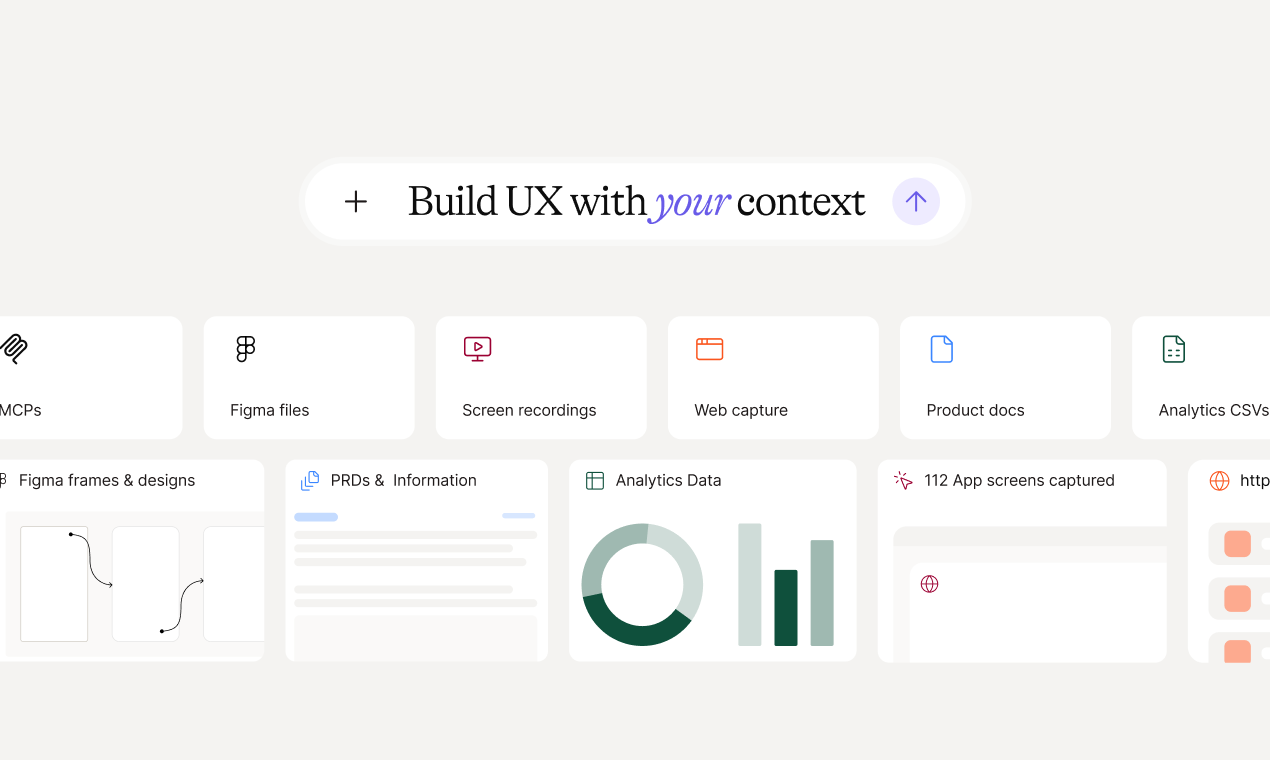
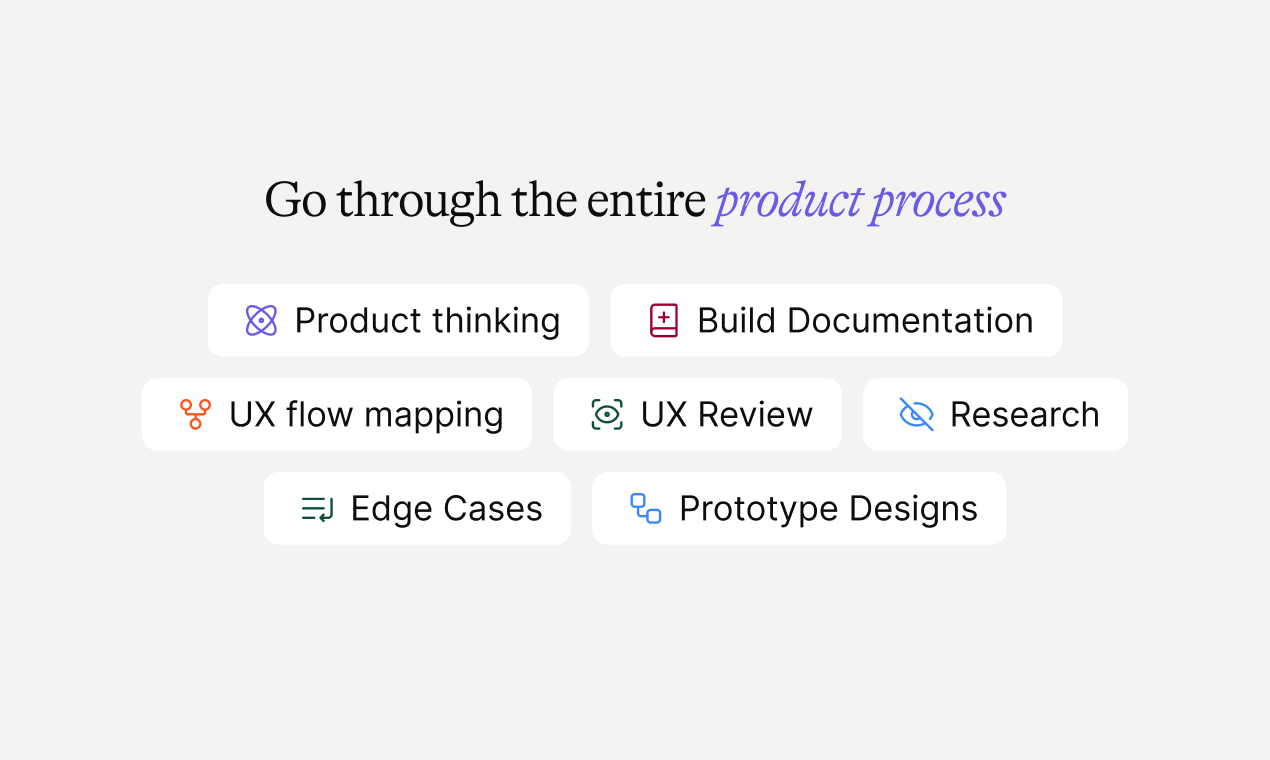
查看原始信息
Synra
Synra is a managed MCP gateway. Add your database credentials, get a secure URL, paste it into Claude Desktop — done. No JSON config files, noenv headaches, no local server setup. Currently supports PostgreSQL and Supabase. Read-only by default. Credentials encrypted with AES-256. Built for developers who want to ask their database questions in natural language without spending an hour configuring MCP servers.
Hey PH! I'm Sam, the maker of Synra. I built this because connecting Claude to a database through MCP was way too painful — JSON config files, environment variables, local server setup. It shouldn't take 30 minutes to ask your database a question. With Synra, you add your credentials, get a URL, paste it into Claude Desktop, and you're querying in under a minute. Right now it supports PostgreSQL and Supabase, with MySQL coming soon. It's early stage and I'm actively building based on user feedback — would love to hear what connectors or features you'd want next.
2
回复

@sam_h11 Congrats Sam. Does Synra support advanced features like custom SQL queries, write access, or schema introspection, and if so, how do you make those safe?

0
回复

good luck on the launch! congrats!

1
回复

@apexflux Thank you so much.

0
回复

I've been using claude code for the past couple of weeks and have such a headache every time I'm connecting to my database, this app looks like it'll streamline the whole process.

0
回复

Cool launch! Would there be some way to connect to databases behind a firewall?

0
回复