Product Hunt 每日热榜 2026-03-03

PH热榜 | 2026-03-03

#1
Krisp Accent Conversion
Understand accented speech in real time
318
一句话介绍:Krisp Accent Conversion 是一款在视频会议场景中,通过实时将带口音的英语转换为标准美式英语,解决全球团队因口音差异导致沟通效率低下和误解痛点的本地化AI音频处理工具。
Productivity Artificial Intelligence Audio
实时语音转换 口音消除 远程协作 企业通讯 AI音频处理 本地计算 生产力工具 全球团队 会议效率 语音清晰度
用户评论摘要:用户普遍肯定其解决真实痛点的价值,询问支持的口音范围(已获答复),期待Chrome扩展(官方确认开发中)。主要讨论点集中于技术原理(听者端处理)、文化敏感性(是否抹杀身份认同)以及未来应用场景(是否扩展至非英语或多语言环境)。
AI 锐评

Krisp Accent Conversion 看似是解决“口音摩擦”的技术方案,实则精准刺中了全球化协作中一个长期被默认为“成本”的隐性痛点:理解负担。其真正的颠覆性不在于口音转换的精度,而在于将“适应”的责任从说话者(非母语者)悄然转移到了听者(通常是主导沟通环境的一方)。这背后是一种权力关系的微妙重构,用技术手段规避了要求对方“说清楚点”所带来的社交压力与潜在的不平等感。

产品标榜“完全在设备端运行”和“近乎零延迟”,这不仅是技术亮点,更是对其核心企业客户隐私与实时性需求的精准回应。然而,评论中关于“文化抹杀”的质疑直指产品伦理内核。将多样化的口音“标准化”为美式英语,本质上是一种技术驱动的语言同质化。它提升效率的同时,也可能无形中强化了某种语言文化霸权,并将“口音”病理化为需要被“矫正”的对象。产品的长期价值不在于成为沟通的“语法修正带”,而应演进为增进理解的“上下文增强器”。团队需要谨慎权衡“清晰度”与“多样性”的边界,并思考如何将技术应用于双向理解,而非单向归一。

此外,其商业模式从面向说话者的降噪,扩展到面向听者的口音转换,意味着从单点工具向沟通基础设施的渗透。若能跨平台无缝集成,它将不再是一个简单的“功能”,而成为底层通讯链路中一个隐形的、却不可或缺的“理解层”。其最大的挑战将是如何在规模化中保持高精度,并应对英语之外更复杂的多语言世界。这步棋走得大胆且具争议,但无疑踩在了AI重塑人类交互方式的关键节点上。

查看原始信息
Krisp Accent Conversion
Accent Conversion for the Listener removes accent friction in real time. It converts accented English into neutral American English on the listener’s side, so speakers don’t change how they talk — you just understand instantly. Fully on-device with near-zero latency and works across Zoom, Teams, and Meet. Built for global teams where “can you repeat that?” quietly slows everything down.

🎉 Proud moment for @Krisp .

Accent Conversion is a thoughtful addition to the Krisp desktop app.

Feels great to hit publish on this.

41
回复
36
回复

i am impressed with this development specially for meeting 7 day trial is enough for me. i wish it will be part of my office in future.

40
回复

@abdul_hafeez16 thanks Abdul.

37
回复

What accents does it support?

40
回复

@jolene_mna It support Indian, Filipino, LATAM, African accents (SA, Kenya, Nigeria, Uganda, Egypt), and also US standard and British standard accents.

37
回复

Hey PH 👋

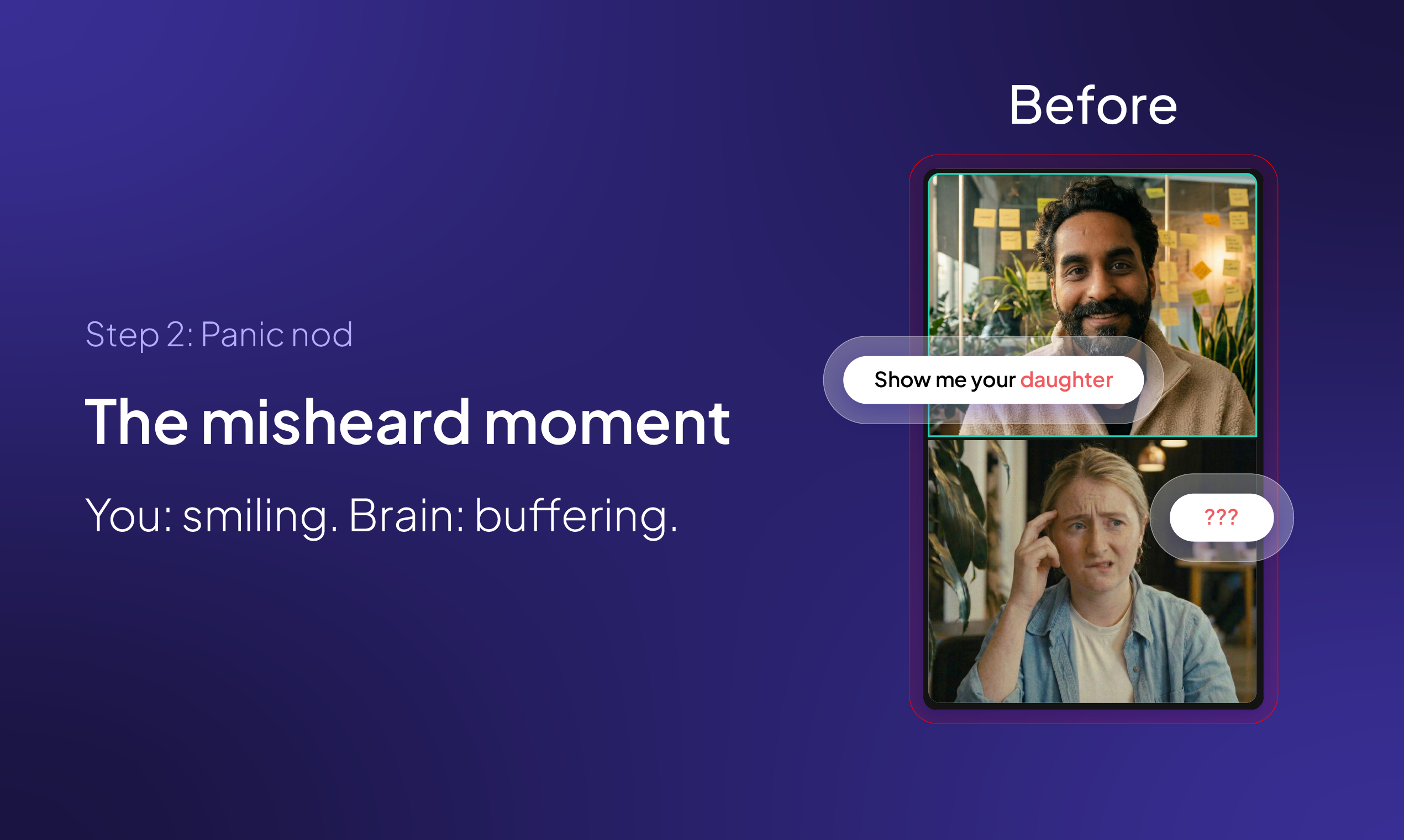
How many times have you nodded in a meeting… and guessed?

Accents aren’t the issue. Misunderstanding is. And it costs time, clarity, and sometimes credibility.

1.1B people speak English as a second language. Global teams are the norm. AI voice agents are scaling fast. Yet both humans and AI still struggle with accented English.

So we built Accent Conversion

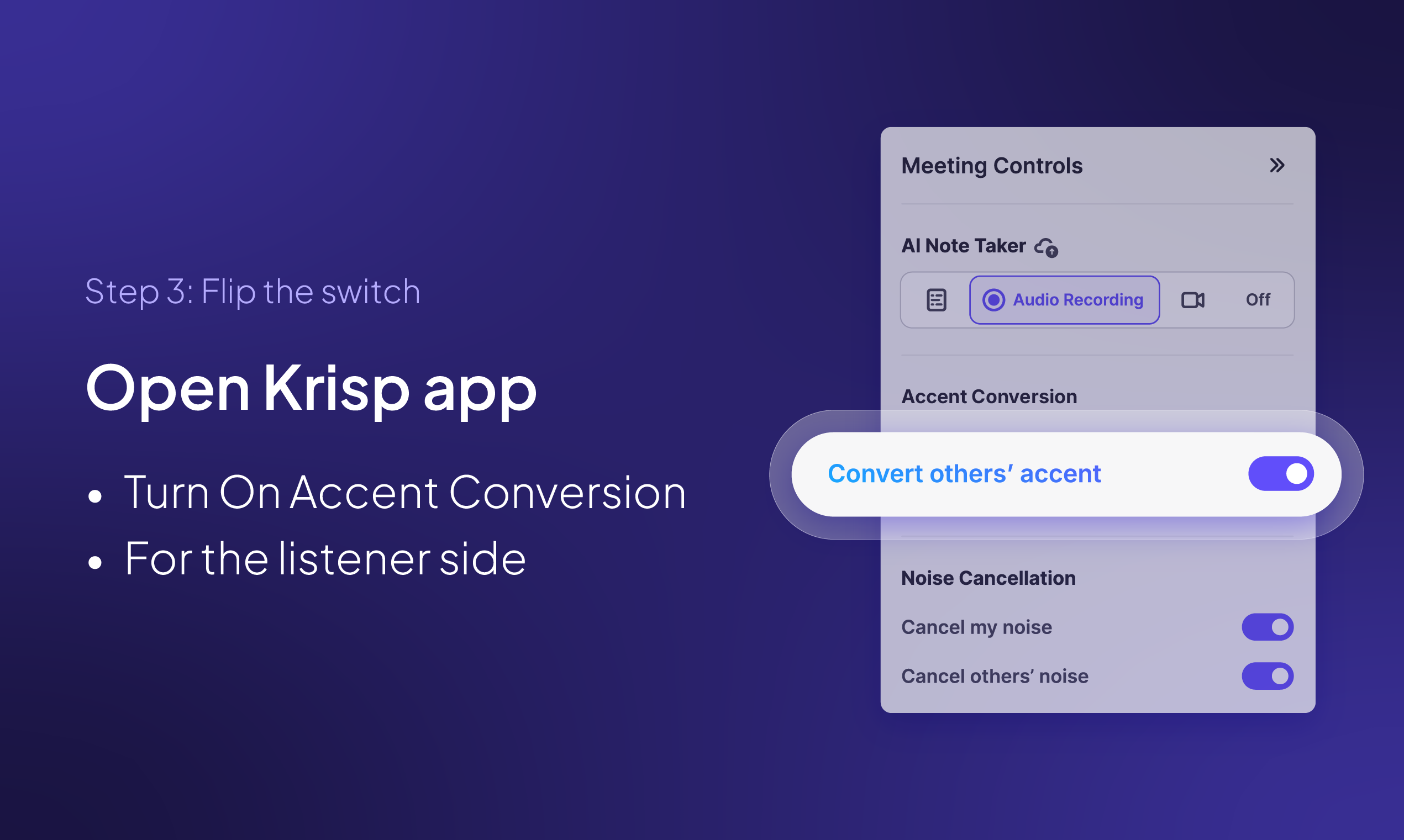
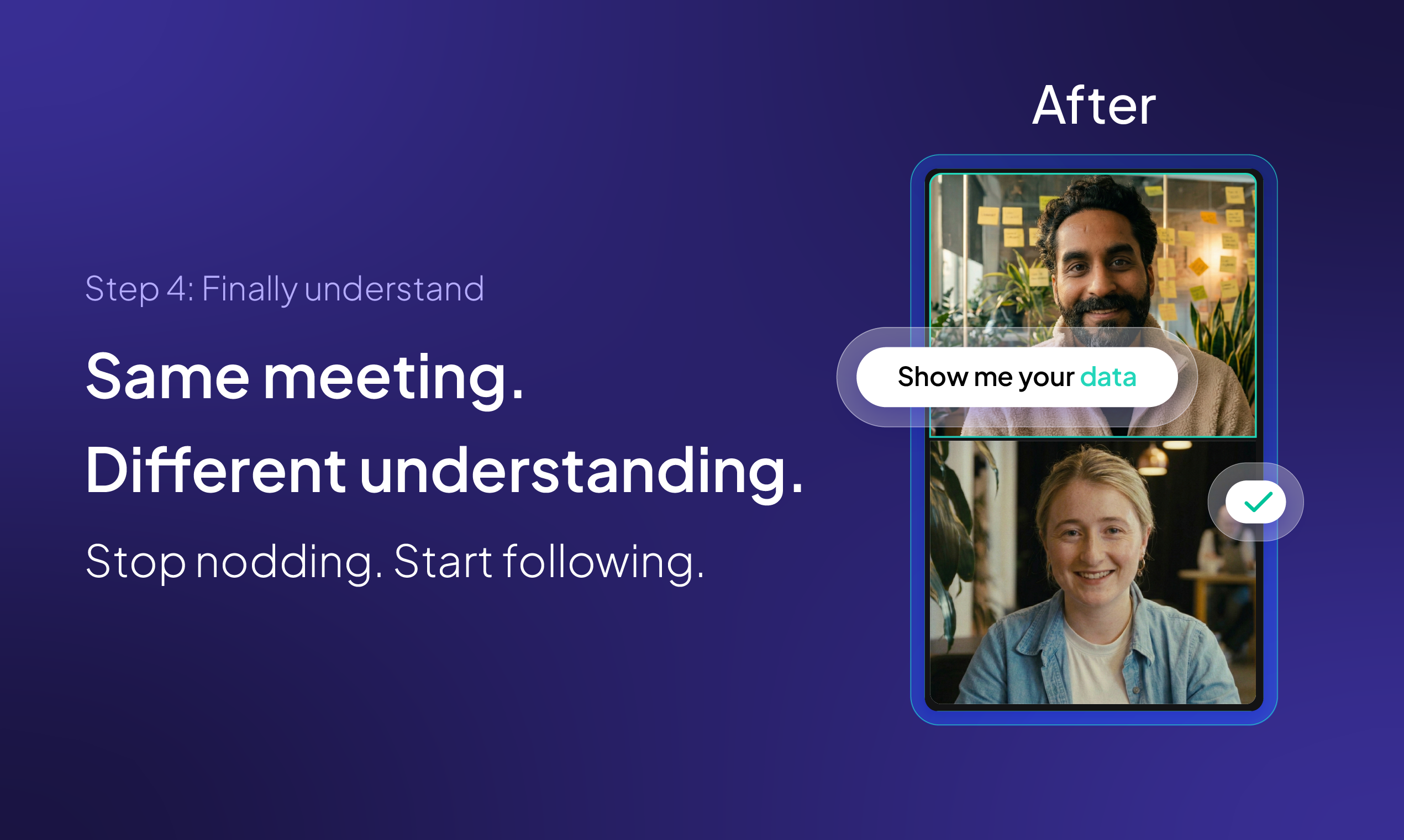
It runs on the listener’s side and converts accented English into neutral American English in real time. The speaker doesn’t change. They don’t install anything. You just understand — the first time.

Fully on-device. Near-zero latency. No weird robotic voices.

Would you use this? Or is misunderstanding just part of global work we’ve learned to tolerate?

Let’s talk.

Asti

39
回复
@asti_pili I came across what you’re building and I’m genuinely impressed. My team and I help founders with pre-seed fundraising from positioning to securing warm investor intros. I’d love to explore how we can support you. Would you be open to a quick 10–15 minute chat this week? Telegram:@switzey
0
回复

@asti_pili Hey Asti. Can people in very diverse teams in multilingual contexts apart from English expect the same benefits or results?

2
回复

@asti_pili This tackles a very real friction point in global teams.

A few things I’m curious about:

  1. How do you ensure this doesn’t unintentionally erase identity or nuance? Accent is deeply tied to culture, where’s the line between clarity and normalization?

  2. Technically, are you modifying phonetics only, or also smoothing pacing and intonation? And how do you avoid semantic distortion in real time?

  3. Have you tested how native speakers perceive it over long conversations, does it feel natural, or does listener fatigue creep in?

I do think misunderstanding isn’t just about accent, it’s also vocabulary, idioms, and domain jargon. Curious if you see this evolving into broader clarity augmentation rather than just accent conversion. This could spark some interesting debates about communication, inclusion, and tech’s role in shaping both!

0
回复

Congrats on the launch.
Would love to see this also as a Chrome extension for YouTube.

39
回复

@nairi_baghdasaryan thanks! Chrome extension is in the makings! Will announce very soon.

39
回复

that's a kewl video ! congrats on this upgrade.
the accent conversion feature has been there for a year, but does this mean - that this new update willy only update the selected words? and how?

37
回复

@ivik thanks and great question. This update is actually different from the speaker-side Accent Conversion we’ve had before.

This one is listener-side. It doesn’t selectively change certain words. It processes the incoming speech in real time and improves overall clarity for the listener, while preserving the speaker’s voice and identity.

So the speaker doesn’t install anything or change how they talk. The improvement happens on your side, during the live conversation.

1
回复

I've been a long-time @Krisp fan, going back to at least 2019, when I hunted Krisp for Windows!

Now the team's back with something new: Think noise cancellation, but for accents.

You’ve been on calls where you think you caught what someone said — but did you really? You smile, nod, and hope you got the gist. But when accents are thick and clarity counts, can you risk it?

Recently I was on a call supporting a founder with their Product Hunt launch whose first language was clearly not English (I won't say who!). Try as I might, I could only discern 75% of what they were saying. Fortunately I was also supporting @asti_pili and @lusine_mnatsakanyan4 with this Krisp Accent Conversion launch! Once enabled, my comprehension went up to 97% and we finished the call with a clear plan to get them to launch on time.

The technology behind Krisp's Accent Conversion tech is genuinely impressive: it runs locally on your device's CPU, and dampens accents in real time. You hear the speaker’s voice—but minus any heavy accent that can get in the way of comprehension.

If you've used Krisp's products before, you know they can ship real breakthroughs in audio.

This one feels like the next big one.

If you’re on global calls or work with a distributed team—this one's worth trying out.

36
回复

@asti_pili  @chrismessina Thanks again for hunting us back in 2019 and for being part of this journey

36
回复

Great work @Krisp team! This removes whole bunch of communication barriers!

34
回复

@artur_asatryan3 thank you!

29
回复

Really happy to share this launch. Accent Conversion is designed for real meetings, not lab demos. Thanks for checking it out.

20
回复

Proud moment for @Krisp. Accent Conversion tackles the listener-side problem in meetings. Curious what use cases pop up first.

13
回复

@argishti_ayvazyan Yes, very excited to see which real world use cases emerge first

3
回复

Congrats on the launch. It's indeed a great product for global and multi-lingual teams.

3
回复

@vahagn_sarksyan thank you!

0
回复

Big milestone to celebrate today. 🚀

Accent Conversion makes accented English easier to follow in real time. Curious what use cases pop up first.

3
回复

@lia_titanyan2 🙏💛

0
回复

Excited to see this live today. Accent Conversion is designed for real meetings, not lab demos. Happy to answer questions in the comments.

3
回复
0
回复

Hey PH 👋

Big milestone to celebrate today. Accent Conversion is a big step for our Voice AI work.

Happy to answer questions in the comments.

3
回复

@narek_sahakyan14 It really is!

0
回复

Excited to see this live today. Accent Conversion brings the ‘hear it once’ dream closer to real life. Hope you try it and tell us what you think.

2
回复

@gyumjibashyan 🙏💛

0
回复

Congrats on the launch team.
I've definitely faces this while being on call with different stakeholders

Would love to see this on slack as well

1
回复
@otodidakt_20 The best part? It works with any calling app — Slack, Zoom, Meet, Teams, etc.
0
回复
are you planning to make a firefox extension for this? i'd love to be able to use it while watching yotube. congrats on the launch!!
1
回复

@nourhan_abdallah thank you! Chrome extension is next on line and it will work on Youtube videos! Stay tuned!

1
回复

Finally. I've been nodding along in global meetings for 3 years understanding 60% and hoping the other 40% wasn't critical. Spoiler: it was always the critical part :)

1
回复

Finally shipping this feels great. Accent Conversion is built for those misheard moments in global calls. Thanks for checking it out.

1
回复

Huge day for the team. Accent Conversion focuses on comprehension, not changing speakers. Happy to answer questions in the comments.

1
回复

@david_2222 🙏💛

0
回复

Huge congratulations to the @Krisp team on the launch! 🎉

This is truly one of the most impressive features I’ve seen from Krisp. Solving real-time accent friction in such a seamless way is a big leap forward for global communication.

Amazing to see how Krisp continues to innovate and solidify its position as one of the leading players in the Voice AI space.

1
回复

@gev_nazaryan thank you!

0
回复

This has been a long build. Accent Conversion brings the ‘hear it once’ dream closer to real life. Would love feedback from anyone in global teams.

1
回复
0
回复

This is super cool! Curious how well it handles overlapping speakers / fast back-and-forth conversations?

0
回复

I tested it and...whoa! I love it!

It's a pity I only get 60 minutes a day, as I'm already paying for the subscription I was expecting this to be included.

How do you do that by the way, is it locally executed? As there is almost no latency, it must be.

0
回复

I work with contractors in four time zones. It's the mental tax of re-parsing every other sentence while trying to stay in the conversation. Does this run locally or does audio hit your servers? I'm prepping my own launch soon and real-time audio latency is something I think about a lot.

0
回复

Congrats on the launch. I think India could be a great market.

0
回复

This is a lifesaver for global teams! Clear communication is so important, and being able to convert accents in real-time will definitely boost confidence for many speakers. Does it support multiple languages for conversion, or is it focused only on English right now?

0
回复

Hilarious video. I actually clicked this feature on when I first signed in this morning. I've been hoping for it for months. Really hoping it can do this and help me FOCUS. :-D

0
回复

@amy_kay_watson_m_div_mcc haha :) thank you

0
回复

Very cool, congrats! and nice ad ❤️

0
回复

Is the accent conversion only available for certain languages? I'm Greek; will it be helpful for me?

0
回复
#2
Qwen3.5 Small
0.8B-9B native multimodal w/ more intelligence, less compute
300
一句话介绍:Qwen3.5 Small系列是一组原生多模态小参数模型,通过在边缘设备上提供强大的本地AI能力,解决了移动、IoT及隐私敏感场景下对低功耗、低成本和高响应速度AI计算的迫切需求。
Open Source Privacy Artificial Intelligence
小型语言模型 边缘AI 多模态模型 开源AI 轻量化代理 物联网部署 本地推理 高性能基准 参数高效 模型矩阵
用户评论摘要:用户普遍惊叹于9B模型以极小参数量比肩百亿级模型的性能,认为这将极大推动边缘AI和隐私优先应用。关注点包括:小模型结构化输出可靠性、实际部署的吞吐量数据、非技术开发者的使用门槛,以及对具体任务能力的询问。
AI 锐评

Qwen3.5 Small系列的真正颠覆性,不在于参数规模,而在于它重新定义了“边缘智能”的性价比基线。其宣称的“0.8B原生多模态”和“9B对标GPT-OSS-120B”,若经得起实践检验,意味着AI部署的范式正在发生转移:从依赖云端巨量算力的集中式智能,转向广泛分布的、嵌入现实终端的泛在智能。

这系列模型最犀利的价值是“降维打击”。它用极致的参数效率,将原本需要数据中心支持的能力压缩到单块消费级GPU甚至手机芯片上。这不仅关乎隐私和延迟,更关乎AI应用的商业模式和生态控制权——开发者可以构建完全离线的、低成本的AI功能,打破对大型云API的依赖。评论中提到的“改变边缘部署的计算公式”一语中的。

然而,光鲜的基准测试分数背后,隐藏着现实世界的“暗礁”。小模型在复杂指令遵循、逻辑连贯性和长上下文中的稳定性,往往是大模型轻易碾压的短板。评论中关于“JSON模式遵从性”的质疑直击要害:在边缘场景中,可靠的结构化输出比单纯的文本生成能力更重要。团队是否通过差异化训练(如强化学习或思维链蒸馏)解决了这一痛点,将是其能否从“技术演示”走向“生产可用”的关键。

此外,这套“从0.8B到397B”的完整矩阵,展现了团队清晰的产品化思维:不再是发布孤立的模型,而是提供覆盖全场景的解决方案。这旨在吸引不同需求的开发者进入其生态,从嵌入式设备到企业服务器,形成闭环。真正的挑战在于,工具链、文档和社区支持能否跟上模型发布的步伐,让“非技术开发者”也能轻松上手,正如评论中所问。否则,它可能只是AI竞赛中又一枚精致的技术勋章,而非真正点燃边缘创新的火种。

查看原始信息
Qwen3.5 Small
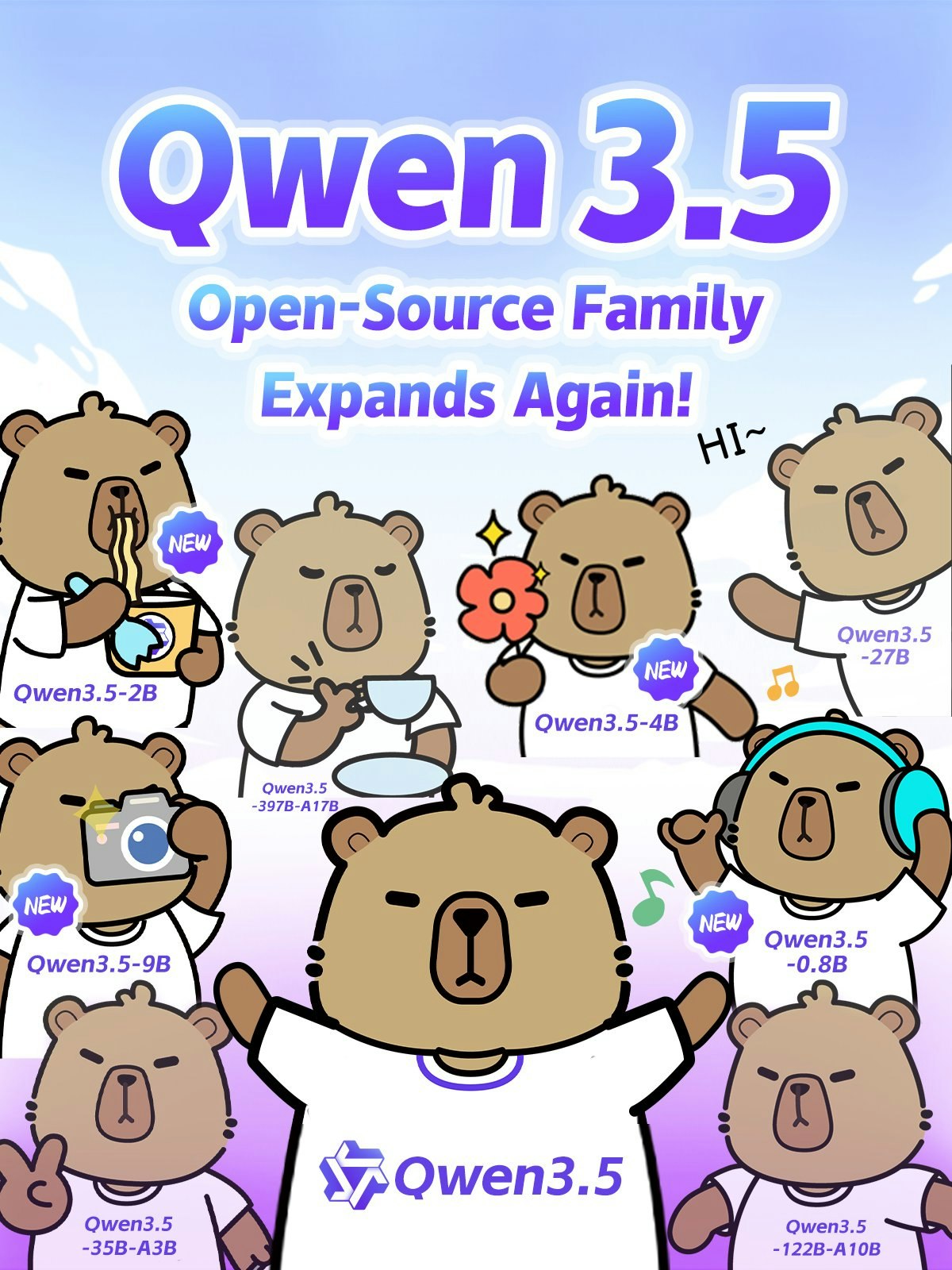
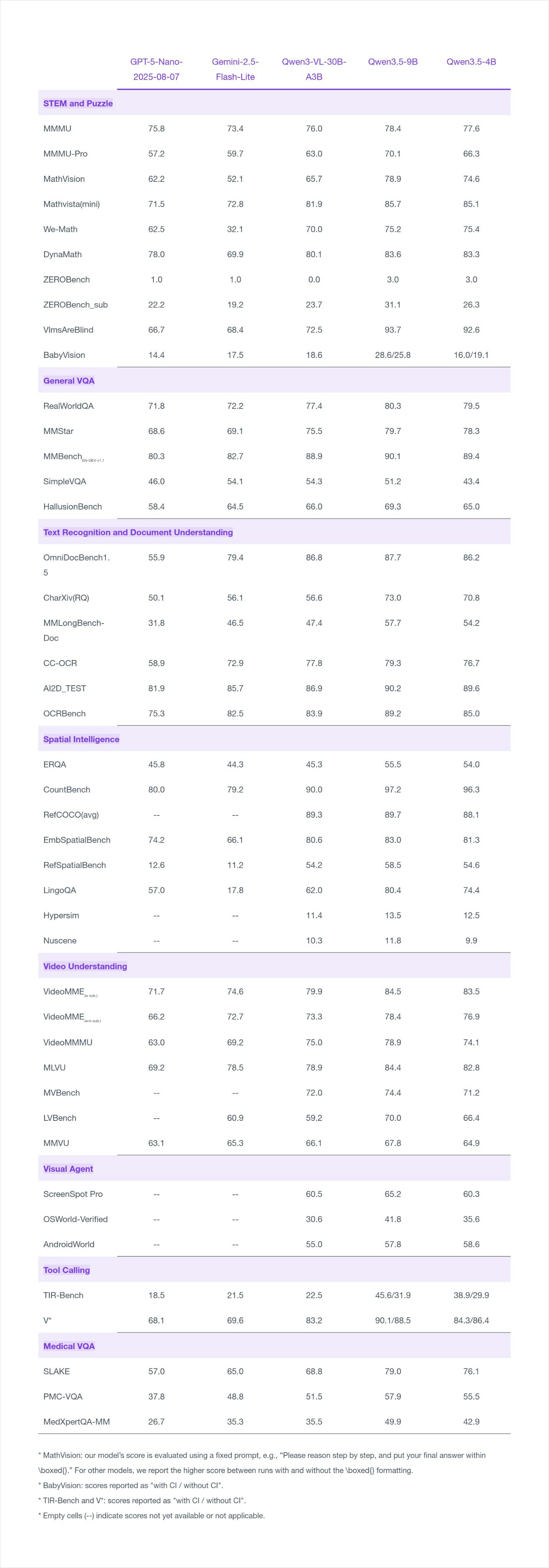
Qwen just released the Qwen3.5 Small Model Series — 0.8B, 2B, 4B and 9B. Native multimodal with improved architecture and scaled RL. 0.8B and 2B are tiny and fast for edge devices, 4B makes a strong lightweight agent base, and 9B is already closing the gap with much larger models. Base versions released too.

Hi everyone!

The Qwen team just dropped the Qwen3.5 Small Model Series: 0.8B, 2B, 4B, and 9B, along with their Base versions.

This release fills the missing piece for on-device deployment and completes the full Qwen3.5 matrix from 0.8B all the way to 397B. Now you have clear choices:

  • 0.8B/2B for embedded/IoT/Mobile

  • 4B for lightweight multimodal agents

  • 9B for edge servers

  • Plus the bigger MoE models for heavier workloads.

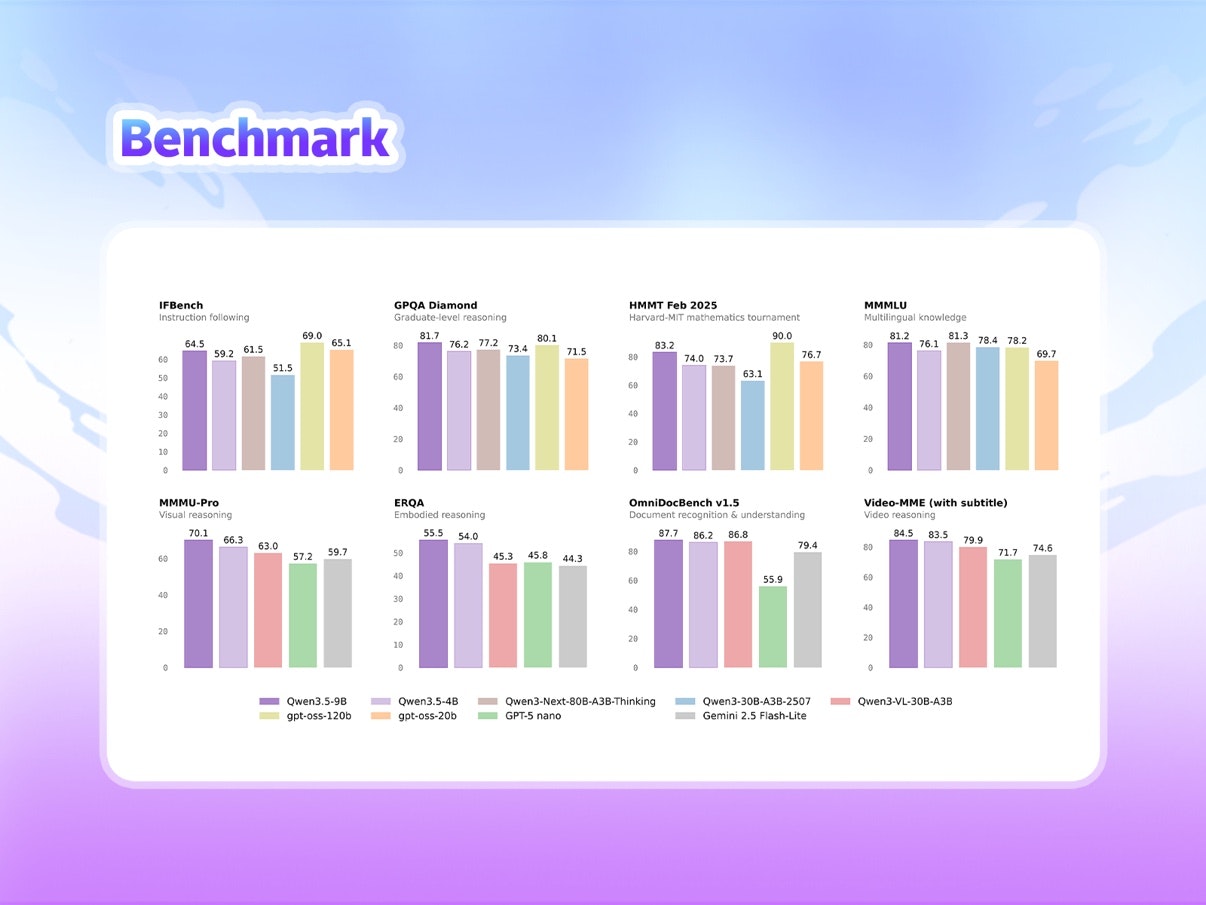
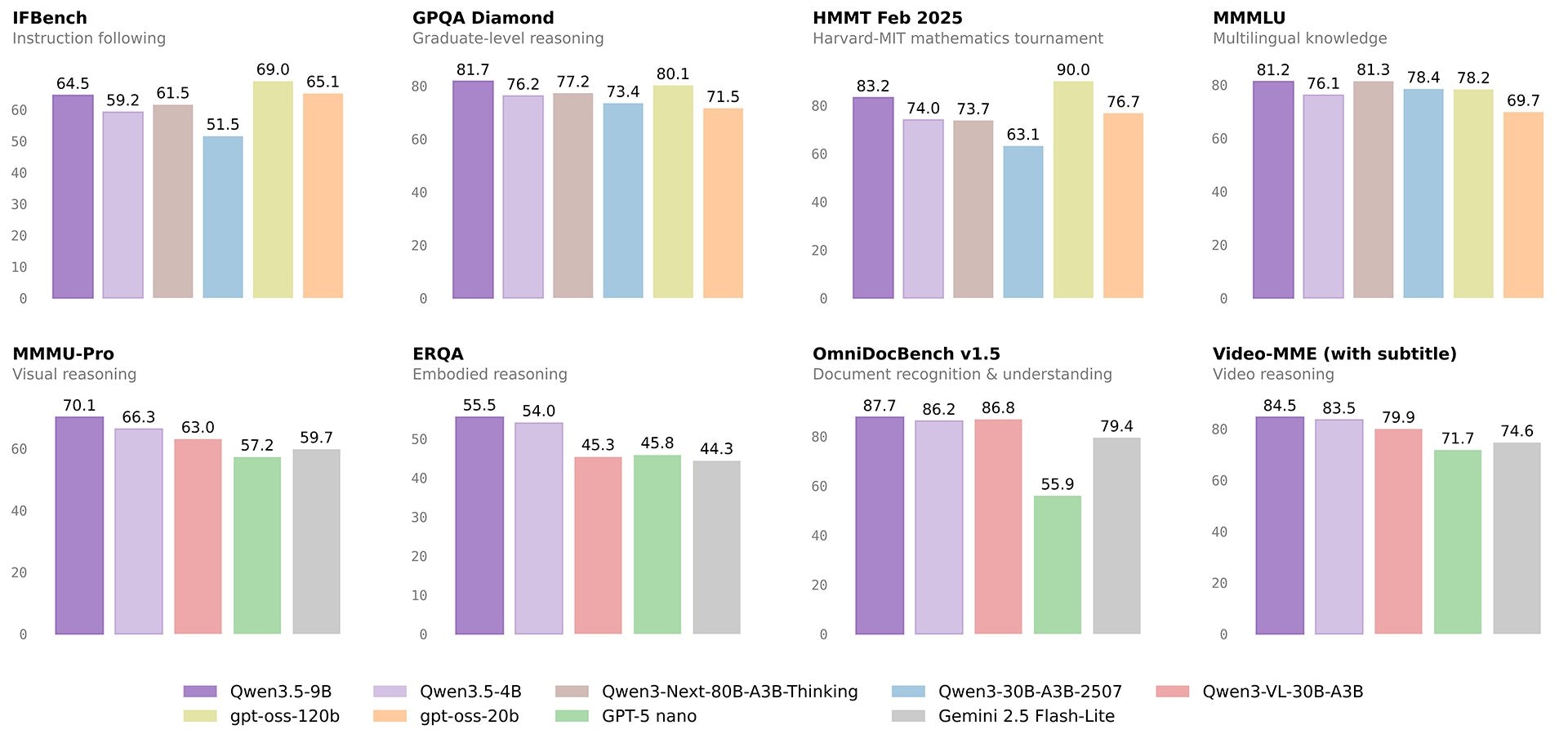
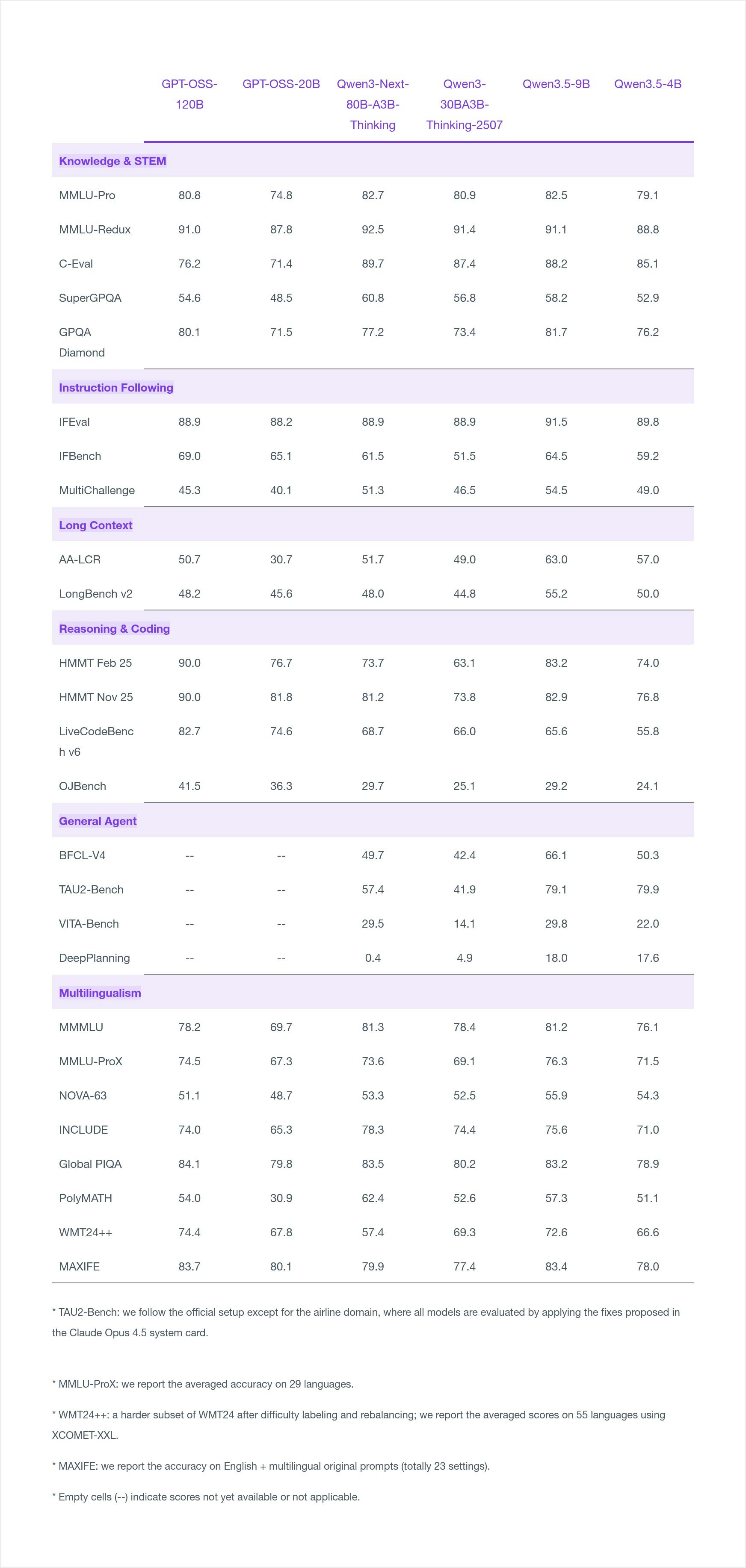
The 9B is the real shocker: matching or beating GPT-OSS-120B on several key benchmarks while being 13x smaller.

Even Elon chimed in:

Edge AI is heating up fast. This opens up exciting new opportunities for AI hardware and local innovation.

Play with these models on @Ollama!

8
回复

@zaczuo Impressive release! Already played with all the small series both locally (MLX) and in the cloud. Now that's something that can be reliably and constantly used in agentic workflows!

1
回复

Native multimodal at 0.8B is genuinely impressive - most teams trade off size for capability, but 262K context windows + text/image/video in under 1B parameters changes the edge deployment math.

The 9B beating GPT-OSS-20B on GPQA Diamond is interesting. Curious about structured output reliability at 0.8B though - small models tend to drop JSON schema adherence under complex instructions. Is there a differentiated training approach for structured data tasks?

MTP for faster inference on constrained hardware is a smart addition. Real-world throughput numbers on consumer GPU vs Apple Silicon would help developers size their deployment targets.

0
回复

The 9B punching above its weight class is the real story here. Running capable models locally without needing a data center changes what's possible for privacy-conscious apps and edge deployments. Been waiting for small open-source models to close this gap.

0
回复

The 9B matching models that size is wild — smaller models getting this good makes edge + local AI way more practical than most people realize.

0
回复

What kinds of tasks can be performed with these models?

0
回复

@binyuan_hui @chen_cheng1 @junyang_lin Hi guys. Can non-technical developers use these models easily? What tooling or platforms do they support?

0
回复

@kimberly_ross Try them on Locally AI :)

0
回复
Hey congratulations on the launch!
0
回复
#3
getviktor.com
Your AI Coworker that proactively executes tasks
270
一句话介绍:一款集成在Slack等协作平台中的AI协作者,能主动监控团队工作流、连接数千款工具并自动执行任务,从编写代码到管理广告活动,在复杂工作场景中替代人工操作,解决效率与响应滞后痛点。
Productivity Artificial Intelligence Business
AI协作者 工作流自动化 Slack集成 多工具连接 主动式AI 企业效率工具 智能办公 代码生成 跨平台自动化 团队协作
用户评论摘要:用户普遍认可其“主动执行”能力,如自动生成报告、修复代码、监控异常。核心反馈包括:设置门槛低(无需编码)、需明确自主行动边界与错误防范机制、初期需数天学习适应后效用显著。部分用户询问成功率与幻觉控制。
AI 锐评

Viktor试图颠覆当前AI工具“问答式”的被动范式,其真正价值不在于连接3000+工具的广度,而在于构建了一个持续学习工作上下文并主动介入的“数字员工”系统。产品巧妙避开了AI工具最大的激活陷阱——空白输入框——通过观察Slack等通信平台直接嵌入工作流,从“等你命令”变为“给你提案”。

然而,其宣称的“自主性”是一把双刃剑。评论中透露的“未经询问即提交PR”、“自行生成UTM参数并催促批准”等案例,在展现高效的同时,也暴露出权限与信任的灰色地带。产品将决策压力转移给了用户:并非“能否执行”,而是“是否批准”。这种模式高度依赖其行动建议的准确性,一旦出现误判,可能导致连锁操作错误。

从生态位看,Viktor并非简单自动化工具,而是向“组织操作系统”演进。它通过持续学习形成团队专属的“工作图谱”,这构成了其壁垒。但风险同样明显:重度依赖Slack/Teams等平台生态,数据安全与隐私合规问题将随其深度介入而放大。此外,“最佳协作者”的叙事需要极高可靠性支撑,当前LLM固有的幻觉问题,即便通过审批流程缓解,仍可能消耗团队信任成本。

总体而言,Viktor代表了AI Agent从“工具”迈向“同事”的激进实验。其成败关键不在于技术炫技,而在于能否在“主动性”与“可控性”、“智能”与“可靠”之间找到企业级应用所需的精准平衡点。它可能重新定义人机协作界面,也可能成为过度自动化风险的典型案例。

查看原始信息
getviktor.com
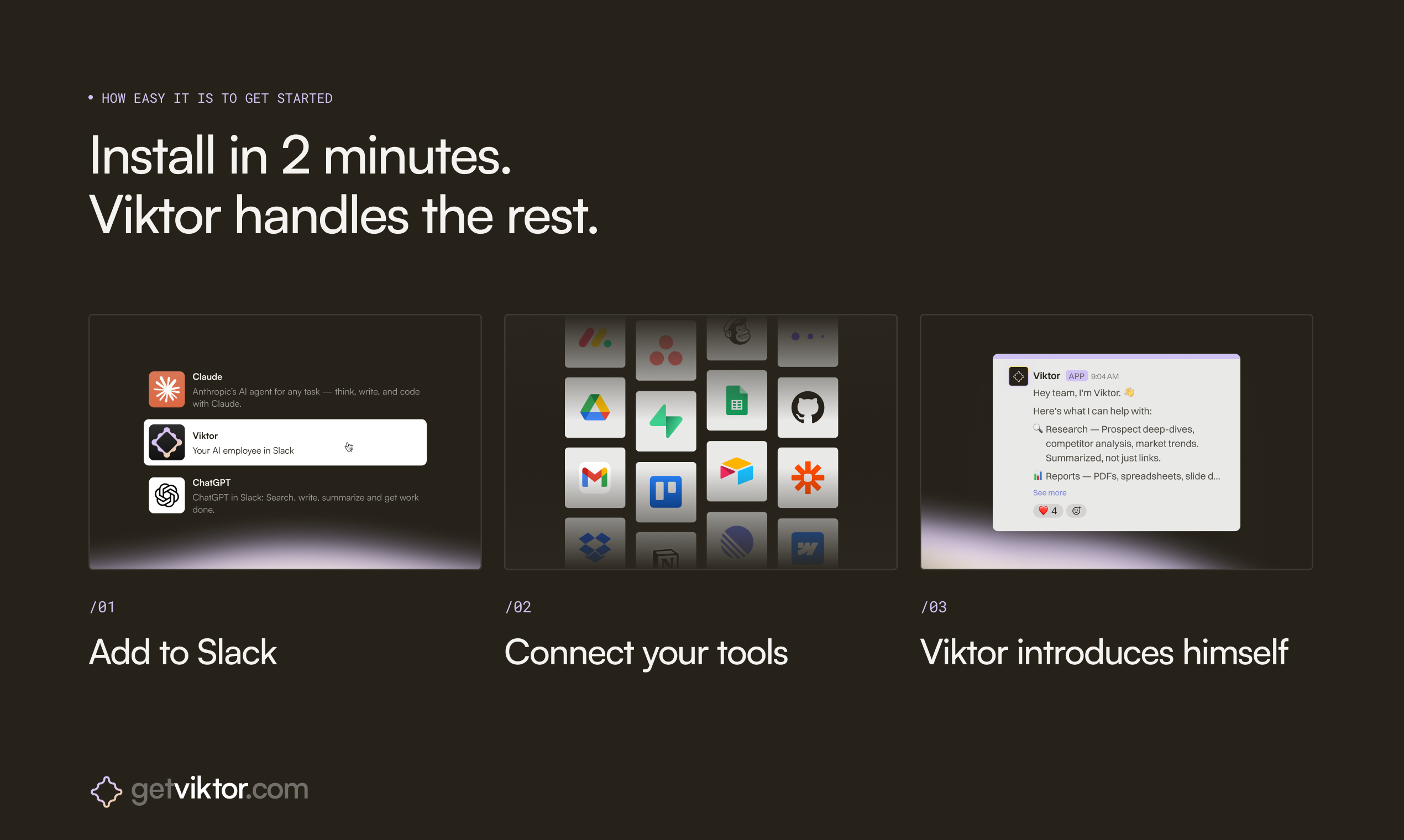
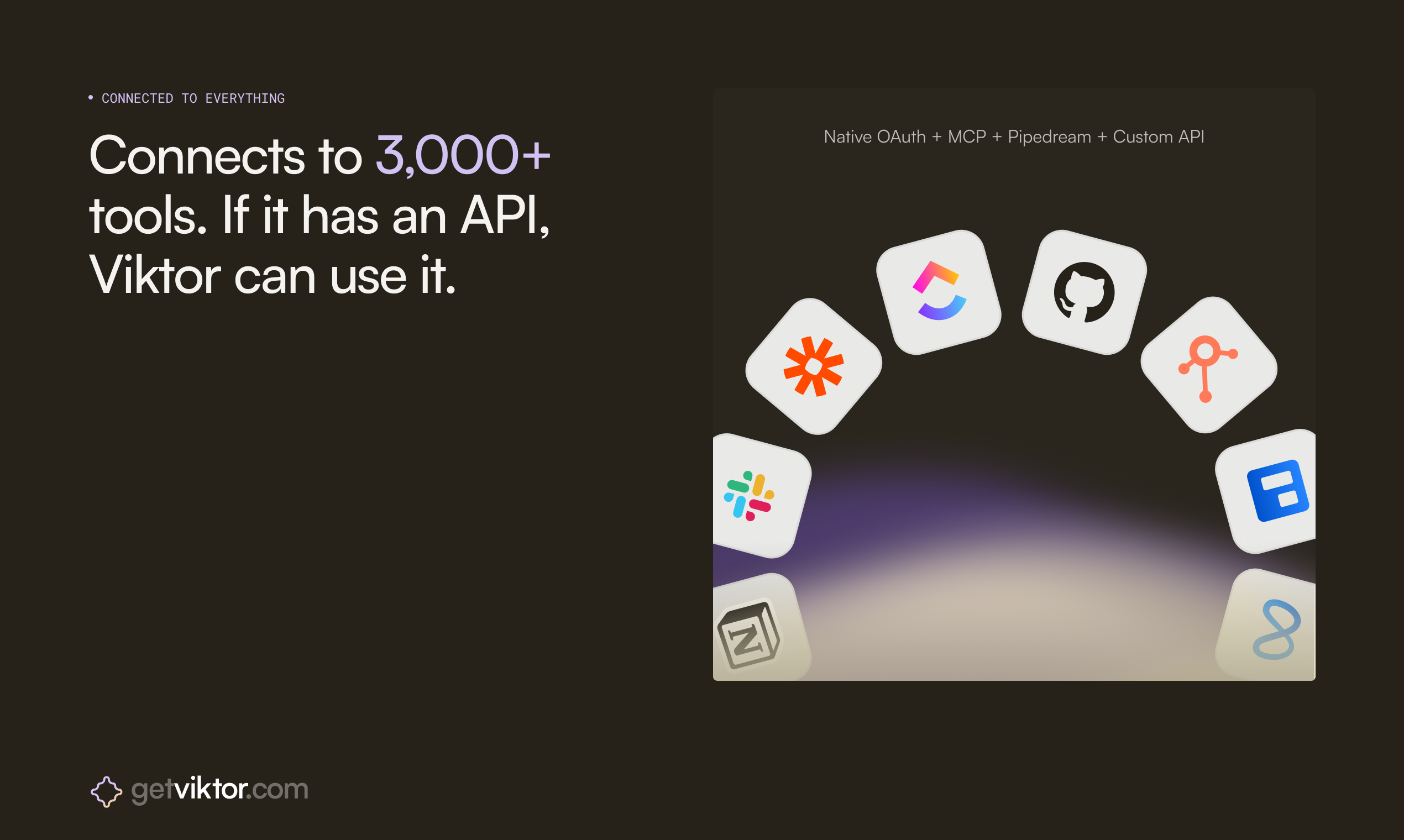
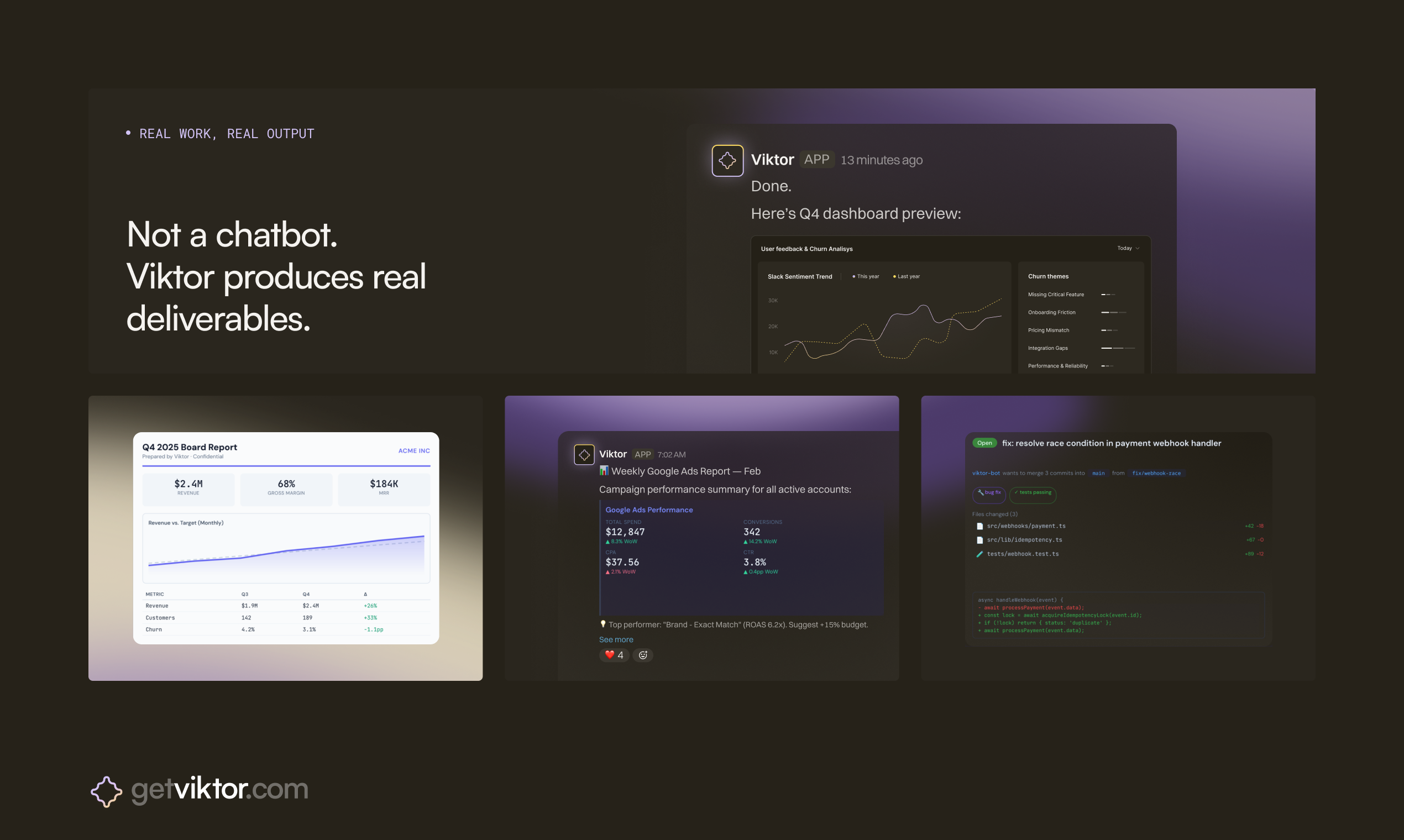
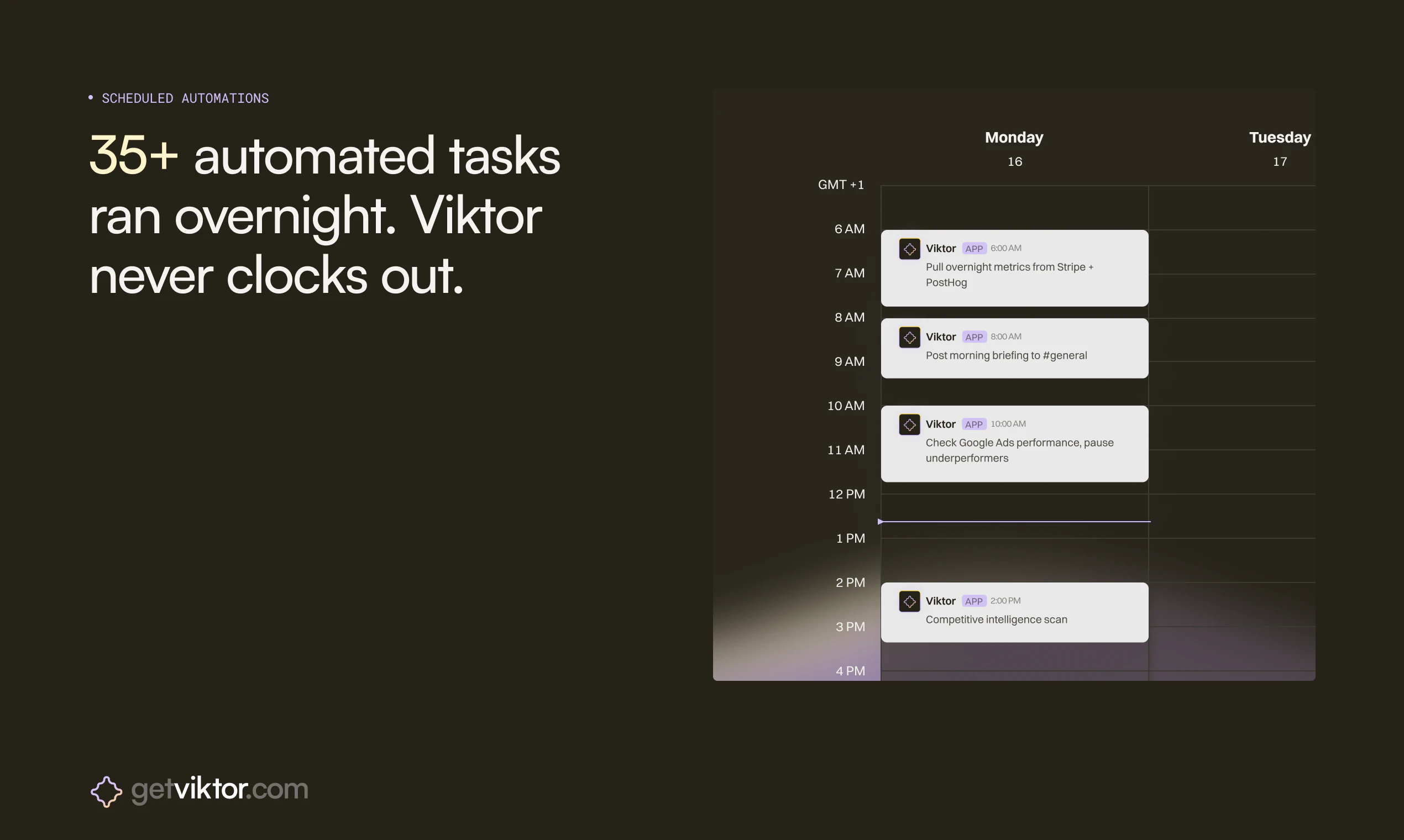
Your AI tools answer questions. Viktor does the work. It lives in Slack, connects to 3,000+ tools across your entire stack, and acts on its own. It watches how your team works, spots problems before anyone notices, and proposes automations built around how your company actually works, before anyone asks. It manages campaigns, builds apps, delivers reports, and writes code. And it runs for weeks without losing context, learning your company deeper every day. Not a chatbot. A coworker.

I'm writing this from Dubai.

For the past three days, Iran has been firing rockets at the city. Flights are canceled. The airport is partially closed. I'm stuck in a hotel room watching smoke rise over Jebel Ali.

We launched Viktor anyway.

Think of your best coworker. We launched someone better. Maybe even better than you.

Viktor lives in your Slack, connects to 3,000+ tools, and does the actual work: reports, code, web apps, ad campaigns.

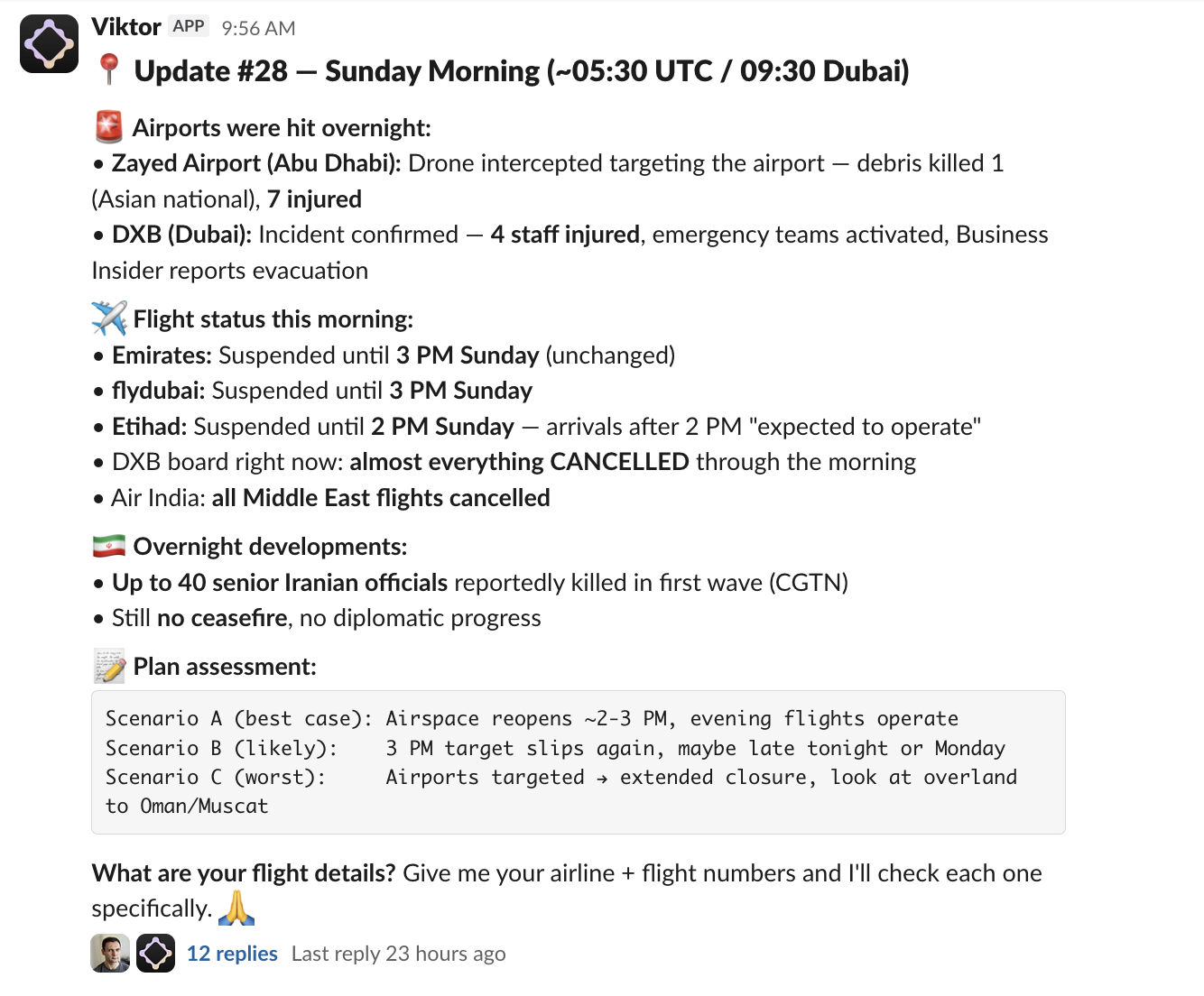
While I've been stuck here watching the news, Viktor posted 28 real-time missile updates to our team Slack, tracked every team member's flight status, and told us when to shelter in place. Then it ran our ads, flagged a spend anomaly, and shipped a PR to our codebase. Nobody asked it to.

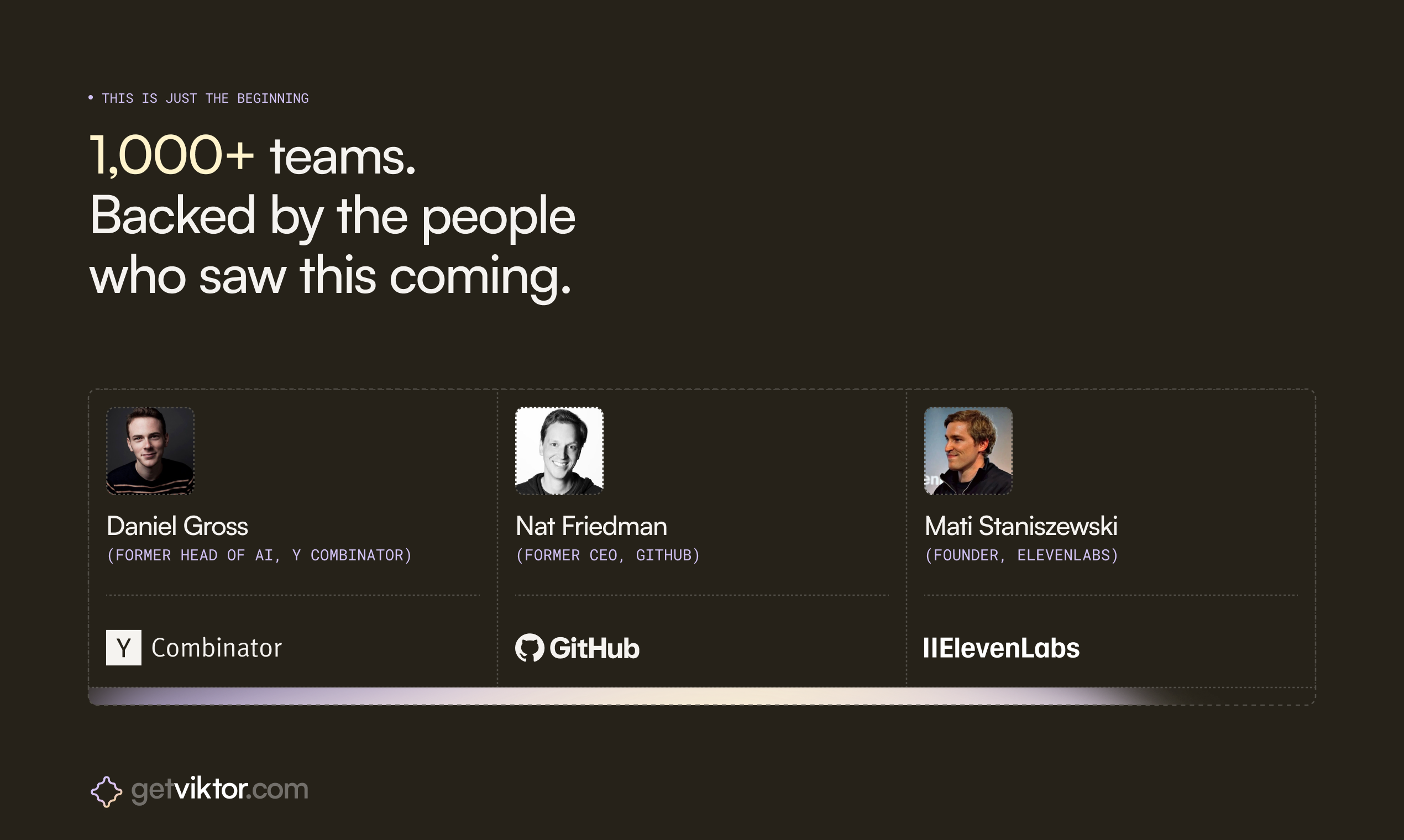
Over 1,000 teams use Viktor. Backed by Daniel Gross, Nat Friedman, and the founder of ElevenLabs. Salesforce lists us in their app store.

You can't make this up.

Fryderyk, co-founder.

P.S. Viktor is coming to Microsoft Teams very soon. Very.

20
回复

@fwiatrowskiHey Fryderyk. What does setting Viktor up look like for a team with no coding experience? Is it easy to get started?

1
回复

@fwiatrowski This is dramatic positioning strong hook! A smart response should stay grounded and probe substance, not hype. Here’s a thoughtful comment you could leave:

First, hope you and your team are safe.

The “autonomous coworker” framing is bold. A few things I’m curious about:

  1. When Viktor takes initiative (like posting updates or shipping a PR “without being asked”), what guardrails define scope? How do teams control when it acts vs. when it suggests?

  2. For cross-tool execution (ads, code, flight tracking, Slack updates), how do you prevent cascading errors if one assumption is wrong?

  3. What’s the boundary between automation and agency here? Is Viktor operating off predefined playbooks, learned patterns, or fully autonomous reasoning loops?

The story is compelling, but autonomy at that level raises serious questions about governance, observability, and trust.

Would love to understand how you balance initiative with accountability

0
回复

I run growth at Wispr Flow, so I spend most of my time deep in AI tools and automation. I'd been following Fryderyk and the Zeta Labs team since Jace, their AI email assistant, and was impressed by how fast they shipped product.

When Fryderyk showed me Viktor, it clicked immediately. I'd been spending hours building automations in Claude Code - stitching together context, writing scripts, trying to make things persistent and scheduled. Viktor did all of that natively. It just lives in Slack, already has the context from your tools and conversations, and runs on its own.

But the thing that genuinely blew me away was the proactive behavior. Viktor doesn't just wait for you to ask. It observes how your team works, chimes in when it spots something relevant, and suggests automations you didn't think to set up. I've never seen an AI tool take initiative like that.

I ended up advising the team on growth strategy because I believe this is how every team will work within a few years. Not another tab. Not another tool. A coworker that lives where your team already communicates.

If you're skeptical, give it your worst task. That's what convinced me.

7
回复

@mswulinski The Claude Code comparison is one of the best ways I've heard it explained. People were essentially building Viktor by hand, every time. We just made it permanent. "Give it your worst task" is going on the website. Thank you for believing in this early.

4
回复

Can't wait to try it!

4
回复

@pablo_simko 🙌 Excited for you to try Viktor, if you share what you’re hoping to do with it, I'm happy to point you to the best starting place. Also, we'd love any feedback once you’ve had a chance to play with it!

0
回复

I use Viktor daily for managing support. When a ticket comes in, it gets forwarded in Slack automatically and tags Viktor - it pulls up the customer's account in Stripe, checks activity in PostHog, searches for related bugs in Linear, analyzes code base, and drafts a response. What used to be a 20-30 min investigation per ticket now takes under 2. Absolute game changer.

4
回复
@jkb_krz This is exactly the kind of leverage support teams deserve. Freeing up 30 minutes per ticket compounds fast
0
回复

Launched Viktor on my GTM stack (Lemlist + GA4 + Internal Database). Viktor managed to find a few mistakes (mine, unfortunately), helped me analyze which outbound campaigns worked best for which persona, then proposed a few fixes to better attribute traffic (I hadn't added UTMs for our outbound campaigns). When I ghosted him for a day, Viktor told me we cannot wait on this, generated its own UTMs, and asked for permission to apply all of them.


Would recommend, 10 out of 10.

3
回复

@lil_bsz "Viktor told me we cannot wait on this" is the line we're going to use everywhere.

That's exactly what a good coworker does. Not wait for you to come back. Not send a reminder. Just tell you the work needs to happen and ask for the green light.

Glad the UTMs are sorted. What's the next thing on your list?

1
回复

Congrats on the launch! Viktor’s been on our team for two weeks, and I’m already used to handing him work 🔥

3
回复

@kamila_dabrowska Two weeks in and already delegating. That's the goal.

What's the thing you hand Viktor most often?

0
回复

I have been using Jace for a while, a tool from the same team and when Viktor came into the scene, I also ran it and I love it! I've run out of credits, but it's pretty credit efficient and useful.
Really really recommend this tool and its team!

3
回复

@josh_littler This made my day. A Jace user who came over to Viktor on their own and ran out of credits is exactly the signal we needed today. DM me your email. I'll sort the credits.

0
回复

Viktor submitted a PR while one of our engineers was on vacation. It read the codebase, found the issue, wrote the fix, opened the PR with a proper description. The engineer approved it from his phone. That was a Wednesday

3
回复

@darthwade true, the proactive part caught me off guard. I expected to always have to ask it for things. Instead it started noticing patterns on its own and flagging stuff before I even knew about it (approving a PR from your phone while on vacation is wild though)

1
回复

I'm on the support team and one morning Viktor just dropped a list in Slack - it had gone through PostHog, found 12 accounts that hadn't logged in for two weeks with open tickets, and cross-referenced Stripe to flag which ones were paying customers. Nobody asked it to do this. It just noticed they were slipping through the cracks before I did.

3
回复
@katarzyna_krynska That proactive check on inactive accounts is wild!
0
回复

good luck boys

2
回复

@karmedge thanks!

0
回复

Also what is the overall success rate of doing tasks in your internal testing? Can victor hallucinate?

2
回复

@cool_samurai_sword Honest answer: Viktor is built on LLMs, so hallucination is possible in theory. In practice, we've designed it so it rarely matters.

Viktor pulls real data from your actual tools (Stripe, PostHog, CRM, etc.) rather than guessing. It writes and runs code to verify its work. And any action that touches external systems requires your approval first — you see exactly what it's about to do before it does it.

On success rate — we have near-zero churn, which says more than any benchmark. Teams that try Viktor keep using it.

1
回复

We got early access to Viktor because we built their website - so we've been testing it in beta for a while now.

I'll be honest, day 1 was just okay. Cool tool, nice concept, but nothing crazy. Then around day 5-6 something clicked. Viktor had absorbed enough of our Slack context to actually understand how we work, who our clients are, what we care about. That's when it went from "another AI tool" to something I genuinely rely on.

The thing that got me first was the sales prep. Before every call, Viktor just drops a full persona report - who the person is, how they match our ICP, what we should lead with. I used to spend 15 minutes scrambling through LinkedIn before meetings. Now I just read what Viktor already prepared.

But for an agency like ours, the real game-changer is how it connects everything. We run ClickUp, Clockify, Slack, Meta Ads, CRM - the usual chaos. Viktor sits across all of them. It auto-generates Clockify reports we send to clients, flags Meta ad spend issues, pings us before deadlines slip. I stopped opening half of these tools directly.

It even generates UI wireframes based on our brandbook straight in Slack. HTML, on brand. For a design agency that's wild.

Two weeks in and Viktor honestly became one of the most productive "people" on the team. Huge congrats on the launch.

Rooting for Product of the Day 🚀🖤🤝🏻

2
回复

@jakub_startek I experienced a similar thing myself. There was an unread message from Fryderyk, and after a couple of hours, Viktor stepped in on my behalf and did probably 80% of the heavy lifting. He then directed it to me for final decisions. Crazy 🤯

0
回复

Let’s go Viktor!

2
回复

@ferrannp WAGMI

0
回复

Hey, I work on growth at Zeta Labs. Here's what surprised us most.

AI tools have terrible day-1 retention. Nearly all of them. Users sign up, try it once, leave. We spent months assuming this was a product quality problem.

It wasn't. It was the blank prompt box.

Someone opens a new AI tool, sees an empty text field asking "How can I help you?" and freezes. They type something generic. Get a generic response. Decide the product isn't for them. The product was fine. The entry point was broken.

Viktor flips this. It doesn't wait for you to figure out what to ask. It joins your Slack, reads what's happening, and messages you first.

"I noticed your team's been going back and forth on X. Want me to handle it?"

Your first experience isn't inventing a prompt. It's saying yes or no.

That one design decision moved our activation numbers more than any feature we shipped.

And "chat with AI" is the wrong model for work. A good coworker doesn't sit in a corner waiting for instructions. They pay attention and come to you with context. That's what Viktor is.

Happy to go deep on anything: how we built the proactive engine, growth experiments that failed, whatever. Ask below.

Antoni

2
回复

Been using this for a few weeks, insane!

1
回复
@thedannorris what's been your favorite use case so far?
0
回复
@thedannorris Thanks for using it! If you have any feedback or features that you’d like to have please let us know.
0
回复

Viktor looks incredible, will definitely give it a try! Congrats on the launch!

1
回复
@steventey thanks for the support!
0
回复
Proactive agents can easily become noisy: how do you decide *when* Viktor should interrupt vs stay silent, and what feedback loops or metrics do you use to tune proactivity without turning Slack into spam?
1
回复
@curiouskitty that's a lot of the work that I've seen Peter and the engineering team really try and figure out where heartbeats are most effective and when proactiveness is both non-intrusive and helpful at the same time. I have found the current balance of the way that Viktor responds to things to be that perfect balance personally. Curious to see what you experience once you give it a try!
1
回复

@curiouskitty Great question - this was honestly one of the hardest things to get right. A few things that make it work:

First, Viktor accumulates context over time rather than reacting to every single event. It builds up observations across channels and only surfaces something when it crosses a significance threshold. So it's not pinging you every time a metric moves - it waits until a pattern actually forms. Like "3 customers mentioned the same issue this week" or "this campaign's CPA drifted 20% above target over the last 4 days."

Second, there's a clear hierarchy of when to speak vs stay silent. Direct questions and anomalies that need action - always. Interesting patterns - only when they're actionable. General observations - almost never. The bar is basically "would a smart coworker tap you on the shoulder for this?"

And the feedback loop is pretty natural since it lives in Slack. If a message gets ignored or someone tells it to chill, it learns. If something it flagged leads to action, it learns that too. Over time it calibrates to each team's noise tolerance.

We've been running it internally for months and the spam problem is genuinely solved. Most days it sends maybe 2-3 proactive messages across the whole team. Quality over quantity.

1
回复

Tremendous work ethic. Hope you guys land safely. Cheers on shipping a cool product. Signing up right away :)

1
回复

@naga_pramod thanks man, means a lot! Let us know what you think

1
回复

congrats on the launch! meaningful step beyond copilots.

ps: so if your AI tools answer questions and Viktor does the work… does that make Viktor the one actually earning the promotion? 😉

1
回复

Viktor for sure agrees with you :)

0
回复
This is a really powerful idea. I like the shift from “AI that answers” to “AI that actually does the work.” Living inside Slack and acting across tools makes it feel more like a real teammate than just another chatbot. The long-term context part is especially interesting. Great execution on this 👏
1
回复

@md_murtuza_ali Very glad to hear that. Do you have any particular situation in mind that made you think of Viktor as your co-worker?

0
回复

@md_murtuza_ali thanks for acknowledging this. Making Viktor feel like a coworker is vital to the UX we wanna offer. Very soon we want Microsoft Teams users to experience how powerful an AI coworker can be. This is a revolution.

0
回复

I've been testing out Viktor for the last few weeks and it's awesome. It's able to give me daily insights to what competitors are doing and who they're working with. Plus I love how proactive it is at telling us what automations should be built

1
回复

@thejohnapolinar The competitive intel is one of my favorites too.

Especially when it starts cross-referencing what competitors are doing with what we're spending on ads.

The proactive piece is what keeps surprising people. It goes through your workflows, spots something worth automating, and comes to you: "I noticed you do X every week, want me to take over?" That's the moment most users tell us they really got it.

What integrations are you running it on top of?

0
回复

Good luck to the team being stuck in Dubai! Hope you're safe 🙏

Then, congrats on the launch! I'm curious, is there any technical challenge you solved and can openly talk about? And is adding your own API key on the roadmap or against the vision?

Asking because it's not obvious to me what's best between a) closed source and better outputs but being chained to a system that burns thousands a month and b) somewhat lower quality output? (although agentic OSS is progressing insanely fast) but no added margin on token and possibility to run things on your own hardware. Or maybe I'm just not ICP 😄.

Thank you!

1
回复
@sudocorentin Hey Corentin! Interesting things we is solved is how to deal with thousands of tools in a way that doesn’t overwhelm the agent, but also makes tool discovery and learnings easy. You can find some details in: https://getviktor.com/blog/what-... Regarding API keys and OSS models: We tried running Viktor on everything from Kimi K2.5 to the latest Codex release. But honestly the output quality and intelligence you get from Opus 4.6 Thinking is not nearly matched by any other model right now. These other models are ok for coding, but just not good enough as general agent. Also in practice most OSS hosted models have almost no prompt caching discount, while the closed models have 90% discount. We are keeping right now a low margin, so you won’t pay a lot on top of API prices anyway.
1
回复

Any ways to prevent leak of company data or to filter sensitive information?

1
回复
@viktorgems We really focused on making Viktor ready and secire for companies. This means all tools that write external data (like Notion/Hubspot) require your approval before writing anything outside. We are also building an additional privacy mode that will allow you to add private integrations that your team should not have access to like gmail.
0
回复
@viktorgems Yeah, totally fair concern. We actually built the whole permission system around this. Every tool Viktor has access to can be set to "ask me first" mode - so before it sends a message, updates a CRM record, or runs a query, it shows you exactly what it's about to do and waits for your approval. You can also fully disable any tool you're not comfortable with. On top of that, Viktor only sees the Slack channels you explicitly add it to and only the integrations you connect. No blanket access to anything. Data side - everything's encrypted, SOC 2 audited, CASA Tier 3 controls, and we don't train on your data. Most teams start with approvals on for everything and loosen it over time as they build trust. Works pretty well.
0
回复
it helped me to close small code changes requests without even opening me ide, just "@ Viktor make that landing change" -> wait a minute -> pr is ready
1
回复

Very cool! Congrats on the launch team!

1
回复

@zambrzycki Thanks!

0
回复

I worked on Viktor in the last months and there are some genuinely impressive technical breakthroughs in it.

The agent is one the first ones able to use 10k+ tools without any context regressions by doing an on file system routing and is able to compose tools via code into more complex actions.

It also is significantly more proactive than any agent you might have interacted with before.

1
回复

Viktor really helped us to stay up to date in Dubai! I also use it for data analysis and debugging while walking around town all the time lol

1
回复

We had an error spike. Viktor read the logs, cross-referenced with recent PRs, identified the likely cause, linked the relevant code, and opened a Linear issue with full context. By the time anyone saw the alert, half the work was already done.

1
回复

@bwilytsch Just the ability to grab Slack context + drop things into Linear is a game-changer for me, definitely resonates.

0
回复

Launched from a warzone is a hell of a backstory and already builds trust damn. The "runs for weeks without losing context" claim is the part I want to hear more about since that's exactly where every long-running agent stumbles. Congrats on shipping Viktor.

0
回复

This is a rlly interesting... Curious what kinds of tasks teams are seeing Viktor take over first in practice?

0
回复
#4
Deep Personality
Science-backed personality insights for you and your partner
263
一句话介绍:Deep Personality 通过整合28项心理学评估,在一小时内为用户提供深度人格分析及关系对比,以极低成本解决了个人自我认知与亲密关系、职场人际动态洞察的核心痛点。
Education Couples Artificial Intelligence
心理评估 人格分析 关系咨询 AI生成报告 自我认知 伴侣关系 职场协作 心理健康筛查 数字化疗法 生产力工具
用户评论摘要:用户普遍惊叹于报告的深度与准确性,认为其超越了传统心理测试。主要反馈包括:期待欧盟地区可用;建议增加测试过程中的即时反馈以防疲劳;担忧“预测冲突”可能被误解为宿命论;关注数据输入AI后的伦理边界。关系对比功能被多次证实能有效揭示矛盾根源。
AI 锐评

Deep Personality 的本质,并非又一个趣味心理测试合集,而是一次对传统心理咨询与关系咨询模式的激进解构与效率革命。它真正的锋芒在于两点:一是通过聚合28项权威量表,构建了前所未有的个人心理数据维度,让AI生成的报告具备了逼近甚至超越初期治疗师访谈的洞察力;二是其独创的“关系对比”与“预载数据的AI提示词”,将应用场景从静态的自我了解,动态延伸至具体的人际互动与持续的个性化指导,这直接动摇了传统咨询按小时计费、需反复陈述背景的基础模式。

然而,其风险与争议同样尖锐。首先,将复杂的心理评估压缩至一小时完成,用户疲劳与答题状态对结果可靠性的潜在影响尚未得到充分验证。其次,产品游走于“提供洞察”与“进行治疗”的模糊边界,尤其是直接生成“最可能发生的五次争吵”等预测性内容,虽具吸引力,却可能引发心理暗示或简化复杂关系的风险。最后,其商业模式高度依赖于用户授权极其敏感的心理数据,并将之用于AI分析,在数据安全与伦理合规(如GDPR)层面面临严峻挑战。

总体而言,这是一款理念超前、痛点抓取精准的产品。它未必能替代深度治疗,但极有可能成为现代人快速建立自我认知基线、优化核心关系的重要工具,并对心理咨询行业产生鲶鱼效应。其成败关键,在于团队能否以严谨的态度处理心理学测量的信效度问题,并在激进的用户体验与必要的伦理安全护栏之间找到平衡。

查看原始信息
Deep Personality
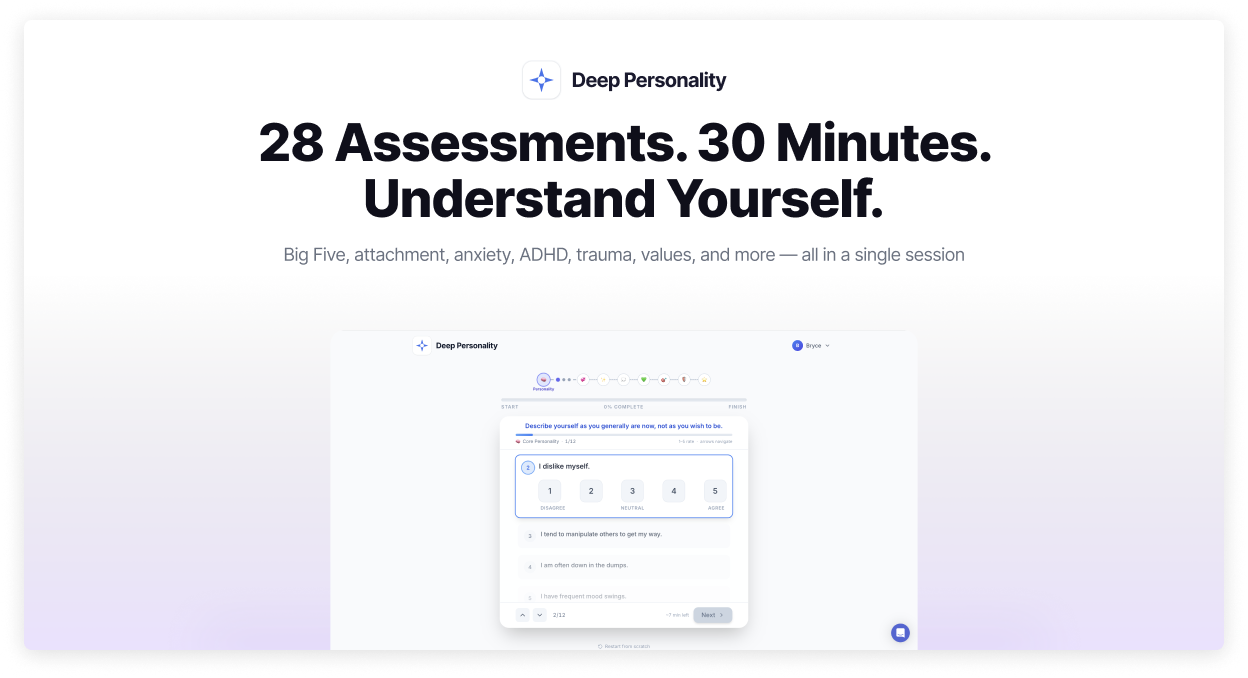
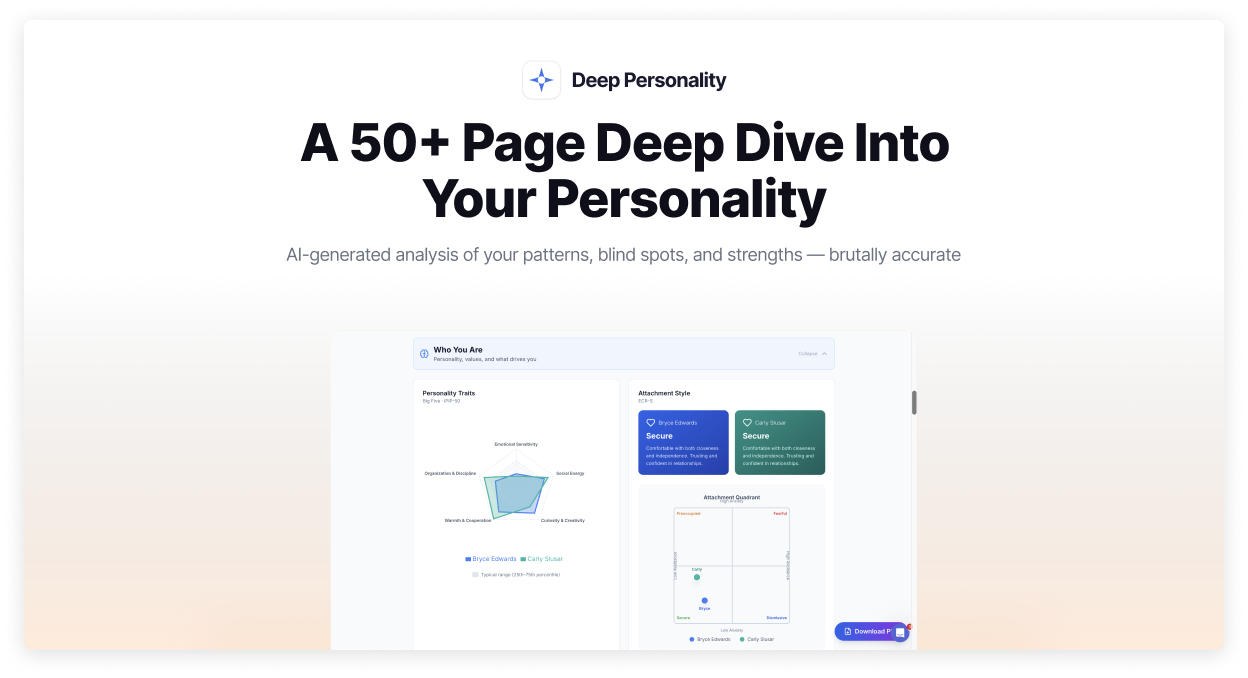
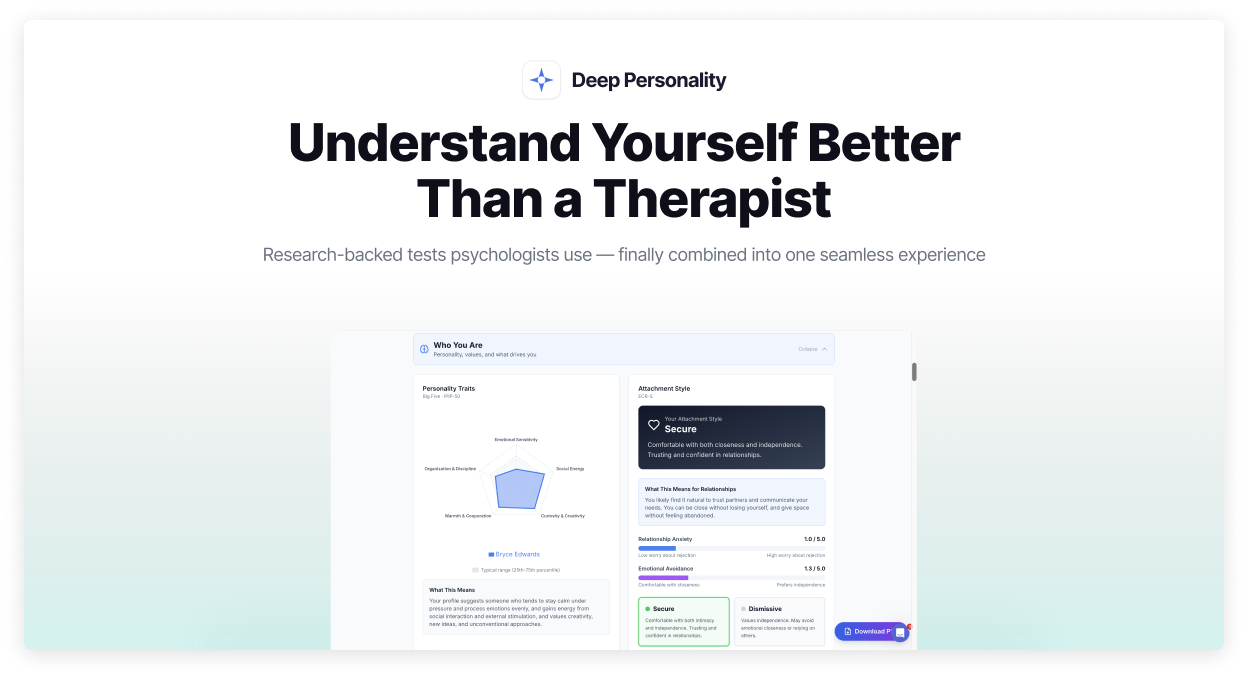
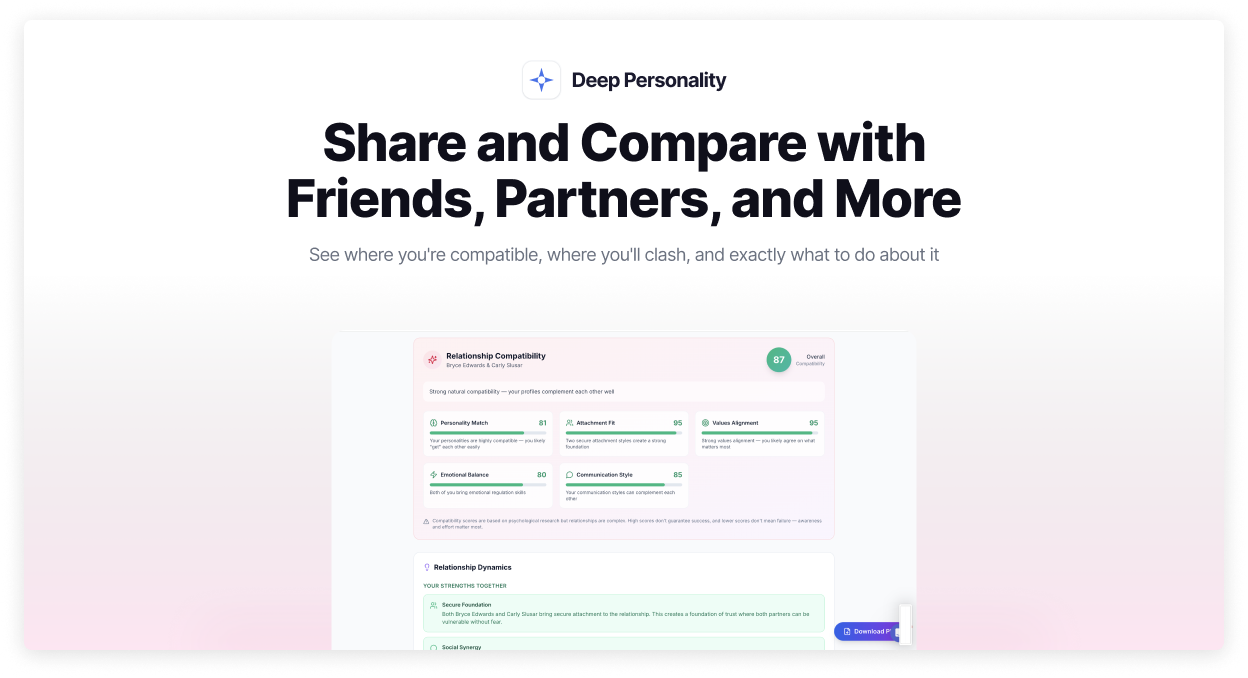
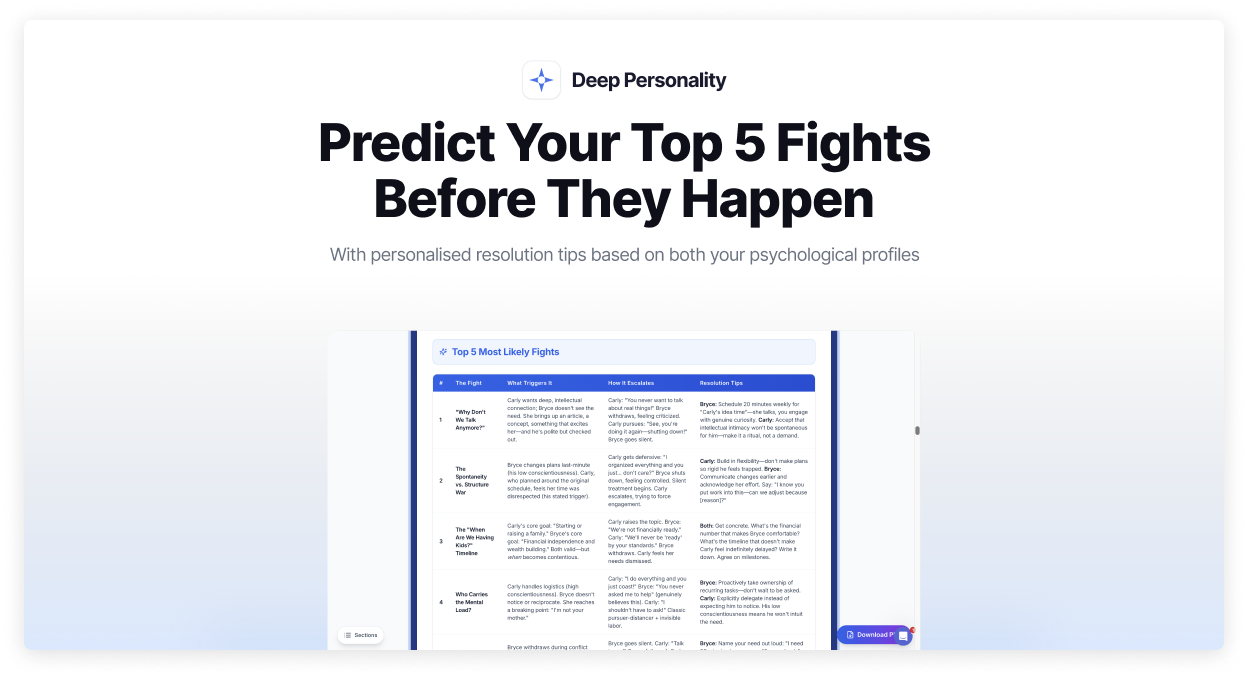
Understand yourself better than a therapist would after 10 sessions. We take you through 28 research-backed assessments for personality traits, attachment style, mental health screening, neurodiversity, values, and more in under an hour. Once you're done, you can see your scores and read an extensive AI-generated analysis of your patterns, blind spots, and strengths. Use the compare feature for an in depth analysis of your relationships with friends, colleagues, family, or romantic partners.
Last month, my girlfriend Zoe and I sat in our den with our jaws on the floor. We were in front of my laptop, taking turns reading a report out loud, line by line. The document read like a CIA dossier — incisively breaking down each of our repeated fights and nailing our relationship dynamics. We had to laugh. We couldn't believe it. A few days earlier, I'd asked ChatGPT a simple but loaded question: "What information would you need in order to become the ultimate personalized relationship coach?" It replied with a long list of personality tests — the same ones psychologists use to evaluate mental health, personality, and relationship satisfaction. The tests were all available online, but scattered across annoying PDFs and awkward, old-school forms. For someone with ADHD, like me, the idea of doing them one by one was pure torture. I just wanted to pound through them as one big test. So I built one. Deep Personality combines 28 validated psychological assessments into a single session that takes under an hour — Big Five personality, attachment styles, anxiety, depression, ADHD, trauma, sensory processing, values, and more. You get a 50+ page deep dive on your personality. It feels like finally getting the owner's manual for myself. But the real magic happens when you compare with someone. Have your partner, friend, or coworker take it too, and the app analyzes how your personalities interact — where you're compatible, where you'll clash, and what to do about it. For couples, it predicts your top 5 most likely fights with specific resolution tips, and more. You also get a custom AI prompt pre-loaded with your psychological data. Drop it into ChatGPT or Claude and you have a therapist who already knows your attachment style, anxiety patterns, and emotional regulation tendencies. No more spending six sessions explaining who you are. It costs a fraction of a single therapy session. I think it might blow your mind. Would love to hear what you think!
6
回复

@awilkinson congrats on this successful launch
Curious to know when wil this b available in UK?

0
回复

@awilkinson This is a wild idea.

A few things I'm wondering:

  1. If someone answers 28 psychological tests in one sitting, how do you deal with fatigue affecting the results?

  2. When the app predicts “your top 5 fights,” how do you avoid people taking that as destiny instead of a tendency?

  3. If someone feeds all this psychological data into ChatGPT, how do you stop the model from overstepping into therapy territory?

The partner comparison part is especially interesting. Have you seen couples actually change behavior after reading the report?

0
回复

too bad it's not available in EU due to GDPR but it looks great! I used LLMs heavily to analyse results from previous tests I took and the tips I got have been useful

0
回复

@mrcpiras I used Opera browser that has an in-built VPN to use it from this side of the ocean

0
回复

Its cool. But Maybe add a interim assesment at milestones. At 15% complete there should be some insight, so that the user is encouraged to continue. # my two cents 🙏

0
回复

@conduit_design It should show mini insights as you go - but also good things come to those who wait

0
回复

I had the opportunity to beta test this app.

If you want (or need) to be seen, this is it.

You don't need a therapist. You can do it on your own time. You can save some money. You're also likely going to get better results.

Opinions are from my own personal experience :)

0
回复

This looks fantastic. I love the level of depth that you're going into. I can imagine it will spark a lot of good insights.

0
回复

@nathanbarry Thanks man! The depth surprised me—the AI connecting all 28 assessments together surfaces patterns you'd never catch from any single test. Try the comparison feature with your partner, that's where it gets wild

0
回复

Almost 20 years ago one of my execs made everyone at Justin.tv (the company that turned into Twitch) take the DISC personality assessment. I thought it was a silly idea at the time, but immediately after we got our results I learned so much about how my work personality interacted with all my cofounders and other leaders in the company. Love this idea!

0
回复

@justinkan The report it writes is honestly scary. It's like they read 10 years of therapist notes on me. Would love to hear what you think if you try it.

0
回复

THIS IS AMAZING -- super helpful. Can't wait to use for our staff :)

0
回复

After seeing how accurate my Deep Personality assessment is, I asked ChatGPT to recommend 20 activities based on the profile to elevate happiness and ensure meaning as I approach retirement. I am looking forward to pursuing all of them! Well done, Andrew. I have already recommended Deep Personality to family, friends and business associates.

0
回复

@dennis_petroskey That's such a cool use case. Hadn't even thought of that. And thanks for spreading the word!

0
回复

It is cool! I've seen how hard Andrew has worked on this, how much he's put into it, to make it legit.

0
回复

This tool is such a gamechanger. I took it, then my wife and mom took it, and then we told friends about it and they've had their work partners take it and everyone has found it super enlightening despite having taken many personality tests before.

0
回复

When I saw this on X I was curious.

But when I took the test I couldn't believe how much i had learnt about myself.

Things I struggled to explain had a reason for being the way they were.

And when i compared my results to my wife's results. It shone a glaringly big spotlight on why our issues were our issues.

This tool was one of the biggest changes in the last couple of months for me.

Thank-you so much for creating it Andrew.

0
回复

@thenicrobb This means a lot man. That moment when something you've always felt but couldn't explain suddenly has a name and a reason. That's exactly why I built this. So glad it's making a difference for you and your wife ❤️

0
回复

I’ve done a bunch of personality profile assessments as well as therapy. Deep Personality aligned with all that prior effort to give me comfort that it's sound and make the new or different insights all the more interesting and useful. The HR companies aren't in trouble in theory, its here.

0
回复

@scott_howard_acc That's the best validation — that it aligns with what therapy and other assessments surfaced while adding new stuff on top. The HR companies should be paying attention because this kind of depth is going to be the new standard

0
回复

Congrats on the launch Andrew!

0
回复

The origin story of asking ChatGPT what it would need to be the ultimate relationship coach and then just building the answer is a great way to solve a product definition problem. The custom AI prompt pre-loaded with your psychological data is also the feature that makes everything else click. No more spending six sessions explaining who you are is a real unlock.

I'm married to a psychologist, so we're both going to take this and compare notes, which should make for a very interesting evening. Curious whether the couple compatibility report holds up under professional scrutiny or surfaces things even a trained eye would find surprising.

@awilkinson One question totally unrelated to the product itself: how did you make the promo video? The motion and pacing are really smooth, and I'd love to know the workflow behind it. Congrats on the launch!

0
回复

@joao_seabra Oh man a psychologist's perspective on the couples report would be so cool. Would genuinely love to hear what she thinks — whether it holds up under professional scrutiny or surprises her.

0
回复

Excited to hear everyone's feedback!

0
回复
#5
SuperMoney
Your money stress, solved by AI.
186
一句话介绍:一款AI驱动的个人财务管理应用,通过连接用户账户、分析财务数据并提供个性化、可执行的省钱与优化建议,在用户面对债务管理、预算规划和财务决策时,解决其因信息繁杂和缺乏专业指导而产生的财务焦虑问题。
Fintech Artificial Intelligence Personal Finance
AI个人理财 财务管理 债务优化 个性化建议 财务产品比较 自动化预算 财务健康 金融科技 智能顾问 数据安全
用户评论摘要:用户关注数据安全与产品独特性,团队详细解释了隐私保护架构(AI不接触个人身份信息)及结合数据、AI与市场的核心优势。有用户询问从现有工具迁移的便利性及新手入门建议,团队强调无缝连接账户和“每周一次检查”的低习惯负担。另有建议拓展全球市场,团队确认是未来愿景。
AI 锐评

SuperMoney并非又一个简单的财务追踪器,其真正价值在于将长达十年的金融产品市场数据、银行级数据聚合与新兴的LLM技术进行了一次“功利性”极强的缝合。它瞄准了一个精准的痛点:收入尚可但财务混乱的中产阶层,他们不足以负担传统财务顾问,却又厌倦了只呈现图表而不给出行动的“哑巴”应用。

产品的犀利之处在于其“三位一体”的架构:数据层(连接账户)、分析层(Sense AI)与行动层(产品市场)。这使其建议能跨越“洞察”与“执行”的鸿沟,例如直接提示更低的贷款利率并提供转换途径。团队强调其AI“看不到你是谁”,这是一种聪明的隐私叙事,将分析模型与个人身份信息隔离,既缓解用户顾虑,也规避了部分监管风险。

然而,其挑战同样明显。首先,其核心价值严重依赖于美国本土的金融产品生态和数据接口,全球化扩张将面临巨大的合规与本地化壁垒。其次,“财务平静”的承诺抬高了用户预期,但个人财务问题的复杂性远超算法模型,AI建议的可靠性、在极端市场下的表现,以及潜在的责任界定,都是尚未经过周期检验的暗礁。最后,作为从产品评论平台转型的应用,它需要说服用户将最敏感的财务数据托付,这需要超越竞品的安全信任建设。

本质上,SuperMoney尝试成为每个用户的“财务副驾驶”。它不是要取代专业的、针对富人的财务规划,而是用自动化与规模化,将基础但关键的财务优化能力民主化。成败关键在于其AI建议的“命中率”与“收益率”——能否持续为用户省下真金白银,并将这种价值感知贯穿于用户体验之中。否则,它极易沦为另一个让用户更焦虑的数据看板。

查看原始信息
SuperMoney
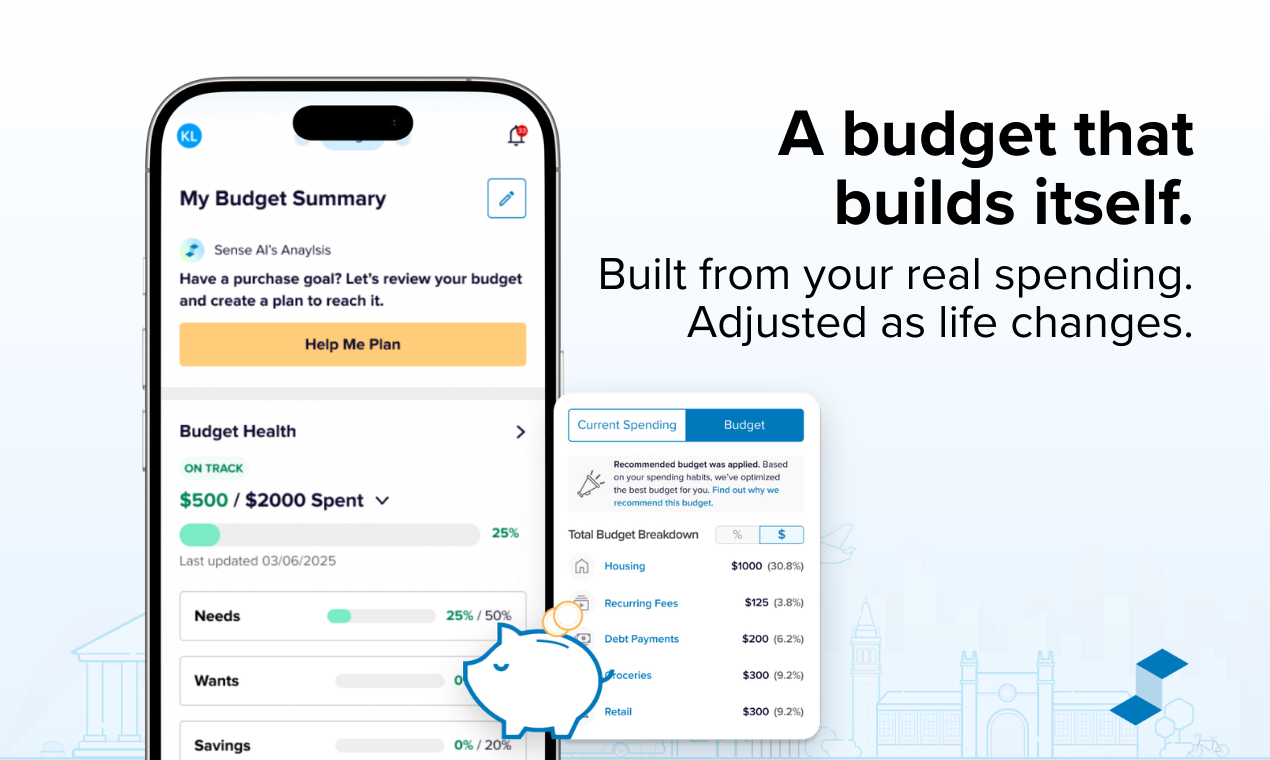
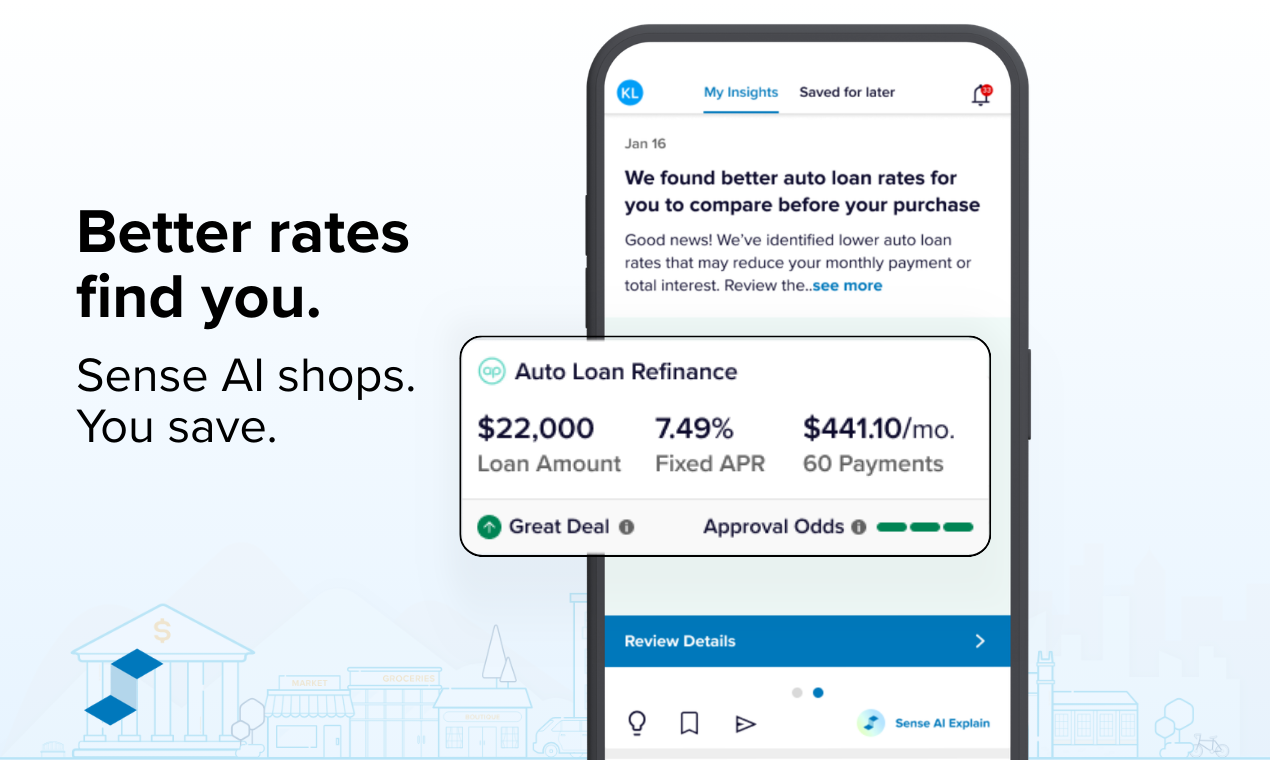
An AI personal finance app that goes beyond tracking. SuperMoney surfaces money-saving actions—optimize debt, spot better options, and stay on plan—so you always know what to do next.

👋 Hey Product Hunt, I'm Miron, founder of SuperMoney.

Nearly 9 in 10 Americans started 2026 feeling financially stressed, according to the National Endowment for Financial Education.

My wife and I were part of that statistic coming out of college, buried in debt. I became obsessed with tools like Mint, but frustrated that you couldn't actually compare financial products side by side with any real transparency.

So in 2013 I started SuperMoney as a financial product reviews marketplace. I thought it was wild that no one had done it.

Fortune 500 companies apparently agreed, sending us cease and desist letters in the early days. We kept going anyway, and it took off.

By 2017 we were already sketching out what an AI financial advisor could look like internally. The problem we kept coming back to: traditional financial advisors operate on an assets under management model, so they're built for the top 1%.

Everyone else is dealing with real financial stress and getting no guidance at all.

The prototypes never quite got there. When LLMs arrived, we knew it was time to actually build it, and give people something most of them have never had: genuine financial calm.

That's what today is. Ten years in the making.

The SuperMoney App connects your accounts and actually does something with the data. Not just pretty charts. It:

  1. Builds your budget, tracks your spending, sets goals, and suggests what to do next to achieve them.

  2. Serves you a feed of insights based on what's actually happening in your finances.

  3. Surfaces lower rates on your existing loans and smarter debt paydown paths. Real savings, not just insights.

  4. When you have a question, you can ask it directly. The AI knows your accounts, your credit, your loans, and your goals, so the answers are actually relevant to you, not generic advice you could Google.

If you earn good money but still feel financially overwhelmed, this was built for you.

Try it free for 2 weeks. If you do, I'd love to know: what would you want us to build next? 🙏

28
回复

Having a financial tracker is one of my must-haves in Adulting. But what needs to be highlighted here is that it gives you insights into what's actually happening in your finances. Congrats on the launch, @miron_lulic

0
回复

@miron_lulic Hi Miron. Congratulations on launching. This is so helpful and convenient, Many people, even myself, feel overwhelmed by debt. What’s the first thing you’d tell someone who doesn’t know where to start? Would you say that your development is helpful in regards to being somewhat of a beginner trying to get their finances together? Do users need to connect their bank accounts for SuperMoney to give good advice, or can they still benefit even without linking accounts?

0
回复

@miron_lulic Very excited about this - I've been thinking a lot lately that this is what the financial industry needs!

0
回复

This could be translated into many languages to make more people across the globe financially aware. 🫠

10
回复

@busmark_w_nika 100% agree — that's the long-term vision! We're starting with the US first to get the experience right, but expanding globally is definitely on the roadmap. Thanks for the support!

7
回复

@busmark_w_nika We absolutely want to make the product available in more countries.

7
回复

@busmark_w_nika Absolutely! We're working on that. In fact, SenseAI is already pretty good at answering financial questions in other languages.

4
回复

How do you protect user data and what is your USP?

10
回复

@viktorgems Great question!

On data protection, SuperMoney is built with security at every layer:

  • Your AI never sees your identity. Our AI analyzes your finances without accessing personally identifiable information.

  • Bank-grade encryption. Your data is protected at rest and in transit with 256-bit encryption.

  • Independently audited. SOC 2 Type II certified for the last 3 years, a rigorous ongoing audit that very few companies achieve.

  • No sharing without your consent. Your data is never passed to third parties unless you explicitly allow it (e.g. to receive a loan rate quote from an integrated lender like Citi Bank).

  • Full control, always. Disconnect accounts or delete your data anytime, no questions, no friction.

On what makes us different: Most financial tools either show you generic product lists or just track your spending. SuperMoney combines 10+ years of real financial product data with an AI advisor that actually tells you what to do and why, based on your specific profile.

Not just pretty charts. It:

  1. Builds your budget, tracks your spending, sets goals, and suggests what to do next to achieve them.

  2. Serves you a feed of insights based on what's actually happening in your finances.

  3. Surfaces lower rates on your existing loans and smarter debt paydown paths. Real savings, not just insights.

  4. When you have a question, you can ask it directly. The AI knows your accounts, your credit, your loans, and your goals, so the answers are actually relevant to you, not generic advice you could Google.


Think of it as the difference between a comparison spreadsheet and a knowledgeable friend who knows your situation and gives you a straight answer.

We call it financial calm: less anxiety, less guesswork, better outcomes.

5
回复

@viktorgems To add to the data security point. We intentionally built the AI so it never sees who you are. It analyzes your financial patterns but has no access to your SSN, or account numbers. That was a non-negotiable for us from day one.

On what makes us different — Most apps do one thing: track your spending, or check your credit, or show you product offers. We combine all three — full visibility into your accounts and credit history, an AI that actually thinks through your situation the way a financial coach would, and a marketplace where you can act on those recommendations immediately. That trifecta is what turns "here's what's happening" into "here's how to do it right now."

7
回复

@viktorgems Security was non-negotiable from day one for our engineering team too. Building the AI to analyze patterns without ever touching PII was one of the most interesting challenges we solved.

1
回复

Hey Product Hunt! 👋

Excited to finally have this out in the world! I worked on the AI chatbot — the piece that lets you ask real questions about your money and get answers based on your actual financial picture.

If you try it, I'd love to hear what surprised you (good or bad). Here all day to answer questions!

9
回复

👋 Hey Product Hunt! So excited to finally share SuperMoney App with this community.

We've been building toward this for over a decade, starting as a financial product comparison platform and now evolving into something that actually tells you what to do with your money, not just what's happening.

The AI doesn't just surface data. It thinks through your situation and gives you a clear next step. That's what we couldn't find anywhere else, so we built it.

Happy to answer any questions about the product, the journey, or the vision. Let's go! 🚀

8
回复

whenever i see @benln hunting the product , its always valuable

8
回复

Hi Product Hunt! So excited to be live. 🚀

Since I started out as a CFP I've wanted to make high-end financial planning accessible to everyone, not just the wealthy. Our team has been building toward this for 10 years, and I’ve loved helping bake real financial logic into Sense AI. I’ll be here all day to answer any questions you have. We’re looking forward to your honest feedback!

8
回复

Hey Product Hunt!

I'm one of the product managers at SuperMoney, and today's launch is the culmination of years of work.


My focus has been on the insights experience—delivering tailored tips based on your data and spending habits, not generic advice. The app doesn't just show you data. It tells you what it means and what to do next. Simple, clear, actionable.

Happy to answer any questions about how we built this!

7
回复

Big day for the team! 👋 It’s incredibly rewarding to finally introduce the SuperMoney App to the Product Hunt community.

As the SEO lead here at SuperMoney, I spend my day looking at the financial questions people are actually asking Google. The truth? Most 'how-to' articles give the same generic advice to everyone.

What’s been so exciting about building Sense AI is that it finally moves past the 'top 10 tips' and gives you a personalized roadmap based on your actual debt and rates. It’s the difference between reading a map and having a GPS.

We’ve been in the game since 2013, so we didn't just 'add AI' to a spreadsheet. We built this engine to understand the actual mechanics of the financial products you're using.

We're going to be hanging out here all day, so please drop any questions!

To the PH community: I'm curious, if you could 'Google' one thing about your personal finances and get a 100% accurate, personalized answer instead of a generic article, what would it be?

Looking forward to your feedback!

7
回复
For someone who already has a system (spreadsheets, their bank app, another budgeting tool), what’s the smallest workflow change that makes SuperMoney “stick,” and what does a successful first 7 days look like in terms of habits and touchpoints?
6
回复

@curiouskitty Love this question because it's the right one to ask.

The honest answer: the smallest change that makes SuperMoney stick is a single weekly check-in, not a new daily habit. If you're already organized, we're not trying to replace your system. We're trying to be the layer on top that tells you when something in your financial life deserves attention and what to do about it.


A realistic first 7 days:


Day 1 (15 min): Connect your accounts, let the AI build your first budget, and make it yours in under 15 minutes.


Days 2-4: Nothing required. Let the AI work. You might get a nudge about a goal or a fresh insight, but no pressure to act.


Day 5-7: One decision. Not ten. Just respond to the single highest-value recommendation SuperMoney surfaced. That's the habit we're trying to build: see insight, evaluate it, act or dismiss it consciously.


What "sticky" looks like after week one: You stopped second-guessing whether you have the best rate on something because you know SuperMoney will tell you if you don't. That's financial calm in practice.

If your spreadsheet is still open, that's fine. We just want to be the thing that tells you when the spreadsheet needs updating.

11
回复

@curiouskitty Great points from the team. From my background in planning, the smallest change that sticks is moving from defense (tracking old spend) to offense (acting on real-time insights).

Success in week one is realizing you’ve spent practically zero minutes on data entry and 100% of your time on clarity. This opens up the mental capacity to actually strategize. Instead of being a data entry clerk for your own life, you finally have the space to be the architect of your financial future.

6
回复

@curiouskitty We also remove the guess work around the next steps by resurfacing all applicable action items via the insights tab of the app that summarizes your financial health and provides recommendation around solutions that can help you build your credit, reduce debt, and strengthen your overall financial picture

2
回复

Hey product hunt, I am a software engineer over at Supermoney.

The team has been hard at work on this product and are eager to share it with you. Looking forward to your feedback and hopefully we can help improve the world a little bit!

5
回复

Hey Product Hunt! 👋🏻

I’m the Lead Product Designer at SuperMoney, and over the past several years I’ve had the privilege of working closely with our incredible team to craft and refine the SuperMoney experience across every platform.

Today, we’re excited to finally share the SuperMoney app with you. SuperMoney is a powerful personal finance management tool designed to help you take control of your financial goals with clarity and confidence. At the heart of the experience is Sense AI — your intelligent companion that provides personalized insights, smart recommendations, and ongoing support tailored to your financial journey.

We’ve put a lot of thought, care, and iteration into building something that truly empowers users, and we can’t wait to hear what you think. Your feedback means everything to us — let us know how we can make SuperMoney even better for you!

5
回复

How could I migrate all my financial status and data to SuperMoney? It could be quite tedious sometimes...

5
回复

@cruise_chen SuperMoney uses bank linking technology to import your data directly from the financial institutions you use. Once you authorize access it's seamless and our AI is able to comb through the data to provide personalized insights and recommendations.

6
回复

@cruise_chen Great question! The good news is there's no tedious manual data entry needed. When you connect your financial accounts through the app, SuperMoney securely pulls in your balances, transactions, and account details automatically. You can link bank accounts, credit cards, loans, and investments all in one place.

Once connected, Sense AI starts analyzing your full financial picture and gives you personalized insights right away. Most users are fully set up in just a few minutes.

If you run into any issues connecting an account, just let us know and we'll help you get sorted! www.supermoney.com

3
回复

Hey Product Hunt, I am one of the product managers that worked on the app.

We're very happy to launch the SuperMoney app. At SuperMoney, we have more than a decade of experience providing financial tools and services to our customers, and this app is the next evolution of our mission to provide automated financing and insights to help you super power your money. Our app (available on web, iOS, and Android) is an AI-powered decisioning platform for all your financial needs that provides you with the tools and means to help you get out of debt, build your financial portfolio, and gain useful insights into your financial health.

We'd love to hear any of your questions about how SuperMoney can help you meet your financial objectives and what we have in store for you in the future

5
回复

So excited to finally see this out in the world! The team has poured an incredible amount of care into this and it shows. If you've ever felt overwhelmed by your finances, give it a try — this is the tool we wish existed. Proud of everyone who made it happen. 🚀

4
回复

Hi Product Hunt! 👋

I’m a software engineer at SuperMoney and I am so excited we can finally share this app with everyone! Our team has been working hard towards this goal for years and we can’t wait to hear your feedbacks.

4
回复
Wow.... Something I definitely need. Even though the money I earn can't even keep me afloat, this can help me track expenses so I see the sides I waste money on and cut it off. Congratulations on your launch 🤝
3
回复

@george_esther Thanks, Esther! Our focus with this app is to help our users find additional savings and pay off debt faster so they can live their lives with greater financial freedom and less stress. We'd love for you to give it a try — your feedback would mean a lot as we continue to improve the experience.

2
回复

@george_esther Thank you so much for the support! 🧡 We really built this for exactly that feeling, when it feels like you're just trying to keep your head above water.

Tracking is a great first step, but we hope the 'Action Plan' helps you find some breathing room you didn't know you had. We're rooting for you!

2
回复

@george_esther Appreciate the support!

2
回复

How does product aggregation work on the platform? Do you partner with all financial institutions and lenders? Essentially, how can we, as users, be sure we're getting an unbiased view into the best possible options for our personal situation?

2
回复

@jason_van_rensburg Great question. We've built a data orchestration layer with coverage across all major financial institutions and lenders, which allows us to easily fetch transaction and credit details. On top of that, our Sense AI technology analyzes your financial data to provide personalized, unbiased recommendations tailored to your specific situation. Our focus is to give our users complete visibility into their financial health and recommend actions that can help them achieve their personal objectives

2
回复

@jason_van_rensburg Great question, and transparency here matters so we'll be direct.


SuperMoney has been building financial service relationships since 2013. We have direct API integrations with hundreds of providers including Citibank, SoFi, LendingClub, and many others, which means real-time rate quotes pulled directly from the source, not estimates.

How the product coverage works:

For rate quote experiences (personal loans / debt consolidation, auto refi, student loan refi, etc.), we show live quotes from our integrated partners. Think of it like a flight search engine: we can only show fares from airlines in our network, but our network is extensive and growing.

The broader marketplace covers thousands of financial products from both partners and non-partners, similar to how Yelp lists every restaurant, not just the ones that advertise.

On the unbiased question specifically:

Our entire product database is accessible by the AI via MCP, so when the AI makes a recommendation, it's working from the full picture, not a curated subset. And critically, the AI is explicitly prompted to recommend what's best for you, not what's most profitable for us.

We don't publish arbitrary editorial ratings. Qualitative scores are based entirely on community NPS, real ratings from real users. Quantitative comparisons are based on actual product terms: rates, fees, terms, approval likelihood. The goal is to give you the financial transparency to make your own call, not to nudge you toward a particular product.

While the marketplace component is a feature of a broader experience, we may be compensated by partners when you choose their product, similar to how flight search engines work. But our ranking logic is built around your profile and product fit.

3
回复

@jason_van_rensburg One thing worth adding: the unbiased piece is structural, not just intentional. Because the AI pulls from the full product database — not a pre-filtered list — it can't be "nudged" toward partners the way traditional comparison sites can. The ranking reflects your profile and product fit first. Compensation may follow a match, but it doesn't determine one.

1
回复

Hey Product Hunt!

I am VP of Operations at SuperMoney.

Today is a day I have been looking forward to for a long time.

What I want to highlight from my perspective: the SuperMoney app is built on top of relationships with the broadest set of financial service providers in the space. That means when the AI recommends something to you, it is not generic advice. It is backed by real options that actually exist for your specific financial situation.

That robustness is what allows our AI to move beyond tips and actually tell you what to do next. It is not just smart data analysis. It is smart analysis connected to real, actionable solutions.

Huge congratulations to the team. We are here all day and would love your feedback.

1
回复
#6
Springfield Oracle
Every Simpsons prediction sourced, scored, fact-checked
160
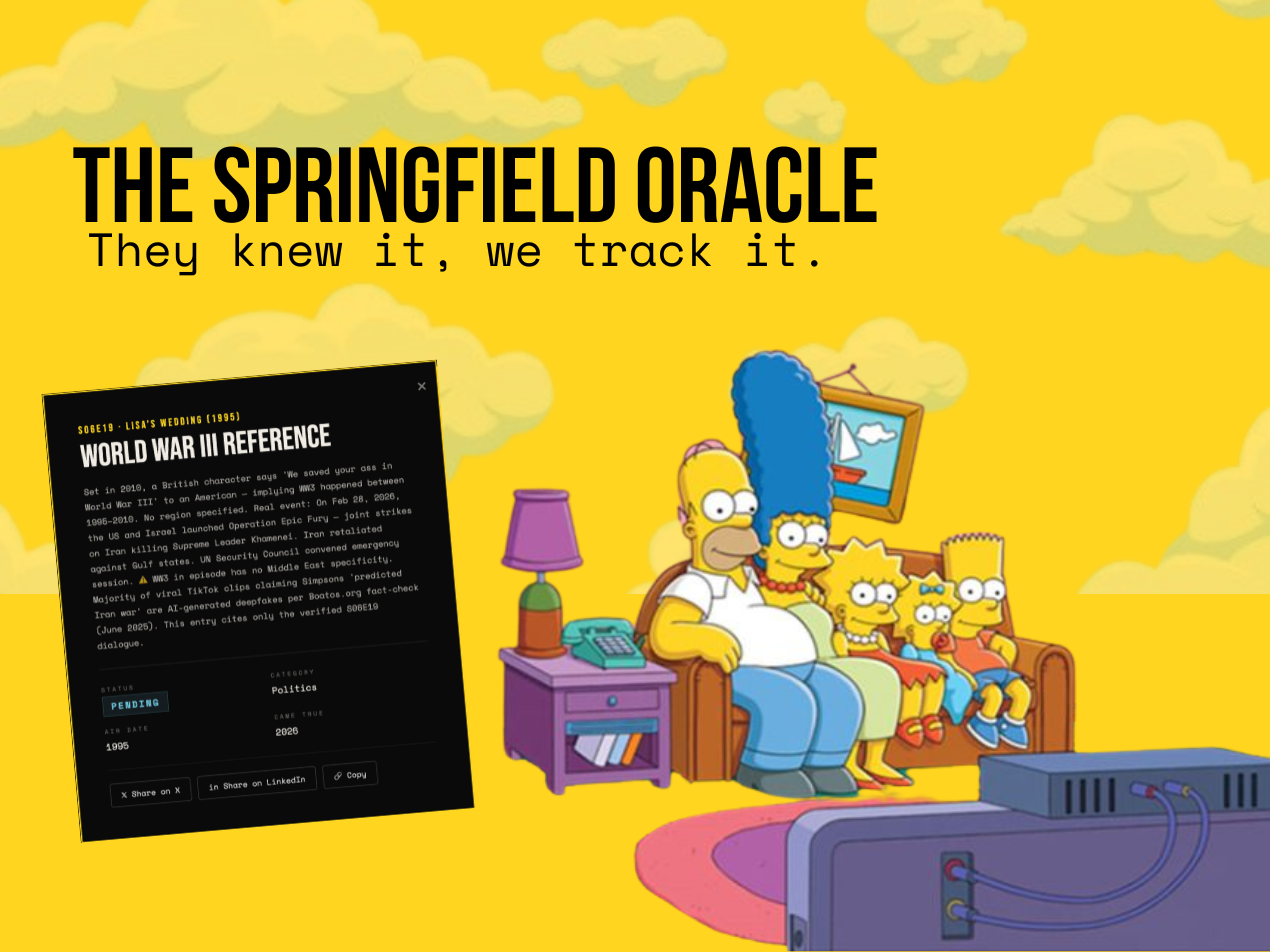
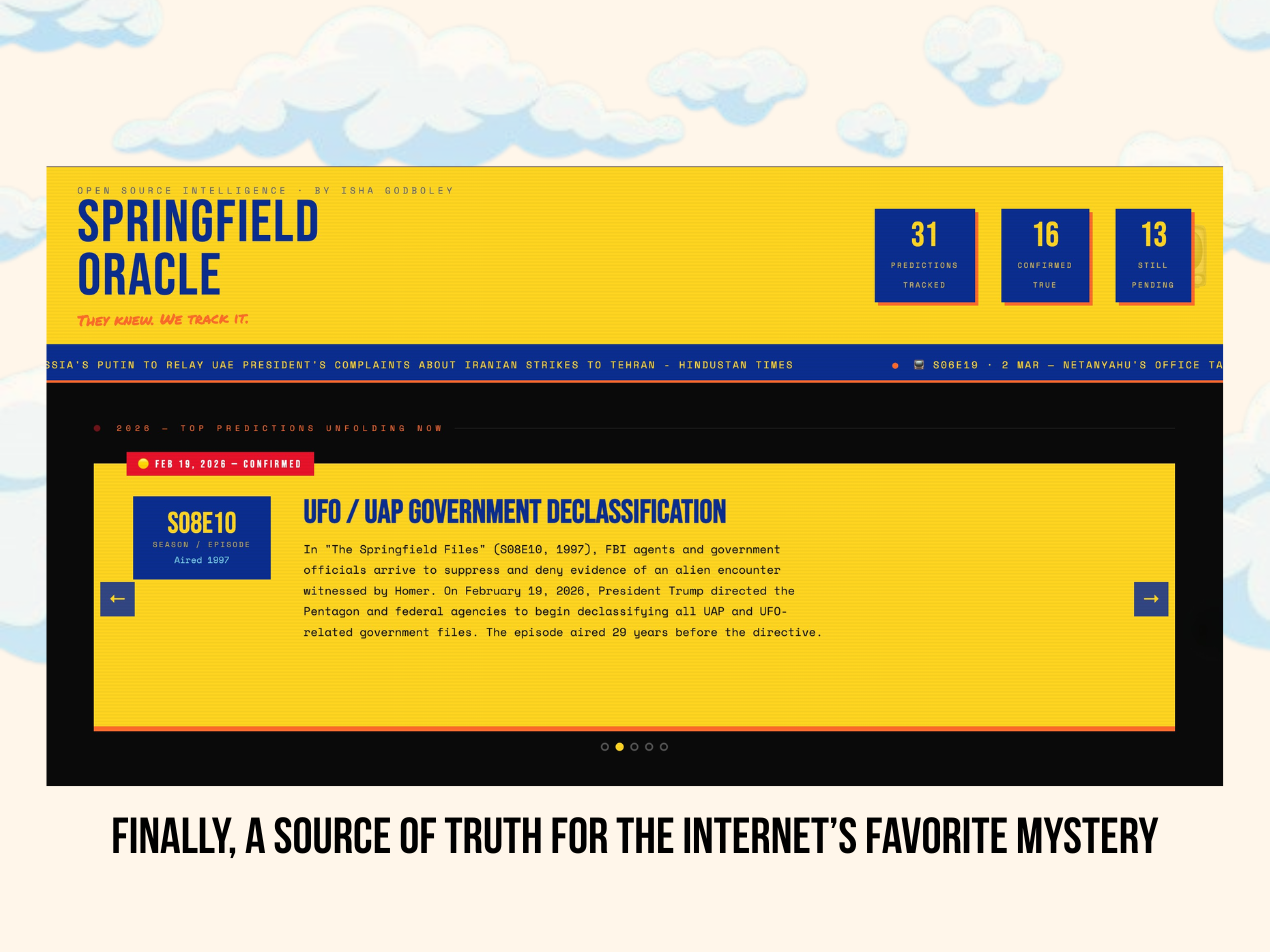
一句话介绍:一款针对“《辛普森一家》预言”网络迷因进行溯源、评分和事实核查的数据库工具,在信息混乱的社交媒体场景下,帮助用户快速辨别相关视频剪辑的真伪,打击AI深度伪造和虚假信息传播。
News Artificial Intelligence Entertainment
事实核查 流行文化数据库 溯源工具 媒体素养 开源项目 社区驱动 信息验证 辛普森一家 网络迷因 AI打假
用户评论摘要:用户普遍赞赏其打击深度伪造、建立可信数据库的初衷,认为其“存证”和“争议”标签设计增强了可信度。主要建议包括:增加社区提交与投票验证功能、完善模糊预言的评分维度(如置信度)、开发按现实事件反向搜索功能,并期待其成为该垂直领域的“Snopes”。
AI 锐评

Springfield Oracle 表面上是一个趣味性的流行文化数据库,但其内核是一次针对后真相时代信息传播基础设施的精准手术。它的真正价值并非在于证明《辛普森一家》有多“神”,而在于它试图为一种高度混乱、被AI生成内容严重污染的网络迷因现象,建立一套可验证的“源语法”。

产品聪明地抓住了两个关键痛点:一是病毒式传播内容普遍存在的“溯源缺失”,二是AI深度伪造技术让这种缺失变得致命。它没有陷入“预言是否成真”的哲学辩论,而是退一步,先解决更基础的问题:这个剪辑是否真实存在?它出自哪一季哪一集?其声称的关联事件是否有可靠信源?这种将“事实核查”流程应用于娱乐文化领域的降维打击,是其专业性的体现。

从评论中开发者的回应可以看出,项目面临着核心的方法论挑战:如何对“模糊预言”进行量化评分而不沦为新的谣言温床。其提出的“置信度分层”未来规划是正确方向,但这要求极其严谨的维度设计和公开透明的评分标准,否则自身权威性将受质疑。此外,产品的可持续性高度依赖社区运营,如何设计机制以确保用户提交内容的质与量,将决定其能否从个人项目进化为活的公共知识库。

本质上,Springfield Oracle 是一个关于“我们如何知道我们知道什么”的微型实验。它在一个狭小但高关注度的领域内,示范了如何用开源、结构化和社区协作的方式,对抗信息的熵增与恶意操纵。它的成功与否,不仅关乎一个动画片的预言,更关乎我们能否为互联网上任意一个声称“某某早已预言”的瞬间,构建出普遍适用的验证框架。

查看原始信息
Springfield Oracle
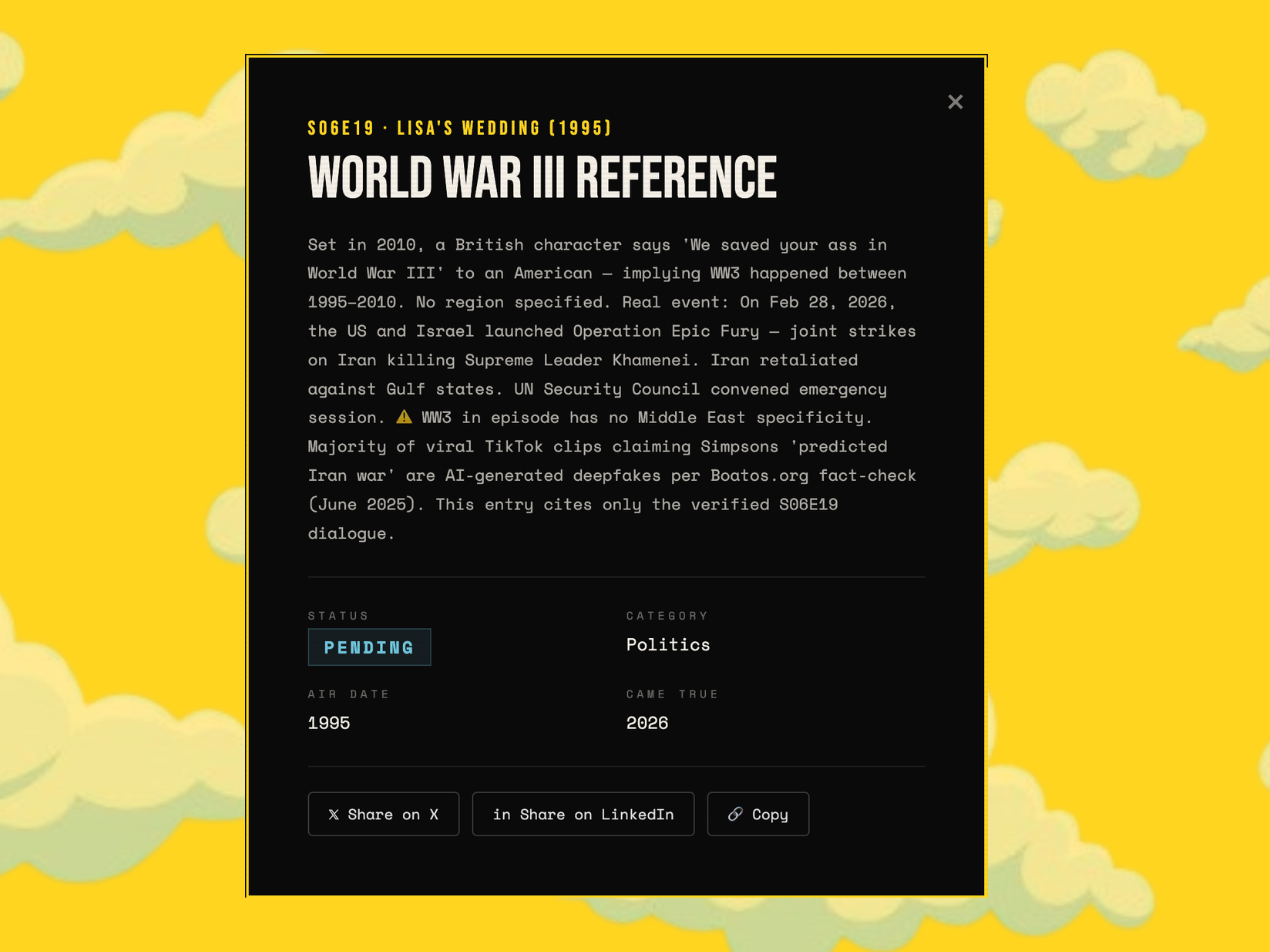
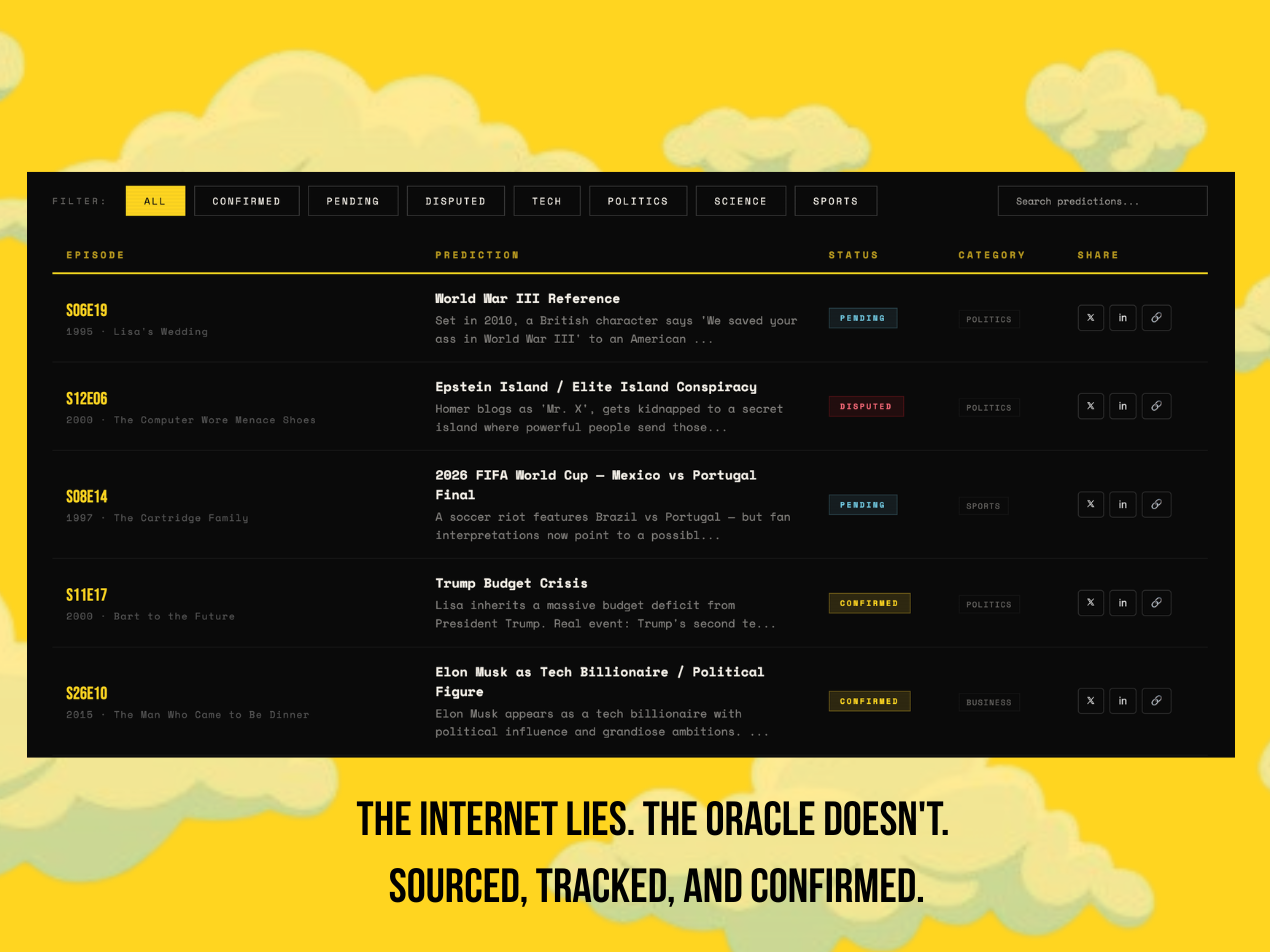
Viral Simpsons prediction videos have no sources. Half the clips are AI-generated fakes, and nobody built the actual database until now. Springfield Oracle tracks every prediction with verified episode references, real event citations, and honest fact-checks. The world so far has been relentless, and the Simpsons wrote all of it. Springfield Oracle tells you which claims are real. And which aren't.
Hey PH 👋 I built Springfield Oracle because I was tired of the same cycle. Something happens in the world. Someone posts a Simpsons clip. It goes viral. 10 million views. No episode reference. No source. Half the time it's a deepfake. The Simpsons has been on air for 35 years. It deserves better than that. So I built the database nobody had built. Every prediction is sourced to a real episode. Every claim is checked against a real event. Nothing marked Confirmed without receipts. The world so far has been relentless — Iran strikes, H3N2, the Epstein Files, the first American Pope, and UAP declassification. The Simpsons called most of it. Springfield Oracle shows you exactly when, how, and whether the viral version you saw is actually true. It's free. It's open source. Community submissions are open — if you find a prediction we missed, submit it, and it goes into the database. Would love your feedback on what to track next. 👇
11
回复

@isha_godboley Hey Isha. This is so intelligent. In your research, have you found patterns in episodes that do line up with real events, like social media virals versus actual clips? How do you think media literacy plays into why these predictions go viral?

0
回复

@isha_godboley The fact that you label some as "Disputed" instead of confirming everything for clicks is what makes this credible. Great project.

One question: do you plan to add a feature where users can submit potential predictions they spot in episodes, with a community voting or verification system before they go live on the tracker?

0
回复

@isha_godboley Love the idea of separating real predictions from viral myths.

  1. How do you decide what counts as a real prediction vs coincidence?

  2. Do you track false viral claims too? That might be just as interesting.

  3. Are you planning to let people search by event first (e.g. AI, elections, pandemics) and then see if a Simpsons episode referenced something similar?

Feels like this could become the Snopes of Simpsons predictions, which the internet definitely needs.

0
回复

Hi everyone, thank you so much for all your support and helping us get to #5. Onward and upwards from here on!

2
回复

Super cool! Sad to see all those predictions happen but love the creativity here.

2
回复

@prao25 Unfortunately, that's how the world has become :( But I guess it gives some sense of preparedness in the chaos. Thanks!

2
回复

wow this is a game changer for people like me there are many claims i am not able to crosscheck all

2
回复

@chinmay_dokania I know this is going to be a site you'd come back to often. I assure you it's worth the bookmark!

0
回复

How cool is that, since I have watched only a few episodes and we have the internet full with such claims it would be nice abd useful to fact check them.

2
回复

@viktorgems Absolutely, and that's what we're building for. As we grow further, we'll be adding more predictions, episodic context and fact-check with the real world events. Thanks for the support!

2
回复

More accurate than reddit about who's going to win the next election. Crazy stuff. Congrats on the launch

2
回复

Hahaha, better than wasting all your time going down the prediction rabbit hole, only to find out it was all AI slop. It's time we started keeping reciepts. Thanks for the support @harshxharsh !

0
回复

Hi everyone 👋

I kept wondering If thousands of people claim “The Simpsons predicted this”…

Why was there no actual database?

Springfield Oracle is our attempt to turn internet chaos into something structured.

The real question is: What happens when pop culture becomes data?

Curious to hear your thoughts.

2
回复

Love the name behind this idea, spot on and very pop culture. Congrats on the launch, @isha_godboley!

1
回复

@neilverma Thank you, that was the idea. Something that every Simpsons watcher would immediately catch and relate with.

1
回复
it's fun and entertaining.
1
回复

@vandonova Thanks!

0
回复
Congrats on the launch, really interesting idea, few years back we could just easily point out and correlate events with Simpsons episodes because it's just hard to recreate. Nowadays anyone can just generate it with a prompt so now even if someone attempts a correlation, an immediate fact check can be done.
1
回复

super super cool! got an early preview and i spent a LOT of time going through this.

this is the kind of personal projects to like to see 🫡

1
回复

@kritikasinghania Thank you so much, Kritika!

0
回复

Honestly, in a sea of AI agent projects, it’s so refreshing to come across something like this! The branding and visual identity really stand out too, it's really nice !

Just out of curiosity, how long did it take you to build this database? And what’s your process for keeping it updated as new viral clips (or new predictions) pop up?

Great work, in any case!

0
回复

@yoannajuille Thanks Yoanna! It took about half a night to cover this, and down the line, I'm going to use a lot of Claude Code and a little bit of manual effort on keeping the predictions updated, along with a lot of crowdsourcing help.

0
回复

The deepfake problem is what makes this actually necessary rather than just fun. When half the viral clips are fabricated, the whole "Simpsons predicted it" phenomenon becomes impossible to reason about without a sourced database. This is the infrastructure that should have existed years ago.

The scoring system is the right call too. Confirmed with receipts versus Pending versus debunked are very different things and collapsing them all into "the Simpsons predicted X" is where most of the misinformation comes from.

Curious about the methodology for borderline cases. When a prediction is genuinely ambiguous, like something that kind of happened but not quite the way the episode described, how does the scoring handle that nuance? Is there a partial match category or is it binary?

0
回复

@joao_seabra Exactly the right question and honestly the hardest part of building this.

Right now, the system is deliberately conservative; if it doesn't meet the bar for Confirmed, it goes to Disputed or Pending, no partial credit. The risk of a "partial match" category is that it becomes a catch-all for lazy confirmations. "Kind of happened" is how misinformation starts.


There are genuinely interesting cases where the episode got the concept right but the details wrong, or got the details right, but the framing is contested.

The longer-term plan is a confidence layer that sits beneath the status, essentially a score that reflects how closely the episode maps to the real event across a few dimensions: specificity, timing, and source quality. So you'd see Confirmed at 91% versus 67% and immediately understand that one is a direct match and the other is a reasonable interpretation.

Not live yet. But that's where this goes.

3
回复
#7
Mailercloud Email API Platform
1,000+ Emails per Second with 99%+ Deliverability
158
一句话介绍:Mailercloud Email API 为开发者和成长型企业提供高吞吐、高送达率的一站式邮件发送基础设施,解决了在SaaS、金融科技等场景中,事务性邮件与营销邮件需分开管理、送达率难以保障的核心痛点。
API Email Marketing Developer Tools
邮件API 邮件基础设施 邮件送达率 事务性邮件 营销邮件 开发者工具 SaaS解决方案 邮件监控 高并发发送 邮件投递保障
用户评论摘要:用户普遍认可产品方向,核心关切点集中于如何保障邮件不进垃圾箱、如何隔离事务与营销邮件流量以保护关键邮件送达率,以及新域名/IP的预热机制是否自动化。创始人回复了部分技术细节。
AI 锐评

Mailercloud此次从营销工具向“全栈邮件基础设施”的转型,精准切中了一个被许多平台服务商刻意模糊的痛点:将高敏感的事务性邮件(如OTP、账单)与批量营销邮件在底层基础设施上进行混同管理所带来的巨大送达风险。其标榜的“99%+送达率”和“1000+/秒”吞吐量是行业入场券,而非真正的壁垒。

真正的价值在于其试图将邮件发送从“功能”提升为“可观测、可管控的基础设施”。实时追踪、域名认证、收件箱监控等功能模块的整合,意味着它开始为开发者提供送达率的“可观测性”,这是从黑盒走向白盒的关键一步。然而,用户评论一针见血地刺穿了所有邮件服务商最脆弱的环节:冷启动与流量隔离。声称的高送达率在成熟IP池上不难实现,但如何为每个新客户的新域名提供自动化、安全的预热流程?能否真正做到事务与营销邮件的IP池、域名乃至信誉体系隔离?这不仅是技术问题,更是产品哲学与运营能力的体现。

当前市场不缺邮件API,缺的是真正理解“邮件即关键业务基础设施”并提供零信任、高可靠保障的供应商。Mailercloud看到了这个缝隙,但用户尖锐的提问表明,其产品叙事与市场最深的焦虑尚未完全弥合。若能在自动化预热、强制隔离策略与透明的信誉报告上构建起坚实护城河,它才有机会从众多声称“高送达率”的供应商中脱颖而出,成为严肃业务的首选。否则,它可能只是另一个功能更全的邮件服务商而已。

查看原始信息
Mailercloud Email API Platform
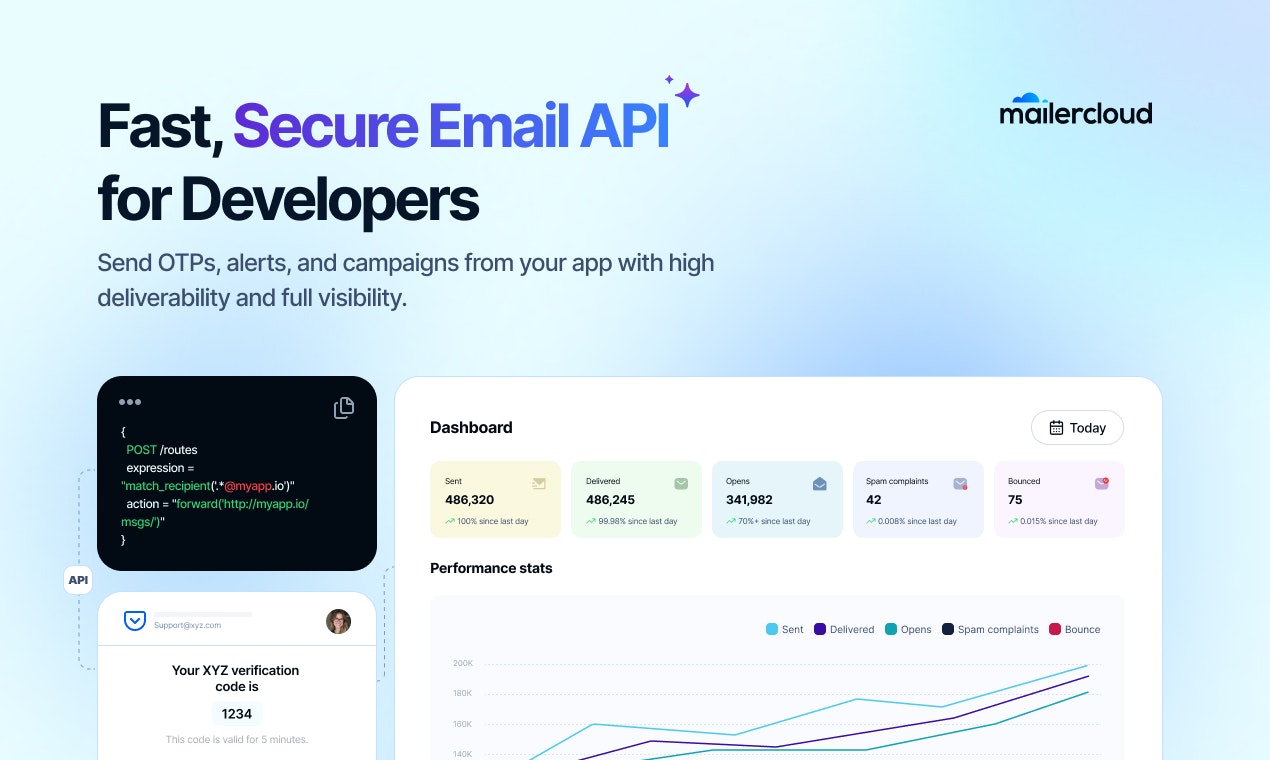
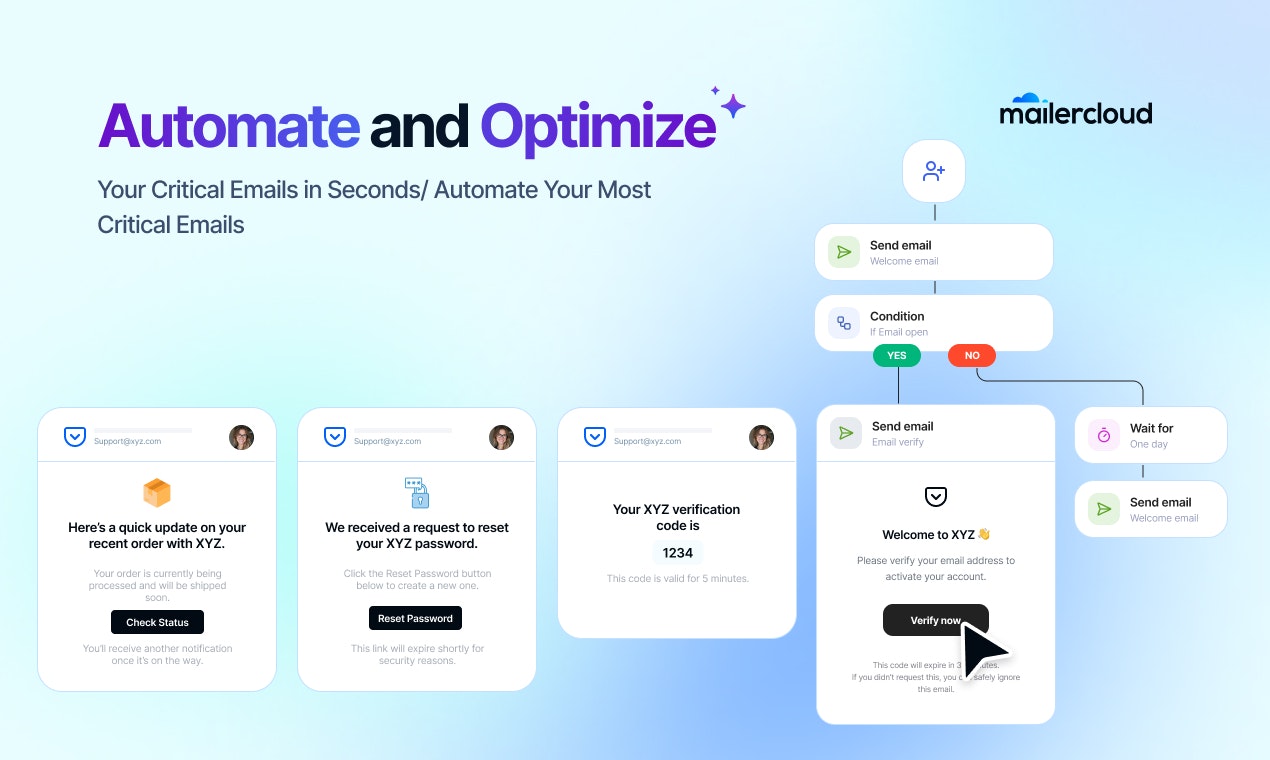
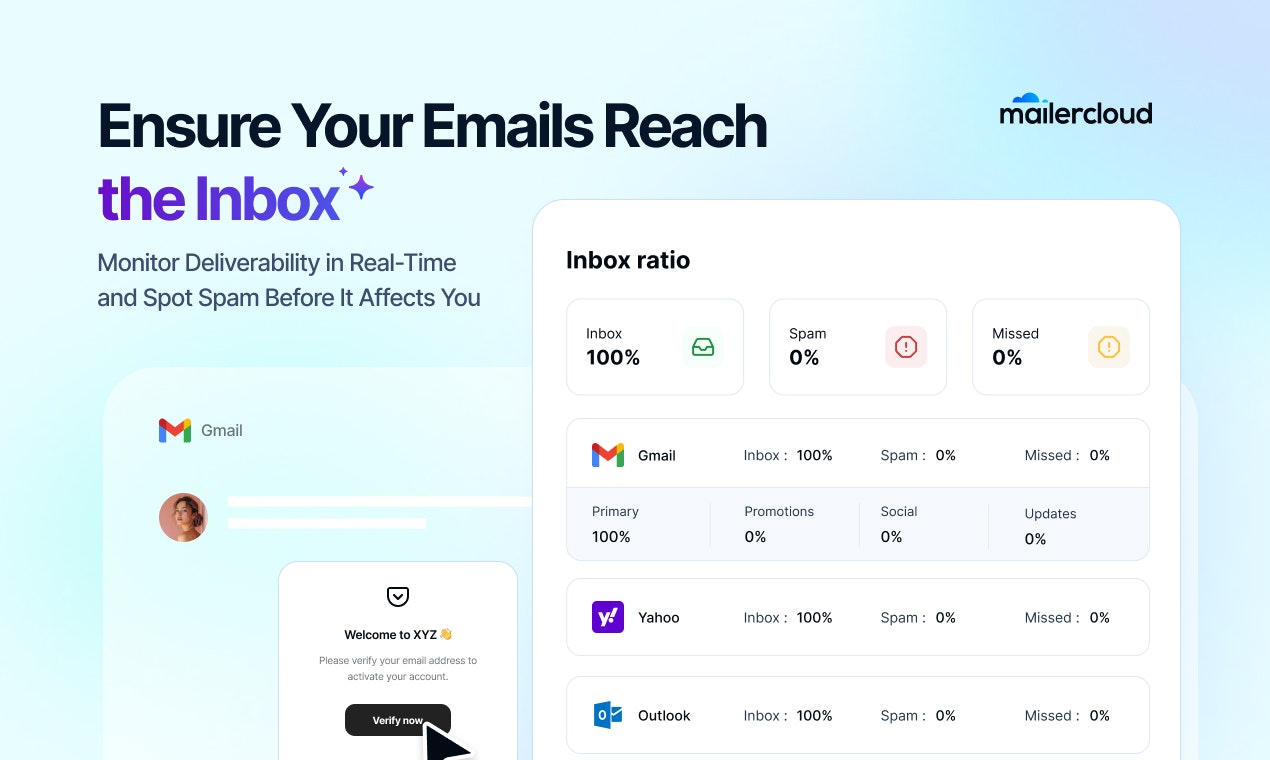
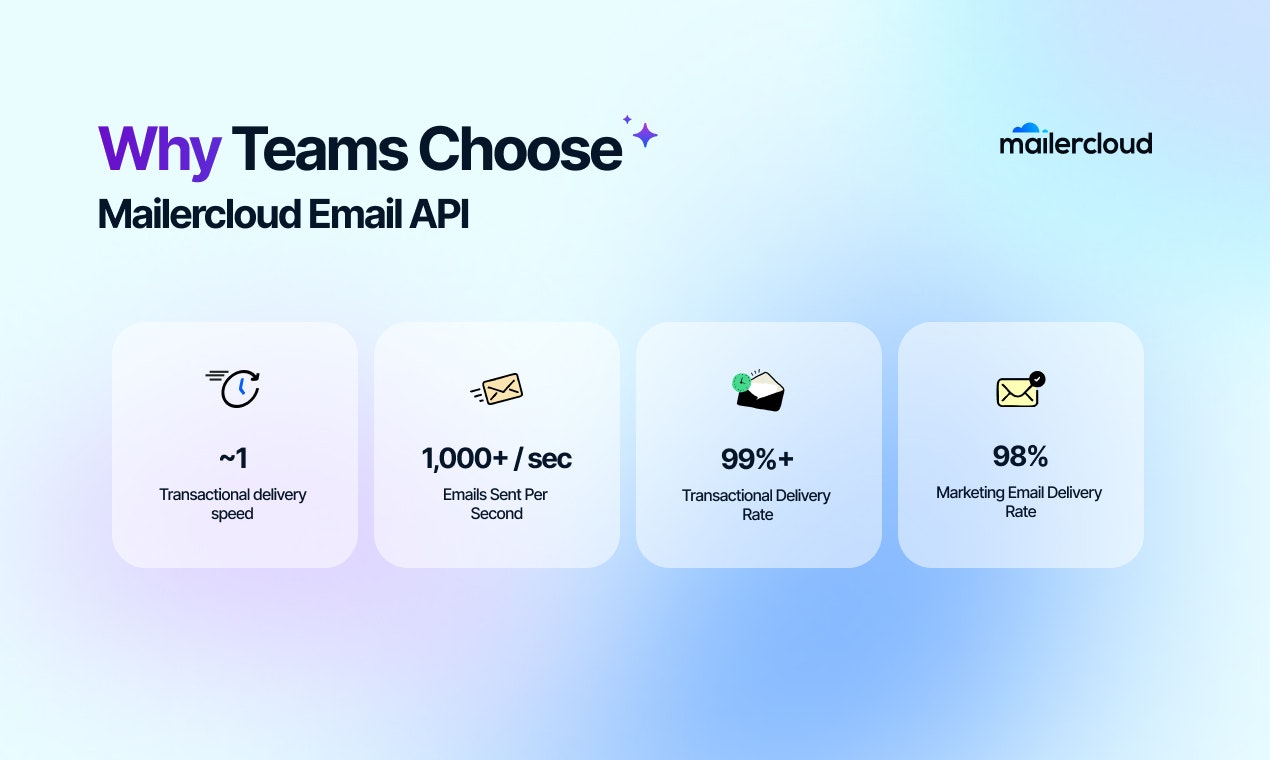
Mailercloud Email API helps developers send transactional and marketing emails at scale with 1,000+ emails per second throughput and 99%+ deliverability. Built for SaaS platforms, fintech apps, and growing businesses, it offers real-time tracking, webhook support, domain authentication, and inbox monitoring — so your critical emails land where they should: the inbox.
Hello Product Hunt Community 👋 I'm Vinoop, Co-Founder of Mailercloud, and I'm excited to introduce Mailercloud Email API — built to help developers send both transactional and marketing emails with speed, scale, and high deliverability. Many of our customers needed more than campaign tools — they required reliable infrastructure to send OTPs, alerts, password resets, order confirmations, and marketing communications from a single platform. With this launch, we’re expanding Mailercloud beyond email marketing into powerful email infrastructure for growing businesses. Key Highlights: ⚡ 1,000+ emails per second throughput 📈 99%+ deliverability performance 📊 Real-time tracking & webhooks 🔐 Secure domain authentication & inbox monitoring We would truly appreciate your feedback and questions — especially from developers building products that depend on reliable email delivery. Looking forward to your thoughts and discussion 🚀
4
回复

@vinoop_thayatt Hey Vinoop. How does Mailercloud ensure that emails don’t end up in spam? Is it just technology, or are there best practices users must follow too?

1
回复

@vinoop_thayatt In Mailercloud, do you split transactional and marketing sends into separate domains or IP pools so a campaign spike can't hurt OTP deliverability? Domain authentication, inbox monitoring, and webhooks are the right building blocks, and guided warm-up plus suppression defaults would make onboarding feel safer.

0
回复

This is called gold

2
回复
@kshitij_mishra4 thanks. Really appreciate your support 🙏🏽
0
回复
Email API adds real power to the platform💪 Congrats on the launch @vinoop_thayatt @amar_cp @shigha_tharayil 🔥🔥🔥
1
回复

Thanks @anvartk

1
回复

This is great, @vinoop_thayatt! Does it sort your email into folders as well? Congrats on the launch!

0
回复

This sounds like a powerful tool. Since it supports sending up to 1,000 emails at once, does it also have safeguards in place to ensure deliverability and prevent messages from landing in spam or promotions?

0
回复

Congrats on the launch! This looks like a solid upgrade for teams that need both marketing and transactional emails in one place 🚀

0
回复

This looks super interesting - great job Vinoop and team. Keen to test Mailercloud out.

0
回复

The move from email marketing tool to full email infrastructure is the right expansion. Teams building SaaS products don't want to stitch together separate providers for transactional and marketing emails, and the deliverability risk of doing it wrong on OTPs and password resets is too high to cut corners on.

99%+ deliverability is the number everyone claims but the real question is how it holds up on cold domains and newly authenticated sending infrastructure. How does Mailercloud handle the warm-up period for new domains, is that managed automatically or does the developer need to control it manually?

Building a SaaS platform myself right now and reliable transactional email for things like billing confirmations and auth flows is exactly the kind of infrastructure that needs to just work without babysitting. Congrats on the launch!

0
回复
#8
Lavalier AI
Interview Intelligence to make confident hiring decisions
155
一句话介绍:Lavalier AI是一款面试智能平台,通过AI记录、分析并结构化面试对话内容,帮助招聘团队在更短时间内基于证据做出更自信的聘用决策,解决了传统面试流程中信息丢失、效率低下且依赖模糊记忆的痛点。
Hiring Artificial Intelligence Human Resources
招聘科技 AI面试助手 人才评估 面试智能 招聘流程优化 HR SaaS 结构化面试 证据驱动决策 招聘协同 公平招聘
用户评论摘要:用户反馈积极,认为产品提升了面试质量和决策效率,尤其赞赏其以候选人为中心、辅助而非替代人类决策的理念。主要建议包括:为小团队提供更清晰的价值主张、增加应用内引导以发现高级功能、未来开发候选人版本,并询问对技术面试场景的支持。
AI 锐评

Lavalier AI的亮相,远不止是HR科技栈中新增了一个“AI转录与总结”工具。其真正的锋芒,在于试图根治一个行业顽疾:面试过程中的“信号衰减”与“证据缺失”。传统面试如同一场低效的“传话游戏”,从面试官的瞬时记忆、潦草笔记到延迟反馈,核心信息不断损耗,最终决策往往依赖于模糊的“感觉”或“性格”印象,这直接导致了糟糕的招聘质量和高昂的失败成本。

Lavalier的解题思路是“回归本源”——锁定候选人的原话作为不可篡改的证据基石。但这只是第一步。其更深层的价值在于,它通过“定义角色-生成问题-对齐标准”的前置流程,试图干预和规范面试行为本身,引导面试官提出正确的问题,从而从源头生产出有效的、可比较的“证据”,而非仅仅事后美化一场无效的对话。这使其与市面上泛滥的通用会议转录工具产生了本质区别:它提供的是贯穿招聘生命周期的“决策支持系统”,而不仅仅是事后的“记录仪”。

然而,其面临的挑战也同样清晰。首先,市场教育成本高昂,需要让用户理解其与免费转录工具的本质差异。其次,如何平衡“引导”与“僵化”,确保流程结构化而不扼杀面试中必要的、灵活的深度探究,将是对产品设计的长期考验。最后,创始人Jensen Harris坦诚的“求职失败”故事赋予了产品强烈的情感共鸣,但将其转化为广泛的商业成功,仍需证明其在多样化行业和复杂职位(如技术面试)上的普适性与深度。如果成功,Lavalier有望成为招聘领域的“新基建”,将面试从一门“玄学”转变为一项可衡量、可优化、更公平的决策科学。

查看原始信息
Lavalier AI
Lavalier AI helps you raise your hiring bar with interview intelligence that drives better hiring decisions in more than half the time. Easily define the role you're hiring for. Generate interview questions designed to evaluate skills. Compare candidates against the same job criteria. Get to a confident hiring decision — faster than ever. 🎁 Click Visit above to sign up for Lavalier, unlock 500 bonus credits, and hire for your next 5+ roles for free. 🎁

Hi Product Hunt! 👋 I'm Jensen Harris, one of the founders of Textio, and I've lost a lot of sleep over the last year waiting for this day 🤞

Here's the deal: I hate many parts of the standard job interview process SO MUCH.

Don't get me wrong, I love hiring people. Meeting smart, engaged humans and figuring out how they could thrive—that part is genuinely wonderful. But all the make-work and drudgery that goes into a standard interview process? It fills my heart with dread.

First the prework, where I think about what I intend to ask and then promptly forget during the interview. Then the endless notes I have to take that make the candidate think I'm multitasking. Don't forget the post-interview feedback essay I'd put off writing for days because I had an actual job to do, by which point I'd forgotten half of what we talked about. Oh, and the debrief meeting a week later where everyone shares half-remembered observations and their most visceral gut feelings.

Candidates who receive job offers are 12x more likely to be described as having "a great personality" than rejected candidates. No wonder, it's probably all most people remember. Great way to make hiring decisions! 🤮

Here's a story I've been embarrassed to tell publicly: I've never successfully been hired for a job as an adult.

I started at Microsoft through a college intern program and just never left. When I was ready for my first big career change, I was rejected dozens of times. Seven full onsites, zero offers. For one, I prepped for weeks, flew a thousand miles, bought and put on the scratchy wool suit they required (!!!). Spent two days with them, felt optimistic. And when the rejection call eventually came weeks later, they described conversations I know for a fact I never had. They'd mixed up my feedback with someone else's.

After all that effort, they'd lost track of who I even was.

That feeling—"they didn't actually hear my words!"—still sits in the pit of my stomach over a decade later.

It was in Chicago, digesting a (mediocre, honestly) deep dish pizza with the team when what became Lavalier showed up suddenly like a hot fire in my brain. What if we centered the entire interview process on the candidate's own words? Not the game of telephone from interview to notes to feedback form to verbal debrief, but what the candidate ACTUALLY SAID!

I wrote the very first lines of code at the Alaska Airlines gate in Chicago's Terminal 2 as the core parts of the platform started to form in my mind: role intake that helps recruiters define what actually matters in minutes instead of meetings. Interviewers who can actually be present in the conversation instead of focus on transcribing it. Recruiters who can ask something like "which candidates have deep experience mentoring" and instantly get back answers across 40 hours of interviews, linked directly to the candidate's own words. Hiring decisions based on evidence, available in hours—instead of on weeks of fading memory and half-remembered vibes.

Now, Lavalier doesn't make hiring decisions—we believe humans should make hiring decisions. And Lavalier supports those human decisions by giving hiring teams the data they need to make intelligent, informed decisions based on what actually happened during the interview.

This is the most exciting product I've built in my career. It's the first thing at Textio I've personally written a substantial percentage of the code for since the original product back in 2014. For our company, it feels like a rebirth—a second chance to think boldly about how to take a really hard set of hiring problems and make them radically, magically better.

We built one of the first products to bring AI to HR over a decade ago. Since then, companies like Bloomberg, Cisco, Johnson & Johnson, and Spotify have relied on our products every day, and we've picked up some cool recognition along the way (Fast Company Most Innovative Companies, Forbes AI 50 list).

We're launching today at lavalier.ai and could really use your feedback! I'd love to hear everything you have to say, and our team will be iterating fast on what we learn because we want Lavalier to be the most indispensable software in your hiring process. I'll be here in the comments throughout the day!

Oh, and if you click the Visit button on this page to sign up for Lavalier, special deal—we're unlocking 500 bonus credits for you (enough to hire for your next 5+ roles for free.)

So let's start here: what is the one thing that makes interviewing—as a candidate or an interviewer—most painful for you today?

28
回复

I was in the room when this product was first imagined — what an honor. I’ve been along for the journey from the very beginning.

I watched the hours. The hard conversations. The relentless work. The heart and soul poured into this build. And what stood out to me most was the insistence that if we were going to create something new, it had to genuinely respect the humans in the process.

That’s why this launch hits differently for me.

Yes, I’m excited about the solution.
Yes, I’m proud of what the team has built.

But I’m even more excited for the recruiters and hiring leaders who will use it.


Because this won’t just help them move faster.
It will help them hire better.
But more importantly, it will create a better experience for the most important humans in the process, the candidates.


And after 30 years in recruitment, that’s the part that matters most to me.

18
回复

Congratulations, Team Lavalier! It has been magic watching this come to life. I had the honor of leading Textio through the augmented writing wave, building a team that was thinking about practical outcomes in AI (and bias in AI) before foundation models were broadly available. As you've created Lavalier to solve modern recruiter problems, I've watched from afar as you systematically think through 1. what makes a great experience for candidates, hiring managers, and recruiters alike, 2. how to place fairness and auditability at the center of the interviewing process, and 3. making sure the process is AI-enabled but led by human decisions and interactions throughout. Excited for more people to benefit from what you have created!

17
回复

Congrats on the launch , keep making more great products like these

12
回复

Loving using Lavalier! We use it extensively at Cowboy Ventures when we are doing internal hiring, and have noticed improvements in our hiring process from higher quality deliberations to faster decision making. Can't imagine hiring without it now.

7
回复

I'm Colleen, CEO of Textio (and yes, I can attest that @jensenharris is not lying about not sleeping!)


I was also in Chicago for that pizza — and for the record, it was excellent deep dish, I'll hear no slander. What Jensen described as a hot fire in his brain started in a conference room in one of the greatest cities in the world (I'm from Chicago, I can confidently say that).

I mapped out the entire landscape of how hiring actually works — every step, every handoff, every place where signal gets lost. Where our customers were telling us the most friction lives. Why all the ways people have tried to fix it keep failing. And it kept coming back to the same thing: the fixes all depend on making another human do something that's either not their top priority or something they're just not that good at — remembering everything from a conversation, assessing it against job requirements they may not have even read, and then writing it all down in a way that's clear and useful. That's a lot to ask of someone who has an actual day job on top of interviewing.

That's where Lavalier started. Not with the technology, but with that problem.


I'm using it right now to hire for a role on my own team. It's changed how I show up in interviews — I actually listen instead of frantically typing, and afterwards I can see whether I assessed what I said mattered or just followed the conversation wherever it went. That honesty is uncomfortable but it's the whole point.


Try it and tell us what you think — we're building this fast and your feedback matters.

7
回复

I had the opportunity to beta test Textio's new product, Lavalier, and I like it more than I expected to. The suggested questions and follow-ups were especially helpful for less experienced interviewers, and the notes it generated were stronger than what we usually capture — the quotes and structured summaries made writing feedback easier without starting from scratch. I also appreciate that it doesn’t try to make hiring decisions for you, which feels important. That said, the first time I used it I wasn’t totally sure if I was navigating it the “right” way — a little more in-app guidance would help. It’s simple, but there are clearly deeper features that aren’t obvious right away. Overall, it feels genuinely useful, especially for teams who want better interview quality without handing decisions over to AI.

3
回复

It's cool!!!

Is there any version for interviewee?

2
回复

@khanh1992 Not...yet :-) But giving candidates a great experience is central to this product's life and existence. Curious what you want to see for interviewees?

1
回复

I can see the value for teams running dozens of interviews a week — consistency across that many hiring managers is a real problem. But for a team of 3-4 people who interview maybe twice a week, we already piece this together with Teams recordings and AI summaries. What would Lavalier give us that that workflow doesn't?

1
回复

@klara_minarikova I love this question!

Sure, Teams and Copilot can transcribe your interviews and summarize what happened. But a transcript of a bad interview is still a bad interview. If the interviewer asked the wrong questions, skipped key competencies, or never probed on what actually matters for the role, no AI summary fixes that — you just get a cleaner version of bad data.

Transcription tools have been widely available for years. One in three hires still fails within 18 months. That's because the problem was never capturing what was said. The problem is that most interviews aren't designed to surface the right evidence in the first place.

Lavalier works across the entire interview lifecycle — aligning your team on competencies before the interview, guiding interviewers to stay on-criteria during it, and giving you comparable, evidence-based candidate summaries after. We're not just showing you what happened. We're helping you run the kind of interviews that lead to better hiring decisions, AND at a price point every team loves (free for the hiring velocity you mentioned).

3
回复

Congrats on the launch! The interview space definitely needs better tooling. Does Lavalier work well for technical interviews too, like system design rounds?

0
回复
#9
Skyvern MCP & Skills
Let Claude code and Open Claw automate the web
133
一句话介绍:Skyvern MCP 通过自然语言指令,让AI助手(如Claude Code)能自动操作、填写表单及提取网页数据,解决了传统自动化脚本编写复杂、维护成本高的痛点。
Web App Open Source Artificial Intelligence GitHub
浏览器自动化 AI智能体 无代码开发 网页数据提取 RPA 模型上下文协议(MCP) 自然语言编程 云端浏览器 工作流自动化 开源工具
用户评论摘要:用户普遍称赞产品理念和团队,认为其解决了AI代理浏览器交互的痛点(如连接慢、验证码)。有效评论聚焦技术实现:关注复杂认证/单页应用的处理能力,以及MCP无状态协议与有状态浏览器会话如何协调的设计挑战。
AI 锐评

Skyvern MCP 的实质,是将传统RPA与AI智能体工作流之间的“最后一公里”桥梁标准化。其真正价值不在于“又一个无代码自动化工具”,而在于通过MCP协议将云端浏览器能力封装为AI可调用的标准化工具集,这试图将脆弱的、基于元素选择器的脚本自动化,升级为基于意图理解和环境感知的“语义层自动化”。

产品巧妙地避开了与成熟RPA工具在传统企业流程上的正面竞争,转而切入正迅速崛起的AI智能体生态。它为Claude Code等编码助手提供了“手和眼睛”,让LLM的规划能力得以在真实浏览器环境中执行,这比单纯提供API调用或代码生成更进了一步。然而,其面临的挑战同样尖锐:评论中指出的“无状态协议与有状态浏览器”的矛盾,正是核心痛点。这并非单纯的技术问题,而是产品逻辑的核心——如何在保证扩展性的同时,管理复杂的会话状态、认证安全和动态页面稳定性。此外,“自然语言驱动”在高度结构化但视觉多变的网页操作中,能否保持高可靠性与低延迟,仍有待大规模场景验证。

它的成功与否,将取决于其能否在“AI理解意图”与“浏览器精确操作”之间建立足够鲁棒的映射,并形成比直接编写Playwright脚本更高效的开发范式。这不仅仅是一个工具,更是一次对AI时代人机交互与自动化构建方式的押注。

查看原始信息
Skyvern MCP & Skills
Skyvern's new MCP lets agents like Claude Code and OpenClaw register, build, and maintain automations on any never-before seen website Skyvern's sub-agents will learn the website, register new automations, and maintain them for you so your agent can focus on what really matters

🚀🚀🚀 We're excited to launch Skyvern MCP — give your AI assistant superpowers to browse the web, fill out forms, extract data, and run multi-step automations. Works with OpenClaw, Claude Code, Codex, Cursor, or your custom agent.

🎯 Get started at app.skyvern.com or check out the open source repo at github.com/Skyvern-AI/skyvern.

Skyvern MCP connects your favorite AI assistant to a real cloud browser through the Model Context Protocol. Instead of writing Selenium scripts or wrestling with CSS selectors, you just tell your AI what to do in plain English — and Skyvern handles the rest.

Setup takes 30 seconds. Seriously.

No Python. No pip install. No local server. One line of config, and your AI assistant can browse the web:

claude mcp add-json skyvern '{"type":"http","url":"https://api.skyvern.com/mcp/","headers":{"x-api-key":"YOUR_API_KEY"}}'

That's it. Your AI now has access to 33 browser automation tools across 6 categories.

How is this different from other browser automation tools?

Traditional browser automation (Selenium, Playwright, Puppeteer) requires you to write code, manage selectors, and handle every edge case manually. Skyvern MCP flips this on its head:

🗣️ Natural language, not code — Say "Submit this" instead of writing document.querySelector('#btn-submit-form-v2').click()

🧠 AI-powered extraction — Ask "extract all job listings with title, company, and salary" and get back clean JSON

AI validation — Check conditions like "is the user logged in?" and get a true/false answer

🔄 Reusable workflows — Chain actions into multi-step automations you can run again and again

☁️ Cloud browsers — No local browser needed. Skyvern runs browsers in the cloud with geographic proxy support

🤔 What can you actually do with it?

Here are real use cases we see every day:

📊 "Go to Hacker News and get the top 10 posts with titles and scores" — Your AI opens a browser, navigates, extracts structured data, and returns it to you

📝 "Fill out this government form with my business details" — Multi-page form automation with intelligent field detection

🧾 "Log into my vendor portal and download last month's invoices" — Secure credential-based login + file download

🔍 "Search the Secretary of State website and verify this business registration" — Multi-step research across dynamic pages

💼 "Find remote Python jobs on Indeed paying over $150k" — Navigate, filter, extract, all in one conversation

🛠️ 33 Tools. 6 Categories. Infinite Possibilities.

Category

What it does

Browser Sessions

Open, manage, and reuse cloud browser sessions

Browser Actions

Navigate, click, type, scroll — via natural language

Data Extraction

Pull structured JSON from any page, take screenshots

Validation

AI-powered assertions on page state

Credentials

Secure login flows with stored passwords

Workflows

Build and run multi-step automations

🤩 We're open source!

Skyvern is fully open source with over ⭐️ 20K+ Stars on GitHub ⭐️. Check out the repo: github.com/Skyvern-AI/skyvern

Want to self-host? Just pip install skyvern

Want the MCP? Follow the instructions here

Want the skills? Follow the instructions here

🖥️ Works with all the tools you already use

  • OpenClaw

  • Claude Desktop

  • Claude Code

  • Cursor

  • Codex

  • Any MCP-compatible client

📞 Want to build complex automations?

We'd love to help! Shoot me an email at founders@skyvern.com and let's chat about what you're building.

🎁 Launch Offer

We're giving everyone a 10% discount to try Skyvern MCP. Get started here: app.skyvern.com and use the coupon code PH10 Happy automating! We'd love to see the creative ways you put your coding agent to work in the browser.

2
回复

@suchintan_singh wow this is awesome! I'm excited to hook this up to my Claude Code. Browser use has been a pain point in these agent tools for me with slow, flaky connections that get tripped up by captchas and other things. I'm excited for this one!

1
回复

Let's go, @suchintan_singh!! I was excited to see that you and Shuchang are also launching today

2
回复

Great product and a great team that really cares about seeing their customers succeed!

1
回复

Big kudos, this is a genuinely great product you’ve built!

0
回复

The MCP approach is smart — connecting AI agents to a real browser through a standard protocol instead of brittle Selenium scripts. How does it handle sites with complex auth flows or dynamic SPAs?

0
回复

Just tried it out for our current setup with Skyvern - it's solid!

0
回复

Congrats on your 4th launch! One thing I've been wrestling with on the MCP side: The protocol is stateless but browser sessions obviously aren't. When someone's agent logs into a portal, clicks through three pages, and pulls invoices, how are you keeping that session alive between tool calls? Are you pinning to a browser instance on your end?


That stateless-protocol-meets-stateful-browser tension is one of the more interesting design problems in the MCP ecosystem right now.

0
回复

@leonardkim Thats' exactly right - we spin up a browser session and keep it online as the agent runs

0
回复

Skyvern can do so many incredible things - and being able to integrate it into llm workflows is such a choice upgrade. Nice work on this! Congrats to you and the team @suchintan_singh🙌

0
回复
#10
Secret Sauce 3D
AI tool suite for professional 3D artists
131
一句话介绍:一款为专业3D艺术家打造的AI副驾驶工具套件,通过提供每一步都可编辑的AI生成起点(高模、分件、拓扑优化、UV、纹理基底),解决从概念到生产就绪资产流程中重复性基础工作的痛点,让艺术家能专注于创意与精修而非从零搭建。
Artificial Intelligence Games 3D Modeling
AI 3D生成 数字内容创作 3D建模辅助工具 游戏美术管线 可编辑AI输出 几何优化 UV展开 纹理基础 生产力工具 艺术家工作流
用户评论摘要:用户肯定其“辅助而非替代”的实用定位及可编辑输出。核心关切在于:对生成结果的细节控制度;与严格生产标准(如面数预算、拓扑流)的兼容性;对现有模型导入和局部重生成的支持;学习曲线;以及引擎导出、定价等实际落地问题。
AI 锐评

Secret Sauce 3D 的亮相,试图刺破当前AI 3D领域浮于表面的“生成炫技”,直指专业生产管线中最枯燥、最耗时的“中间环节”。其真正的价值主张并非“一键出图”,而是“为专业流程提供可迭代的AI半成品”。这一定位聪明且务实:它承认并依赖艺术家的专业技能,将AI降格为处理基础几何、分件、展UV等重复劳动的“高级助手”。

从评论反馈看,专业用户的兴奋与疑虑并存。兴奋点在于工具精准切中了“从高模到游戏资产”这一耗时过程的效率痛点;疑虑则全部指向“可控性”与“生产合规性”——AI优化的拓扑能否满足AAA项目严苛的边流要求?生成的UV是否真的“可用”而非“有待重做”?这恰恰揭示了专业工具与玩具的核心区别:结果的可预测性、与现有标准的兼容性,远比单纯的“神奇”或“快速”更重要。

产品背后的团队(Kaedim)宣称其工具已内部经受了百人艺术家团队与AAA管线的考验,这是其最重要的信任背书。然而,将其作为标准化产品开放,挑战才真正开始:如何将内部特定流程的经验,抽象成能适应不同艺术家、不同项目、不同引擎需求的普适性规则?用户关于局部重拓扑、引擎专用导出等提问,正是这一挑战的具体体现。

如果它能持续迭代,成功地将“艺术家的控制力”与“AI的自动化”在微观操作层面深度融合,而非提供封闭的黑箱魔法,它有望成为3D生产管线中新的基础设施。反之,若在复杂多变的真实需求前,其“可编辑性”流于表面,则很可能沦为又一个“看起来很美”的过渡性玩具。其成败,在于对“生产环境”四字理解的深度。

查看原始信息
Secret Sauce 3D
Secret Sauce 3D is an AI co-pilot built for 3D artists and 3D enthusiasts. Generate high-poly starting points, segment into parts, optimise geometry, create UVs, and build texture bases — all with editable outputs at every step. Get a starting point for each step of the 3D pipeline so that you don’t have to start building from scratch, and use AI tools that integrate directly into your existing pipeline.

Hi all! Konstantina here — the founder of Kaedim.

We built Secret Sauce 3D because most online AI 3D apps stop where real production work begins.

Generating a mesh is easy. Turning it into an editable, usable, engine-ready asset is not.

For the past 5 years, our internal team of 100+ 3D artists has used AI tools we built in-house to ship real assets for AAA pipelines, under real constraints — poly budgets, topology standards, UV workflows, engine compatibility.

Today, we’re opening some of that tooling for all professional 3D artists out there!

Secret Sauce is an AI co-pilot designed to integrate into real workflows, targeting each step of the 3D modelling pipeline — while keeping everything editable and useful.

✨ What this means in terms of features we are releasing today:

• Generate high-poly foundations you can refine

• Optimise geometry without starting over

• Segment meshes to parts or combine parts into groups

• Create UVs you can actually work with

• Build texture foundations to use in your flow — not locked outputs

• Iterate step-by-step instead of regenerating from scratch

The philosophy is simple: Get a starting point, edit it forward.

You still need 3D skills. That’s intentional. We’re not replacing artists — we’re reducing friction so your time goes into improving your work, not recreating base geometry.

We’ll be shipping updates multiple times per week and evolving this alongside artists’ real workflows.

Hope you guys like it, we’d love your feedback!

If you give it a go, please comment on what you think would make this more valuable for your pipeline 👇

💭 We have also started a Discord server here for everyone to share ideas and experiments — feel free to join the discussion: https://discord.gg/HjEAXbxq

P.S. HUGE shoutout to the team that worked super hard on this for the past few months to get this over the line at a v high quality for a first release. WELL DONE 👏👏👏

27
回复

@konstantinapsoma Hey Konstantina. How much creative control does the user have over AI-generated results?Can I tweak or customize AI suggestions if I want something very specific?

0
回复

@konstantinapsoma This is so cool! Focusing on the messy middle of the pipeline makes a lot of sense.

A few things I'm wondering:

  1. How well does the geometry optimization hold up with strict game-ready poly budgets?

  2. When artists iterate step-by-step, does the AI preserve topology decisions, or can it break edge flow?

  3. Are you planning support for engine-specific exports (Unity/Unreal-ready assets)?

Feels like the real value is saving hours on base geometry without breaking production standards. Curious what step in the pipeline artists end up using this for the most.

0
回复

Just dropped a full technical walkthrough for anyone who wants to see the actual workflow end-to-end 👇

🎥 https://www.youtube.com/watch?v=OHtvkIQYsB8

Let us know what you think, all feedback welcome!

17
回复

@sota_hunter killed it with this super low level tech demo of the app 🍩

2
回复

A practical approach to AI in 3D, built to assist, not replace, artists. Editable geometry and UV stages make it genuinely useful in real workflows.

12
回复
0
回复

@omkar_chalke1 Exactly!!

0
回复

Is it possible to bring in an existing mesh and refine in further ?

4
回复

Hey @ritvik_anand1 , absolutely! You can upload your existing 3D models and build on top of them, from optimizing what you have, to move forward with the pipeline and create UVs and textures

0
回复

@ritvik_anand1 yes you can upload your own model and then use the options on the app to optimise/segment/UV etc. the model!

0
回复

@ritvik_anand1 Yes! The intention is that artistry and polish can happen at every stage, and then feed right back into SS3D for further edits. You can drag an .fbx file straight into the panel to upload. This means you can also "opt in" to any stage you prefer to use the platform with.

1
回复

a complete tool for me without needing me to jump here and there again. When I create a render scene and suddenly I notice there something missing in the scene I can directly create the missing asset just by a couple clicks! with optimized, uv ready and even texture ready asset! what a very time saving.

4
回复

The "refine, don't rebuild" concept feels like the right angle. How much time are artists actually saving?

4
回复

Hey @ritesh_sharma19 thanks for your feedback!

Regarding your question, it obviously depends on the asset and the pipeline, but for game-ready realistic assets we’re often seeing artists skip several days from high-poly blockout to an optimized mesh, often with a strong UV starting point. Hope that helps!

0
回复

I like that this focuses on flexibility and editable outputs. That's honestly the kind of AI support that makes sense for real production work.

4
回复

how steep is the learning curve for experienced artists?

3
回复

@waljohnata Not very steep, we've tried to keep a balance of simplicity, while still offering editability.
It does depend on your use case a little bit. For example if you are running a realistic style PBR asset, you can click a single button and get a textured/Uved asset as an output.
In terms of traditional process, nothing much differs from what an experienced artist would be familiar with, with the exception of the concept of segmentation, the need to split a fused model output into parts for editability.
Any specific questions, just let us know, happy to help clarify!

4
回复

Hey team, congrats on the launch. If I don't like the generated topology on a certain area of the mesh, can I re-run for just that section?

1
回复

@brid_jagtap The general recommendation at this point if you are happy with 80 percent of the topology, but have a some small problem areas, would be to manually retopo those areas. Thanks for sharing!

1
回复

Usually in AAA production, predictability matters more than speed. Can predictability be something to be expected with this?

0
回复

Ai in 3d has felt more like a novelty than a tool for real production so far, Not sure how this can be different in day to day use

0
回复

🚀🚀🚀 So cool! Can I use this to texture models as well?

0
回复

AI-assisted design sounds amazing! "Claude code/codex for designers" type of thing

Similar to vibecoding can someone have no experience and be vibe-3d-designing with this?

0
回复

This looks awesome!

How much control do we have over the retopo generation?
Any way we can direct where certain loops should be or go, or any plans on implementing it?

0
回复

You should keep a pricing page 😁

0
回复

@rakibulism good point, will add!

0
回复

Looks great, does it fit well into the SoloDev workflow aswell?

0
回复

Wow! this looks promising, does is create good topology for animation? , keeping loops clean?

0
回复

@alberto_liu_zhu The technology is still evolving, so this depends a little on your art style/subject matter. Simple to moderate complexity characters can work out quite well, some subjects still need improvement, but we are fighting hard to continue to evolve this. If artists can spend more enjoying making art, and less time on UVs and topology,etc. we'll be happy! ;)

1
回复

🚀

0
回复

🍩

0
回复

I've seen AI optimize geometry poorly for mobile. Can this target specific platform constraints?

0
回复

I'm wondering how stable the outputs are across iterations. Is there a lot of randomness?

0
回复

@kirubel_seyoum1 3d generation is quite stable. On the 2d side a lot of effort has gone into getting stable results, but with this technology there is still randomness on that side so far.

2
回复

AI in 3D is exciting, but expectations are often unrealistic. What's something this tool intentionally does not try to do?

0
回复

wow, excited to use this in my projects. I especially like how you can iterate and change the input image, most online AI generators don't have this so its nice seeing everything in one package.

0
回复

Can you store pipeline presets for different projects?

0
回复
#11
MonoDesk
For designers, web/video creators who'd rather be creating
128
一句话介绍:MonoDesk为自由职业创意工作者提供了一个统一的工作空间,通过整合项目管理、客户沟通、任务规划和AI助手,解决了他们在多个工具间频繁切换、精力分散的核心痛点。
Design Tools Productivity Freelance
自由职业者工具 创意项目管理 一体化工作空间 效率提升 客户反馈管理 AI助手 上下文切换 远程协作 生产力工具 SaaS
用户评论摘要:用户普遍认可产品理念与AI内容质量,认为其能有效整合分散工具。主要建议包括:增加客户文件安全签署功能、修复日历Bug。团队积极互动,收集反馈并规划功能迭代。
AI 锐评

MonoDesk瞄准了一个真实但拥挤的赛道:自由职业者生产力工具。其宣称的“一个平静的工作空间”直指创意工作者在碎片化工具中消耗心力的顽疾,价值主张清晰。然而,其真正的挑战不在于“整合”本身,而在于能否在集成度与功能深度上取得平衡。

从评论看,早期用户对AI助手质量表示惊喜,这或许是其关键的差异化起点。但一条关于日历Bug的评论和另一条对“安全签署”功能的询问,暴露了早期产品在基础功能完整性与垂直场景深耕上的矛盾。自由职业者的工作流极其个性化,合同签署、版权管理等“行政重负”是否应纳入“一体化”范畴,需要产品团队在“简洁”与“全能”间做出战略抉择。

值得注意的是,团队回复中透露了“前自由职业者”的身份背景,这既是宝贵的洞察来源,也可能成为认知盲区——为自己群体打造的工具,能否突破同温层,满足更广泛的自由职业者需求?其“平静”的体验,是否会以牺牲专业场景下的高级功能为代价?

当前市场已不乏从特定环节(如时间追踪、提案生成)切入再扩展的竞品。MonoDesk选择以“工作空间”的广阔概念开局,野心巨大。其成败关键,在于能否利用早期AI口碑建立技术信任,并精准定义“一体化”的边界,避免成为一个看似全面却每个模块都不够专业的“功能杂货铺”。真正的“平静”,源于对核心工作流的极致优化,而非功能的简单堆砌。

查看原始信息
MonoDesk
No one tells you that freelancing means running an entire business on your own – the briefs, the feedback threads, the scope creep, the second-guessing. MonoDesk is built for that reality and replaces the constant context-switching that kills momentum, with one calm workplace. Built for how freelance creative professionals actually work!

Heya! Aaron here from MonoDesk - we built the app we wished existed when we were freelancing.

One workspace for projects, clients, planning & a helpful AI assistant.

Really keen to hear what you think!

7
回复

@aaron_rutley Hey, saw your product launch. I’m reviewing SaaS dashboards today and redesigning one for free. Feel free to drop your product in the thread if you're interested.

0
回复

Hey, I’m Lou, part of the MonoDesk team and a freelancer myself.

When we say we built MonoDesk for creatives tired of juggling briefs,
feedback, tasks, and admin across a dozen tools, I’m one of them.

If you’re a creative pro, we'd love your take.
What’s missing? What should we build next?

It's free during beta. Jump in and tell us what you think.

3
回复

Love it! Makes me wish I was freelancing at the moment, as this looks super helpful :) I'll be sharing with my freelance friends this week to get their take. Nice website btw!

1
回复
@monicamick thanks! Keen to hear what your friends think!
0
回复

This is an impressive app, congratulations! The quality of the AI-generated content genuinely exceeded my expectations, other apps I’ve tried haven’t come close. I’ll definitely be integrating MonoDesk into my project moving forward. I just found a bug on the calendar, it isn’t working properly, it may be due to a bug.

0
回复

Hey @matheusdsantosr_dev , thanks for your feedback and your support on the launch of MonoDesk.
I'm the Lead Product Designer and ex Freelancer for 20+ years.
Feel free to DM me directly with your calendar bug and and other feedback you might have.

This is early stages for us with MonoDesk.
We have a lot of cool ideas in the pipeline and would love your input.

— John

0
回复

Love, love love this! In my previous role as Cretive Director, I had to juggle so many tools - Pixieset for client submissions, Milanote for client feedback, Box… the list goes on. For admin stuff, does this support secure client document sign offs like contracts, project completion paperwork, NDAs, etc? Congrats on this! I’m all for unification

0
回复
@jacklyn_i thanks so much for your feedback! We’re considering all things client approval as an upcoming feature!
1
回复

Great product! I wish I had this when I was a freelance designer. Way better than having to pay for and use different tools. Congrats on the launch!

0
回复
@alejandro_mizraji thanks Ale! Appreciate the feedback!
0
回复
#12
GHOSTYPE
The AI voice interface that learns your style.
120
一句话介绍:Ghostype是一款基于本地学习的AI语音界面,通过理解应用场景自动切换语气并执行发送操作,解决了用户在语音输入后需手动编辑和发送的繁琐流程痛点。
Productivity Artificial Intelligence
AI语音助手 macOS工具 本地化学习 上下文感知 自动化工作流 隐私保护 个性化输出 智能发送 语音转文本 效率工具
用户评论摘要:用户肯定产品解决“AI口音”和手动发送的痛点,关注上下文语气切换的实际效果。开发者被问及未来规划(如多语言支持、深度个性化),评论亦指出语境感知是技术难点,若实现好将成核心优势。
AI 锐评

Ghostype看似是语音转文本工具,实则是试图重构人机交互层的“场景化自动化中介”。其真正价值不在于语音识别精度,而在于通过本地化行为学习与上下文感知,将离散的“语音指令”转化为符合具体应用场景的“结构化动作”。这本质上是在挑战当前AI语音工具的通用范式——后者往往追求普适性却牺牲了工作流连贯性。

产品提出的“Ghost Twin”本地学习与“App Profiles”自动切换,直击两大行业软肋:一是云端AI输出的“机械感”与隐私顾虑,二是用户在不同应用间需手动切换模式的效率断层。然而,其技术风险恰恰也在于“场景感知”的可靠性:非标准化的界面与多变的使用语境,可能使“智能发送”逻辑沦为需要频繁调试的脆弱规则。

从评论中开发者对“Smart Send逻辑”的征询可见,产品仍处于寻找最佳自动化边界的阶段。若其能真正实现高准确率的语境判断,并构建开放的“Ghost Morph”技能生态,它或许能从一个效率工具演进为个人数字工作流的智能中枢。但当前需警惕的是,过度强调“风格学习”可能沦为营销噱头——用户核心需求仍是稳定无感的自动化,而非AI模仿人格。隐私优势虽是亮点,但本地算力能否支撑复杂模型持续学习,将是其规模化前必须跨越的隐形门槛。

查看原始信息
GHOSTYPE
Ghostype is a context-aware AI voice interface for macOS. It knows your active app to automate the workflow: ⚡️ Smart Auto-Send: Detects context to format & execute "Send" (e.g., Cmd+Enter). 🎨 App Profiles: Auto-switches tones per app. 🧩 Ghost Morph: Custom Agent Skills. 👻 Ghost Twin: Learns your style locally.
Hey Product Hunt! 👋 I’m the maker behind Ghostype. I built this because I got tired of the "AI Accent." I use voice dictation daily, but I spent more time editing the output to sound like me than I did actually speaking. Plus, having to manually hit Cmd+Enter after every dictation felt like a broken workflow. So I built Ghostype—a macOS-native layer that sits between your voice and your apps. It’s not just "speech-to-text." It’s an automation engine: ⚡️ Smart Auto-Send: My favorite feature. It detects if you're in Slack, Discord, or Notes, and executes the correct "Send" command automatically. No keyboard needed. 🎨 App-Specific Profiles: It knows context. It keeps my tone "Professional" in Outlook but switches to "Casual & Lowercase" in Telegram. 🧩 Ghost Morph: I added custom Agent Skills. Hold a modifier key to turn a rambling voice note into a structured Jira ticket or a Twitter thread instantly. 👻 Ghost Twin: The "magic" part. It analyzes your local writing history to learn your specific style/slang, so the output feels like you, not a robot. 🔐 A note on Privacy: I’m an indie dev and literally cannot afford the server costs to store your data. 😂 So, Ghostype is built with a Local-Storage architecture. Your history and style vectors stay 100% on your Mac. I’m currently in Beta and iterating fast. I’d love to hear your feedback on the "Smart Send" logic—does it fit your workflow? Thanks for checking it out! 👻
4
回复

@dawei_geng Hi Dawei. Congrats on launching. Are there next big features you want to add? More languages, deeper personalization, or something else? This would be great for a broad and diverse audience base.

0
回复

Context-aware tone switching per app is a genuinely hard problem to get right. Most voice tools are either totally generic or require you to babysit the profiles manually, so if Ghost Morph works well in practice that's a real differentiator. Congrats on the launch!

0
回复
#13
Continue (Mission Control)
Quality control for your software factory
113
一句话介绍:在AI辅助开发导致代码产出激增、人工审查跟不上的场景下,Continue通过将代码质量标准编写成可源控制的Markdown检查项,在每次拉取请求时自动运行AI代理进行审查,确保代码质量与规范的一致性,解决了团队规模化交付的品控难题。
Software Engineering Developer Tools Artificial Intelligence
AI代码审查 开发流程自动化 代码质量管控 智能体工作流 DevOps 持续集成 规范即代码 AI辅助开发 PR自动检查 软件工厂
用户评论摘要:用户反馈核心解决了AI生成代码的质量与规范统一难题,尤其赞赏其“检查项”设计能显著提升交付速度与安全感。主要问题与建议集中在:检查项误报(噪音)如何处理、反馈循环是手动修复还是自动修复、以及团队应如何起步(渐进式还是全面铺开)。
AI 锐评

Continue所标榜的“软件工厂质量控制”,实质上是在为AI编码狂潮按下一个至关重要的暂停键。它的真正价值并非发明了新的代码检查规则,而是重构了“规范”的载体与执行流程——将模糊、依赖人工记忆与经验的团队约定,沉淀为可版本化、可评审、可迭代的Markdown文件。这标志着团队知识从“人脑”到“代码库”的一次关键迁移。

产品犀利地切中了当前AI辅助开发的核心矛盾:代码生成速度已突破瓶颈,但质量控制的杠杆依然紧握在有限的人类 reviewer 手中。其“检查即技能”的架构是精明的,它将庞大的“代码质量”问题拆解为一个个单一职责、可组合的AI代理,这让质量控制本身变得可测量、可优化。用户评论中透露的“干预率”概念,正是将质量控制工程化的体现——当AI修正的准确率足够高,人类即可将闸门从“审核”转为“自动放行”,从而实现质量控制闭环的自动化升阶。

然而,其挑战同样明显。产品的有效性高度依赖于团队将模糊标准转化为精确提示词的能力,这本身是一项高门槛的元工作。此外,如何平衡检查的广度与精度,避免陷入“规则膨胀”和“误报地狱”,将是其能否规模化应用的关键。它并非取代了人类 reviewer,而是将其角色从“规范执行者”提升为“规范定义者与调优师”。在AI代写代码成为标配的未来,Continue试图回答的,正是“我们究竟该如何信任AI产出”这一根本性问题。它的成败,将不取决于其AI能力多强,而取决于它能否帮助团队建立一套与AI高效协作的、动态演进的质量宪法。

查看原始信息
Continue (Mission Control)
AI agents multiplied code output. Review didn't scale with it. Tests still pass, but conventions erode, security patterns slip, and your codebase starts feeling like it was written by ten different people. Continue is quality control for your software factory: source-controlled AI checks on every pull request. Describe a standard in plain English, commit it as a markdown file, and it runs as an AI agent on every PR. Catches what you told it to. Passes silently when everything's fine.
We built this because we had the problem ourselves. AI agents write most of our code now, and our small team couldn't review everything at the level we wanted. So we started encoding our standards as markdown files that run on every PR, which we call checks. You can think of checks like running skills on every pull request, where each check looks for one particular thing you care about and blocks the PR with a suggestion if it finds an issue. Would love to hear what standards matter most to your team! https://docs.continue.dev/
6
回复

It's been very surprising how quickly we're able to ship code once checks are in place. For the last few years there has been (rightfully so) a dominating conversation on scaling the writing of code, but with that problem feeling largely solved, it's become, for us, a question of how to make sure that all code meets our standards. Checks in Mission Control have made this pretty easy to do, especially given we can just ask Claude to write checks for us. With checks doing the heavy lifting, most PRs probably don't take more than a few seconds of human review

5
回复

let's go, amazing product in the wild

4
回复

@brennan_lupyrypa Thanks Brennan, much appreciated!

2
回复

This is exactly the kind of tooling that's been missing in the AI-assisted development workflow. We use 4 different AI providers at TubeSpark (OpenAI, Anthropic, Groq, Gemini) for content generation, and the quality variance between models is real — what passes review from one provider often needs manual fixes from another.

The idea of encoding quality standards as source-controlled markdown files that run on every PR is brilliant. Right now we rely on manual code review to catch AI-generated inconsistencies, which doesn't scale.

Curious about the feedback loop — when Mission Control flags an issue, does the developer fix it manually or can it suggest/apply fixes automatically?

4
回复

@aitubespark Super cool! The multi-provider quality variance is exactly the problem checks solve. You encode "good" once as markdown files in .continue/checks/, and it runs on every Pull Request (PR) regardless of which model wrote the content / code.

On the feedback loop: checks show up as GitHub status checks on the PR. If one fails, you click through to Mission Control where you get more detail and can quickly accept or reject the suggested fix. Once you build trust in a check, you just flip it to auto-fix. At that point the AI catches the issue, fixes it, and pushes, all before you look at the PR.


How do you know when to flip that switch? We wrote about this in Intervention Rates Are the New Build Times. Measure how often you have to correct the AI per check, and as that drops toward zero, that's your signal to let it run autonomously. This is easy to do on the Metrics page in Mission Control.


For your four-provider setup, I'd start by writing checks for the specific patterns where you see quality variance between models. The stuff reviewers keep catching. That becomes your quality floor every PR has to clear.

3
回复

My favorite check on the Continue team is our "Next.js best practices" based on this skill. It runs on every PR and catches something subtle almost every time!

Even though we have this same skill for the agent to use locally, agents still make mistakes as context windows grow, so running it in CI gives us assurance that we aren't letting slop make it into production.

2
回复

The markdown-file-as-check approach is smart because it keeps standards reviewable and diffs visible, same as any other code change. One thing I'd want to know: how do you handle checks that are too broad and start flagging everything? That noise problem killed a couple internal lint rules on our team before we got the scope right.

2
回复

@abayb Yeah this is definitely a key observation. We built into the system an easy way to toggle the "Sensitivity" of suggestions, and whenever you reject you can provide feedback. Between the two of these things, and also just updating the check files on occasion, it's not hard to keep down noise. And even if there is a high volume of checks, you can just ask your coding agent to address them, it will do a good job!

1
回复

2
回复

Love the idea of encoding standards as markdown checks. Curious — do teams typically start with a few core checks and expand, or do you recommend defining all standards upfront?

1
回复
#14
Sequirly
Prevent accidental data leaks while using AI tools
111
一句话介绍:一款通过浏览器本地实时扫描,在用户向AI工具提交提示词或上传文件时,预防敏感数据意外泄露的安全工具。
Chrome Extensions Artificial Intelligence Security
AI安全 数据防泄露 隐私保护 浏览器扩展 本地处理 实时扫描 提示词安全 企业SaaS 人因风险防护
用户评论摘要:用户认可其解决真实痛点。创始人回复:1. 目前为Chrome扩展,支持浏览器AI工具,无需集成;正计划支持Claude Code等IDE。2. 可手动覆盖误报;通过本地拦截提供泄漏保证。3. 暂不支持自托管LLM,主要针对云服务。
AI 锐评

Sequirly切入了一个在AI狂热中被普遍忽视的“最后一米”安全盲区:人因失误。其真正价值不在于技术复杂度,而在于精准定位了安全范式从“防御外部攻击”向“管理内部行为”的转变。在AI工具成为生产力标配的当下,传统DLP和防火墙对员工随手将客户数据粘贴进ChatGPT的行为无能为力,Sequirly试图成为这个场景下的“粘贴前拦截器”。

产品设计的精明之处在于“本地处理”和“无内容监控”。这直击了企业对于数据安全的双重焦虑:既怕数据泄露给AI公司,也怕被内部监控系统过度窥视。它用技术方案缓解了前者,用隐私设计安抚了后者。

然而,其发展面临根本性挑战:护城河较浅。核心的本地扫描逻辑(如正则匹配、关键词检测)易被复制,且作为浏览器扩展,其防护范围天然受限。当AI交互深度融入IDE、办公软件乃至操作系统工作流时,扩展的覆盖能力将捉襟见肘。创始人在评论中透露正与公司合作探索集成,这暗示其作为独立扩展的形态可能只是切入市场的“楔子”,最终出路或是成为嵌入企业安全栈的一个模块。

本质上,Sequirly是AI原生时代一块必要的“创可贴”,但它揭示的是一道更深的结构性伤口:AI工具本身在设计与普及过程中,长期缺乏内置的、用户友好的安全护栏。当这类“创可贴”成为必需品,恰恰反衬出整个生态在安全设计上的原始与粗放。

查看原始信息
Sequirly
Sequirly warns you before you share sensitive data with AI tools, keeping your privacy and security intact. It scans prompts and document uploads in real time, detecting API keys, credentials, and personal information before they reach Claude, ChatGPT, Gemini, or any AI tool. All scanning happens locally in your browser.
Hey Product Hunt! I'm Sudip, co-founder of Sequirly. A while back, I saw one of our marketing analysts paste the entire CRM data of our customers into Claude. Not his fault, he was just trying to move fast and generate a comprehensive marketing report. That's the moment I realized a massive gap in security. Everyone's telling us to use more AI, ship faster with Claude, build agents, go AI-native, or get left behind. And they're right. Teams that adopt AI will win. But nobody is talking about the potential risk that comes with everyone depending on AI. Every time your team uses an AI tool, they're potentially exposing sensitive data. → Client credentials in a prompt → Code, including keys and secrets copy-pasted for bug fixing → Confidential documents uploaded for summarization Most security tools protect infrastructure: firewalls, networks, and endpoints. But the biggest AI risk isn't a hack, it's human. Humans accidentally share something they shouldn't and click the phishing email links. And no firewall catches that. The few AI-specific tools that exist? They monitor what already leaked or they fix the vulnerable tools. So we decided to build the safety net. Sequirly sits between your team and their AI tools. It scans prompts and documents in real time, detecting sensitive information before it reaches an AI tool. What makes us different: → Prevention, not monitoring. All the processing happens locally in your browser and we stop the leak before it happens. → Built for humans, not systems. We protect against the accidental paste, the risk no DLP catches. → Document upload scanning. Your team uploads contracts, spreadsheets, reports to AI tools daily. Sequirly now catches sensitive data in those files too. → 100% local processing. Your prompt data never touches our servers, only the metadata is sent to your dashboard. → Visibility without surveillance. Admins see what categories were flagged, never the actual content. We are now offering a 30-day free trial, no credit card required. Try it now and see for yourself how much sensitive data flows through your AI interactions. Quick question: What's the most sensitive thing you've ever pasted into ChatGPT? (Be honest, we've all done it.) Happy to answer anything in the comments. — Sudip
6
回复

@qsudip_bhandari 
This is brilliant! As AI adoption accelerates, I've heard cases where integrating tools like Claude Code with ad accounts led to account takeovers, so a service like this feels essential.


Does Sequirly require integration with Claude Code or other AI tools to work?

3
回复
@tomohiro_tanaka I completely agree with you. As of now, we are providing a security layer using a Chrome extension to support browser-based AI tools. For that, no integration is required; just install the extension. We are also working with companies to understand their AI use cases and add support for tools like Claude Code and Cursor.
4
回复

@qsudip_bhandari Hi Sudip. What happens if the tool accidentally flags non-sensitive data? Can I override it? And are there guarantees that sensitive data won’t reach AI tools?

0
回复

This solves a real problem. With so many teams pasting data into ChatGPT and other AI tools without thinking, having a safety layer makes total sense. Does it work with self-hosted LLMs too, or just cloud-based ones?

0
回复
#15
DialogLab
Authoring, simulating, testing human-AI group conversations
103
一句话介绍:DialogLab是一个用于设计、模拟和测试人机混合群组对话的研究原型平台,通过在可视化环境中配置对话场景、智能体角色与回合规则,解决了多智能体及人机混合对话系统难以系统性设计和评估的痛点。
Open Source Prototyping Artificial Intelligence
对话AI设计 多智能体模拟 人机交互研究 原型测试工具 群组对话仿真 开源研究框架 对话流程编排 可视化设计 行为分析 谷歌研究
用户评论摘要:用户肯定其针对“多对多”真实对话场景的设计价值,关注其在游戏、教育等领域的应用。核心建议与问题包括:能否支持基于角色发言时长的回归测试;期待人类与AI助手共同参与的群聊模拟;以及如何测试智能体在指令冲突下的表现。
AI 锐评

DialogLab的价值不在于提供了另一个对话AI构建器,而在于它尖锐地指出了一个被行业长期忽视的“暗礁”:现实世界的对话本质上是多线程、多参与者的复杂系统,而当前主流AI交互范式却仍固守“一对一”的筒仓。它将学术研究中对对话结构、回合转换、社会规范的洞察,工程化为一个可操作的设计环境,其“片段化流程控制”和“脚本与即兴过渡”机制,是对对话“可控性”与“开放性”矛盾的一次务实解构。

然而,其“研究原型”的定位也暴露了局限性。它目前更像一个严谨的“实验室仪器”,而非产品团队的“瑞士军刀”。验证看板和分析功能虽好,但评论中关于“回归检查”的追问,正戳中了其从“分析现象”到“支持快速迭代”之间的鸿沟。真正的产品化挑战在于,如何将这些复杂的规则与控制,转化为产品经理和设计师能直观理解并高效使用的抽象层,而不只是研究者和资深工程师的专属工具。

它的出现是一个信号:AI交互设计正在从“提示词工程”的微观层面,跃升至“对话架构”的宏观层面。未来衡量一个对话系统的好坏,可能不仅是看单轮回复的精准度,更要看其能否在动态群组中维持话题连贯、角色一致与社会性合理。DialogLab为此搭了一个宝贵的试验台,但让这套方法论走出研究室,融入真实的开发流水线,才是其能否产生颠覆性影响的关键。

查看原始信息
DialogLab
DialogLab is a research prototype that provides a unified interface to configure conversational scenes, define agent personas, manage group structures, specify turn-taking rules, and orchestrate transitions between scripted narratives and improvisation. Designers can 1) configure group, party, snippet characteristics, 2) test with simulation and live interaction, and 3) gain insights with timeline view and post-hoc analytics.
Hey Rohan, that line about AI being optimized for the exception, not the rule, is a sharp reframe. Was there a specific project or use case where you watched a single-thread AI completely fail in a group setting?
2
回复

@vouchy I keep ending up with a group sim and a pile of transcripts. DialogLab's snippets with turn-taking and interruption rules, plus the audit panel and verification dashboard, make it something you can test. Does the dashboard support regression checks like per-role talk-time bounds? That'd speed iteration a lot.

0
回复

Every AI product built in the last 3 years was optimized for the same interaction: one human, one AI, one thread. But that's not how real conversations work.

Team standups. Classroom discussions. Conference Q&As. Game NPC interactions. These are multi-party, fluid, and full of interruptions.

We've been designing AI for the exception, not the rule.

DialogLab is Google Research's open-source framework to author, simulate, and test dynamic group conversations involving both humans and AI agents.

Not just "prompt a model and hope for the best." An actual design environment for multi-party dialogue.

Here's what it does differently 👇

  • Visual scene builder - drag-and-drop canvas to set up participants, roles, subgroups, and shared content

  • Snippet-based flow control - break conversations into phases like opening, debate, and consensus, each with its own turn-taking and interruption rules

  • Human-in-the-loop simulation - an audit panel surfaces AI response suggestions during testing; you accept, edit, or dismiss in real time

  • Verification dashboard - visualizes turn distribution and sentiment flow so you're not reading 200 lines of raw transcript

Tested with 14 domain experts across game design, education, and social science research. Human control mode rated consistently higher on engagement, realism, and effectiveness vs fully autonomous agents.

Who should care right now 🎯

  • Game devs building NPC dialogue systems that feel alive

  • Educators creating AI-simulated practice environments like mock interviews or debate prep

  • Researchers studying group dynamics without coordinating 10 humans in a lab

  • Product teams prototyping AI experiences beyond the single chatbot window

We're entering a world where AI agents talk to each other and to humans simultaneously.

DialogLab is an early, honest attempt to build it. It's a research prototype, not a polished SaaS tool. The GitHub is open, the paper is published. Worth an afternoon if you're building anything in the multi-agent or conversational AI space.

GitHub: https://github.com/ecruhue/DialogLab

If you could simulate any group conversation before shipping it, what would you test first? Share in the comments! :)

1
回复

This is interesting, I would like to see multi party chats that include humans and their AI assistants.

1
回复

Really cool research — the idea of orchestrating transitions between scripted and improvised conversations is fascinating. Can you test how different agent personas handle conflicting instructions in a group setting?

0
回复

congrats @sundar_pichai for the launch

0
回复
#16
Upsolve AI for CSVs
Turn your CSVs into share-worthy dashboards
99
一句话介绍:一款在浏览器内运行的AI工具,可将CSV文件通过自然语言对话即时转换为交互式仪表盘,无需SQL或复杂设置,为中小商家及团队提供零门槛的快速数据洞察。
Analytics Artificial Intelligence Data Visualization
数据分析 CSV处理 AI对话式分析 即时可视化 零代码 浏览器应用 隐私安全 嵌入式分析 轻量级BI 免费工具
用户评论摘要:用户反馈积极,肯定其“无需SQL与数据透视表”的简洁流程。核心提问涉及CSV文件的大小限制与性能边界,表明用户关注产品的实际处理能力与 scalability。
AI 锐评

Upsolve AI for CSVs 精准切入了一个被主流BI工具长期忽视的“缝隙市场”:非技术用户对静态CSV文件的即时、可视化分析需求。其宣称的“隐私优先”(数据不离线)和“真正对话式”交互,直击传统流程(导出-清洗-建模-可视化)的繁琐与数据安全顾虑,将分析门槛从“技能”降维到“意图”。

然而,其价值与风险同样鲜明。产品本质是嵌入式分析平台的功能子集降级,战略上可能意在作为其核心SQL产品的低成本引流入口。其真正的考验在于:第一,性能天花板。浏览器本地处理对大体积CSV的支撑能力存疑,这直接决定了其能否处理“CRM数据转储”等真实场景。第二,洞察深度。自然语言查询目前仅能应对模式清晰的描述性分析,对于复杂归因或预测性需求,恐力有不逮,易沦为“图表玩具”。第三,商业模式。当前“真免费”策略依赖“合理的月度AI使用限制”,这暗示其成本与AI API调用强关联;一旦用户形成依赖并产生高频、大量需求,如何平衡体验与成本将成为关键矛盾。

它并非传统BI的替代品,而是一个高效的“数据对话翻译器”。其成功不在于功能多强大,而在于场景足够聚焦——让中小商家在五分钟内,从一团混乱的表格中得到几个能直接用于决策或分享的图表。但若不能清晰定义并守住“轻量、即时、一次性分析”的边界,试图向更重度的分析场景扩张,则很可能在性能、成本和功能上陷入尴尬境地。

查看原始信息
Upsolve AI for CSVs
Your CSVs have a lot to say. Now it speaks English and draws charts. Upsolve for CSV works on any dataset in your browser: drop in file → ask questions → interactive dashboards instantly. No SQL, no pivot tables, no additional tool setup.
Hey Product Hunt! 👋 Really excited to share what we built with you today. The backstory: My co-founder and I run Upsolve, an embedded analytics platform with an AI agent for SQL databases. We kept getting the same request: "This is great, but can you do it for CSVs too?" We said no for months because it wasn't our focus. But after the 20th person asked, we realized there's a real gap - people have data stuck in CSVs (Shopify exports, CRM dumps, survey results) and they just want quick insights without the hassle of traditional BI tools. So we built this stripped-down version that does one thing really well: CSV → AI chat → instant dashboards. What makes it different: 🔒 Privacy-first - Your CSV never leaves your browser. It is stored in your local browser storage, no data storage on our end. 💬 Actually conversational - Just ask "show me sales by month" or "what are my top products?" The AI figures out the right visualizations. ⚡ Zero friction - Simply create an account to start. No database setup, no tutorial videos. Upload and go. 🆓 Free for real - Not a 14-day trial. We're keeping this free with reasonable monthly AI usage limits. Who we built this for: 1. Shopify sellers drowning in order exports 2. Teams that need to share quick insights without Excel gymnastics 3. Anyone who thinks "there has to be an easier way" when staring at a CSV 4. Small businesses without dedicated BI tools We've already had users build dashboards for everything from e-commerce sales to fitness tracking data to procurement analytics. Would love to hear what you'd use it for! Try it out and let me know what you think. Happy to answer any questions! 🚀
1
回复

@kalingwu Hey, saw your product launch. I’m reviewing SaaS dashboards today and redesigning one for free. Feel free to drop your product in the thread if you're interested.

0
回复

Let's gooooooo @Upsolve AI team! This is awesome. Great work

1
回复

No SQL, no pivot tables — that's exactly the workflow most people actually need. How large of a CSV can it handle before performance starts to drop?

0
回复
#17
AgentCenter for OpenClaw
Mission Control for your OpenClaw agents.
91
一句话介绍:* 在OpenClaw多智能体生产环境中,AgentCenter提供实时监控与任务看板,解决AI工作流运维混乱、难以追踪和调试的痛点。
Productivity Developer Tools Artificial Intelligence
* AI智能体运维 多智能体管理 工作流监控 实时看板 生产级AI 团队协作 故障调试 自动化运维 OpenClaw生态 任务可视化
用户评论摘要:* 用户肯定“任务控制”定位精准,询问现有智能体如何接入。回复显示配置需调整,但提供两种方案:完全重构或通过提示词集成。另有深度提问涉及子智能体监控,官方确认支持层级化任务追溯。
AI 锐评

*

AgentCenter直击AI智能体从实验走向生产的核心矛盾:当单一智能体扩展为复杂工作流时,运维能见度缺失会迅速抵消自动化效益。产品以“任务控制”为隐喻,将看板管理与实时监控结合,试图把分散的日志、任务状态和协作动线收归统一面板,本质上是在为早期野蛮生长的智能体运维提供“可观测性”基础设施。

但值得警惕的是,其与现有OpenClaw智能体的集成路径存在矛盾信息:官方回复先称需重新配置,后又建议用提示词“升级”现有智能体。这暴露了产品可能处于早期迭代期,架构尚未稳定,或是在“无缝迁移”与“系统重构”之间摇摆。其价值不在于功能多新颖,而在于抓住了生产级AI团队的核心焦虑——控制力。然而,真正的考验在于能否承接复杂、动态的多智能体编排(如突发子智能体生成、跨工作流依赖),而非仅提供静态任务看板。若仅停留在可视化层面,它可能只是又一个“仪表盘”;若能深度嵌入智能体调度逻辑,成为决策中枢,才有机会从“监控工具”升级为“AI运维操作系统”。当前投票数不高,也反映市场仍在观望其实际集成深度与稳定性。

查看原始信息
AgentCenter for OpenClaw
AgentCenter is Mission Control for OpenClaw agents. Get real-time visibility into runs, workflows, and performance from a single dashboard. Monitor activity, troubleshoot failures, and manage agents in production with confidence. Built for teams and builders who need reliability, clarity, and control over their AI operations.
Hey Product Hunt 👋 We built AgentCenter because running OpenClaw agents in production started to feel chaotic. Once you move beyond experiments, you need visibility, monitoring, and real operational control — not guesswork. AgentCenter is our answer to that: A mission control layer for OpenClaw agents. With it, you can: • Monitor agent runs in real time • Track workflows and performance • Debug failures faster • Operate agents with confidence We’re building this for teams and serious builders running AI in production. Would love to know — what’s the biggest challenge you face managing AI agents today? Thanks for the support 🙏
1
回复

Cool! Can I use it with my already working openclaw agents?

1
回复

@ilya_lee Yes — but not directly.

Since we’ve introduced a Kanban-based workflow, every agent in AgentCenter requires its own configuration (API key, role, project ID, etc.). So you can’t just plug in an already running OpenClaw agent as-is.

However, you can easily recreate your existing agent inside AgentCenter by defining a new agent in the app and assigning it the same roles, capabilities, and API keys (App provided). Once configured, it will work just like your current setup — but now with Mission Control features on top.

1
回复

@ilya_lee  Actually you can use it with your already working OpenClaw agents, Here’s the easiest way:

👉 Create a new agent inside AgentCenter.

👉 Copy the system prompt / integration message our app generates.

👉 Paste it into your existing agent and tell it to update itself.

That’s it — you don’t need to manually reconfigure everything.

Once pasted, your agent upgrades itself with:

  • API-level integration

  • Kanban board access

  • Chat system connectivity

  • Project + role mapping

No rebuild. No migration headaches. Just plug in the integration layer and your agent becomes Mission-Control ready 🚀

1
回复

The "mission control" framing is exactly right for this problem. Once you move past single-agent experiments into multi-agent workflows, the operational overhead becomes the real bottleneck — not the agent logic itself. Most teams are cobbling together logs and dashboards from separate tools, which defeats the purpose of automation.

>

> How does AgentCenter handle runs where an agent spawns sub-agents mid-workflow — does the visibility cascade down to the child runs automatically?

0
回复

@ivaylotz 

Yes, the idea is that you already have skill based agents set up.

The lead assigns a task to the right agent based on what they are good at. If that agent needs to move faster, it can create multiple instances of itself to handle parts of the work in parallel.

All of those instances report back to AgentCenter under the same task.

The lead can then review what was delivered, verify the results, and decide what happens next. That might mean marking it complete or assigning follow up work to another agent with a different skill set.

So it works like a real team. One lead coordinating, skilled members doing the work, and sometimes spinning up extra hands when needed.

2
回复
#18
Alexandria
Bring your knowledge and docs to life
89
一句话介绍:Alexandria是一款AI驱动的知识管理平台,核心功能是将散乱的知识与文档转化为结构化、可搜索、可交互的活文档,主要解决团队在知识沉淀、文档整理与协作中效率低下、信息孤岛的核心痛点。
Productivity Notes Artificial Intelligence
AI知识管理 文档智能化 语音转文档 可交互组件 知识协作平台 AI智能体 文档提炼 企业知识库 信息结构化
用户评论摘要:用户肯定其“简单化”定位与语音转文档功能,并警惕产品“Notion化”的臃肿趋势。核心问题聚焦于AI在语音转文档时,如何实现内容的结构化判断(如标题、要点划分),创始人回应强调“人机协作”模式,提供规则设定与原始稿参照。
AI 锐评

Alexandria的叙事巧妙地游走在“反Notion”的定位与“AI智能体协作”的愿景之间。其宣称的“让文档活过来”并非空谈,产品矩阵(语音转文档、文档精炼、搜索对话、交互组件)确实试图覆盖知识从产生、固化到应用的全链路,直击传统文档工具“创建即终结”的死穴。

然而,其真正的挑战与价值内核在于“人机协作”的尺度拿捏。评论中尖锐地指出,语音转文档的难点在于“结构性判断”,这恰恰是当前AI的模糊地带。创始人的回应透露了产品思路:不追求全自动,而是提供“规则设定+原始稿对照”的协作框架。这看似保守,实则是现阶段更务实的路径——将AI定位为拥有强大记忆与整理能力的“副驾驶”,而非取代人类思考的“自动驾驶”。

产品真正的潜力或许不在于又一个“知识库”,而在于其“将文档转化为交互组件”的远期构想。这暗示了其向低代码/应用生成方向延伸的可能性,让沉淀的知识能直接驱动业务流程。风险同样明显:功能堆叠可能导致背离“简单”初心,陷入它试图避免的“Notion化”陷阱。此外,在巨头环伺的协同与AI市场,其必须证明,在文档理解的深度与行动化能力上,能建立起足够坚固的技术与体验壁垒。

查看原始信息
Alexandria
Alexandria helps you turn all of your trapped knowledge into documentation, refine your already created documents, make your documents searchable and chattable, and gives you the ability to turn your documentation into real working interactive components. Alexandria is a reimagined knowledge management platform. Create, collaborate, search, and share — powered by AI agents.
How's it going? I'm Raymond, the creator of Alexandria! Let's get right into it: I know knowledge management platforms exist. Notion, Scribe, Granola, all those fancy schmancy apps are all out there. I created Alexandria with one thing in mind: keep it simple. At the end of the day, we're making documents come to life. Whether that's making it easier for folks to turn their voice recording rambles into actual documentation, or having a partner help them refine documents, or sharing that documentation out to internal/external folks, or even seeing their research and knowledge come to life into an interactive component. I made this app because a customer of mine, (back when I was an SE), said that finding an easy-to-use, intelligent, and good-looking knowledge management tool was pretty hard to come by. This is my solution! This has been a long time coming, so I truly hope you find value in it and enjoy. :)
1
回复

Congrats on the launch!

This resonates with me, Raymond. I've been deep in the knowledge management space and the thing that kills most of these tools is they all eventually try to become Notion. Then nobody knows what the product actually does anymore. The voice-to-docs angle is what caught my eye though. Getting a clean transcript is the easy part now. The hard part? Figuring out what from a 20-minute ramble should be a heading vs. a bullet vs. just cut entirely. That structural judgment is where the real value is.

How are you handling that? Does the AI auto-structure the doc or does the user get to shape it first?

1
回复

Hi @leonardkim!

I completely agree with you — every knowledge management app does eventually become like Notion, because Notion is just THAT GOOD.

I think the biggest thing I want to emphasize with Alexandria is that it's not meant to be just for knowledge management: it's meant for you to have a partner that understands your business to get work done. And I hope it's a collaboration vs the promise that it does it all for you.

Love your insight into transcript to knowledge. Right now, I have it designed so that the transcript allows for you to actually, before you toss it to the LLM, the ability to describe what kind of documentation you want to create + anything else you want it to follow as hard-rules.

Afterwards, you get a drafted document, BUT, you also get the original transcript as well! If there's anything missing, you can still refer to it and add it back in. If there's nonsense, easily tell the document refinement agent to take it out. Really, I tried to make it as a collaborative and heavily contextualized for the agents as possible, so it can help you in all regards.

Thanks for the question, cheers!

0
回复

Nice! All the models requires a knowledge base to be actually useful and I've found many founders dealing with fetch and organize all they already know about their own business. It could change that game! Congrats!!

1
回复
@german_merlo1 Thanks Germán! Agreed, and even more importantly - humans need knowledge too! Envisioning this as an ultimate collaboration tool between humans and agents, where knowledge serves as the medium of understanding!
0
回复
#19
Shavely
Group chat where every message speaks your language
86
一句话介绍:一款为多语言团队和社区打造的移动群聊应用,通过消息自动实时翻译成用户各自的语言,解决了跨语言沟通中的信息丢失和参与度下降的痛点。
Productivity Messaging Artificial Intelligence
团队协作 即时通讯 实时翻译 多语言支持 跨境沟通 移动应用 企业工具 国际化 SaaS 效率工具
用户评论摘要:用户高度认可其解决真实痛点,特别是国际WhatsApp群的混乱问题。主要建议包括:增加印度地区方言及混合语言(如Hinglish)支持;开发API以便与其他平台集成;建议增加术语表和“不翻译”列表等功能。
AI 锐评

Shavely切入了一个被主流协同工具长期忽视的缝隙市场:非正式、高频的跨国团队即时沟通。其真正的价值并非技术上的机器翻译,而在于将翻译深度重构为一种“无感”的用户体验——消息先显原文本,再以动画转化为用户语言,这一设计巧妙缓解了机器翻译不信任感,同时保留了原文语境。这比Slack或Teams的翻译插件更进了一步,从“功能”转向了“环境”。

然而,其前景面临双重挑战。一是市场定位的“窄”与“广”之间的矛盾:作为独立群聊App,它需要从WhatsApp、Telegram等巨头的生态中切出用户,迁移成本极高;其更大的机会或许在于作为翻译能力供应商,通过API嵌入现有工作流(如客服、电商),评论中团队对此已有规划,这是更明智的路径。二是产品逻辑的潜在悖论:极度流畅的自动翻译可能削弱团队成员主动学习共通语言的动力,长远或不利于团队文化融合。此外,对于俚语、混合语(如Hinglish)的翻译挑战,是技术也是产品哲学的考验。

本质上,Shavely是全球化碎片化沟通现状的一个“创可贴”式解决方案。它敏锐地捕捉到了“语言舒适区”对沟通效率的隐性侵蚀,并通过设计使其显性化。但它能否成长为独立生态,还是最终成为被集成的“水电煤”,将取决于其能否在“体验壁垒”和“生态开放”间找到最佳平衡点。

查看原始信息
Shavely
Shavely is a mobile group chat built for multilingual teams and communities.Messages are translated automatically into each user’s language across 29 languages — with translation visible in real time, no manual action required.

This solves a very real problem that most team chat tools completely ignore.

WhatsApp groups with international teams are a mess, half the conversation gets lost because people default to their comfort language and others just stop engaging. Automatic per-user translation without any manual action is the right UX call.

29 languages on launch is a strong foundation. Would love to see Hinglish or regional Indian language support down the road, massive multilingual user base there.

Congrats on the launch!

2
回复

@alamenigma Thank you so much for the thoughtful feedback — you nailed it.

The WhatsApp international group problem is exactly what inspired us. When people go silent because they can’t keep up, teams lose valuable voices. We wanted to remove that friction entirely.


Great call on Indian language support as well! We already support Hindi and Bengali at launch, but Hinglish is a really interesting challenge — code-switching is such a natural way people communicate in India. Regional Indian languages are definitely on our roadmap as we grow. The multilingual ecosystem there is too important to ignore.


Really appreciate the encouragement and insights!

1
回复

Nice, do you plan to integrate this to other tools that are widely used? I understand that the focus lays on internal teams but I think this is something useful for everyone and sooner or later we will have such options on the majority of the platforms.

1
回复

@viktorgems Thanks so much for the thoughtful feedback, Victor 🙏

You're absolutely right — we believe real-time translation should be available wherever people communicate, not just inside Shavely.


We're currently working on opening up our API so other platforms and tools can integrate our translation capabilities. One of the first areas we're exploring is cross-border e-commerce customer support, where multilingual communication is especially critical.Really excited about what's ahead.

Are there any specific tools or platforms you'd personally love to see Shavely integrate with?

Many Thanks,

0
回复
Hi Product Hunt 👋 I'm the maker of Shavely. After spending over 10 years at global IT companies in Tokyo, I saw firsthand how stressful daily communication was for non-native English speakers — even when English was the common language. So I started building Shavely as an internal tool to remove that friction. Shavely is a mobile group chat that automatically translates messages into each user's language across 29 languages. When a message arrives, users first see the original text, followed by a rainbow gradient animation that builds anticipation before the message transforms into their language — no manual action required. Using Shavely internally, we noticed that communication became more natural and inclusive. Later, a hotel room cleaning company with staff from multiple Southeast Asian countries adopted Shavely and reported fewer misunderstandings and smoother task coordination. The name "Shavely" comes from a Hakata dialect phrase meaning "let's talk," reflecting our belief that conversations should be effortless and stress-free regardless of language. Today, early users are already using Shavely for work, friendships, and hobby communities across different countries. How do you handle multilingual communication in your team? I'd love to hear your thoughts 🙏
0
回复

One more real-world story we’d love to share:

A hotel cleaning company with staff from multiple Southeast Asian countries started using Shavely for daily coordination. Before, instructions often had to be repeated in different languages, and small misunderstandings would slow things down.

After introducing automatic per-user translation, they reported fewer clarification messages and smoother task handoffs between shifts. Seeing Shavely work in a fast-paced, multilingual environment like that reinforced why we’re building this.

It’s a small example, but it shows how invisible language friction can impact real operations.

Where else do you think this kind of friction exists?

0
回复

@tatsuya_murakami Shift handoffs are where translations go sideways, so Shavely showing the original first then auto-translating is smart. In WhatsApp it's a long-press translate step or copy-paste. A room glossary plus a do not translate list would seal it.

0
回复
#20
The Bias
The synthesis engine for multi-perspective news
85
一句话介绍:The Bias是一款新闻视角合成引擎,通过将多家媒体的报道重构为一份结构化摘要,在用户追踪重大新闻事件时,解决了需要跨多个标签页比对信息、难以快速厘清事实共识与分歧的痛点。
Productivity News Artificial Intelligence
新闻聚合 媒体分析 事实核查 信息梳理 多视角阅读 媒体偏见识别 内容合成 工具型应用
用户评论摘要:用户肯定其“证实/争议/不明”的结构化梳理是核心价值,优于仅展示多信源的聚合器。主要建议包括:增加故事事实状态随时间演变的可视化追踪;希望了解其基于具体主张(claim-by-claim)进行归类并展示信源审计线索的细节。创始人积极回应,确认正在开发相关内容。
AI 锐评

The Bias的野心并非简单的新闻聚合,而是试图成为信息混乱时代的“认知减负”工具。其真正价值不在于呈现更多信源,而在于引入了一个关键的中间层——对跨信源信息进行“主张级”的比对、归因与状态标注。这本质上是将专业新闻编辑室的“事实核查”与“综合报道”工作流程产品化、自动化。

然而,其面临的挑战与机遇同样巨大。首先,技术信任是基石。“合成”过程是否客观、算法如何界定“证实”与“争议”,必须极度透明。评论区追问的“审计线索”正是此意,用户需要能穿透“合成结果”,回溯到原始信源的具体主张,否则这不过是另一种形式的黑箱叙事。其次,产品形态面临“清晰度”与“信息量”的永恒矛盾。高度结构化的摘要提升了效率,但也可能滤除了新闻中至关重要的语境、细节与叙事张力,将复杂的现实过度简化为几个标签。创始人思考的“时间线”功能是关键方向,因为真相是动态的,呈现事实状态的演变过程,比呈现某个时间点的切片结论更重要。

最终,The Bias的成功将不取决于其技术多炫酷,而取决于它能否在“速食理解”与“深度认知”之间找到精准的平衡点,并建立起无可置疑的流程公信力。它不是在提供“无偏见”的新闻(这不可能),而是在清晰地揭示“偏见”如何分布,以及共识究竟建立在何处。这是对当前媒体生态一次有价值的范式挑战。
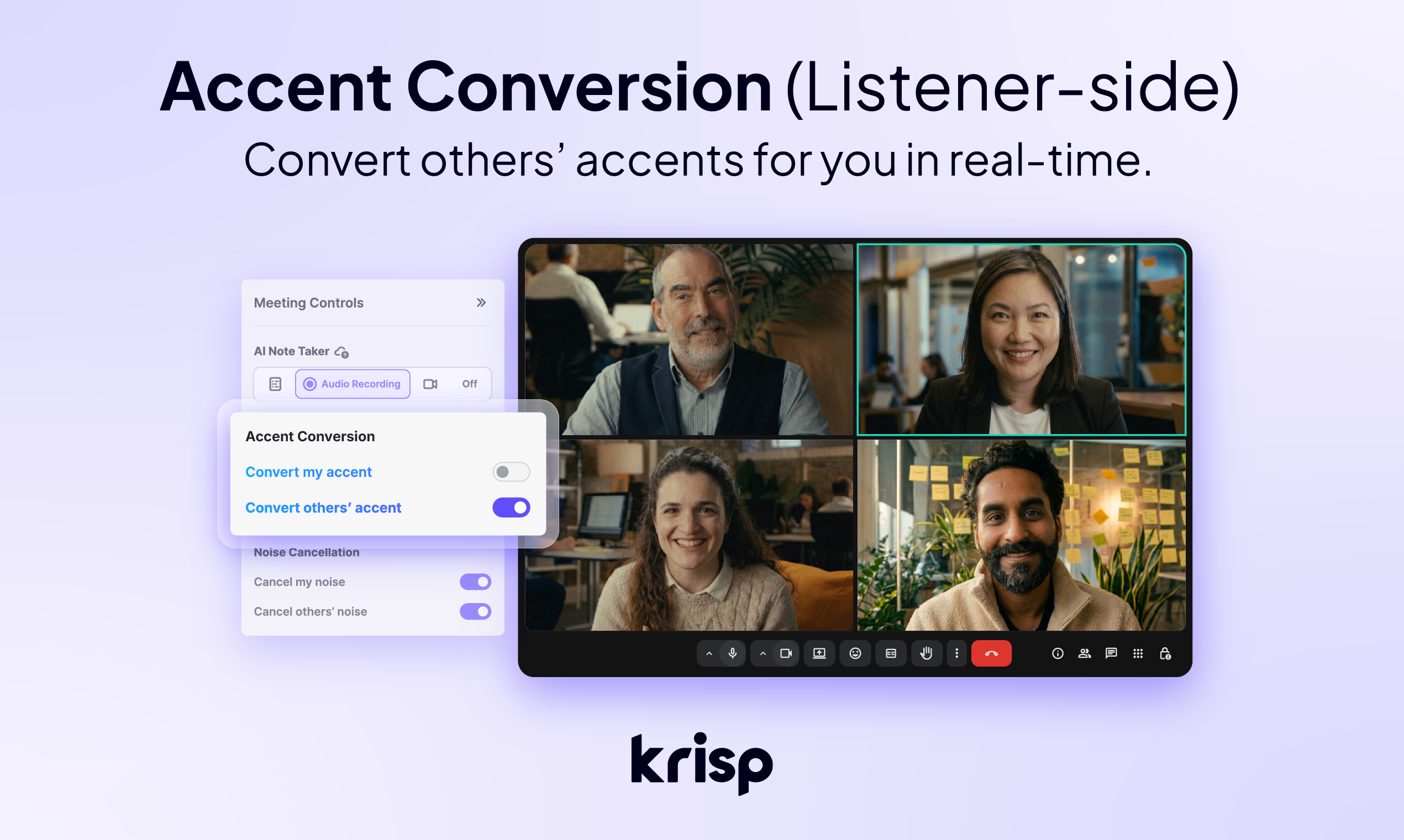
查看原始信息
The Bias
Most big news stories don’t have one version — they have many. The Bias is a perspective synthesis engine that reconstructs coverage across outlets into one structured read, showing what’s corroborated, what’s contested, what’s still unclear, and how framing differs. Built for clarity without tab-hopping. PH feedback wanted: If you were improving this tomorrow, what’s the first thing you’d change in the reading experience?
Hey everyone — I’m Charlie, founder of The Bias. I started building this because following major stories increasingly meant choosing one outlet’s framing — or opening a dozen tabs and trying to reconcile them myself. The Bias is a perspective synthesis engine for news. We reconstruct coverage across outlets into one structured read, surfacing what’s corroborated, what’s contested, what’s still unclear, and how framing differs between sources. We’re early and iterating quickly. I’d love thoughts on whether the structure feels intuitive — and whether this meaningfully helps you understand a story faster than tab-hopping. Happy to answer anything about how it works, what sources we cover, or where we’re taking it.
3
回复

@charlie_ehlen Unfortunately, this is not available in my country, Switzerland.

0
回复

The corroborated / contested / unclear distinction is the feature that matters most here. Most news aggregators just show you more sources, which doesn't solve the problem. Knowing which claims have cross-source agreement versus which ones are disputed versus which ones nobody actually knows yet is a fundamentally different reading experience.

The closest comparison is Ground News, which does a solid job of showing left/center/right framing differences. But it still sends you to individual articles rather than synthesizing them. AllSides does the same, side by side rather than structured. The Bias is trying to solve a harder problem: not just showing you where sources differ but telling you what they actually agree and disagree on. That's a much more useful output if you pull it off consistently.

To answer your question on what I'd change first: I'd want a way to track how a story's corroboration status evolves over time. Something that looks contested on day one often gets clarified within 48 hours, and being able to see that arc would add a lot of value. Congrats on the launch! 📰

2
回复

@joao_seabra This is such a thoughtful take — thank you. You articulated the core problem better than I usually do.

You’re exactly right: just adding more sources doesn’t reduce uncertainty. The goal is to shift from “here are 12 takes” to “here’s what’s actually agreed on, what’s disputed, and what’s still unclear.” That synthesis layer is the hard part, but it’s also where the real value is.

We’re actively working on the temporal evolution piece now. The current approach is to update articles as new facts emerge, so if something is contested on day one but clarified 48 hours later, the status changes accordingly.

I’m curious how you’d want to see that expressed. Is a living, updated article the right format, or would something like a visible status timeline make the progression clearer?

2
回复

@joao_seabra Does The Bias build the corroborated, contested, unclear buckets claim by claim, with a way to see which outlets support each point and when they published? That audit trail is what makes synthesis feel faster than tab-hopping.

0
回复

That’s awesome! How many sources are you tracking? We’re doing similar classification at MediaThrive. If you want, ping me and we can exchange ideas. 🙂

1
回复

@pavelbg Thanks! Right now I’m we’re tracking about 600 sources globally, but looking to expand to more as soon as we can.

That’s great you’re doing something similar at MediaThrive — I’d definitely be up for comparing notes. What’s the main idea behind MediaThrive? I’ll ping you so we can swap ideas. 🙂

0
回复

I get nervous when skills turn into a grab-bag of styles, agents start feeling random. How are you scoring Skills Refiner's benchmark, by running a small task suite or just grading the refactored text, including translate/refine cases? That's what makes a score like this trustworthy.

0
回复