Product Hunt 每日热榜 2026-03-09

PH热榜 | 2026-03-09

#1
Timelaps
Know if your marketing is working with real-time insights
453
一句话介绍:Timelaps通过实时收集并分析超过4000名目标消费者的反馈,为品牌营销团队提供持续的品牌健康度追踪与洞察,解决了传统品牌追踪方式成本高昂、周期漫长、数据滞后的痛点。
Branding Marketing Artificial Intelligence
品牌追踪 市场研究 实时洞察 营销分析 SaaS 消费者洞察 品牌健康度 AI驱动 营销技术 增长工具
用户评论摘要:用户普遍认可实时品牌洞察的价值,认为其改变了传统昂贵、缓慢的季度报告模式。主要问题集中于:数据更新机制与归因分析能力(如何区分相关性/因果)、典型客户画像、数据收集方法与长期质量保证、以及如何将仪表板洞察整合到现有工作流(如报告)。
AI 锐评

Timelaps的野心在于将“品牌”这个最抽象的资产数据化、实时化,并塞进现代营销的SaaS工具栈。其核心价值并非发明了新指标,而是以“实时”和“可负担”为利刃,试图肢解传统市场研究机构昂贵、迟缓的服务模式。产品介绍中反复强调的“5倍性价比”、“数天上线”直击传统痛处,迎合了当下企业对敏捷决策的极致追求。

然而,其宣称的“革命性”面临深层拷问。首先,“实时”与“研究级”存在内在张力。高频数据收集如何保证样本代表性与回答质量?过度追求速度是否会牺牲洞察深度,沦为肤浅的情绪脉冲监测?其次,品牌建设本质是长期心智工程,其效果往往非线性且滞后。将之置于实时仪表板上,可能助长营销人员的短期焦虑,导致为追逐指标波动而进行无意义的策略微调。评论中关于“归因”的质疑切中要害:实时看到品牌指标波动固然好,但若无能力解释波动根源(是某次campaign、竞品动作还是宏观环境),其行动指导价值将大打折扣。

真正的颠覆点在于其“AI+专家”的混合模式。若其“研究级AI”能超越图表生成,深入解读数据关联、模拟心智变化路径、甚至预测品牌健康趋势,方能从“更快的仪表板”升维为“品牌策略大脑”。目前看来,Timelaps成功地将品牌追踪从“战略咨询”领域拉到了“运营工具”层面,但能否真正赋能品牌构建长期主义优势,而非提供另一套令人焦虑的实时KPI,取决于其算法深度与对品牌科学本质的理解。它是一面更快的镜子,但企业更需要的是能指明方向的罗盘。

查看原始信息
Timelaps
Timelaps conducts primary research, collects responses from 4,000+ real consumers in target demographics, and tells you whether your brand marketing is working. Compared to traditional agencies or trackers, Timelaps is 5x more affordable, based on the latest science of brand growth, and continuously updated in real time.

Hey Product Hunt 👋

I'm Harry, cofounder of Timelaps.

I previously cofounded HackQuest, raised $5M+ in funding, and grew it into one of the leading developer ecosystems in the world with over 2M users.

After HackQuest was acquired, I spent months traveling the globe: discovering, designing, coding, testing, and validating over 35 ideas from my "things to build" list to find what's next.

In San Francisco, during ODF, Henk and I sat together during the opening ceremony and connected instantly on the type of company we want to build together and the massive opportunity in the intersection of AI and market research.

We kept asking: What matters most in the age of AI? After months of exploration and pivots, Henk and I answered the question with our Timelaps thesis. Below are snippets of why we chose branding & brand tracking.

Why Branding?
Brand is back. According to the recent McKinsey study published in November 2025, Branding was cited as the number one priority for 2026 by marketing leaders across all business models. 


That’s because a strong brand drives real business outcomes:

  • Brand is a measurable financial asset. Econometric analysis of 135 global firms shows that every $1 increase in brand value equates to $1.76 in turnover.

  • Sustainable Pricing Power: Brand is the antidote to commoditization. Kantar’s BrandZ data proves that stronger brands command higher than average prices vs their competitors.

  • Cheaper to grow. The same studies show that a strong brand hugely improves the ROI of marketing and lowers CAC.


What is Brand Tracking? Why Brand Tracking?
Brand tracking measures how strong your brand is now, how that is changing over time, and how you compare to competitors.

It answers questions like:

  • Are people aware of us?

  • Are we associated with the right problems and solutions?

  • Are we becoming the default choice in key moments of the customer journey?

  • Are paid and PR campaigns actually shifting perception?

  • Are we growing faster than competitors in brand health?

You wouldn’t run paid socials / search without knowing your CTR, CPC, and CPA. 

Brand tracking is the equivalent of long-term growth. It helps you:

  • See if your marketing is working for building brand equity.

  • Show which campaigns have an effect, or not.

  • Identify segments you are over- or underperforming in.

  • Detect signs of competitor threats.

  • Identify the top growth areas for your brand.

Importantly, brand tracking shows you what demand looks like before it shows up in sales figures. Revenue is the lagging indicator. Brand is the leading one.

The AI revolution has transformed what brands can create. It's time for tracking to catch up.

We are still very early in the journey (<5 wks). Our goal is to document our growth journey on Product Hunt and share it with all of you. Our team is available ALL DAY for all your feedback and questions. Grateful for your support and excited to chat here / over a call :)

17
回复

@harryzhangs Interesting direction here.

Most brand tracking tools I’ve seen still operate on the old quarterly research cycle, which makes the insight almost historical by the time teams see it.

I'm curious about something though.


When marketers see the dashboard update with new data, does Timelaps also help explain what likely caused the change (campaign, channel, messaging), or is the focus mainly on surfacing the signal?

2
回复

@harryzhangs Pretty cool idea. Real-time insights from thousands of consumers sounds really powerful. Congrats on the launch! 

3
回复

@harryzhangs Hey Harry. How do you help users distinguish between correlation and actual marketing impact?

3
回复

Thrilled to co-present On Deck alums @harryzhangs and @henk_pretorius1's Timelaps.

Brand building in the age of AI requires constant vigilance and adaption.

Customer attention is fickle; keeping it means seeing shifts early.

This requires a tighter feedback loop.

Historically, brand tracking took months and cost $100K–$500K+.

Useful, but way too slow now.

Timelaps gives you an instant-replay view of the moments that matter— when someone chooses you… or chooses a competitor.

With real-time insights from real people, you can spot what’s changing, update your messaging, and stay top-of-mind when it counts.

If you market a brand and you’re tired of waiting a quarter to learn what happened last quarter, grab a consult with the team today (it's not everyday you get free advice from a PhD!).

9
回复

@harryzhangs  @henk_pretorius1  @chrismessina Brand tracking used to be painfully slow and expensive, so real-time signals sound like a big shift.

Curious what kind of companies are adopting Timelaps the fastest so far?

0
回复

@harryzhangs  @henk_pretorius1  @chrismessina 

I worked with Harry on one of his previous product. The team is top notch. So excited about the product, glad you hunted this

2
回复

Really interesting thesis on brand tracking. Most startups I know treat brand measurement as something you check quarterly through expensive agency reports, by which point the data is already stale. Having continuous, real time consumer feedback on brand perception changes everything about how you iterate on positioning. The 4,000+ consumer panel approach reminds me of how product teams use continuous discovery. Curious what the typical turnaround looks like from launching a study to getting actionable insights.

6
回复

@handuo thanks! And great question. Set up is super quick - you'll be up and running in days. As opposed to the weeks of planning with research agencies.

4
回复

@handuo Thanks so much for the question! Very happy that you share our vision. Turn around is actually one of Timelaps' key differentiators - consulting firms / agencies usually take weeks of discovery meetings to get onboarded (I have led them) and months to see results, while Timelaps onboards in days.

Our vision for the future is a self-service SaaS tool that takes hours to get started & shows real-time insights.

2
回复

@handuo Interesting point. Brand tracking has traditionally been slow and expensive, so real-time signals sound like a big shift.

Curious what type of teams are adopting Timelaps the fastest so far — startups, agencies, or larger brands?

0
回复

Hi Product Hunt! 👋

I’m Henk, co-founder of Timelaps.

After two decades designing brand health studies for some of the world's biggest brands, we've built the one I always wished existed.

I have a PhD in Psychology and previously co-founded the largest digital research agency in Africa - Columinate (acquired by Human8). We were at the forefront of moving research from offline to online.

Now, I’m seeing an even bigger shift. AI has commoditized content and product creation. The advantage is no longer what you make.

It's your brand. The space you occupy in people's minds is the last durable advantage. Companies are waking up to this. The pivot back to brand-building is real.

But measuring brand health is still expensive, slow, and based on metrics that don't reflect how people actually choose. I know this because I've been on the other side.

We built Timelaps to bring brand intelligence into the modern tech stack.

 Why Timelaps?

  • Real Data: Insights from thousands of real consumers in your category.

  • Modern dashboard: An always-ready intelligent dashboard, not a dusty slide deck.

  • Always-On: Forget annual "waves." This is continuous tracking.

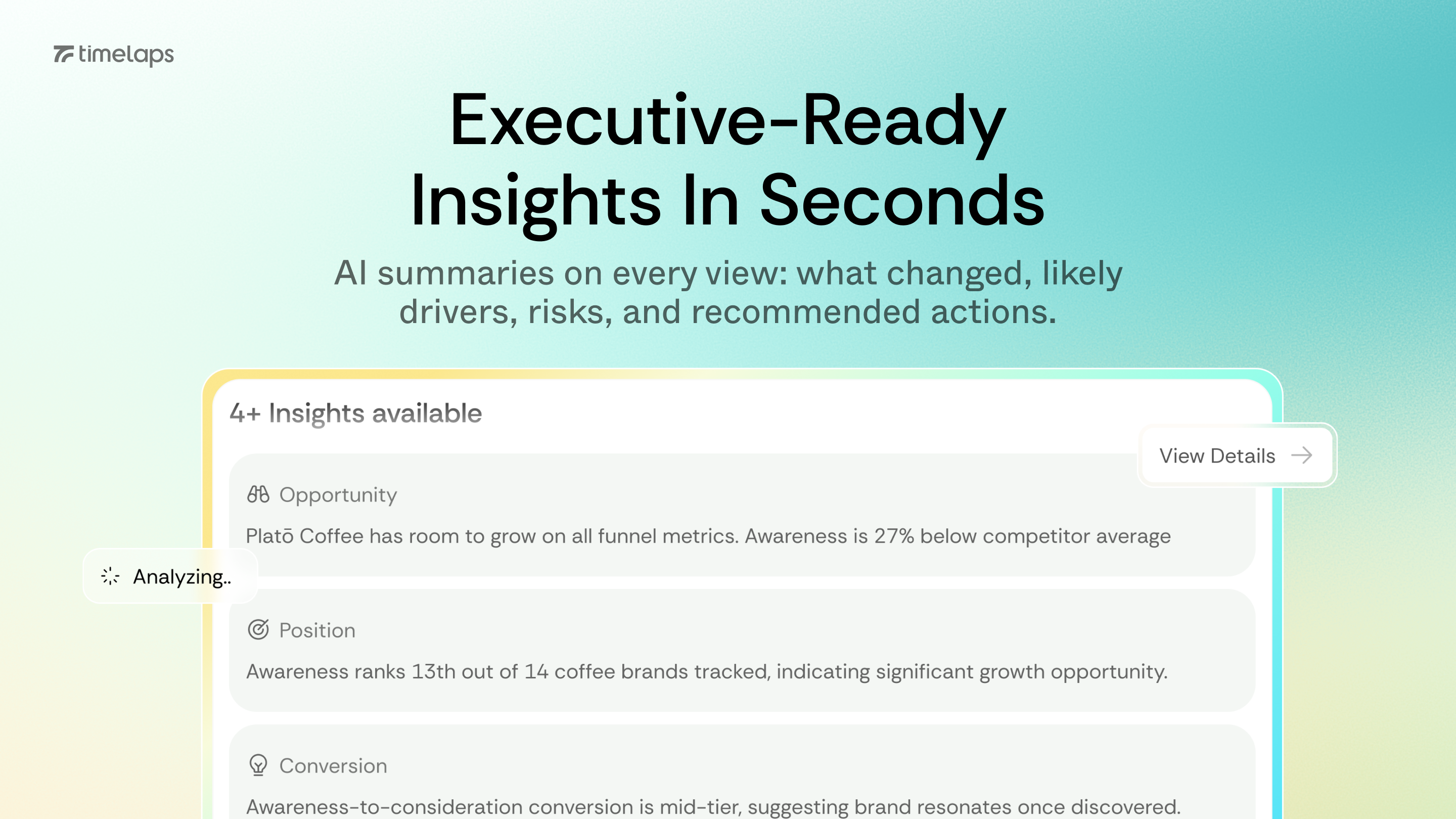
  • Research-Grade AI: We combine the latest in brand science with AI that surfaces actual opportunities, not just charts.

  • Startup Speed: Set up in days, not months.

  • SaaS Pricing: Priced like a subscription, not a bloated agency retainer.

I’m building this alongside some great people - my cofounder Harry Zhang and I met in San Francisco doing the ODF fellowship. We instantly connected on the kind of company we want to build, and now we’re making it happen. Matt is leading product dev, and it’s been incredible working with him and seeing what we’ve built so far. Shout out to Yutong, Yash, Daniel, and Dirk for building Timelaps with us.

Product Hunt Special

We are launching early to gather your feedback and shape v.next. As a thank you:

  • Free Consultation: For founders/marketers building consumer products, we’re offering a free 30-minute deep dive on your brand-building and tracking strategy.

Check us out:

I’ll be here all day to answer questions. Can’t wait to hear what you think.

6
回复

Website is nailed! :)

5
回复

@busmark_w_nika Appreciate that!

3
回复
3
回复

Congrats on the launch, Harry and Henk! The dashboard looks really comprehensive and having real-time brand data is a huge step forward. I do have a quick question, though—what should I do if I can’t quite figure out what a specific chart means? Is there an easy way to get support or guidance from your team to interpret the data?


4
回复

@aarjoo Thanks! We've made it easy to see what's happening with every chart. First, you can click on about, that brings up info about the chart and underlying questions. You can also ask the AI analyst. And, of course, we do onboarding for every client. We find most people get up to speed very quickly.

1
回复

@aarjoo Thanks so much for the support & question - Henk already addressed it, but I just wanted to add that the vision for Timelaps is to be the ultimate self-service SaaS tool for brand tracking, whether for humans or agents. We are always upgrading features to prioritize customer experience. And that includes the AI analyst chatbot that you can ask questions and bounce ideas off now. Very soon, you will see the voice agent released so you can chat with the AI analyst directly. Stay tuned for more and newer features :)

1
回复

As someone working in growth/marketing, this really resonates.

Most teams today have tons of performance data (GA, ads dashboards, attribution tools), but very little visibility into brand perception over time. That gap makes it hard to understand whether growth is coming from paid acquisition or actual brand momentum.

Timelaps looks like it’s trying to solve that by turning brand tracking into something continuous instead of a once-a-year survey or agency report, which is a pretty interesting shift.

I’m especially curious about how the data is collected and how often the signals update — are these rolling panels, surveys, or modeled insights?

If this works well, I can see it becoming part of the modern marketing stack alongside tools like Google Analytics.

Congrats on the launch on Product Hunt 🚀 Looking forward to seeing how teams use this.

4
回复

@chelsea_yang Thanks Chelsea - you've nailed it - that's exactly what we're building. Appreciate the support!

As for the question - we use continuous surveys, sourced from only the highest quality research panels, with multiple layers of quality checks before we push it to the dashboard. So it's real insights from real people in real time :)

1
回复

@chelsea_yang Thanks so much for the support Chelsea - you are here since day 1 :)

2
回复

How does Timelaps specifically measure "brand growth" metrics—such as mental availability or penetration—in real time to validate that marketing efforts are driving long-term commercial value rather than just short-term engagement?

4
回复

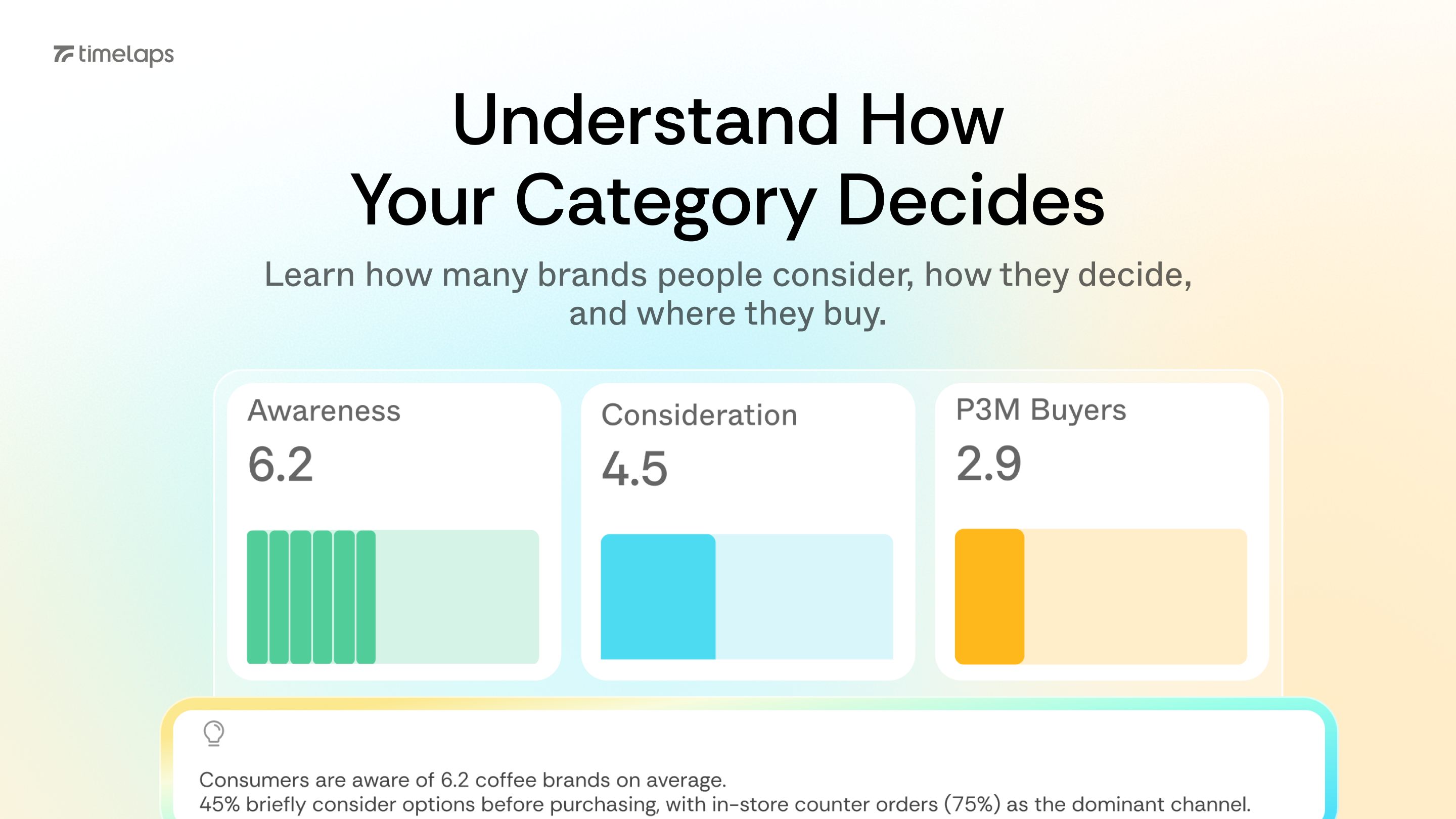
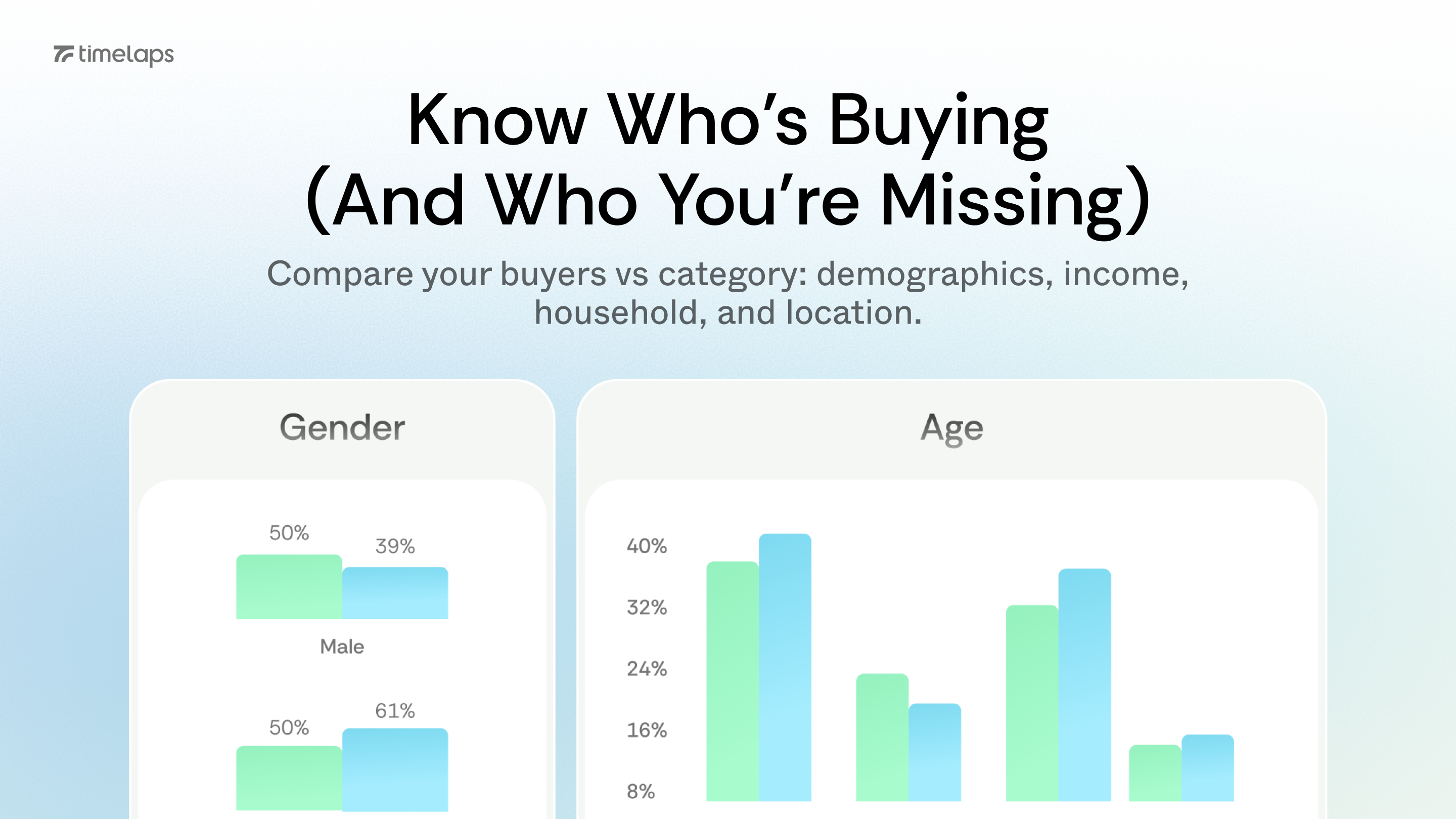
@mordrag Hey Denis, right question to ask :) In short, we use a validated set of questions and metrics tailored to each category that surfaces the moments (category entry points) that brands need to win to grow share long term vs short term. We do this alongside the tried-and-true metrics marketers know: awareness, consideration, usage/buying, and associations. We track and report on these continuously amongst a representative set of people in that category. Because we have 1. Measures validated to track actual market share 2. Do this continuously - we're able to map the effects of marketing efforts on key brand growth metrics. Happy to do a demo and discuss more.

1
回复

@mordrag Hey Denis, thanks for the question & support :)

1
回复

@mordrag Great question. Measuring brand growth in real time sounds tricky.

Curious if Timelaps relies more on survey signals, behavioral data, or a mix of both?

2
回复

Marketers finally getting real-time brand insights instead of waiting months for a giant slide deck… progress 😅

3
回复

@aiden_jenkins progress indeed :)

1
回复

@aiden_jenkins Indeed, thanks for the support Aiden! No more waiting - real-time insights for the win!

1
回复

What a beautifully designed dashboard. I love how it makes complex market research look so approachable and calm. Question for the makers: how long does it typically take for a new brand to set up their first tracker and start seeing those real-time insights roll in?

3
回复

@white_devil22 thank you! Set up is super quick - we can have you up and running in a few days before we start collecting data, and the first results are available shortly after.

1
回复

@white_devil22 Thanks so much - "beautifully-designed", "approachable" are exactly the goal. It takes 1-2 days to set up, compared to weeks and even months in the case of consulting firms / agencies (we did these before!)

2
回复

Great concept, gonna try this out

3
回复

@oratis Thanks, great to hear!

1
回复

@oratis Yessir! Please let us know what you think.

1
回复

Congrats on the launch! Brand tracking has historically been a very niche space. It’s mostly been accessible only to large consumer companies because of the high cost and complexity. So it's super helpful to have a very professional report at a fraction of the traditional cost. But I'm curious how do you ensure the quality of data over time, especially if companies are using the data for long-term brand tracking?

3
回复

Thanks! @joysong_j We do that in a few ways 1. We make sure the people we get insights from match the category 2. We do extensive quality screening before, during and after data collection 3. We ensure measures remain consistent across time so any change we observe in brand health is real and not because of some quirk in the measurement.

1
回复

@joysong_j Great point. Long-term brand tracking really depends on consistent data quality.

Curious if Timelaps relies more on continuous sampling or periodic surveys to keep the data reliable over time?

0
回复

@joysong_j Thanks so much, Joy & live the profile pic haha!

Quality is the #1 priority at Timelaps, hence the claim on "research-grade." We work with the best panel providers that are academic / research-level covering 80+ markets, at a statistically sufficient sample size (even for political census), and design the algorithm intentionally to ensure consistency across time so data is comparable.

1
回复

I believe most Brand Tracking Reports are still delivered via Slide Decks and that dashboard are expensive add ons. Timelaps seems to have made that a non-issue? And Research-Grade - so not just a basic brand funnel?

3
回复

@elna_pretorius Hey Elna, thanks for the question! Yes, you are spot on! Slide Decks are useful, but often get tossed aside and go obsolete quickly as they capture only a snapshot (and often using data collected from months ago). That's why Timelaps is a living dashboard that's updated in real-time, continuously.

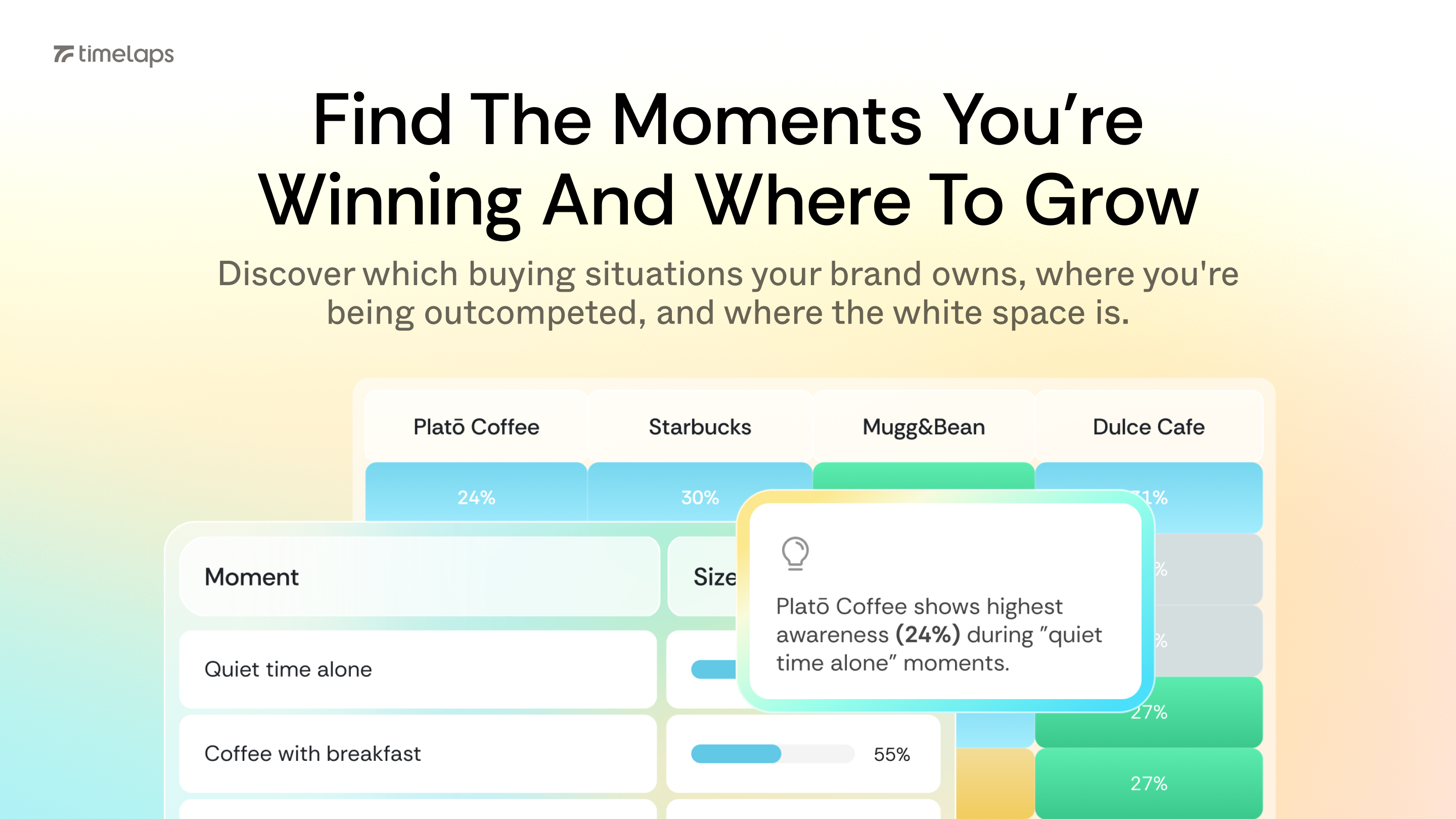
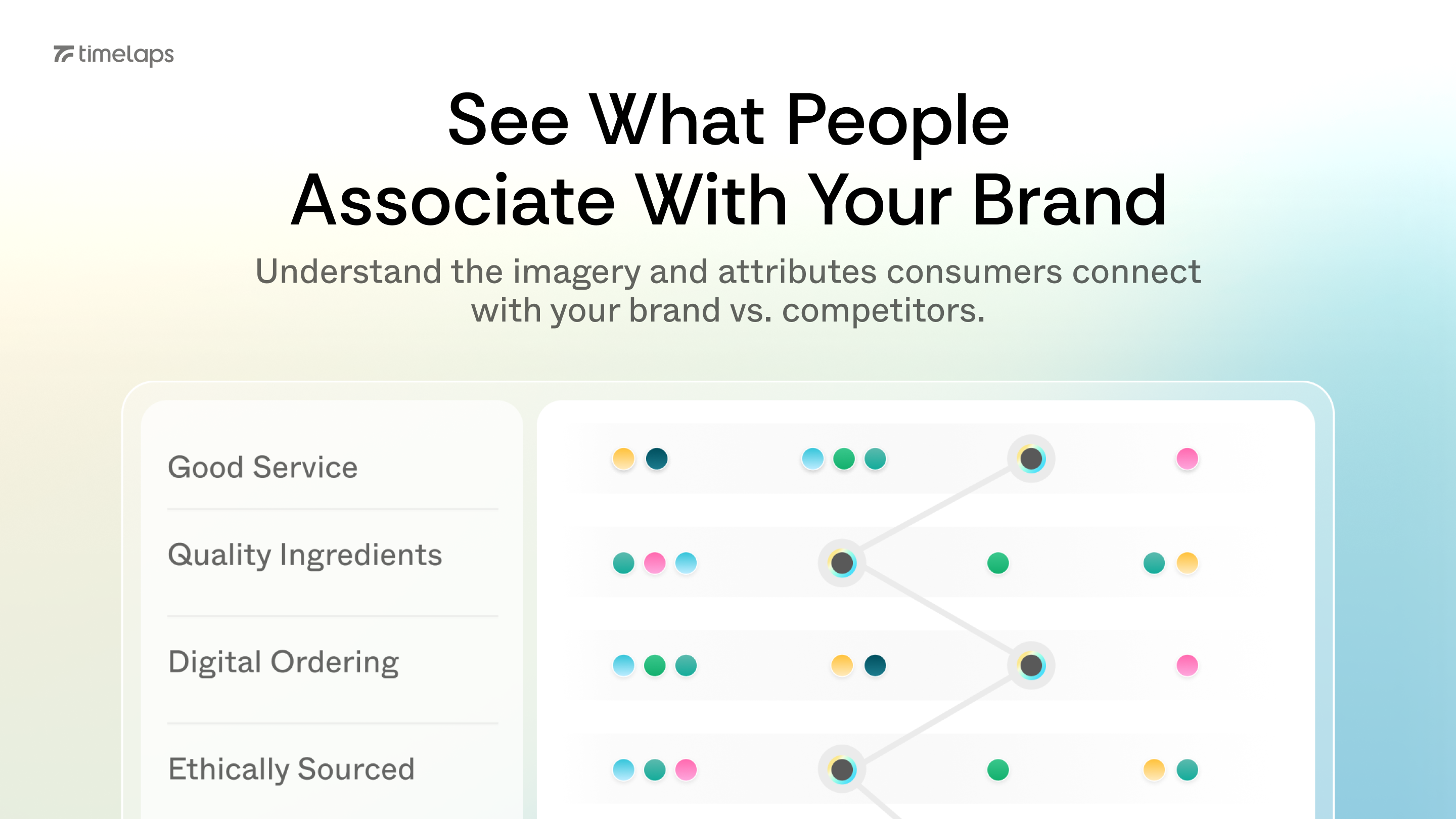
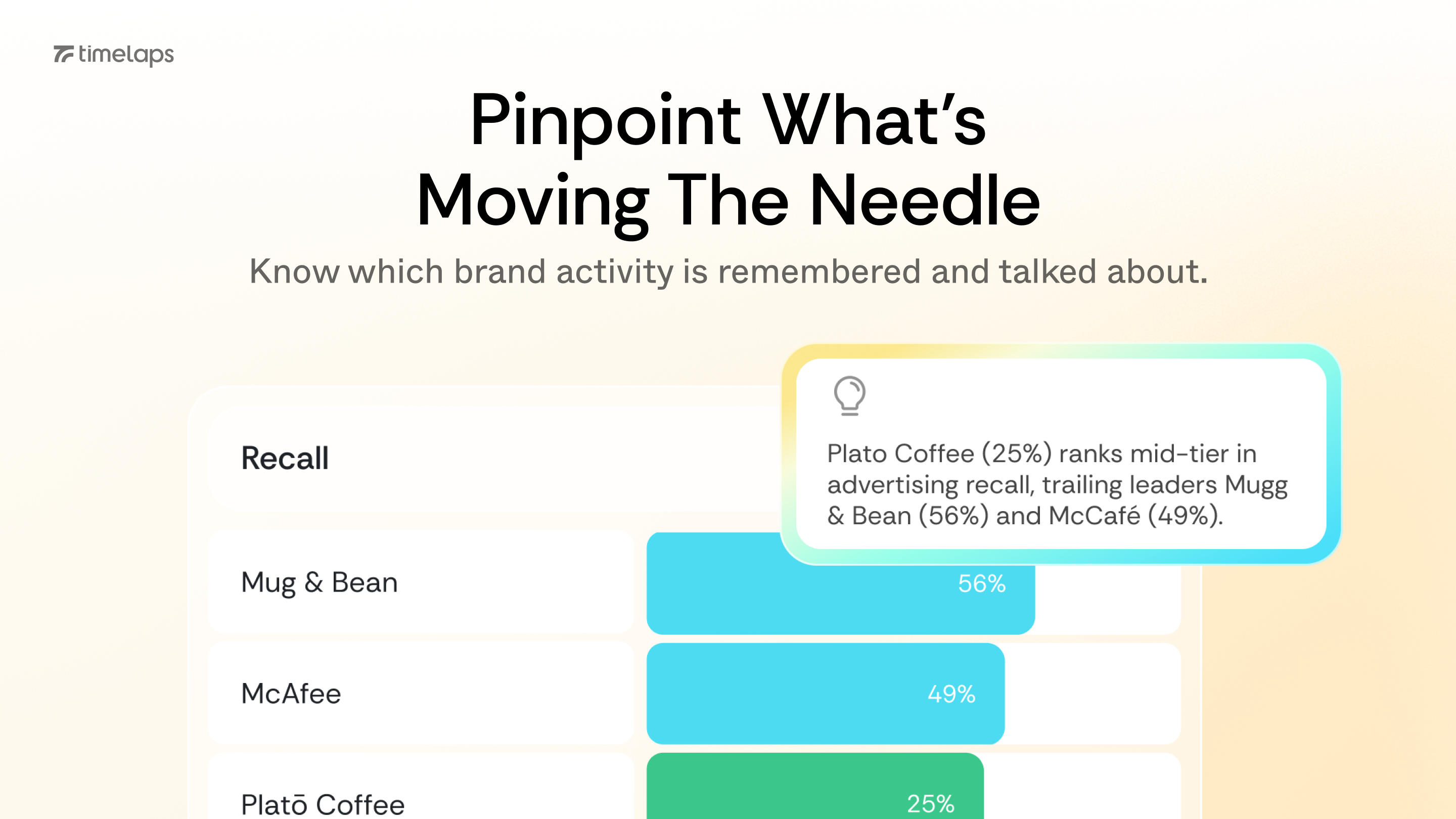
Research-grade means classic + modern components. Timelaps includes not only the classic brand funnels, advertising recall, positioning, demographics, etc., but also moments, associations, and word-of-mouth. Moments in particular are super useful as they highlight the exact moment(s) you or your competitors win / lose consumers.

2
回复

@elna_pretorius Good point. A lot of brand tracking reports still end up as static slide decks.

Curious if Timelaps replaces those reports entirely with a live dashboard or if teams still export insights into presentations?

2
回复
timelaps is so cool
2
回复

Congrats Harry and Henk! Timelaps looks excellent, excited to try it out soon

2
回复

@aridutilh thanks Ari 🙏🏼

1
回复

@aridutilh Thank you so much Ari!! Would love to catch up and demo some of our new features too :)

1
回复

Two important things:

  1. Primary consumer research is a horrifyingly outdated thing these days, and it's still so expensive and time consuming.

  2. Harry is an amazing builder who definitely knows what he's doing; I am excited to see Harry working in this space, because it serves such a sore need.

Rooting for you Harry!

2
回复

@jackietanyen Thanks so much for the support, Jackie. This means the world, coming from you!! Super excited to revolutionize primary consumer research (specifically in the brand tracking niche!) with AI.

Would love to show you what we are building and have planned for in the future :)

1
回复

This is really good, especially when you're just starting. Congrats on the launch, @harryzhangs!

2
回复

@harryzhangs  @neilverma Thanks Neil!

1
回复

@neilverma Thanks so much for the support Neil :)

1
回复

Running marketing for a small business, I've always felt brand tracking was a "big company" luxury — quarterly agency decks we'd get 3 months late, already irrelevant. The idea of overlaying campaign activity onto a continuous perception timeline is exactly what I needed to understand what's actually moving the needle. Quick question: how granular can the demographic segmentation get? Can I, for example, compare brand awareness among Gen Z vs Millennials in a specific city?

2
回复

@ilya_lee That's such a good observation, and exactly what we've been hearing from marketers everywhere: slow, expensive tracking that arrives too late and prices out many brands that need it most.

And yes, that's exactly what you can do - cut and compare data by demographics like age, region, income and more!

1
回复

@ilya_lee Hey Ilya, you are already miles ahead, knowing brand tracking exists and actively finding ways to leverage it. I also believe overlaying campaign activity onto a timeline view of brand health is a game-changer (ps: kind of like TradingView overlaying market news & Fed policy changes) - excited to release the feature soon.

On your question, 100%, that's exactly what the demographics section empowers users to do in the interactive dashboard. You can filter by age group, geography, and more etc. A lot of easier to identify pattern for experienced eyes but obviously the title summary and AI analyst also help!

1
回复

@harryzhangs Love the idea! I’m curious, what surprised you the most while validating this with marketers?

2
回复

@harryzhangs  @damian_quiroga Hi Damian, honestly, it was the degree to which, for most brands, they felt the pain we describe here: slow, expensive tracking that hasn't changed in decades! Also, how widely this was true: for small brands and enterprise brands alike.

2
回复

@damian_quiroga Thanks so much for the support, Damian - the validation process has been quite a journey, and we have been astonished by the sheer volume of excitement from brand marketers, especially those marketing executives at large enterprises who have been working with agencies or a traditional alternative tool that costs high six figures and, in many cases, seven figures annually. They definitely feel the pain. In fact, most clients we have onboarded so far fall under this category.

For leaders in smaller brands, many have heard of brand tracking but never actively used it, and some are completely foreign to the concept (similar to digital marketing back in 2012-2014), they understand the need but are still learning how it works. Our goal is to make it as simple as possible for them to get started and derive value.

2
回复

Yeap Harry! I still remember how we used to do this 10 years ago and it was like diving blindly without key data. New times, new ways, new mindset. I'm sure founders will love to see their brand tracking and how they can outperform through Timelaps. Wish you all the best

2
回复

@german_merlo1 appreciate that, thank you!

1
回复

@german_merlo1 100%. A lot of exciting new things are now only possible because of AI. Thanks so much for the support man :)

1
回复

I've been flying blind on what's actually driving signups for TubeSpark. Google Analytics tells me someone visited from Twitter, but not whether that visit mattered. Real-time would help a lot when I'm testing different landing page versions across 5 languages. How granular does the attribution get?

2
回复

@aitubespark Hi Gabriel, Thanks for the kind words, and the attribution pain you're describing is real, but Timelaps actually sits in a different part of the stack. We're a brand-tracking platform, so rather than measuring what drives a specific signup, we measure how your brand is perceived and recalled by your target audience over time.

Think of it as the layer above attribution: once you know people are finding you, we help you understand whether they actually know who you are, what you stand for, and whether you're top of mind when they're ready to buy.

For your attribution needs, curious whether you've tried something like Northbeam or Triple Whale? Hope the launch is useful context either way, and if brand perception ever becomes a priority as TubeSpark scales, we'd love to have you back!

1
回复

@aitubespark Hey Gabriel, thanks so much for the thoughtful question. Henk already answered your question in-detail, so I just wanted to offer you a free brand consult available once you land on our home page. It will be your time, tailored to TubeSpark, and does not have to be related to Timelaps. Please feel free to DM if it's easier!

2
回复

Love the concept. As a marketer myself, results from brand marketing efforts are the toughet to attribute. Glad to see an impactful alternative to the cost-intensive options of third party agencies or outdated research cycles.

2
回复

@shalini_umrao appreciate that Shalini, we built this for all marketers, so great to hear it resonates!

1
回复

@shalini_umrao Thanks, Shailini! Love to see support from a fellow marketer :)

1
回复

Love this product. Excited to see you continue to grow on PH. Wondering how’s the feedback so far? Have you gotten any enterprise clients?

2
回复

@yves_yang Thank you! Feedback has been great from enterprise, mid-market, and challenger brands. We're onboarding clients across all segments right now. It's been eye-opening to see how many diverse brands struggle with the same issues that Timelaps solves.

1
回复

Solid video, good luck on the launch!

2
回复

@jan_heimes Thanks Jan! Appreciate the support.

1
回复

@jan_heimes Thanks Jan :)

1
回复

Interesting concept! Does the platform highlight why perception shifts happen, or just show the metrics? Would love to understand how teams interpret the changes.

2
回复

@leo_aj Hey Leo, thanks! Yes we do - teams can already use internal knowledge of campaigns to know what shifted. In our next release, we are launching a feature that actually allows marketers to overlay their campaigns (and competitors') on the data, showing what effect they had. Once enough data is collected for each project this will be used to 1. Surface patterns across marketing efforts that had the most impact 2. Make predictions about planned campaigns.

1
回复

@leo_aj Hey Leo, thanks for the question! We'd love to chat with you and further demonstrate what the platform is capable of and the new features that we will soon make available to the public (many never existed in any other brand trackers before). We'd invite you to book a chat with us here: https://calendly.com/timelaps/new-meeting!

1
回复

This is super practical for marketers.

I like the ‘Moment x Brand Matrix’ chart especially as it allows me to compare across competitors and zooms in on specific moments where we are winning / losing.

2
回复

@justin2025 appreciate that. That's one of my favorites too - it's a very insightful view.

2
回复

@justin2025 Thank you!! That's a prime example of showing what's the latest in brand science - you won't find this chart in any other brand tracking software :)

2
回复
I was a consultant doing brand equity tracking and data analysis for a long time partnered with global consumer goods brands. What I encountered was not only traditional research methodology that was manually and time consuming, but also the different tracking metrics from each client that was not consistent all the time without the possibility of building a single data tool to serve customized purposes. Would love to try it out and share more thoughts!
1
回复

@haoze_zhang Hey Haoze, love this feedback. You clearly understand the painpoint & I shared a similar experience as a consultant! Building a tool that's comprehensive enough to cover the 80% common grounds and flexible enough to address the 20% personalized requests / questions from each client is the key. Would love to share our perspective and learn about yours over a call if you are down: https://calendly.com/timelaps/new-meeting.

1
回复

Is this optimized mostly for B2C companies or can B2B style companies also take part? What about startups that don't have much of a "brand footprint" to begin with?

1
回复

@lienchueh Hey Lien, thanks for the great questions. You are correct, this is optimized for 2C companies. B2B is significantly harder and more costly, so not within our focus area at the moment.

For startups that don't have much of a brand footprint to begin with, valuable insights will also be very difficult to obtain at the current stage. Hence, most of our customers are enterprise and challenger brands (or Series A-C startups that are at least top 20 in the category). We are working on a more startup & SMB friendly product version and offer as part of the roadmap. Excited to share more very soon :)

We are still very happy to chat & see if there's anything we can help. Please feel free to book a call directly with Henk & I: https://calendly.com/timelaps/new-meeting

1
回复

Hey Harry! Congrats on your launch! Great to see Timelaps on ProductHunt!

How does Timelaps compare to traditional brand tracking tools in terms of turnaround time? We've been looking for the best brand tracker that gives insights in days, not weeks. Is it possible with Timelaps?

1
回复

@byalexai Hey Alex!! Thanks so much for the support, and it was so great to chat with you back in the discovery phase of Timelaps.

Appreciate the thoughtful question - turnaround time is the key differentiator and advantage Timelaps has over traditional alternatives like Qualtrics or agencies / consultancies.

Brands working with agencies / consultancies typically take weeks to set up (via a series of information downloads and discovery interviews; I have led many of these exchanges in my prev. life!) and months to get snapshot PPTs fully completed from study design to field work to analyses and to reporting.

Below is a quote from a design partner (a leading brand in EMEA): "We expect to receive our report next month (March), but the Field work was done online last August (more than five months ago)."

You are spot-on. Timelaps takes only 1-2 days to set up, and you can start seeing action insights in real-time shortly after.

Would love to chat more and show you how it works!

2
回复

Congrats on the launch! Real-time brand tracking from actual consumer responses instead of just web analytics is a cool angle. How are you thinking about scaling the panel sizes across different markets?

1
回复

@dparrelli Thanks for the question, David! You understood the value prop immediately.

We are keeping panel size consistent for our enterprise and challenger brand clients and design partners now at 4,000 / year (same as other leading self-service tools & functions as a better, cheaper, fully-automated Qualtrics alternative). This is the number widely considered by F500 companies and brand marketing researchers globally as the gold standard for a representative sample size to draw meaningful recommendations over time.

And you are spot-on, in some markets (we cover 82 markets now) and categories (we can support all 2C businesses), we might need to increase / decrease panel size. As our database scales and our AI gets better and better, the tool will provide more accurate recommendations accordingly.

2
回复
#2
Roundtable
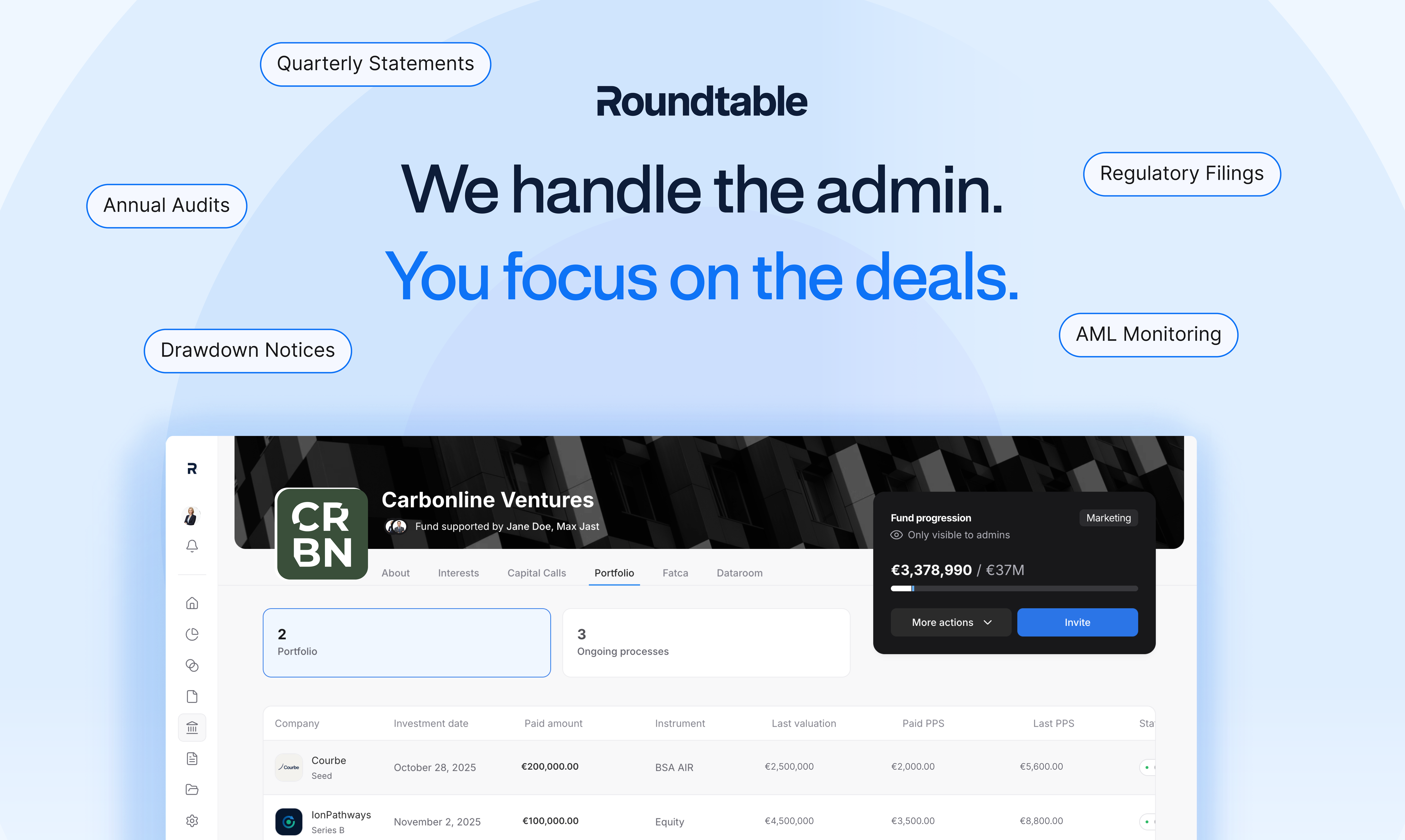

Launch your EU investment fund in days, not months
393
一句话介绍:Roundtable通过提供“基金即服务”平台,让新兴基金经理能在几天内以极低成本在欧盟合规设立并运营基金,解决了欧洲基金设立流程繁琐、成本高昂、准入壁垒高的核心痛点。
Fintech Investing Venture Capital
金融科技 基金即服务 合规科技 投资管理 欧盟基金 私募股权 创业投资 数字募资 资产管理 B2B金融
用户评论摘要:用户普遍赞扬产品解决了行业长期痛点,认可其易用性和团队执行力。有效评论集中在两个关键问题:1. 平台自动化与人工介入的具体边界(如法律结构、合规、报告等环节);2. 作为AIFM,平台与基金经理在投资决策失误时的责任划分。整体反馈积极,被视为对陈旧行业的颠覆。
AI 锐评

Roundtable看似是一个流程自动化和成本削减工具,但其真正的颠覆性价值在于重构了欧洲风险投资市场的权力结构与资本流动模式。它本质上是一个“监管套利”与“基础设施民主化”的结合体:通过其持有的EUVECA牌照,将原本属于大型机构的合规准入特权,以服务形式拆售给新兴基金管理人。这不仅降低了财务门槛,更重要的是打破了“仅限专业投资者”和“本国市场”的地域监管枷锁,创造了泛欧盟乃至跨大西洋的募资渠道。

然而,其“基金即服务”模式的核心风险与挑战也在于此。第一是责任嵌套问题。平台作为持牌AIFM(另类投资基金经理),在法律上是基金的“外壳”,但实际投资决策权在客户(基金经理)手中。这种“壳”与“核”的分离,在出现业绩纠纷或合规漏洞时,将引发复杂的责任认定危机。评论中关于责任划分的提问直指这一命门。第二是规模与深度的矛盾。平台通过标准化实现“几天内启动”,但高端、复杂的基金结构往往需要高度定制化的法律与税务方案,这并非当前模式所能覆盖,可能将其客群限定在相对简单的基金类型上。

其长期价值不在于成为又一个基金行政管理软件,而在于有望成为欧洲新兴VC基金的“默认启动层”。如果它能成功汇聚大量新兴管理人和其背后的LP网络,它将从一个服务提供商演变为一个资产分发和人才发现的枢纽平台,掌握资产端的源头数据。但这条道路上面临着传统大型基金服务商(如Aztec Group)的竞争,以及监管环境变化的潜在风险。它是否真能“让更多人创办基金”,还是仅仅降低了初始门槛,却将竞争推向了更残酷的募资与投资能力层面,仍有待观察。这是一场针对金融特权阶层的精巧起义,但起义者最终可能也在构建新的规则与壁垒。

查看原始信息
Roundtable
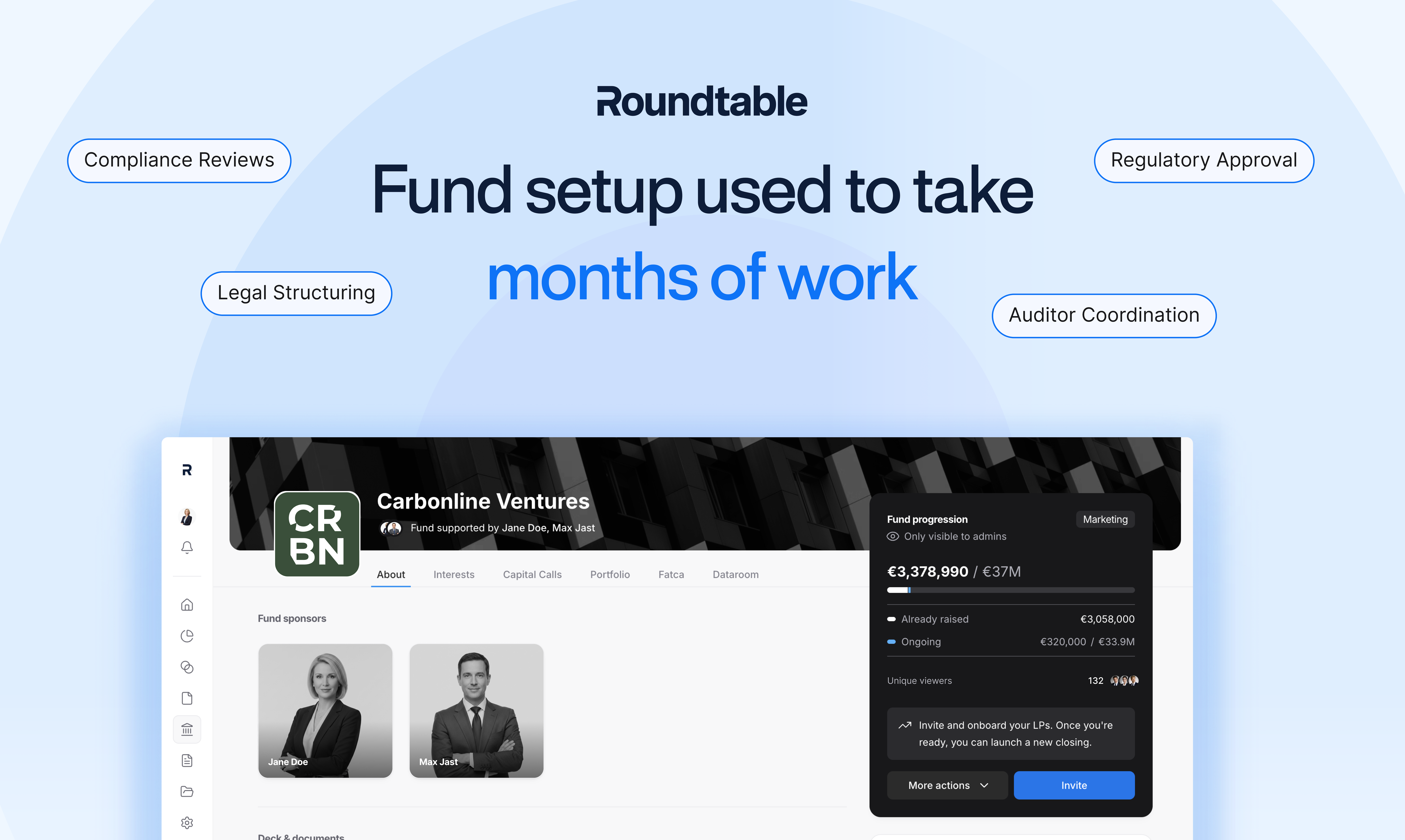
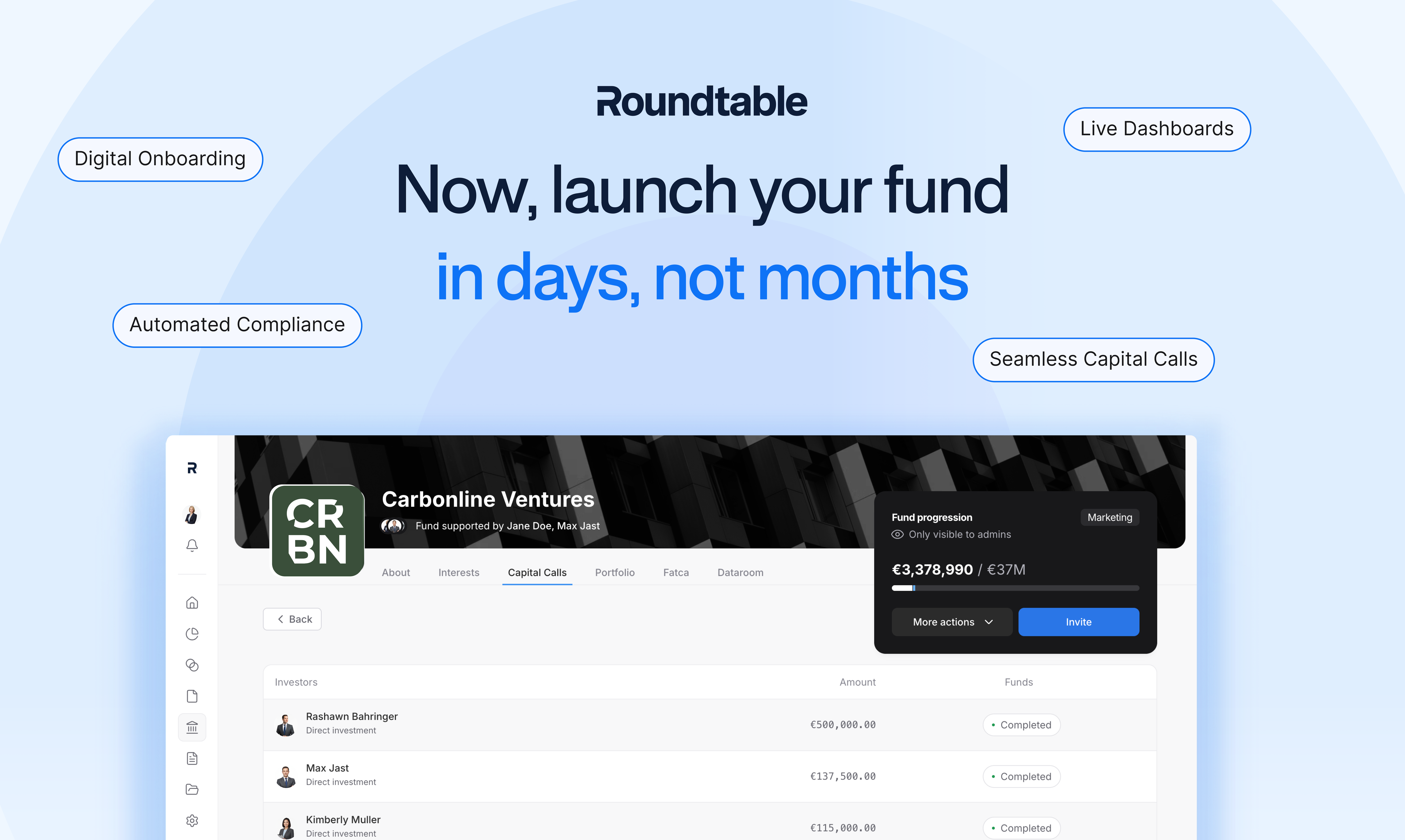
Setting up a fund in Europe used to take €200k+ (legal/tax included) and months of waiting. We built Roundtable to change that. With our EUVECA license, emerging fund managers can launch a compliant EU fund in days, not months. Market to professional and non-professional investors across Europe, onboard LPs digitally, manage capital calls and distributions, all from one platform. US LPs welcome too.

Hey Product Hunt!

I'm Julien, CPO at Roundtable.

Launching an investment fund in Europe is painfully complex:
- Need an AIFM license (€200k/year minimum - legal/tax included)
- 2-3 months of bureaucracy
- Can only market to professional investors in your country

This means only large institutions can afford to launch funds, while emerging
managers are locked out.

Roundtable is fund-as-a-service infrastructure that handles everything:
- We are your AIFM
- Legal docs included (LPA, Sub Agreement, PRIIPS KID)
- Launch in days, not months
- Market to professional + non-professional investors across EU
- Digital LP onboarding, capital calls, distributions
- US LP support available

Why we built this
Setting up a fund in Europe meant €200k/year minimum for an AIFM license (legal/tax included), and months of bureaucracy, before making a single investment. Emerging managers were being locked out by infrastructure designed for billion-dollar institutions. We built Roundtable to change that.

What we're most excited about
With our EUVECA license, funds can be marketed compliantly to non-professional and professional investors across all EU countries, including US LPs. Most platforms still lock you into professional-investor-only distribution in your home country. We don't.

What we need from you
Your honest feedback! Specifically:
- Fund managers: Would this solve your problems?
- LPs: Would you feel comfortable investing through this?
- Anyone: What are we missing?

Thanks for checking us out! Will be here all day answering questions.

29
回复

@julien_fissette I love your product, gogogo Roundtable !!

0
回复

@julien_fissette Hi Julien. Which parts of fund creation does Roundtable actually automate? Legal structure, compliance, investor onboarding, reporting? What parts of launching a fund still require human involvement despite the platform?

2
回复

@julien_fissette Hey Julien :) As the AIFM, when a fund manager makes a questionable investment decision, where exactly does your liability end and theirs begin?

0
回复

When you need an SVP, you actually need a RoundTable. It's so easy, the product is super well done, and this new launch just proves one more time how smart their team is! Keep pushing 🔥

11
回复

@aureliengeorget Thanks Aurélien!

4
回复

Thanks for your support @aureliengeorget !!

3
回复
Addicted to Roundtable :) it’s about to become a verb !
11
回复

Thanks for your support @mvaxelaire !!

0
回复

Thanks@mvaxelaire for the kind words!
Love working with you :)

4
回复

Thank you for your continuous support@mvaxelaire 🙌

5
回复

Insane to see how quickly roundtable is growing! Love the product and the team!

10
回复

Thanks for your support @guillaume_moubeche1 !!

0
回复

@guillaume_moubeche1 Thanks a lot !

0
回复

@guillaume_moubeche1 Thanks for the kind words, means a lot coming from you!

3
回复

Love the product, congrats on the launch!

10
回复

Thanks for your support @quentin_le_gall1 !!

3
回复

@quentin_le_gall1 
Thank you!

4
回复

@quentin_le_gall1 let's gooo thanks Quentin 💙

2
回复

Congrats on the launch! Amazing to see how you're filling this critical gap in our ecosystem! Onwards!

9
回复

Thanks for your support @eggertxyz !!

0
回复

@eggertxyz Thank you very much Christian

0
回复

@eggertxyz Thanks!
Indeed, it's crazy how hard it still is to launch a fund in Europe!
Let's go!

4
回复

I've been one of the first to use Roundtable for their SPV features. World class execution. This will be a blast for Fundadmin. Congrats @julien_fissette @evan_testa @simon_ternoir @jantoine - can't wait

9
回复

Thanks for your support @quentin_nickmans1 !!!

3
回复

Clearly a long time to be disrupted industry !

4
回复

@quentin_nickmans1 Thanks for your support from Day 1!

1
回复

Loved the experience as founders! Great job, RT!

9
回复

@hugues_renou2 Thanks for the kind words!
Happy to have been able to support you

4
回复

Thanks for your support @hugues_renou2 !!

3
回复

Thanks @hugues_renou2 !

3
回复

Well done Roundtable! Awesome product and team, let's go 🚀

8
回复

Thank you@gregcha !

4
回复

Thanks for your support @gregcha !!

3
回复

Have been a user at Roundtable for a couple of years, I can't ever remember how we handled investment workflows, clubs and compliance before!

8
回复

Thanks for your support @amaury_sepulchre2 !!

2
回复

Thanks for your support Amaury !!

2
回复

@amaury_sepulchre2 Thanks for using us from the start!

0
回复

On top of a very well-thought product, there is also skilled people behind like @alexis_guinebretiere to provide you with a seamless and insightful experience.
Roundtable is an evidence!

7
回复

Indeed ;)

3
回复

Thanks@brieuc1 !
Indeed, we focus on both the product and the execution to make it a memorable experience :)

3
回复

Maybe the most insightful comment of the day, thanks @brieuc1 😉

2
回复

Thank you @Roundtable for your amazing contribution to private investments, making it easier to invest will make it more accessible, which in turn will move cash away from savings accounts and into private markets, fostering innovation along the way!

7
回复

Thanks for your support @gregblondeau !!

0
回复

Thank you Gregory !!

1
回复

Thanks@gregblondeau 
That's the exact plan!

1
回复

This is long overdue. The barrier to entry for emerging fund managers in Europe has been absurd for years €200k+ just to exist legally before raising a single euro. Congrats on the launch, will be watching this closely.

7
回复

@pierre_lemaire2 
Exactly, it's really a high barrier to entry to fund formation in Europe!
We're hoping this will help the ecosystem as a whole

2
回复
Thanks Pierre !
0
回复

Big congrats on the launch @julien_fissette !

Speaking from experience: we used Roundtable at Phacet to structure our seed round SPV and to run our BA club. What would have been months of legal back-and-forth was done in days.

Europe desperately needed this kind of infrastructure. Excited to see you open the door for more emerging managers !

7
回复

Thanks for your support  @willpa !!

1
回复

Thanks for the kind words@willpa 🙌

1
回复

I am the biggest fan of Roundtable, what you guys have built is incredible

7
回复

Thanks Roxanne ! And it's just the beginning :)

4
回复

Thanks for your support @roxannevarza !!

2
回复

@roxannevarza Thanks for the kind words, means a lot coming from you!

2
回复

ngl if you are raising for a fund and not using it your ngmi

7
回复

@tibozaurus 
ngl if you’re raising a fund and still running ops on spreadsheets you’re ngmi!

5
回复

Congrats on the launch @julien_fissette @evan_testa !
Big fan since day one!

7
回复

Thanks for your support  @adrienvdb !!

3
回复

@evan_testa  @adrienvdb 
Thanks Adrien!

4
回复

Thanks Adrien !

2
回复

The EUVECA license angle is really smart. Most fund in a box plays I have seen target US managers through SPV structures, but European emerging managers have been massively underserved. Being able to market to non professional investors across the whole EU is a game changer for smaller funds that cannot hit institutional minimums. What is the typical fund size you are seeing from early users?

7
回复

Thanks @handuo !
Indeed Euveca even enables marketing to non profesionnal in Europe with tickets starting at 100k€!
For now the fund sizes are ranging from 8M€ to 300M€! And we have an average between 20 and 30M€!

5
回复

@handuo Great question!

You're right, the EU is once more lagging the US, and we need to catch up.
The EUVECA license is designed to do just that with a European passport allowing to easily market across the EU.
We're seeing funds ranging from 10M€ up to 300M€ :)

4
回复

Ohh great idea, this is going to scrap the hustle of raising capital from founders, as a founder, I think this is gonna help me a lot . I’m so excited to try it. Does it work for only the EU Market VCs and Angels?

6
回复

@atwijukire_ariho_seth our setup complies with EU regulation, but it is possible for EU funds to raise from foreign investors as well.
However we cannot support just about any fund in any market, yet ;)

1
回复

First fund customer here! European regulations are impossible to navigate and Roundtable is the only fund admin to make it bearable :) The team is reactive at all times.

5
回复

Thanks for your support @etienneboutan !!

0
回复
Congrats team!
5
回复

Thanks for your support @iuliia_sh !!

0
回复

Thanks

1
回复

Thank you@iuliia_sh !
We love papermark as well!

1
回复

What's the minimum / average emerging fund size you are looking to enable?

It's more ~ 2/3MM or double digit?

Would an Emerging Manager already need (some sort of) capital commitments in order to start off?

Thanks :) @julien_fissette

5
回复

For now our funds are ranging from 8M€ (single digit) to 300M€ with an average around 20/30M. But with the level of automation in front of us we will soon be able to support 3/5M€ funds too !

4
回复

@julien_fissette Interesting problem to tackle.


The infrastructure barrier in Europe is real. €200k/year and months of setup effectively block emerging managers before they even place their first deal.

The ‘fund-as-a-service’ angle feels like the real unlock here, especially if launch timelines drop from months to days.

One thing I’m curious about.


For new fund managers raising their first vehicle, does Roundtable also help with investor visibility or discovery, or is the focus mainly on infrastructure and compliance?

5
回复

@taimur_haider1 
Hi Taimur,
This is a great question!

We're an infrastructure player, so we don't actively push investment opportunities to investors.
This is a difference with a crowdfunding platform for instance.
We consider that it avoids conflicts of interest on our part!

4
回复

How does Roundtable’s financial infrastructure automate the complex regulatory compliance and capital call processes across different asset classes like Real Estate and Venture Capital within a single marketplace?

5
回复

Hello @mordrag ,
We are getting the different required licenses from the regulator and then we open one asset class by one asset class and map all required processes specific for each!

Thanks to AI and an agnostic central data model, we manage to provide a high level of automation to our operation teams and our customers (bringing back high level of reliability compare to multiple excels which are commonly used in the ecosystem as of now)

5
回复
Wow, interesting product. How did you manage to get through all the European bureaucracy?
4
回复
By tackling it piece by piece and automating it !!
0
回复

Use roundtable for all my SPVs

4
回复

Thanks for your support @auree_aubert !!!

1
回复

@auree_aubert Thanks!

1
回复

What's the reason behind the name? Love the fact that it focuses on the EU sector. Congrats on the launch@julien_fissette!

4
回复

@neilverma
The reason behind the name Roundtable is that, like probably a lot of startup founders, we tried dozens of different names which either didn't sound great but were available, or sounded great but were already taken until we landed on this one!

1
回复

Congrats on the launch! Europe has incredible startups and scaleups, so anything that makes it easier for founders to raise funds and scale across the continent (and the world) is amazing!

4
回复

Thanks for your support @e_ernoult !!!

2
回复

@e_ernoult thank you !

0
回复

@e_ernoult That's the goal! Thanks for your support :)

1
回复

Excellent tool ! I used it to manage the funding of my own startup, Octopus Community => smooth, efficient, fast, user friendly and super customer support

3
回复

@gregoire_mercier1 Thanks for your support !

0
回复

Interesting to see where this will go, and congrats for the launch!

3
回复

Thanks @weiss_arnaud !

0
回复
#3
Dex
Ask your data. Get answers and next steps.
290
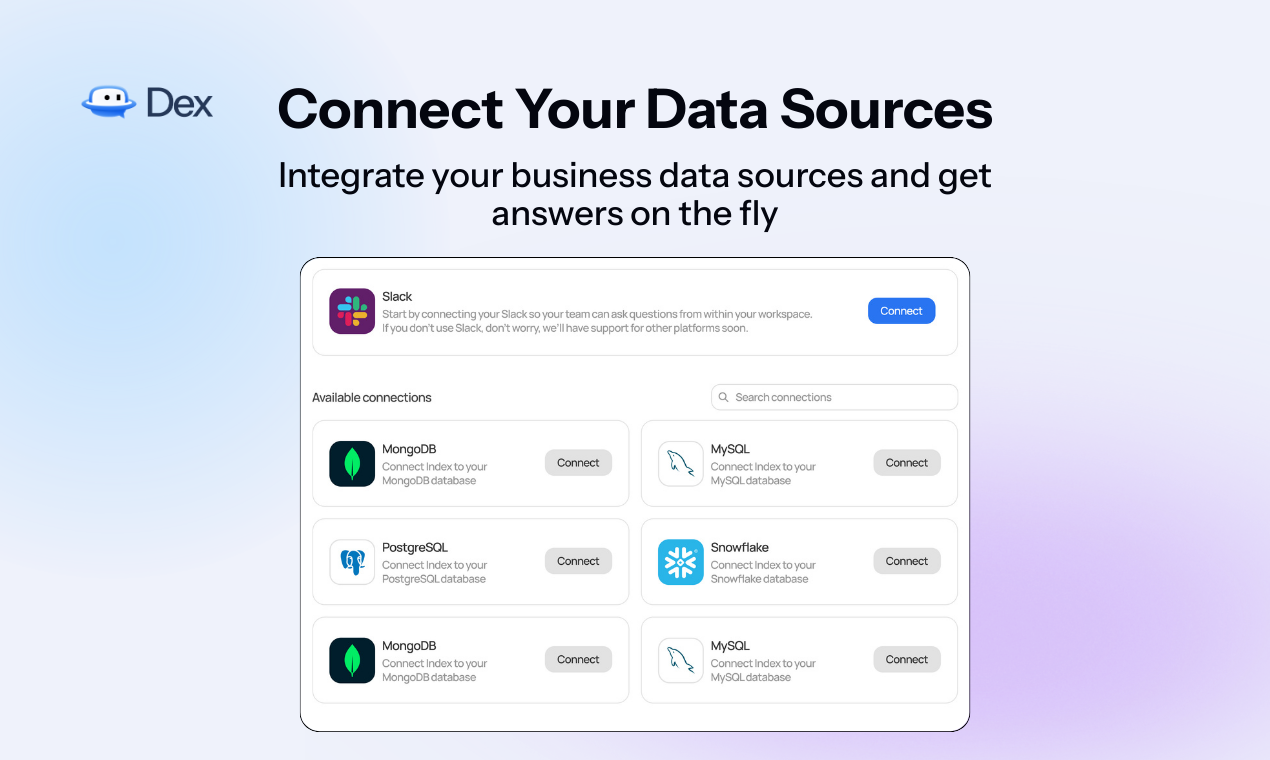
一句话介绍:Dex是一款面向创业者的AI数据分析助手,通过连接多种数据源并支持自然语言提问,帮助非技术用户在无需编写SQL或等待数据工程师的情况下,快速获得数据洞察和行动建议,解决数据获取与决策脱节的痛点。
Productivity
AI数据分析 自然语言查询 数据整合平台 无代码分析 商业智能 数据民主化 多源数据连接 Slack集成 自动化报告 创业工具
用户评论摘要:用户普遍认可其自然语言查询和多源数据整合价值,特别赞赏“可查看生成SQL”的透明设计。主要问题集中于数据安全机制、与现有AI工具(如Claude)的差异、对混乱数据的处理能力,以及是否支持上下文追问和定时报告。团队对安全、准确性和扩展性给予了详细回复。
AI 锐评

Dex切入了一个经典且顽固的痛点——数据访问瓶颈。其宣称的价值并非简单的“AI写SQL”,而在于试图成为跨数据源的统一语义层和决策代理。这比单数据库SQL Copilot野心更大。

产品亮点清晰:一是“可查验查询”建立了关键的技术信任,让黑箱输出变得可审计;二是将Slack作为主要交互界面,精准嵌入决策对话发生的场景,而非另一个孤立的分析工具;三是强调“推荐后续步骤”,试图跨越从洞察到行动的鸿沟。

然而,其面临的挑战同样尖锐。首先,**技术风险并未消失,只是转移了**。将复杂业务逻辑转化为准确SQL本身是难题,跨异构数据源的JOIN更甚,其准确性宣称需经受真实企业混乱数据的考验。其次,**安全与便利的永恒博弈**。尽管团队详细说明了加密与权限控制,但一旦成为集中访问枢纽,其安全边界和攻击面将成倍扩大,这将是企业级客户的核心顾虑。最后,**竞争维度复杂化**。它不仅要与传统BI和数据分析平台竞争,还需面对如ChatGPT等通用AI助手通过插件生态侵入同一场景。其壁垒在于深度工作流集成与垂直场景的精度,但这需要持续的工程打磨。

真正的考验在于,它能否在保持“自然语言”简易性的同时,处理企业级的数据复杂性与严谨性需求。如果成功,它将成为“数据民主化”的有效推手;若精度不足,则可能沦为另一个尝鲜即弃的玩具。团队对性能基准测试和安全架构的阐述显示出专业意识,但产品的长期价值,将由其在真实业务决策中不可替代的准确性来决定。

查看原始信息
Dex
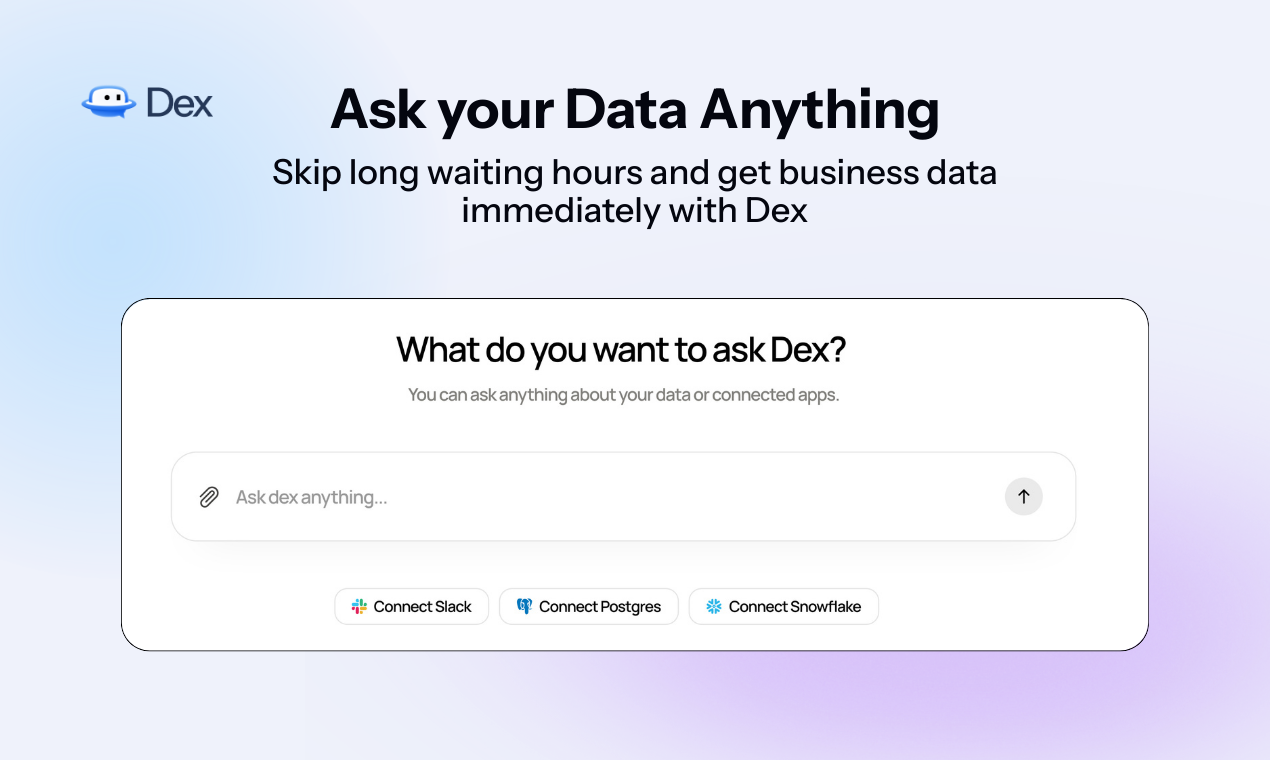
Dex is an AI data analyst for founders. Connect your databases, spreadsheets, or BI tools, ask questions in plain English, and get instant answers with recommended next steps based on your data.

Hi everyone I’m Tope, founder of Dex.

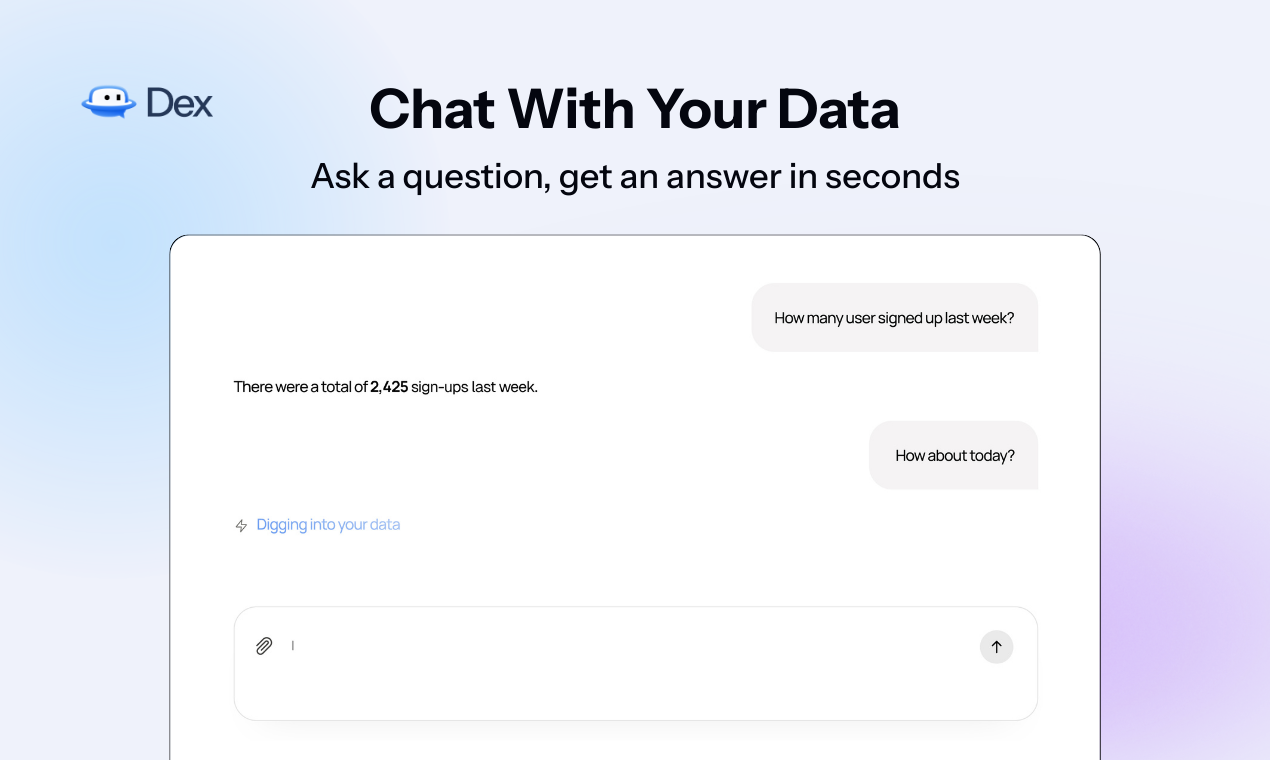
Dex helps teams get instant answers and actionable insights from their data without writing SQL or waiting hours/days on an analyst. You just ask questions in plain English and Dex instantly gives you the answer.


The Problem We Noticed
In order to get the data they need, most people have to either write complicated sql queries or wait for a specialized data engineer. The data engineer has a backlog and is constantly swamped, meanwhile the non-technical person needs this data in order to make a decision. Thus, making data a huge bottleneck for making these critical decisions.

How Dex Solves This
Dex is an AI agent that can automatically write sql directly on your database and visualize the results in seconds. It’s fast, it’s accurate and every number comes straight from the source of truth. You can even inspect the exact query Dex ran, so you always know where the numbers came from.

Dex connects securely to your:

✅ Postgres,
✅ Mongodb
✅ Snowflake instance.
✅ Google sheets
✅ Shopify
✅ Stripe
✅ and more

You can also upload spreadsheets as a data source. Once connected, you can ask questions either on the Dex web app or in Slack.

We’d love to get your feedback on what we’ve built.

Visit dexdata.ai to get started today
Or join our slack community

Huge shoutout to the amazing team who helped make this possible:

@owusu_samuel

@the_real_agboola

@hameed13

@hassan0x

13
回复

This is great! What's the reason behind the name Dex? Congrats on the launch,@topealabi_ !

1
回复

@topealabi_ Hi Tope. Congrats on launching. What insight made you believe now was the right time to build Dex?

0
回复

How does Dex ensure the security and privacy of sensitive database credentials while performing cross-source joins between disparate tools like SQL databases and spreadsheets?

4
回复

@mordrag 

Security and privacy are core to Dex’s architecture. Credentials are end-to-end encrypted using industry-standard practices and are never exposed to the AI layer. Dex only accesses schema metadata to understand structure, while credentials are decrypted temporarily at execution time to run queries.

We also implement multiple guardrails and validation layers to prevent unsafe queries or sensitive data exposure, and users have granular control to enable or disable specific tables and fields the AI can access.

11
回复

Cool product. When I was at Meta, getting access to data was very painful. Do you all have other ways to interface with the data other than Slack?

2
回复

@obedeugene Asides Slack, you can also query connected data sources or upload files directly through the Dex dashboard. More messaging platforms and integrations will be added over time to enable broader team collaboration.

2
回复

The part I like here is the recommended next steps based on data. getting insight is good, but knowing what to do next makes it even better. 👍

2
回复

@saturnina_brigante Thanks for the feedback.

1
回复

Pulling data from BI tools, sheets, and databases into one assistant is a smart idea. Instead of digging through dashboards, yo ask and get a clear answer.

2
回复

@shawn_idrees Yes, that is the goal. Thanks for the support, Shawn.

1
回复
Love the plain English query approach — removing the SQL bottleneck for non-technical founders is huge. Quick question: does Dex support scheduled reports? Like automatically sending a daily summary to Slack at a set time?
2
回复

@jay_song_dev Hi Jay yes we do support scheduled insights and reports sent to a sent to your slack DM as often as you would like it. Just ask Dex on slack

4
回复

The multi-source approach is what makes this interesting to me — being able to query across Postgres, Sheets, and Stripe from one place is way more useful than yet another SQL copilot. The fact that you can inspect the actual query Dex ran is a nice trust-builder too.

1
回复
@letian_wang3 Thanks a lot for the feedback. Over time, Dex will offer a large number of data source connection and even more messaging platform integrations.
0
回复

The Slack integration is the right call - that's where the questions actually happen. Curious how it handles follow-up questions in a thread. Can you ask 'now break that down by country' and have it remember the context from the first query?

1
回复
@alex_kerya Yes, Dex does remember context in threads.
0
回复

This is really cool. The "inspect the exact query" part is what sets this apart imo. Most AI-to-SQL tools I've tried just give you the answer with no way to verify the logic, which is a dealbreaker when you're making business decisions off the data. Being able to see what Dex actually ran is huge for trust.

1
回复

@mihir_kanzariya Thanks for the feedback, Mihir. Dex provides an avenue for technical reviews on each query by technical users.

1
回复

Hey
Just wondering why it is called Dex?

1
回复

@vadym_pavlenko Hi Vadym, Dex is short for Index.

1
回复

@vadym_pavlenko Hi Vadym, Dex comes from index. An index organizes information so it’s easy to find and use. Dex is the shorter, faster version of that idea.

1
回复

Good job! Love that you're solving this problem.
Curious whether & how it handles messy/incomplete data?

1
回复

@zeebs Thanks for the feedback.
Our data ingestion layer already handles this.

1
回复

@topealabi_ Cool product! How do you measure the quality or confidence of the structured data outputs?

1
回复

@damian_quiroga 

Appreciate that Damian!

We don’t just let the AI wing it every query goes through a pipeline that ensures it only pulls from real fields and tables in your database. Low-confidence or ambiguous outputs are flagged for follow-up, and the system can ask for clarification when needed. On top of that, we benchmark performance against public datasets (bridsql -minidev) with predefined queries to objectively measure accuracy. This approach ensures our outputs are both reliable and correct.

4
回复

Ican use postgresql mcp server, google docs mcp. There are a lot of tools for Claude, so I can just ask it a question. What makes you better then simple claude client?

1
回复

@valentina_konuhova Hi Valentina, Dex has several features that distinguish it from other products. It allows users to communicate with multiple data sources from a single interface, making data access and analysis much simpler. With Dex’s Slack integration, teams can interact with all their connected databases directly within Slack, enabling faster collaboration and faster decision-making. Dex also supports scheduled insights and reports, which can be automatically delivered to users via email or Slack, ensuring teams stay informed without needing to manually check dashboards.


2
回复

Love not having to utilize SQL. When compared to existing tools that let you query databases without writing SQL, what would you say makes Dex distinct compared to those existing options?

0
回复

Love this. Asking your data questions in plain English and skipping the SQL queue is exactly what most founders need. What data sources are you seeing teams connect most?

0
回复
So cool @topealabi_ Does Dex support any custom integrations like an MCP server (or similar protocol/server setup) for advanced workflows, or is that on the roadmap?
0
回复

@_anasansari 
Thanks for asking, Anas

Custom integrations like an MCP server or similar setups aren’t supported yet, but this is something we plan to add in future updates as we expand DexData’s workflow capabilities.

0
回复

Congrats on a launch! Dex was an interesting naming choice — immediately associates with Decentralized Exchanges in my case.

0
回复

@nikitaeverywhere Dex is short for index ;)

2
回复

@nikitaeverywhere Thanks for the support

2
回复
#4
simply
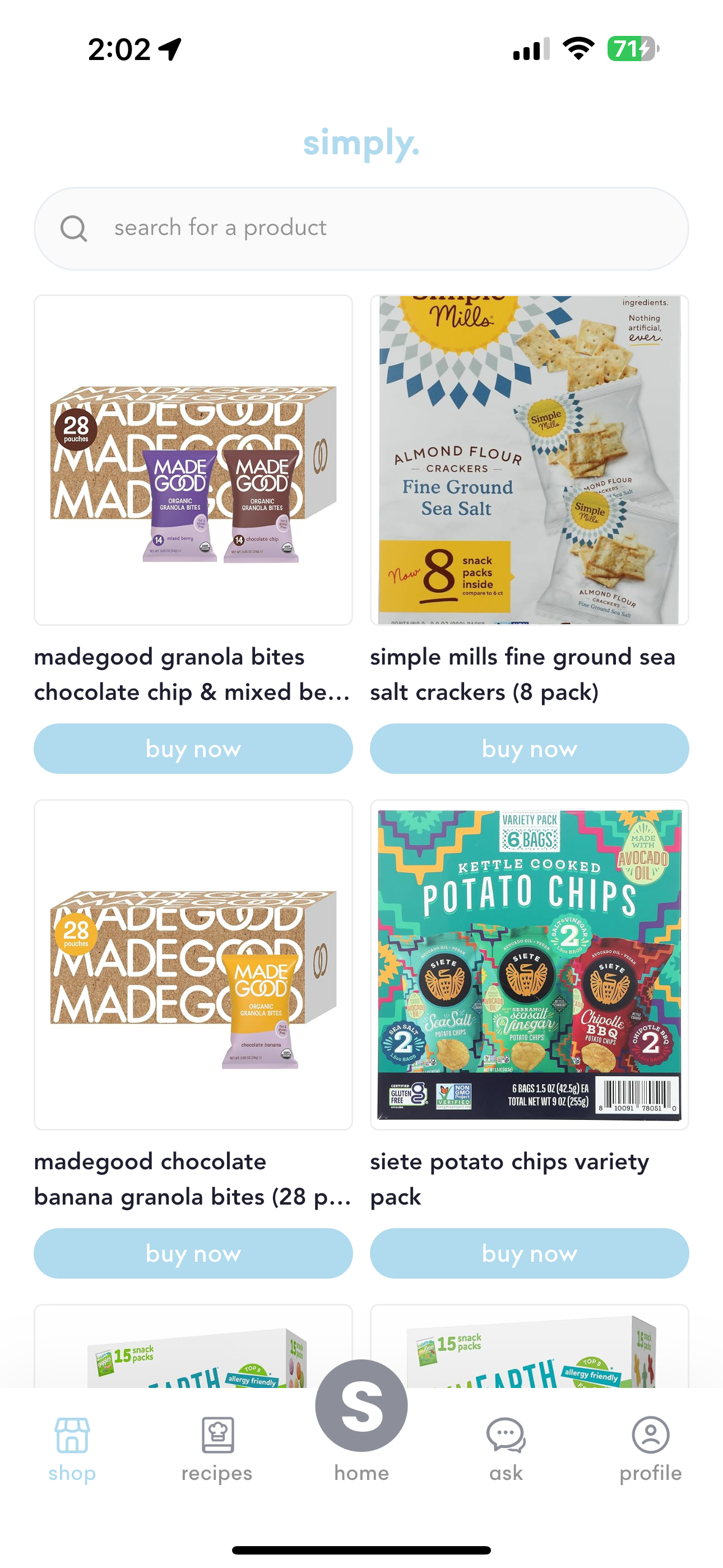
ai nutrition app
265
一句话介绍:一款通过提供由认证营养师设计的每日可执行小贴士,帮助用户在日常生活场景中无压力地建立可持续健康习惯的AI营养应用。
Health & Fitness Productivity Artificial Intelligence
健康科技 营养指导 习惯养成 微习惯 健康生活 人工智能 订阅制 心理健康 可持续性 内容可信
用户评论摘要:用户普遍赞赏其“简化”理念,认为其对抗了信息过载和极端饮食焦虑。核心关注点在于个性化程度,多人询问建议是否通用或能基于目标调整。有效建议包括:增加进度追踪器以提升成就感,以及简化新用户激活流程。
AI 锐评

Simply切入了一个精准的痛点缝隙:在“极端节食”与“信息过载”之间,提供一条基于专业知识的“最小阻力路径”。它的真正价值不在于AI技术的颠覆性,而在于对健康行为改变心理的深刻理解——将宏大的健康目标解构为每日可消化的、零认知负担的微任务。这本质上是将“知识付费”和“习惯养成”模式进行了结合,认证营养师背书解决了信任问题,每日推送机制利用了提醒和承诺一致性心理。

然而,其面临的挑战同样清晰。首先,其“AI”标签目前看来更偏向营销话术,核心内容生产仍依赖于传统营养师,AI聊天功能仅是补充,这可能导致其与真正的个性化营养算法应用存在体验代差。其次,用户对“个性化”的连续追问揭示了其核心矛盾:如果建议始终是普适性的,用户的长期参与度和付费意愿将面临考验;而一旦深入个性化,就必然涉及复杂的用户数据输入与合规风险,背离其“极简”初衷。最后,其商业模式依赖订阅,但微习惯的养成本身旨在让用户“忘记”应用,这与追求用户粘性和留存率的商业目标存在根本张力。

Simply更像一个精心设计的健康内容订阅服务,而非技术驱动的健康革命。它的成功与否,将取决于其能否在“保持极简”与“提供足够个性化价值”之间找到那个微妙的平衡点,并证明这种每日小贴士的模式能产生可量化的健康结果,而不仅仅是心理安慰。

查看原始信息
simply
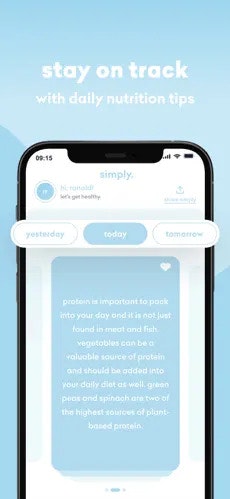
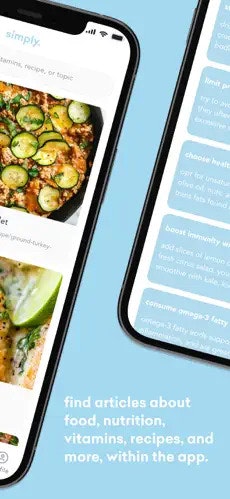
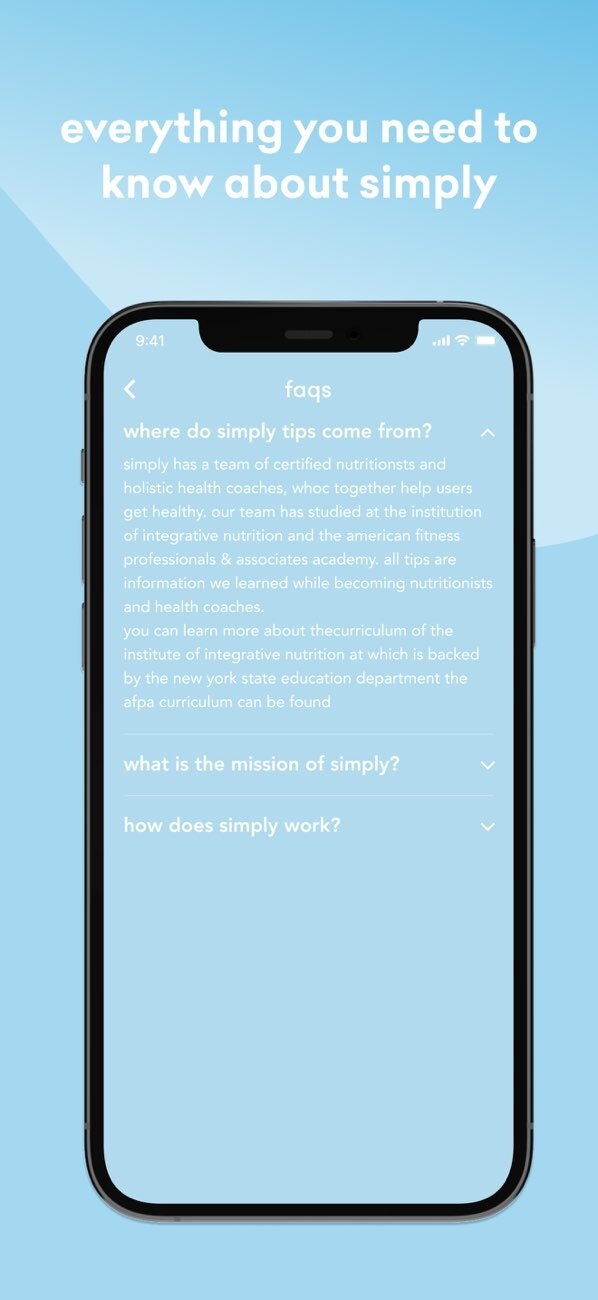
simply is a nutrition app that delivers practical daily nutrition tips created by certified nutritionists. it’s designed for people who want to improve their health but feel overwhelmed by complex diets, conflicting advice, and restrictive meal plans. instead of promoting fad diets, simply provides small, actionable tips users can apply in everyday life, helping them build sustainable and healthier habits over time.
I’m excited to hunt Simply today! There’s so much confusing nutrition advice online, extreme diets, conflicting opinions, and information overload. What I like about Simply is that it takes a much simpler approach: small, practical nutrition tips you can actually apply in everyday life. The app sends daily tips created by certified nutritionists, helping users gradually learn how food impacts their body and build healthier habits over time. Instead of pushing restrictive diets or complicated plans, Simply focuses on consistent, achievable improvements that anyone can follow. 👉A few things that stood out to me: 👉Daily actionable nutrition tips 👉Choose when you receive your daily tip 👉Save tips and track which ones you’ve applied 👉A mission that also supports kids’ nutrition programs If you’re someone who wants to get healthier but feels overwhelmed by all the noise around nutrition, this looks like a refreshing approach.
7
回复

@istiakahmad Thank you for the kind words about simply!

1
回复

@istiakahmad Hey Ahmad. What features help users stay consistent instead of abandoning the app after a few weeks?

0
回复

Hi Product Hunt, 👋

I’m the maker of Simply, and we just launched today.

Built Simply for people who want to eat healthier but feel overwhelmed by strict diets and conflicting nutrition advice. Instead of complicated plans, Simply shares small daily tips from certified nutritionists to help you build sustainable habits.

Excited to hear what you think.

3
回复

@priyankamandal Thank you for supporting simply!

0
回复

Finally a nutrition app that doesn’t ask me to completely change my life on day one 😅

2
回复

@sadie_perry Really Flattered to see you loved it (: , Thanks again. Any feedback is appreciated

0
回复

@sadie_perry that's the idea behind it and exactly how I got healthy (and why simply exists)! By learning about nutrition, applying that knowledge to everyday life, and making small changes that are obtainable and eventually turn into a big lifestyle change that works for you.

0
回复

@sadie_perry you can download simply in the iOS store (https://apps.apple.com/us/app/simply-nutrition-tips/id6744089564) + Google Play (https://play.google.com/store/apps/details?id=com.daily.simply.nutritions). use code "producthunt" to get a 30-day free trial!

0
回复

Does it give personalized nutrition tips or just general ones? Like, can it adapt if someone’s cutting carbs?

2
回复

@djordjevic_nikola Hi Nikola, So the personification will come with our future roadmap ( :

0
回复

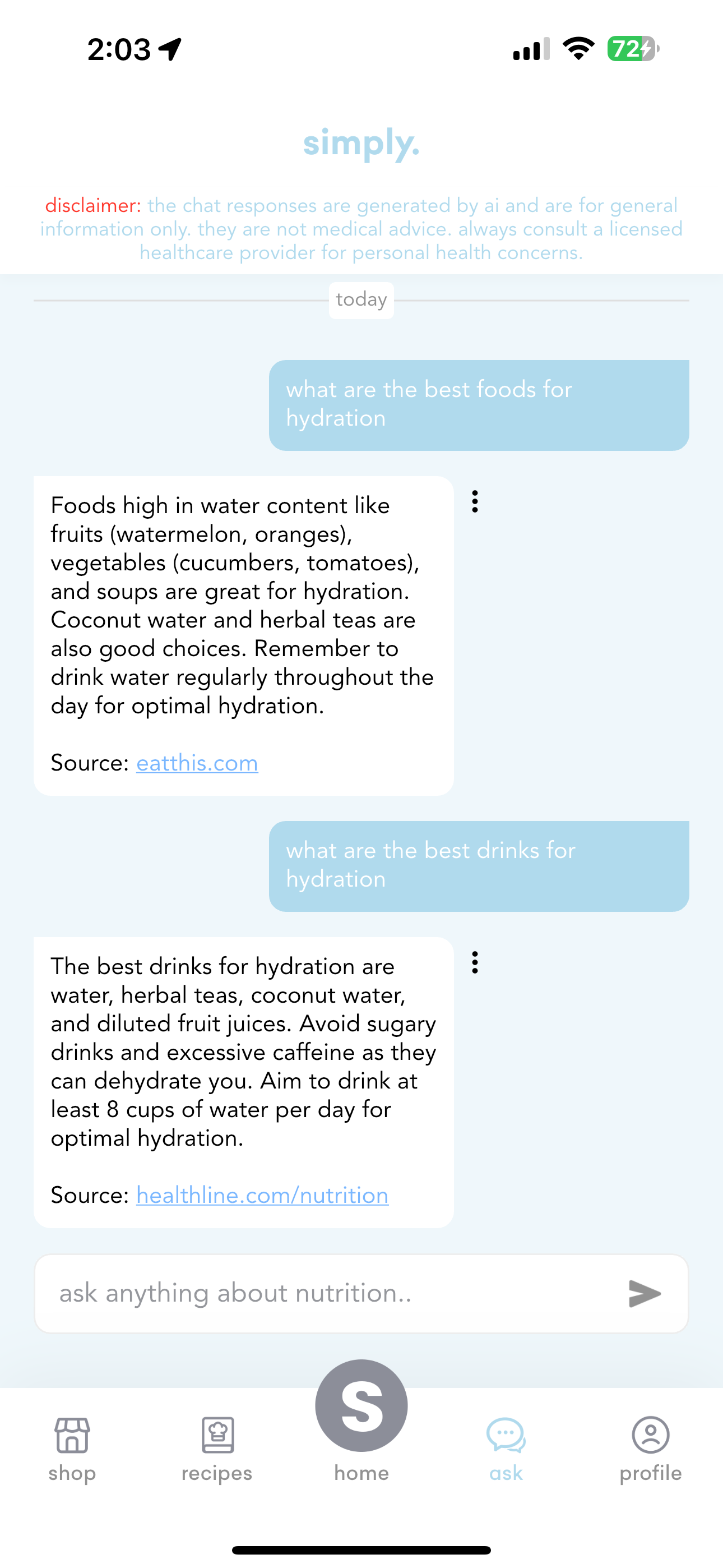
@djordjevic_nikola simply provides users with daily nutrition tips to allow them to learn about nutrition, and then add that knowledge into their everyday life and choices. simply's ai chat allows users to receive more personalized nutrition advice. Thank you for your interest in simply!

0
回复

@djordjevic_nikola you can download simply in the iOS store (https://apps.apple.com/us/app/simply-nutrition-tips/id6744089564) + Google Play (https://play.google.com/store/apps/details?id=com.daily.simply.nutritions). use code "producthunt" to get a 30-day free trial!

0
回复

Congratulations on the launch 🎉 🎉 !!

2
回复

@shubham_pratap Thank you so much!

0
回复

@shubham_pratap  Thank you! I hope you love simply!

0
回复

@shubham_pratap you can download simply in the iOS store (https://apps.apple.com/us/app/simply-nutrition-tips/id6744089564) + Google Play (https://play.google.com/store/apps/details?id=com.daily.simply.nutritions). use code "producthunt" to get a 30-day free trial!

0
回复
Finally an AI nutrition app that actually makes sense. Giving it a try - staying healthy just got a little easier. Congrats on the launch! 👏
2
回复

@raihanshezan Thank you so much for the words, Hope you will love it ( :

0
回复

@raihanshezan  Thank you for these kind words! I am so excited to help you get healthy.

0
回复

@raihanshezan you can download simply in the iOS store (https://apps.apple.com/us/app/simply-nutrition-tips/id6744089564) + Google Play (https://play.google.com/store/apps/details?id=com.daily.simply.nutritions). use code "producthunt" to get a 30-day free trial!

0
回复
This is a refreshing approach to nutrition. Daily expert tips + an AI assistant to ask questions anytime sounds like a great combination for learning and improving habits over time. Excited to try it out!
2
回复

@iftekharahmad Thanks IFTEKHAR. Hope it exceeds your expectations.

0
回复

@iftekharahmad Thank you for the support! I think you'll love it!

0
回复

@iftekharahmad you can download simply in the iOS store (https://apps.apple.com/us/app/simply-nutrition-tips/id6744089564) + Google Play (https://play.google.com/store/apps/details?id=com.daily.simply.nutritions). use code "producthunt" to get a 30-day free trial!

0
回复
Really cool idea!
1
回复

@edgeghost Thank you so much adam ( :

0
回复

@edgeghost  Thank you for the feedback!

0
回复

@edgeghost you can download simply in the iOS store (https://apps.apple.com/us/app/simply-nutrition-tips/id6744089564) + Google Play (https://play.google.com/store/apps/details?id=com.daily.simply.nutritions). use code "producthunt" to get a 30-day free trial!

0
回复

It's like watching what you eat, and HOW you eat. Love this platform. Congrats on the launch, @courtneyscioli!

1
回复

@courtneyscioli  @neilverma Thank you so much neil ( :

0
回复

@neilverma thank you! That's exactly the idea behind, just how I got healthy. By learning about nutrition and applying that knowledge to everyday life. By making small changes that eventually lead to an entirely new lifestyle. Really appreciate your feedback!

0
回复

@neilverma you can download simply in the iOS store (https://apps.apple.com/us/app/simply-nutrition-tips/id6744089564) + Google Play (https://play.google.com/store/apps/details?id=com.daily.simply.nutritions). use code "producthunt" to get a 30-day free trial!

0
回复

I really like the philosophy behind Simply teaching nutrition through small, daily, actionable tips instead of pushing extreme diets is refreshing and way more sustainable. The fact that a certified nutritionist is behind the content gives it real credibility, and the donation to kids' nutrition programs shows genuine purpose.

Congrats on the launch!

have you considered adding a simple progress tracker where users can mark which daily tips they've actually applied to their routine?

1
回复

@martingebara Hi Martin, Great idea, Would be happy to build the progress tracker. Thanks for the suggestion ( :

0
回复

@martingebara  thank you for this feedback! I am so glad you are finding value in it. simply was built on the foundation of how I got healthy years ago - no extreme diets, no fads, no un-sustainable meals plans. simply helps users from the start of their nutrition journey by helping them understand what they are eating, why, and how to make simple swaps and lifestyle changes that don't feel extreme. It has worked for me for over a decade and I love watching it work for our users, too!

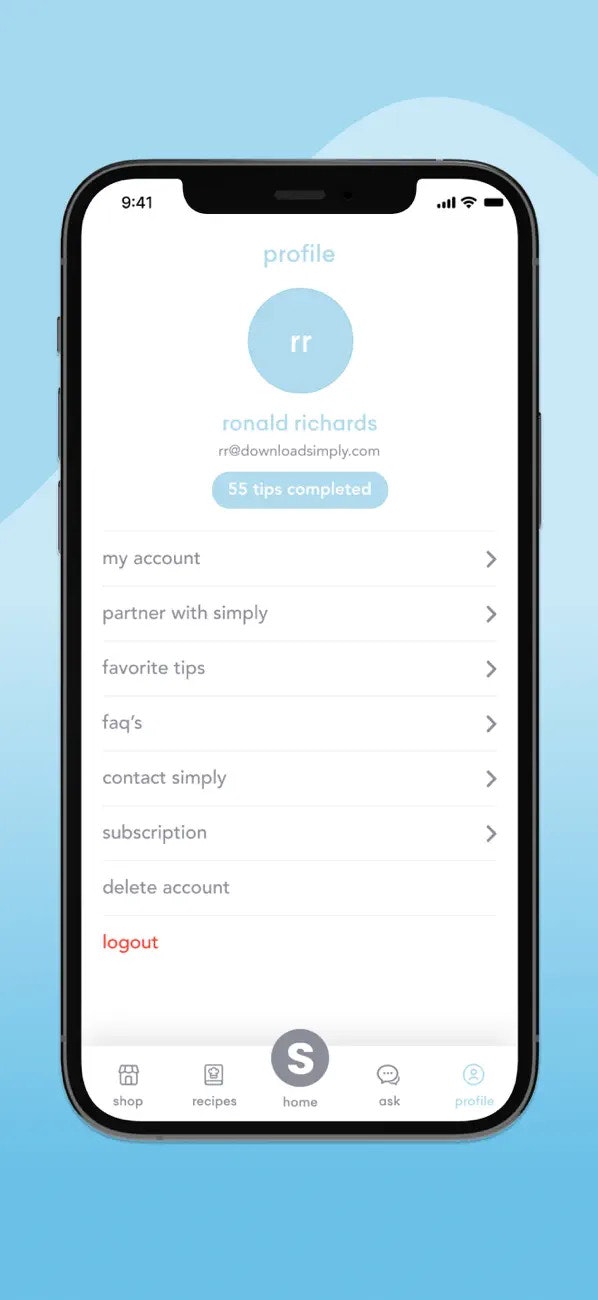
You can favorite your tips from the homepage, and then view those tips anytime in the future in the "favorite tips" section of your account. The tip traction in your profile allows you to see how many tips you have completed.

Thank you for all of this helpful feedback!

0
回复

@martingebara you can download simply in the iOS store (https://apps.apple.com/us/app/simply-nutrition-tips/id6744089564) + Google Play (https://play.google.com/store/apps/details?id=com.daily.simply.nutritions). use code "producthunt" to get a 30-day free trial!

0
回复

Love the angle here. Good luck with the launch!

1
回复

@lev_kerzhner  Thank you for the feedback!

0
回复

@lev_kerzhner Thank you so much for the compliment ( :

0
回复

@priyankamandal @courtneyscioli This is a great product idea. One UX improvement that could increase user activation is simplifying the onboarding flow.

1
回复

@priyankamandal  @dcodes20 Thank you for the time and feedback! So valuable to us.

0
回复

@priyankamandal  @dcodes20  you can download simply in the iOS store (https://apps.apple.com/us/app/simply-nutrition-tips/id6744089564) + Google Play (https://play.google.com/store/apps/details?id=com.daily.simply.nutritions). use code "producthunt" to get a 30-day free trial!

0
回复

Wanted to ask wether there is any personalisation or it is general nutrition advices. As everyone is different, have different needs and maybe differences in their health estate and goals

1
回复

@viktorgems  simply provides users with daily nutrition tips to allow them to learn about nutrition, and then add that knowledge into their everyday life and choices. simply's ai chat allows users to receive more personalized nutrition advice. Thank you for your interest in simply!

2
回复

@viktorgems you can download simply in the iOS store (https://apps.apple.com/us/app/simply-nutrition-tips/id6744089564) + Google Play (https://play.google.com/store/apps/details?id=com.daily.simply.nutritions). use code "producthunt" to get a 30-day free trial!

0
回复

Really dig the approach here. Small daily tips from actual nutritionists instead of overwhelming meal plans. Do the tips get more personalized over time based on how you use the app?

0
回复

Congrats on your launch!
I’ve tried building a few fitness apps myself and learned how hard this space is.
Out of curiosity, what’s your strategy for helping users stick with the app long term and actually build habits?

0
回复

Congrats on the launch! One idea for a potential feature down the road: maybe users could upload what they ate that day (I'm picturing something like MyFitnessPal or Lose It!) and get personalized feedback/suggestions on areas where they could improve their diet (e.g., like swapping out something they ate that day for a healthier alternative). Either way, the app looks great, and best of luck!

0
回复

@shaun_hurley Thank you for this wonderful feedback! Love your vision and really appreciate you sharing.

0
回复

@shaun_hurley you can download simply in the iOS store (https://apps.apple.com/us/app/simply-nutrition-tips/id6744089564) + Google Play (https://play.google.com/store/apps/details?id=com.daily.simply.nutritions). use code "producthunt" to get a 30-day free trial!

0
回复

Congrats on the launch! Love the idea of improving people's diets on a daily basis.
Curious how you’re thinking about personalizing nutrition tips for different users?

0
回复

@victoria_samoilenko1  Thank you! So glad you like it. Being healthy is so important. simply sends users daily nutrition tips that gives them the knowledge they need to get healthy. users can use our ai nutrition chat to get personalized nutrition advice.

0
回复

@victoria_samoilenko1 you can download simply in the iOS store (https://apps.apple.com/us/app/simply-nutrition-tips/id6744089564) + Google Play (https://play.google.com/store/apps/details?id=com.daily.simply.nutritions). use code "producthunt" to get a 30-day free trial!

0
回复
#5
SCRAPR
The data layer for the agentic web
239
一句话介绍:SCRAPR通过直接拦截并解析现代网站加载数据时的底层API请求,而非依赖脆弱的DOM解析或笨重的浏览器自动化,为开发者、数据团队和AI构建者提供了一种更快速、稳定、易维护的网页数据提取方案,解决了传统爬虫在动态网站面前易失效、难维护的核心痛点。
Productivity API Artificial Intelligence
网页数据提取 API拦截 无头浏览器替代 数据管道 AI数据供给 现代网站爬虫 结构化数据 开发者工具 数据自动化 网络请求分析
用户评论摘要:用户普遍赞赏其“从源头获取数据”的巧妙思路,认为能极大提升稳定性。主要问题集中于:如何处理API变更、签名或会话保护的复杂站点;是否具备应对Cloudflare等反爬机制的能力;以及未来是否会推出数据模式映射、批量处理等增强功能。
AI 锐评

SCRAPR提出的“为智能体网络提供数据层”的愿景,直指当前AI应用浪潮下一个被低估的基础设施痛点:高质量、高稳定性的结构化数据供给。其技术路径选择展现出了深刻的行业洞察——与其在渲染后的DOM层进行一场永无止境且脆弱的“军备竞赛”,不如降维打击,直抵数据源头。

这并非一个简单的技术优化,而是一次范式转换。传统爬虫与无头浏览器的困境,本质上是将数据消费者置于了与网站前端框架对抗的位置。SCRAPR则试图扮演一个“合规的观察者”,通过模拟并理解网站自身的数据加载逻辑来获取信息,这使其在理论上具备了更强的鲁棒性和更低的资源消耗。创始人反复强调的“不依赖固定选择器”和“适应网站数据流”,正是其核心价值主张:从“解析界面”转向“理解通信协议”。

然而,其宣称的“可处理任意现代网站”的理想,在现实中面临严峻挑战。评论中多次提及的动态签名、会话依赖和服务器端渲染(SSR)场景,正是其方法论可能失效的边界。在这些情况下,数据流可能与页面逻辑深度耦合,单纯拦截网络请求未必能获得完整或可访问的数据。此外,将稳定性寄托于网站内部API的“相对稳定”,本身也是一种假设,大型平台的数据接口变更同样频繁且无预警。

真正的考验在于其“重新分析并调整”的能力能否实现自动化与智能化。如果每次适配仍需大量人工干预,则其优势将大打折扣。长远看,SCRAPR的价值不仅在于一个更聪明的爬虫引擎,更在于能否基于此构建一个标准化的、面向AI的数据供给平台。正如用户所建议的,集成数据模式定义与映射能力,将是其从“提取工具”升级为“数据管道核心”的关键一步。当前MVP阶段所展示的思路令人振奋,但其工程实现的深度与广度,将决定它最终是成为一个利基工具,还是下一代数据基础设施的基石。

查看原始信息
SCRAPR
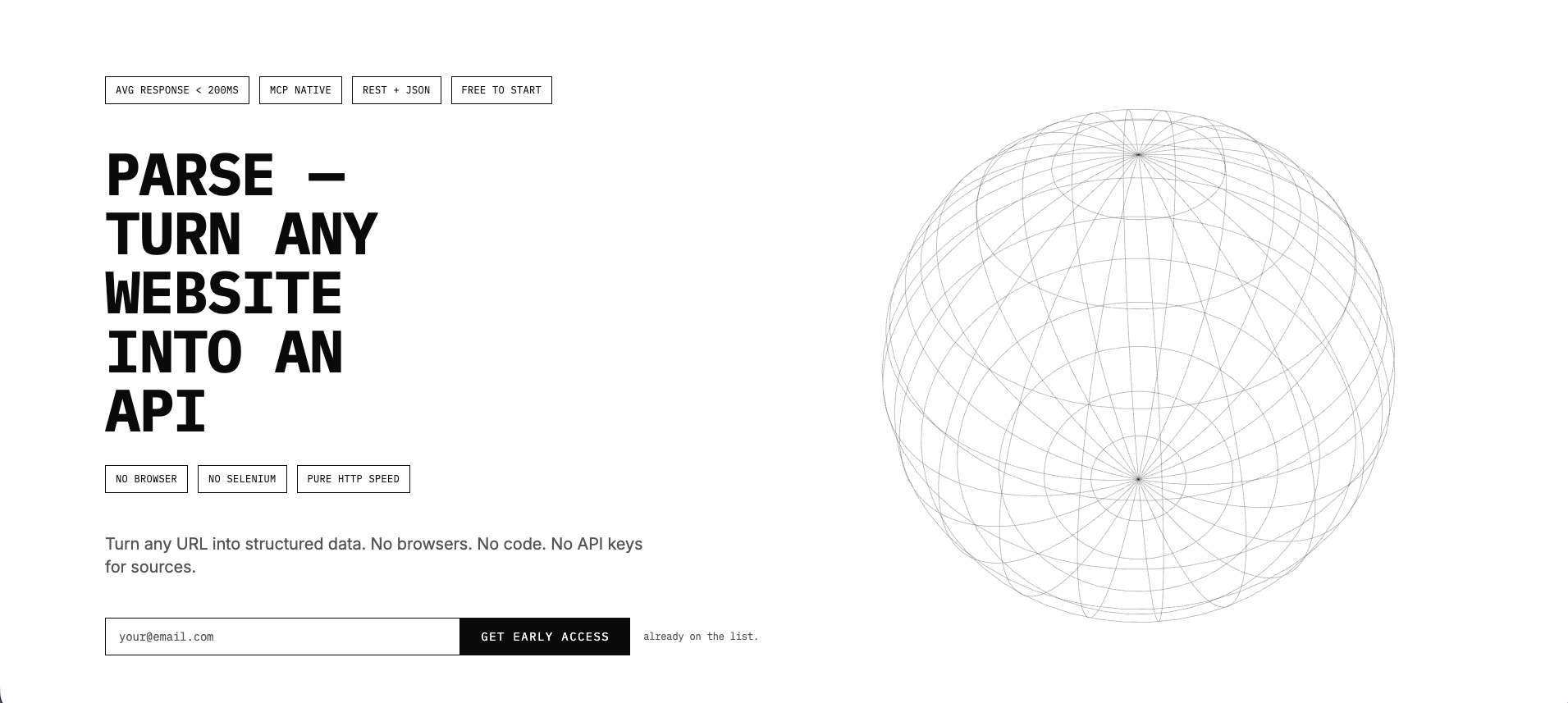
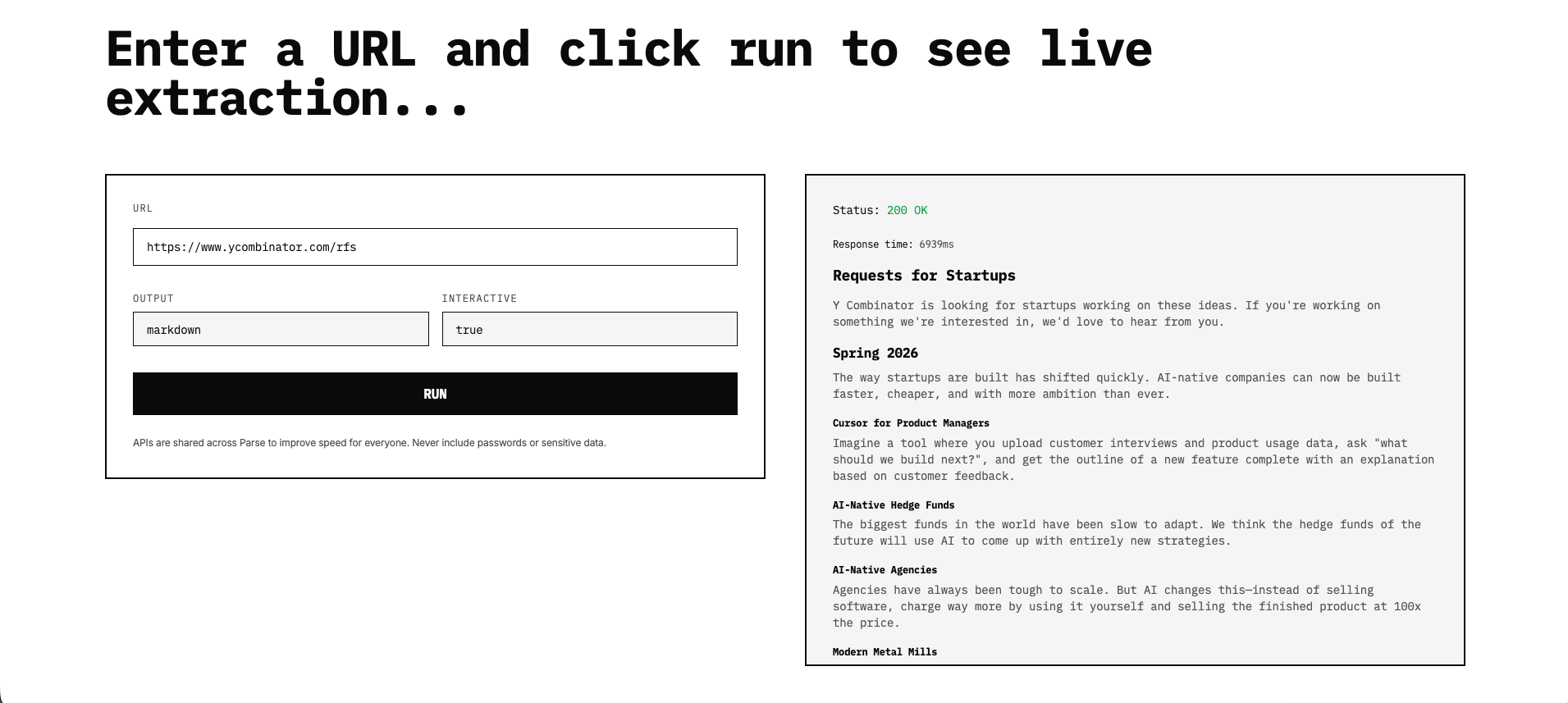
SCRAPR is a new approach to web data extraction. Instead of relying on fragile DOM selectors or heavy browser automation, SCRAPR looks at how modern websites actually load their data and extracts structured responses directly from those sources. The goal is to make web data pipelines faster, more reliable, and easier to maintain. Right now SCRAPR is in early MVP and we’re looking for developers, data teams, and AI builders who need clean structured data from websites.

I built SCRAPR after running into the same problem again and again:

Getting structured data from websites is still way harder than it should be.

Most tools fall into two buckets:

• Browser automation (Puppeteer / Selenium) — slow and expensive
• Traditional scrapers — fragile and constantly breaking

SCRAPR tries a different approach.

Instead of rendering pages or parsing messy HTML, it focuses on how websites actually load their data and extracts structured responses from there.

The goal is to make web data extraction more reliable — especially for AI pipelines and data workflows.

It’s still early (MVP stage), and I’m looking for builders who want to try it and give feedback.

7
回复

@vemulasukrit Hi Sukrit. Congrats on launching. How does SCRAPR identify and extract the relevant data from a website’s structure?

0
回复

How does this engine handle JavaScript-heavy or dynamic content without a browser, and what mechanisms ensure data accuracy when the source website changes its layout?

5
回复
@mordrag For JavaScript-heavy sites, the engine doesn’t use a browser. Instead it looks at the page’s code and finds the API requests the site uses to load its data (like fetch, axios, or GraphQL). Then it calls those data endpoints directly and pulls the real content from there. This makes it much faster and lighter than running a full browser.
2
回复

So what happens when the API changes?

Sites like Linkedin also use server side rendering and hydration for pages so this approach won't work on most websites?

2
回复

@arjun_chintapalli Good question. If an API changes, SCRAPR isn’t tied to just one extraction path. It can re-analyze how the page delivers its data and adjust instead of relying on a fixed endpoint or selector.

And you’re right that some sites use server-side rendering or hydration. In those cases the content still exists in the page response or in subsequent requests, so SCRAPR can fall back to extracting it from the page structure when needed.

0
回复

This approach is super clever — basically doing what I always do manually in Chrome DevTools Network tab (hunting for those fetch/GraphQL calls) but automated 😮

Does the engine just statically analyze the page source to find those internal API requests, or does it use AI/LLM in some way to detect and reconstruct the right endpoints even on tricky sites?

And how well does it handle completely arbitrary URLs — like, throw any random modern site at it and it still finds the clean data source reliably?

2
回复
@paxhumana Yeah that’s actually a great way to think about it 😄 it’s basically automating the kind of discovery people usually do manually in DevTools. Under the hood it analyzes how modern sites load their data and figures out the clean data sources from there. It’s not tied to specific selectors or layouts, which helps it stay stable even when sites change their UI. The goal is that you can throw pretty much any modern site at it and it will still find the structured data without needing manual setup. There are always edge cases of course, but it works reliably across a wide range of sites.
0
回复

This is such a clean solution to a problem that's been annoying developers forever. Rooting for you!

2
回复
@lev_kerzhner Thanks! 😊
0
回复
Hey Sukrit, that frustration of scraping tools either being slow and fragile or breaking constantly on modern sites is painfully real. Was there a specific project where you watched your scraper break for the tenth time on some JS-heavy page and thought okay, there has to be a completely different approach?
2
回复
@vouchy Yeah honestly that exact frustration is what started it 😅 I kept hitting sites where traditional scrapers would either break when the layout changed or become super slow because they needed a full browser. After dealing with that enough times, it felt obvious that the approach itself needed to change. So instead of relying on fragile selectors or browser automation, the engine focuses on understanding page structure and the data sources behind the page. That way it’s much less likely to break when the UI changes.
3
回复
@piroune_balachandran Good question. Yes — there is a fallback. If the underlying endpoints change or disappear, SCRAPR can fall back to extracting the content directly from the page structure instead.
0
回复

Intercepting network calls instead of rendering pages is a smart approach. Way less fragile than the usual scraping setups. What kinds of sites have been trickiest to support so far?

1
回复

@dparrelli Thanks, appreciate that!

Some of the trickier ones tend to be sites that generate requests dynamically or rely heavily on session-based flows, since those can behave differently depending on how the page loads.

But overall most modern sites still rely on some form of underlying data requests.

0
回复

Great implementation! Is the live demo on the website operable? I can't seem to enter text into the fields. Early access requested!

1
回复

@joel_farthing Thanks, really appreciate that!

The demo on the site is more of a preview right now, so the input fields aren’t fully interactive yet. I’m working on making a proper live demo soon.

Glad you requested early access — I’ll make sure you get access as we roll out the next version!

0
回复

Really smart approach to web scraping. Focusing on where data actually comes from rather than relying on DOM selectors is a much more resilient strategy. Most scraping tools break the moment a site updates its frontend, so anchoring to underlying API calls makes a lot of sense.

Curious about how you handle rate limiting and sites that aggressively block automated access. Either way, congrats on the launch!

1
回复
@handuo Thanks, really appreciate that! For things like rate limiting or stricter access controls, it really depends on how the specific site handles requests. SCRAPR focuses on keeping requests lightweight and behaving like a normal client rather than relying on heavy browser automation.
0
回复

Smart approach intercepting the underlying API calls instead of fighting the DOM. I've built data pipelines that relied on traditional scraping and the maintenance burden of broken selectors is brutal. Curious -- do you have plans for a schema definition layer where users can map the intercepted responses to a consistent output format? That would make it really useful for feeding structured data into AI workflows.

1
回复
@emad_ibrahim Thanks Emad, really appreciate that. And yeah, the maintenance from broken selectors is exactly one of the main problems I wanted to avoid. A schema / mapping layer is definitely something I’ve been thinking about. Right now the focus is on getting clean structured responses out reliably, but adding a way for users to map or normalize outputs for pipelines and AI workflows would make a lot of sense.
0
回复

The interception approach is clever, way faster than spinning up a headless browser for every request. Have you thought about a batch endpoint where you can throw a list of URLs at it in one call? Anytime I've built a scraping pipeline for a project, the single-URL-at-a-time loop is where things get slow and annoying to manage.

1
回复
@juelz Thanks Julian, really appreciate that! And yes — that’s a great point. Running things one URL at a time can definitely become slow when you’re building pipelines. There’s already support for batch-style requests where you can pass multiple URLs in one call, and I’m planning to expand that further so it works better for larger data pipelines.
0
回复
Does this handle things like fingerprinting and bot detection? Awesome that you coming at this with a new angle!
1
回复
@edgeghost Thanks Adam, appreciate it! SCRAPR mainly focuses on extracting data efficiently without needing a full browser, which already avoids a lot of the typical issues. For things like fingerprinting or bot detection, it really depends on how the specific site is set up. But yeah, the end goal is to make it work for any given website.
1
回复

Most scrapers fight the rendered HTML. This goes upstream to where the data actually comes from, am I understanding that right? That's quite interesting.

What gets me most is the stability angle. Anything built on CSS selectors or DOM structure breaks the moment a site redesigns its front-end. If you're anchored to the underlying API calls instead, that problem should mostly disappear.

I'm building an AI platform that pulls structured data into its pipeline, so this is genuinely relevant to me. The edge case I keep running into with this type of approach: sites that sign their internal API requests dynamically, session tokens, HMAC signatures, that kind of thing. How does SCRAPR handle those? That's usually where it gets complicated in my experience.

1
回复
@joao_seabra Yes, you’re understanding it correctly. The main idea is to focus on where the data actually comes from instead of relying on fragile DOM selectors, which is where a lot of traditional scrapers break when the UI changes. For cases like signed requests, session tokens, or other protections, those are definitely some of the harder scenarios. SCRAPR doesn’t rely on a single rigid method there — it adapts to how the site normally serves its data and works within that flow. The goal is not to bypass a site’s logic, but to make data extraction more stable and reliable compared to approaches that depend purely on the rendered HTML. Also really cool to hear you’re building an AI platform around structured data pipelines — that’s exactly the kind of use case we’re seeing more of.
1
回复

Sounds cool. Would love to try it out for example on https://www.maxxi.art/events/categories/mostre/

1
回复

@rjalex Thanks! That’s a great example site to test on.

Right now we’re rolling out early access gradually while we keep improving the engine, but I’d definitely like to try SCRAPR on pages like that. Sites with event listings and structured content are actually a really interesting use case.

If you’ve requested early access, you should hear from me soon!

0
回复

Looks cool — but how well does it actually handle hard targets like Cloudflare, JS-heavy sites, proxies, and rate limits in the real world?

1
回复
@paradox_hash The engine doesn’t rely on browser automation, so for JS-heavy sites it looks for the actual data endpoints the site calls (APIs, GraphQL, fetch requests) and pulls data directly from those. That avoids a lot of the usual scraping issues. For things like rate limits or protection layers, it behaves more like a normal HTTP client and adapts requests rather than brute-forcing pages.
1
回复
#6
BrandingStudio.ai
Agency-quality branding in 60 minutes, not 6 months
158
一句话介绍:一款将传统高价、长周期的品牌咨询流程AI化、自助化的平台,为初创公司创始人提供从市场策略分析到视觉系统生成的一站式品牌创建服务,核心解决了早期团队缺乏专业品牌方法论与高昂预算的痛点。
Design Tools Branding Artificial Intelligence
AI品牌设计 品牌策略自动化 初创公司品牌 SaaS设计工具 品牌视觉系统 竞争分析 品牌指南生成 企业服务 人工智能应用 设计民主化
用户评论摘要:用户普遍认可其“策略先行”的理念与创始人背景。主要问题集中于:AI分析数据的深度与准确性、各模块生成内容的一致性保障、竞品监控(BrandRadar)的具体数据来源与逻辑,以及如何向用户解释品牌决策背后的原因。
AI 锐评

BrandingStudio.ai 表面上卖的是“60分钟取代6个月”的效率革命,但其真正的赌注,是创始人是否愿意为一种“被封装的专业直觉”买单。产品将20年高端咨询经验提炼为标准化AI模块,试图将品牌建设从一门艺术转变为可重复的数据科学流程,这是其最核心的价值主张。

其风险与挑战同样尖锐。首先,“1000+数据点分析”是营销话术还是真知灼见?品牌战略的精髓往往在于对模糊地带的洞察和对矛盾信息的取舍,当前AI能否处理这种非结构化、需要辩证思维的决策,值得深度怀疑。其次,产品试图覆盖从战略到执行的全链条,但每个环节都可能面临“专业度足够深”的质疑:作为策略工具,它能否替代人类顾问的深度访谈与行业嗅觉?作为设计工具,其生成的视觉系统在独特性和艺术性上,能否超越模板化嫌疑?

评论区的提问切中要害:系统如何保证策略与视觉的“因果一致性”,而不仅仅是机械关联?竞品数据是表面抓取还是能解读市场动态?这暴露了其作为“黑箱”产品的天然短板——缺乏决策过程的透明化教育,用户得到的可能是一份精美的“答案”,却无法理解“解题思路”,这对于需要随着公司成长而迭代品牌的创始人而言,可能是一种长期隐患。

本质上,它并非要颠覆顶级品牌咨询公司(后者处理的是最复杂、最需要信任的顶层设计),而是精准收割了“中间市场”——那些有品牌意识但资源有限的初创公司。它的成功不取决于能否做出惊世骇俗的设计,而在于能否以足够可靠的“专业底线”,将创始人从毫无头绪的混乱选择和天价账单中拯救出来,成为一个值得信赖的“启动器”。然而,品牌建设的终点是建立人心认知,当所有初创公司都开始使用类似逻辑的“数据驱动”品牌工具时,是否会催生出新一轮的“AI风格”同质化?这或许是下一个值得深思的问题。

查看原始信息
BrandingStudio.ai
BrandingStudio.ai brings the $150K–$500K agency process to founders. 7 AI-powered modules build your entire brand from strategy and competitor analysis to logo, color system, typography, voice guidelines, and a 90-day launch plan. It analyzes 1,000+ data points about your business before generating a single pixel. Everything exports as SVG, PDF, and a shareable digital brand hub. Built by a brand consultant for Coca-Cola, HSBC, and Airbnb, who turned 20 years of methodology into AI.
Hey Product Hunt! 👋 I'm João — first time launching here, so bear with me. I spent 20 years building brand identities for companies like Coca-Cola, HSBC, AT&T, and Bank of America. The methodology always worked just as well for a 3-person startup as for a Fortune 500. But at $150K–$500K and 6+ months, only big companies could access it. I kept thinking: what if the process itself could be made accessible? So I spent the past year building it — solo, from Portugal. BrandingStudio.ai runs the same 7-phase process a brand agency would: 🔬 BrandDNA — Market research + competitor analysis 🧠 BrandCore — Strategy, values, positioning 🗣️ BrandVoice — Messaging, tone, 30+ content templates 🎨 BrandLook — Logo, colors, typography, etc - a full visual system 📖 BrandBook — Live shareable brand hub + PDF 🚀 BrandLaunch — 90-day roadmap + content campaigns 📡 BrandRadar — Ongoing competitor monitoring The key idea: it analyzes 1,000+ data points about your business before generating anything visual. Strategy first, then design. There's a free trial with 75 credits — enough to go through the core workflow. EU-hosted, GDPR compliant, your data is never used for AI training. I'm genuinely looking for honest feedback — especially from founders who've gone through branding before, or designers who deliver it. What works? What doesn't? I want to make this better. 🙏
9
回复

@joao_seabra Excellent work! Amazing tool, It will help many companies.

0
回复

@joao_seabra The idea of translating a full agency style process into something founders can run themselves is interesting. I am curious how well the system captures nuance when analysing those 1,000 plus data points.

Does it mostly rely on the information the founder provides, or does it also pull external signals like competitor positioning and market patterns to shape the strategy?

0
回复

@joao_seabra Hi Joao. Congrats on launching. How do you help users understand the reasoning behind the branding choices the AI suggests? I'm also curious to know what mistakes do startups commonly make when creating their brand identity?

0
回复

20 years of agency branding turned into a product is impressive.


The part that stood out to me is the decision to start with strategy before touching the visuals. Making the research and positioning step accessible to startups is a strong idea.


Congrats on the launch @joao_seabra !

2
回复

@taimur_haider1 Thank you. That's the exact insight that made me build this.

For 20 years, I saw brilliant founders rush to a logo, only to find their visual identity had no strategic foundation to support growth. Starting with strategy, the market research, competitor analysis, and positioning were always the secret sauce for our Fortune 500 clients. Making that step accessible, not just affordable, is the mission.

The 75-credit free trial lets you run through that core strategic workflow. I'd be curious what you think after trying the core modules.

1
回复

20 years of agency branding experience packaged into AI modules is a strong foundation. Going beyond just logos into voice guidelines and launch plans is a nice touch. How long does a typical run-through take?

1
回复

@dparrelli Thank you, David. That's a great question, and you've hit on a key design principle.

It depends entirely on the user. A founder with a clear vision can complete the core strategy and identity in under an hour. Others use it as a strategic and creative partner, iterating on the AI's insights and suggestions, which can take a few hours of reflection.

The platform is built for both paces. You can move fast with confidence, or use it as a thinking partner to pressure-test your ideas (it's constantly auto-saving every user input, so you can exit and come back whenever you want). The 75 free credits are enough to explore that core workflow and find your own rhythm if you want to try it.

0
回复

This looks great, I feel a lot of work done by traditional agencies is being challenged now. Will sign up!

1
回复

@karanparwani Thank you, Karan. That's a thoughtful observation, and it puts me in a tricky spot.

I still consult for some of the world's largest brand consultancies. I love that work. But I couldn't close my eyes to the need to democratize this level of strategic thinking for the brilliant founders and small teams who simply can't access $300K+ engagements.

This platform isn't about replacing agencies. It's about scaling the core methodology so that foundational, strategy-first branding is accessible to everyone.

I'd love to hear what you think once you've tried the DNA and Core modules.

0
回复

The 7-phase approach is really smart. Brand consistency is one of the hardest things for early-stage startups to get right, and having AI handle the heavy lifting of competitor analysis, color systems, and typography saves founders from making random design choices they will regret later.

20 years of agency experience baked into the tool gives it real credibility. Congrats on the launch, Joao!

1
回复

@handuo Thank you, Handuo. You've perfectly articulated the exact problem I saw for years at agencies: brilliant founders making random, isolated design choices that later become costly inconsistencies. The 7-module system is designed to prevent exactly that by forcing a strategic sequence, just like we use today at the world's top brand consultancy agencies. The competitor analysis, market positioning, and so many other brand data points must be locked in before the AI ever suggests a single color. That's the 20 years of process, baked in to save founders from their future selves. I'd be curious, which of the seven phases do you think is most often overlooked by early teams?

0
回复

Curious about Brand Radar. How does it actually capture your competitor's data? And how does it choose the competitor? Congrats on the launch, @joao_seabra!

1
回复

@neilverma Thanks Neil, great question!

Competitor selection works two ways: you can add competitors manually, or our AI can suggest real competitors you might not even be aware of, based on your industry, positioning, and market. It draws on the brand profile you built in earlier modules, so suggestions are contextual rather than generic.

Data capture runs through web intelligence: we search for competitor news, website changes, and industry mentions using web search APIs, then layer AI analysis on top to classify what changed (visual, messaging, product, content), assess severity, and generate strategic recommendations specific to your brand's positioning.

It also calculates a Brand Health Score across 5 factors (competitor activity, content freshness, visual consistency, messaging coherence, and market presence) and detects industry trends relevant to your niche.

Everything runs automatically on a weekly cycle, so you get a living dashboard and a weekly email report if you choose to. Thanks for the kind words!

1
回复

Finally, an AI that says "let me analyze 1,000 data points about your business" before generating a logo, instead of just making a gradient circle and calling it a brand identity. Obrigado!

1
回复

@ilya_lee Thank you. That's exactly the ethos we built into every module. For over 20 years, I saw the disconnect between a quick logo and a lasting brand. The AI here isn't a magic button. It's an analyst first, building a strategic foundation before it ever touches a visual. It's the difference between decoration and identity. Obrigado for getting it.

0
回复

How do the AI-powered modules handle potential inconsistencies or conflicts between the various branding components generated, such as logos, color schemes, and typography, to ensure a cohesive and effective brand identity?

1
回复

@zhukmax Thank you for asking this, Max. This is the core challenge we solve.

The AI doesn't generate components in isolation. It's a connected system. The 1,000+ data points from your BrandDNA and the strategic position from BrandCore become the creative brief for BrandLook. The logo, colors, and typography are generated from that strategy to express a single, unified idea.

It ensures the visual identity is a direct translation of the strategy, not a random assembly of parts.

1
回复

Interesting, just saw a comment on design from Paul Graham today.

1
回复

@jan_heimes It’s a remarkable coincidence. His essay “The Brand Age” was published the same week we launched (is this what you're referring to?). He argues that when performance is commoditized, brand becomes the only battleground. Our platform is built for that exact moment. It starts with strategy, not just a logo, to help you stand out in a sea of sameness. I'd love for you to try it.

1
回复
Love how you’re demystifying branding and making it much more approachable. Congrats! I’ve been in the design game 15+ years (I built responsivelogos.co.uk back in the day) so I’m always curious about how things scale. How does the system handle responsive variations for stuff like logos, layouts, type across different sizes/screens?
0
回复
#7
Unite Pro for macOS
Turn websites into Mac apps
147
一句话介绍:将常用网站转化为具有原生体验的Mac应用,在浏览器标签页混乱、多任务切换频繁的工作场景下,为用户构建一个专注、高效且与系统深度集成的独立工作空间,解决网页工具体验割裂和注意力分散的痛点。
Mac Productivity Menu Bar Apps
网站转应用 PWA增强工具 生产力软件 Mac应用 浏览器辅助 专注工具 工作流优化 原生集成 自定义网站 应用封装器
用户评论摘要:用户认可其解决浏览器标签页混乱的核心价值,赞赏其原生快捷键支持等细节。主要问题/建议包括:询问相同根域名网站的应用隔离处理、侧边栏标签页重命名功能(已确认为bug并将修复)、期待Setapp上架(已确认),并探讨其提升专注度的具体机制和流行用例。
AI 锐评

Unite Pro 所标榜的“将网站变为原生应用”,本质上是将PWA(渐进式Web应用)概念进行了系统级的深度封装和体验增强。其真正价值并非技术上的颠覆,而在于精准地捕捉并放大了现代知识工作者在“浏览器即操作系统”时代下的核心焦虑——碎片化与上下文丢失。

产品通过“窗口/侧边栏/菜单栏”三模式切换、链接转发规则和网站控件,其深层逻辑是试图在开放的Web与封闭的本地系统之间,建立一套用户可控的“边界规则”。它让用户能自主决定哪个Web服务以何种形态、在何种权限下介入自己的工作流。Dock徽章、会议提醒等“原生增强”功能,则是将Web服务被动等待访问的模式,扭转为可主动、轻量提示用户的模式,这略微扭转了用户与Web服务的主被动关系。

然而,其挑战也显而易见。首先,它解决的“混乱”部分源于浏览器自身设计哲学的局限,但作为第三方工具,其体验的流畅度高度依赖于macOS系统接口的开放度和稳定性。其次,高级功能如脚本注入虽强大,却将用户体验的复杂度从“管理标签页”转移到了“管理一个应用封装器”,可能催生新的学习成本。最后,其商业模式介于专业工具与大众软件之间,面对的是既有浏览器原生PWA功能,也有如Flotato、Coherence等同类工具的竞争,其“Pro”的专业性必须持续通过类似“AI伴侣叠加层”等创新点来证明,否则易沦为单纯的界面美化工具。

总而言之,Unite Pro是一款典型的“工作流雕刻刀”。它并不创造新的内容,而是为已有的Web服务重新塑造交互容器与上下文。它的成功与否,不取决于技术是否高深,而在于能否让用户感知到,经过它封装后的Web工具,在效率与心流体验上的提升,显著高于其所带来的管理成本。它是在浏览器霸权下,一次精致的“桌面复兴”尝试。

查看原始信息
Unite Pro for macOS
Unite Pro turns your most important websites into fast, native-feeling Mac apps—completely isolated, deeply customizable, and built for macOS Tahoe. Create an app in seconds, switch between Window / Sidebar / Menu Bar modes, remove distractions with Website Controls, route links to other apps and browsers, and add native enhancements like dock badges, meeting alerts, AI overlays, and live Dock Monitor previews.
Hi Product Hunt! 👋 Today we’re launching Unite Pro — the biggest update in Unite’s history, completely rebuilt and reimagined for modern macOS. Unite has been around since 2017, built for one simple idea: if you rely on websites for work, they shouldn’t live as messy browser tabs. Unite Pro takes that to the next level with a new creation experience, a modern macOS Tahoe design, and native enhancements that make web apps feel truly at home on your Mac. What’s new in Unite Pro: - Create apps in seconds with a redesigned creation tool, smarter suggestions, and a beautiful new icon system - Three modes per app — Window, Sidebar, and Menu Bar — switch instantly based on how you work - Website Controls to remove distractions and edit any site visually (plus powerful scripts/styles for advanced users) - Smart Enhancements like dock badges, meeting notifications, video speed controls, and AI Companion overlays - Link Forwarding improvements to keep your workflow contained across apps and your browser - A long list of polish: Built-in password manager, per-site location controls, permissions manager, quick settings, live Dock Monitor previews, and more If you’ve ever wanted your most important web tools to feel like real Mac software — faster, cleaner, and built around your workflow — Unite Pro is for you. I’ll be here all day answering questions, taking feedback, and helping anyone get set up. If you try it, tell me which website you’d turn into your first Unite Pro app — I’m always curious how people build their workflows. We'll have a few free licenses for the best answers!
3
回复
@bzg0515 I use PWAs for Atlassian products (JIRA and Confluence primarily), they don’t have desktop apps and having a distraction free space that’s dedicated to the what each product does is a huge help with context-switching. The issue I run into is that the PWAs both have the same root URL, so if the JIRA session ends up in a Confluence page, it will always load back into Confluence unless I restart Safari entirely. Does Unite Pro handle apps with similar URLs well?
0
回复

@bzg0515 have a look at what we did here

0
回复

@bzg0515 How does turning websites into apps help people stay more focused or organized? What are some unexpected ways early users are using Unite Pro?

0
回复

Finally… a way to escape the chaos of 47 browser tabs 😅
If Unite Pro can save me from tab overload, it's already a win.

2
回复

I never really explored other app creators, but after sticking with Safari and Chrome’s basic versions, Unite Pro is a breath of fresh air. It handles shortcuts like Cmd + W perfectly, which makes my web apps finally behave like everything else on my Mac. Simple, clean, and works exactly as expected.

1
回复

Congrats on the launch! The Window/Sidebar/Menu Bar mode switching is exactly what makes this more than just a basic site wrapper. What's been the most popular use case you've seen from users so far?

0
回复

really good but cannot rename the tabs in the sidebar

0
回复

@jenkida ah indeed a bug! will get it fixed

0
回复

Turning websites into native-feeling Mac apps is such a killer use case — the menu bar and dock badge integrations especially. Congrats on the launch!

0
回复

@lev_kerzhner Thank you Lev!

0
回复
Will this update be on Setapp?
0
回复

@jason_sher1 Yes! It should be available now.

0
回复
#8
Nothing Phone (4a) Pro
Redefining the Nothing aesthetic with a metal unibody
143
一句话介绍:Nothing Phone (4a) Pro 通过一体成型金属机身和升级的Glyph Matrix灯效,在保持品牌辨识度的同时,为追求质感与性能的中端市场用户提供了兼具高级手感和强劲拍摄能力的选择。
Hardware Artificial Intelligence Cell Phone
智能手机 中高端机型 金属一体化机身 透明设计元素 高通骁龙7 Gen 4 Glyph灯效系统 长焦摄影 高刷新率屏幕 竞品对标
用户评论摘要:用户普遍肯定金属机身带来的高端质感,视其为品牌成熟而不失特色的进化。透明相机模组被视为对品牌DNA的巧妙保留。主要关注点在于:与旧款塑料机身的实际对比、Glyph Matrix的功能性进化、以及其与谷歌Pixel等竞品对标的市场策略。存在少量对更新幅度不大的调侃。
AI 锐评

Nothing Phone (4a) Pro 的发布,与其说是一次产品迭代,不如说是一场精明的品牌战略转型。它标志着Nothing从一个依靠“透明背板”这一单一视觉噱头的叛逆者,向主流中高端市场务实派玩家的关键一跃。

产品层面最犀利的动作,是用“全金属一体机身”亲手解构了自己赖以成名的“全透明”符号。这绝非简单的材质升级,而是一次目标用户群的精准迁移。它用行业公认的“高级感”语言,向那些因塑料手感而却步的务实消费者喊话,同时将透明设计收缩为相机模组上的一个“彩蛋”,完成了品牌标识从形式到精神的软着陆——我们仍有态度,但更在乎你的手感。

核心配置的堆料,尤其是夸张的140倍长焦和3000尼特Glyph Matrix,暴露出其“越级打击”的野心。它瞄准的正是谷歌Pixel a系列把持的“质感性价比”市场。用更强的参数和更独特的交互(Glyph),在Pixel的“计算摄影”护城河外开辟战场。

然而,风险与机遇并存。抛弃最具辨识度的外观,是否会让其在同质化的金属机身海洋中泯然众人?骁龙7系的定位,能否支撑起“Pro”之名和面对竞品的性能期待?用户评论中“最不Nothing的Nothing手机”这一句,既是赞誉,也点出了品牌身份认知可能出现的模糊与撕裂。

总之,Phone (4a) Pro 是一款成熟的产品,却也是一场冒险的赌注。它显示了Nothing活下去并做大的强烈欲望,其成功与否,将不取决于极客粉丝的欢呼,而在于广大中间市场消费者是否愿意为一个“去符号化”后的新Nothing买单。

查看原始信息
Nothing Phone (4a) Pro
The Nothing Phone (4a) Pro features a slim 7.95 mm full-metal unibody, confining its signature transparency to the camera module. Running the Snapdragon 7 Gen 4, the phone delivers a 3000-nit Glyph Matrix and up to 140x telephoto zoom.

Hi everyone!

With no Phone (4) this year, the Phone (4a) Pro looks like the phone carrying Nothing in 2026.

And it"s probably the most un-Nothing Nothing phone they've ever shipped :) Gone is the full transparent back. Instead, you get a slim full-metal aluminum unibody that feels properly premium. The iconic Glyph is now a bigger, brighter Matrix, and the transparent camera module is basically the last clear nod to the old Nothing DNA.

It also packs a serious camera setup, Snapdragon 7 Gen 4, and a 144Hz 5000-nit display.

Feels like Nothing is going after the Pixel 10a and premium midrange crowd. Very interesting move!

2
回复

That telephoto zoom and metal build look fire 🔥 Can’t wait to see hands-on reviews!

1
回复

The metal unibody is a nice evolution while still keeping the transparency element on the camera. Feels like Nothing is growing up without losing its identity. Curious how the Glyph Matrix has evolved functionally this time around.

0
回复

looks so good!

0
回复

The metal unibody is a bold move — curious how it holds up vs the plastic feel of the previous 4a. Congrats on the launch!

0
回复

Feels like the update is… Nothing as well. 😄

0
回复
#9
OpenClix
Agent-driven retention flows for mobile apps.
135
一句话介绍:OpenClix是一款帮助移动应用团队以智能代理驱动的方式,轻松创建和管理本地推送营销活动,从而提升用户留存、减少通知疲劳的开发工具。
Open Source Developer Tools GitHub Development
移动应用运营 用户留存 推送通知 开源工具 智能代理集成 本地优先 营销自动化 A/B测试 开发效率
用户评论摘要:用户普遍赞赏其开源、本地集成及代理友好的设计,认为能有效对抗通知疲劳并简化工作流。主要反馈包括:建议官网信息更突出“提升留存”的结果导向;询问抑制规则是静态还是动态学习;关心与哪些AI代理兼容;肯定其依赖管理方案。
AI 锐评

OpenClix的亮相,与其说是一款新工具,不如说是一次对移动应用增长范式颇具野心的“祛魅”。它试图用“开源”和“本地优先”这两把手术刀,切开当前臃肿、黑盒化的SaaS营销云市场。其真正价值不在于“推送”这个古老的功能,而在于将营销活动的配置、逻辑乃至代码,从不可控的云端仪表盘夺回,重新置于开发者的版本控制之下。这本质上是将增长基础设施“左移”,与开发流程深度融合。

产品介绍中强调的“代理驱动”是另一个精妙切入点。它巧妙地将当前AI代理的代码能力转化为生产力,让代理成为活动创建、优化乃至分析的执行者,而非替代人类。这为技术型团队提供了一条高杠杆率的自动化路径。然而,这也暴露了其核心矛盾:目标用户究竟是追求极致效率与控制的开发者,还是更关注业务指标、渴求“开箱即用”的产品经理?评论区的反馈恰好印证了这一点:Builder们为代码入仓、依赖简化欢呼,而产品人则直接质问“为何不先谈留存提升”。

其挑战显而易见。首先,“本地优先”是一把双刃剑,在赋予控制权的同时,也意味着团队需自行承担部署、维护与数据管道建设的成本,这可能会吓退资源有限的中小团队。其次,当前基于静态规则的抑制逻辑,在智能化程度上远未达到其描绘的“动态学习”愿景,与成熟的商业化平台相比存在差距。它的成功,将取决于能否在“开发者友好”的哲学与“产品团队易用”的实用主义之间找到平衡,并构建起围绕其开源生态的简易部署方案与数据集成能力。它未必能取代一切,但很可能在追求深度定制与数据自主的高效能团队中,开辟出一个坚实的利基市场。

查看原始信息
OpenClix
OpenClix helps mobile teams run agent-driven local push campaigns without heavy setup. Create campaigns with smart triggers, suppression rules, and scheduling—then let agents analyze results, optimize engagement, and stop ineffective campaigns. Connect outcomes to retention metrics, ship faster, reduce notification fatigue, and iterate from real performance data.

Hey Product Hunt 👋 I’m excited to share OpenClix.

We built OpenClix to make local push campaigns practical for product teams that want better retention but don’t want to stitch together complex tooling. With OpenClix, you can design campaigns, set trigger logic and guardrails, and continuously optimize based on campaign performance.
OpenClix is built for agent-friendly workflows, so you can use it with any agent you want. Your team can create campaigns, tune rules, and iterate using the agent experience that already fits your process.

What we’d love your feedback on:
1. Campaign setup flow (is it intuitive?)
2. The analytics/reporting clarity (what’s missing?)
3. Which integrations you want next

Happy to answer any questions and would love to hear how your team currently handles push campaigns.

5
回复

@jace_yoo Hi Jace. Congrats on launching. I've actually began building my own product and wanted to know from your experience what skills are most important for someone who wants to build tools that improve user engagement and what beginner mistakes do founders make when trying to improve retention?

0
回复

Love that this is open source. Notification fatigue is one of the biggest reasons users churn from mobile apps, and most teams just blast push notifications without thinking about suppression rules or timing. The fact that you can connect outcomes directly to retention metrics means teams can finally measure what actually moves the needle instead of guessing. How does the suppression logic work? Is it rule based, or does it learn from user behavior over time?

2
回复

@handuo Heyy! Thank you for the comment. Right now the suppression logic works based on rules defined in the config file, so teams can control things like timing, frequency limits, and other suppression conditions in a predictable way.

That said, we are thinking about evolving this in the future. The idea is to eventually incorporate user behavior data so the system can learn over time and adjust suppression dynamically. Instead of relying only on static rules, it would be able to adapt based on how users actually interact with notifications and the app.

1
回复

As a developer, dependency management has always been painful when building and using libraries(especially with React Native.).

While working on OpenClix, I wanted to address this problem. Inspired by shadcn, we chose an approach where the agent directly adds the full library code into your project. No more running npm install, and no more dealing with peer dependency issues. (The same idea applies to SPM, Gradle, and Pub as well!)

The agent handles installation, integration, and even verifies the build. All the code lives directly in your project, so you can freely customize it to fit your needs.


Now it’s time to grow your app with full control in your hands!

1
回复

What I like about OpenClix is that it is as close to normal app development than integrating campaign tools. Everything living in the repo is so much better to me than having to manage campaign logic in some separate dashboard that I have to learn what this UI does and what that does. Also great that it is not a hosted service.

1
回复

Push campaigns without the complexity - yes please. Good luck today!

1
回复

Interesting approach with the local-first engagement model, @jeong_woo_yoo!


One thing I noticed while reading the homepage. The headline focuses heavily on the technical architecture, ‘open-source local-first engagement’, before the outcome mobile teams care about most: retention lift.


For builders the tech detail is appealing.

But for product teams evaluating quickly, a more outcome-led first line can sometimes pull them deeper into the page.

Something like leading with the retention impact first, then introducing the open-source approach as the mechanism.


Curious if you tested messaging framed around retention growth vs the infrastructure angle.

1
回复

@taimur_haider1 Thanks for the comment!
That is a great point. Since our ICP is mobile app makers, we definitely agree that outcome focused messaging like retention lift is important, and it is something we can test over time.

For now though, we intentionally chose to lead with the open source and local first engagement angle because we wanted to clearly signal the core idea and philosophy behind the product from the first line. As we learn more from users and experiments, we are open to testing messaging that leads more directly with retention impact as well.

1
回复

Agent-friendly and open source is a really nice combo for push campaigns. Most tools in this space are way too heavy for smaller teams. What agent setups are people using with it so far?

0
回复

@dparrelli Great question. So far it has mostly been Claude, since many developers already use it for repo level reasoning and code editing.

But the project is not tied to any specific agent. It is designed so that whatever agent you are already using to build your app can work with it.

0
回复
#10
cutefolio
build portfolios that actually look cute.
129
一句话介绍:一款主打“可爱”视觉与高度组织化的Link-in-bio工具,帮助个人和品牌创建美观的链接聚合页与作品集,解决单一生物链接无法展示多内容、传统作品集链接冗长不美观的痛点。
Productivity Developer Tools GitHub Tech
链接聚合页 个人作品集 品牌营销 开源 模板定制 数据分析 自定义域名 替代Linktree 设计驱动
用户评论摘要:用户肯定其开源、多域名和免费策略。核心反馈聚焦于模板生态:建议开设模板市场、支持用户自创模板。开发者回应开源贡献欢迎,但暂不开放用户专属模板,同时正积极开发“从GitHub导入”功能以简化创建流程。
AI 锐评

CuteFolio切入了一个看似拥挤但痛点明确的赛道——Link-in-bio。其真正的锋芒并非仅是“更可爱”,而在于试图用“开源”和“开发者友好”策略,撬动Linktree等传统产品难以触及的精准用户群:技术创作者与极客品牌。

产品介绍中强调的“比Linktree更可爱、更有组织、更现代”是表层价值,用于吸引大众用户。但其评论区暴露了更深层的战略线索:用户反复询问模板自定义、GitHub集成,开发者则积极回应开源贡献与GitHub导入功能。这揭示出CuteFolio可能意在构建一个以开发者为种子用户的生态。通过开源代码,它降低了技术用户的信任门槛,并可能吸引他们贡献模板和集成,从而形成差异化模板库和更强大的技术集成能力(如导入GitHub项目),这正是普通SaaS工具难以快速构建的壁垒。

然而,其挑战也显而易见。在“可爱”与“极客”之间如何平衡品牌调性?开源模式如何与商业变现(如自定义域名、高级分析)顺畅结合而不引发社区矛盾?面对Carrd、Bio.link等强大对手,仅靠“可爱”设计和有限的免费域名可能不足以形成护城河。其真正的胜负手,或许在于能否将“开源社区活跃度”转化为“产品功能独特性”,并成功吸引第一批高质量的技术创作者用户,通过他们的精美作品集形成破圈传播。否则,它可能只是又一个稍显精致的Linktree仿制品。

查看原始信息
cutefolio
build portfolios or linkfolios for you and your brand that actually look cute and hold the attention. way cuter, organised and modern than just another linktree. track analytics (unique visitors, most clicked link in your app and country wise traffic), custom domains supported and 5+ in-house domains for free.
While exploring Twitter, I kept seeing the same problem for both people and brands: one bio link isn’t enough. Many were forced to use long portfolio URLs, and others couldn’t show all their apps, products, campaigns, or social links in a clean way. That’s the need this project solves. I built a Linktree-style platform where individuals and brands can create a simple, branded linkfolio and portfolio and share everything with support across 5 domains for better flexibility and identity. multiple domains are added + building more. custom domains, complete visitors analytics included too, generous free tier as well.
1
回复

Open-source + template customization is smart. Curious how easy it will be for users to integrate GitHub projects into their portfolio.

1
回复

Maybe templates marketplace can make sense?

1
回复

@jan_heimes could u elaborate?

0
回复

Will there be any option to add our own templates? Or do you plan to extend that templates library? :)

1
回复

@busmark_w_nika it is open source, hence we welcome everyone to add new templates. and i am actively working for the same as well.

but no, no custom template for user-specific. tho we allow full customization like what section they want to keep (in particular template), font, coloring etc.

1
回复

Congrats on the launch! Looks like a cleaner, cuter take on the link-in-bio space. Custom domains + 5 free in-house domains is generous. Any plans for user-created templates down the line?

0
回复

just added
+ 2 new linkfolio templates.
=> 1. Pure HTML : clean and no css linkfolio
=> 2. WidgetFolio: beautiful widgets for each link

+ "import from github" feautre : now you can import your portfolio from your github, just enter your username and fetch your profile details and all the projects. then choose the template and boom, you are live.

0
回复

I have a friend who might find this useful, I was wondering wether he can adapt his current porfolio and do not start from scratch? Just sort of continue from where he stopped

0
回复

@viktorgems it's actually easier to build one. just select the template and fill in your info.

with that said we are working on "import from github" feature too, so one can build whole portfolio in one click.

0
回复
#11
Hannah & Co
AI coworkers for marketing.
119
一句话介绍:一款通过邮件交互的AI同事团队,为预算有限的营销人员和小团队提供从市场研究、数据可视化到项目管理的端到端成品交付,解决了AI工具只出文本不出可直接使用的工作成果的痛点。
Productivity Marketing Artificial Intelligence
AI营销助手 AI同事 自动化工作流 邮件交互 营销研究 数据仪表盘 项目管理 成品交付 SaaS 中小企业
用户评论摘要:用户高度认可“像同事一样发邮件”的直观交互和交付成品(PPT、仪表盘)的价值。核心关切在于:输出质量是否“会议就绪”、如何处理专有数据与隐私、工作流细节与异步任务管理能力,以及其与通用AI模型结合精心提示的本质区别。
AI 锐评

Hannah & Co 的核心理念——“AI同事”而非“AI聊天框”——是一次精准的定位跃迁。它试图解决的,不是信息获取或内容生成,而是“工作完成度”。这直指当前AIGC应用的核心泡沫:用户需要的从来不是一段聪明的文字,而是一个可交付、可闭环的商业结果。

其价值锚点有三:一是“成品输出”,将AI从内容草稿机升级为虚拟专业服务者(如制作PPT、仪表盘),试图跳过从文本到应用的“最后一公里”;二是“无工具化”的邮件交互,以最低学习成本切入真实工作流;三是“团队化”分工,通过Elena进行内部协同,暗示了单点智能向流程智能的演进。

然而,华丽包装下,质疑同样尖锐。首先,“50年营销经验”的注入是护城河还是营销话术?其输出质量是真正内化了行业方法论,还是高级提示工程与模板的缝合?评论中对“会议就绪”的反复追问,正是对此的警惕。其次,“邮件接口”在降低门槛的同时,也可能成为复杂任务与深度集成的瓶颈,它更像一个巧妙的MVP,而非终极形态。最后,其商业模式隐含风险:当用户将核心数据(研究简报、内部数据)通过邮件交付给这个“黑箱团队”,数据安全与隐私如何保障?这绝非简单承诺所能化解。

本质上,Hannah & Co 是在售卖一种“确定性的幻觉”。它将AI不可预测的生成过程,包装成可靠同事的确定性交付。其真正挑战在于,能否在规模化中维持这种“确定性”,并将工作流从邮件后端真正嵌入企业环境。若成功,它定义了一个新品类;若失败,它则只是一个体验良好的、会回复邮件的自动化模板工具。

查看原始信息
Hannah & Co
Hannah, Elena, and Alex are AI coworkers for marketing any business can afford. Hannah researches markets and competitors. Polished documents in 20 minutes. Alex turns data into interactive dashboards. Elena manages projects end to end - coordinates Hannah and Alex so you don't have to. Built on 50 years of Serviceplan expertise. The team is growing. Specialized AI coworkers for additional marketing disciplines are in development. Free to start.
Hey Hunters 👋 We're thrilled to launch Hannah, Elena, and Alex - AI coworkers for marketing built on 50 years of Serviceplan expertise. The Problem AI tools give you chat. What you actually need is someone who does the work and sends you something finished - a deck you can walk into a meeting with, a dashboard you can share, a project that actually gets delivered. Meet Your New Team ✅ Hannah - marketing research partner. Email her a question, get a sourced PowerPoint in ~20 minutes ✅ Alex - coding partner. Send him data, he builds interactive dashboards ✅ Elena - project manager. Coordinates the whole team so you don't have to No new tools. No prompts to engineer. Just email them like a colleague. Who It's For Marketers, founders, and small teams doing the work of a whole department without the budget for one. We'd Love Your Feedback What's the first task you'd hand off to an AI coworker? What's stopped you from trusting AI with real work? Thanks for your support! 🎉
5
回复

Can I ask Hannah or a future agent to reach out (email) to a category of businesses for me and to send me a summary of what their replies/interactions were? I have a list of about 150 companies in the biometric data space and I'm curious which of would want to partner up in a multimodal data collection effort.

I have specifics in terms of how I would want to collaborate but I want to avoid doing the back and forth of identifying email addresses, emailing based off of the technology and stage of the specific company, replying on time in a thoughtful manner and with my writing style, and using some persuasion techniques in order to drive up the chances of my KPIs being met.

1
回复

@rainbows Yes, you can absolutely do this!

0
回复

Interesting approach! How the workflow works under the hood? Are Hannah / Alex / Elena operating more like a backend AI service where users send inputs (email, data, brief) and receive deliverables, or do they integrate directly into the user’s tools and environment? Also curious how you’re thinking about data privacy when users share internal company data. 🫠

0
回复

The "just email them like a colleague" interface is genuinely underrated as a UX decision. Most AI tools require you to learn a new app — this one meets you where you already work. I run a small consulting practice and the bottleneck is always turning research into a presentable deliverable. If Hannah can reliably produce a deck I can walk into a client meeting with (not just a draft to reformat), that's a real time saver. How does she handle proprietary data I'd want to include — can I attach files or CSVs for her to incorporate into the analysis?

0
回复

Most AI tools give you text that you still have to reformat into something usable. Getting a PowerPoint or dashboard directly is a different level. Curious about the output quality though — is the deck ready to present or is it more of a starting point that still needs manual editing?

0
回复

@klara_minarikova Often it is already ready to present but it's always good to double check.

0
回复

Congrats on the launch, @jami_safari!


The ‘AI coworker’ framing is interesting. Most tools still position themselves as assistants or copilots, but treating them like team members who deliver finished work feels like a different direction. Isn't that so?


I also liked the focus on sending back usable outputs like decks and dashboards instead of raw AI responses.

Curious what kind of tasks teams are handing off to Hannah first.

0
回复

Love the "just email them like a colleague" framing — it removes the intimidation factor that stops many non-technical marketers from adopting AI tools. The combination of Hannah (research), Alex (data viz), and Elena (coordination) covering three distinct workflows is smart. Curious whether Elena can manage async tasks that span multiple days, or is it more of a same-session orchestration? Congrats on the launch!

0
回复

Would the results be different from what I can get from other AI models if I provide them with a proper prompt and instruct them from the beginning?

0
回复

@viktorgems Good question. Yes, the results will be quite different since Hannah 1) has a pretty complex architecture that allows her to split up tasks, use multiple subagents, etc 2) She's infused with a lot of domain knowledge by one of the largest Marketing Agencies in the world (Serviceplan) and 3) Hannah can do much more than just write. She can coordinate with other agents, she can create files, she can hire other agents, she has access to Premium data

0
回复
#12
Phi-4-reasoning-vision
Open-weight 15B multimodal model for thinking and GUI agents
116
一句话介绍:一款基于中融合架构的紧凑型开源多模态模型,通过平衡快速直接感知与深度思维链,高效赋能GUI智能体和解决复杂数学推理问题,为开发者构建低延迟、高性价比的自动化工具提供了新选择。
Open Source Artificial Intelligence
开源多模态模型 AI智能体 GUI自动化 数学推理 思维链 计算机使用 中融合架构 轻量化部署 屏幕理解 微软研究
用户评论摘要:用户关注其15B参数在单张24GB显卡上可运行的部署优势,以及“直接感知与深度思维链”自适应切换的机制细节。同时,评论高度认可其在GUI智能体(如浏览器自动化、测试工具)场景的应用潜力,并询问其与更大模型在GUI任务上的具体性能对比数据。
AI 锐评

Phi-4-reasoning-vision-15B的出现,远不止是参数列表上又多了一个“中等尺寸”模型。其真正的锋芒,在于精准切入了一个亟待弥合的断层:在庞大闭源模型的超凡能力与终端实际部署的苛刻成本(算力、延迟、隐私)之间,开辟出一条务实的路径。

“中融合架构”与“15B参数”的搭配是经过精密计算的产物。它本质上是一次面向特定任务(GUI智能体、数学推理)的效率革命。与动辄数百B参数、追求通用全能的巨模型不同,Phi-4将资源集中押注在“高分辨率屏幕理解”与“结构化推理”的交叉点上。其宣传的“快速直接感知”与“深度思维链”的自动切换,并非炫技,而是针对智能体操作循环的核心优化——在“点击按钮”这类简单感知任务上极速响应,在“分析图表并推导结论”时转入深思模式。这种设计直指当前AI智能体在真实环境中步履蹒跚的痛点:反应迟钝、思考成本高昂。

然而,其面临的挑战同样清晰。首先,“开放权重”虽值得称赞,但“高效”的性能严重依赖对任务复杂度的精准判断,其切换机制的透明度和可干预性(如用户评论所问)将是开发者信任的关键。其次,在GUI智能体这片蓝海,它不仅要证明自己比更小的模型更“聪明”,更需在具体任务上展现出接近甚至超越巨型模型的“性价比”优势,而这需要扎实、细致的基准测试来证明,目前看来仍是缺失的一环。

总而言之,Phi-4并非全能冠军,而是一把精心锻造的“特种手术刀”。它标志着大模型竞技从一味追求规模,进入了面向垂直场景进行架构与效率深度优化的新阶段。它的成功与否,将不取决于在学术基准上的全面得分,而取决于能否真正成为无数开发者手中,那个构建下一代自动化应用时“刚刚好”的核心引擎。

查看原始信息
Phi-4-reasoning-vision
Phi-4-reasoning-vision-15B is a compact open-weight multimodal model built on a mid-fusion architecture. Balancing fast direct perception with deep chain-of-thought, building capable computer-use agents and solving complex math is now highly efficient.

Hi everyone!

Phi-4-Reasoning-Vision-15B is Microsoft"s new 15B open-weight model that makes multimodal reasoning feel much more efficient.

It was trained on 200B multimodal tokens, handles high-res screens well, and stays direct on simpler tasks while switching into deeper reasoning when needed.

Looks especially strong for math, science, and computer-use agents. Weights on HF.

0
回复

@zaczuo 15B with mid-fusion is a sweet spot — large enough for real reasoning but still runnable on a single 24GB card. The "direct perception vs deep chain-of-thought" switching is interesting. Does it decide that automatically based on task complexity, or is there a way to force one mode over the other?

1
回复

The GUI agent angle is what makes this really compelling. A 15B model that can handle high-res screens well enough for computer-use tasks is a big deal for anyone building browser automation or testing tools. The adaptive reasoning depth -- going direct on simple perception but switching to chain-of-thought for harder problems -- seems like the right tradeoff for latency-sensitive agent loops. Have you seen benchmarks on how it compares to larger models specifically on GUI grounding tasks?

0
回复
#13
Reflct
The journaling habit you'll actually keep
114
一句话介绍:一款通过每日三个引导性问题与AI模式分析,帮助用户在两分钟内轻松建立并坚持日记习惯,解决传统日记应用因空白页恐惧和耗时过长而难以持续痛点的情绪记录应用。
Writing Artificial Intelligence Health
AI日记 情绪追踪 心理健康 习惯养成 引导式记录 模式分析 个人成长 SaaS 订阅制 隐私安全
用户评论摘要:用户肯定其低门槛和引导式设计有效解决了“空白页恐惧”。核心反馈围绕AI角色边界:多数认可其“反映而非建议”的克制定位,但部分用户希望获得温和建议。开发者强调隐私安全,使用Anthropic API且数据不用于训练。其他建议包括增加“历史上的今天”功能、优化AI回应个性化。
AI 锐评

Reflct的聪明之处在于,它精准地解剖了日记类产品的核心矛盾:用户渴望自我洞察的长期价值与启动时巨大心智负担之间的断层。它没有在AI的“智能”上炫技,反而在“限制”上做文章——两分钟、三个问题,这种反效率的强制约束,恰恰是击穿用户心理防线的利器。它将AI从“代笔”或“导师”的神坛上拉下来,定位为“镜子”和“连接点发现者”,这是一个极具分寸感的战略选择。

然而,其真正的挑战与价值都潜藏于此。当前“只呈现模式,不给予建议”的克制哲学,是出于对数据敏感性的敬畏,也是规避AI“胡说八道”伦理风险的护城河。这使其区别于泛滥的AI教练,获得了早期技术谨慎采纳者的信任。但长期来看,用户付费的深层动机是“改变”而非仅仅“知晓”。当AI清晰地指出用户情绪连续数周下滑时,这种“沉默的知情权”可能转化为一种新型的焦虑。产品未来的关键进化,或许不在于是否提供建议,而在于能否构建一个从“认知”到“行动”的、极低摩擦的闭环系统,例如将模式与用户自行设定的微行动库或经过严谨筛选的外部资源(如正念练习)进行温和关联。

本质上,Reflct不是在销售一个日记工具,而是在销售一种“可持续的自我关注”的服务。它的最大风险并非来自同类竞品,而在于用户度过初期的新鲜感后,当那些被揭示的模式变得不再新奇甚至令人困扰时,产品能否通过更深层的交互设计(如评论中提到的“历史对比”功能)或适度的、用户主导的干预工具,持续提供“被看见”和“在成长”的价值感,从而将短暂的AI惊奇转化为不可替代的习惯依赖。

查看原始信息
Reflct
Most journaling apps give you a blank page and wish you luck. Reflct gives you a mirror. Every evening, answer three guided questions from 120+ rotating prompts. Log your mood in one tap. Then let AI do what humans can't - connect the dots across weeks and months of entries to reveal patterns in your mood, energy, and thoughts you'd never notice alone. Free to start. No credit card required.

Hey Product Hunt 👋 I'm Mark, a solo builder.

I built Reflct because I genuinely couldn't stick to journaling. Every app I tried either gave me a blank page (intimidating) or required twenty minutes of deep reflection I didn't have energy for at 10pm. I wanted something that fit into real life, quick, guided, and actually useful over time.

So I built it. Three questions every evening, under two minutes.

The AI isn't gimmicky. It genuinely analyzes your entries over weeks and surfaces patterns you wouldn't notice yourself. Things like "your mood consistently drops mid-week" or "you feel most settled when you protect your evening routine." Stuff that takes a therapist months to observe, surfaced automatically.

What's live today:

Free tier:

  • 120+ guided questions across 8 categories

  • Mood tracking with a visual heatmap

  • Voice entries (speak instead of type)

  • Streak tracking

  • AI acknowledgment after every reflection (a quiet personal response to what you just shared)

  • Genuinely useful without ever paying

Pro at $7.99/month adds:

  • AI weekly summaries every Sunday

  • Deep pattern detection at 20+ entries

  • AI monthly mood narrative

  • Full-text search across all entries

  • Unlimited history

  • Question swapping with preference learning

Sign in with Google, LinkedIn, X, or email.

I'd love honest feedback, especially from anyone who has tried journaling and quit. That's exactly who I built this for.

Happy to answer anything 🙏

Support email for any question or if you would like to help out and report any bugs: support@reflct.co

3
回复

I'm exactly the person you built this for—I've quit journaling many times because of that intimidating blank page. Does the AI 'acknowledgment' after each entry feel like a real conversation, or is it more of a summary?

3
回复
Im wondering as well here - does the AI acknowledgment actually feel personal after a while?
0
回复

@linapok 

It's closer to acknowledgment than conversation. It reads the emotional weight of what you wrote and responds

to that, not just the content. Deliberately quiet, one short note, then lets you rest.

Still actively improving this part. But the goal was always to make you feel heard rather than start a dialogue.

0
回复

I like the approach of AI reflecting rather than advising — with data this personal it is the safer path. But I am curious where the line is. When the AI sees mood dropping for several weeks in a row does it just surface that or does it suggest a next step?

2
回复

@klara_minarikova 

Really good question and it's something I thought hard about while building this. Right now Reflct surfaces the pattern and stops there. So if your mood has been dropping for several weeks, it will name that clearly in your weekly summary or pattern detection. Something like "your mood has trended downward over the past three weeks, most noticeably mid-week."

The next step is intentionally left to you, the user. My reasoning: for data this personal, unsolicited advice can feel intrusive or even patronizing. "Your mood is low, here's what to do" assumes the AI knows your context, your life, your reasons. It doesn't. That said, I've had a few people suggest a softer version of this, not prescriptive advice but something like "others in similar patterns have found X helpful." That's a direction I'm genuinely considering.

The line I want to hold: Reflct should always feel like a mirror that occasionally points something out, never a coach telling you what to do.

Still figuring out exactly where that line sits.

Thanks for mentioning this 🙏

1
回复

Would be cool if you added a feature where after a journal entry, it pulls up a random journal entry you made a while ago to show you how your entry / mood has evolved over time. - This would also match the name "Reflct".

Great idea though! Wishing you the best with this 🍃

1
回复

@minhajulll This is a genuinely great idea and honestly you're right that it fits the name perfectly. "On this day a year ago you wrote..." is something I've seen done poorly in other apps but the way you're describing it, tied to mood evolution and not just nostalgia, is actually meaningful. Seeing that you were anxious about something that no longer affects you at all is a powerful moment of perspective. Adding this to the roadmap. Thank you for the kind words.

1
回复

As it analyses patterns and sort of voices them out I think it would be nice to include suggestions and advices of what to do and how to improve your overall mood

1
回复

@viktorgems Thanks for the idea!

I’ve thought about this a lot. Right now Reflct is built around reflection and acknowledgment rather than advice: the AI reflects back what it sees in your entries: themes, mood shifts, what connected your days, so you can notice patterns yourself. I’ve kept it that way so it feels like "being heard", not like a coach telling you what to do.

I’m still trying to figure out what people who journal actually want: whether most prefer just being heard, or also want some pointers and direction. If it turns out a lot of users expect something like that, I’d seriously consider adding it. At the same time, it feels like a sensitive area, if we lean on the AI for full-on advice, what if it sometimes steers someone the wrong way? So I’m balancing "should I add this?" with "how do I do it in a way that’s helpful and safe?".

Your feedback helps a lot, it’s something I’m actively thinking through. Thank you!

2
回复

How does Reflct’s AI ensure the privacy and security of sensitive journal entries while processing them to identify long-term emotional and behavioral patterns?

1
回复

@mordrag 

For AI features, Reflct uses Anthropic’s API. Only the data needed for each feature is sent (e.g. that week’s entries for your summary, or the last few weeks for patterns), never your full journal. Anthropic doesn’t use your content to train their models, and your entries aren’t read by humans for training or review (per their stated policies). Reflct doesn’t sell or share your data; you can export or delete it anytime from Settings. Full details are in the Privacy Policy.

I treat this as an ongoing priority and I’m open to ideas on how to improve safety and transparency when AI processes user input. If you have suggestions, I’d love to hear them.

Thank you!

0
回复

Hey Mark, this is one of the more thoughtful launches I've seen today.

The under two minutes constraint is what makes this work. Most journaling apps ask too much, and users bail. You've removed that friction in a way that feels deliberate.

The AI surfacing patterns over time is also the kind of feature that could easily feel gimmicky but doesn't here. That's harder to pull off than it looks.

One copy thought a concrete example in the hero could do a lot of work. Something like "Notice your mood dips every Wednesday; fix it before it compounds" makes the outcome feel real, especially for someone who's already quit three other journaling apps.

Curious what prompt types drive the most retention, I work with SaaS founders on messaging and positioning, so I'm always trying to understand what keeps users coming back at the product level. Would love to know what you're seeing.

0
回复

Journaling apps live or die by habit formation — smart that you built the prompts and mood tracking into the core loop rather than leaving people with a blank page. Congrats on the launch!

0
回复

@lev_kerzhner I agree. Thank you very much!

0
回复
#14
Flowripple
Easily Trigger workflows from your SaaS
108
一句话介绍:Flowripple是一款通过可视化工作流构建器,帮助SaaS团队以极低代码或无代码方式,自动化处理用户生命周期事件(如用户引导、订阅续费、支付重试等)的工具,解决了营销、成功团队因依赖工程师和代码部署而导致工作流迭代缓慢的核心痛点。
Productivity SaaS No-Code
工作流自动化 无代码/低代码 SaaS集成 事件驱动架构 可视化构建器 运维可观测性 团队协作 流程编排 开发者工具 效率提升
用户评论摘要:用户高度认可其赋予非技术团队自主权、消除技术债务的价值,并赞赏可视化调试功能。主要问题与建议集中在:流程更新时的版本控制策略、日志过滤功能增强、以及建议在营销信息上更突出“迭代速度”而非技术特性。
AI 锐评

Flowripple表面上是一个无代码工作流自动化工具,但其真正的锋芒在于,它试图对SaaS应用的“业务逻辑层”进行一次外科手术式的剥离与重构。它将那些冗长、易变、且充满“if/then/wait”的业务流程(如用户引导、支付重试)从核心代码中解耦出来,这不仅是在“减少技术债务”,更是在重新划分产品研发与业务运营之间的权力边界。

它的价值远不止“让营销人员改邮件主题不用求程序员”。其深层价值在于:第一,**改变了迭代范式**,将业务逻辑的变更从需要严格评审、测试、部署的“软件发布”流程,降级为可即时预览、调整、发布的“配置更新”,极大压缩了业务假设到验证的周期。第二,**重塑了问题排查模式**,将散落在日志文件中的文本线索,转化为可视化的用户旅程图谱,使“为什么这个用户没收到邮件?”这类问题从需要专业工程师深度介入的排查,变成了任何团队成员可快速理解的直观追溯。

然而,其面临的挑战同样尖锐。将核心业务逻辑外置到第三方服务,必然引发对**可靠性、数据安全与版本管理**的极致要求。当前“用户中途切换至新流程版本”的策略虽简化了设计,但在复杂金融或关键操作流程中可能引发一致性问题。此外,其定位介于轻量级自动化工具(如Zapier)与重量级企业编排平台之间,需要在功能深度与上手简易度上找到精妙平衡,避免成为另一个“需要被管理的复杂系统”。

本质上,Flowripple售卖的不是功能,而是一种“**敏捷自治权**”。它能否成功,不仅取决于其技术实现的优雅程度,更取决于它能否让非技术团队在获得权力的同时,建立起与之匹配的流程变更纪律与责任意识。否则,解耦的代码债务,可能转化为混乱的业务逻辑债务。

查看原始信息
Flowripple
Automate your SaaS workflows with minimal code. Visual workflow builder that lets your whole team manage triggers, integrations, and automations without code deploys.
At my startup, we were hardcoding every lifecycle event such as user onboarding sequences, subscription renewals/cancellations, payment failure retries etc. The technical debt was piling up, we had to create complex background jobs to manage long-running delays (e.g., "Wait 3 days, then check X"). If a user didn't get an email, we were digging through massive application logs to find out where the logic branched off or if every time marketing wanted to change a delay from 24 to 48 hours, or edit a subject line, it required a PR and a full code deployment. The Solution: Decoupling via Event-Driven Orchestration which I ended up naming Flowripple I realized these flows shouldn't live in the core business logic. I moved the logic out of the app and into an orchestration service. Deleted 400+ lines of boilerplate and Separation of Concerns: The backend handles the database; the visual workflow builder handles the "if/then/wait" logic. Non-Eng Autonomy: The success team can now adjust delays or email copy in a UI without asking for a code push. Retries & Observability: We get a visual trace of every user's path through the flow, which makes debugging instant. I ended up building this into a tool called Flowripple because I couldn't find a lightweight way to do this without the overhead of massive enterprise tools.
1
回复

The non-eng autonomy angle is what stands out here. Every SaaS team I have seen has this exact pain where marketing or success wants to tweak a delay or change an email subject line and it turns into a full engineering ticket. Making that a visual workflow change instead of a PR is a huge unlock. Curious how you handle versioning when a flow gets updated mid execution. Does a user who started on v1 finish on v1, or get switched to v2?

1
回复

@handuo  Right now , the execution will be switched to v2 (except for delay steps), but a proper ability to drafts and versioning will be added soon.

0
回复

Shiv, this is really cool. The problem you’re solving is one I see kill momentum at so many SaaS companies: marketing wants to move fast, engineering is stretched thin, and lifecycle workflows become this awkward no man’s land where nothing gets done quickly.

The visual builder plus full observability is a smart combo. Non technical folks get real autonomy, and there’s no messy technical debt piling up in the background.

One thought on messaging: “time to iterate” could be a sharper hook than just listing technical benefits. PMs and growth leads care about speed and not being blocked, so if that angle comes through faster, the value probably lands even harder. As someone who helps SaaS teams sharpen messaging, I’d love to see how you’re framing this to prospects; it feels like there’s a strong story that could really resonate.

Curious, what are your early users actually building first? Onboarding sequences seem like the obvious starting point, but I wonder if some teams are using it for flows you didn’t expect.

Rooting for this one. Flowripple could really change how teams think about owning their workflows.

0
回复

This is actually great solution - I plan on trying this soon with my team soon. Quick question on the visual trace feature: if a user hits a multi-split branch, can you filter the logs to just see the users who went down path B?

rooting for you today.

0
回复

@llstewart Thank you soo much really appreciate it , Actually right now you can individually identify which execution took which path , but the log filter you asked for is something which can easily be accommodated in the product.
Really looking forward for your feedback on the product

0
回复

This resonates hard. I've dealt with the exact same pain -- hardcoding onboarding sequences and payment retry logic that should never live in the core app. The 400 lines of boilerplate you deleted is such a relatable number. The visual trace for debugging user paths is a killer feature too. When something breaks in a background job at 2am, having a clear visual of where the flow diverged saves hours. How does integration work on the SaaS side -- is it a webhook-based trigger system, or do you provide an SDK that fires events directly?

0
回复

@emad_ibrahim Actually a great question , i absolutely hated the webhook approach , because it introduced another problem to basically manage webhooks in your application.
Flowripple solves this using SDK (http requests if you don't want to add dependencies) where you create your own trigger identifiers which will automatically show up on the dashboard and you can create flow(s) as you wish starting from these triggers

0
回复
#15
Wideframe
AI Coworker for Video Editors
92
一句话介绍:Wideframe是一款AI视频编辑助手,通过自动化素材的搜索、标记、组织和排序,解决视频编辑师在前期素材准备阶段耗时过长(据称是实际剪辑时间3倍)的核心痛点,帮助其更快地完成视频交付。
Artificial Intelligence Video
AI视频编辑 素材管理 生产力工具 创意辅助 自动化工作流 SaaS 视频后期制作 AI智能体
用户评论摘要:用户反馈积极,编辑群体表示喜爱。创始人阐述了产品愿景与团队背景。有用户询问其技术栈,团队透露使用了Anthropic和Gemini等大模型,并指出视频模型领域技术迭代迅速。另有用户认为该工具能降低新手门槛。
AI 锐评

Wideframe切入了一个被广泛忽视但确实存在的“脏活累活”环节——视频剪辑前的素材准备。其宣称“编辑花费3倍于剪辑的时间在准备上”,直击了专业工作流中效率最低下的部分。产品定位“AI协作者”而非“全自动生产”,是明智且可持续的,它旨在成为增强创意工作者能力的“副驾驶”,而非取代他们。

然而,其面临的挑战同样清晰。首先,技术壁垒高且迭代快。视频理解AI本身是前沿领域,模型“state-of-the-art”频繁易主,这意味着团队必须持续投入研发以保持竞争力。其次,从“有用”到“不可或缺”存在鸿沟。自动化标记和排序的准确度、是否符合编辑的个人思维习惯,将直接决定工具是被偶尔使用还是深度集成到工作流中。最后,其商业模式和场景扩展性有待观察。目前用户画像从广告创意到纪录片作者跨度较大,不同细分领域对素材管理的需求差异显著,产品是追求泛用性还是垂直深耕,需要战略抉择。

真正的价值在于,如果Wideframe能可靠地接管那些机械、繁琐的预处理任务,它将可能重新定义视频编辑的价值分配——让编辑将更多时间和心智投入到真正的创意决策上。这契合了AI赋能创意产业的理想图景:不是让机器变得更像人,而是让人能更专注于人之为人的部分——创意与审美。团队创始人对艺术历史的热情是一个有趣的信号,或许暗示着产品未来不会止步于效率工具,而可能向创意启发层面演进。但当下,它仍需在工程稳定性和AI准确性上证明自己。

查看原始信息
Wideframe
Wideframe is an AI coworker for video editors. It automates the searching, labeling, organizing, and sequencing so editors can ship videos faster.

Hi Product Hunt! I'm the CEO and Co-Founder of Wideframe. Wideframe is an AI coworker for video editors. It automates searching, labeling, organizing, and sequencing so editors can ship videos faster.

Why is this important? Well, it turns out that editors spend 3x more time preparing footage than actually editing!

Before Wideframe, I ran an agency that produced thousands of video ads for brands like DoorDash, Dropbox, and Adobe. My team felt this footage prep pain and I'm excited that we can now solve it.

We launched publicly in February and it went viral. Editors really like what we're building!

I'm excited to build Wideframe because we're helping creatives rather than "automating video production". I think the best future the world can have is one where AI handles boring, mechanical work for us and also expands what we're capable of creatively.

My co-founder is a cracked engineer and 2x YC Founder/CPTO, but he also is a talented photographer with a deep passion for art history.

We hope Wideframe can contribute even a small bit to the future history of video storytelling :)

We hope you like what we've built so far and cheer us on as we build so much more! Give us lots of feedback so we can keep making Wideframe better, too.

You can try Wideframe free for 7 days at: try.wideframe.com

Check in with us on X too:
x.com/wideframeai
x.com/heyzk
x.com/danielpearson

2
回复

I tried getting into video editing once, but tools like DaVinci Resolve were so complex that I gave up, but your tool looks like it could make beginners like me much more powerful editors!

Anyways, congrats on the launch!

0
回复

wow this is insane! what LLM providers do you guys use for the editing?

0
回复

@gobhanu_korisepati Our agent has access to a ton of different tools for search, video understanding, sequencing, etc... but special shouts to Anthropic and Gemini models! We lean on them a lot. It's crazy how often SOTA is changing hands in video models though...

0
回复

I'm not a video editor, but seems pretty useful!

0
回复

@josh_makes_things thank you! So far, editors have loved it. We have everyone from ad creatives to documentarians using Wideframe to prepare their footage. It's been so fun and we're meeting so many cool folks.

0
回复
#16
Kita
Turn documents into signals for lenders
92
一句话介绍:Kita是一款面向新兴市场贷款机构的文档智能平台,通过AI将混乱的借款人财务文件即时转化为经过反欺诈核查、可直接用于信贷决策的结构化风险信号,解决了信贷团队处理非标准化文档效率低下、风控流程高度依赖人工的核心痛点。
Fintech SaaS Tech
金融科技 文档智能 信贷风控 AI基础设施 新兴市场 反欺诈 流程自动化 风险信号 无纸化处理 B2B SaaS
用户评论摘要:目前有效评论主要为创始团队的产品理念阐述,暂无外部用户反馈。创始团队重点说明了产品源于新兴市场信贷数据薄弱的实际痛点,并强调了其超越简单文档提取、涵盖验证与反欺诈的完整工作流解决方案。
AI 锐评

Kita瞄准了一个看似细分却极具痛点的市场缝隙:新兴市场贷款机构的文档处理“脏活”。其真正价值不在于炫酷的AI文档识别技术本身,而在于将这项技术深度重构为符合特定市场“地情”的风险基础设施。

产品介绍直言不讳地指出了新兴市场(如菲律宾、印尼)与发达市场的本质差异:信用局数据有限、开放银行未成熟。这意味着,贷款决策无法依赖于现成的、标准化的信用分,反而更依赖于那些“混乱的”、非标准的财务文件(如手写流水、非制式报表)。Kita的聪明之处在于,它没有试图用AI去强行“替代”信审员,而是定位为“增强”——将混乱无序的原始文档转化为“决策就绪的风险信号”。这一定位精准击中了两个要害:一是极大压缩从收集文件到做出初步判断的“垃圾时间”;二是通过内置的反欺诈核查,试图解决新兴市场可能更突出的文件伪造问题。

然而,其面临的挑战同样尖锐。首先,技术壁垒并非不可逾越,其护城河在于对当地市场文档类型、欺诈手段、风控逻辑的深度知识库与模型训练,这需要持续的、本土化的数据喂养和迭代。其次,作为B2B服务,其增长极度依赖与当地头部金融机构的标杆案例合作,销售周期长,且需深度嵌入客户工作流。最后,“决策就绪”一词意味着巨大的责任,平台输出的信号若导致坏账,责任边界如何界定?这不仅是技术问题,更是法律与信任问题。

总体而言,Kita的构想切中了真实且有付费能力的需求,其“AI+基础设施+新兴市场”的组合拳颇具战略眼光。但它能否成功,不取决于AI精度的一个百分点提升,而取决于其能否在特定区域市场建立起深度的、信任的合作伙伴生态,并真正理解那些“混乱文档”背后错综复杂的商业现实。这是一场对产品深度、本土化运营和行业耐心的综合考验。

查看原始信息
Kita
Kita is a document intelligence platform for lenders in emerging markets, turning messy borrower documents into fraud-checked, decision-ready risk signals.
Hi, we’re the founders of Kita. We built Kita after seeing the same problem again and again across lending teams in markets like the Philippines, where credit data is often thin: critical decisions were being slowed by messy financial documents and highly manual workflows. Credit teams were spending far too much time chasing documents, reviewing files by hand, and piecing together fragmented information from inconsistent, chaotic formats to make high-stakes risk decisions. We started with a simple question: what if financial documents could become structured, trustworthy, decision-ready data instantly? As we worked more closely with lenders, our thinking evolved beyond extraction alone. We realized the bigger opportunity was to build a system that could handle the messy reality around documents too: validating them, checking for fraud, and helping teams move applications forward faster and with more confidence. Kita is our answer to that. We’re building AI infrastructure for document-heavy risk workflows, starting with lending. These rails are especially critical in emerging markets like the Philippines, Indonesia, and Mexico, where credit bureaus are often limited and open banking is still nascent. With Kita, lenders can move faster, make better decisions, and serve more people.
7
回复
#17
SubSchool
All-in-one teaching platform automating routine with AI
47
一句话介绍:SubSchool是一个集课程创建、直播授课、辅导工作流和AI辅助工具于一体的在线教学平台,帮助教师、培训师及企业培训团队将零散教学材料快速转化为结构化课程,并自动化处理作业生成、提交收集与批改等重复性工作,在在线教育、考试辅导和小班教学等场景中显著减轻教育工作者的行政负担。
Education Artificial Intelligence Online Learning
在线教育平台 AI辅助教学 课程创建 智能批改 辅导工作流 教师工具 教育科技 自动化教学 一体化解决方案 企业培训
用户评论摘要:用户肯定产品一体化与AI减负价值,创始人坦诚的转型故事获赞。核心疑问聚焦于AI功能对学生端的延伸(如自适应学习),并探讨其长期差异点在于成为“教学操作系统”还是以AI层为核心。开发者回复确认当前AI主要服务教师,学生端自适应难度功能已上线,个性化内容推荐待平台内容充实后推进。
AI 锐评

SubSchool此番“重生”式发布,看似押注AI自动化,实则剑指在线教学被长期忽视的症结:工作流碎片化。其真正价值不在于单项功能的AI化,而在于用AI作为粘合剂,将课程创建、直播、辅导、作业、批改这些割裂环节缝合为一个数据连贯的闭环。这直击了教师“在Zoom、Drive、聊天工具间反复切换”的切肤之痛。

然而,其挑战与机遇同样鲜明。一方面,“一体化”是柄双刃剑,可能面临与现有垂直领域巨头(如Zoom、Teachable)的正面竞争,且平台切换成本不容小觑。另一方面,评论中关于“AI主要服务教师端”的质疑点出了关键:当前产品逻辑仍是“教师效率工具”,其数据闭环的价值尚未充分反哺至学生端的个性化学习。开发者回应的“动态作业”仅是初步适配,离真正的“因材施教”尚有距离。

产品的长期护城河,或将取决于其能否将AI从“效率工具”升级为“认知引擎”。即,不仅自动化批改,更能从学生提交的作业、互动数据中挖掘知识薄弱点,为教师提供超越表面的教学洞察,并最终为学生构建自适应学习路径。届时,SubSchool才可能从“优秀的工作流整合者”蜕变为“重塑教学关系的智能中枢”。当前版本是坚实的第一步,但真正的战役在于如何让AI驱动的数据飞轮转起来,同时避免陷入“功能堆砌”的陷阱。

查看原始信息
SubSchool
SubSchool is an online teaching platform for educators who want to create and sell courses and run tutoring in one place. The platform combines course creation, live lessons, tutoring workflows, and AI-powered generation and grading tools designed to reduce routine work and help educators deliver structured learning experiences more efficiently.
Hey Product Hunt 👋 The 10-second version: SubSchool helps teachers, tutors, and training teams turn existing teaching material into a course fast — and lets AI handle the routine. Upload videos → get a structured course → generate homework → collect submissions → AI-assisted grading → keep tutoring recordings + homework in one thread. If you’ve ever taught online and felt like your “real job” became copy-pasting, organizing, chasing, and grading… yeah. That’s what we’re deleting. What SubSchool is SubSchool is a platform where you can: - Create and sell online courses without building a website or wiring payment systems - Teach live lessons + 1:1 tutoring - Run the full loop: content → practice → feedback → progress The difference in this version: AI does the repetitive work that normally eats your evenings. What’s new in this launch 1. Video lectures → course structure automatically Upload a bundle of recorded lessons and SubSchool helps turn it into a ready-to-deliver course: modules, lessons, titles, descriptions. 2. Homework generation per lesson Generate homework aligned to the lesson topic, then reuse/remix it and adjust difficulty quickly. 3. AI-assisted grading (including interview-style answers) SubSchool can help check submissions in multiple formats, including interview-style answers. Instructors can review and adjust when needed. 4. Tutoring workflow in one thread Live session → recording → homework → submission → feedback — all in one place, so the next lesson starts with context, not guesswork. Who it’s for Exam prep creators (SAT-style and similar): Turn lecture recordings into a structured course, generate practice per lesson, and speed up feedback. Tutors & small-group teachers: Stop splitting your workflow across Zoom, Drive, chats, and spreadsheets. Keep sessions, recordings, homework, and feedback together. Corporate training / EduHire teams: Build a repeatable learning + assessment flow and reduce manual evaluation while keeping humans in control. One platform, three use-cases. Same loop: content → practice → feedback. The story We first launched SubSchool back in 2023 with a simple promise: online teaching without the setup hell. It was simple — but it wasn’t convenient enough for real teaching workflows. And it didn’t automate the time-consuming parts that actually break teachers: structuring content, homework, grading, and keeping everything organized. So adoption was our reality check: we couldn’t attract teachers at scale, because we weren’t removing enough pain. Then we did the uncomfortable founder move: we paused. Not to “keep polishing the old version”, but to rethink what the platform should be from the ground up. This launch is that result: a from-scratch rebuild of SubSchool into the product it should have been in the first place — simple to start, but finally strong where it matters: AI automation + end-to-end teaching workflow. Feedback Inside the teacher platform you can submit feature requests and vote on others. Basically: a politely weaponized feedback loop. If something feels clunky or missing, tell us — we’ll fix it faster than your students submit homework. Thanks for checking out SubSchool ❤️
7
回复

Brilliant stuff! all the best!

2
回复

@lev_kerzhner Thank you!

1
回复

I see a lot of AI on the teacher side — generating structure, grading, homework. Curious what the student gets though. If the AI can evaluate answers it could also identify where a student has gaps and suggest what to practice next. Are you heading toward adaptive learning or is the AI mainly on the teacher side for now?

2
回复

@klara_minarikova Yes, right now the main functionality is to reduce the teacher's routine. For students, there is a dynamic homework feature so that the difficulty of the assignments adapts to the student's results during the course. But so far, this system simply changes the set of created assignments.

In the future, we plan to develop a smart search and recommendation system to offer students individual lessons from courses based on their requests. This will happen a little later, as there is currently too little content on the platform for such functionality to be of significant benefit.

0
回复

I love the honest founder story! Not an easy move, but often the right one. 🙌 Many teaching tools solve one part of the workflow (course hosting, live sessions, homework tools...), but educators still end up stitching together 4–5 tools to run a single class. Where you see SubSchool’s main differentiation long term? Is the goal to become more of an all-in-one operating system for teaching, or do you see the AI layer (structuring content, grading, feedback loops) as the real core of the product?

0
回复

Great launch! Bringing course creation, tutoring, and AI tools together in one platform is a smart move. Excited to see how SubSchool helps educators scale their teaching.

0
回复
#18
WhyFi
Figure out why your Wi-Fi is bad and fix it.
38
一句话介绍:WhyFi是一款macOS菜单栏应用,通过实时监测和精准定位网络问题根源(Wi-Fi、路由器、ISP或DNS),帮助用户在家庭、办公或移动场景中快速诊断并修复糟糕的Wi-Fi连接,终结网络故障带来的困扰。
Mac Wi-Fi Menu Bar Apps
macOS应用 菜单栏工具 网络诊断 Wi-Fi优化 连接监控 故障排查 网速测试 信号雷达 独立开发 效率工具
用户评论摘要:用户普遍赞赏其快速诊断能力和雷达功能,认为其解决了长期痛点。主要建议包括:自动推荐路由器最佳信道、推出手机版本、进一步优化界面设计。开发者被称赞为响应迅速且具有社会责任感。
AI 锐评

WhyFi看似是一个精巧的工具型应用,但其真正价值在于将复杂的网络分层诊断能力“平民化”和“自动化”。它本质上是一个网络领域的“故障树分析”引擎,封装在极简的菜单栏里。其核心创新不在于技术突破(各项检测技术本身已存在),而在于将专业IT运维的排查逻辑和决策路径,以极低的认知成本和交互成本交付给普通用户。

产品巧妙地抓住了现代人的一个隐性焦虑:对“不可靠连接”的失控感。它提供的不是原始数据罗列(那是众多现有工具的做法),而是经过归因分析后的“结论”和“行动建议”,这使其从“监控工具”升维为“决策支持系统”。雷达功能更是将空间信号质量可视化,将抽象问题转化为可行动的物理空间优化方案,这是其产品设计的亮点。

然而,其天花板也显而易见。首先,深度受限于本地检测能力,对于ISP骨干网或复杂网络策略问题,其判断可能流于表面。其次,商业模式和用户粘性存疑:问题诊断具有偶发性,用户可能在解决问题后长期不再打开,订阅制或持续付费动力不足。评论中关于手机版的建议恰恰点中了其最大软肋——移动场景下的网络焦虑和诊断需求其实更为高频和迫切,局限于macOS严重制约了其市场广度。

总体而言,WhyFi是一款出色地解决了“特定平台、特定痛点”的“优雅解药”,体现了独立开发者对用户体验的深刻洞察和工程封装能力。但它更像一个功能强大的“特性”,而非一个具有广阔护城河的“产品”。其未来取决于能否从“一次性诊断工具”演进为“跨平台的主动网络健康管理平台”,并构建更深度的数据服务或生态整合。当前版本,是一个值得称赞的精品起点。

查看原始信息
WhyFi
A handy macOS menu bar app that monitors your connection in real time, pinpoints whether the issue is Wi-Fi, router, ISP, or DNS, and tells you how to fix it.
Hey Product Hunt. I'm James, the maker of WhyFi - thanks for taking the time to check it out 😃 I built the app to answer the age old question: why is my Wi-Fi connection absolutely rubbish and/or not working right now? Personally I've wanted this for years! Here are the highlights: - Built for macOS and lives in your menu bar - Continuously monitors your connection - Separates issues across Wi-Fi, router, ISP, and DNS - Run a speed test anytime - Get advice on how to fix issues - Copy your Wi-Fi stats to troubleshoot with AI - WhyFi Radar helps you find the best spot for a stronger signal I hope you like it! And feel free to share any feedback, I appreciate it. Cheers, James Potter
4
回复

Finally, I know why my internet is so bad at certain places. Well done, James!

2
回复

Loving the radar feature! Can it also suggest the best channel for my router automatically?

1
回复

I can't to see if this works :)

1
回复

Very helpful to know more about why my horrible wifi doesnt work well

1
回复

Haven’t tried yet, but this is what I need!

1
回复

The best Wi-Fi app. Now I know why the internet at my coworking space isn’t that good. Congrats on the launch, James!

1
回复

Diagnosed my Wi-Fi issue in about 30 seconds. My ISP has some explaining to do 👀"

0
回复

Awesome little app, been using it for a few weeks and it's so handy when moving, going to a new cowork or cafe. The dev James is super responsive to ideas and issue. A great indie app!

0
回复

The signal strength screen is an awesome feature and looks great, one that I've not seen before, congrats on the launch! The design is nice and minimal given that it's a troubleshooting app, I would make the other popups a bit more polished. You should definitely create this as a phone app.

0
回复

With WhyFi you too can be a WiFi Sommelier!!

0
回复

Really handy tool! I especially like the explanations you can look at for each data point. So each time the internet has an issue and interrupts my work, I'm at least learning something new 😅

0
回复

The OG app which has spawned at least two other lookalike wannabe menubar network monitors (that I know of). James was very responsive to some suggestions that I made about licensing info on the website and it was done immediately. The app has saved me a lot of time in figuring out wifi issues and helped me to reorient my layouts at home.

Not only that he has been funding a lot of his proceedings from the app sales to animal charity agency in far east. So a developer who cares for tech and society 👏🏽

0
回复
#19
Revolink: Smart Multi-Path Links
Create smart short links with custom redirect rules
25
一句话介绍:Revolink是一款智能多路径短链接工具,通过自定义重定向规则(如按国家、设备、时间等),为现代营销人员解决了单一静态链接无法实现个性化、本地化营销及A/B测试的痛点。
Analytics Marketing Affiliate marketing
智能短链接 营销工具 个性化重定向 A/B测试 本地化营销 实时分析 多语言支持 链接管理 营销自动化 条件重定向引擎
用户评论摘要:用户普遍认可产品概念,认为其将短链接变为“路由引擎”是游戏规则改变者。主要反馈包括:询问特定语言(意大利语)支持计划;关注多重规则冲突时的优先级处理逻辑;以及好奇产品当前的主要应用场景(营销活动还是产品流程)。
AI 锐评

Revolink的本质,是将短链接从简单的“交通警察”升级为具备实时决策能力的“智能交通控制系统”。其真正价值不在于缩短URL,而在于将每个点击背后的上下文(地理位置、设备、时间)转化为可编程的营销指令,从而让流量分配从粗放走向精准。

产品切中了现代营销的核心焦虑:流量昂贵却转化低效。传统静态链接无法应对多元化的用户场景,迫使营销人员创建大量独立链接进行A/B测试或本地化活动,导致管理混乱、数据分散。Revolink通过一个链接集成多重条件规则,理论上能极大简化运营复杂度,并实现真正的动态个性化。其内置的UTM参数构建器和详细分析,也试图形成“规则设置-效果追踪”的闭环。

然而,其成功关键在于两个“度”:一是“规则智能度”。目前仅提及“选择最合适的规则”,但逻辑黑盒可能引发信任与调试难题。在复杂规则叠加时,如何定义“最合适”、是否支持自定义优先级,将直接影响高级用例的可行性。二是“场景渗透度”。产品定位“现代营销人员”略显宽泛。从评论询问主要用例可见,其应用场景仍需市场教育。它更像是基础设施,其爆发需绑定于具体的、高频率的营销操作(如全球产品发布、区域性限时促销)或增长实验流程中。

总体而言,这是一个在红海(短链接)中开辟蓝海的精巧产品,理念先进。但能否从“有趣的工具”成长为“不可或缺的基础设施”,取决于其规则引擎的透明与强大程度,以及能否找到并深耕那些最能体现其效率优势的细分场景,形成口碑裂变。当前25票的关注度,也表明其仍需在市场发声和用例示范上投入更多。

查看原始信息
Revolink: Smart Multi-Path Links
Revolink is the smart link infrastructure for modern marketers. One link, many paths — route visitors by country, device, OS, language, or schedule. Built for personalization, A/B testing, and smarter campaigns — with real-time analytics and multilingual support.

Congratulations on the launch!

The idea of using one short link as an engine for A/B tests and localized campaigns is a game-changer. It makes marketing so much smarter and easier. I also saw you already support 11 languages, which is huge! Any plans to add Italian soon?

1
回复

@alina_anitei Thank you for your congratulations ❤️ We are ready to expand the list of supported languages based on customer needs. For the launch, we chose a list of the 11 most popular languages. But it will not be a problem for us to add Italian in the near future.

0
回复

Very cool concept. Curious — how do you handle conflicts when multiple redirect rules match a visitor (for example country + device + time)? Is there a priority system or rule order?

1
回复

@ali_goldberg It's quite simple: the system chooses the most appropriate rule between the two.

0
回复

Hey Product Hunt 👋

After months of late-night coding sessions, I’m excited to launch Revolink — One short link, many paths 🚀

I built Revolink because traditional short links felt too static — one link, one destination.
With Revolink, a single short link can have multiple routes, and each one can activate based on where, when, and how your visitor clicks.

Here’s what’s inside 👇

◆ Smart redirects — define custom rules by country, city, device, OS, browser, active hours, or even weekdays.
◆ UTM Builder — create and reuse campaign parameters with ease (works with any redirect rule).
◆ Default & fallback rules — your links always stay live, even if no condition matches.
◆ Per-rule passwords — protect specific redirects or use one global password.
◆ Detailed analytics — get real-time insights by country, city, browser, device, OS, top rules, and referrers — everything you need to understand your audience and optimize performance.

◆ Multilingual experience — available in:
🇬🇧 English https://revolink.link/en/

🇺🇦 Ukrainian https://revolink.link/uk/

🇪🇸 Spanish https://revolink.link/es/

🇯🇵 Japanese https://revolink.link/ja/

🇸🇦 Arabic https://revolink.link/ar/

🇵🇹 Portuguese https://revolink.link/pt/

🇫🇷 French https://revolink.link/fr/

🇩🇪 German https://revolink.link/de/

🇹🇭 Thai https://revolink.link/th/

🇮🇩 Indonesian https://revolink.link/id/

🇨🇳 Chinese https://revolink.link/zh/

Revolink isn’t just a shortener — it’s a conditional redirect engine for smarter marketing.
Perfect for localized campaigns, A/B tests, and personalized flows — all from a single short link.

Built solo, with ❤️ for performance and simplicity.
Would love your thoughts and feedback 🙌

https://revolink.link

0
回复

Congratulations on the launch!

0
回复

@maksymyaroshchuk Looks promising! 🚀 I like the idea of turning a short link into a small routing engine – the ability to adapt destinations based on context (location, device, time, etc.) opens up some really interesting use cases for campaigns and experiments. What kind of use cases you’re seeing most so far – more marketing campaigns or product flows?

0
回复
#20
Design Diff
Figma vs. Production: Catch every mismatch instantly
25
一句话介绍:一款通过AI和像素级分析,自动对比Figma设计稿与线上产品实现差异(如间距、颜色、元素缺失),并能一键生成问题单的工具,解决了设计交付过程中人工核对耗时费力、易出错的痛点。
Design Tools SaaS Artificial Intelligence
设计开发协作 设计走查 视觉回归测试 UI验收 自动化QA 像素级比对 Figma工具 开发提效 设计一致性管理 AI质检
用户评论摘要:用户肯定其利用AI加速执行的价值,关注其节省团队返工时间的潜力。具体问题包括:是否支持检测响应式布局问题,以及期待看到针对不同规模团队的用例研究。
AI 锐评

Design Diff瞄准了一个经典且顽固的行业痛点——“设计还原度”。其真正价值不在于简单的“找不同”,而在于试图将非标准化的、依赖人眼与主观经验的视觉验收过程,标准化、自动化、并融入工作流。产品思路清晰:以Chrome扩展降低使用门槛,以AI与像素分析提供比人眼更稳定、细致的检测基准,最后通过对接Linear/Jira将发现的问题直接转化为可追踪的任务,形成闭环。

然而,其面临的挑战同样明显。首先,技术天花板:UI差异的判定存在大量“模糊地带”(如阴影渲染、动态内容、交互动效),AI能否理解设计意图而非机械比对像素,决定了其工具属性上限是“高效助手”还是“可靠裁判”。其次,市场定位:在初创团队追求速度与在大企业追求流程规范的两种场景下,其价值主张和阻力点不同。小团队可能更需要它,但付费意愿弱;大企业流程复杂,集成与合规成本高。最后,评论中关于响应式布局的提问直指核心——现代UI是动态、多状态的,仅对比静态帧可能远远不够。

总体而言,这是一款在正确方向上颇具潜力的效率工具。它能否从“有趣的解决方案”成长为“团队必备基建”,取决于其技术对复杂场景的覆盖深度,以及能否在“发现更多问题”与“避免无关噪声”之间找到最佳平衡点,真正为团队减负而非增加新的审查负担。
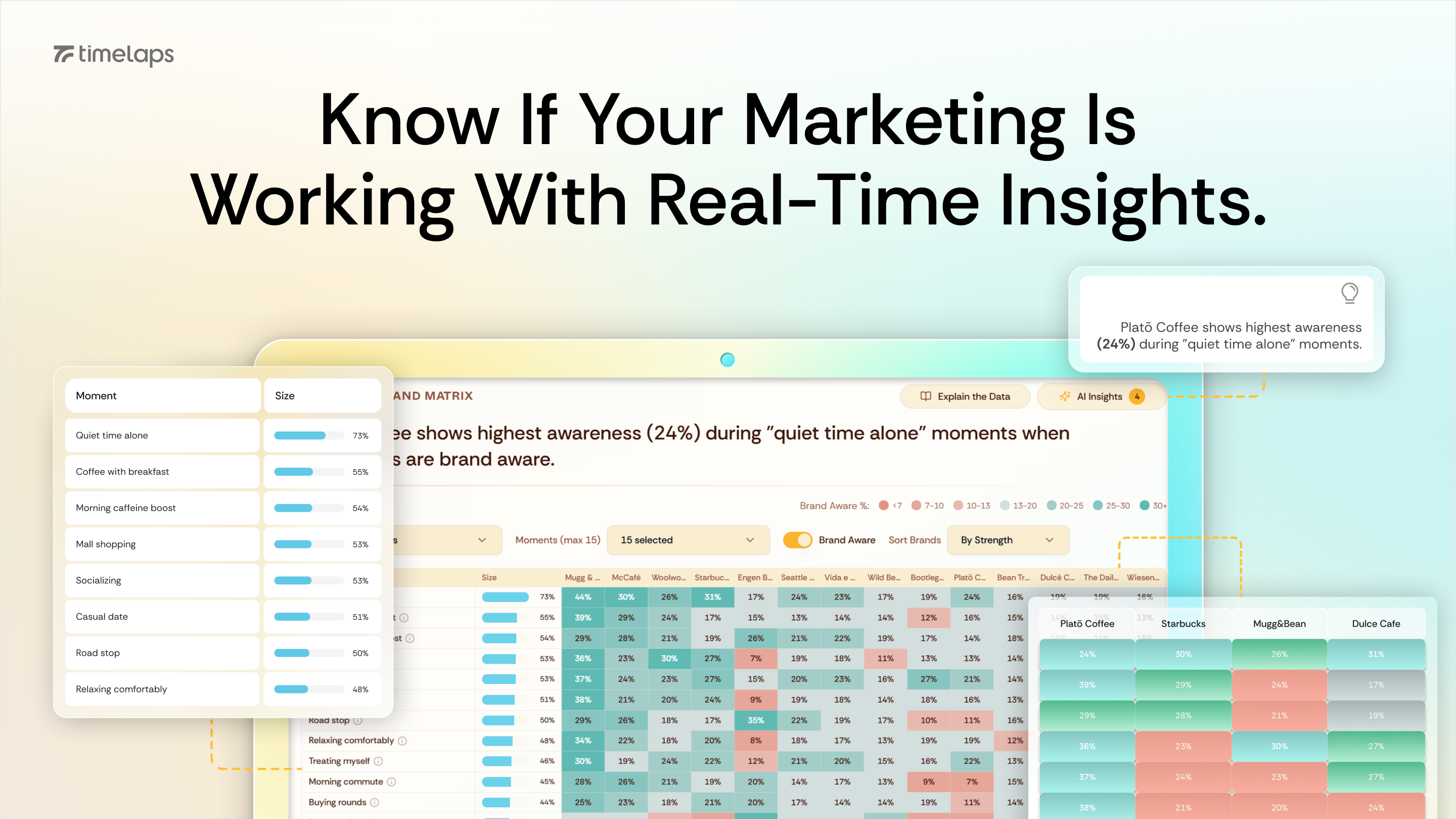
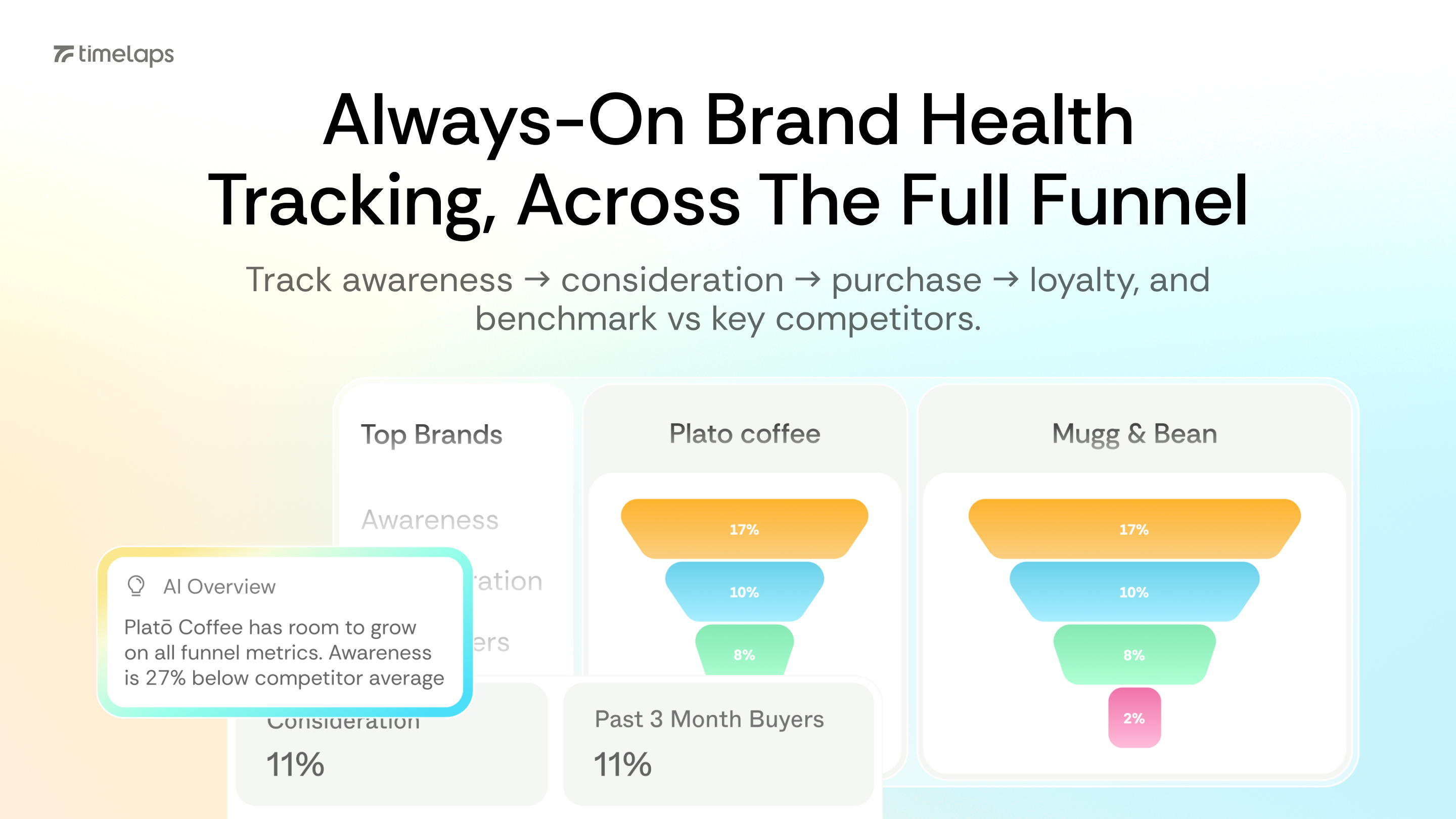
查看原始信息
Design Diff
Design Diff bridges the gap between Figma and production. Catch spacing drift, color mismatches, and missing elements—then push issues to Linear or Jira in one click. Run a quick audit in 45s, or a deep audit in 2 min. Free to start.

Hey Product Hunt! 👋

We're Rags and the team at Floto — and we built Design Diff to solve a problem that was driving us insane.

Here's what kept happening:

We'd build a feature. Check on staging. Something's off — the spacing's wrong, that button's the wrong color, the modal doesn't match the frame. Now what?

Either someone (usually our poor designer) spends hours documenting every deviation, creating tickets, annotating screenshots... or we just ship it and let the design debt pile up. Did a bit of both. Neither is what we want.

At some point, we thought we'd cracked it with Figma MCP + Claude Code. We hadn't. In some cases, it actually got worse — implementations drifted even further because "the AI was handling it."

So we built Design Diff to solve this. Started out as a web app where we could upload implementation screenshots and connect to Figma to pull the reference. We've also now added a Chrome extension to directly do this from the browser.

Here's how it works:

  1. From the Chrome extension we open any live page or staging environment, connect our Figma frame directly (no exports), and kick off a Diff

  2. The Diff does a bunch of AI & pixel-level analysis and we get categorised issues with pixel-precise locations and side-by-side and overlapped visual comparisons.

  3. We've also integrated with Linear and Jira so we can push full details in one-click, pre-formatted with screenshots.

  4. And we've done some neat stuff like add a mode where we ignore lorem-ipsum type copy or repeated dynamic elements, auto-select the best match reference image from the Figma file etc.

Turns out this isn't just our problem.

We started talking to other designers. Every team we spoke to had the same frustration: the implementation never quite matches the design, and catching those differences is manual, tedious, soul-crushing work.

Who's using it: Designers protecting visual integrity. Frontend devs checking work before shipping. QA engineers running visual regression without the eyeball fatigue. PMs who want polished interfaces without the back-and-forth tax.

So we've packaged this up and dropping it here today to see if there's a wider audience. Or even if this isn't the exact solution — we'd love to hear from people with similar problems that we could build Design Diff to solve.

Free to use and explore: 1,000 credits to start, no card required. Top-ups from $10.


And if this solves something real for you, an upvote means the world. Thank you 🙏

7
回复

Happy Monday an excited to hunt @ragsontherocks and @Design Diff today! I'm really happy to see a great usage of AI to accelerate execution for all stakeholders from design teams to PMs.

The time, energy and resources team waste on find tuning designs or figure out things were not on spot after launch impede innovation time.

Curious to see how it is used both by startups and larger teams.

4
回复
@illaigescheit Thanks so much for hunting us, Illai! 🙏 Totally agree on the innovation time point — we’ve had teams tell us that they lose days per sprint on the back and forth trying to identify and fix these issues. Would love to hear what folks think could make Design Diff even more valuable for teams. Always looking to build what people actually need, not just what we think they need!
1
回复

Love the Chrome extension integration! Does it also detect responsive layout issues across breakpoints?

1
回复

Would be interesting to see how startups vs. large enterprises use this differently—any case studies planned?

1
回复