Product Hunt 每日热榜 2026-03-11

PH热榜 | 2026-03-11

#1
InsForge
Give agents everything they need to ship fullstack apps
476
一句话介绍:InsForge是一个专为AI智能体开发设计的原生后端平台,通过语义层为智能体提供数据库、认证、存储等基础设施的端到端操作能力,解决了智能体在构建全栈应用时难以理解和操作传统人类中心式后端架构的痛点。
Open Source Developer Tools GitHub Database
AI原生后端 智能体开发平台 全栈应用开发 语义层 开源后端 MCP集成 基础设施即代码 开发者工具 Agentic开发 云部署
用户评论摘要:用户普遍赞赏其“AI原生”理念与开源+托管模式。核心反馈包括:MCP集成能让智能体获取实时上下文而非猜测API,是关键优势;关注与Cursor/Claude等工具的集成细节;询问与现有Supabase等后端是替代还是可协同;探讨性能基准提升的具体技术原因及在大规模工作流下的表现。
AI 锐评

InsForge的野心不在于成为又一个BaaS,而在于定义“Agentic Infrastructure”这一新品类。其真正的颠覆性在于“语义层”的提出——这不是简单的API封装,而是将后端资源抽象为智能体可内省、可推理的结构化数据类型。这试图从根本上解决当前AI智能体开发的核心矛盾:智能体的代码生成能力与对复杂、隐晦的系统状态认知不足之间的断层。

产品巧妙地抓住了两个趋势交汇点:一是AI编码助手(如Cursor)的普及,让原型构建极快,但部署上线仍卡在人类运维;二是MCP等协议的出现,为工具提供统一“感知”通道。InsForge将自身构建为通过MCP暴露的、智能体可操作的“活系统”,让智能体从代码编写者晋升为系统管理员。其公布的优于Supabase的基准测试,暗示减少“猜测性”工具调用能显著提升效率与准确性,这直指当前智能体工作流中大量的试错成本。

然而,挑战同样尖锐。首先,“智能体原生”是否真能形成壁垒,还是仅成为对传统API的一层友好包装?其次,将基础设施的操作权大幅让渡给智能体,在安全性、错误传播和权责界定上带来全新风险。最后,其价值高度依赖于整个开发生态向“Agentic”范式的迁移速度。若该迁移缓慢,它可能只是一个有特色的BaaS;若迁移加速,它则可能成为智能体与物理数字世界交互的关键中间层。InsForge是一场大胆的赌注,赌的是未来软件的核心操作员不再是人类,而是AI。

查看原始信息
InsForge
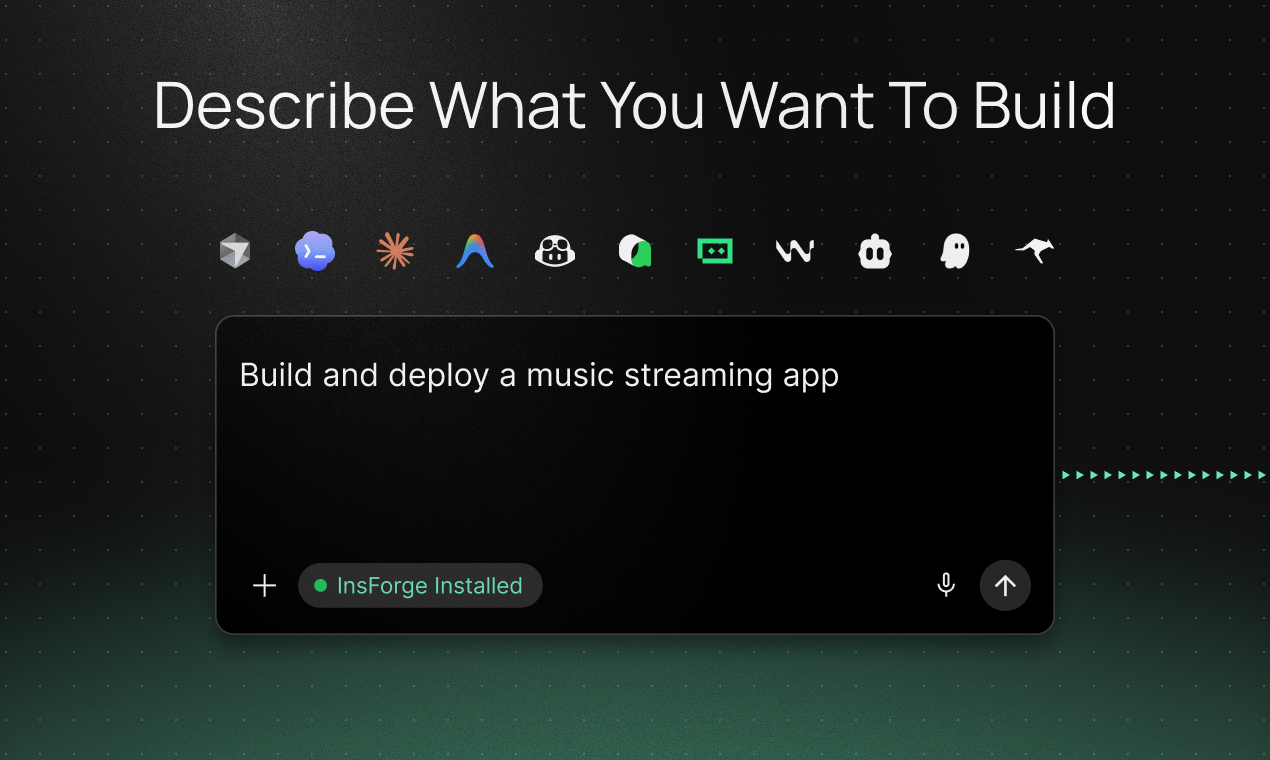
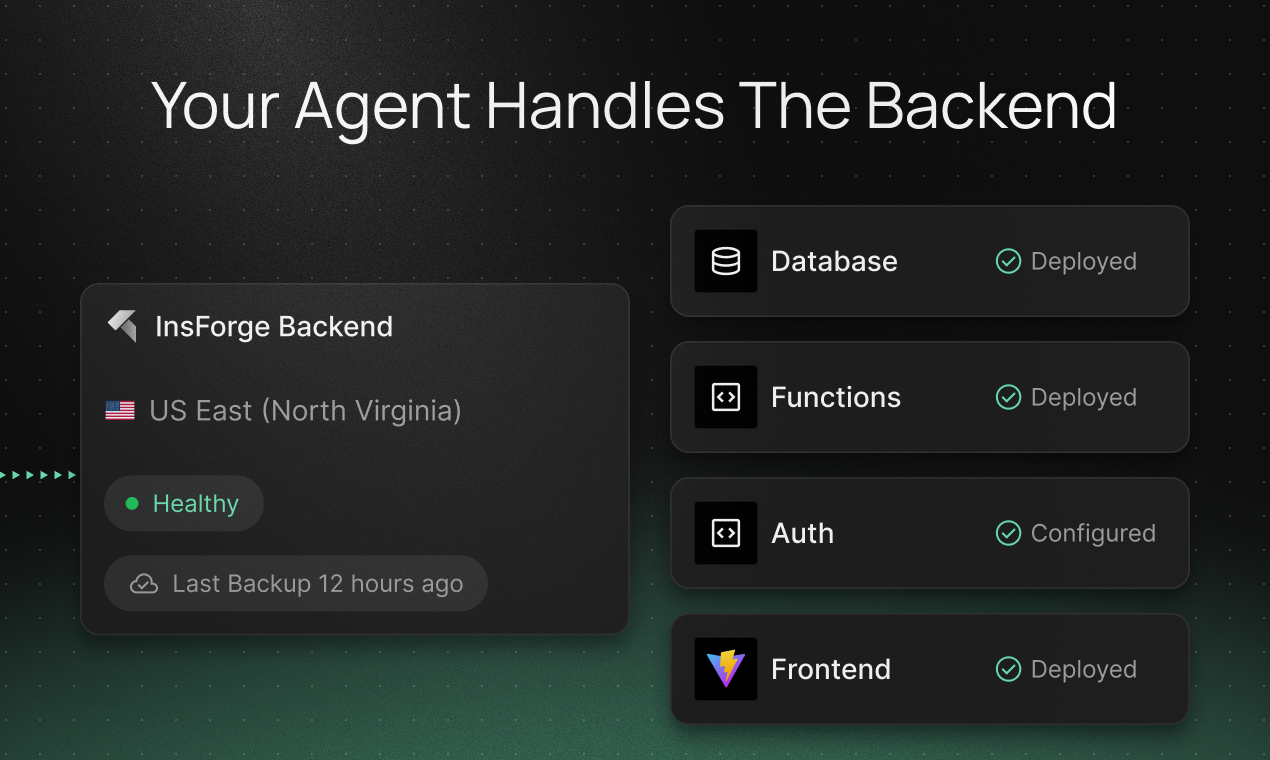
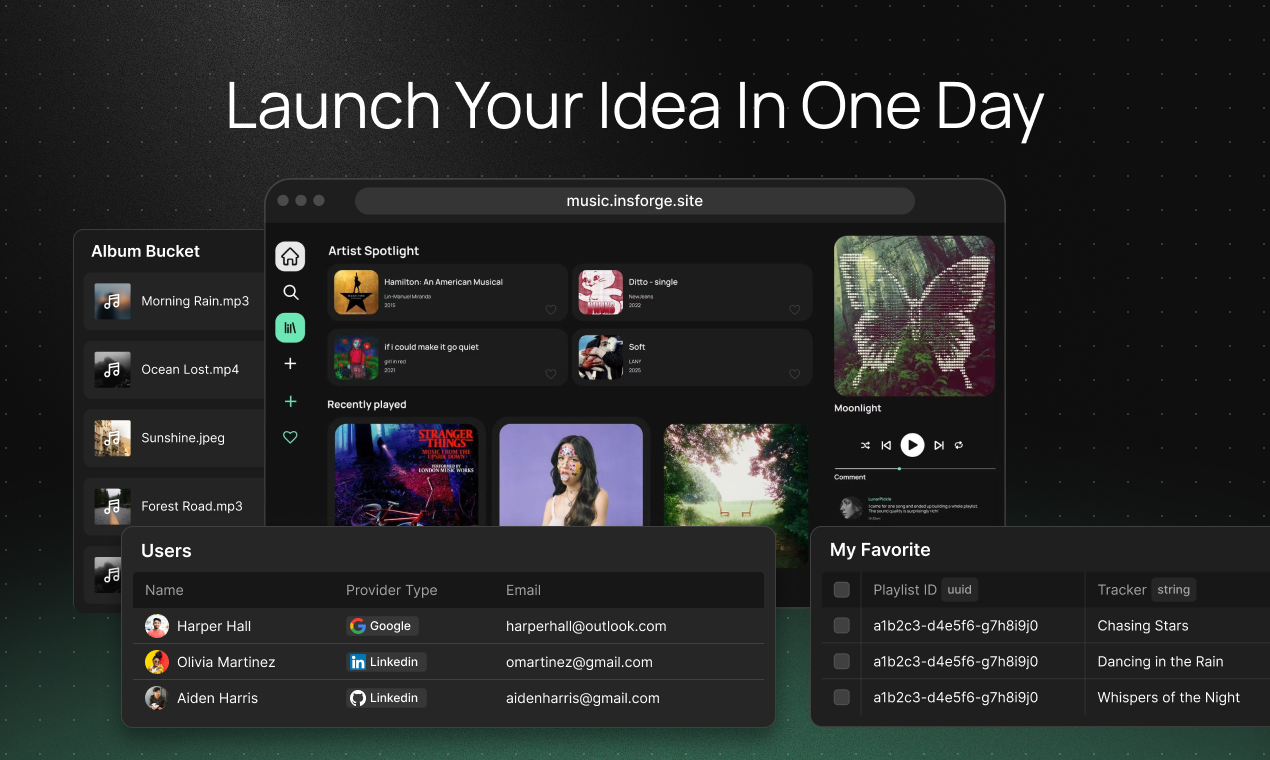
InsForge is the backend built for agentic development. We offer everything AI agents need to build fullstack apps that scale. Our open source backend (2.3K stars on GitHub) provides databases, auth, storage, model gateway and edge functions accessible through a semantic layer that agents can understand, reason about, and operate end to end. Say the word, and you can deploy to InsForge Cloud or your own domain.

Thrilled to back @hanghuang and the InsForge team on their Product Hunt launch.

InsForge is an AI‑native backend built for agents.

This isn't “AI bolted on,” this is starting with agent experience, and building on that foundation.

The unlock is a semantic layer that agents can actually read and act on.

Agents introspect policies and provision resources, so you can ship full‑stack apps end‑to‑end.

This adds up to:

  • Faster setup with npx. One install. Go build.

  • Agents working inside your IDEs (Cursor, Claude, etc.). No new UI to learn.

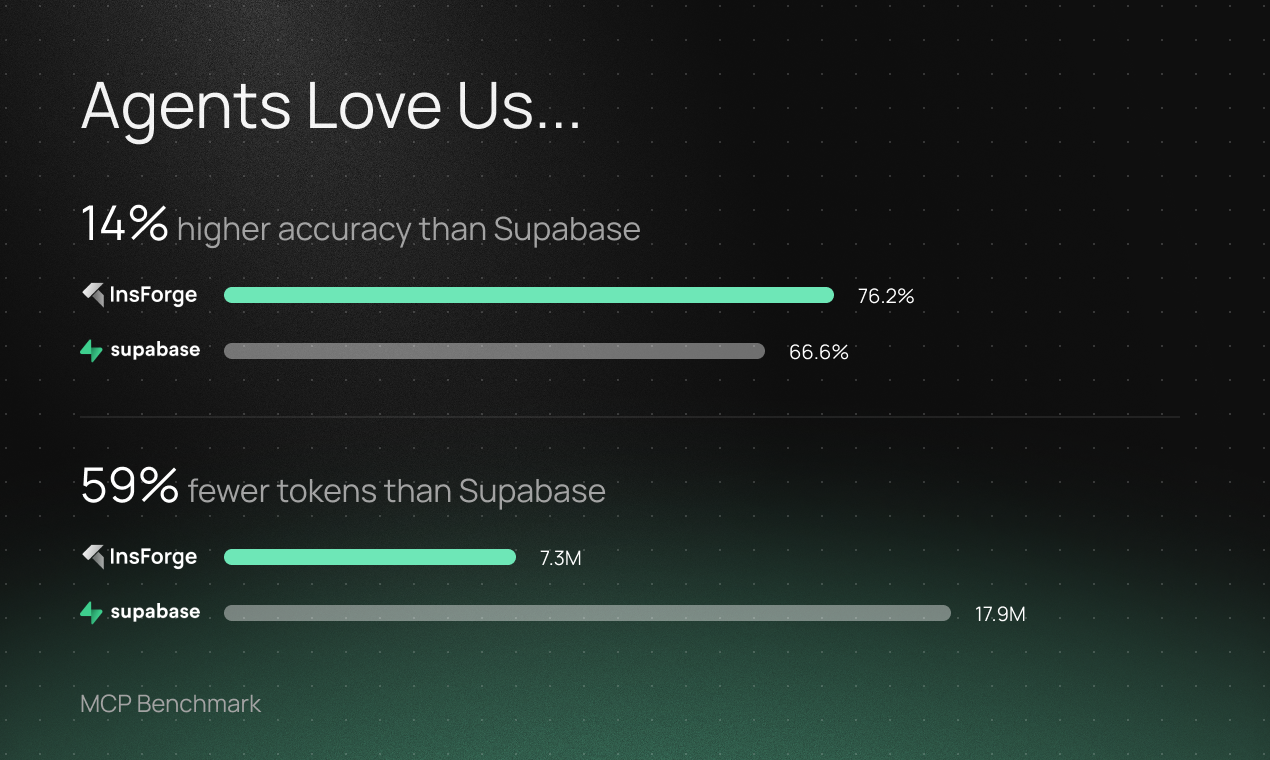
  • Benchmarked performance demonstrates higher accuracy, greater token efficiency, and lower latency.

If you’re exploring agentic development—or migrating off legacy backends—InsForge is the platform that gives your agents the infra they need to tackle the heavy lifting.

Get started now:

npx @insforge/cli create
11
回复

@insforge  @chrismessina thanks Chris for hunting us 🙏

1
回复

@hanghuang  @insforge  @chrismessina Thanks for hunting InsForge 🫡

1
回复

Hey product hunt! @tonychang430 here, co-founder of InsForge.

Before starting InsForge, I was working at Databricks on the networking infrastructure team. One of the first projects I worked on was optimizing our cloud resources, and we ended up saving around $30K networking cost per month. It ended up just turning on private link to aws resources, which is a private link endpoint setup and a cloud configuration.

That experience taught me something important: just because something works doesn’t mean it’s scalable or designed the right way.

Over the past year, AI coding tools have gotten incredibly good at generating code. You can go from idea to prototype faster than ever. But shipping a real product still means dealing with databases, auth, storage, deployments, infrastructure, and a lot of configuration.

Most of these systems were designed for humans who understand every layer of the stack.

But agents don’t work that way.

We started asking a simple question:

What would a backend look like if it was designed for agents from day one?

That is why we built InsForge. It is a backend platform where agents can set up infrastructure, manage data, deploy applications, and operate everything end to end.

Humans are slower, make more mistakes, and usually need deep knowledge of every layer of the stack. Agents should be able to understand the system and get things done directly.

Our goal is simple.

Make agents the primary operators of software infrastructure.

Really excited to share this with the Product Hunt community. Happy to answer any questions and would love to hear what you think 🙏

8
回复

@tonychang430 let’s go man! Building the world-tier infrastructure for agentic development!

3
回复

Hey Product Hunt 👋 I’m @hanghuang, co-founder of InsForge.

Before starting InsForge, I was a Product Manager at Amazon and have always enjoyed building products and launching side projects to test new ideas.

InsForge is the backend built for agentic development — giving agents everything they need to ship fullstack apps, fast.

Most backend platforms are designed for human developers. But InsForge starts with agent experience.

Our platform (2.1K+ stars on GitHub) exposes backend primitives like databases, auth, storage, and functions through a semantic layer that agents understand, can reason about, and operate end to end:

With InsForge, your agent can:

  • Set up everything needed to ship fullstack apps

  • Launch and deploy your applications on a hosted or custom URL

  • Build applications that are secure and scale

Building on InsForge is faster and more reliable — up to 14% more accurate, 1.4x faster, and 2.4x more token efficient than SupaBase — as demonstrated in our MCPMark v2 benchmark.

To get started, head to your terminal and enter:

npx @insforge/cli create

And use code INSFORGELW1 to get a month of InsForge Pro for $0.00!

👉 Got questions? Drop them below, or join our Discord.

We’re excited to share this with the Product Hunt community and can't wait to see what you build. Thanks for checking us out, and huge thanks to our hunter @chrismessina for hunting us🙏

7
回复

@hanghuang  @insforge  @chrismessina Join our discord and we respond under 1 min 👀

2
回复

@hanghuang  @insforge  @chrismessina Been running into exactly this with multi-instance setups. Agents don't really "get" the backend, they just guess at API shapes and hope for the best. How do your edge functions handle concurrency when multiple agents hit the same resources?

1
回复

@hanghuang  @insforge  @chrismessina Congrats on this, guys! For teams already deep in Supabase — existing tables, RLS policies, edge functions — is InsForge only a replacement or can it layer on top?

0
回复

The MCP integration is what sets InsForge apart. Instead of agents hallucinating API calls or guessing schema, they can actually fetch live backend context. That's a fundamentally smarter approach than just giving agents a README and hoping for the best.

5
回复

@leo_aj Exactly! That’s why agents need agent-native infrastructure!

2
回复

@leo_aj Yes! We spend a LOT of time optimizing for the Agentic Experience! We believe Agentic experience is the new developer experience.

2
回复

@leo_aj  Spot on, moving from static docs to live context is the jump from guessing to knowing for any serious agentic workflow!

0
回复
Benchmarks like MCPMark suggest big gains vs Supabase—what specific parts of your semantic layer or tool design drive those gains (fewer tool calls, smaller payloads, better introspection), and where do you still see agents struggle today?
4
回复

@curiouskitty I think is how we expose the backend as structured data type for agents to self-introspect and use. And with this capability, agents can use the InsForge platform like human developers. Reasoning and fetching information (when needed), so their performance will be much higher!

As for struggles, I think definitely context, that's why we build this semantic layer.

1
回复

Congrats on the launch! Would love to know how this integrates with tools like Cursor or Claude Code in real workflows

4
回复

@josie_oy Thanks! Great question. We built InsForge so tools like Cursor or Claude Code can actually operate the backend directly. The agent can understand the system through MCP and do things like create databases, set up auth, or deploy functions!

1
回复

@josie_oy please reach out if you need anything from InsForge team!

1
回复

@josie_oy We have InsForge MCP and Skills to help you connect smoothly. It works out of box for any agents!

0
回复

Open source AND hosted? Best of both worlds.

3
回复

@shirley_mou open source is and will always be the core of InsForge

1
回复

@shirley_mou Open source is the key factor to build our community!

0
回复

npx @insforge/cli create — that's it. That's the tweet.

2
回复

@insforge  @jaredl yep, easier setup means higher onboarding rate haha

1
回复

Have a great launch! Good luck!

2
回复
1
回复

Awesome project! shared with our dev team :) putting everything in one place sounds like a fascinating approach.

2
回复

@lev_kerzhner we will continue to add more functionalities

1
回复

@lev_kerzhner Safe and comprehensive!!

0
回复
Open source AND hosted? Best of both worlds.
2
回复

@frey_loong Yes! We’re developers, so we know both open source and hosted are needed XD

0
回复

@frey_loong Opensource Gang!!!

0
回复
Looks interesting! Good luck 🤞
2
回复

@dmitry_zakharov_aiThanks for the support! Really appreciate it.

0
回复

@dmitry_zakharov_ai thank you so much for the support!

0
回复

@dmitry_zakharov_ai Thank you so much!

0
回复

Congrats on the launch! Following the roadmap closely.

2
回复

@djneverland Thanks! More exciting features coming soon 👀

0
回复

@djneverland if you found anything you needed, just add them to our public roadmap!

0
回复

Congrats on the launch team! Excited for the future of InsForge :) 🚀

1
回复

@elijahmuraoka Thank you so much!

0
回复

@elijahmuraoka thanks! We love Tomoji as well

1
回复

The UI looks very clean. Curious how this performs with larger workflows.

1
回复

@1mirul We are very pleased that you like our website. We have made many infrastructure-level optimizations to ensure that it can run normally in complex business scenarios, and we are still iterating on it.

1
回复

@1mirul thank you so much for liking our site! Yes, we hold a very high bar for user experience! As for the performance, we have Series-A stage company using our service, they have 4 millions users! So don’t need to worry at all

1
回复

The model gateway feature is underrated. Being able to route to different LLM providers through a single OpenAI-compatible API, with usage tracked per project, is exactly what teams building AI-native apps need.

1
回复

@31xira also we provide advanced LLM features like web search / pdf extraction and multi-modal process

1
回复

@31xira This resonates. The future of building isn’t just faster — it’s more autonomous, and agentic development helps unlock that shift.

0
回复

So I've had the chance of trying out the remote MCP server from Minns Foods with Claude Code and also with Codex. The capability of just being able to very quickly build applications and also deploy them with a full-fledged database authentication is just wonderful. The developer experience is great, like a one-shot prompt; you can get your full stack up and ready. I feel that, when comparing it with being able to do more complex tasks as compared to the developer experience that you get with Supabase, I certainly feel that I've had much more success in being able to do things faster. The overall performance also feels a lot more snappier.

I'm glad that we have this capability with a really robust MCP server that has all of the built-in capabilities to automatically fetch stocks and then also just one-click deploy the app on ourselves. It has been pretty fun to work with.

1
回复

@shivaylamba thank you so much! And I think InsForge is not just good for 1-shot prototyping, but also continues building!

1
回复

the semantic layer approach is exactly right. agents shouldn't guess at infrastructure the same way they shouldn't guess at who the user is. been building the identity side of this problem - the agent knows what to build with insforge, but does it know who it's building for? the cold start for user context is the same problem you solved for infra.

1
回复

@ivo_gospodinov exactly, and that’s why we are killing it on benchmark results

2
回复

Congrats on the launch @chrismessina & @tonychang430! Building a backend specifically for the Agentic Era is a great vision. Can't wait to see how this evolves. Upvoted!

1
回复

@chrismessina  @tonychang430  @taimur_haider1 thank you for your support! If you need any help from InsForge team, don’t hesitate to contact us!

1
回复

The agentic backend is here. No more excuses for not shipping.

1
回复

@arthur_winston3 With coding agents + insforge, full stack apps can be done in minutes!

1
回复

@arthur_winston3 with InsForge, you literally ship your idea today :)

1
回复

I tried it for few builds, solid product features!

1
回复

@astrodevil Thanks for trying out InsForge!

1
回复

@astrodevil glad to hear you like it!

1
回复
What makes the agent better at building on top of InsForge compared to more known platforms? Is it a better skill definition? My initial thought is to say, the agent will be best in platforms they have been trained for.
1
回复

@bengeekly absolutely, but the platforms need to be agent native that provides access and strong context engineer capabilities, otherwise agents can’t use it well. This is our strength, proved by benchmark!

0
回复

Good product, looking forward to seeing where it goes.

1
回复

@jieyu_yang1 Thanks! Will continue our updates!

1
回复

@jieyu_yang1 we will keep shipping 🫡

1
回复

This is exactly what the agentic dev ecosystem needed.

1
回复

@qiwap Agent experience is the new developer experience!

1
回复

@qiwap agent-native devs love us so much haha

1
回复

The pgvector support (mentioned in the docs) is a great addition for teams building RAG applications. Having vector search built into the same Postgres instance as your relational data simplifies a lot of architecture decisions.

1
回复

@chelsea_yang Exactly! The reason we use postgres instance is because of it's extensions!

1
回复

@chelsea_yang yes, pgvector + our embedding pipeline make AI related workflow much easier to implement!

0
回复

My Cursor agent just deployed a full-stack app. I'm shook.

1
回复

@haoyuan_huang Haha, use it more and you'll see even crazier things.

1
回复

@haoyuan_huang keep building! You will find there’s no limit hah

1
回复

@haoyuan_huang That's why we built InsForge!

0
回复

The semantic layer approach is really smart — having agents reason about backend primitives rather than just calling APIs changes the whole development model. The fact that it works inside existing IDEs like Cursor and Claude with no new UI to learn is a big plus. Congrats on the launch!

1
回复

@handuo Thanks! We’re entering the era of agentic developments, so agent experience is the new developer experience

0
回复

@handuo Indeed! It's not just an api call. It's an entire backend ecosystem build for agents as primary operator!

0
回复

@handuo Well said. As agents become part of the workflow, development itself needs to evolve. Agent-first thinking is the natural next step.

0
回复

As someone who mostly dabbles in front-end and rarely backend, I'm always afraid I'll set up something wrong that causes a recursive loop and spikes my cloud or database cost somewhere. Are there ways that InsForge can also help with ensuring the code is cost-optimized as well?

0
回复

Congrats on #1! The semantic layer approach is smart - agents that can reason about their own infrastructure instead of blind API calls is a big unlock. How are you handling auth scoping when multiple agents share the same backend? That's always been tricky in multi-agent setups.

0
回复

Interesting direction.

AI can already generate a lot of frontend code, but backend setup is still where agents struggle.

Tools like this that make infrastructure "agent friendly" are going to become a big part of the AI dev stack.

0
回复
#2
Cardboard
Cursor for video editing
408
一句话介绍:Cardboard是一款智能代理视频编辑器,通过自然语言描述指令,在浏览器中实现从原始素材到成片的快速剪辑,解决了传统视频软件学习门槛高、操作耗时繁琐的核心痛点,尤其适合内容创作者、营销团队快速批量生产视频。
Marketing Artificial Intelligence Video
AI视频编辑 智能剪辑代理 自然语言视频编辑 云端协作工具 YC孵化 生产力工具 内容创作 视频自动化 浏览器应用
用户评论摘要:用户普遍认可其颠覆传统编辑流程的潜力,关注其对长视频(如会议、婚礼)亮点提取的效果。核心问题集中在:与Descript/Premiere的差异化优势(回答:规模化、低技能要求、视觉理解);如何处理叙事连贯性;以及具体功能如时间线评论协作的路线图。
AI 锐评

Cardboard的野心不在于成为另一个功能更强大的“剪辑座舱”,而是旨在成为视频编辑的“自动驾驶系统”。其真正的价值锚点并非单纯提升既有专业用户的效率,而是试图重新定义视频编辑的交互范式与用户边界。

它将编辑从基于时间轴的、以工具操作为核心的手工活,转变为以“意图表达”为核心的协作过程。这直接攻击了传统专业软件(如Premiere, DaVinci)最大的软肋:将大量认知负荷消耗在软件操作而非创意决策上。其宣称的“视觉理解”能力,若真能可靠实现,将是与纯转录驱动工具(如Descript)的关键代差,意味着AI能理解画面内容而不仅仅是文字,从而做出更具创意的剪辑判断。

然而,其面临的挑战同样尖锐。首先,“代理”的可靠性是信任基石。当前AI在复杂叙事、情感节奏和微妙审美上的判断仍不稳定,产品回复中“不确定时会询问用户”的策略,揭示了其作为“副驾驶”而非“全自动驾驶”的现状。其次,其定位看似是“能力放大器”,但实际可能夹在中间:追求极致效率与规模的初级用户和营销团队可能觉得功能足够;而一旦用户对创意控制有更高要求,又会迅速触及AI的天花板,退回专业工具。团队明确不竞争长片、调色、特效等专业领域,这虽是明智的聚焦,但也框定了其天花板——它更像是一个强大的“视频内容生产工具”,而非“影视创作工具”。

最终,Cardboard的成功将取决于其AI“导演”在多样化真实素材中表现出的“品味”一致性,以及能否在“全权代理”与“用户控制”之间找到那个既高效又不令人沮丧的甜蜜点。它开启的赛道值得期待,但距离“改变一切”的承诺,还有漫长的可靠性验证之路要走。

查看原始信息
Cardboard
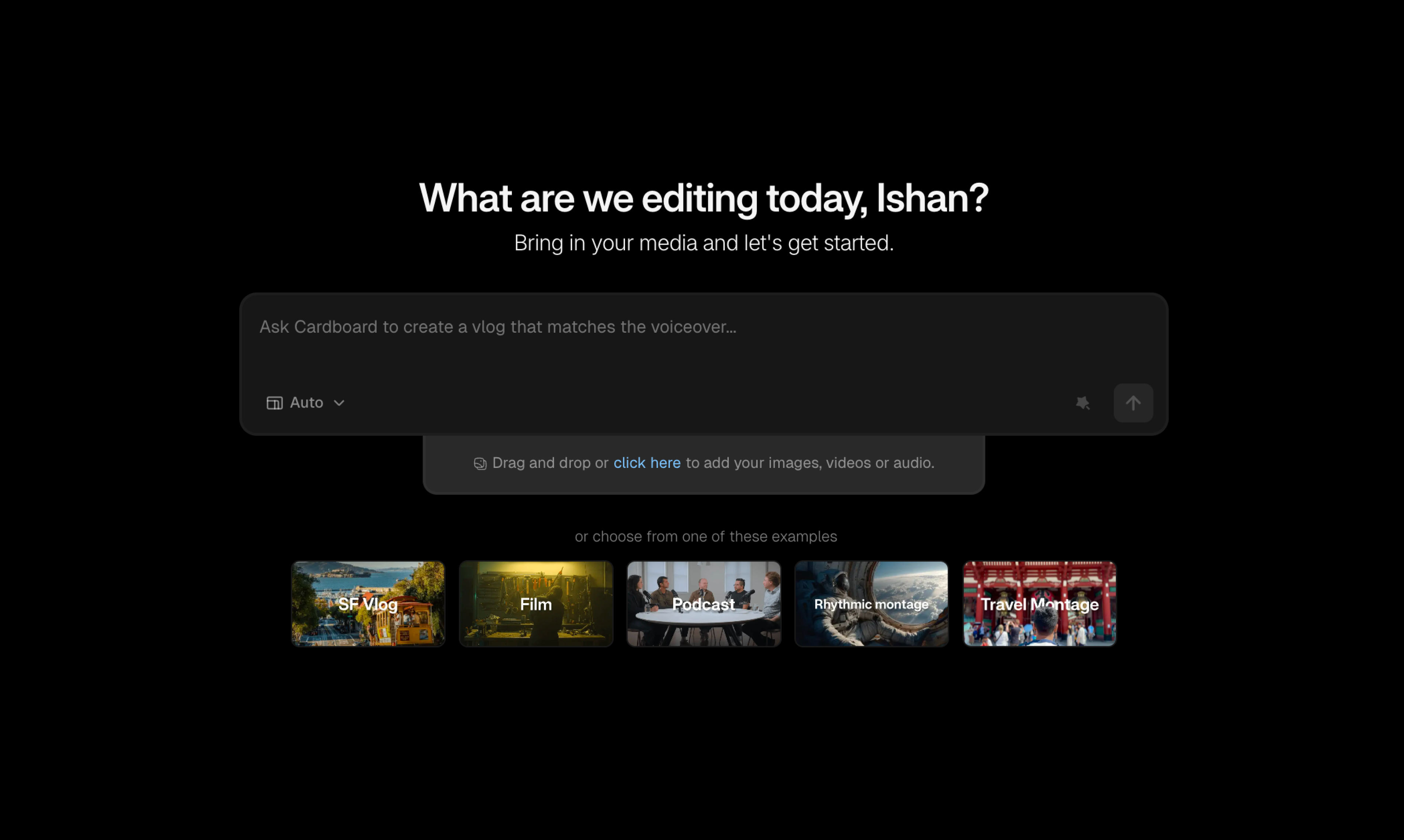
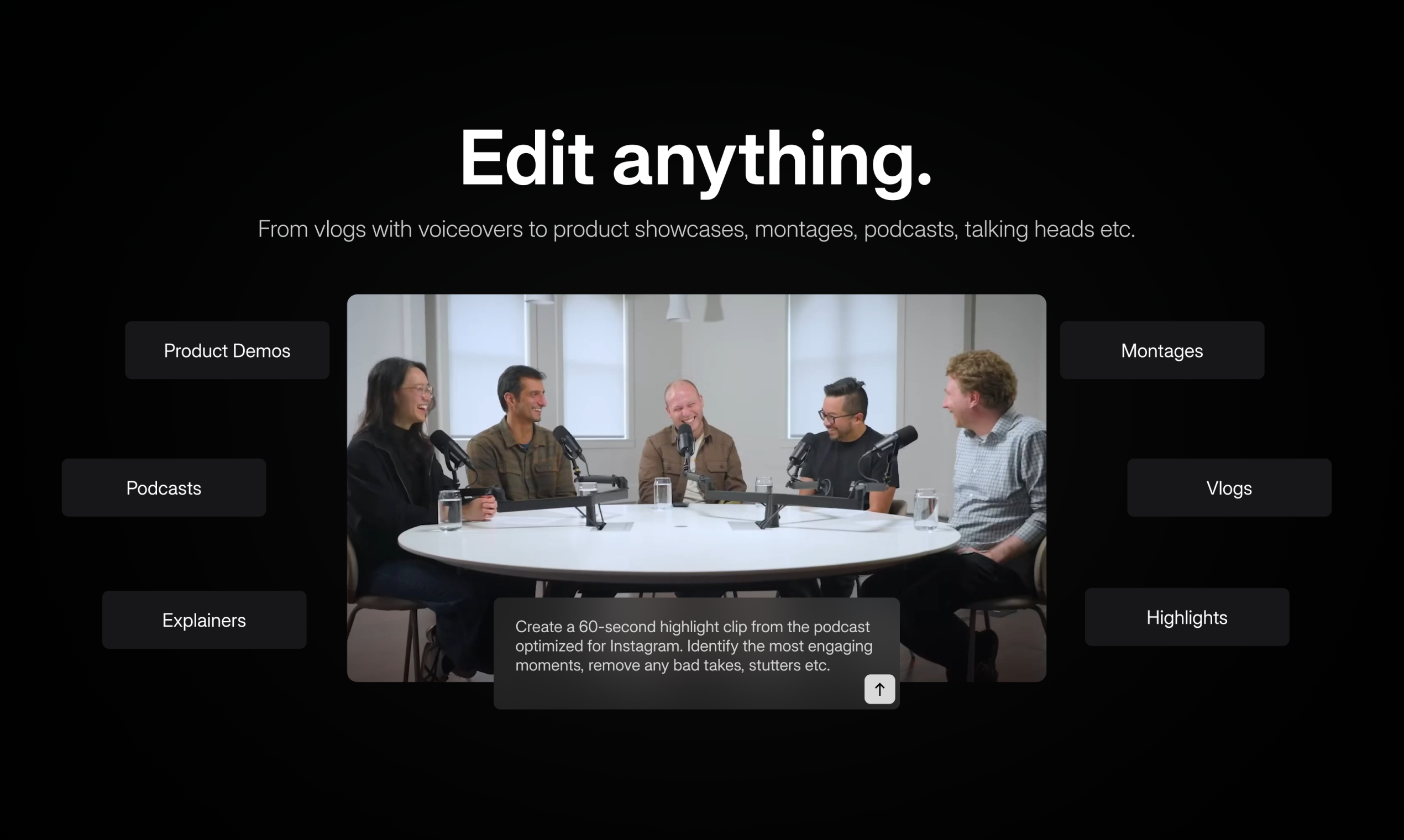
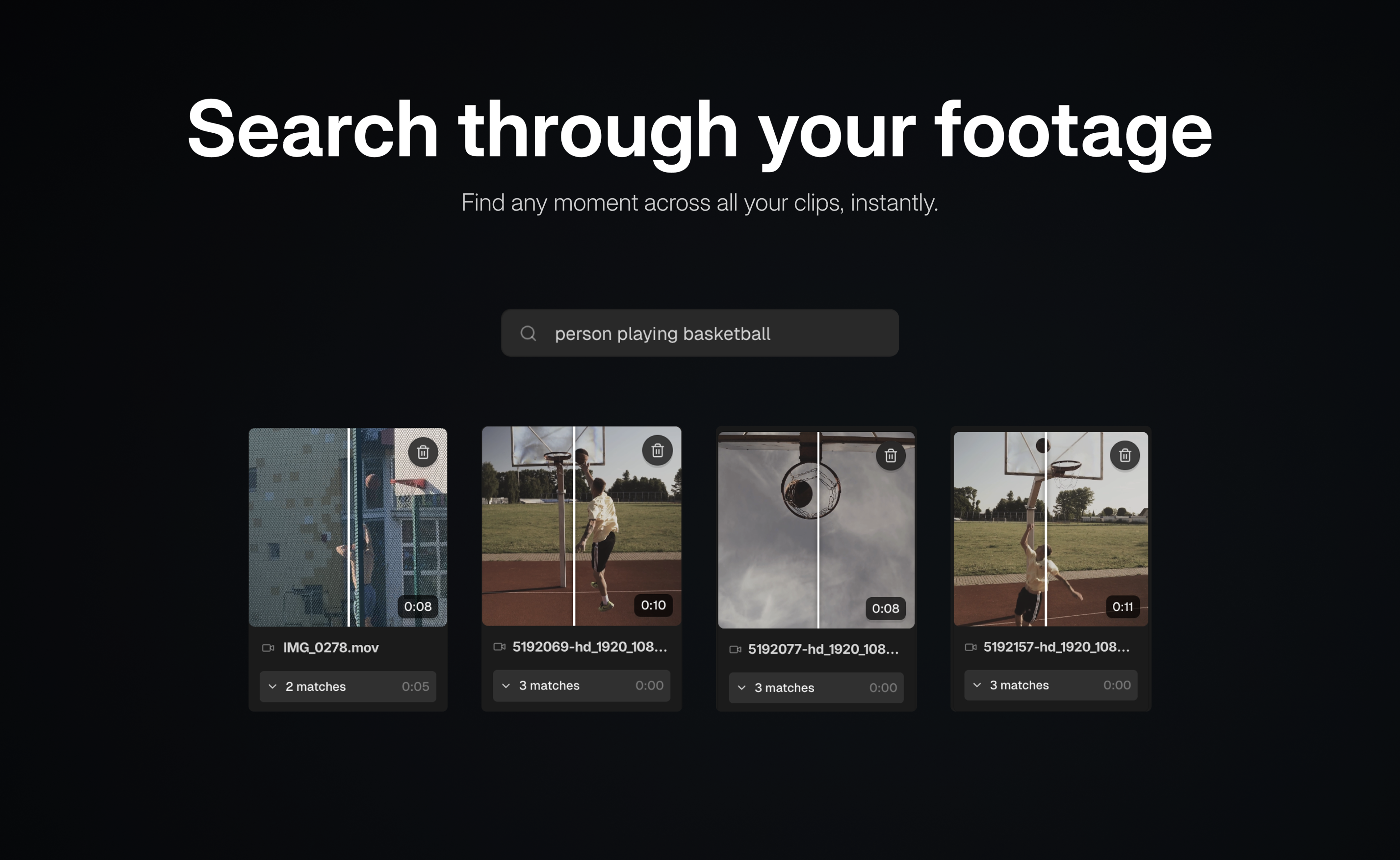
Cardboard is an agentic video editor that gets you from raw footage to final cut in minutes. Think of it like an intelligent collaborator, one that understands what's in your clips, has the taste to know what a good edit looks like, and executes your vision.
Hey Product Hunt 👋 I'm Saksham, Co-Founder & CEO of Cardboard (Backed by Y Combinator). Video editing hasn't fundamentally changed in 25 years. You still drag clips and spend hours on cuts that should take seconds. The tools got prettier but the grind remained. My Co-Founder, Ishan and I built Cardboard because we lived this problem ourselves while creating content. Both of us hit the same wall: tools like Premiere Pro or DaVinci are powerful, but the learning curve is steep and getting to first cut takes hours. Creativity starts to feel like manual work. Cardboard is the agentic video editor, think Cursor, but for video. You describe the edit, it executes. It runs in your browser, supports live collaboration, and lets you find footage by what's in it. Humans from PostHog, Airtable, Google, and more, are using Cardboard to go from raw footage to final cut in minutes. Now it's your turn: https://www.usecardboard.com/signup We'll be here in comments all day, ask us anything :) We'd love to hear your thoughts/feedback. Find us on X: https://x.com/usecardboard https://x.com/sxmawl https://x.com/ishandeveloper
20
回复

@saksham_aggarwal7  Let's Go! This looks super disruptive, congratulations on the launch! All the best!

3
回复

@saksham_aggarwal7 This sounds exciting. I've been struggling to pace up the post production of our videos, it usually takes 2-3 days a video with the current setup.

Will definitely give it a shot rn!

2
回复

@saksham_aggarwal7 Congratulations! As someone GEO content (shorts, LIVEs, podcasts), how has Cardboard sped up your own first cuts from raw footage to hooks; any specific prompt tricks for turning talking-head interviews into punchy 30s clips?

0
回复

Huge fan of the product and team! What’s the most non obvious usecase of cardboard you’ve seen in the wild?

3
回复

@liveink Thanks Kevin!

Honestly, we started doing this ourselves. Saksham and I throw our long meeting recordings into Cardboard and ask it to create highlight reels we can share with customers.

But the one that really surprised me was that one of our users edited his wedding video with it.

1
回复

Great product! How does it handle longer recordings like customer calls or screen recordings where the "good parts" are buried? Does it let you describe what you're looking for semantically, or is it more keyword-based?

3
回复

@zigapotoc Yep! You can go either way. Describe what you're looking for semantically, or search for that one specific keyword you mentioned in a webinar. Both work great.

But honestly, the best way is to just ask the agent to find the highlights. It'll figure out the sequences with the aha moments, the hooks, all of it. Would love for you to try it out!

0
回复

awesome product guys

3
回复

@kshitij_mishra4 Thanks Kshitij!

0
回复
If someone is currently happy with Descript for transcript editing (or Premiere/DaVinci for full control), what’s the specific “breaking point” where Cardboard becomes the obvious switch—and what do you intentionally *not* try to compete on?
2
回复

@curiouskitty 

Here are the following breaking points:

  • Scale. "20 ads by Thursday" or "1000 product videos this month" - traditional editors make human the bottleneck on every cut, resize, and caption. Cardboard acts as their force multiplier.

  • Skill. A founder / marketer knows what they want but doesn't want to spend months to learn intricacies of timeline in Premier / DaVinci. To have more control, Cardboard has a very simple and easy-to-use timeline.

  • Visual Understanding: Descript simplified transcript based editing but does not posses good visual understanding. Cardboard's Director agent actually has visual understanding of your footage, understands it deeply and is able to make creative decisions, not just template fills.

What we don't compete on: Long-form narrative films, advanced professional tools for color grading, VFX, frame-by-frame broadcast work. That's Premiere's job.

We're not building a better cockpit - we're building autopilot :)

1
回复

Awesome let's go guys - super bullish on Cardboard - think this might actually get the DaVinci users to move over

2
回复

@pranjali_awasthi Haha we're coming for them! Thank you, this means a lot. Rooting for Slashy too! Would love for you to try it out and tell us what you think! : )

0
回复

Very simple to use

2
回复

@harsha_gaddipati Glad to hear :)

0
回复

that is wild! Shared internally and can't wait to work with it :)

2
回复

@lev_kerzhner Really excited for you to try it :)

0
回复

banger!

2
回复

@hiya_chaplot1 Thanks Hiya!

0
回复

wow awesome product guys

2
回复

@kshitij_mishra4 thanks kshitij!

0
回复

That's a big promise. If it works as intended, it would change everything for video editing. I bookmarked it to see how it goes in a few weeks. Best of luck to you :)

2
回复

@nathan_croissant Thanks Nathan! Would love for you to try it out and hear what you think. Excited to surprise you :)

0
回复

Cracked team, let’s go

2
回复

@serjobas ty ty ty

0
回复

@serjobas Thank you!

0
回复

The idea of describing an edit and having it execute is a huge unlock. Video editing has always been this weird paradox where you know exactly what you want but spend hours clicking through timelines to get there. Running in the browser and supporting live collaboration makes this really accessible too. Congrats on the launch and the YC backing!

2
回复

@handuo that's right! people who've edited videos know how much painful the process is.

thanks for your support!

0
回复

One of my biggest challenges with AI editing software is that the clips end up feeling disjointed and lacks the "smooth" narrative that I'm going for. Are there ways to enter into a "plan" mode so that I can specify the style of video that I'm editing for?

1
回复

@lienchueh Great question! We don't have a dedicated plan mode right now, but the way we built the agent kind of addresses this. Wherever it's uncertain about something, instead of self-guessing, it just asks you. So the narrative stays in your control throughout.

You can also just ask it to draft a rough script or outline before you start cutting.

Curious, would a plan mode be more about setting a style upfront, or is a storyboarding experience closer to what you have in mind?

0
回复

I really appreciate the live collaboration feature weaved into this. Is there a comment-and-resolve flow on the timeline or is that on the roadmap?

1
回复

@jacklyn_i 

Yep, feels like you read our minds!

0
回复

This has good potential

1
回复

@harshactually I agree!

0
回复

amazing product i have come across in last couple of days amazing

1
回复

@sammy_xf thanks sammy, glad you liked it.

0
回复

Great product, very very useful for launch videos!!

1
回复

@dhruv_roongta ty ty dhruv!

0
回复

This looks really exciting! I’ve been waiting years for a product like this, but with pricing starting at $60 a month, obviously this is aimed at businesses and not at individuals. I hope you are successful and there is some path towards launching a consumer product with a much lower price point. It would also be exciting if there was a local client, something that didn’t force customers to upload gigabytes of video footage. Not everyone has a fast pipe so this could be limiting in some scenarios.

1
回复

@jasonrdunn 

I hear you Jason, we don't have to upload the entire footage to get started with editing, we only upload that for collab/cloud sync so that it is accessible on all of your devices.

For our ingestion pipelines we just upload small byte sized chunks of the footage.

1
回复

This is awesome, its amazing to see how many functions people perform online are now totally turning out to be prompt and usage based.

1
回复

@jake_friedberg you can just type things into existence :)

0
回复

Max video length it can handle at once?

1
回复

@mege_mege 

It depends on how much memory your PC has. There should be no limit in theory but we've seen it produces good results for raw footage of upto upto 60 gb/8hr of footage.

Beyond that, we still support it, but the agent quality degrades because of context limits, we're working on smarter context management.

0
回复

"Cursor for video editing" and backed by YC. My video editor just started updating their resume. Upvoted. 🎬

1
回复

@ilya_lee Haha!

0
回复
Great execution here. As someone who’s spent 15+ years in Ae ‘dragging around’ clips in the timeline this feels like a natural evolution for video. Congrats on the launch!
1
回复

@joeharrison Thanks Joe, there's so many exciting things we're shipping every week.

Excited for what's next!

1
回复

Ishan is a wonderful person. For quite a long time, ever since we used to speak a lot about WebAssembly and we also met at JSConf India in 2023. He is a super, super talented person, and I'm just so glad to see him launch such an amazing product, which is live today now. Kudos to the team for building this and this overall user experience of having an authentic video editor and how that should look. This is the tool; so much thought and effort has gone into the UI/UX and just being able to create videos on the fly, having that chat-like prompt to be able to distribute the videos and have really, really slick, clean UI for doing editing on the fly. It's just massive, right, so proud of what they've been able to do and support this launch throughout.

1
回复

@shivaylamba 

Grateful to build this with @ishandeveloper :)

0
回复

the "describe the edit, it executes" framing is sharp. curious how the agent handles first-time users with no editing history - does it lean on the clarifying questions a lot early on? the cold start problem for understanding someone's aesthetic is one of the harder ones. congrats on the launch @saksham_aggarwal7

1
回复

@ivo_gospodinov 

The agent asks more and more questions if user says "can you make it into a cool vlog?"

We're also planning a feature where users can upload a video/image they like and they'll be able to get closer to that using Cardboard's agent :)

0
回复

"Cursor for video editing" — okay you have my attention. As someone who uses Cursor daily for coding, the idea of an AI that actually understands what's in my footage and makes editing decisions for me sounds incredible. I've been wanting to make short demo videos for my apps but always gave up at the editing stage because it takes forever. If this can take raw screen recordings and turn them into polished product demos, I'm sold. Is that a use case you support, or is it more focused on podcast/talking-head content?

1
回复

@sparkuu 

Yes, in fact this is a use case that has got good traction as well. We can do product demos with zoom-ins / transitions / captions / etc.

0
回复

this looks incredibly exciting, congrats on the launch. does it resync the timeline if we change the music later? that’s honestly my biggest pain point in editing videos.

1
回复

@gourish_narang 

yes, just ask it "hey i just changed the music to @mentionthetrackhere - can you resync the timeline?"

0
回复

Video editing is the bottleneck for every YouTube creator I talk to. The ideas and scripting part can be fast, but then you spend 6 hours cutting and trimming. If this does for video what Cursor did for coding, I want to see it in action. How does it handle multicam or footage with a lot of cuts? That's usually where AI editors fall apart.

1
回复

@aitubespark Glad the analogy resonates!

On multicam, it works really well for podcasts already. Some of our users have been producing results that honestly surprised even us. (Was literally shipping audio sync for this last week: https://x.com/ishandeveloper/status/2030957527018741892)

That said, there's a lot more we can do and we have a bunch of things on the roadmap. Curious, what are some of the use cases you have in mind? Would love to learn.

0
回复

Congratulations on the launch, this looks super slick

1
回复

Appreciate it, coming from you@daffinity ! ✨

0
回复

Congratulations on the launch! I'd love to know if Cardboard can help me speed up my flow for fetching, cropping/editing videos from multiple sources (usually Youtube/Reddit/Instagram etc. ) to be then exported and sent out via Whatsapp etc.
I love cropping + making edits to videos to fit a certain hyperspecific context (think memes tailored to a group of < 15 people) and my current flow is a bit tedious: I have to download the video from its original source using third party applications, then edit it manually using either the Photos app or other third party applications if I have to make more complicated changes like adding text etc. Would love to know if Cardboard has any features in the pipeline that can help accelerate this end-to-end flow!

1
回复

@ameya_deshmukh3 Thanks for the kind words!

Fetching footage directly from YouTube/Reddit/Instagram isn't something we support right now. You'd still need to bring in the raw footage yourself.

That said, we've heard this from quite a few users and have a couple of ideas in the works, either generating assets for you directly, or pulling relevant ones from the web.

For everything after that though, if you bring in the footage, the agent can handle the reframing, cropping, and fitting it to whatever hyper-specific context you have in mind. Adding text, adjusting for format, that's exactly the kind of thing it's built for.

We update our changelog pretty much every week if you want to follow along: usecardboard.com/changelog. Would love to have you try it! : )

1
回复
#3
Teract AI
Your AI reputation coach for LinkedIn, X, Reddit & more
323
一句话介绍:Teract AI是一款AI声誉教练,通过分析用户语言风格与专业知识,在LinkedIn、X、Reddit等8个平台主动发现高价值对话,并代用户起草符合个人语境的评论与帖子,解决了专业人士需频繁维护多个社交形象但时间精力不足的核心痛点。
Productivity
AI写作助手 个人品牌管理 社交媒体管理 声誉教练 跨平台互动 内容生成 人类在环 Chrome扩展 精准触达 对话发现
用户评论摘要:用户反馈集中于产品安全性(是否触发平台封禁)、跨平台语调校准能力、AI生成内容在Reddit等社区的“非人性化”风险、学习用户声音的机制与伦理边界,以及“每日情报”功能能否实现精准的垂直领域筛选。开发者回复强调手动审核、无自动化行为及平台差异化适配。
AI 锐评

Teract AI的野心不在于替代用户写作,而在于重构社交媒体参与的“发现-决策-创作”工作流。其宣称的核心价值“AI声誉教练”实则是将策略层(在哪说)与执行层(说什么)进行了AI赋能整合,这比单纯的内容生成工具高出一个维度。

产品巧妙地将自身定位为“浏览器内的写作助手”,而非自动化机器人,这是对当前各大社交平台反自动化政策的高明规避。然而,这恰恰暴露了其商业模式的潜在天花板:它本质上是一个效率工具,而非增长黑客工具。其价值上限取决于用户自身的参与意愿和审阅时间,无法实现真正的“规模扩张”。

用户评论中关于“语调校准”和“Reddit人性化”的质疑,直指此类产品最脆弱的命门——语境理解。AI可以模仿词汇和句法,但难以真正理解每个社区亚文化的、瞬息万变的“氛围”和“梗”。在LinkedIn上得体的专业评论,移植到Reddit可能立刻被视为“AI味浓重”的冒犯。开发团队“可引入不完美”的回复是一种妥协方案,但“刻意的不完美”本身也可能被社区雷达侦测。

更深刻的伦理问题在于“声音的异化”。当用户长期依赖并批准AI起草的、模仿自己的“深思熟虑”的言论时,其线上人格是否会逐渐趋近于AI所认为的“理想化专业形象”?这本质上是一个数字时代的“自我呈现”悖论:我们使用工具来更高效地表达“真实的自我”,但工具也在悄然塑造着表达的内容与边界。

总体而言,Teract AI是当前AI应用浪潮中一个思路清晰、定位精准的产品。它瞄准了有个人品牌建设需求的专业人士这一付费意愿强的群体,并通过“人类在环”解决了初期的信任问题。但其长期成功,不仅取决于技术对“用户声音”模仿的保真度,更取决于其能否真正理解并融入各个平台的微型文化战场,成为用户洞察与社交智慧的延伸,而非一个略显笨拙的修辞学助手。

查看原始信息
Teract AI
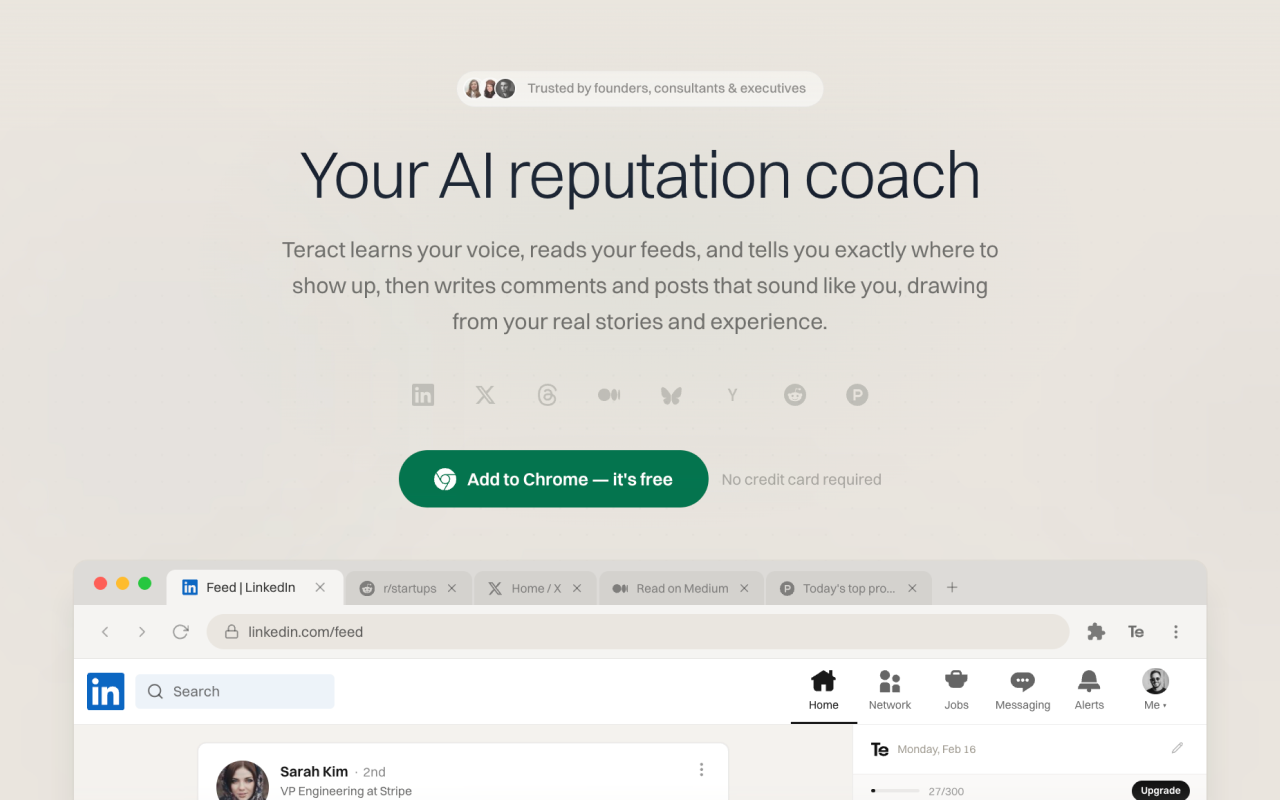
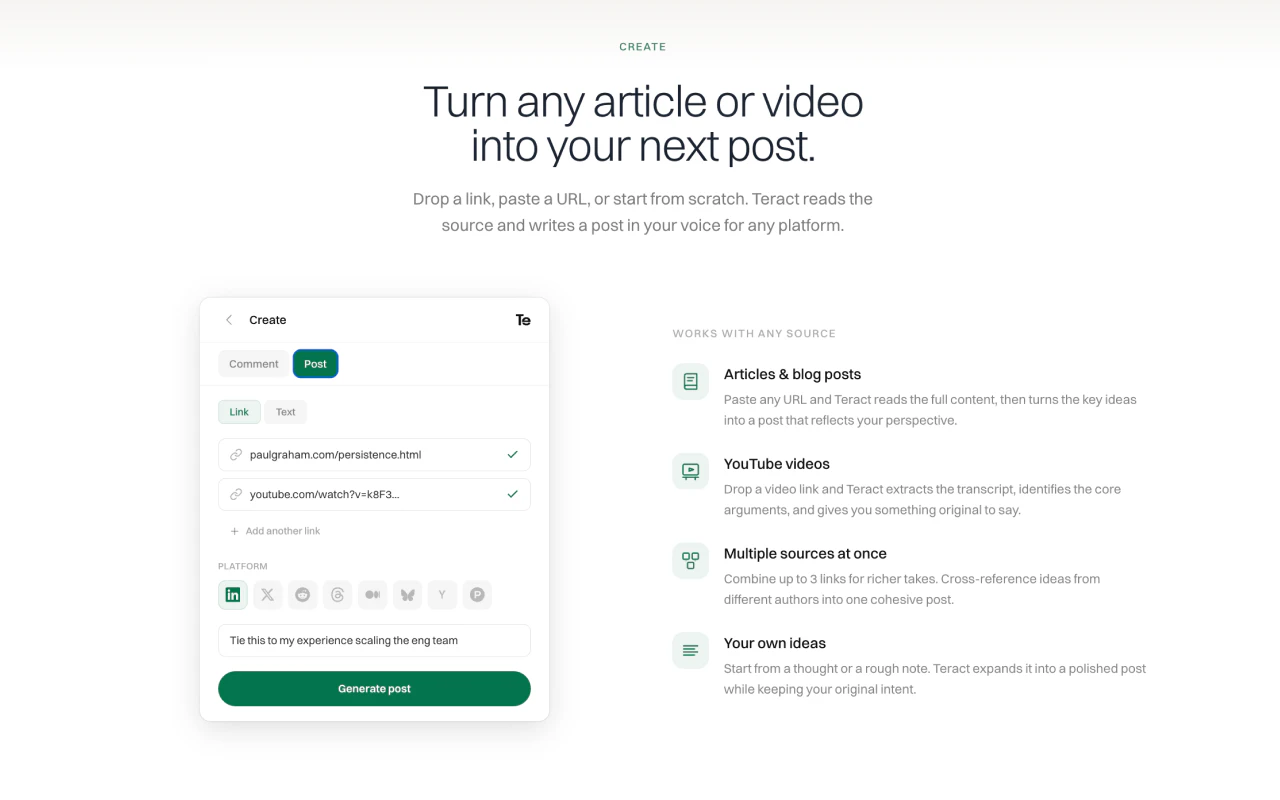
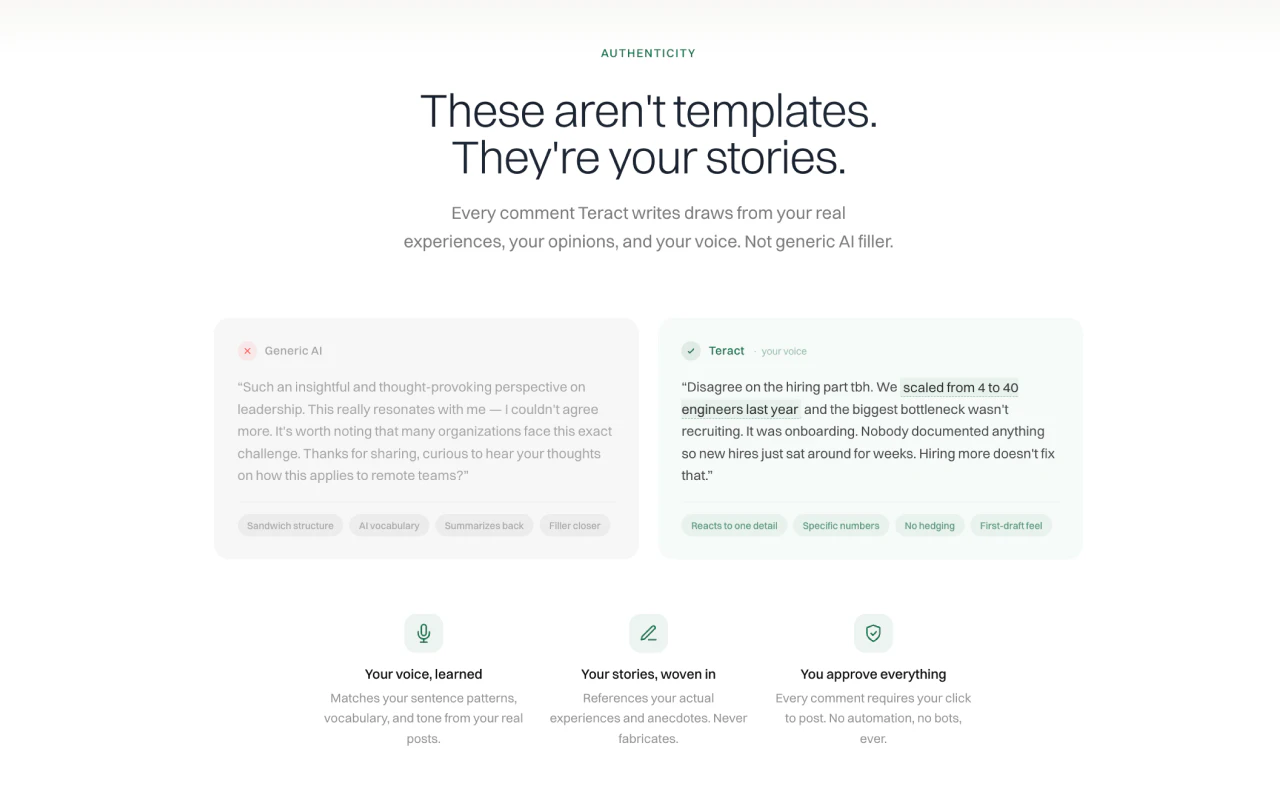
Teract learns your voice, scans your feeds, and tells you exactly where to show up online. It finds high-impact conversations across platforms like LinkedIn, X, and Reddit, then drafts thoughtful comments and posts that reflect your real voice and experience.
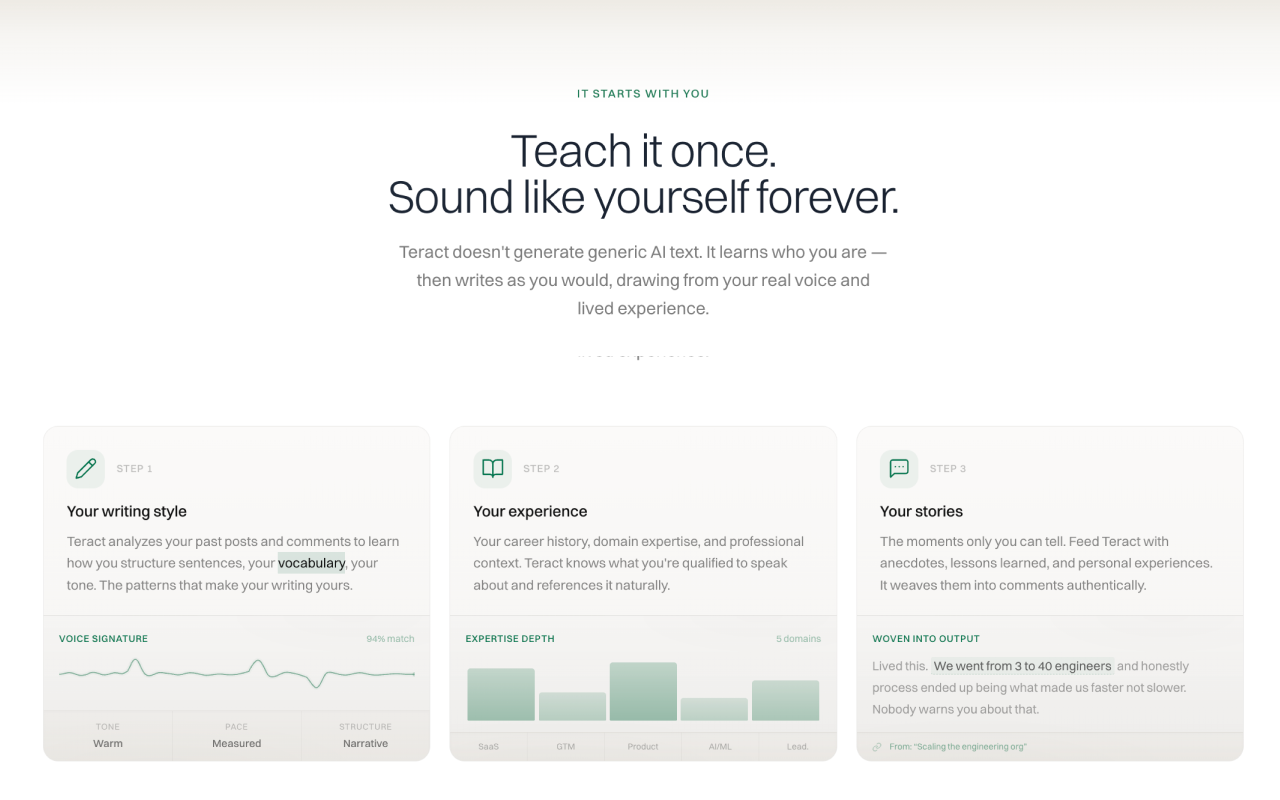
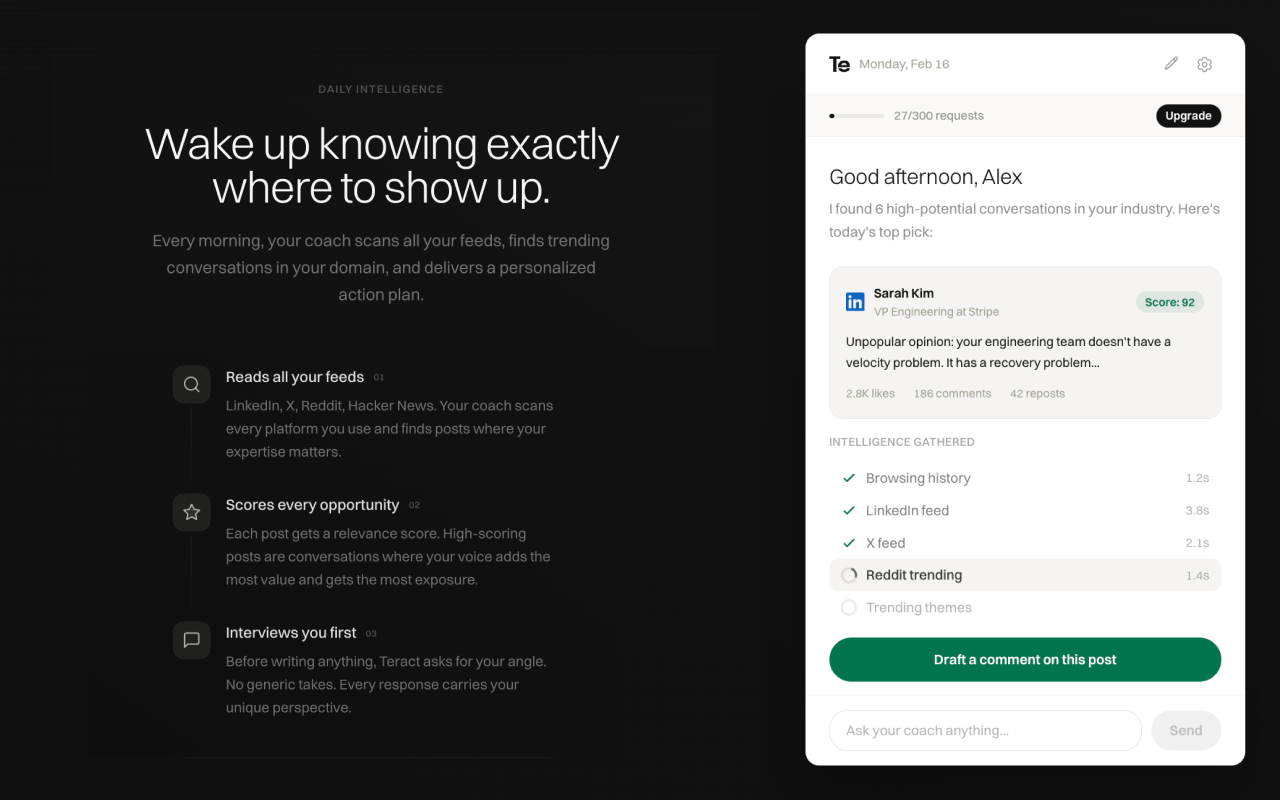
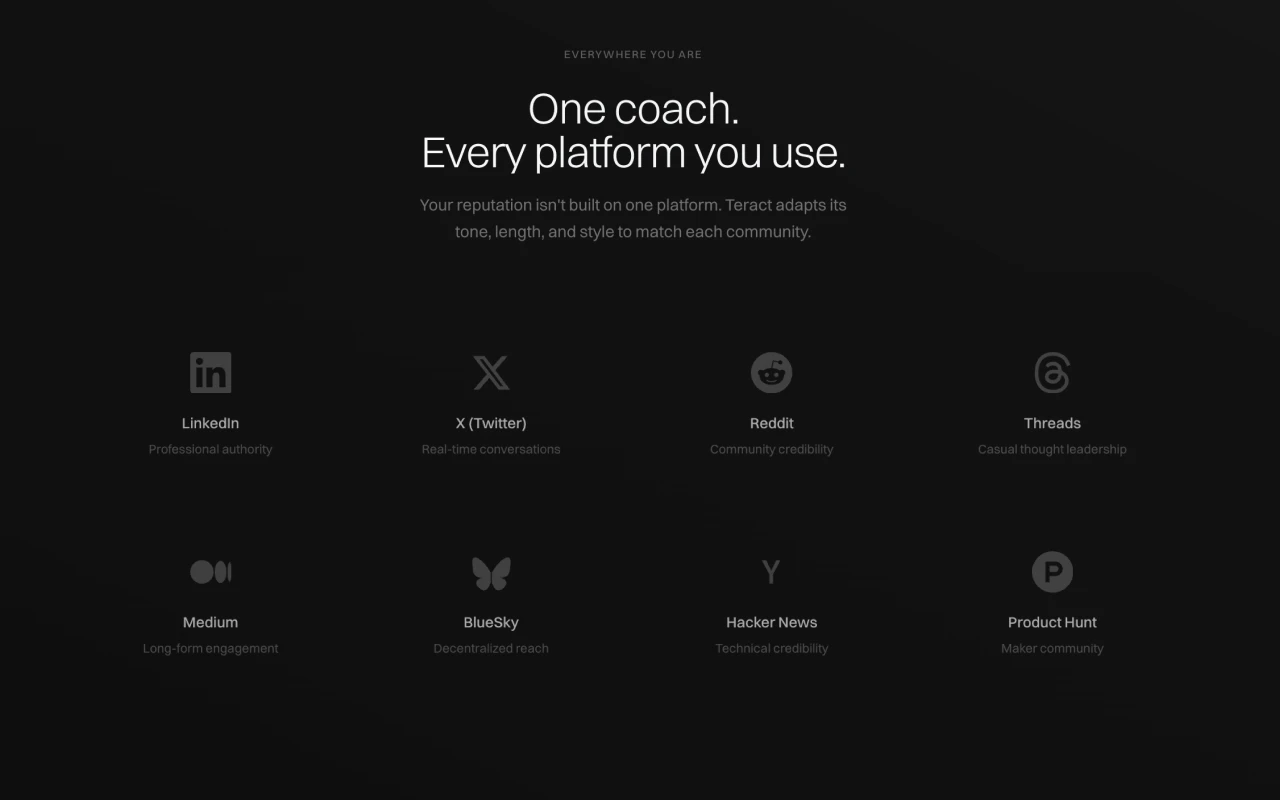
👋 Hey Product Hunt! Meet Teract — your AI reputation coach that finds high-impact conversations and helps you engage in your own voice across 8 platforms. Here’s how it works: ✍️ Your voice signature – learns your sentence patterns, vocabulary, and rhythm. 💼 Your expertise map – knows your career, domain knowledge, and what you can confidently speak about. 📖 Your story bank – weaves your real experiences into comments and posts naturally. ☀️ Daily intelligence – scans LinkedIn, X, Reddit, Hacker News, Medium, Threads, BlueSky, and Product Hunt for trending conversations. ⚡ One-click comments – drafts replies in your voice with 11 styles to choose from (Add Value, Share Experience, Ask Question…). ✅ No bots. No auto-posting. You approve everything. 🚀 Amplify your voice, save hours, and show up where it matters most.
7
回复

@djordjevic_nikola I really like the idea behind this but how does Teract calibrate tone across platforms? A LinkedIn post, a Reddit comment, and an X thread require completely different registers — professional vs. conversational vs. punchy.

1
回复

@djordjevic_nikola If it learns your voice well enough to draft comments that sound like you, what stops someone from approving outputs without actually reading them, and at what point does "your voice" become the AI's voice with your name on it?

0
回复

Is it safe? Because I was restricted by LinkedIn because of the 3rd party tools that "automate" my activity (tho I do not use them). But possibly it could trigger the restriction.

Do you have any guarantees that it won't trigger a ban?

3
回复

@busmark_w_nika Totally understand the concern - getting restricted sucks and LinkedIn is aggressive about automation.

Teract is fundamentally different from automation tools. Here's why it's safe:

1. You approve everything - Teract never posts, comments, or messages on its own. It drafts the text, you review it, then YOU click to post. From LinkedIn's perspective, you're just typing and posting normally.

2. No bot behavior - There's no auto-liking, auto-following, auto-commenting at scale. No scheduled posts. No bulk actions. It's just you, writing comments one at a time, at human speed.

3. Chrome extension, not a bot - Teract runs in your browser as you browse. It's not logging into your account from a server somewhere or using LinkedIn's API in ways they don't allow.

The tools that get you banned are the ones that log in as you and perform actions automatically - mass connection requests, auto-comments on 50 posts per day, that kind of thing. Teract is a writing assistant that helps you draft better comments. You're still the one posting them.

That said, no tool can guarantee LinkedIn won't change their policies. But the architecture is designed to be indistinguishable from you just being a really engaged, thoughtful commenter.

2
回复
@busmark_w_nika Totally fair - note that Teract works on 7 other platforms: X, Reddit, Threads, Medium, BlueSky, Hacker News, and PH itself 👋. You could skip LinkedIn entirely for now.
0
回复

Congrats on the launch team!

2
回复

@rbluena Thanks for your support, Rabii!!!

1
回复

Congrats on the launch!

2
回复

@chilarai Thanks for support Chilarai!!!

1
回复

This is a cool idea! Social media is a constant grind, so having an AI that helps with replies and interactions feels very timely. Wondering how the AI learns and adapts to someone's writing style?

Will definitely give it a try..

Congrats on the launch!

2
回复

@teon_stamenovic1 Thanks so much for the support! Teract learns your writing style by analyzing your existing posts and comments when you set up your profile. The more you post, the better it gets at matching your tone, language, and preferred topics. You can always edit or tweak anything it generates, so it stays true to your voice. Would love to hear what you think once you try it out!

1
回复

Congrats on the launch, @djordjevic_nikola & @whoisrade!

To me, the Voice Signature and Story Bank approach is the only way to solve the AI-noise problem on LinkedIn right now. Upvoted for the vision of keeping the "Human in the loop!"

2
回复

@taimur_haider1 Thank you so much, Taimur! Really appreciate your support and totally agree—keeping the “human in the loop” is key to authentic engagement.

1
回复

Congratulations on the launch 🎉 🎉 !

2
回复

@shubham_pratap Thanks for the support, Shubham! 🎉

1
回复

Great product! Congratulations on the launch. This will genuinely help solo entrepreneurs who need to handle everything on their own.

2
回复

@bhu_1 Totally agree, Bhuwan! Being a one-person show is tough, and tools like Teract are lifesavers for streamlining engagement.

1
回复

Very very cool. I built a similar tool for myself, but am very curious to see your angle. Could be brilliant for founder led growth.

Cheers!

2
回复

@lev_kerzhner Cool! Founder led growth is definitely where AI like this can shine. Always fascinating to see different spins on the same idea.

1
回复

@djordjevic_nikola The Chrome extension format is smart for LinkedIn, but Reddit has a notoriously allergic reaction to AI-polished content. Does this implement a

natural vibe that deliberately introduces casual phrasing, or even slight imperfections — to avoid the ‘this sounds like ChatGPT’ flag that gets downvoted fast on Reddit?

1
回复

@jacklyn_i Great point, Jacklyn! Yes, Teract adapts its tone for each platform. For Reddit, it deliberately uses more casual language and can introduce slight imperfections to blend in and avoid that generic AI feel. You can also review and tweak the output before posting for an even more natural vibe.

1
回复

Sorry, I might have missed something, but does it directly interact with let's say LinkedIn, or it just analyses and creates content? ok, let's say it can mimic me and create content and comments, which don't sound like an AI slop, but can I simply run it on my LI profile?

1
回复

@davitausberlin No worries! Teract doesn’t directly interact with LinkedIn or auto-post for you. It analyzes your profile and posts to learn your style, then helps you generate content and comments that sound like you. You run it in your browser alongside LinkedIn, so you can easily draft and post content on your profile, but you always review and post manually.

3
回复

I like how straightforward everything is—no confusion at all.

1
回复

@amelia_brooks3 Thank you, Amelia! We’ve worked hard to keep it simple and clear, so that means a lot!

1
回复

Building a B2B SaaS in public means showing up consistently on X and LinkedIn — but my bottleneck isn't the writing, it's always knowing where to show up and which conversations are worth my time. The "daily intelligence" feature that surfaces high-impact conversations across platforms is actually the most valuable part to me. How smart is the targeting? Can I tune it to only surface discussions relevant to a specific niche (e.g., accounting/fintech for US SMBs) without drowning in general startup content?

1
回复

@ilya_lee Great question, Ilya! Yes, you can tune the daily intelligence feature to focus on specific niches. Teract analyzes both your past activity and your specified interests, so you can set preferences like “accounting/fintech for US SMBs” and avoid broader startup content. The AI Coach gets smarter over time based on your engagement, so it becomes more targeted the more you use it.

1
回复

How does the tool learn your sentence patterns, vocabulary, and rhythm? Congrats on the launch, @djordjevic_nikola!

1
回复

@neilverma Thanks, Neil! Teract analyzes your existing posts and comments to pick up on your sentence patterns, vocabulary, and rhythm during the profile setup. The more examples it has, the better it matches your voice. It keeps refining as you generate and edit content.

1
回复

I just tried it out. I clicked Insert, but nothing happened. I think the generated content should be insertable into the comment box, right?

1
回复

@bjf_yfwl Thanks for trying it out and letting us know, Bo! Yes, the generated content should be insertable into the comment box. If “Insert” didn’t work, please try refreshing the page or restarting your browser.

1
回复

Hey, сongrats on the launch! How long does it usually take for Teract to learn your writing style?

1
回复

@ermakovich_sergey Thanks, Sergey! Teract starts learning your writing style right away by analyzing your existing posts during setup. The more content you have, the quicker and more accurately it adapts—usually just a few minutes to get started, and it keeps getting better as you use it.

0
回复

do you find that the comments it drafts actually get engagement? do people still sense the AI tone even after proper context / training?

1
回复

@mcarmonas Great questions, Marti! Yes, comments drafted with Teract do get real engagement—especially after it learns your style. Most people can’t tell it’s AI!

2
回复

Is it safe for linkedin? will it not lead to ban?

1
回复

@preetham_cloud Yes, it’s safe for LinkedIn! Teract doesn’t use automation or auto-posting, it just helps you generate content, which you post manually. This keeps your account compliant and avoids any ban risk.

2
回复

Interesting use case. How do you circumnavigate the issue of AI tools being blocked by platforms?

1
回复

@shalini_umrao Great question, Shalini! Teract avoids this issue by not connecting directly to social platforms or using any automation. It never auto-posts or interacts with the platform’s backend-everything is generated for you to review and post manually, so it stays fully platform-compliant.

1
回复

the voice signature + story bank approach is exactly right. been building the same thing from a different direction - northr extracts identity from AI conversations so it's available the moment you open chatgpt or claude. teract from the social side, northr from the AI side. weirdly complementary. congrats on the launch rade.

1
回复

@ivo_gospodinov Thanks so much, Ivo! Love hearing about the approach you’re taking with Northr-it definitely sounds complementary. Exciting to see different ways of solving for authentic online identity. Appreciate the support!

1
回复

Amazing stuff! Supported.

1
回复

@karanparwani Thanks for the support. AI is really changing the game for social media.

1
回复

How do you plan to monetize ?

1
回复

@vicgrss Thanks for asking, Victor! Teract is a subscription-based tool—we offer monthly and yearly plans. Users pay for premium features like advanced AI coaching, multi-platform support, and higher content generation limits. There’s also a free trial to start!

1
回复

Hey, congrats on the launch! How does the fundamentals work? Usually I've heard automation tools trigger a ban or account restrictions. How does Teract guarantee that doesn't happen?

1
回复

@swati_paliwal Thanks and great question! Teract is different from automation tools, it never auto-posts or acts on your behalf. You generate content, review it, and post it yourself. This manual process keeps you safe because it complies with all platform rules. Your account stays secure and there’s no risk of bans or restrictions.

1
回复

What unique method does Teract use to ensure its AI-generated comments and posts authentically reflect your personal voice rather than sounding generic?

1
回复

@mordrag Great question! Three things make it sound like you:

1. Voice analysis - Teract reads your past comments and posts to learn how you actually write. Your sentence structure, vocabulary, tone, pacing. The patterns that make your writing yours.

2. Story bank - When you first set up, Teract asks you to share your stories in your bio. The moments only you can tell. Maybe you lived in Singapore for a few years, switched careers, had a major production incident and how you solved it, climbed Kilimanjaro, whatever. It stores these and weaves them into comments when they're relevant to the conversation.

3. Experience mapping - It knows your career history and domain expertise, so it only speaks about things you're actually qualified to talk about.

The result is comments that reference your real experiences, not generic "great post!" filler. When someone's talking about scaling engineering teams and you actually scaled one from 5 to 50 people, Teract pulls that story and uses it. That's what makes it sound like you instead of ChatGPT.

1
回复
How does your prioritization/scoring for “high-impact conversations” actually work in practice across very different cultures (LinkedIn vs X vs Reddit vs HN)? What inputs matter most, and how do you tune it so it surfaces opportunities that are both relevant and safe for a user’s reputation?
0
回复

Interesting concept. Helping people engage in important conversations in their own voice across multiple platforms sounds very useful. The voice signature and story bank idea is especially interesting. How does Teract make sure the generated comments still feel authentic and not overly AI-written?

0
回复
love the concept — how long does it take for Teract to actually learn your voice well enough that comments feel natural? asking because that's usually where these tools fall short 👀
0
回复

Showing some love to fellow Serbian makers.

I used the first version on Linkedin and couldn’t wait for it to work on X too. Now I can trully be the “reply guy” 😁

0
回复

I really dig the 'Voice Signature' approach-there’s too much generic AI slop on LinkedIn right now, so anything that keeps it feeling like a real human conversation is a win. I like it!
Looking forward to giving the Chrome extension a trt. Nice work! Keep it up!

0
回复

How do you avoid getting shadowbanned on LI?

0
回复
@jan_heimes Teract sidesteps the shadowban risk by design - it never acts on your behalf. No auto-posts, no scheduled actions, no server logging into your account. It generates the text, you review it, you post it manually. LinkedIn shadowbans accounts that show bot-like patterns: posting 10x/day, mass commenting at inhuman speed, bulk connection requests. Teract doesn't do any of that - you're still the one deciding what goes out and when. From LinkedIn's perspective, you're just a very thoughtful commenter. 🙂
0
回复
#4
OpenUI
The open standard for Generative UI
286
一句话介绍:OpenUI是一个生成式UI开放标准,它让AI应用能够直接输出交互式UI组件而非纯文本,解决了开发者在构建AI界面时因JSON格式笨重导致的渲染慢、易出错、设计系统难集成等核心痛点。
Open Source Developer Tools Artificial Intelligence GitHub
生成式UI AI界面开发 开源标准 UI组件 大语言模型 开发框架 渲染优化 模型无关 前端工具 开发者工具
用户评论摘要:用户普遍认可其解决JSON痛点的思路及开源价值,关注其流式渲染性能、多模型/框架兼容性、设计系统适配及生产环境可靠性。主要问题集中于C1平台对模糊UI意图的处理、跨平台一致性及具体测试细节。
AI 锐评

OpenUI的野心不在于创造另一个UI库,而在于重新定义AI与界面之间的“通信协议”。它敏锐地戳破了当前AI应用界面层的华丽泡沫:开发者耗费大量精力在提示工程和JSON解析上,只为让LLM输出一个本应更直观的结构。其真正的颠覆性在于,它承认了“代码即LLM母语”这一事实,放弃驯服LLM去生成严谨但反直觉的JSON,转而采用一种更贴近代码习惯的语法。这是一种范式转移。

然而,其宣称的“模型无关”与“框架无关”更像是一种理想宣言。评论中透露的C1平台对GPT-5和Sonnet4的“生产推荐”,暗示了在追求极致可靠性的实际场景中,标准仍需与特定模型的“习性”和平台的工程化方案结合。其核心矛盾在于:一个旨在普适的开放标准,其最佳实践和稳定性保障却可能依赖于背后的商业平台Thesys C1。这引发了关于“开放标准”与“商业闭环”如何共存的经典质疑。

它的价值若止步于“更快的JSON替代品”,则格局有限。其深层潜力在于成为AI原生应用的“HTML”——一种描述交互意图的中间层语言,让UI真正成为AI思维的流式自然延伸,而非事后的笨重包装。但能否成功,取决于其能否在保持简洁性的同时,构建起强大的生态共识,并真正解决评论中关心的模糊意图处理、跨端一致性等工程深水区问题。否则,它可能只是解决了旧痛点,却开启了新锁定的序章。

查看原始信息
OpenUI
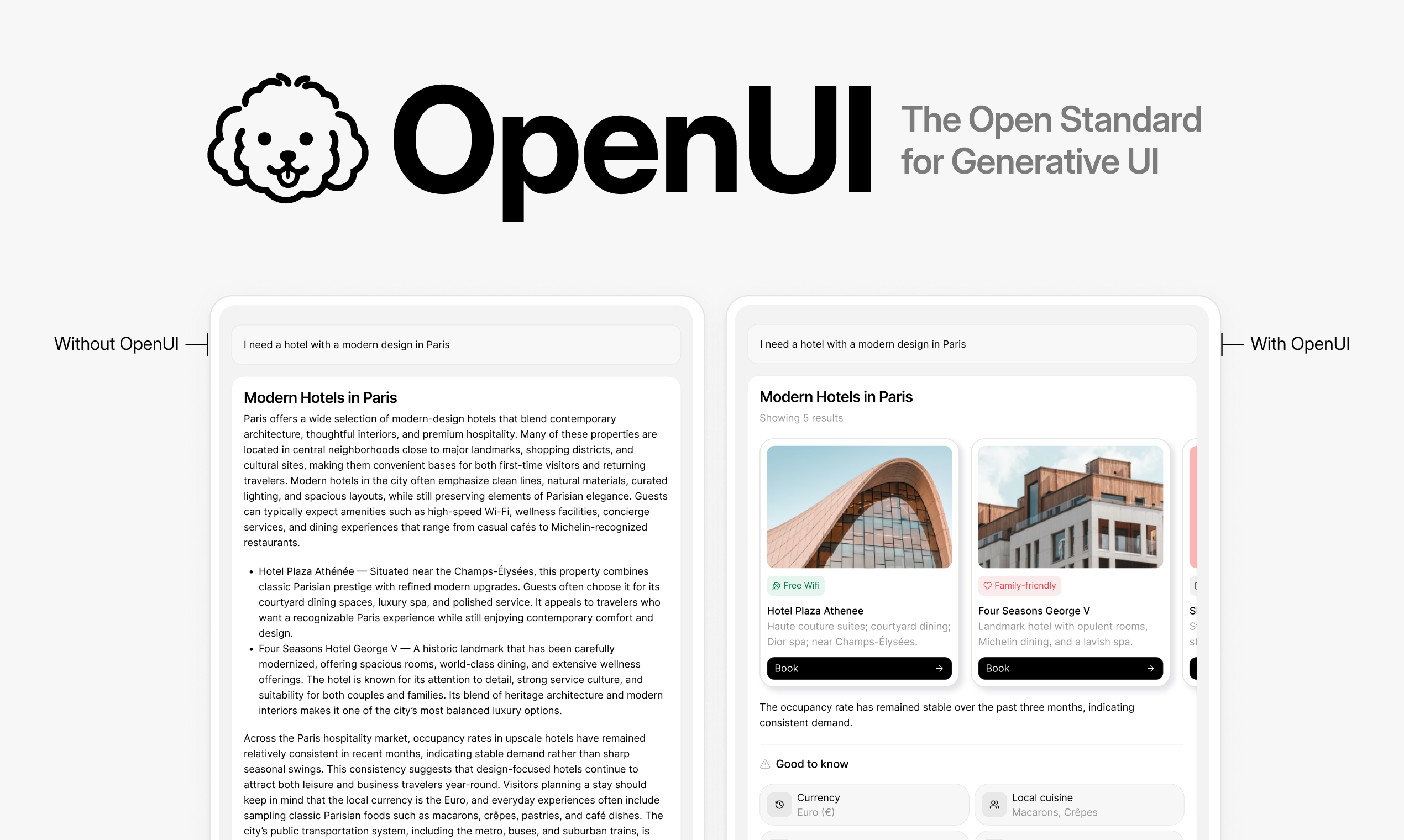
The Open Standard for Generative UIMake your AI apps respond with interactive UI components like cards, tables, forms and charts instead of text. Streaming-native, token-efficient, and works with any AI model (GPT,Claude,M2.5) and agent framework like ai-sdk, Google ADK
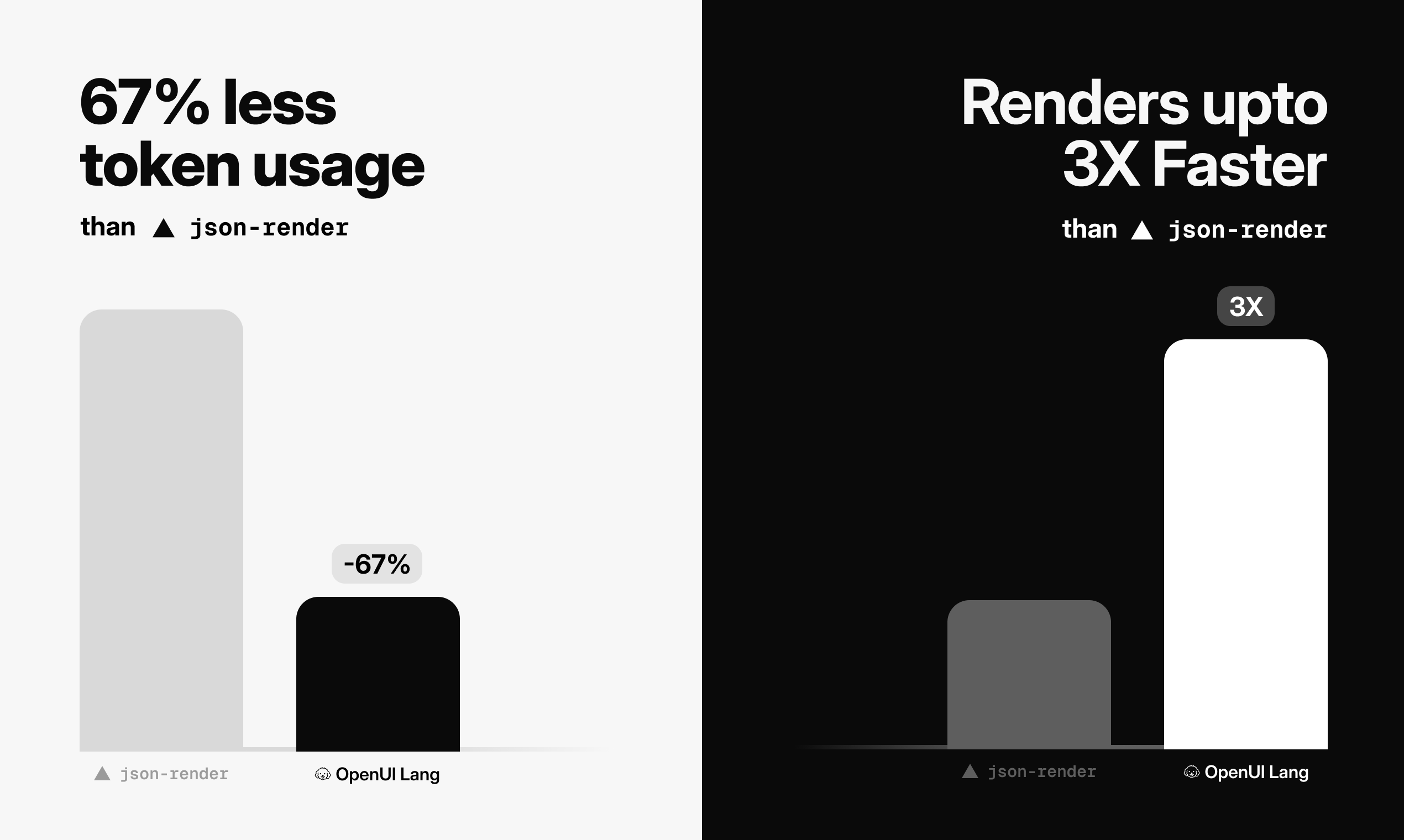
Hey Product Hunt! 👋 Parikshit here, co-founder of https://thesys.dev Introducing OpenUI - the open standard for generative UI Why we built this: Over the past two years, Thesys has powered generative UI for 10,000+ developers through our managed platform, C1. At that scale, we kept hitting the same wall. JSON : the standard format everyone (including us) used for structured UI output, kept breaking in production. It's too verbose, so rendering felt slow. It's too rigid, so custom design systems fought against it. And LLMs kept producing malformed output because deeply nested JSON isn't what they were trained to generate. We tried better validation, better prompts. The error rates improved. The problems didn't go away. So we designed a new format. OpenUI Lang uses code-like syntax that mirrors how LLMs actually learned structure, from billions of lines of code. The results: 🌱 67% fewer tokens than json-render → faster responses, lower cost ⚡️ 3x faster rendering → compared to our previous JSON-based approach 🎯 Near 0% malformed output → LLMs produce valid OpenUI Lang the way they produce valid functions 🦾 Model-agnostic → Works with all LLMs including OpenAI, Anthropic, Gemini, Mistral, Ollama 📦 Framework-agnostic → Works with your favorite frameworks including Vercel AI SDK, LangChain, CrewAI 📱UI library agnostic → Hook your own design system or the popular ones like ShadCN, Radix and so on. Get started: 📖 Docs → openui.com/docs 🎮 GitHub → github.com/thesysdev/openui 💬 Discord → https://discord.com/invite/Pbv5P... We're open-sourcing this because we believe generative UI should be shared infrastructure, not locked behind any one platform. If you're building AI interfaces or thinking about it,we'd love you to try it, break it, and tell us what's missing. Know more about Thesys : Https://thesys.dev
3
回复

Really proud of what we shipped here.

For a year we watched the same three problems surface across 10,000+ developers building AI-generated interfaces: slow rendering, broken output, hard-to-integrate designs. We kept patching. The problems kept coming back.

Turns out they were all symptoms of the same root cause: the format we were using didn't fit how LLMs think.

So we built one that did. The results were immediate. 3x faster, 67% fewer tokens, dramatically more reliable.

Open source and free. Hope it helps.

2
回复

One good update, here! Congrats on the launch, @pgd!

1
回复

@pgd  @neilverma thanks for the support

0
回复

This is one of those "why didn't this exist sooner" ideas. I'm so tired of AI responses being giant walls of text when what I actually need is a table or a card. The fact that it works with GPT, Claude, and Google ADK with just 2 lines of code is really appealing — nobody wants to be locked into one model these days. One question: how does it handle streaming? Like if the AI is generating a chart in real-time, does it render progressively or wait for the full response? That'd be a dealbreaker for chat-style apps where latency matters.

1
回复

@sparkuu OpenUI is built to be streaming native. Users can expect to see first render within 500ms-1s.

0
回复

great idea!

1
回复

@ishiid thank you. excited to see what you build.

1
回复
Loving the sound of this. How much ACC testing was done on this?
1
回复

@orateur Hey Ossy, what do you mean by ACC testing?

0
回复

How does OpenUI handle the challenge of adapting to different UI design paradigms and aesthetic preferences between various AI model outputs, given that these can vary significantly?

1
回复

@zhukmax Interesting point. Currently OpenUI is not opinionated to any paradigms. We recommend C1 by Thesys which has extensively tested to follow your preferences.

2
回复

MCP integration in 2 lines is a strong hook — the real friction in generative UI isn't rendering components, it's getting the LLM to emit the right structure reliably. We build LLM workflows for structured financial data and the jump from "returns JSON" to "returns interactive UI" is where most teams get stuck. Curious: how does C1 handle edge cases where the model's UI intent is ambiguous — do you fall back gracefully or does the developer define constraints upfront?

1
回复

@slavaakulov Due to strict schema enforcement, when schema breaks we retry internally to handle the interaction

0
回复

That is so cool! LLM visuals tend to be really frustrating. super curious to see how you resolved this. Shared with our marketing team :)

1
回复

What types of LLMs and frameworks are currently supported by C1's 2-line integration, and how does it handle UI rendering consistency across different platforms?

1
回复

@mordrag C1 was designed to LLM and framework agnostic. However we currently recommend GPT5 and Sonnet4 for production use. C1 only support web but we are planning to support for native mobile apps in upcoming months.

0
回复

An open standard for generative UI is exactly what the ecosystem needs. Having 10K+ developers already using this through Thesys gives it real momentum. Congrats on the launch!

1
回复

@handuo thanks for the support!

1
回复

Congrats on the launch Parikshit. Rethinking the structure behind generative UI instead of just patching the problems with JSON is a smart move, and the focus on speed and reliability is exciting to see. Looking forward to seeing how the community builds with OpenUI.

0
回复
#5
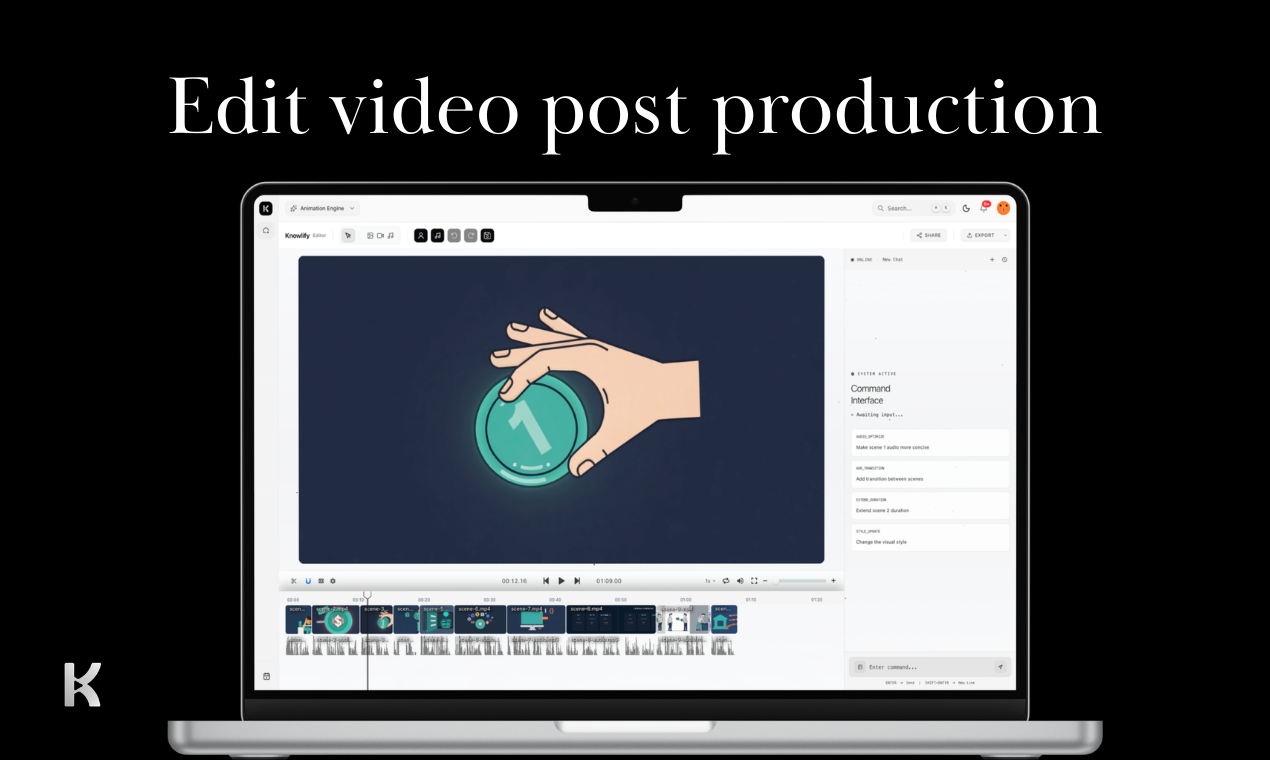
Knowlify
Cursor for Animated Videos
236
一句话介绍:Knowlify是一款AI视频工作室,能将文档(如PDF)快速转化为高质量、高吸引力的Kurzgesagt风格动画解说视频,主要解决团队在规模化制作高留存率知识解说视频时面临的效率低下、内容枯燥的痛点。
Productivity Artificial Intelligence Video
AI视频生成 文档转视频 知识解说 动画视频 团队效率工具 Kurzgesagt风格 B2B内容创作 教育科技 营销内容自动化
用户评论摘要:用户普遍认可其解决真实痛点,风格独特。核心反馈集中在:1. 价格昂贵,成本计算方式引发疑虑;2. 对PPT支持、高度定制化(如自定图像、控制叙事核心)的需求;3. 询问技术细节(如生成时间、视觉生成方式、AI规划器逻辑);4. 期待其在不同垂直领域的应用效果。
AI 锐评

Knowlify的定位精准且颇具野心,它没有陷入“AI数字人”或“动态PPT”这两个已显疲态的竞争红海,而是锚定了“知识留存”这一更高阶的目标,并聪明地借用了已被市场验证的Kurzgesagt动画风格作为载体。这使其从工具层面跃升至“认知效率方案”层面,价值主张更锋利。

其真正的护城河并非单纯的视频生成,而在于宣称的“定制化AI规划器”。这暗示它试图理解文档逻辑、重构叙事,而不仅是视觉化文本。如果成功,它将解决内容创作中最核心的“策划”环节,这才是其宣称“节省90%时间”的关键。然而,这也是最大风险点:当前AI的语义理解和抽象能力能否稳定产出逻辑严谨、重点突出的脚本?用户关于“控制叙事核心”的疑问直指这一黑盒。

当前最现实的掣肘是定价策略。高昂的单片成本($150/5分钟)虽以节省传统动画制作时间和成本为辩护,但会直接将高频、规模化生产的潜在用户(如内容营销团队)拒之门外。这暴露了其依赖重度计算资源的现状,也使其在早期更像是一个“优质外包替代方案”,而非可随意迭代、试错的内部生产力工具。能否在提升模型效率的同时快速降低价格,将决定它是成为小众精品还是大众爆款。

总体而言,Knowlify展现了一个正确的方向:用AI处理创意生产中的“重脑力”部分(策划与设计),而非仅仅替代“重劳力”部分(渲染与剪辑)。但它正走在技术、成本与市场接受度的钢丝上。

查看原始信息
Knowlify
Knowlify is an AI video studio that turns docs into premium explainer videos. Built for teams that need consistent, high-impact explainers - faster than traditional production, more engaging than standard AI video tools.

Hey Product Hunt, I'm Ritam, Co-founder of Knowlify!

The Problem:

Most people in 2026 don't read. Instead, they want to watch an engaging video explaining the content. The problem is that there is no scalable way for teams to create high-quality, highly engaging video content.

Most tools in this space follow one of two flawed approaches:

Uncanny AI avatars – They feel robotic, stiff, and instantly disconnect the viewer from the material.

Glorified slideshows – They simply slap text over generic stock footage, completely missing the mark on creativity and engagement.

From day 1, we set out to fix these issues. We built Knowlify with one vision: to make knowledge so engaging that once you click play, you're instantly hooked for the rest of the video.

How Knowlify is Different 🚀:

Knowlify is focused on maximizing content retention—helping your audience learn the most amount of material in the shortest amount of time. Instead of boring slides, we convert text, PDFs, and other docs into engaging, Kurzgesagt-style animated videos.

  • Beautiful, educational animations – We turn dry text and documents into exciting, animated stories that actually communicate complex information in a fun way.

  • Custom-trained AI models – We've trained our own planner and voiceover models on proprietary datasets to ensure the pacing, tone, and structure are perfect.

  • Built for creativity – Most AI tools are terrible at being creative. We've built an agentic system that specifically thrives on creative video production, and it will only get better over time.

Who is this for?

Whether you're a content manager turning blog posts into engaging media, or a creator building instructional content to convey complex information, Knowlify makes it effortless. The possibilities are truly endless.

Here's an example tutorial to understand the website better!

Knowlify Tutorial

15
回复

@ritam_rana Congrats on the launch! Just a quick q; for B2B content teams scaling LinkedIn carousels or newsletters to video like turning SEO-optimized posts into hooks, what's one retention hack your custom AI planner uses to keep complex topics punchy under 90 seconds?

8
回复

@ritam_rana  Congrats on the launch, Ritam. The focus on retention is smart. Most tools focus on generating video quickly, but not necessarily making the viewer actually understand or remember the material. The Kurzgesagt style direction is interesting too because that format works well for explaining complex topics. It keeps attention while still teaching something meaningful, which is harder than it looks.

One thing I am curious about is how much control creators have over the final narrative and pacing. If someone uploads a long article or technical document, can they guide the AI on what the “core lesson” should be, or does the planner model decide what is most important?

I could see this being really powerful for turning dense reports or educational material into something people will actually finish watching. Curious how teams are using it so far.

1
回复

@ritam_rana Kurzgesagt-style animation is a high bar to claim ! how much of the visual output is genuinely generative versus templated motion graphics with swapped content?

0
回复

This solves a real pain point. I've tried turning written content into video with other tools and the results always felt like glorified slideshows. The Kurzgesagt-style animations are a much better approach for retention. How long does it take to generate a 3-5 minute explainer from a document?

9
回复

@redcat Thanks for commenting! For a typical 1-3 minute explainer it usually takes around ~5 minutes to generate the first version.

You get a step-by-step storyboard view where you can edit the script, visuals, and scenes before the final render. Most people spend a couple extra minutes tweaking the scenes to get it exactly how they want.

Check out Knowlify.com to see an example!

7
回复

Would it work with a ppt presentation and how well will it be able to tackle something specific where information is not largely available online or publicly?

7
回复

@viktorgems  Thank you for your question! Currently, Knowlify supports PDFs and prompting, and we are actively working on adding PowerPoint (PPT) support for a future update.

The platform works best with clear, text-rich PDFs. If a PDF contains mostly screenshots, diagrams, or is visually dense, the results may not be as effective as those from well-structured source material.

For very niche or highly specific topics, the system performs best when the needed information is present in the source material or is available online in some form. Since the model relies on the context it can access, the clearer and more detailed the input, the better the output will be.

You can also add up to five reference images, plan out your video before generating it, and edit the output afterward to refine it further.

We would love for you to check it out and try creating something at https://create.knowlify.com/login.

8
回复

@viktorgems we are adding this soon as nitish and jon mentioned. out of curiosity, what type of content was in the powerpoint?

1
回复

Sounds quite interesting. I've experienced this problem myself, and as easy as Canva is to create content, it is hard to get started if you are not experienced. I will be testing it soon. Congrats on the launch!

6
回复

@diego_builds Awesome! Let us know how it goes. Feel free to share the video as well! Would love to see what you create.

4
回复

@diego_builds thanks diego! would love to see what you make with knowlify

0
回复

The product works well, but it’s extremely pricey. My 30-second video used 1,200 credits, and generating a 5-minute YouTube video will cost $150. That’s not reasonable at this rate.

6
回复

@alsafa_alizada Thanks for the honest feedback. That is completely fair, and we are actively improving pricing as we scale.

Our main focus right now is not just the cost of a single output, but the impact on production time and throughput. For many teams, the value comes from being able to cut video production time by up to 90%, go from idea to output much faster, and create significantly more content without the traditional workflow bottlenecks.

That is the lens we are optimizing around today: time saved, speed to publish, and overall output. As the product scales and infrastructure improves, we expect pricing to come down further over time.

Really appreciate you calling this out. Feedback like this helps us sharpen both the product and the pricing.

7
回复

this is one of the greatest product i have ever seen on product hunt this month

6
回复

@kshitij_mishra4 Haha thank you! Please let me know if you have any questions

6
回复

@kshitij_mishra4 share your coolest vid with us! we'd love to see how you use it :)

3
回复

@kshitij_mishra4 Wow thank you!

2
回复

Also I’m wondering how you approach pricing given that video generation can be pretty compute-heavy. Do you charge based on usage, or do you bundle it into subscription tiers?

5
回复

@meghna_vikram pricing is listed on https://create.knowlify.com/p/pricing!

we basically allow you to buy credits as you please or upgrade to one of our monthly subscriptions, which gives you a bunch of credits for a cheaper price!

2
回复

Is Knowlify better at specific video styles or does it adapt well to anything? I find most vertical AI tools are great in some scenarios and in others they suck, if there's a style where Knowlify really shines, worth mentioning!

5
回复

@mcarmonas hey! animated videos for knowledge-sharing are our strong suit

5
回复

@mcarmonas My personal favorites are some 3d and corporate video styles! However really any sort of animated style works well!

6
回复

the kurzgesagt-style bet is the right call. the uncanny avatar problem has killed more ai video tools than anything else. curious how the pricing evolves - the $150/5min comment is the main objection you'll keep hearing. congrats on the launch ritam.

5
回复

@ivo_gospodinov Thank you, I really appreciate your input. We chose this approach because, for explainer videos, clarity and consistency are more important than mimicking a human presence on screen.

Regarding pricing, we are focusing on saving time and increasing output. Compared to hiring freelancers or animation studios, our advantage lies in our speed, efficiency, and ability to transform ideas into published videos quickly. As we scale, we expect our pricing to improve further.

1
回复

@ivo_gospodinov thank you! i completely agree. i don't believe avatars are the way for knowledge sharing and that has been our thesis since day 1.

as for pricing, typical animation studios can charge insane amounts, like $8000 for a 30 sec clip. of course, these are high production, but still a crazy amount.

for now, our pricing reflects the costs on our side and we anticipate it going lower over time!

1
回复

What's a Kurzgesagt-style? First time hearing it! What's the reason behind choosing this style? Congrats on the launch, @ritam_rana!

4
回复

@neilverma Kurzesgat is a very popular Youtuber! He has over 25 million subs and his videos were an inspiration for us when building this product

check them out here: https://www.youtube.com/@kurzgesagt

2
回复

@ritam_rana  @neilverma Thank you! "Kurzgesagt" is a YouTube channel that does story-telling based animated videos that have a distinctive artstyle. People love that art style, as do we, so we implemented a version of that into our platform!

Try it out for yourself!: https://create.knowlify.com/p

1
回复

@ritam_rana  @neilverma He is one of my childhood favorite YouTubers! We wanted to mimic his engaging style of content when making our own videos!

1
回复

ok so basically AI creates animations and voiceover and puts them on top of each other? What tech do you use for voiceover?

4
回复

@davitausberlin Yep! The abstraction layer we've built on top of AI Video Tools is what makes us unique. 11labs is used for the voiceover.

3
回复

Been looking for something like this, well done

2
回复

@ishaan_sehgal thank you and glad to hear you finally found a solution!

2
回复

Thid idea will work well with older teams that have a lot of information stuck on PDFs, and need a way to quickly make that content for marketing. I think of old traditional organizations such as governments, that want to communicate on their website what a certain application process looks like, or best practices.

The product idea is good, here is how the features worked for me:

- Voiceover: I uploaded a document on questions that you can ask to a designer when you start a project, and it gave me a voiceover about meal prepping.
- The storyboarding features worked really well. It simple enough to be able to just modify the prompt that creates the image, then change the colours if necessary. However, in a world that everything looks AI generated it could be nice to replace the image with something else the user already has saved. Could defeat the purpose, but that's a quick modification i think would be useful for my own process, so that I can customize outside of the platform then come back.
- Took about 20 minutes to make the video.

Lovely tool with a lot of potential for legacy boomer clients.

2
回复

@mason_mcintosh Thank you so much for your thoughtful feedback. You are absolutely right that this tool can be particularly beneficial for older teams and traditional organizations that have valuable information buried in PDFs and need to quickly transform it into clear marketing or communication content. Government and process-driven use cases are excellent examples of this.

I also appreciate you bringing up the voiceover issue. That experience was unintended, and we are actively working to improve consistency between the source material and the generated output.

I’m glad to hear the storyboarding feature worked well for you. You made an excellent point about being able to swap in your own saved visuals; that kind of flexibility would be very valuable for teams seeking more customization and greater brand control.

It’s also fantastic to know you were able to produce a finished video in about 20 minutes. That speed is a significant part of the value we aim to provide.

Thanks once again for trying Knowlify and for your detailed feedback. It genuinely helps us improve.

2
回复

@mason_mcintosh Thank you for the detailed feedback Mason! Your suggestion on inserting an existing image you want is a good idea, I'm adding that to our "TODO" list!

Feel free to send the link to the video or share the editor with us (would love to see what video you made)! My email is jonathan@knowlify.com

2
回复

@mason_mcintosh i appreciate the feedback. we've worked hard on the user experience so we can limit the amount of time to make a good video.

as for using your own images, i believe that might work via the reference image tool by uploading it into the chatbox. this is still a feature in progress, so let us know your thoughts :)

2
回复

Truly the curse of society's shortening attention span. This feels like a really great idea to deploy for onboarding or explaining complex ideas. Given that AI has limitations when it comes to how much context can be retained, is there a maximize "size" that a PDF should be limited to when it comes to creating these explainer videos?

1
回复

@lienchueh Thank you and really appreciate the insight! For PDFs, the current maximum size is 50MB or 50 pages for a video!

0
回复
You mention custom-trained “planner” and voiceover models. In practice, what does the planner optimize for (learning outcomes, narrative flow, visual density, timing), and how do you let teams steer or lock decisions so outputs are consistent across a whole library?
0
回复

The example in the video looks solid, but I'm curious - how consistent is the quality across different art styles? Some tools nail one look and fall apart on everything else. Which styles work best right now and which ones are still rough?

0
回复

Hi folks, congrats on the launch!


Your tool looks like it could fit nicely into my workflow. I regularly work with quarterly +100 pages data reports.

Does your system support analyzing documents of that size?

0
回复

@mike_sykulski 

hey mike! we'll make sure it works with those types of reports.

how about we hop on a call and figure out how we can help?

feel free to book here: https://meetings-na2.hubspot.com/knowlify

0
回复
#6
Gemini Embedding 2
Google's first natively multimodal embedding model
229
一句话介绍:Google首个原生多模态嵌入模型,通过将文本、图像、视频、音频和文档映射到统一的向量空间,解决了开发者在构建跨媒体检索与分类系统时需整合多个独立模型和处理流程的复杂痛点。
Developer Tools Artificial Intelligence Development
多模态AI 嵌入模型 向量数据库 跨模态检索 语义搜索 谷歌云AI 机器学习 RAG系统 人工智能开发 统一表征学习
用户评论摘要:用户普遍认可其统一多模态嵌入的突破性价值,能极大简化跨模态检索和RAG系统构建。同时,有具体场景的开发者提出了对音频嵌入在短时、嘈杂环境中实际效果的疑问,并希望测试其性能边界。
AI 锐评

Gemini Embedding 2的发布,与其说是一项技术升级,不如说是谷歌对AI基础设施层一次深思熟虑的战略整合。其真正的锋芒,并非简单的“支持多模态”,而在于“原生”与“统一”这两个词。当前业界的普遍实践是将不同模态的数据通过各自独立的模型(如CLIP用于图文,Whisper用于音频转录)转化为向量,再费力地拼凑到一个近似空间中进行运算。这个过程充满了工程上的胶水代码、精度损失和协同难题。Gemini Embedding 2直接釜底抽薪,试图从底层提供一个“原子化”的统一语义空间。

它的价值必须放在两个维度审视:一是效率与成本,开发者得以用单一API调用替代复杂的多模型Pipeline,降低了系统复杂度和维护成本;二是能力边界,原生多模态嵌入可能解锁全新的应用范式。例如,评论中提到的“无需转录的音频嵌入”,其意义远不止于降低延迟。它意味着模型能直接捕捉语音中的韵律、情绪等超文本信息,这些信息在转录为文字时已永久丢失。这对于情感分析、内容安全或更细腻的交互体验至关重要。

然而,掌声之下需存冷思考。首先,“统一空间”的质量是最大问号。将文本、图像、视频、音频的语义强行对齐,是否会带来“维度诅咒”?即在某些模态(如图像分类)上的精度,是否会为了跨模态对齐而做出牺牲?这需要严格的基准测试来验证。其次,作为闭源的云API,它进一步强化了开发者对谷歌AI基础设施的依赖,模型的黑箱特性可能让其在某些对可解释性有要求的场景中受阻。最后,那个关于“短时嘈杂音频”的评论直击要害:这类模型通常在干净、标准的实验室数据上表现惊艳,但在真实世界的混乱与噪声中,其鲁棒性才是真正的试金石。

总而言之,Gemini Embedding 2是一次重要的基础设施跃进,它描绘了多模态AI走向工程化、平民化的清晰路径。但它并非万能钥匙,其实际统治力将取决于它在具体、嘈杂的现实任务中的性能表现,以及开发者是否愿意将核心的嵌入层“锁”在谷歌的生态之中。它拉开了下一代AI应用竞争的序幕,但比赛才刚刚开始。

查看原始信息
Gemini Embedding 2
Gemini Embedding 2 is Google's first natively multimodal embedding model that maps text, images, video, audio and documents into a single embedding space, enabling multimodal retrieval and classification across different types of media and it’s available now in public preview.

Gemini Embedding 2 is Google's first natively multimodal embedding model, designed to map text, images, video, audio, and documents into a single embedding space.

Most embedding pipelines today are fragmented... developers often need separate models and preprocessing steps (like audio transcription or image captioning) before generating embeddings. Gemini Embedding 2 simplifies this by handling multiple modalities directly and enabling multimodal retrieval, classification, and semantic search from one unified model.

Key features:

  • Multimodal embeddings for text, images, video, audio, and PDFs

  • Up to 8192 tokens for text, 6 images per request, 120s video, and 6-page PDFs

  • Native audio embeddings without transcription

  • Supports 100+ languages

  • Interleaved multimodal inputs (e.g., text + image together)

  • Flexible embedding dimensions with Matryoshka Representation Learning (3072 → 768)

Why this matters: Developers can build RAG systems, semantic search, sentiment analysis, clustering, and multimodal retrieval much more easily with a single embedding model that understands different media types together.

Who it’s for: AI developers, ML engineers, and teams building search, assistants, knowledge bases, and multimodal AI applications.

If you’re building the next generation of multimodal AI experiences, this is definitely worth exploring.

I hunt the latest and greatest launches in tech, SaaS and AI, follow to be notified @rohanrecommends

4
回复

A natively multimodal embedding model that maps text, images, video, and audio into the same space is a big deal. Most embedding approaches still treat modalities separately, which creates friction when you want to do cross-modal search or retrieval. This should make building multimodal RAG systems much more straightforward.

2
回复

The native audio embeddings without transcription step is the part I want to test first. We log food via voice in FuelOS and always pre-transcribe before any semantic matching, which adds latency and a failure point. Does the audio embedding quality hold up for short, noisy clips (5-15 seconds) or is it optimized more for longer-form content?

0
回复
#7
Firecrawl CLI
The complete web data toolkit for AI agents
177
一句话介绍:一款为AI智能体与开发者设计的命令行工具,通过提供网页抓取、搜索和浏览的一体化方案,解决了智能体获取可靠、结构化网络数据时遇到的JS站点兼容性差和上下文令牌浪费的核心痛点。
Developer Tools Artificial Intelligence
AI智能体开发工具 网页数据抓取 命令行工具 数据提取 上下文优化 网络爬虫 市场情报 研发赋能 自动化工具
用户评论摘要:用户普遍认可其解决了AI智能体获取可靠网络数据的核心痛点,赞赏其文件化上下文管理和令牌高效性。主要问题集中于:1. 如何处理反爬和结构多变的网站;2. 对Next.js等客户端渲染站点的支持细节;3. 是否有现成的技能模板。
AI 锐评

Firecrawl CLI的发布,直指当前AI智能体开发中最“脏累活”却至关重要的环节——高质量、高可靠性的外部数据接入。其宣称的“超越Claude原生抓取80%覆盖率”和“最大令牌效率”,本质上是在挑战一个行业共识:即大模型智能体的能力边界,正从纯代码与内部数据推理,转向与动态、混乱的真实世界网络数据可靠交互。

产品将“抓取、搜索、浏览”三合一,并输出清洁Markdown/JSON,其真正价值并非功能堆砌,而在于试图为智能体建立一套标准化的“网络感官”与“信息消化系统”。文件系统作为交互中介的设计尤为巧妙,它避开了让智能体直接处理原始HTML的复杂性,将数据预处理和结构化这一高不确定性任务从智能体推理链中剥离,转化为相对确定的环境操作(文件读写),这提升了智能体行动的可靠性与可预测性。

然而,其面临的考验同样严峻。评论中关于反爬与动态站点的疑问,正是其商业与技术护城河所在。若其云浏览器方案能稳定绕过主流反爬机制并高效处理SPA,它将从一个“好用工具”升级为“关键基础设施”。但这也意味着持续的高对抗性技术投入和潜在的法律灰色地带风险。

总体而言,Firecrawl CLI代表了AI工程化演进的一个务实方向:与其一味追求模型规模的宏大叙事,不如深耕如何让现有模型更可靠、更经济地利用现有网络信息。它的成功与否,将取决于其技术深度能否支撑起其承诺的“可靠性”,以及能否在开发者中形成处理网络数据的“事实标准”工作流。

查看原始信息
Firecrawl CLI
Firecrawl CLI is an all-in-one toolkit for scraping, searching, and browsing the web. Built for AI agents and developers, it delivers clean, reliable data with maximum token efficiency - outperforming native Claude Code fetch with >80% coverage.

Hey Product Hunt! 👋 Eric here.

We launched Firecrawl CLI, your agent’s complete web data toolkit.

Every developer building with agents eventually hits the same wall, reliable web data access.

Most tools break on JavaScript-heavy sites or dump entire pages into context, wasting tokens and slowing down reasoning.

Firecrawl CLI fixes that.

It gives agents a unified interface to:
- scrape pages into clean Markdown or JSON
- search and return complete results in one step
- browse interactive or gated pages through a cloud browser
- crawl and map entire sites for structured coverage

Firecrawl CLI uses a file-based approach for context management, so results are written to the filesystem and agents can use bash methods for efficient search and retrieval.

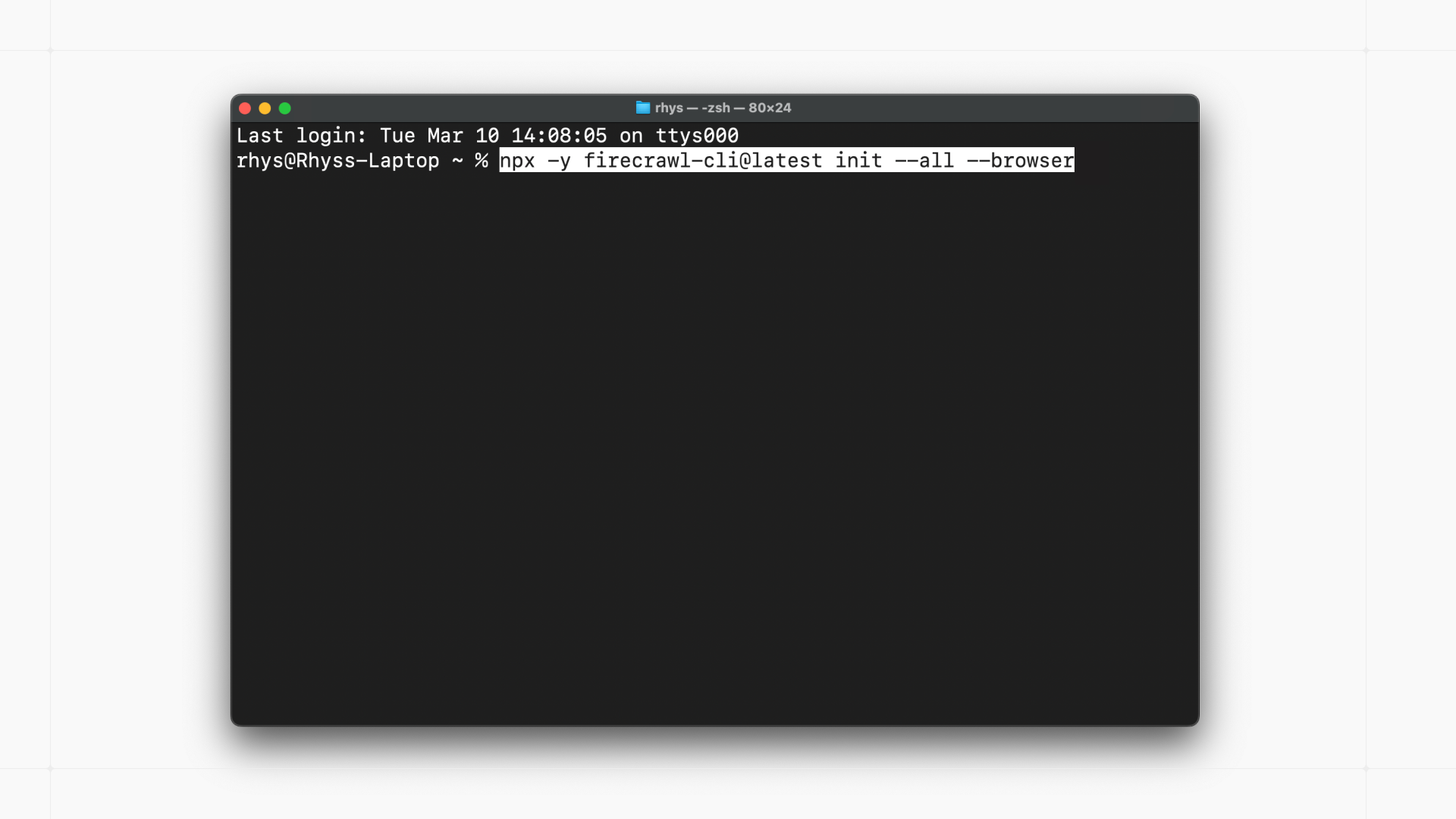
To install it, just run:
$ npx -y -cli@latest init --all --browser

Once installed, your agent knows how to get live web data whenever it needs it.

Real use cases:
- Enrich AI agents and knowledge bases with live, structured web data for more accurate reasoning and responses
- Power deep research workflows by collecting verifiable sources, documentation, and papers across the web
- Automate data and market intelligence gathering - tracking competitors, product updates, and industry trends in real time
- Capture information from dynamic or login-gated sites to access data hidden behind dashboards, forms, and authenticated workflows.

Works with all popular harnesses like Claude Code, Codex, and OpenCode.

You can try it now: https://docs.firecrawl.dev/sdks/cli

We’d love to hear what you build with it!

2
回复
Oh woow, that was the missing brick to my OpenClaw setup. Do you have a ready skill.md ?
1
回复

@bengeekly We do!!

1
回复

Reliable web data access is definitely one of the biggest pain points when building agents. The idea of returning clean structured data instead of dumping full pages into context makes a lot of sense. How does Firecrawl CLI handle sites that actively block scraping or frequently change their structure?

0
回复

am planning to switch from stagehand to this after this launch amazing

0
回复

Actively using Firecrawl via MCP and will be happy to try CLI! Thanks

0
回复

Congrats on the Firecrawl CLI launch, @ericciarla! 91K stars is a testament to the reliability you've built. I like the "File-Based Approach" for context management. Essential tool for the 2026 stack.

0
回复

the file-based approach for context management is such a smart design choice. been building agents that need web data and the biggest headache is always getting clean output without burning tokens on garbage html. curious how the cloud browser handles sites with heavy client-side rendering tho, like SPAs built on next.js or similar?

0
回复

@mihir_kanzariya Thank you! It handles heavy client side sites very well - that is the exact reason we built it to complement and extend scrape :)

0
回复

Awesome project! shared with our dev team :)

0
回复

@lev_kerzhner Sweet - ty!!

0
回复

Having reliable web data extraction is one of those unglamorous but absolutely critical pieces for AI agents. The fact that most tools break on JS-heavy sites or waste tokens on full page dumps is a real pain point. A CLI that handles scraping, searching, and browsing in one place with clean output is exactly what the agent ecosystem needs. Nice work on the 6th launch!

0
回复

@handuo Thank you and I would agree 100%

0
回复
#8
IonRouter
Serve Any AI Model, Faster & Cheaper
169
一句话介绍:IonRouter 是一款提供与 OpenAI 兼容的 API 路由服务,通过自研的高效推理引擎,以市场半价、更低延迟调用多种主流开源模型,解决了开发者在构建多模态AI应用时面临的高成本和性能优化难题。
Developer Tools Artificial Intelligence Tech
AI模型路由 推理优化 成本削减 OpenAI兼容API 多模态AI 模型部署 基础设施即服务 高性能计算 Grace Hopper优化
用户评论摘要:用户普遍对“半价”和低延迟表示强烈兴趣,并询问技术原理与免费计划。核心关注点在于:1. 成本与速度如何兼得;2. 与OpenRouter等竞品的差异;3. 生产环境下的重度负载表现。开发者回应揭示了其自研引擎与芯片级优化的技术路径。
AI 锐评

IonRouter 的叙事核心是“半价”,但这恰恰是其最犀利的双刃剑。它并非简单的模型聚合商,而是试图通过自研的 IonAttention 推理引擎,在 NVIDIA Grace Hopper 这一特定硬件架构上重构推理的“Token经济学”,实现硬件利用率的突破。其宣称的“单GPU多模型复用且切换时间<100ms”,直指当前云上AI推理资源闲置与碎片化的行业痛点,价值在于将推理从“粗放的资源租赁”转向“精细的效能运营”。

然而,光环之下疑点重重。首先,其“半价”优势严重绑定于对特定(且较新)芯片架构的深度优化,这既是技术壁垒,也是生态枷锁,其通用性和可持续性有待观察。其次,作为后来者,面对 OpenRouter 等已建立生态的对手,仅凭价格和速度参数难以形成绝对护城河,开发者社区的信任与迁移成本是更高门槛。评论中关于生产负载的担忧非常关键——在理想演示与复杂、异构的真实生产场景之间,往往存在巨大的“效能鸿沟”。

本质上,IonRouter 是一场豪赌:赌的是专用硬件(Grace Hopper)将成为主流,赌的是自研引擎的优化幅度能持续抵消生态劣势。它若成功,将推动AI基础设施层从“堆算力”向“榨算力”的范式转变。但在此之前,它必须向市场证明,其“奇迹引擎”不仅在实验室跑分中领先,更能在千奇百怪的真实业务流中,稳定地交付“又快又省”的承诺。

查看原始信息
IonRouter
Teams use IonRouter as a drop‑in OpenAI-compatible API to hit the best open models for LLMs, vision, video, and TTS at HALF market rate. You can run agents and multi‑modal apps, and deploy your finetunes on our fleet while we handle optimization and scaling in the background. Under the hood, IonRouter runs a custom inference engine (IonAttention) built for NVIDIA Grace Hopper, cutting price and latency for your workloads.

Hey y'all! @veercumulus and I are super excited to launch this product showcasing our proprietary IonAttention Engine: https://cumulus.blog/ionattention

Now serving Kimi, Minimax, GLM, Qwen 3.5, Wan, and more! Also serving your finetunes :)

13
回复

@veercumulus  @suryaa_rajinikanth Congrats on the launch 🚀

Infrastructure that makes running multiple models cheaper and easier is becoming increasingly important as more teams build AI products. Curious to see how developers use IonRouter in production.

1
回复

Wow this would actually be so useful to us. What do you actually use to make it so much cheaper?

8
回复

@gobhanu_korisepati Our own proprietary inference engine purpose built for the Grace NVIDIA architecture enables us to get these insane prices & blazing fast speeds.

Find out more here:

https://cumulus.blog/ionattention

4
回复

@gobhanu_korisepati The cost difference is really interesting.

If you can keep latency low while routing across multiple models, that’s a pretty big advantage for teams building AI products at scale. Curious how this performs under heavy production workloads.

0
回复

Congrats team! Let's goooo!

2
回复

@charles_ding1 Thanks Charles :)

0
回复
How does speed compare? That’s what I’m most interested in.
1
回复

OpenAI-compatible routing plus lower latency/cost is super compelling for multi‑modal apps. Shared with our dev team.

1
回复

@lev_kerzhner Would love to have y'all on board :)

0
回复
Hey Suryaa, congrats on the launch! Curious what sparked building your own attention engine. Was there a specific limitation you kept hitting with existing inference setups that made you think okay, we need to build this from scratch ourselves?
1
回复

@vouchy I think we really wanted better performance and utilization. Tried forking open source solutions and monkey patching but didn't really work. So we decided to build ground up!

1
回复

How does IonAttention's custom inference engine achieve half the market rate without compromising model quality or response accuracy?

1
回复

@mordrag The token economics of our inference engine make it super viable to cut prices! We are able to multiplex models off one single GPU with <100ms of switch time. So our GPUs constantly are serving the models our customers actually want to run. We also have the most optimized engine for the cheaper Grace Hopper chips - more performance and less cost!

0
回复

Congratulations!!!

0
回复

Looks promising. Is there a free plan?

0
回复

Hey, congrats to your launch. I am wondering what are the main differences of IonRouter as opose to OpenRouter? Still learning about the model infrastructure, renting, deployment etc, so I hope this is not a silly question to ask!

0
回复

This looks really cool! For someone that hasn't really worked in this space, can you "explain like I'm 5" and "explain like I'm 16"?

0
回复

@vincent_jeltsch1 Hey Vincent! We've purpose built an inference engine from scratch for the Grace NVIDIA GPUs, what this has allowed us to do is make breakthroughs in performance & speed for all inference workloads.

We've hosted the most popular models on our pool of GPUs to make available to the public for usage based tokens. Very similar service to openrouter, where you sign up and can use any model you want. You will get faster speeds than any provider on openrouter (Alibaba themselves, Together AI, fireworks, etc). And the best part is you pay half the price! Win-win in all scenarios.


Hope this helps.

1
回复
#9
Citable
Be in AI answers before your competitors. We do it for you.
142
一句话介绍:Citable 是一款为中小企业提供全托管式AI搜索优化服务的平台,通过专业的策略、内容创建与引用构建,帮助企业在ChatGPT、Perplexity等AI对话引擎的答案中被推荐,解决其在AI搜索时代品牌曝光不足的痛点。
Artificial Intelligence Search Marketing automation
AI搜索优化 GEO营销 品牌曝光 内容营销 托管式服务 中小企业营销 AI引用构建 竞争情报 营销自动化 获客引擎
用户评论摘要:用户肯定产品方向,认为从“排名”到“推理”的搜索转变是关键。核心问题聚焦于:1. 如何确定高引用概率的内容?2. 如何准确追踪效果?3. 与同类工具相比的差异化(避免混乱、实现真正提升)。建议关注模型漂移对进度报告的影响。
AI 锐评

Citable 敏锐地抓住了“搜索范式转移”的焦虑——当答案由AI生成时,传统的SEO失灵,竞争在全新的“引用战场”上重启。其宣称的“服务即软件”模式,本质是将专业的GEO(生成式引擎优化)能力产品化、订阅化,试图为无力雇佣专职团队的中小企业提供“外脑”。

产品的真正价值不在于又一个“AI搜索排名跟踪器”,而在于承诺了从诊断到执行的闭环,并捆绑了人力服务。这戳中了当前AI搜索营销的核心矛盾:知道方向容易,但生产出能被AI识别并引用的高质量、结构化内容极难。其提供的“内容映射”、“行动引擎”和“博客优化”,实则是将内容策略与工程能力打包出售。

然而,其模式面临双重考验:一是服务规模化与质量控制的矛盾,重度依赖人力服务难以实现指数级增长;二是AI搜索本身的不稳定性,各大模型的检索与引用逻辑持续演变,今日的有效策略明日可能失效。用户关于“模型漂移”和“效果追踪”的提问直指这一软肋。

长远看,Citable更像一个过渡期的“拐杖”。它验证了市场对AI原生营销服务的迫切需求,但其护城河取决于能否将服务过程中积累的“如何被AI引用”的知识沉淀为真正的、可复制的算法或系统,从而从“人力密集的顾问”进化成“智能驱动的平台”。否则,它可能只是数字营销长河中,又一个因平台规则变迁而兴起、也可能随之衰落的服务型产品。

查看原始信息
Citable
Your competitors are already showing up in ChatGPT and Perplexity. Citable is the only fully managed GEO agency built for SMBs: we handle your AI search strategy, content, and citation building from day one. Just a dedicated team that makes AI recommend your business.

Hey Product Hunters 👋

I'm Maria, co-founder and CTO of Citable… and we're back for Launch #3 with our results!

Quick context: Citable helps founders and marketers show up inside AI engines like ChatGPT, Perplexity, and Gemini. Because search is shifting from ranking to reasoning, and most brands are still invisible in it.

The problem we keep hearing:

Have you searched your brand in ChatGPT and seen your competitors instead? You know you need to publish content, but you don't know what to post, where to post, or who to actually delegate it to.

What's new this launch, Service as Software:

We didn't just ship features. We shipped ourselves. You can now hire Citable as your fractional CMO or marketing associate who already knows GEO inside and out. No agency retainer. No hiring process. Just someone who shows up, knows what to do, and does it.

✅ Fractional GEO marketer — strategy + execution handled for you
✅ Content mapped to your buyer questions — blog posts, social snippets, Reddit comments
✅ Action Engine — tells you exactly what to post, where, and why
✅ Blog optimizer — drop any content in and we format it for AI citation

✅ YouTube to GEO content — turn your videos into citation-ready assets

✅ Competitor AI trend monitoring — know why they're getting cited and close the gap

A result we're proud of:

One founder went from 0% AI visibility to 8% across their core buyer questions in 45 days, and hit 500K+ awareness impact on Reddit.

Not ready to commit? Start with a $99 AI Audit.

You'll get your AI visibility score across ChatGPT, Perplexity, Gemini, and Grok, your competitor landscape, your visibility gaps, and a prioritized action plan. Delivered in 48 hours. Credits toward your first month if you move to a plan.

👉 Book a 30-min intro with us: https://cal.com/cole-leng-tp1zwk/30min
🌐 www.getcitable.com

We're also thrilled to be partnering with NoodleSeed on this launch! Where Citable gets your brand cited inside AI search results, NoodleSeed picks up from there — nurturing those leads directly inside AI conversations, capturing inquiries, answering FAQs, and letting customers browse your catalog without ever leaving ChatGPT. Together, it's a full AI GTM stack: get discovered, then convert.

If you're a founder trying to figure out AI search, we'd love your feedback, your roasts, and your toughest questions 🙏

7
回复

Full AI GTM stack starts now! get discovered, then convert. Great collab with our partner NoodleSeed for closing the loop from getting leads nurtured into conversions, building comprehensive user feedbacks without leaving ChatGPT.

4
回复

@maria_gorskikh1  Congrats on the third launch, Maria. The shift from ranking to reasoning is something a lot of companies still do not fully understand yet, so tools that help founders see where they actually show up inside AI responses are going to matter more and more.

I also like the “service as software” angle. A lot of founders know they should be doing this type of content work, but the real blocker is figuring out what to write, where to post it, and then actually doing it consistently.

The competitor visibility piece is especially interesting. Seeing why another company gets cited in AI answers is probably far more useful than traditional keyword rankings.

One thing I am curious about. When your system identifies visibility gaps, how do you determine what content actually has the highest probability of getting cited by AI systems? Are you analyzing patterns from existing citations across ChatGPT, Perplexity, and Gemini, or is the recommendation engine mostly based on competitor coverage?

Really interesting space to be building in right now.

0
回复
Congratulations on the launch! 🚀
3
回复

Congratulations guys, It really looks super promising!

How can you actually keep track of the results to know if it's actually working?

2
回复

@ignacio_borrell Hi Ignacio, thx for the upvote! We are mainly tracking brand visibility, and accompanied impacts among the UGC channels like reddit, LinkedIn, Youtube, etc.
We tie the content we optimized/created back to the question that we are optimizing for. So if the brand visibility increases, and AI cites the content, then its' a win. Nothing fancy. But we've helped a B2B SaaS client from 0% to 8% in 45 days, gaining 500K views on Reddit as well.)

1
回复

Spent 20 years learning keyword research and link building. AI search launches. Now the meta is "write content that a language model would cite in a conversation." brb pivoting my entire content strategy. Upvoted out of self-preservation.

2
回复

@ilya_lee Haha what a world we are livin in! SEO is still important, keyword research & link building just got more optimized for the actual user intents instead of pure volume tracking. What use to take weeks to do, now can be done in minutes. An example with blog optimizer we have is that you can update your content ready in 5 minutes, making sure it's not only link-built, but also AI-ready.

1
回复

Aside from the new upgrade, just wanted to commend how pleasing your brand colors are in this preview. Congrats on the launch, @maria_gorskikh1!

2
回复

@neilverma Thank you so much, that really means a lot 😊 We spent a lot of time thinking through the feel of the brand, so im really glad that came through. Appreciate the support!

1
回复
Congrats on your 3rd launch on PH! We found Citable - a breeze to use. Excited for the partnership 🎊
2
回复

@naveed_rafi1 Thank you so much, that means a lot. Really glad Citable has felt easy to use, because that was one of the biggest things we cared about building right. Also very excited about the partnership 🎉

1
回复

Interesting, very many products push in that direction recently. What are you doing differently?

2
回复

@jan_heimes Hey Jan, great question! In one word. Tracking prompts is easy, getting real uplift in AI is not. We help you streamline the GEO process simply through taking all the insights from tracking and turn it into actionable items (with done-for-you contents) ready at your end.
So instead of utilizing another tool and learn the ever-changing GEO, just let us do the heavy uplifting so that you can focus on real value proposition distillation, and brand building.

1
回复

Interesting! I've worked with a few similar tools and they were very chaotic to say the least. Curious to see how you solved this. :) also shared with our GTM internally.

2
回复

@lev_kerzhner Thx Lev! Appreciate the support! Marketers had suffered enough from another tool. We are offering directly agency support with an alignment software layer where marketers can just spend roughly 15 minutes a day to approve the contents that we've nurtured for them, approve and post.
No more burden on mind, and stalling content production)

1
回复

Love the direction — “tracking prompts is easy, uplift is hard” is exactly the pain. Curious how you normalize model drift when reporting weekly progress: fixed benchmark prompt sets with confidence bands, or re-sampling by intent clusters each week? That’s usually where teams over/under-react.

1
回复

Seems like testing is going well. I got an error that there are too many requests.

Send me a DM when you guys are ready for another tester!

1
回复

@mason_mcintosh Hi Mason, traffic came in fast today so we scaled up our infrastructure to make sure everyone gets a clean experience.) Now you should be able to give it a try. lmk how it goes!

1
回复

Congratulations, @clyp1108!

I know that moving the needle from SEO to Agentic Search is the biggest challenge for brands in 2026. The Persona Matters section is a huge differentiator. Love the Prescriptive Actions approach.

1
回复
#10
ChatGPT Interactive Learning
Learn math and science with interactive visual explanations
135
一句话介绍:ChatGPT推出交互式可视化学习功能,通过动态图解和变量操控,将抽象的数学与科学概念具象化,解决了传统学习方式中理解困难、缺乏直观性的痛点。
Education Artificial Intelligence School
人工智能教育 交互式学习 可视化教学 STEM教育 概念理解 自适应学习 教育科技 AI导师 沉浸式学习 ChatGPT插件
用户评论摘要:主要评论为积极的产品功能宣传,强调其升级意义与教学价值。但存在用户质疑信息真实性,指出未找到官方发布信息,并对产品通过Product Hunt发布的形式表示疑惑。
AI 锐评

这款所谓的“ChatGPT Interactive Learning”产品,其发布本身比功能更值得玩味。从现有信息看,它并非独立APP,而是ChatGPT的功能升级,却以独立产品形式出现在Product Hunt,这引发了对其发布渠道和真实性的社区质疑。这反映出AI巨头功能迭代与独立产品边界模糊化的新常态。

其宣称的价值——通过交互可视化攻克STEM教育抽象性——确实直击要害。动态图解与变量操控若能实现,是从“知识检索”迈向“概念建构”的关键一步,将大语言模型的逻辑链条转化为可感知的因果模型。这不再是提供答案,而是搭建理解的情境,理论上能降低认知负荷,促进直觉形成。

然而,深度剖析之下,隐患与挑战并存。首先,其内容深度与广度存疑。70+核心话题仅是起点,科学体系的复杂性与知识网络的连贯性,远非孤立模块所能覆盖。其次,“交互”的真实性有待检验。是预设动画的触发,还是基于物理规则的实时模拟?这决定了学习者是“探索发现”还是“观看演示”。最后,教育效果缺乏实证。互动是否真能转化为深层理解与迁移能力,需严谨学习科学评估,而非仅凭体验新颖性断言。

更尖锐的问题是:这是教育范式的革新,还是高级营销素材?OpenAI若严肃进军教育,需构建完整的教学逻辑、评估体系与课程规划,而非仅提供炫酷的工具。当前形式,更像是对其代码解释器与可视化能力的场景化展示,旨在巩固其“全能助手”的叙事,吸引更广泛的用户群体(学生、家长、教育者)进入其生态。

真正的价值不在于“又一个学习工具”,而在于它是否标志着AI从知识库向交互式认知伙伴的范式转变。如果成功,它将重新定义人机协作学习的边界;如果流于表面,则不过是AI热潮中又一个精美的教育科技泡沫。用户对发布信息的质疑,恰恰反映了市场对AI炒作日益增长的警惕性。产品需要以持续、扎实的教育成果来回应这份警惕。

查看原始信息
ChatGPT Interactive Learning
140M people already use ChatGPT to solve math and science problems. Now it actually shows you. Interactive Learning brings dynamic visual explanations to topics like the Pythagorean theorem, Ohm's law, and compound interest, no textbook required.

ChatGPT just got a powerful upgrade for learning math and science!

OpenAI is rolling out interactive visual explanations that turn abstract concepts into hands-on learning experiences.

Instead of just reading formulas, learners can now manipulate variables and instantly see how graphs, formulas, and relationships change in real time.

This tackles a big problem: many people struggle with math because concepts feel abstract. With these dynamic modules, ChatGPT helps users experiment with equations, explore relationships, and understand concepts more intuitively.

Starting with 70+ core topics like the Pythagorean theorem, PV=nRT, Coulomb’s law, exponential decay, and more, the experience makes learning far more interactive than traditional explanations.

Great for students, parents, and educators who want a more exploratory way to learn, teach, and understand math and science concepts.

The feature is rolling out globally to all logged-in @ChatGPT by OpenAI users starting today.

I hunt the latest and greatest launches in tech, SaaS and AI, follow to be notified @rohanrecommends

5
回复
I can’t find anything about this online. Did ChatGPT post the video you shared?
0
回复

@sunbash same here, can't find any info. Since when does ChatGPT release its products on PH?

0
回复
#11
Mindspase
A visual AI knowledge base that organizes what you save
125
一句话介绍:Mindspase是一款视觉化AI知识库,通过零手动整理和自然语言搜索,解决了用户在信息过载时代“收藏即遗忘”的痛点,让灵感与知识得以轻松重现。
Productivity Artificial Intelligence
AI知识管理 视觉化信息组织 无文件夹整理 自然语言搜索 隐私安全 团队协作空间 灵感管理 跨内容类型存储 智能标签 情绪化浏览
用户评论摘要:用户普遍认可其解决“收藏夹坟墓”痛点的价值,并对“视觉情绪浏览”概念表示兴趣。主要疑问集中在:AI标签随内容量增大的准确性、模糊搜索的机制、与其他工具的集成可能性,以及多语言搜索支持。也有评论提醒产品需清晰传达价值以促进增长。
AI 锐评

Mindspase的野心不在于成为另一个笔记或书签工具,而旨在构建一个符合人类记忆非线性、关联性特征的“外脑”。其核心赌注——“零手动整理”看似是卖点,实则是巨大的产品与技术悬崖。它试图用AI完全替代人类的信息分类劳动,这要求其底层模型不仅要有出色的多模态理解能力(处理文章、图片、PDF等),更需具备深度的个性化学习能力,以理解每个用户独特的“记忆逻辑”。从评论中关于“AI标签是否会随内容增多而变得嘈杂”的质疑即可见,用户对此的信任是脆弱的。

当前,其“视觉情绪浏览”和“自然语言搜索”概念颇具前瞻性,击中了传统关键词搜索的盲区——即我们常凭感觉和模糊片段进行回忆。然而,这恰恰也是技术难点所在。模糊查询的准确度将直接决定产品是“神奇”还是“鸡肋”。此外,产品将“隐私”和“无广告”作为核心原则,这在赢得早期技术敏感型用户好感的同时,也为其商业模式画上了问号。是走向订阅制,还是未来在B端的“集体思维”协作功能上寻找路径,需要更清晰的叙事。

总体而言,Mindspase切入了一个真实且普遍的需求缝隙,但其长期成功不取决于概念的新颖,而取决于AI在真实、复杂、海量的个人数据场景下,能否持续提供稳定、精准、且令人惊喜的“记忆重现”体验。它不是在优化组织效率,而是在挑战人类如何与信息交互的根本范式,这是一条迷人但遍布荆棘的道路。

查看原始信息
Mindspase
Mindspase is a visual, AI-powered knowledge base that automatically organizes everything you save, articles, images, videos, music, quotes, PDFs, with zero folders or manual tagging. Search the way you actually remember things: "that blue design article from last month." Features unique visual layout, natural language + visual search, Collective Minds for shared knowledge spaces, and full end-to-end encryption. No ads. No data selling. Ever.
Hey Product Hunt! 👋 I built Mindspase because I kept losing the things that inspired me. Bookmarks became a graveyard. Notes apps became a mess. I wanted something that worked the way memory should work, just save it, and it's there when you need it. The core bet we made: zero manual organization, ever. The AI handles tagging, categorizing, and understanding your content from the moment you save it. You just live your life and accumulate knowledge. A few things I'm especially excited for you to try: - Natural language search, it's weirdly satisfying when it actually works - Collective Minds, shared knowledge spaces with people you trust - Visual mood browsing, filtering your saves by vibe, not category We're privacy-obsessed. No ads. No selling your data. Your mind is yours. Would love to hear what you think, and if you have a use case you'd want Mindspase to nail, drop it below. I read every comment. 🙏
5
回复

@gil_finkelstein2 Congrats on the launch!

 Products like this usually solve a real problem, but what often determines how fast they grow is how clearly the story and value are communicated to the right audience.
I work with startups and SaaS founders to turn their product messaging into high-converting website copy, SEO-driven content, and LinkedIn storytelling that attracts attention and turns visitors into loyal users.
Sometimes the product is already great, it just needs the right words to truly unlock its visibility and growth.
If you ever want a few ideas on how the content around your product could be optimized to amplify its reach, I’d be happy to share.
Hassan Fadlullah
Website Content Writer | SEO Content Writer | SaaS Writer | LinkedIn Ghostwriter

0
回复

@gil_finkelstein2  This is a really interesting problem to tackle. I think a lot of us have felt that “bookmark graveyard” effect where you save things with good intentions and then never find them again. I also like the idea of removing the manual organization layer. Most tools assume people will carefully tag and categorize things, but in reality that breaks down pretty fast once life gets busy.

The “visual mood browsing” concept caught my attention because that feels closer to how memory actually works. Sometimes you are not searching for a specific article, you are trying to rediscover something that had a certain feel or idea attached to it. I’m curious about one thing though. Over time, as someone saves hundreds or even thousands of things, how does the system prevent the AI tagging from drifting or becoming noisy? Does it learn from how users interact with the saved items to refine the structure of their “mind space”?

Really cool concept. Curious to see how people end up using it once their libraries start getting large.

0
回复

How does Mindspace's natural language search handle ambiguous or vague queries when users can't remember specific details about saved content?

2
回复

@mordrag Hey Denis,

You don’t have to remember specific details. It will be enough to remember, timeframe, or even a small piece of information like, “the article on the last technology “

1
回复

It's asking me to Sign in to base44.com - what's the connection? / Thanks

1
回复

@davidbennett I've built it with Base44

1
回复

@gil_finkelstein2 If I build a mind, can I integrate it with other tools?

1
回复

@dennishlewis like what?

In the platform you have “Feature requests” if enough users will asks for that, I will add it

0
回复

Would it be able to tackle multiple languages? Here I specifically mean the search option

1
回复
0
回复

The concept of saving things without needing to manually organize them sounds very appealing. Natural language search and mood-based browsing also feel like a more intuitive way to rediscover content later. How does Mindspase decide which tags or categories to assign when saving very different types of content?

0
回复
#12
TADA
1:1 text-acoustic alignment for 5x faster speech generation
120
一句话介绍:TADA是一款开源的语音语言模型,通过1:1文本-声学对齐技术,在语音合成场景下,解决了传统TTS系统速度慢、易出现吞词和内容幻觉的痛点。
Open Source Artificial Intelligence Audio
开源语音模型 文本到语音 语音合成 快速生成 消除幻觉 长上下文 边缘计算 多语言 AI语音代理 音画同步
用户评论摘要:用户普遍认为该产品理念出色,速度快、无幻觉、支持长音频是核心优势。主要疑问集中在:1. 对齐技术对富有表现力或情感化语音的处理效果;2. 量化模型格式(GGUF)的发布计划;3. 对开发方Hume AI在衡量AI对人类情感幸福影响这一宏观理念的追问。
AI 锐评

TADA的“1:1对齐”并非简单的效率提升,而是一次对传统TTS范式根基的动摇。传统系统在离散的文本标记与连续的声学帧之间进行模糊映射,是导致速度瓶颈、内容错乱(幻觉、吞词)和上下文窗口受限的根源。TADA将两者统一为连续的、对齐的令牌流,实质上是重构了语音生成的数据结构,从源头上规避了映射失配问题。这解释了其宣称的5倍速、零幻觉和超长上下文能力——这些并非独立的优化成果,而是同一技术范式突破后的必然体现。

然而,其真正的价值与潜在局限皆系于此。评论中关于“情感表达”的质疑切中要害:强制性的严格对齐,是否会以牺牲语音的韵律变化、情感起伏和自然停顿为代价?将语音过度“文本化”和“令牌化”,可能导向机械、平坦的播报风格,在需要高度表现力的场景中处于劣势。这揭示了TADA当前更适用于对准确性、速度和稳定性要求极高的场景,如信息播报、边缘设备语音代理,而非情感陪伴或内容创作。

Hume AI将其开源,野心在于确立新的行业标准,并推动社区在其高效、可靠的底层架构上,构建更复杂的语音应用生态。但另一条评论则触及了Hume更深层的企业叙事矛盾:一家以“情感AI”为标签的公司,却率先发布了一款强调“精准对齐”而非“情感表达”的语音模型。这或许暗示,在工程可靠性问题未解决之前,谈论情感福祉仍是空中楼阁。TADA是Hume交出的一份扎实的基础设施答卷,但它离其宏大的“改善人类情感”使命,还有相当长的距离。它的成功,将取决于社区能否在其精准但可能“枯燥”的基石上,重新演绎出语音的丰富情感。

查看原始信息
TADA
TADA (Text-Acoustic Dual Alignment) is Hume AI's open-source speech-language model that synchronizes text and audio one-to-one. TADA synchronizes text and speech into a single continuous stream via 1:1 token alignment. Generating audio at 5x the speed of conventional LLM-based TTS systems completely eliminates skipped words and content hallucinations across 1000+ tests.

I'm gonna used it today for my raspberry pi at home. Claude said it was the best option availabke!

2
回复

Hi everyone!

TADA is one of the most interesting open-source voice releases I’ve seen in a while.

The big idea is simple but brilliant: it aligns text and audio one-to-one, so the model never has to juggle that huge mismatch between text tokens and acoustic frames. That single change unlocks the three things people actually care about in TTS: way better speed, much longer context, and basically zero content hallucinations.


Hume reports 5x faster generation than similar LLM-based systems, zero hallucinations across 1,000+ test samples, and it can fit roughly 700 seconds of audio in a 2,048-token context where other models tap out way earlier.

Releasing the 1B English and 3B multilingual models under an open-source license gives the community a massive new tool for building highly reliable voice agents — especially on the edge.

1
回复

Congratulations on the launch guys, this definitely looks promising!

But does the 1:1 alignment still work well with expressive speech or emotional tones?

0
回复

will be waiting for the gguf

0
回复

How does Hume measure and validate whether its AI systems are genuinely improving human emotional well-being rather than simply optimizing for engagement or perceived satisfaction?

0
回复
#13
CodeYam CLI & Memory
Comprehensive memory management for Claude Code
117
一句话介绍:一款为Claude Code设计的CLI工具,通过后台代理分析编码会话记录,自动生成并管理精准的规则,解决AI编码助手因项目上下文过时或混乱而重复犯错的痛点。
Developer Tools Artificial Intelligence Tech
AI编程助手 上下文管理 开发者工具 CLI工具 规则引擎 代码会话分析 自动化 本地运行 开源项目辅助 生产力工具
用户评论摘要:用户普遍认可其解决了Claude.md文件易过时的核心痛点。主要问题集中于规则冲突处理机制、与Claude原生记忆工具的区别,以及“困惑模式”检测的准确性。开发者回应积极,提供了技术细节和使用指引。
AI 锐评

CodeYam Memory切入了一个AI原生开发中日益凸显的“技术债”问题:如何系统化地管理AI助手的上下文,而非依赖零散、静态的提示文件。其价值不在于简单的自动化,而在于构建了一个“观察-诊断-规则化”的反馈闭环。它试图将开发者与AI协作中模糊的、经验性的“调教”过程,转化为可审计、可迭代的显性知识库。

产品聪明地利用了Claude Code内置的、尚未被充分发掘的规则系统作为底层支撑,这比从零构建一个外部覆盖层更轻量,也避免了与官方生态的直接冲突。其真正的挑战在于算法的精准度:“困惑模式”的识别极具主观性,过度概括可能导致规则泛滥,反而污染上下文窗口;而识别不足则工具形同虚设。评论中关于“困惑与模糊指令区别”的质疑直指核心——这本质是一个意图推断问题,对当前AI仍是难题。

因此,CodeYam Memory的长期价值并非替代人工,而是提升人机协作的“可观测性”与“可操作性”。它将散落在聊天记录中的碎片化修正,沉淀为结构化的项目规则,本质上是在为团队积累如何与AI高效协作的“元知识”。它的成功与否,将取决于其规则生成与维护的“信噪比”,以及能否融入开发者的自然工作流,而非成为又一个需要维护的“副驾驶的副驾驶”。

查看原始信息
CodeYam CLI & Memory
We built CodeYam Memory because Claude Code kept repeating the same mistakes and our claude.md files got stale. CodeYam Memory uses a background agent to review your coding session transcripts, identifies confusion patterns, and generates targeted rules with proper scoping. This is a small first step towards our vision of exploring the ideal AI-native development experience, packaged as a lightweight CLI that you can use wherever you use Claude Code.
Hey PH community! I’m Nadia, one of the makers. Happy to answer anything. We built CodeYam Memory because Claude Code kept making the same mistakes on our codebase. Our claude [dot] md files quickly got stale and maintaining by hand or with Claude wasn’t sufficient. While digging into this we found that Claude has a native rules system that allowed us to target specific parts of our repo with path matching. This was ideal for our use case but trying to manage these rules by hand was already not working and would be even harder with more granular, targeted rules. CodeYam Memory uses a background agent to review your coding session transcripts, identifies confusion patterns, and generates targeted rules with proper scoping. You review and approve everything. Dashboard for auditing, a background-agent review process so nothing goes stale as code changes, tracking of everything lives in a simple file in git. How to Get Started: Install: npm install -g @codeyam/codeyam-cli@latest Then from your project root run: codeyam This will launch a dashboard with further instructions for initializing CodeYam Memory. Free, runs locally, no login required, and language agnostic. Would love feedback. Some context on what “rules” are for people who haven’t seen them: Claude Code has a built-in system for structured context beyond claude.md files. Rules support path matching (apply context only to specific files/directories), scoped organization, and structured formatting. We have been running CodeYam Memory on our own repo for the past few weeks. The main difference we see is fewer repeated mistakes and less manual context maintenance. It’s still early, but it has meaningfully improved how we work with Claude Code. If discussion gets too long for HN threads, we also have a Discord for questions and feedback: https://discord.gg/eFPUs7CeFw
6
回复

Oh this is solving a real pain point. I use Claude Code daily and the CLAUDE.md file situation gets messy fast, especially when you're juggling multiple features across different parts of the codebase. The background agent reviewing transcripts is a clever approach. Does it handle conflicting rules well? Like if one session teaches it something that contradicts a previous rule?

5
回复

@mihir_kanzariya Yes it should. The background agent reviews all rules and should catch any conflicts. We also have a pre-written prompt that you can run at any time to audit all rules, look for any inconsistencies or inefficiently communicated rules, etc. and clean them up. Generally speaking, though, we have never had a problem with conflicting rules in our own usage.

1
回复

oh man this hits close. been building a desktop app with Claude Code for months and the CLAUDE.md staleness problem is probably our #1 source of wasted time. you write great instructions, they work for a week, then the codebase evolves and the agent starts doing weird things because the context is outdated.

we ended up with this whole system of CLAUDE.md + AGENTS.md + skills files and honestly keeping them in sync is like its own part-time job at this point.

curious about the "confusion pattern" detection — how does it figure out when Claude is confused vs when the instructions are just ambiguous? those feel like two different problems to me but maybe I'm wrong. also does it work with sub-agents / multi-agent setups or only single CLAUDE.md?

3
回复

@jarmo_tuisk2 The background agent has instructions and examples of what to look for. The primary goal is to look for something confusing that is likely to happen again in a future session. It doesn't always get it right, though, so we do review our rules on a regular basis. The dashboard provides good tools to help with reviewing and auditing rules so you can keep all rules clean and tidy easily.

2
回复

@jarmo_tuisk2 Regarding the sub-agents, multi-agents: rules are a built in Claude Code mechanism: https://code.claude.com/docs/en/memory#organize-rules-with-claude%2Frules%2F that get loaded in to context when the rule path matches the file being worked on so I believe this will work with any Claude agent in the working session.

2
回复

This is super cool and great for us as startup heavily using claude code. How does this compare to Claude's Memory Tool? https://platform.claude.com/docs/en/agents-and-tools/tool-use/memory-tool

2
回复

@amelia_wampler great question. @Claude Code's own memory tool is actually something we're using too. In our experience, and with what we've seen from Claude, it's a much more casual and black box experience.

We needed something more aggressive at extracting out anything complex or confusing to ensure that future sessions had better information and we wanted complete visibility into what memories were being created so we could fix them if they weren't great and ensure that they weren't impacting the context window too much, so we built out a rather robust dashboard experience to handle that.

3
回复

This is a real problem. We've burned a lot of time manually updating claude.md files that drift out of sync with how the codebase actually works. Background agent approach makes a lot of sense. Checking this out!

2
回复

@jamesclift thanks, and same on previously spending too much time on updating claude.md files that go stale. Trying to catch and maintain those was a huge pain for us as well. If you have any feedback or questions, just let me know. Would love to hear what you think!

1
回复

This is exciting and feels right on time, I was running into issues with claude md just this morning. Looking forward to trying this out and congratulations to the CodeYam team on their launch!

1
回复

@pablo_diaz7 thank you and hope it’s helpful! We’d love to hear what you think once you’ve had a chance to try it out.

If you have any questions, feedback, or issues, just let me know and I’m happy to help.

0
回复

Have been using CodeYam for weeks; the "confusion archaeology" is SPOT ON, and frankly these insights were great for my team as well as the agents.

1
回复

@jmckenty thank you so much, and really glad to hear! If you have feedback, feature requests or questions, reach out any time.

0
回复

the stale claude.md problem is real and you've nailed the fix for project context. what i keep running into is the other half of the cold start - claude doesn't know who the developer is either. role, preferences, how they like to work. codeyam handles what the codebase needs claude to know. been working on the human side of that same gap with northr identity. feels like these two would stack well.

1
回复

@ivo_gospodinov thanks, I really appreciate this.

Totally agree there are two halves to the cold start problem: what the agent needs to know about the codebase, and what it should know about the developer.

We started with the project side because Claude Code getting lost or confused in our fairly complex codebase was the pain we were feeling most, but the human layer is very interesting too. Would love to learn more about what you've been building and exploring with northr identity!

0
回复
#14
MorphMind: A Steerable AI Platform
Build a team of AI specialists that deliver quality work
113
一句话介绍:MorphMind将AI从一个黑盒聊天机器人转变为可自定义、可引导的专家团队,在复杂的研究、分析和决策支持等场景中,解决了用户对AI输出结果缺乏透明度、控制力和可追溯性的核心痛点。
Productivity Artificial Intelligence Tech
可引导AI AI代理团队 可追溯性 工作流协作 角色定制 知识复用 AI项目管理 企业AI 智能体平台 人机协作
用户评论摘要:用户普遍赞赏“可引导的专家团队”理念和可追溯推理功能,认为对实际工作流至关重要。主要问题集中于跨项目知识/工作流如何安全准确地复用。创始人回应称通过“专家”作为持久化载体来积累结构化经验。
AI 锐评

MorphMind的野心不在于打造另一个更强大的“全能型”AI助手,而是试图解构并重构人机协作的范式。其核心价值并非技术突破,而是产品哲学上的转向:从追求“答案的生成”转向“过程的治理”。它敏锐地击中了当前企业级AI应用的真实软肋——失控感。当AI开始涉足研究、分析、决策等复杂链条时,单次性的、黑盒的对话模式立刻显得笨拙而危险。

产品提出的“可引导的专家团队”模型,本质上是将项目管理与质量控制的成熟思想注入AI协作流程。通过角色分配、过程检查、中途介入和知识复用,它试图将AI的输出从“概率性艺术”转变为“可管理的工程”。这直指专业工作场景中问责制、一致性与知识沉淀的核心需求。

然而,其宣称的“专家”能跨项目积累经验并安全复用,是理想也是最大的风险点。这涉及AI智能体的长期记忆、偏好泛化与边界控制等一系列未完全解决的技术挑战。产品若成功,将开辟企业AI应用的新层;若其“专家”的复用逻辑出现偏差或“幻觉”,则可能放大错误,形成复合型风险。它真正的考验在于,能否在“可引导”的灵活性与“可信任”的稳定性之间找到精妙的平衡,这远非一个产品设计就能解决,更需要底层AI行为的根本性进步。

查看原始信息
MorphMind: A Steerable AI Platform
MorphMind turns AI from a black-box chatbot into a team of customizable AI specialists you can actually steer. Build expert teams, assign roles, inspect their work, jump in to guide them, and reuse what they learn across projects. Instead of just accepting or rejecting an answer, you can question reasoning, redo specific steps, and keep a traceable trail of sources and computations. We built MorphMind for people who want AI that is not only powerful, but steerable.
Hey Product Hunt 👋 I’m Jie, cofounder and CEO of MorphMind. Before starting MorphMind, I spent years working in AI research and also watching how people actually use AI in real work. Again and again, I saw the same pattern: AI was getting more powerful, but people were not feeling more in control. In many cases, the opposite was happening. For brainstorming, chat works great. But when the work becomes more complex — research, analysis, writing, decision support — the real pain shows up fast. People do not just need an answer. They need to know where it came from, what reasoning led to it, which part to fix, and how to guide the process without restarting everything from scratch. That kept bothering us. Too often, using AI means re-explaining context, checking every claim, correcting the same mistake twice, and trying to steer a system that only really gives you two choices: accept or regenerate. It feels less like working with a capable partner and more like supervising a very fast but unreliable intern. So we started asking a different question: What if AI were not just more powerful — but more steerable? That question became the foundation for MorphMind. Instead of one black-box assistant, MorphMind lets you work with a customizable team of AI specialists. You can assign roles, inspect their work, jump in mid-process, redirect them when needed, and reuse what they learn across projects. Our goal is to make AI feel less like a slot machine and more like a team you can actually lead. We believe the next wave of AI will not be defined only by raw capability. It will be defined by whether people can truly guide it, trust it, and build with it. That is why we built MorphMind.
14
回复

Love the steerable specialist team idea—traceable reasoning is huge for real workflows. Shared with our dev team.

6
回复

@lev_kerzhner Thanks so much, Lev. Really appreciate that!

That’s exactly how we think about it too: in real workflows, traceability stops being optional. In some ways, the goal is less “one all-knowing AI assistant” and more a Monkey King–style team you can actually direct. Thanks for sharing it with your dev team.

1
回复

How does MorphMind ensure that knowledge and workflows learned by AI specialists in one project are accurately and safely transferred for reuse in different projects?

5
回复

@mordrag Thanks, Denis — great question!

A simple way to think about it is: a specialist in MorphMind is not a one-off chat session. It’s more like a persistent team member you can bring across projects.

That means reuse happens through the specialist itself: it can carry forward role-specific memory, workflow habits, and prior experience within its boundary — much like a real researcher or analyst gets better over time by working with you repeatedly.

So instead of copying raw context from one project into another, we keep the same specialist and let it accumulate structured experience: how you like sources evaluated, how findings should be synthesized, what standards matter to you, and how that role has worked in past projects.

The screenshot at bottom gives a glimpse of that model: the specialist has defined skills, memory, and prior experiences that continue to build over time.

That’s the direction we care about: reusing a great mind through a specialist that stays steerable and continuously morphing.

1
回复

If you want the full story behind why we built MorphMind — including three real scenarios we tested on ourselves before launching — here's our launch essay: https://medium.com/@jie_87656/the-more-powerful-ai-gets-the-more-anxious-you-feel-thats-not-a-model-problem-f7e6f2ec3226

1
回复

Really love this building your own multi- AI-agents platform. I tried the product to start a literature-based science research. It improves my efficiency immediately while having all the reference source accurate. I cannot wait to try its newly released version.

0
回复
#15
ELVES
Summon your army of AI agents
106
一句话介绍:ELVES为Claude Code等AI编程代理提供了一个具备共享工作空间、记忆层和统一部署点的本地管理平台,解决了多代理切换混乱、上下文丢失和资源消耗不透明的问题。
Developer Tools Artificial Intelligence YC Application
AI编程助手管理 本地开发工具 多代理协作 上下文持久化 工作空间隔离 性能监控仪表盘 开源工具 开发者生产力
用户评论摘要:用户(包括开发者本人)肯定其解决了AI编程代理会话隔离、手动配置繁琐及资源消耗不透明等痛点。特别指出其SQLite记忆层与相关性衰减架构设计合理。同时提出更高维度的“开发者身份”持久化是待解决问题。
AI 锐评

ELVES看似是一个AI编程代理的“管理外壳”,但其真正价值在于它试图为当前离散、短视且“失忆”的AI编码体验,构建一套系统性的本地工程化基础设施。它不生产代码,而是管理“生产代码的AI”。

产品犀利地切中了当前开发者使用Claude Code等工具时的核心矛盾:AI能力强大,但交互模式原始。手动编辑Markdown/JSON配置、会话间状态清零、多任务冲突、资源消耗黑盒,这些痛点让AI辅助从“智能”倒退为“手工劳动”。ELVES通过工作树隔离解决冲突,通过SQLite记忆层实现带衰减的上下文持久化,并将底层遥测数据可视化,本质上是在为AI编程引入版本控制(git worktree)、状态管理(记忆层)和可观测性(仪表盘)这些软件工程的核心范式。

然而,其挑战与价值并存。首先,它深度绑定特定AI工具(Claude/Codex),生态依赖性较强。其次,其“记忆衰减”机制虽被评论赞许为避免“陈旧上下文毒害”,但衰减策略的普适性与可配置性将是关键,否则可能从“保存一切”的极端走向“遗忘重要信息”的另一极端。最后,正如评论所指,它解决了“何事被做”的记忆,但未解决“何人操作”的身份与偏好层,这提示AI编程代理的管理正在从工具层面向“开发者数字孪生”的更深层次演进。

总体而言,ELVES代表了AI编程工具从“单次对话玩具”向“可持续集成的工作伙伴”演进的重要一步。它的开源与本地化立场,在数据隐私敏感的开发场景中具备优势,但其长远价值取决于能否成为AI编程代理间协作与集成的“事实标准”层,而不仅仅是一个优秀的外挂插件。

查看原始信息
ELVES
Switching between AI coding agents is chaos. ELVES gives them a shared workspace, shared memory, and a single place to ship from. Works with Claude Code & Codex!
Been hacking on this for a bit and figured I'd share since it scratches a specific itch I kept running into with Claude Code/Codex. Every session starts cold. Skills and MCP configs are just dotfiles you edit by hand. Running multiple agents means they stomp on each other. And I had zero visibility into which projects were eating my tokens. So we built ELVES to fix that. Here's what it actually does: You can browse, edit, and install skills from a UI instead of hand-editing markdown. Same for MCP servers — toggle them on/off instead of messing with JSON. Each task spins up in its own git worktree with an embedded terminal, so you can run multiple agents without conflicts. There's a file explorer with a split view so you can watch the agent work alongside your code. A SQLite-backed memory layer persists context across sessions with relevance decay so old stuff fades out naturally. And it parses the telemetry Claude Code already writes to ~/.claude/ into actual readable dashboards — token usage by model, cache hit rates, session timelines, activity heatmaps, that kind of thing. Everything is local. No cloud, no accounts. Spawns a real CLI in a PTY, nothing proprietary. Also supports Codex. MIT licensed, free to use. One heads up — the app isn't notarized by Apple yet, so after installing you'll need to go to System Settings → Privacy & Security → Open Anyway. Still early and rough around the edges. Give it a try and let me know what you think — feedback, feature requests, and issues are all welcome on GitHub.
1
回复

the SQLite memory layer with relevance decay is the right architecture. project context that fades naturally is much better than stale context that poisons the agent. the gap i keep seeing is the layer above - who the developer is doesn't persist anywhere either. working on that with northr identity. same problem, different stack.

1
回复

@ivo_gospodinov Really appreciate you picking up on that, yes the decay mechanism was one of those design decisions we debated a lot. Stale context is genuinely worse than no context in most cases.

The developer identity layer is a fascinating dimension we haven't fully tackled yet. Right now ELVES persists what was worked on, but you're right that who is working and their preferences/patterns is a separate unsolved problem. Would love to see what northr is doing there as the two layers feel complementary. Checking it out!

0
回复
#16
Nativeline AI + Cloud
Native Swift apps + a real cloud database. One prompt away.
104
一句话介绍:一款通过自然语言描述,即可快速生成包含原生SwiftUI界面和内置云数据库的全栈苹果平台应用的一体化开发平台,解决了独立开发者和初创团队在原型验证和产品上线过程中,因工具链割裂、后端搭建复杂而导致的开发效率低下和动力丧失的痛点。
Artificial Intelligence Database Vibe coding
AI应用开发 原生Swift 全栈平台 云数据库 快速原型 苹果生态 无代码/低代码 应用发布 后端即服务 一体化开发
用户评论摘要:用户普遍赞赏其“一体化”理念和生成真正原生应用的能力,认为能极大提升开发速度。主要关切点集中在平台锁定风险(数据能否导出)、生成代码的调试机制,以及应用商店提交流程的自动化程度。创始人回应称支持数据导出,并提供自动化TestFlight提交。
AI 锐评

Nativeline AI + Cloud 的野心,远不止是又一个“AI生成代码”的工具。它精准地刺中了当前“AI应用构建器”市场的虚伪痛点:绝大多数产品以“快速”为名,行“妥协”之实,交付的是性能与体验欠佳的Web包装应用,并将最棘手的后端架构问题留给开发者。Nativeline的颠覆性在于,它试图用一套封闭但完整的体系,重新定义“全栈”的边界——将从前端的SwiftUI、ARKit,到后端的数据库、认证、存储、函数,乃至最终的应用商店发布,全部封装在一个以提示词驱动的黑盒里。

其真正的价值并非技术上的突破(集成现有技术),而是产品定位上的“暴力整合”。它看透了“开发效率”的本质不仅是写代码快,更是消除令人崩溃的上下文切换和系统集成工作。通过将Supabase/Firebase的后端能力与Xcode的本地开发环境“溶解”到自己的云平台中,它向目标用户(独立开发者、小团队)兜售的是一种“确定性的快”:从想法到可运行、可上架的全功能应用,路径被极度缩短和标准化。

然而,这种“一站式”的便利背后,潜藏着巨大的战略赌注和风险。对开发者而言,便利性是以深度绑定和平台依赖性为代价的。尽管创始人承诺可导出数据,但应用架构、业务逻辑与Nativeline平台的耦合度极可能很高,迁移成本不容小觑。对Nativeline自身而言,它正走上一条与主流“开放集成”趋势相反的道路,需要自行维护整个复杂的技术栈,其可靠性、扩展性以及能否跟上苹果每年庞大的框架更新,将是严峻的长期考验。它可能成为小团队“从0到1”的火箭,但也可能成为其“从1到100”的枷锁。成功与否,取决于它能否在“开箱即用的魔力”与“企业级可控性”之间,找到一个可持续的平衡点。

查看原始信息
Nativeline AI + Cloud
The only native Swift AI app builder with a real cloud database built in. iPhone, iPad, and Mac. AR, Siri, Liquid Glass, menu bar apps, Apple Maps, every Apple framework. Describe your app, watch it build, build your database with a prompt. Auth, storage, functions, analytics, all inside one platform. No Supabase. No Firebase. No Xcode. Your app and your backend. One platform to App Store.
Hey Product Hunters! 👋 Today I'm launching Nativeline AI + Cloud, the fastest way to go from idea to a full stack native Swift app, ready for the App Store. I've been building iOS, and Mac apps in Swift for a while. At some point I started looking for AI tools to speed things up - and couldn't find a single one that actually did Swift well or even at all. Every tool gave me a web wrapper. Slow. Buggy. No real Apple features. Half the time I was fighting Expo instead of building my app. The tools that were supposed to make things faster were making them worse. And the worst part? Even after all that, I still didn't have a real app. Because there was no backend. So now I'm leaving the tool, going to Supabase, setting up tables, wiring APIs, configuring auth. By the time everything was connected, the momentum was dead. I wasn't the only one. So I built Nativeline. 🔨 App Building Real native Swift - SwiftUI, not web wrappers • iPhone, iPad, and Mac from one platform • Liquid Glass and latest Apple Frameworks built in • AR, Siri, Apple Maps, menu bar apps, full access to everything Apple offers. • Built-in simulators • TestFlight and App Store publishing • And more! ☁️ Cloud (launching today) • Database you can see and manage inside the app • User sign-up and auth - working out of the box • File storage • Analytics - DAU, sign-ups, usage charts • Same power as Supabase - zero setup No Supabase. No Firebase. No Xcode. Describe your app, the AI builds it, your backend is already there. Real analytics you can show an investor & watch your app grow. Everything from one place. I built this because building and launching an app should feel exciting, not like how I felt duct-taping five tools together and hoping they talk to each other. Your app. Your backend. One platform. 🚀 What's been the biggest thing stopping you from shipping your app idea? Would love to hear! Try Nativeline free at https://nativeline.ai - and for the PH community, use code NATIVEHUNT for 20% off any plan. 🧡
4
回复

The built-in cloud database is smart for getting prototypes out fast. But what happens if someone builds something real on this and then needs to migrate away? Can you export the data layer, or are you pretty much committed once you start building on Nativeline Cloud?

2
回复
@juelz hey Julian! You can export. I wouldn’t see the need to as Nativeline Cloud is extremely powerful and is production grade.
0
回复

Whoa!! so I don't need supabase anymore...i can do it all in the app? that is significant. so now we've moved closer to shorter time to full stack production apps. that is a great benefit for business builders. Well done!!🎉🎉 I"m not sure I've seen this in the other app builders.

2
回复
@uelsimon thank you! You have really helped shape Nativeline where it is now through dozens upon dozens of messages back and fourth of feedback. Looking forward to hearing more about what you think of Nativeline Cloud!
1
回复

@uelsimon The move toward more integrated app stacks is definitely interesting.

If developers can manage models, routing, and infrastructure in one layer, it could significantly reduce the complexity of building AI-powered products. Curious how teams will structure their stacks around this.

1
回复

wow awesome product man!

2
回复

@kshitij_mishra4 thank you so much! I appreciate the kind words!

0
回复

I have been using @Nativeline and this is exactly something i was looking for to build mac apps, it's so simple to use, everything is straight forward and @kanepanderson is so helpful. He's hustling and completely bootstrapped this which is insane. Mad respect!

1
回复
@vikas_sabbi hey Vikas! Thanks for the comment appreciate all of the support
0
回复

Hey Kane!

Congratulation on the launch,

I was wondering how does Nativeline handle debugging or fixing issues once the AI has generated the Swift code?

1
回复
@ignacio_borrell hey! The agent works through a specific process that we find best for debugging apps, if the build fails the agent tests by building the app then resolves the errors.
1
回复

Hi Kane! Does it also help with passing apple store verification? It was always the part that was slowing me down. Is the Nativeline doing full submission to the store end to end, or I still have to fill it out myself and babysit it?

1
回复
@mateusz_jacniacki yep! Nativeline does the full submission to TestFlight at the moment. One click
1
回复

the "wrestling between tools" framing is exactly right kane. that context switching cost is real - and most of it is the same problem every time. chatgpt doesn't know what you're building, claude doesn't know who you are. been building northr identity to fix that specific gap. every session starts with full context. congrats on the launch.

1
回复
@ivo_gospodinov thanks!!
0
回复

Crazy how easy it is to build an entire app, backend, functions, database, everything, in one spot! It took one single sentence and boom, I had a database in Nativeline Cloud working. Amazing!!!

1
回复
@destari it’s very crazy how far AI has come
1
回复

Very cool stuff! :) Looking forward to playing around with it.

1
回复
@lev_kerzhner thanks!! Give it a shot and let us know wha truly think!
0
回复

Wow, this solves exactly the pain I've been feeling for years!


As someone who's tried every 'AI app builder' out there, I always ended up with half-baked React Native wrappers or fighting Expo + Firebase glue code for weeks. The moment I saw real native SwiftUI + multi-platform (iPhone/iPad/Mac) + built-in cloud backend with zero setup… I literally paused and said 'finally!' out loud. The frustration you described—losing momentum after building the UI only to spend days on auth/tables/APIs—is so real. Nativeline Cloud sounds like the missing piece that actually lets solo makers ship complete, production-ready apps fast.
Super excited to try this.

🚀
1
回复
@rimas_mocevicius exactly! Give it a try!
0
回复
#17
Typinator 10
The fast and private text expander for macOS and iOS
102
一句话介绍:Typinator 10是一款面向macOS和iOS的快速、隐私优先的文本扩展工具,通过将重复性输入转化为即时文本快捷键,在邮件回复、代码编写、AI提示词输入等高频打字场景中,显著提升用户效率并保障数据安全。
iOS Mac Productivity
文本扩展工具 效率提升 隐私保护 跨平台同步 macOS应用 iOS应用 键盘扩展 本地优先 自动化输入 Apple Intelligence集成
用户评论摘要:用户积极评价其跨平台同步和隐私设计,询问iOS独立购买、图片扩展功能及iOS系统级集成原理。开发者回复确认iOS通过自定义键盘实现全应用覆盖,需开启完全访问权限,数据本地存储,图片扩展功能已在Mac实现,iOS已列入计划。
AI 锐评

Typinator 10的迭代,表面是功能清单的扩充——跨平台、新界面、智能集成,实则是一次在“效率”与“隐私”两大红海需求中,极具策略性的精准卡位。

其真正价值不在于简单的“文本替换”,而在于构建了一个以用户数据主权为核心的效率生态系统。在云端服务普遍默认采集数据的今天,它旗帜鲜明地强调“本地存储、云同步可选”,甚至支持NAS等私有化方案,这并非技术噱头,而是切中了专业用户和团队对敏感信息泄露的深层焦虑。这种“隐私即功能”的定位,使其在众多云同步效率工具中形成了差异化壁垒。

然而,其挑战同样明显。iOS版本依赖“完全访问”的键盘扩展权限,这本身就是一道用户体验的高门槛,会让部分隐私极端敏感者望而却步。尽管团队以透明解释应对,但如何平衡“系统级能力”与“用户权限恐惧”,将是其移动端普及的关键一战。此外,集成Apple Intelligence的自动化创建看似光鲜,但实际效果是否优于用户精心打磨的快捷键库,仍需观察,这可能更像一个顺应生态的营销亮点而非核心价值。

总体而言,Typinator 10的野心是成为跨苹果生态的、可信赖的输入基础设施。它不追逐最炫酷的AI功能,而是深耕“可控的自动化”。其成功与否,将取决于能否在维持隐私承诺的同时,让跨平台同步体验真正做到无缝与优雅,从而让用户愿意将那些代表其工作流核心的“数字肌肉记忆”托付于此。

查看原始信息
Typinator 10
Turn repetitive typing into instant text shortcuts. Save hours every week. Works in every app, keeps your data private. Trusted by individuals and teams. Now available on iOS.
This is a big update for anyone who types the same things repeatedly like responses, AI prompts, code blocks, phrases. Typinator turns them into keystroke abbreviations, available in every application. Typinator 10 is the first step into cross-platform. Your Mac setup now works on iPhone and iPad. What's new: • iOS companion app – Your sets on iPhone and iPad • Multi-device sync – Cloud-agnostic, using any directory (iCloud, NAS, Dropbox, etc.) • Apple Intelligence integration – Create, translate, and optimize expansions automatically • Redesigned interface – Faster navigation, modernized layout • Simplified login – No license keys, just your email address Your sets are now available on Mac, iPhone & iPad. Get started here: www.typinator.com
7
回复

@alice_ro This is really interesting. I’ve actually been looking for something that works like this.

I only need the iPhone version right now. Is it possible to apply the one-time payment offer only to the iPhone app? I already have a solution on my iMac (@Text Blaze), so at the moment I only need this for my iPhone.

1
回复

Really appreciate the focus on privacy and local storage. Nice to see productivity tools that don’t rely entirely on the cloud.

3
回复

@levi_ross Thank you!

1
回复

what a useful tool! do you have any plans to support images upload? I have some use cases where it could be extremely useful

congrats!

1
回复

@mike_sykulskiThank you!
Do you mean expanding images? On Mac, it is already possible, and for iOS, it is on our list for the next updates!

1
回复

How does the iOS version of the app maintain consistent shortcut expansion across the entire operating system, and what specific accessibility or keyboard extension permissions are required to ensure it "works in every app" while keeping user data strictly on-device?

0
回复

@mordrag Typinator stores your snippets locally on your device. No cloud uploads, no data collection by us. Sync is entirely your choice: iCloud, Dropbox, OneDrive, a company server (NAS, WebDAV), or any network location. Sync works between Macs.
To use your snippet sets on iPhone and iPad you need to sync via iCloud.

On iOS, Typinator works as a custom keyboard, which is exactly what allows it to work in every app system-wide. Wherever iOS shows a keyboard, Typinator is available.

Two permissions are required in your keyboard settings: Enable the Typinator keyboard & enable Full Access, this is needed so the keyboard extension can access your locally stored snippet sets. Without it, iOS restricts what the keyboard can read. Your data stays on your device.

Here's a short video walkthrough:YouTube

0
回复
#18
Product Workbench for Claude Code
Turn feature ideas into stakeholder-ready code prototypes
100
一句话介绍:一款面向企业产品经理和设计师的AI辅助工作台,通过安全克隆现有产品前端并集成Claude Code,在复杂的合规与代码环境中,快速构建出符合业务和技术约束的可运行代码原型,解决“想法到可交付原型”的转化难题。
Design Tools Prototyping
AI辅助开发 产品原型工具 企业级安全 Claude Code集成 低代码/无代码 产品管理 设计协作 前端克隆 本地化部署 工作流整合
用户评论摘要:用户肯定其“为Claude注入产品上下文”的核心思路。主要疑问集中于生成质量保障机制、是否支持演示视频生成,以及最受关注的企业安全与访问控制问题。开发者回复详细解释了本地化、零数据过服务器、数据脱敏等多重安全策略。
AI 锐评

Chordio Workbench的野心,并非再造一个Figma或传统的原型拖拽工具,而是试图成为打通产品构想与工程实现“最后一公里”的编译层。它的核心价值在于“约束条件下的创造力”:不是让AI天马行空地生成UI,而是将其创造力严格限定在克隆出的真实产品代码、品牌规范及合规要求构成的“牢笼”内。这精准击中了企业级产品创新的核心痛点——创新成本不是“从0到1画个图”,而是“如何在庞大的遗产代码、安全红线与跨部门依赖中,让一个想法安全地落地为可验证、可交付的代码片段”。

从评论区的交锋可以看出,其宣称的“安全”是成败关键,也是最大卖点。它巧妙地做了责任分割:自身仅作为“搬运工”和“流程调度者”,代码克隆在用户浏览器本地完成,核心的AI生成能力依赖企业已批准的内部Claude Code,所有产物存于用户自有代码库。这种“三零原则”(零接触后端代码、零数据过服务器、零第三方基础设施)的设计,是它能否敲开企业大门的钥匙。

然而,其真正的挑战在于“上下文”的厚度与精度。目前它主要处理的是前端代码和显性约束。但企业决策的复杂性远超于此,包括团队政治、资源博弈、技术债等隐性知识,这些难以被结构化注入AI。正如一位评论者犀利指出的,缺少“使用者上下文”(如PM的决策偏好)是一大缺口。产品能否成功,取决于其“上下文工程”能深入到何种程度,以及AI在如此复杂约束下是能产出惊艳方案,还是趋于平庸。它不是一个普适工具,而是为那些已被“大象”般的产品所困、却又必须让其跳舞的团队,提供的一把特种手术刀。

查看原始信息
Product Workbench for Claude Code
Chordio helps PMs and designers prototype directly on their product even in complex enterprise environments. It runs in Claude Code and starts with cloning the front-end of the product and relevant context into a dedicated repository to enable prototyping securely in minutes with no heavy setup. It ships with built-in agent skills and a local dashboard to help with research, prototype, review, and stakeholder communication to support the full workflow from concept to a “ship it” decision.

Big thanks for the launch lift, YC & @garrytan!

Hi Product Hunt!

We’re excited to introduce Chordio Workbench, a Claude Code product workspace that’s built for product managers and designers on enterprise teams.

The Problem

In an enterprise setup, product managers and designers are often locked out of prototyping on top of their existing product. Security requirements, large code base, and complex build setup get in the way of fast code-first exploration.

Enterprise product work also comes with more constraints. Regulatory compliance. Brand and UX standards. Legacy code. Cross-functional dependencies.

So the challenge is not only coming up with a surface-level prototype. It’s building one that works within product, business, and team constraints.


Solution

Chordio Workbench gives product managers and designers a Claude-assisted workflow for research, prototyping, review, and stakeholder communication, so teams can align faster.

The entire workflow runs on your local machine. It starts by cloning your product’s front end into a dedicated workbench repository and compiling it into code Claude Code can use. That lets teams prototype in minutes on top of their product without a heavy setup.

Chordio Workbench also brings product, business, and team context into the process, so Claude helps explore solutions while grounded in real constraints.

When the team gets to yes, they don't just have a spec or static mockup. They have a coded solution that is ready for integration, with less translation work between product, design, and engineering.

If you would like to try Chordio, please reach out at chordio.com and we'll get you up and running.

2
回复

congrats! nice idea

1
回复

@ishiid Thank you!

0
回复

Hi, congrats on the launch!

I tried multiple similar and I was always disappointed about the quality of generated screens.

What mechanisms do you use to maintain accuracy when Claude interacts with that codebase?

I really, really, really need some product that fulfill that promise!

0
回复

Hi, I'm curious if I can use it to generate demo video for specific features. Prototypes are great, but sometimes what I need is just quick animation of how the proposed feature works. If you are already handling real assets from my codebase, it shouldn't be hard to combine it with skill of motion design, it would be amazing!

0
回复

@mateusz_jacniacki the skills are modular, so yes, it can help demo a specific feature. If you're just looking to create a quick animated vide, the workbench might be an overkill - check out remotion https://www.remotion.dev/. Happy to jump on a call and help you land on the solution you need. We can do this in real-time.

1
回复

the "context into claude" framing is exactly right. chordio loads the product context. the gap i keep seeing is the layer above - claude also doesn't know the pm or designer using it. role, preferences, how they think about tradeoffs. been building northr identity for that piece. product context + human context together is a much better starting point. congrats on the launch ehud.

0
回复

@ivo_gospodinov Great point. Good context is a real game changer in the quality you're getting out of Claude Code. The workbench helps keep it organized and individuals can easily add their preferences in markdown file/s. CC will incorporate this context when creating new prototypes or decks.

1
回复

How does Chordio handle security and access control when cloning front-end code from complex enterprise environments with sensitive or proprietary data?

0
回复

@mordrag a few approaches:

  1. Zero access to code, databases, or backend APIs needed. The cloning process captures only the rendered front-end (DOM, styles, and assets) client-side in the user's browser - no backend logic or proprietary server-side code is ever touched.

  2. Zero data saved on Chordio's servers - everything (including captured sites and designs) is stored in the user's own code repository, under their existing access controls and security policies.

  3. Zero data passes through Chordio's servers - the entire process runs through the user's own pre-approved AI coding agent (e.g., Claude Code), so no third-party infrastructure is introduced. Access to the cloned code is scoped entirely to the user's own repository - only those with existing repository access can view or work with it.

  4. Data redaction - we instruct the coding agent to redact any sensitive or private data that might be captured from the browser. We can also introduce automated review and validation phases as part of the capture flow that independently verify sensitive data has been redacted before it reaches the repository.

0
回复

@mordrag a few approaches:

  1. Zero access to code, databases, or backend APIs needed. The cloning process captures only the rendered front-end (DOM, styles, and assets) client-side in the user's browser - no backend logic or proprietary server-side code is ever touched.

  2. Zero data saved on Chordio's servers - everything (including captured sites and designs) is stored in the user's own code repository, under their existing access controls and security policies.

  3. Zero data passes through Chordio's servers - the entire process runs through the user's own pre-approved AI coding agent (e.g., Claude Code), so no third-party infrastructure is introduced. Access to the cloned code is scoped entirely to the user's own repository - only those with existing repository access can view or work with it.

  4. Data redaction - we instruct the coding agent to redact any sensitive or private data that might be captured from the browser. We can also introduce automated review and validation phases as part of the capture flow that independently verify sensitive data has been redacted before it reaches the repository.

0
回复
#19
ScreenGeany AI
Ask AI about anything on your screen with a single hotkey
91
一句话介绍:一款通过全局热键即时捕捉屏幕内容并获取AI解答的工具,解决了用户在跨应用查询信息时频繁截图、切换窗口、复制粘贴导致的流程中断与效率低下痛点。
Productivity SaaS Artificial Intelligence
屏幕AI助手 生产力工具 全局热键 零上下文切换 隐私安全 多模型支持(GPT/Claude) macOS应用 免费增值 实时问答 无痕处理
用户评论摘要:用户普遍认可其解决“45秒上下文切换”痛点的价值,尤其赞赏“表单字段解释”这一场景。主要反馈/建议包括:希望推出网页版或浏览器扩展;深入询问隐私保护机制(内存处理、独立验证);建议将“表单帮助”作为核心营销用例;关注响应速度与准确性。
AI 锐评

ScreenGeany AI 精准切入了一个被主流AI聊天界面所忽视的缝隙市场:高频、碎片化、强上下文依赖的屏幕内容即时解读。其真正的价值并非技术突破,而是对“AI交互动线”的重构——它将AI从需要“前往”的目的地,变成了一个随时可“召唤”的叠加层。

产品聪明地抓住了两个关键原则:第一,**最小化交互熵**。通过热键将“捕捉-提问-回答”压缩为一个近乎瞬时的动作,这比任何功能堆砌都更能提升采用率。第二,**零信任隐私**。宣称“截图仅存内存、不落盘、不经自家服务器”,这直击了企业用户和个人对屏幕敏感数据的核心顾虑,成为了其关键的信任支点。

然而,其面临的挑战同样清晰。首先是**场景深度**。当前主打快速答疑,但面对“合同审阅”等复杂任务,小屏幕叠加窗口的交互方式是否仍能保持高效?这存疑。其次是**生态枷锁**。作为原生macOS应用,其体验优势与平台绑定是一体两面,这与用户期待的全平台、浏览器内便捷性存在矛盾。最后是**商业模式**。免费版(10次/月)更像是一个功能演示,Pro版(200次/月)对于重度用户而言可能迅速见顶,而BYOK(自带密钥)模式虽能解锁无限使用,却也使产品退化为一个功能单一的“前端”,用户粘性与付费价值将面临考验。

本质上,它是一款优秀的“最后一英里”交付工具。但它能否从一个小巧的“功能点”,成长为一个不可替代的“工作流环节”,取决于它能否在保持当前瞬时、无感优势的同时,深化对复杂任务的支持,并构建起跨平台的、连贯的体验。否则,它极易被整合能力更强的操作系统级AI或全能型助手应用所覆盖。

查看原始信息
ScreenGeany AI
Ask AI about anything on your screen. One hotkey captures your display and gets an instant answer from Claude or GPT — right on top of your current app. No screenshots saved, no copy-pasting, no tab-switching. Free plan: 10 queries/month, no key needed. Pro: 200 queries + BYOK unlimited. Screenshots stay in RAM only — never stored. Supports Claude Haiku, Sonnet, Opus & GPT-4o. macOS 12+.
Hey Product Hunt! I'm Krunal, the maker of ScreenGeany AI. The problem that bugged me: Every day I'd find myself doing the same thing — see something on screen, screenshot it, open ChatGPT, upload it, wait, then switch back. For a 10-second question, it took 45 seconds of context-switching. So I built ScreenGeany AI. One hotkey captures your screen and gets an instant AI answer — right on top of whatever app you're using. No screenshots saved. No copy-paste. No tab-switching. How it works: - Press the hotkey (customizable) - It captures what's on your screen - Ask your question - Get an answer from Claude or GPT-4o — without ever leaving your current app Some real ways I use it daily: - Stuck on a form? Ask what a field means - Reading docs? Ask for a summary - Debugging? Ask about the error on screen - Reviewing a contract? Ask about a clause What's included: - Free plan: 10 queries/month, no API key needed - Pro: 200 queries/month + BYOK for unlimited - Your screenshots are never stored (RAM only, deleted immediately) I'd love to hear how you'd use it — drop a comment! And if you have feedback or feature requests, I'm right here.
10
回复

@krunalvaghela It means ask AI about anything on your screen?

0
回复

useful initiative, would be nice to be able to use it on the web version without having to download the app but I understand that there are limitations with that.

2
回复

@viktorgems Thanks Victor! You're right — a web version would be convenient, but the core experience really

  depends on being a native app. Here's why:

  The magic is the global hotkey that works across ANY app — your browser, IDE, PDF reader, email

  client — without switching context. A web app can only see its own tab, not your whole screen.

  That said, we're exploring a Chrome extension that could cover browser-based use cases (forms,

  emails, articles). Would that be useful for your workflow?

  Appreciate the kind words and feedback!

1
回复

the 45-second context switch problem is real and annoying. the "stuck on a form field" use case is the one i'd lead with in marketing - it's the most universally relatable. curious whether you're seeing people use it more for quick lookups or longer analytical questions like contract review. congrats on the launch krunal.

1
回复

Ivo Gospodinov Thanks Ivo! The "stuck on a form field" moment is exactly what made me build this — kept running into it myself. Great call on leading with that.

To your question — it's day one so early to say, but right now it's mostly quick lookups ("what does this mean?", "draft a reply"). Longer stuff like contract review works too since you can ask follow-ups.

Would love to hear what you'd use it for!

1
回复

This is a nice, simple idea. The “ask about anything on your screen” use case comes up a lot, and having it triggered by a hotkey directly on top of the current app feels pretty natural.

Keeping screenshots only in RAM is also a good call. A lot of people hesitate with screen tools because of privacy concerns. The real test will probably be how fast and accurate the responses feel in day-to-day use.

1
回复

@konstantinalikhanov Thanks Konstantin! Privacy was non-negotiable — screenshots stay in RAM, encrypted over TLS 1.3, deleted the second AI responds. Nothing stored anywhere, ever.

On speed — responses start streaming in about 2 seconds, and you can switch between Claude and GPT-4o depending on what works best. Give it a try and let me know how it feels!

1
回复

How does the app ensure screenshots are fully cleared from RAM after each query, and is there any independent verification of this privacy claim?

1
回复

@mordrag  Great question, Denis!                                                                            


  Screenshots are captured as NSImage objects held only in memory (RAM). Once the AI responds, the  

  reference is released and the memory is deallocated — no file is ever written to disk.

  The image is sent directly from your machine to the AI provider (Anthropic/OpenAI) over HTTPS. It

  never touches our servers.

  Really appreciate you asking — thanks!

0
回复
"Screenshots stay in RAM only" is a great privacy call. Most screen capture tools quietly save temp files to disk without telling you. Do you flush the buffer immediately after the AI responds, or does it persist for the session in case the user wants to ask a follow-up about the same capture?
0
回复
#20
HypeScribe
Google Drive for Your Speech w/ 99% AI transcription
84
一句话介绍:HypeScribe是一个集成了高精度AI转录与分析的语音数据管理中心,通过处理会议录音、社交媒体音频及语音消息,解决了用户在多场景下语音信息难以检索、整理和利用的核心痛点。
Productivity Meetings Artificial Intelligence
语音转录 AI笔记 会议记录 语音数据管理 多平台支持 按文件付费 语音搜索 内容摘要 SaaS工具 生产力应用
用户评论摘要:创始评论阐述了产品愿景与差异化特点(如代币定价、高精度多语言)。有效评论仅一条,用户指出语音笔记事后浏览不便的痛点,对产品解决该问题表示兴趣并愿意尝试。
AI 锐评

HypeScribe的叙事框架——“语音的Google Drive”——颇具野心,但其真正的价值锚点可能并非“存储”,而是“激活”。产品将离散的、非结构化的语音流(会议、社媒、即时消息)统一转化为可搜索、可摘要、可交互的结构化文本,这实质上是为企业与个人构建了一个私域的、跨平台的语音数据中台。

其宣称的“99%准确率”和代币制定价是双刃剑。高准确率是此类工具的入场券,而非护城河;按文件计费虽简化了用户认知,但在处理超长会议录音时可能面临价值感知挑战。产品真正的壁垒或许已在其数据中初现端倪:作为从Telegram bot成长起来的应用,其公布的82.5%月留存率异常亮眼,这强烈暗示其确实捕捉到了一个未被满足的刚性需求——用户并非简单地需要“转录”,而是需要从语音流中无缝提取“洞察”和“行动项”。

然而,其挑战同样清晰。赛道拥挤,从巨头附属功能到各类独立工具,竞争核心将迅速从转录准确度转向工作流嵌入深度与数据分析智能。其规划的Google Drive集成是正确方向,但未来必须更深地融入Notion、Slack等核心协作生态,并从“转录后分析”走向“实时对话智能”,否则恐将停留为一个好用但可被替代的工具。它的前景,取决于能否从“语音的转换器”进化为“对话的决策支持系统”。

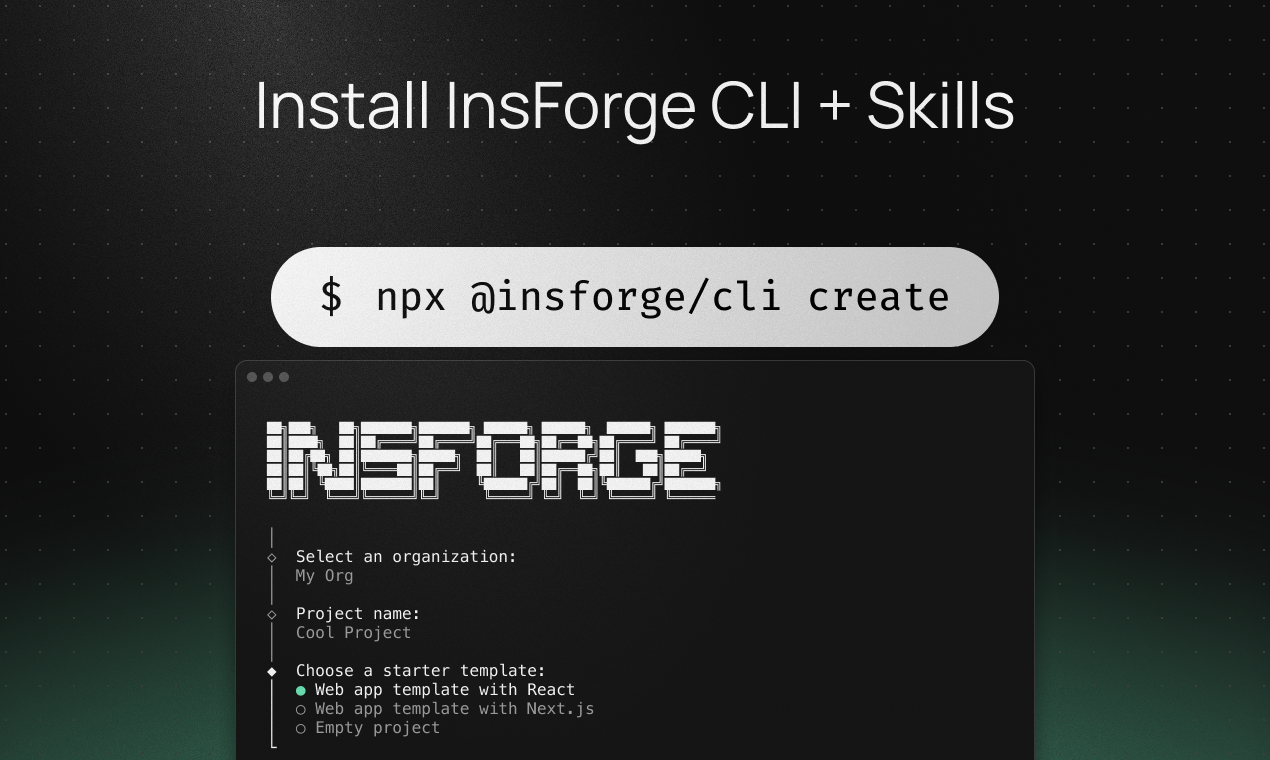
查看原始信息
HypeScribe
HypeScribe provides fast and accurate transcription for your audio and video, including direct support for social media links from platforms like YouTube, Instagram, and TikTok. We also offer a dedicated notetaker for your meetings on Google Meet, Zoom, and Teams, with upcoming integrations like Google Drive to centralize all your speech data.
Hey Product Hunt! 👋 We're launching HypeScribe — think of it as "Google Drive for Your Speech." Voice messages, meetings, and audio content are everywhere, but the insights inside them stay trapped. HypeScribe is one place where all your speech lives, gets transcribed, and becomes something you can actually use. What makes us different: token-based pricing where 1 token = 1 file regardless of length, unused tokens roll over. 99% accuracy across 99+ languages, AI summaries, action items, and a Q&A chatbot over every transcript. Works via Telegram bot, web app, and supports YouTube, Instagram, TikTok links and more. Started as a Telegram bot, now at 500K+ users with 82.5% monthly retention. We're clearly solving something real. What features would make HypeScribe more useful for you?
1
回复

Interesting project. I've given up on voice notes for personal projects because it was just a pain to browse through all the files afterwards (vs text). I'll look into it

0
回复

wow keep making more good products like these

0
回复