Product Hunt 每日热榜 2026-04-13

PH热榜 | 2026-04-13

#1
Krisp Accent Converter for YouTube
YouTube, but you clearly understand everyone
329
一句话介绍:一款免费的Chrome浏览器扩展,利用端侧AI实时转换YouTube视频中的口音,提升非母语英语内容(如技术讲座、课程)的清晰度和可理解性,解决了用户因口音障碍难以吸收优质内容的痛点。
Chrome Extensions Productivity Audio
浏览器扩展 口音转换 语音清晰化 AI音频处理 教育科技 无障碍辅助 实时处理 YouTube工具 端侧AI 内容可及性
用户评论摘要:用户普遍认为产品解决了真实痛点,尤其在理解印度等口音的技术讲座时效果显著。主要反馈包括:肯定其价值与易用性;询问支持的口音范围(团队回复重点支持印度、菲律宾等口音);关注语音的自然度、情感保留及与视频的同步性;建议扩展到创作端;并讨论该功能未来是否会被YouTube原生集成。
AI 锐评

Krisp此次推出的口音转换器,看似是功能微创新,实则精准刺入了一个被主流平台长期忽视的“口音鸿沟”市场。其真正价值不在于技术炫技,而在于对内容消费不平等现象的务实解构。YouTube拥有海量由非母语者创造的优质教育、技术内容,但口音屏障使得这些内容的有效传播大打折扣。字幕和调速是通用方案,但前者存在翻译失真和延迟,后者牺牲效率,均未直击“听不清”的核心。

产品巧妙地将经过会议场景验证的AI模型,以轻量的浏览器扩展形式嵌入最大的视频平台,实现了近乎零成本的用户触达和教育。其“端侧AI”的强调,不仅关乎隐私和延迟,更深层次是降低了平台集成的技术顾虑与合规风险,为未来可能的B端合作或收购埋下伏笔。从评论看,用户最关切的并非技术原理,而是效果边界(口音覆盖度、情感保留)和体验完整性(音画同步)。这正是产品的挑战所在:在“口音标准化”与“发言人音色特质保留”之间走钢丝。过度优化前者,可能导致语音“机器人化”,损耗教学情感;过度强调后者,则可能削弱清晰化效果。

它的出现,预示着一个新维度的媒体无障碍标准正在被定义——从“看到文字”到“听清声音”。然而,其商业模式的长远性存疑。作为免费扩展,它无疑是出色的用户获取和品牌展示工具,但最终价值闭环可能需要依赖向B端(如在线教育平台)的技术输出,或促使YouTube这类巨头将其内化为付费功能。它此刻的成功,恰恰在于它指出了巨头的盲区,但这也可能加速巨头亲自下场的进程。

查看原始信息
Krisp Accent Converter for YouTube
YouTube has speed control, captions, auto-translate — but no accent control. Now it does. Free Chrome extension, on-device AI, one toggle.

Hey PH!

We launched Accent Conversion for meetings back in March. People loved it, but we kept hearing the same request: "Can I use this on YouTube?"

So we went and looked. Pick any popular lecture by a non-native English speaker and scroll to the comments. It's always the same: "Can't understand what he's saying." "Had to watch at 0.75x." "Captions are completely wrong."

Millions of views. Brilliant speakers. Huge chunk of the audience rewinding or just leaving.

That felt wrong. The content is right there. The only thing in the way is accent clarity. So we packaged our on-device AI into a free Chrome extension.

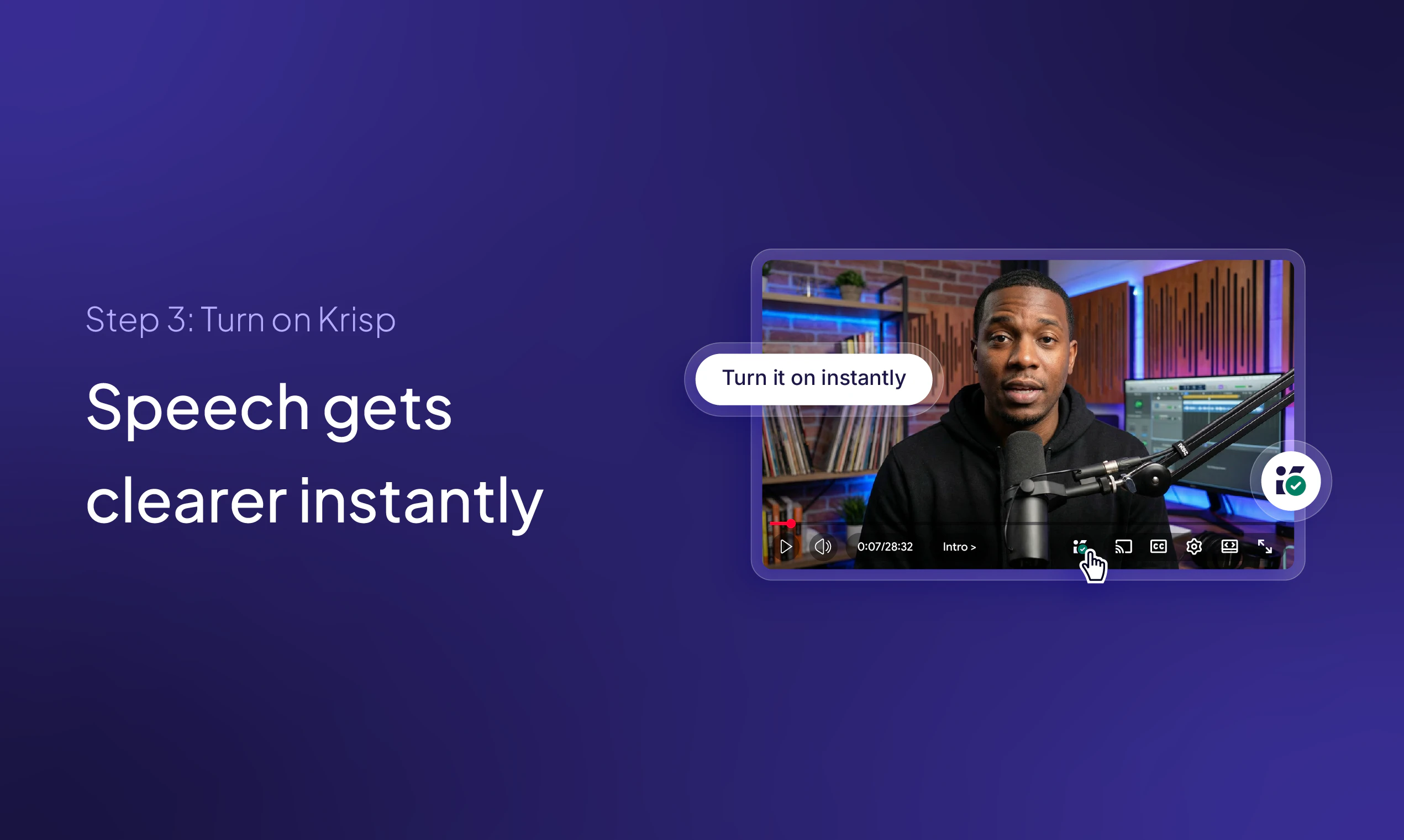
Open a YouTube video, toggle it on, speech gets clearer. That's it.

Ask me anything, I'm here all day.

20
回复

@asti_pili Have you tested how well it handles diverse accents like Indian English in tech talks or Indian-accented creators on YouTube? As someone in India watching global content daily, that could be a game-changer for accessibility here.

6
回复

@asti_pili Brilliant talks deserve to be understood.
One toggle, clearer speech — problem solved.

0
回复

@asti_pili I've been using Krisp for noise cancellation on calls for a while. Didn't know they had accent tech too. The YouTube extension is a nice way to try it

2
回复

Great job Krisp team! This is a life-saver 🤌

btw, what accents does it support?

7
回复

@hrant_sedrakyan2 Thanks!
It support wide range of accents but works the best with Indian, Filipino, Latin American, African, and Chinese-Mandarin accents

6
回复

Most tools focus on captions, but real-time accent normalization in audio addresses a different problem! Curious how it handles heavily accented technical content like coding tutorials or medical lectures where vocabulary matters as much as clarity. Congrats on the launch, team Krisp!

6
回复

@jasonhowie yeah, give it a spin - it's really easy to setup from chrome extension store

1
回复
@asti_pili hello
0
回复
@asti_pili hello 👋
0
回复

So freaking useful! Do you see accent conversion becoming as standard as captions or playback speed on video platforms or maybe youtube will add this feature itself??

6
回复

@lak7 I won't lie that is a possibility :) they already added auto translation

5
回复

@lak7 Congrats on the launch 👏 The idea of improving comprehension instead of just subtitles is actually pretty refreshing.

1
回复

We built it for builders like us 🎉 Everyone I know who watches Vibe coding tutorials needs to try this.

5
回复

@eduard_hambardzumyan it used to be just for coding videos :D now it's vibe coding videos all day

4
回复

Looks Neat! Can we take it beyond meeting rooms ? Can we use this for voice over for my content, with natural emotion ?

4
回复

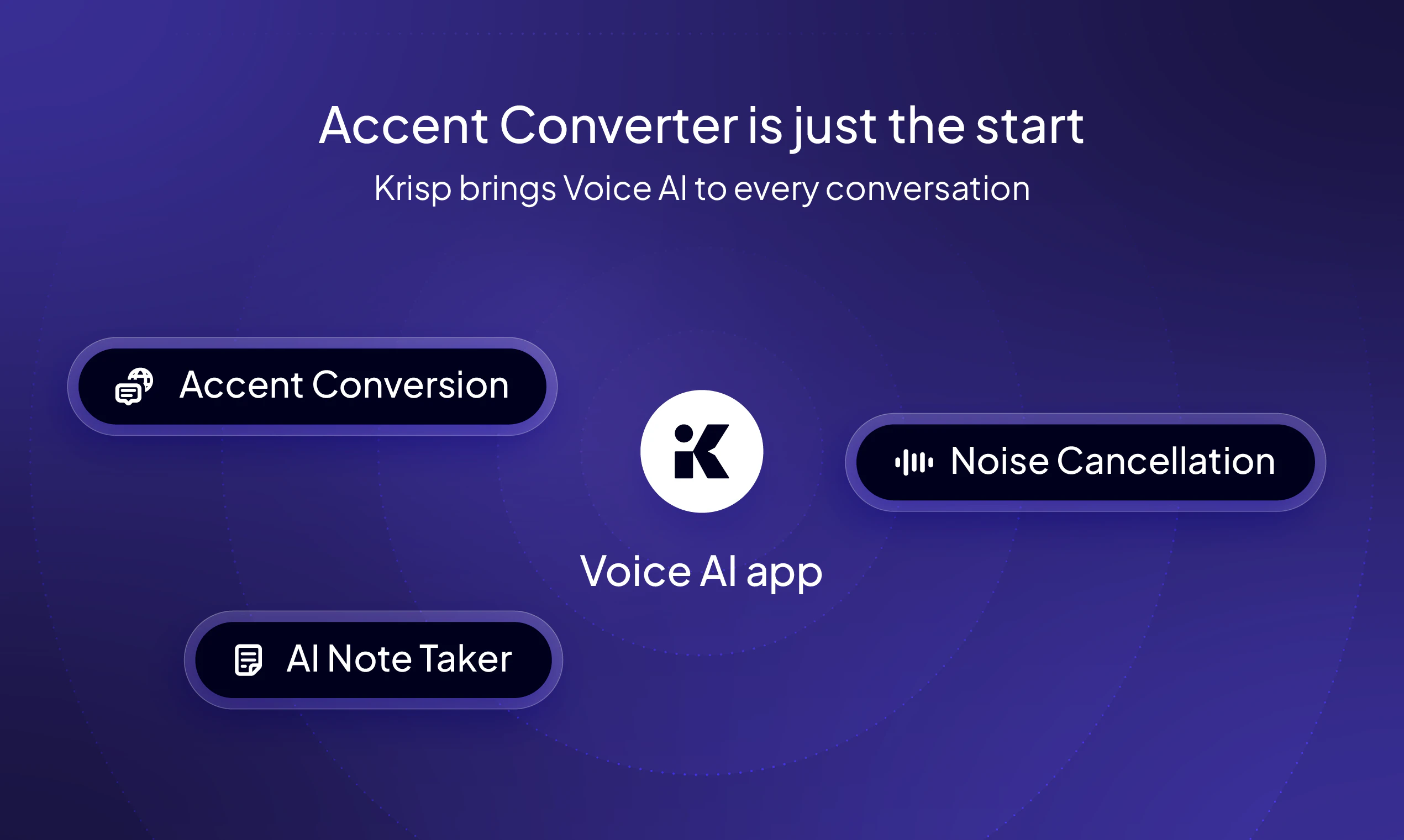
@raj_peko this extension is for the listener side. But you can use our Krisp voice ai app for creation

0
回复

We are Curious how natutal the converted voice sounds across different accents. does it preserve the speaker’s tone or lean more neutral?

4
回复

@laylabell Good question. The Idea is to keep speakers voice unchanged, however there are numerous subtleties to voice, like emotion, noise, etc...The challenging part is to find the perfect balance in accent conversion and everything-that-is-voice preservation

1
回复

Just tried and it's amazing! Can't believe Youtube couldn't come up with this feature all these years!

4
回复

Just installed it. Tried it on an NPTEL lecture and before/after is impressive

3
回复

intresting approach, but I hope it doesn’t distort the speaker’s tone too much. That natural flow is still important for learning.

3
回复

@greg_mason1 it doesn't give it a try. It's really easy to setup from Chrome extension store.

1
回复

Cool !! I usually spend half of my time on technical tutorials trying to decipher specific terms that get lost in translation or heavy accents.

Does this handle real time processing well enough ? there is no weird audio lag with the video ? if the sync is tight , this is very useful .

3
回复

@farhan_nazir55 no lag, truly real-time. the latency is under 200ms which is unnoticeable to human ear

1
回复

This feels like when captions first became standard on YouTube. Once you have it you wonder how you watched without it

3
回复

Does it affect the voice (changes it, or maybe makes it robotic)?

3
回复

@tetiana_n it keeps the voice, might slightly impact the emotion but we are tuning to find the perfect balance of accent conversion and complete voice+tone preservation.

2
回复

Heheh! Need this. As a non-native english speaker we constantly deal with it and I'm sure many founders gonna feel the same Asti! Wish you all the best here

3
回复

@german_merlo1 Thanks 🙌

2
回复

I can finally understand my CS lectures

3
回复

Now I can go back to my resolution to learn Python, since I will actually understand the content. :)

3
回复

You know, 40 seconds of video and everything is clear. The main feature is clear!)

2
回复

love the idea. very useful for native language speakers. what's the accuracy of these models, the cost of a wrong accent can be significant in some use cases like critical meetings.

2
回复

@lokesh_motwani1 true that. it's low latency under 200 milliseconds and high accuracy

1
回复

I have struggled in meetings, where people don't have good microphones or are sitting away from the laptop or a lot of background noise, If Krisp can support that as well it will be awesome.

But that will be real time.

2
回复

Finally. I spend half my day on YouTube watching technical documentation and deep-dives, and it's a constant struggle when the auto-captions can't parse technical jargon because of a thick accent. I usually end up wasting time rewinding or just giving up on the video entirely.

Seeing this as an on-device Chrome extension is interesting from a performance standpoint. I'm curious about the browser overhead—have you guys noticed any significant impact on CPU or RAM usage during longer 30+ minute lectures?

This is a genuine friction point for the global dev community. Great to see a practical use case for on-device AI that isn't just another chatbot. Good luck with the launch!

2
回复

How is this different from auto-captions? Is it actually changing the audio?

2
回复

@eduard_harutyunyan1 Yes, it changes the audio in real time to neutral American English

1
回复

This is one of those apps you only appreciate once you’ve tried it in a noisy environment. Curious how it performs with more complex background noise like cafés or street traffic.

1
回复

@uxpinjack feel free to check our demos in Krisp Voice AI lab

0
回复

This is a huge deal for educational content. I teach an Excel for Financial Modelling course on Udemy (https://www.udemy.com/course/excel-for-financial-modelling/) and a big chunk of my students are non-native English speakers working in finance globally. Accent barriers in video-based learning are real, and on-device AI that solves this without requiring the creator to re-record is brilliant. Curious if you're seeing higher retention rates on videos where accent conversion is active?

0
回复

This is what I can genuinely useful, practical leverage of AI, very nice. I have one question and one suggestion.

  • Question: does it work well also when people are talking on another or only for solo speakers?

  • Suggestion: Make also a funny/gimicky version where everyone can switch their voices to anything they like - I always wanted to sound like British royalty :)

0
回复

YouTube has had speed control since forever but accent was always the missing piece. I've rewound the same sentence four times trying to catch a word. One toggle sounds right - this doesn't need to be complicated.

0
回复
#2
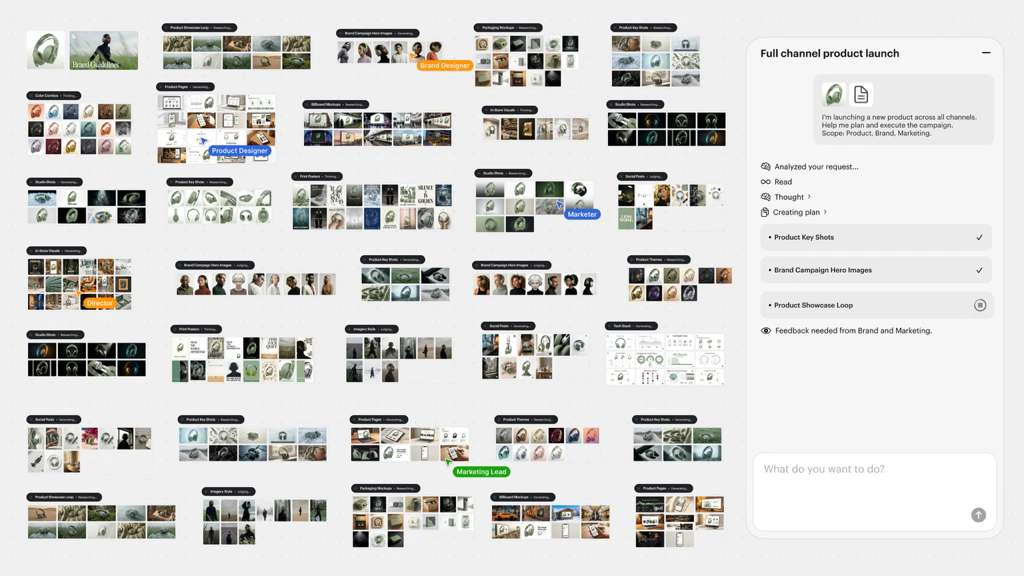
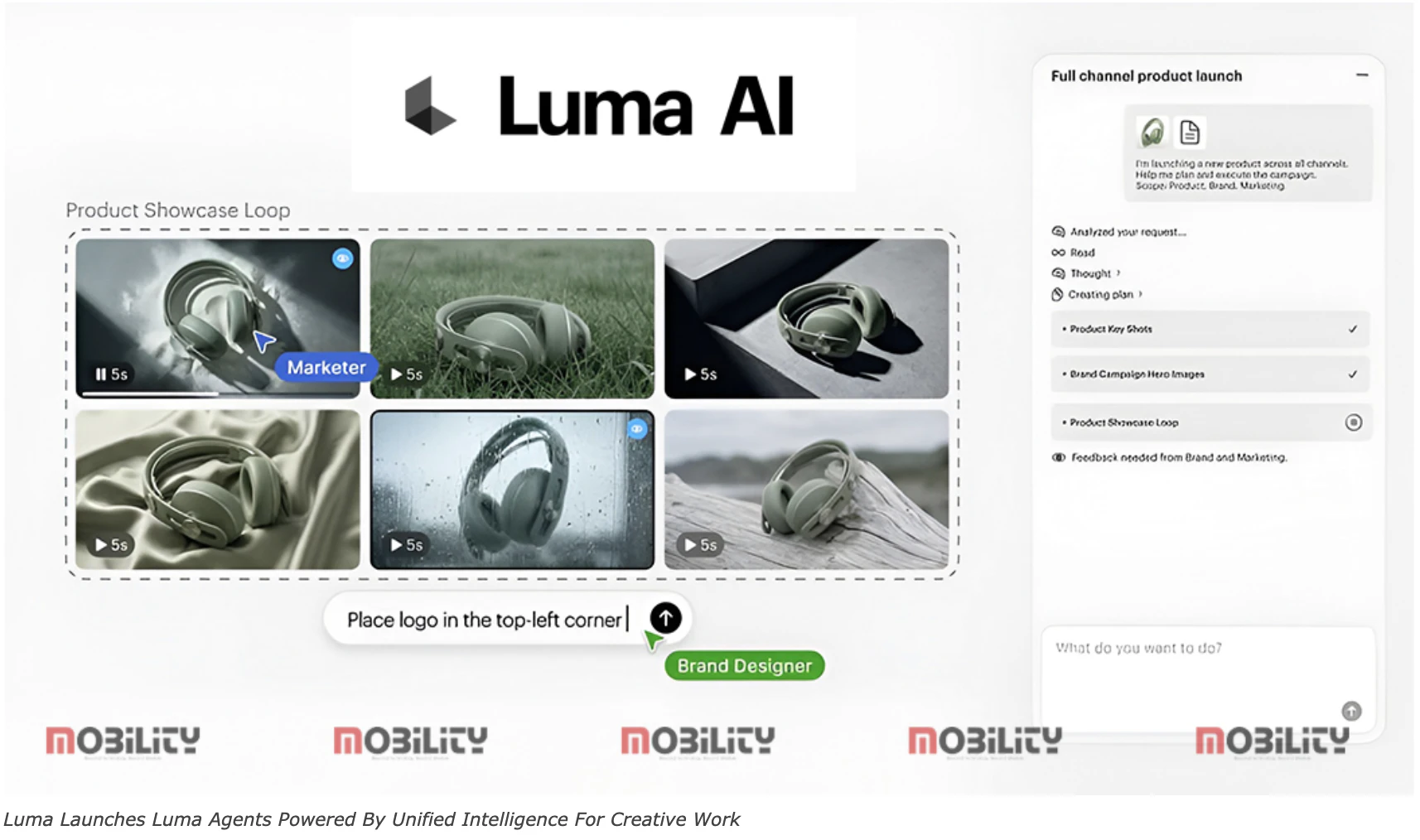
Luma Agents
Agents that plan, iterate, + refine w/ full creative context
269
一句话介绍:Luma Agents是一款面向创意团队和代理商的AI智能体平台,通过在一个共享工作流中贯通视频、图像和音频的规划、生成与迭代,解决了多工具间创作流程割裂、上下文丢失及效率低下的核心痛点。
Design Tools Social Media Marketing
AI智能体 多模态内容生成 创意生产管线 品牌营销 视频本地化 社交媒体广告 创意协作平台 端到端工作流 上下文保持
用户评论摘要:用户普遍认可“端到端共享上下文”的价值,认为其解决了创意资产风格不连贯的根本问题。主要关注点在于:实际工作流中团队协作与单会话的上下文传递范围、AI迭代过程中人工控制权的平衡、以及产品是替代还是补充现有工具栈。部分用户建议集成更先进的生成模型并开放试用。
AI 锐评

Luma Agents的野心不在于推出又一个孤立的AI生成工具,而在于试图重构数字创意生产的工作流本身。其宣称的“共享上下文端到端”是击中当前行业要害的精准定位——它将矛头指向了创意生产中长期存在的“缝合怪”困境,即不同模态、不同环节的产出在技术层面合格,却在品牌调性与创意内核上脱节。

产品的真正价值,在于将AI智能体从“执行者”定位向“协作者”推进。它不再仅仅是听令生成一张图或一段视频,而是试图理解并承载一个完整的创意简报(Creative Brief),并让这份理解贯穿于跨模态、多格式的批量生产与迭代中。这对于品牌营销、电商素材等强调高度一致性与快速规模化生产的场景,具有显著的效率提升潜力。

然而,其面临的挑战同样尖锐。首先,“上下文”的深度与保真度是技术黑盒,智能体对品牌“神韵”的理解能否达到资深创意总监的精度存疑。其次,评论中关于“控制权”的疑问直指核心:在赋予AI规划与迭代能力后,人类创意者如何确保主导权而非被流程裹挟?这涉及到工具哲学的根本转变。最后,市场采纳路径很可能如评论所预测——先作为现有工具链的补充层(Layering),而非颠覆性替代。只有当其在复杂、边缘案例中证明其可靠性与产出质量后,才可能引发工作流的彻底重构。

因此,Luma Agents是一次极具前瞻性的赛道卡位,它描绘了未来AI赋能创意生产的理想图景:一个无缝、智能、保持一致性的管线。但其成功与否,取决于能否将“共享上下文”这一美好概念,转化为创意团队可感知、可信任、且不可或缺的生产力基石,而非又一个增加复杂性的中间件。

查看原始信息
Luma Agents
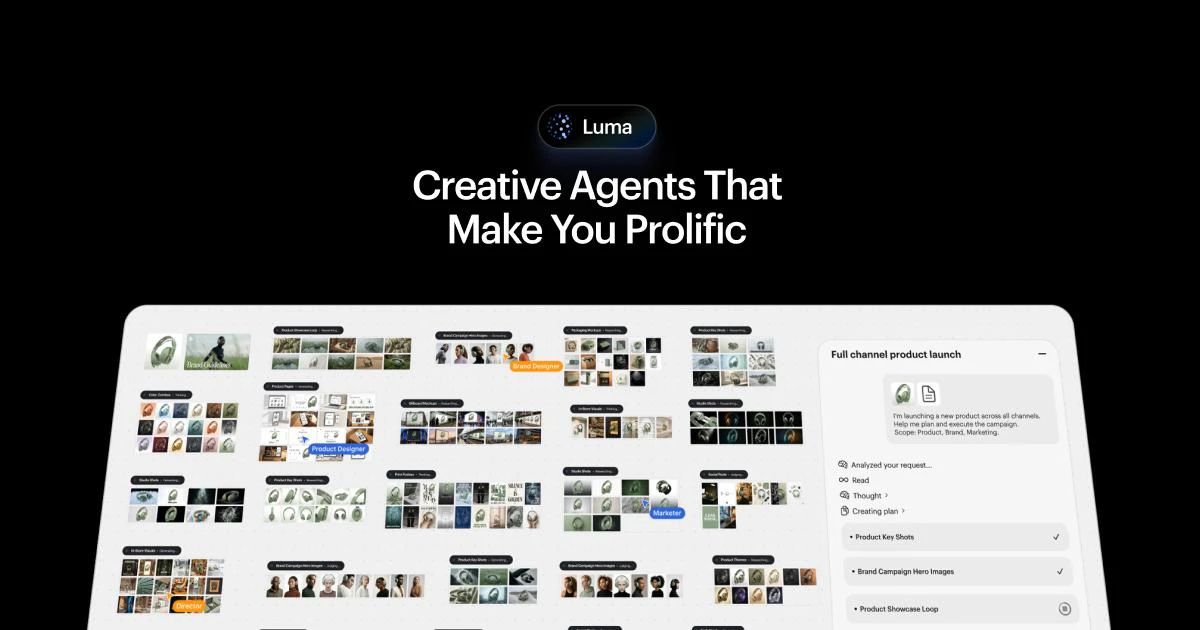
AI agents that plan, generate, and iterate across video, image, and audio in one pipeline. Brand campaigns, product visuals, social ads, video localisation with shared context end-to-end. For creative teams and agencies.

Luma Agents is a creative agent platform that plans, generates, and iterates across video, image, and audio within a single shared workflow.

I'm hunting this because the gap it's addressing is structural, not just a feature gap most AI creative tools are isolated generators, not pipelines.

The problem: Creative teams at agencies and studios are stuck stitching outputs together across tools. Every handoff is a restart. Context gets lost. Scale means adding headcount.

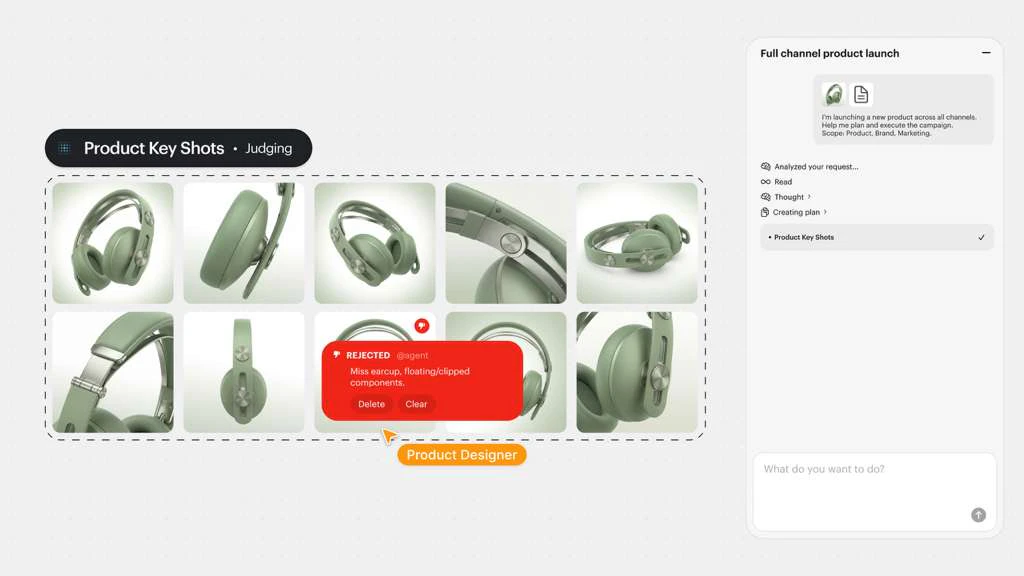
The solution: Luma Agents embeds context across every stage of a project concept to delivery. Agents see what you see, carry that context through video, image, and audio generation, and iterate without you re-explaining from scratch.

What you can do with it:

🎬 Run a full brand campaign with cohesive visuals and variants across formats

📦 Generate e-commerce product shots lifestyle, hero, on-model in one workflow

📱 Produce short-form video ads with hooks, captions, and platform-specific framing

🌍 Localize videos with natural voiceovers and synced visuals across languages

Who it's for: Creative directors, brand teams, and agency producers who are already using AI tools but spending too much time wrangling outputs between them. Also relevant for solo creators who want to produce at team-level volume.

Time will tell whether teams are going to use this to replace specific tools in the stack or layering it on top of what they already have.

P.S. I hunt the latest and greatest launches in tech, SaaS and AI, follow to be notified @rohanrecommends

13
回复

@rohanrecommends What's one real-world creative workflow you've seen Luma Agents streamline the most like a brand campaign or e-comm shoot; and what time savings did it deliver?

0
回复

@rohanrecommends great hunt Rohan been using many tools to kind of stitch a solution like this one together. Great stuff

0
回复

The "shared context end-to-end" angle is what makes this genuinely interesting to me.

Most AI creative tools treat each output as a fresh start — image, then video, then copy, all disconnected. The result is creative that looks like a ransom note: technically competent, visually inconsistent.

Building ad-vertly.ai, we obsessed over this same problem from the advertising side. A campaign should have a through-line: same brand voice, same visual DNA, same audience understanding — whether you're running a static banner or a 15-second video. The moment you break context, the creative stops feeling like a brand and starts feeling like a vendor.

The market that'll love this first: performance marketing teams at agencies where speed-to-creative is the bottleneck. The question is whether the iteration loop is tight enough to replace the current "generate, export, feedback, regenerate" cycle that kills time.

Really excited to see where this goes. Congrats on the launch!

4
回复

@gaurav_singh91 Keeping a single through-line for voice and visuals across every asset is exactly what Luma Agents are aiming for with Agents. Thanks for stopping by!

3
回复

@gaurav_singh91 I agree! shared context is a massive game changer especially across different tools, that is actually where agents change from being tools to being team-mates!

0
回复

Is this release from this company? https://luma.com/

3
回复
@lenaavramenko nope, it’s about https://lumalabs.ai
3
回复

Works best for product teams with repeatable assets, consistent brief and clear output. I am not sure this works for service-based business. The pipeline thinking is solid either way.

3
回复

@rajanbuilds Repeatable assets with tight briefs are where this really sings, and I'm equally keen on how far it can stretch for more bespoke service workflows. Thanks for sharing your take here!

2
回复

How much control do teams have over each step when the agent starts refining outputs on its own?

2
回复

The "shared context" piece is what kills every creative workflow I've seen. You finish the video, send it to copy, they produce something totally different in tone, then back to square one. Curious whether the context travels across handoffs between team members or just within a single session?

2
回复

mostly layering first - teams dont pull out existing tools until the new one handles edge cases reliably. curious what a full replacement workflow looks like.

2
回复

@mykola_kondratiuk Totally agree, most teams will layer this in until it proves itself on the edge cases. Thanks for sharing your comment. :)

2
回复

Really interesting direction. Feels like we’re moving from tools to actual creative collaborators. The shared context across assets is a big deal.

1
回复
A potentially good product you guys have, if you can switch your image/video generation to Veo 3 or something at that level. Especially for product launch demos.
1
回复

Would u consider giving a trial plan to test this. I find only paid subsciptions

0
回复
#3
Cleo Labs
Automate global compliance for selling physical products
228
一句话介绍:Cleo Labs 是一款通过多智能体AI管道自动扫描全球106个国家、超1.9万个监管机构,为实体产品卖家提供精准、结构化全球合规图谱的工具,解决了企业跨境销售时面临的法规复杂、多变且难以追踪的核心痛点。
Legal Artificial Intelligence
全球合规自动化 RegTech 实体产品合规 AI法律科技 跨境贸易 监管情报 多智能体AI 数字产品护照 供应链合规 市场准入分析
用户评论摘要:用户关注产品是同时展示所有适用法规还是择一处理(确认展示全部),适用阶段(证实适用于市场准入前规划与持续监控),以及小团队能否无需专家直接使用。建议包括集成Shopify等平台,并高度认可其“AI速度+法律专家验证”的混合模式与解决实际痛点的价值。
AI 锐评

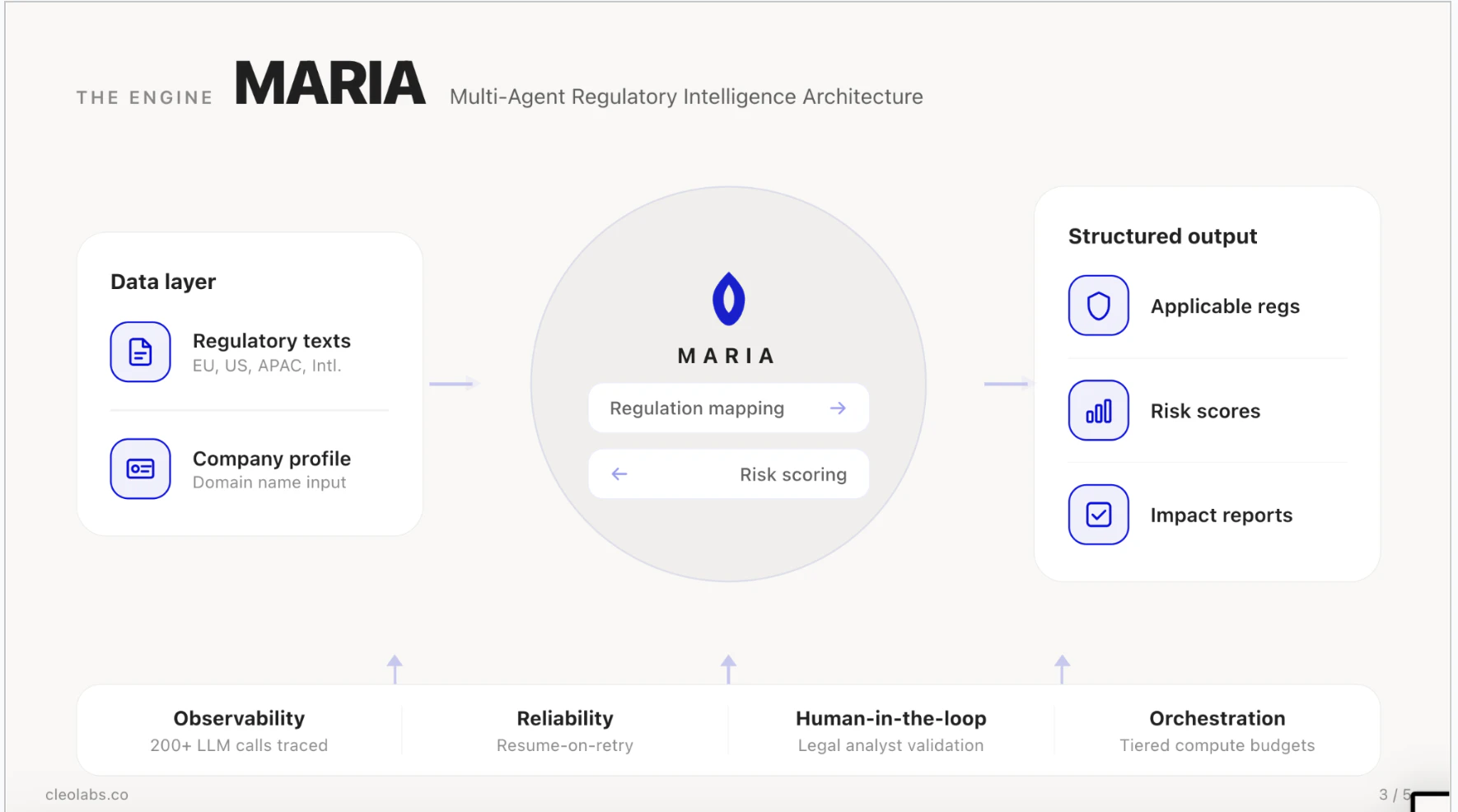
Cleo Labs 切入了一个被严重低估的“硬骨头”市场:实体产品的全球合规。其宣称的价值并非简单的信息聚合,而在于用一套名为MARIA的多智能体AI管道,试图将高度非结构化、分散且动态的各国监管条文,转化为结构化的、可操作的合规清单。这背后的真正挑战不是数据量,而是理解的准确性、更新的及时性以及对法规冲突的识别能力。

产品最犀利的卖点在于“人类在环验证”。在合规领域,AI的“幻觉”是致命伤,单纯依赖大语言模型输出无法建立信任。Cleo通过法律专家对AI输出进行校验,本质上是在用AI承担繁重的初筛和监测工作,而将最终的质量控制锚定在人的专业上。这是一种务实的“AI增强”模式,而非天真的“AI替代”模式,符合企业客户在关键任务上的风险厌恶心理。

其长期战略押注“数字产品护照”等监管趋势极具前瞻性。这不仅是工具,更是试图成为未来产品合规数据的基础设施。然而,其面临的考验同样严峻:如何保证对19,000多个监管源头的覆盖深度而不仅仅是广度?如何定价才能让早期创业公司和大型跨国品牌都觉得物有所值?以及,当法规解释存在灰色地带时,其“验证”的法律责任边界如何界定?如果它能持续证明其图谱的可靠性与行动指导的有效性,它确实有可能重塑企业全球化扩张的合规成本结构与决策流程。

查看原始信息
Cleo Labs
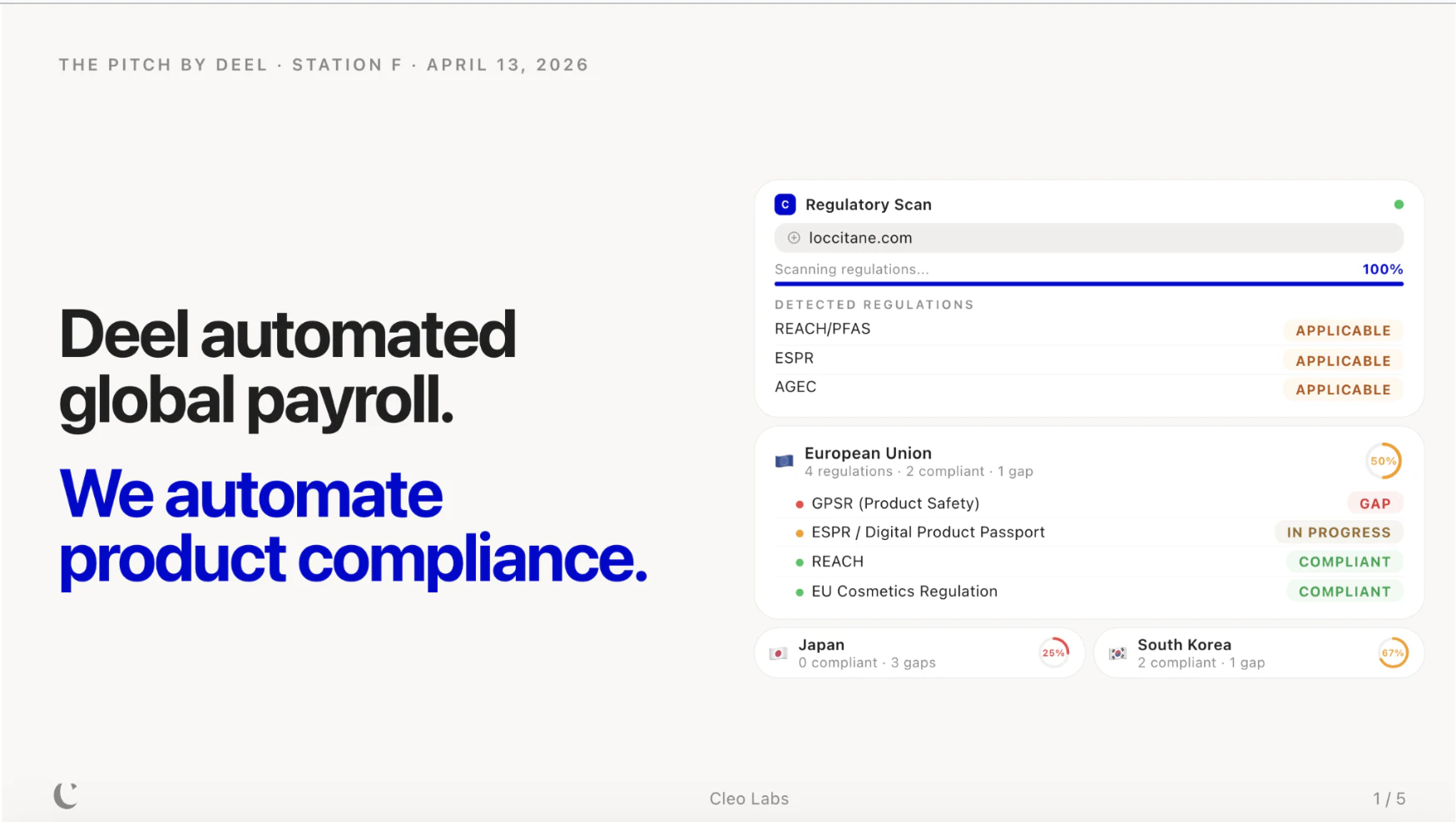
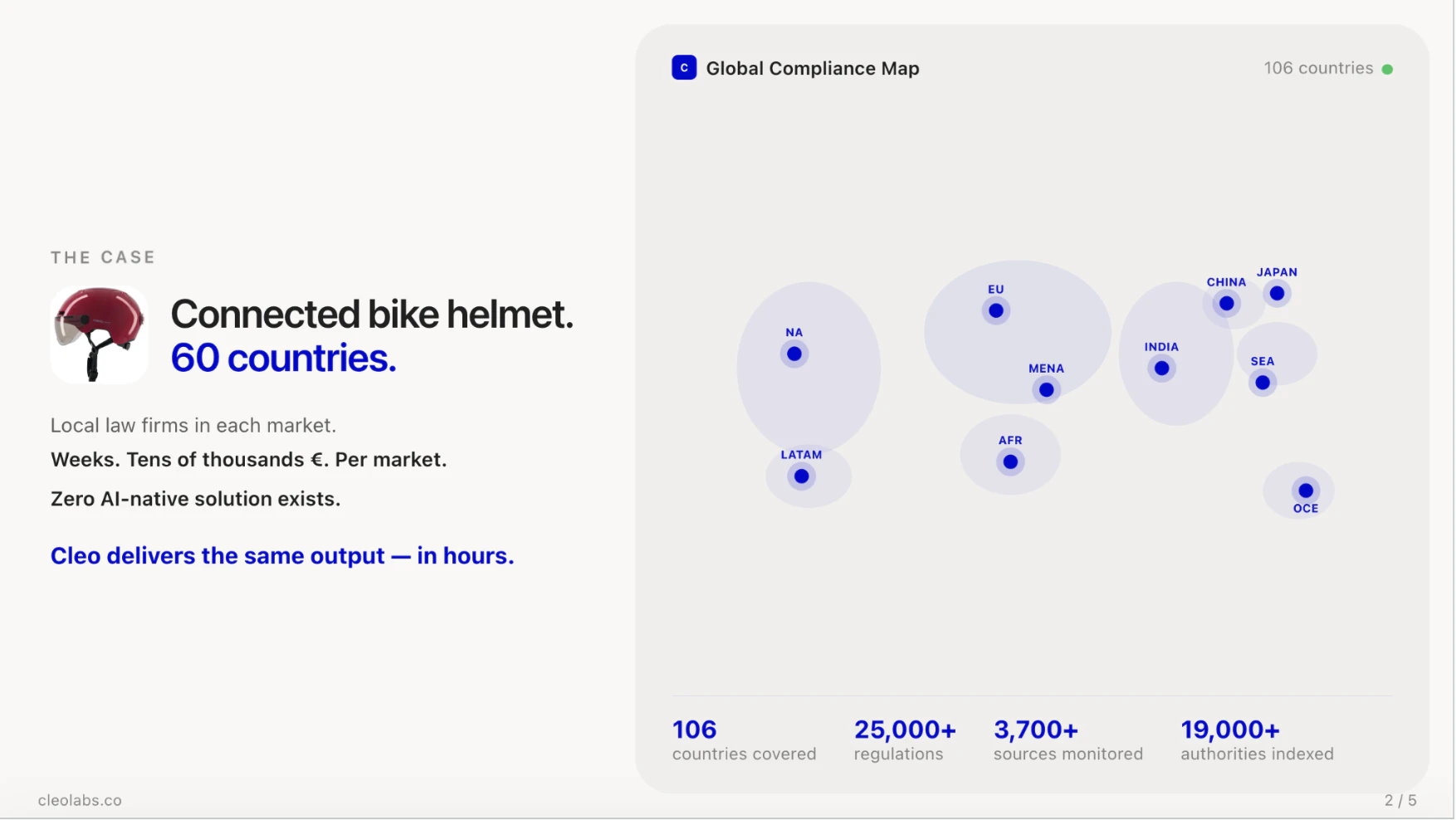
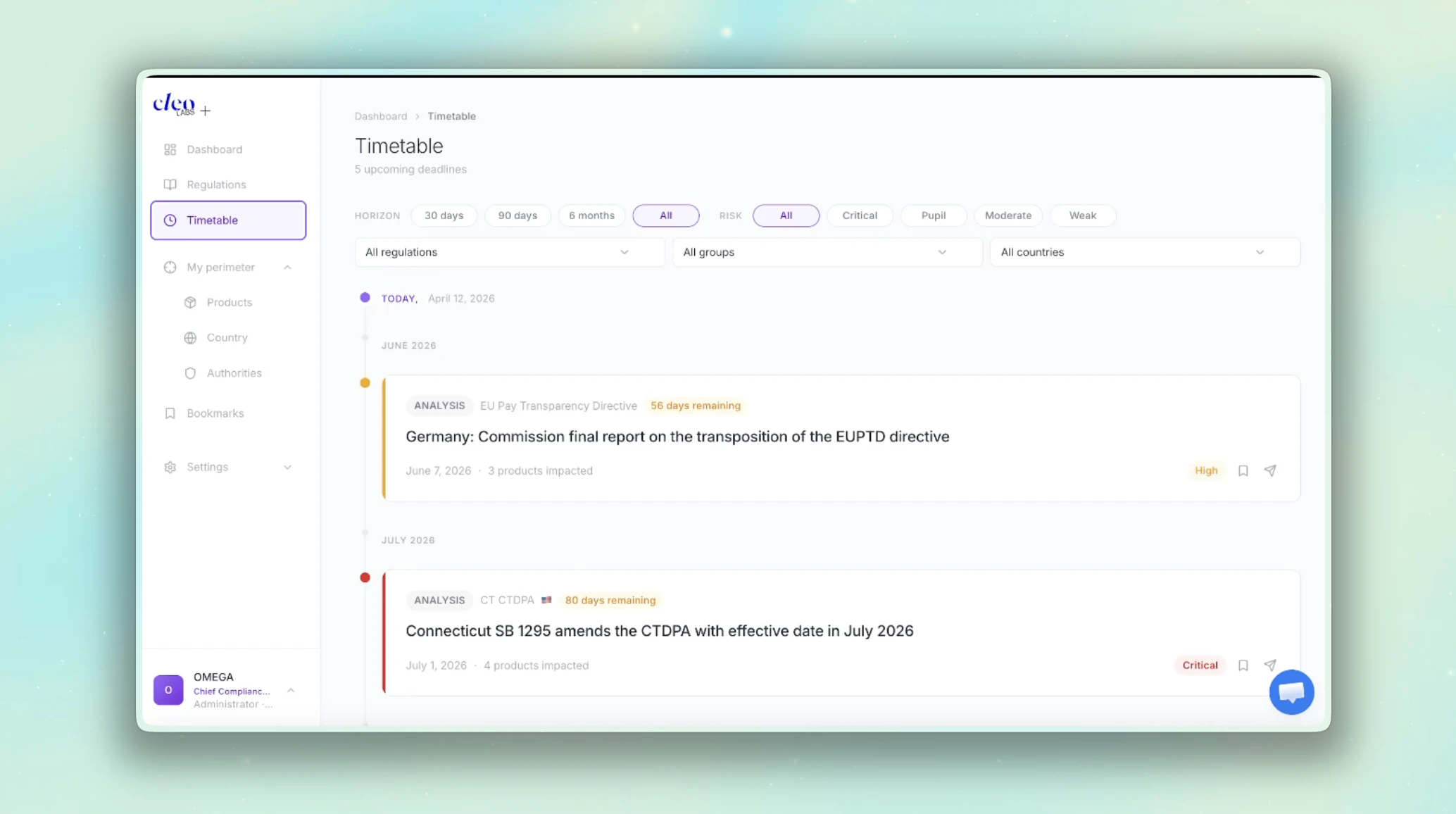
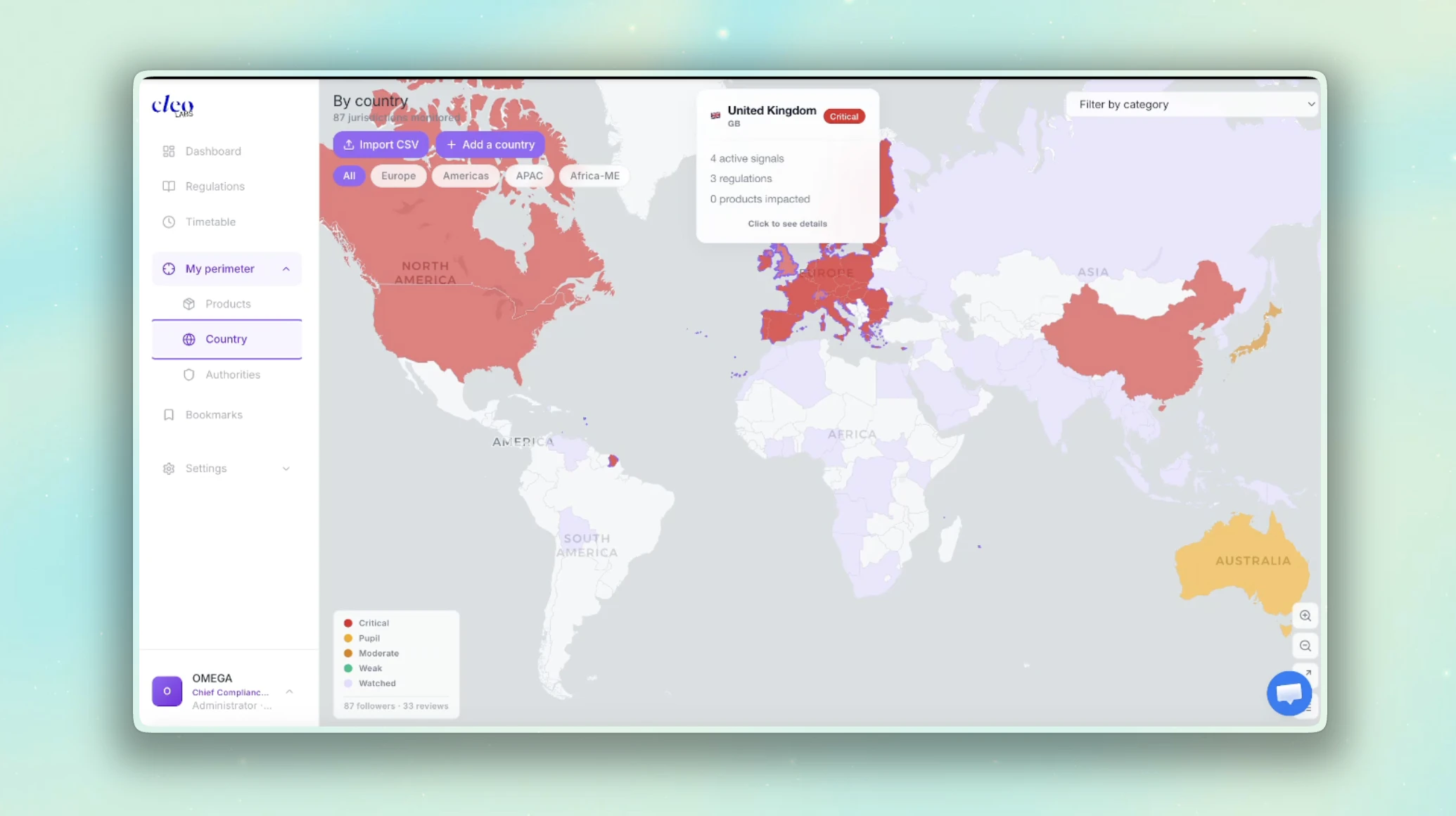
Selling physical products globally? A single item can trigger 100+ regulations across materials, labeling, certifications, and customs and every rule changes from one country to the next. Cleo maps your full regulatory perimeter automatically. Our multi-agent AI pipeline (MARIA) scans 19,000+ authorities in 106 countries and delivers structured compliance maps, verified by legal experts, not hallucinated by a chatbot.)

quick question, does it flag both regulatory tracks or pick the stricter one?

18
回复
@xavier_hernandez2 Great question. Cleo flags both, all of them, actually. The whole point is to give you the full regulatory picture, not a simplified version of it. If your product is subject to overlapping frameworks say REACH for chemical safety, GPSR for general product safety, ESPR for eco-design, Cleo doesn’t pick one. It surfaces all applicable tracks simultaneously, with their own timelines, obligations, and risk levels. And we’re not talking about two or three😅: Cleo can process up to 1000 regulatory frameworks at once for a single product. Cleo monitors over 19,000 regulatory authorities worldwide so the coverage is deep
1
回复

@xavier_hernandez2 I actually like the concept of turning trading into something more interactive. It might help people stay more disciplined if they know they are being ranked.

0
回复

@xavier_hernandez2 The transparency through on-chain rewards is a strong point here. It adds trust compared to traditional leaderboard systems that feel unclear.

1
回复

Congratulations @naomie_halioua on your PH launch,
Is Cleo built more for brands already selling globally, or can a founder use it before* launching to decide which markets to enter first based on compliance complexity?

13
回复

@abod_rehman Absolutely Cleo works for both.

If you’re already selling globally, Cleo keeps you covered with continuous monitoring across 106 countries. But if you’re a founder still deciding where to launch, Cleo is just as powerful. The regulatory mapping is already there across jurisdictions, product categories, and frameworks.

And honestly, that’s one of the most exciting parts of the platform: you don’t have to wait until you’re already exposed to get value from it! You can make smarter decisions before you even ship your first container. Then as you scale, Cleo grows with you from market selection to ongoing compliance.

2
回复
@abod_rehman thank you!
1
回复

Hey Product Hunt! 👋

I'm Naomie, co-founder & CDO of Cleo Labs. I'm a Polytechnique engineer and AI researcher. My co-founder Anaëlle is a Sorbonne-trained lawyer who spent years running legal transformation at Havas Group. She knows the regulations. I build the AI that reads them.

Why we built Cleo:

If you sell a physical product internationally — a bike helmet, a lipstick, a washing machine — you're dealing with a regulatory nightmare that no one talks about. Materials restrictions, labeling rules, certifications, customs codes... and every single one changes from one country to the next. A single connected bike helmet triggers over 100 regulations. Multiply that by 106 markets.

95% of RegTech serves financial services. For physical goods, compliance teams still rely on consultants, spreadsheets, and prayer. We thought that was insane.

What Cleo does:

You type your website URL. Our multi-agent AI pipeline (we call her MARIA) identifies every product category you sell, maps every applicable regulation across 106 countries, and delivers a structured compliance map, with human-in-the-loop validation on every output. This isn't a chatbot giving you a guess. It's AI precision, verified by legal expertise.

We genuinely believe product compliance is the next massive RegTech vertical, and by 2030, every product sold in Europe will need a Digital Product Passport. The wave is here.

Would love your honest feedback. What would make this more useful for your team? 🙏

11
回复

@naomie_halioua Can a small team actually use this without a compliance expert, or is it still necessary to interpret the results with a specialist?

4
回复

@naomie_halioua The regulatory complexity for physical products is a genuinely underserved problem. You're right that 95% of RegTech is built for financial services while product compliance teams are still stitching together consultant reports and spreadsheets across 106 markets. That gap is massive.

The "type your website URL" entry point is smart. Same philosophy we used at ClawSecure: remove every barrier between the user and the value. Paste a URL, get the answer. No onboarding, no configuration, no 6-week implementation. When the alternative is hiring a consultant for every new market, instant structured output changes the economics completely.

The multi-agent pipeline approach makes a lot of sense for this use case too. Regulation mapping across 106 countries isn't a single-model problem. You need specialized agents handling product categorization, jurisdiction-specific rule matching, and cross-market conflict detection as separate tasks. The human-in-the-loop validation layer on top is what makes it trustworthy for compliance, where being 95% right isn't good enough.

The Digital Product Passport point is the real long-term play. Building the compliance infrastructure now before the 2030 mandate forces everyone to scramble is exactly the right timing. The companies that are already mapped and structured when regulations hit will have a massive advantage over those trying to retrofit.

Congrats on the launch to you and Anaëlle! The combination of an AI researcher and a regulatory lawyer building this together is the right founding team for the problem.

1
回复

@naomie_halioua What's one integration like Shopify or customs APIs that'd make Cleo a no-brainer drop-in for bootstrapped teams?

0
回复

Still feels a bit surreal to finally share this 🚀

We’ve been working on MARIA for a while now, and seeing it live - scanning regulatory requirements across +100 countries in minutes - is something we genuinely needed ourselves. What used to take weeks of back-and-forth with legal/compliance teams can now happen almost instantly.

From day one, we knew this couldn’t be just “another AI tool.” Compliance is too critical. That’s why we built a human-in-the-loop verification layer - combining speed with the level of reliability this space demands.

Product compliance is a massive blocker for any brand going global, and we’ve felt that pain firsthand. Really proud of what the team has built, and this is just the beginning.

Big thanks to everyone who supported us along the way 🙏

3
回复
@anaelle_guez the wave is now 🌊
1
回复

compliance matrices across 50+ jurisdictions is one of the nastier unsolved problems in hardware. real issue worth automating.

2
回复

@mykola_kondratiuk1 Thanks Mykola — you nailed it. Anyone who's dealt with multi-market compliance for physical products knows the pain: fragmented sources, conflicting standards, constant regulatory updates. Most teams end up with massive spreadsheets that are outdated the moment they're finished.

That's exactly why we built Cleo. Our AI pipeline scans 19,000+ authorities across 106 countries so hardware teams can stop drowning in regulatory research and focus on shipping products. And every result is verified by legal experts — no hallucination risk.

Would love to hear more about what you've seen on the hardware side — always looking to learn from people who've lived this problem firsthand. 🙌

0
回复

This is a big shift in how compliance work gets done. Mapping regulations across so many countries in minutes feels like a real unlock for global teams.

1
回复
@uxpinjack thank you!
0
回复

will it be only useful for electronics ?

1
回复
@zabbar of course ! The EU regulatory landscape for electronic products is dense and fast-moving, any company selling electronics in Europe has to track changes across multiple jurisdictions and multiple regulatory bodies simultaneously
0
回复

Congrats the launch! Cleo helps every physical product seller in global. Are you planning to make a function that shows regulation passed products? I thought example products make regulations be understood easier.

1
回复

@jolt_shogo Thanks Shogo, appreciate it! Actually, this is already built into Cleo today :)

When you add your products to the platform, our AI pipeline automatically maps each one to the regulations that apply to it — with specific obligations, risk scores, and action cards tailored to each product. So you can see exactly which regulations impact which product, and what you need to do about it.

It makes complex regulatory frameworks much more concrete and actionable, which is exactly what you're describing. Give it a try and let us know what you think!

0
回复

@jolt_shogo i like the idea of making trading more competitive and social instead of doing it alone all the time. It feels more engaging when there’s a ranking system involved, especially for active traders.

1
回复

Anyone who's dealt with cross-border compliance for physical products knows the pain: one SKU can trigger 100+ regulations across materials, certifications, labeling, and customs — and they change constantly.

What stands out here is the multi-agent AI pipeline combined with legal expert verification. That hybrid approach (AI speed + human accuracy) is exactly what this space needs.

Really impressive scope with 106 countries covered.

Well done team! @Cleo Labs

1
回复
@alexandre_bloch We’re the only ones covering 100+ countries AND 19,000+ regulatory authorities. We’re here to win the market 🚀
0
回复

AI has made the world a lot more convenient, but the standards set by governments around the world vary so much that when you try to do something outside of your computer, it's a completely different world (nothing has changed since the days before AI), so this is exactly the kind of feature I wanted! Thank you.

0
回复

Cross-border compliance is one of those silent deal-killers in international transactions. In my work structuring renewable energy deals across multiple jurisdictions, regulatory mapping is always the most time-consuming part of due diligence. I build project finance and valuation templates for cross-border deals on Eloquens (https://www.eloquens.com/channel/samir-asadov-cfa) and the regulatory assumptions are always the hardest to standardize. Love that Cleo is automating this layer — would be curious to see how it handles regulatory divergence between EU and APAC markets.

0
回复
#4
Skills Janitor
Find which Claude Code skills you actually use
166
一句话介绍:一款用于审计、去重、整理和追踪Claude Code技能使用情况的本地脚本工具,解决了AI技能库臃肿、重复和难以管理的问题。
Open Source Developer Tools Artificial Intelligence GitHub
AI技能管理 开发工具 代码审计 去重优化 开源工具 上下文窗口优化 Claude生态 效率工具 本地脚本
用户评论摘要:用户普遍认同技能库臃肿痛点,11%使用率引发共鸣。核心关注点包括:重复技能检测的具体算法、使用数据来源(是否分析本地日志)、未来是否会基于使用模式或Token成本识别低效技能,以及如何集成到自动化清理流程中。
AI 锐评

Skills Janitor揭示了一个正在浮现的“AI后工具化”市场。其真正价值不在于简单的文件清理,而在于首次为AI技能生态提供了“可观测性”。当开发者热衷于为Claude等AI编码助手堆砌技能时,却忽略了两个致命问题:一是未经治理的技能库会持续吞噬宝贵的上下文窗口,直接拉低每次查询的性价比;二是技能之间的隐性冲突与功能重叠,可能导致AI行为不可预测。

产品思路犀利地指向了AI原生工作流的一个盲点——我们习惯于用人类项目管理思维管理代码,却尚未建立管理AI能力的范式。它本质上是一个“AI技能治理平台”的雏形。用户评论中关于“基于Token成本分析”和“自动化每周清理”的建议,恰恰点明了其未来可能演进的商业方向:从清理工具变为优化AI计算资源消耗的必备套件。

然而,其当前形态也暴露了局限性。作为Bash+Python脚本,它更偏向极客用户,未能将数据转化为更直观的优化洞察。开源免费虽利于传播,但若不能持续迭代出更深层的分析功能(如技能调用链分析、场景化使用建议),很可能被集成到更完整的AI开发平台中,成为一个功能模块。它捅破了AI技能管理的第一层窗户纸,但能否从“脚本”进化为“标准”,取决于其能否定义出下一代AI技能管理的核心指标与最佳实践。

查看原始信息
Skills Janitor
9 commands that audit, deduplicate, lint, fix, and track your claude code skills. shows you what's broken, what overlaps, and what you never touch. free. open source.
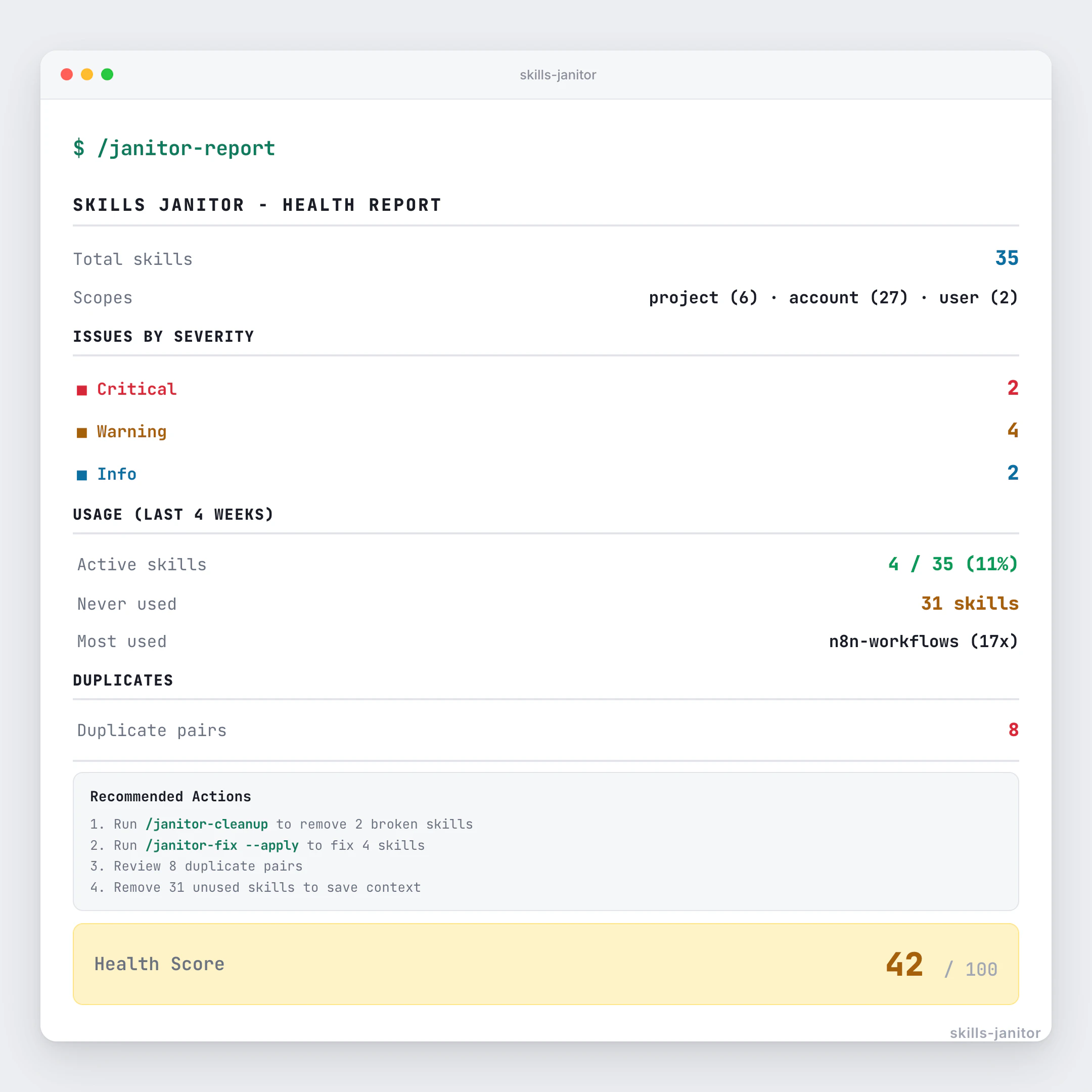
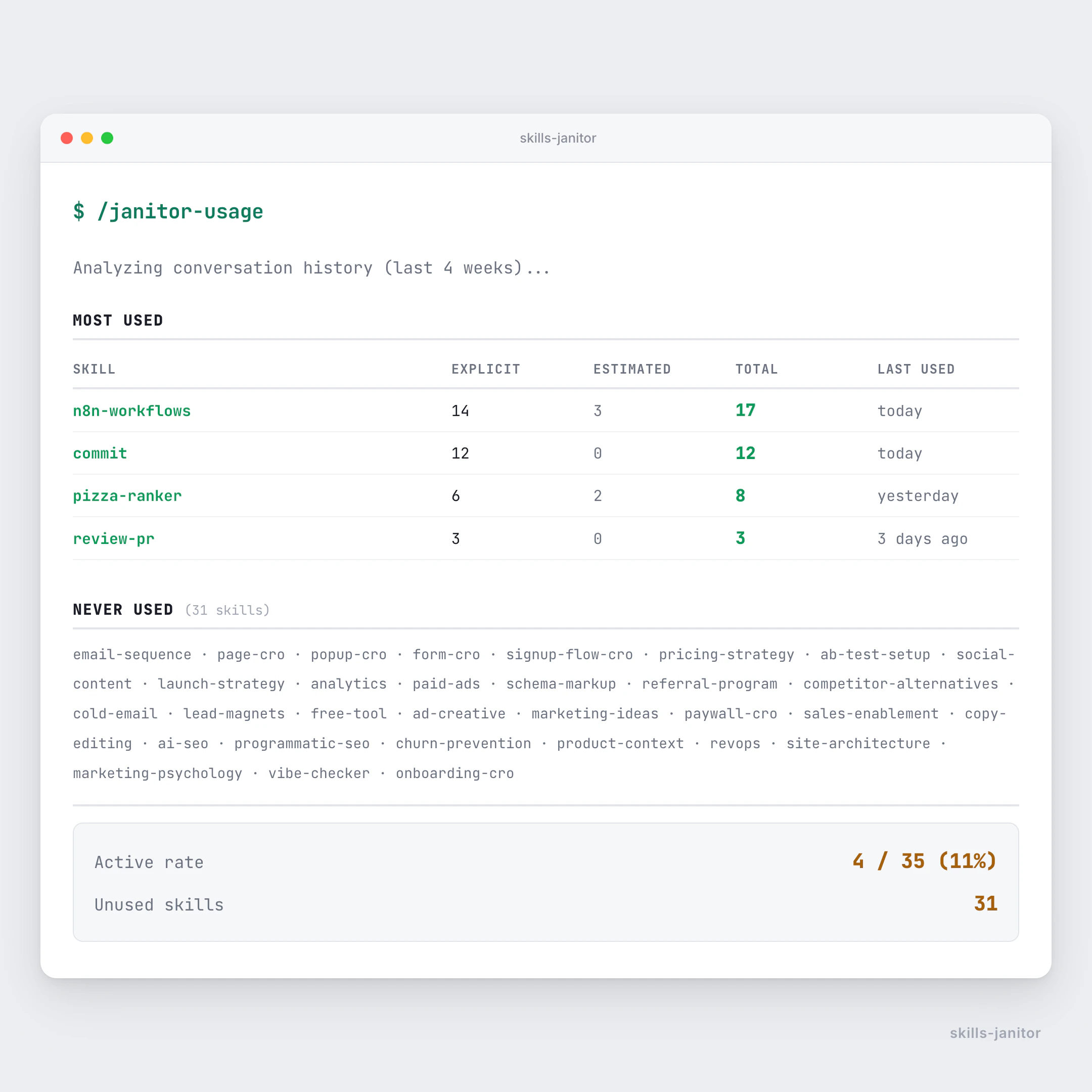
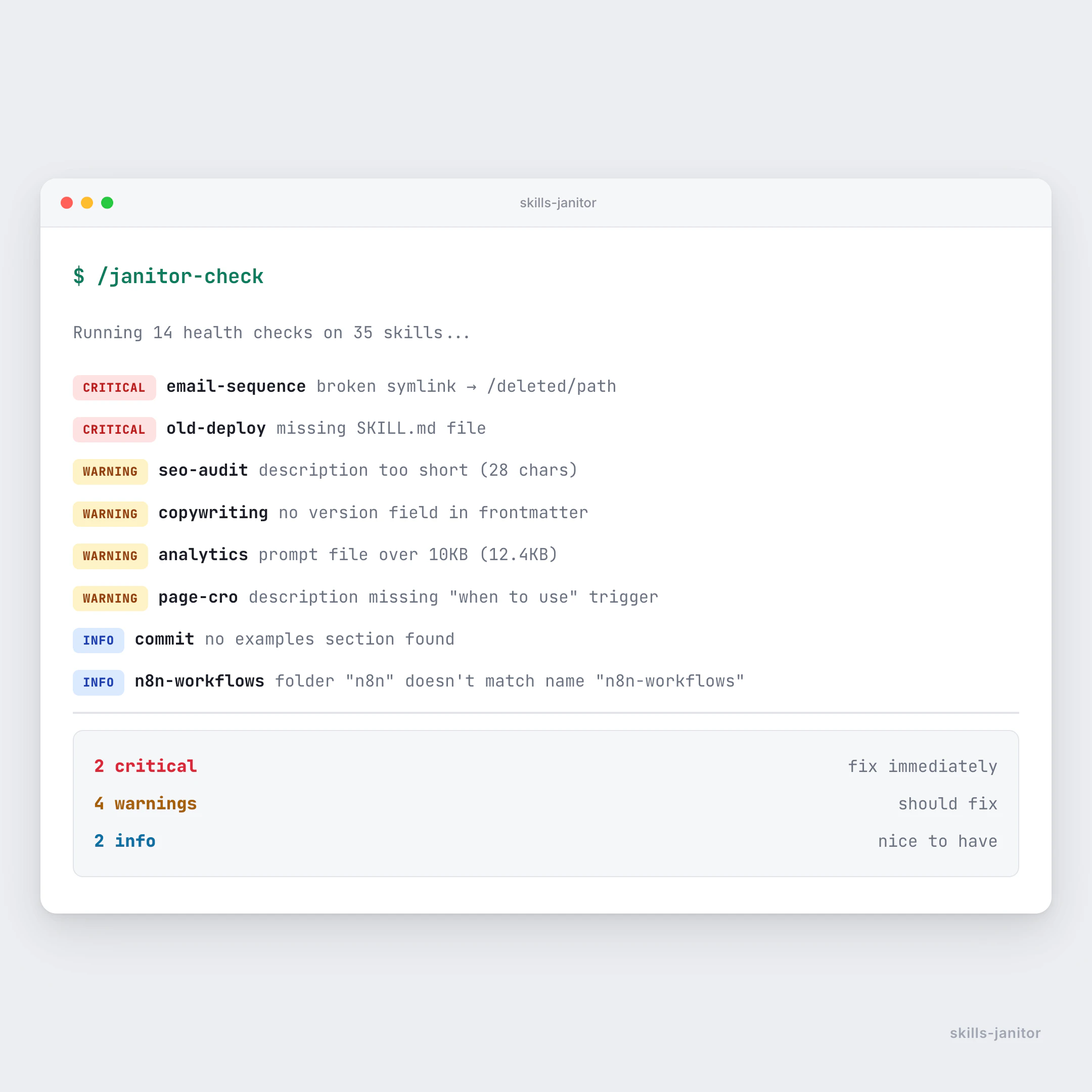
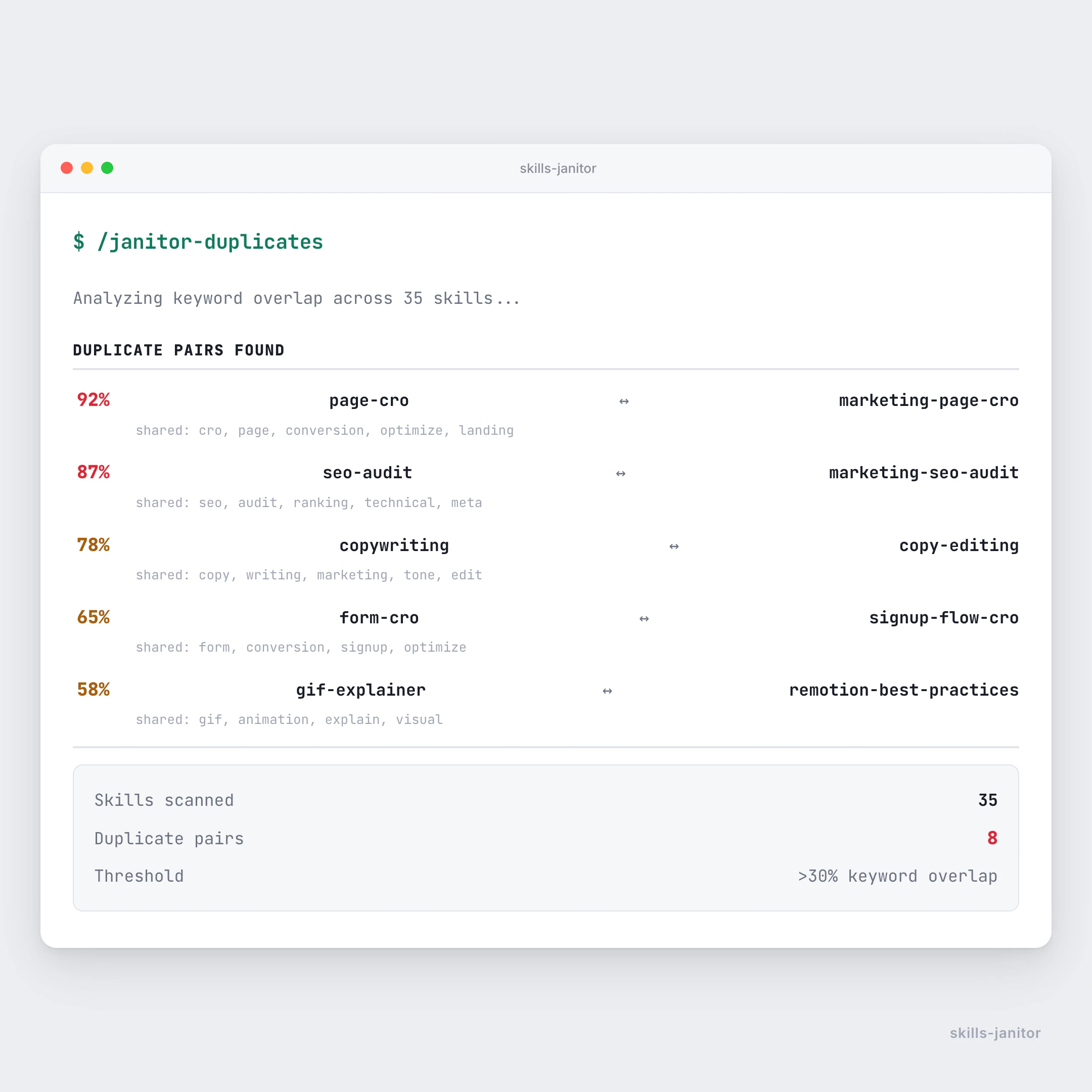
hey, i'm Chris. i built this because my own skills folder was a mess. the moment that made me build it: i ran a usage check and found out i actively use 4 out of 35 installed skills. the other 31 were just sitting there, eating context window space and doing nothing. on top of that, 8 pairs were basically duplicates of each other (seo-audit and marketing-seo-audit at 92% overlap, really?) and 2 were pointing to files i deleted weeks ago. skills janitor is bash + python3, no dependencies, and previews everything before changing anything. it's free, MIT licensed, no tracking, no telemetry. just scripts. would love to hear what your active rate looks like. mine was 11%. kind of embarrassing.
5
回复

@krzysztof_hendzel Beyond duplicates, any plans to detect low-performers based on usage patterns or token cost, to keep agents lean?

0
回复
Solid. I have a ton of skills and sometimes it gets a bit difficult to manage and track the frequency. Does it also surface an overlap % between similar skills?
1
回复

11% active rate sounds about right. I have a similar pile of skills I keep adding "just in case" and never trigger. The dedup feature is the real value here - I definitely have overlapping skills that quietly fight each other for context space. Going to run this today

1
回复

I've been dumping so many custom tools into my Claude Code config lately that half my context window is probably just unused skill descriptions. I am really curious if this parses the local Claude logs to calculate usage stats or if I need to run it alongside a proxy. Hooking this up to an automated weekly cleanup script would be a massive time saver.

1
回复

solid util. though if you're surprised by which skills you actually use, the taxonomy was probably wrong to begin with.

1
回复

@mykola_kondratiuk could be, I'm thinking about making it more simple or make it more like a set of actions under fewer commands, will see. thanks for the comment :)

0
回复

Solid idea. My skills folder gets crazy real fast.

0
回复

Man, I love this and need it. Really interesting idea.

0
回复
#5
showmd
Markdown was never meant to be previewed plain text
158
一句话介绍:一款免费的macOS快速查看扩展,在Finder中按空格即可将Markdown文件(尤其是含YAML元数据和AI代理XML标签的文件)渲染为美观易读的预览,解决了开发者日常查看复杂Markdown源码时体验割裂的痛点。
Mac Open Source User Experience GitHub
macOS工具 快速查看扩展 Markdown预览 开发者工具 生产力工具 离线应用 AI工作流 YAML渲染 开源工具
用户评论摘要:用户普遍赞赏其解决了长期痛点,特别是对AI工作流中复杂Markdown的渲染效果。反馈包括安装时的网络报错(已解决)、对实时预览功能的询问,以及对其精准市场定位(反“纯文本”哲学)的肯定。
AI 锐评

showmd的价值远不止于“又一个Markdown预览器”。它精准地捕捉到了一个被主流工具忽视的生态位变迁:Markdown已从简单的写作语法,演变为AI代理时代承载复杂结构化指令(YAML元数据、自定义XML标签)的配置与文档载体。传统预览器固守“纯文本”教条,在此场景下已构成体验断层。

其真正犀利之处在于“理解上下文”。它将YAML前端元数据解析为可折叠表格,将AI代理标签渲染为带标签的边框区块,这本质上是对文件语义的解读和可视化重构,而不仅是样式渲染。这标志着预览工具从“格式转换”向“内容理解”迈出了一小步,贴合了当下AI开发工作流中人类需要频繁审阅、调试结构化提示词的实际需求。

然而,其作为Quick Look扩展的形态,既是优势也是局限。优势在于深度集成系统,体验无缝;局限在于功能场景被严格限定在“预览”,无法介入编辑流。用户关于“实时预览”的询问恰恰击中了这一边界。产品目前明智地选择了做深单点体验,而非泛功能覆盖。其成功揭示了工具演化的一个方向:在基础技术栈(如Markdown)被赋予新内涵的转折点,通过深度适配新场景的微观创新,能迅速建立竞争壁垒。但长远看,其理念若被主流编辑器吸收内化,其独立价值将面临挑战。

查看原始信息
showmd
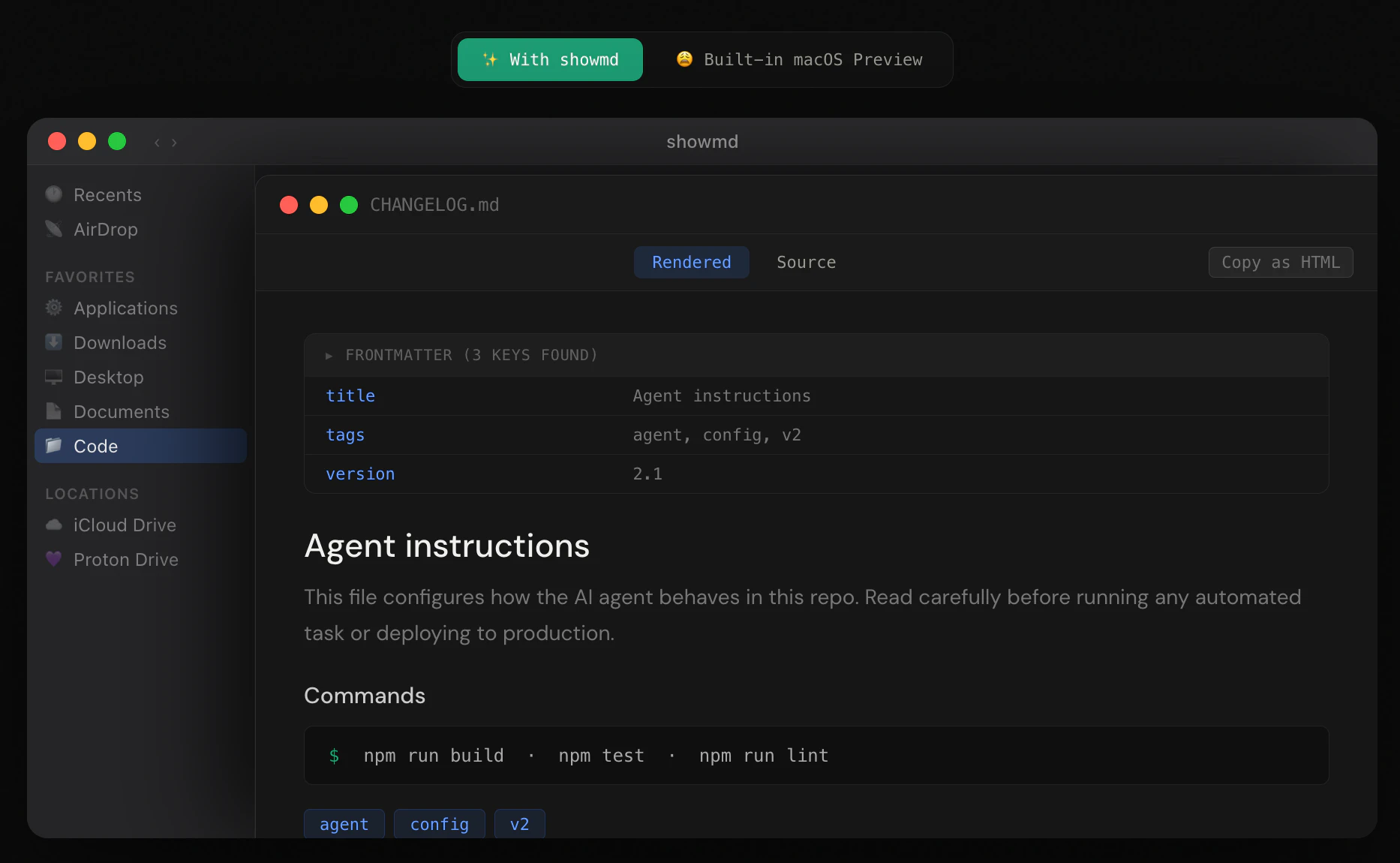
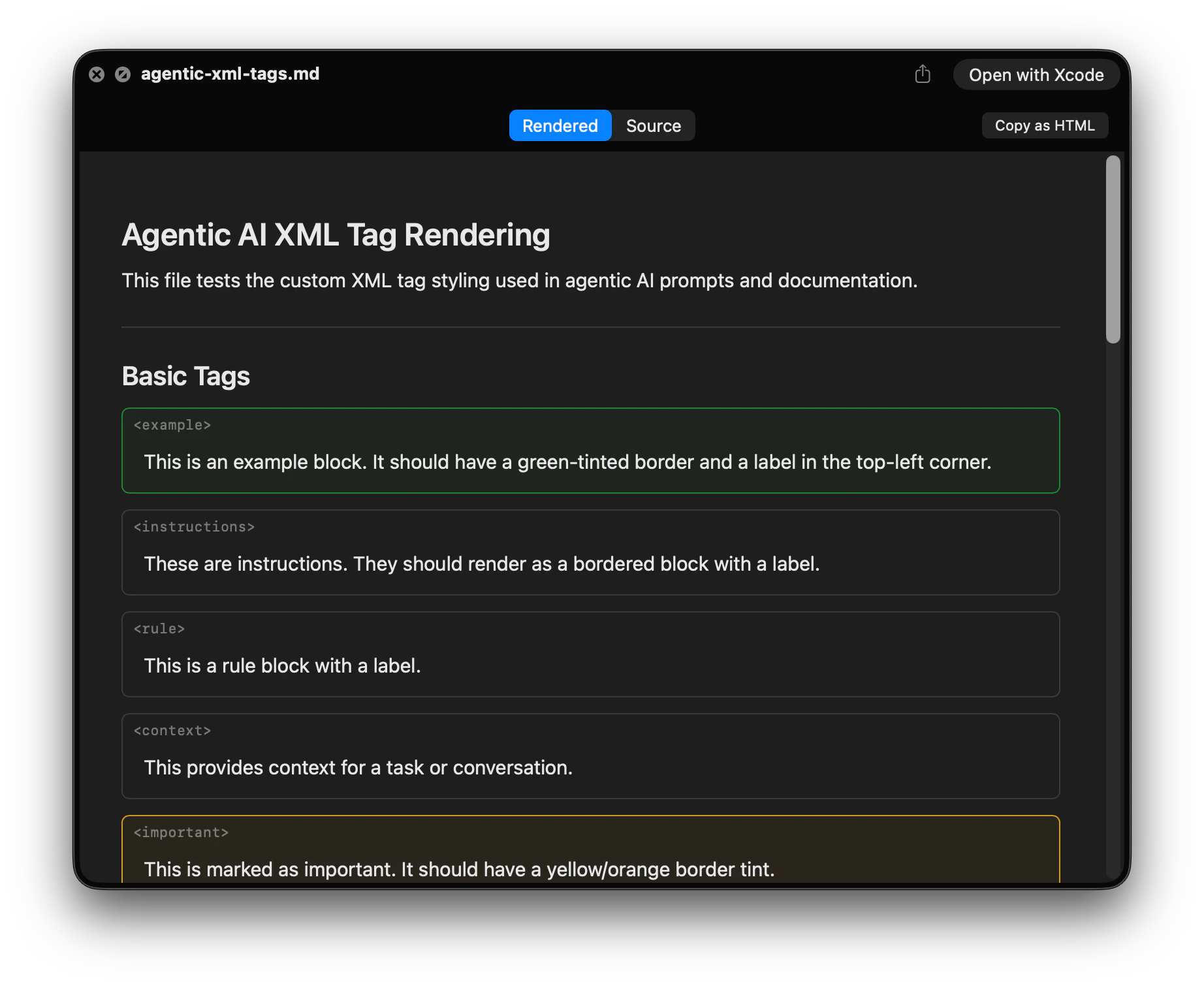
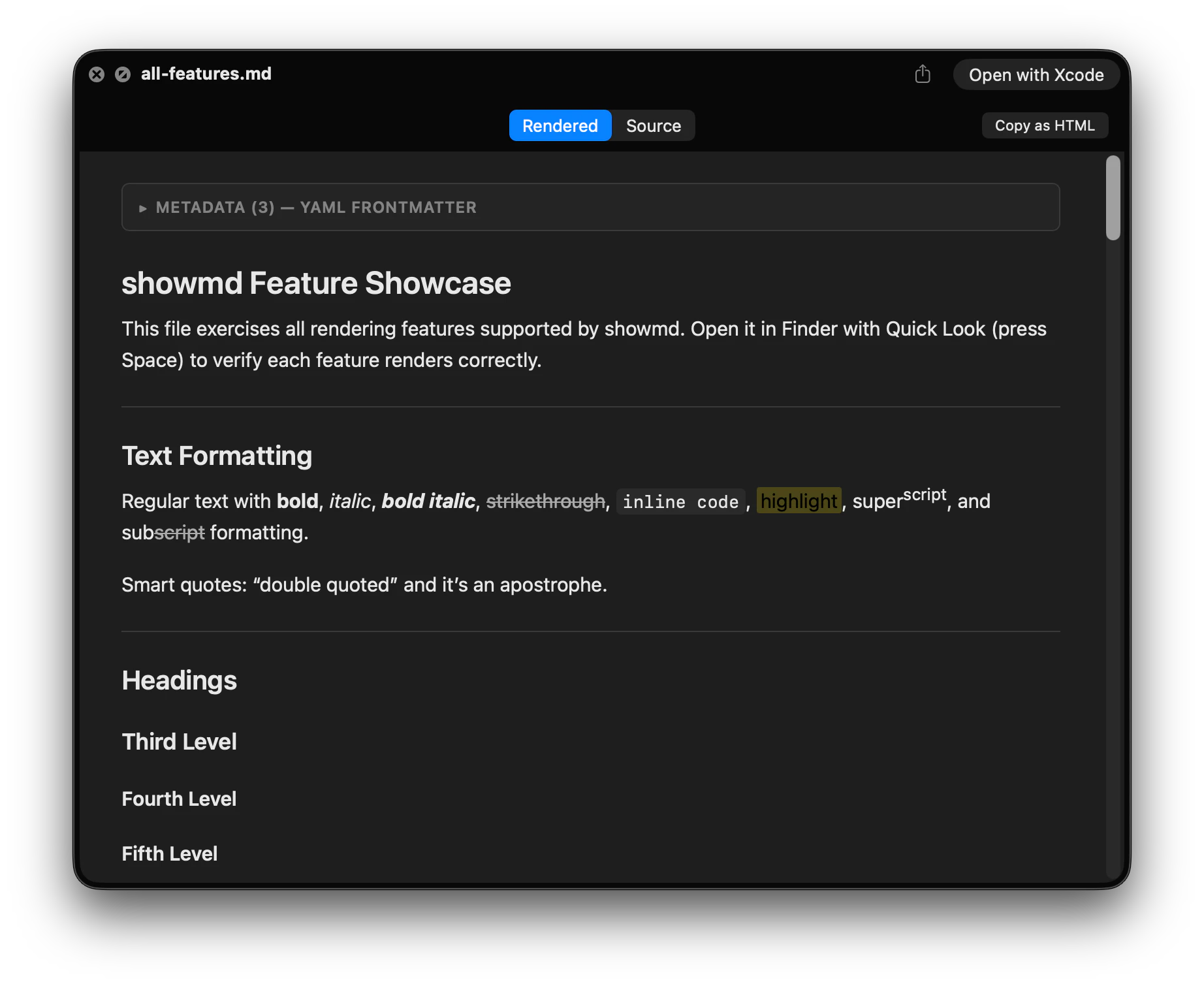
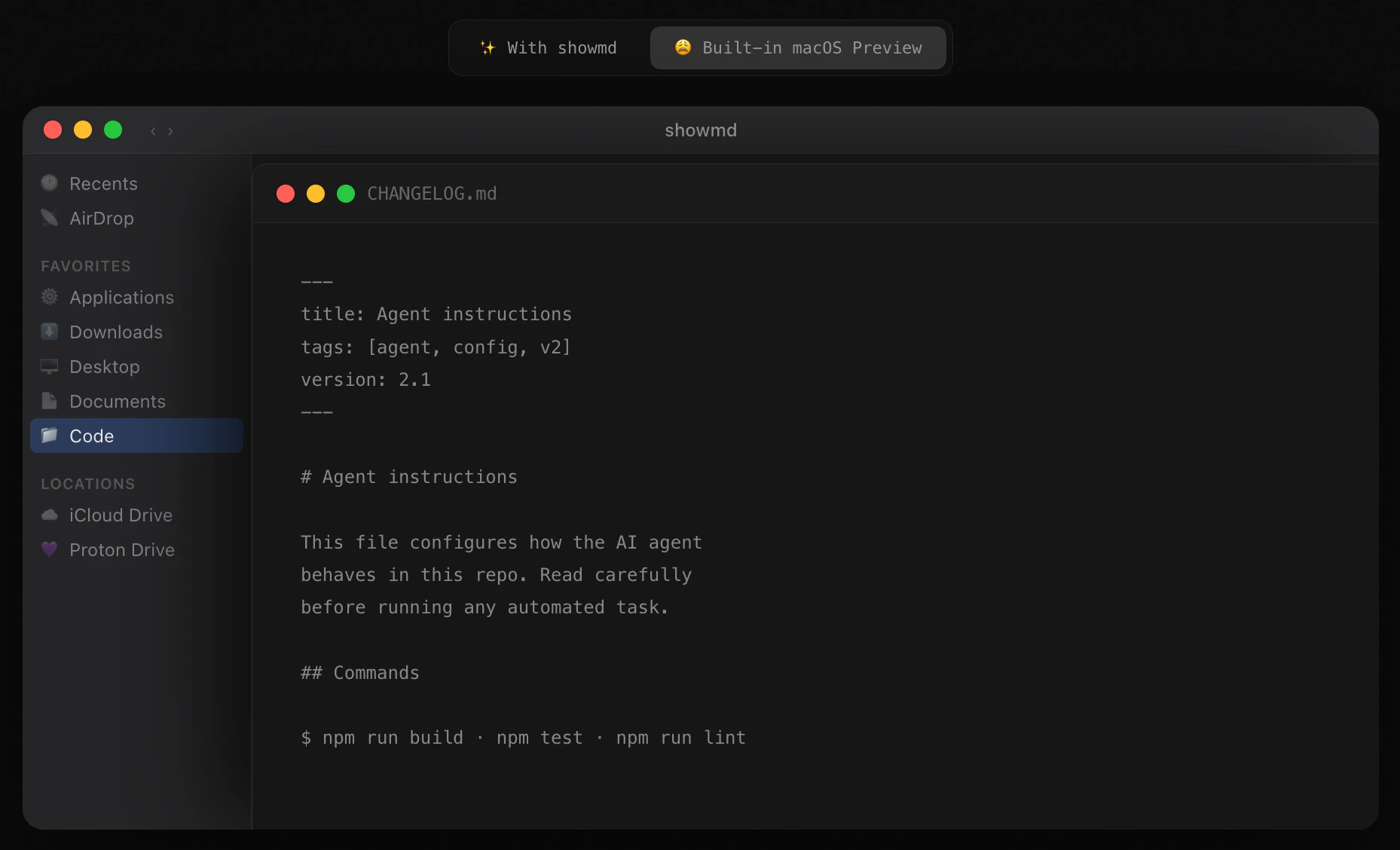
Ever asked yourself why all of those SKILL.md files are rendered in plain text in MacOS Preview? showmd is a free, native macOS Quick Look extension that renders Markdown beautifully. YAML frontmatter parsed into a collapsible metadata table — collapsed by default, one click to expand. No other viewer does this. Agentic AI XML tags — and 17 more — rendered as labeled, bordered blocks instead of raw angle brackets.
Hey PH! 👋 You might know me from Holdor (my first side project in years launched last month here on PH) — after that launch I dove deeper into developer tooling, and one daily frustration kept nagging me. I work with Markdown files all day. CLAUDE.md, AGENTS.md, README.md — they're everywhere now. But every time I hit Space in Finder to Quick Look one, I'd get a wall of raw text. Hashes, dashes, angle brackets. Unreadable. So I did some research. There are a few tools that handle basic Markdown formatting, sure. But none of them understand how Markdown is actually used today — especially in agentic AI workflows. YAML frontmatter? Rendered as noise. Custom XML tags like , , ? Just raw angle brackets. That's the gap I built showmd for. It's a free, native macOS Quick Look extension. Press Space on any .md file and get an instant, beautifully rendered preview — with frontmatter parsed into a collapsible metadata table, 20+ agentic AI XML tags styled as labeled blocks, syntax highlighting for 190+ languages, KaTeX math, Mermaid diagrams, and full GitHub Flavored Markdown support. All offline, all bundled, zero config. Since launching so many side projects again is fun, I thought: let's group everything together under my new side project brand yetanother.one — which should indicate: yes, I have lots of ideas, and yes... those happen mostly at night. Hope you like it! Let me know what I should build next? Spoiler: I'm currently working on something completely different — a new Android launcher.
6
回复

@jollife finally a good way to look at my markdown files that have mathematical formulas in them 🤓

1
回复

@jollife honestly, this is nice! congrats!

1
回复

@jollife Congrats. Does showmd handle live previewing or auto-reload for .md files open in VS Code/iA Writer while editing?

0
回复

finally. something everyone needed but no one had the courage to ask for :)

2
回复

@marcin_uchacz1 today, everything's a prompt away. and Claude is always happy to assist, no matter what 🤣

0
回复

I have a folder of nothing but .md files CLAUDE.md, MEMORY.md, various agent instructions and opening any of them in Finder has been genuinely painful for two years. Installing this right now!

1
回复

@dklymentiev let me know how this feels and if there's anything still missing!

0
回复

Hi @jollife !
App works great, I was looking for exactly this - I hate looking at md source ;).

1
回复

@dominik_bartosik trust me, everyone does. 🙈

0
回复

bold positioning. most markdown apps lean into the 'it's just text' thing - this is the counter-argument.

1
回复

@mykola_kondratiuk might have been true couple of years ago. but nowadays with frontmatter and xml and other stuff, markdown is really basically the opposite of "just text". glad you like the positioning.

0
回复

What a great outcome from our first coding evening in years 🎉 You’ve added a lot of nice features to our initial minimal prototype – Well done!

1
回复

@neuling2k yes, one evening, two indie hackers, tons of ideas. felt like being in my 20s again. still have some other tabs open from last time…

0
回复

Good idea in theory. I’ve seen a lot of markdown preview tools, but most fall apart once you hit larger repos or mixed content. Curious how this compares.

0
回复

@uxpinjack let me know - in my tests it performed quite ok for bigger markdown files as well.

0
回复

Sounded like my cup of team, so I tried to install with brew and
==> Fetching downloads for: johannesnagl/tap/showmd

✘ Cask showmd (1.0.1)

Error: Download failed on Cask 'showmd' with message: Download failed: https://github.com/johannesnagl/showmd/releases/download/v1.0.1/showmd-1.0.1.zip

curl: (56) The requested URL returned error: 504

0
回复

@houbsta The asset exists, the URL redirects correctly, and returns HTTP 200 now. The 504 was likely a transient GitHub CDN hiccup, not a cask issue.

Tell the user to retry:

brew install --cask johannesnagl/tap/showmd

or clear the download cache first if the bad response was cached:

brew cleanup --prune=all
brew install --cask johannesnagl/tap/showmd

I just tested the download URL (showmd-1.0.1.zip, ~3.97 MB) and it returns 200 OK. Nothing to fix on our side.

0
回复

@houbsta the same happened to me but at the second try it worked ¯\_(ツ)_/¯.

In my case, connectivity issues with Github .

0
回复
#6
ContextPool
Persistent memory for AI coding agents
153
一句话介绍:ContextPool为AI编程助手(如Cursor、Claude Code)提供持久记忆层,自动从历史会话中提取工程洞察,解决开发者反复向AI重述项目背景、已修复Bug和设计决策的痛点。
Open Source Developer Tools Artificial Intelligence GitHub
AI编程助手 持久记忆 开发效率工具 上下文管理 团队知识库 开源 MCP协议 本地优先 工程洞察提取 代码会话管理
用户评论摘要:用户普遍认可其解决“AI健忘症”的核心痛点,尤其关注团队记忆、多项目/多技术栈支持、过时/错误记忆的清理机制、以及从大量会话中提取高价值洞察的有效性。部分用户将其与手动维护文档的方式对比,询问其增量价值。
AI 锐评

ContextPool切入了一个精准且日益凸显的“AI后遗症”市场:随着开发者深度依赖AI结对编程,会话的“原子性”和“失忆性”成了新的效率瓶颈。它并非简单缓存聊天记录,而是试图构建一个结构化的、可检索的“工程记忆体”,其真正价值在于将非结构化的对话流,蒸馏为可被后续AI直接消费的“提示词增强块”。

产品设计体现了对开发者心理和工程现实的洞察:本地优先保障隐私与控制权;以MCP协议集成,避免生态锁死;输出Markdown格式,保持LLM友好性。然而,其面临的挑战远大于技术实现。首当其冲的是“记忆污染”问题——过时、错误或矛盾的决策如何被识别和清理?虽然团队提到了未来规划,但这本质是一个知识管理难题,而非单纯的技术问题。其次,“提取”的可靠性存疑:LLM能否从冗长会话中准确识别出真正关键、普适的“洞察”,而非无关噪音?这直接决定了工具是“智能摘要”还是“垃圾生成器”。

最值得玩味的是其“团队同步”功能。它试图将个人记忆升格为组织资产,但评论中“第二个文档坟墓”的担忧一针见血。如果缺乏基于使用反馈的动态权重、生命周期管理和权威裁决机制,共享池极易沦为信息沼泽。产品目前将冲突解决方案抛回给AI和用户,这在早期可行,但在规模下可能适得其反。

总体而言,ContextPool是一次必要的尝试,它标志着AI编程工具从“单次会话工具”向“持续学习系统”演进的关键一步。但其长期成功的标尺,不在于它记住了多少,而在于它如何优雅地“忘记”和“优选”,从而真正成为团队中那位“不忘事、不啰嗦、且经验持续增长”的沉默伙伴。

查看原始信息
ContextPool
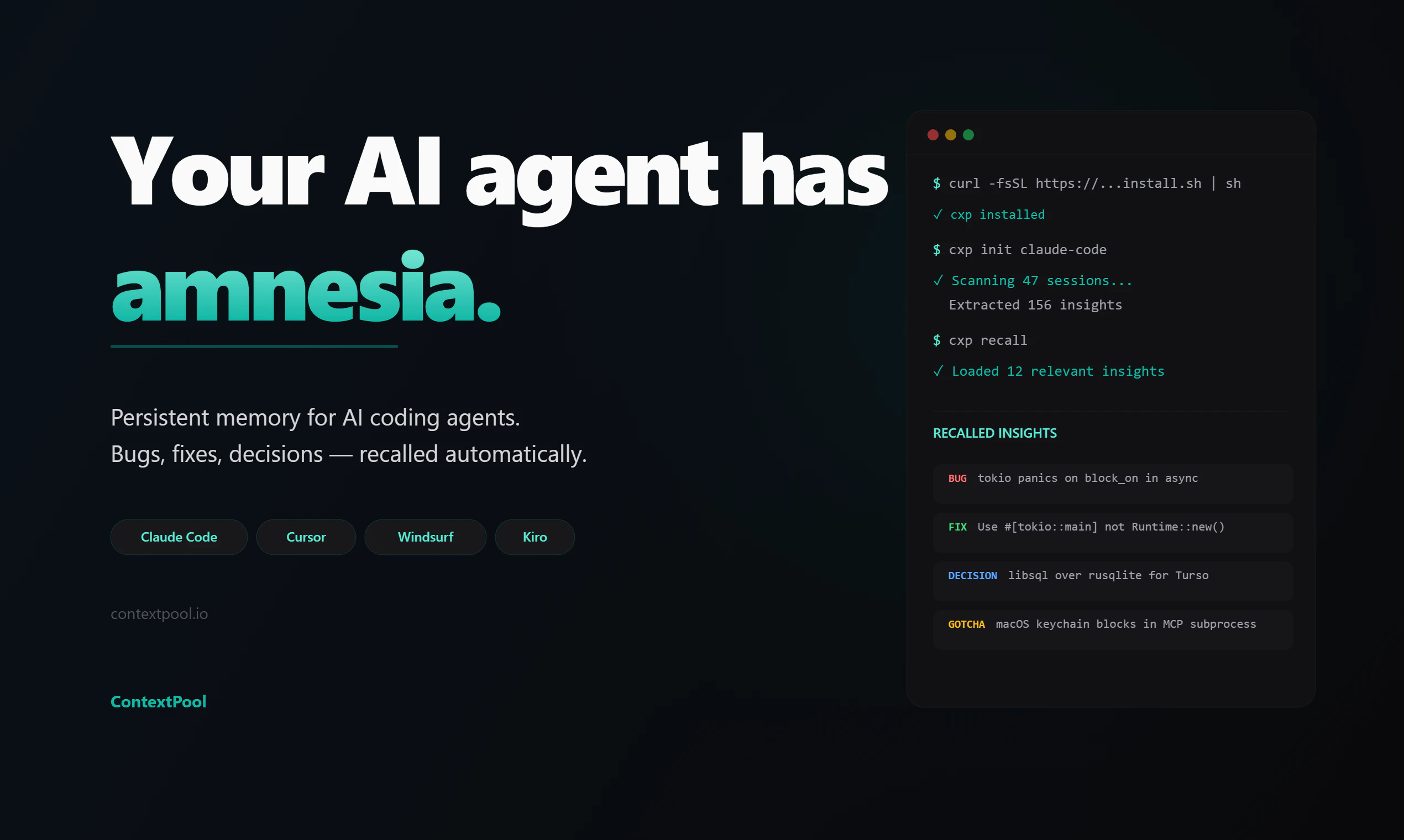
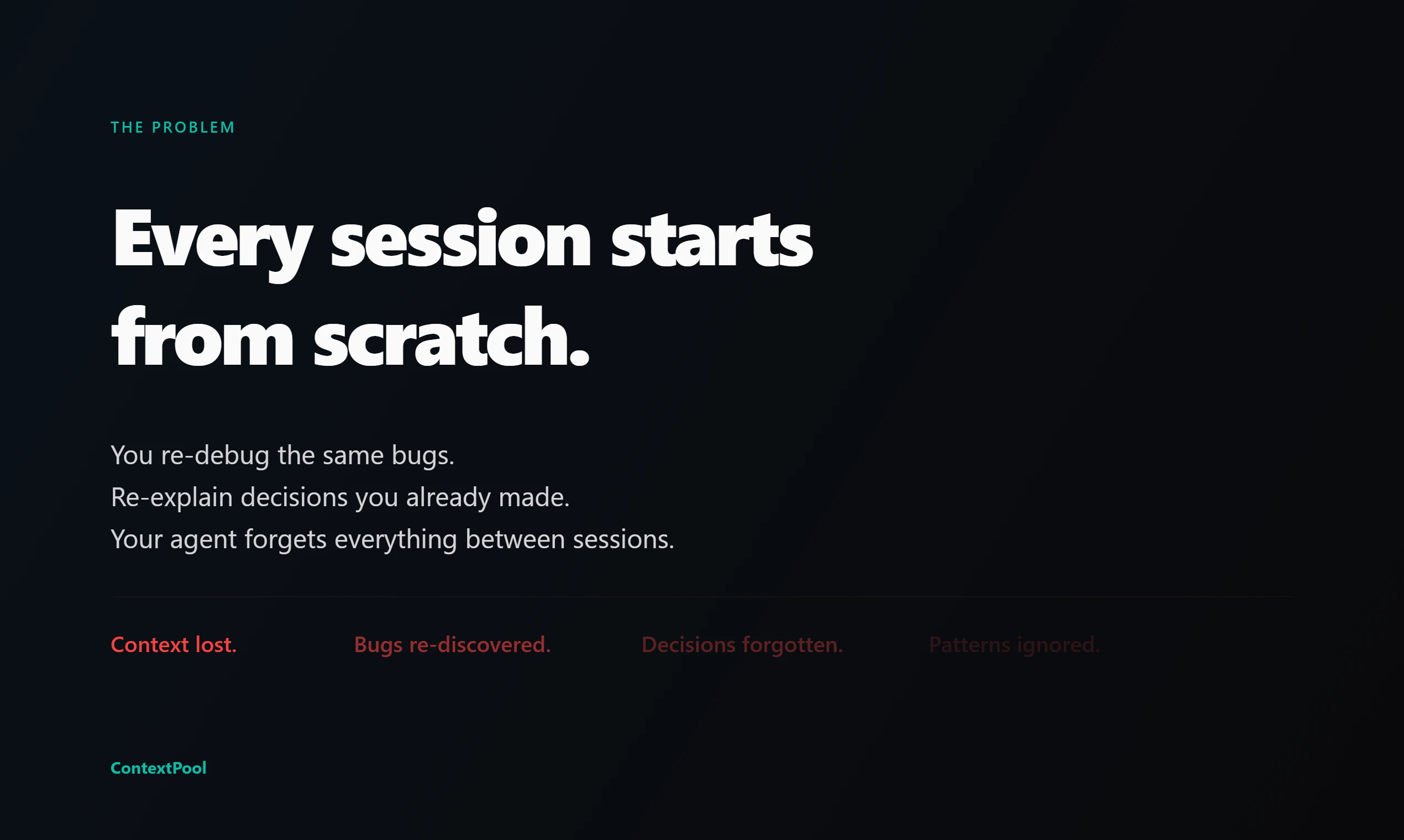
Every AI coding session starts from scratch. You re-debug the same bugs, re-explain decisions you already made. Your agent forgets everything. ContextPool gives your agent persistent memory. It scans your past Cursor and Claude Code sessions, extracts engineering insights (bugs, fixes, design decisions, gotchas), and loads relevant context via MCP at session start. No prompting needed. Works with Claude code, Cursor, Windsurf, and Kiro. Free and open source - team sync available for $7.99/mo.

Hey Product Hunt 👋

We built ContextPool because we kept hitting the same wall: every time started a new Claude Code or Cursor session, my agent had zero memory of what we'd already figured out together. Same bugs re-discovered. Same architectural decisions re-explained. Same gotchas re-learned.

It felt like working with a brilliant colleague who gets amnesia every morning.

So we built a persistent memory layer specifically for AI coding agents. Here's how it works:

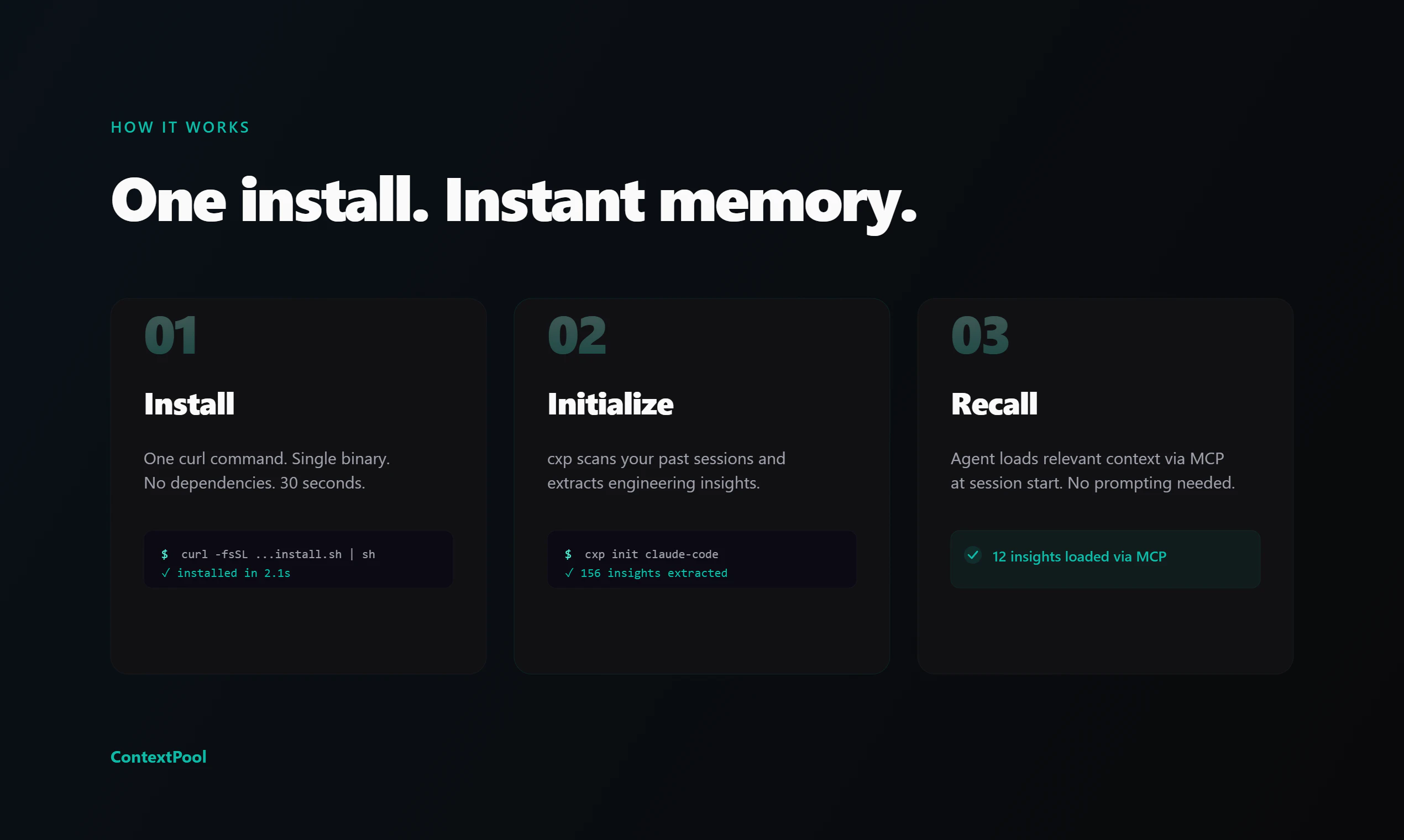
1. Install with one curl command (30 seconds, single binary, no dependencies)
2. Run `cxp init` - it scans your past sessions and extracts engineering insights using an LLM
3. Your agent automatically loads relevant context via MCP at session start

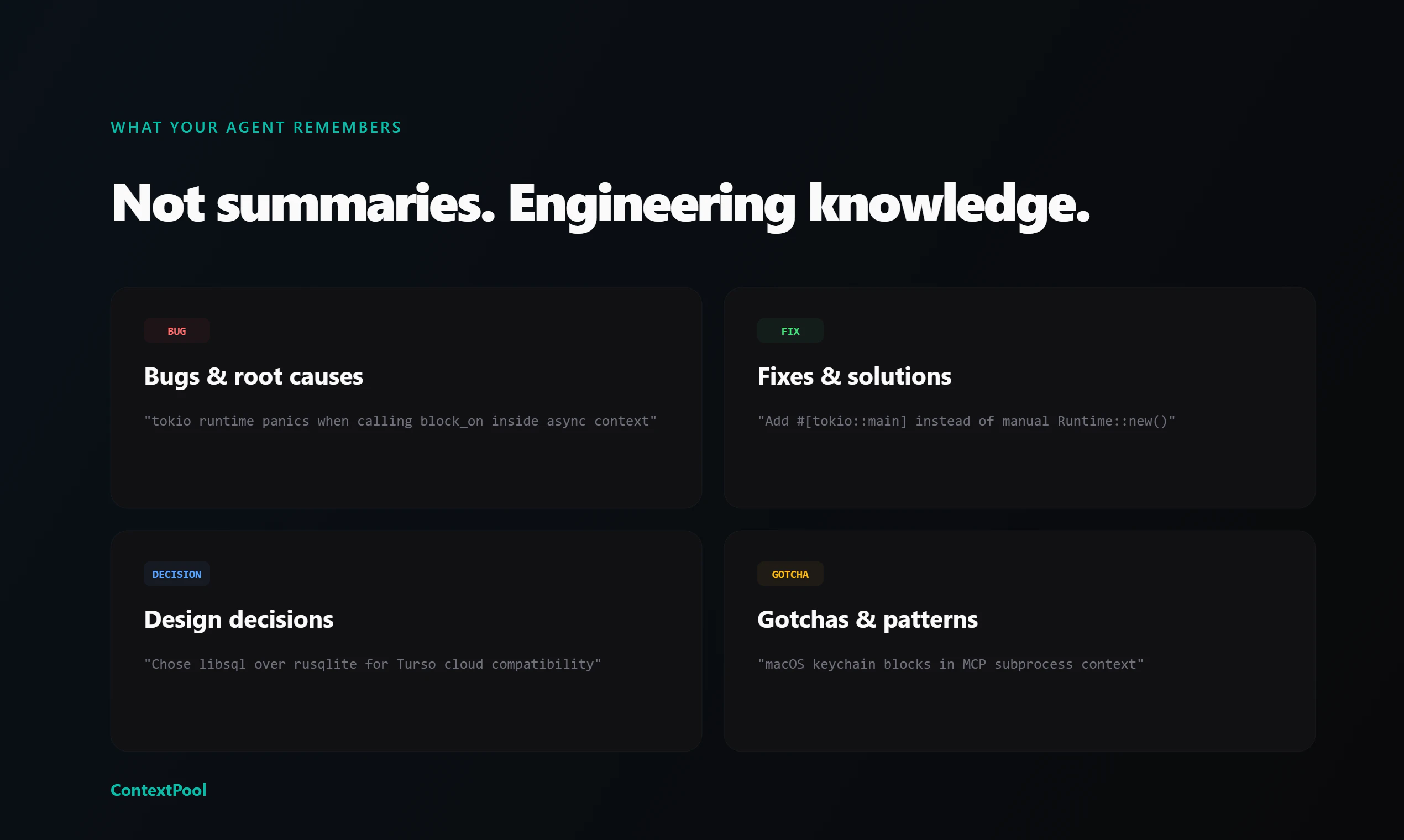
What it remembers isn't conversation summaries - it's actionable engineering knowledge:
→ Bugs & root causes ("tokio panics on block_on in async context")
→ Fixes & solutions ("Use #[tokio::main] instead of manual Runtime::new()")
→ Design decisions ("Chose libsql over rusqlite for Turso compatibility")
→ Gotchas ("macOS keychain blocks in MCP subprocess context")

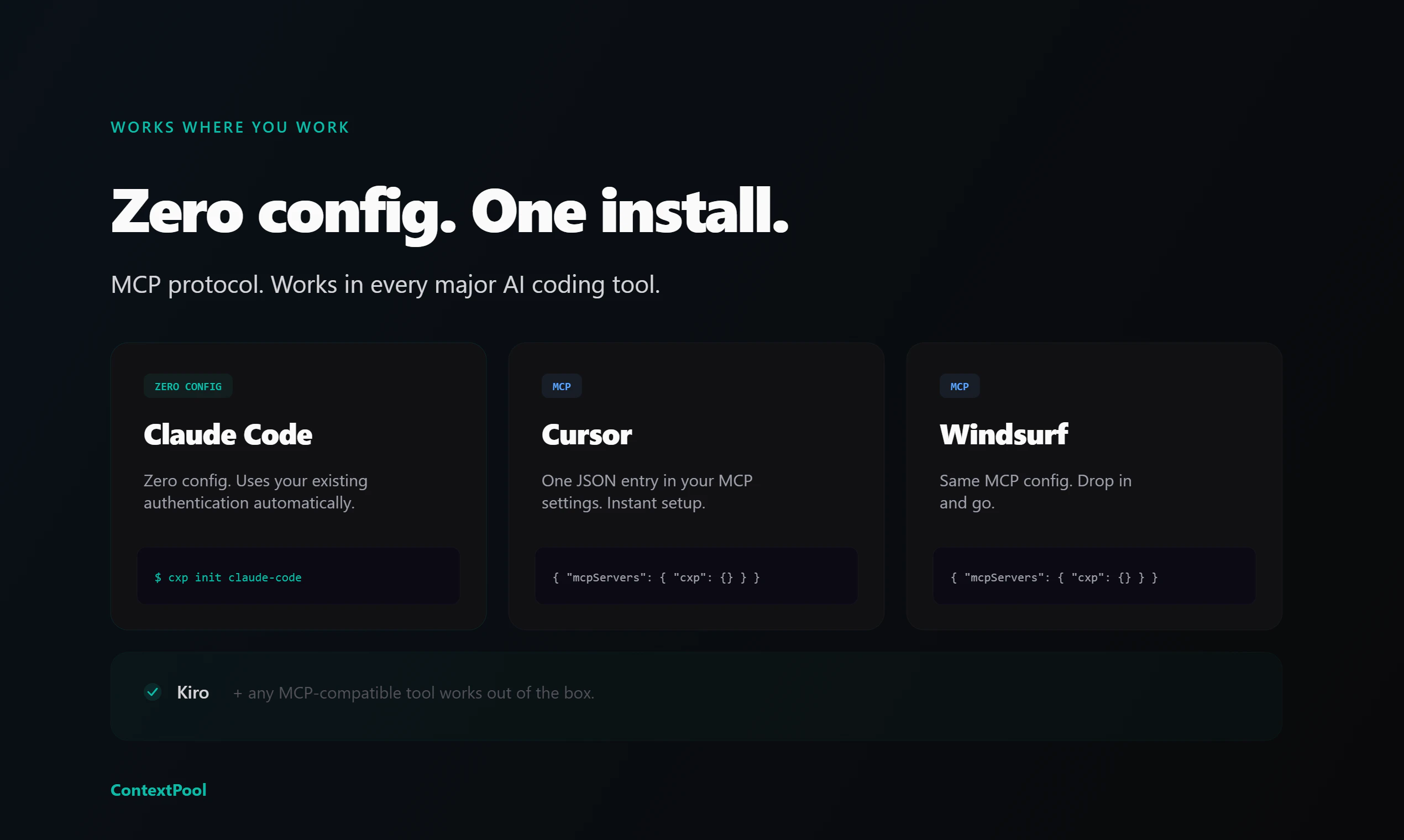
It works with Claude Code (zero config), Cursor, Windsurf, and Kiro. Local-first and privacy-first - raw transcripts never leave your machine, only extracted insights sync when you opt in.

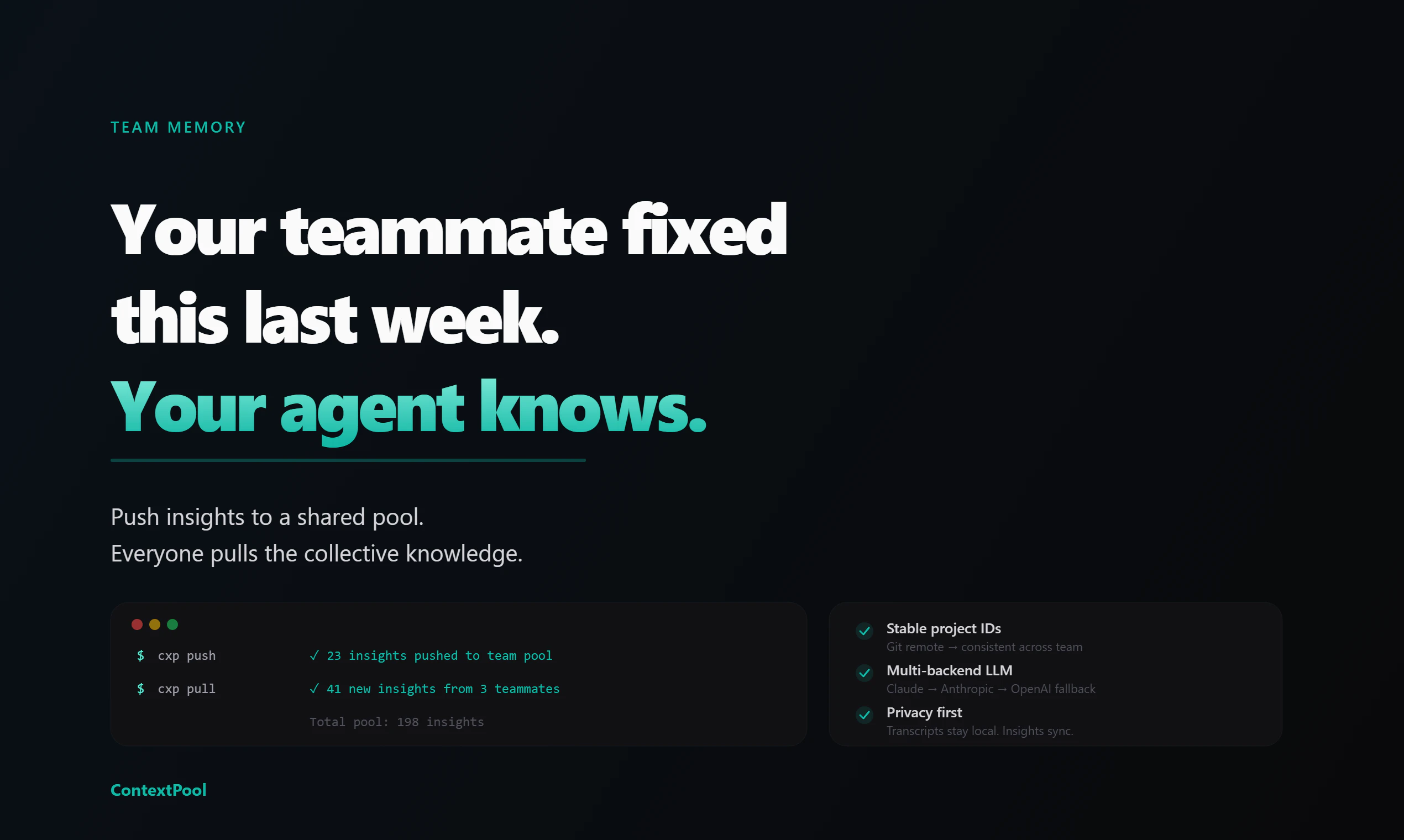
The team memory feature is what we are most excited about: push insights to a shared pool, and everyone on the team pulls the collective knowledge. Your teammate debugged something last week? Your agent already knows.

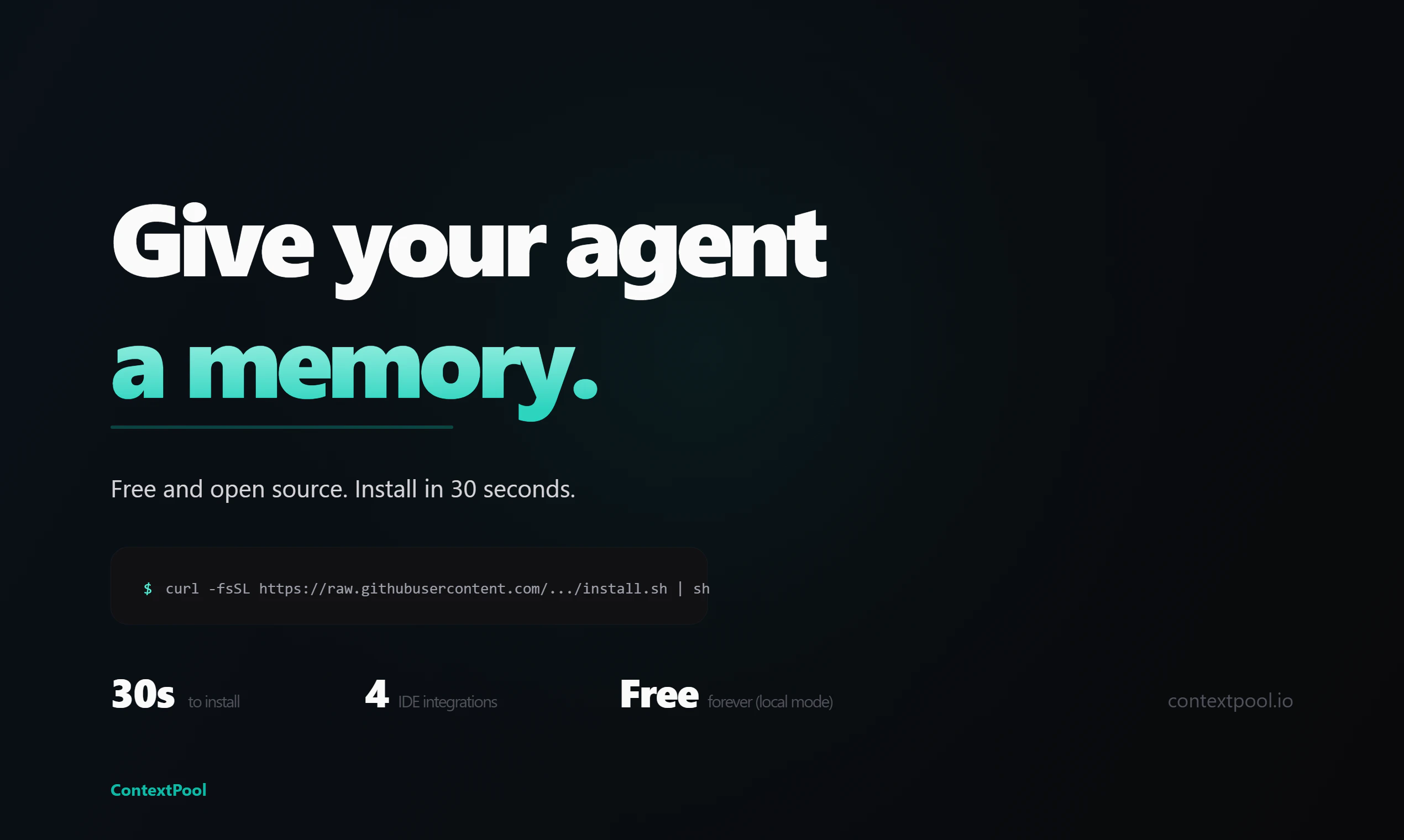
Free and open source for local use. $7.99/mo for team sync.

We'd love to hear: what's the most frustrating thing you keep re-explaining to your AI coding agent? And if you try it - what insights does it extract from your sessions?

GitHub: https://github.com/syv-labs/cxp

11
回复

@majidyusufi How well does ContextPool handle extracting team-specific patterns, like our custom error-handling conventions, for shared pools?

0
回复

@majidyusufi the local file approach makes this feel a lot more usable than yet another hidden memory layer. the thing I keep wondering about is team memory though - once multiple people start pushing decisions into the shared pool, how do you stop it from slowly turning into a second docs graveyard?

0
回复

Really cool! Btw how does Contextpool handles codebase evolution like when old decisions become invalid? Also how are you structuring extracted insights, are these embeddings, structured schemas,or something hybrid? And is all of it stored locally?

3
回复

@lak7 
Thanks for the great questions!

ContextPool extracts structured insights from your coding sessions, each one typed (decision, bug, feature, etc.) with a title, summary, optional file reference, and tags. The format is intentionally LLM-native: plain markdown that any AI can read and reason over without needing a vector pipeline.

On codebase evolution: we're actively working on insight lifecycle management, the ability to flag, update, or supersede outdated decisions as your codebase changes. Expect this soon.

On storage: summaries live locally inside your repo under ContextPool/, so you stay in full control. Team sync to a shared cloud DB is opt-in. Importantly, raw conversation transcripts are never stored, only the distilled insights.

4
回复

Vibe-coder here. I maintain a claude.md file and update it manually at the end of every session. It's manual, but it works. For a solo builder (no team) what does ContextPool give me that a well-maintained claude.md doesn't?

1
回复

probably the extraction part — you document what you think matters,

but i'd guess it catches stuff you'd never think to write down (that

random 2am gotcha that took 3 hours). @majidyusufi curious — what

happens with low-signal sessions, does it still store something or is

there a quality threshold?

2
回复

The brilliant colleague with amnesia framing is exactly how it feels, you spend half the session rebuilding context instead of actually building. The team memory angle is where this gets really interesting though.

Does it handle conflicts when two teamates have solved the same problem in completely different ways or does it just load both and let the agent decide?

1
回复

@farrukh_butt1 Right now it loads both and the agent sees them, which is actually more useful than it might sound. It gets to reason about why two approaches exist, which often surfaces the real tradeoff rather than just picking one arbitrarily.

That said, we're fully aware that at team scale, unresolved conflicts in memory can become noise. Explicit conflict resolution, flagging when two summaries contradict each other and letting a team lead resolve it, is something we're building toward.

But honestly, for the problem you described (rebuilding context instead of building), even the current behavior is a massive step up. The agent walks in knowing both solutions exist, asks a smarter question, and you spend 2 minutes resolving a real tradeoff instead of 20 minutes re-explaining the whole system from scratch.

1
回复

This is solving a real problem. I've been building a full SaaS in Claude Code for the past year: 13 AI agents, FastAPI backend, Next.js frontend — and the context loss between sessions is genuinely the biggest friction point.

The thing I keep re-explaining: project architecture decisions. Why certain agents are split the way they are, why the credit system works a specific way, which database tables relate to what. Every new session I'm pasting the same CLAUDE.md context block to get the agent back up to speed.

Curious about one thing, how does it handle multi-stack projects? My repo has TypeScript frontend and Python backend with very different patterns and gotchas in each. Does it extract insights per-language/per-directory, or is it all one pool?

Going to try this today.

1
回复

@maria_fitzpatrick 
Thats great to hear!!
On the multi-stack question: it's one pool, but search makes it feel naturally separated. A session debugging your FastAPI agent orchestration produces Python-flavored summaries. A session fixing a Next.js billing UI produces frontend-flavored ones. When you're working on the backend, backend context surfaces. The stack separation happens through relevance, not rigid partitioning.
For a project like yours though, where the architecture spans both stacks, that's actually a strength. If a credit system decision touches both the FastAPI logic and the frontend display, that cross-cutting insight gets captured in one place and surfaces whenever either side is in play.
The CLAUDE.md you keep re-pasting? That's a one-time thing with ContextPool. You explain the agent split once, it's stored, and it shows up in every future session where it matters, without you lifting a finger.

1
回复

I don’t quite understand how you handle control and cleanup of memory from bad, incorrect, or outdated solutions. I often reset the context on purpose so the agent forgets everything and we can start from a clean slate — otherwise past mistakes can compound into even worse decisions over time. I’m really curious how this is managed in your approach.

1
回复

@denys_valis Great question, and a real concern with any persistent memory system.

You stay in control. ContextPool stores summaries as plain local files you can read, edit, or delete at any time. Bad session? Delete that summary. Done.

We don't load everything, we search using proper keywords. Context is only surfaced when it's relevant to your current task. A wrong decision from three months ago on a different feature simply never appears.

Fresh starts are first-class. You can tell the agent to ignore memory entirely, or wipe the index whenever you want. Clean slates aren't a workaround, they're built in.

And coming soon: automatic stale memory deprecation, so outdated context ages out on its own without you having to think about it.

4
回复

What I've used so far that works very well for me is the compound part of Compound Engineering. The problem I see to CE is that it's per repo, ContextPool looks amazing since all my repos can share these eng learnings!

Great work!

0
回复

This solves a genuine pain point. I run a small agency and every time I spin up a Claude Code session on a client project, I spend the first 10 minutes re-explaining the stack, the deployment quirks, and why we made certain architectural choices. The idea of capturing that as structured, searchable memory rather than just dumping everything into CLAUDE.md is a much cleaner approach. Curious about one thing: for the team sync at $7.99/mo, is there a way to scope shared memory per project or repo? In an agency setting, you definitely don't want client A's context leaking into client B's sessions.

0
回复

Interesting concept, but “exhaustive scanning” sounds expensive at scale. Curious how it performs with large document sets in real production use.

0
回复

Built something similar for a different layer persistent memory across business workflows, not just coding sessions. The "docs graveyard" concern from the comments is real. What helped us was making memory write-on-use, not write-on-save. If an agent references a piece of context during a task, that context gets reinforced. If nothing ever pulls it, it decays. Curious how you handle relevance scoring when the pool grows past a few thousand entries.

0
回复

This is really cool. Does the agent have persistent memory on only your work or also the work your team is working on?

0
回复

@jacklyn_i Both.

ContextPool captures sessions from everyone on the team. So if your teammate spent yesterday untangling a gnarly FastAPI dependency issue, that insight is available to you today, without them having to write a doc, send a Slack message, or remember to tell you.

It's the difference between institutional knowledge living in people's heads versus actually being shared. The agent that helped your teammate debug also quietly remembered what it learned, and now that memory is yours too.

After a quick one-time auth setup, your whole team's context flows into a shared pool automatically, no manual syncing, no one remembering to document anything. It just works in the background as everyone builds.

0
回复
#7
Clarm
AI inbound layer to capture, qualify, and route leads
134
一句话介绍:Clarm是一款AI驱动的多渠道潜在客户捕获与筛选层,通过在网站、Slack、Discord、GitHub和邮箱等渠道自动与访客互动,智能判断购买意向并精准路由,解决了企业在非工作时间或高流量场景下潜在销售线索大量流失的痛点。
Productivity SaaS Artificial Intelligence
AI销售助手 潜在客户筛选 多渠道互动 销售自动化 线索路由 B2B工具 YC孵化 SOC2合规 HIPAA合规 转化率优化
用户评论摘要:用户肯定其多渠道集成与提升销售线索的效果,创始人透露电商类客户转化率提升显著。主要问题与建议集中在:1) 请求更多案例数据和基准;2) 询问与LinkedIn等平台的集成可能;3) 关注路由准确性的长期评估与反馈机制;4) 关心知识库(如文档、代码库)更新的同步准确性;5) 询问与现有工具(如Crisp)的兼容性。
AI 锐评

Clarm的定位并非又一个聊天机器人,而是一个“AI驱动的入站转化层”,其真正价值在于将企业从“守株待兔”式的被动获客,转向在用户自然停留的数字场景中进行主动、智能的意图筛选与分流。产品敏锐地抓住了两个关键趋势:一是用户交互偏好从表单和静态页面向即时聊天的迁移;二是企业增长对合规性与全渠道覆盖的硬性要求。

其犀利之处在于“筛选”与“路由”的双重能力。它不满足于仅仅增加互动,而是旨在通过AI判断,将“询问定价的访客”、“在文档中徘徊40分钟的技术负责人”与“普通浏览者”区别对待,并将高价值线索实时推送给正确的人或下一步流程。这直接攻击了传统销售漏斗中最大的效率黑洞——线索浪费与响应延迟。创始人声称的“6倍销售相关消息增长”,其巨大提升空间恰恰源于传统B2B网站极低的基线互动率。

然而,光环之下亦有隐忧。首先,其核心壁垒在于意图分类模型的精准度与深度行业适配能力。评论中关于“路由质量长期评估”、“金融行业自定义筛选标准”的提问,直指其产品能否从“不错”变为“不可或缺”的关键。其次,尽管支持多渠道,但用户对LinkedIn集成的需求揭示了重要场景的缺失。最后,“半小时部署”的便捷性是一把双刃剑,在降低使用门槛的同时,也可能让企业低估了知识库优化与路由规则配置所需的持续运营成本。

总体而言,Clarm展现了一个清晰的愿景:成为企业数字前端的智能中枢。但它面临的挑战同样清晰:在避免成为“更复杂的聊天插件”的同时,需持续深化其AI的决策智能,并构建可验证的ROI闭环,才能真正坐实“转化层”的定位。

查看原始信息
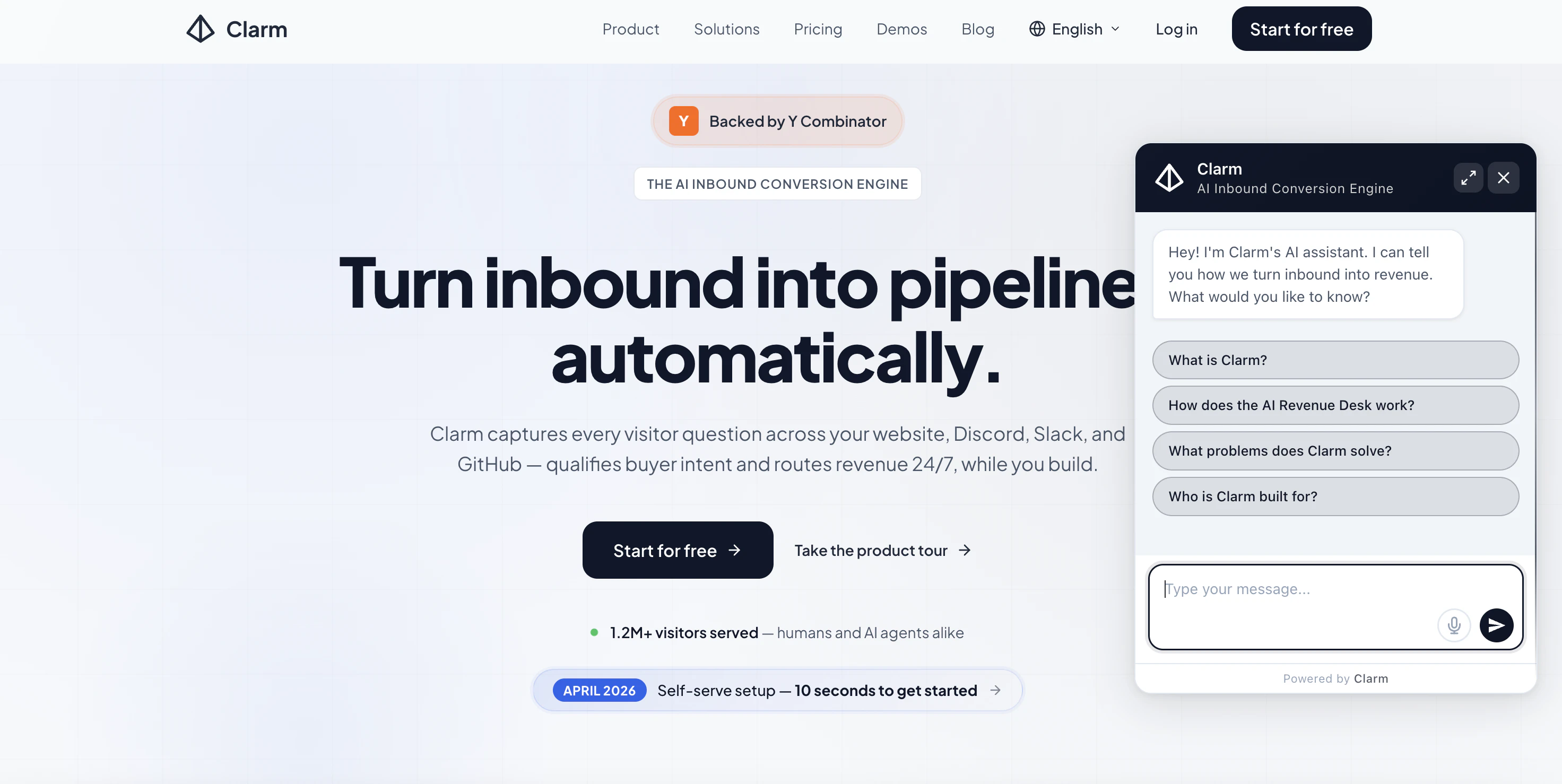
Clarm
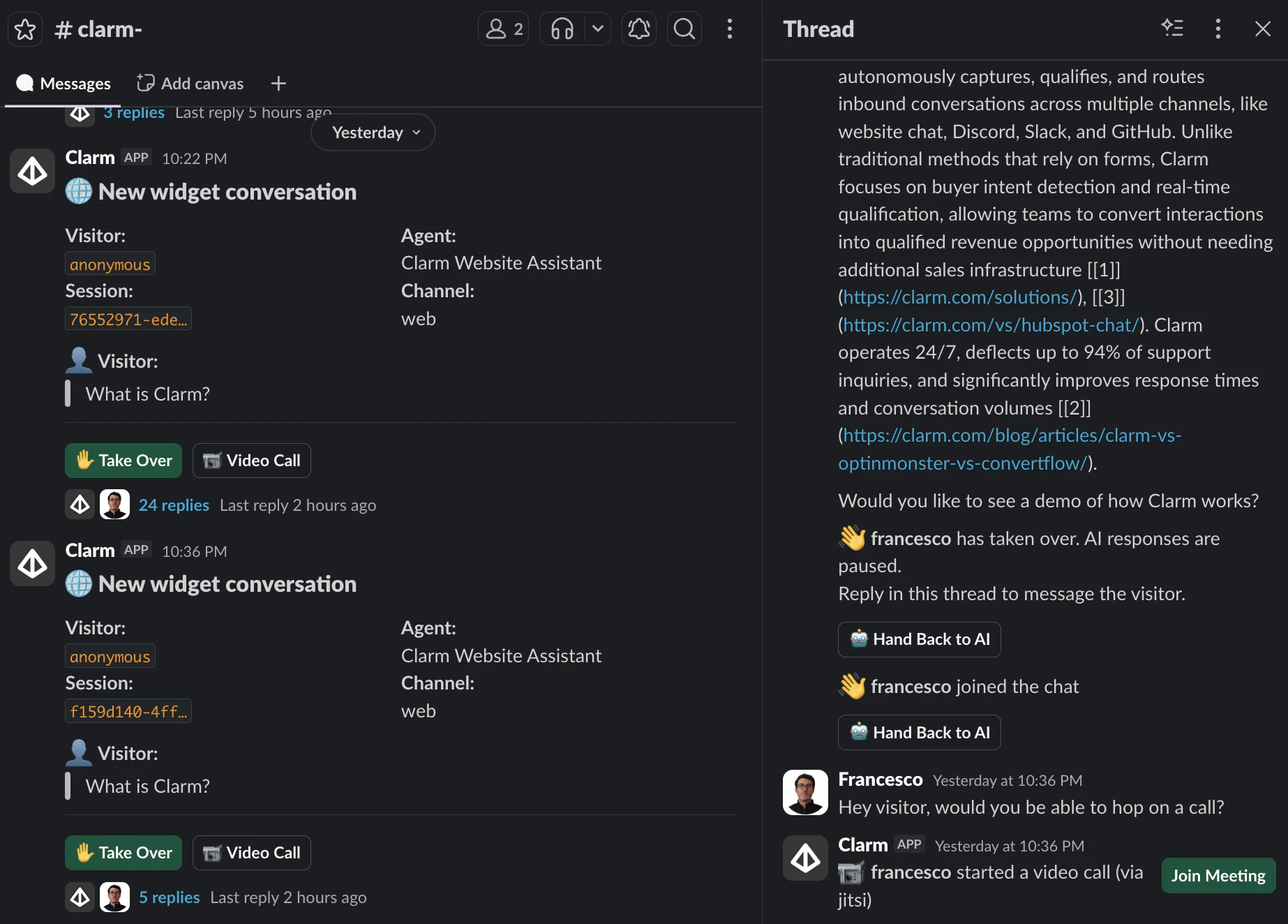
Capture inbound visitors, qualify buyer intent with AI, and route revenue 24/7 across web chat, Slack, Discord, GitHub, and email. SOC 2 Type II and HIPAA compliant. Y Combinator backed.
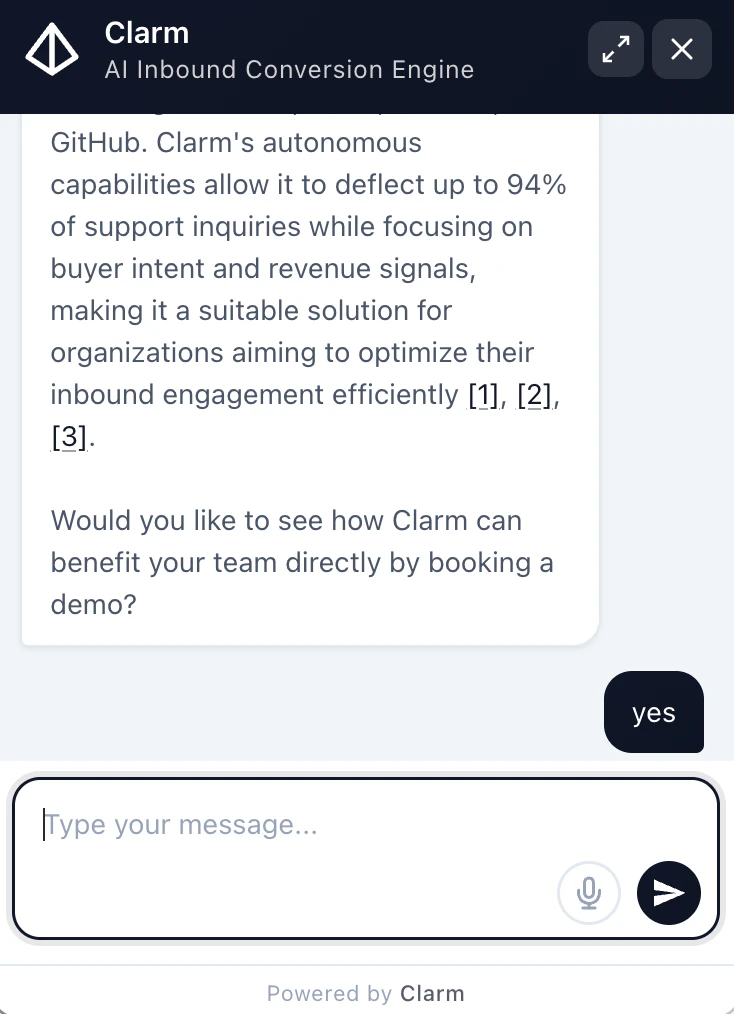
Hey PH — Marcus here (founder at Clarm). We kept noticing the same thing on every site we cared about: tons of traffic, almost none of it turns into a real conversation — and when it does, it’s usually the wrong moment, the wrong channel, or it dies in a form. So we built Clarm to be the AI inbound conversion layer: capture people where they already are (web + Slack/Discord/GitHub/email), qualify intent, and route the good stuff to the right next step — without making your team live in chat all day. The best results we've seen were a 6x increase in sales related messages! Turns out that people prefer to talk to AIs to ask about pricing and to express their real opinions on some topics. If you try it today, the thing I’d love your honest take on is whether it feels fast to “good enough” for your own site (widget + knowledge + routing) — we’re optimizing for “ship in an afternoon,” not a 6-week implementation. Quick asks (pick your adventure): Drop your site + what you sell — I’ll reply with the one funnel I’d wire up first. If you’re in healthcare/finance/devtools, tell me what compliance constraint actually blocks you — we’ve been living in that world. What’s the #1 place inbound leaks for you right now: the homepage, pricing, docs, or after-hours?
5
回复

@marcusstorm Love this. Have any examples/case studies to share like what sort of brands saw highest conversion rates with this?

0
回复
@marcusstorm looks interesting - we sell a B2B enterprise decision intelligence platform for regulated industries - ForwardLane.com. Interested if you’re able to connect to Linked In to capture inbound messages from LI and LI pages. This is the one big conversion leak we can’t easily bridge. It’d be great to be able to have Clarm pipe into LI for engagement there
0
回复

@marcusstorm This is really interesting — especially the multi-channel part (web + Slack + GitHub).

One thing I’m curious about is how you evaluate routing quality over time.

For example:

  • which conversations actually convert vs just increase engagement

  • whether certain channels produce higher quality leads

  • or if the agent ever misclassifies intent and routes incorrectly

Feels like there’s a really interesting feedback loop here between capture → qualification → conversion.

0
回复

This is super interesting! I Wish I had discovered it earlier lol.
Anyways 6x increase sounds strong but what was the baseline and what kind of companies saw the biggest lift? Also have you seen any cases where AI actually hurts conversion maybe due to wrong tone or over automation etc

4
回复

@lak7 Hi Lakshay, the companies which saw the highest conversion rates are e-commerce companies. The tone is very important, and we therefore take care in making sure that the AI replies correctly to customers.

Overall, customers have seen great results, and with the new features, where the human can take over, the AI , which is able to also understand the sentiment of the user, notifies a representative of the company.

2
回复

@lak7 great question Lakshay! No, we don’t see any drop off. On the contrary, engagement increases across the board.

We think there are two reasons for the big increase: 1) our deployment is flexible (API as well as prebuilt designs) so users can place the chat in the best place, as well as use the agentic capabilities to deepen user engagement (time spent on website etc), and 2) people in general prefer using chat as an interface since about 1 year ago.

Finally, the baseline engagement for a b2b saas tool is pretty low. “Book a demo” is tons of friction. Perhaps only 1 in 1000 interact - so if you manage to get that to 5% (the top standard) you’re not 6xing, you’re 50xing!

Example: one customer got tons of pricing related queries via chat even though the link to the pricing page was right there. We were surprised but after asking end users they simply prefer chatting now! It’s easier to ask for a specific discount eg for veterans or startups than to look on the page.

Install and have fun! We’re trying to make it as easy as possible for companies to have access to this tech, so that consumers can find the best products for them.

0
回复

I've tried dozens of these tools, and Clarm is hands down the best

4
回复

@paul_sangle_ferriere1 thank you Paul!

1
回复

We had a lead sit on our docs site for 40 minutes reading everything and then just close the tab. Nothing. If something had just said "hey, want a quick demo?" at the right moment, that would've been a customer! +1 upvote!

1
回复

@dklymentiev exactly what we designed this for!! Hope to see you on our platform!

1
回复

This is a strong idea, especially for dev tools where questions repeat a lot. Curious how you keep answers accurate when docs or repos change quickly.

1
回复

@uxpinjack hey Jack! Our connectors reindex on update, so that’s not an issue at all. For repos we use a memory layer so that the whole repo doesn’t have to be reindexed 100 times a day, and to combine that with other docs and other knowledge sources.

What’s your use case you have in mind?

0
回复

Nice product, can it work with Crisp?

1
回复

@bengeekly it does! Not out the box, but we can set it up for you easily. Are you thinking of using Clarm for the initial triage and input and Crisp as the support system?

0
回复

What's the turnaround time to get this live and working? Does it require a hands-on detailed setup?

1
回复

@jacklyn_i Hi Jacklyn., We can get you up and running within 20 minutes to half an hour. You just need to sign up, and we will send you an email with the script for the widget that you can embed in your website.

It roughly takes half an hour for us to index your website.

Get started here: https://clarm.com/get-started/. You can reach out directly if you need any help.

0
回复

Interesting approach to inbound qualification. In financial services, the gap between "someone visited our site" and "this is a qualified deal opportunity" is massive. We built ModeLoop (https://modeloop.net/?i=1) to help finance teams with modeling and deal structuring, and lead qualification has always been the bottleneck — especially distinguishing serious institutional buyers from casual browsers. The AI intent detection across multiple channels (web, Slack, Discord) is a smart move. Does Clarm support custom qualification criteria specific to B2B financial services use cases?

0
回复

Congrats on the launch! Chat interfaces always win!

0
回复
#8
VoxCPM2
Open-source 48kHz TTS with voice design and cloning
115
一句话介绍:VoxCPM2是一款仅20亿参数的开源文本转语音模型,通过文本描述直接生成或克隆可控音色,并输出48kHz高品质音频,解决了音视频创作、营销等领域中寻找定制化人声门槛高、流程繁琐的痛点。
Open Source Artificial Intelligence Audio
开源TTS模型 语音合成 音色设计 语音克隆 多语言支持 高保真音频 实时流式处理 轻量化AI Apache-2.0协议 音频工作流
用户评论摘要:用户普遍惊叹其“能力密度”,对仅用文本提示生成新音色的“语音设计”功能感到惊喜。有评论者询问其在营销、播客等场景的实际应用案例。另有专业开发者关注其多语言混合发音的处理能力,体现出对生产环境实用细节的关切。
AI 锐评

VoxCPM2的发布,与其说是一次参数竞赛的胜利,不如说是一次对开源语音合成应用范式的精准重构。其真正价值不在于堆砌“48kHz”、“30种语言”等规格参数,而在于用仅2B的轻量级模型,将“语音设计”这一高阶概念产品化——让用户通过自然语言描述直接生成音色,这实质上将声音从“寻找/克隆”的稀缺资源,变成了“按需描述生成”的可设计元素,大幅降低了创意门槛。

然而,其面临的挑战同样清晰。评论中关于多语言混合发音的疑问,正戳中了当前TTS模型在复杂、自然语境下的通病:技术演示惊艳,但生产环境中的鲁棒性、一致性和情感细微控制仍是难关。所谓的“生产就绪”RTF指标,在真实工作流中能否经受住复杂脚本、长文本连贯性以及多说话人场景的考验,仍需观察。

它最大的冲击力在于其开源协议与轻量化体量。Apache-2.0许可使其能无障碍地嵌入各类商业产品,而2B参数则意味着更低的部署成本和硬件门槛,有望真正推动高质量语音合成从云端API服务下沉到边缘设备和个人工作台。但这把“利剑”也指向了自身:如何构建可持续的开发者生态与商业模式,来支撑其长期迭代,将是其能否从“惊艳的开源项目”蜕变为“定义行业的标准”的关键。它的出现,迫使整个行业重新思考:语音合成的核心价值,究竟是为已有声音做复制,还是为人类想象力提供新的发声工具?

查看原始信息
VoxCPM2
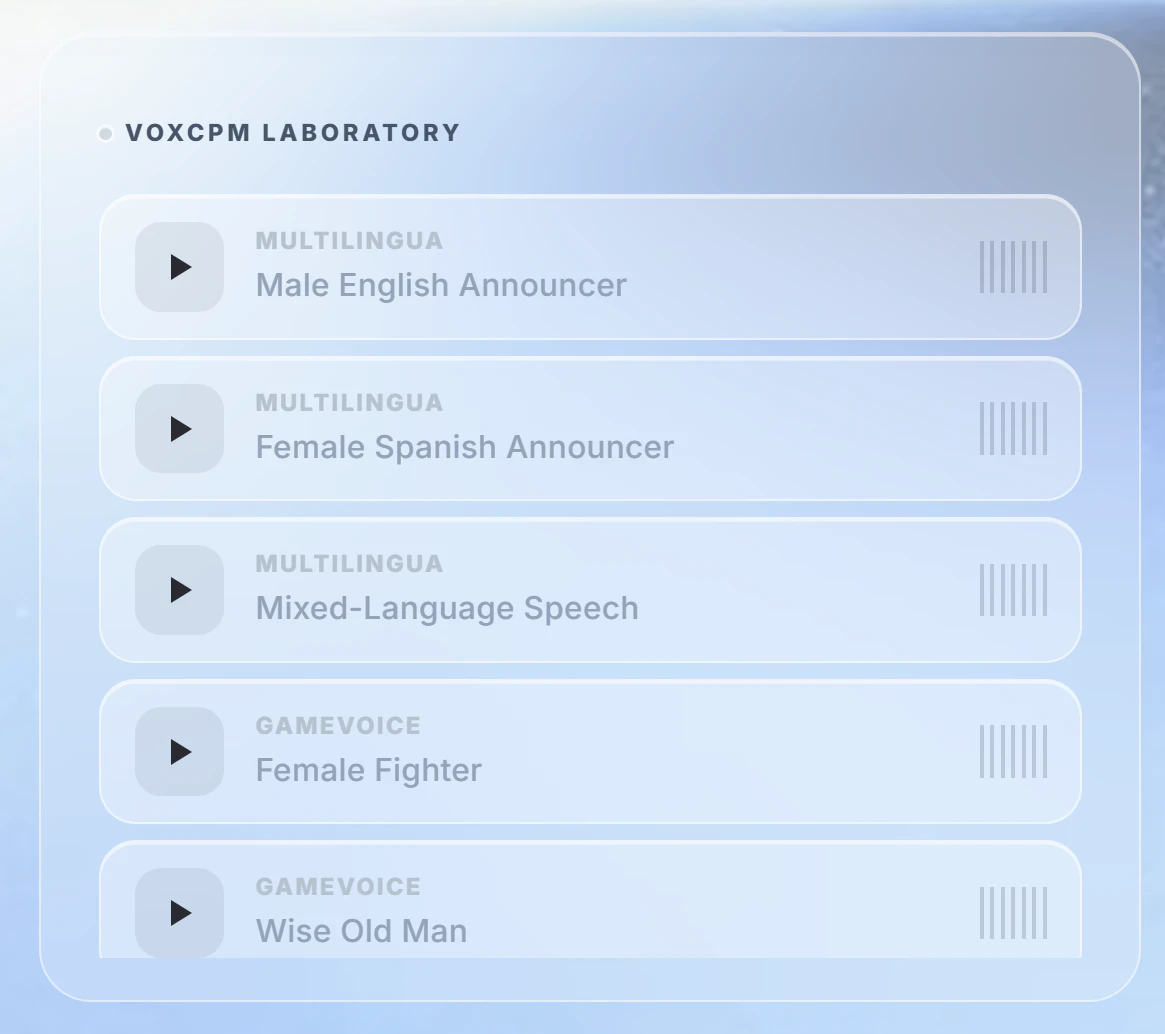
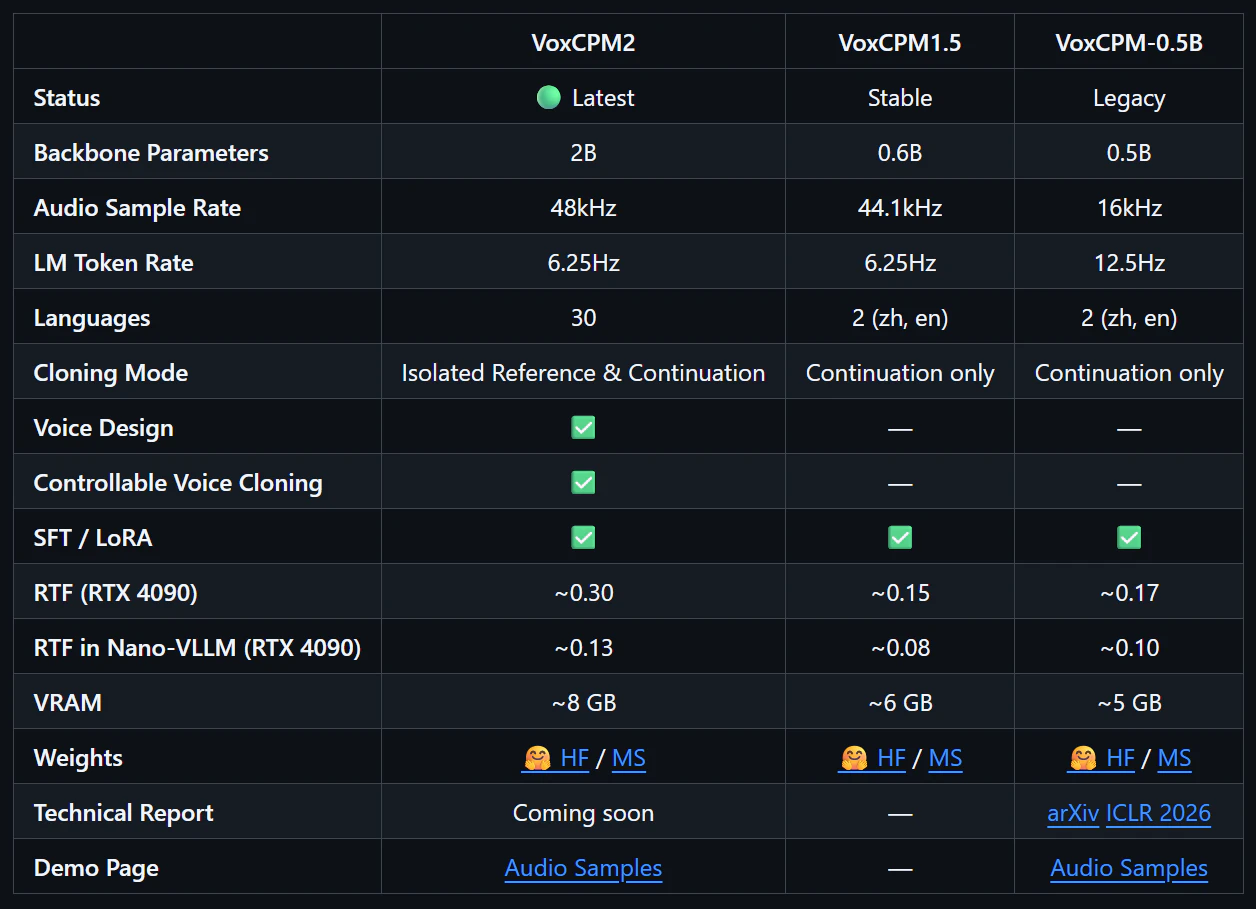
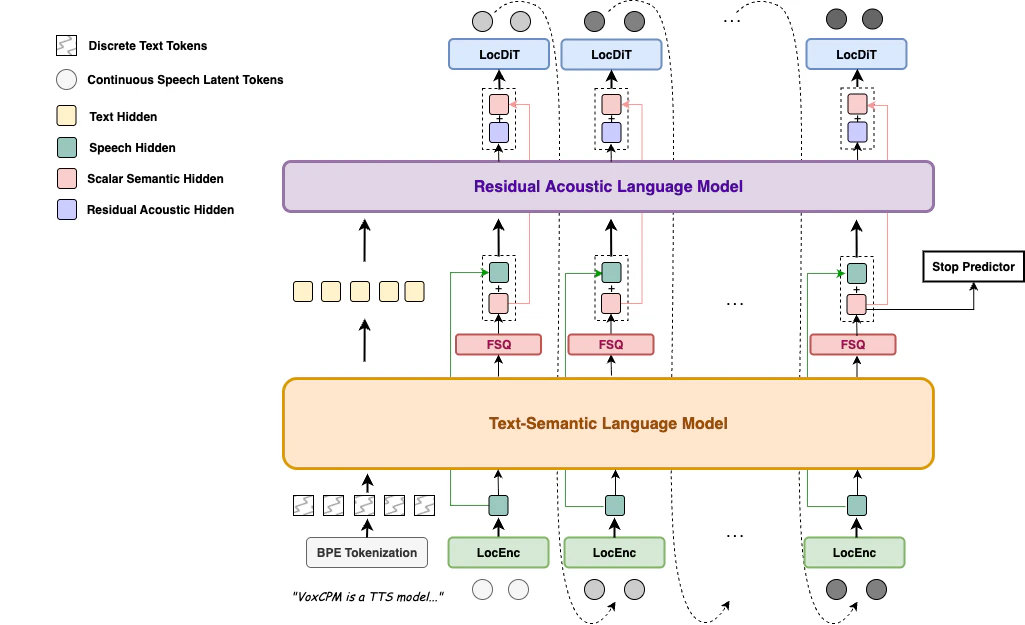
VoxCPM2 is a 2B open-source TTS model with 30-language support, 48kHz output, voice design from text alone, controllable voice cloning, and real-time streaming fast enough for production voice workflows.

Hi everyone!

VoxCPM2 is the next-generation open-source audio model from the @MiniCPM family, and it perfectly continues their signature trait of incredible "capability density" — packing all of these features into a model that is only 2B parameters!

Despite its highly compact size, the feature set it brings to the table is quite rare for an open-source release:

  • Voice Design: Instead of hunting for the perfect reference audio to clone, you can just prompt the model directly (e.g., (A young woman, gentle and sweet voice) Hello world.). It generates a completely novel voice on the fly.

  • Native 48kHz Output: It has a built-in super-resolution VAE, meaning no external upsamplers are needed to get studio-quality audio.

  • Controllable Voice Cloning: You can clone a voice from a short clip, but still steer the emotion, pacing, and style using text prompts.

  • Production-Ready: It hits an RTF of ~0.13 for real-time streaming and is fully open-source under the Apache-2.0 license.

It is incredibly refreshing to see this level of controllable, high-fidelity audio hit the open-source ecosystem in such a lightweight package.

Try it out here!

9
回复

@zaczuo Have you seen folks using it yet for quick custom podcast intros or branded voiceovers in marketing?

0
回复

Voice design from text prompts instead of hunting for a reference clip is the thing I didn't know I needed. "A tired middle-aged man reading terms of service" and it just... makes that? 2B parameters for this is wild. Will try it locally today.

2
回复

2B params delivering 48kHz + voice design + cloning is impressive capability density. As someone building an audio/video editing tool that relies on audio analysis for precise segment boundaries, I appreciate how much source quality matters.

Curious: how does VoxCPM2 handle multilingual switching within a single utterance — e.g. Japanese with embedded English terms?

0
回复
#9
Deconflict
Plan your WiFi and see through walls
115
一句话介绍:一款免费开源的浏览器端WiFi规划工具,通过上传平面图、放置真实AP模型并模拟信号穿墙衰减,帮助家庭用户和IT人员可视化无线覆盖、自动分配信道并优化AP位置,解决WiFi盲区与信号干扰的痛点。
Design Tools Open Source Developer Tools GitHub
WiFi规划工具 网络优化 信号模拟 开源 浏览器应用 信道分配 室内覆盖 AP部署 射频衰减 网络可视化
用户评论摘要:用户普遍赞赏其轻量、实用及逼真的材料衰减模型。主要问题与建议包括:期待多层建筑支持、设备密度加权优化、性能加载延迟(尤其特定地区),以及询问模型准确性。开发者积极回应,确认相关功能已在规划中。
AI 锐评

Deconflict的价值核心在于将昂贵的专业无线网络规划能力“平民化”。它并非又一个简单的信号模拟器,其关键突破在于引入了基于真实物理属性的材料衰减参数和实时信道干扰计算,这直接击中了家庭用户和小型企业主“知其然不知其所以然”的痛点——他们能感受到信号差,却无法量化一堵混凝土墙带来的高达12dB的信号损失。

然而,其“免费开源”和“浏览器运行”的双重特性是一把双刃剑。优势在于零门槛、易传播,迅速吸引了被Ekahau等企业级软件价格劝退的用户。但劣势同样明显:受限于浏览器算力和2D射线模型,它无法处理复杂的3D多径效应和家具遮挡,这决定了其天花板是“精准的规划工具”而非“高保真仿真工具”。开发者对此有清醒认知,定位在“合理范围内的实用”。

从评论互动看,产品的成功在于精准解决了“规划”这一环节,但用户已开始提出“运营”层面的需求,如基于设备密度的优化。这揭示了其从“部署工具”向“网络健康管理平台”演进的潜在路径。当前最大的挑战并非功能,而是作为开源项目如何平衡性能优化(如评论提及的加载延迟)与开发可持续性。若能建立社区生态,吸引贡献者共同优化引擎与模型,它有望成为中小场景无线网络规划的事实标准。

查看原始信息
Deconflict
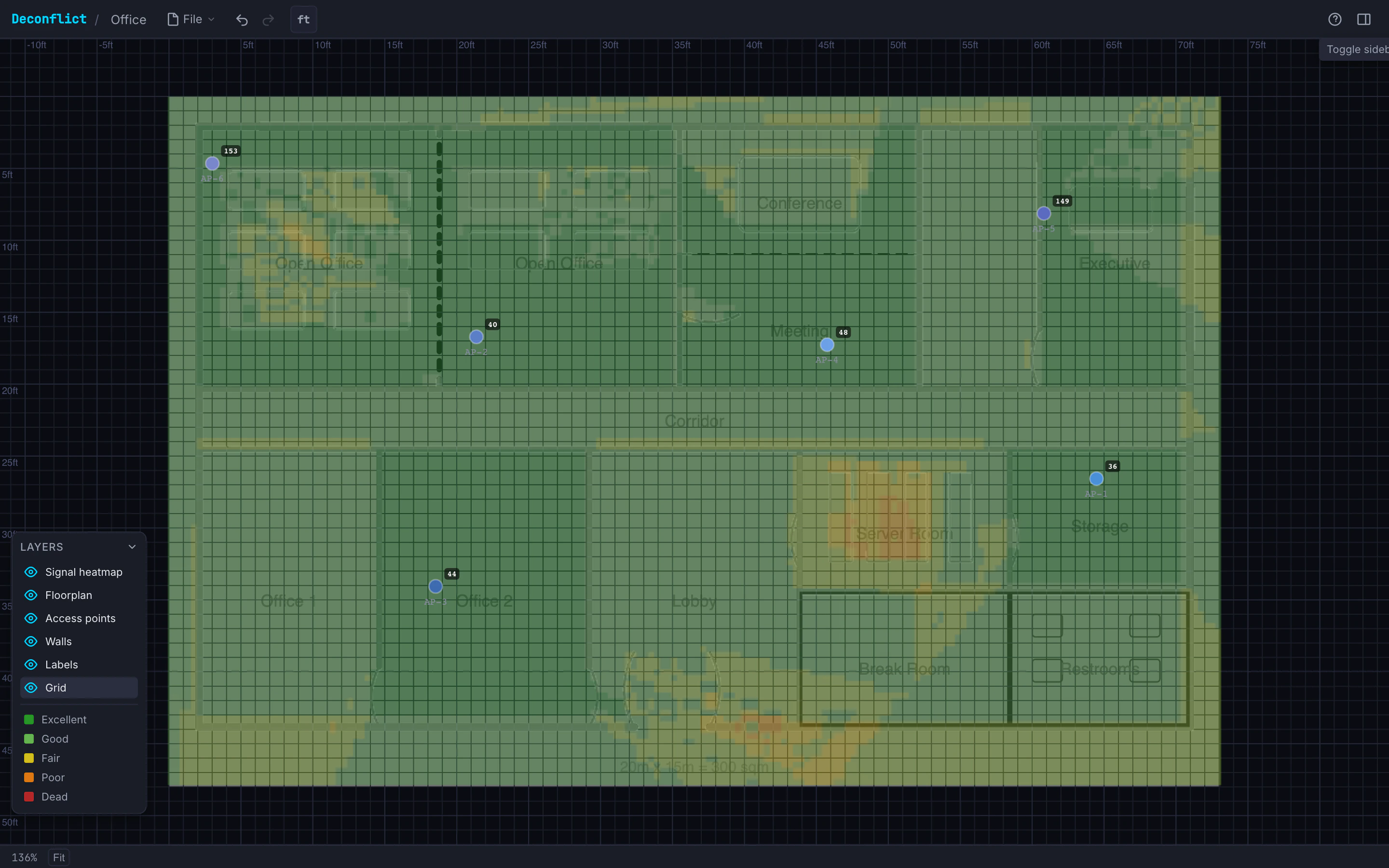
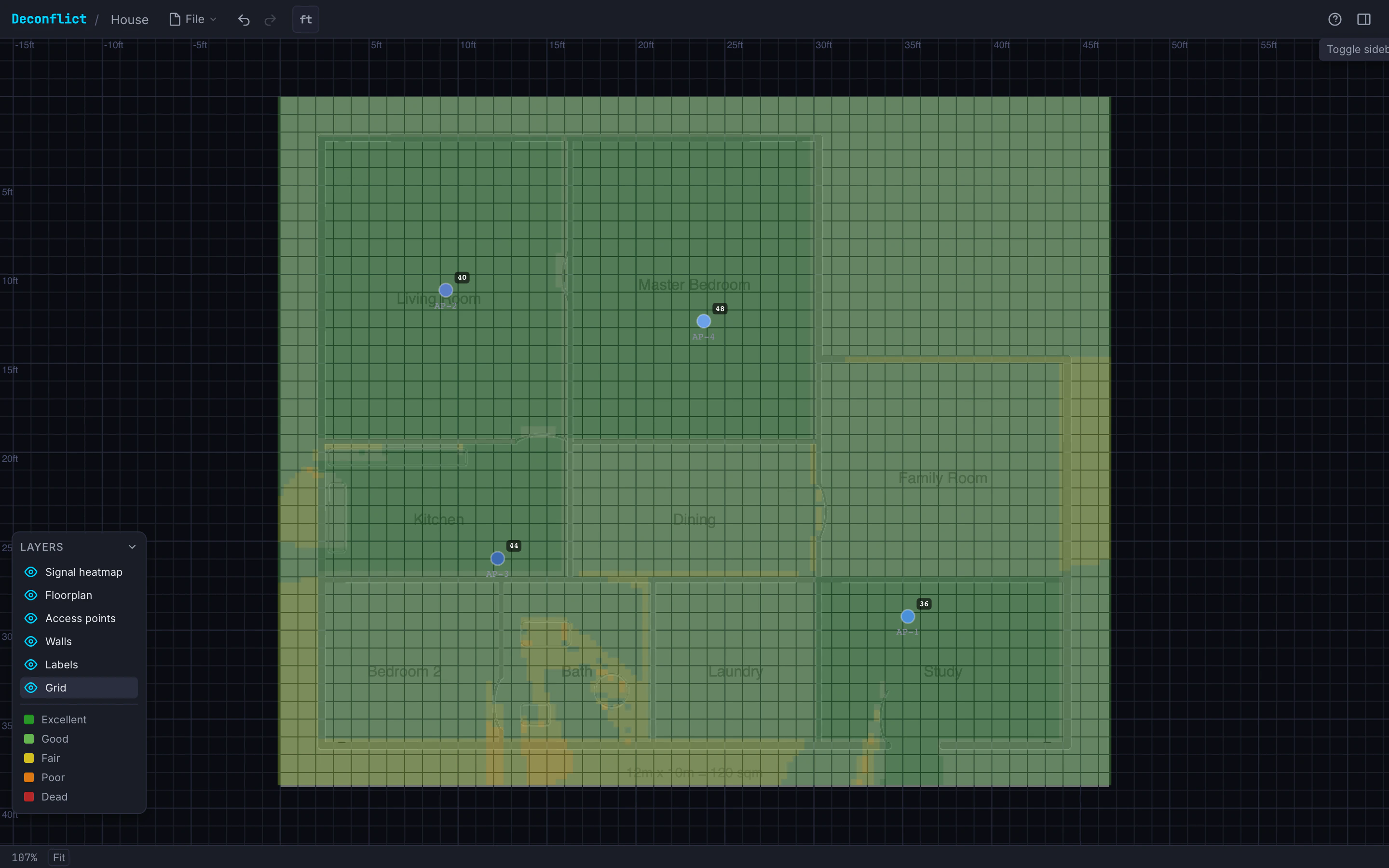
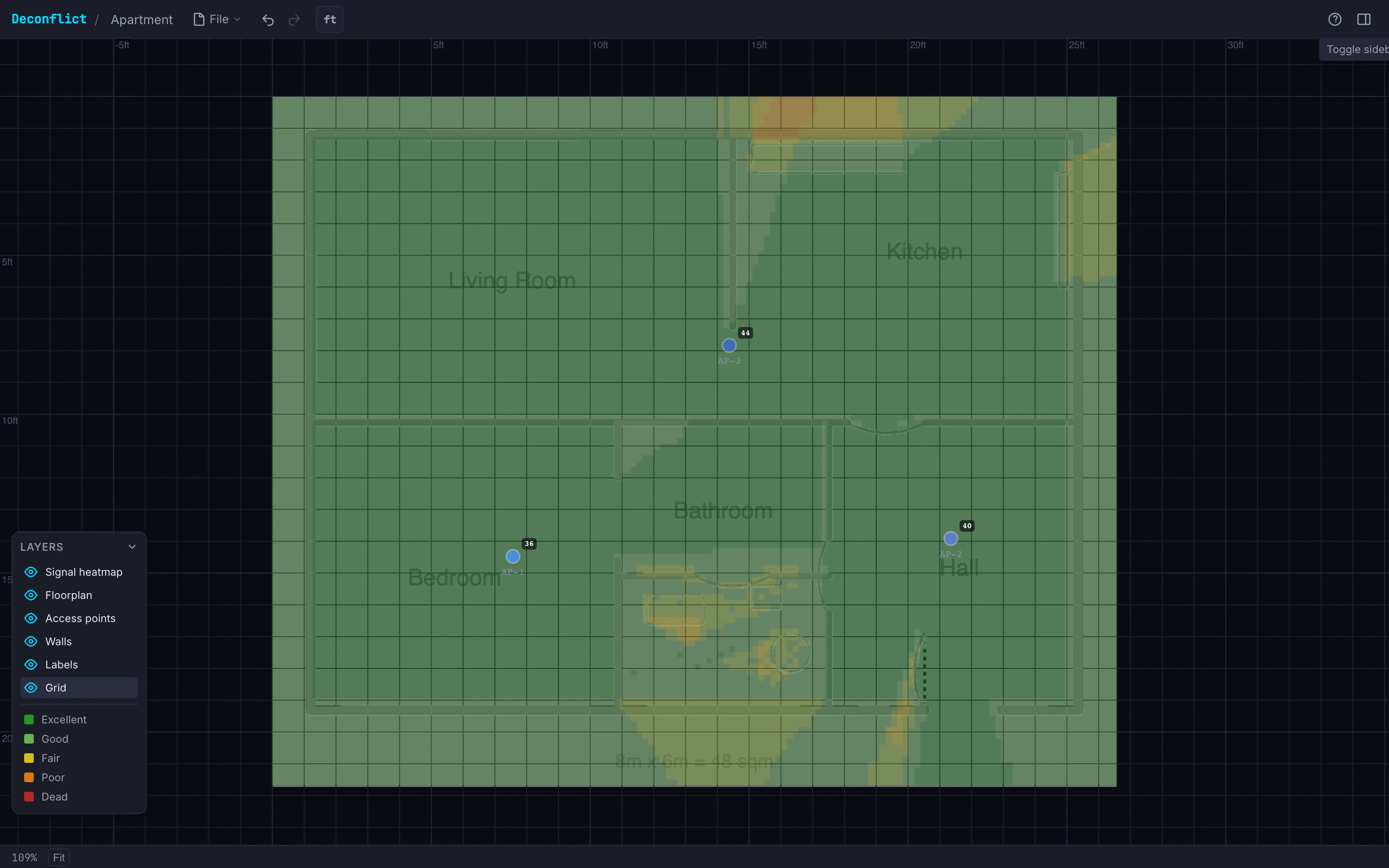
Free, open-source WiFi planner that runs in your browser. Drop a floorplan, place access points from 100+ real models, and see signal coverage through walls in real time. Each wall material has realistic RF attenuation. Glass, brick, concrete all behave differently. Channels are assigned automatically, and a 3-stage optimizer finds ideal AP placement. No account, no install, no subscription.

Really nice idea, especially the real-time interference visualization. How do you handle more complex layouts like multi-floor homes or offices?

1
回复

@uxpinjack Thanks! Right now it's single-floor only. Each floor would be a separate project. Multi-floor support where you can model inter-floor attenuation (signal bleeding through ceilings) is on the roadmap. The signal model already handles per-material dB loss, so adding a floor/ceiling material type is the natural extension.

0
回复
I kept running into co-channel interference in my apartment and wanted to figure out the best channel assignments without paying for Ekahau. I looked around and everything was either expensive enterprise software or too basic to be useful. So I built Deconflict. It started as a graph coloring solver for channel assignment, but once I could see the interference graph I wanted to see the actual signal coverage too. That led to wall detection from floorplan images, then per-material RF attenuation (glass vs brick vs concrete), then an AP placement optimizer. The hardest part was making the heatmap feel right. Real indoor signal propagation is messy. I went through several iterations of the signal model before landing on one that looks physically plausible and runs fast enough to update as you drag APs around. The wall material system made the biggest difference. Seeing your signal actually degrade through a concrete wall differently than a glass door makes the tool genuinely useful for planning. It's completely free and open source. Everything runs in the browser, nothing hits a server. I use it for my own network and figured others might find it useful too.
0
回复

This is actually really slick.

I’ve run a decent number of site surveys, and having something lightweight like this in the browser is a big win compared to traditional tools.

How accurate have you found the attenuation modeling across different materials?

0
回复

@tezdevs Thanks. The dB values are from IEEE and ITU indoor propagation references. Drywall at 3 dB, glass at 2 dB, brick at 8 dB, concrete at 12 dB, metal at 20 dB. These are per-wall-crossing values, so a ray that passes through two concrete walls sees 24 dB of loss.

In practice it gets you in the right ballpark for planning. The signal model uses an inverse quartic path loss (n=4) which is typical for furnished indoor spaces. Combined with the per-material wall losses, the heatmap matches what you'd see on a real site survey reasonably well.

Where it falls short is multipath, furniture, and ceiling height. It's a 2D ray model, not a full 3D propagation simulation. But for "where should I put my APs and which walls are killing my signal," it does the job without hauling out a spectrum analyzer.

0
回复

Congrats on the launch! The product concept looks solid.

Quick performance alert: I just ran a real-device test from Beijing, and the landing page takes 30s+ to become interactive. It seems like a major bottleneck with the API or font loading in this region.

I’ve got the full recording with console logs ready. Would you like me to send you the link to help your team debug?

0
回复

Going to test it! Looks great!

0
回复

@antoninkus Thanks, let me know how it goes!

0
回复

Ok this is one of those tools I didn't know I needed until now. The realistic wall material attenuation is what makes this actually useful vs just guessing where to put access points. Does the 3-stage optimizer account for expected device density? Like a conference room with 20 people on video calls vs a hallway nobody sits in?

0
回复

@yotam_dahan Thanks! The optimizer currently maximizes signal coverage across the building interior. It treats every point equally and doesn't account for device density or expected load per zone yet.

That's a great feature idea though. The throughput model already estimates per-AP Mbps based on co-channel contention, so weighting zones by expected client count is a natural next step. Would let you bias coverage toward the conference room and away from the hallway.

Adding it to the roadmap.

1
回复

Really handy!! Have users discovered any issues in their setup that they wouldn’t have noticed otherwise??

0
回复

@lak7 Yeah, the most common one is co-channel interference. People put two APs on the same channel without realizing their coverage areas overlap. The solver catches that immediately and assigns non-conflicting channels.

The other big one is walls people underestimate. A single concrete wall can cut your signal by 12 dB, which is roughly a 75% reduction in throughput. The heatmap makes that obvious in a way that "my WiFi is slow in the bedroom" never does.

0
回复

I have this robo vacuum at my home and I also really don't understand why in some areas it doesn't get the Wi-Fi access. Having this loaded onto the system would really help me plan out those and also how to position my Wi-Fi. Having it open source is ready to add on. Thank you for this, Sean

0
回复

@nayan_surya98 That's a great use case. IoT devices like robot vacuums are usually on 2.4 GHz with weak antennas, so they're the first to drop out in dead zones. If you draw your floorplan and place your router, the heatmap will show you exactly where the signal dies and whether it's a wall or just distance. Hope it helps!

0
回复
#10
SigmaMind MCP
Build and control voice AI agents via MCP
107
一句话介绍:一款将完整语音AI技术栈(如智能体、通话、号码等)封装为MCP协议工具的服务器,让开发者能在IDE内通过自然语言指令快速构建、测试和部署低延迟语音AI助手,解决了开发者在不同平台间频繁切换、配置流程繁琐的核心痛点。
API Developer Tools Artificial Intelligence
语音AI开发平台 MCP协议集成 开发者工具 AI智能体编排 低延迟语音 代码环境集成 自然语言配置 生产级基础设施 电话系统集成 工作流优化
用户评论摘要:用户肯定其简化语音AI“布线”复杂度的价值,认为是从“基础设施”转向“可访问性”的关键。主要疑问集中于:长期定位是停留在MCP协议层,还是转向更结果导向的产品;在并行工具调用时,如何保障可观测性和调试;与自行集成开源方案的核心差异(在于生产级的稳定性和规模化能力)。
AI 锐评

SigmaMind MCP 表面上是一个将语音AI功能引入IDE的MCP服务器,但其真正的颠覆性在于对“开发范式”的改造。它没有选择在模型能力或语音质量上做增量优化,而是精准地切入了AI工程化中最隐秘的痛点——上下文切换与系统集成损耗。开发者不再需要为配置一个语音智能体而在仪表盘、API文档和代码编辑器之间疲于奔命,这本质上是通过协议层将“基础设施”彻底“接口化”。

然而,其当前的定位存在一个显著的张力。产品名和宣传紧扣“MCP”这一技术协议,这固然能吸引早期开发者与技术决策者,但也可能将其禁锢在“为技术而技术”的工具范畴。正如评论所指,当并行工具调用成为常态,复杂的生产调试和观测需求会迅速浮出水面,这远非一个简洁的提示词所能解决。产品的下一阶段挑战,将从“如何便捷地创建”转向“如何可靠地观测、管理和优化”这些分布式的语音智能体。

它的核心价值并非仅仅是“sub-800ms延迟”或“噪声消除”,而是通过深度集成工作流,将语音AI从需要专门运维的“系统级项目”,降维成开发者可在编码流中随时调用的“功能模块”。如果它能成功跨越从“惊艳的演示”到“坚如磐石的工程平台”这道鸿沟,并平衡好底层协议透明性与上层业务成果可见性,它有望定义下一代语音AI应用的开发标准。否则,它可能只是技术栈中又一个精美的“桥接器”。

查看原始信息
SigmaMind MCP
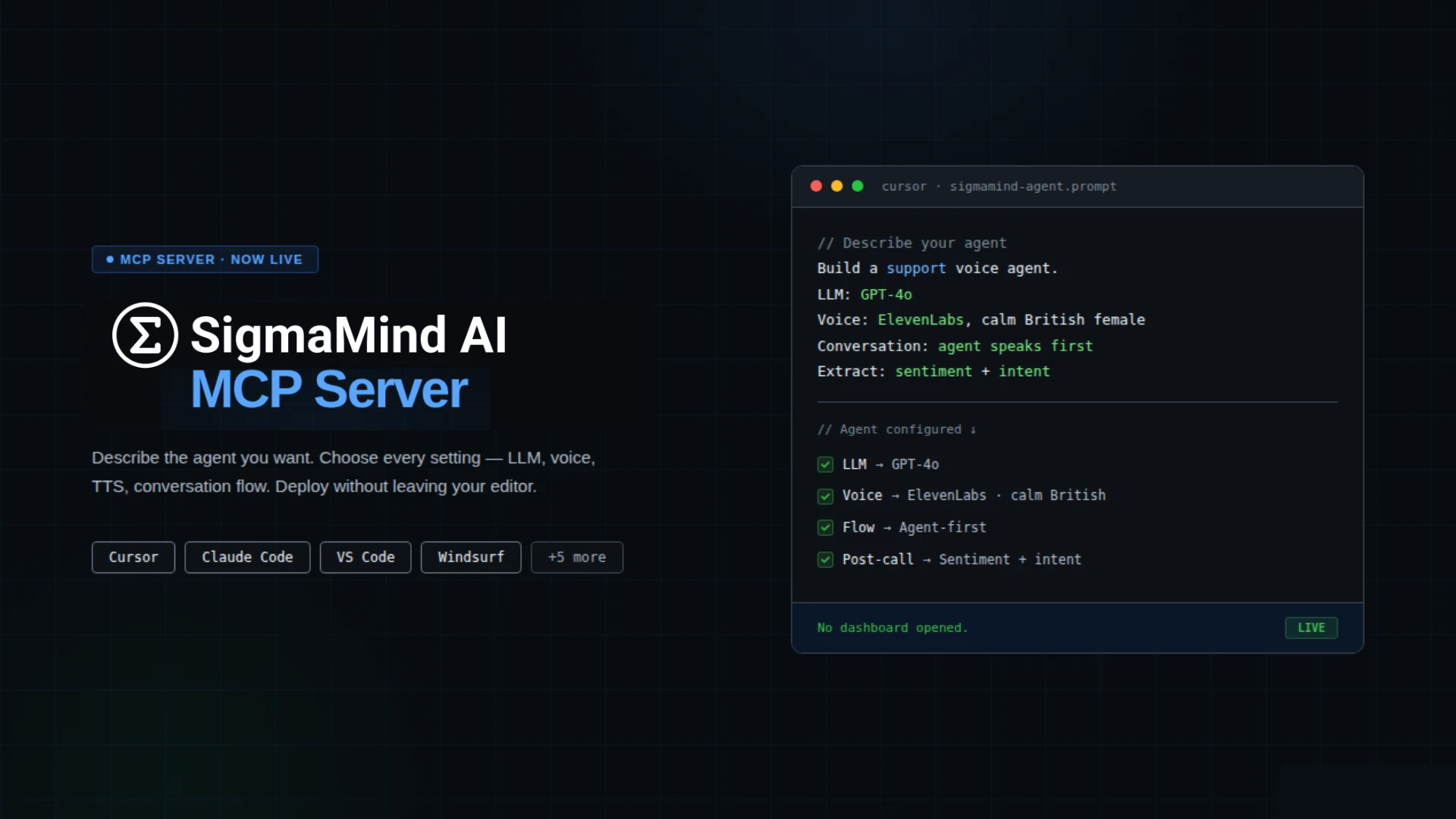
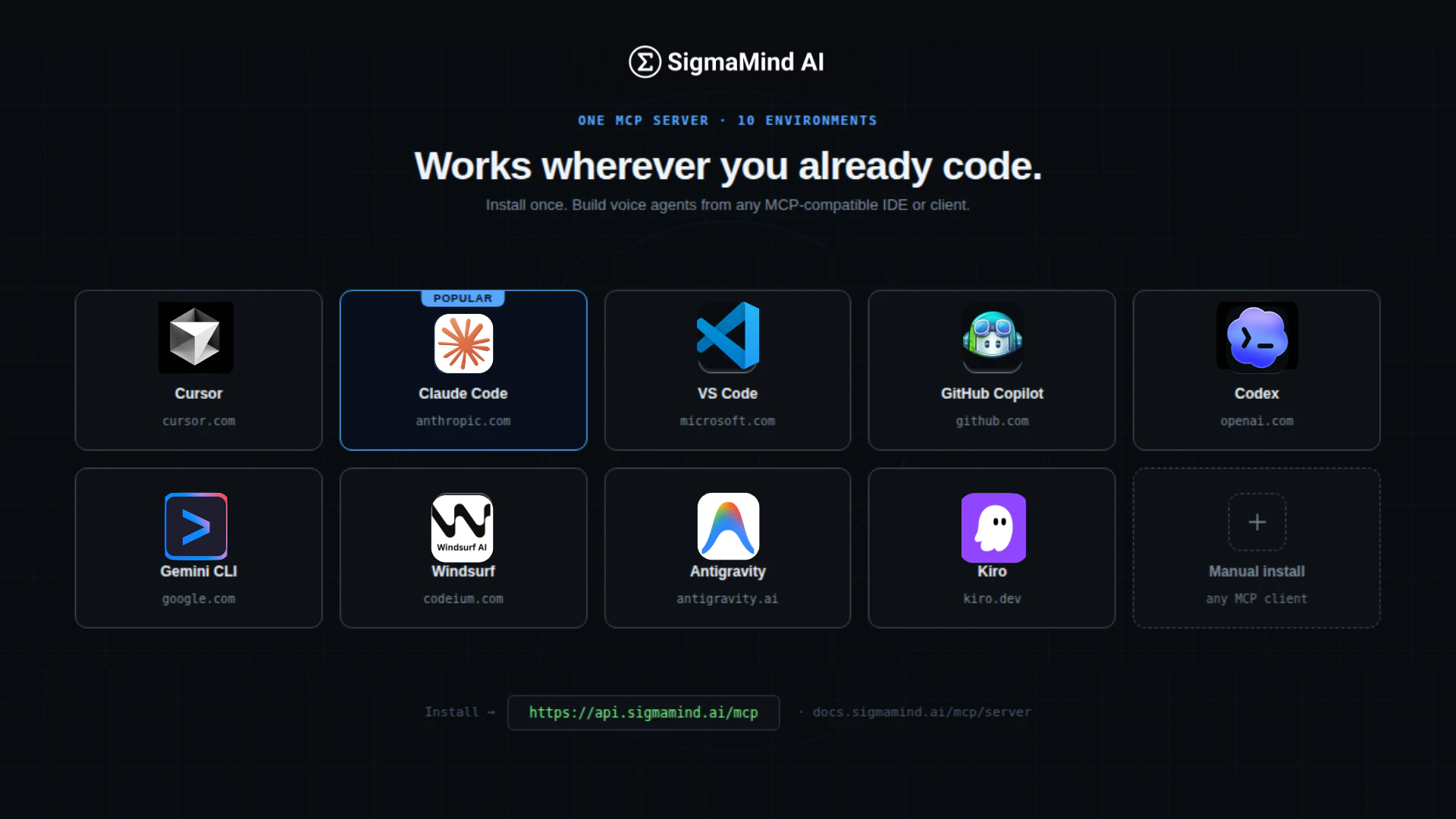
SigmaMind's MCP server exposes your entire voice AI stack as tools – agents, calls, campaigns, webhooks, phone numbers – manageable directly from your MCP client or IDE. Spin up agents, trigger test calls, debug with inline call records, and automate deployments without leaving your editor. Sub-800ms latency, SOTA noise cancellation, VAD, IVR navigation, and voicemail detection handled out of the box.

Hey 👋
We’re Ashish and Pratik, founders of SigmaMind AI.

After watching developers jump between dashboards, docs tabs, and their IDE just to configure a single voice agent - we knew the problem wasn't the technology. It was the workflow.

So we built SigmaMind MCP server.

Open Cursor, Claude Code, or VS Code. Type what you want:

"Build a customer support voice agent. GPT-4o. ElevenLabs, calm British female. Agent speaks first. Extract sentiment and escalation flags after every call."

That exact spec deploys. No dashboard opened. No context switching.

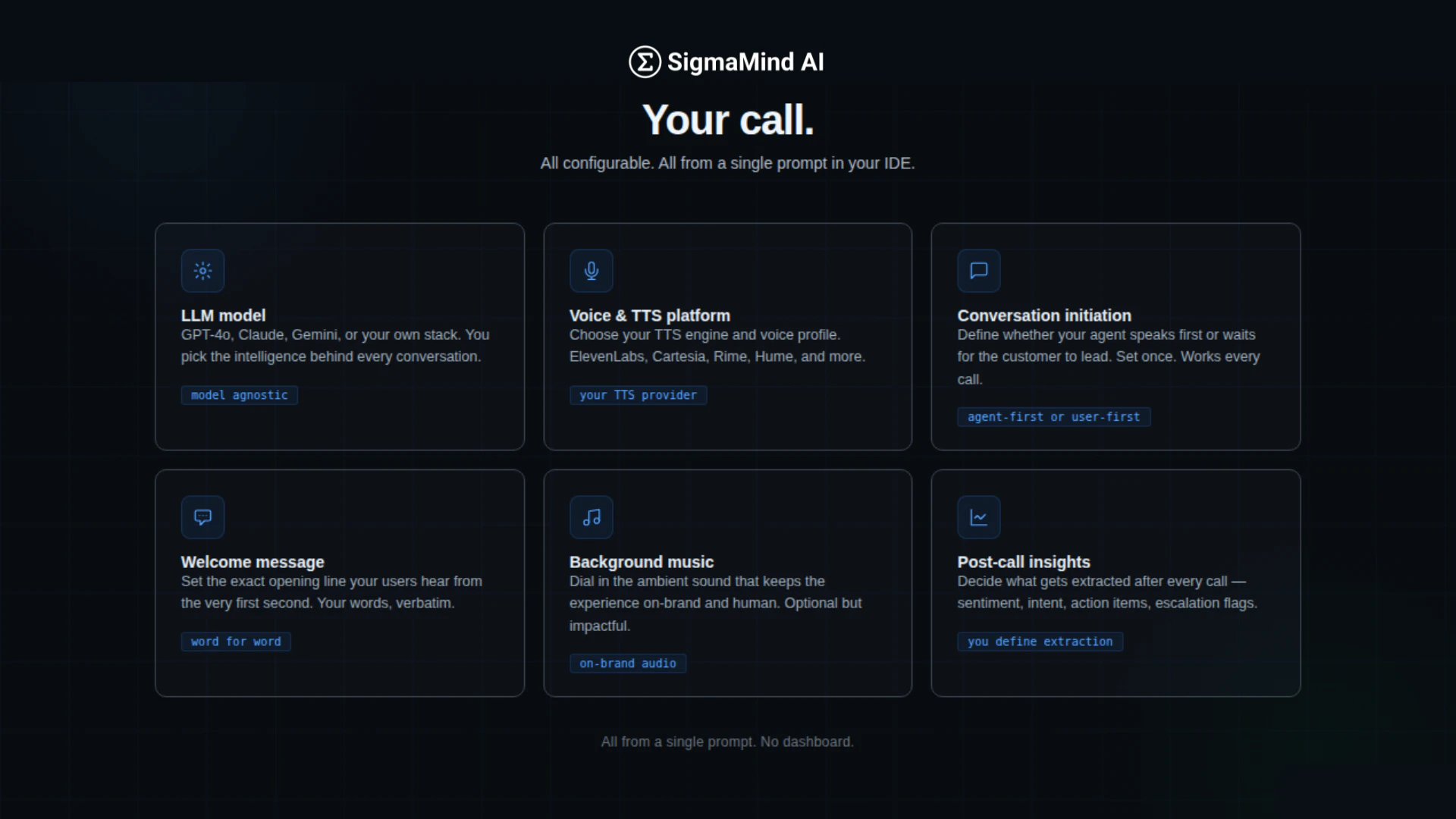
Here's what you're actually controlling from that one prompt:
→ LLM Model - GPT-4o, Claude, Gemini, or your own
→ Voice & TTS - pick the exact voice experience
→ Conversation Flow - who speaks first, how it behaves
→ Welcome Message - define the opening line
→ Background Audio - optional, on-brand
→ Post-Call Insights - sentiment, intent, escalation

Every layer configurable. All from natural language.

And telephony is built in - buy numbers or bring your own, assign to agents instantly, run real calls not simulations.

Under the hood:
→ Sub-800ms latency
→ IVR and phone trees navigation
→ Built-in VAD (Voice activity detection)
→ Noise cancellation for noisy background environments
→ Model-agnostic (Deepgram, GPT, ElevenLabs, or your own stack)
→ Multimodal (voice, chat, email - one agent brain)
→ Parallel tool calling for real-world actions

Set up in under 5 minutes: https://docs.sigmamind.ai/mcp/se...

4
回复

@pratikmundra This feels less like an “agent platform” and more like an orchestration layer for distributed execution. Curious how you're handling observability across parallel tool calls—once multiple agents + MCP tools start running concurrently, debugging and tracing becomes the real challenge.

0
回复

@pratikmundra Really clean execution — especially collapsing the entire voice stack into a single prompt inside the IDE. That’s a big unlock.

One thing I’m curious about: right now the product feels like “infrastructure made accessible”, but the naming (SigmaMind MCP) leans heavily into the protocol layer.

Do you see it staying positioned around MCP long-term, or evolving into something more outcome-driven as adoption grows beyond dev-heavy users?

0
回复

i can direct claude code to an existing open source github repo and build voice agent for me with VAD / sub 800ms latency etc ? I understand this may consume more tokens. How is this MCP diff ?

2
回复

@raj_peko with this MCP you get access to SigmaMind's voice infrastructure which handles - VAD, noise cancellation, latency, IVR navigation etc. out of the box. You can absolutely use open source repos to build voice agents, but with voice matters, it's the 'wiring' that matters a lot. When you scale it up to over millions of calls, most of them being highly concurrent calls, this may present issues. This MCP just provides a ready-to-deploy voice infrastructure as opposed to developers needing to wire everything together.

0
回复

MCP for voice agents makes sense. wiring voice into an agent stack always gets messy - nice that this abstracts it.

2
回复

@mykola_kondratiuk1 Exactly — feels like most of the value here is removing that wiring complexity.

Which is why it’s interesting how much of the current branding still leans into the technical layer rather than the outcome it enables.

1
回复

This is so cool. Running a VOICE AI company this is really good stuff. Congrats on the launch

1
回复

@ansh_deb thanks for the support!

0
回复

So proud of the team for getting the SigmaMind MCP Server live today!

I’ve seen how much effort went into making sure this wasn't just another 'cool tool' but a production-grade orchestration layer.

My favorite part? Being able to create and manage a Voice AI agent, all from a simple prompt, without leaving Cursor. It feels like magic every time.

We’re all hanging out here today to answer questions and get your feedback.

1
回复
#11
Open Comet
The autonomous AI browser agent for deep research & tasks
104
一句话介绍:Open Comet是一款运行在浏览器侧边栏的自主AI智能体,能在用户真实登录的网页环境中自动执行多步骤研究与任务,解决了用户在深度信息搜集和重复性网页操作中需频繁切换、手动操作的效率痛点。
Chrome Extensions Productivity Task Management GitHub
AI浏览器智能体 自主网页操作 本地化隐私 浏览器扩展 多步骤工作流 人机协同 网页自动化 零数据架构 深度研究工具 企业级推理
用户评论摘要:用户普遍赞赏其本地存储的隐私设计,并重点关注其实际能力边界:能否在已登录网站(如LinkedIn)执行操作、如何处理高风险动作、应对会话持久性与反爬机制的稳定性,以及信息来源的交叉验证能力。开发者回复确认了人机协同机制及当前局限性。
AI 锐评

Open Comet的野心在于将“智能体”从聊天框的囚笼中解放,植入真实的浏览器环境。其宣称的“高保真”与“零数据架构”直击当前AI助手的两大软肋:操作环境的隔阂与数据隐私的黑箱。产品价值并非在于其全知全能,而在于它选择了一条务实的路径——不试图重建浏览器或破解反爬,而是依附于用户现有会话,以“人在回路”的方式实现可控自动化。这本质上是将智能体降格为“超级宏”,虽在自主性上做了妥协,却在实用性与安全性上找到了一个现阶段更可能落地的平衡点。

然而,其面临的挑战与所有浏览器自动化工具同源:动态网页的不可预测性、反自动化机制的不断升级,以及多步骤任务中的状态漂移问题。评论中关于“源可靠性验证”和“STORM研究循环”的质疑,恰恰暴露了其从“自动化脚本”迈向“可信研究助手”之间的巨大鸿沟。当前版本更像是一个概念验证,证明了侧边栏智能体的可行性,但其真正的“企业级推理”能力,仍有待于在复杂、长链条的真实业务场景中得到严酷检验。它的出现,标志着AI应用正从“问答”走向“操作”,但距离真正的“自主”,还有一片名为“可靠性”的荒野需要穿越。

查看原始信息
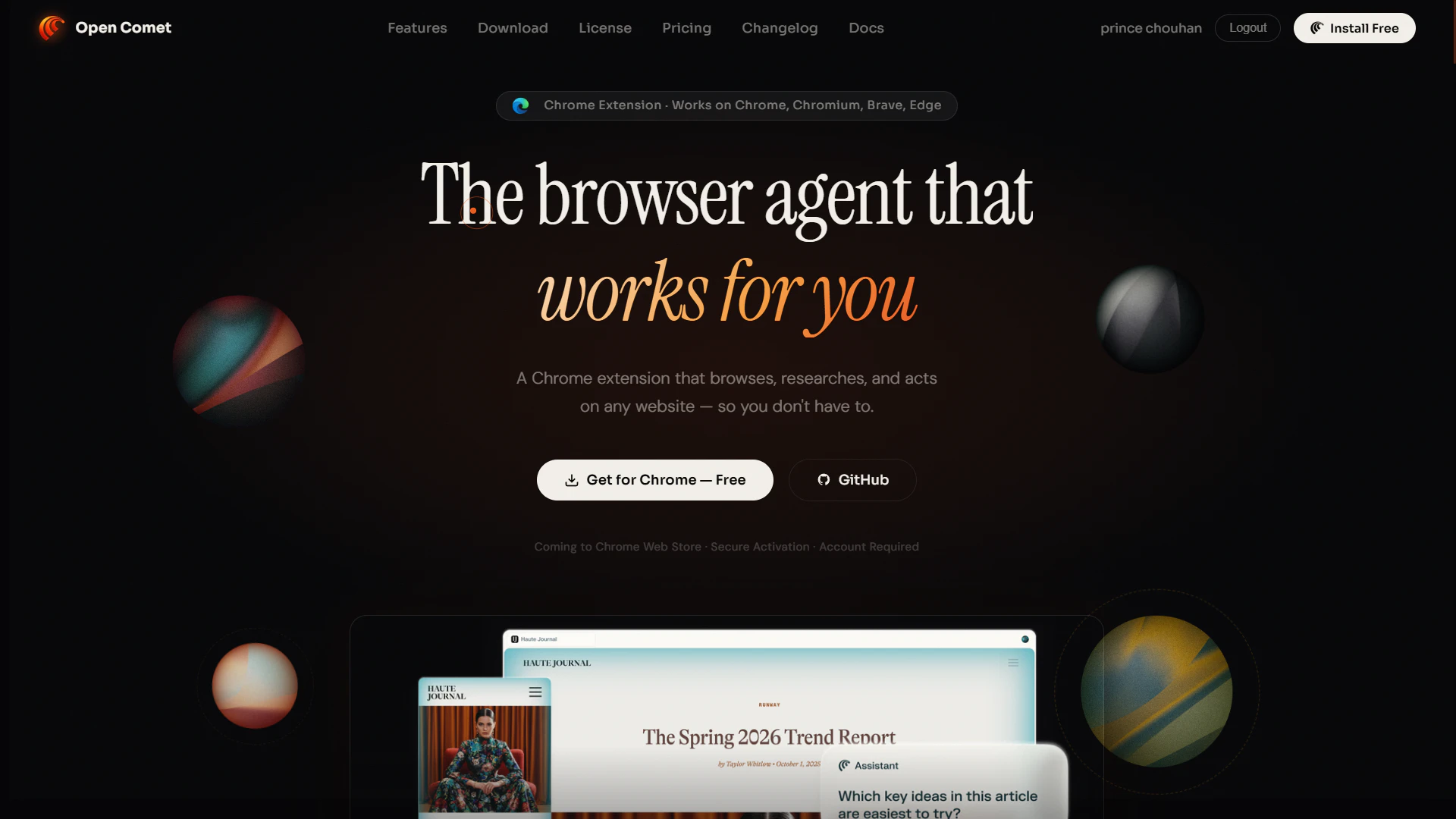
Open Comet
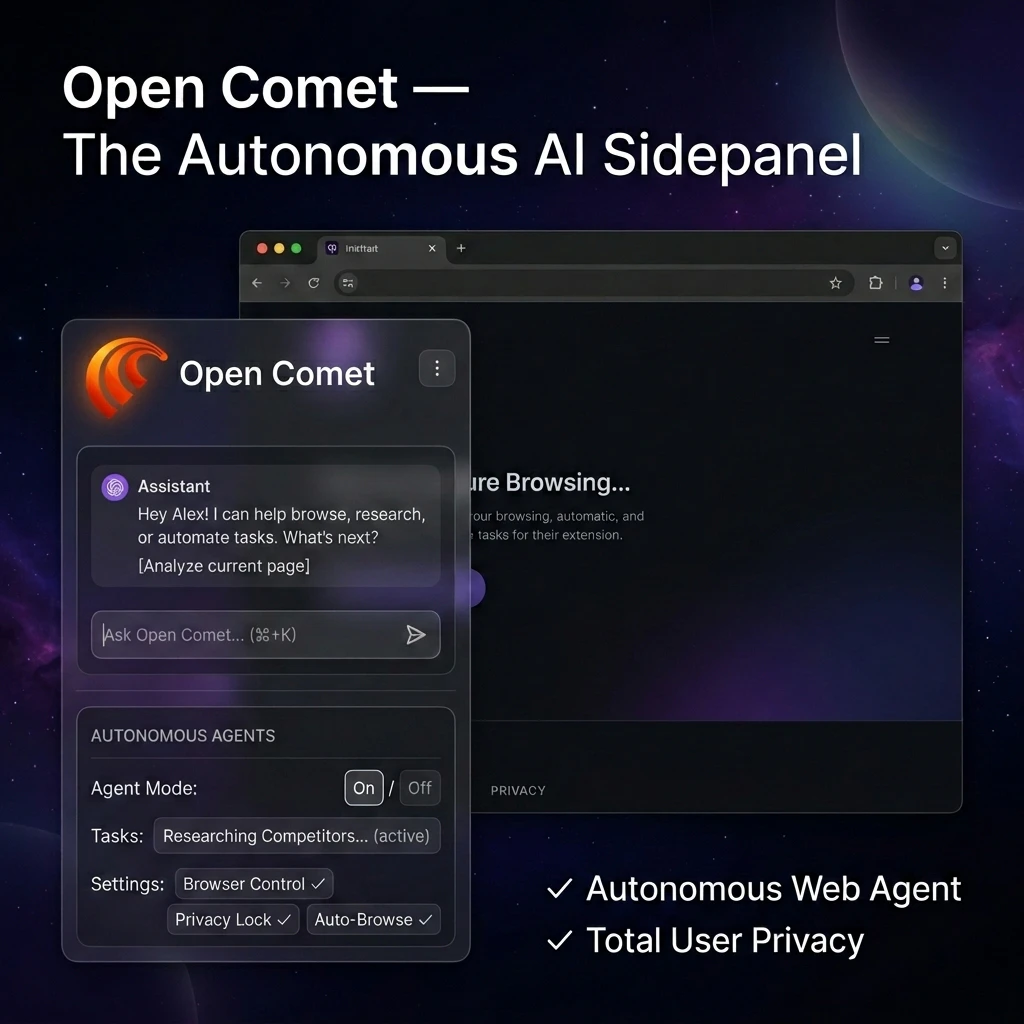
Open Comet is a high-fidelity AI agent that lives in your browser’s sidepanel. Unlike basic assistants, it autonomously browses, researches, and executes multi-step workflows across any website. Built on a "Zero-Data" architecture, it keeps your history local while providing enterprise-grade reasoning. Features include high-fidelity execution guards, STORM-inspired research loops, and full support for both Cloud (BYOK) and Local (Ollama) models.

Hi Product Hunt! 👋 I’m Prince, the creator of Open Comet.

Most AI agents today feel 'trapped' behind a chat box, forcing you to copy-paste data back and forth. I built Open Comet to bridge that gap—an agent that actually lives where you work.

My goal was to combine the power of autonomous research with a strict privacy-first architecture. Whether you're a researcher needing deep link exploration or a developer automating repetitive web tasks, Open Comet is designed to stay out of your data and in your flow.

Excited to hear your feedback and answer any questions!

2
回复

@princechouhan06 This is basically bringing a distributed “execution + research layer” into the browser. Curious how you handle state drift across multi-step workflows—once the agent branches across tabs + async pages, consistency becomes the real bottleneck, not reasoning.

0
回复

Lovely! Can this browse my logged in pages like linkedin ? And take actions on my behalf. Some UX flows especially linkedin is sub-optimal and this can help save me lot time. Thanks.

1
回复

@raj_peko Great question, Rajesh 👍

Yes — Open Comet is designed to work on real, logged-in pages (like LinkedIn) and can assist with actions on your behalf.

However, there are a couple of important points:

  • It can interact with UI elements (clicking, typing, navigating flows) within your active browser session

  • Since you’re already logged in, it operates within your session context

  • For sensitive or high-impact actions, it follows a human-in-the-loop approach (asks for confirmation before executing)

So for cases like LinkedIn workflows (posting, navigating profiles, repetitive actions), it can definitely help reduce friction and save time—especially where UX feels sub-optimal.

That said, some flows may vary depending on site restrictions and dynamic UI behavior, but improving reliability across such platforms is an ongoing focus.

Would love to hear your experience once you try it 🙌

1
回复

love that you went with local history storage. too many AI tools are black boxes with your data. curious about the STORM research loops - does it actually follow citation trails and cross-reference sources, or is it more like iterative searching?

1
回复

@piotreksedzik Appreciate that, Piotr 🙌

Great question — the current implementation is closer to iterative research loops rather than a full academic-style citation graph like STORM.

It can:

  • Perform multi-step searches

  • Refine queries based on previous results

  • Aggregate and summarize findings across steps

Cross-referencing does happen to an extent (by comparing results across iterations), but it’s not yet doing deep citation trail tracking or source graph traversal in a strict sense.

That said, moving toward more structured source tracking and citation-aware reasoning is definitely something I’m exploring for future versions.

Would love to hear your thoughts once you try it 👍

0
回复

Is this availabe on Linux ?

1
回复

@vynkx_ Open Comet works on Linux, as it runs in Chromium-based browsers like Chrome, Brave, and Edge, all natively supported on Linux distributions.

0
回复

@vynkx_ Hey Vinayak! Yes, Open Comet works on Linux — it's a Chrome extension, so it runs anywhere Chrome does.

v1.1 just went open source (April 2026), so if you hit any edge cases with the new Skills system or Deep Research features on your specific distro, you can debug it directly or file an issue. We've tested on Ubuntu 22.04; other distros should work but let us know if they don't!

0
回复

Autonomous AI research agents are where things are headed for anyone doing serious market analysis. I built PolyMind (https://polyminds.netlify.app/) to track large trades on prediction markets using AI-powered alerts, and the hardest part was always the research layer — synthesizing signals from dozens of sources into actionable insight. An autonomous browser agent that can handle deep research tasks across the web would be a game-changer for financial due diligence workflows. How does Open Comet handle source reliability and conflicting information across pages?

0
回复

every autonomous browser agent I've tried hits the same wall eventually - persistent auth sessions and bot detection. curious where this one breaks.

0
回复

That’s a very real observation, Mykola—completely agree 👍

Persistent auth sessions and bot detection are definitely the hard boundary for most browser agents, and Open Comet isn’t magically bypassing those.

Right now, it works within your existing browser session, so it leverages your active login state rather than trying to handle auth itself. That avoids a lot of friction, but:

  • It doesn’t try to bypass bot detection systems

  • Performance can vary on platforms with aggressive anti-automation measures

  • Some flows may break when sites heavily rely on dynamic tokens or strict interaction patterns

So the current approach is more about assisted interaction within real user context, not full autonomous control across all sites.

Long term, I’m exploring ways to make it more robust around session handling and reliability, but staying within safe and compliant boundaries is important here.

Would be really interested to hear where it breaks for you if you try it—that feedback is gold 🙌

0
回复

Tried a few browser agents before and the scariest moment is always when it hovers over a "Submit Order" button. Does this one ask before doing something irreversible or do you just trust it and hope?

0
回复

@dklymentiev That’s a very real concern, Dmytro 😄 totally get that “hover over submit” moment.

Open Comet is designed to not blindly execute irreversible actions. It follows a human-in-the-loop approach, where:

  • It asks for confirmation before any high-impact or irreversible action (like submissions, payments, etc.)

  • You can see what it’s about to do before it happens

  • All actions are transparent and trackable, not hidden

So the idea is—you’re always in control, and the agent assists rather than takes risky decisions on its own.

Building that trust layer is a big priority, especially for real-world use cases 👍

1
回复

really appreciate the zero-data architecture and local history storage. most ai tools are just black boxes with your data so keeping it in the browser is a big plus for privacy. definitely going to give the chrome extension a spin today

0
回复

@yp_pro Really appreciate that, Yaroslav 🙌

Privacy was a core focus while building Open Comet — keeping things local-first and transparent instead of a black-box approach.

Glad that resonated with you. Would love to hear your thoughts after you try the extension 👍

1
回复

Does this work only on Perplexity's Comet browser? Is there an affiliation with them as Open Comet's branding, name and logo is almost 100% on par with Perplexity's - most specifically, their Comet product.

0
回复

@jacklyn_i Hey Jacklyn, great question—totally fair to ask 👍

No, Open Comet does not work only on Perplexity’s Comet browser, and there’s no affiliation with them.

Tools like Perplexity’s Comet and OpenAI’s Atlas are actually separate AI browsers built from scratch with AI deeply integrated into them. Open Comet takes a different approach—it’s designed to work inside your existing browser (via extension), so there’s no need to switch browsers.

Regarding the naming/branding—yes, it’s inspired by the same emerging category of AI browser agents, but Open Comet is an independent project focused on being more open, flexible, and privacy-first.

Also, one key difference is the approach to data: many AI browsers process and interact with user data at a deeper level to enable automation, whereas Open Comet is designed with a local-first mindset (no data storage/access).

Happy to clarify anything else if you’re curious 🙌

0
回复

autonomous is doing a lot of work here - the distinction that matters for real adoption is whether it blocks before acting or just does things and logs it.

0
回复

@mykola_kondratiuk That’s a very fair point, Mykola—completely agree 👍

Right now, Open Comet is designed with a controlled autonomy approach. It doesn’t just execute actions blindly—instead, it pauses for confirmation on sensitive or high-impact actions, while allowing smoother flow for low-risk steps.

So it’s more of a human-in-the-loop system rather than fully autonomous execution. Everything is also transparent and logged, so you can see what it’s doing at each step.

I think this balance is important for real-world adoption—full autonomy without control can break trust pretty quickly.

Would be great to hear your take after you try it 🙌

0
回复
#12
Legitify
Compliant cross-border notarization, reimagined.
97
一句话介绍:Legitify 提供完全数字化的合规跨境公证与海牙认证流程,为企业和个人解决了因传统纸质、线下、跨国界公证手续带来的耗时、高成本与进度阻滞的核心痛点。
Productivity Legal Artificial Intelligence
跨境公证 数字公证 远程身份验证 电子签名 海牙认证 法律科技 合规工作流 跨境业务 效率工具
用户评论摘要:用户反馈肯定了产品在德国等数字化进程缓慢地区的价值。创始人详细阐述了产品愿景与功能。主要问题集中于支持国家范围、如何同步当地政策变化,官方回复解释了其基于欧盟/英国公证网络与《海牙公约》的合规模式。
AI 锐评

Legitify 瞄准的并非一个新鲜概念——远程在线公证(RON),但其真正的锋芒在于“跨境”与“合规”的交叉点。它本质上是一个精心构建的合规层与连接器:上游整合欧盟、英国等地已获法律许可的公证人网络,下游利用《海牙认证公约》构建跨境效力,将自身塑造成一个标准化的数字中间件。

产品价值不在于技术突破(身份验证、电子签名已属成熟),而在于对复杂法律地缘版图的解构与重组。它解决的痛点是“不确定性”:将传统流程中“寻找合规路径”的隐性成本(研究当地法律、寻找可靠公证人、协调物流)转化为确定性的数字服务。其宣称的50+司法管辖区有效性,正是这种“合规即服务”能力的体现。

然而,其最大的挑战与护城河也在于此。合规是动态的,各国对远程公证的态度和政策处于演变中。产品的扩张速度将严重受限于与各地监管的磨合及公证网络的拓展能力。评论中关于政策同步的质疑直指核心。此外,在非海牙公约成员国或对远程公证持保守态度的关键市场(评论中德国用户的期盼反衬出现实阻力),其效力可能受限,这或许是其当前聚焦欧盟与英国的原因。

总体而言,Legitify是全球化数字浪潮与本地化法律传统之间矛盾的一个优雅解决方案。它并非颠覆法律,而是优化法律的“接口”。其成功与否,不取决于技术流量,而取决于其法律网络扩张的深度与广度,以及在快速变化的监管环境中维持合规稳定的运营能力。它为企业提供的,是让“公证”这个传统摩擦点,从一项需要专门管理的合规项目,退隐为一项可按需调用的基础服务。

查看原始信息
Legitify
Compliant cross-border notarization workflows, fully digital. Legitify takes the entire process: identity verification, document signing, and final certification - and makes it remote, legally valid, and borderless across 50+ jurisdictions. What used to take days of office visits, separate queues, couriers, and paperwork now takes minutes. Built for businesses and individuals who can't afford borders, delays, or errors getting in the way of progress.

I'm in Germany right now and this is such an issue here. Really hopeful that we can continue to digitize the bottom of the iceberg!

4
回复

@vincent_weir3 Yes! We need smarter digital policies that allow remote and electronic notarization

in Germany and no in person requirements! We see a lot of customers use Legitify to execute POAs online for Germany.

0
回复
@vincent_weir3 Hopeful Germany will eventually choose digital policies over bureaucratic ones! We are already handling many PoA executions for Germany via Legitify!
2
回复

Hey Product Hunt 👋 I’m Aida, founder & CEO of Legitify.

Somewhere in the world, a deal is stuck right now…because someone is waiting on a stamp. A physical stamp. In 2026. Notarization and apostille are still shockingly manual - print it, sign it, scan it, find an office, wait days, repeat. It’s slow, expensive, and weirdly offline for something that blocks global business.

So we fixed it.

👉 Notarization + apostille, fully remote
👉 EU & UK notary infrastructure
👉 Valid across 50+ jurisdictions
👉 From request to certified docs in minutes/hours
👉 No unnecessary travel. No printers. No appointments. No “please come back tomorrow.”

If you work in legal, compliance, ops or anything cross-border, you already know: this stuff quietly kills momentum. We built Legitify so “waiting on notarization” stops being a sentence.

Already used by teams at leading enterprises and - and scaling fast 🚀

Hot take: paperwork shouldn’t be harder than the deal it enables.

I am here - AMA 🙌

Especially interested in the most ridiculous cross-border bottlenecks you’ve seen 👇

1
回复

Nice initiative? Which countries do you support ? How do you keep yourself in sync with local policy changes ?

0
回复

@raj_pekoHi Rajesh, we currently have a notary network based in the EU and UK, with additional jurisdictions being added soon. By leveraging our network alongside the Apostille Convention, we're already able to serve customers across 50+ jurisdictions worldwide. We take compliance seriously, we only onboard notaries in jurisdictions where remote online notarization (RON) or electronic notarization has been formally approved, ensuring every document we handle meets the highest legal standards. Please don't hesitate to reach out if you have any questions about coverage in a specific jurisdiction.

0
回复
#13
SuperHQ
Run AI coding agents in real microVM sandboxes
92
一句话介绍:SuperHQ通过在隔离的微型虚拟机中运行AI编程助手,解决了开发者在本地使用多AI代理时代码安全与系统隔离的核心痛点。
Productivity Developer Tools Artificial Intelligence GitHub
AI编程助手 代码安全 沙箱隔离 微虚拟机 开发工具 代理编排 本地部署 密钥管理
用户评论摘要:用户肯定其将隔离作为系统设计核心的突破性思路,并询问多代理状态同步与差异合并的技术细节。开发者确认当前仅支持macOS,Windows与Linux版本正在社区开发中。
AI 锐评

SuperHQ看似是又一个AI编程工具,但其真正的锋芒在于对“信任”这一根本问题的工程化解构。在AI代理狂热追逐能力的当下,它冷静地将“隔离”从可选项提升为架构基石,这无异于一次范式纠偏。

其价值并非仅仅是“更安全地运行Claude或Codex”。其深层创新在于三重解耦:一是通过微虚拟机实现代理行为与宿主环境的物理隔离,二是通过临时文件系统覆盖层实现过程与结果的分离,三是通过本地认证网关实现密钥与执行环境的逻辑隔离。这构建了一个可审计、可回滚的AI协作框架,将黑箱操作转变为白箱工作流。

然而,其挑战同样鲜明。创始人提到的“多代理对同一仓库状态的收敛”问题,直指分布式版本控制与AI非确定性输出的本质矛盾。此外,从极客工具迈向大众平台,其面临的将是易用性、性能开销与跨平台一致性的经典三角难题。当前macOS优先的策略也揭示了其早期定位——服务于对安全有极致要求的高端开发者。

本质上,SuperHQ贩卖的不是效率,而是控制权。在AI时代,这或许是一种更为稀缺和高级的生产力。

查看原始信息
SuperHQ
SuperHQ orchestrates Claude Code, Codex, and Pi coding agents inside isolated microVMs, with a secure auth gateway that keeps your API keys out of the sandbox.
Hey everyone! I have been running multiple coding agents on my machine for a while and it always bugged me that none of them had real isolation. Most tools sandbox by cloning into git worktrees or just wrapping terminals. I built Shuru a few months ago (some of you might have seen it on HN) to solve the sandboxing part. SuperHQ is the app layer on top of it. Each agent gets its own microVM with a full Debian environment. You mount your projects in, writes go to a tmpfs overlay so your host is never touched. When the agent is done you get a unified diff view to accept or discard changes. Your API keys never enter the VM, they are swapped in on the wire by a local auth gateway. You can also use your ChatGPT subscription directly for Codex and Pi, no API keys needed. Would love to hear your feedback!
3
回复

@harshthedev This is the first “agent setup” I’ve seen that actually treats isolation as a first-class system design problem instead of an implementation detail. Curious how you’re thinking about state consistency + diff reconciliation when multiple VM agents converge on the same repo state.

0
回复

Harsh is first class shipper! This looks amazing!

1
回复

@pelaseyed Thanks a lot for the support :)

0
回复

Can you add this program to Windows, or is it basically the same for Mac OS?

1
回复

@alex_render Hi, the community is working on a Windows port, which will be released soon. But as of now, it is MacOS only. Linux support is also coming.

1
回复
#14
Vekta
AI training and coaching platform for endurance sports
92
一句话介绍:Vekta是一个将人类专业知识与AI相结合的平台,为耐力运动教练和运动员整合训练计划、分析与洞察,解决数据繁杂却难以转化为有效性能提升方案的痛点。
Health & Fitness Sports
AI训练平台 耐力运动 数据分析 教练辅助 职业体育 个性化训练 绩效管理 体育科技 SaaS
用户评论摘要:用户肯定其将数据转化为实际性能提升的价值,特别赞赏其构建教练与运动员共享模型的理念。核心建议是关注新用户的“顿悟时刻”设计,以推动在职业队伍之外的广泛采用。
AI 锐评

Vekta切入了一个精准且高价值的细分市场——职业与严肃业余耐力运动训练。其真正的颠覆性不在于简单的“AI+体育”概念,而在于试图重构训练系统中的核心生产关系:将教练的经验智慧与AI的数据处理能力置于一个共享的、动态的“性能模型”之中。这直击了当前运动科技领域的普遍软肋——数据烟囱与决策孤岛。产品标榜的超越FTP、采用临界功率模型等技术点,是服务于严肃运动员的性能“硬核”需求,是其专业性的护城河。

然而,其面临的挑战同样清晰。首先,从“为职业车队服务”到“为普通教练和运动员所用”之间存在巨大的产品与市场匹配鸿沟。职业场景有专职人员消化复杂数据,而大众市场需要极致的简洁与自动化。评论中提及的“新用户顿悟时刻”恰恰点中了这一命门:如何让非顶级用户在第一时间感知到价值,而非被复杂模型吓退?其次,其商业模式可能受限于耐力运动本身的小众市场天花板。虽然客单价高,但规模扩张需要将产品逻辑泛化到更广泛的健身或健康领域,这可能与其“专业性能”的定位产生冲突。最后,作为数据驱动平台,其长期价值取决于数据的闭环与模型的进化,这需要庞大的用户基数和持续的行为数据输入,在早期如何打破这个循环是关键。

总体而言,Vekta展现了一个专业、深度的产品方向,但它的成功将不取决于其技术或概念有多先进,而取决于其能否在保持专业深度的同时,完成从“职业装备”到“专业工具”的优雅降维,找到那个关键的、可规模化的用户体验支点。

查看原始信息
Vekta
The first platform where human expertise and AI work as one. Vekta connects planning, analysis, and insight into one integrated performance system, giving coaches and athletes a precise, evolving understanding of how they train, adapt, and perform.

Hey Product Hunt! I'm Paul-Antoine, co-founder of Vekta.

We're thrilled to share Vekta, an AI-powered training and coaching platform built to transform endurance sport.

Endurance sport has never been more data-rich. But data without the right system behind it just creates noise. Vekta connects planning, analysis, and insight into one integrated performance system so coaches and athletes can focus on what actually matters: performance.

What makes Vekta different?

  • Moving beyond FTP: Vekta goes beyond FTP with Critical Power and W' modelling, giving the most advanced and accurate measure of an athlete's current ability and true performance.

  • Built for athletes and coaches: Performance is a partnership. Vekta connects coach and athlete inside the same performance model, aligning planning, execution, and feedback in one shared environment.

  • Human expertise meets AI: AI surfaces patterns, detects change, and highlights what matters. Coaches and athletes apply judgment. Technology amplifies decision-making. It does not replace it.

  • Powering the pro peloton: Trusted by WorldTour teams including Lidl-Trek, FDJ United-SUEZ, and Decathlon CMA CGM. Chris Froome, 4x Tour de France winner, joined as Chief Innovation Officer.

  • Structure meets personalisation: Sessions, events, recovery data, and feedback in one coherent system. Build sessions in seconds. Every detail is connected to the bigger picture.

    Whether you're a dedicated athlete, a coach, or a WorldTour rider, Vekta gives you a precise, evolving understanding of how you train, adapt, and perform.

    We'd love your thoughts, questions, and feedback!

    Paul-Antoine Co-founder & CEO, Vekta

4
回复

@paulantoine_girard This is strong, especially the focus on turning all that data into something actually usable for performance.

Feels like the real difference is the shared model between coach and athlete, that alignment is where most tools probably fall short.

Curious what the first “aha” moment looks like for a new user, feels like that’s what will drive adoption beyond pro teams.

0
回复

Super cool idea! Love that this connects with my Oura ring. Was training for a half marathon last year and became obsessed with stats.

0
回复

@derek_curtis1 Thanks Derek!

0
回复
#15
deckpipe.dev
agent-first slide renderer
89
一句话介绍:deckpipe.dev 是一款“智能体优先”的幻灯片渲染引擎,它允许AI智能体通过JSON描述幻灯片内容并自动渲染成演示文稿,解决了在AI协作场景中快速、灵活生成结构化视觉材料的痛点。
Artificial Intelligence
AI智能体工具 幻灯片自动生成 MCP服务器 无头渲染引擎 开发者工具 JSON驱动 人机协作 开源生态 效率工具 内容编排
用户评论摘要:用户肯定其“将智能留给智能体”的极简设计哲学,认为能节省时间。主要反馈集中在样式控制力上,询问用户与智能体在结构和样式上的权限划分。创始人回应目前样式基础,强调与智能体协同迭代内容的工作流。
AI 锐评

deckpipe.dev 表面是一个幻灯片工具,实质是AI智能体时代的“标准化输出接口”。其真正价值不在于渲染能力本身,而在于通过定义一种极简的JSON协议,将幻灯片这种高度非结构化的创意产物,变成了AI智能体可理解、可操作、可生成的标准化数据对象。

这步棋看似简单,实则犀利。它精准地预判了未来AI工作流的痛点:当每个个体都拥有一个主智能体时,核心矛盾将从“如何让AI执行任务”转向“如何让AI与复杂的人类工具链对话”。市面上一众SaaS忙于在自家产品上“螺栓式”地集成AI功能,导致智能碎片化、上下文割裂。deckpipe反其道而行,主动做“笨”的、被动的渲染层,将所有的内容决策与逻辑推理权交还给中心化的智能体。这符合技术演进的底层逻辑——专业化分工。AI负责思考和结构化,专用工具负责高保真呈现。

然而,其挑战也同样明显。首先,其市场天花板与“智能体优先”范式的普及速度强绑定,目前仍属早期开发者需求。其次,将设计控制权过度让渡给AI,在当前AI审美与设计一致性尚不成熟的阶段,可能难以满足专业级演示需求,使其易被定位为“快速草稿工具”。它的成功,将不取决于自身功能多强大,而取决于它能否成为AI智能体世界中最流行、最通用的那款“幻灯片MCP服务器”,构建起生态护城河。这是一场关于标准与协议的豪赌。

查看原始信息
deckpipe.dev
deckpipe is an agent-first slide deck engine. your agent describes slides as json; deckpipe renders them. deckpipe also enables your agent to read and address comments. MCP server for any agent.
Hi Product Hunt community! I am constantly jamming with AI (in my case Claude) on various topics I am looking into. At some point I realized "wouldn't it be nice to now just ask it to make a deck about this?". I know Claude already supports making PPTX decks, but I wanted something that is open to any agent via MCP. I believe in the near future, every individual/team will have a main agent that will have lots of context and orchestrate all kinds of external tools and sub-agents. I made deckpipe intentionally dumb, so that all intelligence sits with whatever agent you are already using. I don't think it makes sense for all SaaS to rush and bolt-on AI to their products. Some things are better dumb. Would love to hear your feedback! –Björn
1
回复

@bjoern2000 Love this approach, letting the agent handle intelligence instead of bloating the tool makes a lot of sense. I’m going to try it with my current setup, could be a huge time-saver for quick presentations

0
回复

This is cool. Turning slides into a JSON-driven system is a fresh take. Curious how much control users have over styling vs the agent deciding structure.

1
回复
@uxpinjack Thank you! Styling is pretty basic are the moment: Accent color and 2 fonts. Idea is you work with your agent on content outline and structure and, then ask it to create the slides and then iterate.
0
回复
#16
GhostDesk
Your invisible AI co-pilot for interviews & meetings
89
一句话介绍:GhostDesk是一款完全隐身的桌面AI助手,在面试、高利害会议等高压场景中,为用户提供实时转录、AI答案和屏幕分析支持,同时规避监考和录屏软件的检测,解决用户因紧张遗忘或需要即时信息支援的痛点。
SaaS Developer Tools Artificial Intelligence
AI助手 实时转录 屏幕OCR 隐身模式 防检测 面试辅助 会议效率 高压场景 桌面应用 生产力工具
用户评论摘要:用户关注与竞品Cluely的对比,开发者回应在延迟、OCR、隐身模式和价格上有优势。用户询问技术实现细节(虚拟麦克风驱动或系统输出)。有评论建议品牌定位应从“隐身”转向“高压场景下的优势赋能”。
AI 锐评

GhostDesk 2.0精准切入了一个灰色但需求强烈的利基市场:在受监控或高压力环境中寻求不对称信息优势的用户。其核心价值并非简单的“AI副驾驶”,而是一个“数字护身符”,旨在缓解用户在关键场合下的表现焦虑与认知过载。

产品介绍的“隐身”特性是一把双刃剑。从技术角度看,针对专业监考工具的规避能力是其最犀利的卖点,也构成了短期壁垒。然而,这也将产品置于道德与合规的模糊地带,可能限制其主流化发展和长期品牌形象。评论中关于“定位优势而非隐身”的建议极为中肯,这暗示了产品真正的用户心理诉求:他们需要的不是“作弊工具”,而是一种能提升自信、保障稳定发挥的“增强层”。

从功能集成看,语音转录、OCR与AI应答的闭环设计确实针对了实时交互场景的痛点。但深度挑战在于:在完全隐身的前提下,如何提供流畅、不干扰主任务的交互体验?目前的“不可见”模式可能将交互成本转移到了用户的注意力分配上,如何确保AI提示本身不成为新的认知负担,是设计上的关键。

此外,其商业模式高度依赖于特定场景(如在线面试、考试)的持续存在与监管技术的不对称性。一旦监管技术升级或平台规则收紧,其核心优势可能迅速消退。因此,GhostDesk的长期路径,或许需要从“规避检测”转向“合规赋能”,例如专注于为练习、复盘或无障碍支持等正当场景提供增强服务,从而建立更可持续的产品生命线。

查看原始信息
GhostDesk
GhostDesk 2.0 is a stealth desktop AI assistant that stays completely hidden from screen capture and recording software. Get real-time voice transcription, instant AI answers, and OCR-based screen analysis — all invisible to proctoring tools. Built for interviews, competitive exams, and high-stakes sessions. New in v2: Nova-3 voice transcription, DeepSeek V3.2 + R1 routing, smarter OCR, and a fully rewritten stealth engine.

Do you think this is better than cluely?

3
回复

@lak7 I have same question :)

1
回复

@lakI mean honestly it is. It is better in a lot of things like latency, ocr support, deepthink mode, stealth( no proctoring app can detect it). The pricing is a lot cheaper compared to cluely

2
回复

@lak7 Latency + stealth alone is a strong combo here — feels like the bigger challenge will be how it's positioned long-term vs just feature comparison.

0
回复

Building an AI tool that actually stays out of the way during live interviews is a tough design challenge. I do a lot of user discovery calls and always struggle with breaking eye contact to check my notes. I am really curious if you are capturing the live audio through a virtual microphone driver or just hooking into system output.

2
回复

@y_taka hooking the system output. helps with the latency

1
回复

Hey PH! 👋 I'm Mit, solo dev behind GhostDesk. Built this after bombing a few meetings where I knew the answer but froze under pressure. GhostDesk sits invisibly on your screen — captures your voice, reads the screen using ocr, and feeds you AI responses in real time, all without appearing in recordings or screen shares. V2 is a full rebuild: faster transcription, smarter AI routing, and a stealth engine that actually works. Would love brutal feedback. AMA!

1
回复

@vaguemit That’s actually a really interesting direction — especially the “invisible + undetectable” angle.

Feels like the core value here is more about giving users an edge in high-pressure moments rather than just being “ghost-like”.

Curious if you’ve thought about positioning the brand more around that advantage rather than the stealth aspect itself?

0
回复
#17
Revenue by Sleek Analytics
See your revenue alongside your traffic. In real time.
82
一句话介绍:一款将Stripe实时收入数据与网站流量数据并排展示的分析工具,解决了市场运营人员无法快速、直观地判断流量波动是否真正带来收入的痛点。
Analytics SaaS Developer Tools
收入归因分析 实时数据仪表板 Stripe集成 营销效果分析 SaaS工具 数据可视化 隐私安全 轻量级应用 效率工具
用户评论摘要:用户普遍认可产品核心价值:将收入与流量实时关联,流程轻量即时。主要反馈集中在功能深度上:询问数据粒度(能否追踪到具体渠道或活动),以及对产品未来扩展时如何保持简洁性的关切。
AI 锐评

Sleek Analytics 推出的这款产品,精准地刺中了现代增长团队的一个经典盲区:数据孤岛带来的决策迟滞。它没有选择构建一个庞杂的全能BI系统,而是扮演了一个极为锋利的“手术刀”角色——单点切入,直连Stripe与流量数据,实现近乎零延迟的收入可视化。其宣称的“Restricted key only”和“Privacy-first”是切入企业级市场的聪明策略,用技术手段降低了安全顾虑的接入门槛。

然而,其真正的挑战与价值天花板也在此刻显现。从评论中用户的追问可以看出,当前版本提供的可能还是一个“宏观真相”。一旦用户尝到甜头,必然会要求更“微观的归因”:这笔收入是来自自然搜索、付费广告还是网红推广?这要求产品必须向后整合更复杂的归因模型和数据管道,向前则可能需对接Google Analytics、Meta Ads等多平台。这与评论中担忧的“如何保持轻量”形成了核心矛盾。

因此,这款产品的未来,取决于团队在“功能深度”与“体验简洁”这个经典对立面上所做的权衡。它可能成为一款优雅的、面向中小团队或初创公司的核心监控仪表盘,也可能以此为楔子,逐步侵入更广阔的商业智能与分析市场。它的出现本身,就是对那些操作笨重、设置复杂的传统分析工具的一次犀利批判。

查看原始信息
Revenue by Sleek Analytics
Connect Stripe with a restricted key and watch your payments land live in your Sleek dashboard. Real-time revenue attribution, any time range, zero tab switching. Finally know if that traffic spike actually made you money.
Hey PH! 👋 We shipped Stripe revenue attribution for Sleek today. The problem we kept hearing: "I see a traffic spike but have no idea if it converted." Now you do. Connect your Stripe account in settings, pick your time range, and your payments show up right next to your traffic data. Restricted key only, we never touch more than we need. Privacy-first, as always. Would love your feedback!
2
回复

@uaghazade This is really useful, especially putting revenue right next to traffic. I think that’s the exact gap most people struggle with.

How granular does it get though, like can you trace it down to specific channels or campaigns, or is it more top-level for now?

Either way, this makes a lot of sense for anyone tired of guessing what converted.

0
回复

@uaghazade Really like this — connecting revenue to traffic in real-time is something a lot of tools overcomplicate.

Feels like the biggest strength here is how lightweight and immediate it is — curious how you think about maintaining that if the product expands further?

1
回复
#18
Claunnector
Connect your Mac's Mail, Calendar, and more to AI
78
一句话介绍:Claunnector是一款macOS菜单栏应用,通过本地运行MCP服务器,让Claude等AI工具能安全读写本地邮件、日历等数据,解决了用户在追求AI效率时担忧隐私泄露的核心痛点。
Email Productivity Menu Bar Apps
AI工具集成 本地化部署 数据隐私 macOS生产力工具 MCP服务器 菜单栏应用 权限管理 审计日志 无云化 一键安装
用户评论摘要:开发者自述产品源于个人对AI无法安全交互本地应用的痛点。用户肯定其本地化运行解决了信任问题,同时指出产品功能强大但略显技术化,建议优化新用户引导流程以更快实现“顿悟时刻”。
AI 锐评

Claunnector看似是又一个AI集成工具,但其真正价值在于精准切中了当前AI应用生态中最脆弱的信任环节。在各大厂商竞相将用户数据上传云端进行模型训练的时代,它反其道而行之,以“数据永不离开本地”作为核心卖点,这并非简单的功能差异化,而是对AI隐私焦虑的一次外科手术式打击。

产品通过本地MCP服务器架构,将AI能力从“云上黑箱”转变为“本地可控工具”,其客户端权限配置和完整审计日志功能,实质上是在用户与AI之间建立了一套可追溯的问责机制。这解决了专业用户(尤其是处理敏感信息的商务、法律人士)既想利用AI提升效率,又极度忌惮数据泄露的核心矛盾。

然而,其挑战同样明显。首先,重度依赖本地算力可能限制处理复杂任务的能力,与云端AI的规模优势形成天然鸿沟。其次,“仅Claude自动连接”的现状暴露了其对单一生态的早期依赖,能否成为跨AI平台的通用数据桥梁存疑。最后,正如用户所指出的,平衡“强大控制力”与“用户易用性”将是其破圈关键——隐私爱好者青睐的复杂配置,恰恰是大众用户的使用门槛。

本质上,Claunnector不是AI能力的创造者,而是AI与本地环境之间“受信任的中间人”。它的出现标志着AI应用正从“功能竞赛”进入“信任基建”的新阶段。如果它能成功教育市场并建立标准,其价值将远超一个工具,而可能成为未来桌面AI交互的基础协议层。但这条路的前提是,它必须从极客的“玩具”平稳走向大众的“工具”。

查看原始信息
Claunnector
Claunnector is a native macOS menubar app that gives AI tools like Claude, ChatGPT, and Codex direct access to your Mail, Calendars, Reminders, Contacts, and Notes — all running locally on your Mac. With 70+ MCP tools, your AI can manage emails, events, reminders, contacts, and notes. Everything runs on localhost — your data never leaves your Mac. Features: Client Profiles for per-client access control, full Audit Log, Keychain storage, and one-click install for Claude Desktop.
Hey Product Hunt! 👋 I built Claunnector because I was frustrated that AI tools couldn't interact with the apps I use every day on my Mac. I wanted Claude to be able to read AND WRITE emails, check my calendar, and create reminders — without sending my data to yet another cloud service (some of these are doable by the iOS app). Claunnector solves this by running a local MCP server right on your Mac. It connects your Mail, Calendars, Reminders, Contacts, and Apple Notes to any MCP-compatible AI client — Claude Desktop, Claude Code, ChatGPT, Codex, and more (though only Claude is "automatic"). Everything stays on localhost, so your data never leaves your machine. What makes it different is the focus on privacy and control. You get Client Profiles to decide exactly which tools each AI client can access, a full Audit Log to see everything your AI has done, and Keychain-secured credentials. It's a single .app — no installer, no background daemons, no config files to edit. I'd love to hear what you think, and happy to answer any questions!
0
回复

@rsalesas This is clean, especially the fact that everything stays local, That alone solves a big trust issue most AI tools still ignore.

I’d like to know how you’re thinking about onboarding though, because this feels powerful but slightly technical at first glance.

Feels like the first “aha” moment will be key here.

0
回复
#19
REasy
The operating system for African importers
73
一句话介绍:REasy为非洲小型进口企业提供一站式操作系统,在跨境贸易场景下,通过整合供应商审核、支付、物流与清关等环节,解决供应链碎片化导致的利润侵蚀痛点。
Payments
跨境贸易操作系统 非洲中小企业 B2B进口 SaaS平台 供应链整合 跨境支付 物流管理 海关清关 新兴市场 数字化转型
用户评论摘要:目前提供的评论列表为空,无法获取用户直接反馈。建议后续通过用户访谈或市场调研收集关于产品易用性、服务覆盖范围、费用结构及本地化适配等维度的具体意见。
AI 锐评

REasy瞄准了一个极具潜力却长期被主流SaaS厂商忽视的利基市场——非洲中小进口商。其宣称的“操作系统”定位,本质上是对跨境贸易中“脏活累活”的数字化整合,野心不小。非洲跨境贸易的痛点并非秘密:碎片化的服务商、高昂的信任成本、复杂的清关手续,这些都精准地吞噬着本就微薄的利润。REasy若能真正打通从寻源到交付的全链条,其价值将远不止于工具,而是成为贸易基础设施的一部分。

然而,其面临的挑战同样尖锐。首先,“全链路”意味着要与无数本地化、非标准的环节搏斗,从喀麦隆起步能否形成可复制的模式存疑。其次,支付与金融是核心,但在外汇管制普遍、金融基建薄弱的地区,其解决方案的合规性与稳定性将经受严峻考验。最后,作为平台,其核心壁垒在于双边网络效应——吸引足够多的进口商与供应商。在信任缺失的市场,冷启动难度极大,可能需要重度线下服务介入,这又将拖慢扩张速度与利润率。

产品标语中的“操作系统”一词颇具战略考量,意在彰显其基础性与不可或缺性。但现阶段,它更可能是一个“重度垂直的工作流协同平台”。其真正的试金石在于:能否将线下极度复杂的贸易流程,抽象为线上足够简单、可靠且低成本的标准化产品。若成功,它不止是一个APP,而是成为非洲跨境贸易的“数字守门人”;若失败,则可能陷入为特定地区提供定制化IT服务的泥潭。在资本与耐心双重稀缺的非洲创业环境中,这是一场与时间的豪赌。

查看原始信息
REasy
REasy is the operating system for African small businesses that import goods — handling everything from vetting overseas suppliers and managing cross-border payments to coordinating logistics and customs. Started in Cameroon, solving the fragmented supply chain that kills margins for thousands of African SME importers.
#20
Ably Chat
The Chat API built for serious scale
73
一句话介绍:Ably Chat为开发者提供了一个专为大规模实时通信设计的API,解决了在直播、游戏、客服等高并发场景下,构建稳定、可扩展聊天功能的复杂技术难题。
Messaging Developer Tools Chat rooms
实时通信API 开发者工具 可扩展架构 聊天功能 直播互动 游戏内通讯 SDK 企业级基础设施 高可用性
用户评论摘要:用户关注定价模式与大规模使用的成本;认可其在直播、游戏等高并发场景的价值,强调消息顺序和稳定性是关键;赞赏其开箱即用的功能(如输入提示)节省开发成本;并提及对AI智能体集成等前沿演进的兴趣。
AI 锐评

Ably Chat的亮相,精准刺中了实时通信领域的“阿克琉斯之踵”——规模。它不只是在功能列表上做加法,而是将“严肃规模”作为核心价值主张,这一定位本身就极具穿透力。产品介绍中反复强调的“消息顺序保证”、“99.999%可用性”和“全球边缘网络”,并非锦上添花,而是直面直播、游戏等场景下,海量并发导致的消息乱序、延迟、崩溃等核心痛点。这暗示其底层可能采用了更严谨的分布式共识机制,而不仅仅是简单的Pub/Sub。

用户评论也印证了这一点:资深开发者关心的不是花哨的UI套件,而是“分区下的消息顺序保证”和“定价如何随使用量扩展”。这揭示了两个关键挑战:一是技术上的“正确性”在规模压力下成本极高;二是商业上的“可预测性”,避免因成功(用户量暴增)而导致的成本失控。Ably Chat若真能在这两点上给出优雅解,其价值将远超一个功能丰富的API,而是成为数字业务敢于部署实时互动功能的“信心基础设施”。

然而,其真正的试金石并非功能完备性,而是在极端场景下的实际表现与成本曲线。在拥挤的CPaaS市场中,它必须证明自己不仅是另一个“功能更多”的聊天API,而是能在关键时刻扛住“最终BOSS”的工程级解决方案。否则,它可能只是技术栈中的一个可选项,而非必选项。
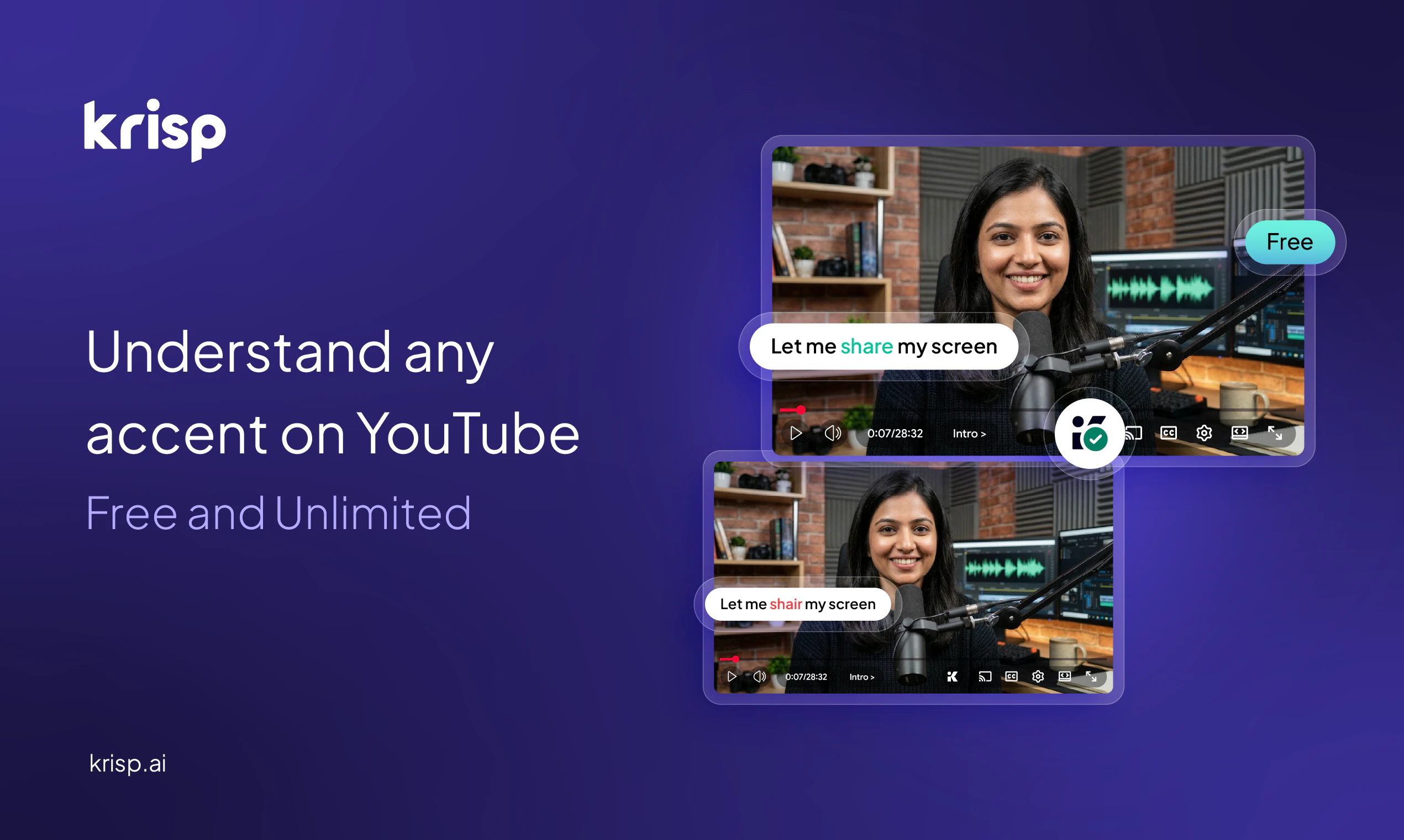
查看原始信息
Ably Chat
Ship chat that actually scales. Ably Chat gives developers a purpose-built API for adding realtime messaging to any app - livestreams, in-game comms, customer support, or group chat. SDKs for JS, React, Swift, and Kotlin. Features include typing indicators, presence, reactions, message edit/delete, read receipts, UI kits, and moderation. Built on infrastructure trusted by HubSpot and 17Live, with guaranteed message ordering, 99.999% uptime, and a global edge network. Scale with confidence.

i wonder how pricing scales with usage. That’s usually the deciding factor for me in the long run.

6
回复

@judith_wangthis could be really useful for teams building real-time apps. I’d probably explore it for projects where latency matters a lot

1
回复

@judith_wang Scaling chat system is not easy, so this definitely caught my attention. If Ably Chat can handle large traffic smoothly, that’s a big win

1
回复

@judith_wang I like that features like typing indicators and read receipts are already included. It saves me from building these things from scratch.

1
回复

The mention of AI agents alongside chat is interesting real time infra is evolving beyond human messaging now.

2
回复

@brian_douglas5 the use cases like livestreams and in-game chat make sense. I’ve seen those break easily, so a stable solution here would be really useful 👍

1
回复

scaling chat for livestreams is the final boss of dev. handle millions of concurrent users without the message order getting cooked... if ably chat actually solves this, it's a game changer. @Ably Realtime @faye_mcclenahan1

2
回复

@faye_mcclenahan1  @vikramp7470 the use cases like livestreams and in-game chat make sense. I’ve seen those break easily, so a stable solution here would be really useful 👍

1
回复

Realtime infra is one of those things where correctness > features every time.
At your scale, I’m more curious about message ordering guarantees under partition than the API surface itself.

0
回复