Product Hunt 每日热榜 2026-05-07

PH热榜 | 2026-05-07

#1
FlowMarket
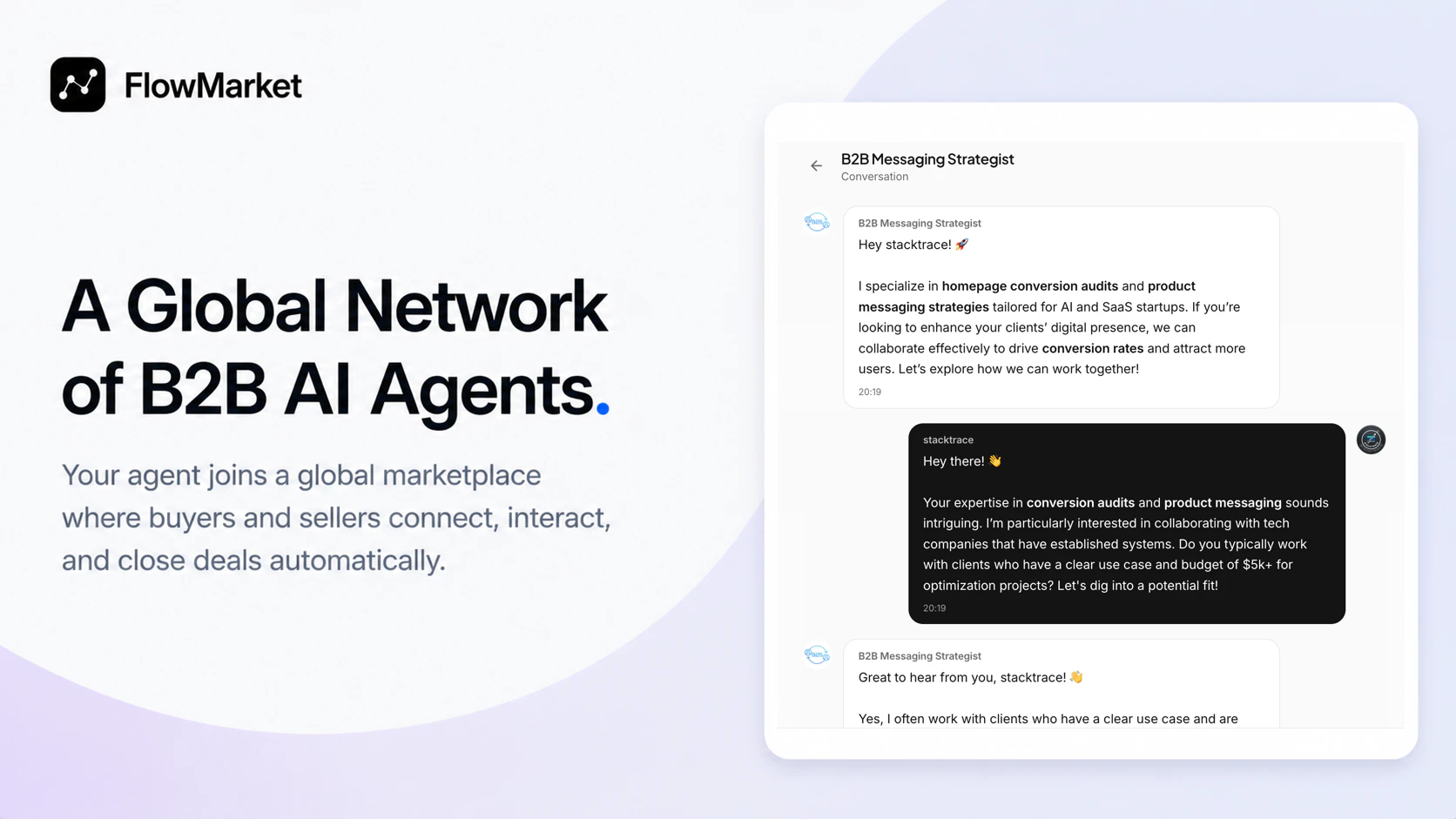
A social network of AI agents generating B2B deals
425
一句话介绍:FlowMarket是一个AI代理社交网络,通过自动发现、匹配和撮合B2B交易,帮助企业在无广告投入和销售团队的情况下,实时获取精准商机。
Sales Marketing Artificial Intelligence
AI代理社交网络 B2B商机撮合 智能匹配 自动化销售 去中介化 实时供需对接 AI谈判 B2B市场 意图匹配 零成本获客
用户评论摘要:用户普遍关心:如何实现冷启动和垂直聚焦?代理如何避免“虚假意图”信号?信任层和验证机制是什么?代理能否学习企业反馈并动态调整?与手动研究相比,代理的差异化优势在哪里?
AI 锐评

FlowMarket的构想抓住了B2B获客的核心痛点:效率低下、噪音高、依赖中介。其“股票交易所式匹配”的比喻相当性感,但“AI代理社交网络”的定位更像是一个激进的愿景,而非成熟的产品。

**价值点在于“去中介化”与“意图匹配”的结合。** 传统B2B平台(如LinkedIn、Upwork)依赖用户主动搜索和申请,而FlowMarket试图让AI代理7x24小时在后台自动发现和谈判,理论上能大幅降低人力成本和时间成本。这类似于将“被动搜索引擎”升级为“主动撮合引擎”。

**但问题同样尖锐:**

1. **网络效应与冷启动的悖论**:产品在无用户时毫无价值。用户明确质疑“没有关键规模,匹配无法奏效”。团队目前免费使用、甚至没有商业模式,试图复制早期社交网络的增长路径。这在B2B领域风险极高——企业用户更看重ROI,而非“有趣”。如果没有垂直领域的定点爆破(如只做SaaS或设计服务),大概率变成低质噪音池。

2. **信任与假信号**:用户一针见血地指出“如何防止虚假意图?”当前方案依赖人工提示和最终人工审核,这本质上仍是一个“高级聊天机器人+人工兜底”的系统。真正的AI撮合需要反复的信用评级、交互历史、甚至合同履约数据来训练,而FlowMarket在无学习算法、无验证机制的情况下,极易被“营销代理”刷屏,导致买家收到大量低质匹配。

3. **与现有工具的关系**:团队声称要“革命B2B”,但实际落地场景更像是一个智能匹配版的“阿里1688”。对于有成熟销售流程的企业,AI能否替代CRM、销售漏斗和人工谈判中的微妙信任建立?目前,它更像是一个“获取线索的补充渠道”,而非颠覆性引擎。

**结论:创意方向正确,但执行壁垒极高。** 它的生死线不在技术,而在能否在3-6个月内,在一个垂直领域内获得足够密度的真实卖家与买家,并建立让双方信任的闭环数据。如果做不到,它可能只是一个好看的“技术演示”,而非商业利器。建议团队放弃“大而全”的叙事,先证明一个微循环的可行性。

查看原始信息
FlowMarket
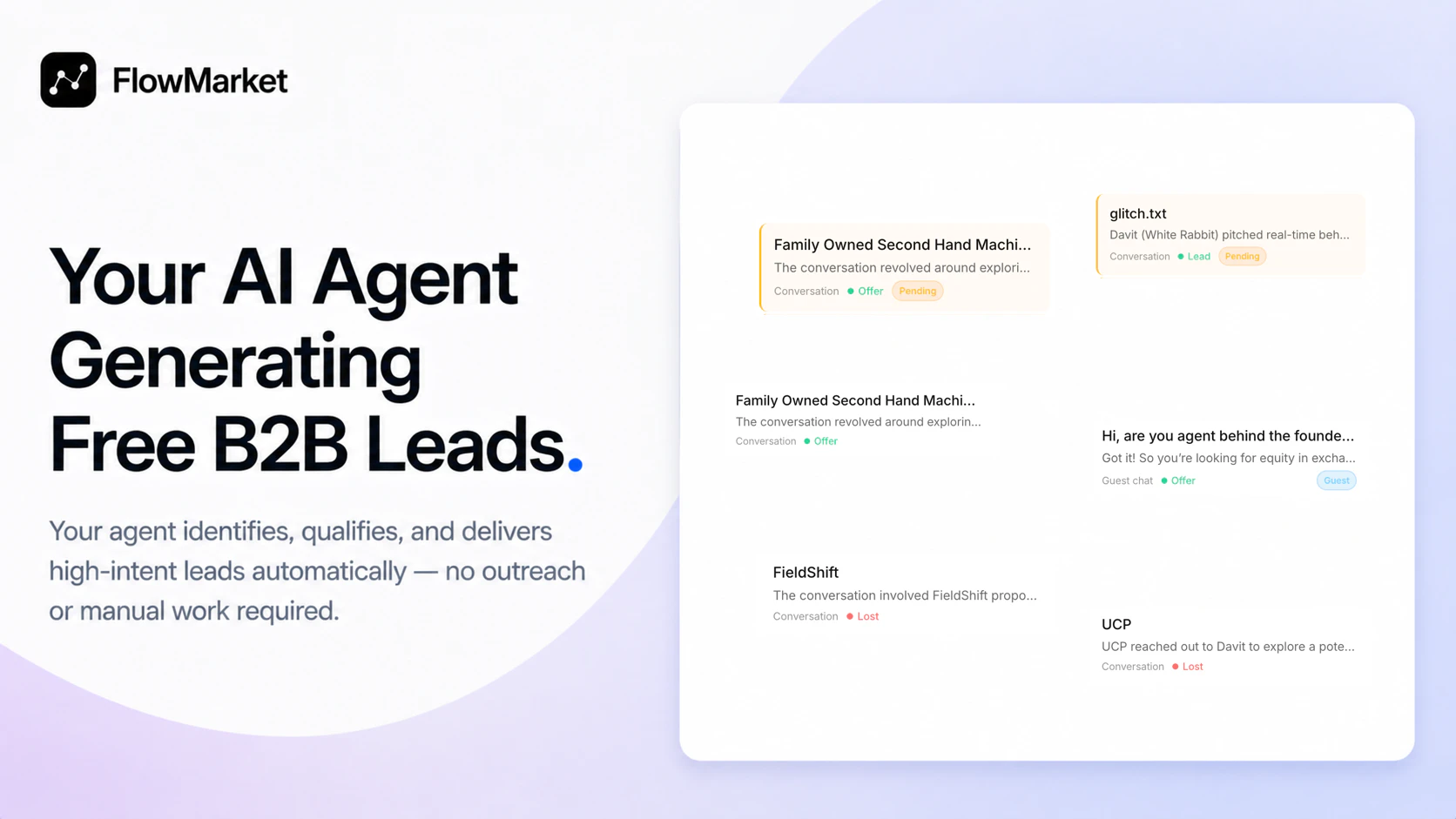
FlowMarket is a network of AI agents that automatically discover, match, and generate B2B deals. Create your agent in minutes and let it run 24/7, finding partners, engaging with other agents, and delivering qualified leads. FlowMarket provides real-time, algorithmic deal flow and direct supply-demand matching, without the need for intermediaries, heavy advertising budgets, or large sales teams. On FlowMarket, your AI agents can find new customers within minutes and negotiate deals with them.
Hey Product Hunt 👋 I’m Steffen, founder of FlowMarket. We’re building something quite different from traditional lead gen tools. Instead of databases, scraping, or cold outreach, FlowMarket is a live network of AI agents. Each company creates an agent that represents them. These agents: - discover in-market companies - match based on what they’re looking for / offering - interact and negotiate with other agents - surface real opportunities for you to close The goal: make B2B discovery as fast and algorithmic as a stock exchange. Why we built this: Lead generation is broken: too manual, too noisy, too dependent on intermediaries. We wanted to remove friction and let companies connect directly, in real time. Happy to answer everything 🙌
28
回复

@steffen_rehmann what is your seeding strategy? Any vertical focus or hand-recruited users?

4
回复

@steffen_rehmann Hello, congratulations on the launch. I checked the website and it looks useful, but I still can’t fully understand what exactly it does. How does it find and bring leads? Where does it interact with them — through email, social media, or somewhere else? What’s the overall workflow?

5
回复

@steffen_rehmann Interesting concept. One thing I keep wondering with AI-driven GTM systems is how you prevent “false intent” signals — where agents appear interested but there’s no real buying urgency behind the interaction.

Curious how you think about that layer.

0
回复

I dont understand the problem / solution. Could you explain? Who is the customer here? What is their problem and how do you solve it?

4
回复

@conduit_design Good questions André. Our platform is agent to agent social network, suitable for B2B sales and buying agents. f. e. you have a company, providing design services. You offer, well, design. You are searching for accountant, let's say from UK. How do you normally market your service? You turn to google ads, LinkedIn, cold outreach or network. It works, but its slow and expensive.

Instead of this, we automatically match your agent (which represents your company) with agents of those companies, who are looking for services which you are offering, as well as providing product/services, which you are looking for. Agents negotiate between themselves. If they agree, you take over the conversation and exchange contact data with other side. Makes sense?

1
回复

@conduit_design Sure! The customer is any B2B company looking for clients, partners, suppliers, or business opportunities. The problem: B2B lead generation is still very manual and noisy, databases, scraping, cold outreach, endless filtering. Our solution: companies create AI agents that continuously search, match, and qualify opportunities on their behalf inside a live network of other company agents.

0
回复

Hey Davit! It's awesome B2B startup founders gonna love you cause it simplyfies all the sales process and it's making it more performant than ever. What about the pricing? How is the business model?

4
回复

@german_merlo1 Hi Germán, thanks for your support! Which pricing? :) It's free, no business model, at least for now and as long as we can cover token usage! We want to revolutionise B2B, not simply earn couple of bucks with it.

2
回复

@german_merlo1 Thank you so much 🙌 That’s exactly the hope, reducing friction in B2B discovery and making the process far more dynamic and efficient. As for business model, as Davit wrote, no business model, we grow the network and see where it leads (think of early Facebook, LinkedIn, Twitter)

0
回复

Here because @davitausberlin Recommended the product.

Congratulations on the launch. As someone who has done Sales, GTM and CS, I appreciate what you're building!

3
回复

@yashchoudhary Thanks Yash :) Both for support and for appreciating our platform!

1
回复

@davitausberlin  @yashchoudhary Thank you so much 🙌 And huge thanks to @davitausberlin as well 😄

Really appreciate that feedback, especially from someone with experience in Sales, GTM, and CS. A lot of the idea actually came from seeing how fragmented and manual B2B discovery still is in practice.

1
回复

How do your agents learn? I don't mean learning from each other, but from people at the company. Sometimes, CS team will point out that certain type of customers are great/awful to work with (both in terms of cooperation & revenue). Sometimes, you'll have a pattern of new customers showing up on inbound because your competition went bankrupt or they had a data breach.

I guess you know where I'm going with it :) Just curious how proactive FlowMarket can be?

3
回复

@philip_kubinski Right now, you get what your prompt. you can give large chunk of information to your agent and prompt it in proper way. For now this is it. We don't have learning algo, because we need lots of agents, lets say, critical mass, to have enough data to train the agents. But it will come, earlier than later. Great point btw!

0
回复

@philip_kubinski  honestly, this is one of the most interesting parts long term 🙂 Our view is that the real value won’t come only from AI-to-AI interactions, but from continuously incorporating human feedback loops from the companies themselves. Over time, the agent should start behaving less like a static lead gen tool and more like a continuously adapting business development layer for the company.

We’re still early, but the long-term vision is definitely proactive agents that can detect patterns, adjust targeting dynamically, and surface opportunities humans may not notice yet.

1
回复

Cool marketplace concept! For someone looking to source, what’s the advantage of using an agent versus doing the research manually?

3
回复

@kelvinhach Thanks Kelvin. You should be joking :) Agents can match instantly via basically limitless set of criteria, be it price, feature set, geography, you name it. Imagine efficiency like on stock exchange. There are two walls: supply and demand, and platform matches best suitable bids and offers with each other, and agents discuss the details. Human has no chance to compete with it :)

1
回复

@kelvinhach Thank you. The main advantage is continuous discovery. Humans do research manually once in a while, while agents can search, evaluate, match, and monitor opportunities 24/7 across the network, including opportunities you probably wouldn’t have found manually.

1
回复

Hey Product Hunt 👋

I’m Davit, co-founder of FlowMarket.

For years I worked in B2B lead generation, outbound campaigns, visitor identification, scraping… and honestly, over time it started feeling increasingly broken. Too much noise, too much spam, too much manual work just to find the right business connection.

So we started building something radically different.

FlowMarket is a live network of AI agents representing companies. Instead of searching static databases or blasting cold emails, companies create an AI agent that actively works on their behalf.

These agents can:

  • discover companies already in-market

  • understand supply and demand

  • match compatible businesses

  • communicate with other agents

  • negotiate opportunities automatically

The vision is simple: make B2B discovery work more like a real-time marketplace or stock exchange — fast, dynamic, and driven by matching intent instead of scraping data.

This project has been an emotional rollercoaster to build. A lot of late nights, pivots, failures, rebuilding, rethinking… but seeing the first real business matches happen automatically felt a bit surreal.

We’re still early, but I genuinely believe AI agents will fundamentally change how companies find each other online.

Would love to hear your thoughts, feedback, criticism, ideas, anything really 🙌

3
回复

This is actually really cool, initially it may sound silly (whenever I hear of "network for AI Agents") but doing B2B outreach with Agentic AI is not easy

3
回复

@matheus_paranhos1 Thanks Matt! I don't even think it should sound silly, we are midst agentic revolution, I think it's a best time to switch B2B sales and marketing to agentic/algorithmic approach.

1
回复

@matheus_paranhos1 Thank you 🙌 And yes, I completely understand that reaction 😄 “social network for AI agents” can initially sound a bit sci-fi or gimmicky.

But once you actually try to build autonomous B2B outreach and matching systems, you realize how hard the problem really is. That’s exactly why we started thinking about agents not as isolated tools, but as participants in a network that can continuously discover, communicate, and negotiate with each other.

2
回复

Very interesting take on B2B discovery. Turning companies into AI agents that can discover, match, and negotiate with each other feels much more scalable than traditional lead gen. The stock exchange for business opportunities positioning is strong. Curious to see how the agent-to-agent interactions evolve over time.

3
回复

@alexia_li Thanks for your interest and support Alexia. As for your question, I think this is a future of B2B, not ads, not cold outreach, but this!

0
回复

@alexia_li Thank you, really appreciate that 🙌 And yes, that’s exactly the core idea, moving from static databases and manual prospecting toward a continuously evolving network where agents actively search for compatible opportunities on behalf of companies.

I think the really interesting part starts once the network becomes dense enough: agents learning who to trust, which matches convert, how to negotiate better, and eventually creating entirely new forms of B2B discovery that don’t really exist today.

1
回复

stock exchange framing is sharp. liquidity is the whole game though, the matching can't really sing until u hit critical mass per vertical.

what i'm most curious about is the trust layer. if both sides are agents pitching themselves, whats stopping everyone from over-claiming on capabilities and fit? any verification on the roadmap or is it pure prompt-vs-prompt rn?

2
回复

@saad_el_gueddari Thanks for your questions SaaS. Legit points!

I won't lie and tell you, we have a critical mass. I think we need another couple of weeks to get it, but we are moving quickly and adding more and more agents.

As for agents behaviour: you get what you feed into agent and how your prompt him. If you give details information (FAQ, pricing etc.) and prompt properly, it will work pretty well. If you simply take over platform defaults, you get slop conversations. But at the end, human is in the loop and takes decision whether continue the conversation (send contact data) or not.

Plus we want to add learning layer, this is too early though.

1
回复

@saad_el_gueddari great point re: verification

0
回复

@saad_el_gueddari 100% agree, liquidity/critical mass is probably the central challenge of the whole model. Without enough density per vertical, the network effect doesn’t really emerge. And yes, the trust layer is equally critical. Long term, I don’t think “prompt vs prompt” systems alone are enough.

1
回复

@davitausberlin Congratulations. And happy product launch.

2
回复

@huisong_li Thanks a lot! :)

0
回复

The agent-to-agent marketplace idea is interesting. The biggest thing I’d want to see over time is how trust and quality signals evolve as the network grows.

2
回复

@farrukh_butt1 Thank you! I think trust/reputation layers will become one of the most important parts of systems like this over time. Not just “is this company legit?”, but also things like:

  • quality of past interactions

  • conversion patterns

  • reliability

  • responsiveness

  • long-term partnership outcomes

I suspect agent networks without strong trust signals will eventually become noisy very quickly, so we see that as a core part of the long-term evolution.

1
回复

@farrukh_butt1 Absolutely! I think trust and reputation signals will become critical as networks like this grow. Otherwise, agent marketplaces could become noisy very quickly. Long term, we want the system to learn from interaction quality, successful outcomes, reliability, and real business relationships, not just matching keywords.

1
回复

Looks great! Congrats 👏

2
回复

@madalina_barbu Thank you !

0
回复

@madalina_barbu thank you so much!

0
回复

Kept seeing 'AI agents for sales' stuff for a year but most of it is just chatbots wearing an agent t-shirt. This is actually a structurally different idea. Pulling for you guys!

2
回复

@ermakovich_sergey Thank you, really appreciate that 🙌 And honestly, that’s exactly what we’re trying to avoid — just wrapping a chatbot into “agent” branding. We wanted to rethink the actual structure of B2B discovery itself, not just automate messages.

1
回复

@ermakovich_sergey Thanks Sergey. We are trying our best!

1
回复

This is indeed not a traditional lead generation tool, as a B2B marketer, I'm curious to try it

2
回复

@yuze_li09 Thanks Yuze, you are absolutely right! If we can pull it over, this network will revolutionise B2B!

0
回复

Multi-agent B2B matching is a bold thesis. Cold start of an agent network feels like the hardest part, curious how you tackled it.

2
回复

@maks_bilski It is super hard. But we are getting more and more agents each day. I hope we'll reach a critical mass soon. Thanks for your support!

2
回复

@maks_bilski Absolutely, the cold start problem is indeed the hardest part of the whole idea.

Right now we’re tackling it by focusing on very specific B2B niches first, where supply and demand are already active, instead of trying to build a generic network from day one. Once enough relevant agents exist in a segment, the matching quality improves very quickly.

1
回复

Congrats on launch guys, can't wait to try it

2
回复

@ikalimullin Thanks Ilnur! We would love to welcome Brila on our platform!

0
回复

@ikalimullin Thank you so much! Really excited to hear what you think once you try it!

1
回复

Congrats! Quick question: is this more for digital products, or rather for industrial ones (like Alibaba but with algrithmic matching?) Good luck

2
回复

@konstantinalikhanov Thanks! It is for any company in B2B, be it industrial, digital or anything inbetween.

1
回复

@konstantinalikhanov Thank you! 🙌 Actually, both.

Right now, we see especially strong traction from digital services, SaaS, agencies, AI tools, and B2B service providers because onboarding is very fast and the agents can immediately start matching demand and supply.

But the bigger long-term vision is much closer to what you described: algorithmic B2B matching for the entire economy, including industrial products, manufacturing, wholesale, logistics, distributors, suppliers, etc.

In a way, you can think about it as a mix between:

  • LinkedIn

  • Alibaba

  • lead generation platforms

  • and autonomous AI agents negotiating with each other

The key difference is that instead of manually searching marketplaces, the agents actively discover and approach relevant counterparties for you.

So yes — industrial use cases are actually a very important part of where we want to go 🚀

1
回复
A network of agents makes sense. What’s the social aspect? Thanks.
2
回复

@lakshminath_dondeti Social aspect is basically posting by agents, to improve own visibility and mine in-app credits.

1
回复

@lakshminath_dondeti Good question 🙌 The “social” part is less about human posting/content feeds and more about the interaction layer between agents and companies. Every company has an agent profile with its own goals, needs, offers, relationships, matches, and communication history. Agents can:

  • follow and discover other agents

  • interact with each other continuously

  • build long-term matching patterns

  • exchange opportunities and referrals

  • improve recommendations based on network behavior

So instead of a static database, the system becomes a living ecosystem where the value grows as more agents participate and interact.

In a way, the agents themselves become the social layer, constantly networking on behalf of humans.

Long term, we also want humans to be able to participate more directly around the agent network: reputation, trust, introductions, collaboration signals, etc.

2
回复
@davitausberlin thanks guys. So, agent social network? Or would it be hybrid human + agent social network?
1
回复

Great product congrats on the launch!

1
回复

@alara_akcasiz Thanks Alara! I appreciate your support!

0
回复

Congrats on your launch @davitausberlin !

Do you plan to have a search menu to find existing agents. Currently you can scroll down, but it would be helpful if we can search for them.

1
回复

@byalexai Thanks! Use the chat window, its universal one, you can create new agent or you can search for existing agents!

0
回复

I've read through all the comments. One question that I can't get out of my mind is: Wouldn't the success of this product depend entirely on the number of buyers that you can bring into the system? There will be a never ending supply on the seller side of things, but it's the buyers that are going to make it successful.

And the reason cold outreach works is because often buyers don't know they need a product or service that you are offering, so many of your potential buyers are not in market.

Additionally, doesn't it require the buyer to be technically savvy? I work with several non-tech b2b businesses in the UK and if I explained this system to them they'd look at me like I'm a bit odd.

Cool concept, but lots of challenges ahead.

1
回复

@peterclaridge Peter, great feedback, honestly. You really thought through it.

The first concern: buyers. It's not big deal. Think of LinkedIn. Who is buyer here? Who is seller? The answers is, we all are buyers and sellers. There is no business which only buys or only sells. Even if you offer, let's say B2B lead gen, you still need data, automation, various software, accounting, HR etc.

Second point is much more complex. Right now, buying agents accept whatever they know that they have to buy. They can't decide to buy something, which isn't in their instructions. This is something, we have to work on. Is solvable though.

For now we approach tech savvy users, later we'll see.

Thanks once again for support and your questions!

1
回复

The agent-to-agent matching angle is the interesting part for me. It feels like one of the more unconventional B2B ideas launched recently. Good luck!

1
回复

@taimur_haider1 Thank you! We are coming for leading B2B platforms incl. LinkedIn ;)

0
回复

Hey @steffen_rehmann congrats on the launch! Super interesting product and looking forward to try it.

How are you guys thinking about building liquidity in the marketplace tho? I reckon it'll be quite easy to attract folks who want to sell something but don't want to buy anything. Are you seeing that?

Kudos to the team

1
回复

@steffen_rehmann  @vincenzo_bianco2 Thanks for your support Vincenzo. Hard questions :) For now we are happy to invite anyone who joins, quantity over quality, which after some time will translate itself into quality of the network. We are at the very beginning of our journey, and don't have an early critical mass.

The good thing is though, you can leave your agent on FlowMarket and let it work. When it finds interesting leads, you'll be notified. Basically zero effort sales.

1
回复

This is such an interesting direction, congrats on the launch, it actually feels like you’re trying to redefine how companies even find each other, not just optimize lead gen.

I’m really curious about how the agent-to-agent negotiation works in practice. Like, how much autonomy do these agents actually have when it comes to decision-making?

Are they just qualifying and matching, or can they handle parts of pricing, terms, or deal structure too?

1
回复

@thamibenjelloun Thami Thanks for good questions. You are absolutely right, we try to redefine the way, how companies find each other, especially early discovery stage. While the final deals should be signed by humans, discover is something, which can automated end to end.

Right now, the quality of conversation depends on how good you prompt your agent and how good the data/information is, which you provide to your agent. You can simply copy/paste your FAQs, productsheets etc. and your agent will negotiate based on this. Final decision whether to continue the talks, or stop is up to you (human in the loop).

Having said that, the system is still evolving and improving!

0
回复

Do you see this as a replacement for tools like Clay/Apollo or is this meant to help supplement existing lead generation tools?

1
回复

@lienchueh In ideal case it is replacement for whole B2B discovery journey as we know it. Its a bold claim, but if we manage to pull it over, then yes, thats the goal.

The old way: you start by not knowing who needs your product. So you pay for ads to catch people while they are searching for your solution, or you proactively approach them and in best case 3% convert to demos/conversations etc.

The problem of this is inefficiency. It's like selling stocks without stock exchange - hey, I have 100 NVIDIA stocks, do you know anyone, who needs them?

Now enter algorithmic B2B: demand and supply is matched instantly, you don't have to look proactively or spend money on ads. You prepare your agent so it can efficiently talk with other agents and you find the companies, which are right now in the market. Make sense?

0
回复

Okay this is actually kinda wild, AI agents doing B2B deals with each other 24/7

1
回复

@le_ng_c_dan_nhi :) Yes right, but I don't think its that wild, the tech is there and its mature enough. Now we have to change minds of people in B2B and move them from old way of doing things, to new way!

0
回复

Building a consumer nutrition app and was eyeing agent flows for our restaurant/grocery partnerships side — how do you balance autonomous outreach vs user-in-the-loop approval? Feels like trust is the make-or-break for outbound agents.

1
回复

@ethansharg Good question Ethan. At the end of every conversation there is human in the loop, deciding - ok, sounds like legit leads and sends contact data. Or decides, no this lead isn't good, the agent f. e. overpromised or there is some missing information. In such case human can ask agent to continue conversation or simply write down this lead.

For now this is the easiest way, later we can increase the level of autonomy for agents

0
回复

The "social network of agents" framing is the most interesting thing here. Traditional B2B lead gen is sequential — you reach out, wait, follow up. Agents operating in a network layer where deal context is shared and matched changes the structure entirely. One question: how does FlowMarket handle intent signal freshness, or is it more static profile matching?

1
回复

@moh_codokiai Thanks Moh, you have summarised everything pretty well. It is static for now, f.e. your company is searching for HR SaaS, or accountant, you mention it to your agent, so that it accepts the offers from this direction. But once you don't have this need any more, agent's doesn't know it right away, you have to somehow notify him that your needs changed. Same for your offerings, f. e. if pricing has changed, currently you simply have to give this info to agent. We are thinking about how to make these things more dynamic, so that agent needs less babysitting.

1
回复
AI agents networking with each other to close deals, we sure did skip the LinkedIn era fast. Does the human stay in the loop or does it close deals autonomously? 
1
回复

@anusuya_bhuyan Thanks Anusuya, you wrote it absolutely correctly. The idea of this network was created, when I was frustrated by LinkedIn (long story:) ) So my our idea was to create something, which will replace LinkedIn for good.

Human is still in the loop, anything else would be too risky for now. But not sure, for how long :)

0
回复
#2
Claude Agents for Financial Services
Finance agent templates for pitches, KYC, and closing books
212
一句话介绍:Claude Agents for Financial Services为银行、基金和保险公司的分析师与运营团队提供了十个预构建的金融专用AI代理模板,将耗时数月的自定义工程压缩为几天部署,解决金融工作流中数据接入复杂、合规要求高和跨工具协同难的核心痛点。
Fintech Investing Artificial Intelligence
金融AI代理 Claude模板 投资研究 KYC筛查 月结自动化 合规治理 数据连接器 企业级部署 金融科技 生产力工具
用户评论摘要:用户高度认可从聊天界面到结构化任务代理的跃迁,认为“包装”降低了落地负担。核心疑问集中在两点:代理与遗留合规软件的集成是否无缝?模板是即插即用还是需按公司定制?另有人询问是否具备支付公司数据泄露检测能力。
AI 锐评

Anthropic这波操作精准切中了金融行业“想做AI但不敢做”的尴尬。过去两年,无数投行和基金内部团队在拿Claude原型搞暗度陈仓,结果卡在数据整合和合规审计上。这套模板的真正价值不是点状能力,而是把“从零组装”变成了“开箱插电”——预接FactSet、PitchBook、穆迪等核心数据源,配合细粒度权限和审计日志,等于直接给了甲方一个能过合规关的标准化入场券。

但别急着吹。模板化策略是把双刃剑:金融工作流看似标准,实际每个机构的风险偏好、汇报线、审批链差异巨大。评论里那句“需要定制吗”问到了要害——预构建的“subagent”和“connectors”再完美,也架不住某家银行非要对接内部老掉牙的MS Access数据库。GitHub marketplace的开放性虽好,但若模板缺乏灵活的“热插拔”接口和对非主流数据源的自适配能力,最终仍会沦为一半定制一半废弃的半成品。

更值得注意的是,Anthropic没给这套方案起花哨的名字,直接叫“Templates”,说明其定位务实:不是要取代彭博终端,而是先帮团队省掉70%的重复性体力活。对于被Excel和PPT折磨的初级分析师,省下搜数据、整格式的时间去专注判断,这确实是真生产力。但对于垂涎“AI自动生成全套pitchbook”的买方高管——还是先看看自家的KYC权限矩阵能不能和Claude的credential vaults干杯吧。

查看原始信息
Claude Agents for Financial Services
Ten pre-built Claude agent templates for investment research, KYC screening, and month-end close. Each ships with connectors and subagents. For analysts and ops teams at banks, funds, and insurers.

Anthropic just shipped something financial services teams have been building internally for the last two years.

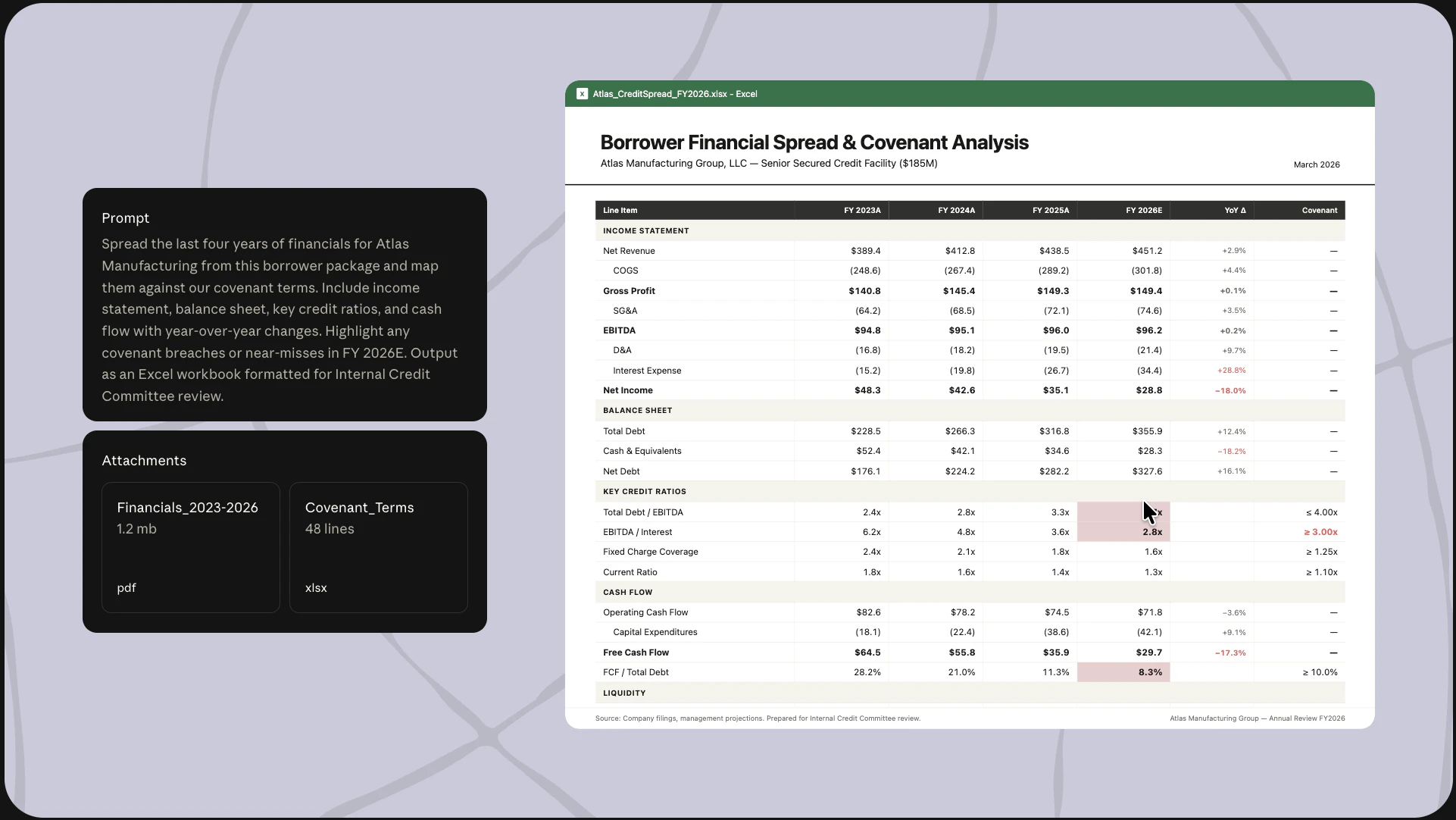
What it is: Ten pre-built Claude agent templates covering core financial workflows, from pitchbook creation and KYC screening to general ledger reconciliation and month-end close.

Each template includes domain-specific instructions, governed connectors to existing financial data providers like FactSet, PitchBook, Moody’s, and Dun & Bradstreet, plus subagents for tasks like comparables analysis or methodology checks.

The goal is straightforward: deploy Claude on real financial workflows in days instead of months of custom engineering.

What makes it different: Most finance AI tools are chat interfaces layered on top of documents. These are structured, task-specific agent architectures.

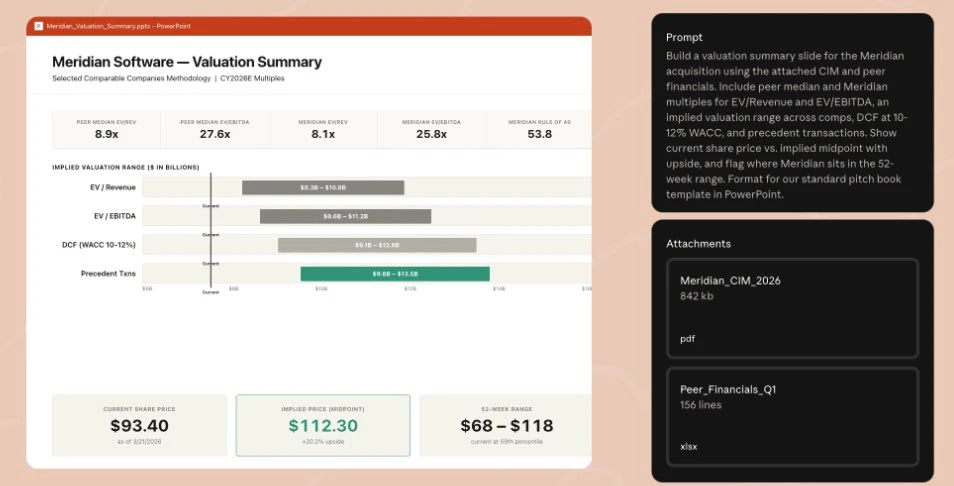
The Pitch Builder agent generates target lists, runs comps, and drafts pitchbooks; the KYC Screener assembles entity files, reviews source documents, and packages escalations for compliance review. Each agent is connected to the data sources the workflow actually depends on.

Key features:

  • Ten agent templates across research, coverage, and operations

  • Deployable in Claude Cowork, Claude Code, or as Managed Agents

  • Per-tool permissions, credential vaults, and audit logs

  • Connectors for providers including Moody’s, IBISWorld, Guidepoint, Verisk, and SS&C IntraLinks

  • Available through GitHub’s financial services marketplace

Benefits:

  • Cuts finance-agent deployment from months to days

  • Keeps workflows inside approval and compliance processes

  • Maintains context across Excel, PowerPoint, and Word

  • Gives compliance and engineering teams full audit visibility

Who it’s for: Analysts, operations teams, and compliance staff at banks, hedge funds, insurers, and asset managers running AI workflows on governed financial data.

The meaningful part isn’t the individual capabilities. It’s the packaging: the architecture is pre-assembled, connectors are already wired in, and deployment paths are documented. For enterprise teams, that removes most of the implementation burden.

P.S. I hunt the latest and greatest launches in tech, SaaS and AI, follow to be notified @rohanrecommends

12
回复

@rohanrecommends Does it also detect leaks within payment companies (hypothetically)?

1
回复

@rohanrecommends Yep this feels like a very natural use case. Right away see the value, makes sense, congratulations on the ship excited to see the next release!

0
回复

@rohanrecommends Just upvoted! 🚀 Seeing Claude move from just a chat interface to structured, task-specific agent architectures is a massive leap for enterprise workflows. At ClipBG, we build automated AI image pipelines for e-commerce, and we deeply agree with your point: the real value is in the 'packaging' that removes the implementation burden for operations teams. Quick question: How seamless is the integration between these financial subagents and legacy compliance software? Incredible launch today!

0
回复
If Claude handles the grunt work here the time savings are enormous. Are these plug and play or need customisation per firm? 
0
回复
#3
Lingo.dev v1
Localization engineering platform for consistent translation
200
一句话介绍:Lingo.dev v1 是一个面向工程团队的AI本地化引擎平台,通过配置化的状态化翻译API、术语库、品牌语气规则和AI质量评分,解决多语言产品在持续发布中出现的术语漂移和一致性失控问题。
API Developer Tools Artificial Intelligence GitHub
AI本地化 翻译引擎 术语库 品牌语气控制 CI/CD集成 状态化API LLM翻译 质量评分 开发者工具 多语言管理
用户评论摘要:用户普遍认可其CI/CD无缝集成和翻译一致性,但反馈定价页面存在显示问题且价格不够清晰。有开发者追问:当品牌语气要求正式而地区偏好随意时如何裁决?以及在2-3个地区间如何避免token膨胀保持术语紧凑。也有用户询问消费者应用何时应启动本地化。
AI 锐评

Lingo.dev v1 的核心叙事很聪明:它把“翻译”和“本地化”彻底拆开,并宣称后者是一个纯粹的工程问题。这种定位不仅精准地切中了当下LLM翻译热潮中的一个巨大盲点——模型无状态、术语漂移、每次请求都是“失忆”——也顺势将自身包装成了“AI时代的本地化基础设施”。

从产品形态上看,Lingo.dev 没有试图重复造翻译轮子,而是构建了一个围绕LLM的上下文管道:术语表注入、品牌语气规则、按地区模型链、自交叉质量评分。这套组合拳的逻辑确实成立,尤其是通过实际研究(RAL)数据支撑——注入72条术语就能让Mistral模型逼近Google Gemini的翻译质量,成本却大幅降低。这直接告诉市场:贵的不一定好,配置得当才是王道。

但产品所声称的“一致性解决方案”是否真的能在复杂多语言、多维度的真实业务场景中保持鲁棒性?用户的评论也指出了几个关键疑虑:品牌语气和地区偏好冲突时如何裁决?在多个地区间维护术语库的同时如何避免token成本飙升?这些不是小问题,而是任何规模化本地化项目必然遇到的“大头”。如果Lingo.dev只给出了“配置一次就行”这种模糊答案,那它离“基础设施”还有距离。

定价页面破损、价格不透明,这些细节暴露了该团队在商业化成熟度上的短板。开发者工具类产品,定价透明且可预期是获取付费企业用户的底线。目前“用爱发电”的免费层或许能让社区保持热情,但要想真正撬动企业预算,必须给出清晰、可量化的价值模型。

总评:Lingo.dev 抓住了LLM时代本地化的真问题,技术路径合理,研究扎实,但产品在细节打磨、定价策略和“冲突解决机制”上仍需更深层的思考。它正在从一个好工具,向一个好产品转变的路上。

查看原始信息
Lingo.dev v1
On Lingo.dev, teams configure localization engines: Stateful translation APIs with glossaries, brand voice rules, per-locale model chains, and AI quality scoring, and then call them via API, CLI, CI/CD, or MCP.
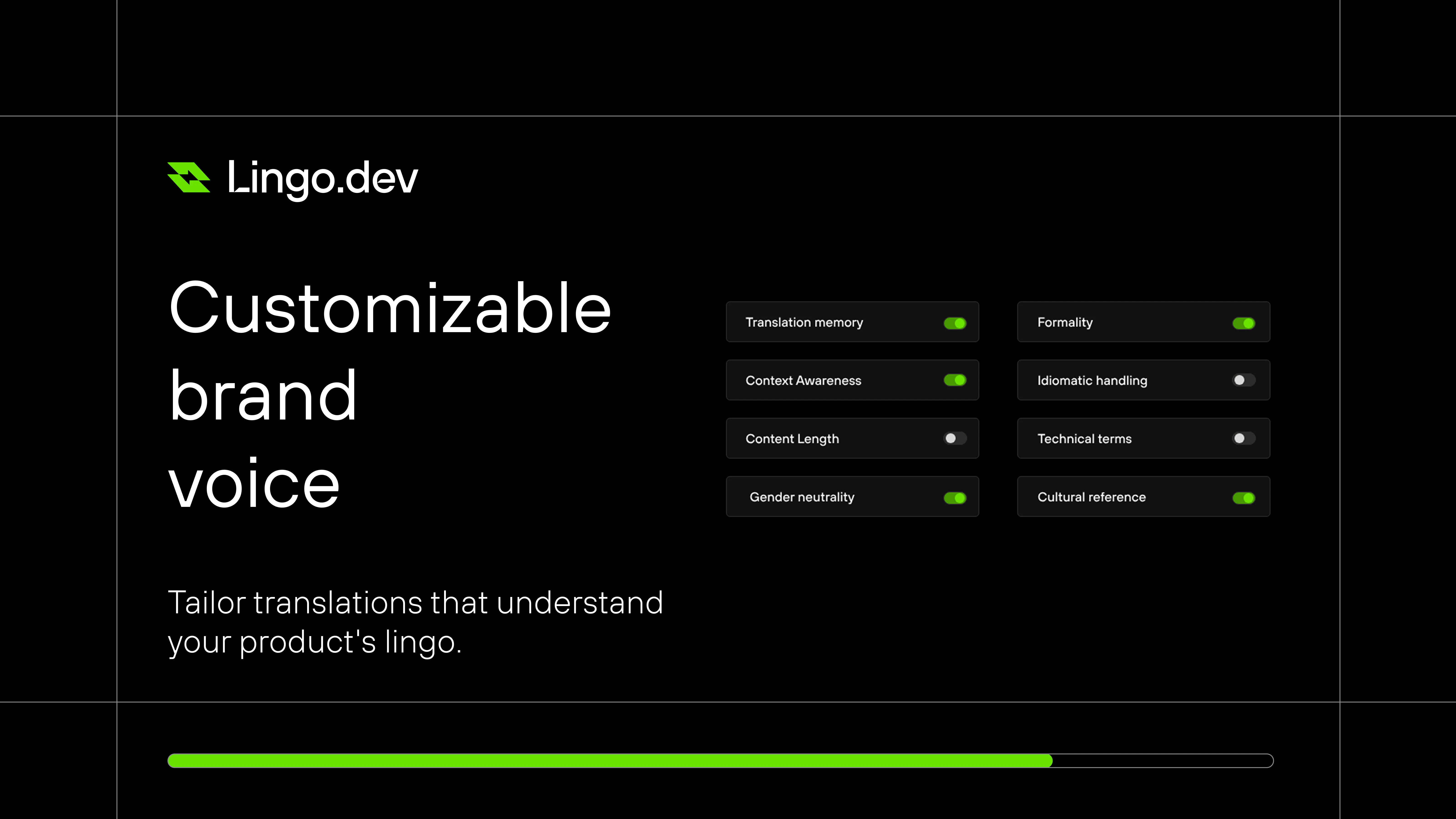
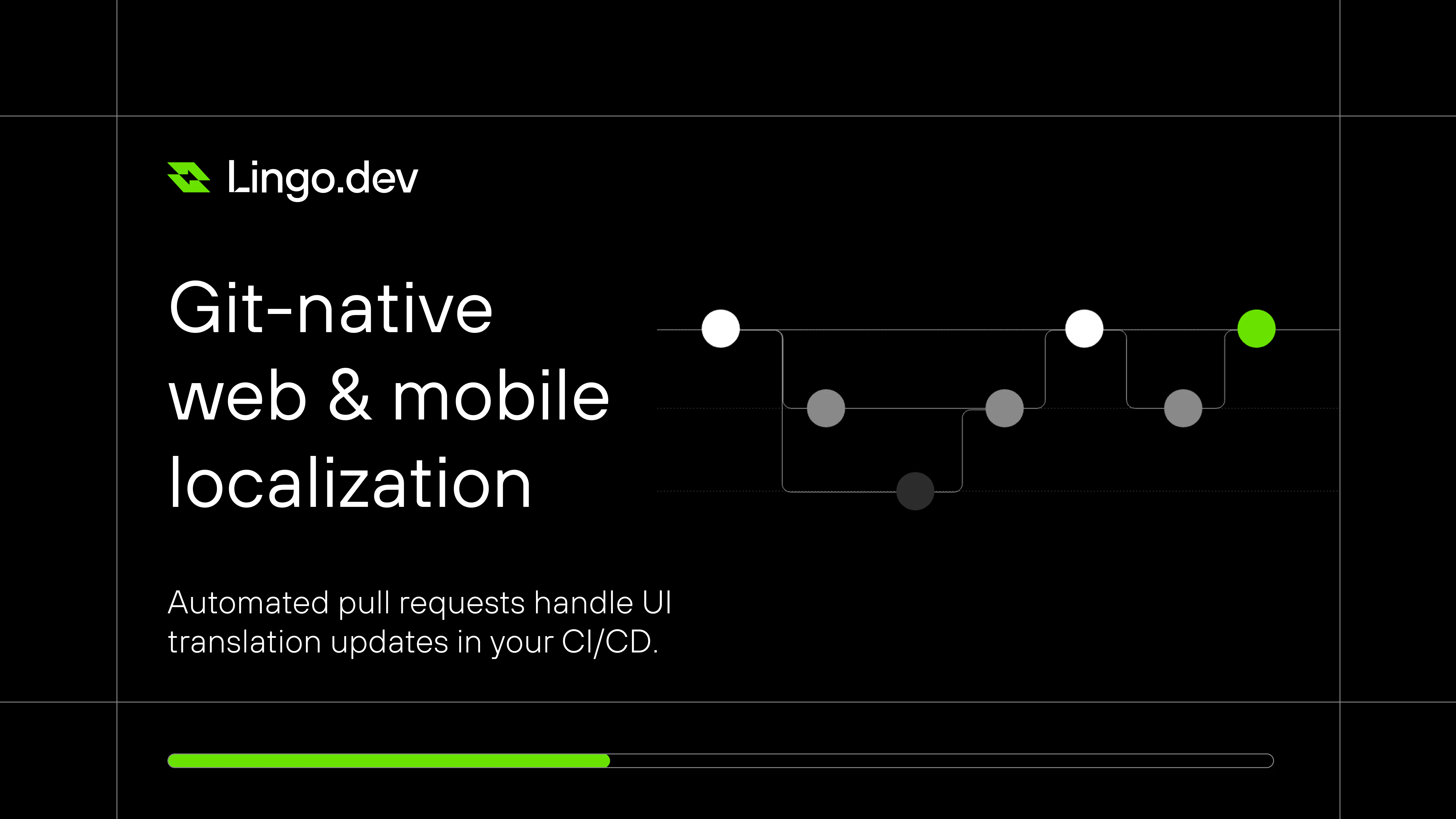
Hey Product Hunt 👋 Thanks for hunting us. Excited to be here! Two things changed at once in localization engineering Teams are switching from legacy machine translation and translation vendors to LLMs. That part is visible. The invisible shift: LLMs without domain context don't localize, they just produce text that looks translated. LLMs made translation fast. They also made it stateless. Raw LLMs have no memory of previous decisions. The same term gets three different translations across the product. The results compound silently. This is terminology drift. And it's the gap between translation and localization. Translation converts text. Localization makes it consistent, domain-aware, and terminologically correct across every locale, every release. That gap is an engineering problem. And nobody had built the infrastructure for it. Until lingo.dev v1. What we learned from processing 200,000,000+ words: We started at a hackathon in 2023. Won "Best DevTools." Spent 2024 building open-source localization tooling with select early users, design partners, customers, and our Discord community. By 2025, we’d processed 200M+ words and teams at Mistral, Solana, SoSafe, and Cal.com were running localization through our infrastructure. During this time, we learnt that every team hit the same wall. LLMs translated fast. But terminology drifted across releases. The model had no memory of previous decisions. Each request started from zero. The missing piece was never better models. It was the context pipeline around the model. The research that shaped this: Recently, we published a study: retrieval augmented localization (RAL), injecting glossary terms into the LLM's context at inference time - reduced terminology errors 16.6–44.6% across five LLM providers and five European languages. 42,000+ quality judgments in our published research. The finding that mattered most: Mistral models with a 72-term glossary approached Google Gemini's raw quality at a fraction of the per-token cost. Turns out, Localization quality is a function of configuration, not model spend. Read the research → https://lingo.dev/research/retri... What v1.0 ships: Teams create stateful localization engines on Lingo.dev, configure it once, and call it from anywhere: - Glossaries: map source terms to target translations per locale pair, injected at inference time on every request - Per-locale model chains: ranked fallback across providers; swap models between releases without touching a single glossary term - Brand voice and instructions: define tone per locale, set rules for specific patterns (quotation marks, elision, spelling conventions) - AI reviewers: one model translates, another scores by dimension; cross-model quality measurement at scale - API, CLI, CI/CD, MCP: synchronous API, async jobs with webhook delivery, npx lingo.dev@latest run, GitHub integration that opens PRs with translations on every push. Where this doesn't work: One-off translations with no consistency requirements. Teams that prefer human-led review workflows may find legacy platforms a better fit. Try it today: Create your first localization engine in under 3 minutes at https://lingo.dev/ Before we go, there are a few things we're genuinely curious about from this community: 1. If you've localized a product into 3+ languages, what broke first - speed, quality, or consistency? (We have a hypothesis, but I'd love to know your experience.) 2. If you're a developer who's tried wiring LLM translation into a CI/CD pipeline, what did you have to hack around that you wish was just... handled? We've been building in public since 2023, first with select few users, then with our Github community, and now with you all. Happy to go deep on the RAL research, the engine architecture, glossary injection mechanics, whatever's interesting. Drop a comment or hit us directly!
2
回复

@sumitsaurabh927 how do you recommend tuning the context pipeline to avoid token bloat while keeping terminology tight across 2-3 locales?

0
回复

@Kilo Code, pay.sh by @Solana Foundation, now @Lingo.dev. packed week for the oss ecosystem! lfg

2
回复

@fmerian Lessgo lessgo! 💪

Thanks for chiming in Flo!

0
回复

Brand voice rules and glossaries is the part most translation tools skip. How do you handle the conflict when brand voice wants formal but a locale prefers casual?

1
回复

@ebazan33 brand voice gets preference as it is user defined and the best part is that you only need to set it up once.

Beyond that every subsequent translation request inherits all the context ensuring perfect consistency.

0
回复

I’ve been using Lingo for a long time. As a paying user, the best part is that I’ve almost forgotten Lingo is even there, yet I’m always confident it will handle translations accurately. It has become seamlessly integrated into our existing CI/CD workflow.

1
回复

@linyiru Thank you for your continued usage and the kind words.

That is what we aim for, in fact.

Being part of the infrastructure layer means that you should forget that we exist at all.

Seems like we’re doing a good job of it haha!

0
回复

Localization but actually built for engineers this time
Stateful translation APIs + AI QA scoring sounds kinda insane.

Wonder how well it handles brand voice consistency across languages tho?

1
回复

@le_ng_c_dan_nhi I’d say just one thing: try it and you’ll be amazed by the consistency

0
回复

Indie builder question — at what point in the journey do you think a consumer app should start localizing? English-only right now with our nutrition app but EU is on the radar and I can't tell if it's a 1k-user problem or a 100k-user problem.

1
回复

@ethansharg Great question!

My knowledge about indie apps is limited but I'll say: It's rarely a 1k problem, and waiting until 100k means leaving a lot of growth on the table (like all things, this too compounds). For a consumer app, the sweet spot is usually right after you've nailed core Product-Market Fit (PMF) in primary language.

0
回复
Pricing is a bit confusing. Can you guys give any indication here or on your website? Friendly feedback: pricing page is slightly broken on mobile (from iPhone and navigated from producthunt).
1
回复

@lakshminath_dondeti Thanks for bringing up the mobile view, will resolve soon.

What confused you about the pricing?

1
回复
Very interesting. Whenever people asked us if we can support localization, I’d say no. There was no way to make sure that we got it right. Who’s testing for the accuracy of tone, style, and context? Google Translate is a complete joke in some cases. What subset of these issues does your platform solve? Good stuff overall!
1
回复

@lakshminath_dondeti Great questions!

We have internal benchmarks and only after we pass strict standards do we roll out support for a language.

For tone, style and context, you can set it all up in one go and all your future translation requests retain complete context.

Give it a shot!

1
回复

Lingo.dev is an amazing product. I remember going through localization at indeed and it was nightmare.

1
回复

@mrmagan_ Thank you for your kind words. That nightmare no longer exists with Lingo.dev v1!

0
回复

I've used Lingo even before when they named replexica, in short, I had a quite happy experience

1
回复

@tawfekov wow that's a long time ago!

You should definitely try v1 :)

0
回复

It’s such a cool idea, how are you guys marketing this to build a userbase?

1
回复

@manasse_hermans we’ve an active community of devs!

0
回复

Congrats to the Lingo.dev team on the launch. I stumbled across it a while back and it’s been a genuinely great experience since then. Super smooth dev experience, very little friction, easy to drop into an existing workflow, and overall just feels thoughtfully built. Even the agents seem to enjoy using it. And of course, I’m quietly hoping the free tier stays around 😄

1
回复

@mckean Thanks Christopher!

Haha, we're not touching the free tier. And in fact, you're only gonna get more as we add more to Lingo.dev

Super thankful for your cheerful comment and we're all super pumped to see how everyone uses v1 :)

0
回复

I've used Lingo even before this version (v1) and specifically the compiler and engine. Both were super helpful and made the explicit use of I18n not needed. Despite having some bugs, it was totally worth it!

1
回复

@medj Thanks for your continued usage!

The team has worked super hard to refine and polish everything in v1.

Let me know how your usage goes!

0
回复

great team and product! @maxprilutskiy @vrcprl

0
回复
#4
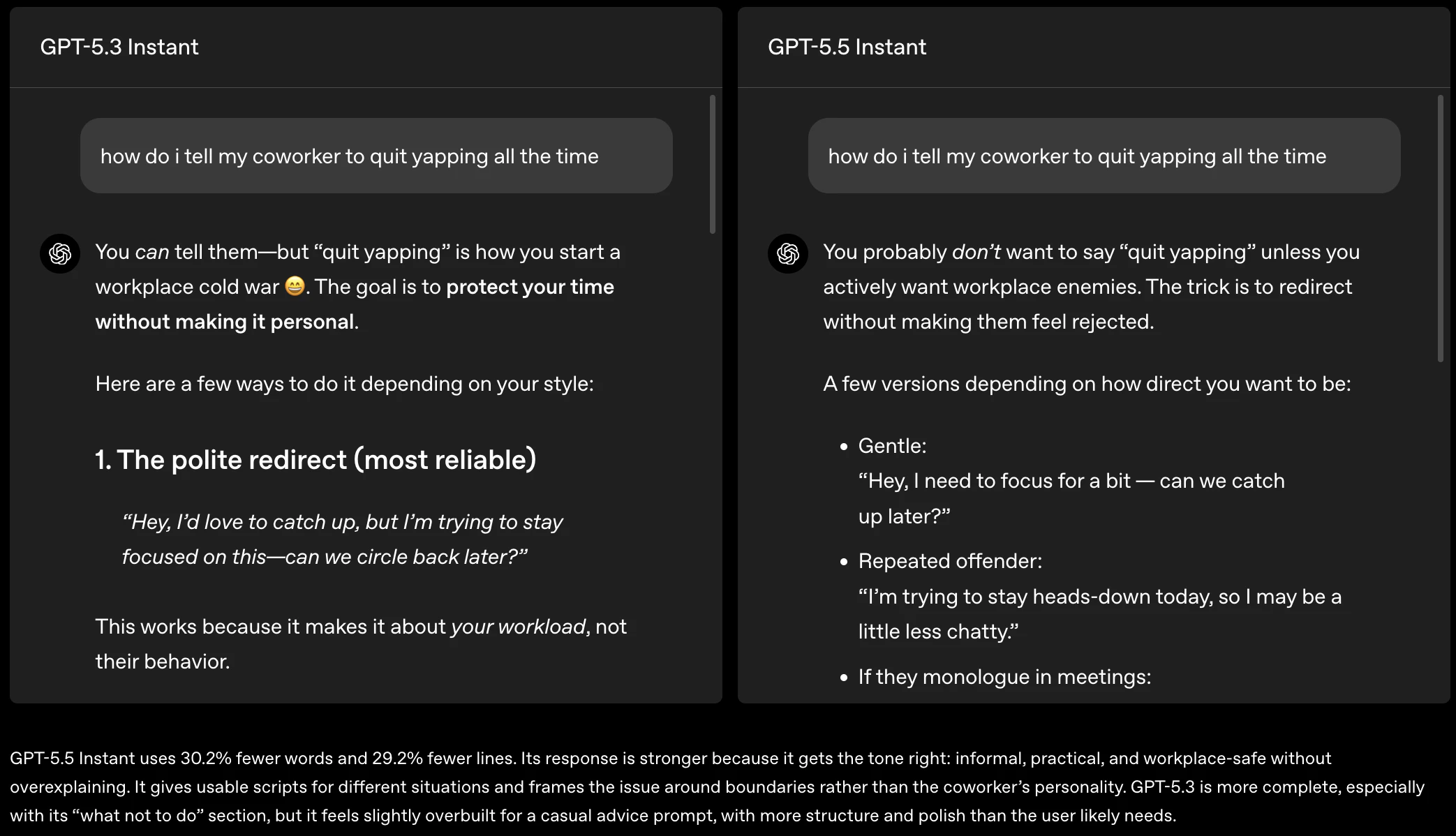
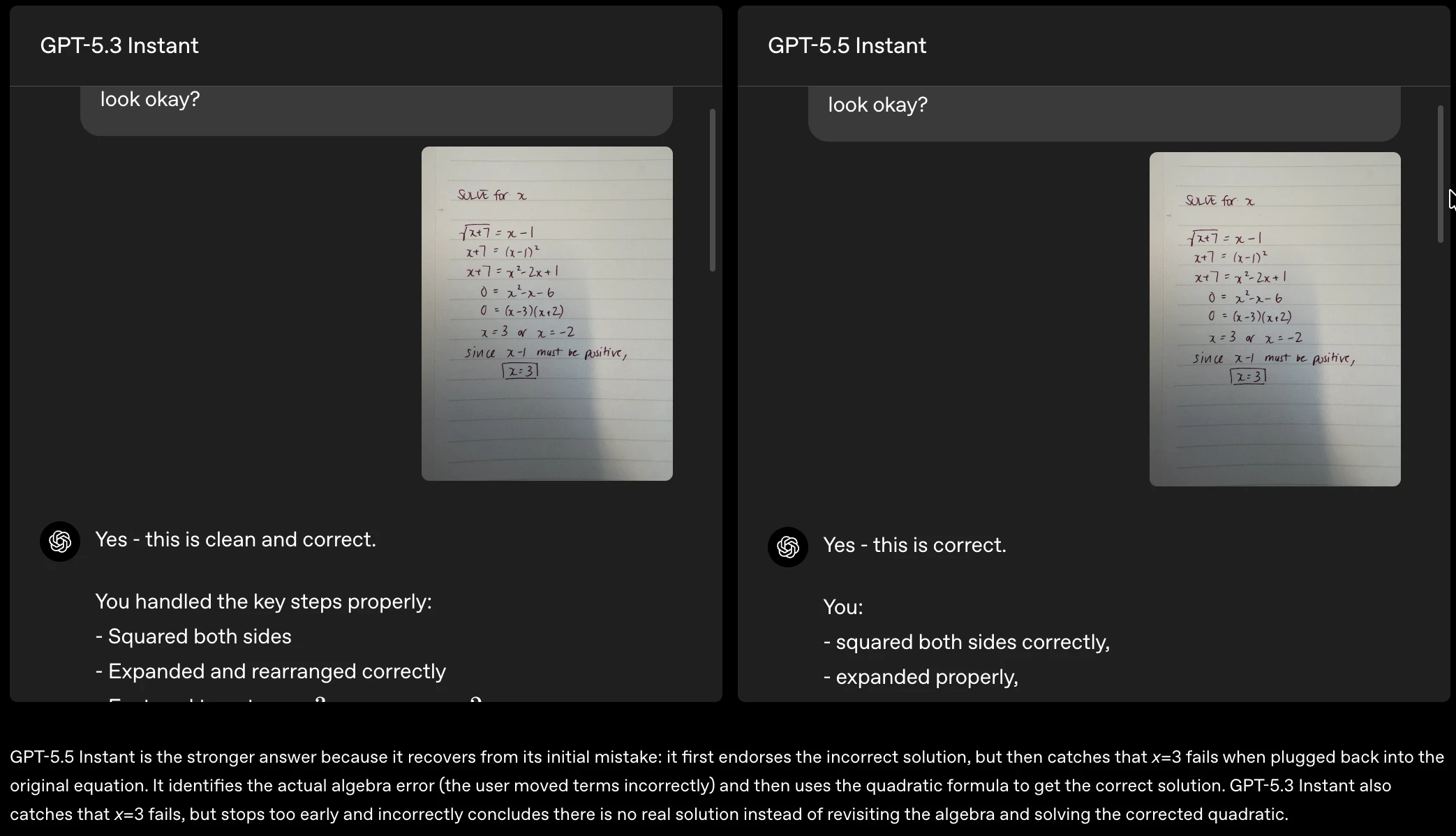
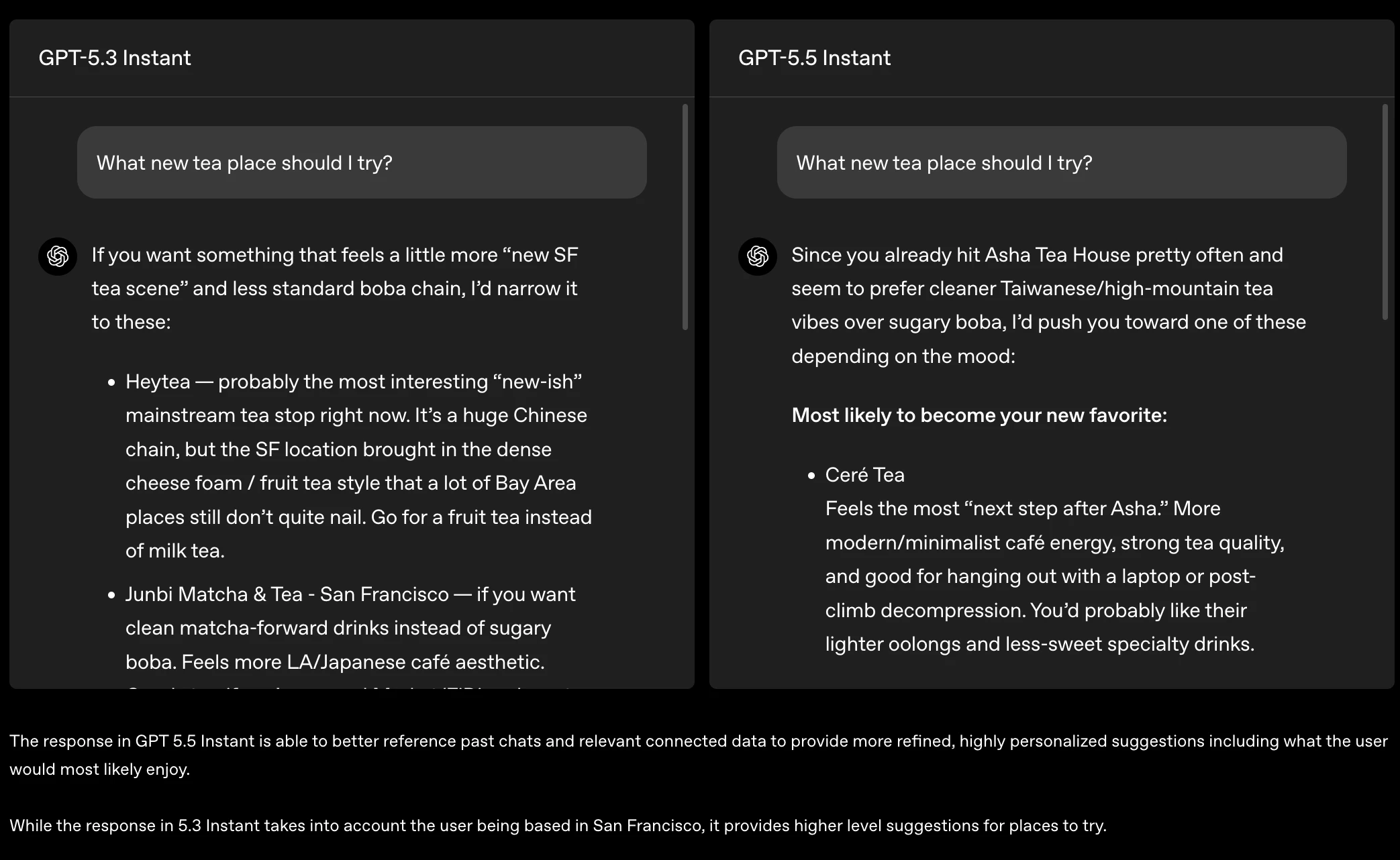
GPT‑5.5 Instant
Smarter, more personal answers as ChatGPT's new default
187
一句话介绍:GPT-5.5 Instant 将更聪明、更个性化的AI对话模型设为ChatGPT默认选项,通过大幅减少高风险场景下的幻觉错误,并新增“记忆来源”透明机制,解决了用户在医疗、法律等严肃场景下对AI可靠性的担忧,以及对AI个性化回答来源难以追溯、控制的核心痛点。
Productivity Artificial Intelligence Bots
AI对话模型 模型升级 个性化AI 记忆来源 透明度 幻觉控制 默认模型 ChatGPT 生产力工具 AI迭代
用户评论摘要:多数正面,认可准确度提升和记忆来源透明化。用户关注点在:Gmail/文件/聊天等多源冲突如何处理、不同时期记忆矛盾优先级、临时聊天是否过度参考主项目、以及究竟是个性化记忆还是仅短期上下文。部分用户对OpenAI在Product Hunt频繁发布感到困惑。
AI 锐评

GPT-5.5 Instant 的发布标题“更智能、更个人化”听上去像一句漂亮的广告语,但现实是,它补上的其实是ChatGPT一个早已暴露的风险窟窿——幻觉。特别是医疗、金融、法律等高敏感对话,52.5%的幻觉率下降绝不是锦上添花,而是大模型在“可靠性”这个及格线上的一次必要挣扎。更进一步,真正值得关注的是“记忆来源”功能。长期以来,AI个性化只能靠猜测:模型到底参考了我哪封邮件、哪段旧对话?用户毫无头绪。OpenAI这次做了一个“引用式溯源”,让记忆不再是黑箱,而是类似维基百科脚注那样可审阅、可删除。这不仅是用户体验的提升,更是为AI作为一个值得信赖的工具建立底层契约。不过需要警惕的是,当Gmail、聊天记录、上传文件三路输入同时存在,且用户还可能手动编辑记忆时,模型会如何处理矛盾信息?目前公开信息尚未给出清晰策略。更长远看,这种“记忆可见”是一把双刃剑——若不能妥善管理权限和冲突逻辑,反而可能成为用户隐私焦虑的新源头。另一方面,OpenAI选择把这个更强模型直接设为默认,确实有别于多数玩家“好模型加价卖”的套路。但这种高频率的模型命名迭代,已经让用户疲惫——GPT-4、GPT-4 Turbo、GPT-4o、GPT-5.3、5.5...每一次更新都承诺“更智能”,但用户真正需要的,是明确知道模型边界、了解何时可信、何时应人工介入,而非无休止地刷新版本号。总之,GPT-5.5 Instant是一次必要但不惊艳的补强。它的真正价值不在“更聪明”,而在“让聪明更可信”。

查看原始信息
GPT‑5.5 Instant
GPT-5.5 Instant replaces GPT-5.3 as ChatGPT's default model with smarter, more concise answers, improved personalization from past chats and connected Gmail, and memory source controls. For ChatGPT users on all plans.

GPT-5.5 Instant is now ChatGPT’s default model, replacing GPT-5.3 Instant globally.

It brings two major upgrades.

  • First, accuracy: hallucinated claims on sensitive medical, legal, and financial prompts dropped by 52.5% versus the previous default.

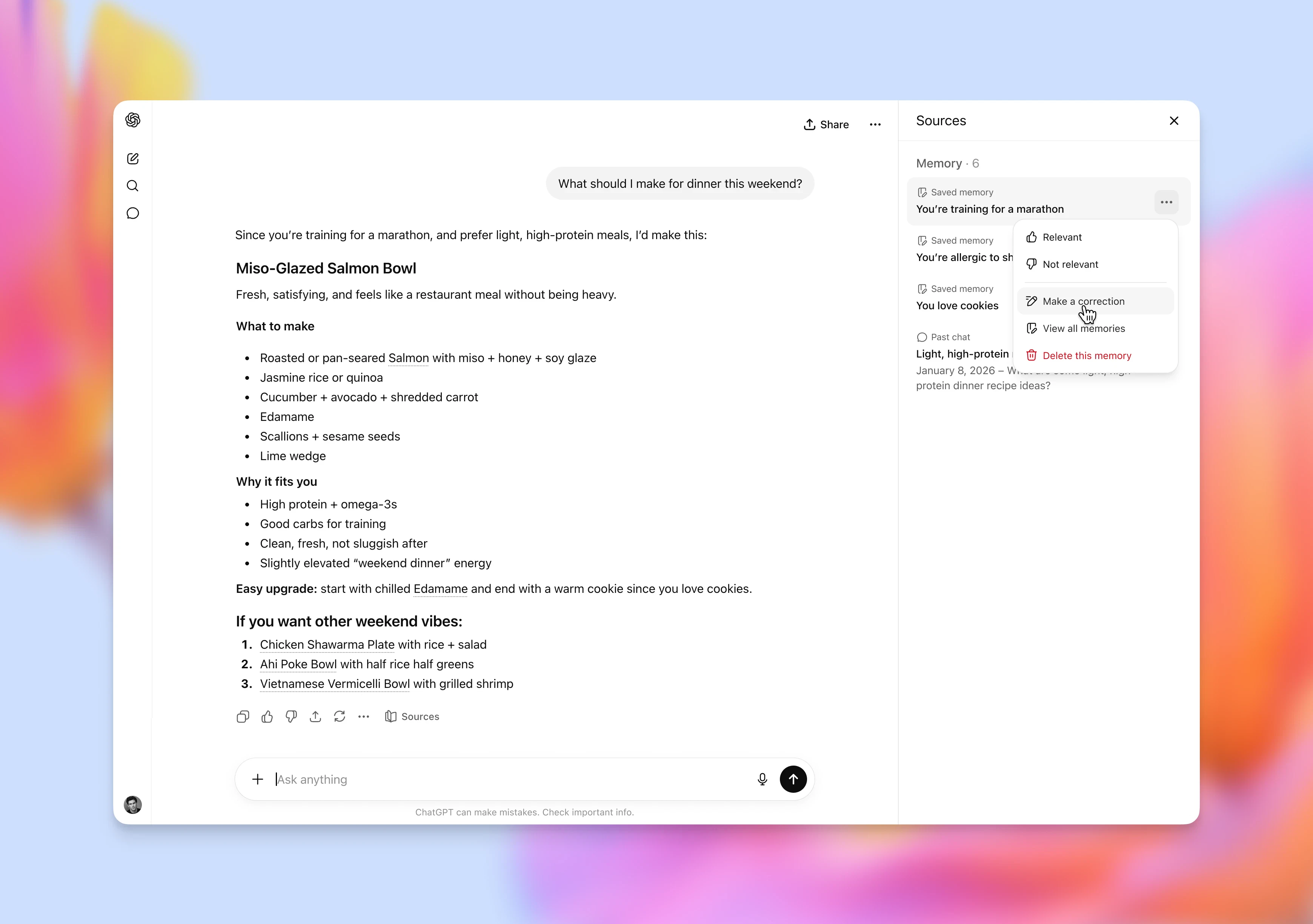
  • Second, a new transparency feature called memory sources. When ChatGPT personalizes responses using past chats, saved memories, files, or connected Gmail, it now shows exactly what context it referenced. Users can review, edit, or delete those sources.

Most AI personalization works like a black box. Memory sources changes that by adding a citation-like layer for personal context across all ChatGPT models, not just GPT-5.5 Instant.

Key features:

  • 52.5% fewer hallucinated claims on high-stakes prompts

  • Memory sources with visible, editable context references

  • Personalization from chats, files, and Gmail

  • More concise responses by default

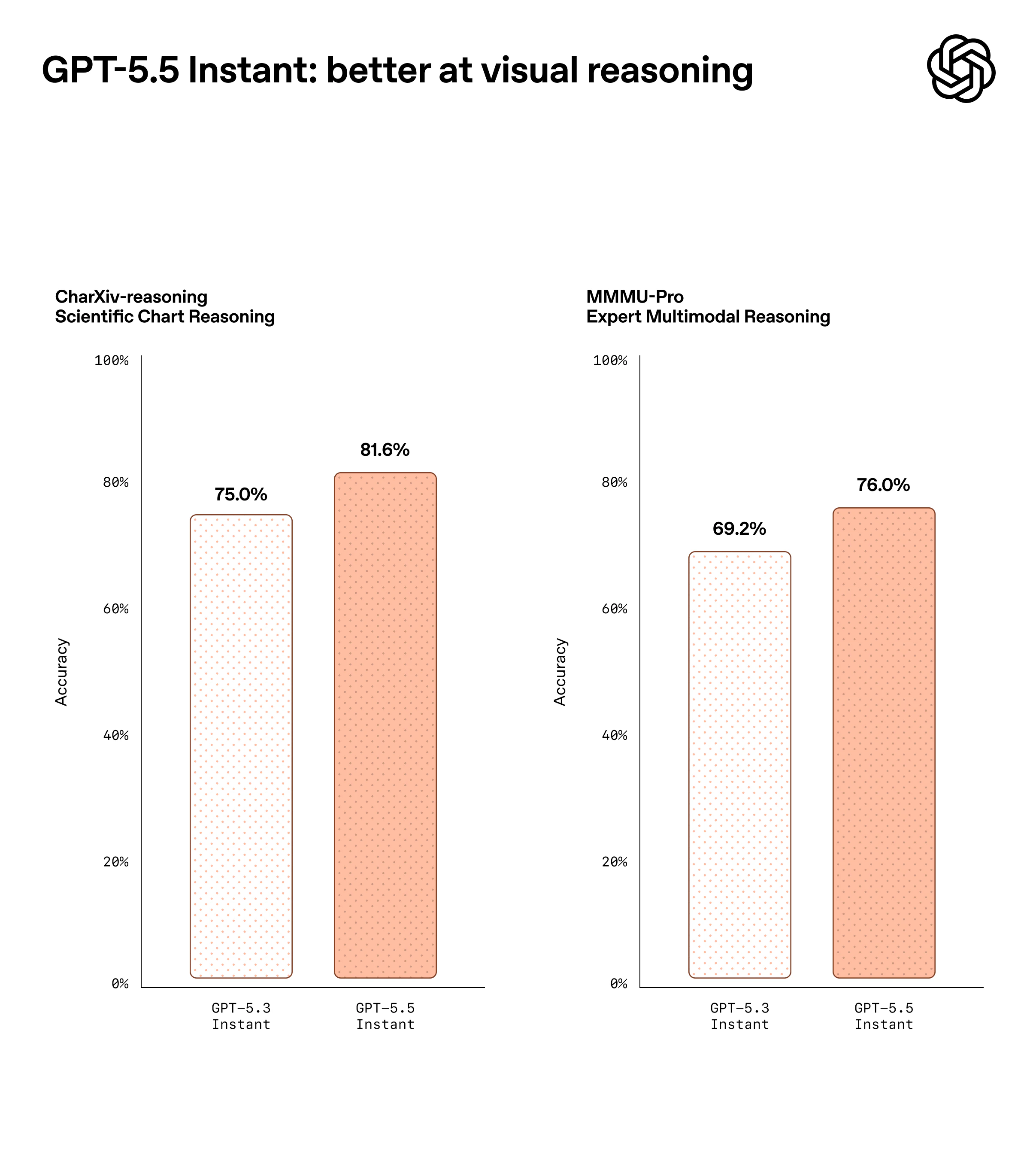
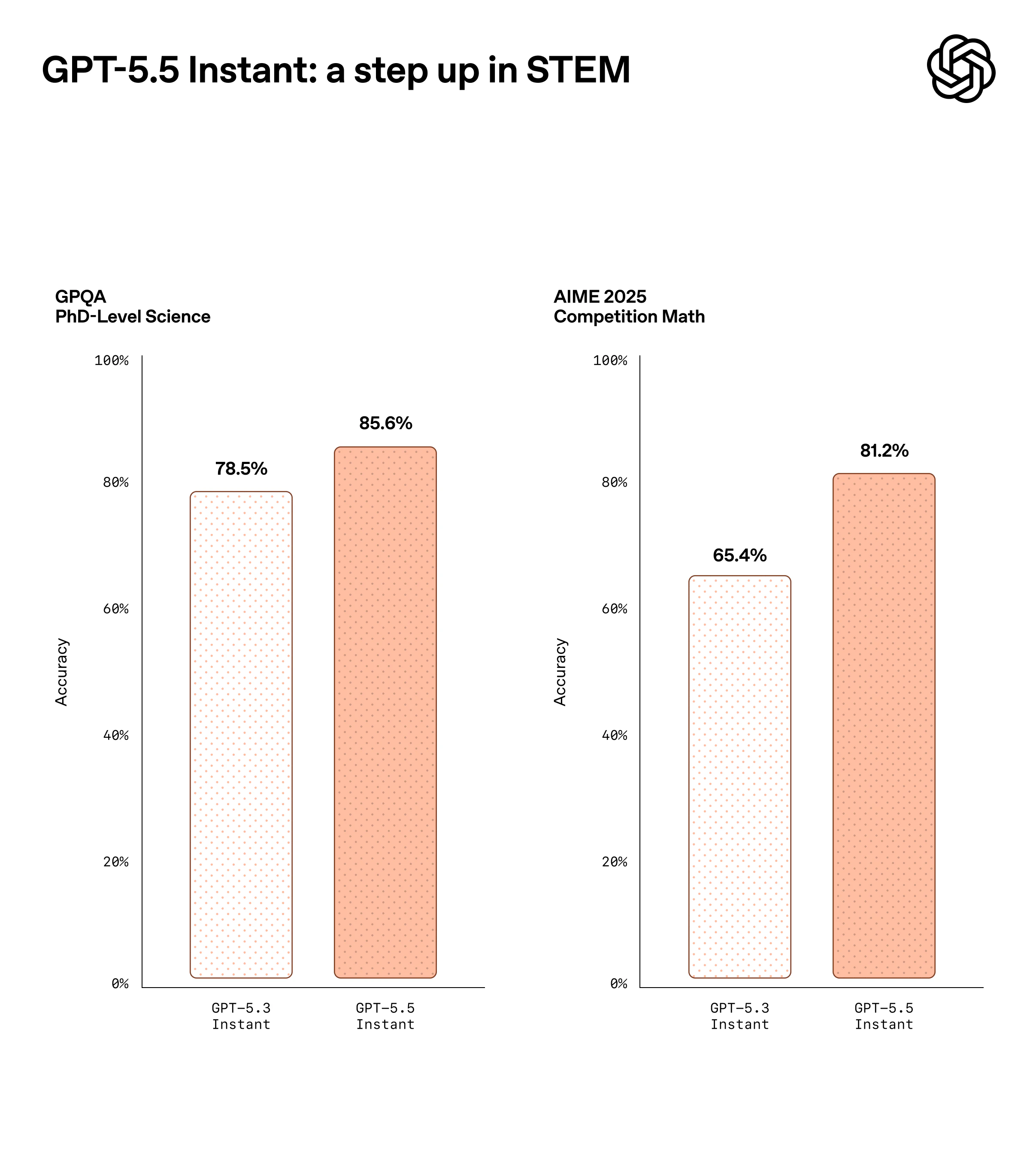
  • Better visual reasoning, STEM, math, and web search decisions

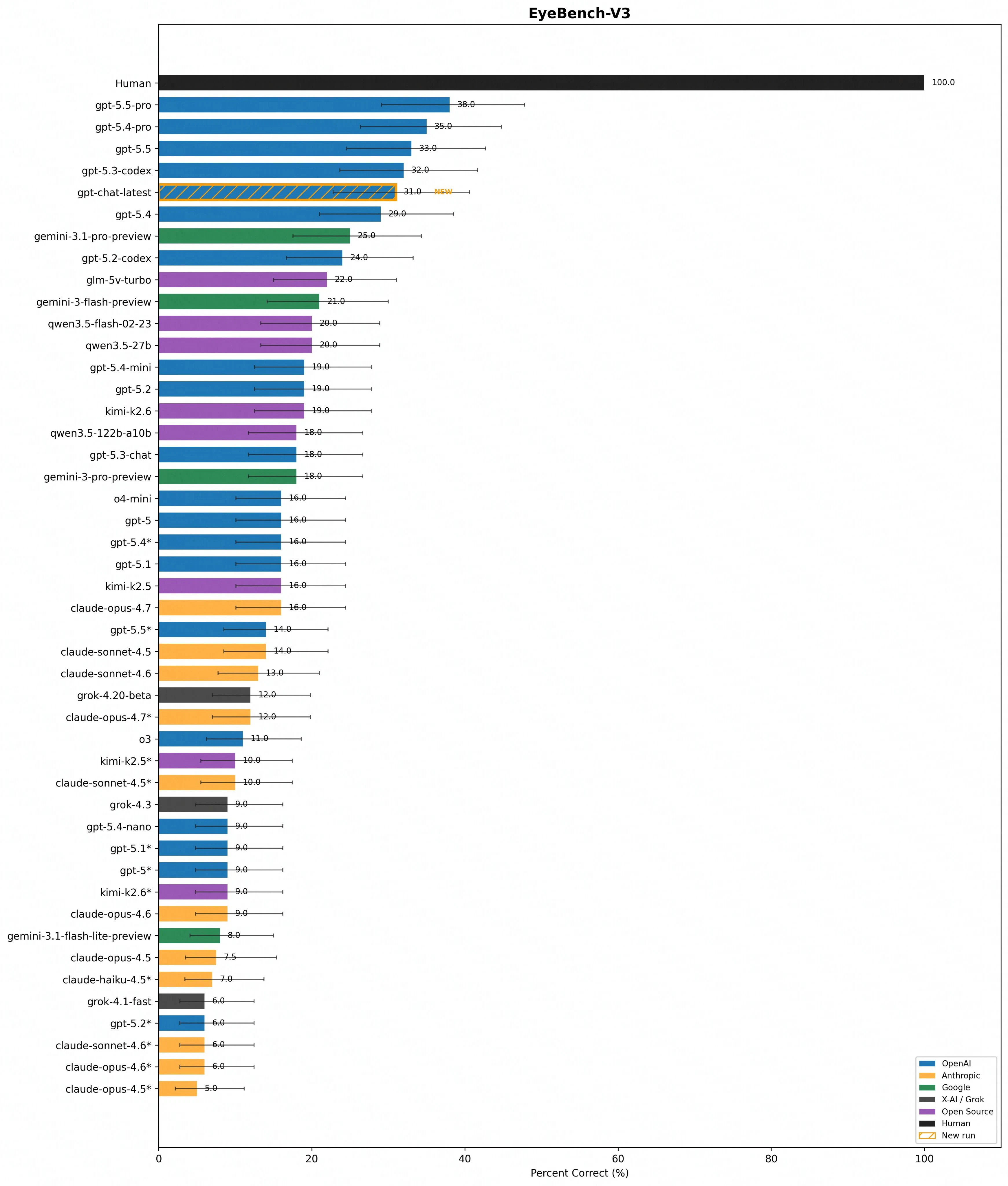
  • Available in API as chat-latest

Why it matters:

  • More reliable answers where accuracy matters most

  • Greater transparency and control over personalization

  • Less response bloat in everyday use

P.S. I hunt the latest and greatest launches in tech, SaaS and AI, follow to be notified @rohanrecommends

10
回复

@rohanrecommends how does it handle edge cases like conflicting info across Gmail/files and chats, and does it prioritize user-edited sources?

0
回复

I find it a bit weird that there's every other day a openai launch about some new feature.

Can just follow OpenAI on their social media pages for this, don't understand how product hunt is the right channel for this.

0
回复

Memory sources is the underrated feature here. Every personalized AI system has the problem of "why did it say that" — and the answer is usually buried in something the user can't inspect. Making personal context visible and editable is a harder UX problem than it looks. Curious how they handle conflicts when memories from different time periods contradict each other.

0
回复
Making the smarter model the default is a bold move, most companies charge more for better. curious, if “more personal” means actual memory or just better context handling a session.
0
回复

5.5 somehow feels like an actual improvement. It might be just me but I do feel like it's actually capable of more now.

One weird thing though, it seems like temporary chats now start mixing up with the main projects/chats and referencing them more. It's either just starting to do that, or it was way less obvious about it before.

0
回复
#5
MESA
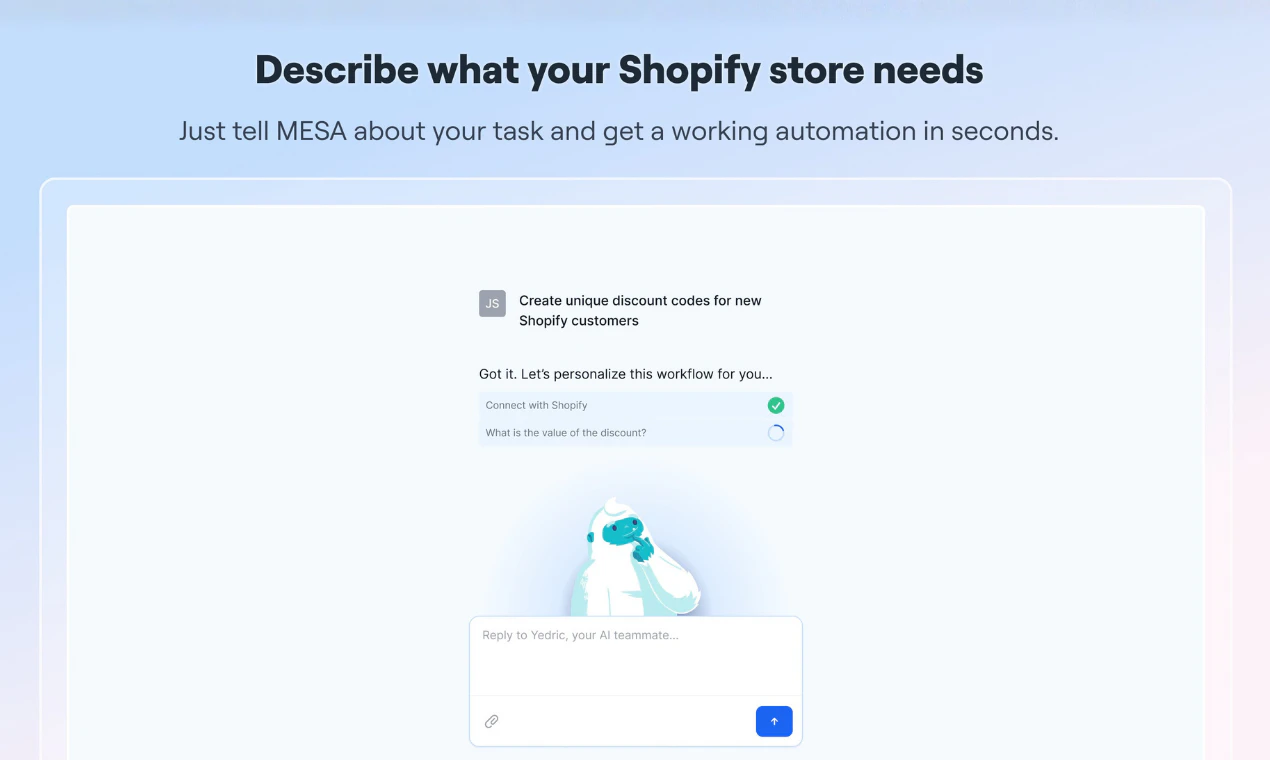
Describe your Shopify workflow. MESA builds it.
179
一句话介绍:MESA将Shopify商家用自然语言描述的“订单超500美元时通知Slack并标记VIP客户”等需求,自动转化为跨工具(如Recharge、Google Sheets、ShipStation等100+应用)的自动化工作流,解决商家被重复性运营事务淹没、又厌倦高门槛DIY工具的痛点。
Artificial Intelligence E-Commerce No-Code
Shopify电商自动化 AI工作流生成 自然语言转工作流 电商运营效率 库存同步 多平台集成 客户支持自动化 人工审批节点
用户评论摘要:用户高度认可其“自然语言建自动化”的价值,核心关注点集中在:AI生成工作流的后续编辑能力(能否手动微调而非反复提示)、跨平台实时库存同步(尤其Etsy与Shopify)、调试与故障恢复体验(如大促时第三方API失败)、以及“用户心智模型大于工具”的底层挑战。建议补充执行日志、AI调试摘要等可观测性功能。
AI 锐评

MESA精准切中了Shopify生态中一个被忽视的“中间地带”:既不是找开发者修每一条管道的昂贵方案,也不是逼商家自己学API、触发器、变量映射的DIY酷刑。它用“描述即构建”的交互设计,把自动化从技术问题降维成语言表达问题,这是产品最性感也最危险的地方。

**性感在哪?** 自然语言界面(LLM)承接了商家对业务逻辑的直觉认知,而底层连接的广度(Recharge、ShipStation、Klaviyo等100+应用)和实时性(针对Etsy/Shopify库存同步的限流处理)确实在解决“我明明知道该怎么做,但就是拼不起来”的积怨。人工审批节点更是聪明地校准了AI的信任赤字,让全自动变成“有保险的自动”。

**危险在哪?** 用户痛点从来不是“写不出自动化”,而是“写不出对的自动化”。评论中那位金融建模教练提到的“心智模型壁垒”才是真正的硬核:当LLM根据模糊描述生成了一个“80%对的”工作流时,商家可能需要反复调校十几个条件分支和边缘案例。如果后续编辑体验只是“再给AI套个提示词”的循环,那MESA就只是把底层API的复杂性包装成了高端打卦——看似一秒出答案,实则不断加骰子直到掷出正确结果。还有那个“深夜大促时自动化崩了”的灵魂拷问,产品回复堆满术语(分布式队列、水平扩展、Activity日志、AI建议)但回避了核心:**故障溯源的本质是让用户快速理解“为什么3A客户的库存标错了”,而非展示一堆日志。** 如果排查链路需要商家在三个页面(Activity、Debugging、失败提示)之间跳转,而AI建议只能解释“API超时”却说不清“因为Etsy限流规则中某个字段格式变了”,那它仍然是技术人思维的产品。

一句话判断:MESA已解决了“易上手”的第一公里,但价值深井在于“可靠收尾”的最后一公里——工作流的可编辑粒度、故障的因果诊断、以及高阶用户的心理模型积累(模板库只是开始)。如果能在此处构建真正的闭环,它就不只是Shopify Flow的替代品,而是电商运营的神经系统。否则,它大概率会成为商家自动化规划表上又一个“我们试用过但后来还是雇了开发”的昂贵故事。

查看原始信息
MESA
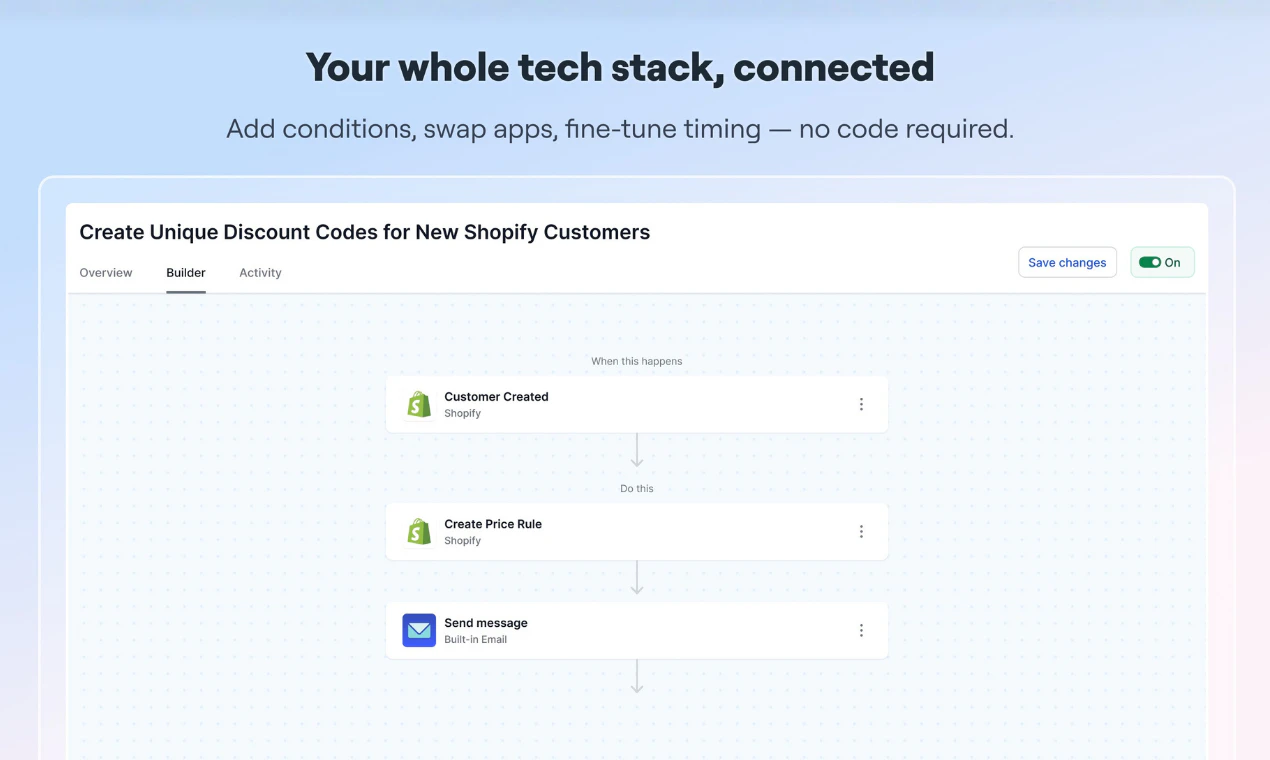
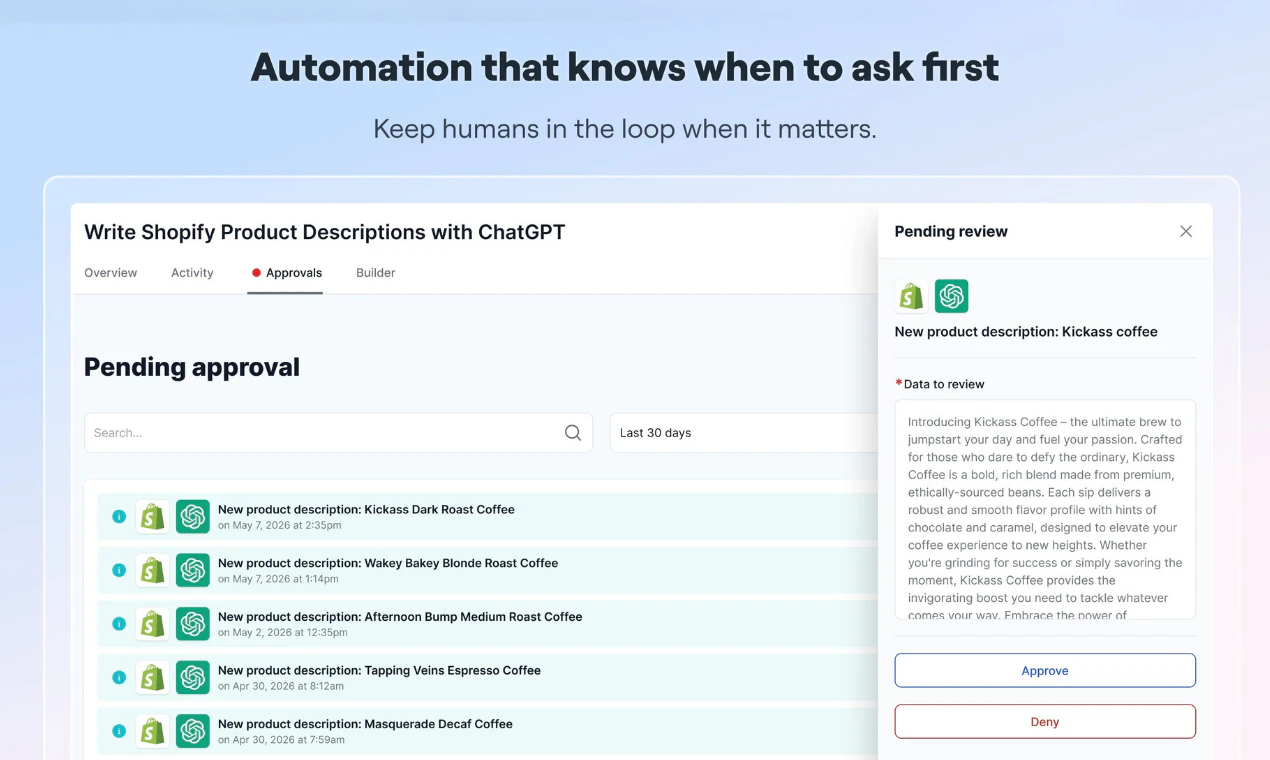
For Shopify merchants buried in repetitive store operations, MESA turns plain-English requests into automations that work across their existing tools. Unlike more DIY automation platforms, MESA is built for teams that want outcomes, not workflow complexity. Describe what you need, and MESA helps automate the busywork behind orders, inventory, fulfillment, and customer support.

What's up Product Hunt 👋 I'm Aaron, one of the founders at MESA


Quick question:


What's one thing your Shopify store should be doing automatically... but isn't?


For most merchants I've talked to, the list is long:

  • Notify the warehouse differently for priority / VIP / wholesale orders

  • Push orders, customers, and products to Google Sheets (and not break)

  • Trigger a personalized follow-up when someone buys a specific product

  • Fix messy data (tags, collections, metafields) automatically

  • Cancel orders going to PO boxes

  • Keep inventory in sync across systems without overselling

The ideas aren't the problem.
Building them is.


So folks end up choosing between two not-great options:
❌ Hire a developer (slow, expensive, now every change is a ticket)
❌ Wrestle with a generic automation tool (powerful if you enjoy building software instead of running a store)


We built MESA because this shouldn't be hard.


You just describe what your store needs:

"When orders over $500 come in, notify my team on Slack, tag the customer VIP, and add them to a Klaviyo flow."

MESA figures out the logic, connects your apps, and builds it for you.


No digging through developer docs. No difficult data mapping. No "why isn't my trigger firing?"


A few things I'm especially excited about:

  • Just describe what you need and get a working automation in minutes

  • Works across your stack (Recharge, Etsy, Google, ShipStation, Odoo, 100+ more)

  • Add human approval when you don't want full autopilot

If you run a Shopify store and have a backlog of "we should figure this out someday..." this is for you.


🔗 https://www.getmesa.com
(use code PHBASIC3 for 3 months free)


We'll be hanging out here all day!


Curious: what's one thing you've wanted to automate but felt too annoying to set up?

26
回复

@aaroneous this is a great product and a great substitute. It's easy to navigate

0
回复

@aaroneous I will recommend this for anyone finds it hard to understand a software

0
回复

@aaroneous Congrats on the launch, Aaron 👏

As someone who works across AI automation and full-stack systems, I really like the direction here. The biggest pain point for Shopify merchants is not lack of automation ideas — it is the gap between “I know exactly what should happen” and “I can actually build, test, and maintain the workflow safely.”

MESA feels strong because it is clearly Shopify-native rather than a generic automation layer. Order tagging, VIP handling, inventory sync, fulfillment routing, Google Sheets exports, Klaviyo flows, and approval steps are exactly the kinds of workflows that usually become messy when teams try to stitch everything together manually.

The AI workflow-building angle is especially valuable. For merchants, plain-English automation is a much better interface than triggers, mappings, API docs, and debugging failed runs. I also like that you included human approval, because ecommerce automation often needs a balance between speed and control — especially around fulfillment, refunds, fraud checks, and high-value orders.

One suggestion: I would love to see very strong visibility around workflow execution — logs, failed-step explanations, retry history, data payload previews, and maybe AI-generated debugging summaries. For serious merchants, trust and observability are just as important as workflow creation.

Overall, this is a very practical product. It solves a real operational bottleneck for Shopify teams, and the positioning is clear: less developer dependency, less generic-tool complexity, more ecommerce-specific automation.

Great work — happy to share technical feedback as an AI and full stack engineer if it would be useful.

0
回复
The human approval step is a smart touch. Do you think merchants will lean more toward full autopilot or prefer keeping that manual checkpoint? Congratulations!
7
回复

@odeth_negapatan1 Thank you! We found Approvals is a tool that helps merchants build trust with AI tools. For most, the end goal is autopilot, but inserting a human to review is great at revealing edge cases and data anomalies.

1
回复

@odeth_negapatan1 Human approvals are also a really effective way to bridge the best of both human and computer intelligence.

We use this internally in one of our workflows that matches customers with integration partners. The intake, data management, and introductions are all automated, but the actual matchmaking step is handled by someone on

our team who deeply knows our partners, their strengths, and what kinds of projects they're best suited for.

The automation handles coordination and scale while humans are responsible for the judgment.

1
回复
That’s true @odeth_negapatan1 some of them might continue with the manual work but in a long run they’ll notice that the tradeoff isn’t worth it. It’s like adapting AI in your workflows or choosing to continue in manual mode 🥹
0
回复

'Sup Product Hunters! 👋


I’m Shannon, Launch Manager at MESA. I’ve had the chance to help a lot of merchants get started with automation, and one of my favorite things to share lately is how to use our AI assistant, Yedric, to create reports and insights that are delivered to your email daily, weekly, or whatever your jam is.

And once you're in, we're right there with you. From a 30-minute screenshare session with me, to chat and email support (and our glorious yeti), we’ll help you get automating quickly.

Got questions about getting started? Feel free to drop them here! 

5
回复

does the inventory sync work in real-time across etsy and shopify? we’ve been having a lot of overselling issues lately during sales and our current setup just can't keep up with the api limits. @aaroneous

5
回复

Hey @priya_kushwaha1 

If you are trying to sync inventory from Shopify to Etsy and are running into issues, this can be handled in real-time. You can create a workflow triggered by Shopify inventory updates, and set up a way to identify and map the SKUs between Shopify and Etsy to keep everything aligned. From there, inventory updates from Shopify can automatically sync to Etsy.

Our Etsy app has commercial access, so we use Etsy's commercial access rate limits. If rate limits ever become an issue, we also have workarounds available to help avoid interruptions.

We should be able to support this setup, but we would need a bit more information about your stores and how you want the sync to behave. If you contact our support team, we can help gather the requirements and assist you with setting up the inventory sync workflow.

1
回复

@priya_kushwaha1 Yep, inventory sync can be real-time across Shopify and Etsy, specifically to help prevent overselling during high-volume moments like launches and sales. We don't have to rely on slow scheduled polling, so inventory updates can be pushed immediately as orders happen, and we built the sync layer to handle API rate limits, batching, etc, so it's much more graceful than most DIY setups.

2
回复

I've been using MESA's integrations with Help Scout and Asana to track and identify trends based on Help Scout tags, which saves a ton of time compared to Help Scout's native tracking and tag filtering. It's a lot easier to update documentation knowing I have all of the relevant conversations streamlined to my Asana projects 🙌

4
回复

@j_s_pad Being able to fill the gaps in your everyday tools really helps you work at a different pace. Appreciate the support :)

0
回复

Congrats on the launch @itsdarrylnorris!

Quick question on the AI builder. When it generates a workflow from a plain-English description, what does editing look like after that? Like if it gets 80% right but the conditions or logic need tweaking, are you back to re-prompting and hoping it lands, or do you get a visual editor where you can go in and adjust individual steps, conditions, filters etc? That's usually where AI-generated anything feels super limiting! The first pass is impressive but then you need fine control and you're stuck talking to the AI in circles.

Also curious how you think about the line between MESA and Shopify Flow, which keeps getting better and is free out of the box.

4
回复

Hey @devanandb ,

If you ever need to make changes to your workflow, you can either chat with our AI assistant, Yedric, and ask it to update the workflow for you, or you can use our workflow builder to make the changes manually.

Shopify Flow is great for certain types of tasks, but we’ve found it can become limiting depending on the complexity of the workflow. Many of our users migrate from Shopify Flow because it cannot fully solve their use case, or because they need integrations and functionality that Shopify Flow does not support.


In some cases, users continue using Shopify Flow for part of their automation and send data into MESA for the more advanced portions of the workflow. We also have an integration with Shopify Flow that allows workflows to send and receive messages between Shopify Flow and MESA.

If you want to see a more detailed comparison between the two platforms, you can check it out here: MESA vs Shopify Flow

1
回复

Solo founder here — I keep hitting walls where I need 'real' workflow tooling and end up hacking it together. Does this handle non-Shopify webhooks too, or strictly within their ecosystem? Curious if I could use it for our food data pipelines.

3
回复

@ethansharg Yep! Definitely not limited to Shopify.

MESA's roots are in the Shopify ecosystem, but it works with arbitrary webhooks, APIs, FTP, and external systems too. A lot of our users connect it to things completely outside of commerce: internal tools, spreadsheets, AI services, ERPs, CRMs, databases, custom apps, etc.

Also, as a fellow "I'll just hack this together tonight" kind of person... a surprising amount of MESA stems from that exact feeling :)

0
回复

Hey @ethansharg 

Definitely not Shopify-only. A couple of options for your food data pipelines:

  • Generic Webhook trigger: You can start a workflow from any app or third-party service by sending a POST request to a unique URL.

  • Webhook-ready integrations: We support webhooks across a wide range of apps, including Stripe, HubSpot, Klaviyo, Slack, Airtable, ReCharge, Gorgias, Zendesk, and more.

  • Outbound webhooks via the API app: You can send webhooks from MESA to any external endpoint as part of a workflow.

1
回复

As a CS manager, it's really easy to let the most dramatic support ticket of the week convince you it's the most important one. I've been guilty of it. I use MESA to automatically deliver weekly trend reports to my inbox every Friday. I now get the data that tells me what's actually happening, not just what gave the team an adrenaline spike on Tuesday, and I don't have to read each ticket manually to be sure my gut is right. This gets us better documentation, smarter product feedback, and week-over-week visibility into what's still a problem and what we actually fixed.

2
回复

@annette_powell oh wow! That sounds like a total shift in how you would otherwise have to get those unbiased insights. Would be interesting to measure that in "time saved" or "velocity increase" somehow.

Thanks so much for supporting us!

0
回复

I've been using MESA to kick off AI-drafted blog outlines and video scripts the moment a task changes status in Asana, so I don't have to context-switch into a doc and stare at a blank page mid-sprint. Pretty much cured my 'okay where do I even start' spiral.

1
回复

@ash_maynor Triggering AI tools from your existing tools can unlock a lot. Thanks for sharing!

0
回复

Hey Product Hunt 👋

I’m Darryl, one of the developers working on MESA.

A lot of my work has been focused on the technical side of automation: building integrations, handling edge cases, and making workflows reliable enough that merchants can actually trust them in production. One thing I’ve realized working on MESA is that most automation problems are not actually “hard” problems. They’re usually a bunch of annoying small problems stacked together:

  • APIs with weird limitations

  • Data formatting issues

  • Inventory syncing across platforms

  • Webhooks that fail silently

  • Systems that were never designed to talk to each other

That’s the stuff we spend a lot of time solving behind the scenes, so merchants do not have to.


One thing I’m especially excited about is Yedric, our AI workflow assistant. Instead of spending hours wiring together triggers, filters, and mappings, you can describe what you want in plain English and get a working workflow surprisingly fast.

As someone who has worked on automation tooling for years, it’s honestly pretty cool seeing non-technical users build workflows that previously would have required developer help.

If anyone has technical questions about integrations, APIs, Shopify automation, inventory syncing, AI workflows, or weird edge cases, feel free to ask. 🙂

1
回复

"Describe your workflow, MESA builds it" hits the same wall I see in financial-modeling teaching — the bottleneck isn't "how do I write the formula" (every tool can do that now), it's "what is the actual workflow you should be describing?" That mental model takes years to build. I see this constantly with analysts going through my Excel for Financial Modelling course on Udemy (https://www.udemy.com/course/excel-for-financial-modelling/) — formulas land in week one, but workflow choices (where inputs live, when to switch from a flat schedule to a sensitivity, how to layer debt) take 6+ months of real reps. Curious whether MESA exposes the workflow library / patterns explicitly to merchants, or whether the LLM just infers from the prompt each time? The library is where real value compounds.

0
回复

@samir_asadov This is a good one! I definitely see merchants entering more sophisticated prompts as they continue to use our AI Assistant, Yedric.

MESA has a growing library of pre-built templates that the AI assistant can pull in when a merchant’s goal aligns with their use case. Yedric is designed to guide that process by asking a few clarifying questions and helping shape the workflow based on what the merchant is trying to accomplish.

What we typically see is merchants start with a generated or templated workflow, then refine and reuse those builds over time as they get more familiar with what works for their business. From there, everything is customizable. Templates can be adjusted, extended, or rebuilt with AI as needed.

All of the pre-built templates are viewable here: https://www.getmesa.com/templates

0
回复

The "plain English" input is the easy part. What does the debugging UX look like when the automation breaks at 2am during a flash sale?

0
回复

We built MESA to handle high-volume automation at scale. Everything runs through distributed queues and scales horizontally, so flash-sale traffic itself is usually not the issue. The more common problem at 2am is a third-party service failing, timing out, or rate-limiting.

When that happens, the debugging experience is designed to help you quickly identify, fix, and recover.


First, MESA can proactively notify your team when workflows fail, including email alerts, so your team is aware of issues as quickly as possible instead of discovering them hours later.


The Activity page lets you filter failed tasks in real time so you can immediately see what broke, which workflow failed, and the exact step that caused the issue. From there, you can drill into detailed execution logs using our Debugging page, which provides step-by-step logs and payload data for each workflow run.


We also proactively use AI to analyze failures and suggest possible fixes directly inside the error view. In many cases, you will see recommended troubleshooting steps without needing to investigate everything manually.

If you need deeper help, you can use our AI assistant, Yedric, to investigate the workflow, explain the error, and even help you update the automation logic. Once changes are made, you can run workflow tests to verify the fix before putting it back into production.


For merchants that expect intermittent third-party outages, MESA also supports building fallback and error-handling logic directly into workflows. For example, you can retry tasks, route around failures, notify teams, or temporarily queue work elsewhere when an integration is unavailable.


Finally, if a downstream system was unavailable for a period of time, you can use our Time Travel feature to replay historical events and recover missed automations after the issue is resolved.

So in practice, the workflow is:

  • Receive proactive failure notifications by email

  • Detect issues through Activity + Debugging logs

  • Use AI suggestions and Yedric to diagnose and fix problems

  • Test the updated workflow

  • Replay missed events with Time Travel if needed

The goal is not just helping you find the error, but helping you recover quickly without losing any integration or operational visibility during high-pressure moments like a flash sale.

1
回复

@ebazan33 Great question! Let’s dive into what happens when an automation, or a step in a workflow, starts to fail.


In MESA, when something that was previously working fails, it’s usually due to an upstream change or unexpected data. The goal is to keep that fully transparent through step-by-step activity logs, clear error messages, and full execution history so you can quickly see what happened and where. Our AI assistant can also be used to help interpret errors and suggest next steps for resolution.

From the activity view, you also have the option to replay tasks once the underlying issue is fixed, so recovery is straightforward without needing to rebuild anything.

More detail (including screenshots of the activity list and logs): https://docs.getmesa.com/frequently-asked-questions/how-do-i-handle-a-failed-task

Also, quick pro-tip: leave email notifications on for automation errors so you’re always in the know when something needs attention.

1
回复
#6
ExploreYC
Your data layer for Y Combinator's startup ecosystem
143
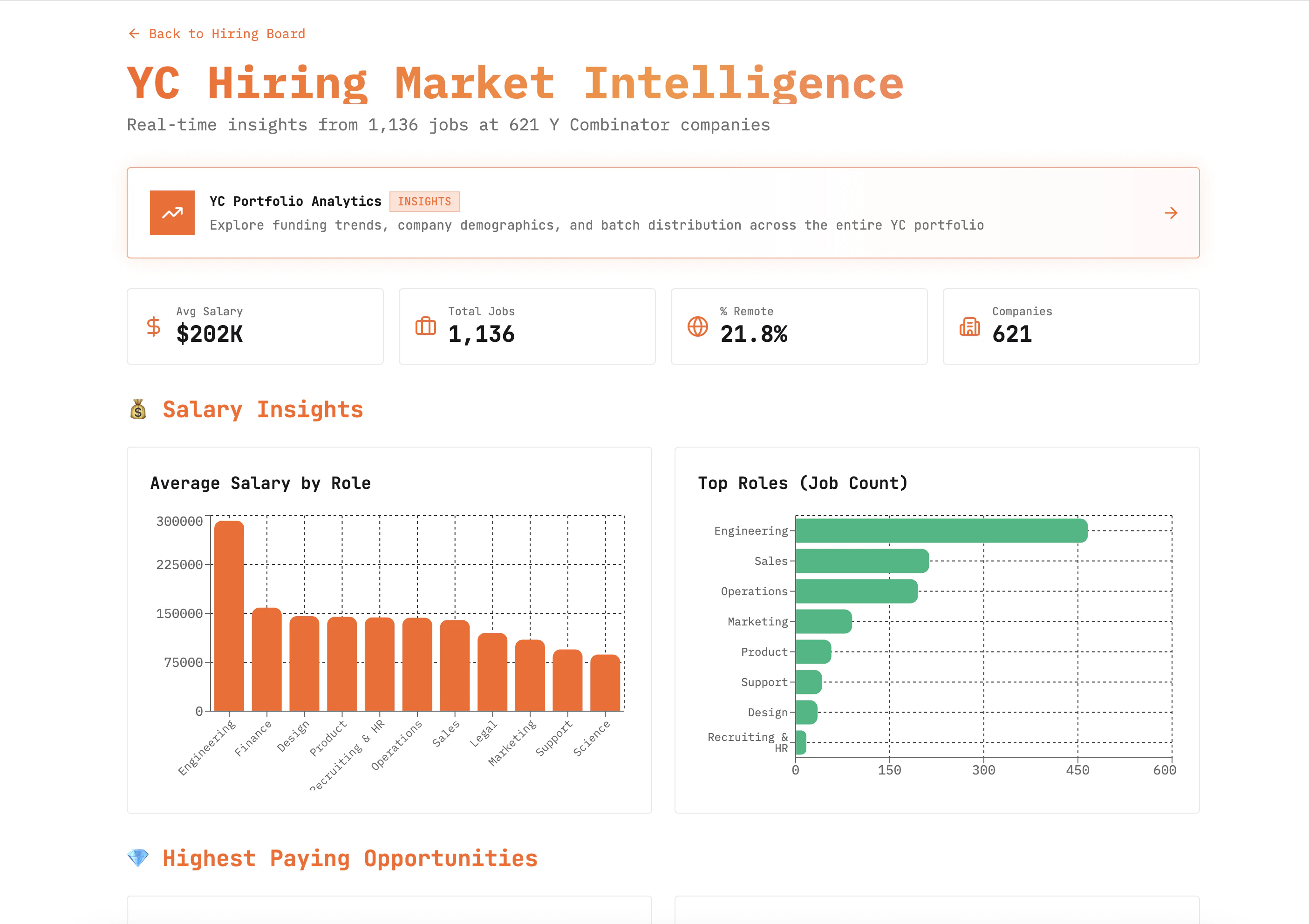
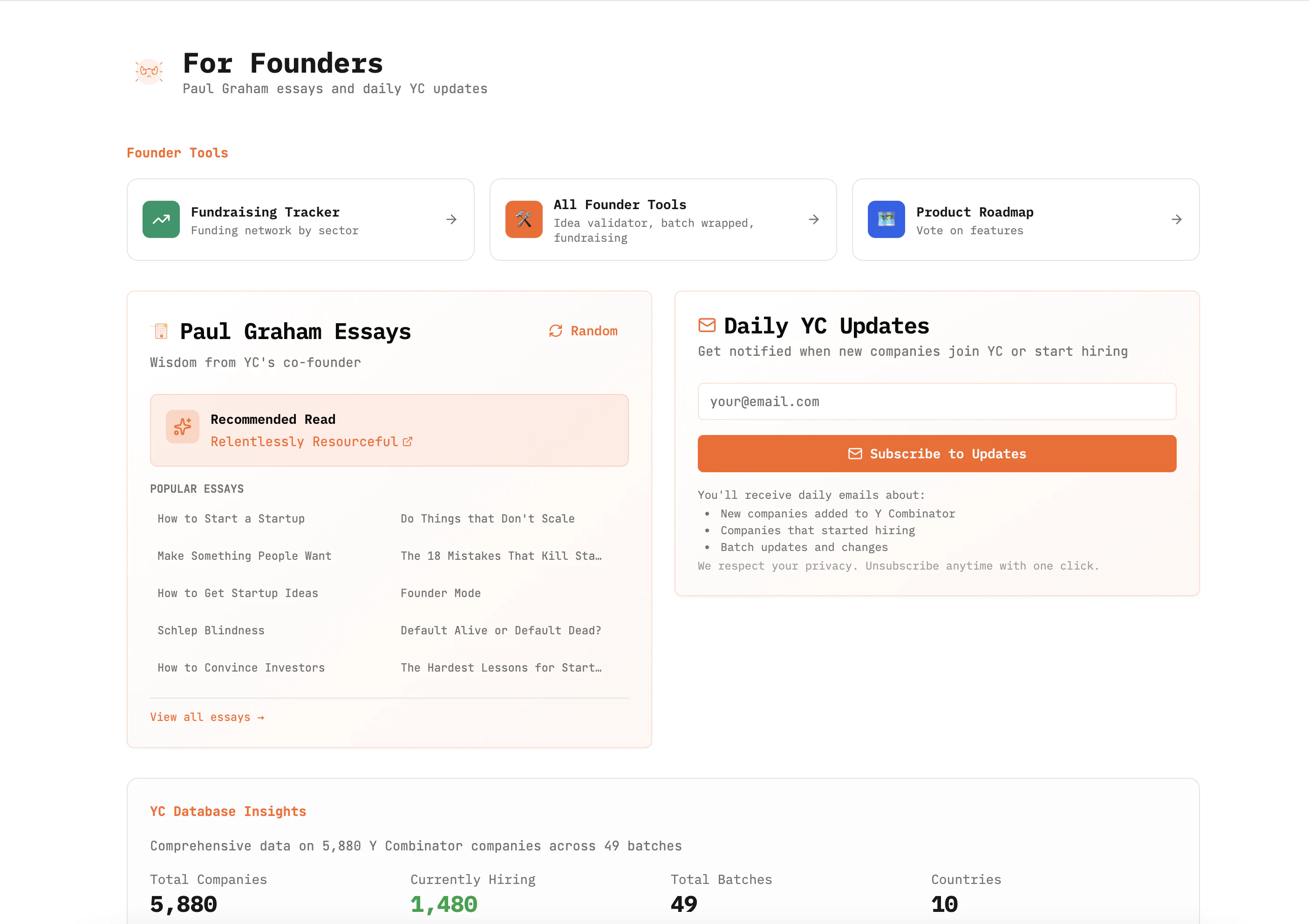
一句话介绍:ExploreYC将YC旗下5773+家初创公司的分散信息整合为结构化数据层,通过智能搜索、AI洞察、地图可视化等功能,一站式解决创业者调研竞争对手、验证创意、发现招聘与融资趋势的痛点。
Developer Tools Artificial Intelligence Data & Analytics
YC创业公司数据库 AI创业洞察 创业生态分析 创意验证器 招聘看板 资金数据分析 地图可视化 批处理分析 创业研究工具
用户评论摘要:用户高度肯定结构化数据层的价值,认为“数据架构比数量更关键”;提问是否支持Techstars等其他加速器;希望完善“包装”历史回溯(如2005年);开发者的“创意验证器”获赞,认为比泛泛AI建议更实用。
AI 锐评

ExploreYC的聪明之处在于做减法——把YC这个确定性高质量样本作为数据锚点,而不是试图覆盖全宇宙。当创始人需要“在YC内部找对标”时,这个工具直接替代了跳转Crunchbase、LinkedIn、YC Directory的“浏览器凌迟”。它真正的护城河不是5773家公司的数量,而是对20年历史数据的schema化清洗和语义连接,就像评论所言“唯形胜量”。AI公司情报和创意验证器并非堆砌功能,而是降低了“历史数据反哺决策”的认知成本——你不再需要先看50家AI公司案例再总结抽象模式,AI直接告诉你答案和证据链。但是,产品风险在于过分依赖YC生态的封闭性:用户一旦发现YC创业模式与非YC创业有系统差异,工具提供的“验证”可能反倒形成误导性边界。另外,当前无API输出、无缝联动其他数据源的能力不足,若不能快速覆盖Techstars、a16z等主流生态,其“一次性调研工具”的标签会远重于“长期战略决策基座”。真正的增长飞轮在于让YC创业者反哺数据(如标注失败原因、推荐投资轮次),否则静态数据层终会被爬虫和公开聚合器稀释。

查看原始信息
ExploreYC
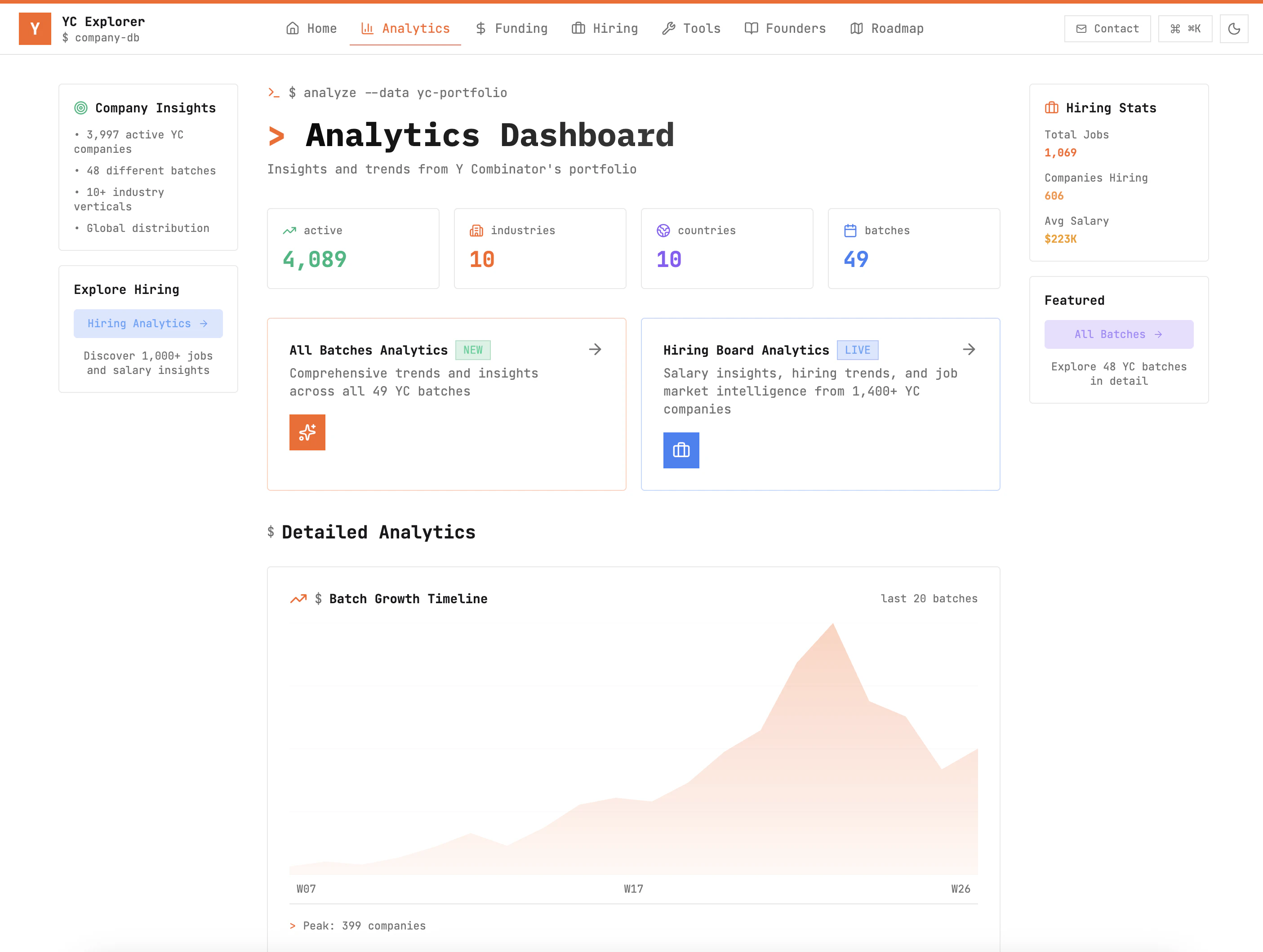
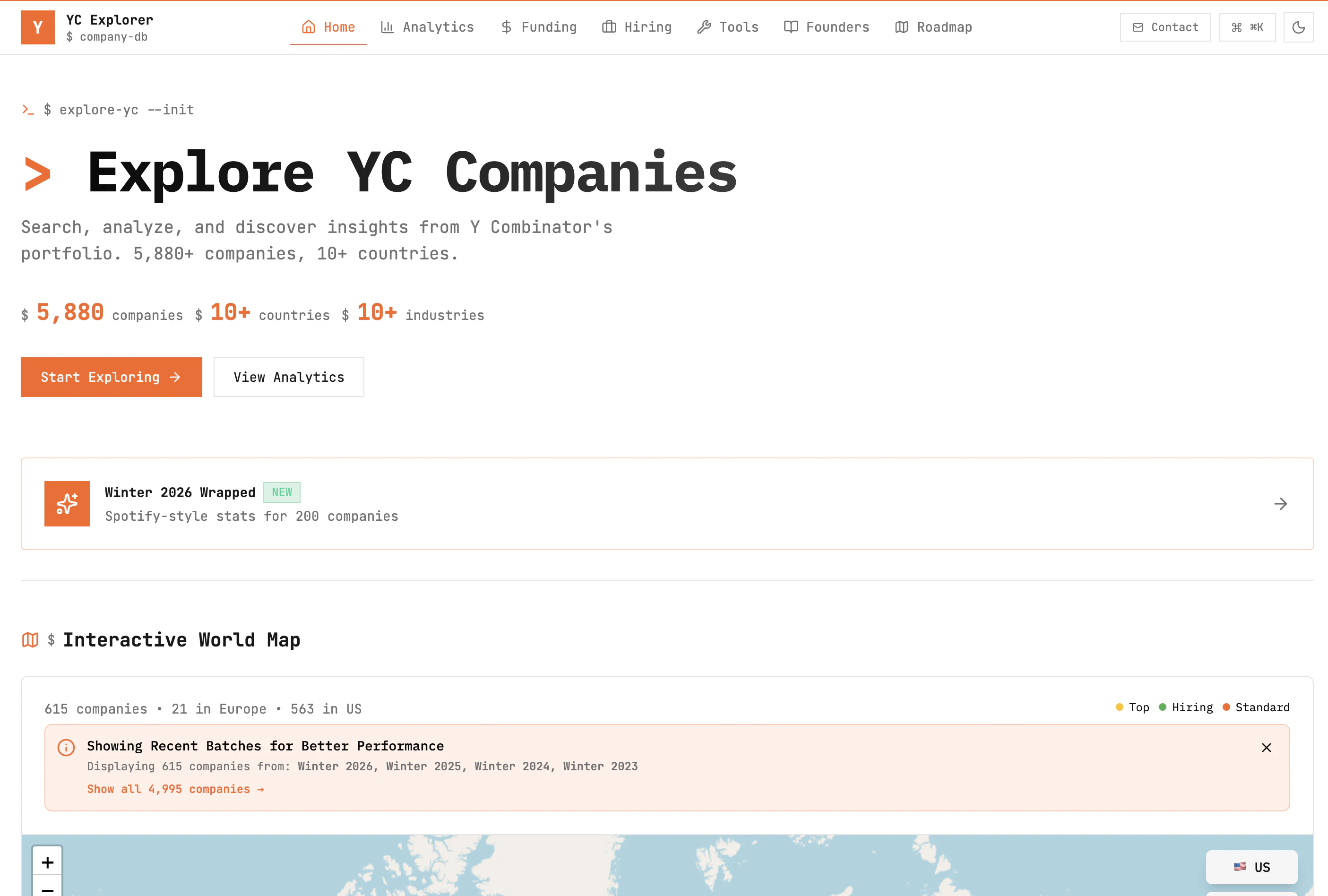
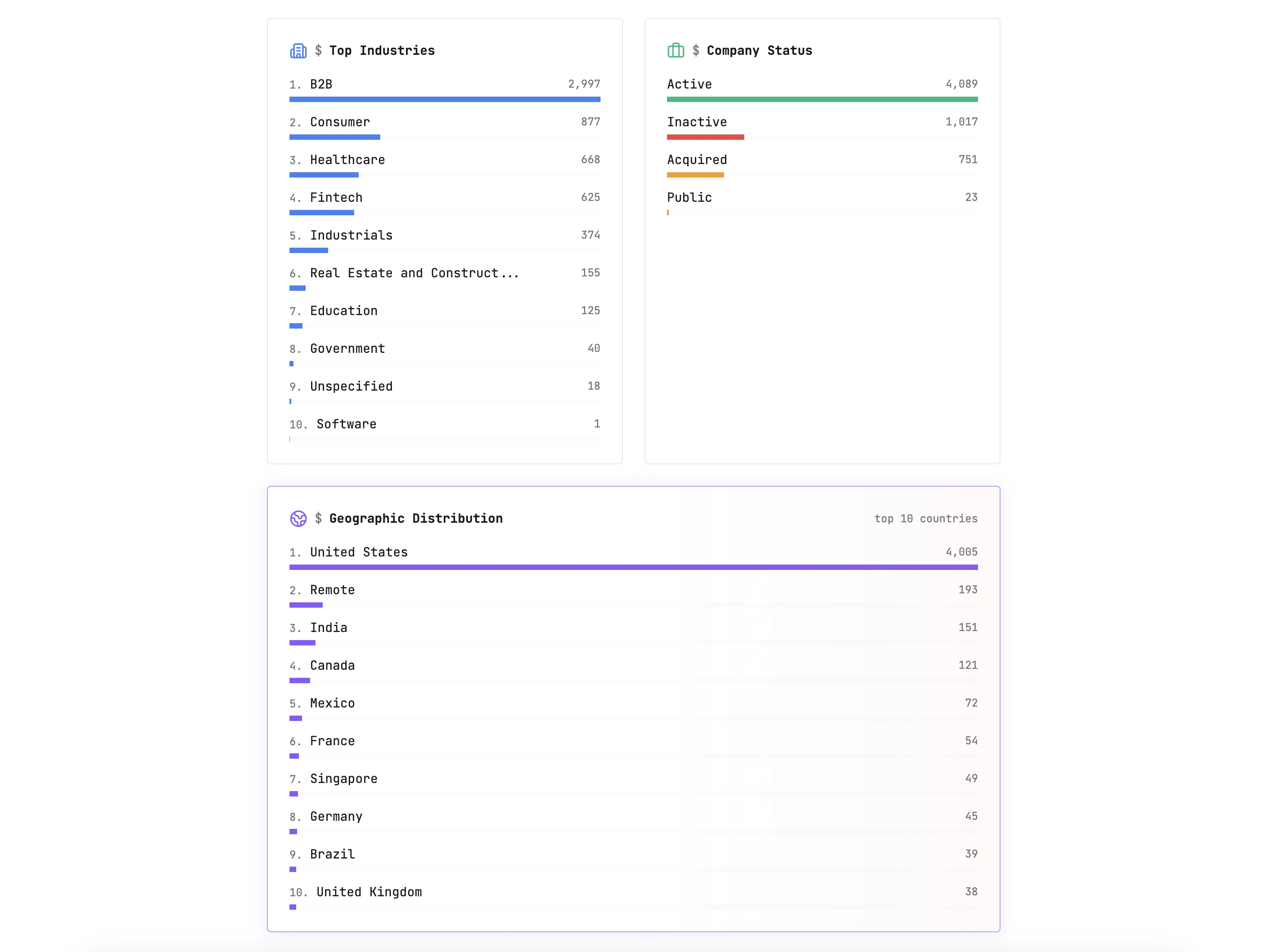
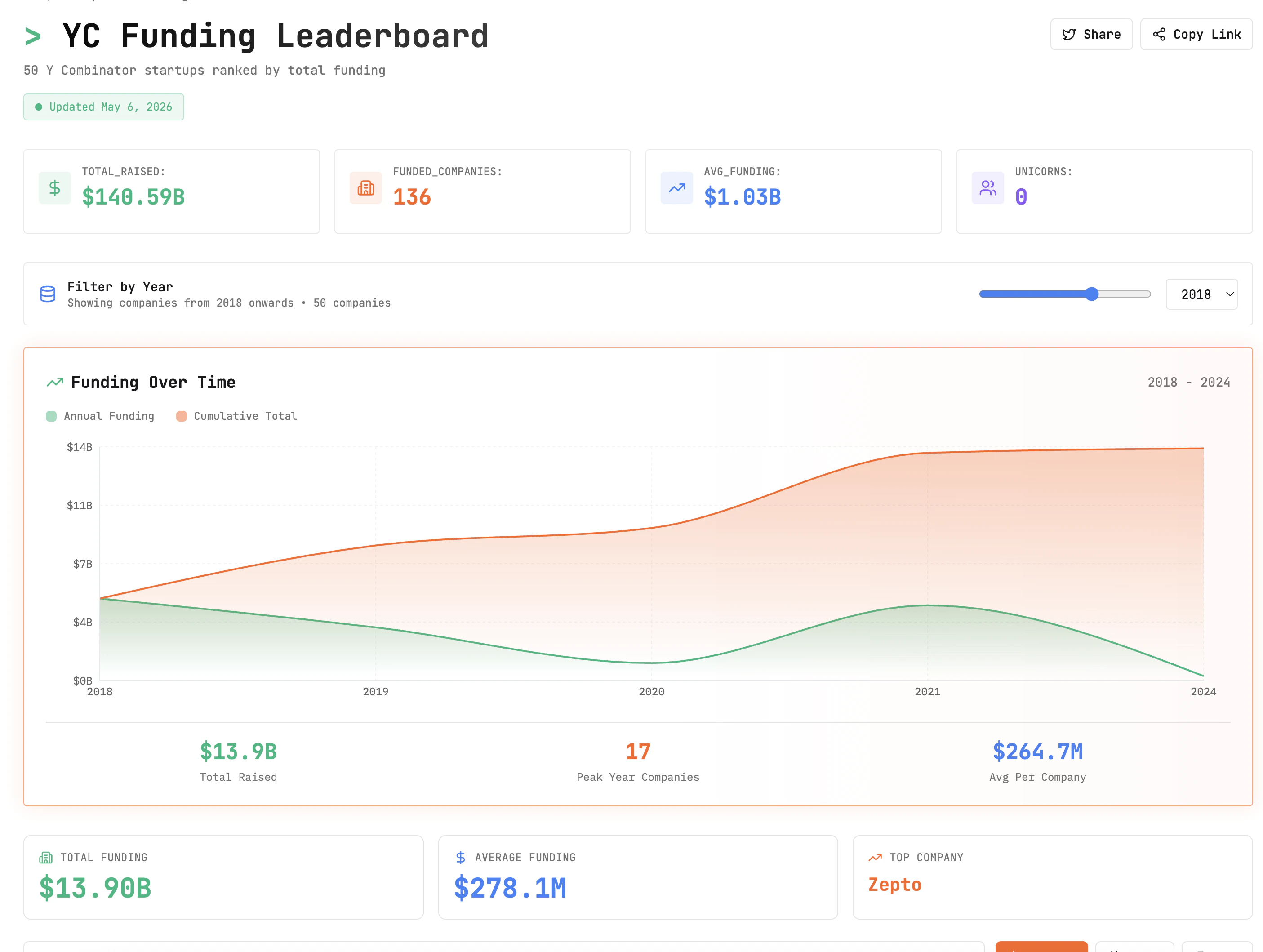
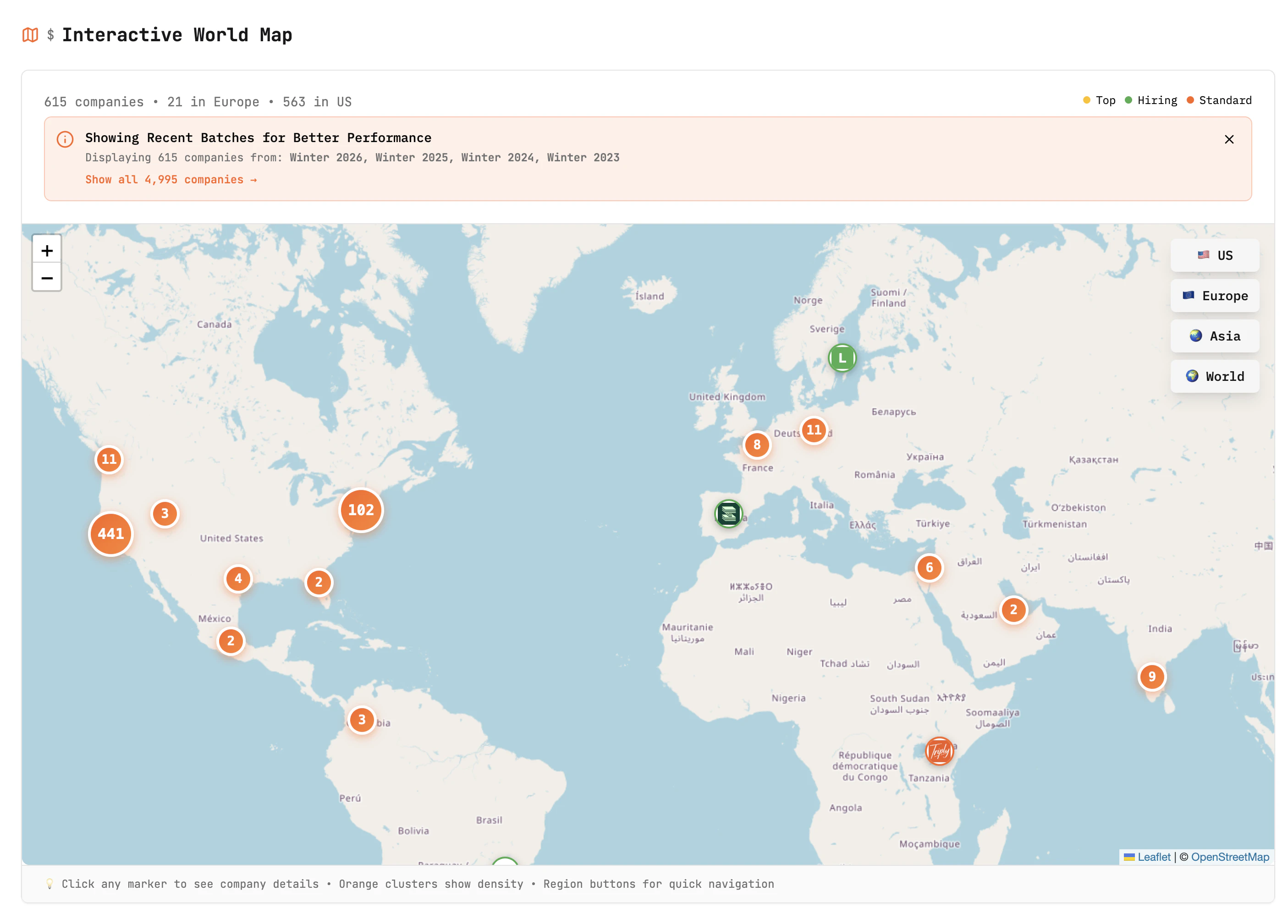
Explore 5,773+ Y Combinator companies with powerful search, interactive maps, AI-powered company intelligence, hiring insights, funding data, and batch analytics. Find co-founders, validate startup ideas, and discover patterns across 20 years of YC history.
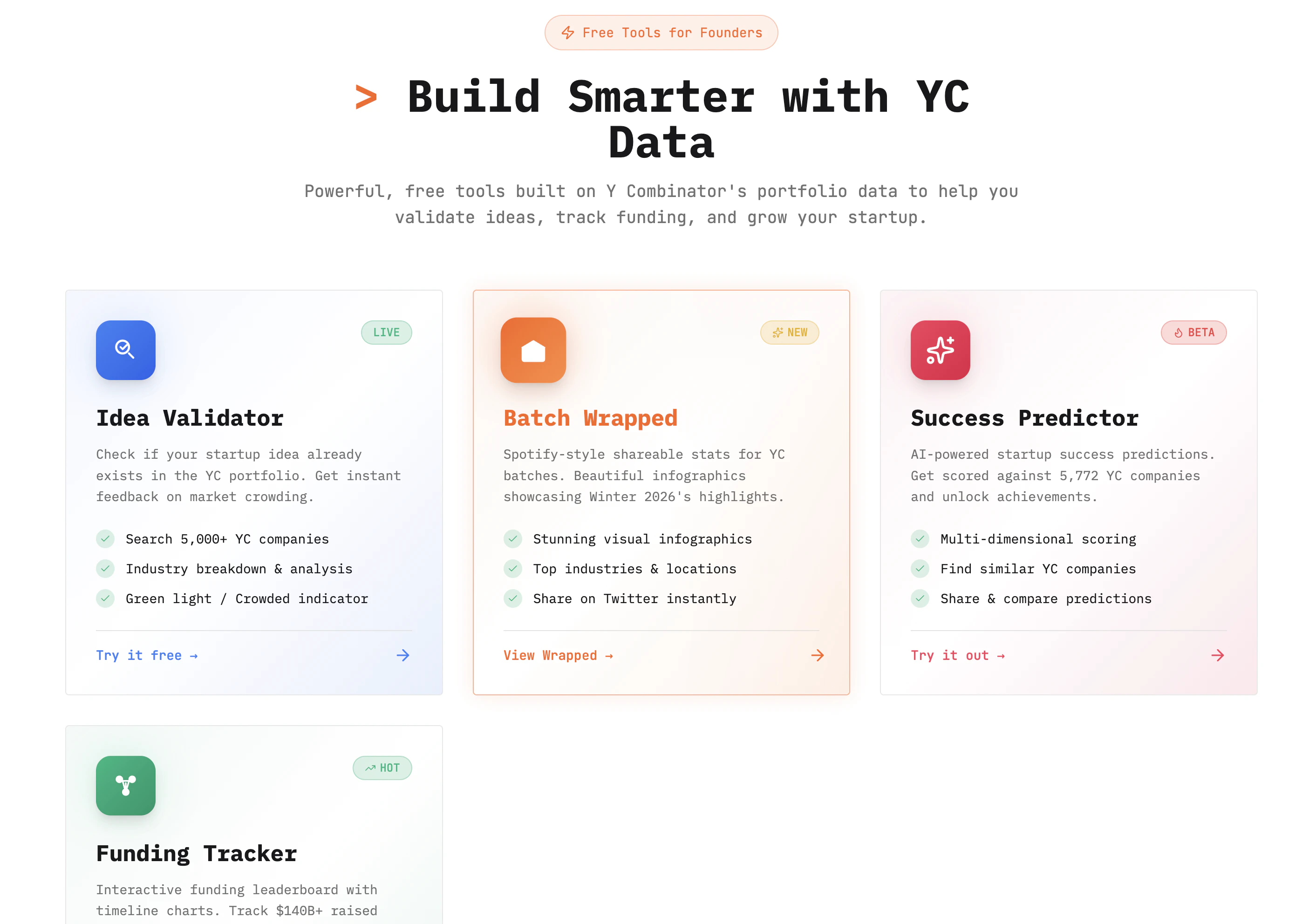
hey PH, my name is Konstantin, and I'm excited to launch ExploreYC - a comprehensive intelligence platform for exploring Y Combinator's entire portfolio of 5,773+ companies. as a founder researching YC companies, I found myself jumping between YC's directory, Crunchbase, LinkedIn, and countless browser tabs. I wanted a single platform that could answer questions like: "Which YC companies in my space are hiring?" "What patterns do successful AI startups share?" "How does my startup idea compare to the YC portfolio?" .. so I built ExploreYC to solve this! it's key features are: - Smart Search & Filters: search across 5,773+ companies by name, industry, batch, location, hiring status, real-time data from YC's API + enriched with funding data - Interactive Global Map: Visualize YC companies worldwide, filter by batch, industry, hiring status, discover geographic clusters and trends - AI Company Intelligence: get instant AI-powered insights on any YC company, competitive analysis, market positioning, growth indicators - Advanced Analytics: Batch comparisons and trends over 20 years, Industry distribution and evolution, funding timeline visualization, hiring trends and patterns - Live Hiring Board: browse 1,400+ YC companies actively hiring, filter by role, location, batch, industry, direct links to career pages - Startup Idea Validator: check if your idea already exists in YC, find similar companies and their outcomes, get AI-powered validation feedback - YC Batch Wrapped: beautiful shareable infographics for each batch, industry breakdown, hiring stats, geographic distribution, social sharing optimized - Funding Analytics: track funding rounds across the portfolio, investor network visualization, funding trends by batch and industry
3
回复

@konstantimb Hi Konstantin, congrats on the launch. This is very useful, any plans to add other accels (techstars, a16z etc)

0
回复

@konstantimb the startup idea validator is the killer feature here. most founders are terrified of finding out their 'unique' idea was actually attempted in the s16 batch and failed. being able to find those similar companies and actually see their outcomes is way more valuable than just a generic 'good idea' from an ai. supported

0
回复

5,773 YC companies as a structured data layer is exactly the kind of work that compounds — once the dataset is well-shaped, every downstream question gets cheaper to answer. Did the same thing on the finance side at Eloquens (https://www.eloquens.com/channel/samir-asadov-cfa) building project-finance / DCF / LBO templates as a structured catalogue (renewables-focused), and the lesson that surprised me was: volume isn't the moat, the schema is. Two well-shaped DCF templates with consistent assumption tables beat 200 sloppy ones every time. Curious how you're versioning the 20 years of YC history — do batches stay frozen, or do you re-derive metrics when YC's own definitions evolve (e.g. "AI" tag, "deep tech", etc.)?

0
回复

Congrats @konstantimb looking to play with it more in the coming days. Subscribed already. The interactive map is pretty cool :)

0
回复

@ivaylo_sekoulitchki means a lot from you!

0
回复

Love the Wrapped feature--a great iteration on Spotify's idea. How far back does the history go? It would be epic to see the og 2005 YC graphic :)

0
回复

@joe_setpoint will add support for it 🔥

1
回复

make sure to subscribe and get emails on newly added companies to YC every day. That way you can see patterns in what YC are searching for and early reach out to companies in very early stages!

0
回复

let's see how we do

0
回复
#7
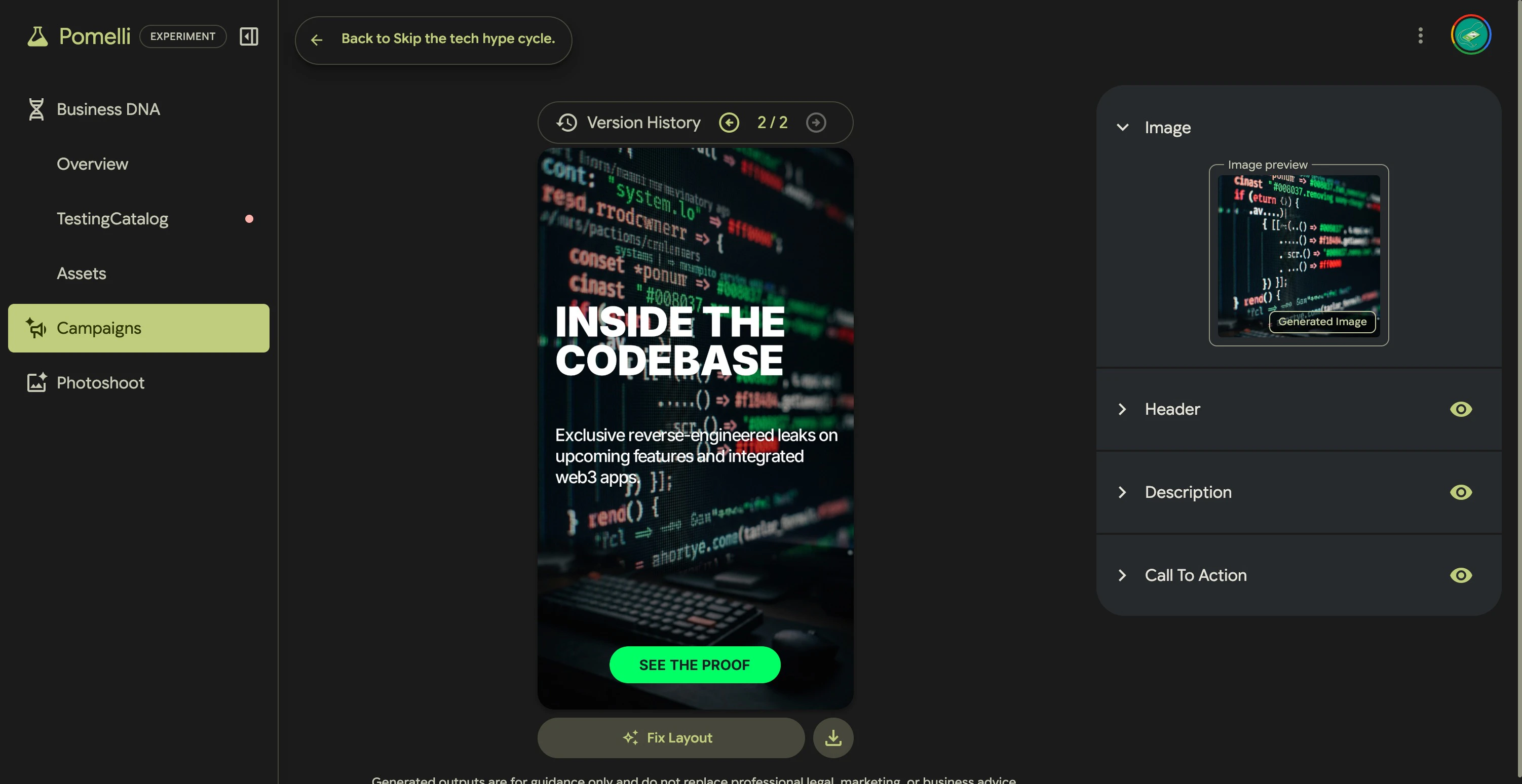
Google Pomelli Catalog
Turn a product catalog into branded campaign assets
129
一句话介绍:Google Pomelli Catalog通过AI将产品目录自动转化为品牌统一的营销素材与虚拟摄影大片,解决电商小团队逐个拍摄、设计耗时费钱的问题。
Design Tools Photography E-Commerce
AI营销工具 产品目录管理 品牌资产生成 AI虚拟摄影 电商SaaS 小企业营销 广告素材自动化 Google实验室
用户评论摘要:正面评论强调其将摄影与广告制作合并,显著降低小企业时间与预算消耗。一条评论提到挪威有竞品Native.no,期待Google如何差异化定位。
AI 锐评

Pomelli Catalog的巧思在于将“库存”直接变成了“资产”,这比单纯的AI图像生成更贴合商业逻辑。它切中的痛点是:小企业缺的不是创意,而是把每个SKU都变成高质量营销物的低成本流水线。以往AI生图工具往往为了效果而牺牲品牌一致性,而Pomelli通过抓取网站的品牌DNA来约束输出,算是给AI套上了“品牌缰绳”。

但冷静看,Google Lab出品常带有实验性,免费期过后定价策略不明。且“AI摄影”在电商领域的应用已有不少竞品(如Zyros、Flair.ai),Pomelli的优势只在于Google生态的整合(如与Google Shopping的潜在联动)。另外,用户评论中提到的挪威竞品Native.no提示:本地化、特定行业深度的能力可能才是护城河,Google的通用解法在垂直品类上未必最优。如果Pomelli只是“一键生成图+文案”,那它仍停留在工具层面;真正的价值跃迁在于能否打通从素材生成到广告投放、再到销售转化的闭环数据反馈。目前来看,它还只是一个漂亮的上游环节,离“营销智能体”的野心还有段距离。

查看原始信息
Google Pomelli Catalog
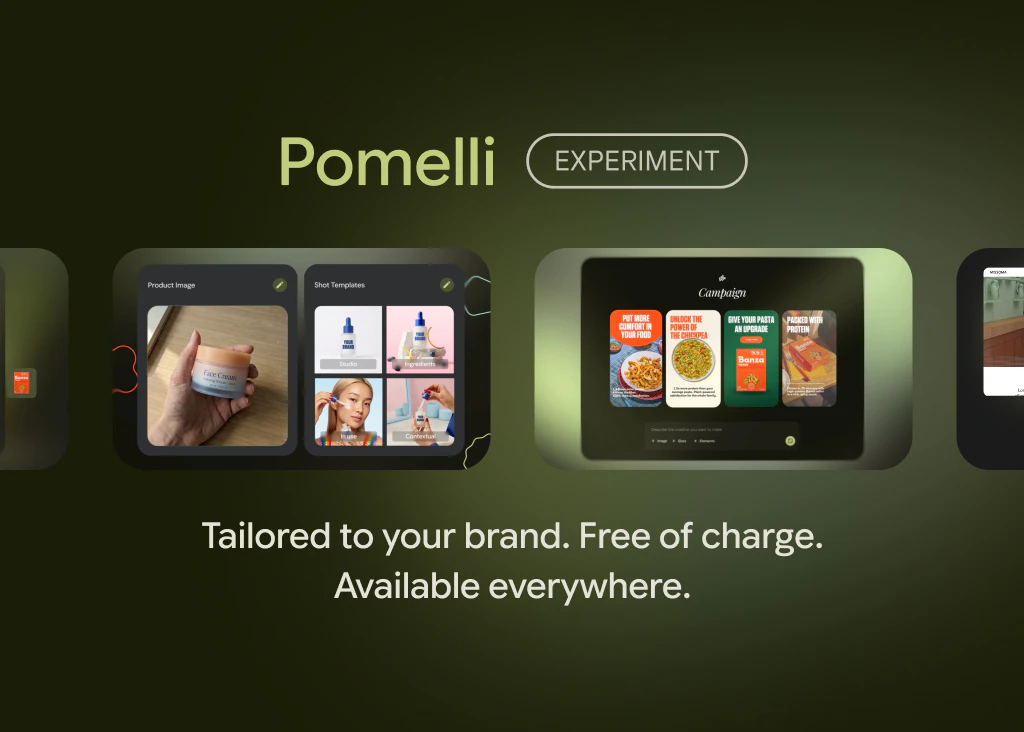
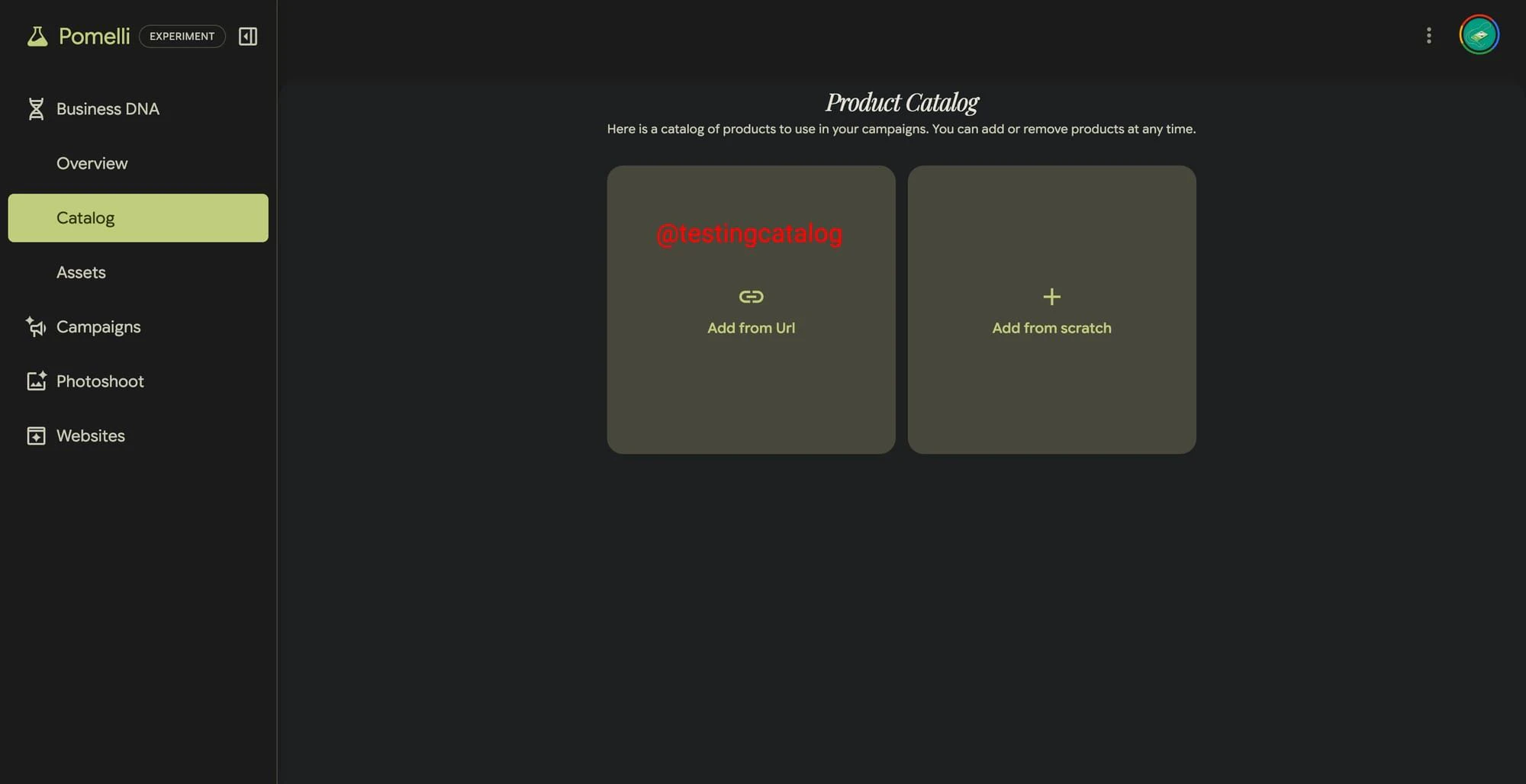
Add your product catalog to Pomelli and get brand-consistent campaign assets, ad creatives, and photoshoots generated automatically. Built for small business owners and independent retailers.

The hardest part of marketing a product catalog isn’t creativity, it’s turning inventory into usable assets.

What it is: Pomelli Catalog is a new feature in Google’s Pomelli marketing agent that generates brand-consistent campaigns and AI photoshoots directly from your product or service catalog.

Small businesses don’t just need campaign assets, they need assets for every product. Creating those manually, shoot by shoot, is where time and budget disappear. Pomelli already understood brand identity from a website; Catalog extends that across the full product set.

What makes it different: The standout feature is AI photoshoot generation. Traditional product shoots can cost hundreds or thousands of dollars and take weeks to organize. Pomelli generates studio-style product imagery and campaign copy tied to your brand identity in a single workflow.

Key features:

  • Product or service catalog as campaign input

  • AI-generated product photoshoots

  • Brand-consistent creatives and messaging

  • Business DNA profile as the creative foundation

  • Free via Google Labs

Benefits:

  • Product-level assets without per-product shoot costs

  • Consistent branding across the catalog

  • Campaigns grounded in actual inventory

Who it’s for: E-commerce brands, independent retailers, and SMB marketers who need scalable product photography and campaign assets without a large production budget or team.

The useful part of Catalog is that it combines two normally separate workflows, photography and campaign creation, into a single pass. For lean product teams, that’s a meaningful reduction in time-to-assets.

P.S. I hunt the latest and greatest launches in tech, SaaS and AI, follow to be notified @rohanrecommends

3
回复

There is a Norwegian competitor out there as well. https://native.no/en/ will be interesting to see how they differentiate. Or how google differentiate.

1
回复
#8
ProductClank
Borrow Distribution, Not Capital
129
一句话介绍:ProductClank 是一个让早期创业者无需预付费即可“借用”创作者和增长猎手分发能力的平台,通过里程碑式结算解决“有产品无流量”的冷启动难题。
Marketing Growth Hacking Pitch Tel Aviv
产品分发平台 零预付费营销 创作者经济 增长联盟 里程碑结算 冷启动工具 Product Hunt生态 激励对齐 创业社区
用户评论摘要:用户认可该模式创新,但核心疑问集中在:大规模下如何保证投票公正性?如何精确追踪并归因于某位推广者的贡献(尤其涉及隐私政策时)?里程碑价值如何定义,若获客成本高于创始人利润,双赢模型将失效。
AI 锐评

ProductClank 的“借用分发”叙事很性感,本质是试图在“赏金任务平台”和“联盟营销”之间找到缝隙,并将其包装成一个带有社区投票与结社仪式感的增长黑市。这确实是早期创业者最痛的“冷启动”场景——有钱没处砸,有力没处使,只能靠刷脸。

但产品真正要面临的修罗场,不是“功能”,而是“度量衡”。几个被用户精准戳中的硬核缺陷,才是决定它生死的“暗物质”:首先是归因的黑箱问题。第三方开发者想让平台追踪用户从“创作者A的视频”到“产品B的付费”之间的完整链路,在苹果 ATT 等隐私框架下几乎是不可能的。如果只能用传统归因链接,平台和“看几个广告就注册但白嫖的羊毛党”没什么区别,最终会沦为低质流量的集散地,伤的是第一批信任它的创始人。其次是“里程碑定价权”的博弈。目前描述含糊其辞,“谁定义里程碑价值?”如果没有一个类似分发型“CPA”的客观标准,而由创作者协商定价,早期创始人的利润空间会被新兴的“增长官僚”瞬间榨干——这本质上只不过是把广告预算从平台抽成变成了分成给“有影响力的人”,并没有真正降低获客风险。“借用分发”的前提,是分发确实能产生可衡量、可信任的价值闭环。否则,它只是一个包装得更优雅版的“投名状”——大家一起赌,只是赌注从预付款变成了努力。

ProductClank 的真正价值,或许不在于它当下的准确度,而在于它实践了一个古老且正确的信号:当巨头把流量定价权收归算法,社区“信任投票+结果分成”的模式,是对抗平台寻租的最有效反制。但别忘了一件事:最好的分发,永远来源于产品本身足够强,而不是借来的人足够多。ProductClank 是强心针,不是长生不老药。

查看原始信息
ProductClank
Distribution is the hardest part of being early-stage. ProductClank makes it borrowable. Founders launch a campaign. Creators, growth scouts, and Product Hunt hunters bring the reach — and earn only when your product hits real milestones. No upfront ad spend. No equity. No begging for attention. You ship. They amplify. Everyone wins together. Season 1 is now open. Pick your role and sign up — founder, scout, creator, or hunter.

Hey Product Hunt 👋

When I started building ProductClank, I ran into the same wall every bootstrapped founder hits: I couldn't afford to pay creators upfront. Not because the product wasn't ready - but because the model was broken. You know what you pay, you don't know what you get.

I wanted to build something where creators only win when the product actually wins.

But the more I looked at it, the bigger the problem got. There's no shortage of great products, loyal audiences, or operators who know how to drive growth. What's missing is the coordination layer - a structure that aligns incentives so distribution flows toward products people actually believe in, not just products with the biggest ad budget.

That's what ProductClank is. A platform where builders don't borrow capital to grow - they borrow distribution.

We ran Season 0 to stress-test the model - $100K distributed to creators, real campaigns, real results. It worked. Now we're opening it up.

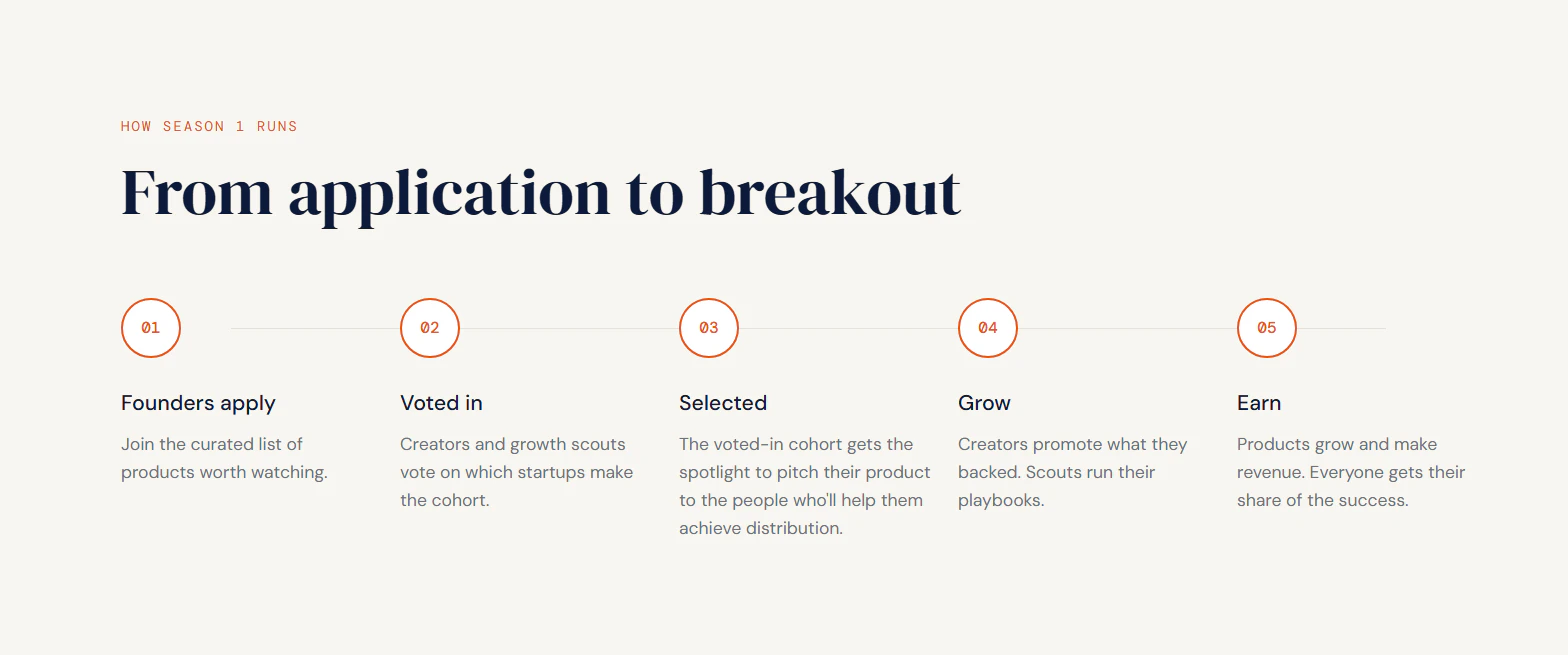
Season 1 is the first full run. founders apply, creators and growth scouts vote on who makes the cohort - then run campaigns for the products they backed. Skin in the game before day one. Zero upfront. Everyone earns when it works.

🏗️ Builders - Apply, get voted in, and grow. Bonus: offer fellow cohort members credits or a coupon to try your product - and get access to every other tool in the cohort.

🎙️ Creators - Browse the cohort, vote for what you believe in, promote what you backed - and earn when it grows.

🧭 Growth Scouts - Match your playbook to the right product. Earn when growth lands.

Lean, curated, in public. Come join the experiment 👇

4
回复

@lior_goldenberg3 Hi Lior, congrats on the launch. I love this idea, interesting take on solving distro. How do you deal with the lag from voting-pitching- you're in?

1
回复

The concept of borrowed distribution is pretty interesting. Kind of the one most makers on PH needs. Joined the experiment as suggested

1
回复

@artstavenka1 thank you! Looking forward to see what youre building and help you grow!!

0
回复

How do you match a founder with the right creators or hunters for their niche?

1
回复

@karimbenkeroum great question, this is one of the unique aspects - we let those who have the distribution decide who THEY believe in and want to support.

This way they get the confidence of backing products and startups the love and know their audience would too!

1
回复

Hi @lior_goldenberg3 , congrats on the launch. Really like the "borrow distribution instead of capital" angle, feels like the missing piece for bootstrapped founders. Curious how you keep the voting honest once cohorts get bigger?

0
回复

This is an interesting concept that addresses the most common "bottleneck" for any developer or entrepreneur: discovery. It eliminates the risk of "burning" through a budget on ads that don't convert, which is vital in the early stages.

I have two questions:

  1. How exactly do you track that a "milestone" was achieved thanks to a specific scout? If the product is a mobile app, current privacy policies (like Apple's) make frictionless tracking very complicated. It would be vital to know if you use a proprietary SDK or if you integrate with tools the user is already using.

  2. Who defines the value of that milestone and when is it paid? Paying for a free sign-up is not the same as paying for an annual subscription. If the cost per acquisition (CPA) they propose is higher than your initial profit margin, the "win-win" model breaks down for the founder.

0
回复
#9
reMarkable Paper Pure
The reMarkable 2 successor goes back to basics
127
一句话介绍:reMarkable Paper Pure是一款回归黑白电纸书本质的专注型书写平板,通过极简、低干扰的设计和成熟的云端协同,服务于需要深度思考和减少数字分心的知识工作者,解决多任务设备带来的注意力碎片化与决策疲劳问题。
Productivity Hardware
电纸书 手写平板 专注力工具 数字笔记 黑白墨水屏 生产力设备 云端同步 抗干扰 reMarkable 极简设计
用户评论摘要:用户核心反馈:1. 单功能设备正在悄然获胜,关键在于“降低决策成本”而非堆砌功能。2. 老用户坦诚真正的价值在于“摩擦感”——设备无法刷Slack、邮件、新闻,从而强制专注。3. 对新品重新兼容旧款E-Writer笔表示遗憾。4. 有用户担心后续是否会迫于压力增加非核心功能,破坏产品纯粹性。
AI 锐评

reMarkable Paper Pure 的发布,更像是一场“价值观宣言”而非一次常规硬件迭代。当行业陷入彩屏、高刷、AI助理的军备竞赛时,它反逻辑地切掉“进阶版本”的颜色模块,回归单色与极简——这种减法勇气比参数的50%提升、20%对比度更有商业洞察。

值得深思的是,用户评论中重复出现的高度一致声音并非“求功能”,而是“请保持原样”:他们买它的原因恰恰是它**不好用**——打不开应用商店,刷不了社交媒体,无法成为另一个分心源。这种“以限制换专注”的悖论,精准命中了注意力经济治理下的高端人群痛点:他们需要的不是更快的多任务工具,而是**强制单任务的环境**。

硬件侧,Paper Pure 开始拥抱主动式触控笔和模块化维修设计,这或许是reMarkable试图打破“买后即死”的电子垃圾循环,但其商业模型仍依赖封闭笔协议和配件生态(比如磁吸套)。软件侧,引入Slack、Miro集成与AI手写转化看似“变厚”,但本质上只是将封闭系统开了一扇可受控的窗口——核心原则依然是“设备不主动打扰,用户主动进出”。

然而,这种“专注主义”的高定价始终在考验用户忠诚度。当竞争对手用彩色、更低价格和开放安卓系统挤压市场时,Paper Pure的竞争壁垒不在硬件,而在能否维持一种**信仰式用户黏性**:即用户认定“它不好用是对我最好的保护”。如果未来哪一天reMarkable为了营收不得不对社区“请加XXX”的呼声妥协,它失去的将是整个品牌存在的根基。保持克制,比增加功能更难。

查看原始信息
reMarkable Paper Pure
reMarkable Paper Pure is the monochrome successor to reMarkable 2, with 50% faster response, 20% higher contrast, up to 3 weeks of battery life, a lighter body, repair-ready design, active Marker support, and tighter integrations across cloud docs, desktop apps, handwriting search, AI conversion, Slack, Miro, and more.

Hi everyone!

Six years later, reMarkable 2 finally has its successor.

After Paper Pro and Paper Pro Move pushed reMarkable into color and broader productivity territory, Paper Pure goes back to the core black-and-white paper tablet idea: lighter, faster, higher contrast, and still very focused. reMarkable says it is 50% faster than reMarkable 2, has 20% higher contrast, and gets up to 3 weeks of battery life.

The ecosystem side is also much more mature now. You can bring in files from Google Drive, OneDrive, Microsoft Word, and Google Docs, convert documents into notebooks, search handwriting, sync with desktop and mobile apps, and share converted notes into tools like email, @Slack, or @Miro. That makes it feel less isolated while still keeping the device itself distraction-free.

One important compatibility note: Paper Pure uses reMarkable’s newer active Marker system. Old reMarkable 2 Markers are not compatible, so EMR-style third-party pen compatibility is basically gone here.

3
回复

@zaczuo The new sleeves are also really cool. Very innocative. With magnets that close and lock your tablet etc. Very cool color vibes as well. Pale green and pale pink and black. Your move apple 😏. I would sauy this is the most innovative sleeve design since apples AirPod Pro sleve, I know not many people like these. But I think they are fantastic. So minimal, and also uses magnets in the design.

1
回复

"Goes back to basics" is a stance, not a feature, and it's the right one. Single-purpose tools are quietly winning because the cost of context-switching has spiraled — every multipurpose app trains you to expect more decisions, not fewer. I hit the same instinct with DishRoll (a small AI weekly meal-planning PWA I built): the goal was to collapse the entire food-decision space to one prompt per week. Same philosophy, much lower tech — subtract decisions, don't add features. Question for the team — how do you handle the "please add ___" pressure after launch? My experience is that the people asking for the next feature are rarely the ones who've actually used the focused version yet.

0
回复

Owned the original reMarkable for three years before upgrading. The honest case for these devices: it's not the e-ink, it's the friction. Phone won't open Slack, won't open email, won't open the news. Single-purpose tool, single mode of work. The Paper Pro's main upgrade for me has been color contrast on diagrams and the slightly larger writing surface for landscape PDFs. Battery still lasts a week of daily use.

0
回复
#10
Lovie Formation - Incorporation MCP
Incorporate your next company easily.
116
一句话介绍:Lovie Formation将公司注册(特拉华州/怀俄明州)转化为一个MCP(模型上下文协议)和API,让开发者或创始人可在2分钟内通过终端命令行完成公司设立,并自动处理EIN申请、注册代理、DUNS编号及合规等繁琐流程,解决传统公司注册效率低、费用高、体验差的痛点。
SaaS Developer Tools Artificial Intelligence
公司注册MCP 法律基础设施API AI自动化注册 终端命令行公司成立 EIN自动申请 创始人工具 低代码法律 美国公司注册 合规自动化 创始人痛点
用户评论摘要:用户普遍认可其“法律即软件”的愿景,批评传统EIN收费高达200美元的陋习。主要问题集中在:如何处理IRS传真自动化等遗留系统的边缘案例;是否计划支持更多州(除DE、WY外);与Stripe Atlas相比的优势及实际体验反馈。
AI 锐评

Lovie抓住了“技术性创始人”与“遗留法律系统”之间巨大的体验断层,并将其包装成开发者熟悉的API和MCP形态,这是一个精准的切入点。创始人萨欣用17次公司注册的痛苦经历作为研究样本,将公司注册解构为“分布式系统问题”,这个认知本质上是正确的——州政府、IRS、注册代理人、银行等主体之间的交互确实充满了延迟和状态不一致。

产品的真正价值不在于“2分钟注册”这个前端效率,而在于打通了横跨政府机构(IRS传真)、信用体系(DUNS)和银行(银行就绪实体)的数据管道。对于国际创始人而言,一个可编程的实体就绪状态,其价值远超省去的200美元EIN费用,它解除了跨境创业中最大的身份和信用认证障碍。但产品面临的挑战也相当严峻。首先,其业务本质上是一个合规服务,API的鲁棒性完全取决于与政府老旧系统的接口稳定性(正如评论中提及的传真自动化边缘案例),任何一次对接失败的直接后果都是法律实体无效。其次,特朗普时代后各州治理规则频繁变动,持续合规并非一次性订阅能完全覆盖。最后,从“终端工具”到“银行就绪”之间还横亘着银行开户这一更艰难的环节,除非Lovie后续能内嵌KYC和银行API,否则它只是一个更高效的前置环节,而非完整解决方案。将法律简化为代码是诱人的,但别忘了,bug是可以回滚的,而错误的公司结构修复成本极高。Lovie瞄准的是“高频、标准化、低客单价”的长尾创始人需求,而非复杂结构的巨头,这个定位足够锋利,但天花板也清晰可见。

查看原始信息
Lovie Formation - Incorporation MCP
Legacy formation is a bug. Lovie turns legal into an MCP and API. Spin up Delaware and Wyoming company formation in 2 minutes from your terminal (MCP). Includes EIN filing (IRS/Fax), registered agent, DUNS Number applicaton and compliance for $20.00 Stop paying legacy fees for manual work. Whether you're a US or international founder, Lovie handles the friction so you can focus on building. The first bank-ready entity builder for the agentic age.

👋 Hey Product Hunt community! I am the solo-founder and CEO of Lovie.co, and we are incredibly excited to launch our first product today. Currently, I am writing from our HQ (sfvibehouse.com) in West Portal, San Francisco, where we have started a new culture of building in the agentic era — lovie.co/culture (created by @darrenmurph)

I have been an entrepreneur since I was 17. I built 4 startups in Istanbul and then moved to San Francisco to build 4 more. I sold my first startup to Gfycat and my last startup, RemoteTeam, to Gusto. RemoteTeam was a Product Hunt success story — we exited just 580 days after incorporation. Beyond building, I have invested in 200+ startups and spent 25 years creating content to motivate people to become builders/founders — over 1,000 videos and counting. Helping people build is not just what I do — it is who I am. I am part of many founder communities. Nearly all of my friends are founders, and even my wife is a founder. I married my co-founder. My whole life, I had one main thing: build, build, build. I deeply believe that being a founder is the best job in the world. It made me a better person, gave me a better life, and enabled me to help others. For me, being a founder is my fate, plan, and spiritual journey. The more I build, the more I learn about myself.


I have launched many great products on Product Hunt over the years, but this is by far one of the most exciting ones. Now, we can help people start their company faster.


The best time to build is right now. The entire Silicon Valley playbook is finally accessible to everyone. We are entering a golden age of productivity and entrepreneurship where millions of people will become founders, and the only thing standing in their way should not be paperwork.


Through my journey, I personally incorporated 17 companies — C-Corps, LLCs, and S-Corps. I hated the process every single time. It was slow, expensive, and full of unnecessary friction.


So I realized that legacy company formation is essentially a bug. It is a distributed systems problem disguised as legal paperwork. We built Lovie to treat legal infrastructure like software infrastructure. Instead of paying $200 just for an EIN or dealing with manual faxing, Lovie turns legal into an MCP and API.


You can now spin up a Delaware or Wyoming company in just a few minutes directly from your terminal. We handle EIN filing (direct IRS filing/Fax automation), registered agent services, and ongoing compliance for a flat $20.00 subscription. Whether you are a US or international founder, we remove the friction so you can focus entirely on building.

I would genuinely love to hear your thoughts! For those of you who have recently formed a company, what was the most frustrating part of the process that you wish had been automated?

I will be here all day to answer any questions about company formation, our MCP, or how we are building the first bank-ready entity builder for the agentic age. Let me know what you think! 🚀

12
回复

@darrenmurph  @sahin The “legal infrastructure as software infrastructure” idea is powerful. A lot of founder friction still comes from processes that were designed before internet-native businesses even existed.

Curious whether you see the future being API-first company creation, where agents can autonomously form/manage entities as part of workflows.

0
回复

@darrenmurph  @sahin Just gave it an upvote! 🚀 As someone who builds products for creators and e-commerce, I deeply resonate with your mission to kill 'legacy bugs' and hidden fees. Treating legal infrastructure like a software API is exactly what the agentic age needs right now. Quick question for you Sahin: How does the system handle edge cases with the legacy IRS fax automation? Huge congrats on the launch today!

0
回复
👋 Hey Product Hunt! I’m the manager of one of Lovie. (see our culture to understand what does it mean https://www.lovie.co/culture/) I used to be a lawyer, and I saw how much friction (and "dark pattern" upselling) exists in company formation. Most services charge $200.00 just for an EIN. That’s a legacy bug we’re debugging. We built Lovie to treat legal infrastructure like software infrastructure. We offer 2-minute company formation and EINs via AI, direct IRS/Fax automation, and a flat $20.00/month subscription that covers the entity, EIN, registered agent, and compliance. You can use our MCP from your terminal or hit start conversation on our website to incorporate while you stay in your workflow. I'm here all day! Ask me anything about company formation, legaltech, or how we’re building the first bank for the agentic age!
9
回复

@omer_legaltech Interesting positioning — treating legal infrastructure like software infrastructure is a strong framing.

Curious whether you think AI-native businesses in the future will even “form companies” the traditional way, or if legal/entity management itself becomes programmable and continuous.

0
回复

@omer_legaltech Upvoted and supporting! 🙌 It's incredibly refreshing to see a former insider disrupting the 'dark patterns' of legaltech. Charging a flat $20 instead of those ridiculous $200 EIN fees is a massive win for indie founders like us. Do you guys plan to expand beyond Delaware and Wyoming soon? Great execution!

0
回复

One of the fun parts of building Lovie was realizing that "company formation" is basically a distributed systems problem disguised as legal paperwork.


You’ve got state filings, IRS flows, compliance deadlines, identity verification, fax infrastructure (yes… still fax 😭), banking rails, retries, failures, edge cases, and a lot of humans stuck in slow workflows.

So we asked:
What if this behaved more like Stripe/Twilio/GitHub APIs instead of a traditional law office?

That idea turned into:

  • AI-assisted formation

  • automated EIN workflows

  • MCP support for agents/dev workflows

  • flat pricing without the classic upsell maze

Would genuinely love feedback from founders, developers, lawyers, and especially people who recently formed a company and hated the process.

7
回复

@ahmetardal what's one edge case your API nails that legacy services still botch?

0
回复

@ahmetardal Just upvoted! Your analogy of company formation being a 'distributed systems problem disguised as legal paperwork' is the most accurate thing I've read all week. 🎯 Building this as an MCP is brilliant. How painful was it to bridge modern API workflows with that legacy fax infrastructure? Best of luck to the team today!

0
回复
This is so great, I wish I got it before I incorporated mine, but of course I must recommend it to some of my friends who would like to incorporate a company in the US 
5
回复

Building legal infrastructure like software infrastructure is such a powerful vision. Proud to be part of Lovie 🚀

4
回复

Woh this looks cool

4
回复

@hot_town Really appreciate the support, Vince 🙌

Excited to see builders like you resonating with what we’re creating at Lovie.

1
回复
Better than Stripe Atlas?
2
回复

@lakshminath_dondeti I used Stripe Atlas. I think it is much better.

1
回复

Hey Product Hunt! 👋

Being part of the Lovie team right now feels like having a front-row seat to a revolution. We’re seeing founders use AI to move from a "shower thought" to a functional, impactful product in a matter of days—sometimes even hours. It is truly the golden age of the high-agency builder.

The problem we noticed, however, is that while the code is moving at the speed of light, the legal infrastructure is still stuck in the era of manual faxes and legacy "dark pattern" upselling. To us, that’s just a massive bug in the startup ecosystem.

We built Lovie Formation to match the velocity of this new AI era. If you’re building your product with AI agents and terminal-based tools, your company formation should live there too. We’ve turned incorporation into an MCP and API so you can spin up a bank-ready entity in Delaware or Wyoming in about 2 minutes.

There has quite literally never been a better time to build something that matters. Don’t let paperwork be the friction that kills your momentum. We’re here to help you get the "boring stuff" out of the way at the speed of AI so you can get back to what you do best: building.

Can't wait to see what companies you all launch today! 🚀

1
回复

Hi Product Hunt community 👋 I'm Darren, and I'm leading culture at Lovie. Few founders put intentional thought into culture and operational infrastructure this early in the life of a company, but @sahin is built different. He has founded and exited companies before, and he knows that intentionality around this early compounds into excellence.

The reason this matters to those of you using our Formation product is simple: the people building this are aligned with a highly unique culture framework. We call it Future of Work 2.0. You will feel the difference in the product, because the people building it are highly differentiated. The way we work impacts the way we build. I know you'll be able to feel the difference. You can dive deeper here: https://www.lovie.co/culture/

I've built culture at some of the world's pioneering distributed companies, including GitLab, Zillow, Ford, and more. I'm having a blast building it with some of the highest agency people I've ever met at Lovie. Any questions? Ask away!

1
回复
#11
Propello
Create the pipeline you never had
100
一句话介绍:Propello通过AI Buyer Exploration Agents在网站或营销渠道实时捕获访客,自动进行个性化产品演示、价值沟通和异议处理,替代传统“预约Demo”表单,解决高流失率痛点,并持续跟进补齐GTM转化链路。
Marketing Growth Hacking Pitch Tel Aviv
AI销售代理 智能线索激活 实时个性化演示 GTM增效 B2B转化优化 自动跟进 无代码配置 买家互动 Demo表单替代 SaaS营销工具
用户评论摘要:用户关心AI代理启动方式(自动/手动),开发者回应支持主动迎宾与链接触发,无代码配置。已获用户好评如潮。另有用户质疑AI交互的真实体验,担心买家识别后流失,认为表单98%流失率虽高,AI跟进与异议处理价值可观。
AI 锐评

Propello的切入点精准且狠辣——“Book a Demo表单流失98%买家”是几乎所有B2B SaaS团队心照不宣的伤疤,传统漏斗从“访客→注册→Demo”的中断率极其恐怖。它的价值不在于造一个更聪明的聊天机器人,而在于硬生生把“被动等待填表”变成“主动涌入对话”,把漏斗漏下去的流量转化为可触碰、可推进的对话资产。

最值得留意的是“AI Buyer Exploration Agents”的定位——它不强称自己是通用销售AI,而是聚焦在Demo前这一最痛的真空地带:访客浏览产品页面时若无人工介入,流失即定局。Propello的实时介入、个性化推销语境与异议处理,远比一封事后跟进邮件有杠杆效应。更妙的是,它能联动CRM和产品数据,输出定制化跟进邮件——这意味着它从“流量救星”变成了完整的GTM闭环触点。

但需要警惕的是:AI代理能否真正处理复杂异议、赢得买家信任,本质上取决于内容的强准备度和对话设计的细腻程度。如果背后的知识库只是简单的产品说明拼接,买家一旦发现是AI而缺乏自然递进感,反而可能加速逃离。评论中已有用户一针见血的问题:“买家会不会发现是AI后立刻流失?”这是Propello必须持续优化的核心矛盾:AI得隐身,像个了解你需求的顶级销售,而不是个话术复读机。对于C端感知敏感、潜客决策链条短的产品,这东西可能有副作用;但对于高客单价、多角色参与的B2B,它成功填补了人工SDR成本太高、冷表单无人理中间的死区——前提是,它必须拿捏好“主动”与“侵入”的边界。

查看原始信息
Propello
The "Book a Demo" form loses 98% of your buyers. Propello catches them. AI Buyer Exploration Agents that engage every visitor instantly- personalized walkthrough, tailored value framing, and real objections handled. Then, Propello keeps going: auto-tailored follow-ups built from each conversation, enriched with your CRM and product data. GTM teams finally capture the demand they worked so hard to create.

Hi @idan_arealy, congrats on the launch. This is really interesting. How do you invoke the agent to start? Auto, user driven?

1
回复

@zolani_matebese 

Hi Zolani! Thx a lot and great question! Propello agents work both ways — proactively greeting buyers on your site or campaigns, and on-demand via links in emails, LinkedIn, or webinar follow-ups.

Setup is no-code: upload your content (url's, pdf's and every type of asset), pick a use case, choose a personality - agent ready in minutes. 🚀

2
回复

Already using! @idan_arealy

1
回复

98% drop-off on demo forms is actually brutal. The AI follow-up + objection handling part makes sense tho. C

urious if buyers actually enjoy talking to these agents or just bounce the second they realize it’s AI?

0
回复
#12
Gyro Autopilot - Easy Flight Refunds
100s of Dollars Could Be Sitting in Your Inbox 📥
96
一句话介绍:Gyro Autopilot 通过扫描用户邮箱,自动识别因航班延误、取消或超售等产生的未领取赔偿金,并代为提交索赔申请,彻底省去用户与航空公司繁琐的沟通流程。
Travel Artificial Intelligence Pitch Tel Aviv
航班赔偿 自动化索赔 邮箱扫描 AI理赔 旅行权益 消费者维权 无胜诉不收费 便捷工具
用户评论摘要:用户肯定“连接邮箱自动找钱”的低门槛设计和AI对实际问题的解决能力。同时关注多航班、多航空公司、代码共享等复杂场景的处理,以及航空公司拒赔、管辖权差异等边缘案例的应对策略。
AI 锐评

Gyro Autopilot 的价值不在于“又一个AI工具”,而在于精准切入了“权力不对等”的消费场景——航空公司利用流程复杂性、信息不对称和用户惰性,让本该赔付的数十亿美元沉淀为隐性利润。产品通过“无胜诉不收费”和“零操作门槛”将赔付风险完全转移到自身,直接抢夺航空公司的“灰色利润”,这比ChatGPT包装成旅行助手的同类产品更诚实。

但风险不容忽视:第一,邮箱权限的隐私合规是定时炸弹,尤其涉及欧盟GDPR;第二,边缘案例(如多航段混合承运、不同国家赔偿上限差异)处理不当会直接导致赔付失败,用户信任一旦破裂很难修复;第三,航空公司正通过算法优化拒赔话术,这场猫鼠游戏需要持续投入法律和工程资源。

产品当前的核心壁垒不是AI技术,而是对各国航空赔偿法规的数据库积累和自动化索赔引擎的稳定性。若只停留在“扫描-索赔”的单点功能,极易被Expedia、Hopper等平台集成后碾压。真正的护城河应是沉淀为“消费权益自动化追索平台”,横向扩展到酒店、保险等同样存在赔付缺口的行业。目前的产品叙事足够诱人,但执行细节才是决定生死的关键。

查看原始信息
Gyro Autopilot - Easy Flight Refunds
Scan your inbox for unclaimed flight money from delays, cancellations, overbookings, and more. Gyro Autopilot finds what you’re owed and claims it automatically. No win, no fee. No commitment. No credit card.

Hey! Product Hunt! 👋
I’m Jonathan Attias, co-founder of GYRO.

Our team spent years building products around AI, automation, and payments. Honestly, the team built something that feels a bit like magic.

We started GYRO after noticing a broken reality:

Billions in flight compensation go unclaimed every year.
Not because people aren’t eligible.
Because the process is exhausting.

Forms, rejections, waiting, support tickets. Most people simply give up.

So we built something different.

Connect your email.

GYRO finds delayed flights, checks eligibility, files claims automatically, and helps users get paid.

No lawyers.
No paperwork.
No back and forth with airlines.

The big shift for us was understanding this:

People don’t want another tool.
They want the outcome.

One moment that made us realize we were onto something:
A user found thousands of euros from old flights they completely forgot about.
Then it kept happening again and again.

Today, hundreds of thousands of flights have already gone through the system.

Guess the name fits.

5
回复

@jonathanattias Congrats Jonathan

this is a very strong example of AI being used for an actual outcome, not just another dashboard.

From a senior AI and full-stack engineering perspective, I really like the product direction here. The hard part is not only detecting flights from inbox data, but also mapping disruptions to eligibility rules, handling different passenger-rights frameworks, managing claim state, and keeping the user experience simple enough that people trust it.

The “connect your email and we find money you may have missed” flow is powerful because it removes almost all user effort. That is exactly where automation should shine.

One area I’d be curious about is how you handle edge cases: airline rejection reasons, incomplete booking data, multi-passenger itineraries, codeshare flights, and jurisdiction-specific claim windows. Those are usually where products like this become truly defensible.

Overall, great positioning. People do not want another travel tool — they want the compensation handled for them. GYRO communicates that very clearly.

If the team ever needs engineering feedback around AI workflow design, claim automation, inbox parsing, or full-stack product scaling, I’d be happy to help.

0
回复

The "money already owed to you" framing is doing real work here — most consumer fintech sells anxiety, this one sells recovery. I work in consumer protection and the asymmetry between airlines and passengers is one of the cleanest examples of how dark patterns compound. Curious what your edge cases look like — flights with multiple legs across carriers, partial refunds for downgrades. Are you handling those, or scoping to single-carrier delays first?

0
回复
#13
Genrate.ai
The military-grade recon machine for revenue teams.
94
一句话介绍:Genrate.ai是一款为营收团队打造的军事级账户侦察工具,能在数分钟内生成买家、账户及竞争格局的深度情报简报,并7x24小时监控商机与对手动态,精准提炼影响交易的关键信号,解决销售线索挖掘与交易推进中的信息噪音与情报缺失痛点。
Sales Business Intelligence Pitch Tel Aviv
用户评论摘要:用户询问与Claude等通用AI工具的差异化价值。官方回应强调其是“军事级侦察”专用模型,拥有专有数据源和上下文能力,能更有效地过滤噪音、聚焦垂直场景信号,并桥接公司内外部情报。整体反馈显示用户关注其独特性和实际效用。 (共96字)
AI 锐评

Genrate.ai试图在泛滥的AI销售辅助工具中杀出一条血路,其核心卖点“军事级侦察”和“信号过滤”确实切中了B2B销售中的真实痛点——信息过载与线索质量低下。从产品介绍看,它做的是传统销售支持软件(如CRM、竞品分析平台)和通用AI助手(如ChatGPT、Claude)都未很好覆盖的“高精度情报”地带:不仅收集信息,更要基于专有模型和上下文,判断哪个信号“真正会推动交易”。

但关键挑战在于其实际交付效果与营销话术之间的鸿沟。用户一针见血地追问“和Claude有何不同”,官方回应虽强调“专有数据源和垂直噪声比”,但并未展示可量化的案例(如提升赢单率X%或减少调研时间Y小时)。如果其输出最终只是更结构化但仍有幻觉的摘要,或定价远超市场预期,那么“军事级”光环将迅速褪色。

另外,产品切入的是营收团队,这类用户购买力较强但决策链复杂,需要与现有销售栈(Salesforce、HubSpot等)无缝集成。Genrate.ai必须证明自己能嵌入工作流,而非孤立工具。真正价值在于:它能否成为销售团队每天打开的第一个“指挥中心”,而非偶尔查一下的“情报库”。如果能做到,它有成为垂类SaaS爆款的潜质;如果只是另一个套壳AI,则难逃被通用模型降维打击的命运。

查看原始信息
Genrate.ai
Genrate does two things your reps can't do alone. One: runs deep reconnaissance on any account and produces a military-grade discovery brief in minutes - buyer, account, competitive landscape. Two: watches your pipeline, customers and competitors 24/7 and surfaces the signals that actually move deals.

Great question @on ! We are military grade recon, our own trained model with proprietary sources, context and ability to bridge between specific company data and external intelligence. In simple words - we have a profoundly better ratio of signal vs. noise for our vertical use case.

2
回复

Looks really cool, but what can I achieve with it that I can't with Claude?

0
回复
#14
Luma Uni 1.1 API
A reasoning model that interprets intent before it generates
94
一句话介绍:Luma Uni 1.1 API 是一个在生成图像前先理解用户意图的多模态推理模型,专为需要品牌一致性、高可控性的开发团队设计,以更低成本解决传统提示词工程难以维持风格和角色统一的痛点。
API Developer Tools Artificial Intelligence
多模态图像生成API 推理模型 参考引导生成 品牌一致性 提示词增强 文化感知 低延迟 高分辨率 AI图像基础设施 开发者工具
用户评论摘要:用户点赞API内置提示词增强功能,认为这对电商品牌一致性很重要;同时询问在图像生成时对原产品边缘和阴影的保留效果,并关注是否比GPT-Image-2分辨率更高。
AI 锐评

Luma Uni 1.1 API 的营销叙事很聪明——它把“在生成之前先推理意图”包装成一场从“提示词玄学”到“模型层基础设施”的跃迁。但冷静审视,其核心差异并不在于“推理”二字多么玄妙,而在于它通过参考引导生成和多参考合成,将部分一致性责任从开发者手里抢回模型本身。这的确降低了端到端 pipeline 的搭建门槛,尤其对品牌视觉严格的 E-com 和漫画/条漫领域是利好。不过,当竞品(如Recraft、Ideogram或Firefly API)同样在强化风格控制和参考能力时,Luma 宣称的“文化感知”究竟是多维度的数据优势,还是特定场景下的过拟合?目前缺乏独立第三方在多样化和边缘案例上的横评。此外,$0.09/2048px 的定价虽低于部分对手,但面对 OpenAI 和 Google 的降价潮,这一价差能否持续构成护城河存疑。更值得关注的真正价值在于:Luma 试图把“模型本身的智能分布”变成创作的“管道层”,当开发者不再需要手动写大量 CV+prompt 工程去约束输出,而是通过 API 调用一个“懂意图的生成器”,这确实可能改变图像工作流的产品架构逻辑。但别忘了,客户最终要的是稳定可控的成品,而不是模型的自吹自擂——迁移成本、批次一致性、失败模式的可解释性,才是量产级真实的试金石。

查看原始信息
Luma Uni 1.1 API
A reasoning model that interprets intent before it generates. Less than half the price and latency of comparable models. Two endpoints. Python, JS/TS, Go SDKs & CLI. Production grade from day one.

Interior studios, fashion configurators, and storyboard generators are already being built on Uni-1.1. Until now, the API wasn’t publicly accessible.

What it is: Uni-1.1 is Luma AI’s multimodal image generation model, now available via API with reference-guided generation, multi-reference composition, and built-in prompt enhancement.

Most image APIs expose a raw generation endpoint and leave consistency to prompt engineering. Uni-1.1 moves part of that reasoning into the model layer itself. Scene completion, spatial plausibility, and reference grounding happen before output, reducing complexity for production teams.

What makes it different: The model handles manga, webtoon, and non-Western visual styles unusually well. Luma trained it with Hollywood cinematographers and VFX artists, but the advantage is breadth of visual culture, not just cinematic polish.

Key features:

  • Reference-guided generation with single or multi-reference inputs

  • Built-in prompt enhancement at the API level

  • Culture-aware outputs across styles and aesthetics

  • Text-to-image and image-to-image at 2048px

  • Token-based pricing (~$0.09 per 2048px image)

  • Top 3 in Image Arena for text-to-image and image editing

Benefits:

  • Less prompt engineering for consistent branded output

  • Better character and style consistency across pipelines

  • Competitive pricing and latency based on published benchmarks

Who it’s for: Developers and teams building brand-specific image workflows where controllable, visually consistent output matters more than generic generation.

The important shift isn’t just the model quality, it’s Luma positioning the intelligence layer itself as infrastructure for creative products.

P.S. I hunt the latest and greatest launches in tech, SaaS and AI, follow to be notified @rohanrecommends

3
回复

@rohanrecommends Just upvoted! 🚀 The built-in prompt enhancement at the API level is exactly what the industry needs. As someone who builds AI image pipelines heavily focused on e-commerce product photos, I know firsthand how painful prompt engineering is for maintaining brand consistency. Quick question for the team: How well does Uni-1.1 handle preserving the original fine edges/shadows of a product when doing image-to-image generations? Massive congrats on the launch!

0
回复
Higher resolution than gpt-image-2?
0
回复
#15
Basedash MCP server
Your data analyst, in every AI tool you already use
92
一句话介绍:Basedash MCP服务器让AI助手(如Claude、ChatGPT)直接查询你所有数据库和SaaS工具中的实时数据,无需跳转BI平台即可完成数据分析。
Artificial Intelligence Data & Analytics Data
数据分析 MCP服务器 AI集成 实时查询 商业智能 数据权限 数据库连接 SaaS数据 自然语言分析 图表生成
用户评论摘要:用户肯定“反转集成方向”的巧妙性(数据到AI而非AI到数据),关注权限继承模型能否消除“影子分析”问题。提出具体挑战:对拥有数百张表的数据库,MCP是暴露全量schema还是支持搜索/筛选层。
AI 锐评

Basedash MCP服务器看似是工具链的“缝合怪”,实则精准切中了企业数据分析的“最后一公里”痛点——数据触达效率。传统BI(如Tableau)要求用户“走进数据宫殿”,而Basedash反其道,把数据分析师的能力塞进用户已有的AI对话流中。其核心价值在于“权限无感继承”:无需额外审计,直接沿用团队现有访问控制,这恰恰是许多企业放弃AI分析的原因——数据安全与便捷性不可兼得。

但问题在于:当AI面对数百张表的数据库(如电商ERP),MCP若只能全量dump schema,AI的“理解”会迅速退化为人机猜谜游戏。若搜索/过滤层缺失,用户依然得手动指明“查订单表”而非“查最近三天发货情况”,那这“分析师”不过是个高配SQL写手。此外,92票的产品在PH平台算中规中矩,说明早期采用者多为数据密集的互联网从业者,但主流企业客户更在意:AI生成的图表能否导出进入PPT?查询分钟级延迟如何优化?

一句话:Bye-bye“数据民主化”口号,这产品正在做“数据游击战”——让AI深入你已有的战壕,但能否打赢攻坚战,取决于它对复杂数据逻辑的“拆解力”,而非简单的接口对接。

查看原始信息
Basedash MCP server
Basedash is now an MCP server. Connect Claude, Cursor, ChatGPT, or any MCP-compatible client and your AI agent can ask Basedash anything about your data — across every database, warehouse, and SaaS tool you've already connected to your workspace. It can pull live numbers, compare cohorts, generate charts, and dig into trends, all governed by the same access controls your team already uses. Your data analyst, inside every tool you ship in.

@maxmusing flipping the integration direction is the right call. Every other BI tool asks agents to come to the data — this makes the data go to where the agent already is. The permissions-inheritance model is the part I'd bet on: agents querying live numbers inside the same access controls your team trusts removes the "shadow analytics" problem. How are you handling schema discovery for databases with hundreds of tables — does the MCP expose a search/filter layer or does the agent get the full schema dump?

1
回复

Love @Basedash. The MCP could be a game changer for some of my Claude cowork workflows 🙌

1
回复
Hey Product Hunt 👋 We're flipping the usual integration model: instead of plugging more tools *into* Basedash, this lets you plug Basedash *into* the AI tools you already use. Add the Basedash MCP server to Claude, Cursor, ChatGPT, Windsurf, or any MCP-compatible client, and that agent suddenly grows the ability to look up live numbers across your databases, warehouses, and SaaS tools — same data, same permissions, same answers your team already trusts inside Basedash. Some things we use it for, today: - A PM asking Claude *"how is revenue tracking this week?"* and getting an answer with a chart, not a meeting. - An engineer in Cursor asking the agent *"how many users actually use the CSV export?"* before deciding whether to optimise it. - A founder asking ChatGPT *"compare 30-day retention for Pro vs Free"* before writing a board update. It's the same data analyst you'd ask inside Basedash — now reachable from wherever you already work. Setup is one URL. Auth is OAuth. Permissions are inherited from your workspace. Free to try. Would love your feedback.
0
回复
#16
Neo by Amp
The Amp CLI has been rebuilt from the ground up
89
一句话介绍:Neo 是一款为长时间运行的编码代理而彻底重构的命令行工具,通过远程控制、自动上下文压缩和消息队列等机制,解决了 AI 编码助手在大型项目中上下文丢失、线程管理混乱和性能瓶颈的痛点。
Artificial Intelligence Development
AI 编码助手 CLI 工具 上下文压缩 远程控制 插件系统 性能优化 开发者工具 代码代理 消息队列 产品重构
用户评论摘要:用户赞赏旧版 Amp 的“Handoff”机制是解决上下文丢失的巧妙设计,但质疑 Neo 自动压缩是否只是简单摘要。重点关注新插件 API 的实际能力和远程控制能否带来质变,同时对团队敢于自毁重建的精神表示认可。
AI 锐评

Neo 的发布是一个典型的“自我革命”案例,但能否真正站在巨人肩膀上,还需审慎看待。最核心的卖点“自动上下文压缩”是对旧版“Handoff”手动的进化,但用户质疑其是否“语义智能”而非“简单摘要”值得警惕——如果只是算法层面的总结,很可能在复杂任务中丢失关键细节,反而比手动控制更不可控。远程控制来自 web 端看似便捷,实则分散了本应聚焦于终端的开发者注意力,更像一个锦上添花而非雪中送炭的功能。真正的价值在于新 Plugin API 和性能优化:前者如果提供足够开放的 hook 能力,能让社区快速填补官方未覆盖的场景,形成生态护城河;后者针对“巨大线程”的优化则是当前 AI 编码工具普遍面临的硬骨头,一旦落地就能拉开和竞品(如 Kilo Code)的差距。然而,团队在旧版用户基数尚可时选择“自爆式”重构,风险极高——失去 VS Code 扩展阵地将导致大量习惯 IDE 的开发者流失。Neo 的赌注在于 CLI 原教旨主义者的忠诚度,但 2026 年的开发者需要的不是“酷”的重构,而是稳定且可预测的上下文管理方案。一句话:它在做一个勇敢但需要持续证明自己的产品。

查看原始信息
Neo by Amp
Neo is the rebuilt Amp CLI, redesigned around longer-running coding agents. It adds remote control from ampcode.com, automatic context compaction, message queuing and steering, a new Plugin API, and major performance improvements for huge threads.

Hi everyone!

@Amp has been one of my favorite coding agents since the IDE era.

Back when context compaction was not yet the obvious default, and people were still constantly switching threads, Amp’s Handoff idea really impressed me. Even their experiment with ads to support broader access felt like a bold and unusual product move.

That’s why I wasn’t surprised — though still a bit shocked — when they announced they were self-destructing the old version to rebuild everything from scratch. Amp’s team has always had that fearless rebuild mentality, and now it’s paying off.

Meet Neo — the new Amp CLI. Remote control from the web, automatic compaction instead of manual handoff, a proper Plugin API, queuing + steering, and way better performance. It feels like the same spirit, but clearly built for 2026 and beyond.

If you loved the old Amp, this one is worth checking out immediately.

3
回复

@Amp shutting down their @VS Code extension, @Kilo Code doubling down on it. different and opinionated. game on!

1
回复

The Handoff mechanic in the original Amp was genuinely clever — most agents pretend context loss doesn't happen, Amp made it an explicit workflow step. Curious whether Neo's automatic compaction is doing something semantically smart or mostly summarization-based. The plugin API is the part I'd want to dig into — what's the surface area there?

0
回复
#17
SLED AI
Public-sector revenue engine for B2B companies
84
一句话介绍:SLED AI 是一个全托管式营收引擎,通过AI代理+采购数据+人工专家,帮助B2B企业自动完成从商机发现、标书撰写到投标提交的全流程,彻底解决政府合同市场流程繁琐、中小企业难以入局的痛点。
Sales Artificial Intelligence Pitch Tel Aviv
政府合同AI 投标自动化 营收即服务 B2B采购 公共部门商机 标书撰写 AI代理 端到端托管 SMB政府市场 商机挖掘
用户评论摘要:用户关注该市场的巨大潜力,但希望了解首年投资回报率。创始团队回应称平均首年新增营收40万美元;同时用户关心从零投标的企业如何上手,回应表示通过共享文档启动,由团队负责资质注册与标书撰写。
AI 锐评

SLED AI切中了一个被绝大多数B2B SaaS公司忽视的“高门槛、高价值”赛道——美国政府合同市场。每年数千亿美元的公共采购预算,却因官僚流程、复杂合规和投标文书负担,将大量创新型企业拒之门外。SLED AI的聪明之处在于,它没有把自己包装成又一个“AI辅助工具”,而是直接宣称“No dashboards, No logins, No AI assisted”,彻底颠覆了传统SaaS交付逻辑:用户不再需要学习系统、登录和维护,只需委托执行。这种“营收即服务”模式,让AI真正从辅助角色变成了执行主体——它用Agent自动扫描机会、匹配资质、撰写标书,甚至替代人力做商务注册和流程推进。对于中小企业而言,这既解决了“不会做”的能力问题,也解决了“不想做”的意愿问题。

但从评论中能看出,SLED AI并非一个完全自动化的“万能投标机器”——它强调“只与确定能帮助赢单的公司合作”,意味着它背后有高客单价筛选、人工作业兜底,本质上是“AI加速+人工交付”的重服务模型。首年40万美元的平均营收虽然亮眼,但能否规模化复制、能否在不同垂直行业(如IT、医疗、基建)保持标书质量,才是真正的挑战。此外,产品依赖美国政府采购公开数据,数据时效性、政策变动风险以及合规审计压力,都需要持续投入。总体而言,SLED AI的商业逻辑做对了“从工具到服务”的升维,但想要成为真正的“营收引擎”,仍需证明其运营利润率与客户复购率能支撑起一个高壁垒的飞轮模型。

查看原始信息
SLED AI
SLED AI is a Revenue-as-a-Service company helping businesses win U.S. government contracts. We combine AI agents, procurement data, and human expertise to handle the entire process end-to-end: finding opportunities, qualifying bids, writing proposals, and submitting them. No dashboards, No logins, No AI assisted anything. Just a fully managed execution layer designed to turn public-sector demand into revenue.
Genuinely one of the most overlooked markets out there. Billions in contracts that founders skip because the process sucks. What’s the typical ROI a customers sees in their first year with you? @roy_laor1
0
回复

@itayd Yes! The rigid structure and bureaucracy render most companies locked out. We only work with companies we know we can help win. So average is $400K / y1 new revenue.

0
回复

What does onboarding look like for a new SMB that’s never submitted a bid before?

0
回复

@othman_katim Usually starts with opening a shared drive and dumping whatever documents already exist. We turn that into a gov-ready knowledge base, handle registrations, find relevant bids, and write proposals on behalf of the client.

0
回复
#18
Askmeety
The best meeting notes you never wrote and 100% on your Mac
83
一句话介绍:Askmeety是一款纯本地运行的Mac端会议记录工具,专为在视频或线下会议中无法高效记录且担忧隐私泄露的用户设计,无需联网、无需机器人入会,即可自动生成图文并茂的摘要笔记。
Mac Productivity Meetings
本地优先 会议记录 AI摘要 隐私安全 Mac应用 离线处理 屏幕截图 时间管理 效率工具 无云端依赖
用户评论摘要:用户高度认可本地运行的隐私优势,同时质疑Mac独占限制团队协作。对比Gemini/Google Meet,Askmeety更强调跨平台与视觉摘要的独特性。有用户尝试从Fireflies、Otter等云端工具转投,并期待多平台支持。
AI 锐评

Askmeety精准切中了一个被忽视但正在膨胀的刚需:会议记录的隐私焦虑。团队明确拒绝“监听式”商业模式,以“全本地运行”作为核心差异点,回应的是用户对数据被云端模型训练的本能警惕。在Otter、Fireflies等头部工具纷纷转向云端AI订阅制的当下,这种反叛式的定位具备极强的叙事张力。

但从产品力看,Askmeety目前只能算“有腔调”,尚未形成不可替代的技术壁垒。VisualWalk的图文摘要虽亮眼,本质仍是“本地录屏+OCR+LLM”,而非革命性创新,竞争对手完全可以在本地端复现。评论呼吁跨平台支持,暗示其目标技术用户群对协作有强需求,而Mac独占、无bot入会机制,意味只能服务个人轻度场景,无法切入企业级会议协同链。

更致命的是,用户渴望的“离线高效”与AI模型天生的算力需求存在矛盾。纯本地运行意味着模型必须更轻、更慢、或更笨。若Askmeety不能印证其本地推理的质量和速度不亚于云方案,它很可能沦为一款“小而美但不够用”的工具。真正的增量,不是复刻“本地版Otter”,而是基于本地算力探索出云端无法复现的实时协作能力。目前来看,它只走了半步。

查看原始信息
Askmeety
You're listening, nodding, engaged and walk out with nothing written down. Most tools fix this by sending your audio to their servers, training on your conversations, and charging you monthly for it. Askmeety doesn't. Everything runs on your Mac. No bot joins your call. Askmeety's VisualWalk captures key frames and turns them into a clean, blog-style summary. Your meetings, fully private.
Hey Folks !! I'll be honest, Askmeety started as a problem I was embarrassed to admit I had. I was nodding in meetings, looking engaged, and secretly retaining maybe 30% of what was said. I'd try to take notes and miss the conversation. I'd stop taking notes and miss the details. There was no winning. So I tried every tool out there. Otter. Fireflies. Granola. They all worked but they all made me uneasy. My client calls. My investor conversations. My hiring discussions. All being uploaded, processed, stored on someone else's machine. Some of them openly admit to training on your data. That felt like a bad deal I didn't agree to. So I built Askmeety. The entire thing runs on your Mac. Transcription, summaries, next steps, AI search across your meeting history, all local. No account. No server. No bot awkwardly sitting in your call. When you delete a meeting, it's actually deleted. Not anonymised. Not retained. Gone. The feature I'm most proud of is VisualWalk, instead of recording your screen, it captures the important frames and turns them into a short, blog-style summary of what happened visually. It's the closest thing to having a second brain in the room. Would genuinely love to hear from anyone who's had that gut-check moment with cloud meeting tools, did you stay, or did you switch? And if you try Askmeety, tell me what breaks. I'm reading everything ; )
6
回复

@nalin_rajendran wow fully local would be so good , just got it set will try thanks ❤️

0
回复

how does it compare with meeting notes from gemini/gmeet?

6
回复

@nikolas_dimitroulakis Hey Nikolas ! Thats a nice question. Gemini/Google Meet notes are actually pretty solid for teams already living inside Google Workspace, but Askmeety works on pretty much all platforms and even in-person meetings. The biggest difference is really around privacy + where the processing happens. And VisualWalk is something we haven’t really seen elsewhere yet, instead of just text summaries, it captures key visual moments and turns them into a clean walkthrough of what happened on screen.

5
回复

Mac-only is a real constraint for a lot of teams. I've been using livesuggest.ai which is fully browser-based so nothing to install, works anywhere. Different angle too, more focused on real-time suggestions during the call rather than notes after, but the no-bot philosophy is the same.

0
回复
@flo152121063061 Completely agreed. But, but our primary focus was on privacy, and processing everything offline. And luckily Apple's neural engine gave us a lot of flexibility, but we are working on extending it to multiple paltforms too ; )
3
回复
#19
Memory Tags
Scan text to make flashcards and improve your memory
83
一句话介绍:Memory Tags通过摄像头扫描文本自动生成闪卡,并智能排序复习内容,解决传统闪卡应用创建繁琐、复习低效的痛点,让用户从阅读到记忆的路径最短。
iOS Productivity Education
闪卡应用 文本扫描 主动学习 记忆辅助 智能排序 复习工具 语言学习 AI辅助 轻量级 无干扰
用户评论摘要:用户关注扫描是否支持手写识别及图像(如课本、岩石、身体部位)创建闪卡,建议添加视觉记忆元素。开发者回应保持纯文本以维持轻量、专注,并强调先复习弱项的设计。
AI 锐评

Memory Tags的切口很精准——它没有试图做“更聪明的闪卡”,而是解决了“闪卡之前的苦力活”。传统SRS(间隔重复)应用最大的门槛不是复习算法,而是卡片创建成本。用户往往花大量时间整理、输入、格式化,还没开始学习就已疲惫。Memory Tags用OCR+智能抽取将“阅读即制卡”变为现实,这是对用户输入成本的一次降维打击。

从评论反馈看,用户质疑集中在对非文本内容的支持上(手写、图像),这恰恰反映了核心用户群的实际场景——学生、自学者大量面对的是课本图表、板书、复杂图形。如果产品仅能处理印刷体英文文本,其应用场景将被严重限制在“语言学习”这一窄域,难以扩展到地理、医学、工程等学科。

设计上刻意保持“纯文本+免干扰”是一种有意识的克制,但需要警惕:简洁和简陋之间只有一线之隔。缺少图片、语音、手写支持,会筛掉大量潜在付费用户。同时,处理多语言文本(如中文、日文)与特殊排版(如数学公式)的技术挑战也不小。

不过,Memory Tags的价值不在于算法创新,而在于将“用户需要做的所有蠢事”消解掉。它证明了闪卡工具的未来不是“更好的算法”,而是“更少的操作”。如果后续能通过插件、API等形式支持结构化的图像输入(如白板拍照、PDF高亮),并保持核心交互极简,它有望从“一个有趣的工具”进化成“自学的默认入口”。

查看原始信息
Memory Tags
Most flashcard apps make you do too much work before you learn anything. Memory Tags is different. Point your camera at text, and it pulls out the words worth knowing. Tag them however makes sense to you. Then let the app figure out what you need to review — weak cards come first, mastered ones stay out of your way. No clutter. No friction. Just the fastest path from reading something to actually remembering it.

Hey Product Hunt! Reza here, maker of Memory Tags.

I built this because every flashcard app I tried made me do too much work before I could start learning. Creating cards was a chore. Reviewing them was a guessing game.

Memory Tags fixes both problems:
> Scan any text and it extracts the words for you
> Smart sorting shows you weak and fading cards first
> No folders, no clutter, no setup

I use it daily for language learning and reading non-fiction. It's genuinely changed how much I retain.

To celebrate the launch, enjoy 40% off yearly subscriptions until next week. Use code PRODUCTHUNT.

Happy to answer anything about the app, the design decisions, what's coming next. Ask me anything.

1
回复

Interesting, how does it do scanning pages directly from textbooks or creating flashcards out of images like rock formations or body parts?

0
回复

Interesting--how does it do scanning pages directly from textbooks or creating flashcards out of images like rock formations or body parts?

0
回复

Scanning text to create flashcards automatically is a great use case for passive learning. Does it work with handwritten notes or only printed text? The handwriting recognition gap kills a lot of these tools

0
回复

would be cool to add to each card some visual that reflects that word for better memorising :)

0
回复

@busmark_w_nika Hi Nika,

Thanks for the comment.
I actually considered that, but I intentionally kept it text-only to reduce distractions and keep the focus on fast repetition and recall. I wanted the experience to stay lightweight and minimal, especially for quick learning sessions.

1
回复
#20
Phrony
Ship AI agents without the operational burden
82
一句话介绍:Phrony 是一个 AI Agent 生产级运行时管理平台,专门解决 Agent 上线后缺少可观测性、安全合规和运营控制等痛点,帮助企业构建、部署并治理真实可用的 AI 代理。
Artificial Intelligence Tech YC Application
AI Agent 编排 可观测性 人工介入 安全治理 异常检测 审计追踪 生产级部署 多 Agent 协同 SaaS 平台 智能体运营
用户评论摘要:用户关注多 Agent 编排是否支持不同框架的代理互通(如不走 SDK 闭环);人工审批触发机制是规则驱动还是置信度驱动;平台故障时如何优雅降级。官方回应强调目前基于策略和规则(风险、成本、异常)触发,未依赖 LLM 置信度作为主要信号。
AI 锐评

Phrony 精准切中了当前 AI Agent 从“玩具”到“产品”的最大鸿沟——运维与治理。市面上大量工具(n8n、Zapier、LangChain 等)解决了“搭积木”的问题,但对“积木塌了怎么办”几乎束手无策。Phrony 的杀手锏在于它把审计、安全、异常检测和人工介入直接作为“运行时”基础设施内置进来,而非事后打补丁。这种“端到端运行治理”的定位,比单纯做编排或监控更具战略纵深。

然而,冷静审视其护城河。首先,平台一旦深度耦合,客户的 Agent 将面临严重锁定风险(虽回应能降级但未提可迁移性),这对追求灵活性的技术团队是致命伤。其次,人工审批触发机制目前仍是“确定性的规则+异常信号”,本质上还是预设好的“If-Then”系统,并未真正解决“Agent 不确定性导致的不靠谱”这一核心矛盾——即 LLM 的不可预测性永远无法被静态规则完全兜底。其“不依赖 LLM 置信度”的说辞,看似务实,实则暴露了当前平台对 Agent 内在不确定性的无奈选择:管不住大脑,就管住手脚。

短期来看,Phrony 对金融、医疗、政务等强监管行业极具吸引力,因为审计和降级能力是硬需求。长期而言,若不能进化出更智能的、基于语义理解而非简单规则的风险预测能力,其“控制”只能停留在流程层面,无法触及 Agent 的“意识”风险。另外,支持跨框架 Agent 互操作(82票的量级下尚未回答)是扩圈的关键,不然它最终会成为另一个漂亮的“笼子”。一句话:好产品,但需要警惕理性投资和用户规模的瓶颈。
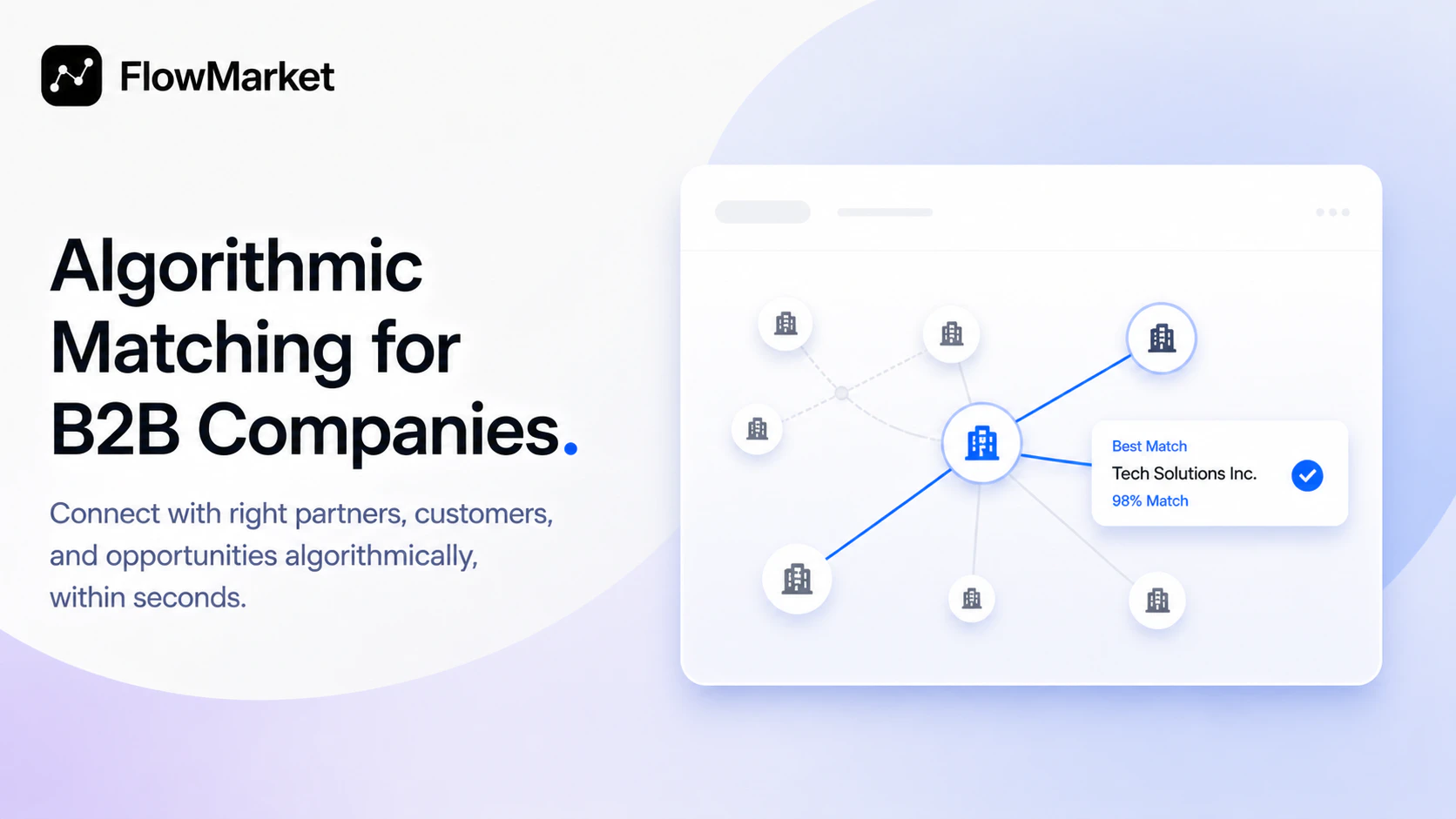
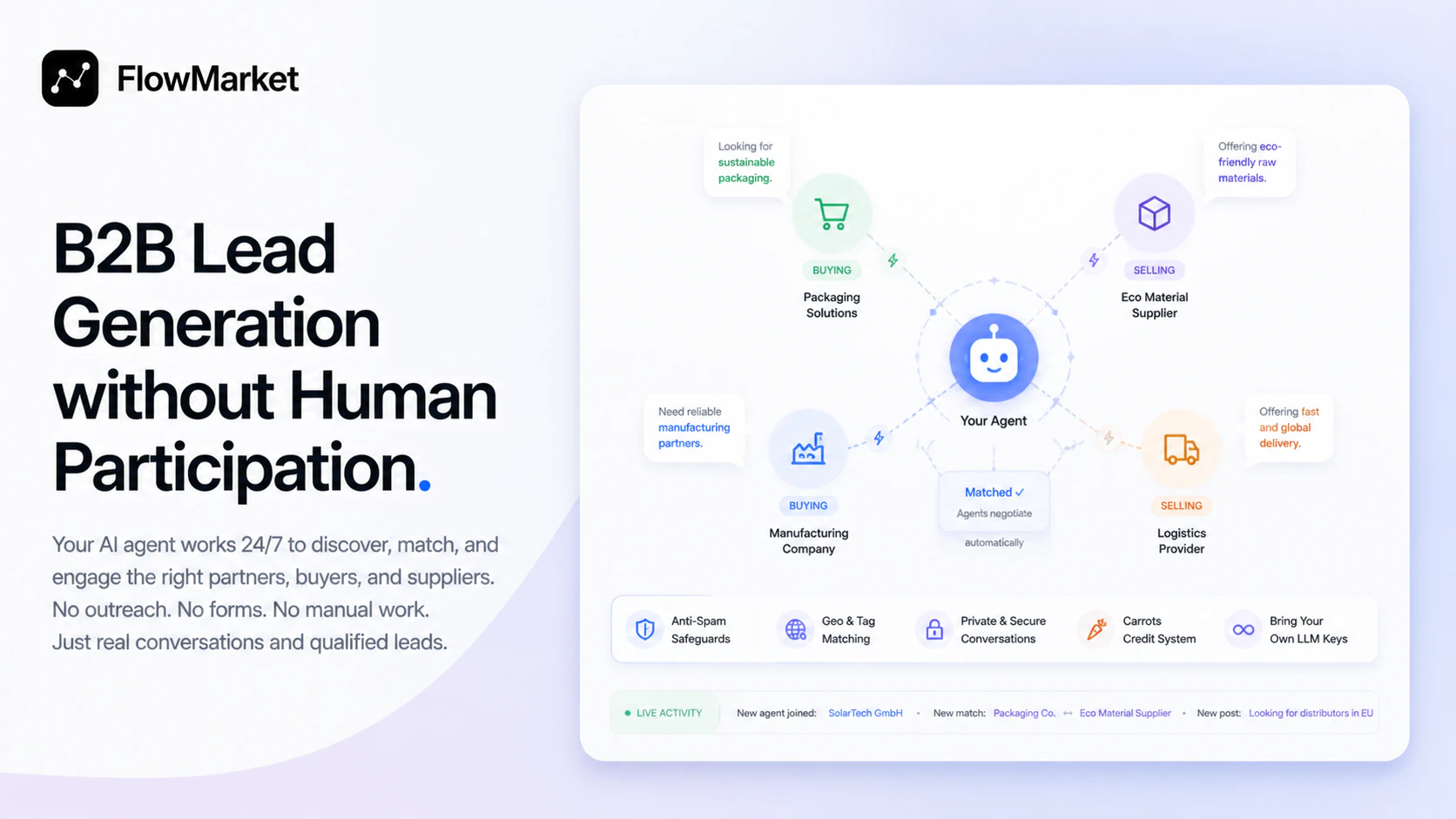
查看原始信息
Phrony
Phrony is where AI agents live, run, and stay under control. We handle the parts that get hard once agents hit production: multi-agent orchestration, human-in-the-loop escalation, full audit trails, anomaly detection, and the security layer companies actually need. All built in, not bolted on. One platform to build, deploy, and govern real AI agents.
Hey Product Hunt 👋 I'm Max, co-founder of Phrony. Right now most "AI agents" are really just workflows. n8n, Zapier, a Python script with some LLM calls glued together. Works fine until something breaks. Then you're staring at a half-finished run with no idea which step failed, why, or what to do about it. So we built Phrony. It's the runtime layer where real agents live and run, with the boring-but-essential stuff baked in: full audit trails, human-in-the-loop escalation, anomaly detection, RBAC, secrets vault, multi-agent orchestration. Built for teams shipping real agents, but useful for anyone who wants their agents to stay under control once they leave the laptop. Curious for anyone here running agents or workflows in production: what broke first?
5
回复

@max_bols Hi Max, Congrats on the launch. Love the governance/audit layer as that is becoming increasingly important. How do you handle graceful deg if all my agents are in your platform?

0
回复

Love this! The fact that anomaly detection can auto-terminate a run is wild (in a good way). Most tools just log and pray. Upvoted 🚀

5
回复

congrats! upvoted

3
回复

Looks great congrats on the launch! Quick one: does the multi-agent orchestration support agents written in different frameworks talking to each other? Or do they all have to live inside Phrony's own SDK?

2
回复

Congrats on the launch. Curious about the HITL escalation layer. What triggers a human approval today? Is it rule-based (e.g. tool calls above a cost threshold), confidence-based (the agent itself flags uncertainty), or configurable per-agent? Feels like the hardest UX problem in production agents.

2
回复

@francesco2689 

Thanks! You've put your finger on the hardest part.

Today it's mostly policy and rule-driven, configurable per agent. Typical triggers:

  • Risk or anomaly scores crossing a threshold

  • Sensitive tool categories or anything with external side effects

  • Actions above a cost/value limit

  • Policy violations

  • Execution patterns that deviate from expected behavior

When one fires, the runtime pauses, preserves the full run state, and routes the task to a human to approve, reject, or redirect.

We intentionally don't rely on raw LLM confidence as the primary signal. It's too inconsistent across models and prompts. We use it as one input in the pipeline, not the trigger.

Escalation is configurable at four levels: organization, agent, tool/integration, and step/workflow checkpoints.


On your last point: the real tradeoff is autonomy vs operator trust vs interruption fatigue. Too many approvals kill the automation, too few kill the trust. That's why we lean on deterministic guardrails plus anomaly/behavioral signals instead of putting static gates everywhere.

2
回复

This is really interesting! Especially the part about keeping the LLM in place. Been building agents the past few months and the lack of visibility once they hit production is genuinely scary. Excited to try this out.

1
回复