Product Hunt 每日热榜 2026-05-15

PH热榜 | 2026-05-15

#1
OpenHuman
An open source AI harness built with the human in mind
413
一句话介绍:OpenHuman 是一款开源、本地优先的 AI 代理工具,通过永久记忆、一键集成和图形界面,解决了普通人因会话记忆丢失、数据隐私担忧和配置复杂而放弃使用 AI 代理的痛点。
Productivity Open Source Artificial Intelligence GitHub
开源AI代理 本地优先 隐私保护 永久记忆 图形界面 一键集成 工具调用 数据主权 非技术用户 生产力工具
用户评论摘要:用户认可“永久记忆”和“本地优先”解决了反复解释上下文和隐私焦虑的核心痛点。技术用户关心记忆过载(模糊搜索 vs 精确召回)、幻觉处理(基于真实数据+可溯源)、上下文窗口压缩及本地模型路由等问题。非技术用户(如花店老板)的实际应用案例展示了产品破圈潜力。
AI 锐评

OpenHuman 在“AI 代理”这个被大模型公司和极客玩家垄断的赛道上,找到了一个精准而微妙的缝隙:**为“次优硬件”和“非代码人群”提供有尊严的代理体验。**

产品最聪明的设计不是模型多强,而是对“记忆”和“隐私”的工程实现——将记忆树结构化存储于本地 SQLite,而非无脑塞入上下文窗口,这是一个务实且优雅的解决方案。它承认了“本地模型能力有限”的现实,却通过智能路由(低质任务用本地小模型)和 Token 压缩机制,在消费级硬件上提供了可用性。

然而,需要警惕“永久记忆”可能带来的反馈循环陷阱。如果记忆系统对用户行为的记录和回放过强,会导致用户陷入信息茧房,AI 的创造性反而被过往数据约束。此外,虽然产品声明了数据主权,但“本地运行”意味着用户必须自行承担备份、数据损坏等运维风险,这对目标群体(非技术用户)的隐性要求其实不低。

总的来说,OpenHuman 做对了两件事:一是用图形界面和两分钟安装教育了市场,证明 AI 代理可以不是“开发者玩具”;二是用开源和本地优先的姿态,切中了用户对公有云数据收割的深层不信任。但它的长期护城河不在于代码,而在于能否围绕“记忆”建立起一套比大模型厂商的闭源方案更可信、更可控的用户习惯。在 OpenAI 和 Google 的强云端记忆面前,本地化的“慢智慧”是一场值得尊敬的赌博。

查看原始信息
OpenHuman
90% of people who try AI agents give up. Three reasons: memory that resets every session, your data sitting in someone else's cloud and a terminal just to get started. Real blockers. OpenHuman fixes all of it. Local-first, privacy-first. It remembers everything about you and actually gets smarter the more you use it. Every feature lives in one simple interface. Fully open source. One-click setup. P.S. The product is in beta, so expect bugs, but we're building and shipping fast.

Heya! I'm Steven, founder of TinyHumans.

A few months ago I tried to set up an open-source AI agent for my dad. Three hours later and after wrestling with API keys, YAML and a terminal he had never opened in his life, we both gave up.

That's when I realised that every powerful AI agent today is built for the 0.01% who can spin up their own runtime. The other 99.99% are watching the agent revolution from the sidelines.

So we built OpenHuman.

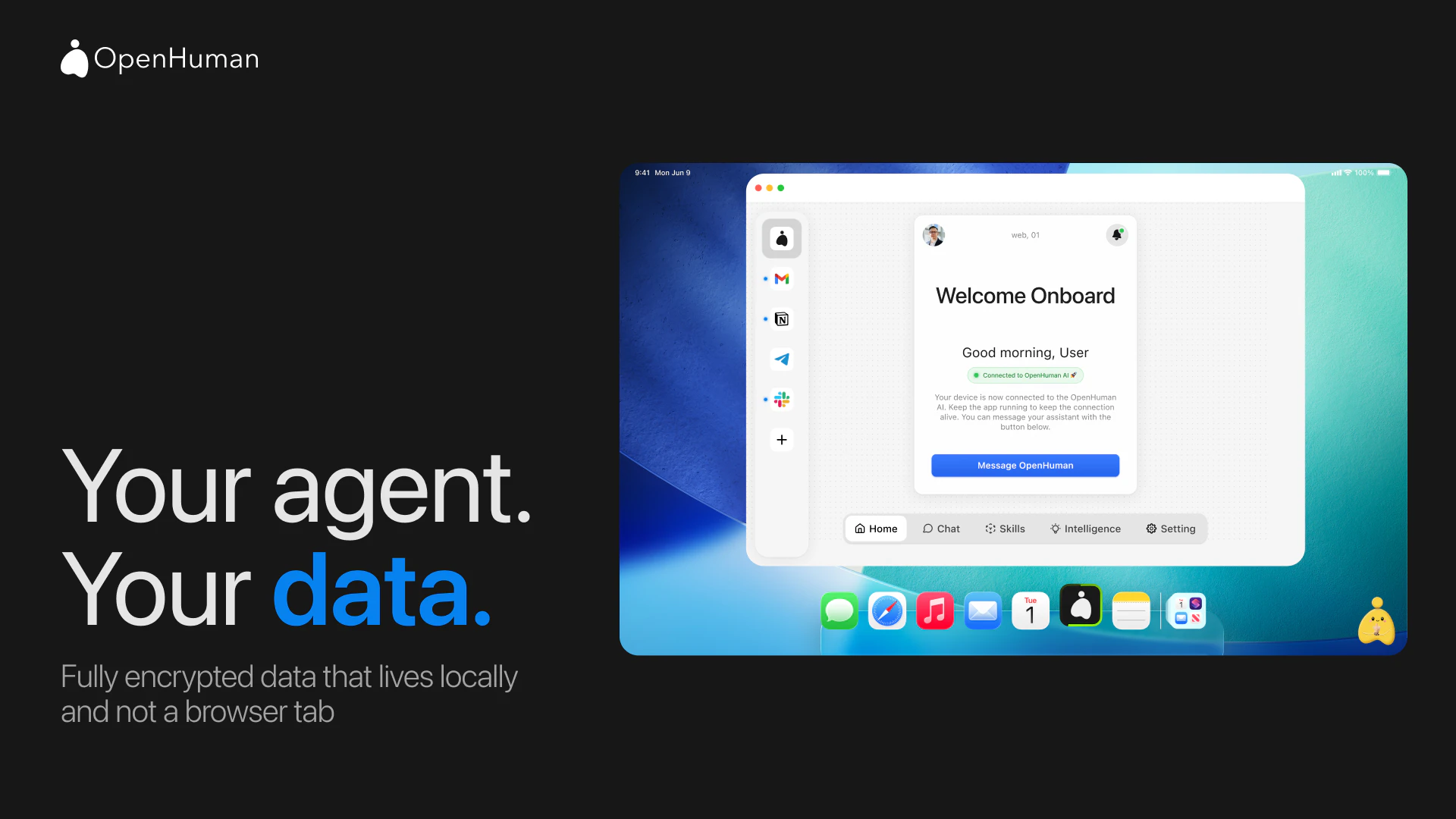
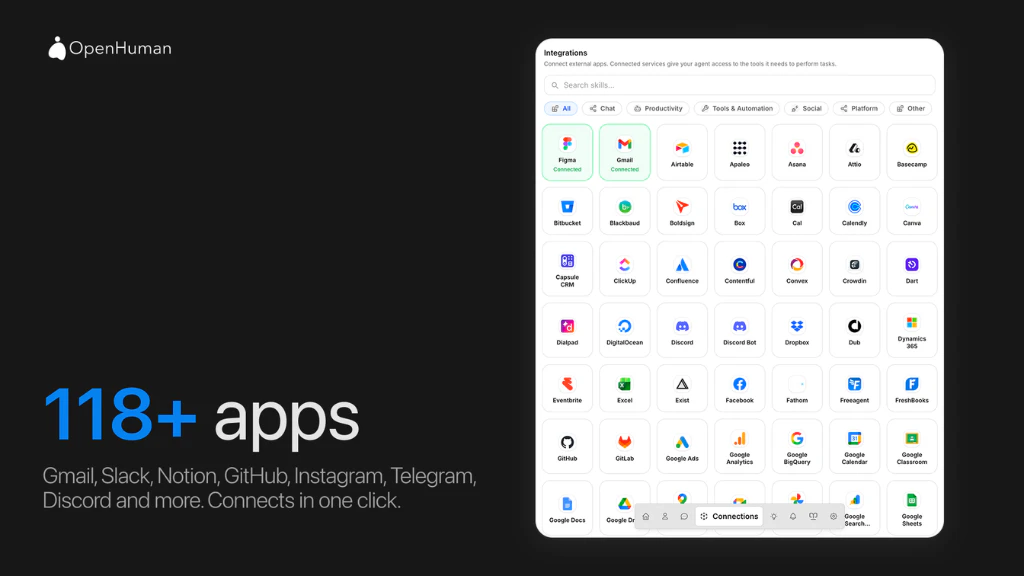
OpenHuman is a super-intelligent AI agent that anyone can use. Two-minute setup. No config files. A simple GUI you'd hand to your parents and they'd actually figure out. Connect Gmail, Slack, Telegram, Notion, and GitHub in one click and it just works.

A few things I'm proud of:

* It runs locally. Encrypted vault. We never sell your data.

* It never forgets. Real memory across sessions, not session-only.

* It's open-source under GNU.

* It's free to start: no engineer, no GPU, no $6k setup bill.

Early signal has been wild: 8000+ GitHub stars, 5000+ users in the first 7 days, and 150% week-over-week growth.

Today, we're opening it up to all of you. Note that it is still in beta, so you're super early if you find bugs. Feel free to report them to me over at the Discord.

I'll be in the comments all day. You can break it, roast it, tell me what's missing, ask anything. We ship fixes live.

Would love your feedback!

25
回复

@enamakel @kunal_karani this seems to be an interesting product. looking forward to experimenting with it it in my daily life!

3
回复

@enamakel This is a strong problem framing powerful but unusable for normal people is exactly where most AI agent tools are today. The 2-minute setup + real GUI + local-first memory combo is what will actually move it beyond devs and into everyday users. 🚀

0
回复

@enamakel Hi Steven, awesome product and congrats on the launch. Too lazy to see the GH now but what local slm do you use to orchestrate and memorize before invoking LLMs?

3
回复

Hi 👋

I'm Ankita, the product marketer at OpenHuman.

I joined this team because Steven and the rest of TinyHumans were the only people I'd met who genuinely wanted to build an AI agent for everyone, not just engineers. The people who don't write code, don't want to wire API keys, don't want to read YAML files. People like my parents, honestly.

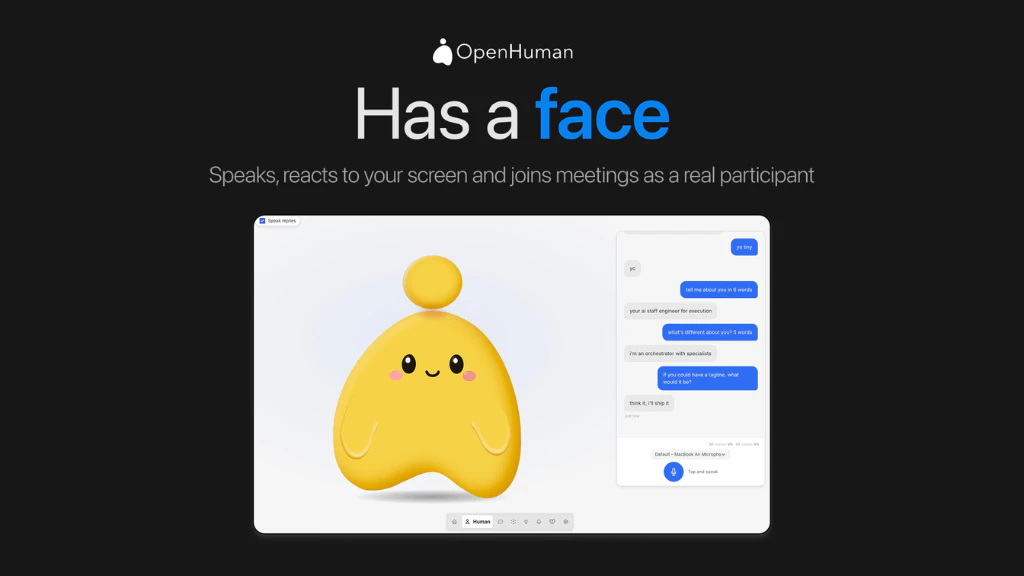
Watching the last few months of shipping has been wild. The skills marketplace went from a handful of integrations to 118+. Memory went from session-only to actually remembering you across weeks. And Tiny the mascot has somehow become the most-discussed feature in our internal slack.

If you've ever wanted to use an AI agent but felt the setup wasn't worth the headache, today is your day. It gets way more useful the longer you use it because it actually remembers what you tell it.

Try it free at tinyhumans.ai/openhuman.

Hop into our Discord if you want to chat, ask for a feature, or report a bug. I'm reading everything today.

Thanks for being here 🙏

Ankita

6
回复

Launching alongside great products like this makes today even more exciting. Really impressed by what you’ve built. Supporting fellow makers today would love to cheer each other on 🚀

6
回复

@erenasiroglu thanks brother :D yeah hope you like it. it's getting a ton of improvement.

3
回复
Congrats on the launch! Looks awesome. How does canonicalization decide what’s currently true vs what’s historical context the agent should know about but not act on? Are chunks scored by recency, source authority, or something more interesting?
4
回复

@ferdi_sigona Hey Ferdi, thanks for the great question.

Short version: chunks carry temporal metadata plus a source weight and at retrieval the agent reasons over both rather than relying purely on similarity.

Recency is one signal but not the only one. So, a confirmation from your finance team about a contract amount outweighs a casual slack message from three weeks ago even if the slack message is more recent.

Source authority is computed per connector.

We also track explicit revisions where a later document or message overrides an earlier claim so the canonical state is the latest non-contradicted assertion rather than just the latest chunk.

Recall stays fast because we keep a rolling summary tree per entity that gets updated incrementally rather than recomputed. Long-horizon contradiction handling is one of the things we're actively improving.

2
回复

@ferdi_sigona So chunks are yes stored by time, and scored by interactions. But the interesting thing about memory is that it's a clickable plug and play model. so you can literally choose any other memory system you want or like.

The default memory itself is pretty good yes.

0
回复

One of the weirdest things about using OpenHuman now is how fast normal AI tools start feeling “dumb”.

The moment your AI starts remembering context across chats, understanding your workflow, pulling information across apps, and quietly helping in the background… it’s really hard to go back.

Feels less like using ChatGPT and more like having a second operating system running alongside you.

Also watching non-technical people set this up in like 2 minutes after spending months hearing “AI agents are too complicated” has been pretty wild !

4
回复

@kunal_karani welcome to the journey brother

2
回复

@kunal_karani Persistent memory really changes the experience once AI keeps context across sessions, normal chatbots start feeling stateless and repetitive. The second operating system comparison actually makes sense, especially when the assistant quietly adapts to your workflow over time.

0
回复

@kunal_karani welcome to the fam guy!

0
回复

can it use my skills and maybe commands? Tool calls? Is it good for coding?

3
回复

@robert_douglass yep. 118+ integrations (Gmail, Slack, Notion, etc.) full tool calling with chaining plus retries, and a built-in code sandbox for writing, running, and debugging. it actually does stuff, not just chats about it. :)

1
回复

@robert_douglass Yes tool calls yes. It's not good for coding just YET. it'll be ppretty soon as it's evolving and people are contributing.

That's the beauty of OpenSource.

1
回复

Amazing product

2
回复

@rahul_singh_bhadoriya appreciate it, rahul! Thank you!

0
回复

@rahul_singh_bhadoriya Bhai mera Bhai

0
回复

How did this not exist before?! Love the idea, want to give it a try even though I don't necessarily need an agent in my life.


Something I've seen that feels related: the concept of moving our personal data from the custody of vendors (social, doctors, marketers, employers etc) back to us - the owners. Eg a graph of all your data with granular sharing and privacy policies that you directly control. There's an obvious privacy aspect to this, but it's also natural to imagine how agents can thrive with (controlled) access to it, as an extension of the permanent memory you've built.

2
回复

@aleksandr_rakitin right? That's the reaction we keep getting. and honestly, the I don't necessarily need an agent thing is fair. Most people don't need another chatbot. but here's the shift: once an agent actually remembers your world, your preferences, your projects, your people, you stop thinking of it as a tool you use. It becomes context you live inside. you realize how much mental overhead you were carrying just to keep all your apps and threads straight. That's why we built the Memory Tree into a local Obsidian vault with plain .md files. the graph of your data shouldn't live in Notion's cloud, or Google's servers, or Anthropic's memory. Ii should live on your machine, in formats you can read, edit, export, or delete. Granular control by default.

1
回复

@aleksandr_rakitin f***k yeah... So you I kid you not, but in the next 24 hours a new release is coming out where you can use your own API keys and absolute full control over your data and costs.

So this way you don't need to use our cloud if you're tech savvy enough. Privacy is yours basically. We keep the cloud (if chosen) completly stateless.

1
回复
Love how you’re making agents accessible beyond the tech crowd, what’s been the most surprising use case you’ve seen so far? Congratulations on your launch day!
2
回复

@odeth_negapatan1 thank you! 🙏 most surprising use case so far a florist in ohio using it to auto-reply to wedding inquiries on emails, manage her calendar, and send invoice reminders. zero coding background. the world is your oyster! that's exactly why we built it. agents shouldn't just be for devs.

0
回复

@odeth_negapatan1 Someone is using OH to unsubscribe from all the shitty newsletters and manage their instagram and twitter to grow their businesss. More incoming.

And super awesome to meet ya :D thanks and i hope you get to try out the product and give us more feedback

0
回复

Finally an AI that doesnt forget everything after every chat. Sounds actually useful for normal people not just tech guys.

2
回复

@oleksandr_drohomyretskyi2 Thanks Oleksandr, that's the entire reason we shipped it. Normal people deserve AI agents that aren't a part-time job to configure.

Curious what made you try ours over the others. Was it the local-first part, the memory, or just the GUI not asking you to open a terminal?

1
回复

@oleksandr_drohomyretskyi2 Basiaclly OpenClaw/Hermes is for the top 1%. OpenHumans is for the 99%

0
回复

The privacy angle is a big reason to go local-first, but the persistent memory is what actually makes it usable day to day. I I am tired of re-explaining my tech stack and project goals every single time I open a new session.

Since you mentioned that it is in beta and remembers everything, I want to know how you handle context window limits or database bloat over time. Does it start getting sluggish once it knows too much about my work history, or is there some kind of automated cleanup?

2
回复

@ritikgupta_01 Great question! That re-explaining loop is exactly why we built the Memory Tree the way we did. We don't dump your entire work history into the prompt. The Memory Tree canonicalizes everything into chunks (3k tokens max), scores them by relevance, and folds them into summary trees: per-source, per-topic, per-day. When the agent needs context, it retrieves the most relevant chunks and summaries, not a raw dump. TokenJuice compacts verbose tool output before it ever hits the model, so even sweeping months of email stays cheap. And on the sluggishness end - The retrieval layer is local SQLite with indexed chunks. The agent isn't scanning a massive log every time. It pulls what matters for the task at hand. So yes, it remembers everything, but it doesn't remember everything all at once in the expensive way. It remembers like a human does: details for what matters, summaries for the rest.

0
回复

@ritikgupta_01 So context window limits, are handled like any agent harness. it compresses context when it hits 90% of the window. but it also does a ton of token compressing and cost cutting so that everything is smartly put in the window.

See this for more infor https://tinyhumans.gitbook.io/openhuman/features/token-compression

And it also uses lower end models for a lot of the low quality work such as summarization and cleanups. See this for more info https://tinyhumans.gitbook.io/openhuman/features/model-routing In many cases you can run it completly locally using a local AI

0
回复

The gap between powerful agent and usable by normal people is still massive and most projects only solve the first half.

2
回复

@bruce_warren Hey Bruce, nice to see your comment.

You just described the entire reason we built this.

We've spent more engineering hours on installer, defaults, error messages, and recovery than we have on the LLM layer. So I agree when you state the gap between usability of agents and normal people.

So, I would like to say this one is different. It is something that anybody can use because of its easy and simple interface.

1
回复

@bruce_warren LFG thanks for the comment, give it a try and lmk what you think about it.

0
回复

Congrats on launch!! I like the idea.

1
回复

@thamibenjelloun Thanks Thami, appreciate your comment. Please feel free to try out the product and give your feedback. I would be happy to give extra credits if that helps!

1
回复
0
回复

How it's handle hallucination thing?

1
回复

@imrulkaayes Good question.
Three layers here:

First, OpenHuman grounds its answers in your actual data (emails, slack, notion, etc.) rather than generating from training memory alone.

Second, every memory chunk has a deterministic ID and we can show you the exact source for any claim the agent makes.

Third, when the agent isn't confident, it tells you and asks rather than guessing. We're not pretending hallucinations are solved, but grounding in your real corpus plus auditable retrieval cuts the worst of it.

Happy to go deeper if useful.

1
回复

@imrulkaayes The default prompts used by the agent already prevent halucination. And if you want to use a model that is completly yours and high end, you can easily switch to that as well. Most frontier models if prompted well do not halcuinate (much).

0
回复

What is the subscription price to use this? Is it open source or need to pay anything?

0
回复

@agastya_patel it is completely open source and you choose to either run things locally in which it is as good as free. or use a cloud if you don't have decent enough hardware

0
回复

@itsnotgaf Congratulations. And happy product launch.

0
回复

@itsnotgaf  @huisong_li Thanks Huisong, really appreciate it. Big fan of what you all are building at Epsilla, vector DB infra is one of those things people don't appreciate until they really need it.

1
回复

@itsnotgaf  @huisong_li Thanks huisong :) I hope you get a chance to try it out and let us know aht you thinka bout it

0
回复
#2
HasData
Web scraping service for AI agents
334
一句话介绍:HasData 是一款专为 AI Agent 和数据管道设计的托管式网页抓取服务,用户只需发送 URL 即可获得干净的 JSON 或 Markdown 数据,无需处理代理、浏览器渲染或反爬机制,解决开发者在构建 AI 应用时“有模型但没干净数据”的核心痛点。
Artificial Intelligence Data Vercel Day
AI数据抓取 网页爬虫API AI Agent工具 无代码数据采集 MCP服务器 数据管道 结构化数据提取 商业数据API 反爬虫托管 LLM数据输入
用户评论摘要:用户普遍认可数据质量高、集成快(20分钟完成 607 行邮件补全,命中率 69%)。关键问题:有用户询问能否自动去除广告和导航噪音,官方回应显示已提供可配置的标志。另有用户对比 Firecrawl,指出二者在 UI/UX 和无代码/API 分群上存在差异。评论中罕见负面反馈,主要围绕“仅对成功请求计费”这一差异化价值展开。
AI 锐评

HasData 的“卖点”其实很直白:如果你用 AI Agent 但拿不到靠谱的数据,再智能的模型也只是废铁。这个逻辑在 LLM 狂潮中尤为致命——你让 Claude 帮你分析市场,它回复“网页打不开”或“内容包含广告”,就等于白干。

从产品层面看,HasData 没有押宝在“多酷的 AI”上,而是扎实地解决了数据提取的脏活累活:代理池、浏览器渲染、反爬绕过、结构化输出。这是典型的基础设施型产品,50+ 现成 API 覆盖 Google、Zillow、Amazon 等高频站点,叠加 AI Agent 做泛化提取,形成“确定需求走 API,模糊需求走 Agent”的双轨打法。底层逻辑很务实:把非标网站的数据提取变成一次 prompt 调用,而不是几天爬虫调参。

但必须指出,这类服务的护城河并不稳定。Firecrawl、Jina AI 等竞品同样在抢这个生态位,差异更多体现在“成功计费”和“预置 API 数量”这类运营细节,而非技术壁垒。HasData 宣称“只对成功计费”,这确实是一记直击痛点的商业策略——开发者最怕白费功夫,尤其是调试代理时。然而,若反爬成本持续上升,成功率的“定义”是否会在隐含上限前出现猫腻,值得长期观察。

真正值得关注的是其 MCP 和 Agent Skill 接入能力。它把数据提取从 API 调用升级为了 AI Agent 的“默认能力”,这实际上是在抢数据管道的定义权——如果未来多数 agent 框架默认集成 HasData 插件,后来者将很难抢夺其生态位。一句话总结:HasData 卖的不是爬虫,而是“通往真实世界的数据跳板”。如果它能持续压低失败率并加快新网站覆盖,就有机会成为 AI 时代的“数据中间层标准”。否则,它只是又一个漂亮的 API 壳子,在竞品模仿潮中迅速下沉。

查看原始信息
HasData
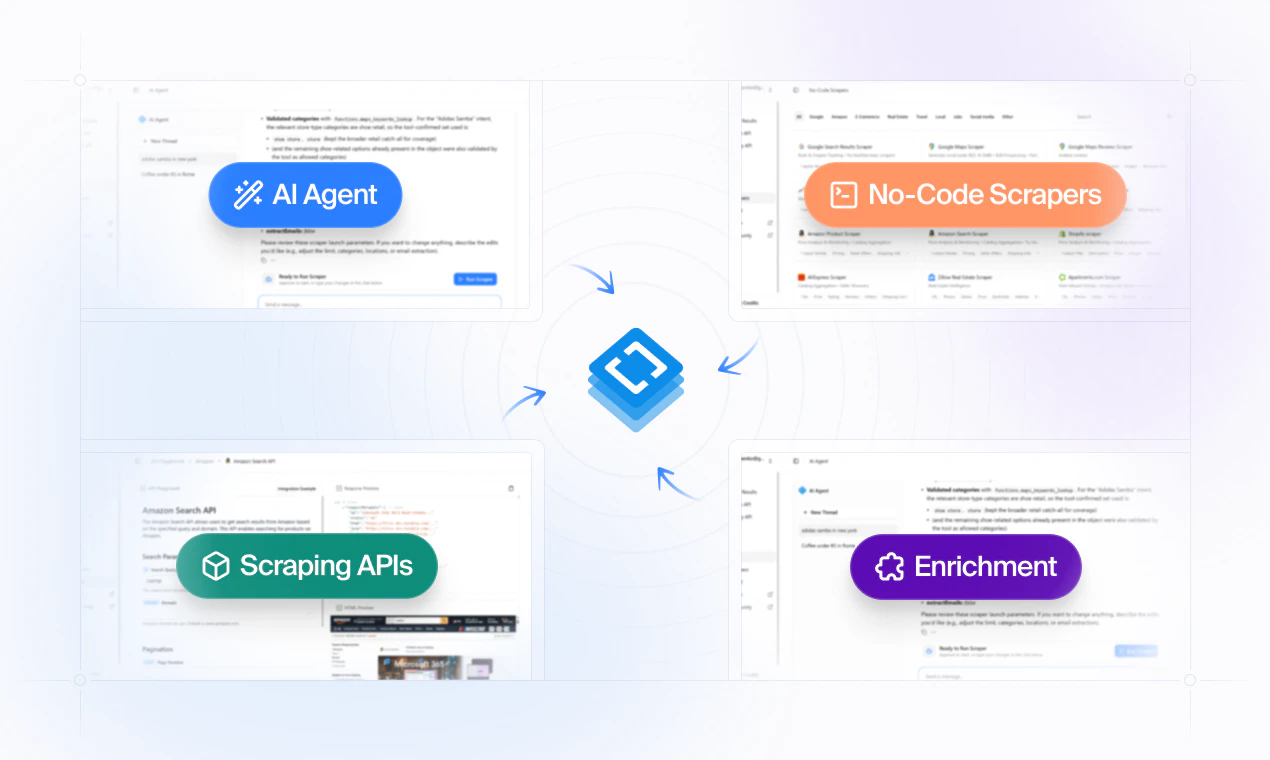
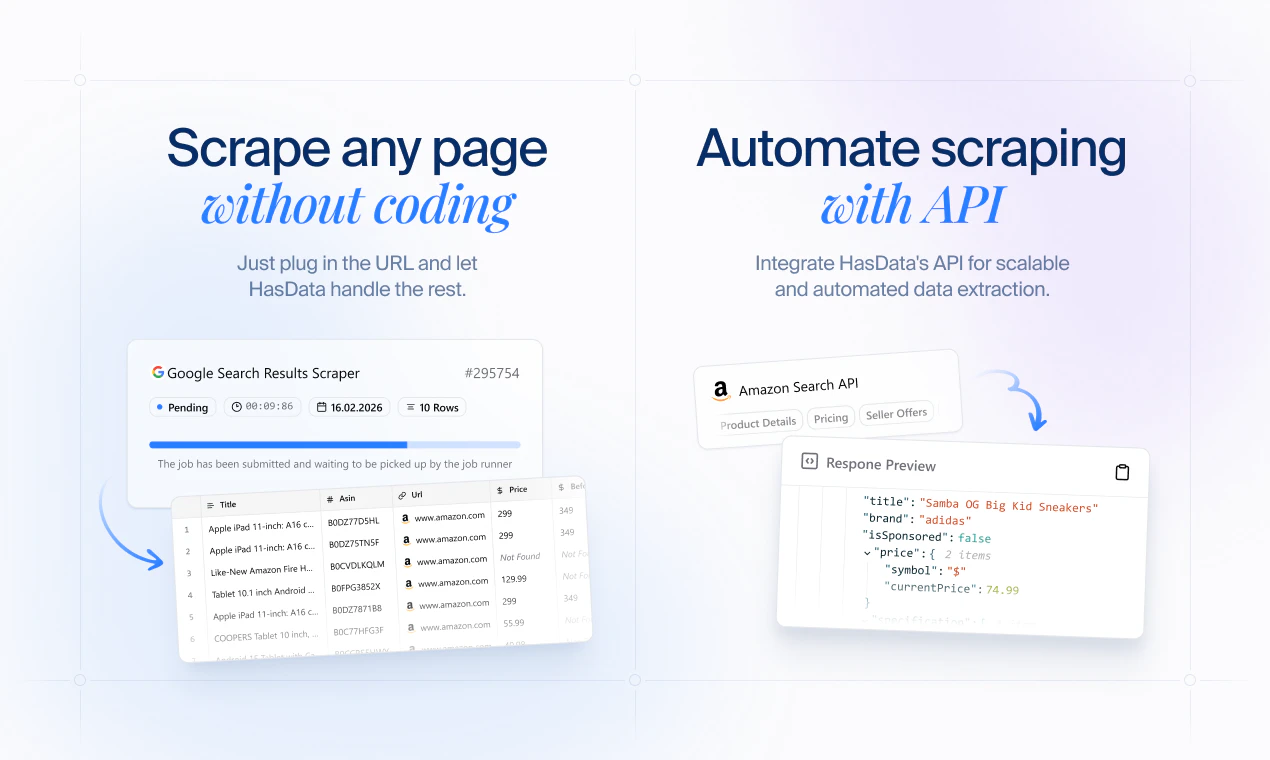
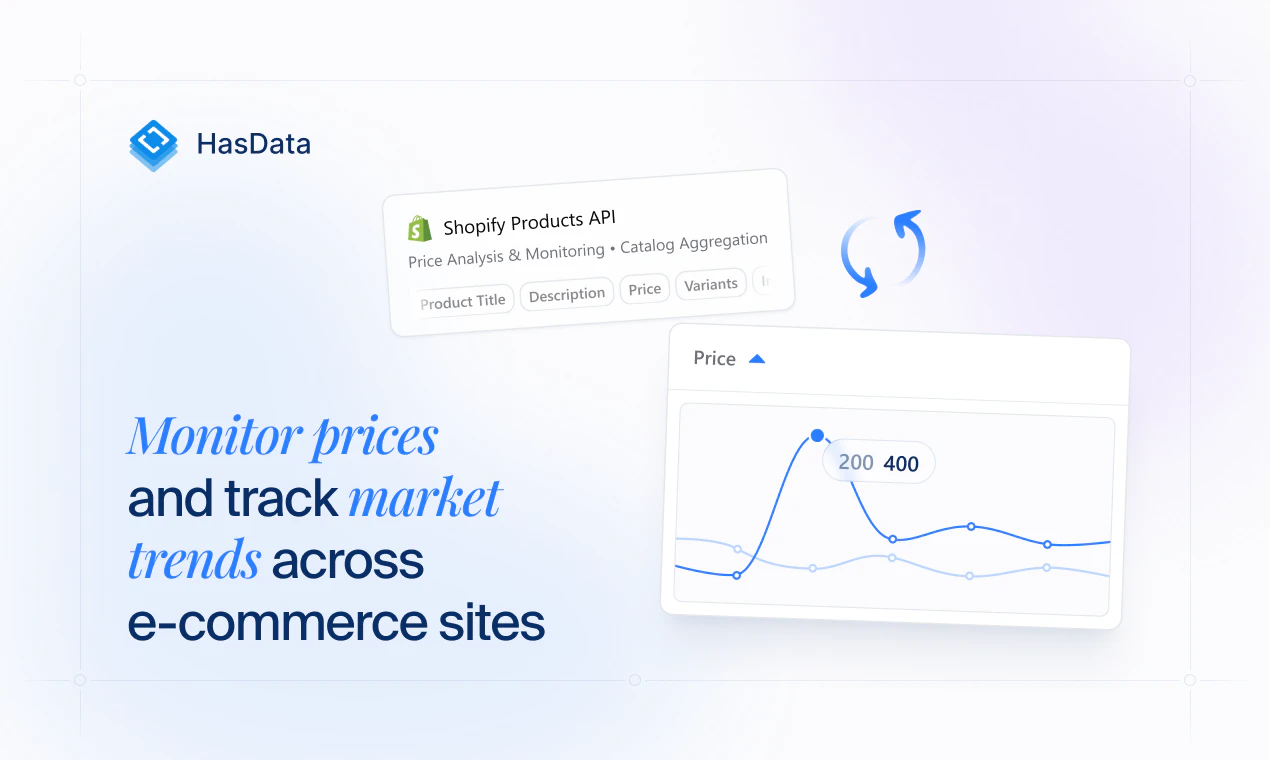
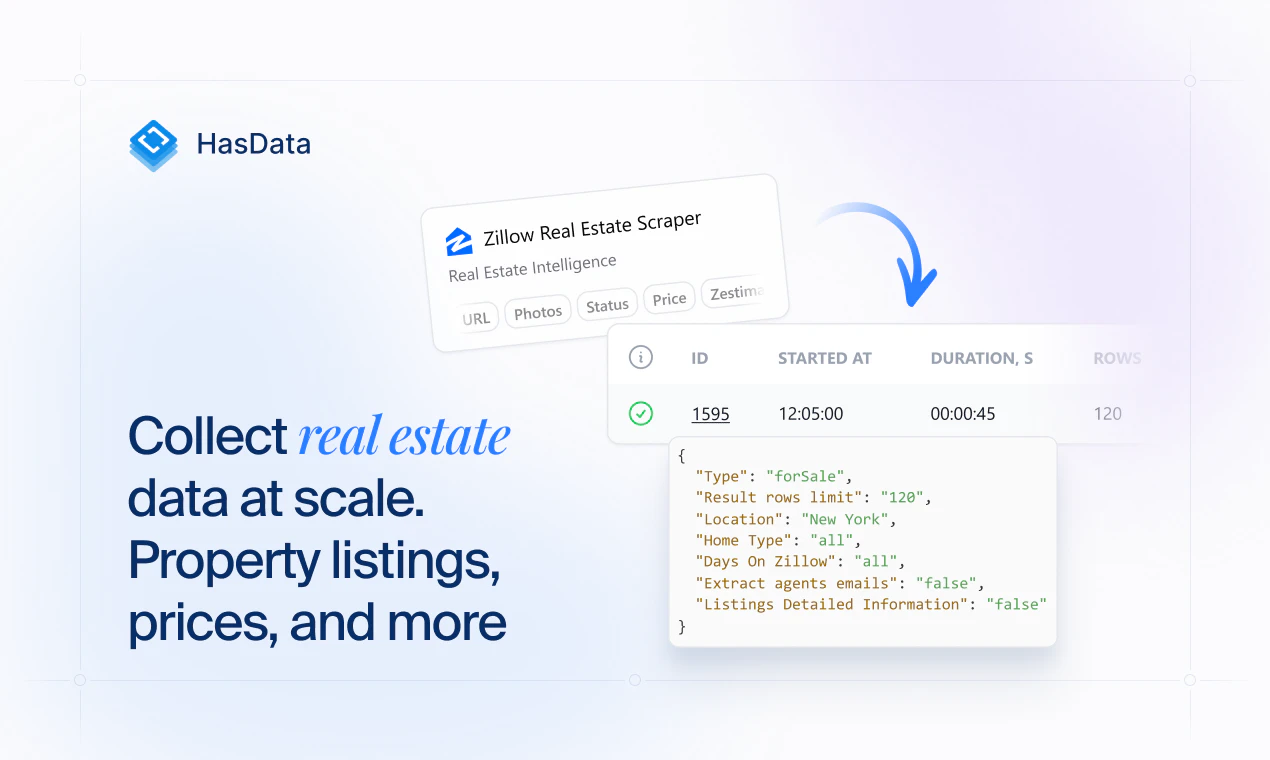
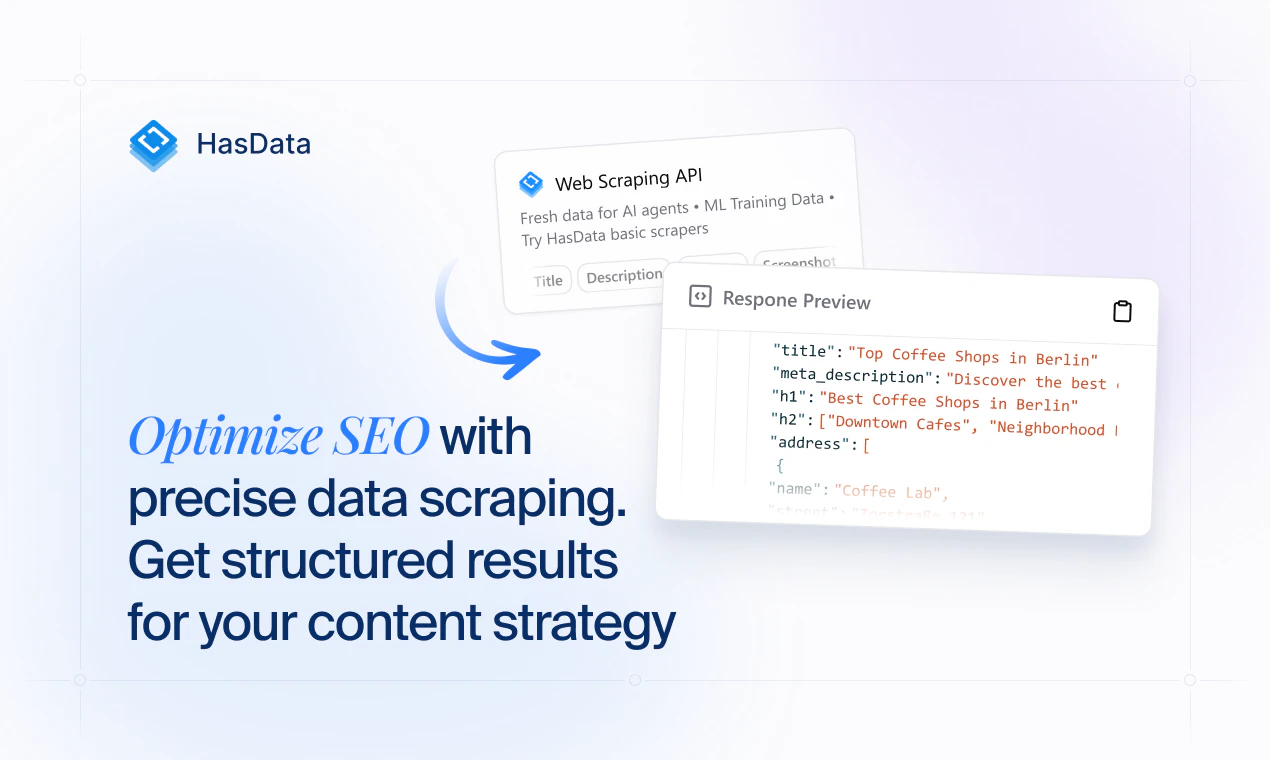
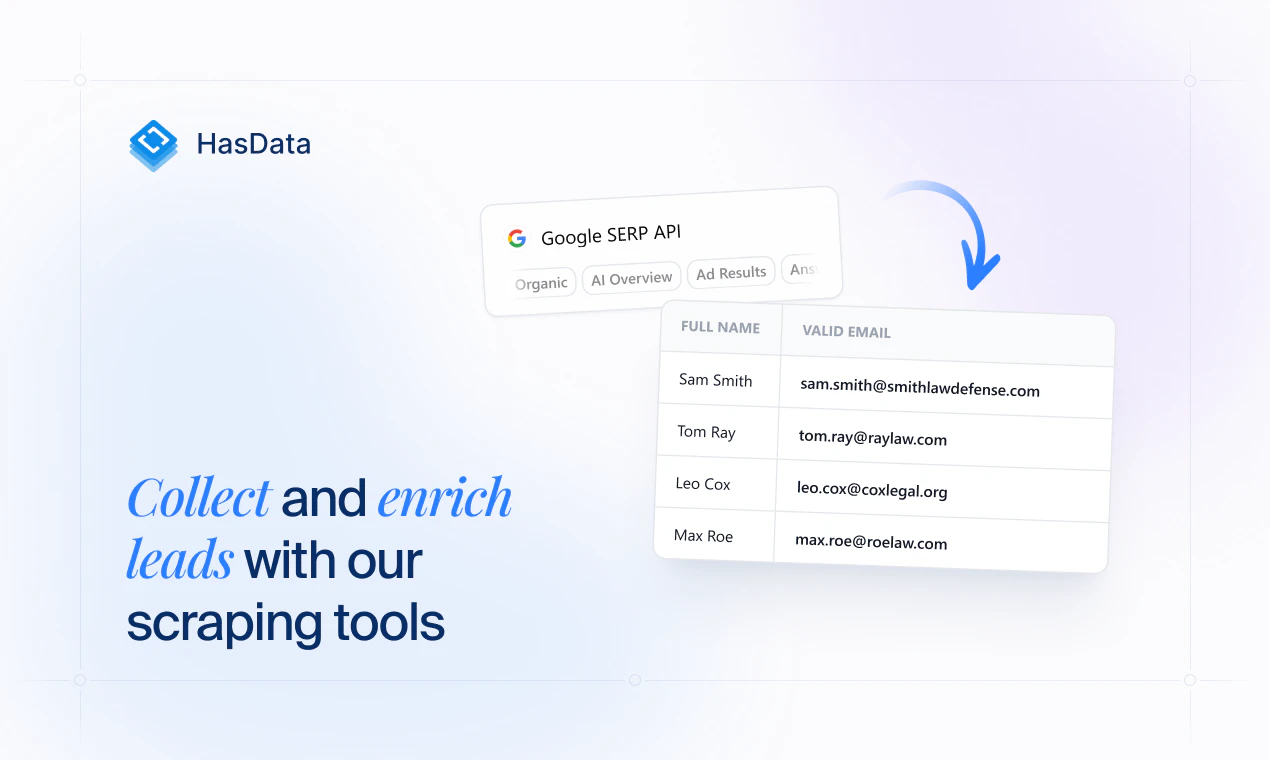
HasData is the managed web scraping service for data pipelines and AI agents. Send any URL, get clean JSON or Markdown back in one API call. We handle proxies, browser rendering, retries, and anti-bot. 50+ ready scrapers cover Google Search, Maps, News, Zillow, Indeed, and major e-commerce. AI extraction handles any other URL from a plain-text prompt. Use it from Claude, ChatGPT, or your own AI agent via MCP. CLI for everything else.

Hey Product Hunt 👋

Sergey here, co-founder at HasData.


HasData is the managed web data service for AI agents and pipelines. We handle the messy infrastructure like proxies and anti-bot. We also maintain dozens of ready APIs for Google, Maps, Zillow and e-commerce.


And one thing that sets us apart from every other API in this space: we only bill on success. Failed requests cost nothing. You pay for data that actually arrives, not for retries on a broken proxy.


Today we are launching our AI Agent, an MCP server, a CLI and Agent Skills for Claude Code and OpenClaw. You can now connect HasData straight to your AI stack.


The catalog is pretty powerful if you know exactly what you need. But it gets frustrating if you do not. Picking the right tool, learning the parameters and parsing the output takes time away from actual building.


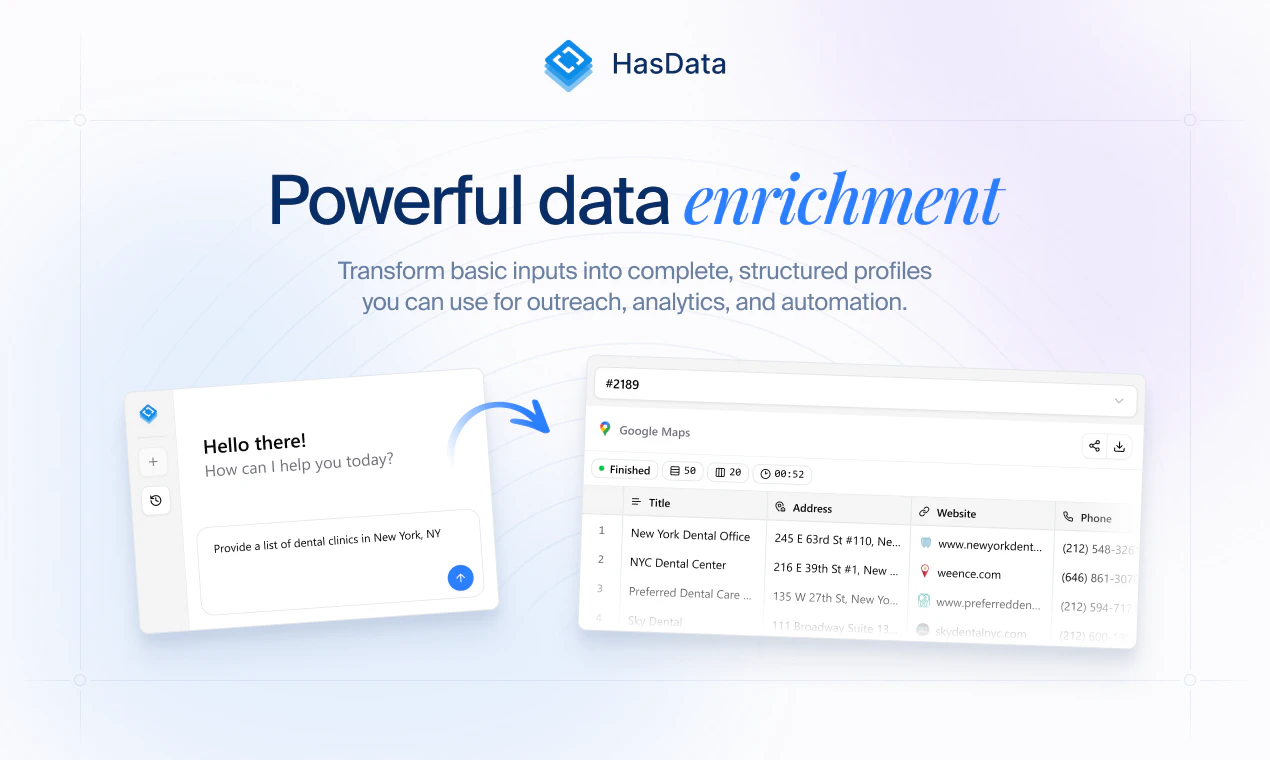
The new AI Agent fixes that. Describe what you need. The Agent picks the matching API, runs the job, and returns a dataset. Enrich any row from the same chat with contacts, firmographics, or whatever's missing.


The MCP server, CLI, and Agent Skills give the same flow to anyone working from Claude, ChatGPT, the terminal, or Claude Code.


Two things worth knowing:

  • We're giving 10,000 free credits during launch week.

  • If you're a HasData user already, everything works on your existing account, catalog, and workspace. No separate plan, no migration.

It's live at app.hasdata.com/chat. I'm here all day, so is the team. Drop a comment, break it, tell us what's missing.

31
回复

@ermakovich_sergey congrat with the launch! This is what new agentic ai worlds need!

4
回复
@ermakovich_sergey you have managed to run a great service. I am client for over 3 years. You provide really robust service with many features. This AI feature is blown my mind. Our stuff save their time by easily getting to data 📊 Congrats with launching 🚀
0
回复

@ermakovich_sergey  @rmilyushkevich  Congrats on the launch! As a developer who does a lot of web scraping, I’ve used hasData (Scrapeit cloud) before, and it’s a lifesaver. It easily handles almost any scraping challenge on any website. This is a really solid product. The guys never stop moving forward, always upgrading and improving it. Best of luck with the launch.

0
回复

Hey Product Hunters!

Nick's here, CPO and Growth Advisor for HasData. I believe this launch is 100% worth your attention, let me tell you why.

Web scraping always used to be a complicated tool for developers to use: if you do it on your own, you have to build and maintain the whole scraping infrastructure by yourself, but that's even not the most complicated part. Parsing your data and extracting relevant values used to be another kind of a nightmare - before LLM and ChatGPT, of course.

Today, thanks to HasData and AI capabilities integrated into this products, I feel like searching and extracting the data you need from web is like building a website with Lovable instead of hiring a freelancer to built it for you with WordPress. You simply pick the required scraper, or even further, prompt your request to HasData AI Agent - then get the relevant data set ready for your CRM enrichment or cold outreach in minutes. Or, what I personally love the most, simply use something like Claude or OpenClaw connector and use the whole power of HasData scraping capabilities in your favourite AI tool - simple as that!

So go ahead and try HasData AI scraping tools today for free and let us know what you think - we are happy to consider your feedback and feature requests ❤️

9
回复

Your AI is only as smart as the data behind it. And right now most teams I talk to are either flying blind, or they've got somebody on the team who basically does proxies and CAPTCHAs full-time and rewrites parsers every time a site changes its DOM.

I'm Roman, CEO & CTO at HasData. We've spent years on that infrastructure so you don't have to.

Behind one key:

  • 40+ ready-made APIs across search (Google SERP), travel (Booking, Airbnb, Google Flights, Google Maps), real estate (Zillow, Redfin), shopping (Amazon, Google Shopping), jobs, and social

  • A Web Scraping API for everything else: any URL in, parsed JSON out

  • An AI Agent that drives the catalog from natural language if you just want a one-off pull without writing code

Use it however you build: HTTP API, CLI, Claude Skill, OpenClaw, or MCP server.

Free to start at hasdata.com. You get 10,000 credits when you sign up. If we save you a week of proxy work, throw us an upvote.

I'll be in the comments today. Happy to get into the APIs, the agent, pricing, what we're working on next, whatever.

9
回复

This is a really good service. I used it to collect data for Callersmart website. Data quality is perfect, fast response and good price. They have different platforms no-code scrapers:

Recommend!

8
回复

@pawel_zajac4 Thank you Pawel! Glad to hear the data held up for Callersmart, that is a great use case. And thanks for the screenshot, did half my pitch for me :)

4
回复

@pawel_zajac4 cheers mate, happy to see nice feedback here, appreciate your support

3
回复

Well done team! Public web data on-demand, payable on-delivery. That's the hook/promise of HasData. :)

I'm a power user of their YouTube Transcript API. And have been a fan of the team's work (and their work effort) since before Roman came onto my podcast.

How can you not be bullish on HasData when they're shipping so much goodness on a monthly basis?

8
回复

@briandavidcrane thanks a lot Brian, fantastic feedback and support 🫶

5
回复

@briandavidcrane Thank you. Appreciate the support and the ongoing belief in the team.

5
回复

Hey PH! I'm Valentina, technical writer at HasData, and yes, I actually use their tools daily.

The team already covered features, so I just want to add why I personally like this. I tried and used every scraper, every API, every no-code tool, every feature they built. What I really like is how fast you go from start to the result. Even first time using a tool, takes almost no time to understand how it works.

And the project keeps moving forward. They keep building new tools, new scrapers, covering more sources. The latest addition is an AI Agent, so you don't even pick APIs or scrapers yourself, just get the ready data.

If you work with data in any capacity, give it a try. And I also happy to answer any questions in the comments today and further.

8
回复

Overall dope features but I have one question as well. I have seen while extracting webpage data from Firecrawl, that the extracted text contains all the advertisements links as well, this sorts of corrupt the data and need some cleaning before feeding to LLM. So I want to understand does HasData remove those links in some way ?

7
回复

@abhishekr_ai we have a flag for that. Default behavior keeps the page as-is, but you can toggle it to strip ads and nav clutter before the response goes back. Some users actually want the ad data, so we left it configurable rather than forcing one mode.

9
回复

Hey there! I just wanted to say qudos for your service. I used it for some enrichment work and honestly you nailed it!!! It took me only about 20 minutes to connect your API to my setup (agent skill for Claude vibe me through), and I was impressed with how smooth the process was.

I had a dataset of 607 rows, and the email enrichment came back with a 74% success rate, which I think is fantastic. After checking for bounces, it settled at 69%. Not bad at all for just 20 minutes of work!

I've added you to my favorites for scraping services because you definitely deserve a spot there.

6
回复

@nickolay_tsarik this is really cool feedback, thank you for sharing numbers :)

2
回复

@nickolay_tsarik Thanks Nickolay! Real numbers from a real run are way more useful than any pitch we could write. Appreciate it.

2
回复

@nickolay_tsarik yeah, we're doing our best to improve our enrichment workflows these days, hopefully you'll love it even more soon!

1
回复

Good luck with the launch, Bulba Scrapping service )) Fingers crossed for a massive scale-up!

6
回复

@malkiel Thanks Kirill 😄 Fueled by bulba, deployed everywhere

5
回复

@malkiel fingers crossed! Cheers mate :)

1
回复

@malkiel guy, it was epic, couldn't pass by 😂

3
回复

Good luck

6
回复

@dzianis_yatsenka thank you :)

2
回复

@dzianis_yatsenka Thanks Dzianis! Appreciate it.

2
回复

@dzianis_yatsenka thanks for your support today, means a lot to us :)

2
回复

I’ve been using HasData for a while now, mainly for Google Maps scraping, and it’s been really easy to use.

What I like is that it removes a lot of the usual friction around collecting structured data. Instead of spending ages working out the best way to scrape, clean, and organise the data, I’ve been able to get useful results pretty quickly.

I’m especially excited to try the new AI agent. Getting data from less common websites is often the painful bit. It can be time-consuming, inconsistent, and a lot of trial and error, especially when every site has a slightly different structure.

If the agent can make that process smoother and more reliable, it’ll be a really useful addition.

Congrats on the launch. Looking forward to seeing how the product develops.

6
回复

@rich_tank Thank you, really appreciate you writing this up. The painful part you described is the exact reason we built the AI Agent.

3
回复

Building a small side project that needs lead data and was about to write a custom scraper. Now I think I'll just use this - will give it a try at least. Congrats on launching today!

5
回复

@dafonov yeah, we are super good at this - even got a separate enrichment API so you don't have to do the data parsing and extraction yourself, check it out!

2
回复

@dafonov Thanks Dmitry, glad to be the easier path :) If you hit any walls during the trial, ping me here or in the Intercom on the site - happy to help you skip the trial-and-error part.

2
回复

Congratulations team!!! All the best in this new launch!

5
回复

@andrii_tymoshchuk cheers mate, appreciate your support today!

3
回复

@andrii_tymoshchuk Thank you Andrii, appreciate it! Spellar's #1 yesterday was a great run, congrats to the whole team.

3
回复

Congrats on the launch and good luck today! Love your landing page design btw, especially the widget that gets you started with a link to scrape or an agent prompt - good part of onboarding process nowadays, would love to know how it works for you

5
回复

@flashberry yeah, we've just released that before the launch, I believe this thing increases your landing page conversion rate hugely. Will share some statistics here in a month or something when we have enough users seeing this

2
回复

@flashberry Thanks Mikhail! Honestly still measuring it, the AI Agent and the prompt input both shipped this week, so I will know more in a few weeks. The general "try before signup" pattern has been one of our better activation moves though.

2
回复

Hey guys, congrats on launch! I've recently seen Firecrawl doing the same (I guess?) AI craping agent - what's the difference between them and you if any?

5
回复

@gregory_yashkin Hey man, cheers, appreciate your kind word and support! That matters a lot to us 🫶

Yeah, we do love guys from Firecrawl, I see them doing some amazing things lately. I believe that healthy competition helps everyone, especially the end users. I could say we have some different approach to UI/UX and also separating no-code and API scrapers for different user segments - don't know, will let PH users decide today :)

4
回复

Scraping for AI agents is a huge bottleneck right now. How does HasData handle complex anti-bot measures like Cloudflare or dynamic JS-heavy sites without constant manual tweaks?

5
回复

@rivra_dev the whole point is that a request from us should be indistinguishable from one a real person makes in their browser. So we rotate proxies across several providers, we negotiate TLS the way an actual browser does (the cipher suites, the order, the extensions - all of it), and the servers our browsers run on are set up to look like real consumer hardware, not a datacenter VM.

5
回复

Honestly, Roman mentioning that the AI Agent cross-checks ambiguous pages against a secondary source is totally flying under the radar — it's the most underrated part of this whole launch.

Quick practical question though: how does the Agent actually decide when to escalate to a cross-check? Is it relying on confidence scores (like the extraction model saying "I'm only 60% sure"), strict schema validation ("required field missing"), or some other heuristic?

Asking as an indie dev building AI tools, because getting that "when to escalate" logic right is usually exactly what makes or breaks agentic systems in production.

4
回复

@nicola_ceccaroni good question and I think we're still figuring it out when to escalate the cross-check. I would say we are using the combination of all 3 options you mentioned.

1. Before running data collection agents defines the schema and it doesn't change before current iteration of data collection finished.
2. We have different playbooks for different kind of data. For example, if it's a reviews & rating - we can take this data from Google Maps. And for Google Maps we have API, which doesn't use AI extract at all, so we are pretty confident it is correct.
3. Playbooks for emails and phone numbers look different and they include cross checks. Some of the obvious signal is the mismatch between business/person location and country code of the phone number. We have 10+ signals. If the score is low - we do cross check via our search api.

2
回复

Congratulations on the launch! Does the agent run on a schedule for recurring tasks, or only on demand?

4
回复

@margarita_lubovskaya Thanks Margarita! Right now on-demand only. Scheduling is in the plans (pun not intended). Coming soon.

1
回复

Congrats on Launch! I hope we could get a LinkedIn extension even though it blocks scraping...

4
回复

@zanc_zhao Thanks Zanc! We stick to publicly available data only, so no dedicated LinkedIn scraper planned. Google SERP can cover a lot of public profile data if that helps.

1
回复

@zanc_zhao will see, for now, I'd suggest to try getting the data you need from SERP snippets from LinkedIn-related search queries - works good for me!

1
回复

Seems like you guys did a really great job connecting your scraping tools to AI via mcps, cli, etc. Might give it a try today!

4
回复
@nikvoice do it mate, I bet you’ll love it! Thanks for supporting us today 🫶
1
回复

@nikvoice Thanks Nik! That was the main thing we wanted to nail. Same scrapers usable from MCP, CLI, or the API without rewriting anything. If you try it and hit something rough, ping me here

1
回复

Hey guys, congrats on launch!  I run an AI agency and we have quite a lot of projects where scraping is a big part of the stack - market research, price monitoring, lead enrichment, competitor tracking, AI agents with web data. So this looks super relevant for us. Scraping is always one of those parts that sounds easy in the begining, but then you spend a lot of time on proxies, blocks, JS rendering and weird site structures. Just one question how well does it work with websites that have heavy anti-bot protection or dynamic pages with a lot of JS rendering?

4
回复

@konstantin_pinchukovskiy looks really relevant. About handling anti-bot and JS rendering, it is all on our side, so you don't have to think about it. The request goes through our infrastructure and full browser rendering and then you get clean data back. I'd say the fastest way to see how it works for your cases is to just try it, we give 10 000 free credits during launch week :)

2
回复

@konstantin_pinchukovskiy Thanks Konstantin! Both are handled. Residential proxies, headless browsers, auto-retry, all under the hood on the ready scrapers. And we only bill on success, so failed retries cost you nothing.

2
回复

Scaling scrapers for AI agents is usually a massive headache because of proxy rotation and constant site updates. Paying only for successful requests feels like a fair model. Do you provide a way to train the AI extraction for specific non standard layouts, or is it purely automated? Also, what system is being used behind it?

4
回复

@ritikgupta_01 Thanks Ritik! You guide it with AI Extract Rules, basically a schema you describe (fields, types, descriptions), and the LLM returns clean JSON. No selectors, no training.

1
回复

How do you deal with reliability there, do you surface a confidence score or require a quick validation step?

4
回复

@thamibenjelloun For the 40+ pre-built APIs (Amazon, Google, Booking, Zillow, etc.) we don't use AI extraction at all. They're scrapers we maintain ourselves.

Synthetic tests run daily and compare live responses against what we expect, so if a site rotates its layout we usually catch it the same day and fix it before anyone notices.

The schema you call against today is the same one you'll get next month.

4
回复

Congrats team! Happy to find your product, Google maps no-code scrapers is sth I really need, will try today.

4
回复

@victoria_makarevich Thanks Victoria! Google Maps is one of the most battle-tested scrapers in our catalog, you should be good. 10K free credits during launch week, more than enough to validate it on your use case. Let me know how it goes.

2
回复

@victoria_makarevich Thanks Victoria! Google Maps is one of the most battle-tested scrapers in our catalog, you should be good. 10K free credits during launch week, more than enough to validate it on your use case. Let me know how it goes.

2
回复

@victoria_makarevich feel free to share your feedback straight away - we love shipping updates our users ask for!

1
回复

Congrats on launch! Love how the agent picks the matching scraper itself, that part always slowed me down on other tools.

4
回复

@igorsorokinua Thanks Igor! Glad it landed. That decision-making step is the part we wanted to remove for exactly the reason you described.

2
回复

@igorsorokinua it also configures the scraper better than an average new user who's not familiar with web scraping - I love it!

1
回复

most scraping services charge you whether the data comes back clean or not and you end up paying for broken responses. how does the openclaw skill integration work in practice though, does the agent automatically pick which scraper to use or do you still have to configure each one manually

4
回复

@tina_chhabra hey, that's right - HasData only charges for successful api calls, you don't pay for failed executions and don't receive broken respones.

Speaking if AI related features - we build it in such way that any agent could pick and configure the right scrapers itself. So far works good I think :)

2
回复

@tina_chhabra Thanks Tina, glad the billing model landed.

As for OpenClaw, the Skill is fully automatic. You describe what you need in plain English ("get me top reviews for this restaurant"), and the Skill picks the right scraper from our catalog, runs it, and returns structured data.

2
回复

Congrats on launch, guys! The scraper catalog covers the obvious targets, but what happens when someone needs a niche source not in the library? Does the agent fall back to AI extraction on raw html, or wait for the team to build a dedicated scraper?

4
回复

@julia_peremitina good catch, we were iterating with this workflow a lot lately. So basically, we set up our Agent in such way that it has to pick one of the existing sources first for a better search quality. If there's no relevant source - it can always decide to use basic search and general web scraping tools to build its reply. It works good for now, will be adding more sources and improving our web scraping capabilities in the future!

2
回复

@julia_peremitina Thank you for question! For niche sources you do not need a dedicated scraper at all. Our web scraping API has special parameter where you just describe the fields you want (name, type, optional description) and our LLM returns clean JSON. No CSS selectors, no waiting on us.

And extraction happens on our side, so your agent gets structured JSON instead of raw HTML. Your LLM tokens stay low.

3
回复

Hey, such a nice selection of web scraping apis! But why should I choose you if I'm already on Apify or a similar solution?

4
回复

@hotfixer hey, appreciate your feedback much, cheers! I might just give you a funny story instead of a direct answer:

Last week we had a customer who joined us with the help of Claude - he basically prompted it to find the best scraping solution for his e-commerce use case and try it. It ended up with Claude choosing us among all the competitors found and even purchasing our Pro plan itself.

So yeah, all of the web scraping solutions have their own pros and cons, so we do. Sometimes HasData is just a better fit for you :)

4
回复

Congrats, team! As your current user, I'm happy to see you finally launched on Product Hunt! Congrats and all the best. P.S.: those guys do a great job, take a look if you need to scrape some web data 😻

4
回复

@kate_ramakaieva hi Kate, happy to see you among our users! Thanks for your trust and support, means a lot to us :)

3
回复

@kate_ramakaieva Thank you Kate! Your support throughout the prep for this launch meant a lot.

3
回复

Congrats on the launch! Used enough unstable scrapers to appreciate when someone takes this problem seriously.

Btw, is the tiktok scraper coming anytime soon?

4
回复

@msvst hey man, appreciate your support today, means a lot! Yeah, we're now thinking of covering all the short videos platforms for scraping the statistics, etc. Definitely in our roadmap, you just gave it an extra score!

3
回复
#3
PHBench
Predict the next Series A from a ProductHunt launch
318
一句话介绍:PHBench是一个基于Product Hunt首发数据预测创业公司获得A轮融资概率的公开基准平台,帮助VC和创始人通过7年、6.7万次产品发布数据量化评估早期产品潜力。
Venture Capital Artificial Intelligence GitHub Data Vercel Day
产品猎手预测 A轮融资预测 创业基准测试 产品信号分析 团队规模 社区参与度 B2B转化率 机器学习模型 开放数据集 HuggingFace
用户评论摘要:用户关注模型信号的有效性与限制,如团队规模与互动的交互效应是否检测分发能力而非产品本质;质疑投票数与排名关系,且指出早期融资历史是强关联而非因果;建议分析假阳性案例、猎人影响、重复创始人等,并担忧公开信号可能导致创业者优化行为导致信号失真。
AI 锐评

PHBench看似是在用机器学习为VC装上一副“寻宝眼镜”,实则更像是在Product Hunt这口“火锅”里测出了水温变化的概率模型,而非为投资人找到了下一个“海底捞”。其价值在于将玄学般的“早期感觉”量化为一组可验证的信号——团队规模与社区互动的加权组合确实比单纯的投票数更具洞察力,B2B赛道的3倍转化率也撕开了“消费者热捧必火”的假象。但真正值得警惕的是,该模型的杀伤力恰恰在于它的公开性:一旦底层特征被广泛知晓,创始人们能迅速反向优化——组建名义大团队、水军式互动、选品向高转化类别挤兑,这会让模型快速沦为“打榜指南”,而非“价值探测器”。更为致命的是,评论中披露的“88.3%的A轮公司已有种子轮”这一数据,基本揭示了模型的核心逻辑:它不过是在一群已经通过“投资人认证”的选手里,甄别谁更擅长“打广告”罢了。对于真正从零起步、没有资本杠杆的独立开发者,这组信号几乎等于“我不认识你,所以不看好你”。产品本身在学术上是一个严谨的开源基准,但在VC实用场景中,它更像一个用来强化既有判断、而非颠覆认知的“马后炮报表”。一句话总结:PHBench是个好工具,但别把它当神谕,否则你投的每一轮A可能都在为“运营大师”而不是“产品天才”买单。

查看原始信息
PHBench
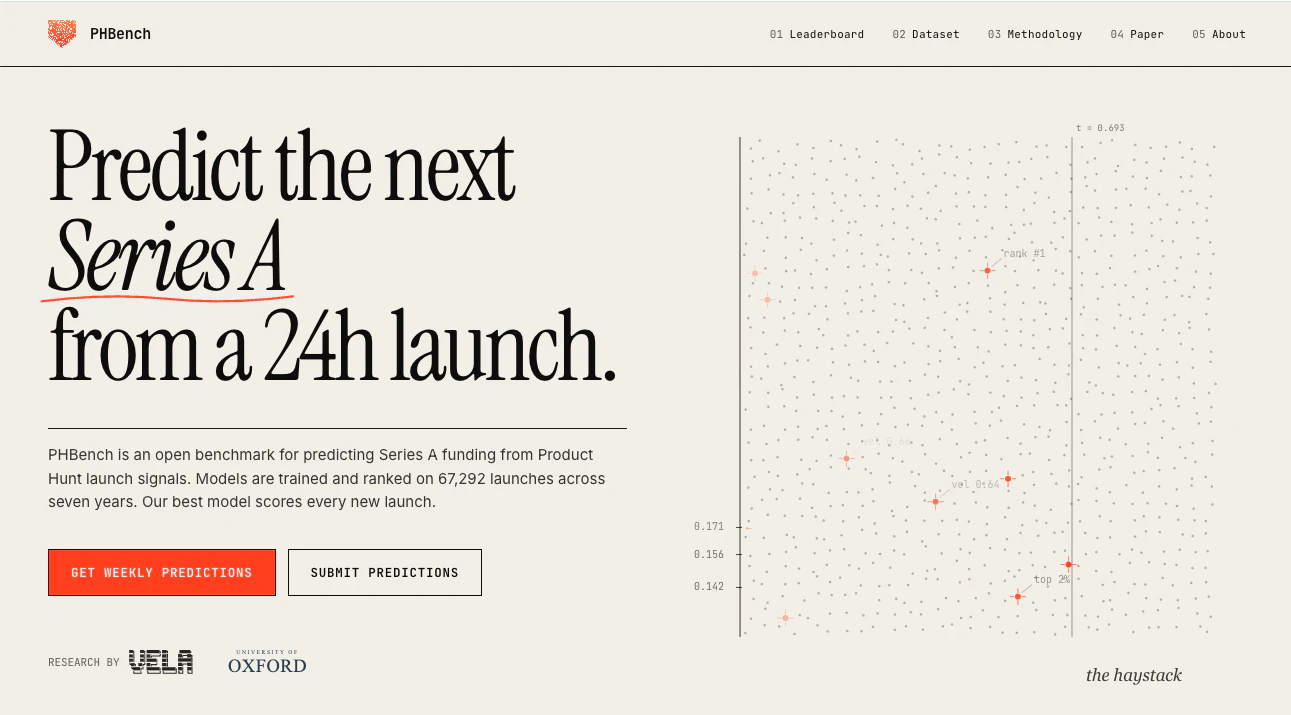
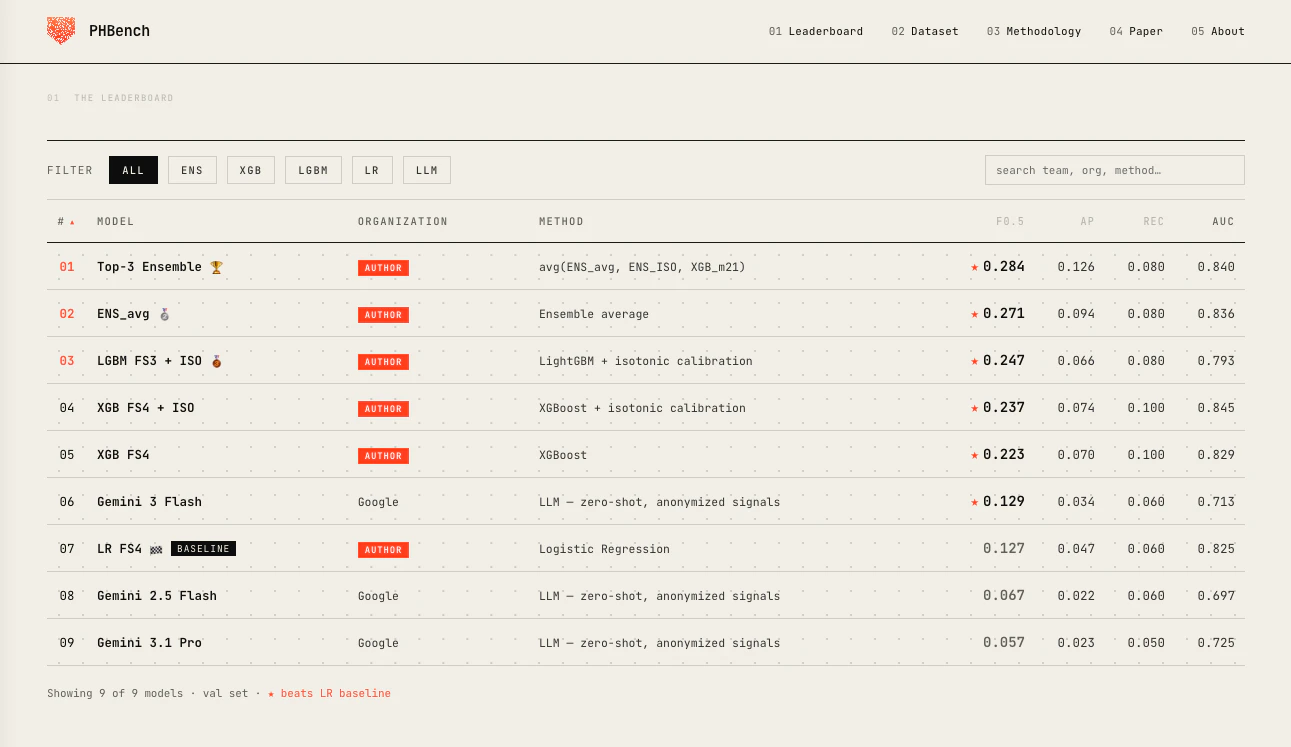
PHBench: the first public benchmark predicting Series A funding from Product Hunt launch signals. We analyzed 67,292 featured launches over 7 years, linked to 528 verified Series A rounds via Crunchbase. Champion model: 4.7x lift over random. Team size × community engagement is the strongest signal; B2B (API, Payments, Fintech) converts at 3x baseline; Rank #1 raises at 2.2x unranked. Dataset, code, and baselines open. Submit at phbench.com and subscribe for weekly high-probability launches.

@rajiv_ayyangar, thank you so much for hunting us!

Hey PH Community 👋

We're Yagiz, a Senior Technical Product Manager at Amazon and an independent researcher and Yigit, co-founder and GP of Vela Partners. Today, we're launching PHBench in collaboration with the University of Oxford (Ben Griffin and Rick Chen) and Vela Partners, the leading quant VC.

And yes, the irony of launching a Product Hunt benchmark on Product Hunt is completely intentional 🙂

Here's the origin story. We kept asking a question nobody had answered: Can you predict which Product Hunt launches will raise Series A funding, based solely on what you see on launch day (votes, rank, team size, category, timing)?

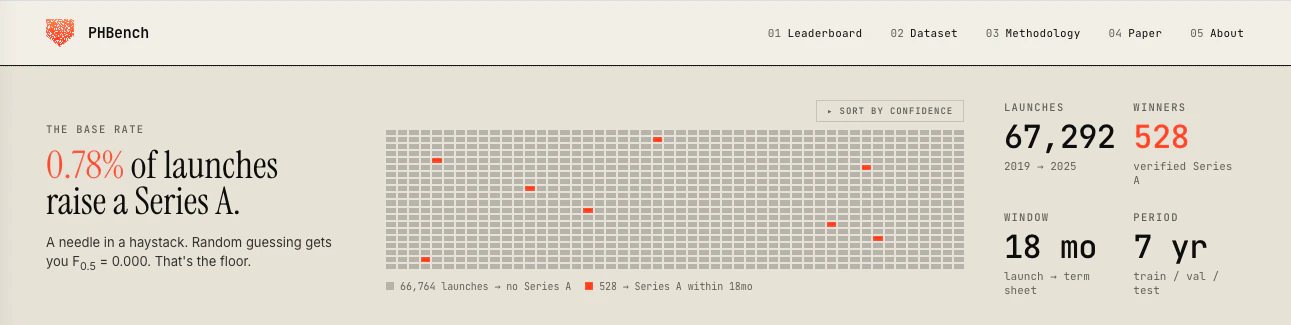
So we built PHBench. We collected 67,292 featured PH launches going back to 2019, matched them to Crunchbase funding records, and identified 528 verified Series A raises within 18 months. Seven years of data. Every featured launch.

Three findings I think this community will find interesting:

→ The signals work. Our model is 4.7x better than random. Statistically significant.

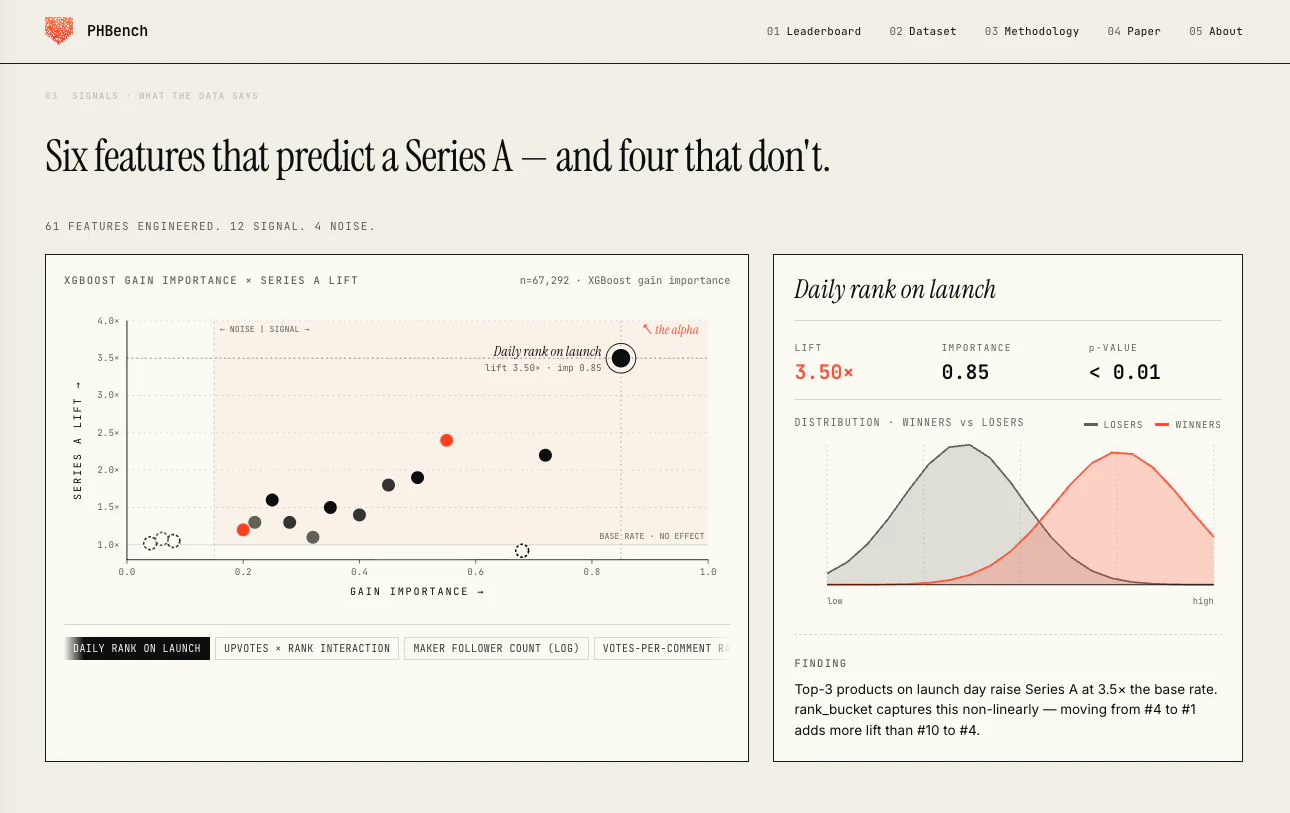
→ The strongest predictor isn't votes alone. It's team size × community engagement together. A large coordinated team achieving high traction is more predictive than either signal alone.

→ B2B categories convert at 3x the baseline rate. API, Payments, Fintech. If you launch a developer tool on a Tuesday with a big team and high engagement, that's a strong signal.

We also tested three frontier Gemini models on the same task. The most capable model performed the worst. Better reasoning doesn't help with pure numbers.

The dataset is available on HuggingFace. The leaderboard is live. The code is public. Can you beat our baseline?

The paper is on arXiv and has been submitted to the NeurIPS 2026 Evaluations & Datasets Track.

Would love your feedback — especially from anyone who's launched on PH and gone on to raise Series A. You're in our dataset :)

19
回复

@yigit One thing I found especially interesting is the “team size × engagement” interaction signal.

Did you explore whether this is actually detecting distribution maturity rather than product quality itself?

0
回复

Been quietly working on this with Yagiz, Yigit and Rick for a while.


While I mostly focus on using founder profiles to predict raises, PHBench tries the same prediction but from the product side. A similar question but from the other side.


Have a go at the leaderboard if you fancy; the data's on HuggingFace.

5
回复

@bengriffin3 thank you for your valuable contributions. Excited to incorporate ProductHunt into founder prediction pipeline.

1
回复

Are you using only launch day signals, or do you include post launch traction like follows and comments over the first week?

4
回复

@karimbenkeroum The core signals are captured on launch day (votes, comments, daily rank, maker profiles, topic tags).

One caveat: maker follower counts were scraped in 2026, not at launch time, so for older launches, they reflect post-funding growth. It's a limitation we document in the paper.

Adding richer post-launch features like 7-day comment growth or follow-on engagement would be a great extension. We think there's a lot of untapped signal there.

Full details on the feature set are in Section 5 of the paper: arxiv.org/abs/2605.02974

1
回复

Interesting, most people assume raw upvotes are the proxy for quality. So the finding about team size × community engagement being a stronger signal than votes alone is genuinely counterintuitive but very curious. Have you looked at whether solo founders who hit high engagement are penalized by this model? Do they show up as a distinct cluster? Would love to see how the signal degrades for truly first-time founders vs. repeat ones. Incredible dataset, congrats on getting years of data cleaned!

3
回复

@artstavenka1 Thanks! And yes, the votes finding surprises everyone! Raw upvote count is actually one of our four "noise" features. It has high model importance but near-zero conditional lift. The reason: viral launches with 500+ votes are often consumer products riding a wave of hype that doesn't translate to institutional funding. The strongest signal is votes combined with daily rank. A #1 launch with high engagement raises Series A at 3.5x the baseline but votes without a strong rank is noise. Maker team size is #2 in importance, and maker follower count is #6 but carries a higher lift (2.4x vs 1.2x for team size alone). Suggesting that who's on the team matters more than how many.

On solo founders: we haven't done the cluster analysis you're describing, but the data is suggestive. Solo founders (maker_count = 1) underperform teams of 2-3, with a modest 1.2x lift for teams vs. baseline. But the bigger signal is follower count: a solo founder with a large following performs fine; a solo founder with no following is where the model gets skeptical.

We don't currently distinguish first-time vs repeat founders. That's a great feature idea, but maker IDs are redacted in the PH API for privacy, so it's not something participants can compute today. It would require a partnership with Product Hunt to access that signal. @rajiv_ayyangar what do you think :)?

If you're curious about digging in, would love to see you submit a model:) You can get the full dataset from here: https://huggingface.co/datasets/ihlamury/phbench

1
回复

So excited to see this live! This has been a labor of love, collecting data, running +100 experiments, and testing LLMs against good old gradient boosting.

The leaderboard is open. If you can beat us, you're the new champion. Who's in?

3
回复

@ihlamury looking forward to seeing some competition soon!!!

0
回复

Really excited to bring PHBench to you guys! By extending the short-term productivity signals on Product Hunt to predict long-term funding materialization, we help to identify outlier products that are truly valuable in the VC environment. We think it will be greatly beneficial to the Product Hunt community.

Come to beat our baseline and get to the top of the leaderboard!

3
回复

@rick_chen5 excited to see more predictors in ProductHunt community to join us! :)

0
回复

Really cool idea, Good luck! @ihlamury @yigit

3
回复

@ihlamury  @cem_ozcelik thank you Cem!

2
回复

Would be interesting to see a breakdown of false positives: high PH engagement but no Series A. That’s often where the real insight is.

2
回复

@gabriel_brooks1 Totally agree. The false positives are where it gets interesting.

Our model's top 50 test predictions have 10% precision, meaning 5 out of 50 are genuine Series A raises. That's 13x better than random chance (0.76% base rate), but it still means 45 out of 50 are false positives.

A few patterns we've noticed in the false positives: consumer/social products that go viral on launch day but lack the B2B unit economics VCs want, projects by well-followed makers that are side projects rather than fundable companies, and launches from 2022-2023 that hit strong signals during the funding winter when conversion rates dropped to 0.5%.

The data is fully open. A "false positive autopsy" on the top 100 predicted-but-didn't-raise would be a great community contribution. If you're up for it:) https://huggingface.co/datasets/ihlamury/phbench

0
回复

congrats on the launch! This seems very interesting and exciting.

1
回复

@alara_akcasiz Thank you so much!

0
回复

@alara_akcasiz thank you!

0
回复

@yigit, congrats on the launch. I will be wondering the result of https://www.producthunt.com/products/vela-terminal launch after the launch ends!

My best product hunt launches were driven by public curiosity and correlated with it. I was using those metric for A/B/C testing and it was way more making sense when you test yourself as founder or an idea of early prediction when same amount of effort is spent.

I will definitely try to benchmark using my past launches and give feedback!

1
回复

@ozgur_ozkan4 thank you! My interpretation is that ProductHunt is a signal that the founder is hustling, and if she has the distribution / network. So it's a positive signal of a larger feature set.

0
回复

No analysis on hunter impact? 🥴🥴🥴

1
回复

@chrismessina Valid request! Not yet. Hunter signal is actually one we'd love to explore. The current model uses maker profiles but not who hunted the product. There's probably

real signal there. A hunt from a top hunter likely correlates with stronger launches. Adding it to the wishlist for v2! 🫡

0
回复
What’s PHBench’s prediction for PHBench?
1
回复

@cyrus_burns we'll know by the end of the launch but it's positive, because it's dev tool and 4 hunters! These are positive signals :)

0
回复

After today's launch, we all expect to see PHBench's chances of hitting Series A based on its own model. Good luck!

1
回复

@joe_setpoint Haha! I did run our launch through the model just for fun: daily rank looking strong, maker team of 4, developer tools category. The model would like our odds.

Unfortunately, PHBench itself isn't raising a Series A:) We're an open research benchmark, not a startup.

0
回复

X Corner Random Encounter: A Quick Take on PHBench 🧠

Huge congrats to Yagiz, Yiğit, and the Vela Partners team on this launch!

I just bumped into Yagiz and Yiğit at the X corner an hour ago. I threw a quick challenge at their core assumption, and they gave me some incredible, patient replies. Here is our quick chat. (With help from Gemini to organize my thoughts into this post!)

My Question on Twitter: Many top launches already raised seed money. They use PH as an amplifier, not a starting point. It feels like the high engagement vs. Series A is more of a correlation rather than causality—the "strong signal" might just be a lagging indicator of their pre-existing capital/resources.

Yagiz's Backdoor Insights: Yagiz dropped a total golden nugget. He told me: "88.3% of the 528 launches that raised Series A in our dataset had prior seed funding."

(And oh my god, that means I’m officially part of the 11.7% "naked" bootstrapped builders trying to survive with zero funding, haha! 😅)

Yagiz honestly framed that PHBench is a predictive benchmark, not a causal study. They don't claim causality. But he noted that while a funded team can buy upvotes, consistently landing Rank #1 is harder to manufacture.

Yiğit's Side Note: Yiğit also shared another fascinating data point with me: "Consistent social media posters increase their likelihood of success. However, not posting doesn't decrease your chance. It’s just neutral."

I guess those successful but quiet builders must have massive "invisible" networks that online data simply cannot capture.

My Takeaway: This conversation completely shifted my view. PHBench is essentially a "Funnel Accelerator" for VCs.

It does not discover hidden gems from absolute scratch. Instead, it predicts which already-backed teams have the top-tier GTM execution to dominate the market on launch day. If you already have seed money, PH is the ultimate stress test for your team.

My Personal Note:

To wrap up, I want to say how much I truly appreciate their hard work. Data cleaning and dataset building are brutal, sweating jobs. Really appreciate to see them doing all this heavy lifting and unselfishly open-sourcing the whole thing to the community. Thanks a lot.

0
回复

Now that this model is public, founders will start optimizing for the signals it tracks - bigger teams on paper, coordinated engagement, category shopping. Does publishing the feature set risk corrupting the signal over time?

Also curious where EdTech lands in the category rankings. Congrats on the launch!

0
回复
Given the temporal performance decay you observed across funding regimes, how should users operationalize the score: do you recommend retraining/refreshing on a schedule, calibrating by year/sector, or using it mainly as a relative ranking signal—and why did you choose F0.5 as the primary leaderboard metric for that workflow?
0
回复

@curiouskitty On operationalizing the score: We'd recommend treating it as a relative ranking signal rather than a calibrated probability. The model ranks well (13x lift over random in the top 50), but the absolute probabilities shift across market regimes.

For anyone deploying this in practice, we'd suggest re-ranking the current cohort weekly rather than relying on absolute thresholds. Periodic retraining (quarterly, as new Crunchbase labels resolve) would help, and calibrating by sector makes sense given that Fintech/API categories convert at 3x the baseline while consumer categories are well below.

On F₀.₅ as primary metric: In VC deal-flow screening, false positives are more expensive than false negatives. A false positive means an analyst spends time on a company that won't raise (scarce capacity wasted). A false negative means missing a deal, but that's recoverable through other sourcing channels. F₀.₅ weights precision twice as heavily as recall, which matches that asymmetry. AP is reported as a threshold-free complement, but F₀.₅ at an optimized threshold is what we'd actually use in a weekly screening workflow.

0
回复
#4
Lensmor
Turn exhibitor data into pre-booked sales meetings
272
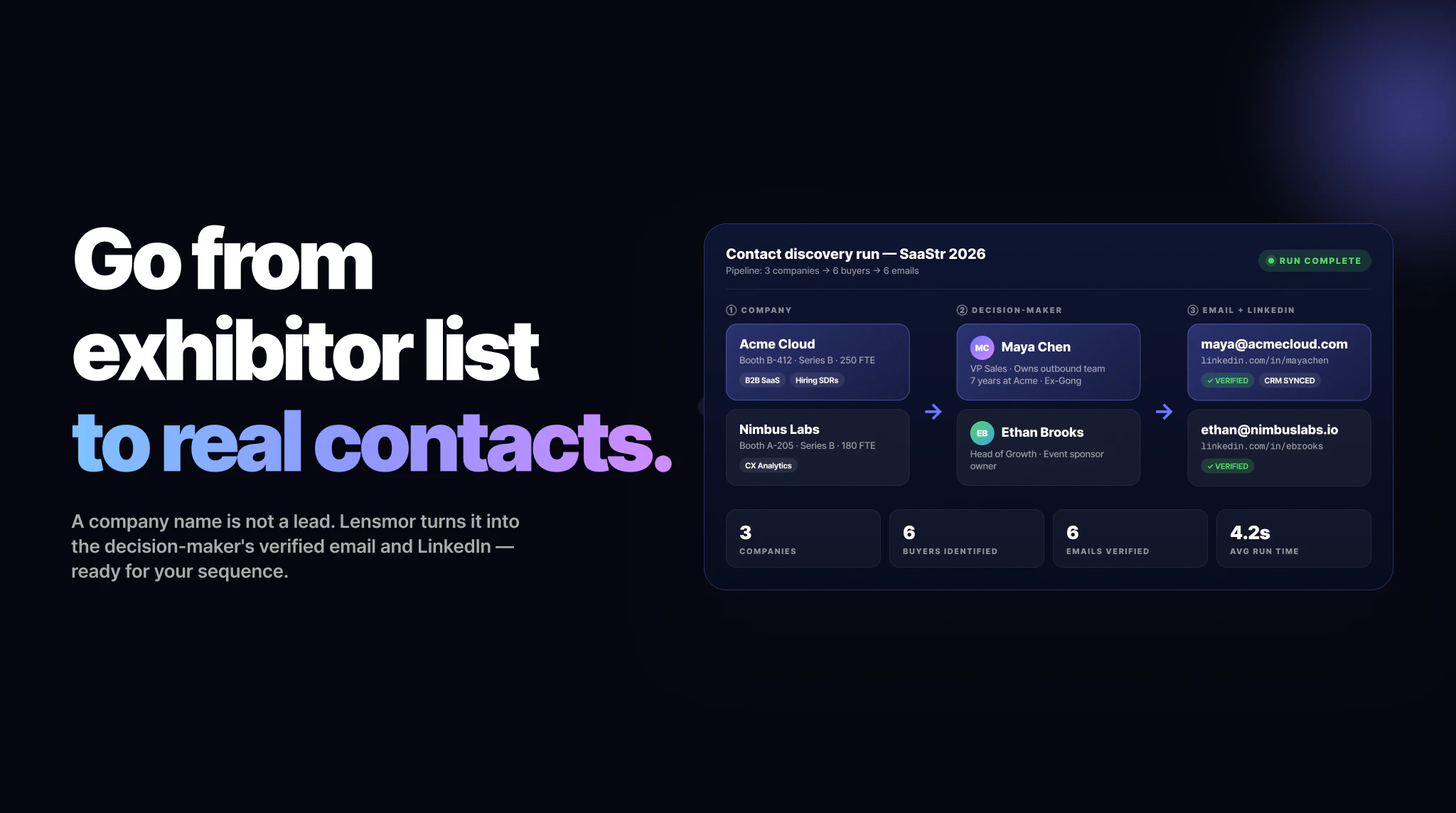
一句话介绍:Lensmor是一个以展会参展商数据为核心的销售情报工具,帮助B2B团队在展会前精准发现目标公司、找到关键决策人、获取验证邮箱,并串联AI辅助的触达规划,将无序的展商名单转化为可预约的会议机会。
Events Artificial Intelligence Vercel Day
B2B销售 展会获客 参展商数据 销售情报 AI外呼 决策人识别 邮箱验证 活动营销 会议预约 数据导出
用户评论摘要:用户普遍认可“展前规划”的价值,认为能改善ROI难追踪的痛点。主要反馈包括:希望实现从名单到会议的端到端归因追踪(区别于手动CRM)、集成Calendly等日程工具、以及AI生成个性化外呼内容。创始人回复强调以数据精准度优先,暂不追求全自动发送。
AI 锐评

Lensmor切中的是一个真实但常被忽视的痛点:展会营销的ROI黑洞。大多数B2B公司砸下重金参展,却仍在用Excel和泛泛的名片扫描度日。Lensmor的聪明之处在于,它没有试图再造一个CRM或自动化营销工具,而是精准锚定“参展商数据”这一高价值、低竞争度的上游环节。

从产品设计看,16万+全球展会库、企业到展会反向查询、决策人邮箱验证,这些功能构成了一个实用的“情报层”。创始人坦言不做“Spray and Pray”的盲目外呼,而是聚焦于让团队“带着正确名单进场”,这种克制值得肯定。目前产品最大的护城河在于数据质量与更新频率——如果Lensmor能持续证明其参展商数据的时效性与准确率远高于通用B2B数据库(如ZoomInfo),则能真正建立壁垒。

然而,危险信号在于“功能堆砌的幻觉”。AI Agent、CSV导出、CRM集成,这些听起来很好,但若数据源无法与主流展会组织方(如Informa、Reed Exhibitions)建立独家或高频合作,其数据库很快就会沦为二手数据的“花式整合”。同样,评论中多次提及的“端到端ROI追踪”是潜在大坑——试图打通日历、邮箱、CRM的归因系统,技术成本和用户信任门槛极高,若盲目投入,只会分散早期资源。

Lensmor的生死线不在于功能多少,而在于能否成为“展前情报的第一入口”。如果它只做成一款漂亮的“高级Excel替代品”,即便有272个投票,最终也会被Salesforce或HubSpot的原生模块吞噬。真正的价值在于:它能否定义一个新的销售动作——“Lensmor一下,就知道该去哪场展会找谁喝茶”。

查看原始信息
Lensmor
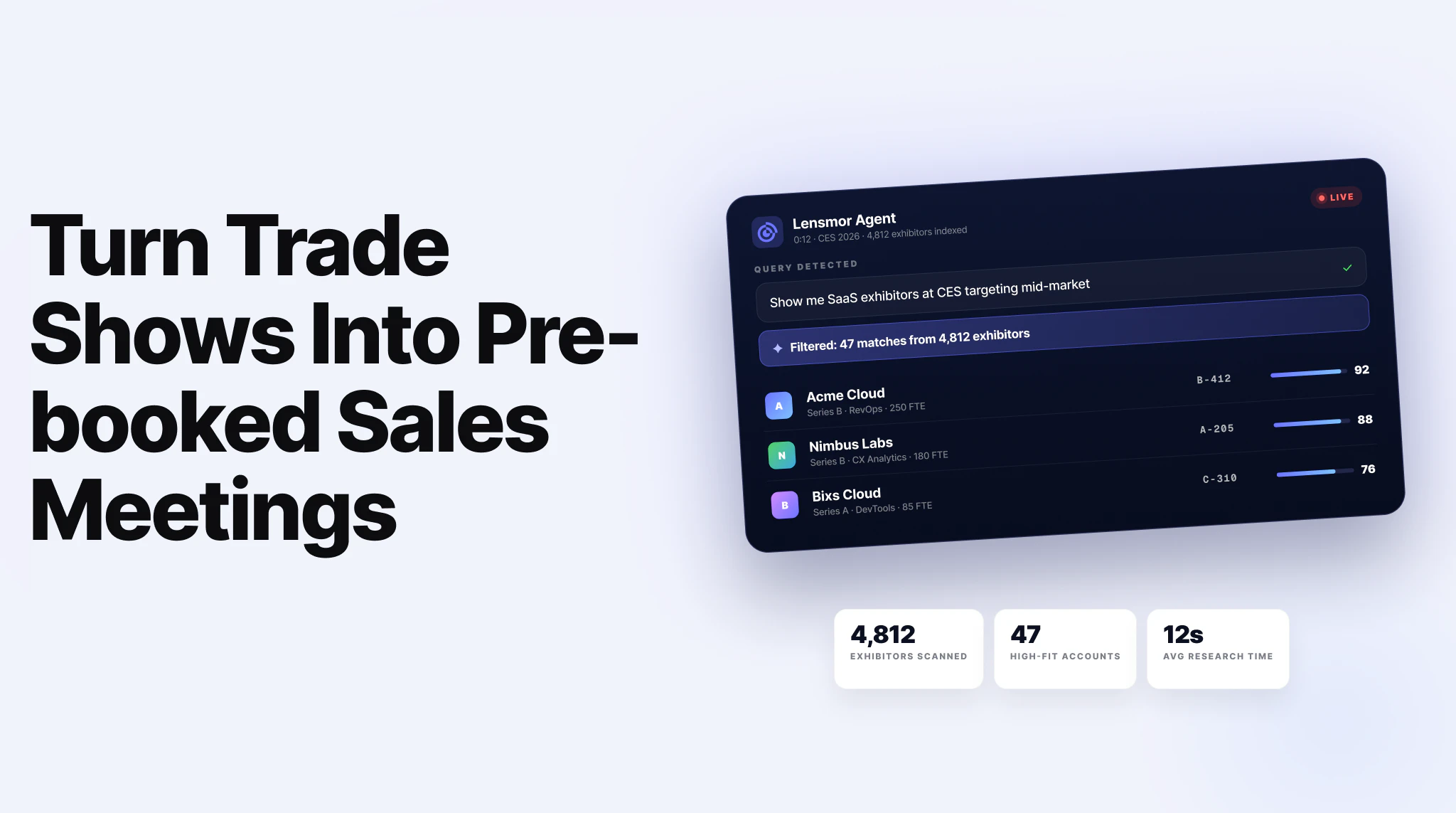
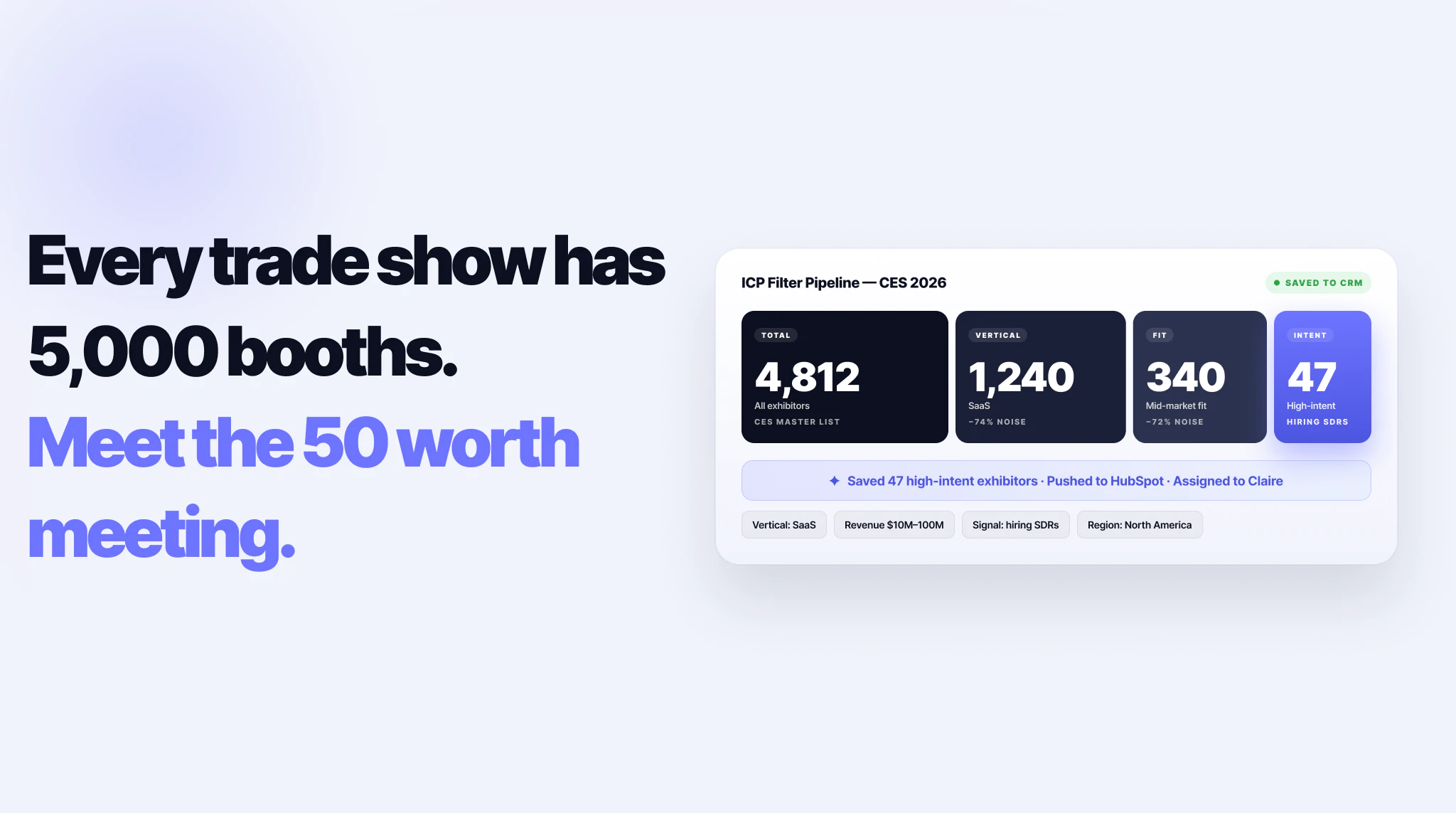
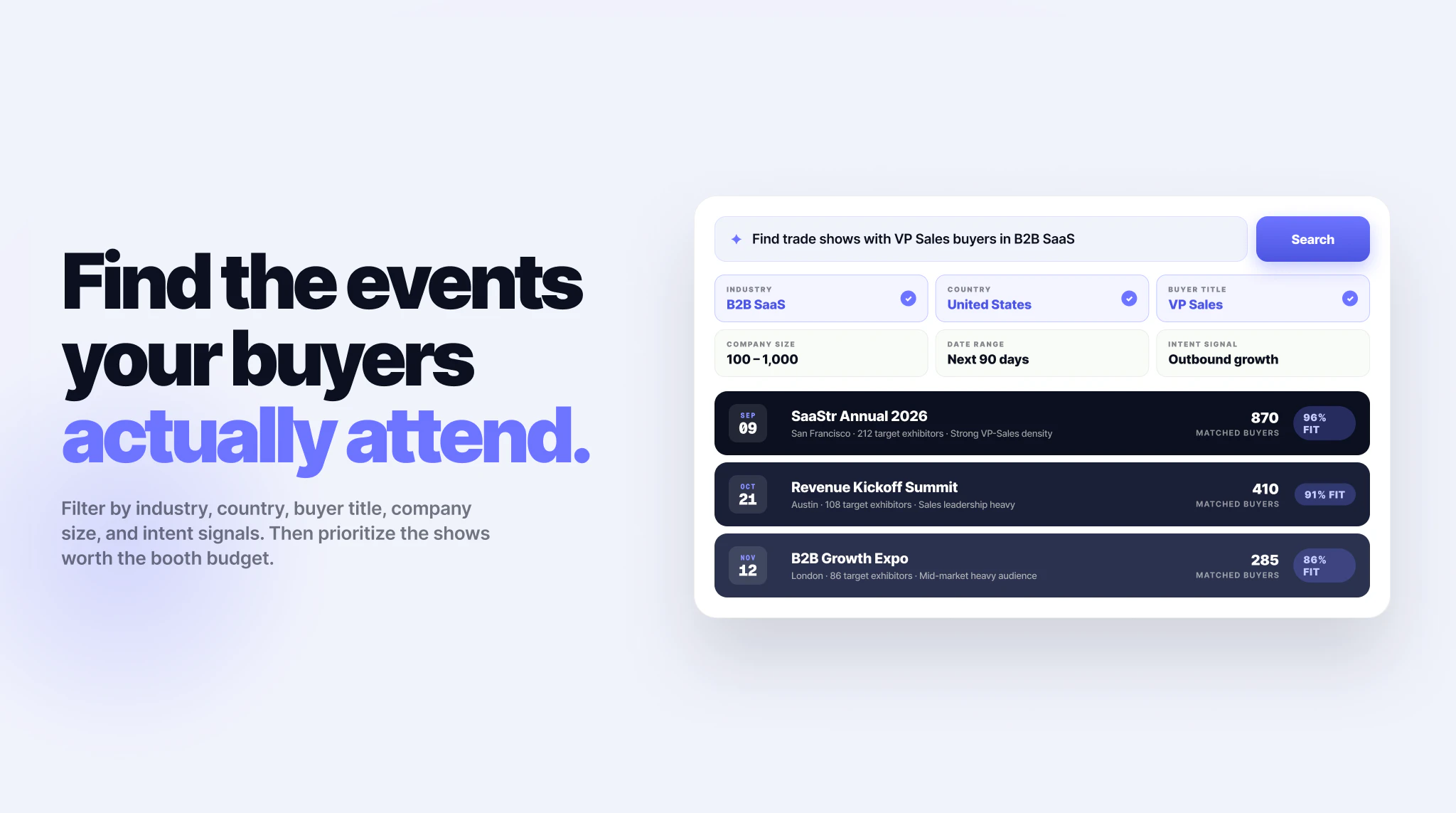
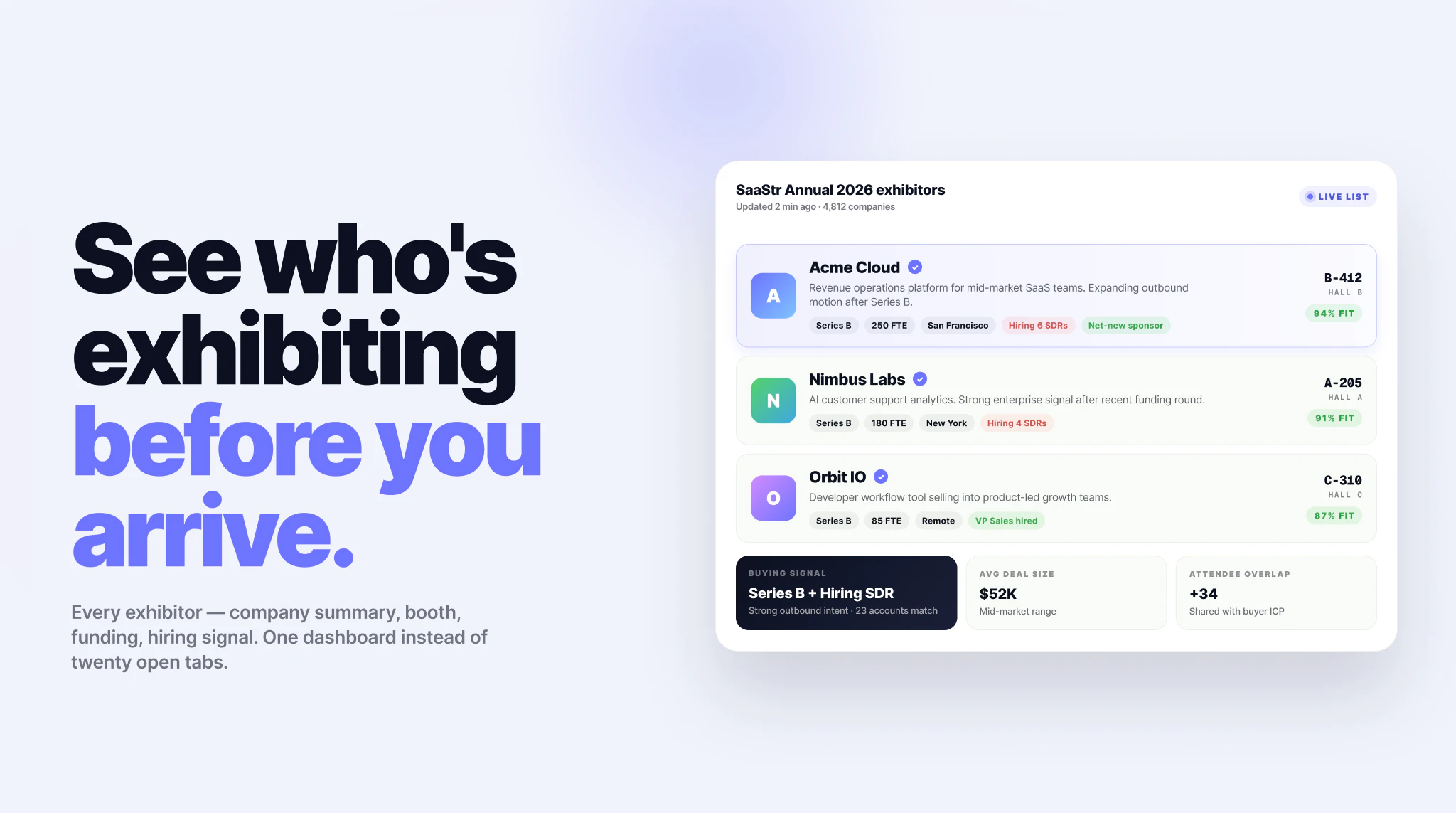
Unlike generic contact databases, Lensmor starts with exhibitor data, helping teams discover relevant events, find exhibiting companies, identify decision-makers, reveal verified emails, and book meetings before the show begins. Standout features include 160,000+ global events, exhibitor search, reverse company-to-event lookup, CSV export, and an AI agent for lead discovery and outreach planning.

Hey Product Hunt, Claire here, founder of Lensmor.

We built Lensmor because trade show prep is still weirdly manual.

A lot of B2B teams spend real money on booths, travel, sponsorships, and sales time, but still walk into the event with a messy spreadsheet, a generic exhibitor list, and no clear plan for who they should meet.

Lensmor starts with exhibitor data.

You can search 160,000+ global events, find exhibiting companies, identify decision-makers, reveal verified emails, export lists, and plan outreach before the show starts.

The goal is simple: help teams walk into trade shows with the right target list and more meetings already booked.

We’re also building an AI Agent that turns the workflow into a faster pre-show sprint:
find target exhibitors → generate intelligence briefs → draft outreach → help plan meeting booking and follow-up.

We’re launching today as part of Vercel Day, and Lensmor is built on Vercel.

I’d love feedback from anyone who has used trade shows for pipeline:

Where does trade show prep usually break for your team?
- finding the right exhibitors
- figuring out who to contact
- writing pre-show outreach
- booking meetings before the event
- proving ROI after the show

13
回复

@clairehuang This is the kind of tool I would want to test against one upcoming event first. If it can surface better target accounts quickly, the business case is pretty straightforward.

2
回复

@clairehuang What I like here is the focus on pre-show planning. Most event tools talk about what happens during or after the show, but the meeting pipeline is usually decided before anyone arrives.

0
回复

@clairehuang Hi Claire, Congrats on the launch. Very niche but cool tool.

0
回复

Proving ROI after a show is always the hardest part because the follow-ups are usually generic and late. If Lensmor helps us book meetings before the event starts, that’s already a win. Is there a way to track which booked meetings actually came from Lensmor lists?

4
回复

@vikramp7470 Great question, Vikram — and I agree, booking meetings before the show is already a much more measurable win than chasing generic follow-ups afterward.

Today, teams can push Lensmor-generated lists into their CRM, including HubSpot, and track them as a campaign or source there.

For deeper end-to-end attribution, like automatically proving which booked meeting converted into pipeline, we’d need broader access to CRM, calendar, email, and revenue data. Many companies are understandably cautious about that level of sensitive permission, so we’re being thoughtful about it.

At this stage, our focus is on building the event-specific data graph: stronger exhibitor intelligence, ICP fit, decision-maker mapping, and high-value signals that help teams make better pre-show decisions. Over time, we’ll add more attribution workflows where they create clear value without compromising trust.

3
回复

Good one for sales people. How does it help with bulk outreach, like someone want to set outreach sequence automatically?

1
回复

@imrulkaayes Exactly — and I think this is an important distinction.

Trade shows are already a form of scaled customer acquisition. The real question is not just “how do I send more emails?” but “which event has the highest concentration of ICP-fit companies, and who should I meet there?”

For B2B, trust still matters a lot. Offline conversations and face-to-face meetings can create a level of credibility that purely automated outreach often can’t.

So our view is not to use AI for “spray and pray” bulk outreach. It’s to use AI to make the offline GTM motion much more precise: choose the right events, identify the right companies, find the right people, and create a relevant reason to connect before the show starts.

0
回复

Congrats, Claire! Proving ROI after the show is notoriously hard. Does Lensmor currently track which exported contacts actually turned into meetings or pipeline, or is that still a manual CRM step?


1
回复

@barnaby_lloyd Great question, Barnaby — and I agree, post-show ROI is one of the hardest parts of trade show marketing.

Today, Lensmor focuses on the pre-show intelligence layer: helping teams identify the right exhibitors, contacts, and outreach angles before the event starts. Once contacts are exported or pushed into a CRM like HubSpot, teams can track meetings and pipeline there using Lensmor/event as the source or campaign.

We’re not trying to pretend full attribution is solved magically inside Lensmor yet. Deeper tracking would require access to CRM, calendar, email, and revenue data, which many teams are understandably careful about.

Our current priority is to make the pre-show signal much stronger first — so teams start with better accounts, better contacts, and better context. Then we can build more attribution workflows on top of that foundation.

0
回复

Congrats! On booking meetings before the event does Lensmor integrate with scheduling tools like Calendly or Chili Piper to suggest time slots based on the event agenda or exhibitor availability?


1
回复

@imogen_wallace Great question, Imogen — this is definitely part of the workflow we care about.

Today, Lensmor is more focused on the pre-show intelligence layer: helping teams identify the right exhibitors, decision-makers, and outreach opportunities before the event starts. Teams can then move those opportunities into their existing CRM/scheduling flow.

Native integrations with tools like Calendly or Chili Piper are on our roadmap. What we’re especially interested in is not just “add a booking link,” but making scheduling smarter around the event context — agenda, booth timing, travel windows, and priority accounts.

That’s where we think trade show scheduling can become much more intentional.

0
回复

Congrats on the launch. Curious about the AI agent's autonomy - does it draft outreach sequences for human approval before sending, or do you let it send autonomously to verified emails? Asking as someone building agent harnesses on the other side of this category and always interested in where teams draw the trust line.

1
回复

@mu_li Great question, Mu — and I really like the way you framed the “trust line.”

For us, the AI agent should first act as a research and drafting layer, not an autonomous sender. Lensmor helps identify the right exhibitors, contacts, and event context, then can support more relevant outreach drafts — but we believe the human should review and approve before anything goes out.

Especially in outbound, trust is not just about data accuracy. It’s also about brand voice, timing, and reputation. So our current philosophy is: let AI do the heavy research and personalization work, but keep humans in control of the final message and sending decision.

2
回复

Trade show ROI is hard to prove when the team starts with an unstructured list. Lensmor’s approach should make the before-and-after much easier to track.

1
回复

@lily_liu8 Thanks Lily, exactly.

When the starting point is an unstructured list, it becomes hard to tell what worked and what did not after the event.

We want Lensmor to help teams create a clearer before-and-after:

which exhibitors matched the ICP, who was contacted, which conversations turned into meetings, and what actually came from the show.

0
回复

Congratulations 🎊

1
回复
0
回复

Generic lead databases rarely understand event intent. Exhibitor data is a better starting point because it already tells you which companies are investing in that market. Love the idea of Lensmor!

1
回复

@alexia_li Most lead databases start from “who could be a buyer.” But event data starts from “who is already making a market move.”

When a company chooses to exhibit, they’re not just fitting an ICP on paper — they’re actively investing budget, showing up in a category, and trying to create demand in a specific market window.

That’s why we believe exhibitor data is such a strong starting point for sales teams. Really appreciate your support!

0
回复

The best part of this is the timing. Outreach before the show is where teams can still change the outcome. After the event, most leads are already cold. Congrats on the launch!

1
回复

@constance_tong Thank you, Constance — you nailed the core insight.

We see trade shows less as “offline events” and more as time-bound intent graphs. The real leverage is not after the show when everyone is chasing cold leads, but before the show, when companies have already signaled budget, priority, and market intent by choosing to exhibit.

0
回复

Congrats on the launch, Claire! Love the angle of Lensmor.

From my experience, trade shows are expensive, yet most teams still prep with messy spreadsheets and generic lead lists. Turning exhibitor data into a prioritized meeting list before the event is a practical, high-ROI use case.

1
回复

@itsluo Thanks Luo, really appreciate it.

That’s exactly the gap we’re focused on. Trade shows are expensive, but the prep often still depends on someone manually cleaning exhibitor lists, guessing which companies matter, and stitching together contacts in a spreadsheet.

Our goal is to make the pre-show workflow much more concrete:

which exhibitors should we prioritize, who should we contact, and how do we turn that into meetings before the event starts?

0
回复

Converting exhibitor data into meetings is a high-value niche. Does the tool use AI to personalize the outreach based on the specific company's recent news or launches?

1
回复

@rivra_dev Great question — yes, we believe public news, launches, and product signals are key to making outreach truly relevant.

Today, Lensmor focuses on helping teams identify the right events, exhibitors, and decision-makers before the show. In our upcoming iterations, we’re adding more company-level signals like recent news and product updates to support more personalized, timely outreach.

The goal is context-driven outreach, not just AI-generated copy.

2
回复

Congratulations, team, the trade show ROI piece you mentioned, how does Lensmor help prove that?
Is there built-in tracking for which booths/meetings actually converted, or would that be on us to track separately in our CRM?

1
回复

@abod_rehman Great question, Abdul. Today we support HubSpot integration, so teams can push selected exhibitors, contacts, and meeting opportunities into their CRM and track conversion/pipeline there.

Our core value right now is the pre-show intelligence layer: helping teams identify the right events for their ICP, the most relevant exhibitors, and the decision-makers worth reaching before the show starts.

We see that intent signal itself as a big missing piece in trade show ROI, and we’ll continue adding more event-specific data and attribution workflows over time.

2
回复
@_ivan1 perfect, all the best with your launch mate
1
回复

Congrats on the launch, and as one who loves going to expos for leads, I really like the idea! I was wondering whether the database could include side events related to each expo. Based on my experience, most real networking happens outside the exhibition space at those events, so I believe it would be helpful to include those information for reference as well.

0
回复

Congrats on the launch! Nice surprise to see you here – I was curious about your product recently and wanted to wish you good luck. I'm building in the events space too (B2C, a tool that recommends which events to go to), so it's cool to see what other people are doing in this area. Wishing you a great launch day! Funnily enough, I launched my side product on PH today as well 😄

0
回复

Congrats, Claire! How do you handle duplicate or parent-subsidiary company listings across multiple shows? One team might attend 5+ events per quarter and needs deduplication.

0
回复

Curious how the intent signal scoring works in practice; is it based on the exhibitor's booth activity at past shows, or are you pulling from outside signals like hiring and funding too? asking because the ICP filter looks solid but intent is usually where these tools get fuzzy

0
回复

@alexzayago Great question — and I completely agree, “intent” is where many tools become fuzzy.

For us, we try to separate ICP fit from event intent. ICP fit answers: “Is this the right type of company?” Intent answers: “Why is this company worth engaging now, in this specific market window?”

Today, our scoring starts with event-native signals: exhibitor category, event relevance, sponsor/booth presence, repeat attendance across shows when available, market/category alignment, and how well the company/contact maps to your ICP.

We’re also adding more outside company signals like hiring, funding, product launches, and recent news. But we don’t want intent to become a black-box score. The goal is to show the underlying signals clearly, so teams understand why an account is being prioritized.

0
回复

Congrats on the launch! Does the AI Agent generate intelligence briefs that include recent news, job changes, or funding rounds? Or is it more static company/exhibitor data?

0
回复

@andrew_paul11 Great question, Andrew — yes, we believe recent news, job changes, funding rounds, product launches, and other company-level signals are very important. They’re on our roadmap, and we’ll be shipping updates around this soon.

One thing we’ve learned is that exhibitor data itself is not static either. Trade shows have a short time window, and exhibitor lists, booth info, sponsors, and company context can change quickly before the event.

So we don’t think of this as a static CSV export. Our goal is to build a continuously refreshed event intelligence layer — combining exhibitor data with timely company signals, so sales teams can act on fresh context before the show starts.

0
回复
How do you source and keep exhibitor rosters current across 160,000+ events—especially when organizers gate lists behind sponsor/exhibitor access—and what’s your approach when data is incomplete or changes right before the show?
0
回复

@curiouskitty Great question — this is one of the hardest parts of building in this category.

We combine multiple public and permitted sources: organizer websites, exhibitor/sponsor pages, event directories, company websites, and other open signals. Then we run enrichment, deduplication, freshness checks, and confidence scoring on top of that data.

When data is incomplete or behind gated exhibitor access, we don’t want to pretend it’s perfect. We’d rather make the data quality and recency clear, then focus on surfacing the highest-confidence signals first.

Right before a show, things can change quickly — exhibitors drop, booths move, new sponsors appear — so improving refresh speed and data quality is a big ongoing priority for us.

Our view is that event intelligence is not just about collecting lists. It’s about continuously turning fragmented, messy event data into timely, usable sales signals.

1
回复

Congrats! If a team's biggest bottleneck is 'writing pre-show outreach,' does Lensmor offer A/B testing or open-rate tracking for different message versions? Or is that outside scope for now?

0
回复

@alexis_rodriguez7 Great question, Alexis — for now, A/B testing and open-rate tracking are mostly handled through the team’s existing sales engagement or CRM tools.

Our current focus is the layer before that: helping teams understand who to reach out to, why they matter, and what event-specific context should shape the message.

I do think message testing will become important over time, but our view is that the biggest lift is not just “write better copy.” It’s turning event signals into the right target list and the right outreach angle before the show starts.

Once that foundation is strong, testing different message versions becomes much more meaningful.

0
回复

Congrats on the launch, folks 🤩 Good luck!

0
回复

@j_che Thanks!

0
回复

Congrats, Claire! What's the typical workflow gap after a team exports a list from Lensmor do they usually leave Lensmor to send emails, or are you building native sending + tracking?


0
回复

@owen_shaw2 Thanks Owen, great question.

Today, most teams use Lensmor to build and export the target list, then run sending through their existing sales stack, usually HubSpot, Salesforce, Apollo, Instantly, Smartlead, or another outbound tool.

The bigger workflow gap we see after export is turning the list into an actual pre-show meeting plan:

which exhibitors are worth prioritizing, what angle to use, who to contact, and when to follow up.

That’s why we’re building the AI Agent layer:

target exhibitors → intelligence briefs → outreach drafts → meeting booking support → follow-up planning.

Native sending + tracking is on the roadmap. We’re approaching it carefully because many teams already have deliverability, CRM, and compliance workflows in place, and we want Lensmor to fit into that workflow cleanly instead of forcing a full replacement.

0
回复

The product feels useful because it connects event data to the sales workflow. That bridge is usually handled manually by someone on the team.

0
回复

@william_wang24 Thanks William — exactly.

0
回复

I like that Lensmor starts with the event context first. For RevOps teams, a cleaner target list before the show can save a lot of messy follow-up work later.

0
回复

@shirley_mou Absolutely, we’ve heard this pain point so many times from sales teams, both in Reddit discussions and in day-to-day conversations.

AI is moving incredibly fast, but the trade show workflow still feels very traditional and manual. That’s exactly why we wanted to build something focused on the event context first.

1
回复

Congrats on the launch! This is such a practical use of data. It’s not just more dashboards—it’s a clear path from event research straight into real sales conversations.

0
回复

@genedai Thank you, Gene! That’s exactly what we’re trying to build. Really appreciate your support!

1
回复
#5
Agentic Website Builder 2.0 by Lokuma
Design, build, and run your site with a design agent harness
167
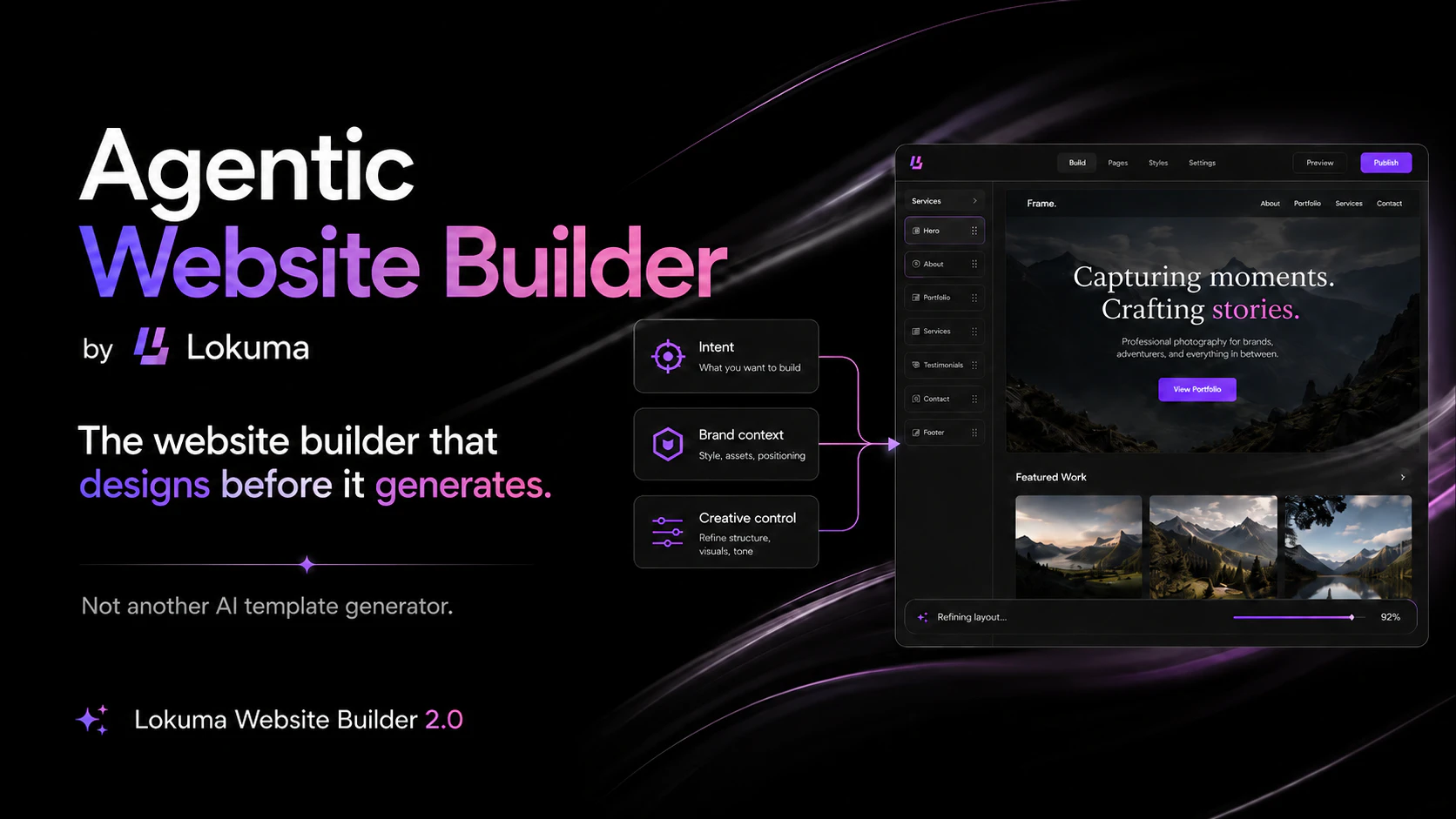
一句话介绍:Agentic Website Builder 2.0 是一个“设计即系统”的智能建站工具,核心解决现有AI建站工具“生成一时爽,编辑火葬场”的痛点——通过设计感知智能体,在品牌一致性和长期可维护性上实现从生成到迭代的全流程闭环。
Design Tools Artificial Intelligence Vercel Day
用户评论摘要:用户普遍关注长期编辑后设计一致性问题(点赞最高),以及“AI风”同质化困惑。团队回应聚焦“设计系统先行”与“目标修补”架构,避免信任LLM记忆。同时,有用户指出工具灵活性不如开发级工具(如Antigravity),而SEO与代理间设计迁移功能尚待完善。
AI 锐评

Agentic Website Builder 2.0 与其说是一个建站工具,不如说是一场对当前AI生成式工具“不负责任”的路线纠偏。当大多数产品沉迷于用大模型一次性吐出漂亮但脆弱的“第一稿”时,Lokuma选择了一条更难的路:构建一个包含记忆、约束和自我修正的智能体生命周期。

产品的真正价值并不在于“生成”,而在于“维护”。其“计划-执行-审查-自纠”的智能体循环,以及将设计系统(Design Tokens、Tailwind Config)作为不可侵犯的“宪法”而非模型可以随意篡改的“建议”,这从根本上扭转了“AI生成如一次性纸杯”的尴尬局面。通过“目标修补”和“设计系统先行”的策略,它成功将AI从不可控的“艺术家”变成了可控的“高级美工师”——遵循品牌手册、在既定框架内执行具体指令。

然而,锐评之下仍需泼冷水。首先,所有“防漂移”机制本质上是在与LLM的不确定性做“军备竞赛”,只要底层模型输出存在随机性,绝对的“锁定”就只是理想。其次,该产品在当前阶段对“设计感”的追求,难免以牺牲“灵活性”为代价。用户@ayush_tiwari37的评论非常精准——它与如“VS Code on steroids”的产品并非竞品,而是互补。Lokuma在品牌与设计上建墙,意味着它在深度开发与异形交互上也会筑起壁垒。

整体来看,这不是一个讨好所有人的通用型产品,而是一个服务于“非技术但审美在线”的创业者、以及需要高效产出品牌站点的“小型精品机构”的精准工具。它切中的是AI生产从“可用”到“可信”之间的那一层薄薄但坚硬的理性泡沫。与其说它在卖工具,不如说它在贩卖一种确定性——这在AI过度承诺的时代,是一种稀缺且聪明的定位。

查看原始信息
Agentic Website Builder 2.0 by Lokuma
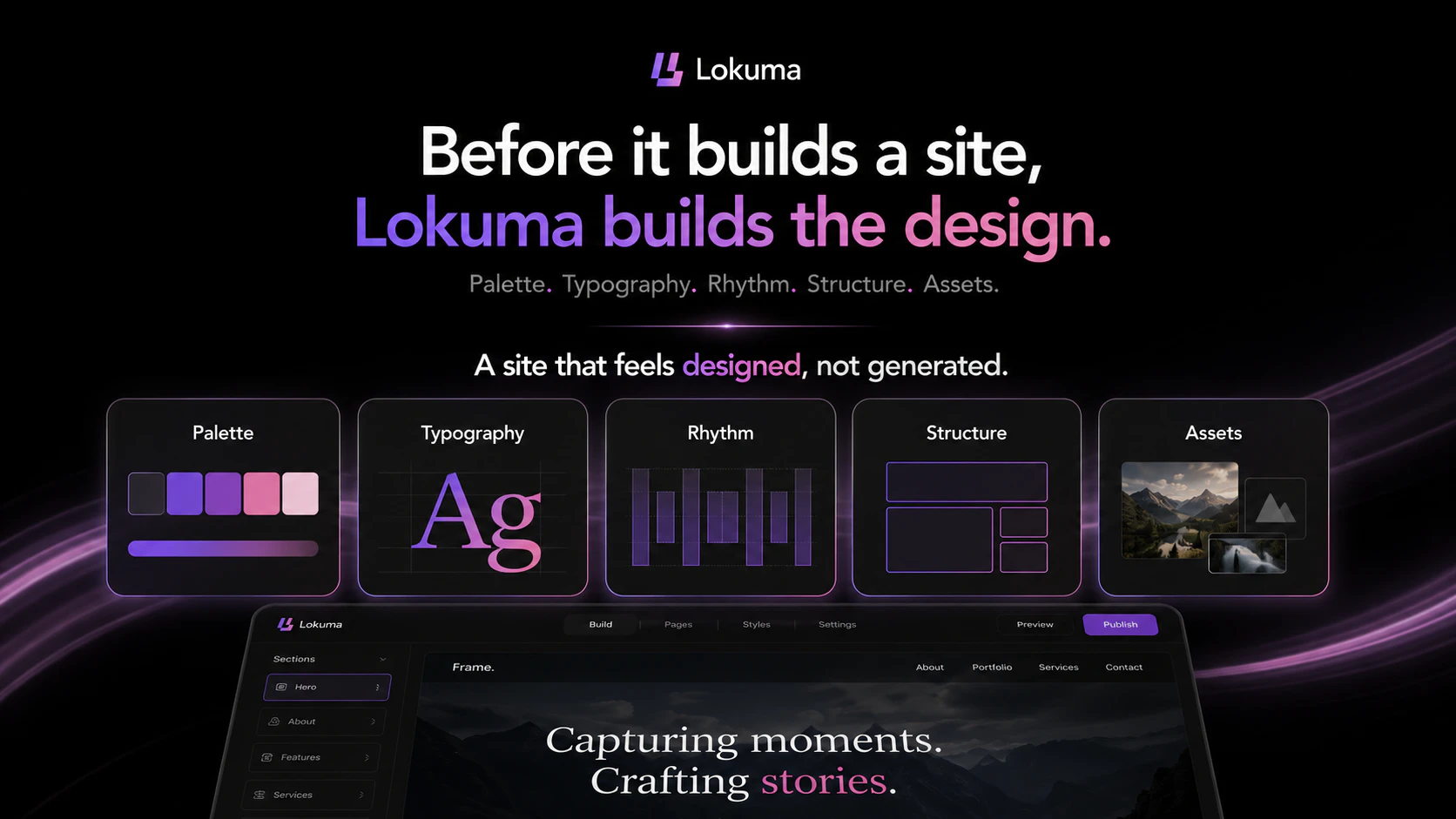
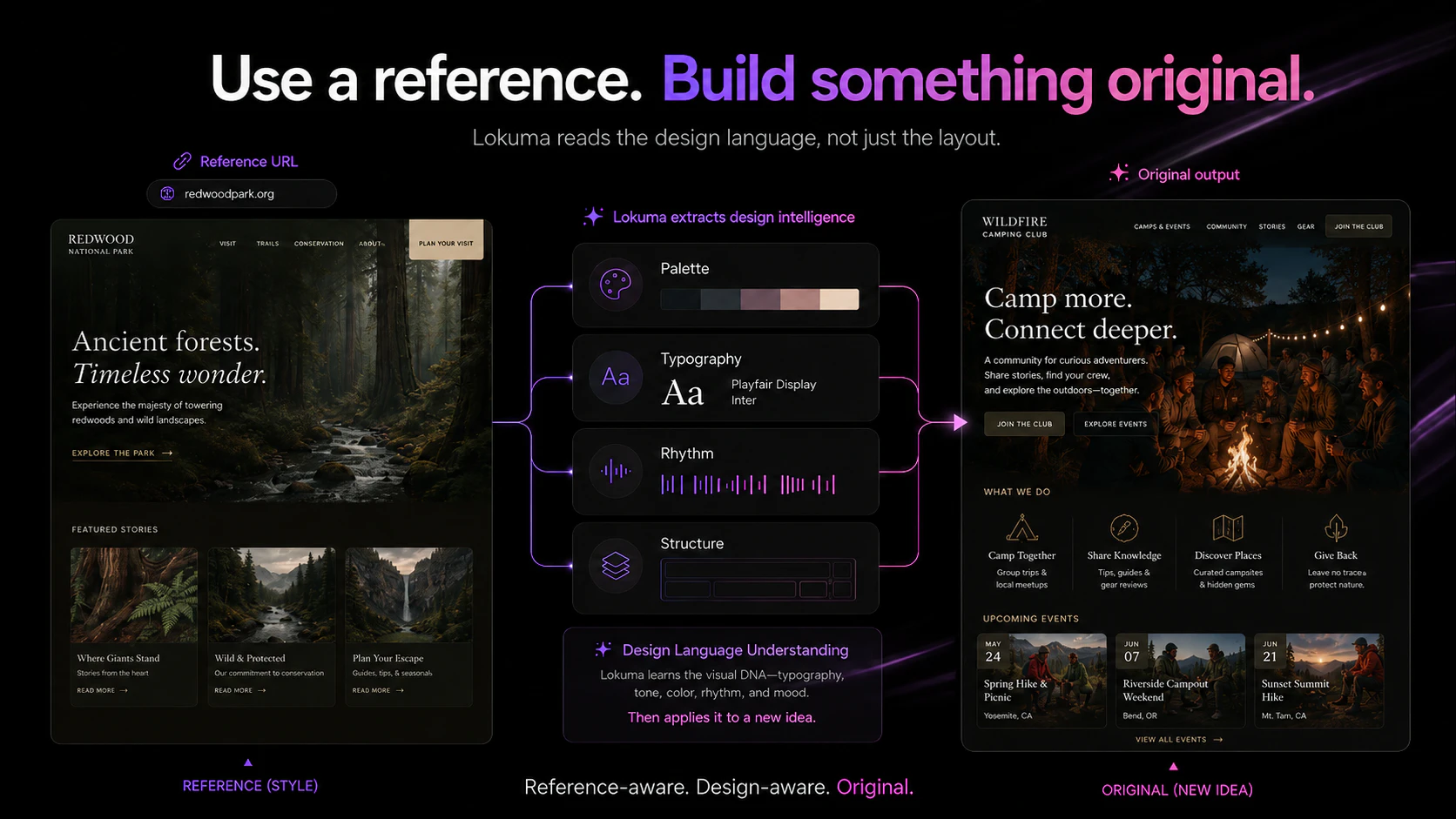
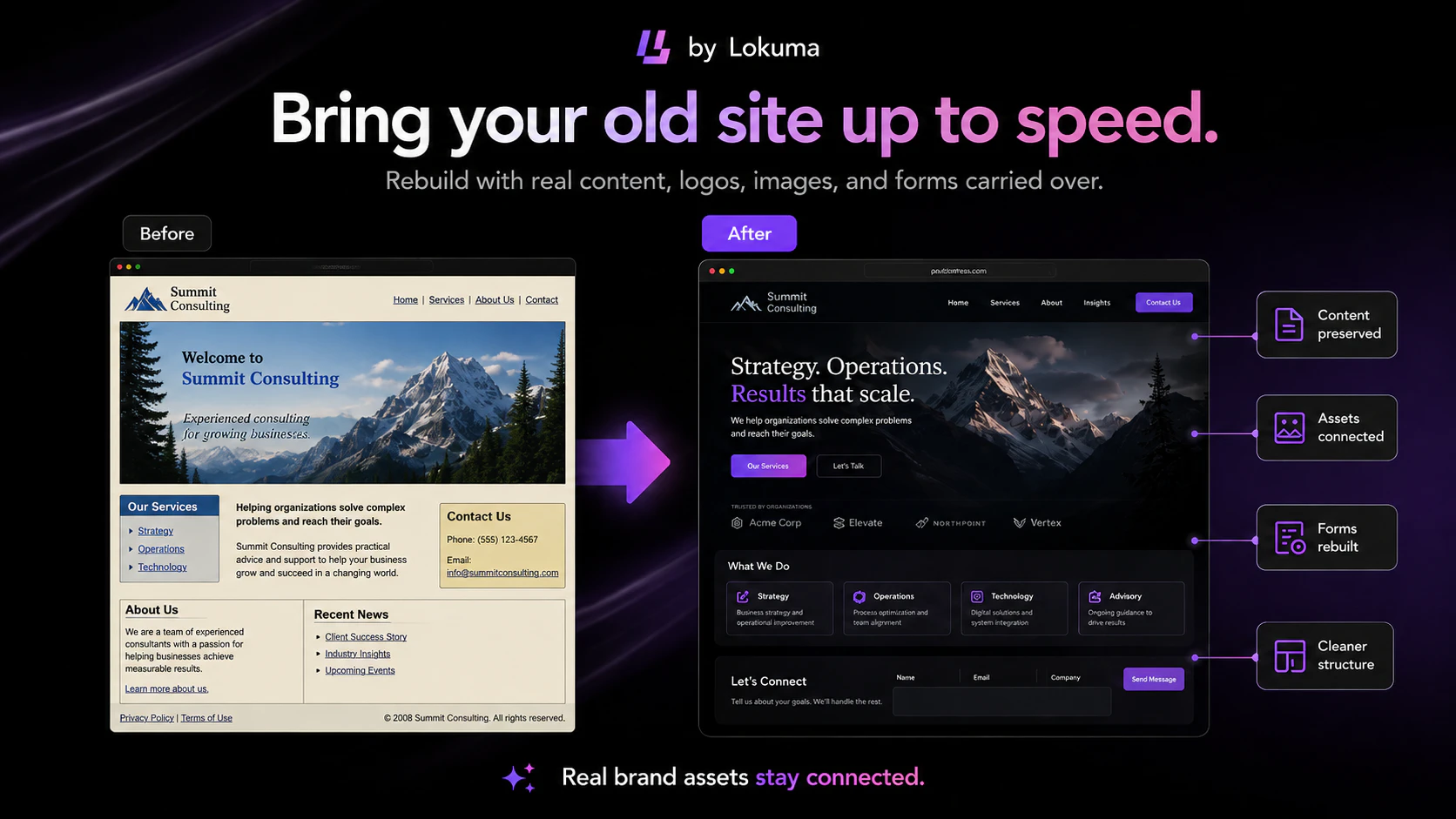
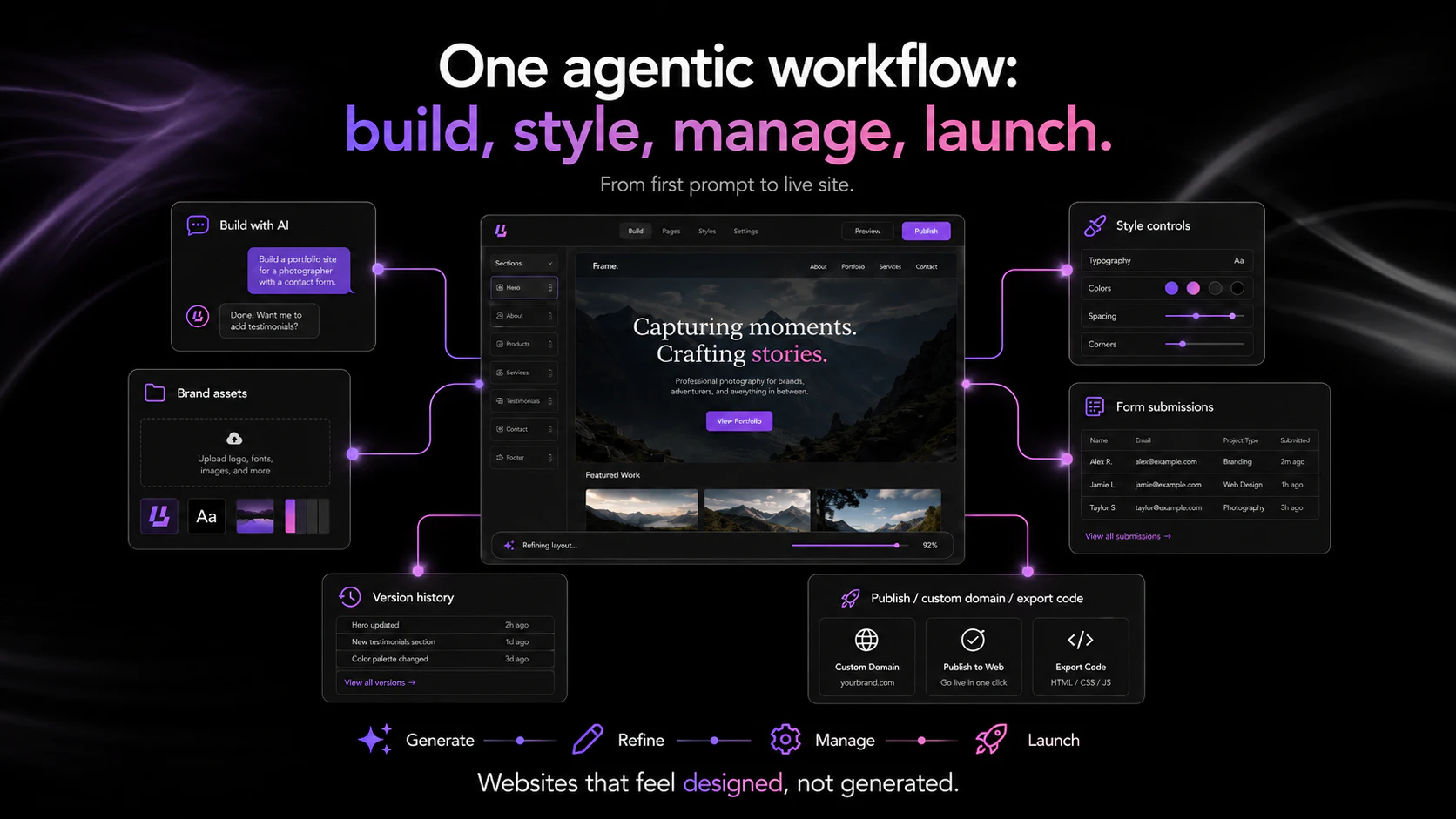
Lokuma 2.0 is a design-aware agent harness for websites. Most AI builders can generate a first draft. But real sites need structure, taste, brand consistency, editing, publishing, forms, and ongoing updates. Lokuma connects planning, design, style, assets, site state, edits, and publishing into one agentic workflow — so your website feels designed, not just generated. Design, build, and run your site with agents.

Hey Product Hunt!

Tech lead at Lokuma here.

The core shift in v2.0: we replaced the fixed "generate-once" pipeline with a real agent loop — the model plans, writes code, inspects output, and self-corrects until it's satisfied. That's what makes the quality jump feel so dramatic.


A few things under the hood we're proud of:

1.Plan-first — the agent drafts a build plan before writing any code. Users approve it before execution starts.


2.Targeted patching — edits use find-and-replace on the specific changed section, not full file rewrites. Faster and more predictable.

3.Live preview — updates as the agent works, not just at the end.


We built this because we were tired of AI builders that look great in demos but break the moment you customize. Lokuma 2.0 is meant to be a real collaborative builder.

Happy to answer questions about the architecture — looking forward to your feedback!

5
回复

@big_claw Couldn't have done this without your vision on the agent architecture. The plan-first loop, the patching strategy, the live preview — all your shape on the codebase. Founder gets the marketing slot; you solved the hard problem. Grateful.

Best,

Mu

0
回复

@big_claw Curious about one technical/design decision; when the agent enters the self-correction loop, how do you decide whether it should locally patch the existing implementation vs. rethink the higher-level plan entirely?

0
回复

Hi Product Hunt,

I'm Mu, back again.

In March we launched Lokuma Design Agent here - a design intelligence layer that other AI agents call. It took #1 of the day, and that response shaped what came next.

Design Agent is still one of our core. It's evolving fast — the world is moving toward agent-first stacks, and design intelligence for AI is a long road we're committed to.

But there's another half of the picture.

A lot of people aren't building with their own AI agents, yet.
They're sitting down to make a website themselves.
They still need better tools.

So today I'm launching Lokuma Website Builder 2.0.

Design Agent is for AI.


Website Builder is for the people AI builds for.
Same conviction, different side of the screen.

Why now?

Over the past few months, agent architecture has matured. Tool dispatch, persistent memory, self-repair, observability — the runtime is finally ready. And SMBs and creators are entering AI website building in waves. But most of what they get is still a v1.

Most AI website builders generate a great first draft.
Then they leave.

You change the headline, the design breaks.
You add a section, the brand drifts.
The hero photo is wrong, but you can't say "make it more golden-hour" — because the agent doesn't remember what your brand looks like.

That's not a prompt problem.
That's a runtime problem.

So in the month after Design Agent shipped, we went heads-down to build the runtime underneath.

Lokuma 2.0 is a design-aware agent harness for websites.

The same agent that builds your site can edit it next month, restyle it next quarter, swap a palette, fix a broken form, ship the change. It remembers your brand, your structure, your previous iterations, your live source code.

Generation isn't running a website.
A first draft isn't enough.

You need something that stays.

Why us?

I've spent the last decade building tools designers actually use — Readdy and Creatie reach 500,000+ designers and creators today.
Lokuma Website Builder 1.0 quietly shipped in February and showed us where AI-built websites actually break.
Design Agent gave AI a designer's brain.

This one gives that brain a body — and that took the whole team.

We're a small indie crew — designers who write code, AI researchers who care about typography, growth gurus who were running AI-native marketing experiments before that was a category. The roles blur, deliberately. A harness like this lives in the seams between design and runtime, between agent loops and SMB workflows — exactly where mixed-discipline teams move fastest.

Curious how others here see it:

When your AI ships v1, what's the first thing that breaks the second time you try to change it?

— Mu

4
回复

The real test will be long term edits most tools can generate a good first version but maintaining design integrity after 10–20 changes is where things usually break.

2
回复

@gabriel_brooks1 Gabriel, agreed entirely. A polished v1 is table stakes; long-term integrity is the real test. Our long-running internal stress tests show the design system still holds across heavy edits — not pixel-perfect, but the "system collapses" failure mode shouldn't happen. Take a swing at it.

Best,

Mu

0
回复

I like lokuma, i tried it and figure it create sites with better design than directly from claude, very nice! good job :)

1
回复

@nilni Nil, thank you! Means a lot coming from someone shipping Pagegun + Makeform. Both products we look at when thinking about "tools that consistently do their job amazing" — that bar is rare. Keep at it!

0
回复

I like the move toward targeted patching instead of full file rewrites. Whenever I use AI tools available for UI work, they usually break existing CSS while trying to add a single new button. Does this agent actually understand my existing design system and tokens before it starts patching, or is it still guessing a bit?

1
回复

@ritikgupta_01 Ritik, short version: we don't trust the LLM to remember your design system. We make remembering free.

Design tokens are structured per-project state the agent sees every iteration. The Tailwind config is locked — agent can only compose with existing tokens, can't invent new ones. Patches are find-and-replace, not rewrites. A pre-build audit catches the slips.

Not 100%, but "one button breaks the system" shouldn't happen.

Best,

Mu

0
回复
How do you avoid the ‘AI Look’?
1
回复

@lakshminath_dondeti The "AI look" is what happens when you let the model collapse to its mean — the average of everything in its training. Prompts can't pull it off-center reliably; only the system around it can. For us that's vertical data labeling, model engineering, and the harness that integrates both into every iteration. Avoiding mediocrity isn't a prompt problem. It's a system problem.

0
回复

what if I'm an agency building 5 different client sites?
Can the agent learn from one site's design system and apply lessons to the next one, or is each site starting fresh?

1
回复

@boyuan_deng1 Great use case, and one we hear from agencies a lot.

Right now each site is its own world — the agent has full memory within a site (brand, structure, iterations, live code), but nothing carries across. That said, you can still enforce consistency today through visual templates and instructions — set the design language once, reuse it as a starting point.

An agency-level layer where taste and components travel across client work natively is something we're actively designing. If you're open to chatting, we'd love to hear how your team would want it to work.

0
回复

@boyuan_deng1 +1 to Qi An. One specific trick: every project auto-keeps a "design notes" doc as the agent works — style, brand rules, decisions made along the way. For client #2, paste the relevant bits into chat and agent uses it as your baseline immediately. Crude but real. Boyuan, this kind of use case shapes our agency roadmap — drop me a DM if you want a deeper convo.

Best,

Mu

0
回复

The concept of a 'design agent harness' is intriguing. Does the agent iterate based on high-level feedback (e.g., 'make it more professional'), or does it require specific UI instructions?

1
回复

@rivra_dev Actually both,but high-level feedback is the interesting case.

"Make it more professional" gets resolved against the design system the agent built first: type scale, spacing, palette, hierarchy. So vague intent becomes concrete moves inside an existing grammar, not a fresh guess.

Specific UI instructions work too, and the agent will flag when one breaks the system rather than silently complying.

The harness exists so the agent has enough context to interpret intent. That's the whole point.

0
回复

@rivra_dev On top of what Qi An shared - Without a harness, "make it more professional" is a fresh guess every time. With a harness, it's a move inside an existing grammar — tighten leading, drop saturation, lift hierarchy contrast. Same words, different category of result.

0
回复

I've spent the last few years marketing AI website builders. From inside that seat, the pattern is hard to miss: every new launch promises something different, but the outputs converge within a quarter. Different brands, same skeletons. Different prompts, similar typography. After a while it stops being a tooling problem and starts feeling like a category problem.

The thing that's hard for AI isn't generating a page. It's generating constraint. Design is mostly about what gets left out — the hierarchy that decides what earns attention, the system that decides what's allowed at all. Models are trained on abundance; they want to add. Design wants to subtract. That's the real gap.

Lokuma 2.0 starts there. It builds the design system first — color, type, spacing, hierarchy, the whole grammar — before a single page exists. The site is then composed inside the system, not the other way around. Drop in a reference site and it picks up the design language without copying the layout. Bring an old site across and it gets rebuilt on top of a proper system, content and assets intact.

It's a strange thing to ship from inside a category I've watched commoditize itself. But this is the part that's hardest to fake, and the part that — if it works — holds up. AI is going to keep making generic things faster. Taste is the only layer that compounds.

1
回复

@qian_712 Your work on this product goes way past marketing. The concepts, the growth thinking, the daily polish on framing — I've learned from all of it. Many great ideas from yo are going to stay with me. Grateful you're on this team.

Best,

Mu

0
回复

The "operate" part is what catches my attention. Building a site is table stakes now — maintaining it, updating content, fixing broken stuff without touching code is where 90% of non-technical founders get stuck. Does the agent handle things like SEO meta tags and structured data automatically, or is that still manual?

0
回复

@ytubviral meta + OG tags + sitemap + robots are handled automatically. Richer SEO (structured data, schema-driven enhancements) is exposed through chat — agent picks up what each page needs based on its content type. Beyond SEO: content edits, broken-link fixes, form repair all happen in the same conversation. The site stays editable, not a one-shot dump.

Best,

Mu

0
回复

Congrats on the launch. I tried it out and the onboarding questions stood out to me.

The best part for me was being able to paste in websites for design inspiration. That made the process feel more grounded because I was not just describing a site from nothing. I could give it examples of the style I had in mind and let the builder work from there.

I also liked how descriptive the questions were before generation. For a website builder like this, those first inputs seem really important because the more clearly the agent understands the user’s taste, references, and intent upfront, the less cleanup and back-and-forth the user probably has to do after the first design is generated.

Excited to see where this goes. The product feels like it is trying to make the design process more collaborative instead of just generating a first draft and leaving the user to clean it up.

0
回复

@danush_singla Danush, thank you! You've put your finger on the design thesis exactly.

Most builders treat intake as a form to skip past. We treat it as the place the whole project's design DNA gets set — taste, references, intent, all captured upfront so the agent isn't guessing on iteration 3 what you meant in iteration 1.

The reference URL paste is the move I'm proudest of. "I want it to feel like X" is how designers actually think — making it the first input instead of an afterthought changes the whole arc of the build. Glad it landed.

Best,

Mu

0
回复

I've been using agentic website builders like Antigravity, and there are some clear advantages and disadvantages to Agentic Website Builder 2.0 by Lokuma.

On the plus side, it's very easy to use, meaning someone from a non-tech background can easily pick it up. It also handles the design part entirely on its own and honestly does it much better than Antigravity, which requires the user to provide exhaustive details and a hell of a prompt just to make things look aesthetic.

However, it lags behind when it comes to flexibility. Antigravity is basically VS Code on steroids, which devs can leverage much better, but that is not the case here with Agentic Website Builder 2.0.

0
回复

@ayush_tiwari37 Honest read — you've named the trade-off correctly.

Lokuma sits in the "design comes for free, you cede some dev flexibility" half of the market. Antigravity sits in the other half. Both are legit positions; we picked the first one deliberately.

Two escape hatches today if you need more: export code (Starter+) drops the project into your IDE / GitHub / Cursor; in-chat file editing ("change line 47 of Hero.tsx") works but isn't the primary surface.

If a "Lokuma + dev side-door" would actually solve this for you, tell me what specifically — thinking about how to do it without breaking the non-tech-user path.

Best,

Mu

0
回复

Honestly, the biggest headache with AI builders is trying to change one small line of text a week later and watching the entire layout drift into absolute chaos. If this actually keeps edits localized without turning the codebase into spaghetti over time, it’s a massive win.

0
回复

@mithra_xavier Yeah, this is the headache we think about most. Some tech architecure for now:

1. Style edits (palette, font, anchor) bypass the LLM entirely — direct

token rewrite + rebuild in ~15s. So "change brand color a week later"

can't drift the layout, because the LLM doesn't run on that path.

2. Content edits are surgical old_string → new_string patches, and a

post-build audit flags drift (e.g. hero src pointing at a stale image

reference) so the agent can self-heal before you see it.

Not 100% solved. But worst-case revert is minutes, not weeks. Still

iterating on tighter guarantees.

0
回复

Is the focus on UI only, or does it include UX too? From another comment and reply, if I ask it to "make it more professional" does it understand how the target audience will perceive "professional"?

0
回复

@you_x_you_i Mostly UI, with UX scaffolding, such as section order, copy hierarchy,

conversion flow, form wiring and etc. What we don't do: actual audience

research.

"Professional" is routed by industry tag, not by what your audience

perceives as professional. For example, fintech loads certain design style + Space Grotesk × IBM

Plex Sans. Boutique hotel loads oxblood + gold + Cormorant.

Defensible defaults — not researched answers.

For SMB founders that's a fair trade-off — fast first cut they can react to, before they invest in the research/strategy layer (which is your work, not ours). Starting point, not the finish line.

Hope this helps : )

Best,

Mu

1
回复

Congrats, Mu! For agencies building sites for clients – does Lokuma support handoff where the agent can explain its design decisions to a non-technical client during revision rounds?

0
回复

@alexis_rodriguez7 Alexis — honest framing first: we'd rather the agent not talk directly to your clients. Agency value lives in the translation layer — reading what a client actually wants, framing the rationale in their language, holding the relationship. Putting an AI in that seat erodes exactly what makes the agency necessary.

So Lokuma is built as a teammate inside the agency, not a client-facing tool. Today:

  • Every build emits a design pitch + design cards (anchor, palette, hierarchy rationale) in client-readable language — agencies pull from these for review meetings, drop what doesn't fit

  • Export code (Starter+) — your team owns the artifact and integrates however

  • Direct publish — fastest "let me share the live preview with the client for sign-off" path

Shareable client-review link + per-revision approval flow are on the roadmap. Running 5+ clients? Ping me — would love to design this with you.

Best,

Mu

0
回复

Congrats, Mu! For SMBs who are not technical how do they tell Lokuma what their brand looks like? Do they upload a style guide, point to an existing site, or describe it conversationally?


0
回复

@barnaby_lloyd Barnaby — all of those work today, plus a fourth. Choices for non-technical users:

  • Describe it in chat ("earthy, editorial, like a wine label")

  • Drop a reference URL in chat — agent extracts palette + typography without copying the layout

  • Upload a logo or screenshot directly in chat — vision picks up the look; logo persists as the brand anchor

  • Use the Style panel — side drawer with logo upload, brand text, palette / font swap, composition picker — for users who'd rather click than type

Most mix two: a sentence in chat + a logo upload (either route). Multi-page style-guide PDFs aren't auto-parsed yet (on roadmap).

Best,

Mu

0
回复

Really thoughtful launch congrats! What's the most unexpected thing that broke during your own testing when editing an AI generated site a month later? That story would help us trust the runtime.


0
回复

@owen_shaw2 Best story: our auto-repair watchdog.

We built it so when a site loaded with a blank #root after a successful build, the runtime auto-files a "fix this" chat. Sounded great in tests.

Then a user opened a project from weeks earlier. The iframe took a beat to fetch, watchdog saw empty root, fired auto-repair → backend treated it as a fresh build under that project ID → completely unrelated content appeared in the user's project slot.

Fix: a phase-edge tracker. Watchdog only arms after we've actually observed a build complete in the current session. Can't mistake "page loading" for "site broken" anymore.

Trust the runtime — but only when the runtime knows what state it's in.

Best,

Mu

0
回复

Congrats on the launch, Mu! You said most AI website builders generate a great first draft, then leave when your AI ships v1 what's the first thing that breaks the second time you try to change it? for us it's always the hero section layout


0
回复

@imogen_wallace Imogen, you nailed it. Hero is the canonical "regenerate-the-whole-section-on-every-edit" trap — change a headline, lose the image; nudge the CTA, layout falls apart. We pick a hero recipe early (cinematic / split / overlay-rail) so the agent edits inside it instead of over it. Won't claim it's perfect — hero is hard — but it should hold for the kind of edits that used to torch v2. Try it on one you've fought with, ping back?

Best,

Mu

0
回复

Congrats on this launch!

0
回复

@peng_wood Thanks Wood for your kind support!

0
回复

Hey Product Hunt 👋

Joy here, back for round two.

In March, we launched Lokuma Design Agent — a design intelligence layer built for other AI agents to call. It hit #1 Product of the Day, and what we heard from that community changed everything about what we did next.

Design Agent is still core to what we're building. It's moving fast, agent-first stacks are becoming the default, and we're in it for the long game on design intelligence for AI.

But there's a side of this we hadn't fully addressed.

As a branding & marketing agency owner, I've seen how SME owners struggle.

You're wearing ten hats. You're good at your craft — whether that's running a restaurant, a studio, a clinic, a shop. But building a website? That's a different skill set entirely, and hiring someone to do it right isn't always an option.

I watched businesses around me struggle with this for years. Not because they lacked ambition, but because the tools assumed too much, too much time, too much budget, too much technical fluency. They'd settle for something that looked cheap. Or they'd spend money they didn't have on something they couldn't maintain.

That gap is what Lokuma is really about. Not just a better AI tool, but an honest attempt to give small businesses something they've never quite had: a website that looks like it was made for them, and actually stays that way.

What Lokuma 2.0 actually is:

Most AI builders are one-and-done. They generate, then vanish. What you're left with is a site you can't confidently touch — because the thing that built it isn't there anymore.

Lokuma 2.0 is different. It's a design-aware agent harness: the same agent that builds your site sticks around. It comes back next month when you need to update the headline. Next quarter when you want a full restyle. When a form breaks, when the palette needs a refresh, when your offering changes and the whole page needs to catch up.

It knows your brand — not as a setting you configured once, but as something it's held onto: your visual language, your structure, your previous iterations, your live source code. Every edit is informed by everything that came before.

Because here's the thing most builders miss: generating a website isn't the same as running one. A great first draft is just the beginning. The real test is what happens the second time you need to change something — and the third, and the tenth.

You don't just need something that launches. You need something that lasts.

So join us and explore Lokuma 2.0 together.

0
回复

Great one team, BTW, if someone eventually wants to hand this off to a developer or export it cleanly, what's the code quality like?

0
回复

@abod_rehman Thanks! Yes, full export anytime.

It's agent-written code — modern stack, readable, componentized. Not hand-crafted by a senior engineer, but clean enough for a developer to pick up without a rewrite. The targeted-patching approach in v2.0 actually helps here: edits stay localized, so the codebase doesn't drift into spaghetti over many iterations.

0
回复

Hey PH. Building Lokuma 2.0 these months — with the team, with AI as a collaborator — keeps returning me to one thought: the era already shifted. The question isn't what AI can do. It's what each of us chooses to become next. — DK

0
回复

Hi PH! Full-stack engineer at Lokuma. I tune guitars on weekends. Tuning agents on weekdays turns out to be the same craft — pluck, listen, find the half-step off, adjust one thing, pluck again. Most of Lokuma 2.0 was built by agents I spent two months tuning. Different strings, same instinct.

0
回复
#6
Gradient Bang
Massively multi-player game played by talking to an LLM
151
一句话介绍:Gradient Bang是一款通过语音与LLM交互来管理AI子代理舰队、在动态UI环境中进行大规模多人对战的实验性游戏,将复杂AI编排融入复古太空贸易玩法,旨在探索AI原生应用的技术边界。
Artificial Intelligence GitHub Tech Games Vercel Day
AI原生游戏 LLM驱动 语音交互 多智能体编排 动态UI 子代理 开源 实时通信 Agent沙盒 太空贸易
用户评论摘要:玩家称赞其创新与趣味性,同时关注:LLM随机性如何平衡对抗公平性;长上下文与实时延迟的技术挑战;提示驱动的游戏如何防止代理幻觉;以及“人类vs自动化”的竞争公平性问题。团队承认目前是实验性项目,平衡仍在调试中。
AI 锐评

Gradient Bang的野心远不止于一款游戏。它本质上是一个“AI原生”的技术演示沙盒,披着复古太空贸易的外衣,内里却是对多代理编排、动态UI生成、长上下文管理与实时语音管道等前沿命题的暴力实验。其核心价值不在可玩性,而在于它向开发者暴露了“把LLM塞进实时系统”的完整痛点和解决方案——从Pipecat框架处理语音延迟,到子代理共享上下文的模式,再到用LLM替代传统错误处理的激进做法。

但作为游戏,它目前更像一个技术噱头而非成熟作品。评论中反复出现的“不确定性”“平衡缺失”“自动化vs人力”问题,揭示出LLM固有的不可预测性如何破坏了游戏最基础的公平规则。当玩家能编写更高效的交易循环或堆叠更多算力时,竞技性就沦为了一场“谁的代理写得好”或“谁的GPU多”的军备竞赛。团队坦承“不知道如何解决”,这恰恰是AI原生游戏至今没有出圈范例的缩影。

真正值得关注的,是它开源后作为教学工具的价值。开发者可以克隆仓库,观察:Vercel Sandbox如何支持用户自定义子代理资产;结构化数据如何与LLM上下文混合;动态UI如何在维持用户体验与AI自主性间摇摆。其设计哲学——用LLM缩减后端代码量,将错误处理转回推理循环——可能比游戏本身更具启发性。但若只能作为技术演示存在,它注定是极客的玩具,而非大众的娱乐。

查看原始信息
Gradient Bang
Gradient Bang is a new kind of software: AI-native, built from the ground up to use LLMs everywhere. The game has a dynamic user interface driven by an LLM, conversational voice input, and to win you have to manage a fleet of AI subagents. You can even program your own subagents and run them in Vercel Sandboxes. Built with Pipecat, Daily WebRTC, Supabase, Vercel.

Gradient Bang is a massively multiplayer, completely LLM-driven game. Come play Gradient Bang with us. See if you can catch me on the leaderboard.

This whole thing started because I wanted to explore a bunch of things I’m currently obsessed with, in an application of non-trivial size, that felt both new and old at the same time.

So … a retro-style space trading game built entirely around interacting with and managing multiple LLMs. Factorio, but instead of clicking, you talk to your ship AI and figure out how to make money, make friends, and make havoc for your enemies.

Some of the things we’ve been thinking about as we hack on Gradient Bang:

- Sub-agent orchestration
- Managing very, very, very long LLM contexts, including episodic memory across user sessions
- World events and large volumes of structured data input as part of human/agent conversations
- Dynamic user interfaces, driven/created on the fly by LLMs
- And, of course, voice as primary input

If you’ve been building coding harnesses, or writing Open Claw agents, or doing pretty much anything that pushes the boundaries of AI-native development these days, you’re probably thinking about these things too!

The game is entirely open source. So if you want to see how we built it, you can clone the repo and start asking Claude/Codex about the code. If you want to add a feature, submit a PR.

New today, design your own corporation ship agents, run them in a Vercel Sandbox, and bring them into the game. Think you can make your pair trading loops faster? That's going to give you a pretty big advantage in the game. Want to run with unlimited corp ship compute using open source models? You can do that, now!

See the Vercel Sandbox subagents starter repo here: https://github.com/pipecat-ai/gradient-bang/tree/main/deployment/vercel

5
回复

@kwindla was chasing that leaderboard for a bit, feeling guilty about token/electricty usage - I was "strong" :) I use games as an ADHD harness so I can stay focused on one 'work task' at a time, and this was useful for that for a bit, thank you! It also has changed the way I think about designing similar systems, so thank you again for that! Definitely a game every developer and GTM specialist should play today to understand how they can use AI to create autonomous systems to grow their company.

1
回复

Gradient Bang is one of those products that immediately makes you want to keep exploring. Super fun, witty and packed with interesting ideas around agents, voice, and dynamic UIs. Glad I got to contribute to it in a small way, awesome work by the team!

2
回复

@jain_atul It's really great working (and playing the game) with you! How are you doing on the leaderboard, in the newly re-started universe?

1
回复

Was super interesting to work with the @Daily.co team on this. The use case goes way beyond gaming into complex enterprise workflows. 🚀

Would love to read a deep dive into the subtopics you tackled - managing long-term context, dynamic UIs, and sub-agent orchestration. Will hit Claude on the repo logic in the meantime! 🤖💻

2
回复

@kabra_sidhant I've been taking notes for long-ish posts about everything we learned. There's so much interesting stuff, and so many things for us all to figure out together as an AI engineering community. Things like how to design UIs to be dynamic and driven by LLMs, but still good user experiences. And how to inject lots of structured data into LLM contexts, and when to run inference versus just queue up the events.

0
回复

Gradient Bang is built on Pipecat, the leading open-source Python framework for building real-time voice and multimodal agents. We're hosting a hackathon on May 30th at YC along with our friends at Cekura, NVIDIA, AWS, and Twilio. Come join us!
https://events.ycombinator.com/HW0opxy78

2
回复

Takes me back to the 90s!!

Having worked with agents and particularly voice agents for the last 2 years, the craft behind this game is quite amazing. We ran 100s of simulations to test these agents and I have only 1 thing to say - If you haven't tried it yet, do now period

2
回复

@tarush_ I definitely had the classic BBS games (especially TradeWars 2002) in mind, when we started working on Gradient Bang. Playing those games was my earliest experience of online, social interactions!

0
回复

Launching together today makes Product Hunt even more exciting. Love the product it really caught my attention.

Cheering for fellow makers today, and would love to support each other. Wishing you a fantastic launch 🚀

2
回复

@erenasiroglu Love it!

1
回复

love this! Do you have future plans of launching more such games?

1
回复

@shashij_gupta No! But, then again, we didn't really plan to build this one. It was just a side project that turned out to be so much fun that we kept working on it, and other people got excited about it too.

What do you think? Should we all start an open source games project, together, and build a bunch more of these things? :-)

0
回复

looks cool! Love that players can ship their own subagents into sandboxes. Curious how you keep the game balanced when some players can write tighter loops or throw way more compute at their corp ships than others?

1
回复

@louislecat The real answer is that we don't know. Everything about this game is an experiment! You can already automate the game with Claude Code or Codex or OpenClaw. To the "humans vs agents" thing is already a question. There have been a few flame wars about that in the Discord channel.

1
回复
Most games give players fixed mechanics, while this feels almost unpredictable because the LLM itself shapes the experience dynamically. Did designing around that uncertainty become the hardest part of building Gradient Bang?
1
回复

@kr1v Yes, definitely. The biggest challenges are:

  1. Core architecture for running lots of LLM inference loops in parallel, partially sharing context between the "subagents".

  2. Designing a game that feels like the right balance between the LLMs doing whatever they do, versus gameplay being reliable. We tried to design LLM unpredictability into the game, a bit. The expectation is that your ship AI is not perfect. Sometimes it does great, sometimes it makes mistakes. You, the player, are supposed to manage that and learn how you give it tasks. But we definitely don't have this balance right, yet.

0
回复

A multiplayer game driven by LLM prompts sounds like absolute chaos in the best way. How do you handle the latency issues that usually come with real-time LLM interactions?

1
回复

@rivra_dev I'm so glad you asked. The entire game is built on Pipecat, the open source framework for realtime AI. Pipecat is the most widely used library for building voice agents and realtime video avatars.

We use models that are very low-latency. The game supports a number of options for models, but the current public game server is using Deepgram for speech-to-text and Gradium for text-to-speech.

We also built a new Pipecat library for the long-running subagents that need to share context with each other and with the voice agent, called Pipecat Subagents. But this library code has turned out to be so useful that we're working on integrating it into Pipecat core directly.

I wrote a long guide to building voice agents, which covers a lot of the "hard parts" about latency, interruption handling, context management, etc: https://voiceaiandvoiceagents.com/

5
回复

0
回复
Compared to narrative-first LLM games like AI Dungeon, how do you keep the world “authoritative” so agents can’t hallucinate outcomes—what’s your grounding strategy between free-form conversation and the actual game state/actions?
0
回复

@curiouskitty This is such a great question. In Gradient Bang there are two layers:

  1. Everything you do in the game happens through talking to an LLM, or an LLM giving a "task" to another LLM.

  2. Each action the LLMs take in the game run through a traditional, deterministic game server. That's built on @Supabase, all game state is stored in the database, and there are edge functions that do all the kinds of locking/etc that you do in a game server code base.

I will say that as we've rewritten the Gradient Bang codebase a few times, a pretty consistent pattern is that we've deleted "traditional" code and replaced it with LLM inference. For example, there's now very little traditional error handling in the core game code. Mostly, errors just get passed back into the LLM and we ask the LLM to figure out what to do from context.

1
回复
#7
Crustimate
Free tool to fix your LinkedIn to get found by AI recruiters
144
一句话介绍:Crustimate是一款免费的LinkedIn个人资料AI优化工具,能在30秒内评估用户对AI招聘系统的可见性得分,并给出针对性修改建议,解决求职者简历被AI筛选工具过滤、无法进入人类招聘官视野的痛点。
Hiring Tech Vercel Day
AI招聘优化 LinkedIn资料分析 简历评分 求职工具 AI可见性 角色匹配 免费SaaS 候选人筛选 个人品牌优化 招聘科技
用户评论摘要:用户普遍认可工具有用,能提供具体改进建议。有用户询问修复后实际获得招聘官联系的效果数据,开发者承认将开始追踪。另有用户建议按角色(PM、工程师等)个性化推荐,开发者回应已按角色区分。此外,有用户反映在应用内浏览器加载不稳定,开发者已修复。
AI 锐评

Crustimate切中了一个被广泛忽视但日益关键的痛点——AI招聘系统的“黑箱筛选”。当大多数求职者还在优化简历格式和关键词堆砌时,招聘端早已进化到由AI自动过滤候选人。Crustimate的价值不在于提供通用建议,而在于反向工程AI招聘工具的筛选逻辑,量化“可见性”这一原本模糊的概念。

从功能看,产品构建了一个完整的闭环:诊断(AI就绪度评分)→ 修复(重写标题、复制粘贴修改)→ 策略(角色匹配、行动规划)→ 执行(目标公司联系人及预写消息)。这种“即测即改”的模式降低了用户行为门槛,免费+无需登录的策略更有利于冷启动和口碑传播。

但冷静来看,产品存在明显局限。首先,其核心依赖“AI招聘工具如何阅读LinkedIn”这一底层逻辑,但不同AI招聘系统的算法、权重和更新频率各异,评分模型的准确性和时效性存疑。其次,用户评论中提出的“修复后实际转化率”是验证产品价值的关键指标,而官方目前仅能提供个人案例(从52到78分),缺乏系统性追踪。若无法证明分数提升与实际面试邀约间的因果关系,工具就容易沦为“自我安慰型仪表盘”。

此外,产品本质是“修复LinkedIn资料”,而非解决求职者的核心竞争力问题。它能优化简历的AI可读性,但无法改变一个人是否真正匹配岗位。在招聘流程后端,人类面试官依然会通过深度交流判断候选人。过度依赖这类工具可能导致求职者成为“AI优化专家”,而非“优秀员工”——这或许是产品需要警惕的方向。

总体而言,Crustimate是一个定位精准、执行迅速的实用工具,尤其在学生和被动求职者群体中有明确价值。但若想从“好用的工具”进化为“不可替代的平台”,必须建立从“可见性”到“录用率”的因果数据链,并警惕算法迭代带来的过时风险。

查看原始信息
Crustimate
AI recruiting tools now filter candidates before any human sees your name. Paste your LinkedIn URL and get your AI readiness score in 30 seconds. See exactly what's hurting your visibility, get a rewritten profile, and a prioritised fix list so recruiters can actually find you. All for free!

Hey PH! 👋

Most people don't know this yet: when you apply for a job, an AI tool scans your LinkedIn before any human sees your name. Platforms like Juicebox, HireEZ, and Gem are filtering candidates at scale and most profiles are invisible to them.

The candidate might truly be qualified, but because their profile isn't written for how AI reads it, they never get shown to a recruiter.

Findable fixes that. Paste your LinkedIn URL and we score your profile in 30 seconds, showing you exactly how findable you are to AI recruiting tools and what's hurting your visibility.

Here's what you get:

📊 AI readiness score out of 100: see exactly where you stand across role clarity, skills, and completeness

✍️ Rewritten headline: optimized for how AI recruiting tools actually surface candidates

🔧 Copy-paste fixes: specific changes you can make on LinkedIn right now

📋 Resume scoring: upload your resume and we'll find gaps and check alignment with your LinkedIn

🎯 Role-specific match score: enter any target role and see how well your profile matches it today

🚀 Long-term goal mode: reframe your entire action plan around where you want to be, not just where you are

📋 Action plan: specific things to build and publish that make you a credible candidate beyond just fixing your profile

🏢 Companies matched to your trajectory: aligned, realistic, and stretch companies with a personalised explanation of why you fit

📩 Who to reach out to: specific people at those companies with pre-written outreach messages ready to copy

A few ways people are using it:

🎯 Active job seekers: know exactly what AI recruiting tools see when they scan your profile and fix it before your next application.

🔄 Passive candidates: not looking right now but want to stay findable. Run your score, make the fixes, and let opportunities come to you.

👩‍💼 Recruiters: send it to every candidate before they go to interview. Takes 30 seconds and makes your submissions stronger.

🎓 Students and early-career folks: your LinkedIn is your resume now. Make sure AI can actually find you before you start applying.

Free. No login. 30 seconds.

Try it at: https://tools.crustdata.com/crustimate

4
回复

Nice tool! Definitely useful for candidates applying. Tried it out and got some good recs for improving my score.

3
回复

@abhiranjan_mehta That's awesome! Anything we can do to improve it the tool for you?

1
回复

Best of luck team with your launch.

Quick question, have you tracked whether people who actually implement these fixes get more recruiter outreach? Like, real before/after data?

3
回复

@abod_rehman Thanks for the question, Abdul! Will start tracing that! My own profile went from 52 to 78 so far so hoping to see with real results! I agree this would be fantastic to track.

1
回复

Curious if you personalizing recommendations by role (PM vs engineer vs marketing), or if it’s a universal scoring system.

2
回复

@gabriel_brooks1 Yep - by role! Thanks for the question, Gabriel. Will make that more clear.

0
回复
Congrats @daniel_ahmadizadeh1 on the launch, very nice tool! One thing I have noticed while trying to visit tool website from the in-app browser here in PH, first two reloads in crashed then worked fine. Best of luck!
0
回复

@ielrefaae Thanks for flagging! Are you referring to this? If so, you're so right! Fixing asap. Should work here: https://crustimate.com/

0
回复

@ielrefaae should be fixed !

0
回复
#8
mia
Cursor for Product Managers
136
一句话介绍:mia是一款利用AI整合并分析客户访谈、支持工单、销售通话及使用数据等多元信号,自动生成可直接用于AI开发的、具备完整上下文的PRD与优先级排序需求的平台,旨在解决产品经理因信息分散而无法高效决策的痛点。
Productivity Developer Tools Artificial Intelligence
产品管理 AI Agent 客户信号分析 需求生成 产品策略 PRD撰写 用户反馈聚合 数据分析 Cursor对标 SaaS
用户评论摘要:用户普遍认可其解决PM与开发沟通鸿沟的价值,核心问题集中在:如何与Linear/Jira等工具集成(已支持),如何处理冲突信号(策略性保留给PM判断),及与同类产品(如CC-gstack)的区别。有部分用户遭遇了登录错误。
AI 锐评

Mia的“Cursor for PMs”口号响亮,但平心而论,它目前更像“客户信号版Jasper”,而非一个能自己写代码的AI伴侣。其真正的价值在于承担了产品管理中最繁琐、最容易被忽视的“情报聚合与清洗”环节。它通过将分散在14个工具里的碎片化信息结构化,把PM从“信息矿工”变成了“决策者”。

然而,产品仍存在本质的、也是暂时无法回避的困境。第一,它处理的是“过去的声音”,对“未来的缺席”无能为力。用户没说的、竞品在做的、技术趋势带来的颠覆,Mia无法预警。第二,处理冲突信号时“把战略判断留给人”是一种聪明的克制和诚实的表态——它承认了当前AI无法承担商业责任的本质局限,但也意味着核心决策链条依然高度依赖人,工具只是辅助。

与“Cursor”类能够直接输出代码、实现“意图到代码”闭环的工具相比,Mia的实际交付物仍处在“高保真需求文档”阶段,要实现其口号中的“执行”,还差整个“从需求文档到AI开发Agent”这一层的集成与闭环(官方也承认正在建设中)。目前来看,它对小型敏捷团队的价值远大于大型复杂组织;后者的问题往往不是缺数据,而是权力结构和组织惯性导致决策无法由工具驱动。

更犀利的观察是:如果AI开发Agent(如Devin, Codex)最终自己就能解析原始需求并提问,那Mia作为中间层的存在价值就将被压缩。因此,Mia必须尽快跑完集成闭环,让“信号→需求→代码”成为其护城河,而非停留在“好看的Excel替代品”。

查看原始信息
mia
Allowing product managers to turn their customer signals into ship-ready requirements for AI to develop.
Hey PH community, Today is an exciting milestone as we launch for the second time. I started this journey based on my 20 years as a product strategist. My persistent pain point was never having enough integrated data to build the right product. This created an endless loop of misalignment between growth and product teams. Inspired by the build in public movement, we launched our market intelligence module last October. Since then, 500 customers have helped us understand exactly what to build next. Their feedback led us to a powerful realization: the world needs a product intelligence platform that doesn't just analyze market and customer signals, but actually executes. We have now evolved that vision into Cursor for Product Managers. While we cannot provide a freemium version as a bootstrapped team, we want to support this community. Use the code MIA50 for a 50% discount. This will give you full access to see how we are redefining product strategy by connecting market data, competitor moves, and customer signals into one seamless flow. We are currently building the integrations to fully close the loop with coding platforms but we can assure you that we will build fast. Love you guys! Sevil on behalf of the mia team
7
回复

@sevil_kubilay Hi Sevil, Congrats on the launch. How does Mia differ from CC-gstack, aicofounder or similar?

0
回复

This feels especially useful for teams without dedicated product ops or research synthesis layers. Smaller teams will likely get the most immediate value.

2
回复

As a developer, I usually spend half my day clarifying what a PM actually wants. If this can bridge that gap by translating spec-speak into something actionable for my dev environment, that’s a win for me. Does it export directly to Linear or Jira, or integrate with any other tools?

2
回复

@ritikgupta_01 Really appreciate this perspective, that PM ↔ dev gap is exactly what we’re trying to reduce. Translating intent into something actually actionable is a big focus for us.

On integrations: not fully there yet, but Linear/Jira + dev workflow integrations are definitely on the roadmap.

0
回复

@ritikgupta_01 Hi, Ramazan is here.

You just described the exact reason we built this. The 'what does the PM actually mean' tax is brutal and we wanted to kill it.

On integrations: yes, mia exports to Linear and Jira today. Tickets come over with the context block attached, so you see the underlying customer quotes, the related themes, and the acceptance criteria in one place instead of a one-line title and a Slack thread you have to dig up. We also push to Notion for spec docs, and Slack for lightweight async handoffs.

The goal is that by the time a ticket hits your board, the 'what and why' is already answered, so your clarifying questions are about implementation, not intent.

0
回复

Great idea. I’m still waiting for someone to build an AI service that analyzes user behavior on a website, understands their goals and doubts based on the entry point, visited pages, mouse movement, etc., and then takes actions that increase the chances of conversion. This could be a popup with relevant information, an email, or even a dynamically changing interface tailored to the user’s intent. That would be gold for product managers!

1
回复

@natalia_iankovych Appreciate this 🙌 totally agree, it feels like we’re one layer away from this becoming real. The shift from static analytics to real-time understanding + action is going to be huge. Would be a game changer for PMs.

0
回复

@sevil_kubilay nice, congrats, btw, what do you mean by "customer signals" exactly? Curious to know more how it works and delivers the value and btw, great work :)

1
回复

@khashayar_mansourizadeh1 Thanks for the interest with great question! :) mia connects your customer interviews, support tickets, sales calls and usage data to build a single, traceable chain of product evidence.

1
回复

@sevil_kubilay  @khashayar_mansourizadeh1 Hi, Ramazan is here. By customer signals we mean any input where a real user, prospect, or internal team is telling you something about the product, even if they don't realize it. That includes support tickets, sales call notes, churn reasons, feature requests, NPS comments, app store reviews, Slack threads, Intercom chats, and Gong calls.

The problem is most of this lives in tools the PM doesn't open every day, so the signal sits there unread. mia pulls it all into one place, clusters it by theme, and surfaces what's actually trending. So instead of a PM scrolling through 200 Zendesk tickets on a Friday, they see 'checkout friction is up 40% this month, here are the 18 tickets behind it' and can decide what to do with it.

0
回复

'Cursor for PMs' is a bold tagline! Can mia help with drafting technical specs and PRDs by referencing an existing codebase, or is it focused on the ideation stage?

1
回复

@rivra_dev The current version of mia excels at the ideation stage. We are currently integrating with existing codebases to ensure your product intent translates perfectly into shipping-ready code.

1
回复

@rivra_dev Great question, and a fair push on the tagline.

Honestly, the bigger PM pain we kept seeing wasn't 'I need help writing the spec', it was 'I have no idea what to put in the spec because context lives in 14 places.' So that's where mia starts today: pulling signal from your external sources (user feedback, support tickets, sales calls) and internal ones (existing docs, tools, conversations) and turning that mess into a prioritized, defensible backlog.

Codebase referencing for spec and PRD drafting is the next layer we're building, and we're close. But we made a deliberate call to nail the upstream context problem first, because a beautifully written PRD for the wrong feature is still the wrong feature.

0
回复

The hard part has always been deciding what counts as signal. One loud enterprise can drown fifty quiet churners, and most teams never see the second group.

Hope you'll solve it!

0
回复

The "Cursor for PMs" framing really clicked for me, it immediately communicates that this isn't another dashboard, it's a tool that executes.

Sevil, curious: of the 500 customers you mentioned, what's the workflow change they report most often after using mia for the first 30 days?

0
回复

@muhamm3d Hi, Ramazan is here.

The pattern we hear most often in the first 30 days: PMs change what they bring to their cross-functional meetings. Before mia, the prioritization conversation starts with the PM's opinion. After mia, it starts with a themed view of what customers are actually saying, and the room argues about the response instead of the diagnosis. That's a smaller shift than it sounds and a bigger one than it sounds, at the same time.

The other change, which we didn't expect: PMs report fewer pings from sales and support asking 'did you see this customer complaint'. Because everyone can see the same signal feed, the human relay of feedback drops.

0
回复

Love the direction. I can see how it works when a solid growth team actually sit next to Product.

As a PM in a legacy org, I'd be happy if I even got actionable insights based on multimodal inputs - I'll write the PRD, hell I'll even write the code - but please help me make sense of the hairy data. Something I'm gonna try solving for myself.

0
回复

Well done. Will you be able to trace a shipped feature back to the original customer signal that triggered it? That traceability layer would be huge for making the case internally that PM-led discovery actually moves the needle

0
回复

The gap between "raw feedback" and "something an AI can actually build from" is real and painful.
Curious...does mia handle conflicting signals from different customer segments, or does it surface them and leave the call to the PM?

0
回复

@dmitrii_volosatov Hi, Ramazan is here.

You're poking at the exact problem we obsess over, so thank you for asking it.

Our stance: mia surfaces conflicts, but doesn't resolve them. And that's a deliberate call, not a limitation we're hiding.

Here's why. When enterprise asks for SSO and SMB asks for a lower price, that's not a data problem, it's a strategy call tied to who you want to win with. An AI making that call for you is an AI quietly running your company. What mia does instead is make the conflict visible and quantified: 'this theme is driven 80% by your top 10 ARR accounts, this other theme is 200 free users on Reddit', so the PM walks into the prioritization meeting with evidence instead of vibes.

The gap you mentioned, between raw feedback and something buildable, is exactly where we live. We just think the last mile of judgment should stay human, at least until the AI has skin in the P&L.

1
回复

Hey team. Getting an error at the signup "Access blocked: This app’s request is invalid"

0
回复

@lipkovskiy Hi, Ramazan is here. The code we gave is a Stripe discount code rather than a direct access to the portal. Kind Regards

0
回复

Congrats on the launch! Been following closely this space as it's probably a big gap in between Coding Agents and all the data produced by the business. The only thing that is really integrated is the ticketing (e.g linear).
Whats is your take in the right UX for the long term of the product? More of a self-service insight platform, or more integrated directly into Slack and Coding agents. I'm asking because I think the problem is very genuine but the UX is hard to nail.

0
回复
#9
TrustClaw by Composio
Self-hosted AI agent that connects 1000+ apps on Vercel
134
一句话介绍:TrustClaw 是一款可一键部署在 Vercel 上的自托管开源 AI 代理,通过 OAuth 安全连接 1000+ 应用,支持定时任务与 Telegram/网页交互,解决用户对云端 SaaS 泄露个人凭证和数据的信任焦虑。
Open Source Artificial Intelligence Vercel Day
AI代理 自托管 开源 OAuth安全 Vercel部署 Telegram交互 定时任务 隐私优先 MIT许可证 个人自动化
用户评论摘要:用户普遍认可自托管与 OAuth 授权带来的信任感。核心问题集中在 Vercel Hobby 计划的运行时长限制(函数5分钟、定时任务每天一次),以及任务错误时的审计与回滚机制。少数用户遭遇部署后页面空白/无响应的技术问题,另有评论认为项目“杀死了一万家初创公司”。
AI 锐评

TrustClaw 精准地踩中了一个敏感地带:用户既想要 AI 代理的便利性,又对 SaaS 模式下的数据所有权和凭证安全心有余悸。它的策略很聪明——不强调 AI 能力多强(底层仍是 Composio 的工具链),而将“信任”作为核心卖点,通过开源、MIT 许可、Vercel 自托管和 OAuth 流来构建技术层面的安全感。

但这本质上是一个“信任外包”而非“完美安全”的方案。数据不交给 Composio,但交给了 Vercel;代理不接触原始凭证,但获得了执行操作的临时令牌,且运行在云服务器上。对于真正追求极端隐私的用户,这种方式仍是折衷。同时,Vercel Hobby 计划的严苛限制(函数超时、低频定时任务)让“24/7全天候代理”的宣称打了折扣——它更适合轻量级、偶发性的自动化,而非连续、复杂的后台进程。

从市场角度看,TrustClaw 满足了“去 OpenClaw 痛点”的空白:更易部署、更安全的心理锚点。但它的护城河不深。一旦主流玩家(如 OpenAI)或云基础设施提供商(如 Vercel 自身)推出类似的一键自托管代理,其差异化优势将迅速消失。它的真正价值可能不在于成为个人 AI 的终极形态,而在于为开发者社区提供了一个极佳的参考范式:如何用几行代码和云生态,快速构建一个“看起来安全”的私人代理原型。目前它还更像是技术爱好者的炫酷玩具,距离成为普通用户的“日常管家”还有一段关键的距离。

查看原始信息
TrustClaw by Composio
TrustClaw is a personal AI agent that you can self-host on Vercel with one command. Powered by Composio, it connects to 1000+ apps over OAuth, runs scheduled jobs on its own, and talks to you on the web or Telegram. It is fully open-sourced, MIT-licensed and ready for you to take over.

Hi there PH. I'm back with another banger launch and this time an open-sourcing project.

A bit of context: I came across TrustClaw on Twitter, before I joined Composio. Every now and then I'd run into a founder who tells me they were using it as their daily driver.

Today Sarah(MTS at Composio and creator of TrustClaw) made it open source on GitHub. It is MIT-licensed, with a CLI that gets you from zero to a working instance in two minutes. The inner founder in me has been twitching about this all week and there's a real category of people who want their own always-on agent, on their own infra, with their own data, and not a hosted SaaS sitting between them and their accounts. TrustClaw is the cleanest version of that I've seen.

Huge shoutout to Sarah who shipped in less than 4hrs and turned this from an idea to what it is today.

Deploy a 24/7 agent via Vercel that talks to you on Telegram, remembers things, and plugs into ~1000 apps over OAuth via Composio, but didn't want to ship your tokens to a third party. Clone the repo and build your agent in < 2 mins. Btw OpenClaw but more secure.

Sarah is here to answer any questions. Let us know what you think. All feedback welcome :)

4
回复

Hey, creator of TrustClaw here!

3 months ago OpenClaw had taken the internet by storm and I was immediately inspired to build some way to make it easier for non-technical people (and lazy people like me) to spin up their own personal agent without having to deploy their own docker container or set up plugins, skills, MCPs, CLIs for all their apps. So I built my own version and launched it and it went viral on X. After months of convincing, I am so excitid to announce today that it is open-source!

The craziest part is you can deploy all this in a single command!

npx @ComposioHQ/trustclaw deploy

Or, without touching any code at all via our Vercel template.

When preparing this project for the open-source community, easy deployment was a MUST. Vercel's stores (database + redis), cron jobs, AI Gateway, AI SDK covered absolutely everything this project needed. Their ecosystem is incredibly powerful and made this project so easy to get up an running.

4
回复

Being able to self host is a big deal for personal agents that have access to my Telegram or Gmail. Having clear audit logs to see exactly what actions were taken while I was “asleep” would really help build trust in the system.

3
回复

Is there a way I could run this on my laptop? Because I would try a safer version of OpenClaw. I haven’t even tried OpenClaw yet because I think it’s not secure

2
回复
@karthikp32 it actually runs on the cloud and the magic behind the “trust” is it does not have access to a machine at all! that way it can’t access any passwords or credentials stored on your machine. Here is how it works. To connect an app, say, Gmail, you sign in via OAuth through Composio, and Composio grants your agent access to specific tools. Your agent can invoke only those tools which you’ve authorized and even execute code in a sandbox to perform bulk operations and complex tasks.
1
回复

One click to deploy is insane, no more excuses to not ship. Can't wait to see what people build on top of this 👀

2
回复

@shawn_esquivel Sarah just killed 10,000 startups with this launch

0
回复

The combination of scheduled actions, self hosting, and access to real apps through OAuth makes it easier for people actually building workflows they rely on daily, especially with the added control and privacy that comes from being able to run it yourself. Good job guys.

2
回复

@thamibenjelloun thanks. Can't wait to see what you build using TrustClaw.

0
回复

vercel hobby caps functions at 5 minutes and cron jobs only run once a day. for anything beyond basic scheduled tasks that seems like it could hit a wall pretty fast. are most users running this on hobby or does it realistically need vercel pro to be useful day to day

2
回复

The 'doing things while you sleep' promise is bold! What kind of security guardrails are in place to ensure the AI doesn't perform unauthorized actions in a production environment?

2
回复

When the agent performs scheduled actions while you're asleep, what's the rollback mechanism if it makes a mistake? Can you audit what it did and undo bulk operations, or is it fire-and-forget once the cron triggers?

1
回复

Setup was super quick & easy using Vercel Single Click deploy but when I started using it I couldn't get it working and pages were loading blank (tools and no responses). What did I do wrong!? :(

1
回复
What was the first “this is unsafe / unusable in real life” moment that convinced you the market needed a security-first personal agent (as opposed to just a nicer OpenClaw deployment), and how did you validate that pain beyond your own workflow?
1
回复

I've spent entire weekends trying to set up self-hosted agent stuff and it always falls apart somewhere in the auth flow . the OAuth-through-Composio approach makes sense too, like the agent never actually sees my raw credentials which is the part that always made me nervous. one thing I'm genuinely unsure about though , if I'm on Vercel hobby plan, how long can a single agent task actually run before it just cuts off?

0
回复
#10
Standboy
A Game Boy that wakes up while your agent works
132
一句话介绍:一款嵌入编辑器侧边栏的虚拟Game Boy,在AI代理工作时自动唤醒并运行用户自备的ROM游戏,解决开发者等待代理执行任务时的无聊与注意力涣散问题。
Open Source Developer Tools Artificial Intelligence GitHub
开发者工具 编辑器插件 AI代理 效率辅助 游戏模拟器 侧边栏应用 开源 无遥测 怀旧 休闲
用户评论摘要:用户普遍认可其“让等待变有趣”的创意,核心建议集中在:1)将当前二元状态(运行/停止)扩展为显示具体任务进度或类型;2)加入代理调试反馈(如显示卡死、限流等状态);3)增加互动学习元素,在等待间隙展示正在构建的代码逻辑。多数用户希望保持离线无云依赖特性。
AI 锐评

Standboy精准戳中了AI编程时代一个被忽视的“剩余时间”痛点:当人类从编码者退化为代理监督者时,编辑器内的空闲时间变得漫长且反人性。产品用极低成本(开源、无遥测、本地ROM)实现了高情绪价值——让等待从焦虑转为愉悦,本质上是在解决**心理带宽的再分配**。

但它的价值天花板也清晰可见:当前仅是“二元状态的娱乐化包装”,既未连接代理的上下文状态,也无法反哺工作流。评论中多数建设性建议(任务可视化、调试反馈、学习型互动)都指向一个事实——单纯娱乐是对“等待时间”的浪费,而非增值。更具竞争力的演进方向应是:将Game Boy的屏幕变为代理工作的“状态仪表盘”,比如用像素画展示实时代码变更、测试进度或卡点类型,甚至允许用户在游戏中“触发”一个重试或确认动作,从而把被动娱乐变成主动管控。

另外,该产品的可持续性存疑。带ROM的游戏模拟器面临版权灰色地带(用户自备ROM虽规避了直接侵权,但整体体验依赖盗版生态),且“在编辑器中玩游戏”极易沦为调试时的干扰源。真正的长期价值可能不在“游戏”本身,而在“嵌入式状态反馈”的模式——未来可复用框架,将怀旧像素屏幕替换为其他微交互形式(如墨水屏待办、复古跑马灯调试日志),这才是细分场景的真正护城河。

查看原始信息
Standboy
A Game Boy in your editor sidebar that wakes up while your AI agent works and tucks away when it stops.
Hi all! Michael here. AI agents do most of the typing now, which means longer waiting minutes that could be more fun. So I built Standboy, a little Game Boy that lives in your editor sidebar, wakes up when your agent starts working, and tucks himself away when it stops. Bring your own ROMs (GB, GBC, GBA all work), saves live in a folder you control. Free, MIT, no telemetry, just a fun thing. What would you play while your agent works?
3
回复

@mfbz Congrats on the launch. Does SuperContra go with deep work?

1
回复

The Game Boy as ambient indicator that an agent is running async is a fun design call. Curious about the specific signal: is it binary (something is running, nothing is running), or is the screen actually communicating which agent, which task, how far along?

The visualization choice seems load-bearing to me, because "your agent is doing something" is much less useful in practice than "your agent is on step 3 of the migration and waiting for your token approval." Which side did you land on, and why?

2
回复

@shanegrant thank you for the interesting questions.

  • yes actually it attach to your Claude code or Cursor agents hooks in order to determine wether to show or not so it's kind of binary at the moment

  • i wanted to create something that keeps you in the editor while your agent is running. now it's playing a Game Boy, but it could be something else, the core idea is to keep you in the loop while the agent is doing the work

1
回复

This is a fun way to solve the silent agent problem. Sometimes I am not sure whether my script is stuck or just thinking. Having an interactive agent that shows its state or mood makes it much clearer whether it is actually working or not. Beyond the aesthetic side, does it provide any real debugging feedback if the agent hits a loop, a rate limit, or a code issue that it is unable to solve?

2
回复

@ritikgupta_01 no, right now it opens a Game Boy where you can play your favorite games while you agent works so that you won't leave the editor. that's a cool idea tho, i was thinking of having some other "mode" instead of just playing

0
回复
Lowkey feels like Standboy could evolve into something really cool. Instead of only playing idle games while the agent works, it could also add tiny interactive moments that teach users what’s being built in real time.
2
回复

@kr1v definitely, nice idea!

0
回复

@kr1v It could also run ads for that matter

0
回复

This is such a clever visual cue for 'deep work.' Does the Standboy character have different animations based on the type of task the agent is currently performing?

2
回复

@rivra_dev no, but that's a good idea! what were you thinking? like when the agent is using some tools it can show itself working? that's funny

0
回复

Gotta love the solution. Brings back the memories of the good old days. 😅

1
回复

@tim_350life yes! imagine when you were a kid playing the Game Boy, who'll ever thought you'll do the same when your agent works?! incredible times

1
回复

Tamagotchi that you have to keep alive next? :D

1
回复

@ivan_sem you feed it on agent tools usage and you let it rest on thinking mmm

0
回复

this is the kind of thing that sounds dumb for 5 seconds and then you realize people will genuinely keep it installed for months

also feels like a very “current era” product. humans becoming supervisors for agents means idle time inside editors is suddenly a real UX problem and this weirdly addresses it better than productivity tools do

1
回复

@abhiram5 exactly! i mean, you can run 10 other parallel agents but to stay focused on what you are doing and avoid too much context switching that's useful

0
回复

The saves live in a folder you control part is what got me — no cloud dependency

1
回复

@novamaker01 yes, the idea is that you can export them and store them wherever you want, so you won’t lose your progress

0
回复

Really cool to see us launching on the same day. Loved the product and the execution looks great. Sending support from one maker to another would love to support each other 🚀

1
回复

@erenasiroglu Thank you and congratz Eren, what did you launch? i'm curious to check it out!

0
回复
#11
Cline SDK
Build coding agents with a plugin-based open-source runtime
105
一句话介绍:Cline SDK 是一款基于插件的开源TypeScript代理运行时,专为开发者在VS Code、CLI、桌面应用等不同界面中构建可移植、可持久化的编码代理或AI工具而设计。
Open Source Developer Tools GitHub
开源 编码代理 Agent运行时 TypeScript 插件架构 MCP支持 多代理 检查点 跨平台
用户评论摘要:用户高度认可Cline团队将其内部运行时的开源行为,认为这比专门为发布而构建的框架更有可信度;一位开发者表示已将多个内部代理切换到新SDK,体验良好。另有用户关注插件的故障隔离能力,询问buggy工具崩溃时是否会连带整个代理。
AI 锐评

Cline SDK的真正价值不在于它拥有漂亮的基准测试数字,而在于它尝试解决当前AI编码代理领域的一个根本性结构缺陷——运行时与产品界面的“硬耦合”。无论从评论中还是产品介绍中,都能清晰看到这一痛点:大量的代理框架在VS Code等特定环境中生长,其运行逻辑与UI层纠缠不清,导致迁移、扩展和状态持久化成为噩梦。

Cline的开源举动,实际上是将其赖以成名的内部架构进行了一次“外科手术式”的解耦:将无状态的核心代理循环与有状态运行时层分离。这一设计直接带来了两个关键优势:一是“会话可迁移性”,即代理的工作流不再被锁定在某个编辑器或终端内,开发者可以在Slack bot、CLI甚至桌面应用中无缝复用同一套逻辑;二是“故障弹性”,通过原生子代理和检查点机制,它允许复杂任务被拆解并在非理想状态下重启,而非一次性的脆性执行。

然而,评论中关于“插件故障隔离”的尖锐提问点出了核心风险——插件生态的鲁棒性。Cline的Plugin架构虽然通过生命周期钩子和工具注册提供了扩展性,但并未明确承诺沙箱隔离。一旦有第三方插件包含内存泄漏或无限循环,整个“可移植”的黄金保证就会瞬间崩塌。如果Cline不能像成熟的运行时(如Deno或Cloudflare Workers)那样提供严格的权限和资源隔离,其“生产级”定位将停留在概念验证层面,难以承载高负载的内部工具链。

此外,“提供者无关”的模型切换虽然便利,但也意味着Cline必须持续适配各大模型API的频繁迭代,这将带来巨额的维护成本。若团队资源不足以快速跟进,这份“便利性”随时可能变成“兼容性陷阱”。

总的来说,Cline SDK在架构理念上是领先的——把“代理运行时”从“代理产品”中剥离出来,这为AI工程化提供了更清晰的抽象层。它的成功不取决于最初有多少好评,而取决于能否在插件生态的沙盒化、长期任务的状态一致性以及多模型适配的及时性这三个硬核工程问题上交出答卷。相比于那些包装精美的AI编排框架,Cline更像一把为专业工匠准备的、需要自己打磨的趁手工具。

查看原始信息
Cline SDK
Cline SDK is an open-source TypeScript agent runtime with plugin architecture, native subagents, MCP support, checkpointing, cron jobs, and web fetch. For developers building custom coding agents or CLI tools.

Cline just open-sourced the agent runtime that powers one of the most-used coding agents in the world.

What it is: @cline/sdk is a TypeScript agent runtime with a plugin architecture, designed to be embedded in any surface VS Code extensions, CLIs, desktop apps, Slack bots, or whatever you're building.

The problem with most agent frameworks is that the loop gets glued to the product surface. Cline had this same issue: the agent grew inside the VS Code extension, and eventually the runtime and the IDE wrapper were inseparable. The SDK is the result of pulling those two things apart: a stateless, reusable loop at the core, with a stateful runtime layer on top of it.

What makes it different: most coding agent runtimes aren't actually portable. They're designed to run inside one product. Cline SDK is explicitly built so sessions can move across surfaces, long-running work survives UI restarts, and the agent loop stays stateless regardless of where it's running. The plugin layer lets teams add domain-specific tools and observe lifecycle events without forking the runtime.

Key features:

  • Plugin architecture for registering tools, lifecycle hooks, and agent rules

  • Native subagents and multi-agent teams with built-in handoff and orchestration

  • Checkpointing, scheduled cron jobs, web fetch, and MCP connectors out of the box

  • Provider-agnostic: Anthropic, OpenAI, Google, AWS Bedrock, Mistral, LiteLLM, and OpenAI-compatible endpoints

  • Example apps included: Slack bot, VS Code extension, desktop app

Benefits:

  • Embed a production-grade agent loop without building the harness yourself

  • Swap models and providers via config, not code rewrites

  • Multi-agent workflows without a separate orchestration layer

  • Start small with individual packages, add the stateful runtime only when you need it

Who it's for: TypeScript developers building coding agents, internal dev tooling, or AI-powered CLI applications who want a stable, extensible runtime rather than a prompt wrapper.

The benchmark numbers on Terminal-Bench 2.0 will get attention, but what actually matters here is that Cline is releasing the same runtime they use internally as an open package. That's a different kind of credibility than a framework built specifically for public release.

P.S. I hunt the latest and greatest launches in tech, SaaS and AI, follow to be notified @rohanrecommends

2
回复

Honestly Kudos to the Cline team. I have been switching many internal agents over to the new SDK and it has been great! 🫡👏🏻🚀

1
回复

@andres_girault Love to hear that! The Cline SDK + skill lets you build agentic products in seconds, it's so much fun 🚀

0
回复

Plugin-based runtimes live or die on fault isolation. If a buggy tool crashes mid-session, does it kill the whole agent or is each plugin sandboxed? That's were most SDKs get sloppy.

1
回复
#12
Relay
Stop repeating yourself to every AI
104
一句话介绍:Relay是一款AI上下文共享工具,通过在浏览器扩展和MCP协议支持下,让用户在不同AI聊天工具(ChatGPT、Claude、Gemini等)和IDE代理间自动同步项目简报,告别反复粘贴上下文的历史。
Chrome Extensions Productivity Developer Tools Artificial Intelligence Vercel Day
AI上下文管理 项目记忆同步 跨工具协作 MCP协议 开发者工具 浏览器扩展 生产力效率 AI工作流
用户评论摘要:用户痛点高度共鸣(切换AI工具需重复解释堆栈、架构等)。核心反馈:1. 需持久化堆栈、当前冲刺目标、关键架构决策等,遗忘随机调试和一次性问题;2. 关注上下文如何避免过时/矛盾,创始人回应将支持可检视和更新;3. 与手动维护Markdown文件方案的差异化在于跨工具同步和降低维护门槛。
AI 锐评

Relay切中了一个真实且高频的“AI摩擦”痛点:当AI工具从单点变成工作流矩阵时,碎片化上下文已成为显性生产力杀手。它本质上是在为“人-多AI”协作搭建一个轻量级语义传输层,其创新不在于技术复杂度(Chrome扩展+MCP协议),而在于对“非结构化记忆”的产品化封装。

但从评论反馈看,产品面临两大核心挑战:第一,记忆的边界管理。如何智能区分“值得持久化的项目知识”与“一次性的对话垃圾”?若全量同步,会迅速沦为噪音堆砌;若过滤不当,用户信任感将崩塌。创始人虽表示“不是只追加的日志”,但具体如何实现“可检视、可覆盖、自动过期”的智能简史,仍缺细节。第二,跨工具一致性与版本冲突。当ChatGPT、Cursor、Claude Code同时读写同一份简报,争用或覆盖逻辑如何处理?这是分布式系统一致性问题在产品层的投射,工程难度远高于一个简易同步器。

Relay的长期价值不在于做一个“更好的粘贴板”,而在于定义一种新的计算原语:AI协作中的持久化工作记忆。但当前阶段,它更像是“给健忘的AI们开了一场同步会议”,而非真正聪明地理解项目演进。对于重度多工具用户,值得一试;但若想成为刚需,Relay需要从“一个被动的记忆管道”进化为“一个有判断力的项目协作者”。

查看原始信息
Relay
❌ Every time you open a new AI chat, you paste the same context all over again — your stack, decisions, constraints, where you left off 🛠️ Relay fixes this. It captures what matters from your AI chats and keeps a living project brief ready. One click injects your full context into any fresh conversation 🦾 Via MCP, your IDE agents (Cursor, Claude Code, Windsurf, Codex, etc.) read and write the same brief, synced automatically Works with: ChatGPT, Claude, Gemini, Grok, and more. Free to start
👋 Hey Product Hunt! I’m Alimkhan, a solo founder from Kazakhstan, building Relay. The pain: I bounce between Claude, ChatGPT, Perplexity, Gemini and their agentic cli tools in the same day. Every time I switch tabs or start a new chat, they forget what I’m building, and what already changed. I was often copy‑pasting the same project brief just to get back to where we left off. So I built Relay, a shared project brief that follows you across AI tools. With Relay you can: • 🧠 Keep a living brief for each project that updates as you chat • ⚡ Inject that brief into any new conversation with one click, so the AI starts “already caught up” • 🌐 Use the same context across ChatGPT, Claude, Gemini, Perplexity, Grok and more • 👨‍💻 For devs: use the MCP integration so IDE/CLI agents (Cursor, Claude Code, Codex, etc.) read and write to the same brief as your browser chats Relay’s Chrome Web Store extension was just approved and this is still early - I’m shipping fast and would love your feedback. 💡 A couple questions for you: • When you switch between AI tools, what actually needs to persist vs what should be forgotten? • If Relay could reliably remember 3–5 things about your current project, what would you pick first? 🙌 I’ll be in the comments all day, would love to hear how you currently handle context across tools and what you’d want Relay to do better.
2
回复

@alimkhan_y for me, what should persist: stack + versions, current sprint goal, key architectural decisions plus the ones we rejected, naming conventions, last 'state of play'. what should be forgotten: random debugging tangents, throwaway one-off questions, anything we reverted. the brief should feel like a living readme, not a chat log.

1
回复

The pain is real — every new Claude/GPT/Cursor session starts from zero and you spend the first 5 minutes re-explaining your stack. A shared context layer that just follows you across tools is the right fix. What happens when context gets stale or contradictory — does Relay surface that, or does it trust whatever was saved last?

2
回复

@dmitrii_volosatov Great question. Relay does not blindly trust every saved note forever. The idea is to keep context inspectable and updateable: agents can recall what was saved, then overwrite, supersede, or clean up stale context as the project changes. We’re leaning hard into “living context,” not an append-only memory dump.

0
回复

Goated idea, real problem i've been suffering from myself. Building in the same space, tried their product and LOVED it. Congrats on the launch guys! Good luck

1
回复
0
回复

This is painfully relatable. I run a 3 person startup and we use Claude, Claude Code, and ChatGPT across the team. the context re-pasting is real. Solo founder from Kazakhstan building this is impressive too. Good luck today!

1
回复

@tjclayton Thank you TJ, really appreciate it. That cross-tool context re-pasting is exactly the pain Relay is trying to remove.

0
回复
Yeah, it’s a huge pain point actually, it’s great to see a solopreneur trying to fix this problem. Wishing you a great luck!
1
回复

@nikita_naumov Thank you Nick, really appreciate the support. That pain point is exactly why I started building Relay.

0
回复

@alimkhan_y Congrats, every day I have this challenge, but I solve it by keeping a clean set of md files in my repos and always instructing the agents to keep them updated (e.g. build plan, architecture, progress, audit, summary, etc.). I was curious to know how it would be different from that and what would be the added value/benefit here?

Btw, very cool product and love the website!

1
回复

@khashayar_mansourizadeh1 Thank you, and that markdown-file workflow is exactly the closest manual workaround today. The difference is that Relay makes it shared across tools, searchable/recallable by the agent, and easier to keep focused on durable project state rather than a pile of files that every agent has to be re-taught to read and maintain. The added value is less ceremony and fewer stale docs while still keeping the context inspectable.

0
回复

The 'stop repeating yourself' pitch hits home. Does Relay sync your context across different LLM interfaces (like ChatGPT and Claude) simultaneously?

1
回复

@rivra_dev Yes, that’s the goal. Relay gives different AI clients a shared project memory layer, so Claude, ChatGPT/Codex, Cursor, etc. can pick up the same brief, decisions, tasks, and project context instead of each starting cold.

0
回复
#13
Sleek Analytics v3
A simple Google Analytics alternative for the modern web.
101
一句话介绍:Sleek Analytics v3 是一款即插即用的隐私优先网站分析工具,通过一行代码实现无Cookie实时访客追踪,解决现代网站主在合规与数据洞察之间的两难痛点。
Vercel Day
网站分析 Google Analytics替代 隐私优先 无Cookie追踪 实时数据 轻量级 用户行为 iOS应用 Telegram通知 Vercel部署
用户评论摘要:用户赞赏其极简UI和Telegram实时流量预警功能,并询问了自定义阈值与匿名访客追踪细节。开发者确认可设置访客数阈值避免通知疲劳,且默认追踪所有访客,用户标识为可选API功能。
AI 锐评

Sleek Analytics v3再次印证了一个趋势:产品价值不在于功能堆砌,而在于把“常用功能”做到极致。它精准切中了中小团队对Google Analytics“杀鸡用牛刀”的反感——庞大、复杂、且合规风险高。v3版本的核心升级(实时全球洞察、iOS App、Telegram日报)并非技术突破,而是场景补完,尤其Telegram告警功能,用极低门槛解决了小团队“无专职运营监控流量”的刚需。

然而,这种“极简”也是双刃剑。评论中缺乏对数据深度分析(如漏斗、归因)的追问,暗示其上限仍停留在“好看的数据可视化”层面,难以替代GA对于增长黑客的价值。另外,完全依赖Vercel Edge Functions虽然省去运维,但也绑定了技术栈自由度,对于有定制化需求的中型团队是潜在隐患。101票的成绩在PH生态中算中规中矩,说明它并未颠覆市场,而是在“隐私合规”这一细分赛道上稳扎稳打。其真正护城河在于对“无通知疲劳”的精细化设计(可调阈值),而非技术本身。对于只需要“看一眼就知道今天有没有人来看我网站”的创业者,这或许是比Fathom和Plausible更顺手的工具——前提是你接受它在高阶分析上的空白。

查看原始信息
Sleek Analytics v3
Sleek Analytics is a privacy-first Google Analytics alternative for Modern Web. Real-time website analytics, cookieless tracking, and fast dashboards. We built Sleek because analytics shouldn't require a PhD. Paste one line of code, and within seconds you're watching real visitors move through your site live. No setup headaches, no cookie banners, no noise. Just your data, clean and simple.

Sleek Analytics v3 is live 🚀

We've been obsessed with one problem: how to make analytics so simple, you actually use it.

Today we're shipping things that change how people track their business:

Real-time global visitor insights, our new iOS app, and daily digests in Telegram—all built on Vercel. We're using Vercel's Edge Functions for our webhook infrastructure, cron jobs for scheduled digests, and deploying globally so data reaches your dashboard instantly, no matter where you are.

Built entirely on Vercel's stack, which made it possible to ship globally, at scale, without managing infrastructure.

Ask us anything—we'll be here all day 💚

2
回复
I’m a big fan of GA alternatives and your product looks great. Would love to try it a bit later, congrats on launch and good luck!
2
回复
@nikita_naumov thank you a lot, Nick!
1
回复

Real-time Telegram pings for traffic spikes is a great feature for small teams. Can you set custom thresholds for these alerts to avoid notification fatigue?

2
回复

@rivra_dev thank you, Gavin! and yes, you can set custom visitor thresholds so you only get alerted when it actually matters for your traffic levels. notification fatigue is a real problem and we've built the controls to avoid it.

1
回复

Love the UX/UI of your app. Just wishing you all the best after the launch date.

1
回复

@tim_350life thanks Tim, for that kind of words!

1
回复

The dashboard looks very easy to understand, a huge upside for small non-technical teams. It looks like you can identify users with an email address (or other identifier). Does it show non-logged-in visitors?

1
回复

@you_x_you_i thanks, Emma! yes, Sleek tracks all visitors by default regardless of login state. anonymous visitors are fully visible with their pages, referrers, device, and session data. the user identifier feature is optional and only comes into play if you explicitly pass an email or ID through our API to tie a session to a known user.

2
回复
#14
Kimi WebBridge
A bridge connecting AI agents to the live web
101
一句话介绍:Kimi WebBridge 是一款浏览器扩展,让AI智能体能够直接操控网页(打开页面、填写表单、提取信息),从而解决AI无法与真实网页交互的痛点。
Chrome Extensions Artificial Intelligence
浏览器扩展 AI代理 网页自动化 浏览器控制 数据提取 本地优先 智能体工具 隐私安全 AI+浏览器 任务自动化
用户评论摘要:用户关注:1.是否需要保持浏览器会话常开;2.如何处理Shadow DOM和反爬机制;3.隐私安全,尤其敏感操作(如提交表单)是否有确认步骤;4.页面数据传递给LLM时是否结构化处理(JSON/精简DOM)以控制Token消耗;5.如何保障银行、医疗等敏感网站的数据隐私。
AI 锐评

Kimi WebBridge 切中了AI原生应用的“最后一公里”痛点——AI可以写出完美的代码和文本,却连一个网页的“登录按钮”都点不了。它本质上是用一个浏览器扩展,为终端AI代理(如Claude Code、Cursor)提供了一个挂载在真实浏览器上的“机械手”,这是典型的“本地优先”架构,看似笨拙,实则聪明。

**价值核心在于“信任”**:用户评论中最高频的关切是隐私和安全。Kimi WebBridge 选择让AI使用用户现有的本地浏览器会话,而非将Cookie交给第三方云服务,这一设计精准地化解了“AI代理是否偷传数据”的信任危机。在自动化效率与数据主权之间,它没有押注云端黑盒,而是坚持本地控制,这对企业级用户(银行、医疗、财务)来说几乎是唯一可接受的选项。

**技术挑战尚未解决**:评论区反复提及的“Shadow DOM”、“Token浪费”、“反爬检测”,直指产品技术深度的不足。如果只是将整个DOM树当作纯文本扔给LLM(大语言模型),那么对于富交互、高度动态的现代网页,Token消耗将天文数字般增长,且半结构化数据提取失败率极高。如果无法实现智能化的“DOM摘要”和“关键节点定位”,其实际可用性将大打折扣。

**市场定位的致命短板**:Kimi WebBridge 严重依赖第三方的AI代理(Claude Code、Cursor等),自身并无强大的基座模型或决策能力。它更像一个“工具链中的工具”,而非独立产品。一旦主流AI代理(如OpenAI、Google的Gemini)内置了类似的原生浏览器控制能力(通过更底层的Chrome DevTools Protocol等),Kimi WebBridge 的生存空间将迅速被挤压。在Web Agent这个赛道上,做“管道”的永远不如做“大脑”的利润高。

查看原始信息
Kimi WebBridge
Kimi WebBridge is the browser extension for AI agents. AI can open pages, click, fill forms, extract info, and automate web tasks.

Hi everyone!

Kimi WebBridge is a practical bridge between AI agents and the browser.

Install the extension, connect it to your local agent, and the agent can use your existing Chrome or Edge session to handle web tasks like opening pages, filling forms, collecting information, and moving through websites for you.

The nice part is that CC/Codex, @Cursor, Hermes, and @OpenClaw can use it too.

A lot of daily work still happens in the browser, and WebBridge gives agents a simple way to actually operate there.

3
回复

@zaczuo Hi Zac, congrats on the launch. Does this require an open session or can agenst standup/invoke the browser for certain tasks by themselves?

1
回复

The local first approach for browser control is a smart move for security. I have stayed away from most browser agents because I don't want to hand over my session cookies to a third-party server. How do you handle sites that are heavy on shadow DOM or complex anti-bot triggers?

1
回复

I dogfood Kimi WebBridge and honestly, I use it every single day!

Just install the extension, link it to your agent, and it will surf Chrome/Edge for you — filling forms, grabbing info, clicking around… basically handling all the boring stuff.

It works with Claude Code, Codex, Kimi CLI, Cursor, Hermes, OpenClaw.

1
回复

Multi-file analysis is the feature I'd actually open this for. Half my week is reading through ten PDFs from a customer to figure out what they're really asking for.

0
回复

I know how tough interacting with a live browser can be as I've been frequently using Python and Selenium recently. Giving terminal agents a clean way to bridge that gap is a massive step up. I'm really curious how the extension actually passes the page data back to the LLM... does it clean everything up into structured JSON or a lightweight DOM snippet first, or is it just dumping raw HTML? How do you manage the token count?

0
回复

Giving terminal agents a clean way to interact with a real browser is a huge help. I'm really curious how the extension actually passes the page data to the LLM. Does it clean everything up into structured JSON or a lightweight DOM snippet first, or is it just dumping the raw HTML? Managing the token count while keeping the page context is always the trickiest part of building web agents.

0
回复

How do you handle sensitive actions like form submissions, is there a confirmation step before it clicks buy or send?

0
回复

How do you handle user data privacy when bridging AI agents to the live web? Especially for users on sites with sensitive content (banking, health portals)?

0
回复

Connecting agents to the 'live web' is still a major hurdle. Does the bridge provide a structured data output (JSON) for the agent, or does it just pass raw HTML?

0
回复
#15
Wowable
Paste a link and get a live website
93
一句话介绍:Wowable允许用户粘贴Google Maps、Instagram、TripAdvisor等现有商业链接或截图,无需编写和设计,即可在1分钟内自动生成一个真实、专业的营销型网站,解决小企业因时间成本高而缺乏线上形象的核心痛点。
Website Builder Artificial Intelligence No-Code
AI网站生成 小企业建站 内容聚合 商业资料转化 无代码建站 本地商家工具 社交媒体集成 SEO优化 移动端适配 自动化营销
用户评论摘要:用户普遍认可其效果真实、布局清爽,尤其对TripAdvisor、LinkedIn等内容源的转化准确度感到惊艳。主要建议和疑问包括:如何避免生成网站风格同质化(如自动检测Logo和主题);如何处理多平台内容源的合并与冲突;以及未来是否会增加锁定特定区域防止AI覆写的功能。小商家对“无需编写”和“从已有内容出发”的定位高度赞赏。
AI 锐评

Wowable在“AI建站”这片红海中,确实找到了一条相对聪明的差异化路径。它没有去比拼谁家的“大模型文笔更流畅”(那终究是卷废话),而是回到了商业本质:把事实搬上网站。当竞品还在教用户“如何写提示词”时,Wowable已经默认用户没时间写,直接去Google Maps和TripAdvisor上扒用户的好评和照片来用。这个“从内容反推网站”的思路,实际上是踩中了小商家最痛的痛点——不是不想要网站,而是不想从头编造一篇关于自己的官网文案。

然而,产品的护城河目前来看并不深。评论区有人直接点出了核心隐患:“相似的设计主题”和“多源信息的冲突处理”。目前Wowable更像是一个精巧的“内容搬运搭架子器”,还远未进化到“品牌识别”的层次。如果它不能在未来三个月内,基于数据提炼出更个性的配色、字体和版式(比如从上传的照片和Logo中学习视觉风格),那么它很容易被具有更强多模态理解能力的大厂(如Wix或Squarespace的AI助手)直接复制。

另一个值得关注的潜在风险是SEO。虽然团队声称网站结构良好,但从第三方来源(如TripAdvisor)聚合的内容,其原创性和独特性在搜索引擎眼中可能大打折扣。对于以“获取更多客户”为目标的商家,如果生成的网站最终只是一个内容中台,而不能产出独特的、第一手的价值内容,那么它在AI搜索(如ChatGPT)时代的可见性并不会比原有的TripAdvisor页面更好。

总的来看,Wowable是“AI降低建站门槛”的一次极佳实践,但若要从小工具进化为商业基础设施,它必须解决“从有到优”——即从有内容到有真正差异化品牌资产——的难题。目前它值得小商家一试,但不要指望它能替代你为自己的生意倾注的思考。

查看原始信息
Wowable
Most website builders generate generic pages that all sound the same. Wowable turns reviews, social profiles, screenshots, and business listings into a complete website using the content your business already has online. Paste a Google Maps link, Instagram profile, TripAdvisor page, LinkedIn profile, or even a screenshot — and Wowable turns it into a website that feels authentic instead of AI-generated. No writing. No design. No setup.

Hey Product Hunt 👋
Launching Wowable on Vercel Day 🚀

We built Wowable because most AI website builders still generate generic content.


The problem: even when the design looks good, every website ends up sounding the same. You still have to rewrite everything manually because every page says “quality service”, “customer-first”, or “best in town”.


Our approach: businesses already have real content online. Customer reviews, social profiles, photos, business listings, and screenshots already describe what makes a business unique far better than placeholder AI copy.


Instead of starting from a blank page, Wowable builds websites from content businesses already have online.


Paste a Google Maps link, Instagram profile, TripAdvisor page, LinkedIn profile, or even a screenshot, and Wowable builds the website from that content automatically.


No prompts. No writing. No complicated setup.

🚀 Product Hunt Launch Offer:

To celebrate our launch, we’re giving the first 50 users 50% off Wowable Pro for the first year.

Use code: WOWABLE50


Would genuinely love your feedback 👇

7
回复

@moh_codokiai Hi Moh, Congrats on the launch. I like the idea of personalizing via existing data, how do you do it without looking formulaic?

3
回复

@moh_codokiai This is very cool - i just tested it out for a friend's gym, pretty impressed with the result! He's always looking for new customers, and has been struggling, will his site show up for gym related searches on chat GPT?

0
回复

@moh_codokiai Love this approach using existing business content instead of generic AI copy makes a lot more sense. The "no prompts, no writing" part is especially compelling for small businesses. Congrats on the launch and all the best for 🚀 on Product Hunt!

0
回复

Can the owner edit and lock certain sections so the AI doesn’t overwrite key details later?

5
回复

@karimbenkeroum Thanks Karim, really appreciate the question 🙌

Yes, definitely. We didn’t want owners to feel locked into AI-generated content.

After generation, users can fully edit sections, rewrite content, switch layouts/themes, add or remove sections, and keep regenerating specific parts without affecting everything else.

We’re also exploring more granular controls like locking sections or preserving custom edits during future regenerations 👍

2
回复

@josh_bennett1 I just tried generating a website using a random TripAdvisor link and honestly didn’t expect it to turn out this clean. The layout, photos, reviews, and overall structure actually looked like a proper modern business website instead of one of those obvious AI-generated pages. Even the mobile version looked polished. Curious how you guys are handling the scraping and content structuring behind the scenes because the data mapping looked surprisingly accurate.

4
回复

@josh_bennett1  @suyash_kr appreciate you trying it out and sharing this 🙌

What you mentioned is exactly what we’ve been trying to solve. Most businesses already have content scattered across the internet like reviews, photos, menus, social pages, business listings, customer feedback etc. but none of it is structured into an actual website experience.

A big part of Wowable is the content mapping and structuring layer behind the scenes. Instead of just scraping text and dumping it into a template, we try to understand the business type, the strongest signals from reviews, available media, services, tone, and how customers describe the business, then organize that into sections that feel more natural and usable.

We also spent a lot of time on mobile responsiveness because many small business owners will mostly share these sites through Instagram, WhatsApp, Google Maps, QR codes, and direct messages where mobile is the first experience.

Still early and definitely a lot more to improve, but comments like this genuinely help because making AI-generated websites feel less “template-like” has been one of our biggest focuses from day one 🙌

0
回复

@josh_bennett1  @suyash_kr Fantastic Suyash, thanks for the support and testing wowable out :) Our focus was very much on keeping it UX focused, clean design with the most important components for businesses' end customers to convert.

2
回复

Hey everyone, Chris here, one of the makers behind Wowable.

Over the last 10+ years running a website and digital agency, I noticed the same thing over and over again: most small businesses know they should have a website, but the process is still surprisingly painful. Hiring designers/developers is expensive, DIY builders take time, and many business owners simply never get around to launching something properly.

At the same time, people are searching online more than ever, not just on Google anymore, but increasingly through AI tools like ChatGPT and other assistants that rely heavily on web content and business information. Businesses without a proper web presence risk becoming almost invisible online.

That’s why we built Wowable. The idea was simple: what if you could paste a Google Maps link, Instagram profile, Facebook page, TripAdvisor listing, or even screenshots/brochures… and instantly get a clean, professional website in under a minute?

The goal isn’t just to “generate a website with AI.” It’s to help businesses get online faster, look credible, and start getting discovered by more customers.

Would genuinely love to hear your thoughts, feedback, criticisms, or ideas on where we should take this next 🙌

4
回复

@moh_codokiai @josh_bennett1 i tested this just while ago and its really good and by the way the name wowable is very good name.

The site generated from a simple brochure into a polished website is wow. Good luck and would like to know which model using for this or scraping? Also how the seo works for this?

3
回复

@xavair Thanks a lot Xavair, really appreciate you taking the time to test it 🙌

The brochure-to-website flow has honestly been one of the most interesting things for us too because a lot of small businesses already have content, flyers, menus, reviews, social pages, etc, but never get around to turning it into a proper website.

For the generation side, we’re using AI to understand and structure business content from multiple sources like screenshots, listings, reviews, photos, and social profiles rather than just generating generic placeholder copy from a blank prompt.

On the SEO side, every generated site includes editable metadata, structured sections, responsive layouts, optimized headings/content, social previews, and clean indexing-friendly pages. We also wanted owners to be able to edit and improve things later instead of being locked into static AI output.

Still a lot we want to improve, especially around deeper SEO customization and regeneration controls, but really appreciate the feedback and glad you liked the idea behind it 🙌

4
回复

@moh_codokiai  @xavair Really appreciate this Xavair 🙌

One thing we noticed while building Wowable is that most small businesses already spent years building trust online through reviews, photos, Instagram pages, menus, brochures, and customer feedback, but their actual website still ends up empty or outdated.

That’s why we focused more on understanding existing business content rather than generating random AI copy from scratch.

Glad you liked the brochure example as well, that’s been one of the most fun use cases to watch people try today 🚀

4
回复

@moh_codokiai  @josh_bennett1  @xavair Thanks Xavair ! Appreciate the feedback :) And regarding the name, when we had first tried to solve the problem for small business owners, and we started testing and generating these websites so quickly and with such great context, we just kept saying "wow" to each other - and that's when wowable.ai was born :)

In terms of SEO, we realised after speaking to 100's of freelancers, cafes, small restaurants, gyms, barbershops and more, that their core focus is getting more customers, and were open to as many channels as possible. The thing holding them back from a website was the effort, cost and overall perception of the difficulty of getting "live". They were all keen to get ranked higher, get more customers, so we've tried to make this as seamless as possible for them

1
回复

One thing we realized while building Wowable is that most small businesses already have enough content online for a website, they just don’t have time to organize it.

A restaurant might already have:

  • hundreds of customer reviews

  • photos

  • menus

  • Instagram posts

  • business listings

but still no website that properly reflects the business.

That became a huge part of the idea behind Wowable.

3
回复

I like that this doesn’t stop at just generating a homepage. The ability to edit themes, manage SEO, connect domains, and view analytics makes it feel more like an actual business product rather than a quick AI demo. Technical question though, how are you handling businesses that have content spread across multiple platforms instead of one source?

2
回复

@maurya_abhiranjan Thanks Abhiranjan, really appreciate that observation because that was one of the biggest things we wanted to avoid from day one.

We didn’t want Wowable to feel like “generate a homepage and you’re done.” The idea was to make it feel closer to a real business website product where owners can actually manage and evolve the site after generation.

For businesses spread across multiple platforms, we try to merge signals from different sources instead of relying on a single input only. For example a restaurant might have:

  • reviews on Google Maps

  • photos on Instagram

  • menus on TripAdvisor

  • business details from listings

  • personal branding from LinkedIn

The interesting challenge is that every platform describes the same business differently, so a big part of the work is around normalization, ranking trust/quality of content, and figuring out which signals should shape the final structure and messaging of the site.

Still improving this a lot, especially around conflicting or incomplete data across sources, but the multi-source business identity part has become one of the most interesting areas while building Wowable.

1
回复

@moh_codokiai one site generated personal website from my linkedin and looking great. Loving this to generate more and more.

2
回复

@moh_codokiai  @meena_sh Amazing ! we love to see this :D Thank you for the support!

1
回复

@meena_sh Thanks Meena 🙌 Really happy to hear that worked well for your LinkedIn profile.

Personal websites were actually one of the interesting use cases we discovered while building Wowable. A lot of people already have enough content on LinkedIn like experience, bio, projects, skills, testimonials, and social presence, but turning that into a clean personal website still takes time and design work.

Glad you liked the result ❤️

We’re also working on making personal websites even better with more layout styles, portfolio sections, custom branding, and easier editing after generation. Really appreciate you trying it out and sharing feedback early 🙌

0
回复

I tried it, and it is a good idea. However, you need to make it more advanced by using AI to detect logos and themes, as competitors are currently creating sites with similar designs and themes.

1
回复
@muhammad_hamd Thanks Muhammad, really appreciate you testing it and sharing honest feedback. You’re actually pointing at one of the biggest challenges in this space right now. A lot of AI website builders still end up producing very similar looking sites because they rely heavily on generic templates and prompt-based generation. Our goal with Wowable is to move more toward understanding the actual business identity through logos, brand colors, screenshots, brochures, social pages, reviews, and the overall style the business already uses online. We’ve already started experimenting with smarter style and branding detection so generated websites feel more unique to each business instead of looking obviously AI-generated. Out of curiosity, what do you think would make generated websites feel more unique or “owned” by the business from a design perspective?
0
回复

I just tried generating a website using a random TripAdvisor link and honestly didn’t expect it to turn out this clean. The layout, photos, reviews, and overall structure actually looked like a proper modern business website instead of one of those obvious AI-generated pages. Even the mobile version looked polished. Curious how you guys are handling the scraping and content structuring behind the scenes because the data mapping looked surprisingly accurate.

1
回复

@joshua_josh1 @joshua_josh Really appreciate this feedback.

A big part of the challenge has actually been making the generated websites feel like they were built around the business instead of looking like a generic AI template with content pasted into it.

For TripAdvisor specifically, there’s usually a lot of rich context already available like reviews, photos, categories, amenities, menus, traveler sentiment, and even the way people describe the experience. We try to structure and prioritize those signals instead of treating everything as plain text input.

The content mapping side has probably been one of the hardest parts because different platforms expose business information very differently, and the data quality can vary a lot between businesses. Some have amazing reviews but poor images, others have strong social presence but almost no structured business info.

Still improving the pipeline a lot, but hearing that the final result felt polished and accurate genuinely means a lot because that’s exactly the experience we’re aiming for.

0
回复

Congrats on the launch! Local business owners are too busy running the shop to write web copy. The whole game is meeting them at the content they already have online.

0
回复
#16
Mobius
Describe a trade and Mobius builds, backtests, and runs it
90
一句话介绍:Mobius将散户用自然语言描述的量化交易策略,自动转化为基于真实市场数据和另类信号(如国会交易、暗池、Reddit情绪)的回测与实盘交易机器人,极大缩短从想法到执行的时间差。
Fintech Artificial Intelligence Vercel Day
量化交易 自然语言策略 回测 交易机器人 另类数据 散户工具 自动化交易 AI代理 无代码 执行速度
用户评论摘要:用户高度关注回测参数的控制力(如是否可指定特定波动事件测试),以及策略过拟合的防护机制。多位用户对“国会交易追踪”功能表现出强烈兴趣,核心痛点是数据获取到执行之间的延迟。也有用户建议优化用户体验,如保存草稿。
AI 锐评

Mobius切中了一个非常具体且高价值的痛点——“量化交易最后一公里”的笨重与延迟。它没有试图创造新的策略逻辑,而是革命性地简化了“执行路径”。其核心价值不在于策略构建(这仍是用户的任务),而在于将“想法-数据-回测-实盘”这四步从数天压缩到数分钟,并整合了部分深藏在贝壳里的另类信号(国会交易、暗池)。这种“策略即服务”的范式,本质上是为散户提供了一种“量化能力平权”,扫清了此前只有机构才能负担的技术栈和数据处理成本。

然而,风险同样集中。其一,“从一句话到盈利策略”的幻灭感——用户的朴素语言极易导致隐性过拟合(如“买涨时买入”这种无意义条件),若不加入治理层(如最小数据要求、统计显著性检查),该工具将成为噪音生成器。评论中用户也精准点出了此问题。其二,另类数据的时效性与可靠性问题(如Reddit情绪可否量化?),若信号滞后,工具反而成为反向指标。其三,对Alpaca单一券商的依赖是脆弱性,且实盘执行延迟、滑点等真实交易摩擦可能被简化。

整体上,Mobius是一个极其出色的“执行层”产品,但离“可靠交易系统”仍有距离。它若能增设策略质量评分、风险控制阈值(如最大回撤自动停用),并开放数据源验证,才可能从“有趣的玩具”进化为“散户的私募一号”。其商业模式的发展也将依赖交易量的分成还是订阅制,值得关注。

查看原始信息
Mobius
Retail traders are stuck between no-code tools that can't flex and quant stacks that take weeks to set up. The idea is fast. The execution isn't. Mobius turns plain-English strategies into deployed trading bots backtested on real market data, running on alternative signals like congressional trades, dark pools, and Reddit sentiment. No code, no context switching, no alpha decay. Strategy. Backtest. Live. In minutes.

The backtesting part is what makes this interesting. Most trading bots usually just follow trends. How much control do I actually have over the backtesting parameters? For example, can I force it to test against specific historical volatility events like flash crashes, or do I need to specify something else for that?

2
回复

Hey PH! I'm Bhargava, one of the founders of Mobius.

One thing I kept running into as a retail trader was that the idea was never the hard part. Turning it into something that actually runs in the market was the real issue.

But with Mobius, You describe your strategy in plain English, and we handle the rest. Backtesting, screening, researching, and live trading Mobius handles the whole loop, in one place, in minutes.

We're live today. Excited to hear what you'd build first.

2
回复

Finally, someone making the Pelosi-tracking actually actionable. I’ve been trying to scrape those filings manually, but the lag usually kills the trade. If this can automate the entry the second the data hits, it’s a massive win. @dheeraj_t

2
回复
Hey everyone, my name is Dheeraj and I'm excited to finally share Mobius with you all! But first, a little backstory. I managed my own retail portfolio for years, and the frustrating part was never coming up with ideas. It was the gap between having one and actually doing something with it. You know the drill. Write the strategy somewhere. Open a backtesting environment. Hunt down the data sources that actually move markets (congressional trades, dark pool activity, macro signals) and figure out how to pipe them in. Wire it to a broker. By the time you've done all that, the edge is gone. That wall is exactly what Mobius came out of. Describe your strategy in plain English: "buy when RSI drops below 30 and congressional buy activity is elevated." Mobius deploys an agent to backtest it bar-by-bar, pull the alt data automatically, and execute via Alpaca. The whole loop, in one place. And it turns out we weren't alone. Across 15 discovery calls, 100% of traders cited execution speed as the core problem. Almost everyone hit the same second wall too: the signals that actually move markets were locked behind pipelines they couldn't build. Mobius removes both. We built the platform we always wanted to use. Would love to know what strategy you'd run first.
1
回复

Retail traders fail at the gap between "this looks good in a sheet" and "this is running on real money." Anything that closes that gap fast is going to print.

1
回复

Knows nothing about trading, but maybe it would feels better if you can track what user have inputed in the landing page in localStorage, and if user decide to register, it will carries to the dashboard as sketch.

1
回复

Launching together today makes Product Hunt even more fun. Really loved what you built it instantly caught my attention.

Always happy to support fellow makers, and would love to support each other. Wishing you an amazing launch 🚀

1
回复

The plain English strategy input is the right UX call, most backtesting tools make you learn their DSL before you can even test if your idea is worth anything. Curious how you're handling strategy overfitting when users describe vague conditions — does Mobius add any guardrails there?"

0
回复
#17
Cats Lock
Lock your Mac keyboard so your cat can walk on it.
89
一句话介绍:Cats Lock 是一款专为养猫人士设计的 Mac 键盘锁定工具,能在猫咪踩踏键盘时一键禁用输入,避免工作会议或通话中因乱码造成的社死现场,并支持静默隐身模式与自定义提示音。
Mac Cats Vercel Day
macOS 工具 键盘锁定 猫主子 防打扰 独立开发 付费应用 生产力工具 宠物场景 一次性付费
用户评论摘要:用户普遍认可其精准解决养猫痛点,有人戏称“该预装在macOS中”。一位网友建议增加趣味“猫模式”(如屏幕动画),开发者已纳入1.1版本计划;另有人担忧强制锁定期间若系统崩溃会有风险,但整体反馈积极,无严重负面评价。
AI 锐评

Cats Lock 是一款典型的“小而美”独立开发作品,其聪明之处在于将一个废弃代码级别的“禁用键盘”功能,重新包装为一种养猫场景下的社交货币。89票不算高,但评论区充满共鸣与“想买”情绪,说明它精准刺中了一个被大厂忽视的细分需求:不是怕键盘脏,而是怕猫在领导面前替你发言。

从产品设计看,Stealth Lock(静默隐身模式)和自定义警告音两个功能显露出开发者对场景的深度理解——前者解决会议中的体面问题,后者让“猫在敲字”成为可感知的幽默信息,而非灾难。$2.99 一次付费、无订阅、无分析追踪,在当下 SaaS 泛滥的环境里,本身就是一种克制且自信的产品态度。

不过,坦诚地说,这仍是一款“单点解决方案”而非“系统级生态”。技术上几乎没有壁垒(禁键的核心 API 任何开发者都能调),用户粘性完全依赖于“养猫”这一恒定变量。一旦系统开放类似功能(如 macOS 内置宠物模式),它的护城河就只剩一个好笑的名字和一段真诚的作者故事。

它值得被推广,但不值得被神化。它是某个程序员给猫写的情书,恰好也卖了给其他铲屎官。

查看原始信息
Cats Lock
Most keyboard-locking apps were built for keyboard cleaning. Cats Lock is built for the cat moment. What stands out: • Stealth Lock mode (silent + invisible) for meetings • Customizable warning sound, with import for your own • ⌘L from main window or menu bar • Sandboxed, no analytics, no account • $2.99 one-time, no subscription Built by an indie developer for himself and his cat to enjoy.

this should ship bundled with macOS for cat owners. two of mine attached, both certified keyboard interns :)

2
回复

@sergeynagorny Send this straight to Tim Cook! Your interns look highly experienced, exactly the demographic Cats Lock was built for. Thank you :)

1
回复
Hey Product Hunt 👋 I'm Todd, and Cats Lock is the result of my cat repeatedly walking across my keyboard during work calls and sending things into Slack I cannot legally share here. I figured a small, focused utility that just does the one thing would be useful for anyone else living through this. So here it is. A few details worth knowing: • ⌘L locks the keyboard from the main window or menu bar, ⌘L again unlocks • Standard mode shows a friendly overlay with a customizable warning sound on each blocked keypress (also great as an audible cue from the next room when your cat has joined the keyboard) • Stealth Lock mode is silent and invisible, useful during meetings, recordings, or calls • Sandboxed, no Accessibility prompt, no analytics, no account creation • $2.99 one-time, no subscription Happy to answer any questions today, and I'd love to hear your "what my cat typed" stories. 🐈
1
回复

Damn bro, I don't have a cat, but I love your idea so f***g much! This is absolutely brilliant, love it!

1
回复

@nikita_naumov Thanks Nick! It was one of those ideas I couldn't get out of my head until I actually made it. Appreciate the support & love!

1
回复

Haha, are you making a system to destroy my MAC by letting the cat walk on it? Haha. Good thinking btw.

0
回复

@imrulkaayes Ha, the opposite actually, it locks the keyboard so the cat can nap on it without consequences. Cat wins, Mac survives.

0
回复

This is the most 'Product Hunt' product I've seen today. Beyond just locking the keys, does it have a 'cat mode' that displays something fun on the screen while the keyboard is disabled?

0
回复

@rivra_dev Ha! Taking that as a compliment 😸

Right now there's a friendly overlay with a pulsing paw and a "Cats Lock Enabled" message. When your cat actually mashes the keys, a warning flashes so you know they tried, plus a customizable sound on each blocked keypress. Check out the video demo on the site to see it in action. www.catslock.app.

A more playful "cat mode" with animations is a great v1.1 idea though — adding it to the list. Thanks for the comment!

0
回复
#18
Picsart MCP
One connection for 140+ AI models for images and video
88
一句话介绍:Picsart MCP通过一个统一接口连接140+AI模型,让创作者无需切换工具即可用自然语言完成图像、视频和音频处理,解决多工具切换与操作复杂性的痛点。
Android Design Tools Marketing Artificial Intelligence
AI视频编辑 图像生成 音频处理 MCP服务器 统一接口 创作效率 自然语言交互 批量处理 多模型集成 Picsart
用户评论摘要:用户关注AI视频编辑功能,询问演示视频是否由Picsart制作。另一用户提出批量处理需求(如YouTube缩略图多版本生成),认为逐一操作低效,希望用于A/B测试,体现对工作流优化的迫切期望。
AI 锐评

Picsart MCP的价值在于“去中介化”——它试图消灭创作者在多工具间跳转的摩擦,通过MCP协议将140+模型封装成一个“黑箱”,只留自然语言作为入口。从产品逻辑看,这种“一键调用”确实能改善轻度用户的体验:省去了学习各工具界面的成本,让AI直接理解意图并选择模型,尤其适合快速产出短视频、封面图等高频简单需求。

然而,问题同样明显。首先,“140+模型”听起来强大,但实际是“广度”而非“深度”。用户评论中提到的“批量处理”恰恰暴露了核心短板:当创作者需要精细化控制(如指定输出尺寸、风格一致性、批量参数微调)时,单纯的自然语言指令可能不够精确。其次,MCP服务器依赖联网调用,对网络延迟敏感;而视频和音频处理对算力要求极高,若本地化支持不足,体验会大打折扣。更关键的是,Picsart本身并非模型训练方,其“统一接口”的本质更像是一个聚合中间件——这意味着它受限于上游模型的能力上限,且难以提供差异化原生功能。对于那些追求极致效果的专业人士(如需要逐帧调整或特定风格迁移),MCP的“自动化”反而可能成为束缚。

说白了,这个产品的目标用户并非硬核创作者,而是“想做但不想学”的轻量级用户。它解决了“能做什么”的入口问题,但尚未解决“做好”的工程化难题。如果后续能开放参数接口、支持本地模型扩展、并引入工作流编排(如预设输出规范),才真正有资格成为专业工具箱。否则,它大概率会沦为又一个“玩具级”聚合器——热闹,但不持久。

查看原始信息
Picsart MCP
With MCP, AI assistants connect to tools through a single, reusable link. The Picsart MCP server acts as a unified toolbox, giving access to 140+ AI models for image, video, and audio. A request starts in plain English, the assistant selects the right model, and the result appears instantly. No manual setup, switching tools, or learning interfaces. One connection handles everything.

Hey! I'm following all AI Video Editors here, because I love to create videos, but editing is a nightmare for me. So, I'm asking the same question all AI Video Editors launching on PH: your video uploaded here(it's super cool btw!) edited using Picsart?

1
回复

Having 140+ models in one place is a game changer for creators who spend half their day switching between tools. Quick question — is there batch processing? For YouTube thumbnails I usually need 5-10 variations per video and doing them one by one kills the workflow. Would love to test this for thumbnail A/B testing.

0
回复
#19
Riffly
Describe a deck and AI builds it + Exports to PowerPoint
87
一句话介绍:Riffly是一款通过自然语言对话即可快速生成完整演示文稿,并直接导出为可编辑PowerPoint文件(pptx)的AI工具,主要服务于需要高频制作专业提案、课件和客户演示的职场用户,解决传统演示工具操作繁琐、制作耗时的问题。
Productivity Artificial Intelligence YC Application Vercel Day
AI演示文稿生成 对话式编辑 PowerPoint导出 销售提案 客户提案 教师课件 专业设计 效率工具 企业工作流 Claude AI
用户评论摘要:用户高度认可“真实.pptx导出”功能,因为其他AI工具仅输出专有链接或静态PDF。核心疑问集中于:chart在导出后是否保持可编辑(当前为静态,正在规划)。企业用户关切品牌模板和颜色、字体等品牌套件支持(已纳入路线图)。开发者明确付费壁垒来自高频用户,如每周需制作提案的销售和顾问。
AI 锐评

Riffly没有在“生成幻觉”上竞争,而是精准切中了企业办公的“最后一公里”——**可编辑的输出**。这比Beautiful.ai们高了一个段位,因为后者制造的“漂亮垃圾”在需要实际修改时立刻破功。核心价值在于:将AI从“一次性的灵感喷射器”变成了“可被人类精修的协作助手”,这背后是对“办公室政治”的深刻理解——老板永远会在最后一秒改一个数字,而那个数字需要一个真实的文本框。

但风险在于:这本质上是一个AI封装层,底层模型依赖Claude,导出逻辑还原PowerPoint对象。护城河不深,一旦微软在Copilot中原生实现同等级别的“对话式构建+原生编辑”,Riffly将面临降维打击。目前的免费3次/月更像一个钓鱼钩,其高频场景(销售、顾问)极其垂直,意味着获客成本不低,且用户迁移成本主要取决于PPT原生功能的还原率——比如图表可编辑性,如果久拖不决,将严重削弱“板房级信任”。

一句话:这是**一名优秀PM对“真需求”的精准定位**,但技术和生态壁垒薄弱。除非能迅速吃掉小而美的付费高频用户群,并在“AI+PPT”的纯粹编辑体验上做到极致,否则终究是巨头的养料。

查看原始信息
Riffly
Riffly is an AI presentation builder you talk to instead of click through. Type your prompt — "10-slide pitch deck, dark theme, investor-ready" — and a full designed deck appears in seconds. Refine it through chat. Click any slide to edit directly. Export a realpptx for PowerPoint or Google Slides. Better than Beautiful.ai — friendlier UX, real free tier, no auto-renewal traps. Free: 3 decks/month, no credit card. Pro: $12/mo or $99/year.
Presentations is a tough use case for me to understand. How many presentations do your users make in a month?
1
回复

@lakshminath_dondeti Honestly great question and I'll be transparent — we launched today so I'm working with early data.

What I can tell you from the first users: the people getting the most value are the ones who build presentations regularly as part of their workflow — salespeople doing weekly client proposals, consultants turning around client decks, teachers building new lesson slides every week. For those users it's not one deck a month, it's 4-8.

The free tier gives us a natural signal here too — users who hit the 3 deck/month free limit and upgrade to Pro are telling us exactly how frequently they build. Watching that data closely.

The honest answer is the high-frequency users are the ones who make this a sticky product. A founder building one pitch deck a year is a one-time use case. A sales rep building a proposal every week is a subscription that renews itself.

That's who we're building for.

0
回复

Real .pptx export is the killer feature here. Most AI builders give you a proprietary link or a static PDF, which is useless if you need to make a quick tweak in the boardroom. Does it export as editable shapes and text, or just flat images?

1
回复

@priya_kushwaha1 This is exactly why I built the export the way I did — a .pptx file that actually behaves like a PowerPoint file, not a screenshot dressed up as one.

Text blocks and bullet points export as fully editable native PowerPoint elements. Click into any slide in PowerPoint or Google Slides and type directly — no workarounds.

Charts are currently static but native editable charts are coming — that's a priority on the roadmap based on how many people are asking about it.

The goal was always: if someone opens this file in a boardroom and needs to change a number on slide 4, they should be able to do it in 10 seconds. That's the bar we're building to.

Thanks for asking this!!

1
回复

Do charts and layouts stay editable once you open it in PowerPoint, or do they flatten into images?

1
回复

@othman_katim Great question — right now text and layout elements stay fully editable when you open in PowerPoint. You can click into any text block and edit it directly. Charts are currently exported as static elements, but making them fully editable as native PowerPoint charts is on the roadmap. The goal is a file that feels like it was built in PowerPoint from scratch, not something that came out of an AI tool. Thanks for asking this — it's exactly the kind of feedback that shapes what we prioritize next.

0
回复

Exporting directly to PowerPoint is a killer feature for corporate workflows. Can Riffly follow a specific brand kit or template provided by the user?

1
回复

@rivra_dev Great question — and you're right, that's exactly where the biggest enterprise value is. Brand kit support is on the roadmap. The plan is to let users upload their brand colors, fonts, and logo, and Riffly applies them automatically to every deck generated. No more off-brand slides from team members who don't know the style guide. If you want early access when that ships, drop your email and I'll reach out directly.

0
回复
Hey Product Hunt! 👋 I'm Justin, founder of Riffly. I built this because I kept watching smart people waste 2+ hours on presentations that should take 10 minutes. Every tool out there still makes you drag boxes and click through templates. I wanted something you could just talk to. The idea was simple: what if building a deck felt like texting a designer who never sleeps? You describe what you need. Riffly builds it. You refine it through chat. Export a real PowerPoint file in one click. A few things I'm proud of: → Chat-based editing — say "make slide 3 shorter" and it just happens → Real .pptx export that opens in PowerPoint or Google Slides → Genuine free tier — 3 decks/month, no credit card, no tricks → Built on Claude AI for quality output that doesn't sound robotic Still building — voice input and more theme options are coming soon. Would love your honest feedback, especially on deck quality and the editing experience. Try it free at tryriffly.app 🙏
0
回复

Hey everyone — welcome to the launch! 👋

I built Riffly because I genuinely hated making presentations. Still do. So I built something that does it for me.

This is day 1 of putting it in front of the world and I couldn't be more grateful for everyone who showed up.

Ask me anything. Tell me what's broken. Tell me what you love. Tell me what you'd build differently. I can take it — honest feedback is the only way this gets better.

A few things I'm already working on based on early feedback: → Brand kit support (apply your own colors, fonts, and logo) → Fully editable charts in PowerPoint export → Larger deck mode for 20+ slide presentations

This is a real product built by one person who wanted to solve a real problem. Every comment here shapes what gets built next.

Thank you for being here on day 1. Let's build something great together. 🚀

0
回复
#20
Basedash MCP Connectors
Connect any app and take action anywhere
87
一句话介绍:Basedash MCP Connectors 让AI代理在聊天界面中安全地跨数据库、SaaS工具执行读写操作,终结数据孤岛与手动流程。
Artificial Intelligence Data & Analytics Business Intelligence
AI代理 MCP服务器 数据库集成 SaaS工具连接 自动化工作流 读写双向控制 审批控制 企业级代理 产品猎手 低代码运维
用户评论摘要:用户赞赏“需要审批”的默认权限设计,认为它让AI代理在生产系统中可信可用。有用户关心跨系统流程中断后的错误处理机制(如回滚、通知、重试)。团队答复称代理可读取错误并自动重试,审批机制支持所有MCP服务器。
AI 锐评

Basedash MCP Connectors的价值并不在于“又多了一个AI聊天机器人”,而在于它终于把“读”和“写”这两层权力在安全边界内统一给了代理。过去一年,大多数AI数据库工具只能当“高级查询器”,读数据、画图表,但行动仍依赖于人的手动触发——这种半截子自动化本质上是给焦虑的开发者多配了一个秘书,而不是给组织装上一套能自动执行决策的神经系统。MCP Connectors的杀手锏是“审批门控”设计:默认状态下每个工具操作都需要人工确认,用户可以基于信任逐步解锁“始终允许”。这个细节看似保守,实则是让代理真正进入生产环境的唯一通行证——没有它,任何写入系统行为的代理都注定被困在Demo里。同时,支持自定义MCP服务器意味着它不锁定于预设SaaS生态,任何内部API、遗留系统都能成为代理的行动臂膀。从用户评论看,最令人兴奋的用例不是单点操作,而是“读取数据库判断本周活跃用户→自动发邮件→更新CRM字段”的多步链式流程,这恰恰是传统低代码平台做起来吃力、但自然语言代理天生擅长的。不过,真正考验还在现实:多系统事务的原子性如何保证?当Linkdin写入失败而邮件已发出时,基于错误重试的逻辑是否足以避免脏数据?这很可能比审批门控更决定产品上限。但无论如何,Basedash这一步让“代理即操作系统”的愿景跨过了从“娱乐”到“实用”的门槛。
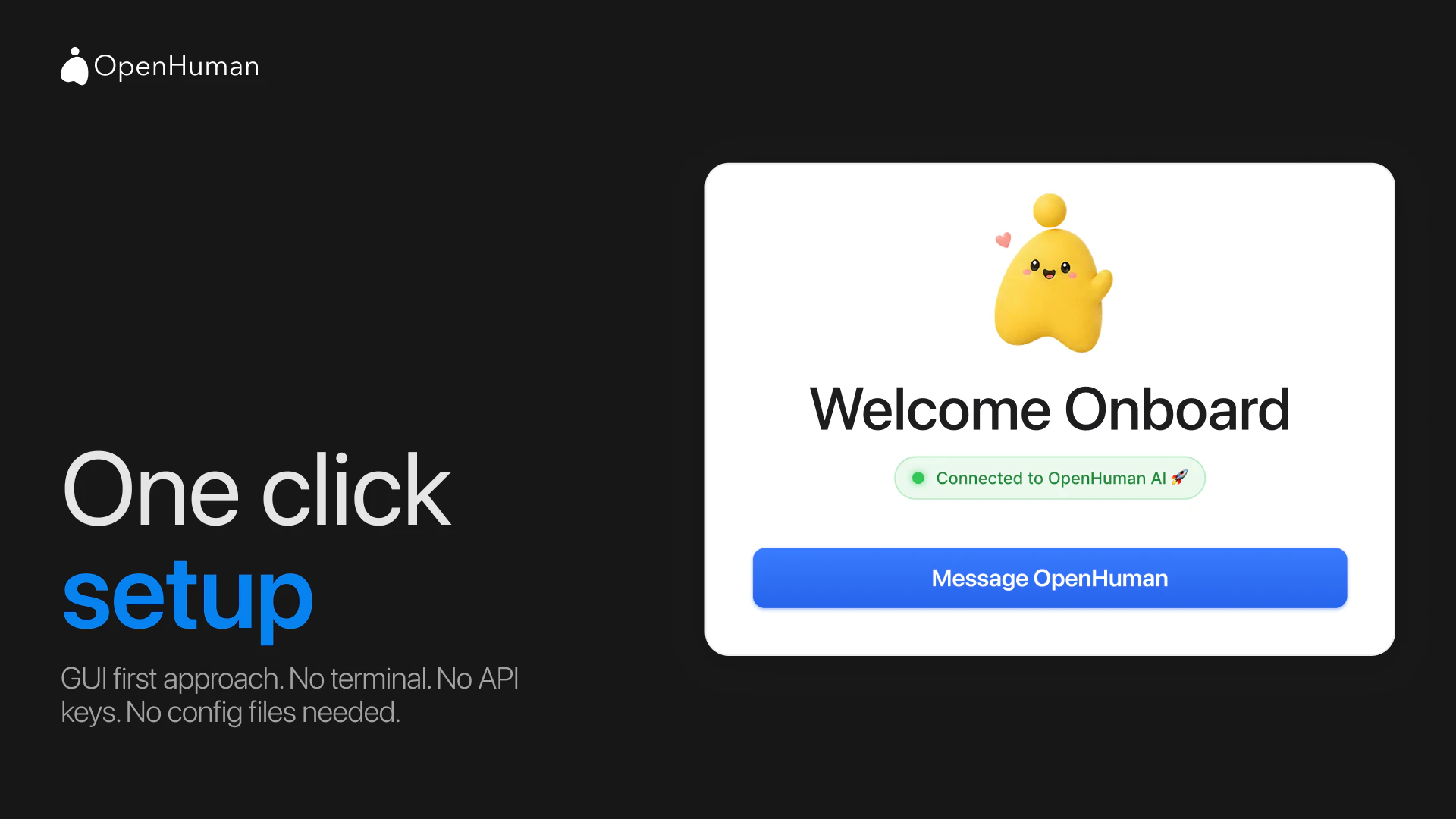
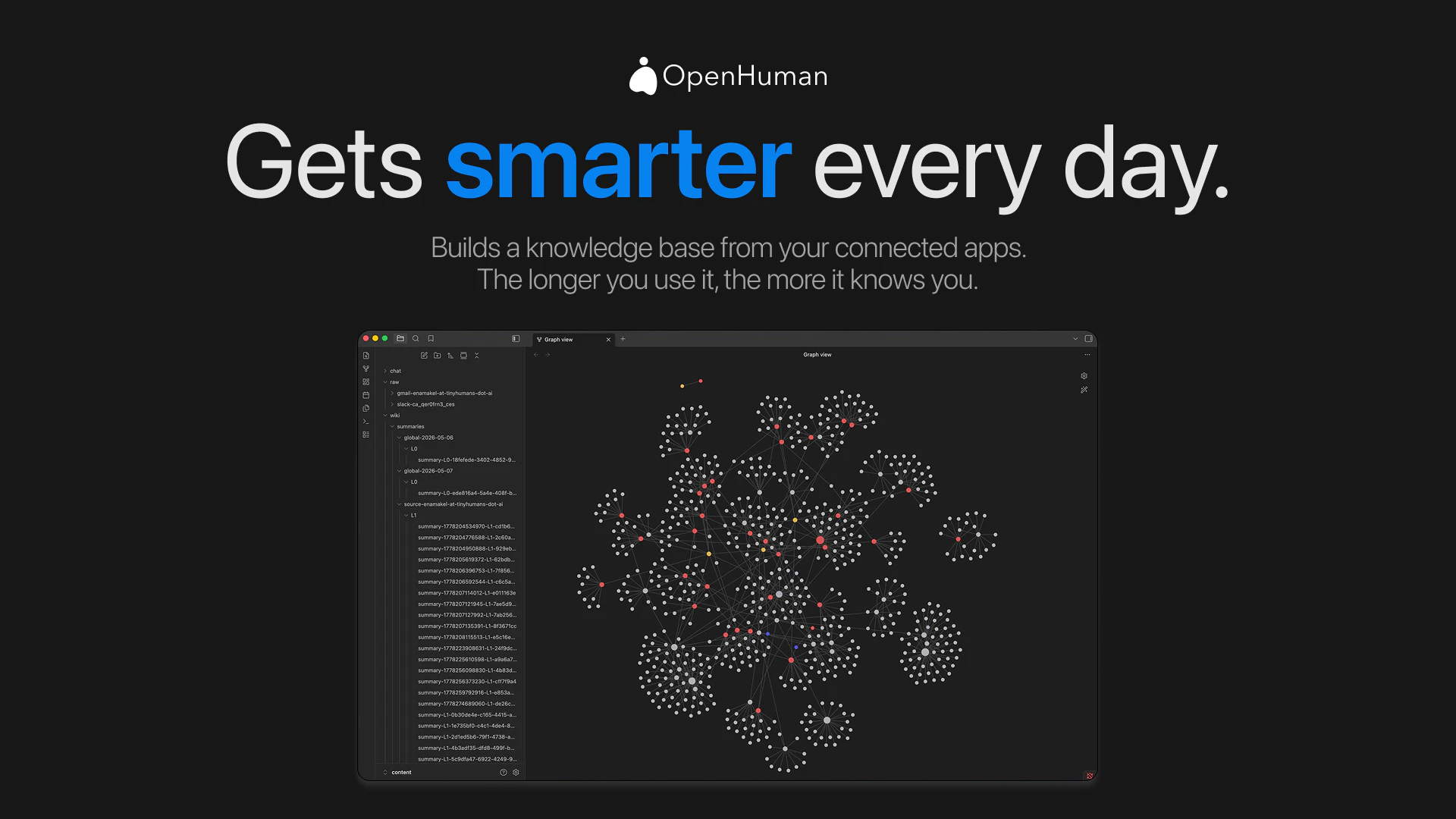
查看原始信息
Basedash MCP Connectors
Basedash already reads from your databases, warehouses, and SaaS tools. Now it can act on them too. Connect any MCP server — Linear, HubSpot, Slack, Resend, Notion, GitHub — and the Basedash agent gets new tools it can use right inside chat. Ask it to email your latest signups, file a Linear bug from a support ticket, or update a HubSpot lead based on what a user did in your product. Pair with Automations to run the whole flow on a schedule. Connect any app. Take action anywhere.
Hey everyone, Max here from Basedash. Today we're shipping MCP Connectors. Basedash already reads from your databases and SaaS tools, now it can act on them too. Connect any MCP server (Linear, HubSpot, Slack, Resend, Notion, GitHub, your own internal one) and the Basedash agent gets new tools it can use right inside chat. The pattern that's been the most useful for us internally: ask the agent to do something that mixes a read from your product database with an action in another app. "Email this week's signups a personalized welcome based on the features they actually set up." "File a Linear bug from this support ticket and link the user record." "Update the HubSpot lead for everyone who hit the paywall this week." Each tool is gated. New tools default to "needs approval", so the first time the agent wants to send an email or create an issue you confirm it; once you trust a tool you flip it to "always allow". Pairs cleanly with Automations from a couple weeks ago: the same flow that runs once on demand can run every weekday at 9am. PH community gets an extra week on their trial this week. Happy to answer anything.
2
回复

@maxmusing Really like the approval-gated approach here gives AI agents actual utility without losing control. The cross-tool workflows you mentioned (DB + HubSpot/Linear/email actions) feel genuinely practical, not just demo use cases. Congrats on the launch 🚀

0
回复

The thing I keep coming back to with MCP Connectors is that the highest-leverage work in any company already lives across three or four systems, and until now there hasn't been a clean way to let an agent operate on that whole surface from one place. Reading from your warehouse and then acting in Linear, HubSpot, or Slack in the same chat session is a meaningfully different shape of tool than the dashboards most of us grew up with. The team has been deep in this for months and it feels great to finally ship. Happy to dig into anything in the thread today.

1
回复

@kris_lachance Basedash is more and more becoming the place I do most of my ops work these days.

0
回复

The approval gate design is the detail that stands out most — "needs approval" by default before flipping to "always allow" is exactly the right trust model for agents that can actually write to production systems. A lot of agentic tools skip this and it's why people don't trust them with real workflows.

The cross-system chaining is where this gets interesting. Curious how it handles failures mid-chain — if the DB read succeeds but the HubSpot write fails, does it roll back, notify, or just log and move on? That failure handling is usually where these workflows quietly break in practice.

Also wondering if MCP servers you self-host get the same approval UX or if that's only for the pre-built connectors.

1
回复

@saumya_jainn Approval was really important for us, especially moving from a purely read-only product to now supporting mutations. The user always has full control of what the agent tries to do, and if they're comfortable giving more access, they can allow the agent to auto-approve selected tools.

If a tool call ever fails, the agent sees the error message and can retry as it sees fit (including rolling back if necessary).

And approval works for all MCP servers! Pre-built or custom.

1
回复

My non-engineer team would slack me for a number twice a week and I'd write the query, screenshot it, move on. Tools like this kill that loop, which is what I actually want.

0
回复