Product Hunt 每日热榜 2026-05-29

PH热榜 | 2026-05-29

#1
Ava 2.0
Your AI BDR that runs outbound sales autonomously
328
一句话介绍:Ava 2.0 是一个全自主运行的 AI 销售开发代表(BDR),自动完成从2.5亿+专业人士中筛选线索、多通道外联、处理异议到预订会议的整个外销流程,解决销售团队在手动线索挖掘、个性化触达和效率低下上的痛点。
Productivity Sales Artificial Intelligence
AI销售代理 外销自动化 线索挖掘 多通道外联 B2B销售 自主BDR 销售效率 AI员工 邮件营销 个性化触达
用户评论摘要:用户核心疑虑:全自主模式是否沦为“群发垃圾邮件”,个性化是否足够深;域信誉如何保护以防触发垃圾邮件过滤器;成本效益(每联系成本过高)。建议:应有“谨慎发送”的阈值机制,学习拒绝和错误回复,并能处理复杂的购买旅程细微差异。
AI 锐评

Ava 2.0 的野心不在工具层面,而在替代整个初级销售岗位。从“AI辅助”到“全自主”,其价值并非“多发送”,而是通过意图信号捕捉、多变量测试和自主处理异议,试图解决销售漏斗顶端的规模化与个性化矛盾。

然而,评论中的质疑直击命门:当“无人在环”时,系统输出的是“有效体感”还是“优雅的噪声”?目前看来,产品在“广撒网”效率上已无可挑剔——300M+联系人、15+数据源、多通道序列,但“何时不发送”的决策模型才是真正护城河。用户反馈指出,域名信誉风险、成本模型不透明、个性化深度不足等问题尚未被完美回应。

坦白讲,当前市场不缺AI SDR,缺的是能区分“制造会议”和“创造价值”的智能体。Ava 2.0 若能在“全自主”基础上,建立清晰的发送边界(如低置信度线索自动降级或人工审核),并降低单位获客成本,才有资格从“自动化工具”升级为“销售策略引擎”。否则,它只是把“人肉群发”升级成了“AI群发”,边际改进而非范式革新。对自建销售团队的中小企业,250美元/月的自助模式有吸引力,但建议先做小规模测试看退信率和转化质量,别让“便宜”变成“昂贵”。

查看原始信息
Ava 2.0
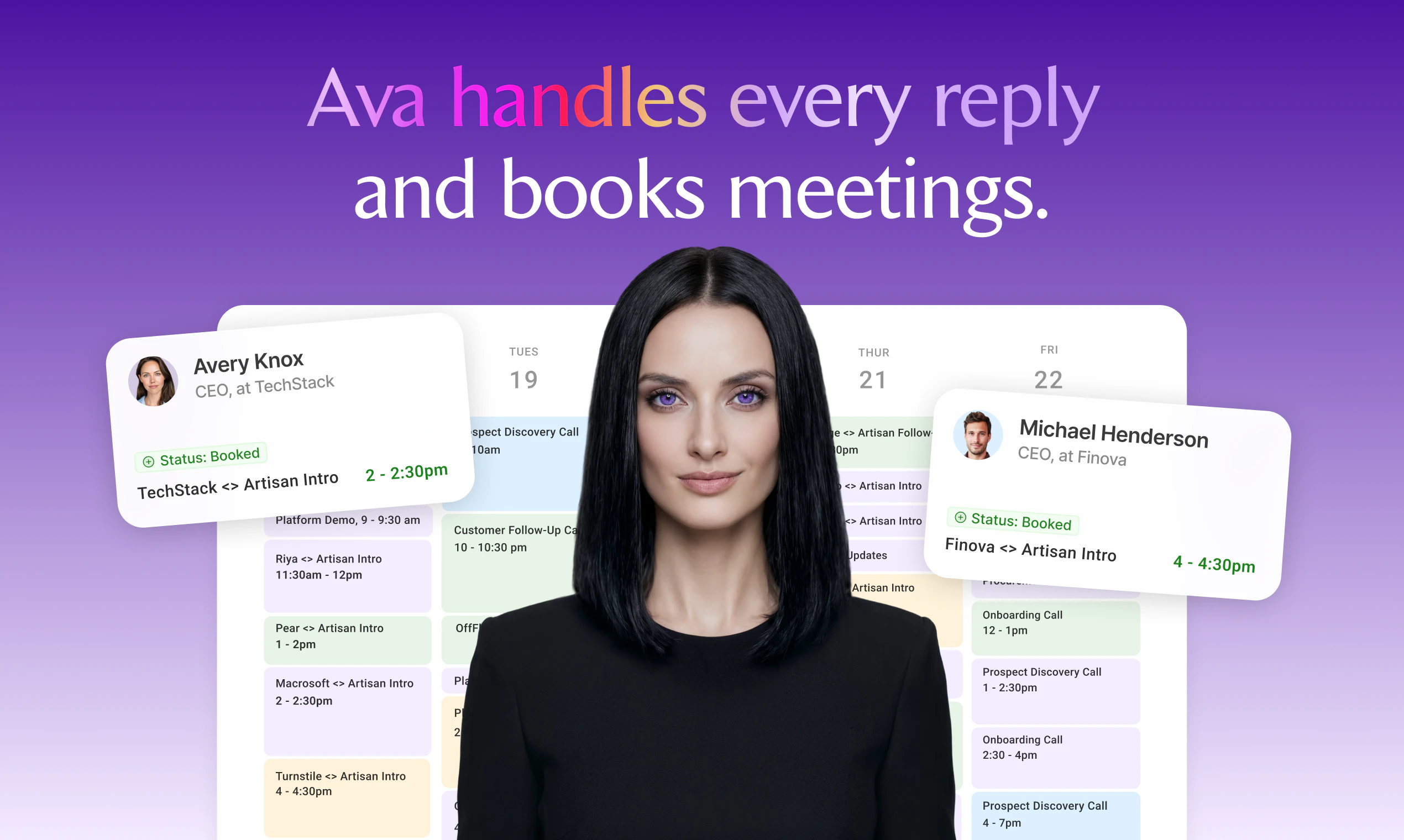
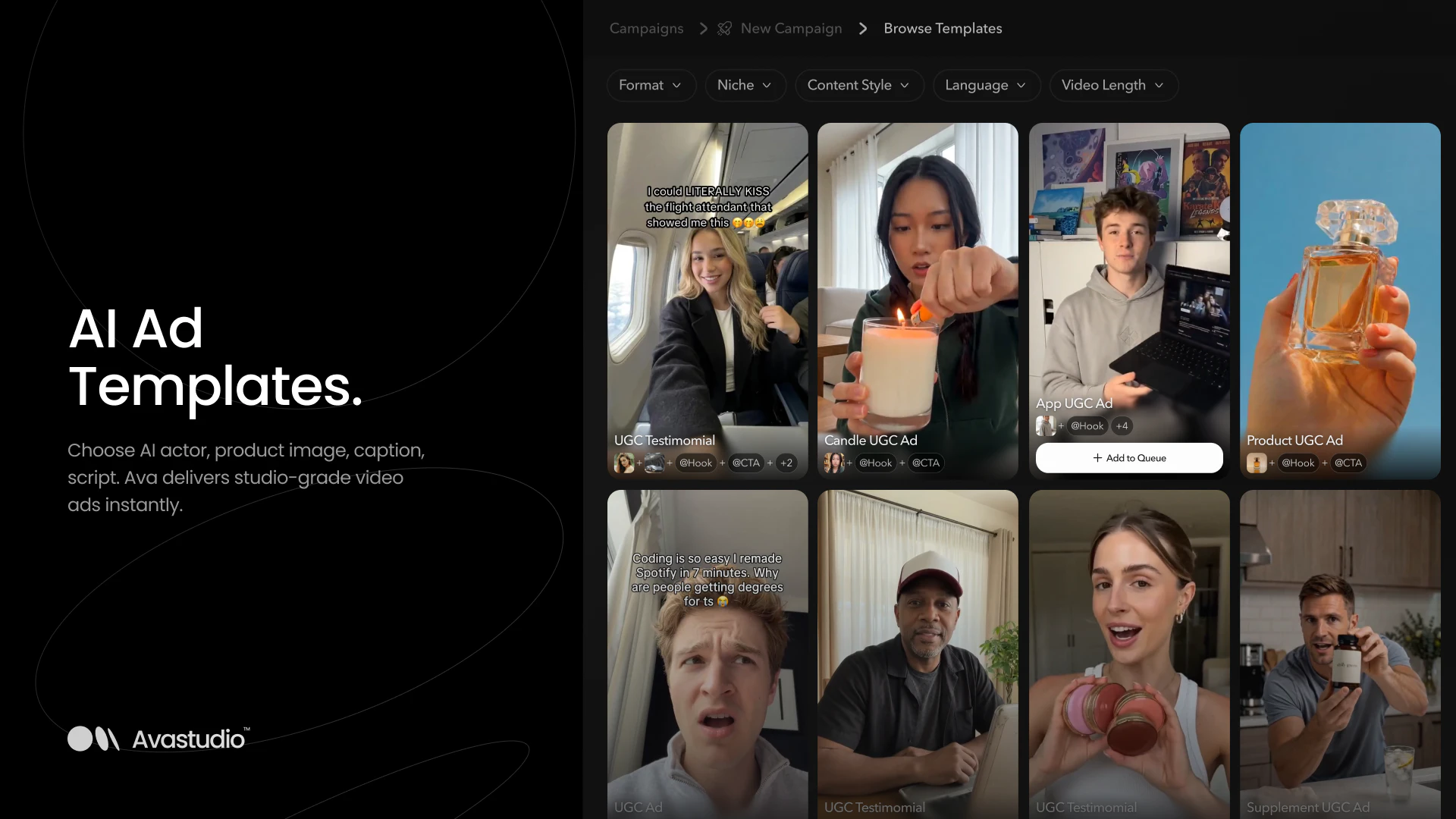
Ava is an AI BDR that runs your entire outbound on autopilot. She sources leads from 250M+ professionals, runs multi-channel outreach, and books qualified meetings. Fully autonomously.

Hey PH 👋


I'm Jaspar, co-founder and CEO of Artisan. I started my first business at 7, selling candy from my bedroom. Since then I've raised $36M+ to build AI employees and we're currently at ~$10M ARR.


Some of you might remember our first PH launch in February 2024 when we first launched Ava the AI BDR.


Today we're releasing Ava 2.0. We rebuilt her from the ground up and she is now fully autonomous and she runs your entire outbound on autopilot. She finds leads, sends personalized outreach, handles objections, and books meetings on your calendar. No human in the loop.


She searches through 300M+ contacts, enriches every lead, and watches for intent signals like funding rounds and leadership changes. She launches personalized multi-channel campaigns, runs continuous multi-variate tests, and auto-optimizes toward what converts. When a prospect replies, Ava reads the response, handles objections, answers questions, and books the meeting.


With Artisan, the entire sales stack lives in one place. Lead discovery, enrichment, signals, sequencing, a dialer, and deliverability infrastructure. All in one platform.


She's already running outbound for thousands of reps at companies like Corgi, SaaStr, Quora, and CookUnity.

🎁 For the PH community: new users get $300 in free credits. No credit card required. artisan.co


Jaspar

13
回复

@jasparcj Very cool concept but I have to be honest - I have some reservations about the fully autonomous part. As others have mentioned, will this feel like spray and pray outreach, or will Ava understand the nuances of the buyer journey?

2
回复

with ava running fully autonomous multi channel campaigns on autopilot, how are you guys managing local domain safety under the hood? sending huge volumes of automated personalizations can flag spam filters fast if the inbox infrastructure isn't airtight. good job team

6
回复

The hard part with an autonomous BDR is not “can it send more?” It is whether the system knows when not to send.

For a tool like Ava, I’d want the review layer to make a few things very visible before outreach goes out: why this account, why now, what evidence supports the angle, what would make this a bad fit, and what the fallback is if confidence is low. Learning from ignores and bad-fit replies matters as much as learning from booked meetings.

That’s the line between useful outbound automation and just scaling the same spray-and-pray problem with better copy.

4
回复

@jim_jeffers you can set qualification criteria and Ava checks each lead with an AI research agent. She filters out hard disqualifiers before they enroll, and for anything she can't verify upfront, she just asks the lead directly before booking!

2
回复

Looks interesting. The data with Eva covers for niche industries like local small businesses as well or its more relevant for B2B startups and the likes??

4
回复

@ankur_jeswani we have a professional database and a local business database!

2
回复

How do you keep it from burning your domain reputation or sending the same outbound style to everyone?

4
回复

Congrats. Since Feb 2024, what has changed and what is upcoming on the roadmap?

3
回复

@iamanantgupta thank you! Ava is now fully autonomous and books meetings with no human in the loop. It's a ground-up rebuild from our v1. New on top: a built-in dialer, chat to run her in plain language, ML lead scoring, dedicated campaign types (cold, warm, cross-sell/upsell, signals), and a lot more. Plus self-serve at $250/mo (down 10x from $2.5k)!

0
回复

Over the last 3 months, I’ve tested 8–9 similar services. All of them had the same problem — the credits disappear within a few days, and the cost per contact ends up being quite high. Have you calculated the average cost per contact or other metrics?

2
回复

fully autonomous outbound with no human in the loop is bold. the personalization has to be genuinely good or you're just automating spam at scale. curious what the reply rates look like vs a human SDR running the same list

2
回复

Congrats on the launch @jasparcj @lucas_moeller ! Very cool, and timely! Upvoted :)

I have been juggling around with Apollo/Prospeo + Clay + ChatGPT and that's really messy!

When you say searches contacts and sends outreach messages - which social media handles are included? And how do you measure the output, do you have any numbers around how many of those outreach messages convert? And how it is compared to the traditional manual ways? Thanks!

2
回复

The autonomy is impressive. The open question for me is the one Anna raised: what is the failure mode when Ava is confident and wrong? Outbound is unforgiving, because a confidently wrong message still gets sent and the cost lands on your domain reputation, not on a quiet retry. Curious whether 2.0 has a notion of "not sure enough to send," or whether everything above a threshold just ships.

1
回复

I'm just starting out, I have a quick question: in the connected Gmail account I have multiple accounts set up - I was never asked which account will be used to send emails. This means either the default account will be used, or the main account will be used - but which is it?

1
回复

Curious how you think about the economics of outbound if agents become abundant. Historically, the bottleneck wasn’t sending messages, it was hiring, training, and managing SDRs. If every company suddenly has an unlimited number of AI SDRs, does outbound become more effective? or does attention become the new scarce resource?

In other words, does the winner become the company with the best AI, or the prospect with the best filters?

1
回复

Is this only for B2B ? Also, whats the source of the 300M+ contacts ? Is it across the globe or specific to geography ?

1
回复

@vinitvr not just B2B, we also have a local business database (200M+ businesses). We waterfall-enrich across 15+ providers

0
回复

Congrats on the launch! Going from AI-assisted outbound to fully autonomous outbound is a pretty big leap. Curious to see how Ava handles the messy real-world objections that make human reps earn their coffee.

1
回复

@alina_tyslenok_ thank you! Ava handles objections autonomously based on a knowledge base you set, and anything she's unsure on escalates to a human. You can also set plain-text escalation rules, e.g. "escalate if they bring up pricing"

0
回复

Super interesting, the enrichment is generated in app, or through APIs/?

0
回复

Is it only for B2B?

0
回复

Congrats on the launch! A few questions:
- How does she learn about my ICP, the different segments, and their specificities (buying journey, pain, etc.)
- Is Ava improving over time?
- What kind of outreach volume does she handle (via email & LinkedIn)? How does she ensure great deliverability?
- Is phone call on the roadmap?
- Among the 300M+ contacts database, what's most represented? (B2B? US?, etc.)

0
回复

is it not working on mobile ?

0
回复

@sara_spanger onboarding needs to be on a computer!

0
回复

Wanted to try out, still wasn’t able to pass onboarding page. After feeling all info, didn’t see next step (on mobile)

0
回复

@avrutova sorry, onboarding needs to be on computer!

0
回复
#2
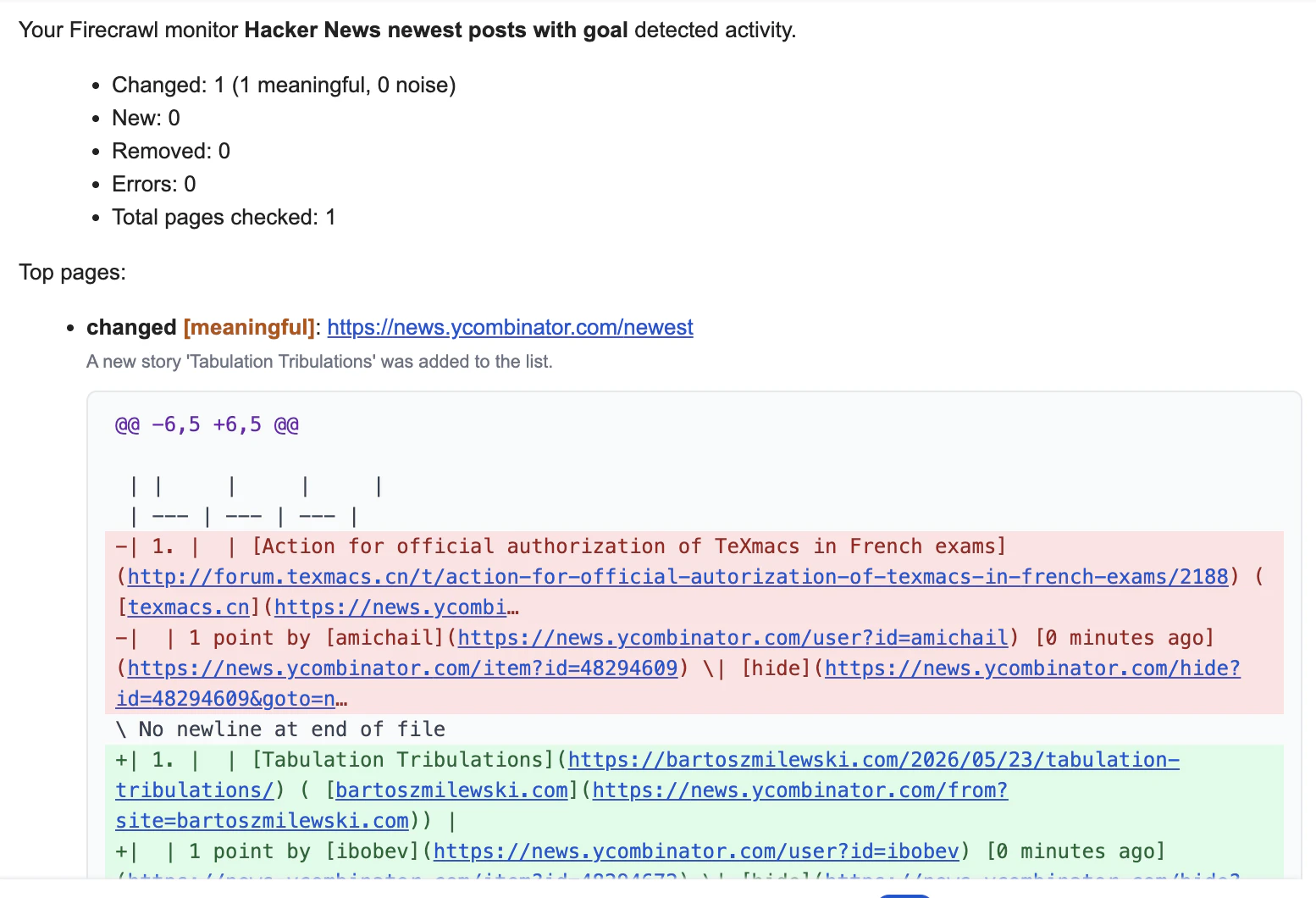
/monitor by Firecrawl
Notify your AI agent when the web changes
294
一句话介绍:/monitor通过智能网页变更检测与webhook推送,将AI代理从“定时盲抓”和“高额token浪费”中解放出来,专注于处理网页上真正变化的内容。
Developer Tools Artificial Intelligence
网页监控 AI代理 Webhook 智能Diff Token优化 网站变更通知 动态页面 竞品追踪 成本控制 Firecrawl
用户评论摘要:用户普遍看好其解决重复抓取浪费token的核心痛点。但集中关心三个问题:是否支持JavaScript动态页面(被证实支持)、能否精确定位页面内特定元素进行监控(官方回复支持按目标设置)、以及如何区分像素级重排与实质性内容变更。合规监控和自然语言摘要差异也是高频提及的需求。
AI 锐评

/monitor的出现,本质上是将AI Agent的“信息饥渴”转化为一种可量化的成本控制方案。它精准地切中了当前AI工作流中最隐蔽的浪费点:为维持信息新鲜度而进行的无差别暴力抓取。其核心价值不在于“监控”本身,而在于“智能差异提取”——这直接转化为90%的Token成本削减,对于任何规模化使用LLM的应用都是极具说服力的ROI计算。

然而,我们必须警惕其“场景陷阱”。产品宣传中强调的“竞品追踪”、“政策监控”虽然真实,但并非所有场景都适合。例如,监控JavaScript重交互的页面,即使Firecrawl能抓取,其变更的语义复杂性也可能导致大量“非实质性”告警(如广告轮播、时间戳更新),从而抵消Token节省。官方回复中提到的“按目标设置”是应对此问题的关键,但这要求用户能精准描述监控目标,对非技术人员存在使用门槛。

真正的护城河在于其“前置成本估算”和“签名Webhook”设计,这在企业级合规与自动化流水线中至关重要。但产品仍需回答一个根本问题:当网页内容完全由API动态驱动时,基于DOM的Diff是否会沦为噪声制造机?长远来看,/monitor的挑战不是技术实现,而是帮助用户找到那个“值得监控、变化有意义、且能自动化决策”的甜蜜区间,否则它只是从一个“定时任务”变成了一个“更昂贵的通知器”。

查看原始信息
/monitor by Firecrawl
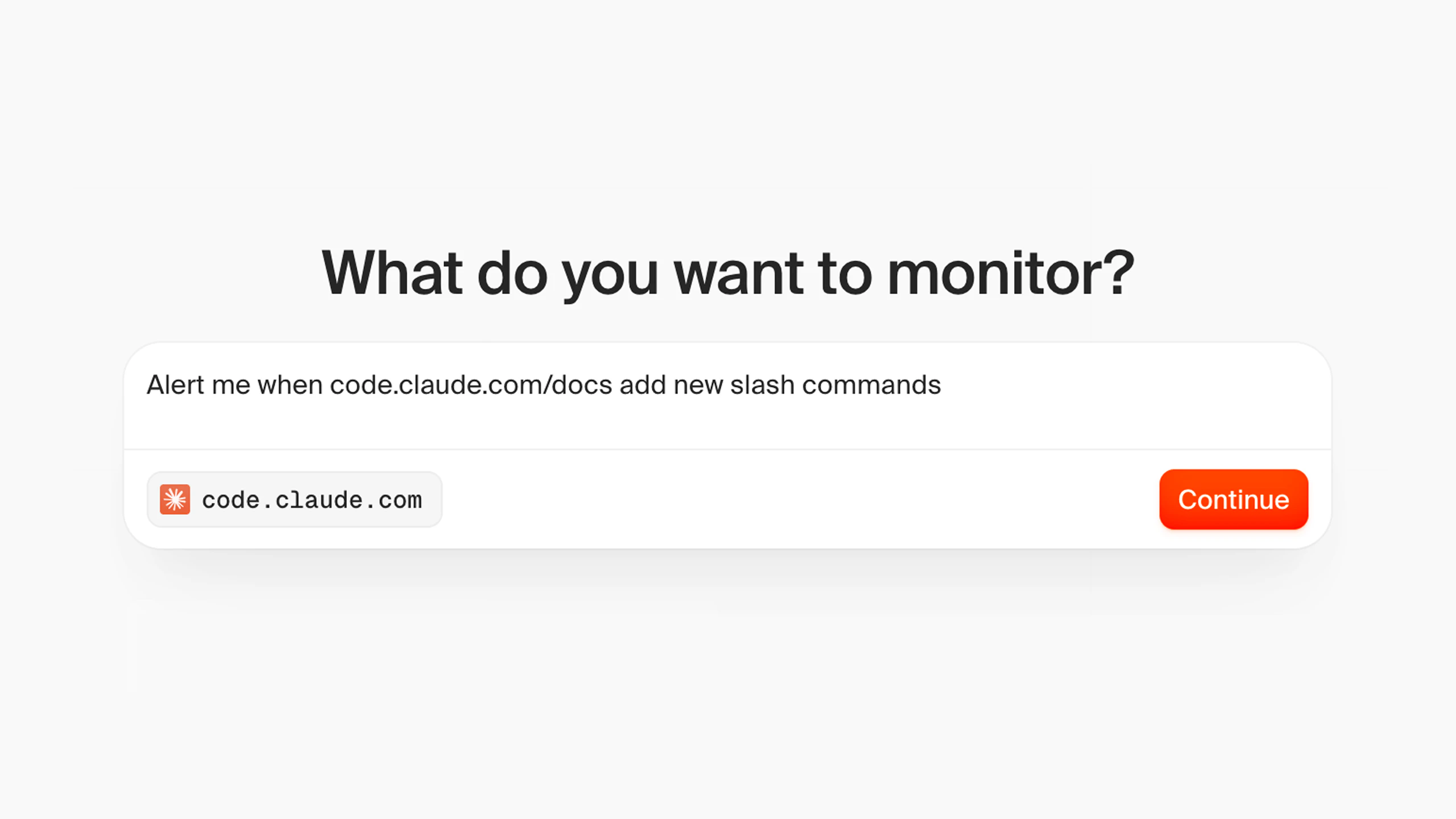
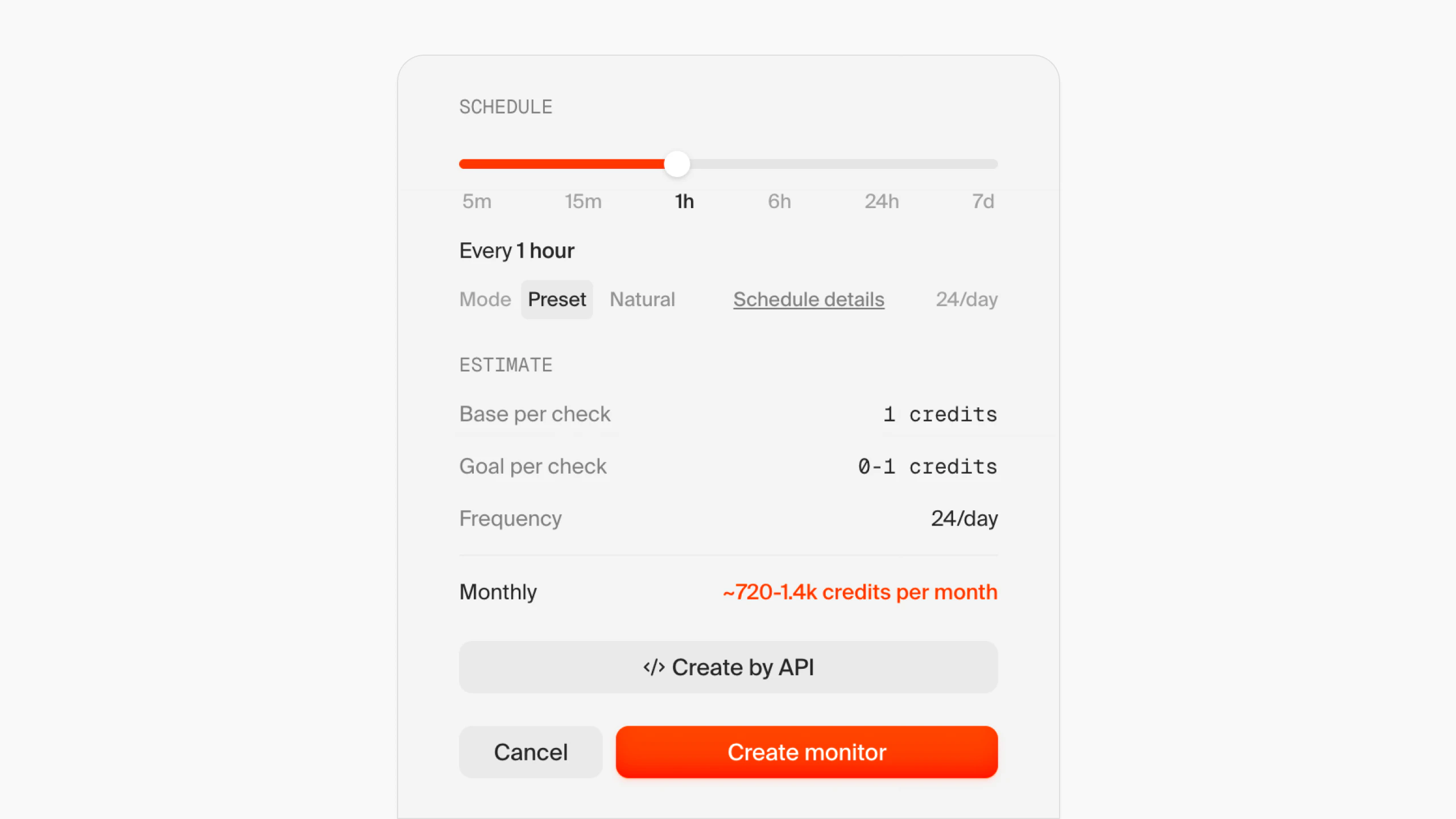
/monitor notifies your agent via webhook the moment pages or sites change. Use up to 90% fewer LLM tokens by only ingesting what changes on a page.
Hey Product Hunt 👋 We're Eric, Caleb, and Nick from Firecrawl. Today we're launching /monitor, the easiest way to keep your AI agent in sync with the web. We built /monitor because we kept hearing the same thing. A lot of our customers were already using Firecrawl to watch specific pages, re-scraping the same pricing pages, docs, changelogs, and filings on a loop just to catch when something changed. It makes a ton of sense, but doing it by hand means you either over-poll and burn tokens on pages that didn't change, or under-poll and miss the update that mattered. So we turned it into a product. Point it at a URL, describe what to track in plain English, and Firecrawl checks the page on your cadence, compares it to the last version, and pings your agent over webhook the moment something meaningful changes. Your agent only ingests what actually changed, so you can cut token usage by up to 90%. There's nothing to wire up yourself. The schema, scheduling, diffing, and delivery are all handled for you, and you see the estimated monthly cost before you flip a monitor on. Changes arrive by signed webhook or email, with a permalink for every diff you can hand straight to another agent. It runs on Firecrawl's /scrape under the hood, so JS-heavy pages get tracked reliably too. If you've got an agent re-scraping the same docs, changelogs, or competitor pages on a loop, this one's for you. You can try it out here: https://docs.firecrawl.dev/featu... Would love to hear what you think.
1
回复

@ericciarla Congrats on the launch, It looks like Firecrawl is one of those tools that feels obvious only after you use it. Web data for agents is still messy, especially when pages change.

What use case are you seeing most often for /monitor?...competitive tracking, docs changes, pricing pages, or something else?

0
回复

@ericciarla The over-poll versus under-poll tradeoff is exactly the tax nobody budgets for when they wire this up by hand. Pricing the diff before you flip a monitor on is the detail I would not have thought to ask for, but immediately want. One question: when a page changes layout but not meaning, does the diff stay quiet, or does my agent get woken up for a CSS refactor?

0
回复

Been waiting for something like this. Setting up custom polling logic to watch external data sources is one of those tasks that eats 2-3 hours and nobody talks about

Been doing the "scrape on a cron + diff manually" thing for competitor tracking for months. The webhook approach is cleaner. One question/ does it handle pages that hydrate content via JS after first render?

1
回复

Web change monitoring via webhooks is something I've wanted for competitor tracking for a while. Does it handle JS-rendered pages or only static HTML? A lot of the pages worth monitoring hydrate content after first load.

0
回复

The compliance monitoring use case feels underexplored here. Regulatory pages, terms of service, and policy documents change infrequently but consequentially. The kind of thing you want an agent to flag immediately when it shifts, not catch on the next scheduled crawl. The challenge is those pages often have boilerplate that changes (cookie banners, footer dates) without the substantive content changing. Curious whether /monitor lets you scope the watch to a specific element or section of a page, rather than monitoring the full document. that would make it significantly more useful for policy/legal tracking workflows.

0
回复
  1. How does the tool bypass advanced anti-scraping blocks like Cloudflare or CAPTCHAs?

  2. Can the system detect and highlight a single word change within a text?

0
回复

@ericciarla @caleb_peffer @nickscamara Congrats on launching /monitoring!

The shift from "blind polling" to "intelligent diffing" is exactly what dev teams need to keep AI agent costs under control. I’ve lost count of how many tokens I’ve burned re-scraping unchanged docs.

How does /monitor handle dynamic content (like JS-heavy dashboards) vs. static text? Does it ignore irrelevant UI changes (like ad rotations or timestamps) to ensure the webhook only fires for meaningful data shifts?

🕸️

0
回复

This is one of those features that seems obvious only after someone builds it. Monitoring changes instead of constantly re-scraping pages feels like a much smarter approach. Congrats on the launch!

0
回复
Super timely addition. Value these days comes from doing the work before it’s needed 👌 May integrate for competitive analysis in zentrik
0
回复

@jalcantara Sounds amazing. Let me know how you like it!

0
回复

Can you set rules for what counts as a meaningful change, like only when certain sections or selectors update?

0
回复

@naimz Yeah, so it actually depends on the goal you set. If you set a specific goal about a specific selector, then it will only notify you around that. Vice versa for entire pages!

1
回复

agents re scraping entire pages every hour just to check if one price changed is such a waste of tokens and money. only ingesting the diff is how it should've always worked

0
回复

@tina_chhabra 100% this is overdue!

0
回复

Congrats Eric, Caleb, and Nick! 🔥

Love this build. The 90% token cut is wild. That's the number every team running AI products is quietly desperate for.

We pull buyer-side data into FireCoach all day long for sales prospect profiles, and the re-scrape vs. monitor tradeoff is exactly the thing we keep fighting. Going to share this with our engineering team.

Quick question: does the diff get summarized in natural language before hitting the webhook, or does the receiving agent still have to interpret the raw diff?

Either way, this is one of those "obvious in hindsight" products. Nice work!

0
回复

@midori_verity That's incredible. Thank you! Right now it's just the raw diff and the receiving agent has to interpret that raw diff, which they are pretty good at.

1
回复
#3
Ava Studio
Your AI creative team for video ads
245
一句话介绍:Ava Studio是一款面向创始人和小团队的AI视频广告生成工具,通过研究产品、市场及竞品,自动生成50+可编辑的短视频变体,解决用户在TikTok、Reels等平台推广时创意生产慢、成本高、难以测试多角度的痛点。
Marketing Artificial Intelligence Video
AI视频广告生成 短视频营销 创意团队替代 TikTok广告 Meta广告 广告变体生成 营销自动化 产品推广 竞品分析 电商营销
用户评论摘要:用户普遍认可“研究先行”的价值,但担忧生成内容是否同质化、缺乏品牌个性。核心问题包括:如何筛选50+变体中的高潜力角度;是否支持品牌声线定制;已生成广告的CPM等实际效果数据;能否深度集成竞品分析库;以及B2C SaaS产品是否适用(经确认支持)。创始人承诺正朝“测试系统”而非“内容机器”进化。
AI 锐评

Ava Studio切中的是一个真实却常被忽视的痛点:创始人并非不想做广告,而是被“零到一”的创意生产流程压垮。产品核心价值在于将“创意研究-脚本-多角度变体”的全链路压缩至“输入产品链接”这一动作,直接降低了测试广告创意的门槛。其“研究先行”的设计(分析竞品、已有成功广告模式)跳出了多数AI视频工具“只生成不思考”的窠臼,为后续的批量变体提供了逻辑起点。

然而,产品当前的风险亦十分明显。首先,“50+变体”若缺乏有效的“角度地图”或“信号回传”机制,极易沦为“高质量AI垃圾”——不同视觉包装下传递同一孱弱主张。创始人回应将构建“测试系统”是正确方向,但尚未在用户评论中看到落地方案。其次,品牌声线的捕捉依赖产品网站信息,这对于风格独特或非标准化的品牌可能不够精准,存在“有效但平庸”的陷阱。最后,产品仍处于早期,缺乏能证明“转化效果”的灯塔客户数据(CPM、ROAS等),使得其价值主张停留在“效率提升”而非“效果承诺”。

对于月活有限、急需快速验证营销角度的早期团队,Ava Studio是极具性价比的“创意副驾驶”。但对于追求品牌深度或已形成成熟营销方法论的团队,它更像一个高效的素材生产器,而非战略决策工具。其未来能否从“降本工具”进化为“增效引擎”,取决于能否将“研发生成”闭环为“测试学习”的正向循环。

查看原始信息
Ava Studio
Ava Studio researches your product, develops hooks and creative angles, then generates 50+ editable short-form ad variants ready for TikTok, Reels, Meta, and any platform you want to ship on.

Hey Product Hunt, I'm Tong, founder of Ava Studio 👋

If you’ve ever launched a product, you probably know the feeling: the product is live, the site looks good, users are waiting somewhere… and now you need ads.

That’s where a lot of founders get stuck.

You can stare at ChatGPT trying to write hooks. You can brief an agency that costs more than your MRR. You can spend three hours in Runway or CapCut and end up with one clip you’re not sure is even usable.

The problem isn’t that founders don’t know their product. It’s that making good ads requires an entire creative workflow: research, briefs, scripts, hooks, actors, product shots, editing, resizing, testing, and iteration.

We built Ava Studio to make that workflow feel like having a creative team on demand.

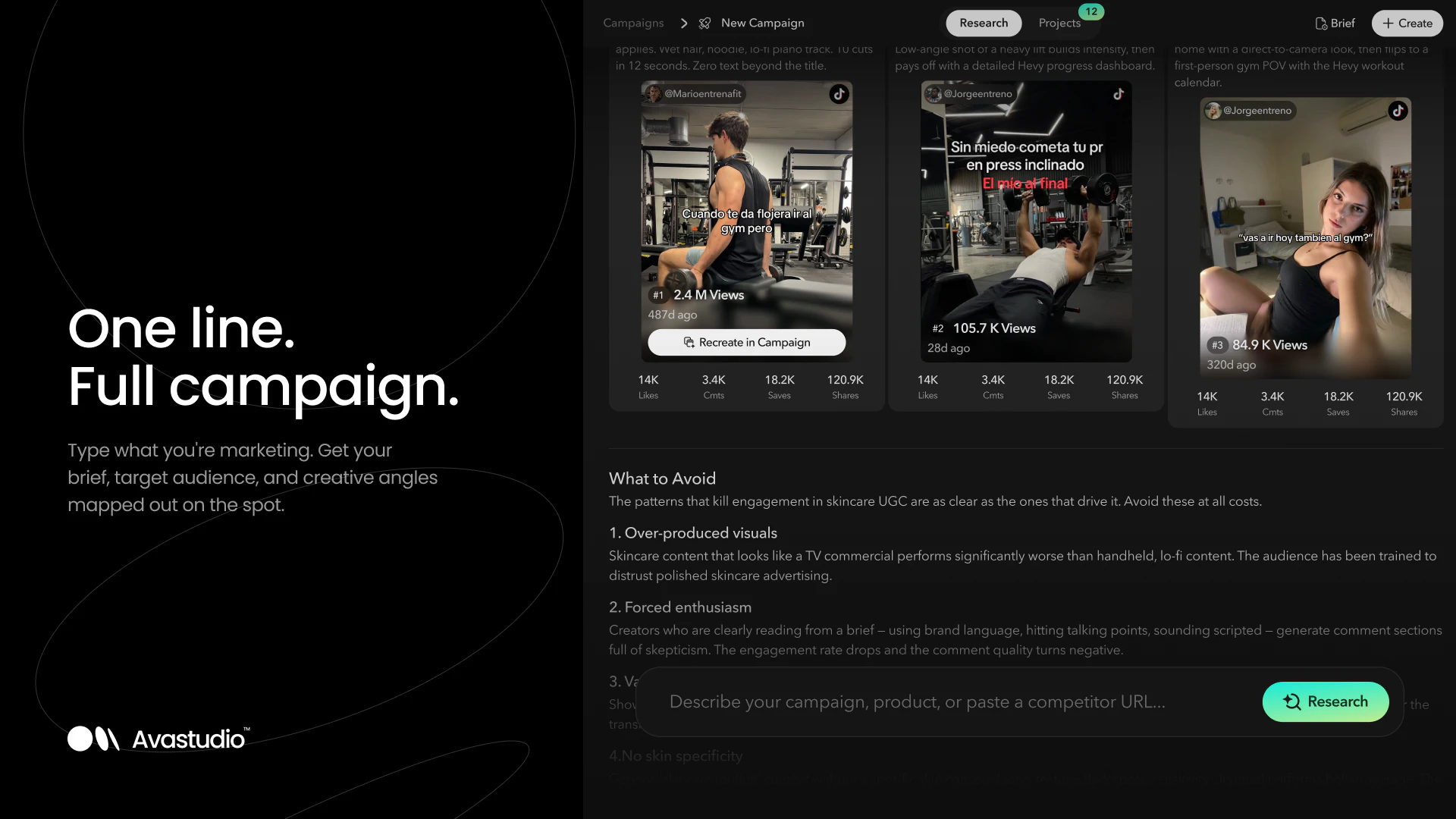
Drop in your product link and Ava studies your product, your market, and the ads already working in your category. Then she generates creative briefs, scripts, and 50+ editable ad variants ready for TikTok, Instagram, Meta, and YouTube.

What used to take weeks of creative briefs, scripts, edits, and agency back-and-forth now starts from one product link.


Watch me walk through it personally here:

https://www.youtube.com/watch?v=2RS2-3qaEhg

A few things people are surprised by when they first try it:

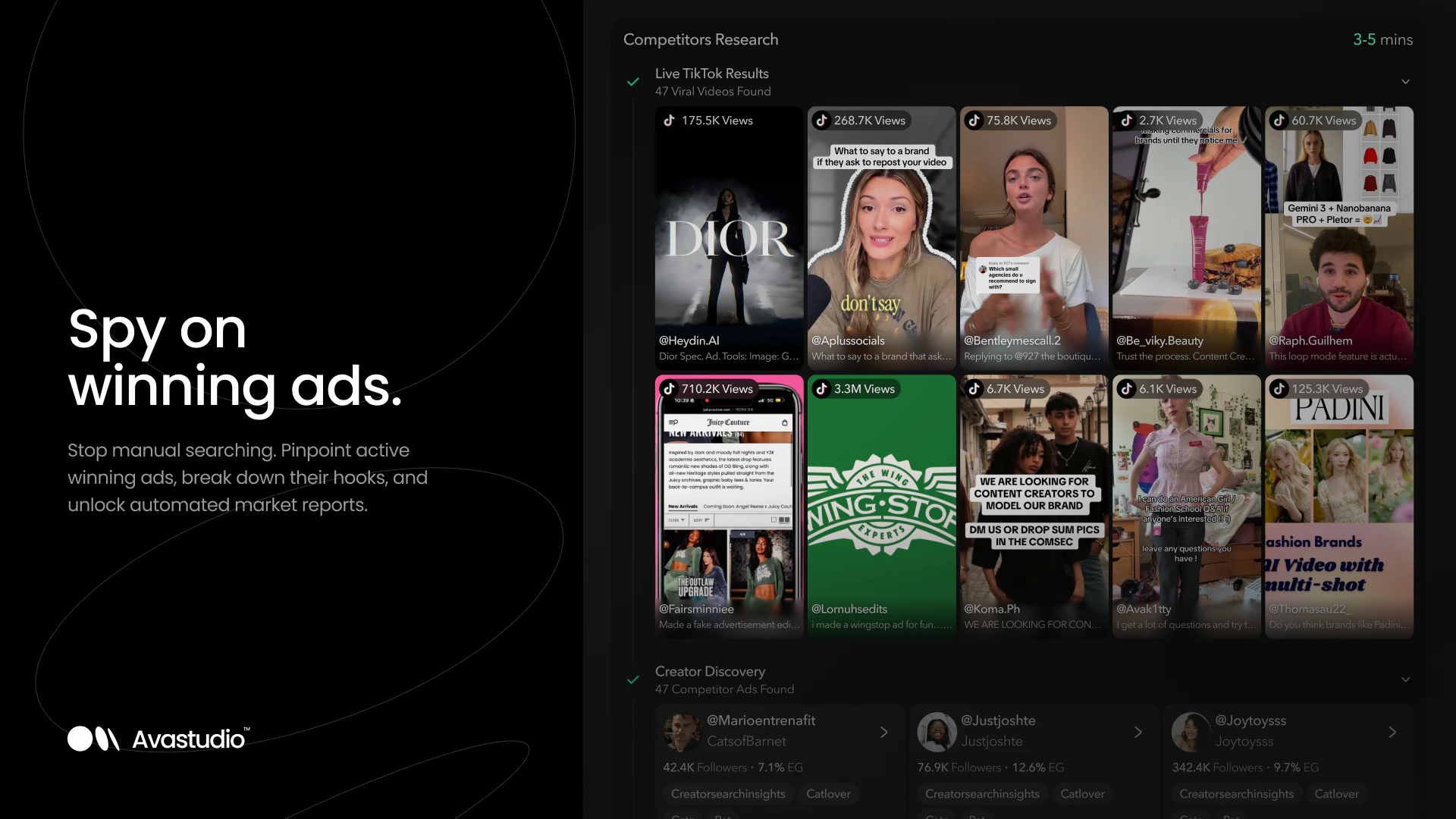
🔹 Ava starts where good agencies start: research. She studies your product, your category, your competitors, and the ads already winning before writing a single script.

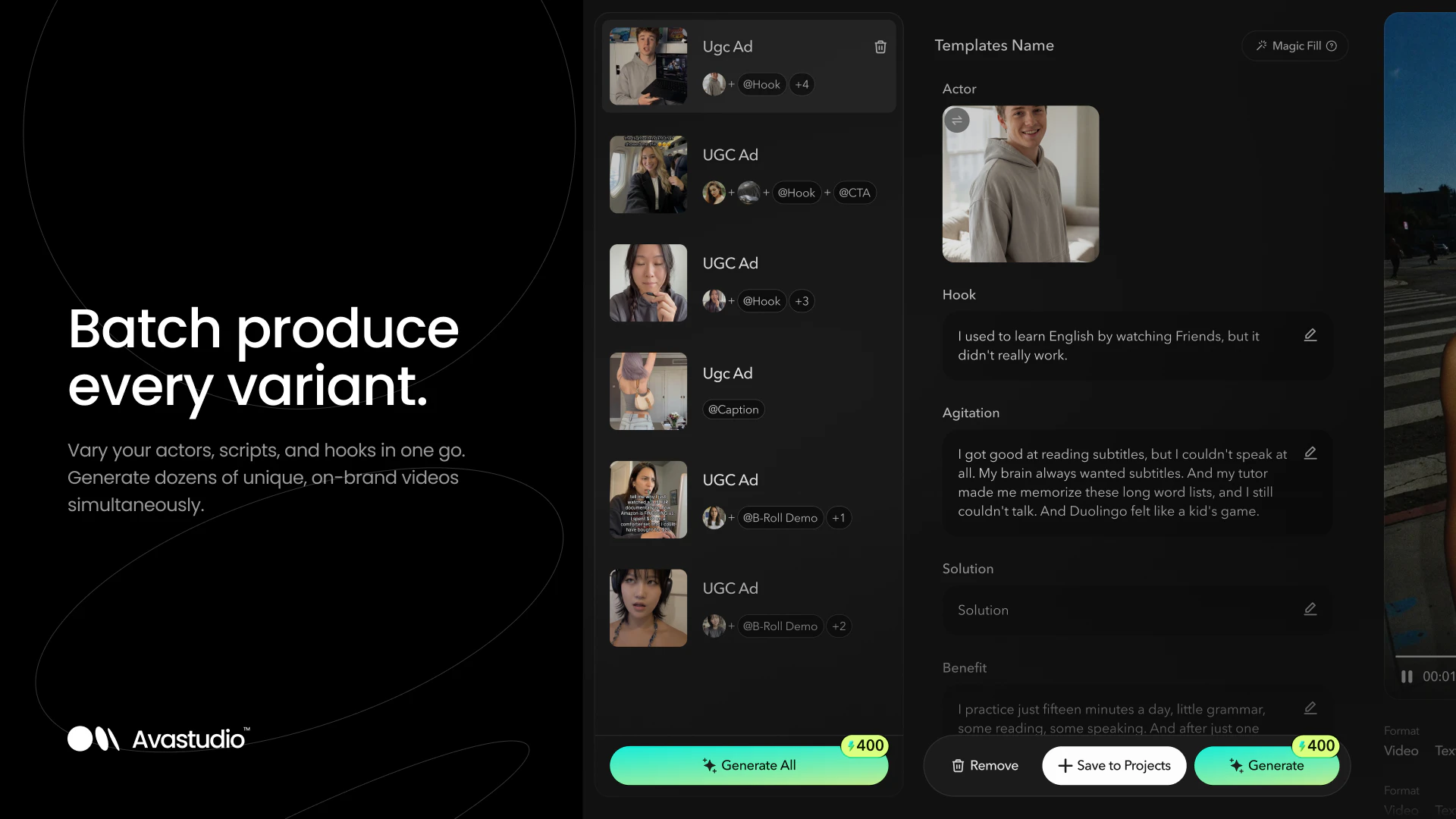
🔹 It does not just make one video. One product link becomes a complete campaign: creative briefs, hooks, scripts, storyboards, actors, product shots, and 50+ editable variants.

🔹 Every output is remixable. Change the hook, swap the actor, rewrite the script, replace the product shot, or turn one good idea into ten new angles.

🔹 The template library is built around ads that already work. Browse winning formats by category, clone the structure, and customize it for your product in minutes.

🔹 Ava keeps the whole creative process in one workspace: research, strategy, scripting, generation, editing, and export for TikTok, Instagram, Meta, and YouTube.

Ava is built for founders and small teams who need ads that look good, move fast, and don’t require hiring an agency.

Every new account gets 500 free credits, enough to run a full workflow from research to finished variants.

Try it here: avastudio.com


Please break it, tell us what’s missing, and send us the weirdest product you can throw at it. We’re building this with founders who actually need to ship.

Much love,

Tong

31
回复

@tpow this is a good development, with this it will saves me and my team money and time

0
回复

@tpow The interesting part here is the research + angle generation before the actual ads. A lot of AI ad tools jump straight into producing creatives without understanding positioning first, which is usually where performance is won or lost. How are users deciding which hooks or creative angles to double down on once the 50+ variants are generated?

0
回复

@tpow Congratulations on the launch

0
回复

being able to turn one winning creative angle into ten new variants with quick hook swaps is exactly what performance marketing needs right now. ad fatigue happens so fast on tiktok, so keeping the asset pipeline fresh is everything. awesome job buddy 👍

2
回复

@priya_kushwaha1 Thanks Priya. Appreciate the support!

The best creative workflow is not “make one perfect ad.” It’s find a signal, then keep remixing the angle while it’s still working.

That’s why everything in Ava Studio is editable: hooks, actors, scripts, product shots, CTAs, scenes.

Are you mostly seeing this pain on TikTok, or Meta too?

2
回复

Congratulations. I actually made my first AI video using your product this morning. Best of luck to you all.

1
回复

@aliali123 Thank you, Ali! Really appreciate you giving Ava a try, especially on launch day :)

Hope it helped you get something useful out the door. Thanks for the support, and we'd love to hear any feedback as you keep using it!

1
回复

@aliali123 Thank you, Ali! That’s awesome to hear. What kind of video did you make?

1
回复

so all this means we don't need to hire a whole marketing team once I've use this app, right?

1
回复

@maksym_shcherbakov1 Haha, not quite, but we'd love to give your marketing team superpowers.

What Ava Studio helps with is the slow and time consuming part of the process: research, creative exploration, competitor analysis, scripting, content generation, and producing variations to test. What it doesn't replace is the human judgment behind strategy and brand decisions. We're not trying to replace marketers. We just want a small team to be able to do the kind of work that normally takes a much bigger one.

1
回复

@maksym_shcherbakov1 Think of it as a creative team that works 24/7, while you stay the founder/marketer. Ava Studio replaces content research, production bottleneck, scripting, shooting, editing, resizing, so a solo founder or small team can ship volume that used to need an agency. But it doesn't replace vision/product strategy: knowing your customer, your offer, and your channel.

1
回复

The research-first part is the right instinct. The risk with AI ad generation is not usually producing enough variants; it is producing 50 variants that all express the same weak claim with different visuals.

One thing I’d love to see in a workflow like this is an angle map before generation: audience, pain/risk, proof asset, objection, hook family, and why this angle is worth testing. Then when an ad works or fails, the learning attaches to the angle, not just the finished video.

That would make Ava Studio feel less like a content machine and more like a creative testing system.

1
回复

@jim_jeffers Agreed - my concern too. And does it reflect YOUR voice, style, and quirks? Or is it vanilla AI??

0
回复

@jim_jeffers Thanks Jim! Yeah this is the right concern.

When we ran Meta ads to promote our own product, the thing that hit us hardest was how much creative angle matters. Generic vs vertical-specific variants performed differently by orders of magnitude. Same product, same actor, different creative direction, and the results weren't even close. The takeaway wasn't "we need better-looking AI ads," it was "we need to test more real creative directions, faster."

So Ava Studio is built more like a testing partner than a content machine. She studies your market, researches what's winning in your category, surfaces real angles you can clone, recommends templates that already proved out, and lets you spin variants you can actually put in front of an audience that week instead of next quarter.

The point isn't to replace creative judgment or generate more AI slop. It's to compress the cycle between "this might work" and "this actually works." If you try it and let us know where it falls short, that's the feedback that helps us most 🙏

0
回复

Big congrats on the launch. The hardest part of short-form ads is usually coming up with enough strong creative angles consistently, so turning research and hook generation into a faster workflow is genuinely valuable for teams shipping large content. Good job.

1
回复

@thamibenjelloun Thanks Thami, really appreciate it.

Exactly. For short-form ads, the hard part is not producing one video. It is finding enough good angles to test consistently.

That is why Ava Studio starts with research first, then turns product, category, and competitor context into hooks, scripts, storyboards, and editable variants.

1
回复

Tong, you nailed the post-launch panic — "the site looks good and now you need ads" is exactly the wall most founders hit. Having something research the product, write the hooks, and hand back 50+ editable variants for TikTok/Reels/Meta beats burning three hours in CapCut on one clip you're not even sure about. Congrats on the launch! I'm @JayTheSong on X — would love to connect.

1
回复

@JayTheSong Thanks Jay. Yeah, that post-launch moment is way too real ngl.

You finally get the product/site shipped, then immediately realize distribution needs a creative pipeline too. That’s the gap we’re trying to close with Ava Studio: research the product, find the angles, generate the first batch, then keep remixing instead of starting from zero in CapCut every time.

1
回复

AI video ads for solo operators is the right use case hiring a creative team isn't an option but you still need content that converts. Does it handle vertical format for Reels and TikTok or mostly landscape output?

0
回复

@imad_elkhafi Thanks! Yes, definitely. Vertical is actually the default for a lot of the content generated in Ava Studio since most users are creating for TikTok, Reels, and Shorts. We support multiple aspect ratios as well, so you can generate content for different channels depending on where you're running campaigns.

0
回复

This is the part that feels most useful to me: starting with research, then turning it into multiple editable ad angles instead of just one polished clip. Very founder-friendly for testing creative quickly!

0
回复

@pierlorenzo_peruzzo Thanks! That's exactly the idea. Creative testing is often more valuable than trying to generate a single perfect ad. The faster you can explore different angles, the faster you find what actually works!

0
回复

Congrats on the launch! We do both human and ai ugc as well. I'm curious who are the best customers you've had using Ava Studio and what are the sample campaign metrics, CPM and concrete accounts look like as lighthouse case studies?

0
回复

@jiaodong_whatif Thanks! Great question. We've seen the most traction with teams that care a lot about creative testing but don't have the resources to constantly spin up new concepts. It's still pretty early for us, so I don't want to throw out benchmark numbers that aren't representative yet. But one thing we've noticed again and again is how much the angle matters. Sometimes a completely different outcome just because the messaging or framing changed. That's really the problem we're trying to solve

1
回复

Ok, the "stare at ChatGPT trying to write hooks" line made me laugh because I've done it this week. Multiple times.

The creative workflow tax on founders is one of those quiet killers. You think you're going to spend an hour on ads, four hours later you've got one mediocre clip and a headache.

Product link to 50 variants is the kind of thing that would have saved me serious time over the last few months. Going to share with our team.

Quick question: how does Ava handle brand voice? Does she pick it up from the site copy, or do you train her on a separate input?

Congrats on the launch!

0
回复

@midori_verity Thank you, Midori!

"The creative workflow tax" is such a good way to put it. We've definitely lived through the "I'll spend an hour on this" turning into half a day of researching, writing, generating, and second guessing.

On brand voice, Ava picks up a lot from your website, product, and brand context. You can also upload brand assets to give her more signal around your voice, style, and positioning. We don't think it should just generate what works for the category, it should generate what works for your brand within that category.

Really appreciate you sharing it with the team. Let us know how it works for you if you get a chance to try it out!

0
回复

This is very cool! Can I use this to generate talking videos or only non talking videos? I've been looking for studio to mass produce UGC content for our product and they often charge a lot. This solves a huge problem for us!

0
回复

@powermunchkin Thanks! Yep, Ava Studio supports both. You can generate talking head videos with AI actors and voiceovers, non talking product videos, or mix different formats within the same campaign. Most teams end up testing a combination since different formats perform differently across platforms.

For UGC at scale, this is basically the use case we built for. You can spin variants with different actors, hooks, and angles from a single product link, without the usual agency or creator costs.

You also get 500 free credits to try it out. If you give it a spin, we'd love to hear what works well and what you'd like to see improved 🙏

0
回复

@powermunchkin 

Thank you! Yes, both. Ava does any format, whether it's talking (AI actors lip-synced to your hooks) and non-talking (product, b-roll, text-driven). Mass production is the core use case: Campaign Mode batches dozens of distinct ads at once, so it directly replaces the per-video studio fees you're paying.

0
回复

Love this, running out of ideas it’s so horrible and this just takes care of that.

0
回复

@alejandra_casanova Thank you! Honestly, that's exactly the pain point that led us to build Ava Studio. Most teams aren't short on tools anymore. They're short on fresh ideas that are actually worth testing. Glad it resonated!

0
回复

It would be really cool to add competitor analysis and a database of best practices for each industry/product category. Because what matters is not just creating a beautiful video, but one that actually drives sales ;)

0
回复

@natalia_iankovych Thanks Natalia! Totally agree. A beautiful video doesn't necessarily sell.

That's actually a big part of what Ava Studio does today. Before generating anything, it researches your category, analyzes competitors and top performing ads in your space, identifies common hooks, angles, and audience signals, then uses those insights to guide the creative generation. So you're not just getting videos, you're getting the reasoning behind them.

The goal isn't just to help you make more ads. It's to help you understand what's already working in your market and turn those learnings into variations you can actually test.

Out of curiosity, if you had a "best practices" database for your category, what would you want it to tell you? Which messages convert, which hooks are saturated, what competitors are testing, or something else? :)

1
回复

@natalia_iankovych Exactly the right instinct, Natalia. We're building toward that with our researcher agent that's already live in campaign mode, it pulls top-performing ads in your category and feeds the winning patterns back into generation, so the output is built on what converts, not just what looks good.

Best-practice templates per category are live today (60+ across 16 categories); the competitor-analysis layer is on the roadmap.

1
回复

Looks to work well for physical products - how does it work for a B2C saas product?

0
回复

@jacinto_salz Works well for SaaS too. The difference is what goes in the @product ingredients: instead of an image of physical product, you give it screen recording b-roll or UI screenshot, and AVA builds the ads around the use case, a talking actor doing the pitch, weaving in your screen-demo b-roll, before/after of the problem you solve. Hook and script logic is identical; only the visual asset type changes.

0
回复

@tpow Congrats on the launch!

How does Ava Studio ensure the generated hooks and scripts actually capture the unique voice of a specific brand, rather than just recycling trending formats?

Also, I'm curious if the "50+ variants" are truly distinct in narrative structure, or mostly visual/resizing iterations?

0
回复

@diana_nadim2 Thanks Diana.

Brand voice: AVA generates against a Brand DNA layer, your assets and past winners (@hook, @actor, @product, @script, @logo, @CTA), not a generic trend template. Trends are scaffolding, your brand is the guiding constraint.

Variants: both, and you decide which. Alter the @hook / @actor ingredients of chosen templates and the variants already become different narrative structures; hold those fixed and vary scene length or size and you get visual iterations of one winner.

0
回复

Congrats on the launch! Solving the creative angles bottleneck with faster research and hook generation is genuinely valuable. Well done.

0
回复

@yuki1028 Thanks, Yuki! Really appreciate that. We kept hearing the same thing from teams: generating content wasn't the bottleneck anymore, coming up with the right angles to test was. Glad that part of the vision resonated with you 🙏

0
回复

Congrats on the launch, Tong and team! Love that Ava starts with research instead of jumping straight into generation. That foundation can make a huge difference when testing creative angles.

0
回复

@marianna_tymchuk Thanks, Marianna!

That's exactly our thinking. Generating content is becoming easier every day. Knowing what to generate is still the hard part. We kept running into the same problem: teams could make more ads than ever, but still struggled to figure out which angles were actually worth testing.

0
回复

the post-launch panic of 'okay now we need ads' is way too real. 50+ variants from one product link means you can actually test angles instead of going all in on one creative and hoping it works

0
回复

@tina_chhabra Thanks Tina. That “one creative and hope” loop is exactly what we wanted to kill.

Ava Studio is built so a product link can turn into multiple angles, hooks, scripts, storyboards, and editable variants, then you can keep swapping pieces instead of restarting every time.

0
回复
#4
Agent A by Ahrefs
The AI Marketing Agent Powered by Ahrefs Data
218
一句话介绍:Agent A是一款基于Ahrefs超170T索引数据的AI营销代理,能自动执行关键词研究、竞品分析、技术审计等SEO任务,将繁琐的数据洞察直接转化为可落地的执行方案,解决营销团队“懂数据但不会用”的核心痛点。
Marketing SEO
AI营销代理 SEO自动化 Ahrefs数据 竞品分析 关键词研究 技术SEO审计 内容规划 营销执行 数据洞察 工作流集成
用户评论摘要:用户普遍认可Ahrefs数据价值,认为Agent A补齐了“从洞察到执行”的缺失环节。核心疑问集中在:能否区分关键词机会与SERP约束等不同推荐逻辑(而非黑盒输出);是否支持具体的内容缺口分析与文章建议;AI可见性追踪如何应对近期SEO变化;以及能否降低Ahrefs陡峭的学习曲线和高价门槛。
AI 锐评

Agent A不是又一个“AI SEO写手”,而是一次对传统SEO工具逻辑的底层重构。Ahrefs的护城河从来不是UI,而是全球最深厚的索引数据之一。过去,这些数据被困在仪表盘里,需要人力去解读、排序、决策、执行——这恰恰是绝大多数中小团队用不起、用不好Ahrefs的原因。现在Agent A试图将“数据分析师+策略员+执行专员”的三重角色压缩成一个协作界面,其真正价值不在于生成多少关键词列表,而在于能否基于数据做出带有优先级和不确定性的“可信任决策建议”。

从早期评论看,用户并不满足于“AI帮你做事”,他们更关心的是:这个Agent能否像资深同事一样解释为什么做、为什么不做。一个只会堆砌100个关键词的AI毫无意义,但一个能说“基于SERP约束和客户语言差异,这个关键词不应在此时创建内容”的AI,才真正对得起“代理”二字。此外,Ahrefs固有的高昂费用与陡峭门槛,让Agent A的免费或低成本版本极具破坏性——它可能把Ahrefs从“专家工具箱”变成“团队标配”。

风险在于,如果Agent A只是将原有功能包装成对话框,而非真正重构决策逻辑,那么它充其量只是一个语音交互版Ahrefs。真正的护城河,是让这个“代理”学会什么时候不执行,而不是能不能执行。对Ahrefs而言,这是数据资产变现最聪明的尝试;对用户而言,这可能是第一次SEO工具不让你看数据,而是替你干活。

查看原始信息
Agent A by Ahrefs
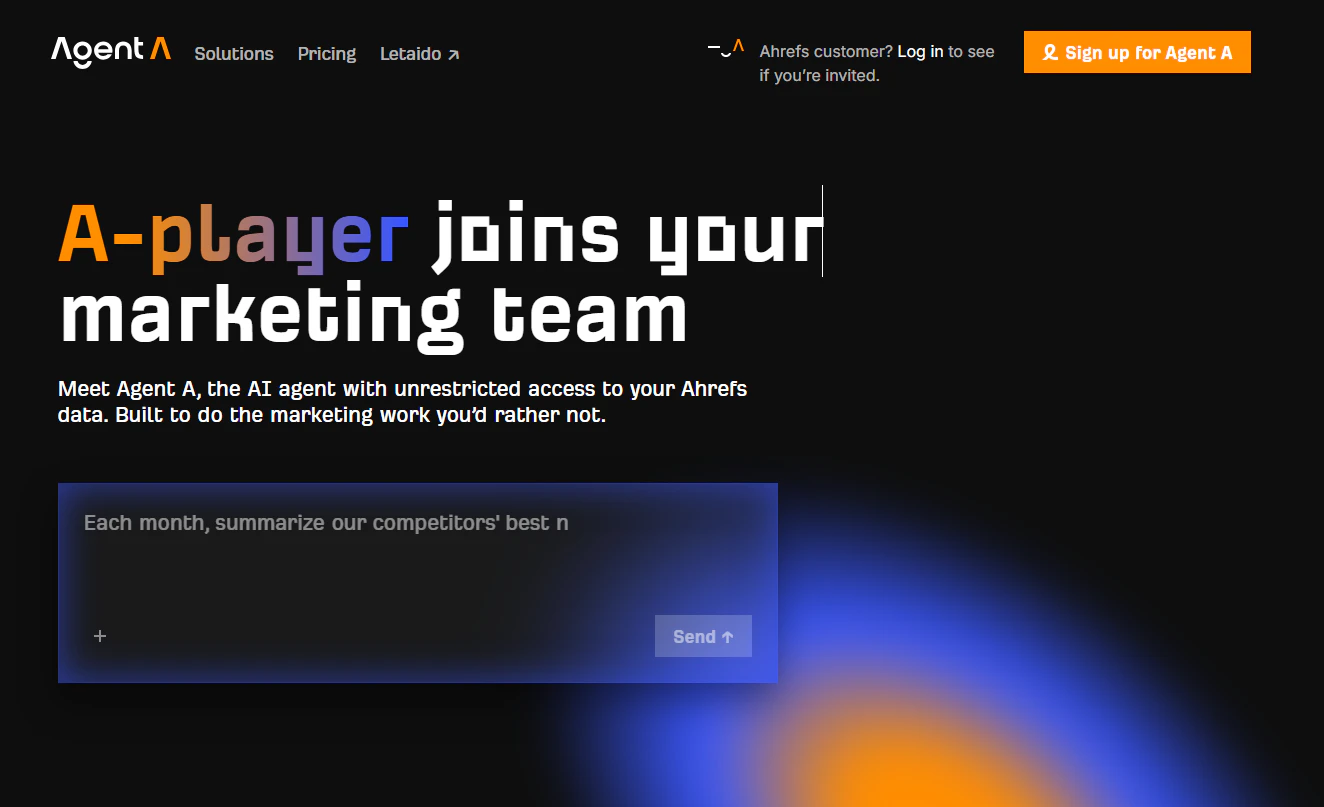
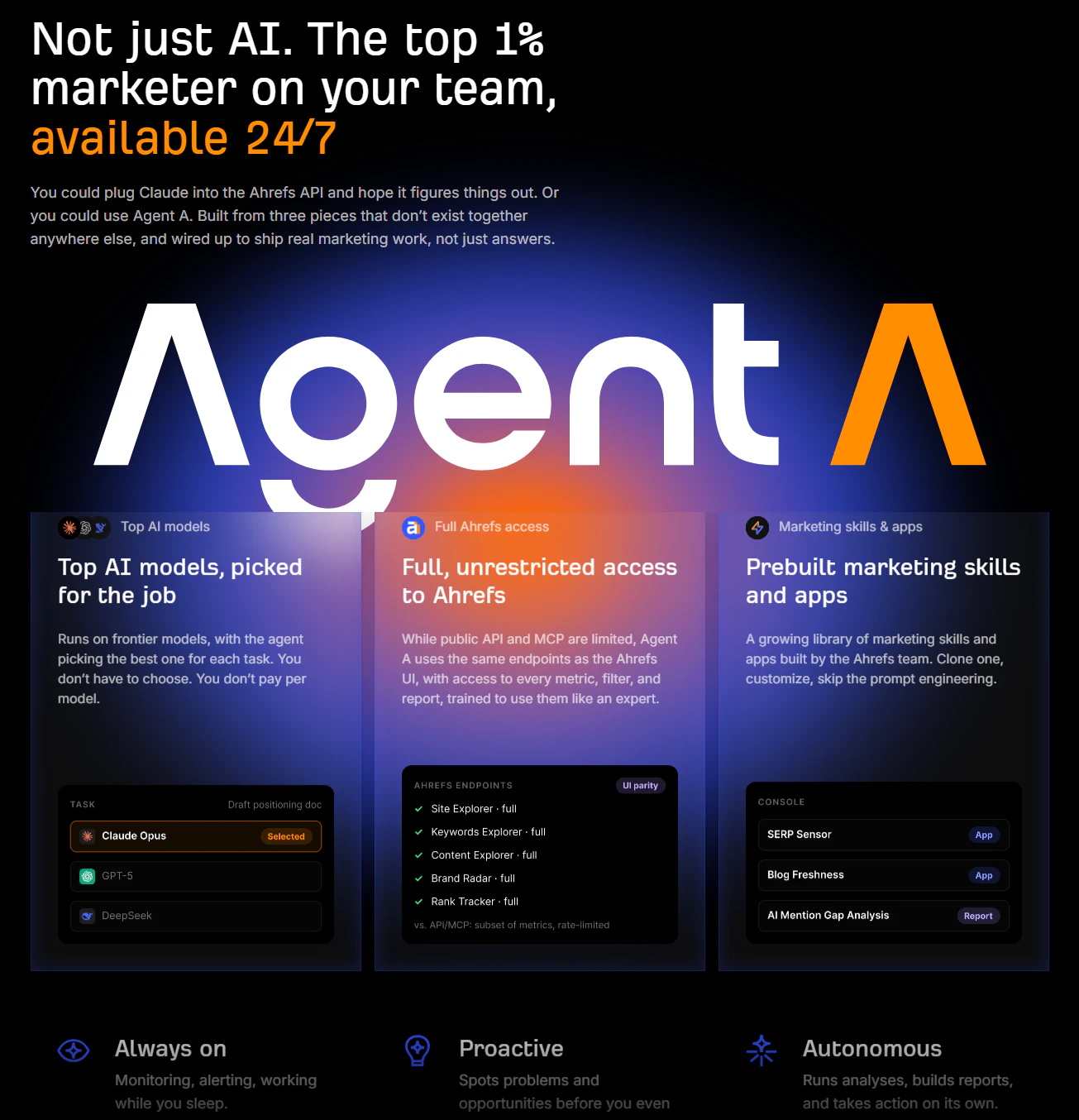
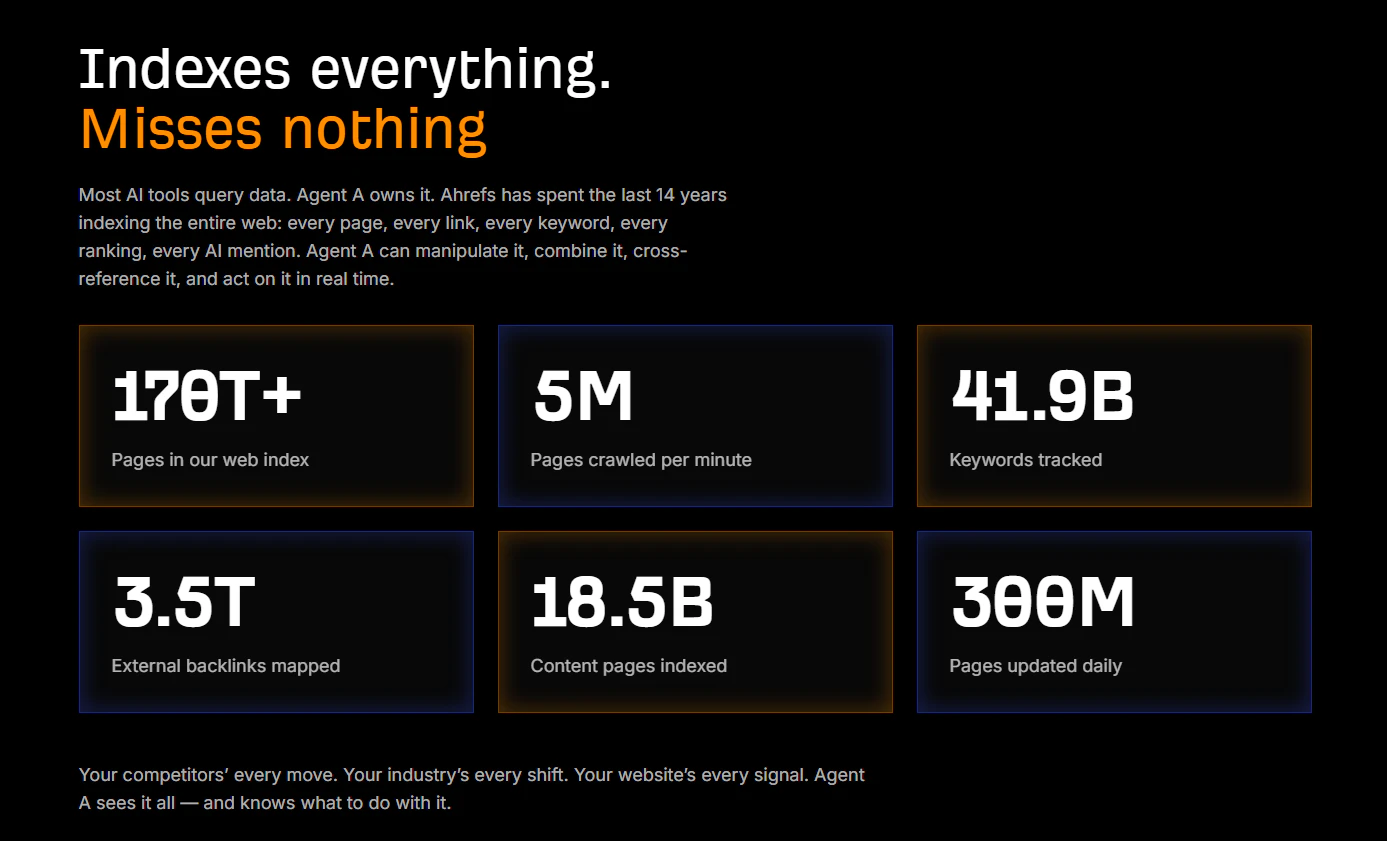
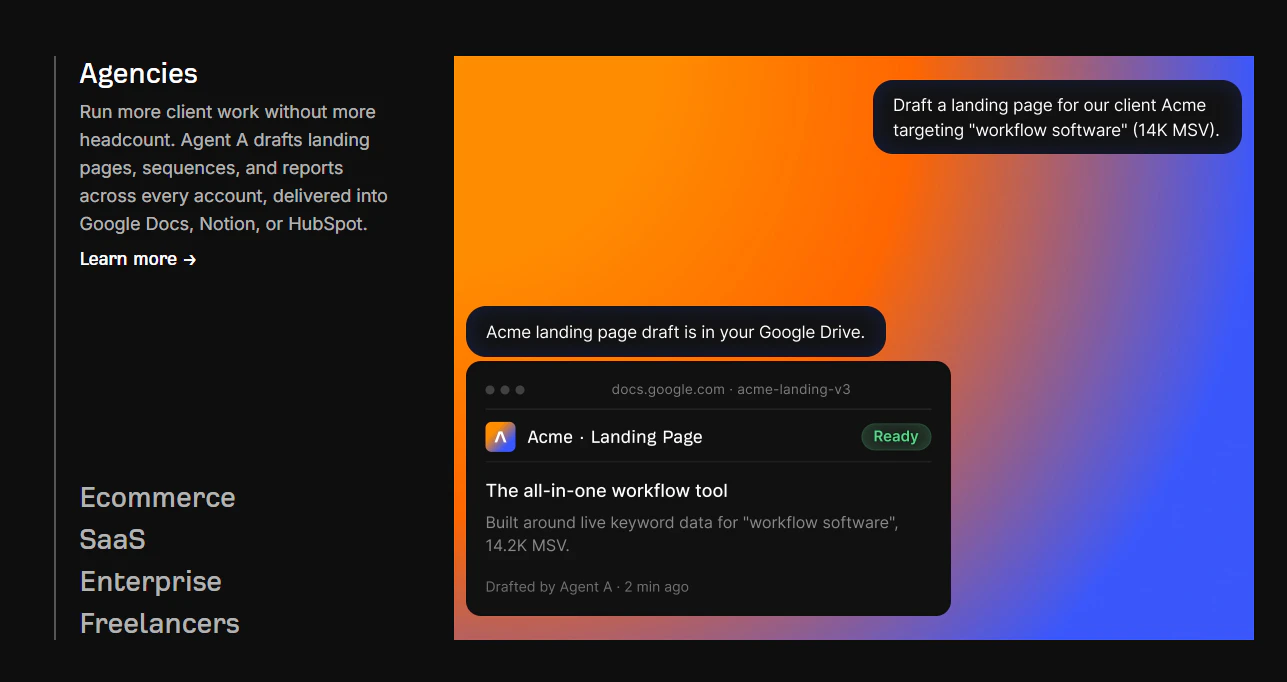
Meet Agent A — the AI agent built on Ahrefs' industry-leading dataset of 170T+ indexed pages. Analyzes, builds, and acts on marketing insights so you can focus on strategy.

Hey Hunters 👋

I am excited to hunt Ahrefs Agent A today.

This feels less like a simple AI SEO tool and more like having a marketing teammate that actually understands search data.

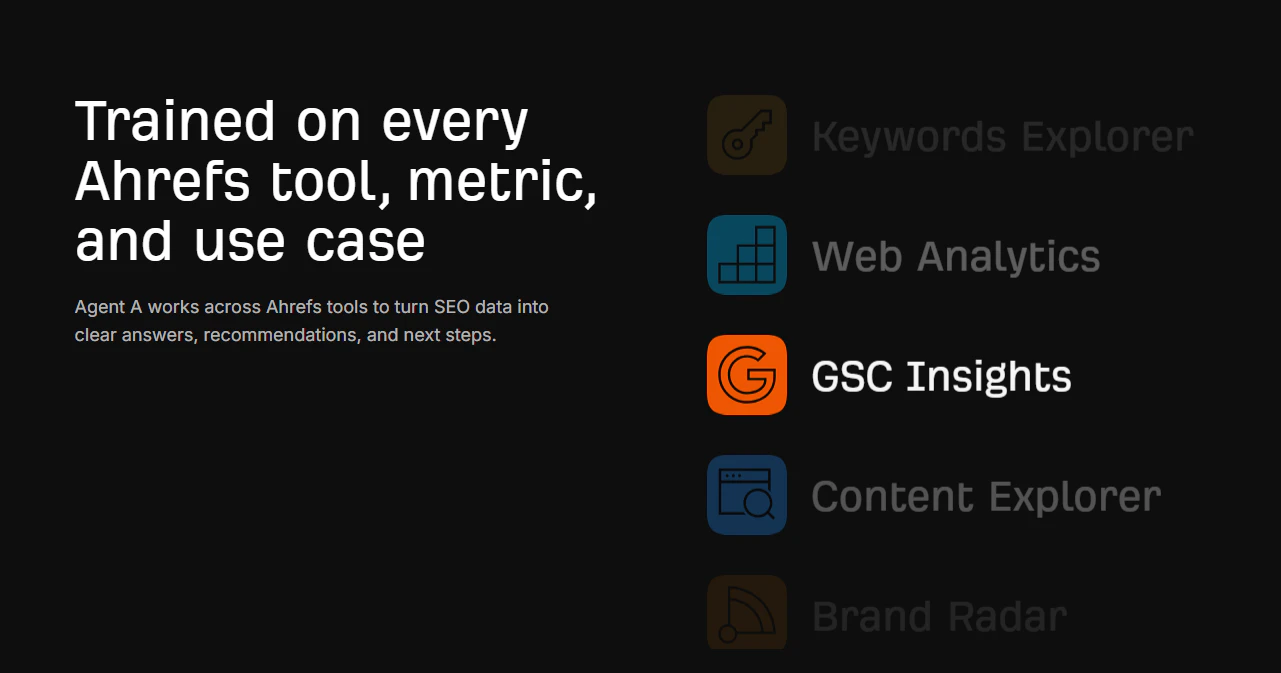
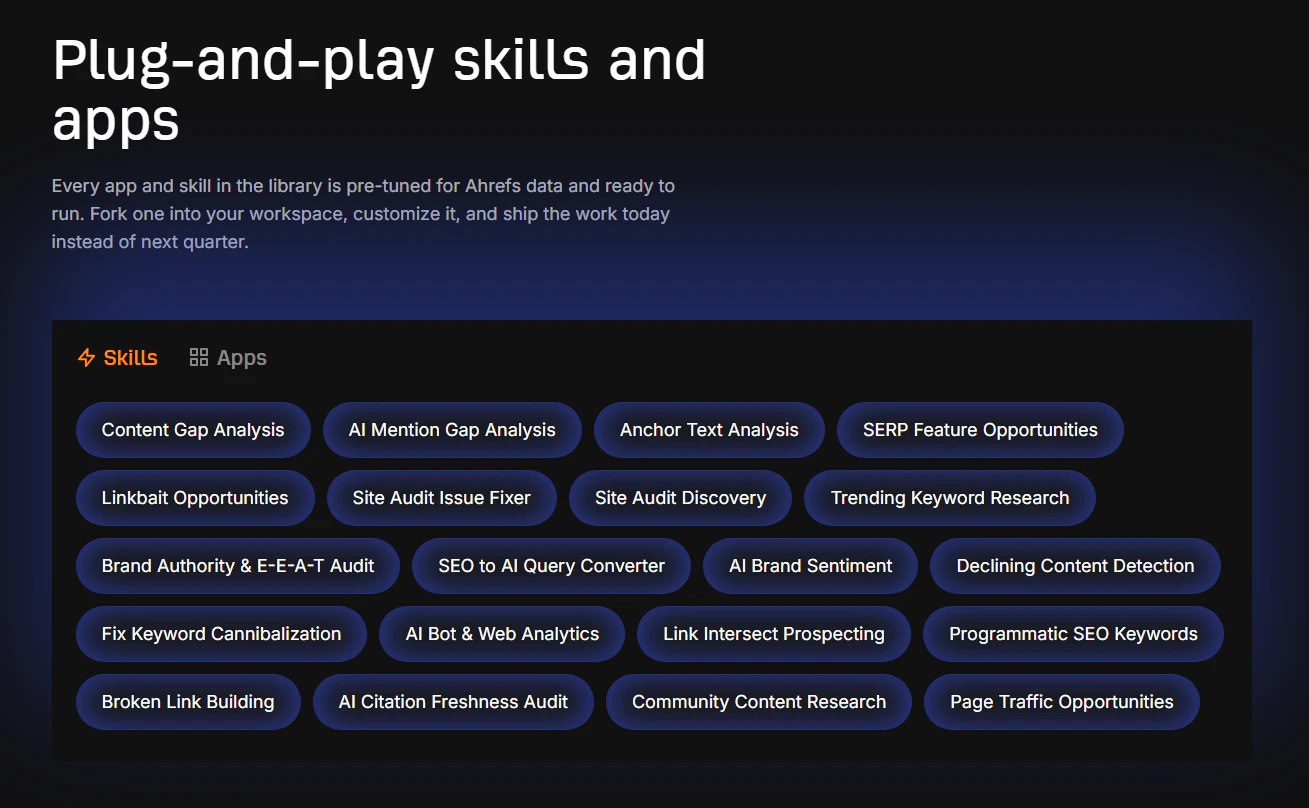
Agent A can handle keyword research, competitor analysis, technical SEO audits, content planning, backlink insights, and even AI visibility tracking — all powered by Ahrefs’ huge search database.

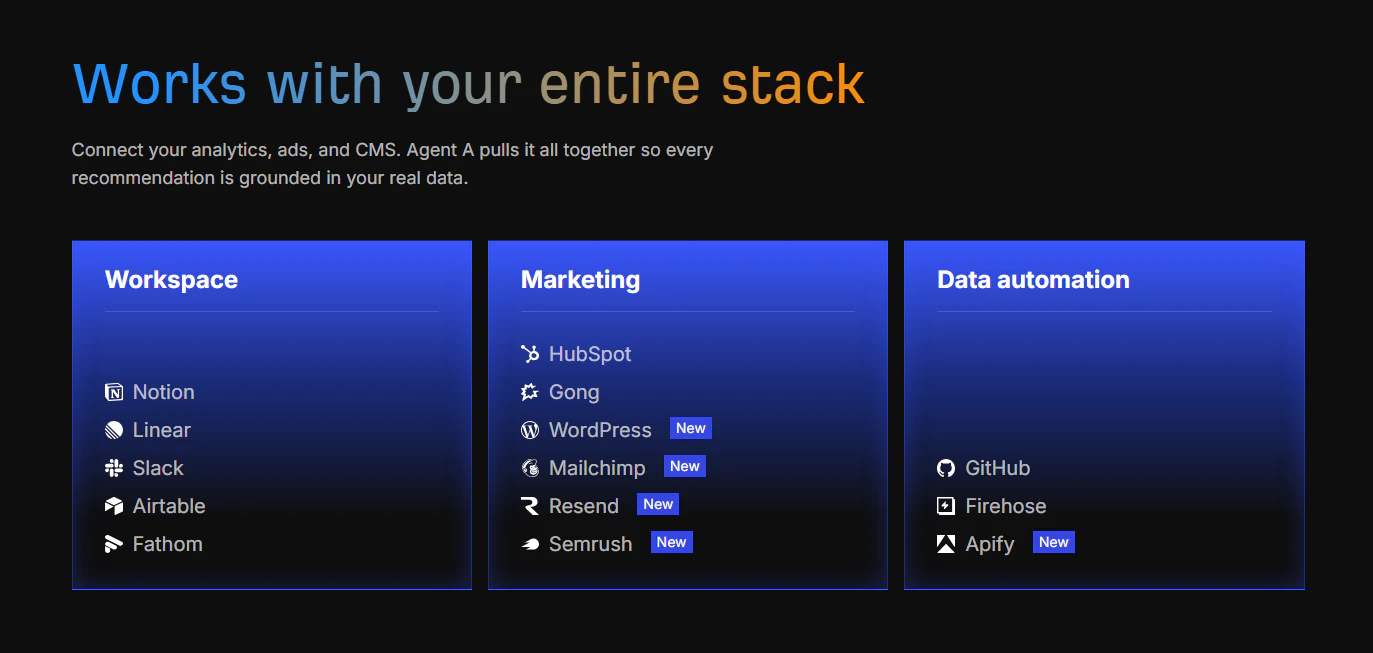
What I really liked is that it focuses on execution, not just generating content. The integrations with tools like WordPress, Notion, Slack, and HubSpot also make the workflow much smoother.

Big congrats to the Ahrefs team on the launch 🚀

2
回复

@saaswarrior The marketing-teammate framing is what hits for me. Most AI tools right now feel like a really fast intern who needs you to direct every step. Something that actually understands the data and runs the workflow end-to-end is a totally different category.

What are people seeing on AI visibility tracking specifically. That's the part of SEO that's exploded into a fog in the last 6 months, and most tools haven't caught up.

Excited to play with Agent A this week. Nice work, Ahrefs team.

0
回复

The useful leap here is not just “AI can execute SEO tasks,” it is whether it can explain priority and uncertainty well enough that a marketer trusts the next action.

For content planning especially, I’d want Agent A to separate a few things that often get blended together: keyword opportunity, SERP constraint, customer language, competitor gap, and the brand’s actual point of view. Those are different inputs. If the agent can show which one is driving a recommendation — and when it decides not to create content — that would be a big step up from dashboards or generic AI briefs.

2
回复

Ahrefs data powering a marketing agent is a strong combo the data has always been the best part, the UI just gets in the way. Does it handle content gap analysis and suggest specific articles to write, or mostly technical SEO tasks?

0
回复

We've spent a surprising amount of time manually watching HN whenever we launch something.

What signal ended up being most predictive for you — velocity of upvotes, comment activity, front-page movement, or something else entirely?

0
回复

Congrats on the launch! Ahrefs has always had the data — adding an agent layer on top of it feels like a natural next step. Curious to see how much manual SEO work it can actually eliminate.

0
回复

ahrefs data is already the best in the game so an agent that can actually act on those insights instead of just showing dashboards is a big step. the gap between 'here's what you should do' and 'done' is where most seo tools stop

0
回复

As a formerish SEO (well, still an SEO inside, my scope has just expanded beyond organic, too), super excited for this launch. Ahrefs has been my go-to tool for years now but it's a hard one to learn + a pricy one. If Agent A can do what it promises, it would help bridge that gap of "hey, this tool is really really useful.... but it's also super hard to learn and turning the insights into actual helpful work is hard unless you have someone on your team with Ahrefs experience"

0
回复
#5
Firecoach AI
AI roleplays that turn reps into top performers
207
一句话介绍:Firecoach AI通过AI销售角色扮演,将团队方法论内化为可重复的实战训练,解决销售团队“培训有但规模化教练缺失”的痛点,在低风险环境中提升代表实战能力。
Sales SaaS Artificial Intelligence
AI销售教练 销售角色扮演 销售方法论 销售培训 销售赋能 AI评分 销售模拟 SaaS工具 团队绩效 销售管理
用户评论摘要:用户肯定产品解决“练习不足”和“教练精力分散”的核心问题。但关注AI评分准确性(是否为关键词匹配)、如何复制顶尖销售思路、以及评分是否会导致代表“演给评分看”而非真正推进交易。建议保持评分可追溯性与人工监督。
AI 锐评

Firecoach AI切中了销售赋能领域一个长期存在的“哑巴痛点”:培训材料堆积如山,但代表在真实场景下依然手足无措。它的直接价值在于将销售方法论从“纸质文档”变为“可对抗的AI对手”,让代表在零风险环境中“犯错”并即时获得反馈——这本质上是在缩短“知道”到“做到”之间的鸿沟。

但产品真正的野心,远不止于一个AI陪练。从披露的技术架构看,其评分层引入了语义评估而非简单关键词匹配,且支持管理者重写评分规则,以及将CRM实际成交数据与角色扮演表现关联——这形成了一个“练习→反馈→真实交易→再校准”的数据飞轮。如果这一闭环能跑通,它将颠覆传统销售教练“凭经验、随机抽样”的粗放模式。

然而,挑战同样明显。首先,将顶尖销售“头脑中的直觉”系统化为可量化的评分标准,本身就极易失真:代表可能通过学习“高分话术”来操纵评分,而非真正提升推动交易的能力。评论区已有用户敏锐指出这一点。其次,依赖Fathom、Gong等第三方笔记工具才能捕获真实通话数据,意味着其数据流的完整性受限于生态合作,且增加了部署复杂度。最后,创始人宣称的“21天复制顶尖销售”在规模化实践中极易演变为“机械化模仿”——真正的销售高手往往赢在临场应变与关系构建,这些难以被任何评分模型捕捉。

一句话总结:Firecoach AI用AI杠杆放大了培训的“密度”和“频率”,但它能否从“好用的陪练机”进化为“可信赖的绩效预测器”,取决于它能否在生产数据与主观判断之间,守住那条危险且微妙的边界。

查看原始信息
Firecoach AI
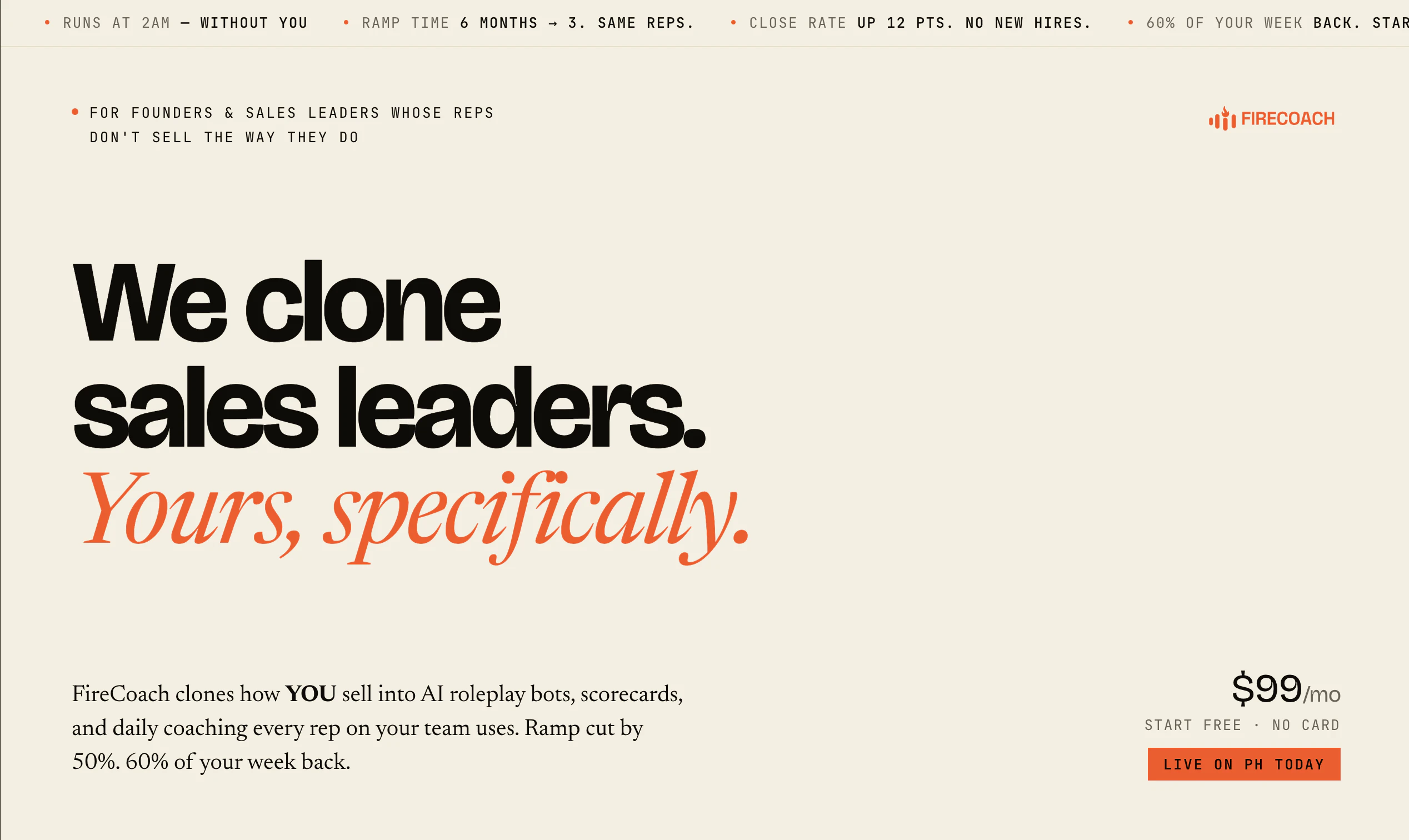
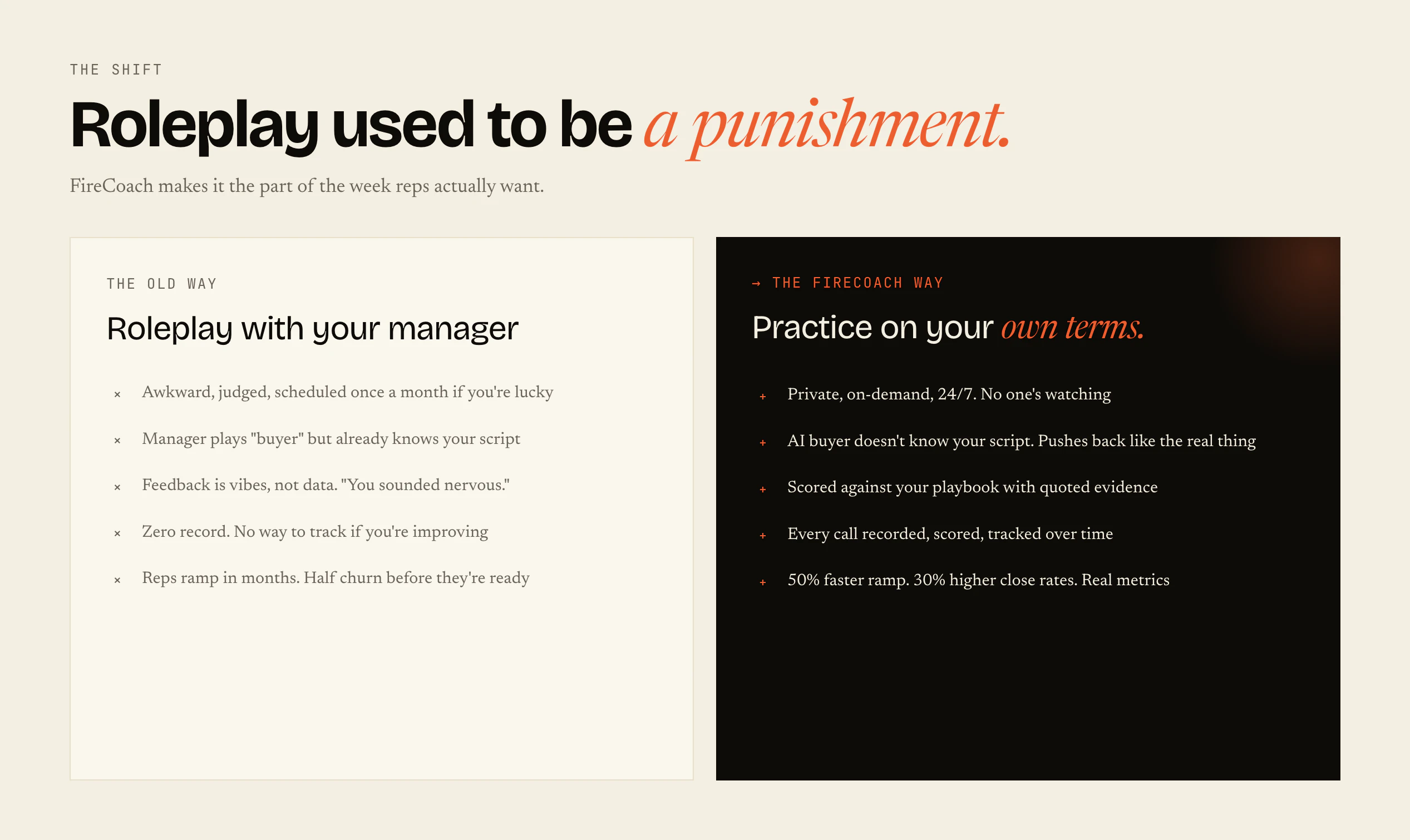
FireCoach.ai is the fastest way to clone your sales methodology and coach every rep on your team — at scale, without adding headcount. Build custom AI sales bots trained on your playbook, run rep roleplays, get scored feedback, and identify coaching gaps before they show up on a lost deal.

Hey Product Hunt 👋

I'm Midori, founder of FireCoach.ai. I've been in sales long enough that I've watched the same thing break revenue at every company I've touched. Two exits in, I finally stopped accepting it.

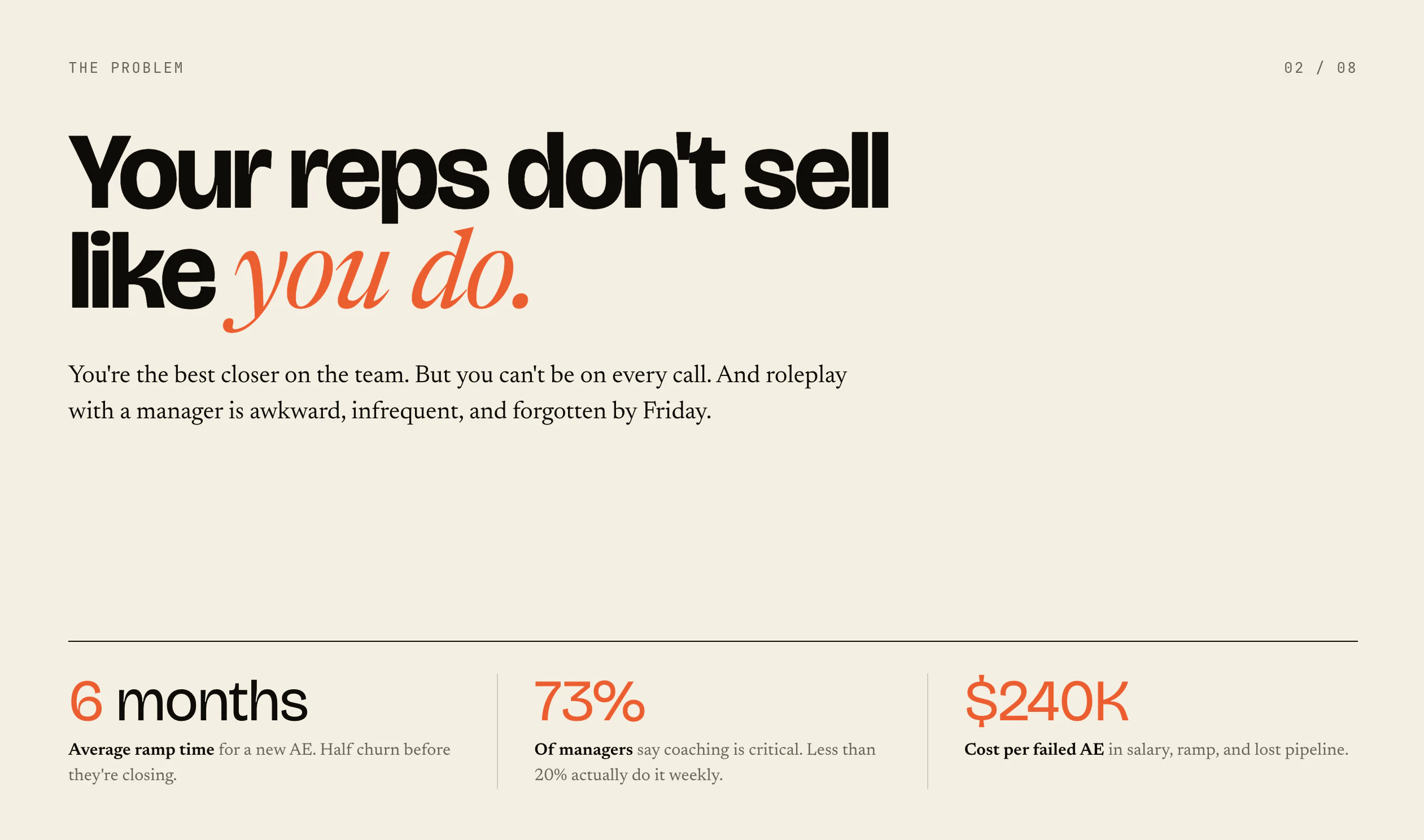
Here's the loop. You hire a rep. You onboard them, pair them with a manager, hand them the playbook (which they skim once and never open again, and you know this). The manager coaches the two or three reps they actually have bandwidth for. Everyone else wings it.

The ones who need help most are the last ones to get it. Usually caught in a deal review, after the pipeline damage is done.

Your best methodology lives in your top coach's head. There's only one of them. And they're already in 12 other meetings.

I talked to 100+ sales leaders in the last year. Every single one said some version of "I can't be everywhere at once." A few of them said it while actively being somewhere they didn't want to be.

So I built FireCoach.ai.

FireCoach loads every rep with your methodology before they ever get on a live call. They go in knowing the objections, knowing the right answers, knowing exactly how to deliver them.

Like having the test questions the night before.

🔸AI bots run the exact buyer conversations your reps will face, before they face them live

🔸Every session scored against your methodology (Gap Selling, SPIN, MEDDIC, or we build one with you if you're running off vibes and instinct, which honestly most teams are)

🔸Reps see exactly where they stumbled and what to say instead

🔸Managers get rep-level visibility into every rep's gaps without sitting on every call

🔸Works with any sales motion: inbound, outbound, enterprise, transactional

🔸Your reps don't walk into calls hoping they remember their training.

They walk in having already won the conversation.

Basically cheating. We're fine with that.

The part most tools skip: adoption. Every customer starts with a PowerSprint → we come in, customize FireCoach to your exact methodology, and we stay until your team is actually using it and getting results. Not a help doc. Not a Loom walkthrough. Us, there, making it stick.

Tool and team. You're not doing this alone.

I'll be in the comments all day with @thisiskp_ @yyogeshwar @vishal_maurya03. If you run a sales team, I want to hear what's actually broken. I'll be straight with you about whether FireCoach fixes it.

Try it free at firecoach.ai 🙏

12
回复

@thisiskp_  @vishal_maurya03  @midori_verity 
This is exactly the gap most sales teams still struggle with — training exists, but consistent coaching at scale doesn’t.The biggest win here is turning top-performer knowledge into repeatable practice before real customer calls happen. That’s where most pipeline leakage actually starts.

“Tool + team” is also the right approach. Adoption is where most enablement platforms fail.

6
回复

@thisiskp_  @yyogeshwar  @vishal_maurya03  @midori_verity congrats on the launch. Whats the modelling process and how do you adapt to different sales leaders styles?

1
回复

@thisiskp_  @yyogeshwar  @vishal_maurya03  @midori_verity 
The "playbook they skim once and never open again" hit hard that's every sales team I've seen. What makes FireCoach stand out is that it attacks the practice gap, not just the knowledge gap. Reps don't fail because they don't know the methodology; they fail because they've never actually rehearsed it under pressure. The scored roleplay feedback loop is exactly what bridges that. Congrats on the launch the "tool + team" PowerSprint approach is smart, adoption is where most enablement tools quietly die.

0
回复

this is cool, we’d use to train SDRs

3
回复

@nick_verity2 - thanks Nick! Happy to set you up. We can accelerate the ramp time significantly and take the workload off your manager. Cheers!

0
回复

Hey PH fam 👋

Thrilled to hunt FireCoach today. This problem statement resonated immediately.

As a sales leader and life long business owner, @midori_verity has seen the same revenue leak at every company she's touched. Not a people problem. Not a product problem. A readiness problem.

Most reps walk into their first real calls carrying half a playbook and good intentions. The coaching they needed happened in someone else's 1:1. The manager with the right instincts was already in 12 other meetings. By the time the gap shows up, it's showing up in the pipeline. So she teamed up with @yyogeshwar and built a solution for this: Firecoach.

FireCoach moves the coaching before the damage happens.

→ 🔸 Reps practice against AI that mirrors your actual buyer conversations

→ 🔸 Sessions scored against your methodology: Gap Selling, SPIN, MEDDIC, or built from scratch

→ 🔸 Every rep gets visibility into their own weak spots before a manager has to point them out

→ 🔸 Managers see rep-level patterns without adding a single meeting to their calendar

What I find most compelling is what happens after you sign up. Most tools onboard you and disappear. FireCoach runs a PowerSprint where the team comes in, customizes everything to your motion, and stays until adoption is real. That's a fundamentally different kind of commitment.

PS: I've enjoyed being an advisor to the team and truly believe they are a powerhouse combo!

The team is in the comments all day. If something in your sales pipeline is quietly bleeding, go tell em what it is. 🙏

3
回复

@yyogeshwar  @thisiskp_ - you've been the most awesome advisor through this experience! The tool is stronger, we've moved fast, and the response has been incredibly positive. Most importantly - you got me to play bigger. Best decision ever! Thank you 🙏

2
回复

Good product, 1 question though -
How do you keep the methodology scoring accurate—is it just keyword matching, or does it actually evaluate the quality of a rep's response?

2
回复

@rutuja_wanjari - Great question. Keyword matching is exactly the trap most early AI coaching tools fell into, and it's why reps quickly figured out how to game them by stuffing magic words into every call.

We use semantic evaluation, not keyword matching. The AI reads the actual response and asks: did the rep handle the objection effectively, did they ask the right discovery questions to uncover pain, did they build trust before pitching, did they actually move the buyer forward.

So a rep can say all the "right" words in the wrong order and still score low. And a rep can use totally different language but score high because they hit the underlying intent of the methodology.

A few things keep it sharp over time. Scorecards are built around your specific methodology and your top performer's actual moves, not a generic AI judgment of "what good sales looks like." Managers can override any score, and those overrides train the system to score sharper next time. And we tie scoring back to real CRM outcomes, so if a "high-scoring" rep isn't closing deals, we know the scorecard is wrong and we tune it.

Keyword matching is fast, cheap, and useless. Quality evaluation is harder to build, but it's the only version that actually coaches anyone.

0
回复

The strongest part here is tying coaching back to real calls and outcomes, not just making roleplay feel realistic.

One thing I’d watch carefully: scorecards can accidentally reward reps for sounding like the methodology instead of actually moving the buyer forward. I’d want every coaching note to keep a source trail: the exact call snippet, the outcome it correlated with, and whether a manager agreed with the interpretation.

That would make the “clone the top performer” promise much more trustworthy, because the team can see what was copied, what was inferred, and what still needs human judgment.

2
回复

@jim_jeffers Ok, this is exactly the trap most sales coaching tools fall into. Glad you named it!

Reps performing to the scorecard instead of to the buyer is real, especially when the scorecard is generic. We hit this hard during early testing (one of our clients caught his AI penalizing reps for objections the buyer never raised), and we rebuilt the whole scoring layer around it.

A few things we did to avoid the trap:

→ Scorecards are tweaked based on YOUR top performer's actual moves, not a generic methodology. "Sounding like the methodology" only counts if the methodology is literally what your best closer does.

→ Manager in the loop by default. Sales leaders edit scoring criteria and can override individual scoring decisions. AI assists. It doesn't judge.

→ Every coaching note links back to the exact call snippet it came from. Reps see WHY they got that score. Managers can verify or push back on the interpretation.

→ We tie scorecard performance to CRM outcomes over time. If a "high-scoring" rep isn't winning deals, the scorecard is wrong, not the rep.

The trust trail is baked in by design. Without it, the clone is just a costume. Thank you for sharing your thoughts!

1
回复

Very cool @midori_verity! Upvoted :)

So how do you train AI on what's in people's heads? Do I need to record my sessions and AI trains on that? And how long will it take to replicate what my best sales person would do?

2
回复

@aiswarya_s Love this question! It's actually the part that gets sales leaders most excited.


There are three layers to how the cloning actually works:

1️⃣ The fast layer (30 seconds)
Pull any prospect from your CRM, paste their website URL, and FireCoach generates an AI version of them, with their real objections and buyer profile, in 30 seconds. No training needed for this part.

2️⃣ The methodology layer
Upload your playbook, scorecards, and sales framework (SPIN, MEDDIC, Gap, whatever you actually run). FireCoach bakes that into how it scores reps and what it pushes them to improve on. Your top performer's instincts become the standard everyone is measured against.

3️⃣ The learning layer (this is where the magic is)
Connect any notetaker (Fathom, Fireflies, Gong, all of them). Every real call your team makes flows back in. Over time, the AI surfaces patterns no human could spot:

→ Which phrases close and which kill momentum
→ What your top rep does differently from your bottom rep
→ Which objections consistently end deals
→ The signals showing up 3 calls before a deal goes cold

So no, you don't have to record sessions for it to work. But the more you feed it (your team's calls, your playbook, your top performer's recordings) the sharper the clone gets.

How long to replicate your best sales person:

→ Practice-ready against a real prospect: same day
→ Custom scorecards trained on your methodology: ~1 week
→ A real, working clone of your top performer at scale: 21 days (this is our Power Sprint program, where we go deep on the methodology, build out the bot army, and onboard your team)

Happy to walk you through it live if you ever want to see it in action! 🔥

2
回复

Congrats on your launch!! Do you tie the coaching insights back to CRM outcomes over time, or is it mainly performance inside the roleplay?

2
回复

@karimbenkeroum Yes, and this is where it gets really interesting.

FireCoach connects to any CRM and any notetaker. Pull a contact from your pipeline, paste a URL, and you've got a Firecard, a full AI persona with their objections and buyer profile, in 30 seconds.


But the bigger play is what happens over time.

Once you've got hundreds (then thousands) of real calls flowing through, you stop guessing and start seeing things no human team could spot manually:

→ The exact language your top performers use that your bottom reps don't (so you can clone it across the team)

→ Where deals consistently stall, which objection kills them, and which reps keep hitting the same wall

→ Which ICPs actually convert vs. which ones eat 6 weeks of pipeline and ghost

→ Language patterns that flip skeptical prospects into curious ones

→ Which competitors keep showing up, how reps handle them, and what they should be saying instead

→ Conversation signals that predict closed-won (or closed-lost) three calls before the deal closes

→ Pricing pressure patterns: when discount talk starts, who folds, who holds the line

→ Product and messaging gaps hiding inside your lost-deal calls (the stuff marketing and product never hear)

→ Whether your coaching is actually moving the needle, by rep, by quarter, with data instead of vibes

Pipeline tells you what happened. FireCoach tells you why, and what to fix before the next deal repeats it.

That's the real unlock.

2
回复

@karimbenkeroum  Thanks! That loop is actually our USP — think of it like the player development pipeline in American sports:

🏟️ Spring Training / Practice Squad → Roleplays Daily reps in FireCoach. Low stakes, high volume. This is where reps get logged, mechanics get fixed, and the playbook gets drilled. Like a rookie running routes in OTAs or a pitcher working the bullpen — nobody's watching the scoreboard yet.

📊 Combine Metrics → Coaching Insights Every roleplay throws off measurables — objection handling, discovery depth, talk-time ratio, closing cadence. Same as a 40-yard dash, vertical leap, or exit velocity. Quantified strengths and gaps, rep by rep.

🏆 Regular Season → Live CRM Calls Now you're on the field. Real prospects, real pipeline, real W's and L's. The CRM is your box score — deals won, conversion rates, cycle times, ARR booked.

🔁 Film Room → The Feedback Loop (this is the USP) We tie Sunday's game tape back to Wednesday's practice. If a rep is losing deals at the discovery stage in HubSpot/Salesforce, FireCoach knows which roleplay drills to prescribe next. Practice performance → game performance, with a measurable causal link.

🥇 Playoffs / All-Star Selection → Top Performers Reps who put in the practice reps and convert in CRM rise to the top. Data-backed MVPs, not gut-feel favorites.

The thesis: practice tape predicts game tape. And we close the loop so the manager-coach can finally prove it.

2
回复

Nice idea, would be very beneficial for my team as well. What CRM can you integrate? I'm assuming SalesForce, how about SAP CRM?

1
回复

@jsa0607 Hi Jerome - we can integrate any CRM. Happy to create a custom roleplay twin of your ideal prospect to check out. Lmk if you're game!

1
回复

@jsa0607 we can work out SAP CRM for you team , lets connect https://calendly.com/fuel-to-fire/demo-firecoach

1
回复
#6
MCP Bridge by Appfactor
Connect any API to any AI agent
195
一句话介绍:MCP Bridge 是一款面向企业级AI代理的开源中间件,通过自动将REST、GraphQL、SOAP、gRPC等多种老旧或异构API转化为标准化MCP工具定义,解决了在生产环境中直接调用企业API时面临的认证复杂、协议混乱、治理缺失及上下文膨胀等痛点。
API Developer Tools Artificial Intelligence
MCP服务器 API网关 AI代理 企业级集成 开源 自动生成工具定义 多协议支持 可观测性 安全治理 身份认证
用户评论摘要:核心需求是处理“不干净”的API:非OpenAPI标准、多步认证、错误码无规则。用户认可其OAuth、Cognito等复杂认证支持,以及内置的提示注入防护和令牌生命周期管理。开发者对自动生成的架构在处理GraphQL联合和gRPC反射上表示肯定,同时指出对纯REST尚需OpenAPI的短板。社区普遍认为,解决了“手写MCP服务器”的规模化难题。
AI 锐评

MCP Bridge 精准击中了当前AI工程化浪潮中的一个硬核痛点——并非“连接API”,而是“治理混乱”。它没有追逐花哨的Agent功能,而是回归到基础设施层面,解决企业遗留系统与现代LLM代理之间的协议沼泽。

其真正的价值不在于“自动生成MCP定义”这个炫酷能力,而在于它作为单一控制平面,切入的是架构层面的“N+1连接器问题”。通过将认证、限流、响应归一化、审计和成本追踪内聚到一个自托管的服务器中,它让企业安全团队不再担心Agent越权(通过“人工介入确认”和“敏感度分级”),同时也让开发团队从维护数十个脆弱的“胶水脚本”中解放。

但必须指出,其宣称的“任何API”仍有明显软肋:对纯REST端点缺乏样本推断能力,仍依赖OpenAPI;其强大的“响应转换沙箱”虽然灵活,但引入JavaScript执行增加了潜在的攻击面和性能开销。另外,社区讨论中“Token自动刷新”和“撤销传播”这类细节才是真正挑战——这些功能在企业级生产环境中需要极高的健壮性,开源社区的维护深度决定了它的上限。

总的来说,MCP Bridge不是给玩票的极客准备的玩具,而是为那些要处理SAP、Salesforce或自研遗留系统的CTO准备的工具箱。它解决了AI代理从“实验”到“投产”之间最核心的信任和控制问题。如果后续能在REST盲区填补和沙箱性能优化上持续投入,这可能是MCP生态中第一个真正“企业就绪”的桥接基础设施。

查看原始信息
MCP Bridge by Appfactor
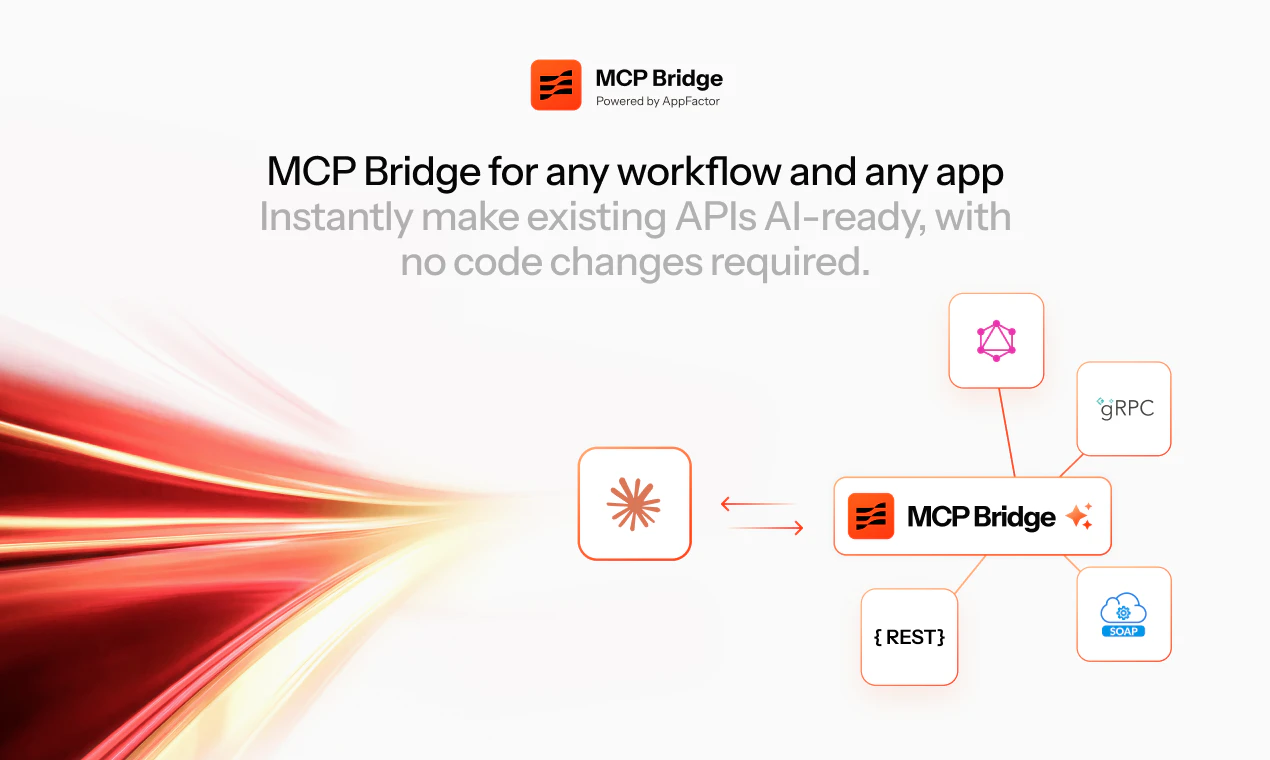
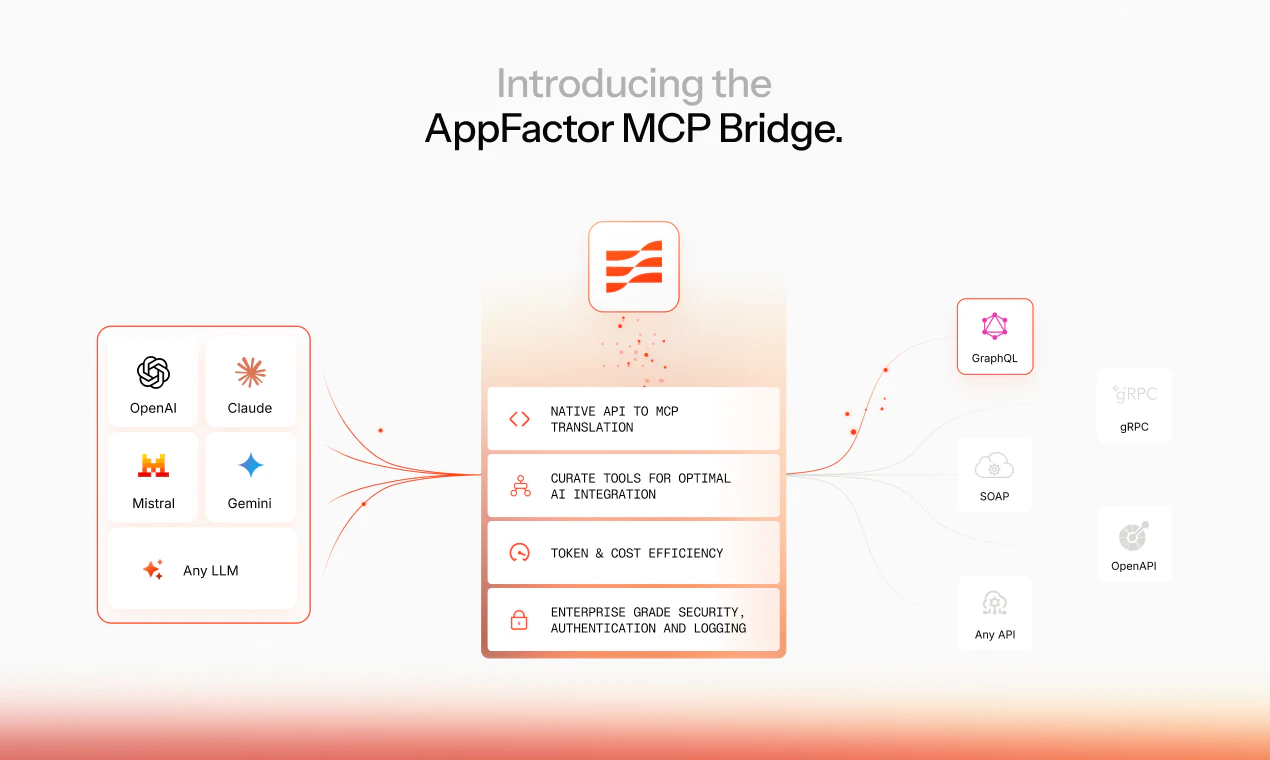
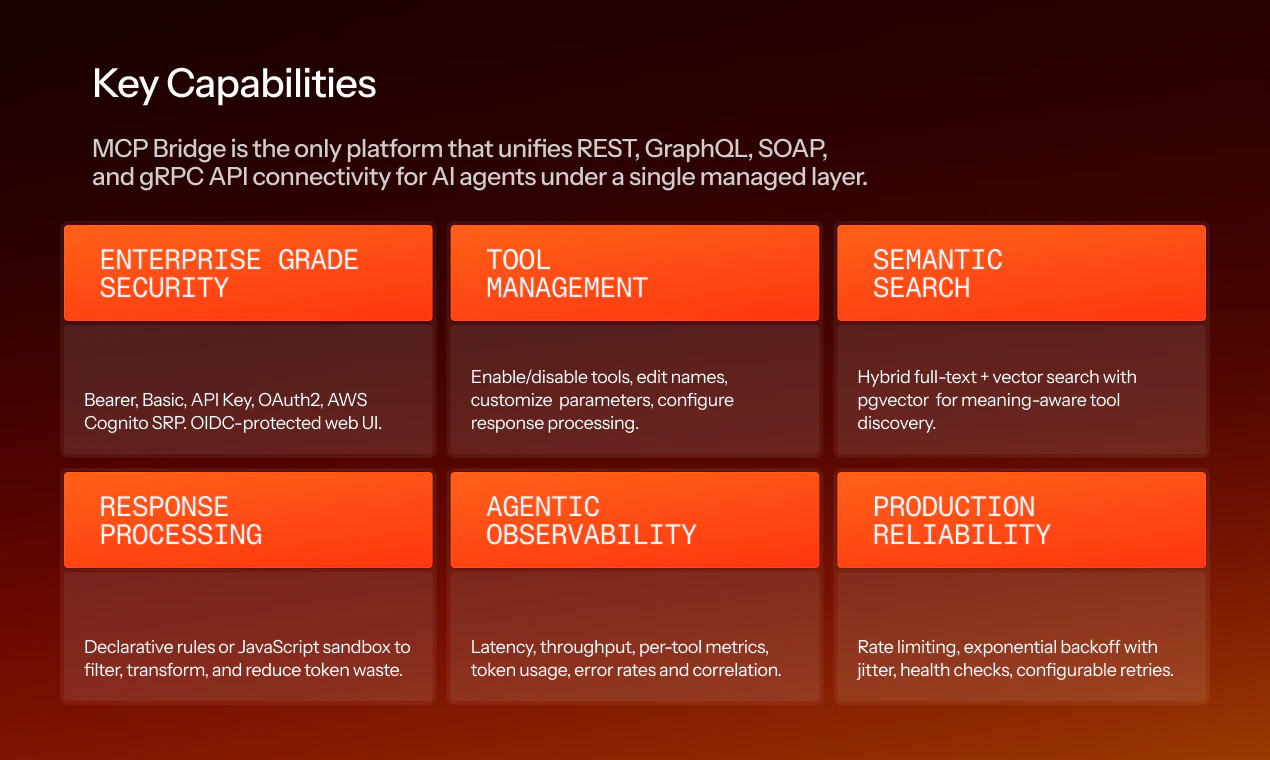
Point MCP Bridge at any REST, GraphQL, SOAP, or gRPC API. It auto-generates MCP tool definitions with typed schemas, auth, rate limiting, and response processing. Your LLM agents call enterprise APIs through one standard interface.

Hi builders!


Keith here, CEO and co-founder of AppFactor. Really excited to ship this one.

The story
We built MCP Bridge for our own need, not an idea.
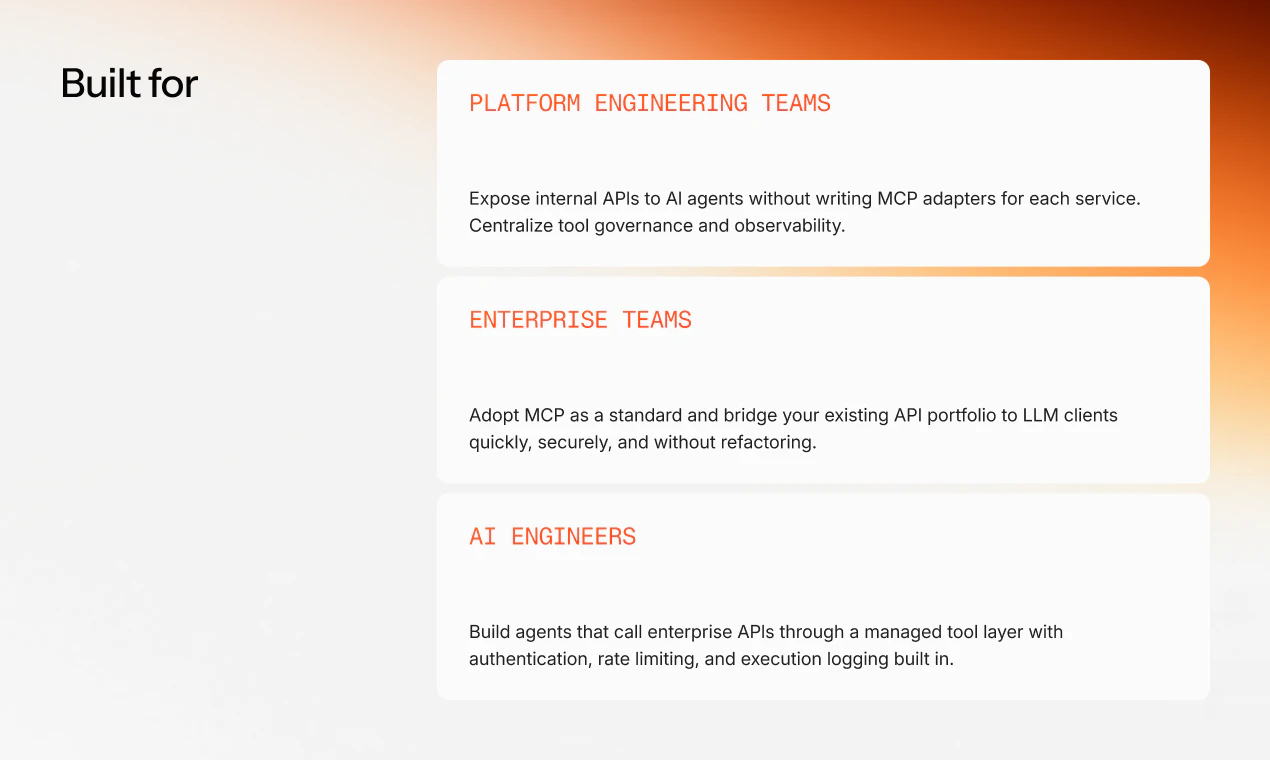
At AppFactor we've spent years building deterministic tools for an orchestration system of agents that deliver autonomous software maintenance. Infra and software discovery, scanning orchestration, build engines, deployment automation. As we layered our upcoming agentic platform (ForgeCatalyst) on top to harness these tools, we hit the wall every team building production agents eventually hits. Security, governance, cost/token usage, observability...
The AppFactor system requires meaningful validations, in environments where governance, security and controls are paramount when acting on customer code. With large complex API's with many tools, comes the next challenge - context constraints and efficiencies and multiple protocols to support.
The standard fix is to hand-build a dedicated MCP server for every API. This doesn't scale. We know we are not alone with our requirements and given the domain we operate in which is all about software maintenance, legacy transformation and the eternal battle of trying to bridge the past to the future. We recognised that not all systems have clean, well presented OpenAPI spec API's. There are many API protocols, and almost all API's were indeed built before agents and LLM's became an exciting real world proposition. That poses challenges in how these tools are invoked and consumed. So we built MCP Bridge to address all of these challenges.
You know the rest of the story.

What it does
Point it at any REST, GraphQL, SOAP, or gRPC API. It auto-generates fully-typed MCP tools with behavioral annotations and smart response processing. Self-hosted. Open source. Credentials never leave your environment.

What's shipped

  • 4 API types, end-to-end

  • 6 auth methods (Bearer, Basic, API key, OAuth2, Cognito SRP)

  • Human-in-the-loop approval for destructive ops

  • Code Mode: 3 meta-tools replace 100+ definitions, ~98% less context

  • Analytics: latency, token cost, errors per tool

  • Built in Rust (Dioxus + Axum), PostgreSQL, in a container


We're in the comments all day. What APIs would you connect first? And how should we improve?

Happy building!

Keith
→ MCP Bridge: https://mcp-bridge.ai/
→ Docs: https://docs.mcp-bridge.ai/

Thanks @fmerian for hunting us!

9
回复

Most "connect any API" tools mean "connect any API that already has an OpenAPI spec and clean auth." What does MCP Bridge actually do when you're dealing with something messier, like a legacy REST endpoint with inconsistent error codes or an API that requires a multi-step auth handshake before you can do anything useful?

Congrats for the launch!

6
回复

@fberrez1 Honestly, this is the right critique to make — OpenAPI-only tooling falls apart on the second enterprise customer.

How MCP Bridge layers it:

1. OpenAPI / WSDL / GraphQL as a starting point, not the finish line. The Tool Builder imports what you have, but it generates an editable tool definition, not a sealed wrapper.

2. Adapters for response normalization — when an API returns 200 with `{"error": "..."}` in the body, or different error shapes per endpoint, you write a small transform (JavaScript, runs in our sandbox) that maps the mess to a consistent contract. The agent sees a clean tool; the bridge does the dirty work.

3. Multi-step flows as a single tool — auth handshake → token cache → main call → response shaping is one composable tool from the agent's perspective. The LLM never has to reason about flow state.

4. Custom auth handlers — not just OAuth and API keys. We've shipped tools against APIs that want a nonce signed with a private key, exchanged for a session token, then the real request. Three calls and some crypto — one tool to the agent.

5. Failure shaping — inconsistent status codes get classified at the adapter layer into a retry/no-retry decision, so the agent doesn't have to figure out whether a 200 with an error body means "try again" or "give up."


Most "connect any API" tools assume the world looks like Stripe. Enterprise APIs don't. The Tool Builder and the sandbox exist specifically to handle the gap between what's documented and what actually works.

6
回复

So happy to launch MCP Bridge! 🚀

4
回复

@knarik Let's go!

1
回复

@knarik S/O for the launch! Enjoy

0
回复

Auto-generating typed MCP schemas from SOAP and gRPC alongside REST is the hard part others skip. We've spent cycles manually wrapping customer-side APIs with inconsistent auth patterns just to get an agent to call them reliably. How does schema inference hold up for APIs without an OpenAPI spec, or ones where the response shape varies by query?

3
回复

@retain_dev Nailed it — that's the part we leaned into. gRPC and GraphQL need no hand-written spec: we pull typed schemas from server reflection / introspection live off the endpoint (gRPC even synthesizes tool descriptions from message fields when proto comments are missing). SOAP uses the WSDL. The one honest gap is REST — we still need an OpenAPI spec, no inference from sample payloads yet.
For varying shapes: GraphQL unions → oneOf, nullables → anyOf, OpenAPI oneOf/anyOf preserved, gRPC treated as dynamic; plus a response-processing layer that rewrites the advertised output schema to match what the agent actually gets back.

2
回复

the security breakdown in the comments is the most honest thing I've read on a PH launch. most tools in this space skip the 'what happens when your agent gets prompt injected' conversation entirely. the 3-level sensitivity guardrails and credential encryption is how this should be built

3
回复

@tina_chhabra Hi Tina,

That is very kind of you. Thank you for the feedback and your support.

0
回复

the auto-generated schema approach is smart. biggest pain point with MCP right now is writing tool definitions by hand for every API you want to connect. curious how it handles APIs with inconsistent response formats across endpoints?

3
回复

@ozandag Thanks — yeah, the hand-written tool definition tax is the largest hidden cost in MCP today, especially when you've got 200+ endpoints to expose.

For inconsistent response shapes across endpoints, the approach is:

1. Auto-gen from the spec, refine from real responses. OpenAPI is often wrong or under-specified, so the Tool Builder lets you feed in actual sample responses and update the schema to match what production really returns. Spec says one thing, reality says another — reality wins.

2. Per-endpoint response transforms. Each tool has its own normalizer slot. Endpoint A returns `{data: [...]}`, endpoint B returns a bare array — a set of declarative rules are predefined. Written once per endpoint, not per call.

3. Canonical field names. When the same concept appears as `user_id`, `userId`, and `uid` across endpoints, the adapter maps them to one canonical form.

Auto-generation gets you ~70% there for clean APIs, maybe ~30% for legacy.

5
回复
What kind of security risks and bad actors threats do you anticipate with a tool like that? And how should users monitor and prepare for that?
3
回复

@kjlis Great question. The threat categories we take most seriously with MCP today:

- Prompt injection through tool responses — malicious servers return content that hijacks agent reasoning

- Confused deputy — agents inherit the union of all tool permissions, so a harmless tool becomes dangerous when it sits next to a powerful one

- Credential aggregation — MCP servers concentrate OAuth tokens and become high-value targets

- DNS rebinding / host header attacks on local MCP servers

- Tool description poisoning — descriptions are part of the prompt, so they can be weaponised to bias tool selection


What to monitor:

- Audit log every tool call with full I/O

- Egress traffic from the agent runtime

- Tool description changes over time

- Token usage patterns per integration


In MCP Bridge we lean on per-tool scoping, sandboxed execution for generated code, and full audit trails — the enterprise customers we work with treat agent runtimes the same way they treat any other privileged service, and that's the right instinct.

6
回复

We've run into this problem a few times while connecting different agent workflows. The integration itself is usually easy, but keeping everything reliable once multiple tools start talking to each other is where things get messy.

Are most teams using MCP Bridge as a central layer between agents, or more as a quick way to expose existing APIs to AI tools?

2
回复

@zaid_mallik1 Thanks Zaid,

It's depending on the goals and pain points they have had to date. Some teams are starting with the second use case: exposing existing APIs (REST, SOAP, gRPC, GraphQL) to their agents without having to build and maintain a dedicated MCP server per system. That's the fast win.

But many teams getting real value treat MCP Bridge as the central connectivity layer. One control plane for auth, governance, observability, and protocol translation across all their agent workflows. Once you have more than two or three agents talking to more than a handful of systems, the "one MCP server per API" approach collapses under its own weight (sprawl, context bloat and then high costs!, inconsistent auth). Exactly the mess you're describing.

0
回复

Finally, a product to help you create a MCP server, fast and reliable. It's about time! If you don't use @MCP Bridge by Appfactor, you're ngmi.

S/O for the launch, ?makers

2
回复

@fmerian Thanks so much for the support!

1
回复

This could save developers a lot of integration time.

2
回复

@nithin_raju1 Thanks Nithin, Yes!!!! It's also of course about trying to reduce the maintenance surface area of many MCP servers, that often lack standardization or guardrails. Observability then becomes a major issue too.

1
回复

How does auth work when the target API needs OAuth? that's the part that always kills these tools for me

1
回复

@trekh Totally fair — auth is where a lot of these break. We support OAuth2 client-credentials (and password grant) for target APIs: MCP Bridge fetches, caches, and auto-refreshes the token server-side so the agent never touches it. Plus Bearer/Basic/API-key, Cognito SRP, and WS-Security. Credentials are encrypted at rest.

2
回复

Using MCP as the standard transport is a smart call. Agents get structured tool definitions without any custom adapter code. We've hit the N+1 connector problem repeatedly building AI agents that need to talk to CRMs and ticketing systems. How do you handle auth token lifecycle when agents discover and invoke new endpoints dynamically?

1
回复

@anand_thakkar1 Quick reframe — MCP Bridge actually eliminates the N+1 situation by construction: it's a single MCP server that fronts every integration. Your agent connects once and discovers tools across all your CRMs, ticketing systems, and whatever else through that one endpoint. No per-system connector glue on the agent side.

The real question then is how we handle token lifecycle inside that single server when an agent is invoking tools dynamically across many backends:

1. Refresh happens at the bridge, invisible to the agent. We hold refresh tokens server-side, track expiry, and refresh proactively (or on a 401 retry). The agent's tool call either succeeds or gets a clean error — it never has to reason about token state.

2. Tokens are bound to integration, not to the agent. When a tool is invoked, the bridge looks up credentials keyed by the authenticated end user on whose behalf the agent is running, not anything the agent provides.

3. Scope mismatches trigger re-consent at the human layer. If an agent reaches for an endpoint whose required scopes aren't covered by the existing grant, the bridge returns a structured "needs consent" response and the OAuth flow runs with the human user. The agent doesn't get to escalate on its own.

4. Revocation propagates. When an upstream system revokes a token, or a user revokes consent in our UI, the cached binding is invalidated and subsequent tool calls fail with a clear signal rather than a 401 storm.

5. Audit per tool call. Every invocation logs which credential was used, when it was last refreshed, and which user it was bound to. SOC2 table stakes, but also what lets you actually debug "why did the agent suddenly start failing on Salesforce."

Tool selection is fully dynamic when the underlying integrations are pre-authorized. A brand-new system the user has never connected still needs a human-in-the-loop first consent — no auth model gets around that. The trick is making that the only manual step.

1
回复

Congrats on your launch @keith_neilson @ehw_appfactor @knarik !

You provide any way to test the MCP tool definitions created as well?

1
回复

@aiswarya_s thank you! 😊

1
回复

@aiswarya_s  Yes — there's an inline test runner in the Test Console. You can invoke a tool directly against the real endpoint, inspect the response, and verify the schema and adapter produce what you expect. Tightens the build-test loop a lot.
Another way is to use the MCP Inspector connected to MCP Bridge.

2
回复

How do you handle user permissions without leaking secrets to the agent?

1
回复

@thamibenjelloun Agent never sees any permissions nor credentials. Credentials used to access an API, are stored encrypted by the Bridge itself. The Agent interacts only with tools/prompts/resources.

On top of that, optional input/output guardrails to protect tool execution.
Input guardrails detect prompt injection patterns in tool arguments (3 sensitivity levels: Low, Medium, High — covering role-play jailbreaks, XSS, SQL injection, role tag injection).
Output guardrails detect sensitive data in API responses across 8 categories (SSN, credit cards, AWS keys, GitHub tokens, JWTs, API keys, emails, phone numbers) with per-category detect-and-log or detect-and-redact modes. Per-tool overrides. Violations logged to MCP clients in real time. Off by default — configurable via Settings UI

2
回复

"Any API" is the key claim does it handle APIs that require OAuth or custom auth flows, or mostly simple API key setups? That's usually where these tools hit a wall.

0
回复
#7
Integuru
Generate fast, reliable APIs for any platform. No browsers
163
一句话介绍:Integuru通过逆向工程直接对接平台后端,为缺乏官方API的网站自动生成高速、可靠的API,解决AI Agent和垂直AI公司在构建集成时因依赖浏览器自动化而面临的延迟高、稳定性差和维护负担重的问题。
API Developer Tools Artificial Intelligence
API生成 反向工程 AI集成平台 无浏览器自动化 后端直连 自动修复 会话管理 垂直AI 企业级集成 SaaS集成
用户评论摘要:用户普遍认可解决浏览器自动化脆弱的痛点,关注点集中在:如何应对后端变动和自动修复时间(分钟级);处理身份验证、OAuth、SSO及短生命周期token的细节;数据安全与合规性(是否会被平台封禁);多步骤认证流程(如reCAPTCHA)的处理方式。用户建议扩展至社交媒体平台。
AI 锐评

Integuru的巧思在于,它不再与网站的前端DOM或自动化脚本的脆弱性缠斗,而是将AI的逆向工程能力聚焦于一个更稳定、更底层的目标——后端通信协议。这本质上是一种“降维打击”:既然前端UI会变、选择器会漂移、加载会延迟,那我就直接跳过这一切,监听并复刻浏览器与服务器之间的网络流量,将临时性的HTTP请求固化为可复用的API。

从商业价值看,它精准切入了垂直AI公司(医疗、物流、法律等)最“痛”的环节——与客户遗存的、没有现代API的系统对接。这些系统通常老旧、封闭,但又是业务核心。放弃RPA和浏览器自动化,意味着Integuru承诺的不仅是3秒响应和99.9%成功率,更是一种从“运维灾难”到“运维外包”的范式转换。其24/7在线维护团队和自动修复能力,将集成后最大的隐性成本(凌晨两点的故障排查)直接内化,这是其定价权的来源。

然而,必须警惕其核心能力的“脆弱面”。逆向工程毕竟游走在灰色地带,其合法性依赖于目标平台的ToS以及当地法律解释。此外,多步骤OAuth、MFA、reCAPTCHA等常见的现代安全机制,是其AIsession层能否真正普适的试金石。如果只能处理简单的账号密码登录,其应用范围将大大受限。更根本的挑战在于,如果主流SaaS平台(如Salesforce)选择主动升级其反爬策略,甚至直接封禁模拟请求的IP,Integuru的“auto-healing”能否跟上这种“军备竞赛”的节奏,将决定它是一款精巧的工具,还是一种随时可能失效的变通方案。

查看原始信息
Integuru
Integuru generates fast, reliable APIs for any platform, without browsers or RPA. API calls complete in ~3 seconds with 99.9%+ success. Most agents today use browser automation to control web apps that lack official APIs, but this is slow and brittle. Integuru replaces browsers entirely and connects directly with the backend. Integuru covers authentication and edge cases. Integrations get auto-healing, API docs, and a 24/7 on-call maintenance team. Each API is generated end-to-end in minutes.

Hey PH! 👋

We’re the founders of Integuru, an AI-powered integration platform.

AI agents need to access external platforms, but most platforms don’t offer official, accessible, or comprehensive APIs. That makes integration the single biggest bottleneck.

To build integrations, most companies today use browser automation. But many of them have now outgrown their browser implementations. They’re running into issues with latency, reliability, and throughput.

Introducing Integuru: an AI platform that automatically reverse-engineers a website’s backend. It generates integrations that directly hit website servers. Today, our main users are vertical AI companies in healthcare, logistics, proptech, legal, and more.

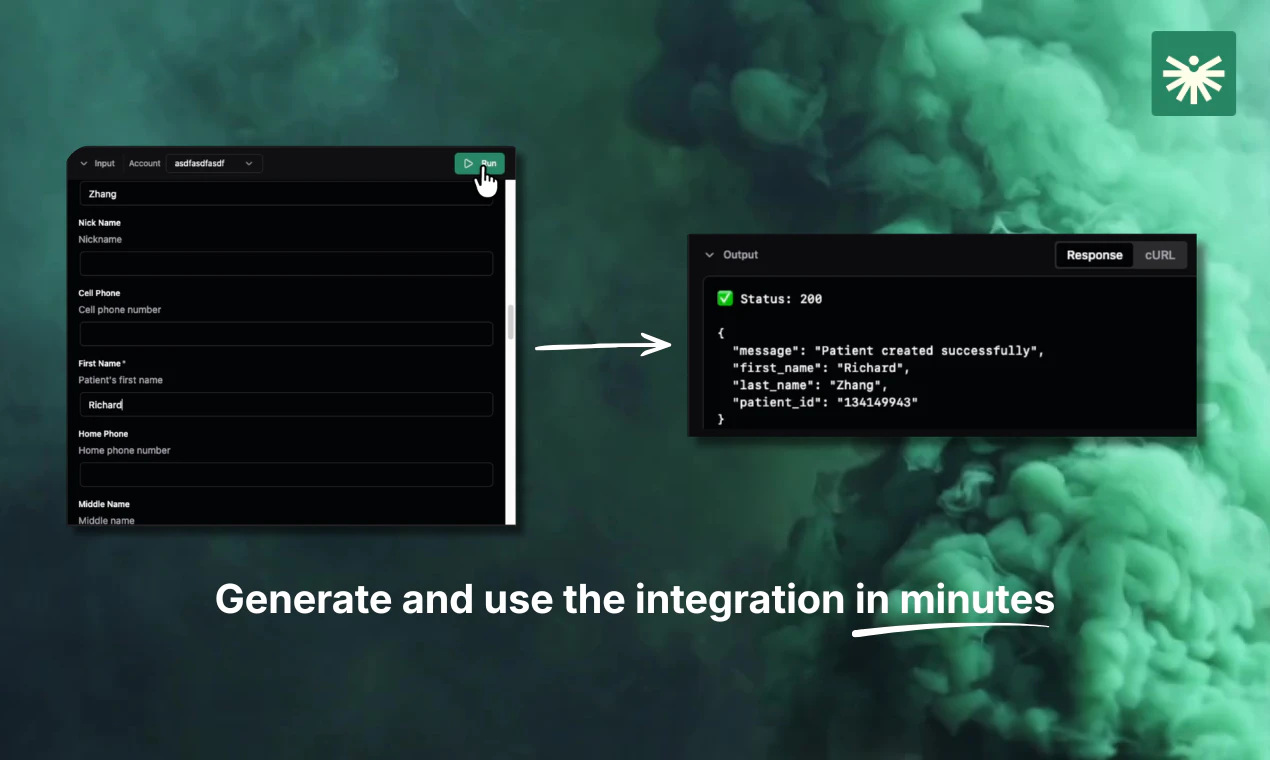
On Integuru, you can generate your ideal integration end-to-end in minutes, including support for authentication. In real production environments for existing users, API calls complete in ~3 seconds with 99.9%+ success, including deployments above 1M requests/month/platform. Requests are executed live and achieve low latency without data-caching.

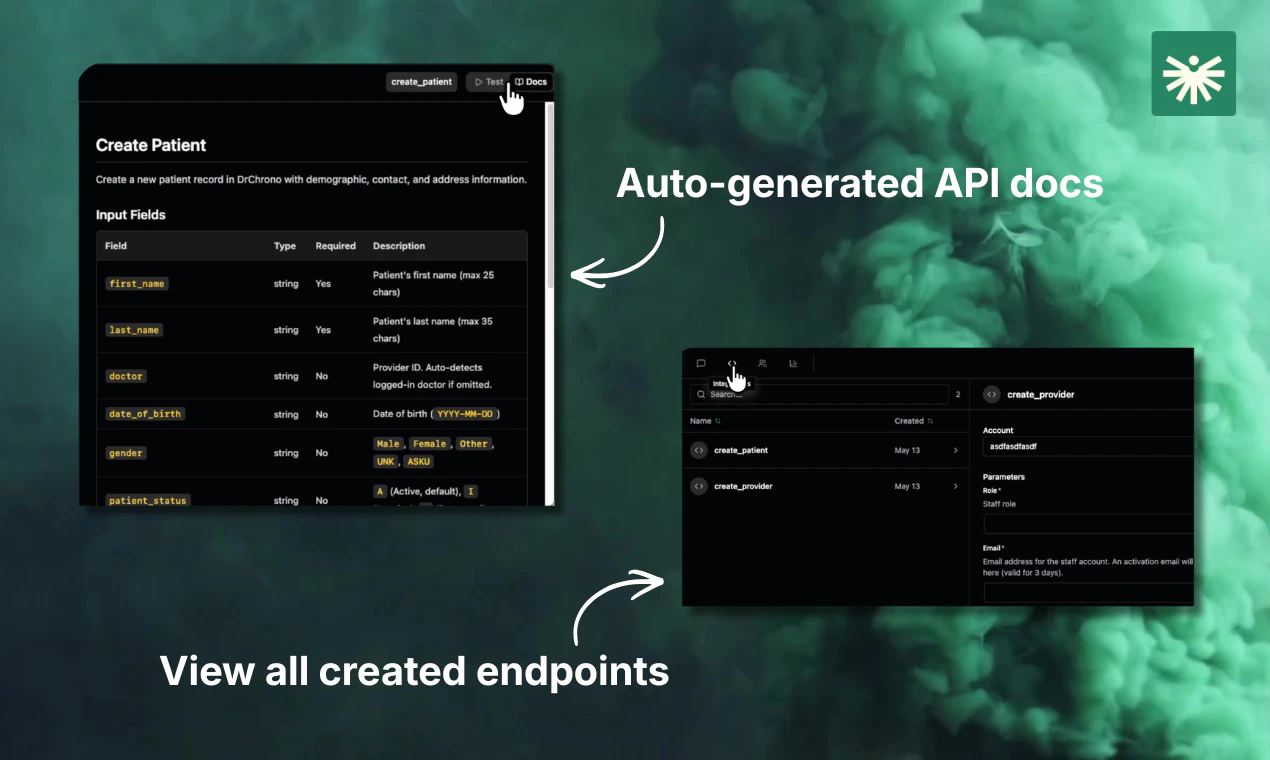
Integrations on Integuru get auto-healing, API docs, and a 24/7 on-call team for maintenance.

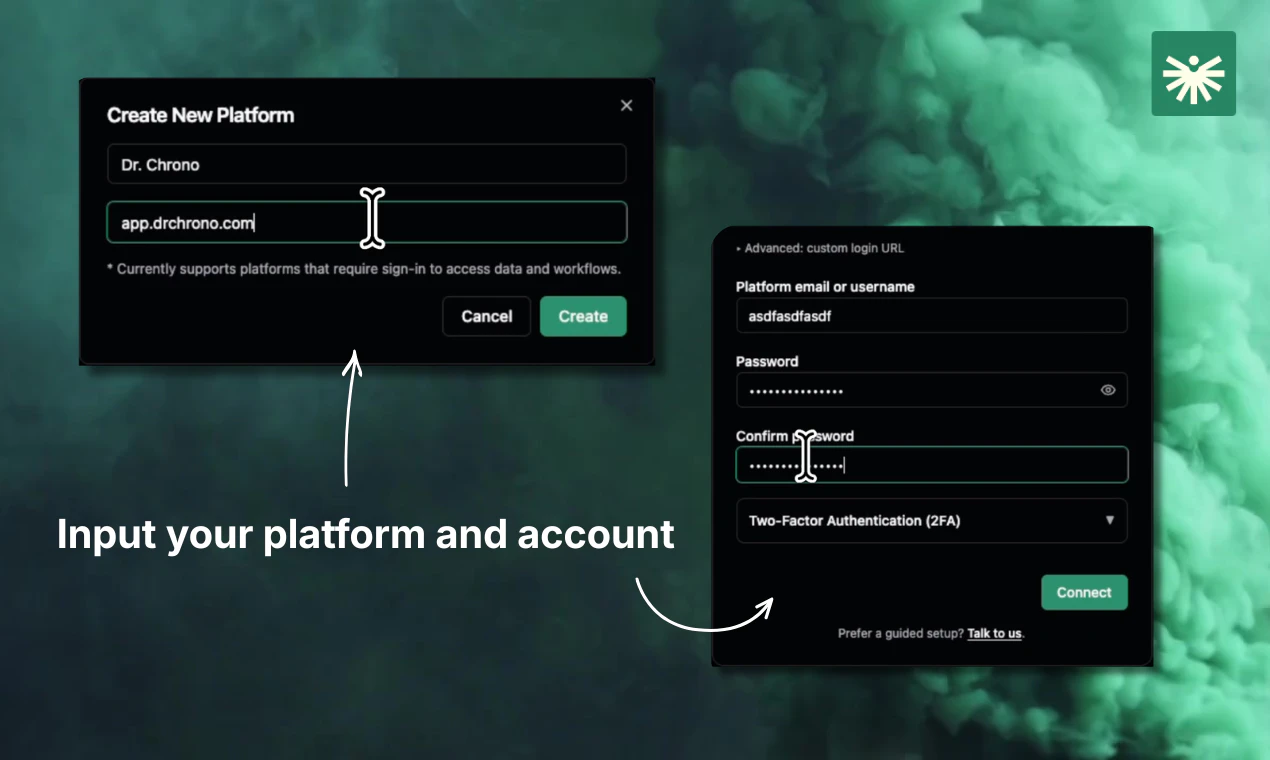
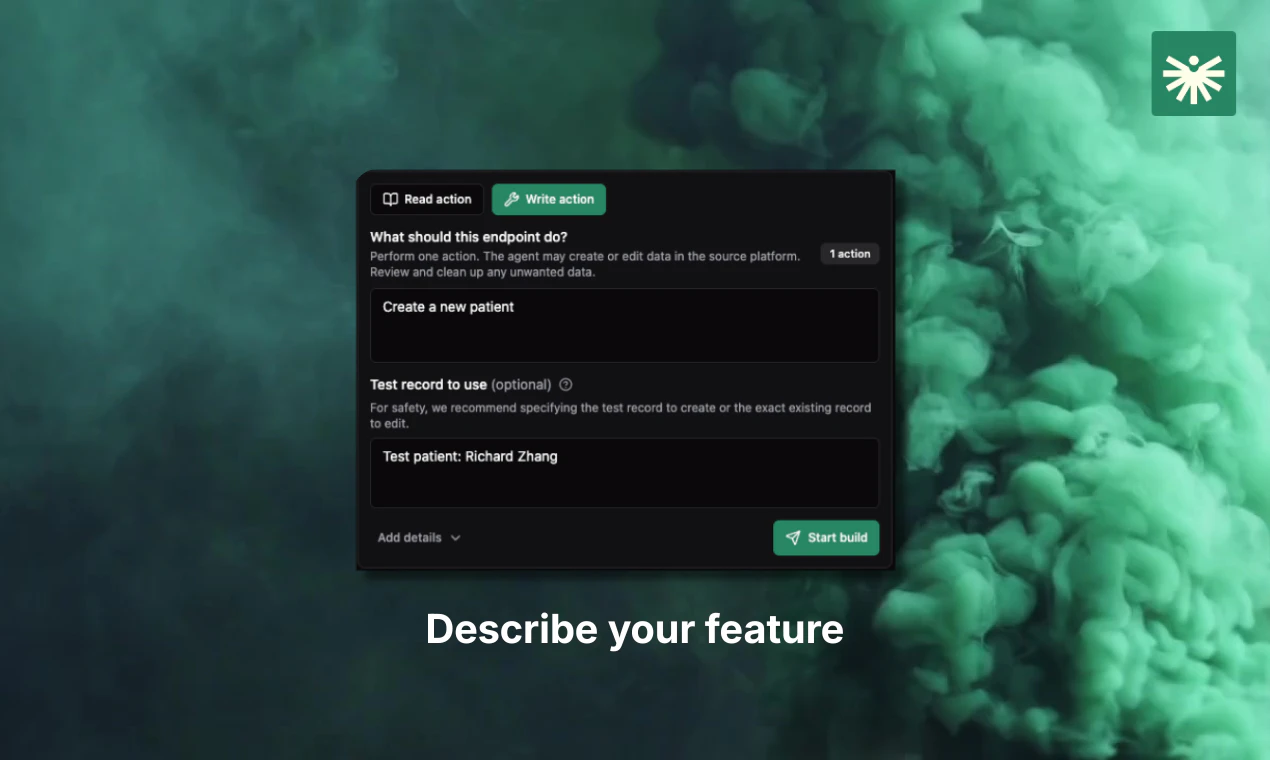
⚡️ Using Integuru is super simple:

  1. Input the website and account you want to integrate with.

  2. Describe your desired feature in natural language.

  3. Integuru proposes an API schema and, upon your approval, generates the endpoint in ~10 minutes.


🙋‍♂️ Who is Integuru for?

Integuru is best for vertical AI companies that need to integrate with customer systems. We already support high-growth companies across these industries:

  • Healthcare: connecting to EHRs, EMRs, RCMs, CTMSes, insurance portals, etc.

  • Logistics: integrating with TMSes, WMSes, ERPs, carrier portals, etc.

  • Proptech: automating property management systems, utilities, permitting software, etc.

  • Legal: controlling practice/case management systems, government portals, etc.

  • Enterprise AI transformation: accessing ERPs, CRMs, CX platforms, internal tools, etc.

… and more

🎯 Try Today!


Integuru is free to try! Go to app.integuru.com to get started! We’d love your feedback ❤️

7
回复

@richardzhang This is a very real pain for agent builders. Browser automation works until it breaks OAuth or small UI changes. I see you already have scripts for Healthcare, Logistics, etc... Are you planning to create an API solution for social media platforms (such as TikTok and Instagram)?

0
回复

congrats on the launch! I was wondering...brittleness in browser automation usually shows up much later on, when the platform ships a quiet backend change. So when that happens, what's the time-to-healed-endpoint your consumers actually see? Hours? Minutes?

2
回复

@artstavenka1 Thanks for the important question! In our experience, the more a company scales, the more problems it will run into with browser automation. But this can happen much earlier than people expect, especially depending on the team's requirements for latency and reliability. When the platform ships a backend change (which happens far less often than frontend changes), Integuru takes minutes to auto-heal. Our 24/7 on-call team is also there to jump in if or when needed, but most of the time.

2
回复

And what if the required data is behind a login? Will the service be able to log in (if login/password are provided) and retrieve data from the personal account/dashboard?

1
回复

@natalia_iankovych Yes! We provide an authentication system to support various auth flows 😊

1
回复

@richardzhang Congrats on the launch! Solving the "no API" bottleneck is huge for vertical AI teams.

The promise of "reverse-engineering the backend" is powerful, but for healthcare/legal users (as you mentioned), security is paramount. How does Integuru securely handle authentication tokens and session management? And if the target website changes its backend structure, how does the "auto-healing" feature detect and fix the integration without breaking production data flows?

1
回复

@diana_nadim2 These are very important questions. Thanks Diana!

Security is a huge emphasis for us. We manage sessions with least-privilege access, encrypted handling of sensitive tokens, and tight isolation around each user workflow.

Regarding auto-healing, we monitor integration behavior and failure patterns to detect when something has shifted and repair the affected flow without users having to rebuild the integration themselves. On top of that, we provide a 24/7 on-call maintenance team ready to jump in when needed. The goal is to keep production workflows stable even when the underlying app moves.

1
回复

Congratulations on the launch! Replacing fragile browser automation with direct backend integrations is a bold move, and the reliability gains alone sound compelling.

1
回复

@marianna_tymchuk Thank you very much!

0
回复

the 24/7 on-call maintenance team detail is doing more work than it might seem. the hidden cost of browser automation isn't the initial build, it's the ongoing babysitting when things break at 2am. if that maintenance burden actually transfers to Integuru's team that's a meaningfully different value proposition than just being faster

1
回复

@ansari_adin This is very insightful. Builders and teams should seriously consider using Integuru if they care about any one of the following: reliability, latency, and throughput. While low latency is important for many applications, like voice AI products, reliability is also a significant factor in production environments. In addition to auto-healing already built into Integuru, we provide a 24/7 on-call maintenance team to offer additional peace of mind for users running mission-critical integrations.

0
回复

That sounds interesting 🤔

Would love to know the architecture of it

1
回复

@jay_gangwar Thank you for your interest! Integuru uses a multi-agent architecture that inspects how platforms operate beneath the UI, identifies the correct request flows, handles auth/session state, and generates stable API interfaces on top.

1
回复

Reverse-engineering internal APIs by watching network traffic is clever, but the thing I'd want to know is how fragile the output is when the platform rotates tokens or changes an endpoint path. Does Integuru detect that and regenerate, or does the caller just start getting 401s until someone reruns the capture?

1
回复

@fberrez1 Thank you for this thoughtful question! Integuru has built-in auto-healing when it detects changes. We also provide a 24/7 on-call maintenance team for added peace of mind. We aim to support the most mission-critical integrations, and we're very fortunate that companies are already using us to do so.

0
回复

Congratulations on your launch!

1
回复

@othman_katim Thank you!

0
回复

reverse engineering backend apis dynamically to bypass brittle puppeteer/playwright scripts is a wild approach. how are you guys handling complex, multi-step authentication flows like oauth rotations, recaptcha checkpoints, or enterprise sso under the hood when generating these endpoints?

browser automation is such a massive pain to maintain at scale with selector drift, so hitting the server directly is a huge upgrade. outstanding positioning on the launch team..🙌

1
回复

@priya_kushwaha1 This is a very important question! We built a generalized auth/session layer for maintaining valid user-authorized sessions across flows like multi-step login, token rotation, and checkpoint interruptions. We’re actively developing support for OAuth and SSO, and they should roll out soon. Once that session is established, the generated endpoints call the underlying server requests directly instead of replaying browser UI steps for every action, which can be brittle. 

1
回复

Congrats on the launch, Richard! Framing integration as the bottleneck for agents really lands — browser automation has always felt like a fragile stopgap once you hit latency and reliability at scale. Turning that into clean APIs with ~3s calls and 99.9% success is exactly what agent builders have been missing. Following along — I'm @JayTheSong on X if you'd like to connect.

1
回复

@JayTheSong Thank you very much!

0
回复

"No browsers" is a bold claim for platforms that actively fight scraping. How does it handle platforms that update their structure frequently or add bot detection? Curious how stable the generated APIs are over time.

0
回复

Browser automation for integrations is one of those approaches that looks fine in a demo and becomes a maintenance burden in production. The moment a platform does a minor UI refresh, your agent is blind. We evaluated this class of tool when building integrations against APIs that didn't have official endpoints, and the failure mode that killed us wasn't the happy path, it was authentication session expiry mid-workflow with no clean recovery path. How does Integuru handle auth token refresh for platforms that use short-lived sessions or MFA flows? Does it abstract that entirely, or does that still land on the caller to manage?

0
回复

This is awesome! I would love to use it. Though, quick question: How legal is it? Will the mega SaaS companies send us a cease and desist for using this? Can they detect that we are using it? Will they block our customers' accounts if our customers are using it?

0
回复
#8
Linear Diffs
A new way to review PRs, directly inside Linear
151
一句话介绍:Linear Diffs 将代码审查无缝嵌入Linear工作流,解决了开发者在任务追踪与代码审查平台间频繁切换导致的上下文丢失和效率低下问题。
Productivity Software Engineering GitHub
代码审查 Linear集成 开发工作流 上下文切换 AI代理 GitHub同步 产品管理 拉取请求 协作工具 效率提升
用户评论摘要:用户普遍认可其消除上下文切换的价值,但提出多项疑问:是否支持AI自动摘要?如何处理堆叠PR和强制推送?内联评论能否与GitHub双向同步?部分用户质疑PM工具是否适合代码审查场景。
AI 锐评

Linear Diffs 踩准了AI代理大量生成PR后,审查能力严重滞后于生成节奏的痛点。它的核心价值并非在技术层面超越GitHub或IDE的审查体验——事实上,真正深度审查依然需要返回原生环境——而是把“审查状态”和“原始需求”固化在同一张票证下,消灭了“这个PR改的是不是我当时要的?”的认知断层。

然而,产品目前暴露了几个隐患:第一,它默认用户只在Linear里做“轻量审查”,但真正的代码审查(CR)需要符号引用、暂存区比对、甚至本地调试;第二,对强制推送、堆叠PR等Git复杂操作的处理仍模糊不清,这类场景一旦出问题反而会加剧混乱;第三,面临“PM工具越界”的原罪——开发者社区对工具边界敏感,如果把审查强塞给只看Trello看板的经理,反而催生形式主义的审核流水线。

它真正的护城河在于“与Linear议题原生绑定”的数据模型,以及未来可能生长出的“基于需求自动分配AI审查代理”的能力。但如果只是为了少点一次标签页,那它只是一个好看的“GitHub预览窗”,而不是什么革命性产品。

查看原始信息
Linear Diffs
Introducing Linear Diffs to make reviewing code a fast and fluid experience native to Linear. You can now review diffs from any issue with a PR, iterate on further changes with agents, and ship code from Linear. All reviews in Linear sync back to GitHub, so the current state of review work is always clear. Linear Diffs is available now on all plans.

Review code in @Linear, iterate with your team and agents, all in one place. Love this direction!

1
回复

Upvoting and commenting so I can get that awesome swag! Totally kidding, Linear is great. Congrats on the launch, love the new swag—you did well.

1
回复

Been waiting for something like this since the "close the issue, open GitHub, scroll to find the PR, lose context, come back" loop gets old fast. I do not use code editor anymore so a better interface that github is always welcomed! Very cool feature

1
回复
hello, how are you
0
回复

I dont read diffs anymore tho, there are just too many prs. But I do ask 3 agents to read them on every PR and just give me the gist. Can it do smth like that?

0
回复

Code review inside Linear makes a lot of sense now that agents can create PRs directly from issues. The hard part is keeping the review anchored to the original intent, not just the diff. Curious how you handle stacked or related PRs from the same Linear issue.

0
回复

One thing we've seen with AI-generated code is that PR volume goes up faster than review capacity. Are teams using this primarily to speed up reviews, or to reduce the amount of context reviewers need to load before giving feedback?

0
回复

I haven't used Linear, just out of curiousity, isn't it mostly a PM tool ? If so, why would we need to review PR here ? Shouldn't it be in the IDE / coding tool ? I didn't get the use case.

0
回复

Rendering PR diffs inside the issue context solves a real context-switching problem. We've lost too much review state bouncing between GitHub threads and Linear tickets. Since reviews sync back to GitHub, curious how you're handling force-pushes mid-review. Does the diff view update automatically, or does it require a manual refresh?

0
回复

with agents pushing PRs constantly now, having review right next to the issue is actually necessary not just convenient. nice timing on this

0
回复

Collapsing the context switch between issue tracker and code review is the right call. You can finally review a change against the spec it came from without toggling tabs. We've felt this friction most when AI agents generate multiple interdependent PRs in a sprint. Does Linear Diffs support inline comments that sync bidirectionally with GitHub's review state?

0
回复
#9
Sinalytica
Travel back to 1998 and use Lovable on Windows 98
123
一句话介绍:Sinalytica 是一款让用户穿越回1998年、在Windows 98系统界面上体验类Lovable交互工具的复古风格应用,满足对经典操作系统怀旧或好奇的用户情感需求。
Retro Games Software Engineering Entertainment
复古UI Windows 98 怀旧体验 交互模拟 AI工具 桌面应用 创意工具 情感设计 产品演示 轻量应用
用户评论摘要:用户称赞打字效果真实,交互自然,有沉浸感。但评论数量少,缺乏对功能实用性的讨论或批评性反馈,目前更像是一次趣味性展示而非解决实际问题的工具。
AI 锐评

Sinalytica 本质上是一个精巧的“界面皮肤+交互模拟器”,而非真正的生产力工具。它抓住了“怀旧”这一情感钩子,把Windows 98的UI风格与现代AI或工具类应用(如Lovable)嫁接,制造出强烈的新旧反差感。这种设计在短期内能通过新奇感和情感共鸣吸引眼球,尤其对经历过那个时代的用户或追求复古美学的极客群体有吸引力。然而,从产品价值角度看,它并未解决任何现实问题——既不是效率提升工具,也不是更先进的交互范式。123票的投票量在Product Hunt上算中等,但评论深度不足,缺乏对功能层面(如能否真正运行代码、实现复杂操作)的讨论,暗示大多数用户仅仅是被“外观”打动,而非“用途”。若Sinalytica仅仅停留在“看起来像”的层面,它将很快沦为一次性玩具。真正的价值在于:是否能在复古UI之下,提供足够差异化且实用的功能体验,否则就是一场精致的作秀。建议团队清醒地思考:用户是来“玩”这个皮肤的,还是来“用”这个工具的?

查看原始信息
Sinalytica
Sina Rajaeeian — Software Engineer and ML engineer. Building across AI/ML, web & mobile, and quantitative finance.

I love it. Even that typing is so real!

4
回复

@busmark_w_nika Lovable 98 :)

1
回复

@busmark_w_nika Thank you! Making the interaction feel natural is one of my biggest goals when building, so I'm happy that came through.

0
回复
#10
Screen Ruler
The go-to ruler for designers and developers
105
一句话介绍:Screen Ruler 是一款专为设计师与开发者打造的浏览器扩展,通过视觉化解析布局、渐变、伪类状态及CSS转换,解决设计稿还原与开发调试中的测量与信息提取痛点,远不止于“测量”工具。
Chrome Extensions Design Tools Developer Tools
设计工具 开发工具 浏览器扩展 布局检查 CSS转Tailwind 性能检测 SEO预览 像素测量 渐变检测 伪类模拟
用户评论摘要:用户普遍认为其功能远超普通尺子,解决了设计QA与开发沟通的痛点,尤其对布局检查和CSS转换功能赞不绝口。有用户提议增加代码编辑功能,开发者回应已在路线图中;也有用户询问目标用户为开发者还是设计师,开发者回答两者兼顾但更偏向有设计意识的开发者。
AI 锐评

Screen Ruler 的增长逻辑非常清晰:它没有重复发明轮子,而是精准地给浏览器开发者工具(DevTools)这个“汽车”加了一个“快充接口”。它洞察到的核心痛点是,DevTools 虽然强大,但操作链路长、信息呈现“反直觉”,尤其在视觉设计还原(像素级测量、Flexbox/Grid布局可视化、渐变参数提取)这一高频场景中效率低下。其产品价值不在于创造新能力,而在于将 DevTools 中的“功能”提炼为“工作流”,通过直观的视觉界面(如浮动检查器、布局图形化)大幅降低认知负荷与操作阈值。

从用户反馈看,其“CSS转Tailwind”和“Page tab(性能/SEO)”功能精准击中了两类人群:一是从传统CSS向Utility-First框架迁移的开发者,二是需要快速透视页面健康状况的维护者。这暗示了一个趋势:垂直化的“超分度”开发工具正在崛起,它们不追求大而全,而是针对特定工作流(如设计还原)提供比官方工具更快的体验。

不过,该产品目前仍处于“信息输出”层面。用户提出的“能否在侧边栏编辑代码”的质问直指其天花板——若只做“更好的显示器”,而不提供“点击修改并回写”的闭环,其粘性会低于那些允许“边看边改”的集成开发环境。好在开发者已将其纳入路线图,若能打通从“测量”到“修改”的最后一公里,Screen Ruler 将从一个优秀的小工具,进化为设计交付流水线上不可或缺的一环。在B端付费意愿上,其“设计QA + 开发辅助”的双重属性,搭配促销折价,对中小型团队具备较强的直接吸引力。

查看原始信息
Screen Ruler
Unlike browser DevTools, Screen Ruler is built for design workflows: visual flexbox/grid breakdown, gradient inspection with color stops, multi-element pseudo-state simulation, CSS-to-Tailwind conversion, and a Page tab with Performance, SEO, and Social previews.

Can it measure elements across different browser zoom levels?

2
回复

@nithin_raju1 Yes. Measurements are in CSS pixels, so they're accurate at every zoom level.

0
回复
# Product Hunt Launch Hi Product Hunt, Over the last 6 months, Screen Ruler has continued to grow to over 50,000 weekly active users on the Chrome Web Store. Screen Ruler continues to evolve as I expand its feature set so this launch doesn't have a typical "theme". Just a whole bunch of cool new stuff to try! - Stylesheet parsing: When selecting an element, see rules across all stylesheets that affect that element with specificity visualized. - Page inspection: A new Page tab with Performance, SEO issues, and Social previews. - Layout inspection block: A glanceable visual breakdown of flexbox and grid: axes, justify/align, gap, and tracks. - Inspector pinning: Now you can pin the floating inspector. - State simulation: Force an element into a different pseudo-state (hover, focus, active). - CSS to Tailwind conversion: Convert any element's CSS to Tailwind utility classes. - Breakpoints, box-model margin indicators, HSB color space, element-probe contrast detection, plus dozens of refinements across the inspector flow. Product Hunt Exclusive: Get 15% off Pro with code PH15OFF at checkout. Valid until the end of the month.
1
回复

Right thing shows up at the right time ! I'm making a pitch deck for my product and it's so hard to center / align stuffs and this help a lot. Well done G

1
回复

Now that is something we all never asked for. But we all need it

Nailed it man 🫡

1
回复

As a designer this seems useful to do design QA and provide specific feedback to devs on what to change.

I've typically done this manually through browser developer tools. I find the item, adjust the css until I get the desired result (when possible). Then I give that info to dev for updating.

This will save a bit of time, although it would nice to be able to edit the code from the Screen Ruler sidebar. Then I wouldn't have to use dev tools at all. But I'm not sure the browser allows that.

Great work!

1
回复

@amperisk Thanks for your comment. Editing is on the roadmap!

1
回复

Haven't launched on Product Hunt yet, but this caught my eye. Most rulers just measure. You added actual dev tools.

Genuinely curious – devs or designers as the main user?

1
回复

@riley_hansen Thanks for the comment. The audience is both but definitely skews to the design-conscious developer.

1
回复
#11
Basedash: Embedded Analytics
Give customers AI analytics inside your product.
103
一句话介绍:Basedash通过一个iframe和JWT认证,让SaaS产品快速嵌入AI驱动的自服务分析功能,客户无需离开产品即可用自然语言提问、创建仪表盘并获得智能洞察,解决了为客户报表功能需数月开发与维护的痛点。
Artificial Intelligence Data & Analytics Business Intelligence
嵌入式分析 AI数据分析 客户自助报表 SaaS内嵌分析 仪表盘嵌入 行级安全 AI智能体 产品内分析 BI嵌入 JWT单点登录
用户评论摘要:用户赞赏其技术卓越,但批评基础版付费墙过高(实际需$1k/月),建议推出创业扶持计划。核心疑问聚焦于:嵌入式仪表盘与AI聊天功能的细粒度权限控制是否支持按客户层级分隔,以及用户更倾向直接获得答案还是交互式仪表盘。
AI 锐评

Basedash Embedding的聪明之处在于,它不是在跟Tableau或Looker抢存量BI市场,而是在制造一个新品类——让SaaS公司直接把AI分析能力作为“产品功能”卖给终端客户。一个iframe加JWT就能实现行级安全的多租户分析,这对技术团队薄弱的SaaS公司来说几乎是降维打击。但冷静来看,评论中反复出现的定价抱怨很关键:基础版38美元/月的入门价格看似友好,但真正有用的AI Agent和完整数据源支持都困在$999/月的Pro版里。这意味着,最渴求这种嵌入功能的早期SaaS公司反而用不起,而能轻松掏月租的企业可能更倾向于自研。此外,虽然宣传强调“替换季度开发”,但嵌入后的定制化(如主题、权限、提示词)仍需投入运营精力,并非零成本。更值得警惕的是AI分析的准确性——让客户直接对话底层数据,一旦模型幻觉产生误导性业务结论,责任归属会成为产品方与客户之间的定时炸弹。总而言之,这是一个技术思路极佳、但商业落地仍需打磨的产品,尤其需要对定价策略和AI可靠性提供更透明的保障。

查看原始信息
Basedash: Embedded Analytics
Basedash Embedding puts the full power of Basedash inside your own product. Drop a dashboard in with one iframe, or embed the whole app so your customers can chat with the AI agent, build their own dashboards, and get automatic insights — without ever leaving you. Row-level security scopes every customer to their own data, and customization controls decide exactly which features they see. Setup is one iframe and a JWT. Analytics, inside your product. Scoped to every customer.
Hey everyone, Max here from Basedash. Today we're launching Basedash Embedding. It puts the full power of Basedash inside your own product, so the customers using your app get dashboards and the Basedash AI agent on their own data, without ever leaving you. There are two ways to use it. The simple one: build a chart or dashboard in Basedash, flip on a public embed, and drop the iframe into your site, no Basedash account required to view it. The big one: embed the whole app behind JWT SSO, and your customers can chat with the agent, build their own dashboards, and get automatic insights, all scoped to their own data. The example that sold it for us: a marketing agency runs ads for its clients and already has a dashboard product. They embedded Basedash into it, and now each client can ask "which campaigns had the best ROAS last month?" and get an answer and a chart built on the spot, seeing only their own account, never anyone else's. That last part is row-level security, and it's the thing that makes embedding safe to ship to customers. You control exactly what they get: theme, which features are visible, suggested prompts, allowed origins. PH community gets an extra week on their trial this week. Happy to answer any questions!
2
回复

We've found that users often ask for analytics but end up wanting answers rather than dashboards.

Are you seeing customers primarily embed charts, or are people starting to ask for more conversational/AI-driven ways to interact with their data?

1
回复

@samyak_sanklecha seeing both quite often!

0
回复

Hi friends! Kris here, also from Basedash.

The before-and-after on this one still gets me. Adding analytics to your product used to mean a quarter of eng time and a permanent maintenance tax. Now it's an iframe and a JWT.

And your customers get the full product. The agent, dashboards they build themselves, insights that show up on their own, all scoped to their own data.

If you've ever had a customer ask for a dashboard inside your app and quietly winced, this is the one to try.

Drop your questions below, I'll be around all day.

1
回复

BaseDash is so, so goated. @maxmusing built tech that made me fall in love with BI, again. The insights generated from just plugging in, like, PostHog & a couple others = insane.

I do, candidly, wish it were more affordable, or that they offered plans that were more accommodating of early stage companies, since I think those startups could benefit the most from the data surfaced by BaseDash, but I get it... it's definitely worth what they're charging, but the Basic plan paywalls so many of the useful features (MCP servers, full source support, etc.) that you're really looking at $1k/mo... maybe some sort of a program like Intercom & others offer, where a company can qualify for a special 1-2 year "growth startup" package, could be apropos?

Really excellent tech, nothing quite like it. It's worth running a trial if you have a SaaS product with even minimal traffic, and are using something like PostHog, MixPanel, Amplitude, Fathom, GA, databases, etc.

Keep up the great work, Max - I hope you consider opening up some non-technical roles on that /careers page someday! ;) (I'm gainfully/happily employed, mind you! but BD is one I'd consider joining...)

0
回复

about the customization controls. you mention deciding which features customers see but how granular does that actually get. like can i show the dashboard view and hide the AI chat entirely for certain customer tiers, or is it more of an all-or-nothing toggle. that distinction matters a lot if you're trying to gate analytics features by plan without building a separate integration for each tier

0
回复

@ansari_adin you can get super fine-grained and control which users can access which features within Basedash. We expose parameters on the embed code so you can control it programmatically per user.

0
回复

How customizable are the embedded dashboards?

0
回复

@nithin_raju1 every individual feature (AI chat, dashboards, automations, insights) can be toggled on/off, and charts can use any of 9 different colors. You also have full control over the AI system prompt so you can control output format, voice, etc.

0
回复
#12
Hyper: Self-driving Company Brain
Turn your AI agents from interns to veterans
95
一句话介绍:Hyper 是一款将公司内部所有知识(文档、Slack、邮件、日历等)整合为统一大脑,并接入AI代理与自动化流程的工具,解决AI代理因缺乏公司上下文而无法高效执行任务的痛点。
Productivity SaaS Artificial Intelligence
企业知识库 AI代理 上下文感知 自动化工作流 知识图谱 员工效率 智能助手 内容索引 团队协作
用户评论摘要:用户认可“公司大脑”定位,指出现有AI代理的最大短板是缺乏上下文。主要关注点:1. 产品定位是共享知识层还是个人助手;2. GDPR合规性;3. 支持工单分类是高频高价值场景;4. 能否回溯索引历史数据;5. 需要区分公司共识与个人工作风格的信任度与源追踪。
AI 锐评

Hyper的切入角度极其精准——AI代理空有“执行力”却无“记忆力”的窘境是当前行业通病。产品将“上下文”这一核心资产从个人碎片化工具中抽离,构建企业级知识图谱底座,本质是在为AI代理补齐“入职培训”这一缺失环节。

值得肯定的是,其对历史数据的回溯索引能力(Slack、Gmail等)解决了“冷启动”难题,直接缩短了客户价值兑现周期。然而,产品仍面临几个硬伤:首先,“公司共识”与“个人风格”的边界模糊。一个AI既能写出“我们公司”的统一话术,又要模仿“我的”语气,这两者存在天然张力,若信任与溯源机制不够透明,会导致输出混乱。其次,GDPR合规尚未落实,对欧洲企业客户几乎是致命伤,反映出产品在SaaS合规策略上存在滞后。

从商业角度看,Hyper的实际价值可能不在“通用AI”,而在于“场景化知识检索+垂直自动化”——比如工单分类、合同审查等有明确胜率的场景,这是对的。但长远来看,知识图谱的维护成本极高:谁为“知识”的质量与时效性负责?若知识大量过期或内耗,AI反而会成为“一个靠谱的糊涂蛋”。Hyper需要证明的不只是它能连接所有数据,而是它能持续筛选、更新和去重这些数据。

一句话总结:方向正确,但“大脑”的第一次换血和免疫系统(合规与治理)尚待成熟。

查看原始信息
Hyper: Self-driving Company Brain
Hyper is the company brain that learns everything about your company (Docs, Slack, Email, Calendar, etc) then plugs into your AI skills & agents & automations so they go from forgetful interns into seasoned veterans that accomplish tasks. It helps them drafts emails in your voice, reads your contracts, triages your tickets, and preps you for every meeting, because it knows everything everyone at your company knows. Give it a spin from our website!

Hey PH 👋,

Hyper cofounder here. My cofounder Kanyes and I have been (best friends and) building together for last decade. We’ve been power users of nearly all the second brain / tool-for-thought tools as students back in 2017, then later tried fine-tuning GPT-2 in Kanyes’s garage back in 2020 to build an AI that knew everything about us — our taste, how we work, what we believe in, etc. and have that AI automate work that we found tedious (like doing problem sets, yuck). We were obviously 5 years too early.

After college, we joined Matic to build robots, and we again felt this pain but in a real company that needed to ship real products. We saw information constantly fall through the cracks and tribal knowledge lost when key people left the company. We watched people trying their best to prevent this by being disciplined with writing docs or posting slack threads, and eventually we became those people. Then in 2023 when the world shifted to AI agents, we realized that even thought we’ve hacked “good enough” solutions together for human workers, our AI workers still remain dumb! 

They’re as powerful as executives but have the context of a day-one intern. 

So we both quit our jobs and decided to go solve this properly. Today, I’m excited to share that you can download and start using Hyper directly from our website! We're deeply grateful to be able to deliver world class software to the dreamers and pirates like us. Hyper has already sped up our AI automations significantly (drafting emails that has all our company knowledge and writes like me!) and we're relentless about fighting hard for the world-bending teams that want to move extraordinarily fast.

8
回复

@_shalinshah_ The company brain positioning is strong. alot of Ai agents fail because they don’t know the company context.

Does Hyper work better as a shared company knowledge layer? or as a personal assistant for each team member?

3
回复

Congrats on the launch!🚀

2
回复

@avi_peltz thanks Avi!

2
回复
GDPR complimented? 🙈
2
回复

@rafael_romano Not yet but definitely in the works!

2
回复

The support ticket triage use case is probably the most immediately valuable. That's a task with clear ground truth (was the triage correct?) and high volume, which means you can measure improvement fast. The harder version of that problem is when the institutional knowledge needed for correct triage lives in a decision someone made 18 months ago in a Slack thread that no one bookmarked. Curious whether Hyper indexes Slack history retroactively on setup, or whether it only captures context going forward from the point of connection. that distinction would significantly change the time-to-value for new customers.

1
回复

@binu_george That's great feedback, but yes Hyper goes back and indexes Slack history (and as a matter of fact all connectors like Gmail, Drive, Notion, etc) retroactively to collect the entire history of what has happened in the company. Once connected though, it's "live" in the sense that on every new message Hyper's agents read and understand how that fits into the graph of all previous knowledge. And then on the point about support ticket triaging, we definitely agree that it's a high utility use case and one that we're actively working to go tackle!

1
回复

This is super cool. Congrats on the launch guys!!

0
回复

The company-brain framing is strong because it names the real bottleneck with agents: they can act, but they usually do not know what the company has already learned.

One thing I’d want to see very clearly in a product like this is how Hyper separates shared company truth from personal working style. “We always position the product this way” and “Shalin tends to write emails this way” are both useful, but they should probably age, conflict, and get overridden differently.

If the system can show source trails and confidence for those two layers separately, it would make the voice/email use cases much more trustworthy.

0
回复
#13
Coffee Piano
Browser music and piano studio with visual harmony tools
95
一句话介绍:Coffee Piano 是一款在浏览器中运行的可视化音乐与钢琴创作工具,通过轨道图与和弦图谱,帮助音乐创作者将抽象的乐理直观化,轻松理解和弦功能与和声逻辑。
Music Education SaaS
浏览器音乐 虚拟钢琴 可视化乐理 和弦图谱 MIDI编曲 和声引擎 音乐创作工具 初学者友好 双语界面 重配和声
用户评论摘要:用户赞赏可视化设计对乐理学习的帮助,认为对初学者友好。但也提出了疑问:和弦轨道图(Chord Lens)中的第二张图含义不够清晰,需增加引导。另有用户对大量展示吉他指板图感到奇怪,且建议宣传时注意价格展示的平衡。
AI 锐评

Coffee Piano的亮点不在“弹钢琴”,而在“看和声”。它精准切入了一个长期存在的痛点:无数音乐制作人和爱好者在键盘上摸爬滚打多年,却始终难以通过黑白键直观理解音阶的对称性和和弦间的逻辑关系。将调式、和弦进行、声部引导(voice leading)等信息抽象为动态的“轨道图”和“和弦地图”,这本质上是在用空间认知替代传统死记硬背,对半路出家的创作者是巨大的效率提升。

产品功能上“软硬兼施”,既有真实的钢琴和Rhodes音色采样(声音引擎),又有MIDI和延音踏板支持(硬件交互),保证了创作工具的实用性,不至于沦为纯理论玩具。而一键重配和声(Reharmonize)及自动根据用户水平生成和弦进行的功能,更是将“理论”直接转化为“可演奏的操作”,降低了即兴和编曲的门槛。

然而,目前仅95票的热度反映了其尚未破圈。问题在于:它的用户画像有些分裂。对于专业音乐人,其音源和交互深度可能不足以替代DAW(数字音频工作站);对于纯粹的小白,需要先理解“声部引导”和“调式替代”这类概念才能用好“和弦地图”,学习曲线依然存在。正如评论所暗示的,产品的中级用户——也就是那些已经掌握基础和弦、渴望理解“为什么”以及“如何再进一步”的创作者——才是其真正价值洼地。另外,大量展示吉他指板并非败笔,反而可能是打通键盘与吉他两种思维模式的桥梁,关键要看如何针对不同乐器用户重新组织UI信息。

最后,一句尖锐的观察:如果它仅仅止步于“可视化”,那么它只是一本漂亮的乐理插图。若想成为日常创作工具,必须让“可视化”反向驱动“声音”,比如通过简单的拖拽就能生成复杂的Jazz Voicing(爵士和弦排列)或Bass Line(贝斯线)。否则,它最终仍是一款精美的“乐理辅助玩具”,而非一个“创作工作室”。

查看原始信息
Coffee Piano
Most harmony tools are too theoretical or too simple. Coffee Piano combines a real piano studio, sampled Piano & Rhodes, MIDI, sustain pedal with a visual harmony engine. Orbit visuals show scales and chords as circular maps. A harmony map reveals voice leading and chord function. Reharmonize in one click per bar or full progression. Guitar diagrams sync to every chord. Works in the browser, no install, bilingual UI.

Pulled up the orbit visual and got why you went circular for scales. Symmetry that's invisible on a keyboard becomes obvious on a circle right? When you reharmonize a bar, does it stay diatonic by default?

2
回复

@artstavenka1 Exactly, that’s the idea. On a keyboard, C major and A minor look like different shapes; on the circle the same key family sits as one symmetric ring, so scale/chord relationships pop immediately....yes reharmonizing a bar stays on the same harmonic degree by default. “Enrich all” works the same way across the progression.

1
回复

The visual harmony approach looks very beginner friendly.

2
回复

@nithin_raju1 Thank you. That's exactly the goal... harmony should feel intuitive before it feels technical. Glad it comes through visually.

1
回复

The visual map is a cool idea, but I'm confused on what it actually represents. Especially the second picture.

1
回复

@zanc_zhao You’re right, chord lens is confusing at first glance and that’s on us. We’re adding a short explainer in the app.

When you click a bar, the chord in the middle is what’s playing there now. The circles around it are optional swaps, not random chords. The inner ring is the closest options, same degree or strong functional moves like tritone subs. The outer ring is more color options that still share notes with the center. The violet ring is the parallel key, so if you’re on Am you might see chords from A major. Thanks!

0
回复

@adictum very interesting!
Do you have to be a pro musician, or you can figure it out even if you're an amateur?

1
回复

@adana Thank you! Any level, the progression generator lets you choose your skill level, so you can start with simple basic triad chords and work your way up to extensions and jazz chords at your own pace. No music theory background required to start having fun with it!

1
回复
@adictum sounds good! will try 😊
1
回复

Pretty cool i dig it. Your chord variations are using guitar tabs which i found a little weird for a piano app but as a player of both i can see the advantage there. In general its a cool product with some cool things to offer.

Im not an expert at marketing but maybe throwing the price around so much might hurt. The price point i think is fair its just that its mentioned everywhere on the site, but i do get that a lifetime is unheard of these days haha. Again i am no expert at all its just my opinion. As for the app itself the visuals are really great and a beautiful way of seeing all this theory. Good luck!

1
回复

@andrewb23 Thanks! Fair point on the guitar diagrams, it's intentional actually. A lot of pianists also play guitar or teach both, so having the same harmony reflected on the fretboard saves a lot of back and forth. I play both too.

And noted on the pricing visibility, good honest feedback, I'll take a look at the balance. Appreciate you taking the time to dig in properly.

2
回复
I built Coffee Piano because there was no tool that let you hear a chord idea, see it as a visual map, and understand the harmonic logic behind it, all in the same place. Most tools are either a sound engine with no theory, or a theory reference with no sound. That disconnect is what Coffee Piano solves. It brings harmony to life visually through orbital scale and chord maps, a real piano and Rhodes engine with MIDI, smart progression generation, reharmonization, and guitar diagrams, all in the browser. Built for musicians who think in harmony, not just in notes. Would love to hear your thoughts.
0
回复
#14
Notchy
Mac dynamic island with music, timers, clipboard, file drops
94
一句话介绍:Notchy将MacBook的刘海屏变为一个动态信息岛,在后台运行时可集中展示音乐、倒计时、剪贴板、文件传输等任务状态,解决用户在多任务时频繁切换窗口和错过通知的痛点。
Productivity Music Apple
macOS刘海屏 Dynamic Island 动态岛 免费工具 通知管理 任务栏增强 剪贴板历史 番茄钟 文件拖放 系统工具
用户评论摘要:用户称赞工具免费且精致,但核心追问集中在多任务冲突时的处理逻辑(如计时器优先级最高,其他按最新覆盖)、性能与电池消耗(开发者展示0%空闲CPU占用对比数据),并建议加入用户自定义标签和LLM集成功能。
AI 锐评

Notchy的野心显而易见:它试图用“免费+原生”的组合拳,在Mac刘海屏这个已经被玩出花的小空间里,打出差异化。产品逻辑是讨巧的——把碎片化的系统状态(音乐、计时、剪贴、下载)缝合进一个视觉焦点,本质是在争夺用户的“余光注意力”,但这恰恰是最大的技术陷阱。

从评论的尖锐提问就能看出,这个“岛”的生死线不在于有多少功能,而在于多任务调度逻辑。开发者给出的“计时器霸权+最新弹出覆盖”方案,虽然避免了常见的堆叠混乱,但也暴露了其优先级系统的粗糙。当“一个无关紧要的弹窗可以打断一个重要下载提示”时,这种“伪动态”体验反而会制造比原生命令栏更糟糕的认知负荷,用户很可能从“关注增益”变为“干扰焦虑”。

性能方面,0%的空闲CPU数据在原生SwiftUI和优化的前提下可信度较高,但这只是及格线。真正的考验在于:当音乐频谱、番茄钟倒计时、长文本剪贴预览、甚至未来用户建议的LLM结果同时争夺那几十像素时,UI的渲染抖动和输入响应延迟才是真正的“电池杀手”。此外,“永不收费”的承诺虽有情怀,但也让人担忧后续维护与“谨慎新增功能”(开发者原话)之间的持续性问题——没有营收压力,往往意味着没有长期打磨的动力。

Notchy目前更像是一个“功能齐全的Demo”,其真正价值在于验证了“刘海屏作为第二信息流入口”的可行性。但要从奇技淫巧变为日常必装,它需要一套更智能的上下文感知优先级引擎,而不是让用户去适应开发者的预设规则。否则,它只会是发烧友硬盘里的又一个两周即弃的玩具。

查看原始信息
Notchy
Notchy is the free, native macOS notch app that turns your MacBook notch into a fluid Dynamic Island — music, timers, clipboard, file drops, cluely, HUDs.

This looks surprisingly polished for a free tool. Wishing you a successful launch day and lots of happy Mac users!

1
回复

@marianna_tymchuk Thanks a lot! Really appreciate it 🙌
More polishing and improvements will be added over time as needed in a thoughtful way.

0
回复

Hi Vishva! four things fighting for the same tiny strip! when a timer's running and you copy something and a download finishes all at once, what wins the notch? hard priority order, most-recent, or does it stack and rotate? congrats on your launch, good luck!


1
回复

@hiyamojo 

Hey! Good question - it's the thing that actually trips up most notch apps.


Two layers. The timer stays - it holds the notch until it's done, nothing bumps it (and it'll share space with music side by side).

Copy and download-finished are quick pop-ins, and there's only one slot for those: newest wins. So the download would just take over the copy, no stacking or rotating. Once it fades, you're back to the timer.

Only catch: since it's purely "newest wins," there's no priority — a trivial alert can cut in front of an important one. But the timer itself never gets lost.

0
回复

how you're handling the performance side. notch apps that run constantly have a bad reputation for quietly draining battery on MacBooks, especially on M-series chips where people are very sensitive to anything that tanks their all-day runtime. have you done any benchmarking on idle CPU and battery impact because that's usually the reason people uninstall these after a week regardless of how useful the features are

1
回复

@ansari_adin 

Yes, we did benchmarking with our app, and it is quite efficient!


Setup: Apple M2, macOS 26.5, May 2026. Each app run alone, no input, CPU summed across processes, averaged over several 10-second idle windows.

Idle CPU results:

App

Idle CPU

Type

Notchy 1.0.14

~0%

native SwiftUI


Check out the comparison table at:
https://notchy.dev/#:~:text=BATTERY%20%26%20PERFORMANCE

0
回复

That looks really good.

I think you should let users add their own tabs.

Another suggestion is to add any LLM tab

1
回复

@jay_gangwar good thoughts! I'd love to learn more about the idea you have. Lets connect offline at https://www.linkedin.com/in/vishvavariya/

1
回复

Does Notchy have any battery or performance impact when it’s running all day?

1
回复

@othman_katim That's a good question, yes -- we did a benchmarking across few similar apps and ours is one of the efficient apps out there.

Check the results at: https://notchy.dev/#:~:text=BATTERY%20%26%20PERFORMANCE

0
回复
I know there are a lot of apps in the market for converting your boring notch to a dynamic island like an iPhone but there is not one app that does everything and none of them is free :( So that was my motivation to build an mac app which I call Notchy which is completely free, never ever I'm going to monetize it. Donations on Ko-Fi is appreciated for the development costs. This app can show amazing music amplifiers using notch, pomodoro timers, clipboard history, file drops, cuely (TelePromptor), bluetooth and battery notifications. Go check it out for free! Download now on: https://notchy.dev
0
回复
#15
MoDev
The AI dev environment built for your phone.
91
一句话介绍:MoDev 是一款将手机变为 AI 驱动的开发控制台的应用,它解决了开发者无法随时用电脑操作 GitHub、Vercel、Supabase 等工具时的效率痛点,允许通过自然语言对话完成代码提交、数据库查询、邮件处理等任务。
Developer Tools Artificial Intelligence Vercel Day
AI开发工具 移动办公 自然语言编程 开发运维自动化 手机开发环境 代码管理 数据库查询 智能助手 无代码操作 生产力工具
用户评论摘要:用户主要关心安全性,担心手机丢失后可能直接导致生产环境被破坏(如部署、删库)。开发者承认当前缺少生物识别步骤验证,但已为删除数据库等高风险操作设置了硬性阻断。另一个疑虑是性能,但官方解释手机仅作控制层,计算在远端执行。
AI 锐评

MoDev 精准切中了一个真实但小众的痛点:“有手机,没有电脑”时的开发中断焦虑。创始人 Juan 作为独立开发者,在产品故事和营销上很聪明——从自身错过 deadline 经历出发,让产品有了温度。

从功能看,MoDev 本质上是一个“移动端 API 聚合聊天机器人”,利用 LLM 理解意图并调用 GitHub、Supabase、Vercel 等第三方 API。这并非全新事务,本质上和 Slack 上集成 ChatGPT 插件、或许多“AI 助手”类工具没有壁垒性差异。它的核心差异是“专为手机设计”,且将所有权归于用户自己的云服务(BYOK),不托管代码、不充当中间商。

这恰恰是双刃剑。杀手锏在于 BYOK 模式极为友好——用户无需担心数据转移和供应商锁定,AI 调用费直接付给 API 提供商(如 Claude、OpenAI),平台不抽成,这比 Replit 等托管式 IDE 更轻、更开放。但代价是,MoDev 本质只是“遥控器”,一旦网络不通或第三方站点抽风,整个环境几近瘫痪;它无法做到离线或本地的代码开发,更像个“监督指挥仪表盘”,而不是真正的开发环境。

最大软肋始终是安全。创始人坦言“生产环境被偷”是真实风险,目前靠 read/write 权限分离加硬性阻断勉强应付,但缺乏生物级二次验证。当手机丢失频繁发生在这个“永远登录”的场景下,给开发者的安全感远远不够。如果后续不引入细粒度 MFA(如部署前面容/指纹确认、敏感操作绑物理安全密钥),那它永远只能作为临时补丁,而非主力工作台。

总结:MoDev 是一位独立开发者用极简资源打造的轻量级移动运维工具,适合偶尔在路上做简单分支合并、查 DB、发邮件的独立开发者。但距离成为“移动端全栈开发环境”还有很长的路,尤其在安全能力和故障容忍度上。别指望它能取代电脑,它只是一个让手机也能成为你“后备开发终端”的勇敢尝试。

查看原始信息
MoDev
The AI dev environment built for your phone. Connect GitHub, Vercel, Supabase, Gmail, Calendar, and more. Any AI. Any API. Then chat to ship. → Deploy from your phone → Read repos, commit, open PRs → Query your database with natural language → Manage email and calendar by chat → BYOK on dev plans · Claude included on Moonlight One message. Real execution. From anywhere. Built solo. Bootstrapped. Founding members lock in today's price forever — first 100 only.
Hey Product Hunt 👋 I'm Juan — solo founder of MoDev and RLTS, Inc. The real story: I missed a client deadline because I couldn't get to my PC. That was the last time. I built MoDev over the last several months. No team. No investors. Just a real problem and a stack I knew cold. What you're looking at is v1. It's live. Stripe is live. You can sign up right now at modev.app. Plans start at $15/mo. BYOK on developer plans means your AI usage is billed directly by your provider — no markups, no middleman. Founding members lock in today's pricing forever. First 100 only. No increases. Ever. Ask me anything about the build, the stack, or the product. I'll answer every single comment. 🖤
3
回复

@jr_rltsinc Hi Juan, congrats on the launch. this is a great specific use case. I'd be interested to know how your users actually use it irl.

1
回复

Congrats on launching Juan!
What's the auth model when the phone itself is the dev environment? A laptop being stolen means an attacker has to crack disk encryption, hit your password, etc. A phone gets unlocked dozens of times a day in public, and if MoDev is logged in and connected to GitHub + Supabase + Vercel + Gmail, "phone stolen" suddenly means "production access stolen." Is there a step-up auth before destructive actions (deploy, drop table, force-push), or session re-verification on suspicious activity, or is it relying on the phone OS lock as the security boundary?

2
回复

How do you handle safety rails, like preventing accidental production deploys or risky database queries from chat?

1
回复

Interesting concept, so it works directly with github ? where is the code executing ?

0
回复

@jaygangwar thanks! On performance, the phone is just the chat + control layer. The heavy lifting (builds, deploys, queries) runs on your own Vercel/Supabase, not on-device, so it stays light even on mobile.

On Replit: Replit hosts your code and runs the IDE + compute in their cloud. MoDev is BYOK — it never hosts your code. It's the mobile-first AI cockpit on top of your own GitHub + Vercel + Supabase. Different category: we're the control layer, not the host.

0
回复

@ferdisigona great framing — 'phone stolen = prod access stolen' is exactly the risk to design around.

Today: every destructive/write action needs an explicit in-app confirmation, and the worst ops (drop table, delete repo, charges) are hard-blocked entirely, so a logged-in, unlocked phone still can't deploy or wipe data silently. The current session boundary is OAuth + OS lock.

What's not there yet: a biometric step-up gate before destructive actions and session re-verification on suspicious activity. That's the next security layer on the roadmap. Not going to pretend it's shipped, it's where I'm headed.

0
回复

@karimbenkeroum Hey Good morning! Great question, this was core to the design. Every tool is split into read vs. write. Reads (queries, listing repos/deployments) auto-execute. Anything that writes - deploys, DB mutations, sending mail - surfaces a confirmation card before it runs, so nothing fires silently from chat.

On top of that there's a hard-blocked tier that never executes even if you confirm: DROP TABLE, deleting repos, and live Stripe charges. The model literally can't run those.

And because it's BYOK, you're operating against your own GitHub/Vercel/Supabase, ETC. MoDev never hosts your code or holds the keys to do something irreversible behind your back. Human-in-the-loop on every destructive action, by design.

0
回复

The ui looks really good not sure about the performance.

How will you differentiate from replit?

0
回复
#16
TrackNotch
LLM usage tracking that lives in your Mac's notch
86
一句话介绍:TrackNotch是一款常驻Mac刘海区域的本地化AI模型使用追踪工具,帮助开发者实时监控Claude、OpenAI、Cursor等服务的上下文填充、速率限制和月度预算,无需代理或数据上传,解决AI使用成本失控与状态模糊的痛点。
Mac Open Source Developer Tools GitHub
AI使用追踪 Mac本地工具 刘海区域显示 开源免费 预算管理 速率限制 Claude监控 本地隐私 开发者工具 v1.1.1
用户评论摘要:用户普遍认可刘海区域显示创意,并询问对Gemini、Codex的支持。有用户关注团队共享预算功能,但开发者明确坚持单机本地化以避免隐私折衷。另有用户追问token计数读取方式(日志/拦截/API轮询),涉及精度与账户类型兼容性。
AI 锐评

TrackNotch精准切入了一个被巨头忽略的夹缝——AI使用追踪。在OpenAI、Claude们疯狂推送“对话即服务”的当下,用户对“用了多少”“还剩多少”的感知被切割在多个网页后台中。TrackNotch的聪明之处在于选择Mac刘海作为UI锚点:它利用苹果生态中这个被戏谑却不可忽视的物理像素带,将后台数据透明化地“挂”在用户视线边缘。这种“一瞥即得”的交互,远比切到浏览器再登录Dashboard更符合工作流肌肉记忆。

但产品价值面临两个结构性挑战。其一,数据源精度受限于读取方式。如果只是轮询官方API,那么与用户付费账单之间必然存在延迟和差异;如果拦截本地日志,则对网络层协议和SDK版本有强依赖。其二,单机本地化是柄双刃剑——它换来了极致的隐私承诺,却彻底丧失了团队协作的可比性。在组织AI支出动辄数万美金的背景下,一个只能看自己Mac的仪表盘,更像极客玩具而非企业工具。开发者拒绝加后端的态度值得尊敬,但“现有的计费工具已经够用”的托词,回避了一个事实:绝大多数初创团队根本没有审计AI消费的基础设施。TrackNotch要破圈,要么坚守本地、强化离线分析能力(如结合App Store批量部署获取匿名聚合统计),要么提供可选的、端到端加密的同步方案。否则,它永远将是那些在Claude会话中迷失的极客们的一个漂亮小药丸,而非行业级解决方案。MIT许可证和未签名安装的粗糙现状,暗示这更接近个人项目的骄傲亮相,而非商业产品的完整答卷。

查看原始信息
TrackNotch
TrackNotch is a native macOS app that shows Claude, OpenAI, Cursor, and Codex usage right in your notch. Context arc, budget tracking, rate limits and all local. No proxies, no telemetry, nothing leaves your machine. Free and open-source.

Wow, interesting, will check this out, I was looking for something like this. Does it support gemini/codex too ?

1
回复

@vinitvr Yes not gemini but antigravity and codex.

0
回复

the budget tracking piece is interesting for teams but right now it sounds personal use only. is there any plan for shared visibility, like if a small team wanted to track aggregate spend across multiple machines without everyone having to check their own notch individually. or is keeping it single machine intentional because the moment you add sync you have to make privacy tradeoffs you've explicitly avoided

1
回复

@ansari_adin I’m intentionally keeping TrackNotch single‑machine and local‑only right now. The moment I add sync/shared dashboards, I’d need a backend and would have to make privacy tradeoffs I’m trying to avoid. For org‑wide API spend, I imagine teams using their existing billing/observability tools, and TrackNotch staying focused on power‑user visibility on each Mac.

0
回复

That is really good.

Does it track calude code/antigravity costs or usage

1
回复

@jay_gangwar Thank you and yes it does track both of them.

1
回复

Love that it lives directly in the Mac notch.

1
回复

@nithin_raju1 Thank you! I am glad you found it useful!

0
回复
Built this because I kept losing track of where I was in a Claude session mid-task. Ended up building a notch-wing pill that shows context fill, rate limits, and monthly spend across 5 providers without any backend or telemetry. v1.1.1 is out now. Still unsigned (Gatekeeper workaround in the README), notarization is next. MIT, free, open-source. If you hit a bug or want a provider added — open an issue, happy to ship fast.
0
回复

The local-only processing is the right call for an API key-adjacent tool. Anything that proxies or phones home with usage data is a non-starter for a lot of developers. One thing I'm curious about: how does TrackNotch get read access to the token counts? Is it reading from the local provider SDKs' log files, intercepting at the network layer, or pulling from the official usage APIs on a poll interval? The answer affects both accuracy and whether it works for team accounts vs. individual API keys.

0
回复
#17
RabbitTravel
Smart travel planning made effortless
82
一句话介绍:RabbitTravel是一款AI驱动的智能旅行规划工具,帮助用户快速生成优化后的多目的地行程,解决传统规划耗时、复杂且效率低下的痛点。
Productivity Travel Business Travel
AI旅行规划 智能行程 路线优化 个性化推荐 实时交通 旅行助手 效率工具 旅游科技 行程生成器 多目的地
用户评论摘要:用户认可“智能行程优化”对频繁出行者的价值。但核心问题在于数据不足:评分来源不清(可能来自手动或脚本),导致点击后无评价展示,影响可信度。创始人承认数据库依赖手动提交,尚不完善。
AI 锐评

RabbitTravel的产品概念并不新鲜——AI生成行程曾是2019-2020年旅游科技赛道的热门标签,但多数项目死于“数据空洞”。当前82票的冷启动成绩,恰恰暴露了它最致命的短板:缺少真实的POI、酒店、交通数据支撑。创始人回帖中坦承“数据多为手动或脚本生成”,这意味着所谓的“智能优化”本质上是沙盘推演,而非可落地执行的行程规划。

与TripIt、Rome2Rio等成熟工具不同,RabbitTravel没有打通任何主流OTA或点评平台的API,评分和评价的缺失让推荐沦为无源之水。用户“去南极”的案例极具讽刺性:一个连基础数据都未建成的平台,却在推广“全球目的地智能规划”。

其核心价值在于“思维上的效率”——帮用户从零散的景点中整理出合理动线。但若不能尽快接入Booking、Agoda、Google Maps等真实数据源,并解决评分可信度问题,它只会是一个“精致的PPT生成器”。从产品上线姿态看,更像早期demo而非MVP。给创业者一个忠告:AI旅游规划的护城河不是算法,而是货架上的真实商品和评价。没有数据持续喂养的AI,再聪明的行程也只是空中楼阁。

查看原始信息
RabbitTravel
RabbitTravel is an AI-powered travel planning platform that builds optimized itineraries for any destination worldwide. It combines intelligent routing, real-time transit integration, and personalized recommendations to help users plan trips faster and smarter. Unlike traditional travel tools, RabbitTravel dynamically adjusts schedules based on distance, time, and travel preferences, making complex trip planning effortless and highly efficient.
Planning trips shouldn’t take hours. RabbitTravel turns complex itineraries into simple, optimized routes in seconds — so you can focus on traveling, not planning. We’d love your feedback
1
回复

Hey, Tuan. I've got a question.

So, I was looking for a plan to travel from my city to Antarctica. There are many stays listed here with ratings. When I clicked on them, there were no reviews. So, I'm wondering where the ratings are scraped from. Is it from travel booking sites like Agoda, Booking.com and Aibnb?

1
回复

@archanaa11 Thank you so much for taking the time to use my website. I have to admit that the website still doesn’t have enough data yet, so some of the things you were looking for may not be available because there haven’t been many user submissions so far.

I’ll do my best to improve and complete the database as soon as possible, so users like you — especially people who love traveling — can have a truly great experience.

Also, most of the lists and data you see there were either written manually by me or generated with scripts, so there may still be a lot of mistakes or inaccuracies. I hope you can understand and forgive those issues.

Thank you once again!

Tuan,

1
回复

Congrats on the launch! 🐰
As someone who's constantly hopping between cities for content and work, the "optimized itinerary" angle hits real. Most travel apps give you a list — this actually looks like it thinks for you.
Upvoted. Will test on my next trip. 🌊

1
回复

@jingwei_zhang3 Thank you for your support. I will do my very best to continue improving the app and provide the best possible experience for all users.

Tuan,

0
回复
#18
Clipline
AI Video Cutter for viral Shorts, Reels, TikTok in Telegram
82
一句话介绍:Clipline 是一款集成在 Telegram 内的 AI 视频剪辑机器人,让创作者无需打开电脑或订阅付费软件,仅通过分享链接即可在 90 秒内将长视频自动裁剪为带字幕的短视频。
Productivity Artificial Intelligence Video
AI视频裁剪 Telegram机器人 短视频工具 内容创作 自动字幕 按需付费 病毒视频 创作者工具 视频翻译 自媒体工具
用户评论摘要:用户赞赏其按需付费模式和零门槛操作,认为对非日更创作者很友好。同时,有用户好奇为何选择 Telegram 而非 Discord,并对其“持有即退款”的计费逻辑(如失败判定标准)提出疑问,开发者回应表示退款严格基于系统交付失败结果,确保用户不为失败订单付费。
AI 锐评

Clipline 的聪明之处在于它没有试图再造一个“更好的 Opus Clip”,而是将 AI 剪辑功能完美寄生在 Telegram 这个高频、轻量的即时通讯生态里。这降低了用户使用新工具的心理门槛和操作成本——用户不需要打开新网页、注册新账号,只需要像分享表情包一样分享链接。这种“寄生式”的产品策略,让 Clipline 在推广上获得了 Telegram 庞大的用户池和流畅的分享路径,这是在 Product Hunt 上常见的“铺新摊子”式产品所不具备的。

然而,它的核心竞争壁垒并不在于 AI 剪辑技术本身。Gemini 的 API、字幕生成、自动翻译,这些能力其他工具也都能调用,很快就会出现类似的 Telegram 机器人。真正的护城河在于三点:一是“按量付费”模型对低频创作者的吸引力,这直接打击了 Opus Clip 等订阅制的软肋;二是对 Telegram Mini App 交互的深度打磨,比如“Smart Remote Control”让用户能在聊天框内手动选择剪辑区间,这在同类机器人中是体验升级;三是开发者在极端环境下对产品稳定性(如自动删除文件、失败退款)的执着,这赋予了产品一种罕见的“契约”信任感。

风险在于,Clipline 严重依赖 Telegram 平台和其 Stars 支付体系,一旦平台政策调整或出现竞争性功能(如 Telegram 官方推出剪辑机器人),将面临严峻挑战。此外,AI 剪辑的“无脑流”虽然高效,但在内容深度和创意二次创作上始终是短板,它更适合“搬运工”和“切片频道”,而非真正的原创内容创作者。作为一款轻量工具,它很称职,但天花板也很清晰——它解决的是“快”和“省”的问题,而非“好”和“新”的问题。

查看原始信息
Clipline
Clipline is an AI-powered Telegram bot that turns any long video (YouTube, file) into short, engaging clips in 90 seconds. Just tap Share → Clipline — no copy‑paste. ✅ Smart clipping with Gemini AI (no cut‑off words). ✅ Customizable subtitles + your own banner watermark. ✅ Auto‑translate subtitles to English 🌍. ✅ Files auto‑delete after 3 hours – fully private. ✅ Pay only for what you get: "Hold & Refund" billing. Perfect for creators, SMM, arbitrage, and clipping channels.

pay as you go with no subscription is such a better model for creators who don't clip videos every single day. built the whole thing under air raid sirens in ukraine too. respect

1
回复

@tina_chhabra Thank you so much, Tina! Your support means the world to me. 🙏

You hit the nail on the head – I really wanted to create a fair model for content creators who value flexibility over monthly commitments.

Regarding the terms... thank you for your kind words. It certainly wasn't easy, but creating Clipline has helped me stay focused and motivated to create something useful for the world, no matter what.

I really hope this tool helps you with your content creation! Please feel free to share your feedback.

0
回复

No copy-paste and auto-delete? That's smart.
Genuinely curious – why Telegram instead of Discord or a web app? Either way, solid work.

1
回复

@riley_hansen Hi Riley! Thank you so much!

I chose Telegram because of its speed and zero friction. With a web app, you have to open a browser, sign up, and navigate menus. Here, you just tap "Share" on the YouTube app and send the link straight to the bot on the go.

Plus, Telegram's new Mini Apps allowed us to build a full web-like interface (our Smart Remote) right inside the chat. It’s the best of both worlds!

Appreciate your support and feedback. Have a great day!

3
回复

Hi Product Hunt! 👋 I’m Serge, the solo-founder of Clipline.

I built this entire infrastructure over the last 5 months in Nikopol, Ukraine, often working under air raid sirens and power outages.

Why I built this:

As a creator, I was tired of manually cutting videos, re-typing subtitles, and waiting for renders. So I built a bot that does everything automatically – directly from the Share button. I wanted to create a tool that proves you don't need heavy desktop apps or expensive subscriptions to create high-quality content.

What is Clipline? 🎬

It’s a powerful Telegram bot that replaces tools like Opus Clip. You simply send a YouTube link or upload an MP4, and our AI (running on fast GPUs) does the rest in 90 seconds:

✨ AI-editing mode: finds the most viral hooks (no awkward cut-offs).

💬 Adds dynamic, engaging subtitles.

🌍 Auto-translates foreign videos into perfect English 🇺🇸.

🚩 Embeds your custom banner/watermark permanently.

🖐 PRO-editing mode: complete manual control - choose the pieces that will be hits.

✂️ Smart Remote Control: Unlike other AI tools that force random clips on you, our WebApp lets you manually select the exact 30 seconds you want to process.

💰 Pay As You Go: No month subscription traps. You only pay for the minutes you process using Telegram Stars.

🤝 The 20% Affiliate Program:

If you are a creator, marketer, or channel admin, you can monetize with us. We have an official 20% lifetime affiliate program via Telegram Stars. You earn a direct cut from every user you refer.

🎁 No promo code needed – every new user gets 5 free processing minutes right after /start. Just try it: send any YouTube link, and the AI will make shorts for you. The first render is on me.

I’m incredibly excited to finally share this with the PH community. I’ll be here all day answering your questions and reading your feedback! Let's make some viral clips! 🚀

0
回复

@clipline_bot Really smart execution.

The combination of AI clipping, subtitle localization, and a Telegram-native workflow solves a genuine problem for creators trying to scale content production.

I help startups grow through AI automation, email marketing, and content systems, and I can already see opportunities to improve user activation, retention, and creator monetization journeys around a product like this.

Congratulations on the launch. I'd love to connect and explore potential collaboration opportunities as you continue to scale.

0
回复

Hey Serge! 'hold & refund' is a billing model i've not seen on many tools. In your case what trips the refund? clips you reject, ones you never download, or ones an AI gate flags as weak? and who judges 'what you got', you or the model? congrats on your launch, good luck!

0
回复

@hiyamojo "Hey Keith! Great to have you here. Let me clarify the 'Hold & Refund' logic, as it's built on a very straightforward 'Pay-for-Delivery' principle:

  1. What trips the refund? It’s strictly about successful delivery. If our system, for any technical reason, fails to render or send the clips to your Telegram chat, we don't charge you. The 'hold' is released, and the tokens are instantly returned to your balance.

  2. In PRO Mode: If you manually select 5 specific segments to be processed and we only manage to successfully deliver 4 of them, you will be automatically refunded for that 1 missing segment.

  3. In AI Mode: We process the fragment you've sent, but again—if the robot fails to produce the result or delivery is interrupted, your tokens are safe and returned to you.

Who judges? Our delivery engine. It cross-checks what was actually sent to your chat against what was reserved. If it's not in your chat, it's not on your bill.

We believe you should only pay for a service that actually works! Feel free to test it out! 🚀"

0
回复
#19
PromptLayer
Trace AI requests, workflows, and costs in one timeline
79
一句话介绍:PromptLayer 是一款面向开发者的 AI 可观测性工具,通过时间线和瀑布视图追踪多步骤 AI 工作流中的请求、成本、延迟和失败,解决复杂 AI 应用调试难、成本不透明的问题。
Developer Tools Artificial Intelligence
AI可观测性 开发者工具 工作流追踪 Token监控 成本分析 延迟调试 LLM应用 多Agent调试 可视化归因 瀑布视图
用户评论摘要:用户关注点集中在:多Agent循环步骤的可视化挑战(如重复步骤模式识别)、调试与开发阶段的追踪实际价值、成本突增与错误归因的痛点。建议将“可观测性”表述更直白,直接面向“为什么AI突然花了40美元”等真实问题。
AI 锐评

PromptLayer 切中了一个正在迅速变大的痛点:当 AI 应用从单一模型调用演变为多步工作流、多Agent协作后,传统日志和API仪表盘完全失效。它的核心价值不在于“记录数据”,而在于“还原因果”——让开发者能以类似浏览后端请求瀑布图的方式,定位一个失误、一笔超支、一段延迟到底发生在链条的哪个环节。这是从“模型黑盒”到“系统透明”的关键跃迁。

从产品定位看,它避开了已经拥挤的提示工程战场,选择了一条更底层、更工程化的路径。79票的初期表现不算惊艳,但评论区质量高,用户提及的“自动回归检测”和“循环工作流可视化”恰恰是目前最大的功能缺口。当前版本假设工作流是DAG(有向无环图),但真实Agent常出现循环嵌套、自调用、多轮重试,这会导致同一节点被反复执行且难以聚合分析,这是PromptLayer需尽快解决的结构性短板。

另外,“可观测性”一词作为卖点对开发者有吸引力,但对预算决策者(如CTO)或突发故障的开发者来说,情绪冲击力不足。如果它能进一步提供“成本预警+异常归因”的自动化告警,而不仅仅是事后检视的视图,将从工具进化为治理平台。总体而言,这是一个方向正确但尚在半途的产品,前景取决于能否快速补齐全周期、复杂拓扑的可观测能力,而不仅仅是停留在“更好看的日志”层面。

查看原始信息
PromptLayer
PromptLayer is AI observability for developers. Trace requests, workflows, token usage, latency, costs, and failures through a single timeline and waterfall view. Follow complete execution paths across multi-step AI systems, understand where failures occur, identify slow or expensive workflow steps, and debug AI applications with the same visibility developers expect from modern software systems.
Hey everyone 👋 I'm Sam, a developer who spends a lot of time building AI-powered applications. As workflows became more complex, I found myself constantly asking questions like: * Which model call failed? * Why did this workflow suddenly get slower? * Where did these tokens go? * Which step generated this response? Most AI tooling focused on prompts or playgrounds. I wanted something closer to how developers debug software: requests, traces, timelines, waterfalls, costs, and failures. So I built PromptLayer. PromptLayer lets you instrument AI workflows and visualize the entire execution path, from individual model calls up to full workflow traces. Current free beta includes: * Request explorer * Workflow tracing * Waterfall views * Token and latency tracking * Model analytics * JavaScript SDK * Free beta access I'd genuinely love feedback from anyone building with OpenAI, Anthropic, or multi-step AI workflows. Thanks for checking it out.
3
回复

@sambenson This feels like a necessary layer as AI apps become more complex and multi-agent workflows become the norm. Developers are starting to need the same level of visibility for AI systems that they already expect from backend infrastructure and distributed systems. The waterfall/timeline view especially makes sense for debugging reasoning chains and hidden cost leaks. What kinds of issues are teams discovering most often once they finally get full observability into their AI workflows?

0
回复

We've noticed that once agents start calling multiple tools and sub-agents, debugging becomes harder than building the workflow itself.

Are you seeing people use PromptLayer mostly for observability after things break, or are teams actively using the traces to improve agent behavior during development?

1
回复
@samyak_sanklecha Great question. I’m seeing both, but the more interesting use case is during development. Most teams first look for observability after something breaks. Once they have traces, though, they start using them to understand prompt chains, inspect tool calls, compare model behaviour, and optimise costs before issues reach production. The goal isn’t just debugging. It’s making agent behaviour visible enough that improving it becomes much faster.
0
回复
@samyak_sanklecha That’s been my experience too. Once workflows start branching through tools and sub-agents, the hard part stops being model quality and becomes understanding why a particular outcome happened. Right now I’m mostly seeing teams review traces manually. The biggest challenge for many isn’t catching regressions automatically yet, it’s simply getting enough visibility to explain what happened in the first place. I suspect automated evaluation and regression detection will eventually sit on top of trace data, but most teams still seem to be solving the observability problem first.
0
回复

Hey, Just came across PromptLayer and honestly it looks like something a lot of AI builders genuinely need right now.

One thing that caught my eye, the opening line "Observability for LLM apps" might be flying over alot of stressed users thinking "why did my AI just cost me $40 in one hour" or "why did it give that user a completely wrong answer"; not thinking in terms of observability.

I took a quick crack at a different angle for your hero section, happy to send it over if you want to take a look, no cost or anything, just thought it could be useful

1
回复
@gulfam_ejaz Sure, feel free to get in touch. You can find me on X off you want to drop a DM
0
回复

Congrats on the launch!!

1
回复
@german_merlo1 thank you!
0
回复

where did these tokens go' is the question every team running agents eventually asks and nobody has a good answer for. the waterfall view for multi-step workflows is what makes this useful over just checking your api dashboard

1
回复
@tina_chhabra absolutely! I'm aiming to make token tracking as simple as possible. Thanks for your comment!
0
回复

The waterfall visualization makes sense for sequential workflows, but agent loops introduce a wrinkle: the same step can execute dozens of times before terminating (or failing to). Does PromptLayer handle cycles in the execution graph, or does it assume DAG-shaped workflows? Specifically wondering whether it surfaces repeated-step patterns as a distinct signal rather than just summing token counts.

0
回复
#20
Drafted
Design a home instantly with AI
77
一句话介绍:Drafted是一款利用AI生成住宅建筑平面图、立面图和3D设计的工具,帮助用户在几分钟内快速探索房屋布局方案,解决传统设计周期长、成本高的问题。
Design Tools Home Artificial Intelligence
AI建筑设计 自动生成户型图 住宅规划 室内设计工具 平面图生成 3D住宅模型 CAD导出 建筑师助手 快速原型 房产科技
用户评论摘要:用户赞赏产品从草图到可视化设计的即时反馈与病毒传播潜力,主要建议优化首页展示(如加入视频和模板预览),降低注册门槛,避免点击模板即强制登录。
AI 锐评

Drafted的亮点不在于它“画出了房子”,而在于它把建筑设计中“早期可能性探索”这个环节从专业壁垒中抽离出来,变成了一种近乎游戏化的体验。传统上,业主想尝试一版户型方案,不仅需要建筑师的时间、费用,还受限于沟通成本;而Drafted用AI替代了前端草图推敲,让“假如卧室给次卧加个卫生间”这种试探性需求在数秒内可视化。120天内12万用户、32万套房设计的传播数据也印证了“分享梦想家”的社交驱动力远超CRM中理性的“早鸟折扣”。

但它面临的挑战也很典型:一旦进入“真正要盖楼”的阶段,AI生成的布局合理性能否经受住结构、采光规范、管线走向等工程级验证,甚至是否能对接本地审批流程,才是B端建筑师团队是否愿意为生产率买单的分水岭。当前评论中用户拒绝注册、第一眼缺乏引导的痛点,反映出产品目前更偏向C端的“灵感引擎”,而非专业工作流插件。如果Drafted能在几个月内推出可编辑的CAD导出层级,并让专业用户在AI输出基础上精调(而非封死入口),它就不仅是一个“AI速写板”,而可能重新定义住宅设计从“灵感”到“施工图”的最短路径。否则,它很可能陷入“好看但用不了”的AI Demo宿命。
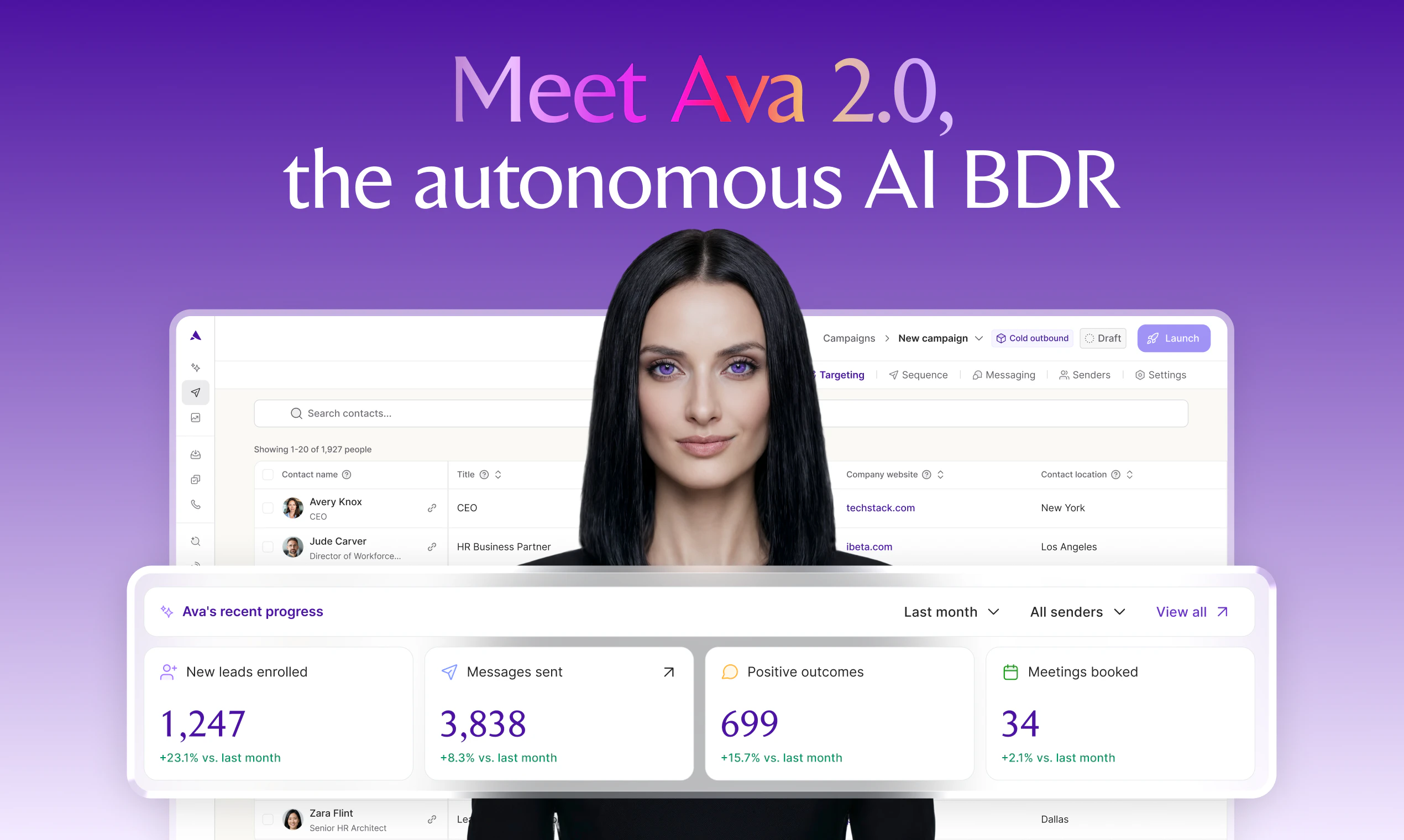
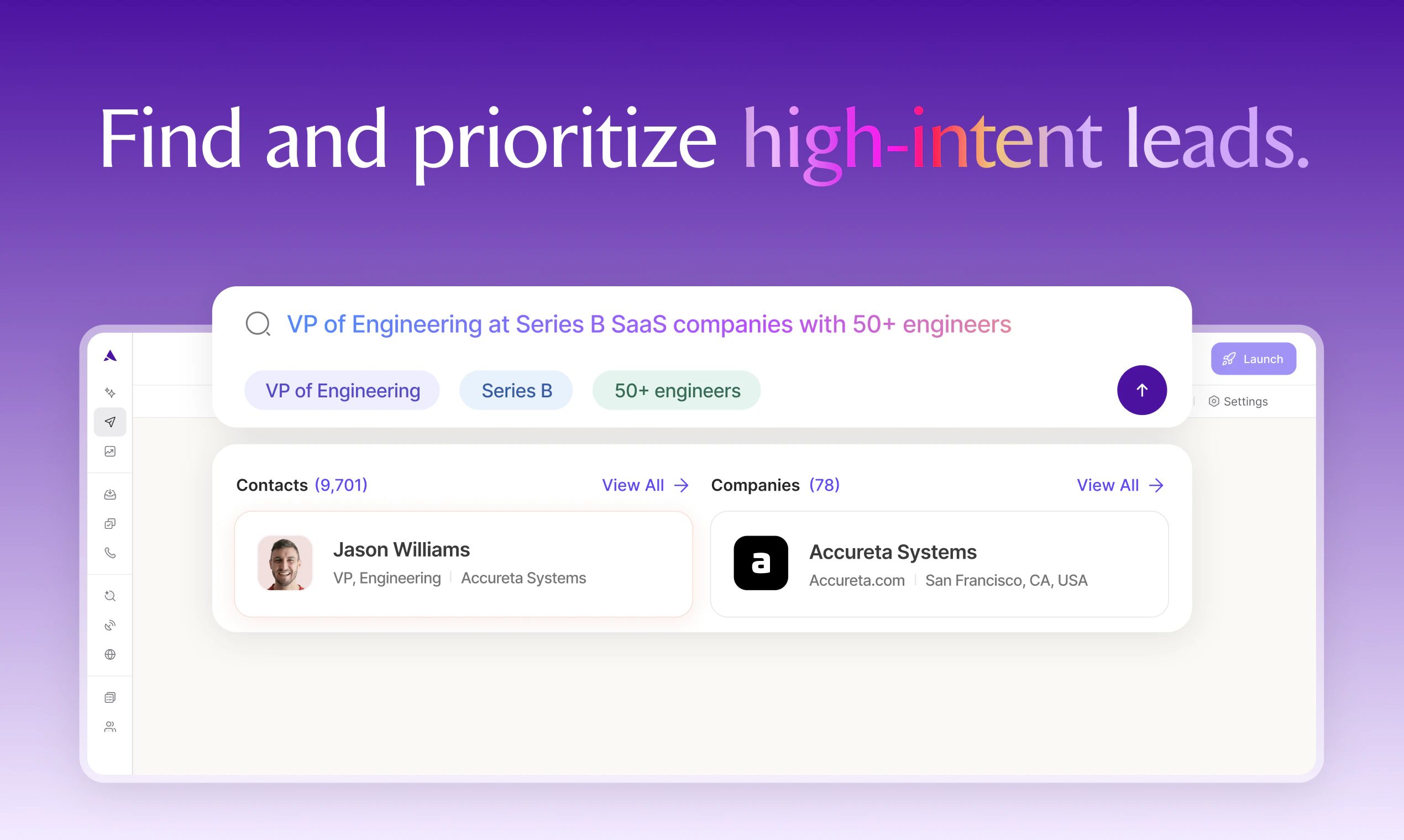
查看原始信息
Drafted
It’s never been easier to design your dream house. Draw any footprint, choose your rooms, and Drafted generates complete floor plans, elevations, and 3D home designs in seconds. Explore ideas instantly, customize layouts, and export CAD and PDF files when you're ready to move forward. Over the last month, more than 120,000 people have come to the product and generated over 325,000 home designs. Most of our growth has come from viral social sharing and word of mouth.
Hey everyone 👋 - Nick here, founder of Drafted. Before Drafted, we spent years helping people design and build custom homes. We repeatedly saw homeowners, architects, builders, and developers asking the same question: "Given these constraints, what could I design?" Surprisingly, answering that question is still slow and expensive. Exploring even a handful of alternatives often requires significant design work before anyone knows whether a direction is worth pursuing. We started experimenting with whether modern generative models could help. Existing image models could generate beautiful architectural images, but they struggled with floor plans because floor plans require spatial reasoning, geometry, and functional relationships between rooms. Over the last year, we've been building models specifically for residential architecture. Today, users can define room lists, square footage targets, footprint shapes, lot boundaries, and other constraints to generate complete floor plans, elevations, and 3D home designs in seconds. We'd love feedback from anyone interested in AI, architecture, construction, real estate, or design software. We'll be here all day answering questions. Feel free to email me: Nick@drafted.ai
3
回复

@primalnick The traction numbers here are wild, but the bigger insight is probably how immediate the feedback loop feels. Being able to go from a rough footprint to a full visualized home concept in seconds makes experimentation addictive. The viral sharing makes a lot of sense too since people naturally want feedback on dream-home ideas. What kinds of layouts or design patterns are users generating most often right now?

0
回复

Wow this is like really really cool. Im sorry i have no use to try it as its just not in my wheelhouse of projects / products i work with but i was just looking at the products today and i was really impressed with this. I have seen a lot of like make this room look good with Ai but you guys went to a whole other level with this.

I definitely think this project should have been upvoted higher. I feel bad as i usually test the products i feel are cool and leave feedback but just dont know where to even start with this one. I did go through the site a bit though and some small recommendation's would be the landing page maybe should have some content or pics or video (this video you have here in ph is super compelling) but all these templates that if i click on take me to a login seems a little forceful. I just feel like its hard to learn exactly what you are about without being forced to sign up. I am no marketing expert what so ever, just wanted to point that out as its just my personal feelings. I thought it was just the product hunt slug page or something but i see your real homepage is the same. Anyway best of luck really amazing stuff!

0
回复