Product Hunt 每日热榜 2026-07-16

PH热榜 | 2026-07-16

#1
Paradigm
Turn any goal into a personalized, adaptive learning path.
528
一句话介绍:Paradigm 是一款将任意学习目标转化为个性化、自适应学习路径的AI导师平台,解决用户在自学过程中“不知道下一步该学什么”以及“学习工具碎片化(笔记、练习、辅导分离)”的核心痛点。
User Experience Education Career Vercel Day
AI导师 自适应学习路径 个性化教育 目标驱动学习 实时反馈 技能证明 多模态交互(文本/代码/桌面) 智能作业辅助 学习路径规划 教育科技
用户评论摘要:用户关注定价(1000免费令牌用完后如何收费)、AI导师决策逻辑(如何根据进度定下一步)、是否支持iMessage外交互及跨平台学习。正面反馈:固定计划过时,动态路径更实用;建议改善注册页的上下文衔接(网址输入目标在注册页丢失)。深刻提问:导师能否评估平台外真实工作产出(如上线产品),而非仅止于内部测试。
AI 锐评

Paradigm在“AI教育”这条拥挤赛道上,拿出的不是又一个套壳聊天机器人,而是一套真正敢于承诺“动态适应”的系统。它的核心差异在于:**路径不是预先规划的课程表,而是根据用户实时表现、甚至外部输入(如考试范围、项目进度)来自我修正的决策引擎**。评论中用户抱怨“固定计划第三天就过时”,直击了传统在线教育的痛——Paradigm用“持续诊断+即时反馈”回应了这一点。更值得关注的野心是它承诺的“跨OS虚拟机和iMessage交互”,这意味着AI导师不止于对话,还能帮你挂载真实环境、执行任务、甚至聊天框里解构一张解剖图——这是从“知识问答”向“能力教练”的跃迁。

但“名字你定价”的定价策略虽有趣,却像用趣味性掩盖模糊的商业模型;评论也指出注册流程中断学习状态的致命Bug:用户输入“学SEO”后,进入注册页就丢了上下文,这在漏斗设计中是原则性失误。技术上,最大的问号是:**“自适应”深度能否穿透真实世界**——一位用户尖锐提问:我项目里交付的产品,平台能理解并纳入路径吗?团队的回答提及“跨OS VM”,但未解释如何结构化外部的、非标准的“证据”。如果回答始终是文档内的测验和沙盒里的练习,它依然是另一个“围墙里的实验室”,而非创始人承诺的“大学生活外的那所大学”。

简言之,Paradigm的方向正确、落地漂亮,但真正从“工具”成为“教育基础设施”,需要破的是“围墙边界”——对真实世界产出确权的可行性,比任何自适应算法都更难。

查看原始信息
Paradigm
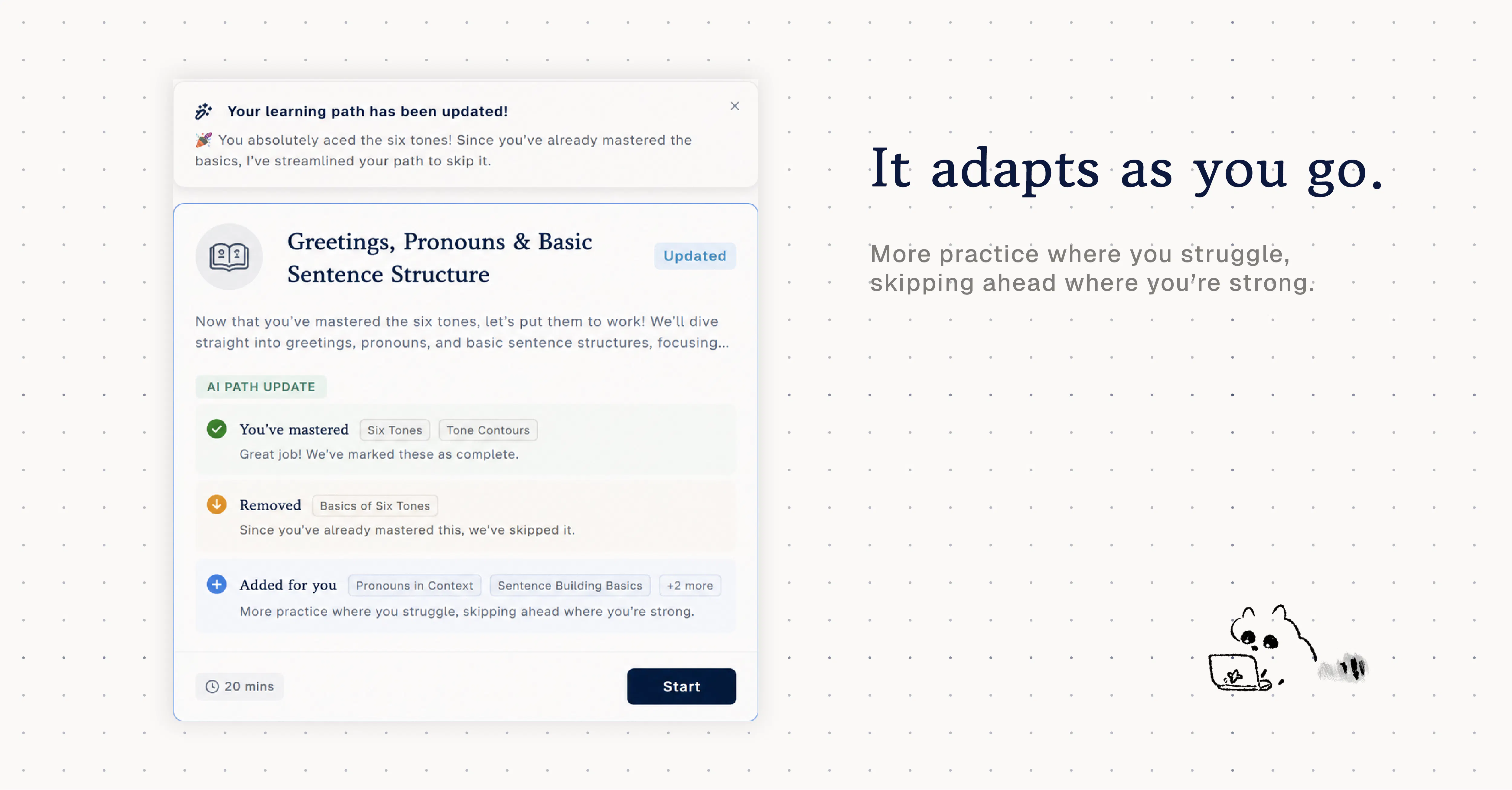
Paradigm reimagines education around the individual, taking any learning goal and turning it into a step-by-step path that evolves with your progress, helping you move steadily from curiosity to mastery without getting lost.

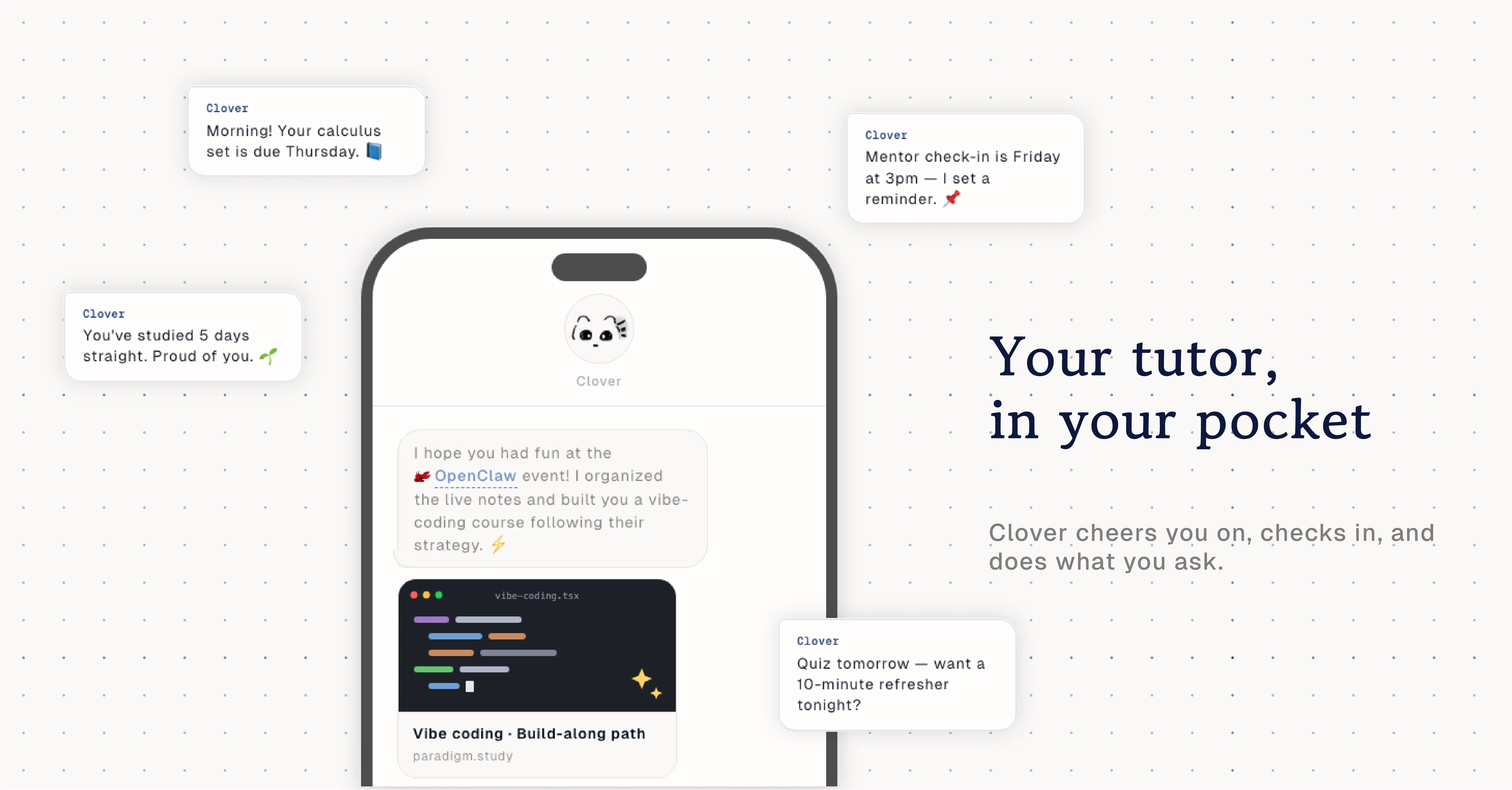
It's 11pm the night before your final, and your tutor texts you: it noticed your professor allows a cheat sheet, and it can build one around exactly the topics you're weakest on. Want it?

Hey Product Hunt 👋 I'm Scott, founder of Paradigm. That text is Clover, and moments like it are the whole product.

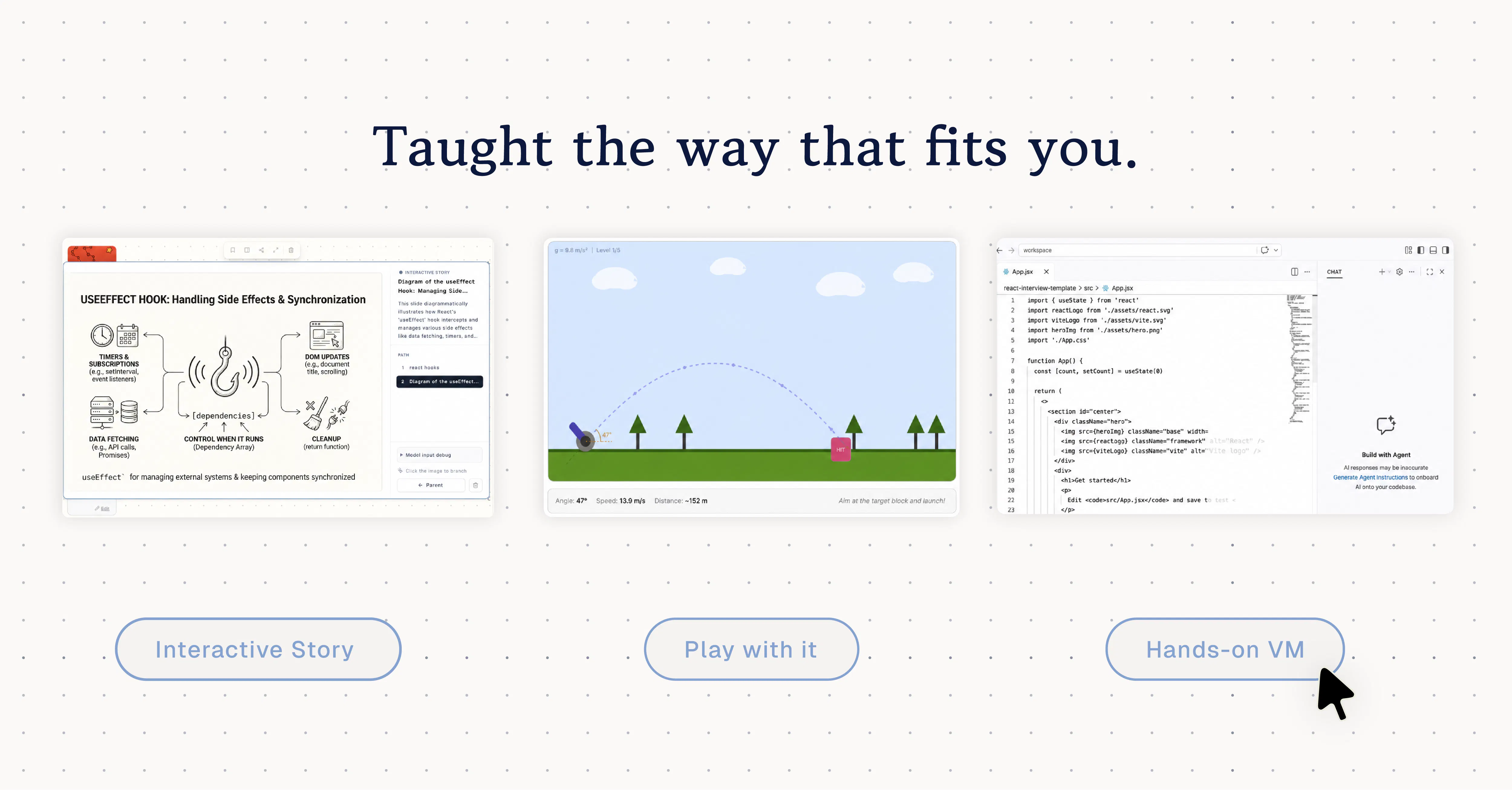
Another one: you say you want to ship your first app. Paradigm spins up a real cloud machine — terminal, Claude Code, the works — and walks you through it keystroke by keystroke until something is live.

Not courseware with a chatbot stapled on — one tutor that builds whatever the moment calls for (a spoken conversation, a coding sandbox, a full desktop) and remembers everything you've ever done with it. On the canvas, in your texts, the night before the exam.

Every interaction is graded as it happens, so what you walk away with is proof of skill, not a transcript. Anyone can build a course here; ours currently run from "Speed-run ICS 31" (UCI's intro programming, crammed) to "Let's count to 10!" (pre-K).

I started building this as a college freshman in 2023 — some of you might know me from OpenClaw or ShellBench. Almost everything that actually mattered in my education happened outside a syllabus. So I'm building the university I wish existed.

(One team fact I can't not share: the engineer behind our agent pipeline is also one of China's most-streamed underground rappers — 100M+ streams. The album and the agent pipeline shipped the same year.)

I'll be here all day, reading every comment.

👉 My ask: bring the weirdest thing you've ever wanted to learn — your grandmother's recipes, a 40-page anatomy atlas, a niche cert — and tell me where the path it builds breaks.

20
回复

@scoootscooob very good product

2
回复
@luca47 thx for supporting us!
1
回复

@scoootscooob Congrats on the #1 spot — turning any goal into an adaptive learning path is a strong idea, and the "actually adapts" part is exactly what everyone else fakes. You've already got a launch video, so here's something different: a free looping GIF of Paradigm built from your own screenshots — a click-free moving shot for your PH gallery, site hero or launch tweet, Giphy-tagged so it keeps getting found. White-label, yours to post anywhere: https://foxplug.com/g/542ec315c6c245d2829d

https://www.youtube.com/watch?v=NY6uIkBXExc

That came out of FoxPlug in ~30 seconds from just your URL. You keep building, and FoxPlug turns every commit, release and milestone into GIFs, videos, posts and a live changelog — automatically. Make your own free at https://foxplug.com

0
回复

How does the AI tutor decide what to teach next as I progress?

11
回复

@aslhangedi8oxh As you progress, the tutor keeps track of where you struggle and where you're doing well — then uses that to decide what comes next: reinforce a weak spot, move on, or level up the difficulty. So the path is driven by your actual performance, not a fixed sequence.

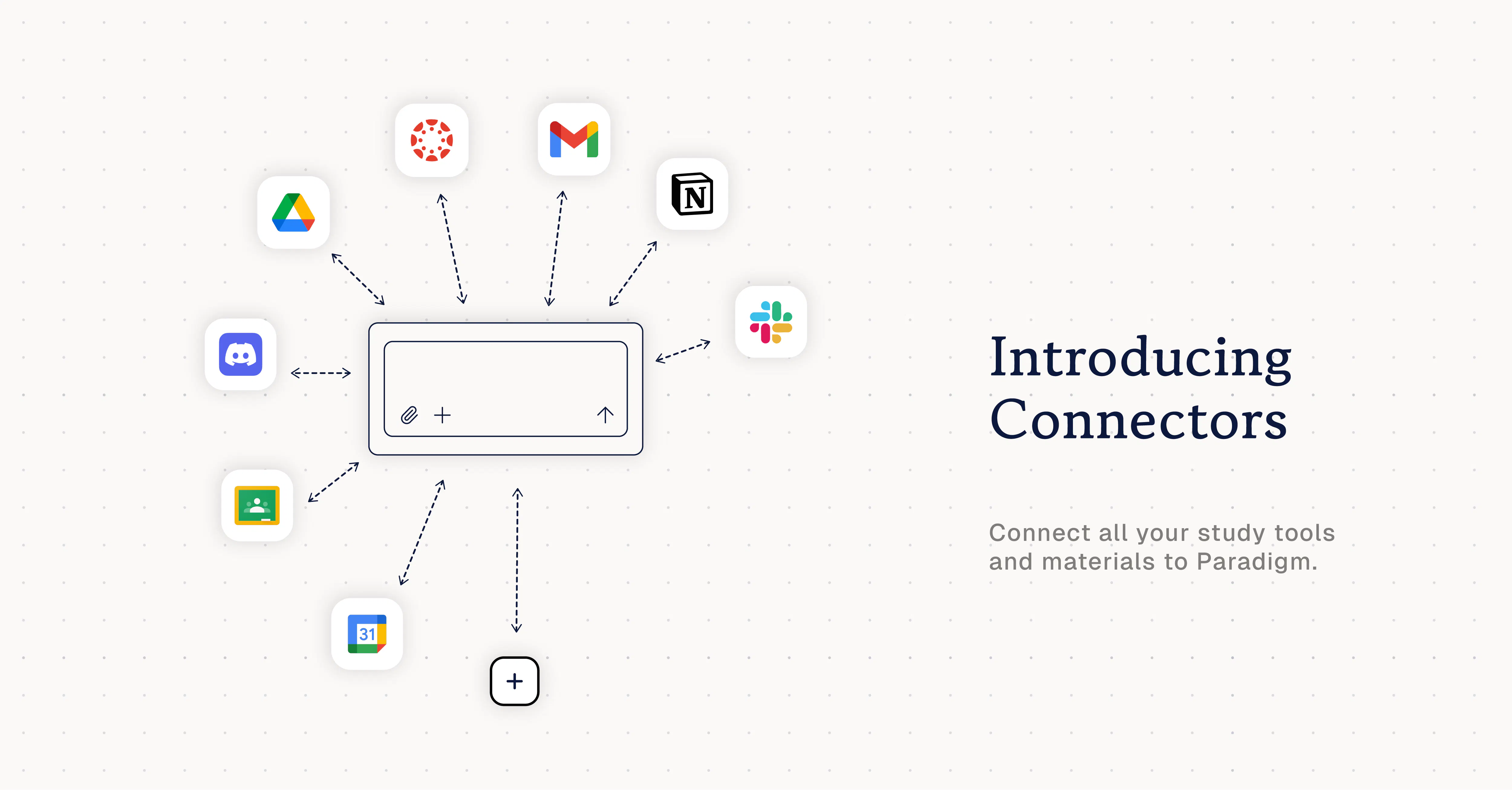
It also has rich context to work with — it can search the web and pull in whatever you give it (links, files, Google Drive, email, even your Canvas and more), so what it teaches stays grounded in your material and your progress. 🙌

1
回复

Juggling separate apps for notes, practice, and tutoring is exhausting. Does Paradigm bring these together?

7
回复

@hkristinabeoigp Yes — that's exactly the point of Paradigm. Notes, practice, and tutoring all live in one place, and they actually talk to each other.

Your notes feed the tutor, the tutor knows what you've practiced, and your practice adapts to where you're struggling — so you're not copy-pasting context between three apps that don't know each other. One workspace, everything connected. 🎉

1
回复

My biggest problem with self-study is not knowing what to learn next. Does Paradigm solve that?

6
回复

@elabinboaqxmg Yes — that's exactly what it's built for. Instead of you having to figure out the roadmap, Paradigm decides what to learn next for you: it tracks where you're strong and where you're struggling, then picks the next step — reinforce a weak spot, move on, or level up. You just show up and learn; it handles the "what next." 🙌

0
回复

Love that the path evolves with your progress instead of being fixed on day one.

3
回复

@elifsugrgeiqxf That's the part we cared about most — a plan fixed on day one is out of date by day three, because you've changed. Letting the path move with you is what keeps it actually useful. Thanks for the love!

0
回复

How does pricing work once the 1,000 free tokens run out?

3
回复

@songlsankxxlh Great question! A couple of ways it works:

First, join our Discord 👀 — we're constantly running activities and events where you can earn more tokens.

And beyond that, we use an AI-based bidding system: as Scott mentioned in the maker comment, your price for the product comes down to how well you can persuade our AI agent. So it's less a fixed price tag and more a fun conversation. 😄🙌

0
回复

Can I chat with the tutor over text/iMessage, or only inside the app?

3
回复

@naciyenk4c Yes! You're not stuck inside the app — you can text the tutor over iMessage and it'll respond right there, just like messaging a friend. You can send it photos, PDFs, links, ask questions, and it keeps up with your progress the same way it does in-app. Great for quick check-ins or studying on the go. Here's a real example 👇

0
回复

Congrats on the launch! 🚀 That bit about everything that mattered happening outside a syllabus really got me. Honestly everything I use day to day I picked up by building stuff and breaking it, never from a course. Proof of skill over a transcript is way more useful anyway.

2
回复

@nelsonsilvadev Thank you! And yeah — that's the truth almost nobody puts on a syllabus: the stuff that sticks comes from building and breaking things, not sitting through a course. A transcript says you showed up; proof of skill says you can actually do the thing. That's the part we care about measuring. Sounds like you've been living this already — appreciate you sharing it!

0
回复

Congrats on the launch, #1 spot is well earned. I spent a good 15 minutes poking around the site before commenting.

The interactive widget on the landing page is a really smart touch. I typed "learn technical SEO for Next.js sites" and it started sketching out a path, which genuinely got me curious.

One honest piece of feedback from that session: every CTA on the site (Open in Paradigm, Start learning, even Name your price) lands on the exact same generic signup screen, and it never mentions the goal I just typed. All the momentum the widget builds dies right at the highest friction step. A single line like "sign up and we'll finish your technical SEO path" would carry that motivation through. Also the typed goal only lives in sessionStorage, so anyone who opens their email verification link in a new tab will feel like their goal got lost.

Tiny one: the 404 page's Return to Catalog button points to /home/catalog, which logged out visitors can't open.

The name your price tuition idea is fun, curious how tough Clover is as a negotiator. Upvoted!

2
回复
@abdullah_javaid3 thanks for the through feedback! tagging @jingjing_w
0
回复

An AI tutor that meets you across text, app, and chat feels way more natural than opening yet another dashboard.

2
回复

@serdarkara21102 Thanks so much! And Clover the raccon @contact_paradigm is so so cute 🦝💗

0
回复

The hardest part of learning to code alone is getting stuck with no one to ask. Does the tutor help there?

2
回复
@cemreivaq yes! often times the problem is even not knowing what to ask. the agent will observe and interpret where you might be having trouble with and come up proactively before you even ask the question!
0
回复
congrats Scott bb
1
回复
@miltonheyan thx bb
0
回复

This genuinely looks like an exceptional product. I chose a reasonably technical (and probably not hugely mainstream) subject and it created a well structured course for me, with a blend of knowledge and practical walk throughs. As ever with Product Hunt, I am working through today's launches... but this is firmly getting an upvote and I will be coming back. I normally have a comment or query, but everything makes sense so far (I even found how to change the voice, which was my only irritation!)

1
回复

@martin_tanner This actually made my day, thank you so much! 🥳 Throwing a technical, non-mainstream subject at it is honestly the best stress test there is (generic topics are easy to fake; niche ones aren't), so it means a lot that the structure and the knowledge-plus-hands-on blend held up for you. And ha — glad you found the voice setting; noted that it took a bit of hunting. Thanks for the upvote and for planning to come back — that's the part that really matters to us. See you again soon!

0
回复

This idea is simply brilliant. Having goals is not the hard part. It's creating a path and then adapting the path when life happens.

1
回复

@amy_ingram Exactly! Goals are easy, it's the path (and re-drawing it every time life gets in the way) that trips everyone up. That's the part we wanted to take off your plate. Thanks for the kind words!

0
回复

Taking your "tell me where the path breaks" ask seriously: I hand-built exactly this for myself this month — a 12-week path where every week has to produce a real artifact for my actual job, with an LLM mentor that quizzes me against those outcomes — because topic-sequenced courses never stuck. Graded interactions cover what happens inside Paradigm; my paths always broke at the boundary, where the proof lives outside the platform (a dashboard shipped at work, not a quiz). Can the tutor take messy external artifacts as evidence and adapt the path around them, or does grading stop at its own sandbox?

1
回复
@mystoryland yes! It only matters when it’s always up to date relevant. which is why we built this platform with cross os vm so that we give the agent ability to build the most relevant and up to date experience for you.
0
回复

Interesting concept. As someone teaching myself new skills constantly while building a SaaS, the "getting lost" part is real.

1
回复

@ringo_td5 That's the exact scenario we built this for: less time figuring out what to learn next, more time actually learning it. Appreciate you checking it out!

0
回复

This product is very cool, but during the course learning process, I really wish there was a "teacher" who could help explain confusing terms or other doubts at any time. I hope this feature can be supported in the future!

1
回复

This product is very cool, but during the course learning process, I really wish there was a "teacher" who could help explain confusing terms or other doubts at any time. I hope this feature can be supported in the future! I encountered a BUG: after creating a course, the course disappeared when I returned to the homepage.

1
回复
@1251912798 looking into that right now!
0
回复
@1251912798 definitely a UX we should improve on. tagging @paradigm_geo here
0
回复

Amazing idea - exactly what is needed to help me cross the "valley of despair" when I am trying to understand that new thing.

1
回复

@justin_r_pearsonGetting you through that dip with a path that adapts instead of leaving you stranded is the whole point. Thanks for the support — let's conquer the new things together! 🙌

0
回复

Your product sounds really nice! Congratulation on launch! I`m learning serbian language at the moment, so testing Paradigm on creating course for learning serbian verbs. First impression is great, would check in more detailed way and share my experience.

1
回复

@julia_shtogren Thank you! Learning Serbian sounds like a great way to try Paradigm — would love to hear how it goes as you explore more.

0
回复

This feels like having a patient 1:1 tutor that actually adjusts to your pace.

1
回复
@cosgun_hak89117 exactly!
0
回复

The coding sandbox built directly into the lessons is a really smart touch.

1
回复

I like that it covers academic exams and professional skills in the same place.

1
回复

@erdal224209 That's exactly the range we were after — and integrations make it seamless on both sides. It's connected to Canvas, so you can pull in your actual courses without feeding the tutor any context yourself. And with email integration, if you get, say, interview details in your inbox, it can grab them and build prep around them. Same workspace, whichever chapter of life you're in. 🙌

0
回复

Congrats on the launch! Are you guys diagnosing weakness passively from what I'm working on or users basically sit an assessment first?

1
回复

@artstavenka1 yes, we'll track your learning journey and diagnose your weakness

2
回复

most learning tools are just a fixed playlist with a progress bar. building the path around your actual goal is the part that makes this worth trying

1
回复

@alex_watson2110 That's right! Starting from your goal and shaping the path around it (instead of you bending to fit the playlist) is the whole difference. Thanks — hope you give it a try! 

0
回复

Can I import my own study materials or textbooks into a learning path?

1
回复

@kbra84zm Yes! You can upload both documents and links, or you can just trust the agent with its own decision :D

0
回复

Would this work for brushing up on math before starting a data science course?

1
回复

@kymetigeg Yes! Whatever you want, just prompt it to the agent, and it'll create a course that adapts to your need. You may also tell it to adjust the course if you want to make changes halfway.

0
回复

Does the coding sandbox support multiple languages like Python and JavaScript?

1
回复
@grkemellek1eu3 it supports any coding language that you may need and even coding agents like Claude code and codex
0
回复

The idea of going from curiosity to mastery without dead ends really resonates. Most courses lose you halfway.

1
回复

@sevcandokurel That halfway drop-off is where almost everything loses people — the moment it stops matching where you actually are. Closing those dead ends, so curiosity has a clear road all the way to mastery, is exactly what we're chasing. Really glad it resonated!

0
回复

This looks great for lifelong learners who just want to explore a new subject.

1
回复

@umutpozg Absolutely — that's a perfect use case. Go give it a spin and type in your first prompt — see where it takes you!

0
回复
#2
Zro
Private inference for coding agents
425
一句话介绍:Zro 为编码智能体提供基于开源模型的私有推理API,在零数据留存的多区域基础设施上实现高速调用,解决开发者在使用闭源API时隐私泄露与自托管模型时运维繁琐的痛点。
API Developer Tools Tech Vercel Day
AI推理 私有API 编码智能体 零数据留存 开源模型 多区域部署 隐私优先 开发者工具 SaaS 模型即服务
用户评论摘要:用户普遍认可其速度和隐私承诺,但关注点集中在:真实Agent循环中多步调用下的延迟表现、如何证明零数据留存、当前仅支持EU区域(急需US区域)、以及希望增加更多编码模型(如Qwen系列)。团队积极回应,承诺优化长上下文工作负载并拓展区域。
AI 锐评

Zro切中的是AI开发者社区一个日益尖锐的“不可能三角”:性能、隐私与运维成本。其核心卖点“零数据留存”和“多区域优化推理”并非技术首创,但精准定位于编码智能体这一高价值、高隐私敏感场景,将商业叙事从空洞的“隐私保护”落地为“你的代码不该成为他人的训练数据”,直击企业法务和CTO的噩梦。

从用户反馈看,团队的技术底子不差(MoonMath/Ingonyoma背景),延迟和稳定性获得了早期采用者的认可。但真正的考验在于:1. **证明“零留存”不是噱头**:这需要公开的审计报告或可验证的架构设计,仅凭口号无法赢得严肃的企业客户。2. **长上下文Agent推理的真实性能**:用户一针见血地指出“10次工具调用后的延迟”是试金石,这与单次API调用的速度天差地别,目前团队尚未给出令人信服的基准测试数据。3. **模型生态的广度**:仅支持GLM 5.2和Minimax M3,面对Code Llama、DeepSeek Coder等强手,模型库显得单薄。开发者切换ISP的意愿极低,除非Zro在特定模型上展现出碾压性的延迟优势或价格优势。

策略上,Zro需避免落入“又一个API壳公司”的尴尬。其护城河应该是:通过自研推理引擎在长序列、Agent循环场景中建立可量化的性能壁垒(例如公布与vLLM/TGI的对比基准),而非单纯依赖隐私叙事。否则,当主要闭源提供商(OpenAI、Anthropic)也推出“不训练”条款或开源模型自托管工具链成熟时,Zro的差异化将迅速瓦解。故步自封于“隐私优先”是短视的,尽快拥抱更多模型并打磨“编码Agent专用优化”才是生存之道。

查看原始信息
Zro
Fast and optimized open-model inference on multi-region infrastructure with zero request retention.

👋 Hi Product Hunt!

We're MoonMath, the team behind Zro.

Over the last year, we've been obsessed with one problem: making AI inference faster and more efficient. As we worked with developers building AI products, we kept seeing the same tradeoff:

Use closed-source AI APIs and give up privacy and control.
or
Run open-weight models yourself and spend time managing infrastructure.

We built Zro so developers don't have to choose.

With Zro, you get a fast, OpenAI-compatible API for open-weight models with:

🌏 Multi-region hosted inference
🔒 Zero data retention & zero training on your prompts
🏢 Optional on-prem deployments
⚡ A serving stack optimized for coding agents and long-context workloads using MoonMath's in-house inference technology.
🛠️ Built for easy setup with the most popular AI coding agents


We're launching early because we want feedback from developers building real AI products. We'd love to know:

Which models should we add next?
What features are missing from your current inference provider?
What would make you switch?

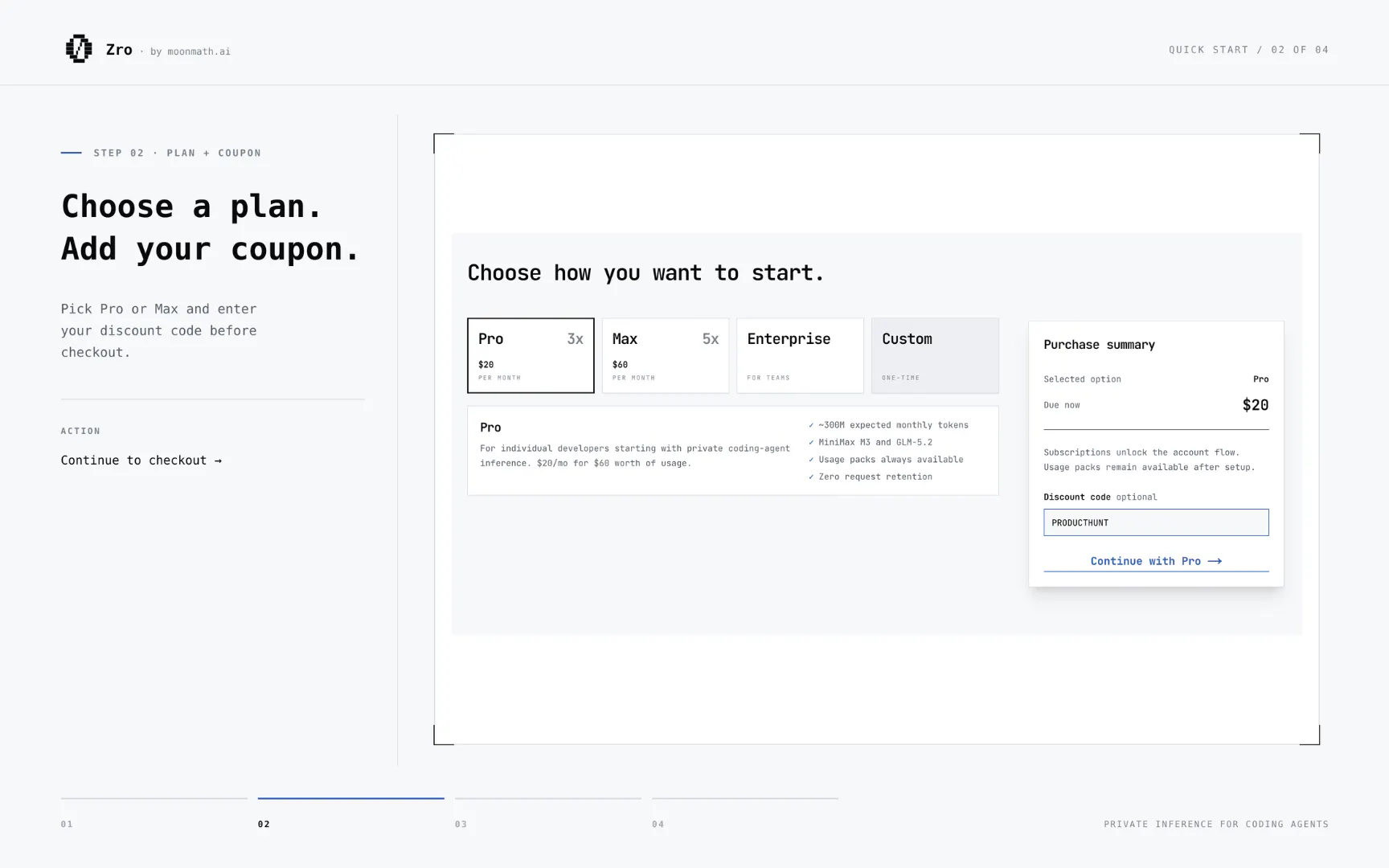
🎁 Product Hunt launch offer

Use code PRODUCTHUNT to get 1 month of Zro Pro free.

Limited to the first 100 users.

We'll be here throughout the day to answer every question. Thanks for checking out Zro, we're excited to hear what you think! 🚀

16
回复

@otsar_shalmoni Congrats on the launch — private inference for coding agents is timely; teams are getting nervous about their code leaving their own infrastructure, and you're selling exactly that peace of mind. You've already got a video, so here's a complement: a free looping GIF of Zro from your own screenshots, a moving shot for your gallery that plays without a click, Giphy-tagged to keep surfacing. White-label, no strings: https://foxplug.com/g/be1c208afc1f4c398605

https://www.youtube.com/watch?v=NY6uIkBXExc

It's a 30-second taste of FoxPlug — you stay building, and it turns your releases and milestones into GIFs, videos, posts and a changelog on its own. Roll your own free at https://foxplug.com

0
回复

@otsar_shalmoni This is a boxing most founders and teams have been waiting for, no need to change your whole agent orchestration at all this is amazing. Launching is just the start hope Zro develops even further.

0
回复

@otsar_shalmoni Congrats on the launch 🚀

I like that you're focusing on a problem many AI teams eventually run into: balancing performance, privacy, and operational simplicity. An OpenAI compatible API for open weight models with zero data retention and on prem deployment makes for a compelling combination.

I'm curious, after working with early users, what's been the biggest reason they've switched from their previous inference provider? Was it latency, cost, privacy, or something you didn't expect?

Wishing you and the team an amazing launch! 🎉🔥

0
回复
Congrats on launch @emirsoyturk I’ve been using it for the past week, and I’ve genuinely been impressed with the results. The speed improvements on GLM 5.2 are noticeable right away, and it’s already become part of my workflow. Great product.
8
回复

I've been using Zro for about a month, it's great!
Very fast and reliable

4
回复

@adi_milstein Thank you! Is there anything we can do to make your experience even better?

0
回复

Private inference is the box teams check last, usually right after their proprietary code turns up somewhere it should not. The part I would pressure-test is latency ten tool calls deep in a real agent loop, not on a single prompt. That is where most self-hosted setups fall over.

3
回复

@shivangit26 Exactly, that is the reason we are optimizing our inference for long-context agentic workflows!

Let us know if there is any model you would like to see.

1
回复

I am using GLM 5.2 through ZRO in my daily workflow for a while now. The speed and quality have been impressive so far.

Good luck with the launch!

3
回复

@karasakalmt Amazing! Do you have any coding models that you would like to see on ZRO?

0
回复

honestly the no-retention thing is a really thoughtful call, most teams talk about speed but skip the privacy piece entirely. nice to see it baked in from day one

3
回复

@yiitellezf6fz Thanks! Privacy has always been core to our ethos as a company

0
回复

"Your code shouldn't be someone else's training data" is a strong line. Which open models are you running under the hood, and is EU hosting the default or a paid tier? Congrats on the launch

3
回复

@alex_tomilin EU hosting is the default and we are working on adding new regions (e.g US). Right now GLM 5.2 and Minimax M3 are accesible via ZRO and we are testing/optimizing new models.

Do you have any models that you would like to see added?

3
回复

The API speed of response is really fast. Been used for a while and very satisfied by the quality of the API.

3
回复

@peter_chen21 Thanks! We're actively working on adding more models and faster responses. Do you have any features/models that you'd like to see added?

1
回复

Fastest API I have ever used so far.

3
回复

@yamancan Happy to hear that! More improvements are on the way.

0
回复

Additionaly, you can try PRODUCTHUNTMAX for 50% off the Max Plan

3
回复

private + coding agents, finally. how much latency do you give up to keep it private?

2
回复

@doganakbulut You don’t have to trade one for the other! ZRO is optimized for fast, long-context coding-agent workloads while keeping zero data retention. Which model would you like to see on ZRO next?

3
回复

the zero-retention, no-training-on-your-code angle is the whole pitch for me. most devs just assume their prompts end up as training data somewhere and live with it. if you can actually prove retention is zero, that's a real reason to switch, not just a nice-to-have

2
回复

@alex_watson2110 Thanks for the comment! Privacy is part of our core beliefs and has been at the heart of what we have built over the past years at MoonMath and Ingonyama.

0
回复

Really like the commitment to zero request retention, that's a rare stance these days and shows the team actually thought through the privacy side instead of just slapping it on a landing page.

2
回复

@pnar1063684 Absolutely. Privacy has always been a core principle behind what we build at MoonMath and Ingonyama.

0
回复

The tradeoff between closed APIs and self-hosting open models is very real. most small teams want more privacy and control, but not the operational burden of running inference infrastructure themselves.

The OpenAI-compatible API, zero retention, and optional on-prem path make Zro feel practical for teams that want to start simple and keep more control as they grow. Curious how you handle routing across regions for long-context coding workloads without hurting cache efficiency or latency consistency?

2
回复

@andrasczeizel We are not routing your request across region and that's how it wouldn't hurt the cache at all. Before setting up your session with API key you will be able to select which region you want to use.

Right now, all live machines are located in the EU, but US options will be available soon!

5
回复

Latency felt noticeably snappier than what I usually get from other inference providers, and I love that nothing gets stored. Refreshing to see a team actually prioritize both speed and privacy at the same time.

2
回复

@selim321016 Amazing! We are working hard to optimize models specifically for long-context agentic workflows.

0
回复

"zero retention claims are cheap, anyone can audit this?"

2
回复

@paige_lauren1 Fair point. Privacy has always been core to what we build at MoonMath and Ingonyama. We're actively working toward stronger transparency around these guarantees.

2
回复

which agents work with it?"

2
回复

Hey @oliver_nathan2 , I'm Jeremy one of the builders of Zro. Thanks for asking!
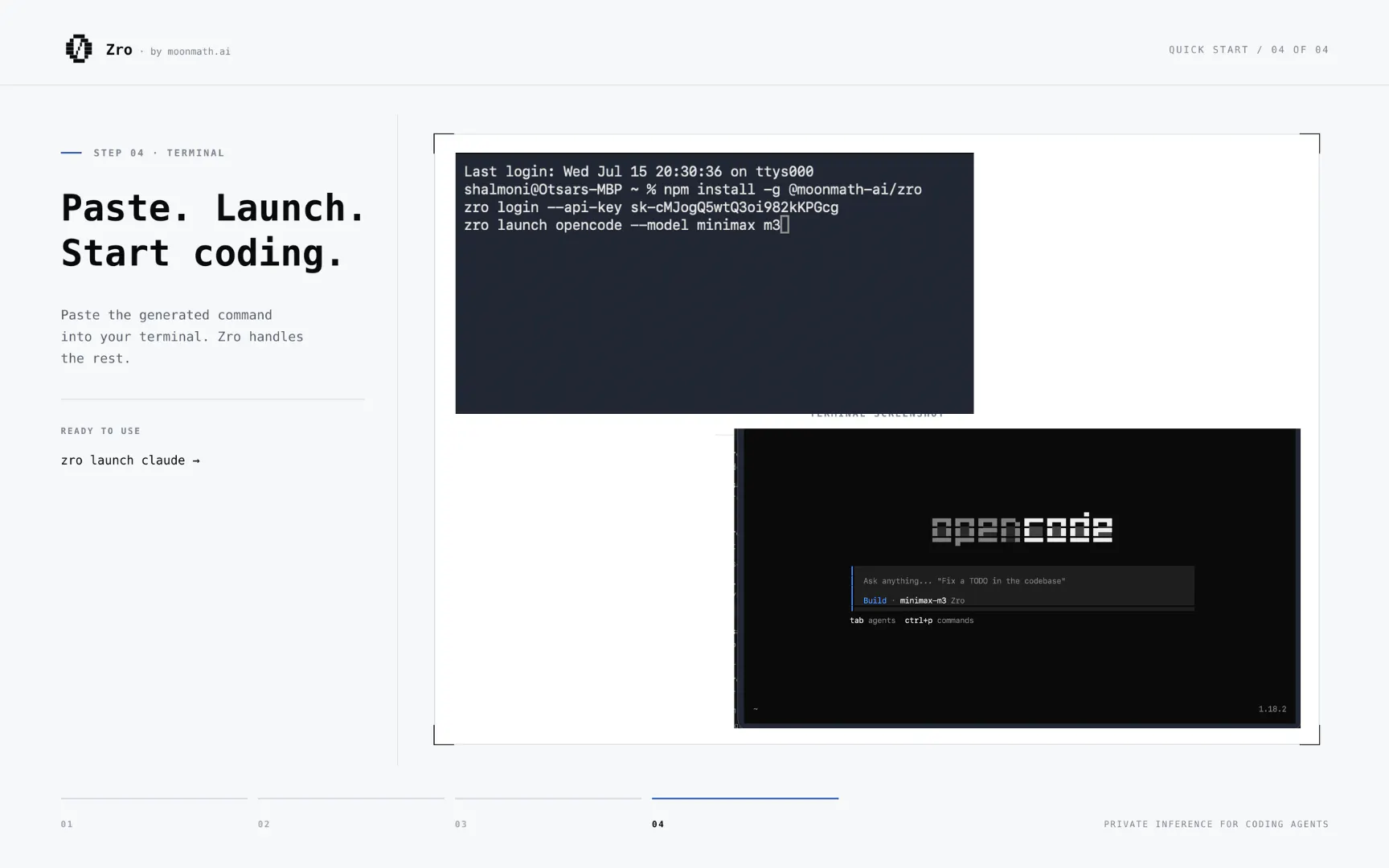
We have built in support for many popular harnesses like Claude Code, Codex, Pi, OpenCode, and are adding more. You can see all of the ones we officially support here https://zro.moonmath.ai/integrations

0
回复

Private inference is one of the most underrated problems in the agent space right now. I build in a compliance-heavy vertical, so "your code never leaves your control" is a real buying trigger, not a nice-to-have.

How are you handling the latency tradeoff vs. hosted frontier models?

1
回复

@clemente_lopez1 100% private inference is a need. In terms of latency, there is no need to trade it for privacy! We don't trade any privacy for latency and our latency is top tier.

0
回复

"on prem this early feels like a lot for a small team to support properly, are yall going setup manually right now or is there tooling for it".

1
回复

@aria_turner Right now we work together with the team to customize their on prem deployment to their needs. We have been running Zro internally on prem for a while and have experience in deploying on prem, hybrid, and cloud based solutions.

0
回复

"multi region's great for latency but some of us need single region only for compliance stuff, is that even an option here".

1
回复

@zoe_sullivan you will be able to select the region or regions you’re comfortable using, and your API key will be restricted to those regions.

Right now, all live machines are located in the EU, but US options will be available soon!

2
回复

"openai keeps cutting prices every few months, not sure privacy alone convinces people to switch providers".

1
回复

@hannah_parker5 That’s true. Privacy alone may not be enough for some users. The most important real-world metric is cost per completed task. Models are getting smarter, and using them is becoming easier and cheaper every day.

Open-weight models are already competitive in both intelligence and cost, and they’re improving quickly on both fronts.

Speed is another important factor. The SGLang team and we at MoonMath are working hard to improve these models, especially for long-context agentic workflows.

0
回复

@Emir Soytürk makes sense, TTFT and TPS are the two numbers that actually matter for an agent loop, not just raw throughput. curious if you've published any benchmarks against the big hosted providers or if that's still coming

0
回复

Congrats on the launch! Zero retention really matters once you're touching more than one company's data, I run a few different businesses through my own tool and the idea of any of that context leaking across clients or getting used for training is a non-starter for me. Curious how you think about audit logs on your end, if a customer asks "prove nothing was retained," what do you actually show them?

0
回复

@stacywycof83995 Exactly the right question. Privacy and verifiability have been part of our ethos since our Ingonyama days.

ZRO doesn’t retain prompt or completion content. We only keep limited operational metadata such as token counts, latency, model.

We’re currently looking into ways such as independent audits and TEE-based verification to better understand how we can make these guarantees more transparent and verifiable over time

1
回复

👋 Hey Product Hunt!

Quick correction: our Product Hunt launch offer is no longer 100% off.

We saw abuse from zero-dollar checkout flows, so we changed the Pro launch offer to first month for $1. It is still a major launch discount, but it requires a real payment and helps us keep the service healthy for legitimate users.

The Max Plan promo code is unchanged: 50% off the first month.

Thanks for understanding. We’d rather be transparent and keep things stable for everyone.

0
回复

zero retention is the right pitch for coding agents specifically, a lot of codebases can't go through a provider that might log or train on the prompts. is the latency comparable to the big hosted providers, or is there a tradeoff for the privacy guarantee

0
回复

@omri_ben_shoham1 There is no need to trade it for privacy! In coding agent latency is determined by two numbers. TTFT (Time To First Token) and TPS (Token per Second). We are optimizing them especially for long-context agentic workflow so you have the smallest latency. Let us know what you think about our inference speed!

0
回复

Do you also support Claude? Would be interested if you supported their models.

0
回复

@sai_xiong We are only serving open-weight models like GLM 5.2 and Minimax M3. Addition to that we have built-in support for Claude Code.

check integration page out for more information: https://zro.moonmath.ai/integrations

you can also add ZRO as custom provider next to your existing claude models so you can easily switch between them

0
回复

Streaming support for token-by-token responses would be huge for chat use cases, even if it means slightly more work on the caching layer. Right now waiting for full completions before anything renders feels dated for an inference API in 2026.

0
回复

@frat8d8j Totally agree. ZRO already supports streaming through the OpenAI-compatible API.

If you saw a buffered response, let us know which client or integration you used!

0
回复

Congrats on the launch! Keeping it OpenAI-compatible is a massive smart move. A lot of teams want to switch to open-weight models for privacy but dread rewriting their entire agent orchestration layer or dealing with completely different API schemas. How has the drop-in replacement experience been for early testers? Are there any specific edge cases with function calling or streaming where the compatibility layer behaves differently than native OpenAI?

0
回复

@franz_briones Thanks for your comment Franz. It's really difficult problem and ZRO has built-in support for many popular harnesses like Claude Code, Codex, Pi, OpenCode. You can see all of the ones we officially support here: https://zro.moonmath.ai/integrations. We are also adding new harnesses like Kilo Code, Grok Build, Command Code.

Which open-weight models would you like to see?
Is there any tool that you're using and ZRO doesn't list it as supported?

2
回复

Love that there's no request retention here, that's a real differentiator for anyone dealing with sensitive data. One thing that would help me evaluate it faster though: a small public latency dashboard comparing Zro to other inference providers on common open models. Even just a simple weekly update with p50 and p95 numbers across regions would make it way easier to decide if it's worth migrating workloads over.

0
回复

@selinkutbag9gj Good idea, thanks for the feedback!

0
回复

One of the builders here 👋

GLM 5.2 is honestly a beast. I have been using it daily since we first launched ZRO internally, including to improve ZRO itself.

The speed and quality are really impressive. Give it a try!

0
回复
#3
Albato AI
Build AI-driven workflows across 1,000+ apps
289
一句话介绍:Albato AI 是一个无代码自动化平台,通过AI对话助手和智能代理,让用户用自然语言快速构建跨1000+应用的工作流,解决传统自动化设置复杂、调试困难、协作效率低的痛点。
Artificial Intelligence No-Code Tech news
无代码自动化 AI工作流 自然语言生成 智能代理 应用集成 画布模式 错误处理 自动化调试 自动化共享 SaaS工具
用户评论摘要:用户普遍称赞AI对话构建流程的便捷性,但核心问题集中在**AI决策的可控性**:有用户质疑自然语言分支逻辑在边缘情况下的误判风险,要求预览或试运行功能。同时,用户建议增加**版本历史与可视化差异对比**,以解决AI自动修改后难以回滚的问题。
AI 锐评

Albato AI 精准击中了传统无代码自动化平台(如Zapier、Make)的“伪易用性”软肋——那些层层嵌套的菜单和条件逻辑,本质上仍是技术人员的玩具,而非真正的生产力工具。通过“聊天即构建”和“AI代理自主执行”,Albato将人类从繁琐的界面操作中解放出来,让自动化回归“描述需求”的本质。

然而,其核心风险也恰恰在于此:**AI的“不确定性”与自动化的“确定性”要求之间存在根本矛盾**。多数用户用例(如CRM到电子表格同步)确实能通过训练过的Coilot轻松解决,但一旦涉及复杂业务逻辑(如审批分支、数据校验),AI对意图的“模糊理解”可能酿成灾难。尽管平台提供了单步测试和错误处理配置,但缺乏用户强烈要求的**全流程可视化预览**和**版本回滚**,这意味着在关键生产环境中,用户仍需为AI的“黑箱决策”买单。

从产品策略看,Albato的聪明之处在于**用AI降低低频新手用户的上手门槛**,同时通过画布模式、错误路由等工具保留**专业用户的安全网**。但真正竞品壁垒并非AI本身(通用大模型极易复制),而是其构建的**1000+应用深度对接的生态**以及**对业务场景的指令微调**。如果后续团队能快速补上版本控制、AI行为审计日志等“防呆”机制,Albato有望成为下一个企业级自动化的基础设施,否则将困在“演示惊艳,落地惊心”的尴尬境地。

查看原始信息
Albato AI
Automate smarter with Albato: chat with Albato Copilot to build automations and let AI Agents execute tasks from natural language requests. Plus, visualize workflows with Canvas mode, test individual steps with real data, and share automations easily.

🚀 Albato just got a major upgrade!

Hey everyone 👋 Wenddy here from the Albato team — and we’re beyond excited to introduce a new chapter in no-code automation.


We’ve rebuilt the Albato experience to make automation smarter, faster, and more intuitive than ever.


Here’s what’s new 👇

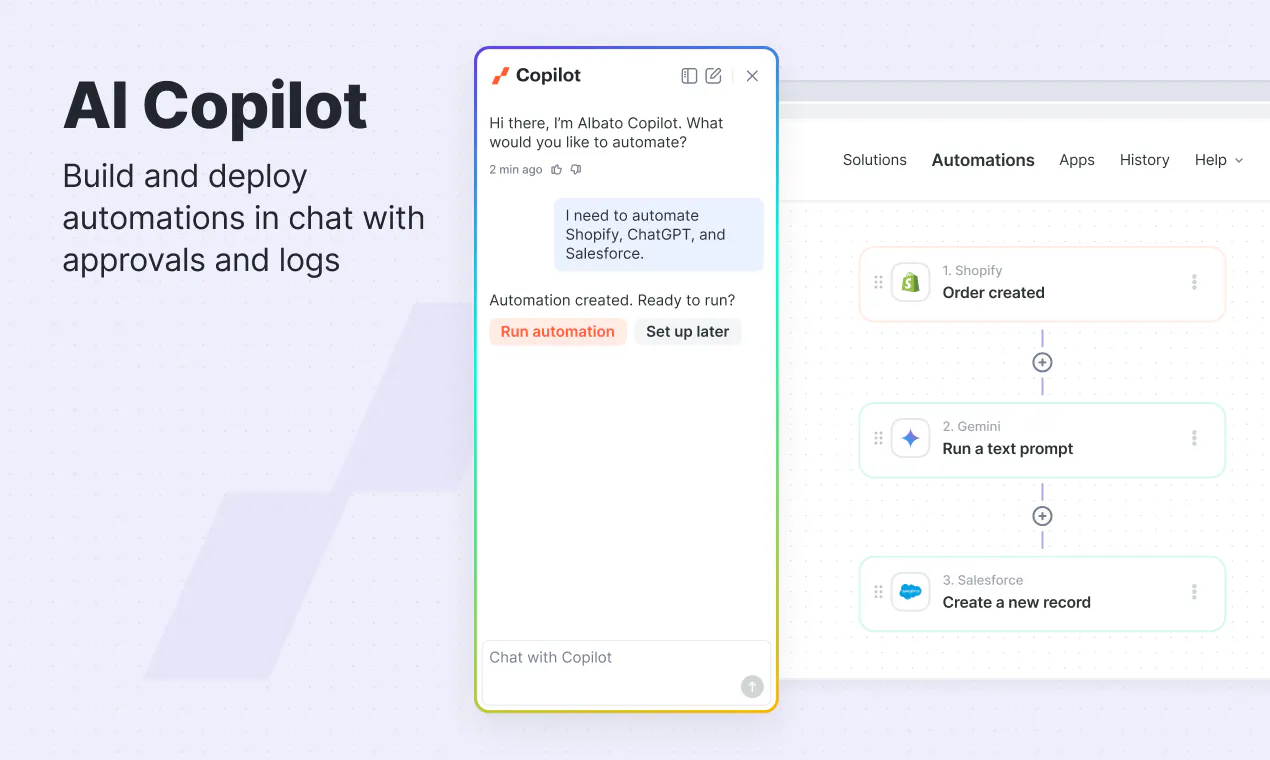
🤖 Albato Copilot — Describe what you want to automate in your own words (in any language!), and Copilot instantly builds your workflows for you. It’s like having a personal automation expert at your side, available 24/7.

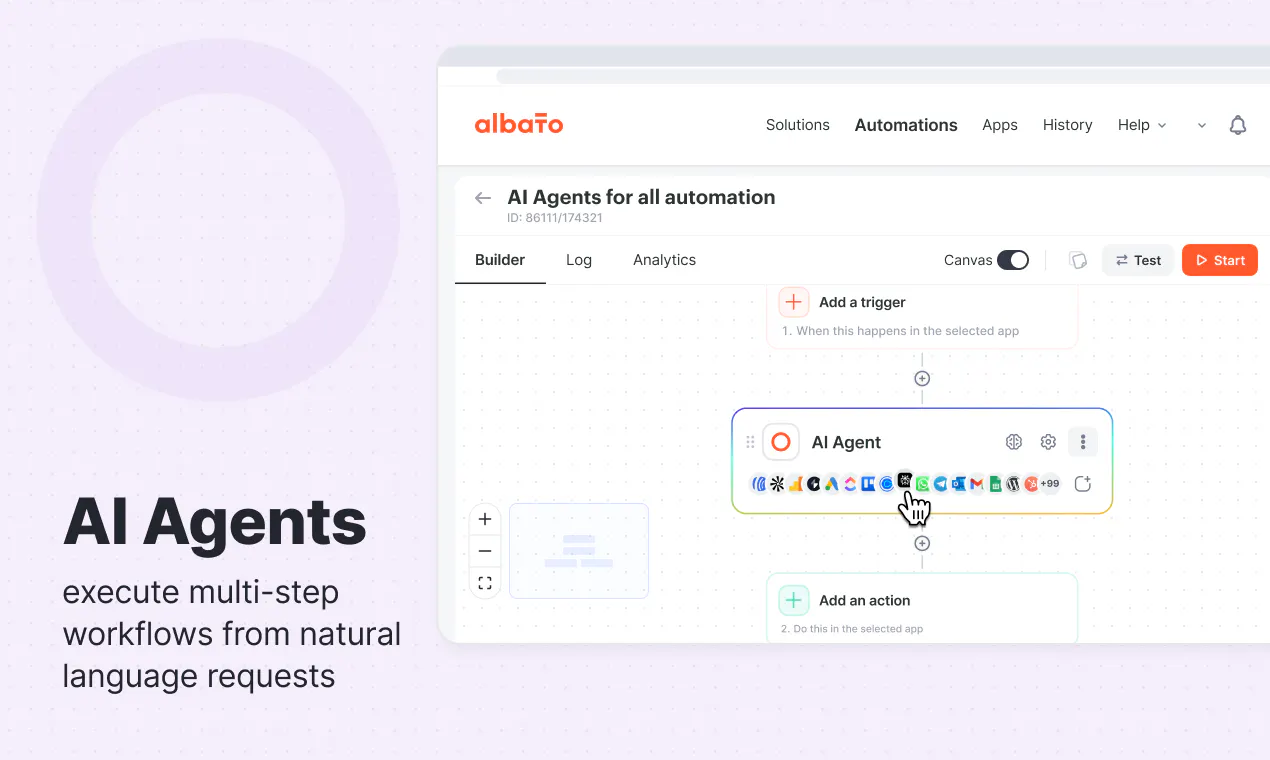
🧠 AI Agents — Go beyond workflow creation. Simply describe a task, and AI Agents can understand your intent, choose the right actions, and execute multi-step automations across your connected apps with built-in guardrails.

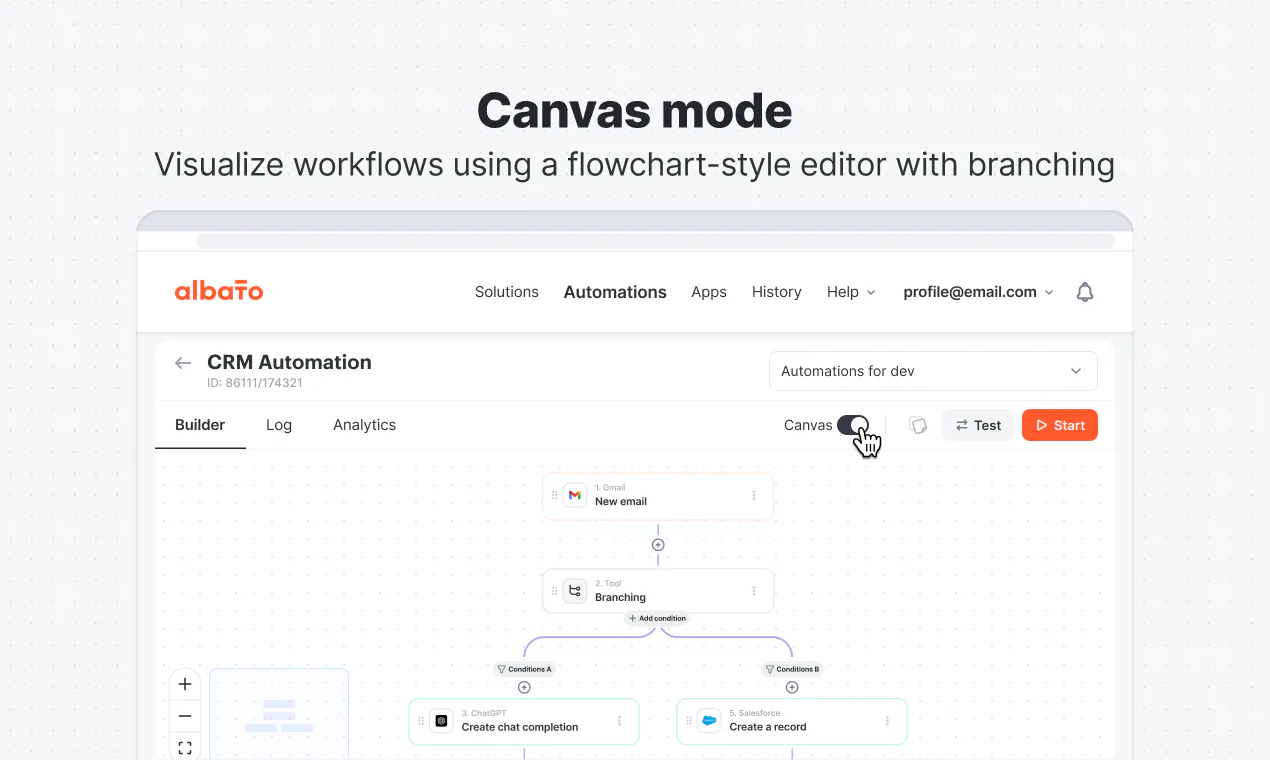
🧩 Canvas Mode — See your workflows come to life in a flowchart-style editor that gives you complete clarity and control. Explore complex automations with ease in one clean visual space. (And yes, drag-and-drop functionality is coming soon 👀)


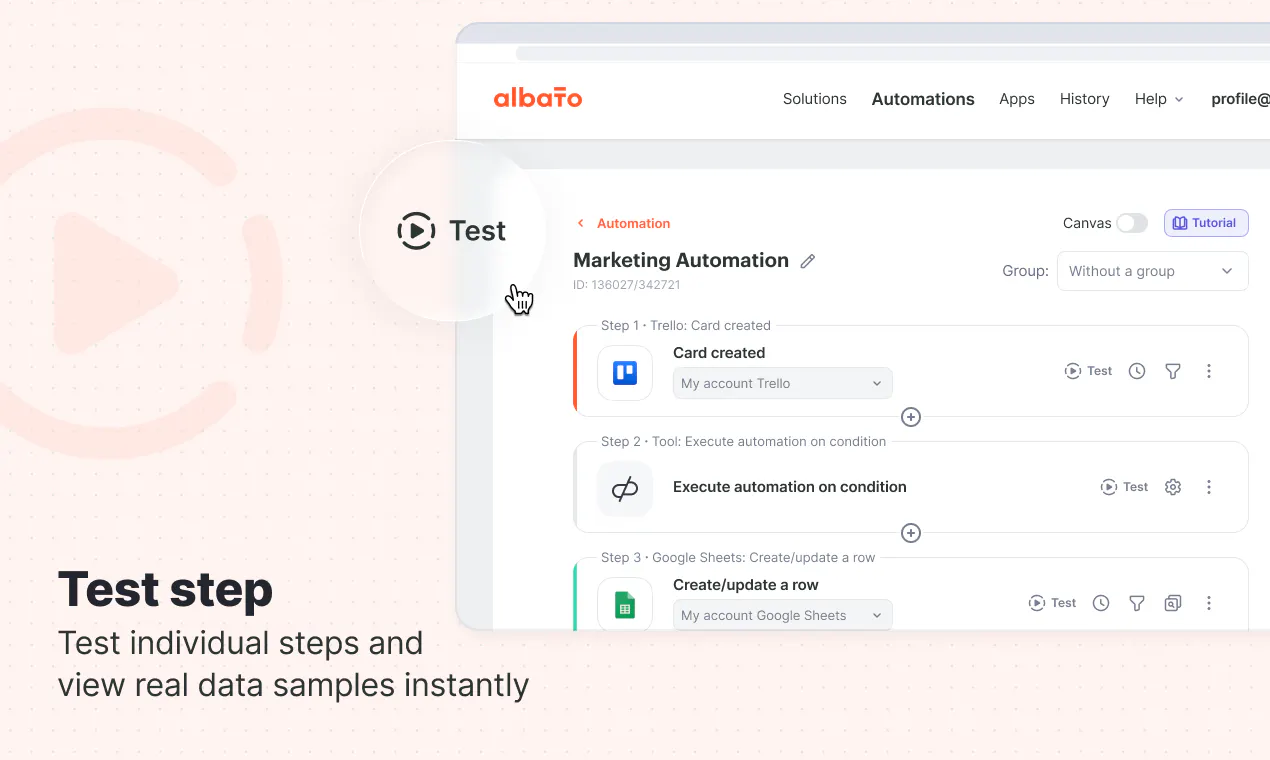
⚙️ Test Step — You can now test each step individually and instantly view real data samples in mapped fields. Validate and debug step by step, configure using real data, and save time while fine-tuning your workflows with precision.

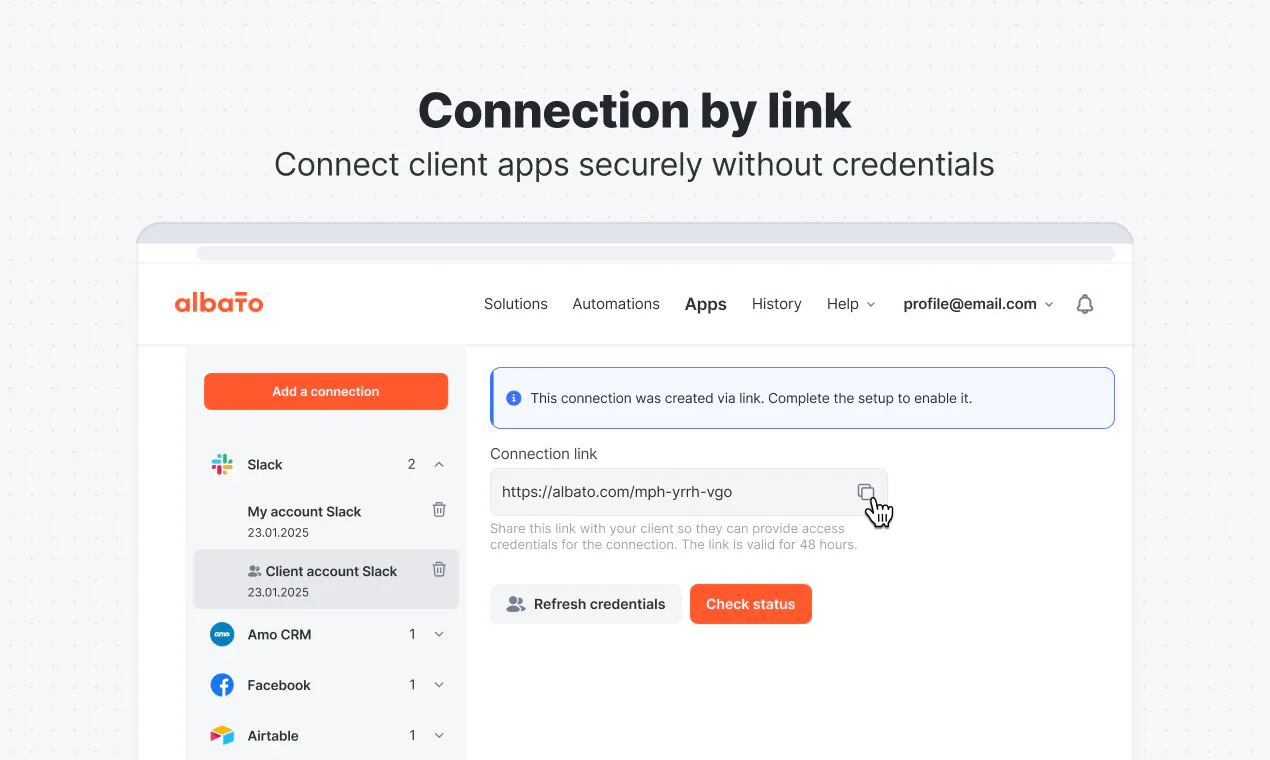
🔗 Connection by Link — Connect client apps securely without sharing credentials. Generate a link, send it to your client, and the connection appears instantly in your account — perfect for freelancers and agencies managing automations safely and efficiently.


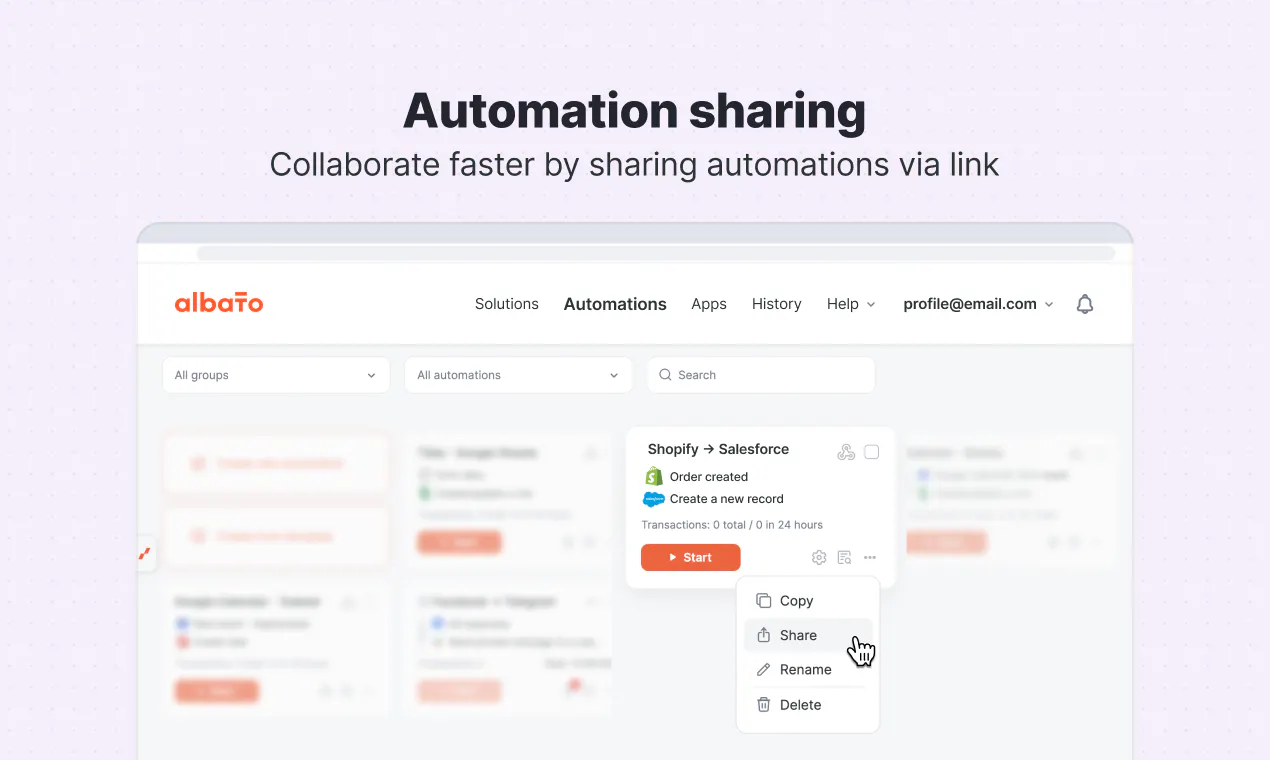
📤 Automation Sharing by Link — Share complete automations with a simple link. Collaborate faster, distribute proven workflows, and help others get started in seconds without rebuilding automations from scratch.

🌍 1K+ Apps Integrated — We’ve reached a major milestone with over a thousand connected apps and refreshed triggers and actions across our library.


And we’re not stopping here...

🔜 Coming soon:


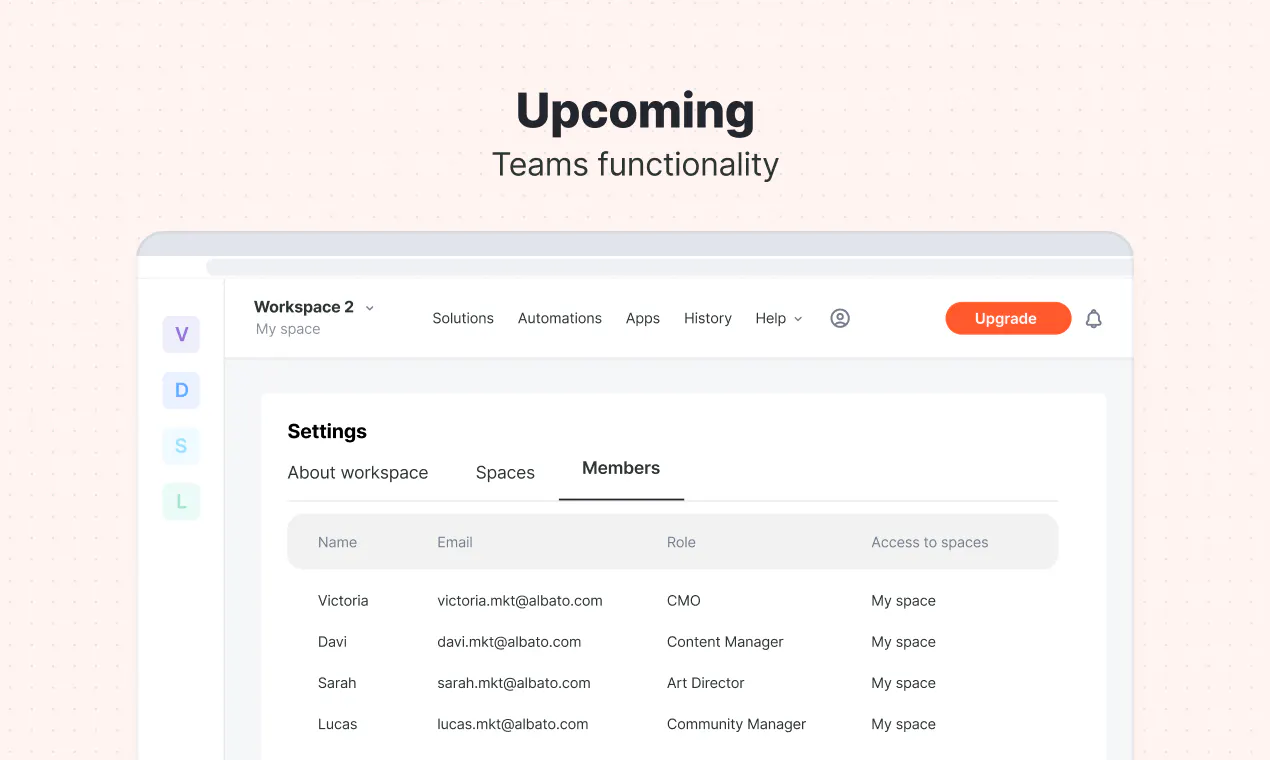
Teams functionality — create multiple workspaces, manage subaccounts, and assign roles effortlessly.


This release is all about giving you more control, flexibility, and power to build automations that work exactly how you need them to.


We’d appreciate your support and are here to answer any questions!

Let’s redefine no-code automation — together ⚡

10
回复

@wenddy_dias1 what's the task on your plate right now that you keep putting off the longest?

0
回复

@wenddy_dias1 Congrats on the launch! From a product perspective, which capability has created the biggest "aha!" moment for users so far? Is it AI-generated workflows, the growing integration library, or embedded automation for SaaS products? Those adoption patterns often reveal where the strongest product-market fit is emerging.

0
回复

Hi @wenddy_dias1,

Congrats on building Albato! I really like how you're combining AI with no-code automation to make workflow creation much simpler.

As the platform continues to grow, if you ever need additional engineering support, my team specializes in React, Next.js, Node.js, AI integrations, API development, and scalable SaaS products. We'd be happy to help accelerate feature delivery.

Happy to connect and explore if we can support your roadmap. Best of luck with Albato's growth! 🚀

0
回复

the natural-language branching logic part is the piece I'd want to stress test before trusting it on anything important. with a normal if/then builder you can see exactly what will happen, with an AI agent interpreting the branch conditions there's more room for it to misread intent on an edge case. is there a way to preview or dry-run a workflow before it goes live on real data

1
回复

Hey, @omri_ben_shoham1 1 We hope you'll enjoy the feature. 😊

To help prevent unexpected behavior, you can configure guardrails for your AI Agents to clearly define how they should behave. You can also test the automation before putting it into production, allowing you to verify that the workflow before it runs on real data.

0
回复

1000+ apps is a lot. curious what happens when one step in the chain breaks — does it retry or just die?

1
回复

Thank you,@doganakbulut ! We're constantly expanding our app library 🚀

As for errors, we have built-in Error Handling that can be configured for each step of an automation, allowing you to define exactly what should happen if an error occurs:

  • Stop the automation – The automation stops immediately, and no subsequent steps are executed.

  • Continue the automation – The automation ignores the error and proceeds to the next step.

  • Proceed to a selected step – You can use the Error Handler as a router, sending the automation to any subsequent step you choose if an error occurs.

Once an automation is running, any failed requests are clearly shown in the execution log. From there, you can either manually resend failed requests or enable automatic error resending.

If an automation ends up containing only failed requests (with no successful executions), it will eventually be stopped automatically.

0
回复

Hey team, thats huge.!I have been trying to build such an automation system (text to automation) and failed utterly :D Great technical work. What percent is deterministic and what percent of workflows is still random? AI is flexible, but not really deterministic. How did you solve this problem?

1
回复

Thank you so much,@davitausberlin ! We really appreciate that 😊

Copilot is trained on Albato's knowledge base and hundreds of real-world automation use cases, so in most cases it will correctly understand, suggest, and implement the workflow the user is trying to build. That gives us a much more predictable experience than relying on a general-purpose AI model alone, while still keeping the flexibility of natural language interactions.

0
回复

Congratulations on the launch!

1
回复

Thank you very much,@alina_valyaeva !

0
回复

This looks solid. Does the Copilot remember context across multiple automation requests in the same session?

1
回复

Thank you, @dhiraj_patel5 ! Yeah, Copilot does remember context within the same chat session. This allows users to build on previous requests, refine existing automations, and have more natural, multi-step conversations without having to repeat the context each time.

0
回复

Really great and helpful product!

1
回复

@alex_egorov Thanks so much!

0
回复

Love how chat-driven the automation builder feels now. One thing I'd love to see is a visual diff or version history for flows, so when Copilot regenerates a scenario I can quickly see what changed and roll back if needed. Would save a lot of trial and error.

1
回复

@mcahitdemi69gf Really appreciate this! 🙌 Glad the chat-driven builder feels good to you. And that's a great suggestion, a visual diff and version history for flows would make Copilot changes much easier to review and roll back. I'll pass it along to the team as feedback. Thanks for thinking it through with us!

0
回复

Really like where you're taking this. The AI side feels like a natural next step for Albato

1
回复

@alena_medvedevaa Thank you! That's exactly how we see it too, a natural next step. Glad it resonates. 🙌

0
回复

Honestly surprised how fast I got a working flow going just by describing what I wanted to the Copilot. Made connecting my CRM to a spreadsheet way less painful than the usual zapier setup.

1
回复

@deryasarobkyp1 Love hearing that! 🙌 Getting a working flow just by describing it is exactly what we were going for, and CRM to spreadsheet is such a common one to get stuck on. Really glad it felt smoother for you. Thanks for giving it a go!

0
回复

Happy launch day! Wishing the whole team a strong run today

1
回复

@annmast Thank you! The team really appreciates the kind words. 💙

0
回复

Been a fan for a while, great to see you all on PH today. Congrats! 🔥

1
回复

@refat_ametov Thank you so much, really glad to have you here with us today! 🎉

0
回复

The chat-to-automation approach just makes sense. Way less friction than clicking through menus. Nice work

1
回复

@artyom_zhuravlev Thanks so much! 🙌 That was exactly the goal, way less friction.

0
回复

Congrats on the launch! Been following Albato for a while, always great to see the team shipping.

1
回复

@solodnev Thank you! 🙌 Means a lot to have you following along.

0
回复

The copilot chat for setting up workflows is actually pretty smooth, I described a Slack to Sheets thing and it built the steps for me without much fuss. Surprised how quickly it handled the branching logic too.

1
回复

@aylindurma83884 Love hearing this! 🙌 The Slack to Sheets flow is such a common one, glad the Copilot handled it smoothly, branching and all. That's exactly the experience we were going for. Thanks for giving it a spin! 🚀

0
回复

With Albato being described as an AI-powered no-code automation platform, I’m curious how the AI part shows up in practice. Is it mostly helping users build workflows faster, suggesting automations, or handling steps like dictation/agent-style actions? The categories mention AI Agents and AI Workflow Automation, so I’d be interested in where you draw the line between classic no-code automation and more autonomous behavior.

1
回复

@crystalmei Great question! 🙌 The AI shows up in two distinct ways.

First, Albato Copilot is the build-faster side. It helps you create and configure automations through plain language, and can also update existing ones, so less time wiring up steps manually.

Second, AI Agents are the more autonomous side. Instead of a fixed if-this-then-that path, an agent can interpret a request and decide which steps or actions to take to get it done.

So the line is roughly: classic no-code automation runs the exact flow you define, while agents add reasoning and decision-making on top of it. Copilot helps you build, agents help execute. 🚀

1
回复

The Test Step feature with real data feels like one of the most useful improvements here. building automations is usually easy until one mapped field is wrong and you have to debug the entire workflow, so being able to validate each step separately should save a lot of frustration :)

The connection-by-link and automation sharing also make a lot of sense for freelancers and agencies. Curious how much Albato Copilot can modify an existing complex workflow. can I describe a change in plain language and have it safely update only the relevant steps without rebuilding everything?

1
回复

@andrasczeizel 

Thank you, great points! 🙌 The Test Step feature is exactly about that: catching one wrong mapped field before it breaks the whole flow, instead of debugging after.

On Copilot:Yes! Albato Copilot can do both. It can create new automations and AI agents, but it can also update the settings and configs of existing ones you've already set up.

3
回复

@andrasczeizel what's the task on your plate right now that you keep putting off the longest?

0
回复

Congrats on the launch! 🚀

Canvas mode makes way more sense than staring at a list of steps. Nice work team!

1
回复

@konnov_den Thanks so much! 🙌 Canvas mode was one of those things we wished we'd built sooner, so happy it clicks for you. Appreciate the support! 🚀

0
回复

Been a Albato User for few years now and a proud multiple Albato ''LTD'' holder 😎, Great tool indeed!

1
回复

@istiakahmad Thank you so much, that means a lot! 🙌

1
回复

@Wenddy Dias good to hear, the test-before-production step is really the part that matters most to me. guardrails are only as good as someone remembering to configure them, a dry run catches the stuff nobody thought to guard against

0
回复

Congrats launch! Amazing Product~

0
回复

This is a solid one. Excited to see how it evolves from here. Congrats team!

0
回复

Congrats team! What's been the most popular use case for the AI agents so far?

0
回复

@vlad_lobchenko Thanks! 🙌 So far the most popular one is handling incoming leads and messages: the agent reads the request, figures out what to do, and routes or logs it in the right place without a fixed rulebook. Data enrichment and summarizing updates into tools like Slack or Sheets are close behind. Curious to see what people build next!

0
回复

Congrats on the launch! 🎉 The Copilot is exactly the kind of thing that saves hours. Awesome work team!

0
回复

@alexx_lagutin Thanks so much, really appreciate it! 🙌

0
回复

Love to see it 😍 Huge respect to everyone at Albato, you keep raising the bar. Onwards 🚀

0
回复

@petr_antropov1 Thank you so much! 🙏

0
回复
#4
Codex Micro
Tactile controls for your Codex agents
230
一句话介绍:Codex Micro是一套为OpenAI Codex智能体设计的物理控制键盘,通过实体按键、旋钮和RGB状态灯,解决多智能体并行运行时需频繁切换窗口查看进度与调整参数的痛点。
Hardware Developer Tools Artificial Intelligence
硬件控制台 AI智能体 触觉交互 物理旋钮 RGB状态灯 开发者工具 工作效率 OpenAI Codex 多智能体管理 创意硬件
用户评论摘要:用户肯定物理旋钮调节推理层级与实时状态灯的实用价值;强烈建议增加内置实时费用仪表盘,按模型/项目拆分消耗并设置预算警报;多人反馈追踪多智能体状态、避免频繁切窗是核心需求;部分用户希望有纯软件版的状态提示功能。
AI 锐评

Codex Micro本质上是一个“务虚”的硬件,它的核心价值不在于新增AI能力,而在于将软件中的抽象操作(调整推理层级、查看智能体状态)转化为物理触觉反馈。这种“从像素到旋钮”的迁移,确实捕捉到开发者频繁切窗、追踪多线程智能体的真实烦躁感——RGB状态灯比弹窗通知更无感,旋钮比下拉菜单更直觉。但问题在于其定位非常狭窄:230美元的定价,针对的是同时运行多个Codex Agent的重度用户,而这类用户数量远不及大众开发者。评论区高赞的“费用仪表盘”需求透露出更深的痛点——智能体调用是烧钱的,而硬件无法解决token消耗的透明度问题。更致命的是,一旦OpenAI调整API策略或推出更智能的状态管理UI,这块物理键盘的“信息独占性”就会大幅贬值。作为一款硬件玩具,它满足的是极客的掌控欲和仪式感;作为生产工具,它的寿命与Codex生态深度绑定,且缺乏不可替代性。Work Louder再次证明:帮AI用户省钱,远比帮他们花钱制造“物理存在感”更有长期价值。

查看原始信息
Codex Micro
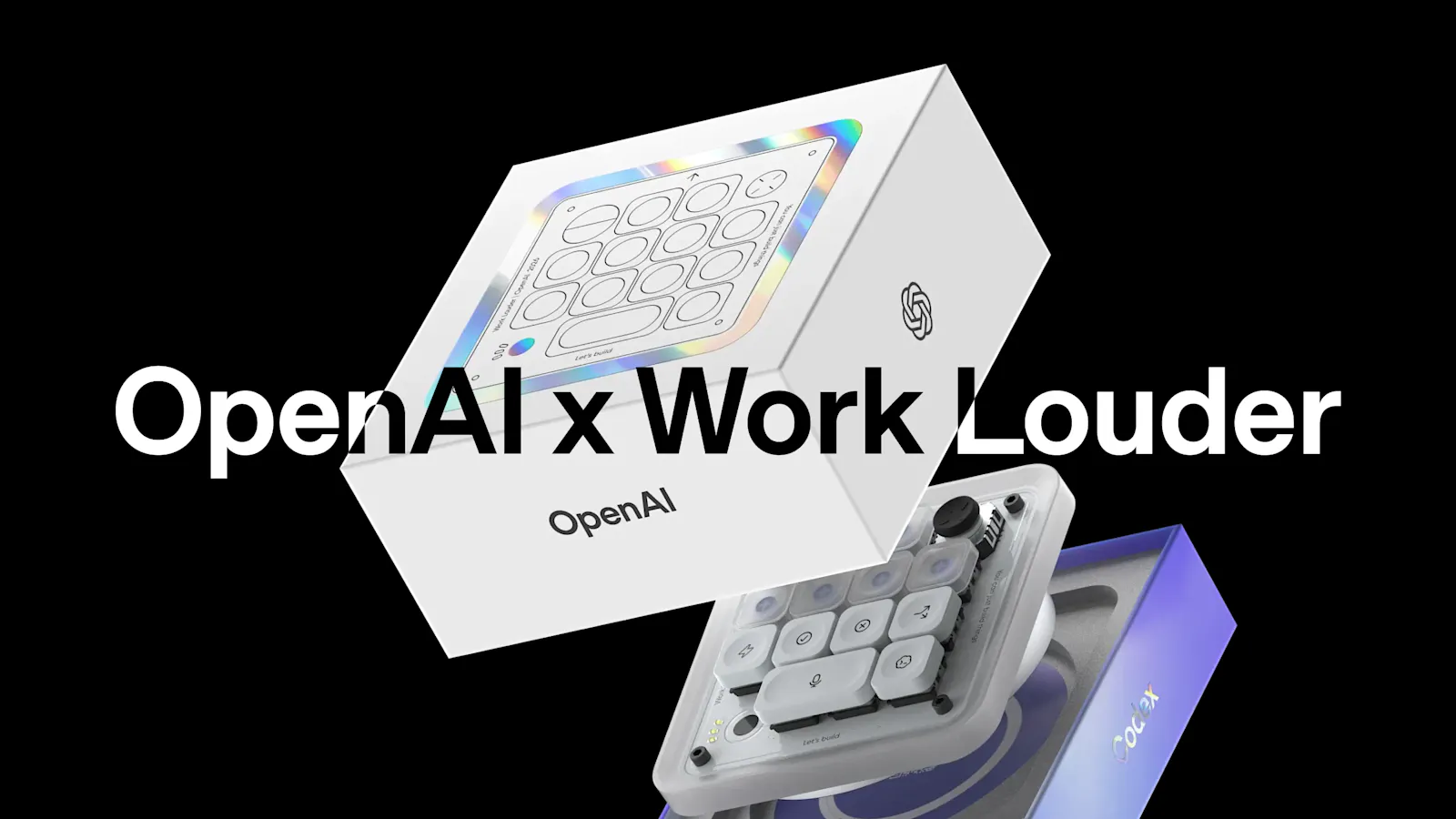
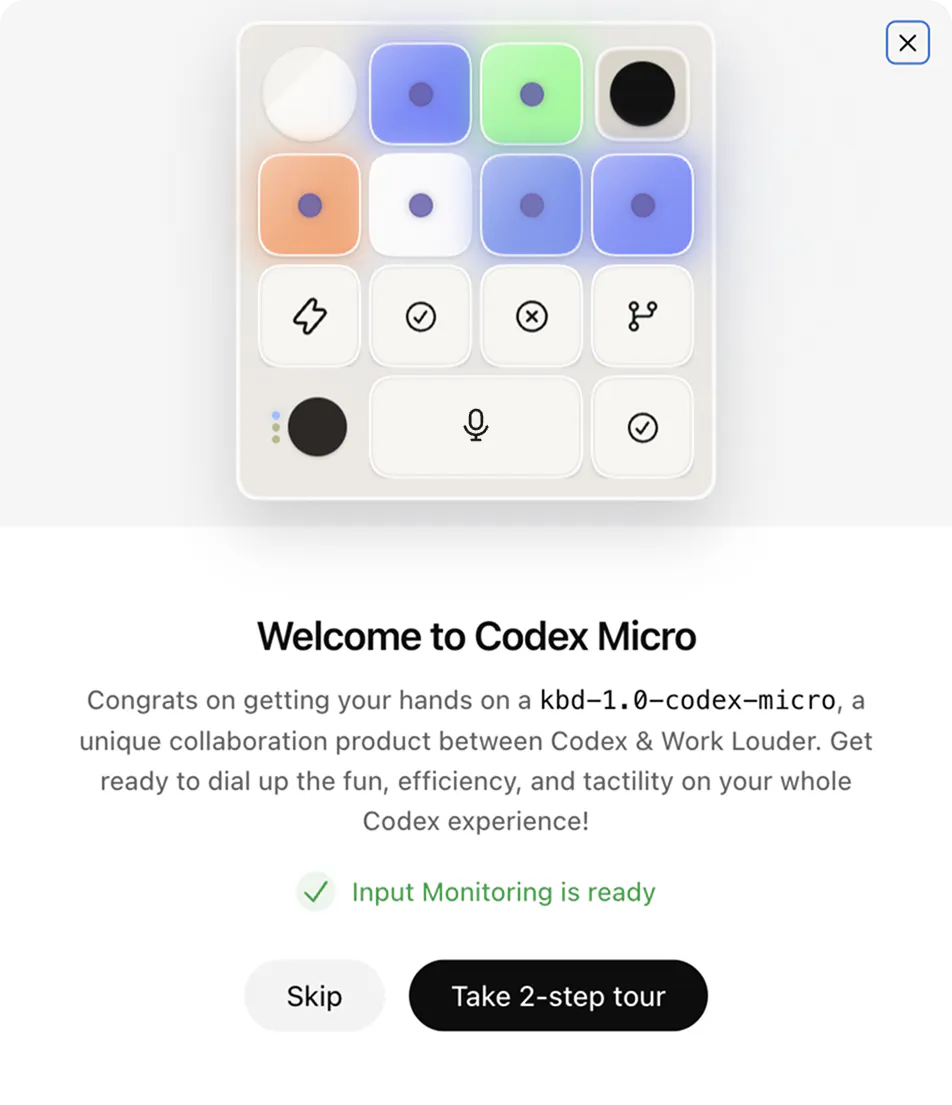
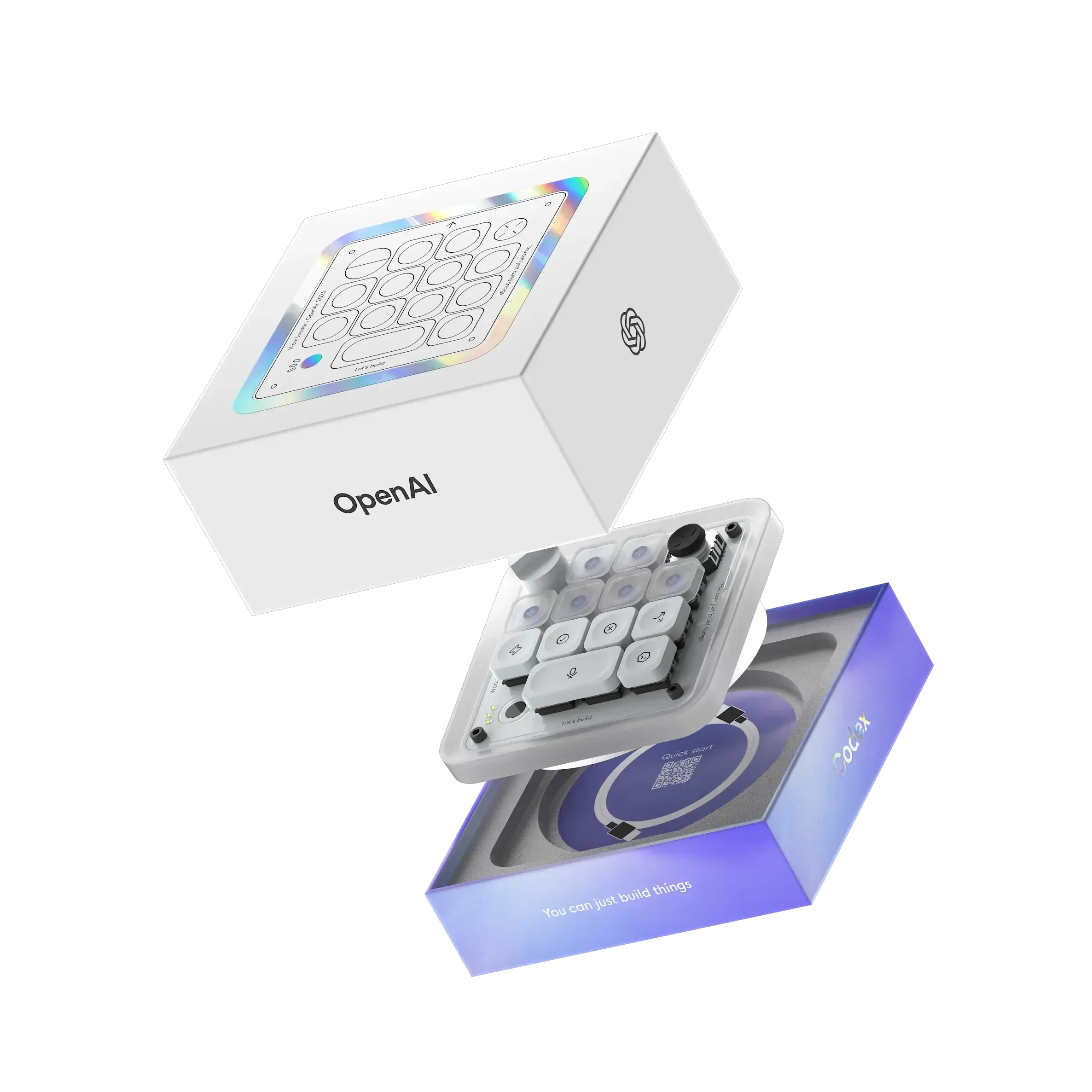
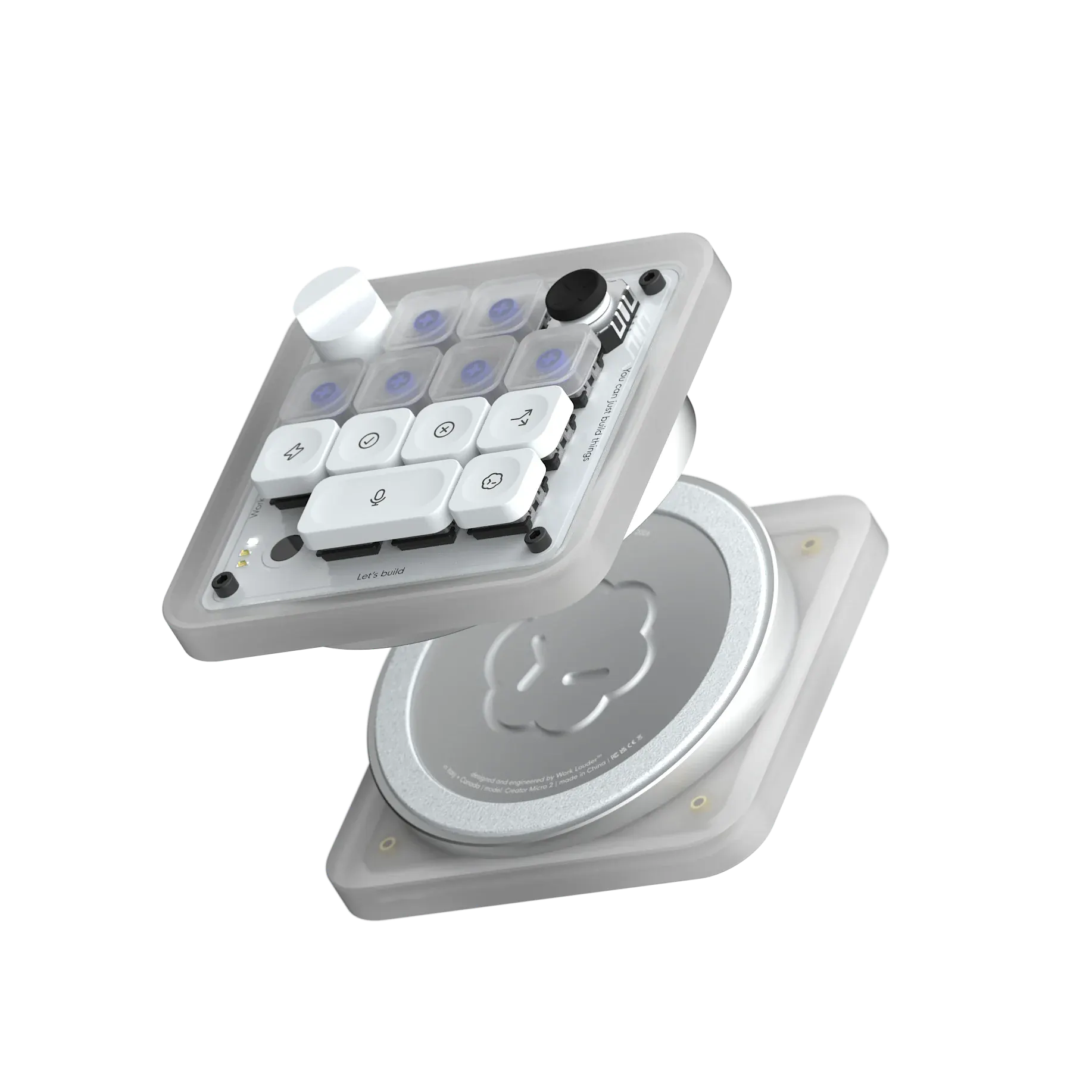
Codex Micro is a compact keyboard built with Work Louder to control your Codex agents. It features physical keys for common skills, a dial to adjust reasoning levels, and live RGB status lights so you can track agent progress without switching windows.
$230 so you turn your token spend up and down, like a faucet 🚰 My *wallet* is feeling the AGI! 😅
4
回复

@chrismessina hahaha true

0
回复

Hi everyone!

@OpenAI and Work Louder built a little hardware control deck for Codex.

Each Agent Key shows live status from Codex, so you can see which agents are thinking, running, waiting, or done without opening every chat.

The joystick launches skills. The dial adjusts reasoning. The other keys can handle voice dictation, task switching, permissions, and follow-up work.

Of course, you can do all of this with a mouse.

But turning up the model’s brainpower with a physical dial is much more fun :)

3
回复

@zaczuo I'm curious, what guidance would you give builders when deciding between Sol, Terra, and Luna? Beyond benchmarks, are there workflow patterns or product use cases where each model consistently shines?

0
回复

Would love a built-in cost dashboard that breaks down spending per model and project in real time, basically a way to set budget alerts before the bill sneaks up on you. Would make planning so much easier.

2
回复

Turning reasoning level into a physical dial is exactly the kind of unnecessary-but-perfect hardware idea I love :))

The live status keys are genuinely useful too. once you have multiple agents running, constantly opening chats just to see who is thinking, waiting, or finished gets annoying fast. This feels like a fun little control center for people who spend way too much time with Codex... which is probably most of us here :)

1
回复

@andrasczeizel Hey Andras! Exactly this! Managing multiple agents running simultaneously without getting lost in tabs is the real orchestration challenge for builders right now! 🎯⚡

That live status feature on the physical keys is such a brilliant way to track swarm activity. When you have an AI Swarm executing complex workflows, tactile visibility is everything.

We actually faced this exact challenge while building our launch today: LegalRisk AI! 🤖👑 Right now, our live product runs an autonomous 3-Agent Swarm to audit cross-border contracts across 190+ jurisdictions in 60s.

But here is the exciting part we are currently finishing up: We are nearly done building a massive multi-agent orchestration dashboard where 30+ enterprise applications and hundreds of autonomous agents work in parallel under one unified control plane! Keeping track of which agent is parsing, evaluating, or redlining across that many workflows makes tools like this Codex control deck an absolute dream for our upcoming ecosystem.

Upvoted and cheering for @OpenAI and everyone pushing the boundaries of multi-agent architectures today! Let's crush it! 🚀🔥

0
回复

The RGB status lights are the part I'd actually want, not for the fun factor but because "is this agent stuck or just thinking" is a real question when you're running things in the background across more than one company, like I do. I'd take a software-only version of that ambient status idea in a heartbeat even without the hardware.

0
回复

the tactile angle caught me off guard, in a good way. is it a physical thing or software controls?

0
回复

a physical dial for reasoning level is such a fun idea. and the status lights so you're not alt-tabbing every 30 seconds to check if the agent is still working, that's the kind of small thing that actually changes how it feels to use

0
回复

It would be great to see a built-in usage dashboard showing token costs and request breakdowns per project in real time. Right now pulling that data requires extra tooling and it makes budgeting for client work harder than it needs to be.

0
回复
#5
River
AI account executives that demo and close B2B deals
221
一句话介绍:River通过AI销售代表实时接入通话、演示产品并处理异议,帮助B2B企业将获客响应从5天等待压缩为即时闭环,核心解决中小企业销售团队无法即时跟进高意向线索的痛点。
Sales Artificial Intelligence Audio Vercel Day
AI销售代表 语音AI B2B销售自动化 产品演示 意向客户接待 企业级语音代理 销售效率提升 实时通话 销售线索转化 AI谈判
用户评论摘要:用户关注AI应对边缘异议和脱稿提问的能力,以及何时应转接人类。产品设$25K交易额阈值,低于此AI全流程闭环,高于此则演示后移交。有用户反映对话理解有误,团队承诺48小时内基于销售录音定制。多位用户认可即时响应价值。
AI 锐评

River的亮点不在“AI能代替销售”,而在它对销售漏斗的精准切割——用明确的$25K阈值替代了多数AI工具模糊的“智能判断”。这种设计既规避了大客户关系中AI无法替代的信任博弈,也堵死了因模型误判而丢失潜在高价值客户的风险。在中小B2B企业的采购场景中,80%的异议本就集中在产品功能和定价上,AI完全有能力应对,而高端生态圈的复杂谈判本就是幸存者偏差的幻觉。真正值得警惕的是,产品对“即时响应”的依赖是双刃剑:一旦AI在通话中出现低级理解错误(用户反馈已证实存在),公司品牌将为此承担比人工错误更严重的信誉折损——客户不会接受“机器人答非所问”是人之常情。此外,“关闭交易”这一承诺被过度泛化:用户直观会要求变更合同条款或定制定价,而AI无法在权限外现场授权。River最聪明的策略是将“关闭”定义为“用持续性跟进来缩短决策窗口”,而非即时签约。客观说,这套方案对SaaS初创公司的首轮线索验证极有价值,也解决了最痛苦的“忙不过来”问题。但长期看,AI销售代表若无自主学习机制,将沦为进阶版聊天机器人。真正棘手的挑战在于,当AI暴露框架外漏洞时,人类补位的迟滞比传统销售的“5天等待”更致命。

查看原始信息
River

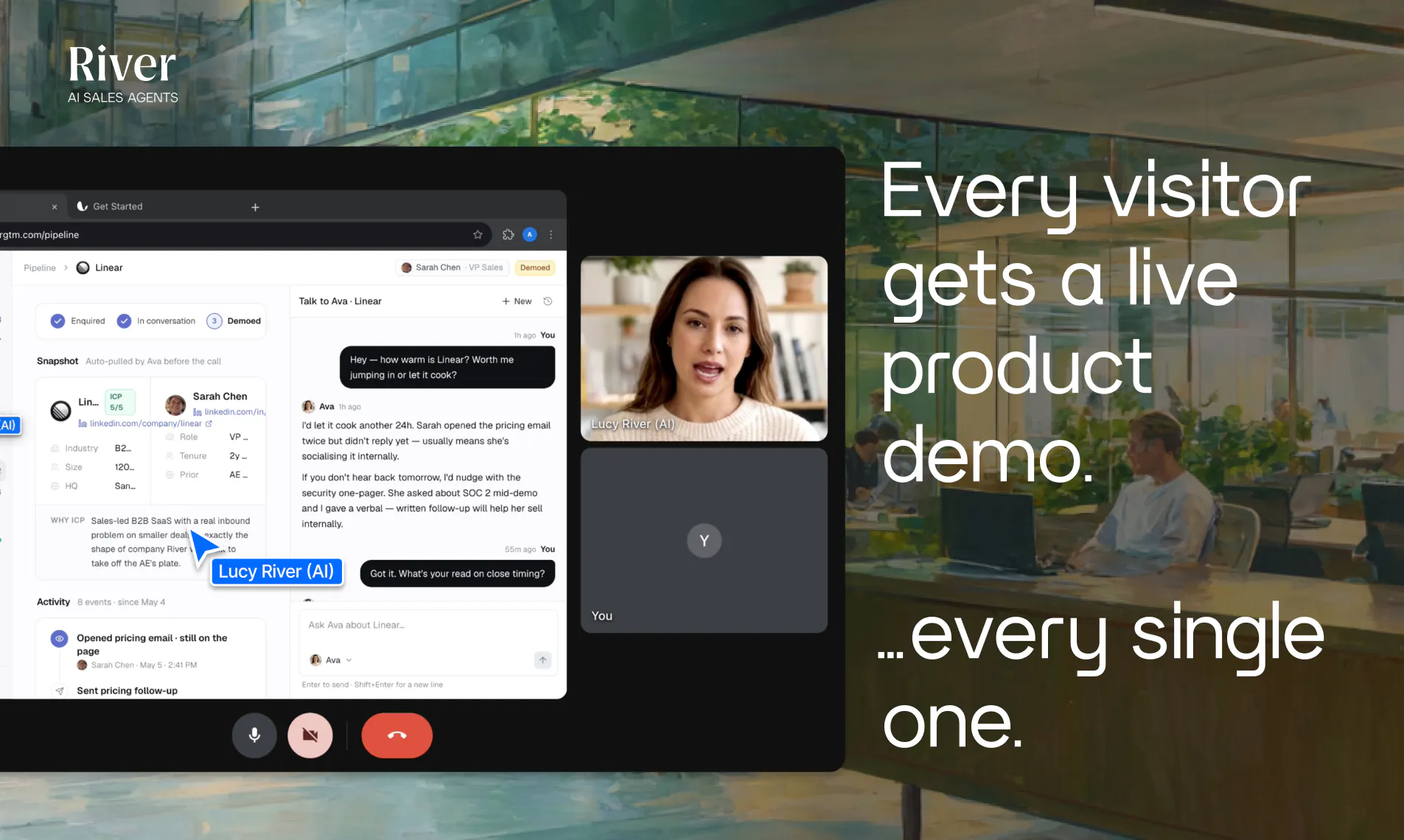
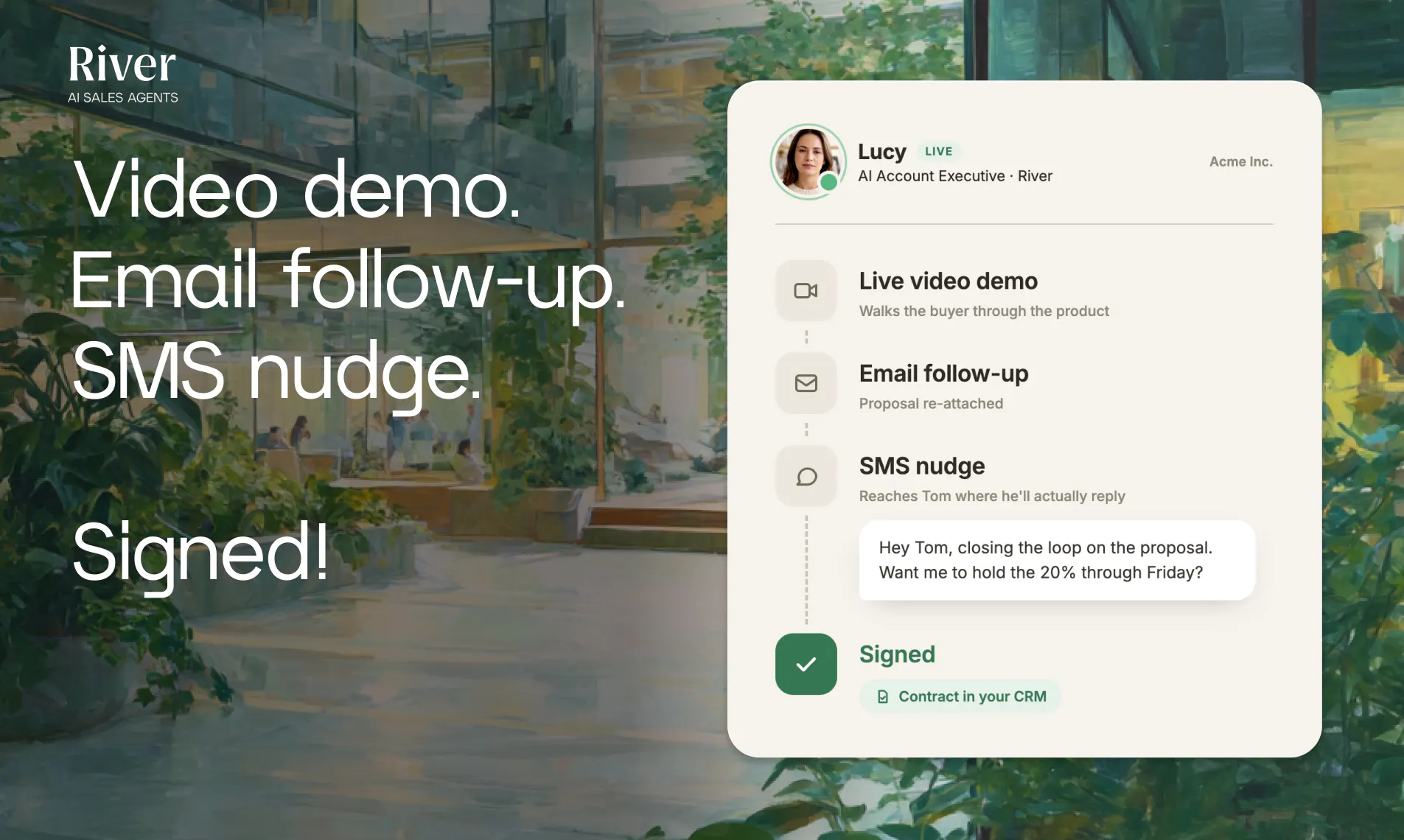
River enables B2B companies to sell with VoiceAI. When a lead enquires, our AI account executive joins a live call instantly, runs the product demo, handles objections, and closes - so no lead ever waits for a rep's calendar. Backed by founders of Ramp, Kalshi, and Lean.

Hey Product Hunt 👋 Tarek here, CEO of River, building with my brother Sam.

I used to do the same sales demo 15 times a day. Small accounts, same questions, zero time left. So Sam cloned me. My clone sells full time now: it joins a live call the second a lead enquires, shares its screen, runs the demo, handles objections, and closes.

River lets any B2B company do the same. Build your ideal account executive (voice, accent, persona, tuned to your buyers) and give every inbound lead an instant live demo instead of a form and a five-day wait.

Talk to the ramp sales team right now: rivergtm.com/demo/ramp

Will people buy from AI? We're betting the company on it. Tell us what breaks. I'll be in the comments all day, and so will Sam. And my clone.

8
回复

@tarekabi From the buyer side, what makes me tune out of a demo fast is a rep who can't go off-script the moment I ask something specific about my stack. How does River handle a prospect who interrupts with an edge-case objection versus running its scripted path, and does it know when to hand off to a human instead of pushing to close?

2
回复

@tarekabi The "instant demo instead of a five-day wait" framing is the real insight here most people would've built a better scheduling tool instead of asking why there's a wait at all.

The part I'd actually worry about, watching this as a build: objection handling in a live call isn't really a script problem, it's a context problem. A good AE handles an objection well because they know something specific about that account mid-call, not because they have a great answer prepared in advance. What happens when a lead asks something that depends on information your clone doesn't have yet a pricing exception, a contract detail, something only a human on your team would know? Does it stall, guess, or hand off live? That's usually where these systems either earn trust in one call or lose it permanently.

0
回复

@tarekabi Congrats on the launch! A sales rep with live demo is a win

1
回复

Congrats on the launch🚀 this is such a smart application of Voice AI to a real pain point in B2B sales! Instant lead response is often the difference between a closed deal and a cold lead, so automating that first touch is genuinely brilliant.
How do you ensure the AI's tone and pitch stay aligned with a company's brand voice, especially for businesses with more nuanced or consultative sales processes?

3
回复

@aymi_malik Thanks. Voice, accent, and persona are tuned per company, and she's demoing your actual product rather than reciting a pitch, so the tone comes from your material.

On consultative: that's exactly where we don't pretend. Above your deal-size threshold she demos and hands your AE a warm prospect with the full context. Under it, single decision-maker, she runs it end to end. Nuanced multi-stakeholder deals stay human on purpose.

1
回复

letting AI actually close deals feels bold lol. is the demo part usable on its own if im not ready for the full thing?

2
回复

@doganakbulut yes exactly you could use the demo now without the closing. Happy to look into your use case and build for you

3
回复

@samabi love this, went through the live demo on your site and booked a session to chat more. I think this solves a great need for founders.

2
回复

@samabi  @neal_mann THank you it means a lot! Yes i was in this position and needed to amplify myself to be able to grow sales without headcount. Happy to see it relate with you 🙏

0
回复
This is good.. is it customisable for transactional sale only or complex sale too.. as in multiple gate keepers, influencers from a company joining that demo call.. and thanks for making it.
1
回复

The $25K deal size cutoff is the most honest design choice here. Most AI sales tools claim they can close anything, which immediately raises red flags.


Thanks for your honesty 😊

1
回复

You're right @mohammed_messeguem  ! Glad you've realised
we know that there are some relationship based deals where humans need to be empowered and some where humans are a blocker which tend the smaller transactions and we're focused on that

0
回复

An AI that qualifies and demos consistently would save most teams real hours before it ever closes a thing. The closing claim is the ambitious part, because B2B decisions happen in rooms the AE is not in. Show me it nurturing a slow deal and I am paying attention.

1
回复

@shivangit26 Fair skepticism, and the closing claim is deliberately scoped. Under ~$25K with a single decision-maker she goes end to end: proposal, follow-up, contract. Above that she demos and hands off. We're not claiming she wins the room she's not in.

On nurturing a slow deal, that's the part I'd actually show you. She follows up across email and WhatsApp for days when there's no reply. Happy to walk you through a real one: rivergtm.com/demo/ramp

0
回复
This is Amazing good luck guys 👏
1
回复

@samirrashed Thank you Samir!!

0
回复

This is nice. How long does it take to train River to sound like a specific company's actual sales style?

1
回复

@dhiraj_patel5 Based on the sales transcripts that you have, but with good data we can spin up your agent within 48 hours!

0
回复

This is an excellent idea, and I’m currently facing exactly this problem, especially with multilingual products. After my new product launched, I don’t have enough customer service staff to introduce it to users. It would be a great experience if AI avatars could take over client communication and product demos. I believe this will bring tremendous help to both B2C and B2B businesses.

I tried chatting with it just now, and I found it often fails to fully grasp what I’m trying to say, and I’m not sure if it’s an issue with my expression. Besides, can it actually operate my product interface to conduct real demonstrations for users? How are real cases and practical data implemented here?

1
回复

@caryzz The misunderstanding is on us, not your expression. I was looking into your conversation transcript with her and that's exactly the kind of thing I want to fix, thank you for your patience and for sharing!!

On the interface: yes, she shares her screen and walks through the product live, not a canned video. Multilingual is already there (English, French, Arabic, more), which sounds relevant for you.

0
回复

Having an AI account executive instantly join a call, share its screen, run the demo, and handle objections is honestly wild :)

As a founder, the idea of never losing an inbound lead just because nobody is available feels very compelling, especially for smaller teams where repeating the same demo can consume the entire day. The hardest part is probably knowing when the AI should keep selling and when a deal needs human judgment. Curious how River detects that moment, especially with unusual objections or larger accounts?

1
回复

@andrasczeizel Great point. Honestly we did on that one. Rather than have the AI guess when a deal needs judgment, we made it a number you set. Under ~$25K, single decision-maker, she closes. Above it, she demos and books your team.

Blunt, but it means the "should I keep selling" call isn't left to a model on unusual objections. Where it's still hard is the messy middle, and I'd love your read on where you'd draw the line.

1
回复
@tarekabi The speed to lead advantage here is massive, especially since waiting five days for a demo kills so many deals. Quick question though, how does the clone handle really unexpected or off-topic questions during a live screen share?
0
回复

Honestly this is the kind of thing sales teams would try immediately if it saves even a few hours of back-and-forth.

0
回复

the demo and objection-handling part I can see working well, but "closes" is doing a lot of work in that sentence. does it actually have authority to agree on pricing or contract terms on the call, or does closing here mean it gets the prospect to a signed-ready state and a human still has to finalize the deal

0
回复
Love the direction. Of this. For solo founders could be a godsend. How will it handle hand offs?
0
回复

Soon we'll have agents selling to agent buyers. Seriously though, very cool

0
回复

@rich_sun hahah exactly we're getting ready for that and will be well positioned to serve that!
Thanks Rich

0
回复
Really interesting approach. I’d love to know how the AI handles complex technical questions and when it decides to hand the conversation over to a human AE. Congrats on the launch! 👏
0
回复

@harithavijayakumar Thank you Haritha! You can try it live on your website, i'm pretty sure you'd be impressed at how it's handling it

0
回复

Congrats @tarekabi & @samabi on your launch! This is a great product that addresses one of the most difficult aspect of running a business. I am just wondering if your AI agents have options for African voices. Say a local product built in Africa for Africans wanted to use River, would that fit in naturally?

0
回复
@patofthefuture hey Patrick thanks for the kind words. We do have some african languages and accents, which one did you have in mind to give you an accurate answer?
0
回复
interesting, what is the pricing on this?
0
回复

@ethan_lee8 outcome based pricing:
- Demo agent: fee per demo completed
- Account executive: commission on deal closed
Let me know what's your use case happy to build for you

0
回复

the way you framed this around "no lead ever waits" is honestly such a sharp angle, most voice ai stuff feels gimmicky but the demo call flow sounds like it was actually thought through

0
回复

@bnyamingegfgk2 Thanks, that's the part we sweated. I lived it: 15 demos a day, same questions, zero time left. Try her and tell me where it breaks: rivergtm.com/start

1
回复
#6
Nitrosend
Email for AI agents. They sign up, send and reply.
161
一句话介绍:Nitrosend是专为AI代理设计的全栈电子邮件基础设施,让代理能自主完成注册、域名配置、邮件发送与回复,无需人工干预,解决了传统邮件工具与AI工作流脱节的痛点。
Email Marketing Developer Tools Artificial Intelligence Vercel Day
AI代理邮件 无仪表盘邮件 智能发信 自主注册 域名邮件 AI客户回复 代理收件箱 邮件送达率 营销自动化 MCP驱动
用户评论摘要:用户称赞自主注册和3分钟发信的速度。核心担忧集中在:AI代理如何防止域名信誉受损?是否支持欧盟合规与退订?回复是否会被标记为AI?以及误回复后责任归属。
AI 锐评

Nitrosend的野心在于重新定义“邮件即基础设施”的边界——它不再是一个需要人类登录操作的仪表盘,而是AI代理的“原生通讯器官”。创始人乔治的三次创业经验(SmartrMail被收购、Sendicate发送60亿封邮件)让这款产品在看似简单的“让代理发邮件”背后,筑起了三重护城河:

**1. 代理自洽性**:SKILL.md文件是这个产品的神来之笔。它让代理在无人看守的情况下自行完成注册、DNS验证、计费绑定和首次发信。这不是功能,而是设计哲学——它假设未来的工作流中,人类只扮演“审批者”而非“操作员”。Obooko(840,000读者)的实战经验证明,这种模式在内容分发和客服触发类场景中确实可行。

**2. 反直觉的信任机制**:用户最尖锐的提问全部指向“AI代理如何不变成垃圾邮件制造机”。Nitrosend的回答是把人类最好的发信纪律——SPF/DKIM/DMARC验证、冷启动配额、退信和投诉监控——硬编码进代理的行为逻辑。它甚至提供了“仅草稿模式”(人工确认后才发送),这相当于给代理戴上了一副“行为矫正器”。在AI乱发邮件的恐慌中,这种强约束反而成了信任加速器。

**3. 隐含的行业格局改写**:Gmail正主动打击AI代发的邮件,而Nitrosend的“代理收件箱”完全托管在用户自有域名下,让返回路径和发件人身份无法被简单定义为“爬虫”。当大多数邮件服务商还在试图用API兼容AI时,Nitrosend直接提供了AI的“原生居住地”。长期看,如果MCP(Model Context Protocol)驱动的收件箱管理成为标配,现在的“人工每日审批”将进化为“按意图授权”——价值从操作效率转移到决策精准度。

但风险同样清晰:代理的“1-1客户回复”中,一旦误判“何时该升级到人类”,可能导致灾难性公关。而“精准营销”所需的隐私合规(如GDPR下的数据隔离)和账户安全(如何防止恶意代理突破配额)仍是悬而未决的雷区。在Agentic AI商业化的黎明期,Nitrosend做对了一件事:它不试图让AI取代人类发信,而是让人类在更高维度上“签名授权”——这才是邮件自动化真正的终局。

查看原始信息
Nitrosend
Nitrosend is full-stack email built for AI agents. Point any agent at nitrosend.com/SKILL.md and it signs itself up, onboards, connects your domain and sends. Live today: marketing and transactional email, real inboxes for agents on your own domain (beta, by request), and 1-1 customer replies with human escalation. Coming soon: personalised outreach run by your agent. In development: goal-based agentic marketing. Humans approve. Agents operate.

Hey Product Hunt, George here 👋🏻

Nitrosend came out of running Obooko (producthunt.com/products/obooko, #2 Product of the Day here in February). Running a free ebook platform with 840,000 readers on its list, entirely through an AI agent, convinced me the dashboard era of email is done. It's also my third email company: SmartrMail (acquired 2022) and Sendicate before it, with six billion emails sent between them.

Six weeks ago we launched Nitrosend as headless email you run from Claude or Codex instead of a UI. Today it goes further: the agent gets an inbox, and get send for itself. Point any agent at nitrosend.com/SKILL.md and it signs up, connects your domain, sorts billing and sends its first email. no human required.

The bit I'm proudest of is Agent Inboxes (beta): real addresses for your agents on the domain you own, created BY your agent, like ernest@yourcompany.com, sylvia@yourcompany.com. They send, receive and hold 1-1 conversations with your customers, and escalate to a human when it matters. Gmail actively fights this. we built the place where it's native. Because very soon this will be table stakes for your agent, so we're shipping it now.

Coming real soon: Agentic Outreach, where your agent researches prospects, writes personally and works the replies. Get a look alike audience from your current customer list, zoom in on your ICP, give them personalised messaging. No start up founder I know likes doing spray and pray outbound, but some still do it as the tools aren't good enough to really make it relevant. We're solving that.

In development: set a goal for your brand's email and Nitrosend does the rest.

Agentic signup and onboarding are shipped, headless full stack newsletters, flows, transactional email all live sending and delighting our first users (including me on Obooko!). Agent Inboxes are beta by request (ask in app and we can turn it on for you), Outreach is coming soon, goal-based is in dev.

Super excited to ship this, ask any question in the comments!

2
回复

@gthartley Congrats on the launch — giving AI agents their own email to sign up, send and reply is a genuinely novel primitive; a lot of agentic workflows quietly break at exactly that step. You've already got a video, so here's a complement: a free looping GIF of Nitrosend from your own screenshots, a moving shot for your gallery that plays without a click, Giphy-tagged to keep surfacing. White-label, post it anywhere: https://foxplug.com/g/43d5f5515ed247c99a15

https://www.youtube.com/watch?v=NY6uIkBXExc

That's a 30-second sample of FoxPlug — you keep building, and it turns what you ship into GIFs, videos, posts and a changelog automatically. Free at https://foxplug.com

0
回复

@gthartley Congrats on the launch! From a product perspective, what surprised you most during early testing? Did users value the dashboard-free workflow more than AI-generated email content, or was there another feature that consistently drove adoption? Those insights often reveal where the strongest product-market fit is emerging.

0
回复

The "agent points at SKILL.md, signs itself up and connects the domain" onboarding is slick, but the thing I'd test first is deliverability once an agent is the one hitting send. When an agent ramps a fresh domain, does Nitrosend enforce its own warmup and rate limits (plus SPF/DKIM/DMARC verification) before it'll send at volume, or can an agent torch a new domain's reputation on day one? That guardrail is what would make me comfortable letting an agent operate unattended.

1
回复

@hazy0 right question to ask, deliverability is the bit we're most paranoid about (third email company, we've been burned before). Nothing sends until SPF, DKIM and DMARC verify on the domain, sending is quota'd so a fresh domain can't blast at volume on day one, and bounce and complaint monitoring runs on every send. The agent gets the same guardrails a good human sender would, it just actually follows them.

0
回复

Love the idea - i) Is it visible on the receiving end that its agentic? ii) i it EU compliant i.e. opt out options per default ?


1
回复

@nikolaos_chr i) Nope, nothing on the receiving end flags it as agentic. It's a standard email sent from whatever address you set up on your own domain, same as if you'd written it in Gmail. ii) Yep, GDPR compliant, and unsubscribe and opt-out is on by default.

0
回复

Giving agents their own inbox sounds narrow until you realize half an automated workflow is waiting on a reply nobody is watching. Deliverability and sender reputation for bots is the hard, unglamorous problem underneath this. That is also the moat if you get it right.

1
回复

@shivangit26 yeah exactly. And long term, an inbox that is completely MCP driven means you don't have to do the daily manual inbox "triage grind".

0
回复

Finally a sane way to let agents handle email without me babysitting every send. Pointed one at the SKILL.md file and it had my domain sending in minutes, which honestly surprised me.

1
回复

@cemreb6dj amazing, love to hear that!! thanks for the early support

0
回复

Tried it out and sent an email from Claude in about 3 minutes. Pretty useful, I'm not a fan of logging into a clunky dashboard just to send an email when everything else is via API/MCP.

1
回复

@jgdeutsch love that Jeff. 3 mins though, we gotta improve those numbers hahah. And yeah, who needs dusty UIs these days?!

1
回复

the self-signup part is the piece that gives me pause - an agent that can sign itself up and start sending on my domain without me in the loop for each step. what's stopping that from tanking domain reputation if the agent gets a little too enthusiastic with the marketing send? is there a rate limit or review gate before it actually hits real inboxes

0
回复

Congrats on the launch! I'm wondering if companies would actually use AI agents to send mails because for me it's not about the technology but more around trust that there should be a human verifying. Have you seen customers with similar perspectives ?

0
回复

This is really smart. Will definitely try it out for our startup.

0
回复

kinda wild concept. whats stopping this from turning inboxes into agent spam over time?

0
回复

Seriouslyyyy impressive product

0
回复

The beta inboxes on your own domain worry me. A wrong 1-1 customer reply now comes from the company's real domain, so the blast radius lands on the sender, not Nitrosend

0
回复

@oleksandr_knyga yes guardrails are important, and you decide how much autonomy you give to your agents on email out, if you're worried you can set it to draft only (human approve). many of our current users are running outbound email already on other tools (a lot using their own domains), but want it better targeted and more personalised. that's what we're aiming at with this

0
回复

agent inboxes that escalate 'when it matters' is the real product. deciding when to hand off is the hard part. what signal makes it escalate vs reply itself?

0
回复

Congrats @gthartley for the launch 🙌 love the target audience lookalike concept for outbound, qq how do you handle privacy and security for AI-managed conversations?

0
回复

@priya_kushwaha1 Thanks Priya! On privacy: the agent only sees what you scope it to. Access is per-brand via MCP or API keys, your contact data never trains anything, and sends have approval gates by default so nothing goes out to a list without a human saying so. we've even shipped an optional safe mode if people don't want their agent to be able to do any bulk sends (requires a human clicking final send button)

1
回复
#7
The Eureka Database
Turn a Reddit complaint into your next company
147
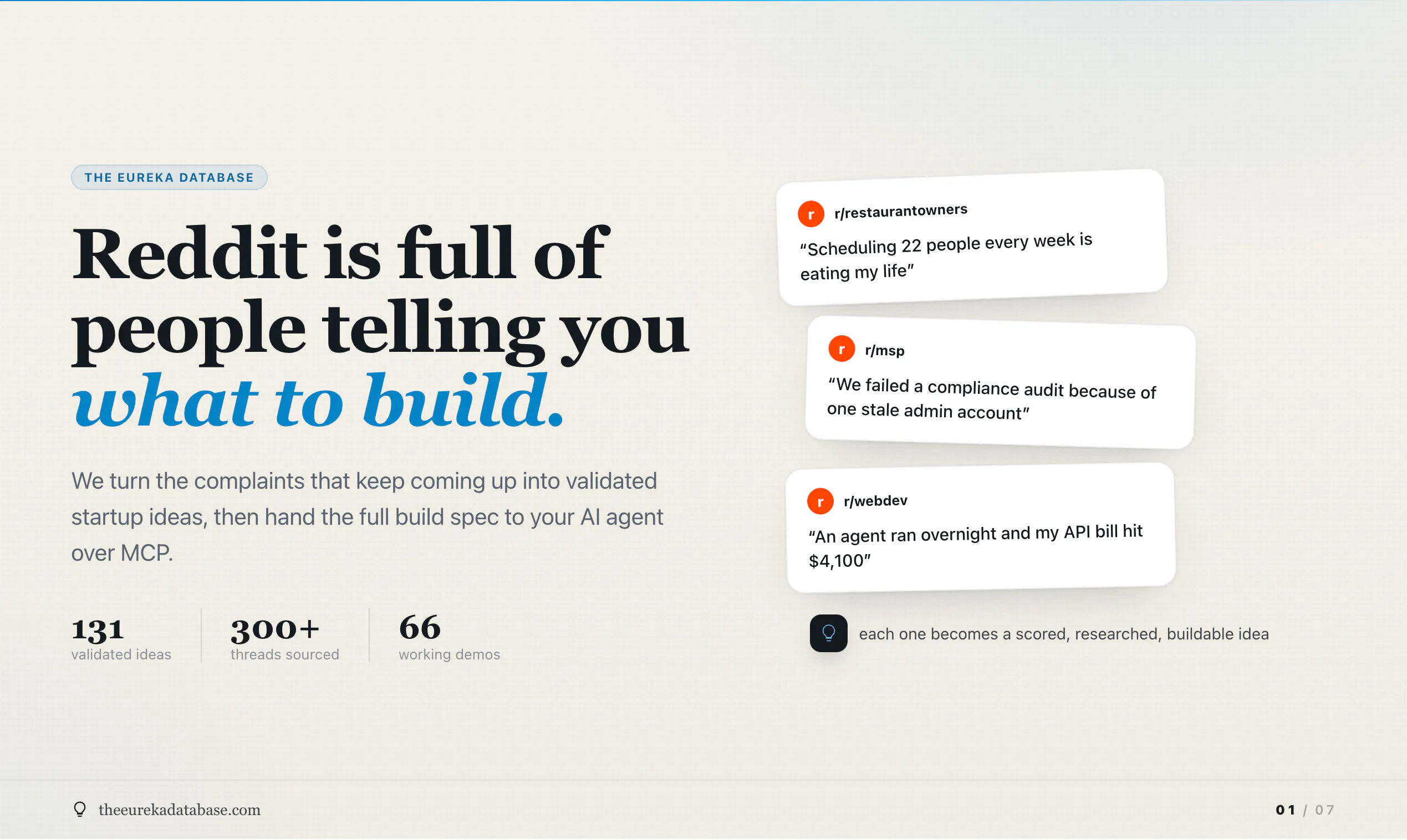
一句话介绍:The Eureka Database 是一款从 Reddit 等平台用户真实抱怨中挖掘可商业化创业点子的工具,通过 MCP 协议将已验证需求的完整构建规格(包括代码、架构、设计)直接交付给 AI Agent,帮助开发者跳过“自嗨式造轮子”环节,直接解决有人愿意付费的真实痛点。
Productivity Tech Vercel Day
创业点子挖掘 Reddit 抱怨分析 需求验证 AI 辅助开发 MCP 协议 用户痛点库 商业化评估 产品创意生成 竞争分析 低代码/无代码
用户评论摘要:用户普遍认可其解决了“盲目开发”的痛点,但也提出多个关键问题:如何区分“抱怨”与“付费意愿”(已获详细解答)、如何避免多人“撞车”同一创意(已确认排重机制)、如何追踪创意热度趋势(已纳入更新计划)、建议加入 Quora 等更多数据源、以及希望收据数据保持实时更新。
AI 锐评

The Eureka Database 的定位精准地切中了当前 AI 创业工具的产业缝隙——它没有停留在“生成1001个点子的废话循环”,而是把“需求验证”这个最费力且最值钱的环节产品化了。创始人 Jeremy 把 Reddit 视为“世界上最大的未被挖掘的按需抱怨池”,并用一套相对复杂的过滤引擎(语言信号、频率分布、付费意愿线索而非单纯点赞)来蒸馏出真正有商业潜力的诉求,这比市面上那些仅靠关键词或热度排序的工具高明了一个量级。

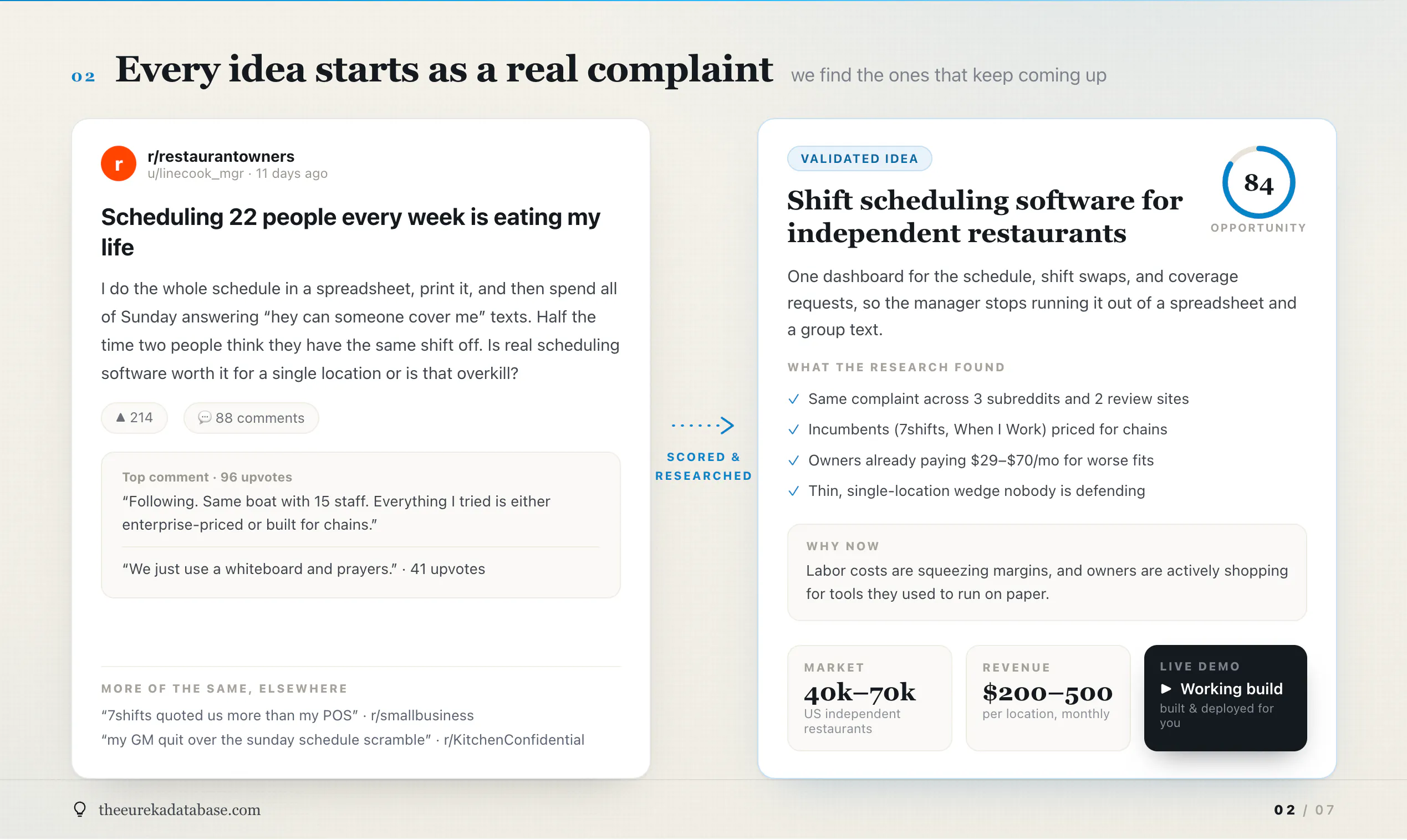
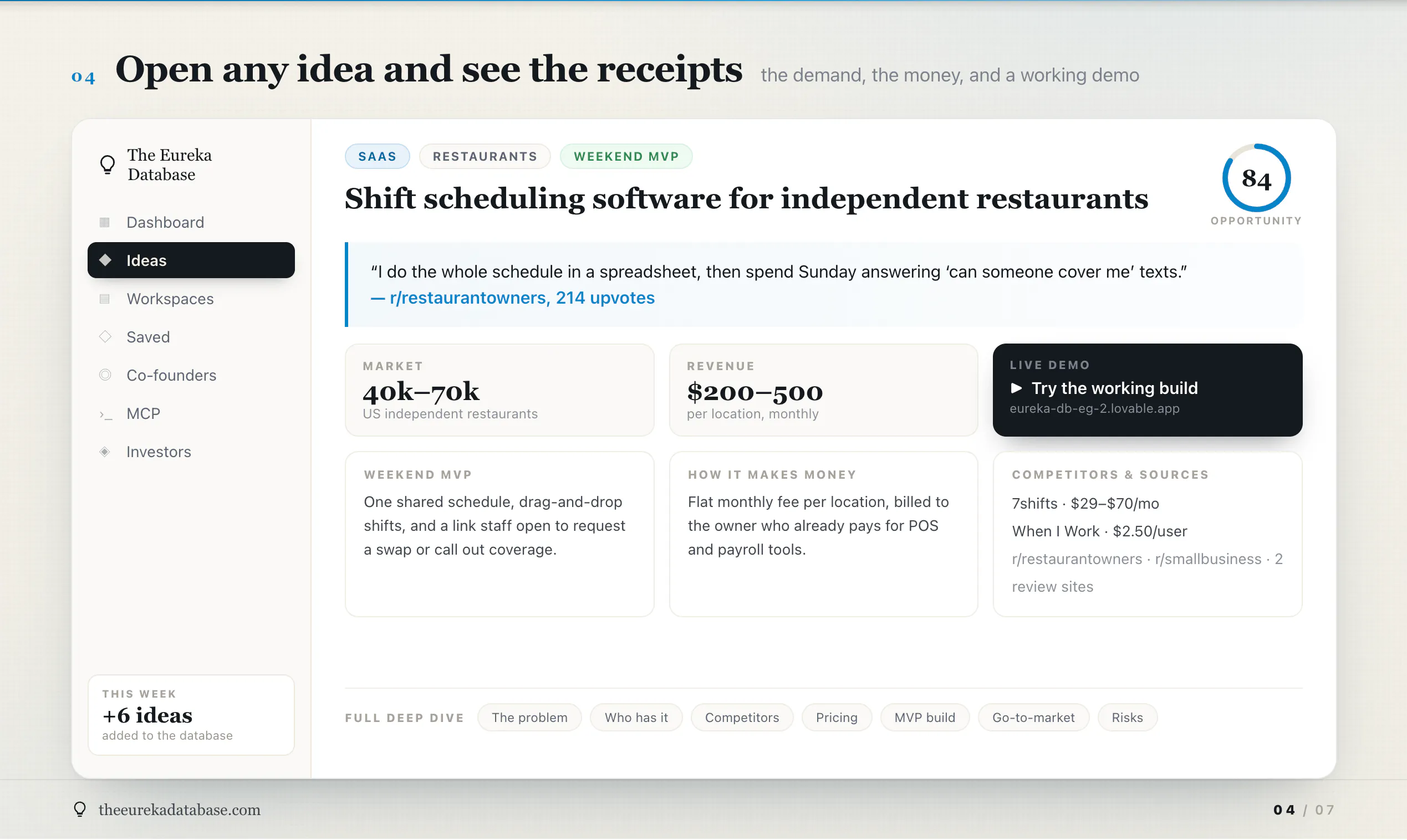
其核心价值不在于“点子多”,而在于“证据链”:每条抱怨附带了原始帖子、现有赢利者、市场估值和可运行 Demo。这本质上是一套“逆向最小可行产品”方法论——不是先造轮子再找客户,而是找到客户的轮子需求后,直接用 MCP 协议把构建所需的所有规格(技术栈、数据库 schema、设计风格)“喂”给代码 Agent。这种做法大幅降低了从“知晓需求”到“交付产品”之间的认知搬运成本。

但需要警惕的风险在于:当数百个用户盯着同样的“高分抱怨”时,产品同质化是大概率事件。虽然团队用了“近一年数据+最新抱怨优先”的机制来缓解这个问题,但真正的差异化壁垒不应该建立在信息稀缺性上(因为信息最终会扩散),而应该建立在执行速度和质量上——你能否比竞争对手早一周交付并且做得更好?此外,区分“抱怨”和“付费意愿”的模型再精细,也无法替代创始人亲自访谈用户的能力。工具可以给出“做什么”的正确答案,但永远无法替创始人回答“怎么做”以及“和谁一起做”的问题。

总的来说,这是一个优秀的创业加速器,但不是创业避风港。它最适合那些具备执行力、但苦于被“假痛点”浪费时间的理性创始人。而对于那些幻想靠一个点子一夜暴富的人来说,它只会让失败来得更快更清晰。

查看原始信息
The Eureka Database
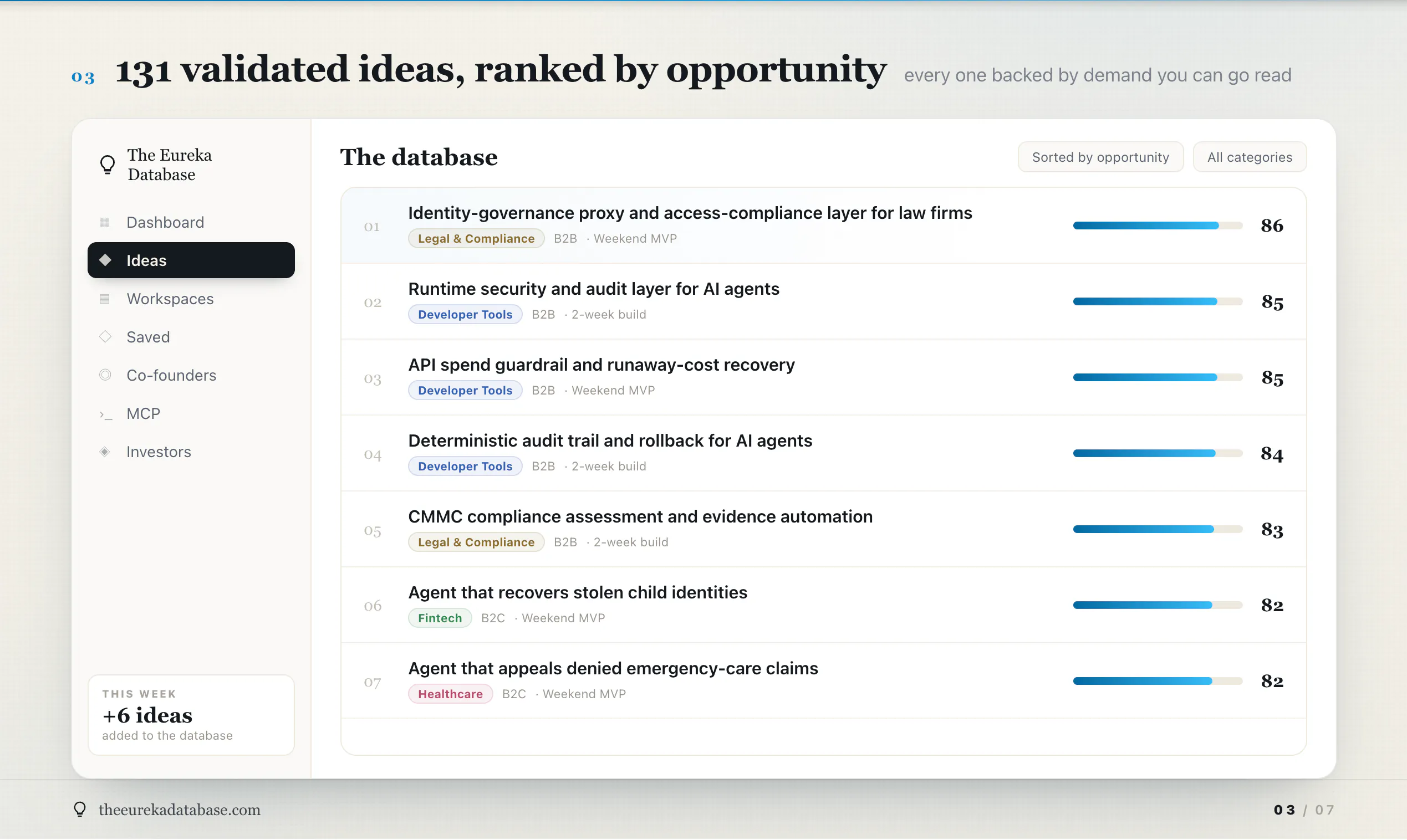
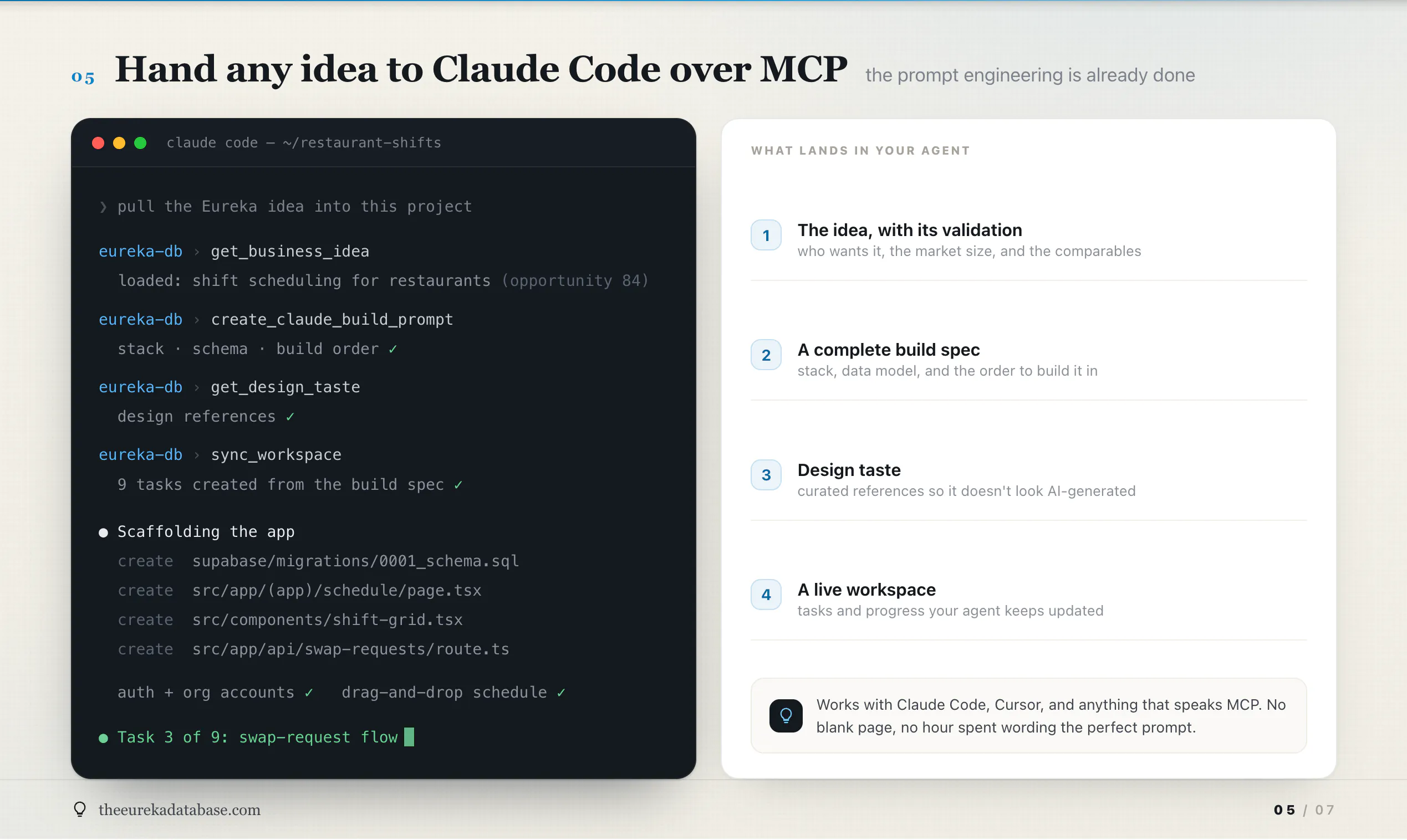
AI will happily generate a thousand startup ideas. It can't tell you which one people will actually pay for. The Eureka Database is a library of ideas mined from real complaints on Reddit, reviews, and forums. Every idea comes with the receipts: who wants it, who's already profitable, and a working demo. Connect over MCP and your AI agent pulls the full build spec for any saved idea: the problem, the stack, the schema, even the design taste, no prompt engineering needed.
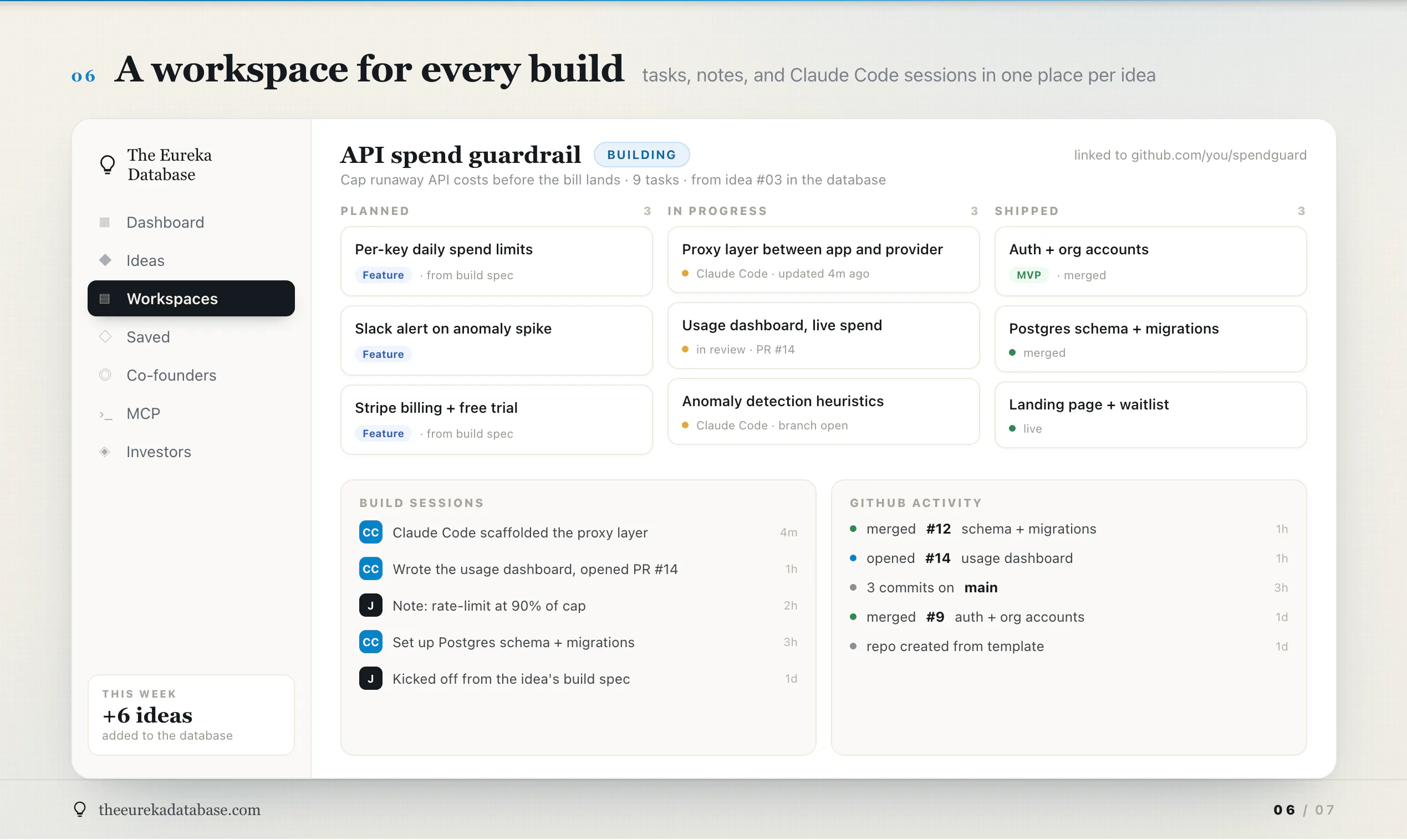
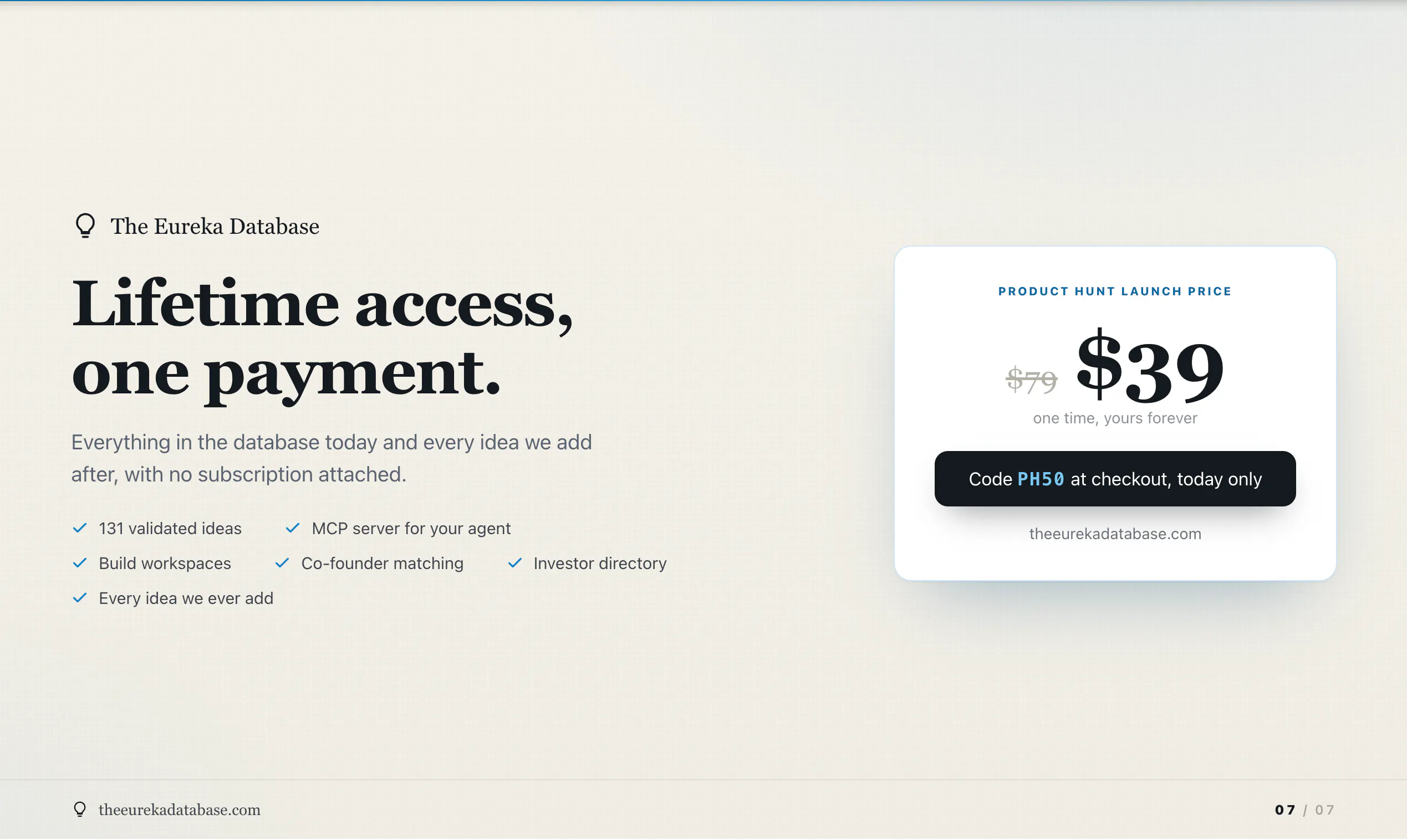
Hey Product Hunt! Jeremy here, founder of The Eureka Database. Over a billion people visit Reddit every month, across 100,000+ active communities. A huge share of what they post is people describing problems they'd pay to fix, asking for tools that don't exist, and sharing the workarounds they've hacked together. It's the biggest pile of unfiltered demand on the internet, and almost nobody mines it. For years my process for picking what to build was embarrassing. A shower thought, a hit of excitement, a weekend of building, then a launch to nobody. I was good at building and bad at knowing whether anyone actually wanted the thing. AI only made it worse. I could ship a polished product in a weekend, which mostly meant I could waste weekends faster. So I built The Eureka Database. It reads through that Reddit firehose, pulls the complaints that keep repeating, and researches each one into a real idea, with the original threads, competitors already making money, a market estimate, and a working demo. Then it hands the whole thing to Claude Code through our MCP server. The idea, the spec, and design references from repos like Magic UI load straight into your editor, and a shared workspace keeps the build from scattering across ten tabs. It does the prompt engineering for you. There's co-founder matching if you don't want to build alone, and an investor list for later. Lifetime access is one payment, so please use code "PH50" for 50% off for the launch! Expires July 19th, 11:59pm EDT. Happy to answer anything in the comments, and I'd love to hear where it misses. — Jeremy, The Eureka Database
6
回复

@jeremy_galang This is actually something that I was looking for recently. Are you considering Quora as well? There are a lot of threads there where people directly ask for ideas or describe a gap. This might be a good additional source.

2
回复

would love to see a freshness score on each idea so we know how recently the underlying complaints popped up, since some pain points fizzle out fast and others keep showing up year after year

2
回复

@ceyda299740 Great idea, Ceyda! Right now we only pull threads from the last year and surface the most recent ones first, so everything in there is at least reasonably fresh. But a visible freshness score is better, it'd let you tell a pain point that's been building for years apart from one that just spiked last week. Adding it to the list. Thanks!

0
回复

I have shipped over 30 projects and my problem was never building, it was picking ideas nobody asked for, so this speaks to me. One thing I keep wondering though. If hundreds of members see the same top idea with the same build spec, do we all end up shipping the same product? Any way to see how many people already pulled a spec?

1
回复

@abdullah_javaid3  You're 100% right, Abdullah. Under the hood we already only pull from the last year and rank the newest complaints first, so nothing's coming from a five year old thread. A trend signal on the idea itself is the better version, whether the complaint is picking up or fading, and whether the profitable players are actually growing. Puts it right in front of you instead of asking you to trust it. On the list :)

0
回复

The idea of pulling real build specs directly through MCP is genuinely useful, saves so much guesswork. One thing that would make this a no-brainer for me is a freshness or trend signal on each idea, something like how often the underlying complaint is being mentioned recently or whether the existing profitable players are gaining traction. Right now an idea could be mined from a five year old thread and feel current when it's actually fading.

1
回复

@durankumsaidzi Hi! Just wanted to say I checked out what you're building—it looks interesting. Founders don't usually get enough appreciation for the work behind the scenes. Wishing you the best with it!

0
回复

"I could waste weekends faster" hit a nerve, I'm on the other side of that right now, built the product first and I'm doing the demand-validation work in reverse. One thing I'd push on: a repeated complaint proves the pain is real, but people complain about plenty of things they'd never pay to fix. Does the database distinguish "loud problem" from "monetizable problem" beyond listing competitors who charge? That gap is where most idea-mining tools miss.

1
回复

@cannetjam Thanks Kenneth! Good question, and it's the thing we spend the most time on.

We don't really weigh how loud a thread is. What moves the needle is whether someone's already spending time or money on a workaround, so "I wish this existed" barely registers, but "I've tried three tools and I'm still stuck in a spreadsheet" scores high. Whether competitors already charge is a smaller signal on top, it doesn't decide much on its own.

0
回复

Half of the good indie products started as someone's Reddit complaint anyway, you just made the pipeline official. How do you filter complaints that are loud from complaints people would actually pay to fix? Congrats on the launch

1
回复

@alex_tomilin Hi! Just wanted to say I checked out what you're building—it looks interesting. Founders don't usually get enough appreciation for the work behind the scenes. Wishing you the best with it!

0
回复

@alex_tomilin Hey Alex! Couple things that actually do the work here:

A single loud thread is almost a red flag for us. The way the math works, upvotes get put on a log scale, so going from 50 to 5,000 upvotes barely moves the score, one viral rant is usually just one bad week for a product. Frequency is its own separate input though, so the same complaint quietly recurring across different subreddits over months counts for way more than one big thread.

Before any of that, there's a filter that reads the actual language of the post. It's looking for phrases that signal a real job-to-be-done, things like "alternatives to X," "what do you all use for," "still doing this in a spreadsheet," and it throws out pure venting and "someone should fix Facebook" posts before they ever become an idea.

Then whether people would pay is its own score, blended from a few things, how severe the pain is, how often it recurs, and willingness-to-pay signals, each weighted separately so upvotes can't fake it. Recency plays in too, we only pull from the last year so a pain that fizzled out won't surface.

Thanks for the kind words on the launch :)

1
回复

finally a tool that skips the brainstorming step and gets straight to building. i pulled a saved idea over mcp and it dropped the schema into my agent without me touching a prompt

1
回复

@recep763495 Glad you like the tool, Recep!

0
回复

the receipts angle is what sells me here, actual evidence of who wants it beats another AI-generated idea list any day. how often do you refresh the "who's already profitable" data, that seems like the part that would go stale fastest since competitors and pricing shift constantly

0
回复

I'd definitely talk to users before building anything but the database sounds useful. I'm curious if multiple founders use Eureka do they all end up chasing the same opportunities ?

0
回复

The "receipts" angle is the part most idea lists miss — knowing someone's already profitable off a complaint is way more useful than another AI-generated wishlist. How do you keep it from surfacing the same over-mined ideas everyone's already chasing? Curious how fresh you keep the Reddit data.

0
回复

This solves a real pain — I built my SaaS because a friend complained about her workflow for 6 months, not because AI suggested it.

0
回复

Funny timing, I spent this morning digging through Reddit threads about client content chaos for exactly this reason. Though my product came from pain I lived myself, not a database. How do you tell a loud complaint from one people would pay to kill? Volume alone seems like it'd surface a lot of venting.

0
回复
#8
Nuvio
Connect your X bio to your MRR and GA4 for auto updates
145
一句话介绍:Nuvio 是一款自动更新 X(Twitter)个人资料的工具,通过连接 Stripe、Google Analytics 和 Search Console,让创始人实时展示真实的营收、流量和 SEO 数据,省去手动更新的麻烦,增强社交信任。
Twitter Developer Tools Social media marketing Vercel Day
社交证明 自动更新 X个人资料 Stripe集成 MRR展示 GA4数据 创始人工具 实时数据 独立开发者 SaaS产品
用户评论摘要:用户普遍认可“实时社交证明”的创意,建议增加指标选择(如MRR vs 流量)、数据冻结期(防周末低谷)和更新频率调度。有用户希望接入RevenueCat/App Store数据,评论区也反馈了“虚荣地板”功能需求,创始人积极回应将添加。
AI 锐评

Nuvio 精准切入了一个“小而美”但常被忽视的痛点:创始人手动更新 X 资料的尴尬与不可信。它本质上是一个“社交证明基础设施”,核心价值不是数据自动化,而是将“可信度”从静态截图变为动态资源。

产品逻辑清晰,但局限也很明显。目前仅支持 Stripe、GA4 和 Search Console,而对大量移动端开发者(通过 RevenueCat、App Store 获利)或非 SaaS 创业者来说,这几乎是空白。评论中用户追问“App Store 数据支持”便是明证。创始人虽承诺“在规划”,但若迟迟不覆盖,产品极易沦为 SaaS 创始人的小众工具,错失更广大的独立开发者市场。

功能层面,用户提出的“指标选择”(bio vs banner)和“更新调度/冻结”是刚需。当前“实时更新”看似酷,实则可能因周末或低点暴露业务脆弱性,反损信任。评论区多次提及“虚荣地板”和“调度刷新”,创始人应及时在 MVP 后快速迭代。

商业模式上,创始人坦言“X API 成本”是订阅制的理由,但可以探索“自带 API 密钥”降低门槛,或推出免费版(限制展示一个指标)来扩大用户基数。否则,定价将直接决定产品是“增长杠杆”还是“成本中心”。

总体而言,Nuvio 方向正确,执行尚可,但若停留在“Stripe+GA4 自动化”的舒适区,而不扩展数据源、增强用户控制力,很可能只是“小而美”,难以真正规模化。

查看原始信息
Nuvio
Tired of outdated or hand-typed metrics in your X profile? Nuvio connects to Stripe, Google Analytics, and Search Console to auto-update your bio and banner with real, verified revenue and traffic stats. Built for founders and indie makers aiming to grow trust and stand out with live social proof. No manual edits—just authentic numbers that prove your progress.
Hey Product Hunt 👋 As a founder, I used to spend way too much time updating my X bio whenever my metrics changed—always worrying about whether my numbers were actually credible. It felt like anyone could claim $50k MRR, but showing real, verified stats was another story. So I built Nuvio to solve this for myself and other builders. It connects directly to Stripe, GA4, and Search Console to keep your X profile updated with live, authentic numbers—no manual edits or copy-paste needed. Now your followers, potential users, and investors know your stats are real. • Connect once, automate forever • Live revenue, traffic, and SEO proof • Built for founders, indie makers, SaaS builders If you're actively growing on X and want your bio to work for you, Nuvio is designed to help. We have a free trial for Product Hunt folks—just sign up and give it a spin. 🙏 I'm curious: How do you currently show proof or credibility on your profile? What stats would you want to highlight? Would love your feedback!
3
回复

@therayess Congrats on the launch — "comunícate sin límites" is a clean promise, and a communication product that actually delivers frictionless reach is always worth a look. You've already got a video, so here's a complement: a free looping GIF of Nuvio from your own screenshots, a click-free moving shot for your gallery, Giphy-tagged to keep surfacing. White-label, yours to keep: https://foxplug.com/g/7726ce9fc18f45438d29

https://www.youtube.com/watch?v=NY6uIkBXExc

A 30-second taste of FoxPlug — you keep building, and it turns every release and milestone into GIFs, videos, posts and a live changelog. Start free at https://foxplug.com

0
回复

@therayess Hi,

Congratulations on launching Product.

I review newly launched SaaS products as part of my work, and yours stood out. While exploring it, I found a few areas where the onboarding flow, UI, and performance could be refined.

I recorded a short review with actionable suggestions tailored to your product. No strings attached—just thought it might be useful while you're iterating after launch.

Happy to send it over if you're interested.

0
回复

@therayess Congrats on the launch! From a product perspective, what has been the biggest "aha!" moment for early users? Is it asking financial questions in natural language, the cash flow forecasting, or something unexpected that ended up driving retention? Those insights are always fascinating because they often reveal where true product-market fit emerges.

0
回复

Live MRR in the bio is a bold level of building in public. Does it update down too on a bad month, or is there a vanity floor? Respect either way, congrats on the launch

2
回复

@alex_tomilin Hi Alex, thanks for your feedback, hey that's a cool idea about the vanity floor, right now no it's not doing it, but now i'm gonna add it based on your input, cheers Alex :)

0
回复

Congrats Ammar! All the best here

1
回复

the banner auto-update from google analytics actually works without me touching anything, kind of mind blowing how it just pulls live numbers into the profile. wish more tools did this instead of making me copy paste screenshots every week.

1
回复

Love the idea of live social proof in bios. One thing that would make it even better is letting users pick which specific metric goes in the bio versus the banner, since real estate is tight and founders might want MRR in the bio but traffic growth shown on the banner.

1
回复

The trust mechanic is really good! Is there a public proof layer, a badge or a link back to the source? Or the credibility leans on people already knowing you built it straight?

1
回复

@artstavenka1 Heya, thanks for the feedback! yes you can insert a 'verified by Nuvio' badge, currently it's optional since it takes from the bio character space, so i leave it in the hands of users to decide if they wanna add it or not.

but, the X banner that we also generate automatically has that badge built into it.

1
回复

@artstavenka1 Hey,

Launching a startup is hard, so congratulations on getting out there.

I work with early-stage SaaS products, and while exploring yours I spotted a few quick improvements around UX, speed, and conversions.

No sales pitch—I just enjoy helping founders build better products.

Want me to send the notes?

0
回复

Love the idea of auto-updating metrics, would save so much hassle. One thing that would make it even better is letting users schedule metric freezes for specific date ranges, like pausing auto-updates during a slow weekend so the bio doesn't reflect a temporary dip. That small layer of control would really help with how the stats represent the business.

1
回复

@larocakl47618 Appreciate you taking the time to check out Nuvio and letting me know your feedback!

Yes this seem to be a very important @alex_tomilin also mentioned the same thing, a vanity floor basically, which would work regardless of weekend or not i guess, on it!

0
回复

honestly this is pretty cool, been waiting for something like this. one thing though, would be awesome if you could add a scheduling feature so the stats update at specific times instead of constantly, like maybe only refresh daily or weekly. some founders probably don't want their numbers flickering all the time

1
回复
@hasandonermds0 thanks for the positive feedback, yeah thats a great idea, added it to the todos 🙂
0
回复

@therayess - great idea, and once my products start earning definitely something I may try out. Best of luck with today's launch. Post Hog integration would be useful and also a discounted annual plan, and possibly a life plan. I tired of more and more subscriptions.

1
回复

@codeandsea Hi Brent, thank you for your valuable support and feedback!

We couldn't do without subscriptions unfortunately because X apis cost us money, but perhaps we can do an option where you BYOK? will definitely be looking into that based on your input, thanks again!

1
回复

@Ammar Rayess thanks, good to know it's flexible on the window. 30 days is probably what I'd default to for a bio stat, all-time can look impressive but it stops meaning much once the number is huge

0
回复

The Stripe + GA4 combo is smart, but a ton of indie makers ship mobile apps where revenue runs through the App Store / RevenueCat instead of Stripe. Any plans to pull those in? I'd happily put live IAP revenue in my bio lol.

0
回复

@lennoxbeflying Hi Ziang, thanks for your feedback, yep, adding an RC integration is in the pipeline, we wanna open it up for app devs for sure.

0
回复

honestly the "authentic numbers" pitch lands, half the MRR screenshots floating around are stale or cherry-picked the one good month. connecting straight to Stripe and GA4 means it can't really be gamed the same way. does it let you pick a rolling window (last 30 days vs all-time) or is it locked to one metric format

0
回复

@omri_ben_shoham1 Thanks for your feedback Omri, yep you can do 30 days vs all time and there are alot of options really.

0
回复
#9
Manta AI
Your AI agent for autonomous web app testing
144
一句话介绍:* Manta AI 是一款能自主探索网页、用自然语言描述即可生成测试用例并自愈的智能测试代理,解决UI频繁变动导致自动化测试脚本维护成本高、团队最终放弃E2E测试的痛点。
Software Engineering Developer Tools Tech Vercel Day
* AI测试代理 无脚本自动化 自愈测试 Web端到端测试 自然语言驱动 本地部署 私有网络测试 CI/CD集成 回归测试 UI回归检测
用户评论摘要:* 用户关注自愈测试能否区分“UI优化”与“真实回归缺陷”,担心可能掩盖bug。本地运行、处理登录/多因素认证(SSO/MFA受限)被肯定。用户希望控制误报率,并确保测试可重复性。部分用户当前采用其他AI方案,对比价值待验证。
AI 锐评

*

Manta AI切入了一个真实且被忽视的痛点:UI自动化测试的“脆性”与维护成本。创始人背景让产品痛点抓得很准——团队在压力下放弃脚本维护,最终为回归缺陷买单。其核心“自愈”能力并非简单重试,而是通过“观察并推理UI”来适应变化,这确实比传统的复杂选择器策略更优雅。

然而,这份优雅背后藏着一个核心矛盾:**“自愈”与“发现回归缺陷”在实质上是对立的**。当UI因bug而错位时,如果测试因“自愈”而通过,它反而成为了缺陷的庇护所。评论中用户对此的质疑非常尖锐,创始人给出的回应(“完全改变导致测试失败,随后可人工检查”)不够有力——这意味着产品需要更精细的“可解释性”与“告警机制”,让用户明确知道“哪里被自愈了”,而非只是“测试通过了”。

另外,局限同样明显:对第三方SSO登录的规避(担心法律风险)直接削弱了其在企业级复杂认证场景下的可用性。尽管有本地运行、防火墙穿越、MCP接口等加分项,但若核心的“无脚本探索”与“自然语言描述”不能从“demo级”进化为“生产级稳定”,它很快会成为下一个被“悄悄放弃”的工具。Manta的价值不取决于它能测试多少页面,而取决于它能否在**“测试通过率高”**和**“不放过真正缺陷”**之间找到让团队信任的平衡点。在这一点上,它需要更多数据来证明自己不是另一个花哨的“测试脚本生成器”,而是一个真正的**“测试质量守护者”**。

查看原始信息
Manta AI
Manta AI is an autonomous testing agent for web applications. Give it a URL and it explores your app the way a real user would — mapping flows, finding bugs, and generating self-healing test cases. Describe a flow in plain English and Manta tests it for you, no script required. When your UI changes, the tests adapt on their own. Run the agent locally on any machine or server — test apps behind a firewall, on a private network, or even on localhost. Free tier open. No card required.

QA never gets love so nice to see this. does it flag flaky tests or just fail them?

2
回复

@doganakbulut Thanks for your comment. On flaky tests; Manta sees and reasons about the UI the way a real person would, so it just deals with whatever is there. No hardcoded anything. Flakiness goes away when you remove the brittleness that causes it.

1
回复

Hi Product Hunt 👋

I'm AbdelRahman, founder of Manta AI. I'm always here — ask me anything.

The honest version of why I built this: I spent years managing software development teams across telecom, fintech, e-commerce, and real estate. Testing was always the part that broke under pressure. Scripts failed every time the UI changed. QA teams burned hours maintaining automation instead of actually testing. And at some point, the team quietly gave up on automated UI testing altogether — not officially, just practically.

That decision always came back to hurt us.

When AI coding tools arrived and made development even faster, I knew the testing gap was going to become a real crisis for a lot of teams. So I built Manta AI.

Manta explores your web app autonomously — without being told where to look. It finds bugs in real user flows, not just unit-level failures. You can also describe a specific flow in plain English and Manta will test it for you, no script required. When your UI changes, the tests self-heal. No selector updates. No maintenance.

The runner can be deployed locally on any machine or server — so you can test apps behind a firewall, on a private network, or on localhost without exposing anything to the public internet. Or run it from the cloud if you prefer.

Free trial is live now. No card required.

If you try it, I'd love to hear your experience — what worked, what surprised you, and what you'd do differently. That's more useful to me right now than anything else.

1
回复

@aelsergani Congrats on the launch — an agent that tests your web app autonomously hits a real nerve; E2E testing is the chore everyone means to automate and never finishes. You've already got a launch video, so here's a different asset: a free looping GIF of Manta from your own screenshots — a click-free moving shot for your gallery or launch tweet, Giphy-tagged so it keeps getting found. White-label, no strings: https://foxplug.com/g/00b2f7e832514623a591

https://www.youtube.com/watch?v=NY6uIkBXExc

Came out of FoxPlug in ~30 seconds from your URL. You stay heads-down building, and it turns your commits, releases and milestones into GIFs, videos, posts and a changelog. Make yours free at https://foxplug.com

0
回复

Cool idea. Right now I'm using codex with browser or claude code with browser use to do such testing. How do you see Manta giving more value?

1
回复

@margharitha Thank you for your comment and great to see how developers are handling such use cases. In your specific use case, Manta will be able to build test plans easily as it knows how your application works. It will be able to run regression tests for previous tests on your local environment, without you having to prompt each test plan again from the beginning.

Manta also holds all the tests on the cloud, so basically you and the team have access to all the tests, results, understanding from the cloud. Manta can run in CI/CD pipelines, can be managed by the QA team rather than the developers.

Let me know more about your workflow/size of the team and I will be able to provide more context.

0
回复

I ship MVPs fast and testing is always the thing I skip when I am tired, then I pay for it later. Curious how it handles login flows, that is where most of my bugs hide. Congrats on the launch.

1
回复

@abdullah_javaid3 Thanks Abdullah for your comment. Manta is able to perform login/ registration through email/password, email/pin, magic links, mobile number/pin, fill forms, wizards, etc. Let me know if you have specific examples. Happy to discuss further.

1
回复

@aelsergani the local and firewall-network angle is interesting, most testing agents assume a public URL. However I'm curious how it handles authenticated flows, like SSO or MFA prompts?

1
回复

@clement_avq Thanks for your comment. Really appreciate your feedback there.

There are many forms of MFA so as to generalize an answer. Today, Manta already supports mobile/email MFA. TOTP is supported if you provide the secret in the login/registration instructions.

SSO like login with Google or such is detected. However, Manta will not proceed with such login requirements as this involves third parties that could impose a legal responsibility upon Manta. Google, Github, LinkedIn, etc. will all have policies restricting AI/bot login that could endanger both Manta and our customers. We are looking into how to make it right. The safe option now is to have a login mechanism aside from SSO in your application, that Manta can use.

1
回复

Coverage is easy to demo, trust is what makes a testing tool stick. If it cannot tell a real regression from a timing flake, teams stop reading the reports within a week. I would lead with how you hold the false-positive rate down.

1
回复

@shivangit26 Thanks for your comment. I agree with your point of view. Manta doesn't just execute a script. It sees and analyzes the page while executing a test so that it actually reasons about the right step to do if a change occurs in the website. If you have a specific use case or target website to try Manta on, I would be pleased to assist.

0
回复

Local runs against localhost:3000 are the right bet here - most agent testers die before they can reach a staging app

1
回复

@oleksandr_knyga Thanks for your comment. This was actually one of the main pillars that shaped Manta. Test websites are usually deployed on private networks. We also want developers to be able to use Manta while still working on their local machines, before pushing to git. Look out for our MCP interface soon, that would enable Manta to work directly from within any IDE. Developers will not longer need to test their code themselves.

0
回复

self-healing test cases is the part i actually care about. writing the tests was never the hard bit, keeping them from breaking every time the UI moves is. if manta handles that reliably it solves the real problem

1
回复

@alex_watson2110 Thanks for your comment. I really appreciate your feedback.

0
回复

The self-healing tests actually adapted when I tweaked a button label, which caught me off guard in a good way. Local execution is a nice touch for our staging environments behind a VPN.

1
回复

@recep755n Thank you for your comment. Stay tuned as Manta re-shapes software testing for years to come.

0
回复

Pointed it at a staging app and it picked up a broken checkout flow on its own without any setup. The self-healing part feels pretty solid too when I shuffled the UI around.

1
回复

@evvalkayga5vdo Thank you for trying out Manta! Excited to see how Manta can further enhance your software testing process.

0
回复

Really like the framing here, AbdelRahman — the honest "the team quietly gave up on automated UI testing" is such a real failure mode, and going after it with autonomous exploration instead of brittle selectors feels right.

One thing I'd genuinely love to understand: when the UI changes and a test self-heals, how does Manta tell "the UI legitimately moved" from "the UI broke"? A redesign should heal, but a regression that shifts the same element is exactly the bug you'd want it to catch — curious where that line gets drawn.

And on the autonomous exploration: since the agent picks its own path, how repeatable is a run? If it surfaces a bug today, will the same flow reliably reproduce it tomorrow, or does the path drift between runs?

Excited to try it on a flow behind a firewall 🙏 @aelsergani

1
回复

@akbar_b Thank you for your feedback. Manta is able to know when a UI change happens but doesn't break the test plan. A change in button color, location, etc. can be picked up easily. However, a complete change that breaks the test will fail the test. That is when you can easily check the test run and see what exactly broke. We can add a feature to notify the user when a test had to self-heal to be successful. Then the user can check visually how the test was healed and decide.

Stay tuned as Manta re-shapes and progresses with more and more use cases.

0
回复

the self-healing part makes me a little nervous rather than reassured, if a UI change is actually a bug (a button moved because of a broken layout, not an intentional redesign) does the agent know the difference, or would it just quietly adapt the test to match the broken state and mask the regression

0
回复
#10
In Parallel MCP
Your context, available to every agent.
125
一句话介绍:In Parallel MCP是一款通过MCP协议为AI代理提供统一上下文记忆层的工具,解决了用户在不同AI工具间重复输入公司背景、会议决策和项目信息导致的效率低下问题。
Productivity Meetings Artificial Intelligence Vercel Day
AI记忆层 MCP协议 上下文管理 企业知识图谱 AI代理 团队协作 决策追踪 数据安全 效率工具 上下文漂移
用户评论摘要:用户痛点集中在上下文漂移、决策丢失和手动维护成本高。核心问题:如何自动捕获微更新而非手动编辑?是否支持单人使用?能否限制敏感文件夹权限?是否存在移动端?还有用户担忧共享上下文变脏后更危险。
AI 锐评

In Parallel MCP切中的是一个极其真实且昂贵的痛点:AI时代的“上下文税”。当ChatGPT、Claude、Copilot各自为政,每次对话都要重新投喂公司背景、项目决策,这不仅是2分钟不耐烦的心理折磨,更是团队协作中隐性但巨大的效率黑洞。产品巧妙地将自身定位为“位于所有AI代理底层的标准层”,而非又一个需要人类跪着喂养的工具,这个思路很精准。

从用户评论看,社区显然被“决策丢失”和“上下文漂移”戳中了脊梁骨。但产品的真正考验不在于“能不能记住”,而在于“能不能活得同步”。SOC 2 Type II和ISO 42001认证是B端市场的敲门砖,但更核心的挑战在技术层面:如何优雅解决“两个代理同时拉取上下文后一个更新了”的冲突?团队提出的“事件关系图”方案听起来比“最后写入胜出”聪明,但复杂性不可小觑。另外,产品目前依赖被动监听和自动提取,若理解偏差导致上下文污染,结果会比没有记忆更致命——正如一位用户所言,信任一个过时的共享源比没有更糟糕。

当前版本明显更偏向企业团队,单人用户的场景虽然被提及,但功能边界尚未清晰。移动端和自托管VPC的缺失,也限制了它在高频离线场景和对数据主权极度敏感的企业中的推广。整体而言,In Parallel MCP走出了解决AI碎片化记忆的正确第一步,但想要成为“执行层的操作系统”,它需要证明自己不仅能“记住”,更能“准确遗忘”和“聪明冲突”。这是从有趣工具到基础设施的致命一跃。

查看原始信息
In Parallel MCP
You've explained your company to ChatGPT. Then to Claude. Then to Copilot. Every time you open a new chat, you start from scratch. Paste the notes. Upload the document. Copy in the email thread. Summarize what your team decided two weeks ago — to a tool that could've just known it all along. In Parallel's MCP server ends that. Connect it once, and whichever AI you open already knows your meetings, decisions, and context. Just ask the question. Less prose. More truth.

Okay, as promised, I'll go first 😅


Mine was a weekly "alignment sync" that survived three reorgs. The project it was created for shipped in 2023. Nobody remembered why it existed, but nobody wanted to be the one to kill it — so every Monday, eight people spent 30 minutes confirming there was nothing to align on.


It finally died when someone noticed the original organizer had left the company a year earlier.


That meeting is basically why In Parallel exists. If the decisions and status lived somewhere that updated itself, the meeting would have had nothing left to do.


Your turn — what's yours? 👇

6
回复

@kristian_luoma Congrats on the launch — calling it "the operating system for execution" is a bold frame, and there's a real gap between planning tools and things that actually drive the work forward. You launched without a video, so I made you a free launch kit: a looping, branded GIF of In Parallel from your own screenshots, Giphy-tagged so it keeps getting found. White-label, post it anywhere: https://foxplug.com/g/b6082416a3664f618c67

https://www.youtube.com/watch?v=NY6uIkBXExc

That came out of FoxPlug in ~30 seconds from just your URL. You keep building, and FoxPlug turns every commit, release and milestone into GIFs, videos, posts and a live changelog — automatically. Make your own free at https://foxplug.com

0
回复

@kristian_luoma Hi! Hope you're having a good day. I enjoy connecting with people building interesting products, so I thought I'd reach out and say hello. Always nice meeting fellow builders.

0
回复

As a CPO this hits a nerve 😅 The gap between "what we decided in the room" and "what's actually on the roadmap" is where half my week disappears. Every tool captures something — notes, tickets, docs — but the decision itself always seems to fall through the cracks. Love that In Parallel sits underneath instead of adding yet another surface to babysit. Pricing per workspace instead of per seat is the right call too. Congrats on the launch, upvoted 🚀

3
回复

SOC 2 Type II for an MCP context layer is exactly the boring enterprise signal I'd look for

3
回复

@oleksandr_knyga 100%. Not only that, we got also ISO 42001. While not as hot yet, I'd say it'll be the future. If interested, here's some more boring stuff: https://podcasts.apple.com/cz/podcast/episode-1-pioneers-of-the-new-ai-standard-iso-42001/id1790620457?i=1000684062280&l=cs

0
回复

Every comment here is about big teams so let me ask from the other side. I am a one person company and I still lose context between Claude Code sessions every single day. Is this built only for organizations or does it make sense for a solo builder too?

2
回复

@abdullah_javaid3 I feel your pain. By default, you are managing your own context in the product. By extension, we let you share it with the team (or agents, if needed).

0
回复

Congrats on the launch, Kristian! The concept of standardizing the shared context layer over MCP is brilliant. A major pain point with centralized team hubs is 'context drift'—a decision is made in Slack, the execution changes in GitHub, but the overarching context file stays static. How does In Parallel natively capture those micro-updates without forcing team members to manually edit the shared state every single day? Is it passively listening to integrations?

2
回复

@franz_briones Yes, indeed. Passively listening, and analysing, de-duping, and collecting "observations" is the key. We've been inspired greatly by the works of John Boyd (an American fighter-pilot from Korean War who came up with the theory behind "Situational Awareness"). Context drift is such a great term. We use Coordination Tax, but I'm tempted to steal "Context drift". Did you coin it?

1
回复

The portability problem is the real one: context trapped in each tool means every agent is a stranger. Building on MCP is the right bet because it standardizes that layer instead of locking it to one app. The test will be keeping context fresh, stale shared context is worse than none.

2
回复

@shivangit26 Amen.

0
回复

Congratulations on the launch! Solving the context problem for organizations with information moving faster than ever is a big deal! Heck, just figuring out how to manage my own personal context as a solo builder to make the most out of AI has it's challenges.

1
回复

@derrek_pearson It's true!

0
回复

This bit me two weeks ago, a rule I set at planning stage silently disappeared before the generation step and the output invented a fact. Took a day to find where the context died. So, real question: two agents pull the same context, one updates it mid-task, what happens? Last write wins or something smarter?

1
回复

@vladimir_iudin yeah, I hate when that happens. Well, we're building and maintaining decisions-based context that is the artefact e.g. something that can work for between people, not just between sessions. But to pull that off it is something smarter: so we save the "graph" of events and relationships, and use that.

1
回复

Really interesting approach to the LLM memory bottleneck standard custom instructions are too static, and vector databases get too noisy. Does your self-hosted VPC setup allow us to restrict sensitive context folders so only specific teams (like HR or Finance) can query them?

1
回复

@priya_kushwaha1 Thanks so much, couldn't agree more. We do not at the moment offer VPC setup, but are working on that option; what is important is that we offer no-training on your data (ISO 42001 certified, and SOC2 compliant).

2
回复

One thing that would make this a no-brainer for me is a mobile companion app. Most of my context-switching happens away from my desk, and being able to quickly check on goals, risks, or ownership changes from my phone would keep me aligned even when I'm not at my laptop. A simple read-only view with the ability to flag updates would be enough.

1
回复

@eyll09641878946 .. did you just read our roadmap? Working on it!

1
回复

every "single source of truth for the org" tool I've seen eventually turns into the thing everyone stops updating, then it's worse than no source at all because people trust a stale answer. how does In Parallel keep goals/ownership actually current without someone manually maintaining it, is it pulling straight from where the work happens (tickets, docs, calendars) or does it still rely on people logging updates

0
回复

The "explain your company once and every agent already knows it" pitch nails the actual daily tax of re-pasting context into each new chat. Where does that shared context actually live: a hosted store on your side, or something I control and can host in my own environment? And how does it stay current: does it auto-derive decisions and ownership from the connected tools, or does someone have to curate what goes in? With permission-scoped MCP access, is scoping per-user so an agent only sees what that person could see, or is it one org-wide context every connected tool can read?

0
回复
#11
Graft AI
Turn company operations into a living map for agents
118
一句话介绍:Graft AI 通过将企业遗留系统、内部工具和操作流程转化为一个“活的运营地图”,为AI代理提供稳定、可审计的工具接口,解决代理在真实业务中因底层UI变化或缺乏API而无法可靠执行任务的痛点。
SaaS Artificial Intelligence Vercel Day
企业级AI代理 遗留系统集成 操作知识图谱 工作流自动化 UI漂移检测 低代码/无代码 企业治理 审计追踪 人工智能基础设施 RPA替代
用户评论摘要:用户认可其解决企业真实痛点,但关心地图维护的实时性、语义漂移时是否会静默出错。核心问题包括:如何无需人工监控保持更新、如何处理需要人类判断的节点、以及修复滞后时间是分钟级还是需人工确认。
AI 锐评

Graft AI精准地切中了当前AI Agent落地的“最后一公里”现实困境——绝大多数企业并非运行在API友好的云原生环境中,而是由一堆“有屏幕但没接口”的遗留软件、Excel和内部系统构成。其提出的“活的运营地图”替代“静态文档”的思路颇具颠覆性,本质上是将企业领域知识从人脑转移到可版本化、可验证的机器层,为Agent提供了一套“数字神经系统”。

但冷静来看,产品描述中“自我修复”“自动检测漂移”等承诺极具工程挑战。UI漂移检测的误报率、修复对业务逻辑的无损性、以及混合验证器在“语义正确”与“执行正确”之间的判断,都是极难规模化落地的技术债。目前评论中用户对“人类判断节点”“可视回溯时间线”的追问,恰恰暴露了产品在复杂业务流中仍存在“黑箱”和“人力兜底”的依赖。与其说是Agent基础设施,不如说是一个高度智能化的RPA升级版,其价值锚点仍在于企业治理(审批、审计、权限),而非真正的自主智能。能否让“运营地图”像Git仓库一样可靠,而非另一个需要专人喂养的“数字文档”,将是Graft从噱头走向生产力的分水岭。

查看原始信息
Graft AI
Most agent tools assume clean APIs. Graft starts where companies actually work: legacy apps, internal tools, and workflows trapped behind screens. It learns how the work gets done, turns it into a living operational map, and gives agents stable tools with permissions, approvals, audit trails, and verification built in. When the underlying UI changes, Graft detects the drift and repairs the workflow without breaking the agent interface.
Hey PH 👋 I started Graft after realizing that the hardest part of deploying agents at work is not the model. It is the software around it. Real companies run on ERPs, desktop apps, internal portals, spreadsheets, and years of operational knowledge that agents cannot reliably understand or use. Graft began as a way to turn those interfaces into stable tools for agents. While building it, the idea grew into something bigger: a living map of how a company actually works. Graft learns the workflow, decisions, permissions, exceptions, and success conditions, then gives agents a safe way to do the work with approvals, audit trails, and verification built in. When the underlying software changes, the agent-facing tool stays stable. We are launching early because we want to learn from the people actually building and operating agents. What is one system or workflow your agent still cannot reliably use today?
2
回复

@ychampion I like that you're solving a real enterprise problem instead of assuming every company has modern APIs. Learning workflows directly from legacy systems, providing agents with stable interfaces, and automatically repairing workflows when the UI changes is a clever approach. The built-in permissions, approvals, audit trails, and verification also make it feel much more practical for businesses that need reliability and governance. Best of luck with the launch!

0
回复

@ychampion Hi,

Congratulations on launching

I review newly launched SaaS products as part of my work, and yours stood out. While exploring it, I found a few areas where the onboarding flow, UI, and performance could be refined.

I recorded a short review with actionable suggestions tailored to your product. No strings attached—just thought it might be useful while you're iterating after launch.

Happy to send it over if you're interested.

0
回复

docs go stale in a week so i like the living map idea. how does it stay updated without me babysitting it?

2
回复

@doganakbulut hello, good question. You shouldn’t have to babysit it. Graft watches real workflow executions and compares decisions, exceptions, and outcomes against the current map; when something changes, it proposes a clear diff, tests it in shadow mode, and only asks for review when the change is risky or uncertain. Normal work keeps the map current, while people step in only for meaningful exceptions. We're working on sandboxed environments and many cool features, it self-updates it self. This is not an agent, its an infra running to understand how your company operates, connects to software your company uses, extracts the domain knowledge from people to create a operating knowledge map (with our advanced memory systems) usable by agents consistently. For example it understands how refunds work, so this won't save it as a doc, it'll see how it functions in your company and map it out, next time something changes it'll update itself. It is deeply integrated to your system and connected to the tools you use and is like an evolving brain

Ask any questions if you have! if you're interested and want to talk, you can sign up for the waitlist at graft.axcelner.com

1
回复

One thing that would help us adopt this faster is a visual timeline view inside the operational map, so we can scrub through past workflow executions and see exactly where drift or failures happened. Right now troubleshooting at scale feels like guesswork.

1
回复

@alpergrbzobpev Yes, that is exactly where Graft is headed: every run becomes a replayable visual timeline, so teams can scrub through decisions, handoffs, failures, and drift instead of debugging from scattered logs. Your company owns the resulting operational knowledge base, and every employee correction makes it smarter, much like a team continuously improves a shared codebase for agents. If you're interested and want to talk, The waitlist is live at graft.axcelner.com.

1
回复

the framing that the model was never the hard part is honestly accurate for most companies, the real question is whether the "living map" stays correct as workflows quietly drift over months, not just when the UI visibly changes.

1
回复

@evan_cooper1 yes, Graft continuously compares real decisions, exceptions, and outcomes against the certified workgraph, so quiet semantic drift is detected and reviewed before it becomes production behavior. We are also building a workflow machine that can replay any historical case under today’s rules and show exactly where the company’s operating logic changed.

0
回复

@evan_cooper1 Hi! Just wanted to say I checked out what you're building—it looks interesting. Founders don't usually get enough appreciation for the work behind the scenes. Wishing you the best with it!

0
回复

spend months trying to get an agent to reliably click though our old internal ticketing system before giving up, this is the exact problem.

1
回复

@kyle_bennett6 Exactly. The problem is not getting an agent through the UI once, it is making the 500th run as reliable as the first. Graft learns the workflow, turns it into a stable tool like create_ticket or update_case, and verifies the result in the source system so the agent never has to rediscover that interface again.

0
回复

nothing in the pitch about workflows that need a human judgement call partway through, is that out of scope for now?

1
回复

@leah_josephine No. Human judgment is a first-class step in Graft workflows. Agents run autonomously until they hit a policy boundary or a genuinely ambiguous exception, then route a concise, evidence-backed decision to the right person and pause only that step. Once decided, the workflow resumes from the same state, so humans handle exceptions rather than babysitting every run.

0
回复

feels adjacent to Browser Use in spirit, just aimed at ERPs and desktop apps instead of the open web.

1
回复

@ian_maxwell2 No actually, this is really different. We're not teaching agents how to interact, we're building an operational knowledge map of the company, how operations really work and today it is stuck in people's head as domain knowledge, we saw a shift where now anybody can contribute to a company's codebase but imagine now employees knowledge and how work is done in the company is operatable by agents consistently, this still breaks at scale today and we're solving that.

Browser Use helps an agent operate a UI, while Graft turns recurring enterprise work into versioned, policy-bound, independently verified tools that agents can call reliably without rediscovering the interface every time.

1
回复

building stable tools instead of chasing every API makes sense, but that shifts a lot of ongoing maintenance onto graft's side to keep those maps accurate as companies change.

1
回复

@dustin_warren Exactly, which is why maintenance is part of the product: Graft continuously detects UI and business-logic drift, fails closed when a workflow no longer matches its certified behavior, and re-verifies every update before agents can use it again.

0
回复

@dustin_warren Hi! Just wanted to say I checked out what you're building—it looks interesting. Founders don't usually get enough appreciation for the work behind the scenes. Wishing you the best with it!

0
回复

if the underlying business logic changes and not just the screen, does the agent, facing tool silently start doing the wrong thing instead of breaking?

1
回复

@derek_julian nope, Graft treats a business-rule change as semantic drift, not a UI repair. Every tool is bound to explicit policies, expected effects, and independent verification; if the source system no longer behaves as certified, the tool fails closed and is quarantined until a new version is reviewed and re-certified. I previously worked on enterprise infra where data was messy and agents needed it in real time, this was the exact problem I faced and I've spent my time solving this

0
回复

approvals + audit trails baked in from day one is the part that'll actually get this past an IT review, not the AI framing.

1
回复

@hailey_brianna1 True. The AI gets attention, but approvals, least-privilege access, independent verification, and complete audit trails are what make Graft deployable inside a real enterprise. We're making it actually work in prod

0
回复

Graft turns real company operations into a shared, continuously updated layer for agents. We've seen companies transform to the AI native era but fail in operations because of institutional knowledge, and graft solves that.

1
回复

the self-healing part for legacy UI drift is the piece nobody else seems to be tackling well, most RPA-style tools just break silently when a button moves. what's the actual gap between the UI changing and Graft detecting + repairing it, are we talking minutes or does it need a human to confirm the fix before it goes back into production

0
回复

hello everyone, just a quick update. I've updated graft's social media, the old one was the wrong one. Thank you.

0
回复

Graft will be helping f500's transform their legacy applications into operational knowledge basis for agents to use. Agents can interact with their legacy software and help them transition into agent native software, this is a shift we're seeing but companies fail because the data is in people's head as domain knowledge so we're building the infra to make it operational by agents.

0
回复

Building a receipt-scanning feature right now and even at my tiny scale, the "verification" part is the hard bit — I ended up schema-validating every LLM response and failing closed on anything unparseable, because silently-wrong output is worse than an error. Curious how you handle the case where the workflow succeeds mechanically but the result is semantically wrong — is verification rule-based per workflow, or learned?

0
回复

@cannetjam That is exactly the failure mode we care about. Graft uses a hybrid verifier: explicit schemas, business invariants, and source-of-truth checks define what “correct” means, while learned models detect semantic mismatches and novel edge cases. Learned signals can quarantine a run or propose a new rule, but they never silently change the contract; ambiguous results fail closed or go to a human.

0
回复

Operations as a map agents can walk is close to what I do per-client, structured facts an AI can't step outside of. Mine is one brand, yours is a whole company, and I suspect the hard part scales badly. How do you keep the map current when the operations change weekly?

0
回复

@vladimir_iudin That is the hard part, so we treat the operational map like a versioned codebase, not a static knowledge graph. Every execution, exception, and employee correction is compared against the current map; changes are proposed as reviewable updates, tested in shadow mode, and only promoted after they pass verification. The map stays current because the company continuously contributes to it through normal work, instead of relying on a quarterly process-document rewrite. We're building knowledge graphs, real time data flow mechanisms, more info soon.

1
回复
#12
Cito
Hybrid academic search over 236M papers, built for agents
114
一句话介绍:Cito是一个专为AI代理设计的混合学术搜索引擎,覆盖2.36亿篇论文,提供无速率限制的API和原生MCP接口,解决了代理在进行深度文献检索时被上游API限流卡死的痛点。
Developer Tools Artificial Intelligence Search Vercel Day
学术搜索 混合检索 AI代理 MCP协议 API服务 论文检索 语义检索 开源工具 开发者工具 文献挖掘
用户评论摘要:用户普遍满意其速度快、MCP集成开箱即用,解决代理被限流问题。建议包括:提供流式端点或轮询机制(目前批量接口已覆盖)、查询上限能否支持深度检索(作者回应可上调)。负面反馈极少。
AI 锐评

Cito的定位精准而克制——它不试图做一个“智能问答机器人”,而是回归搜索引擎的本职:快速、全面、无痛地召回论文。这恰恰是当下学术界AI工具链中最稀缺的一环。

从技术上看,BM25+SPECTER2混合检索+交叉编码器重排序的管线并不新奇,但难能可贵的是,作者为了绕过上游API的“1请求/秒”魔咒,选择了自建索引并提供更宽松的100请求/分钟免费额度,且明确愿意为合理需求单独提额。这种“从自身痛点出发、为同类开发者解困”的务实姿态,比堆砌AI噱头更能赢得口碑。

不过,真正的考验在于持续运营成本和数据新鲜度——Semantic Scholar语料是静态快照还是实时更新?如果索引滞后,研究者找最新预印本仍会绕回Google Scholar。另外,纯JSON API和MCP接口意味着Cito是管道而非终点,用户需自行搭建推理层,对非技术用户门槛较高。

一句话评价:Cito解决了学术API代理化的“最后一公里”,但能否成为基础设施,取决于它在规模和时效上的长期投入。

查看原始信息
Cito
Cito is a hybrid search engine over the Semantic Scholar corpus: 236M papers in the keyword index, 146M with SPECTER2 dense vectors, fused with RRF and reranked by a cross-encoder. Free web search with no signup, a plain JSON API, and a native MCP endpoint so agents like Claude Code can run deep literature research without upstream rate limits. Built because every academic API throttled my agents to death.
Hi Product Hunt! I built Cito because I kept hitting rate limits while doing literature research with AI agents. Google Scholar has no API at all, and Semantic Scholar's defaults to 1 request per second. Fine for a human, but an agent doing a deep-research run fires dozens of queries and just stalls. So I indexed the corpus myself: 236M papers, hybrid BM25 + SPECTER2 dense retrieval fused with RRF, reranked by a cross-encoder, served from a single CPU box in under half a second. What makes it different: - Web search works with no signup - Plain JSON API with honest, generous limits (free keys: 100 req/min, vs 1 req/sec upstream) - Native MCP endpoint: one command and Claude Code / Cursor can search the literature directly It is deliberately a retrieval engine, not a chatbot. It returns ranked papers with abstracts, citation counts, open-access PDF links and DOIs; the reasoning layer is your agent's job. Would love feedback, especially from anyone building research agents. If a rate limit ever blocks legitimate work, tell me and I will raise it.
3
回复

@tao_hpu I like that you're tackling a real pain point for researchers and AI agents. Combining keyword search with semantic retrieval and reranking over such a large academic corpus should make it much easier to find relevant papers instead of relying on exact keywords. The plain JSON API, native MCP support, and lack of restrictive rate limits are especially appealing for developers building research workflows. Best of luck with the launch!

0
回复

The sheer speed of this is impressive! I am not directly involved in academic research currently, but (like most people I guess) I have topics that I am curious to explore further. I spent a good while exploring the topics via this platform and was hugely impressed by the results, the UI and the speed with which they were returned. It was easy to access original content (where applicable) and I would certainly recommend.

0
回复

@martin_tanner Thank you, this made my day. "Not a researcher but curious about topics" is honestly a use case I care about a lot, since most academic search assumes you already know the jargon. If you ever run into a topic where the results feel off or the path to the actual paper feels clunky, I would genuinely like to hear about it.

0
回复

Really glad someone finally built a search engine that doesn't choke an agent after three requests. If you could expose a streaming endpoint or webhook for long queries, agents could kick off a deep search and poll instead of holding a connection open the whole time. That would make it way easier to chain searches across Claude Code sessions without timing out.

0
回复

@elifnurs7bw 

Thanks! Good news is you mostly don't need it: a normal query returns in well under a second even cold, so there's no long connection to hold. The slow path is really when an agent wants 50 things, and for that we just shipped batch endpoints (/search/batch and /paper/batch, plus direct DOI/arXiv lookup) so you can do one round trip instead of fifty. If we ever add something genuinely long-running, for example LLM query expansion over large result sets, an async job plus poll pattern is how I would approach it. What's your use case where a single query runs long enough to time out? I would love a concrete example.

0
回复

finally a search tool that doesn't choke when my agents hammer it. the MCP integration just worked out of the box with claude code, which is more than i can say for most academic apis.

0
回复

@hafizeldgy Glad it just worked, that was the whole point of building it. Upstream APIs rate-limiting agents into the ground is exactly why this project exists. If your agents are doing bulk work, check out the new batch endpoints (/search/batch and /paper/batch, plus direct DOI and arXiv lookup). They landed this week and significantly reduce round trips.

0
回复

The MCP endpoint is what sold me. I keep hitting the Semantic Scholar 1 req/sec wall when Claude runs a deep lit-research pass and it just stalls. Does the free 100/min hold up for a full run, or does it throttle once an agent goes wide?

0
回复

@hung_tran_from_notebook_os 

Short answer: it holds, and going wide is specifically the case it's built for.

The 100/min is a fixed-window counter per API key, not a pacer. There's nothing forcing a gap between calls the way S2's 1 rps does, so you can fire all 100 inside the first second and none of them stall. The window just resets.

Two things worth knowing when an agent fans out:

  1. The limit is per key, not per connection. Ten parallel workers on one key share the same 100; they don't get 100 each.

  2. Search is the metered part. Paper lookups aren't: /paper/batch takes up to 1000 IDs in a single call. In a real literature research pass, most of your volume is resolving and hydrating references, not issuing new queries, so the 100 tends to go a lot further than the raw number suggests. There's also /search/batch (50 queries per request), which cuts round trips, though each query still counts against the 100.

If you do have a run that genuinely needs more, ping me. The limit is a per-key value, so it can be raised for your key.

0
回复
#13
Weave
Think out loud and watch it become a living map.
112
一句话介绍:Weave 将即兴口语转化为实时演化的思维地图,解决“说话容易整理难”的痛点,让会议、头脑风暴等场景中的碎片化想法自动结构化,无需手动记录或整理。
Productivity Notes Artificial Intelligence Vercel Day
语音思维导图 AI会议记录 实时知识图谱 口语转结构 思维可视化 智能提问 协作复盘 手绘自由 本地导出
用户评论摘要:用户称赞实时地图比纯转录更实用,保留思考结构而非文字本身。核心疑问:如何平衡口语杂乱与卡片清晰?暂停提问机制是否会打断思路?Markdown导出是否保留链接关系。开发者回应:乱语视为信号,保留历史回放;提问仅在具体时触发;导出保留嵌套大纲与连接标签。
AI 锐评

Weave 的巧妙之处在于“以暂停为驱动”——它没有走多数AI工具“理解然后总结”的路线,而是把停顿当作提问与梳理的触发器,让输出始终处于“半完成态”。这让它避免了两个致命陷阱:一是转录即死,二是众包式脑暴图。前者让语音内容沦为文本垃圾,后者让用户花时间在修图而非思考。 但它的真正价值并非“更好用的思维导图”,而是“认知的自我观察器”。通过对说话过程的结构化回放,用户能反观自己思路的断裂、跳跃与回避——这远比一张漂亮的图更有认知收益。 缺陷也明显:15分钟免费额度过于吝啬,实际上只要一次深度会议或稍长的头脑风暴就会用尽。而“干净卡片”背后的语言模型有时会抹去口误中的洞察(开发者承认未保留逐字稿),这对创作类用户可能是减分项。 产品本质是“配合思维的语音脚手架”,而非“完美整理工具”。对高频脑暴者、单口复盘者来说是利器,对追求文档成品或严格会议记录的人则脆弱。定价也不如做成一次性买断或团队订阅以匹配使用场景。

查看原始信息
Weave
Talk through an idea and watch it become a live map that reshapes as you change your mind and asks the questions you haven't thought to ask. Capture meetings, replay how a thought unfolded, share a link, export anywhere. Free to start, no card.
Hey Product Hunt! 👋 I built Weave because my best thinking happens out loud — pacing around, half-sentences, changing my mind mid-thought. Every tool I tried made me stop thinking to do the writing: transcripts I never reread, mind-mapping apps where I spent more time dragging boxes than deciding anything. So Weave doesn't transcribe. It maps. Hold Space (or go hands-free) and talk: 🧠 Your words become linked cards in seconds — decisions, facts, questions, risks — each one atomic, each one connected. Say "maybe" and the card appears dashed; it stays provisional and keeps reshaping until you settle it. ✨ Pause, and Weave thinks with you. A pause is the trigger — it tidies the board and floats in glance-length questions you haven't thought to ask ("What about health insurance?"). Answer by voice, keep it, or wave it away. Any card breaks open into its options and risks with one tap. 🎙️ New this week: meeting capture. Share a Meet/Teams tab and Weave maps the whole conversation — with speaker labels, so you can see who committed to what, and where two people actually disagree. 💾 Nothing evaporates. Every board is saved and replayable — scrub back through how a decision actually unfolded. Share a read-only link, or export Markdown / PNG / SVG. A few things I sweated that you might notice: It's genuinely live — cards appear while you're mid-sentence, not after you stop. Manual edits always win. Drag, rewire, rewrite anything; the AI works around you, never over you. The questions only show up when they're specific. If Weave has nothing sharp to ask, it stays silent. Pricing: free tier with 15 voice minutes/month, no card. Pro is £4.99/$4.99 a month for 100 minutes. I'd love to hear how you think out loud — and what Weave gets wrong when you do. I'll be here all day. 🙏
2
回复
Another great feature is the ability to export your graph as an MD file, which you can integrate into your Obsidian or straight into Claude
0
回复

Hi @emmanueladesola , I always think more clearly out loud than on a blank page, so watching my rambling turn into something I can actually look at later sounds really nice. Replaying how an idea took shape is a lovely bonus.

0
回复
@emmanuel_costa5 Exactly, a blank page asks you to already know the structure, but talking doesn’t. You just start, and the map catches up with you. Would love to hear how your first board goes. (It usually maps better than people expect — the mess is where the structure hides.)
0
回复

Congrats on Weave. The live map feels more useful than a plain transcript because it keeps the structure of the thinking, not just the words. The pause-triggered questions are a nice touch too. Curious how you handle messy spoken thoughts: do you preserve the original phrasing anywhere, or only the cleaned-up cards and connections?

0
回复
@simon_dao Thanks and glad the structure-over-words point landed, that’s exactly the bet. On messy thoughts: the mess is treated as signal, not noise. While you talk, your raw words stream into a transcript feed beside the canvas, and the cards deliberately keep your tense and stance — “I think we should…” doesn’t get flattened into “Team should…”. Half-finished thoughts land immediately as visibly provisional cards the model is free to reshape as you keep going, so circling back or contradicting yourself re-forms the map instead of breaking it. The word-for-word transcript isn’t stored with the board today, but every board keeps its full history — you can replay it building itself and watch how the thinking actually evolved.
0
回复

The pause-triggers-questions part is the bit I'd actually use. Half my thinking stalls because I never notice the question I'm avoiding. How does it decide which questions to float without derailing the train of thought? And does the Markdown export keep the card links or flatten it to a plain outline?

0
回复
@hung_tran_from_notebook_os Glad that’s the bit that landed. When you go quiet, it looks at what you just said plus the map, and it’s only allowed to ask something tied to a specific card. If it has nothing specific, it stays silent — no padding, no repeats. Questions are a few words long, float beside the relevant card, and never touch your map unless you keep one; talk past them and they slide into a side tray. Export doesn’t flatten — nested outline plus a “Connections” section for every link (with labels) and an “Open questions” section.
0
回复
#14
Verse
Build and hire autonomous AI employees from a single prompt
108
一句话介绍:Verse通过一句提示即可创建并雇佣自带电脑、邮箱、手机、钱包等全栈资源的自主AI员工,实现7x24小时的独立任务执行与团队协作,解决用户雇佣和管理人力资源的繁琐与成本问题。
Productivity SaaS Artificial Intelligence Vercel Day
AI员工 自主智能体 AI助手 自动化工作流 SaaS AI代理 雇佣平台 AIAgent 任务自动化 团队协作
用户评论摘要:用户普遍担忧AI失控及责任归属,质疑其自托管的钱包、邮箱等权限越界风险。具体问题包括:能否精准限制行为、跨代理上下文能否有效传递、定价与开支限额不透明。建议引入AI“自信度评分”机制来增强信任。
AI 锐评

Verse的包装确实诱人——把AI代理包装成“员工”,赋予它们完整的数字身份资产(邮箱、钱包、Slack等),试图解决AI工具“接口碎片化”与“孤岛化”的痛点。这种“一站式自主代理”的叙事在Product Hunt上总能收割一波好奇票,但投票数108实在暴露了市场真实疑虑。

从评论看,核心矛盾在于“自主权”与“失控风险”的平衡艺术。用户问“谁对发错的邮件负责?”——这其实是所有AI代理人产品的死刑拷问。Verse目前看起来更像一个包裹着漂亮界面的“自动化脚本调度器”,且多个代理互相委托的设计,本质上是把单点错误扩散成链式灾难。真正有价值的是那个用户提出的“自信度评分”——让AI在行动前标记自己的确定性等级,而非事后诸葛亮。

Verse目前最大的价值不是取代员工,而是帮极客和极早期用户低成本试错自动化流程。它离“雇佣”还很远,更像一个高级的Zapier+模拟环境沙盒。如果没有对AI行为边界、账务审计、错误回溯的硬约束机制,这个“员工”迟早会让你为它的“自由”买单。

查看原始信息
Verse
Verse allows anyone to build and hire autonomous AI employees from a single prompt. Every employee comes with its own computer, email inbox, phone number, browser, wallet, crypto wallet, Slack account, identity, memory, and persistent intelligence, allowing it to work independently on your behalf 24/7. Chat with them, call them, assign them tasks, or place them in shared Spaces where teams of AI employees collaborate, delegate work, and solve complex problems together.
Who's ready to hire their first employee!? 🤖
3
回复

what happens if it sends the wrong email or books the wrong thing tho , who's on the hook for that.

2
回复

Gave it a quick spin and was honestly surprised how natural it felt to just text an "employee" to handle a task. The idea of them having their own inbox and memory makes it feel less like a chatbot and more like an actual hire.

1
回复

same energy as Thomas's comment lol, though I wanna see one finish a full task start to finish before I call it an "employee".

1
回复

gonna try hiring one just for lead follow ups first, feels like the safest way to test it before trusting it with money.

1
回复

no pricing past "free options" and nothing on limits for what the wallet can actually spend.

1
回复

is this for solo founders who want an assistant or teams trying to cut headcount, kinda reads like both.

1
回复

agents delegating to other agents sounds hard to get right without stuff going sideways. how's that actually working so far.

1
回复
  • cool until it does something dumb with no human checking first. how much can you actually rein it in.

1
回复

an AI with its own wallet and phone number? bold move 😅

1
回复

wait, they get crypto wallets?

1
回复

There have been many products which claimed this before, but how do you ensure that while transferring from one agent to another, the context is maintained effectively?

This is where I felt other products in the market have not done as well as they had communicated.

0
回复

"How much can you actually rein it in" is the question I'd want answered before hiring one of these. I don't run autonomous employees, but I run a monitoring tool across three businesses, and the thing that earned trust wasn't making the AI more capable, it was making its confidence visible: it grades every call it makes (Verified, Very Likely, Needs Review, Monitor Only) instead of acting the same way on everything. If an AI employee could show which of its own actions it's least sure about before it does them, not just after something goes wrong, that would make the "who's on the hook" question a lot less scary. Congrats on the launch, curious whether that kind of self-reported confidence is on your roadmap.

0
回复
#15
dot.
The feedback layer for anything you build with AI.
100
一句话介绍:dot. 让AI构建的产品能通过点击页面任意位置直接钉住评论,无需截图、无需登录,彻底终结了在Slack里发截图“打哑谜”的低效反馈循环。
Design Tools Developer Tools Vibe coding Vercel Day
AI应用反馈 实时页面评论 无登录协作 Claude集成 原型评审工具 用户测试 产品迭代 网页锚点批注 团队协作 Product Hunt发布
用户评论摘要:用户普遍认可“点击即评论”的流畅体验,尤其赞赏无需注册的评审流程。核心需求集中在锚点可靠性(DOM变化时评论是否漂移)、反馈管理(标记已解决、导出清单)以及版本溯源(明确评论对应的迭代版本)。创始人回应已通过混合锚点定位和版本控制解决部分问题。
AI 锐评

在AI构建工具(Claude、Cursor等)把“原型产出速度”拉爆的2026年,dot. 精准地踩中了一个被严重低估的断层:反馈速度。它的价值不在于技术多深,而在于把“发截图、等回复”这种20世纪的异步协同,硬生生拽回到“指向即反馈”的实时交互。

核心杀招是“零摩擦”。评审者无需注册、无需插件、无需切应用——这直接撕掉了原本反馈链条中最大的心理阻力。当反馈成本趋近于零,质量反而可能上升,因为用户能自然地在看到问题的第一秒就留下批注,而不是“先截个图,回头再说”,后者99%都成了沉默成本。

但需要警惕的是:这个产品的前提是“AI构建的产物”。如果你是正经的复杂网页应用,DOM结构变动、动态渲染、微前端等场景,现有的“混合锚点”方案是否会翻车?评论中已有用户对React/SPA场景的锚点可靠性提出了质疑,创始人虽然回答了iframe解耦,但实际体验中,高动态页面(如无限滚动、条件渲染)下的批注漂移几乎是物理定律,dot. 是否做了版本差异标记?是否支持回滚到特定版本的反馈视图?目前只看到模糊的“版本控制”。

另外,商业模型值得玩味——“评审者永远免费,创建者付费”。这看似聪明,实则是一把双刃剑。如果免费侧的用户体验永远不够好(比如无导出、无高级管理),那付费的价值就只体现在“项目管理”上。而AI原生的构建者往往只需要“反馈闭环”,而非“项目管理”,这可能导致付费转化率偏低。

一句话总结:dot. 是AI时代的“便签纸”,撕掉了反馈的标签,却还没找到把反馈变成“知识资产”的方法。它解决了“更快地得到反馈”,但下一个难题——“如何管理数百条无结构化的锚点评论”——才是决定它能否从“工具”升级为“平台”的分水岭。

查看原始信息
dot.
dot. is the fastest way to get feedback on anything you build. Paste any URL, or ask Claude to create a review link, then share it. Anyone clicks anywhere on the live page to pin a comment. No signup, no extension, no screenshots in Slack. Reviewers are always free.

Hey Product Hunt 👋

I'm Muni, founder of dot.

The feedback loop for most builders in 2026: build something, screenshot it, paste in Slack, type "thoughts?", get "looks good 👍", ship it, find out three things were broken. Every week.

Now everyone's building faster than ever with Claude, Lovable, Cursor, v0, but the feedback loop hasn't caught up. You still bundle files, deploy somewhere, paste screenshots, and lose all the context.

dot. fixes that. Create a project for any URL or Claude artifact, anyone can click anywhere on the live page and pin feedback. No signup, no extension, nothing to install. Built something in Claude? Say "add dot. feedback to my artifact" and dot. turns it into a shareable page, nothing to deploy. Iterate your artifact and the review link stays the same; feedback stays attached to the version it was left on.

The part I'm most excited about: dot. is in the official Claude connectors directory, trending #8 today on it, and since going live two weeks ago, 1,200+ people have connected it. Inside Claude, you say five words and get a shareable project with feedback. Build → get feedback → iterate, all in one place.

Reviewers are always free and never need an account, you only pay for the people creating and managing projects (solo or a shared team workspace).

For Product Hunt: use code PRODUCTHUNT for 1 month free on the Individual plan.

I'll be here all day, would genuinely love your feedback 🙂. What's the most broken part of your feedback process right now?

— Muni

1
回复

the click-to-pin mechanic on the live page is such a clean alternative to screenshot chaos. love how it removes the friction without making the reviewer install anything.

1
回复

@sema1024768 "Screenshot chaos" is painfully accurate. The whole bet was that if you make giving feedback as easy as clicking, people actually do it. Thanks for checking it out!

0
回复

Honestly, the click-to-pin thing on a live page is way smoother than I expected, basically feels like leaving a sticky note on the actual site. No extension or signup hurdle is genuinely the move.

1
回复

@soneryzbf "Leaving a sticky note on the actual site", that's one of the best descriptions anyone's given! Might put that on the landing page 💭 Thanks for trying it out Soner!

0
回复

the click-to-pin approach is really clever, it removes that awkward "what tab do i screenshot" back-and-forth that always kills momentum on async reviews. loving how frictionless this is.

1
回复

@oktaydthl That "what tab do I screenshot" moment is exactly what made me build this. The context loss between seeing the problem and communicating it is where all useful feedback dies. Thanks for trying it out!

0
回复

The no-signup reviewer flow feels right for AI-built prototypes. One thing I’d want as a builder is a tiny feedback receipt after a review: what page/state the comment was pinned on, what changed since that link was created, and whether the reviewer saw the latest version or an older artifact.

That would make comments easier to trust when Claude/v0 iterations are moving fast.

0
回复

@grace_lee26 Really smart suggestion. We actually just shipped versioning for artifacts, feedback stays attached to the version it was left on, so you can see exactly what the reviewer saw even after you've iterated. The full "receipt" idea (what changed since, which version they reviewed) is a natural extension of that. Adding it to the roadmap. Thanks Grace!

0
回复

The "no signup, reviewers just click anywhere to pin a comment" flow is exactly what kills the screenshot-in-Slack loop for me. Day-one question: when I paste a Claude artifact or URL and then ship a change to the underlying page, do the existing pinned comments stay anchored to the right element, or do they drift/detach once the DOM moves? And can I mark comments resolved or export them into a clean punch-list, or does all the feedback just live in the thread?

0
回复

@leo404 Great questions Leopold. On anchoring: pins use a hybrid of percentage-based coordinates and DOM element anchoring, so they hold position well through most changes. For Claude artifacts specifically, we just shipped versioning, iterate your artifact and the review link stays the same, but feedback stays attached to the version it was left on. So you get a clean history per iteration rather than old pins drifting on new layouts.

On managing feedback: yes, you can mark comments resolved directly in the dashboard (and reply to them). Resolved vs active are separate tabs so it works like a punch list out of the box. Export isn't live yet but it's on the roadmap, appreciate the push on that!

0
回复

Just tried this with a landing page I'm building in Claude, said "add dot. feedback" and got a shareable link in seconds. Sent it to a friend, they pinned 3 comments directly on the page without creating an account. This is how feedback should work. The fact that reviewers don't need to sign up is a huge deal.

0
回复

@tahiyat_hassan That's exactly the workflow we optimized for, build in Claude or any prototyping tool, add feedback, share, done. No deploy step in between. Glad the no-signup part landed for your friend too. Thanks for trying it out!

0
回复

Giving feedback on screenshots for a website feels like we're still living in caves. This tool is 🔥.

0
回复

@joe_alim We've been sending screenshots in Slack since 2014 and somehow collectively decided that was fine. It was not fine. Thanks for joining us in the modern era 🙂

0
回复

Congrats on the launch! Love the "no signup, pin anywhere" model — feels like the same instinct behind CancelKit (capture the reason right at the moment/place it happens, not a follow-up form later). Curious how you handle pin anchoring on pages that re-render client-side (React/SPA) — do you snapshot a DOM selector at pin time, or something more robust to layout shifts?

0
回复

@cancelkithq Thanks Yakup! Pins use a hybrid of percentage-based coordinates and DOM element anchoring, so they hold up well across re-renders and layout shifts. The overlay runs on top of the page via iframe, so it's fully decoupled from the app's own DOM. Appreciate you checking it out!

0
回复

the click-anywhere-on-the-page commenting is genuinely clever, turns passive feedback into something way more natural than screenshot chains

0
回复

@h_cemil92282 Thank you Cemil, that's exactly the shift we're going for. Screenshots strip out all the spatial context. When you can point at the exact thing you mean, the quality of feedback changes completely.

0
回复
#16
Amami
Analytics that lives inside your AI assistant
97
一句话介绍:Amami是一个隐私优先、支持MCP协议的无埋点分析工具,让开发者在Cursor或Claude等AI编辑器中直接通过自然语言查询网站流量并获得优化建议,终结了反复切换浏览器查看数据的低效场景。
Analytics SEO Privacy Vercel Day
AI驱动分析 隐私优先 MCP协议 开发者工具 无埋点 实时流量 编辑器集成 自动化洞察 轻量化脚本
用户评论摘要:用户普遍认可MCP集成带来的效率提升,但提出两个关键诉求:1)如何通过AI发现数据中未曾预料的异常峰值(即被动式告警);2)需要支持周/月流量对比查询及Search Console关键词数据。官方回应将推出自动巡检AI代理实现主动洞察。
AI 锐评

Amami真正价值不在于“查询分析”——这不过是给数据库套了个ChatGPT UI。其核心突破在于将分析能力从“被动查数”升级为“主动诊断+行动建议”。

从评论看,用户并非缺乏获取数据的能力,而是困于“知道有问题但不知道问题在哪”的认知盲区。那个关于“dashboard能显示意外峰值但查询不能”的灵魂拷问,恰好戳中了当前AI分析工具的通病:它们擅长回答精确问题,但无法识别用户本应关注却未关注的信息。

Amami的应答中提到了“AI Inspection”自动巡检机制,这才是产品的杀手锏——让AI成为一位数据哨兵,定期扫描所有指标变化,主动推送“你的转化率异常下降了”而非等待提问。这种模式才真正释放了MCP的价值:从“人找数据”变为“数据找人”。

不过,必须警惕的是,如果这种主动洞察最终沦为“把所有指标波动都通知一遍”的噪音制造器,那就只是换了皮的仪表盘告警系统。真正的壁垒在于AI能否区分统计噪声和业务信号,给出可执行的诊断而非数据罗列——比如“你的定价页跳出率上升12%,可能是因为新标题与后端流量不匹配”这样的具体归因。

另外,隐私优先虽然是个好叙事,但独立站分析产品想撬动存量市场,必然要面临与Google Analytics等老牌工具在数据丰富度和生态成熟度上的硬仗。对于MVP阶段的Amami,集中火力做好AI洞察这个维度,比试图提供“完整分析平台”更明智——毕竟开发者要的从来不是另一个分析后台,而是把分析能力融化在他们的工作流里。

查看原始信息
Amami
I built Amami because I was tired of tab-switching between Cursor and a browser tab just to check how many people visited my site. Amami is privacy-first analytics with native MCP support — you literally ask Codex/Claude "how's my traffic?" and get answers + recommendations without leaving your editor. No cookies, no consent banners, <2KB script. Start to use it now !

Shoutout to everyone checking out amami.dev on Product Hunt!

We’ve prepared an exclusive gift just for PH community members: 3 full months of Pro membership, 100% free — no hidden fees, no strings attached.

Grab your free trial right away!

Hit me up in the comments or shoot an email to watson_zang@foxmail.com if you’ve got any questions.

Exclusive PH promo code:

AMAMI-97F1E-70C61-C30E5-B87E8-1C048-171E1

2
回复

Hey hunters! 👋

We built Amami because we kept asking ourselves: "Why do I need to open a browser to check analytics when I spend 90% of my day in Cursor?"

The MCP integration means your AI assistant becomes your data analyst. Not just "here's your pageview count" — but "your pricing page got 3,240 visits last week, HN visitors stay 42% longer, and I recommend doubling down on your HN launch strategy."

Happy to answer any questions about MCP, privacy-first analytics, or our tech stack!

P.S. — Try the one-prompt setup. It genuinely feels like magic the first time your AI says "I've added analytics to your project."

out Software: dashboard.amami.dev/login

software Docs: docs.amami.dev

Shoutout to everyone checking out amami.dev on Product Hunt!

We’ve prepared an exclusive gift just for PH community members: 3 full months of Pro membership, 100% free — no hidden fees, no strings attached.

Grab your free trial right away!

Hit me up in the comments or shoot an email to watson_zang@foxmail.com if you’ve got any questions.

Exclusive PH promo code:

AMAMI-97F1E-70C61-C30E5-B87E8-1C048-171E1

1
回复

From my experience: a dashboard sometimes shows something you weren't looking for - a spike you didn't think would happen. With a query-first setup, how do you surface the thing you didn't know to ask? 

1
回复
@alieksia Great question — and honestly, this is exactly why we didn't go "dashboard-only" or "query-only." **We have a full dashboard.** Clean, fast, all your data visualized. You can browse around, spot spikes you didn't expect, drill down. It's there when you want it. But here's the thing: we think the *default* should be AI-first, not dashboard-first. **What's coming: AI Inspection** We're launching an AI agent that automatically inspects your data on a regular basis. You connect via MCP and ask: > "What do you see in my data? Anything I should optimize for traffic or conversions?" And the AI actually answers based on your real data: > "I see three things: > 1. Your /pricing page bounce rate jumped 12% since last week — might be the new headline > 2. HN referral traffic is up 3x but conversion is flat — your landing page might not match their expectations > 3. Mobile visitors drop off hard on your signup form — consider shortening it" It's not "query instead of dashboard" — it's **having a data analyst who actually looks at your numbers and tells you what matters,** without you needing to know what to look for. The dashboard is for exploration. The AI is for insight. Both exist. We just think most people shouldn't have to stare at charts to know what to fix. Curious — what would you want an AI analyst to flag for you automatically?
1
回复

@alieksia Yeah with UI elements, such as dashboard, it feels pretty natural to interact with anlaytics. Also you have control plane with which you can change filter for say, site or time range which

I think it would be good use case if User was just only interested in numbers directly crunched on their terminal or IDE. But from my lens, I do see that dashboard and UI brings authentic value when you are purely looking basic stuff like visits, sessions, demographics, page visit breakdown or recent traffic.

Anyways congrats.

0
回复

I do SEO for my own product and the first 20 minutes of every morning go to checking analytics and Search Console in separate tabs. Asking Claude for the numbers inside my editor would give me that time back. Does it only track visits on my own site or can I also see which pages are winning in search so I plan content from the same place?

0
回复

@abdullah_javaid3 Great question — and yes, we totally get that 20-minute morning ritual of jumping between Analytics, Search Console, and whatever else just to get your bearings. That's exactly the kind of friction MCP is meant to eliminate.

You can see both in one place. Our MCP integration connects to your site's visit data (pageviews, sources, real-time visitors) and pulls in your search performance — which pages are ranking, for what keywords, their click-through rates, and how positions are trending. So when you ask Claude in your editor, you get the full picture without switching tabs.

Here's where it gets really powerful: you can literally ask "How'd yesterday go?" and get an instant day-over-day comparison — which pages spiked, where the growth came from, what's trending up or down. No more digging through separate dashboards. And unlike Google Search Console, where data can lag 24–48 hours, our feed is significantly more real-time, so you're always looking at fresh numbers, not yesterday's stale report.

Even better — this connects directly into your AI Agent workflow. Your agent can call this MCP to pull your site's growth data, compare yesterday vs. today, and automatically act on it: restructure underperforming pages, suggest content updates, double down on what's winning — all without you manually copying numbers into a prompt. That's the AI-native feedback loop: data → insight → action, fully automated and fully inside your workflow.

That means your morning ritual becomes:

  • "How did my site perform yesterday?" → instant day-over-day breakdown

  • "Which pages had new growth?" → SEO winners surfaced automatically

  • "Optimize my site structure based on what worked" → your Agent executes it

Everything — analytics + search performance + content optimization — inside the same conversation. No more tab-hopping. Those 20 minutes are yours again. ☕

If you have more questions, feel free to shoot me an email directly — happy to walk through anything: watson_zang@foxmail.com

Give it a try and let us know how it feels!

0
回复

Staying inside your work while checking how things are actually doing, with no jump into yet another dashboard, is the kind of small relief that quietly adds up.

0
回复

The pain is real, dashboards get built and abandoned constantly. This only works if answers are auditable, otherwise it is a confident guess I cannot defend in a meeting. Traceability is what separates this from a chatbot bolted onto a database.

0
回复

the mcp setup was way easier than i expected, like two minutes and i was asking claude about my traffic from the editor. really nice not jumping back and forth to a browser tab anymore.

0
回复

Love the MCP integration idea, this is exactly the kind of thing that makes analytics actually useful inside my workflow. One thing that would seal it for me is real-time visitor counts streaming live, so I can literally watch the impact of a post I just published without refreshing anything.

0
回复

@kaderj50m Thanks so much for the kind words — we're thrilled the MCP integration resonates with your workflow! 🙌

Great news: you get both daily visitor stats and a live view of who's currently on your site in real time — no refresh needed. The dashboard streams active visitor counts the moment a post goes live, so you can literally watch the spike happen as your content hits.

And yes, all tracking is fully anonymized by design — no cookies, no personal identifiers, no cross-site tracking. This means you're compliant out of the box with GDPR, CCPA, and other privacy regulations worldwide. We know how costly privacy missteps can be (those €20,000+ fines are no joke), so we built privacy-first from day one.

Would love to hear how the live stream works for your next launch! Feel free to ping us with any other ideas — feedback like yours directly shapes what we ship next. 🚀

0
回复

The MCP integration is genuinely clever, that part hooked me. One thing though, I'd love a way to compare traffic windows right from my editor prompt, like asking how this week stacks up against last week without opening a dashboard. That would make the AI-driven angle even more useful day to day.

0
回复
@emirdemirbwv23 Thanks for sharing that — it's exactly the kind of workflow we had in mind. And here's the thing: **this already works.** You can ask those exact questions right now in Claude Code or Cursor: > "How does this week compare to last week?" > "Which pages dropped this month?" > "Why did our paid conversion rate change?" Amami will pull the data, compare the periods, and give you both the breakdown and the takeaway — what changed and what to do about it. No dashboard needed. Go ahead and try it out. Happy analyzing!
0
回复

finally something that fixes the annoying back-and-forth between my editor and the browser tab just to check stats. the MCP integration works smoothly, asked claude about yesterday's traffic and got a clear breakdown with actual suggestions on what to fix.

0
回复
Thanks @enes5ltx ! This is exactly why we built it — that constant context-switching between editor and browser just kills flow. Really glad the MCP setup was smooth and Claude gave you actionable suggestions. That's the part we're most excited about: not just "here are your numbers" but "here's what to do about them." If anything felt missing or clunky during setup, my DMs are open — we ship fast.
0
回复

Finally, analytics I can actually query from my editor instead of alt-tabbing like it's 2009. The MCP angle feels genuinely useful for quick "is this page getting traction" checks.

0
回复
@tuana1257158 Appreciate that — the alt-tab fatigue is real. Here's the fastest way to try it: tell your AI assistant: > "Add analytics to my website." That's it. The agent handles setup, opens your browser for auth, injects the tracking script, and confirms when it's live. Takes about 60 seconds. Then you can ask "is my landing page getting traction?" and get an actual answer. Give it a shot: https://dashboard.amami.dev/
0
回复
#17
FlightGlitch
Catch mistake fares before airlines fix them
96
一句话介绍:FlightGlitch 通过7x24小时监控航空公司定价错误,为用户提供从选定机场出发的超低价机票即时预警,并利用AI分析票价风险,帮助用户在价格被修正前快速决策。
Global Nomad Travel Artificial Intelligence
机票比价 错误票价 航班预警 AI分析 出行工具 旅行省钱 实时监控 风险提示 订阅服务 Product Hunt
用户评论摘要:用户普遍关注警报速度和错误票价被取消的风险。多人赞赏AI对票价风险的分析(如航空公司的历史行为),但建议增加免费试用以降低付费门槛。有用户反映部分国家/地区暂不支持,希望扩大覆盖范围。
AI 锐评

FlightGlitch精准切入了“机票价格漏洞”这一小众但高价值的场景。其核心价值不在于“找到便宜票”,而在于用AI解决了用户对“错误票价”是否会被航司取消的后顾之忧——这是传统比价工具从未妥善处理的痛点。评论中用户反复提及“订了票后不敢订酒店”,恰恰证明了这一需求真实且迫切。产品通过监控航司定价错误、结合历史行为与价格偏差来评估风险,并将结果直接呈现在“Watch out for”区域,逻辑清晰,切中要害。然而,风险提示再准确,也无法消除本质上的不确定性。用户最终需要的是“确定性”,而非“高概率的建议”。此外,当前仅覆盖部分区域,且订阅模式缺少免费试用,拦住了大量观望用户。在数据源获取上,创始人坦言面临GDS API和成本天花板——这决定了FlightGlitch本质上是一场与航司反应速度的赛跑,而非技术壁垒的长期护城河。短期看,它能借助“捡漏”的兴奋感和AI分析的专业度实现病毒传播;长期看,要么走向更高频的机票比价工具,拓宽用户交易场景,要么成为OTA的精准流量导购,否则难以摆脱“拼手速+拼运气”的边缘工具印象。真正的突破口,或许在于将“错误票价”的风险对冲成付费服务——比如保单或取消保障——但那是另一个考验风控与资本的故事了。

查看原始信息
FlightGlitch
FlightGlitch finds $900 flights for $140 by monitoring airline pricing errors 24/7. Get instant cheap flight alerts today.
Hey Product Hunt 👋 I’m Shahvaiz, the founder of FlightGlitch. I built FlightGlitch because the best flight deals usually have two problems: they disappear quickly, and most of the alerts you receive are not even relevant to your departure airport. FlightGlitch lets you choose your home airports and receive alerts when we find unusually cheap flights or possible airline pricing errors. Each deal also includes an AI-powered breakdown of the price, route, pros, cons, and anything you should know before booking. The goal is not just to show you a cheap price. It is to help you quickly understand whether the deal is actually worth booking before it disappears. FlightGlitch currently includes: ✈️ Personalized deals from your selected airports ⚡ Fast mistake fare and cheap flight alerts 🤖 AI-powered deal analysis 💬 An AI concierge for questions about each trip 🔗 Direct links to available booking options I have been working on this for a while, and I’m excited to finally launch it publicly. I would love your honest feedback, especially on the deal pages and whether they give you enough information to confidently book a flight. Thanks for checking out FlightGlitch!
5
回复

@shahvyy This is such a great idea!! This will make it so convenient to book flights while knowing you’re getting the best deals! So excited for FlightGlitch!!

0
回复

How are you determining the risk that an airline will void an error fare? Is the AI looking at historical behavior from that specific airline or more at the characteristics of the fare itself? Really interesting feature either way.

2
回复

@shahvyy Wait, the AI actually looks at the likelihood of a mistake fare being honored?? That’s such an obvious thing to add once you hear it, but I’ve never seen a flight deal service do it. Very cool.

2
回复

@abhiranjan_mehta Yes!! This was one of the biggest things I wanted to solve with FlightGlitch. Finding a crazy fare is great, but knowing what you’re actually getting yourself into before you start planning an entire trip around it is just as important. Glad you caught that!

0
回复

Really like that each deal comes with an AI breakdown of the route, pros/cons and the “things to know before booking” — with mistake fares the price is only half the decision. One thing I’d love to know: does that breakdown also flag how risky the fare is, i.e. the chance the airline voids the booking as an error, so I know when to hold off on booking hotels around it? Congrats on the launch!

2
回复

@andrei_rebrov1 Yes, the AI breakdown explicitly flags risk of cancellation/voiding as its own signal. We look at a few things: how far the price deviates from typical fares on that route, the airline’s historical behavior with mistake fares (some carriers honor, others nuke bookings within hours), whether it’s a third-party OTA vs. direct airline, and how old the fare is. That gets surfaced in the “Watch out for” section — if you see a red flag like “Likely error fare - airline has voided similar fares in the past” or “Book fast, but wait 24-48h before non refundable hotels,” that’s the risk signal.

For hotels specifically, our rule of thumb is: book the flight first, then wait ~24–48 hours for the airline to confirm or void before locking in non refundable hotels. We actually nudge users toward refundable/cancelable hotel rates during that window. If the deal is tagged “error fare” or shows a high void risk, we’ll say so upfront.

Appreciate the congrats — and glad the breakdown is landing the way we intended. 🙌

0
回复

mistake fares are basically a race against the airline noticing, so speed is everything here. how fast is the alert actually landing after the fare goes live, and once someone books on it have you seen airlines honor it consistently or is there a real risk of a "sorry, we're cancelling this ticket" email a week later

1
回复

The is this fare actually going to ticket? angle is the killer feature for me. Finding a $180 flight to Europe is great. Finding out the airline canceled it AFTER you booked a nonrefundable hotel is not

1
回复

Going user here 👋 I don’t necessarily think I’d cancel it immediately, but the AI analysis on error fares is genuinely interesting. I’ve always been nervous about booking hotels right after grabbing a suspiciously cheap flight. Going to test FlightGlitch alongside it and see how they compare.

1
回复

Cool idea team.

I want to sign up and see it, but honestly not quite willing to drop my credit card yet. My recommendation - a short free trial so I can see a few alerts would probably have convinced me.

Good luck with the launch!

1
回复

Scored a $138 roundtrip to Lisbon last week that would've been $900 on the airline site, alerts hit my inbox within minutes of the mistake going live. Game changer for spontaneous trips.

1
回复

Hey man! I've actually tried to build something similar before (though I gave up on it), so it's cool to see someone push it live. I kept hitting walls with the GDS APIs like Amadeus and Sabre, and even Duffel, and at any real scale the flight data pulling plus cron scheduling got iffy fast, both on cost and rate limits.

How did you end up solving that side? Are you polling routes on a fixed schedule or reacting to some cheaper signal, and did you stick with a GDS or find another source for the fare data? Really curious how you keep it fresh without the bill exploding. Congrats on shipping it.

0
回复

This looks useful. Are there any limits on how many airports can be tracked at once, and how quickly are alerts typically sent after a deal is spotted? Congratulations!

0
回复

@henry_habib There are no limits on how many airports can be tracked, we send out alerts instantly via email & will be rolling out SMS alerts within the month as well. Thanks for checking it out! ✈️☀️

0
回复
It is thats great your app, but the thing its no working for my country. I hope in the future can cover extend more zonesIt is thats great your app, but its no working for my country. I hope in the future can cover extend more zones.
0
回复

@piview Totally hear you. “More zones” is the most requested thing in our inbox right now, & we’re building the data pipeline so new regions can be added without each one being a custom project. If you’re open to it, drop your country in a reply or DM and I’ll make sure you’re on the early access list when we flip the switch.

0
回复

hey, are you plannign to launch thsi fro EMEA fligths as well ?

0
回复

@nikolaos_chr We already have some EU/UK routes in the pipeline, and EMEA expansion is the next priority on our roadmap after we lock down the depth of our current coverage. Think more origin cities across Europe, Middle East hubs, and Africa routes over the coming weeks.

0
回复
#18
ClipMatch
Turn your camera roll into social content with AI
95
一句话介绍:ClipMatch 是一款AI视频编辑器,能将用户手机相册里的零散素材智能匹配脚本,一键导出适合各平台的短视频,省去繁琐的时间线剪辑。
Marketing Influencer marketing Video Vercel Day
AI视频编辑 短剧生成 素材匹配 脚本辅助 社交媒体内容 相册管理 自动剪辑 无时间线编辑 内容创作 创作者工具
用户评论摘要:用户关注AI能否自动构思内容、处理杂乱相册;核心诉求是支持单片段手动替换、锁定已匹配的镜头、保持账号独有语气;多数认可其解决“懒得剪”的痛点,认为能节省大量时间。
AI 锐评

ClipMatch切中的是一个真实但早已被拥挤的赛道——用AI帮懒人剪视频。它的核心卖点“无时间线编辑”确实降低了发布门槛,尤其对那些相册里躺着几百个废片的用户极具诱惑。但评论中反复出现的“能否锁定镜头”“能否单独替换一段”等疑问,揭示了产品的致命软肋:AI的“自动匹配”在真实场景中大概率会沦为手动纠错的体力活。一旦频繁需要人为介入调整,它就会从效率工具退化为另一款需要耐心驯服的中级软件,违背了“尊重懒惰”的初衷。更值得警惕的是,产品强调“AI辅助而非替代人”,这听起来政治正确,实际上可能两头不讨好——重度创作者会觉得功能太浅,圈外小白又会被底层逻辑的不可控性劝退。此外,产品目前似乎缺乏对用户个人风格的持续学习能力,如果每次生成的文案和语气都千篇一律,那么它输出的内容将很难在差异化竞争的社媒中存活。ClipMatch需要解决的不只是“让剪辑变快”,而是“让AI生成的剪辑真正能用、好用”,否则它只会成为又一个相册数字坟场的墓碑雕刻师。

查看原始信息
ClipMatch
The AI video editor that turns camera roll footage into short-form videos. Get help with script writing, let clip matching pair each line with the right shot, and export social content for Instagram, TikTok, YouTube Shorts, or LinkedIn — no timeline editing.
So stoked to share this with everyone. In an era filled with AI slop, we wanted to use AI to empower the human side of creation and make it easier to tell stories based on your existing camera roll content. Let us know if you have feedback!
2
回复

If you give it access to content from a camera roll can it come up with its own ideas for content?

1
回复

The thing is that camera rolls are usually messy. I have some duplicate takes, blurry clips, and random videos. How well does the AI filter through all of that?

0
回复

The "no timeline editing, just match each script line to a shot from your roll" flow is the part that would actually get me to finish a video instead of abandoning it half-edited. Day-one question: when the auto clip-matching picks the wrong shot for a line, can I swap that single clip without redoing the whole edit, or does it regenerate the sequence? And does export give me a clean file I own (no watermark) plus the individual matched clips, or just the stitched render?

0
回复

Abigail, the part of posting videos I dread most is the fiddly editing, and my camera roll is a graveyard of clips I never do anything with. This feels like it respects my time and my laziness in equal measure.

0
回复

Congrats on launching ClipMatch. I like the focus on turning existing camera roll footage into usable short-form videos instead of starting from a blank timeline. The script-to-clip matching feels especially useful for creators who already have lots of raw footage. Curious: when the script changes after clips are matched, do you preserve locked shots or re-run matching from scratch?

0
回复

Everyone's sitting on months of unused footage, so the source makes sense. What I couldn't tell from the page: does it pick up how the account actually talks over time, or is the caption style the same for every user? Asking because voice is the thing I fight daily building for ghostwriters.

0
回复

Took a stack of random clips from a weekend trip and ClipMatch actually paired them with my rough script better than I expected. The auto-export for different platforms saved me a solid hour.

0
回复

would love a way to lock in specific clips so the AI doesn't swap them out when regenerating. sometimes the match is already perfect and I just want to tweak the script without losing that shot

0
回复
#19
SonOf
Empty your backlog. Pay only when it ships
94
一句话介绍:SonOf 是一款将开发外包风险完全反转的AI驱动开发服务,通过连接代码仓库和项目管理工具,自动审计、拆解任务并提供固定报价,仅在代码部署到生产环境后收费,解决了非技术创始人无法评估工程师、预算和风险,以及大量未完成工作浪费资金的痛点。
SaaS Developer Tools Artificial Intelligence Vercel Day
AI开发代理 按结果付费 代码审计 产品开发服务 外包风险反转 固定价格报价 技术债务处理 非技术创业团队 远程开发团队 生产环境交付
用户评论摘要:用户主要关注三方面:1)非技术客户如何验证估算和代码质量;2)按结果付费模式下,如何定义“已交付”以及争议仲裁机制;3)实际交付项目的成本对比数据。创始人详细回应了通过固定价格、预审计划、转嫁风险的商业模式解决验证难题,并给出了清晰的仲裁规则和成本对比案例。
AI 锐评

SonOf本质上不是又一个AI编码工具,而是对传统软件外包商业模式的彻底重构。其真正的颠覆性不在“AI写代码”,而在于把“劣质交付”的成本从客户转移到了自己身上。

传统外包的核心痛点是信息不对称:客户付钱买工时,但无法衡量工时质量,风险完全由客户承担。SonOf通过“固定价格+仅按生产交付收费”的机制,将风险反转。这意味着它必须让AI系统足够精准才能盈利,否则就会亏损。这种机制迫使产品必须内生性地解决估算不准、需求模糊、沟通不畅等外包行业顽疾,而不是靠客户迁就。

然而,这个模式也存在明显脆弱性。首先,长期维护和复杂系统耦合带来的隐性技术债如何计价?如果只按story point计价,公司可能会倾向于频繁重构而非修补,导致代码质量长期受损。其次,AI能处理微服务或独立功能模块,但面对强耦合、无文档的遗留系统,其“审计”很可能流于表面。最核心的风险是,一旦客户对“正确性”的理解与AI的产出发生重大分歧(例如“正确但不符合语境需求”),目前的“重做免费”机制能否支撑其毛利模型?这需要极高的上下文解析能力和极低的容错率。

一句话总结:SonOf用资本杠杆(自己押注)换取了客户信任,但如果AI的“生产”能力无法匹配其商业模式的承诺,它可能只是用一个昂贵的赌注取代了另一个昂贵的赌注。真正的护城河是那个“准将承诺”而非AI本身。

查看原始信息
SonOf
Connect your repo and PM tools. SonOf audits the codebase, writes and estimates the tickets, and ships the ones you approve. A senior engineer signs every plan and reviews every PR. Billed only when code hits production. Rejected work costs $0.

Hey Product Hunt 👋 Oleksii here, one of three makers.

For 8 years we've run Fulcrum, a dev studio — 100+ products shipped. Every client conversation started with the same two questions: how much will it cost, and when will it be done?

And for years, my honest answer was: it depends.

It depends on a pile of risks. A pile of nuances. Work everything out properly upfront — that's waterfall, and it takes forever. Go with an open check — the risk shifts to the client: they might pay more than they planned. Either way, one thing was constant: clients pay for hours.

Lately there's a third option. Founders try to build with AI themselves. They burn weeks and tokens — and rarely reach real production. Limitations show up. Slop shows up. The money is already spent.

Here's the uncomfortable accounting truth behind all three paths: unfinished work is money that never capitalizes. Half-built features, slipping roadmaps, abandoned prototypes — pure spend, zero asset. Only code in production converts money into value.

And a second problem I kept seeing with non-technical founders: they can't evaluate whether an engineer is good, can't predict budgets, can't see risks. The outsourcing model quietly transfers all of that responsibility onto the person least equipped to carry it.

That's why we built SonOf — for ourselves first. It started as an internal engine to push Fulcrum client work through faster. After ~10 engagements ran on it, we realized we'd built the product. (Yes, it's named after Son of Anton — Gilfoyle's AI in Silicon Valley. We're that kind of team.)

SonOf reads your entire product — repo, tickets, docs — as one context, and does the discovery work that used to take weeks. What you get is something the old model could never give:

Full visibility over scope, before you spend anything. Every piece of work becomes a ticket with a fixed price on it — $500 per story point.

The timeline in your hands. You approve tickets one by one — what to build, in what order, at what pace.

Payment lands where value lands. You're billed only when code reaches production — the moment spend becomes an asset. A senior engineer signs every plan and reviews every PR before merge. Rejected work costs $0.

See what that does to the two problems above? You don't need to judge engineers, budgets, or risks anymore.

So after all these years, my answer finally changed — not because we work differently now, but because the client finally sees what we see.

How much? It's on the ticket, before you say yes.

When? You set the pace — approve, and the engine works around the clock.

Not "it depends."

The audit of your product is free: connect a repo, see your whole map. I'll be in the comments all day.

6
回复

Love the name! 😁
What do you see as the main use cases for the product? I'd love to understand where you think it provides the most value.

4
回复

@yuliia_pron Good question. We see three situations where it earns its keep:

  1. You inherited a codebase you can't read. Solo founder, v1 built by a freelancer, an agency, or vibe-coded with Lovable/Bolt — the original developer is gone, the product runs, and nobody knows what's inside. The free audit alone solves half the problem: you finally get a map of what you own.

  2. Your backlog grows faster than your team ships. Founder-led startup, a few in-house devs, and a backlog that's mostly going to die there. SonOf takes the tickets your team will never get to — you approve, it ships, your devs stay on the core.

  3. You can't hire fast enough. Eng teams where the roadmap slips quarter after quarter because every hire takes months. Extra shipping capacity without headcount, and without the agency markup.

The common thread: the value isn't "AI writes code" — it's that unfinished work finally becomes shipped work, and you pay only when it lands in production.

Honestly, the fastest way to see where it helps you is the audit — it's free and it tells you what's broken and what's ready to build before you spend anything.

2
回复

Sounds interesting! But how can a non-technical client verify that the estimates are adequate and the code quality is high?

2
回复

@svitlana_filipova1 

Honest answer: they can't — and that's exactly the problem we built the model around.

A non-technical founder can't verify estimates or code quality at any agency, freelancer, or in-house hire either. The traditional model just hides it: you find out the estimate was wrong when the invoice grows, and that the code was bad a year later.

So instead of asking clients to verify, we removed the need to:

  1. Estimates: every ticket has a fixed price before you say yes. If our estimate is wrong, that's our loss, not yours — the price doesn't move after approval.

  2. Quality: you judge results, not code. Review the working feature on staging — if it's not right, we redo it free. Still not right — money back. Rejected work costs $0.

  3. And the exit is honest: cancel anytime and keep the audit, the knowledge base, and every shipped PR.

We only get paid when code reaches production, so shipping bad code or inflating estimates costs us directly. Incentives do the verifying.

Plus the audit is free — you see how we read your codebase before spending a dollar. That's the quality sample.

0
回复

Genuinely impressed that the billing only triggers on code that ships to production. The senior engineer review on every PR gave me confidence to let it touch real tickets instead of just test repos.

2
回复

@masal1468301 Thank you!

1
回复

Charging on outcome instead of effort is rare, and customers notice, most tools bill you for trying and failing. The operational risk is disputes: what counts as shipped, who arbitrates, what happens on a half-done feature. Get that airtight and this is genuinely differentiated.

1
回复

@shivangit26 Thank you — and you're right, disputes are where outcome-based pricing usually dies. Here's how we've made it airtight:

What counts as shipped: code in production. Not "done," not "in review" — deployed. That's the billing trigger, so there's no gray zone to argue about.

Who arbitrates: the client, before the money moves. You review the feature on staging — if it's good enough, you approve and it ships. If not, we redo it free. Still not right — money back. Rejected work costs $0.

Half-done features: they don't get billed, period. A ticket either reaches production or it costs nothing.

And the part that keeps disputes from happening at all: before we take a ticket, we review the input — PRD detail, designs, whatever context exists (we parse Slack, Notion, Jira). If it's thin, we write out our assumptions and limitations, and the client signs off on those before we build. Most disputes are really scope disagreements in disguise; we surface them at ticket time, not at invoice time.

The bet underneath: models keep getting better at working with context, so this burden shrinks every quarter. But we didn't price on that hope — the guarantee works today.

0
回复

Congrats on launch! What are the numbers of how it impacted the projects you'd already delivered?

1
回复

@kateryna_khalimonchuk  thanks!

We ran ~10 client engagements through the engine before opening it up, and two of them converted to ongoing paying customers. The cleanest number we have is cost per identical deliverable: work that quotes at $4–16K with freelancers or $10–30K at an agency lands at $1–5K through SonOf. Same scope, same production bar — a senior engineer still signs every PR.

If you want a number about your project instead — the audit is free, and it tells you exactly what's sitting in your backlog and what it would cost to ship.

1
回复

Oleksii, the honest bit here is that work only counting once it truly ships really lands with me. So many things claim progress long before anything reaches real people, and that framing feels refreshingly grounded.

0
回复

pay-only-when-it-ships puts the risk on you, not me. that's the rare part. does the senior engineer sign the plan up front, or only review the final pr?

0
回复

Hey @andrewzakonov — both, actually:

  1. Up front: the engineer reviews the plan and the estimates the system produced, tweaks if needed, and signs off before anything gets built.

  2. Before staging: same engineer reviews and tests the PR.

  3. You review on staging — happy with the result, it goes to prod.

And yes, the risk sits with us by design. It's what forces the plan-signing to be real rather than a rubber stamp — if we ship nothing, we earn nothing.

1
回复
#20
Breadcromb
A browser that remembers everything and can act on anything
93
一句话介绍:Breadcromb(原名 Trace)是一款内置 AI 长期记忆的浏览器,它能记住用户浏览过的所有内容,并基于上下文辅助研究、写作和自动化任务,解决 AI 每次对话都“失忆”、需要重复提供背景的痛点。
Artificial Intelligence Tech Vercel Day
AI浏览器 长期记忆 本地优先 隐私保护 上下文感知 自动化助手 知识管理 用户控制 多模型支持
用户评论摘要:用户关注 AI 在邮箱、银行等敏感场景的自治边界,要求行动前需明确确认。建议增加手动标记高亮片段的功能,以提升记忆精准度。创始人回应强调渐进信任、透明存储和用户控制,记忆仅服务于工作,不追踪全部行为。
AI 锐评

Breadcromb 的野心在于重新定义浏览器——从“信息容器”进化为“个人AI助理的操作系统”。其核心差异在于“持久记忆”与“用户控制”的平衡,这切中了当前AI工具的两大死穴:上下文断裂导致重复劳动,以及隐私阴影下的信任危机。

但真正的挑战不在于技术实现,而在于产品哲学的执行。评论中“'Act on anything' is a much bigger trust jump”一针见血:当AI能操作银行和邮箱,任何一点“授权边界的模糊”都是灾难。创始人的回应(“建议、用户确认、渐进授权”)是标准答案,但现实是用户往往在便利性面前松懈警惕,而一旦发生误操作,责任归属将极其复杂。

更务实的产品价值可能在于“记忆+建议”而非“记忆+自动执行”。手动标签、高亮等用户主动参与的机制(已有用户提出)比被动全量记录更有实际意义——它让AI成为“可检索的超级笔记本”,而非一个内心戏很多的管家。

另外,宣称“模型无关、数据自由”是聪明的战略姿态,但实现难度大:不同模型对上下文格式、记忆调用方式的支持差异极大。若想真正做到不锁定用户,Breadcromb 需要构建一个标准化的记忆数据层,这本身就是不小的工程。

总的来说,Breadcromb 方向正确,但需警惕过度承诺“行动能力”。在“信任漏斗”的底部,先把“记住一切”做成不可替代的体验,比急着“代劳一切”更稳妥。
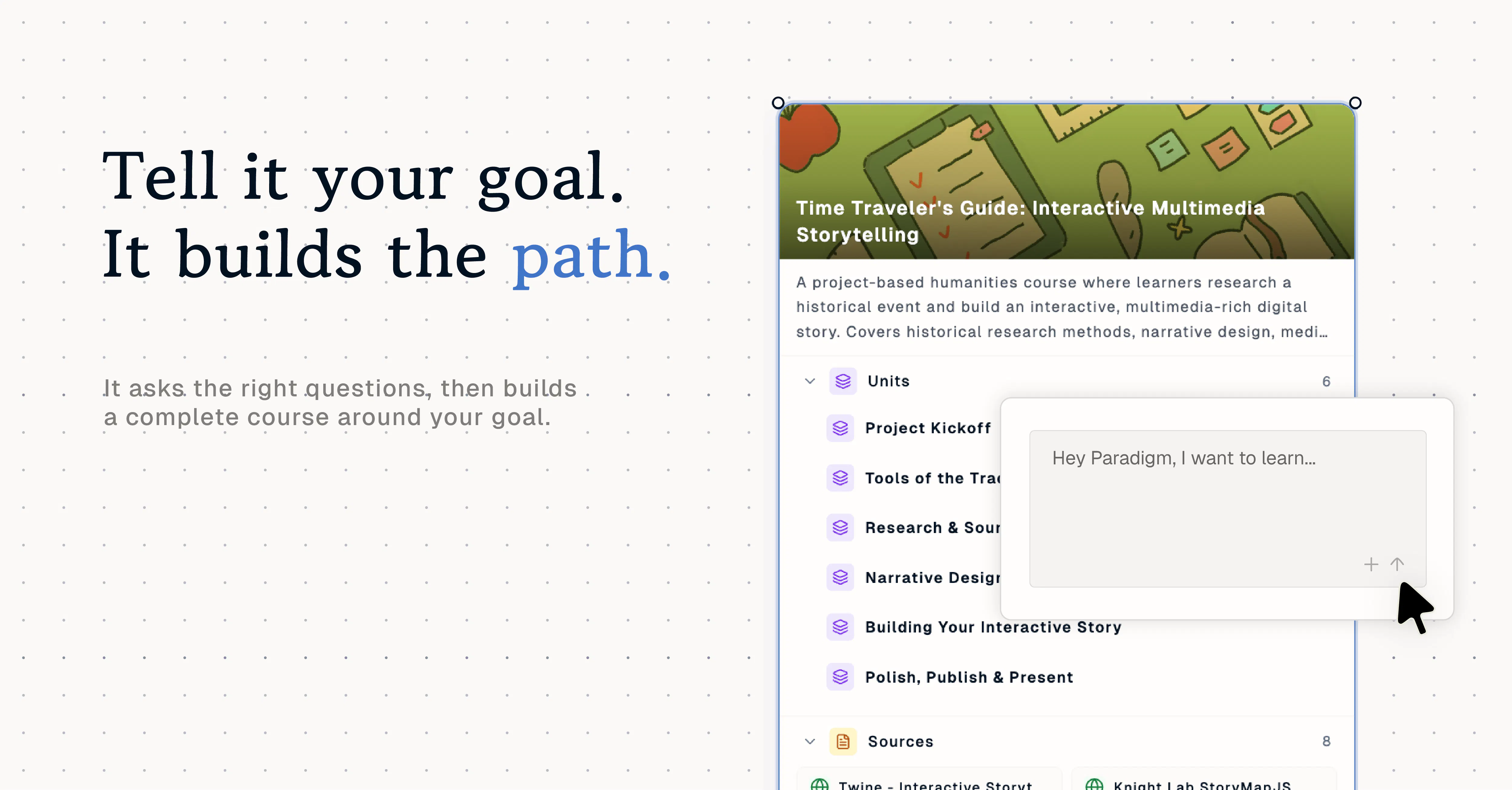
查看原始信息
Breadcromb
Your AI shouldn't start from scratch every time. Trace is the browser that remembers everything you've read, understands your work, and gives AI the context to help you research, write, and automate tasks without sacrificing privacy.

'Act on anything' is super interesting! A browser already logged into my email and bank taking actions on its own is a much bigger trust jump than remembering what I read. QQ - where do you guys draw the boundary on what it can touch before a user hands it that much rope?

2
回复

@artstavenka1 Great question and I completely agree that there’s a big difference between an AI that remembers context and an AI that can take actions on your behalf.

For us, memory is the foundation, but action requires a much higher level of trust. The boundary we’re aiming for is that the AI should help users understand, prepare, and suggest actions before it ever executes anything sensitive.

For example:

  • Summarizing, organizing, extracting information, and helping you make decisions

  • Taking actions with clear user confirmation

  • Handling sensitive areas like email, banking, purchases, or private accounts only with explicit permission and strong safeguards

The principle is that the user should always remain in control the AI should be an assistant, not an autonomous actor with unlimited access.

This is one of the reasons we’re building Trace around transparency and user-controlled memory first. We believe trust has to be earned progressively before giving AI more agency.

Really appreciate the question it’s exactly the kind of conversation we want to have around the future of AI browsers. 🙌

2
回复

Curious to see how you draw the line between remembering useful context and keeping the user in control.

2
回复

@crystalmei Thank you so much for the upvote!

That question gets right to the heart of what we're building.

We believe the line is user control. Memory should feel like a personal notebook, not a black box. Users can always see what has been remembered, edit or delete it, and decide what deserves to become long-term knowledge.

Our goal is to remember only the context that genuinely helps you in future work not to keep a record of everything you do. By keeping memory transparent and user-controlled (with local-first storage by default), we hope people can benefit from persistent context without giving up their privacy.

We'd love to hear your thoughts when you end up trying it! 😊

0
回复
👋 Hi Product Hunt! I'm Christophe, the founder of Trace. The idea for Trace came from a frustration I experienced every day. I spend hours reading articles, PDFs, documentation, emails, and research papers. AI tools could answer questions about what I was looking at right now, but they had no memory of everything I had already learned. Every conversation started from scratch. At the same time, I became increasingly concerned about privacy. As more companies adopt AI, they want the productivity benefits without sending all of their knowledge to third-party services or becoming locked into a single AI provider. That's why I built Trace. Trace is an AI browser that gives AI long-term memory. It remembers what you've read across the web, understands your work over time, and provides personalized context to help you research, write, and complete tasks more effectively—all while keeping you in control of your data and letting you choose the AI models you use. This is still the beginning of the journey, and I'm launching today to learn from real users. I'd love your feedback: Would an AI browser fit into your daily workflow? What feature would make you switch from your current browser? What's the biggest frustration you have with AI tools today? I'll be here all day answering questions and discussing ideas. Thanks for checking out Trace! 🚀
1
回复

@christophe_cheuleu I like the idea of giving AI long-term memory instead of making it start from scratch with every prompt. A browser that understands what you've already read and uses that context to help with research, writing, and automation could make AI feel much more like a real assistant. The focus on keeping everything private is an important differentiator as more people become concerned about where their data goes. Best of luck with the launch!

0
回复

Christophe, I live across an absurd number of tabs and forget half of what I read, so the idea of something that quietly holds onto all that for me is genuinely appealing.

1
回复

@matthieu_poitrimolt Thank you, that really means a lot to hear! 😊

That's exactly the kind of problem we built Trace to solve. So many of us spend our days jumping between dozens of tabs, articles, PDFs, and docs, only to lose track of where we found something.

If you get a chance to try it, I'd love to hear your honest feedback.

The app is completely free, and your thoughts would be incredibly valuable as we continue improving it.

0
回复

Most AI tools feel like talking to someone with amnesia — you explain your project every single time. The "remembers everything you've read" angle could actually fix that. Does it work across different AI tools or is it tied to Trace's own interface?

1
回复

@ringo_td5 That's exactly the problem we're trying to solve. 😊

Today, Trace's persistent memory is built directly into the browser experience, so it works seamlessly across everything you browse. Our goal is to make this memory model-agnostic, so users are not locked into a single AI provider.

Long term, we want your personal knowledge to remain yours and be usable with different AI models, whether that's GPT, Claude, Gemini, or future models. The idea is that your memory should belong to you, not to a specific AI interface.

0
回复

one thing i'd love is a way to manually tag or highlight snippets within pages so the AI can pull from those specifically instead of just the whole browsing history

1
回复

@glerobcu Thanks for sharing this. I really like this idea!

You’re right that there’s a difference between remembering everything you read and intentionally marking the pieces of information that matter most. A way to manually highlight/tag specific snippets and let the AI prioritize those when answering would make the memory much more precise and user-controlled.

This is actually very aligned with where we want to take Trace: giving users an active role in shaping their personal knowledge base, rather than just passively collecting browsing history.

I’ll definitely keep this in mind as we continue improving the product. Thanks again for the thoughtful feedback!

1
回复