Product Hunt 每日热榜 2026-07-23

PH热榜 | 2026-07-23

#1
Teable 3.0
AI Spreadsheet for Business
358
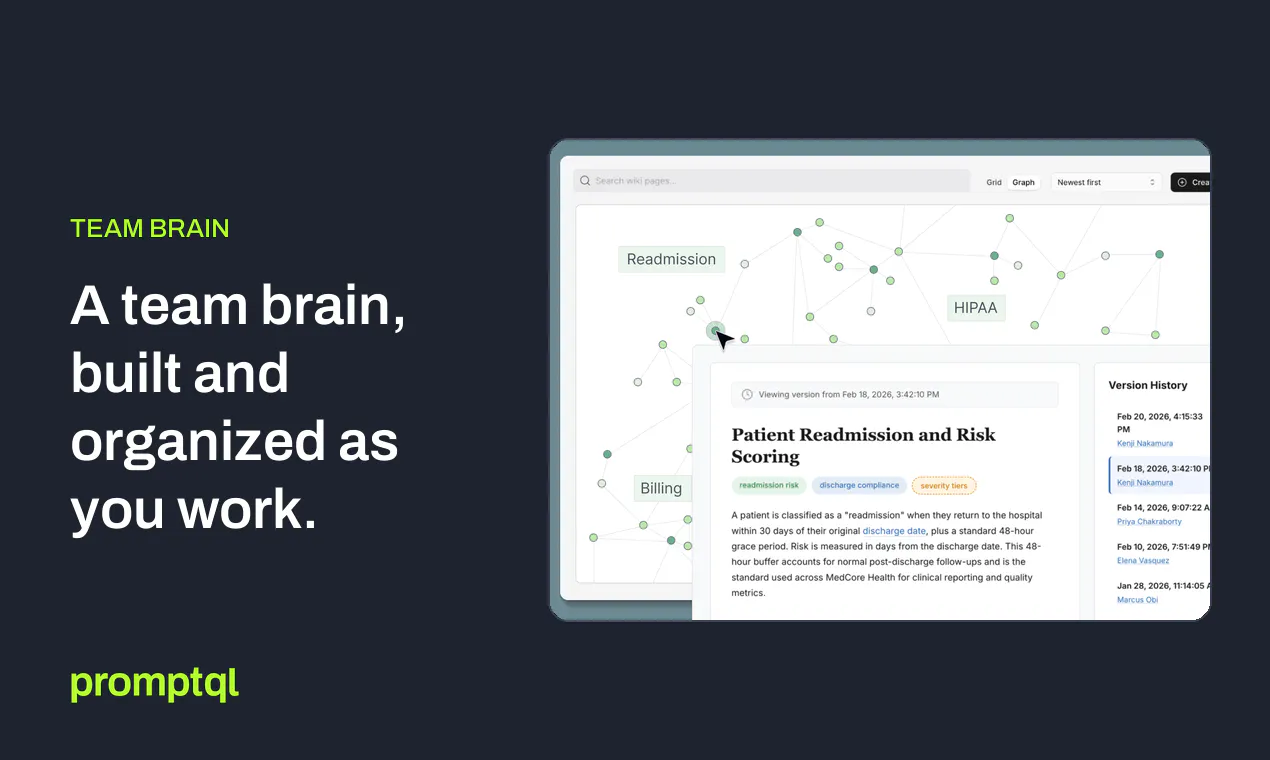
一句话介绍:Teable 3.0 是一个以 PostgreSQL 为核心的 AI 智能表格,能将企业的零散业务数据(如表格、文件、遗留系统)无缝迁移并转化为可执行的 AI 工作流和自定义应用,解决团队在数据孤岛、协作混乱和缺乏灵活自动化方面的核心痛点。
Productivity Spreadsheets Artificial Intelligence GitHub OpenAI Day
AI智能表格 低代码平台 工作流自动化 数据迁移 自定义应用 业务数据库 企业协同 Airtable替代 PostgreSQL AI代理
用户评论摘要:用户最关心两大核心问题:一是从Airtable等系统迁移时,能否完美保留复杂的关联记录和公式逻辑,而非仅迁移原始数据;二是AI执行多步骤任务出现错误时,是否支持事务回滚和审计追踪。团队协作中的权限管控和数据一致性也是高频关注点。
AI 锐评

Teable 3.0 的野心很大,它试图在一款产品内缝合“表格的灵活性”、“数据库的可靠性”和“AI的智能性”。这种“既要又要还要”的定位,既让它看起来是Airtable和Retool的联合颠覆者,也暗藏了巨大的集成风险。

从用户反馈看,真正的价值不在于“迁移功能”,而在于其底层架构——**PostgreSQL**。这个选择是明智的,因为它赋予了产品严肃的事务处理能力(支持回滚)和复杂的关系模型(保留关联记录),这正是那些被Airtable的“虚假数据库”折磨的团队所渴求的。评论区反复出现“迁移后逻辑是否丢失”、“多代理并发冲突如何处理”的尖刻问题,本质上是在追问:你们到底是一个披着AI外衣的高级电子表格,还是一个真正的业务数据库?

“AI Spreadsheet”的标语既是卖点也是陷阱。如果AI层只是自动化数据录入和生成简单公式,那不过是锦上添花;但如果真能像宣传那样“理解业务上下文”并操作跨表关联的复杂工作流,其价值将是指数级的。目前来看,Teable在“AI可控性”上做得不错(分步日志、权限隔离),但其AI在处理“二义性”和“动态数据架构变化”时的真实表现,才是决定其能否从“酷炫玩具”进化为“业务基石”的关键。

最大的挑战在于:它试图覆盖从数据存储、协同编辑到应用开发、AI编排的全链条。这种“一体化”在概念上很完美,但在实践中极易因功能臃肿而导致每个环节都不够极致。最终,它可能既无法取代Airtable的简单易用,也无法比肩Retool的深度定制。如果Teable不能守住“数据关系完整性”和“AI动作可追溯性”这两条底线,那它3.0版本带来的,只会是一个更复杂的混乱源头。

查看原始信息
Teable 3.0
Turn your business data into AI workflows and custom apps. Connect any system, migrate any data, and build anything that fits your business 100%.
The migration claim is the part I would stress test hardest, specifically the linked records piece. Airtable and similar tools let people build pretty tangled relationship structures over years, lookups referencing lookups, rollups built on linked fields that are themselves filtered views. Moving the raw data over is the easy part. Moving the actual behavior of those relationships so formulas and automations still resolve the same way on the other side is where most migration tools quietly lose fidelity. Curious how much of that structural logic survives a real migration versus just the tables and values themselves. Also on the super automation side, once you're running things like contract expiration reminders and weekly sales reports automatically, what happens when the underlying data changes shape, say someone renames a field or restructures a table the automation depends on. Does it fail loud and notify someone, or does it quietly keep running against stale assumptions.
8
回复

@thys_beesman Brandon, this is exactly the kind of complexity we built Teable for. Migration preserves the structure and flags anything that needs attention. Automations also surface issues when the underlying data changes. We’d love for you to stress test it.

1
回复

@thys_beesman We usually don’t promise a “100% migration.” We aim for 200%: not merely reproducing the old Airtable system, but making it significantly more capable.

Moving rows is the easy part. The real value lives in the relationships—linked records, references, lookups, rollups, formulas, permissions, and the business logic accumulated around them. Teable’s relational model can preserve that connected structure while giving you more powerful ways to reference, query, and operate on it, all backed by real PostgreSQL.

But migration is only the starting point.

Once that relational foundation is in Teable, you can build almost any AI workflow or custom app directly on top of it. Agents can understand and act across customers, contracts, owners, approvals, renewals, and communications—not as disconnected text, but as related business context. They can generate reports, request approvals, send reminders, update records, and power purpose-built applications without forcing you to scatter logic across automation platforms, scripts, databases, and app builders.

So where exact one-to-one legacy behavior makes sense, we reproduce it. Where the old system was constrained by Airtable’s limits, Teable gives you the freedom to rebuild it better.

That’s what we mean by 200% migration: your existing relational knowledge comes with you, but the system that emerges can be far more adaptable, automated, and intelligent than the one you left behind.

Give us your hardest linked-record workflow—not the clean demo base. That’s where Teable’s relational foundation, freely customizable AI workflows, and custom apps begin to unlock possibilities that a conventional migration tool simply cannot.

6
回复

Hey, the spreadsheet-that-is-really-a-database space is crowded, so curious where you land. In my experience the moment a team spreadsheet gets important it breaks, because five people edit it and nobody trusts the numbers. Does Teable handle permissions and audit trails well enough to be the real source of truth, or is it best as a fast front end?

7
回复

@artem_fedorovich That’s exactly the problem Teable is built to solve—but we’re much more than a database-spreadsheet.

Teable is a complete environment for agents to operate in. Your data, apps, automations, permissions, audit trails, and collaborators all live in one place, backed by real PostgreSQL and mature, production-grade infrastructure. Instead of critical business context being scattered across spreadsheets, automation tools, internal apps, and disconnected AI agents, Teable brings it together into one trusted system.

That means the AI doesn’t work in a vacuum. It understands the live data, permissions, and workflows your team already relies on—and can act across them seamlessly. Complex configurations and automations that once required several tools, integrations, and months of custom development can now be built and operated through one coherent experience.

Our belief is simple: teams shouldn’t have to choose between the flexibility of a spreadsheet, the reliability of a database, and the power of AI agents. Software should adapt to the way your business works, while keeping every change controlled, traceable, and trustworthy.

So yes, Teable can absolutely be your real source of truth—but that’s only the foundation. What we’re really building is the place where your data and agents work together to run the business.

I strongly recommend giving it a try with one of your real team workflows. That’s when Teable truly clicks.

2
回复

@artem_fedorovich Yes, Teable is designed to be the source of truth. Permissions and audit logs stay with the same data your team uses for apps and automations, so everyone works from one trusted system.

2
回复
@artem_fedorovich Version control and audit trails are usually where most visual database tools struggle under team load. Having true granular permission levels is crucial for making it a reliable single source of truth rather than just a pretty front end.
1
回复

One of the most interesting launches today! The Postgres-as-substrate choice is what makes the agent story believable to me. And probably most 'AI acts on your data' pitches fall apart the second an agent writes something wrong across linked records. Wondering...when an agent runs a multi-step action and step 3 fails, does the whole thing roll back as one transaction?

5
回复

@artstavenka1 Great question—and this is exactly why the underlying architecture matters.

Every step is logged and traceable, individual actions can be rolled back, and agent permissions can be tightly scoped to control what each agent is allowed to read or change. If something fails mid-run, the agent can inspect the failure, attempt a fix, and continue—instead of leaving you with an unexplained, half-finished result.

And inside a team, multiple agents can collaborate across the same connected data and workflow, each with its own responsibilities and permission boundaries.

So the goal isn’t just to let AI write to your data. It’s to make agent work observable, controllable, recoverable, and collaborative enough for real business operations.

2
回复

@artstavenka1 Every step is logged and traceable. If something fails along the way, the agent will inspect it, try to fix it, and do its best to finish the job.

2
回复

❌ Scattered files.

❌ Overlooked customer follow-ups.

❌ Hard-to-use legacy systems.

❌ Teams struggling to become AI-native.

Introducing Teable 3.0 — The AI Spreadsheet for Business. Teams can build 100% business-fit AI workflows and custom apps, while connecting and migrating any data into one place.

What’s new in Teable 3.0:

  • Connect & Migrate Anything — Move from Airtable, spreadsheets, files, and other systems into Teable. Data, table structures, attachments, and linked records can be migrated into one AI-ready workspace.

  • Complex task capabilities — Teable can now handle long-running tasks, such as handle dozens of Excel/CSV files at once, or PDF documents up to 100 pages.

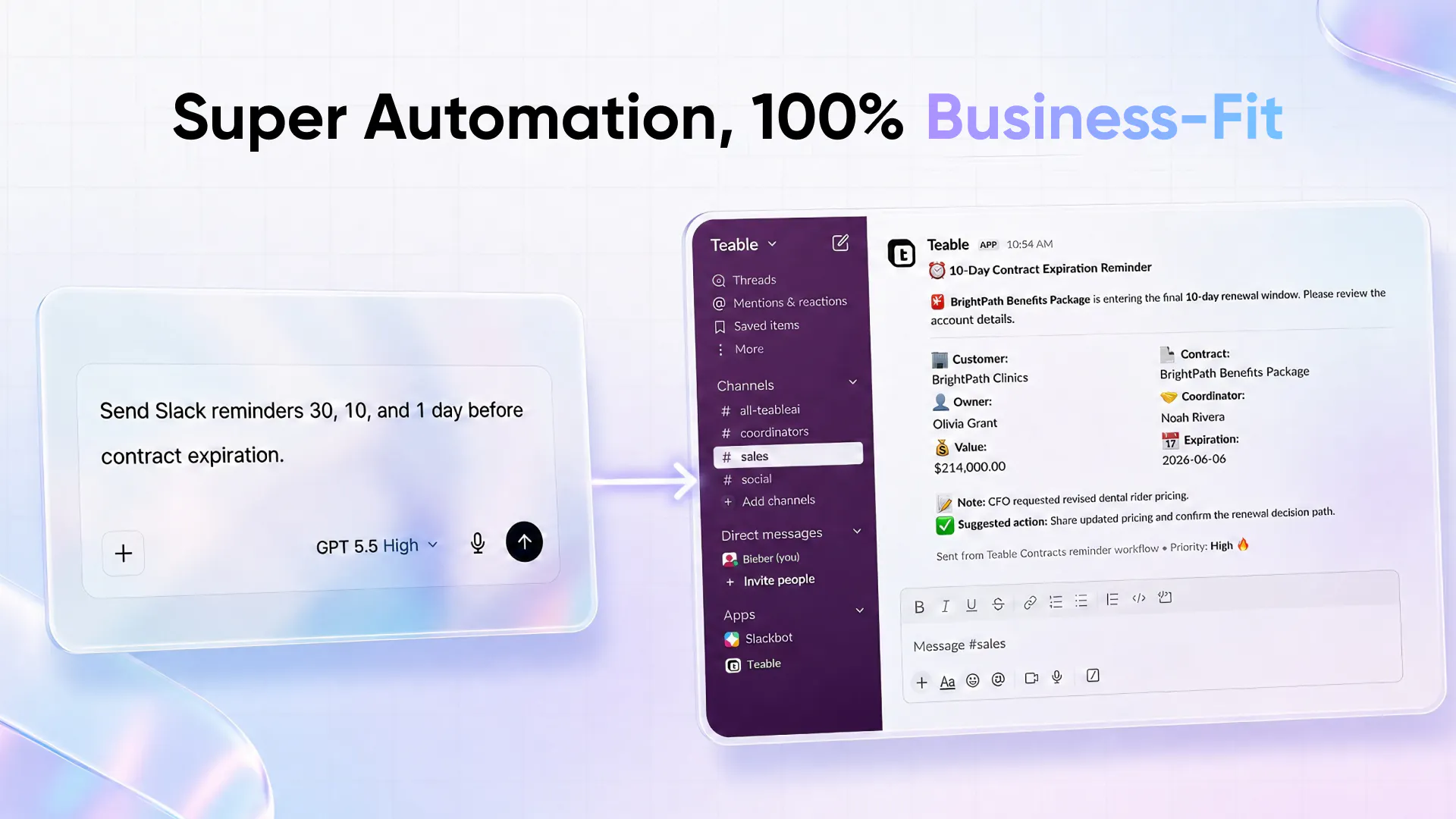
  • Super Automation — Automate custom workflows that fit your business, from contract expiration reminders to weekly sales reports, Slack updates, approvals, and operational processes.

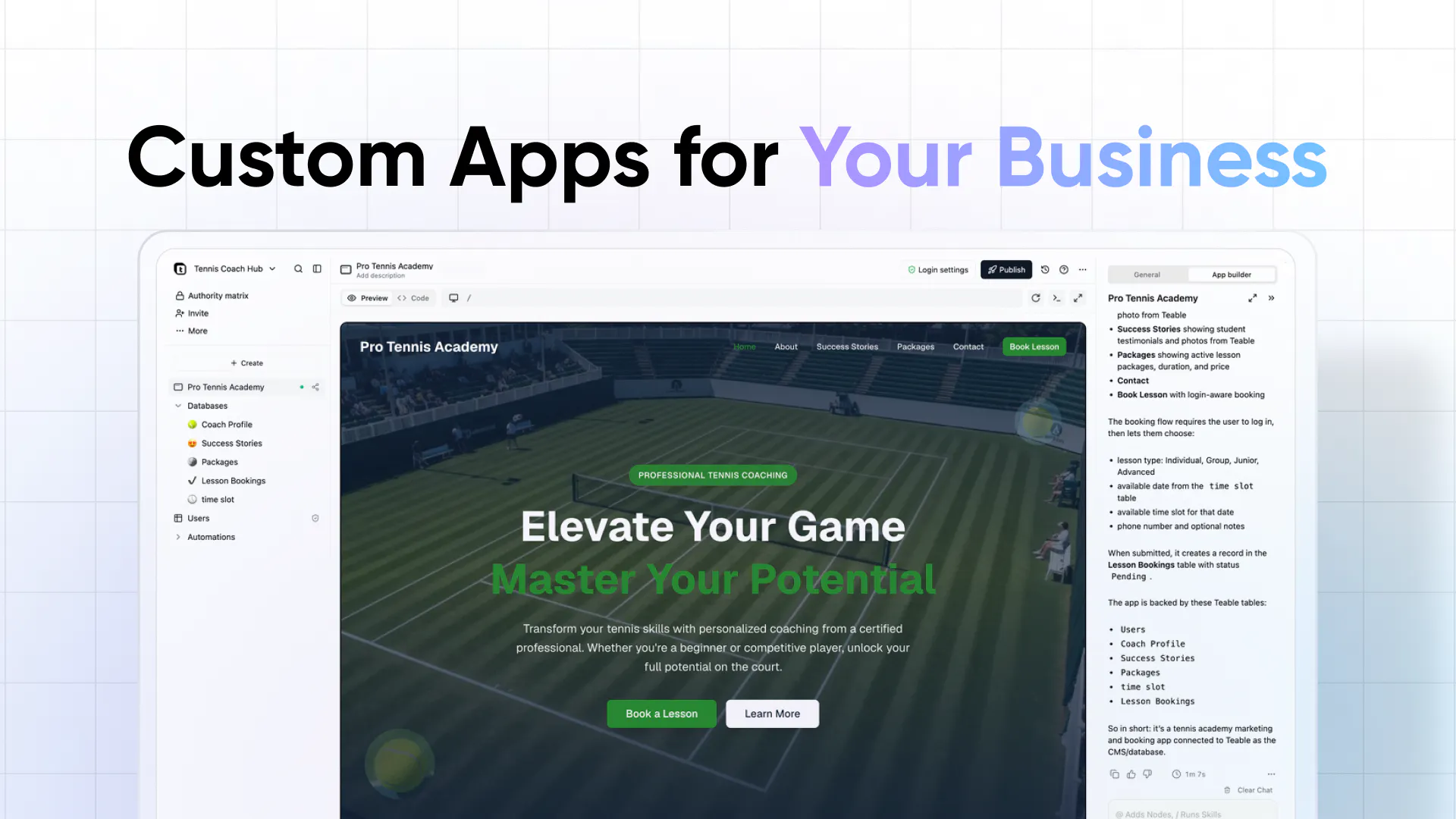
  • Custom Apps 100% business-fit — Build dashboards, booking pages, portals, internal tools, and business apps directly on top of your data.

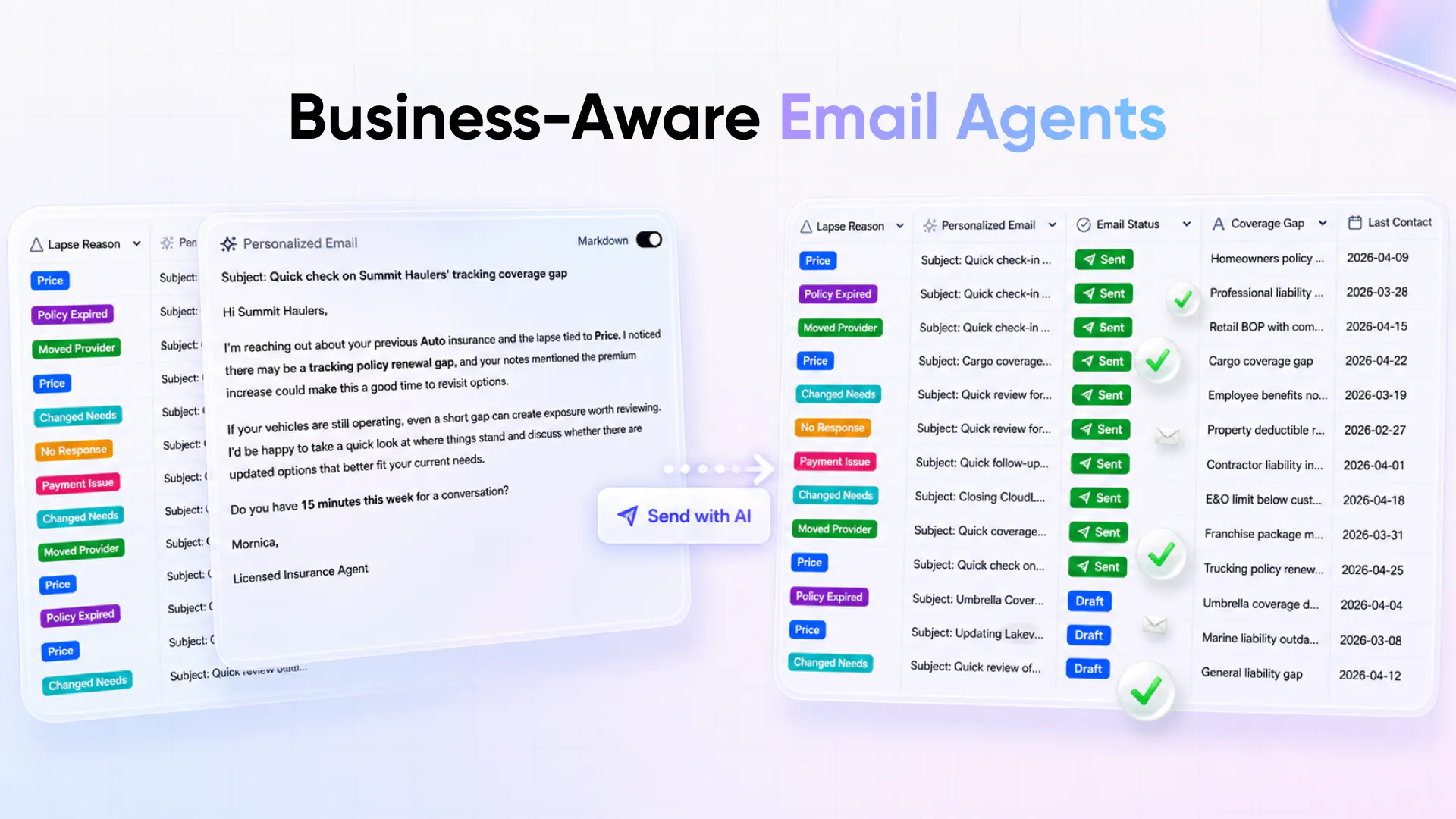
  • Business-aware Email Agents — Generate and send personalized follow-up emails in bulk using your customer data, business context. Personal inboxes and unsubscribe links are supported.

✨ Whether for small businesses or enterprises, Teable helps teams move beyond traditional spreadsheets and legacy systems into an AI-native way of working.

🚀 Try Teable 3.0: https://teable.ai

5
回复
@bieber_chen Handling 100 page PDFs alongside dozens of CSVs in a single AI workspace is a huge workflow upgrade! The 1-click migration from Airtable is going to save teams so many headache hours. How does Teable maintain data structure accuracy when importing complex linked records from Airtable?
1
回复

"AI workflows" built on top of spreadsheet data is the pitch but the interesting question is what the AI layer is actually doing, like is it generating formulas, automating data entry, running analysis on the data, or orchestrating multi-step workflows that call external APIs? Those are pretty different products and the listing doesn't distinguish between them, curious which one is actually the core use case Teable users are building toward.

3
回复

@ansari_adin Ansari, it covers them all. Teams describe the business process they need, and Teable AI works across the data, automations, integrations, and custom apps needed to make it run. A lead workflow, for example, can include importing data, enrichment, routing, follow-up emails, and a dashboard in the same workspace.

1
回复

the migrate-anything plus self-host combo is the real hook here, owning your own data is the thing airtable structurally can't offer. congrats on 3.0

3
回复

@alex_watson2110  Yes, you don’t have to choose between powerful software and control of your own data. Full capability, full ownership.

1
回复

@alex_watson2110 Exactly. For teams that care about data ownership and infrastructure control, being able to migrate to Teable and self-host it is a powerful option. Thanks for the support!

1
回复

Congratulations on the launch!
natural language application building has huge potential. can multiple team members collaborate with the same AI agent simultaneously? how does collaboration work in shared workspaces?

2
回复

@avery_thompson2 Absolutely. Teable is designed for shared workspaces, not isolated one-person AI sessions. Team members collaborate around the same live data, apps, and workflows, while agents can have distinct responsibilities and permission scopes. Every action is logged, so the team can see what happened, who initiated it, and what the agent changed. The goal is shared AI context without sacrificing control or accountability.

1
回复

@avery_thompson2 Thank you! Shared workspaces are central to Teable. Team members work with Teable AI around the same live data, apps, and workflows, with permissions and a clear history of every change.

1
回复

the "build anything that fits your business 100%" part is the ambitious bit - when the AI spins up a custom app from your tables, does it set access/permission rules on its own or is that still a manual pass per app?

2
回复

@sabber_ahamed Permissions are part of the system the AI builds within—not an afterthought bolted onto the generated app. Agents operate inside defined access boundaries, and every action is logged and traceable.

You still retain final control and can review or refine access rules for each app.

1
回复

@sabber_ahamed Sabber, Teable AI can handle the access setup as part of building the app, and you can review or adjust it for each app.

1
回复

this reads less like an Airtable competitor and more like someone trying to replace Retool and Airtable at the same time. that's a much bigger yet.

2
回复

@kellyops  Kelly, that’s a sharp read. We’re bringing the data layer, workflows, and custom apps into one place, so teams don’t have to stitch Airtable and Retool together.

1
回复
Interesting! Does the custom app layer support different experiences for employees, partners, and customers? That would unlock a lot of workflows currently split across portals and internal bases.
2
回复

@sophialgrowth Sophia, absolutely! That’s a great use case for Teable. You can tailor the pages, actions, and data each group sees based on their role, while built-in login handles sign-in and app access. Everything runs on the same Teable data and workflows.

2
回复

Congrats on shipping Teable 3.0! 🎉 "Connect any system, migrate any data" is a bold promise — curious how deep the AI goes on the migration side: does it auto-detect schema/field types from messy source data, or do you still need to map fields manually before it builds the workflow?

2
回复

@ryancheng Thank you! And yes—the AI goes beyond moving rows. It can understand messy source data, infer schemas and field types, and help map relationships before building the workflow. You can still review and adjust everything, but you’re no longer starting from a blank mapping screen.

1
回复

@ryancheng From an ops perspective, this means less setup work and fewer mistakes. The AI handles most of the mapping first, and you just review and adjust anything that needs attention before moving the data.

1
回复

@ryancheng Great question! Teable AI can identify schemas and field types even when the source data is messy, then map them automatically. You can adjust anything if needed.

1
回复

Perfect for teams held together by spreadsheets and one ops hero.

2
回复

@wys1010 Exactly 😂 Teable gives the spreadsheets superpowers—and finally lets the ops hero take a vacation.

0
回复

@wys1010 We’ve all seen that setup 😂 Hopefully Teable can give the ops hero a little backup

0
回复

@wys1010 We know that ops hero well 😄 The goal is to turn their spreadsheet setup into a system the whole team can run together.

1
回复

Being able to migrate linked records and attachments instead of only importing flat spreadsheets is a really valuable detail in my view. How much manual cleanup is typically needed after moving a more complex Airtable setup into Teable?

2
回复

@nico_mandera Just ask GPT-5.6 sol to do it, 0 manual job! check then you can start building a new fully automated AI workflow in Teable !

1
回复

@nico_mandera it’s more of a quick check than a cleanup job 😄 Linked records and attachments come along for the ride!

2
回复

@nico_mandera Great question! Nico. No manual work is needed, unless you’d like to give everything a quick check before getting started.

3
回复

From approachable databases to executable ones. Nice shift.

2
回复

@3rdmatter Exactly—your database shouldn’t just store the work, it should finish the work. That’s the shift. 🚀

1
回复

@3rdmatter That’s a great way to put it 😄 Less switching between tools, more getting things done in one place.

1
回复

@3rdmatter That’s the idea: an approachable database you can actually run your business on.

1
回复

the multi-agent collaboration angle is the part that jumps out at me over the single-agent rollback question everyone else is asking. once you have two agents with overlapping permission scopes both acting on the same linked record at roughly the same time, is there any locking or conflict detection, or does it become a last-write-wins situation where the second agent's transaction just silently overwrites the first without either agent knowing a conflict happened?

1
回复

@galdayan Multi-agent collaboration can’t simply mean pointing two independent agents at the same table and hoping they don’t collide.

In Teable, you can separate agents by responsibility and tightly scope what each one may read or change. Every action is logged at the step level, so overlapping writes remain attributable and inspectable, and individual actions can be rolled back if needed. Agents also work from shared, live context rather than isolated copies of the data.

We don’t want to disguise concurrency as “collaboration,” though. Permission boundaries prevent many conflicts; logs and recovery make the remaining ones visible and correctable. More explicit coordination policies for genuinely overlapping agents are an important part of making multi-agent systems trustworthy at scale.

1
回复

@galdayan Gal, every step an Agent takes is recorded and traceable, while the Agent keeps working to complete the task. If two Agents touch the same data, the change history makes it clear what happened.

1
回复

The thing that always sold me on Teable over the Airtable-style tools is that it's real Postgres underneath — your data stays actual SQL you can own and query, not locked in a proprietary spreadsheet blob. Curious how 3.0 handles the AI-workflow side: when an agent builds an app or automation off the data, do you get a deterministic, inspectable step you can audit, or is it prompt-driven each run? That's usually the trust gap for "AI + my business data." Congrats on the launch.

1
回复

@alexander_shishkov1 Thank you—you’ve identified the exact trust gap we care about.

AI may help build the app or automation, but the result isn’t just a hidden prompt rerun from scratch each time. The workflow is persistent and inspectable, every execution step is logged, and individual actions can be reviewed and rolled back. You can also tightly scope what each agent is permitted to read or change.

For more complex work, multiple agents can collaborate within the same team while keeping clear responsibilities and permission boundaries.

Our principle is simple: AI can be flexible in how it reasons, but its actions on business data must remain visible, controlled, and recoverable. Real PostgreSQL provides the trusted data foundation; Teable adds the operational layer required to let agents work on it safely.

0
回复

What am I missing? If I have data in a spreadsheet, using the spreadsheet as a db, why would I move the data into Teable? Maybe I am too tired but I don't understand the value prop and the problem this solves. Maybe someone can explain? Thank you!

1
回复

@rusutraiancristian 

That’s a completely fair question. If your spreadsheet is personal, relatively small, and mainly used for calculations, you may not need to move it.

The problem appears when the spreadsheet starts running the business: multiple people edit it, records need relationships, access must be controlled, changes must be audited, and reminders, approvals, reports, emails, or custom interfaces have to be built around it. At that point, teams usually glue together more spreadsheets, scripts, automation services, and internal tools—and eventually nobody fully trusts or understands the system.

Teable keeps the familiar table experience but puts real PostgreSQL underneath it. Then it adds relational data, permissions, auditability, automations, custom apps, and AI agents in the same environment.

So the value isn’t “another place to store spreadsheet rows.” It’s turning business data into a trustworthy system that can actively run the workflow around it—without losing the flexibility that made the spreadsheet useful in the first place.

1
回复

@rusutraiancristian Rusu, I get where you’re coming from. If your spreadsheet already does everything you need, there’s no reason to move it. Teable becomes useful when that same data needs to support a growing team, controlled access, automations, AI workflows, and custom apps.

1
回复

Congrats on the launch @guangyu_li
A quick question, how does Teable compare to just using Airtable + a couple of AI plugins at this point?

1
回复

Congratulations

1
回复

@madalina_barbu Thanks for your support, Madalina!

1
回复

This feels like one of those products that quietly becomes part of a team's daily workflow. I like that Teable 2.0 focuses on making databases actually useful with AI instead of adding AI for the sake of it. The clean interface and automation features look promising. Looking forward to trying it with a real project. Congrats on the launch!

1
回复

@1mirul Amirul, thank you! Making AI genuinely useful in day-to-day work is exactly what we’re aiming for. We want Teable to become a natural part of how teams work with their data. Would love to hear how it goes when you try it on a real project.

1
回复

How does the data sync work when you're pulling from multiple sources that update at different schedules? That's always where the real complexity hides in these multi-system setups.

1
回复

@talhakhalidmtk Muhammad, good question. In Teable, each source can update on its own schedule while everything flows into the same workspace. Each run is tracked, so teams can keep their data current without coordinating every source manually.

2
回复

hey congrats on the launch! quick question: how do you handle permissions and history logs since many people can just edit and change data that can tangle the rest of the workflow?

1
回复

@mathias_barboza Hi Mathias, thanks! Teable’s Authority Matrix lets you control access at the table, field, and record levels, including specific actions. Record history shows who changed what and when, while audit logs keep key operations traceable as more people work in the same base.

1
回复

Wait—the table can become the app too?

1
回复

@buzzy_jade Yes! The table is the data foundation—and Teable can turn it into a real app with interfaces, workflows, permissions, and automations on top. Same data, no rebuild.

1
回复

@buzzy_jade You can start with a table, then turn it into something your team actually uses—like a CRM, landing page or customer portal. Everything stays connected to the same data.

1
回复

@buzzy_jade Yep 😄 Your table can power the app directly, and you can shape the interface around how your team actually works.

1
回复

I like that the demo examples are operational—contract reminders, reports, approvals, emails—not just “summarize this column.” Much easier to understand the business value.

1
回复

@erok_chen That’s exactly the point. Teable help get the work done. Contracts, approvals, reports, emails: real operations, not AI party tricks.

1
回复

@erok_chen Glad that came through! We picked these examples because they’re the everyday tasks teams actually spend time on. If there’s another workflow you’d like to see, let us know.

1
回复

@erok_chen Appreciate that. The real test for us is whether AI can take a recurring business task all the way to completion.

1
回复

Marketing ops is a data problem. This gets it.

1
回复

@andy2026 You absolutely get it. Teable is the all-in-one workspace where everything data work needs—data, apps, workflows, and AI—comes together and actually runs.

1
回复

@andy2026 Marketing's hard part isn’t getting more data, but it’s keeping campaigns, leads, and follow-ups connected. That’s where Teable can really help.

1
回复

@andy2026 Exactly. Teable brings data, apps, workflows, and AI into one system, so marketing teams can run campaigns, emails, approvals, and reporting in one place.

1
回复

This looks like one of those products that makes more sense the moment you imagine your own workflow inside it. I am already thinking about a customer onboarding system.

1
回复

@tammytan516 You have to try it! Turn that customer onboarding idea into a working system and see how surprisingly effortless it feels. We think you’re in for a refreshingly smooth experience.

1
回复

@tammytan516 Customer onboarding is a great use case 🙌 You can keep customer info, tasks, approvals, and follow-ups all in one place. Would love to see what you build!

1
回复

@tammytan516 Love that this got you thinking about a real workflow right away. Customer onboarding would be a fun one to build in Teable. Let us know how it goes!

1
回复

I moved from Airtable to self-hosted Teable 2 years ago, happy to see Teable back on Product Hunt.

The product feels much more opinionated now: not just flexible tables, but a clear system for running business workflows. The interesting part is that the new direction does not abandon the table model that attracted people in the first place. It builds workflows and apps on top of it. That continuity makes the evolution feel earned rather than like an AI rebrand.

1
回复

@itsluo You really get what we’ve been building. ❤️

Three years, thousands of customers, and countless workflows later—Teable’s new AI can now create the kind of custom apps and automations we once thought were impossible.

And the best part? Tables are still at the heart of it all.

Getting work done has never been this easy. We’re so glad to have you back with us on Product Hunt! 🚀

1
回复

@itsluo This means a lot coming from someone who’s been self-hosting Teable for two years 🙌 Users like you helped us get here. Would love to hear what you’re running on Teable today!

1
回复

@itsluo Thanks for sticking with Teable for the past two years. Hearing that this evolution feels natural from a longtime self-hosted user means a lot to us.

1
回复

Amazing product!Congrats on this launch!

1
回复

@peng_wood Thank your support !!

1
回复

@peng_wood Really appreciate it, Wood! We put a lot into this launch and can’t wait to hear what you think after trying it 🙌

0
回复

@peng_wood Thanks, Wood! It means a lot to have your support on launch day.

1
回复

The mix of structured data and app generation is what caught me. Being able to turn something like receipts or customer feedback into a working workflow without moving it into another tool feels genuinely useful.

0
回复

Congratulation on the launch Teable 3.0 team! Really amazing stuff 🎉

Most AI-native database tools are moving toward autonomous agents. How do you see Teable balancing user control and transparency with AI-driven actions, especially when agents are modifying business-critical data at scale?

0
回复
#2
PromptQL
Multiplayer AI that replaces Slack
324
一句话介绍:PromptQL是一个专为团队协作设计的“AI原生工作空间”,通过在共享线程中整合数据库、SaaS工具和内部知识,取代Slack,解决团队知识分散于不同聊天和AI工具、上下文无法积累的痛点。
Productivity SaaS Artificial Intelligence OpenAI Day
AI原生工作空间 团队协作AI 共享上下文 知识管理 AI Agent 多人AI 企业级AI工具 工作流自动化 Slack替代 上下文编译
用户评论摘要:用户普遍认可其解决知识割裂的价值,但核心担忧集中在:数据安全与隐私(AI是否可读取所有对话);权限管理(敏感API如何隔离);对Slack等现有工具形成依赖;项目锁定风险(Wiki深度建立后难以迁移)。建议包括优化管理后台和外部团队连接功能。
AI 锐评

PromptQL的野心远不止于“AI版Slack”。其真正价值在于打破了传统AI工具的个体孤岛——AI不再是每个人的私人助理,而是团队的“共享大脑”,通过自动捕获和编译集体上下文,让个体能力瞬间倍增。这种“人类负责上下文,AI负责执行”的范式,确实触及了团队协作效率的深层瓶颈。

然而,这把双刃剑的另一面极为锋利。首先,评论中反复出现的隐私与安全担忧并非空穴来风。当AI能无孔不入地阅读所有对话和代码,甚至主动推送“Alex在做什么”时,这在带来便利的同时,也制造了令人不安的“被监视”感。如何用精细到令人信服的权限粒度(如RAG的安全边界)来平衡透明与侵犯,是能否进入严肃企业的生死线。

其次,产品描绘的理想图景——“自动捕捉上下文并建议更新”,在现实中极易滑向“集体幻觉”。社区评论中辩驳称“人类需审核”,但依赖同事的社交压力来维护“Wiki”的准确性,在高节奏的商业环境中并不可靠。一旦产生一个错误的“公认事实”被系统固化并传播,纠正成本将远高于传统工具。更不用说,深度绑定导致的“Wiki锁定”风险,本质是另一种形式的数据绑架。

整体而言,PromptQL是一次勇敢的“从零重建”尝试,而非简单的功能叠加。它赌的是团队愿意牺牲一部分隐私和工具切换的自由度,来换取AI驱动的集体智能跃迁。这个赌注能否成功,取决于它能否在“无所不知”与“守口如瓶”之间,以及“快速积累”与“精准正确”之间,找到那个让企业信任的、细如发丝的平衡点。否则,它很可能只是一个更高效的、但同样让人焦虑的“数字牢笼”。

查看原始信息
PromptQL
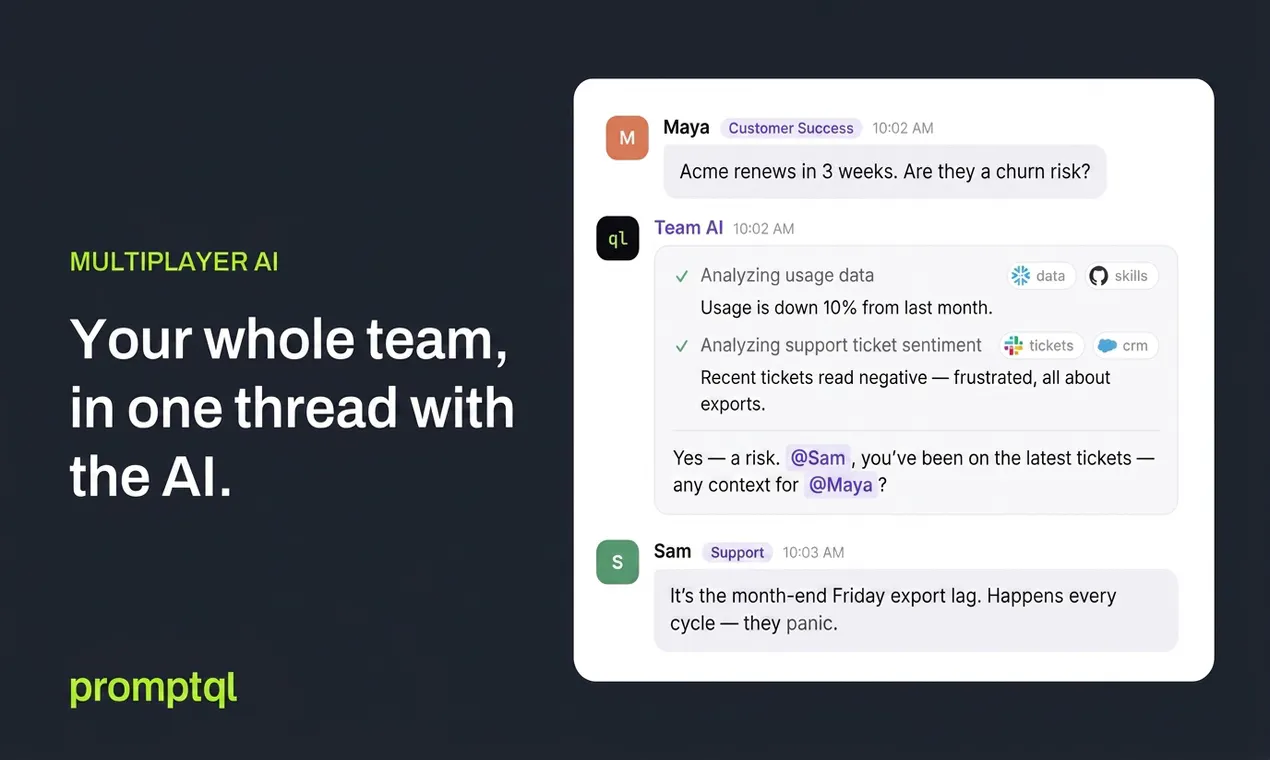
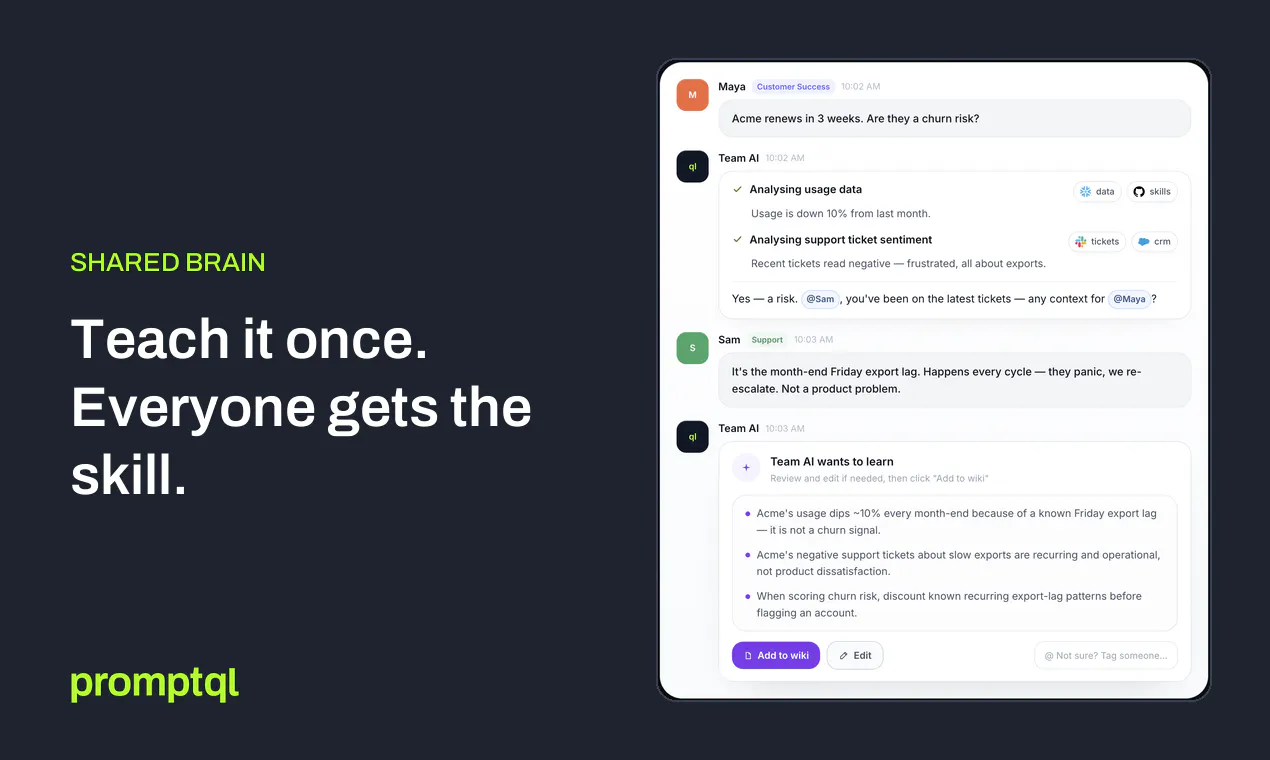
Stop splitting team knowledge between Slack and everyone's private AI chats. PromptQL is multiplayer AI for teams: think Claude or ChatGPT in shared threads. Tag teammates to review, correct, and refine answers without losing the reasoning. Connect databases, SaaS apps, coding agents, and events. PromptQL captures tribal knowledge and suggests shared-brain updates so context compounds. Scopes and multi-user permissions keep the right context accessible to the right people.

I'm Tanmai, CEO/cofounder at PromptQL and excited to share the world's first AI native workspace with you. Thank you @kevin for hunting us today!

The team behind PromptQL is Hasura, and we ended up building PromptQL entirely by accident.

Here's the story:

  • Be us

  • Try to build AI that's accurate with data & tools

  • Realize that good context is the bottleneck as AI gets better

  • Realize that no one person in the team has all the required context

  • Build multiplayer AI (shared threads) so that people can work together in a shared AI thread and automatically capture context

  • Move our 70 people team out from Slack to "test the multiplayer experience" on desktop & mobile in Feb 2026

  • Things get f***ing weird

  • Get team-wide AI psychosis by having a single shared AI connected to everyone and everything

  • Realize that we built a Slack for the AI era

So now we don't do DMs or meetings, because the AI knows.

When I ask: "What's alex working on?", its able to look at Alex's work in the workspace and across other tools like slack or github (that is visible to me ofc) and gives me a sense of what's happening, what he's blocked on and how I can help him. I don't disturb Alex and I get an accurate status report. No meetings needed.


Or going further, I can do things that I don't know how to do myself:

When I ask "Help me build this integration for a customer", it uses skills and context from other engineers who've built and reviewed integrations before. Even if we don't explicitly maintain a shared skills repo, I'm suddenly as powerful as my entire team, not just my individual ability.


PromptQL is the first agentic workspace because the whole app is an AI:

PromptQL builds task-specific agents on the fly as users talk to each other. It builds connectors to databases, SaaS tools and internal APIs and learns skills on the go.

Other AI Slack clones (including Slack itself) allow humans and agents to talk to each other. But these agents have to be specifically built and added to the workspace, which we think is just a minor milestone in the path to AGI where AI builds the agents for you with the right security and context guardrails!


We think that tools like Slack are holding us back from doing the most important work that we need to do as teams. We need to be building shared context that we can then apply to the hundreds of tasks in parallel with AI. We need to work together in a way where humans are responsible for context and agents are responsible for execution.


Exclusively for the ProductHunt community, we're giving $1000 in tokens if you want to try PromptQL along with your team!

Please comment here if you're interested and tell us about your team. We'll set up a quick custom 15 minute onboarding for your team and unlock those credits for you that work across all our available models from Fable to Sol to Kimi-K3.

You can also sign up yourself and unlock free credits to play around with it yourself.

12
回复

@kevin  @tanmaig Nice idea!

3
回复
@tanmaig When PromptQL dynamically builds agents and connectors on the fly, how does it manage data security guardrails so sensitive internal APIs aren't accidentally exposed across different team scopes?
3
回复
@tanmaig what about security? And how about privacy?? I don’t know if I want AI reading EVERY conversation 🫣
5
回复

I work at PromptQL, so obviously biased, but here's how I actually use it day to day.

Anyone who lives in Slack knows the FOMO: interesting discussions happening in ten channels at once, and you can't be everywhere. Curing that yourself normally means dedicated engineering time to build something and keep it running. Here it's just... the default. Whatever's interesting or relevant finds you, full context always at your fingertips. You just start a thread and ask PromptQL to find things that might be interesting (define THE interesting ofc) and it just silently works and keeps you updated.

Works outside work too. I use it to trace how a news story actually unfolded instead of getting the echo-chamber version from my feed.

But my favourite thing is how a product gets built now. A thread and the learning becomes the RFC itself. You, your teammates, stakeholders and the AI hash out everything in one place: UX, backend constraints, cost, the actual implementation. One thread, full lifecycle of a feature. I've had the pain firsthand of answering the same questions over and over, explaining why some decision was made months ago, digging through old threads to reconstruct context. Now the feature itself can be Q&A'ed with AI because it watched the whole thing happen. What's more pleasing to a feature builder than not fielding every how/why question, and only getting pulled in when it actually matters?

Even the boring part of shipping (watching adoption, catching issues) gets easier. Hook up PostHog and Grafana and it quietly takes on the operator role. You just approve when needed.

5
回复

@karthik_venkateswaran it's also been so cool to see how many more people in the company (across functions) now "build" product!

2
回复

PromptQL has been an amazing addition to our AI stack. It's one place that now stores all the context of our team - across various workflows - research, todo lists, marketing, finance, decisions made during workflow. Our slack usage is decreasing daily (we still use it for notifying and general chit-chat) as work has moved to promptql. What I truly love is the cross-model functionality - where I can try the latest models almost the day they are launched and see how they perform on our workflows.

A few feature requests:
- A dedicated section for recurring workflows
- Easier admin functionalities including tracking usage, spends, privileges, etc
- Ability to edit tables and artifacts directly in the canvas
- External teams connect (similar to Slack connect)

Keep on with the great work!

5
回复

@nk_kapur  wooot! ❤️

thanks for the feedback:

  • recurring workflows section coming soon!

  • just added a good usage section to get started with both for users and admins. you should see it on the sidebar

  • artifacts can be made editable, just need to ask promptql to make it editable. tables being editable coming soon!

  • external teams connect v1 is live! you can add external guests to private threads or rooms already which makes it super nice to collaborate with external consultants, vendors, customers, lawyers etc

2
回复

@nk_kapur Thanks for being an early supporter and pushing us forward continuously! Have really valued all the feedback from you and implemented most of it :)

1
回复

What is nuts about working with PromptQL is how easy is to say:

“Is this thing a problem? Show me data”

“Right, what should we do to fix it”

“Yeah that looks like a good fix, let’s iterate a bit and then deploy it”

“Monitor the problem data every day and let’s check we fixed the problem”

When “doing things” is cheap, making sure you’re not doing useless things is key, and that’s so easy for me now.

4
回复

@dan_harvey and that's also the reason it feels like the rate of changes to the wiki (shared context) seems to be steadily increasing. which i found very surprising. I would have expected that the rate settles down to a small steady rate once all the shared context has been taught.

but exactly to your point, why would I stop after teaching it one thing. I'll move on to the next thing. done right i think it's like a continuous acceleration. too weird to comprehend what that means....

3
回复

the correction/lock mechanism answer covers factual mistakes well, but what about genuine disagreement that isn't a mistake at all - two senior people with different but equally valid judgment calls on how something should work. does the shared thread surface that as visible tension (both views, both names attached) or does it end up flattening into whichever answer got approved first, making the other person's actual position invisible to everyone who reads it later?

3
回复

@galdayan Wikipedia style!

So promptql suggests disambiguation entries whenever this happens. It also has articles on each user and team as well. So that way depending on who's asking and why they're asking it's able to choose the right definition (like a human would) without getting confused.

These kinds of multiple definitions and disagreements are actually super common and honestly the point of the wiki is to capture all of that in one place and then use it well!

1
回复

how big does a company have to be to start feeling the value of @PromptQL ??
cc: @rajoshi_ghosh

3
回复
@laura_cruickshanks I would say a team of atleast 2! One other person is where you see the true value!
1
回复

The "shared-brain updates so context compounds" framing is different from other team AI tools. One thing I'd be curious about—when corrections and learning flow back into the context, how do you prevent authoritative corrections from overweighting domain expertise that was already in the system? Like, if someone corrects a nuance mid-thread, does it need peer review before it locks in, or is the cost of outdated shared context higher than the cost of wrong-but-quick updates?

3
回复

@nextmark changes are never automatically written back. changes are only suggested. a human always has to approve (or edit or reject) the changes. these changes are a precise set of bullets not a giant wall of text.

but most importantly the control mechanism is like wikipedia. so people who care about certain domains "follow" those topics. And that way any changes they get notified on. and if it changes then they can swiftly revert.

the last boss is that you can lock a page entirely, but that's usually not necessary. the more open the context is the more self-correcting it becomes.

And given the fact that every change has a human name attached to it, people don't want their names to be associated with sloppy or wrong info. The team and social dynamics keep things naturally clean :)

1
回复

What's a use case you think most people don't know PromptQL can support but is really helpful?

3
回复

@zach_gold collaboratively going from question/answer to agent is my favourite.

Zach: "How many active users did we get from the PH launch"
AI: "hmm..not sure about active user definitiion. maybe @/tanmai knows"

Tanmai: "yeah, for social campaigns we usually do a has credit card on file and atleast one interaction in the first 6 hours"

AI: "ok, here's what that looks like"
Zach: "awesome, can you make that live refresh every hour and in case someone crosses more than 5 threads in the first 6 hours, help me draft a personal email to set up a call with them. ping me whenever this happens"
AI: "Done"


Collaboratively building an agent on the fly is just too much fun :)

1
回复

Congrats on the launch! I like the core bet: humans own context, agents do the work.

But Slack is a muscle memory at this point. How do you see that playing out? Is full migration the goal, or is the real win that team context becomes queryable and agents act on it, and chat just happens to be where it lives? Let's say that my team’s stuff lives in Notion, Google Drive, Jira, and Slack. What does week one look like? Do we move in fully, or does PromptQL read from those tools while we ease over?

3
回复

@tmaleh_ Hey! Great question - so connecting to your tools and setting up on PromptQL is a 5-15 min task.. so PromptQL helps you ease over at the pace you want to. Also we don't move data - so you can connect to these tools and PromptQl works with them as it needs to.

The champions / our first users in a team - are usually the ones who push all work via PromptQL in that first week and start seeing the wiki once they connect their tools of choice. And once you're set up, you can also access PromptQL in Slack - and start tagging it in. The way you start off where the team mostly is and slowly start moving to promptql for deep work.

Does that make sense? I'd love to show you a demo of how we work in case you'd like to try it out for your team.

1
回复

biggest strength here is the cross model switching. biggest risk is lock-in once the wiki gets deep.

3
回复
@brody_vincent 1000%. Internally we’ve been switching across Claude to Grok to GPT to Kimi across tasks. Over time I think what model class is preferred for what task will also become a kind of skill in the shared context repo.
2
回复

interesting idea. what made you take on slack?

3
回复

@honeymittal It was accidental! We started out building AI that'd be accurate when connected to company data.. and it soon became obvious that the missing layer was shared context. As we started to build out the system that would capture shared context- aka multiplayer AI, we suddenly realised we're built an AI native slack!

3
回复
@honeymittal gotta do what you gotta do right! :)
1
回复

Building shared context instead of forcing everyone to constantly repeat the same information feels like the real unlock for AI at work Most AI tools make individuals faster but PromptQL makes the whole team smarter That is a much bigger shift Looking forward to seeing where this goes

Congrats on the launch @rajoshi_ghosh

3
回复

@rajoshi_ghosh  @suryansh_tiwari2 thanks! exactly right -- not having an AI that has amnesia everytime you talk to it is kind of nice :)

2
回复

I never thought we could replace Slack completely, but when we did and started doing almost all work in PromptQL I realized the true power that a "native AI" experience can bring in an enterprise.

My usual flow when I am stuck is ask PromptQL, and it just knows - because someone else had figured it out earlier and PromptQL had learned it. Everything from "who has office keys" to "how can I access to the latest open-weight model in my local dev" - it JUST knows. Apart from asking questions, I ask it to do things, whenever I find a small product issue - I don't just raise the issue with the engineering team, I ask PromptQL to fix -> show me preview -> inform appropriate team/people for an approval -> deploy.

3
回复

@tiru_selvan it's kind of cool how it makes you feel closer to everyone else in the team. even though you're using AI. Because you're like: 'wait, how did you know, oh because X taught it, so cool'.

1
回复

I use Slack every day for work, so this is a huge help.

2
回复

@hasui0310 awesome! Try it out and let us know if you need any help getting set up.

0
回复

super excited for the launch! one of the most brilliant teams. we also use hasura in our stack and have been following them for a long while. congrats, can't wait to try it! :)

2
回复
@diwank_tomer yay!!!! 😃
1
回复

Been a user of PromptQL and it's an amazing re-invention of collaboration!

2
回复

@msethu Thanks for being an early supporter. I hope you've been able to unlock more usecases with PromptQL

1
回复

I think this is genuinely one of the best apps I've seen so far. or at least dreaming about this kind of apps for while

where everything is in one place, and you can actually work with other people, without having to share documents back and forth. You just share the chat, and their agents keep working on their own tasks. That's genuinely amazing.

2
回复
@mohammed_messeguem appreciate the kind words! It has genuinely been pretty incredible when we moved over as a team to work this way.
1
回复
Oh wow!! 🤩 This is the coolest AI tool! It’s actually helping unblock me now that I can work faster. And I don’t feel like I’m losing context. It tells me what is happening in other parts of the company in real time. And I’m not gonna break someone else’s flow by pinging them. Amazing 😻 @rajoshi_ghosh
2
回复
@laura_cruickshanks yeah! It’s a completely ai native way of working.. it’s when you just expect AI to most of your work - so collaboration with humans is long brainstorming sessions, or a quick tag in to add a missing piece of context in real time
0
回复

the scopes/permissions part is the sharp edge - if someone corrects an answer in a restricted-scope thread, does that correction ever bleed into the shared-brain for people outside that scope, or does it stay siloed to who saw the original thread?

2
回复

@sabber_ahamed We hear this from customers all the while. There's a lot of really good shared knowledge, but some information should be need-to-know.

The wiki is also able to be scoped so learnings from scope-restricted threads end up in secured parts of the wiki. Only users with that level of access are able to pull them into context

0
回复
@sabber_ahamed it goes into the “shared brain”! That’s critical, otherwise multiplayer is useless. The clever thing is that it’s done with “scopes”. So you can decide if those learnings are for everyone, or maybe only for the finance team or maybe only personal to you.
1
回复

cool video, shared context, skills and existing workflows to hyper automate development. dosent this reduce hiring needs

2
回复
@arnav_salkade it definitely helps one person do the work of more people!
2
回复
@arnav_salkade correct. This is more for non-coding use cases. Data and Ops are great examples. Also, codex isn’t multiplayer. Meaning there are no shared threads in codex User 1: look logs and tell me what happened AI: Done, should I raise a PR to fix User 1: Yes AI: Done User 1: cool, @/user2 can you review and deploy. User 2: yeah looks good, let’s deploy. Soemthing like that. Typically it’s never that smooth in real life SRE incident. User 2 has many questions and goes back and forth with AI. You typically bring in more experts also. So on and so forth.
0
回复

This is neat. Does each thread have its own AI context or does it pull from the team's full history?

2
回复
@dhiraj_patel5 both! Each thread keeps reading relevant stuff from the shared context wiki.
1
回复

I love it! it got my context and precisely what my team needed!

2
回复

@felix_josemon That's awesome to hear!

1
回复

It's impressive how quickly PromptQL became "the" place where work actually happens. Engineering, planning, tracking, collaboration, creating pull requests, deployments, monitoring, alerting — everything stays in one workflow instead of constantly switching between tools. It's been fun using what feels like the "final boss" of engineering tools over the past few months.

2
回复

@abhijeet_singh4 yeah, so much of engg work ends up being the before (what should we build, why) and after (is it done, what should we do immediately after). the shared thread way of working really surfaces that in a whole new way.

1
回复

Congratulations @rajoshi_ghosh @tanmaig ! This is amazing! Good luck with the launch :D

2
回复

@tanmaig  @nikhil_moorjani Thanks Nikhil! Appreciate the support :)

1
回复

the 'tag teammates to review/correct without losing the reasoning' part is the actual hard problem, most team-AI tools just dump a shared chat log and call it collaboration. when someone corrects an answer mid-thread, does that correction get folded back into the shared-brain context for future questions or does it just live as a one-off reply in that thread?

1
回复

@omri_ben_shoham1 Yes, it gets folded back in. Everything durable worth learning in a thread is actively learnt and it is also shown to the user for review before "committing" it to the shared context.

You can see the entire change log of the shared context and tie it back to the originating threads as well.

1
回复

Excited to launch this today. Congrats @tanmaig and @rajoshi_ghosh on the launch! 🚀 Love the concept of a AI-native workspace built around captured team context rather than just isolated chats.

As teams transition over, what’s been the biggest friction point in getting non-technical team members to trust and adopt the shared AI context layer day-to-day?

1
回复
@kevin thanks a lot for supporting our launch as usual! Non tech folks were a core ICP when we designed and worked through early versions of the product. The fact that the shared context is easy to view and correct / streer is what helps build trust. If something smells fishy - just ask promptql, or teach it a nuance it missed - and now you immediately update the context with your expertise while also getting your work to completion without getting frustrated that AI got something wrong and not having any way to affect change..
1
回复
How did GPT-5.6 change the ambition or scope of what you shipped?
0
回复
GPT-5.6 changed the ambition of what users can run end-to-end inside PromptQL. PromptQL builds shared context as teams work; a self-building wiki of how the business actually operates. GPT-5.6 (especially Sol) lets users put that context to work on complex, high-rigour tasks that used to need a frontier Claude model, at about half the price of Fable. That shows up most clearly in coding. With shared product/domain context already in PromptQL, users can hand off non-trivial features for fully hands-off implementation, review, and testing, not just snippets, but the full loop; without babysitting every step. Scope shift: shared context stopped being "better answers" only. With GPT-5.6 it became the substrate for rigorous, multi-step delivery work teams can actually trust at production cost.
10
回复
#3
PodcastorAI
Your AI twin hosts your video podcast
293
一句话介绍:PodcastorAI 是一款利用AI数字分身和自然语音,将脚本、文档、音频等素材在15分钟内自动生成为高质量视频播客的工具,解决了创作者制作视频播客流程繁琐、耗时长的痛点。
Social Media Marketing YouTube OpenAI Day
AI视频播客生成 数字人播客 数字分身 播客制作工具 AI虚拟主播 自动化视频制作 文本转视频 音频转视频 AI配音 内容创作
用户评论摘要:用户普遍认可其节省时间、转化现有音频的价值,但主要担忧集中在:AI主播在长视频中是否仍有“恐怖谷”效应(口型同步、头部动作);生成后能否调节语速、停顿等细节;希望增加预览功能、MCP集成、按量付费及团队协作功能。
AI 锐评

PodcastorAI 描绘了一个诱人的前景:让创作者从繁琐的拍摄和剪辑中解放出来,专注于内容。其“数字分身”和15分钟出片的效率确实是核心卖点,尤其对已有音频的播客主、教育者等群体有吸引力。然而,产品当前定位更像是一个高级的“AI模板生成器”,而非真正的“创作伙伴”。

用户的担忧直击要害:长视频中数字分身的“恐怖谷”效应依然存在,即便通过“交替镜头”来掩盖,也难逃机械感。目前缺乏对最终表演(语速、停顿、情感)的精细控制,这意味着创作者牺牲了对表达节奏的掌控来换取效率。这对于需要人格化输出的教育、故事类内容而言,是致命的。

产品真正的壁垒不在于“生成”,而在于“控制”和“自然”。目前团队承认的“上下文感知情绪和肢体语言”模型仍在开发中,说明其核心体验尚未成熟。此外,用户对订阅制的疲惫和对预览功能的渴求,反映出产品在销售逻辑上更偏向“消耗品”(每次生成消耗资源),而非“工具”(为创作过程赋能)。如果无法解决深层的人机交互控制问题,PodcastorAI最终可能沦为短视频平台的批量生产工具,而非专业创作者的必需品。其价值上限,取决于是否能从“自动化流水线”进化为“可深度定制的数字演员”。

查看原始信息
PodcastorAI
Create studio-quality video podcasts from scripts, links, PDFs, or ideas — with AI hosts, natural voices, and your digital twin. Podcastor handles production and puts you on screen, turning hours of recording and editing into a finished video podcast in around 15 minutes. Create solo or two-host episodes and get a publish-ready video without cameras or a production team. Already have an audio episode? Upload it and transform it into a video podcast with your voice and AI avatar.

I can't believe (or maybe I can?) how much work it takes to produce a video podcast... (trust me, I'm trying!).

Honestly, I think @jackbogdan and I are ready to outsource our visages to AI and just focus on the banter and chitchat.

I'm ready to give @PodcastorAI a try for our next episode!

11
回复

@jackbogdan  @chrismessina This means a lot coming from you, Chris 🙏 And yes — 'keep the banter, outsource the visages' is exactly the point. Whenever you and Jack are ready, send a photo each and we'll build your twins so your next episode is basically just the two of you talking, minus the camera setup. Would love to see how it turns out.

4
回复

@jackbogdan  @chrismessina Thank you so much for hunting us, Chris! 🙌 Since you’re experiencing the video podcast workflow firsthand, your feedback will be especially valuable to us. We can’t wait to see what you and Jack create with PodcastorAI—please send any questions or honest feedback our way as you try it!

3
回复

@jackbogdan  @chrismessina Hi KARAN, 👋

Congratulations on your Product Hunt launch! 🎉

I checked out PODCASTERAI, and I really like what you're building.

I help early-stage startups increase their Product Hunt visibility through genuine upvotes, real user engagement, and organic app downloads—never bots or fake traffic.

Beyond Product Hunt, I can also help you reach a wider audience by connecting your product with relevant content creators and influencers from my network who have strong and engaged communities.

I believe your product deserves more visibility, and I already have a few growth ideas that could help.

If you're open to it, I'd love to share my proposal. It will only take 5 minutes, and I think you'll find it valuable.

Looking forward to hearing from you! 🚀

0
回复

Hey Product Hunt👋 I’m Parsons, founder of PodcastorAI.

Making a video podcast is stupidly slow. You already know what you want to say — but turning it into something watchable means a camera, lighting, a cohost's calendar, and hours in Descript. One hour of finished content usually eats ~5 hours of production.

Podcastor removes that bottleneck.

Bring your audio podcast (or a link, PDF, or your NotebookLM audio) and it becomes a directed episode hosted by your digital-twin avatar — structure, pacing, host handoffs, all done for you.

NotebookLM can write a podcast; Podcastor puts you on screen.

How PodcastorAI Works

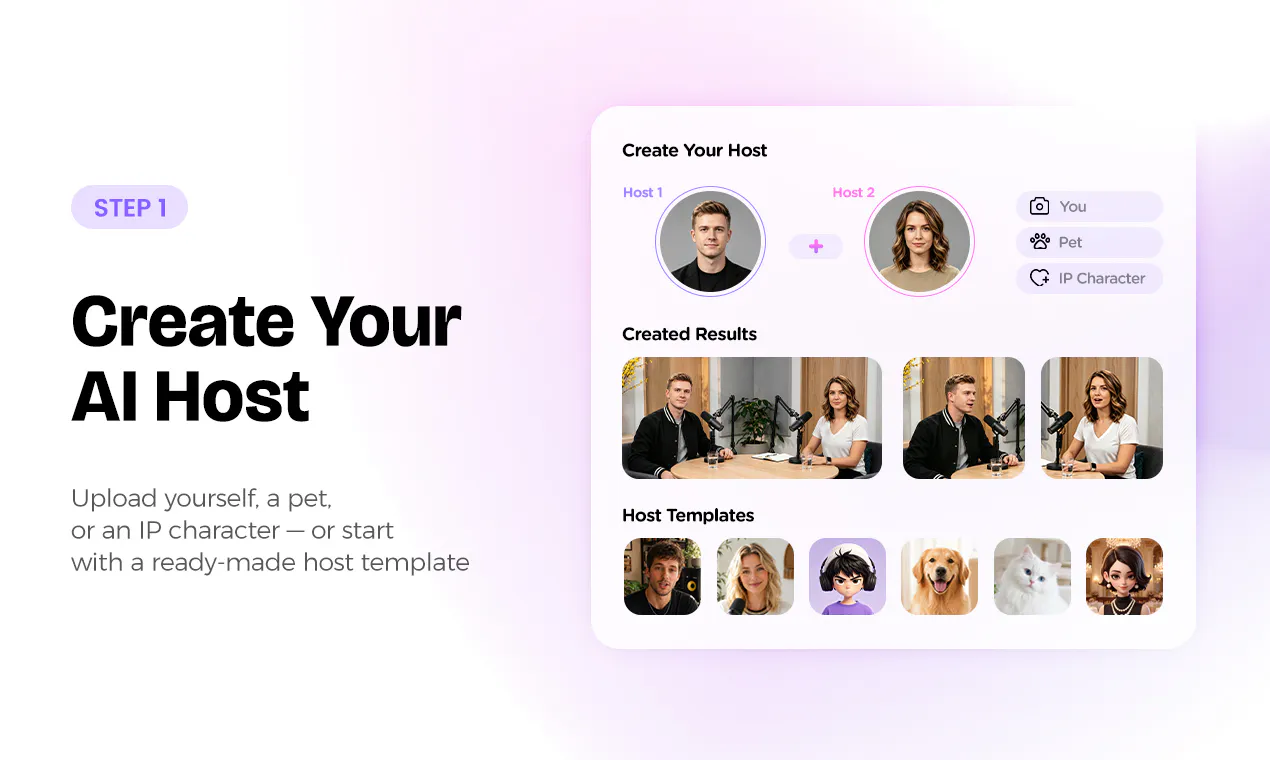
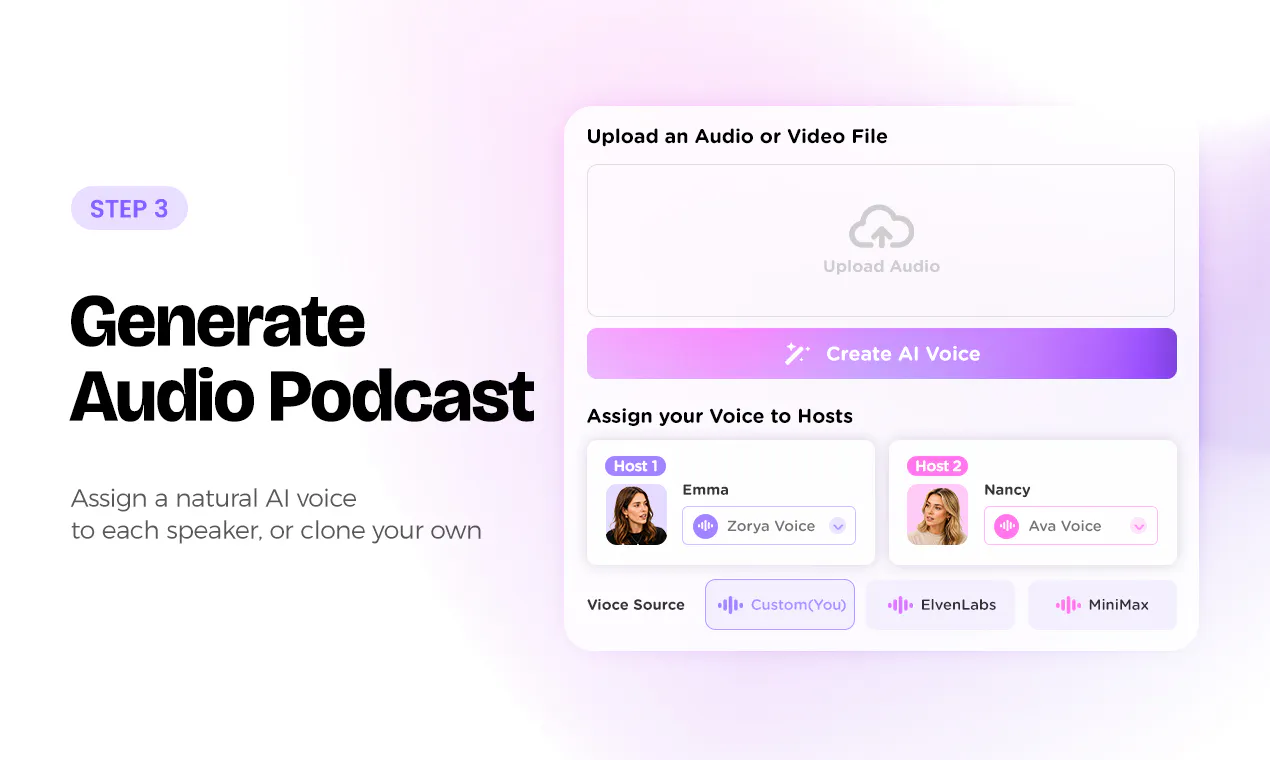
  1. Choose or create your AI hosts

    Upload your image to create a digital twin, bring your pet or original character to life, or start with one of our demo hosts. Create a solo or two-host podcast.

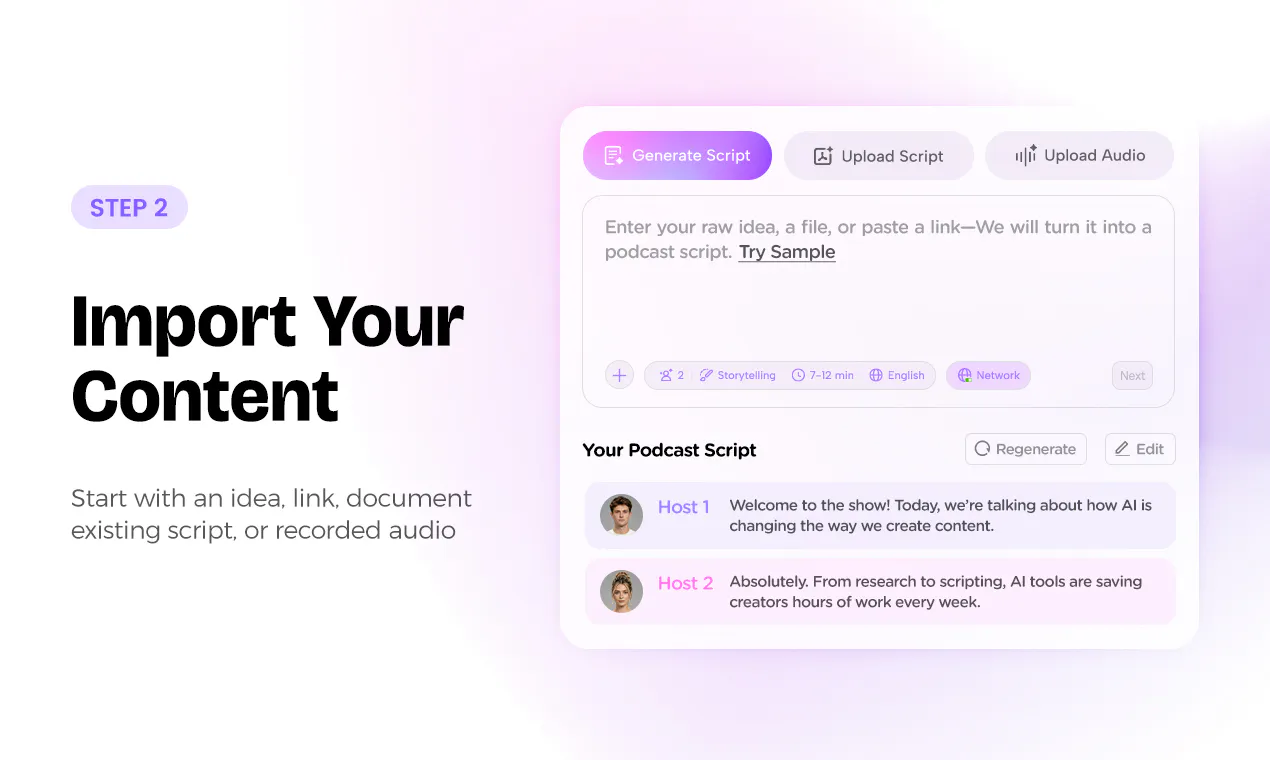
  2. Add your content and choose your voices

    Start with an idea, script, document, link, or recorded audio. Then select an AI voice or clone your own voice.

  3. Generate and publish

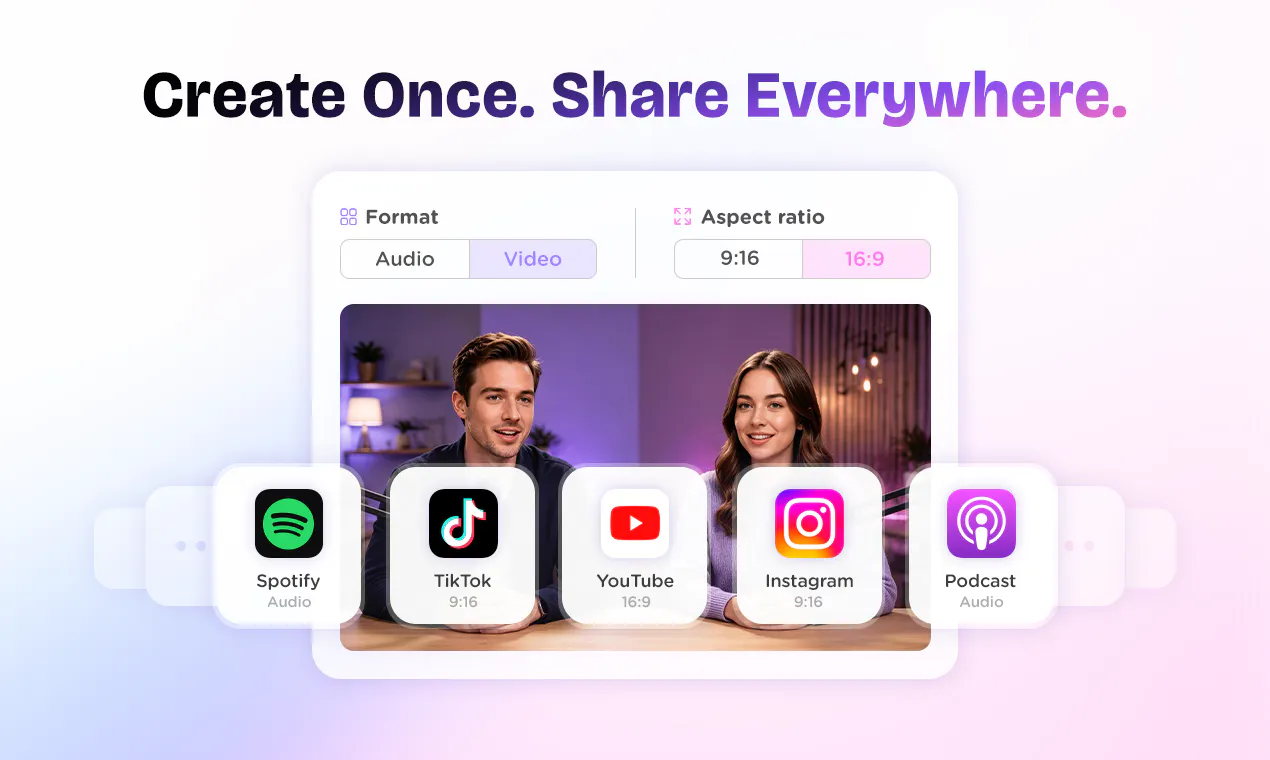
    PodcastorAI automatically handles the hosts, pacing, captions, visuals, and video formats, helping you create and publish polished podcast content in minutes.

Who is PodcastorAI for?

  • Podcasters and creators: turn existing scripts and recordings into videos for YouTube, TikTok, and social media

  • Educators and experts: transform lessons, research, and professional knowledge into engaging video podcasts

  • Brands and content teams: repurpose blogs, webinars, interviews, and campaign materials without rebuilding everything from scratch

  • Storytellers and IP creators: bring personal stories, original characters, or even pets to life as podcast hosts

It's free to try — drop your content and watch your twin host it. We're here all day and would love your feedback. 🙏

To celebrate our launch, use code PCTR30OFFPH to get 30% off your subscription! 🎉

Join our Discord to share feedback, show us what you create, and help shape what we build next:

https://discord.com/invite/KG4XywWkev

P.S. A note on the launch: we're part of Build with OpenAI 🎉 because we leaned hard on GPT-5.6 while building this. Genuinely couldn't have hit this timeline without it.

5
回复

@parsons_wu_real I Karan, 👋

Congratulations on your Product Hunt launch! 🎉

I can help your product get 1,000 genuine app downloads and real Product Hunt upvotes—no bots, no fake traffic.

I also work with genuine creators who have audiences ranging from 100K+ subscribers, with many regularly reaching 1M+ views per reel/video.

My price for 1,000 genuine downloads is $1,000.

If you're interested, I'd be happy to share my growth plan. Looking forward to hearing from you! 🚀

0
回复

An MCP integration would be really useful for sending a transcript from another tool directly into PodcastorAI.

4
回复

@rhinogo You're reading our minds 👀 We've actually been building an MCP server for exactly this — pipe a transcript straight from your tool of choice into Podcastor, no copy-paste tango. Consider your idea officially on the roadmap (and mostly already there 😏)

1
回复

@rhinogo Great suggestion! This is exactly the kind of seamless workflow we want to build—moving content from the tools you already use directly into PodcastorAI. Which tools would you most like us to support first?

1
回复

not gonna lie, kinda worried every podcast using this starts sounding the same eventually.

3
回复

@layla_carter1 That’s a fair concern, and it’s something we think about a lot. Our goal isn’t to give every creator the same AI voice or format, but to preserve what already makes them distinct: their own voice, digital twin, ideas, scripts, pacing, and preferred episode structure. Podcastor should handle the repetitive production work without flattening the creator’s personality.

0
回复

Nice concept. A real time saver! How well does the avatar stay in sync during longer episodes? Congrats on the launch!

3
回复

@henry_habib Thank you! The host’s lip movements stay closely aligned with the pacing and intonation of the audio throughout longer episodes. We also use intelligent alternating shots to keep long-form videos visually engaging, and we’re developing a new model with context-aware emotions and body language to make the digital twin feel even more natural over extended conversations.

2
回复

@henry_habib Appreciate it, Henry 🙌 Because the avatar tracks your actual audio, it stays in sync across the full length — and we support single videos up to 30 minutes, so longer episodes are covered. Thanks for the kind words 🙏

2
回复

Turning an existing recording into a video podcast without recording everything again is such a practical use case.

3
回复

@auula_ Thank you! That’s exactly the practical problem we wanted to solve: creators shouldn’t have to re-record an entire episode just to make it work as video. With Podcastor AI, they can turn the content they’ve already created into a video podcast while preserving their voice and presence.

0
回复

Hi everyone, I’m Shay, a core developer at @PodcastorAI .

When the project was first launched and we decided to build a product that could help podcast creators produce videos quickly and dramatically simplify their workflows, I was genuinely excited. We wanted to save creators from repetitive work so they could spend more time creating great content and focusing on what truly matters. Once the goal was clear, the entire team quickly got to work, with everyone contributing their strengths and collaborating closely. Our product and operations teams also gave the development team tremendous support. I feel very fortunate to work alongside such talented people and turn an idea into a product that people can genuinely use.

When we started the project, GPT-5.6 Sol had not yet been released. With the help of GPT-5.5, we quickly built the MVP and continued refining the experience based on user feedback. AI did more than help us write code faster. It allowed us to validate ideas sooner, identify problems earlier, and spend more time on the details that truly shape the user experience.

When GPT-5.6 Sol was released, our team switched to the new model right away. Combined with Codex, it made the entire development process much smoother. GPT-5.6 Sol understands requirements and code context with impressive accuracy. Even when working on complex tasks involving multiple modules and long call chains, it can quickly identify where changes actually need to be made. The plans produced by Codex’s Plan mode are usually thorough and rarely require major revisions before we can move forward. For us, this is about much more than simply writing code faster. Communication, analysis, implementation, and verification have all become more efficient and reliable, giving the team greater confidence while maintaining a rapid pace of iteration.

We have also introduced GPT-5.6 Sol into our production monitoring workflow. Our agents regularly scan failed tasks and error logs in production. Whenever an issue is detected, they automatically investigate it by combining information from production logs, database records, and the codebase. Once the cause has been identified, they generate a fix and submit the code to our repository for the team to review. This process has saved us a significant amount of time previously spent on repetitive troubleshooting and fixes. It also helps us detect production risks earlier, allowing the team to focus more of its energy on building the product.

We hope @PodcastorAI can bring podcast creators the same kind of productivity boost that GPT-5.6 Sol and Codex have brought to our team. Our goal is to help creators multiply their output and free up more time for creating, thinking, and doing work that truly matters.

We warmly welcome everyone who already creates podcast videos, as well as anyone interested in getting started, to try @PodcastorAI . We hope to become a reliable and effortless part of your creative journey and help you create even greater value!

3
回复

Can users preview a lower-resolution draft before spending credits on the final render?

3
回复

@joviechen Not yet, Jovie — no preview before the final render at the moment 🙏 But it's a great suggestion, and one we'll take away and evaluate. Really appreciate you raising it 🙌

0
回复

the 15 minute turnaround is impressive but I'm curious how it holds up past the 2-3 minute mark, most AI avatar stuff still has a slight uncanny valley thing with head movement and blinking during longer stretches of talking. have you had people watch a full episode without knowing it's a digital twin and not notice?

3
回复

@omri_ben_shoham1 That’s a very real challenge, especially in long-form content. We’re not claiming the digital twin is completely indistinguishable yet, so we built an intelligent alternating-shots system to vary the framing and keep longer episodes from feeling visually repetitive. We’re also developing a new model that adds context-aware emotion and body language, making the host feel much more natural and expressive over longer stretches.

1
回复

Congrats on the launch! 🎉 The "digital twin hosting" angle stands out — most tools stop at voice cloning, but putting an avatar on screen changes the whole feel. Quick question: when someone uploads an existing audio episode, how well does the avatar's lip-sync track the original pacing/tone?

3
回复

@ryancheng Hi Ryan! Thank you so much! The digital host’s lip-sync closely matches the pacing and intonation of the original audio, so uploaded episodes feel natural on screen. We’re also developing our next-generation model to bring more emotion and expressive body language to digital twin hosts, which should make the final videos even more engaging.

2
回复

@ryancheng Appreciate it, Ryan 🙌 The avatar is animated straight from your uploaded audio, so lip-sync and pacing track the original episode instead of being re-timed — pauses, emphasis and all. It's the kind of thing that's easier to feel than to describe, so I'd genuinely love for you to test it with one of your own episodes and tell us how close it lands.

1
回复

Can I keep my original audio exactly as recorded and use the AI host only for the video layer?

3
回复

@mingyouagi Yes, absolutely! You can upload your existing recording, keep the original audio, and add an AI host as the video layer—there’s no need to record or regenerate everything again.

0
回复

Turning an existing recording into a video podcast without recording everything again is such a practical use case.

3
回复

@fayann Exactly! We built this workflow for creators who already have great audio but don’t want to record everything again for video. They can reuse the original episode and turn it into a publish-ready video podcast with an AI host.

0
回复

@chrismessina - This looks awesome, great job. However, I'd getting tired of one more subscription service, do you have plans for a pay-as-you-go model? A model that allowed you to purchase credits instead, that never expires?. I feel offering this model would potentially increase the up take, as many users are hesitant to commit to another monthly/annual subscription. I

3
回复

@codeandsea Thanks Brent — and it's a totally fair ask 🙏 Subscription fatigue is real, and 'buy credits that don't expire' is something we've been actively debating internally. No firm date yet, but you're not the only one asking, so it's very much on our radar. In the meantime it's free to try, really appreciate you taking the time to think it through with us.

3
回复

no team seats yet? asking cause i'd want this for more than just me.

2
回复

@colton_hayes2 Not yet. We currently support individual accounts, but team accounts and multi-seat access are already in development. We know Podcastor becomes much more useful when an entire content team can collaborate, so this is an important part of our roadmap.

0
回复

Damn, nice one. Congrats on the launch. “NotebookLM can write a podcast; Podcastor puts you on screen” is a very clear way to explain it. The digital twin side is interesting, but I’d want to know how much control you have over the final performance. Can you adjust pacing, tone, pauses and host reactions after generation, or do you mostly accept what comes back? That feels important for educators and experts in particular. A technically polished avatar is useful, but only if it still sounds like the person behind the content.

2
回复

@os_ishmael Thanks, and that’s a great point. If you use Podcastor’s TTS, you can precisely adjust pacing and add pauses to shape the delivery. For uploaded NotebookLM audio, we can extract the script so you can revise the spoken content rather than simply accepting the original output.

Fine-grained control over host reactions isn’t available yet, although the current lip-sync is already very strong. We’re now developing digital twins based on real recorded video, along with a new model that drives emotions and body language from the tone and context of the content. This is especially important for educators and experts, where preserving the creator’s authentic delivery matters as much as visual polish.

1
回复

Curious, where did GPT-5.6 Sol make the biggest difference for PodcastorAI?

2
回复

@erok_chen The biggest difference was not simply faster coding, but making our entire development loop more reliable. GPT-5.6 Sol with Codex became especially effective at understanding requirements and navigating complex, cross-module changes, so we could move from planning to implementation and verification with far less back-and-forth. We also use it in production monitoring: agents inspect failed tasks and logs, trace issues across the database and codebase, then prepare fixes for our team to review. That has helped us iterate faster while catching risks much earlier.

0
回复

For true crime episodes, the research and writing are already intense. I do not want video production to become another full-time job.

2
回复

@ea_z Absolutely. For research-heavy formats like true crime, creators should be able to focus their energy on accuracy, storytelling, and responsible reporting, not spend another full-time job producing the video. That’s exactly the production burden we want Podcastor AI to take off their plate.

0
回复

@sylvialane Congratulations. And happy product launch.

2
回复

@huisong_li Thank you so much, Huisong! We really appreciate your support and kind wishes. It means a lot to our team on launch day! 🙌

0
回复

Really cool, and crazy idea. Can't wait to test it out. When you generate a two-host episode from a document, do the hosts ever actually disagree, or just take turns agreeing? That friction and chemistry is (almost) always what makes it worth listening to.

2
回复

@aidan_codefox Thanks! We completely agree that chemistry and friction are what make a two-host conversation worth listening to. That’s why we offer three formats: Deep Dive, where both hosts unpack a topic together; Debate, where they take opposing sides and challenge each other; and Storytelling, where one leads the story while the other asks questions and keeps it moving. So if you want real disagreement rather than two hosts simply taking turns agreeing, Debate is built specifically for that.

0
回复

I love the idea of turning an existing content library into video instead of always creating from scratch.

2
回复

@buzzy_jade Thank you! That’s exactly the idea: creators already have so much valuable content sitting in their libraries. We want to help them give it a second life in video, without having to start from scratch every time.

0
回复

This feels built for creators who know what they want to say but do not want to spend their week editing.

2
回复

@eric_t_ Exactly! Creators should be able to spend their time shaping ideas and telling great stories, not losing an entire week to editing. Our goal with Podcastor AI is to handle the production work while keeping the creator’s voice and presence at the center.

0
回复

@eric_t_ that's the dream we're chasing — you keep the ideas and the storytelling, we take the editing week off your plate. Try it with your next episode and tell us if it delivers 👀

0
回复
Just tried PodcastorAI, and the free version already impressed me! I generated an audio podcast, and the quality was really good — honestly much better than I expected, and noticeably better than NotebookLM in my experience. What surprised me the most was the variety of formats and customization options. I even uploaded my cat and created an AI host with it — it was so cute! 🐱 Congrats on the launch! Excited to see how PodcastorAI helps more people create and share their ideas. 🚀
2
回复

@new_user___1802026258df93399c32311 Thank you so much for actually trying PodcastorAI and sharing such thoughtful feedback! It means a lot to hear that the audio quality and customization exceeded your expectations. And the cat AI host absolutely made our day—we’d love to see it if you’re comfortable sharing! 🐱💜

0
回复

sounds interesting : ))

2
回复

@madalina_barbu Thanks Madalina 😊 Would love for you to give it a spin — bring any script, link, or PDF and it'll come back as a full video episode hosted by your digital twin. Curious what you'd make with it!

1
回复

This solves a real creator problem. Writing or recording the content is often easy compared with everything that comes afterward.

1
回复

@fei_li5 Exactly, Eric — the "everything afterward" is where most creators stall out. That gap is the whole reason we built Podcastor. Thanks for getting it 🙏

0
回复

How is better than Heygen?

1
回复
@nishant_modi Great question! HeyGen is a powerful general-purpose avatar video platform, while PodcastorAI is built specifically for producing complete podcast shows. You can start with an idea, URL, document, or existing audio, then create a structured solo or two-host episode with reusable digital hosts, cloned voices, podcast-native visuals, and both audio and video outputs. If you only need a talking-avatar video, HeyGen is a strong choice. If you want an end-to-end system for building and consistently producing a podcast show without recording yourself, that’s where PodcastorAI stands out.
1
回复

the digital twin part is the interesting bet - if you re-record one line weeks later does the AI voice/face stay consistent with the original episode, or is there drift between sessions?

1
回复
@sabber_ahamed Great question, Sabber! Once your digital twin and cloned voice are created, they’re saved as reusable profiles. So if you come back weeks later and generate a new line using the same host and voice, the core facial identity and voice characteristics remain consistent with the original episode. There may be slight natural variations in expression, movement, or delivery between generations, but the identity itself shouldn’t drift. Cross-episode consistency is one of the main reasons we built the digital twin feature.
1
回复

love this one! question: for long or pre-recorded episodes, does the AI host lip syncs with the audio? and what about the changes in style and tone within one same episode? thanks and congrats!

1
回复
@mathias_barboza Thanks, Mathias—great question! Yes, for long or pre-recorded episodes, the AI host lip-syncs with the uploaded audio, preserving the original pacing and pauses. The host remains visually consistent throughout the episode, even when the speaking style or tone changes. More expressive emotional reactions and body movements that adapt to those changes are currently in development, and they’re an important part of what we’re building next. Thanks for checking us out and for the thoughtful question!
1
回复

The option to create a solo or two-host podcast is a nice touch. A lot of tools seem built for only one format.

1
回复

@xiao_zhang9 Thank you! We didn’t want creators to be locked into a single format. Some ideas work best as a focused solo episode, while others become much more engaging through conversation, questions, or debate between two hosts. Podcastor is designed to support both, so the format can follow the content rather than the other way around.

0
回复

@xiao_zhang9 Thanks Xiao 🙌 Exactly — real podcasts aren't one-size-fits-all, so we wanted both the solo monologue and the two-host back-and-forth to feel natural. The host handoffs in two-host mode are the part we're most proud of. Would love to hear which format you'd reach for 👀

1
回复

The strongest part for me is that the creator remains visible in the finished video through their own digital twin.

1
回复

@tammytan516 Hi Tammy, that's the whole reason we built it this way 🙏 Most tools erase the creator; we wanted the opposite — your face, your voice, your channel, just without the camera setup. Glad it landed for you.

0
回复

@tammytan516 Exactly! We want creators to stay focused on their ideas and storytelling, while Podcastor AI takes care of bringing the content to life visually, without losing the creator’s presence.

0
回复

Congrats on your launch! How long does it usually take to render a one-hour video podcast with lip sync?

0
回复

@charlenechen_123 Thank you! We currently support episodes up to 30 minutes, so we don’t have a reliable render-time benchmark for a full one-hour podcast yet. Longer generation is already on our roadmap and should be available next month. Once it’s released, we’ll share accurate timing based on real production runs rather than guess today.

0
回复
#4
CrawlRaven
SEO Hub for GSC + GA4 + a 200-point crawl
258
一句话介绍:CrawlRaven 是一个整合 Google Search Console、GA4、关键词导入和 200 点技术爬虫的 SEO 工作台,能自动生成优先级排序的优化清单,解决多站点 SEO 从业者每周手动拼装数据、不知道先修哪个问题的痛点。
Marketing SEO Search OpenAI Day
SEO工具 数据整合 技术审计 内容优化 GSC GA4 关键词研究 网站爬虫 优先级排序 竞品分析
用户评论摘要:用户高度认可其“按排名影响评分”和“消除手动拼表”的价值,核心问题集中在:技术爬虫尚未完善(被指为“营销数字”)、如何平衡快赢与重型修复、B2B长尾词优先级被忽视、以及数据同步频率与关键词过期处理。部分用户希望增加筛选器来覆盖20名以外的低量高转化词。
AI 锐评

CrawlRaven 精准切中了 SEO 工具市场的“最后一公里”困局:大量工具能发现200个问题,却无法告诉用户今天该修哪个。它真正的护城河不是爬虫深度(Screaming Frog 和 Sitebulb 早已做完),而是利用 GSC 实际流量数据对问题做影响排序,把“数据堆砌”转化为“行动指令”。

但产品目前明显处于“半成品”状态:200点技术爬虫和GA4集成尚在开发中,主打的“一体化”名不副实。定价虽是终身制,但功能承诺与交付能力之间存在时间差,早期用户可能落入“为未来买单”的陷阱。此外,基于GSC数据量做优先级排序天然偏袒大流量词,对长尾高转化企业级场景不友好。评论区已出现B2B用户对这一机制的质疑,而创始人仅回应“计划加入用户控制”,说明当前模型缺乏弹性,短期难以满足细分市场。

如果团队能快速补齐爬虫和GA4功能,并开放自定义权重,它有机会成为独立SEO和小型工作室的效率利器,但对于大客户或复杂站群,目前仍需搭配 Screaming Frog 和 Ahrefs 使用——这不是“取代”,而是“协作”。

查看原始信息
CrawlRaven
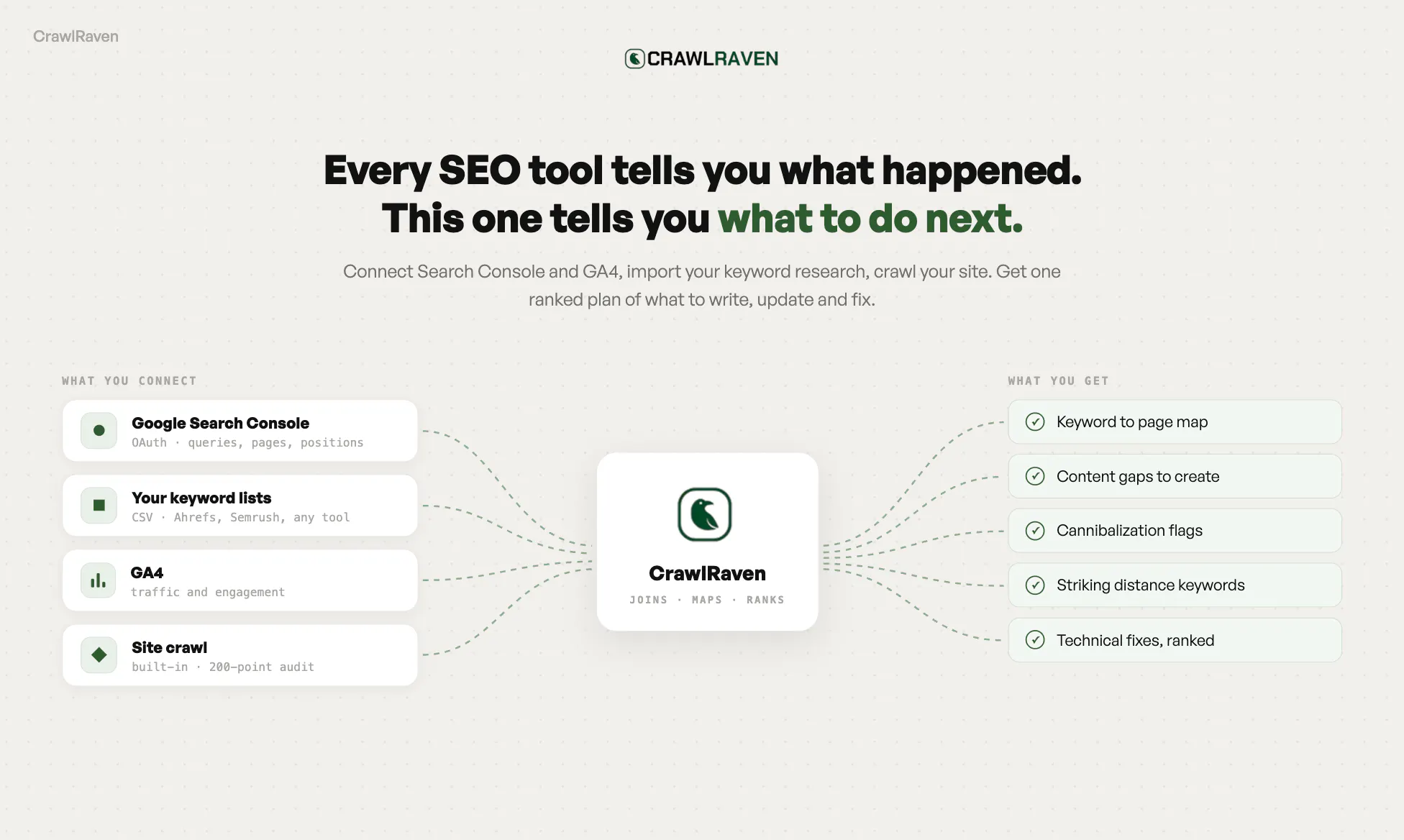
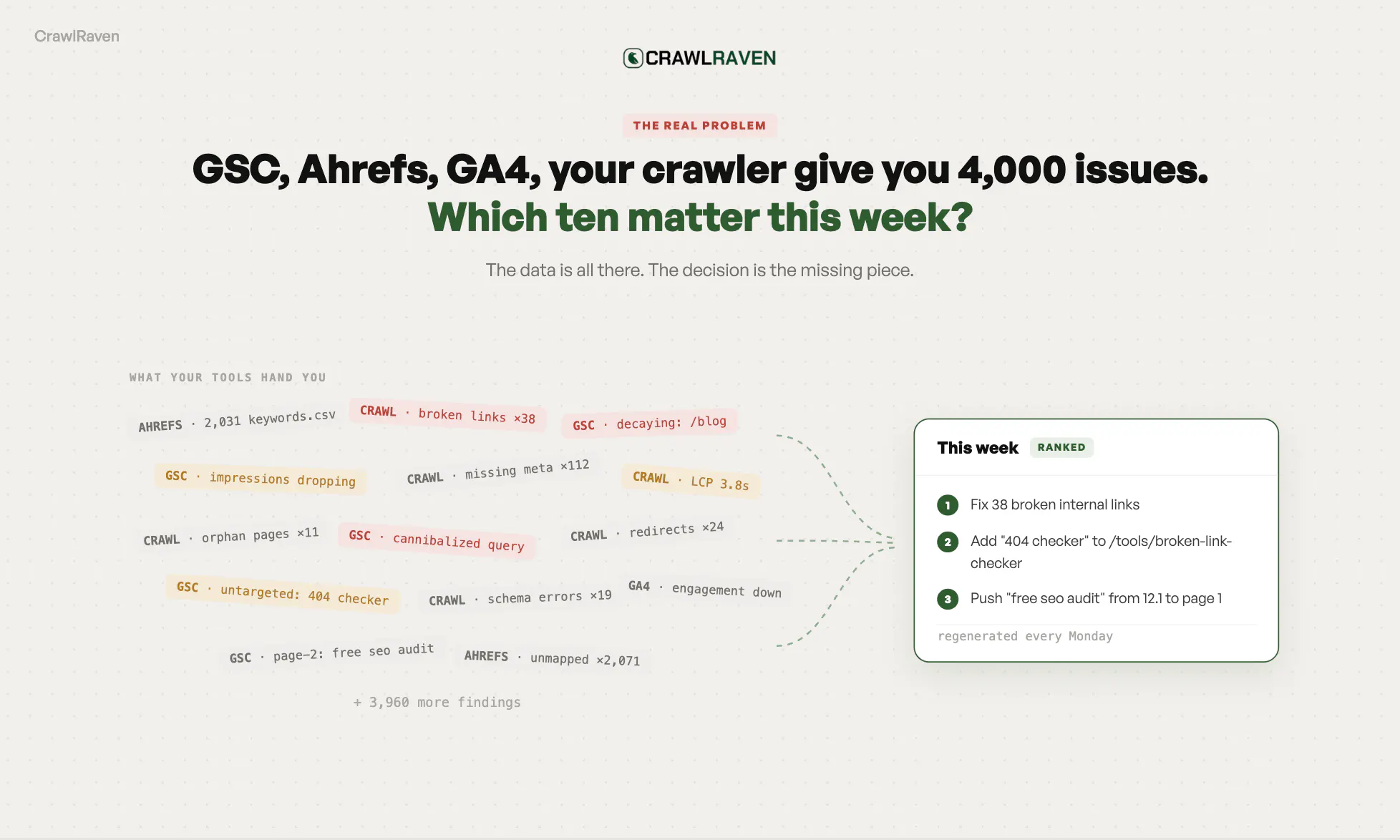
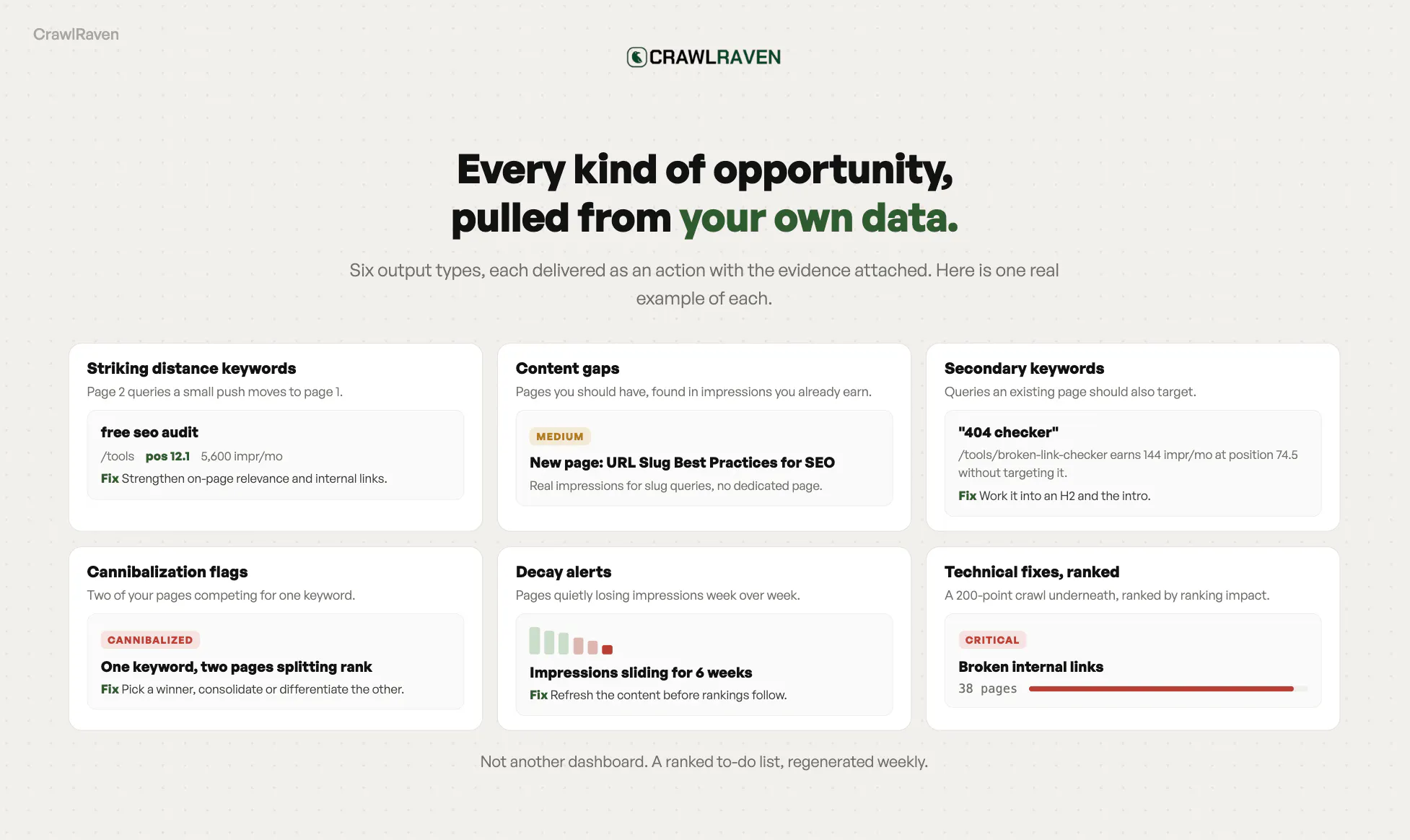
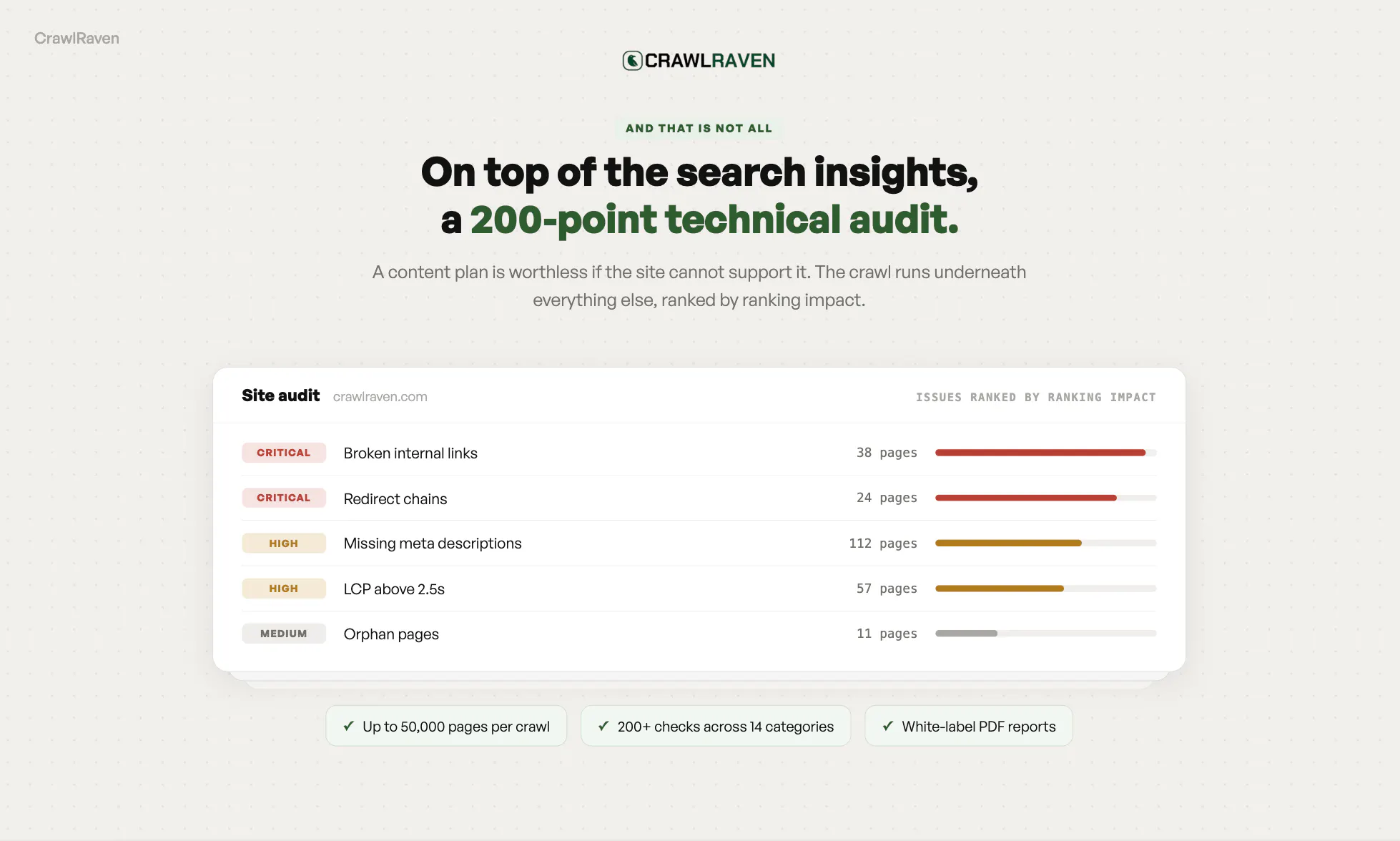
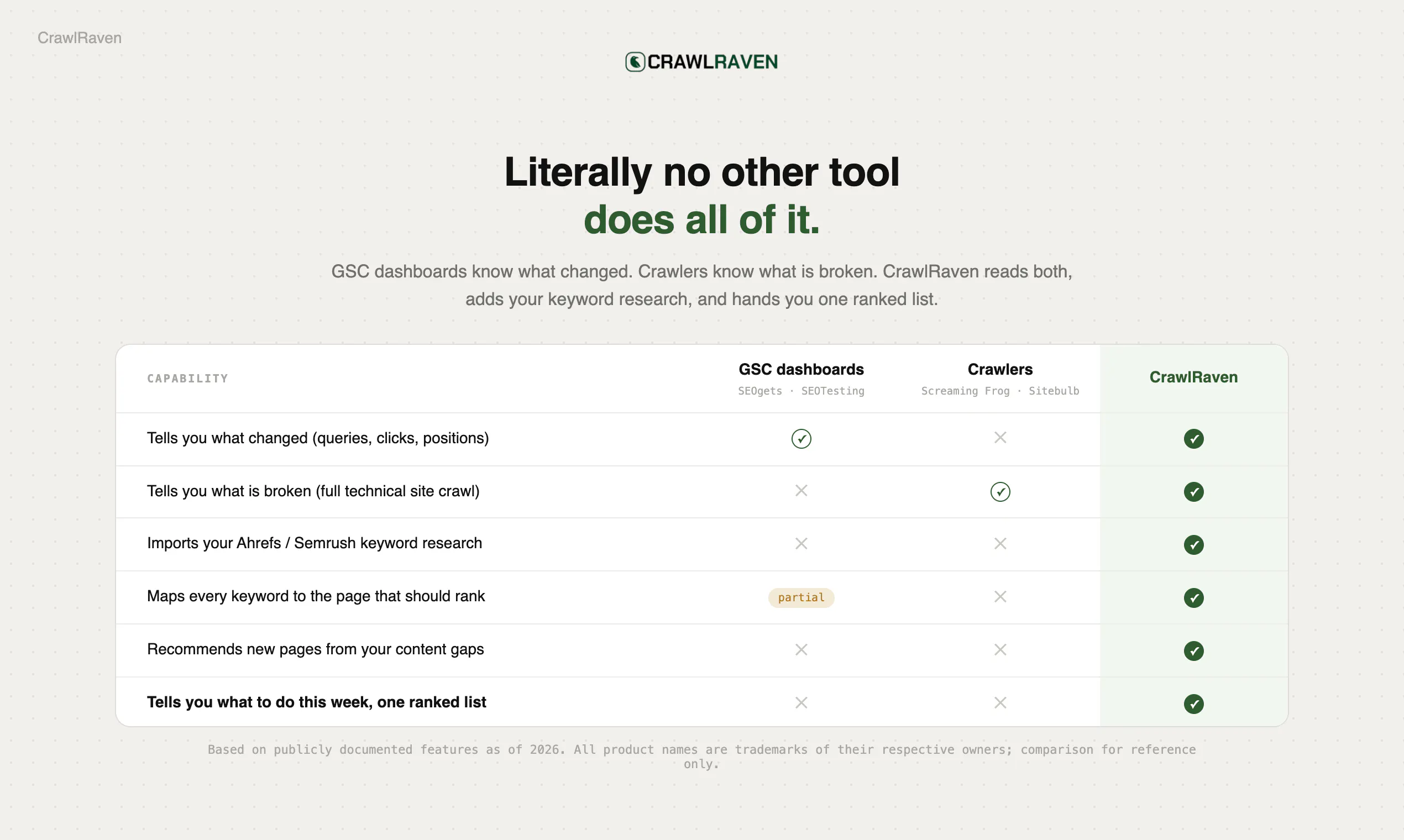
Connect Google Search Console, Google Analytics, import your Ahrefs or Semrush lists, and crawl your site on 200-point technical SEO Audit. CrawlRaven joins all four and hands back a ranked plan: what to write, what to update, what to fix first.
Excited to hunt CrawlRaven today! If you've ever done SEO for more than one site, you know the Sunday-night ritual: export from Search Console, export from Ahrefs, run a crawl, then spend hours stitching it all together in a spreadsheet just to decide what to actually work on this week. CrawlRaven kills that ritual. It pulls Google Search Console, your keyword research imports, and a 200-point technical crawl into one place and turns them into a single prioritized action plan: what to write, what to update, what to fix first. What stood out to me: Issues are scored by ranking impact, so you fix the things that move traffic, not the things that are easiest to find Cannibalization and content decay detection, which most tools either bury or charge enterprise prices for White-label PDF reports, a big deal for agencies and freelancers doing client work The pricing is refreshingly simple too: a free plan, and lifetime deals at $49 and $99 instead of yet another monthly subscription. The makers Aditi and Rakesh have been in SEO for over a decade and built this to solve their own workflow. Congrats on the launch! Curious to hear from the community: what does your current audit-to-action workflow look like?
13
回复

@ayushtweetshere Thanks Ayush!

Been in SEO space for 10 years now.
My workflow moved between duplicating and changing filters across tab, joining multiple Sheets just to get the right insights. I have longed for something like this. The existing tools never changed my workflow, but this one did.

Super excited to share it with the amazing guys at Product Hunt!

Looking forward to your feedback and support

7
回复

@ayushtweetshere Hey, pulling GSC and GA4 into one place is the boring problem nobody wants to solve. When I've worked with SEO agencies the crawl reports were always 200 issues long with no sense of which five actually moved traffic. Does CrawlRaven rank findings by likely impact, or is prioritizing still on me?

3
回复
@ayushtweetshere Eliminating the dreaded Sunday spreadsheet stitching ritual is huge for anyone managing multi-client SEO! Scoring issues by actual ranking impact rather than vanity audit fixes makes prioritizing client tasks so much cleaner. For the content decay and cannibalization detection, how frequently does CrawlRaven sync with Search Console to flag traffic drops before they turn into major ranking losses?
2
回复

super launch of the day! very proud of you guys.. all the best! @ayushtweetshere @rakesh_rry @aditi_chaturvedi

4
回复

@neelptl2602 Thanks for the support.

1
回复

How often does it re-analyze new findings once I've worked on first few??

4
回复

@axebarma  It discovers new keyword opportunities based on the content published, what keywords it already rank for and what can potentially rank for more. The analysis becomes even richer if you add your target keyword list with data from tools like Ahref. With time, you get more data and hence new opportunities are identified. Let me know if this answers your question.

4
回复

@axebarma GSC data syncs from Google automatically every day, so findings update on their own as your changes take effect. No need to re-run anything. Just note Google reports search data with about a 2 day delay, so give fixes a couple of days to show up.

3
回复

Congrats on the launch! Using real GSC impressions and position gaps to surface quick wins is super smart. How far down in rankings (e.g., positions 11–20 vs. 20+) does the algorithm look to identify those high-potential pages?

3
回复

@hannesh Thanks. It looks at positions 4 through 20, so the bottom of page 1 and the top of page 2 both count. The closer you already rank, the higher it lands on your list, since a jump from 6 to 2 wins more clicks than a climb from 18. We skip anything past 20, since those need real content work. And we want at least 50 impressions so the term is one people actually search.


Where would you draw the line? Some folks want to reach past 20 for niche terms that still convert. Others want the list tight around fast wins. Which fits how you work?

2
回复
@rakesh_rry I think 4–20 as the default is spot on for fast wins! That said, having a toggle or filter to occasionally scan positions 20–30 (maybe with a higher impression threshold) for high-intent niche terms would be a great power-user feature down the road.
3
回复

the ranked what-to-fix-first output is the actual value here. every seo tool hands you 200 issues and lets you drown in them, the hard part was never finding problems, it was knowing which three actually move rankings this month. good angle joining gsc and the crawl to decide that instead of just showing it

3
回复

@alex_watson2110 Thanks Alex!

1
回复

Cool idea, agentic AI is definitely the future of SEO work. The whole product hinges on the ranking model. Is "ranked by ranking impact" a fixed weighting, or does it actually learn from what moved rankings on my specific site (or other sites.)

3
回复

@aidan_codefox The ranking uses fixed rules, no AI. It looks at three things from your own Search Console data. How much search demand a keyword has, how close you are to page 1, and how many clicks you should be getting but aren't. Since it runs on your data, your list is yours alone.

Tell me how you'd want it though. Would you rather set the rules yourself, or have it watch what you changed and whether your rankings went up?

1
回复

200-point technical audit is a specific number worth unpacking. Is that 200 distinct checks across categories like indexability, Core Web Vitals, structured data, internal linking, and so on, or is it more like a marketing number that counts variations of similar checks? Screaming Frog and Sitebulb also run extensive technical audits, curious what CrawlRaven's crawl catches that those tools typically miss or under-weight.

2
回复

@ansari_adinThe crawl is what we're building next, so I won't pretend a 200-check spec sheet exists today. That number comes from our v1, which was a full technical SEO crawler before we rebuilt around Search Console data.

I'm not trying to beat Screaming Frog or Sitebulb on check count. We're building the part they leave to you: ranking each finding by whether it hits a page that actually gets traffic and sits close to a win. A broken canonical on a dead page and one on your top traffic page look the same in most crawlers. We tell you which to fix first, using your GSC data.

So what we catch that they miss is the impact ranking. Happy to send you the real breakdown once it ships.

0
回复

Congrats on the launch. Collapsing GSC, GA4, and a full crawl into one prioritized list is the time-saver here, three separate dashboards never gave anyone a single priority order. Before I'd hook this to a client's Search Console: does the OAuth grant ask for read-only access, or does it need edit/verify scope too, and if a workspace disconnects later, does that revoke the grant on your end or just stop the sync?

2
回复

@vollos We only request the readonly scopes, webmasters.readonly for Search Console, and analytics.readonly for GA4 (asked separately, only if you open the GA4 tab). No verify, edit, or property-management access at all. We literally can't change anything in the client's Search Console, only read the performance data.

On disconnect, the access lives in the client's Google account, so if they revoke it there (or your Workspace admin does), our token stops working immediately and the sync halts. We hold nothing that survives that. If you want your data removed on our side too, account deletion wipes the stored tokens and history.

1
回复

If I pay for Ahref, what would make me switch to this?

2
回复

@nishant_modi Ahrefs looks outward, competitor backlinks, the full keyword universe, what everyone else ranks for. CrawlRaven looks at your own Search Console data and tells you what to do with it. Which pages sit one push from page 1, where two of your pages fight over the same term, which pages are quietly losing traffic.

Most people keep Ahrefs for research and use us for the weekly "what do I work on now" list. You can even import your Ahrefs keywords straight in.

3
回复

the 200-point crawl plus GSC/GA4 in one place is the pitch that matters - when a fix from the ranked plan goes live, does the tool re-check and clear that item itself or do you have to manually mark it done and hope it doesn't resurface next crawl?

2
回复

@sabber_ahamedYou hit Resolve, and the detectors do the rest. They re-run on every daily sync. If your fix held, the item stays resolved and drops out of your Attention list. If the problem comes back later, it doesn't quietly reappear as a new finding. It comes back marked Returned, so you can see it regressed and the history stays attached. No guessing whether it's the same issue twice.

Note: the crawl and GA4 are rolling out next, so today this runs on the Search Console side. The same Resolve and Return logic will cover the crawl fixes when they are released.

2
回复

Congrats on the launch team.
This is super promising.
Someone who has been diving into SEO this is going to be super useful

2
回复

@mdshadabalam3 Thanks for the support.

2
回复

Congrats on the launch! Merging GSC, GA4, and crawler data under one roof to actually rank priorities is a huge time-saver. On the action items part - how does the model balance quick wins (like "low hanging fruit" keywords) Vs heavier technical fixes when picking the top action items?

2
回复

@denitsapenchevavaltchanova Thanks. Right now the list leans toward quick wins, because that's what Search Console shows best. A page stuck at the bottom of page 1, or a keyword you rank for but never gave its own page, rises to the top. Small effort, and your own numbers already prove the upside.

The heavier technical fixes come from the crawl audit, which we're adding next. Once it's in, the plan will rank both together

1
回复

Congrats on the launch! For agencies managing multiple client sites, can one account switch between different GSC properties, or does each site need its own separate account?

2
回复

@irahimiam You can add multiple sites on one account. You can also import multiple site by connecting to multiple search console. The current plans allow you to add 3 sites for $49 and 10 sites for $99.

2
回复

Raakesh, the ranking by impressions and closeness to page 1 is the part that caught me, because it also shows where a model like this can struggle.

I run SEO for a niche B2B product in healthcare. My highest-intent terms show zero or missing volume in every tool and barely register in Search Console, since only a few hundred people a month search them at all, yet those are the ones that convert. A prioritizer built on demand would push them straight to the bottom.

Can I weight a keyword up by hand, or mark a low-volume term as high-value, so the ranked plan does not bury the long tail a small market lives on?

2
回复

@clemente_lopez1 I agree with your use case. I have similar experience. Highest intent terms often show very minimal data in GSC. We have plans to add controls for the user where they can decide how they want to prioritise. Consider this added to roadmap.

2
回复

Congrats on the launch! The cannibalization detection caught my eye. I'd pay for that alone if it works well, because everyone knows two of your own pages end up competing for the same keyword, and nobody checks it regularly since it means exporting everything and cross-referencing by hand.

One question, what happens when the keyword list itself is stale? Does the tool flag keywords that stopped mattering, or does it take the list as given?

Upvoted, will try it on our site this week.

2
回复

@roguetink You will be able to see ranks, positions and pages for any given keyword. It recommend how to target keywords and in what priority

3
回复

@roguetink Thanks. Cannibalization was one of the original itches, my cofounder's agency was doing exactly that export-and-cross-reference routine you describe.

On stale keywords, the list isn't taken as given. Every keyword is matched against your live Search Console data, which refreshes daily, so one that stopped mattering shows its real current numbers. And you can mark any keyword as ignored, it drops out of your working list without being deleted, so the list stays clean.

An automatic "this keyword is dead" flag isn't there yet, but it's a really good idea. Would love to hear what it finds on your site this week.

2
回复

pulling GSC, GA4 and the Ahrefs/Semrush export into one ranked action list is the part that's actually useful, most SEO tools just dump the raw data and leave you to reconcile it yourself. does the ranked plan account for pages where GSC and Ahrefs disagree on ranking, or does it just pick one source of truth?

2
回复

@omri_ben_shoham1 Good question. GSC is the source of truth for positions, since it's Google's own impression-weighted data from real searches, while Ahrefs/Semrush positions are spot checks of one location on one day. So when they disagree, we trust GSC.

Your Ahrefs/Semrush export contributes what GSC can't tell you: search volume and difficulty for keywords you don't rank for yet. GSC says where you stand, your keyword list says what's worth chasing, and the ranked list combines both.

1
回复

looks good, currently i m not using any seo tools like ahref so does it suggest keyword suggestions on which i should write on based on my GSC data or do i have add those keywords from my end and do u have any same report of any website where it shows what key actions or tasks it suggested based on my gsc and keyword data thanks

2
回复

@gamifykaran Thanks. Yes, no other tools needed. It pulls keywords straight from your own Search Console data and shows you the ones you're already appearing for but haven't written a page for yet. Adding your own keyword list is optional.


Don't have a sample report to link right now, but happy to share a few screenshots of what the suggestions look like. There's also a free plan, so you can connect your Search Console and see it on your own data.

1
回复

Congrats on the launch. Pulling GSC, GA4 and the crawl into one place saves a lot of time. How does the prioritization decide what goes on top? is it based on traffic potential, effort, or something else?

2
回复

@shivam_vyasThanks. It's ranked by traffic potential relative to how close the win is. We look at your real impressions, your current position, and the gap between what you get and what you'd get with a small move. So a page sitting at position 11 with high impressions outranks a bigger but more speculative opportunity.

Note: Search Console is live today, GA4 and the crawl audit are coming next.

For GA4 google verification is pending.

1
回复

This is awesome! Checking it out later this week. Do you have MCP support?

2
回复

@parthkoshti Yes we do. Available on top tier plan.

3
回复
@rakesh_rry @aditi_chaturvedi Connecting Ahrefs/Semrush with GSC and GA4 in one hub makes SEO auditing so much faster.
1
回复

the impact-ranking questions are all covered well, but I'm more curious about the white-label report narratives since that's the part agencies will forward straight to non-technical clients without necessarily editing the wording. a plain-English "why" for a ranking drop or a prioritized fix is easy to state confidently even when the real cause is multiple overlapping factors. is there anything that keeps the generated narrative hedged when the underlying data doesn't clearly support a single-cause story, or is that something the agency has to catch themselves before sending it out?

1
回复

Congrats on the launch @aditi_chaturvedi ! One question: how do you prioritize recommendations when multiple issues overlap? For example, if a page has technical SEO problems, content decay, and keyword cannibalization at the same time, how does CrawlRaven decide what should be fixed first?

0
回复

Pulling GSC and GA4 into one place is the part I always end up duct-taping together myself. Does the 200-point crawl check anything for AI search / GEO yet or is it still classic SEO? That's where I keep hitting walls lately.

0
回复

The "what to do next" framing is the right one. GSC will tell you a page is "Discovered, currently not crawled" and then leave you guessing whether that's a technical problem or a site-quality problem. Does the ranked plan distinguish between genuinely technical fixes and pages that just need stronger internal links or better content? That distinction is where I've burned the most hours on my own site.

0
回复
How did GPT-5.6 change the ambition or scope of what you shipped?
0
回复
Before GPT-5.6, CrawlRaven was scoped as a reporting tool: merge Search Console, keyword imports, and crawl data into one dashboard and let the user figure out what to do. GPT-5.6 changed that. Its reasoning over large, messy datasets was reliable enough that we moved the core promise from "here is your data" to "here is your prioritized action plan." The model now powers the layer that decides what to write, what to update, and what to fix first, including cannibalization detection and content decay analysis across thousands of pages. It also collapsed our timeline. Features we had parked for a v2, like impact-scored audit findings and white-label report narratives written in plain English, shipped in v1 because GPT-5.6 handled them with far less prompt engineering and post-processing than earlier models. In short, it turned a solo-founder reporting tool into an SEO decision engine we could actually ship.
7
回复
#5
AskCodi
Orchestrate agents at scale while reducing cost
213
一句话介绍:AskCodi是一个Mac端的AI CTO(首席技术官),用户通过自然语言描述需求,它就能自动规划、并行调度多个AI代理、自动选择最便宜的模型完成任务,并通过一个收件箱在需要时征询决策,旨在让开发者从繁琐的AI工具操作中解放出来,专注交付。
Mac Productivity Artificial Intelligence OpenAI Day
AI编码助手 AI CTO 智能代理编排 多项目管理 模型路由 成本优化 自动化开发 Mac应用 开发效率工具 云端IDE
用户评论摘要:用户高度赞扬“管理一个人而非一群代理”的理念,但对模型路由准确性(复杂任务误判为简单任务)、长时运行中的代码库记忆漂移、以及无监督运行的安全边界提出质疑。开发者回应称通过任务验收、预算限制、代码同步和项目章程来确保对齐。
AI 锐评

AskCodi的野心不是在现有的AI编码工具上做“+1”功能,而是试图从根本上重构开发者与AI的协作范式。它的核心洞察在于:当前绝大多数AI工具(如Cursor、Copilot)本质上是从“手动编程”到“手动指挥”的平替,开发者并未被解放,只是换了一份“AI调度员”的新工作。AskCodi提出的“AI CTO”理念,核心价值在于**将决策权从“操作界面”转移到“对话与收件箱”**,真正以目标为导向而非以过程为导向。

从技术层面看,其“模型自动路由”和“跨项目并行”是亮点,但也是风险点。用户的质疑很到位:当模型将看似简单实则复杂的任务路由给廉价模型时,产出“看起来对但实际错”的代码,是致命且难以追溯的。虽然回答中提到了“任务验收标准”和“监督机制”,但这实际上将风险转嫁到了定义验收标准的“人”身上。一个不严谨的验收标准,可能导致整个夜间自动构建在错误的方向上跑出一大段垃圾代码。

产品早期,粗心且自信是不够的。AskCodi最大的挑战在于**信任的建立**。它要求开发者放弃对细节的把控,信任一个“AI CTO”在后台做出的所有技术决策。对于追求稳定和可追溯性的企业级项目,这种“黑盒”式的代理行为难以接受。它目前最合适的场景,可能是独立开发者、小团队的原型验证和快速试错。其价值不在于取代所有开发角色,而在于成为创始人的“技术执行放大镜”,将构思快速转化为可验证的代码片段。真正的护城河,是其能否通过数据积累和反馈循环,将“路由”和“监督”做得足够智能,让信任变得不再盲目,而是基于可验证的过往成绩。

查看原始信息
AskCodi
Tell Codi what you want to build. It writes the plan, runs AI agents in parallel across all your projects, and picks the cheapest model that can do each task, so you ship more and spend less. When you add a project it writes the charter and task list itself, and only pulls you in when a decision needs you, through one inbox.
Hi, I'm Shreyans, one of the makers. I built AskCodi because I got tired of babysitting AI. Every tool I tried turned building software into a second job. Pick the model, paste the context, wire up the agents, then sit there watching a run and hoping it didn't go sideways. I was spending more time operating the tool than shipping with it. So we made the opposite of that. You hire Codi, an AI CTO that lives on your Mac, and you talk to it the way you'd talk to a real one. You don't manage a fleet of agents. You manage one person, and that person runs the team. You've probably seen tools that give you a control center for your agents: terminals, panes, worktrees, all of it yours to drive. This is the opposite. I didn't want a bigger cockpit. I wanted to hand the work to someone and step away. A few things I'm proud of, and would love you to poke holes in. Before Codi writes a single line, it sits down and learns the project. It asks what you're building, who it's for, and what it should never touch without checking, then drafts a plan from your answers. So it builds the thing you meant, not the literal words you typed. You never choose a model again. Codi decides task by task. Cheap models for the boring parts, the expensive ones only where they earn it. In our own use, a week of work came out around a dollar, instead of the fifteen-ish it costs to run a frontier model on everything. And it doesn't need you sitting over it. Codi already knows what's next from talking to you, so it keeps working in your off-hours when tokens are cheaper. You close the laptop, it keeps going, and the calls that are actually yours are waiting in an inbox the next morning. That's really the whole product: a chat and an inbox. It also isn't one thing at a time. Codi runs sessions in parallel across every project you have, so you can kick off work on three repos before your coffee is ready and let them all move together. It's the closest I've felt to running a studio on my own. Honest caveat, since I'd rather you hear it from me: it's early. The memory gets sharper the more you use it, and there are rough edges we're still filing down. If you try it, I most want to hear where it annoyed you. One aside: AskCodi also has an OpenAI-compatible API, if you'd rather build on the orchestration than talk to it. The app is what I'm here to show you today, but the same brains are a call away. It's on Mac(Windows coming soon), free to start on your own Claude subscription. Ask me anything, I'll be here all day.
8
回复

@shreyans_assistiv Really like that AskCodi combines an AI coding assistant with an AI CTO that can plan, delegate, and choose the right model for each task. The BYOK support and OpenAI-compatible API make it a flexible option for teams and developers. Good luck with the launch!

0
回复
@shreyans_assistiv Treating Codi as an AI CTO rather than just another dashboard to manage is a game-changer. The model-switching logic to keep weekly costs down to ~$1 while keeping high efficiency is super clever! Question for you: how does Codi handle complex architectural decisions when jumping between parallel repos?
0
回复

@shreyans_assistiv Congtrats on an awesome launch! Excited to try the new version of AskCodi.

Both routers and sandboxed openclaws are all the rage atm. Seems like you've put them together in a single, inbox-style interface, which seems really cool. But where does it go from here? Can this really become like an AI CTO, that designs your infra, picks the tools, innovates on project concepts, etc?

2
回复

Love the “manage one person, not a fleet of agents” framing! Does the inbox only surface blockers, or can I also review the decisions Codi made on its own?

4
回复

@zaczuo Currently inbox is for blockers but the feature map of each project stores the decision made by codi + every tasks details board also highlights them but they definitely also have a place in the inbox. Thank you for the feedback, definitely going up in the next update.

1
回复

@zaczuo this is a good feedback. We agree that important decisions deserve a dedicated view in the inbox too. We’re adding this to an upcoming update, thanks!

0
回复

Congrats on launching a neat product! QQ: the cost story depends on Codi correctly calling a task 'boring' and handing it to a cheap model, and the tasks that look boring but aren't are exactly where cheap models produce plausible-wrong output. How are solving this conundrum if I didn't invent it at all and it exists?

4
回复

@artstavenka1 Not boring but suitable. Our algorithm uses public data to see which models perform well for which task. It is about reaping the cost benefit without loosing the accuracy too much. Plus the systems in place (skills and supervisor) boost the accuracy instead of dropping it. It is not a pure llm router, llm just classifies the task as to what kind of task it is and then we choose the best cheapest model for it. Hope that cleared it up a bit.

1
回复

@artstavenka1 To add to Shreyans’ answer: routing isn’t a one-way decision. The engineer’s output still has to satisfy the task’s acceptance criteria, tests, and review. If the result exposes unexpected complexity or fails validation, Codi can treat that as evidence that the task was misclassified and escalate it to a more capable model. The savings come from starting efficiently, not from being committed to the first model choice.

1
回复

The “I didn’t want a bigger cockpit, I wanted to hand the work to someone and step away” line really captures the problem. a lot of agent tools save time on coding, then quietly create a new job around choosing models, managing context, watching runs, and deciding what happens next. As someone building across multiple parts of a product, the idea of managing one AI CTO instead of babysitting a fleet of agents sounds much closer to the experience I’d actually want :)

The automatic model routing and overnight work are especially interesting, but also where trust matters most. Curious how Codi decides which decisions genuinely need the founder, and what safeguards stop it from confidently moving too far in the wrong direction while nobody is watching?

3
回复

@andrasczeizel You captured our thought process so well. There are an initial set of ruleset like problems including monetary and security - those are the ones escalated to human. Rest Codi answers as a supervisor. This mainly abstracts the technical decisions away.

The PRs are small enough to do no major harm :)

1
回复

@andrasczeizel Codi works against the project charter and feature map it builds with you at the start. That gives it a clear definition of what is in scope, what is out of scope, and what success looks like for each task.

The work also stays contained in isolated git worktrees and produces reviewable diffs. Tests, acceptance criteria, and a separate review pass have to succeed before Codi considers a task complete. If the work changes product scope, introduces a security or spending decision, or conflicts with the original charter, it comes back to you through the inbox.

We want unattended work to mean "useful progress waiting for you," not "surprise, your product changed overnight." Thanks for raising this because that trust boundary is one of the most important parts of what we’re building.

2
回复

Congrats on the launch guys 🥳! Quick question though I'd usually want to run 2-3 branches on the same repo at once (say a feature, a bugfix, and a refactor in parallel). Does AskCodi isolate that at the branch/worktree level within a single project so they don't conflict, or is the parallelism mainly across separate projects?

3
回复

@raunak_bhansali Thanks! 🙌 Great question. Isolation is at the worktree level: each task gets its own branch and git worktree, so a feature, a bug fix, and a refactor never share a working tree or step on each other. Right now Codi runs them isolated and coordinates them rather than firing all three at the exact same instant, and true simultaneous same-repo branches are on the near-term list. Across projects it's already fully parallel.

0
回复

Even if we clearly explain the full product vision and guidelines to Codi upfront, how do we ensure the AI agents it runs don't drift off course during execution, especially on longer, multi-step tasks? What mechanisms are in place to keep them aligned with the original intent throughout, not just at the start?

3
回复

@piyush_bhansali2 The system has been tested to build out complete applications from start and we have seen certain behaviours from agents that is preventing it from drifting 

  1. Codi truly acts as a supervisor - reviewing not just the PRs but also the plan

  2. Agents are escalating to human users when some request doesn't align with the vision or user experience

  3. Daily briefings shows what is built and what is left at any given time. Purposefully built to always stay updated of what agent is working on and correct as fast as possible

Agents are problematic in that format but alignment is core of the product we have built.

1
回复

Holy Sh*t! I love this! Is this currently limited to Claude or can I use any LLM?

2
回复

@sm0r3ll It works with claude code, openai codex and rest of the models on the market are served through askcodi gateway at provider api prices. BTW loved your reaction :D

0
回复

@shreyans_assistiv Congratulations for your launch. Does Codi work across multiple projects simultaneously, or is it limited to one repo at a time like other AI coding tools? The description mentions "parallel across all your projects", just wanting to confirm if that means true multi-project orchestration from a single inbox.

1
回复

@shreyans_assistiv  @jayant_surana1 Yes, it is true multi-project orchestration. You can run multiple Codi sessions across different projects simultaneously, while approvals and questions from every session arrive in one inbox. You do not need a separate terminal or agent manager for each repo.

0
回复

the overnight autonomy part is what I keep coming back to. if Codi picks a wrong approach at 2am and just keeps going since nothing hit the "needs a decision" bar, do you find out in the morning after it burned hours down a bad path, or is there some checkpoint that catches a run going sideways before it eats your whole night's budget on the wrong thing

1
回复

@omri_ben_shoham1 Codi works in bounded tasks, not one open-ended overnight run. Each task has acceptance criteria, tests, and budget limits. If validation repeatedly fails or the work drifts from the project charter, Codi pauses that branch and surfaces it in the inbox instead of continuing down the wrong path.

0
回复

@shreyans_assistiv congrats on the launch. Which models do you find are being used most often?

1
回复

@adam_maceachern1 Kimi K3, GLM 5.2 and Sonnet 5 as the more effective worker models. Fable or Sol for supervisor. The system is absolutely killing it :) Thank you for your support!!

0
回复

congratulations on the launch! What is the differentiation here between AskCodi and me instructing my agents to run in parallel while using the most optimized models for a given task in Cursor or Conductor? In my mind I just create a skill about this but I could be missing something.

1
回复

@scott_davidson_jr It would be still per project, you would have to still manage atleast one agent per project. Fine at one, starts causing issues as you start working on more. This is not just multi tasking, this is a freelancer on steroids. Plus we have built in systems which actually remove you as a bottle without going off rails. Of course you could build out this system will skills, but skills are still suggestions for agents in long loops.

Do you currently run a multi agent auto model system in Cursor or Conductor? Last time I saw someone's stats, autorouting was still 98% opus. Would love to learn more.

0
回复

Congrats on the launch. The routing question is already well covered above, so a different one.

The part I would poke is memory over long unattended runs. "Remembers your whole codebase" plus "keeps working in your off-hours" is the exact case where drift bites. On a long run the working context gets summarised to stay affordable, and a summary of the codebase slowly stops matching the codebase. Nobody is watching, so the agent keeps building confidently against a picture that has gone stale.

So my question, does Codi re-read the actual files as ground truth during a run, or does it work from its remembered version of them? Because for a supervisor running for hours with no human in the loop, what it remembers about the code and what the code actually says drift apart, and that gap is invisible until the mroning.

Not a gotcha, it is the thing I get wrong most on long agent runs myself.

1
回复

@jernej_jan_kocica by actually dividing the whole system into supervisor and worker, we are eliminating long runs. The entire project is divided into features and modules. Agents are fired our features -> agent comes back with a PR -> supervisor reviews and merges. After every 4-5 PRs, board and codebase is re-synced so that supervisor doesn't go off plan.

0
回复

This is a great product, I was skeptical at first. I use co-work right now, but this really work done

1
回复

@arun_prasad06 Thank you for giving us a chance. Most of the tools are designed for the 200 USD plan, we are aiming to optimise for a market where everyone doesn't have 200 dollars every month to spend on AI

1
回复

@shreyans_assistiv I tried new version, What happens if I update the feature board while the agent is running on the task?

1
回复

@ankita_singh27 Codi adapts, checks if any task are dependent on the change and updates them accordingly. It acts as a true supervisor.

0
回复

Congrats on the launch. The “AI CTO on your Mac” angle is strong, especially the inbox as the main interface instead of another control room.

The part I’d want to try is how it handles an existing messy codebase, not a clean greenfield project. Can Codi build a useful feature map from a repo with older decisions, inconsistent patterns, and half-finished work, or does it need the project to be fairly well-structured first?

1
回复

@aditya_harish_2002 It's actually pretty good at mapping repos, I have personally tried mapping 3 of my messiest projects with multiple repos and it covered what I built better than what I could explain

Do give it a try and let me know what you think of it :)

0
回复

the auto model routing to the cheapest capable model is the part I'd want to see fail-safes on - if the cheap model starts producing worse output mid-task does Codi notice and escalate, or does that only get caught when you review the final diff?

1
回复

@sabber_ahamed Definitely, it is tricky to design failsafes mid task. So how we have do it is each agent works with the task in breakpoints with Codi supervising along the implementation. Plan and PRs are already reviewed by Codi.

0
回复

Interesting - how did you build the model routing?

1
回复

@korbinian_abstreiter It is a combination of LLM Routing + benchmarks + public dataset of model performance over time. We keep experimenting and this adaptive routing is currently showing the best performance.

0
回复

How does Codi decide which model to route a task to?

Is that automatic or do I configure it?

1
回复

@byalexai So all you need to configure are the providers - anthropic models through claude code, openai models through openai codex and rest of the models on the market through askcodi gateway.

Model selection is auto by codi based on the best model to complete the task with as much saving as possible. Routing is always of today's performance of the model. So on the day of launch Sonnet 5 would definitely be better than Opus 4.8.

0
回复

@byalexai To add one detail: your provider setup defines the pool Codi can choose from. Within that pool, Codi looks at the task type, required capabilities, cost, and current model performance. The selected model still has to satisfy the task’s acceptance criteria and review checks, so routing is not based on price alone. If a task turns out to be more complex than expected, Codi can move it to a stronger model.

0
回复

Hey PH 👋 Sachin here, One more thing for anyone coming over from Product Hunt today.

The app is free to try for 7 days, no strings. After that it's $60 for the year. Most people spend more than that on AI in a couple of months, and Codi is built to send the cheap work to cheap models, so it usually saves you more than it costs.

Two ways you'd genuinely help us:

1. Tell us the first moment Codi lost your trust. That's the thing we most want to fix.

2. If you juggle more than one project, tell us whether having Codi run them in parallel actually saves you time.

We're around all day and will answer every comment. If something breaks, reply here or reach out to us via the web app support and we'll jump on it.

1
回复
How do balance cost savings without sacrificing output quality?
1
回复

@ankita_singh27 We have a few things built in that improve output quality while reducing cost. Codi acts as both a supervisor and reviewer for the other agents, and it also routes each task to the most cost-effective model using our routing algorithm. The routing doesn't rely only on benchmark scores - it also considers recent model performance and task difficulty. So instead of defaulting to Fable or GPT-5.6 Sol for everything, it'll often choose models like GLM 5.2, Kimi K3, or MiniMax M3 when they're sufficient. Across our benchmark suite, we've seen roughly 50% lower inference costs with only about a 0.5% drop in task completion.

1
回复
@shreyans_assistiv Automatic routing based on complexity is smart, but will have to try and see! Thanks for the detailed explanation
1
回复

Thats a nice concept. How do you handle cases where you may need to use multiple models?

0
回复

The inbox model for agent blockers is a smart way to cut the noise compared to watching a chat thread spiral. Curious how AskCodi scopes context between projects — does each project get its own isolated context window, or do the agents share ambient workspace state across the whole account? Also wondering if there is a mode where sensitive code stays local and only higher-level summaries go to the cloud.

0
回复
How did GPT-5.6 change the ambition or scope of what you shipped?
0
回复
AskCodi is model-agnostic, so a jump like GPT-5.6 raises our ceiling directly, and the change was mostly about trust. Before, the models were good enough to demo an autonomous "AI CTO" but not reliable enough to let it run a team unattended, so we kept a human on every step and scoped the product down to stay safe. GPT-5.6 was the point we stopped hedging. Agents could take longer, more autonomous runs and actually come back with usable work, so we shipped the things we'd been too nervous to ship: Codi running in your off-hours, and running several projects in parallel. It also sharpened our core bet on cost. As the frontier gets both smarter and cheaper, routing the boring work to small models and saving the expensive calls for the hard parts saves people even more, so "a fraction of the cost" got stronger, not weaker.
3
回复
#6
RunEvr
Agentic project management environment for creatives
163
一句话介绍:RunEvr是一个专为创意团队打造的一站式AI项目管理环境,通过将项目、对话、审核和创作工作集中在一个工作区内,解决因频繁切换工具而导致的上下文丢失和认知负荷问题。
Task Management SaaS Chat rooms OpenAI Day
AI项目管理 创意工作流 团队协作 上下文管理 AI智能体 实时协作看板 一体化工作区 创作反馈 视觉项目管理 生产流程自动化
用户评论摘要:用户普遍认可其解决“工具切换疲劳”和“丢失上下文”的痛点。核心疑问集中在:AI智能体是否会造成噪音(官方回应其仅执行指定任务)、定价模式如何随团队规模扩展、集成能力范围、以及对“喝咖啡”类模糊创意反馈的处理机制。用户对原生通话、实时协作和版本控制功能表示关注。
AI 锐评

RunEvr精准地刺中了创意生产领域中一个被长期忽视的“静脉”:不是工具不够强,而是工具之间的“缝隙”吞噬了团队的创造力和上下文。它没有选择在某个细分功能上与Slack、Notion或Figma正面竞争,而是通过构建一个上下文优先的“全栈环境”,试图重新定义创意协作的底层逻辑。其真正的价值不在于“集成”了多少功能,而在于“消灭”了因切换而产生的认知损耗。

“AI智能体即团队成员”的定位是最大亮点,也是最具风险的赌注。它胆敢让AI执行实际任务(如管理分镜、草拟剧本),而非简单地生成摘要或自动填充状态,这在根本上挑战了传统项目管理工具“记录已有事实”的保守姿态。然而,其成功与否取决于“人类在环”边界的把控——如何让AI足够聪明以分担工作,又足够克制以避免沦为噪音或削弱创作者的主体性。用户对“AI是否越界”的担忧,恰恰表明这并非虚张声势的营销话术。

目前最大的隐患在于生态封闭和服务定价。若其原生功能无法匹敌用户已深度绑定的专项工具(如Avid、Pro Tools等),即使上下文得以保留,功能降级也会导致流失。而“按关键用户”而非“按人头”的定价策略虽巧妙,但实际执行极易在团队扩张时变得复杂。RunEvr不是在卖一个工具,而是在卖一种新的工作哲学。对于受困于工具碎片化的创意巨头而言,这是一次值得押注的“文化迁移”,但前提是它能证明自己既能解决混乱,又不扼杀混乱中孕育的创造力。

查看原始信息
RunEvr
One AI-powered workspace where your projects, conversations, reviews, and creative work stay connected. Every tool switch interrupts creative thinking, scatters context, and adds unnecessary cognitive load. RunEvr is built to keep your entire creative workflow in one place, helping teams stay focused, collaborate naturally, and create without losing momentum.

Hey Product Hunt 🐱

We're excited to finally introduce RunEvr.

RunEvr was born inside our animation studio. Every project involved artists, producers, clients, and partners, but the work itself was scattered across chats, task managers, cloud storage, whiteboards, and endless browser tabs. We weren't losing files - we were losing context.

So instead of adding another tool to the stack, we built the environment we wished we had: one place where projects, conversations, reviews, files, collaborative boards, and AI agents work together in the same context.

We used RunEvr internally for real production before sharing it publicly. It became the space where our team planned projects, reviewed creative work, discussed ideas, and kept everything connected without constantly switching between apps.

Beyond productivity, we wanted collaboration to feel more human. We love storytelling, creativity, and building things together, so we designed RunEvr to be a workspace that's enjoyable to use - not just another dashboard.

In RunEvr, AI agents can become part of the team - taking roles like project coordinators, managers, or creative contributors. They work alongside people as equal members of the project, helping teams organize, create, and move ideas forward while keeping humans at the center of the creative process.

Whether you're building a product, producing creative work, running a community, learning with others, or managing personal projects, our goal is simple: keep everything connected so your ideas can keep moving.

We'd love to hear your thoughts:

Where do you feel collaboration breaks down the most today?

We'll be here all day to answer questions and would genuinely appreciate your feedback. 🚀

8
回复
@adana An all in one workspace where AI agents act like team members for creative projects is brilliant. Managing context instead of files is such a game changer. Upvoted and supported! Let's connect on LinkedIn!
0
回复

What kind of Integrations do you have?

3
回复

@adamkamaneh At the moment, we're focused on building the core experience. Integrations are on our roadmap, and we're actively working on expanding them.

If there's a specific tool your team relies on, we'd love to hear it.

3
回复

"AI agents as equal members" is a bold framing. does that ever get noisy, like an agent jumping into something a client only wanted a human opinion on?

3
回复

@derek_julian That’s a great point. We don’t want AI agents to become another source of noise 😄

Agents don't act on their own. They only do what they're assigned, inside the room and role you place them in.

So an agent never wanders into a thread to offer an opinion nobody asked for - if you want a moment to be human-only, it just is.

Think of it less like a bot listening to everything, and more like a teammate who only works on the tickets you hand them.

0
回复

the tab fatigue thing below is so real. half our pain was just remembering which tool had the latest client note buried in it.

3
回复

@dustin_warren Exactly! This was one of the biggest pains we experienced ourselves.

1
回复

free plan's nice but how does pricing scale once a studio grows past like 10 people, that's usually where these tools start hurting.

3
回复

@kyle_bennett6 Great Question !

Pricing's the hardest part and we're being careful - we're shaping it with our current users right now, so I'd genuinely welcome your take too.

Our intent is - never charge people who are just participating - clients following along, chatting, leaving light comments stay free. We only charge for the heavy lifting (calls, storage, intensive Board use), which means just a small core of each team pays, priced to actual use rather than per head. So as a studio grows, most of your people cost nothing - and the total stays at or below what you already pay for just one of the tools in your current stack.

1
回复

saw calls in the tags but didn't see it covered above, is that built in or does it hook into zoom/meet?

3
回复

@owen_parker4 Thanks Owen!

Calls are built right in - no Zoom or Meet hookup needed. They run natively inside a room's Board, so you jump on a call exactly where the work already lives: you're talking and interacting with the same files, tasks, and media in real time, instead of screen-sharing a window from another app. That's the whole idea - the call happens where the context is, not in a separate tab.

1
回复

Congrats 👏@adana on hitting product hunt today. how do you handle versioning history when team members iterate on media assets inside the board?

3
回复

@priya_kushwaha1 Priya, thanks for the question! 👋

Versioning is decoupled from the Board - it's just a canvas that references files, not a version history itself.

New versions get created either when a task/stage is finalized (each retake/approval bundles into a version), or when someone manually uploads a new overall version at the room level (e.g. "Episode 3 complete").

Iterating on the Board itself doesn't fork history - only finalize/approve or an explicit new upload does.

1
回复

"Agentic project management" is in the product name but the listing doesn't describe what the agent actually does. Is there an AI layer that's doing something like auto-updating task status based on conversation activity, summarizing review feedback into action items, or suggesting next steps, or is "agentic" more of a positioning word rather than a description of how the product actually behaves?

2
回复

@ansari_adin Fair challenge Ansari— and honestly, "agentic" here is more literal than the examples you gave.

It's not an invisible AI quietly flipping task statuses in the background. Our agents are actual teammates you assign work to — they join a room, take a task, do it, and hand it back through the same review loop a human would. You're not babysitting an assistant; you're delegating to a worker.

Aurora is the clearest example — a manager you just talk to. Tell her "set up shots SH001–SH010 and split them across the team," and she'll batch-create all ten tasks, round-robin them to your performers, each with its own description and deadline. She can spin up rooms and stages, invite members, reorganize and reprioritize tasks, set up review chains, and pull deliverables back into the conversation. Two things keep it safe: she only ever acts with your permissions (never more than you could do yourself), and every change she proposes shows up as a preview you approve or reject before anything actually happens.

Then there's Iris, a scriptwriter — give her a brief, she drafts and revises. Lan, a concept artist who creates and iterates from your feedback. Plus quieter helpers doing translation and transcription, so notes and scripts cross languages without leaving the room.

So "agentic" isn't a buzzword for us — it's the whole point: AI teammates that actually do the work, accountable to the same review cycle as everyone else. Some are live today, more landing right after launch. Early, yes — but real. 🙂

1
回复

This feels like one of those products built from a problem the team actually lived through. Really curious to see how the AI agents work alongside the team in real projects. Congrats on the launch! 🚀 @adana

2
回复

@amraniyasser Thank you for your feedback! 🙌

That’s exactly how RunEvr was born - from our own daily struggles managing creative projects.

We’ve been using it internally for months, and AI agents became a natural part of our workflow.

Excited to see how others use them too!

0
回复

creative work is messy in a way regular pm tools struggle with - feedback like 'make it pop more' or 'not quite the right vibe' doesn't map to a clean task/status update. how does the agentic layer here handle that kind of subjective revision request versus a normal checklist item, or is it still mostly structured around trackable tasks under the hood?

2
回复

@omri_ben_shoham1 Really sharp question - this is exactly the gap we obsess over. You're right: "make it pop more" dies the second you flatten it into a ticket.

So we don't. That feedback lives right where the work is - a comment or voice note pinned to the exact frame, so the vibe and nuance stay intact instead of getting squeezed into a status field. There is a light structure underneath (task → take → review → new take), but it's just there to track where things stand - whose turn, needs another pass - not to define what the feedback means. When an agent picks up a revision, it's working from the real note on the real asset, then hands a new take back for review. Human-in-the-loop, not a checkbox.

So yeah - there's a skeleton under the hood, but it's deliberately thin. It keeps the messy back-and-forth moving, not sanitized.

Honestly though, you've given us a really good angle to keep chewing on - it's exactly the kind of thing we want to keep thinking deeper about. Thank you for that. 🙏

0
回复

Congratulations on the launch Adana and team - this actually resonates with me


We went through like 3 different project tools trying to find one that didn't feel like adding another context switch and it was frustrating..

Also genuinely curious how real-time collab feels when you've got multiple people on the same asset

2
回复

@better_shaya Thanks so much Shaya, glad that resonates - that context-switch fatigue is exactly why we built RunEvr this way.

On real-time collab: multiple people can be on the same asset in the Board at once, live cursors, comments, and reactions land in real time, no screen sharing needed - it feels more like being in the same room than passing a file back and forth.

Would love to have you try it and hear what you think.

0
回复

Really like the idea of keeping everything in one context instead of jumping between 5 different tools. The part about 'losing context, not files' is something I've experienced on almost every project.


Curious, what's been the most surprising use case you've seen for AI agents inside RunEvr so far?

Congrats on the launch and good luck today

2
回复

@deepaksingh09 Thank you so much!

And yes, the “losing context, not files” problem is exactly what pushed us to build RunEvr.

The most surprising use case so far was actually outside of creative work 😶

One of our 3D animators started using Aurora (our AI coordinator) not only for project-related tasks, but also to create a weight loss plan, organize his routine, and track his progress. And the funny part - it actually helped him lose weight! 😂

It was a great reminder for us that AI agents can become personal assistants in many areas, not just work.

2
回复

Congratulation @adana on the launch! The all-in-one bet usually breaks when one bundled tool loses to the specialist it replaces. Which capability did you decide had to be best-in-class, and which is okay being good-enough?

2
回复

@aidan_codefox Thanks Aidan, appreciate you asking this!

We're not chasing all-in-one to beat specialists - the bet is context preservation. Our Forum and Drive aren't trying to out-Slack Slack or out-Dropbox Dropbox, they exist so your people and assets live in one room instead of scattered across dedicated tools. The one area we're pushing hardest to be best-in-class: the real-time Board - creatives reviewing media together live, no screen sharing, actual data sharing.

0
回复

It is like Slack for creative teams <3 Looks cool :)

2
回复

@busmark_w_nika Thanks Nika! ❤️ Really happy you like it!

It has a bit of the Slack feeling, but our idea was to go beyond chat.

With one click on a project, everything flows to your screen - tasks, media and materials, chats, calls, reviews, and all the context your team needs to keep creating.

2
回复

Congrats on the launch! What’s been the biggest challenge while building RuneVR?

1
回复

@nadiia_prokofieva Thank you!

The biggest challenge was that we were building RunEvr while running a full Animation Sudio.

RunEvr actually came from the pain of managing real production processes. We were solving our own problems every day, while at the same time building an entirely new environment around them.

Balancing Product development with running the Studio was definitely the hardest part - but it also meant every feature was tested in real production before becoming part of RunEvr.

2
回复

The context-preservation problem feels especially real for creative teams because feedback often arrives in different formats and at different moments. When a project moves from rough idea to approved asset, how do you keep the original brief, review decisions, and current version connected so an AI agent can help without treating an old comment as still authoritative?

0
回复
#7
Moxie Docs: Knowledgebases
Automated documentation for developers, users, and AI Tools
162
一句话介绍:Moxie Docs通过自动化文档生成、PR检查与AI智能体集成,帮助开发团队解决文档与代码不同步的痛点,并支持创建对外知识库。
Developer Tools Artificial Intelligence GitHub OpenAI Day
自动化文档 开发者工具 知识库 文档即代码 AI集成 MCP服务器 PR检查 开源 品牌白标 无厂商锁定
用户评论摘要:用户关注PR检查机制能否阻止合并、文档更新频率与索引延迟,讨论文档与代码谁为“真理源”的冲突。部分用户期望按需付费模式,并对AI生成内容的质量控制表示担忧。
AI 锐评

Moxie Docs看似是一款文档自动化工具,实则切中了AI时代开发者效率的“暗门”——代码与文档的持续背离。其核心价值并非“生成”,而是“持续对齐”:通过PR检查、周五自动回顾、MCP(模型上下文协议)将文档与代码变更绑定,形成闭环。这比多数“一键生成”工具聪明得多,因为后者生成的静态文档会迅速过时。

但质疑点同样鲜明:当AI工具参与代码开发时,Moxie的“PR提议+人工审批”流程是否还有意义?用户反馈中“文档正确而代码错误”的场景,暴露出工具单向依赖代码为“真理源”的局限性。此外,付费模式对低频更新的小项目不够友好,索引长延时对大型单一仓库的性能优化尚存疑问。

Moxie的真正壁垒在于将文档工作流嵌入GitHub生态,并提供AI可消费的元数据。但若不能解决“文档超前于代码”的设计文档处理、以及低使用频次下的付费痛点,它可能只是中等规模的开发团队专属品,而非普惠方案。

查看原始信息
Moxie Docs: Knowledgebases
Now in Beta: Public Sites! Create auto-generated, public-facing help centers and knowledgebases at https://moxiedocs.app. Features rich layouts, white-labelling, full search, and no vendor lock-in. Integrates directly with Changelog! Example: https://docs.moxiedocs.app Also shipped: Webhooks & Slack integration for indexing/PR alerts UI/UX pagination & bulk action improvements DB/infrastructure upgrades for faster loading Continued improvements on document generation quality
We felt we've nailed the experience of keeping developer documentation automated & generated in a high quality threshold. We've expanded our pipeline & infrastructure to extend our knowledge of your codebase and our existing systems to create Public Sites - knowledgebases for users where the control of what you publish and when is in your hands. We tie together automated changelogs, white-labeling of a knowledgebase website, and all docs living directly where you want them to - no vendor lock-in or unnecessary layer on top of your existing stack.
1
回复
@cadenjs White labeled knowledgebases without the fear of vendor lock in? That’s a massive win for devs and ops teams. Automating the changelogs just takes away so much manual friction. Upvoted and supporting! I’m always looking to connect with innovative makers in the tech space let’s definitely link up on LinkedIn!
0
回复

The Friday Cleanup idea is nicely restrained. Batching doc drift into one reviewable PR, with nothing auto-merging, feels like a much easier habit for a team to trust.

1
回复

@adriancia Exactly! I want Moxie Docs to be unobtrusive but deliver real value. The passive context + conventions & doc actions our MCP gives agents means docs are also being improved / maintained passively during the week by anyone using AI tools, the Friday Recap is the last line defense closing that gap.

0
回复

The PR check is the part I would lead with. Docs rot because nothing in the workflow ever tells you they rotted, so a check that fails loudly on the diff is worth more than any amount of generation quality.

One thing worth thinking about on the MCP side: how the docs get chunked matters as much as how they get written. An agent pulling repo context does much better with small single-topic sections it can retrieve precisely than with one long well written page, because a long page embeds as an average of everything in it and stops matching specific questions.

Congrats on the second launch.

1
回复

@paul_crinigan Absolutely - and for the MCP when we index a repo we pull out and identify conventions (these get updated periodically as they can also change over time) and any agent requesting doc info gets the documentation that exists itself, it can provide or identify any source / cited files related to the doc (for either continued examination or for identifying if work it did may have affected a doc in the repo), and any codebase context that is relevant! You can check out more on our MCP here if you're curious: https://moxiedocs.com/mcp

0
回复

Fantastic idea! Wondering if there is a document update every time the repo content changes? Does it run periodically? or is it all one and done (I doubt it!)

1
回复

@rachid_abadli Every opened PR triggers a pass / check! Along with any AI agent utilizing the MCP, and routine checks every few hours. If docs drift from code changes - we find, fix, and surface that!

1
回复

Hey all!

We've greatly expanded and improved our developer documentation & MCP tooling - giving internal devs useful docs that are always up to date, and tools for their AI agents that reduce token usage and improve code quality output. We've build a public open-source MCP server, a CLI setup tool, and a prompt to get setup easily in 1-paste.

The biggest ask we've seen was: How do we manage public-facing docs? Help centers? Knowledgebases?

Now you can! - https://moxiedocs.app/ Starting in Beta any Moxie Docs user can opt-in themselves to start using our Public Sites feature. This unlocks:

  • Automatically generated documentation for both developers and consumers targeted for public consumption. Rich with layouts, charts, codeblocks, internal linking, and more.

  • White-labelling - add your logo, brand color, and light instruction changes

  • Coming soon custom domains and remove Moxie Docs linking for Pro or higher plans

  • Fully hosted, you control what documentation is published, all exists in your code base no vendor lock-in, you own your data. Always.

  • Full document search, reading time, reading indicator, table of contents, documentation groupin

  • Integrates directly with our Changelog feature - get a hosted changelog directly linkable and tied to your help center

Check it out with our own dogfooding example 👉https://docs.moxiedocs.app/

What else has shipped?

  • Webhooks integration - set up any custom webhook endpoint to get alerted when moxie docs finishes indexing, PRs are opened, or Friday Recap is ready for review

  • Slack integration - set up the same alerts and summaries to any Slack workspace

  • Improved UI / UX for pagination, bulk actions, and more

  • Faster loading times app-wide, and an upgrade to our DB and infrastructure to improve performance

See what else is new on our hosted Moxie Docs changelog: https://docs.moxiedocs.app/changelog

1
回复

the code-vs-docs source-of-truth question got covered for the bug scenario, but there's a different case worth asking about: forward-looking design docs or RFCs describing a feature that's planned but not built yet. since code is ground truth for drift detection, does Moxie treat a doc describing not-yet-implemented behavior as "drift" and try to flag or rewrite it toward what the code currently does, or is there a way to mark a doc as intentionally ahead of the code so it doesn't get flattened into just describing the present state?

0
回复

@galdayan Great idea! We do not check for this specifically yet, but I am working on it right now 🫡 we will flag RFCs / ADRs / Plans and detect when the implementation is done, then flag them for either removal or rewrite / combine with a relevant doc surface.

0
回复

Congrats on the launch. Living docs plus an MCP server for the same repo is a smart pairing, most tools solve doc-drift or agent-context but not both from one source of truth. Before I'd point Public Sites at a client's docs: is there a filter step before publishing that catches anything meant to stay internal, a staging URL or an internal-only heading written into the markdown, or does that rely on the team keeping the source clean themselves?

0
回复

@vollos You can choose what repo docs get written to (where we open the PRs to) and that can be either public or private - and separate from the main repo or alongside your code. From there we have a layer of publishing before the doc goes live.

So the workflow is we propose a doc, you review / approve, any approved you click a button and we open a PR adding them, once you merge the last step is just clicking publish. At any time you can revoke published docs (they’d still be in your codebase though, just taken off the site).

0
回复

The PR check is the real forcing function here. Quick question—when an agent hits undocumented code through the MCP, does it try to fill the gap or just work around it? That behavior probably determines whether this compounds your docs problem or solves it.

0
回复

@nextmark We add guidance to the AGENTS.md for any repo connected (we propose the changes via PR - you merge), expose MCP tools, and an agent skill to instruct agents to update any docs in the repo that they changed the behavior of, or to add new docs (or remove) if they add new features or fully remove described ones!

0
回复

the PR check that keeps docs honest is the part that would actually get me to adopt this - every docs tool I've tried eventually goes stale because nothing forces the update at merge time. does it block the PR outright when docs drift too far from the code change, or just flag it as a warning someone can ignore?

0
回复

@omri_ben_shoham1 We run via the checks in GitHub as well as leave comments in the PR - so from the GitHub side you can configure a passing moxie docs check to be required. But our Friday recap is meant to solve that directly as well, every Friday we open a PR automatically that fixes, deletes, updates, etc any docs that may have drifted from recent changes or weren’t already documented.

0
回复

Is this a kind of protection against accidental changes made by the AI?

0
回复

@masterbek we don’t make any changes on your codebase! All documentation updates, changelog entries, and public knowledgebase pages are opened via a PR request to your connected codebase, or require a user to 1-click to publish (for changelog / knowledge bases).

We understand AI can make mistakes and the only thing worse than no docs is wrong docs. We surface suggestions but leave the power to decide when they ship in the hands of maintainers.

0
回复

This feels useful because docs are starting to serve two audiences at once: humans reading the public knowledgebase, and AI agents using repo context while work is happening.

The trust boundary I’d care about is the step before something becomes public. Temporary implementation notes are often helpful for an agent, but not always safe or polished enough for users. A clear diff/review queue for “agent-found doc drift” before publishing would make this much easier to trust.

0
回复

@grace_lee26 that’s exactly what our focus is! Everything runs continuously but nothing happens automatically - the control to review and merge is 100% in your hands. Moxie Docs does the heavy lifting surfacing opportunities, creating changelog items, opening PRs updating docs, and aligning / checking engineer PRs, etc but the final step of merging is always in the hands of repo maintainers.

The only thing worse than no documentation, is incorrect documentation. We take this an extra step with the new public Knowledgebases since it’s an entry point for consumers - you first merge our proposed docs into your repo (no vendor lock in), then 1-click a button to publish them live on the knowledge base.

0
回复

This is interesting. What's the indexing latency on a large monorepo with frequent commits?

0
回复

@dhiraj_patel5 indexing starts immediately and begins surfacing insights / opportunities immediately! Within minutes the MCP will have codebase context and conventions start getting populated.

For a full index depending on repo size could be up to 5/10 minutes - but the value is that it’s never a one time thing, we continually improve / re scan over time - code changes faster than ever with AI tooling so we directly connect to the tools where they work (AGENTS.md, skills, MCP, etc) so our detection has to keep up pace with any repos development speed.

0
回复

Congrats on the launch! On the PR checks that keep docs honest, does it block the merge if docs go stale, or just leave a comment flagging what needs updating?

0
回复

@irahimiam We run checks as GH native tie-ins so you can set it as a requirement they pass! Otherwise it will flag via comment + the failing check with details.

Moxie Docs can also be configured to automatically rewrite any PR description to match a standardized format so it’s easier for humans to review / orient any PR.

1
回复

Really keen to test this out and see how it differs from using pre-commit documentation update hooks, which is my current setup. One quick question for ya - how do you handle the case where the docs are right and the code is wrong? On a bad merge, "sync to code" would happily overwrite the doc that describes the intended behavior. Does drift detection ever flag the code side, or is source always treated as ground truth?

0
回复

@aidan_codefox really love this question! Moxie Docs doesn’t propose code changes so at this time we scan and index code only to understand conventions, overall context / behaviors, and capabilities (which get fed into documentation generation and our MCP), and since code is what’s running - that’s the source of truth for docs. I personally use & suggest code review tools that would catch (probably in the same PR as a doc update) that the code may have bugs or be incorrect.

What we would help with though is that reverse side - if you have your agent fix a bug, a normal flow would mean it fetches codebase context and scans similar files and tries to figure out conventions (all token burn) but then fixes the bug - maybe after some follow up prompts. With our MCP it gets your conventions and context upfront, when it fixes the bug it can automatically fetch what docs already exists, scan those only to identify if it needs to update them, and then update them for you in the same session.

0
回复

@cadenjs - love the idea, but don't like the subscription model too much. What if you only need this for 1 repo and the docs are only typically updated 2 to 3 times a year? Paying a monthly fee seems excessive, are you not considering a pay as you go model for smaller projects? Perhaps something tiered based on usage volume rather than a flat monthly/annual subscription.

0
回复

@codeandsea great question! We do offer free support for qualified open source projects, but a big chunk of the value is the MCP itself. We categorize your code based conventions, docs, context and surface it all directly to agents via skills and an MCP - so even if docs only update periodically (which often is not the case) the MCP will continually provide benefit by giving AI agents direct context and conventions.

If you’ve ever had to say “follow our conventions” or ask AI to update docs it immediately caused to drift from truth, that’s what we solve for.

1
回复
What could you build with GPT-5.6 that wasn’t practical before?
0
回复
GPT-5.6 made both our development speed significantly faster and with higher confidence in code correctness via Codex, but also directly integrates into the core of Moxie Docs to allow us to generate, analyze, organize, and produce rich and useful documentation for all types of repos users connect, giving us the versatility and robustness that any non-AI solution would struggle with greatly.
0
回复
#8
Wispro
Stop typing, start talking, get perfectly written text
138
一句话介绍:Wispro 是一款将语音转换为书面文字的效率工具,通过三种模式(基础、智能、指令)解决用户在使用传统语音输入时无法灵活控制输出风格、难以处理口语化内容的痛点,尤其适合写作、邮件回复等需要快速生成高质量文本的场景。
Productivity Artificial Intelligence Audio OpenAI Day
语音转文字 AI写作助手 效率工具 文本润色 个人化指令 无订阅 免费 Windows Groq API Whisper大模型
用户评论摘要:用户赞赏自定义指令模式(可绕过固定预设),质疑指令模式与口语内容的分辨逻辑(获答复:通过独立热键触发);询问Mac版时间线(开发中);关心非英语语言支持(已支持瑞典语等);建议增加原始语音与清理文本的实时对比功能(开发者已记录)。
AI 锐评

Wispro的聪明之处在于用“模式化”击穿了语音输入产品的同质化竞争。市面上的同类工具大多沉迷于提升转写准确率,却忽略了“准确不等于可用”——人类口语中的填充词、跳跃逻辑和隐含上下文才是实际生产力杀手。Wispro的“Basic/Smart/Command”三级漏斗(从记录到润色再到生成)本质上是将AI理解力拆解为可被用户主动选择的控制粒度,尤其是Command模式跳出了“语音输入即抄写”的思维定式,转向“语音即指令”的生成式交互,这与Copilot的哲学一脉相承。

更值得关注的是其商业模式站位:使用个人Groq API Key彻底砍掉了订阅成本,表面上是“技术洁癖”,实则精准捕获了开发者与高需求用户(如自媒体、产品经理)的底层焦虑——他们愿意为隐私和自定义埋单,却厌恶被涨价绑架。这种“免费但自带素材库”的逻辑,反而是对Pro级功能(动态词库、自定义风格)最有效的隐形钩子。不过,短板同样明显:仅支持Windows导致核心用户群(Mac重度办公者)流失;全依赖Whisper大模型意味着边缘词汇、非主流口音的表现天花板肉眼可见;而“自定义风格”若缺乏预设模板引导,很可能沦为极客玩具。如果它能快速落地Mac版,并引入社区预设风格库(如“学术腔”“戾气回复”),或许能从工具蜕变为工作流引擎。否则,最终会沦为又一个“听起来很酷,但只有硬核用户才坚持用”的完美Demo。

查看原始信息
Wispro
Wispro turns your voice into writing, instantly. Just talk, messy or unfiltered, and Wispro pastes clean, ready-to-use text directly into whatever you're working on. It adapts to how you think, not just how you speak. Basic Mode captures every word exactly as said. Smart Mode cuts filler words and rambling, formatting it into polished prose. Command Mode turns a spoken instruction into finished writing, emails, replies, whole drafts, on the spot. One voice. Three ways to write.
Hey Product Hunt 👋 I've tried several speech-to-text apps recently. Most are genuinely good, fast, accurate, the core job gets done. Some even offer built-in styles for different contexts, a Slack tone, a Gmail tone, and so on. But every one I tried had the same limit: those styles are fixed presets. You can't shape the logic behind them, just pick from a shortlist someone else wrote. So I built Wispro, where you define the tone and rules yourself, in your own words, per app if you want. Not a dropdown menu, your actual instructions. And it's 100% free, every feature included. No paywall on things like the personal dictionary or snippets, the stuff most other apps lock behind a premium tier. Wispro runs on your own free Groq API key, takes two minutes to set up or get one, and comes with a generous limit that covers day-to-day use easily. No subscription, no hidden tier. Give it a try (Windows for now, more platforms coming). Would love your honest feedback.
2
回复

@uussamaab  Looks solid, having custom prompts per app instead of rigid presets makes a lot of sense.

1
回复

The per-app custom instructions is the part that stands out to me. Most dictation tools give you fixed presets, so writing your own rules sounds nice. Any rough sense of when the Mac version lands?

0
回复

Command Mode is the clever part - how does it tell "write me an email about the delay" apart from someone just rambling about writing an email as actual dictation content?

0
回复

@sabber_ahamed Good question! Command Mode isn't guessing from context, you trigger it explicitly with its own hotkey, so the app already knows "this is an instruction" before you even start talking. That's what separates it from the other two modes: Basic Mode just transcribes exactly what you say, no editing at all, and Smart Mode cleans up rambling and filler words into polished prose, but still treats your speech as content to write down. Command Mode is different, it treats your speech as an instruction and generates the output for you.

0
回复

How come its free? No mac version yet?

0
回复

@nishant_modi No Mac yet, it's on the roadmap. And free because it runs on your own Groq API key, their free tier is generous enough to cover daily use without hitting limits.

1
回复

voice-to-text tools always sound great in the demo then fall apart on run-on rambling thoughts that don't have clean sentence boundaries. does this one restructure/clean up the phrasing when you ramble, or is it more of a straight transcription with punctuation added on top?

0
回复

@omri_ben_shoham1 I actually built Wispro with personalization and flexibility as the first driver, specifically to solve this. You can set custom writing styles with your own instructions, so Smart Mode isn't just generic cleanup, it reshapes your rambling into whatever style you've personally defined. Would really love your honest feedback when you try it, and whether it actually solves this for you

0
回复
Does it have more languages than English? (like swedish?:)
0
回复

@swebliss1 Yes! Wispro is powered by Whisper large-v3, which supports a wide range of languages, including Swedish

0
回复

I like the split between Basic, Smart, and Command modes because it gives a clear mental model instead of one vague AI dictation bucket. A useful addition would be a tiny live preview that shows exactly what changed between raw speech and cleaned output so users can learn when to trust each mode.

0
回复

@sergbmw Thank you! That's a smart addition. Noting this down.

0
回复

This looks solid, can people use it for dictating content that can be published on social media as well? :)

0
回复

@busmark_w_nika Thank you! Yes, exactly what Command Mode is for, just say 'write me a tweet about XYZ' and it drafts it on the spot 🙌

1
回复
What could you build with GPT-5.6 that wasn’t practical before?
0
回复
Building Wispro solo would've taken a small team before. GPT-5.6 let me design and ship complex features that normally need dedicated engineering time, in a fraction of what it would've otherwise taken. It turned a one-person idea into a fully working product I could actually launch.
1
回复
#9
Quaso
AI automation agent to get stuff done across apps or browser
134
一句话介绍:Quaso是一款融合应用API集成与浏览器自动化能力的AI代理工具,通过自然语言指令帮助用户打通3000+应用和网页,自动执行跨平台的多步骤工作流,解决日常繁琐操作和上下文切换带来的效率损耗问题。
Productivity Artificial Intelligence No-Code
AI自动化代理 浏览器自动化 API集成 工作流自动化 跨应用操作 SaaS工具 智能Agent 效率工具 低代码自动化 团队协作
用户评论摘要:用户称赞其跨应用与浏览器混合自动化的创新,询问何时用API何时用浏览器(回复:优先API,无原生支持自动降级)。关注后台静默半完成任务的失败模式、浏览器抗检测能力及弹窗自修复机制。建议提供更多实操案例。
AI 锐评

Quaso的核心价值不在于又造了一个“AI万能助手”,而在于它精准掐断了传统自动化工具的两条腿——API集成和浏览器模拟——并让它们在同一套逻辑下协同工作。这种“先API后浏览器”的优雅降级策略,比那些单一押注或者强行融合的方案务实得多。产品背后是背后团队Notte在浏览器基础设施上长达一年的技术积累,这让它在面对复杂的反爬验证和会话持久化时,具备了其他“新手”代理无法比拟的底层稳健性。

但必须指出,目前的“亮点”也恰恰是其潜在瓶颈。用户评论中透露出对“后台静默半完成”、“弹窗修复率”、“反爬被拦截”的担忧,这些问题不会因“优先API”而消失,反而会随着复杂任务比例的升高集中爆发。用户愿意尝鲜其“早报生成”或“Slack转Linear”这类“甜点”任务,但真正考验产品极限的是跨应用、长链路、涉及多步骤浏览器判定的商业核心流程。如果没有足够精细的失败回退与用户通知机制,仅靠“自我修复”这一模糊描述,很难劝服重度用户托管关键业务。

再进一步看,“Tag @Quaso in Slack”是最具粘性的设计,它将Agent植入团队日常沟通场景,降低了从“尝鲜”到“习惯”的心理门槛。这是其他AI工具往往忽略的“场景锚点”——不是让用户去“用”一个产品,而是让产品融进他们“已经处于”的地方。如果Quaso能在自动化链路的可观测性、断点恢复与用户重参与上继续下功夫,而不是单纯堆砌连接数,它有潜力从“玩具”蜕变为日常业务运维中无法被替代的齿轮。否则,它终究只是另一个需要用户不断调试的“半成品智能助理”。

查看原始信息
Quaso
Quaso turns your busywork into automation across all of your apps and the open web. Simply prompt what needs to get done and it builds and sets it up for you. Connects to 3000+ integrations (Gmail, Slack, Linear, Stripe, etc.) and picks up a real browser when there's no native API. Runs on schedules, triggers, and on demand. Fork templates or save any thread as your own reusable skill. Tag @Quaso in Slack so your whole team can put it to work. Just relax and get stuff done.

Hey Product Hunt! 👋

Lucas here, co-founder of Notte, the team behind Quaso. We've spent the past year building browser infrastructure for AI agents, and 200+ companies run their agents on it in production. We also released Anything API, which turns any site into a custom API. That's all great, but one thing was still missing: people kept asking for more complex flows across their apps, and that was still painful to wire up.

Every time we personally wanted to automate a multi-step workflow involving both browser automation and apps (Calendar, email, Linear, etc.), we had to wire up everything by hand. So we built this layer on top of Notte and Anything API. Start with a simple prompt, and your busywork gets done for you.

We didn't build this to launch it. We built it because we wanted it, have been using it daily for weeks, and eventually figured other people probably want it too. A few hundred people have been running it daily for the past few weeks.

All of it under one roof:

  • A real browser it drives itself: cloud sessions you can watch live. It fills forms, checks availability, extracts data from pages with no API 🌐

  • Your actual apps: 3,000+ integrations (Slack, Gmail, Linear, Stripe, Notion…). It doesn't just draft the message, it sends it 🔌

  • Durable automations: any task can become a scheduled or event-triggered agent, a thing that just… runs when you sleep ⏰

  • Multiplayer. Just tag @Quaso in Slack and your whole team gets to use it 👏🏻

It’s not perfect yet. Complex multi-step browser tasks may need a retry, and self-repair fixes most breaks, not all of them.

Try it: start with a template (morning briefing, support triage, Stripe revenue reports) or just describe something you're tired of doing by hand.

We'll be here all day, so ask us anything, and tell us what you'd want your agent to take off your plate. 🙏


6
回复

@Quaso  @giordano_lucas "just describe something you're tired of doing by hand" - this

the web is UI over-load, context-switching uses mental bandwidth, Quaso frees it 🕊️🕊️ just start with a prompt

3
回复

been telling all my non-dev friends about this and the feedback has been amazing, hope everyone gets as much use out of Quaso as me and my friends have :)

even just a simple lead generation triaged in my inbox in every morning, or significant updates in the AI/ML scene arriving in my inbox every morning so I don't get lost in the context switching of X and the web

genuine time saver, has changed my daily routine for the better, highly recommend anyone to drop one prompt about what you want automated see what it does!

P.S. the Slack to Linear integration flow has been 👌, uber seamless :) -- just @Quaso

5
回复

@Quaso  @samatnotte 

How can I buy or try it ?

0
回复

@Quaso  @samatnotte quaso-maxxing

0
回复

Loved the idea! But how does Quaso decide when to use an integration vs pick up the browser?? Like can a single workflow seamlessly switch between both?

3
回复

@lak7 hey! quaso prefers picking up integration if they exist and your task is feasible with what they expose through their APIs/MCPs etc. if this is not possible, browser enters the play! both can work together on a single automation as well

0
回复

The cross-app + browser automation angle is the interesting part — most "AI agent" tools pick one lane (either API integrations or browser control) but rarely both reliably. How are you handling auth/session state when it drives a browser vs. calling an app's API directly — does it fall back to browser automation only when no integration exists, or do you let users force one path over the other? Curious how flaky the browser leg gets on sites with heavy bot detection.

3
回复

@noctis06 , great question.

If an integration exists, the agent picks that up by default, it's faster and more reliable. If the integration can't do what's needed, or none exists, it falls back to browser automation automatically. You can also tell the agent to prefer one path over the other for finer control, it's not purely automatic if you want to steer it.

For auth, we use Notte profiles: you log in once, browser state (cookies, session) gets saved, and future runs reuse it instead of logging in fresh each time. If a session expires, the agent will prompt you to log back in rather than silently failing.

On the browser side, we're not starting from scratch, that's the whole reason Notte exists. A year of building stealth browser infra for agents (residential proxies, fingerprinting, session persistence) carries straight over into Quaso.

It's still not bulletproof. Heavy bot detection sites (aggressive fingerprinting, active challenge-response) can still trip it up, that's honestly the harder 20% of the problem. But it's a much stronger starting point than agent tools building browser automation for the first time on top of a launch.

2
回复

@noctis06 Great questions! Think Lucas responded it all. Meanwhile, did you get the chance to try?

1
回复

The agents fallback to browser automation for tasks MCPs don't support - that's actually really cool! Really looking forward to trying this out 👀

2
回复

@parthkoshti Thanks Parth! Looking fwd your feedback!

0
回复

🥐

2
回复

@ogandreakiro pronounced qwah-so 🥐

2
回复

I run most of my business ops through AI agents already, and the failure mode is never the happy path — it's the scheduled run that silently half-completes while I'm not watching. Does a Quaso run flag me when it hits something ambiguous, or make a judgment call and log it? The browser fallback for tools with no API is the part I'd use daily.

1
回复

Self-repairing UI mechanics are super clever congrats @ogandreakiro how does quaso recover when an unexpected modal or popup breaks a selector?

1
回复

The winning AI agents seem to be the ones that quietly become part of someone's daily workflow rather than trying to do everything.

Curious—what's the first workflow where Quaso consistently becomes a habit instead of just something people try once?

1
回复

hey @aryan787544, I think the first sticky workflow is the one that closes the gap between conversation and execution.

We live in Slack all day, and that's where bugs, feature ideas, and "we should do this next" moments naturally surface. Quaso turns those messages into structured work, tracks it in Linear, and, because it's connected to our codebase and the same tools our team uses, can help close the loop by starting on fixes and features.

Beyond that, we use it daily to be reactive to a bunch of recurring stuff: customer support, Sentry errors, payment issues in Slack, automatic replies for churn signals, meeting prep and enrichment, user behavior analysis across Supabase and PostHog. All things we used to do manually and just offload to Quaso now.

That's made us dramatically more reactive to ideas and incidents: Quaso is present right where work already happens, rather than being another destination the team has to remember to open

1
回复

@aryan787544 Following up Lucas response - did you get a chance to try? :)

0
回复
#10
OpenCode Superapp
The power of Codex with local, self-hosted models and voice
131
一句话介绍:OpenCode Superapp 让开发者能在本地、自托管或云环境中运行类似 Codex 的智能编码代理,并支持语音交互和 Mac 应用监督控制,解决隐私敏感场景下无法使用云端 Agent 工具的痛点。
Productivity Developer Tools Artificial Intelligence OpenAI Day
AI编程助手 本地模型 自托管模型 Codex代理 语音控制 计算机控制 隐私优先 Mac应用 开发者工具 多模型支持
(注:由于限制此处仅按要求输出10个
实际可更丰富)
用户评论摘要:用户关注本地模型实际编程可靠性、权限沙箱边界、离线可用性及语音控制深度集成;开发者回应称本地模型质量因硬件而异,权限控制可按OS/应用/单次授权,语音集成支持实时互动。
AI 锐评

OpenCode Superapp 的吸引力不在于复刻 Codex,而在于它切割出了一个清晰的细分市场:对代码隐私有硬性要求的企业和开发者。在大多数 Agent 工具默认“数据上云”的当下,它提供了“模型随意选、数据本地留”的反向操作,这切中了医疗、金融等合规行业的核心痛点。产品在技术路线上也做出了务实取舍:不强调完全自主的 AI,而是强调“受监督的计算机使用”和“清晰的权限边界”,这避免了自动化 Agent 常见的不可控风险。但问题同样明显——本地小型模型的工具调用能力和长期规划能力相比云端 GPT-5 级模型存在阶跃式“能力悬崖”,用户需要明显牺牲体验换取隐私。目前产品更像是一个“功能齐全的概念验证”:语音控制、远程访问、MCP 扩展等堆砌感较强,但核心的本地编码代理能力是否真实可用,取决于用户是否有足够的 GPU 资源。如果定价无法覆盖高算力硬件的成本,它最终可能只是少数geek的玩具。

查看原始信息
OpenCode Superapp
OpenCode Superapp brings the agentic power of Codex to the models and infrastructure you choose. Run cloud, local, or self-hosted models in a native workspace where agents understand your projects, work with files, Git, and terminals, speak with you through voice, and operate Mac apps through supervised Computer Use. Private by design and extensible through skills and MCPs, it gives you capable agents without giving up model choice or control. Built from the ground up with Codex and GPT-5.6.

The bring-your-own / self-hosted model angle is the part I care about most — most agentic coding tools quietly assume a cloud endpoint, and the moment you want it fully local for private code, things fall apart. Two questions: how close is the local-model experience to cloud in practice (tool-calling reliability is usually where local models drop off), and with the supervised Computer Use driving Mac apps, what does the permission/sandbox boundary actually look like? "Private by design" is easy to say, hard to enforce. Nice work.

2
回复

@alexander_shishkov1 Great question. Honestly the answer on the quality of local models varies a lot between models since you can run something really basic as a small language model or some of the newer more capable models but it depends on your hardware.

About the the permission/sandbox boundary the great thing is that it works exactly as Codex, you make the call if you allow things at the OS level, or at the app level, if you want to allow every single time, or if you want to go full Auto mode. You make the calls.

0
回复

great but is it effective in long horizon plannimg and tasks like codex is? it works without internet?

2
回复

@arnav_salkade Yes, that's the great thing. It runs on the same harness as OpenCode and with offline local models!

0
回复

Local + self-hosted model support is the interesting part here since most "Codex-style" tools assume you're piping everything through a hosted API — how are you handling context/tool-calling quality with smaller local models compared to the hosted ones, is there a capability cliff you have to warn users about? Also curious how voice mode integrates with the agent loop — is it just STT on top of the same prompt pipeline, or does it change how you handle multi-step tool calls?

2
回复

@noctis06 Thanks. It is more than just STT, since it needs to understand pauses, utterance, tone and interruptions. It uses realtime voice apis and it has access to tools to launch/edit/read real task threads and manage it exactly like you would.

0
回复

the supervised Computer Use part is what sells me on this over the fully autonomous agent tools, being able to keep a human check on the Mac app control while still getting local model privacy feels like the right default rather than something you have to dig through settings to enable. does the supervision step differ per app, like does it ask before every click in something sensitive like Finder or a banking app, or is it more of a coarse approve-this-session-once toggle

1
回复

Hey @Product Hunt, Codex is my favorite app. However I do have 3 blockers to use it in certain circumstances:
- Offline, with local models. Like on long flights, I wish I could do some light weight work with local models (like gemma, qwen or gpt-oss).
- Self-hosted models. When handling private information like in healthcare scenarios where sharing PHI is not acceptable.
- Voice control. I wish I could use the power of Codex with my voice.

Well, with the power of GPT-5.6 I built something to solve this. OpenCode Superapp builds from the mature and robust OpenCode harness and makes it a Superapp with personality. Now I have an alternative when I am offline, I need to use self-hosted models/infra and when I want to dispatch tasks with my voice.

Give it a try if you think you will benefit from something like this.

1
回复
How did GPT-5.6 change the ambition or scope of what you shipped?
0
回复
GPT-5.6 built OpenCode Superapp from a simple idea to a focused local coding tool into a complete, extensible agent workspace. I built it from the ground up with GPT-5.6 across architecture, native integrations, UI, testing, debugging, and release hardening. Its capabilities let me go far beyond the original scope: Codex-like agents powered by local, self-hosted, or cloud models; real-time voice control; private offline dictation; computer use; remote access; customizable Supes and icons; and a platform for users to build their own widgets and extensions. What I shipped is not simply another AI client, but a private, personal, multi-provider workspace for building and operating anything on your computer. GPT-5.6 made a product of this breadth realistic for one developer to conceive, implement, integrate, and ship.
1
回复
#11
canitbebuilt
Your hardware idea, inspected. Verdict, BOM, 3D model.
116
一句话介绍:通过一句话描述硬件创意,即可在两分钟内获得可行性裁决、物料清单(BOM)、风险评级及3D概念模型,解决硬件创业者在早期阶段快速验证产品可行性的痛点。
Hardware Tech OpenAI Day
硬件可行性评估 AI产品设计 物料清单 3D建模 创业工具 产品验证 风险评估 原型设计 低成本制造 智能硬件
用户评论摘要:用户讨论集中在BOM定价依赖静态估算而非实时供应商数据,认为“方向性参考”对初筛有用;质疑23年经验编码的裁决对新颖创意的可靠性;部分用户询问后续制造支持,产品方回应可提供进一步帮助(CEO自营原型中心)。
AI 锐评

canitbebuilt本质上是一个“硬件可行性筛选器”,用AI将资深工程师的直觉规则化,服务于创意孵化阶段最痛苦的快速验证。其核心价值并不在于“精确”,而在于“低成本试错”——对没有硬件背景的创始人而言,一份包含BOM、风险、认证门槛的报告,能直接将“白日梦”压缩为可执行的几个决策节点。

然而,产品目前存在明显短板:一是BOM成本估算缺乏实时供应链数据联动,在芯片、电池等价格波动剧烈的领域,静态数据可能误导决策;二是“23年经验”的裁决标准缺乏开放性,当用户提出跨领域或创新性极强的方案时,单一知识框架可能会误判,产品方也承认核反应堆会被直接判为“不可行”,这本质上暴露了隐含经验偏见;三是3D概念模型噱头大于实用,一个无尺寸约束的渲染图对工程落地几乎没有帮助。

好消息是,产品定位清晰:它不试图替代硬件工程师,而是降低“从灵感到入门”的门槛。如果后续能接入动态BOM API、开放裁决逻辑解释、并加入社区反馈机制来迭代专家规则,它有望成为硬件创业者的“第一块垫脚石”。但眼下,它更像是一个聪明的DEMO,而非成熟的工具——方向正确,深度不足。

查看原始信息
canitbebuilt
Have a hardware idea? Describe it in a sentence. You get back a verdict (Buildable / Buildable with changes / Heavy lift / Not viable), a bill of materials costed at 100, 1,000 and 10,000 units, subsystem risk ratings, certification gates for your market, and a 3D concept model. Two minutes, no signup. Criteria come from 23 years of hardware building. Running on GPT-5.6 Terra.
Hi Product Hunt, maker here. After 23 years of building and commercialising hardware, there's one question, I get asked a lot: 'Can this be built?' The honest answer is almost always yes. Ask me for a nuclear reactor and the answer is still yes. The real questions are how, in what form, at what cost, and whether the version that can be built is still the product you wanted. That gap between 'yes' and 'yes, but here's what it actually takes' is where most hardware ideas quietly get shelved. Presenting canitbebuilt: describe your idea in a sentence, and in about two minutes you get a verdict (Buildable / Buildable with changes / Heavy lift / Not viable), a BOM costed at 100, 1,000 and 10,000 units, subsystem risk ratings, certification gates for your market, and a 3D concept model. I built it solo and it runs on GPT-5.6 Terra, launching today, with the verdict criteria encoding what I'd tell you across the table. First inspection requires no signup. Try your wildest idea, nuclear reactors welcome. I'll be in the comments all day, and I'd genuinely like to see what verdicts you get, especially the ones you disagree with.
1
回复

@jogindertanikella Congratulations on the launch!!

1
回复

a BOM generated from a text description is only as useful as how close it is to sourceable reality - part costs and availability swing wildly by region and by whether you're ordering 10 units vs 10,000. is the BOM pulling from live supplier/distributor pricing or is it more of a ballpark estimate based on typical component costs?

1
回复

@omri_ben_shoham1 Thank you for your comment. Linking live supplier/distributor pricing would be a natural progression once there's some traction. Right now, it's a rough estimate and will vary based on quantity.

0
回复

cool but how reliable is it

1
回复

@arnav_salkade Thank you for your comment. Right now, it's just to give a rough idea of what building hardware entails.

0
回复

cool idea

1
回复

@ayda_golahmadi Thank you!

0
回复

That's great. Do you just give the verdict or do you help build that as well? Also, if someone needs a mass production, what happens then?

1
回复

@chilarai Thank you for your comment. I can help out with the next steps too. :) It's part of my day-job as CEO of T-Works, India's Largest Protopying Centre and Manufacturing Incubator.

0
回复
The part I'd poke at is the 23 years of hardware experience baked into the criteria. That's one person's judgment calls turned into rules, and any two veteran hardware engineers will disagree on plenty of edge cases. What counts as buildable with changes versus heavy lift isn't really a formula, it's a judgment call, so I'm curious how much variance you've seen when real engineers push back on a verdict. Also curious about the BOM costing itself. Component pricing and lead times shift all the time, especially for anything with connectivity or a battery in it. Does the 100, 1000, 10000 unit estimate refresh regularly, or is it more of a snapshot that could already be a bit stale by the time someone acts on it.
1
回复

@thys_beesman Thank you for your comment. I wanted the reports to feel less like they came from a spreadsheet and more like they came from an experienced hardware engineer. So I used my 23 years of experience to shape the prompting and the evaluation rubric. The judgment isn't arbitrary, it's grounded in practical engineering gates. As more engineers challenge the reports, I'll keep refining that rubric.

0
回复

the framing of 23 years of judgment encoded into a verdict is the interesting part to me. when it says Buildable, is there any confidence signal for ideas that fall outside your own experience base, or is every verdict presented with the same certainty regardless of how novel the idea is

1
回复

@galdayan Thank you for your comment. If you say a Nuclear Power Reactor, it's going to show as Not Viable. :) So all are not having the same certainty.

0
回复

makes sense, rough-but-directional is still way more useful than nothing at the idea stage. quantity-based variance is probably the harder problem to solve for anyway since a single-unit BOM and a 500-unit BOM can point to completely different suppliers

0
回复
What could you build with GPT-5.6 that wasn’t practical before?
0
回复
As an experienced hardware builder, 23 years commercialising products, I've started using AI models throughout my workflow. Frontier models can produce feasibility analysis if you push them, but not in a way you can easily take a call on building a product: getting a verdict, a BOM consistent across 100/1,000/10,000 units, subsystem risks, and market-specific certification gates took multiple passes, heavy prompting, and cost and latency that made a free public tool impractical. GPT-5.6 Terra changes the economics: it holds a strict verdict schema (Buildable / Buildable with changes / Heavy lift / Not viable) in a single fast pass, at a cost per report low enough to offer instant inspections to anyone, paired with a 3D concept model. canitbebuilt wraps that in verdict criteria encoding what I'd tell a founder across the table, and issues it as a certificate in about two minutes. Same intelligence, but fast and cheap enough to become a product. That's what wasn't practical before.
0
回复
#12
Cosyra 2.0
A cloud workspace for coding agents from your phone
115
一句话介绍:Cosyra 2.0 是一款让开发者通过手机随时访问云端持久化工作空间的工具,解决了离开电脑时AI编程代理因等待输入而中断工作流的痛点。
Productivity Developer Tools Artificial Intelligence
云端工作空间 手机编程 AI代理 持久化工作站 远程终端 GitHub集成 开发者工具 移动办公 Ubuntu环境 生产力工具
用户评论摘要:用户肯定其解决了必须守在电脑前的痛点,但关心安全性:手机丢失或账户被黑是否导致终端与凭证直接暴露?建议明确是否需重新认证。试用包含完整终端体验,10小时免费额度,无功能付费墙。
AI 锐评

Cosyra 2.0 的卖点看似是“手机端操作AI编程代理”,但深挖后会发现,其真正价值在于重新定义了“计算与移动的关系”。它不是简单的终端模拟器,而是一个“不完全依赖本地设备”的持久化云端开发环境。这一点从创始人自曝“第一版只做手机终端,后来发现用户要的是持续工作空间”就能看出——用户真正需要的不是手机敲代码的快感,而是“关掉电脑,代理继续干活,有问题随时手机响应”的无缝状态流转。

然而,这款产品在当前阶段面临两个核心挑战。第一是安全问题:评论中已有用户尖锐质疑“手机丢了等于活终端被拿走”。虽然开发者可以辩解有账户机制,但“持久化”与“安全性”天然存在张力——如果每次都要重认证,那“持久化”的体验就会打折;如果追求无损体验,安全漏洞就是定时炸弹。第二是需求覆盖面的局限:Cosyra解决的痛点在“一次性长任务”场景中非常尖锐,但对日常修修补补、编译调试的开发者来说,手机上看终端仍然是效率极低的操作。它更接近“监控+简单干预”工具,而非“全功能移动IDE”。

说到底,Cosyra目前更适合以下几类人:经常给AI代理派发长周期任务的开发者、需要在通勤或外出时响应代理中断的人、以及希望降低电脑功耗而把计算放在云端的极客。它不便宜(计算资源按量付费),也不万能。若真想内卷进主流开发者的工具箱,它必须在安全策略(如会话加锁、一键吊销)、以及“手机端审阅而非操作”的场景设计上,再下功夫。目前来看,它是个有趣的效率小工具,但离“移动作战平台”还有距离。

查看原始信息
Cosyra 2.0
Cosyra gives you a persistent workspace for cloud agents. Your repos, branches, files, dependencies, terminals, and agent work stay together. Open it from your phone and keep building without leaving a laptop awake.

Hey Product Hunt, Adam here, co-founder of Cosyra. I started building Cosyra because I kept running into the same annoying problem. I’d give a coding agent a task, walk away from my laptop, and come back later to discover it had been waiting for an answer the whole time. I wanted the agent in my pocket instead. Our first version put the terminal on your phone. After watching our first 50 developers use it, we realized the terminal wasn’t the most important part. The persistent workspace was. Cosyra v2.0 is a platform for your coding agents that you access from your phone. Your Ubuntu workspace keeps your repos, branches, files, installed dependencies, terminal sessions, and agent work together. Close the app, come back later, and continue where you left off. Your laptop doesn’t need to stay awake. You can still work through a full terminal, connect GitHub, switch between sessions, and preview localhost apps. We also added a chat experience for people who are less comfortable living in the terminal. You can try Cosyra free for up to 10 hours over 7 days. I’ll be here throughout launch day answering questions. I’d especially love to hear how you currently keep coding agents moving when you’re away from your desk, and what Cosyra would need before you’d trust it with your own workflow. Thanks for checking out Cosyra v2.0

4
回复

@adamroman Really impressive, Adam! This solves a pain point I run into all the time. Having to stay glued to my laptop just because an AI coding agent might need my input breaks the whole workflow. Being able to monitor and continue agent tasks from my phone is a huge quality-of-life improvement. Looking forward to trying Cosyra!

0
回复
@adamroman I understand this pain all too well
1
回复

@adamroman Great, now I can't even use "I'm away from my laptop" as an excuse to stop working.

1
回复

keeping the workspace alive and reachable from a phone is convenient but it also means the thing is sitting there reachable 24/7 instead of only existing while your laptop happens to be open. if that phone gets lost or someone gets into the account, are they looking at a live terminal with your repos and creds already loaded, or is there a re-auth step before an agent session becomes usable again

1
回复

You asked how people keep agents moving while away from the desk. My current answer is a terminal that pings me when an agent needs input, but that still means walking back to the laptop. Answering from my pocket sounds way better. Does the trial include the full terminal experience?

0
回复

@terminal_candy Yes. We don't have paywalls for features, only for the compute, because that is a real operational cost for us. 10 hours are included in the free trial, or you can use it without a credit card. There's a free version that includes 1 hour of compute per week. You can use the app as much as you want, though.

1
回复

@terminal_candy That's exactly the gap we were after. When an agent needs input the prompt comes to your phone and you answer it right there, no walking back. And yes, it's the full terminal, not a cut down view. Same shell, same TUIs, scrollback and all.

0
回复
#13
Squishy
the screen time pet you keep alive with someone
114
一句话介绍:Squishy 是一款将设备使用监控与虚拟宠物养成相结合的屏幕时间管理应用,通过与伴侣共享一只宠物的情感羁绊,解决个人自律难、跨设备追踪断裂的痛点。
iOS Chrome Extensions Productivity OpenAI Day
屏幕时间管理 虚拟宠物 专注力工具 跨设备同步 情侣/朋友监督 网站拦截 应用拦截 习惯养成 游戏化 隐私保护
用户评论摘要:用户普遍认可“共享宠物”带来的责任感比普通拦截器更强,但担忧一方停止使用后宠物状态处理。建议增加实时通知伴侣宠物状态的开关、自定义宠物皮肤进阶系统及买断制选项。安卓版需求明确。
AI 锐评

Squishy 的聪明之处在于把“自律”这个反人性行为,包装成了“养宠”这种情感投资。传统屏幕时间工具的核心矛盾是“用户与机器对抗”,而 Squishy 把它变成了“用户与同伴共同守护一个脆弱生命”——这本质上是一种社会监督的软性植入。结合跨设备同步的设计,它堵住了用户“手机戒了但电脑放纵”的心理漏洞,算是在产品逻辑上完成了闭环。

但从评论反馈看,产品的核心短板也很明显:长期留存依赖的情感绑定能否持续?当前“每日重置+有限交互”的设计,很容易让宠物沦为枯燥的奖惩计数器,而失去“养成感”。用户提到的“进阶系统”和“皮肤解锁”正是指向这一痛点——如果宠物状态仅仅是0和1的切换,而没有成长曲线,那么“愧疚驱动”迟早会疲劳。

另外,订阅制对这类工具是个双刃剑。用户更愿意为一次性买断付费(如评论所提),而共享机制又需要双方持续活跃。一旦其中一个用户倦怠,另一个用户的努力会被“拉平”,反而可能加速两人双双弃用。虽然开发者设计了解绑功能,但这种“代入—退出一重新绑定”的流程成本,对社交关系是一种隐形的损耗。

总的来说,Squishy 切入了一个有价值的情绪锚点,但还没构建出足够深的游戏化循环来支撑长期使用。它在“唤起责任”上做对了,但在“持续奖励”上仍显单薄。若后续能加入基于行为数据的宠物成长树、低门槛的多人共享(而非仅限两人)、以及更丰富的正向激励(而非只靠负向惩罚),才有机会从“玩个新鲜”变成“离不开的伴侣”。

查看原始信息
Squishy
Squishy is an app and website blocker with a mascot whose happiness follows your choices. Focus helps it recover. Opening blocked apps or sites drains it. Share one Squishy with a partner, friend, or family member, and both of you contribute to the same happiness bar while browsing details stay private. One subscription covers the owner and one invited partner, with sync across iPhone, iPad, Android, and Chrome.

I've honestly tried every screen time app imaginable and the feature that syncs it across phone and browser might actually be what I was missing before. maybe there can be like a leveling system where you can customize squishy the more you stick to your goals.

2
回复

@ethan_cheng I think I optimized for the social aspect more than levelling. That does make sense though I was considering adding cosmetics to Squishy with a currency that you get after taking better care of Squishy.

0
回复

The shared bar only works if both people keep opening the app. If one side drops off, does Squishy just stay unhappy, or is there a way to unpair and start fresh with someone else?

2
回复

@jared_salois Hey Jared, there are ways to increase Squishy's happiness with the focus break (timed session to stay off your phone) and adding more ways in the future as well. The happiness also resets every day so depending on the difficulty could start with hard (50) or start easy (100).

On your other note, it is also simple to start fresh with someone else. Simply unpair on settings then run through a pairing code with someone else.

1
回复

I'm came to support just because it is sooo cute, but stop - looks that I need that app!

2
回复

@kate_ramakaieva Thanks Kate! Android is coming out soon, but currently on Apple and Chrome :)

1
回复
@austin595 yeah actually need Android version for my partner 🙌🏻
0
回复

sharing the happiness bar with a partner while keeping the actual browsing details private is a smart way to get the accountability benefit without the awkwardness of someone literally seeing what you opened. does the partner get notified in real time when the pet is drained, or just a daily summary?

2
回复

@omri_ben_shoham1 It mainly is a daily summary if Squishy gets too low, because I've realized when testing that I actually do make Squishy sad (and back to happy) a lot when using it with my friend (and that notification might be a bit annoying). Perhaps I can add a toggle for notifications of people who may want that real time status update.

0
回复

hey product hunt,

i built squishy because i kept telling myself to lock in and stop scrolling ig reels, just to immediately open x on my laptop. squishy is a screen time pet for iphone and chrome. when you hit blocked apps or websites, squishy loses happiness. when you come back and focus, squishy heals.

the part i’m most excited about is the sync: it’s the same squishy across your phone and browser, so you can’t “be good” on one device while doomscrolling on the other.

i’d love feedback on whether this makes screen time feel more personal than a normal blocker.

1
回复

@austin595 Great app concept with an insanely smooth onboarding flow. I would want a lifetime purchase option (tired of subscription based ones)

2
回复

Well done on the launch and the virtual "pet?" idea.

Are you planning on adding more personalisations and characters?

1
回复

@pooja_phillips Most likely go down the personalization route first!

0
回复

The shared pet twist is so smart. Guilt from a normal blocker is easy to ignore but letting down a pet you share with someone is a whole different thing. Can you run more than one Squishy with different people? Congrats on the launch!

1
回复

@terminal_candy Thanks Peter! I was thinking of potentiall making Squishy shared between 2-4 people, but with only 100 Happiness it can be quite difficult to manage with multiple drops at once. In regards to one Squishy but with other people, I haven't thought of that yet, I think the sync might be a bit more difficult to keep up with, but I appreciate the idea :)

1
回复

@Austin a toggle sounds like the right call actually - some people would want the real-time ping specifically because it nudges them to go check on their partner right away, others would find it stressful. defaulting to daily summary and letting people opt into real-time seems like it avoids annoying most users while not taking the feature away from the ones who'd want it.

1
回复

@omri_ben_shoham1 That makes sense. I was a bit hesitant with how many notifications but it does make sense since this is an accountability app at the end of the day. Thanks for the suggestion I'll add it to my list!

0
回复

Cute one! :)

1
回复
0
回复
#14
Basement
Shopping browser with agentic checkout
110
一句话介绍:Basement是一款专为购物设计的AI浏览器,通过智能比价和单次虚拟卡代付,解决用户购物信息分散、支付安全风险及跨平台比价繁琐的痛点。
Artificial Intelligence E-Commerce OpenAI Day
AI购物浏览器 智能比价 代理结账 一次性虚拟卡 支付安全 预算控制 个人衣橱管理 跨平台比价 iOS Chrome扩展
用户评论摘要:用户高度认可单次虚拟卡和预算签名机制,认为这解决了代理购物的核心安全顾虑。同时提出两大疑问:如何避免买错(尺寸、颜色、第三方卖家),以及是否支持已购商品降价追踪。创始人回应目前需用户确认后下单,未来将推更自主的版本。
AI 锐评

Basement的野心不只是一款比价工具,而是一次“购物代理化”的落地尝试。其真正的护城河并非AI比价——这已是红海——而是用“单次虚拟卡+预算签名”重构了交易信任机制。这直击了消费者对AI代付的最大心理障碍:失控的财务风险和隐私暴露。用passkey绑定预算上限,让用户在“授权”与“安全”间找到了近乎完美的平衡点,这比竞品强调的“省钱”叙事高出一个维度。

但产品目前仍处于“半自动”的过渡态——需要用户确认才能下单。这暴露了AI购物代理的核心悖论:要真正“省心”,就必须牺牲部分控制权;要保留控制权,就成了一个更智能的比价导航工具。用户评论中“买错怎么办”的焦虑,暗示了当前AI在复杂购物决策中的可信度缺口——它分不清原装还是仿品,也看不懂“仅剩一件”背后的库存欺骗。

此外,所谓的“衣橱”功能孤立于购物行为之外,若不能与退货、售后、价格保护打通,就只是另一个数字陈列柜。而依赖Crossmint构建的支付层虽巧妙,却意味着产品能否大规模普及,取决于用户对“非传统支付通道”的接纳程度。总体而言,Basement在“金融安全”上得了高分,但在“心智信任”上仍需证明:当AI真的自作主张下单时,消费者是否真的准备好了。

查看原始信息
Basement
Basement is now a shopping browser. Today we launch agentic checkout: your AI shopper finds the best price across the web and buys it for you. Every purchase runs on a single-use card scoped to one order, so your real card is never exposed and nothing goes beyond the budget you set. Every payment lands in one place. Powered by Crossmint. It knows what you like. Now it can buy it. Live on iOS and Chrome.
Hey Product Hunt, Luis here, founder of Basement. I have spent the last decade building consumer products, and this is the one I could not stop thinking about. Shopping online still works against you: your purchases are scattered across dozens of store logins, every tool works for the store, and nothing remembers what you already bought. So I built a browser whose job is shopping. It learns what you like from how you actually browse, keeps a Closet of everything you own, finds the best price across the web, and today it closes the loop and checks out for you. The part I am most proud of is how the buying works. Every purchase runs on a single-use card scoped to that one order, minted inside a budget you sign with your passkey. Your real card never touches Basement, and no purchase can go beyond the cap you set. That checkout layer is powered by Crossmint. It is live today on iOS and Chrome. I would love your feedback, and I will be here all day answering everything.
5
回复

@perronef5 Really like that Basement doesn't just help you find products—it actually completes the purchase while keeping your payment details protected with single-use cards. Combining price comparison, secure checkout, and AI personalization makes for a compelling shopping experience. Good luck with the launch!

0
回复

If it can find Argentina vs Spain under $150, I WANT IT RIGHT NOW

How does live chat feature work?

2
回复

@hooni_tri You can chat with shoppers directly on any page 🤘

1
回复

the single-use card scoped to one order is the part that actually makes this feel usable, that's the real blocker for most people handing over checkout to an agent, not the price comparison. signing the budget with a passkey instead of just a stored limit somewhere is a nice touch too. does the Closet also track price drops on stuff you already own, like if a jacket you bought last month goes on sale somewhere else

1
回复

the single-use card scoped to one order is a genuinely good answer to the "what if it overspends" worry, but it doesn't cover the "what if it buys the wrong thing" worry. wrong size, wrong color, a near-identical listing from a sketchy third-party seller instead of the actual brand, out of stock item substituted with something else entirely. is there a confirmation step before the card actually gets charged, or does "buys it for you" mean the purchase completes autonomously and you find out what you got when it arrives?

0
回复

@galdayan As of now you need to confirm before it buys it for you. We aim to ship a more autonomous one with certain guards in place for derisking agent behavior.

0
回复
#15
Basedash AI Kit
Ship AI analytics in your product, powered by GPT-5.6
107
一句话介绍:Basedash AI Kit 通过API将GPT-5.6驱动的AI数据分析师、自动洞察与仪表盘功能嵌入任意产品,让B2B SaaS团队在几天内为终端用户提供定制化的客户侧分析体验,彻底省去自研AI分析功能的数月周期。
Artificial Intelligence Data & Analytics Business Intelligence OpenAI Day
AI数据分析 嵌入式分析 API平台 B2B SaaS GPT-5.6 客户侧分析 自动化洞察 智能仪表盘 对话式BI 低代码集成
用户评论摘要:用户赞赏从内部工具到可嵌入API的转变,已有多家公司为数千终端用户提供分析能力。有评论关注基于文本数据(如工单)的潜在提示注入风险,官方回应称危险操作默认需人工确认后才执行。另有用户询问GPT-5.6各版本的作用,团队回应Terra驱动AI分析师,Sol用于构建开发者平台。
AI 锐评

Basedash AI Kit的定位很聪明:它不是又一个BI工具,而是要成为所有B2B产品的“分析基础设施”。口号“Ship AI analytics in your product”直击痛点——谁都想拥有Stripe或Linear级别的分析能力,但自研成本高、周期长。其核心价值在于将“AI数据分析师”这个角色彻底API化,让企业以极低代价直接调用最顶级的GPT-5.6模型能力,并做到行级安全与完全自定义UI。

然而,产品并非无懈可击。首先,对GPT-5.6的高度绑定是一把双刃剑:模型能力是其杀手锏,但也是潜在的“单点故障”和成本黑洞,一旦模型迭代或定价变动,整个产品根基将受冲击。其次,“AI agent取数+行动”的场景虽酷,但引入了数据安全新维度。官方对提示注入风险的回复——“默认需人工批准”——在实际大规模客户侧场景下,每个分析请求都走审批流几乎不现实,这要么拖慢用户体验,要么大幅折损“自动”的便利性。真正的安全防线应在于更精细的沙箱机制和上下文隔离(比如训练一个仅读不写的专用模型分支),而非依赖人工。

总体而言,Basedash在技术和市场需求上踩对了点,但要想从“讨喜的组件”变成“不可替代的基础设施”,还需要在模型中立性、安全工程和成本控制上给出更硬的答案。否则,它很可能只是大模型时代里一个精致的过渡品。

查看原始信息
Basedash AI Kit
Basedash is the AI analytics platform — chat with an AI data analyst, automatic daily insights, automations, and dashboards. Now all of it is available through the API. Power your product's customer-facing analytics with a fully custom UI, or extend your internal BI in ways no tool anticipated. Send a question, stream the answer, render the chart — every query scoped to the right customer. Ranked #1 on BI Bench and powered by GPT-5.6. The AI data analyst, now yours to build on.

Hey everyone, Max here from Basedash.

Today we're launching the Basedash developer platform: everything our AI analytics platform does — the AI data analyst, automatic daily insights, automations, dashboards — now available through the API, so you can build it into your own product.

We've spent the last year shipping these features for internal teams. The developer platform turns them into infrastructure: your product's analytics features, powered by Basedash, wearing your UI. Create a chat with "POST /chats", stream the analyst's answer into your own interface, render the charts it builds, manage dashboards and automations — all scoped per customer with row-level security. We already supported embedding our UI; now you can build a fully custom one.

Fitting for OpenAI day: the AI analyst is powered by GPT-5.6, and it's currently ranked #1 on BI Bench, our public benchmark of AI data analysts.

We built this because we kept getting the same request: teams loved the analyst internally and wanted it in front of their customers. The first integrations shipped customer-facing AI analytics in days, not the quarters it takes to build in-house.

PH community: mention Product Hunt when you reach out and we'll extend your trial. Happy to answer any questions or help integrate Basedash into your product.

2
回复

Over the last year we’ve watched customers use our AI analyst internally, and one request kept coming up: “Can we put this in front of our own customers?”

That’s what today’s launch is. Instead of spending months building AI-powered analytics, dashboards, insights, and reporting from scratch, you can plug our API into your own product and ship customer-facing analytics in days.

I’m especially excited about this because we’ve already seen companies use it to power analytics for thousands of their own users. Watching something that started as an internal BI tool become infrastructure for other products has been pretty surreal.

If you’re building a B2B SaaS product and have ever thought, “we should have analytics like Stripe, Linear, or HubSpot,” I’d love to hear what you’re building. Happy to answer questions or jam on use cases.

1
回复

congrats on the launch. one question on the actions side - since the analyst reads customer data and Basedash Actions can let it take action on it, have you thought about prompt injection coming from inside the data itself, like a support ticket or a text field with instructions embedded in it, not from the user asking the question. curious if that's scoped/sandboxed separately from the read-only chat path

0
回复

@galdayan For sure. Any potentially dangerous actions default to requiring explicit approval from the user, so there's always a human in the loop before the agent does anything destructive. Once you feel confident, you can enable auto-approve.

0
回复
What did GPT-5.6 Sol, Terra and Luna unlock that made your launch possible?
0
回复
GPT-5.6 Terra powers the Basedash AI data analyst agent across the app. This includes our AI chat, dashboard builder, and daily insight generator, all of which can now be integrated into other products to power AI analysis features in any app. We also used GPT-5.6 Sol to design and build the whole developer platform. We brainstormed the architecture together and wrote all the code for the various API endpoints.
1
回复
#16
HonorBox
Sell digital products with just Stripe and GitHub
101
一句话介绍:HonorBox 让开发者仅用 Stripe 和 GitHub 就能搭建数字产品销售商店,省去支付平台抽成,实现无服务器、基于仓库邀请的数字交付闭环。
Payments Developer Tools GitHub
开发者工具 数字商品销售 Stripe支付 GitHub集成 无服务器电商 静态网站 自动化交付 开源引擎
用户评论摘要:用户普遍认为HonorBox巧妙利用了开发者信任的工具,但困惑其首个目标用户是否为开发者群体。核心关切集中在交付速度、跨邮箱匹配、退款与权限撤销机制,以及许可证密钥等常见附加需求如何实现。创建者明确回应:交付不依赖邮箱,而是通过结账时收集的GitHub用户名;Pro版可自动处理退款与吊销;许可证密钥通过离线签名模块解决,避免引入后端服务器。
AI 锐评

HonorBox 本质上是一个极其精巧的“胶水代码”,而非一个完整平台。它切中的痛点是真实且尖锐的:平台抽成10%在数字商品(尤其是代码类商品)交易中显得荒谬,因为Stripe和GitHub本身已具备支付与权限控制的核心能力。产品真正的价值不在于“做了多少”,而在于“没有做什么”——它没有建数据库、没有写复杂的后台、没有搞用户管理,而是把两个成熟服务的鸿沟用350行代码填上,并用GitHub Action这套现有基建来驱动。

然而,荣耀的背面是妥协。产品对买家身份的严格限制(必须是GitHub用户且输入GitHub用户名)直接阉割了面向非开发者市场的能力,而创建者自己也坦率承认了这一点。更关键的风险在于,它把电商运营的可靠性完全压在了GitHub Action这个非事务性定时任务上。Action可能延迟、跳过、或在API限流时失效,而Stripe支付链接的状态返回“200但已失效”这种隐晦错误,即便有“调和对账”功能,仍意味着店铺老板必须具备排查CI失败日志的技术能力。这不再是“无代码电商”,而是“有代码的运维责任”。

从商业模式看,免费MIT引擎是引流手段,Pro版才是真正的利润中心——自动化退款吊销、在线合规检测、离线签名模块,这些才是小团队最缺的交钥匙能力。但HonorBox最终能扩多大的体量,取决于它能否让非极客用户也敢用,或者甘愿永远聚焦在“开发者卖东西给开发者”这个小众但忠诚的细分市场。一句话:一个聪明人的工具,但还没有成为大众的产品。

查看原始信息
HonorBox
Your storefront is a static site on GitHub Pages. Checkout is a Stripe Payment Link on your own account. A scheduled GitHub Action delivers each sale by inviting the buyer to your private repo.

HonorBox is listed across Payments, Developer Tools, Productivity, and Social & Community, which makes me wonder about the first target user. Is this mainly for makers/dev teams handling rewards or recognition, or is the payment angle more central? A concrete example workflow would help place it quickly.

2
回复

@mia_qiao Payments is the whole point, the category spread is just tagging. The first target user is a developer selling a code-shaped product to other developers: a CLI, a template pack, a course that lives in a repo, a paid tool. Concrete workflow: fork the template, edit one config file, run the init script with a restricted Stripe key and it creates the product, price and payment link for you, turn on GitHub Pages and the store is live. Your buyer clicks buy, pays on Stripe, types their GitHub username at checkout, and a scheduled Action invites that username to your private product repo. The storefront I sell from is this exact engine unmodified, so the demo is the source.

0
回复
I wanted to sell something to developers and could not find a good reason to pay a platform 10% for hosting a download link. Stripe already handles the payment. GitHub already handles access to private code. The gap between them turned out to be about 350 lines, so I wrote them and made it MIT. The happy path was the easy part. What took the time was everything that fails without telling you. A payment link you deactivated still returns HTTP 200, so your buy button looks fine and takes nobody's money. A Stripe session can complete 23 hours after it was created, so a scan window sized to your poll interval loses that sale while the job stays green. An empty ledger looks the same whether nobody came or the store broke on Tuesday. None of those throw an error. That is the real problem with this architecture, and it is why the free engine ships with a reconciliation pass instead of just a webhook. If your buyers are not on GitHub this is the wrong tool, since delivery is a repo invite. Rather say that now than have someone find out after. Happy to answer anything, including the awkward parts.
1
回复

This is such a clever use of tools developers already trust. Stripe handles the money, GitHub handles access, and HonorBox just connects the two.

How long does it usually take from payment to getting access to the private repo? And what happens if the buyer uses a different email for Stripe and GitHub?

Really smart idea. Congrats on the launch!

1
回复

@john_heaton06 Thanks! Usually within minutes, always within a few hours in the default polling mode, and there's an opt-in webhook mode if you want it near-instant. The email question is the nice part: emails never have to match, because delivery doesn't key on email at all. Checkout asks for the buyer's GitHub username as a custom field and the invite goes to that username, so their Stripe receipt can go anywhere. And since GitHub expires an unaccepted invite after seven days, the engine re-issues it before that happens, a buyer who missed the notification doesn't lose what they paid for.

0
回复

the reconciliation pass is the part that actually matters here, most people building the happy-path version wouldn't even think about a payment link silently returning 200 while deactivated. how far back does the reconciliation job look though, if someone's GitHub Action was down for a few days does it catch every sale in that gap or just the most recent window

0
回复

Shipped mid-launch: Pro's conformance suite now runs itself. A scheduled guard runs the sixteen checks plus the delivery reconcile in your own ops repo, and when something goes red it opens one GitHub issue naming the exact failure, keeps that same issue current while it persists, and closes it when the store comes back clean. A run that errors counts as an alarm too, because a guard that cannot see and says nothing is exactly how these stores lose money quietly.

0
回复

The Stripe + GitHub combo is clever since it skips a database entirely — repo as the product store, Stripe as the ledger. What happens if a buyer needs a refund or you want to revoke access after the fact, does that require manually editing repo permissions? Also curious how you're handling license key delivery if a product needs one, since that's usually the part that turns "just Stripe" into a real backend.

0
回复

@leo404 No manual permission editing. The free engine keeps your books in a ledger and delivery is one scheduled Action, so revoking is removing the collaborator, one call or one click, and the reconcile pass will tell you if paid access and actual access ever disagree. Pro automates the refund case end to end: a refund guard watches Stripe and revokes the buyer's repo access on its own when a refund lands. On license keys, you're right that this is where 'just Stripe' usually grows a backend, which is why I kept keys out of the delivery path entirely. Access IS the repo invite. If your product itself needs keys, Pro ships an ed25519 license module: keys signed in CI, verified offline in your app with drop-in snippets for JS and Python, still no server

0
回复
#17
Megaphone
Open-source Mac dictation App that's 100% on-device
101
一句话介绍:Megaphone 是一款 100% 本地运行的开源 macOS 听写应用,用户只需按住 Fn 键说话,即可在任意应用中输出经过智能清理的纯净文字,彻底解决了传统语音输入需联网、订阅昂贵且延迟高的痛点。
Productivity Artificial Intelligence GitHub Apple OpenAI Day
语音听写 macOS 本地AI 开源 隐私保护 智能清理 免费 Apple Silicon 语音命令 MIT许可证
用户评论摘要:用户普遍认可本地运行和开源特性。主要关注点包括:与苹果自带听写的区别(开发者回应采用新API并支持应用上下文);词典在多设备间的同步问题(已通过新增导入导出按钮解决);对技术语音的准确性好奇;以及自纠错清理是否支持跨句修正。整体反馈积极,社区期待度高。
AI 锐评

Megaphone 的诞生精准切中了当前语音输入市场的一块“肥肉”——专业用户对隐私、延迟和成本的综合敏感度。它并非技术上的颠覆性创新,而是巧妙地将苹果在 macOS 26 中下放的 SpeechAnalyzer 本地 API 和 Foundation Models 重新组装为面向消费者的顺滑体验。

其真正价值在于三点:一是将“万物基于云端”的行业惯性打破了,证明了本地模型在特定场景中的速度和准确性已不输甚至超越Whisper Small等云端方案;二是通过“Hold Fn + 应用上下文适配”将交互门槛降到极致,远超传统“点击按钮-说话-等待-修改”的拙劣流程;三是开源 MIT 协议在信任成本和生态建设上给予用户致命一击,直接杀死了那些靠订阅和隐私换便利的竞品。

但冷静来看,其天花板同样明显:重度依赖苹果的私有 API,一旦苹果更新或限制调用,生存空间会被瞬间压缩;本地模型的词典和语境学习能力在长期使用中是否存在遗忘或过拟合问题,缺乏数据验证;且当前仅适配 Apple Silicon 和 macOS 26 的排他性,将其锁死在“最先进但用户基数有限”的生态位里。对于追求极致效率和隐私的 Mac 重度玩家,Megaphone 是近乎完美的工具;但对普通用户而言,它仍是一次勇敢者的尝鲜——不够稳定、不够兼容,但足够让人对“本地智能”的未来兴奋。

查看原始信息
Megaphone
Hold Fn, speak, and Megaphone types clean text into any Mac app. Apple’s SpeechAnalyzer transcribes as you talk, while on-device Foundation Models remove fillers, fix self-corrections, adapt to app context, and power inline voice commands. No account, API key, subscription, or server. Free, MIT-licensed, and native to Apple silicon Macs running macOS 26.
Hey Product Hunt 👋 A few days ago, I was scrolling Hacker News when I came across a benchmark of Apple’s new SpeechAnalyzer API. The results caught me off guard: Apple’s on-device model was more accurate and roughly three times faster than Whisper Small in the benchmark. That made me wonder why so many Mac dictation apps still need subscriptions and cloud-hosted transcription. So I built Megaphone. Hold Fn, speak naturally, and release. Megaphone types clean text directly into whatever app you are using. SpeechAnalyzer processes your audio while you talk, and Apple’s on-device Foundation Models clean up fillers, resolve self-corrections, and fix punctuation before the result lands. A few other things it can do: • Start with “Hey Megaphone” to generate or rewrite text directly at your cursor • Adapt formatting and vocabulary to the active app • Learn names, acronyms, and technical terms in a private Dictionary • Run in multiple languages • Use hold-to-talk, toggle recording, custom shortcuts, and voice macros There is no Megaphone account, API key, subscription, cloud transcription service, or server receiving your recordings. Megaphone is free, MIT-licensed, and built natively in Swift for Apple silicon Macs running macOS 26 Tahoe. It is built on top of Zach Latta’s excellent FreeFlow project. I replaced its cloud transcription stack with Apple’s SpeechAnalyzer and moved the cleanup and intelligence layer onto Apple’s on-device models. I would especially love feedback on three things: 1. Accuracy with names, accents, and technical vocabulary 2. Whether Smart Cleanup changes too much—or not enough 3. Whether Inline AI feels genuinely useful in daily work The source is public, the issue tracker is open, and I am actively maintaining it. Thanks for giving Megaphone a try.
2
回复

@kuberwastaken Really like that Megaphone keeps everything on-device while turning natural speech into clean, polished text. The app-aware voice commands and native macOS integration make it feel like a fast, privacy-friendly productivity tool. Good luck with the launch!

0
回复

Free, open source, and fully on device is such a rare combo for dictation. Hold Fn and just talk is exactly the right interaction too. Does it type into anything, even a terminal prompt? Congrats on the launch!

1
回复

@terminal_candy absolutely, especially a terminal prompt, I love it on my codex and claude code sessions

0
回复

Honest question: how is this different/better than Apple‘s own dictation feature in macOS?

1
回复

@mrtoner great question!

the one apple uses for built in dictation is called DictationTranscriber and is much dated
SpeechAnalyser is very new

Megaphone also uses the inline AI to fix tones and has application context so in an email window, it types like an email, on a slack thread, it types like a slack message !

0
回复

Running everything on-device feels like a long-term advantage if the experience is just as good as cloud tools.

Curious—what convinces people to stick with Megaphone after the first week—privacy, speed, or something else?

1
回复

@aryan787544 absolutely ! It's likely a mixture of both :) Megaphone is for everyone and Open Source

0
回复

since everything is local with no account or server, what happens to the private Dictionary if you use more than one Mac. does it stay per machine and you re-teach it your names and jargon on each one, or is there some sync path that doesn't involve a cloud account

1
回复

@galdayan that's actually a really good suggestion, maybe we can do that wish JSONs

will ship later today
Edit: there's a new import and export dictionary button in v1.1.8 !

0
回复

100% on-device is the part that sold me — no cloud round-trip for dictation means it should work fine offline and nothing leaves the machine, which is rare for this category. What's the on-device model you're running for transcription, and how's accuracy holding up against something like Whisper cloud on technical/code-heavy speech? Also curious if it's Swift/native or if you're wrapping something cross-platform under the hood.

1
回复

@hi_i_am_mimo SpeechAnalyser API and Apple's on-device foundation model and 100% swift :)

0
回复

no account or server for a dictation app is genuinely rare, most of them want a login and a subscription before you even test the accuracy. the self-correction cleanup is the feature I'd actually use daily, saying a sentence wrong and just re-saying it instead of manually deleting the messed up part. does it handle a correction that comes a few sentences later, like if you catch a mistake after you've already moved on, or does it only fix corrections said right after the error

0
回复

Is there any equivalent to this that's possible on Windows?

0
回复

Amazing, I've been looking for an open source voice to text solution

0
回复

Hey folks, adding to launch day excitement, I'm running an agent loop that looks at the best suggestions in the comments and raises PRs to integrate it into the app 🙌

So drop your best ideas that would make Megaphone perfect for you :)
https://github.com/Kuberwastaken/megaphone

0
回复
#18
AgentLoop
Starts a fresh Codex worker and critic every cycle
101
一句话介绍:AgentLoop通过每轮循环启动全新的代码工作节点和评审节点,自动完成“设定目标-编码-测试-反馈”闭环,解决开发者长期监控AI编码时质量下滑的问题。
Open Source Developer Tools Artificial Intelligence GitHub OpenAI Day
AI编码代理 自动化测试循环 本地沙盒 无依赖Node.js 上下文新鲜度 MCP控制 代码质量闭环 开源开发者工具 GPT-5.6集成 可观测仪表板
用户评论摘要:用户认可“新鲜工作节点/评审节点”的设计可避免上下文腐烂,但质疑固定准则(GUIDELINES.md)可能遗漏未预期的错误;批评者误判时工作节点会盲目修复,缺乏反驳机制;取消中途循环不会回滚未提交更改;大型代码库的架构性问题依赖可测试的准则项,否则容易空转;循环间评审结果可能前后矛盾,需硬性循环上限和两次通过规则。
AI 锐评

AgentLoop的价值不在于“让AI写代码”,而在于用系统结构校正AI的固有缺陷——上下文依赖和自洽性幻觉。它把ChatGPT+Codex这对“创作型+验证型”搭档从一锅粥的长对话拆成离散的“编码-评审”接力赛:每轮的评审节点都是全新会话,不认前一轮的功劳,只认GUIDELINES.md里写死的规则。这确实能堵住“AI越修越烂”的典型死循环。

但它暴露了更根本的局限:规则之外即盲区。当评审节点误判(比如严格却错误的FAIL),工作节点会像提线木偶般照做,作者承认“这是故意的”——要让工作节点和评审节点互怼,就背离了权限分离的设计初衷。更致命的是,若遗漏的错误不在GUIDELINES.md里,整条链就自动失效;所谓的“Polish mode(润色模式)”只给建议不下FAIL,是软补丁而非根修复。

本质上,AgentLoop优化的是“已清晰定义的故障排除流程”,而非“未知域的质量引擎”。它在小范围、高可测性任务(如单元级bug修复)上能显著提升效率,但面对架构重构或模糊需求时,只能依赖开发者提前拆解成可验证的细粒度步骤——这反而把“写准则”的负担转嫁给了人类。

作为个人开发者作品,逻辑自洽且工具链完整(MCP控制、本地沙盒、仪表板),值得一试。但指望它“替你写代码”的人,大概率会沦为写GUIDELINES.md的乙方。开源、无依赖的定位使其更适合嵌入CI管道做可观测的自动化检查环,而非独立的生产级编码代理。

查看原始信息
AgentLoop
Unlike long-running agent chats, AgentLoop starts a fresh Codex worker and critic every cycle. Set the goal and GUIDELINES.md rubric once; workers build, critics test, and failures become concrete fix notes for the next clean context. Project files carry the memory. Runs stay local, sandboxed, observable, and cancellable from a live dashboard, with ChatGPT control through MCP. Polish mode can continue beyond PASS until the critic says SHIP. Open source and zero-dependency Node.js.
Hey Product Hunt, I’m Edward, the solo developer behind AgentLoop. I built it because I kept becoming the relay between ChatGPT and Codex: plan, paste, inspect, return feedback, repeat. Quality slipped as soon as I stopped watching. AgentLoop automates that relay without hiding the work. Set a goal and GUIDELINES.md rubric once. Each cycle starts a fresh Codex worker, then a fresh critic tests the result against your rubric and writes concrete fix notes for the next worker. Project files carry memory between clean contexts, and a local dashboard makes every cycle watchable and cancellable. The moment the idea proved itself was an evaluation with no forced failure. The first worker produced nine passing tests, but the fresh critic still found a real mixed percent-decoding defect. The next worker fixed it, added regression coverage, passed 11 tests, and earned PASS. I designed and built AgentLoop during OpenAI Build Week using Codex CLI and GPT-5.6. It is open source and zero-dependency Node.js. What coding task would you trust an observable loop to handle while you step away?
1
回复

fresh worker and fresh critic every cycle is a smart way to dodge the context-rot problem long-running agent chats get into, where it starts agreeing with its own earlier mistakes. the part I'm curious about is the rubric itself, GUIDELINES.md is only as good as what you thought to write into it upfront. if the critic passes something that's technically rubric-compliant but wrong in a way you didn't anticipate when you wrote the rubric, is there a way to catch that besides just noticing later and rewriting the file

0
回复

@omri_ben_shoham1 Nothing automatic. The critic only grades what's written in GUIDELINES.md, so rubric-clean but wrong gets a pass.

Polish mode is the closest thing to a catch. After the plan passes, leftover cycles switch the critic to an open question: highest-impact improvement, or ship. Nothing bounds that to the rubric, so off-rubric problems surface there. Opt-in, and it can only suggest, never fail a run.

Past that it's noticing and rewriting the file. Same as adding a test after a bug slips through, except you can't write the test until you've seen the bug.

0
回复

The project-files-as-memory idea is the interesting part for me.
I’ve hit the opposite failure: too much chat context making the agent less reliable.
Which type of work has shown the biggest quality jump so far
bug fixes or multi-file features?

0
回复

@yusuke_matsuba Bug fixes, easy, not even close. If I can write the pass condition as one line in a checklist file, the critic has something real to check and it just converges. Features work too, but only as well as I break the plan into steps.

The context thing you're describing is actually why I built this the way I did, instead of one long chat holding everything, each cycle is a clean session that just reads the current state from a file, so it never drags the old context along with it.

0
回复

the flip-flop question covers consistency across cycles, but what about a single critic being wrong in the moment - it fails code that was actually correct, and the next worker "fixes" it by changing something that didn't need changing, possibly introducing a real bug while chasing a phantom one. since the worker just trusts the fix note as ground truth with no way to push back, is there any check for the worker disagreeing with a critic's fail, or is a bad critic call just as final as a good one

0
回复

@galdayan No check, the worker just does what the fix line says. A bad FAIL costs a cycle same as a good one.

That's on purpose though. The whole point of the split is the builder doesn't grade its own work, and letting the worker argue with the critic brings that right back.

What keeps a bad call from spreading is the fix line only lives one cycle. The next critic is a fresh session, it reads PLAN.md, GUIDELINES.md and the actual files, never what the last critic said. So if the phantom fix broke something the rubric covers, the next critic catches it in the files.

If it broke something the rubric doesn't cover, nothing catches that, no. Same limit I told Os about, the critic can only hold the line on stuff that's written down. To me a critic that keeps failing correct code is a rubric problem, tighten that line in GUIDELINES.md once and every run after gets it. CI is the same deal, a check that fails good code gets fixed, nobody gets to skip it.

For the damage side I want per-cycle snapshots with a diff view, so you can see what a bad fix touched and toss it. Same list as the scope cap.

Only time I've actually hit this, my rubric file was the problem. Cost one cycle, run still passed. Have you run into it live or is this preemptive?

0
回复

Congrats on the launch! If you cancel a cycle mid-run from the dashboard, does it roll back the worker's in-progress changes, or do partial edits stay on disk until the next cycle sorts them out?

0
回复

@irahimiam Thanks! No rollback, partial edits stay where the worker left them. Cancel ends the whole loop too, not just the cycle.

It's a hard kill, so a file can get caught half-written. Same as ctrl-c'ing out of any coding CLI.

Git is the checkpoint. Commit before you start a loop and you're safe.

1
回复

Nice one, congrats on the launch. The relay between ChatGPT and Codex is painfully familiar. You start out supervising the work, then somehow end up doing project management for two AI tools. The fresh critic idea is the part that stands out for me. I’d be interested to see how it behaves on a larger codebase where the tests are incomplete or the problem is architectural rather than a clean bug fix. Also, can you cap how much of the codebase it is allowed to touch in each loop? That would probably be the difference between me trusting it and hovering over the dashboard anyway.

0
回复

@os_ishmael Thanks! And yeah, project managing two AI tools is exactly what pushed me to build this.

Scope is directory-level right now, not file-level. The project path gets realpath'd before a loop starts and has to sit inside the daemon's root, so symlinks can't sneak out. Then every worker and critic runs with cwd pinned to that project, workspace-write sandbox, network off inside it. One folder is the whole blast radius.

Inside that folder it's wide open though. No per-cycle file budget, no allowlist. PLAN.md keeps it narrow in practice since the worker only takes the next incomplete increment, but that's just the prompt, nothing actually enforces it.

Git is the real seatbelt. Learned that when a loop overwrote work I hadn't committed yet.

A proper per-loop scope cap is next on my list.

On the architectural stuff, it really comes down to whether you can write the goal as rubric items the critic can check. If you can, size doesn't matter much. Bug fix in a huge repo works fine. Architectural change with no tests, the critic has nothing to check against and it just thrashes. If you point it at something bigger I'd want to hear where it breaks.

0
回复

Fresh worker and critic each cycle is the right instinct, and the file-as-memory part is where I'd expect trouble. We ran a loop like this and hit critic flip-flop: the same code passed one cycle and failed the next, because nothing in the carried notes told the new critic what had already been tried and accepted. We ended up requiring two consecutive passes before calling it done. Do the fix notes accumulate across cycles, and does polish mode have a hard cycle cap?

0
回复

@dipankar_sarkar Yeah, you're poking at the right spot.

They don't accumulate. Only the last critic's fix line gets injected into the next worker prompt. STATE.md is the thing that carries, and the worker rewrites it every cycle. The critic doesn't even read STATE.md, it only sees PLAN.md, GUIDELINES.md and the actual files.

That's on purpose, and it's why I haven't hit the flip-flop. PASS ends the loop, so finished code never gets voted on twice. With polish mode on, the polish critic can only return IMPROVE or SHIP, there's literally no FAIL in the grammar, so it can't take a PASS back. If something regressed it comes back as IMPROVE, restore whatever broke.

Cap is hard. maxCycles 1 to 10, default 3. Polish doesn't get its own budget, it just spends whatever cycles are left after the PASS.

Your point still lands though. Stateless critic means nothing stops it asking for X in cycle 1 and not-X in cycle 3. Objective GUIDELINES items are the only thing holding that line, and if the rubric is loose your two-pass rule is probably the right call.

Was yours free-form or a fixed checklist? I suspect that's the actual variable.

0
回复
How did GPT-5.6 change the ambition or scope of what you shipped?
0
回复
GPT-5.6 changed AgentLoop from a small automation script into a complete local developer tool. I designed the architecture and product decisions, then used Codex CLI with GPT-5.6 to implement and review the daemon, filesystem state, fresh-context worker and critic cycles, MCP bridge, sandbox boundaries, cancellation, and live dashboard in focused sessions. Its ability to navigate a real codebase, run tests, inspect failures, and implement complete product slices let me attempt a much broader project as a solo developer. GPT-5.6 did not just help build AgentLoop. Through Codex, it now powers both the fresh worker and independent critic in every cycle.
0
回复
#19
Blaxel Agent Drive
A shared filesystem for AI agents
98
一句话介绍:Blaxel Agent Drive 为多个AI智能体沙箱提供了统一的分布式文件系统,解决了多智能体协作时文件、工具输出和上下文无法共享和同步的痛点。
Software Engineering Developer Tools Artificial Intelligence
AI文件系统 分布式存储 智能体协作 多沙箱 并发读写 FUSE 上下文共享 开发者工具 MCP 数据管道
用户评论摘要:用户关注并发写入冲突(当前Last-write-wins,计划推出会话锁)、原子写入可见性(防止读取半成品文件)、沙箱崩溃时的回滚机制,以及网络挂载相比本地卷在大量stat/readdir调用下的性能开销。
AI 锐评

Blaxel Agent Drive精准切中了多智能体系统从“演示”走向“生产”的核心断点——共享状态。团队用“一个分布式文件系统”这一古老而优雅的抽象,去替代开发者手撸S3+锁+状态同步的混乱拼图,方向感很好。FUSE作为挂载层保证了低迁移成本,让智能体像操作本地文件一样协作,这是项目最大的价值锚点。

但必须指出,目前产品仍处于“原型正确”阶段,离“生产可靠”差距明显。评论区抛出的问题:并发写入的原子性、崩溃后的一致性、网络挂载的元数据性能开销,每一个都是分布式系统领域需要大量投入的硬骨头。团队目前用“Last-write-wins”和计划中的“会话锁”应对,这在复杂的多智能体pipeline(如一个agent正在写入数据集,另一个同时读取)中依然会导致严重的竞态条件。

真正的价值在于:当AI代理集群开始真正执行跨步骤的复杂任务(如代码生成、自检、调试循环)时,Agent Drive或将取代简单的消息队列和对象存储,成为智能体间“非阻塞、高频、大容量”上下文交换的事实标准。然而,如果产品在文件锁定、缓存优化和故障恢复上无法做到类似ZFS或NFS v4级别的可靠性,它最终只会沦为另一个玩具。团队需要在“与具体框架深度集成”之前,先打好“分布式文件系统基本功”这一仗。

查看原始信息
Blaxel Agent Drive
Mount one distributed filesystem across multiple sandboxes with concurrent read-write access. Agents can share files, tool outputs, datasets, and context through a normal filesystem path.

Hey everyone! Nico here, one of the founders of Blaxel.


Agents do real work in files. The awkward part starts when two sandboxes need to share that work. Teams often end up moving artifacts through an object store, rebuilding context between runs, or creating another handoff layer.

We built Agent Drive to give agents a shared place to work.

Agent Drive is a distributed filesystem that multiple sandboxes can mount at the same time with concurrent read-write access. A coding agent can write an artifact, a review agent can read it from another sandbox, and both see the drive as a normal path in the filesystem.

The demo shows the core workflow:
1. Create a drive.
2. Mount it into two sandboxes.
3. Write a file in one sandbox.
4. Read it from the other.

Under the hood, Agent Drive uses an optimized FUSE client and includes built-in replication. You can attach a drive to a sandbox that is already running, and the files remain available independently of any individual sandbox session.

Agent Drive is currently in private preview. For Product Hunt, we are opening a limited preview cohort. Tell us what your agents need to share when you request access. We will review applications throughout launch day and prioritize teams with an active multi-agent workflow that sign up with a business email.

We would especially like feedback from teams sharing tool outputs, datasets, code artifacts, dependency caches, or context histories across agents. What are your agents trying to hand off today?

1
回复

Congrats on the launch. How do you handle version control? If the next write breaks it, can you easily undo it and go back to the last working version?

0
回复

A shared filesystem is the unsexy-but-right answer to agent collaboration — most teams end up reinventing it badly with object storage and copy-steps. The question that decides real-world use for me is concurrency semantics: when two agents write the same file, what happens? Last-writer-wins, POSIX-ish locking, or something CRDT-like? Multi-agent pipelines live or die on whether a half-written file can be read by the next agent. Congrats on the launch.

0
回复

Write conflicts are covered above, so here's the one that got us. Coding agents make an absurd number of tiny stat and readdir calls, and when we moved an agent workspace onto a network mount a ripgrep across a mid-size repo went from well under a second to something you feel every cycle. Is there a per-sandbox read cache in front of the drive, or does every open go to the distributed layer?

0
回复
Interesting, Concurrent read write access across multiple sandboxes is exactly the kind of feature that sounds simple until two agents touch the same file at the same time. If a coding agent is mid write on an artifact and a review agent opens that same file a moment too early, what does the review agent actually see, a partial write, a lock that makes it wait, or does Agent Drive guarantee some kind of atomic visibility so nobody ever reads a half finished file. Also curious about the failure case where a sandbox mounting the drive crashes or gets killed mid write. Does the FUSE layer roll that write back cleanly, or is there a chance of a corrupted or partially flushed file sitting there for the next sandbox that mounts it.
0
回复

@thys_beesman right now, last write wins. We're working on session-based locks!

0
回复

A shared filesystem that multiple agents can read/write concurrently is the part that's usually hand-rolled with S3 + locking hacks, so nice to see it as a primitive — how do you handle write conflicts when two agents touch the same file at once, optimistic locking or last-write-wins? Also curious what the latency overhead looks like versus just mounting a local volume for single-agent setups.

0
回复
#20
HOL Guard
The 1st Firewall for AI Agents
97
一句话介绍:HOL Guard 是 AI 代理的防火墙,在代理与系统之间拦截高风险操作(如删除生产数据、泄露密钥),解决开发者对自主代理失控的担忧。
Artificial Intelligence Security OpenAI Day
AI安全 防火墙 开源 代理防护 提示注入防护 密钥泄露防护 安全规则引擎 LF去中心化信托 代理权限控制 安全审计
用户评论摘要:用户担心过高误报导致开发者忽略安全提示(Galdayan),并关注拦截后是否提供详细调试信息(Yaroslav)。团队回应本地化存储证据并采用结构化命令解析平衡误报,同时承认暂无全球性误报率数据,但强调开源透明可审计。
AI 锐评

HOL Guard 切中了“AI 代理失控”这一行业痛点,但本质上它更像一个“传统策略引擎”披上了“AI 防火墙”的外衣。其核心价值在于:在代理与环境之间插入一个**可审计、可解释的强制管控层**,而非依赖另一个黑盒模型去判断风险。

亮点在于坚持“本地化、确定性策略”的哲学,拒绝在运行时模糊决策,这比许多依赖 LLM 实时裁决的安全方案更务实。但问题也很尖锐:99% 的生效规则依赖手工维护的“启发式策略”和“可信操作白名单”,这不仅带来巨大的运维成本,更无法防御从未出现的攻击模式——这正是用户提到的“启发式攻击的固有缺陷”。

此外,400K 下载量几乎等同于没有真实安全运营数据支撑,“开源”虽是诚信牌,但暴露出产品尚处在早期孵化阶段。最大的考验不是技术能否实现,而是面对日益诡诈的代理攻击,HOL Guard 能否在不成为“限制创新的绊脚石”和“被绕过后的遮羞布”之间,找到可持续的平衡。对寻求基本合规和快速上手的团队有价值,但对高级攻击场景,仍需更复杂的信任链和零信任架构。
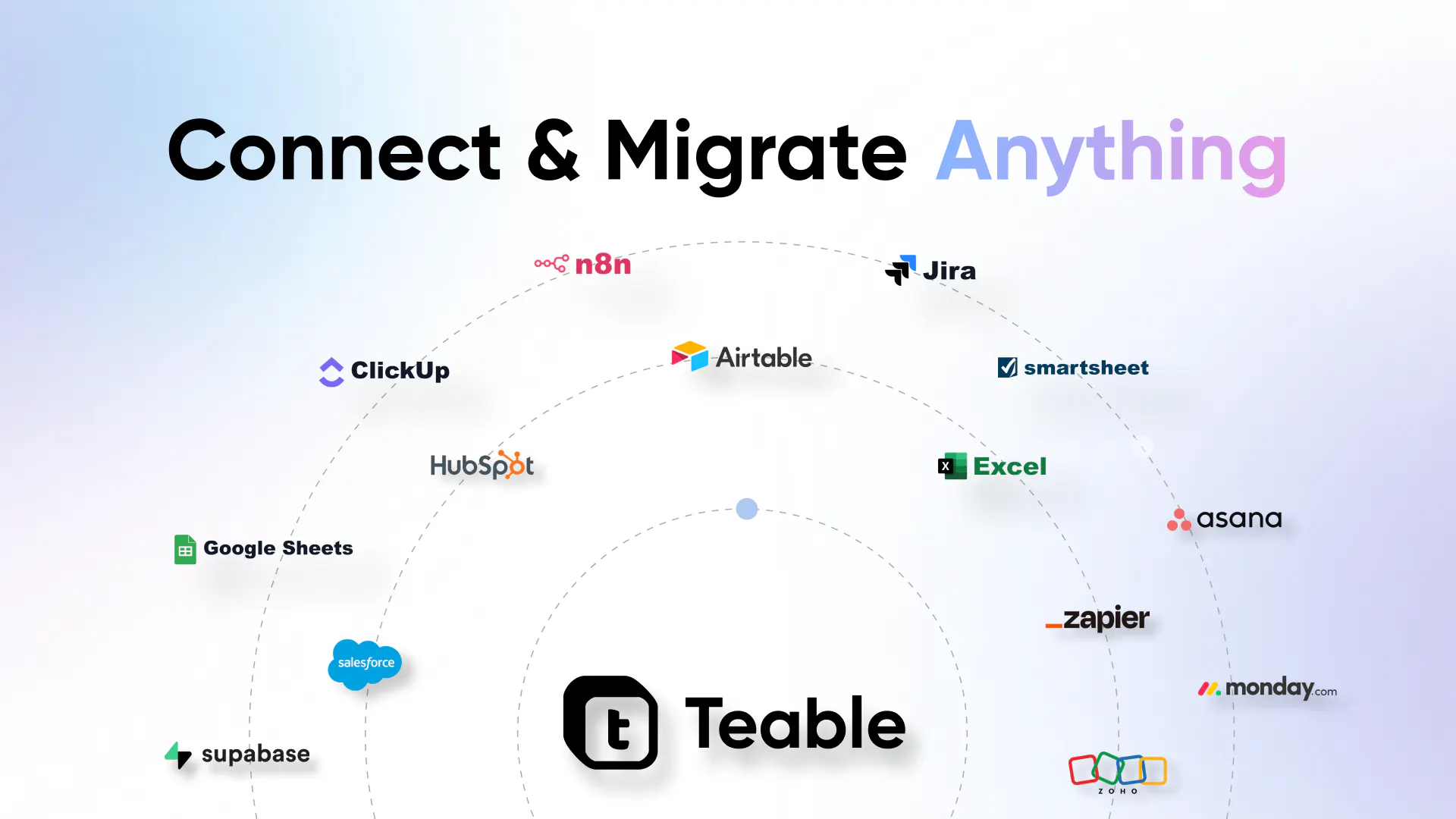
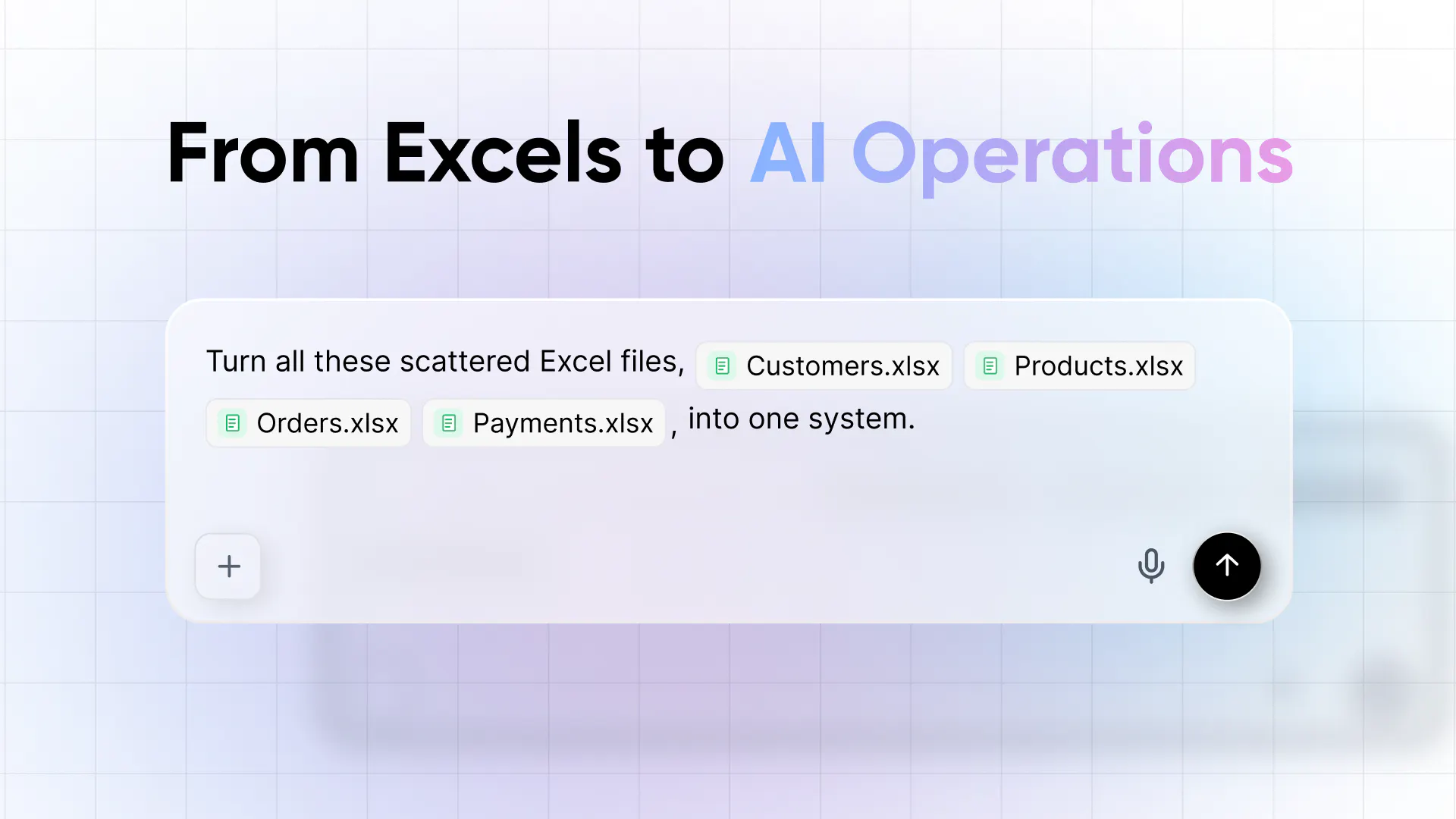
查看原始信息
HOL Guard
HOL Guard is the firewall for AI agents. It sits between agents and your systems, blocking high-risk actions before they happen like deleting production data to exposing secrets. Built by HOL, it’s free, open source, and already has 400K+ downloads.

Hi Product Hunt

I’m Michael Kantor, President of HOL. We’re an open standards consortium for AI agents, with 20+ specifications contributed through LF Decentralized Trust and more than 37M transactions powered by our work.

For the past two years, we’ve been thinking about what happens when billions of autonomous agents are transacting, installing tools, accessing systems, and exchanging information. As we used AI more deeply inside HOL, we saw agents attempt to bypass safeguards, access secrets, and send data they should never have been able to reach.

We originally built HOL Guard to protect our own systems. Once we realized how widespread the problem was, we open-sourced it and started building it for everyone.

HOL Guard uses open standards and hundreds of security heuristics to protect agents from malicious packages, prompt injection, secret exfiltration, and catastrophic actions such as deleting a production database or filesystem. GPT-5.6 was also a valuable partner in building adversarial tests and hardening the product.

We’d love for you to try it, break it, and tell us what we should improve. Thank you for supporting open-source AI security.

6
回复
@kantorcodes Wait, so this can actually help stop AI agents from exposing personal data and accessing things they shouldn't? Wow 😮 This is really interesting. Congrats on the launch!
0
回复

We’re excited about where AI agents are headed but as they become more autonomous, we think developers need better ways to stay in control without sacrificing speed. Our goal with HOL Guard is simple: make it easy to let AI do more while ensuring sensitive actions are reviewed or blocked when they should be.

We’re always building and would genuinely love your feedback. If you’re working with AI agents, what kinds of actions would you want an AI firewall to monitor, pause, or automatically block? We’d love to hear your thoughts!

2
回复

Incredible work, I'll be setting this up in my environment today. My security concerns have been growing as I start relying on autonomous workflows more and more, so this feels like a solid step.

2
回复

@brandon_davenport3 Thanks Brandon! Looking forward to your feedback & thoughts

0
回复

I like that this sits before the agent acts, not after logs are reviewed. The thing I would want to debug quickly is a blocked action: exact tool call, matched rule, risky input/output, and whether it was policy or model uncertainty. Is that visible in the product?

2
回复

@yaroslav_stelmakh Yup! Nothing leaves you device and every action is stored in "evidence" along with great analytics so you can understand where your Agent is making risky tool calls.

0
回复

heuristics cutting both ways is my worry here. a firewall that's too strict on false positives trains developers to just approve everything without reading the prompt, which is worse than not having it at all. do you have real numbers yet on false positive rate at 400k downloads, or is that still mostly theoretical since it just launched

2
回复

@galdayan That’s exactly the failure mode we designed around. A security product that constantly interrupts normal work eventually teaches people to ignore it.

Guard does not treat every unfamiliar action as a block. The default Balanced policy lets known-safe work continue, blocks clear high-confidence threats, and reserves approval for actions that are consequential, changed, or genuinely ambiguous. We also use structured command parsing rather than simple keyword matching, so quoted examples, searches, and dry runs are not treated the same as execution.

We do not yet publish a credible global false-positive percentage. The 400K figure is package downloads, not 400K instrumented runtime decisions, and Guard is local-first by design, so we do not collect everyone’s commands, prompts, files, or approvals to manufacture a dashboard metric. Internally, we've been leveraging HOL Guard for months now and have blocked hundreds of thousands of commands that could be deemed as critical or high risk.

What we do have today is a large regression corpus with paired benign/destructive cases, explicit false-positive release gates, side-effect-free decision inspection, and local receipts that make every interruption explainable. As real team deployments grow, we’ll publish measured results when the sample is meaningful.

1
回复

We've been using HOL standards for quite some time, especially HCS. With this new exciting release we downloaded immediately. This proves to be invaluable tool for any AI agent in your backend/on-chain flow.

1
回复

@kantorcodes congrats on the launch - keen to give this a crack with our team as we push more agents into our workflows. The balanced policy approach looks to be exactly what we need to avoid approval fatigue.

1
回复

@adriantomkins thanks, Adrian!

0
回复
Many of security heuristics is a lot of surface area to keep accurate over time, and heuristic based detection tends to have a specific failure mode, it either misses a genuinely dangerous action that just does not match a known pattern, or it gets so cautious that agents start getting blocked on legitimate work. With something as high stakes as approving or blocking a database delete, which side do you tune toward when a new kind of action does not clearly match anything in the existing heuristic set. Also curious how GPT-5.6 fits into it beyond building adversarial tests during development. Is there any live model reasoning happening at the moment an action gets evaluated, or is the actual runtime blocking purely heuristic and rule based once it ships, with the model only having been used to help design and harden those rules beforehand.
1
回复

@thys_beesman Great questions.

Our view is that high-stakes security decisions should not depend on another model making a probabilistic judgment in real time. You can use AI to generate adversarial cases, find bypasses, and improve coverage, but eventually something has to be the final authority.

In HOL Guard, that authority is local, deterministic policy. The runtime combines structured command parsing, provenance, trust state, severity, confidence, and the user or organization’s chosen security posture. Clear threats can be blocked, trusted actions can proceed, and unclear high-impact actions can require approval instead of forcing Guard to guess.

That is how we balance false positives and false negatives. We are not tuning toward “block everything unfamiliar.” We are tuning toward making consequential actions explicit before they run, while allowing teams to choose how conservative they want Guard to be.

GPT-5.6 is not making the live allow/block decision today. We use models heavily to attack the system during development: generating edge cases, searching for evasions, and challenging assumptions. But once Guard ships, enforcement remains reproducible, inspectable, and explainable.

And because the project is open source, the rules, parsers, tests, and decisions can be challenged and improved in public rather than hidden behind an opaque model response.

1
回复