Product Hunt 每日热榜 2026-08-12

PH热榜 | 2026-08-12

#1
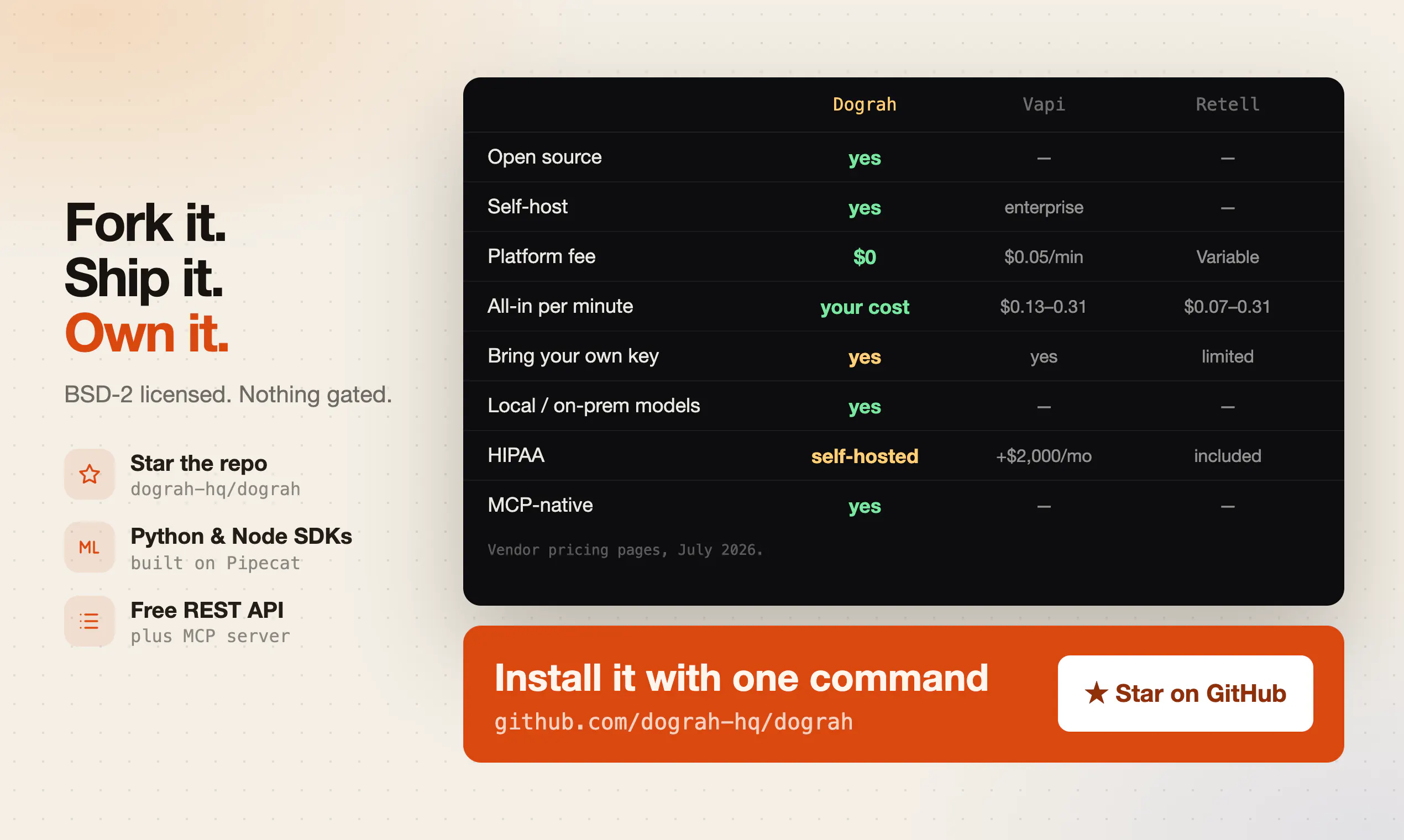
Dograh
The open source VAPI alternative
471
一句话介绍:Dograh是一款完全开源、可自托管的语音AI代理构建平台,通过可视化流程编排器配合自带模型密钥或本地模型,解决企业在电话场景(预约、线索筛选、催收)中受制于闭源平台按分钟收费和数据锁定的痛点。
Open Source Developer Tools GitHub Audio
开源语音AI VAPI替代品 自托管 可视化流程编排 电话代理 语音机器人 MCP集成 本地模型 QA监控 实时语音传输
用户评论摘要:用户高度认可自托管与开源理念,认为成本远低于Vapi/Retell(自带密钥仅1美分/分钟)。主要疑问集中在人工转接的流畅度、语音转语音(S2S)模式在自定义音色和工具调用上的限制、QA指标可定制性及生产环境部署架构建议。社区反馈团队支持响应积极。
AI 锐评

Dograh踩准了当下AI行业中“开源vs闭源”焦虑的鼓点,其口号“别租AI代理”在开发者群体中带有天然的政治正确性。从产品力看,它并非仅靠情怀——多节点对话编排(针对Gemini Realtime这类不支持中途改提示词的模型做断流重连)、动态SIP转接和失败兜底逻辑,确实展示出核心团队在实时通信领域的工程沉淀。471票在PH不算顶尖,但评论区含金量高,提问多聚焦于生产级细节而非“酷炫”,这比高赞但空洞的发布更能说明产品价值。

但必须泼冷水:开源护城河在AI应用层极其脆弱。Dograh本质是将各家语音模型、SIP网关和编排逻辑打包成可部署形态,真正的壁垒(如ASR/TTS模型性能)掌握在Google、OpenAI手中。其宣称的“30+集成”实际上是将上游模型的定价和波动风险转嫁给用户,自托管模式在规模化运维(高并发呼叫、音频存储合规)上会让中小团队疲于奔命。评论中已有人追问500–1000分钟/天的真实基础设施成本,而官方回避了具体数字,这暗示“免费软件”后仍有高昂的维护账单。

更值得警惕的是,团队将“开源”作为主要营销触点,但BSD-2许可下真正活跃的外部代码贡献者寥寥(评论中提及的仍是创始团队亲自下场答疑)。MCP连接Claude Code的卖点更像是一种技术潮流绑定,而非不可替代的集成价值。短期看,Dograh适合有强隐私需求且具备DevOps能力的团队作为POC起点,但若无法在开源生态中培育出类Twilio的插件市场或垂直行业模板库,其“Voice AI的Linux”愿景大概率会被闭源巨头的产品迭代速度碾压。真正的考验在6个月后:当Vapi推出私有化部署,或OpenAI开放实时API的微调能力时,Dograh的差异化还能靠什么维系?

查看原始信息
Dograh
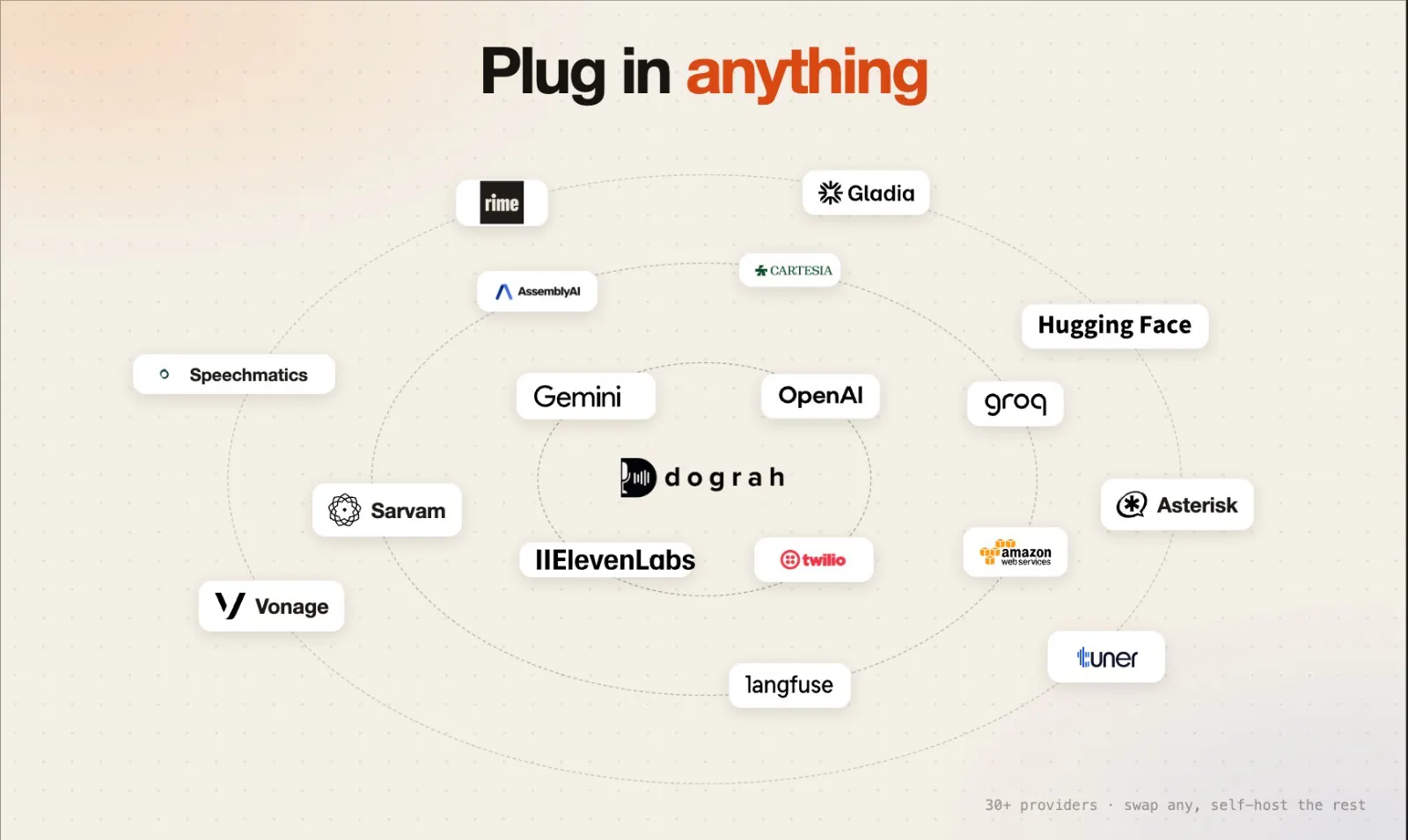
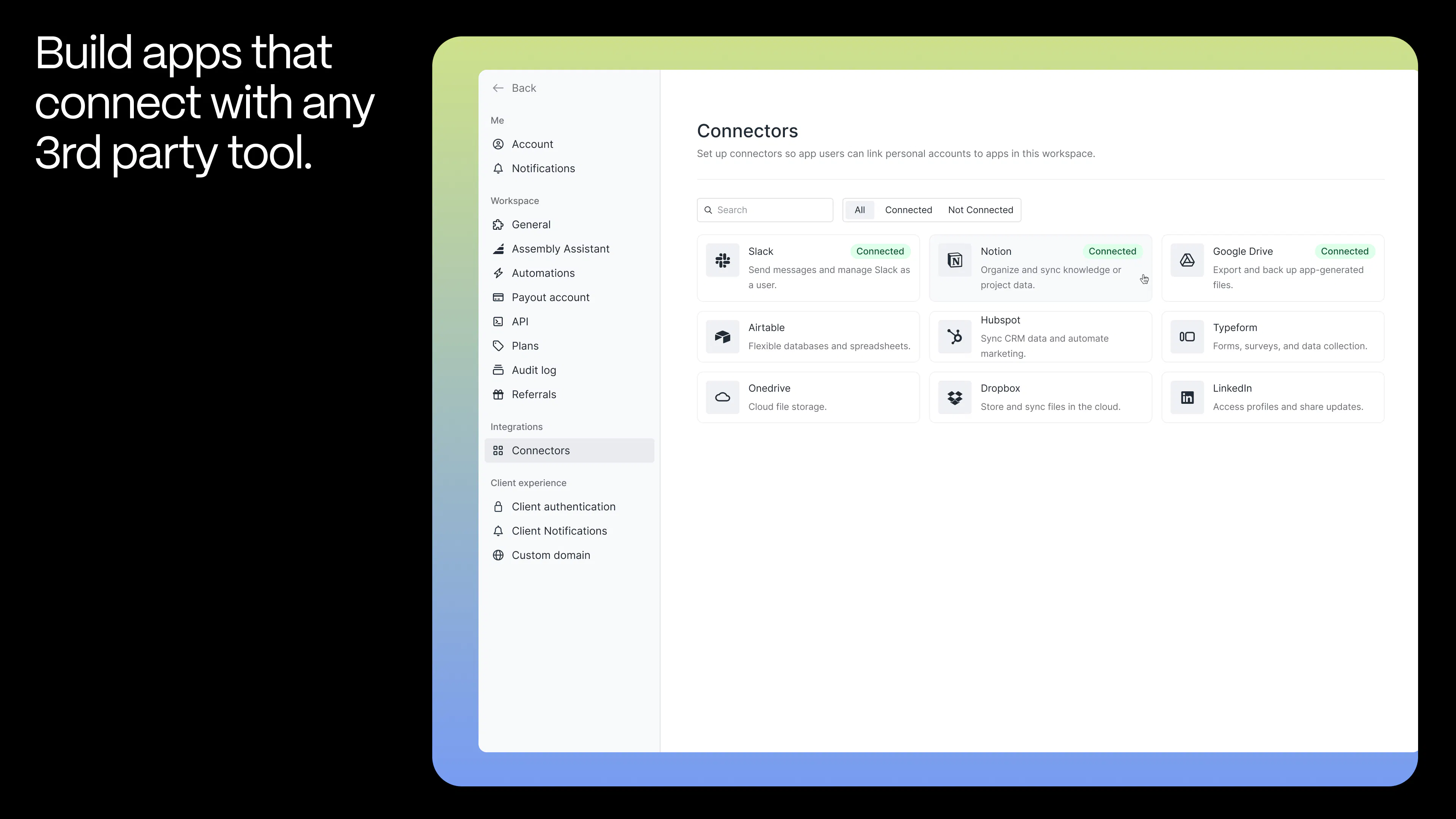
Closed voice platforms make you rent your own agents. Dograh is completely open source- nothing is gated. Visual flow builder, add your model key across 30+ integrations or use local models, telephony, human transfer, and advanced QA & monitoring - all free to self-host in one command. Also connect your claude code with MCP to build voice agents for a use case or call recordings.

Hey Product Hunt, I'm Pritesh, one of the makers of Dograh.

Dograh is an open source platform for building voice AI agents - calling agents that answer calls, book appointments, qualify leads, or run payment reminders over the phone.
Here's the problem we kept hitting. AI is getting locked up. Closed platforms make you rent your own agents on their cloud, at their price. And right now big labs are lobbying to restrict open source AI itself. We run on one belief: no company should own voice AI.
So from day 0 we open sourced every line. BSD-2 license, one command to install, nothing held back, nothing gated. Everything runs on your own server, and it's yours. You build phone agents and also own the whole stack.
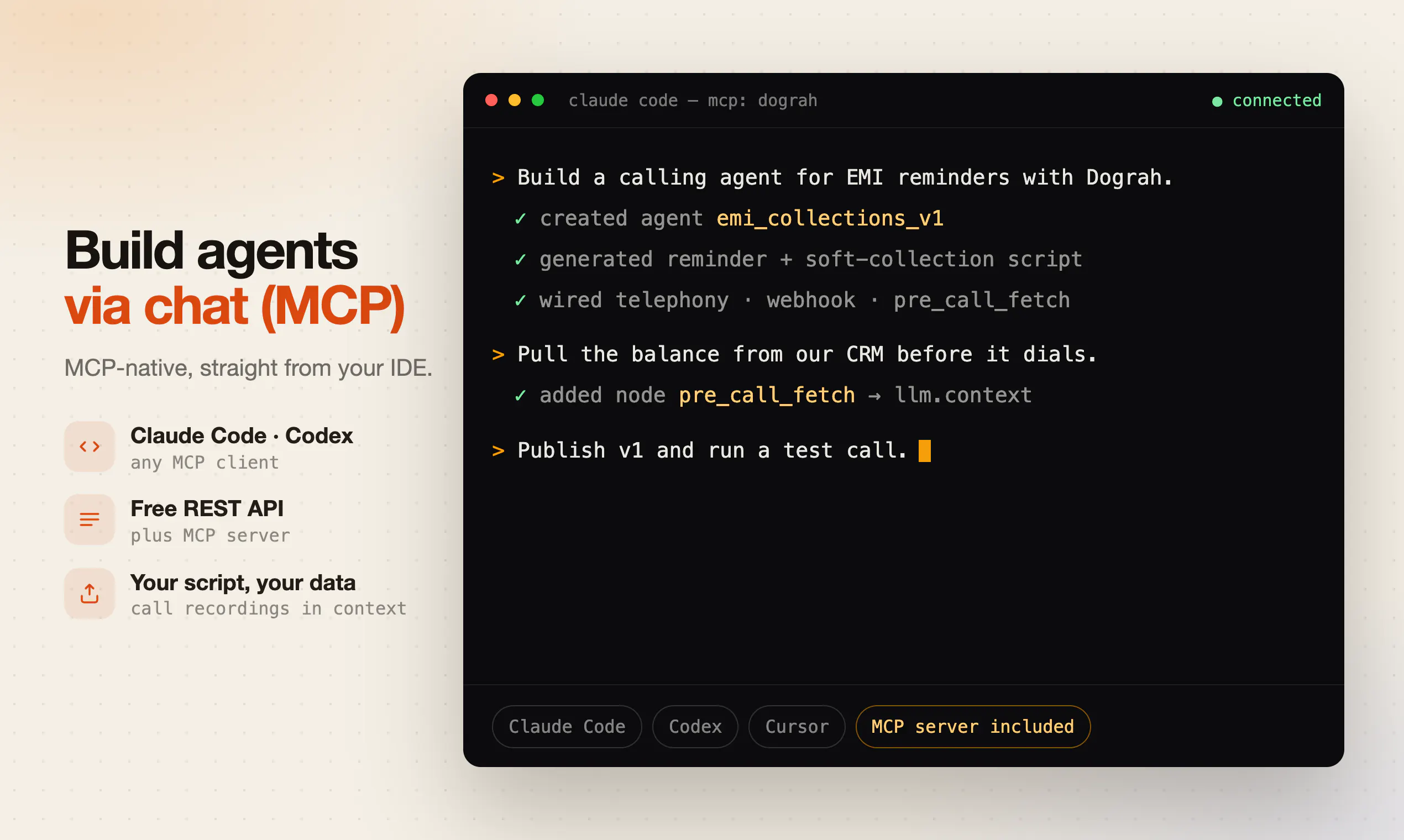
That is the difference. There is no platform to rent here. No per-minute fee, no gated tier. Bring your own keys, or run local models completely offline, even air-gapped. And it's MCP native - connect Claude Code and build a voice agent by chatting with it.
Inside you still get everything the closed platforms sell:

  • Visual flow builder - no glue code

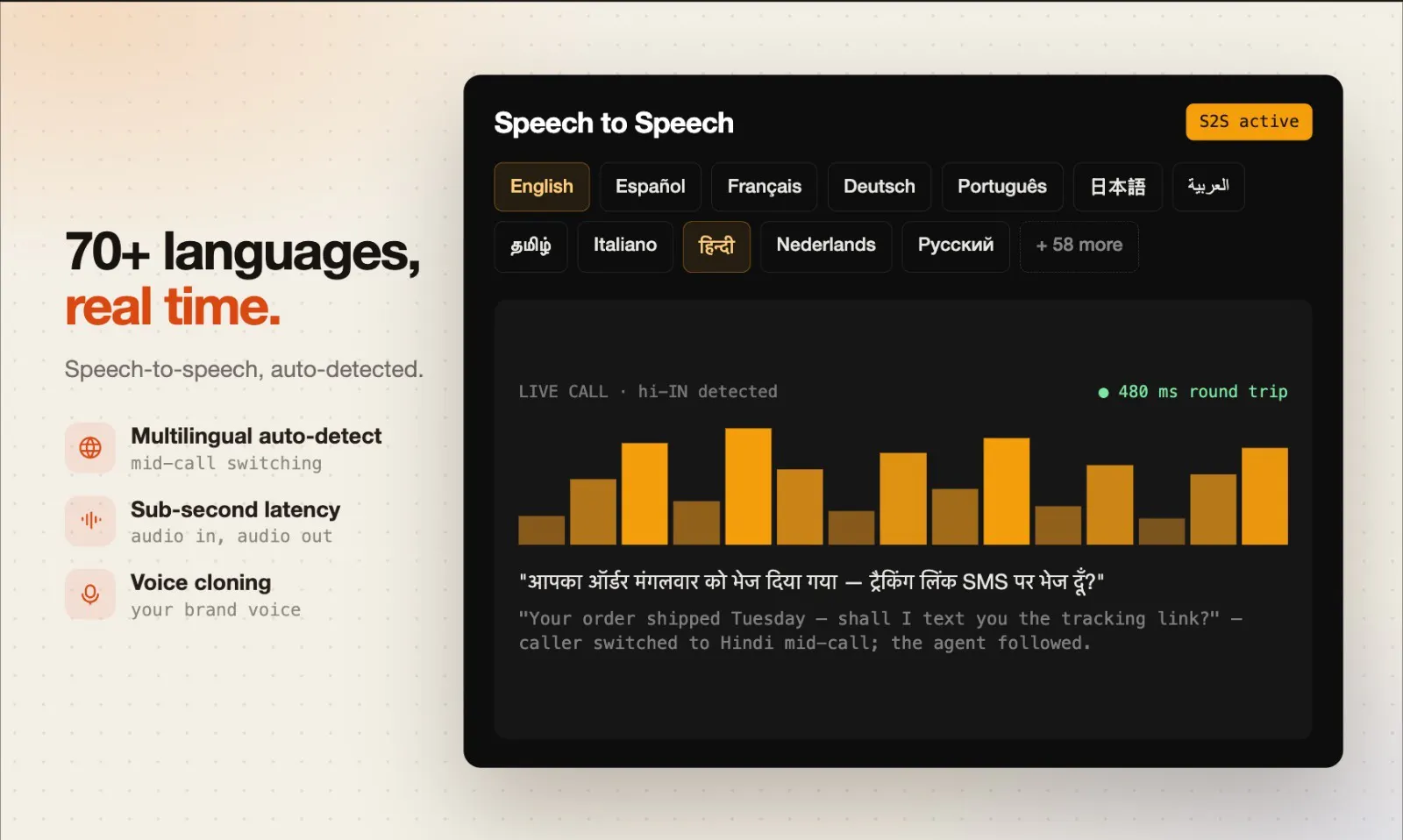
  • Real time speech to speech - 70+ languages with mid-call switching

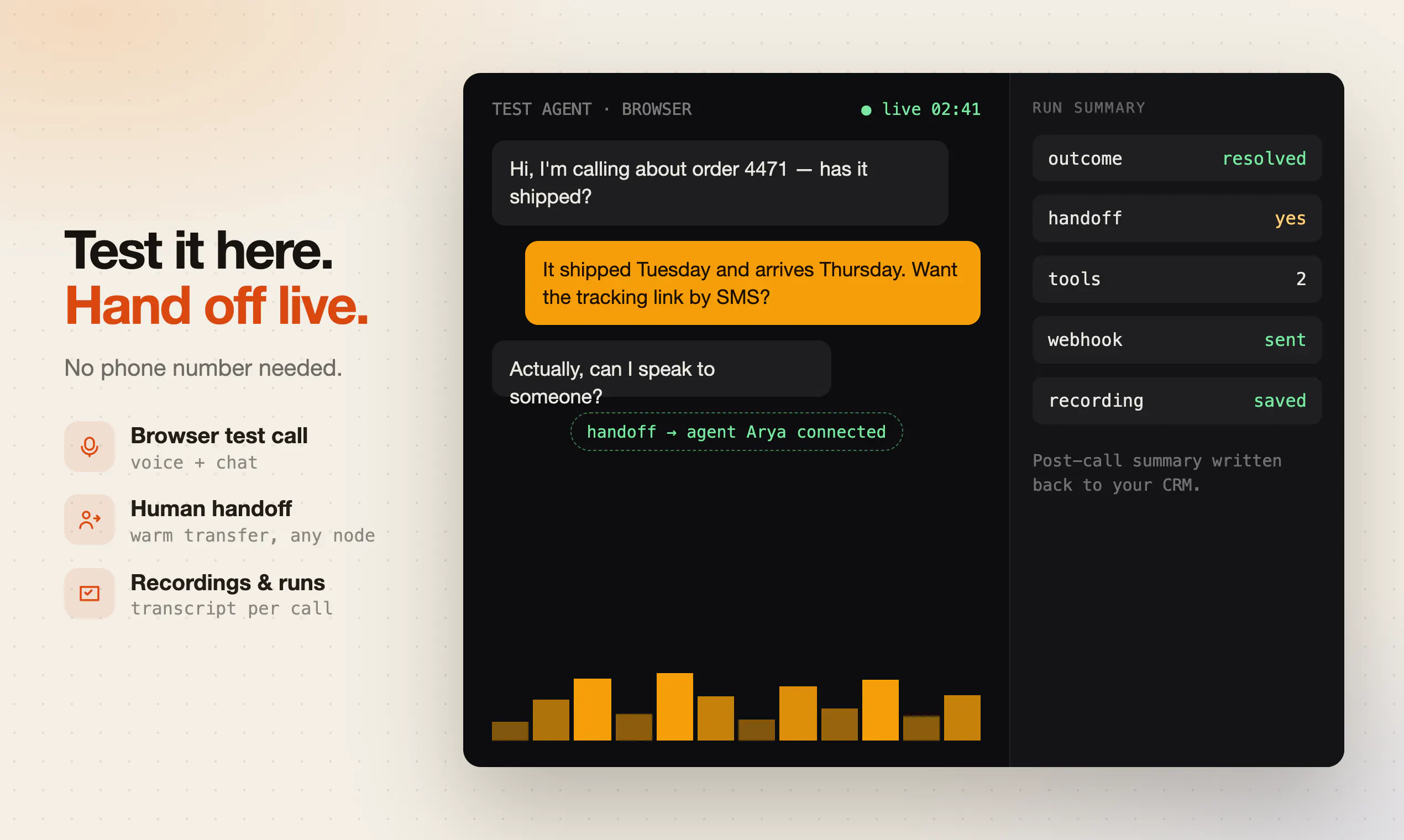
  • Telephony + warm handoff to a human

  • Call recordings with automatic QA

  • Free REST API

Why that matters:

  • The payoff is ownership - your only cost is your model bill

  • Your data never leaves your servers - compliance gets simple

  • No glue code - you ship in hours


It fits developers and agencies building agents for clients or their internal use case, and compliance-heavy teams in healthcare, finance, and collections. Common uses today include appointment booking, lead qualification, support lines, payment reminders.
We are a small team. A star on GitHub or honest feedback here does more for us than you would think.
Install it, break it, tell me what's missing. I'm here all day.
But first, try a Dograh voice agent now.

30
回复

@pritesh_kumar3 Congrats. What’s the most realistic self-host setup you’ve seen work in production; single server, Docker, Kubernetes? And roughly what infra cost should a small agency expect to run 500–1,000 call minutes/day end-to-end on their own stack?

0
回复

@pritesh_kumar3 Congrats on the launch! I can't wait to use it to develop my very own voice bot.

0
回复

How does the human handoff work when an agent reaches a conversation it cannot confidently handle?

15
回复

@nuseir_yassin1 - Thanks for your message.

We have very excellent support for human handoff, where you can declare static destinations or destinations based on the context from the conversation of the agent with the caller. You can define PSTN phone numbers or SIP addresses or ViciDial Ingroups in those destinations where the voice agent can transfer the call based on your matching conditions.

And, of course, have to prompt the LLM to make that transfer call based on certain conditions. If prompted well, the LLM can do it with very high confidence.

1
回复

Hello@nuseir_yassin1 thank you for your message. Adding to Abhishek's reply - the failure path is worth noting too: if the transfer destination can't be resolved (resolver timeout, no match, etc.), it fails gracefully and the agent keeps the conversation pipeline running rather than dropping the call. And for tightening when it hands off, the QA node surfaces signals like repeats, interruptions, and dead air that teams use to refine the confidence logic over time.

1
回复

@nuseir_yassin1 Dograh can hand off to static or dynamically resolved destinations, including phone numbers, SIP addresses, and ViciDial ingroups. The agent dials the destination and waits for an answer before bridging the caller, with configurable transition messages, timeouts, and fallback behavior if the transfer fails.

1
回复

It is exciting to see voice AI move toward open source. As these models scale, how are you approaching the challenge of real-time sentiment analysis and behavioral tracking for agents during live calls, and what metrics do you prioritize to measure conversational quality without compromising user privacy?

7
回复

@lucianb - Thanks, and good question. Sentiment scores are easy to compute but hard to act on mid-call unless we have super robust orchestrator spanning multiple LLMs of different sizes and capabilities (something we are working on).

The signals that actually predict a bad conversation are structural and post call: how often the caller repeats themselves, how often they interrupt, how long the silence runs before they answer (dead air), whether they ask for a human and refuse to talk to the agent. We handle this using a native QA node in workflow builder and also integrate with solutions like Tuner, Noveum. On quality we hold one metric above the others: did the caller get what they called for. Everything else is a proxy for it.

Privacy is where open source does the real work. Self-hosted, the audio never leaves your infrastructure, so there is no third party to trust with it. You keep the derived signals and drop the recording.

8
回复

@lucianb Hey Lucian, thanks for the question. We have an inbuilt QA node that you can run across 100% or a smaller sample of your live calls. The QA node has inbuilt functionality to do sentiment analysis or any custom analysis for your use case.
And since dograh is self hostable you can add a guardrail/mask layer to send PII anonymised data- though this might still need some plumbing and not available out of the box.
Hope this helps :)

9
回复

@lucianb Thanks for the thoughtful question. We focus on practical call outcomes while giving teams control over how their data is processed, stored, and retained.

1
回复

This is a great direction for voice AI!

Do you have better support for multi-step conversations as well?

6
回复

@ankushkun Thank you for your query. We actually have first class support for multi step conversation. When the entire industry was doing one monolithic prompt for voice agent, we and few others (like Bland) were doing natively multi node agents which broke a big monolithic prompt in multi step conversation.

This was specially challenging with models like Gemini Realtime which does not allow updating agent prompt in between conversation, but we figure out some hacks which allows our multi step conversation to work well with them (reconnecting with context playback and compaction).

5
回复

Hi @ankushkun we support multi step conversations extensively.
Infact with Dograh you can build multi-step conversations for real time/speech-to-speech models as well (apart form cascade)

3
回复

@ankushkun Yes, Dograh supports multi-step conversations and customizable workflows for different use cases.

2
回复

At floworks, we tried a few voice agent platforms before landing on Dograh, and the self hosted option made it a no brainer. Feels like it's built by people who actually build voice agents themselves. Excited to see where this goes.

6
回复

@ritesh2503 - Thanks for your appreciation. Yes, we as builders are super passionate about what we are building for the open source ecosystem and community. Our mission is to enable every company in the world to own and operate their voice AI agents securely and efficiently.

3
回复

@ritesh2503 Thanks for the support! Glad the self-hosted approach worked for your team at Floworks. Excited to keep building with feedback from teams using Dograh in production.

3
回复

Thanks Ritesh- we believe in self hosted voice ai and also open weight models. We will keep building for the dev community :)

4
回复

What do you lose when you move to speech to speech?

5
回复

@ankitnayan - Thanks for your comment. Speech to speech are excellent models which offer language switching and lower latency. Many labs are working on Speech to Speech models, like @Google (Gemini Live), @OpenAI (OpenAI Live), @Grok (Grok AI) etc. @Dograh support these and many more.

The only challenge currently is that you cant use custom cloned voice with them, and the tool calling can sometimes be a bit unpredictable. However, we are seeing some very rapid progress in the space and these are bound to improve in short term.

7
回复

@ankitnayan Mostly control. Speech-to-speech is faster and handles language switching well, but you currently give up custom cloned voices and some predictability around tool calls. The gap is closing quickly, though.

4
回复

@ankitnayan While we have seen S2S win on latency and 'humanness'. Having said that tool calling and instruction following is not upto mark with LLM's in cascade approach. However with

@Dograh we ship the ability to break S2S stream accross multiple agents instead of 1 end to end stream and thus give you minute control over your instructions - shorter context and minimal instruciton following - thus enabling premium grade performance with S2S models.
We will be weleasing benchmarks soon . Keep an eye out :)

6
回复
Been using Dograh for a few months now, it’s a really awesome product, and support from the team has been great!
4
回复

@brucem80 This means a lot, genuinely. Thanks for sticking with us these past few months :)

1
回复

@brucem80 Thanks Bruce! Glad to hear Dograh and our support have been useful.

1
回复

@brucem80 - Thanks a lot for your kind words ❤️

You will always find us here trying to evangelise and promote Open Source voice AI adoption. You will always find help on our Slack Community.

0
回复
Awesome launch! The warm handoff to a human feature looks super useful. How seamless is the transition for the caller during a live agent transfer?
4
回复

@hannesh - Thank you for your message.

We have given a lot of thought to how call transfer is configured and works on @Dograh. You can not only set up static destinations but also resolve dynamic destinations based on the call context. The experience is very seamless for the caller. We have the option to provide a transition message - like "Please hold on while I transfer your call to a live agent", and if anything breaks during the transfer, we have a very graceful fallback also which can be controlled by the prompt.

2
回复

@hannesh thanks! from the caller's side it's pretty smooth - they hear hold music while we dial the destination in the background, and you can configure a heads-up message first so it's not abrupt ('connecting you to our billing team now'). importantly, we don't just throw the call over the wall - Dograh actually dials the destination and waits for it to answer before bridging the caller in, so they're never dropped onto a dead or unavailable line. there's also a configurable timeout in case nobody picks up. the one gap today is context isn't automatically passed to the human once connected, but that's very much in our roadmap.

2
回复

@hannesh The transfer is seamless for the caller. Dograh plays hold music while dialing the destination and only bridges the call once someone answers. You can also configure a short transition message, timeout, and fallback behavior.

2
回复

Have heard good reviews about Dograh. Also rooting the founders personally being from IITD.

4
回复

@shantanusewu - Thanks a lot for your support. ❤️

Please do not hesitate to reach out if you need any support in implementing Voice AI for your use cases.

1
回复

Hi @shantanusewu thats such a lovely remark. Would love to connect on other platforms as well . we love IITD :)
Here's lin: https://www.linkedin.com/in/priteshkr/

1
回复

@shantanusewu Thanks for the support! Really appreciate you rooting for Dograh and the founders. ❤️

0
回复

Hey guys, congratulations on the launch! Curious to know how are you guys priced compared to Vapi or Retell.

3
回复

@seomaxtech Thank you for your message.

Our cloud offering is priced at 1 cent per minute of calling if you bring your own keys for models compared to around 5 cents per minute from Vapi and Retell.

If you use Dograh managed models, our model usage is priced at around 7 cents per minute compared to around 8 - 12 cents per minute from Vapi and Retell.

2
回复

@seomaxtech Our cloud offering costs $0.01 per minute with your own model keys, compared with around $0.05 per minute for Vapi and Retell. With Dograh-managed models, it is around $0.07 per minute, compared with roughly $0.08 to $0.12 per minute. And we can go much lower with an increase in volume.

0
回复

@seomaxtech to summarise what the team said - self-host it and it's free forever, or use our cloud at 1¢/min + model usage. Your call on ownership vs. convenience :)

0
回复

The ability to run local models and avoid per-min platform fees is huuuge. But what's best is that the founders are incredibly knowledgeable and always willing to help with setup, best configs or answer any kind of questions. Excited to see where this is going!!

3
回复

@drag0s - Thanks a lot for your kind words ❤️ Wishing you loads of luck with @Zaplingo

1
回复

@drag0s Thanks for the support! Glad the local model support and hands-on help have been useful.

1
回复

@drag0s the founder shoutout is so real, can confirm from the inside :) and it's not just the founders either - our Slack community's got contributors and users constantly trading configuration insights, figuring out the right tool setup for specific use cases, and helping each other debug.

0
回复

Being able to self host the whole thing is a big plus. Congratulations!

3
回复

@henry_habib - Thank you for your comment. Appreciate it. Good luck with @Voquill as well. ❤️

1
回复

Thats core to our philosophy as well@henry_habib 

1
回复

Thanks @henry_habib self hosting and OSS is core to our belief system. And thats how the world should be - accessible and open :)

1
回复

@pritesh_kumar3 Congratulations. And happy product launch.

3
回复

@huisong_li - Thank you so much for your comment. Good luck with @HarnessRouter ❤️

0
回复

Thanks for the support  @huisong_li 

1
回复

thanks @huisong_li for your support :)

1
回复

Product looks amazing. Congratulations to the team!

2
回复

@aj_123 - Thanks a lot for your support.

Wishing you loads of success and luck with @Tough Tongue AI

1
回复

Thanks @aj_123 . lovely to see you rooting for us

1
回复

@aj_123 Thanks for the support! 🙌

1
回复

Congrats on the launch. Can teams customize the QA metrics and scoring rules for different industries or call types?

2
回复

@roopreddy - Thank you so much for your message.

Yes, for sure. We not only provided an inbuilt QA node, where you can customise the QA prompt for different industries, call types, and use cases, but we also integrate and play well with other vendors in the space, like Tuner and Noveum.

You can also expose those QA results in your post-call data sync (webhook nodes) so that your systems immediately get updated with how did the call go and how it can be improved.

Hook that with an MCP, and you have got a self-improving agent. All the best with @Documentation.AI

1
回复

@roopreddy Yes, teams can customize the QA prompts and scoring criteria for different industries, call types, and use cases. Results can also be synced to external systems through post-call webhooks.

1
回复
The ability to bring your own model keys across 30+ integrations makes this feel much more developer-friendly.
2
回复

@abod_rehman Thank you for your message.

We are developers at heart, and we are creating this product for the developer community and business owners who want to own their voice AI stack.

Wishing you loads of luck with @Triforce Todos

1
回复

Thanks @abod_rehman . we are obsessed with dev and oss ecosystem and are all devs ourselves as well

1
回复

@abod_rehman Thanks, Abdul! We wanted developers to have the flexibility to choose their own models without being locked into one provider.

1
回复
Great product!
2
回复

@devansh_pawan1 - Thank you so much for your support. You guys have done excellent work with @Smallest.ai and we are very happy and proud partners.

1
回复

@devansh_pawan1 Thanks for the support! Great to be partnering with @Smallest.ai.

1
回复

@pritesh_kumar3 This looks very promising. Will users be able to build agents without writing any code

2
回复

@dipanshu_kushwaha5 Thanks for your message.

Yes. 100%. Dograh is to voice agents what @n8n is to workflow automation. You can either decide to visually build voice agent using Dograh UI or you can use MCP tools offered by Dograh (cloud or self hosted) to talk to your coding agents to build an agent for you. And all of these play really well with various telephony providers so you can go to production with least friction.

1
回复

@dipanshu_kushwaha Yes, you can build voice agents visually in Dograh without writing code. You can also use Dograh’s MCP tools with coding agents if you prefer.

1
回复

@dipanshu_kushwaha5 To add one more layer - it's no-code even after you build. There's a Test Chat mode where you can edit or replay any turn in a past conversation and Dograh regenerates the agent's replies and node transitions from that point, so you can debug and refine logic without touching code. Makes it easy for non-technical folks (support/ops teams) to actually own the agent long-term, not just the initial build.

0
回复

Congratulations on the launch! 🎉

If Dograh is fully open source and self-hostable, what’s the best way for an agency or developer to monetize voice agents they build for customers? Can they white-label the solution and charge their own customers?

2
回复

@nihalkumar_dwivedi Yes, agencies and developers can white-label Dograh, deploy it for customers, and charge under their own pricing model.

0
回复

@nihalkumar_dwivedi - Thank you for your message.

Yes, @Dograh comes with a very permissive licence that allows you to self host and white-label the solution and use it for commercial purposes.

You can also use our hosted platform as a headless API provider if you have smaller volume to start with and then move on to self host on your own infrastructure as the volume grows.

0
回复

Congratulations on the launch. Operationally, what’s the difference between scaling inbound versus outbound?

2
回复

@bobaikato - Thank you for your comment.

Inbound volume needs to scale more dynamically and is not in operator's control while outbound volume can be controlled by the operator.

Example: If there is a big event in town, a car dealership might get many more calls than they usually do on a normal days.

So, when it comes to scaling, the inbound needs to be more elastic and responsive, while the scaling requirements for outbound can be preplanned and provisioned.

0
回复

Thats an excellent question @bobaikato 
Its mostly around agent building.
In general more receptive about AI agents in inbound calls( e.g. Customer support etc) rather than outbound calls (e.g. Insurance reminder etc)
In outbound we have seen that obsession around getting the first 15 seconds right works best. While in inbound scoping and being abl to handle variety of queries and handoff ecomes critical.

0
回复

@bobaikato Inbound requires elastic capacity because call volume can spike unexpectedly. Outbound is easier to forecast and provision since the operator controls the call volume.

0
回复

Can I get free credits ?

2
回复

@aditi_gupta38 - Thank you for your comment.

When you sign up on Dograh Cloud or setup a Dograh stack in your self deployed infrastructure, you get free credits to get started and build your voice agents.

1
回复

Hi @aditi_gupta38 You can signup at app.dograh.com . We set you up with free credits- both for hte platform as well as AI models.

1
回复

@aditi_gupta38 Yes, you’ll receive free credits when you sign up for Dograh Cloud

0
回复

This is really nice. Do we need to provide custom data for training or is it ready from the go?

2
回复

@chilarai - We ship with an MCP server that can help you build an agent on Dograh. While we dont expect you to bring in earlier conversation recording or custom data, if you have them, the coding agent (using Dograh's MCP) can extract signals and context from there and be able to create an agent which works better for your use case.

You can always find more help on our Slack community.

2
回复

@chilarai its ready from the go - you can build and test any voice agent for your use ccase - within 90 seconds (90sec is our SLA).
Give it a spin here: app.dograh.com

2
回复

@chilarai It’s ready to use out of the box, so no custom training data is required. You can still connect your own data and customize the agent for your use case.

1
回复

🚀 MID-DAY UPDATE: Big thanks to @nuseir_yassin1

We’re having an incredible launch day, and we want to give a massive shoutout to Nuseir Yassin (Nas Daily) for stopping by our thread with some sharp questions on voice orchestration!

For anyone following along or asking similar questions about building production-ready AI voice agents with Dograh:
Seamless Human Handoff: Native escalation and live-agent takeover protocols so your voice agents fall back safely whenever human intervention is needed.

Bring any Models & Telephony: Easily swap between underlying ai models and telephony providers without changing your stack.

Developer-First & Open Source: Built by devs, ex CTO's , YC alum - we live and breathe technology and open source

Drop any technical questions below and we’ll answer them live! ⚡

1
回复

Congrats, team! Long-awaited launch! Could you add more built-in observability around latency, token usage, model performance, and call quality?

1
回复

@kate_ramakaieva - Thank you for your message.

Yes, observability and automatic evals creation is something that's on top of our head. We do integrate our basic observability using OTEL exporters on Langfuse, where you can already create data sets for your own use cases.

We are also trying to add these features natively on Dograh and MCP so that observability around latency, token uses, and model performance becomes a first-class citizen of the platform on both Cloud and your self-hosted environments.

Wishing you all the best with @FuseBase

1
回复

@kate_ramakaieva Thanks for the feedback. We’re working toward native observability for latency, token usage, model performance, and call quality across both cloud and self-hosted deployments.

1
回复

Open source voice agents with this much flexibility is 🔥 The fact that you can self-host, use local models, and connect Claude Code via MCP makes this especially interesting. Congrats on the launch! 🚀

1
回复

@isroiljon - Thank you so much for your kind words.

We have given a lot of thought to creating the product and making it easy for developers and business owners alike to create and manage their voice agents. We are always hungry for more product feedback on how we can improve it and make it easier.

Wishing you all the best with @Premation

1
回复

@isroiljon Appreciate you checking it out! Would love to hear what you build with Dograh.

1
回复

thanks @isroiljon . do try our MCP's - we try to give a blowout experience to devs

0
回复

As a CTO/Solution Architect, I checked how Dograh delivered the outcome and am very happy with them.

Best of luck.

0
回复

@kasaei - Thank you so much for your kind words. We are always hungry for feedback. All the very best with @Api Hunt

0
回复

How is the latency handled for cascaded systems- for the TTFB - end to end (user stops and then heard the first chunk audio) from lets say one of the many api calls during a 10 turn conversion- 30 api calls to each endpoint - stt, llm , tts - if one of the api calls fails lets say turn 5, sst failed ( null or later then 500 ms response), how your framework is handling 1. Fallback model 2. Retry with same model ? Including edge cases for streaming response error for all the three nodes ( stt, llm , tts )

0
回复

@kumar_gautam Thank you for your message.

These are some very relevant questions. We connect over Websocket for TTS and STT, so any failure over websocket connection is automatically retried. For LLMs, we have fallbacks in place, so that if our primary LLM takes longer to respond or fails to respond, there are fallback LLMs in place.

I welcome you to try out @Dograh

0
回复

@pritesh_kumar3 @sandeep_vemu @a6kme1 love the mission behind creating wildly applicable open source offerings. Maybe its an odd question but I am curious - what is the pathway toward revenue generation - is the goal to primarily capture some big fish on the enterprise side? Anyways - killer launch - big fan of what you're doing - following the product / following along!

0
回复

@dzaitzow - Thank you so much for the kind words.

We strongly believe that once Dograh is into consideration of every company in the world for their voice AI use case, revenue will be an organic side effect of that. The primary focus right now is to be able to create as much value as possible for our early believers and customers to cement our place in this industry and market.

Enterprise tickets are of course something thats super welcome and helps us bring the revenue numbers up, and some of very large enterprises (Bn $$+) have told us that they are self hosting Dograh for their use case.

0
回复

Let's goo!

0
回复

@yahia_bakour3 - Thank you so much for your support.

Wishing you loads of luck with @Context.dev

0
回复

Congratulations on the launch @sabiha_khan4 ! Curious to know which major sectors you’re seeing initial traction in. Also, are there any limitations around regional languages or specific geographies?

0
回复

@rahul_aluri - Thank you for your message.

We are seeing good traction in Legal Intakes (inbound and outbound), Car Rentals (inbound), Restaurant Booking (inbound) and Medical Insurance (outbound) sectors.

The limitations are mostly around declaring about robo call for automated calls. Supporting regional languages are more of a capability concern and using the right set of models behind the orchestrator.

All the very best with @Spur.fit

0
回复
#2
Grok Bot
AI teammates that you can give real work to
416
一句话介绍:Grok Bot 是让 AI 队友替你干活的云端平台,它能登录你的各类工具,像真人一样操作并交出完整工作成果,只在需要拍板时才来找你,解决的是“流程性工作占用核心人力”的效率痛点。
Productivity Task Management Artificial Intelligence
AI代理 自动化工作流 云端电脑 多智能体协作 数字员工 企业效率工具 AI助手 任务自动化 无头浏览器 团队协作
用户评论摘要:用户主要关注:与OpenAI Operator及PPLX Computer的差异点;并行任务处理机制;敏感操作(登录、验证码)的安全与摩擦;定价模式是否应转向按成果付费;团队级控制面板与共享Bots的规划。官方回应称支持真并行、敏感步骤会交还用户手动完成,并确认未来将发力团队共享与控制。
AI 锐评

Grok Bot本质上不是又一个聊天机器人,而是对“软件操作权”的重新分配。它真正戳中的痛点是:SaaS越用越多,但每个工具的点击、填写、切换构成了巨大的“隐性税”。让AI直接“住”在云端电脑里操作真实UI,比API对接更野心勃勃——这意味着它不依赖厂商开放接口,理论上能操纵任何网页工具,这是其最具想象力的护城河。

但光鲜背后有两大硬伤。其一是信任与控制的模糊地带:宣称“只在需要审批时回来”,但这个“需要”的阈值由谁定义?如果Bot自作主张完成了超出预期的操作(比如误发邮件或错误调价),责任归属和审计追踪将非常棘手。其二是登录与验证的“冷启动”问题,尽管回复轻描淡写,但企业级应用中,大量第三方工具的风控策略(如新设备指纹、IP信誉)会持续制造摩擦,这直接限制了规模化扩张的速度。

此外,定价模型仍停留在“席位制”是典型的旧思维。当AI能24小时并行干活时,按人头收费根本无法匹配价值——正如评论所言,按“完成的工作流”或“节省的人力时”计费才更具说服力。至于与PPLX Computer和Operator的差异,目前看主要胜在“持久化云端机器”和“多Bot群聊协作”,但这并不构成长期壁垒,大厂随时可以跟进。

Grok Bot踩准了方向,但尚未证明自己能在安全、成本与复杂度的三重压力下,把“AI同事”从玩具变成企业刚需。真正的考验不是它能干多少活,而是企业敢不敢让它独立负责一条业务线。至少现在,它更像一个高效的“高级实习生”,离“正式员工”还有一段信任距离。

查看原始信息
Grok Bot
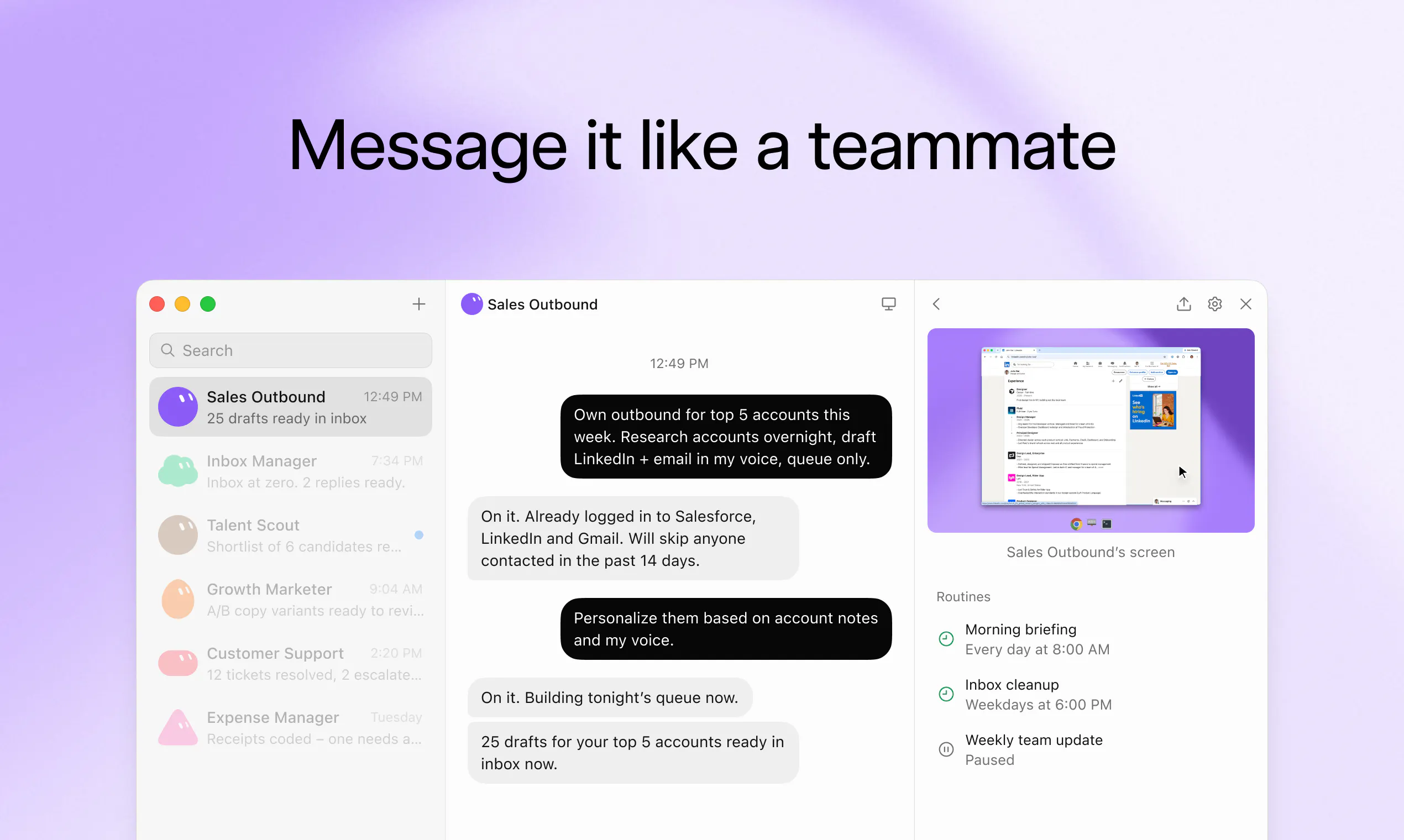
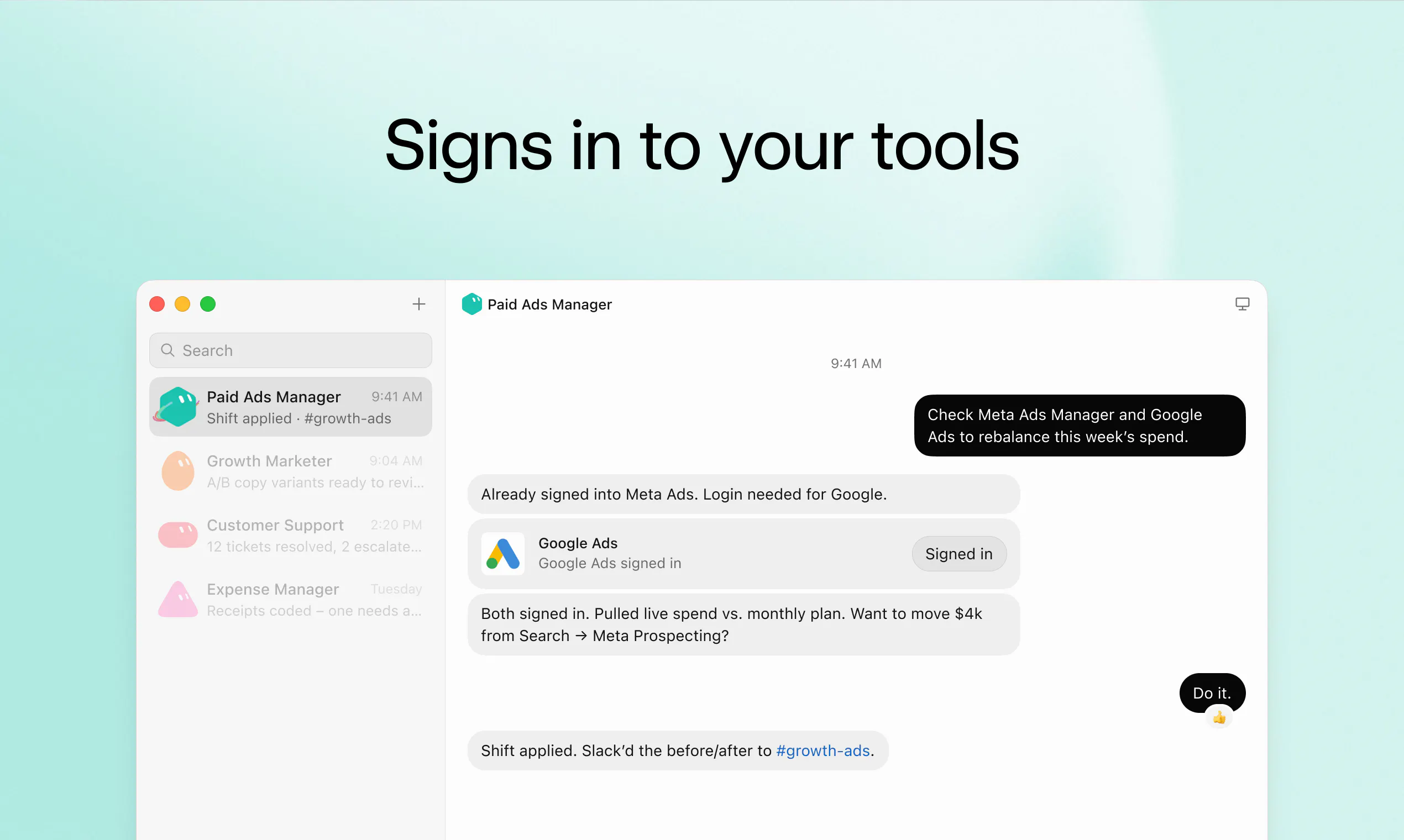
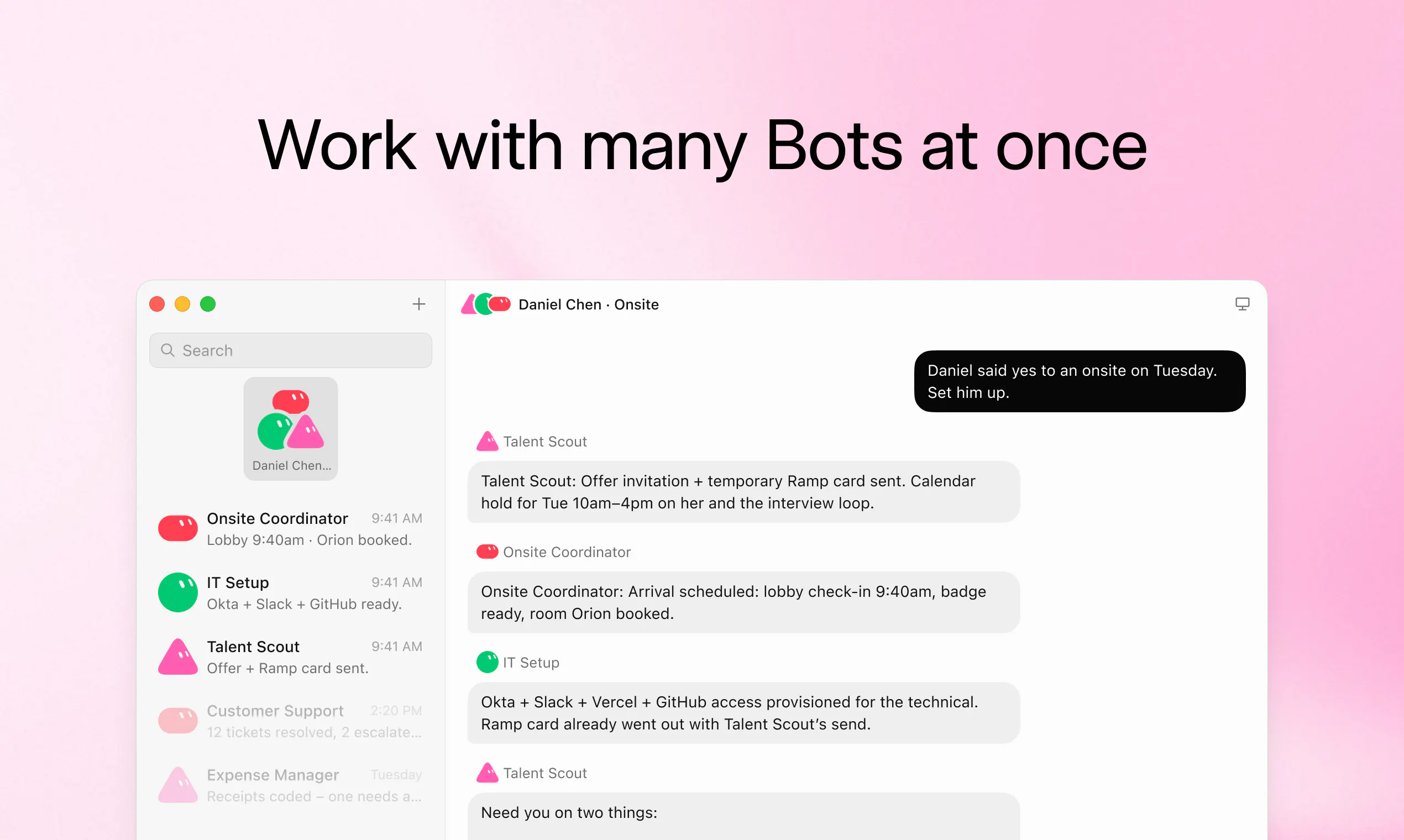
Introducing Grok Bot: AI teammates you can give real work to. Bots sign into your tools, use them like you do, and come back with finished work. Message them like a teammate. They keep context, multitask, and learn your working style on their own cloud computer. Ask Bots to run outbound overnight, code expenses from Gmail, schedule a recruiting onsite, rebalance paid ads, or ship a bug pack. They only come back when something needs your approval.
Thank you PH community! We're very excited to share Grok Bot with you all. Our team would love to hear any feedback or questions you have for us. We'll be around throughout the day!
11
回复

@benln The website you linked goes to a twitter post? Im not logged into twitter so i cant see it. I found this website tho. https://x.ai/bot

2
回复

@benln 🤌

0
回复

Big launch from Cursor.

@benln what's the biggest change/surprise building Grok Bot since you all started?

4
回复

@rrhoover I was surprised at how fast this spread internally. I don't think I've ever seen a product catch on so fast across so many different teams/use cases.

4
回复

This is so awesome. I've been playing with it since yesterday, and it has already become my favorite tech of the year.

2
回复
Thanks for sharing @benln .. good wishes for Grok Team for its success.. do you know how is it different from Grok Automations by any chance.. thanks..
1
回复

Nice launch! Wondering about the multitasking part: if I hand it four things at once, does it queue them or genuinely run them in parallel?

1
回复

@alina_petrova3 Runs in parallel, but depends on how you prompt them! If you give a one Bot four tasks in a row it will keep context and work through them in sequence (but can spin up sub-agents or call another Bot to parallelize work if prompted to do so).

For parallelizing work without additional prompt context we recommend having a "chief of staff" Bot (or putting a few Bots in a group chat), and they will divide and conquer tasks and parallelize work as a default.

0
回复
If someone is already experimenting with OpenAI Operator or Claude’s computer-use experiences, what are the 2–3 concrete things Grok Bot does better today (e.g., parallel bots, routines learned by demonstration, long-running work while your laptop is closed), and where are you intentionally not competing yet?
1
回复

The product question feels solved faster than the pricing question. Once a bot actually owns work, I’d want cost per completed workflow + value of the human time replaced. Seat pricing feels very 2024.

0
回复

'They only come back when something needs your approval' — who decides what that threshold is? The bot or you? That's the whole trust question. Congrats on the launch!

0
回复

It feels like PPLX Computer. But with the extra "bots can also collaborate between them" aspect bolted on and the fact that its on a virtual computer (Unlike PPLX computer which requires a dedicated macbook or macmini).

Question. This is a single player platform today. Do you think it will open up for a more team based control plane in the future?

Another question. Since its a virtual computer. that means logins etc will need to be piped in. There will be alots of unkown IP logging into XYZ etc. And solve this captch because new IP walls. Any insight here? Whats the exeperience and friction level?

thanks!

0
回复

@conduit_design A bit different from PX Computer, each Grok Bot account gets a single persistent cloud machine (browser, files, terminal, live logins) that their Bots share, and Bots can coordinate in threads / group chats independently so you’re not the management layer between specialists!

Team-based control plane is what we're interested in in the future. This may start with "shared Bots" and starter packs, and then move towards fuller shared controls. You can join an enterprise waitlist to get early access to what this looks like :): https://cursor.com/contact-sales?product=grok-bot

2
回复

@conduit_design On logins, there s user choice on what to use with each tool. In general, we:

  1. Prefer high quality connectors/MCP where they exist

  2. Can also have Bots use the real UI on the cloud computer

Login, 2FA, captcha, and payment credentials and hands the computer back to you to complete sensitive steps, and then sessions persist after that.

TLDR; session one can feel a bit like a "new device” (captchas, email codes, “is this you?”). After the first sign-in, friction drops because the session sticks on that machine. We've been running this internally and with a beta program of hundreds of testers for the past several weeks and haven't run any issues on sessions sticking. Overall it's been really fun to work with!

1
回复
Can this be used to amplify a post reach on X?
0
回复

@nrique You could create an agent to help brainstorm post ideas, track engagement, and iterate on new ideas over time.

0
回复
#3
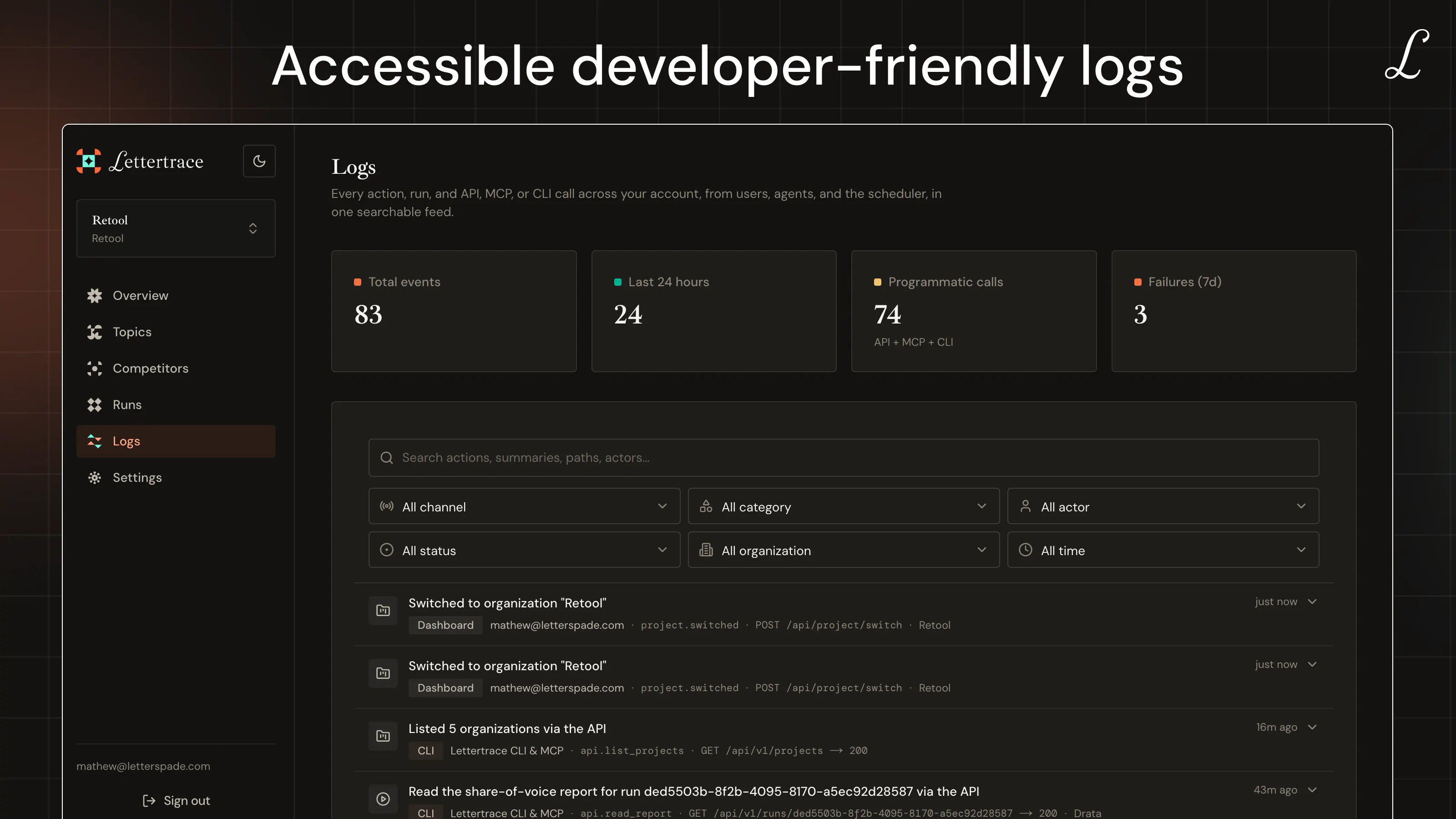
Lettertrace
Track your AI visibility for free (using your own API keys!)
356
一句话介绍:Lettertrace是一款开源的AI搜索可见性追踪工具,用户自带API密钥即可免费监测品牌在Claude、ChatGPT、Gemini等大模型回答中的提及率、声量占比与情感倾向,打破传统AEO/GEO工具高价订阅的壁垒。
Open Source Analytics Marketing GitHub
AI搜索优化 GEO监测 开源工具 品牌可见性 BYOK私有化 大模型提及追踪 开发者工具 CLI命令行 声量分析 免费SaaS
用户评论摘要:用户高度认可开源与BYOK模式,认为其终结了高额订阅痛点;建议新增Grok、Meta AI及欧洲模型如Mistral;询问CLI是否支持定时任务及Docker一键部署;反馈历史数据趋势存储可用;部分用户质疑与付费工具(SEMrush/Profound)在数据准确性上的差异,并关注提示词生成的真实感。
AI 锐评

Lettertrace精准切中了AEO/GEO工具市场的“价格诈欺”软肋——用一次性的CLI脚本+用户自费模型调用,将单次监测成本从$250/月打至$3/次,本质上是把“数据燃料费”与“工具服务费”解耦,倒逼行业回归底层成本定价。这一招“降维打击”确实狠,尤其是以MIT协议全开源+无付费层,直接堵死竞品跟随者复刻商业模式的路径。但其真正的价值不在于“便宜”,而在于将“AI搜索可见性”这一模糊概念工程化:用户可自定义问题变体,对答案进行结构化抽取,并输出共享声量(SOV)与情感指标,这相当于给了市场一套可验证、可复现的测量标尺——尽管其提示词生成质量与情感判断准确性尚未经过大规模基准测试,这恰恰是后续用户留存的关键。潜在隐忧在于:BYOK模式意味着数据出向流量成本与模型选择强绑定,企业级客户若要求跨模型计费聚合或持续观测,仍需自行搭建调度框架;且目前无Docker化部署和调度集成,说明产品仍处于“早期极客验证”阶段,尚未触及营销团队的非技术用户。它在Product Hunt上的热烈反响,更像是对“高贵的SaaS定价”的一次集体嘲讽,而非对其技术壁垒的确认。若Lettertrace能持续开源迭代,提供标准化的定时任务、可视化面板及可信的基准测试报告,它极可能成为GEO赛道事实上的“观察者协议”。反之,若止步于尝鲜玩具,被收购或抄袭只是时间问题。

查看原始信息
Lettertrace
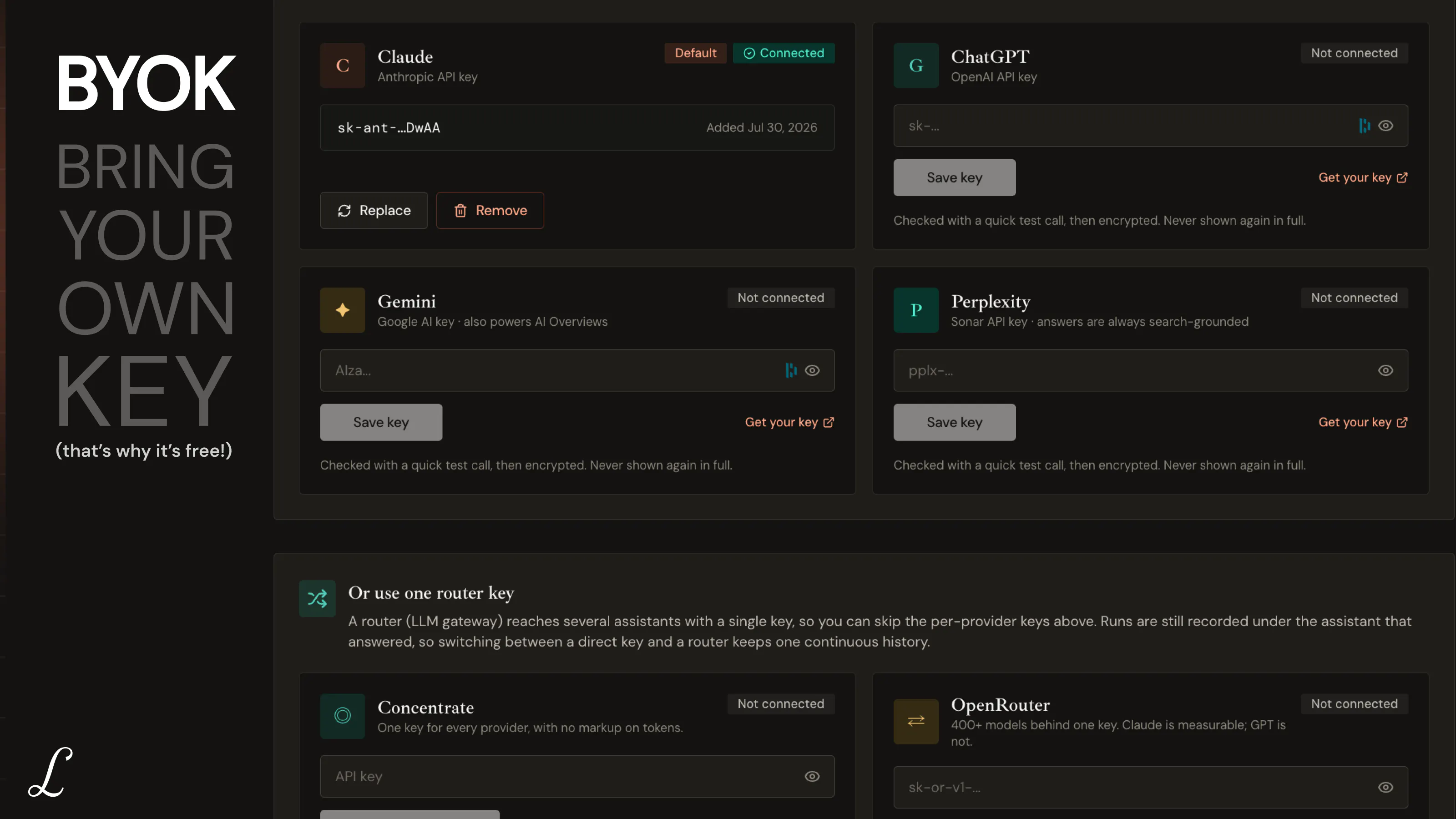
Lettertrace measures how often Claude, ChatGPT, and Gemini mention your company. But there's a catch: it's free, developer-first, bring-your-own-key, and open source.

Hey Product Hunt!

Mathew here. I'm the founder of The Letter Company.

Today, we're debuting one of my favorite things that we've ever built. You've likely heard of AEO. Or GEO. Or AI Search. It's a popular space rife with tools. But there's been a big problem: it's pay-to-play. Even to find out how you're doing on AI Search, you need to fork over something crazy like $250/mo.

And I beg.... for what? AI search is effectively measured by a crafty cron job that orchestrates a bunch of model provider calls.

No more $250/mo fees. Now, it's free. Lettertrace is a BYOK telemetry tool for measuring how you're doing on AI search. It's open source. MIT license. Free even on our hosted version. There are no paid tiers. None. Nada. You'll never put down a credit card. We're moving beyond that. It's time we get telemetry on our GEO, just like we had on our SEO, without having to pay for it.

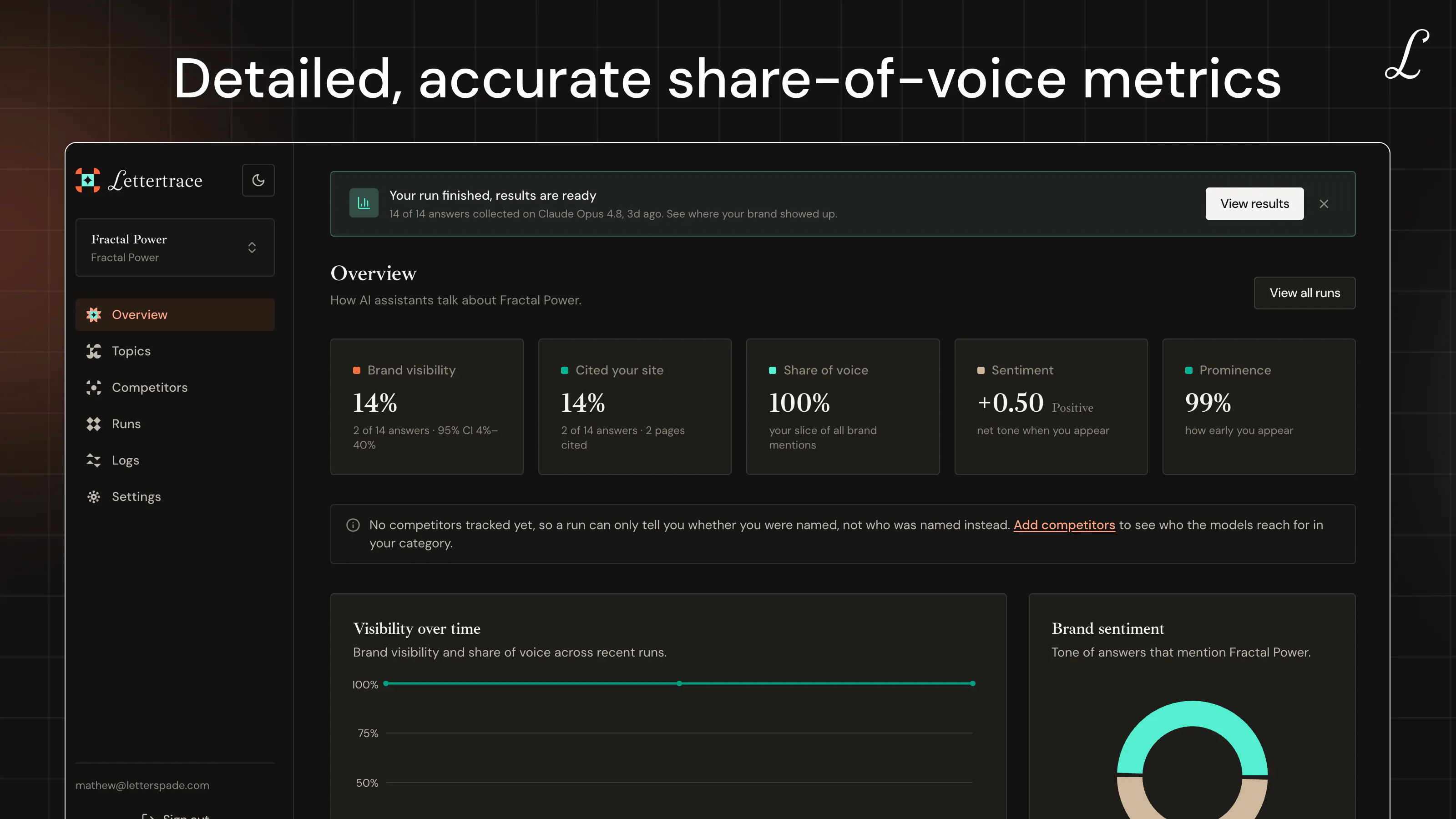
Lettertrace is super easy to use. Like SO easy. Why? Cause it's got an amazing CLI. Just install it, give Claude Code or Codex access, and your coding agent will go to town. It'll add the topics your buyers actually ask about ("best CRM for startups"). It'll generate realistic prompt variations and run them against Claude, ChatGPT, Gemini, and other major LLMs. It'll track visibility, share of voice, prominence, and sentiment.

npm install lettertrace. claude code. prompt. That's it. Or, if you're non-technical, sign-up traditionally.

And it's actually open source. Not open core, none of those gimmicks. A clean MIT license. Bring your own key. You pay the model providers directly, no markup on top. You'll spend ... maybe $3? If you're just paying to measure AI search, you're getting ripped off and we're putting an end to that.

Three things I'd genuinely like feedback on. First, which answer engines matter enough to add next. Second, whether the generated prompt variations read like questions real people ask, because that's the piece I'm least sure about. Third, did the video effectively explain our purpose as a company?

Code: github.com/letterstory/lettertrace

12
回复
@pregasen Congratulations on your launch!! All the best!!
1
回复

@pregasen Outstanding launch, excited to see Lettertrace quickly become the go-to standard for measuring brand visibility across LLMs, qq is there support for scheduled cron triggers built into the CLI, or is it intended to be hooked into existing GitHub Actions / CI pipelines?

1
回复

@pregasen Congrats on the launch Mathew. Great vid....lead with top 5 hopefully. Good on you for open sourcing.

1
回复

How accurate the visibility and the sentiment tracking is compared with the paid tools SEMrush, Profound etc?

2
回复

Ooh, love love love that this is dev-first and oss! Some insight on what you asked - "which answer engines matter enough to add next" - you've hit the main ones we track at Progress, but Grok could be good and for certain niches also Meta AI

2
回复

@denitsapenchevavaltchanova Awesome Grok and Meta AI is on next week's roadmap. We'll add!!

1
回复

Congrats! Tracking how you show up inside LLM chats is quickly becoming as important as ranking on Google was, and most people have zero visibility into that. Respect for making it open source.

2
回复

@mateuszkonik appreciate it :)

0
回复

Looks good! Congratulations team

2
回复

@hamza_afzal_butt Really appreciate the support 🙌

0
回复

@hamza_afzal_butt thank you!

0
回复

I really like the idea of making AI search visibility more accessible, especially with the open-source and BYOK approach.

The fact that there are no paid tiers or extra markup is a refreshing change, and the CLI sounds great for developers who want to get started quickly.

Congrats on the launch! 🎉

2
回复

@gabriella_anjani thank you!!!

0
回复
This is cool! There are so many metrics out there used to measure growth or market penetration, this will be helpful in filling the AI marketing analytics gap
2
回复

@milescward Exactly! That’s the gap we’re trying to fill. AI visibility is becoming an important part of marketing, but the analytics around it are still pretty fragmented. Really glad

1
回复

@milescward thank you!

0
回复

I am so tired of share of voice tools charging money just for me to see if they work. I love that this is BYOK. I dont know why somwone didnt do this sooner. Kudos to the Letter Company. Appreciate that the video explains the business model too. Super smart

2
回复

@meet_patel24 Really appreciate you giving it a try! Glad the BYOK approach made sense to you. We wanted people to actually test it out and see the value before having to pay for another tool. Thanks for the kind words

1
回复

@meet_patel24 Thank you for the kind words!

0
回复

Congrats, Matthew! This feels like one of those tools you don’t realize you needed until you see it. Curious to see how Lettertrace changes the way teams track AI visibility. 🚀

2
回复

@suryansh_tiwari2 That’s exactly what we’re hoping for. AI visibility is still pretty new, so we’re excited to see how teams end up using Lettertrace in their day-to-day workflows. Really appreciate the support!

0
回复

@suryansh_tiwari2 thank you for the kind words + for sharing it on Linkedin!

0
回复

Love that the CLI does the heavy lifting instead of another dashboard I have to log into. Do you store historical runs to see visibility trending over months?

1
回复

@alina_petrova3 yep that's built in

0
回复

Congrats on the launch! Really like the open-source + BYOK approach.

How do you decide which prompts are most relevant to track for a company?

1
回复
Congratulations! It’s so nice that it’s open source:) Are you planning to include European models like Mistral ?
1
回复

Incredible team with deep domain expertise here! Have already enjoyed using their product

1
回复

@ben_futoriansky Thank you :))

0
回复

@ben_futoriansky thank you Ben!! We love work with ya'll

0
回复

@ben_futoriansky thanks so much Ben!

0
回复

Congratulations on the launch @pregasen ! The SEO community needs more such open source and free to use products (like openSEO). Love this and thanks for launching (Profound made a hole in my pocket!)

1
回复

@seomaxtech hahaha i read you.

0
回复

Would love to have a single docker run command so I can test it on my own infra in one click. (The current github repo doesnt have the Dockerfile / image either.)

Anyway Thanks for building it, love opensource.

1
回复

@dhanushreddy29 We could make that happen. @cmillstein could you help with that?

0
回复

Good luck with the launch

1
回复

@tigran_chakhalyan1 thank you so much !

0
回复

Congrats on the Lettertrace launch, Mathew. The open-source + BYOK framing is very clean, and I loved that the website scan produces editable questions before the first run.

One launch-day thought from trying it: when a first run returns 0%, a new user needs one obvious next move. Is it prompts, competitors, model coverage, or simply a brand that is not yet visible? Turning that zero into a small diagnosis could make the first run feel much more actionable.

1
回复

@riya_jawandhiya the rest of our stack helps with that! https://letter.company

2
回复

Following this closely since I track something similar for my own site. One methodology question that would actually change how I read the numbers: how do you tell the difference between a page getting pulled in as a citation or source versus the AI actually naming the brand in the answer text itself? I have watched my own citation count jump sharply on one engine in a single day while actual brand mention count stayed flat at zero the whole time, so those two clearly do not move together for me. Curious whether you track them as separate metrics or treat citation as a proxy for visibility.

1
回复

@abdullah_javaid3 Yep, these are diferrent things. We can detect it semantically. How often it's cited, how often it's mentioned, and the sentiment on the mention itself!

1
回复

What will be the monetisation model then?

1
回复
0
回复

Congratulations

1
回复

@madalina_barbu Thanks a lot!

0
回复

@madalina_barbu thank you !!!

0
回复

Awesome product! I use it today :) Congrats on the launch Mathew!

0
回复

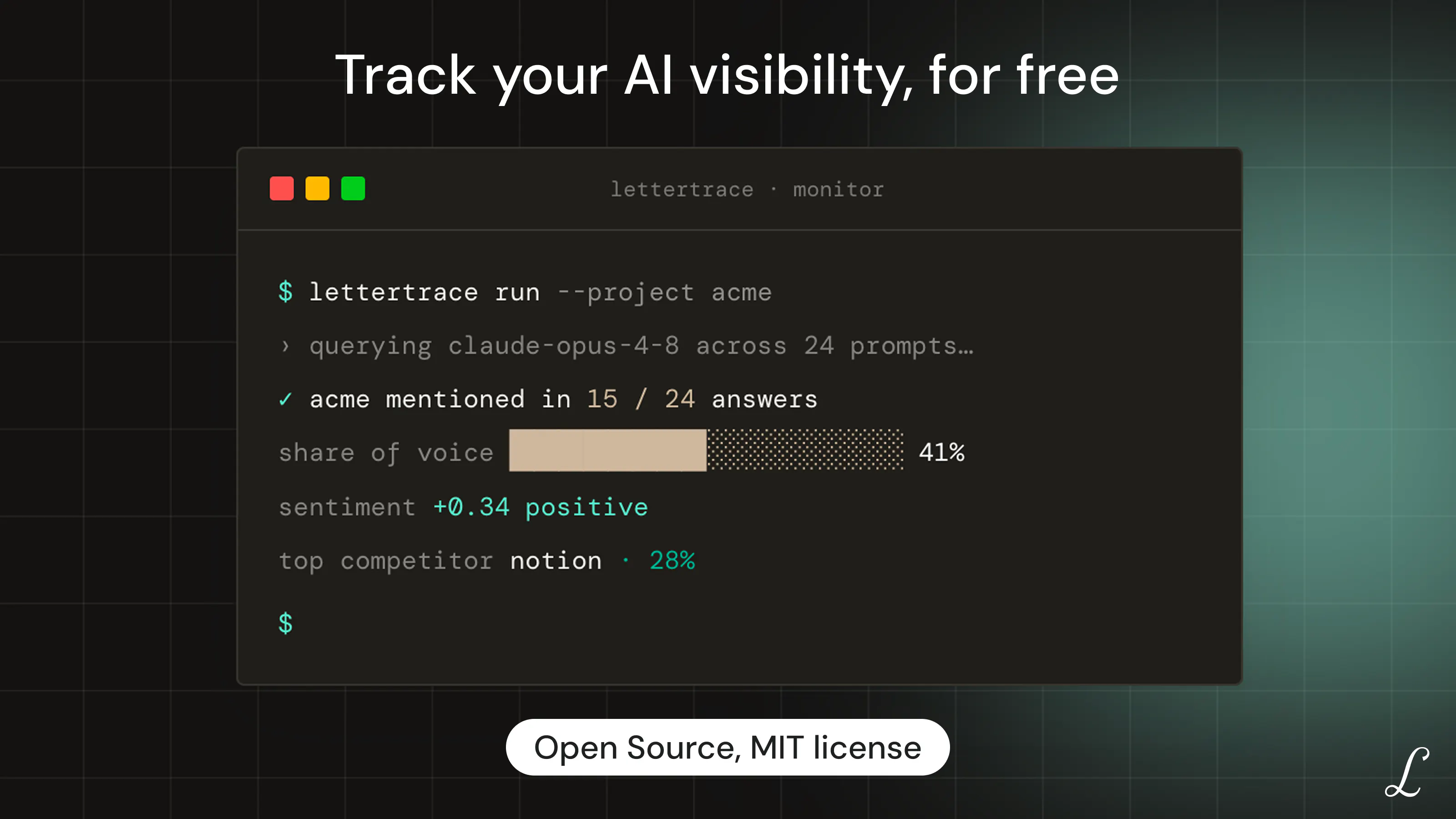
If a company shows up in 15/24 answers, do you know whether that correlates with anything downstream - inbound traffic, signups, or even people mentioning they found you through AI? That second number seems harder to get than the visibility score itself. Congrats on the launch!

0
回复

The question I have not seen asked yet is what makes the number stable enough to trend. Ask the same model the same thing twice and you get different answers, and a silent model update moves your baseline without telling you. So a line going up is mixing your own work with drift you cannot see.

Cheap fix, and I think your architecture already allows it. Measure a control set in the same run, a few competitors or unrelated brands you are not touching. Then drift shows up as a common shift across all of them and you can subtract it out. Being BYOK and open source also means you can pin model versions and re-run history, which the 250 a month tools cannot really offer.

0
回复
#4
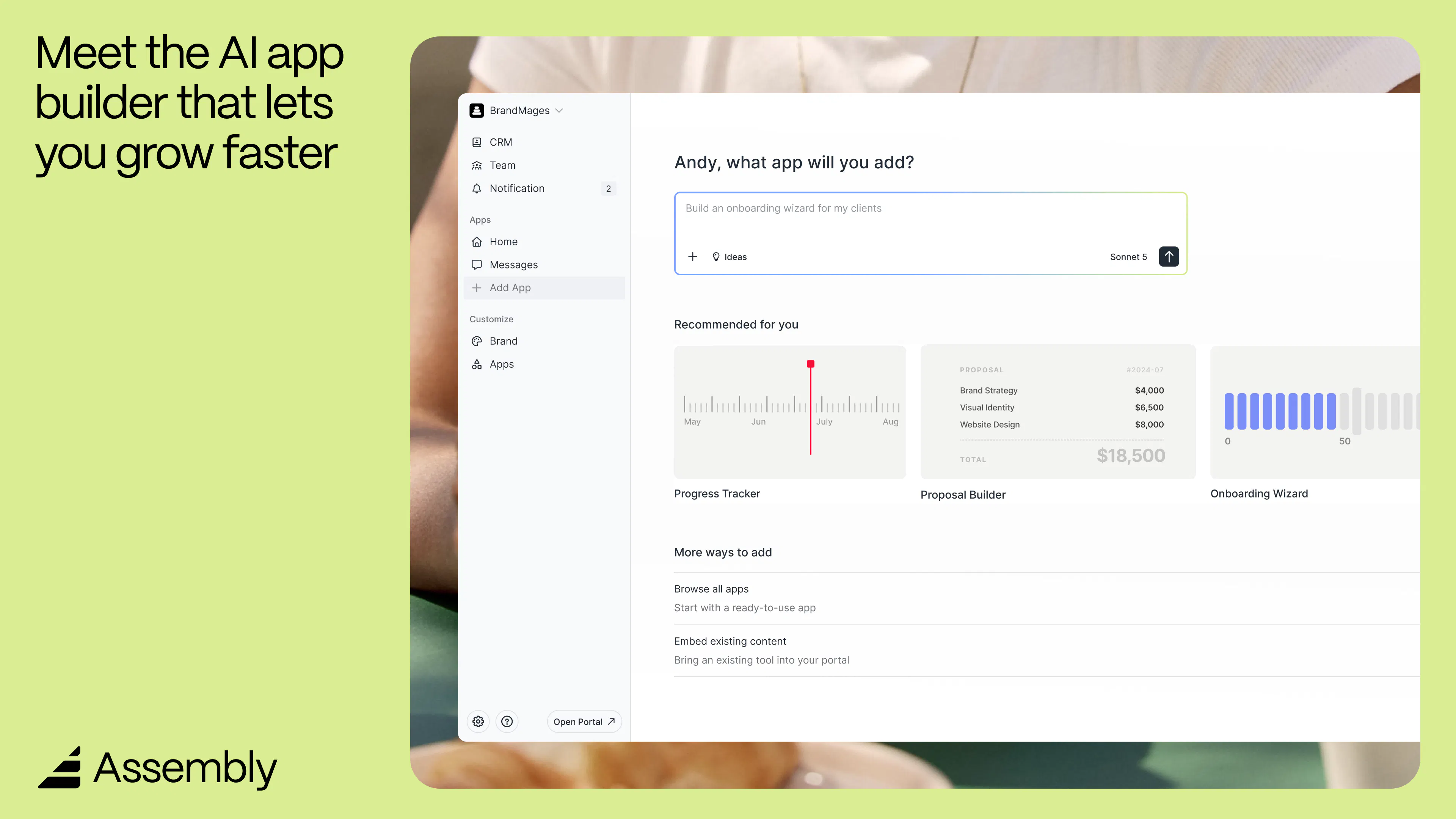
Assembly Studio
AI app builder that grows your revenue
235
一句话介绍:Assembly Studio 是一款面向专业服务机构的AI应用搭建平台,让律所、会计师事务所、咨询公司等无需编写代码,即可在几分钟内生成带有客户认证、权限管理、品牌定制的生产级客户应用(如客户入驻、文件收集、项目追踪等),解决“AI原型好做、交付给客户难”的最后一公里问题,帮助企业摆脱按席位付费的臃肿SaaS。
Web App SaaS Artificial Intelligence
AI应用搭建 无代码平台 专业服务自动化 客户门户 SaaS替代 模板化开发 B2B工具 私域客户体验 垂直AI Builder 生产力工具
用户评论摘要:用户普遍认可“解决AI原型到生产部署的最后一公里”这一定位,尤其称赞文档收集器与客户入驻模板的实用价值。核心疑问集中于多层级权限管理机制(如经理与终端客户如何区分)以及如何与Lovable等工具协作。团队回应显示,Assembly侧重安全客户端体验,可与营销类AI工具互补使用。
AI 锐评

Assembly Studio在挤满通用AI建站工具的赛道上,选择了一个极其精准且高壁垒的切角——专业服务机构的“客户侧交付”。当Lovable和Claude Code让原型生成变得廉价时,真正的痛感转移到了认证、权限、品牌域名这类“脏活累活”上。Assembly的聪明之处在于将“客户身份”作为底层原语,而非功能插件,这使得“为我的客户建一个门户”不再是代码拼接,而是平台原生能力。

从评论区的自曝与用户反馈看,其价值并非“替代Lovable”,而是做AI应用生态的“生产环境”。200+个私有测试应用及替换Airtable、Databox的案例是有效信号,但必须警惕:模板化“一键安装”容易,真正支撑复杂专业服务流程的灵活性与数据隔离能力,是规模化后的核心考验。目前投票数235不算爆款,且评论多来自内部团队(自嗨倾向明显),外部有效提问仅限权限细节,说明市场教育仍需时间。

其“免费永久计划”是犀利的获客钩子,但商业模式终须落到对计算资源与存储的合理收费上。总体而言,这是一款基因正确、定位刁钻的产品,但能否从“专业机构的玩具”变成“专业机构的操作系统”,取决于其模板生态的深度和第三方连接器的广度。短期看,它是高客单价SaaS的掘墓人;长期看,它必须证明自己不是另一个需要被“克隆”的臃肿软件。

查看原始信息
Assembly Studio
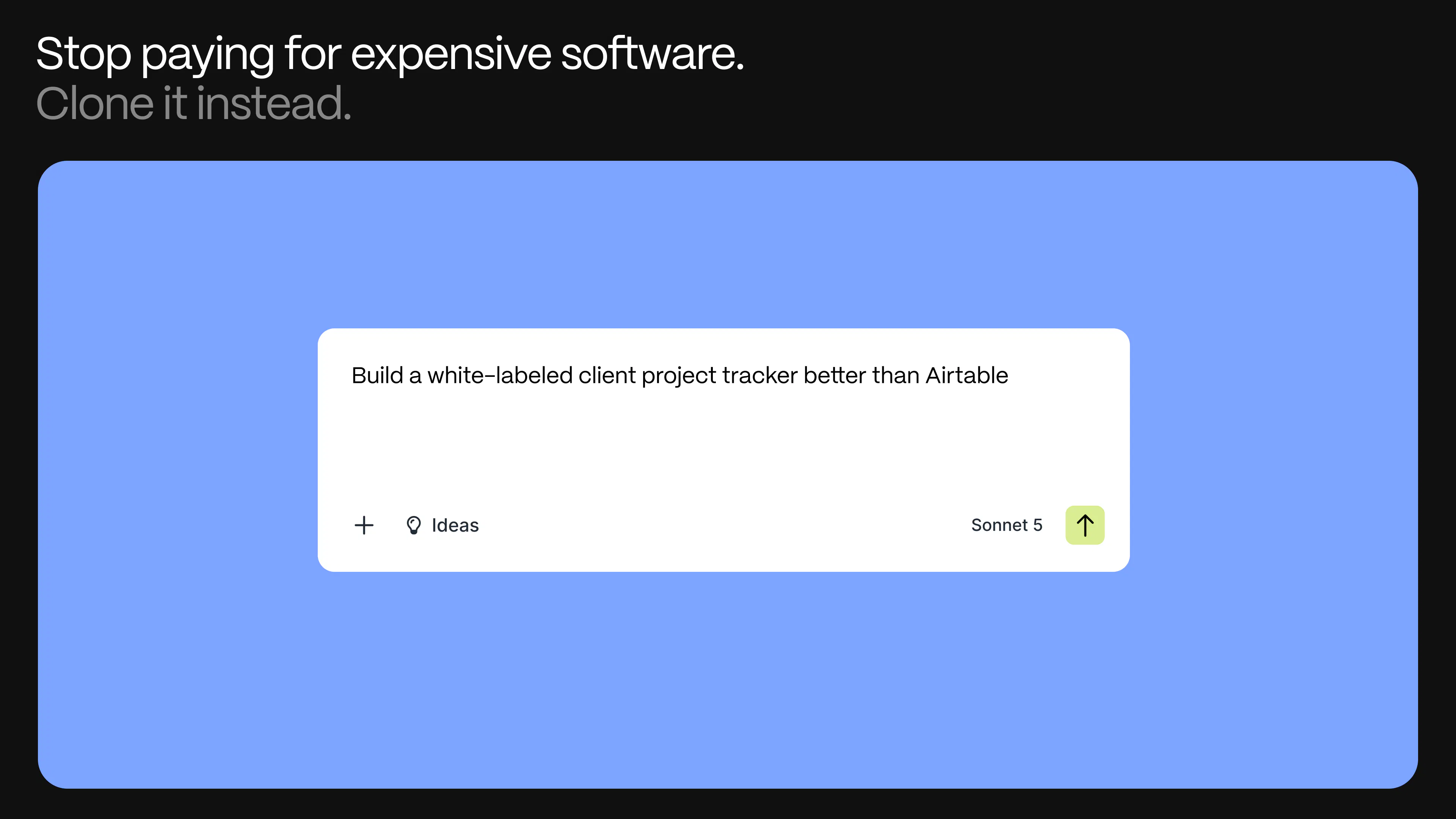
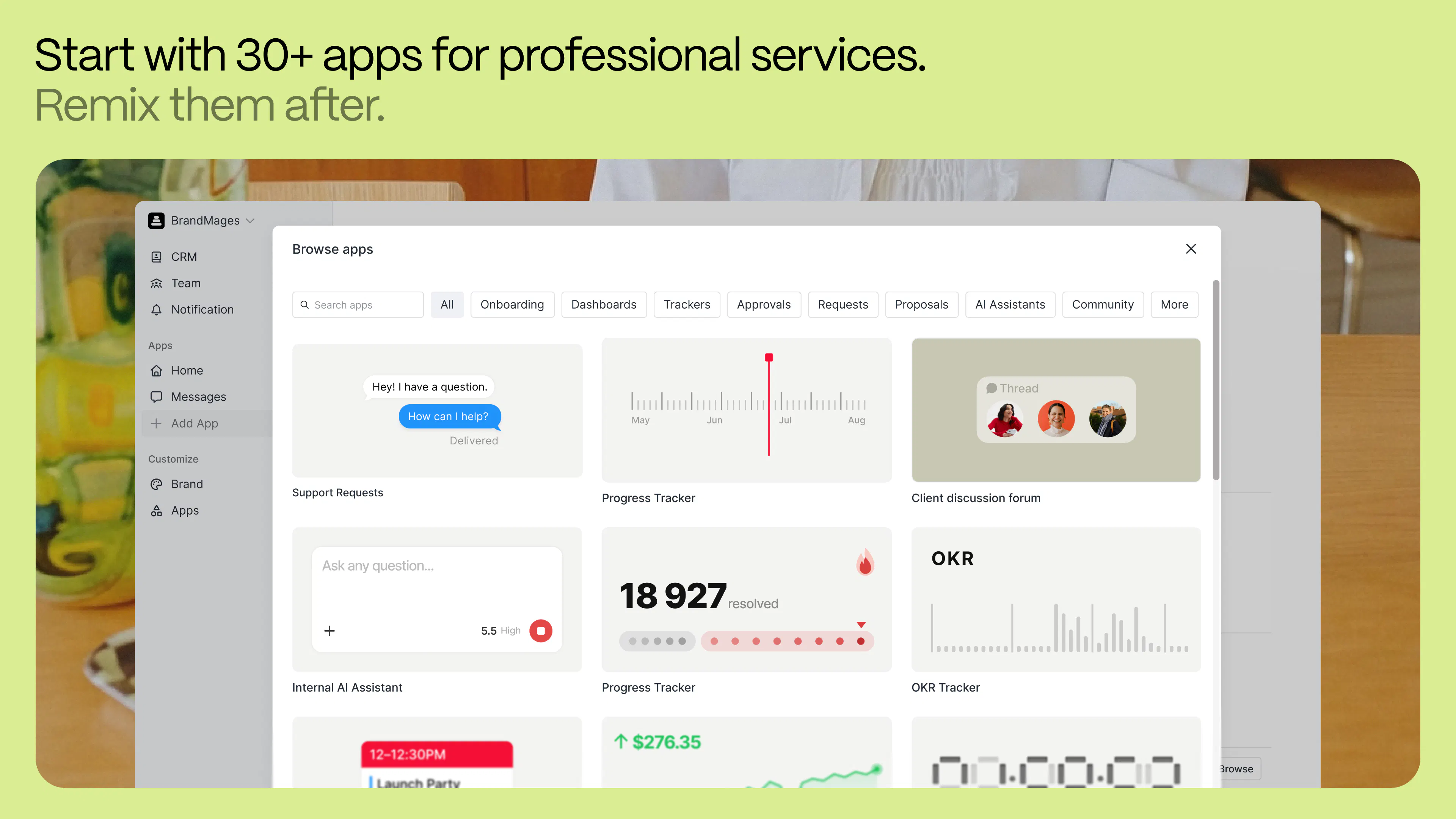
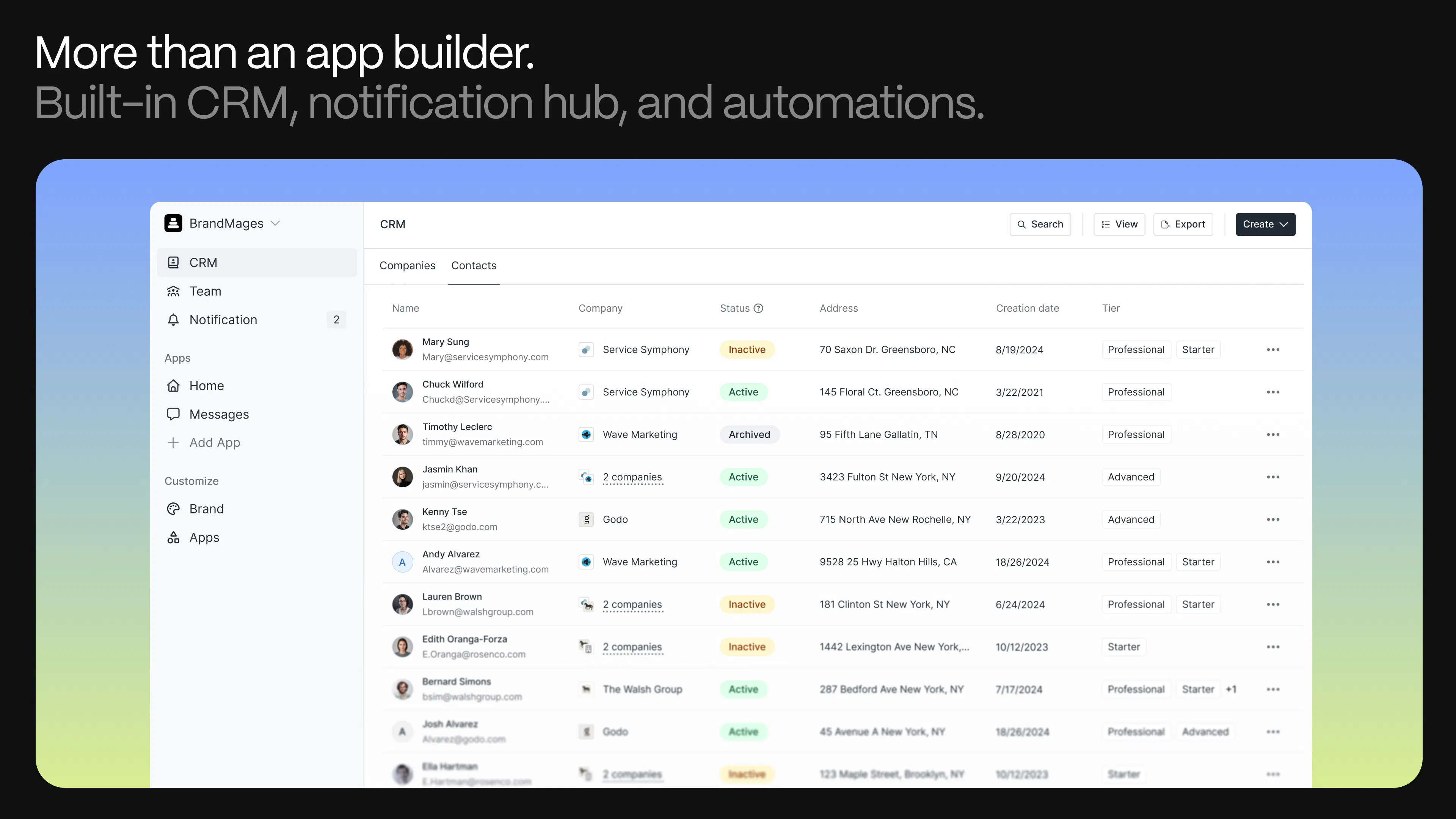
Assembly Studio is the AI app builder made for professional service firms. Describe what you want: onboarding agents, analytics dashboards, community hubs, and get production-grade apps in minutes. 20+ templates to remix. Connects to any 3rd-party tool. Clone any overpriced app charging you per seat. Free forever plan. Stop paying for someone else's software. Build the firm only you can build.

Hey PH! Thanks for the hunt @benln

Marlon here, cofounder of Assembly.

Yes, this is another AI app builder! There are a lot of great ones (Lovable, Base44, Claude Code), but we built one anyway, and I first want to explain why.

Assembly's been around for a few years. We built a CRM and client-facing portal for accountants, law firms, agencies, consultants, and others. We kept seeing our customers build incredible prototypes in Claude Code, but it's still surprisingly hard to actually get something into your clients' hands: auth, permissions, hosting, "where do I send this link".

With Assembly, the client experience is built in: your domain, your brand, one login for your clients. Apps publish directly into that client experience. And because client accounts are a platform primitive, every app already knows who your clients are and what they're allowed to see. "Build a client intake experience for my bookkeeping clients" just works. In our private beta, firms built 200+ apps this way, many replacing expensive products like Airtable, Databox, and others.

Because we're specialized, we also spent the last few months building 20+ templates specifically for professional service firms. Install one in a click, then remix it in Build Mode . Some favorites:

  1. Client onboarding wizard — https://studio.assembly.com/templates/client-onboarding-wizard

  2. Document collector — https://studio.assembly.com/templates/document-collection

  3. Project tracker — https://studio.assembly.com/templates/client-project-tracker

  4. Client help desk — https://studio.assembly.com/templates/client-support-requests

  5. Case status page — https://studio.assembly.com/templates/case-status-page

There's a free forever plan, so you can try it today: studio.assembly.com

I'll be here all day. If you run a services firm, I'd love to hear the first app you'd build!

42
回复

@benln  @marlonmisra Useful templates the document collector and client onboarding tools sound especially practical for service firms

0
回复

@benln  @marlonmisra Congrats on the launch, team! 🚀

Solving that "last mile" problem between building a quick prototype in Claude Code and actually shipping a secure, client-ready portal with auth and custom branding is huge. The friction usually kills so many great custom workflows before clients ever see them.

Really impressed by the template library—the Document Collector and Project Tracker look like immediate wins for service firms.

Quick question: How are you handling permissions when clients need multi-tiered access (e.g., a manager vs. an end client)? Wishing you a massive launch day!

0
回复

@benln  @marlonmisra The last mile is usually where these AI app builders get interesting.

Getting an AI to generate a working prototype is becoming almost trivial. Getting that prototype into a real client workflow with authentication, permissions, branding, and the right user context is a very different problem.

I like that Assembly is attacking that specific gap instead of trying to be another general purpose app builder. The fact that client identity and permissions are built into the platform makes the “build something for my clients” use case much more compelling.

200+ apps in private beta is a pretty solid signal too. Curious to see what firms end up replacing first.

0
回复

Assembly Studio has been by far the most gratifying product I have ever worked on. I have loved building templates (which I am so proud of), testing out the product, and figuring out how to launch this thing that is so hard to describe!

We had a launch party last night, and trying to explain what our product was yesterday vs. what we are today, and trying to tell people what we are is now just fundamentally different; we are no longer "just" a client portal, "just" a CRM, or any of the dozens of apps that Assembly has built. This is now a tool that I really do think could be used by just about anyone who works with clients and has a bit of imagination and creativity--I am so curious to see what apps people will build that are perfect fits for their businesses.

11
回复

@jordan_wechsler1 Your templates QA was impeccable!

2
回复

Assembly has come SUCH a long way in such a short time! When I first joined this company, I would have described us as the “cool” version of “boring client portal software” (complimentary fwiw; I think ‘boring’ software is underrated)!

But unlike other old-school SaaS (rip my employment history) we quickly adapted to the needs of our customers, both for custom client experiences in our product that we would not be able to deliver fast enough with traditional engineering, and to integrate securely with AI tools that were making their lives easier. It didn’t take much time, but it’s taken a metric TON of effort from everyone on the team to bring Assembly Studio to life.

This isn’t the finish line. This is the starting line!

8
回复

The future of software is fully custom!

It took the whole team (and then some) to get this over the line. Excited to see what everyone builds with Assembly Studio.

7
回复

@adam_schwartz7 your product work was (and IS) 🔥

1
回复

Very excited to get this out into the world. Favorite feature has to be all the templates available that can be remixed for individual use cases.

6
回复

So excited to have helped design and shape Assembly Studio. It’s been such a fun product to build, and even better to finally see it out in the world!

6
回复
i cannot wait to see what our users can create. sky is the limit!! ✨💃
5
回复

Hey Marlon! I'm sure Assembly can beat Lovable and all of them. Wish you all the best on this impressive launch!

5
回复

@german_merlo1 thanks! we think Lovable is great BTW and many of our users use both of us in concert. A very common setup is Lovable for the marketing site and Assembly for the secure client experience.

1
回复

Very excited to see Assembly Studio live. Proud of everything our team put into getting it here, and excited to finally share it! Can’t wait to see how firms use it to build the tools and client experiences they’ve always wanted.

4
回复

Congrats on the launch from the Signify team!

Clean client onboarding and portal management are always painful to balance across multiple separate apps, so having this bundled cleanly is a breath of fresh air.

Rooting for you guys today! 🚀

4
回复

@elene_tandashvili thank you!!

1
回复
#5
Unsloth Desktop
Run and train AI models locally on your desktop
207
一句话介绍:Unsloth Desktop 是一款开源桌面应用,让用户无需命令行即可在本地离线运行和微调大语言模型、图像/视频扩散模型及音频模型,并支持将本地 GPU 无缝接入 Claude Code、Codex 等智能体工具,解决了本地 AI 部署门槛高、配置繁琐的痛点。
Open Source Artificial Intelligence GitHub Development
本地AI推理 模型微调 开源桌面应用 离线运行 无代码工作流 GPU加速 多模态模型 开发者工具 数据隐私 智能体集成
用户评论摘要:用户普遍认可其将复杂流程封装为原生应用的易用性,称赞“无需终端”即可完成下载、量化与运行。主要建议集中在官网转化优化:有用户提出应在首屏突出速度提升数据、强化桌面版下载入口,并让开发者快速上手步骤在首屏可见。开发者回应积极,承诺持续改进。
AI 锐评

Unsloth Desktop 的聪明之处在于,它没有试图再造一个新模型,而是把社区里最受好评的微调与推理框架,包装成了一个零门槛的“本地 AI 开关”。从产品策略看,这精准击中了两个群体:一是厌倦了环境配置、只想“点开就用”的普通用户;二是已经用着 Claude Code 或 Codex、却苦于无法低成本接入私有 GPU 的开发者——一句 `unsloth start` 就能让智能体调用本地算力,这比任何 API 中转都更直接且省钱。

但必须指出,其核心价值并非创新,而是“消除摩擦”。Unsloth 原本的技术优势(如 2-5 倍速微调、显存占用减半)被平滑植入桌面端,这固然是好设计,但也意味着产品壁垒取决于对用户习惯的持续覆盖——一旦 Ollama 或 LM Studio 等同类工具跟上无代码微调,差异便会收窄。

评论中那位顾问的建议虽显模板化,却点出了致命短板:官网没有在首屏说清“到底比别家快多少、省多少硬件成本”,而是用“全能”叙事稀释了焦点。对于一个开源项目,下载转化率就是生命线,若不能把技术指标翻译成用户能感知的收益(比如“在 8GB 显存上跑 70B 模型”),很可能会叫好不叫座。

真正的护城河在于生态连接:不仅做模型的本地运行层,更成为智能体调用本地算力的统一入口,这比单纯“跑模型”更有想象力。如果团队能围绕 `unsloth start` 构建起面向 agent 的标准化接口,并沉淀社区微调模板,那么它就不只是一个工具,而是一条管道。目前它已赢在起跑线,但能否跑赢竞争,取决于后续对开发者体验的深度打磨,而非功能堆砌。

查看原始信息
Unsloth Desktop
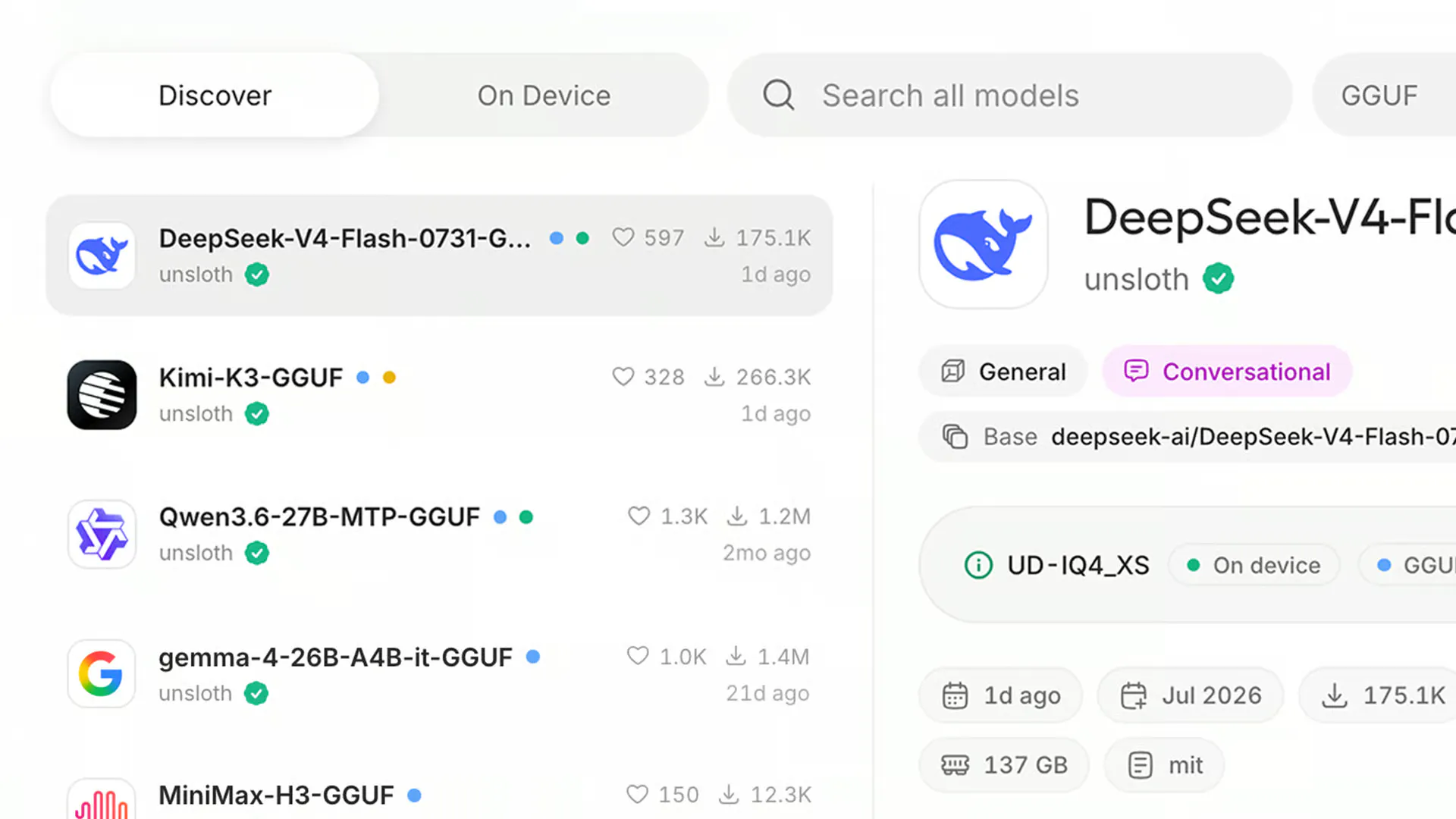
Unsloth Desktop is an open-source app to run and train AI models locally. Run LLMs, image/video diffusion, and audio. Connect agents like Claude Code or Codex to your local GPU with one command, and fine-tune models with no-code workflows.

Hi everyone!

Always a big fan of @Unsloth — from the original codebase to the web version, it has kept getting easier to actually use. Desktop is the most complete version of what they’re building.

It wraps everything into a native Mac, Windows, and Linux app. You can run and train LLMs, image/video diffusion, and audio models entirely offline without touching a terminal.

This is probably the first Unsloth release I could recommend to someone who likes local models but doesn’t want local AI to become a weekend setup project. Pick a model and quantization, download it, and you’re in.

It also makes those local models useful outside the app. unsloth start lets the agent tools you already use call them directly.

Free, open source, and finally a proper desktop app 🦥

7
回复

@zaczuo Hey Zac,

Awesome find with Unsloth Desktop on Product Hunt today! Running and training local AI models offline is a massive win for devs.

I'm an AI CRO & UX Consultant, and I took a quick look at their landing page. Here are 3 quick tweaks that can help drive even more local installs and conversions:

1. Instant Performance Hook: Highlighting exact speed improvements right in the hero section.

2. Frictionless Download Path: Making the primary action for desktop installation more prominent.

3. Clear Developer Quick-Start: Ensuring setup steps are instantly visible above the fold.

Would love to share the full detailed layout if the team is interested. Keep up the great hunting!

Best,

Abdul Moeez

AI CRO & UX Consultant"

0
回复

@zaczuo Oh thanks for sharing! And appreciate all the support! We'll keep making Unsloth better and better for everyone!

2
回复
#6
BearDrive
The open-source shared folder for your team's AI agents
161
一句话介绍:BearDrive 是一个开源、可自托管的本地文件夹同步工具,专为AI Agent团队设计,让Agent在本地生成的报告、CSV、HTML等文件自动同步共享给团队,并保留到“Agent会话”级别的完整版本与作者归属,省去手动上传到Notion/Drive的步骤,解决“Agent产出困在个人电脑里”的协作断层问题。
Productivity Developer Tools Artificial Intelligence GitHub
AI Agent协作 文件同步 开源 自托管 本地优先 版本控制 团队知识库 开发工具 MCP替代 工作流自动化
用户评论摘要:用户核心疑问集中在与Notion/MCP的差异(官方回应:同存,Notion管文档,BearDrive管工作文件);最尖锐反馈是安全性——Agent写入敏感数据自动同步无人工审核门槛,官方确认有`.bdriveignore`和仅同步指定子文件夹机制,但暂无预览式审批流程;另有用户询问大文件(100MB+)支持,官方确认可用但高频重写耗资源,建议放入忽略列表。多数好评来自团队内部使用体验。
AI 锐评

BearDrive踩准了一个真实且迅速放大的痛点:当AI Agent从“聊天助手”变为“生产工具”,其产出(HTML报告、CSV、PDF)正成为团队核心资产,而现有协作栈(Notion/Drive/Git)均无法承接这种高频、非结构化、机器生成的文件的流转需求。它本质上不是“又一个网盘”,而是为“机器间通信”设计的文件总线——让Agent A的产出在本地路径上即时成为Agent B的输入,这是Dropbox和Notion在架构上做不到的。

其价值主张清晰且克制:不做Agent记忆系统,不搞新工作区,只做“文件夹的团队化”。这种“极简”恰恰是对“Agent原生协作”最务实的一层抽象。版本回溯到Agent会话、`.bdriveignore`策略随库同步、指定子文件夹为共享边界,这些设计显示了创始团队对真实工程场景的深度理解。

但风险同样明显:1)安全性是悬顶之剑——无人工审批的自动同步,一旦API Key或客户数据因Agent误操作流出,造成的信任危机将远超协作效率提升;官方虽有忽略文件和权限设计,但“事后轮换密钥”的建议暴露了当前防线的粗糙。2)MCP协议正在快速演进,未来Notion/Drive若原生支持Agent写入并保留原生文件格式,BearDrive的“差异化层级”可能被压缩。3)100MB以上文件的性能瓶颈说明其核心场景是“轻量工作产物”,而非重型数据资产。

犀利地看,BearDrive的护城河不在于技术,而在于它是最早一批把“Agent产出治理”当作一等公民的基础设施。如果它能尽快补齐“同步前审查工作流”和细粒度权限(如按Agent身份限权),有望成为AI团队的事实标准;否则,很容易被大厂在下一个版本中“顺便”集成。其开源策略是明智的,但商业化路径(当前免费Beta)仍需验证——毕竟,企业为“文件夹”付费的意愿,远低于为“安全合规”付费的意愿。

查看原始信息
BearDrive
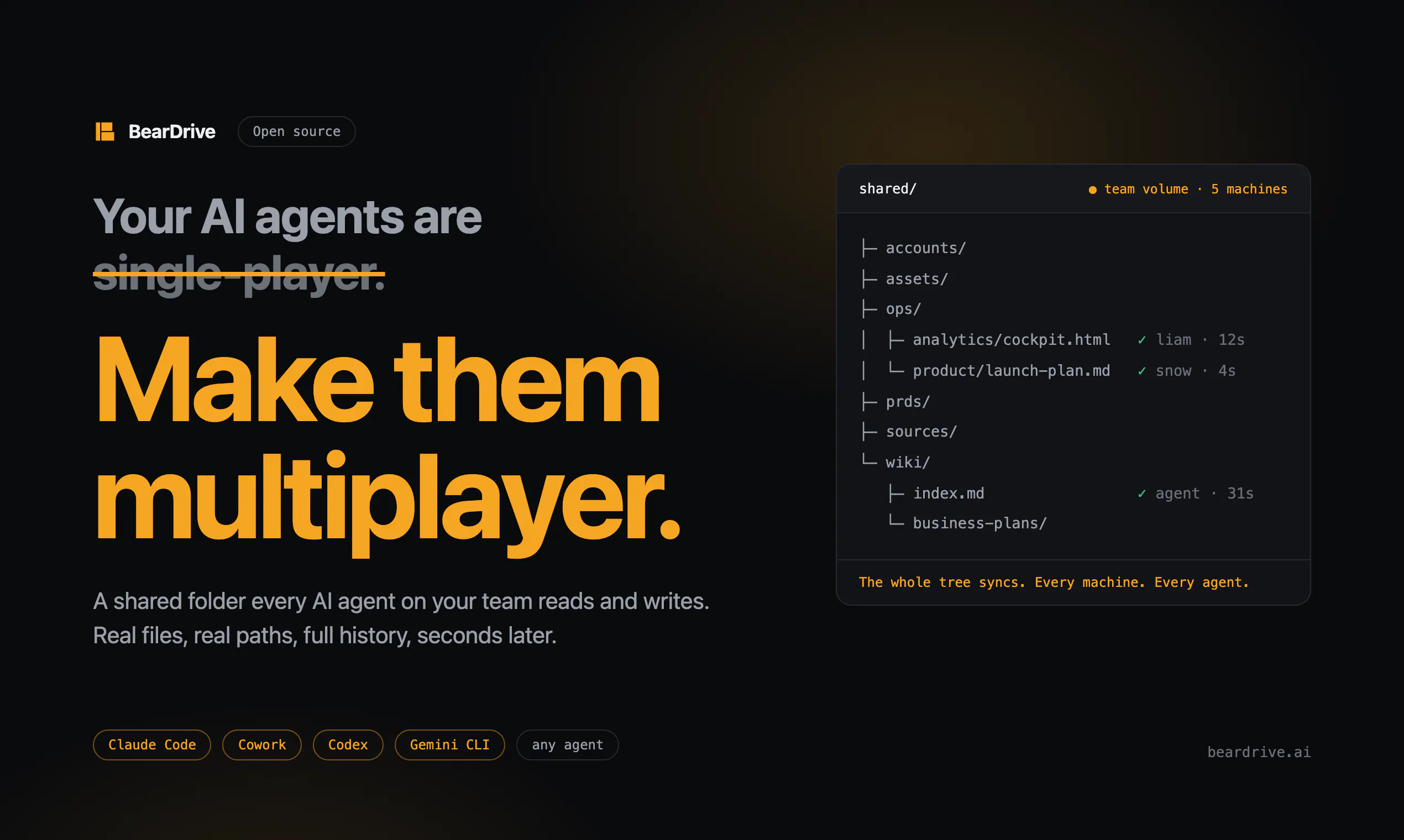
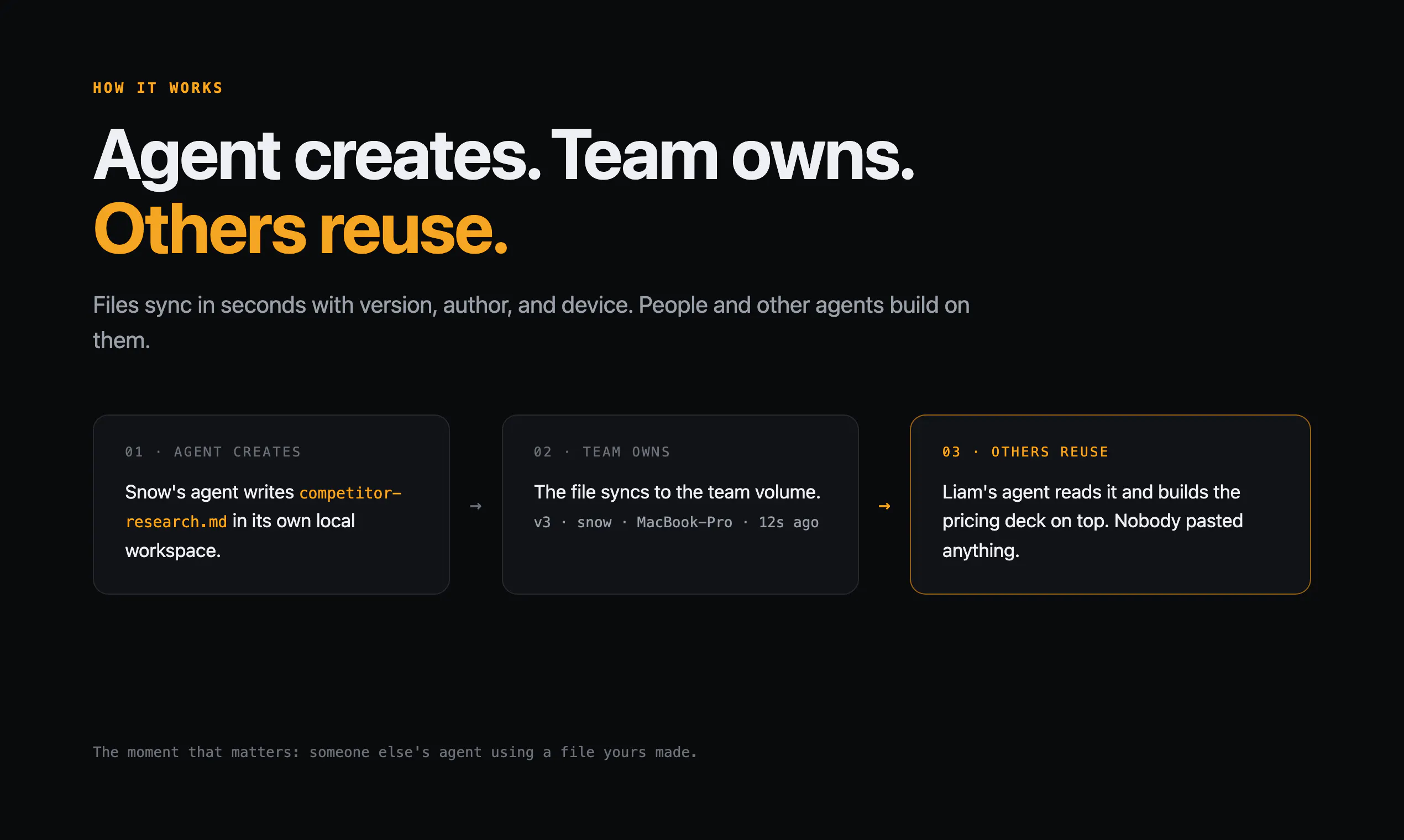
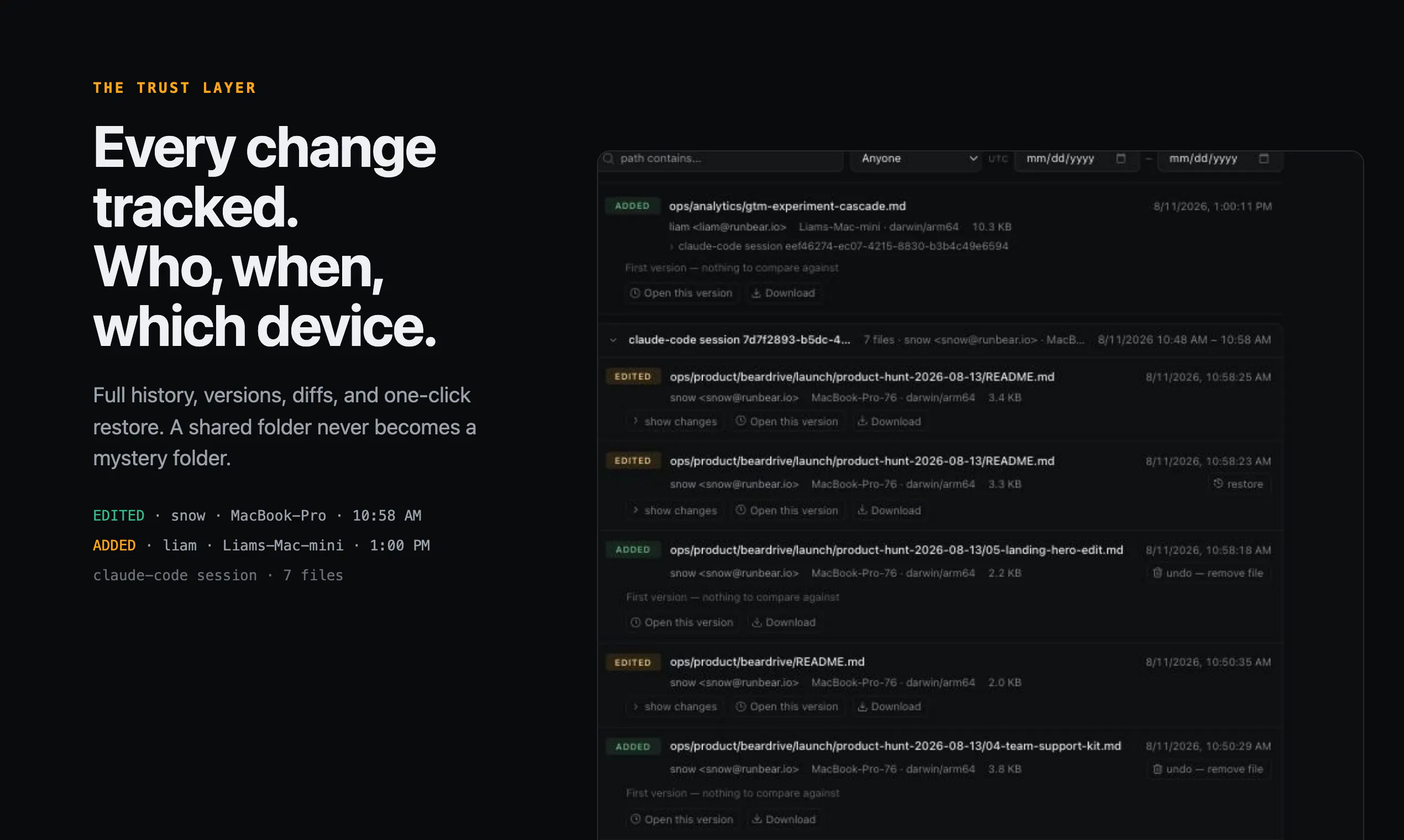
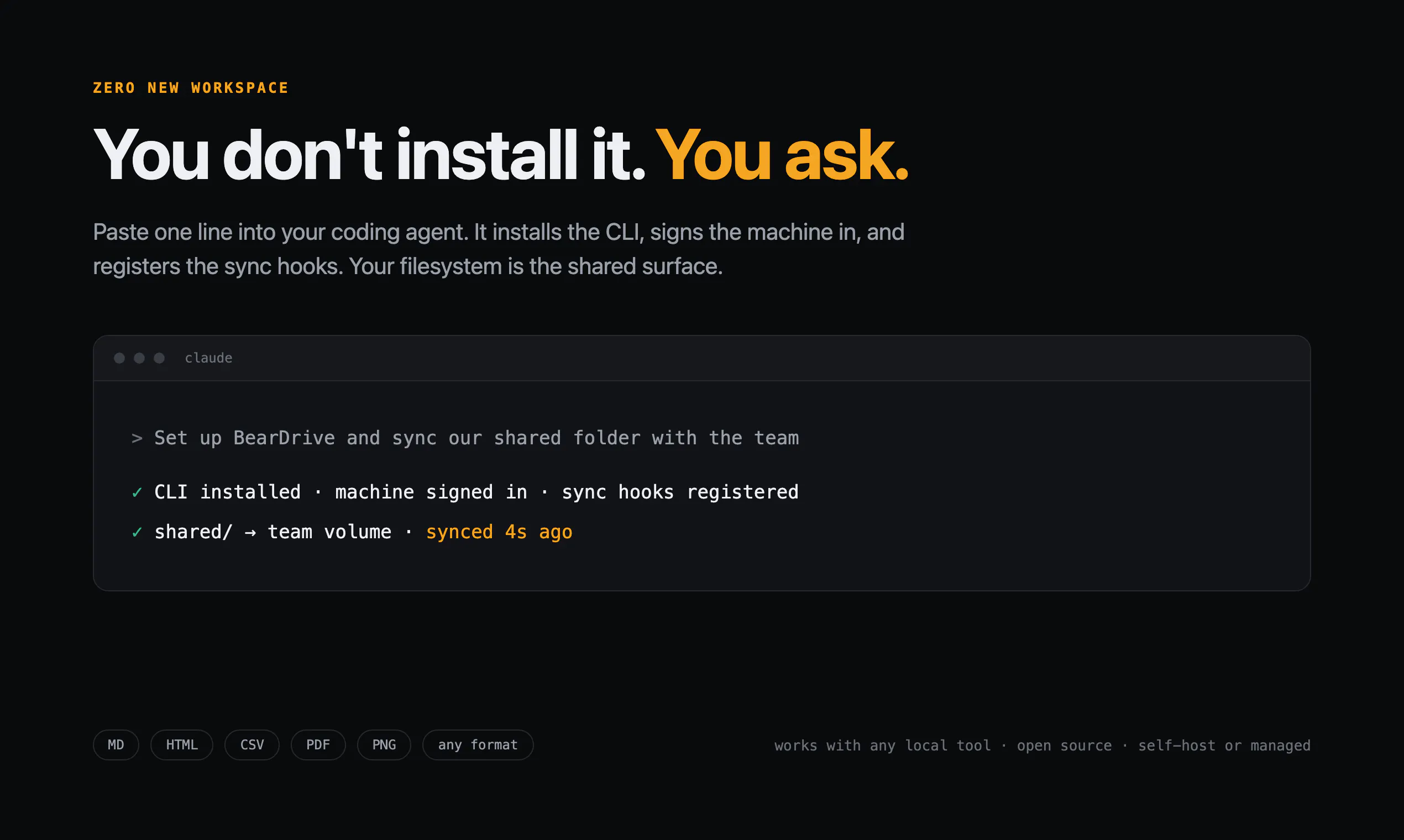
Your AI agents create real files locally: reports, decks, CSVs, research. BearDrive syncs the folder they already work in, so every file is born shared: versioned, attributed down to the agent session, with links only your team can open. Unlike Notion or Drive, nobody moves anything; a teammate's agent reads your agent's work at a real local path seconds later. Works with Claude Code, Cowork, Codex, Gemini CLI, any local tool. Open source and self-hostable. Managed service free during beta.
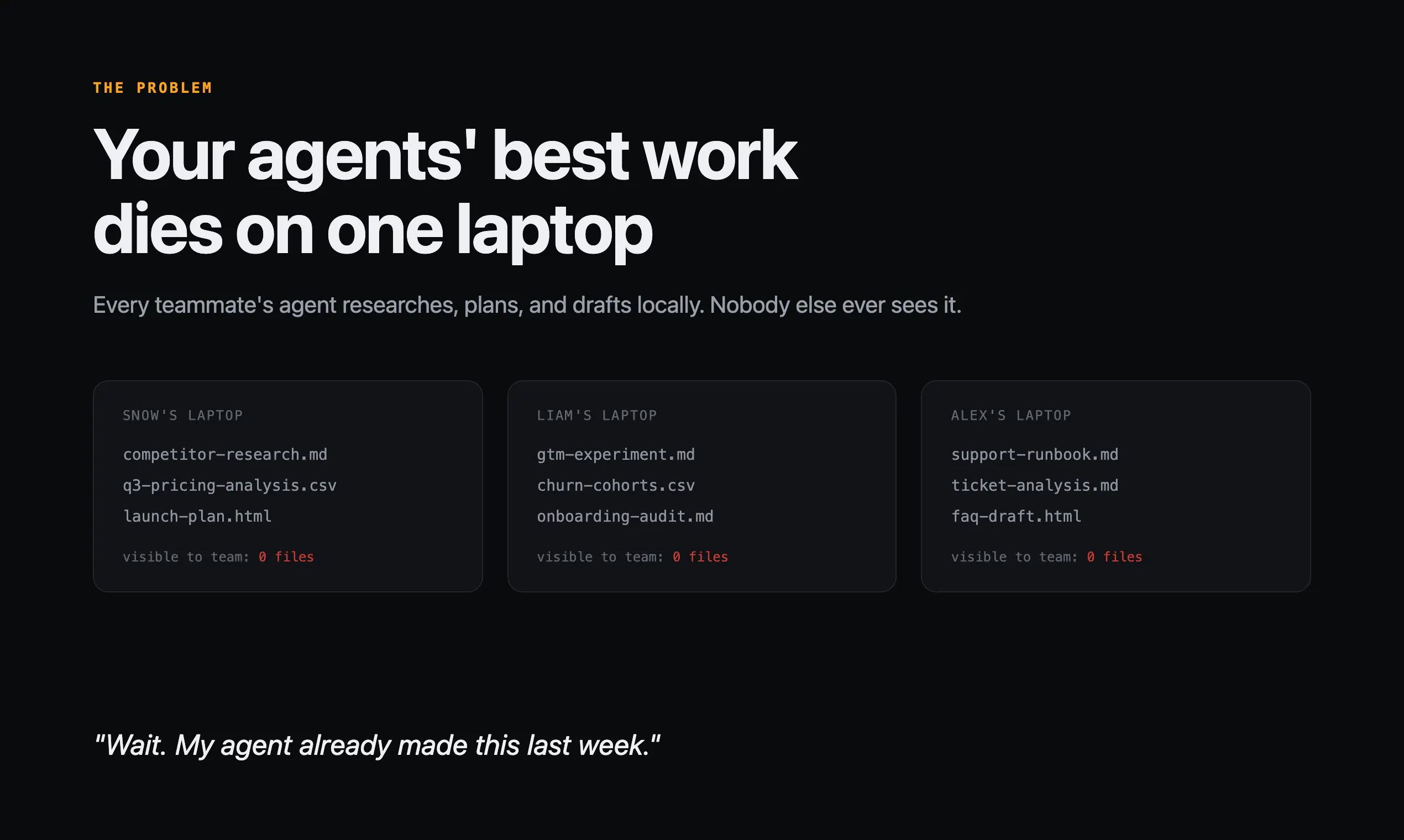
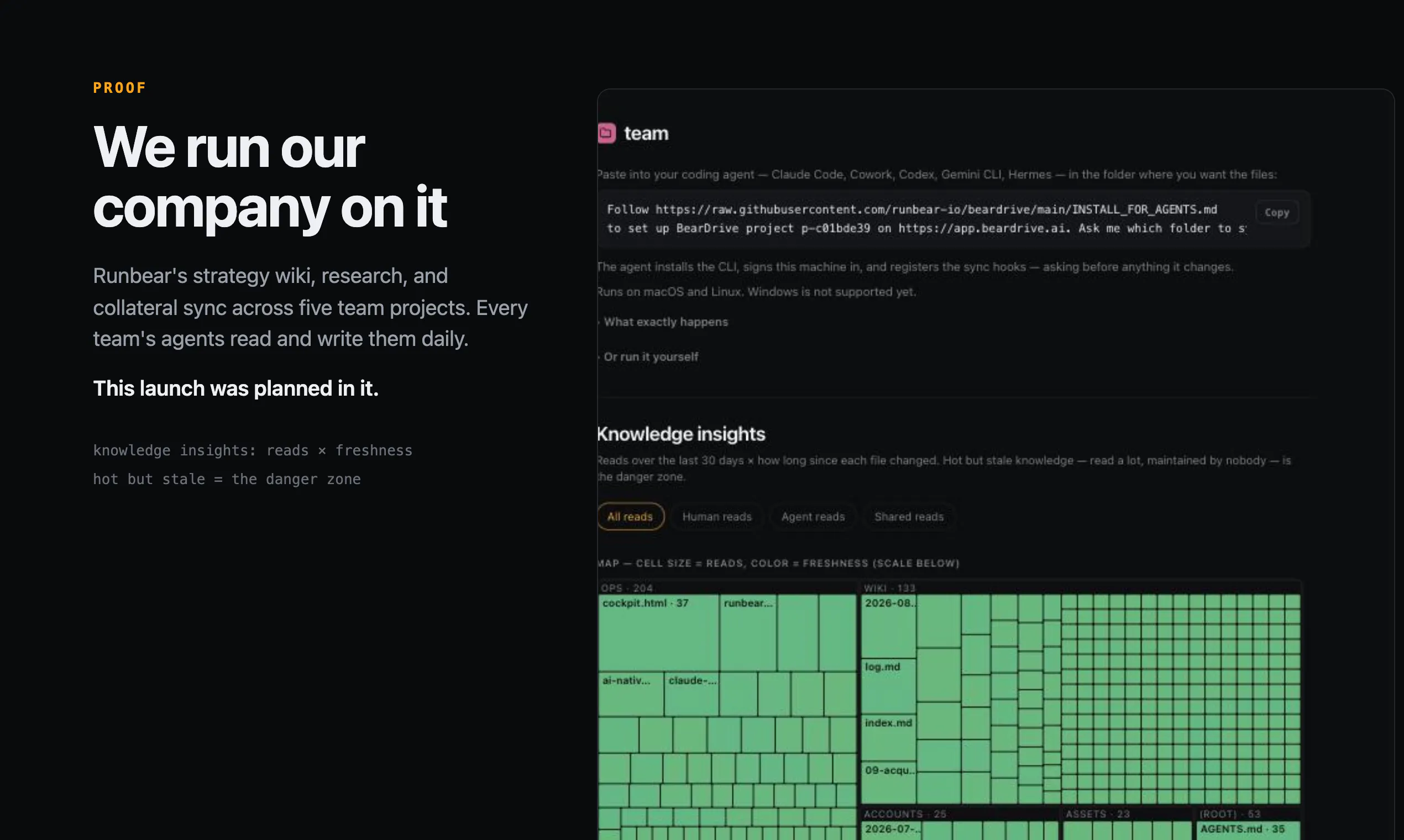
Hey Product Hunt, I'm Snow, founder of Runbear. Here's the moment that made us build BearDrive: everyone on our team uses Claude Code daily. Each of us had an agent producing genuinely good work: competitive research, launch plans, analytics reports, decks. And every one of those files lived and died on one person's laptop. My co-worker would re-research something my agent had already figured out, because neither he nor his agent had any way to know the file existed. The obvious fixes all failed us. Pasting into Notion was a manual chore nobody kept up. Git is wrong for research and ops artifacts, and non-engineers won't touch it. Dropbox syncs bytes but tells you nothing about who made what, when, or whether it's still current. So we built the thing we wanted: a shared folder that is actually built for how agent teams work. - Your agents keep working where they already work: your local filesystem, any file format, any tool. - BearDrive syncs that folder to your team in seconds, with full change history: who, when, from which device. - Every file gets a link you can drop in Slack, and a web view teammates can read without installing anything. - Other people's agents read from the same folder, so context moves between agents without a human re-explaining it. We run our whole company on it. Our strategy wiki, sales collateral, and research sync across the CEO, marketing, dev, and support projects through BearDrive, and each team's agents read and write it every day. This launch was planned in it. What it's not: it's not an agent memory system and not another workspace to migrate into. It's your files, made team-owned. I'd love brutal feedback on one question in particular: when your teammate's agent produces something useful, how does it reach you today? That answer shapes what we build next.
10
回复

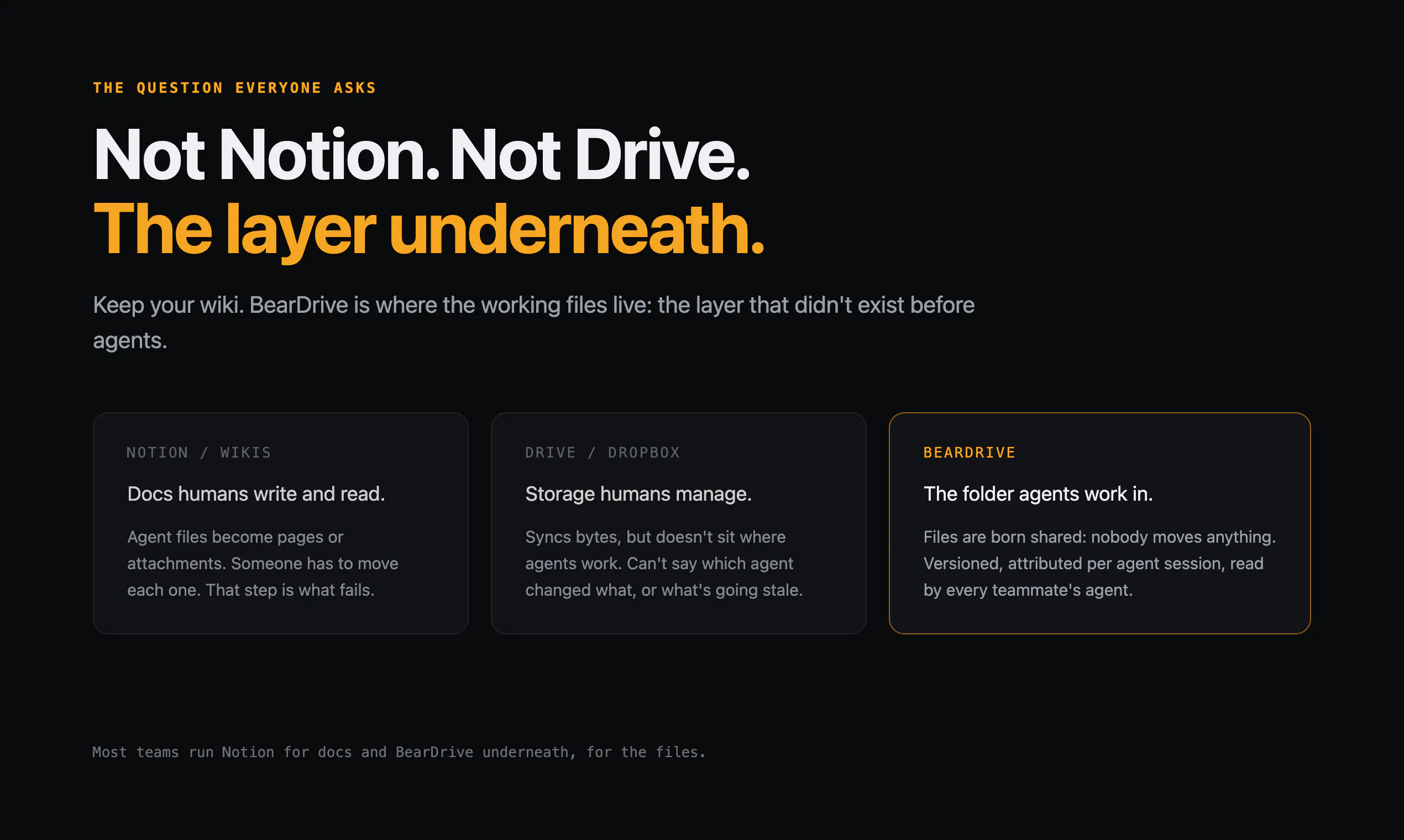
A few folks asked the same great question (thank you for the great question!), so answering once here: how is this different from Notion/ClickUp/Drive with MCP?

Different layer. Notion is where your team writes docs; BearDrive is the folder your agents already work in, made shared. Our agents' output is mostly not prose (HTML reports, CSVs, decks), and moving those into a workspace is a step a human or an MCP call has to perform. That step is what fails, which is how reports end up as Slack uploads named report-v2-FINAL.html.

With BearDrive there is no step. The file syncs the second the agent writes it, with authorship down to the agent session, and a teammate's agent reads it at a real local path with its normal tools. Most teams keep Notion for docs and run BearDrive underneath for the working files.

2
回复

@snowlee Nice launch congrats🙌i really like the focus on actual files rather than creating another separate AI workspace. It keeps the workflow simple.

2
回复

Having a shared folder for each customer has made working together so much easier for our team. So excited that we got to build this together! Thank you so much for your support! 🐻🚀

5
回复

@shuwn_jung let's goooooooo

0
回复

Maker here. Really proud of the team for bringing BearDrive to life🔥

AI agents are having their Dropbox moment!

Our agents can produce dozens of HTML pages and PDFs in a day: quick dashboards, analysis reports, launch docs.

Creating useful files is easy now.

Finding them again is not.

A week later, I know the report exists. I just don’t know whether it’s on someone’s laptop, attached in Slack, or buried under a filename nobody remembers.

And when I do find it, I’m not always sure it’s the latest version.

That’s the Dropbox moment: not another place to dump files, but a way to stop agent-made work from feeling scattered and disposable.

The part I care about most is the handoff. One agent creates something, and another teammate’s agent can actually find it and build on it later.

When an agent creates a useful file on your team, how does the next person find it a week later?

5
回复

So happy this is finally out 🎉 It's already changed how our team works.

4
回复

Glad this is finally out. We built BearDrive to solve a problem we kept running into ourselves: useful agent files getting stuck on one person's laptop. Nice work, team.

4
回复

May be I am missing some thing here, we use Notion for this now. How do you differ from that approch ?

3
回复

@jay_janarthanan1 Not missing anything, it's a fair question (a few folks asked, so the short version):

Notion is where your team writes docs. BearDrive is the folder where your agents already work, made shared. Different layer.

Concretely: our agents produce HTML reports, CSVs, and decks on local disk. Moving those into Notion is a manual step (or an MCP call that turns a file into a page, lossy for anything that isn't prose). With BearDrive there's no step: the file syncs the second it's written, with authorship per change, and a teammate's agent reads it at a real local path with its normal tools.

So most teams keep Notion for docs and use BearDrive for the working files underneath. If your agents' output is mostly prose pages that end up in Notion anyway, your current setup is honestly fine. The difference shows up the day it isn't just prose.

0
回复

Disclosure: I'm a friend of Snow's. That said, the framing here is sharp — "your filesystem is the shared surface" is a much better bet than asking teams to migrate into yet another workspace. The versioning + authorship layer is what makes it more than a sync tool. Congrats on the launch!

3
回复

@jaehee_ko Thank you very much for your support, Jaehee!

0
回复
Regarding your question, how teammate’s output reach me today: through Notion. Agents write there via mcp, the team already lives there, and it works. What’s the specific reasons to migrate?
3
回复

@michael_vavilov It's a fair question! Thank you, Michael. Honest answer first: if Notion + MCP is working for your team, don't migrate. Notion is great for prose the team reads.

The category is different though: we're much closer to Google Drive than to Notion. Notion is a place agents write into; BearDrive is a folder agents work in. And being the native file system makes a bigger difference than it sounds.

Our agents' output is mostly not prose: HTML reports, CSVs, PDFs, deck files. In Notion those become attachments, and an attachment is a dead end for the next agent. In a real folder they're just files at real paths, so when my agent continues a teammate's work it greps, edits, and re-renders with its normal tools. No fetching blocks over an API, no markdown-to-blocks conversion loss, no re-explaining context.

So in practice teams run both: Notion stays the wiki humans read, the shared folder is where working artifacts live, with attribution per change down to the agent session (which already caught an accidental rollback of a teammate's edits for us).

If your agents' output is mostly prose pages, you're honestly not our user yet, and that's fine. Curious though: what happens today when an agent produces something that isn't a page, like a CSV or an HTML report?

1
回复

Congrats on the launch guys!! 🎉 Great to see BearDrive out in the wild!

2
回复

the "syncs to your team in seconds" part is what gives me pause rather than the storage question everyone else is asking. an agent working on something sensitive - a customer contract draft, a research doc that accidentally captured an API key or PII from a scraped page - now propagates to the whole team's synced folder before any human looks at it, since there's no workspace-level review step like a PR or a Slack post someone has to actually send. is there any per-file or per-folder gate before something syncs, or is the model "everything your agent writes locally is now everyone's by default" and you're expected to gitignore-style exclude the sensitive stuff yourself?

1
回复

@galdayan Thank you for this question, Gal! It's the sharpest one here, and it's exactly the right thing to press on.

To your last point first: yes, there's a `.bdriveignore`, exactly gitignore-style, and it syncs with the folder itself, so the exclusion rules are team-wide policy rather than per-person discipline. `.env`, key files, raw scrape dumps, whatever patterns you define never leave the machine.

But it's not the only gate, and honestly not the main one. The main one is scope: BearDrive doesn't sync your whole project. You connect a specific subfolder (ours is `shared/`) and only what's written inside it ever syncs. Your agent keeps working in the project root as usual; scratch work and intermediate junk stay local. Writing a file into the synced subfolder is the send, the same deliberate act as posting to Slack.

And you control that behavior directly: the rules for what belongs in the shared folder live in your own AGENTS/CLAUDE.md ("deliverables only, never secrets or raw scrapes"), so it's an instruction your agents actually follow, versioned and team-visible like everything else.

When something wrong lands anyway: every change hits the feed with author, device, and agent-session attribution, files can be removed, versions rolled back. Recoverable in a way a Slack upload isn't. Though I won't oversell it: if a real API key syncs, rotate it. Same rule as git.

You're right that there's no review-before-sync step today. We're going to add more gates there, and if you have opinions on what it should look like (per-folder rules? a PR-style diff before something becomes the team's copy?), I'd genuinely love to hear them.

0
回复
I’ve been waiting for this product to exist! BearDrive will hopefully let me retire the rclone + jujutsu based system I cobbled together to enable context to be synced with provenance across my various development machines. My one question is about BearDrive’s ability to handle large files. I use a LadybugDB based memory system for my agents, and the .lbdb files can be quite large (100 MB+). Will that be an issue?
1
回复

@samdcbu Thank you, and honest respect for the rclone + jujutsu rig, that's exactly the duct tape we keep finding in the wild, and "sync with provenance" is precisely the job. If BearDrive gets to retire it, I'll consider that the best compliment we've gotten.

On large files, to be transparent: BearDrive isn't specialized for synchronizing big files, but we've confirmed it handles 100 MB+ files without problems, so your `.lbdb` files should sync fine today. The one thing worth knowing is that history is kept per change, so a large file that gets rewritten very frequently costs storage and bandwidth on every write. If your agents touch the `.lbdb` constantly, you may want it in `.bdriveignore` with periodic snapshots synced instead; if it changes a few times a day, just sync it and don't think about it.

Your use case is exactly the kind that should shape how we handle big binaries going forward, so we'll take extra care there. Thank you for the kind words!

0
回复
Maker here. What changed for me: I stopped being the middleman between my teammates' agent and mine. My teammate's agent writes a research doc, my agent reads it from the same folder an hour later - with the authorship and history attached, so I don't have to narrate the context first. Humans and agents on both sides just stay in sync. Small mechanic, but it quietly removed most of the "let me catch you up" overhead from our week.
1
回复

Nice launch and glad this streamlined your team's productivity. :)

I'm still unsure why this should replace workspace setups like Notion/ClickUp connecting via MCP or a team Shared Drive folder though. At my previous company we were particularly concerned about the same docs centralization problem you're describing, which is why we would have still chosen Notion/ClickUp over an extra drive to store key resources and collaborate on docs.

1
回复

@fabcairo Thank you for your support, Fabio! Thank you! And honestly, it doesn't replace Notion. For docs humans write and collaborate on, Notion is the right choice.

What changed for us: once the whole team ran agents daily, most new artifacts weren't docs anymore, they were files on local disk: HTML reports, CSVs, decks (in HTML). Getting those into Notion or a Shared Drive takes a step someone has to perform, and that step is what fails. That's how reports end up as Slack uploads.

BearDrive removes the step. It syncs the folder agents already work in, so files are born shared: authorship down to the agent session, and teammates' agents read them at a local path with their normal tools, no API fetch, no paste.

So: Notion for the docs, BearDrive for the working files underneath. Curious, at your previous company, when an agent produced a CSV or an HTML report, where did it end up?

0
回复
#7
Swipe
Swipe right on your next customer
132
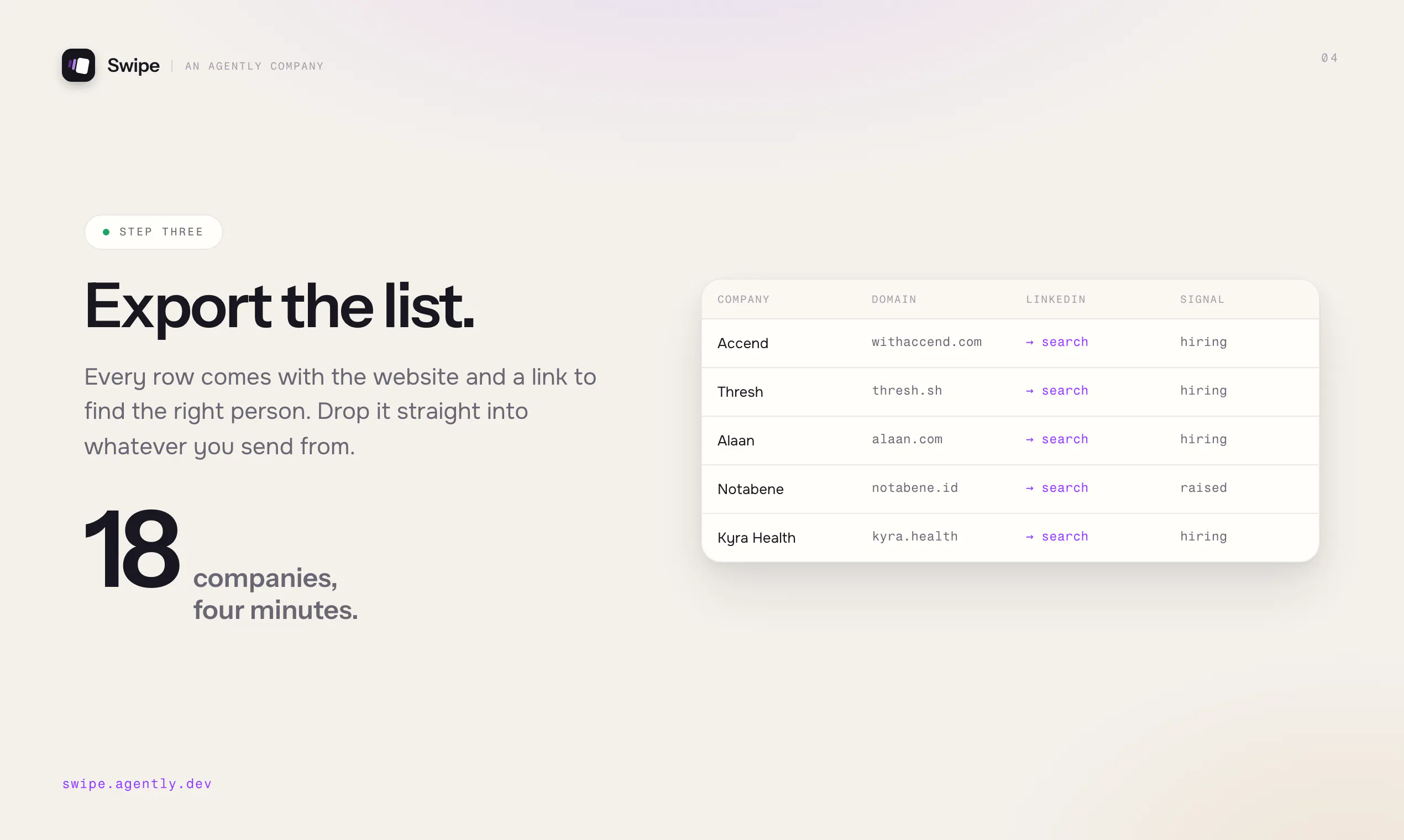
一句话介绍:Swipe 是一款面向销售人员的线索筛选工具,输入目标客户描述后,以“左右滑动”的卡片方式展示真实公司,快速筛选值得跟进的对象并导出为 CSV,帮助用户高效完成潜在客户名单的初步构建。
Productivity Sales Marketing
销售线索工具 客户筛选 Tinder式交互 潜在客户列表 B2B销售 免费工具 开源软件 无注册门槛 数据导出 敏捷开发
用户评论摘要:用户普遍认可其交互新颖、无门槛免费。主要疑问:单次会话有无滑动/导出上限?如何导出导出列表?是否支持导入自有客户名单?另有质疑:快节奏滑动是否导致对客户信息判断过浅,影响线索质量;同时有用户希望明确后续功能规划。
AI 锐评

Swipe 的聪明之处,在于把“筛选线索”这个销售中最枯燥、最耗时的环节,做成了一场沉浸式的“翻牌游戏”。它精准地切中了个人卖家和小团队“不想注册、不想付费、就想快速看一圈”的心理,用极低的试用成本换取了极高的传播噱头——这种“Tinder for sales”的定位,从一开始就赢了注意力。

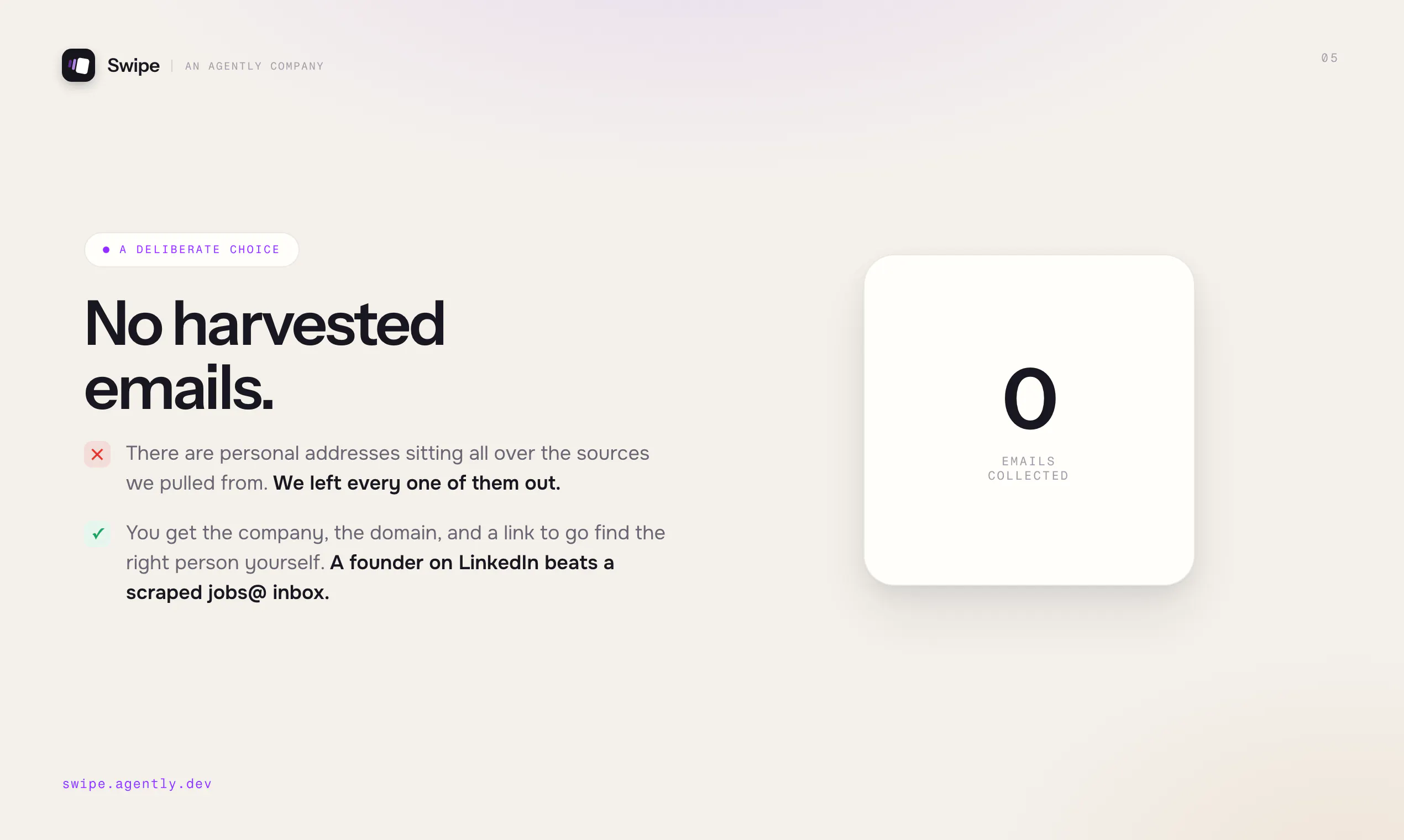
但克制点背后,也是刻意为之的“商业留白”:不提供邮箱抓取,意味着它天然限制了自身成为“数据供应商”的想象空间,转而把自己定位成一个“入口”或“体验层”。这既规避了数据合规风险,也为后续可能的付费功能(如深度联系人匹配、CRM集成、导入导出增强)埋下钩子。

评论中“滑动过快导致判断过浅”的质疑,确实切中要害。产品目前的排名算法是黑盒,如果推荐质量不够精准,所谓的“快”反而会让用户产生“越刷越疲劳”的无效感。而“导出 CSV 后,下一步呢?”——这个链条上的断裂,正是其未来是否从“有趣的 demo”进化为“真正工作流工具”的关键分水岭。

整体来看,Swipe 是一次成功的“场景降维”演示:用消费级交互重塑企业级工具,短期吸睛,但若想留住用户,需要在推荐透明度、数据处理深度和后续转化路径上,给出更扎实的答案。否则,它很容易成为销售工具库里那个“玩过就忘”的尝鲜品。

查看原始信息
Swipe
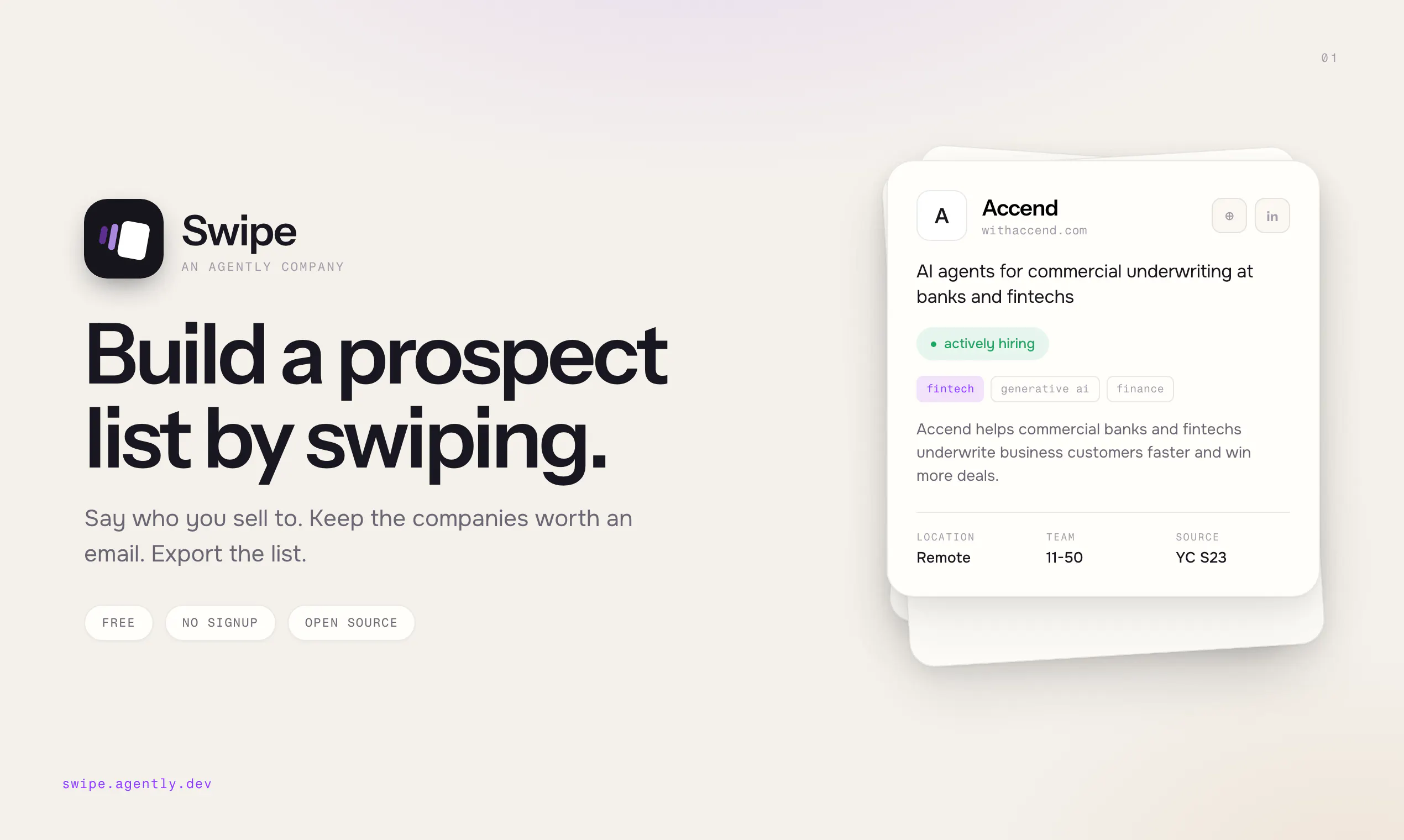
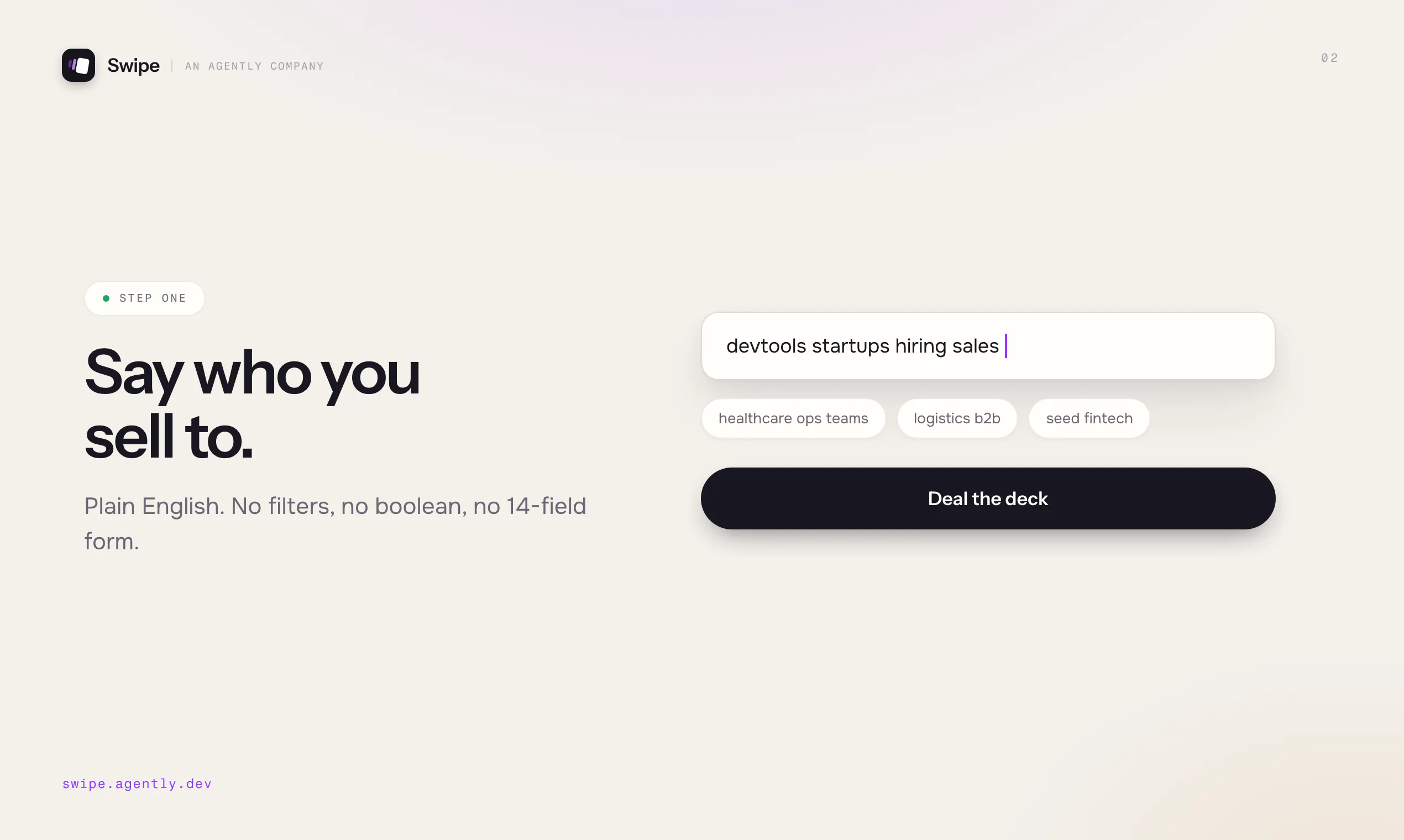
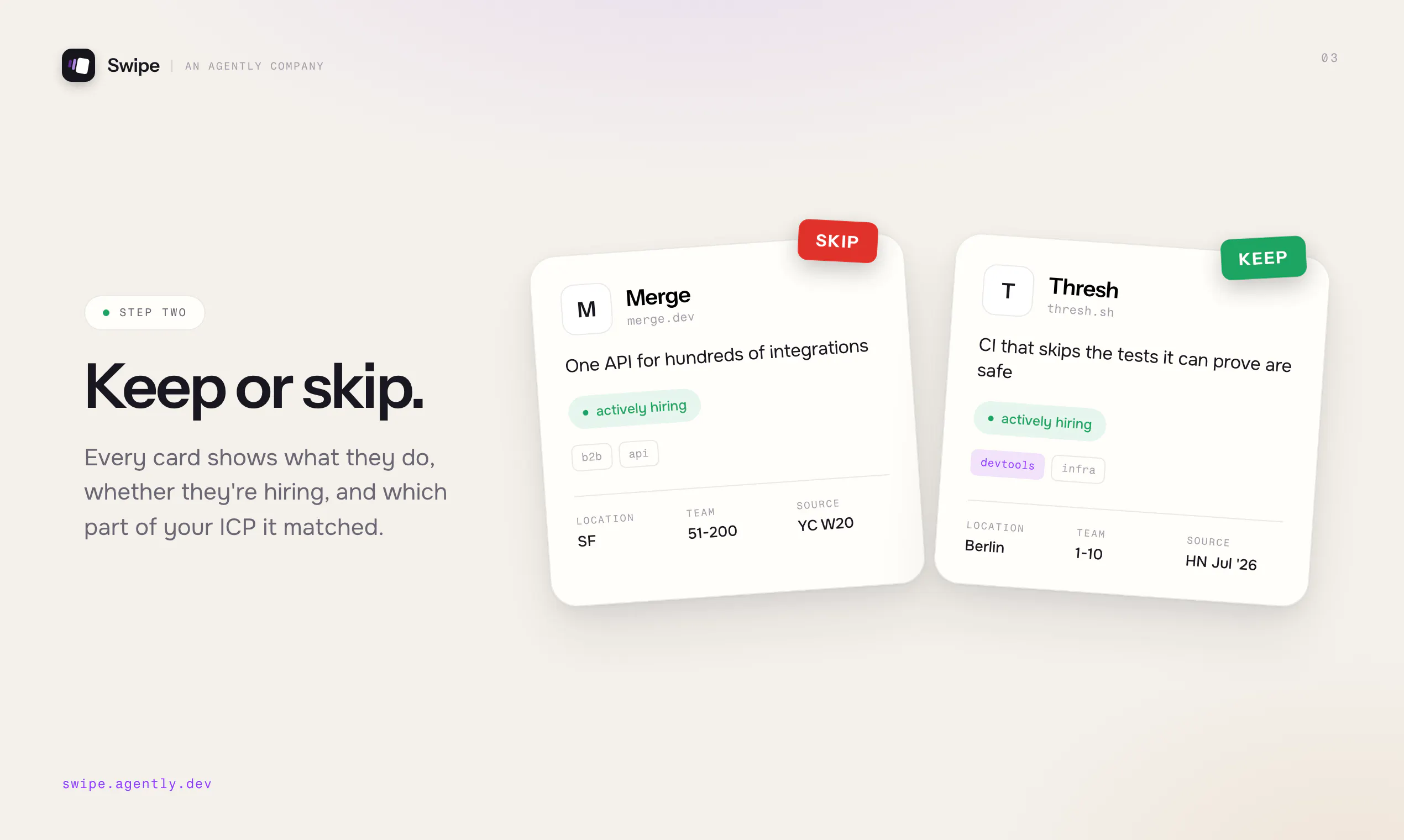
Type who you sell to. Swipe deals a ranked deck of real companies. Keep the ones worth an email, skip the rest, export to CSV. No signup, no credits, no scraped inboxes.
Hey Product Hunt 👋 Building a prospect list is the worst part of selling. Open a directory, filter, copy a name into a sheet, go read what the company actually does, repeat two hundred times. So: type who you sell to, get a deck of real companies, keep the ones worth an email, export the list. One deliberate choice: no harvested emails. There are personal addresses sitting all over the sources we pulled from and we left every one out. You get the company and a link to go find the right person yourself. Free, no signup, open source. Swipe was built with Agently, which is what we actually make: a company brain that does the busywork. Shipping something useful felt like a better demo than another landing page. What ICP did you type, and were the first ten cards any good?
9
回复

@omarships Congrats on the launch..🙌 using a sleek, swipeable UI to solve top-of-funnel list building is a super refreshing take on prospecting. Is there a cap on how many cards a user can swipe or export in a single session on the free tool?

1
回复

@omarships I kept 11, but don't see the option to export, what's next?

0
回复

@omarships Congratulations on the launch! The swipe mechanic makes this genuinely fun to use, but good prospecting usually comes from spending more time on fewer names, not less time on more. Has the format led people toward worse-fit lists because it encourages fast yes/no calls on thin information, or does the ranking do enough filtering upfront that speed doesn't actually cost accuracy?

0
回复
Very nice way to filter leads! Can I import my own list ?
2
回复

@bengeekly didnt think of that, coming up next

0
回复

Love the idea. Congrats on a launch!

1
回复

@nikitaeverywhere Appreciate it

0
回复

Nice concept! So basically, it is Tinder for salespeople? Congrats @omarships 🤗

1
回复

@kate_ramakaieva tinder for sales katie, exactly

1
回复

Congrats on the launch to you and the team!

0
回复
#8
Click
Live research context for ChatGPT and Claude
131
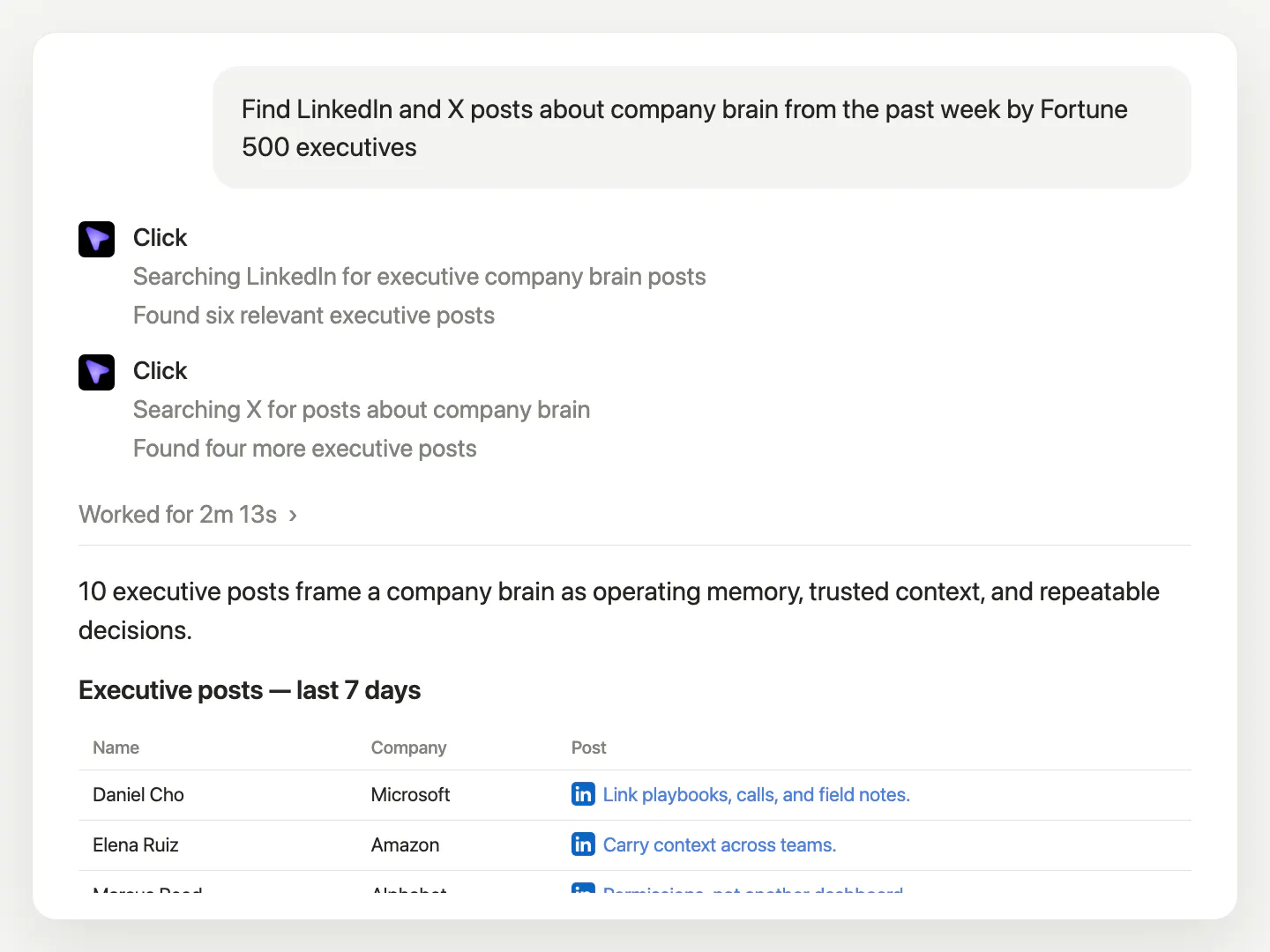
一句话介绍:Click 是一个为 ChatGPT 和 Claude 打造的 MCP 连接器,让 AI 在聊天框内直接获取 LinkedIn、航班、市场等专业平台与实时数据,解决内置搜索抓不到外部权威上下文、用户频繁跳出对话去手动查资料的痛点。
Productivity Artificial Intelligence
MCP 实时数据连接器 AI 搜索增强 专业数据源 社媒情报 市场数据 生活服务查询 大模型插件 聊天内工作流 研究助手
用户评论摘要:用户认可内置搜索缺失专业与市场数据是真实痛点,追问连接器是实时拉取还是缓存数据,以及模型是否能感知数据来源;另有用户表示关注其开发历程并表示祝贺,整体反馈偏积极,但技术细节质疑较突出。
AI 锐评

Click 的切入点很聪明——它不跟 OpenAI 或 Anthropic 拼模型能力,而是专门补足它们最尴尬的短板:内置搜索对登录墙、动态页面和垂直平台数据的无力感。创始人 Aditya 的描述很真实:用户把聊天界面当“家”,但每次要查领英、比价、看财报都得被迫“出门”。Click 本质上是给 AI 装了一条“特许经营”的数据高速公路,而非普通爬虫。其价值不在于“搜索”,而在于“合规且结构化地接入高价值封闭数据源”,这正好契合企业用户对数据时效性和来源可信度的双重要求。

但问题也明显:评论中“实时 vs 缓存”的质疑直指核心——MCP 连接器若只是封装了公开 API,那差异度有限;若涉及登录态抓取,则面临账号风控和隐私合规风险。另外,产品目前以“研究”场景起步,这虽是高频刚需,但天花板清晰。未来若要真正让用户“不出聊天框完成决策”,必须横向扩展交易类、协作类连接器,并解决多数据源冲突时的可信度排序问题。否则,它很容易沦为“高级版浏览工具”,而不是“AI 时代的操作系统层”。对单点突破的产品,第一步值得肯定,但护城河仍靠执行速度与独家数据协议。

查看原始信息
Click
Click is an MCP that provides extensive research connectors to give external context that the built-in web search misses. It provides live context from professional & social platforms, marketplaces, financials, and more. A simple 1-min installation of the MCP in ChatGPT or Claude enables you to do more inside chat.
Hi, I'm Aditya! Click is largely motivated by a change in my own behavior. Codex & Claude are amazing products. I live inside their surface now - using it more than my browser. It feels like home, to the point that I’m annoyed to have to leave. Most often, I’m stepping outside to do external-facing tasks, like researching my leads on LinkedIn or comparing flight options. I want my agents to do these tasks as well. Currently, those can’t be completed because their gateway to the world (in-built web search) has limited access. Often the agent also asks to use the browser with a logged-in session, which I’m uncomfortable with. So, I built the connector layer that I wish existed. My vision with Click is to provide useful that meet users right inside the chat. I'm building out one trusted service at a time, starting with research.
3
回复

@adiasg Built-in web search missing professional and marketplace data is a real gap. Which connectors are pulling live versus cached, and does the model know which one it got?

0
回复

@adiasg Congratulations on the launch! Exciting to have followed this journey!

1
回复

LETS GOOO CLICK

1
回复

@yahia_bakour3 Thanks Yahia!

0
回复
#9
LaraCopilot
Agentic AI Engineer that builds real apps
125
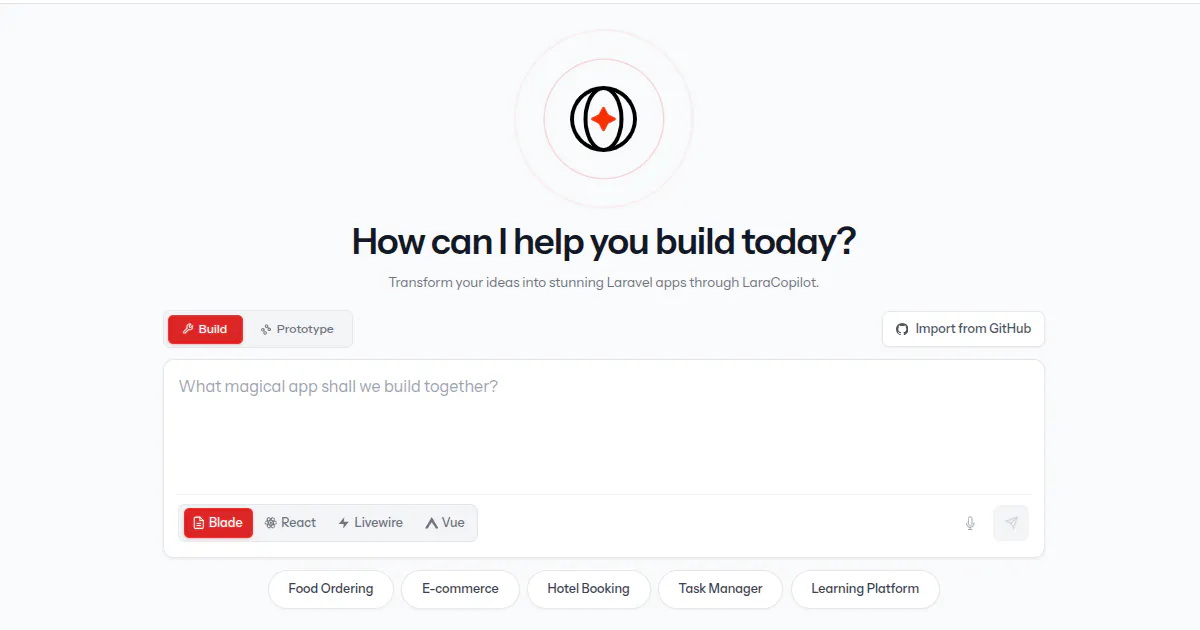
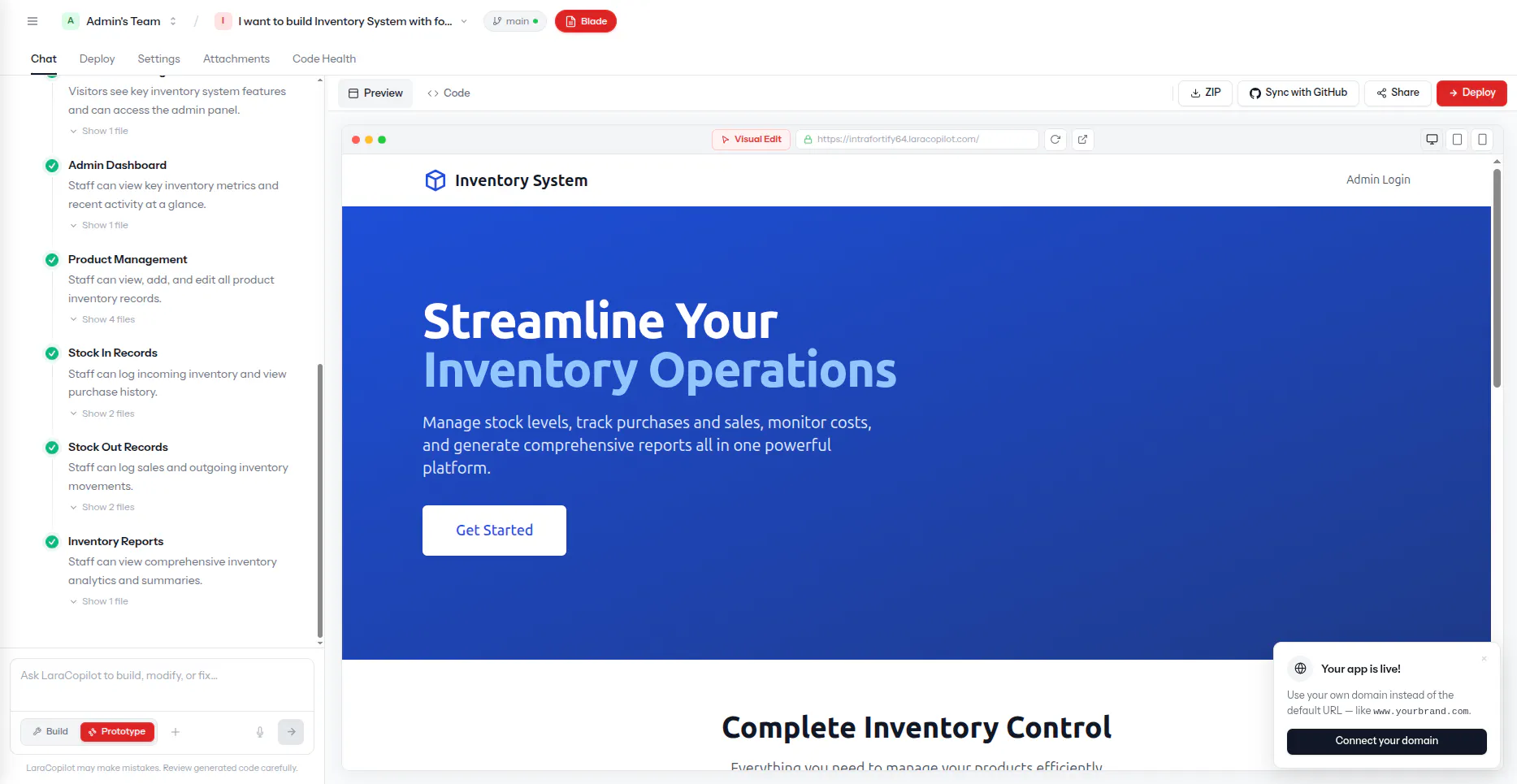
一句话介绍:LaraCopilot是一款基于Laravel生态的Agentic AI编程工具,能将自然语言描述直接生成包含前后端、数据库、认证和API的生产级全栈应用代码,并支持一键部署与GitHub导出,解决AI生成原型难以转化为可维护、可自主掌控的真实产品这一核心痛点。
SaaS Developer Tools Artificial Intelligence
AI编程助手 无代码开发 Laravel 全栈应用生成 后端自动化 代码生成 生产级应用 一键部署 开发者工具 Agentic AI
用户评论摘要:用户普遍认可其生成的Laravel代码质量高,能弥补AI原型到生产环境之间的鸿沟。主要建议与疑问集中在对比Lovable时的后端架构差异,以及Beta版教训对V2的塑造。团队强调代码归属权与无锁定,回应了市场对可控性的核心关切。
AI 锐评

LaraCopilot的V2发布,本质上是对AI编程赛道“浅层繁荣”的一次精准狙击。当大多数AI Builder满足于生成自带托管后端的“玩具原型”时,LaraCopilot选择押注于一个更垂直却也更硬的痛点:**让AI直接生成开发者真正能接手的长生命周期代码**。

它的聪明之处在于,将“代码归属权”和“无锁定”从营销话术上升为了技术壁垒。通过深度绑定Laravel生态,它避开了与Lovable等通用型工具在“前端魔法”上的正面消耗战,转而深挖PHP开发者群体的后端尊严。团队在评论中反复强调“不付费应用也能运行”,正是对开发者对AI工具信任危机——对生成的代码缺乏掌控感——的精准心理按摩。

但犀利的看,V2的成功不在于它功能多炫酷,而在于它验证了一个残酷事实:**AI编程的终局不是取代开发者,而是成为他们真正愿意把Git提交权限交出去的工程师**。其面临的真正挑战是,当它输出的高质量代码将用户牢牢吸附在Laravel框架内时,这种“甜蜜的锁定”是否会在未来成为其拓展至多语言栈的枷锁。如果它能保持这种“深耕一个生态,做到极致”的定力,其护城河将远超那些大而全的竞品。目前来看,它是目前AI生产力工具中少有的敢于承诺“代码即资产”的务实者。

查看原始信息
LaraCopilot
LaraCopilot is an agentic AI engineer that builds real, production-ready apps. Describe your idea in your own language and it builds the whole thing: UI, backend, database, auth, and APIs, wired together and ready to deploy. One-click deploy to the cloud or your own server, GitHub export, instant rollback. No lock-in. The code is yours.
Hey Product Hunt! 👋 We’re back. A year ago we launched LaraCopilot Beta right here (live from Laracon US). Since then, thousands of developers have built with it and generated 2.4M+ lines of code. We listened to every piece of feedback, and today we’re launching V2. The problem we solve hasn’t changed: AI app builders are great for prototypes, but the moment you need a real backend, real auth, a real database, and code you can own and hand to a team, things fall apart. LaraCopilot builds complete, production-ready apps from a description of your idea, in whatever language you think in. What’s new in V2: → Build and Prototype Mode: validate ideas fast, then switch to Build for the production app → Import existing projects: bring your codebase in, refactor it, and build new features on top → Multi-language prompts: describe your idea in your own language, not just English → Frontend choice: Blade, Livewire, React, or Vue → Instant rollback: revert any change with one click → Team workspaces: invite members, private projects, role-based access, private repo integration → Deploy anywhere: one click to the cloud or your own server, zero-downtime, instant rollback And the core is the same: full backend generated as real code (database, auth, jobs, APIs, admin panels), exportable to GitHub, zero lock-in. Your app, your code. Everyone who supported the Beta launch: thank you, V2 exists because of your feedback. If you tried us then, try us again. It’s a different product. What will you build? 🚀
6
回复

@sahil_darji1 This has been an incredible journey to watch from the growth side. 🚀

Over the past year, I’ve seen hundreds of developers build real, end-to-end production-ready applications with LaraCopilot. Seeing them go from an idea to a full-stack app with a real backend, database, auth, APIs, and code they actually own is still mind-blowing to me.

V2 is a massive leap forward. We’ve built something genuinely different from the typical AI app builders out there.

Proud of what the team has built. Now I can’t wait to see what people build with V2. 🔥

3
回复

I’ve been working on LaraCopilot for more than a year, and during this journey I’ve seen hundreds of people build real apps with it.

What makes me really happy is seeing people start with a simple idea and turn it into a complete app with a real backend, database, auth, APIs, and everything working together.

We built LaraCopilot because we wanted AI to do more than just create prototypes. We wanted people to build real products that they can actually use and grow.

Today, people are building real products with LaraCopilot, and some of them are already getting real users and revenue. Seeing this has been amazing for us.

We’ve put a lot of work into making LaraCopilot better, and I’m excited to share it with the Product Hunt community.

If you have tried LaraCopilot before, I would love to hear what you think.

And if you are trying it for the first time, build something and let us know what you create. 🚀


What will you build?

5
回复

@rohanparmar This is exactly why we built LaraCopilot in the first place. ❤️

Seeing people turn an idea into something real, and then actually get users and revenue from it, has been one of the most rewarding parts of this journey.

Thanks for all the work you’ve put into making this happen, Rohan. 🚀

1
回复

Have an app idea? Just tell LaraCopilot what you want in your own words.

LaraCopilot takes your idea and builds the whole application for you — from the design and frontend to the backend, database, login, APIs, and everything needed to make it work.

Once your app is ready, you can deploy it with one click, host it on your own server, or export the code to GitHub.

You always stay in control.

• Build your complete app with AI

• Get the UI and backend built together

• Authentication, database, and APIs included

• Deploy to the cloud or your own server

• Roll back changes instantly

• Export your code to GitHub

• No lock-in — your code belongs to you

Just explain what you want. LaraCopilot builds it.

5
回复

@dhavaljoshi007 Love this, Dhaval. 🙌

“your code belongs to you” part is something we’ve always cared deeply about. We wanted to build an AI app builder that doesn’t leave you with a prototype you have to throw away later.

Build it, ship it, own it. 🚀

1
回复

The “prototype vs. production” gap is such a real problem with AI app builders. Love seeing LaraCopilot tackle the part that usually gets messy- backend, auth, database, APIs, and actually owning the code. Excited to see where V2 goes!

4
回复

@hareesh_vemasani Absolutely! That prototype-to-production gap is exactly what we’re trying to solve with LaraCopilot. V2 is going to push this even further more reliable builds, better agent workflows, and production-ready code while keeping developers in control. 🚀

2
回复

@hareesh_vemasani Exactly! 🙌 The prototype-to-production gap is what we’ve been trying to solve from day one.

Really appreciate you calling that out, Hareesh. Excited for you to see what we’ve done with V2! 🚀

1
回复
can't believe the quality of Laravel code it produces, amazing
4
回复

@alpeshnakrani This means a lot, Alpesh! 🙌

We’ve put a huge amount of effort into making the generated Laravel code actually useful and production-ready. Really glad you’re seeing the quality!

1
回复

Congrats on the launch! How does it compare to Lovable?

4
回复

@mad94 Thanks Dorina! 🙌

Genuinely like Lovable, and honestly a lot of our users use both. The difference is what happens after the prototype.

Lovable generates your frontend and wires it to managed backend services. Fast for demos, but the backend is rented: your data, auth, and logic live on services you don't control.

LaraCopilot generates the entire stack as real code. Database schema, auth flows, background jobs, business logic, APIs. All of it in your repo. Export to GitHub, deploy to the cloud or your own server, hand it to any developer to extend. If you stop paying us, your app keeps running.

In short, Lovable is great for validating an idea fast. LaraCopilot is for when that idea needs to become a real product you own.

Happy to answer anything deeper on how the generation works!

1
回复

@mad94 The biggest difference is that Lovable and most AI builders are stack-agnostic. LaraCopilot is Laravel-native.

1
回复

I've been working on LaraCopilot's growth for more than a year, and I've seen hundreds of people build end-to-end, production-ready apps for their own needs.

Seeing the quality of these full-stack applications, with real backends and everything working together, is honestly mind-blowing to me.

We’ve built something truly amazing. Compared to other AI app builders out there, what LaraCopilot can do is on a completely different level.

I too love LaraCopilot, I have build few amazing app using laracopilot and now it have thousand of users and real MRR as well.

4
回复

@avinashvagh1 Couldn’t agree more, Avinash. 🙌

What’s been most exciting for us is seeing people go beyond prototypes and actually build products they use, ship, and grow with LaraCopilot.

V2 is the result of a lot of that feedback. Thanks for being part of the journey. 🚀

1
回复

It's a great tool. Helped me a lot for crafting my work/idea easily without leaving laravel ecosystem.

3
回复

@akshay_shah10 Thank you!

🙌 That’s exactly what we wanted to achieve making it easier to go from an idea to a working Laravel app without leaving the Laravel ecosystem. 🚀

1
回复

@akshay_shah10 Really glad to hear that, Akshay! 🙌

Keeping developers inside the Laravel ecosystem while making it dramatically faster to turn ideas into working products has always been a big part of what we’re building.

Thanks for using LaraCopilot! 🚀

0
回复

LaraCopilot has been a great boost for speeding up software development and turning ideas into working code faster. Excited to see what v2 brings—congrats on the launch! 🚀

3
回复

@shruti_vaghasiya Thank you, Shruti! 🙌

That’s exactly what we wanted LaraCopilot to do: help developers go from idea to working software much faster.

Excited to have you all see what V2 can do. 🚀

1
回复

congrats on the V2 launch folks.

curious, what was the biggest thing you learned from the beta that shaped V2? 👀

1
回复
#10
RightCard
The honest credit card picker — no bank login
113
一句话介绍:RightCard 是一款无需绑定银行卡的 Safari 扩展工具,在你购物结算时自动推荐最划算的信用卡、一键激活被忽略的银行优惠(Amex/Chase/Citi/Wells Fargo),并提醒轮换返现类别、卡年费和信用额度的到期节点,解决“记不住、懒得查、错过激活”的真实用卡痛点。
iOS Fintech Personal Finance
信用卡管理 返现优化 银行优惠激活 Safari扩展 本地隐私计算 无银行登录 轮换返现提醒 年费提醒 个人理财工具 免费无广告
用户评论摘要:用户普遍认可“免银行登录”的设计,认为这是他们愿意尝试的关键。开发者回应中也被追问“拥有少量卡片是否值得用”,答复称优惠激活功能从一张卡即可受益。有效反馈集中在:对推荐算法信任度的担忧(需展示计算过程)、对“已省金额”夸大宣传的厌倦(认可RightCard的克制),以及希望进一步优化“抢在支付前激活”的场景体验。
AI 锐评

RightCard 的聪明之处,在于它绕开了信用卡管理赛道最拥挤也最致命的战场——聚合账户数据。所有竞品都在做“Plaid连接”,这意味着必须面对用户对凭证泄露的深层恐惧,以及难以摆脱的合规成本。RightCard 用一个架构性决策(Safari扩展读你已登录的页面)同时解决了信任和合规难题,并顺手把“离线计算”变成隐私叙事的一部分。

但真正值得称道的不是隐私,而是它对“诚实数字”的坚持。在金融工具领域,几乎所有竞品都在用“虚拟节省金额”拿捏用户心理,以制造持续打开的驱动力。RightCard 承诺只引用银行官方上限,甚至主动提示“Walmart不计入杂货返现”这种反转化场景,这是对用户智商的尊重,也是产品护城河的一部分——因为这种克制一旦形成口碑,极难被复制。

风险也很明显。第一,核心功能绑定Safari,意味着用户的支付前决策流被强制框在浏览器内,而现实中大量消费发生在App内,这是一块天然短板。第二,单点依赖“已登录的银行页面”,一旦银行改版、启用反自动化脚本,或部分银行的优惠页不支持移动端读取,功能就会崩塌。第三,免费模式没有广告,对独立开发者而言,长期可持续性存疑——除非未来切B端(银行返佣)或做付费高级分析层。

整体来看,RightCard 找准了最高频、最烦琐、且用户自身无法规模化的环节(offer激活与类别记忆),用一套轻架构实现高价值。它不试图取代你的钱包,而是帮你把钱包里已有东西用满——这个定位足够锋利,也足够诚实。若它能持续处理长尾银行和App内消费场景,有机会成为信用卡用户默认安装的“第二大脑”。

查看原始信息
RightCard
RightCard tells you which of your cards to use at any store and auto-adds the bank offers you'd forget to activate (Amex, Chase, Citi, Wells Fargo). It keeps rotating 5% categories straight so you don't have to remember them, and warns you before card credits and annual fees renew. No bank login, no account, no tracking — the Safari extension reads the offers page you're already signed into, and recommendations are computed on your phone, even offline. Honest numbers only. Free, no ads.
Hi PH — solo developer here. RightCard tells you which of your cards to use at any store and auto-adds the bank offers you'd forget to activate. What makes it different from the apps already doing card rewards: No bank login, by architecture. Every competitor asks you to link your bank accounts or hand over credentials to read your offers. RightCard's Safari extension reads the offers page you're already signed into, on your own phone — credentials never enter the picture. Recommendations are computed on-device and work offline. No account, no ads, no tracking SDKs. One-tap offer activation is free. Auto-adding Amex, Chase, Citi and Wells Fargo offers in one pass is the paid tier elsewhere. Here it's just what the app does. You don't have to remember anything. Rotating 5% categories flip every quarter and nobody remembers — RightCard's answers already include them, it reminds you when new ones go live (and to activate), and it gives you a heads-up before card credits and annual fees renew. Honest numbers. No invented "you saved $X" math — only the banks' own stated ceilings ("up to $X"). And it warns you when a bonus won't post: Walmart usually codes as a superstore, not a grocery store, so grocery bonuses don't apply there. Most apps won't tell you that. It's free. A lot of the last two months shipped straight from user bug reports — some the same day — so tell me what's broken or missing and there's a decent chance it ships this week.
2
回复

@parikshit_builds For people like me with 3–5 cards across different banks, what’s the one “aha” moment you’ve seen where users suddenly realize, “Oh, this actually saves me real money without extra work”? And how fast does that usually happen after install?

0
回复

@parikshit_builds The "no invented you-saved-$X math, only the banks' own stated ceilings" principle is something we've had to get disciplined about too, in a different corner of the same problem — bill negotiation and subscription savings are so easy to oversell with a big round number that isn't really earned. Sticking to numbers you can actually defend is a harder design constraint than it sounds, especially under pressure to make screenshots pop. Good to see it held as a hard rule instead of a nice-to-have.

0
回复

@parikshit_builds Do you think people with fewer cards would find this useful too, or is it mainly for reward enthusiasts?

2
回复

@zara_noelle Honest answer, with one flat cashback card there's not much to optimize, the which card part earns its keep as your wallet grows. But the offers side works from card one. I just checked mine to put a real number on it, my Amex Blue Cash Everyday alone is holding 355 offers behind those add buttons, 1,469 across the wallet. That's real money at any wallet size. Same with the fee and credit reminders, one annual fee card is enough to forget one.

0
回复

@parikshit_builds I like that you removed the bank login setup. That's actually where I stop trying apps like this.

2
回复

@landon_matthew Same, that screen is where I closed every other app too. Handing bank credentials to a third party just to see my own offers never sat right with me. That's basically why I built this the way I did. The extension just reads the page you're already logged into, nothing to hand over. Which app made you quit at that screen?

0
回复

@parikshit_builds Do you think the biggest challenge is teaching people to trust the recommendation?

2
回复

@gideon_henry Honestly yes. So the app shows its work. Every answer opens into the actual math, only the banks' own numbers, and it warns you when a bonus won't post, like Walmart counting as a superstore. The data behind it gets cross checked weekly and only publishes when sources agree, otherwise the app falls back to the card's base rate. And there's less to trust us with in the first place, no bank login, no Plaid. People trust the tool that admits when it doesn't know.

0
回复

@parikshit_builds I always end up using the same card because checking rewards feels like too much work. This fixes that habit.

2
回复

@alice_hayes2 Yes, exactly the habit it's built to break. Nobody loses money because they don't know their cards, it's because checking at the register feels like homework. So the answer has to be instant. Search the store, or just ask from your iPhone's search bar. Which card had become your everything card?

0
回复

@RightCard I've definitely forgotten to activate an offer and remembered about it after the purchase?

2
回复

@sebastian_patterson Yeah, that moment is why I built this. Most offers only count if you added them before the purchase. So the RightCard extension just adds all of them in one pass from Safari, and by the time you're paying it's already on the card. Which bank's offers were you losing? Mine were Chase and Amex.

0
回复
#11
CodeBurn
See where your AI coding spend actually goes
104
一句话介绍:CodeBurn 是一款免费开源的本地AI编程成本追踪工具,通过解析40余种AI编程工具(如Claude Code、Cursor、Codex等)自动写入的会话日志,将token消耗与费用按任务、模型、项目及PR维度可视化,并主动识别缓存膨胀、重试开销等浪费,帮助开发者“看见”并削减AI编程支出。
Open Source Developer Tools Artificial Intelligence GitHub
AI成本追踪 开源工具 开发者工具 本地隐私 会话日志分析 token费用可视化 编程助手 效率优化 跨平台桌面应用 模型对比
用户评论摘要:用户高度认可其“本地解析日志”的隐私友好设计,但核心追问集中在归因机制:跨仓库会话成本归属、并行子代理(Task工具)的父子任务分组是否支持,以及未产生PR的“探索性开销”如何合理计入最终产出。另有用户建议优化“Optimize”修复前需明确展示变更预览。
AI 锐评

CodeBurn切中的是一个真实且迅速膨胀的痛点:AI编程支出正从“工具订阅费”滑向“按token计费的隐性流”,而Claude Code、Cursor等工具的官方仪表盘只回答“花了多少”,不回答“花在哪、值不值”。其“直接读取已有session文件”的方案是巧妙且务实的——无需改造工具链、不依赖云端API、天然适配多工具混合场景,这比任何需要额外插桩的竞品都更轻。

真正的价值在于其“归因粒度”:把token消耗挂到PR、项目甚至具体任务上,是成本控制从“事后抽看账单”走向“事前管理预算”的关键一步。但评论也揭示了其内核的脆弱性——归因依赖工具的Task工具链日志,一旦涉及自定义编排器、跨进程、跨提供商的多智能体协同,父子链路即断裂,成本只能退回“时间相关猜测”。这正是当前AI工作流向agent orchestration演进的必然趋势,CodeBurn若不快速补上“外部编排器适配”或“启发式归因引擎”,其“任务级真相”的标签将沦为单工具场景的奢侈品。

此外,“Optimize”字段声称自动修复浪费,但用户已经要求修改前预览——这提醒团队,任何“自动改配置”都是信任测试,日志解析的准确度(如估算成本标注诚实性)与修复动作的可回滚性,才是留存的生命线。在150k用户装机量的基础上,下一步真正该赌的方向不是更多工具的日志解析(那是无底洞),而是把“归因断层”做成一个统一的“agent行为黑盒分析层”——这才是从“看账本的人”升级为“AI工作流审计中枢”的机会窗口。当前版本值得用,但天花板清晰可见。

查看原始信息
CodeBurn
CodeBurn is a free, open-source tracker for AI coding costs. It reads the session files your tools already write - Claude Code, Cursor, Codex, Copilot, 40 in all, and shows every token and dollar by the task, model, project, and pull request that used it. The Optimize tab finds waste like cache bloat or retry tax, applies the fix, and tracks what it actually saved. Everything runs on your machine: no account, no uploads. MIT-licensed and genuinely free, used by 150k+ developers across the world.
Hey PH, I'm Resham, the person behind CodeBurn. AI coding tools don't tell you where your money goes. The bill shows a total, and that's it. Which model? Which project? Was it work that shipped, or an agent re-reading the same file over and over? The thing is, the answer already exists. Every AI coding tool Claude Code, Cursor, Codex, Copilot, and 36 more writes detailed session logs to your own disk. Nobody was reading them. CodeBurn reads them. Here's everything it does: 📊 Understand your spend • Every token and dollar broken down by task, model, project and by pull request, so you see which PRs your budget actually shipped • A spend punchcard: which hours and weekdays you burn the most • Session browser with titles, so you find work by what it was about • Workflow insights: how often you correct the AI, how long until it makes its first edit, which files it keeps reworking 🔥 Cut your spend • Optimize finds the waste: cache bloat, retry tax, expensive models doing work a cheaper one handles fine • It applies the fix for you and tracks what the fix actually saved. Undo included • Compare any two models on your own real usage: cost per edit, one-shot rate • Budgets with warnings, subscription plan and overage tracking, live quota windows 🖥️ Wherever you work • CLI: one command, full dashboard in your terminal • Desktop app for Mac, Windows and Linux nothing else to install, the engine is bundled • macOS menu bar: today's burn always visible, with forecasts and quota pace • Web dashboard served from your own machine • GNOME panel extension for Linux • All of them read the same local data, so they always agree 🔒 Built on two rules • Honest: when a cost is estimated instead of exact, it says so • Yours: open source, MIT license, no account, nothing ever leaves your machine. Genuinely free There's also an MCP server, so your AI agent can check its own spending. Yes, really. 🎁 For PH folks: nothing to unlock it's already free. If your AI tool isn't supported yet, open an issue and I'll personally prioritize it. I'll be in the comments all day. Ask me anything. 👇 → codeburn.app
3
回复

@iamtoruk this is actually so necessary

2
回复
@iamtoruk AI tool spend visibility is such a massive pain point right now, especially when agents loop and burn tokens unnecessarily. Love that it’s completely local and open source. The feature that lets you compare two models based on real cost-per-edit is super valuable!
2
回复

@iamtoruk Reading the session files the tools already write, instead of asking me to wire up another account, is the right design. Does the Optimize tab show what it changed before applying, or does it fix cache bloat automatically?

0
回复

I came to CodeBurn from a somewhat unusual direction.

I spent years in strategy and venture investing looking at companies deploying AI, and later moved into an operating role partly because I wanted to understand the problem from inside an enterprise.

Then I started building with coding agents all day myself, and one thing became very obvious: provider dashboards are good at telling us what we consumed. They are much worse at telling us what the consumption actually accomplished.

Resham had already been attacking that problem with CodeBurn. What immediately interested me was how much ground-truth information was sitting locally in agent sessions and git history.

  • Which project used the money?

  • What was the agent actually doing?

  • How many times did it retry?

  • What did it reread?

  • Did any of that work become a commit or PR?

That is the layer we're building out.

The longer-term question we're particularly interested in is cost per useful unit of AI work, rather than cost per token.

For this launch, I’d especially love feedback from people who use multiple coding agents heavily:

What do you still feel blind to? What metric would actually make you change how you use your agents?

I’ll be around here all day. Looking forward to your inputs.

2
回复

@adityavsingh Honest answer: I can see what a session cost. I have no way to see what it bought.
Most of my spend is not in the PR. It's the hour before it, where the agent reads the wrong files, I stop it, rewrite the prompt, start over. On a dashboard that's retry tax. But a good chunk of it is me working out what I actually want, and then the PR takes ten minutes. So cost per merged PR would make the messy session look awful and the clean one look great, when the messy one is what paid for it.
The metric I'd act on is one where the throwaway sessions get attributed to whatever they eventually produced. Right now I look at the weekly total and shrug.
Separate question: if one session touches three repos, where does the cost land?

1
回复

the attribution thread in here is the most honest writeup of this problem I've seen, the "unattributed rather than smearing it somewhere plausible" choice especially. curious how this handles fan-out though. I run a lot of orchestration now where one task spins up 5-10 subagents in parallel, each burns its own tokens on its own slice, and only one final step merges their output into a PR. none of those side agents individually "did" the PR, the value only exists at the synthesis step. does codeburn have any concept of a parent task grouping child sessions, or does that show up as several expensive unattributed sessions and one cheap one that happens to touch the PR?

1
回复

@galdayan really good question, and its the exact case the attribution was built for, so let me be straight about where it works and where it doesnt.

Yes, there is a parent-child concept. when your orchestrator spawns subagents through Claude Code's Task tool, CodeBurn captures each spawn and ties it back to the PR the parent was working on when it fanned out. The side agents' spend folds into that PR, and the parent can be the anchor even if it barely spent anything itself. So your cheap synthesis session isnt "the one that touched the PR" while the real cost floats away unattributed. The PR row shows the parent plus all the folded workers, with a count of how many agent runs rolled in.

Two honest limits though:

it keys on native Task-tool spawning. If your fan-out is a custom harness or separate processes or cross-provider workers, that parent-child link isnt in any single tool's logs, so those fall back to weaker time/directory correlation or land in unattributed.

And it attributes to the PR that was active when the child was spawned. If the workers all run before the PR even exists and it only appears at the merge step, CodeBurn wont retroactively credit that PR with them. It leaves them unattributed rather than pretending the synthesis step "did" work that happened before it. Thats the same principle you noticed.

So the clean case (Task subagents on a branch you cut up front) folds properly. The messy case (the value only becomes a PR after the workers finish, or a mixed orchestrator) is exactly the frontier we are still working on, because that grouping only exists in your orchestrator's head, not in the logs. Genuinely the most interesting problem in this whole thing.

0
回复
#12
Media Sharing
Let AI agents put screenshots and videos on pull requests
103
一句话介绍:Argos Media Sharing 为AI编码代理和CI流程补上GitHub缺失的图片附件API,通过一条命令将截图或录屏生成稳定分享链接并自动发布到Pull Request评论区,让无法“看”屏幕的代理能用可视化证据汇报UI变更。
Artificial Intelligence GitHub Tech
开发者工具 AI代理 GitHub集成 PR评论 截图上传 持续集成 MCP服务器 视觉反馈 版本追踪 自动化工作流
用户评论摘要:用户认可其解决GitHub无附件API的真实痛点,称赞“坐标级”图片评论对代理的可操作性。有用户询问如何确保代理截取有效画面而非随机状态,官方回应称基于项目内Playwright定向截取关键区域,且单次快照无需视觉测试的稳定性。
AI 锐评

这个工具精准捅破了一层窗户纸——GitHub不是“没有”附件API,而是不提供,这导致所有依赖终端工作的AI代理在视觉反馈上集体失明。Media Sharing的价值不在于“上传图片”这个动作,而在于它重新定义了人机协作的审查协议:当评论者能在图片上留下归一化坐标时,代理获得的不再是模糊的“这里有问题”,而是可解析的数学指令。

但冷静看,它的护城河并不深。本质上是一个带版本管理的对象存储+PR评论钩子,任何有GitHub App权限的团队都能复刻。真正的壁垒在于Argos已有的视觉测试生态(Playwright集成、截图单位计费),这更像是一次巧妙的存量能力变现,而非颠覆性创新。

值得警惕的是“媒体即身份”的版本设计:URL不变但内容迭代,这确实避免了链接腐烂,但也意味着评论锚定的坐标可能指向已消失的像素。官方声称“旧版本评论幸存”,但如何向用户呈现历史版本对比,目前语焉不详。

对独立开发者而言,这确实省去了造轮子的痛苦,但25个截图单位/视频的定价需要精打细算——高频录屏工作流下,免费额度可能支撑不了两天。它解决的是“有”和“无”的问题,而非“好”和“更好”的问题,当GitHub某天良心发现开放附件API,这个工具的价值会瞬间缩水八成。不过在那之前,它确实是AI代理落地到真实代码评审环节的一块重要拼图。

查看原始信息
Media Sharing
GitHub has no API for attaching images to pull requests, so agents and CI ship blind. Argos Media Sharing fixes it: one command turns a screenshot or recording into a stable share link with ready-to-paste Markdown, and posts it on the PR automatically.
Hey Product Hunt! 👋 I'm Greg, co-founder of Argos. We built this because of a hole that kept surprising me: GitHub has no public API for comment attachments. A signed-in browser can drag a screenshot into a pull request, a coding agent working from a terminal cannot. So agents describe UI changes in prose, and reviewers merge on trust or check out the branch to see for themselves. Media Sharing closes that gap. Argos media upload turns any image or screen recording into a stable share link with ready-to-paste Markdown. Stage media on a branch while the agent works; when a pull request opens, Argos publishes it and posts one managed comment, automatically. The two details I'm proudest of: A media is an identity; every upload is a version. Re-upload after review and the URL never changes, the PR embed updates itself, and the version the reviewer commented on survives underneath. Feedback agents can act on. Reviewers pin comments to a point on the image, stored as normalized coordinates plus the exact version. An agent that can't see pixels reads the spot from the CLI, fixes it, and resolves the thread. It works from the CLI, the Node.js SDK, the REST API, and our MCP server, and there's an argos-upload skill that teaches your coding agent when a screenshot beats a paragraph: npx skills add https://argos-ci.com It's live on every plan, including the free one, an image draws 1 screenshot unit from the allowance you already have, a video 25. I'd love to know: how do you get your agents' work in front of reviewers today? I'll be around all day answering questions. 🙏
2
回复

@gregberge Smart solution pinned feedback on exact image locations gives agents something much more useful than vague review comments

0
回复

@gregberge Great idea giving coding agents a way to share screenshots directly in PRs could make reviews much clearer

0
回复

That is really useful, I personally had issues with setting this up myself because of GitHub's limitations.

What do you use to get the agent to capture screenshots/recordings that are actually useful, instead of catching the app in some random state?

0
回复

@mateuszkonik nice to see you like it! On my side it runs Playwright (that is installed locally in the project for E2E + Visual Testing) and it browse the app locally, take screenshots or videos of the relevant parts and upload them. So it's not random, the agent takes care of using the good state. Also it's one-shot so we don't need the stability required for visual testing.

1
回复
#13
Chat Agent by Trigger.dev
AI chat that keeps running after you close the tab
98
一句话介绍:Chat Agent by Trigger.dev 为AI聊天应用提供了一个“每会话独立机器”的后端,核心解决的是传统请求/响应模式下聊天代理易超时、无状态、需大量手动编排的痛点,让长时运行、断点续传的持久化对话体验得以开箱即用。
Open Source Developer Tools Artificial Intelligence
开发者工具 AI后端 持久化会话 无超时 流式传输 开源 状态管理 追踪与成本分析 TypeScript 工作流引擎
用户评论摘要:创始人James详细说明了产品动机与生产数据(1/20轮次超36分钟),强调免运维、刷新不断流、间隔记忆与免费等待。顾问Abdul Moeez建议优化落地页的品牌价值传达、社交证明上移及结果导向CTA。其他用户反馈积极,强调团队信誉与开源贡献。
AI 锐评

这款产品的本质,是对“AI聊天即HTTP请求”这一错误抽象的一次正面纠正。它聪明地把每个对话实例化为一个常驻虚拟机,用“睡眠-唤醒”代替“超时-重试”,用语言运行时天然的内存替换了Postgres+Redis+队列的三层补丁。仅这一点,就足以让Chat Agent在开发者体验上碾压手动编排方案,而生产环境“1/20轮次超36分钟”的数据,也证明了长任务对话并非少数派需求。

但锐评必须指出:其真正的护城河不在于“持久化”本身,而在于与Vercel AI SDK的深度捆绑,以及对可观测性(成本/延迟/工具调用全trace)的原生沉淀。前者降低了迁移门槛,后者直接命中了AI应用从demo到production的核心痛点——成本失控与黑盒调试。

然而,这种“每会话一个机器”的架构也暗含隐忧:极端高并发下的资源开销、状态常驻带来的内存泄漏风险,以及如何与无服务器环境的弹性伸缩兼容,这些问题在介绍中均未提及。此外,虽然Apache 2.0开源是一记好棋,但平台产品的商业闭环仍依赖Trigger.dev的托管服务,开发者自托管的长尾成本与升级负担,可能会让一部分人对“开源”心存保留。

总体而言,这不是一次锦上添花的发布,而是对AI聊天基础设施范式的一次有力冲击。真正的考验在于:当开发者的持久化需求被满足后,他们是否愿意为“机器睡眠免费”的计费模型买单,并接受这家初创公司作为生产依赖的长期承诺。革命感很足,但商业化落地还需更多时间验证。

查看原始信息
Chat Agent by Trigger.dev
Chat agent is a way to build durable AI chat experiences that run on a machine with no timeouts and keep streaming through refreshes and crashes. The machine sleeps when nobody's typing and wakes where it left off, without you managing any state. Keep the AI SDK you already use: streamText on the server, useChat on the client. chat.agent slots in underneath as a transport and the API route between them goes away. Every turn is traced: prompts, tool calls, latency and cost.

Hi everyone! I'm James, one of the founders of Trigger.dev.

Quick context if you haven't come across us: Trigger.dev is a platform for developers to build and run AI agents and workflows in TypeScript. Open source, Apache 2.0, no timeouts, and you can see every run in the dashboard.

Today I'm excited to launch chat.agent, a backend for AI chat apps.

Why we built it

Chat agents are usually built on a request/response endpoint, which is a bad fit. You get a timeout you have to work around and no memory between turns. So you write everything to Postgres, add Redis so the stream survives a refresh, and push the slow work onto a queue that you then have to coordinate. That's a lot of plumbing before your agent does anything interesting.

chat.agent gives every conversation its own machine instead. It lives for the whole conversation, sleeps when nobody's typing, and wakes up where it left off.

What that gets you:

  • No timeouts. In our production data 1 in 20 turns runs longer than 36 minutes, and that's fine.

  • Refresh mid-response and the stream picks up where your browser stopped reading. Close the tab, come back days later, it's still there.

  • Memory between turns is just variables. The sub-agent you spawned four questions ago is still there tomorrow.

  • Waiting is free. Pause for a human approval overnight and you're not billed for the wait.

  • Tracing and per-turn cost and token metrics, with nothing to set up.

  • Works with the AI SDK you already use. streamText on the server, useChat on the client, and the API route between them goes away.

It's been running in production since June, including at Arena.ai, and has handled millions of sessions and 84 years of compute so far.

I'd love to hear how you're handling this today, and if you've built durable chat by hand? I'll be in the comments all day.

Thanks!

Full technical writeup if you want the details:

https://trigger.dev/changelog/chat-agent

And the repo, Apache 2.0 and self-hostable:

https://github.com/triggerdotdev/trigger.dev

8
回复

@samejr Hey James,

I came across Trigger.dev on Product Hunt today—huge congrats on the launch!

I'm an AI CRO & UX Consultant, and I took a quick look at your landing page. I put together a mini optimization blueprint that can help you reduce friction and boost your sign-up conversions:

1. Sharpening the Hero Value Prop: Highlighting immediate time-savings alongside technical capability.

2. Amplifying Social Proof: Moving developer trust badges higher up to drive immediate confidence.

3. Action-Driven CTAs: Swapping generic buttons for outcome-based prompts. Would love to share the full breakdown if you're interested. Keep crushing it!

Best,

Abdul Moeez

AI CRO & UX Consultant"

0
回复
We’ve been a Trigger customer since their early days. A+ team. Congrats on the launch guys!
2
回复

announced earlier this week, the @Trigger.dev team is riding the tailwinds today on @Product Hunt. S/O for this new launch, OSS ftw!

0
回复
#14
tash
The investment platform for trading cards
97
一句话介绍:tash 是一个面向高端评级交易卡的投资平台,让投资者无需自行研究、购买、验证、存储和转售,即可通过专业管理的多元化组合(如 Tash25 指数、GOATs、宝可梦等策略)获得该资产类别的敞口,解决个人投资交易卡门槛高、流程繁琐的痛点。
Card Games Fintech Investing
交易卡投资 另类资产 收藏品金融化 评级卡 指数基金 投资组合管理 体育卡 宝可梦卡 YC创业公司 资产证券化
用户评论摘要:目前评论数量有限,主要为支持性反馈(如“LETS GOOOOO”及团队感谢回帖)。有效信息集中于产品官方介绍中,用户未提出具体疑问或建议,尚缺乏对投资门槛、流动性、费率结构等关键维度的公开讨论。
AI 锐评

tash 的切入点精准:交易卡市场已从收藏爱好演变为具备评级、数据、保险和巨额成交的金融资产,但投资工具严重缺失——个人投资者被迫成为“兼职卡商”,这种低效恰恰是金融产品化的机会。团队用“REITs/ETF/指数基金”类比,逻辑上站得住,且 YC 背景和自述超百万美元的个人交易经验增加了可信度。

但必须冷静看待几层风险。第一,**流动性幻觉**:股票指数基金底层是标准化、高流动性证券,而高端评级卡是高度异质、流动性极差的实物资产。Tash 声称管理“最终销售”,但退出周期、折价幅度、市场下跌时的“挤兑”压力都未披露,这决定了它更像私募股权或艺术品基金,而非“交易卡ETF”。第二,**监管与合规**:主动申请 SEC 资格是正确做法,但获得资格不代表产品优质,反而意味着高昂的合规成本和披露义务,可能压缩收益。第三,**利益冲突**:团队既是组合管理人,又是交易商,自营买卖与客户委托之间如何隔离?估值是否由独立第三方提供?如果组合净值依赖内部评估,投资者将面临不透明的“纸面收益”。第四,**市场体量悖论**:tash 瞄准的是高端市场,但真正能容纳机构级资金的高端卡市场规模有限(可能仅数十亿美元),大举涌入会推高买入成本并扭曲收益,最终变成“自抬轿子”的游戏。

短期看,tash 更像一个“管理式代购+金库+卖货服务”的集合体,其长期叙事(3300 亿美元收藏品市场金融化)宏大但遥远。建议潜在投资者重点追问:组合的流动性条款、历史模拟业绩(而非回测)、管理费与业绩提成、资产托管的独立审计、以及当市场崩盘时,止损机制是什么。在答案清晰之前,这仍是“用金融包装的收藏品生意”,而非“用收藏品支撑的金融产品”。

查看原始信息
tash
tash gives investors access to professionally curated portfolios of high-end graded trading cards. tash manages sourcing, verification, vaulting, reporting, and the eventual sale of the underlying assets.

Hey Product Hunt 👋 We’re the team behind Tash (YC S26).

We’re building the investment platform for trading cards.

THE PROBLEM

Trading cards have evolved into a $50B+ global asset class supported by professional grading, extensive sales data, insured vaulting, and multimillion-dollar transactions.

But investing has barely changed.

Today, investors still have to research, source, price, verify, store, track, and eventually resell every card individually. Building diversified exposure often means becoming a part-time card dealer.

Real estate has REITs. Gold has ETFs. Equities have index funds.

The asset class exists. The investment product does not.

WHAT TASH DOES

Tash gives investors access to professionally managed portfolios of high-end graded trading cards.

Our initial portfolios range from broad market exposure through the Tash25 Index to focused strategies like GOATs, Rising Stars, Vintage, Pokémon, and TCGs.

Investors get diversified exposure while we handle sourcing, verification, secure vaulting, insurance, reporting, and the eventual sale of the underlying cards.

We’re actively pursuing SEC qualification to make these products available to more investors.

If this sounds interesting, join the waitlist at tash.cards. We’d love to have you be one of the first to get access.

WHY US

We grew up collecting cards and never stopped.

Victor, Nathan, and John met in high school before attending UC Berkeley, where we met Nico and became roommates. Together, we’ve bought and sold more than $1M of trading cards and collectibles.

Our backgrounds span finance, data, and marketplaces, alongside years spent buying at card shows, negotiating, tracking prices, and studying the market firsthand.

THE BIGGER VISION

Trading cards are the starting point.

Our long-term vision is to build the financial infrastructure needed to bring the broader $330B+ collectibles market into public markets, making cultural assets easier to access, evaluate, and invest in.

We’d also love to hear from the Product Hunt community: what part of the collectibles market would you want an index for first?

We’ll be here answering questions. Thanks for checking out Tash 🚀

For discussion purposes only. This is not an offer to sell or a solicitation to purchase securities. Any offering will be made solely through definitive offering documents and in accordance with applicable securities laws. Investments involve risk, including possible loss of principal.

4
回复

LETS GOOOOO

3
回复

@yahia_bakour3 Thank you Yahia!

0
回复
#15
Ballet
Agentic workflows that deliver the same outcome every time
94
一句话介绍:Ballet 是一个面向运营团队的智能自动化编排平台,用自然语言描述复杂业务流程后,它能自动生成代码并执行,同时提供审计日志、一键回滚和模拟模式,解决“人工中间件”和碎片化AI代理难以在生产环境落地的问题。
Productivity Developer Tools Artificial Intelligence
智能自动化编排 运营自动化 Agentic工作流 无代码/低代码 AI代理管理 生产级可靠性 业务流程自动化 审计与回滚 模拟模式 企业SaaS
用户评论摘要:创始人Daniel阐明产品定位:针对运营团队“人肉胶水”、AI代理碎片化、以及信任缺失三大痛点。用户未直接提问,但核心潜在质疑聚焦于“自然语言生成代码的真实可靠性”和“与现有n8n等工具的实际差异”,以及“毕业级控制”的具体实现机制。建议关注后续用户对技术架构和场景验证的追问。
AI 锐评

Ballet的切入点精准但并非新故事——用自然语言驱动工作流,本质上是对“低代码+AI生成”的缝合,其真正的护城河不在“生成代码”,而在“运营场景的可控性工程”。这从三个细节可见:一是“模拟模式”而非单纯预览,暗示其面向生产环境的容错设计;二是“一键回滚”和“审计日志”直指企业最敏感的合规与故障追溯;三是“你决定它能做什么”的权限粒度设计,是对“Agent失控”焦虑的正面回应。

但问题同样尖锐。首先,自然语言描述业务问题存在语义歧义,在处理多系统依赖、异常分支和状态协调时,代码生成的正确率存疑——宣传中“最难业务问题”恰恰是边界案例最多的场景。其次,它与n8n、Zapier这类成熟的编排工具相比,并未展示出不可替代的集成生态或性能优势,更像是对现有工具的“AI包装”。最后,运营团队不写代码的幻觉终会被打破——任何复杂自动化不可避免需要人介入调试,届时Ballet是变成“有AI辅助的代码平台”还是“纯自然语言玩具”,将决定其市场天花板。

产品方向值得肯定,但若不能提供足够的白盒调试能力和行业垂直模板(如金融对账、供应链异常处理),它很可能沦为“演示惊艳、生产吃灰”的工具。创始团队在评论中反复强调“12个月用户访谈”,那么下一步需要用更硬的客户案例和故障恢复数据来证明自己,而非停留在理念阐述。

查看原始信息
Ballet
Ballet lets operations teams automate their hardest business problems in minutes. Describe a workflow in plain English. Ballet writes (in code) + runs it, with full audit log, one-click rollback, simulation mode, and you choose how much it can do.
Hey Product Hunt, Daniel here. CEO and co-founder of Brainfish. Ballet is the new product we're launching today. We spent 12 months in hundreds of conversations with ops leaders. Three patterns came up in almost every one: 1. Everyone in ops has become human middleware: gluing systems together, waiting on IT, building n8n flows that break the moment a process needs judgment. 2. Every team is building their own disconnected AI agents, and nothing integrates. 3. Nobody wants full autonomy. They want graduated control they can actually trust in production. We built Ballet to answer all three. It lets operations teams automate their hardest business problems in minutes. It's the orchestration layer between your systems and your agents, built specifically for ops folks who need production-grade reliability without hiring engineers to babysit it. Would love your feedback and questions. I'll be answering all day.
7
回复
#16
Sidekick™
The agentic interface
87
一句话介绍:Sidekick™ 是一款为Mac打造的“智能体化”命令界面,让你用自然语言直接指挥电脑完成任务,从而摆脱在Finder、菜单和零散小工具间反复切换的低效操作。
Mac Productivity Artificial Intelligence
Mac效率工具 AI智能体 自然语言交互 桌面自动化 命令面板 企业级应用 Agentic Interface 生产力工具 工作流自动化 早期产品
用户评论摘要:用户对团队协作功能感兴趣(因公司从Windows全面迁移至Mac,希望定位团队时间浪费点);另有用户指出官网定价页面信息模糊,读后仍不清楚实际使用成本,需明确收费标准。
AI 锐评

Sidekick™ 的野心显然不止于做一个“Mac版ChatGPT快捷键”,其“agentic layer for your entire organisation”的定位,直指当下AI应用最大的泡沫——停留在“对话”而非“执行”。从产品形态看,它试图复刻苹果“Shortcuts”的自动化灵魂,但用LLM(大语言模型)替代了用户手动编排逻辑,这确实是正确方向:AI的价值不在生成文本,而在操纵操作系统。

然而,这款产品面临三重致命挑战。第一,**系统权限的“铁幕”**:让AI自由操作Mac意味着需要无障碍访问、自动化、辅助功能等多重高危权限,任何误操作都可能引发数据灾难,信任成本极高。第二,**通用与深度悖论**:目前展示的“帮你做点事”与“说人话就能完成复杂任务”之间存在巨大鸿沟。如果只是封装了几个简单的AppleScript命令,那它只是个昂贵的小工具;若想深入每个企业级App内部(如设计软件、IDE),其API适配成本将指数级上升。第三,**商业模式模糊**:用户抱怨“读了定价页不知花多少钱”,这暴露了团队尚未想清楚是按月订阅、按Agent调用次数计费,还是企业席位制。在AI残酷的淘汰赛中,这种战略模糊等同于自杀。

真正的价值点或许被低估了:它踩中了“从Windows切换到Mac”的企业迁移潮。如果能将IT部门的支持场景(如批量安装软件、配置环境变量、清理缓存)agent化,Sidekick可能成为Mac管理员的“自动驾驶仪”。但在此之前,它需要先证明自己不是另一个“聪明的玩具”,而是能稳定执行“开灯”而不把整个厨房烧掉的管家。建议团队尽快公布一个杀手级工作流案例,并给出明确的并发级定价,否则这87票的早期热情将被快速透支。

查看原始信息
Sidekick™
The next big interface for your Mac and the agentic layer for your entire organisation.
Hey Product Hunt 👋 I built Sidekick because I kept thinking about how strange it is that AI has become incredibly capable, while the way we actually use our computers hasn’t changed much. We still open Finder, hunt through folders, navigate menus, launch tiny utilities and repeat the same little tasks every day. So I started building Sidekick: a command interface that sits on top of your Mac and lets you simply ask for things to happen. Not just “answer a question.” Actually do something on your computer. The goal is to make interacting with your Mac feel less like operating software and more like giving instructions to someone sitting next to you. This is still an early version, so I’d especially love feedback on one thing: What’s one annoying Mac task you wish you could just tell your computer to handle?
0
回复

@abdullah_farouk This month we moved our entire company to Mac from Windows. I am looking forward to your team feature. Want to find out where people are wasting time

0
回复

The website has a pricing section, I read it, and I still don't know what it would actually cost to use this.

0
回复
#17
Cohesor
A neutral control plane for enterprise AI agents
81
一句话介绍:Cohesor是一个中立于模型供应商的AI Agent智能网关,通过统一端点动态路由和压缩Token,解决企业多智能体混用导致的成本失控、模型选型低效与支出不可见问题。
SaaS Developer Tools Artificial Intelligence
AI网关 模型路由 Token压缩 成本治理 企业AI基建 Agent编排 控制平面 多模型管理 开发者工具 智能代理
用户评论摘要:有用户赞赏“中立控制面”定位,但质疑路由层是否能看到Agent调用的实际内容,以识别同项目并发会话的冲突。开发者回应称当前会话按设计隔离,未来计划通过自定义header合并会话以实现可见性。
AI 锐评

Cohesor踩中了企业AI落地最痛的“暗账”需求——当Claude Code、Cursor等Agent工具开始在企业内部泛滥,财务与IT部门对Token支出的失控感远超对模型能力的焦虑。其宣称的“压缩50%Token、降低60-90%账单”极具诱惑力,但这恰恰是问题的核心:优化Token消耗的本质是牺牲推理质量换取成本,而“按任务动态路由到right-sized模型”的智能程度,直接决定这是降本神器还是精度杀手。当前86票的社区反响平平,且评论者尖锐指出它只是一个“成本与路由信号”,对Agent行为的实际语义毫无感知——这暴露了产品的根本定位缺陷:它试图在中立位置控制Agent,却不了解Agent在做什么,这就像交警只看车牌不看车速与路线,只能收过路费却无法疏导交通。企业真正需要的不是一个“省钱交换机”,而是一个能理解任务上下文、能跨会话协调资源、能对行为负责的治理层。Cohesor若只停留在Token剪枝与模型选择的工程优化层面,很快会被云厂商、模型商甚至开源网关(如LiteLLM)的新版本内化吞并。其护城河不在于压缩算法,而在于能否构建“非侵入式”的Agent活动图谱与基于语义的预算策略。否则,它只是AI狂热期的止痛药,而非真正的控制平面。

查看原始信息
Cohesor
Cohesor is the neutral control plane for AI agents. It sits between your agents - Claude Code, Codex, Cursor, agentic workflow and every LLM model: compressing ~50% of tokens, routing each request to the right-sized model, and governing spend per user for your team. One endpoint, zero code changes, 60–90% lower agent bills. Agent spend is exploding with almost no tooling to understand or control it. The neutral, cost-first control layer is the empty quadrant. Cohesor is built for exactly that.
The inspiration behind Cohesor came from seeing a gap between the promise of AI and how enterprises actually deploy it. As enterprises adopt more AI, they are increasingly dependent on multiple models, providers, and AI applications. But the infrastructure sitting between the business and those models is still largely static—teams manually choose models based on cost, latency, or benchmarks that quickly become outdated. There is no intelligent layer continuously deciding which model, configuration, and routing strategy is best for a specific business task.
1
回复

The neutral control plane part is what caught me. I just found two of my own Claude Code sessions running on the same project at the same time, one of them mid task, with zero visibility between them. Does the routing layer see enough to flag that kind of overlap, same team, same resource, concurrent calls, or is it strictly a cost and model routing signal with no visibility into what the calls are actually doing?

0
回复

@abdullah_javaid3 Currently, each agent session is separated by design- so that there is no cross contamination and context leakage between the sessions. But, in future, we may introduce a custom header where user can define a Cohesor sessionID so that few agent sessions can be combined together in the gateway.

0
回复
#18
Linforge
Turn Anki flashcards into real English conversations
80
一句话介绍:Linforge 将 Anki 单词卡转化为模拟真实对话的英语口语练习,通过音素级发音与语法即时纠错,解决“背了不会说”的哑巴英语痛点。
Messaging Education Artificial Intelligence
AI口语陪练 英语学习 Anki同步 发音纠错 语法纠错 学习工具 效率工具 语言学习 音素级反馈 个性化练习
用户评论摘要:目前唯一有效评论追问“未来是否会支持其他语言”,开发者回复“即将推出”。暂无功能缺陷或使用体验类反馈,产品尚处早期,需更多用户验证。
AI 锐评

Linforge 瞄准的是一个真实且高频的痛点——从“被动识词”到“主动输出”的鸿沟。其核心价值不在于“AI陪聊”,而在于“精准纠错”与“Anki 生态绑定”。前者以音素级反馈切中口语练习中“不知道自己错在哪”的致命伤,后者则利用 Anki 用户极高的学习自律性和存量数据,降低了获客门槛,形成了独特的迁移成本。这比泛泛的“AI 口语老师”更锋利。

然而,其天花板同样明显。**第一,场景单一化**:将卡片转为对话本质上仍是“有稿练习”,对真实交流中的话题跳跃、俚语、非逻辑表达覆盖有限,容易让用户陷入“练习正确但不会实战”的新陷阱。**第二,技术壁垒存疑**:音素级纠错已有成熟 SDK 可用,Anki 同步也非独家能力,护城河更多在于数据积累和反馈算法的精细度,这需要大量用户持续喂养,而 80 票的冷启动数据并不乐观。**第三,商业模式痛点**:Anki 用户群体本就偏好免费开源,付费意愿天然偏低,Linforge 如何说服这群人订阅,是比技术更难解的题。

建议团队尽快利用“多语言支持”这张牌扩大受众,并在反馈延迟和“无卡练习”(自由对话模式)上做出差异化。否则,它极可能沦为 Anki 生态中一个精致的“插件”,而非独立生存的杀手级应用。目前来看,有巧思,但需证明其不可替代性。

查看原始信息
Linforge
Practice English speaking like you're chatting with a real person. Linforge gives instant phoneme-level pronunciation and grammar correction on every sentence, syncs with your Anki decks, and tracks your progress over time.

Will other languages be gradually included?

1
回复

@busmark_w_nika coming soon

0
回复
#19
Nearfield
Turn two or more Studio Displays into stereo speakers
80
一句话介绍:Nearfield 是一款专为双 Studio Display 用户打造的 macOS 原生开源应用,将两块显示器的扬声器合并为一个可调节音量的立体声输出,解决桌面音频割裂与系统音量键失效的痛点。
Open Source GitHub Apple Audio
macOS工具 立体声组合 Studio Display 音频路由 开源软件 桌面音箱 Apple Silicon 声卡虚拟 平衡调节 效率工具
用户评论摘要:用户对创意表示认可,但未拥有双屏无法实测;核心疑问集中在单屏休眠或拔线时的故障处理机制,期望能自动切换至单扬声器并保留立体声/单声道混合,避免手动改设置。另有用户惊讶于苹果未原生支持此功能。
AI 锐评

Nearfield 的价值不在于“发明”立体声,而在于精准填补了苹果生态里一个极其细碎但真实存在的体验裂缝:当用户为追求桌面整洁或视频会议效果而购入两块 Studio Display 时,系统却将两块屏幕的扬声器视为两个独立音源,音量不同步、左右不分家,这几乎是对“Pro”用户尊严的冒犯。Nearfield 以开源 + 一次性买断($14.99)的方式,用极简的 UI 切入,把虚拟立体声设备、左右互换、平衡调节和基于 App 的音频路由打包成“本该如此”的系统级能力。这种工具型产品的成功逻辑非常干净:硬件买齐了,缺的只是软件胶水。

但锐评必须指出两个隐患。第一,功能极度依赖单一硬件组合(双 Studio Display + Apple Silicon),市场盘子极小,这决定了它只能是一款“小而美”的玩物,而非可规模化扩张的商业产品;开发者若指望靠 80 票的热度持续迭代,需警惕社区反馈的稀疏性——评论区已出现“无硬件可测”的尴尬,这直接制约了 bug 修复与技术验证的节奏。第二,产品对故障态(如一块屏幕休眠)的处理策略目前语焉不详,这正是用户最焦虑的实时路径。若未能做到无缝降级到单扬声器并自动保留可用声道,那么“立体声体验”在真实桌面环境中极易退化为“断音惊魂”,反而增加挫败感。建议开发者尽快以清晰的代码逻辑+演示视频回应此问题,否则“精巧”与“脆弱”只有一线之隔。总体而言,这是一个聪明且诚实的工具,但它的天花板由硬件普及度决定,而非产品设计本身。

查看原始信息
Nearfield
Nearfield is a native, open-source Mac app that combines the speakers in two Apple Studio Displays into one volume-controllable stereo output. Swap left and right, adjust balance, and use app and window based audio routing. Requires Apple silicon, two Studio Displays, and macOS 14+.
Hi Product Hunt, I built Nearfield because I have two Studio Displays and wanted their speakers to work as a proper stereo pair without giving up the Mac’s volume keys. Nearfield creates one normal stereo output and adds left/right swapping, balance, and app based audio routing. It is open source under the MIT license. You can build it yourself for free, or get the ready-to-install version is $14.99. I’d especially appreciate feedback from people with two Studio Displays. Does the setup feel clear, and what would you want it to do next?
0
回复

genuinely delightful use of hardware nobody else bothered to combine. I've got an M4 Pro mini with a single display so I can't test this myself, but I'm curious about the failure case: if one of the two displays goes to sleep or gets unplugged mid-playback, does macOS just lose that channel and you're stuck with mono out of one speaker, or does Nearfield detect it and fail over cleanly to a single-display stereo/mono mix without you having to go dig through sound settings?

0
回复

Hey @vince_pataky ,

Congratulations on the launch, I don't have two studio displays to provide feedback with I'm afraid. I did want to say I found this idea very novel when I saw it. I'm surprised Apple doesn't support this. 😀

Hope you hear back from someone who can test. Congratulations again!

0
回复
#20
Statewave
Open-source memory runtime for production AI agents.
29
一句话介绍:Statewave 是一个开源、可自托管的AI智能体记忆运行时,基于PostgreSQL构建,为生产环境中的AI Agent提供具备访问控制、来源追溯和防篡改审计的可信记忆管理,解决记忆黑盒与治理缺失的痛点。
Open Source Developer Tools Artificial Intelligence GitHub
AI Agent记忆 开源 自托管 记忆治理 访问控制 审计日志 来源追溯 PostgreSQL MCP兼容 开发者工具
用户评论摘要:用户普遍认可其治理优先的设计,认为解决了多智能体共享记忆权限、审计追溯难题。主要询问管理控制台是否支持可视化编辑/失效记忆(已确认支持)、多代理冲突链的展示规划,以及未来是否推出托管版本(官方称OSS保持完整,托管版在路线图中)。
AI 锐评

Statewave切入了一个极具价值但常被忽视的细分赛道——AI Agent记忆的生产级治理。它没有重造向量数据库的轮子,而是选择在Postgres之上构建一个包含访问策略、敏感性标签、防篡改审计和来源溯源的“记忆操作系统”层,这精准击中了企业从Demo走向规模化部署时的核心信任断层。其亮点在于将“治理”作为一等公民从第一天就内置,而非事后补救,这使其与Mem0等通用记忆工具形成明确差异化。基准测试数据虽由官方发布,但开源可复现的方式增加了可信度。不过,当前产品仍处于早期社区阶段(10名贡献者、306颗星),其宣称的治理能力在极端复杂权限矩阵下的性能表现、以及大并发下的审计完整性,仍需更多真实生产案例检验。此外,多智能体共享记忆产生的冲突链可视化是一个高价值但极难做好体验的功能,需密切关注其落地形态。总体而言,Statewave押注了正确的问题,若能在开源社区生态和上手体验上持续打磨,有望成为AI基础设施中不可或缺的一环;否则,很容易被云巨头在平台层吞噬。其拒绝“阉割OSS推广云”的策略是明智的,但也是长期艰苦的耐力战。
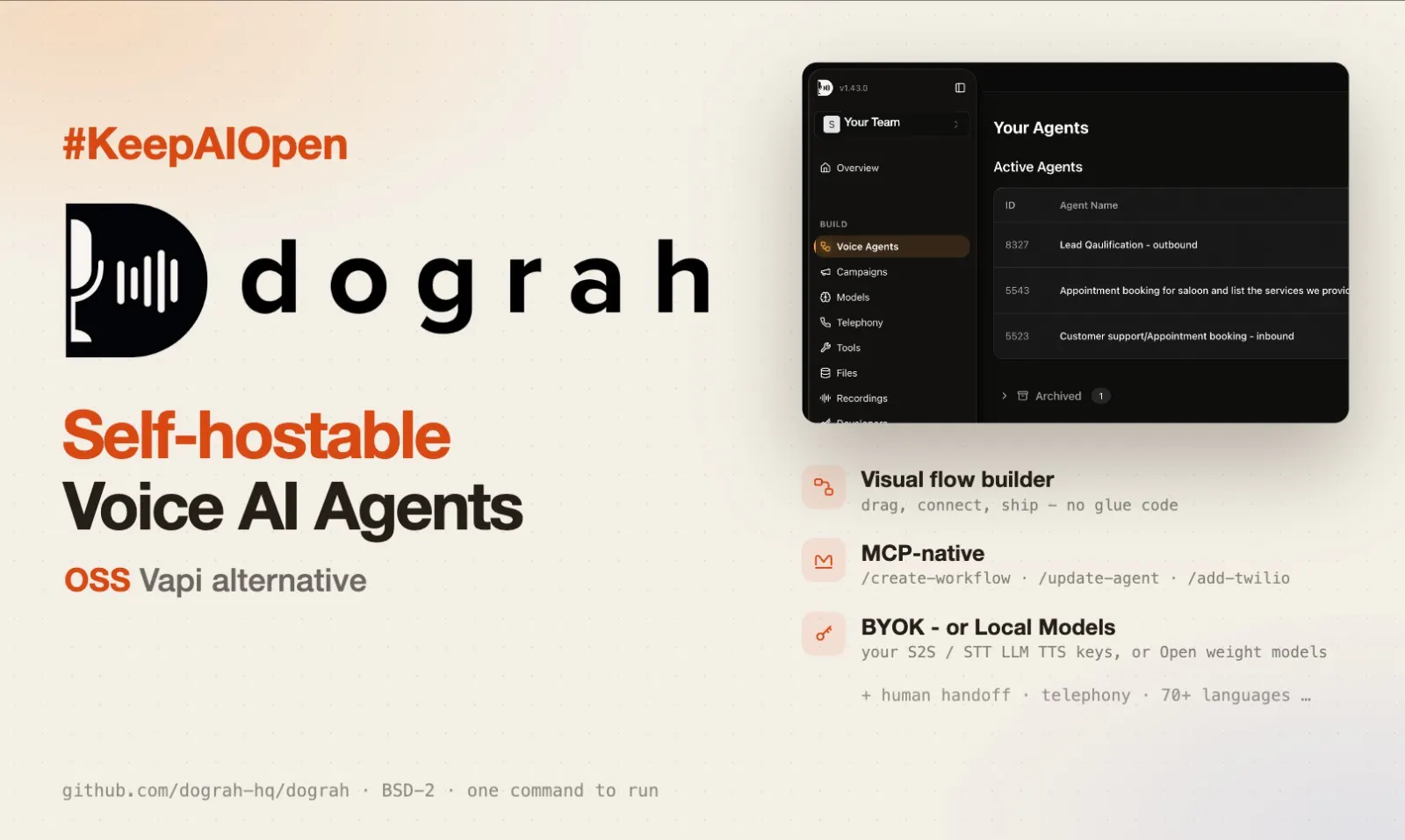
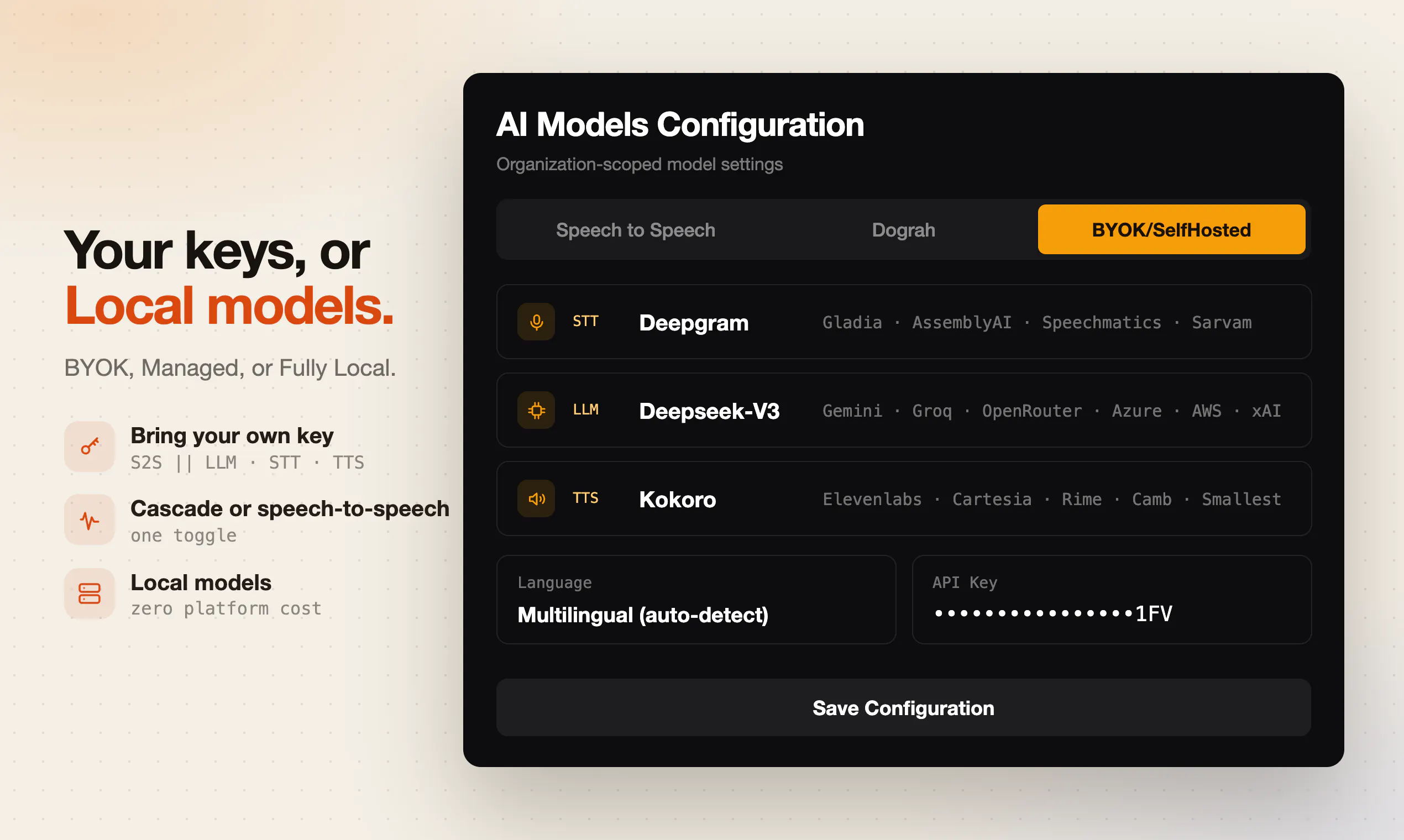
查看原始信息
Statewave
Open-source memory runtime for AI agents. Durable, structured context with provenance, self-hosted on Postgres.

Hey Product Hunt 👋

I’m Saber Maram, the creator of Statewave.

Most AI agent memory today is essentially a black box: a vector store gives you “relevant” context, but it’s hard to know where that memory came from, who can access it, or whether it was modified.

That works for demos. Production systems need more.

So we built Statewave, an open-source, self-hosted memory runtime designed around governance from day one:

  • 🔐 Access policies & sensitivity labels to control what agents can read/write

  • 🧾 Tamper-evident audit receipts for verifiable memory history

  • 🔍 Source traceability so every memory can be traced back to its origin

  • One-command local deployment with the API, admin console, and PostgreSQL included

You can run it locally with:

npx @statewavedev/statewave


It takes about two minutes and works with tools you already use, including Claude Code, Claude Desktop, Cursor, VS Code Copilot, Zed, Aider, Windsurf, and other MCP-compatible clients.

No account. No hosted dependency. Your data stays on your infrastructure.

We also wanted governance to come without sacrificing memory quality. On mem0’s own benchmark harness, Statewave outperforms mem0’s open-source version on both LoCoMo and LongMemEval, while matching its paid cloud tier. The benchmark results are fully reproducible:

https://www.statewave.ai/benchmarks

And this isn’t a launch-day prototype. Statewave is now at v1.4.0, with 384 commits, 14 releases, 10 contributors, 306 GitHub stars, and 10.3K Docker pulls, with 708 unit tests and 56 eval assertions running in CI.

Everything is open source under Apache 2.0:

https://github.com/smaramwbc/statewave

More about the project: https://statewave.ai

If you’re running AI agents in production, I’d especially love to hear:

What’s your biggest memory or governance pain right now?

We’ll be around in the comments today.

9
回复

@statewavedev  @saber_maram Outstanding launch, Building a governance-first memory runtime addresses the exact missing layer in modern agent architecture.

5
回复

@statewavedev  @saber_maram Congrats on the launch, Saber! Not a pain I have hit yet, but the one I expect first is what happens when many agents share the same memory at once. Every time an agent asks for something, the system has to decide right then what that agent is allowed to see. That is hard to add later, which is why designing for governance from day one is the right call.

0
回复

@statewavedev  @saber_maram I’ve been following this project for a while, and this feels like a real step toward making agent memory auditable, controllable, and dependable. I’m especially excited to see how the open-source community contributes to it.

Congratulations, and good luck!

0
回复

Congrats for launch🙌 Does the admin console allow operators to manually inspect, edit, or invalidate compiled memories without needing raw SQL queries against Postgres?

2
回复

@istiakahmad Congrats-back 🙏 Yes — that's exactly what the admin console is for. A subject explorer lets you browse and drill into per-subject memories and episodes, inspect provenance, state-assembly receipts, sensitivity-label policy and compile-job health — and manage compiled memories directly (edit/invalidate), no raw SQL against Postgres.

If your operators prefer the terminal, there's a CLI with full parity — every operation the web UI does. It's a privileged, secure-by-default console (password gate + access gateway), meant to run against your own instance.

This is the repo: https://github.com/smaramwbc/statewave-admin

What's your operator workflow — mostly audit/inspect, or hands-on correction?

1
回复

What got me was traceability. In my own agent project I could never answer "why did it use that memory?" — just a similarity score. With Statewave every retrieval traces back to a source, and the receipt shows what actually went into the context. That's the piece I'd been building badly by hand.

0
回复

@rajesh_gupta__ Facing the same problems is why we build this. Share your experience we are open for all response.

0
回复

Been using Statewave for a multi-agent setup — the supersession model is the part that sold me. When two agents write conflicting state, the older one isn't dropped, it's kept as superseded with links to both. Curious how you're thinking about surfacing those conflict chains in the console over time?

0
回复

@abhi_singh4000 Thanks - that's where we build the https://github.com/smaramwbc/statewave-multi-agent-memory for. Allways open for any comments on it.

0
回复

Tried doing this with a plain vector store first. Retrieval was fine, but the moment I needed access control and an audit trail I was building a whole governance layer myself. Statewave ships that part — self-hosted, so the data stays on my infra. Big time-saver.

0
回复

@arun_pratap_singh7 Thanks for your comment, let me know when you face questions.

0
回复

Really interesting project, especially seeing this open-sourced. Are you thinking about offering a hosted/managed version later, or is the plan to keep Statewave self-hosted?

0
回复

@arvish_suresh Great question. Short answer: self-hosted + open source stays the core — that's the whole point (own your data, inspect the governance yourself, no phone-home), and it's not going anywhere.

That said, yes — a managed/hosted option is on the roadmap for later, for teams who'd rather not run the infra themselves. The important part: the OSS won't turn into a crippled "community edition" to push people to cloud. Self-hosted stays fully supported and first-class.

Out of curiosity — is it mainly the infra/ops overhead you'd want to skip, or something else? That helps us shape what the hosted version should prioritize.

1
回复