Product Hunt 每日热榜 2026-08-27

PH热榜 | 2026-08-27

#1
Skydive
Build cloud agents that work across your tools
397
一句话介绍:Skydive 让用户用自然语言描述目标,即可在云端生成能跨 Slack、浏览器、桌面应用等现有工具自主执行多步骤工作的“AI 数字员工”,无需代码或复杂工作流配置,解决团队重复性跨工具协作效率低下的痛点。
Artificial Intelligence
AI代理 智能体 云端自动化 跨工具协同 无代码 数字员工 工作流自动化 企业SaaS 团队协作 AI员工
用户评论摘要:用户普遍认可其“重执行、轻提示”的定位及持续学习能力,关注点集中在权限控制(可精细到具体工具和数据)、边缘情况处理(未知界面如何应对)、人类审批介入机制(何时自动执行/何时询问)以及沟通渠道扩展(Telegram、WhatsApp)。有用户反馈通过其代理成功挽回18K美元欺诈损失,验证了实际ROI。创始人团队回应了大部分问题,并强调SOC2合规性。
AI 锐评

Skydive的野心不在于做一个更好的聊天机器人或更高阶的RPA工具,而是试图重新定义“软件即员工”的交付范式。它精准击中了当前AI应用的两大死穴:一是Chatbot止步于“建议”而非“执行”,价值停留在信息层;二是传统工作流引擎过度依赖人工拆解逻辑,脆且笨。Skydive通过“云上电脑+自然语言意图+记忆系统”的组合,将代理塑造成一个能自主决策、跨域调用工具、并在试错中自我进化的“数字实体”。其核心壁垒并非模型能力,而是围绕“责任”构建的信任体系——权限隔离、审批流、记忆校准,这些才是企业愿意将核心业务交给代理的关键。

然而,锐评之下仍有三重隐忧:其一,所谓“边缘情况处理”依赖模型推理能力,而云电脑操作任何未登录或改版的SaaS界面时,失败率依然可观,若无强有力的兜底机制,用户信任将快速崩塌。其二,评论区中“代理越用越懂你”是典型的数据飞轮叙事,但如何量化“更聪明”而非仅仅是“记住偏好”,目前缺乏有说服力的衡量指标。其三,397票的获赞与密集的创始人互动,更多反映的是种子用户的兴奋度,而非市场验证。数字员工赛道已有不少巨头和初创卡位,Skydive需要证明其并非“演示惊艳,生产拉胯”的Demo级产品。若真能如用户Dylan所言“代理自付工资”,则此赛道终局可期。

查看原始信息
Skydive
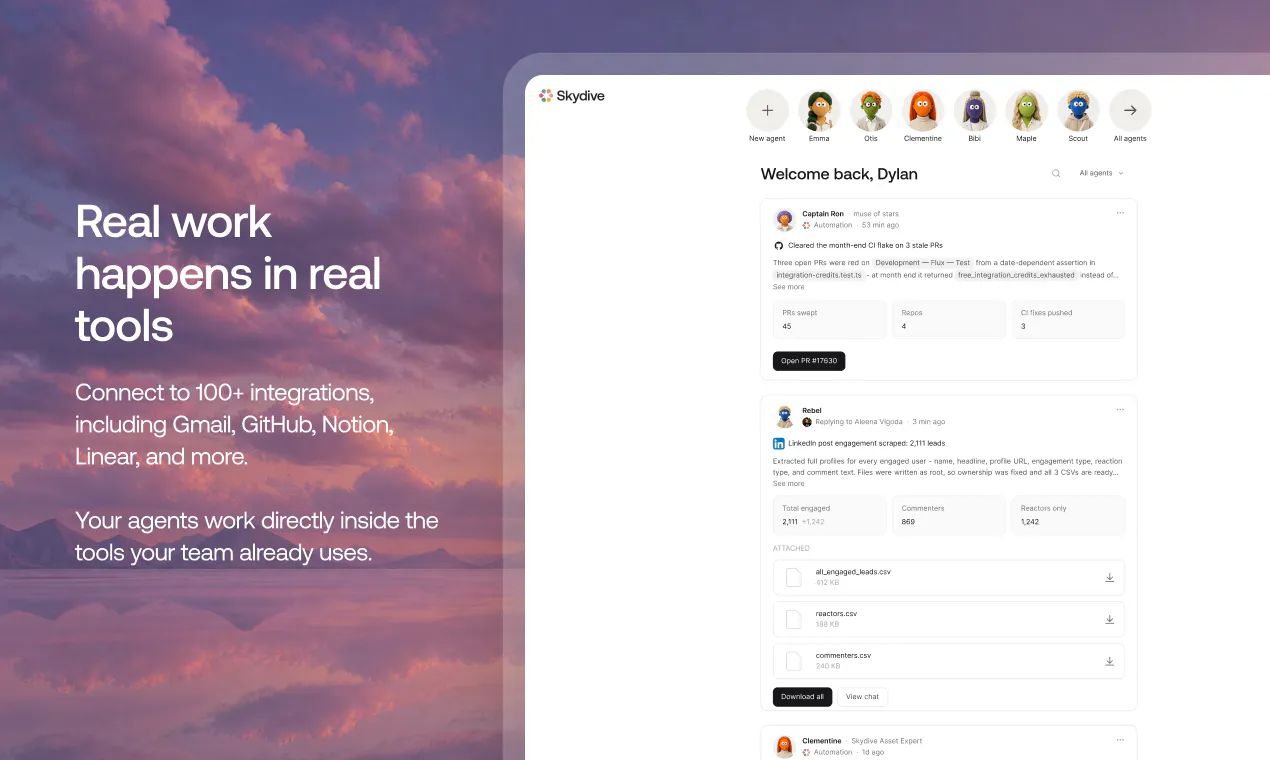
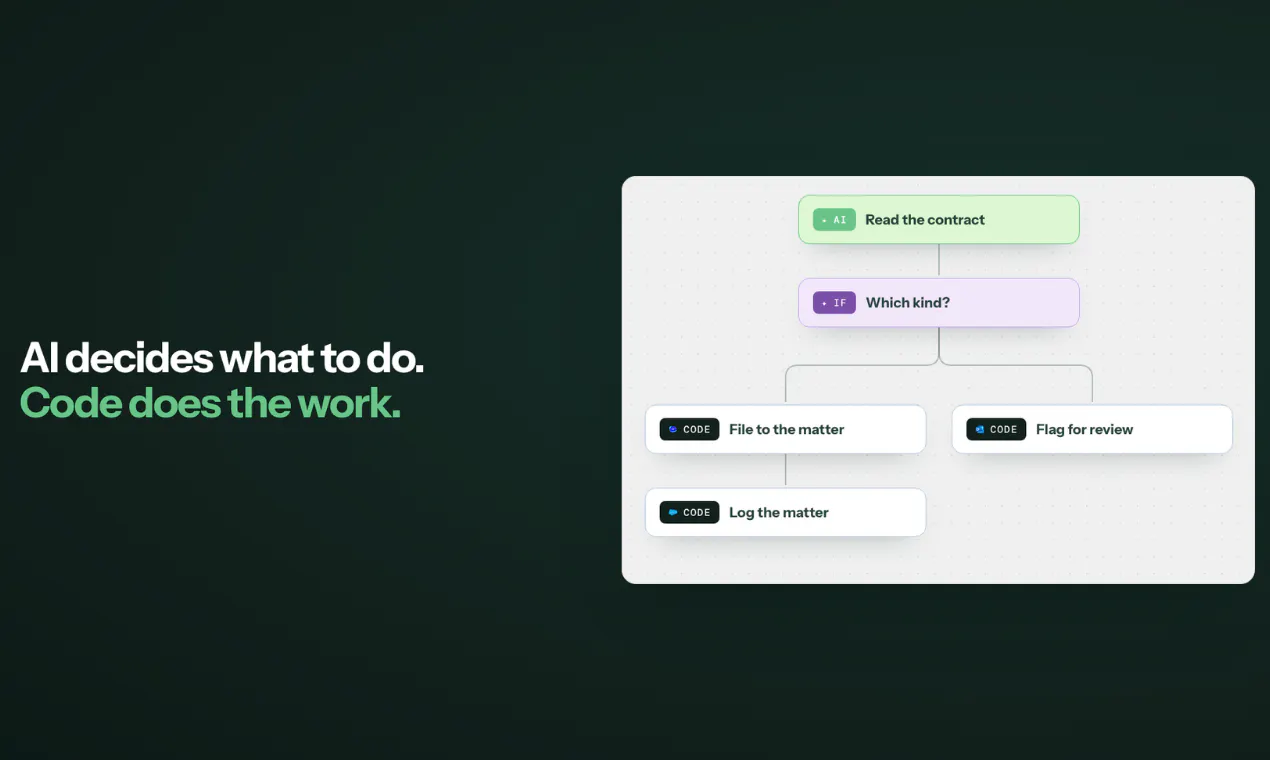
Build cloud agent coworkers that take on real, multi-step work across the tools you already use. Describe the outcome you want, and Skydive creates a working agent in minutes. No code, no prompt engineering, no workflow wiring required. Skydive agents live in your stack, execute repeatable work, and get sharper over time.

Hey Product Hunt! I'm Marcus, Co-founder of Skydive 👋

The problem

Everyone has access to the same AI models now, but you still have to prompt AI tools to get good results. I've seen one too many terminals built for managing Claude Code instances.

Today's tools usually fall into two camps:

💬 Chatbots answer questions and generate content, but you still have to take action yourself. They forget what you taught them the last time you worked together.

Workflow builders automate repetitive processes, but you have to design every step, maintain the logic, and update it whenever something changes.

Skydive is designed to actually help you grow your business by autonomously taking action throughout your company.

Meet Skydive

Skydive lets you hire AI agents that take on real responsibilities across your company.

Describe the job, and your agent gets to work. Your agent has it's own codebase and computer in the cloud, but you never have to think about it. It just works. If you want it to use your skills, you just tell it to. If you want it to learn to write like you, it can do that too. It also self-improves over time by learning from previous conversations.

🖥️ Every agent has its own computer

Agents use websites, apps, and files just like a person would. They click, type, log in, create documents, and complete work from start to finish.

💬 Agents work where you work

You can talk to agents in Slack, email, iMessage, on the web, or in your terminal. They go wherever you go and feel right at home working alongside you. They even connect to your desktop and can use the same programs you use.

🤝 Built for teams

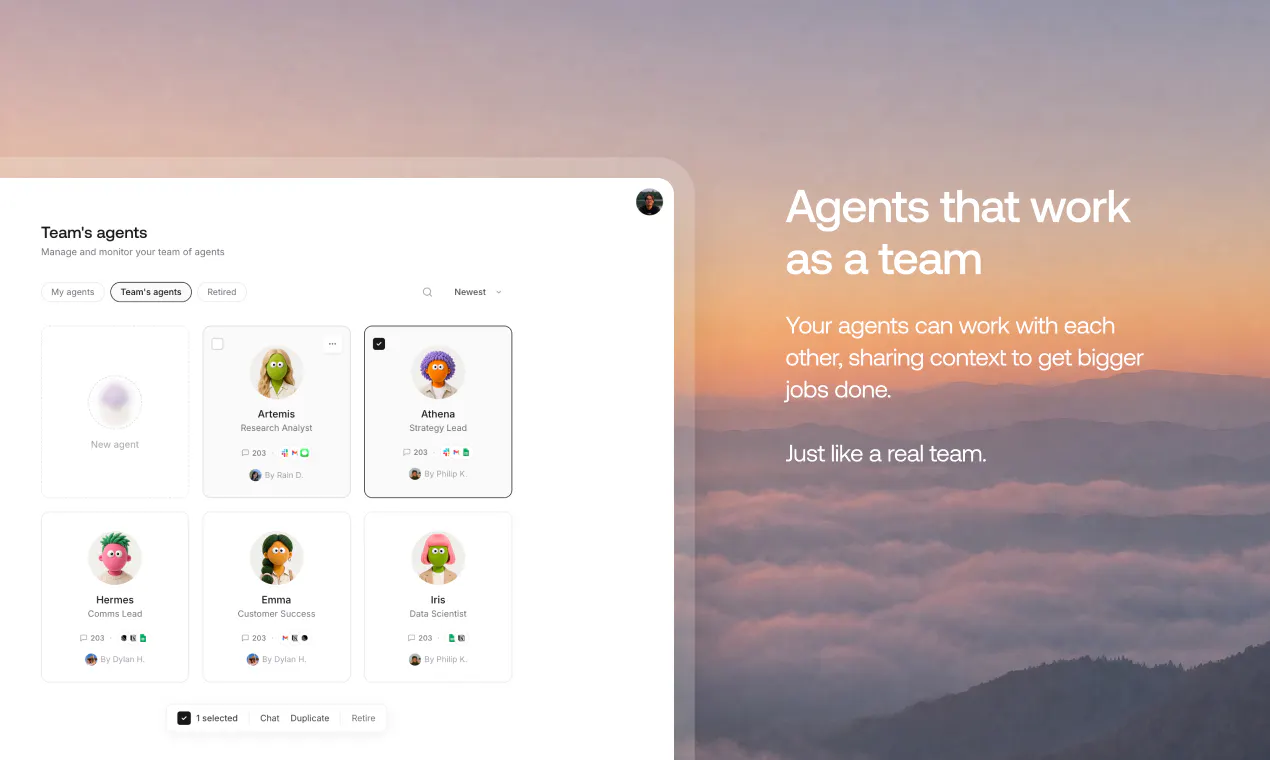
Agents are experts in their own area. They collaborate with each other, share context, and hand work off automatically so bigger projects actually get finished. Every agent can be shared with other members of your team so multiple people can coordinate work.

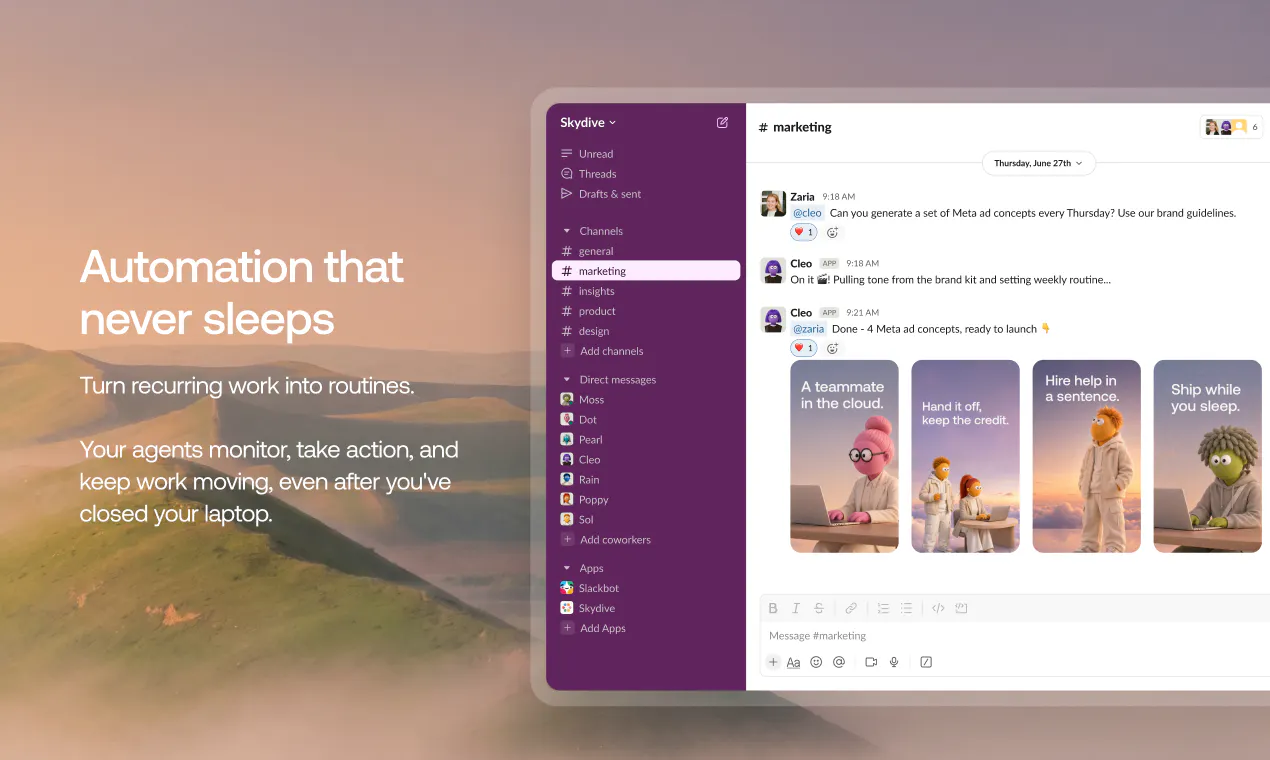
🌙 Automation that never sleeps

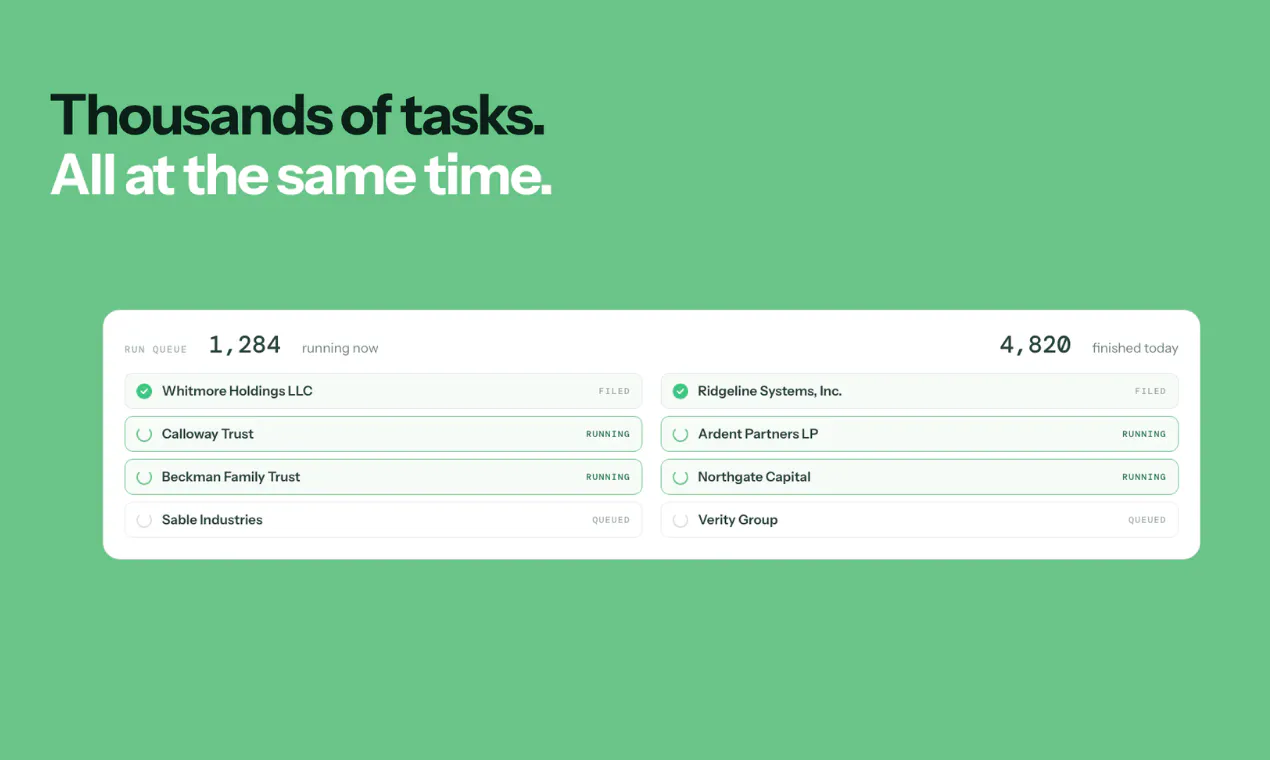
Turn recurring work into routines. Your agents monitor, take action, and keep work moving whether your laptop is open, closed, or you're halfway around the world.

🧠 Agents that improve over time

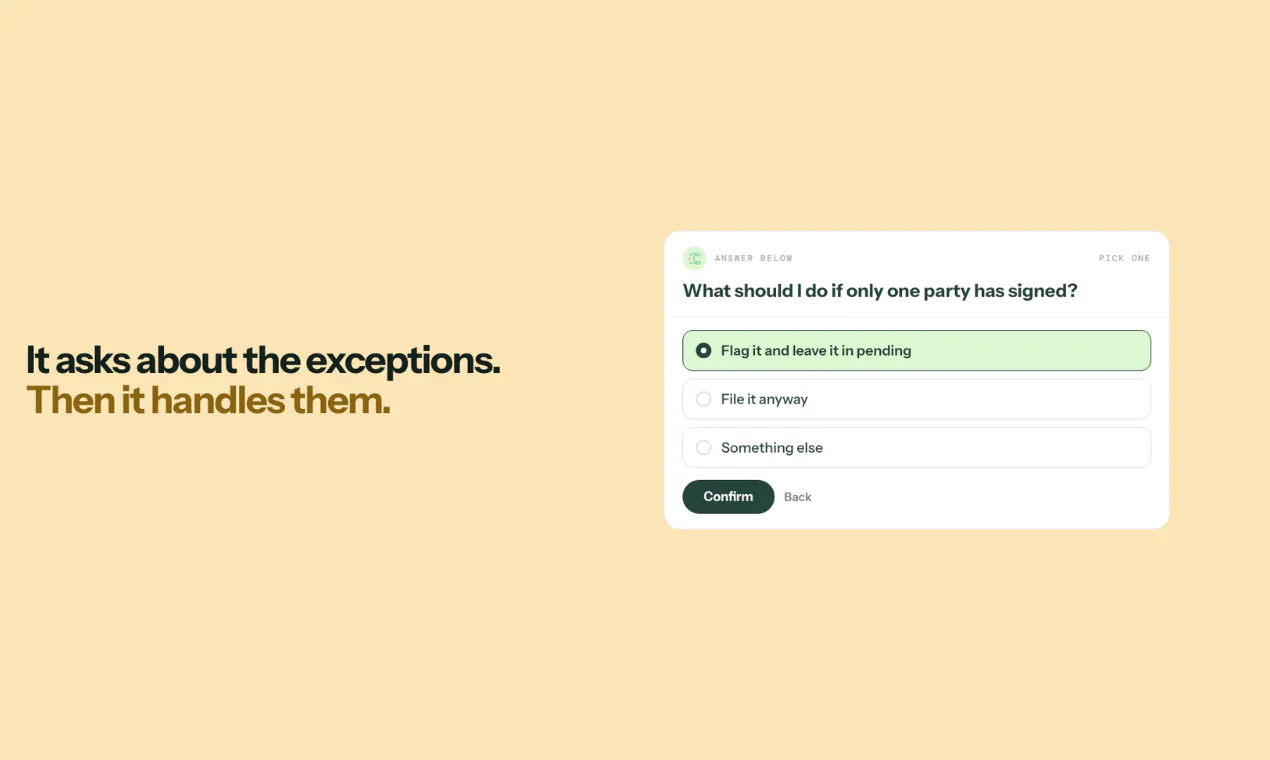
Correct an agent once, and it remembers. Your preferences, feedback, and company knowledge carry forward into future work automatically. When you're done working, your agents are dreaming and ingesting the lessons from the previous day's work.

Who is it for?

Founders, operators, and fast-moving teams that need to do more without adding headcount. If your work spans multiple tools, teammates, and recurring processes, Skydive was built for you.

We'd love your feedback ❤️

We're just getting started, and we'd love to hear what you think.

If there's one responsibility you'd hand off to an AI agent, tell us in the comments. We'll be around all day answering questions and shipping improvements.

To celebrate our Product Hunt launch, we're giving everyone an additional $5 in credits with the code PRODHUNT5 - if you need more, shoot my cofounder an email zaria[at]anything.com :)

If you're launching on product hunt soon, you can use this agent we've built to organize your launch. We used it ourselves, so we'll see how this goes, lol

https://www.skydive.com/templates/product-hunt

Thanks for checking out Skydive! 🚀

22
回复

@themarcuslowe How do you handle edge cases when an agent encounters a unfamiliar interface, given that each has its own cloud computer to click type and log in across your tools?

0
回复

@themarcuslowe Congrats on the launch. Help me understand, is it chat only or chat-first? I mean to ask, is there also a web app from where we can control the agents?

11
回复

@themarcuslowe Skipping the chat terminal to focus on persistent background execution hits a real operational need.

Congrats on the launch! 🚀

11
回复

“Cloud agent coworkers " is a great way to frame this. If this agents actually get better through repeated work, that could be a huge productivity boost.

12
回复

@luke_bell Yes, that’s one of the things we’re most excited about. They build context the more you work together.

9
回复

@luke_bell you nailed it here - my longest running customer facing Skydive agents have immense context now stored in memory so each of their "lanes" of expertise are well honed and improving every day.

6
回复

@luke_bell my best performing and go-to agent isn't even work related. he takes care of my gym workout programming so i dont have to think about it everyday. kinda like how zuckerberg wears the same shirt everyday to minimize decision making lol

8
回复

Congrats. Are we able to control permissions to agents? Example, access to production tools and company data?

11
回复

@himani_sah1 Yes! You can control exactly what each agent has access to (tools, data, repos, etc). Each agent is isolated and access can be revoked at any time.

9
回复

@himani_sah1 Yes! You can also set privacy level for each agent - private to yourself, internal to your company, or open to public in sales use cases.

7
回复

@himani_sah1 In terms of access to anything that might have exposure/sensitivity risk, I've found that my Skydive agents have a (reassuring) foundation of diligence + proactivity. if you're trying to connect to a tool outside of our oAuth integration stack, they'll guide you through the process of storing API keys/tokens in their secrets panel, will verbalize when login details (for example) shouldn't be shared over chat, and will suggest when it's safer for them to open their browser for you to plug in credentials yourself. with trust being paramount in agentic tooling, Skydive's soc2 compliance is also key here!
@marcuslowe_ @dhruvtruth

2
回复

While my customer facing support agents will always be my favorite part of my workday, its the niche agents like ChargeKnight (Stripe Disputes Manager) and Alfie (Affiliate Fraud Prevention and Payments Manager) that win for me on those areas of the business I care about but don't work in daily. They build expertise off best practices (white papers on Stripe Disputes) from external sources and adopt them into our company - Chargeknight even pays for himself, he returns more cash to us than he costs to operate by a factor of 2-4x

Alfie identified spoofing in our affiliate program with pending payouts of over 18k. The vigilance of Skydive agents helping me around the clock is just unbeatable.

10
回复

@dylan34 Dylan you are such a pioneer user of agents, it's incredible!

5
回复

@dylan34 forever impressed by how you can create specialized agents on Skydive and your customer support crew Dylan!

5
回复

@dylan34 thats why u the goat

1
回复

Is Telegram support on the roadmap?

10
回复

@nuseir_yassin1 Not officially yet, but definitely considering! Telegram would be a great fit.

8
回复

@nuseir_yassin1 telegram and whatsapp have been among the top asks!

3
回复

@nuseir_yassin1 Coming soon!

1
回复
It awesome how you move beyond chat to rigid workflow agents that take resposibility. Congratulations on your launch!
10
回复

@odeth_negapatan1 Really appreciate it! Thank you!

6
回复

@odeth_negapatan1 for real! agents can do so much more beyond chatbots

2
回复

pro tip: make an agent that looks similar to you and train them to talk and work like you. then tell your coworkers to go through the agent before escalating to you. congratulations you just made your personal assistant.

9
回复

@pgk1216 It's so fun to make agents that feel like you!

2
回复

@pgk1216 can't count the number of times someone's been in a meeting and we just pinged their agent for the file

2
回复

huge congrats to dhruv and the whole skydive team on the launch. been following this since i signed up - agents that actually do the work across your tools instead of just chatting about it is exactly where this needs to go. pumped to dig in. rooting for you guys

9
回复

@taylor_matthew_desseyn Thanks so much Taylor! Appreciate the support.

4
回复

@taylor_matthew_desseyn Thanks for the support Taylor!!

3
回复

@taylor_matthew_desseyn Thank you Taylor! Appreciate it!!

3
回复

I like that the focus is on outcomes rather than prompt writing. Not everyone wants to spend time figuring out the perfect instructions.

9
回复

@zeeshan_aslam2 Exactly, you should be able to give it the outcome and let it figure out how to get there.

7
回复

@zeeshan_aslam2 I hear you! Now I don't worry about the first prompt anymore and instead ask my Skydive agents how to achieve goals themselves - and they just go make progress proactively!

3
回复
@zeeshan_aslam2 Who cares about the prompt? Did it do the work??
0
回复

How does the tool decide when to rely on an agent and when to ask human input? Or that totally depends on the task?

8
回复

@iamanantgupta You get to decide. You can tell each agent what it owns, when it should check with you, and what requires approval. So it depends on the task and how you’ve set up your agent.

7
回复

@iamanantgupta You can think of these agents as new hires! They are fully autonomous and take work to completion, but only to the degree you want them to. If there are key pieces that you would like review or transparency with, just ask! The clearer you are about what you want and need, the better the agent will be for you. Like a new hire, they get smarter and better overtime as they learn more about your standards and conventions!

4
回复
@iamanantgupta We try to make the agents take action intelligently but when they don't know they'll ask you
0
回复

Skydive looks incredible, congrats on the launch!!

7
回复

@steventey thanks steven!

4
回复

@steventey Thanks so much for the support Steven!

3
回复

Congrats on the launch. Nice touch running today on the same launch agent you're handing to everyone else.

7
回复

@ben_kahan Thanks Ben! Thought it would be a fun experiment to try.

2
回复
@ben_kahan Thank you. We use Skydive for everything internally How can you trust it if you don't use it yourself?
0
回复

Running cloud agents that actually hook into your existing tools without a hassle fixes a huge orchestration pain point. Congrats on shipping!

7
回复

@thisiskp_ Thanks KP! Really appreciate it.

5
回复

@thisiskp_ for real! plug in all your favorite tools -> maximize your agent capabilities

2
回复

This feels especially useful for repetitive work that usually gets stuck between different tools. How much control do teams have over what an agent can access and change?

7
回复

@amybradley A lot! You choose exactly which tools each agent can access and can scope permissions down or up to whatever you would like. You can also separately control who on your team can use or edit the agent.

5
回复

@amybradley perfect question Amy, truly its full control - you decide what it can access and when, set the schedule, set the output, train and when needed, grow its responsibilities.

4
回复

@amybradley permissions are so important! so we provide options to make your agents private to yourself or your team

2
回复

Love how easy it is to create helpful working agents with skydive. Most productive couple days I’ve had in a minute!

6
回复

@michael_heckert Thanks Michael! Really appreciate the support

3
回复
@michael_heckert Matt thank you! Please send us anything that still sucks at support @ skydive . com we're shipping as fast as we can
0
回复

So pumped for this. I've been contemplating looking for a co-founder. This is my sign to build Skydive agents!

6
回复

@warrenharmon Yes Warren!! We would love to have you try out Skydive

2
回复
@warrenharmon If I had this when starting out I woulda built a much bigger company much faster
0
回复

The fact that these agents work across existing tools is what interests me most. It feels more practical than adding another separate workspace.

6
回复

@tom_nick1 Yes, our goal is to fit into how you already work. We don't want to give you another tool to manage!

3
回复

@tom_nick1 our web app is designed to be used as little as possible 😆

3
回复

@tom_nick1 Designed to work across the tools and channels that you use most, something that adapts to the way you work and not the other way around!

3
回复

doing dev work with a skydive agent is underrated. I literally take my work from the web, to the CLI, to iMessage on the train. the grind don't stop even after you leave your computer.

5
回复
3
回复

@brendan_teo real spill B I'm texting my engineering agent off the wakeup! it's a lifestyle 🤞

2
回复

@brendan_teo So true Brendan. It's insane how being able to message anywhere at any time just changes your entire relationship with the agent.

1
回复

craziest part is still the fact that slack is now a multiplayer IDE, CRM, support triage workspace, and everything in between for us. I don't ever want to go back

3
回复

@asurve It's unreal how much it has changed my workflows

2
回复

@asurve u dont ever have to go back ;)

2
回复
@asurve Yea def. Slack is becoming a platform
0
回复

Hey everyone! I'm Rain, one of the designers on the team here. I've been designing Skydive for the past few months and am so happy to see it live!

I created a design agent named Echo who has greatly boosted my productivity and hope everyone gets that magical experience too. Feel free to let me know any product and design feedback you might have :)

(and share your agent card with me once you create one - I'd love to see!)

2
回复

Congrats on your launch but I need to understand what it's all about and how it can help me

2
回复

@amanda_o_connor1 It's an agent builder that lets you create any agent you want! Each agent has a cloud computer and persistent memory, and can run background automations to self-improve. Common use cases include personal assistants, engineers, social media managers, and more!

0
回复
@amanda_o_connor1 Just sign up ! Feel free to reach out to support @ skydive if you need help
0
回复

@amanda_o_connor1 Great question Amanda! Basically you can use Skydive to create AI agents that can connect to the tools you use like gmail, notion, github, and more. By connecting to those tools, your agents can complete real tasks for you. Things like serving as a personal assistant (managing your email & calendar), becoming an engineer (pushing prs), or designing mocks in figma. They have their own computer they can use to browse the web or host/create files. Really you name it, the agents can probably help. You can chat with them on iMessage, email, or Slack and they will have the same memory/personality across all surfaces. It's basically like hiring a coworker!

0
回复
This is my favorite product I've ever had a hand in creating Our team at Anything uses it non stop. So I can't wait for your team to do the same
1
回复

@dhruvtruth It really is incredible how much we use Skydive internally

0
回复

We're really out here hiring cloud coworkers now hahaha. Love the idea of just describing what needs to get done and letting the squad handle the rest. Cool stuff guys, congrats on the launch! @zariazinn @dylan34 @genevieve_tankosich

1
回复

@dylan34  @genevieve_tankosich  @zach_francis Thanks so much Zach! Appreciate the support!!

0
回复

Congrats on the launch guys! Seems like a pretty solid productivity tool.

0
回复

The multi-agent collaboration concept is probably what I’d explore first. Having specialized agents share context and hand work off to each other could be very powerful for larger projects. Curious to see how well this works with real-world, messy workflows.

0
回复

What caught my attention is the persistent memory across different platforms. Being able to start a task in Slack and continue it elsewhere without having to explain everything again could make AI agents genuinely useful for day-to-day operations.

0
回复

The idea of giving an AI agent its own cloud computer is really interesting. Being able to let it actually interact with websites, files, and different tools feels much closer to having a real digital teammate than just another chatbot.

0
回复
#2
Enter Pro
The AI-native platform to build and scale your apps
377
一句话介绍:Enter Pro 是一个AI原生的“想法到应用”一体化构建平台,让团队无需折腾基础设施,即可在一个工作区内完成从规划、构建、预览到上线、扩展应用及AI代理的全流程,解决“原型容易、落地难”的痛点。
Developer Tools Artificial Intelligence No-Code
AI原生开发平台 低代码/无代码 应用构建器 AI Agent构建器 一体化开发运维 自动化工作流 业务应用搭建 团队协作 Converge AI 产品发布
用户评论摘要:用户普遍认可“自举”(用自家平台建自家产品)的实践,认为比宣传语更有说服力。核心疑问集中在:与Lovable、Base44等竞品的差异(回复强调团队协作及共享上下文);多人协作与版本管理机制(回复称支持并行工作与完整版本历史);以及复杂应用扩展性。有人提出希望看到更多针对特定、非热门业务流程的示例。
AI 锐评

Enter Pro 的切入点很精准,它没有重蹈“AI生成Demo”的覆辙,而是以“生产级基础设施全家桶”为卖点,直接瞄准了从“能看”到“能用”之间那段充满脏活累活的鸿沟。其“Can Enter build Enter?”的自举宣言是最高明的营销,也是最严苛的试金石——这比任何PPT都更能说服开发者。

然而,这个赛道已是红海,侧翼是Lovable和Bolt的极速体验,正面是Retool、Bubble等成熟玩家对复杂业务流的统治。Enter Pro 的真正护城河不在于它集成了多少功能,而在于“Converge AI”生态的协同效应。将应用、代理、运营和创意工具置于同一账户和上下文层,确实描绘了“AI作为操作系统”的诱人前景——如果数据孤岛能被真正打破,这将是超越单点工具的代际优势。

但风险同样明显:平台过于宏大往往意味着每个单点都不够锋利。评论中对“复杂应用扩展性”的质疑非常中肯,而回复中提及的“GitHub同步”表明其仍需依赖外部生态,这或许暗示其底层工程化能力尚未完全成熟。对于一个试图承载“整个业务”的平台,用户的核心诉求永远是“可维护性”和“可控性”,而非无限的功能堆砌。赠予积分刺激尝鲜是良策,但能否留住那些被复杂业务折磨的早期用户,取决于它在真实压力下展现出的稳定性和可扩展性。锐评而言,方向正确,前景诱人,但需警惕陷入“大而全”的陷阱,在核心垂直场景的深度上证明自己能跑通“业务闭环”,而不仅是“开发闭环”。

查看原始信息
Enter Pro
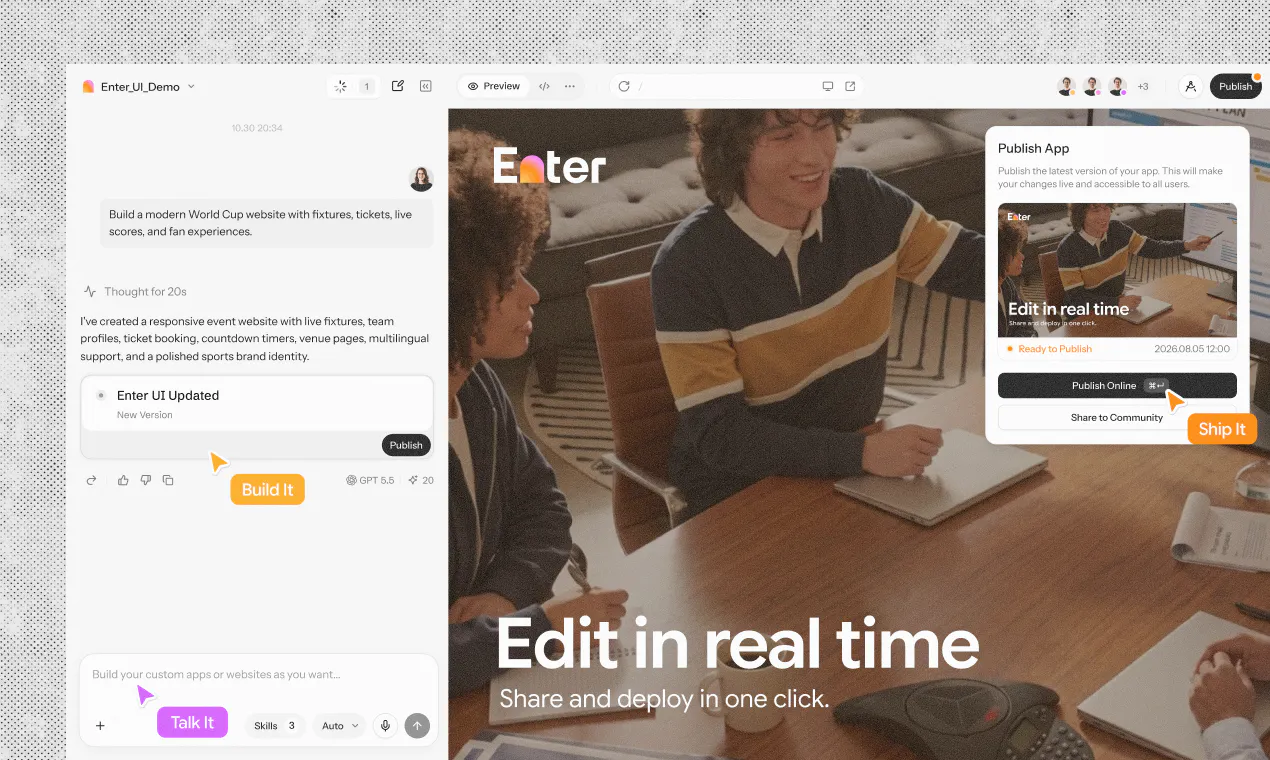
Building what runs a business takes more than code. Enter Pro is the AI-native platform that turns an idea into a working product. Plan, build, preview, launch, and scale apps, websites, and custom AI agents in one continuous workspace. Models, databases, authentication, hosting, payments, analytics, and localization are built in—so teams can ship software built for real business, not just prototypes.

Hey Product Hunt 👋 I'm Eric, one of the makers of Enter Pro.

Today, we're bringing Enter Pro to Product Hunt for the first time.

As AI models grow more capable, the barrier to coding keeps falling. But building what runs a business takes more than code.

Enter Pro is an AI-native platform that turns idea into working apps. As the builder layer of Converge AI, teams can plan, build, preview, launch, and scale apps, websites, portals, internal tools, workflows, and AI agents in one continuous workspace—with databases, authentication, storage, hosting, payments, analytics, and localization built in.

Enter started at the beginning of the year as a small experiment built around one question:

Can Enter build Enter?

We became our own most demanding customer. Our blog system(CMS) was the first product built entirely inside Enter. When GitHub import launched, we brought our main repository into the platform and began building Enter with Enter. Product, operations, and design could ship smaller improvements directly, while engineering stayed focused on the deeper systems behind them. Over time, more of Enter was built on the platform itself—from the Enter Forum and our internal admin system to landing pages created and shipped by non-technical teammates. The answer was yes: Enter could build more than prototypes. It could power the real systems behind our business.

Along the way, we noticed that our teams were still repeating the same work every week—answering support questions, researching accounts, summarizing feedback, and preparing updates. We began turning those workflows into agents, which led to one of Enter Pro’s newest capabilities: Agent Builder.

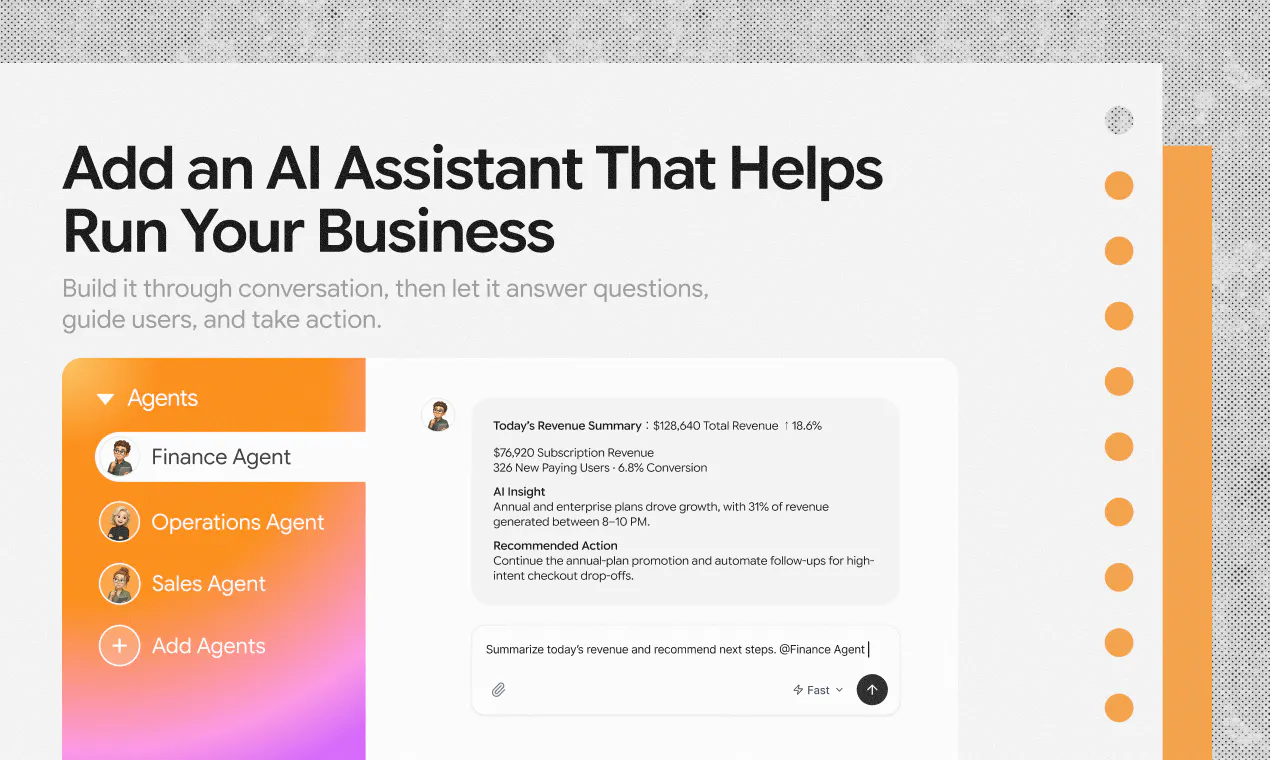
Describe what your agent should do, test it in a live preview, and publish it as a shareable link, a web agent, inside your product, in Slack or Lark, or through an SDK or embed. Enter handles the models, knowledge, tools, deployment, versioning, and infrastructure behind it. The goal isn’t another chatbot or one-off demo. It’s to turn recurring work into agents that can be deployed, maintained, and improved over time.

What excites us most is the shift from AI as a chat window to AI as an operating layer. And because apps and agents are built on the same platform, AI can become part of how a product works from day one—not something added afterward. Our belief is simple: people should spend more time on judgment, creativity, and deciding what to build—and less time repeating the work required to make it happen.

We still have a long roadmap ahead, and we’d love to hear what you want to build with Enter.

As a small launch gift, the first 300 new Product Hunt users who sign up and try Agent Builder will receive 400 bonus Credits. First come, first served—claim them within seven days 🎉

👉 https://enter.converge.ai/s/ph1

15
回复

As a small launch gift, the first 300 new Product Hunt users who sign up and try Agent Builder will receive 400 bonus Credits. First come, first served—claim them within seven days 🎉

👉 https://enter.converge.ai/s/ph1

3
回复

@eric_zhang25 The 'Can Enter build Enter?' experiment, where you rebuilt your own blog and forum inside the platform, is such a bold proof of conviction. Well done👍🏽on the launch!

0
回复

@eric_zhang25 Congrats on the launch, Eric and team!

How I came across Enter Pro?

A community member reached out sharing this “idea-to-app” platform and he walked me through Enter Pro’s vision: an AI-native workspace where you can plan, build, preview, launch, and scale real business software.

What is Enter Pro?

Enter Pro is the builder layer of Converge AI: a single environment for websites, mobile apps, dashboards, marketplaces, SaaS, and custom AI agents, with databases, auth, hosting, payments, analytics, and localization built in.

Why I endorse it?

What won me over is that it’s designed to run your business, not just generate a one-off app, and it even powers parts of Enter’s own product (the “Can Enter build Enter?” story).

Excited to hunt Enter Pro today. I like how versatile it is for building anything from websites to mobile apps to dashboards to marketplaces to SaaS... anything. Looking forward to seeing what the community builds with it. :)

5
回复

love the can enter build enter? story! how has using your own platform changed the way your team develops new features?

4
回复

@olivia_bennett7 Thanks Olivia! Honestly, it completely killed our traditional "handoff" friction. Now our PMs and designers refine features directly in code alongside engineers. If someone hits a pain point using Enter, it becomes our roadmap item the same day. It keeps us radically honest about what we're shipping!

2
回复

Congrats on the launch, Eric!

What makes Enter Pro different to those big players like @Lovable and @Base44 ?

3
回复

@justin2025 Good question! Honest take: tools like Lovable and Base44 are brilliant at what they do—letting you turn an idea into a sleek app in minutes.

Where Enter Pro takes a different path is what happens after the initial build. We didn't want to build another isolated app generator; we wanted to build the engine that actually runs your business.

A few things that make Enter Pro special:

  • We’re a team, not a solo tool: Enter Pro is the Builder Layer of Converge AI. It shares a brain (context layer) with our other products—Converge Work (Ops), Framia (Creative), Combos (Interactive), and Concat (Growth). That means your dev, marketing, and ops teams can build tools that natively talk to each other under one account and subscription.

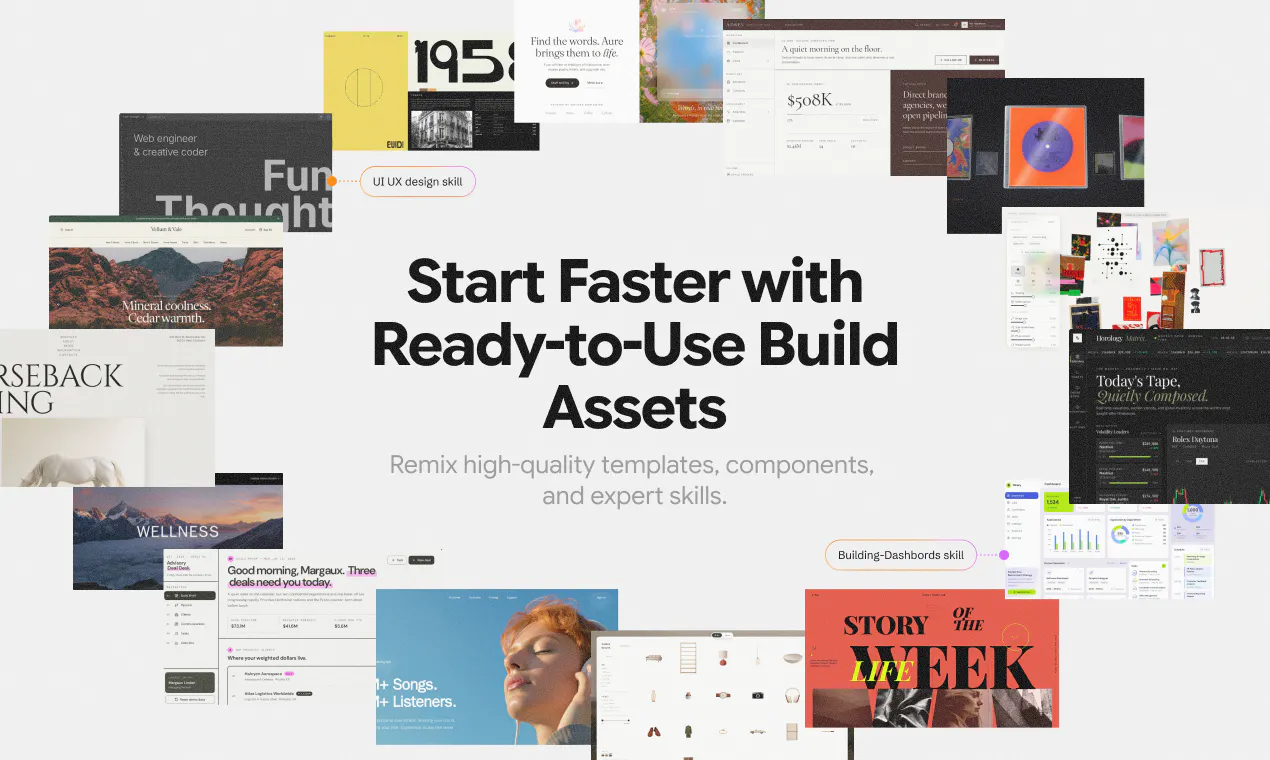
  • From "Vibe Coding" to actually running a business: Prompts and pretty UI are great, but real software needs muscle. We combine natural language coding with production-grade infra, B2B templates, and our new Agent Builder. You’re not just "prompting and praying"—you’re deploying, running, and scaling stuff that works in the real world.

3
回复

How does collaboration work when several people are working on the same project? Is there version history or branching?

2
回复

@kathrine_rolce Hi, Kathrine! Collaboration is actually how we run Enter internally — our CMS, forum, and internal admin tools are all built by cross-functional teams on the platform.

Here's how it works:

  • Team Workspaces — invite members and manage people, projects, and Credits in one shared workspace (Pro supports up to 20 members), with role-based access control.

  • Parallel work, not queues — multiple people can run multiple Agent sessions on the same project at the same time, so no one is blocked waiting on someone else's build.

  • Full version history — every change is tracked with built-in logs and version history. You can diff versions, bookmark milestones, and revert code (with conversation state) in one click.

0
回复

Congrats team! what types of AI agents have you found to be the most valuable in your own daily operations so far?

2
回复

@croft_benjamin Thanks Croft! Hands down, our favorite teammate is Delta 🤖—our resident technical agent!

Our RD trained Delta on our whole codebase, and now it hangs out with us in our team chat every day. Whenever tricky tech puzzles pop up, even our non-tech teammates will jump right in to chat and troubleshoot with Delta.

1
回复
Love that they dogfooded this on their own CMS and forum before opening it up. Says more than any landing page copy could. Congrats on the launch 🚀
2
回复

@abod_rehman Thanks for noticing! We've built our own CMS, forum, internal admin system, and landing pages with Enter Pro. Dogfooding is literally our development workflow. Now we're excited to see what the PH community builds with it 🚀

1
回复

Hey Product Hunt 👋 I’m part of the team behind Enter Pro.

I worked mainly on shaping the Agent Builder and discussing the backend architecture—especially how agents connect to knowledge and tools, get deployed and versioned, and evolve beyond one-off chatbot demos into reliable workflows.

The part I’m most excited about is having apps and agents built in the same environment, so AI can become part of the product itself rather than something bolted on afterward.

Huge credit to the engineering team for bringing it all to life. What’s the first recurring workflow you’d want to turn into an agent?

2
回复
Editing live and sharing the result in one click makes the whole product feel unusually direct.
1
回复

@1067510683 Thanks! "Direct" is exactly the word we chase — edit, preview, share, done. No round-trips. Glad it feels that way!

0
回复

Congrats! @eric_zhang25 . I am Leo founder of flaq.ai. It's very interesting to build apps with Enter Pro. Hope that more and more builders can find Enter Pro to help their building jobs.

1
回复

@hello_leo Thanks Leo — congrats on flaq.ai! Always great to meet fellow AI builders. Hope Enter becomes a go-to tool for your builders too.

0
回复

Having apps and agents in the same product makes sense. AI is more useful when it is part of the workflow, not a separate chat box bolted on later.

1
回复

@axelkane Exactly. Apps and agents should work together—not live in separate tools.

1
回复

Small businesses often know exactly which spreadsheet or email chain they want to replace. The problem is that custom software feels out of reach, while no-code tools can get awkward once the process grows beyond the happy path. Enter Pro looks like a useful middle ground: approachable enough to start without a dev team, but with enough underneath to keep using the result. I'd love to see more examples aimed at these unglamorous, highly specific business workflows.

0
回复

Congratulations on the launch! Is it like Lovable, but with ready-made modules?

0
回复

this looks cool! is this a web app or a desktop app? or both?

0
回复

@itskellysun Everything runs in your browser — no installs, works on mobile too. For developers who prefer the terminal, Enter Code runs locally as a CLI companion (same account, same credits). Best of both!

0
回复

Congrats on the launch! A lot of AI builders are great at getting you to a prototype, but the harder part is everything that comes after—auth, databases, payments, deployment, analytics, and actually maintaining the product. Bringing all of that together with an agent builder in one workspace feels genuinely useful. Curious to see how Enter Pro handles more complex apps as they scale.

0
回复

@ll_wen Thanks — that's exactly the gap we built for: the boring-but-critical parts after the prototype. On scaling, honest answer: we run our own CMS, forum, and internal systems on Enter, and GitHub sync + version history keep the code manageable as apps grow. Would love your feedback when you push one further!

0
回复

The pitch clicked for me right away: describe the idea, build it, and get it online without setting up five different services first. That setup work is where a lot of good ideas die. You lose a weekend to auth, another evening to deployment, and suddenly the thing you wanted to test feels like a systems project. Taking that weight off the first version is a meaningful promise. Congrats on shipping!

0
回复

@mi_leeli You nailed exactly why we built it — the weekend lost to auth, the evening to deployment. We wanted to take that weight off so the first version survives long enough to be tested. Thanks for putting it so well!

0
回复

Interesting product. Is this for product managers?

0
回复

@erkang Thanks for your question! Product managers are one of the audiences, but not just PMs. Restaurant owners, retail teams, and other business folks use it too — if you can describe what you need, you can build it.

0
回复

Congrats on the launch. Building the platform inside the platform was the hard way to prove it.

0
回复

@lucasjpols Hi, Lucas! "the hard way" is right — there were no shortcuts to hide behind. But it forced us to eat our own dogfood daily, and that's how the product got sharp. Thanks for noticing!

0
回复
@eric_zhang25 Congrats on the Enter Pro launch. Going from an idea to a working product in one place is a clear and useful direction. Which type of user has gotten the most out of it so far?
0
回复

@khomichenko Great question! It's a mix: solo founders, PMs, and designers ship MVPs fast, while users from legal, finance, healthcare, restaurant, and media run real businesses on the platform. The common thread — less plumbing, more building.

0
回复

Congrats on the launch! Being able to build and scale full native apps using AI is huge for anyone trying to move fast. The workflow looks super clean and straightforward.

0
回复

@thisiskp_ Thanks! That's the goal — full apps, real code, no ceilings. Glad it comes across that way!

0
回复

Does it have the ability to connect to multiple connectors? I mean, integrating with other tools?

0
回复

@nuseir_yassin1 Great question! Our team is hard at working on this. The first wave of native connectors for popular platforms is landing on Enter super soon. Stay tuned!

0
回复

What base models does Enter Pro use?

0
回复

@iamanantgupta Not one — we're model-agnostic. AI All brings together frontier models from OpenAI (GPT), Anthropic (Claude), Google (Gemini), DeepSeek, Kimi, GLM and more — pick per task, or let Auto choose. One credit balance, no API keys to manage.

0
回复

I have seen tools that are good at just one thing. Example, yesterday's top product was a tool that helps build only iOS apps really well. Whereas Enter Pro seems to build everything and anything. What do you think is the baseline difference between horizontal versus a vertical builder tools?

0
回复

@himani_sah1 Hi, Himani! Great question! Verticals win on depth in one lane; horizontals win on breadth across the whole journey. We chose horizontal on purpose: the value isn't one app type — it's that plan, build, launch, and scale live in one workspace, with DB, auth, hosting, and analytics underneath. Templates give vertical-style depth (start from a ready-made base) without locking you into one lane.

0
回复

I like the idea of custom AI agents being part of the same app-building environment. That could make internal tools much easier to create.

0
回复

@daniel_henry4 That's exactly the angle we care about — our own internal admin and support workflows run as agents right next to the apps. Glad it clicks with you too!

0
回复

Can teams switch between different AI models depending on the task, or is the model choice handled automatically?

0
回复

@anthony_adams_ Both — you're in control! Switch models per task right in the picker (GPT, Claude, Gemini and more), or let Auto choose the best fit. Selections persist across chats, projects, and Agent Builder — one credit balance, no API keys to manage.

0
回复

Having localization built in from the start is a thoughtful touch for teams planning to serve multiple markets.

0
回复

@maali_baali Thanks! Localization is a big lift for most teams, so we wanted to make it less painful — glad it comes across that way.

0
回复

I’d be curious to see how it handles an existing app rather than starting from a blank project.

0
回复

@aarav_pittman Hi, Aarav! You don't actually have to start from a blank project — that's where our creator ecosystem comes in. Inside Enter Pro you'll find a rich, community-built library you can build directly in Design Kits.

0
回复

Congrats on the launch, looks really promising!

0
回复

@hello_yar Thanks so much! Hope you get a chance to try it — we'd love your feedback 🙌

0
回复
A lot of AI app builders create impressive demos. How does it helps users move from a prototype to something they can actually maintain long term?
0
回复

@rukhsar_amjad Fair challenge — that's the part we care about most. The production stack you'd normally stitch together from separate vendors — database, auth, payments, analytics, custom domains — is available right inside the platform. Proof it holds up long-term: our own CMS, forum run on Enter Pro, where non-engineers ship updates weekly.

0
回复

What happens when the AI makes a change that breaks an existing feature? Is there an easy way to inspect and fix it?

0
回复

@nadeem_iqbal4 Fair question — that's where the safety net comes in. Every change lands in version history with code diff, so you can inspect exactly what broke and roll back in one click. Plus one-click AutoFix for runtime errors — the Agent reads the logs and patches it. And for quick fixes, the Visual Editor lets you edit and annotate directly on the live preview — no code needed.

0
回复

I really like the continuous workspace concept. how seamlessly can you move from planning an idea to deploying the finished product?

0
回复

@carter_garcia Thanks, Carter! That's the core idea — plan, build, preview, launch all in one continuous workspace. Plan Mode maps out the architecture for your sign-off, then one click ships it to a live URL — database, auth, and hosting included.

0
回复
#3
Lenz
Independent, multi-model fact-checking API for AI workflows
248
一句话介绍:Lenz是一款面向AI工作流的独立多模型事实核查API,通过提取文本中的可验证主张,并经由多源搜索、多模型辩论和评审团裁决,返回带完整证据链的评分结论,解决AI生成内容中“模型一本正经地胡说八道”的幻觉痛点。
Artificial Intelligence
AI事实核查 幻觉消除 API服务 多模型协作 可审计溯源 内容安全 企业级AI 模型评测 MCP协议 工作流集成
用户评论摘要:用户普遍认可其可视化推理和AI盲点纠偏价值,尤其看好GitHub Action集成、媒体/法律/金融场景应用。核心问题聚焦于:来源相互矛盾的极端情况处理、YouTube视频提取失败、逻辑链条的完整追溯性、以及Deep Research输出验证流程。
AI 锐评

Lenz的定位精准切入了一个AI产业化进程中最致命却常被忽视的环节——事实性保障。当行业沉迷于参数竞赛和生成效果时,Lenz选择为“不可信”兜底,这是典型的“卖铲人”逻辑,且技术路径相当扎实:不是依赖单一模型的自我修正,而是构建了证据收集、多模型对抗辩论、陪审团裁决的完整流水线。其公开的研究数据极具杀伤力——五个前沿模型对23%的真实主张存在显著分歧,76%的答案自信度虚高,这直接戳穿了“大模型即真理”的泡沫,为B端客户采购提供了理性依据。

但需泼冷水的是,Lenz的“独立”是相对而非绝对的。其核心依赖仍是第三方模型API,本质上是把“单点信任”分散为“多点信任”,并未消除信任半径,只是扩大了半径。此外,在知识迭代极快的领域(如突发新闻、前沿科技),多模型共识可能等于“集体过时”。当前248票在PH略显平淡,产品更偏开发者工具,市场教育成本高。其真正护城河不在API本身,而在于那份公开的对抗性研究数据积累的声誉资产,以及逐渐沉淀的、带来源权重的知识图谱。若能抓住媒体、金融、法务等“一行代码都不敢错”的行业,渗透进CI/CD或合规审查流程,Lenz有机会从锦上添花的工具,变成AI社会的“质检总局”——但前提是,它得先证明自己在极端矛盾信息下,比人类编辑更接近真相,而非仅仅看起来更严谨。

查看原始信息
Lenz
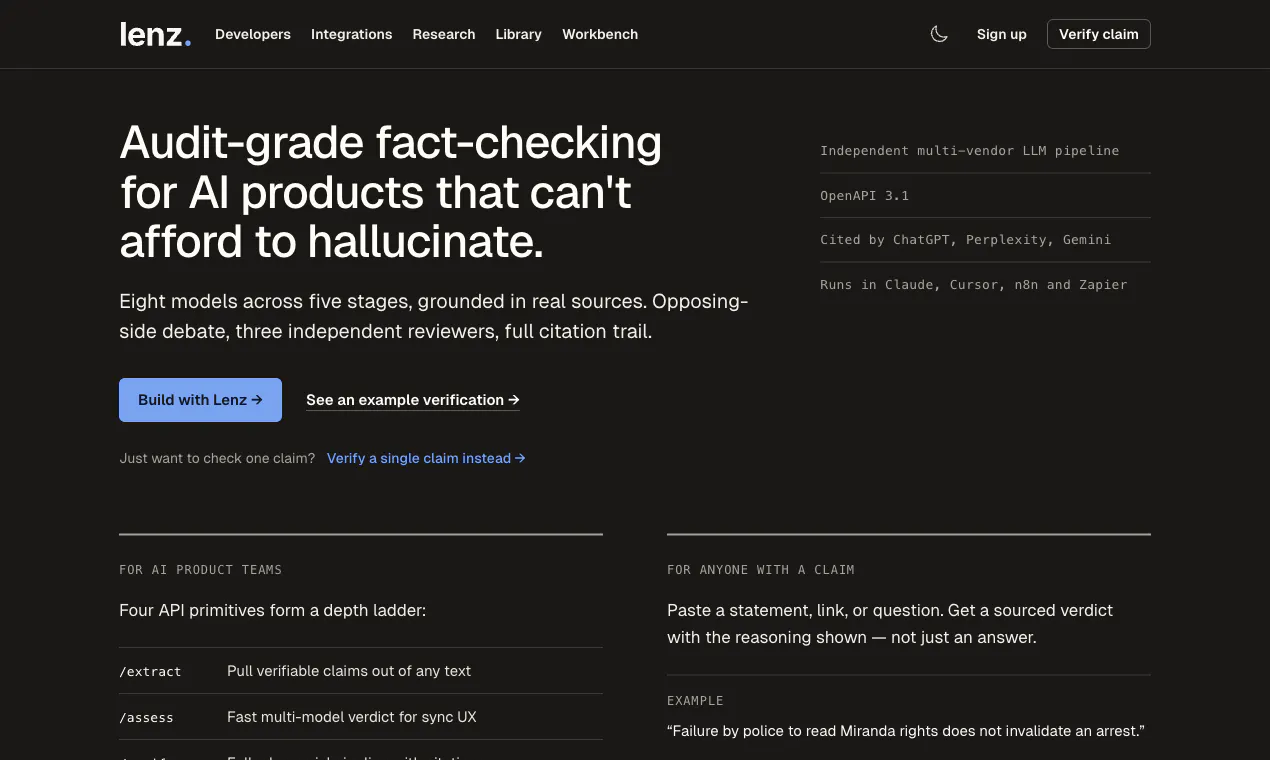
Lenz is an AI fact-checking API for products that cannot afford to hallucinate. It extracts verifiable claims from any text, then checks each one: searching independent sources, running multi-model debate, and routing through a review panel — returning a scored verdict with every source, argument, and step visible. Most AI tools give you one model's best guess from memory. Lenz ensures no single model's blind spots drive the conclusion. Available as API and MCP. Try it free at lenz.io/ph

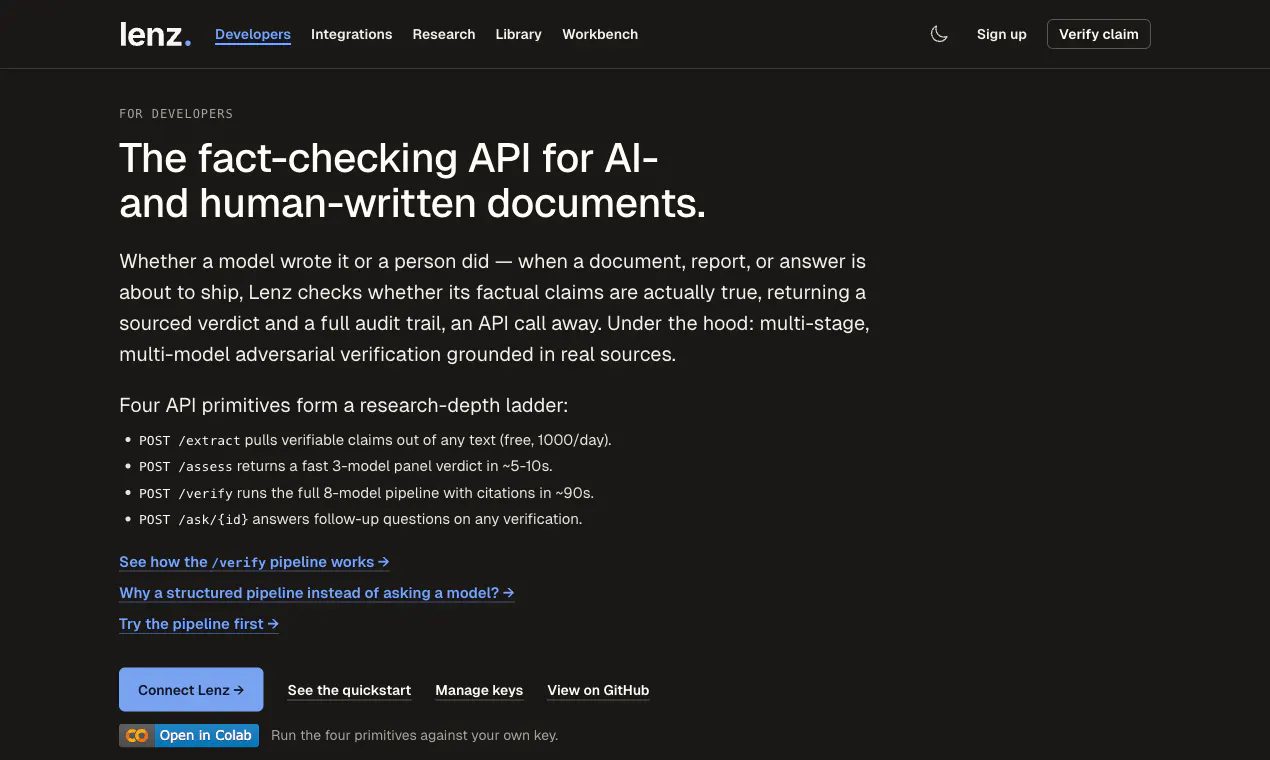
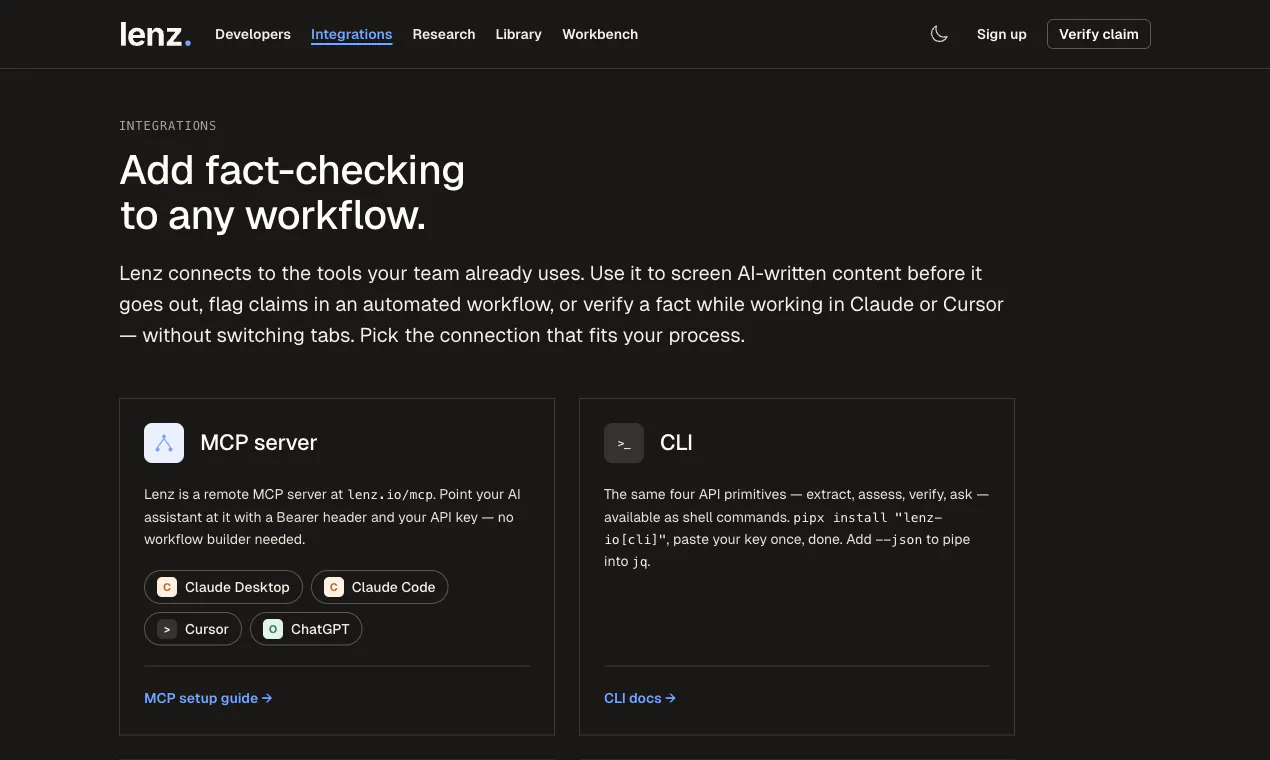
Kosta here, co-founder of Lenz. Many businesses ship AI-generated content to their customers. Some of those use cases could benefit from factual verification of that AI output. That's why we built Lenz, packaged it as an API/SDK, and made it available across multiple platforms (n8n, Zapier, MCP, CLI), so people can easily integrate it into their workflows. Lenz verdicts come with a full audit trail - sources, citations, reasoning, confidence. 

How Lenz is different than just asking a model:

(1) separate evidence gathering step (with source ratings) that doesn't rely on the model's memory or retrieval capabilities

(2) multi-vendor, multi-model approach to address single-model biases

(3) multi-round adversarial debate to crystallize the strongest for/against arguments

(4) multi-model jury reviewing the evidence and the debates across multiple axes

Key API primitives: /extract - extracts the factual claims from a text; /assess - quick assessment of a claim; /verify - the full deep claim verification; /ask - follow-up post-verification questions.

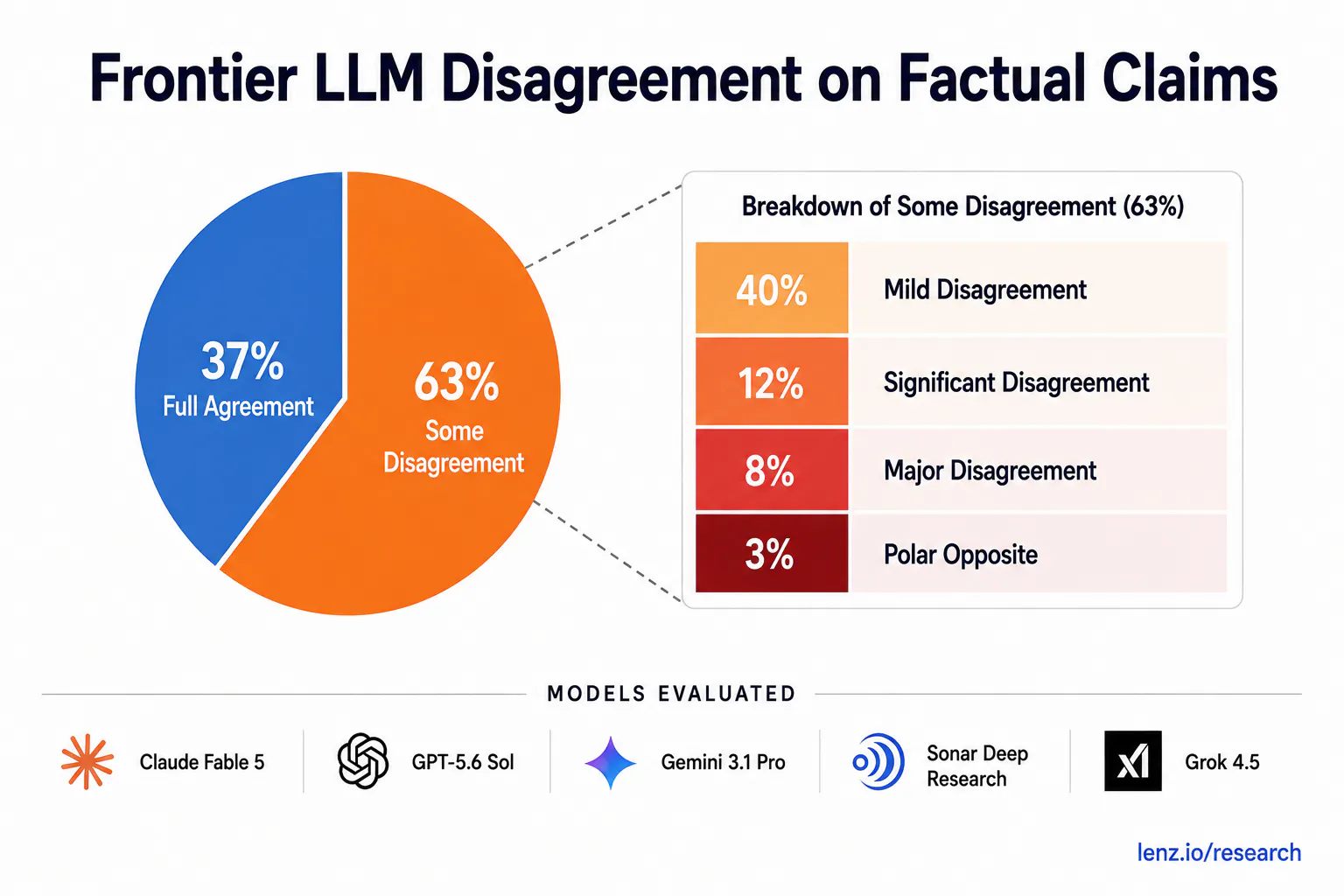
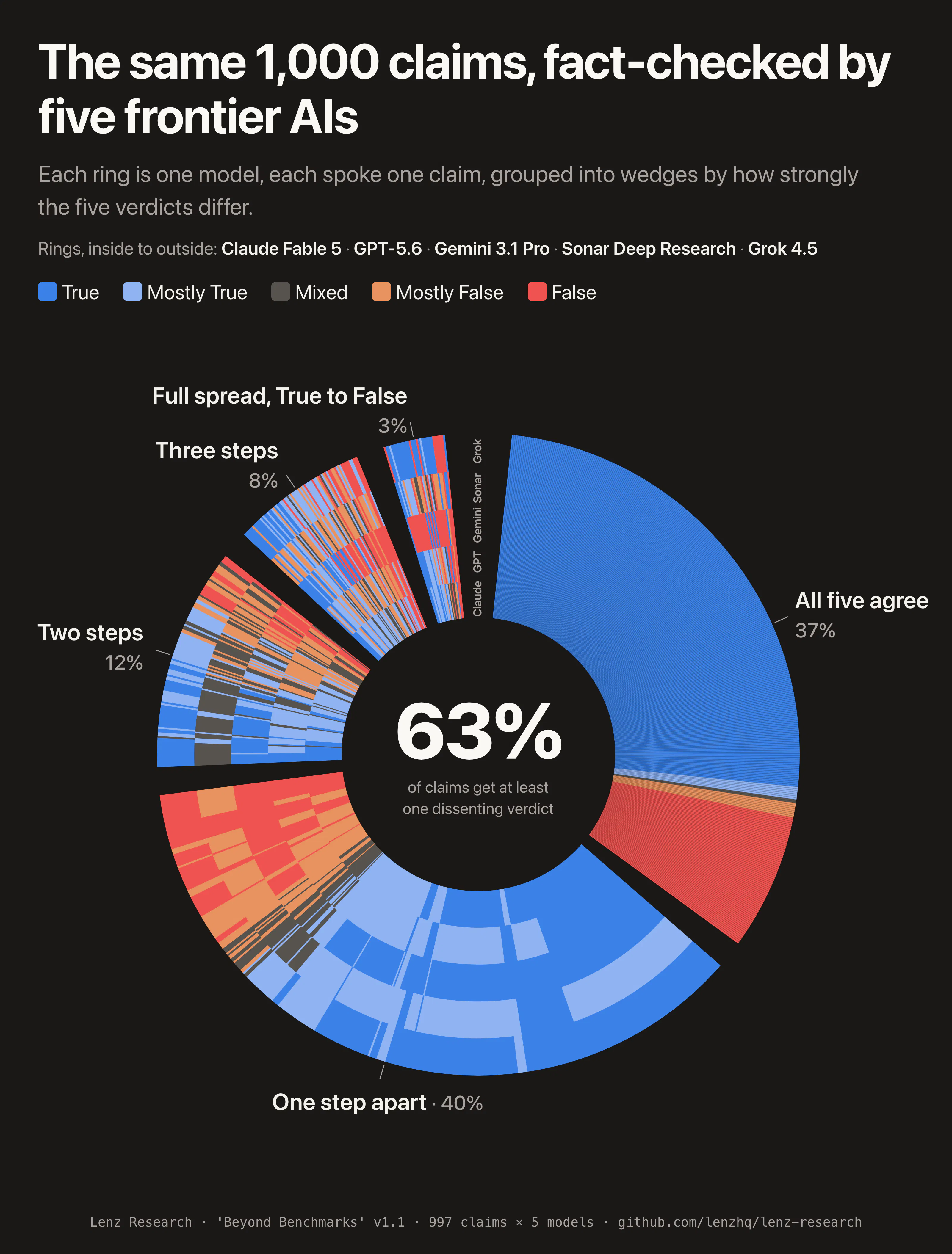
We measured the level of disagreement between the individual frontier models: on 23% of real-world claims, they disagree significantly, which sets the floor of the error Lenz is built to address.

To try a Lenz verification via the UI: lenz.io/verify

More about the LLM disagreement research: lenz.io/research/llm-disagreement

To integrate Lenz: lenz.io/integrations

GitHub: github.com/lenzhq

Hope you find this useful. Let me know either way :)

15
回复

@kostaj get your product listed on https://replaceme.beswinjoe.me

you will get good amount of visitors on your website

0
回复

@kostaj  love the focus on visible reasoning. curious how it handles situations where online sources totally contradict each other?

5
回复

@kostaj Integrating /assess right into a GitHub Action for pre release checks would be a game changer for sure. are you guys planning to make native Git hooks so we don't manually run the pipx command every time

+congrats lessgo

4
回复

Hi, Vicky here 👋 the non-tech co-founder of Lenz


AI has genuinely changed what I can do on my own (from ops to marketing to building alongside an engineering team without being one). I’m one of those people it has really opened doors for.


But there’s another side to this. More and more companies rely on AI to produce the actual content their customers see: reports, articles, recommendations, research, support replies, ... And "someone will check it before it goes out" stops working at scale.


That’s the part of Lenz that really resonates with me. For editorial and production teams, that means letting verified claims through, sending uncertain ones for human review, and keeping the sources behind every decision.


AI will let us produce vastly more. Verification has to scale with it.


Very excited to have Lenz out here today and would love to hear your use cases.

7
回复

@vicky_dodeva Nice launch congrats 🙌 🙌

0
回复

@vicky_dodeva nice launch congrats🙌i think this will solve a massive bottleneck in automated research in agents

2
回复
@vicky_dodeva upvoted, really interesting launch!
2
回复

Hi, I'm Pavel, part of the Lenz team. I worked on the MCP server and the CLI amongst other things.

Quick note on why we believe this needs to exist: we gave the same 1,000 real claims from Lenz to 5 frontier models (Fable, GPT 5.6, Gemini 3.1 Pro, Sonar Deep Research, Grok 4.5), identical prompt, all with web search and thinking. All five agreed on only 37% of them, and on 23% the verdicts were 2+ steps apart on a 5-point scale. Surprisingly confidence was almost meaningless: 76% of all answers were self-rated at 9 or 10 out of 10. The figure below is that result. Each ring is a model, each spoke is a claim, grouped by agreement.

The two services I built:
- MCP server at lenz.io/mcp. To connect see lenz.io/integrations/mcp-server or just hand it to your agent.
- CLI: pipx install "lenz-io[cli]", then lenz verify "the Great Wall is visible from space"

Paper, data and prompts are open if you want to pick it apart: lenz.io/research/llm-disagreement/v1.1

Happy to answer anything. Let me know if you try the MCP.

5
回复

Congrats on the Launch @kostaj This hits close to me, spent Years in Security Testing and the same problem shows up there: one Models blind spot becomes everyones blind spot if you don't cross check.

4
回复

@bdennis11907 Very much our experience too. Even just organizing an adversarial debate with the same model still helps reduce blind spots somewhat.

1
回复

Congrats team..idea of having a jury review the evidence is quite interesting.

3
回复

Thanks, @istiakahmad! Most of the standalone ideas implemented in Lenz (the jury review, the adversarial debate, the separate research step, the use of different models, the preliminary framing step, etc.) are well-researched and known to improve accuracy. We tested and fine-tuned a specific ensemble and packaged it as an easy-to-use API so everyone can use it when verification matters.

1
回复

This feels especially important right now. We are living in a world where AI is becoming one of the first places people go to check what is true, yet your research shows that frontier models disagree on 63% of real-world fact checks.

That is such a powerful reminder that a confident AI answer is not the same thing as a verified answer.

Really love what you’re building with Lenz. The need for trustworthy verification is only going to grow as AI becomes more embedded in how we work, learn, and make decisions.

At this point, I’m just happy to have an AI that occasionally says, “Let me check that” instead of confidently making things up 😂

3
回复

@bogomep Indeed. In our experience, the models' self-reported level of confidence in their answers is mostly noise. They aren't trained to self-assess. Even worse, their incentives (to keep the user happy and engaged) push them to show high confidence when asked. On a 1-10 scale, in 76% of answers, the models report confidence of 9 or 10. And the correlation between confidence level and how much they agree with each other is not too strong either: https://lenz.io/research/llm-disagreement#confidence

2
回复

Congrats on the launch! Does your product provide the full chain of sources for manual verifiability? (not just direct links, but maybe logical facts if this -> then this -> hence this <source>)

2
回复

@nikitaeverywhere We provide the full weight-ordered list of sources and the exact citations, as well as the information for their analysis, including the analysis of logical correctness and fallacies. You can check out the full output of the verification process in some of the public examples in the library: lenz.io/library - the logical fallacies analysis is available for each claim analysis in section Reviewer 1: The Logic Examiner. You can also submit any claim at lenz.io/verify and see the result.

0
回复

Love the idea and positioning! Excited to see where it goes huge congrats on the launch

2
回复
0
回复
Tried it, pretty cool! Couldn’t extract claims from a YouTube video though. Text input worked seamlessly.
2
回复

@megha_t1 Thanks for trying it, Megha—and glad the text input worked smoothly! I’m part of the development team behind Lenz. For some YouTube videos, we don’t have permission to extract the transcript, which may have caused the issue. We’d like to investigate this further, so please feel free to send the video link to info@lenz.io, and we’ll look into exactly what happened.

3
回复

fact checking as an api is underrated 🔍 media or legal buying first?

1
回复

@petrkovacik, indeed! Using a deep fact-checking layer makes the most sense when reputational, legal, or financial risk is involved. So yes - media, legal, finance, healthcare.

0
回复

Congrats on launch number two. Publishing the data and prompts for anyone to pick apart is a good look.

1
回复

Thanks, @lucasjpols. Yes, we try to be as transparent as possible about our research and publish everything, including the code: https://github.com/lenzhq/lenz-research. The repo also includes the input data and the results from our runs.

0
回复

Congrats on a launch, team @kostaj @vicky_dodeva @david19782 @pavel_j - are you a family, wow?

I have a question regarding the product as well. Could Lenz verify outputs from Deep Research in ChatGPT?

1
回复

@kate_ramakaieva we've got that question a lot 😄 Some are family members indeed and the rest is just a suspicious concentration of the same surname 😄

And yes, Lenz can verify outputs from ChatGPT Deep Research. The typical workflow would be:

1. Copy the Deep Research output text

2. Run it through /extract to pull out the verifiable claims

3. Send claims through /verify for the full 8-model pipeline verdict with sources

You can find more at lenz.io/docs/quickstart

1
回复

Wow. That's super cool. I read pitch decks all day and a lot of what's in them is forward-looking "market will be $1T by 2030" kinda of claim. Does Lenz work for that too? They usually have a market data source as the basis for their claims.

0
回复

@tmaleh_, one of our clients is a fund, and they use Lenz in exactly this way. They have their own prescreening AI tool and connected Lenz to it to help fact-check founders' claims in the decks. Lenz cannot check the internal company traction information since this is not public information, but it does a really good job verifying the claims about the market - market size, growth projections, competitors, etc.

0
回复
Congrats on the launch! So how do you validate the checks?
0
回复

@solozero, this is how the validation itself works at a high level: lenz.io/how-it-works
Beyond the verdict, we provide full analysis details (sources, citations, reasoning, etc.), so you can verify the verification. Happy to share more details if you are interested.

1
回复

Half the pages that rank for file format questions I work on are confidently wrong, and they're the most linked. How do your source ratings handle a topic where the crowd is wrong?

0
回复

@yelyzaveta_kibets We assess the authority of the sources too in an effort to find the "scientific consensus" - e.g., give priority to non-retracted published research papers, official gov sources, etc. over YouTube and Reddit posts, etc. That said, there's of course no guarantee that Lenz is always right, but in our experience, a well-orchestrated, dedicated multi-model fact-checking pipeline systematically outperforms any single model alone.

0
回复
#4
Speko
OpenRouter for Voice
239
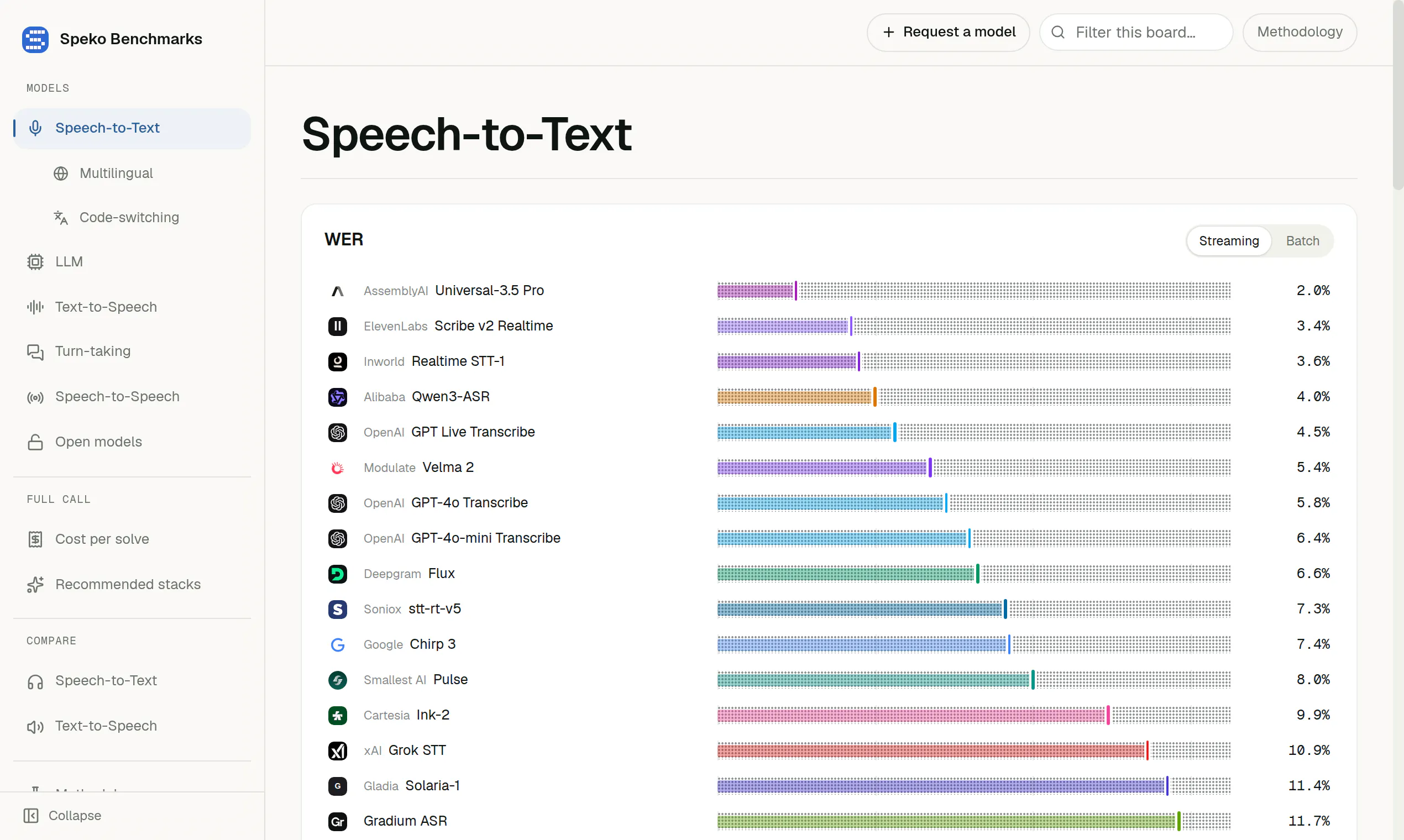
一句话介绍:Speko是一个“语音AI模型的OpenRouter”,通过独立公开基准测试和智能路由,为开发者在语音转文字、大语言模型和文字转语音三大环节中,按具体用例和语言自动选择当前最优的模型组合,省去人工测试和频繁更换模型的研发成本。
Developer Tools Artificial Intelligence Audio
语音AI 模型路由 语音转文字 文本转语音 大语言模型 基准测试 多语言支持 开发者工具 API网关 模型评测
用户评论摘要:用户普遍认可其“独立基准+路由”的定位,并祝贺发布。有效问题集中在:1) 基准列表和多模型接入的更新频率;2) 如何处理通话中模型故障的切换,是否会导致断线;3) 对非标准音频(如iPhone语音备忘录)的预处理能力;4) 与Google开源方案的对比,以及瑞典语、丹麦语等小语种支持。另有用户建议提供实际音频样本便于试听对比。
AI 锐评

Speko踩中了语音AI赛道最痛的“决策成本”问题——模型每周都在更新,评测却仍是作坊式的“发链接给母语者打分”。其核心卖点并非技术壁垒,而是将“选型”这件反人性的事产品化:用公开、可复现的基准测试代替供应商营销话术,让开发者从“追踪模型”的泥潭中解脱。这种“中立路由”的定位,恰好戳中了OpenRouter在文本领域已验证的商业模式,延展到语音赛道具有明确的付费意愿。

但必须指出,Speko面临三重质疑。其一,**护城河极浅**:OpenRouter模式的核心在于模型聚合的规模和分发能力,而非测评本身。一旦大型云厂商或现有API网关(如AWS、Azure)整合类似功能,Speko的独立优势将迅速被稀释。其二,**技术承诺的严峻性**:评论中关于“会话中故障转移”的问题直指死穴——宣称代理无介入,意味着一旦会话中路由失效,无法动态调整,这在实际生产环境中是致命的可靠性缺口。其三,**数据飞轮难建立**:基准测试是低频静态数据,而用户的真实性能反馈才是动态价值,目前产品并未展示此类数据的收集机制。总体而言,这是一个“痛点真实、解法聪明、壁垒待考”的产品。它更适合作为语音AI生态中的“基建组件”被收购,而非独立成长为巨头。核心价值在于把决策透明化,但这也意味着它必须永远跑得比“被路由的模型”更快,才能不被时代抛弃。

查看原始信息
Speko
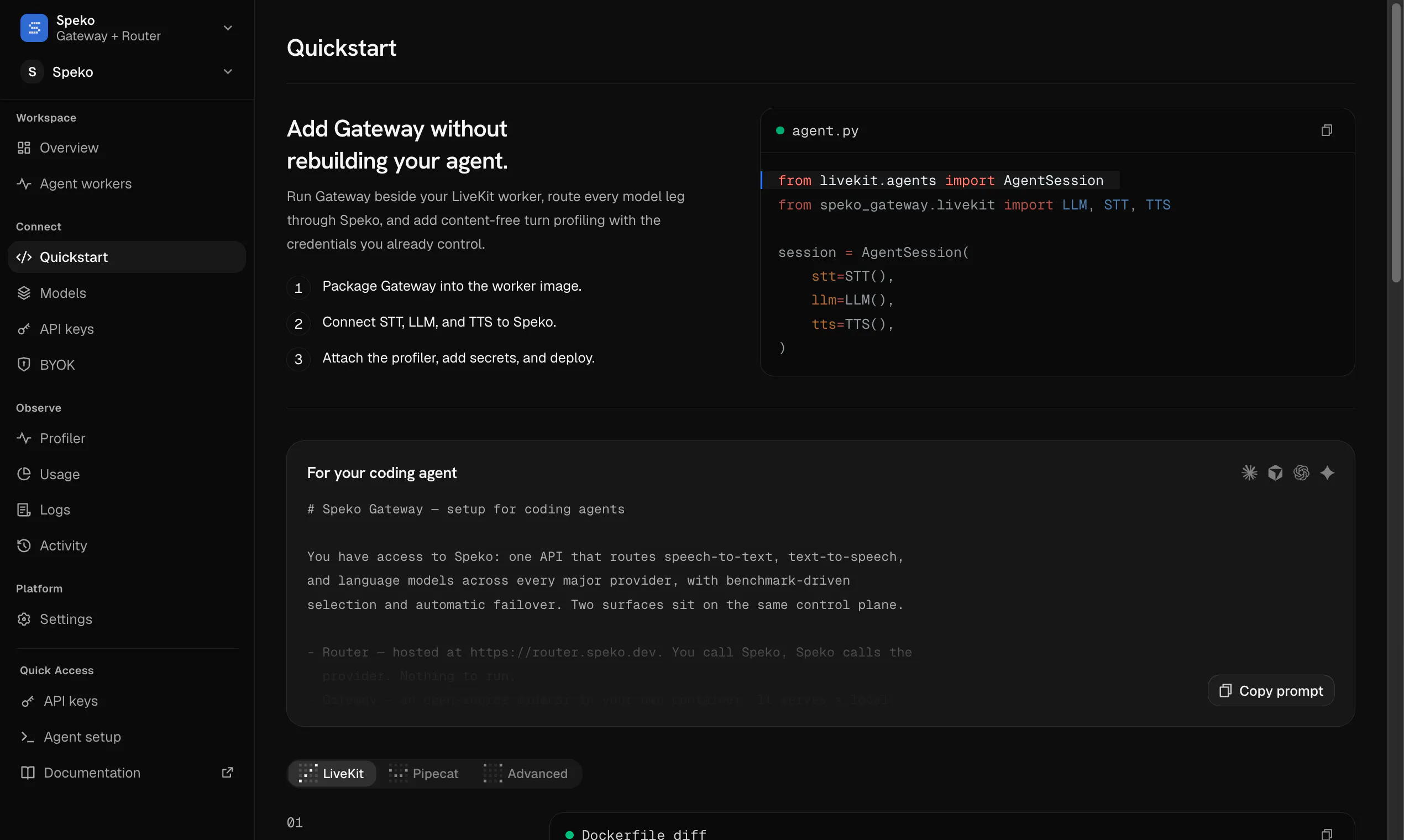
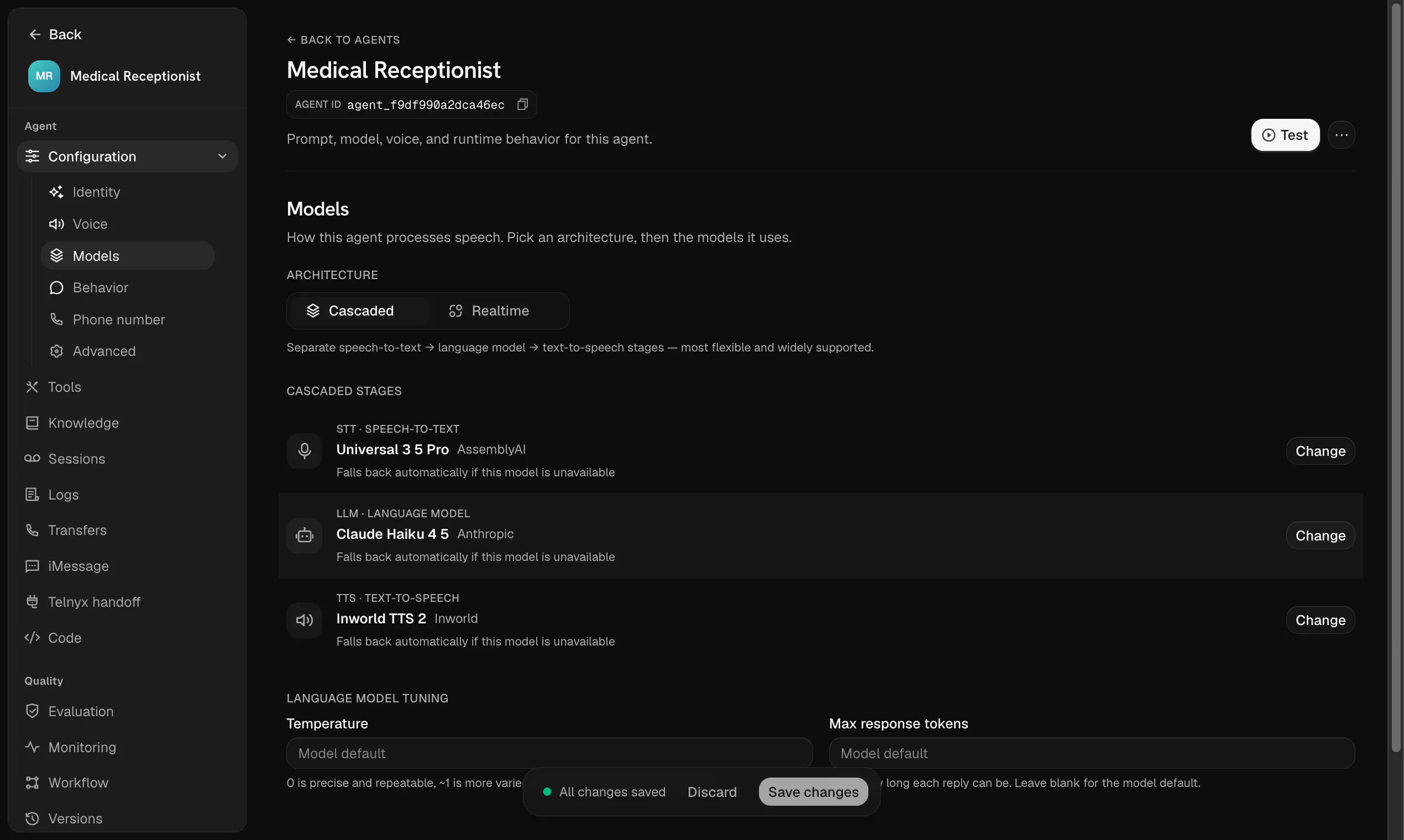
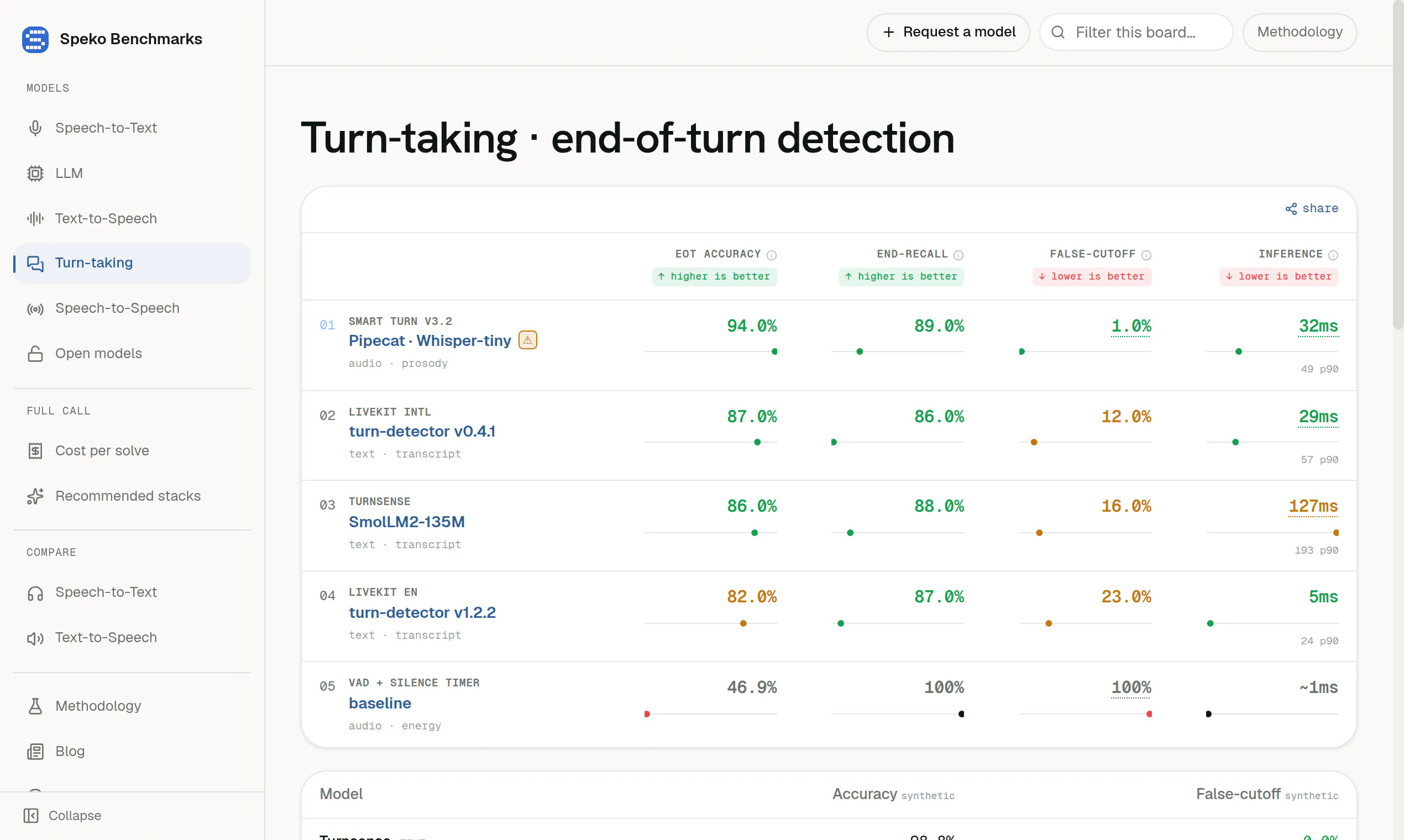
One API for speech-to-text, language models, and text-to-speech, with public benchmarks beside runtime availability.
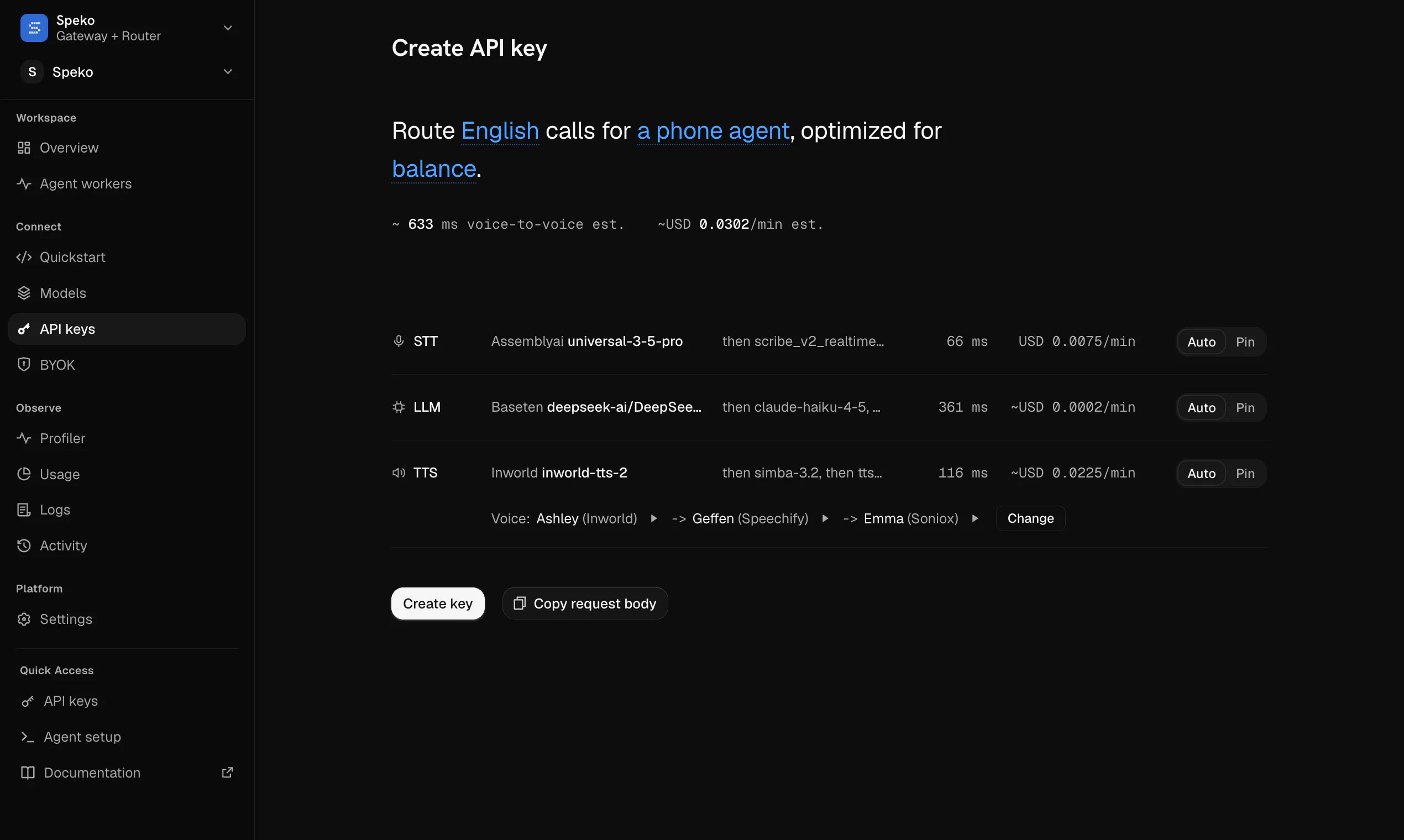
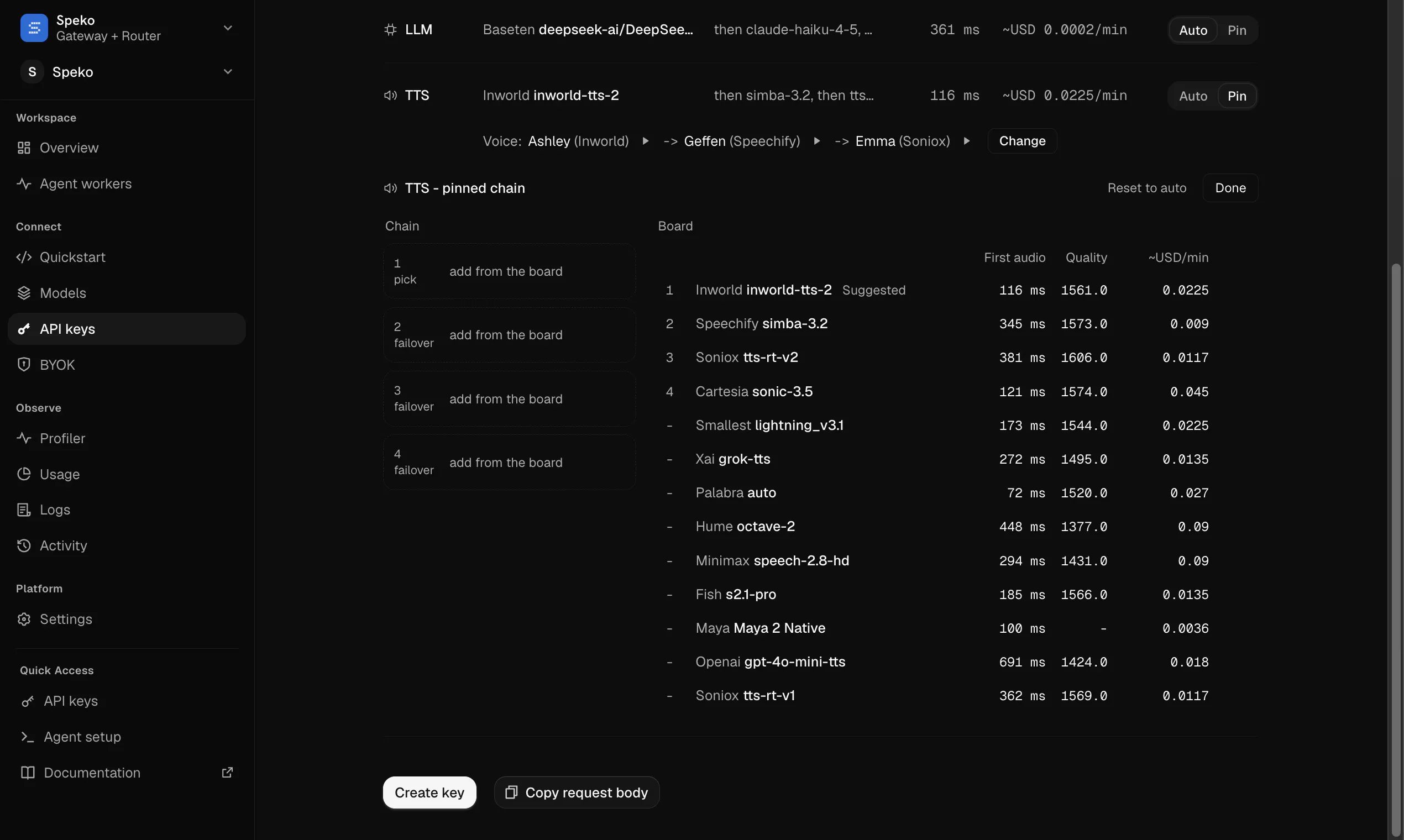
Hi Product Hunt! I'm Bek, founder of Speko. Before this I was cofounded/CTO at a startup building voice AI apps. I left after Series A to work on the pain we lived with every week: we had to support 10+ languages, and I wished there was some kind of gateway that could route to the right voice tech based on the use case and language. Back then our process was a Google Sheet with 15 audio links we sent to people who speak those languages to score. If a new model was good, you swap. Every week something new comes out, even in English, and testing it is so much R&D cost that most teams end up running outdated models - swapping always looks like an R&D project. So early this year we started Speko. What it is: a router for voice models. You come with your use case and language, and we route to the best speech-to-text, LLM, and text-to-speech for it - measured on our public benchmarks, not vendor marketing. You should be running the best voice stack at any given moment. We don't train or sell models ourselves, and that is precisely how we keep the rankings impartial. How the approach evolved: we launched on Hacker News recently and the discussion sharpened how we explain this. "Router" hides three questions: what gets picked (a model, a provider, or the whole stack), where it lives (an external hop or inside your session), and when it decides (session start or mid-call). A voice agent is a live duplex session, not a batch request - that is why this is its own product. And we are proxy-less: routing is decided before the session starts, then audio flows directly to the provider - no extra hop in the audio path.
37
回复

@abdikbek The Google Sheet story explains the problem really well. Voice AI moves so fast that constantly benchmarking and swapping providers can become its own R&D project. Making that decision layer independent and benchmark-driven feels very useful, especially across multiple languages. Congrats on the launch!

0
回复

@abdikbek I’ve known Bek since a previous project as a hardworking professional and a strong team leader. After listening to the podcast, I gained a deeper understanding of Speko and its importance in today’s world. Wishing you and your team every success!

0
回复

@abdikbek ❤️❤️❤️

0
回复

I’ve already discussed this direction with Bek, and we even hosted a deep-dive online meetup together about the development of voice AI.


That’s why it’s especially interesting to see how the idea behind Speko is now evolving into a real product. Choosing the right voice stack is becoming increasingly complex as new models and providers keep emerging.


I really like Speko’s approach: independent benchmarks, routing based on the specific use case and language, and no bias toward their own models.


Very interesting product and direction. Good luck to Bek and the Speko team!

10
回复

@umedrahimoff Thank you a lot Umed aka, enjoyed the interview!

1
回复

Congratulations on the launch @abdikbek! All of us needed a voice AI OpenRouter for sure. Wondering how often you would refresh this list of APIs or include more providers.

8
回复

What are the advantages compared to Google’s open-source libraries and other alternatives? Also, what about less commonly supported languages like Swedish or Danish?

P.S. I just saw a post here about a kids’ app. You should consider partnering with them - they have voice recognition for children and convert speech to text.

4
回复

Love your product, guys. We are using it at SUN

2
回复

I love when a product does all the things I hate doing. Congrats, Speko. Proud user here.

2
回复

Super hyped!

2
回复

Looks good, but would be nice if the site provided also actual voice samples of each model, e.g. just same text with type of voice prompt benchmarked accross different models.

1
回复

This is super cool!

1
回复

Congratulations Bek. I have a question since Speko decides the stack before the session starts to keep audio paths direct, how do you handle mid-call failovers? If a specific provider suffers a sudden latency spike or an outage mid-session, does the system stay locked into that stack, or is there a way to redirect without dropping the user's call

1
回复

Most of the audio I deal with is iPhone voice memos, never the clean format the docs assume. What happens to the input before it reaches a model?

1
回复

openrouter for voice is such a usefull idea 🎙️ which stt is winning rn?

0
回复

Love the "show me the numbers and let me pick" approach haha. Makes choosing between all these models feel a lot less like guesswork. Nice work guys, congrats on the launch! @abdikbek

0
回复

Garry Tan hunter? Nice!

0
回复

Given open router, this makes perfect sense! What are the surprising factors that affect which voice model is best for the situation?

0
回复

congrats on the launch Bek! This is cool

0
回复
#5
Gemini 3.5 Transcribe
Our most precise speech-to-text model yet
220
一句话介绍:Gemini 3.5 Transcribe 是一款面向实时语音转写场景的高精度模型,通过智能清理口头语、自动修正自我纠错,解决用户在嘈杂环境或多人对话中获取干净、可读文本的痛点。
Artificial Intelligence Audio
语音转写 自动语音识别(ASR) 实时转录 说话人分离 多语言支持 噪音抑制 文本后处理 AI工具 开发者API Gemini生态
用户评论摘要:用户普遍认可其对自我纠正和填充词的处理能力,认为能大幅节省编辑时间。有效问题包括:对“已使用一年”的可信度质疑(疑似AI灌水);部分评论缺乏具体场景细节,建议关注其在三人以上会议或方言场景的实际表现。
AI 锐评

Gemini 3.5 Transcribe 的“精准”并非停留在字准率,而是对“语义失真”的暴力修正——这恰恰切中了传统ASR的致命伤:机器把“呃、那个、不对,我说的是…”忠实转出来,看似客观,实则让人类阅读成本飙升。它用“理解意图”代替“逐字复刻”,本质是AI从工具向协作者的身份跃迁。

但必须泼冷水:支持3个说话人、85+语言是营销话术,真实场景中说话人重叠、方言混合、远场拾音仍会大幅降级。开发者真正关心的是延迟、长音频稳定性、以及API定价,而非“自然说话风格”这类玄学。另外评论中出现疑似前员工或水军的“用了一年”留言,被网友当场拆穿,这暴露了产品宣传节奏的草率——首发即遭信任危机。

战略上,它真正的价值不在独立App,而在于为Gemini生态(macOS、Android)和Google Antigravity提供“语音入口”。一旦与图像生成、文件分析打通,它就不是转写工具,而是多模态交互的操作系统级组件。但若仅停留在“更好用的录音笔”,那它就是大厂内卷的又一例证,而非新物种。建议关注Google后续是否开放流式输出和说话人角色记忆,否则这个“精准”撑不起“智能”的野心。

查看原始信息
Gemini 3.5 Transcribe
Our latest speech-to-text model designed for precise and intelligent real-time transcription.

I’m happy to share this! 🚀 Gemini 3.5 Transcribe is a big step forward for natural voice interaction.

Instead of typing every thought, it works the way you actually talk:

  • Handles self-corrections

  • Removes filler words & formats clean text

  • Understands natural intent & speaking style

  • Works accurately in noisy environments

  • Up to 3 speakers with timestamps

  • 85+ languages, accents & dialects


On Gemini for macOS, you can use your voice to generate images, search, summarize, analyze files and more.

It also powers Rambler on Android, turning spoken thoughts into polished text with voice-based edits, corrections and style changes.


🚀 Rolling out now on Gemini for macOS and Rambler on Android. Developers can build with it in Google AI Studio and Google Antigravity.

7
回复

@saaswarrior Can't wait to try it out!

0
回复

@saaswarrior Loved this! What stood out most to me is how it catches self-corrections in real time, like when you say "ah no, I mean..." and it just adjusts on its own. Can't wait to try it out on Gemini for macOS!

0
回复

@saaswarrior The support for self-corrections and filler-word removal sounds really useful. Clean transcripts without losing natural speech could save a lot of editing time. 👏

0
回复
I've been using 3.5 for a year and it works really well
1
回复

@haonanlin wow you must come from the future to be able to use it for a year... or just an AI without context

0
回复
This works really well.. we use it almost all the time.. although Google doesn't need it.. still good wishes..
1
回复

Congrats on the launch. Good to see a model that cleans up the filler rather than transcribing every word faithfully.

0
回复
#6
Traccia
Finally, a vendor-neutral AI Agent Control Plane.
189
一句话介绍:
Open Source Developer Tools Artificial Intelligence
用户评论摘要:
AI 锐评
查看原始信息
Traccia
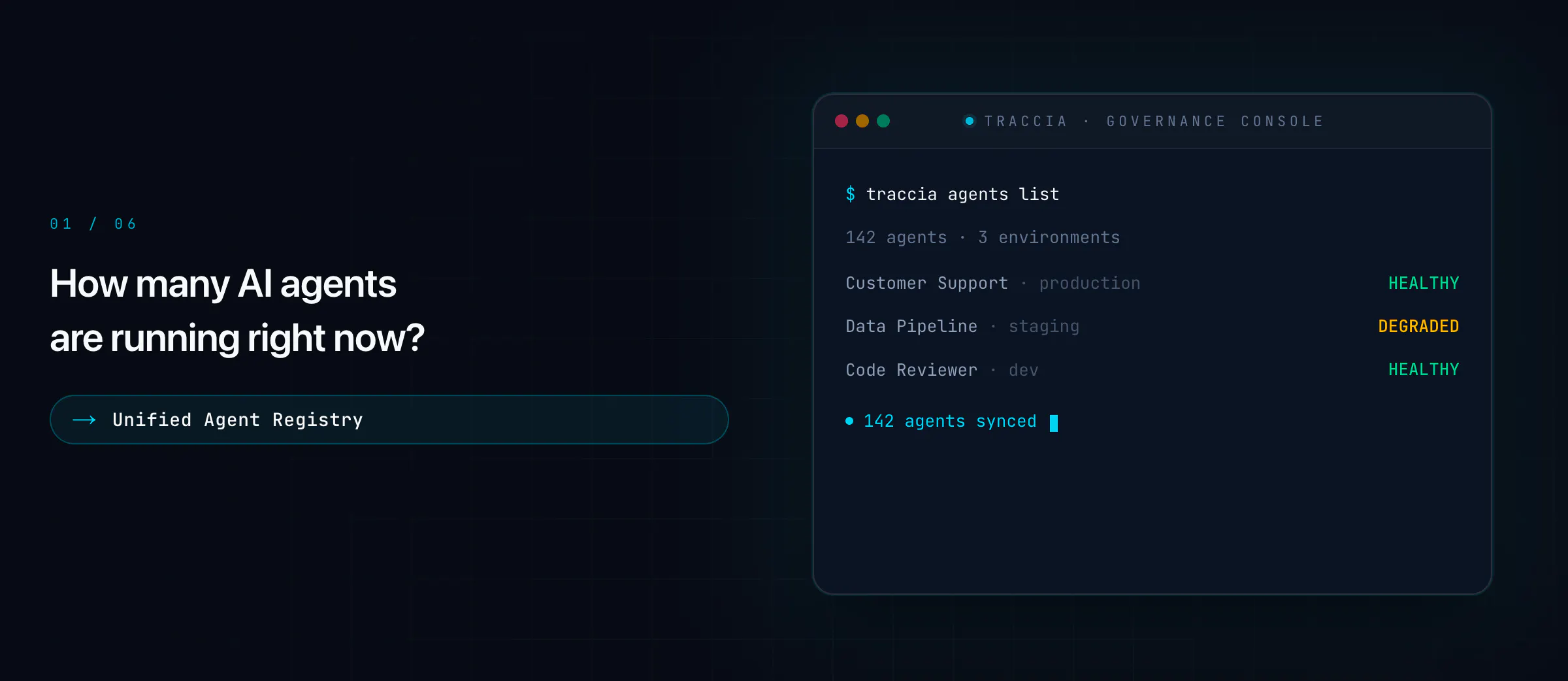
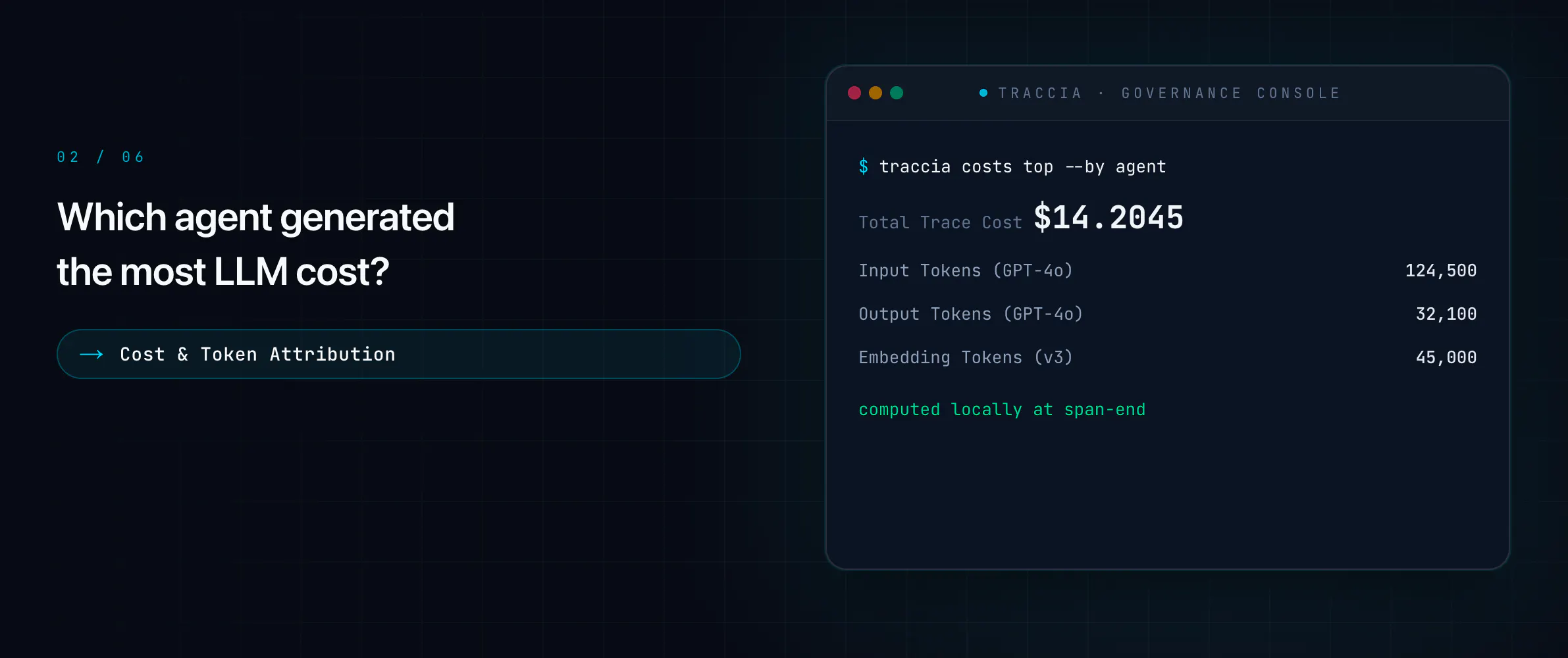
Traccia is a vendor-neutral AI Agent Control Plane built for teams running autonomous agents in production. Observe agent behavior, evaluate performance, govern actions with policies and runtime controls, and maintain an auditable trail of what happened. Built with an open, developer-first SDK and OpenTelemetry, Traccia works across models, frameworks, and existing observability stacks—so teams can control their agents without being locked into a single AI vendor.

We’ve been building Traccia because we kept seeing the same gap with AI agents: once an agent can call tools, make decisions and take actions, a traditional trace can tell you what happened — but not whether that action was acceptable.

With traditional software, an execution usually follows a path defined by the developer. Agents are different. They can reason, choose tools, change their path and take actions we didn’t explicitly define.

That creates a new infrastructure problem for teams deploying agents in production:

What did the agent do? Why did it do it? Was it allowed to? Which policy and permissions applied? And can we prove what happened afterwards?

Traccia is our AI Agent Control Plane — a vendor-neutral layer to observe what agents do, evaluate how they behave, govern what they’re allowed to do, and audit what happened.

We’ve open-sourced the Traccia SDK and built it developer-first, with OpenTelemetry at the foundation. It works across models and agent frameworks, so teams can add observability and governance without being locked into a single AI vendor. We’re still early, and we’re building this alongside developers and teams actually deploying agents.

I’d especially love feedback from people running agents in production:

What are you using today to debug agent behaviour?
How are you evaluating agents?
And more importantly — how do you control what an agent is allowed to do?

We’re also making it easier to try Traccia during the launch.

3 months free with coupon code: TRACCIAPH

18
回复

@vijaypoudel1 The OpenTelemetry-based approach for cross-framework observability is great, that's usually where these agent-observability tools fall apart once you're mixing frameworks. How deep does the policy enforcement go? Is it just gating or blocking specific tool calls at runtime, or can it also catch an agent looping on a task it should have already given up on.

0
回复

Hey Product Hunt 👋 We’re live.

I’m one of the makers of Traccia. If you’ve ever watched an agent take a tool call you didn’t expect and then scrolled a 2,000-span trace trying to answer “was that even allowed?” - that’s the pain that started this.


What ships today

  • Open-source SDK (Python + Node), OpenTelemetry-native

  • Full-fidelity traces across models/agent frameworks

  • Eval path: prompts → datasets → scorers → experiments before you promote

  • Runtime governance: policies + evidence so “observe” isn’t the end of the story

Who this is for
Teams putting agents in production - not demos. If your stack already tells you what happened, but not whether it should have happened, you’re our ICP.

One ask
If you run agents in prod, comment with your current stack for:

  1. debugging a bad tool call

  2. deciding promote vs rollback

  3. blocking an action at runtime

Even “we use X and it’s fine/it sucks because Y” helps more than a silent upvote.

Trying Traccia today? Platform is open - use coupon TRACCIAPH for 3 months free. I’ll be in the comments all day and will answer everything personally.

https://traccia.ai

- Aditya (and the Traccia team)

9
回复

@aditya_kumar_saroj Congratulations on the launch! I have one question I’d genuinely love to know the answer to.

A runtime policy gate sits directly in the request path, so there’s inevitably some latency overhead, but I couldn’t find a number for it. What does the instrumentation add per span, and how much does a policy evaluation add per tool call (ideally at p95 rather than just the average)?

For anything running in production, that number is going to be a big part of deciding whether people leave it switched on. Publishing it even when the tail looks ugly would probably do more for adoption than another feature announcement.

Also, going with OpenTelemetry and keeping the instrumentation vendor-neutral is absolutely the right foundation.

0
回复

The Tsunami of AI agents will overhelm the industry. Every organization and team wants to build AI agents. Yet, once the initial excitement fades and these agents are operating at scale, difficult questions will emerge

  • Was my agent actually allowed to do that?

  • Why did it make that decision?

  • Could I have prevented that action?

  • How do I stop a rogue execution before it causes harm?

Traccia as an AI agent control plane ensures you have the right visibility and control over what you agents can do, what they can access, terminate calls on policy violation and many more.

Trying Traccia today? Platform is open - use coupon TRACCIAPH for 3 months free

5
回复

Congrats on the launch. Open sourcing the SDK is a lot to give away for a control plane, good to see.

4
回复

@lucasjpols Thank you ! We’re on a mission to help enterprises deploy AI agents to production with confidence. We’re open-sourcing the SDK because we want the instrumentation and execution data to be as accessible as possible, while the control plane sits above it to help teams enforce policies and govern those agents in production.

1
回复

Did there occur any specific cases with AI agents that you could label as anomaly within their process?

4
回复

@busmark_w_nika Thank you for a great question. Yes — we’ve seen this particularly with MCP-based workflows. An agent can get into a pattern of repeatedly calling tools, sometimes far beyond what was expected, and the workflow can continue consuming time and tokens without actually making progress.

That’s why we have policies around things like maximum tool calls, specific model calls, and other execution constraints. The idea is to detect and enforce those limits at the agent execution layer rather than only discovering the problem after the run is over.

With agents, an “anomaly” isn’t necessarily a failed run — sometimes it’s a run that is technically working but doing far more than it should.

5
回复

Having one place to manage AI agents across different platforms is huge, especially now that everyone's using a mix of frameworks. Really solid build!

4
回复

@thisiskp_ Thanks KP! That’s exactly the problem we’re seeing — once teams move beyond a single framework, managing what agents can actually do gets messy pretty quickly. We are actively working in the policy/enforcement layer: giving teams a consistent way to control agent actions across frameworks and tools. Would love to hear what you’re seeing at Netlify as wel !

3
回复

Congratulations on the launch! It sounds like a really useful project based on the description. I’ll show it to our team - we’re currently using a similar solution...

3
回复

@natalia_iankovych Thank you! Really appreciate you sharing it with the team. We would also be curious which solution you’re using today and what you like/dislike about it. We’ve been especially focused on the control and policy-enforcement side of ai agents, so that comparison would be really valuable for us.

3
回复

Great control & observability layer guys, solid work. Love the fact there's no vendor lock-in.🔥

0
回复

Vendor neutrality is important. How easy to setup and commission?

0
回复
#7
PageIndex
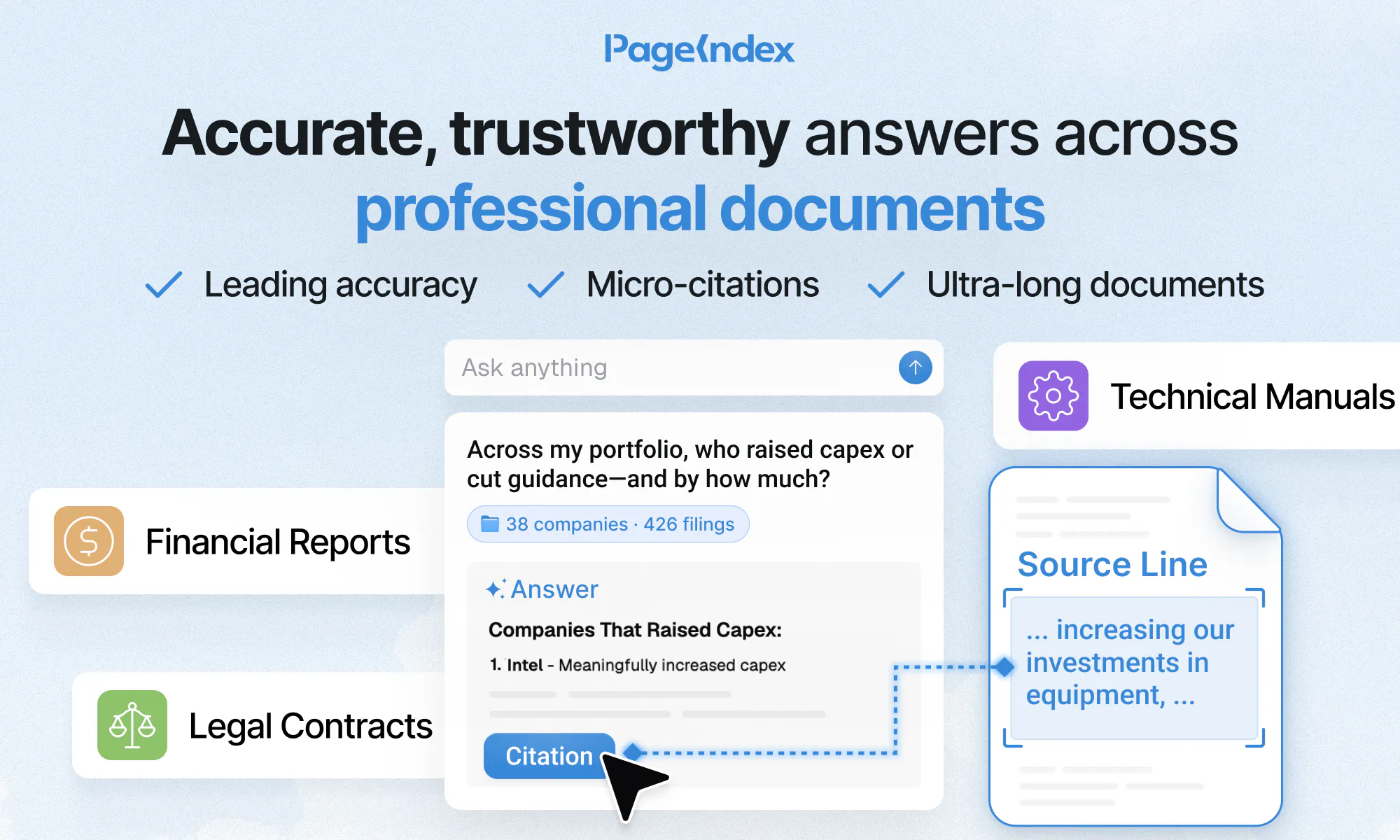
Accurate, trustworthy answers across professional documents
160
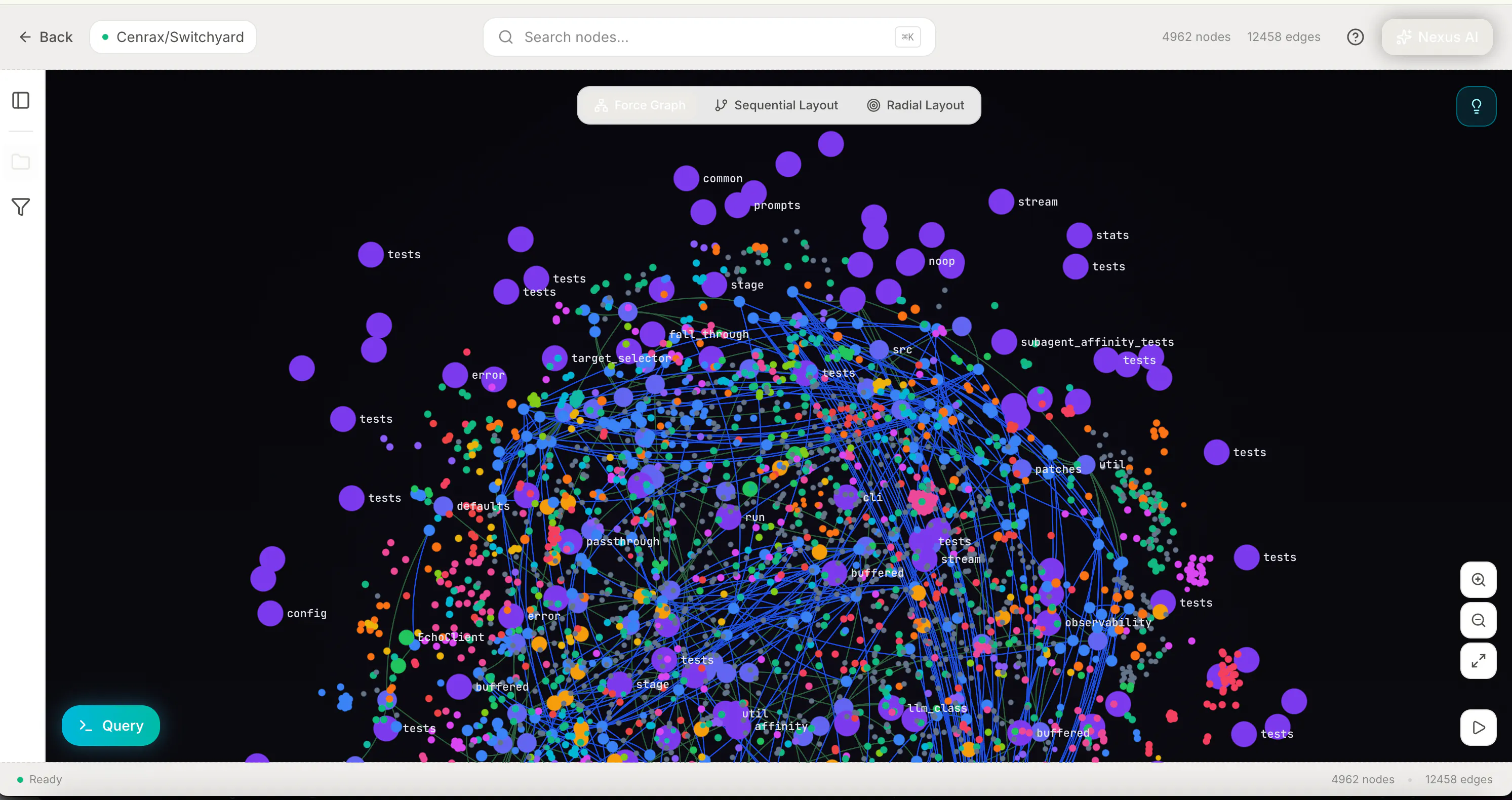
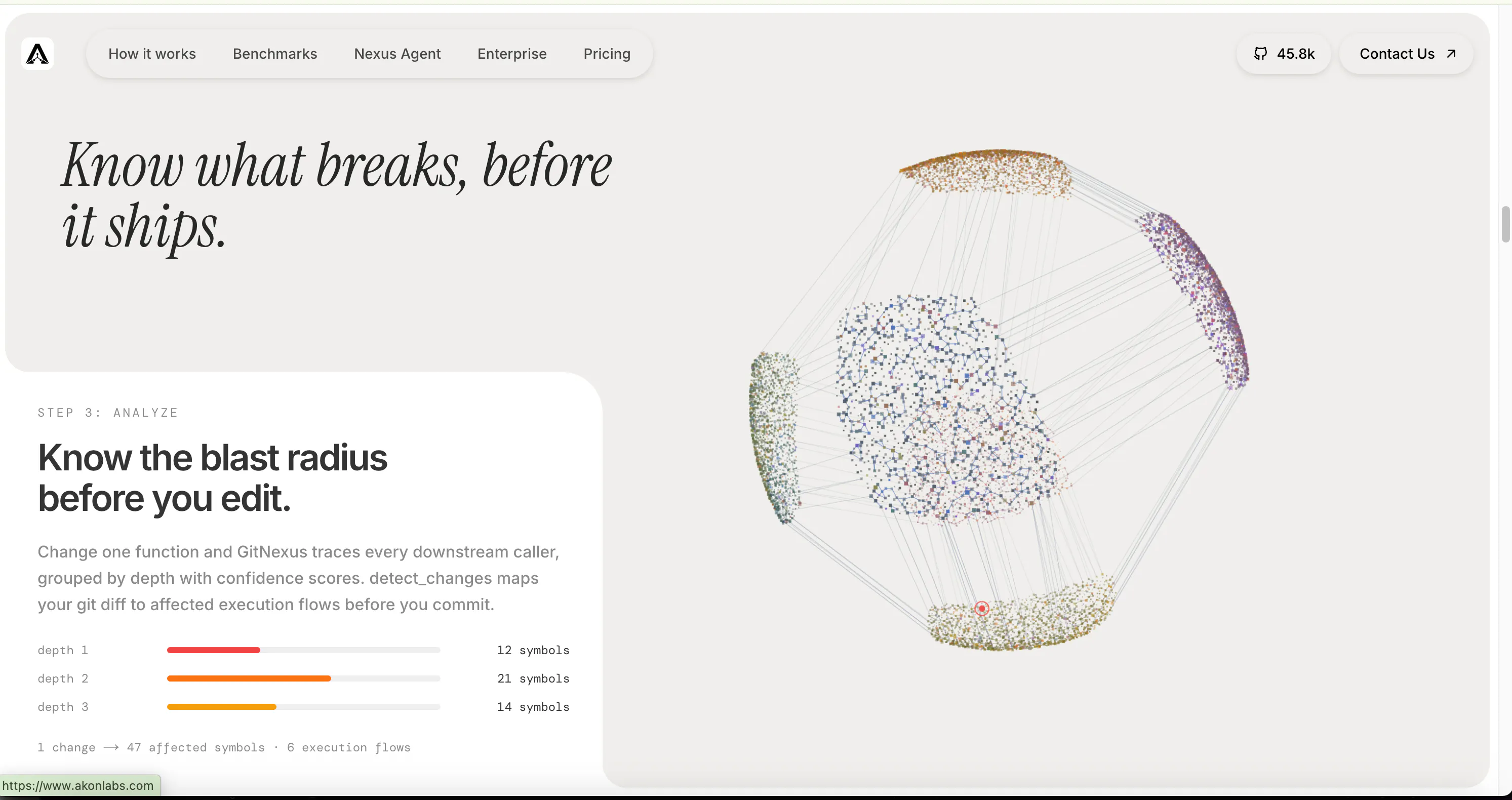
一句话介绍:PageIndex是一款面向长文档的专业知识库问答工具,通过结构化索引和精确到行的引用,让用户能在海量财报、合同、论文中快速提问并一键核验答案来源。
Productivity Artificial Intelligence
AI文档问答 知识库检索 精准引用 金融分析 法律合同 学术研究 结构化索引 OCR识别 文档导航 企业协作
用户评论摘要:用户普遍认可精确到行的高亮引用功能,认为其解决了长文档核验痛点。主要提问集中在:是否保留原始格式(已确认)、共享链接无需注册(已支持)、扫描件处理(已支持OCR)、与ChatGPT/Claude的差异(官方回应为结构化索引突破上下文限制)。有用户建议加强大学科研合作,整体反馈积极。
AI 锐评

PageIndex的定位精准刺中了AI应用最务实的痛点——可信度。当通用大模型仍在用“一本正经地胡说八道”消耗用户信任时,它选择用结构化索引替代向量嵌入,本质上是对当前RAG技术路线的一次大胆纠偏。创始人Ray的论述直指要害:向量检索解决“像不像”,却回答不了“对不对”,更无法穿越“见附录G”这类文档内部指针。这一技术选型让PageIndex具备了两个显著优势:一是推理路径可审计,每个检索决策都能回溯至文档树,这对金融、法律等强合规场景是刚需;二是将文档集视为持久化知识库而非一次性上下文,契合专业用户“季度财报叠增”的长期使用习惯。

然而,风险同样清晰。放弃向量检索意味着对文档结构的一致性要求极高,非结构化PDF、复杂排版表格、多语言混排都可能成为索引质量的暗礁。OCR支持虽是补丁,但识别误差会直接污染下游引用准确性。160票的起步数据尚不足以验证PMF,30K用户和35K GitHub星更多是技术底子的背书,而非商业成功的证明。真正的考验在于:当文档规模从数百页跃升至数万页,结构化索引的构建成本和查询延迟是否还能维持“秒级验证”的体验?以及面对NotebookLM、ChatGPT的Gpts等巨头同类功能时,PageIndex的护城河究竟是技术架构,还是用户迁移成本?对于必须在“快”和“准”之间做抉择的专业用户,PageIndex目前拿出了令人信服的答案,但通往“文档层Perplexity”的路上,它还需要更 aggressive 的生态整合与场景深耕。

查看原始信息
PageIndex
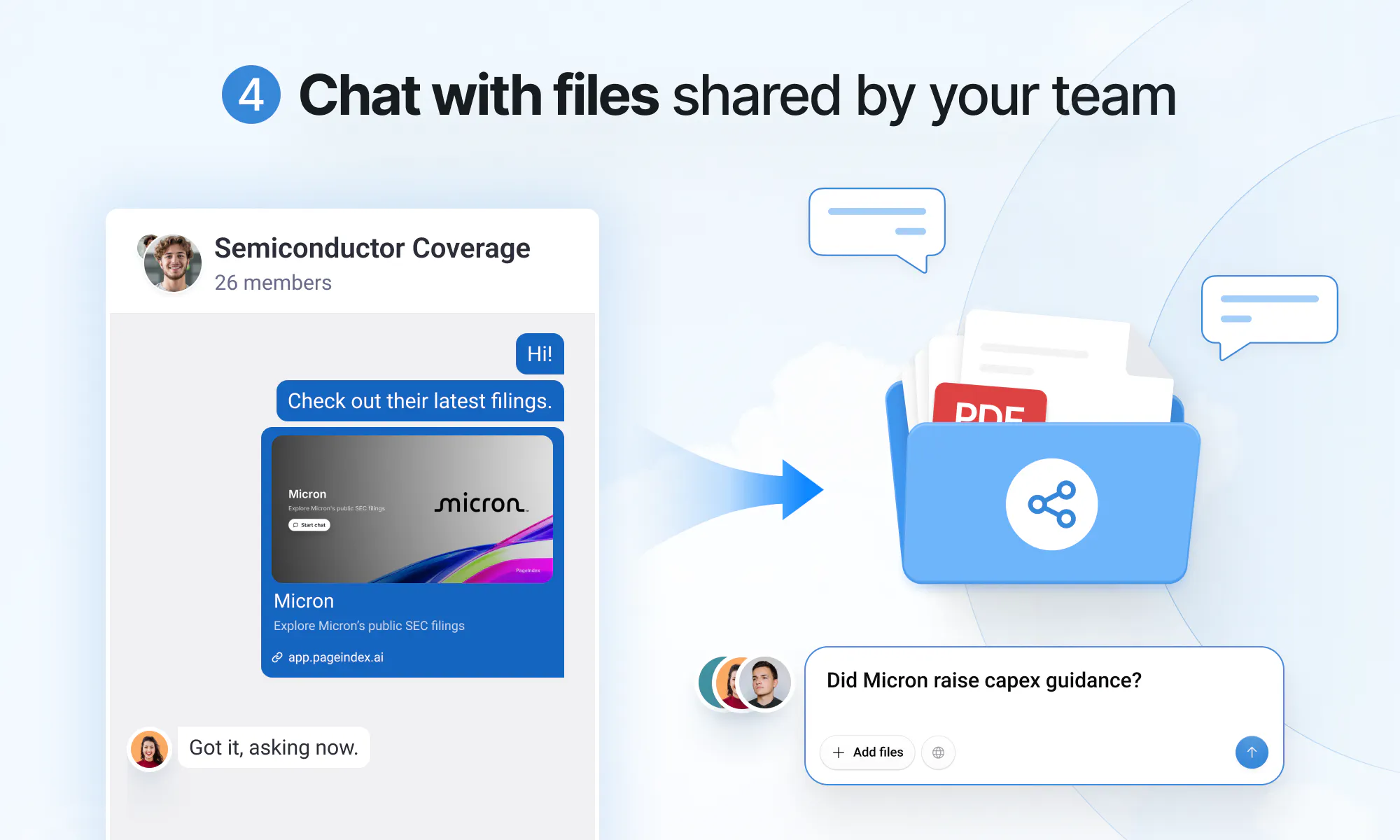
PageIndex gives you accurate, trustworthy answers across long, professional documents your work depends on. Bring in your entire document set, ask your hardest question, and click any citation to jump to the exact highlighted source line, so you can verify it in seconds.

Hey Product Hunt 👋

I'm Mingtian, co-founder of PageIndex.

PageIndex lets you ask across your entire document set and verify every answer down to the source line. If you work with long and professional documents where accuracy and traceability matter, financial reports, legal contracts, textbooks, research papers, etc. and you can't afford to trust an answer you haven't checked, this is for you.

✍️ Here's how it works:

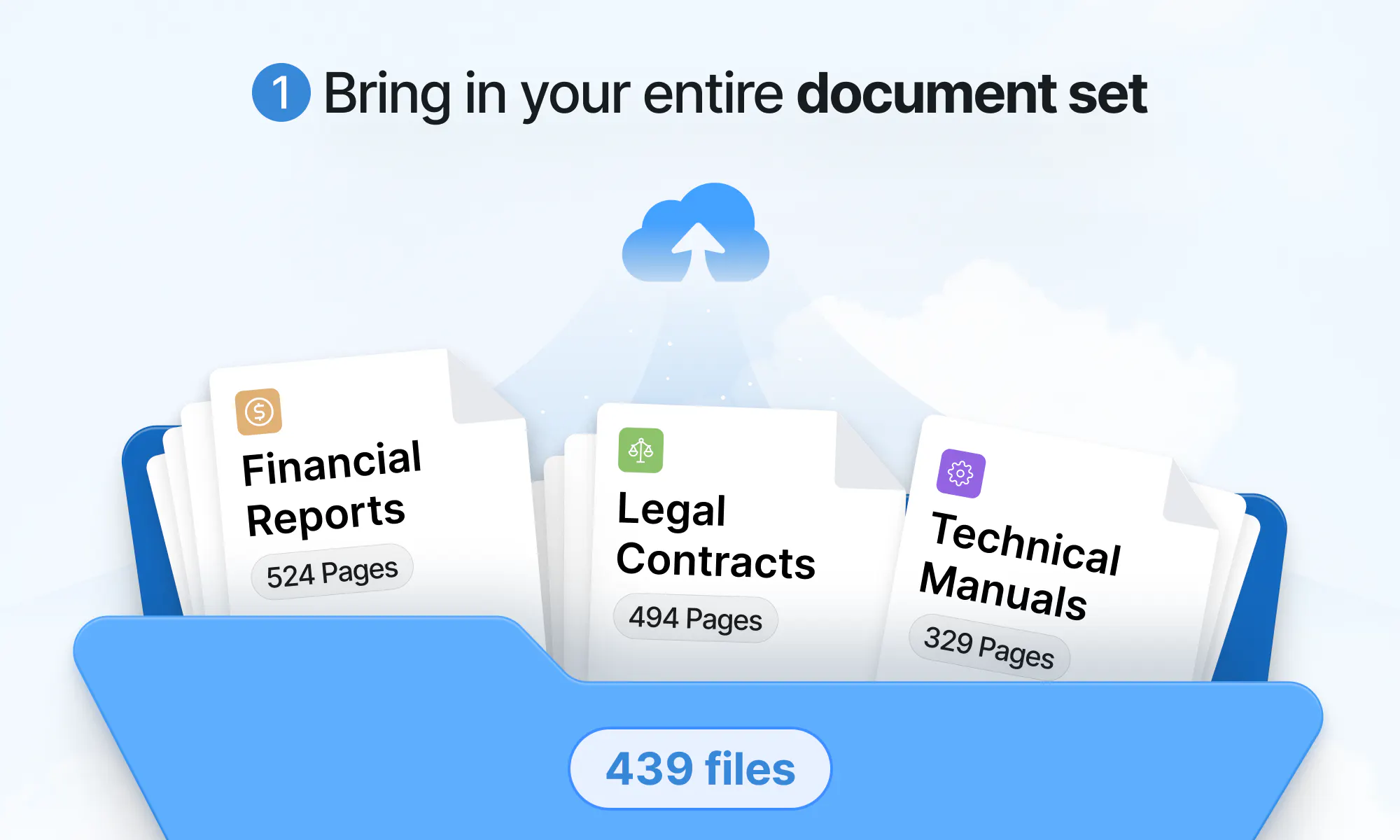
  1. Drop in your entire folder. Folder structure is preserved, and everything you add stays in your knowledge base, so you build it once instead of re-uploading the same files into every new chat.

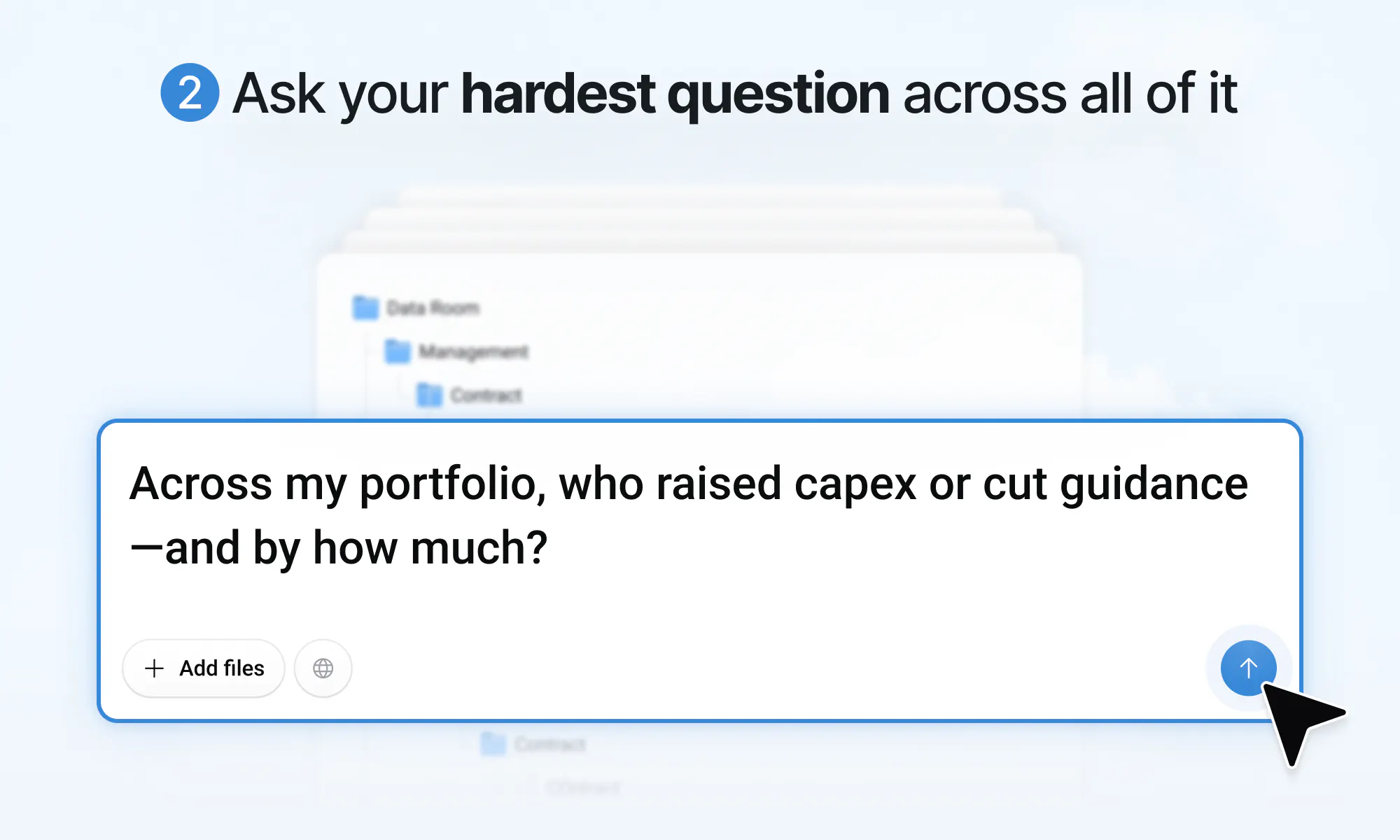
  2. Ask your hardest question across all of it. Ask the one you actually need: a number buried in an appendix, a clause that only makes sense with the definition twelve pages back, a figure that has to be pulled from a table and compared across four files. PageIndex goes and gets all of it.

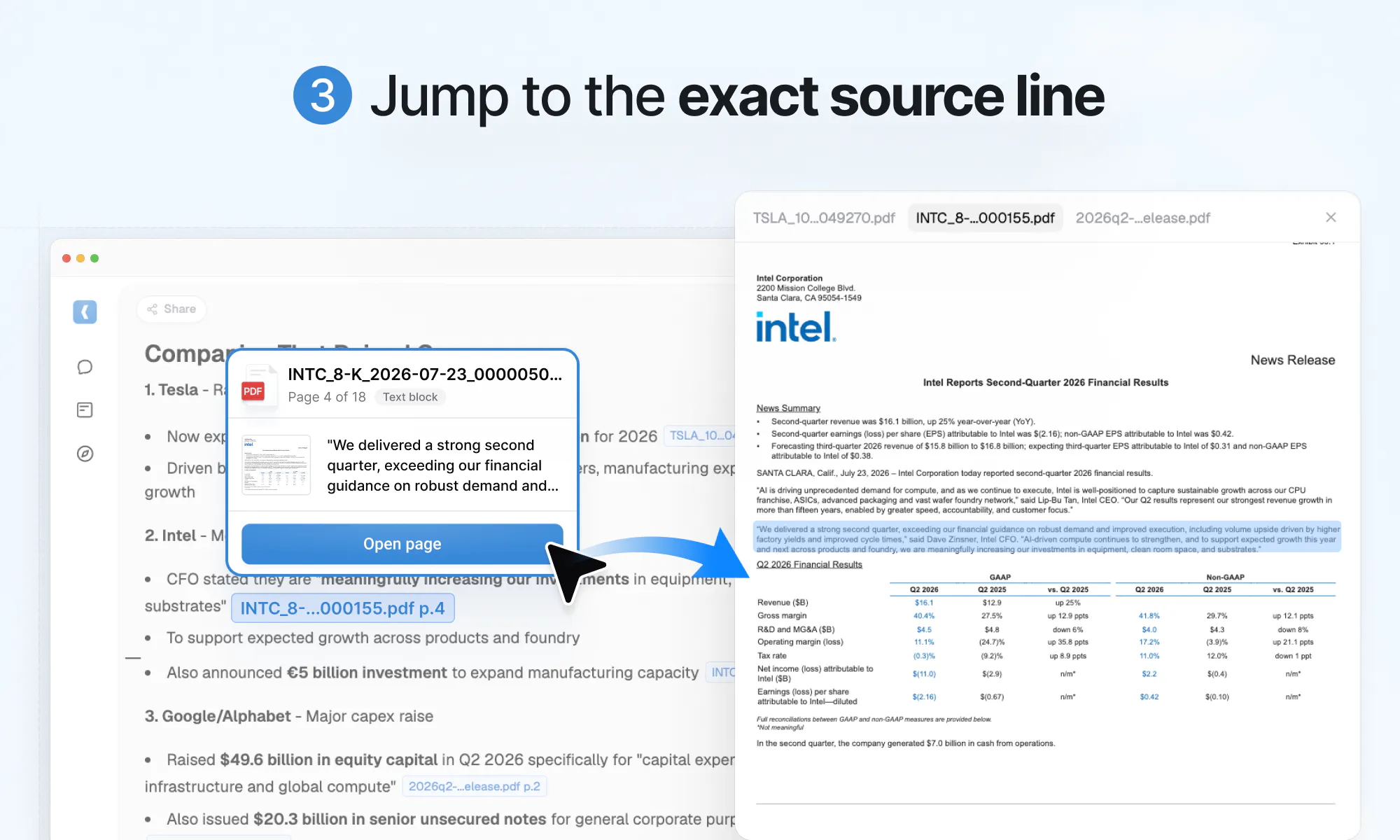
  3. Verify answers in one click. Every answer comes with micro-citations. Click one and the source document opens beside your chat at the right page, highlighted at the exact line the number came from.

Why you want PageIndex:

  • Checking a number takes one click instead of an afternoon of opening PDFs

  • One question runs across hundreds of documents, not one file per chat

  • Tables and charts are read in context

  • Your library compounds each quarter instead of starting from an empty chat

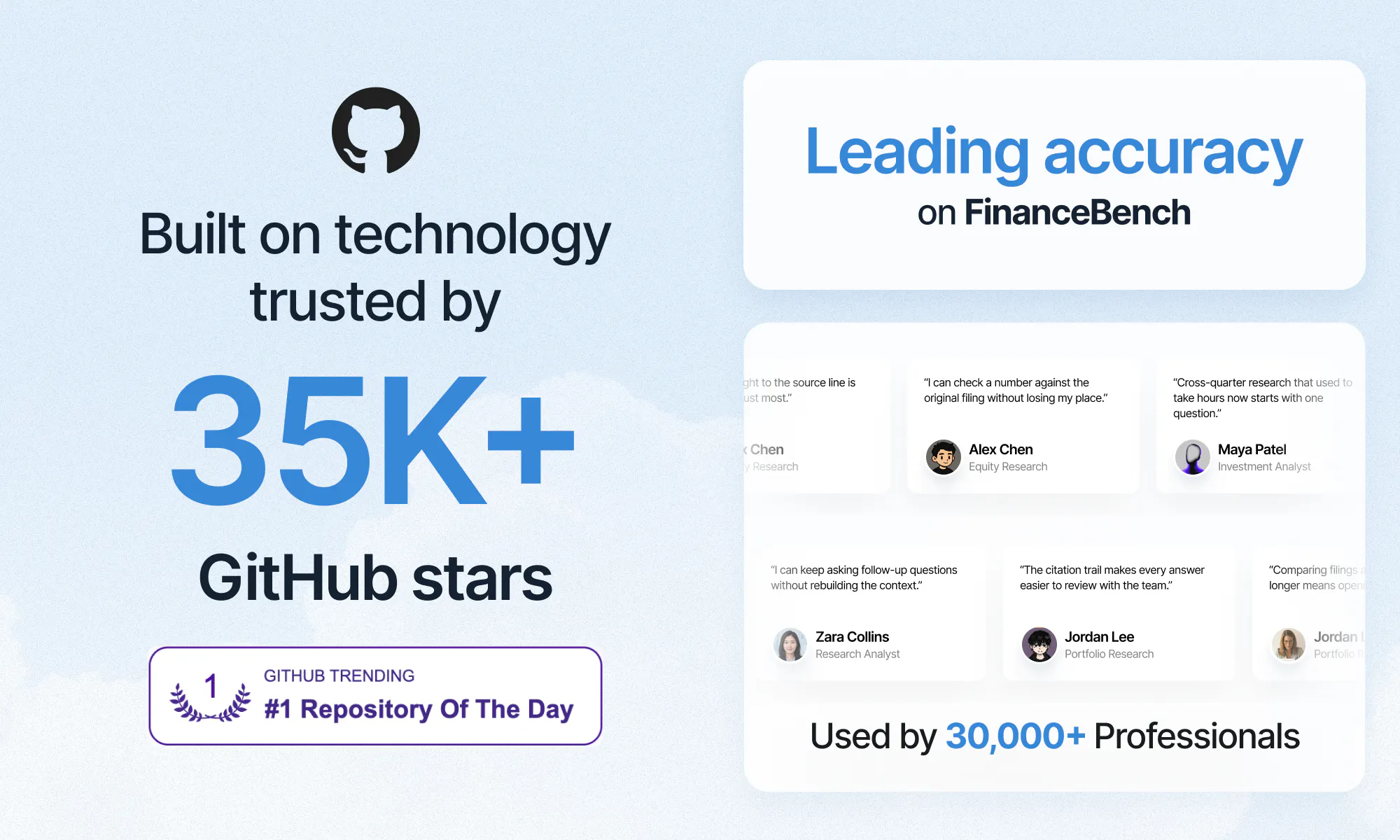
Leading accuracy on FinanceBench. 30K+ people use it, and the retrieval engine underneath has 35K+ GitHub stars and hit #1 on GitHub Trending.

🎉 Launch offer: code PRODUCTHUNT gets you one month of Pro free.

👉 app.pageindex.ai

Thanks for checking us out. I'll be here all day.

4
回复

Hiii PH, I'm Cathy, GTM at PageIndex.

I'm the non-engineer on this team, which makes me test subject number one. If I can't get a verified answer out of a folder in thirty seconds, it goes back to Ray.

Before this I worked in finance. I studied it at LSE and ground through CFA Level I. None of that helps you at 11pm when you're pulling the inputs for an EBITDA build, then tracing every single number back to the page it came from.

👇 That's the bit that changed for me:

  • My filings sit in one folder that stays indexed.

  • I ask across all of them at once.

  • Every number in the answer carries a reference. One click lands me on the exact highlighted line, right next to the chat.

  • The verification pass that used to take an afternoon is now one click.

One favour if you're testing it: please don't ask what Apple earned last year. Any chatbot answers that. Ask the thing only you would know where to look for:

  • a covenant threshold buried in an appendix

  • a segment number that moved between restatements

  • a figure that only appears in a footnote

If anything confuses you in the first two minutes, tell me bluntly. That's the feedback I act on fastest. I'm in the comments all day ☕

4
回复

For contacts and reports I'd rather spend a few seconds checking a source than blindly trust a summary. Does it preserve the orignal document formatting when I kump to the citation?

3
回复

@hassan__fiaz Yes, it does! The original document opens right next to the chat, and the exact source line is highlighted in the viewer so you can verify it right away.

1
回复

Asked three follow-up questions in a row and it kept the context each time without me re-explaining anything.

3
回复

@sylvialane Love hearing that, Zorya! We want you to be able to keep digging, follow the thread, and still trace every answer back to the source.

0
回复

Hi PH, Ray here, co-founder and CTO of PageIndex.

I did my PhD in databases at Oxford. Years spent on indexing, and I was firmly on the side of vector databases.

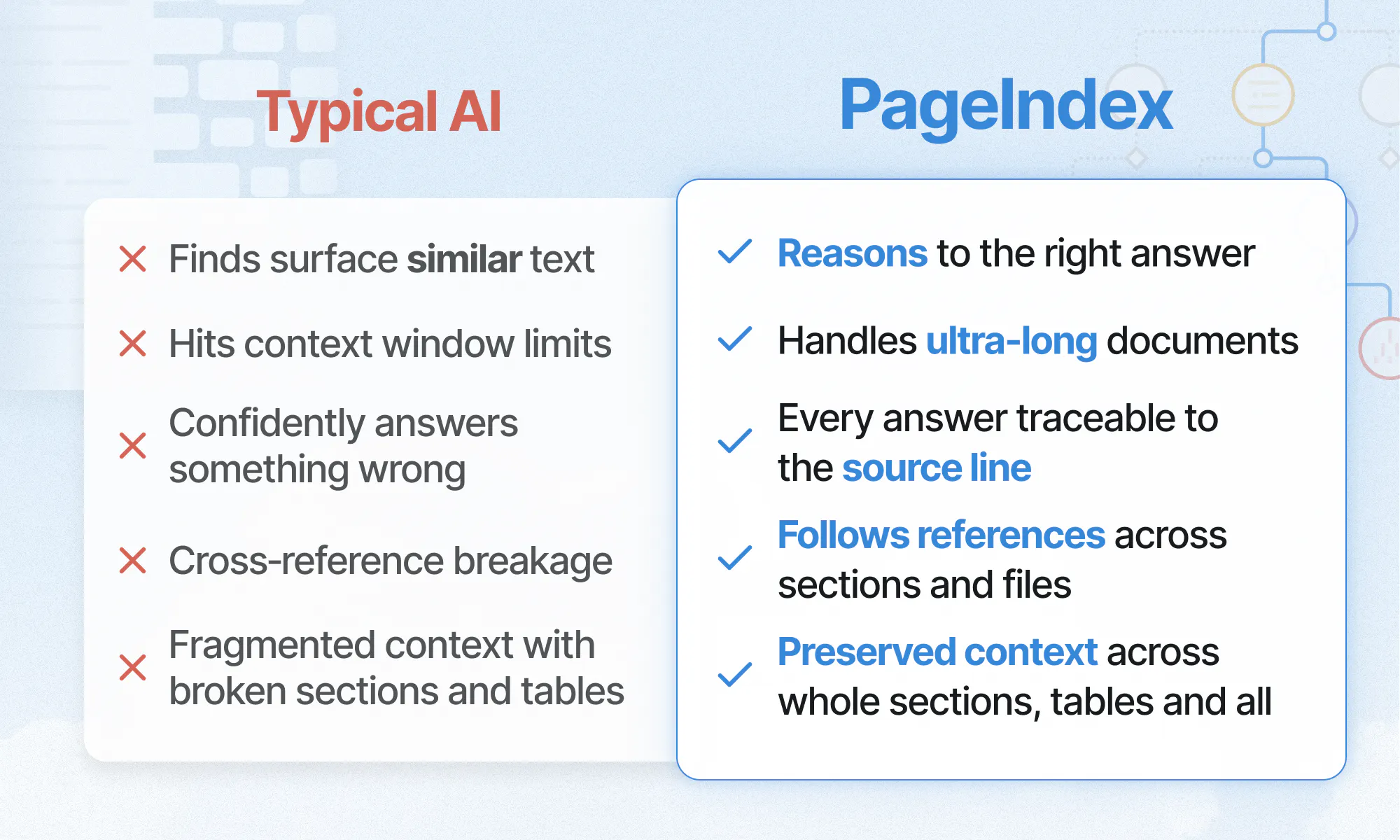
I've changed my mind about them being the right infrastructure for retrieval in AI systems. I want to be precise, because the claim is not "vectors are dead".

An index is defined by the one question it can answer. A vector index answers: which chunks look most like this query?

  • Right question for broad recall over messy, conversational text. Vectors will keep doing that job well.

  • Wrong question for a long, professional document.

Two reasons it breaks down there:

  • The passage you need may share almost no wording with how you asked for it.

  • The answer often sits behind a cross-reference like "see Appendix G". No amount of similarity gets you through that pointer.

So we index the structure instead of the surface.

  • The document's tree sits inside the model's reasoning context.

  • It decides where to look next, not what looks similar.

  • Retrieval becomes navigation. Navigation leaves a path, which is why every answer can point back at the source line.

If you want to stress-test it: upload the longest and most complex document you own, then tell me what happens. Bug reports are worth more to me today than upvotes.

3
回复

Congrats! Avoiding embeddings is an ambitious architectural choice. I'm especially curious whether this makes the results more interpretable, since each search decision could potentially be traced through the document tree.

3
回复

@william_wang24 Exactly — that’s one of the things we care about most. Because retrieval happens over the document structure rather than an embedding space, we can make the reasoning path much easier to inspect, and then ground the final answer back to the exact source lines. Thanks William!

2
回复

Feels like what Perplexity does for the web, but pointed at my own document library instead.Great Launch!

3
回复

@jocky Thanks Jocky! That’s exactly the idea: deep research for your own documents. Been following Teable for a while too 🙌

1
回复

@jocky That’s a great way to put it, Jocky! Perplexity for your own document library is actually pretty close to the experience we’re aiming for — with the added focus on traceable reasoning and exact citations back to the source. Appreciate the support!

1
回复

I like the exact-line citations. Congrats!

2
回复

@henry_habib Thanks Henry! Exact-line citations are one of my favorite parts too — we really want every answer to be easy to verify, not just sound convincing. Appreciate the support!

1
回复

Can I share a single answer with its citations as a link, so a colleague can see the sources without an account?

2
回复

@axelkane Yes! They can open the shared link and check the answer and citations directly, no sign-up needed.

3
回复

@axelkane Absolutely! Just click the Share button in the top-left corner, and you’ll get a shareable link that you can send to anyone.

1
回复

Congrats on launching PageIndex! Verifying answers with clickable citations solves a real pain point. How do you handle documents with scanned or image based pages?

1
回复

@jackthompson68 Thanks Jack! Scanned and image-based PDFs are supported too. PageIndex runs OCR automatically, then indexes the extracted content and document structure as usual. You still get exact line references, so you can click a citation and jump straight to the precise source lines behind the answer.

1
回复

This seems especially valuable for investors and researchers.

1
回复

@s_cen Absolutely, those are two of the core use cases we had, especially when you’re working across long reports and filings and need to verify everything back to the source line.

0
回复
The document should always be the source of truth. I like that AI is supporting the reading process instead of replacing it.
1
回复

@yura_acti Exactly. That’s the philosophy behind PageIndex — AI should help you navigate and understand the document, while the original source stays one click away for verification. Thanks for calling this out!

1
回复

can you suggest how pageindex is better than chatgpt or claude code. what makes pageindex better?

0
回复

@darcwader Hi Darshan, ChatGPT and Claude are limited by what can fit into the context window at once. PageIndex builds a structured map (aka index) of the full document set and brings the right sections into context when needed.

So the model gets focused context from the most relevant parts of the entire document set, with exact source references.

0
回复

Looks pretty scientific :) Do you collaborate with some universities and research centres? :)

0
回复

@busmark_w_nika Thanks! A lot of our team comes from research backgrounds :) We care deeply about the technical side of retrieval and document reasoning, and we’re always open to collaborating with universities and research groups.

0
回复
#8
Yomi
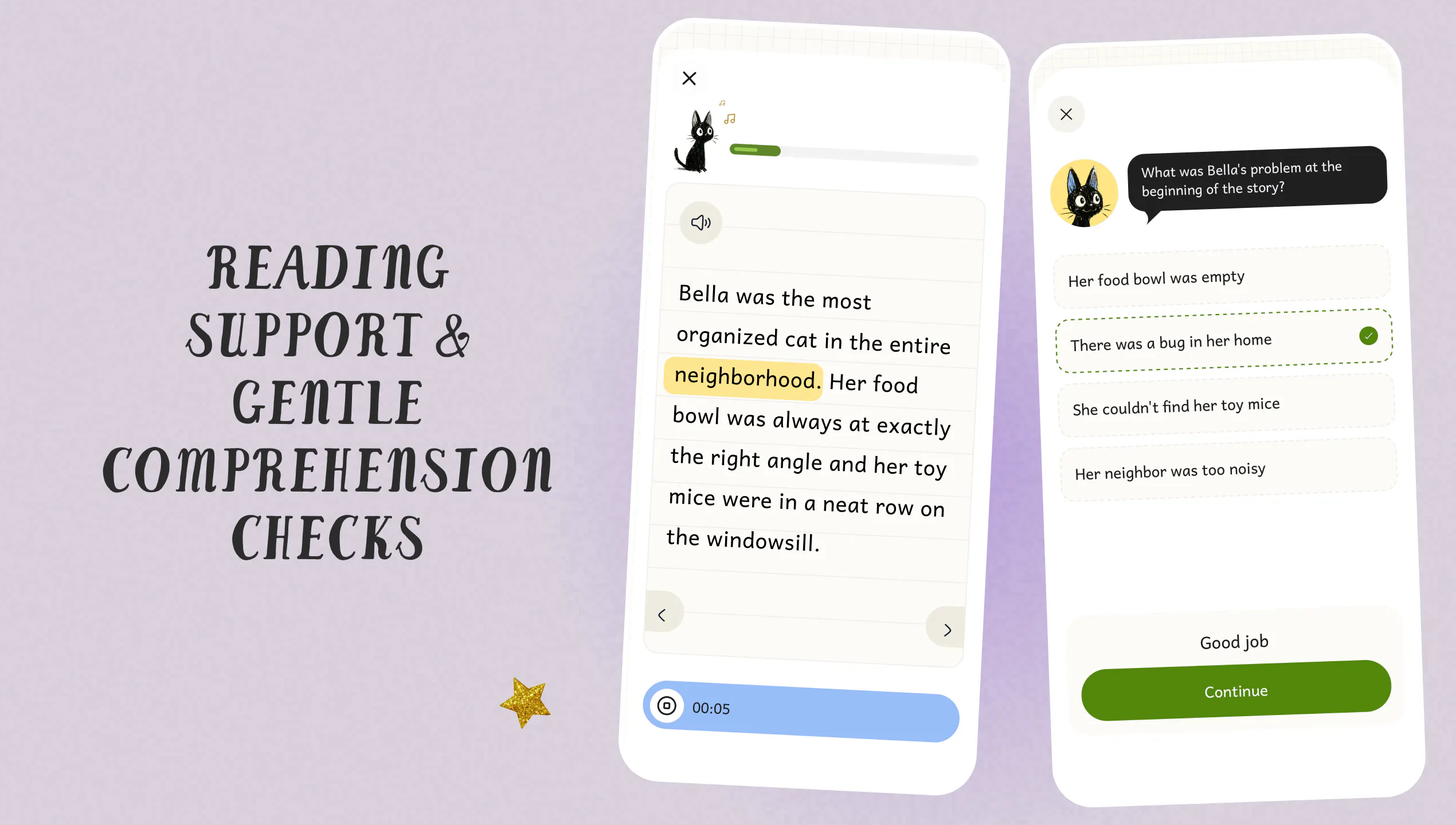
A little cat who loves being read to
148
一句话介绍:Yomi 是一款通过语音识别“听”孩子朗读故事、并用喂猫反馈激励练习的 iOS 儿童阅读应用,专为 5–9 岁孩子打造无压力、无奖惩机制的朗读练习场景,解决“孩子会读但不愿开口”的动机问题。
Kids Education
儿童阅读 语音识别 朗读练习 无游戏化 无账号 教育应用 iOS 英语学习 芬兰语 亲子工具
用户评论摘要:多数评论好评集中在“无连击、无广告、无数据收集”的克制设计,认为比传统激励更健康。用户建议包括:增加德语、配图、让猫更“活”(发声/表情)。部分家长提出希望有理解力问答(已有)及适合更年幼孩子的内容。整体反馈积极,少数人关注扩展语言与内容深度。
AI 锐评

Yomi 的价值不在于“教阅读”,而在于重构阅读练习的情感语境。它精准切入了一个常被忽视的痛点:孩子“能读”但“不愿读”,尤其是对朗读的心理抗拒。主创没有选择强化外部奖励(勋章、连击、排行榜),而是把动机锚点放在“照顾猫”这种低压力、高陪伴感的关系上,让练习回归内在节律而非绩效压力——这在整个儿童教育应用赛道里是稀缺且反直觉的设计判断。

从评论看,用户反馈不局限于“好不好用”,而是主动提出“请加德语”“猫能不能更活”“要不要配图”等延展需求,说明产品触发了情感投射,而非单纯工具使用。这种卷入感是低成本获客和口碑裂变的基础。

但需泼冷水:语音识别在儿童发音、语速、口音上的鲁棒性仍是最大技术风险;“每天重置的猫饥饿度”虽减弱焦虑,也可能削弱长期粘性——尤其对 9 岁用户,新鲜感消退后如何留住?目前仅 iOS + 英/芬兰语,市场天花板清晰,且无账号体系意味着无法做家长报告或个性化推进,这会限制其进入家庭决策链的深度。

Yomi 真正的护城河是“克制力”带来的信任感——这在数据滥用、儿童隐私焦虑的当下是珍贵资产。但接下来的挑战在于:如何在不引入成瘾机制的前提下,持续制造“明天还想读”的动机?能否克制住“为了增长而加功能”的诱惑,将是这个产品能否从“可爱实验”变成“可持续生意”的分水岭。

查看原始信息
Yomi
Yomi is a little cat who gets fed when kids read stories aloud. Speech recognition listens along, kids can tap any tricky word to hear it, and a simple wizard lets them make up their own stories to read back. Real stories come at three levels, so kids pick what feels right today. What's not in it: streaks, ads, accounts, or data collection. No one loses a 14-day streak at bedtime. Yomi won't teach your kid to read, it gives them a reason to practice. Ages 5–9, English & Finnish, iOS.

Hi Product Hunt. I'm Elina, and this is my second launch. 🐱

Yomi is a little cat who loves being read to. Kids read stories out loud, Yomi listens (speech recognition), and every word feeds the cat a little. Tomorrow Yomi is hungry again.

I'm a designer, and I've spent years building educational tools with teachers. In a workshop with first- and second-grade teachers, one question kept coming back: why do some kids freeze when asked to read aloud, even when they can read just fine on their own? A few months later my own kid was doing exactly that, reading silently, refusing to read aloud to anyone. I didn't want to force it. I wanted to build her somewhere safe to practise.

The apps I tried first made it worse, not better: streaks that made bedtime stressful, fire emojis that made her feel bad for taking a day off.

So Yomi deliberately has:

– no streaks (nobody should lose a 14-day streak at bedtime)
– no ads
– no accounts, no data collection
– no leaderboards, no coins, no levels for the kid, only the cat, who is happy today because you read to it

To be honest about what it is: Yomi won't teach your kid to read. Teachers and parents do that. Yomi just gives kids a reason to want the practice, real stories at three levels, tap a word to hear it, and a little wizard for making up your own stories to read back.

It's on iOS in English and Finnish. I'd love to hear from parents here: what made reading practice work (or not work) at your house?

11
回复

@elina_patjas i love those cute little art! congrats on the launch!

0
回复

@elina_patjas 

Choosing to strip out streaks and leaderboards on purpose is the harder design decision, most tools default to those mechanics because they measurably increase engagement, even when the cost is a kid feeling bad at bedtime. Making the cat's happiness reset daily instead of accumulating into a score is a small choice that changes the whole emotional shape of the app. Built by someone who noticed the problem in her own kid before trying to fix it for everyone else's, that's usually the difference between a feature and a genuine product.

0
回复

oh i love this idea and style so much! please add German as supported Language <3

0
回复

This is genuinely adorable haha. I can totally see kids getting weirdly invested in making sure the little cat gets fed every night. Such a fun way to make reading feel less like homework. Congrats on the launch! @elina_patjas

0
回复

@zach_francis thanks. for the record yomi won't starve to death or anything. he just gets *really* tired :D

0
回复

My kid isn't ready for this yet but I love the heart behind it!

0
回复

@tiffany_kavuma ty! let’s hope yomi is still around when they are. i’m working on something for the younger end too, sounds and letters rather than stories so maybe their turn comes sooner than that.

0
回复

I've been thinking (and reading) a lot about the literacy crisis recently, so this is well-timed. I can't wait to check it out and introduce it to my nephews! Congrats on your launch 🎉

0
回复

@ryanwrites thanks. yomi’s not fixing the literacy crisis, but kids who read a little tend to read more. hope the nephews take to him.

0
回复

Loved the idea Elina! Wish you all the best here

0
回复

@german_merlo1 thanks! you too.

0
回复

This is such a cute app! My nephew is going to love this!

0
回复

@aamirxv2 thank you! i hope he finds it as delightful as my kids <3

0
回复

@elina_patjas This is going to end up being the first kids focused app I've seen launch here that I actually download and use with my son. I really love the lack of gamification in this. Like you said, my kid does not need the stress of trying to keep a streak alive when it's bedtime haha.

To your question of what's worked: my son really likes when I ask follow up questions after we read. And from my side, I've found that it really helps to actually get him engaged with what we're reading when he knows we're going to talk about it afterwards. So there being comprehension checks in this is going to be a big hit.

I really appreciate seeing something like this that's actually useful for kids and doesn't have a bunch of bs packed into it. Excited to try it out!

0
回复

@jakecrump this made my day, ty 💚

yeah, every story ends with a gentle comprehension check once the kid finishes reading, and it's yomi who asks them because the kid just read him the story.

let me know how it goes when you two try it, I'd rather hear it didn't work than not hear.

1
回复

Great idea for an app! Any technology that helps kids with reading and getting practice pronouncing words is super helpful. Some ideas for future iterations could be adding pictures to the books somehow, or possibly having Yomi meow/say some phrases to come alive even more. Keep up the great work!

0
回复

@ergoblin thanks! good feedback, i've been already testing some waters with yomi having a voice. and yes to images too!

0
回复
Brilliant! I have a 10yo who struggles with reading. I’m eager to get her started. Well done!!
0
回复

@coderberry3 i hope she finds it helpful, just let her explore it in peace, my kid at least wants to read in her own privacy, so only yomi can listen.

0
回复
So clever to give rewards to kids for good habits and this genuinely makes it exciting for kids. Very creative!
0
回复

@shalabh_sanger thanks for the feedback :) the idea to this app was born in a workshop with first and second grade teachers while concepting a new ABC book, so there is real pedagogy behind yomi.

0
回复

Love this cool app! I have 4 kids and I am sure kids will love this app

0
回复

@zeng nice, 4! mad respect <3 I hope it's useful for them, let me know if you try it out.

0
回复

Hi Elina, I'm not a parent, yet, but I love this. The design and graphics are amazing. Good luck with the launch.

0
回复

@ismaelyws thanks <3 if you know any parents, feel free to share yomi, that's how small things grow.

0
回复
#9
GitNexus (Akon Labs)
The open-source kernel for coding agents
144
一句话介绍:GitNexus是一个开源的知识图谱内核,将企业内分散于多仓库、多SCM的代码库解析为确定性调用图,通过MCP协议为Claude Code等编程代理提供精确的代码上下文查询,以替代传统embedding的“模糊猜测”,从而降低Agent运行成本并提升准确率。
Open Source Developer Tools Artificial Intelligence GitHub
知识图谱 代码上下文引擎 MCP协议 开发者工具 AI编程助手 开源 代码库索引 调用图 LLM成本优化 DevOps
用户评论摘要:用户认可其解决跨仓库调用和上下文痛点,主要质疑图谱新鲜度,关注在快速迭代及Agent频繁提交场景下,图更新是增量实时还是存在重索引延迟导致陈旧数据;另有金融用户询问访问控制,官方回应支持设备级令牌。
AI 锐评

GitNexus切中了当前Agent编程领域最虚浮的环节——上下文工程。当同行都在卷embedding模型精度和RAG管道的召回率时,它反其道而行之,用编译器级别的确定性分析将代码库变成一张精确的图。这个思路是降维打击:与其让模型去“猜”谁调用了某函数,不如直接把答案写在表里。51%的成本下降数据很漂亮,但真正值钱的不是省下的token费用,而是Agent行为从“概率性试错”转向“确定性执行”带来的可靠性质变,这才是企业敢把Agent放进生产环境的关键。

然而,产品若要成为基础设施级别工具,仍有几道硬门槛。首当其冲是评论中提到的图新鲜度问题——在CI/CD流水线分钟级部署的现代研发体系里,若图谱更新存在分钟级甚至小时级延迟,那它提供的“精确上下文”在快节奏分支开发时同样会沦为“精确的过时信息”,这对高频协作的Agent系统是致命的。其次是多语言解析能力,45k stars的开源社区基础虽好,但面对C++模板元编程、动态语言魔法特性或老旧Monorepo的复杂构建链,图谱的完整性与准确性待考。最后,MCP接入只是第一步,真正的护城河在于能否成为企业代码知识的事实标准层——但这需要解决权限模型与跨租户隔离的商业化难题。总体而言,GitNexus方向正确,但须在增量索引性能和企业级治理上证明自己,方不负“kernel”之名。

查看原始信息
GitNexus (Akon Labs)
GitNexus (45k Github stars) is a Knowledge Graph Kernel that unifies every codebase in your org into one source of truth your coding agents can query. It resolves your code into a deterministic graph, so agents get exact callers, imports, and impact instead of embedding guesses, across every repo and SCM you run. On our public benchmark (https://www.akonlabs.com/benchmarks), coding agent runs 51% cheaper with GitNexus connected. It works with any agent over MCP.
Hey Product Hunt Fam, I'm Subham from Akon Labs. We built GitNexus because coding agents spend most of their budget just finding context, not writing code. They read files, grep around, follow imports by hand, and burn tokens rebuilding a mental model of your codebase on every single task. It gets worse the moment that code is spread across multiple GitHub accounts, GitLab, Azure DevOps, and self-hosted enterprise. There's no single view an agent can point at. An agent is only as good as the model of the world you hand it, and most tooling hands it a proxy. A file tree mirrors the disk, not the system. A per-repo index mirrors the org chart, not the call graph. Embeddings return "who calls this function" as a ranked guess when it has an exact answer. GitNexus resolves your codebase into one deterministic graph. Nodes are the real entities: symbols, files, functions, services, repos. Edges are the real relationships: calls, imports, implements, deploys. Agents query it and get exact context, not similarity guesses, across every SCM you have. A few things worth knowing: - It's open source (45K+ GitHub stars, 1M+ npm downloads), so you can evaluate it in the open - It makes both closed and open source models cheaper and more capable. Benchmarks : https://www.akonlabs.com/benchmarks - Works over MCP with Claude Code and your existing agents, no lock-in. Run it managed, or self-hosted and air gapped I'll be around all day. I'd genuinely love to hear what you're using as your codebase context today and where it breaks first. Ask me anything 🙏
9
回复

the "file tree mirrors the disk, not the system" line is a good way to put it - most context tools are really just fancier grep. what I use today is basically Claude Code's own repo-map plus whatever I paste in manually, and it breaks exactly where you'd expect: cross-repo calls, since there's no single view spanning our services. the part I'd want to understand before adopting this though is graph freshness - on a fast-moving repo with agents committing constantly, is the graph updated incrementally per-commit, or is there a reindex lag where an agent could query stale call/import data right after a merge?

2
回复

Congrats on the launch folks!!

1
回复

GitNexus feels like a practical solution to one of the biggest bottlenecks in agentic coding i.e. the context. Huge congrats on the launch, Subham!

1
回复

45k stars is wild 🤯 deterministic graph over embeddings just makes sense

0
回复

This is super cool!

0
回复

At Flowtogen we are using GitNexus and it is helping our team.

0
回复

45K GitHub stars - that’s impressive! Is there a mechanism for controlling who can access the code? Often you can’t show the entire codebase to everyone, especially for financial applications.

0
回复

@natalia_iankovych yes we have the full access control with device level token access.

1
回复
#10
SpacebarX
A keyboard-first outliner for notes, tasks and projects
121
一句话介绍:SpacebarX 是一款键盘优先、本地优先的大纲式笔记与任务管理工具,将笔记、任务、项目、代码和写作统一在一个嵌套大纲中,解决用户在笔记与任务应用之间反复切换、上下文割裂的痛点,并支持离线使用与自选云盘同步。
Productivity Task Management Notes
本地优先笔记 大纲笔记 任务管理 键盘优先 离线应用 Markdown编辑器 PWA应用 个人知识管理 All-in-One工作区 同步笔记
用户评论摘要:用户认可其将笔记与任务结合的思路及离线架构,称其为Workflowy和Notion的混合体,Today视图与深层嵌套任务同步功能备受好评。主要建议与疑问集中在:PWA在浏览器内键盘快捷键冲突问题、原生桌面与移动端应用开发进度、iCloud同步上线时间。
AI 锐评

SpacebarX踩中了“笔记与任务割裂”这一真实痛点,其“大纲即一切”的交互模式和对文件所有权的强调,确实切中了一部分高级用户对效率与控制感的双重执念。但必须清醒看到,其本质仍是Outliner这一古老品类的改良版,并无底层逻辑的创新。Workflowy、Roam、Logseq皆已占据用户心智,SpacebarX以“键盘优先”和“本地优先”作为差异化切入,确实能吸引一批受制于Notion卡顿和Workflowy封闭生态的硬核用户,但这也意味着其天花板受限——它面向的是愿意学习快捷键、接受大纲交互的学习型用户,而非大众市场。评论中开发者对“浏览器引擎内键盘事件冲突”的回应避重就轻,这是PWA路线无法回避的硬伤;原生应用“数周内”的承诺在PH上屡见不鲜,落地质量存疑。更关键的问题是:免费版功能已近完整,Pro版所增加的Board/Calendar等视图不过是标准功能补齐,所谓“BYOK AI”在当前环境下也难成刚需。$99买断价合理但缺乏爆发力。产品在“拥有感”和“简洁性”上做得很体面,但缺乏一个让人非迁居不可的“杀手级场景”。如果不能在协作或AI自动化上做出实质性突破,SpacebarX大概率会成为一款小而美的效率工具,而非下一个生产力平台。

查看原始信息
SpacebarX
SpacebarX is a keyboard-first, local-first outliner for notes, tasks, writing, markdown, code, and projects. Capture and organize from the keyboard, add dates inline, and let Today collect what needs attention. Search across your workspace while keeping every note in context. It works offline and syncs through a cloud folder you control. Free forever. Pro adds visual views, saved searches, encrypted documents, version restore, Calendar, uploads, and BYOK AI.

Hi Product Hunt,

SpacebarX is an offline notes-and-tasks workspace that keeps your work on your machine.

I built it because I was constantly splitting my brain between two apps: notes in one, tasks in the other, and the context I needed always somewhere else.

With SpacebarX, everything lives in one nested outline. Start with a thought. If it becomes a task, make it a task. No project setup, no predefined templates, no deciding how to organize before you can begin.

It has the simplicity of an outline, with the focus and efficiency of a task manager, while keeping the notes behind each task close at hand.

The part I care about most is ownership:

  • Your files stay local

  • You can work fully offline

  • If you want sync, connect your own Google Drive or Dropbox

  • There is no SpacebarX server storing, reading, or controlling your notes

A few things you can use it for:

  • Notes: Keep decisions next to the project plan they came from.

  • Tasks: Turn any thought into a task, assign due date to it and see the task in Today / Calendar view.

  • Files and folders: Separate work into files and folders when you need structure, then switch to Whole View to see it all as one connected outline.

  • Search: Find anything without losing the surrounding outline and context.

  • Writing and code: Keep Markdown and code blocks beside the work they support.

  • Planning: Use Board, Table, Mind Map, or Calendar views when an outline is not the best way to see the work.

Right now, SpacebarX is a PWA you can install from your browser on desktop or mobile. Native desktop and mobile apps are in progress.

The free tier is free forever. Pro is available monthly, yearly, or as a $99 Lifetime plan, normally $199. It adds Board, Table, Mind Map, Calendar, saved searches, encrypted documents, version restore, uploads, and bring-your-own-key AI.

If you have tried combining notes and tasks in one app and gave up, I'd genuinely love to know where it broke down for you?

5
回复

@1simpledev 

Keyboard-first inside a browser engine means fighting the browser for its own keys (Ctrl+W, Ctrl+T, Ctrl+N are reserved in a tab). Does the installed PWA window free those up, or did you design the keymap around them? Asking as someone who spends a lot of time in browser keyboard event handling. Local first with your own Drive/Dropbox as sync is the right architecture for notes.

0
回复

@1simpledev 

Splitting your brain between a notes app and a task app is such a specific, underrated tax, you don't notice it until it's gone. The offline-first, no-server-touching-your-notes angle is the right call too, most tools bolt that on as an afterthought instead of building around it from day one. Keeping the outline as the single source of truth instead of making people choose between structure and speed early is the part that will decide if this sticks long term.

0
回复
@1simpledev Really loved the usability of the app, and sync feels seamless (tried Google Drive). Feels like a really nice blend of Workflowy and Notion. I especially love that tasks I set as due anywhere inside deeply nested lists automatically show up in the Today view. Makes it really easy to keep track of what needs to get done. Any plans for desktop and native mobile apps? The mobile experience is somewhat good, but I think a native app would make it even better. Also, when will iCloud Sync be launched? Looking forward to seeing where you take this!
1
回复

@venkat_selvan 

Thanks so much! Really glad you’re enjoying the experience, especially the Today view and nested tasks 🙌

Native desktop and mobile apps should be coming in the next few weeks. iCloud Sync will come along with the native apps since it only works natively on iOS and macOS.

Really appreciate you trying it out and sharing the feedback!

0
回复
#11
Caddi
Agent that builds agents by only showing your work only once
114
一句话介绍:Caddi是一款通过“演示一次”即可自动生成数字员工的AI代理构建工具,专门解决法律、金融等后台岗位中高频重复、跨应用操作(如合同归档、CRM录入)的自动化难题,让非技术人员无需编写代码或配置复杂流程,即可教会AI完成实际工作。
Productivity Legal Artificial Intelligence
AI代理 自动化工具 演示学习 后台办公 无代码 RPA替代 跨应用操作 知识工作者 流程挖掘 企业SaaS
用户评论摘要:用户普遍认可“屏幕共享演示”的交互方式比搭建流程图更自然,但集中担忧异常处理:评论反复询问“真实流程与演示略有差异时如何适应”“网站界面轻微变动是否会崩溃”“跨3-4个应用的工作流是否支持”。开发者回应称系统会主动询问边界案例并将答案固化为规则,但用户对“未提及的隐性例外”仍存疑虑,希望看到更多关于鲁棒性的实证说明。
AI 锐评

Caddi的定位精准踩中了后台自动化的“最后一公里”痛点:不是流程复杂,而是流程琐碎且充满隐性例外。它用“教会新人”的隐喻替代了传统的流程图搭建,本质上把自动化门槛从“开发能力”降低为“表达能力”——这是对的,因为大部分后台任务的价值在于对例外情况的判断,而非执行本身。

但评论区的密集质疑揭示了核心风险:演示学习的最大盲区正是“未演示的例外”。即使Caddi会主动 probe edge cases,人类的表达永远无法穷尽真实世界的异常流。它声称“AI推理+确定性执行”的混合架构,理论上能兜底,但问题在于“AI推理”的置信度边界——当周界内的判断失误发生在发送邮件、删除记录这类不可逆操作上时,信任成本会急剧放大。

更深层的挑战在于规模化:每个用户的“演示”都是私有流程知识,Caddi的学习本质上是针对单一用户的定制化,难以形成跨租户的复用价值。这意味着它更像一个高级RPA工具而非平台生态,商业天花板取决于获客效率能否覆盖定制化推理成本。

创始人提到的“信任边界”是真正的产品哲学,但目前的演示和评论未充分展示失败案例的处理机制——“每次运行都有日志”只能解决事后追溯,不能解决事前预防。如果Caddi能在“何时该停下来不执行”这件事上做到比人类更保守,它才有机会从效率工具进化为智能同事。否则,它只是把苦力活变成了监督活,价值减半。看多点试错案例,再谈颠覆不迟。

查看原始信息
Caddi
Caddi turns narrated screenshares into production agents that run back-office work across your real tools. Show the task once, and Caddi learns the process, builds the automation, and lets you update it in plain English. Unlike RPA or workflow builders that require scoping, developers, and step-by-step setup, Caddi combines AI reasoning with deterministic execution, with every run logged and every permission scoped.

Hey Product Hunt 👋

I'm Jason, one of the makers of Caddi. Caddi is an agent that builds agents.

We build for law firms, RIAs and accounting firms, and the same thing kept coming up: the work isn't hard, it's just endless. A contract comes back signed, someone downloads it, renames it to the firm convention, files it to the matter, logs it in the CRM. Forty times a month. Every month.

Automating that has always meant a project. Scope it, spec it, configure it, get a developer. So it never happens, and people keep doing it by hand.

Caddi takes a different path, and it starts before you build anything: it reads your stack and tells you which work you repeat most, ranked by impact.

You pick one, and then you teach it like a new hire, except this new hire already knows the job. It follows your guidance or guides you with best practices, and probes for edge-cases: not just "download the contract", but "say how you tell an executed copy from a draft".

When it hits something ambiguous it stops and asks, with the options laid out and a confirm button. What if only one party has signed? Your answer doesn't disappear into a transcript. It becomes a rule in the agent.

What comes out reasons with AI where judgment is needed and runs deterministic code where it isn't, so the messy cases get handled without the exact parts going off-script. Then it runs in the cloud, executing thousands of actions at a time.

And you can see all of it. Every run is a log of what it decided, step by step, with the permission it used to do it: read, create, send.

We'd genuinely love your feedback, especially on where you'd trust an agent and where you wouldn't. That line is the whole product for us.

2
回复

@jason_alafgani, demo-once is the right shape for back-office work. My worry is the narration always skips the exceptions, the 3 weird cases people handle on instinct and forget to mention. Does Caddi ask about the gaps, or learn only what it saw?

0
回复

I can see this being useful for all those boring admin tasks we keep doing every day.

0
回复

ui looks very interesting.

0
回复

How does it handle small change in the process? That's usually where automations break for me.

0
回复

I like the screenshare approach. Feel more natural than setting up a workflow step by step.

0
回复

what happens if a website changes its layout slightly? Does it adjust or break?

0
回复

Talking out loud while doing the task feels way more natural than manually building a giant diagram.

0
回复

Can it handle workflows that hop across 3 or 4 different apps in one go?

0
回复

How well does Caddi handle exceptions when the real process differs slightly from the example?

0
回复
#12
Kira Community
Curate moments with #hashtag
114
一句话介绍:Kira Community 是一款将 AI 图像生成工具升级为社区的产品,让用户通过#话题标签(如#portrait、#goldenhour)策展自己的 AI 创作,并在同好聚集的信息流中找到归属感,解决“创作后无处分享、无人共鸣”的痛点。
Social Media Artificial Intelligence Community
AI绘画 图像生成 创意社区 话题标签 作品分享 社交图谱 美学滤镜 创作者工具 内容策展 UGC平台
用户评论摘要:用户普遍认可概念,但有两类突出问题:一是菲律宾等地区及部分IP被Cloudflare拦截,无法访问;二是对免费版额度、是否自研模型及与Instagram/VSCO的差异化提出疑问。创始人回应了免费额度,但未澄清地域封锁与技术栈问题。
AI 锐评

Kira这步“从工具到社区”的转型,方向正确但路数危险。其核心价值不是“分享”,而是“筛选”——用#hashtag构建的亚文化信息流,确实比Instagram的算法茧房更具策展感,这是它能吸引首批114票的情感锚点。然而,致命伤在于:第一,技术门槛被低估,社区的生命力依赖稳定访问,却连菲律宾用户都被Cloudflare误杀,说明基础设施尚未支撑全球化野心;第二,与VSCO、Instagram的区分度仅停留在“标签”层面,而这恰恰是Instagram早就玩烂的功能,缺乏不可替代的交互机制(如协作创作、衍生品交易);第三,创始人强调“make #anything worth sharing”,但AI生成内容的同质化极易让社区沦为“滤镜打卡地”,而非真正的创作生态。如果Kira不能在两周内解决访问封锁、并提供“标签订阅+共创挑战”等差异化功能,这步棋只会沦为工具的一次社区化装饰,而非范式跃迁。毕竟,用户不缺分享平台,缺的是“被理解”的角落——而角落的前提,是门得能打开。

查看原始信息
Kira Community
Kira began as a tool for making beautiful things: turn a photo or a prompt into portraits, cinematic shots, videos. Now it's a place to share them, too. Kira Community is where your creations become moments. Tag your work with #hashtags, keep it on your profile, and browse a feed built around the themes people actually care about; and the people who care about them with you. This is Kira's first step from a tool to a community. Curate your moments, and share them with people who get it.

Hey Product Hunt 👋

I'm Owen, founder of Kira.

For most of its life, Kira has been a tool. You bring a photo or an idea, and Kira turns it into something beautiful: a portrait, a cinematic shot, a video. I've always loved that.

But one thing kept nagging at me: the second someone made something they loved, they wanted to show it to someone. The making was never really the end of it.

So today we're launching Kira Community: the biggest thing we've ever shipped, and our first real step from a tool into a place.

Here's the idea. Every creation becomes a moment you can curate, caption, and tag: #portrait, #goldenhour, #summer, whatever it is. Your moments live on your profile, and they flow into feeds you explore by hashtag, so instead of scrolling past strangers, you find the people who are into exactly the same things you are.

We spent years making it easy to create. This is the start of the harder, more interesting part: making it worth sharing, giving every creation an audience, and every creator their people.

"Make joy worth sharing" is where we started. Today it becomes something bigger: make #anything worth sharing.

I'll be in the comments all day. Would love to hear your thoughts (and what you'd want to see next).

— Owen

1
回复

@owenlongbo  are you running own pipeline or orchestrating existing models? either way the output consistency is impressive.

1
回复

@owenlongbo I love how you're turning every creation into a moment with tags like #goldenhour—it feels like a natural way to connect people over shared aesthetics rather than just likes. What keeps you from just using Instagram or VSCO for this, and how will the feeds actually surface the right communities?

0
回复

@owenlongbo I am very interested in exploring and using your service. However, when trying to access kira.art, I received a security message indicating that my access has been blocked by Cloudflare.

Here are the technical details displayed on the error page for your reference:

  • Cloudflare Ray ID: a31c368548263db0

  • Your IP address: 2001:ee0:50e9:5120:d4e8:4d16:afc3:ea8e

  • Action taken: Standard web browsing to access the site.

I was not performing any unusual requests or submitting invalid data that would harm the system. Could you please check your firewall/Cloudflare configuration and unblock my IP address so I can continue using the platform?

Tks.

0
回复
Loving the concept. As a big supporter of art and to see a community evolve from creativity is quite exciting.
0
回复

@shalabh_sanger thank you for you kind words!

0
回复

Congrats on the launch! i tried to access the site, but it says i'm blocked. is philippines blocked? im from the philippines

0
回复

Looks great! What does the free tier cover? Would love to try it on a couple of real projects before committing.

0
回复

@1251912798 Free tier gives you daily credits to try Kira and explore the core generation experience, so you can test it before deciding if you want to upgrade. Would love to have you try it out !

0
回复
Oh?
0
回复
#13
Pluto
Your professional profile is now an AI agent
112
一句话介绍:Pluto 是一款AI语音代理,用10分钟对话构建你的“活简历”,让招聘方和AI Agent都能更立体地发现你,解决传统简历和LinkedIn资料扁平化、丢失真实背景和意图的痛点。
Artificial Intelligence Virtual Assistants Career
AI简历 职业档案 AI语音面试 人才发现 人脉网络 智能匹配 招聘科技 个人Agent 求职工具 Product Hunt
用户评论摘要:用户普遍认可“AI代理替代静态主页”的构想,但尖锐指出两大问题:一是AI在10分钟对话中可能产生“我没说过”的错误表述,且难以逐句溯源修正,控制感存疑;二是求职者需同时应付多个招聘Agent,期待Pluto能与Mercor等平台自动打通上下文,减少重复面试。
AI 锐评

Pluto踩中了AI招聘浪潮中最性感也最危险的节点——它试图成为“个人职业数据的结构化层”。当LinkedIn还在用关键词匹配时,Pluto用对话换取上下文,这确实是对“标题化简历”的一次降维打击。但产品当前的软肋是致命的:AI生成的错误信息具有“隐形污染”属性,用户无法分辨哪句出自原始对话,也无法逐句删改,这在求职这种高信任场景下是硬伤。评论中那条关于“10分钟对话的错误是AI想象的,而非我简历的错误”已直击要害。若不能提供“逐句溯源+声纹级纠错”,所谓“控制在你手中”只是一句空话。此外,产品目前仍依赖talentpluto的封闭网络,缺乏开放性——若不能尽快接入主流ATS或建立Agent间协议(如与Mercor等共享上下文),Pluto将沦为又一个孤岛工具。从价值看,Pluto的方向没错,但它必须从“讲故事”转向“可验证的真相”,否则热度过后,用户只会留下一句:“AI又把我介绍错了。”

查看原始信息
Pluto
Pluto is an AI voice agent that learns your story in 10 minutes and makes you discoverable to the right people and AI agents. Most profiles reduce you to titles and keywords. Pluto learns what they miss, from what you are great at to what you want next and how you work best. It turns that understanding into a living professional profile that stays current as you do and represents the fuller picture of who you are.
Hey Product Hunt 👋 I’m Sahil, cofounder of talentpluto. AI is becoming the search engine for people. Companies are using AI to find people to hire, investors to find people to fund and founders to find people to build with. Increasingly, their agents will run those searches for them. But the information representing us was built for a different era. Resumes and LinkedIn profiles reduce people to titles, companies and keywords. They miss the context that explains who someone is, what they are great at and why they might be the right person. If AI is going to search for you, you need a way to represent yourself to AI. That is why we built Pluto. Pluto is an AI voice agent that learns your story in 10 minutes. It understands your strengths, goals, preferences, and how you work best. Then it turns that context into a living professional profile that you control and that both people and AI agents can understand. The bigger vision is an agent that knows you, keeps your story current, makes you discoverable for the right reasons, and represents you when you are not in the room. One way Pluto can work for you today is through talentpluto’s network of top startups. When there is a real reason for you and a company to meet, Pluto checks with you first and can make a warm introduction. LinkedIn gave every professional a page on the internet. We think every professional now needs an agent for the AI era. Pluto is free for professionals. We would love your honest feedback. https://talentpluto.com/
9
回复

@sahilseth nice launch congrats🙌really cool concept, idea of having an active agent represent you rather than just a static LinkedIn page makes a lot of sense. Going to give this a try later today...

4
回复

I just did this and was super super surprised at all the wrong things that AI said about me! Definitely going to show this to my coworkers at Optiver!

7
回复

@jenny_park7 awesome, and please do. AI getting people wrong is only going to become a bigger problem, but it also creates a huge opportunity. AI can take in years of context in seconds and understand people beyond surface level credentials. For the first time, people can be rewarded for their depth.

1
回复

Super pumped to see everyone interacting with Pluto! We're excited for everyone to finally have their professional career represented by Pluto!

6
回复

Super excited for everyone to see this! Please let us know any feedback and comments. We are always building and love any kind of feedback!

5
回复

Big congrats Sahil! 🚀 Pluto is such an interesting take on how AI will change professional discovery. Excited to see this one grow — all the best for the launch! 👏

4
回复

@suryansh_tiwari2 thank you so much! please give us all and any feedback on how we can be better

1
回复

Been really exciting watching Pluto come together and even more exciting to finally share it. We would love any feedback, ideas, or thoughts as you try it out 🚀❤️

4
回复

Let's gooo

3
回复

very cool launch! Congrats team

2
回复

@haita thank you!

0
回复

Super interesting @sahilseth!
One thing i learned testing out products like mercor, clera & jack&jill it's super frustrating to jump in the intro calls with each agent seperately. A partnership to share the context from Pluto with these automatically, would be amazing and save a lot of time.

2
回复

@nils_koepchen1 this will become a more common problem as AI agents take over more work, especially in recruiting!

2
回复

Super excited about this launch. I’ve been following Pluto for a while now and am really interested in seeing how it changes the way companies find and reach great talent! Congrats to the team, it’s only up from here 🫡

2
回复

@ryan_xing let's goo! Appreciate the comment. please let us know how we can improve the product!

1
回复

Congrats! Being discoverable by agents is huge. LinkedIn has become pretty spammy recently

1
回复

@jai_bhatia2 it's only going to get worse!

0
回复

Jenny's comment right above is the whole risk in one line. A resume is thin, but I wrote it, so when it's wrong that's on me. A profile inferred from a 10 minute call is wrong in ways I never said and probably won't think to check, and it's the version an agent reads when I'm not in the room. Control only means something here if I can see which sentence came from which thing I said and kill it at that level, not a settings page.

1
回复

@asadmalik901 hey to clarify, the inaccuracies Jenny saw are what existing AI already says about her, not what Pluto inferred from the call. The 10 minute call is how she corrects that record and tells Pluto how she wants to be represented.

0
回复

Intriguing idea! How does it work from the hiring person's perspective to interact with the candidate's agent?

0
回复

Super interesting and a great way to expand my network!

0
回复
#14
Wondering Canvas
Visual ChatGPT in Parallel
110
一句话介绍:Wondering Canvas 是一个将 AI 对话可视化为“思维画布”的工具,通过并行分支聊天线程与交互式图解,解决用户在探索复杂概念时“线性对话易迷失、信息碎片难整合”的痛点,让理解过程变得结构化且可追溯。
Productivity Education Artificial Intelligence
AI对话可视化 思维导图 学习工具 并行聊天 交互式图表 知识探索 线程分支 笔记整理 教育科技 Canvas画布
用户评论摘要:用户整体好评,称其帮助深入探索主题(如北欧设计史)。有效反馈集中在:1)团队协作功能缺失;2)是否支持网站线框图设计;3)核心痛点——分支易开难合,缺乏将分支结论汇总回主线的机制,导致画布最终沦为“废弃聊天堆”;同时担忧多线程上下文导致使用成本过高。
AI 锐评

Wondering Canvas 切中的是真问题——大模型时代“答案过剩而理解稀缺”。它用画布+并行线程还原了人类非线性的认知路径,视觉化响应也降低了认知负荷,这比绝大多数“聊天框套壳”工具高明一个维度。但评论中一针见血的批评揭示了其致命软肋:它擅长“发散”却拙于“收敛”。目前它本质是一个更美观的“思考草稿纸”,而非“知识建构系统”。若分支无法折叠为结论、映射回主线,用户最终面对的将是比传统聊天记录更混乱的认知废墟。同时,多线程各自携带独立上下文,探索越深,token 成本越陡峭,这在实际使用中会迅速劝退非重度用户。产品当前定位与执行层面,更像是“研究者的灵感收集器”,而非“大众学习平台”。其后续真正的价值跃迁,取决于两点:是否能把“分支”重构成“论证树”(即让每个分支最终产出一个可回填主线的摘要结论),以及是否引入成本可视化与预算控制。否则,即便视觉再精致,也不过是给“信息过载”换了一层更拥挤的皮肤。团队对“总结”与“课程化”的路线图方向正确,但务必警惕重蹈“知识管理工具”覆辙——制造整理的快感,却无法降低理解的摩擦。

查看原始信息
Wondering Canvas
A visual canvas of AI chat threads for understanding anything in parallel. Start a chat thread with a question and get an explanation with interactive diagrams instead of a wall of text. Spin off any key term or sentence into its own thread, ask related questions in the same canvas, and follow suggested next questions. Explore every rabbit hole while keeping your thinking organized in one place.

Hi Product Hunt! I'm Angelica, one of the makers of Canvas!

Canvas is part of Wondering Desktop Web and is a visual way to understand things in parallel. We built Wondering because we felt like AI was giving us more answers, but we are understanding less.

When we want to learn a new concept for work, unpack a research paper, or understand any new topic, the learning process is rarely linear. Yet, when we ask AI, we can only ask follow-ups in the same chat thread or create new conversations so we don’t clutter up the first.

Canvas changes that!

Features:
🖼️ Replies with visuals and interactive diagrams, not just a wall of text
Every response tries to show, not only tell. We add visual explanations with interactive diagrams so the information becomes easier to understand.

🌱 Spin up new chat threads
Whenever you find a term you don’t understand or sentence to follow-up on, you can spin it off into its own thread without cluttering the original conversation.

💬 Suggestions galore
Sometimes you don’t know what you don’t know. We highlight all the key terms so you can dive deeper into understanding those building blocks. We also suggest relevant questions you can ask in the chat thread or spin up a new one.

🧹Organize related chat threads together
All related explorations are now grouped into one Canvas so it’s easy to revisit and make connections.

🗂️ Context stays together
No more copy-pasting answers from one chat thread to another. Creating a new node from the first already pulls its context.

📝 Classic highlights and note-taking
Of course, we have the ability to classically highlight and add notes to the whole chat thread or to a highlighted section of the chat.

Our goal is to make AI feel less like an answer machine and more like a learning environment, where you can build understanding one step at a time.

You can try it out at https://wondering.app/canvas

If you try it, tell me what you’re using it to understand and your thoughts. I’ll be here all day.

6
回复

@aka_kosasih Amazing tool

0
回复

@aka_kosasih I’ve been using it to learn the history of scandinavian design and it’s helped me go deep into Finn Juhl!

0
回复

This was awesome to try, discovered on X btw

1
回复

@atharva_shah thank you!!

0
回复

Can teams together collaborate on this?

0
回复

@hsrambo07 Not yet, but interesting suggestion!

0
回复

Can I use it for wireframing website as well?

0
回复

@busmark_w_nika hi nika! right now our focus here is on helping people understand things! would love to hear how you envision this to work with wireframing though!

0
回复

Branching is the easy half. Every canvas tool I've tried is good at spinning threads off and useless at bringing them back, so you end up with a dozen branches and no way to say which three actually changed what you understood. If a branch can't fold back into the parent as a conclusion rather than a transcript, the canvas turns into a graveyard by the third session. Worth watching the cost side too, since each thread carries its own context and exploring gets expensive faster than it feels like it should.

0
回复

@asadmalik901 Thanks for the feedback! Yes, we are working on summaries as a next step, and are creating a feature to help users create a course out of their canvas explorations. For now, each canvas is meant to help people go explore all the rabbit holes, like a working scratchpad, rather than keep them as general notes.

0
回复
#15
Kraa 2.0
Text editor and a publishing platform
109
一句话介绍:Kraa 2.0是一款集无干扰写作与一键发布于一体的文本编辑器,通过极简界面与强大编辑能力(含独特语音控制)的平衡,解决创作者在“写作—发布”链条中因工具割裂而导致的草稿流失与流程中断痛点。
Writing Notes Text Editors
文本编辑器 发布平台 无干扰写作 语音控制 极简UI 创作工具 ProseMirror Svelte 长文写作 博客发布
用户评论摘要:用户认可其“聚焦写作+随时发布”的定位,尤其吸引创意写作人群。有效质疑集中在:是否能真正替代现有“笔记+发布”双工具流程?语音功能的实际可用性与学习曲线未被验证。暂无负面bug反馈,但样本少,需更多实操检验。
AI 锐评

Kraa 2.0的野心在于用“一个工具”吞掉创作者工作流中两块最肥的肉:写作与发布。其“极简但不简陋”的UI哲学切中市场空位——避开Notion的臃肿和纯Markdown编辑器的冷硬,这是聪明的定位。语音控制是差异化卖点,但也是最大风险:语音写作在非移动场景下效率存疑,且当前语音识别技术对复杂排版指令的容错率极低,若只是“语音转文字”的浅层集成,极易沦为噱头。真正的价值锚点其实在“发布平台”上——若能无缝对接主流博客/社交渠道并解决SEO、排版兼容性,则能成为从灵感到传播的闭环工具。但评论中没人追问“发布后如何涨粉”或“如何管理多平台分发”,说明首批用户仍是工具爱好者而非重度流量创作者,这意味着产品尚未验证商业化路径。此外,基于TipTap/Svelte的技术栈虽带来轻快体验,但也意味着插件生态需从零建设,长期竞争力存疑。一句话:Kraa提供了漂亮的“写作-发布”中间层,但缺乏不可替代的护城河——在Notion和Ghost的夹击下,它必须证明自己的语音能力不是玩具,而是生产力利器。否则,只会是一封写给“极简控”的情书,而不是一份面向市场的商业计划书。

查看原始信息
Kraa 2.0
We tried to do the impossible. A text editor with clutter-free UI while being a text-editing workhorse. With a publishing platform to go with it. And voice support like you haven't seen before.

There is an abundance of choice when it comes to text editors, but they all tend to fall into one of two categories. Either their interface is too cluttered and bursting with features – or they are too simple and limiting.

With Kraa, we tried to strike the best balance between the two. Create an editor that's pleasant to use, simple, clutter-free. And yet – it can take anything you throw at it.

This update also includes a voice control feature unlike anything you have used before.

Kraa is built on ProseMirror (via TipTap) and Svelte.

You don’t need an account to try it. We are proud of the improvements in this new version and hope that you will enjoy them!

Live demos (no login required):

2
回复

@miserilev Congratulations on the launch! This is really interesting because I have been thinking lately about focusing more on my creative writing. I wanted to have a place where I can focus writing but also publish it once I'm ready to make it live without thinking of hosting and such.

I'll check it out!

0
回复

Every blog post I publish started as a note in a different app, and the handoff is where the draft usually dies. Which of those jobs do people actually stop using another tool for?

0
回复
#16
Savvy
An assistant that whispers what to say during a meeting
107
一句话介绍:Savvy 是一款基于本地文档的 macOS 会议实时辅助工具,在你开会时静默待命,仅在需要时提示“该说什么”,解决“资料看过却想不起来”的临场失语痛点。
Meetings GitHub Virtual Assistants
macOS 会议助手 本地文档 实时提示 AI辅助 开源 隐私保护 客户端工具 知识管理 Apple Silicon
用户评论摘要:目前仅有开发者自述评论,无独立用户反馈。其强调“归档而非对话”的痛点真实,但缺少真实使用场景验证。用户潜在疑问可能集中于:文档解析准确性、多客户端适用性、红线设置复杂度、音频流安全性。建议后续关注实际下载转化与Github issue反馈。
AI 锐评

Savvy 的定位聪明地避开了“会议纪要”这一红海,转而切入“会议实时介入”的窄缝——这是典型的“工具型 AI”而非“记录型 AI”,其核心价值不在生成,而在检索与时机判断。三点触发机制(问题命中、红线提醒、主动求助)设计克制,避免了 AI 频繁插话的干扰,符合专业场合的礼仪预期。

但冷静审视,其天花板也清晰可见。第一,依赖“预先建立 per-client 版本化简报”这一前置动作,意味着它服务的是重度文档型岗位(咨询、法务、客户成功),对轻量销售或创意型会议价值有限。第二,所有价值建立在“本地文档质量”之上,若输入文件杂乱或过时,提示反而会成为误导。第三,虽然承诺“仅发送摘录和音频流”,但音频外传在金融、医疗等合规严苛行业依然是采购红线,MIT 开源反而可能让企业自托管成为唯一出路——这既是机会,也是运维负担。

与 Otter、Fireflies 等通用工具相比,Savvy 赌的是“少而准”的交互哲学,但“少”意味着用户必须充分信任其触发判断,而信任需要大量真实场景打磨。目前 107 票与单条开发者评论说明它仍处于极早期,真正的考验在于:当用户连续三次遇到“该提示时没提示”,会不会立刻卸载?建议团队尽快公开 3 个行业场景的实测录屏,并明确文档索引的更新机制与误报率,否则很容易沦为“demo 惊艳、日用鸡肋”的又一款工具。

查看原始信息
Savvy
Savvy is a macOS meeting assistant grounded in your own documents, not the open web. Point it at a folder and it builds a versioned brief per client. In the meeting it stays quiet, then speaks up for exactly three reasons: they asked a question your brief answers, someone crossed a red line you set, or you pressed Advice. Every card cites its source. Documents, indexes and transcripts stay on your Mac; only excerpts and the audio stream leave. Apple Silicon, macOS 13+. Open source, MIT.

Hey Product Hunt 👋

Every AI meeting tool I tried joins the call and mails you a summary afterwards. That helps the archive, not the conversation. What I needed was help during the call, and the answer was usually sitting in a document I had already read twice.

So I built Savvy.

Point it at a folder of documents and it builds a versioned brief per client. During the meeting it stays quiet. It speaks up for exactly three reasons:

1. They asked something your brief already answers.

2. Someone crossed a red line you set.

3. You pressed Advice.

Every card cites the document it came from, so you can check it before you say it.

It runs on your Mac. Files, indexes and transcripts stay there; only excerpts and the audio stream leave it. Apple Silicon, macOS 13+. Open source, MIT: https://github.com/jamalavedra/savvy

If you take client calls, what do you keep open on the second screen today?

1
回复
#17
Qwen3.8-Flash-Next
The open-weight preview of Qwen4
106
一句话介绍:Qwen3.8-Flash-Next 是一个 125B 参数的多模态 MoE 开源模型,仅激活 6B 参数,通过全新架构(QSA、Gated Residual、N-gram 嵌入、Muon)提前预览 Qwen4 的核心技术方向,让开发者和企业用户在不牺牲性能的前提下显著降低推理成本。
Open Source Artificial Intelligence
开源大模型 MoE架构 多模态 Qwen4预览 低激活参数 长上下文 本地推理 架构创新 AI推理优化 模型权重
用户评论摘要:用户认可“可运行的架构预览”这一模式,但质疑 125B 总参数量导致本地部署门槛高,希望推出 35B/A3-6B 级别版本;同时担心新架构破坏 Qwen3 的 LoRA 和微调生态兼容性;另有用户问询 51B 主机内存预取是否适合小型开发者本地运行。
AI 锐评

Qwen3.8-Flash-Next 本质上是一次“技术期货”的营销——用开源权重提前锁定开发者心智,为 Qwen4 的正式发布铺路。6B 激活参数确实漂亮,但 125B 总参数量的物理内存需求(配合 51B 主机预取)把绝大多数个人开发者挡在门外,评论区对 35B 级别版本的呼声恰恰暴露了产品定位的尴尬:它既不是研究论文(缺乏实验细节),也不是平民级可用模型(总参数过大)。新架构中 Gated Residual 与 N-gram 嵌入的组合几乎必然导致现有 Qwen3 生态(LoRA、微调脚本)失效,这等于迫使用户在“等 Qwen4 正式版”和“重写适配代码”之间做选择,而 Qwen 官方并未给出迁移路径。其真实价值在于企业级用户——他们不差钱买 A100 集群,能承受 51B 内存预取,且需要提前验证 Qwen4 架构在 Agent 场景下的长上下文检索能力。对中小团队而言,这更像是一个“看起来很美”的预告片,而非能立即上手的工具。如果 Qwen 真想打造社区生态,应该发布一个参数范围在 10B-30B 的中间版本,而非用 125B 的庞然大物来“普惠”。否则,这次预热除了刷屏社交媒体,对实际应用落地的推动非常有限。

查看原始信息
Qwen3.8-Flash-Next
Qwen3.8-Flash-Next is a 125B multimodal MoE with only 6B active parameters and a new architecture built around QSA, Gated Residual, N-gram embeddings, and Muon. Its open weights give an early look at the architecture Qwen is building toward Qwen4.

Hi everyone!

Qwen has done this once before. Qwen3-Next gave everyone an early look at the architecture that later showed up in Qwen3.5.

Qwen3.8-Flash-Next is doing the same for Qwen4.

It’s a 125B model with only 6B active parameters, and a lot of the new design is about getting more capability without dragging compute up with it. QSA makes long-context retrieval cheaper, Gated Residual gives information more paths through the network, and the new N-gram memory adds capacity with very little per-token compute.

Qwen keeps putting these architecture previews out as real models people can actually run, well before the next generation arrives.

And the weights are already up :) (with a license worth reading)

5
回复

@zaczuo Releasing architecture previews as usable models rather than just research papers is such a practical move for the community. Your post emphasizes how lightweight the 6B active parameter footprint is, but the landing page leans heavily into massive enterprise agentic benchmarks and 51B host memory prefetching. For smaller builders wanting to test that host offload, is it straightforward to run locally or does it really require dedicated server infrastructure?

0
回复

the gated residual + n-gram memory combo is the part i'd want to poke at. changing how information flows through the network usually means old LoRA adapters and fine-tunes built for Qwen3 don't transfer cleanly to the new architecture. is that the tradeoff here, or did you design it so existing Qwen3 tooling and adapters still mostly work on top of this

0
回复

Congrats on the launch! love that these previews are actual downloadable models.

the active param count is spot on — 125B total is what kills it for local though. any chance of a ~35-40B/A3-6B version on this architecture? 35B-A3B was the local goat and it has no successor yet 🙏

0
回复
#18
Ojin
Talk to an AI Agent with a real face and voice, in real time
104
一句话介绍:Ojin 是一款将静态照片转化为具备实时人脸和语音的AI对话代理产品,核心解决语音交互中“轮流说话”的生硬感,让用户能自然打断、插话,获得接近真人的实时对话体验。
Artificial Intelligence
AI语音代理 实时对话 数字人 打断识别 端到端延迟 面部动画 语音交互API 对话式AI Pipecat/LiveKit集成
用户评论摘要:多数评论肯定其打断处理和对话流畅度(如旅行推荐中被插话仍能衔接)。开发者回应了关于麦克风噪音误触发的疑问,并强调模块化(可自选STT/LLM/TTS)。有用户建议定价应体现“有效通话结果”而非单纯按分钟计费;另一专业用户指出“端点检测延迟”才是核心差异,应作为宣传重点而非双模型。
AI 锐评

Ojin的聪明之处在于把“真实感”的赌注押在了最不性感的环节——端点检测(endpointing)与打断处理上。这确实切中了当前AI语音代理行业最深的技术痛点:绝大多数演示死在被用户打断的那一刻。从评论来看,团队执行得不错,甚至经受住了带口音和随机插话的考验。

但冷静审视,Ojin目前的护城河可能比表面看起来更窄。它本质上是“对话编排层”加上两个自研的面部模型,底层STT/LLM/TTS全部依赖用户自带或外部服务。这意味着其技术壁垒集中于“时序判断”算法和微表情的唇形同步上——这两者都是可以被大厂快速卷平的领域,尤其当GPT-5或Gemini 3原生具备更牛的多模态中断感知时。

更值得警惕的是定价策略。创始人认可了“按分钟计费掩盖真实价值”的批评,但这恰恰暴露了商业化的浅层思考:如果用户的痛点是“无效通话浪费钱”,Ojin没有改变计费模型,只是希望用更好的对话质量来佐证单价合理性。真正的差异化应该是“按成功结单/会话目标计费”,但这依赖下游场景深度集成,目前并未看到。

评论中最高赞的专业反馈已经点破:把“双模型面捕”当作宣传卖点是个方向错误,应该把“打断延迟毫秒数”和“接话准确率”拿出来正面硬刚。毕竟,demo可以好看,但企业采购看的是TCO和可验证的产出指标。Ojin的方向值得肯定,但它需要回答一个更尖锐的问题:当所有语音代理都学会了“不打断人”和“会打断人”之后,Ojin的不可替代性还剩什么?目前看,只有那条较薄的时序引擎,尚不足以构成长期壁垒。

查看原始信息
Ojin
Human AI Agents have a real face and a real voice, and run live conversation rather than turn-based exchange. Interrupt mid-sentence, trail off, talk over it, and the endpointing holds. Setup is one still photo, a persona and a voice. No rig, no capture session, no script. Two face models behind a single API. Portrait for scale, Presence for expressiveness. Both drop into Pipecat and LiveKit. Try to interrupt it. Most demos cannot survive that, and it is the fastest way to judge this one.

Hi Product Hunt. I am Mio, founder of Ojin.

I have sat through a lot of AI demos where the face looks perfect but the conversation is unstable.

You say something, it waits. You pause to think, it talks over you. You interrupt, and it finishes its sentence anyway.

Everyone nods and nobody says the obvious thing, which is that this is not a conversation.

So we built Human AI Agents.

What it is

One still photo, a persona written in plain language, and a voice. You get an agent you can talk to and interrupt.

What runs underneath

Two face models behind a single API. Portrait for speed and scale, Presence for expressiveness. Both stream over WebSocket and drop into Pipecat or LiveKit.

What we actually spent the time on

Turn-taking. Knowing when someone has finished a sentence rather than paused to think. It is the unglamorous part and it is most of the product.

Try to break it. Interrupt it mid-sentence, talk over it, trail off, use an accent, most of all have fun!

I'll be around all day.

13
回复

Congrats on the launch@iammio quick question on the silence detection did background hum/mic noise cause false triggers during testing?

6
回复

@iammio Congrats on a worthy launch! I love the idea of Portrait handling speed/scale while Presence adds expressiveness—it feels like building an AI that can both keep up and actually react naturally. Does swapping between the two models change the conversational rhythm, or is it seamless?

0
回复

Congrats on the launch! ✨ Got some nice recommendations from Sofia for travelling and it continues the discussions pretty smoothly when interrupted or when I interject something randomly (and knows to respond to that also). It still is obvious that it's an AI, but the experience is pretty good.

4
回复

@mad94 This made my day, thank you. Sofia handling travel recommendations and then picking up a random interjection is the exact thing we spent the longest on, so hearing it hold up in the wild is worth more to me than any number on the board today.

You are right that it still reads as AI. If you remember what gave it away, the voice, the face, or the timing between them, I would love to know.

0
回复

So happy to see Ojin out today after all the hard work! Proud to work with this team 🔥

3
回复

@seema_chhokar Thank you Seema, long road to today.

0
回复

Proud and honored to be a part of the Ojin team. Hard work do pay off. Congratulations to everyone at Ojin. My favourite is Presence. 🤩

2
回复

I'm very excited to finally have Ojin released!! A lot of engineering efforts went into making this product possible and I'm so proud of the team. Can't wait for people to try it out!

2
回复

Happy to have contributed to this as a product engineer. It's been a wild few months of building, and it's great to finally see people trying what we made. Huge respect to the team, genuinely talented and great people to build with. Let's go! 🚀

2
回复

@aaron_jablonski The turn-taking work was the hard part and most of it was yours, Thanks Aaron.

0
回复

Congrats on the launch! Had a lot of fun with the API portal so far.

1
回复

@christopher_carvalho Thanks Christopher, that is really good to hear. The API portal took a while to get right so it means a lot. What are you building with it?

0
回复

We​'re ​v​ery excited to ​s​hare Ojin today. ​P​lease check it out and share your feedback, thoughts​ and questions​. We're eager to hear what you think - the more feedback, the better!

1
回复

Real-time voice makes $/minute tempting, but I’d rather know cost per completed call outcome. A 4-minute call that books the meeting can be cheaper than a 60-second call that goes nowhere.

0
回复

@zhangchen That is true and per-minute pricing hides exactly that, a four-minute call that lands beats a fast one that goes nowhere.

0
回复

Turn-taking being most of the product is the right admission, and it's also the thing nobody buys on. We work on the generated side of avatars and the failure mode is different, a face that holds for eight seconds and falls apart on the ninth, but the rule is the same, the boring temporal part is where the work actually is. I'd put endpointing latency on the page next to the face model specs, because two face models behind one API reads like the differentiator and it isn't. Anyone who has shipped voice will pick you on the interrupt handling.

0
回复

Congrats on the launch! I use LemonSlice right now but am always open to new providers. Do you have a differentiator?

0
回复

@cbennettstpete Modularity is probably the bigger one: You bring your own STT, LLM and TTS, and you can swap any of them, so you're not locked into our stack for the parts you already have opinions about. After that, scale and track record: hundreds to a thousand-plus parallel conversations, 70+ languages, a 98 NPS and an average interaction time of about 21 minutes on live deployments. Real-time is the third thing, try interrupt it mid-sentence and see whether it picks up your point.

0
回复
#19
Sendra
Design emails in Figma, export HTML that works everywhere
102
一句话介绍:Sendra 是一款 Figma 插件,让设计师无需手写代码,即可把现成的邮件设计稿一键导出为在 Gmail、Outlook、Apple Mail 等真实客户端中都能正常渲染的响应式 HTML,省去反复重写和测试的苦工。
Email Design Tools Email Marketing
Figma插件 邮件设计 HTML导出 响应式邮件 邮件客户端兼容性 暗黑模式 设计工具 邮件测试 工作流提效 无代码
用户评论摘要:用户高度认可“发送测试到收件箱”功能,称其为最佳体验。但明确提出两大痛点:移动端 Gmail 暗黑模式下颜色失真,以及 Outlook 兼容性最差。另有用户建议插件能在导出前主动标记“已知风险”,而非等测试邮件发出后自行检查,以减少试错成本。
AI 锐评

Sendra 切入了一个真实且高频的痛点:邮件设计的“最后一公里”。设计师在 Figma 里交付的只是一张图,而真正的战场在 HTML 层——Outlook 的渲染引擎、Gmail 暗黑模式的颜色反转、移动端的堆叠规则,这些足以让精心设计的邮件在一夜之间变成“乱码艺术品”。Sendra 的产品逻辑很务实:不重新发明设计范式,而是做“设计稿→可用代码”的翻译器,并且把验证环节(测试发送、真实设备检查)直接嵌入插件流中,这是同类工具少有的闭环思路。

102 票的起步成绩不算爆炸,但评论质量高,用户指出了两个决定性缺陷:暗黑模式颜色控制和 Outlook 兼容性。前者是系统级难题,后者是邮件客户端的“蛮荒地”,若 Sendra 无法宣称在这两项上做到“开箱即用”,其“渲染规则已实测”的卖点就打了折扣。用户提出的“风险预标记”建议非常中肯——既然测试难免,不如在导出前就告诉用户哪里可能翻车,这比“等收到测试邮件再肉眼看”更符合现代工具的效率预期。

价值层面,Sendra 的真正标签不是“Figma 转 HTML 工具”,而是“邮件设计的质量控制台”。如果它能持续沉淀各客户端渲染规则,以“已知风险库”的形式对外暴露,甚至反向为 Figma 设计稿提供“规避建议”,那它就从效率工具进化成了行业标准。目前的短板在于:免费 10 次导出是试用策略,但付费点的设计逻辑必须紧扣“高风险场景”的解锁,否则用户很难为“导出一张 HTML”重复付费。

一句话:方向对,闭环好,但剩下的硬骨头(暗黑模式、Outlook)正是用户留存的分水岭,啃下来则赢,啃不下来则沦为又一个“演示完美、生产翻车”的尴尬中转站。

查看原始信息
Sendra
Sendra is a Figma plugin that turns your email designs into clean, responsive HTML that renders in Gmail, Outlook, Apple Mail and every major inbox. Select any frame you've already designed. No component library, nothing to rebuild. Per-element control over stacking, spacing and sizing on mobile, plus dark mode overrides. Every rendering rule is checked against real devices, not preview tools. Sendra hosts your images and sends a test to your inbox, so you see the real thing before shipping.
Hi everyone, I'm Joe. I'm a product designer, and I built Sendra because I kept designing emails in Figma and then building them a second time in HTML. Email clients are the part nobody warns you about. Your email can look right in every preview and still fall apart in Outlook, or quietly lose its styling on someone's Phone. You usually find out when someone forwards you a screenshot a week later. Sendra is built so that doesn't happen. Every rendering rule in Sendra is checked against real clients on real devices rather than preview screenshots, because previews miss exactly the things that break. Two recent additions took out the last manual steps: Sendra hosts your images, so your export ships with real URLs instead of placeholders you fill in yourself, and you can send a test to your own inbox from inside the plugin. It's free for your first 10 exports. If you've got a design that's been a pain to get right across clients, that's the one I'd try it on.
3
回复

@joseph_azzi1 Congrats on the launch! I checked out Sendra and it looks genuinely useful and thoughtfully built. Removing the usual back-and-forth between Figma, HTML, and email client testing feels like a very effective workflow improvement. Great work, and wishing you a successful launch!

0
回复

Hey Sendra team!

I’m actually converting my emails from Figma to HTML right now, and this tool helped me figure out how to do it without dealing with code, plugins, or all the other technical stuff — definitely not my area of expertise.

Thanks, guys 🙌

1
回复

@ira_motorina Thanks Irina. Sednra is a Figma plugin, but you never touch code. You design the email in Figma, select the frame, and it hands you the HTML.

0
回复

just left a review, the test-to-inbox flow is genuinely the best part. saw your reply about gmail dark mode and outlook color shifts still being the rough edges. curious if sendra flags those as "known risk, check manually" before you even send the test, or if you only find out once the test email actually lands and you're eyeballing it yourself

0
回复

I design emails in Figma and then something always breaks in one client I didn't test. Which one still breaks last for you?

0
回复

Gmail on mobile in dark mode. Everything looks good everywhere else, but when someone opens it in Gmail in dark mode, the colors look different. And Outlook breaks the most for me.

0
回复
#20
The Million Sad Ducks
$1 makes one of them permanently happy
102
一句话介绍:一个由百万只“悲伤鸭子”组成的互动世界,用户花1美元即可认领一只鸭子、为其命名并生成官方搞笑的“鸭子幸福证书”,作为一份有梗的礼物送给他人。
Art Entertainment
趣味礼物 数字收藏品 众筹艺术 互动地图 情绪消费 搞笑证书 轻社交 独立开发 付费体验 非AI产品
用户评论摘要:用户普遍觉得证书设计有趣、“假官方”梗到位,1美元定价合理。主要疑问:付款后名字输错能否修改(开发者回复可邮件纠正);部分用户对比百万美元主页,认为“给鸭子命名”赋予了情感价值而非纯广告位。整体反馈积极,无重大缺陷投诉。
AI 锐评

这本质上是一个“情感化微交易”的精致壳子,内核是百万美元主页的变体,但聪明地完成了从“广告位”到“情感载体”的偷换。真正值钱的不是像素,也不是鸭子图形(它们甚至不存在,只是ID的函数),而是“赋予意义”这一动作——用户购买的是一段可转述的社交货币:“我送了你一只永久的快乐鸭子,还有证书”。

从商业逻辑看,这是极低边际成本的生意:存储只记录已付费的鸭子,渲染由ID推导,几乎零服务器压力。1美元定价精准卡在“冲动消费无害”的阈值,而证书的“假官方”细节(三个虚构签署人、鸟类情感福利部)制造了超出价格的惊喜感,这是典型的“价格锚点+情绪溢价”组合。

但风险在于:新鲜感是唯一护城河。没有账号体系、没有二次互动、鸭子一旦快乐就永久静止,用户生命周期基本等于单个礼物周期。如果后续不加入“探访别人养的鸭子”“鸭子图鉴”等轻度社交功能,它很快会沦为一次性的节日玩笑——虽然作为solo项目,这也许正是开发者想要的:小而美,赚一波开心的钱,然后被遗忘或变成彩蛋。比起那些烧钱换增长AI应用,至少它诚实:花1美元,买一个确凿的、可展示的傻乐。
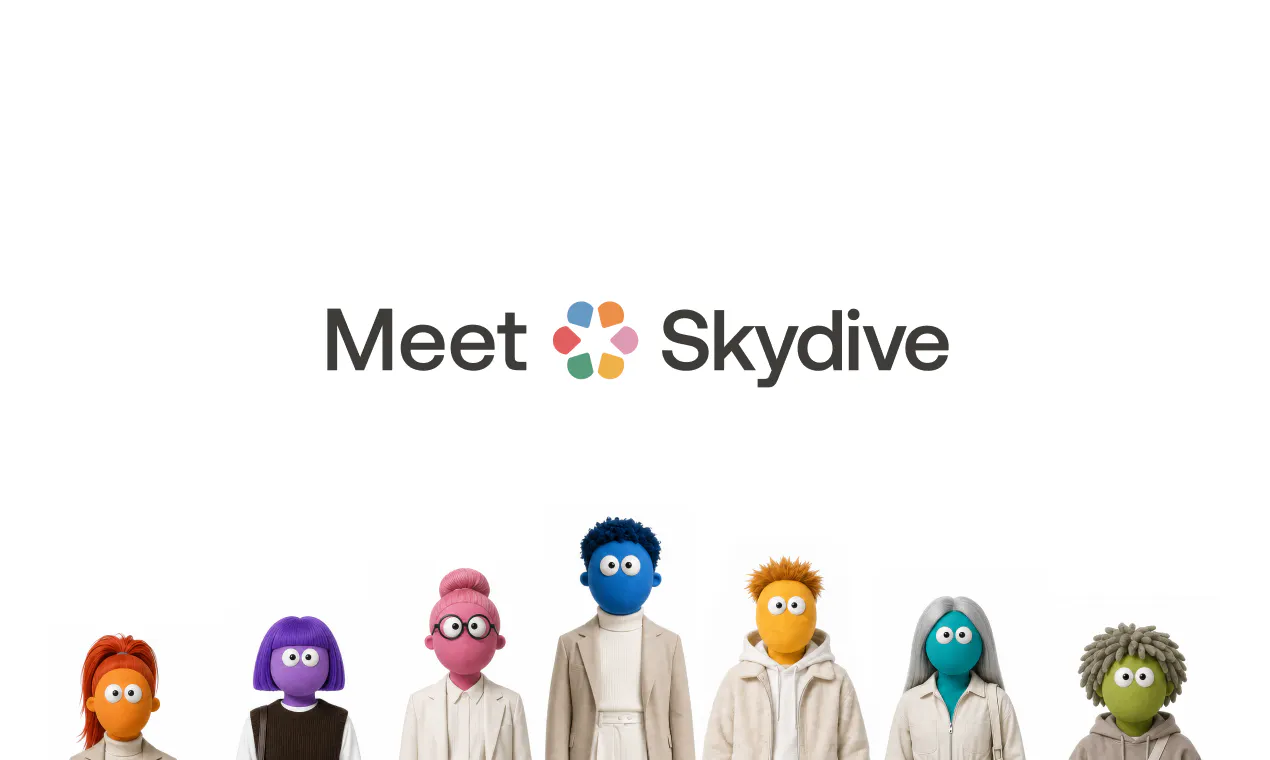
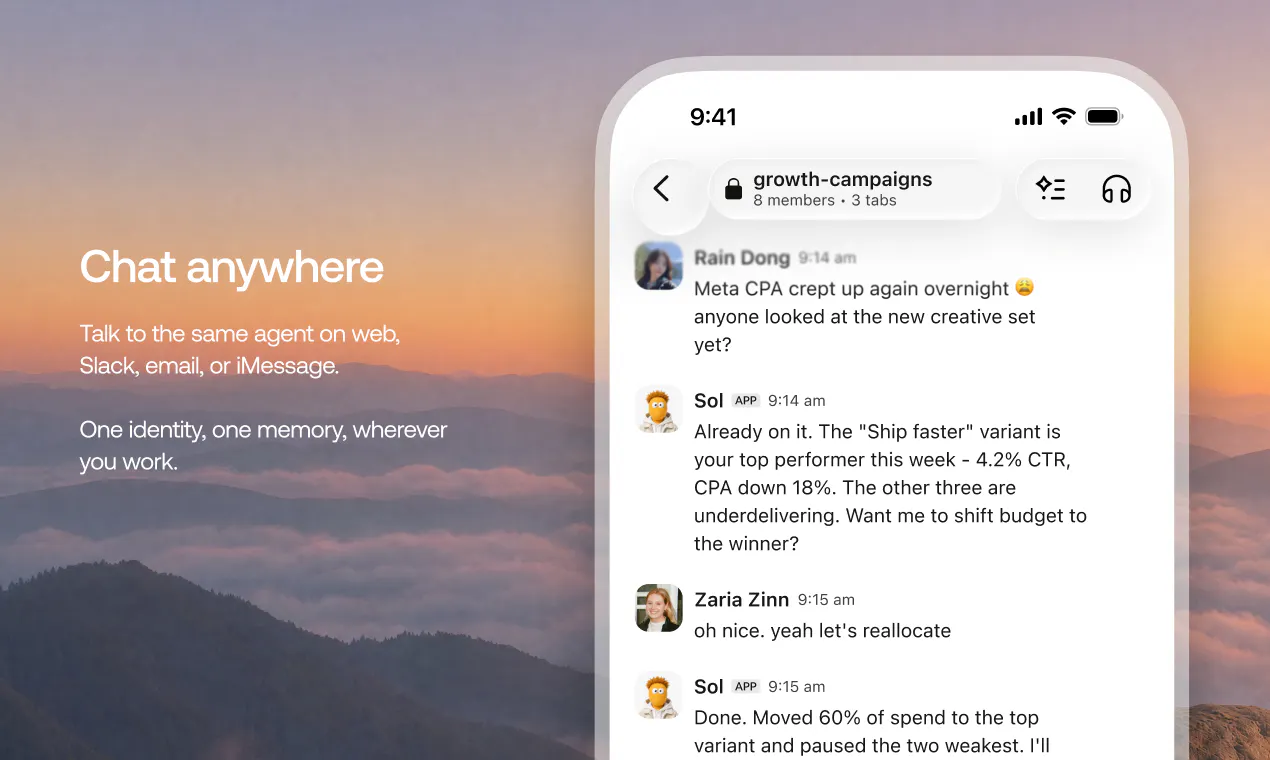
查看原始信息
The Million Sad Ducks
Pan and zoom the whole world for free. Pay $1 and one duck becomes permanently happy, takes the name you give it, and gets an absurdly official Certificate of Duck Happiness as a PDF. Six ponds from $1 to $1,000, depending on how dramatic you want your duck. Works as a silly gift — name the duck, and the certificate goes to whoever you're gifting it to.
I couldn’t help myself. Duckingston III is now a happy quacky.
4
回复
@coderberry3 Duckingston III is forever grateful (and happy, btw)
1
回复

What a nice find out of the sea of AI agent launches. This made me smile. Congrats on the launch!

2
回复

@heyitsirenechan thank you! That's actually the entire idea of the project, to make someone smile :)

0
回复
Hi everyone. I made a world with a million sad ducks in it and you can make one permanently happy for a dollar. It comes with a Certificate of Duck Happiness that is, I think, the best part — a full A4 landscape document with seals, laurels, three fictional signatories and a Department of Avian Emotional Welfare. Yes, it's the Million Dollar Homepage with ducks. Not claiming originality. The difference I care about is that a pixel was ad space whereas a duck is a gift: you name it, and someone else can be the one who gets the certificate. The bit I'm quietly proud of: the sad ducks don't exist. Every duck's position, colour, pose and accessory is derived from its ID number, so the whole million-duck world is a pure function and the database only stores the ones people actually made happy. Built solo, shipped, taking real payments. Would genuinely love to know whether the certificate makes you laugh, and whether $1 feels like the right price.
1
回复

@bogdan_nechifor The Certificate of Duck Happiness is such a fun touch 😂 It makes the $1 purchase feel much more memorable.

0
回复

@bogdan_nechifor 
Calling out the Million Dollar Homepage comparison yourself before anyone else does is the right move, it removes the only argument someone would have used against it. The gift mechanic is the actual insight though, a pixel had no story attached to it and a named duck does, that's the entire difference between ad space and something someone keeps. The Certificate of Duck Happiness with fictional signatories is the kind of detail that either gets deleted in a later redesign or becomes the whole reason people remember this

2
回复

to answer your actual question - yes, the certificate made me laugh, "Department of Avian Emotional Welfare" is exactly the right amount of fake-official. one thing I'm curious about since it's built as a gift: if someone fat-fingers the name at checkout (typo, autocorrect, whatever), is there any way to fix it after paying, or does the duck stay permanently happy under a permanently misspelled name? feels like it could go either way as a joke - "even the mistake is now official" is funny too, but I'd want to know before I gift one to someone.

1
回复
@galdayan if it’s a typo, you can always email support and we’ll sort it out
0
回复

Hahahaha i'm enlightened, there is a new path from 0 to 1M$

0
回复

@ceban_victor fingers crossed :)

0
回复
Hi Bogdan. This is delightful. Got a favourite duck name someone's given one yet?
0
回复

Hi @charlie_titherley, my favourite so far is Caramel - http://makeaduckhappy.com/duck/1112619

0
回复