Product Hunt 每日热榜 2026-09-02

PH热榜 | 2026-09-02

#1
Monid
OpenRouter for agent tools
400
一句话介绍:Monid 是一个面向AI Agent的“工具层聚合器”,用单一API密钥替代1800+第三方服务的独立订阅,让Agent在运行时按需发现、调用外部API,按用量付费,解决多平台账号管理及订阅浪费的痛点。
API Developer Tools Artificial Intelligence
AI Agent工具市场 API聚合平台 无订阅按量付费 开发者基础设施 运行时工具发现 多API统一网关 智能路由 Agent原生应用 数据服务调用 OpenRouter模式
用户评论摘要:用户普遍认可“一钥连接多API”并称其为“日常高频调用入口”,节省15小时及数百美元。主要问题聚焦在:底层API限流如何管理(回复称已做提供方层限流与路由);多API意图匹配机制(靠Agent搜索元数据后自行决策,辅以语义相似度及价格/可靠性排序);能否连接用户自有账号(社交数据无需登录即可读公开信息);B端嵌入方案(可提供用户在产品内浏览和连接集成的能力)。
AI 锐评

Monid的定位准确踩中了AI Agent从“能推理”到“能执行”的断层——即工具获取的碎片化地狱。它复制了OpenRouter在模型层的成功逻辑:统一鉴权、按量计费、运行时发现,从而把Agent的能力边界从“聊天”扩展到“操作真实世界”。其核心价值不在API数量多,而在将“签约-集成-测试-运维”的工程负担转译为一次API调用的成本,本质上售卖的是“执行层的抽象与可靠性”。

但需警惕三点:其一,聚合层利润天花板低,底层API供应商一旦形成规模或被平台直连,中间层议价权弱;其二,智能路由的“推荐质量”是体验护城河,但当前主要依赖Agent决策,若元数据标注不准或长尾API质量参差,会快速消耗用户信任;其三,作为“工具调度器”却无状态编排与工作流治理能力,长期看可能被更重的Agent框架(如LangChain工具生态或云厂商原生服务)吸收。真正要证明的不是“有多少API”,而是“Agent调用成功率高多少、错误恢复有多稳、复杂任务完成度有多好”。目前用户反馈偏早期尝鲜,留存证据薄弱,仍需验证其作为“收费基础设施”而非“高级技能包”的长期不可替代性。若能在执行层构建独占性(如状态化资源、跨任务持久号码、长时任务可靠性),则有机会从“管道”升级为“Agent操作系统的一部分”,否则极易沦为大厂生态的注脚。

查看原始信息
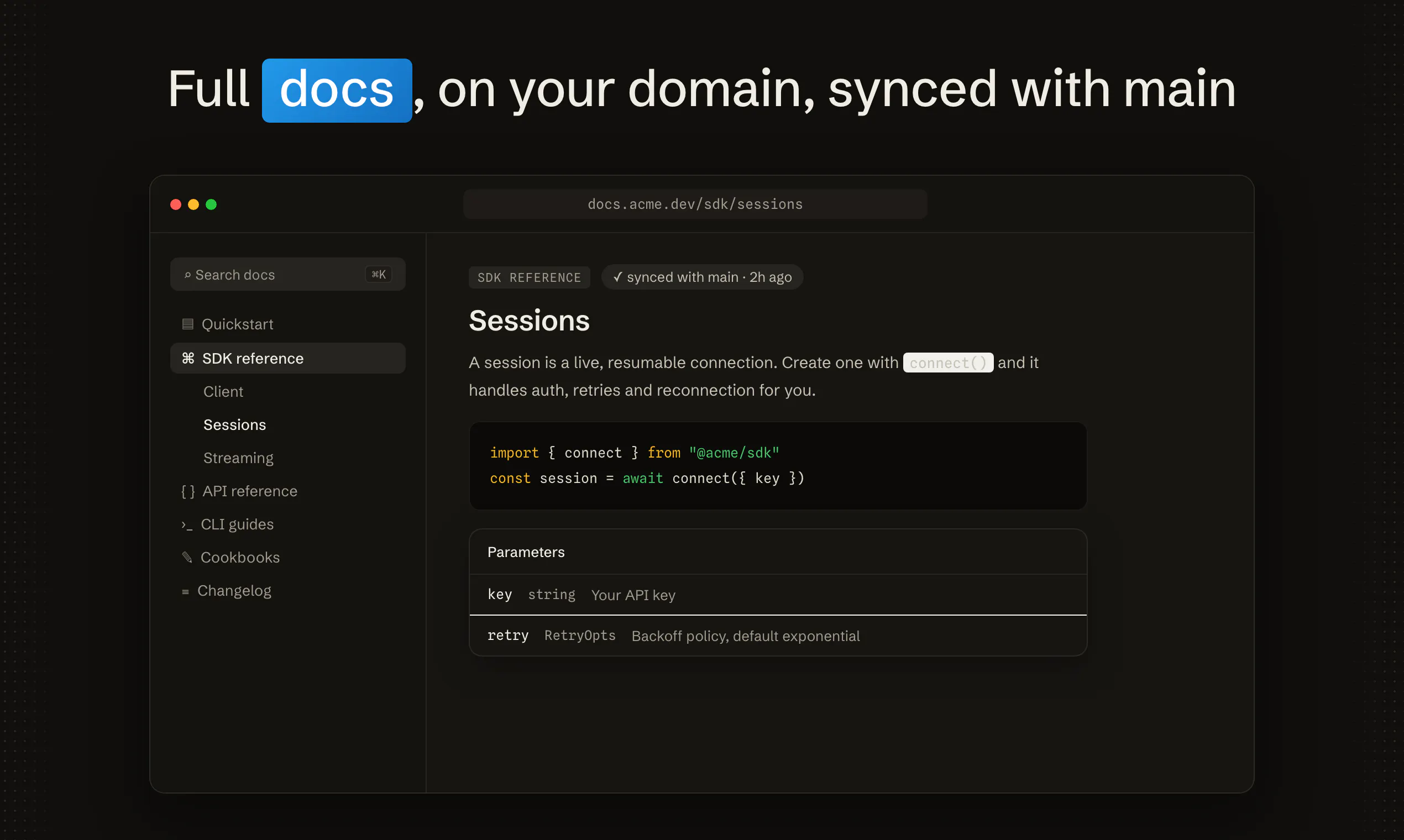
Monid
We connect your AI agent to 1,800+ APIs without any subscriptions. SEO, lead gen, video/music generation, social media, stocks, market trends, on-chain data, competitor tracking, sentiment analysis, all unlocked with one key.

I've been facing the problem Monid's solving, hunting for API providers -> signing up -> testing with real data -> realizing the provider I chose is inadequate -> repeat...

15
回复

@rrhoover sad.

0
回复

Hey PH 👋 I'm Shengkun, cofounder of Monid.

Today we're introducing Monid: OpenRouter for agent tools.

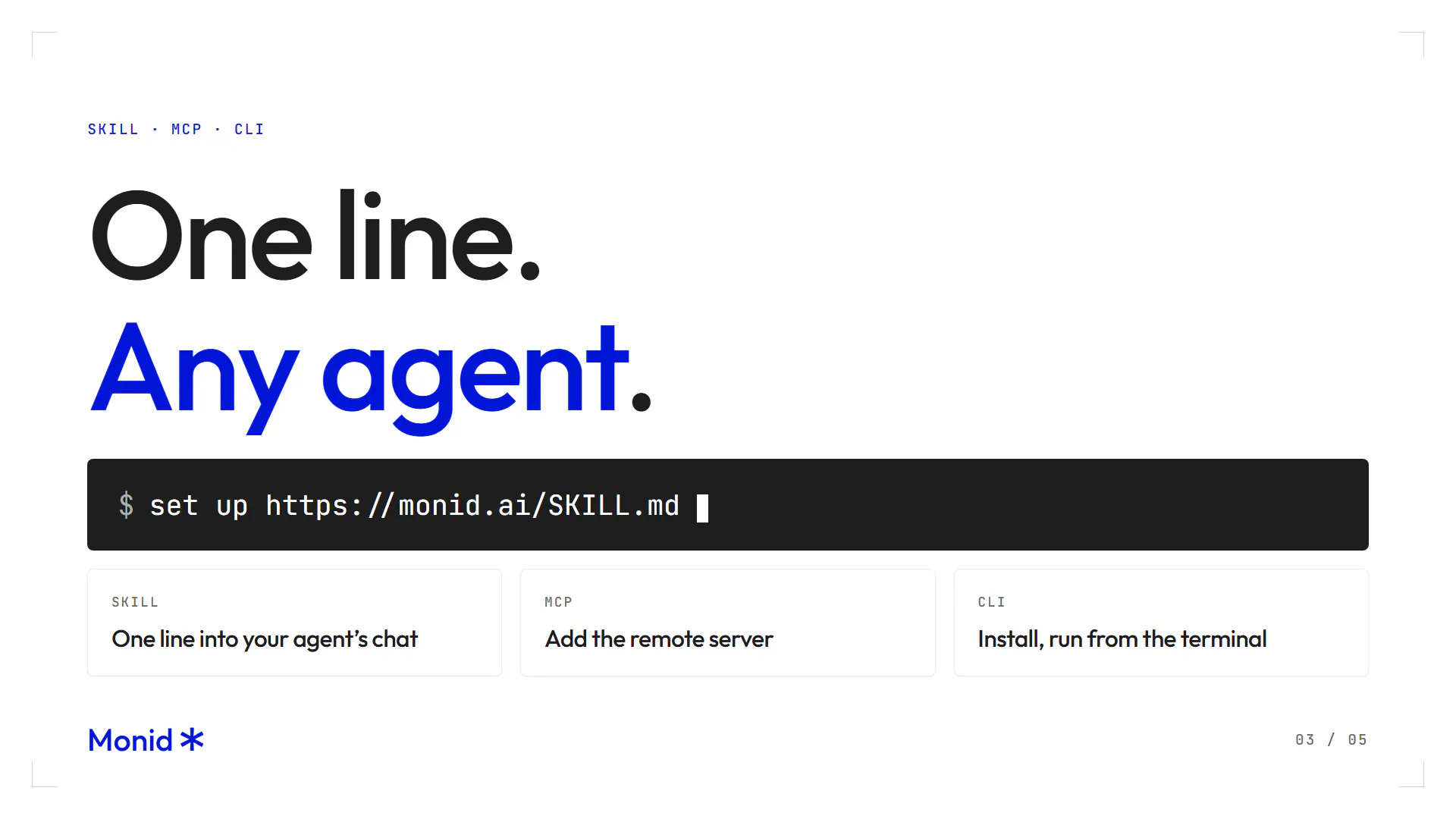
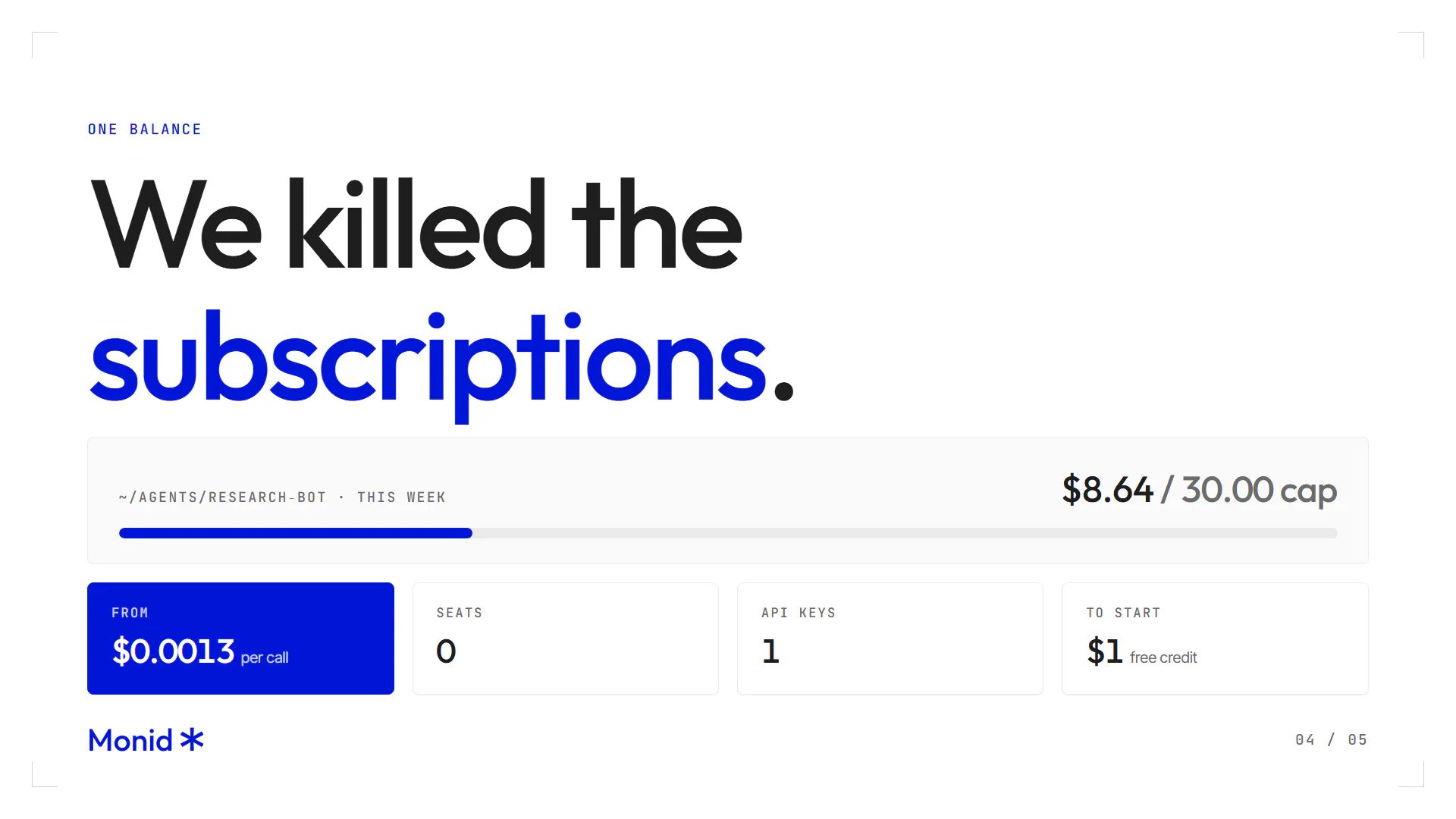
Monid connects your AI agent to 1,800+ APIs without any subscriptions. You don't need to manually sign up for dozens of accounts or pay for subscriptions you barely use.

Your agent can discover and use the tools it needs at runtime, and you simply pay as you go.

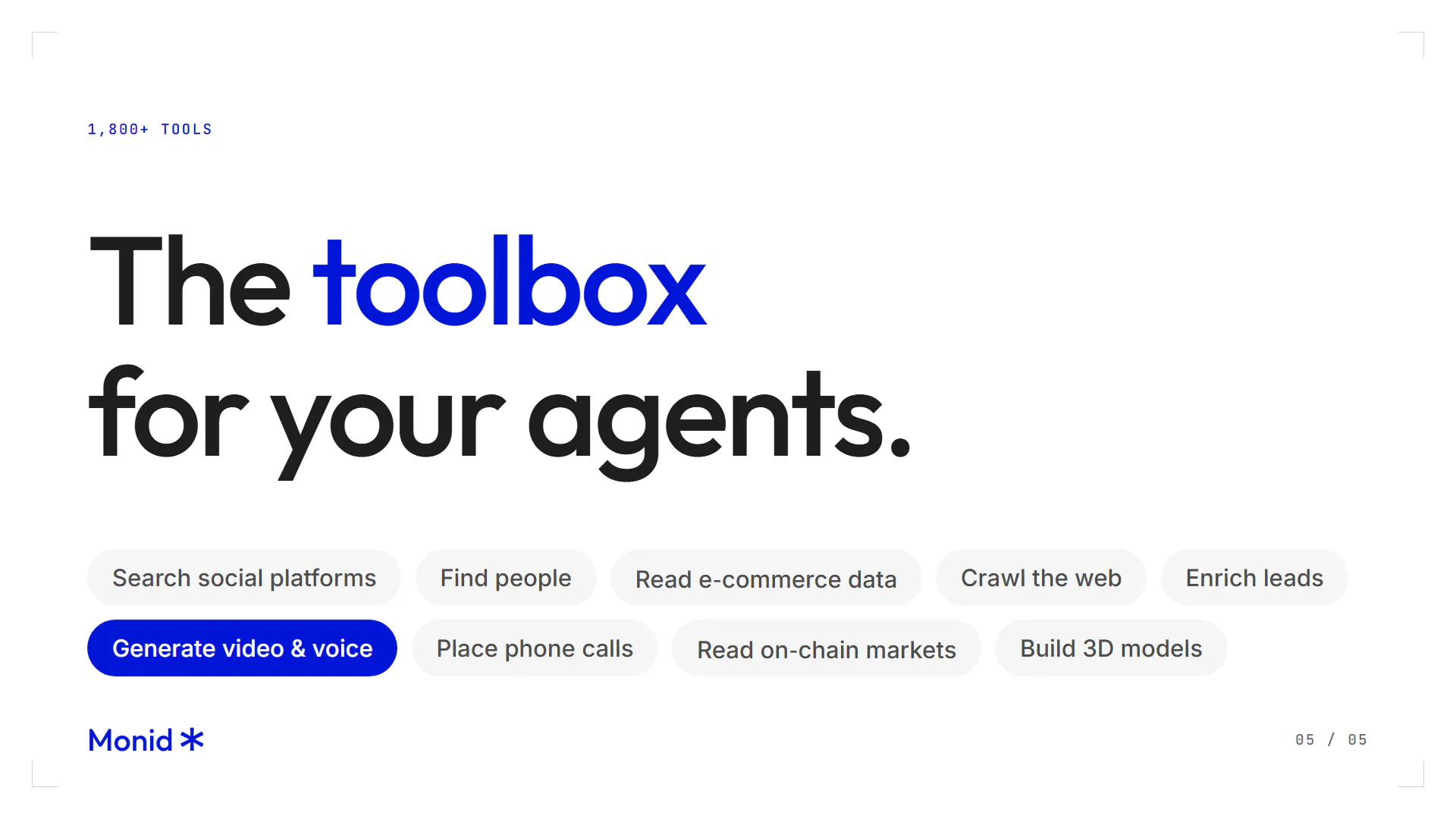
This time, we're introducing more capabilities for your agents. With Monid, your agents can now:

  • Run real SEO and search intelligence

  • Enrich companies and people, verify contacts, build B2B lead lists

  • Generate voice, music, video (Seedance 2.5), images, and 3D models

  • Read social media: TikTok, Instagram, YouTube, Reddit, LinkedIn, and Facebook

  • Check domain reputation, DNS, company registries

  • Track on-chain activity, token prices, and prediction markets like Polymarket

  • Read public markets: equities, derivatives, insider trading

  • Actually do things: place phone calls, send SMS, drive a browser

  • Cover verticals most APIs miss: real estate, vehicle history, jobs, software reviews

You can use Monid in any platform now, including Claude Code, Codex, Hermes Agent, Cursor, Windsurf, OpenClaw, Claude Chat, ChatGPT, and more.

To get started, send this to your agent:

set up https://monid.ai/SKILL.md

Everyone here gets $1 in free credits. Try it and tell me what your agent does with it.


I'll be around all day to answer questions 👋

9
回复

I first installed monid skill in March when it was only connected to 200+ endpoints.

I was not sure if another skill would add any value at first, but quickly discovered Monid as the the one skill that my agent calls for multiple times every day -> Not surprising, since agents do web searches, genertions, social media monitoring everyday -- but now with one key for everything, I don't have to manage multiple api platforms (HUGE entropy reduce!!)

Happy user since then.

Just asked Codex to audit my past week, and it says Monid saved me at least 15 hrs (of searching + setting up tools) + saved me several hundred bucks.

It's THE agent-native era of tool-use Monid is building. Bullish.

7
回复

Really like the idea of one key for everything. How do you handle rate limits across the underlying APIs?

5
回复

@iris_tu Thanks Iris! We handle rate limits at the provider layer, so you don’t have to manage each API separately. We also route across available providers where possible to keep calls reliable.

0
回复

Huge fan of Monid. I use it everyday with like zero effort. I have it connected to Claude so when I ask it to do some analysis or research something for me, it automatically knows to use Monid to get me the real underlying data and not make stuff up.

It's honestly like a super power!

4
回复
@seanlinehan Love hearing this. That’s exactly the experience we’re building for. Thank you for the support!
1
回复

Hi PH 👋 I’m Feiyou, cofounder of Monid, the OpenRouter for agent tools.

We built Monid because we kept running into the same problem while building agents ourselves: agents could reason about what to do, but actually giving them reliable access to the outside world was still painful.

Over the last few months, we’ve added a lot more tools people love, but we’ve also spent a huge amount of time making Monid a better execution layer for agents.

A few things that are meaningfully different now:

  • Smarter routing: we track endpoint reliability and latency so agents can make better decisions about what to use.

  • Stateful resources: agents can create things like phone numbers, keep them around, and use them across tasks for calls and texts.

  • Durable execution: longer-running tool calls and workflows can survive failures and continue reliably instead of depending on a single request succeeding.

There’s still a lot to build, but Monid today is much closer to the infrastructure we originally wanted for our own agents.

Excited to launch it again 🚀

4
回复

How does Monid decide which API or tool is the best match when a agent has several opions available?

3
回复

@maali_baali Monid doesn’t decide, your agents do. You agent can search through the catalog and get back all the information it needs to make a smart routing decision, including tool description, price, reliability, performance, etc.

0
回复
@maali_baali Before each call, we match tools based on description similarity, while also factoring in price and reliability
0
回复

Great product and fantastic team. keep it coming!

3
回复

@keith_zhai Thanks Keith! Really appreciate the support

1
回复

Amazing product, love the concept, I'm a user!

Can we connect to multiple accounts for some tools, like if I have multiple Gmail, Instagram, TikTok accounts?

3
回复

@dsllwn Thanks so much! For social data, no login is needed. Monid can access public data across platforms directly.

1
回复

Hey PH 👋 I’m Jasper, Founding GTM at Monid.

Today we’re launching Monid, the OpenRouter for agent tools.

One connection gives your agent access to 1,800+ APIs across search, SEO, company data, social, finance, media generation, phone calls, browsers, and more.

No separate accounts. No subscriptions. Just discover, use, and pay per call.

Would love your feedback ❤️

3
回复

What are the most popular tools among your users?

3
回复

@nhina Search, SEO, company and people enrichment, and social data are some of the most popular right now.

0
回复

Finding an API is often easy; figuring out which provider is actually worth using for a particular task is the painful part.

2
回复

@vinay2681 That’s the hard part. Monid helps agents compare the options and choose the one that best fits the task.

1
回复

congrats on the launch!! been using Monid for a while now — can’t imagine paying for all those subscriptions again :)

2
回复
@tfedor 🫡🫡🫡
1
回复

We build a platform that currently uses Nango to provide this functionality to our users. Do you have anything that would let our users browse integrations and choose which ones to connect on their behalf directly on our site?

2
回复
@maxheckel Yes! Your users can browse and connect integrations directly from your product. Happy to show you how!
0
回复

With 1,800 APIs how do you handle multiple providers satisfying the same intent? Is it semantic matching, ranking by ttfb, cost?

2
回复

@dmytriis Your agent can search the catalog and get back the top tools ranked by semantic, price, reliability, and performance. From there it can make the decision on which one to use.

2
回复

The no-subscription approach caught my attention. Paying only when an agent actually uses a tool feels more aligned with how agent workflows work.

2
回复
@daniel_henry4 Exactly, pay only when you use it.
1
回复

Can developers set spending limits per agent or per tool to prevent unexpected usage costs?

2
回复

@aarav_pittman Yes! We have built in budget controls.

2
回复
@aarav_pittman Yes. Everything is fully transparent in the dashboard, where you can see all usage records, and you can set budgets for each agent.
1
回复

Congrats on the PH launch, @shengkun_ye ! 🎉 Monid nails the “OpenRouter for agent tools” vibe – no more signing up for 10+ platforms just to test one API, and no more wasted subscriptions. That’s a huge relief 😂

I’m especially impressed by runtime discovery and execution – SEO intelligence, B2B lead enrichment, Polymarket data, even video generation with Seedance 2.5. It turns agents from “toy” into “real workers”. Great breadth!

One constructive thought: with 1,800+ APIs, how does discovery work – keyword matching or semantic search? If agents could describe tasks in plain English (e.g., “find trending AI tools in the last 3 days”) and Monid auto-suggests & orchestrates the best API combo, that would unlock even more runtime magic. Also, would you consider a “task-level cost dashboard” so teams can see which mission burns the most budget?

2
回复

@shengkun_ye  @rocsheh Thanks Zepeng! Discovery is semantic, with relevance, price, and reliability considered. Spend is also fully transparent in the dashboard, with call-level usage and agent budgets.

0
回复

Im about to search all the people with free Apollo people search! 😈

1
回复

The runtime discovery plus payment part is the interesting bit here for me. Curious how u handle spend limits when the agent itself is choosing which Api to use? Feels like that gets important very quickly at scale.

1
回复
Do you expose latency and success rates per endpoint? I’d want agents to route based on reliability, not just price.
1
回复

@matthewwei Yes we do!

1
回复

it's been a game changer using Monid. Let's me test out many services real quickly. Congrats on the launch!

1
回复

Huge fan of Monid! Been using it for various cold outreach efforts, e.g. API calls to X, Apollo etc

1
回复

@yi_zhong3 Thx bro, really appreciate the support! If you run into any issues or have suggestions, feel free to reach out anytime.

1
回复

@shengkun_ye amazing tool, i mean paying for a whole month when you only need a tool once or twice is annoying.
One balance for all of this is much easier than signing up and adding card details everywhere.
Asking the agent and letting it find what it needs sounds handy too.
Would be good to see a few real jobs with the full cost shown from start to finish.

1
回复

@shengkun_ye  @nxan Thanks Ehsan! Exactly the idea. We’ll share more end-to-end examples with full cost breakdowns soon.

1
回复

OpenRouter takes 5% of the model cost. Do you also charge a small percentage of the API cost?

1
回复

The payment part is what makes this more interesting to me. If agents can handle tool costs at runtime, that could simplify a lot of multi API workflows.

1
回复
@kate_sleeman Love this take. Runtime payments make multi-tool workflows much simpler and more flexible
1
回复

I like that the focus is on letting agents discover and use tools themselves rather than making developers write up every API manually.

1
回复
@anthony_adams_ Thank you! Our goal is to make everything as easy as possible for our users.
1
回复
Where’s the pricing?
1
回复
@umberto_abbatantuono https://monid.ai/tools 🫡🫡
1
回复

Congratulations on the launch TEAM. seems this is more useful.

0
回复

Really love the idea and will be trying this out! Do you guys support x402 as well?

0
回复

@yousef_helal yeah, we support x402. plz check here: https://monid.ai/tools

2
回复
#2
Browzer
Put your technical content on autopilot
367
一句话介绍:Browzer 是一款连接 GitHub 仓库、自动生成并持续修复技术文档与内容(docs、changelog、博客、视频脚本)的 DevRel 自动化工具,解决开发者关系团队在代码频繁迭代下文档滞后、创作耗时的问题。
Marketing Developer Tools GitHub
开发者关系自动化 技术文档生成 GitHub集成 内容自愈 SEO/AEO优化 AI写作 changelog自动生成 DevRel工具 代码库内容管理 视频脚本生成
用户评论摘要:用户普遍认可“自愈文档”与自动补齐 changelog 的价值,但集中关切点在于:代码库连接的知识产权泄露风险(官方回应称不存储代码且零留存)、对脏乱/老旧代码库的兼容性、生成内容与真实实现的匹配度及人工控制权(支持手动编辑和Agent修正)、写作风格可配置性与是否保持“人类语气”。部分用户希望看到实际演示。
AI 锐评

Browzer 切中的是 DevRel 工作中最脏最累却最不被看见的环节——文档与代码的持续同步。在 AI 编程让代码提交频率指数级上升的当下,文档“写完即过期”已是常态,创始人从免费用户行为中捕捉到 DevRel 群体的真实付费意愿,并快速由通用工具 pivot 到垂直场景,这本身是典型的“build in public”成功案例,产品方向精准且壁垒在于对代码语义变更的准确理解(能区分内部逻辑改动与 API 破坏性变更)。

但它的挑战同样明显:第一,本质仍是“AI 写文档”,这在技术严谨性要求极高的场景下存在信任门槛——用户评论中反复追问的隐私问题、老代码库的适配性、内容是否忠实于实现,说明企业采购决策者并未被“零存储”话术完全安抚,SOC2 认证前这仍是硬伤。第二,产品覆盖的“demo 视频生成”看似亮点,却是竞争最激烈的红海(Captions、Descript 等通用工具已很成熟),未必是核心留存点。第三,自动发布若把关不严会变成“大规模生成错误文档”的灾难源,Browzer 默认关掉自动批准是明智的,但这也意味着它只是“增效器”,并非“无人值守的答案”。

真正值得关注的是其“内容自愈”机制背后的数据飞轮:每次代码合并触发的文档修正都在积累“代码变更—文档影响”的映射数据,这或许比它生成的任何一篇文章都更有长期价值。如果未来能将这些数据训练成面向更底层开发者工具的“变更即文档”中间层,甚至反向给 CI/CD 流程提供变更风险评估,Browzer 才会从“DevRel 省时工具”升级为“软件工程基础设施”。现阶段,它的天花板取决于 DevRel 团队是否愿意把质量控制流程外包给一个仍需人工兜底的 Agent。

查看原始信息
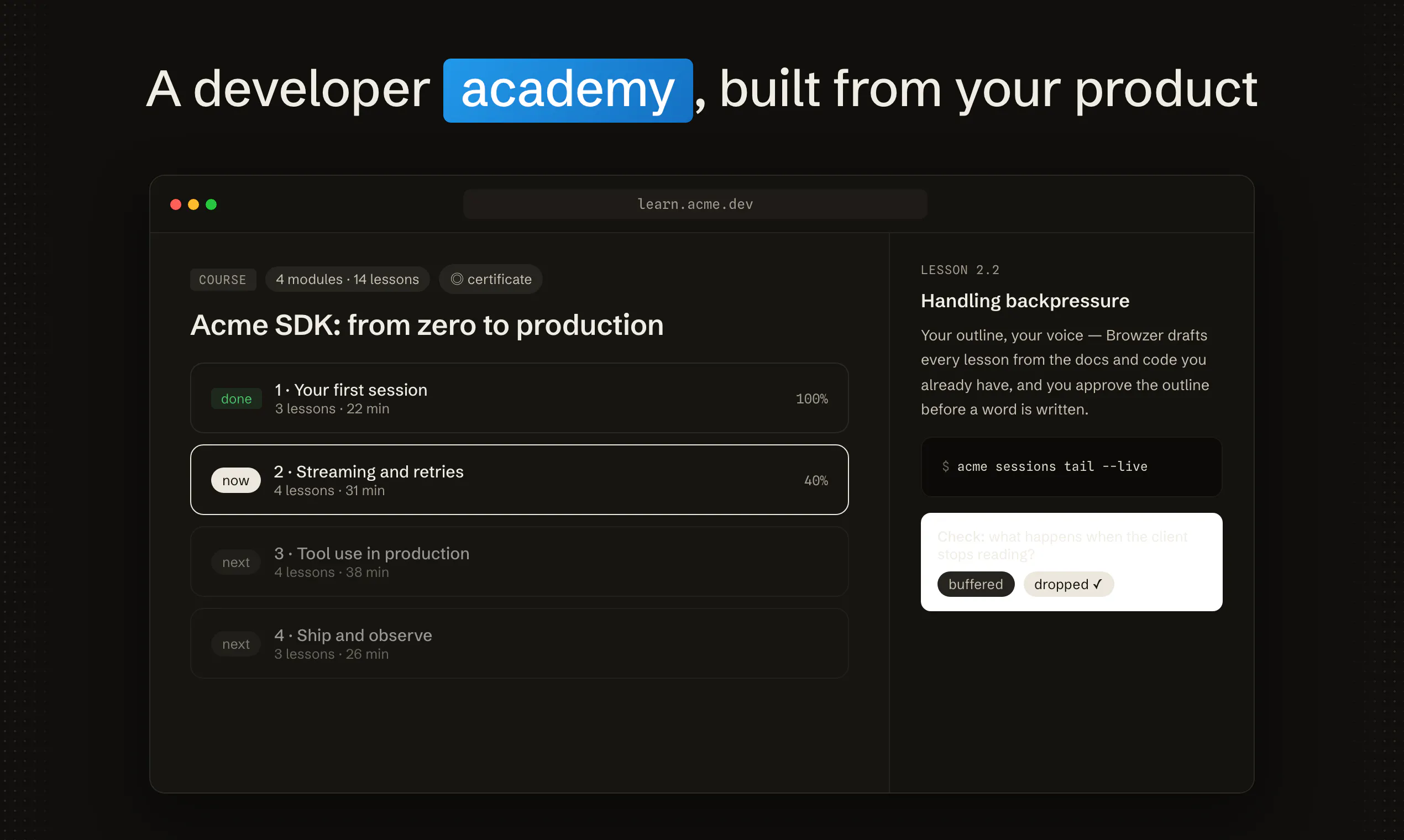
Browzer
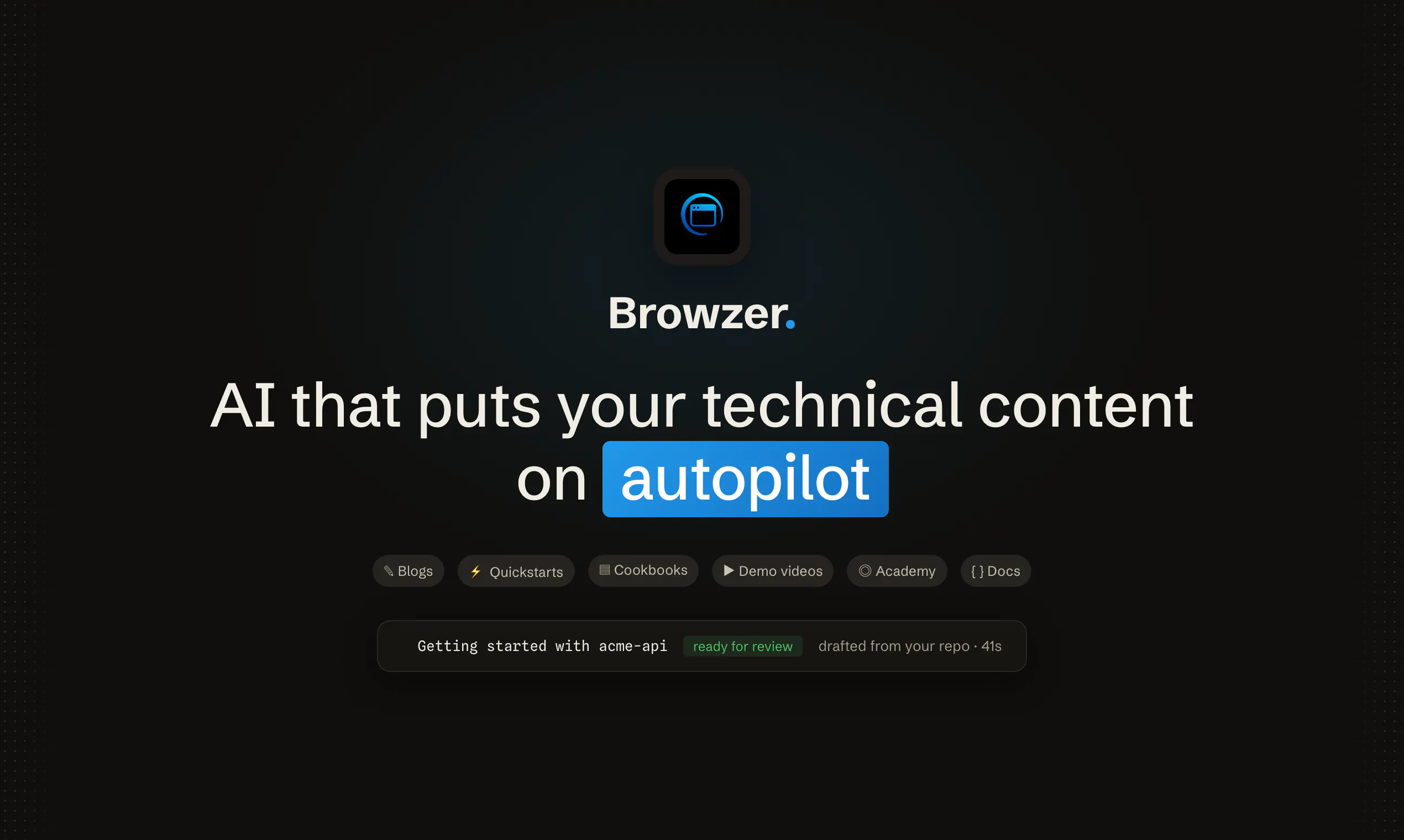
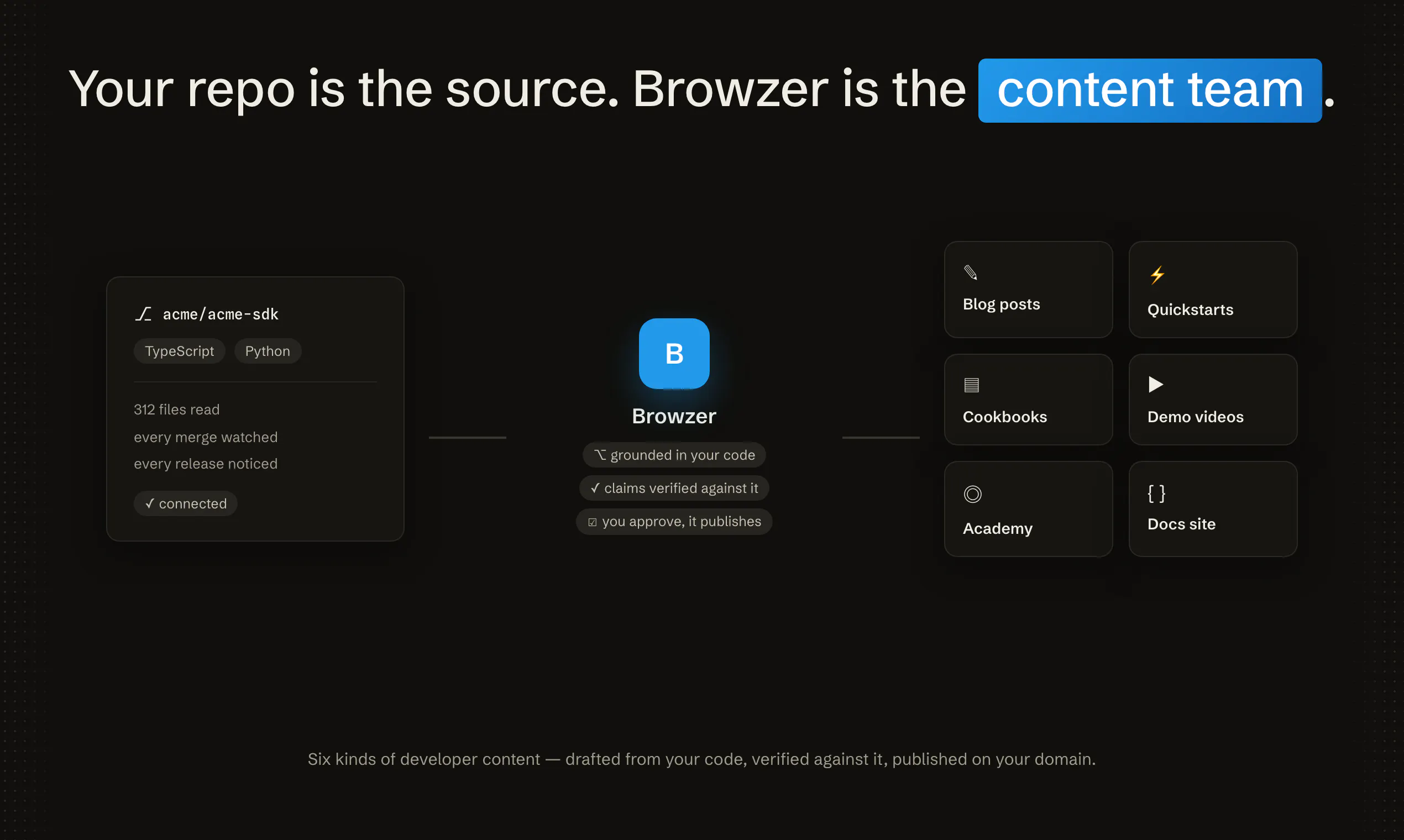
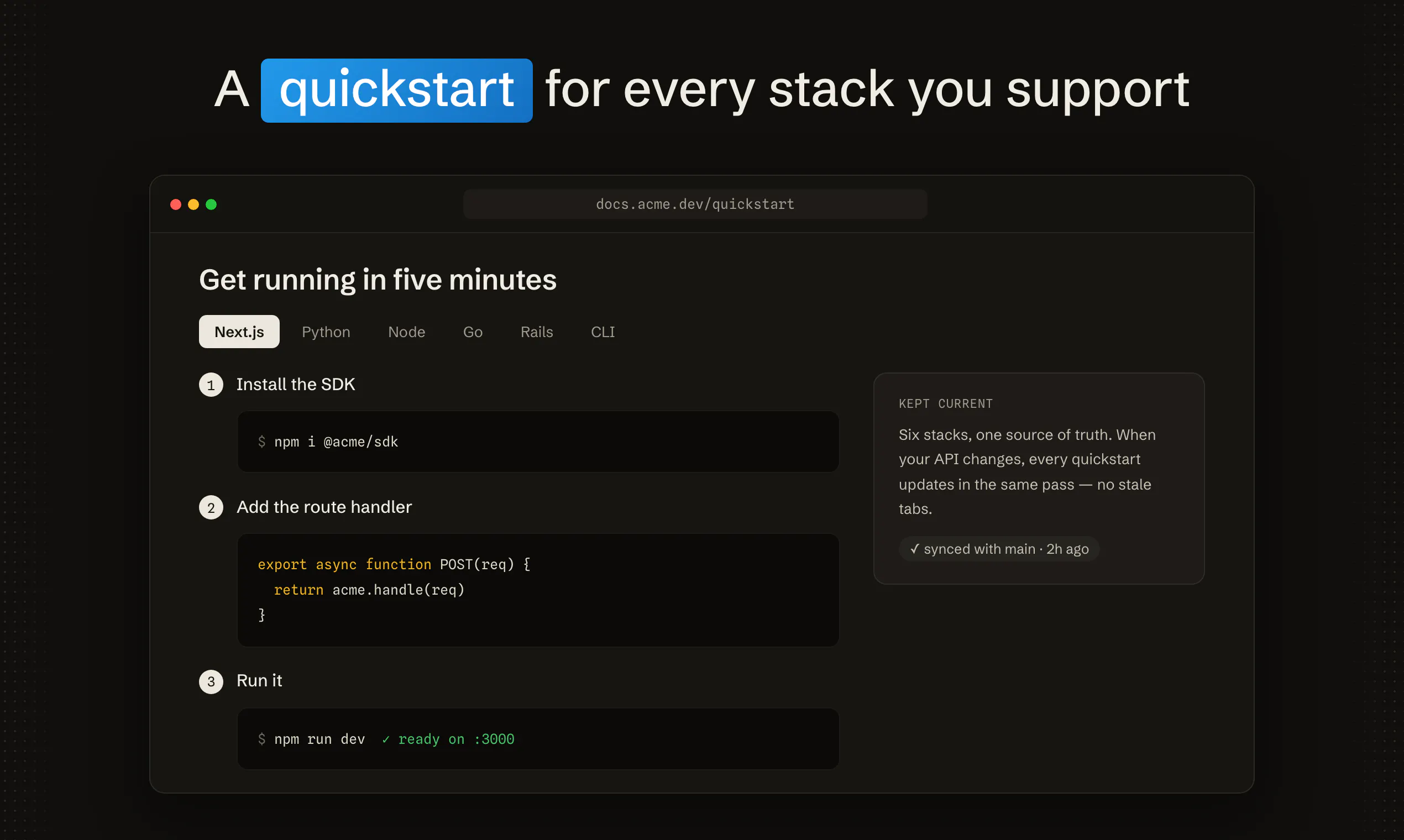
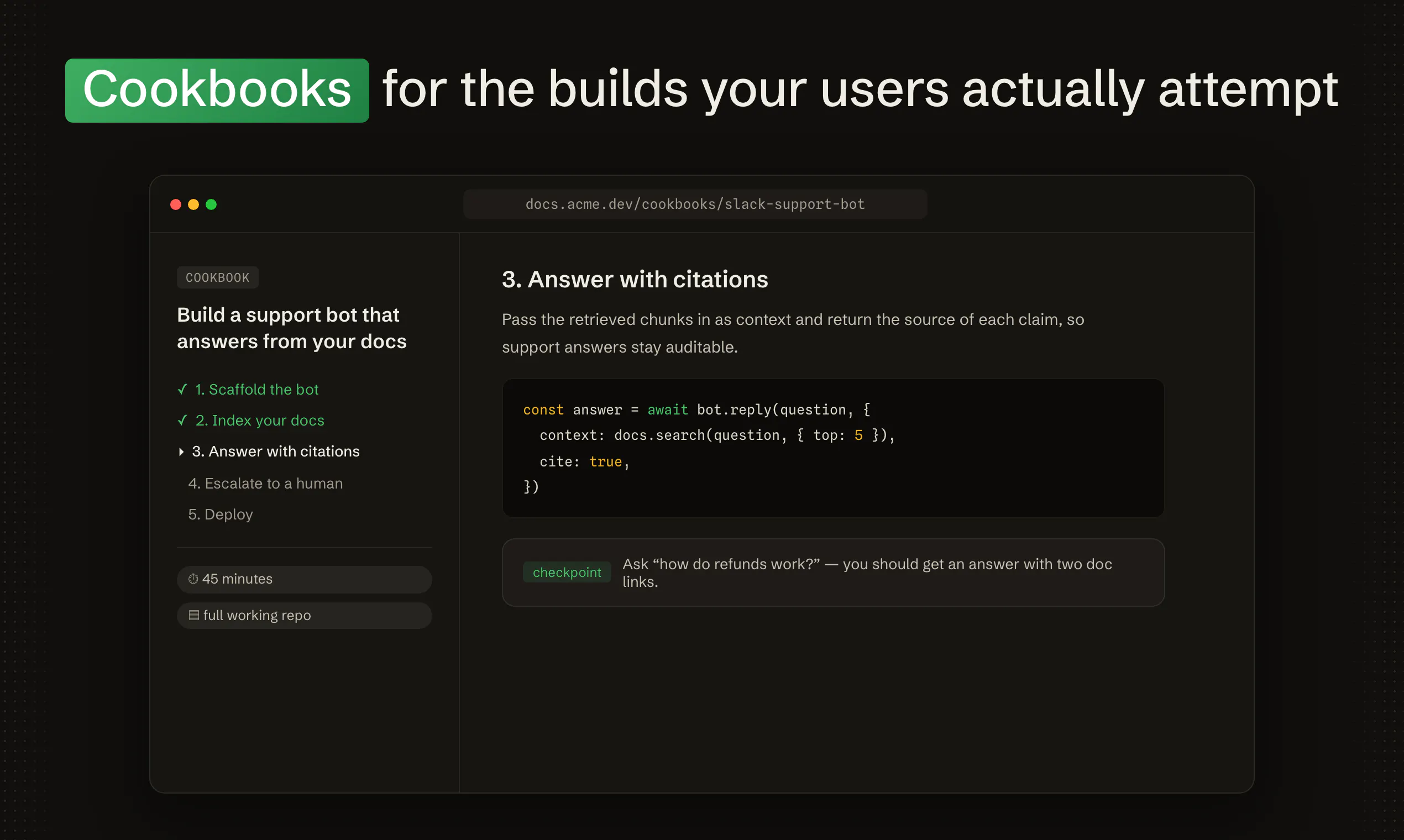
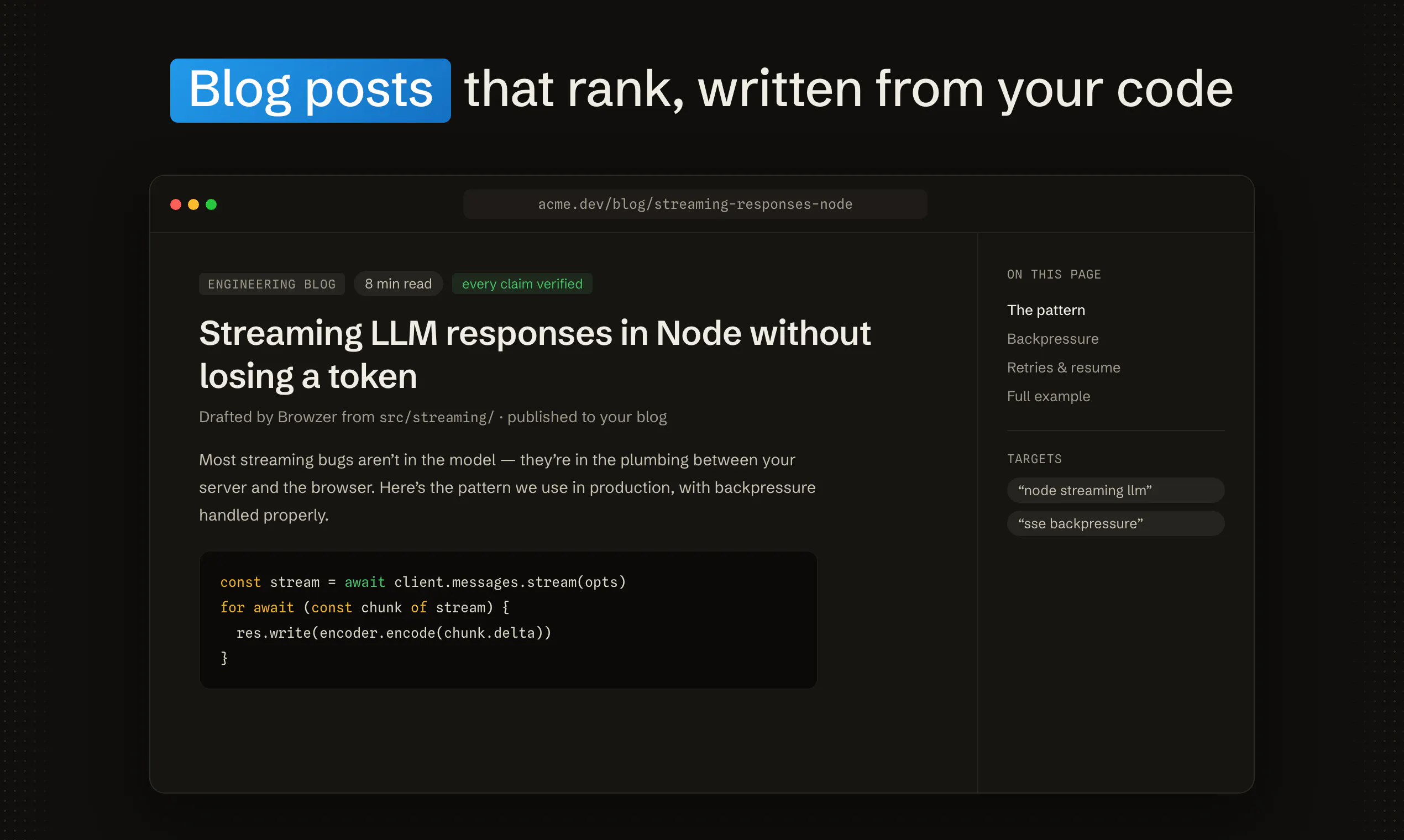
Connect your GitHub repo and Browzer drafts your docs, guides, changelogs, cookbooks, quickstarts, and SEO & AEO friendly blog posts, and then heals them on every merge. We automate all technical output of a DevRel so that DevRel teams can focus more on community, growth & events.

Hey Product Hunt

I'm Rahul, the founder of @Browzer, a tool to put your technical content & docs workflows on autopilot.

We built it because in the previous iteration, I noticed 30% of our free trial users were DevRels who used our product to create product guides for their web-apps.

I decided to pivot into building a tool to automate the most time consuming parts of DevRel's job - creating blogs, quickstarts, cookbooks, demo videos, and other digital resources, so that you got more time to focus on what you love doing, the IRL stuff like building communities & talking to users.

With Browzer, you can connect your codebase, and through our agent mode, you can prompt Browzer to create any technical content that you like. This can also be put on a schedule, so you have fresh content that churns out every week. Content queues up in your Library for you to then review and publish.

We have a free 1-week trial, and paid plans for using Browzer thereafter.

Would love to get any feedback from the PH community, especially from anyone building devtools.

I'm here all day to answer questions the community might have!

In case you'd like to have a longer convo with me you can reach me at rahul@trybrowzer.com or +1 (716) 398-2852.

11
回复

@Browzer  @rahulkumaran4 I love the pivot you made after noticing that 30% of free trial users were DevRels using Browzer to create product guides—it’s a genuine sign of building in public and listening to real user needs.

0
回复

The SEO and AEO content support is a nice addition alongside the developer docs. Curious how much control users have over the writing style.

5
回复
@johnnie_kuvalis the AI takes the first pass at writing things up. After the writes the content, you can either allow it to auto publish, or you could review the content before it’s published. By default, auto approvals are turned off, so humans are required to review content, and in the process you can also update things as needed. Additionally, before any content is written, you can configure a brand voice/tone in the “Configurations” tab
1
回复

firstly congratulation for the launch, for me the self healing documentation idea is the standout feature. code changes often happen much faster than the docs can keep up.

5
回复
@ashir_murtaza1 thank you! And exactly! Especially in the age of AI where most teams are shipping 100s of changes daily, it becomes critical to have self healing docs!
1
回复

This looks really useful! One question on privacy/IP protection - how are you handling this? Connecting a codebase sounds like an intelectual property leakage risk (but that's just my marketer-at-a-corp-environment perspective, I'd be curious to know if it actually a risk or just a perceived one)

4
回复
@denitsapenchevavaltchanova I see where you’re coming from & it’s a valid question. We ask users to install our github app because that app is responsible for looking at the codebase and suggesting technical content that’s relevant. None of your code is ever stored on our end, plus we have zero day retention policies with our upstream inference providers so you can be certain that they’re not stored upstream as well. Additionally, we’re in the process of getting our SOC2 Type 2 to give people a breather.
2
回复

The video content generation is no less than a boom. It saves your so much hours of the efforts & time that goes in scripting, editing and this that. Browzer makes it supereasy. You just say it - and Browzer makes it ready to publish. All built for your product - in the way you love it.
- from the founding engineer

3
回复
@abhinandan_browzer glad to have you on the team! Go Browzer ✌️
1
回复

Nice features, I have seen teams spend hours updating examples and changelogs manually. Automating that repetitive work could be a real time saver.

3
回复
@sansa_grey thank you! And yes, that’s the goal. Make lives of trans handling docs & technical content easier, so they have time to focus on other critical things
1
回复

I have always found keeping docs updated after a release more painful than writing them in the first place. This looks like a useful way around that.

3
回复
@ashley_james yes, definitely. Browzer not only makes it super simple to create docs from scratch, but also makes it easy to manage any drifts thereafter, with little(or no) effort from your end! It just gets it done!
1
回复

I manage a dev team and our changelog is always at least a week behind our product releases. If this really can automatically fill this gap for me, then I'll sign up right now.

2
回复
@keo_nha_cai32 it definitely will. Changelogs are instant. Happy to show you a live demo sometime. Feel free to send me a text on +1 716-398-2852 or email me at rahul@trybrowzer.com and we can get something on our calendars
0
回复

Really interesting! I saw you can generate videos - what other ways can I use what Browzer's context is on my product?

2
回复
@zach_gold great question. Generating demo videos is one part of it. The other things you can accomplish with Browzer are - (1) creating SEO & AEO friendly blog posts (which are technical) (2) cookbooks & QuickStarts in case you have an sdk, api, cli or MCP as it would help users get ramped up to your product easily (3) Creating docs for consumers of your products (these docs also self heal) - all these docs are human and agent friendly, so they come with optimized .md’s which can be fed into coding agents directly to get things done.
1
回复

What happens when the generated content does no fully match the actual implementation?

2
回复
@jordantaylor58 thanks for your question. After any content is generated, it is available to be reviewed (if auto approvals are turned off). During review (and after too actually), the content is editable. So if you’re unhappy with the content, or feel like something is missing, you can make edits manually. If you’d prefer not doing that, then Browzer has an “Agent” mode in the app. You can head over to the agent mode, and tell what you think is missing, and Browzer will fix it up for you!
1
回复

Docs on the site I do SEO for go stale within a week of a release. Does auto-updating keep the human phrasing, or does it read like a changelog?

2
回复
@yelyzaveta_kibets it keeps the human phrasing. But we also have a separate section where you can activate changelog entries. So with every code update you have docs that self heal and maintain human & agent phrasing + you also get changelog entries to show how your product evolves over time
1
回复

Interesting touch which is the demo video generation. I can see it being especially useful when a developer needs to understand a product quickly.

2
回复
@alira_salu yup, that’s the goal. Plus videos are super frustrating to create generally. Our goal is to help make the process of creation of motion videos & explainers about your product, as simple as possible. Would love for you to try it out & give us some feedback!
1
回复

am curious how this performs with a messy or older codebase. thats usually where documentation tools get seriously tested.

2
回复
@adams_parker we haven’t heard any complaints so far about our docs not working on a codebase. But that doesn’t mean there couldn’t be an issue. From what we have heard and seen, our docs are accurate in almost all cases. However, if you have an older codebase, I’d love for you to try us out & let us know of your thoughts. If something’s not working, would love to get your feedback and be happy to fix things as needed
1
回复

what stood out to me is how Browzer keeps the content tied to the actual code. in practice that could save developers a lot time updating docs and exp after small code changes.

2
回复
@jabari_zuri thanks Jabari! Yes! Would love for you to try out Browzer. And if you have any feedback please let me know.
1
回复

How do you handle cases where the workflow changes slightly but the existing documentation is still mostly correct?

Congrats @rahulkumaran4 & team!

Again thanks for sharing another cool product @fmerian <3

2
回复
@hamza_afzal_butt thanks Hamza! Yes, @fmerian is the best & we’re truly grateful to him for hunting Browzer. About your question - we understand how the code changes made affect what’s in the docs. Sometimes, you might have certain semantic changes which doesn’t affect forward facing APIs, but just the internal logic. Such changes, although recognized, don’t trigger a docs update. However, if a function name in your sdk changes, or a new route is added to your api, those things trigger an update to the docs
2
回复

  @hamza_afzal_butt  thanks !

do give a try out 🙌

3
回复

How does Browzer handle a large repo with multiple services and different documentation owners?

2
回复
@james_wilson60 our docs AI is pretty good at understanding and segregating things based on topics. If you have a mono repo with multi language sdks, api specs, cli, MCP, etc., Browzer would be able to figure out how to categorize them and would accordingly handle it. As for different docs owners, you can invite users to your team from within Browzer! So respective owners can approve and handle things wrt their docs from within Browzer
1
回复

the self-heal on merge part is the interesting bit to me - how granular is the trigger? like if I rename a variable that shows up in a code snippet inside a guide but the surrounding explanation is still 100% accurate, does Browzer regenerate the whole page or just patch the snippet? asking because I've used doc tools before where "auto-heal" ended up meaning "rewrite everything every time," which creates its own review burden even if nothing important actually changed.

1
回复
@galdayan great question. Self healing wouldn’t regenerate the whole thing. Only updates whatever is necessary - nothing more, nothing less. You’d also be able to view a “diff”-based view of every doc or piece of content that self heals to see what portions of the docs are being updated.
0
回复

This is huge. Have you considered expanding this for technical content creation as well?

1
回复
@joshuarocket yes! We already do technical content creation - blogs, quick starts, cookbooks, demo videos & changelogs!
1
回复

Cool! Can your service generate documentation directly in Confluence?

1
回复
@natalia_iankovych not at the moment. But we can definitely explore that…if that’ll help convince you to become a customer haha. I’m curious though - what kind of documentation you’d like to see directly in confluence & why confluence?
2
回复
#3
Articos
Launch with confidence, not gut instinct
335
一句话介绍:Articos是一款面向SaaS团队、代理机构和创始人的AI用户研究工具,通过模拟与ICP匹配的虚拟人设,在30分钟内测试信息传达、定位和落地页,替代耗时数周且昂贵的真实用户调研,让产品发布不再依赖直觉。
Marketing SaaS Artificial Intelligence
AI用户研究 消息测试 落地页测试 模拟人设 ICP匹配 SaaS工具 定位验证 文案优化 快速反馈 产品发布
用户评论摘要:用户普遍认可其快速定位问题及高准确率(86%),但核心疑问集中于验证基准与方法论:如何量化“7.5倍优于ChatGPT”的准确性?能否自动从Reddit/G2等社区生成人设?与真实用户面板相比,模拟回复的质量究竟如何?另有用户建议增加基于反馈的文案优化建议功能。
AI 锐评

Articos精准地切入了产品发布流程中一个根深蒂固的痛点——决策滞后与成本高昂。创始人Shaheer的背景(Cloudways、DigitalOcean)为产品可信度提供了有力背书,其“86%人类准确率”的第三方同行评审数据,是营销话术中最具分量的信任状。它试图将传统的定性调研(焦点小组、用户访谈)压缩成即时的定量测试,本质上是用大规模LLM推理替代昂贵、缓慢的真人招募。

然而,这款产品的深层价值并非“验证”,而是“预筛”。它更适用于在内部辩论中形成“多数共识”或快速否决明显不行的方案,为昂贵的A/B测试或真实用户访谈提供优先级。正如评论所示,用户真正质疑的,是模拟信号与真实用户决策之间那“14%的误差”在实际商业环境中可能被放大的风险。其“7.5倍优于ChatGPT”的对比,也容易陷入基准设定的陷阱,缺乏第三方透明度。

产品的生存空间不在高端定制化研究,而在“研究贫瘠”的长尾市场:那些过去因资源限制从未做过有效验证的个人开发者、早期创业团队。Articos卖的不是“真相”,而是“确定的决策依据”和“心理安全感”。当团队连Slack争论都懒得组织时,一个30分钟内能给出具名反馈的报告,确实能终结无限的内耗。风险在于,过度依赖这类工具可能让团队丧失与真实用户共情的能力——工具应催生更多“真实问题”,而非用模拟代替现实。让用户为“信心”付费,远比让他们为“数据”付费更可持续。

查看原始信息
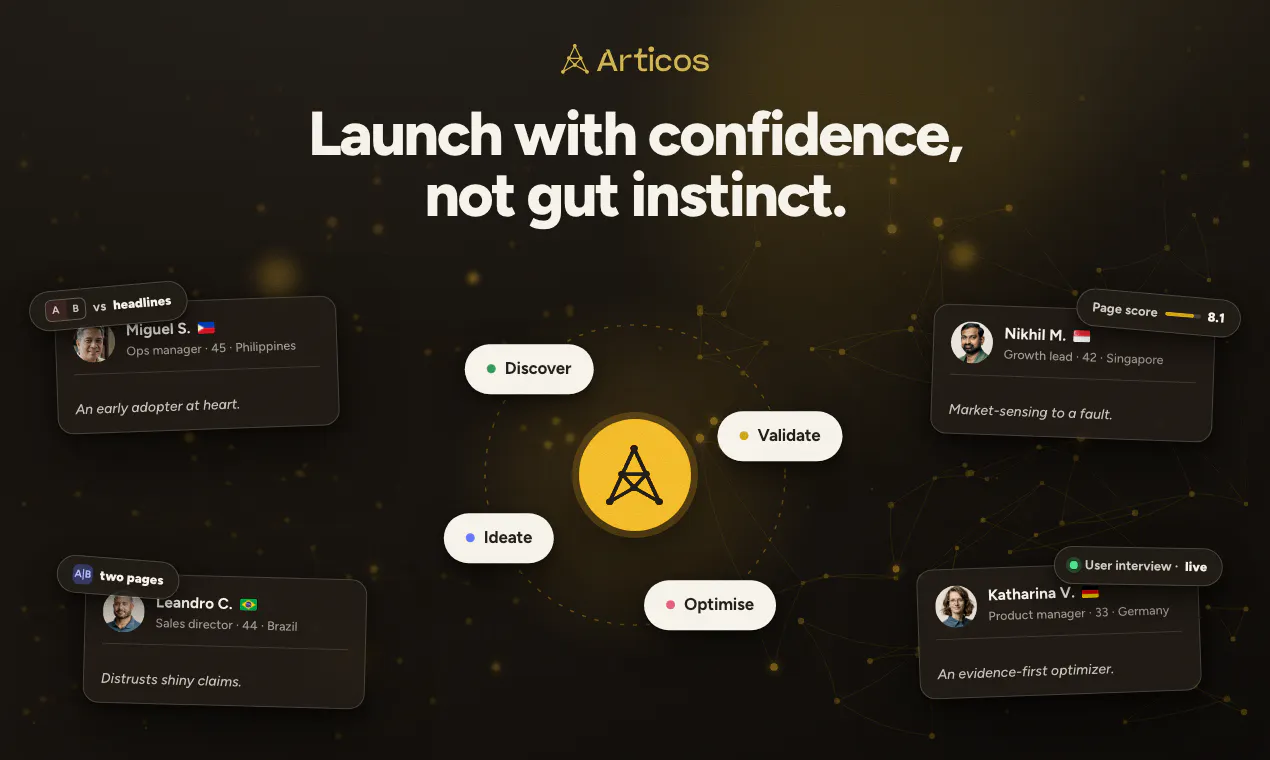
Articos
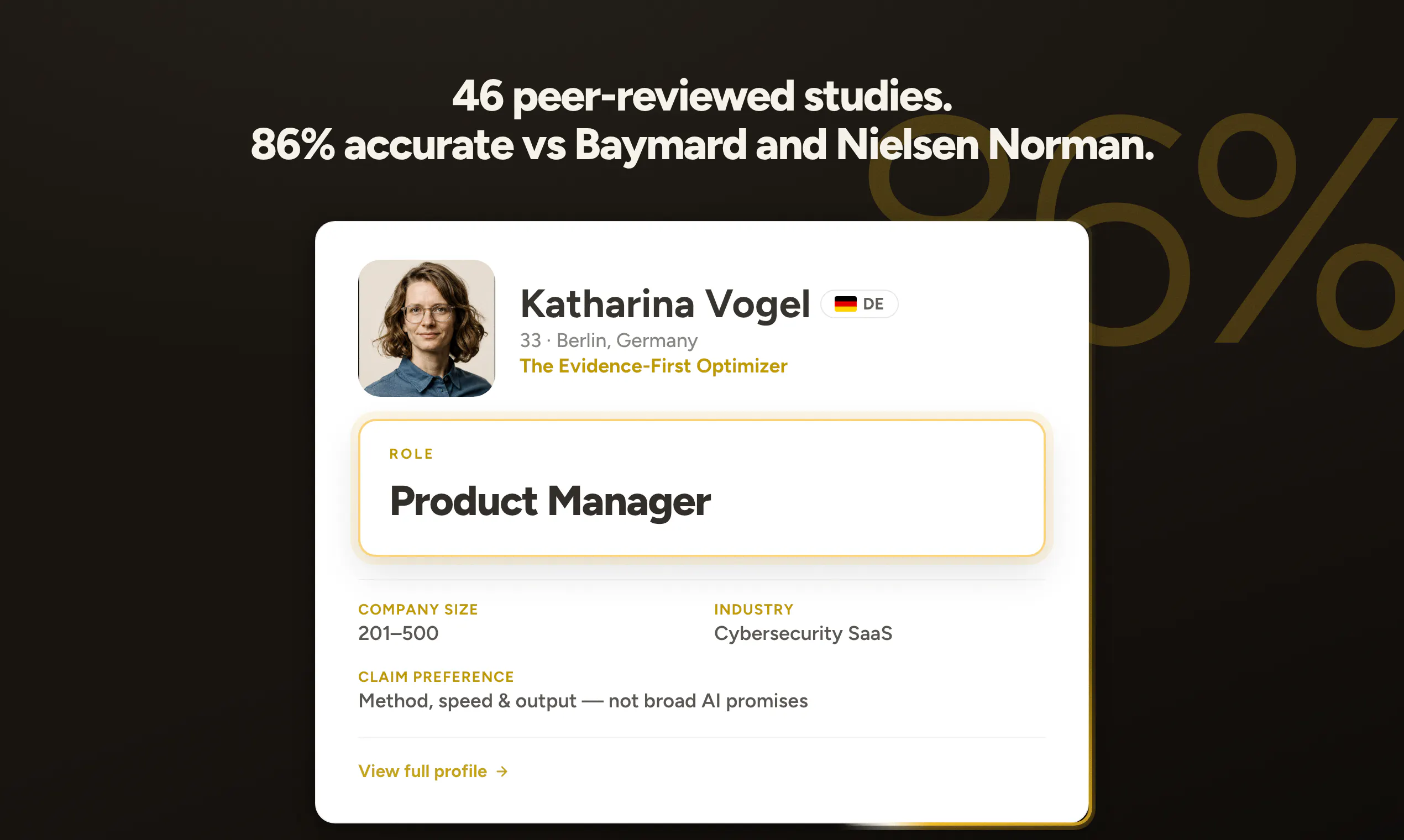
Articos helps SaaS teams, agencies, and founders test messaging, positioning, and landing pages against simulated personas matched to your ICP. Real audience signal in under 30 minutes. Peer-reviewed at 86% human accuracy vs Baymard and Nielsen Norman.

Hey Product Hunt

I am Shaheer, founder of Articos. I spent years in product at Cloudways (acquired for $350M) and at DigitalOcean. Every time we planned a launch, positioning, or new angle, the same thing happened: real audience input cost thousands of dollars and took 4 to 8 weeks, sometimes more. So teams shipped on gut after a Slack debate.

Articos helps SaaS teams, agencies, and founders launch with confidence, not gut. Get structured user insights and feedback in under 30 minutes at a fraction of cost

Here's how it works:

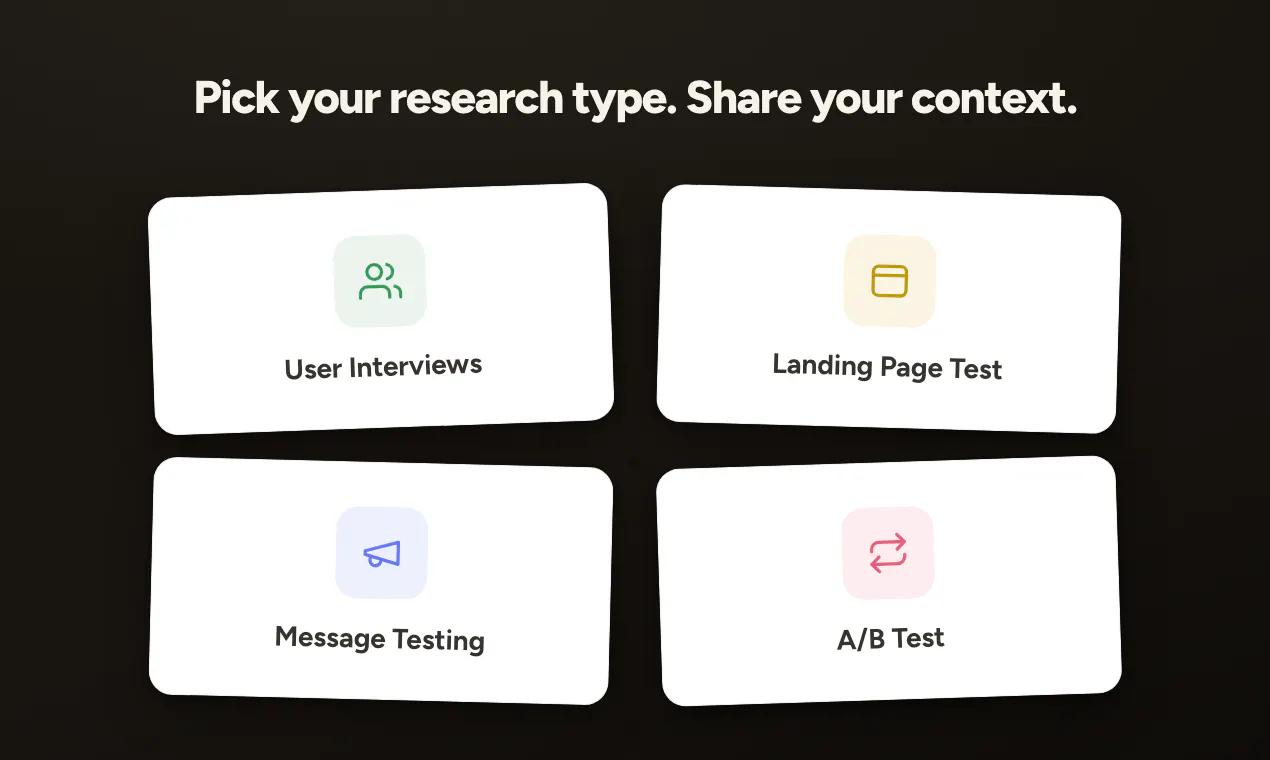
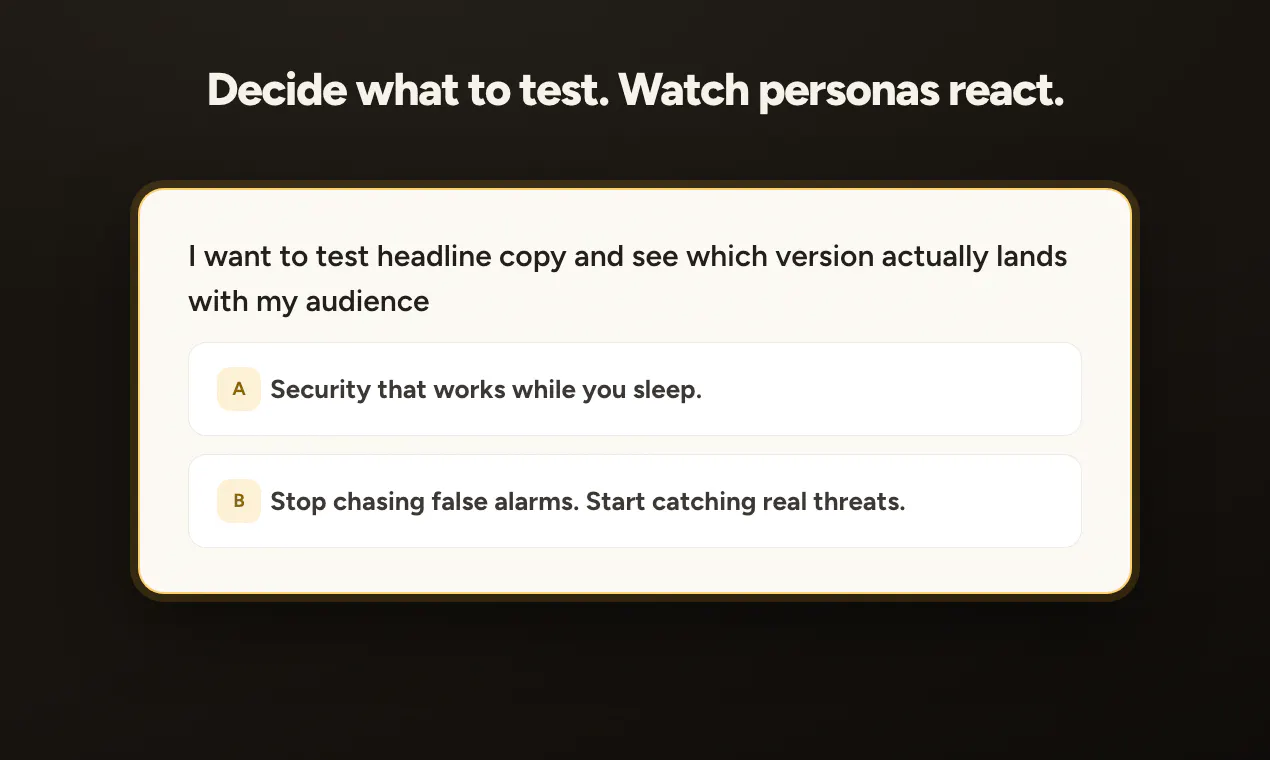
  1. Pick your research type (message testing, landing page testing, user interview, A/B test)

  2. Share what you're testing, where it will run, and who it's for

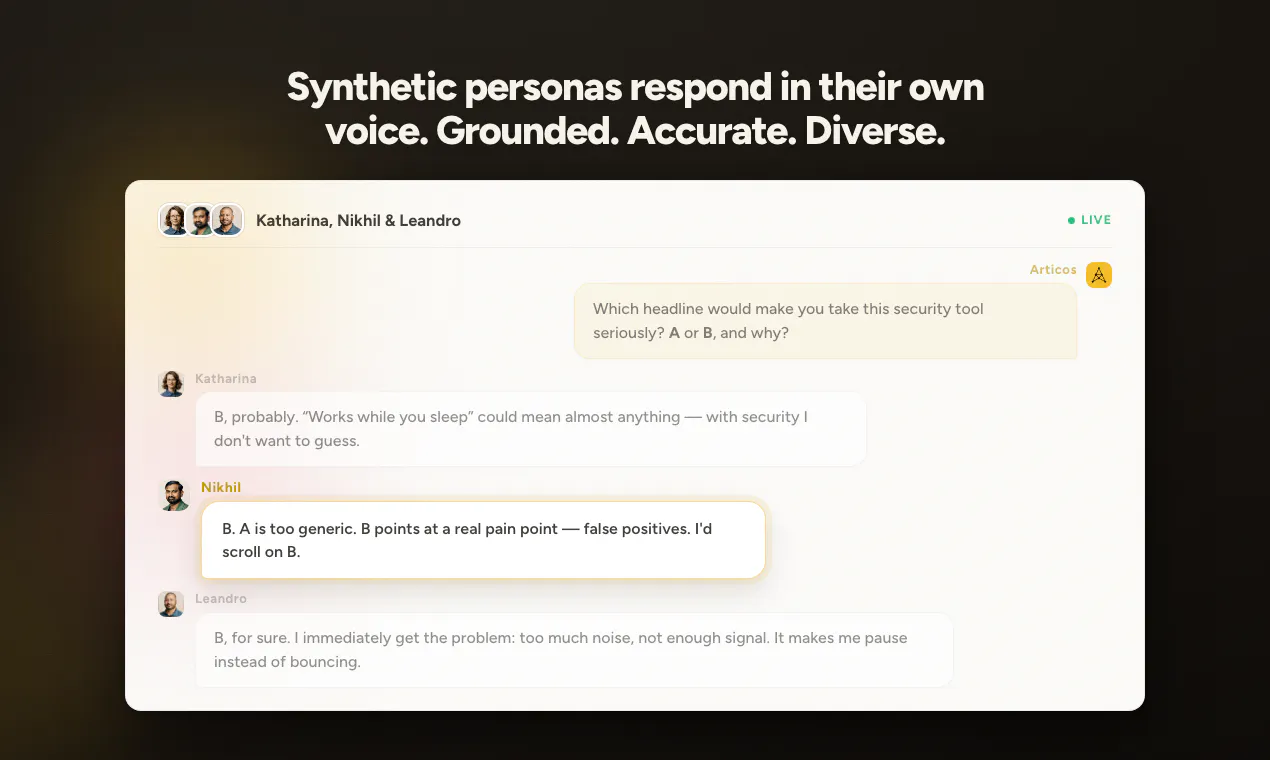
  3. Get findings from simulated personas matched to your ICP

Why teams use Articos:

  • Peer-reviewed methodology across 46 studies in 9 industries, 86% accurate against Baymard and Nielsen Norman

  • 7.5x more accurate than ChatGPT or Claude for the same research task

  • Every finding traces back to specific persona reasoning

  • White-label reports for agencies presenting to clients

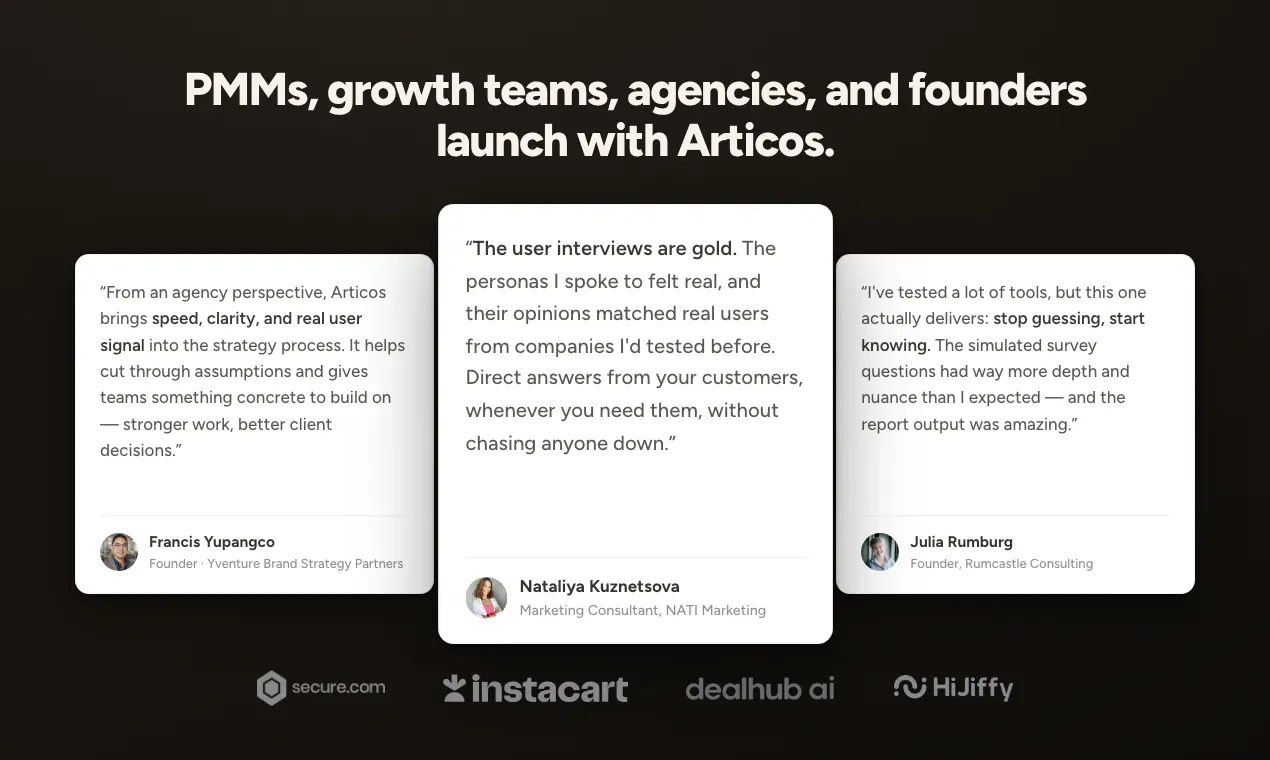
Used by PMMs, growth teams, agencies, and founders at Instacart, HiJiffy, and DealHub, plus hundreds of teams shipping without a research budget.

We just shipped live calls with personas. You can now talk to your simulated audience in real time.

For Product Hunt makers: PH40 gets you 40% off Starter and Pro monthly plans, launch week only. Or try free with 2 researches, no card required.

We'd love your honest feedback. What decision would you test first?

Huge thanks to our hunter Chris Messina for hunting us today.
— Shaheer

9
回复
@shaheergadit Curious about the metric how exactly are you quantifying that Articos is 7.5x more accurate than ChatGPT or Claude for research tasks? What benchmark or ground truth is being used to measure that?
2
回复

@shaheergadit I have used Articos at Cloudways to validate our messaging for some of our campaigns. The turn around time is super fast and helped us improve our messaging a lot. Without Articos, it wouldn't have been possible to test and iterate this fast. Congrats Shaheer and team on launch!

2
回复

@shaheergadit congrats on the launch.

the 4-8 weeks thing is the real problem. most teams i work with don't skip research because they don't value it, they skip it because nobody's waiting six weeks to name a feature. so they argue in slack and ship on gut instead.

getting to structured input in half an hour changes what you'd even bother testing. and the live calls with personas is a nice touch.

good luck today.

1
回复

In prepping for this launch, @shaheergadit and @owais_khan22 ran my @Minara tagline rewrite through Articos live.

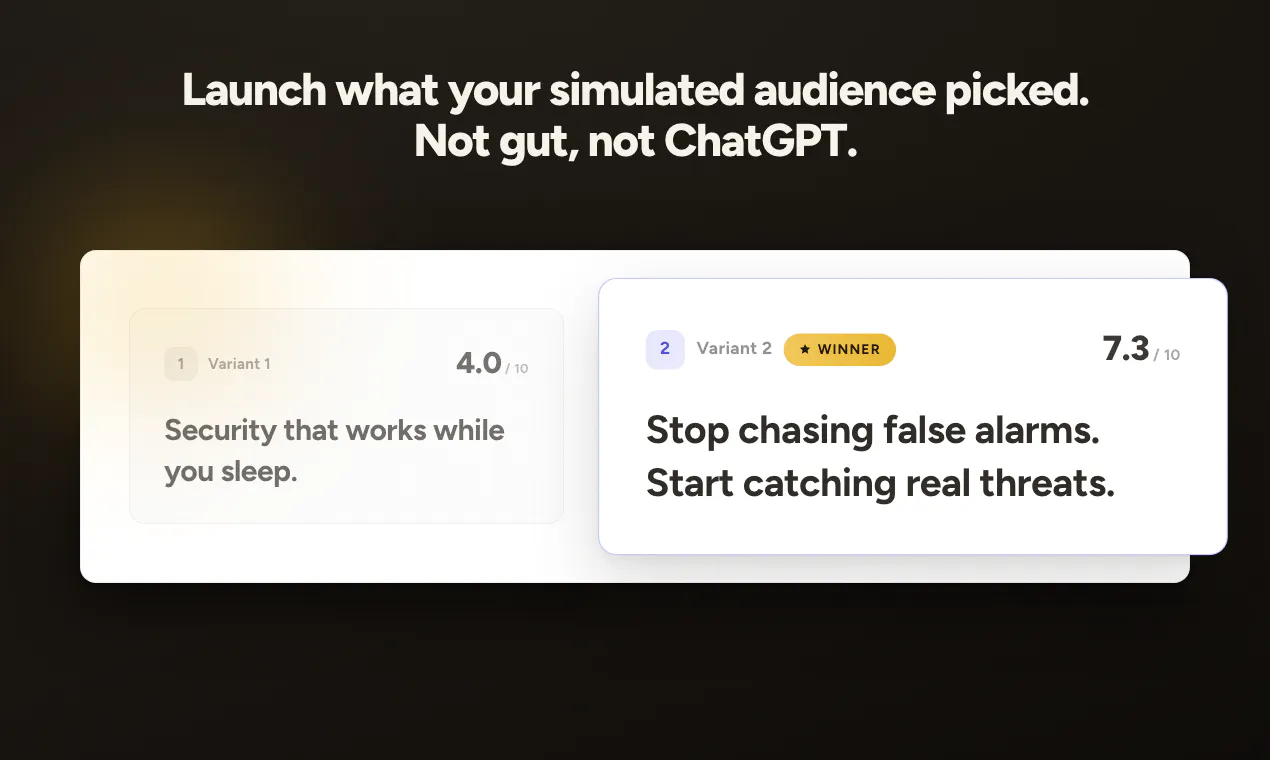
The original “Run your own Wall Street” scored 4.5 (which is still on their homepage) while my rewrite—“Research, plan and invest in one chat”—scored 6.2.

Minara reached #1 on their Product Hunt launch, demonstrating that differentiated language won't matter much if nobody gets what you're trying to say!

Articos lets you test messaging against simulated personas matched to your ICP, and then interrogate their reasoning, and get a report back in under 30 minutes.

If you're prepping for your [Product Hunt] launch and arguing over copy in Slack… try Articos as the dealbreaker!

4
回复

@chrismessina Thx Chris! Appreciate your support

0
回复

@shaheergadit  @owais_khan22  @chrismessina The 4.5 → 6.2 jump is a great example of how clarity can beat cleverness. I’d love to see Articos suggest stronger alternatives based on the persona feedback, not just score the copy.

1
回复

A friend introduced me to @Articos several weeks back. Since then I have been close to Articos and Shaheer and it's been fascinating to see how they have evolved and grown.

4
回复

@vikramp7470 Appreciate your partnership and support

1
回复

Testing this out right now for an upcoming campaign, the UI is really clean so far.

4
回复

@deepaksingh09 Thx Deepak!!

1
回复

Congrats on the launch @owais_khan22 and @shaheergadit ! Just signed up and tested Articos. The onboarding is incredibly fast.

I also really liked how many questions it asks before giving you the final insights. It feels surprisingly detailed rather than just generating a quick generic AI response.

Could Articos eventually generate personas from Reddit threads, G2 reviews, X post/Product Hunt or public community discussions? Probably to share a social media and to try to do a quick research?

3
回复

@byalexai thanks Aleksandar - this is on the roadmap!

0
回复

the peer review detail gives me a bit more confidence in the approach. I’m curious how closely the simulated responses tend to match feedback from actual users.

3
回复

Wellows has been an early user of Articos. We have used Articos to conduct user interviews and find unmet needs of our potential target audience. The insights really helped us shape our ICP and positioning.

Amazing work done by Articos and team. Good luck:)

3
回复

@masabgadit thanks. You guys were early and gave us some of the toughest feedback :)

1
回复

How does Articos compare to running an actual user panel through one of the message testing platforms? I am sure faster, but how's the quality holding up here?

All the best for the launch @owais_khan22

2
回复

@kate_ramakaieva Appreciate your help here.

Interesting question on the comparison. Real panels are still a great option if you have weeks and thousands of dollars to spend. Teams switching to Articos usually mention the 2-3 week timeline and $1.5k to $3k (or even more) per study as the friction.

On quality, our methodology is peer-reviewed at 86% human accuracy vs Baymard and Nielsen Norman, and 7x better than general LLMs. I think the real shift is not quality vs speed. It's making research economical enough to run for every decision, not just the big ones.

2
回复

The standard way of creating positioning maps and messaging pillars have always been doing comprehensive internal stakeholders interviews, customer interviews, reading in-depth market research, looking at the competition (where it stands, what kind of customers they attract) and probable proof (benchmarks, use case based outcomes).

I will put Articos to test in couple of days for a client I am working with and see what it brings me back. I will definitely circle back with the results.

Congrats on the launch, Shaheer and Owais.

2
回复

@invinciblesaad Thx Saad - keep us posted on your tests.

0
回复

@invinciblesaad Appreciate your help and thoughts here.

Would really value your take once you put Articos through the client project. Curious to see where it holds up and where you would want it to go further. Please do share the results 🙏

0
回复

I found Articos when I was looking to evaluate the business concept/idea of a virtual event management agency (now we call it EventLoop). We were validating the concept with potential buyers but that process was slow and we wanted to get off the ground quickly so we used Articos to validate the idea with its generated personas. We not only validated the idea but also improved the messaging based on the report.

2
回复

@arsalan_sajid Thx a lot Arsalan!!

0
回复

User research often gets pushed aside when teams are moving fast. Having something that makes the first round of research easier makes a lot of sense to me

2
回复
Seems like a really interesting use case for CRO, especially as a pre-validation layer before putting real traffic behind an A/B test. Could save a lot of testing cycles. Congrats Shaheer and team!
2
回复

@i_sajjad thx sajjad!

1
回复

Got the taste of the tool, and I think it can be very helpful, especially when there's no time to run real user panels, and you need to check your ideas quickly

1
回复

@katya_rozenoer1 Thx a lot Katya!

0
回复

White label reporting angle is huge for agencies trying to validate copy directions to sceptical cleints. good work team.

1
回复

This is great!! I've been using Articos to test out messaging before making it live anywhere! Love the insights it has provided

1
回复

@shruti_vrm thx a lot! Always good to see our users vouching for it. Even better to hear the insights are landing for you.

0
回复

Positioning is one of those things that can look obvious internally but completely different to a potential customer. This could be a useful reality check for me

1
回复

u said 86.3% recall at 49.2% precision, so abt half the themes are noise. is there a confidence score per theme so i know which to trust?

1
回复

@niveditha_patluri1 Not yet -- the current paper reports confidence at the study/report level through the Research Fidelity Index, not a calibrated confidence score for each individual theme.

you can read more here: https://www.articos.com/science-and-methodology

0
回复

Congrats on the launch! Really interesting approach to testing messaging and positioning against ICP-specific personas before taking it live. One question though - how different does the feedback get when you test the same messaging across different personas?

0
回复

I love that it traces findings back to specific persona reasoning rather than just giving a generic AI summary.

0
回复

We used Articos to test landing pages and understand the unmet needs of our target audience. It’s a great tool

0
回复

The “talk to your simulated audience” part is actually pretty interesting. This could save a lot of teams from making decisions based on gut feeling alone. Congrats on the launch!

0
回复

@suryansh_tiwari2 thank you :)

0
回复

I launched here on Sunday and what decided the day was not positioning, it was whether a curator featured it. Can research see that coming?

0
回复
#4
CleanShot 5.0 with Studio Mode
Mac-native app for screenshots, recordings and collaboration
231
一句话介绍:CleanShot 5.0 将 Mac 原生截图、录屏与全新的 Studio Mode 视频编辑器结合,让用户无需订阅即可将普通的屏幕录制快速打磨成专业级演示视频,解决“录屏易、剪辑精修难”的痛点。
Mac Design Tools Video
Mac截图 屏幕录制 视频编辑 Studio Mode 原生应用 滚动截图 标注工具 录屏剪辑 CleanShot 效率工具
用户评论摘要:用户普遍好评,称其为“必备应用”,老用户对新版激动。核心疑问集中在:与 macOS 自带功能差异(有用户详细列举滚动截图、固定区域、标注优势)、Studio Mode 导出文件大小、是否支持 3D 全景动画(官方回复否,但有点击缩放)、Setapp 用户是否同步更新。创始人回应称所有计划均可使用 Studio Mode,无需订阅。
AI 锐评

CleanShot 5.0 的聪明之处在于它不是发明了一个新需求,而是把“录屏后编辑”这个原本需要专业软件的沉重动作,压缩成了 Mac 原生应用里的一个轻盈模式。从评论看,用户对“Zoom on click”和“可编辑项目文件”的追问,恰恰暴露了其战略野心:它想成为屏幕内容创作的“草稿箱”,而非一次性导出工具。这精准打击了 Screen Studio 等高价竞品,用“无订阅”和“原生性能”构建了性价比护城河。

但值得警惕的是“Pivot 到录屏”的评论——当截图工具的护城河被 macOS 系统更新逐步填平,录屏编辑就成了它必须赢下的第二战场。目前 Studio Mode 的功能仍偏“锦上添花”(缩放、提词),尚未触及叙事结构、多轨道时间线等深度剪辑。一旦用户需求上升到“导演级”剪辑,它依然会被 Final Cut Pro 或 Descript 降维打击。真正的挑战在于:如何在保持“极简美学”的同时,让功能深度跟上专业用户成长的速度,避免沦为“一个好看的玩具”。另外,评论区那位质疑“和系统自带有何区别”的用户,代表了大量潜在付费者的真实困惑——CleanShot 需要更 aggressive 的“价值教育”,光靠功能堆砌不够,得让用户一眼看懂“我为什么回不去自带截图”。

查看原始信息
CleanShot 5.0 with Studio Mode
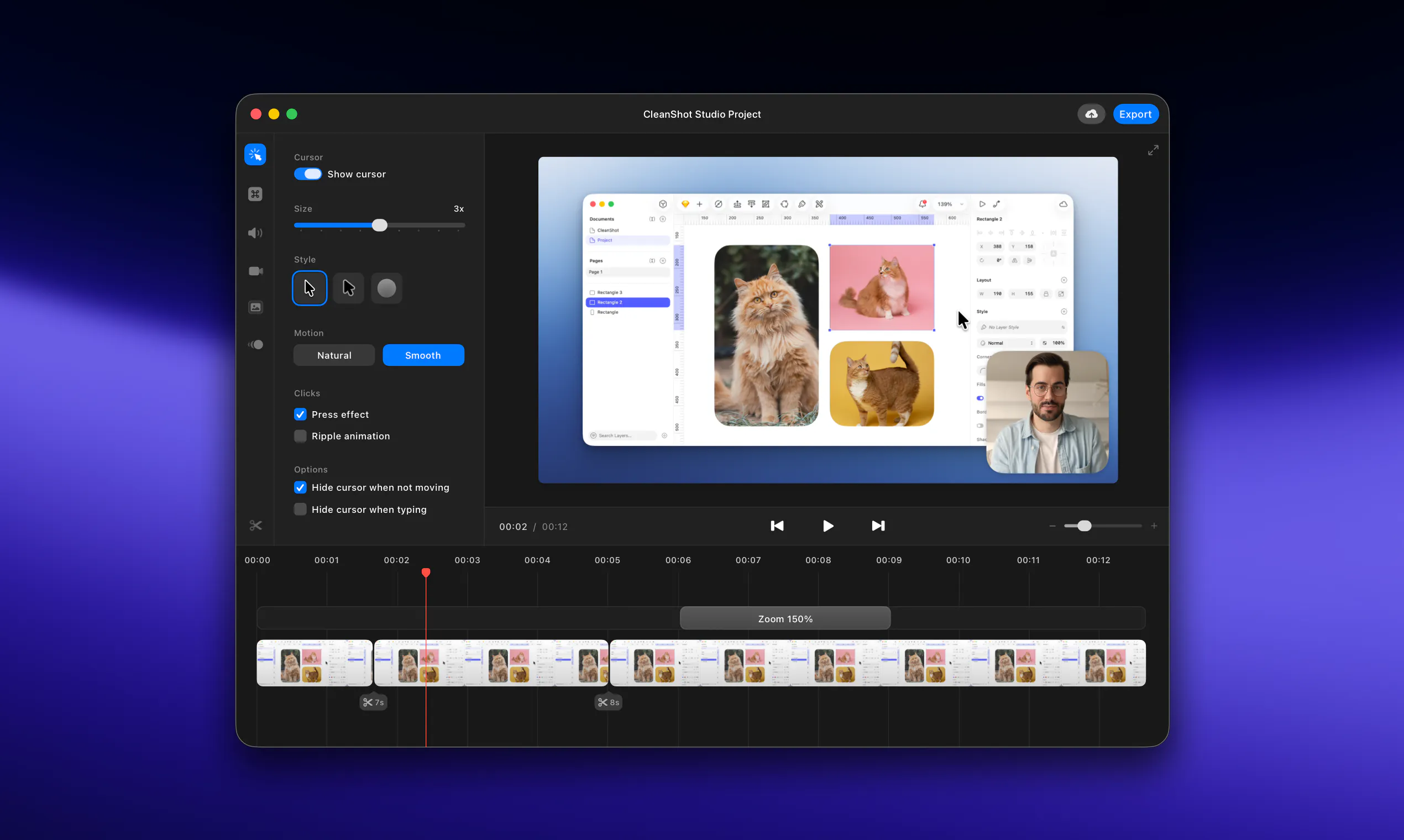
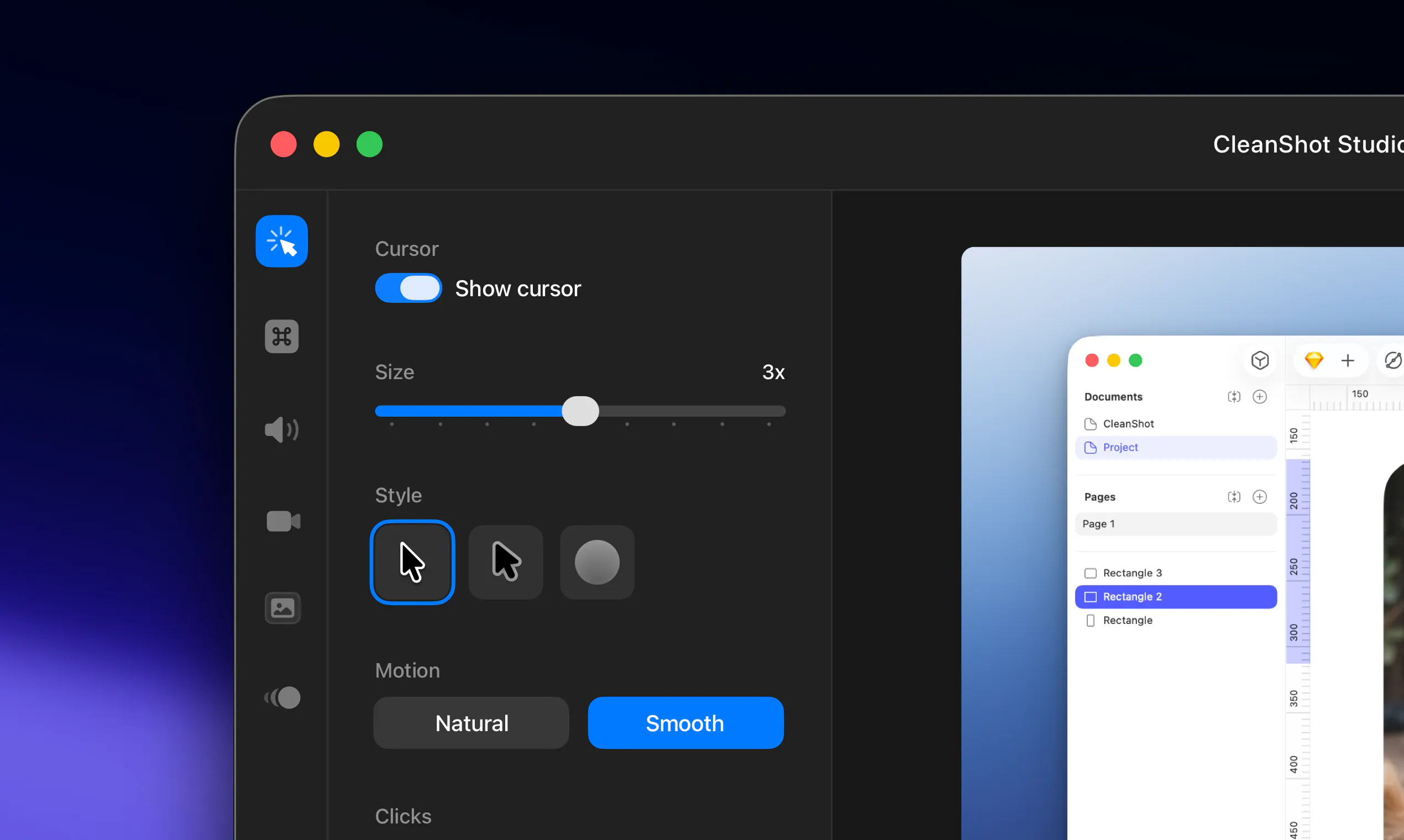
CleanShot is the definitive Mac-native toolkit for screenshots, recordings and collaboration. The new Studio Mode is all you need to turn a simple screen recording into a polished, professional video — with the quality you expect from CleanShot. Available now on all plans. No subscription required.

Hey Product Hunt! 🚀

I'm the co-founder of CleanShot, and I'm super excited to finally launch CleanShot 5.0 with Studio Mode and the new Video Editor!

Our mission with this was very simple: make the editor as powerful as possible while keeping it minimalistic and beautifully designed.

And the best part? It's still a fully native Mac app with great UX and performance.

The Studio Mode is available on all CleanShot plans. No subscription required.

We're just getting started, and we have a lot of new stuff planned for the Video Editor, but I'm excited to hear your feedback! 🙌

5
回复

@lukaszmtw QQ: Do Setapp users get the same update?

0
回复

I love this app. It's essential on a Mac. Looking forward to giving 5.0 a shot.

2
回复
Been using it on all my mac for last few years ❤️
1
回复

Finally!!!!! Long-time user of Cleanshot, hands-down my favourite screenshot product. I'd purchased Screen Studio a while back cos this didn't exist. Can't wait to try it now

1
回复

Looks like Cleanshot is slowly pivoting towards screen recording to compete with Screenstudio and others

1
回复

I dont quite get the upgrade from the build in Mac OS functionality to take screenshots, record video. not trolling can you give me 2 sentences of what this enables me to do ? I see editing but thats bout it, no? downloading a copy know but wish the value was more clear. thank you

0
回复
But native screenshot app in mac does the same, what are you doing differently?
0
回复
@saman_bahmani1 CleanShot is so much more robust and easier to use. My favorite features include: 1. scrolling capture - you scroll a long web page and it stitches it into one photo 2. capture previous area - when I'm capturing one section of the screen across different point in a workflow, I hit one keyboard shortcut and it uses the last screenshot coordinates to capture the same area 3. annotations - it is so fast and easy to add arrows, text, obfuscation, even numbered indicators (for steps in a flow) 4. screen recording - it is so simple to record your screen, add a selfie cam video overlay, and record keystrokes all from a keyboard shortcut
0
回复

Most of my screen recordings end up on a landing page, where file size decides if the page still loads fast. What does Studio Mode export at?

0
回复

What a cool product, congrats team for your launch!

0
回复

my favorite screenshot app just got better. :)

0
回复

Can it do these kinds of 3d pano animations of screen recordings. The ones that look really interesting for Hero sections on websites etc?

0
回复

@conduit_design No, that is not possible. It does zoom in the places you click though. It works awesome.

0
回复

fred's point abt screenshots giving agents context is exactly what i'd use it for. does studio mode keep the raw cursor path so zooms can be redone after?

0
回复

@niveditha_patluri1 Yes! You can even save an editable CleanShot project for later.

0
回复

Cleanshot has been one of my favourite mac apps for a while, I've evangelised numerous colleagues to get it and use it dozens of times a day to bring context to agents and humans. The new release looks like a huge addition that I'm sure I'll use for the more polished screen recordings I need to do!

0
回复

@fredrivett Happy to hear that! 🤝

0
回复
#5
OpenClaw 2.0
The AI that really does things
190
一句话介绍:OpenClaw 2.0 是一款可本地运行、能自动识别 ChatGPT/Claude 密钥的智能体助手,通过对话式配置和多人协作,解决用户管理浏览器、文件等实际任务时“部署繁琐、操作割裂、难以共享”的痛点。
Messaging Developer Tools GitHub Bots
AI智能体 本地自动化 浏览器控制 文件管理 多人协作 对话式配置 密钥自动检测 生产工具 隐私安全
用户评论摘要:用户担忧自动检测密钥导致与现有付费额度混用,缺乏独立限额;多人共享会话可能暴露本地文件路径与浏览历史,权限边界不清晰;另有反馈希望提供55分钟演示视频的精简版,团队功能被视为亮点但需更明确的作用域控制。
AI 锐评

OpenClaw 2.0 的“自动检测密钥”和“团队共享会话”看似便利,实则踩中了两个致命雷区:前者将个人付费账户与本地可执行终端命令的代理绑定,等于在无独立预算护栏的保险箱上装了自动扣款通道——用户月底看到账单才惊觉被队友消耗配额,这根本不是体验升级,而是风险转嫁。后者更甚,本地智能体拥有文件和浏览器权限,队友一旦加入会话,敏感路径和操作轨迹便暴露无遗,所谓“协作”在安全层面上形同裸奔。产品真正打动人的“对话式设置”和“本地运行”反而被这些花哨功能掩盖了价值——它本应是个人自动化助手,而非一支缺乏审计和细粒度权限的远程小队。建议团队优先砍掉或严格限定多人功能的可见范围(如仅分享抽象后的任务结果,而非实时桌面),并引入每会话令牌预算和密钥隔离机制。否则,这产品只会成为极客的玩物,而非企业或高级用户敢托付日常工作的工具。功能冗余若不能带来可控性,就是包袱。

查看原始信息
OpenClaw 2.0
OpenClaw 2.0 simplifies setup by detecting ChatGPT or Claude keys automatically and lets configuration happen through chats with the agent itself. It adds multiplayer team features for sharing sessions, refreshed browser tools for better tracking, and memory upgrades, all while running personal AI helpers locally on devices for tasks like browser control and file management.

Auto-detecting my existing keys is the part I'd push back on. That key is usually already funding something else, and now a local agent that can run terminal commands is drawing on the same balance with no separate cap. Multiplayer makes it sharper, a teammate's shared session spends my quota and I find out at the end of the month. A per-session token budget in the config would cover most of it.

3
回复

The team feature seems like the true hero hero here. No one has done that yet. Anyone know if there is a short version of the 55min video somewhere?

2
回复

@conduit_design I was thinking the same thing :)

0
回复

@conduit_design The team feature definitely caught my attention too! A shorter version would be great 55 minutes is a commitment

0
回复

the multiplayer piece is what makes me pause a bit. if the agent runs locally and can touch files/browser on my machine, and now a teammate can join my session - do they just see the output, or can they see the actual file paths and browsing history it's operating on along the way? for solo use that's fine, but "shared session" + "local machine access" is a combo I'd want scoped pretty carefully before handing a teammate a live view into my desktop.

0
回复
#6
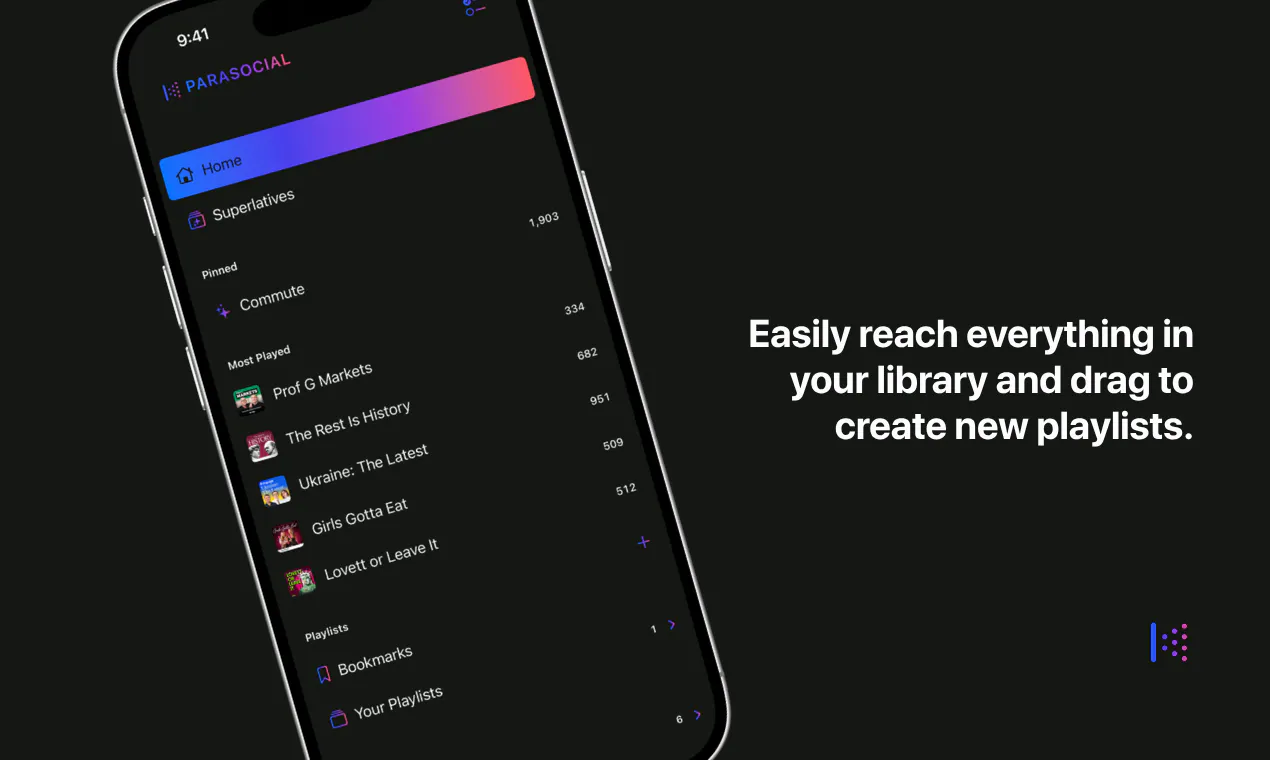
Parasocial
The podcast player for sharing.
188
一句话介绍:Parasocial 是一款面向重度播客听众的原生播客播放器,通过“发布即推送”的极速通知、标签书签管理和智能分类,解决了传统播客App更新延迟、手动整理繁琐、分享不便的核心痛点。
Productivity Entertainment Lifestyle
播客播放器 播客管理 智能播放列表 即时更新 书签标签 无账号同步 苹果生态 播客分享 音频增强
用户评论摘要:用户普遍认可其“极速获取新episode”功能及针对重度听众的设计思路。技术细节受关注,提问集中于推送机制(Podping/WebSub)与同步原理。部分用户询问智能播放列表规则灵活性与片段分享的具体形式,开发者回应称采用深层链接及iCloud匿名同步。
AI 锐评

Parasocial的定位精准且激进,它没有试图取悦所有人,而是为“播客成瘾者”这一细分群体提供了近乎偏执的解决方案。其核心卖点并非花哨的界面,而是对“时效性”的极致追求——通过监测Podping事件而非传统轮询,几乎消灭了订阅更新延迟,这直击行业痛点,也反映出创始人对用户场景的深刻理解。产品功能上没有盲目堆砌,而是做“减法”:摒弃无用的星标,用标签和书签强化知识管理;取消账户体系,依托iCloud实现无缝同步,降低了使用门槛。从评论看,用户质量很高,提问直指技术核心,而创始人的回应也相当坦诚,甚至承认当前分享功能“有点小问题”,这种务实风格容易建立信任。但必须指出,在Spotify等巨头凭借海量内容和算法推荐占据主流市场的当下,Parasocial这种“工具属性”极强的播放器,其天花板可能仅限于硬核用户。$2.99/月的订阅制在免费大潮中虽显清高,但若无法持续提供类似“Watch独立播放”或“个人音频保险箱”这类独家杀手锏,用户留存将面临考验。整体而言,这是一款由真正爱好者打造的、充满理想主义色彩的产品,其价值在于证明了播客体验仍存在巨大的优化空间,而非被巨头定义。若后续路线图能顺利落地,它有机会成为这个细分市场的“播客播放器里的OmniFocus”。

查看原始信息
Parasocial
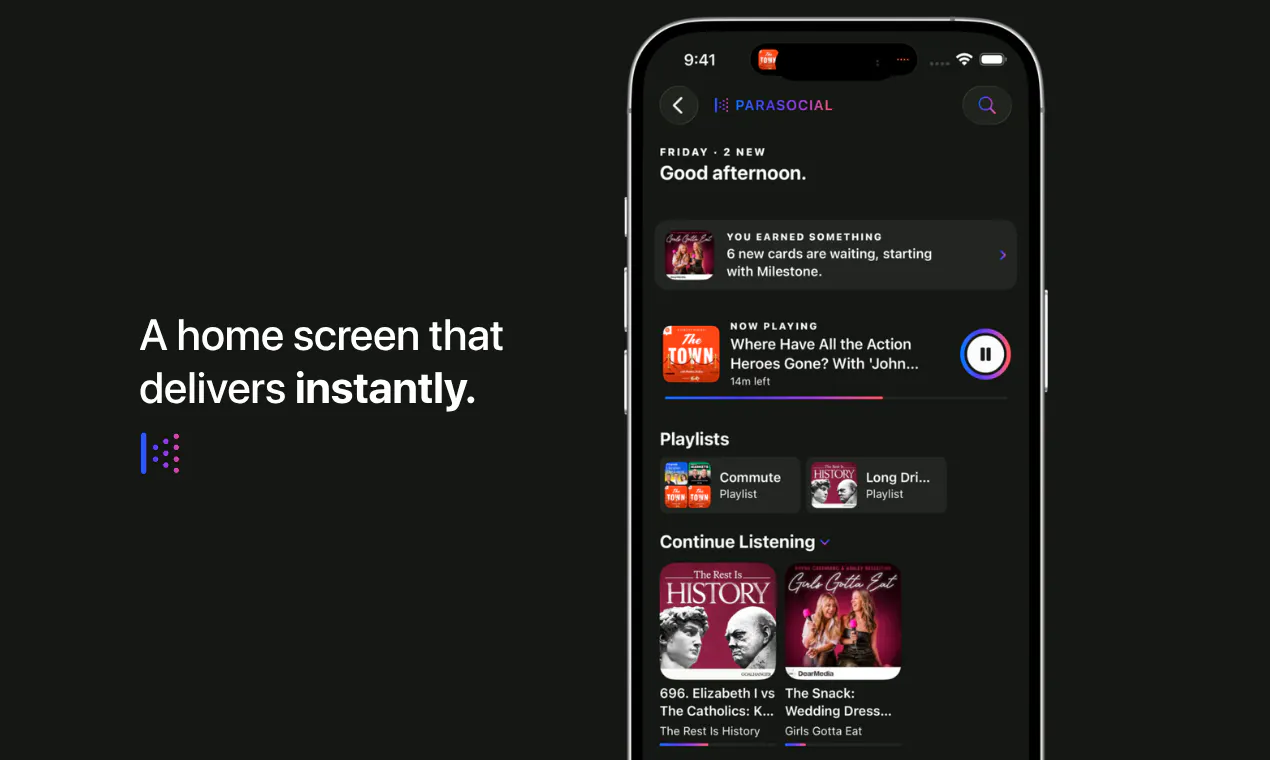
PARASOCIAL is a fast, native podcast player for people who really love podcasts. Get new episodes the moment they publish, automatically download and organize them with smart playlist rules, search huge libraries instantly, bookmark and tag favorites, and share your parasocial relationship with friends. Native on iPhone, iPad, Mac, and CarPlay, with seamless sync and no account required.

Hello Product Hunt community 👋

I'm Paul, the founder of Parasocial.


I'm a podcast addict. I listen at night in bed, so I need a sleep timer that works. I dig through decades-old archives, so I need audio processing that rescues unmastered tape. I want comedy to stay with comedy and history to stay with history without ever sorting anything by hand. I want my episodes on my phone the second they are published, not after six hours of refreshing. I've paid for every other player, and none of them kept up with my needs.

So I built Parasocial, because podcasts should be a joy to listen to. We fixed everything you hate about podcast players. We built a player that checks every box, and we won't stop there.

Three things no other player does:


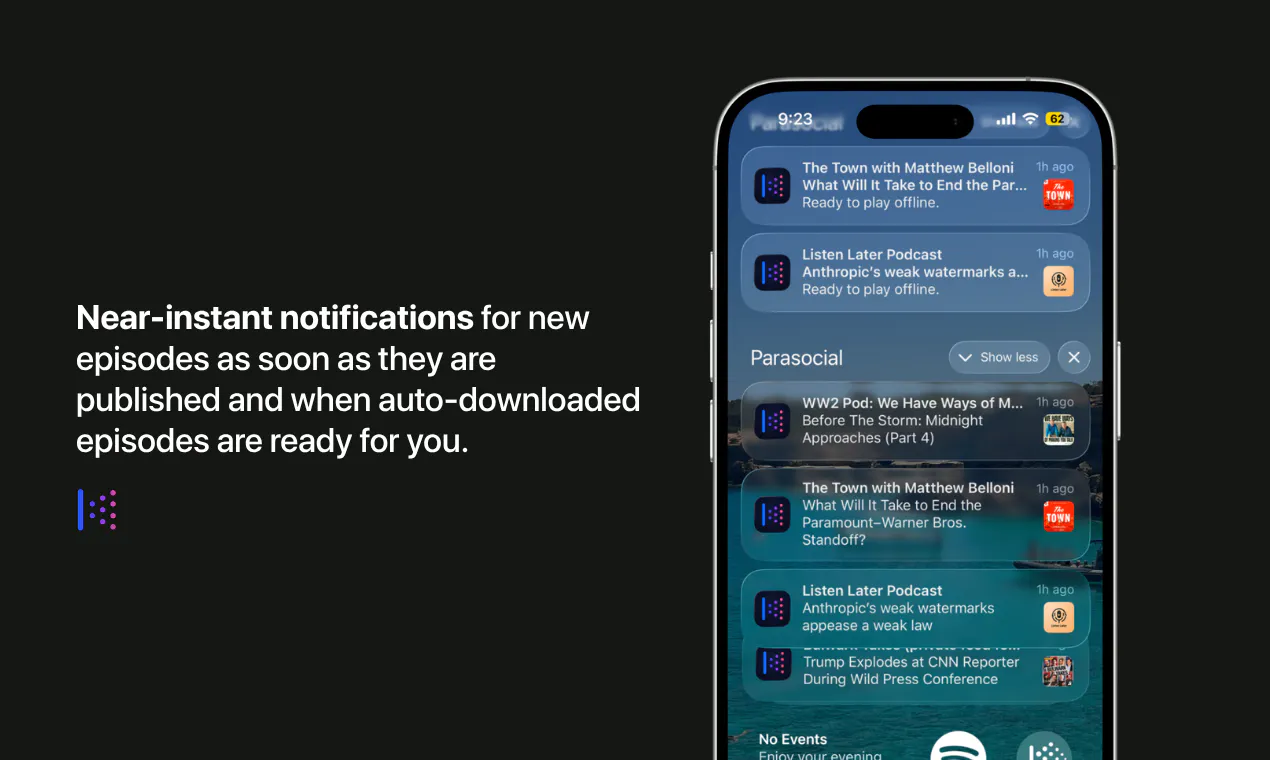
⚡️ Speedy Network Notifications. Your favorite show drops at the same time every day, and your player still finds out hours later. Ours doesn't wait. Our server is told the moment a show publishes, so the episode is on your device, downloaded for offline listening. No more endless refreshing, no six-hour polling wall.


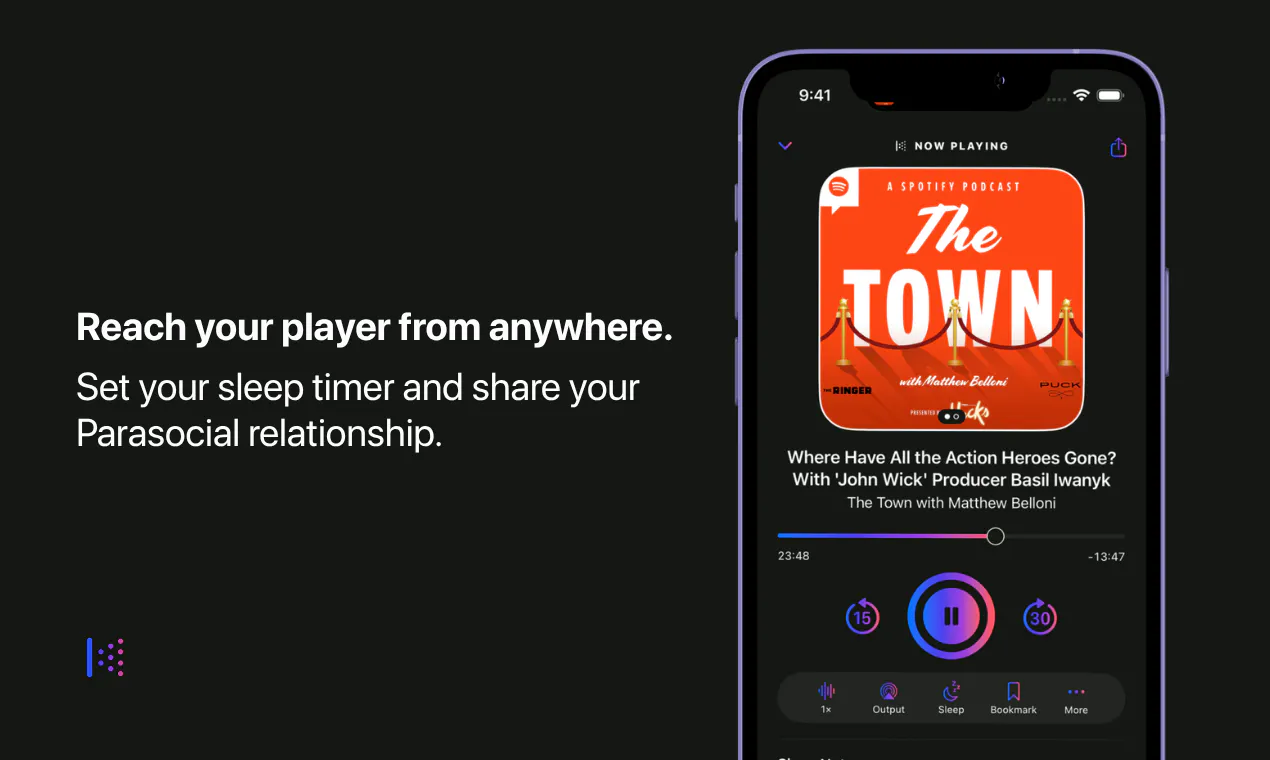
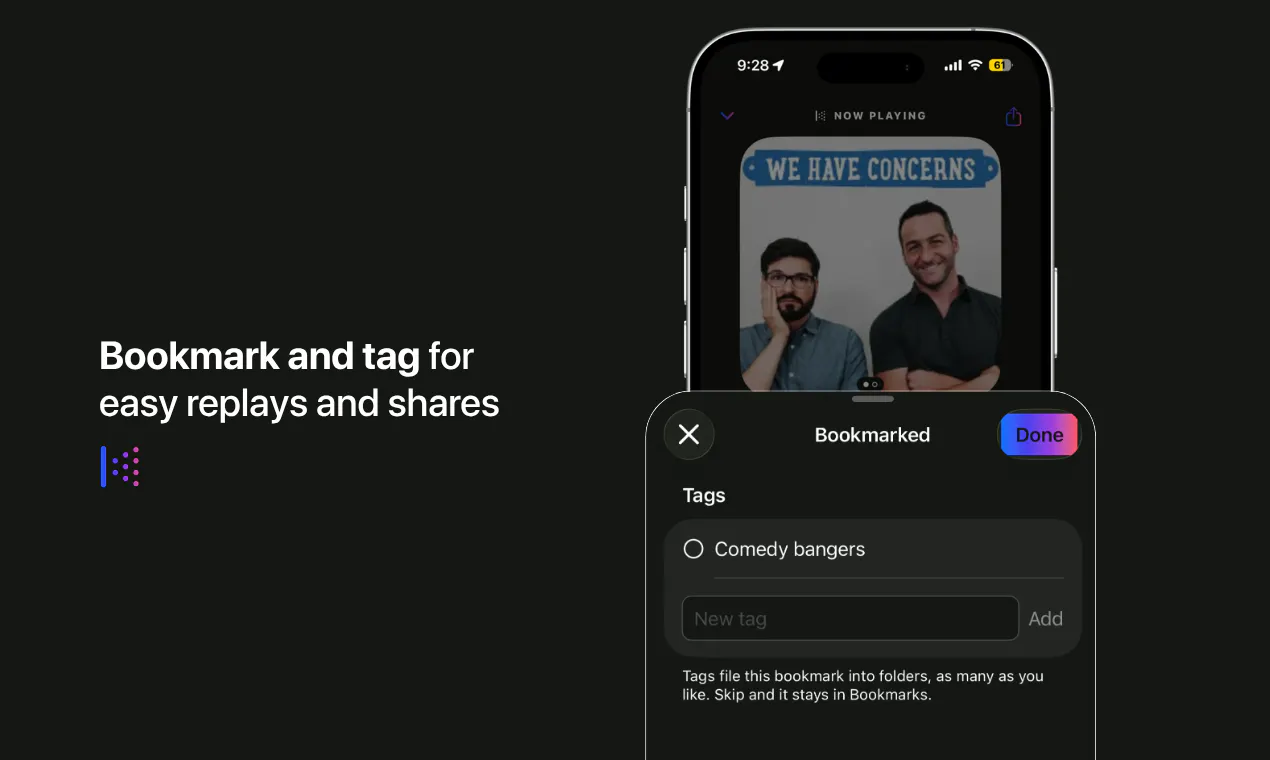
🔖 Bookmarks and tags, not stars. Fifteen years of listening and I never once found the "favorites" or "stars" useful, so we killed them. Save the episodes you love with tags, then grab them and share them in seconds. Organize the shows you love.


🏆 Parasocial: Share your parasocial relationship with friends, earn superlatives, and share clips or whole shows with deep links for Parasocial users and live weblinks for Paranons.

Plus everything else you'd expect from a top-tier player:

🚀 Fast - your library reads from a database on the device, not the network, so tens of thousands of episodes stay instant

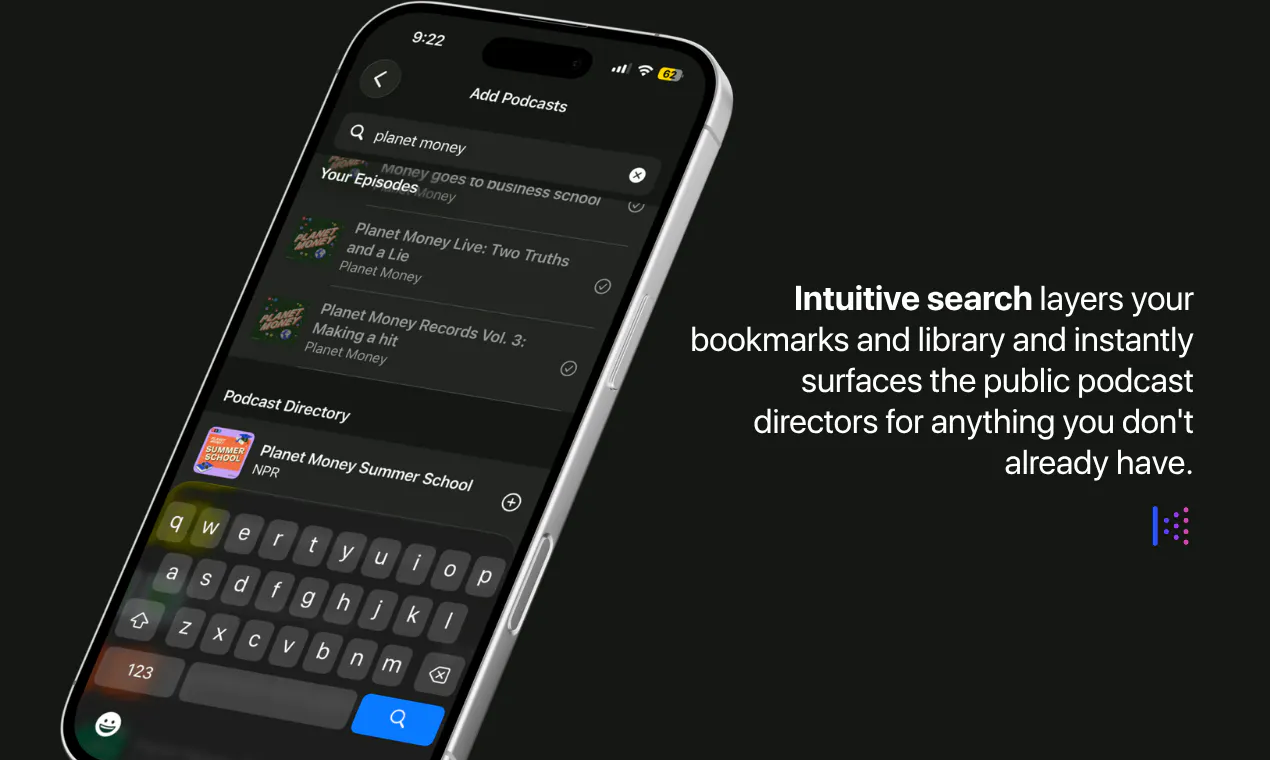
🔎 Better Search - one field searches your own library first and tens of thousands of published shows across every network

✅ Organized - smart playlists built from rules, per-show priorities, and manual overrides that don't break the rule that built the list.

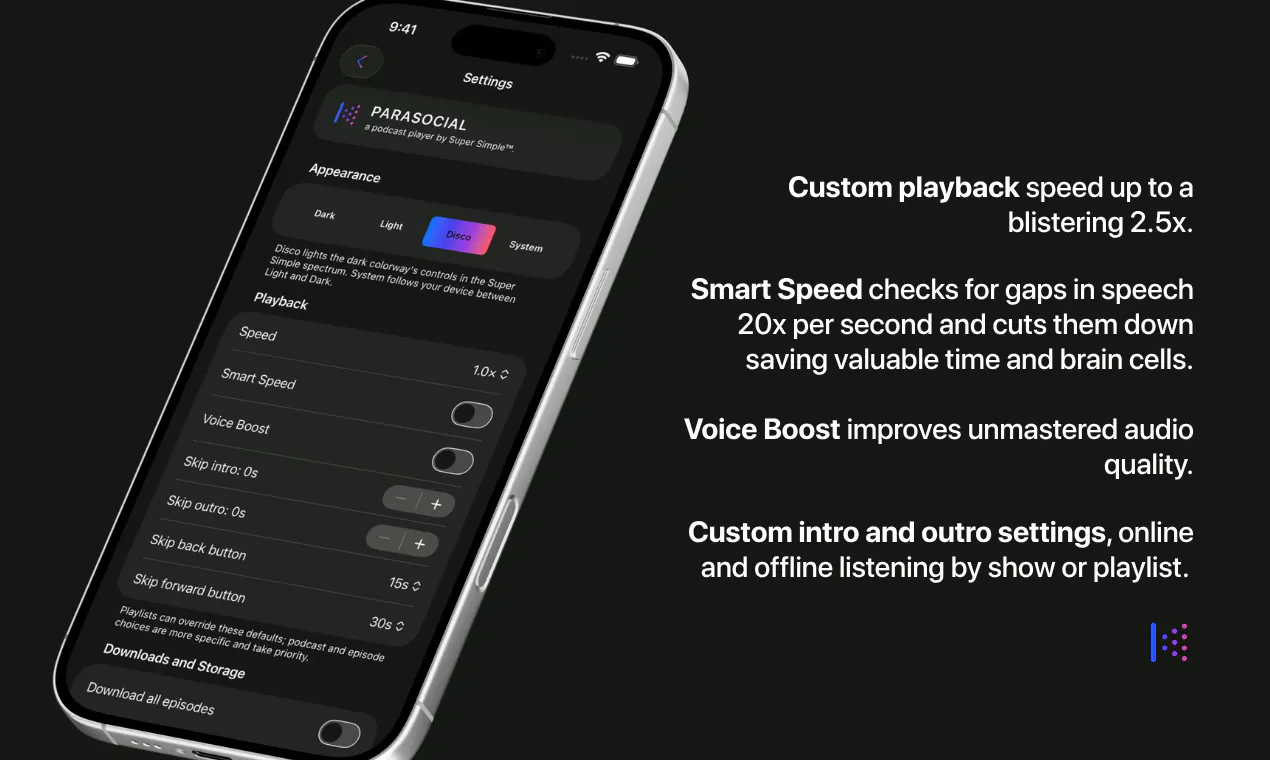
🎧 Trim Gaps and Studio Sound - trim the gaps in the talking 20 times a second and put warmth back under the voice; two hours of talk hands back fifteen minutes without any audio degradation.

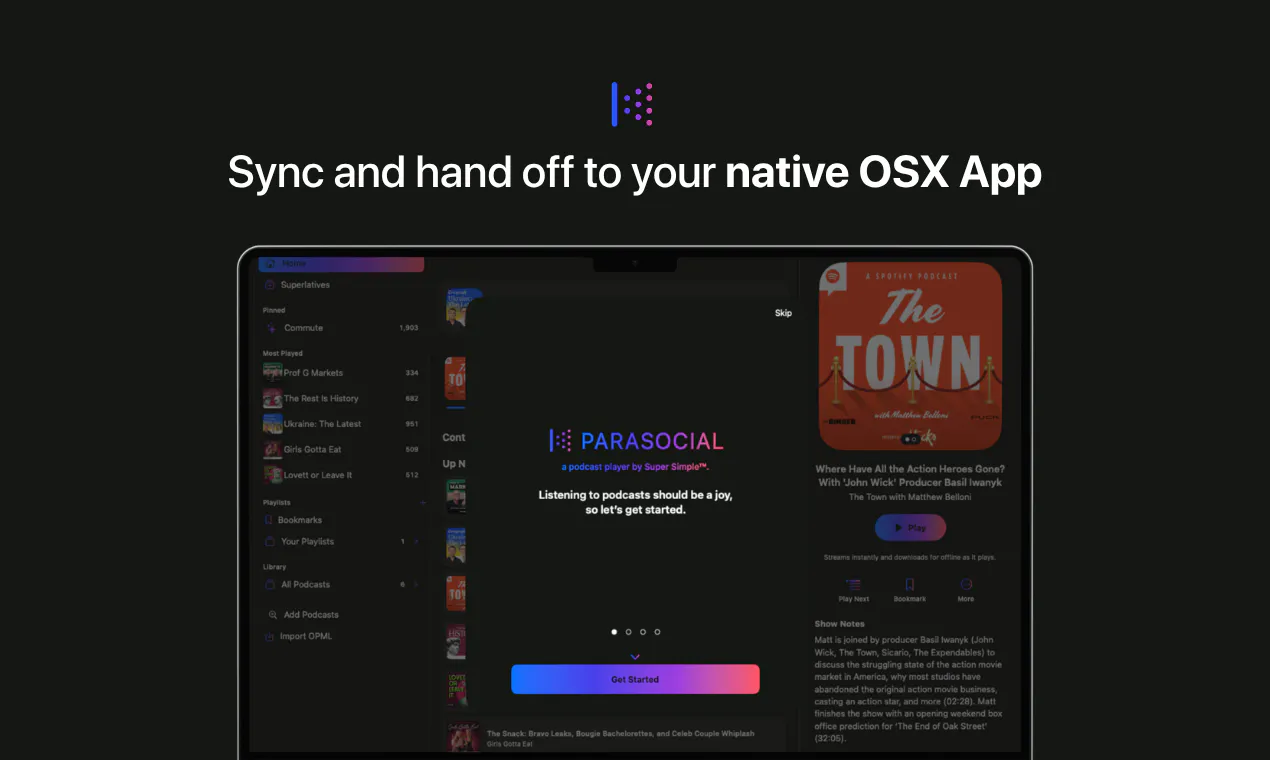
🚗 Everywhere - CarPlay built in, a web player for sharing with the Paranons, native on iPhone, iPad and Mac!

💥 Yours - everything syncs across every device with no email, no password, no profile. No ads. Never will be. And when I say never, I mean never.

👀 How it works:

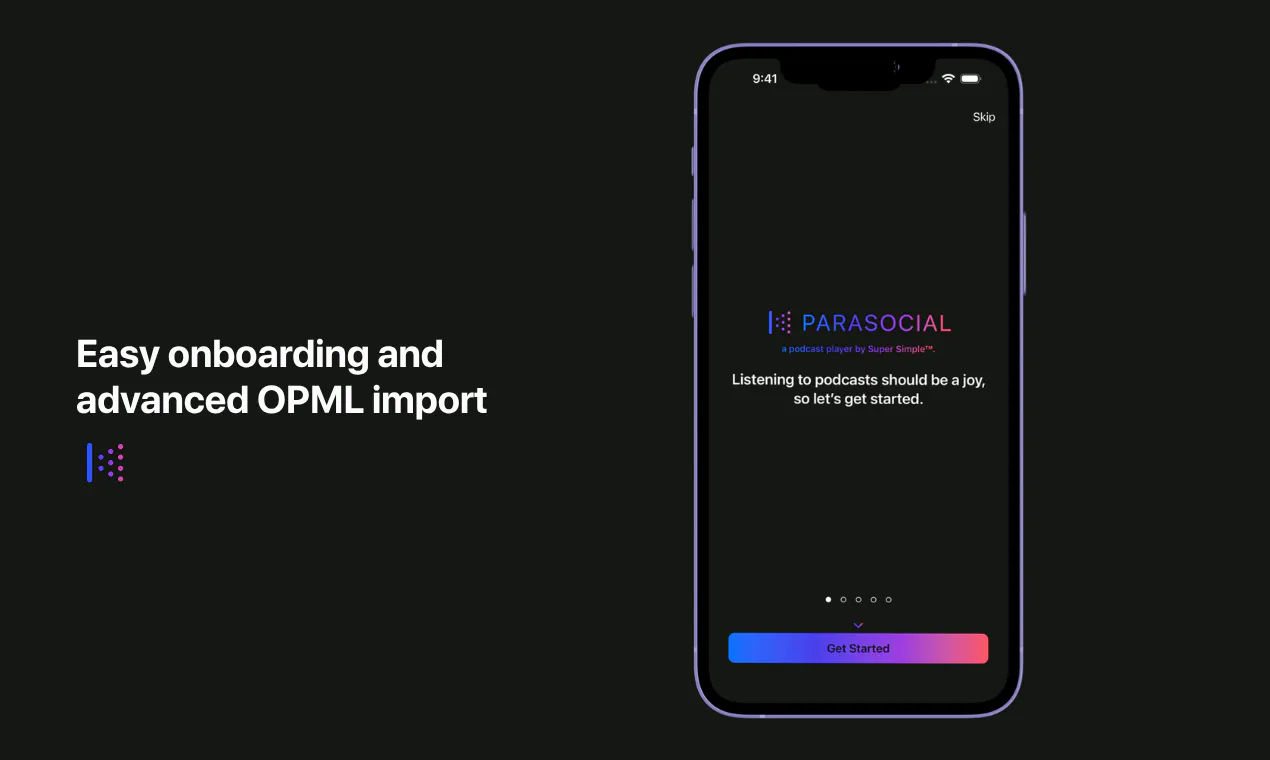
  1. Install Parasocial and import your OPML or Advanced OPLM for playlists, priorities, played state, and progress. We're pretty proud of the import. It's the most advanced around. Move from any podcast player that lets you export.

  2. Search the directory or paste an RSS feed. Quickly find what you're looking for, whether it's in your library or out there in the ether.

  3. Build a smart playlist (or a dumb one).

  4. Bookmark, tag and share with friends.

  5. Check back after your first week of listening for a "wrapped" style superlative.

What we have in-store:

⌚️ Apple Watch app that works when you leave your phone at home

🗣 On-device transcripts for shows that don't publish their own

🎧 A personal audio locker for the files that aren't podcasts

🪩 More Disco (yes please): the colorway that lights every control in the Super Simple spectrum

📺 Category browsing and recommendations that learn from your habits


And so much more!


Parasocial is free to download on iPhone, iPad and Mac. Two weeks free, then $2.99/month or $14.99/year. No account necessary, no invasive tracking, and in my opinion, the best podcast player ever made.

😻 Please do share any feedback and comments, and of course feel free to share Parasocial with anyone who has given up on their podcast app! We're still building every single day, like it's a full-time job.

Happy listening,

Paul

7
回复

@paulgeller Thank you for building this! I've been frustrated with my podplayers and Spotify forever. I just accepted it. But this app is a gamechanger!! Takes frustration out of my day, EVERYDAY.

0
回复

@paulgeller i like this - I'm an avid podcast listener - literally all day and i listen as I go to sleep too. cool product - i'll give a try

0
回复

@paulgeller I've always hated the endless refresh cycle for new episodes – it's wild that your server gets told the moment a show publishes. Congrats on the launch!

0
回复
This sound so cool, Paul! It feels like its built from the POV of someone who understand podcast listeners. Excited to see how the Apple Watch app and transcript evolve. Congratulations and I wish you all the best!
2
回复

@odeth_negapatan1 Thanks! It truly is. I built this app because I'm a paying user of almost every single app in the ecosystem, and I was still unimpressed with the pace of development around podcast listening in general. There are so many good ones out there, but none that do it all. I hope this one does, and I'll keep building. Thanks again.

1
回复

The clips I want to share are always the 40 seconds in the middle of a 90 minute episode. Does sharing give me that as an audio file or a link?

0
回复

@yelyzaveta_kibets They are deep links, so when you share at a particular point in an episode, you are sharing with other parasocial users right at that segment. For non-parasocial users, or as I call them, ahem, Paranons, they get a link to a web player.

Note that this has been a tiny bit finicky in the current release, but I have one queued for tomorrow that smooths it out.

0
回复

I love podcasts. I used to work at a podcast app (Podyssey.fm, RIP). After it shut down I ended up on Spotify by default, and honestly Spotify's podcast experience is so bad it made me stop listening to podcasts.

New episodes just wouldn't show up in my feed. I'd find out a week later that a show I follow had dropped three episodes. Eventually I gave up, which is kind of embarrassing for someone who used to do this for a living.

Parasocial's whole pitch is "episodes show up the second they publish," which only makes logical sense!

That's literally the thing I quit podcasts over - ha!

Downloaded this. Everything sense to me in a way current podcast apps don't. Smart playlists, tags instead of stars, no account, works on my Mac.

Feels like it was built by someone who actually listens to podcasts!

Excited to get back into listening. Congrats on the launch, @paulgeller !!

0
回复

@thisisaliceko Thanks for the kind words, Alice. Wait till you see what we have coming up next.

0
回复

The "get new episodes the moment they publish" line is the part I'd want to understand — are you polling feeds aggressively, or listening on podping/WebSub? I spend most of my time on the publishing side, and the lag between a feed updating and apps actually showing the episode is the thing creators complain about most, so if you've genuinely closed that I'd love to know how. Also curious how sync works with no account required — iCloud, or something else?

0
回复

@podcastbud New episodes show up fast because we watch podping (Hive blockchain events that hosts like Buzzsprout, Transistor, RSS.com, Captivate, Podigee, and Audioboom fire the instant they publish); typically a few seconds from publish to detection. For hosts that don't podping, we're adding a WebSub subscriber next to close that small gap; until then, those feeds fall back to polling, which, yes, is extremely aggressive. But that was the killer feature for me. I want my episodes NOW.

Re: Sync is anonymous: no account, just an iCloud-backed identity that follows you across your own devices.

0
回复

I'm curious about smart playlists. How flexible are the rules if your podcast library is quite messy?

0
回复

@angelaaa Smart playlists are really quite simple. Instead of building them by hand, you can add one or more shows so that all of their episodes are included. You can pin priority shows so that they stay on top. You can have it automatically organized by newest or oldest episode. Most of the things you'd come to expect in a smart playlist.

I'm open to other ideas too if you think there are things that'll help you organize your library a bit better.

0
回复
@paulgeller Is there an ability to create a playlist and then play all of the new episodes or do you have to add each episode to the queue manually? Thanks. R
0
回复

The bookmarking and tagging system is a really nice addition. I can see now that it will be quite useful for saving specific moments from long episodes.

0
回复

@1mirul absolutely. It's one of my favorite conveniences. Even though tags are private right now, I've thought about how they could be used to currate playlists automatically.

0
回复
#7
Dial
Give your AI agent a real phone number in 10 seconds
185
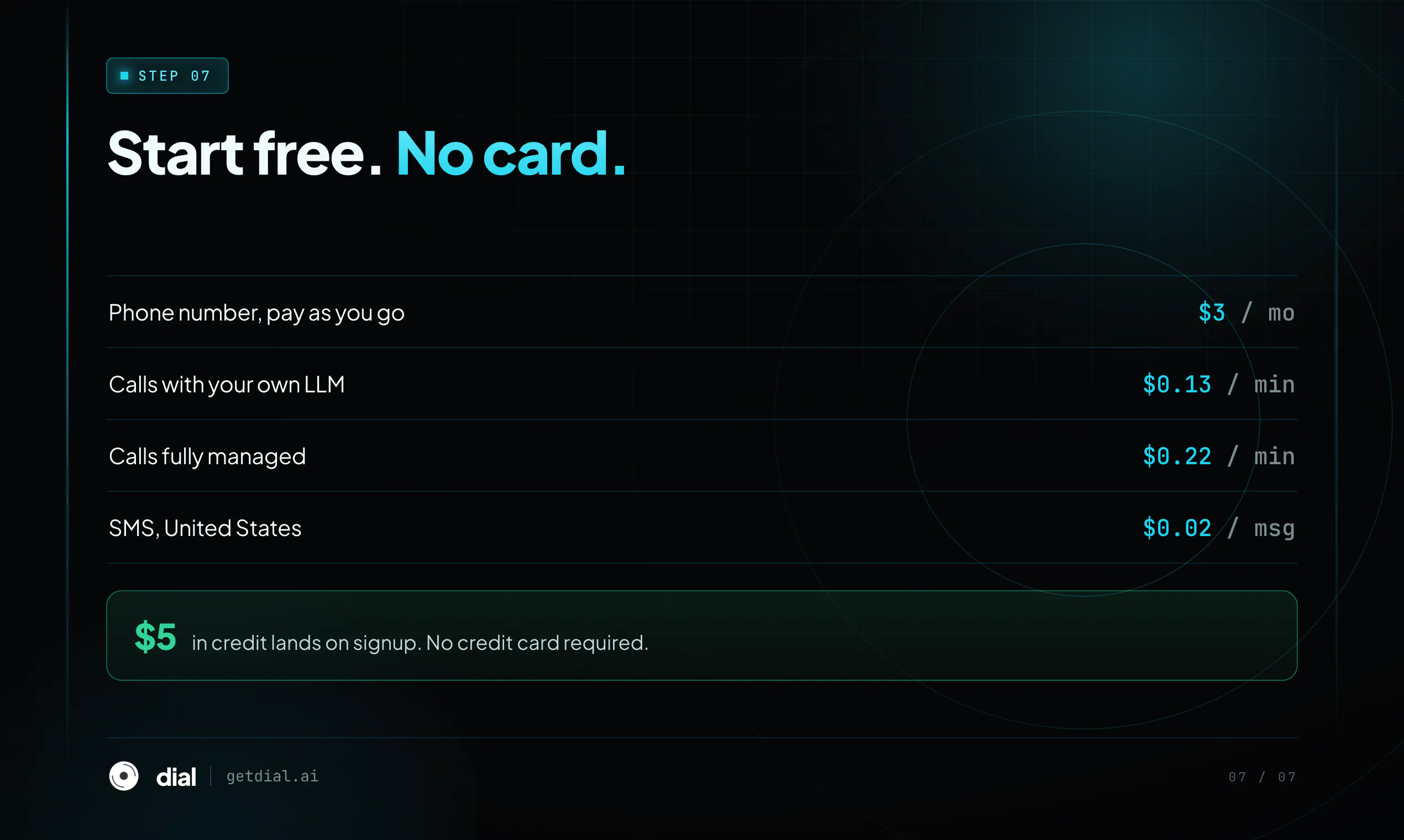
一句话介绍:Dial 通过一个API调用,在约10秒内为AI代理开通真实电话号码,使其能够独立拨打/接听语音、收发短信及iMessage,并读取验证码,从而打通AI在真实世界通信中“号码缺失”的最后一环,解决自动化流程被手机验证码或电话确认卡死的痛点。
Productivity Messaging Artificial Intelligence
AI代理基础设施 电话号码API 语音通话 SMS短信 iMessage集成 验证码读取 MCP服务器支持 开发者工具 通信自动化 智能体工具链
用户评论摘要:用户高度认可“让AI拥有号码”解决自主代理被OTP卡死的痛点,并关注MCP连接、数据库集成及10DLC审批速度。有效问题集中于:资费是否因国家而异、可否无号码发起呼叫、号码失效时的通知及重试机制、能否读取完整短信内容。CTO回应称有风险模型管理号码声誉,支持自愈10DLC(1-3天通过)。
AI 锐评

Dial的聪明之处在于它没有试图做“更聪明的AI”,而是回头补上了AI落地时最脏最累的物理层接口:一个能收发验证码、能等短信、能让代理自己注册并持有的电话号码。从评论看,用户真正兴奋的不是“打电话”这个动作,而是“wait-for”这种阻塞式原语——它把一个需要人类绕过的业务死胡同(OTP验证)变成了代码里的一行等待。这是基础设施思维的胜利。

但必须泼冷水。其一,评论区创始人轮番上阵回复每条提问,刻意营造的“全员客服”氛围掩盖了一个事实:评论区里对价格、号码声誉、失效重试机制的回答全是模糊承诺(“联系我们”“模型自动管理”),缺乏SLA级别的透明保障。其二,所谓的“200+国家覆盖”和“10秒开通”在真实电信监管面前往往意味着高风险号码池或灰色路径,一旦运营商大规模清洗,代理会集体失联,那将是灾难性故障。其三,此类服务本质是Twilio等聚合商的再封装,毛利率受制于上游,当AI代理数量爆发时,运营合规成本会指数级上升,当前“免费额度+按号收费”模式能否支撑规模化存疑。

真正值得看好的是它勾画出的范式:未来AI代理的“通讯录权限”将成为标配。Dial抢占了先发位置,但护城河不在于API多优雅,而在于号码信誉与稀疏资源管理——那才是评论里那个“keep me up at night”问题背后的终极壁垒。目前来看,它更像一个聪明的中继站,而非不可替代的通信枢纽。

查看原始信息
Dial
Your agent can deploy in seconds but cannot get a phone number. Dial fixes that - one API call and it gets a real one in about 10 seconds. It places and receives voice calls, sends and receives SMS in 200+ countries, and messages over iMessage. It can even read inbound verification codes, so phone-gated signups stop being a dead end. Works via REST API, CLI, MCP servers, and SDKs. Free credit on signup, no card.

Hey Product Hunt 👋

I'm Gal, founder of Dial.

Last year we were building an AI agent that needed to sign itself up for a service. It got all the way through the form, hit "we've texted you a code," and just... stopped. Dead. There was no workaround. A fully autonomous agent, defeated by six digits sent to a phone it didn't have.

This isn't an AI that answers your phone. It's a phone number that belongs to your AI.

Every agent framework has gotten very good at giving agents tools. But the moment an agent needs to exist in the physical world - verify an identity, call a human, receive a text - it hits a wall that was built for people:

- No way to provision a number programmatically
- Registration paperwork that takes weeks before the first text sends
- Per-seat pricing that makes no sense when you have 100 agents
- No way for an agent to read an inbound code
- Webhooks you have to host and route yourself

So we built the thing we wanted: one API call, and your agent has a real phone number in about 10 seconds.

What it can do:
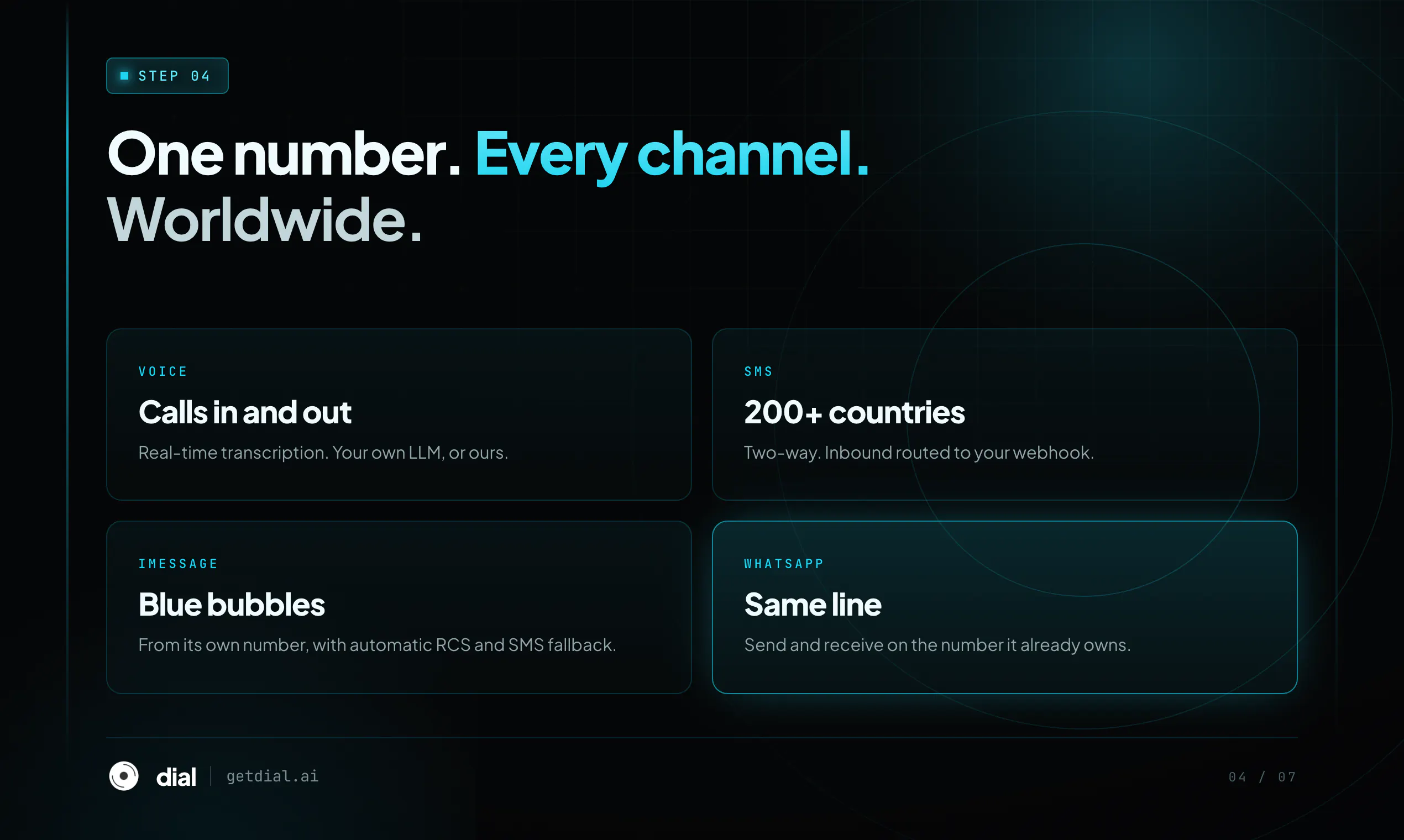
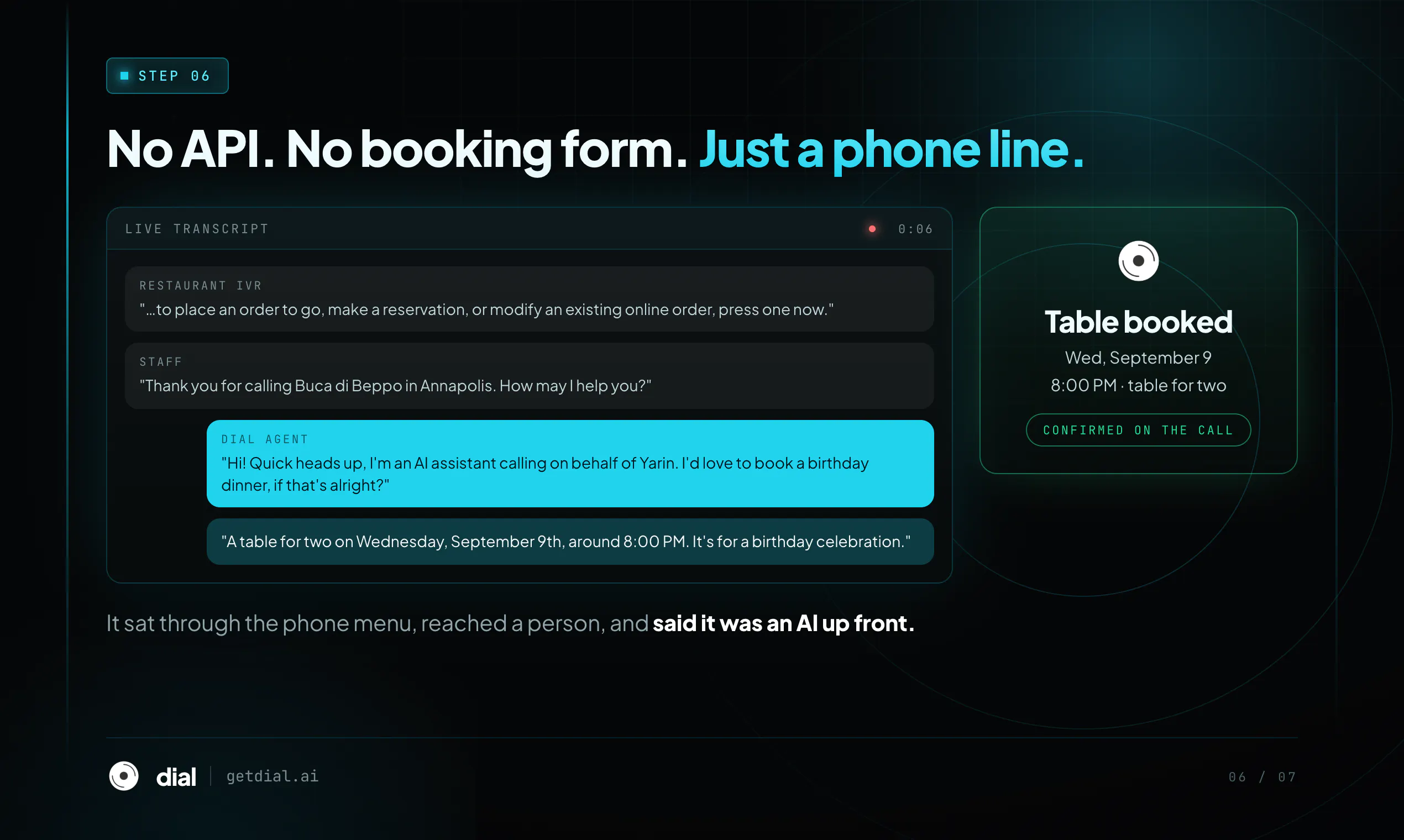
- Place and receive voice calls, with real-time transcription, using your own LLM or ours
- Send and receive SMS in 200+ countries
- Message over iMessage from its own number, with automatic RCS/SMS fallback
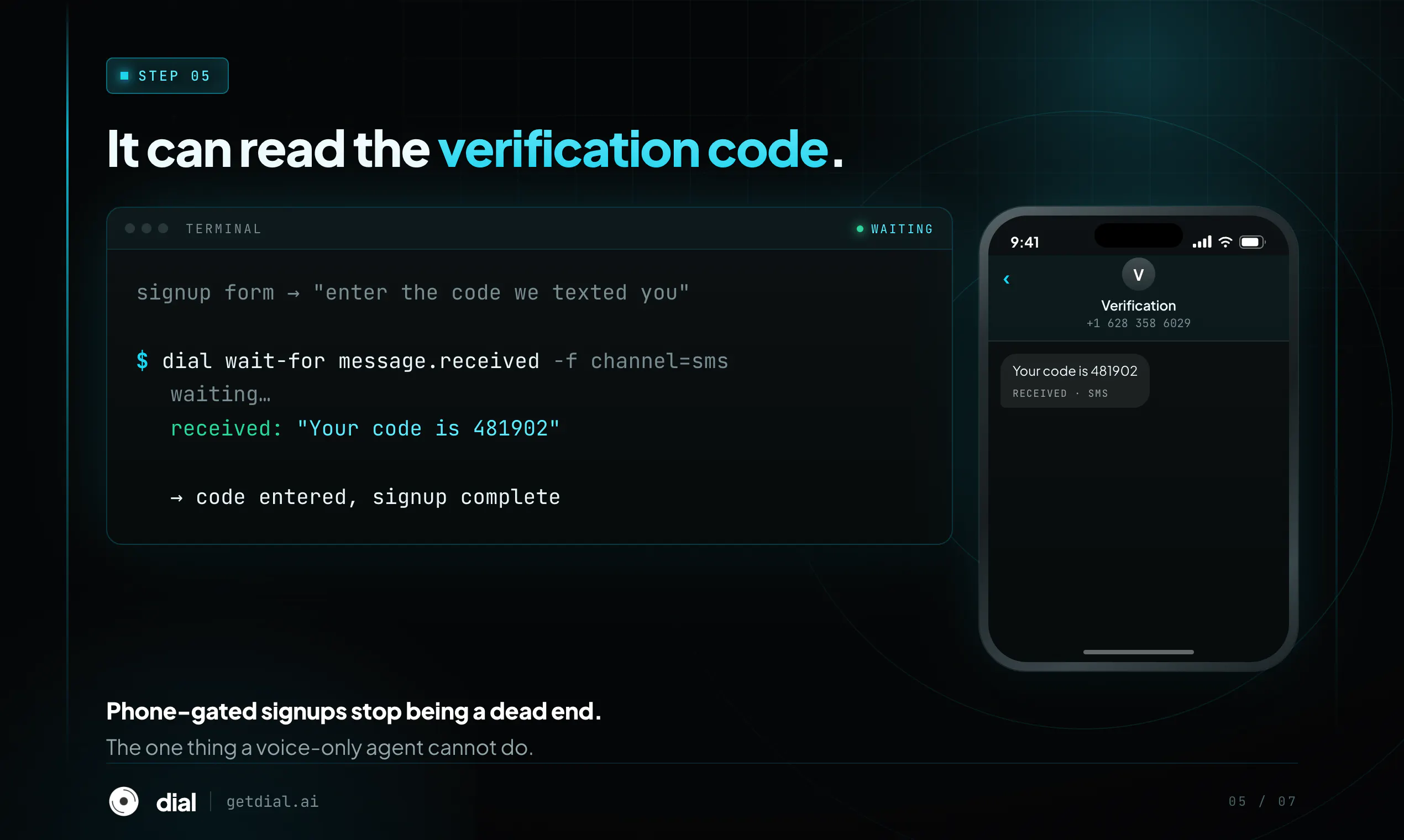
- Read inbound codes, so phone-gated signups stop being a dead end
- One webhook, one format, every channel

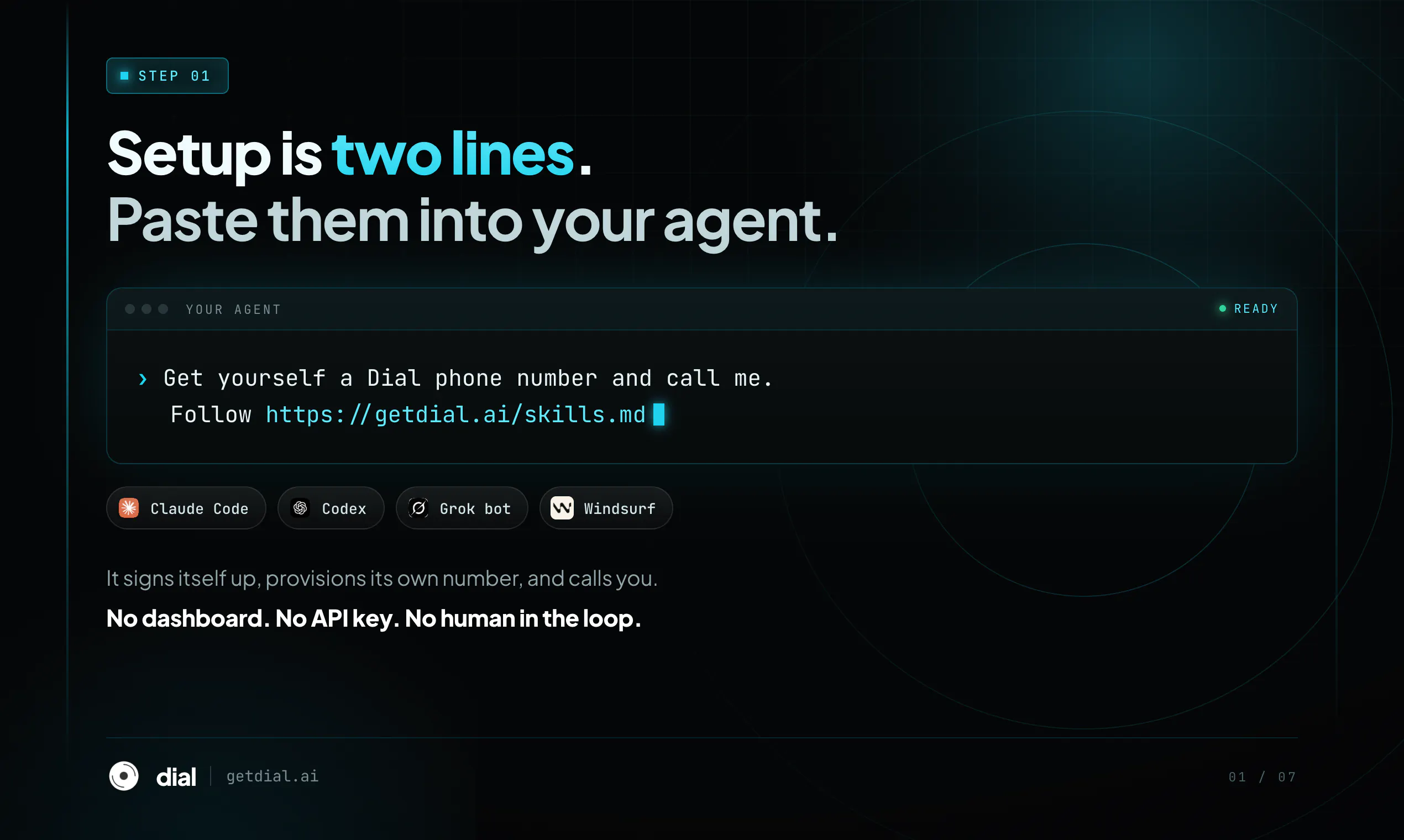
The fastest way to see it: paste this into Claude Code, Cursor, Grok Bot, Codex or any agent -

Get yourself a Dial phone number and call me. Say hello and that setup is working, then ask if I have any questions. Follow https://getdial.ai/skills.md

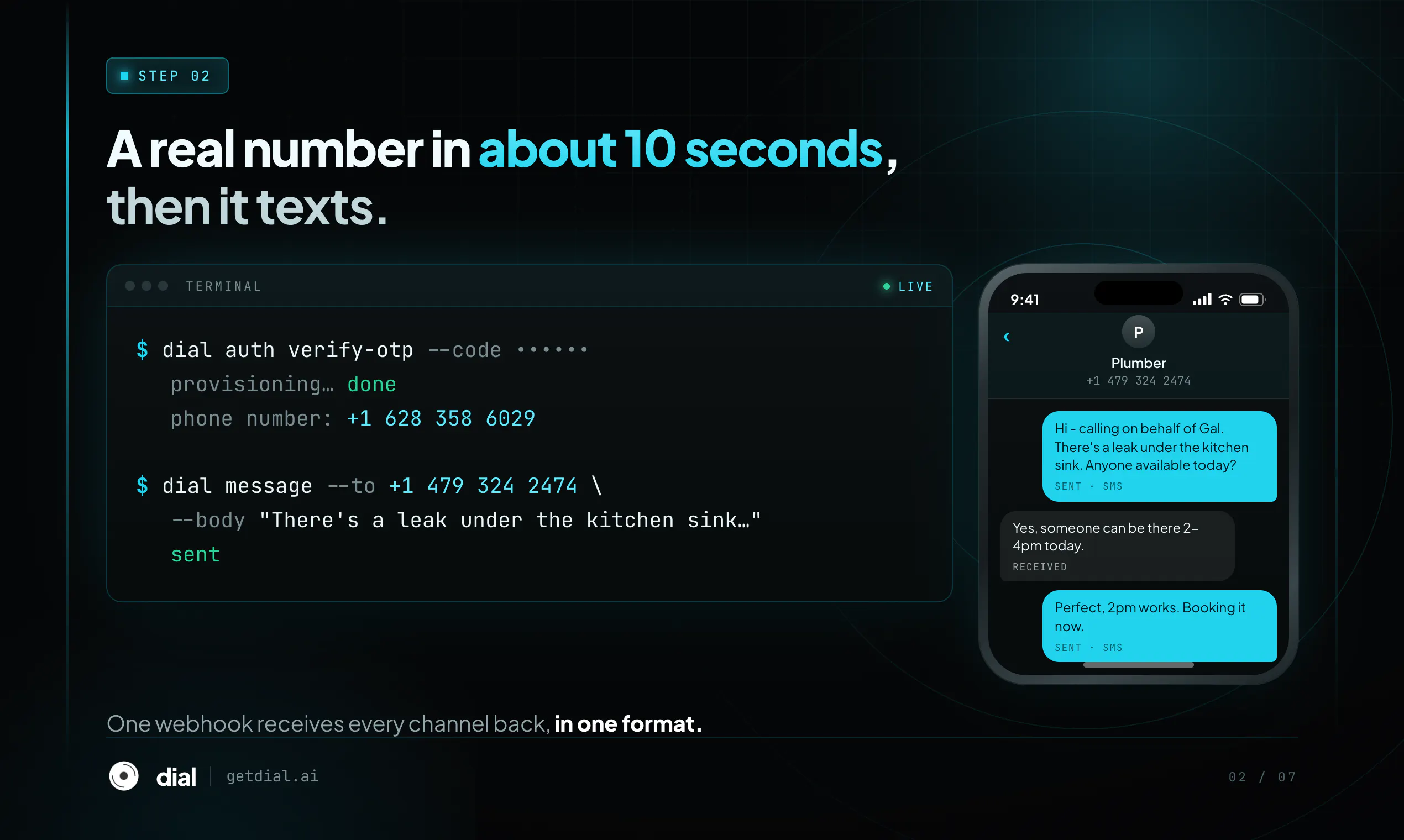
It signs itself up, provisions its own number, and your phone rings. No dashboard, no human in the loop. That's the whole pitch, and you can verify it in about 30 seconds.

We'll be here all day. What's the first thing you'd have your agent call or text? Genuinely curious - the answers to this are how we've picked most of the roadmap so far.

you can also reach us directly at founders@getdial.ai

discord channel - https://discord.com/invite/tEmpesw6GW

8
回复

@galdayan brilliant solution! can I connect it to my claude code and thus I would be able to code via phone calls?

1
回复

Hey guys, this is a super interesting product for a super real problem - makes me question the existence of AI voice agents entirely (and the whole VAD-STT-LLM-TTS stack). Are you using a speech to speech model's API for this?

3
回复

@seomaxtech of course! We must maintain low latency and give it a human-like experience. we've in-house SLMs to decide what's the best s2s model to choose every turn to create a perfect experience!

2
回复

I'm Omri, Co-Founder & CTO of Dial. 👋

A quick look under the hood, because "give your agent a phone number" turned out to be far less of a thin wrapper than we assumed. Three things were genuinely hard:

1. Making the agent the user, not you. No dashboard step, no API key to copy. The agent fetches a skill doc, signs itself up, provisions its own number and starts using it. Everything a human would click, it does over the same API.

2. One shape for every channel. A voice call, an SMS, an iMessage and a WhatsApp message are four completely different beasts underneath. They all come back to a single webhook in one format, so your agent handles one thing instead of four.

3. Letting an agent wait. dial wait-for message.received blocks until the text lands and hands the code back. That is what turns a phone-gated signup from a dead end into just another step.

Setup is two lines pasted into any agent:

Get yourself a Dial phone number and call me. Follow https://getdial.ai/skills.md

$5 in credit on signup, no card.

I'm around all day. Especially curious what people want the webhook payload to carry that it does not yet.

3
回复

Love it! Can I add this to my MCP and connect it to my db?

2
回复

@serenalam Absolutely! thats exactly our context mcp feature

you can just add our docs to your claude code via and it will just take it from there.

claude mcp add --transport http docs-getdial-ai https://docs.getdial.ai/_mcp/server
1
回复

Giving an agent its own phone number feels weirdly obvious after seeing this 😅

Really smart infrastructure layer. Curious how you’re handling number reputation and spam detection as usage scales?

1
回复

@bencohen that’s totally an issue! We have in place automatic risk models that manages each number reputation. Maintaining high reply rate, high calve satisfaction, etc

0
回复

This is a really clean use case for agents. Giving them a real number in seconds feels like a missing piece. Congrats on the launch!

1
回复

@jasper0122 thank you! really appreciate your support! we're both making agents with the right toolkit!

0
回复

@galdayan The first thing I'd wire up isn't a signup, it's the agent telling me it's stuck. My biggest time sink this year is a long Codex run that quietly blocks on a question and sits there for half an hour while I assume it's working. A text when it needs a decision would recover more of my week than anything it's ever got wrong. The thing I'd want to know before building on it is what happens when a number goes bad, whether I get told or whether my agent just silently stops receiving codes and looks broken.

1
回复

@asadmalik901  good question, and it's the one that keeps me up at night honestly. right now if a number goes bad (carrier flags it, gets ported, whatever) you get an explicit webhook event and a dashboard status change, not silence - we designed it that way specifically because "silently stops working" is the failure mode you're describing with the Codex run, and we didn't want to reproduce it. what we don't have yet is a built-in retry/escalation policy (like "if no delivery confirmation in N minutes, page a human") - that's on us to add, we've just been leaning on customers wiring their own alerting off the webhook for now.

0
回复

Interesting. I see on the website that it’s $3 per number. Is that the same in every country, or does the price vary by country?

If I don’t actually need a number but need to make calls in different countries for bookings, do you offer a calling service without having a number associated with it? If so, how much does it cost?

1
回复

@natalia_iankovych not same pricing, you can contact founders@getdial.ai and we will take it from there

And yes we do offer that service

0
回复

Seen that product being built from the ground up!
Instead of stitching together a bunch of legacy solution - twilio,vapi and the alikes - you can spin up a number within minutes. The 10DLC feature is the killer capability imop

1
回复

@nvoitenkov thank you so much for your continuous support!

0
回复

Pretty Dope @galdayan , This is a sign we are about to go full on Sci Fi and define what the new Sci Fi looks like. I know gated estates that uses a GSM module where the ternants calls the Sim Card attached to the Entrance. Imagine if My agent can handle this when I am a ternant.

Deliveries, Visitors will be able to be handled. Ofcourse this is one of the many usecases.

1
回复

@olebogeng_mbedzi this is the best use case anyone's sent me today, and the bit you picked out is exactly what makes it work.

Two things line up:

You can point a number's inbound behaviour wherever you want with

dial number set --inbound-instruction "..."

so the gate calls your Dial number and your agent picks up instead of you.

And the agent can press keypad digits mid-call. We built that for phone menus, but it's the same thing a GSM module at an entrance is waiting for. So it hears the courier, decides, presses the digit, gate opens. No integration, no new hardware, just a number the module already knows how to dial.

Deliveries and visitors sorted while you're in a meeting beats getting interrupted every time.

0
回复

the dial wait-for message.received bit is the actual unlock, not the number itself. does the agent see the whole sms or just the extracted code?

1
回复

@niveditha_patluri1 the whole sms. your agent can decide what to do next

0
回复

Love this product so much, from the moment I started reading the docs!

The simplicity, the reliability, the call quality and the customization capabilities are very impressive!

1
回复

@miki_manor thank you for trusting us! I hope your agent loves us at least as much as you!

0
回复

Ofek here, one of the builders

the moment that still get me:


1. you tell your agent to get a phone number,
2. register with a OTP in chat
3. walk away
4. boom a minute later your own phone rings. No dashboard, no signup form, no one clicking anything,

1
回复

@ofek_ben_yaish1 agents rule the world!

0
回复

Been using this since the early builds.
I don't sit and wait for Claude to finish anymore- it just texts me when it's done, or calls if it needs a decision from me🔥🧑🏻‍💻

1
回复

@yarin_dayan great usecase!

1
回复

how does the 10dlc works? do I still have to wait weeks to get approved?

1
回复

@or_stav that's the beauty - no one should be a telecommunication engineer/legal. regulations are sucks. we provide fully managed 10dlc and we just launched our Self-Healing 10DLC - it gets approved in 1-3 days (instead of 10-15 days)

0
回复
#8
RoundOS
Free Docsend alternative
135
一句话介绍:RoundOS是一款免费、无水印的虚拟数据室(VDR)工具,为创始人提供带NDA门控、水印和逐页分析功能的文件分享服务,解决融资过程中高额订阅费和繁琐销售流程的痛点。
Sales Venture Capital Fundraising
虚拟数据室 文件分享 融资工具 免费替代 DocSend竞品 访问控制 水印保护 链接追踪 逐页分析 NDA门控
用户评论摘要:用户认可免费模式和无席位限制,关注链接过期与撤销功能(已确认支持)、下载追踪与二次分享的监控能力(已回应可实现)、Drive/Dropbox集成及自定义域名(列入路线图)。创始人回应积极,但部分用户对“永久免费”的可持续性存疑。
AI 锐评

RoundOS用“基础设施免费,增值服务收费”的逻辑切入VDR市场,这并非创新,而是对DocSend等旧势力定价权的精准解构。创始人从“自掏腰包45美元看谁打开了自家PPT”的愤怒出发,切中了早期融资者最痛的场景:不是功能不够,而是为基本生存功能付费太荒谬。产品策略清醒——数据室是获客漏斗,真正的付费点“Operator”(AI起草跟投邮件)才是利润池,这避开了与巨头正面拼功能深度的陷阱。

但“免费永久”是把双刃剑。评论区叫好声集中于价格而非产品粘性,说明用户心智中RoundOS仍是“便宜”而非“必用”。VDR场景天然低频,融资季结束即弃用,免费如何转化为持续付费,是未解之谜。此外,链接追踪、水印等基础能力已是大厂标配,Drive/Dropbox集成尚在路线图,意味着目前只能靠手动上传文件,这在尽调文件动辄上百份的真实场景中效率存疑。

真正的护城河不在于“免费”,而在于能否将数据沉淀为对融资进程的智能洞察——比投资人多等三秒翻开哪一页更重要。若Operator仅是简单邮件模板生成,那它和免费房间一样,都只是昂贵获客的代价。建议警惕:当所有竞品都开始提供免费层时,RoundOS的差异化阵地在哪里?评论区无人提问API或安全认证(如SOC 2),也暗示其当前客户集中于早期而非企业级,天花板清晰可见。聪明,但需证明自己不只是一次性的“反DocSend情绪变现”。

查看原始信息
RoundOS
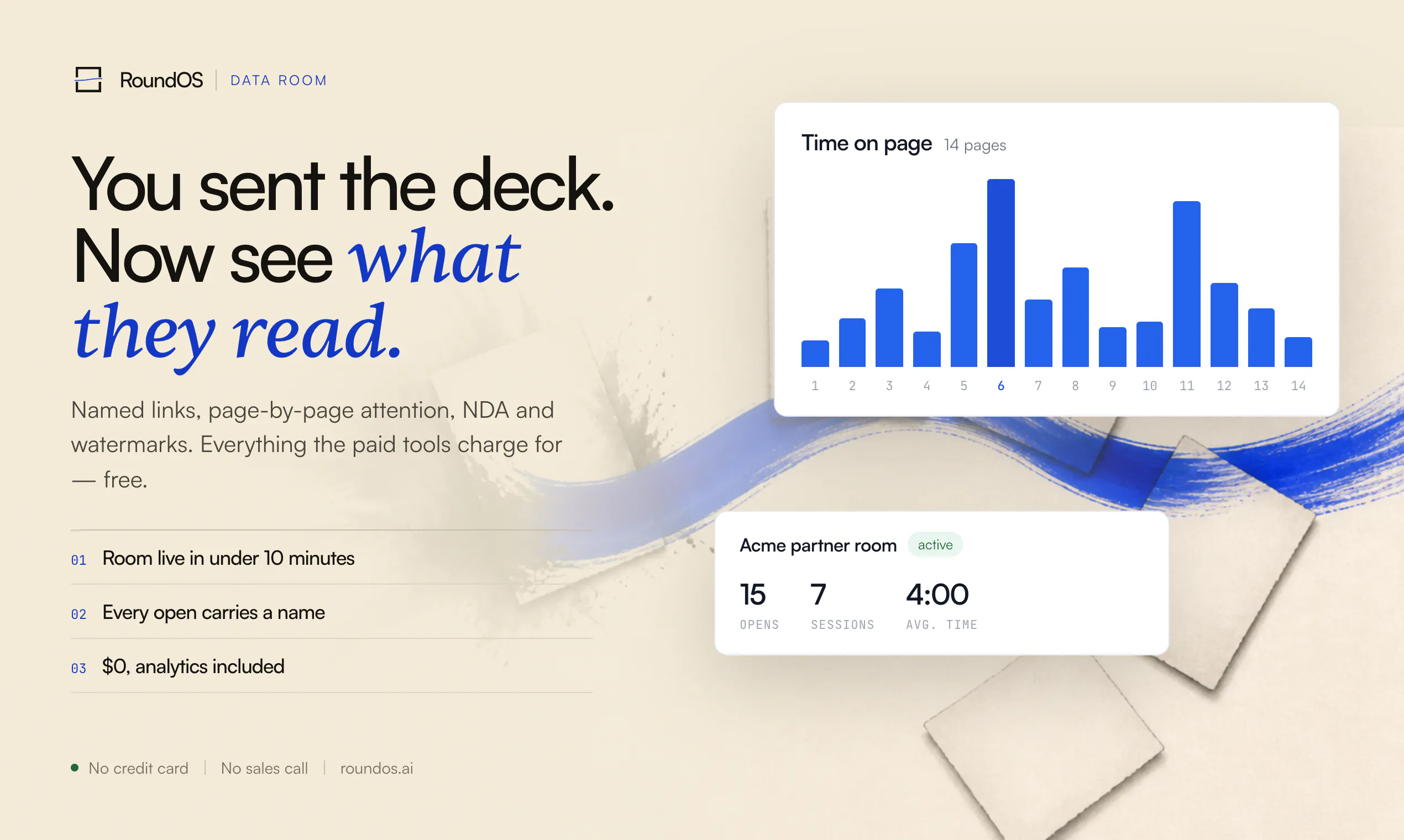
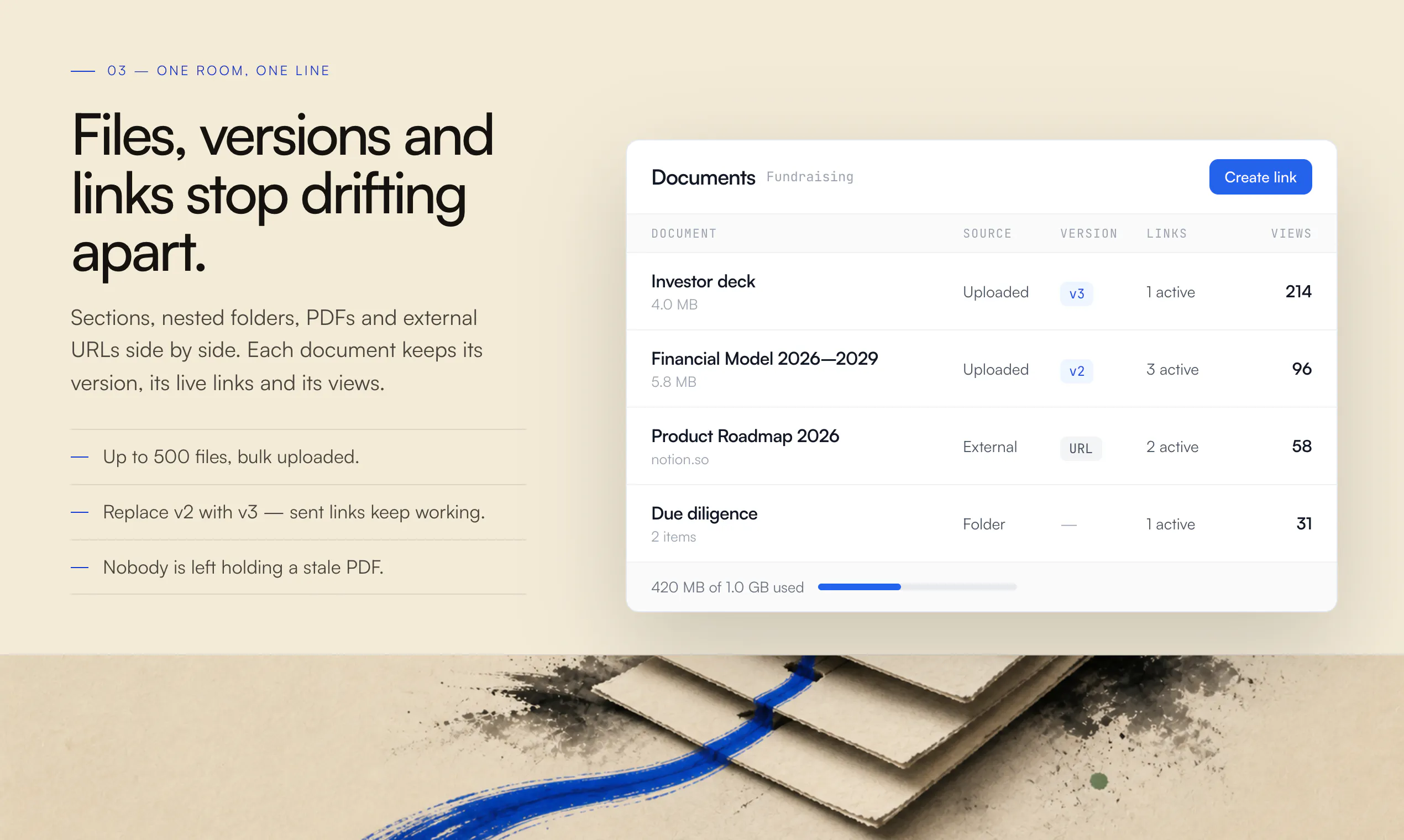
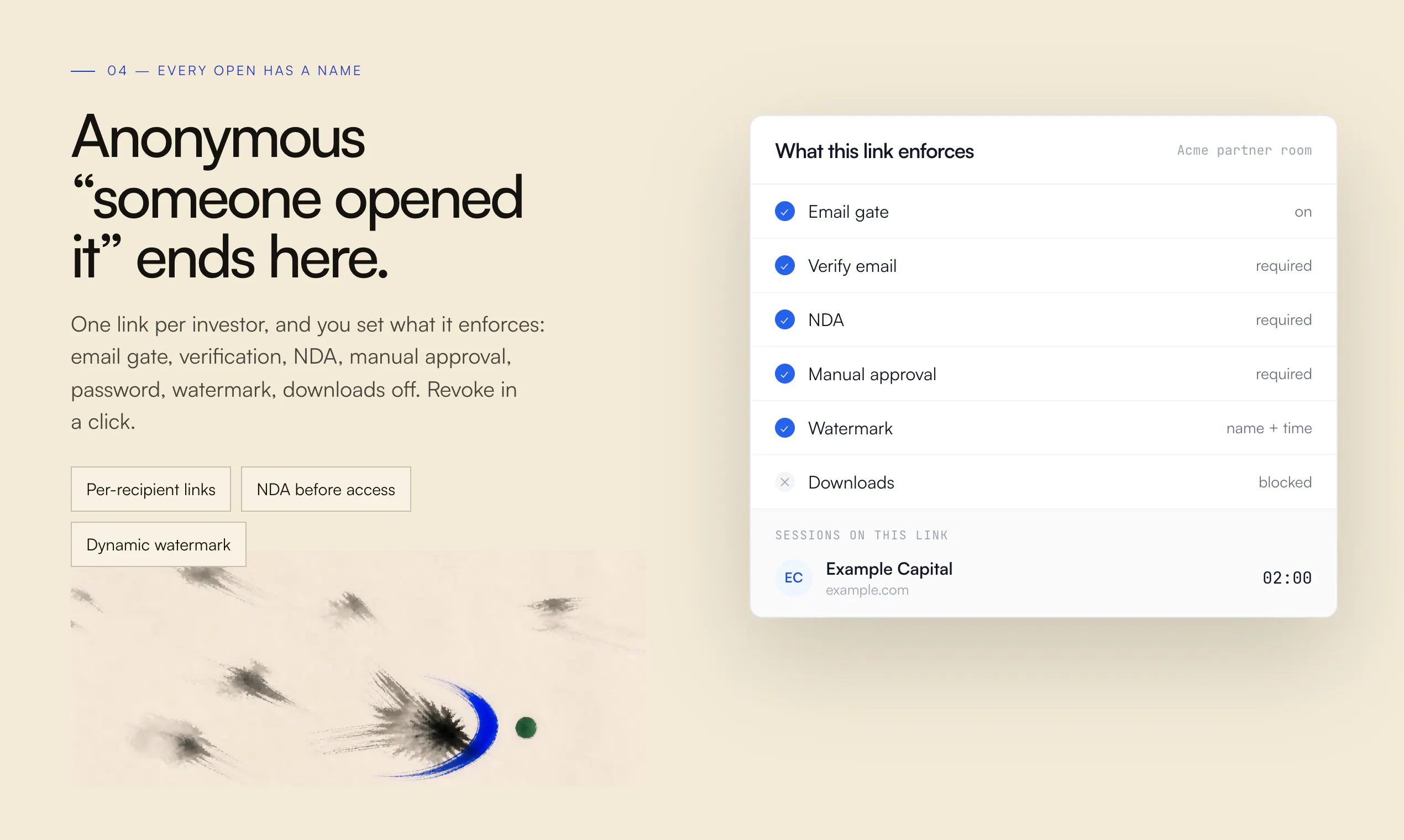
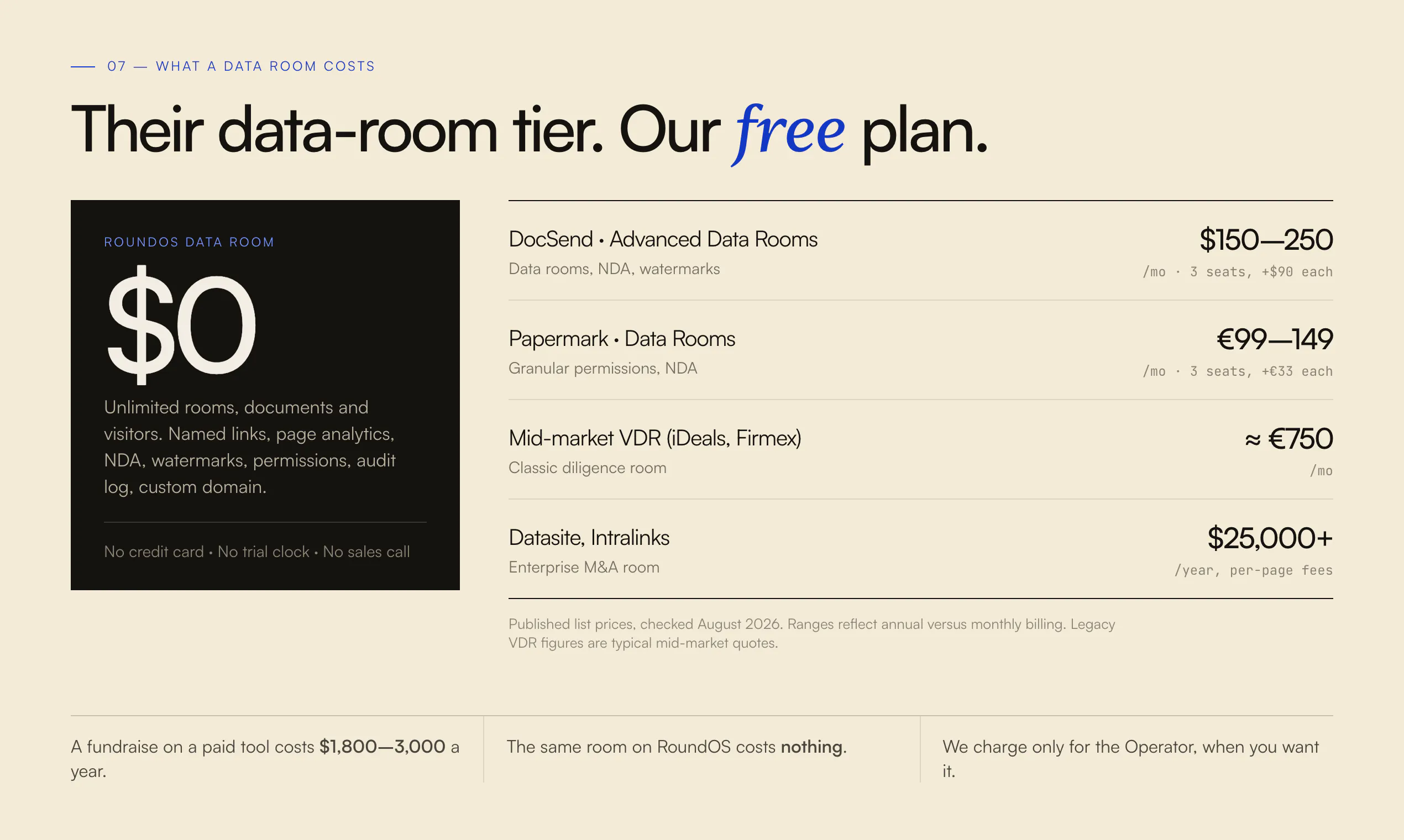
Stop paying for basic infrastructure. RoundOS Data Room: free, forever — the real alternative to DocSend, Papermark, and every other VDR. Share the deck, build the diligence room, gate it with watermarks and NDAs, and read the analytics behind every open. All of it, free.

Hey Product Hunt,
I'm Dmitry, co-founder of RoundOS.

We built this because we got tired of paying $45 (sic!) a month to see who opened our own pitch deck. That's the whole origin story. We were raising our round, we were paying DocSend, we were pissed.

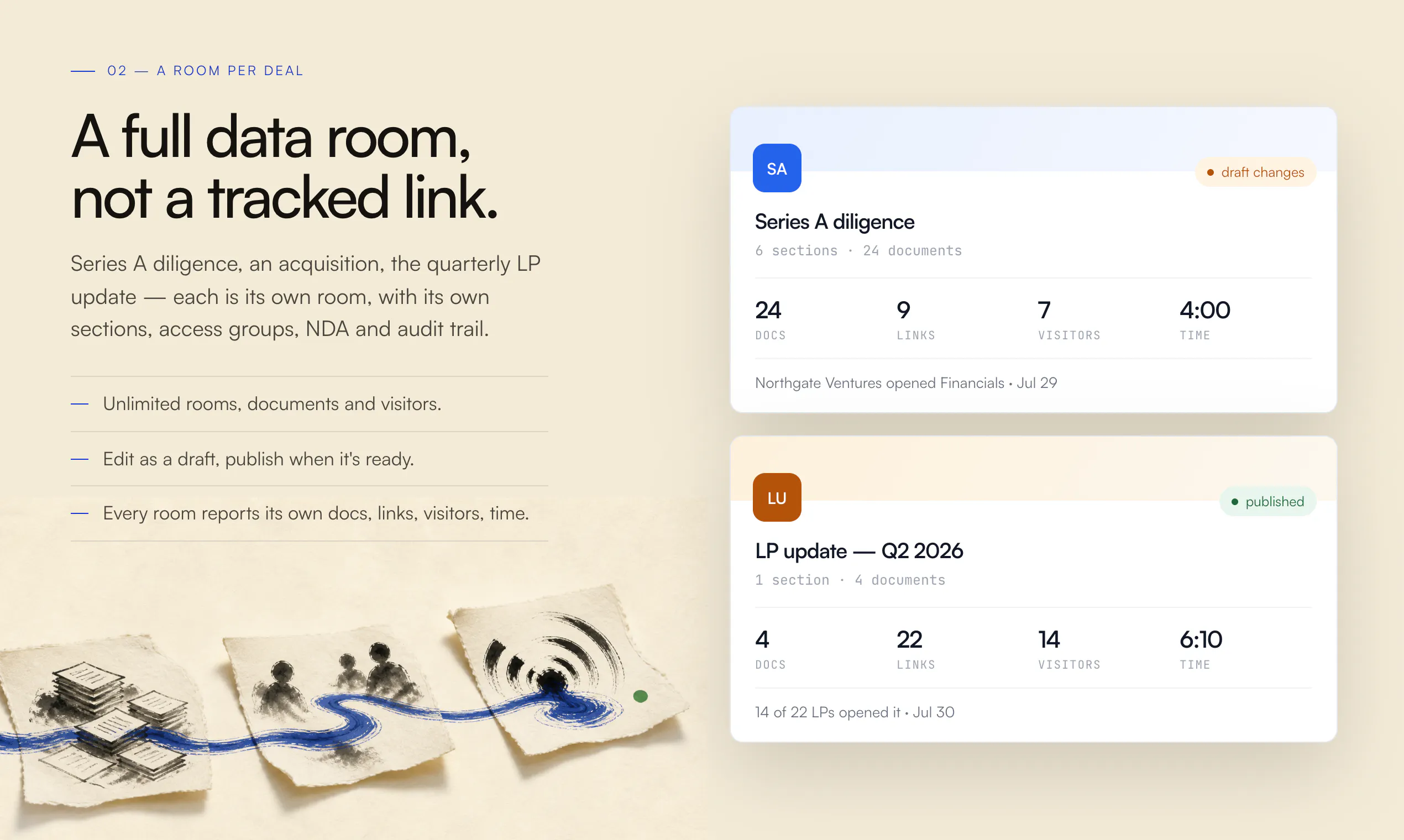
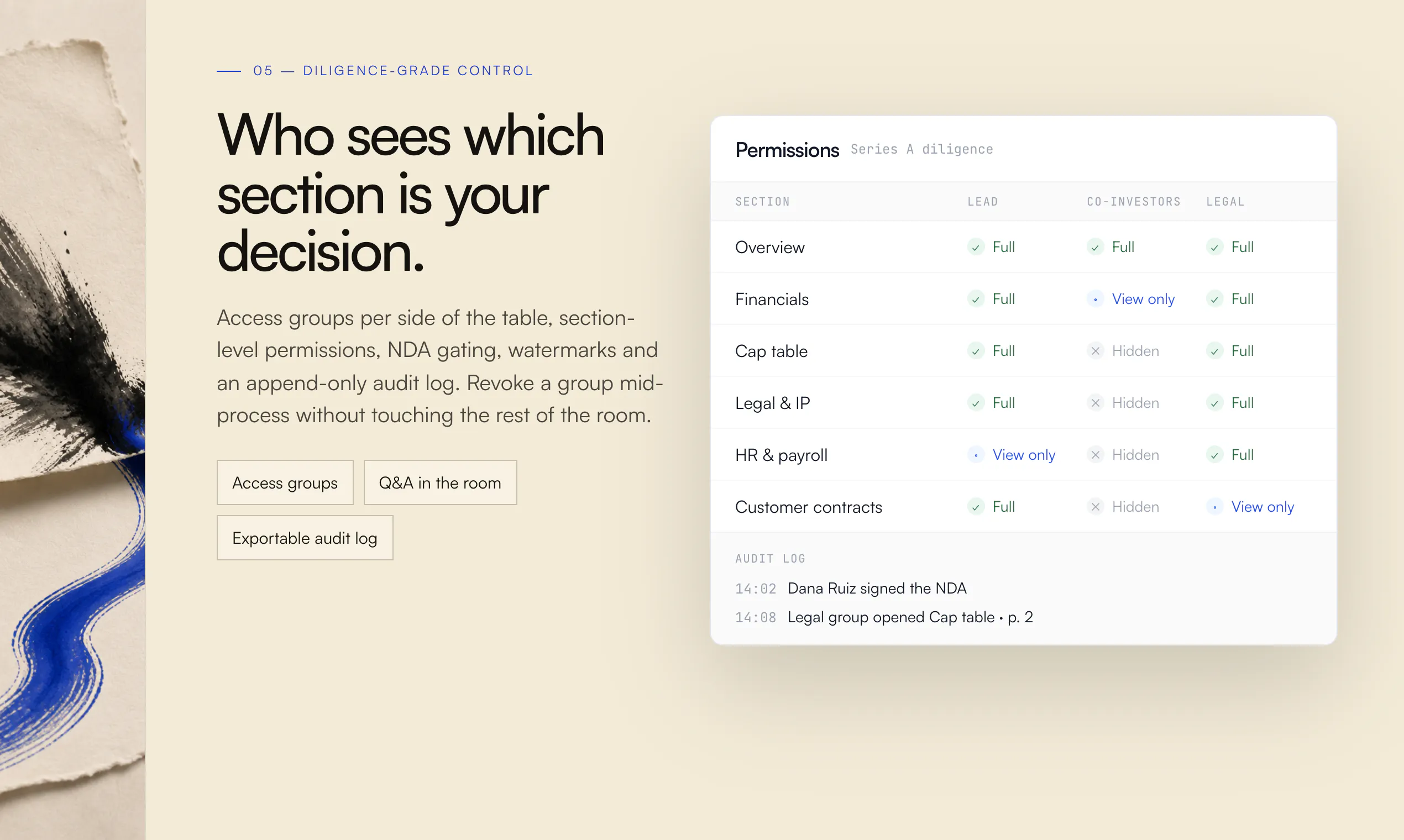
It didn't stop at the deck. Our own investors started asking for the cap table, the financial model, signed agreements, the stuff diligence actually runs on. That's a full virtual data room, and every VDR provider we looked at gates it behind a sales call and a quote. We built that too, and put it in the same free plan: sections, NDA-gating, watermarking, access groups, all of it.

Every data room does the same things: named links, page-level analytics, access controls, and the diligence layer once things get serious. None of that should cost money in 2026. So the whole feature list is free. No card, no trial, no seat limits.

We make money on Operator, a separate product that reads your round and drafts your follow-ups. That part is optional. The room isn't.

What are the other features we need to add? Custom domains?

I'm reading every comment here; feel free to ask questions or report bugs!

9
回复

@dmitry_abramov The no card no trial no seat limits approach is exactly what founders need when they're juggling a raise - kudos for keeping the room itself completely free and making Operator the optional premium side.

0
回复

free forever is a bold promise for this category. I’d definitely be curious to see how the product evolves as more teams start using it.

6
回复

@mahender_ram Commodities should be free in the age of AI.
We are charging for different product, keeping the basic infrastructure free.

0
回复

@mahender_ram I like that you separated the data room from the paid product. For me, keeping the core fundraising infrastructure accessible makes a lot of sense

1
回复

@mahender_ram The no seat limits part stood out to me because data rooms often get expensive once more people need access.

4
回复

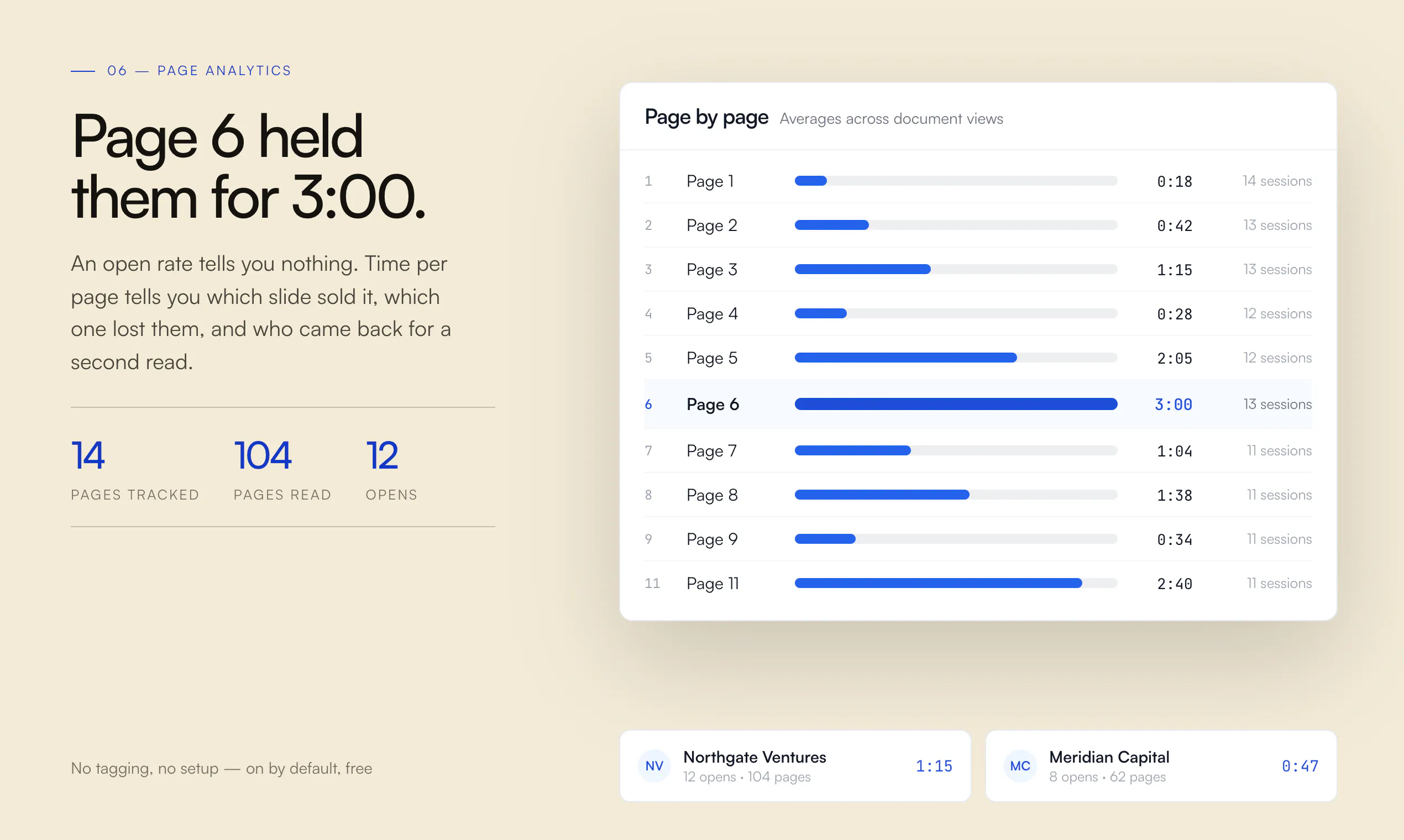
The analytics could be especially useful during fundraising. I’d want to know which pages investors spend time on before my next conversation.

3
回复

@rakesh_gupta20 That is very true! With page-by-page analytics, you can understand what is exactly important for a potential investor. Part of the just focused on the founding team, others are thinking more about numbers, etc...

0
回复

Hey Product Hunt!

Very excited to launch here today!

Fundraising is hard and exhausting enough without having to think about infrastructure and pay for every tool you might need.

It’s especially fun when you’re raising an early round, trying to survive, and still have to pay for basic tools just to run the campaign.

We built our own tool for sharing documents because we needed it ourselves, and now we want to make it available for free.

And we didn’t strip anything out. Customize everything, set up different access levels for different groups and documents, NDAs, watermarks, real-time analytics - you name it.

Just log in, set up your room, and run with it. As simple as that!

Of course, we tried to make everything as simple as possible, but if you find something confusing, annoying, or broken, I’d be very happy to hear about it.

Same goes for feature requests. If there’s something you think a data room should have, tell us!

3
回复

@yaroslav_abramov 

Hello there! Congrats!

Do you support multiple data rooms under one account?

0
回复

Congrats team! Can I set an expiration date for access?

1
回复

@solodnev Thank you!!
Yes, this is possible, each link has its own set of access settings, including the ability to set an expiration date.

0
回复
The “analytics behind every open part” will be really useful will it work even if people try to download and then share or the link will be broken?
1
回复

@harini_mukesh Thank you for the question!
The link will never be broken. RoundOS tracks every visit, even after sharing and re-sharing.
As for downloads, you can either restrict them or allow them, and then the system will track every download by every viewer.

1
回复

Interesting idea. Any plans for integrations with Drive/Dropbox?

0
回复

@artyom_zhuravlev Sure!

Next steps:

  • Custom domains

  • Integrations with Drive and Dropbox

  • Better AI operator for founders

  • Possibly an AI operator for other teams

0
回复

custom domains matter less than link expiry imo. investors forward decks and u lose the room. does the free plan let me kill a link after a set date?

0
回复

@niveditha_patluri1, the free plan allows you to do everything, including killing the link after a set date or even revoking it earlier if needed.
Custom domains will be added soon as well!
Thank you for support!

0
回复
#9
Dyson CameraJet
Precision-floss between teeth while you brush
134
一句话介绍:Dyson CameraJet 是一款将声波刷牙与自动水牙线二合一的智能牙刷,通过内置微距摄像头实时识别牙缝位置,在刷牙的同时精准喷射漱口水锥流,解决用户因懒惰或习惯缺失而跳过独立使用牙线的口腔清洁痛点。
Health & Fitness Hardware
智能牙刷 声波震动 自动冲牙 微距摄像头 牙缝清洁 口腔护理 二合一洁牙 高端个护 Dyson生态 懒人刷牙
用户评论摘要:多数评论认可“自动化牙线”概念,认为解决了“讨厌/跳过牙线”的痛点,甚至牙医也会认可其功能;但质疑点集中于三点:摄像头入浴室存在隐私/怪异感(“Creepy”“Camera? No thanks”),499美元定价过高(“$500 sounds too much”),以及等待镀金版等调侃反映对性价比的不信任。
AI 锐评

CameraJet 的巧妙之处在于把“电动牙刷”这一红海品类,硬生生拉进了“视觉伺服精密喷射”的蓝海——本质上是将Dyson在吸尘器上玩熟的“传感器+微型马达+流体力学”技术栈降维移植到口腔。从工程逻辑看,28 fps识别牙缝并数控喷射,解决的是“牙线使用率极低”这一真实且顽固的行为学问题,而非单纯堆砌参数,这比那些带屏显示刷牙时长的伪智能牙膏牙刷高明一个维度。

但它的商业逻辑存在致命裂缝:核心用户画像错位。最需要自动冲牙的是牙周病患者、正畸人群或老年人,而这些人对499美元价格的敏感度极高,且未必愿意在嘴里放一个带摄像头的精密电子设备(清洁、消毒、寿命均是隐患)。相反,愿意尝鲜的科技极客和Dyson粉丝,通常口腔状况较好,他们购买的理由更多是“酷”而非“必需”——这导致产品陷入“既不够医疗级严谨(无法替代专业冲牙器压力),又不够消费级亲民”的尴尬区间。

摄像头进浴室引发的隐私吐槽不是笑话,而是产品信任的潜在裂痕。即便Dyson强调画面仅用于识别牙缝,但“Always-on Camera”在现代消费者心理中的默认预设是监控,而非便利。六年的研发诚意值得尊重,但若后续车型(如Gold版)不在售后、耗材成本(专用漱口水罐?)和隐私透明化上做出妥协,它很可能只是高收入洁癖者的玩具,而非改变口腔护理习惯的颠覆者。一句话:工程上很Dyson,产品定义上还不够Dyson——因为它没有回答“为什么要做得这么复杂”之外的“为什么是我必须买”。

查看原始信息
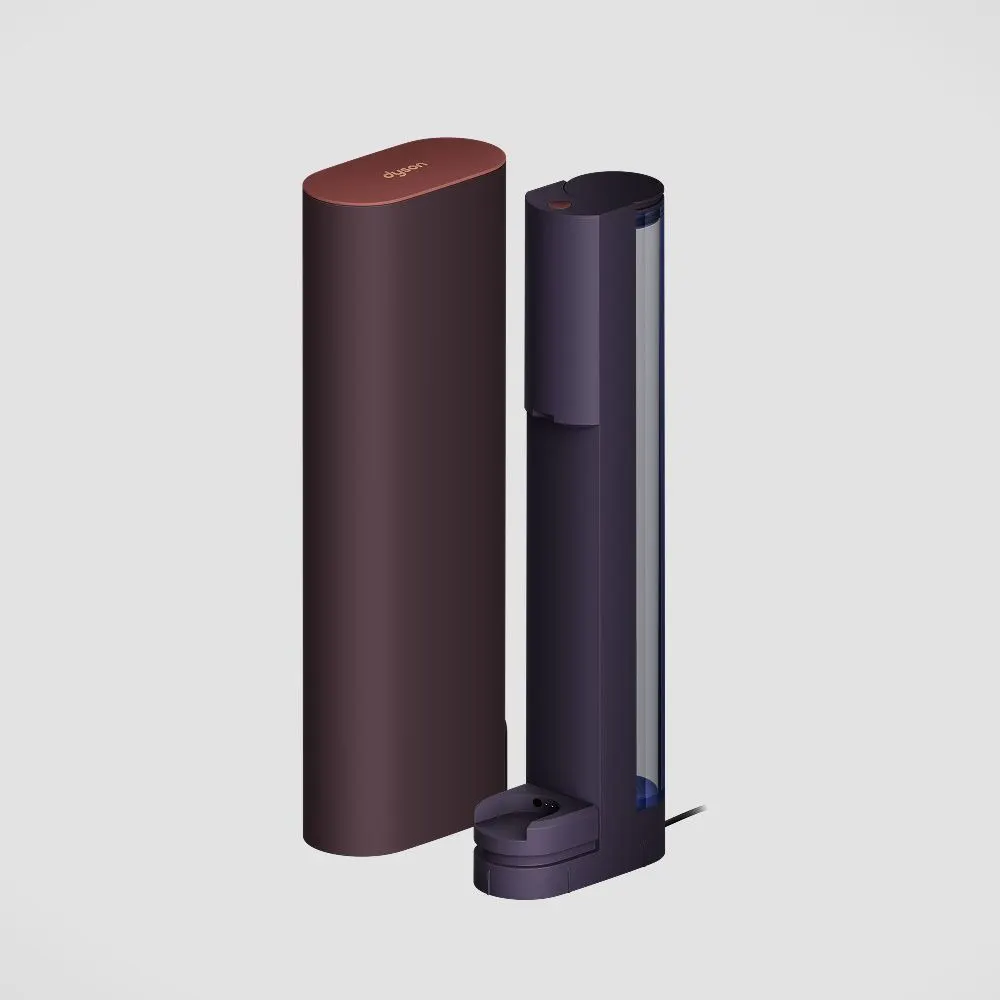
Dyson CameraJet
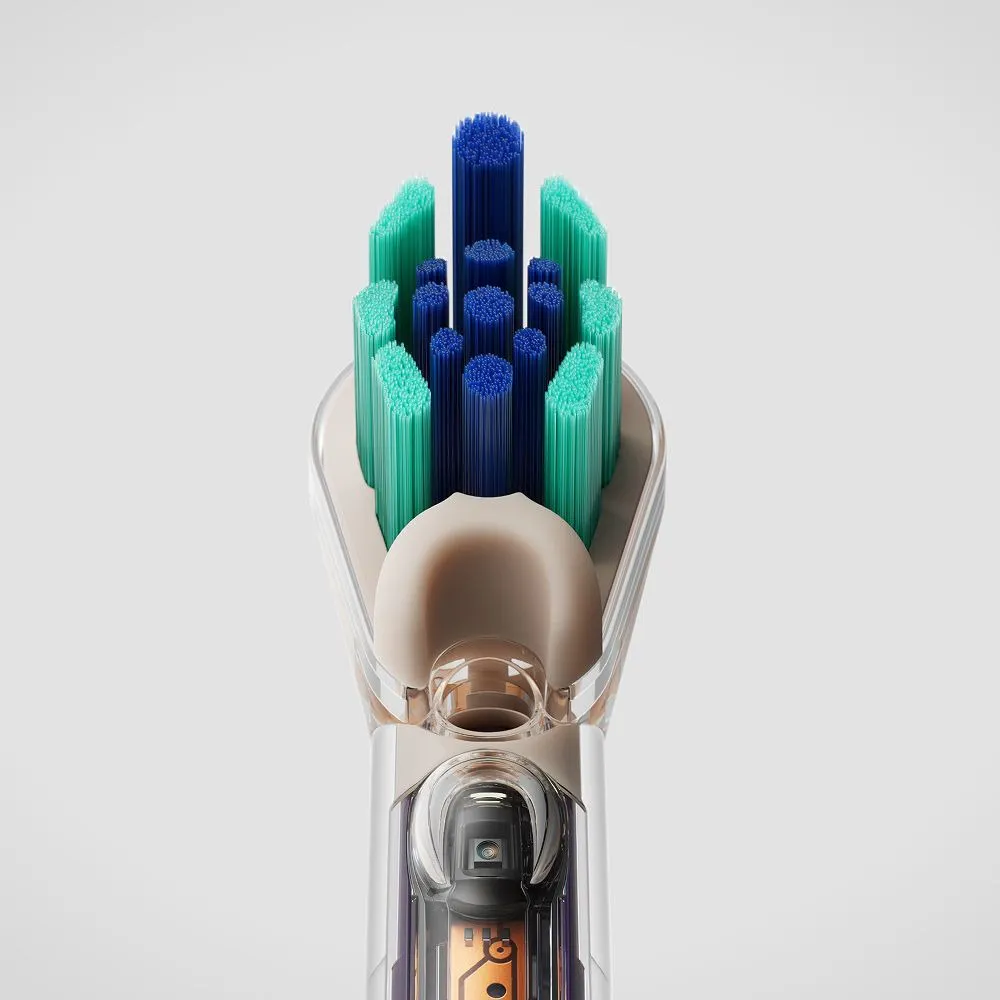
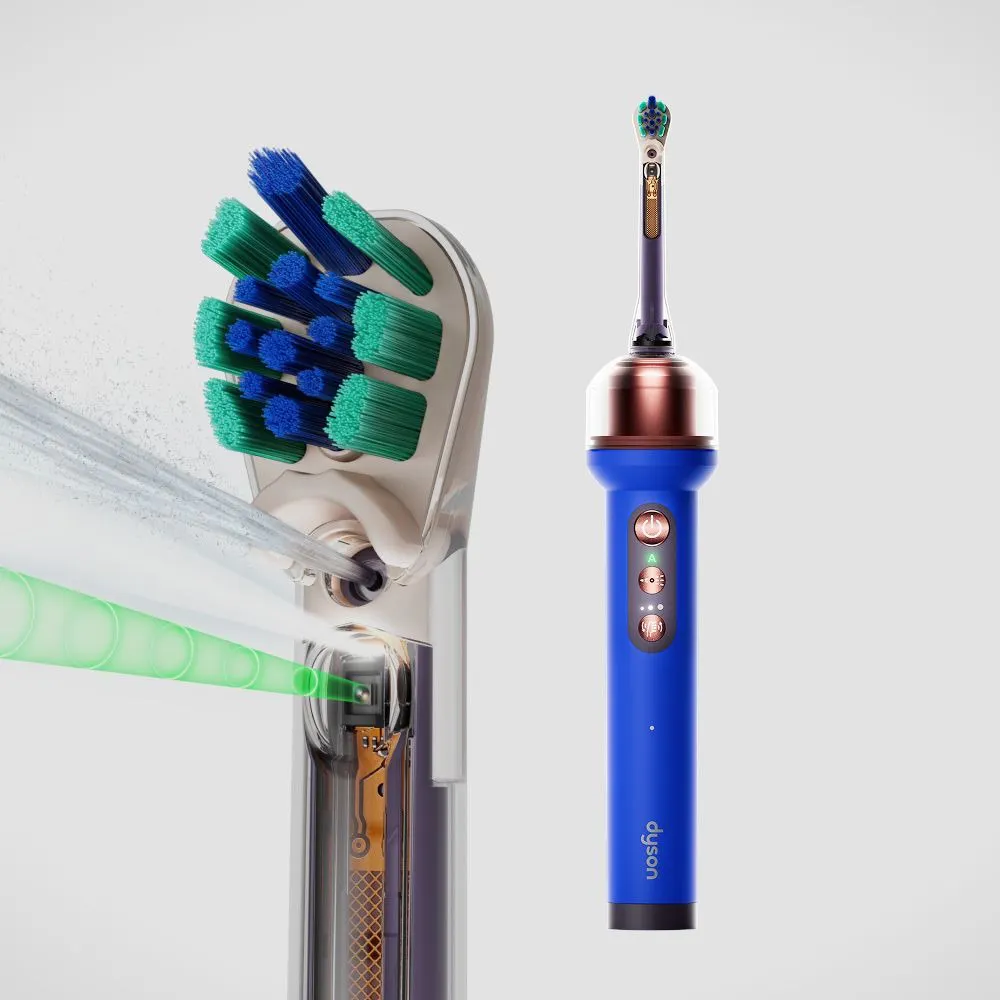
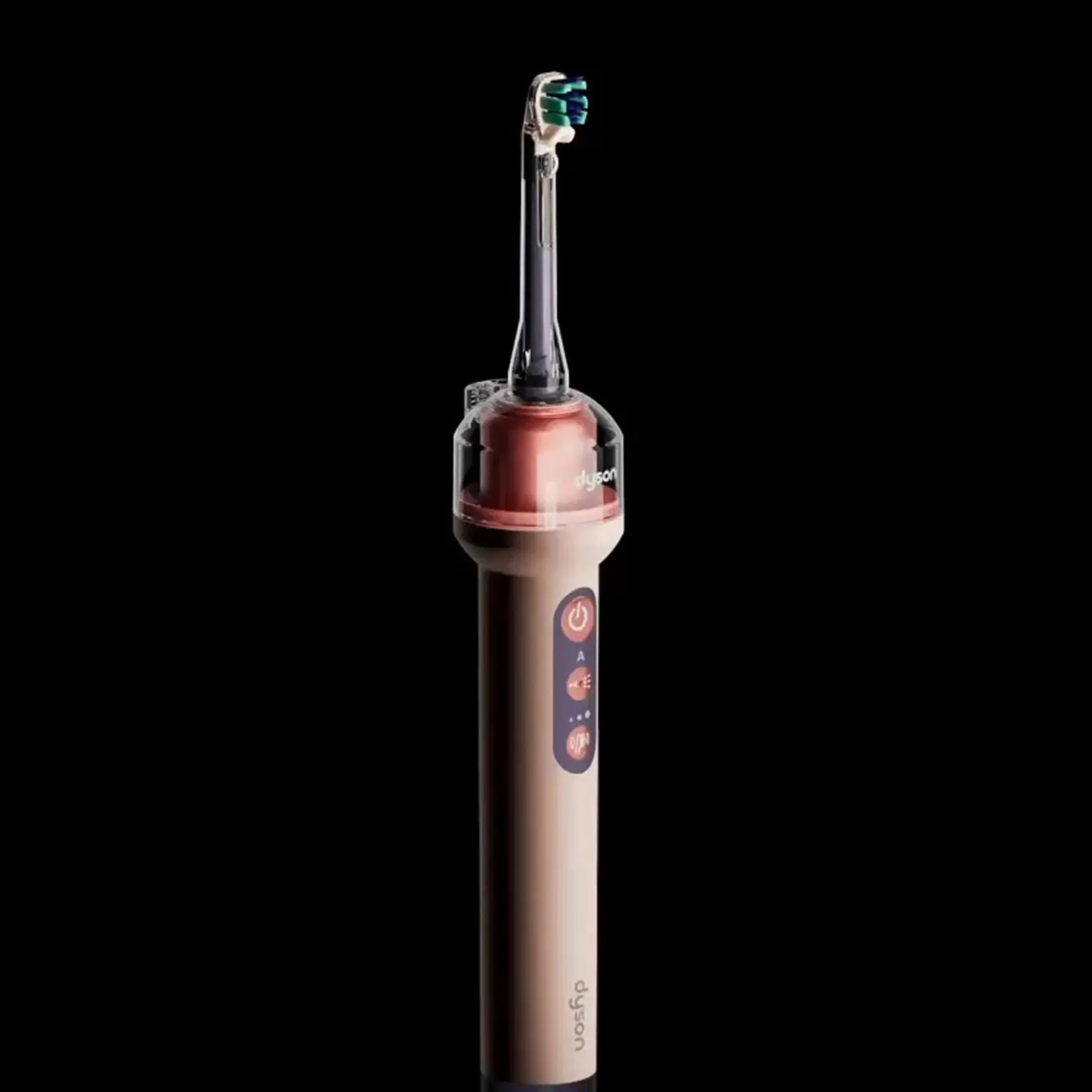
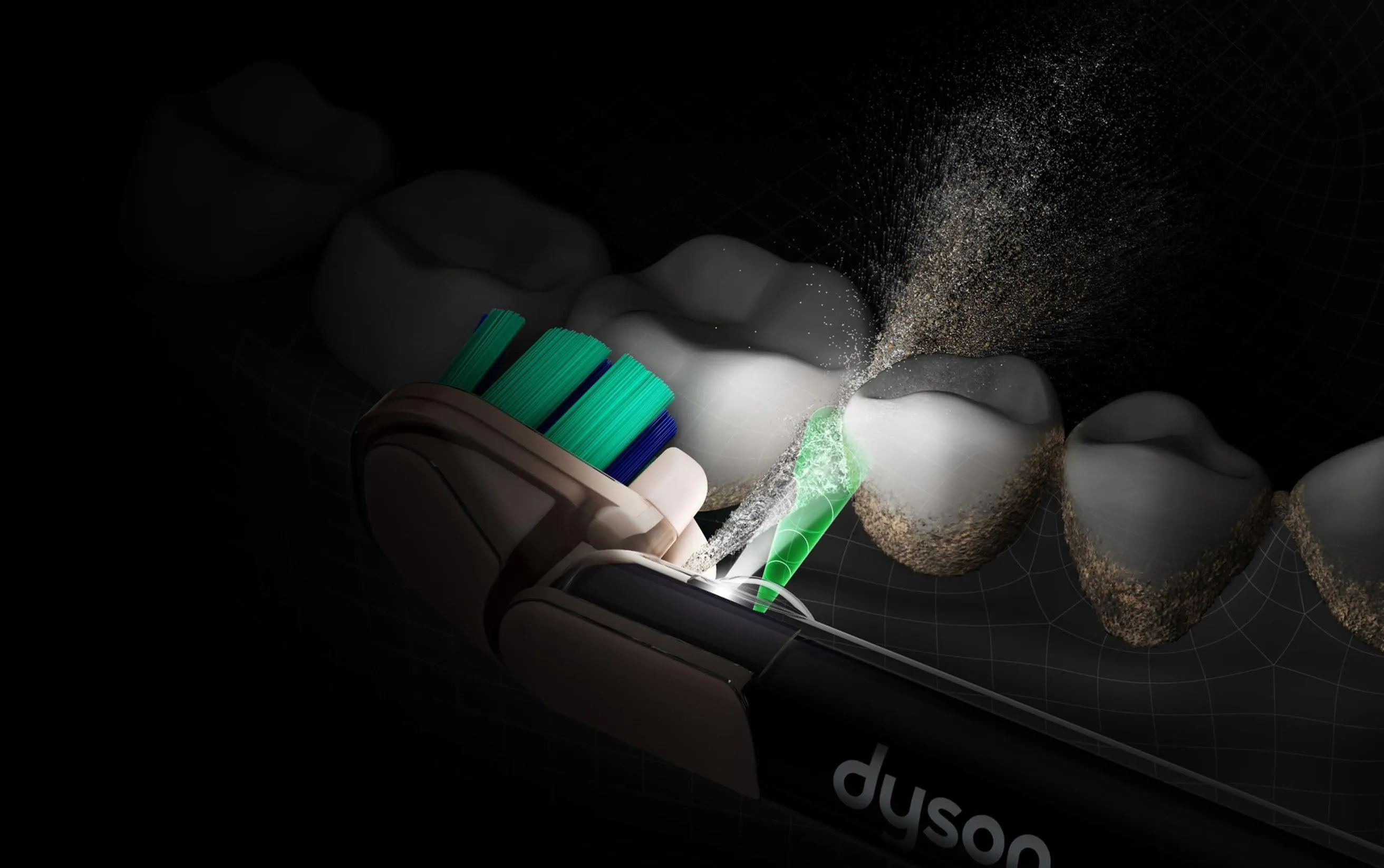
The Dyson CameraJet combines sonic brushing with automated water flossing. An onboard macro camera detects interdental gaps at 28 fps to fire targeted conical bursts of mouthwash while you brush, removing the need for a separate flossing step.

Hi everyone!

A camera inside a toothbrush sounds like overengineering, until you see what Dyson is using it for.

CameraJet watches for the gaps between your teeth as you brush. When it finds one, it fires a small conical jet of mouthrinse into that gap. Brushing and flossing happen in the same pass.

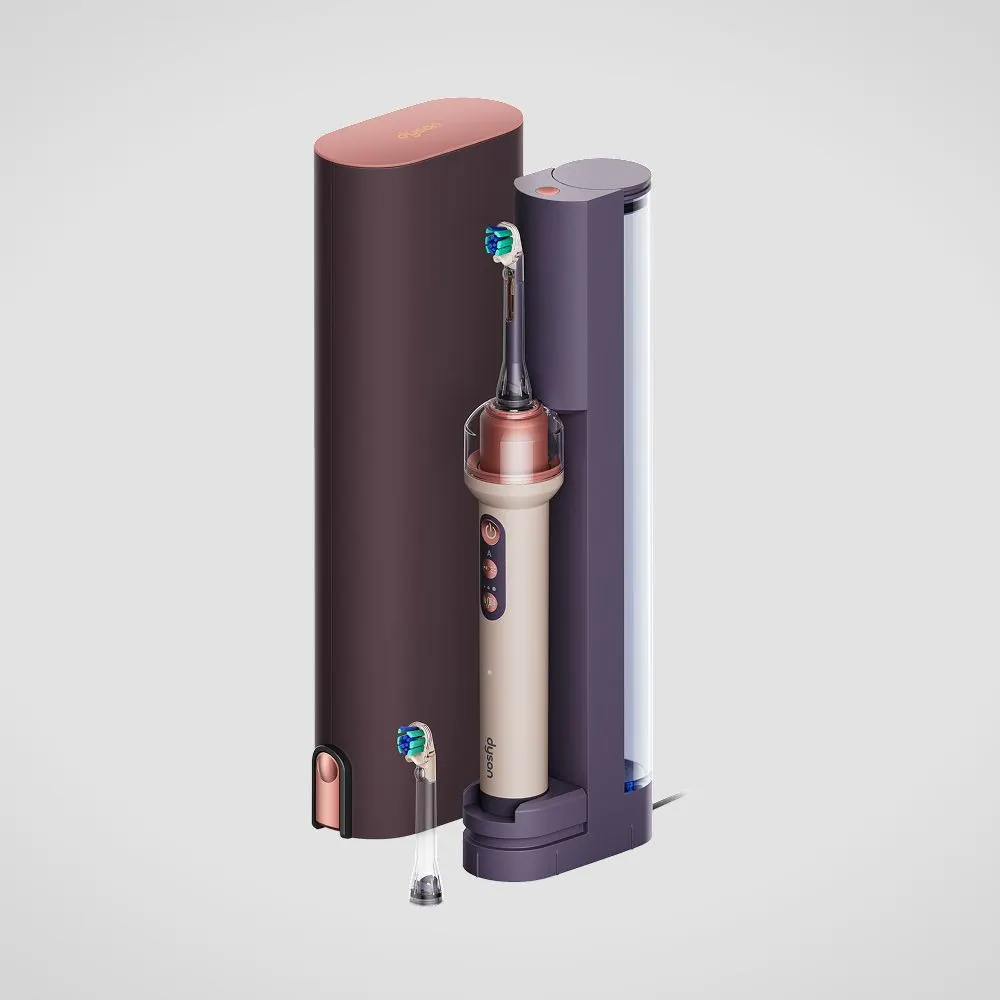
The rest is very Dyson. The tank still jets when the handle is sideways, and the dock refills it in about three seconds. You can stream the camera to MyDyson too, but mostly it’s there to tell the brush where to jet.

$499.99 is a lot for a toothbrush. I still like that they spent six years trying to automate the part of oral care most people skip!😬🪥

4
回复

@zaczuo Some kind of Kärcher wash for teeth =D
~$500 sounds a little too much, but I guess after experiencing it, it could be worth it! And maybe save much more by visiting the dentist less later =/

1
回复

Only thing i'm seeing is that now, you have a camera in your bathroom 😂😂

4
回复

Creepy. I might buy it

1
回复

Woah! This is so weirdly interesting that I wanna buy!

0
回复

Even my dad, who's a dentist, would probably look at this and admit it actually serves a genuinely useful purpose by doing the flossing for you while you brush!

0
回复

Camera? No thanks 😅

0
回复

Why do I want this? Because I hate flossing. Yes...

I'll wait for the gold-plated version.

0
回复
#10
Claude Fable 5.1
Claude’s most advanced models for coding and knowledge work
131
一句话介绍:Claude Fable 5.1 是 Anthropic 推出的新一代旗舰模型,专为长程编码与知识工作优化,通过更低的缓存读取价格、分档推理力度(Low/Medium/High)以及更强的智能体任务稳定性,解决了开发者在高强度 AI 工作流中“能力够但成本失控、长任务易断、误报频繁”的核心痛点。
Developer Tools Artificial Intelligence Science
AI模型 编码助手 知识工作 智能体 长程任务优化 成本优化 模型定价 开发者工具 Anthropic 推理加速
用户评论摘要:用户普遍认可 Fable 5.1 的性能与性价比,尤其点赞缓存降价(典型负载省25%,高智能体任务省45%)和Low/Medium模式持平旧版Fable 5的表现。部分用户反映会话配额消耗过快,需多订阅才能持续使用;也有用户对Medium effort在长编码任务中的稳定性存疑,希望更多实测数据。
AI 锐评

Fable 5.1 表面上是一次常规的模型迭代,但细看定价与定位,Anthropic 实际上在打一场“智能体经济”的算账战争。当模型能力趋近天花板,用户迁移的唯一动力不再是“更强”,而是“同样的强,但更便宜、更听话”。Fable 5.1 把成本下降15%-45%作为核心卖点,精准打击了重度AI用户最大的隐性痛点——不是单次回答质量,而是连续调用数小时后的账单与上下文断裂。

值得注意的细节是评论中反复出现的“配额耗尽”现象。这说明即便模型成本下降,用户消费量却因体验提升而同步膨胀,实际支出的天花板并未击穿。这是Anthropic的定价策略中一个微妙的心理博弈:降低单价以刺激用量,再通过订阅分级收割重度用户——已有用户自曝为绕开配额限制购买多个订阅,这种行为本质上是对“算力民主化”口号的反讽。

从技术价值看,Fable 5.1 的低/中力度模式更值得关注。它不再要求用户为所有任务全功率运行,而是允许开发者在架构层面自行编排“高智+低智”混合体(如有用户提到用高配做orchestrator、低配做subagent),这实际上把“模型成本优化”的产品逻辑下放给了应用开发者,是迈向真正AI工作流工程化的关键一步。至于“安全性误报降低60%”之类的声明,在代码审计与自动代理场景中比模型分数更有说服力。

总体而言,Fable 5.1 不是技术革命,却是一次出色的商业化落地补丁。它聪明地回应了市场的真实报价,而非继续堆砌benchmark。但要警惕的是,若Anthropic持续使用“降价+逼配额”的组合拳,用户忠诚度将在下一个容量瓶颈期受到严峻考验。模型的竞争,早已从智商转向了体力与耐性。

查看原始信息
Claude Fable 5.1
Claude’s most advanced models for coding and knowledge work. Their research capabilities also offer an early glimpse of how AI models will contribute to scientific progress.

Hey PH community 👋

Excited to hunt Claude Fable 5.1 today!

Anthropic has shipped a lot of models, but this one reads like a direct response to what builders kept asking for: better results on long, agentic work, real answers on price and data retention, and safeguards that get out of the way for legitimate use.

Here's a terrific example of what it can do. Alex gave it a picture of a property lot. It designed a house for the lot, rendered it, and produced a cinematic walkthrough 🤯

The pricing move is what stands out to me.

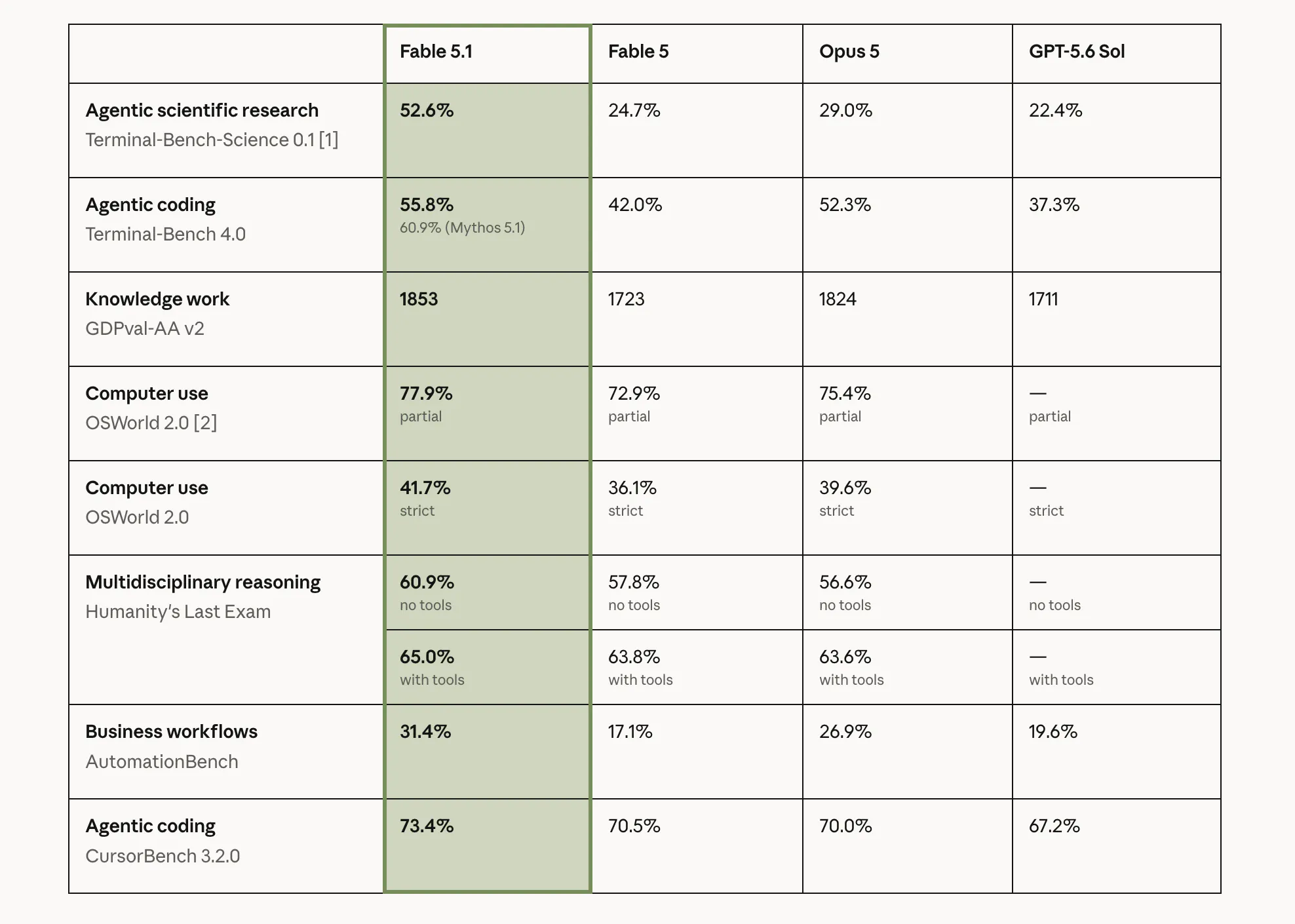
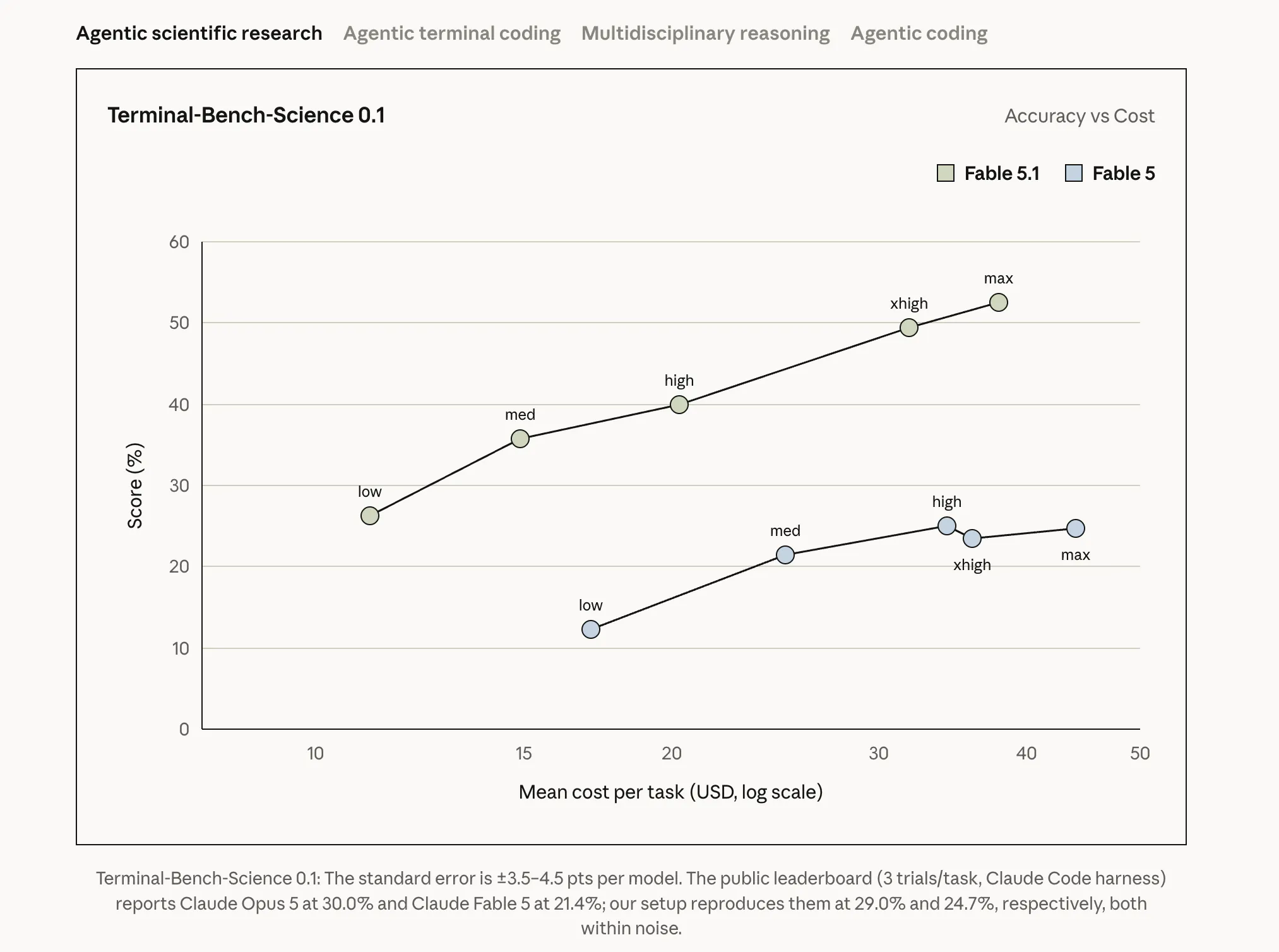
Cache reads got cheaper, so typical workloads cost about 25% less than Fable 5, and highly agentic runs can save up to 45%. Pair that with Low and Medium effort modes that match or beat Fable 5 output, and you're getting more model for less money.

Cybersecurity false positives are down 60% too, which anyone who has hit a wall mid-task will appreciate.

It's also live day one across the major AI gateways, including Netlify's, so you can drop it into an existing stack without touching your keys or config.

Go take it for a spin and tell the team what you build in comments 🚀

8
回复

@thisiskp_ Just restarted Code and got Fable 5.1 as selection. Yay!
If what you say is true then I will start using Fable 5.1 at high as orchestrator with lower effort Fable 5.1 subagents for research and easier tasks (I was using Opus before). Does it make more sense from the token economy pov?

Nothing against Opus 5.0, he is a hard worker too but Anthropic, that child of yours has got some serious ADHD. 5.1 of opus can't come soon enough.

2
回复

@thisiskp_ I like the focus on making powerful models more practical for everyday workloads.

0
回复

i'm seeing things about fable i couldn't believe

3
回复

@fmerian yep same

So many demos on X

1
回复

@fmerian Love it. Using Fable 5.1 max right now in Claude design....wait...used up my session quota....okay pingpong for a couple of hours to wait for it to reset. I will buy another subscription tmrw I guess. How many subscriptions do I need? is 2 enough? 3? :D

2
回复

@fmerian LOL. It was so good. I got another subscription just now. Don't tell Anthropic. I'm not sure its "allowed" 😅

0
回复

@thisiskp_ Love Fable, the example is really terrific !

1
回复

The pricing change is the interesting part. Better models are great until you actually run agents all day and see the bill 😅 Curious how well Medium effort holds up on long coding tasks vs fable 5

0
回复
#11
deepeye by deepidv
The deepfake detector that goes where you browse
116
一句话介绍:deepeye 是一款部署在 Chrome 与 WhatsApp 上的实时深度伪造检测工具,在你浏览网页、查看头像、接听视频或收听语音时,即时标记 AI 生成或被篡改的影像与声音,无需上传、无需后台,在信任发生的当下直接给出真相,解决“眼见不再为实”的新型网络欺诈焦虑。
Chrome Extensions Privacy Artificial Intelligence
深度伪造检测 AI换脸识别 浏览器插件 WhatsApp机器人 实时内容审核 反诈骗工具 音视频鉴伪 网络身份验证 Chrome扩展 隐私保护
用户评论摘要:用户认可“无仪表盘、即时反馈”的轻量设计,认为直击浏览与通信场景中的信任痛点;主要疑问集中在误报率控制、检测模型对新生成式AI的长期抗性,以及背景音乐体验不佳。开发者回应称已通过并联网扫描与会议机器人强化场景覆盖,且与Scam.AI共享数据迭代模型,并暗示行业数据结果具有震撼性。
AI 锐评

deepeye 的价值不在于它又一个“AI检测器”,而在于它精准切入了一个信任已经崩塌的通信现场:LinkedIn头像、WhatsApp语音、视频会议里的脸。当深度伪造从实验室蔓延到招聘、转账、情感诈骗的具体环节时,市场上绝大多数检测方案还停留在“上传文件—等待分析—查看报告”的旧范式里。这种延迟本身就是安全隐患——等你能下载检测报告时,钱已经被转走了。

从产品设计的角度看,deepeye 做对了三件事:第一,把检测能力压缩到“浏览同时”这一毫秒级的动线中,不打断用户原有行为流,这大幅降低了安全工具最常见的“使用摩擦”;第二,刻意放弃仪表盘和上传功能,既是隐私承诺,也是对“安全感”的重新定义——在即时通讯场景里,安全感必须出现在点按“发送”之前,而不是之后;第三,与 Scam.AI 共享数据集的联盟策略,是对抗生成模型迭代加速的务实认错,单打独斗的死路在2024年后已被反复验证。

但锐评必须指出隐患。其一,用户评论中对“背景音乐烦人”和“误报率”的抱怨并非小事——安全工具一旦产生过量的“狼来了”提醒,会迅速招致信任疲劳,最终被用户无意识关闭,那比不装更危险。其二,当前架构依赖 Chrome 和 WhatsApp 的开放接口,这使其在 iOS 生态、Telegram 加密环境或企业私有流量中天然失明,而诈骗团伙恰恰是最先进驻那些“高墙花园”的。其三,也是最致命的质疑:用静态模型武器库去追动态生成的对抗性攻击,本质上是一场军备竞赛,若没有持续学习的沙盒机制和主动投喂的对抗样本生成器,所谓“检测”会在三个月内沦为已经出局的模型的自嗨。评论区那句“会不会被更新的模型秒杀”,不是调侃,是行业正道。deepeye 的方向值得敬畏,但它要跨越的,并非技术精度,而是自身架构的进化速度能否跑赢骗子手中的新模型。目前来看,它跑得快,但还不够快。

查看原始信息
deepeye by deepidv
deepeye flags AI-generated and manipulated images, video, and audio as you browse. Free on Chrome and live inside WhatsApp, it checks the profile photo, the video call, the voice note, in the moment, with no uploads and no dashboard. Built by deepidv, sharpened with Scam.AI Partnership.
Hey Product Hunt 👋 Quick test: the last five profile photos you saw today. How many were real? You don't know. Neither do we, without help. That's the honest state of things: AI-generated faces, voices, and videos crossed the line where human eyes stop working, and they didn't stay in labs. They're on LinkedIn, in your DMs, on your video calls, asking you to accept the connection, take the interview, move the money. So we built deepeye, deepfake detection that goes where you go: 🔍 Chrome extension: flags AI-generated and manipulated media on any page as you browse. LinkedIn included. 💬 WhatsApp: forward a suspicious image, video, or voice note, get a verdict in seconds. ⚡ Real time: no dashboard, no uploads, no waiting. It's just there, telling you what's real. It's free. We build the detection models ourselves at deepidv, and we sharpen them through our partnership with Scam.AI, shared datasets and joint research, because synthetic media evolves faster than any one team can track alone. Two things I'd love from this community: Install it and tell us the first fake it catches for you. Genuinely, that feedback tunes the models. Tell us where you want deepeye next. Firefox? Telegram? Email? The roadmap is listening today. I'll be here all day answering everything. Ask us anything about deepfakes, detection, or the weirdest fakes we've seen this year (there are some stories). Shawn-Marc, and the whole deepidv team 🛡️
3
回复

@shawnmarcmelo I love that there’s no dashboard or upload waiting—it just works in the moment, exactly where trust matters most. How are you keeping false positives low enough that it doesn’t become annoying during regular browsing?

0
回复

@shawnmarcmelo love the video HATE the background music. quite annoying. how confident are you in the detection ability? will this not be superseded or duped within 3 months by newer models? ill give it a go right now.

0
回复

@shawnmarcmelo this is a really practical approach to deepfake detection. I like that it works directly where people actually encounter suspicious content instead of adding any dashboard. congrats on the launch!

0
回复

hi Shawn-Marc the idea of something quietly sitting in the background and giving me a gut check on a face or a voice is genuinely reassuring.
So many messages landing in my inbox lately make me pause, and having a second opinion right there feels like real peace of mind.

2
回复

@amine_aziz_alaoui Were doing our best to clean up the internet and the results of linkedin scans are shocking.

deepeye also offers meeting bots that can detect faceswaps or inauthentic users within the meeting.

4
回复
We should auto install this to phones! Especially that of our grandparents 😅 congrats on the launch
0
回复

Great move partnering with scam.ai for shared datasets, most detection tools act like they're the only ones seeing new fakes. Congrats on the launch!

0
回复
#12
Stitch AI by Dynamic Mockups
The first embroidery digitizing agent
116
一句话介绍:Stitch AI 是一款将平面图案自动转化为刺绣机可执行文件(DST/PES/EXP)的AI智能体,在15秒内完成专业打版师需一天才能完成的刺绣制版工作,解决了个性化定制(POD)卖家因打版成本高、周期长而不敢接刺绣订单的核心痛点。
Design Tools Artificial Intelligence E-Commerce
AI刺绣打版 embroidery digitizing POD自动化工具 机器文件生成 AI设计助手 产品打样预览 服装定制SaaS 智能制造 刺绣生产优化 创意设计工具
用户评论摘要:用户普遍认可其解决了POD行业长期痛点,认为对设计师和DIY卖家极其实用。核心质疑来自专业打版师:担心AI输出在复杂绣品上缺乏逐区域的“置信度”标注,导致生产时出现褶皱等问题,认为预览与真实机绣效果存在差距。官方回应强调预览可同步验证,但未正面回应置信度需求。
AI 锐评

Stitch AI 的价值并不在于“替代打版师”,而在于将刺绣打版从“按件计酬的慢定制”变成了“可规模化的快消品”。它精准切中了POD行业利润最薄弱的环节——小批量订单因打版成本过高而被拒之门外。从商业逻辑上,这无疑是个聪明的切点:将原本$10-50的单次打版成本压至近乎为零,直接释放了长尾的刺绣定制需求。

但必须泼一盆冷水:评论区那位专业打版师的质疑,恰恰戳中了产品的命门。官方巧妙地将“机器文件”与“预览”捆绑销售,试图用“所见即所得”来化解用户对生产风险的恐惧。然而,刺绣的失败往往发生在张力、缩水率与多层色序叠加的物理层面,而非视觉层面。一个在屏幕上完美的文件,在真实布料上变成第三色序的褶皱废品,这种代价依然由用户承担。产品目前提供的“生产单”和“密度热力图”是好的开始,但在关键的生产可靠性反馈上,仅靠“预览让你自己发现问题”是不够的,这本质上把质检风险转嫁给了用户。

此外,从评论反馈来看,其核心受众其实是“Pinterest上的手工妈妈”和POD新手卖家,而非大型刺绣厂。这决定了Stitch AI短期内的天花板是那些追求快速试错、单笔利润薄但量大的高频小单。它真正的壁垒,不是AI算得有多准,而是能否沉淀出足够多的“实际机绣失败案例”来反向训练模型。如果能跨越从“看起来对”到“绣出来对”这道鸿沟,它才有资格从“智能工具”进阶为“行业基建”。目前,它更像是一个极其优秀的“提案生成器”,距离“生产保障系统”还有一段路要走。

查看原始信息
Stitch AI by Dynamic Mockups
Stitch reads your artwork the way a professional digitizer would - planning stitch direction, density, and pull compensation region by region. In 15 seconds, you get all you need: machine file, production sheet, stitch count, lifestyle mockup preview to pitch to your client.

Don’t sleep on this product! I wish I could handle stich like this 10 years ago when I was in the print industry!

5
回复

@lazarkrstic Thank you for the comment! The POD industry is changing with the new tech, and we hear a lot of similar comments. Let us know if you have any suggestions for Stitch improvements!

0
回复

Hey Product Hunt 👋

I'm Nemanja from Dynamic Mockups, where 50,000+ brands and POD sellers make their product mockups. Today we're launching Stitch, the first embroidery digitizing agent.

Some context if you've never sent artwork to an embroidery shop: machines don't read images. Before anything gets stitched, a digitizer has to translate the artwork into stitch instructions - which regions get satin and which get fill, what angle the stitches run, how dense they sit, how much pull compensation to add so the fabric doesn't pucker, and other time-consuming stuff. It's also the industry's bottleneck: $10-50 and about a day of turnaround if lucky, on every single design. Shops turn down small orders because digitizing eats the margin. Sellers who want to offer embroidery are afraid to start.

Auto-digitizing software has been around for years, but getting into it is a ton of work and dedication.

So we built an agent that works the way a professional digitizer works. Stitch reads your artwork and narrates what it sees. It writes a stitch plan region by region, with the reasoning attached. It picks a thread palette. And it tells you what it can't do well, so you get the compromises before production and sew.

After only 15 seconds, you get all of it in your browser:

🧵 A lifestyle preview on a product mockup
🧵 A machine-ready Tajima DST file (or PES and EXP)
🧵 A production sheet for the operator
🧵 The stitch count so that you can quote on the spot

We also created an embroidery studio if you want to go into detail: per-region control over stitch treatment, angle, density, thread finish, and 3D puff; a density heatmap that flags trouble spots; and a stitch player that runs the full needle path at up to 50×.

It's free to try right now.

Post your logo or artwork in the comments, and I'll run it through Stitch and reply with the stitched result. I'll be here all day. 🚀

4
回复

This would be so freaking useful in my designer days

3
回复

@ralic Never too late to have designer days again :) Thanks! And if you know anyone still doing this the hard way, send them our way.

2
回复

This is really a smart product, and people desperately need it on POD and those Pinterest moms, they are will be thrilled to see this

1
回复

@zeng Hi Zeng, thanks for mentioning that! That's the point and the main reason for building the Stitch agent. The POD businesses and solo creators already have a lot on their shoulders when launching products, and creating embroidery shouldn't be the weight too. We know a lot of people are turning down the work because creating an embroidery file from artwork is just way too complicated.

0
回复

Hey everyone 👋

I am the COO at Dynamic Mockups and I will be answering your questions today.

For the creators asking how Stitch was built:

It all started in our analytics. Interest in the embroidery decoration method kept climbing in PostHog - but every one of those users still went to other tools to get their artwork digitized and they were waiting too long to get it digitized to place it on a product mockups within our platform. We found the product in the funnel before it was ever on a roadmap and we want to make it easier and faster.

Our question was simple "can an agent actually plan stitches like a digitizer?" and then we started going deeper and deeper each day. A couple of weeks later - the first version of Stitch was born. Now, it handles extremely complex cases just like a digitizer with a lot of expertise and creativity.

And one shoutout to the professional digitizers who stress-tested the early builds and told us exactly where to improve. The Stitch improved a lot thanks to them.

1
回复

Most AI output is wrong for free. This one is wrong at the cost of thread, stabiliser and machine time, which changes what the preview has to earn. I'd want confidence per region on that production sheet, not just stitch count, because the file that looks clean in preview and puckers on the third colour change is the one that costs someone a client.

0
回复

@asadmalik901 Thanks for mentioning! This is why we built Stitch to generate both the preview and the machine file at the same time. The preview on the product mockup can be used for both pitching to the client and validating the output that will be used by the machine later. However, there are always edge cases or something really hard to produce correctly, but that's what the preview is for, to catch the issues before sewing.

0
回复

I love projects like this! Bringing AI into the real world is a great idea. By the way, you could partner with some equipment manufacturer and create a machine that can mass-produce custom-made clothes: describe what you want online, approve the design, and a week later receive the finished garment by mail. I’d be the first customer of such a service ;)

0
回复

@natalia_iankovych Great idea! We wanted to remove the bottleneck so we can achieve exactly what you've mentioned. We are already partnering with a lot of POD industry leaders out there. Stitch AI is just one of the tools within Dynamic Mockups that removes the bottleneck between demand and the manufacturers. :)

3
回复
#13
Touchy
An iOS assistant that understands the world around you
113
一句话介绍:Touchy是一款iOS端AI语音助手,通过理解屏幕内容并跨应用协调操作,让用户用一句话完成“查清单、叫车、指导做饭”等复杂任务,从而摆脱在多个App间反复切换的繁琐,真正专注于当下生活。
Productivity User Experience Artificial Intelligence
AI语音助手 iOS工具 跨应用操作 屏幕理解 生活辅助 免手持交互 智能协调 效率提升 视觉理解 隐私计算
用户评论摘要:创始团队强调“问完即走”的设计理念,获赞“比Siri更有用”。用户询问照片存储与检索功能是否支持,官方回应暂未实现但已列入路线图。另有评论指出高热度导致服务商限流,目前延迟升高,团队正紧急优化稳定性。
AI 锐评

Touchy的切入点并非再造一个“更聪明的语音助手”,而是试图重塑人机交互的底层范式——从“人找App”变为“助手代劳”。其核心壁垒在于“跨应用协同”与“屏幕内容理解”的组合能力,这比单纯做大模型问答难一个量级,也正因如此,它比Siri之流更接近“数字管家”的雏形。团队聪明地将产品定位为“让你放下手机”,直击当代用户对数字过载的厌倦,这比强调算力或参数更有情感穿透力。

然而,锐评需泼冷水。首先,其依赖的iOS权限开放性极其有限,跨App操作很容易触碰系统红线,长期看要么受制于Apple的“施舍”,要么只能做浅层自动化,难以形成真正的“代理”体验。其次,评论中已暴露基础设施脆弱性——上线即撞上供应商限流,这表明团队对高并发场景准备不足,而这恰恰是语音助手高频使用的致命伤。更值得警惕的是,语音交互看似解放双手,实则可能催生更隐蔽的“对话成瘾”,当便捷性无限提升,用户的下意识提问将更频繁打断心流,这与其“stay in the moment”的初衷背道而驰。产品目前最大的价值在于验证了“场景化复合指令”的可行性,但若不能在隐私本地化与系统级深度集成上做出真突破,很容易沦为又一款“Demo惊艳、日用鸡肋”的极客玩具。核心考验不在技术,而在能否在Apple的围墙花园里,找到那个不越界却足够深的缝隙。

查看原始信息
Touchy
The AI assistant that handles it quietly, so you can stay in the moment. Ask a quick question, then put your phone back away.

Hi everyone! I'm introducing Touchy, along with my co-founders @kevzwang and @rohit_agarwal26 !

Touchy is an iOS voice assistant that understands the world around you and interacts with all the apps and platforms you interact with on a daily basis.

We made this product to make interacting with the world visually a whole lot better, and also to let you live in the moment. You don't have to flip between several apps to get stuff done, instead you can ask Touchy and it'll coordinate them for you. Whether it's figuring out if you've got everything on your grocery list, calling a ride to your next event, or helping you cook a good dinner, Touchy can help you out :)

Try it out and let us know what you think!

4
回复

@kevzwang  @rohit_agarwal26  @landrew_ Sounds way more useful than Siri.. congrats for launch

2
回复

@kevzwang  @rohit_agarwal26  @landrew_ 

The line "ask a quick question, then put your phone back away" is the actual design bet here, most assistants end up adding a screen instead of removing one. Coordinating across apps so you don't have to flip between five of them is the harder, less flashy problem, and it's the one that actually matters for staying present. The interesting failure mode to watch for is voice itself becoming the new interruption once it's this convenient. Good luck with the launch.

0
回复

congrats on launch! Curious about can we just store the pics and find them when in need?

1
回复

@jamieg not at the moment, but we might have something like this in the roadmap coming out soon :)

0
回复

We love all the hype around Touchy and are actually hitting rate limits with our providers! We are working on getting the reliability up, for now the latency might be affected. Please bear with us--we should get the speed up very soon!

0
回复
#14
Doop
Design with AI agents - live on the same canvas
110
一句话介绍:Doop 是一款开源的多人在线无限画布工具,让 Claude、Codex 等AI代理作为“一等公民”入驻画布,与你实时协作设计,共担项目记忆,解决AI设计与人类工作流割裂、代理间记不住设计决策的痛点。
Design Tools Open Source Artificial Intelligence
AI设计协作 无限画布 多AI代理 MCP协议 开源工具 设计记忆共享 实时流式生成 设计工作流 人工与AI协作 设计工具
用户评论摘要:用户肯定了共享记忆解决了AI遗忘设计决策的痛点,并询问安装流程是否简单直接,以及记忆是存储于本地仓库文件还是云端托管。开发者回应称桌面端/Web端皆可,通过MCP接入现有Claude/Codex订阅即可,记忆以可编辑Markdown文件与背后知识图谱(基于Cognee)双轨存储。
AI 锐评

Doop的切入点很聪明,它没有去碰“文生图”这种拥挤的赛道,而是瞄准了“AI代理协同工作”这个更底层、更棘手的工程协作问题。当Claude、Codex等工具已经在代码端证明了自己,设计端的痛点确实在于工作流割裂与上下文丢失——你无法让Codex画完的界面直接流到一个共享白板里,你也无法指望两个代理记忆一致。Doop用“无限画布+MCP连接+共享记忆池”三件套,恰好把AI代理从“对话框里的聊天机器人”提升为“画布上看得见光标、审阅彼此产出的乙方”,这本质上是把AI的生产力从“生成”拉回了“协作”的语境。

价值主张里最锋利的一刀是“Bring your own AI”和“Open source”。它戳中了设计师和独立开发者对平台绑定、按token计费的深度厌恶,直接借用户的订阅为其所用,商业化上极其克制(甚至目前没有),这会赢得极强的早期社区忠诚度。而共享记忆的设计也足够老练——既保留了编辑友好的Markdown硬规则,又用知识图谱兜底软性偏好,这比单纯的“记住上一次指令”高出一个维度。

但必须点出的隐患是:这款工具能否有效运转,完全取决于底层Agent(Claude/Codex/MCP)的能力上限。当前Agent的设计能力大多停留在“生成界面稿”而非“在复杂布局中做出专业审美决策”,如果Agent产出的只是“看起来很AI”的粗糙框架,那么多人实时审阅反而会成为噪音。此外,110票的Launch声浪尚属轻微,且评论多为友好互动,缺乏强场景的深度用户案例(如完整的UI迭代流程、跨Agent长任务实战)。这更多是先锋者的亮相,而非定律级产品的爆发。Doop的长期壁垒不会在画布,而在记忆图谱的成熟度与Agent协作协议的沉淀上——如果它能在开源社区中把“设计记忆互认”做成事实标准,就有机会从“不错的工具”蜕变为“协作层基建”。否则,很容易被Figma或Linear这类平台在原生产品中顺手复刻掉核心体验。目前值得关注,但先用它跑通一个真实项目再下重注为佳。

查看原始信息
Doop
Doop is an infinite multiplayer canvas where AI agents design beside you. Claude, Codex and any MCP agent stream frames onto the canvas live, review each other's work, and share one memory of your decisions, design taste and context. Bring your own AI subscriptions, no platform tokens, no markup. Open source.

Hey Product Hunt! 👋

I built Doop because most design tools aren't built to work with AI agents like Claude Code or Codex as first class citizens. Syncing memory between agents and making they follow guidelines and decisions was super hard. So I decided to build Doop, an open source Claude Design and Paper Design alternative.

Doop is an infinite canvas where AI agents are real collaborators: you see their cursors, they stream designs frame by frame, they review each other's work, and they share one memory of your decisions, design taste and context.

A few things I care about:

  • Bring your own AI: connect the Claude or ChatGPT subscription you already pay for.

  • No platform tokens, no markup.

  • Any MCP agent can join a canvas: Claude, Codex, Cursor, OpenClaw…

  • Doop is open source

I'd love to hear what you'd have your agents design first. Ask me anything!

4
回复
Interesting tool what is the installation process is it just login and use directly?
1
回复

@harini_mukesh You can either use the deskop or the web app. And then you can just hook up your Claude Code or Codex subscription via MCP. Its pretty straight forward. Have you worked with Claude Code or Codex MCPs before?

0
回复

Looks amazing! Congratulations on the launch @kevin_goedecke!

0
回复

Congrats on the launch! I've been using Doop to design ad creatives with Claude and it's great 👍

0
回复

@timosterbuhr Ahh thats great to hear Tim :) Would love some feedback.

0
回复

shared memory across claude and codex is the part i want most, agents forgetting design decisions is the usual pain. is that memory a file in my repo or hosted?

0
回复

@niveditha_patluri1 The design memory is stored in multiple ways, there's an editable markdown file that stores hard design rules (similar to DESIGN.md) and then there's also a knowledge graph under the hood that stores information and also design decisions and style preferences. We use Cognee for the memory database.

0
回复

This is so cool! Can't wait to use it 🔥🔥

0
回复
#15
Userlens
AI agent to improve product adoption
107
一句话介绍:Userlens 通过AI代理Lumi,将SaaS产品使用数据转化为个性化的适时引导,主动触达并帮助那些对功能理解不足或未采纳的用户,以提升产品采用率并遏制早期流失。
SaaS Artificial Intelligence Tech
产品采用 AI代理 用户引导 SaaS分析 行为分析 客户成功 数据驱动 个性化触达 流失预警 用户教育
用户评论摘要:有效评论集中在两点:一是询问Lumi能否识别并参考用户自行发现的非预设变通方案(工作流);二是认可“衡量行为改变而非打开率”及“发送前人工审批”的设计。其余为祝贺、鼓励类社交评论。
AI 锐评

Userlens的叙事切中了SaaS行业一个隐蔽但昂贵的痛点:功能上线后的“冷启动”失败。创始团队以“过早流失”为靶心,将数据基础设施(仓库)与行为分析打通,试图用AI代理Lumi模拟“创始人时刻关注前十个客户”的运营颗粒度。这比传统按模板发送的 onboarding 邮件或纯工具提示栏要聪明得多——它本质上是一个“数据-洞察-动作-反馈”的闭环自动化系统,且把“审批权”留给了人,降低了内部推广的心理门槛。

但必须泼一盆冷水。其一,产品价值极度依赖其底层数据质量和信号识别能力。如果“理解每个账户”依赖的是冰冷的事件打点而非深度业务语义,Lumi很可能只是一个高级版的“触发式弹窗”生成器。其二,评论中那位用户的提问恰到好处:AI能否理解用户“非预期”的变通方案?如果不能识别这种“野生成功路径”,系统只能按既定功能图谱推拉,容易错失将其固化为产品亮点的机会,甚至产生误导。其三,此类产品面临双重挑战:既要证明能驱动可量化的激活/留存指标,又要在护栏参数与个性化之间找到极精细的平衡——过于保守则沦为骚扰邮件过滤器,过于激进则伤害用户体验。

真正的价值锚点应放在“用户教育自动化”而非“消息推送”。若能证明其显著降低了新功能的认知成本并直接关联到收入指标(如扩容、留存),则具有成为SaaS增长基建的潜力;若仅停留在“提醒未使用用户”层面,则与现有客户成功工具的同质化竞争将异常惨烈。

查看原始信息
Userlens
Userlens helps SaaS teams turn product behavior into timely, personal guidance. Lumi, our adoption agent, combines warehouse and analytics data to understand every account, find users who are falling behind, and draft the right message for their context. You set the goal, audience, tone, and guardrails. Lumi personalizes each nudge and measures whether users actually adopt the feature.

Hey Product Hunt 👋 Hai here, co-founder of Userlens.

At our last startup, Wudpecker, we had 20K users and 1,000+ customers. Still, we often learned too late that an user had stopped getting value.

That experience led us to build the first version of Userlens for founders, builders and customer-facing teams. But over time, we realized churn begins much earlier than renewal. It begins when users miss, misunderstand, or never adopt what you ship.

So we rebuilt Userlens around that moment.

Today, we’re launching Lumi: an adoption agent that gives every user the attention founders give their first ten customers.

Lumi:

  • Combines your warehouse and product analytics into a living understanding of every account

  • Identifies exactly who needs help with a feature, and why

  • Drafts personal guidance based on each user’s actual behavior

  • Follows your goals, tone, frequency limits, and guardrails

  • Measures whether product behavior changed, not merely whether a message was opened

Nothing sends without your approval.

We built Lumi for founders, product, growth, and customer teams that ship quickly and want adoption to keep pace.

Product Hunt offer:Try us out with $500 free credit!

If you’re building a product where users are only scratching the surface of what it can do, we’d love for you to try Lumi out at ws.userlens.io

2
回复

@hai_ta1 does Lumi ever flag a workaround a user found on their own, one you didn't design for?

0
回复
Where’s the cake 🎂 ???? Congrats on the launch! I’m super proud of you @hai_ta1 !!!
1
回复

cracked founder, keep going!

1
回复

@aadilghani Thanks Aadil!

0
回复

measuring behaviour change instead of opens is the harder thing to fake. the approval gate before anything sends is what makes it usable inside a real team imo.

0
回复
#16
Onset MCP
Write and publish release notes from your AI assistant
100
一句话介绍:
SaaS Developer Tools Artificial Intelligence
开发者工具 AI工作流 MCP协议 发布说明 Changelog自动化 版本管理 团队协作效率 Cursor插件 Claude集成 内容发布平台
用户评论摘要:用户普遍认可“起草+排期+发布”一体化流程,认为弥补了GitHub PR到客户通知的断层。有效建议集中在两点:一是希望提供针对大版本、小修复、安全更新等不同场景的差异化模板;二是关心发布前对语气和细节的掌控程度。开发者回应称已有变更类型分类(New/Fixed/Security等),且可自定义重命名、配色与排序,并支持通过自然语言在对话中实时调整语气,还确认能从GitHub PR、Linear、Jira拉取数据,MCP模式下无需额外集成。
AI 锐评

Onset MCP 的聪明之处在于它没有试图发明新场景,而是精准切入了“发版收尾”这个最容易被团队集体遗忘的环节——并且用 MCP 协议把入口藏进了开发者已经离不开的 Cursor/Claude 编辑器里。这比单独做一个 SaaS 再让用户“记得来用”高明得多,因为工具的主动性替代了用户的自律性。

从产品设计看,它确实踩中了几个关键点:一是“AI 已经写了半数代码,理应由它来写发布说明”的逻辑链条极其顺滑,这是对现有 AI 编码能力的合理延伸而非凭空造需求;二是将“排期”和“发布”纳入流程,让 changelog 从文档任务变成了定时事件,技术门槛和心智负担都被显著降低;三是免费策略诚意足够,自定义域名、1000订阅者对早期团队有实打实的吸引力。

但冷静审视,质疑声也集中在两个要害上:其一,模板与语气控制目前仍依赖用户的自然语言指令,而非结构化规则,这意味着在多团队协作或对发布文档有严格合规要求的场景(如金融、医疗)中,AI 产出的可预测性仍需验证——“再改一下”的对话式打磨在某些场景下比不过一份写死的 Markdown 模板;其二,所谓“MCP 服务器不触碰 GitHub”是架构上的优点也是商业上的隐患——这意味着 Onset 的核心价值很大程度上是借力于 Anthropic/OpenAI 的生态,一旦主流编辑器原生集成发布说明生成能力,Onset 很容易被降维打击成“一层薄薄的中间件”。

总体而言,这是一个 MVP 极佳、切口极小且执行力老辣的工具,但护城河不深。它的最佳出路要么是快速向团队协作和订阅分发工具链纵深(毕竟已有1000订阅者的免费牌),要么是赌一把 MCP 生态会成为未来五年的 AI Agent 标准协议——两者都是高风险高回报的赌注。作为第一版产品,它值得被更多开发者试用,但别急着把它当作发布流程的终身伴侣。

查看原始信息
Onset MCP
The changelog is the last chore of every release, so hand it to the agent that wrote the code. Onset MCP lets Claude or Cursor draft, schedule, and publish your release notes without leaving the editor. Free plan, no credit card.

Hey Product Hunt 👋

I'm Sonny, and I build Onset.

Onset is a release notes tool. The most common thing I hear from users is a confession: "we stopped posting updates." Writing the changelog is the last thing standing between you and being done with a release, so it slips. Then it's three months of shipped work nobody knows about.

Your agent already knows what shipped, it wrote half of it. It just had no way to publish.

That's Onset MCP. Point Claude, Cursor, or any MCP client at your workspace and say "write up what we shipped this week." It reads your releases and roadmap, drafts the notes, and publishes to your public page. You review before it goes out, always.

Setup is one config block: https://docs.onset.io

It works on the free plan, which is free forever: unlimited releases, 1,000 subscribers, custom domain, no card.

I'd love to know what you'd want it to do that it doesn't yet. I'm here all day.

2
回复

The branded changelog is a nice touch. Customers can actually see what changed without having to dig throught technical updates.

2
回复

@mae_twyman Thanks Mae! You also get custom domain is on the free plan, so it sits on your own subdomain rather than ours :)

0
回复

It would be useful to have different templates for major releases, small fixes, and security updates. That could save even more editing time.

1
回复

@magdalena_anderson we have change types (New, Changed, Fixed, Removed, Deprecated, Security), which you can rename, recolour and reorder in workspace settings, so a security release reads differently from a batch of bug fixes on the page. Going through an agent you can also keep the shape in your project rules and it'll follow it every time.

0
回复

How much control do you have over the tone and level of detail before the relaese notes gets published?

1
回复

@lucy_rolff all of it. For example for tone you can just say it in the chat something like "make it shorter, no marketing voice, assume they read the last one"

0
回复

I like that the focus is not just on writing notes, but also scheduling and publishing them. That makes the whole process feel more complete.

1
回复

Can the agent pull change directly from a GitHub PR and turn them into a customer friendky update?

0
回复

@leo_henry6 Yes, two ways:

  1. Inside the Onset editor, connect GitHub and the AI assistant pulls merged PRs into a draft (you can also use Linear and Jira).

  2. Through MCP you don't need the integration at all, because Claude or Cursor already has the repo open. Ask it to read PR 412 and write the release, and it publishes through Onset. The MCP server itself never touches GitHub.

0
回复

Release notes are easy to postpone after shipping. I like the idea of making them part of the same workflow instead of another task to remember.

0
回复
#17
Basedash AI Sources
Trust every AI answer by seeing what built it
93
一句话介绍:Basedash AI Sources 通过展示AI回答所依据的数据表、SQL查询及返回结果,让用户在商业决策场景中一键核查AI答案的可靠性与来源,解决“AI黑箱”导致的不信任痛点。
Data & Analytics
AI可解释性 数据溯源 SQL审计 BI工具 AI助手 数据可视化 信任机制 MCP连接 企业协作 Product Hunt
用户评论摘要:用户认可SQL与行预览功能,认为其清晰呈现了答案出处,实用性强。官方回应称该功能在聊天功能上线后不久便列入计划,并强调完成的分析会折叠为摘要。暂无负面反馈,主要建议集中于试用体验细节。
AI 锐评

Basedash AI Sources切中的是当前AI企业服务中最敏感的神经——信任。当ChatGPT类工具在办公场景因“幻觉”频频翻车时,它用“显示证据链”的方式,把AI从“黑箱预言家”降维成“可审计的初级分析师”。从产品逻辑看,这不仅是功能补丁,而是对AI生产力工具合法性的一次重构:将SQL、数据表、MCP连接这些“过程性资产”显性化,本质上是把决策责任从AI转移回人类——你不再是“相信AI”,而是“验证AI后自己拍板”。

但锐评需泼冷水:第一,该功能的护城河极浅,目前主流BI平台(如Tableau、Metabase)和AI编码工具(如Cursor)皆在补充类似溯源能力,Basedash若无不可替代的数据连接生态,极易被大厂吞并场景。第二,“展示SQL”对技术用户有价值,但对业务决策者仍存门槛——普罗大众看不懂SQL,只关心结论对不对。若不能将溯源结果进一步简化为“数据质量评分”或“冲突检测提示”,它可能沦为极客的自嗨玩具。第三,投票数93在PH平台属中游水平,评论仅两条有效讨论,说明市场反响并未爆发,仍需验证PMF。总体而言,这是AI应用从“炫技”转向“基建”的有益探索,但若想成为企业标配,还需在“可解释性”的傻瓜化与自动化验证上走得更远。

查看原始信息
Basedash AI Sources
Basedash AI Sources shows exactly what produced every answer. Open Sources to inspect the tables, definitions, charts, data sources, read-only MCP connections, and web pages the AI used—plus every query, its SQL, and a preview of returned rows. Completed work collapses into a compact “Analyzed for…” summary, while actions that change something appear as clear cards beneath the answer. Ask the question, then see the receipts.
Hey everyone, Max here from Basedash. Today we're launching AI Sources: a direct way to verify every AI answer by seeing exactly what built it. Open Sources beneath an answer to inspect the tables, definitions, charts, data sources, read-only MCP connections, and web pages the assistant used. Each query includes the exact SQL and a preview of the rows it returned. Once the answer is complete, the long trail of thinking collapses into a compact “Analyzed for…” summary. Changes stay distinct from evidence. If the assistant runs a mutating query, creates a definition or automation, or updates AI context, that work appears as a clear card beneath the answer. We use Sources to check important company answers before sharing them. Instead of reconstructing the analysis, we can inspect the same rows and SQL immediately. The Product Hunt community gets an extra week on their trial this week. Happy to answer anything.
3
回复

@maxmusing The SQL and row previews make it much easier to see where an answer comes from. Really useful feature.

1
回复

We’re very excited to launch this one! Let us know if you have any feedback or try it out.

2
回复

@kris_lachance this idea has been on our todo list from soon after we launched chat over a year ago. Happy with how it turned out.

0
回复
#18
HydraDB OSS
Now open source: the fastest, cheapest graph DB
93
一句话介绍:HydraDB OSS 是一款直接构建于对象存储之上、用Rust编写的开源原生图数据库,旨在以低于200ms的延迟和极低的运维成本,为AI代理提供关联性上下文记忆与多跳推理能力,解决传统向量数据库“相似≠相关”及信息孤岛导致的上下文碎片化痛点。
Developer Tools Artificial Intelligence Tech
图数据库 开源 AI基础设施 对象存储 Rust 代理记忆 GraphRAG 企业知识图谱 低延迟 上下文引擎
用户评论摘要:评论者(即官方)详细阐述了开源动机与产品愿景,强调其针对Agent记忆和图谱RAG的价值。另一条有效评论(0赞)提出具体疑问:产品是否支持除“公司大脑”以外的特定行业知识图谱构建,而非局限于企业内部数据,该问题尚未得到回复,反映出对通用性的关注。
AI 锐评

HydraDB OSS 踩准了两个风口:其一是“GraphRAG”对向量数据库的祛魅——当业界发现embedding的余弦相似度无法等价于逻辑相关性时,图结构作为上下文层的叙事便极具杀伤力;其二是“AI主权”意识形态,用“Open Source, You Own It”直接打击开发者对闭源API的信任焦虑。将存储直接压在对象存储(如S3)上,确实是对传统图数据库高成本运维的降维打击,Rust带来的性能优势也符合AI基建的审美。

但必须泼一盆冷水:产品真正的护城河不在“图”,而在“如何定义节点和边的语义”以及“与对象存储之间的数据引力”。目前来看,HydraDB仍是一个通用图数据库,其宣传的“智能”更多依赖上层应用的建模,而非内核魔法。用户在评论中追问的“行业知识图谱”恰恰点中死穴——如果不能优雅地实现结构化知识(如Schema映射、本体导入)与私有数据的混合,它很容易沦为又一个性能优越但进不了生产环境的“玩具”。开源是好的策略,能换取社区信任和开发者试错,但也意味着所有技术债务将赤裸裸暴露在聚光灯下。倘若顶层应用生态(如Agent SDK、GraphRAG框架)不能快速成型,这个“最便宜”的底座,最终可能只是为云厂商的对象存储账单做了嫁衣。

查看原始信息
HydraDB OSS
HydraDB is a native graph database built for AI infrastructure — memory, ontologies, and agent context. Today, we're open sourcing the core: the fastest, cheapest graph DB on the market, built directly on object storage. One API call gets you core primitives, sub-200ms latency, and none of the operational overhead of legacy graph databases. We built HydraDB because AI applications need graph-native context, not bolted-on workarounds. Try it, break it, contribute — it's yours now.

Hello Product Hunt community 👋

We’re excited to open source HydraDB today.

What is HydraDB?

Our goal is to support modern AI use cases like agent memory, company brain, and ontologies. A lot of agents today are built with vectorDBs or stitch together multiple around semantic similarity: embed something, retrieve closest chunks, and pass to models. 

But similarity isn’t always relevance. Moreover, information in isolation doesn’t work well for agents. They come back with more questions about that single chunk than answers or work done.

HydraDB is a graph database, built on object storage, written in Rust, for intelligent AI that requires context extremely fast, maintains state over time, all while making it extremely cost efficient.

Context an agent needs is a notion page connected to your emails, messages, and 10 other documents so that your agent gets to choose how much context is enough to complete some work. That’s when it gets a “brain” that hold a relationship, a dependency, a sequence of events, a previous decision, or a fact that has since been superseded. It’s an intelligent graph. 

Why did we build it?

As we worked on AI systems, we kept running into the same problem: models were getting better and eventually reaching a point where intelligence is no longer a bottleneck, but the context they received was still fragmented and lossy.

Enterprise data lives across Slack, Jira, Gmail, GitHub, Drive and dozens of other systems. Agents need to understand not just the individual pieces of data, but how those pieces relate to each other. The same thing shows up in agent memory, code intelligence, knowledge systems, security, and other domains.

We think graphs are going to become an increasingly important part of the context layer for AI. We built HydraDB to make your AI relationally aware, give it connected context easier to store, retrieve, and reason over.

So what are we launching today?

Today we’re open-sourcing HydraDB.

You can now run it yourself, build on top of it, inspect how it works, and tell us where it breaks.

We’re especially excited to see what people build around:

  • agent memory and long-term context

  • GraphRAG and knowledge retrieval

  • enterprise knowledge and ontologies

  • code and dependency graphs

  • multi-hop reasoning

Why open source?

Because we don’t think the next generation of AI infrastructure should be something developers have to take on faith. AI needs to be sovereign and something you own. 

If HydraDB is going to become useful infrastructure, developers should be able to run it themselves, understand it, extend it, benchmark it, and push it into use cases we haven’t thought of.

We also know we won’t figure this out alone.

A big reason for this launch is to get HydraDB into the hands of people building real systems and learn from what they do with it.

So if you try it, we’d love to hear:

  • What did you build?

  • What worked?

  • What was painful?

  • And what would make HydraDB dramatically more useful for you?

Thanks for checking us out and special s/o to everyone who has helped us get here ❤️

4
回复
The company brain is really a cool feature that will make the DB unique but if I need industry specific information instead of my company is that possible with this product?
0
回复
#19
Roadie
Keep your Mac on the right microphone and speakers
90
一句话介绍:Roadie是一款Mac菜单栏音频切换工具,让用户为麦克风和扬声器设置优先级列表,在设备重连、唤醒、登录或系统变更后自动恢复最佳音频设备,解决macOS频繁乱跳音频输出的痛点。
Mac Productivity Menu Bar Apps
Mac工具 菜单栏应用 音频切换器 外设管理 设备优先级 系统增强 本地隐私 办公效率 音频路由 Early Access
用户评论摘要:目前仅一条开发者自述评论,提及核心痛点(macOS设备重连后音频跳错)、产品逻辑(优先级列表+手动选择优先)、隐私承诺(本地运行、无麦克风权限),并主动征求设备兼容性与切换行为反馈,暂无用户问题或建议。
AI 锐评

Roadie切中的是Mac用户真实且高频的“小烦躁”——不是不能手动切,而是系统总在你开会、录音时自作主张跳回显示器扬声器或错误麦克风。它没有堆功能,只做“恢复最佳可用设备”这一件事,且用“手动选择仍优先,直到设备集合变化”的规则避免与用户意图打架,设计克制。0.9.2早鸟版就敢承诺“无需麦克风权限、本地运行”,在隐私敏感时代是加分项,但也意味着它只能基于系统API判断设备存在性,无法感知“设备是否真的在出声”——这可能是后续兼容性问题的根源。真正的挑战在于:macOS音频设备枚举的玄学行为(如蓝牙休眠后仍显示连接、USB声卡驱动加载延迟)会直接考验“重连后恢复”的可靠性。目前的成功门槛不在算法,而在对几十种主流耳机、声卡、采集卡的重连时序的穷举测试。90票的冷启动数据不算亮眼,但音频切换器这类工具靠口碑传染,一旦解决了开发者本人在评论中提到的“显示器扬声器陷阱”,早期用户会自发传播。值得警惕的是:功能越简单,越容易被系统原生功能或免费替代品(如SwitchAudioSource)抄走。Roadie的护城河应该是“优先级策略的智能化”——比如根据当前运行的App(会议软件、音乐播放器)自动切换最优设备,而不是停留在静态列表。否则,它只会是又一个精致的补丁,而非长期工具。

查看原始信息
Roadie
Roadie is a menu-bar audio switcher for Mac. Rank microphones and speakers once, and it automatically restores the best available device after reconnects, wake, login, or macOS changes. Manual choices still win until the device set changes. Pause anytime, avoid unwanted outputs, and stay private: routing runs locally and Roadie never captures audio.

I built Roadie after getting tired of macOS jumping to display speakers or the wrong microphone whenever a device reconnected. The idea is deliberately simple: set priority lists once, then let the menu-bar app handle the churn without fighting intentional manual choices. Roadie is local-first, captures no audio, and needs no microphone permission. This is the 0.9.2 Early Access launch, so feedback on device compatibility and switching behavior is especially welcome.

1
回复
#20
Porte
Control your local Grok sessions from your phone
83
一句话介绍:Porte 是一个为 Grok Build 打造的开源手机遥控器,让你在通勤或离开电脑时,也能随时查看、接管本地编码会话——包括发送指令、终止任务、审批权限和检查代码差异,解决“人不在工位,代码进程却卡在等待确认”的核心痛点。
Open Source Software Engineering Developer Tools GitHub
开发者工具 移动端遥控 Grok Build 开源工具 AI编程助手 会话管理 远程控制 权限审批 效率提升 本地优先
用户评论摘要:目前评论集中于发布者自述,无有效用户问题或缺陷反馈。可识别的潜在关注点在于:是否支持多仓库切换、连接稳定性、以及除 Grok Build 外是否兼容其他编码代理。等待真实用户上手后的安全与延迟实测。
AI 锐评

Porte 切中了一个精准且被忽视的缝隙:当 AI 编码代理跑在本地、又需要人类“看门”时,手机成了最自然的第二块屏幕。它的价值不在于替代电脑客户端,而在于把“远程审批”和“状态监控”从低频操作变成即时响应——这恰好是 Grok Build 这类自主性较强的代理最需要的补丁。

不过要泼两盆冷水。其一,它的核心不是技术壁垒,而是对 Grok Build 生态的深度绑定。只要 Grok 官方日后在移动端加一个轻量配套,Porte 的存续就要打个问号;其二,所谓“本地优先”实则偷偷妥协——它把账号、配对数据、会话记录全存到云端服务器(“Porte 存储”),这既违背了用户对“所有东西留在本机”的直觉期待,也引入了新的攻击面。安全说明若不够透明,重度开发者不会买单。

真正的亮点在于开源和“最小权限”设计:允许/拒绝单个请求而非全局授权,这比很多商业工具更懂开发者的洁癖。未来若能独立出协议层、支持多代理(如 Claude Code、Codex),并推出自托管后端,它才有机会从“Grok 的外挂”进化成“本地代理的通用遥控器”。否则,它只是 AI 编程热潮下一个精巧但脆弱的补丁。
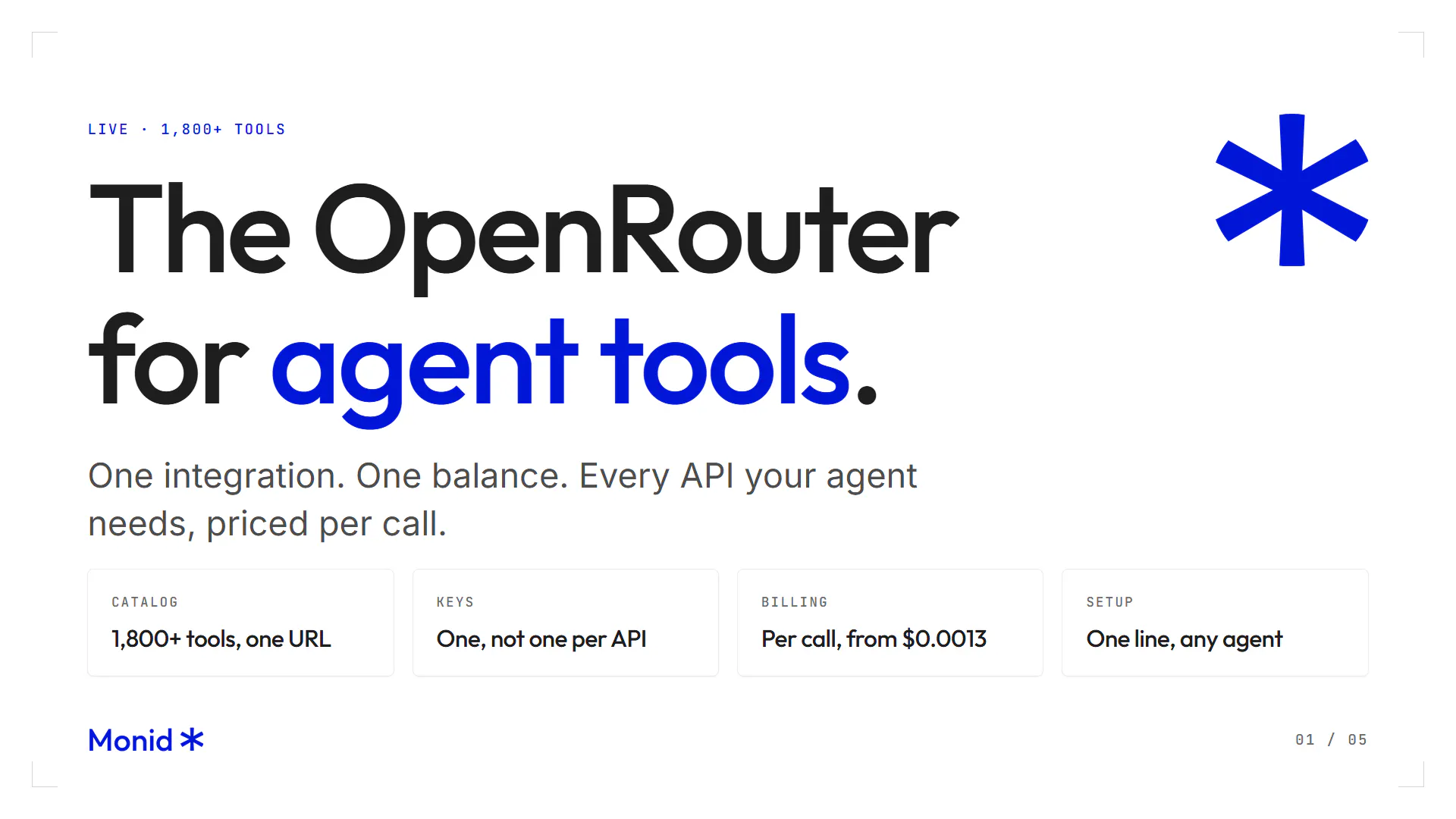
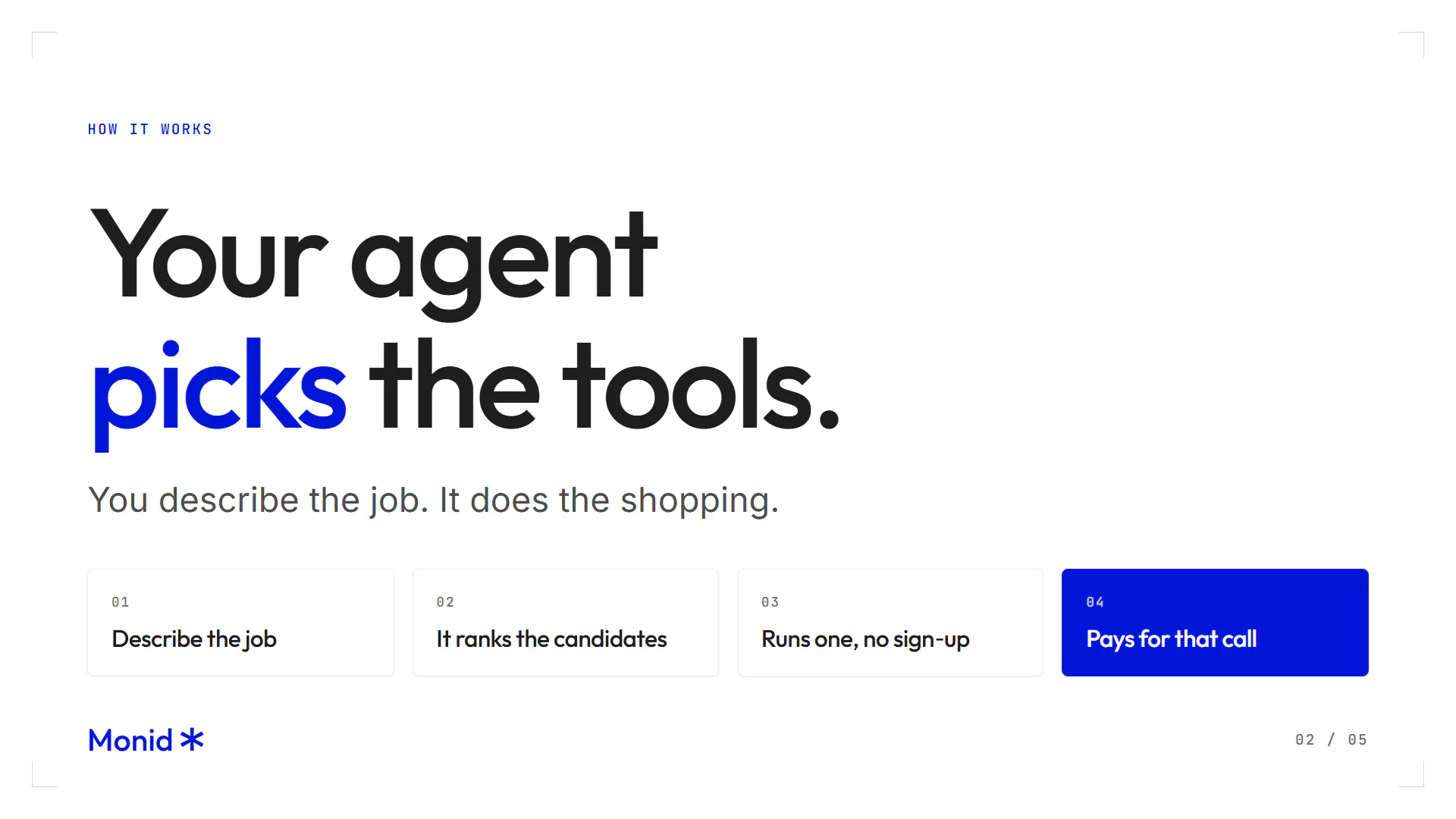
查看原始信息
Porte
Porte is an open-source phone remote control built specifically for Grok Build. Pair your phone with your machine, then read live transcripts, send prompts and files, run slash commands, stop turns, and answer permission requests.

Hey Product Hunters,

I switched to Grok Build as my coding agent and missed one feature: controlling local sessions from my phone.

Le voilà, Porte — French for “door” — an open-source remote control for Grok Build.

How it works:
1. Install the Porte plugin in Grok.
2. Run /remote-control and pair your phone.
3. Start or continue local conversations from your phone.

Porte currently lets you:
- Read transcripts live, including tool calls, diffs, file output, and Grok
responses.
- Send prompts, attach files, run slash commands, and stop a turn.
- Allow or deny permission requests without granting broad approval.
- Open existing conversations or start one in a known local repository.

- View git diff of changes to easily review Grok's work.

Grok and your repository files stay on your machine. Porte preserves Grok’s directory, configuration, sandbox, and permission rules. Porte stores your account, pairing data, and conversation transcripts so your phone can access them.

Last but not least - it's 100% free and open-source.

Try Porte: https://useporte.dev
Source code: https://github.com/alexander-zue...

0
回复